Cambridge A Level Psychology (from 2018) 9990 — 2022 May/June Paper 2 · Variant 2
9990/22/M/J/22 · 10 questions · 60 marks · ≈68 min
The question paper and its mark scheme, free to read here and free to download. This is Cambridge’s own paper, exactly as it was sat.
Question paper12 pages

Mark scheme18 pages
Answers below. Sit the paper first if you are practising.
Questions as text
Q1 · State what is meant by ‘reliability’
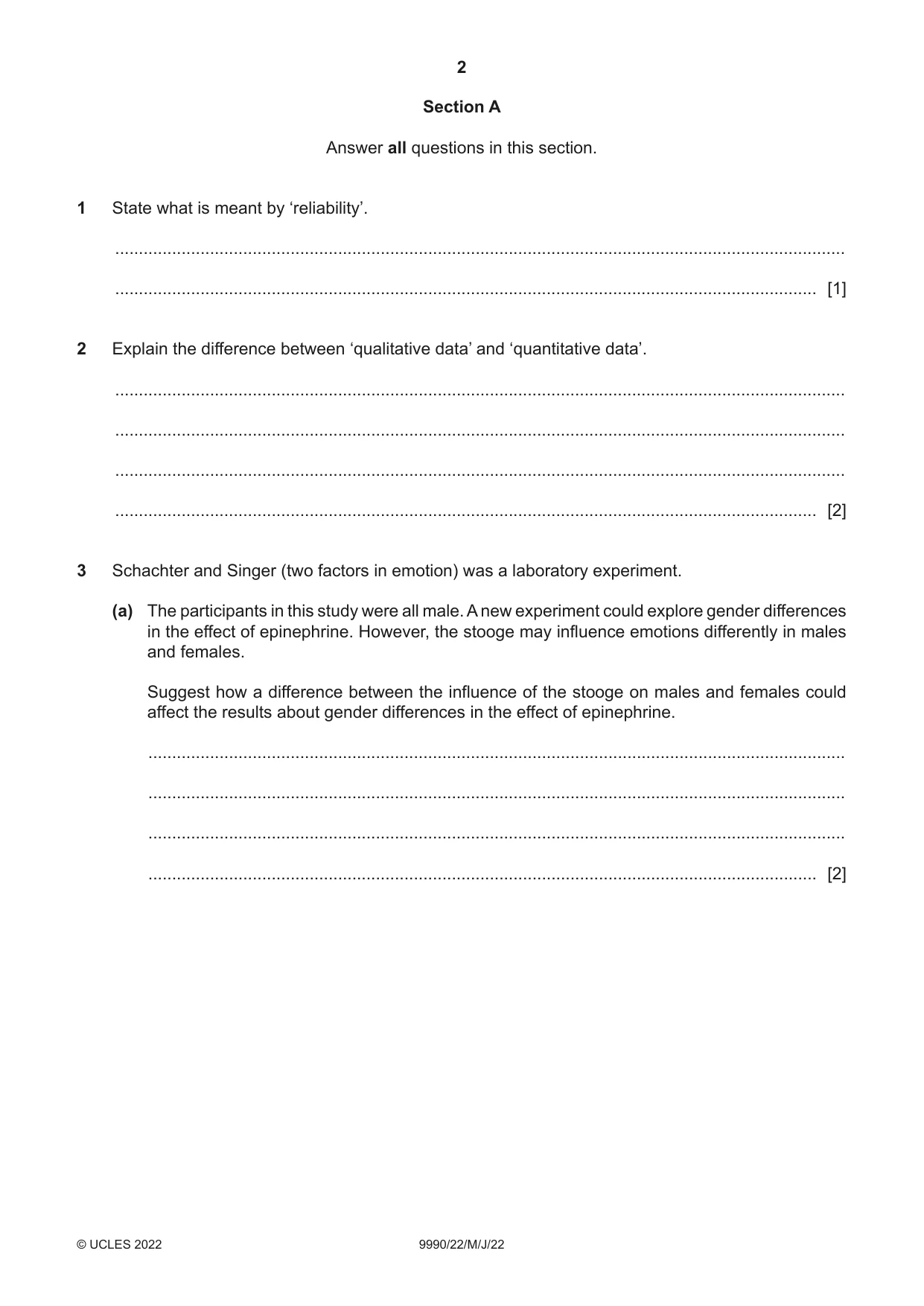
1 State what is meant by ‘reliability’. .......................................................................................................................................................... .................................................................................................................................................... [1]
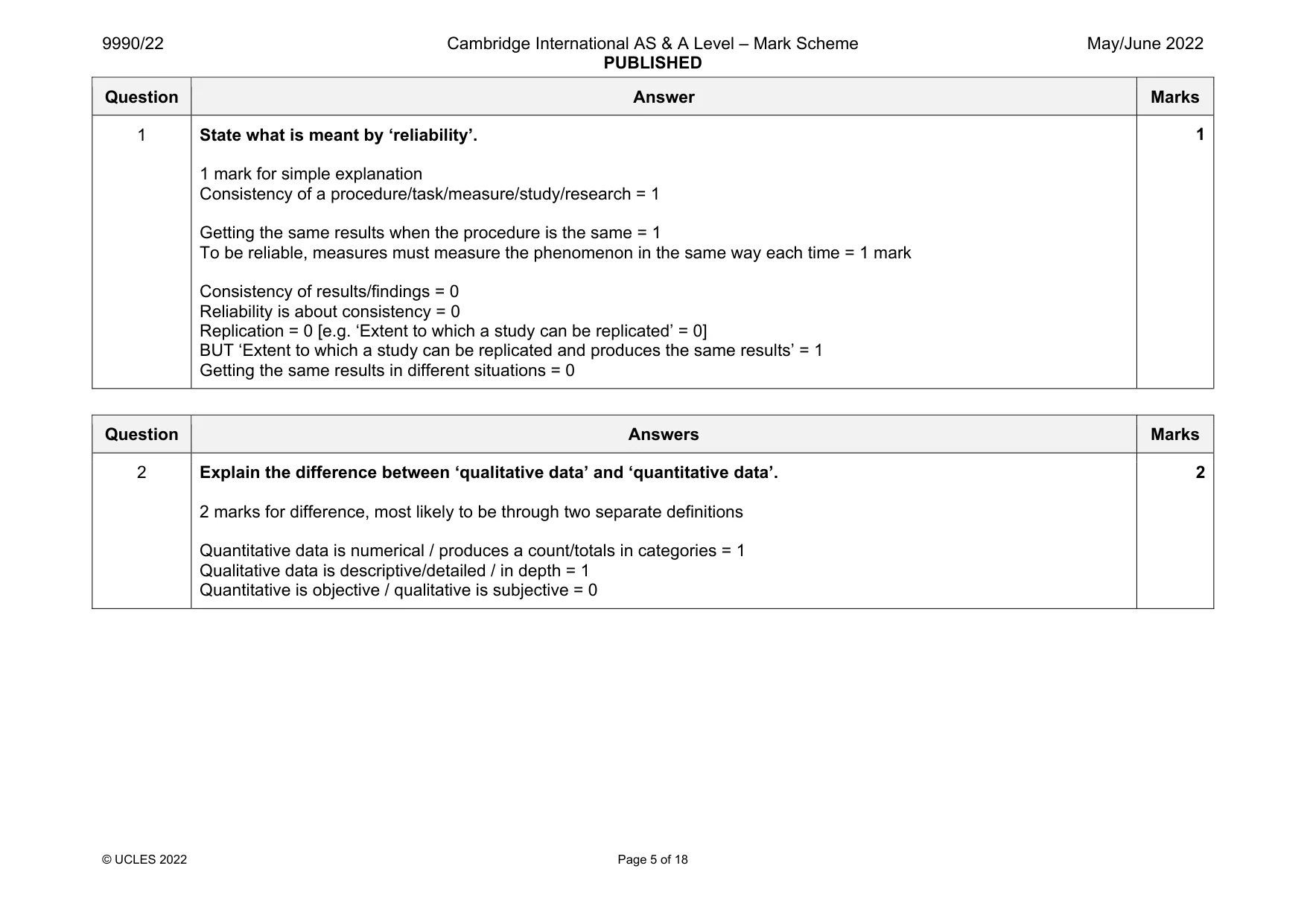
Mark scheme: 1 State what is meant by ‘reliability’. 1 mark for simple explanation Consistency of a procedure/task/measure/study/research = 1 Getting the same results when the procedure is the same = 1 To be reliable, measures must measure the phenomenon in the same way each time = 1 mark Consistency of results/findings = 0 Reliability is about consistency = 0 Replication = 0 [e.g. ‘Extent to which a study can be replicated’ = 0] BUT ‘Extent to which a study can be replicated and produces the same results’ = 1 Getting the same results in different situations = 0
Q2 · Explain the difference between ‘qualitative data’ and ‘quantitative data’
2 Explain the difference between ‘qualitative data’ and ‘quantitative data’. .......................................................................................................................................................... .......................................................................................................................................................... .......................................................................................................................................................... .................................................................................................................................................... [2]
Mark scheme: 2 Explain the difference between ‘qualitative data’ and ‘quantitative data’. 2 marks for difference, most likely to be through two separate definitions Quantitative data is numerical / produces a count/totals in categories = 1 Qualitative data is descriptive/detailed / in depth = 1 Quantitative is objective / qualitative is subjective = 0
Q3 · Schachter and Singer (two factors in emotion) was a laboratory experiment
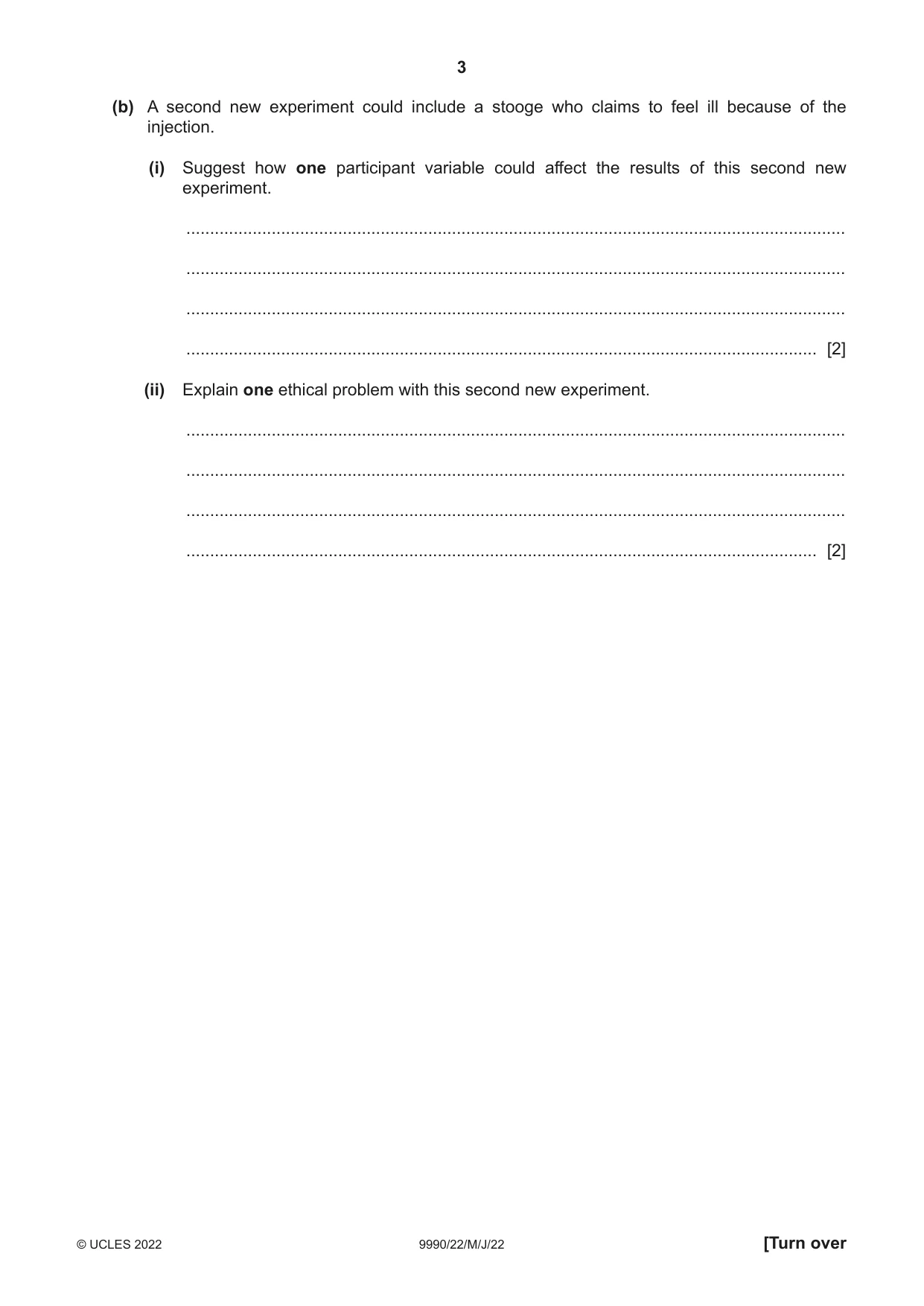
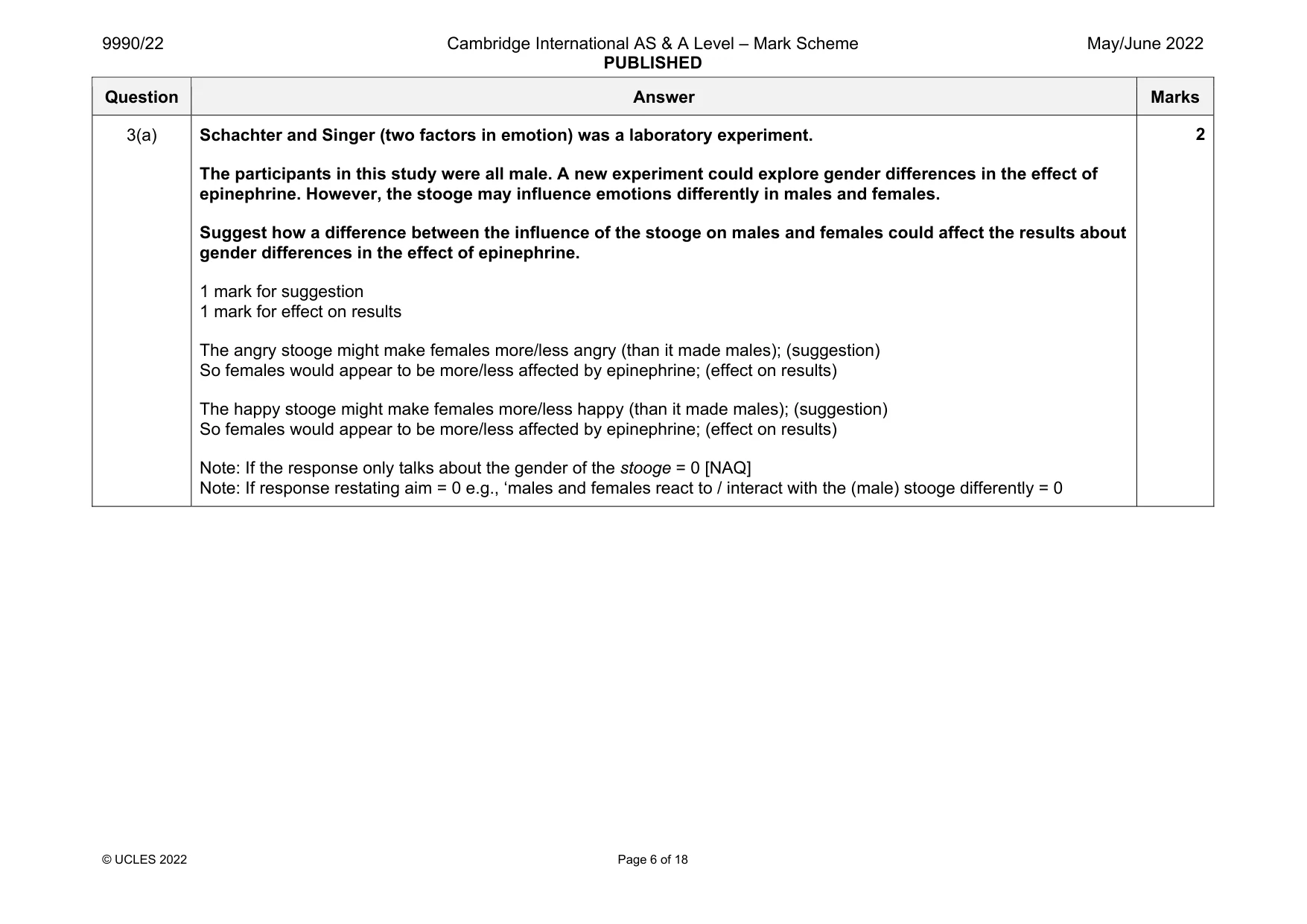
3 Schachter and Singer (two factors in emotion) was a laboratory experiment. (a) The participants in this study were all male. A new experiment could explore gender differences in the effect of epinephrine. However, the stooge may influence emotions differently in males and females. Suggest how a difference between the influence of the stooge on males and females could affect the results about gender differences in the effect of epinephrine. ................................................................................................................................................... ................................................................................................................................................... ................................................................................................................................................... ............................................................................................................................................. [2] (b) A second new experiment could include a stooge who claims to feel ill because of the injection. (i) Suggest how one participant variable could affect the results of this second new experiment. ........................................................................................................................................... ........................................................................................................................................... ........................................................................................................................................... ..................................................................................................................................... [2] (ii) Explain one ethical problem with this second new experiment. ........................................................................................................................................... ........................................................................................................................................... ........................................................................................................................................... ..................................................................................................................................... [2]
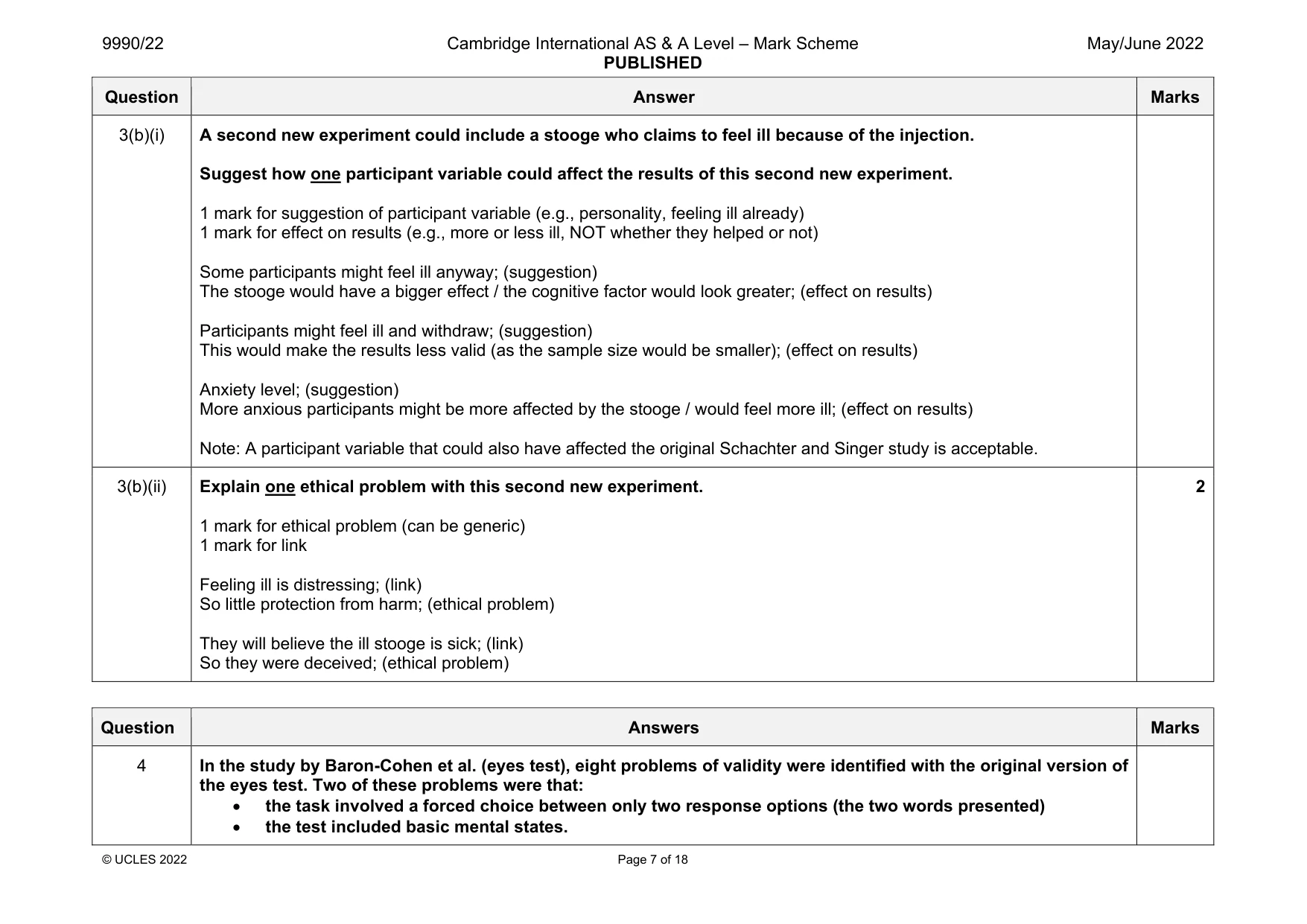
Mark scheme: 3(a) Schachter and Singer (two factors in emotion) was a laboratory experiment. The participants in this study were all male. A new experiment could explore gender differences in the effect of epinephrine. However, the stooge may influence emotions differently in males and females. Suggest how a difference between the influence of the stooge on males and females could affect the results about gender differences in the effect of epinephrine. 1 mark for suggestion 1 mark for effect on results The angry stooge might make females more/less angry (than it made males); (suggestion) So females would appear to be more/less affected by epinephrine; (effect on results) The happy stooge might make females more/less happy (than it made males); (suggestion) So females would appear to be more/less affected by epinephrine; (effect on results) Note: If the response only talks about the gender of the stooge = 0 [NAQ] Note: If response restating aim = 0 e.g., ‘males and females react to / interact with the (male) stooge differently = 0 Question Answer Marks 3(b)(i) A second new experiment could include a stooge who claims to feel ill because of the injection. Suggest how one participant variable could affect the results of this second new experiment. 1 mark for suggestion of participant variable (e.g., personality, feeling ill already) 1 mark for effect on results (e.g., more or less ill, NOT whether they helped or not) Some participants might feel ill anyway; (suggestion) The stooge would have a bigger effect / the cognitive factor would look greater; (effect on results) Participants might feel ill and withdraw; (suggestion) This would make the results less valid (as the sample size would be smaller); (effect on results) Anxiety level; (suggestion) More anxious participants might be more affected by the stooge / would feel more ill; (effect on results) Note: A participant variable that could also have affected the original Schachter and Singer study is acceptable. 3(b)(ii) Explain one ethical problem with this second new experiment. 1 mark for ethical problem (can be generic) 1 mark for link Feeling ill is distressing; (link) So little protection from harm; (ethical problem) They will believe the ill stooge is sick; (link) So they were deceived; (ethical problem) 2
Q4 · In the study by Baron-Cohen et al
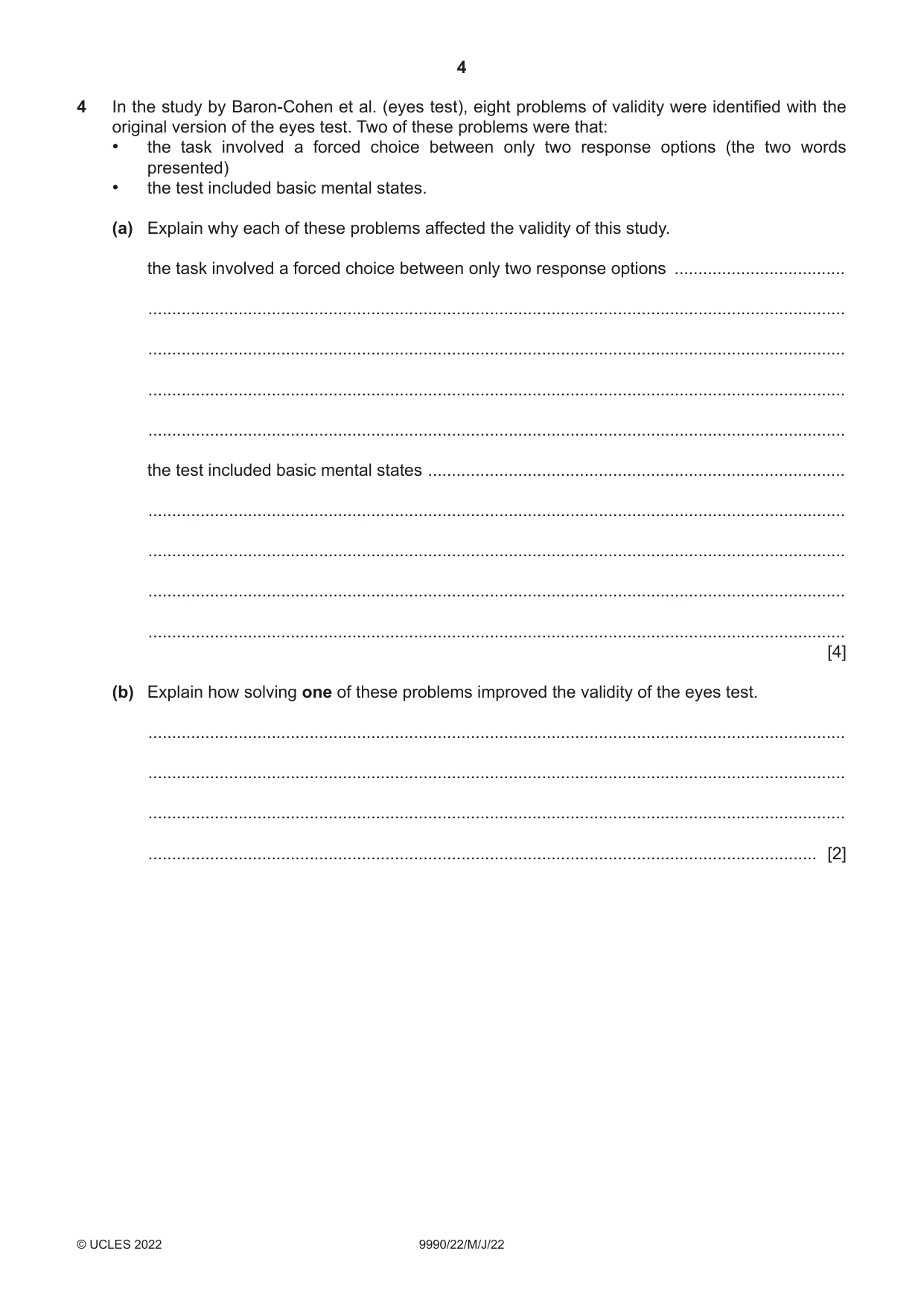
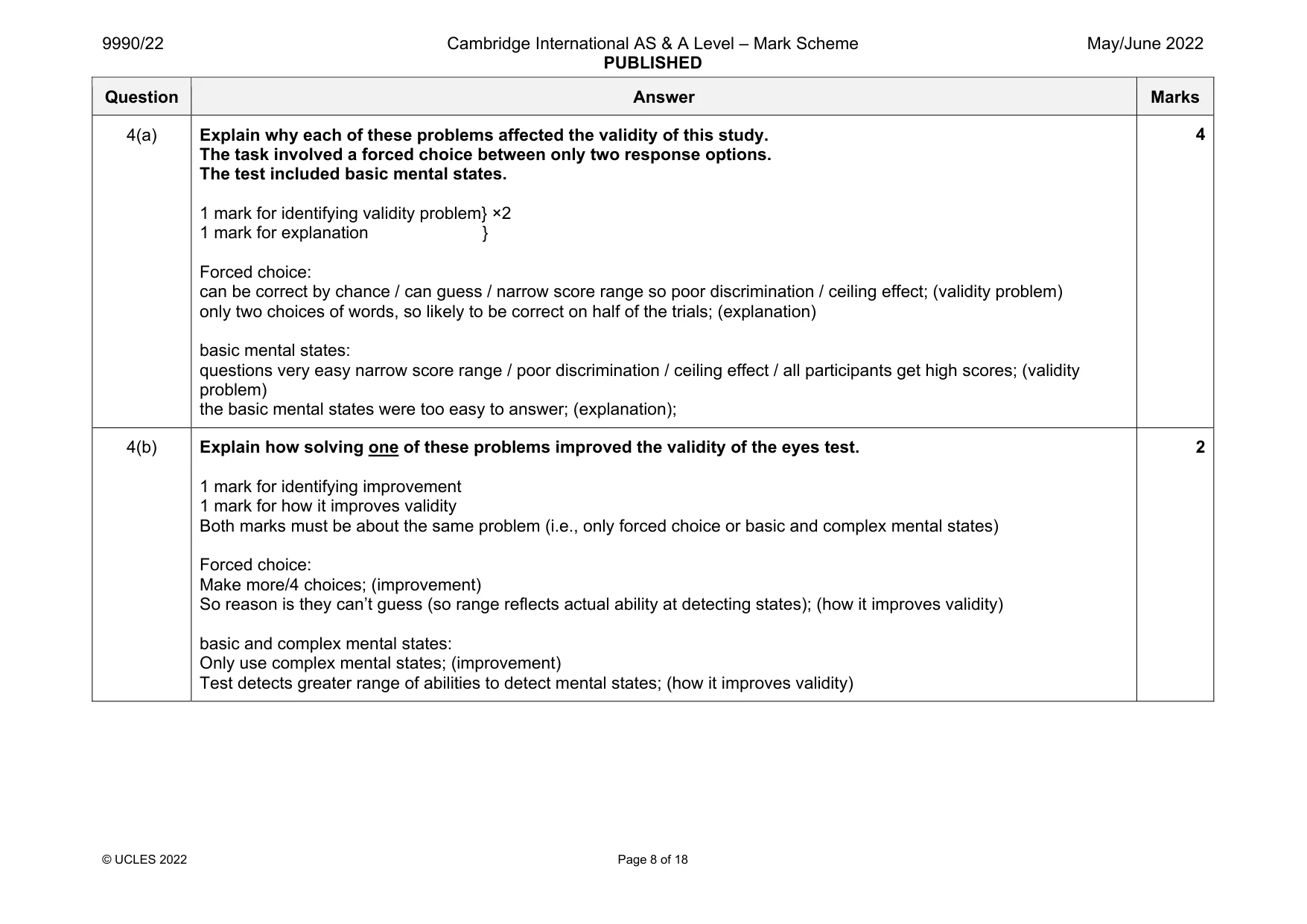
4 In the study by Baron-Cohen et al. (eyes test), eight problems of validity were identified with the original version of the eyes test. Two of these problems were that: • the task involved a forced choice between only two response options (the two words presented) • the test included basic mental states. (a) Explain why each of these problems affected the validity of this study. the task involved a forced choice between only two response options .................................... ................................................................................................................................................... ................................................................................................................................................... ................................................................................................................................................... ................................................................................................................................................... the test included basic mental states ........................................................................................ ................................................................................................................................................... ................................................................................................................................................... ................................................................................................................................................... ................................................................................................................................................... [4] (b) Explain how solving one of these problems improved the validity of the eyes test. ................................................................................................................................................... ................................................................................................................................................... ................................................................................................................................................... ............................................................................................................................................. [2]
Mark scheme: 4 In the study by Baron-Cohen et al. (eyes test), eight problems of validity were identified with the original version of the eyes test. Two of these problems were that: the task involved a forced choice between only two response options (the two words presented) the test included basic mental states. Question Answer Marks 4(a) Explain why each of these problems affected the validity of this study. The task involved a forced choice between only two response options. The test included basic mental states. 1 mark for identifying validity problem} ×2 1 mark for explanation } Forced choice: can be correct by chance / can guess / narrow score range so poor discrimination / ceiling effect; (validity problem) only two choices of words, so likely to be correct on half of the trials; (explanation) basic mental states: questions very easy narrow score range / poor discrimination / ceiling effect / all participants get high scores; (validity problem) the basic mental states were too easy to answer; (explanation); 4 4(b) Explain how solving one of these problems improved the validity of the eyes test. 1 mark for identifying improvement 1 mark for how it improves validity Both marks must be about the same problem (i.e., only forced choice or basic and complex mental states) Forced choice: Make more/4 choices; (improvement) So reason is they can’t guess (so range reflects actual ability at detecting states); (how it improves validity) basic and complex mental states: Only use complex mental states; (improvement) Test detects greater range of abilities to detect mental states; (how it improves validity) 2
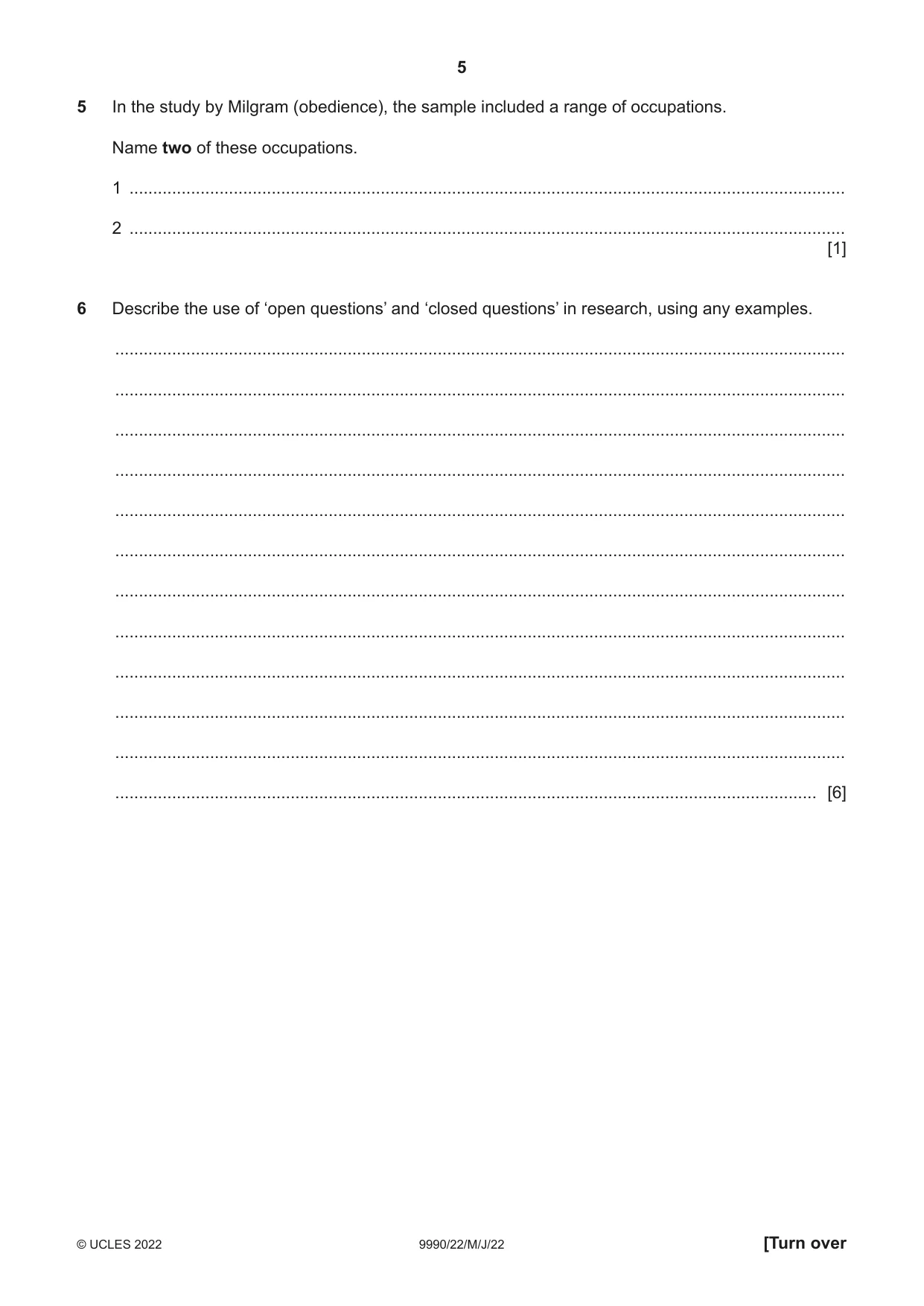
Q5 · In the study by Milgram (obedience), the sample included a range of occupations
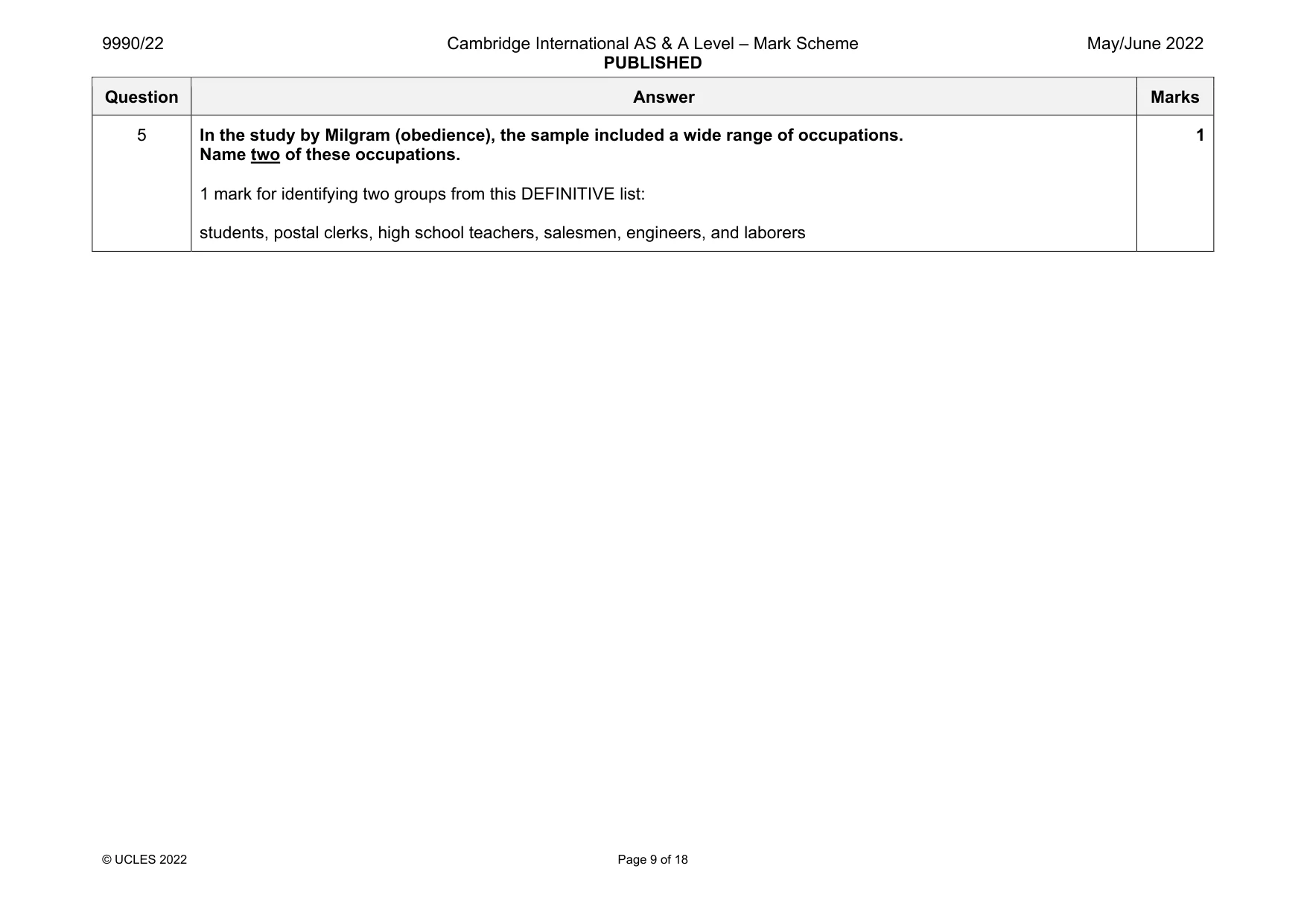
5 In the study by Milgram (obedience), the sample included a range of occupations. Name two of these occupations. 1 ....................................................................................................................................................... 2 ....................................................................................................................................................... [1]
Mark scheme: 5 In the study by Milgram (obedience), the sample included a wide range of occupations. Name two of these occupations. 1 mark for identifying two groups from this DEFINITIVE list: students, postal clerks, high school teachers, salesmen, engineers, and laborers 1
Q6 · Describe the use of ‘open questions’ and ‘closed questions’ in research, using any…
6 Describe the use of ‘open questions’ and ‘closed questions’ in research, using any examples. .......................................................................................................................................................... .......................................................................................................................................................... .......................................................................................................................................................... .......................................................................................................................................................... .......................................................................................................................................................... .......................................................................................................................................................... .......................................................................................................................................................... .......................................................................................................................................................... .......................................................................................................................................................... .......................................................................................................................................................... .......................................................................................................................................................... .................................................................................................................................................... [6]
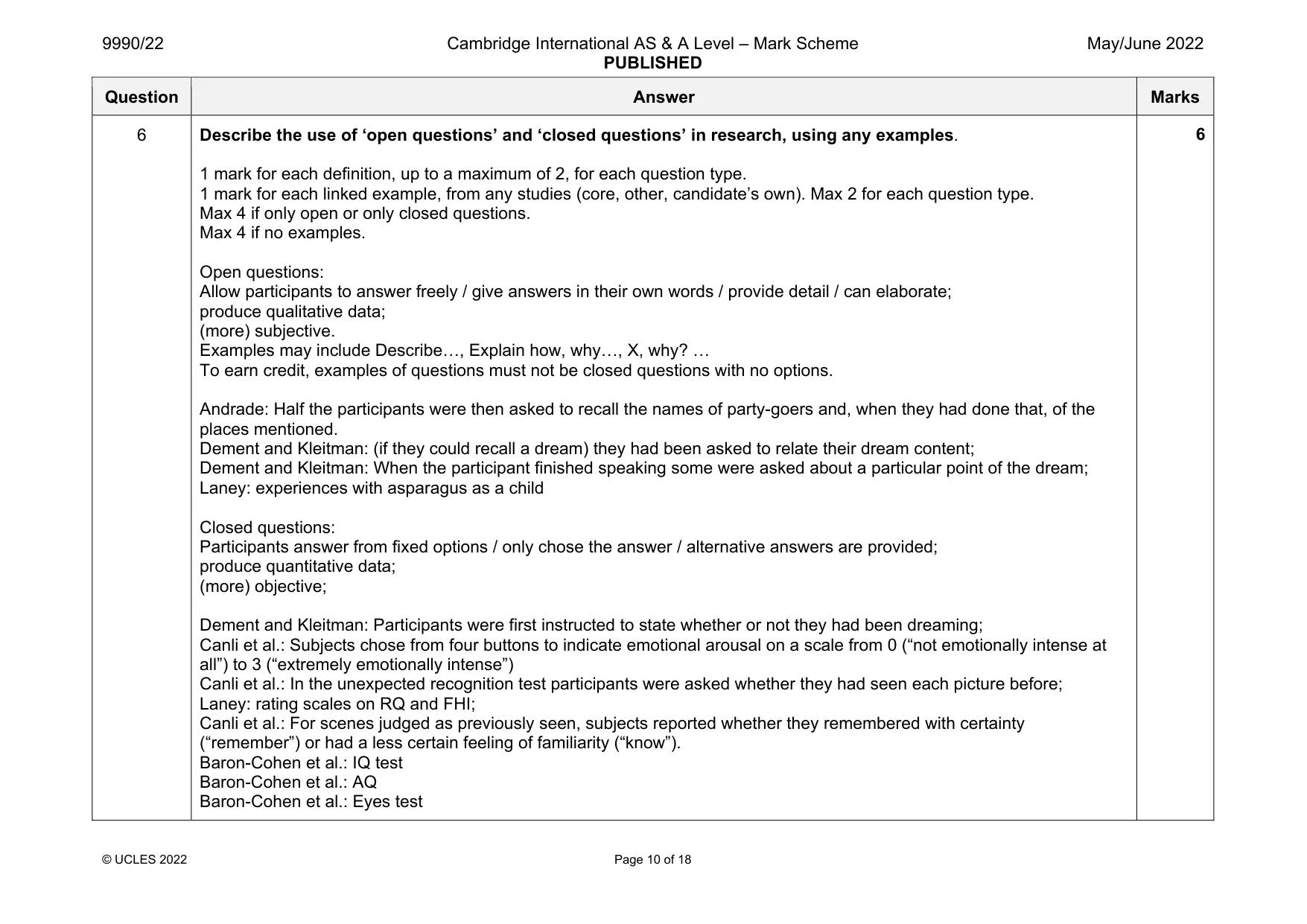
Mark scheme: 6 Describe the use of ‘open questions’ and ‘closed questions’ in research, using any examples. 1 mark for each definition, up to a maximum of 2, for each question type. 1 mark for each linked example, from any studies (core, other, candidate’s own). Max 2 for each question type. Max 4 if only open or only closed questions. Max 4 if no examples. Open questions: Allow participants to answer freely / give answers in their own words / provide detail / can elaborate; produce qualitative data; (more) subjective. Examples may include Describe…, Explain how, why…, X, why? … To earn credit, examples of questions must not be closed questions with no options. Andrade: Half the participants were then asked to recall the names of party-goers and, when they had done that, of the places mentioned. Dement and Kleitman: (if they could recall a dream) they had been asked to relate their dream content; Dement and Kleitman: When the participant finished speaking some were asked about a particular point of the dream; Laney: experiences with asparagus as a child Closed questions: Participants answer from fixed options / only chose the answer / alternative answers are provided; produce quantitative data; (more) objective; Dement and Kleitman: Participants were first instructed to state whether or not they had been dreaming; Canli et al.: Subjects chose from four buttons to indicate emotional arousal on a scale from 0 (“not emotionally intense at all”) to 3 (“extremely emotionally intense”) Canli et al.: In the unexpected recognition test participants were asked whether they had seen each picture before; Laney: rating scales on RQ and FHI; Canli et al.: For scenes judged as previously seen, subjects reported whether they remembered with certainty (“remember”) or had a less certain feeling of familiarity (“know”). Baron-Cohen et al.: IQ test Baron-Cohen et al.: AQ Baron-Cohen et al.: Eyes test
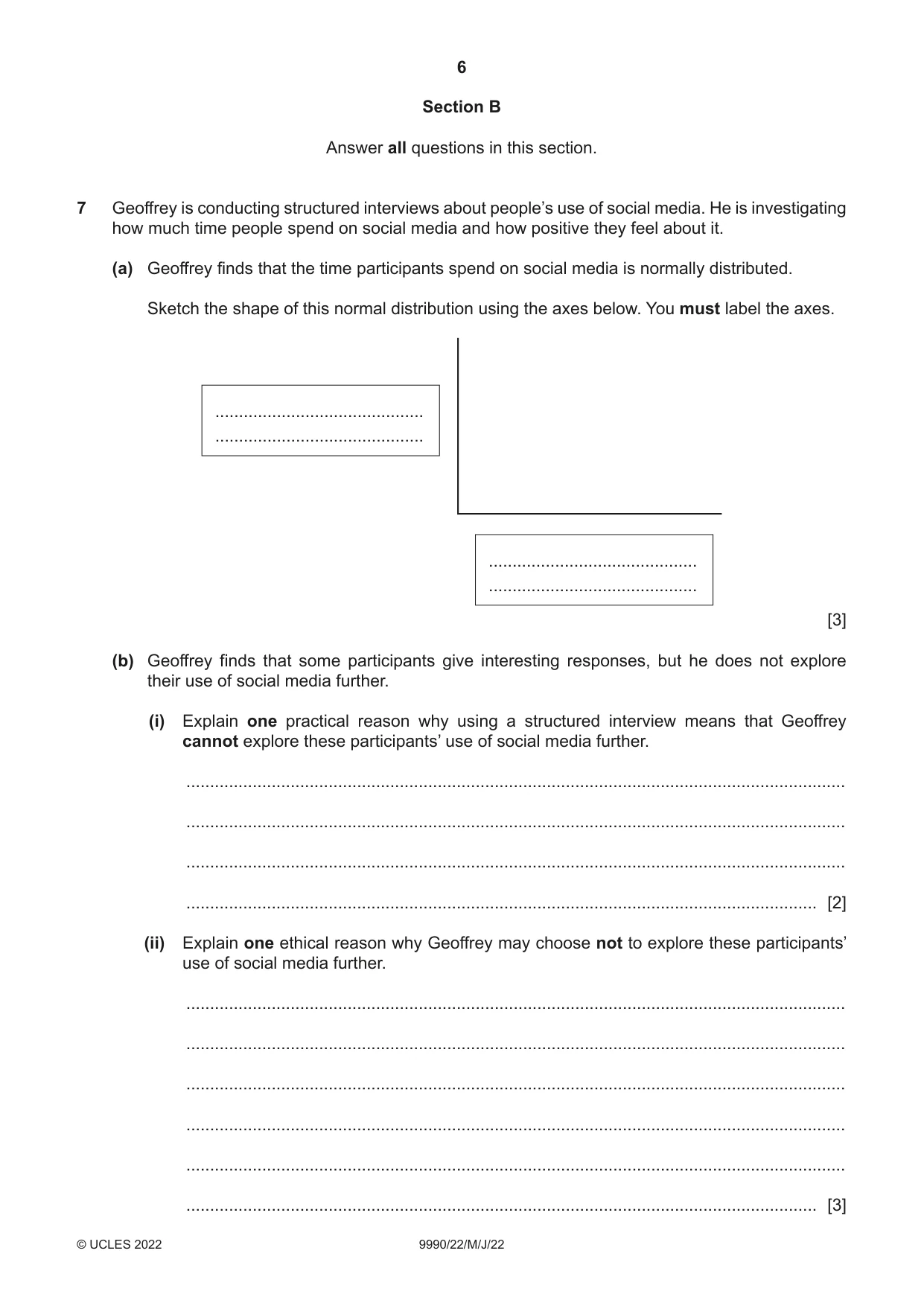
Q7 · Geoffrey is conducting structured interviews about people’s use of social media
7 Geoffrey is conducting structured interviews about people’s use of social media. He is investigating how much time people spend on social media and how positive they feel about it. (a) Geoffrey finds that the time participants spend on social media is normally distributed. Sketch the shape of this normal distribution using the axes below. You must label the axes. ............................................ ............................................ ............................................ ............................................ [3] (b) Geoffrey finds that some participants give interesting responses, but he does not explore their use of social media further. (i) Explain one practical reason why using a structured interview means that Geoffrey cannot explore these participants’ use of social media further. ........................................................................................................................................... ........................................................................................................................................... ........................................................................................................................................... ..................................................................................................................................... [2] (ii) Explain one ethical reason why Geoffrey may choose not to explore these participants’ use of social media further. ........................................................................................................................................... ........................................................................................................................................... ........................................................................................................................................... ........................................................................................................................................... ........................................................................................................................................... ..................................................................................................................................... [3] Question 8 appears on the next page.
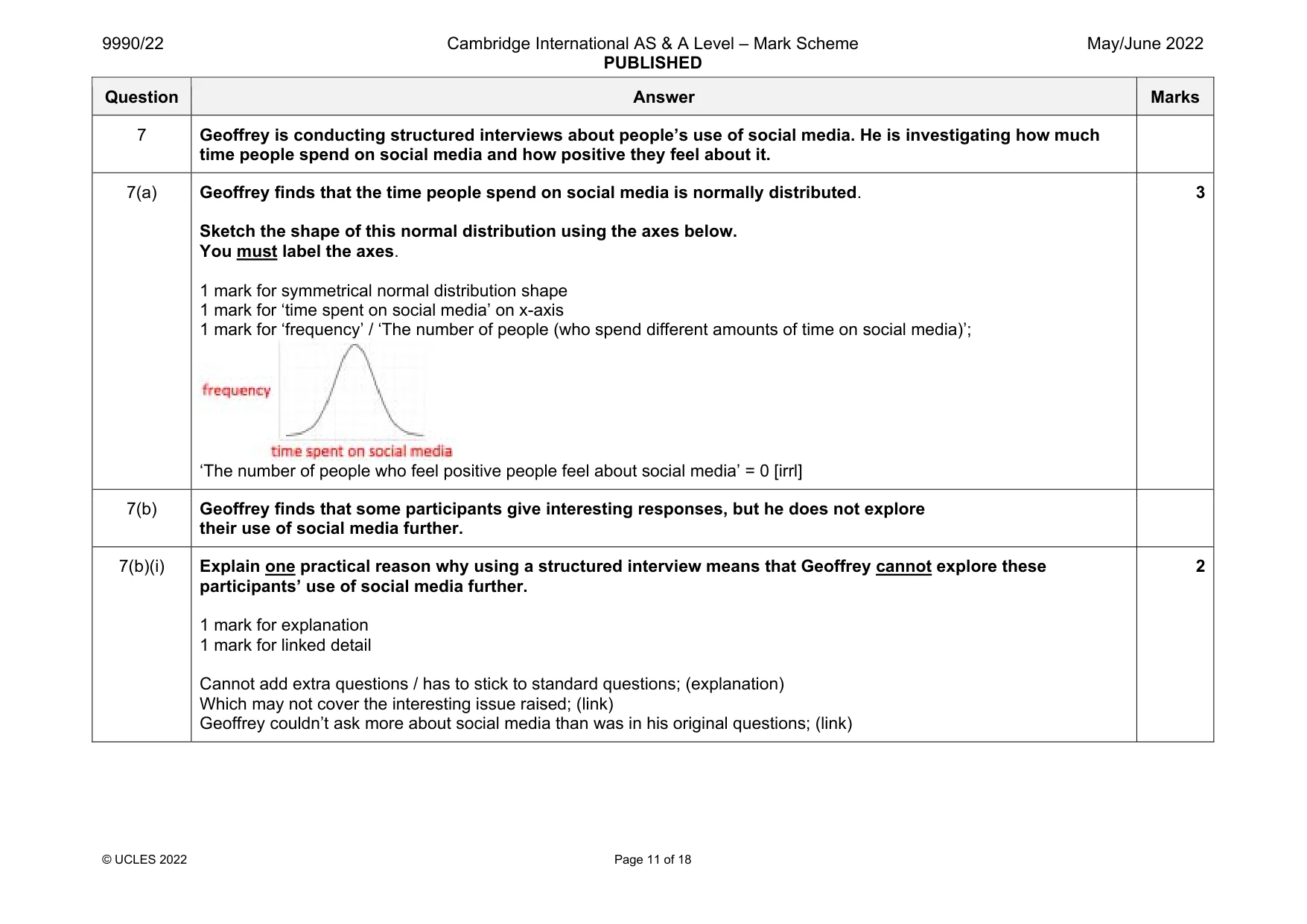
Mark scheme: 7 Geoffrey is conducting structured interviews about people’s use of social media. He is investigating how much time people spend on social media and how positive they feel about it. 7(a) Geoffrey finds that the time people spend on social media is normally distributed. Sketch the shape of this normal distribution using the axes below. You must label the axes. 1 mark for symmetrical normal distribution shape 1 mark for ‘time spent on social media’ on x-axis 1 mark for ‘frequency’ / ‘The number of people (who spend different amounts of time on social media)’; ‘The number of people who feel positive people feel about social media’ = 0 [irrl] 3 7(b) Geoffrey finds that some participants give interesting responses, but he does not explore their use of social media further. 7(b)(i) Explain one practical reason why using a structured interview means that Geoffrey cannot explore these participants’ use of social media further. 1 mark for explanation 1 mark for linked detail Cannot add extra questions / has to stick to standard questions; (explanation) Which may not cover the interesting issue raised; (link) Geoffrey couldn’t ask more about social media than was in his original questions; (link) 2 Question Answer Marks 7(b)(ii) Explain one ethical reason why Geoffrey may choose not to explore these participants’ use of social media further. 1 mark for ethical explanation 1 mark for detail 1 mark for link Protection from harm; (explanation) might feel uncomfortable answering questions; (detail) privacy; (explanation) may not want to answer questions about personal lives; (detail) people might be using social media for reasons they don’t want to explain; (link/detail) they may be embarrassed / they may be telling lies on social media/the posts may be illegal; (link/detail) 3
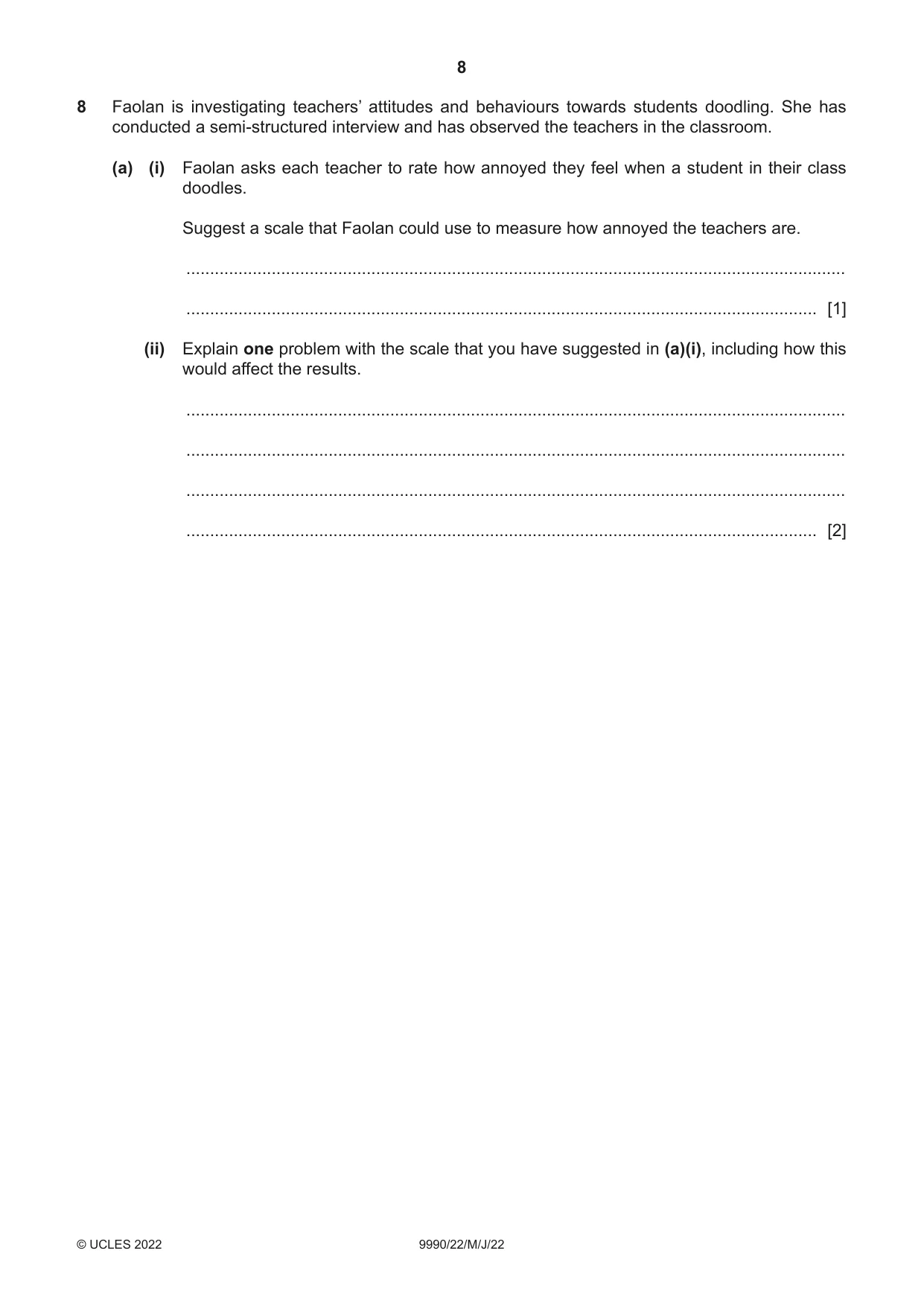
Q8 · Faolan is investigating teachers’ attitudes and behaviours towards students doodling
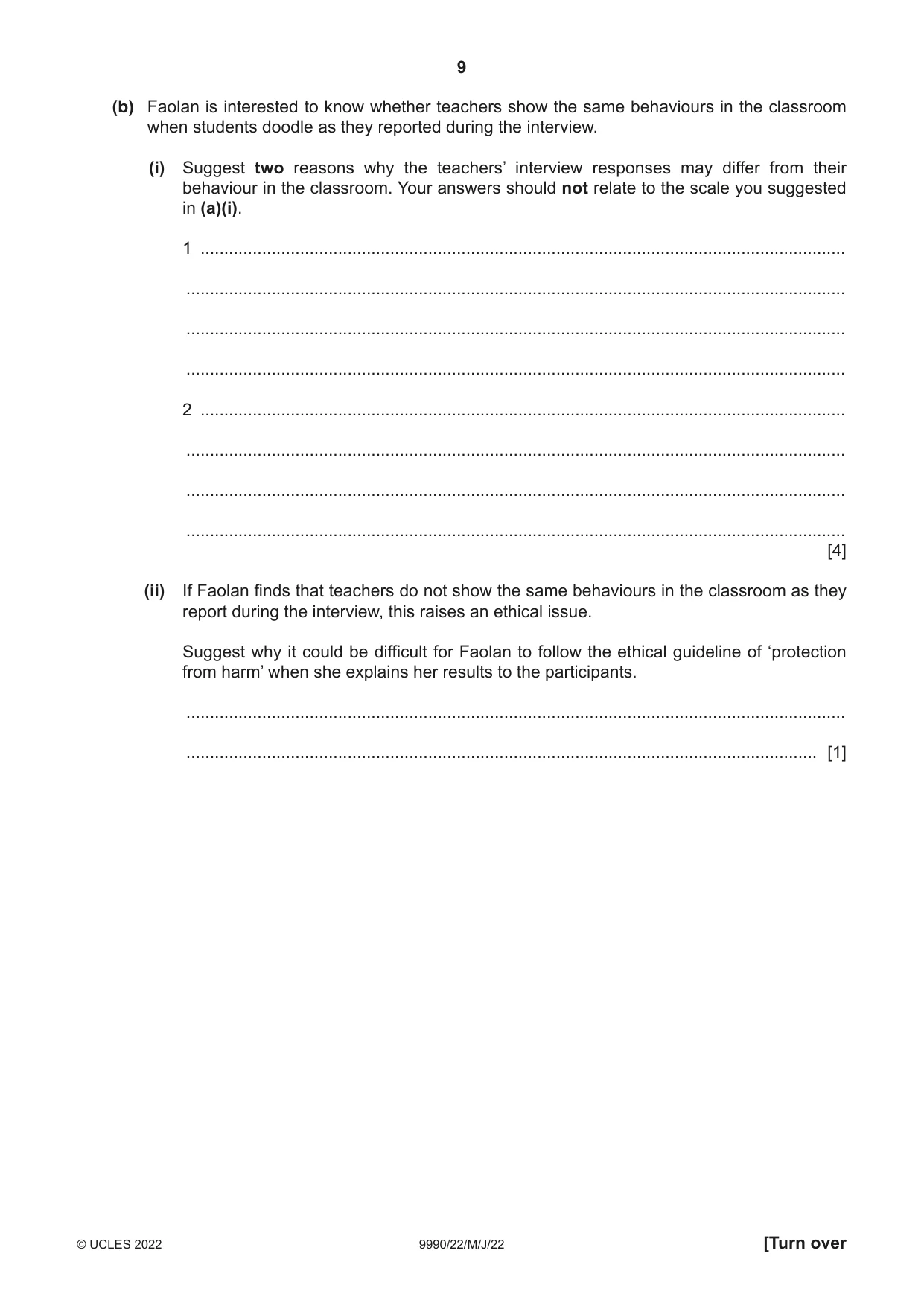
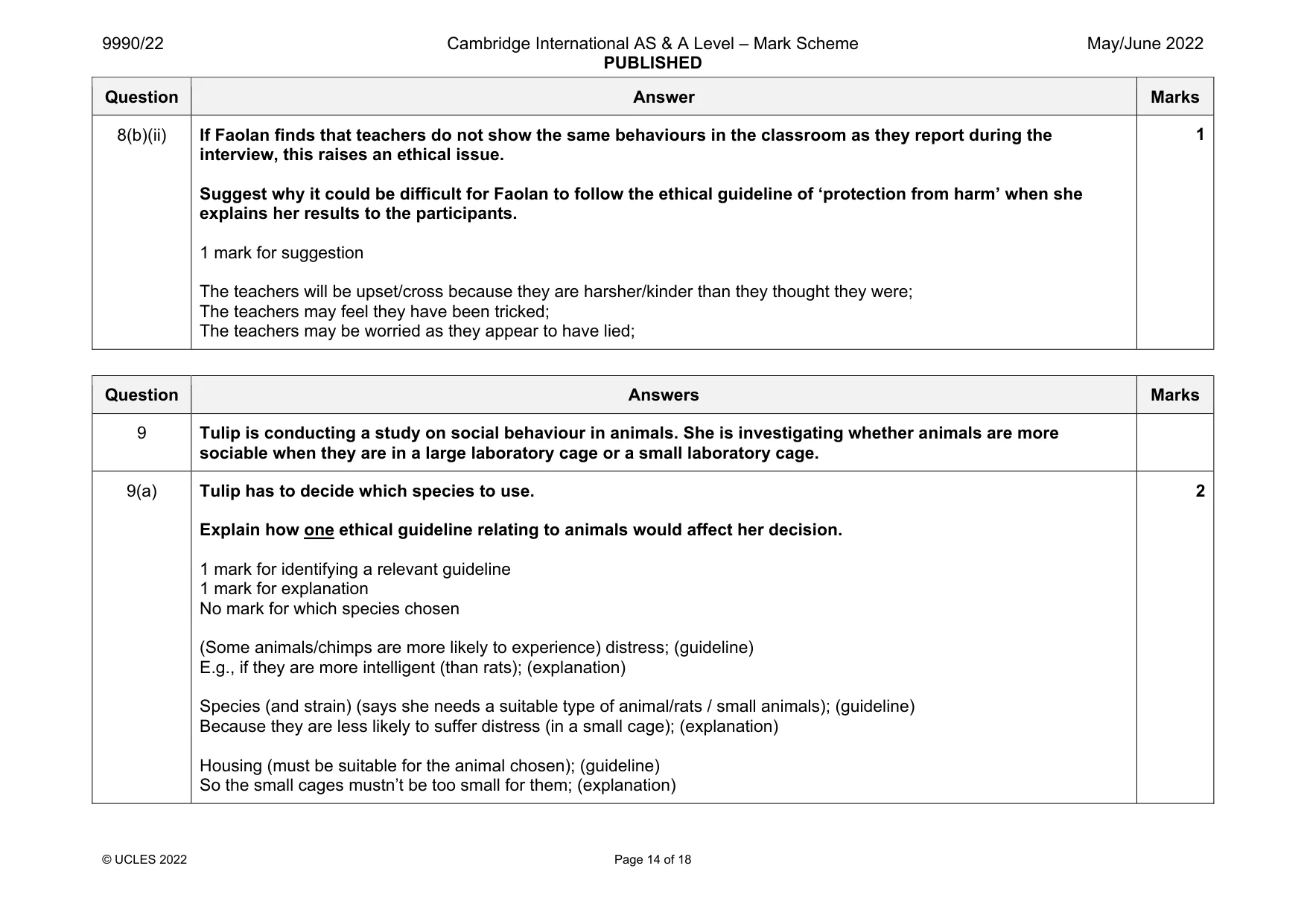
8 Faolan is investigating teachers’ attitudes and behaviours towards students doodling. She has conducted a semi-structured interview and has observed the teachers in the classroom. (a) (i) Faolan asks each teacher to rate how annoyed they feel when a student in their class doodles. Suggest a scale that Faolan could use to measure how annoyed the teachers are. ........................................................................................................................................... ..................................................................................................................................... [1] (ii) Explain one problem with the scale that you have suggested in (a)(i), including how this would affect the results. ........................................................................................................................................... ........................................................................................................................................... ........................................................................................................................................... ..................................................................................................................................... [2] (b) Faolan is interested to know whether teachers show the same behaviours in the classroom when students doodle as they reported during the interview. (i) Suggest two reasons why the teachers’ interview responses may differ from their behaviour in the classroom. Your answers should not relate to the scale you suggested in (a)(i). 1 ........................................................................................................................................ ........................................................................................................................................... ........................................................................................................................................... ........................................................................................................................................... 2 ........................................................................................................................................ ........................................................................................................................................... ........................................................................................................................................... ........................................................................................................................................... [4] (ii) If Faolan finds that teachers do not show the same behaviours in the classroom as they report during the interview, this raises an ethical issue. Suggest why it could be difficult for Faolan to follow the ethical guideline of ‘protection from harm’ when she explains her results to the participants. ........................................................................................................................................... ..................................................................................................................................... [1]
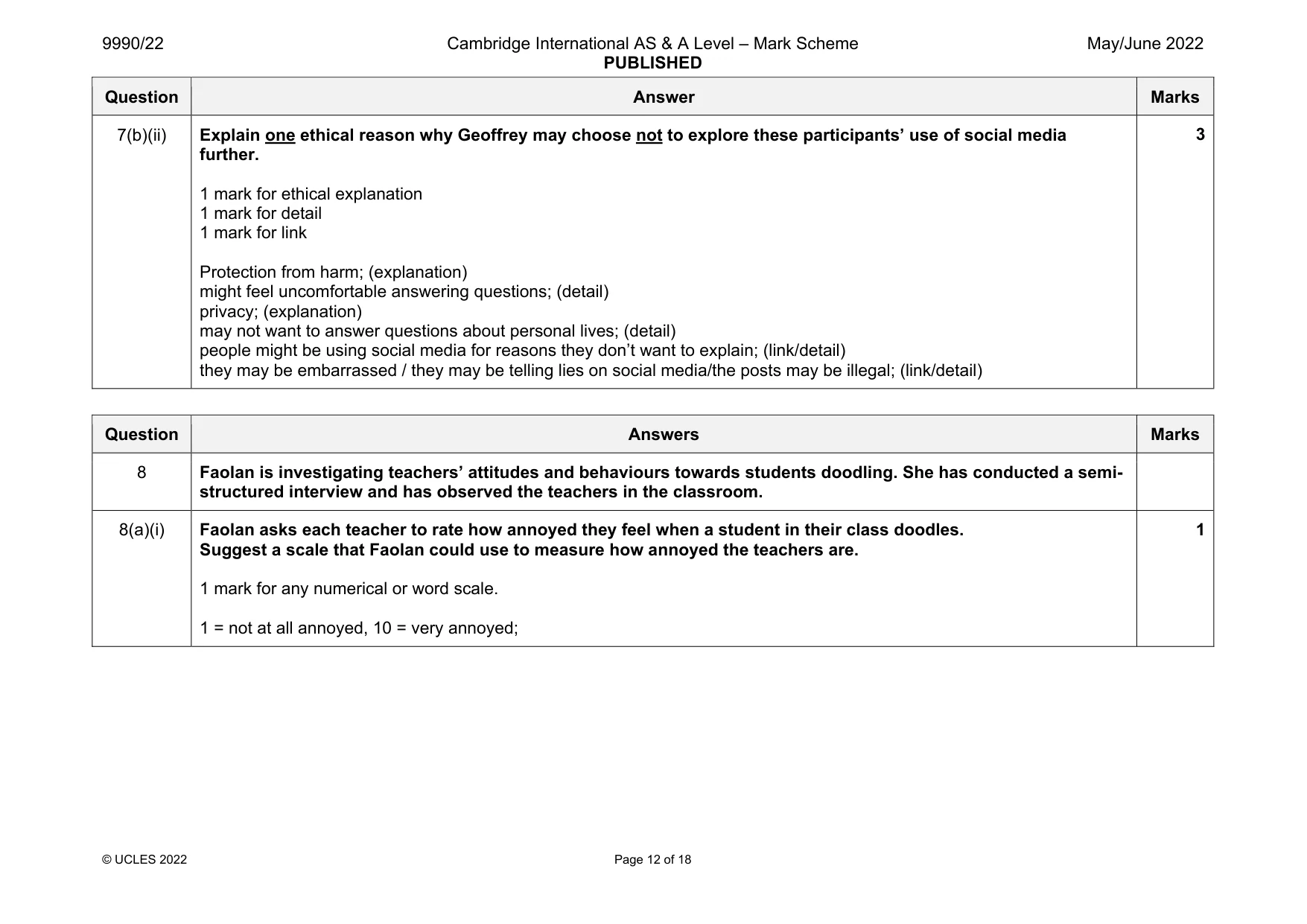
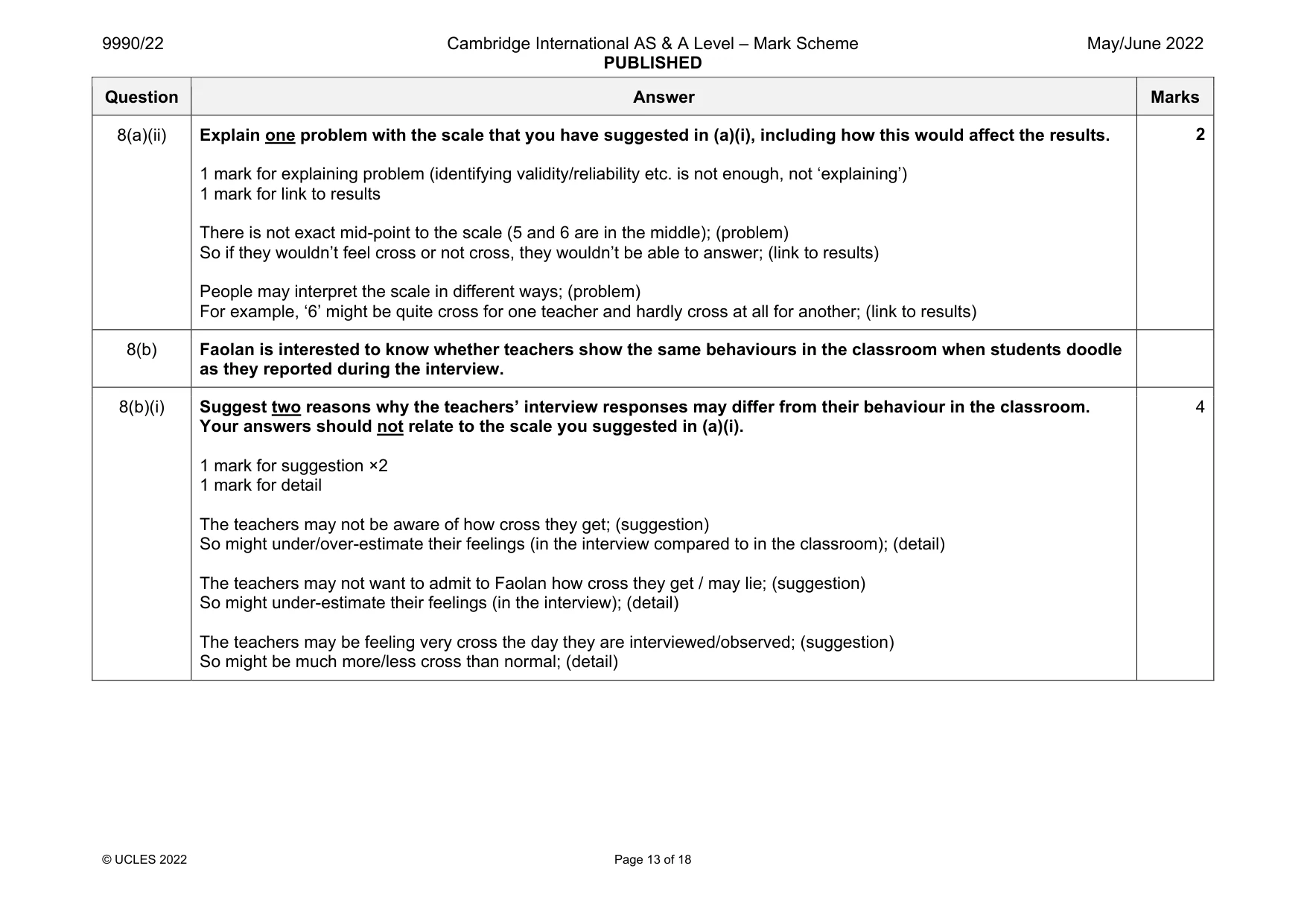
Mark scheme: 8 Faolan is investigating teachers’ attitudes and behaviours towards students doodling. She has conducted a semi- structured interview and has observed the teachers in the classroom. 8(a)(i) Faolan asks each teacher to rate how annoyed they feel when a student in their class doodles. Suggest a scale that Faolan could use to measure how annoyed the teachers are. 1 mark for any numerical or word scale. 1 = not at all annoyed, 10 = very annoyed; 1 Question Answer Marks 8(a)(ii) Explain one problem with the scale that you have suggested in (a)(i), including how this would affect the results. 1 mark for explaining problem (identifying validity/reliability etc. is not enough, not ‘explaining’) 1 mark for link to results There is not exact mid-point to the scale (5 and 6 are in the middle); (problem) So if they wouldn’t feel cross or not cross, they wouldn’t be able to answer; (link to results) People may interpret the scale in different ways; (problem) For example, ‘6’ might be quite cross for one teacher and hardly cross at all for another; (link to results) 2 8(b) Faolan is interested to know whether teachers show the same behaviours in the classroom when students doodle as they reported during the interview. 8(b)(i) Suggest two reasons why the teachers’ interview responses may differ from their behaviour in the classroom. Your answers should not relate to the scale you suggested in (a)(i). 1 mark for suggestion ×2 1 mark for detail The teachers may not be aware of how cross they get; (suggestion) So might under/over-estimate their feelings (in the interview compared to in the classroom); (detail) The teachers may not want to admit to Faolan how cross they get / may lie; (suggestion) So might under-estimate their feelings (in the interview); (detail) The teachers may be feeling very cross the day they are interviewed/observed; (suggestion) So might be much more/less cross than normal; (detail) 4 Question Answer Marks 8(b)(ii) If Faolan finds that teachers do not show the same behaviours in the classroom as they report during the interview, this raises an ethical issue. Suggest why it could be difficult for Faolan to follow the ethical guideline of ‘protection from harm’ when she explains her results to the participants. 1 mark for suggestion The teachers will be upset/cross because they are harsher/kinder than they thought they were; The teachers may feel they have been tricked; The teachers may be worried as they appear to have lied; 1
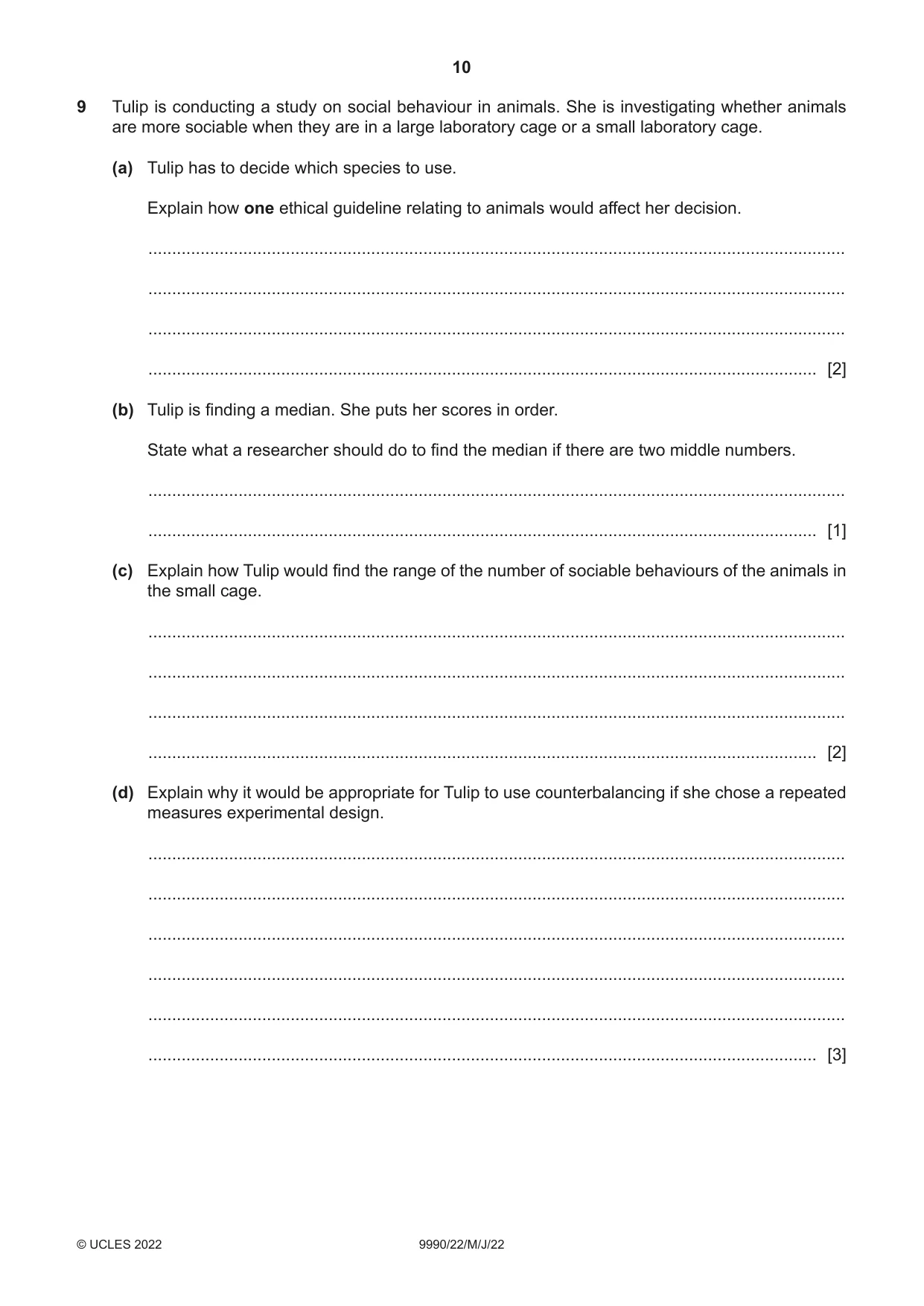
Q9 · Tulip is conducting a study on social behaviour in animals
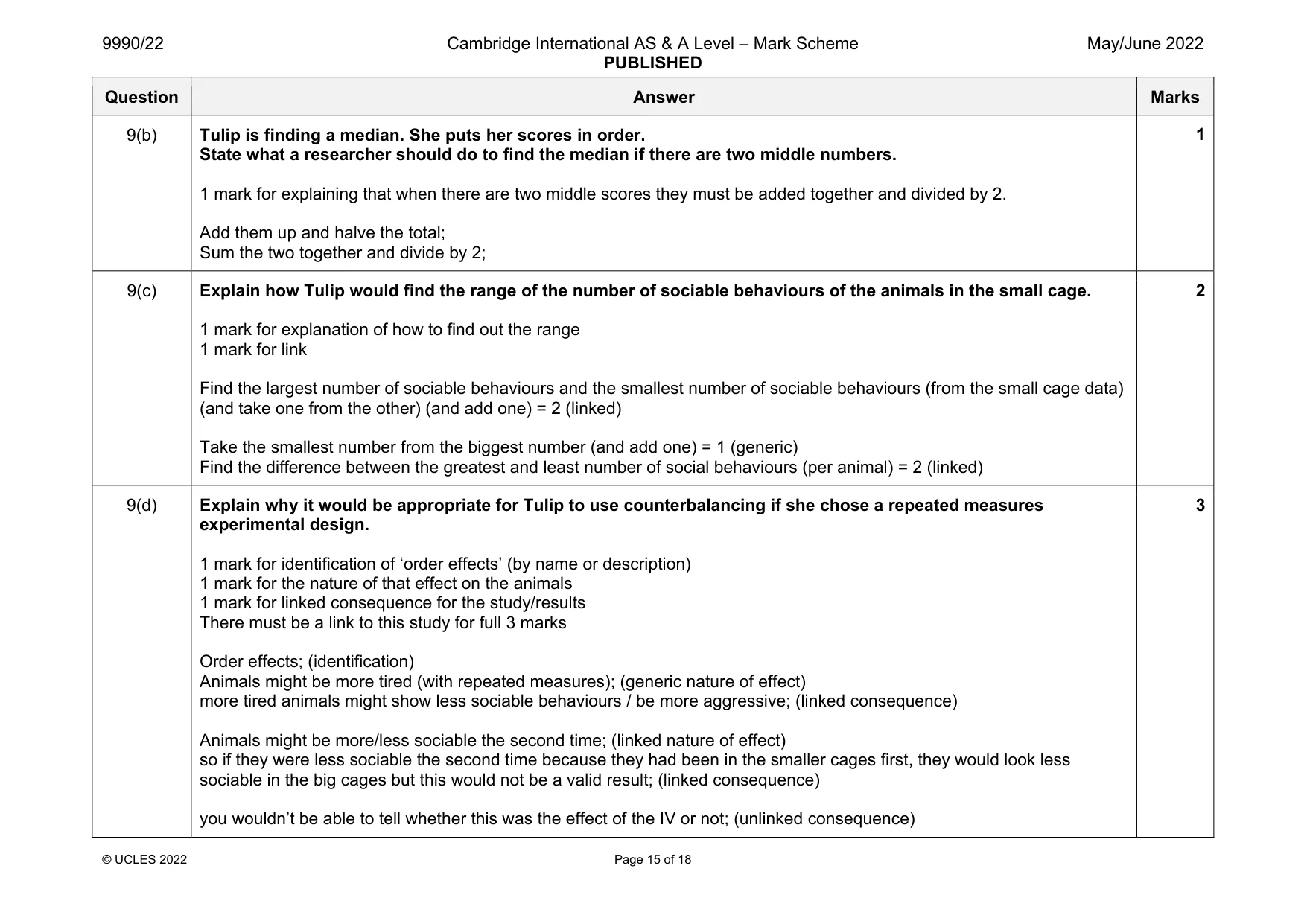
9 Tulip is conducting a study on social behaviour in animals. She is investigating whether animals are more sociable when they are in a large laboratory cage or a small laboratory cage. (a) Tulip has to decide which species to use. Explain how one ethical guideline relating to animals would affect her decision. ................................................................................................................................................... ................................................................................................................................................... ................................................................................................................................................... ............................................................................................................................................. [2] (b) Tulip is finding a median. She puts her scores in order. State what a researcher should do to find the median if there are two middle numbers. ................................................................................................................................................... ............................................................................................................................................. [1] (c) Explain how Tulip would find the range of the number of sociable behaviours of the animals in the small cage. ................................................................................................................................................... ................................................................................................................................................... ................................................................................................................................................... ............................................................................................................................................. [2] (d) Explain why it would be appropriate for Tulip to use counterbalancing if she chose a repeated measures experimental design. ................................................................................................................................................... ................................................................................................................................................... ................................................................................................................................................... ................................................................................................................................................... ................................................................................................................................................... ............................................................................................................................................. [3] Section C Answer all questions in this section.
Mark scheme: 9 Tulip is conducting a study on social behaviour in animals. She is investigating whether animals are more sociable when they are in a large laboratory cage or a small laboratory cage. 9(a) Tulip has to decide which species to use. Explain how one ethical guideline relating to animals would affect her decision. 1 mark for identifying a relevant guideline 1 mark for explanation No mark for which species chosen (Some animals/chimps are more likely to experience) distress; (guideline) E.g., if they are more intelligent (than rats); (explanation) Species (and strain) (says she needs a suitable type of animal/rats / small animals); (guideline) Because they are less likely to suffer distress (in a small cage); (explanation) Housing (must be suitable for the animal chosen); (guideline) So the small cages mustn’t be too small for them; (explanation) 2 Question Answer Marks 9(b) Tulip is finding a median. She puts her scores in order. State what a researcher should do to find the median if there are two middle numbers. 1 mark for explaining that when there are two middle scores they must be added together and divided by 2. Add them up and halve the total; Sum the two together and divide by 2; 1 9(c) Explain how Tulip would find the range of the number of sociable behaviours of the animals in the small cage. 1 mark for explanation of how to find out the range 1 mark for link Find the largest number of sociable behaviours and the smallest number of sociable behaviours (from the small cage data) (and take one from the other) (and add one) = 2 (linked) Take the smallest number from the biggest number (and add one) = 1 (generic) Find the difference between the greatest and least number of social behaviours (per animal) = 2 (linked) 2 9(d) Explain why it would be appropriate for Tulip to use counterbalancing if she chose a repeated measures experimental design. 1 mark for identification of ‘order effects’ (by name or description) 1 mark for the nature of that effect on the animals 1 mark for linked consequence for the study/results There must be a link to this study for full 3 marks Order effects; (identification) Animals might be more tired (with repeated measures); (generic nature of effect) more tired animals might show less sociable behaviours / be more aggressive; (linked consequence) Animals might be more/less sociable the second time; (linked nature of effect) so if they were less sociable the second time because they had been in the smaller cages first, they would look less sociable in the big cages but this would not be a valid result; (linked consequence) you wouldn’t be able to tell whether this was the effect of the IV or not; (unlinked consequence) 3
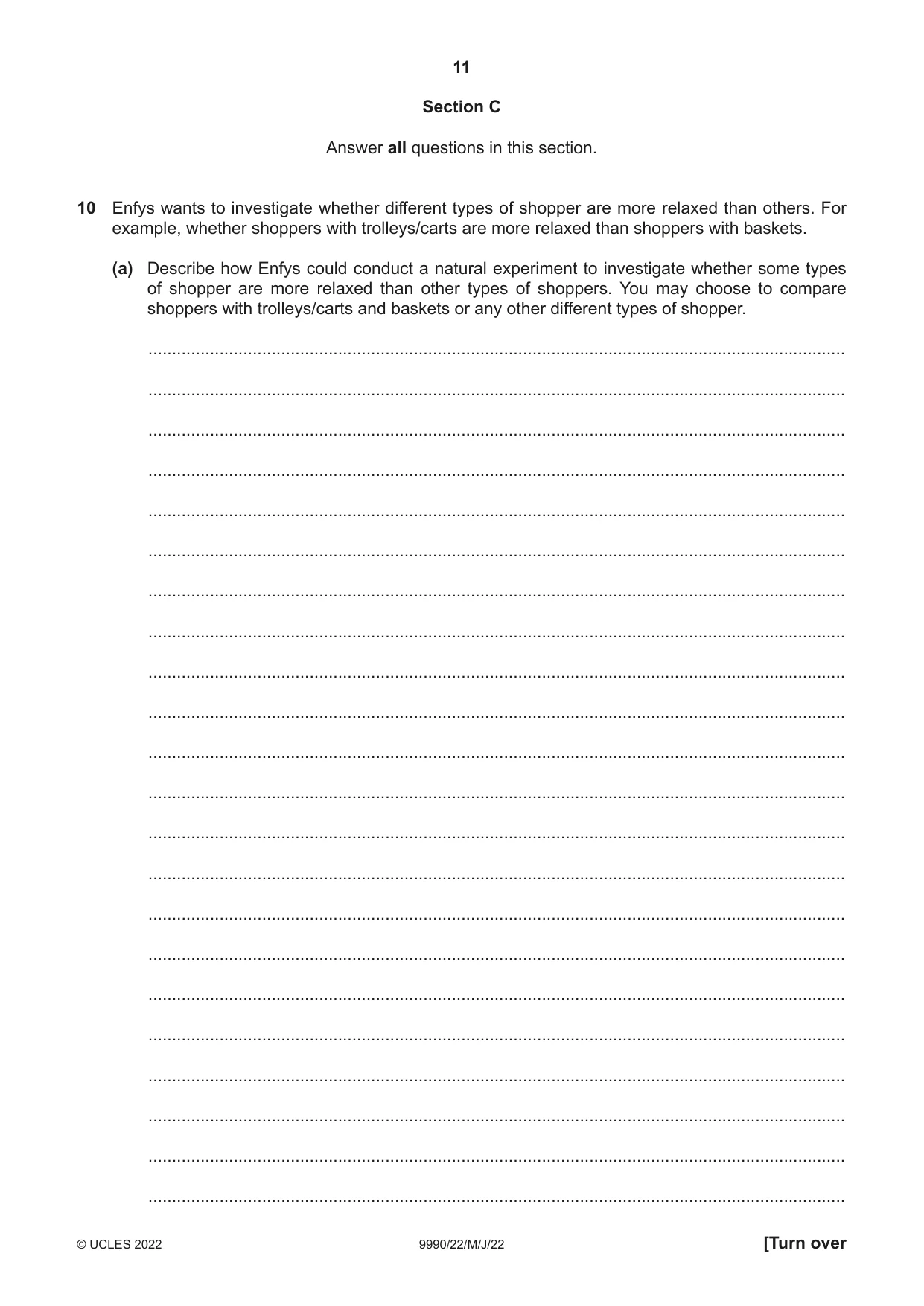
Q10 · Enfys wants to investigate whether different types of shopper are more relaxed than others
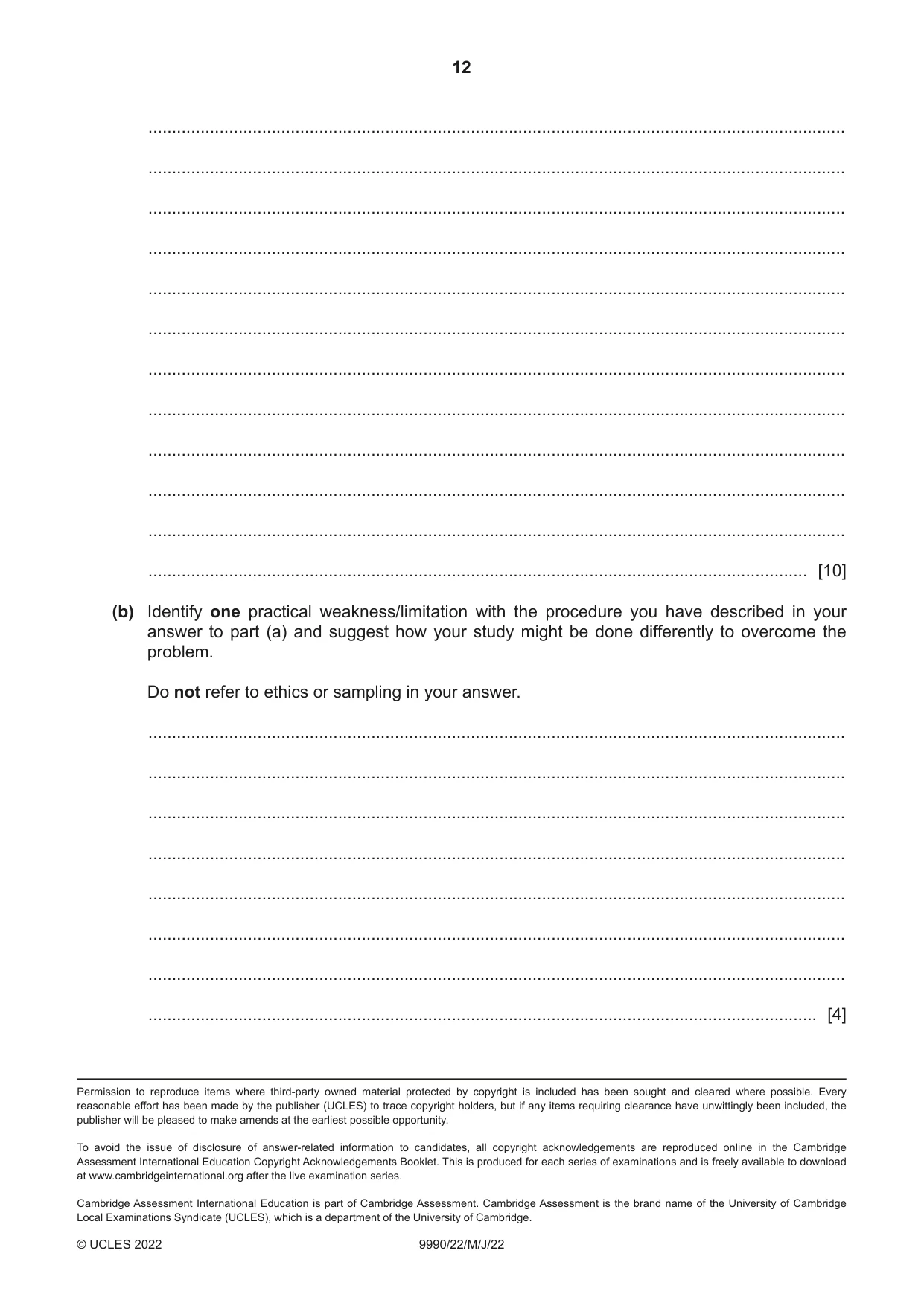
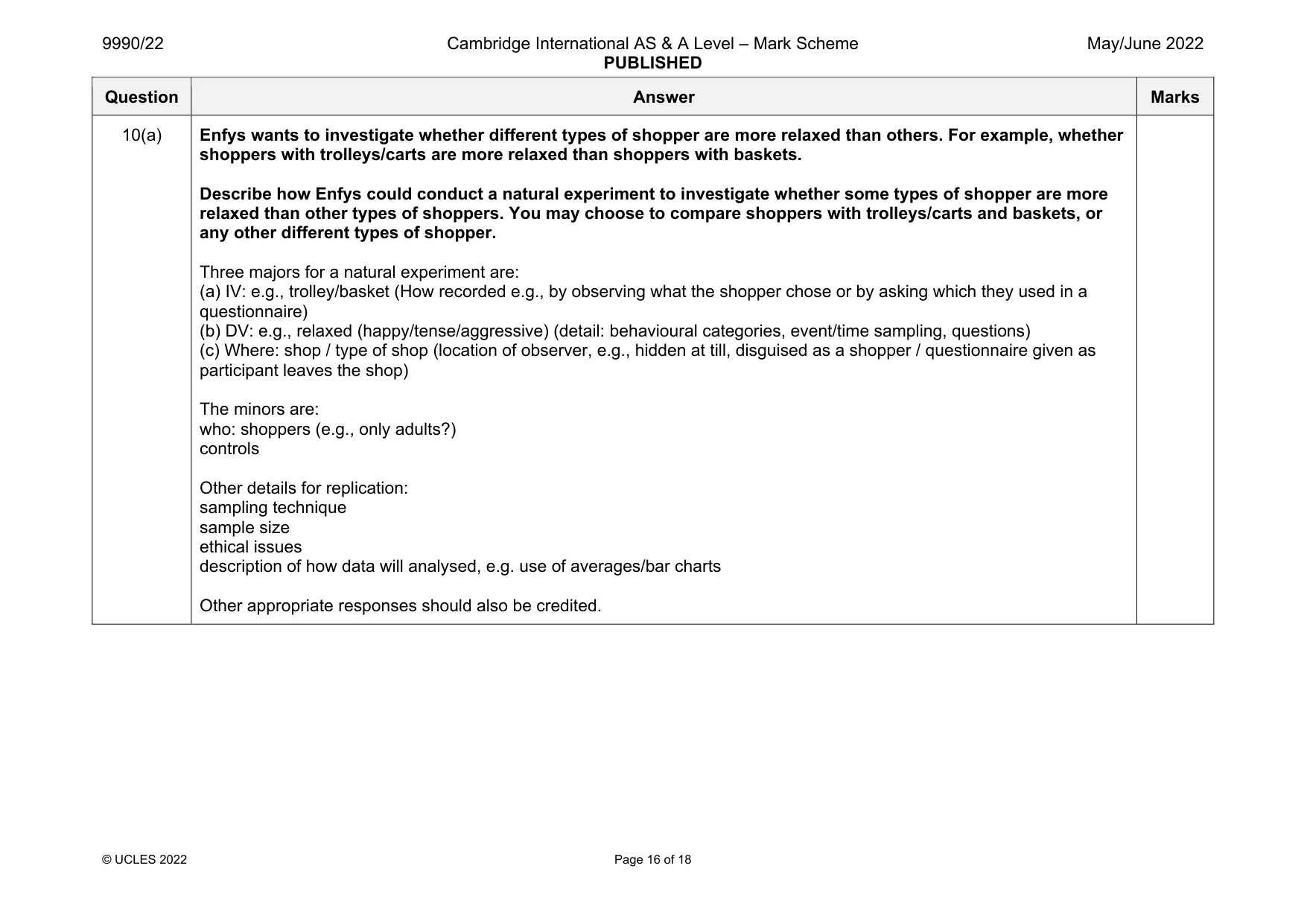
10 Enfys wants to investigate whether different types of shopper are more relaxed than others. For example, whether shoppers with trolleys/carts are more relaxed than shoppers with baskets. (a) Describe how Enfys could conduct a natural experiment to investigate whether some types of shopper are more relaxed than other types of shoppers. You may choose to compare shoppers with trolleys/carts and baskets or any other different types of shopper. ................................................................................................................................................... ................................................................................................................................................... ................................................................................................................................................... ................................................................................................................................................... ................................................................................................................................................... ................................................................................................................................................... ................................................................................................................................................... ................................................................................................................................................... ................................................................................................................................................... ................................................................................................................................................... ................................................................................................................................................... ................................................................................................................................................... ................................................................................................................................................... ................................................................................................................................................... ................................................................................................................................................... ................................................................................................................................................... ................................................................................................................................................... ................................................................................................................................................... ................................................................................................................................................... ................................................................................................................................................... ................................................................................................................................................... ................................................................................................................................................... ................................................................................................................................................... ................................................................................................................................................... ................................................................................................................................................... ................................................................................................................................................... ................................................................................................................................................... ................................................................................................................................................... ................................................................................................................................................... ................................................................................................................................................... ................................................................................................................................................... ................................................................................................................................................... ................................................................................................................................................... ........................................................................................................................................... [10] (b) Identify one practical weakness/limitation with the procedure you have described in your answer to part (a) and suggest how your study might be done differently to overcome the problem. Do not refer to ethics or sampling in your answer. ................................................................................................................................................... ................................................................................................................................................... ................................................................................................................................................... ................................................................................................................................................... ................................................................................................................................................... ................................................................................................................................................... ................................................................................................................................................... ............................................................................................................................................. [4]
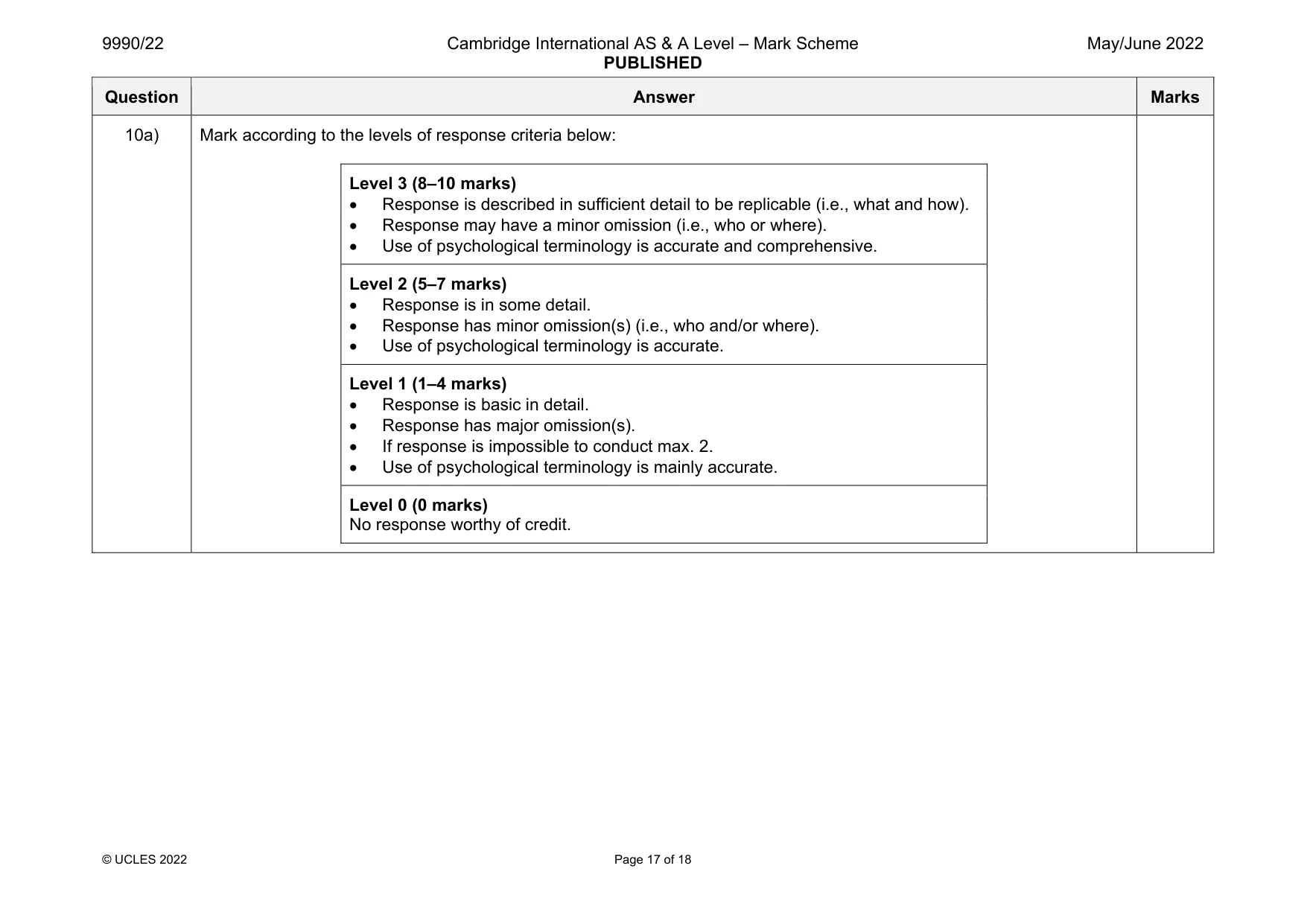
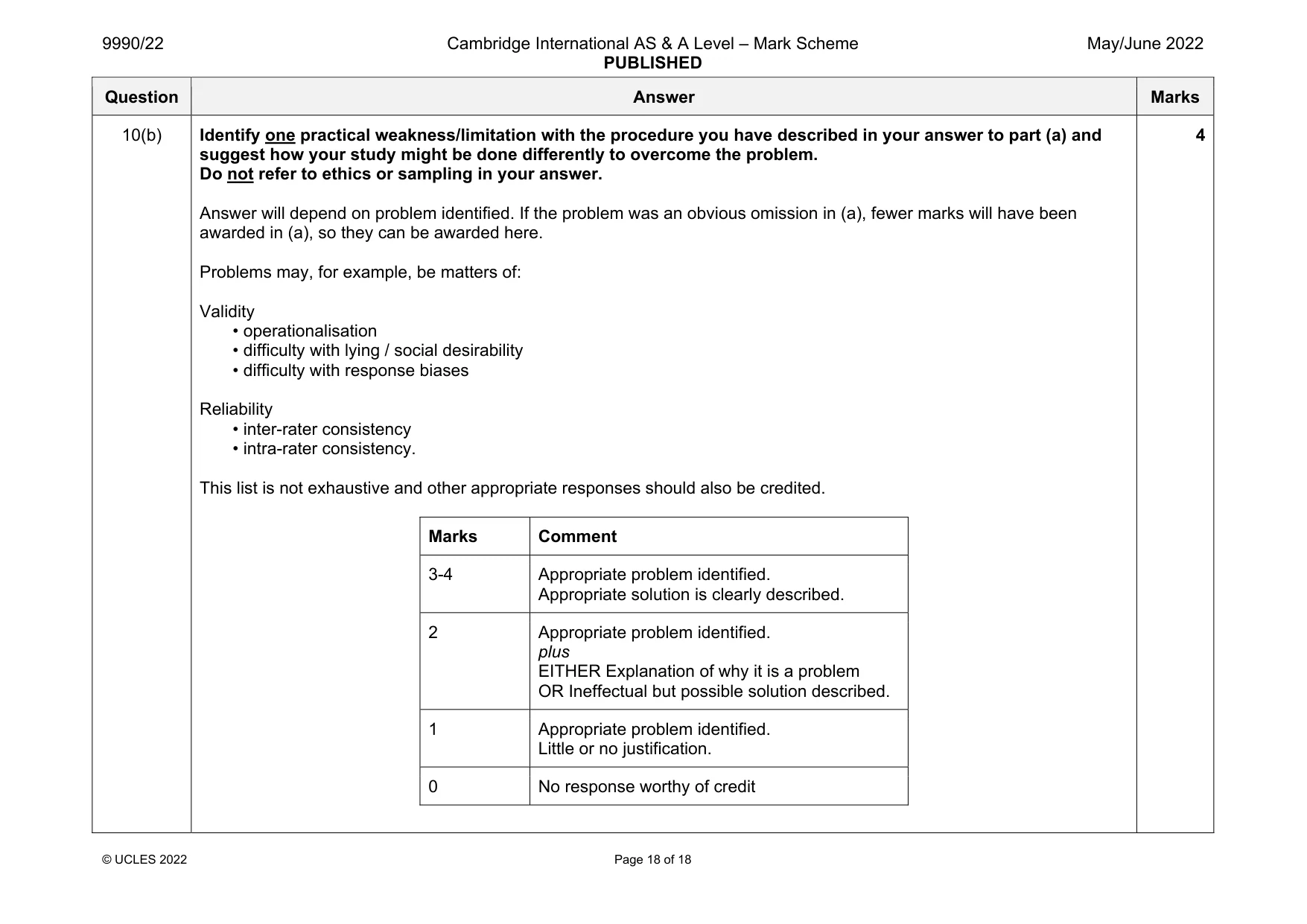
Mark scheme: 10(a) Enfys wants to investigate whether different types of shopper are more relaxed than others. For example, whether shoppers with trolleys/carts are more relaxed than shoppers with baskets. Describe how Enfys could conduct a natural experiment to investigate whether some types of shopper are more relaxed than other types of shoppers. You may choose to compare shoppers with trolleys/carts and baskets, or any other different types of shopper. Three majors for a natural experiment are: (a) IV: e.g., trolley/basket (How recorded e.g., by observing what the shopper chose or by asking which they used in a questionnaire) (b) DV: e.g., relaxed (happy/tense/aggressive) (detail: behavioural categories, event/time sampling, questions) (c) Where: shop / type of shop (location of observer, e.g., hidden at till, disguised as a shopper / questionnaire given as participant leaves the shop) The minors are: who: shoppers (e.g., only adults?) controls Other details for replication: sampling technique sample size ethical issues description of how data will analysed, e.g. use of averages/bar charts Other appropriate responses should also be credited. Question Answer Marks 10a) Mark according to the levels of response criteria below: Level 3 (8–10 marks) Response is described in sufficient detail to be replicable (i.e., what and how). Response may have a minor omission (i.e., who or where). Use of psychological terminology is accurate and comprehensive. Level 2 (5–7 marks) Response is in some detail. Response has minor omission(s) (i.e., who and/or where). Use of psychological terminology is accurate. Level 1 (1–4 marks) Response is basic in detail. Response has major omission(s). If response is impossible to conduct max. 2. Use of psychological terminology is mainly accurate. Level 0 (0 marks) No response worthy of credit. Question Answer Marks 10(b) Identify one practical weakness/limitation with the procedure you have described in your answer to part (a) and suggest how your study might be done differently to overcome the problem. Do not refer to ethics or sampling in your answer. Answer will depend on problem identified. If the problem was an obvious omission in (a), fewer marks will have been awarded in (a), so they can be awarded here. Problems may, for example, be matters of: Validity • operationalisation • difficulty with lying / social desirability • difficulty with response biases Reliability • inter-rater consistency • intra-rater consistency. This list is not exhaustive and other appropriate responses should also be credited. Marks Comment 3-4 Appropriate problem identified. Appropriate solution is clearly described. 2 Appropriate problem identified. plus EITHER Explanation of why it is a problem OR Ineffectual but possible solution described. 1 Appropriate problem identified. Little or no justification. 0 No response worthy of credit 4
What was in this paper
The subtopics covered by these 10 questions, and how many questions each got. Open one in a new tab to see every Cambridge question on it.
What you needed in this session
Cambridge’s own grade thresholds for 2022 May/June, Paper 2 · Variant 2. A higher threshold means an easier paper — the bar moves with how the cohort did.