Cambridge A Level Psychology (from 2018) 9990 — 2021 Oct/Nov Paper 2 · Variant 1
9990/21/O/N/21 · 10 questions · 60 marks · ≈68 min
The question paper and its mark scheme, free to read here and free to download. This is Cambridge’s own paper, exactly as it was sat.
Question paper12 pages

Mark scheme15 pages
Answers below. Sit the paper first if you are practising.
Questions as text
Q1 · Explain why a questionnaire is a self-report method, including an example from a core…
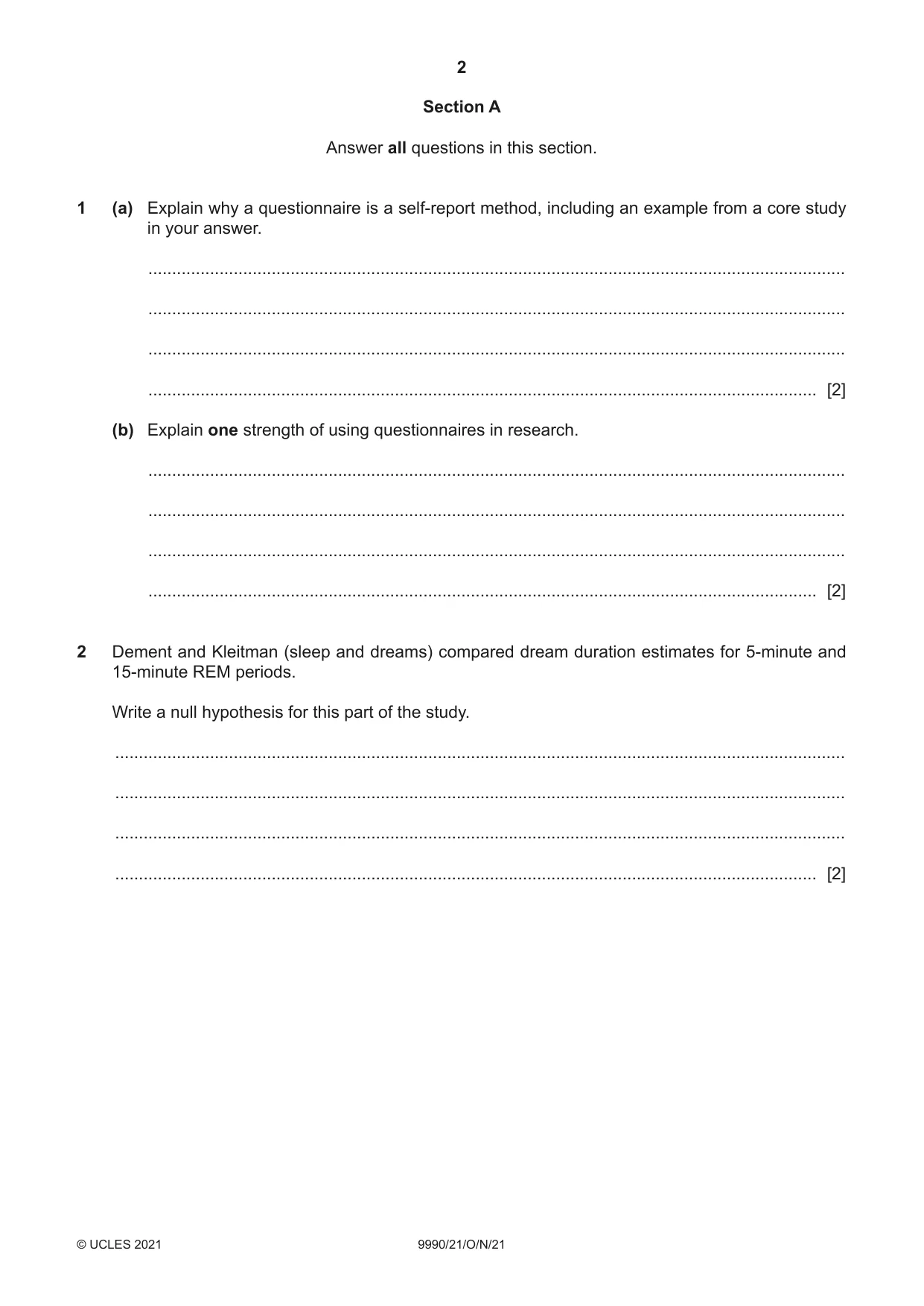
1 (a) Explain why a questionnaire is a self-report method, including an example from a core study in your answer. ................................................................................................................................................... ................................................................................................................................................... ................................................................................................................................................... ............................................................................................................................................. [2] (b) Explain one strength of using questionnaires in research. ................................................................................................................................................... ................................................................................................................................................... ................................................................................................................................................... ............................................................................................................................................. [2]
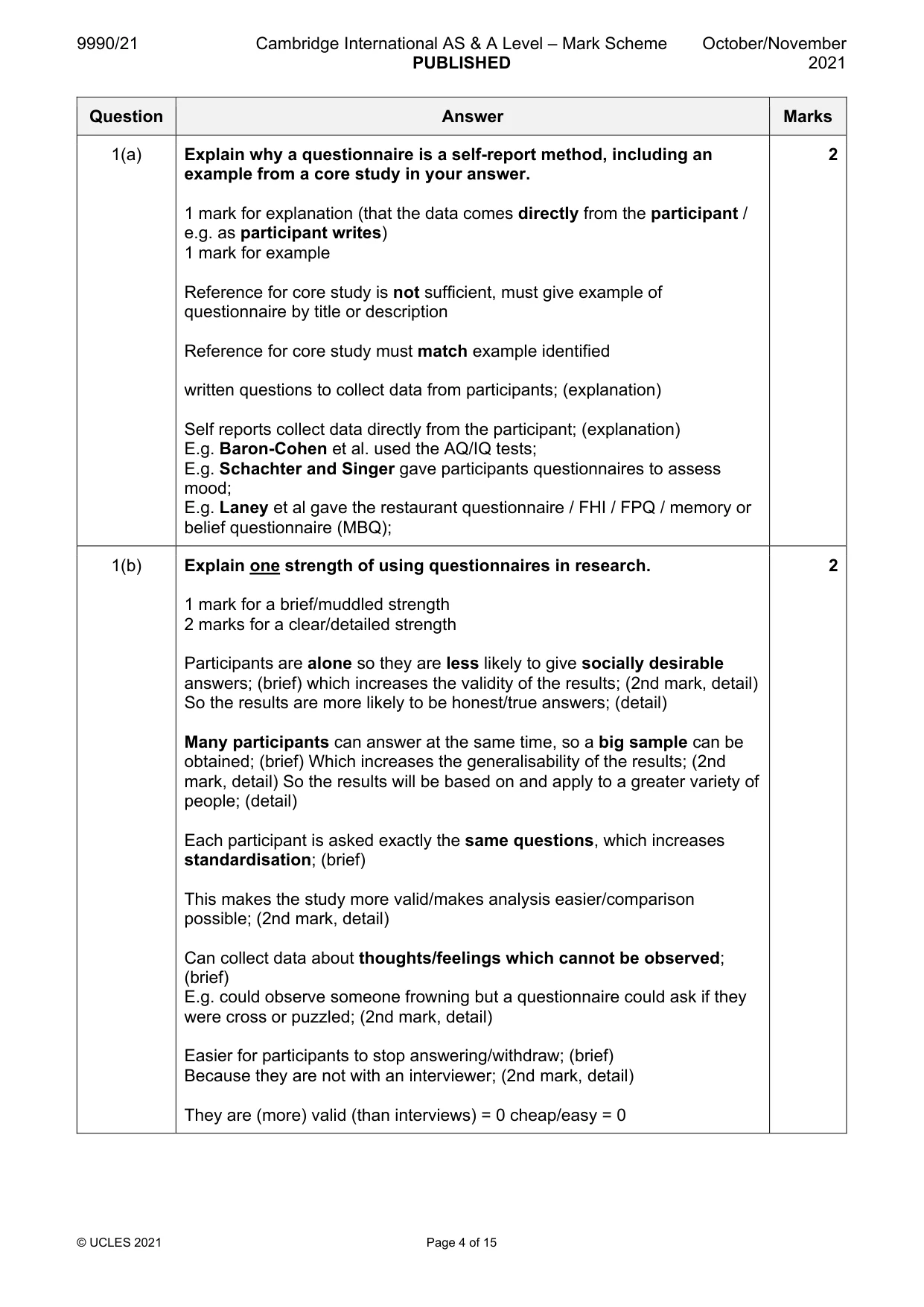
Mark scheme: Question Answer Marks 1(a) Explain why a questionnaire is a self-report method, including an 2 example from a core study in your answer. 1 mark for explanation (that the data comes directly from the participant / e.g. as participant writes) 1 mark for example Reference for core study is not sufficient, must give example of questionnaire by title or description Reference for core study must match example identified written questions to collect data from participants; (explanation) Self reports collect data directly from the participant; (explanation) E.g. Baron-Cohen et al. used the AQ/IQ tests; E.g. Schachter and Singer gave participants questionnaires to assess mood; E.g. Laney et al gave the restaurant questionnaire / FHI / FPQ / memory or belief questionnaire (MBQ); 1(b) Explain one strength of using questionnaires in research. 2 1 mark for a brief/muddled strength 2 marks for a clear/detailed strength Participants are alone so they are less likely to give socially desirable answers; (brief) which increases the validity of the results; (2nd mark, detail) So the results are more likely to be honest/true answers; (detail) Many participants can answer at the same time, so a big sample can be obtained; (brief) Which increases the generalisability of the results; (2nd mark, detail) So the results will be based on and apply to a greater variety of people; (detail) Each participant is asked exactly the same questions, which increases standardisation; (brief) This makes the study more valid/makes analysis easier/comparison possible; (2nd mark, detail) Can collect data about thoughts/feelings which cannot be observed; (brief) E.g. could observe someone frowning but a questionnaire could ask if they were cross or puzzled; (2nd mark, detail) Easier for participants to stop answering/withdraw; (brief) Because they are not with an interviewer; (2nd mark, detail) They are (more) valid (than interviews) = 0 cheap/easy = 0
Q2 · Dement and Kleitman (sleep and dreams) compared dream duration estimates for 5-minute and…
2 Dement and Kleitman (sleep and dreams) compared dream duration estimates for 5-minute and 15-minute REM periods. Write a null hypothesis for this part of the study. .......................................................................................................................................................... .......................................................................................................................................................... .......................................................................................................................................................... .................................................................................................................................................... [2]
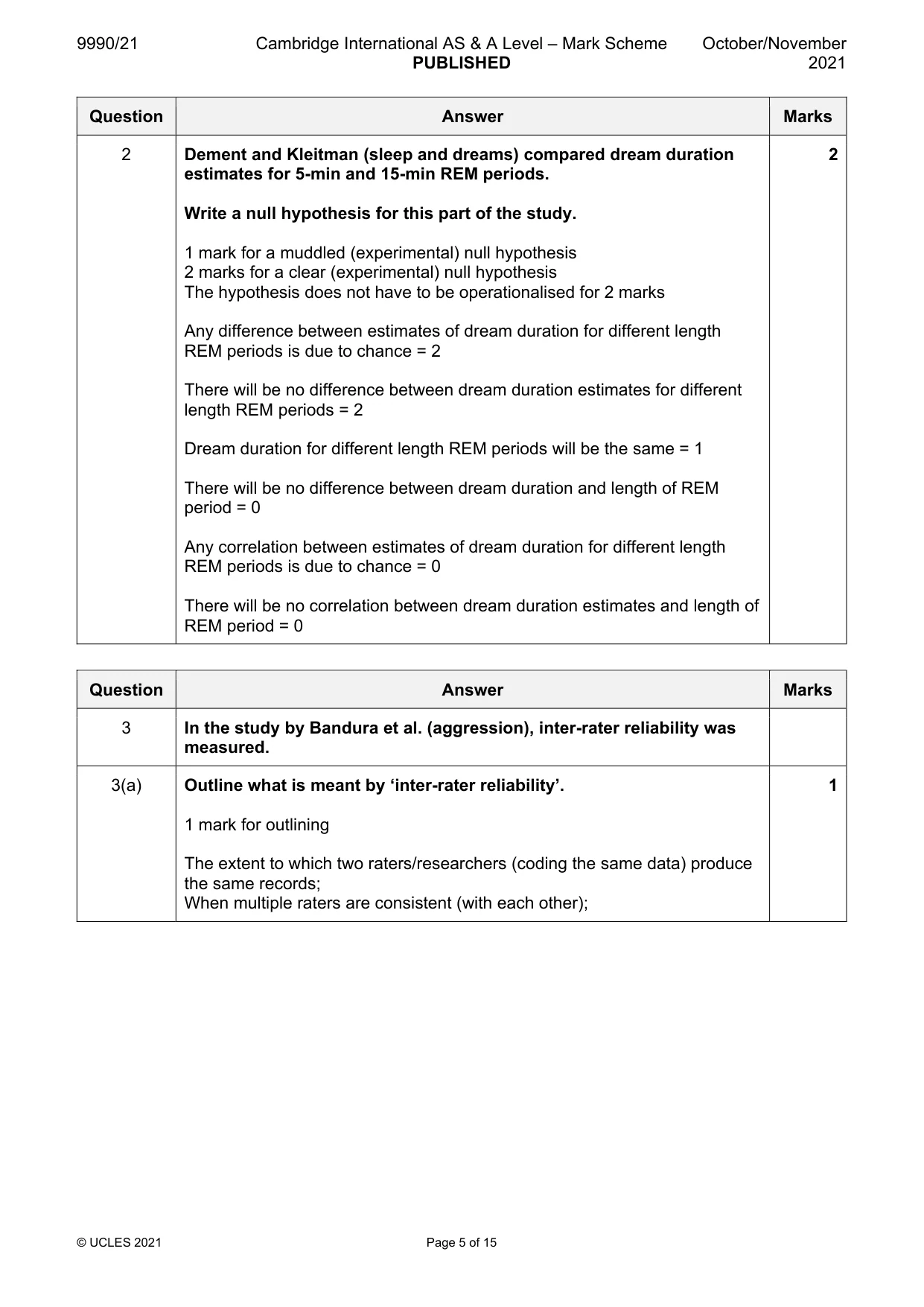
Mark scheme: 2 Dement and Kleitman (sleep and dreams) compared dream duration 2 estimates for 5-min and 15-min REM periods. Write a null hypothesis for this part of the study. 1 mark for a muddled (experimental) null hypothesis 2 marks for a clear (experimental) null hypothesis The hypothesis does not have to be operationalised for 2 marks Any difference between estimates of dream duration for different length REM periods is due to chance = 2 There will be no difference between dream duration estimates for different length REM periods = 2 Dream duration for different length REM periods will be the same = 1 There will be no difference between dream duration and length of REM period = 0 Any correlation between estimates of dream duration for different length REM periods is due to chance = 0 There will be no correlation between dream duration estimates and length of REM period = 0
Q3 · In the study by Bandura et al
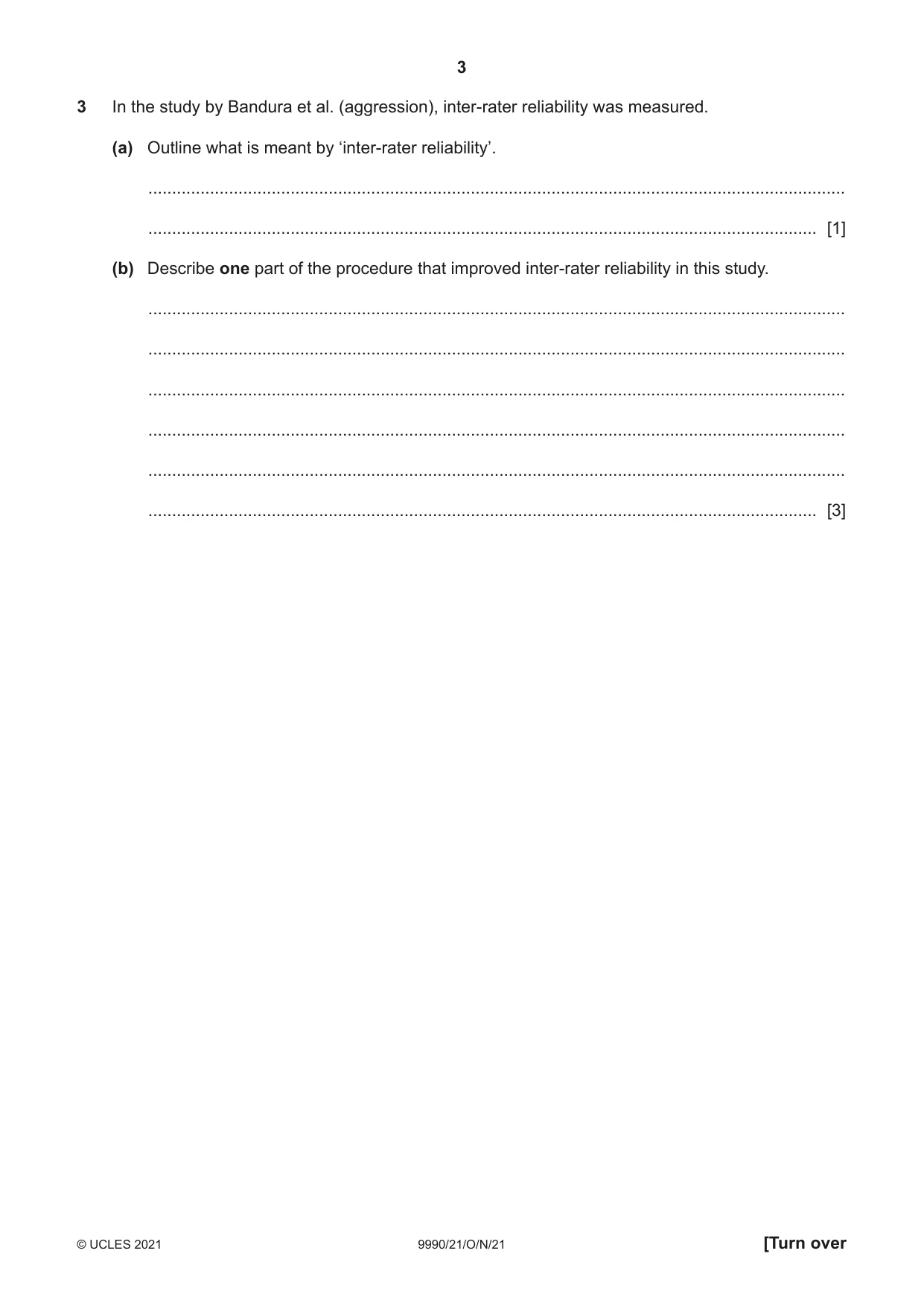
3 In the study by Bandura et al. (aggression), inter-rater reliability was measured. (a) Outline what is meant by ‘inter-rater reliability’. ................................................................................................................................................... ............................................................................................................................................. [1] (b) Describe one part of the procedure that improved inter-rater reliability in this study. ................................................................................................................................................... ................................................................................................................................................... ................................................................................................................................................... ................................................................................................................................................... ................................................................................................................................................... ............................................................................................................................................. [3]
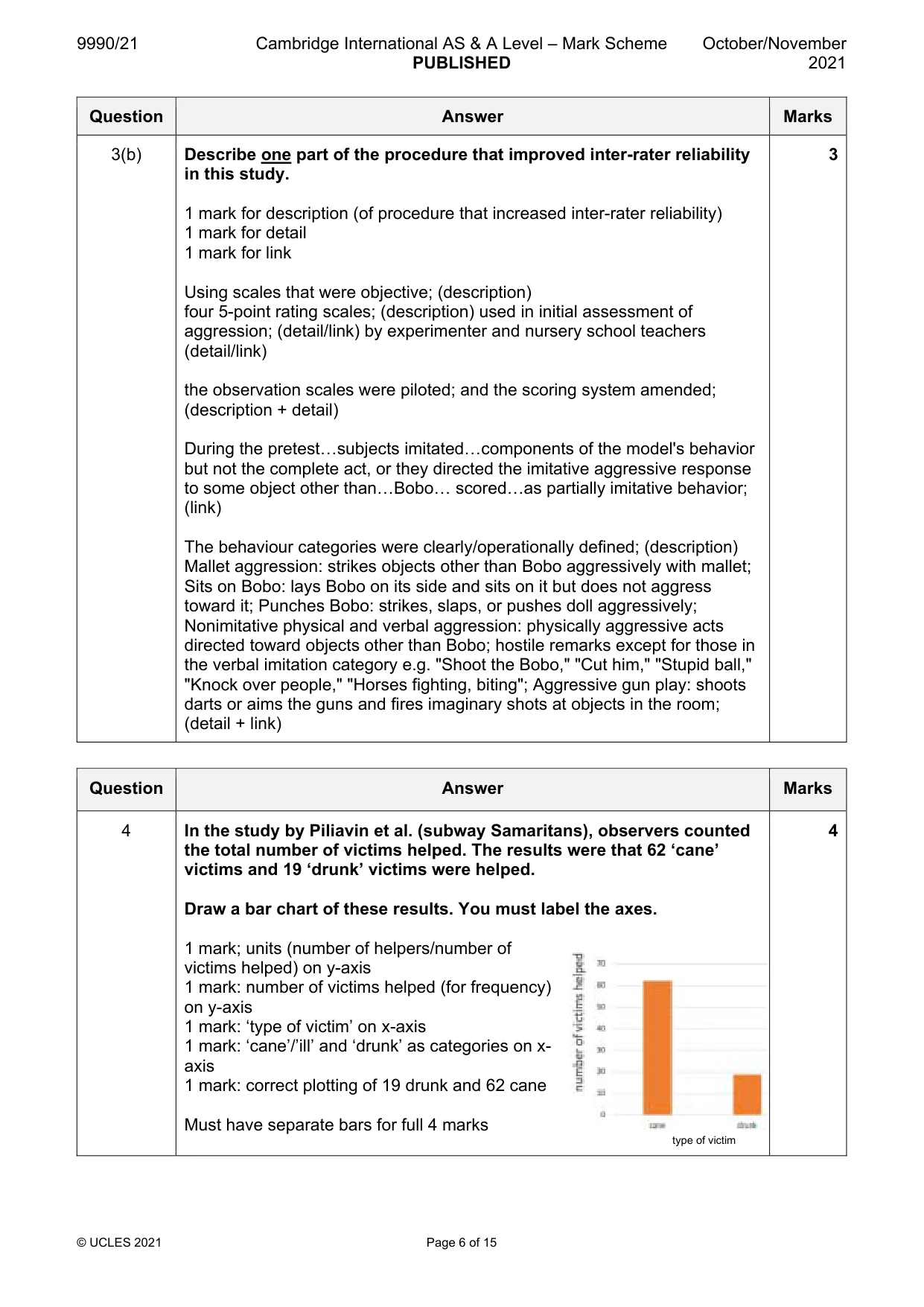
Mark scheme: 3 In the study by Bandura et al. (aggression), inter-rater reliability was measured. 3(a) Outline what is meant by ‘inter-rater reliability’. 1 1 mark for outlining The extent to which two raters/researchers (coding the same data) produce the same records; When multiple raters are consistent (with each other); 3(b) Describe one part of the procedure that improved inter-rater reliability 3 in this study. 1 mark for description (of procedure that increased inter-rater reliability) 1 mark for detail 1 mark for link Using scales that were objective; (description) four 5-point rating scales; (description) used in initial assessment of aggression; (detail/link) by experimenter and nursery school teachers (detail/link) the observation scales were piloted; and the scoring system amended; (description + detail) During the pretest…subjects imitated…components of the model's behavior but not the complete act, or they directed the imitative aggressive response to some object other than…Bobo… scored…as partially imitative behavior; (link) The behaviour categories were clearly/operationally defined; (description) Mallet aggression: strikes objects other than Bobo aggressively with mallet; Sits on Bobo: lays Bobo on its side and sits on it but does not aggress toward it; Punches Bobo: strikes, slaps, or pushes doll aggressively; Nonimitative physical and verbal aggression: physically aggressive acts directed toward objects other than Bobo; hostile remarks except for those in the verbal imitation category e.g. "Shoot the Bobo," "Cut him," "Stupid ball," "Knock over people," "Horses fighting, biting"; Aggressive gun play: shoots darts or aims the guns and fires imaginary shots at objects in the room; (detail + link)
Q4 · In the study by Piliavin et al
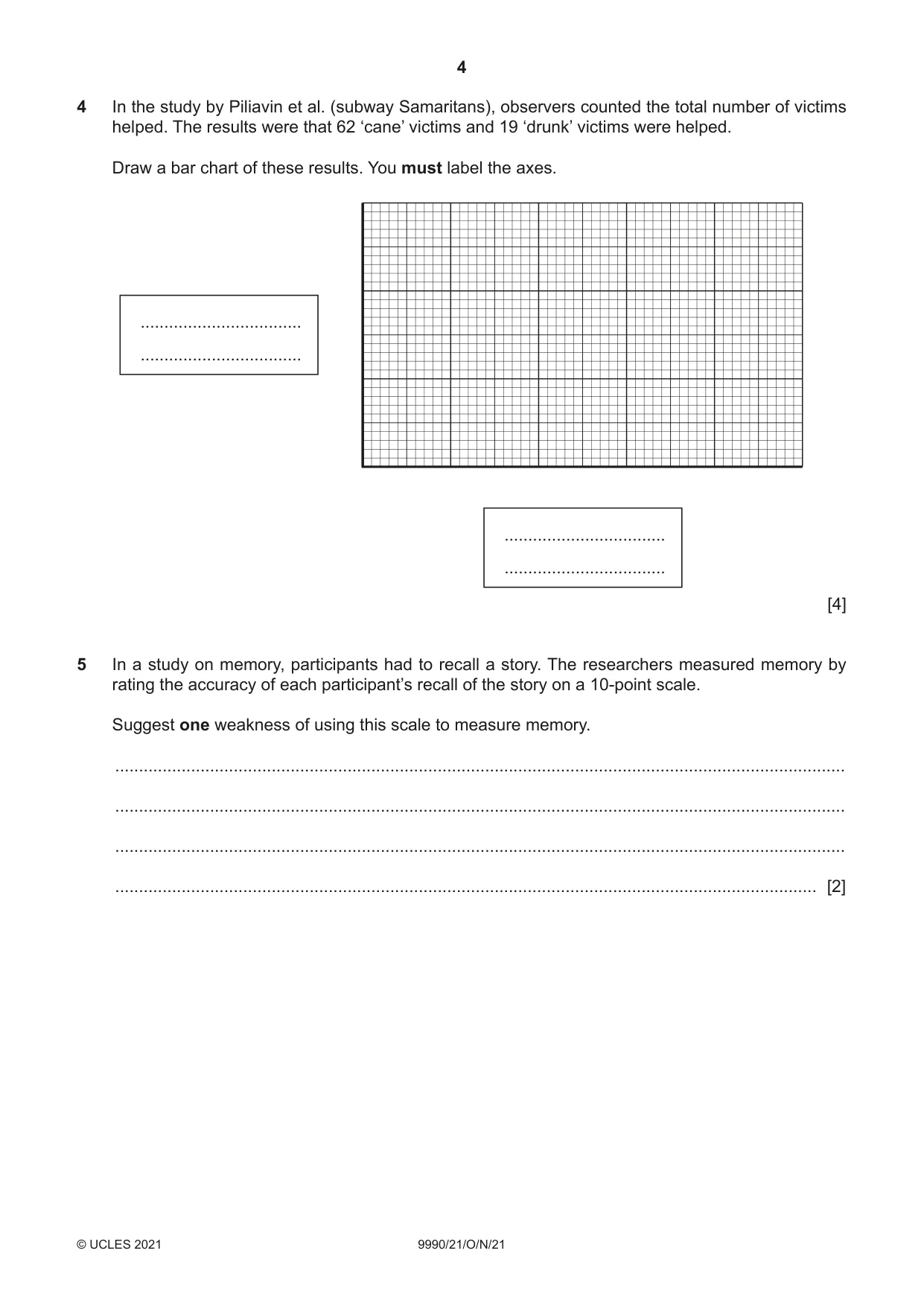
4 In the study by Piliavin et al. (subway Samaritans), observers counted the total number of victims helped. The results were that 62 ‘cane’ victims and 19 ‘drunk’ victims were helped. Draw a bar chart of these results. You must label the axes. .................................. .................................. .................................. .................................. [4]
Mark scheme: 4 In the study by Piliavin et al. (subway Samaritans), observers counted 4 the total number of victims helped. The results were that 62 ‘cane’ victims and 19 ‘drunk’ victims were helped. Draw a bar chart of these results. You must label the axes. 1 mark; units (number of helpers/number of victims helped) on y-axis 1 mark: number of victims helped (for frequency) on y-axis 1 mark: ‘type of victim’ on x-axis 1 mark: ‘cane’/’ill’ and ‘drunk’ as categories on x- axis 1 mark: correct plotting of 19 drunk and 62 cane Must have separate bars for full 4 marks type of victim
Q5 · In a study on memory, participants had to recall a story
5 In a study on memory, participants had to recall a story. The researchers measured memory by rating the accuracy of each participant’s recall of the story on a 10-point scale. Suggest one weakness of using this scale to measure memory. .......................................................................................................................................................... .......................................................................................................................................................... .......................................................................................................................................................... .................................................................................................................................................... [2]
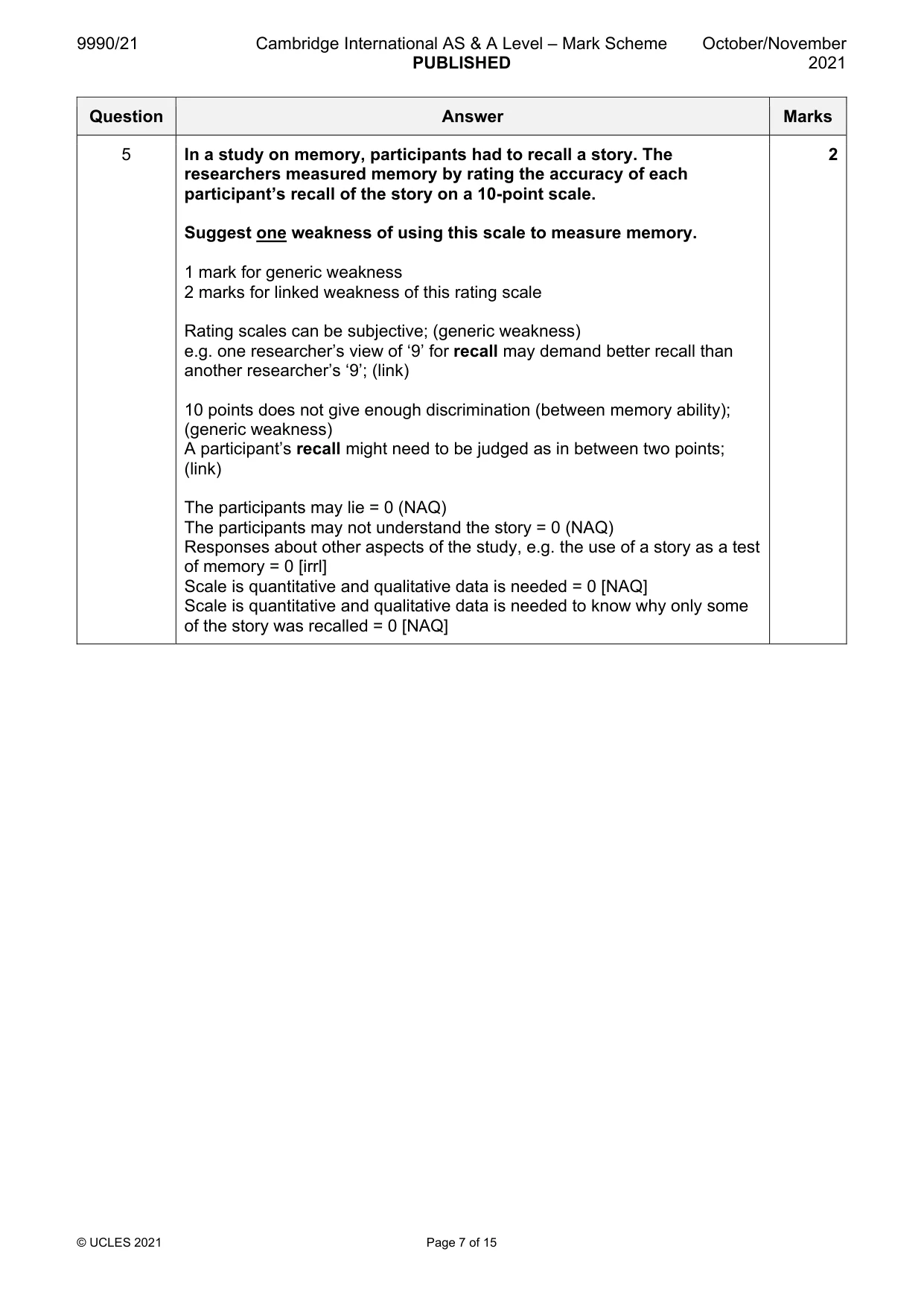
Mark scheme: 5 In a study on memory, participants had to recall a story. The 2 researchers measured memory by rating the accuracy of each participant’s recall of the story on a 10-point scale. Suggest one weakness of using this scale to measure memory. 1 mark for generic weakness 2 marks for linked weakness of this rating scale Rating scales can be subjective; (generic weakness) e.g. one researcher’s view of ‘9’ for recall may demand better recall than another researcher’s ‘9’; (link) 10 points does not give enough discrimination (between memory ability); (generic weakness) A participant’s recall might need to be judged as in between two points; (link) The participants may lie = 0 (NAQ) The participants may not understand the story = 0 (NAQ) Responses about other aspects of the study, e.g. the use of a story as a test of memory = 0 [irrl] Scale is quantitative and qualitative data is needed = 0 [NAQ] Scale is quantitative and qualitative data is needed to know why only some of the story was recalled = 0 [NAQ]
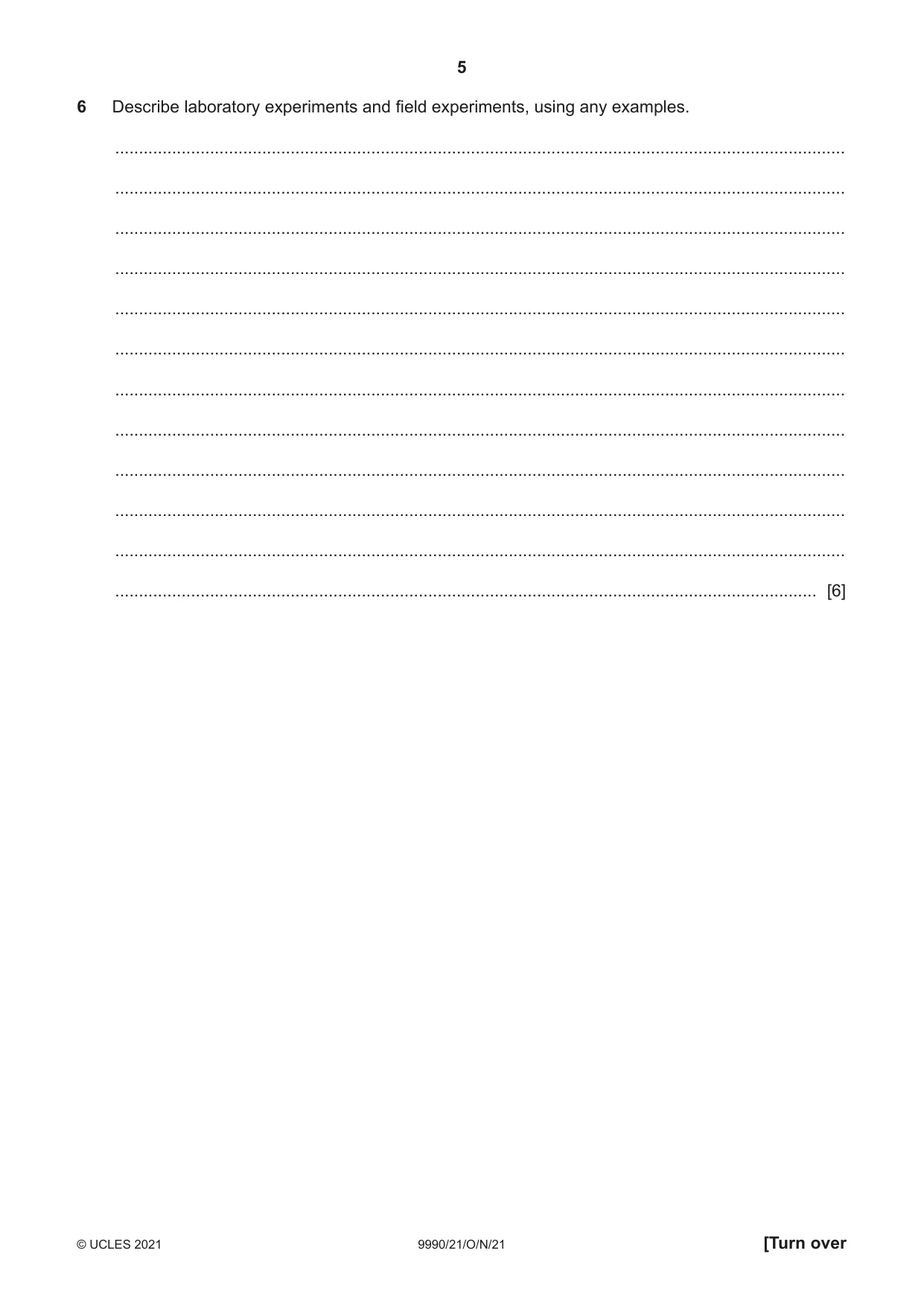
Q6 · Describe laboratory experiments and field experiments, using any examples
6 Describe laboratory experiments and field experiments, using any examples. .......................................................................................................................................................... .......................................................................................................................................................... .......................................................................................................................................................... .......................................................................................................................................................... .......................................................................................................................................................... .......................................................................................................................................................... .......................................................................................................................................................... .......................................................................................................................................................... .......................................................................................................................................................... .......................................................................................................................................................... .......................................................................................................................................................... .................................................................................................................................................... [6]
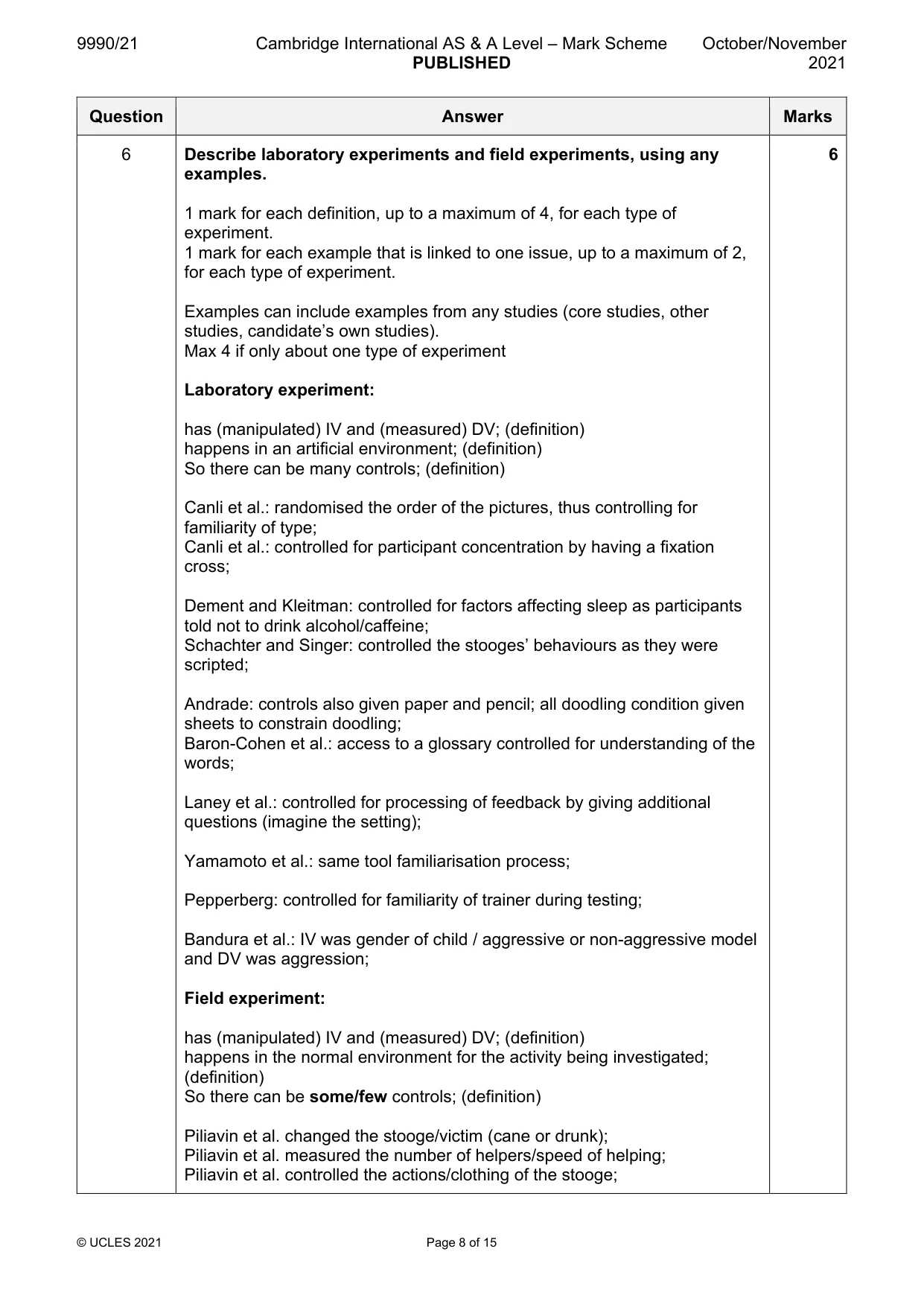
Mark scheme: 6 Describe laboratory experiments and field experiments, using any 6 examples. 1 mark for each definition, up to a maximum of 4, for each type of experiment. 1 mark for each example that is linked to one issue, up to a maximum of 2, for each type of experiment. Examples can include examples from any studies (core studies, other studies, candidate’s own studies). Max 4 if only about one type of experiment Laboratory experiment: has (manipulated) IV and (measured) DV; (definition) happens in an artificial environment; (definition) So there can be many controls; (definition) Canli et al.: randomised the order of the pictures, thus controlling for familiarity of type; Canli et al.: controlled for participant concentration by having a fixation cross; Dement and Kleitman: controlled for factors affecting sleep as participants told not to drink alcohol/caffeine; Schachter and Singer: controlled the stooges’ behaviours as they were scripted; Andrade: controls also given paper and pencil; all doodling condition given sheets to constrain doodling; Baron-Cohen et al.: access to a glossary controlled for understanding of the words; Laney et al.: controlled for processing of feedback by giving additional questions (imagine the setting); Yamamoto et al.: same tool familiarisation process; Pepperberg: controlled for familiarity of trainer during testing; Bandura et al.: IV was gender of child / aggressive or non-aggressive model and DV was aggression; Field experiment: has (manipulated) IV and (measured) DV; (definition) happens in the normal environment for the activity being investigated; (definition) So there can be some/few controls; (definition) Piliavin et al. changed the stooge/victim (cane or drunk); Piliavin et al. measured the number of helpers/speed of helping; Piliavin et al. controlled the actions/clothing of the stooge;
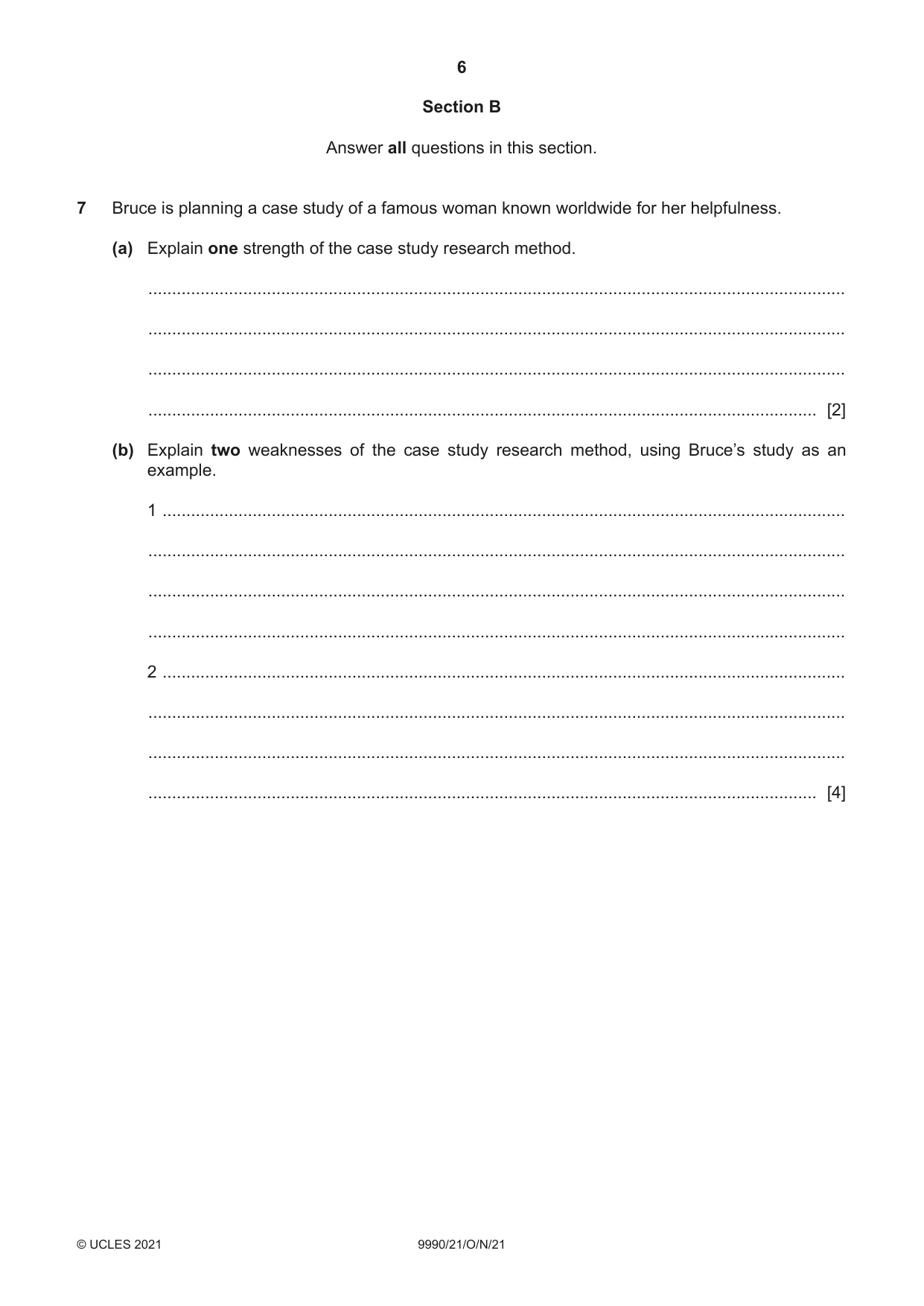
Q7 · Bruce is planning a case study of a famous woman known worldwide for her helpfulness
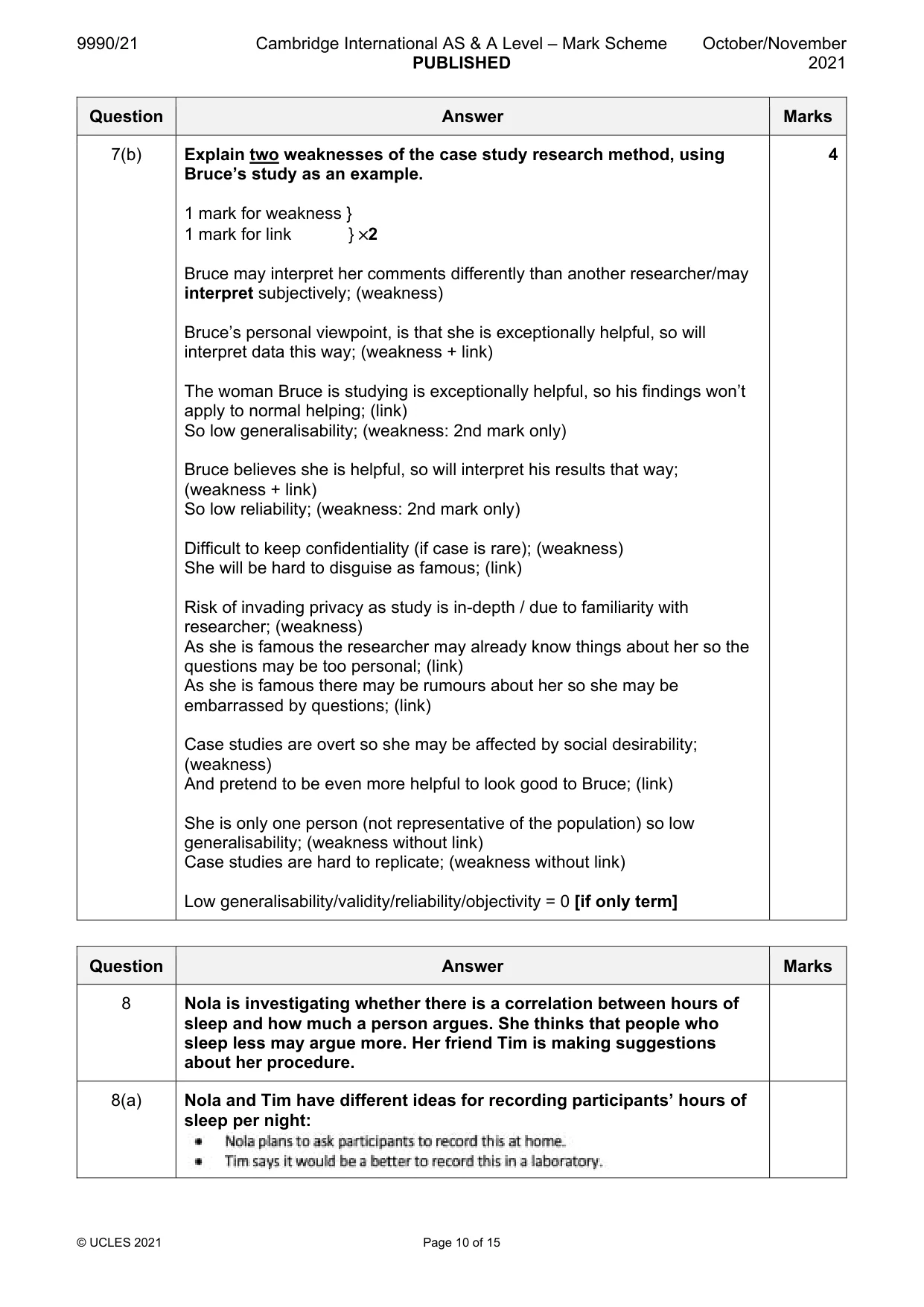
7 Bruce is planning a case study of a famous woman known worldwide for her helpfulness. (a) Explain one strength of the case study research method. ................................................................................................................................................... ................................................................................................................................................... ................................................................................................................................................... ............................................................................................................................................. [2] (b) Explain two weaknesses of the case study research method, using Bruce’s study as an example. 1 ................................................................................................................................................ ................................................................................................................................................... ................................................................................................................................................... ................................................................................................................................................... 2 ................................................................................................................................................ ................................................................................................................................................... ................................................................................................................................................... ............................................................................................................................................. [4]
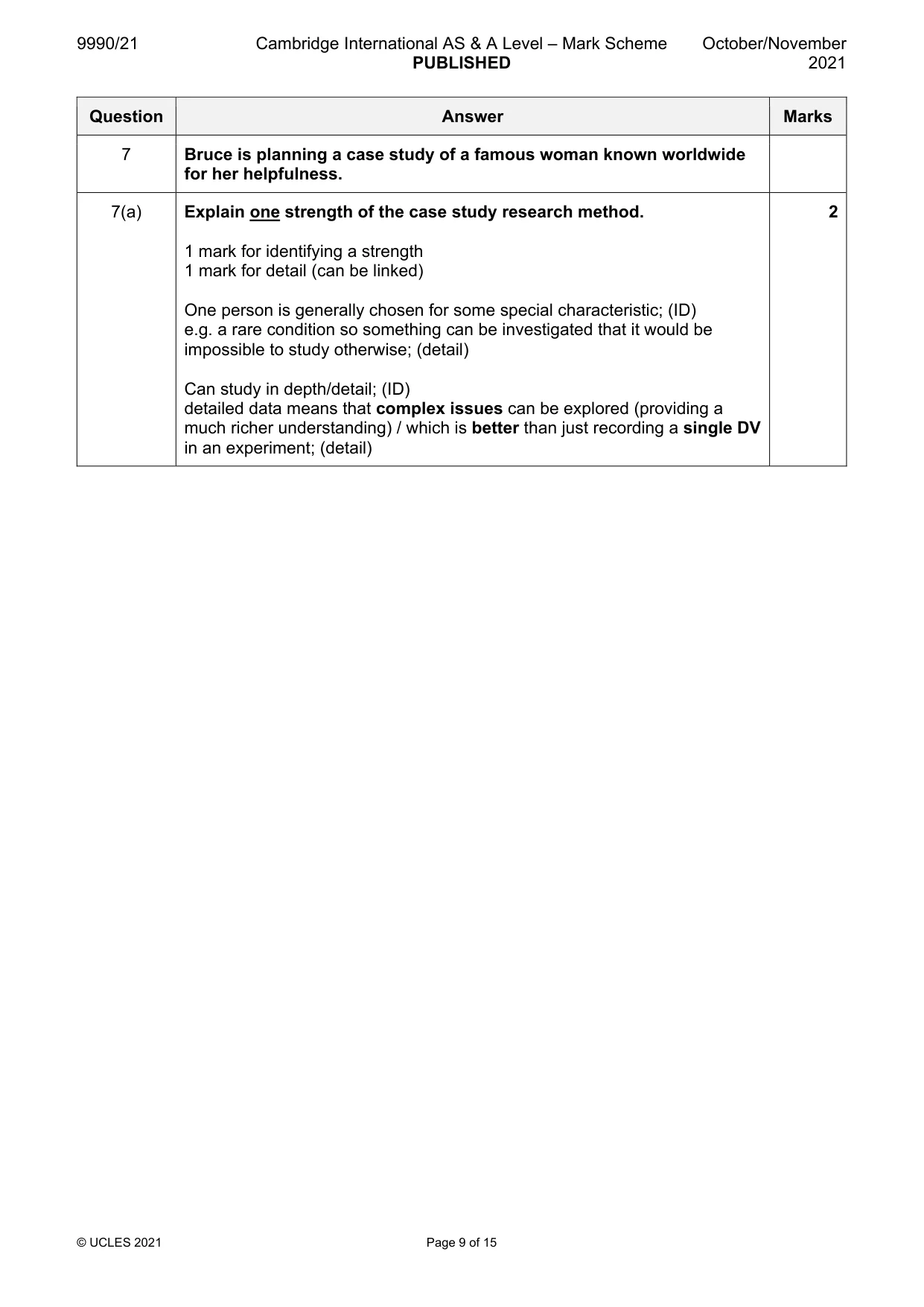
Mark scheme: 7 Bruce is planning a case study of a famous woman known worldwide for her helpfulness. 7(a) Explain one strength of the case study research method. 2 1 mark for identifying a strength 1 mark for detail (can be linked) One person is generally chosen for some special characteristic; (ID) e.g. a rare condition so something can be investigated that it would be impossible to study otherwise; (detail) Can study in depth/detail; (ID) detailed data means that complex issues can be explored (providing a much richer understanding) / which is better than just recording a single DV in an experiment; (detail) 7(b) Explain two weaknesses of the case study research method, using 4 Bruce’s study as an example. 1 mark for weakness } 1 mark for link } ×2 Bruce may interpret her comments differently than another researcher/may interpret subjectively; (weakness) Bruce’s personal viewpoint, is that she is exceptionally helpful, so will interpret data this way; (weakness + link) The woman Bruce is studying is exceptionally helpful, so his findings won’t apply to normal helping; (link) So low generalisability; (weakness: 2nd mark only) Bruce believes she is helpful, so will interpret his results that way; (weakness + link) So low reliability; (weakness: 2nd mark only) Difficult to keep confidentiality (if case is rare); (weakness) She will be hard to disguise as famous; (link) Risk of invading privacy as study is in-depth / due to familiarity with researcher; (weakness) As she is famous the researcher may already know things about her so the questions may be too personal; (link) As she is famous there may be rumours about her so she may be embarrassed by questions; (link) Case studies are overt so she may be affected by social desirability; (weakness) And pretend to be even more helpful to look good to Bruce; (link) She is only one person (not representative of the population) so low generalisability; (weakness without link) Case studies are hard to replicate; (weakness without link) Low generalisability/validity/reliability/objectivity = 0 [if only term]
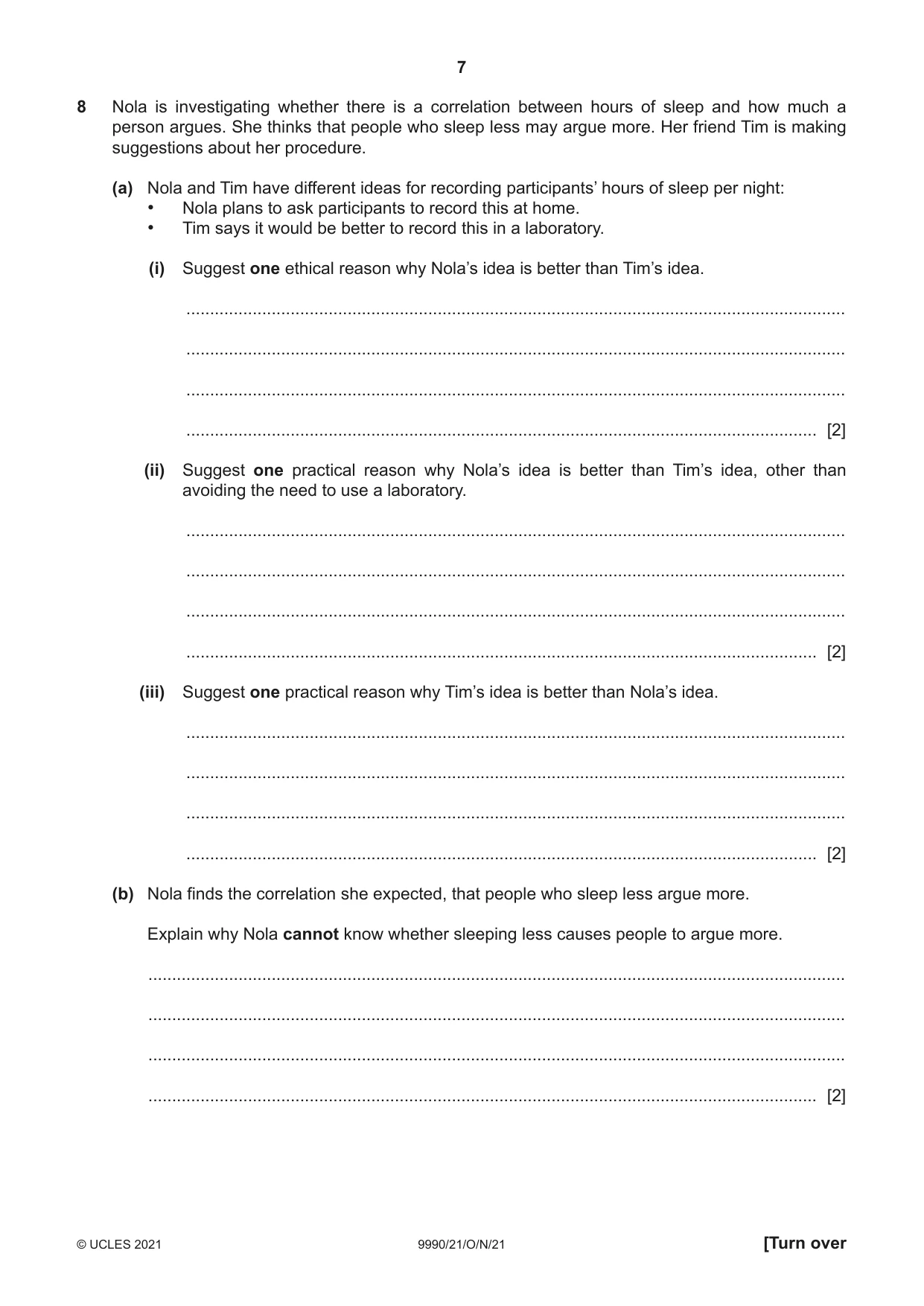
Q8 · Nola is investigating whether there is a correlation between hours of sleep and how much…
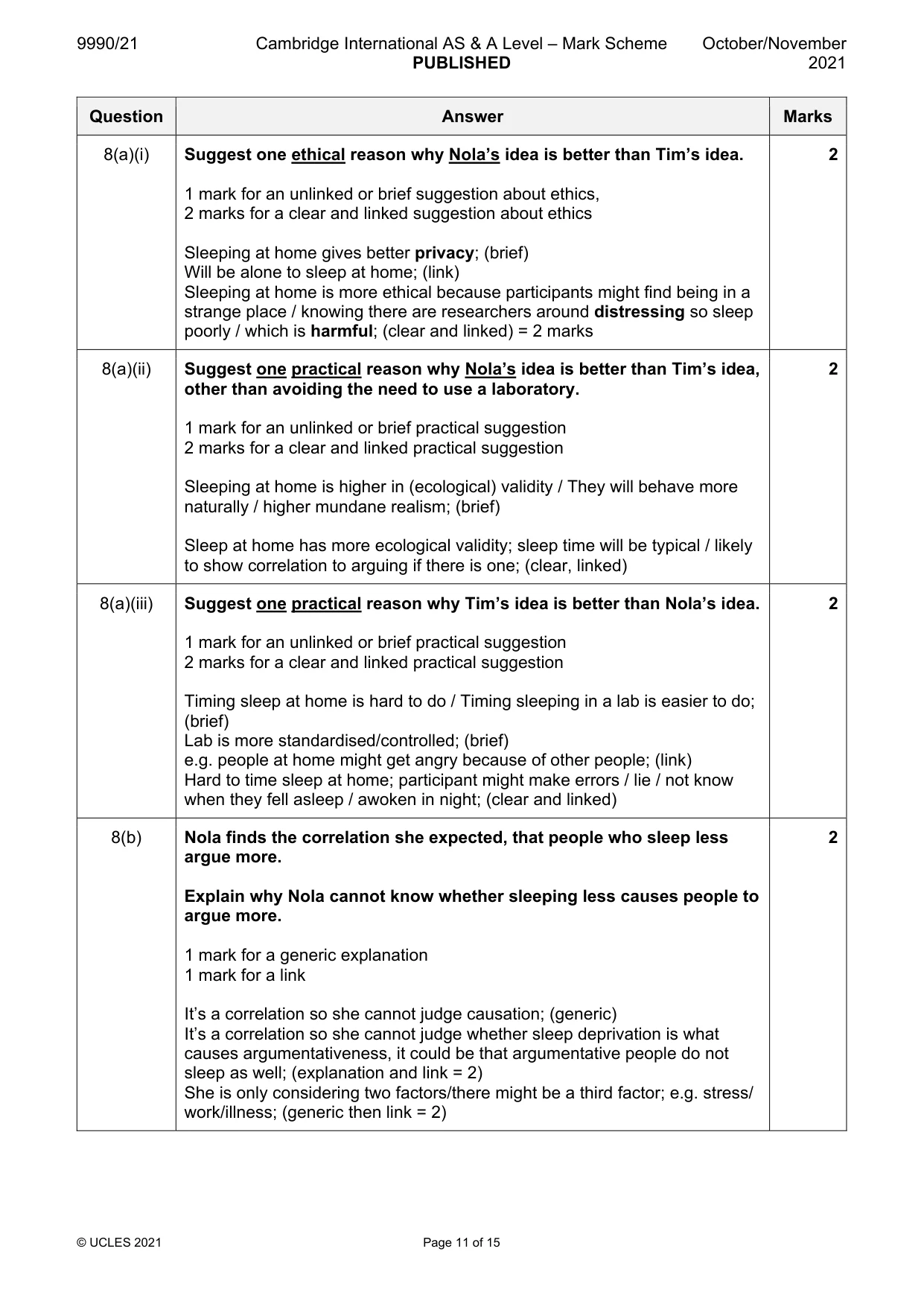
8 Nola is investigating whether there is a correlation between hours of sleep and how much a person argues. She thinks that people who sleep less may argue more. Her friend Tim is making suggestions about her procedure. (a) Nola and Tim have different ideas for recording participants’ hours of sleep per night: • Nola plans to ask participants to record this at home. • Tim says it would be better to record this in a laboratory. (i) Suggest one ethical reason why Nola’s idea is better than Tim’s idea. ........................................................................................................................................... ........................................................................................................................................... ........................................................................................................................................... ..................................................................................................................................... [2] (ii) Suggest one practical reason why Nola’s idea is better than Tim’s idea, other than avoiding the need to use a laboratory. ........................................................................................................................................... ........................................................................................................................................... ........................................................................................................................................... ..................................................................................................................................... [2] (iii) Suggest one practical reason why Tim’s idea is better than Nola’s idea. ........................................................................................................................................... ........................................................................................................................................... ........................................................................................................................................... ..................................................................................................................................... [2] (b) Nola finds the correlation she expected, that people who sleep less argue more. Explain why Nola cannot know whether sleeping less causes people to argue more. ................................................................................................................................................... ................................................................................................................................................... ................................................................................................................................................... ............................................................................................................................................. [2]
Mark scheme: 8 Nola is investigating whether there is a correlation between hours of sleep and how much a person argues. She thinks that people who sleep less may argue more. Her friend Tim is making suggestions about her procedure. 8(a) Nola and Tim have different ideas for recording participants’ hours of sleep per night: 8(a)(i) Suggest one ethical reason why Nola’s idea is better than Tim’s idea. 2 1 mark for an unlinked or brief suggestion about ethics, 2 marks for a clear and linked suggestion about ethics Sleeping at home gives better privacy; (brief) Will be alone to sleep at home; (link) Sleeping at home is more ethical because participants might find being in a strange place / knowing there are researchers around distressing so sleep poorly / which is harmful; (clear and linked) = 2 marks 8(a)(ii) Suggest one practical reason why Nola’s idea is better than Tim’s idea, 2 other than avoiding the need to use a laboratory. 1 mark for an unlinked or brief practical suggestion 2 marks for a clear and linked practical suggestion Sleeping at home is higher in (ecological) validity / They will behave more naturally / higher mundane realism; (brief) Sleep at home has more ecological validity; sleep time will be typical / likely to show correlation to arguing if there is one; (clear, linked) 8(a)(iii) Suggest one practical reason why Tim’s idea is better than Nola’s idea. 2 1 mark for an unlinked or brief practical suggestion 2 marks for a clear and linked practical suggestion Timing sleep at home is hard to do / Timing sleeping in a lab is easier to do; (brief) Lab is more standardised/controlled; (brief) e.g. people at home might get angry because of other people; (link) Hard to time sleep at home; participant might make errors / lie / not know when they fell asleep / awoken in night; (clear and linked) 8(b) Nola finds the correlation she expected, that people who sleep less 2 argue more. Explain why Nola cannot know whether sleeping less causes people to argue more. 1 mark for a generic explanation 1 mark for a link It’s a correlation so she cannot judge causation; (generic) It’s a correlation so she cannot judge whether sleep deprivation is what causes argumentativeness, it could be that argumentative people do not sleep as well; (explanation and link = 2) She is only considering two factors/there might be a third factor; e.g. stress/ work/illness; (generic then link = 2)
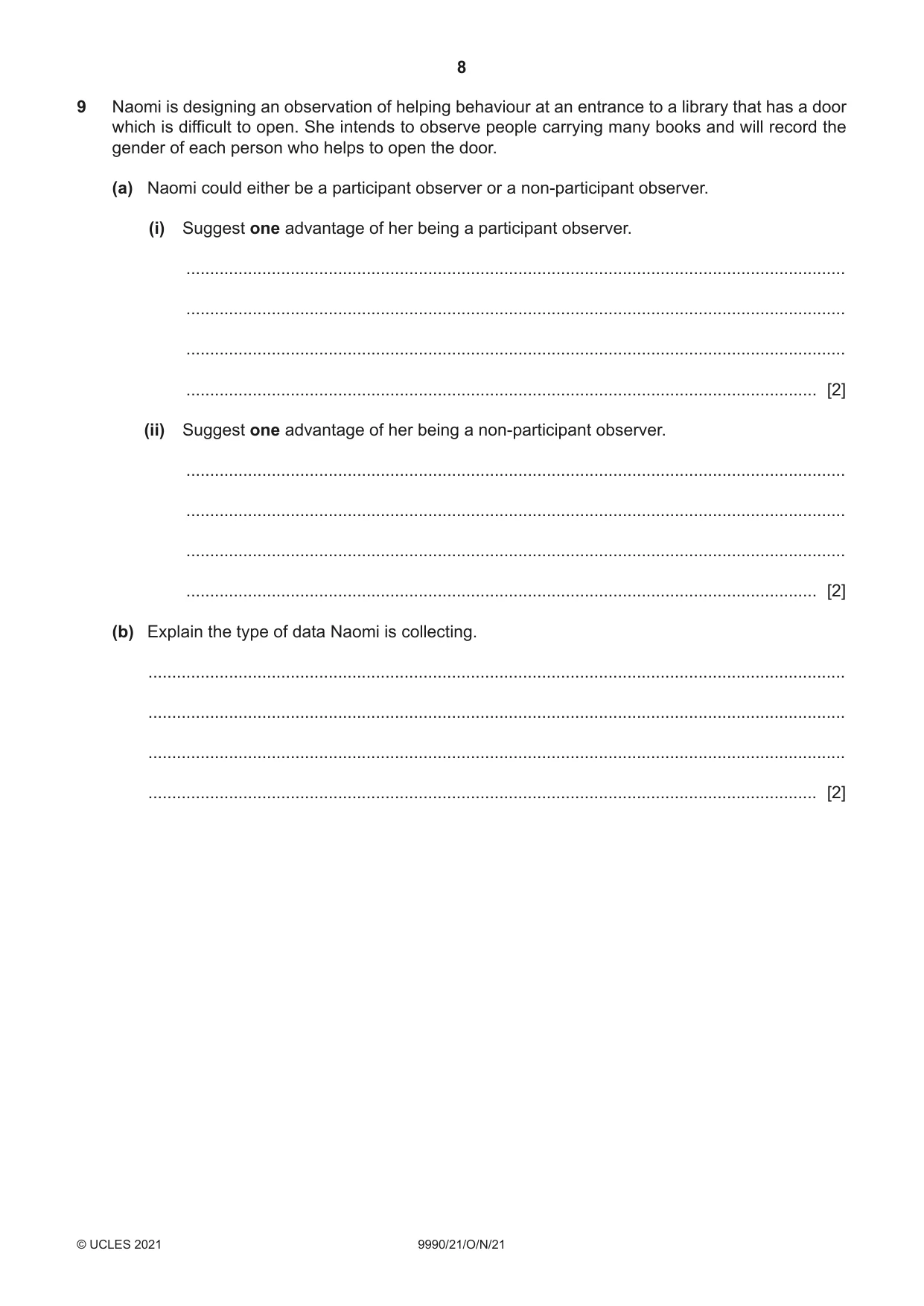
Q9 · Naomi is designing an observation of helping behaviour at an entrance to a library that…
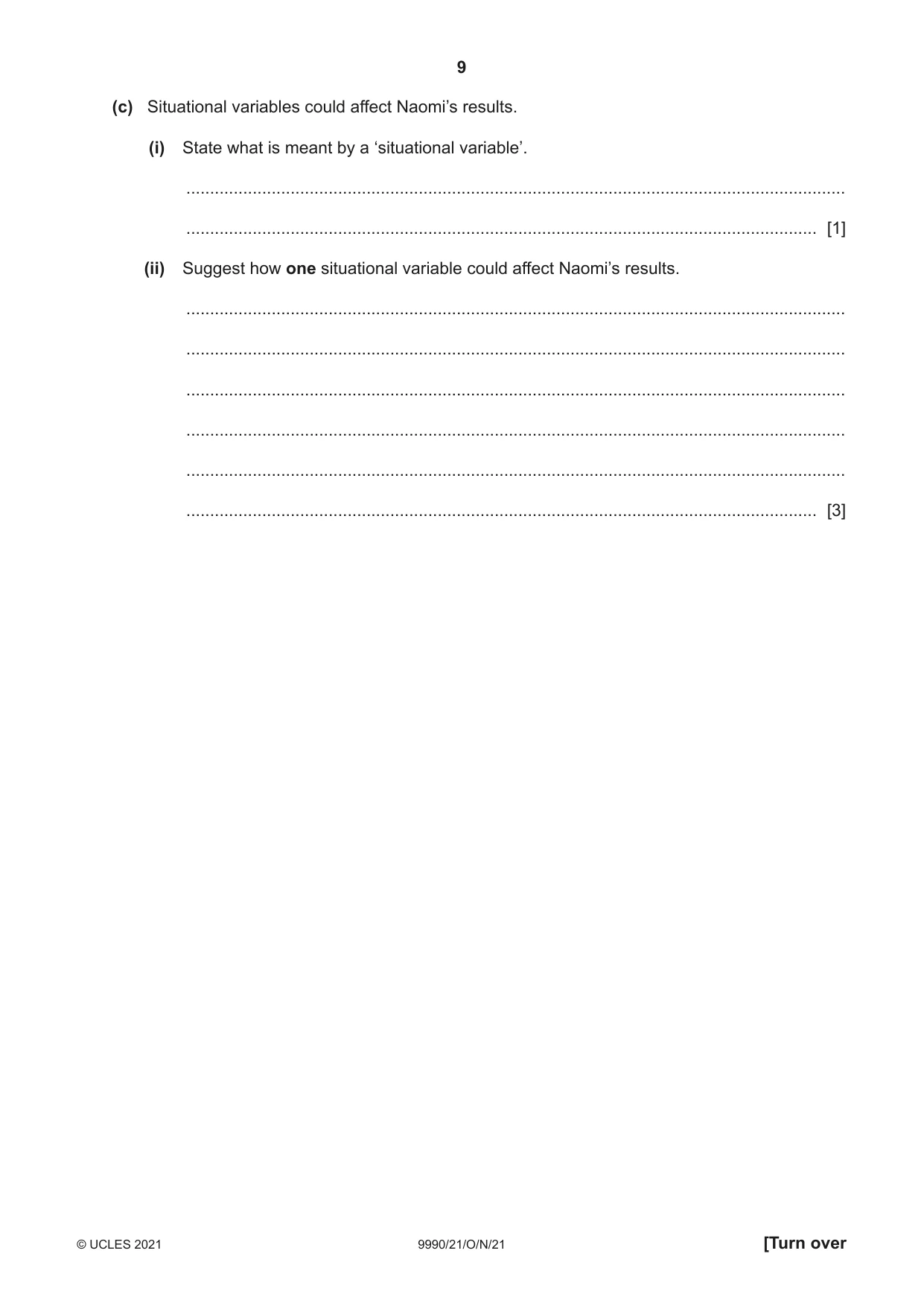
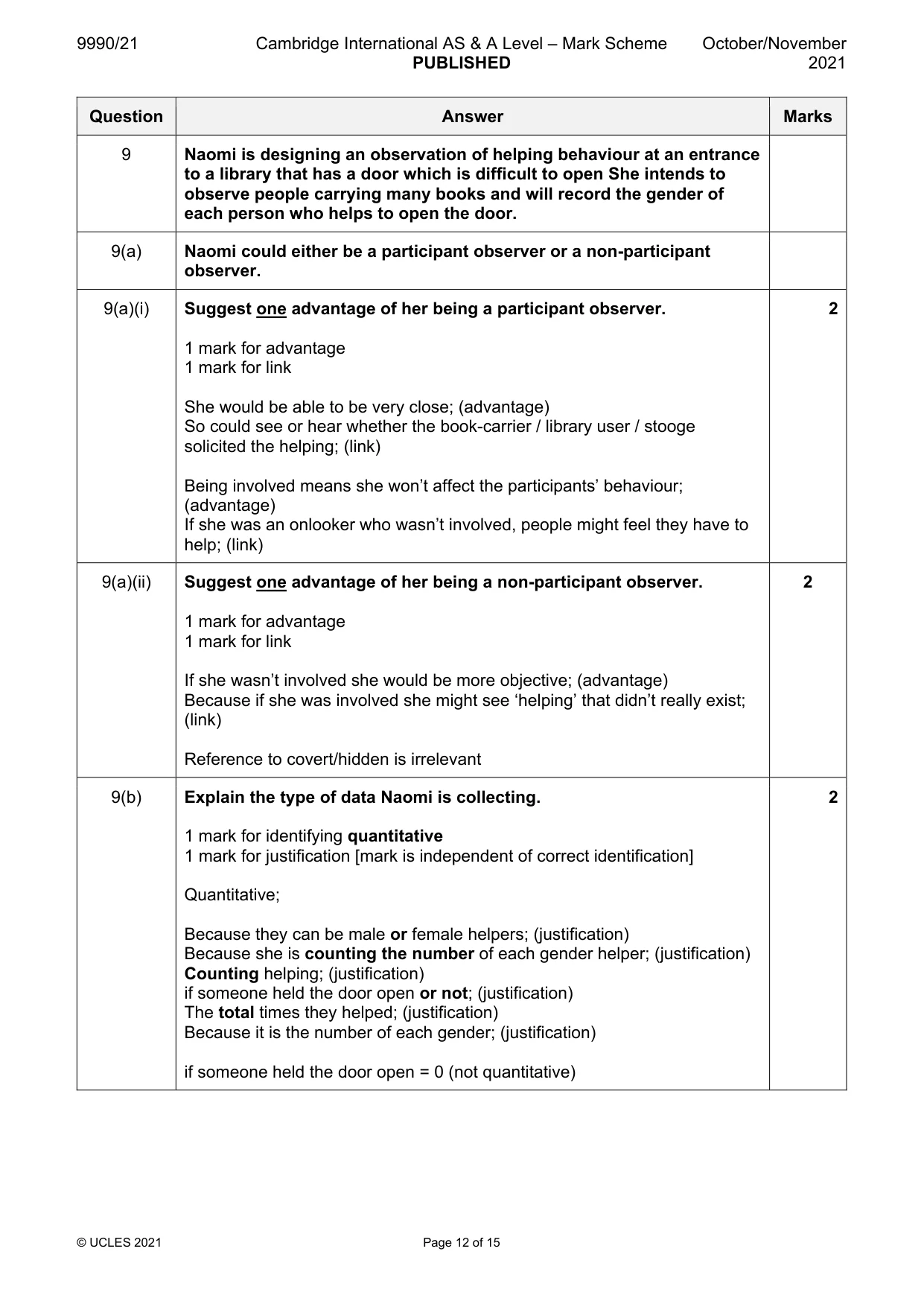
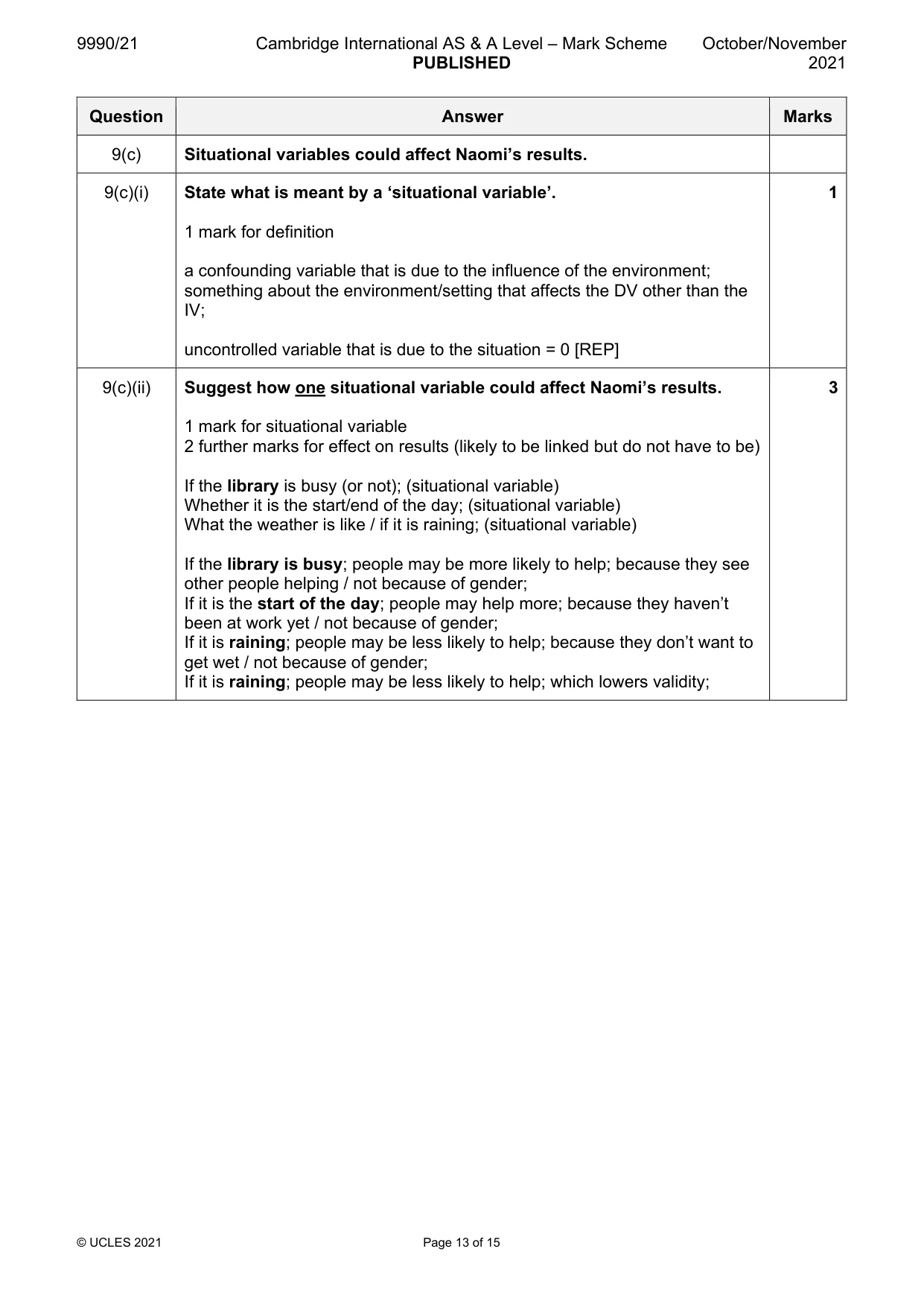
9 Naomi is designing an observation of helping behaviour at an entrance to a library that has a door which is difficult to open. She intends to observe people carrying many books and will record the gender of each person who helps to open the door. (a) Naomi could either be a participant observer or a non-participant observer. (i) Suggest one advantage of her being a participant observer. ........................................................................................................................................... ........................................................................................................................................... ........................................................................................................................................... ..................................................................................................................................... [2] (ii) Suggest one advantage of her being a non-participant observer. ........................................................................................................................................... ........................................................................................................................................... ........................................................................................................................................... ..................................................................................................................................... [2] (b) Explain the type of data Naomi is collecting. ................................................................................................................................................... ................................................................................................................................................... ................................................................................................................................................... ............................................................................................................................................. [2] (c) Situational variables could affect Naomi’s results. (i) State what is meant by a ‘situational variable’. ........................................................................................................................................... ..................................................................................................................................... [1] (ii) Suggest how one situational variable could affect Naomi’s results. ........................................................................................................................................... ........................................................................................................................................... ........................................................................................................................................... ........................................................................................................................................... ........................................................................................................................................... ..................................................................................................................................... [3] Section C Answer all questions in this section.
Mark scheme: 9 Naomi is designing an observation of helping behaviour at an entrance to a library that has a door which is difficult to open She intends to observe people carrying many books and will record the gender of each person who helps to open the door. 9(a) Naomi could either be a participant observer or a non-participant observer. 9(a)(i) Suggest one advantage of her being a participant observer. 2 1 mark for advantage 1 mark for link She would be able to be very close; (advantage) So could see or hear whether the book-carrier / library user / stooge solicited the helping; (link) Being involved means she won’t affect the participants’ behaviour; (advantage) If she was an onlooker who wasn’t involved, people might feel they have to help; (link) 9(a)(ii) Suggest one advantage of her being a non-participant observer. 2 1 mark for advantage 1 mark for link If she wasn’t involved she would be more objective; (advantage) Because if she was involved she might see ‘helping’ that didn’t really exist; (link) Reference to covert/hidden is irrelevant 9(b) Explain the type of data Naomi is collecting. 2 1 mark for identifying quantitative 1 mark for justification [mark is independent of correct identification] Quantitative; Because they can be male or female helpers; (justification) Because she is counting the number of each gender helper; (justification) Counting helping; (justification) if someone held the door open or not; (justification) The total times they helped; (justification) Because it is the number of each gender; (justification) if someone held the door open = 0 (not quantitative) 9(c) Situational variables could affect Naomi’s results. 9(c)(i) State what is meant by a ‘situational variable’. 1 1 mark for definition a confounding variable that is due to the influence of the environment; something about the environment/setting that affects the DV other than the IV; uncontrolled variable that is due to the situation = 0 [REP] 9(c)(ii) Suggest how one situational variable could affect Naomi’s results. 3 1 mark for situational variable 2 further marks for effect on results (likely to be linked but do not have to be) If the library is busy (or not); (situational variable) Whether it is the start/end of the day; (situational variable) What the weather is like / if it is raining; (situational variable) If the library is busy; people may be more likely to help; because they see other people helping / not because of gender; If it is the start of the day; people may help more; because they haven’t been at work yet / not because of gender; If it is raining; people may be less likely to help; because they don’t want to get wet / not because of gender; If it is raining; people may be less likely to help; which lowers validity;
Q10 · Brendan is planning to use a semi-structured interview in a study about road users
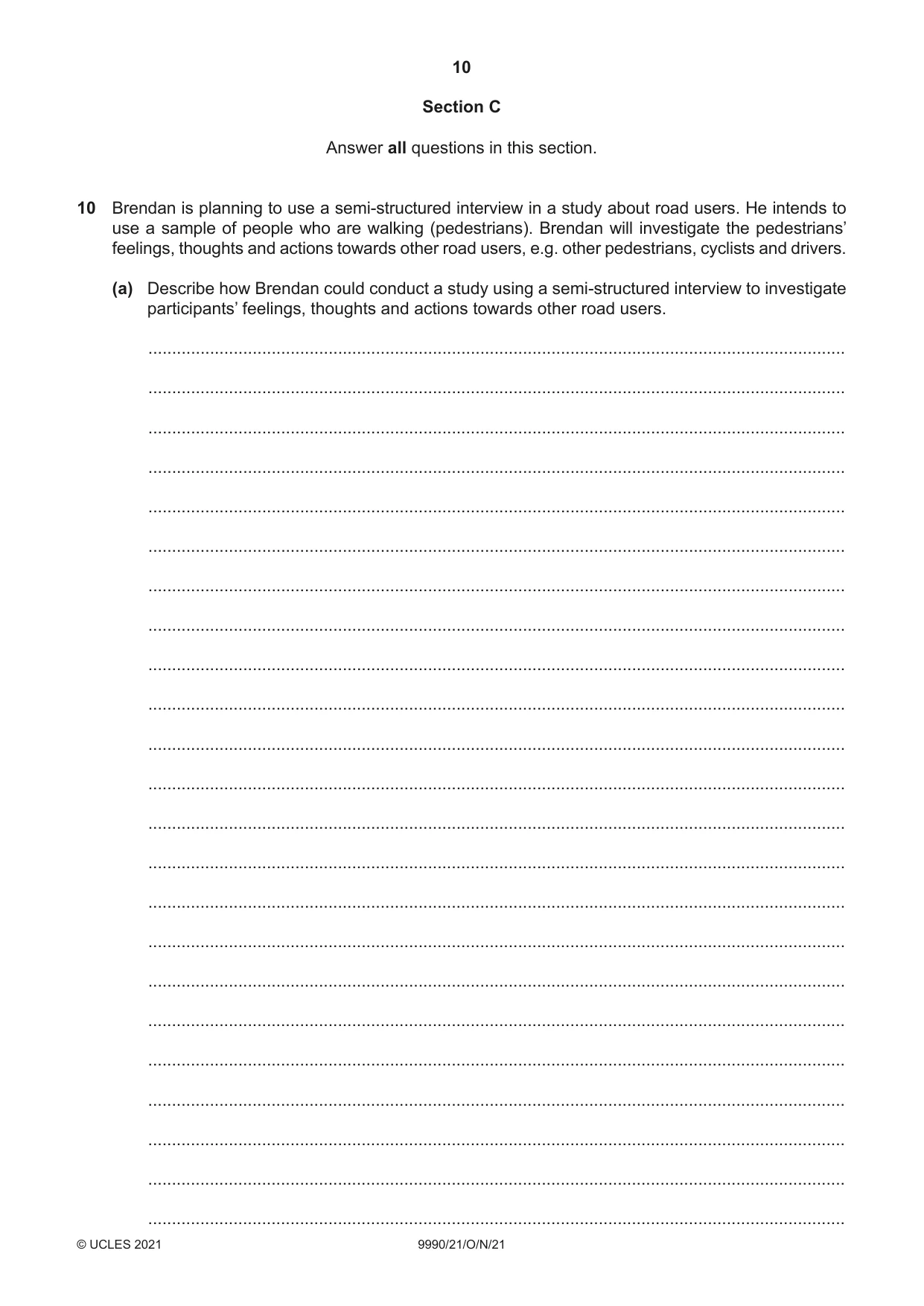
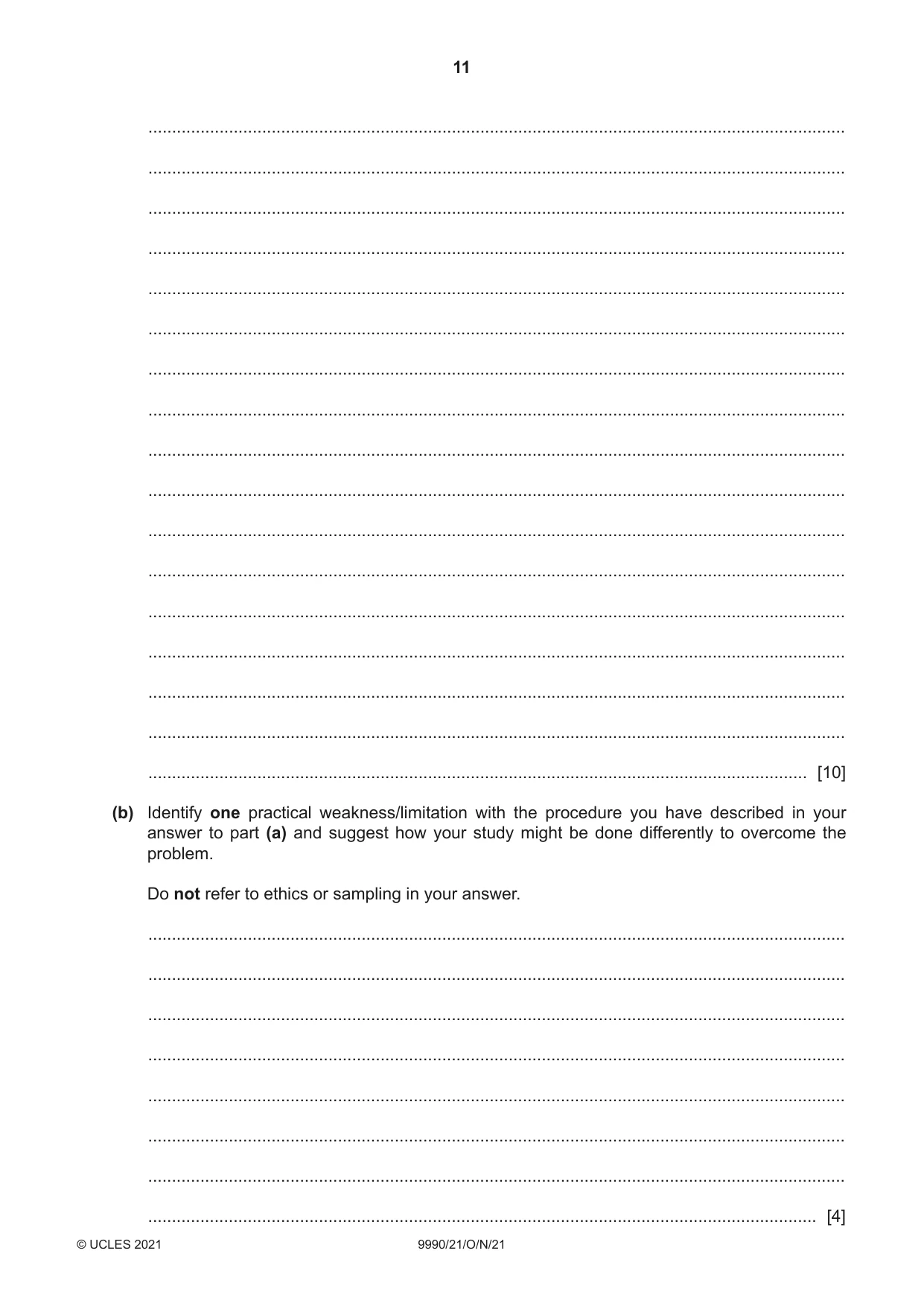
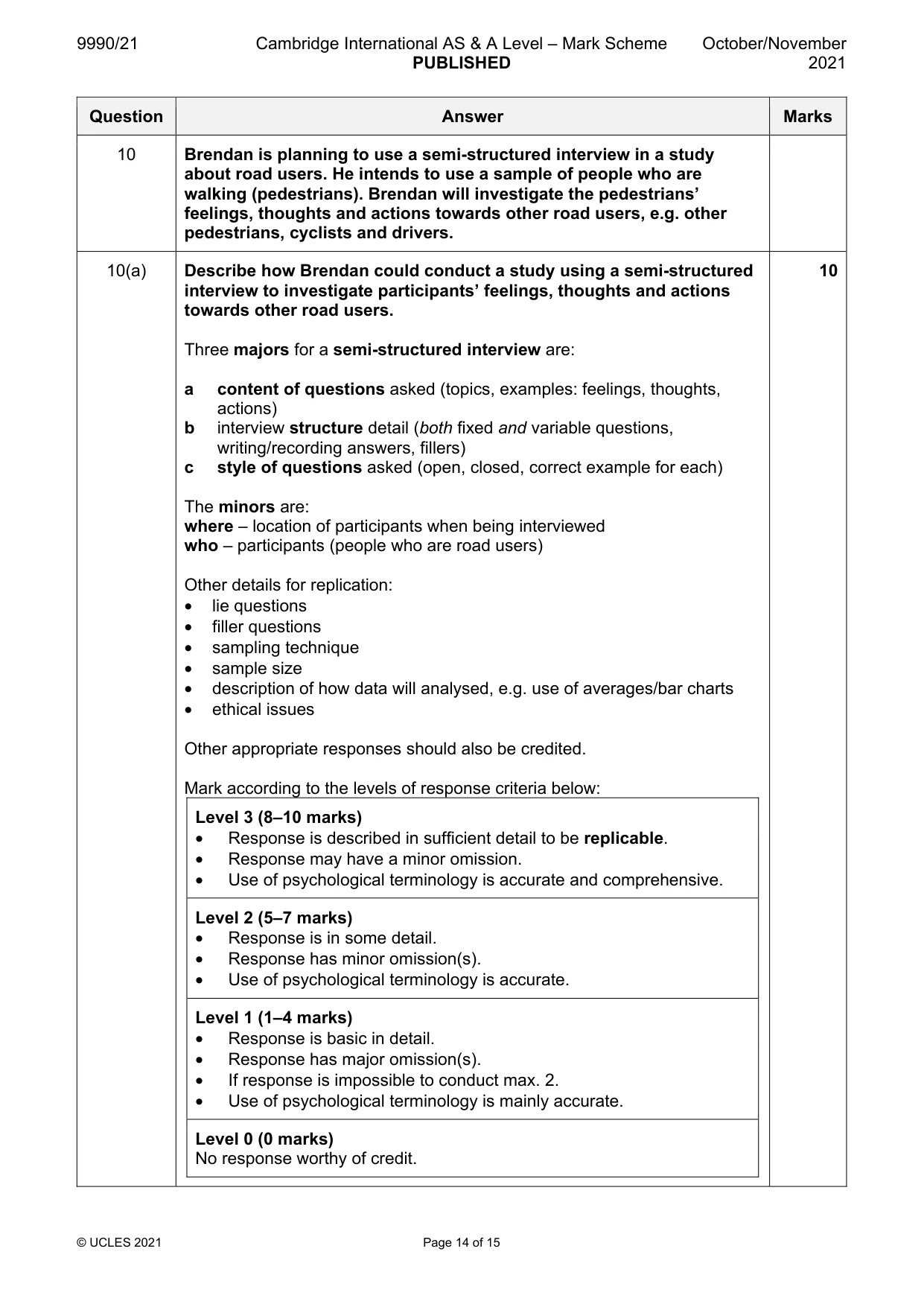
10 Brendan is planning to use a semi-structured interview in a study about road users. He intends to use a sample of people who are walking (pedestrians). Brendan will investigate the pedestrians’ feelings, thoughts and actions towards other road users, e.g. other pedestrians, cyclists and drivers. (a) Describe how Brendan could conduct a study using a semi-structured interview to investigate participants’ feelings, thoughts and actions towards other road users. ................................................................................................................................................... ................................................................................................................................................... ................................................................................................................................................... ................................................................................................................................................... ................................................................................................................................................... ................................................................................................................................................... ................................................................................................................................................... ................................................................................................................................................... ................................................................................................................................................... ................................................................................................................................................... ................................................................................................................................................... ................................................................................................................................................... ................................................................................................................................................... ................................................................................................................................................... ................................................................................................................................................... ................................................................................................................................................... ................................................................................................................................................... ................................................................................................................................................... ................................................................................................................................................... ................................................................................................................................................... ................................................................................................................................................... ................................................................................................................................................... ................................................................................................................................................... ................................................................................................................................................... ................................................................................................................................................... ................................................................................................................................................... ................................................................................................................................................... ................................................................................................................................................... ................................................................................................................................................... ................................................................................................................................................... ................................................................................................................................................... ................................................................................................................................................... ................................................................................................................................................... ................................................................................................................................................... ................................................................................................................................................... ................................................................................................................................................... ................................................................................................................................................... ................................................................................................................................................... ................................................................................................................................................... ........................................................................................................................................... [10] (b) Identify one practical weakness/limitation with the procedure you have described in your answer to part (a) and suggest how your study might be done differently to overcome the problem. Do not refer to ethics or sampling in your answer. ................................................................................................................................................... ................................................................................................................................................... ................................................................................................................................................... ................................................................................................................................................... ................................................................................................................................................... ................................................................................................................................................... ...................................................................................................................................................
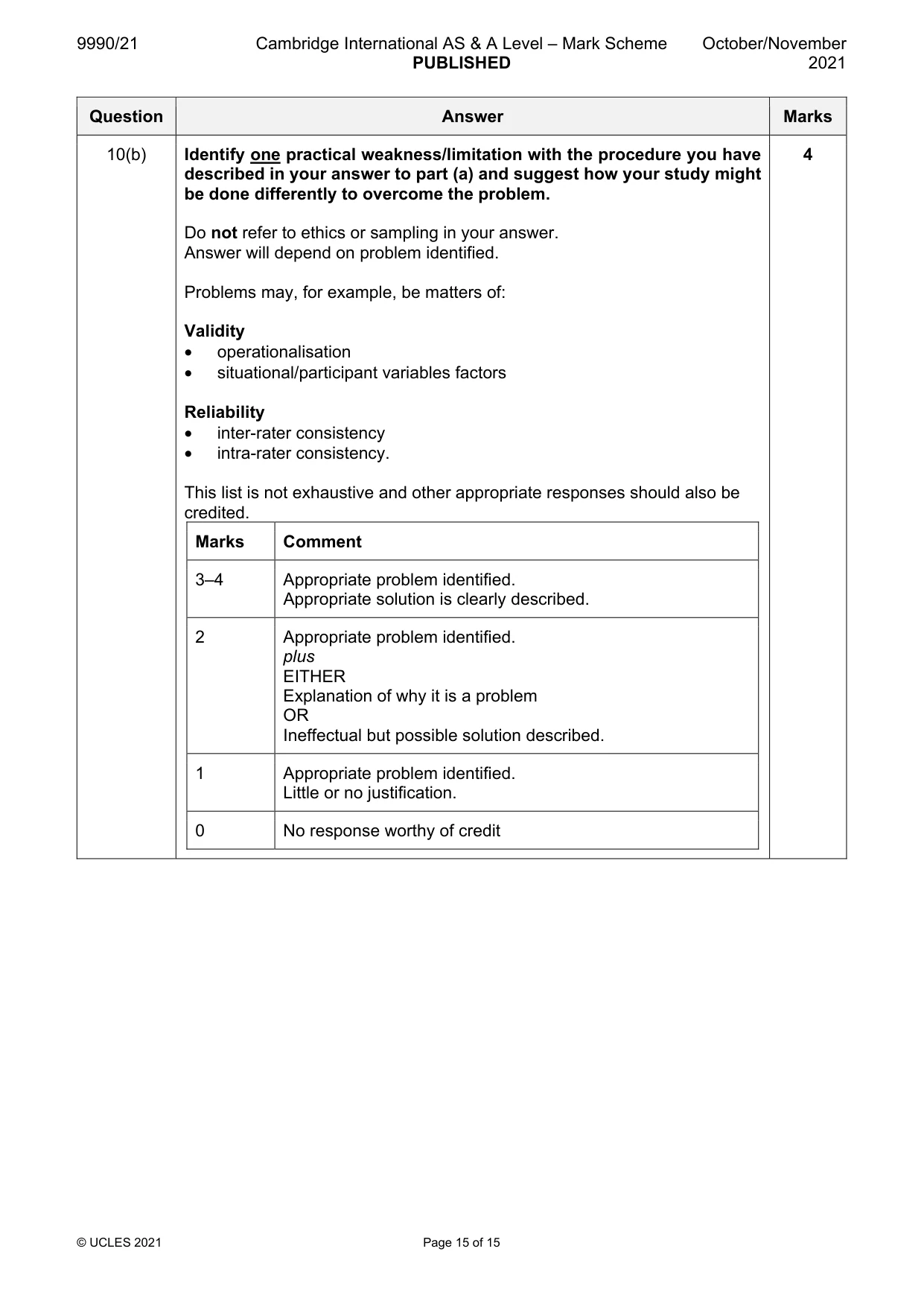
Mark scheme: 10 Brendan is planning to use a semi-structured interview in a study about road users. He intends to use a sample of people who are walking (pedestrians). Brendan will investigate the pedestrians’ feelings, thoughts and actions towards other road users, e.g. other pedestrians, cyclists and drivers. 10(a) Describe how Brendan could conduct a study using a semi-structured 10 interview to investigate participants’ feelings, thoughts and actions towards other road users. Three majors for a semi-structured interview are: a content of questions asked (topics, examples: feelings, thoughts, actions) b interview structure detail (both fixed and variable questions, writing/recording answers, fillers) c style of questions asked (open, closed, correct example for each) The minors are: where – location of participants when being interviewed who – participants (people who are road users) Other details for replication: • lie questions • filler questions • sampling technique • sample size • description of how data will analysed, e.g. use of averages/bar charts • ethical issues Other appropriate responses should also be credited. Mark according to the levels of response criteria below: Level 3 (8–10 marks) • Response is described in sufficient detail to be replicable. • Response may have a minor omission. • Use of psychological terminology is accurate and comprehensive. Level 2 (5–7 marks) • Response is in some detail. • Response has minor omission(s). • Use of psychological terminology is accurate. Level 1 (1–4 marks) • Response is basic in detail. • Response has major omission(s). • If response is impossible to conduct max. 2. • Use of psychological terminology is mainly accurate. Level 0 (0 marks) No response worthy of credit. 10(b) Identify one practical weakness/limitation with the procedure you have 4 described in your answer to part (a) and suggest how your study might be done differently to overcome the problem. Do not refer to ethics or sampling in your answer. Answer will depend on problem identified. Problems may, for example, be matters of: Validity • operationalisation • situational/participant variables factors Reliability • inter-rater consistency • intra-rater consistency. This list is not exhaustive and other appropriate responses should also be credited. Marks Comment 3–4 Appropriate problem identified. Appropriate solution is clearly described. 2 Appropriate problem identified. plus EITHER Explanation of why it is a problem OR Ineffectual but possible solution described. 1 Appropriate problem identified. Little or no justification. 0 No response worthy of credit
What was in this paper
The subtopics covered by these 10 questions, and how many questions each got. Open one in a new tab to see every Cambridge question on it.
What you needed in this session
Cambridge’s own grade thresholds for 2021 Oct/Nov, Paper 2 · Variant 1. A higher threshold means an easier paper — the bar moves with how the cohort did.