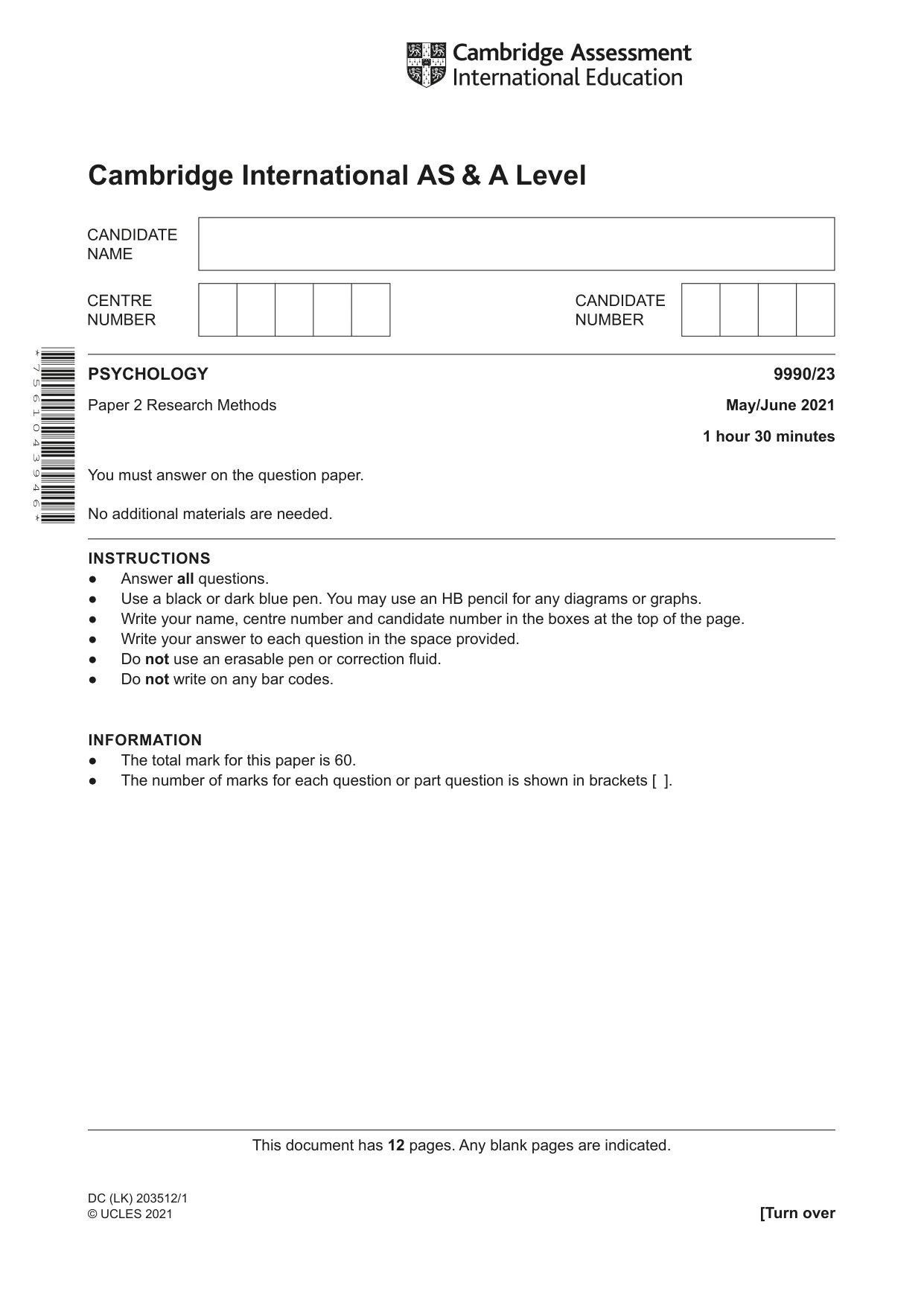
Cambridge A Level Psychology (from 2018) 9990 — 2021 May/June Paper 2 · Variant 3
9990/23/M/J/21 · 10 questions · 60 marks · ≈68 min
The question paper and its mark scheme, free to read here and free to download. This is Cambridge’s own paper, exactly as it was sat.
Question paper12 pages


Mark scheme15 pages
Answers below. Sit the paper first if you are practising.
Questions as text
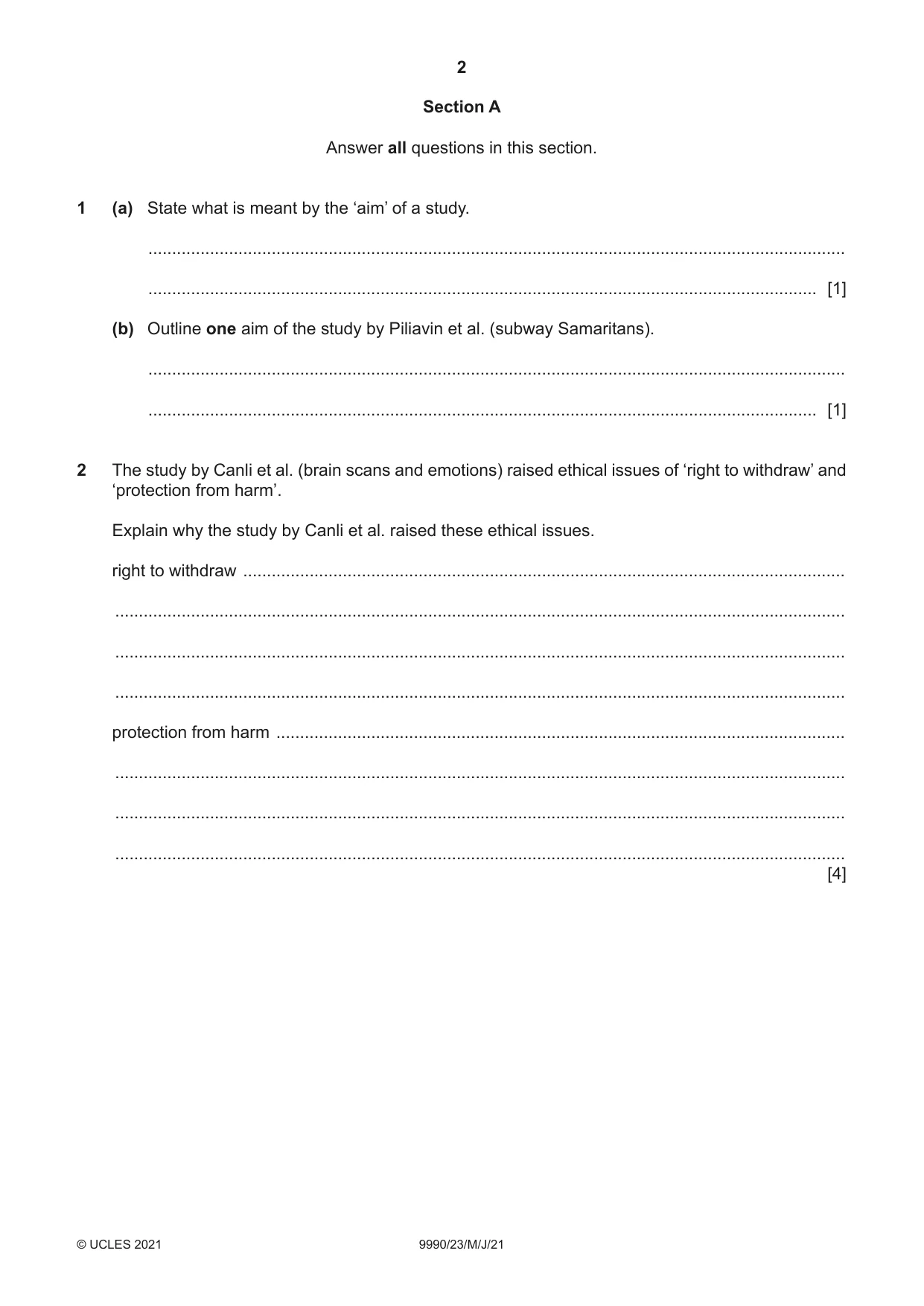
Q1 · State what is meant by the ‘aim’ of a study
1 (a) State what is meant by the ‘aim’ of a study. ................................................................................................................................................... ............................................................................................................................................. [1] (b) Outline one aim of the study by Piliavin et al. (subway Samaritans). ................................................................................................................................................... ............................................................................................................................................. [1]
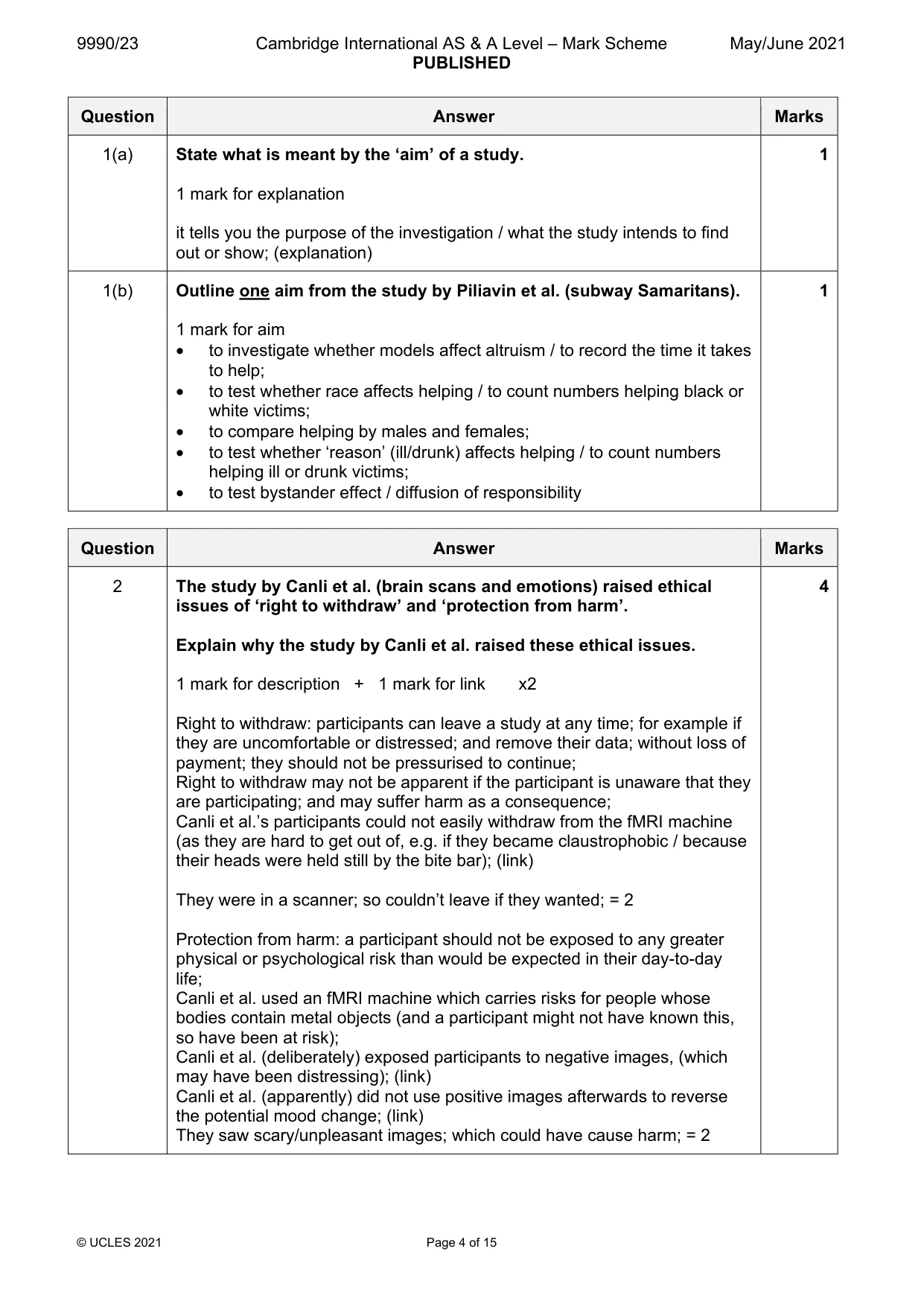
Mark scheme: Question Answer Marks 1(a) State what is meant by the ‘aim’ of a study. 1 1 mark for explanation it tells you the purpose of the investigation / what the study intends to find out or show; (explanation) 1(b) Outline one aim from the study by Piliavin et al. (subway Samaritans). 1 1 mark for aim • to investigate whether models affect altruism / to record the time it takes to help; • to test whether race affects helping / to count numbers helping black or white victims; • to compare helping by males and females; • to test whether ‘reason’ (ill/drunk) affects helping / to count numbers helping ill or drunk victims; • to test bystander effect / diffusion of responsibility
Q2 · The study by Canli et al
2 The study by Canli et al. (brain scans and emotions) raised ethical issues of ‘right to withdraw’ and ‘protection from harm’. Explain why the study by Canli et al. raised these ethical issues. right to withdraw ............................................................................................................................... .......................................................................................................................................................... .......................................................................................................................................................... .......................................................................................................................................................... protection from harm ........................................................................................................................ .......................................................................................................................................................... .......................................................................................................................................................... .......................................................................................................................................................... [4]
Mark scheme: 2 The study by Canli et al. (brain scans and emotions) raised ethical 4 issues of ‘right to withdraw’ and ‘protection from harm’. Explain why the study by Canli et al. raised these ethical issues. 1 mark for description + 1 mark for link x2 Right to withdraw: participants can leave a study at any time; for example if they are uncomfortable or distressed; and remove their data; without loss of payment; they should not be pressurised to continue; Right to withdraw may not be apparent if the participant is unaware that they are participating; and may suffer harm as a consequence; Canli et al.’s participants could not easily withdraw from the fMRI machine (as they are hard to get out of, e.g. if they became claustrophobic / because their heads were held still by the bite bar); (link) They were in a scanner; so couldn’t leave if they wanted; = 2 Protection from harm: a participant should not be exposed to any greater physical or psychological risk than would be expected in their day-to-day life; Canli et al. used an fMRI machine which carries risks for people whose bodies contain metal objects (and a participant might not have known this, so have been at risk); Canli et al. (deliberately) exposed participants to negative images, (which may have been distressing); (link) Canli et al. (apparently) did not use positive images afterwards to reverse the potential mood change; (link) They saw scary/unpleasant images; which could have cause harm; = 2
Q3 · In the study by Laney et al
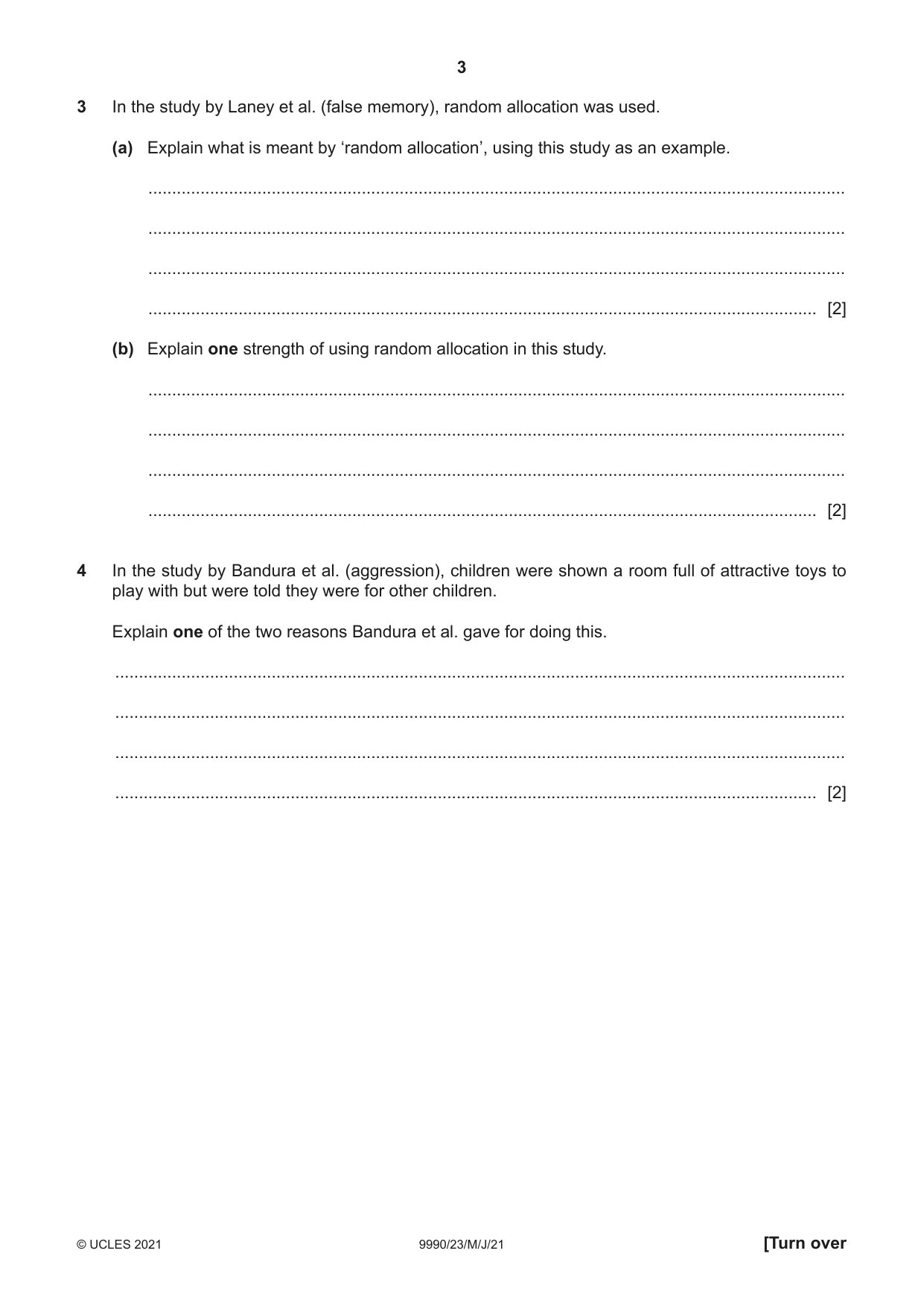
3 In the study by Laney et al. (false memory), random allocation was used. (a) Explain what is meant by ‘random allocation’, using this study as an example. ................................................................................................................................................... ................................................................................................................................................... ................................................................................................................................................... ............................................................................................................................................. [2] (b) Explain one strength of using random allocation in this study. ................................................................................................................................................... ................................................................................................................................................... ................................................................................................................................................... ............................................................................................................................................. [2]
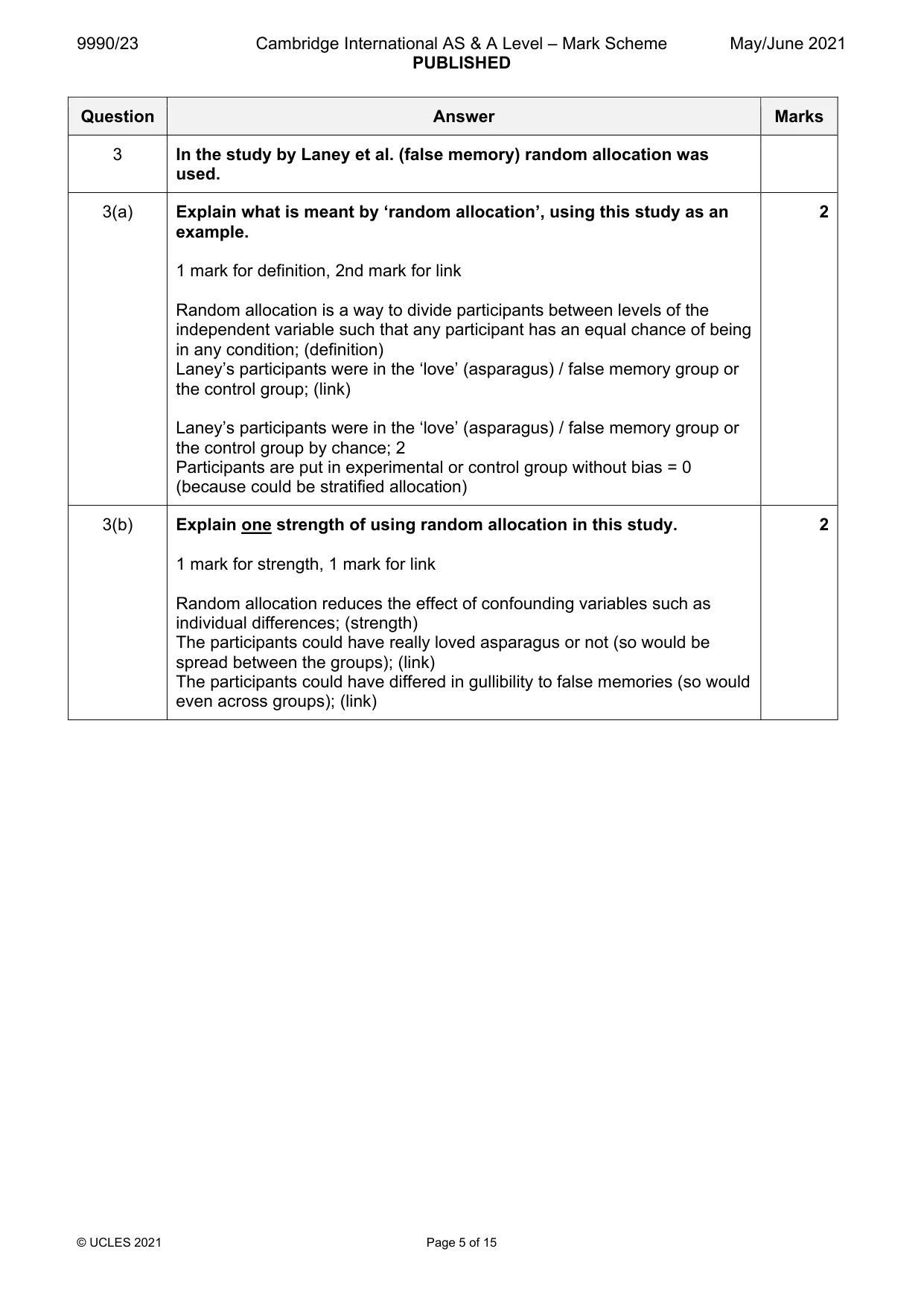
Mark scheme: 3 In the study by Laney et al. (false memory) random allocation was used. 3(a) Explain what is meant by ‘random allocation’, using this study as an 2 example. 1 mark for definition, 2nd mark for link Random allocation is a way to divide participants between levels of the independent variable such that any participant has an equal chance of being in any condition; (definition) Laney’s participants were in the ‘love’ (asparagus) / false memory group or the control group; (link) Laney’s participants were in the ‘love’ (asparagus) / false memory group or the control group by chance; 2 Participants are put in experimental or control group without bias = 0 (because could be stratified allocation) 3(b) Explain one strength of using random allocation in this study. 2 1 mark for strength, 1 mark for link Random allocation reduces the effect of confounding variables such as individual differences; (strength) The participants could have really loved asparagus or not (so would be spread between the groups); (link) The participants could have differed in gullibility to false memories (so would even across groups); (link)
Q4 · In the study by Bandura et al
4 In the study by Bandura et al. (aggression), children were shown a room full of attractive toys to play with but were told they were for other children. Explain one of the two reasons Bandura et al. gave for doing this. .......................................................................................................................................................... .......................................................................................................................................................... .......................................................................................................................................................... .................................................................................................................................................... [2]
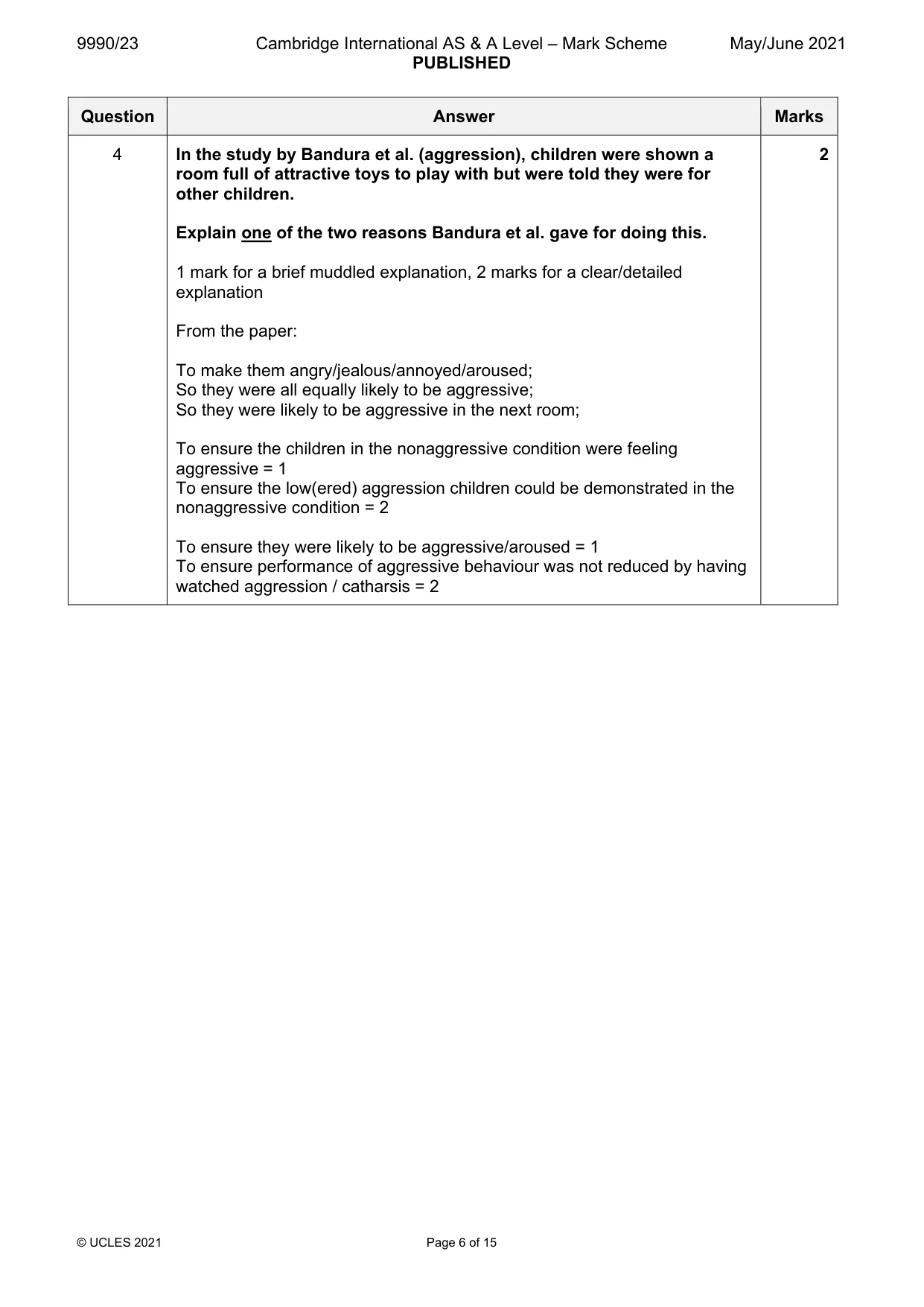
Mark scheme: 4 In the study by Bandura et al. (aggression), children were shown a 2 room full of attractive toys to play with but were told they were for other children. Explain one of the two reasons Bandura et al. gave for doing this. 1 mark for a brief muddled explanation, 2 marks for a clear/detailed explanation From the paper: To make them angry/jealous/annoyed/aroused; So they were all equally likely to be aggressive; So they were likely to be aggressive in the next room; To ensure the children in the nonaggressive condition were feeling aggressive = 1 To ensure the low(ered) aggression children could be demonstrated in the nonaggressive condition = 2 To ensure they were likely to be aggressive/aroused = 1 To ensure performance of aggressive behaviour was not reduced by having watched aggression / catharsis = 2
Q5 · Two studies are using different methods to investigate the topic of dreaming in deaf…
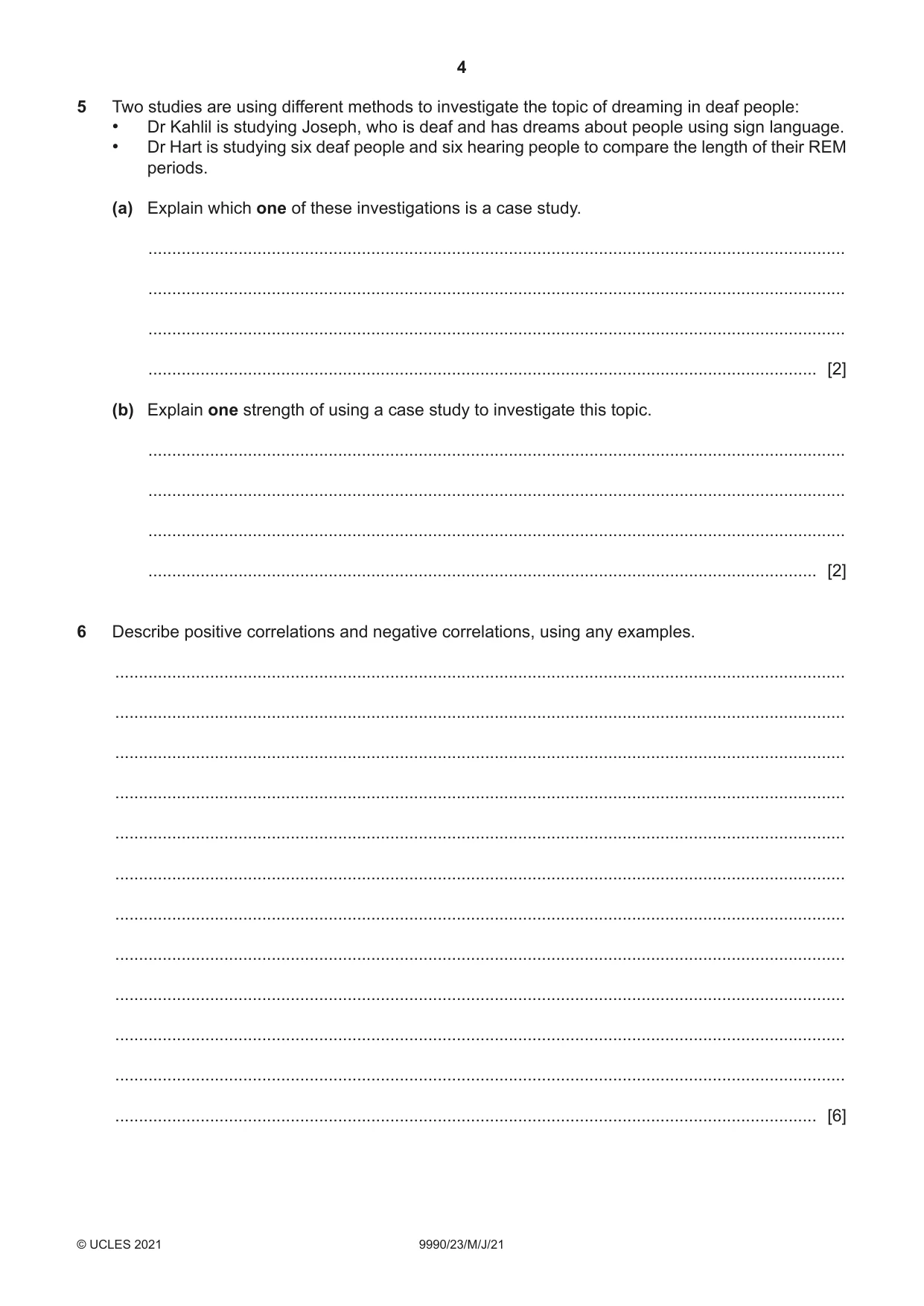
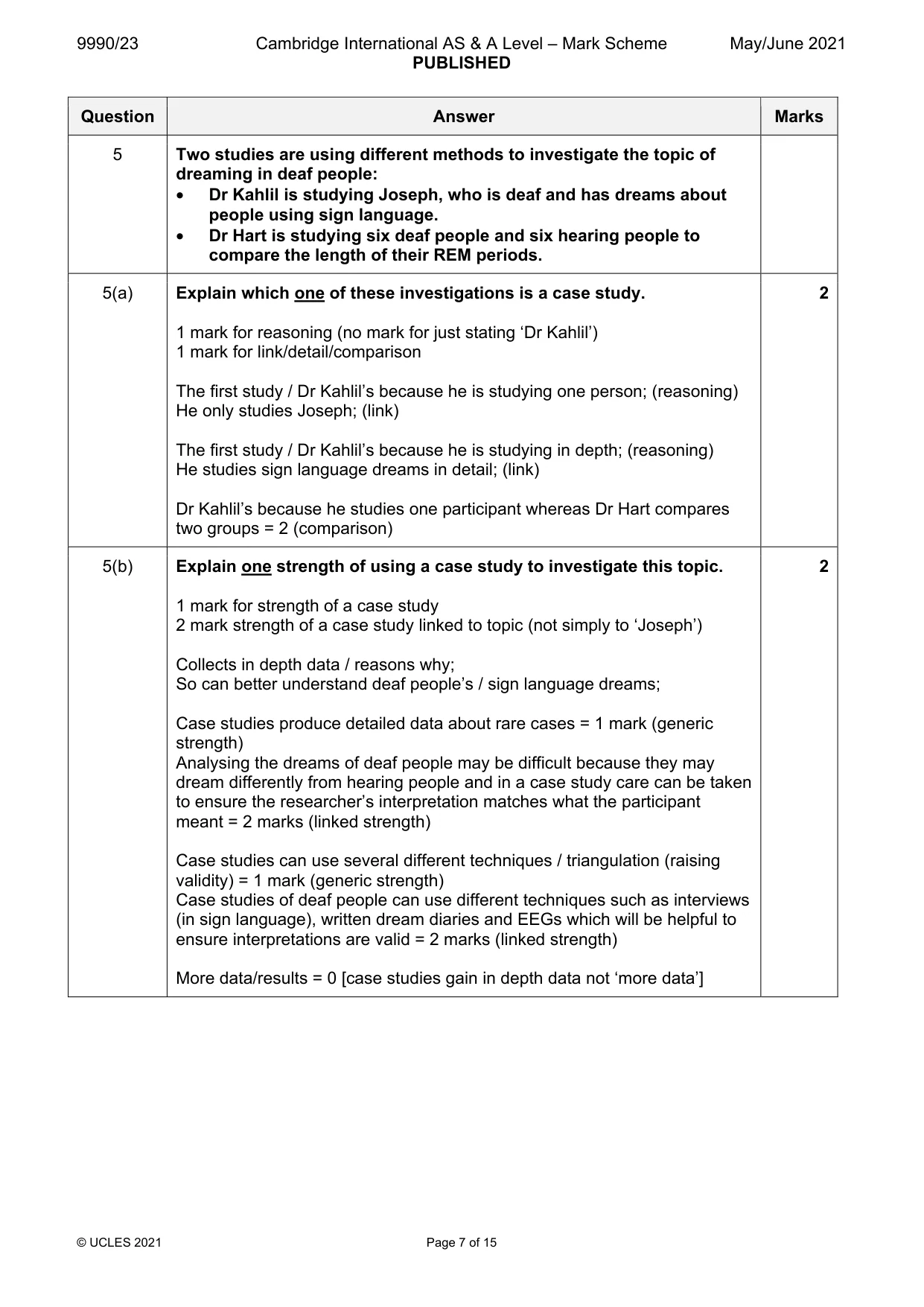
5 Two studies are using different methods to investigate the topic of dreaming in deaf people: • Dr Kahlil is studying Joseph, who is deaf and has dreams about people using sign language. • Dr Hart is studying six deaf people and six hearing people to compare the length of their REM periods. (a) Explain which one of these investigations is a case study. ................................................................................................................................................... ................................................................................................................................................... ................................................................................................................................................... ............................................................................................................................................. [2] (b) Explain one strength of using a case study to investigate this topic. ................................................................................................................................................... ................................................................................................................................................... ................................................................................................................................................... ............................................................................................................................................. [2]
Mark scheme: 5 Two studies are using different methods to investigate the topic of dreaming in deaf people: • Dr Kahlil is studying Joseph, who is deaf and has dreams about people using sign language. • Dr Hart is studying six deaf people and six hearing people to compare the length of their REM periods. 5(a) Explain which one of these investigations is a case study. 2 1 mark for reasoning (no mark for just stating ‘Dr Kahlil’) 1 mark for link/detail/comparison The first study / Dr Kahlil’s because he is studying one person; (reasoning) He only studies Joseph; (link) The first study / Dr Kahlil’s because he is studying in depth; (reasoning) He studies sign language dreams in detail; (link) Dr Kahlil’s because he studies one participant whereas Dr Hart compares two groups = 2 (comparison) 5(b) Explain one strength of using a case study to investigate this topic. 2 1 mark for strength of a case study 2 mark strength of a case study linked to topic (not simply to ‘Joseph’) Collects in depth data / reasons why; So can better understand deaf people’s / sign language dreams; Case studies produce detailed data about rare cases = 1 mark (generic strength) Analysing the dreams of deaf people may be difficult because they may dream differently from hearing people and in a case study care can be taken to ensure the researcher’s interpretation matches what the participant meant = 2 marks (linked strength) Case studies can use several different techniques / triangulation (raising validity) = 1 mark (generic strength) Case studies of deaf people can use different techniques such as interviews (in sign language), written dream diaries and EEGs which will be helpful to ensure interpretations are valid = 2 marks (linked strength) More data/results = 0 [case studies gain in depth data not ‘more data’]
Q6 · Describe positive correlations and negative correlations, using any examples
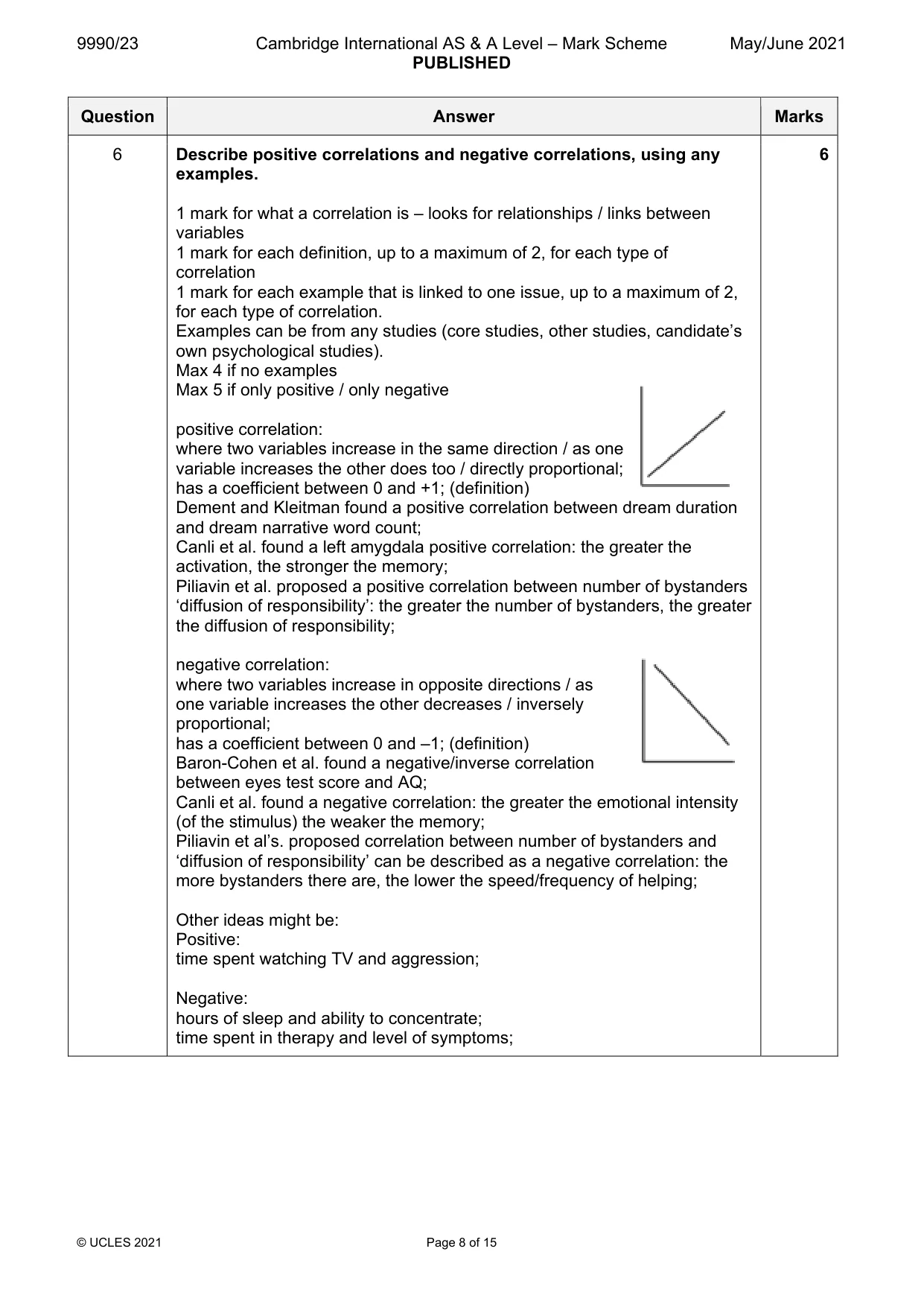
6 Describe positive correlations and negative correlations, using any examples. .......................................................................................................................................................... .......................................................................................................................................................... .......................................................................................................................................................... .......................................................................................................................................................... .......................................................................................................................................................... .......................................................................................................................................................... .......................................................................................................................................................... .......................................................................................................................................................... .......................................................................................................................................................... .......................................................................................................................................................... .......................................................................................................................................................... .................................................................................................................................................... [6]
Mark scheme: 6 Describe positive correlations and negative correlations, using any 6 examples. 1 mark for what a correlation is – looks for relationships / links between variables 1 mark for each definition, up to a maximum of 2, for each type of correlation 1 mark for each example that is linked to one issue, up to a maximum of 2, for each type of correlation. Examples can be from any studies (core studies, other studies, candidate’s own psychological studies). Max 4 if no examples Max 5 if only positive / only negative positive correlation: where two variables increase in the same direction / as one variable increases the other does too / directly proportional; has a coefficient between 0 and +1; (definition) Dement and Kleitman found a positive correlation between dream duration and dream narrative word count; Canli et al. found a left amygdala positive correlation: the greater the activation, the stronger the memory; Piliavin et al. proposed a positive correlation between number of bystanders ‘diffusion of responsibility’: the greater the number of bystanders, the greater the diffusion of responsibility; negative correlation: where two variables increase in opposite directions / as one variable increases the other decreases / inversely proportional; has a coefficient between 0 and –1; (definition) Baron-Cohen et al. found a negative/inverse correlation between eyes test score and AQ; Canli et al. found a negative correlation: the greater the emotional intensity (of the stimulus) the weaker the memory; Piliavin et al’s. proposed correlation between number of bystanders and ‘diffusion of responsibility’ can be described as a negative correlation: the more bystanders there are, the lower the speed/frequency of helping; Other ideas might be: Positive: time spent watching TV and aggression; Negative: hours of sleep and ability to concentrate; time spent in therapy and level of symptoms;
Q7 · Jane is planning a laboratory experiment with two groups of participants
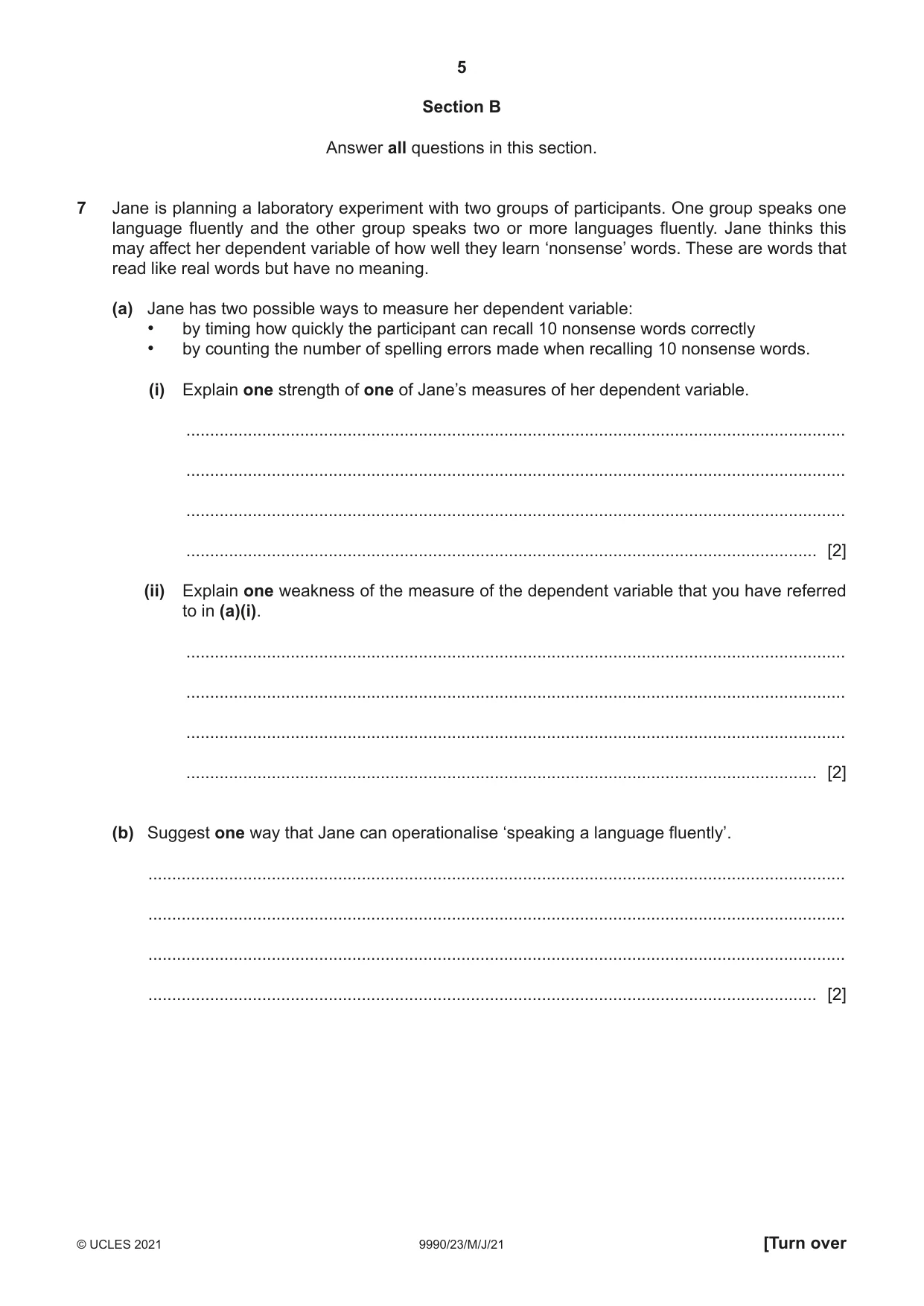
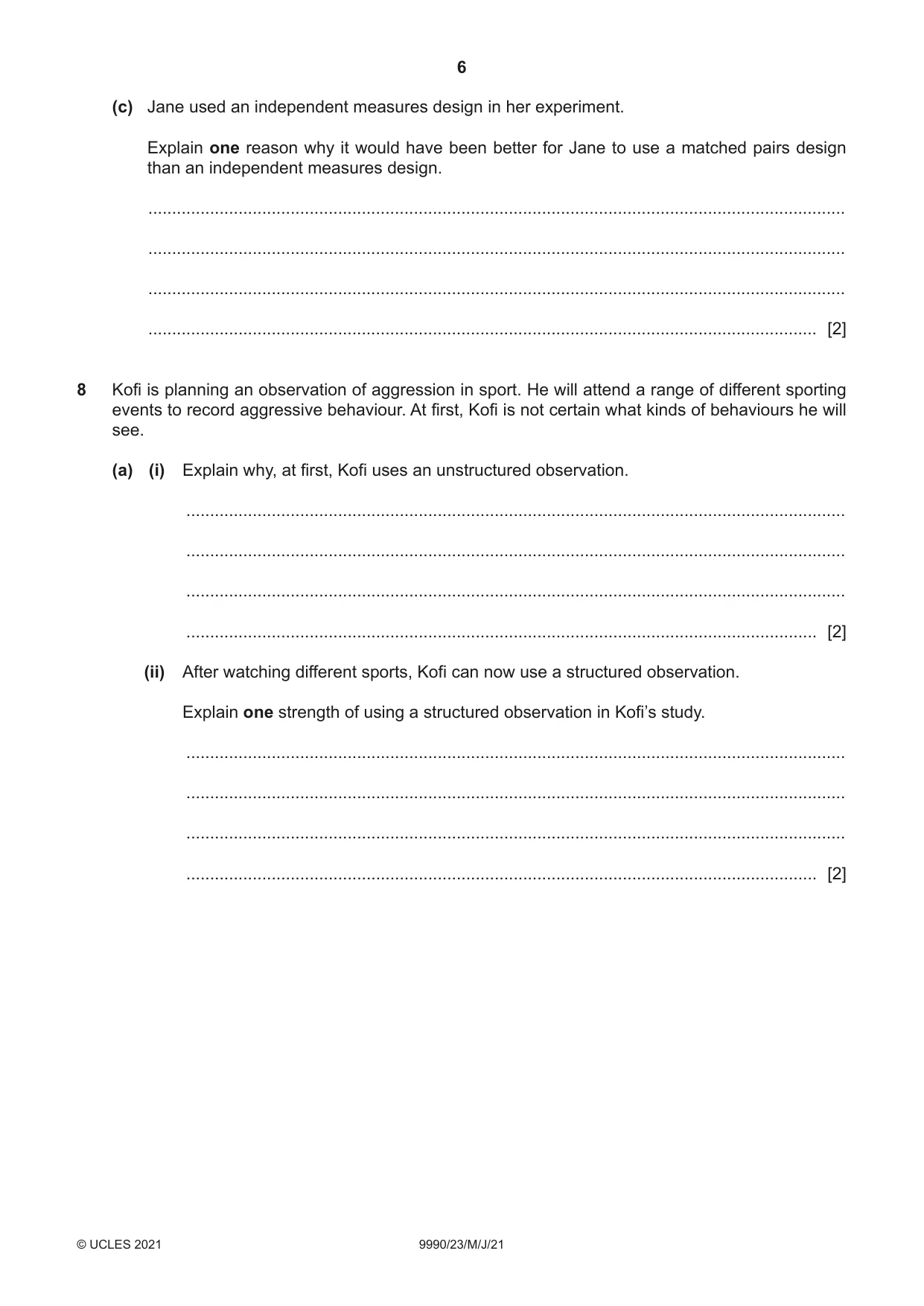
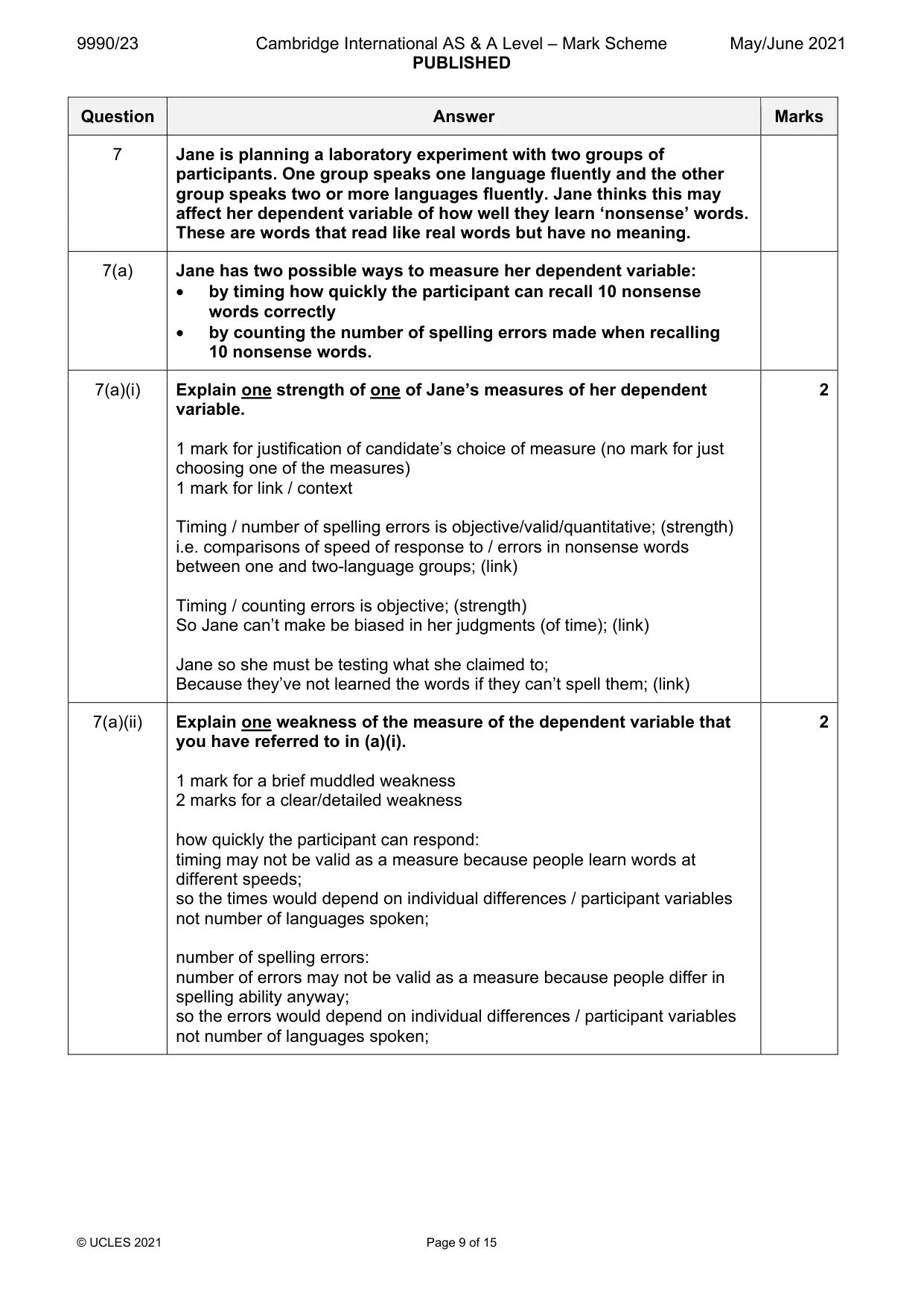
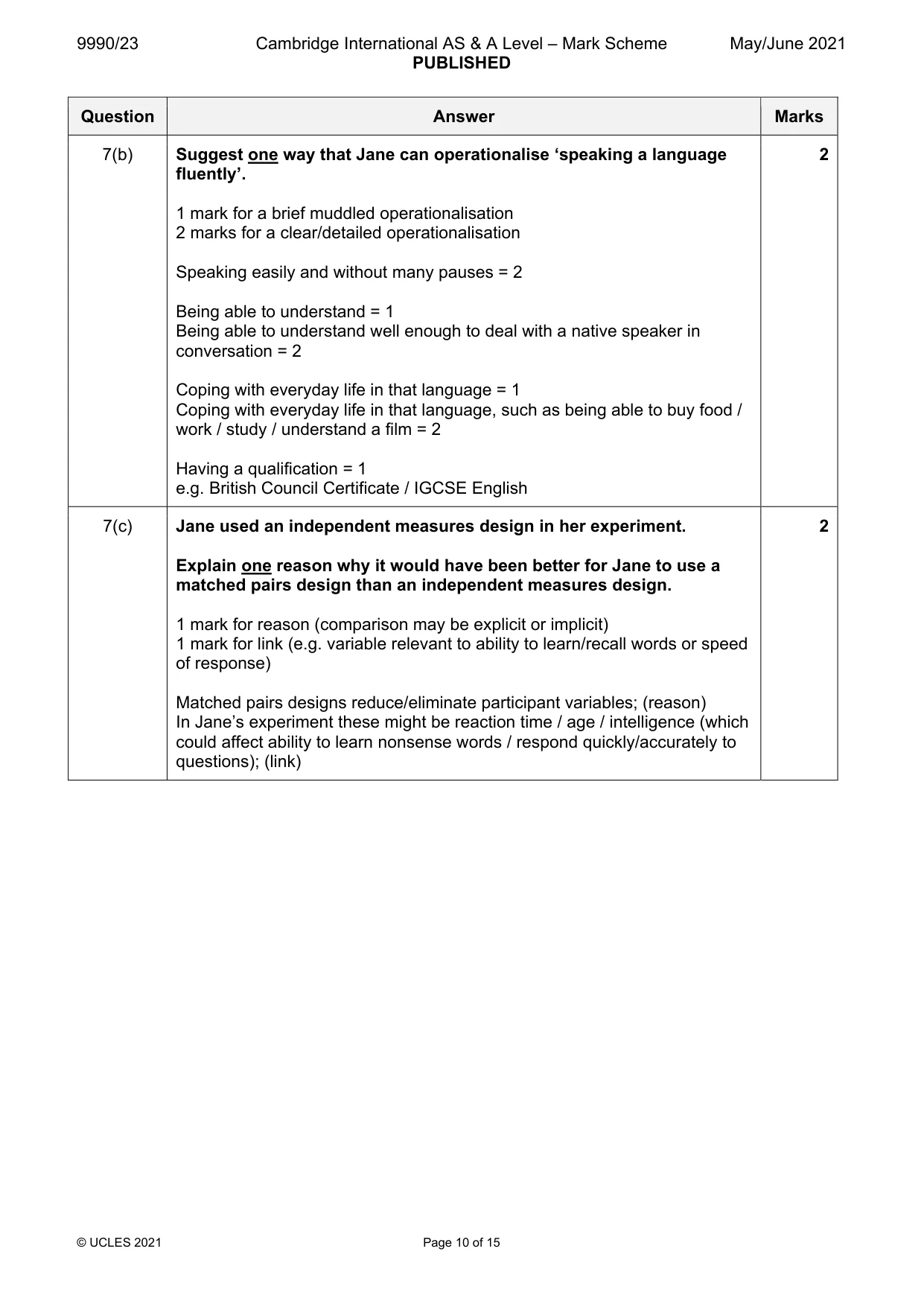
7 Jane is planning a laboratory experiment with two groups of participants. One group speaks one language fluently and the other group speaks two or more languages fluently. Jane thinks this may affect her dependent variable of how well they learn ‘nonsense’ words. These are words that read like real words but have no meaning. (a) Jane has two possible ways to measure her dependent variable: • by timing how quickly the participant can recall 10 nonsense words correctly • by counting the number of spelling errors made when recalling 10 nonsense words. (i) Explain one strength of one of Jane’s measures of her dependent variable. ........................................................................................................................................... ........................................................................................................................................... ........................................................................................................................................... ..................................................................................................................................... [2] (ii) Explain one weakness of the measure of the dependent variable that you have referred to in (a)(i). ........................................................................................................................................... ........................................................................................................................................... ........................................................................................................................................... ..................................................................................................................................... [2] (b) Suggest one way that Jane can operationalise ‘speaking a language fluently’. ................................................................................................................................................... ................................................................................................................................................... ................................................................................................................................................... ............................................................................................................................................. [2] (c) Jane used an independent measures design in her experiment. Explain one reason why it would have been better for Jane to use a matched pairs design than an independent measures design. ................................................................................................................................................... ................................................................................................................................................... ................................................................................................................................................... ............................................................................................................................................. [2]
Mark scheme: 7 Jane is planning a laboratory experiment with two groups of participants. One group speaks one language fluently and the other group speaks two or more languages fluently. Jane thinks this may affect her dependent variable of how well they learn ‘nonsense’ words. These are words that read like real words but have no meaning. 7(a) Jane has two possible ways to measure her dependent variable: • by timing how quickly the participant can recall 10 nonsense words correctly • by counting the number of spelling errors made when recalling 10 nonsense words. 7(a)(i) Explain one strength of one of Jane’s measures of her dependent 2 variable. 1 mark for justification of candidate’s choice of measure (no mark for just choosing one of the measures) 1 mark for link / context Timing / number of spelling errors is objective/valid/quantitative; (strength) i.e. comparisons of speed of response to / errors in nonsense words between one and two-language groups; (link) Timing / counting errors is objective; (strength) So Jane can’t make be biased in her judgments (of time); (link) Jane so she must be testing what she claimed to; Because they’ve not learned the words if they can’t spell them; (link) 7(a)(ii) Explain one weakness of the measure of the dependent variable that 2 you have referred to in (a)(i). 1 mark for a brief muddled weakness 2 marks for a clear/detailed weakness how quickly the participant can respond: timing may not be valid as a measure because people learn words at different speeds; so the times would depend on individual differences / participant variables not number of languages spoken; number of spelling errors: number of errors may not be valid as a measure because people differ in spelling ability anyway; so the errors would depend on individual differences / participant variables not number of languages spoken; 7(b) Suggest one way that Jane can operationalise ‘speaking a language 2 fluently’. 1 mark for a brief muddled operationalisation 2 marks for a clear/detailed operationalisation Speaking easily and without many pauses = 2 Being able to understand = 1 Being able to understand well enough to deal with a native speaker in conversation = 2 Coping with everyday life in that language = 1 Coping with everyday life in that language, such as being able to buy food / work / study / understand a film = 2 Having a qualification = 1 e.g. British Council Certificate / IGCSE English 7(c) Jane used an independent measures design in her experiment. 2 Explain one reason why it would have been better for Jane to use a matched pairs design than an independent measures design. 1 mark for reason (comparison may be explicit or implicit) 1 mark for link (e.g. variable relevant to ability to learn/recall words or speed of response) Matched pairs designs reduce/eliminate participant variables; (reason) In Jane’s experiment these might be reaction time / age / intelligence (which could affect ability to learn nonsense words / respond quickly/accurately to questions); (link)
Q8 · Kofi is planning an observation of aggression in sport
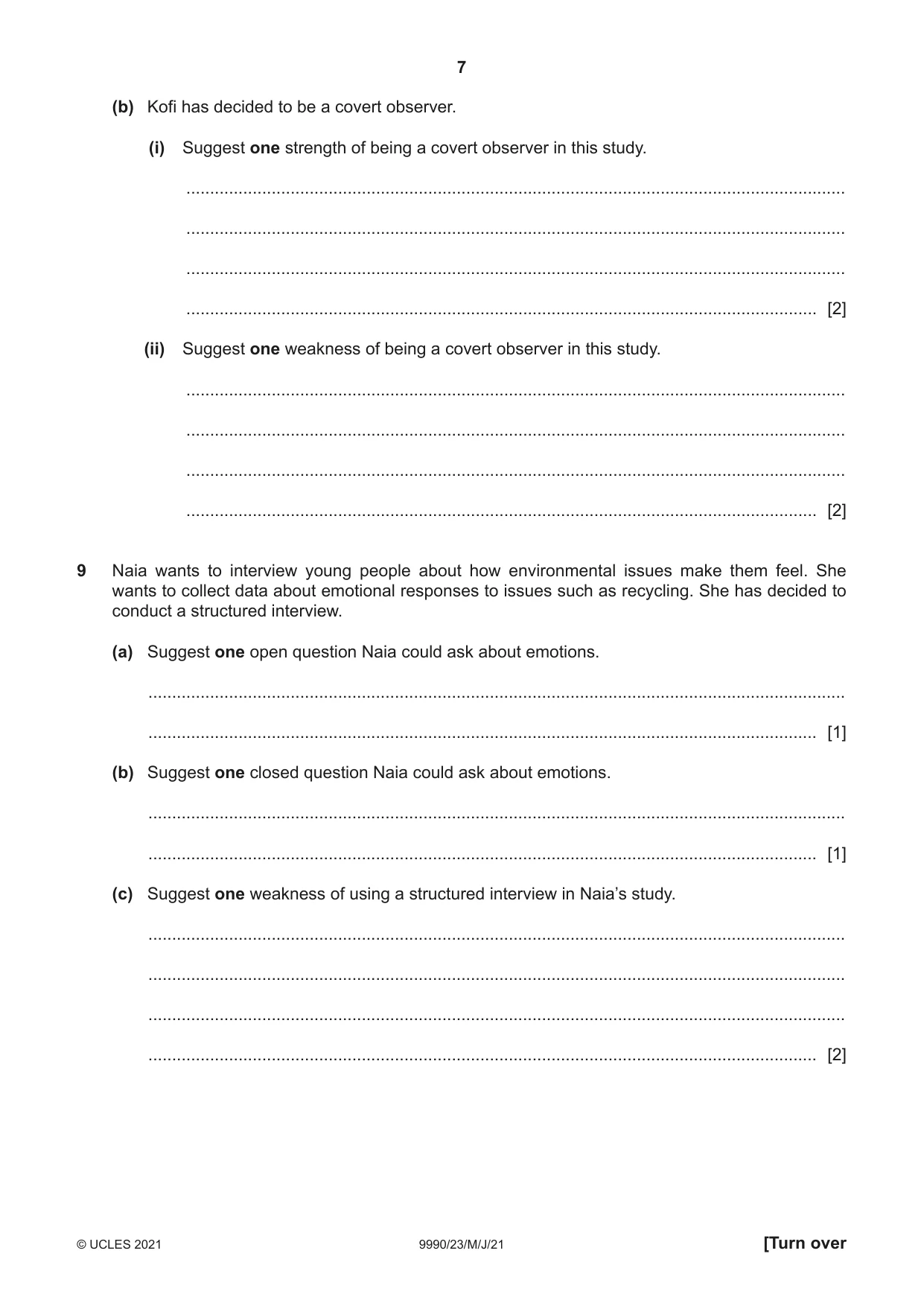
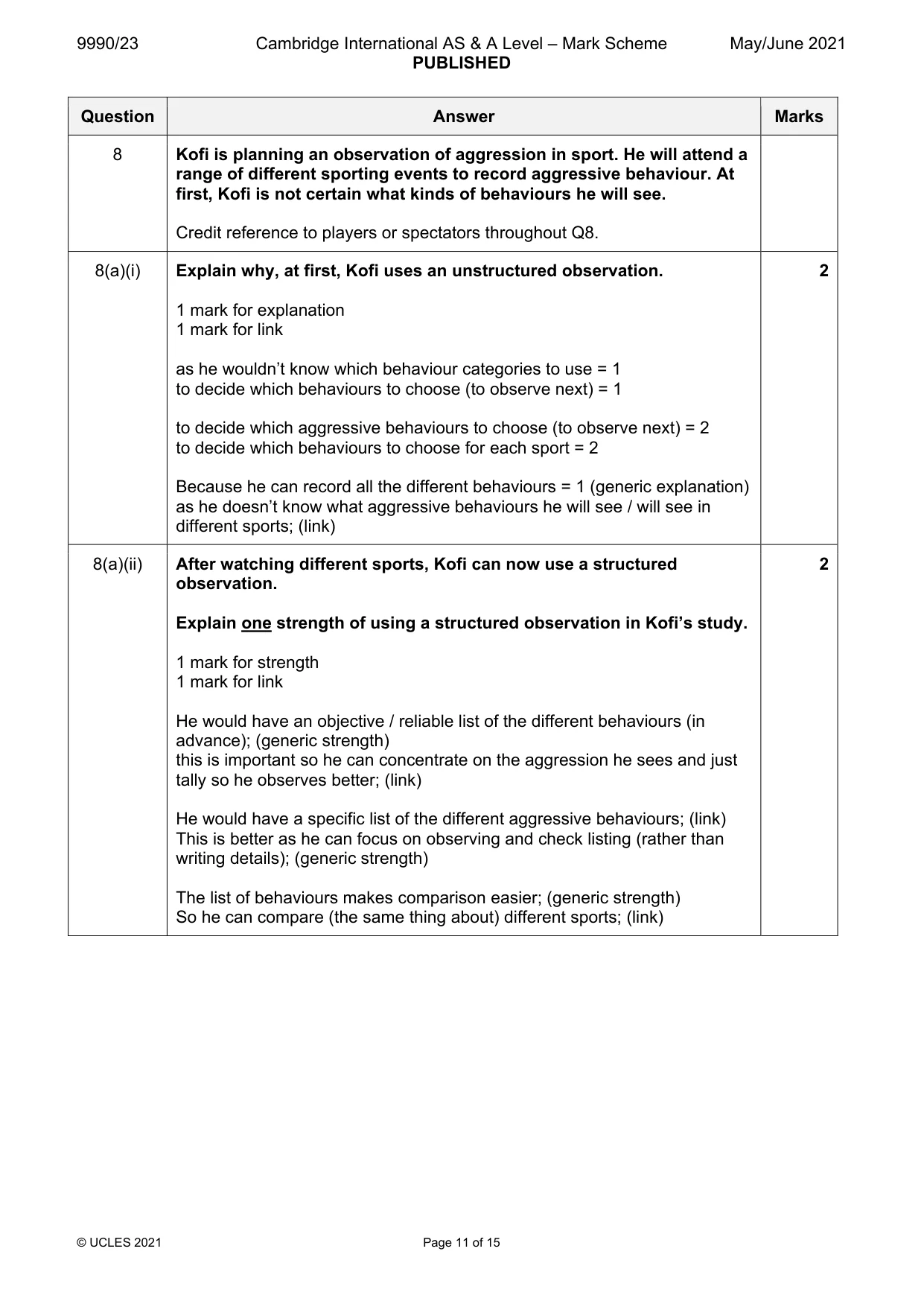
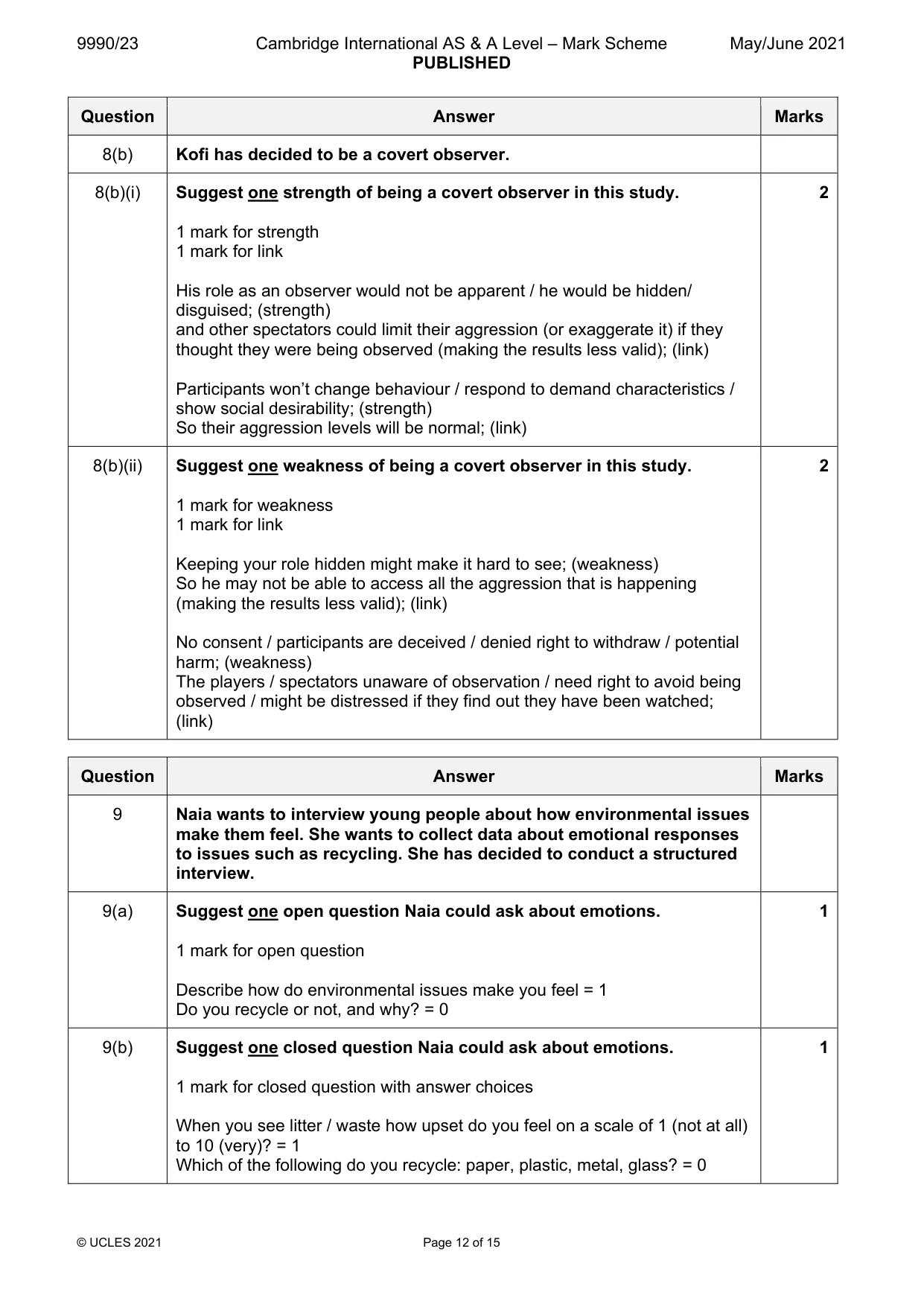
8 Kofi is planning an observation of aggression in sport. He will attend a range of different sporting events to record aggressive behaviour. At first, Kofi is not certain what kinds of behaviours he will see. (a) (i) Explain why, at first, Kofi uses an unstructured observation. ........................................................................................................................................... ........................................................................................................................................... ........................................................................................................................................... ..................................................................................................................................... [2] (ii) After watching different sports, Kofi can now use a structured observation. Explain one strength of using a structured observation in Kofi’s study. ........................................................................................................................................... ........................................................................................................................................... ........................................................................................................................................... ..................................................................................................................................... [2] (b) Kofi has decided to be a covert observer. (i) Suggest one strength of being a covert observer in this study. ........................................................................................................................................... ........................................................................................................................................... ........................................................................................................................................... ..................................................................................................................................... [2] (ii) Suggest one weakness of being a covert observer in this study. ........................................................................................................................................... ........................................................................................................................................... ........................................................................................................................................... ..................................................................................................................................... [2]
Mark scheme: 8 Kofi is planning an observation of aggression in sport. He will attend a range of different sporting events to record aggressive behaviour. At first, Kofi is not certain what kinds of behaviours he will see. Credit reference to players or spectators throughout Q8. 8(a)(i) Explain why, at first, Kofi uses an unstructured observation. 2 1 mark for explanation 1 mark for link as he wouldn’t know which behaviour categories to use = 1 to decide which behaviours to choose (to observe next) = 1 to decide which aggressive behaviours to choose (to observe next) = 2 to decide which behaviours to choose for each sport = 2 Because he can record all the different behaviours = 1 (generic explanation) as he doesn’t know what aggressive behaviours he will see / will see in different sports; (link) 8(a)(ii) After watching different sports, Kofi can now use a structured 2 observation. Explain one strength of using a structured observation in Kofi’s study. 1 mark for strength 1 mark for link He would have an objective / reliable list of the different behaviours (in advance); (generic strength) this is important so he can concentrate on the aggression he sees and just tally so he observes better; (link) He would have a specific list of the different aggressive behaviours; (link) This is better as he can focus on observing and check listing (rather than writing details); (generic strength) The list of behaviours makes comparison easier; (generic strength) So he can compare (the same thing about) different sports; (link) 8(b) Kofi has decided to be a covert observer. 8(b)(i) Suggest one strength of being a covert observer in this study. 2 1 mark for strength 1 mark for link His role as an observer would not be apparent / he would be hidden/ disguised; (strength) and other spectators could limit their aggression (or exaggerate it) if they thought they were being observed (making the results less valid); (link) Participants won’t change behaviour / respond to demand characteristics / show social desirability; (strength) So their aggression levels will be normal; (link) 8(b)(ii) Suggest one weakness of being a covert observer in this study. 2 1 mark for weakness 1 mark for link Keeping your role hidden might make it hard to see; (weakness) So he may not be able to access all the aggression that is happening (making the results less valid); (link) No consent / participants are deceived / denied right to withdraw / potential harm; (weakness) The players / spectators unaware of observation / need right to avoid being observed / might be distressed if they find out they have been watched; (link)
Q9 · Naia wants to interview young people about how environmental issues make them feel
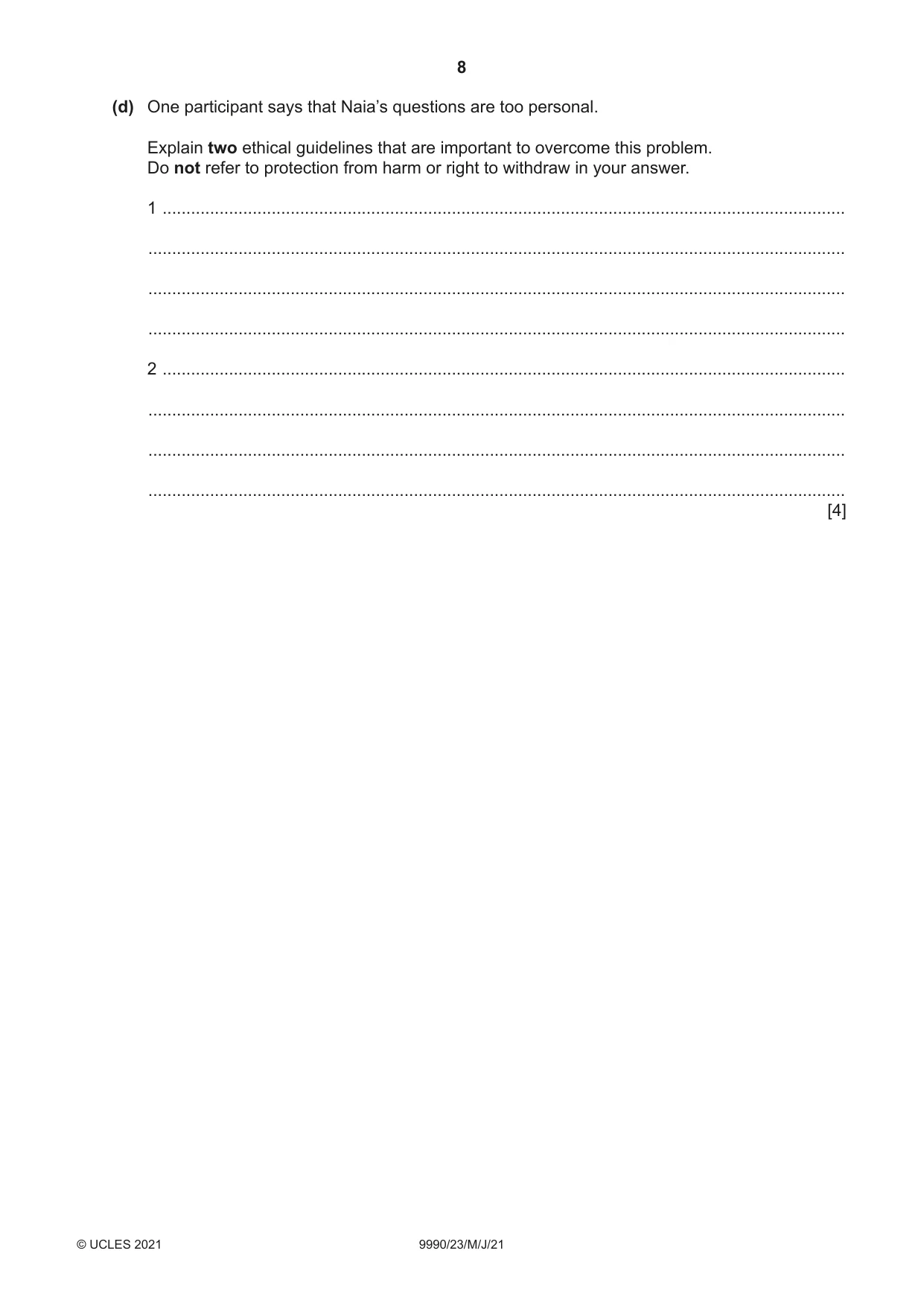
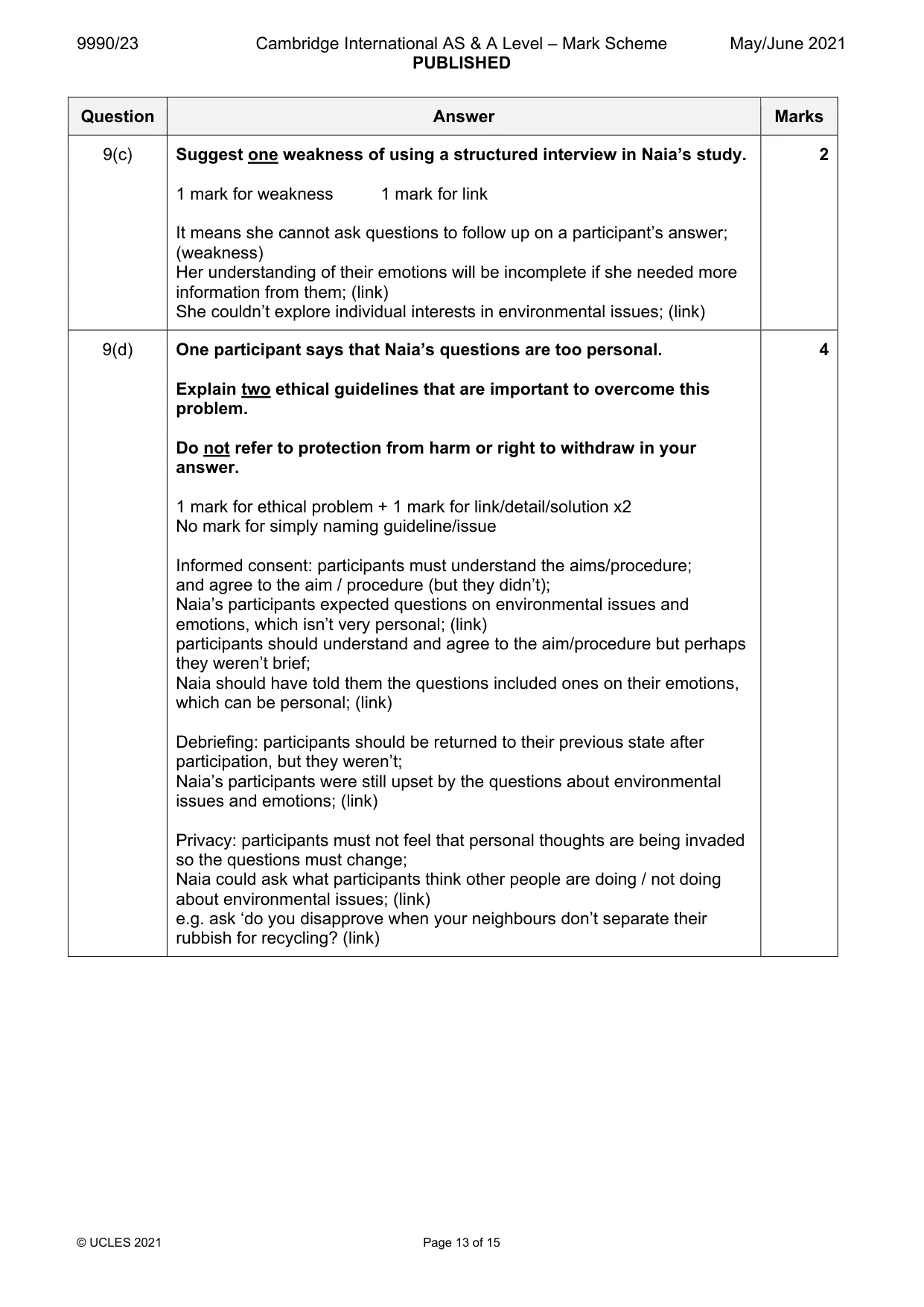
9 Naia wants to interview young people about how environmental issues make them feel. She wants to collect data about emotional responses to issues such as recycling. She has decided to conduct a structured interview. (a) Suggest one open question Naia could ask about emotions. ................................................................................................................................................... ............................................................................................................................................. [1] (b) Suggest one closed question Naia could ask about emotions. ................................................................................................................................................... ............................................................................................................................................. [1] (c) Suggest one weakness of using a structured interview in Naia’s study. ................................................................................................................................................... ................................................................................................................................................... ................................................................................................................................................... ............................................................................................................................................. [2] (d) One participant says that Naia’s questions are too personal. Explain two ethical guidelines that are important to overcome this problem. Do not refer to protection from harm or right to withdraw in your answer. 1 ................................................................................................................................................ ................................................................................................................................................... ................................................................................................................................................... ................................................................................................................................................... 2 ................................................................................................................................................ ................................................................................................................................................... ................................................................................................................................................... ................................................................................................................................................... [4] Section C Answer all questions in this section.
Mark scheme: 9 Naia wants to interview young people about how environmental issues make them feel. She wants to collect data about emotional responses to issues such as recycling. She has decided to conduct a structured interview. 9(a) Suggest one open question Naia could ask about emotions. 1 1 mark for open question Describe how do environmental issues make you feel = 1 Do you recycle or not, and why? = 0 9(b) Suggest one closed question Naia could ask about emotions. 1 1 mark for closed question with answer choices When you see litter / waste how upset do you feel on a scale of 1 (not at all) to 10 (very)? = 1 Which of the following do you recycle: paper, plastic, metal, glass? = 0 9(c) Suggest one weakness of using a structured interview in Naia’s study. 2 1 mark for weakness 1 mark for link It means she cannot ask questions to follow up on a participant’s answer; (weakness) Her understanding of their emotions will be incomplete if she needed more information from them; (link) She couldn’t explore individual interests in environmental issues; (link) 9(d) One participant says that Naia’s questions are too personal. 4 Explain two ethical guidelines that are important to overcome this problem. Do not refer to protection from harm or right to withdraw in your answer. 1 mark for ethical problem + 1 mark for link/detail/solution x2 No mark for simply naming guideline/issue Informed consent: participants must understand the aims/procedure; and agree to the aim / procedure (but they didn’t); Naia’s participants expected questions on environmental issues and emotions, which isn’t very personal; (link) participants should understand and agree to the aim/procedure but perhaps they weren’t brief; Naia should have told them the questions included ones on their emotions, which can be personal; (link) Debriefing: participants should be returned to their previous state after participation, but they weren’t; Naia’s participants were still upset by the questions about environmental issues and emotions; (link) Privacy: participants must not feel that personal thoughts are being invaded so the questions must change; Naia could ask what participants think other people are doing / not doing about environmental issues; (link) e.g. ask ‘do you disapprove when your neighbours don’t separate their rubbish for recycling? (link)
Q10 · Riley notices that children at his school appear to be nicer to each other at morning…
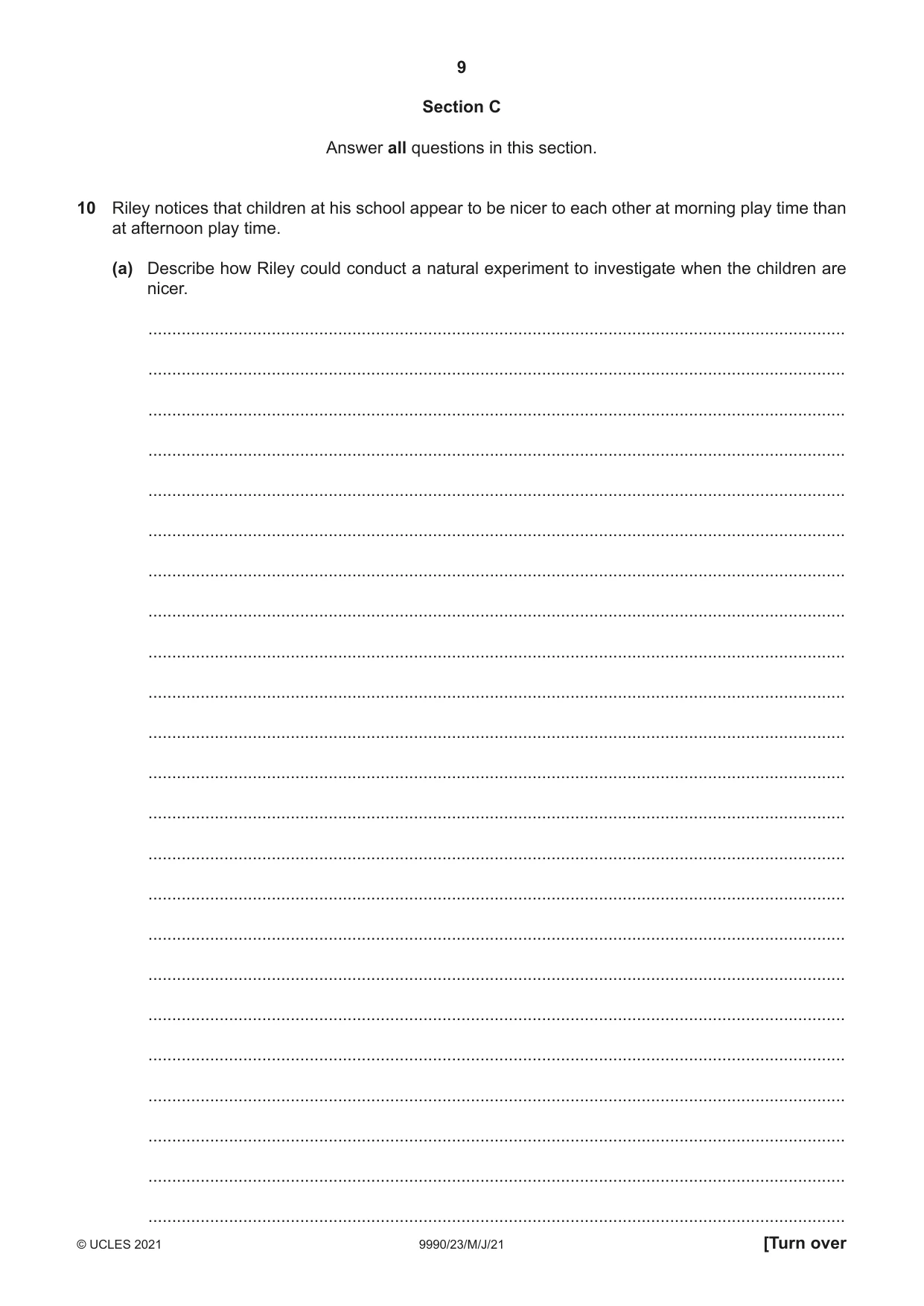
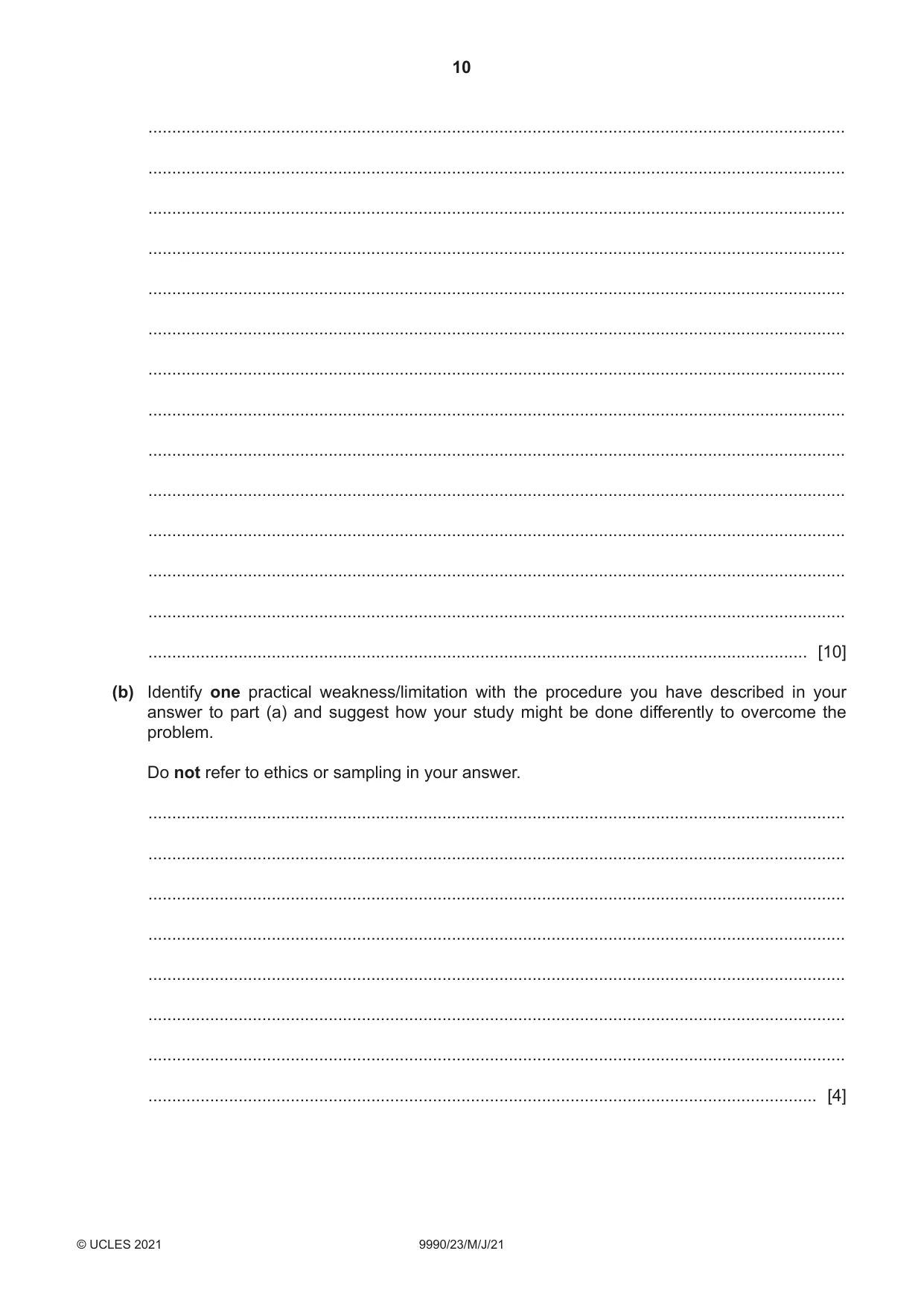
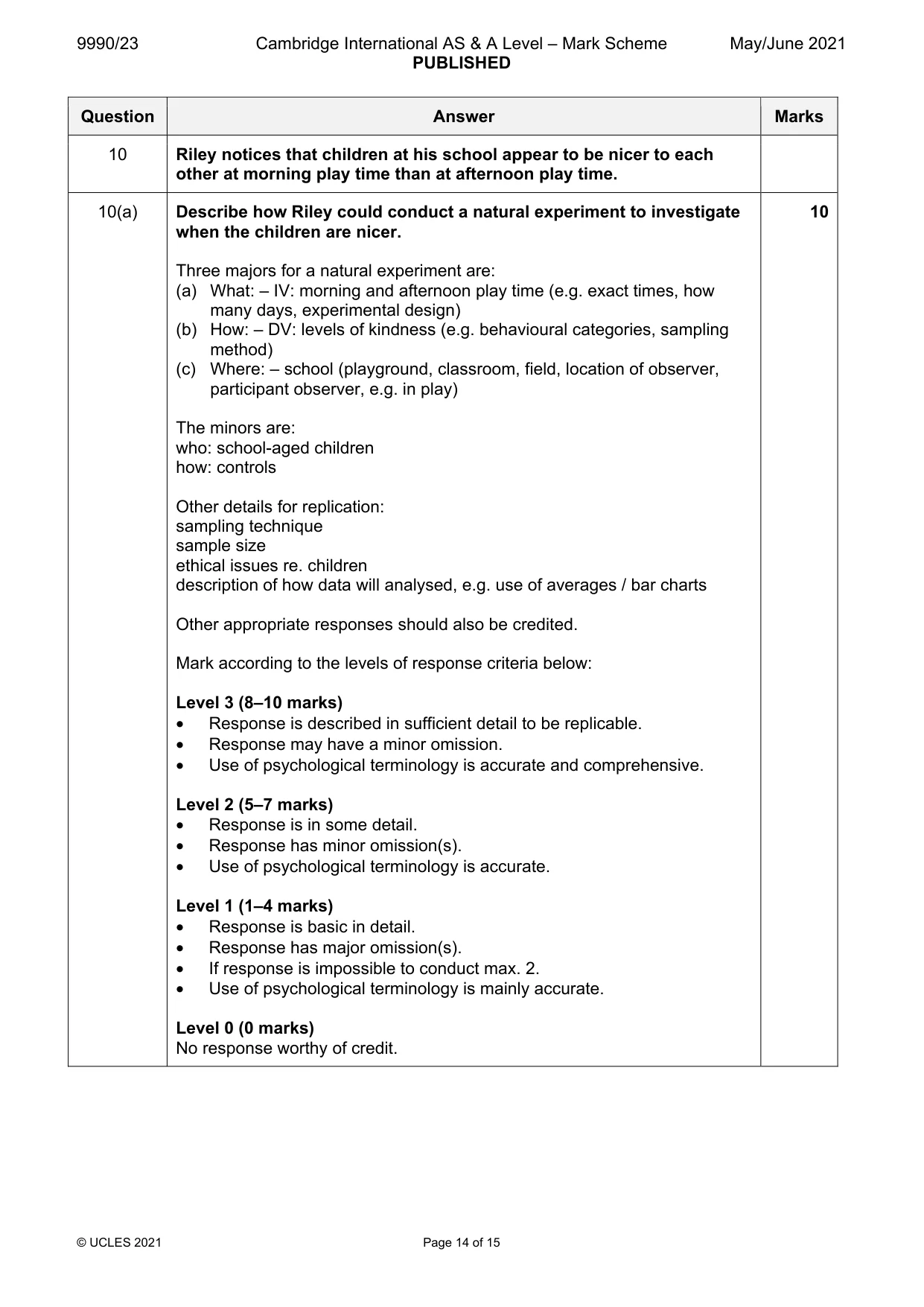
10 Riley notices that children at his school appear to be nicer to each other at morning play time than at afternoon play time. (a) Describe how Riley could conduct a natural experiment to investigate when the children are nicer. ................................................................................................................................................... ................................................................................................................................................... ................................................................................................................................................... ................................................................................................................................................... ................................................................................................................................................... ................................................................................................................................................... ................................................................................................................................................... ................................................................................................................................................... ................................................................................................................................................... ................................................................................................................................................... ................................................................................................................................................... ................................................................................................................................................... ................................................................................................................................................... ................................................................................................................................................... ................................................................................................................................................... ................................................................................................................................................... ................................................................................................................................................... ................................................................................................................................................... ................................................................................................................................................... ................................................................................................................................................... ................................................................................................................................................... ................................................................................................................................................... ................................................................................................................................................... ................................................................................................................................................... ................................................................................................................................................... ................................................................................................................................................... ................................................................................................................................................... ................................................................................................................................................... ................................................................................................................................................... ................................................................................................................................................... ................................................................................................................................................... ................................................................................................................................................... ................................................................................................................................................... ................................................................................................................................................... ................................................................................................................................................... ................................................................................................................................................... ........................................................................................................................................... [10] (b) Identify one practical weakness/limitation with the procedure you have described in your answer to part (a) and suggest how your study might be done differently to overcome the problem. Do not refer to ethics or sampling in your answer. ................................................................................................................................................... ................................................................................................................................................... ................................................................................................................................................... ................................................................................................................................................... ................................................................................................................................................... ................................................................................................................................................... ................................................................................................................................................... ............................................................................................................................................. [4]
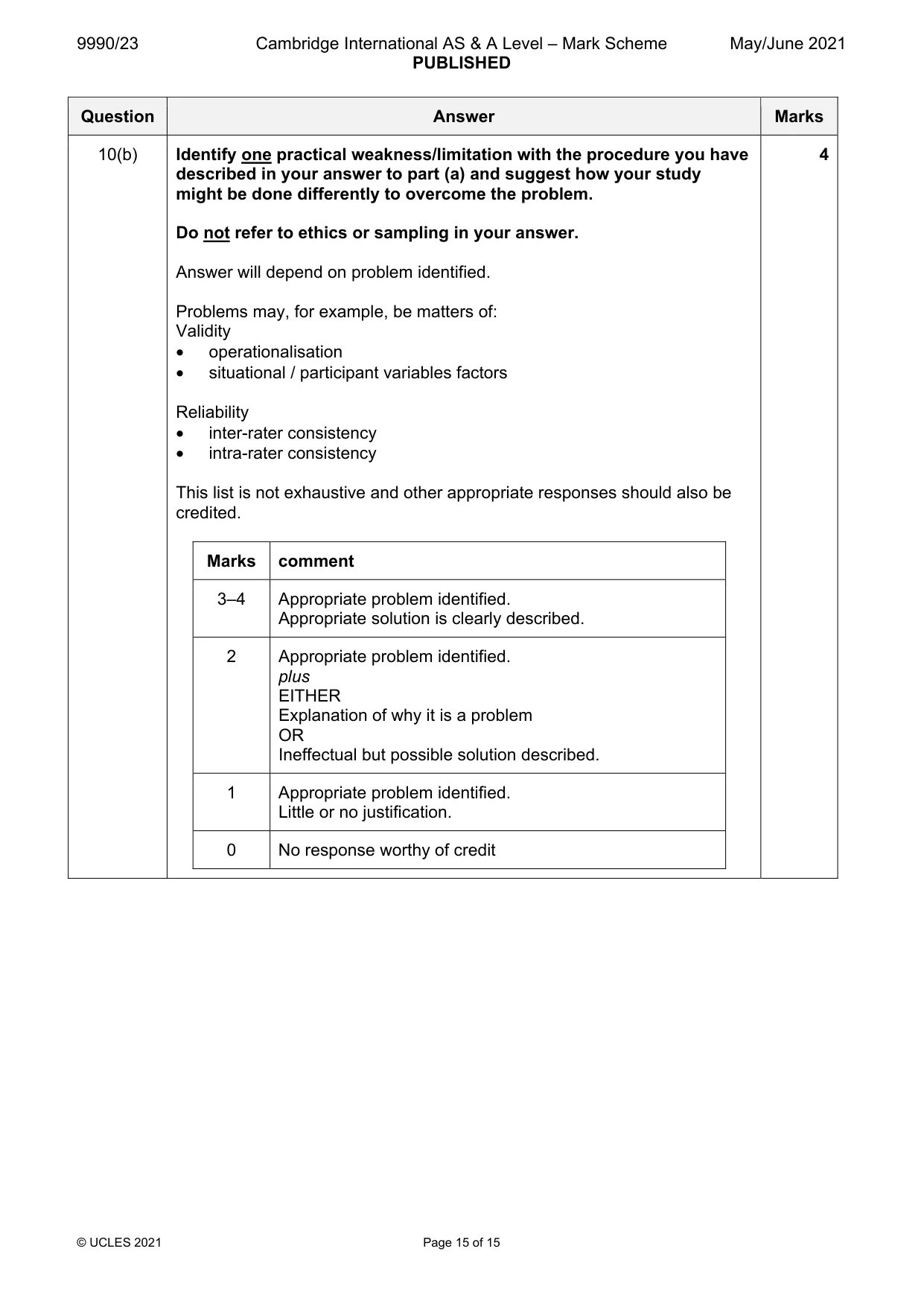
Mark scheme: 10 Riley notices that children at his school appear to be nicer to each other at morning play time than at afternoon play time. 10(a) Describe how Riley could conduct a natural experiment to investigate 10 when the children are nicer. Three majors for a natural experiment are: (a) What: – IV: morning and afternoon play time (e.g. exact times, how many days, experimental design) (b) How: – DV: levels of kindness (e.g. behavioural categories, sampling method) (c) Where: – school (playground, classroom, field, location of observer, participant observer, e.g. in play) The minors are: who: school-aged children how: controls Other details for replication: sampling technique sample size ethical issues re. children description of how data will analysed, e.g. use of averages / bar charts Other appropriate responses should also be credited. Mark according to the levels of response criteria below: Level 3 (8–10 marks) • Response is described in sufficient detail to be replicable. • Response may have a minor omission. • Use of psychological terminology is accurate and comprehensive. Level 2 (5–7 marks) • Response is in some detail. • Response has minor omission(s). • Use of psychological terminology is accurate. Level 1 (1–4 marks) • Response is basic in detail. • Response has major omission(s). • If response is impossible to conduct max. 2. • Use of psychological terminology is mainly accurate. Level 0 (0 marks) No response worthy of credit. 10(b) Identify one practical weakness/limitation with the procedure you have 4 described in your answer to part (a) and suggest how your study might be done differently to overcome the problem. Do not refer to ethics or sampling in your answer. Answer will depend on problem identified. Problems may, for example, be matters of: Validity • operationalisation • situational / participant variables factors Reliability • inter-rater consistency • intra-rater consistency This list is not exhaustive and other appropriate responses should also be credited. Marks comment 3–4 Appropriate problem identified. Appropriate solution is clearly described. 2 Appropriate problem identified. plus EITHER Explanation of why it is a problem OR Ineffectual but possible solution described. 1 Appropriate problem identified. Little or no justification. 0 No response worthy of credit
What was in this paper
The subtopics covered by these 10 questions, and how many questions each got. Open one in a new tab to see every Cambridge question on it.
What you needed in this session
Cambridge’s own grade thresholds for 2021 May/June, Paper 2 · Variant 3. A higher threshold means an easier paper — the bar moves with how the cohort did.