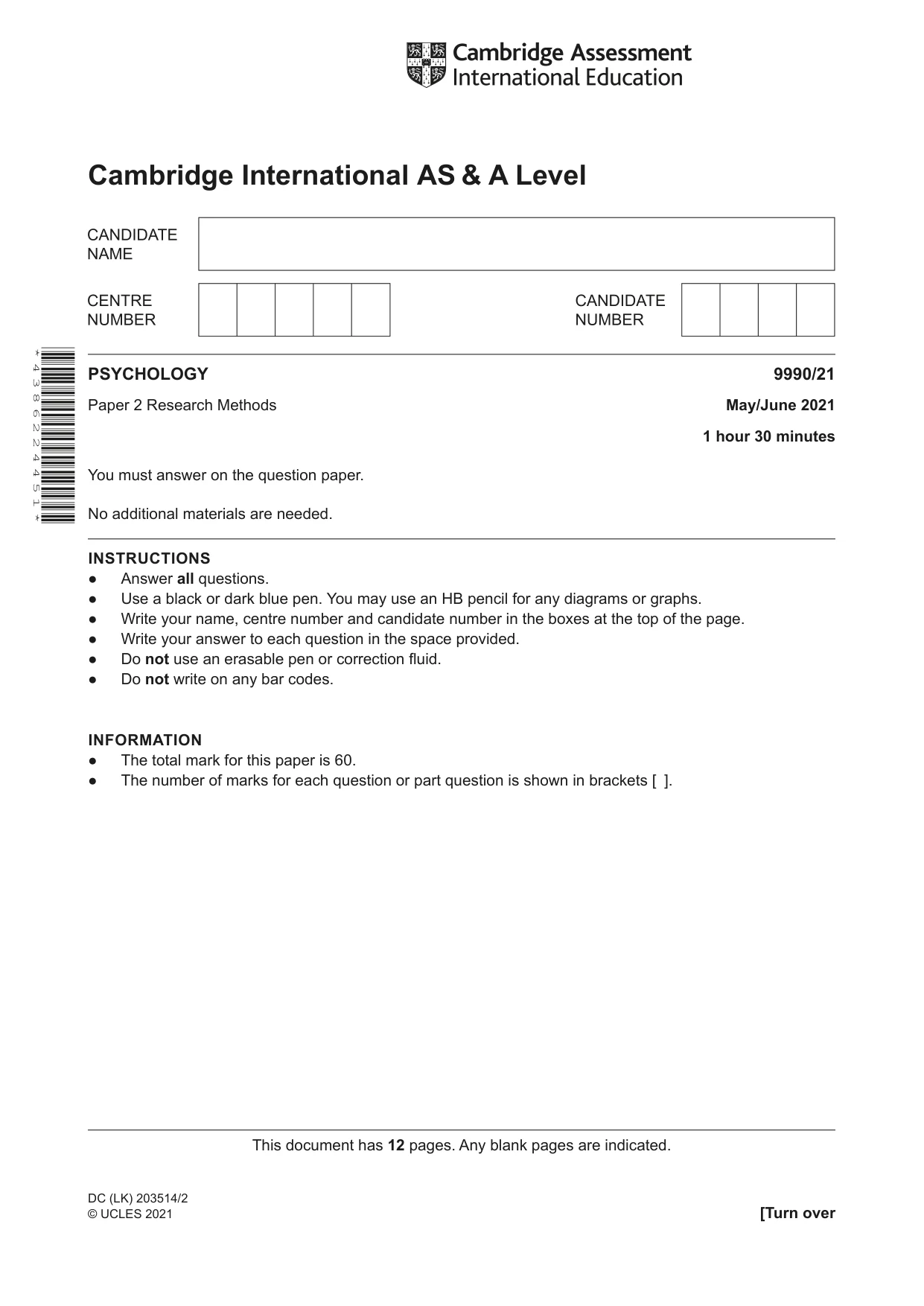
Cambridge A Level Psychology (from 2018) 9990 — 2021 May/June Paper 2 · Variant 1
9990/21/M/J/21 · 10 questions · 60 marks · ≈68 min
The question paper and its mark scheme, free to read here and free to download. This is Cambridge’s own paper, exactly as it was sat.
Question paper12 pages


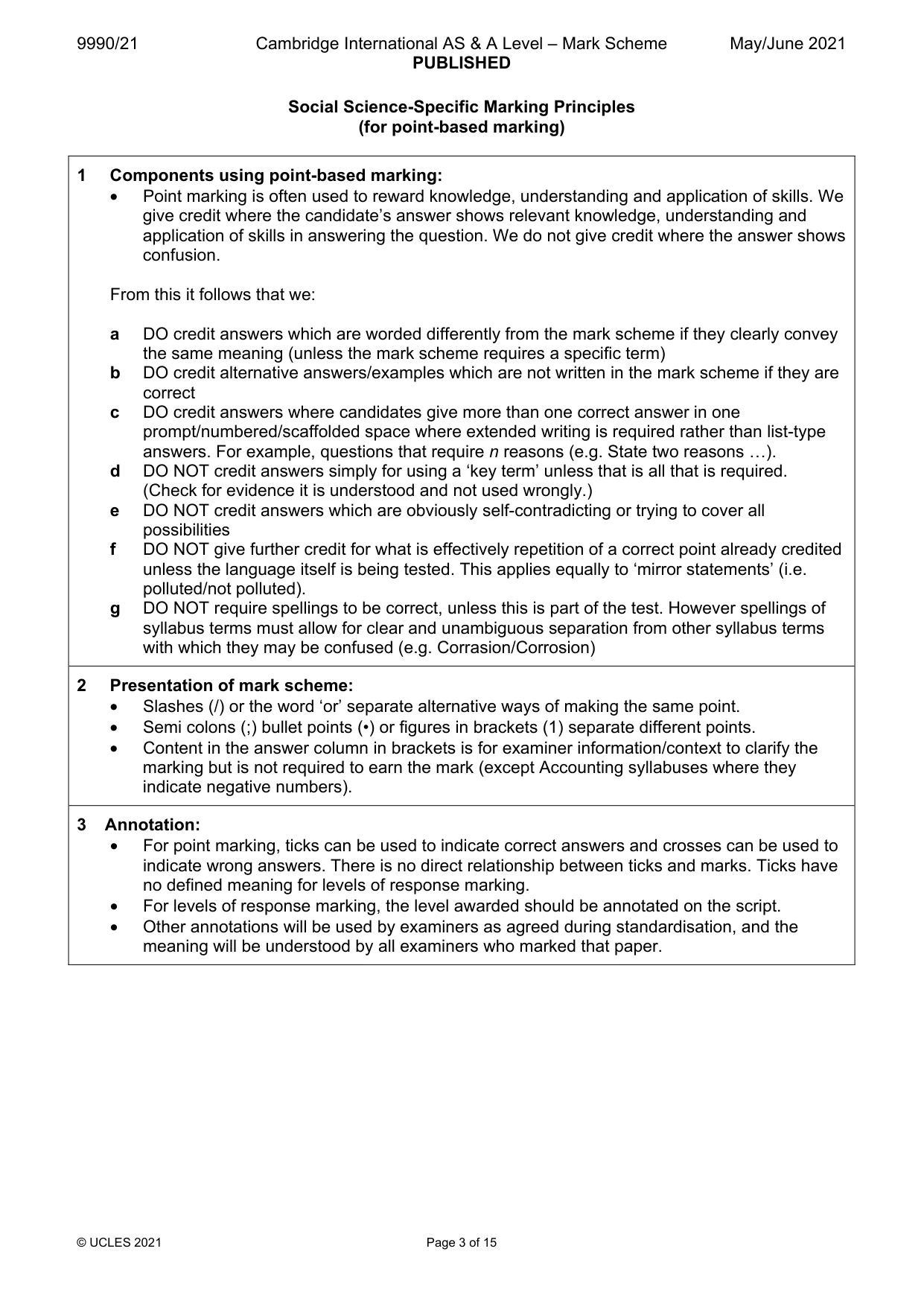
Mark scheme15 pages
Answers below. Sit the paper first if you are practising.
Questions as text
Q1 · In the study by Pepperberg (parrot learning), several features of the procedure helped to…
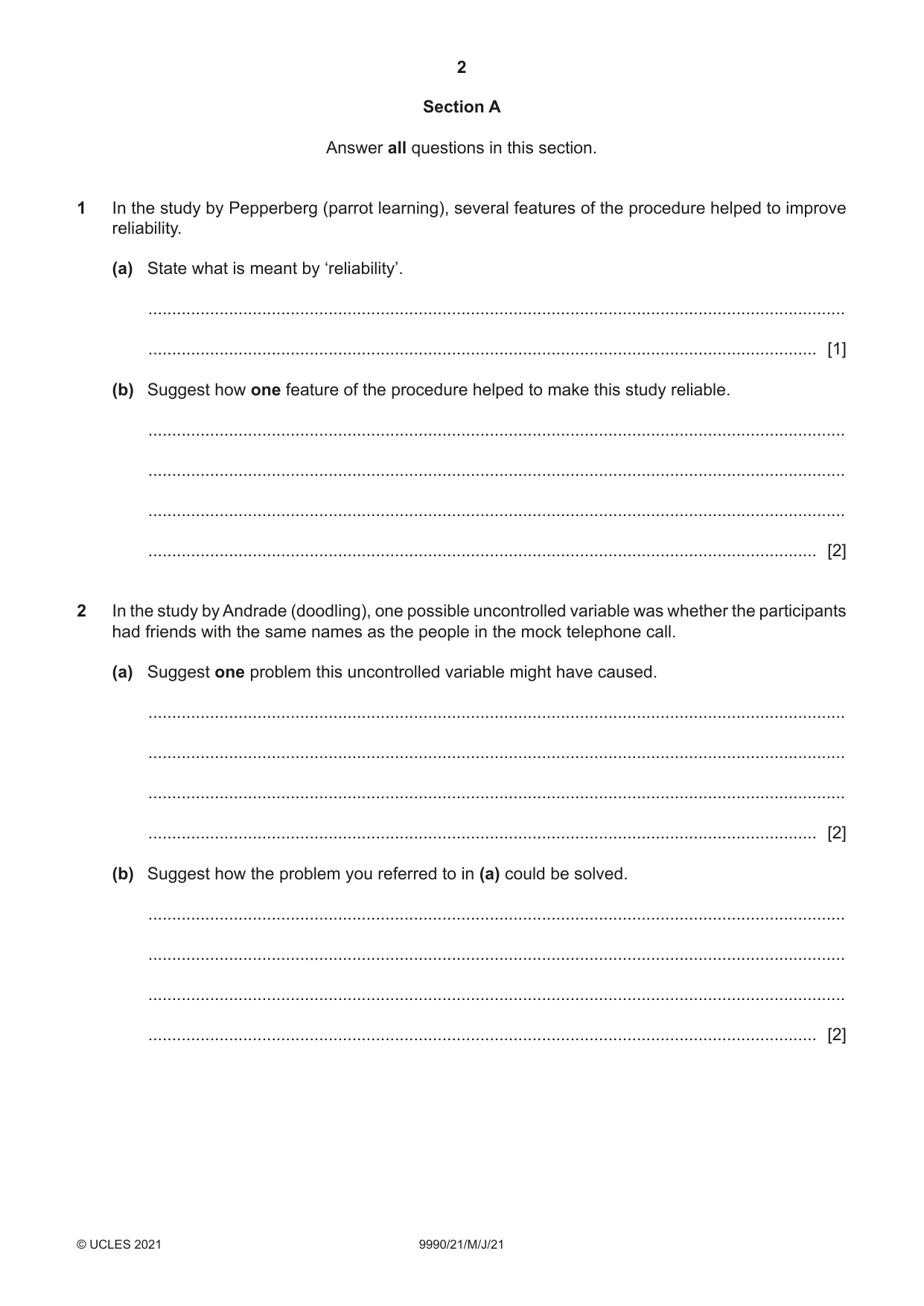
1 In the study by Pepperberg (parrot learning), several features of the procedure helped to improve reliability. (a) State what is meant by ‘reliability’. ................................................................................................................................................... ............................................................................................................................................. [1] (b) Suggest how one feature of the procedure helped to make this study reliable. ................................................................................................................................................... ................................................................................................................................................... ................................................................................................................................................... ............................................................................................................................................. [2]
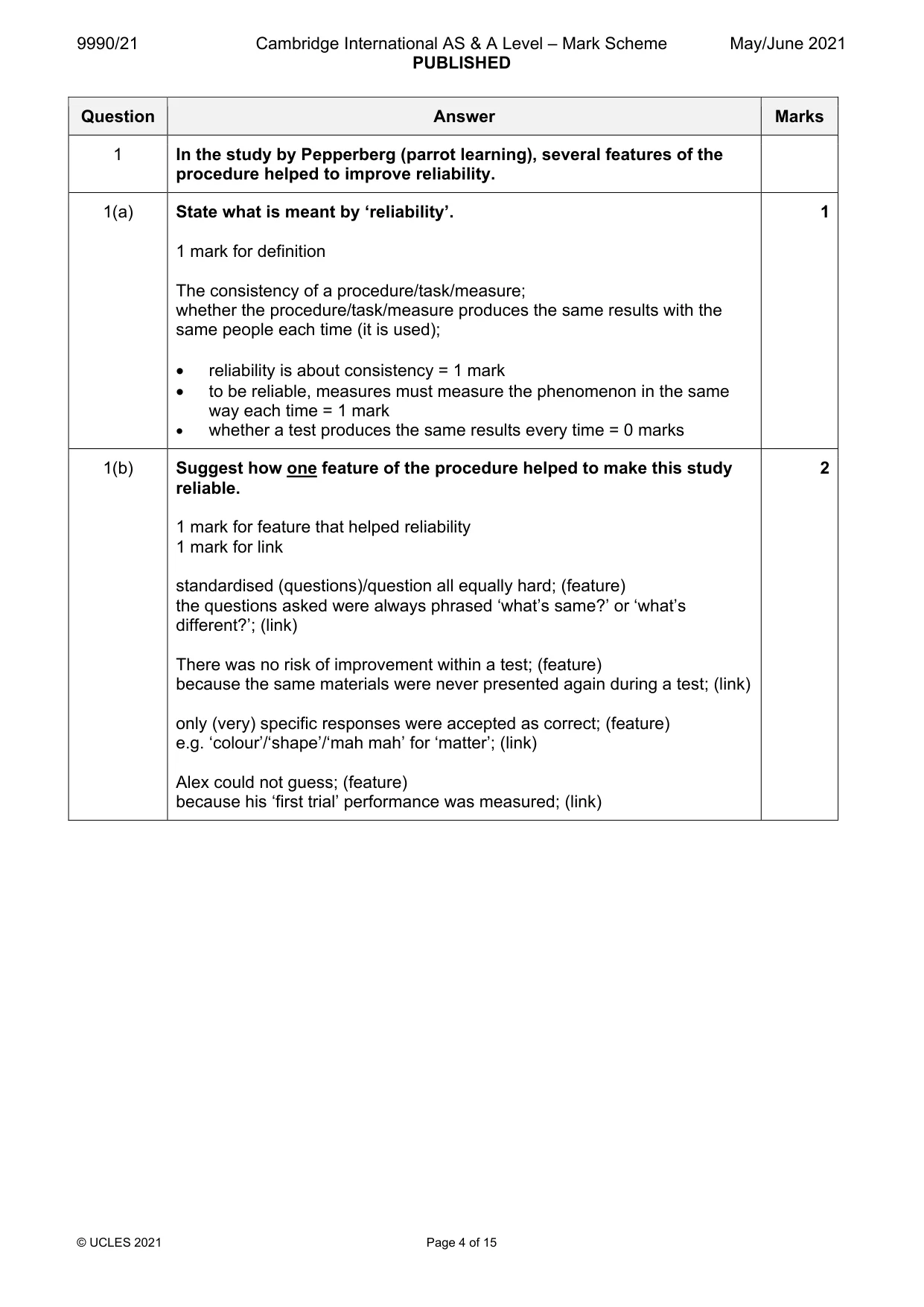
Mark scheme: Question Answer Marks 1 In the study by Pepperberg (parrot learning), several features of the procedure helped to improve reliability. 1(a) State what is meant by ‘reliability’. 1 1 mark for definition The consistency of a procedure/task/measure; whether the procedure/task/measure produces the same results with the same people each time (it is used); • reliability is about consistency = 1 mark • to be reliable, measures must measure the phenomenon in the same way each time = 1 mark • whether a test produces the same results every time = 0 marks 1(b) Suggest how one feature of the procedure helped to make this study 2 reliable. 1 mark for feature that helped reliability 1 mark for link standardised (questions)/question all equally hard; (feature) the questions asked were always phrased ‘what’s same?’ or ‘what’s different?’; (link) There was no risk of improvement within a test; (feature) because the same materials were never presented again during a test; (link) only (very) specific responses were accepted as correct; (feature) e.g. ‘colour’/‘shape’/‘mah mah’ for ‘matter’; (link) Alex could not guess; (feature) because his ‘first trial’ performance was measured; (link)
Q2 · In the study by Andrade (doodling), one possible uncontrolled variable was whether the…
2 In the study by Andrade (doodling), one possible uncontrolled variable was whether the participants had friends with the same names as the people in the mock telephone call. (a) Suggest one problem this uncontrolled variable might have caused. ................................................................................................................................................... ................................................................................................................................................... ................................................................................................................................................... ............................................................................................................................................. [2] (b) Suggest how the problem you referred to in (a) could be solved. ................................................................................................................................................... ................................................................................................................................................... ................................................................................................................................................... ............................................................................................................................................. [2]
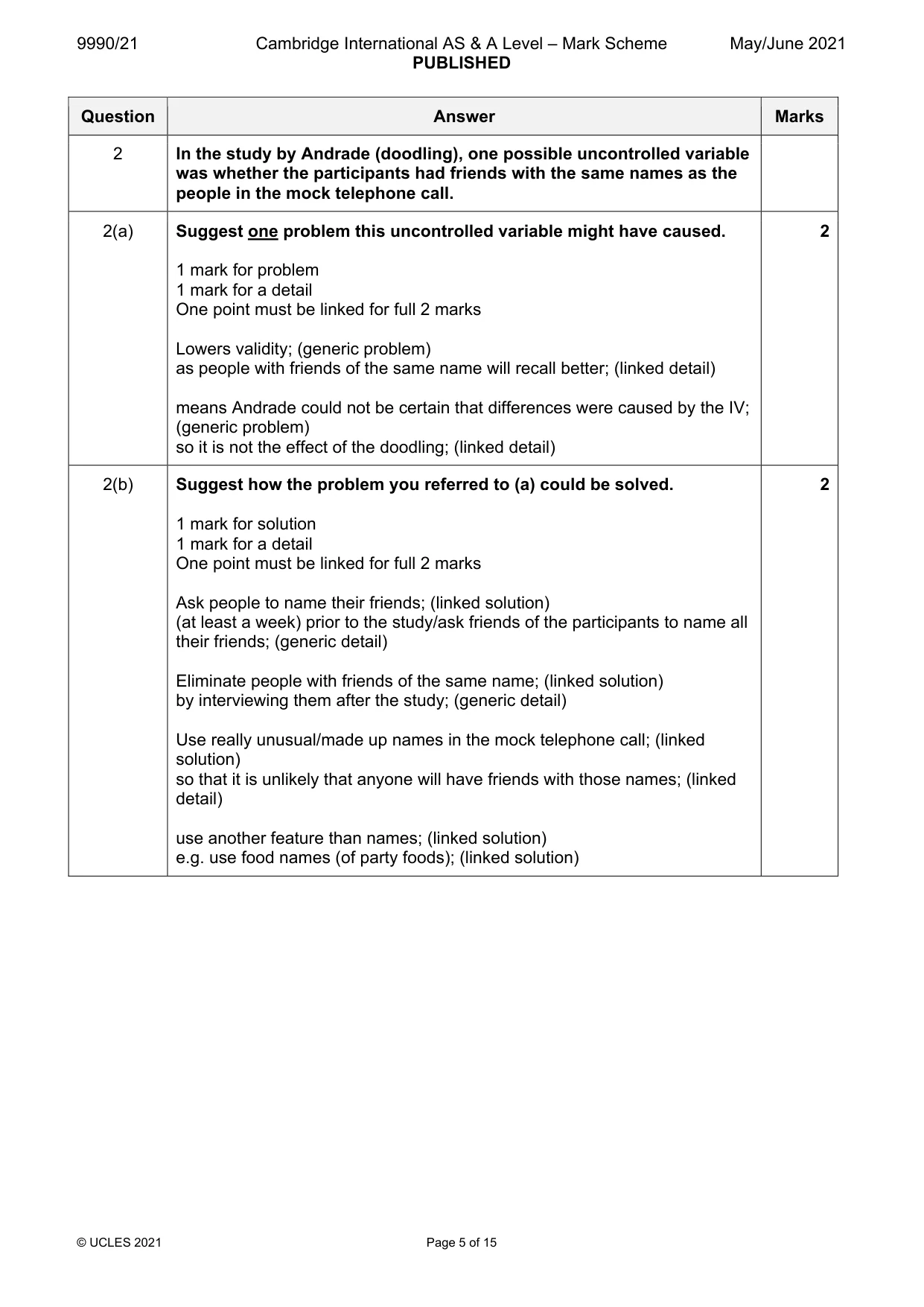
Mark scheme: 2 In the study by Andrade (doodling), one possible uncontrolled variable was whether the participants had friends with the same names as the people in the mock telephone call. 2(a) Suggest one problem this uncontrolled variable might have caused. 2 1 mark for problem 1 mark for a detail One point must be linked for full 2 marks Lowers validity; (generic problem) as people with friends of the same name will recall better; (linked detail) means Andrade could not be certain that differences were caused by the IV; (generic problem) so it is not the effect of the doodling; (linked detail) 2(b) Suggest how the problem you referred to (a) could be solved. 2 1 mark for solution 1 mark for a detail One point must be linked for full 2 marks Ask people to name their friends; (linked solution) (at least a week) prior to the study/ask friends of the participants to name all their friends; (generic detail) Eliminate people with friends of the same name; (linked solution) by interviewing them after the study; (generic detail) Use really unusual/made up names in the mock telephone call; (linked solution) so that it is unlikely that anyone will have friends with those names; (linked detail) use another feature than names; (linked solution) e.g. use food names (of party foods); (linked solution)
Q3 · State what is meant by a ‘case study’
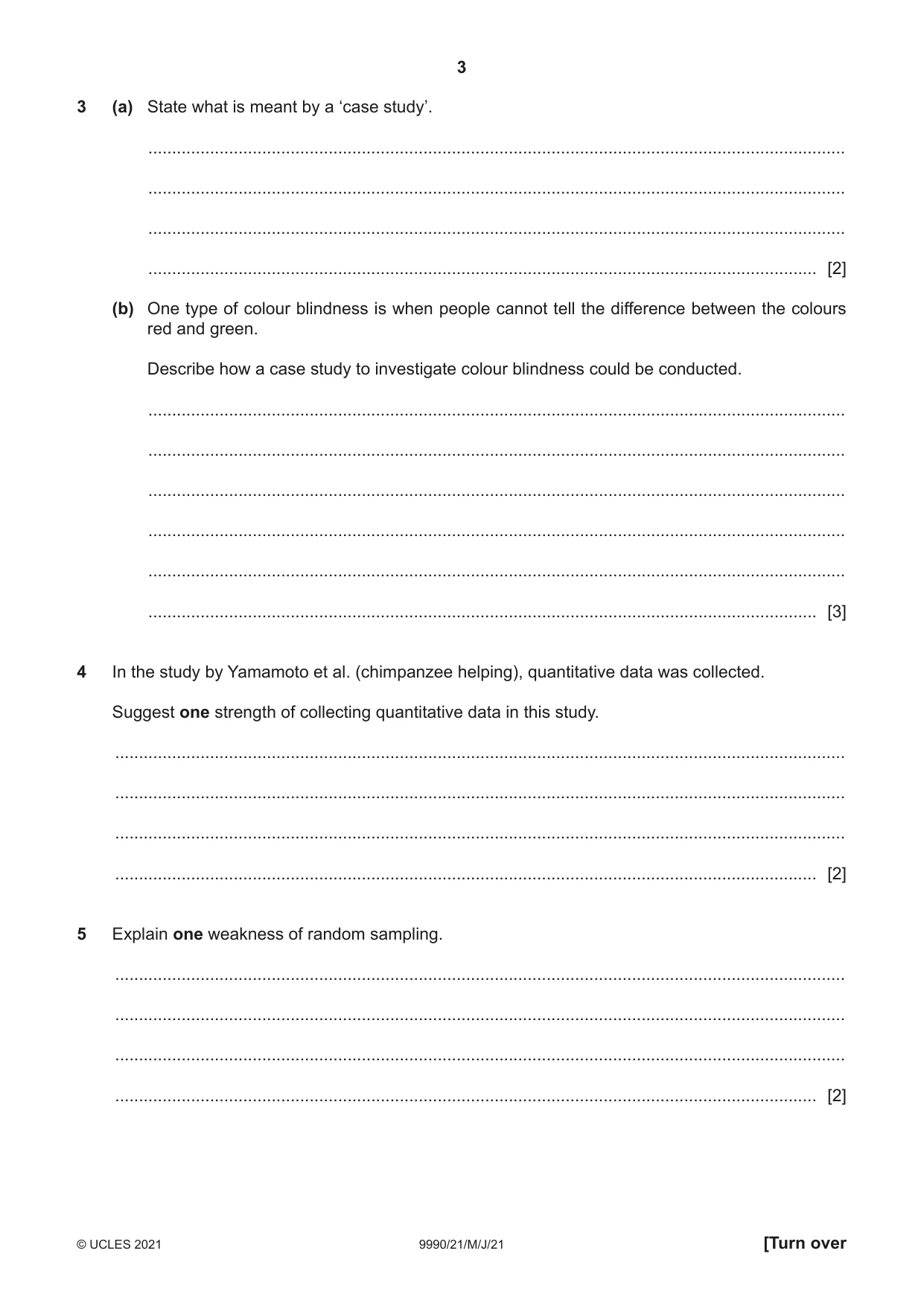
3 (a) State what is meant by a ‘case study’. ................................................................................................................................................... ................................................................................................................................................... ................................................................................................................................................... ............................................................................................................................................. [2] (b) One type of colour blindness is when people cannot tell the difference between the colours red and green. Describe how a case study to investigate colour blindness could be conducted. ................................................................................................................................................... ................................................................................................................................................... ................................................................................................................................................... ................................................................................................................................................... ................................................................................................................................................... ............................................................................................................................................. [3]
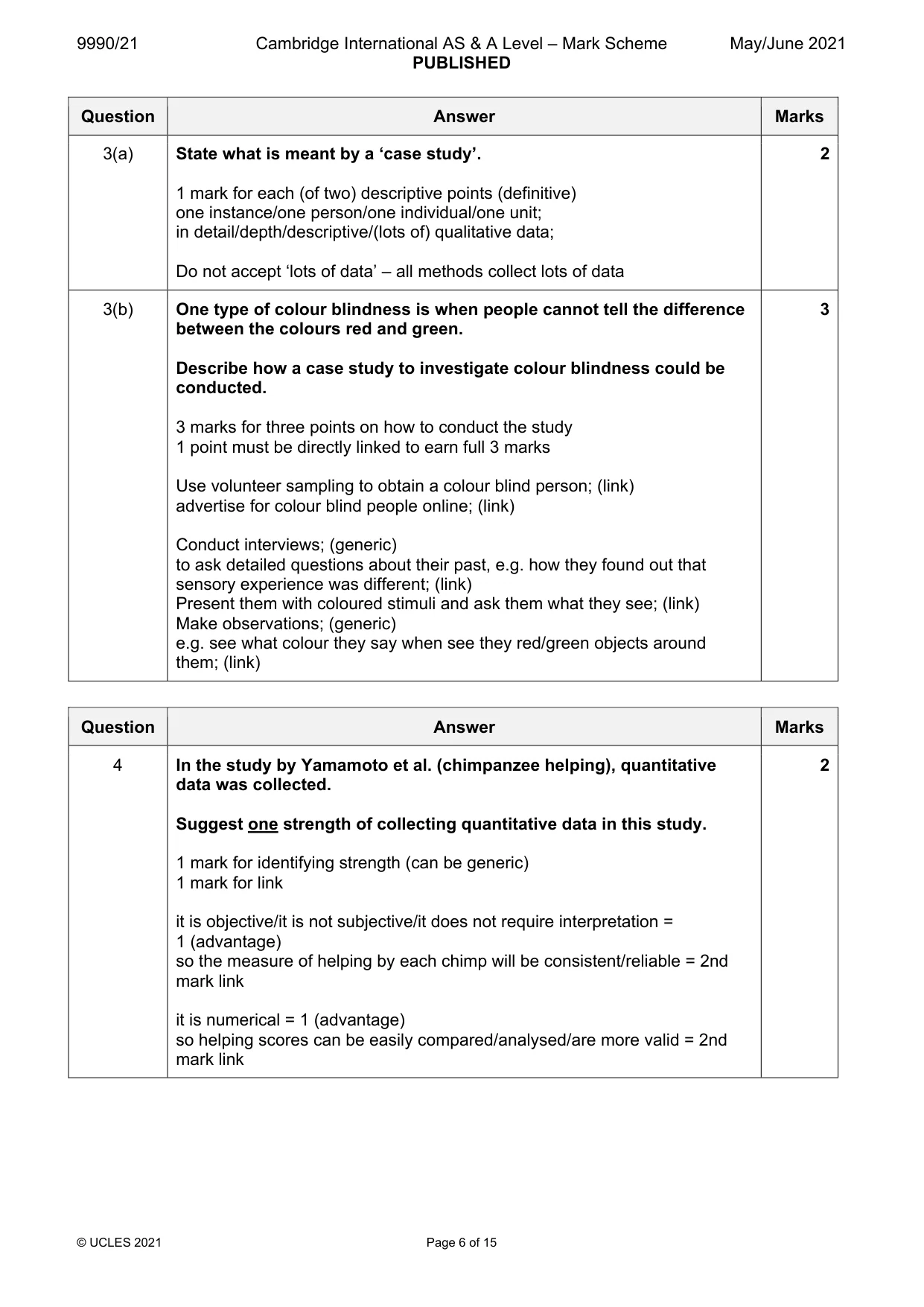
Mark scheme: 3(a) State what is meant by a ‘case study’. 2 1 mark for each (of two) descriptive points (definitive) one instance/one person/one individual/one unit; in detail/depth/descriptive/(lots of) qualitative data; Do not accept ‘lots of data’ – all methods collect lots of data 3(b) One type of colour blindness is when people cannot tell the difference 3 between the colours red and green. Describe how a case study to investigate colour blindness could be conducted. 3 marks for three points on how to conduct the study 1 point must be directly linked to earn full 3 marks Use volunteer sampling to obtain a colour blind person; (link) advertise for colour blind people online; (link) Conduct interviews; (generic) to ask detailed questions about their past, e.g. how they found out that sensory experience was different; (link) Present them with coloured stimuli and ask them what they see; (link) Make observations; (generic) e.g. see what colour they say when see they red/green objects around them; (link)
Q4 · In the study by Yamamoto et al
4 In the study by Yamamoto et al. (chimpanzee helping), quantitative data was collected. Suggest one strength of collecting quantitative data in this study. .......................................................................................................................................................... .......................................................................................................................................................... .......................................................................................................................................................... .................................................................................................................................................... [2]
Mark scheme: 4 In the study by Yamamoto et al. (chimpanzee helping), quantitative 2 data was collected. Suggest one strength of collecting quantitative data in this study. 1 mark for identifying strength (can be generic) 1 mark for link it is objective/it is not subjective/it does not require interpretation = 1 (advantage) so the measure of helping by each chimp will be consistent/reliable = 2nd mark link it is numerical = 1 (advantage) so helping scores can be easily compared/analysed/are more valid = 2nd mark link
Q5 · Explain one weakness of random sampling
5 Explain one weakness of random sampling. .......................................................................................................................................................... .......................................................................................................................................................... .......................................................................................................................................................... .................................................................................................................................................... [2]
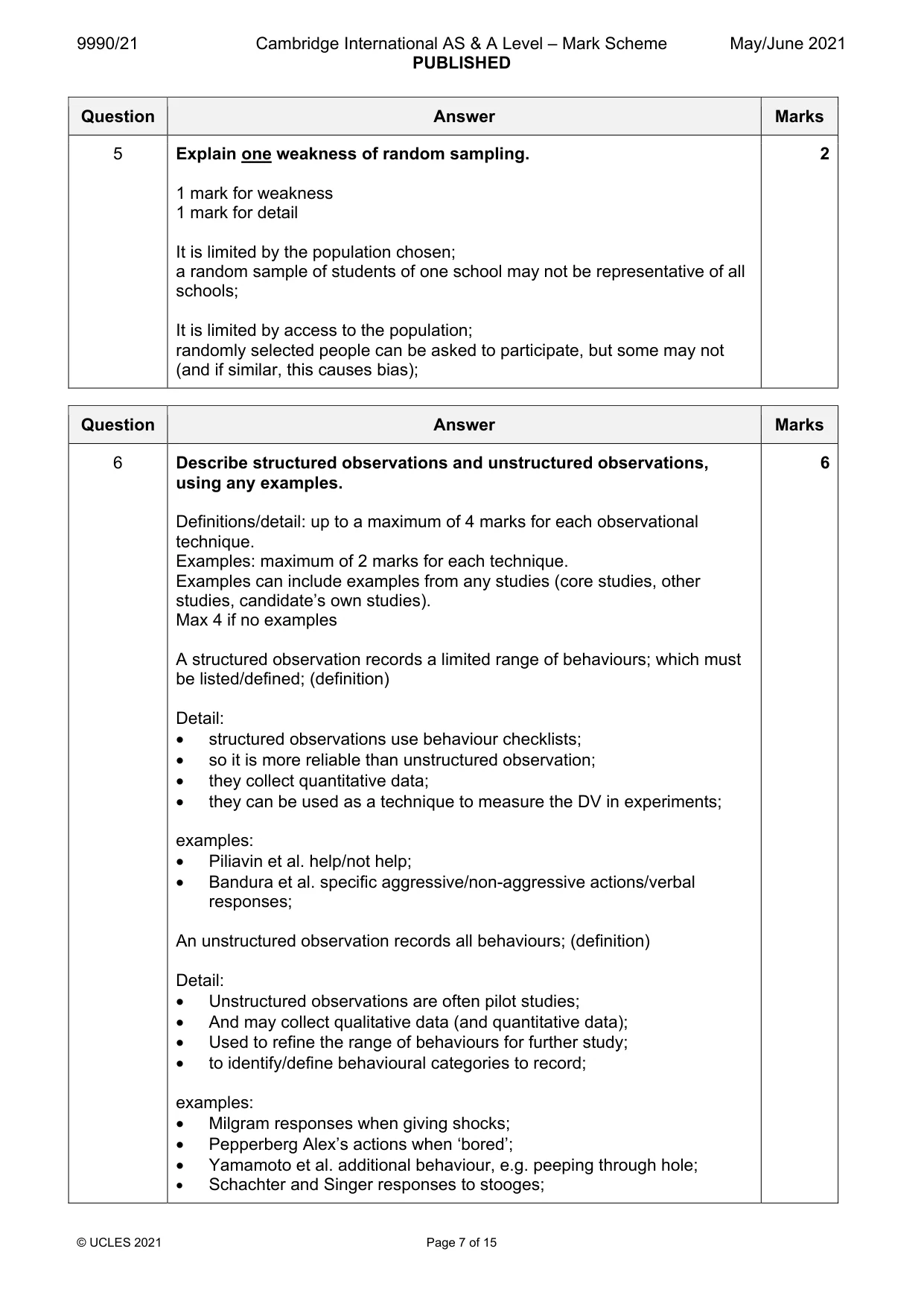
Mark scheme: 5 Explain one weakness of random sampling. 2 1 mark for weakness 1 mark for detail It is limited by the population chosen; a random sample of students of one school may not be representative of all schools; It is limited by access to the population; randomly selected people can be asked to participate, but some may not (and if similar, this causes bias);
Q6 · Describe structured observations and unstructured observations, using any examples
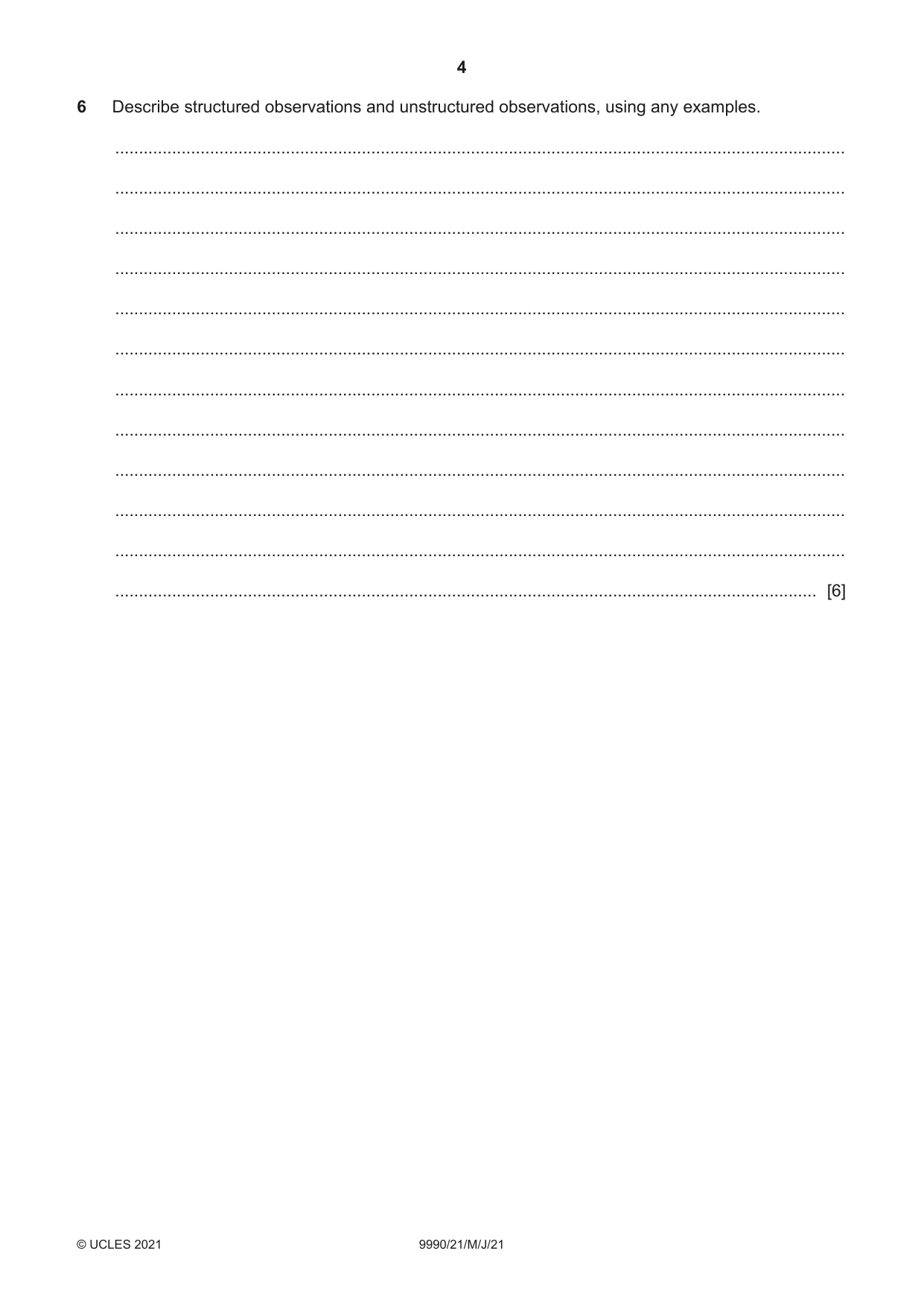
6 Describe structured observations and unstructured observations, using any examples. .......................................................................................................................................................... .......................................................................................................................................................... .......................................................................................................................................................... .......................................................................................................................................................... .......................................................................................................................................................... .......................................................................................................................................................... .......................................................................................................................................................... .......................................................................................................................................................... .......................................................................................................................................................... .......................................................................................................................................................... .......................................................................................................................................................... .................................................................................................................................................... [6]
Mark scheme: 6 Describe structured observations and unstructured observations, 6 using any examples. Definitions/detail: up to a maximum of 4 marks for each observational technique. Examples: maximum of 2 marks for each technique. Examples can include examples from any studies (core studies, other studies, candidate’s own studies). Max 4 if no examples A structured observation records a limited range of behaviours; which must be listed/defined; (definition) Detail: • structured observations use behaviour checklists; • so it is more reliable than unstructured observation; • they collect quantitative data; • they can be used as a technique to measure the DV in experiments; examples: • Piliavin et al. help/not help; • Bandura et al. specific aggressive/non-aggressive actions/verbal responses; An unstructured observation records all behaviours; (definition) Detail: • Unstructured observations are often pilot studies; • And may collect qualitative data (and quantitative data); • Used to refine the range of behaviours for further study; • to identify/define behavioural categories to record; examples: • Milgram responses when giving shocks; • Pepperberg Alex’s actions when ‘bored’; • Yamamoto et al. additional behaviour, e.g. peeping through hole; • Schachter and Singer responses to stooges;
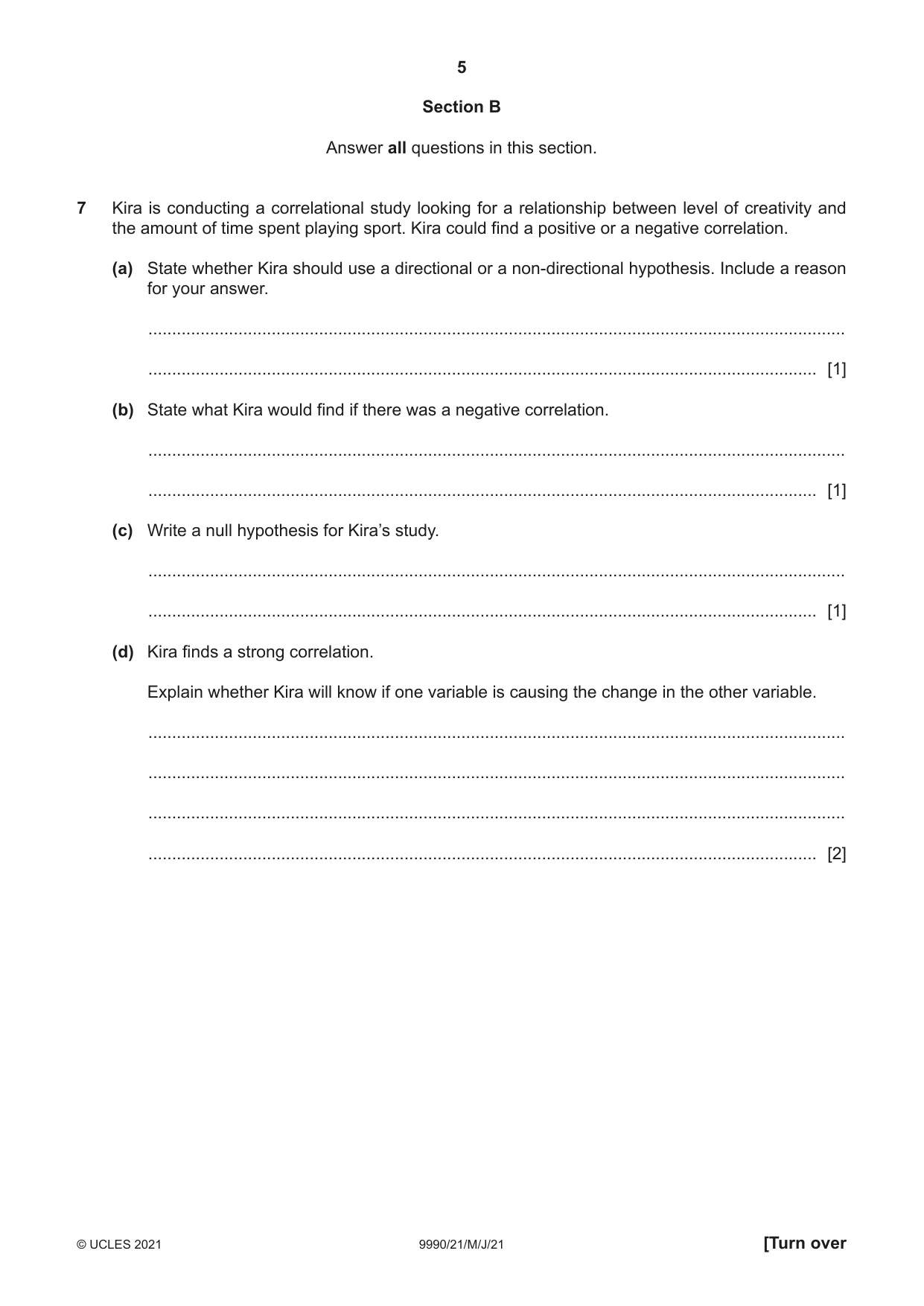
Q7 · Kira is conducting a correlational study looking for a relationship between level of…
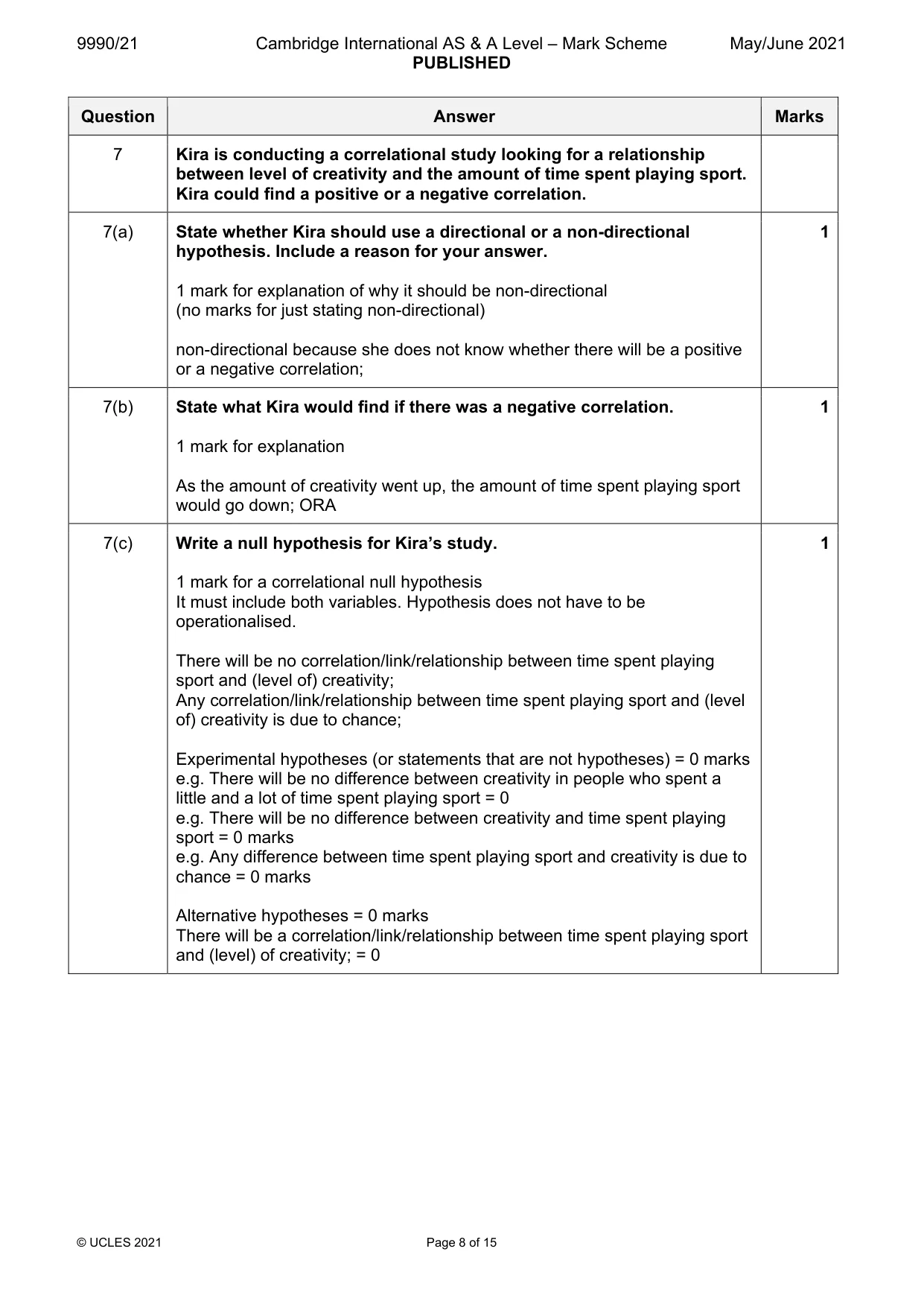
7 Kira is conducting a correlational study looking for a relationship between level of creativity and the amount of time spent playing sport. Kira could find a positive or a negative correlation. (a) State whether Kira should use a directional or a non-directional hypothesis. Include a reason for your answer. ................................................................................................................................................... ............................................................................................................................................. [1] (b) State what Kira would find if there was a negative correlation. ................................................................................................................................................... ............................................................................................................................................. [1] (c) Write a null hypothesis for Kira’s study. ................................................................................................................................................... ............................................................................................................................................. [1] (d) Kira finds a strong correlation. Explain whether Kira will know if one variable is causing the change in the other variable. ................................................................................................................................................... ................................................................................................................................................... ................................................................................................................................................... ............................................................................................................................................. [2]
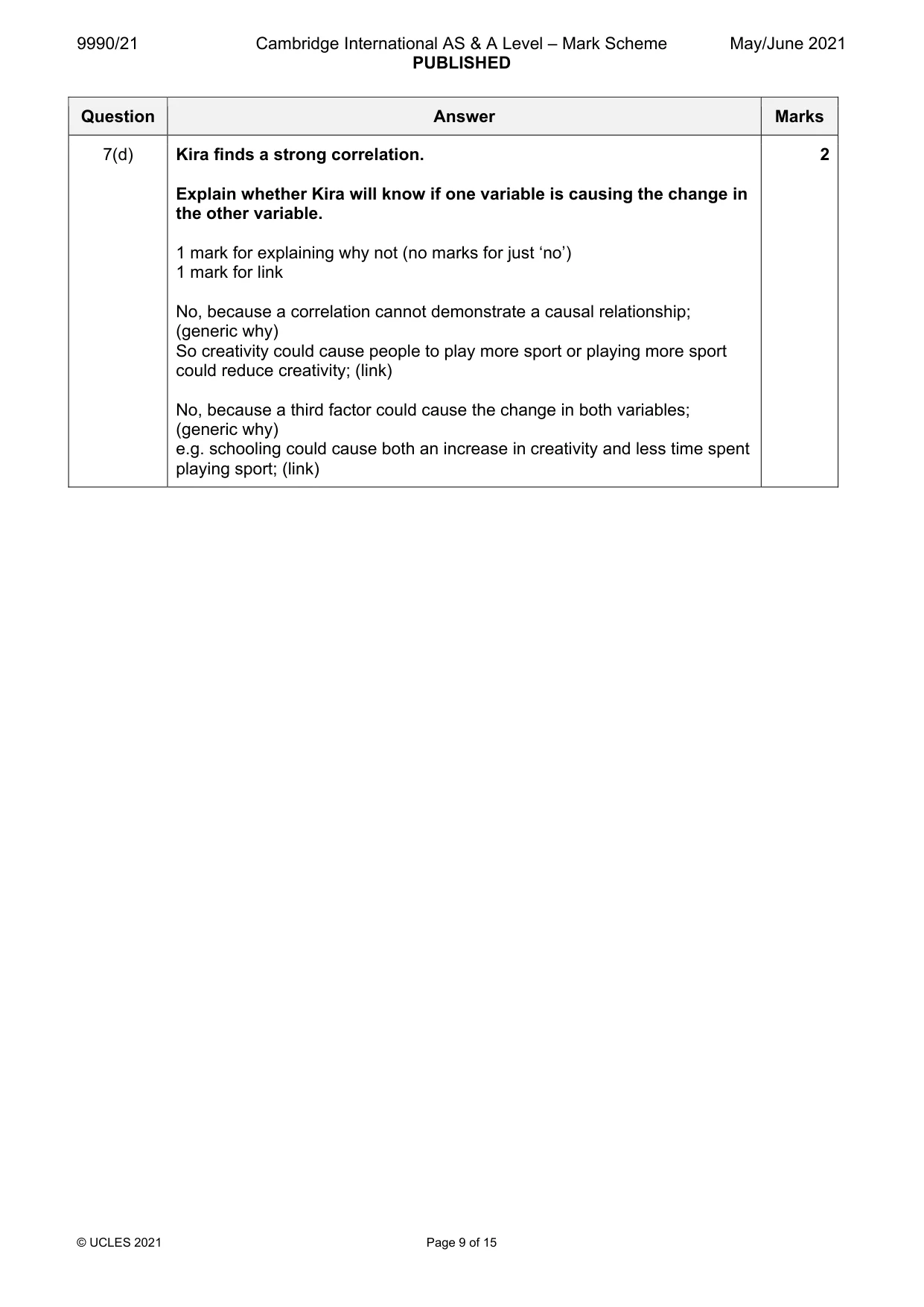
Mark scheme: 7 Kira is conducting a correlational study looking for a relationship between level of creativity and the amount of time spent playing sport. Kira could find a positive or a negative correlation. 7(a) State whether Kira should use a directional or a non-directional 1 hypothesis. Include a reason for your answer. 1 mark for explanation of why it should be non-directional (no marks for just stating non-directional) non-directional because she does not know whether there will be a positive or a negative correlation; 7(b) State what Kira would find if there was a negative correlation. 1 1 mark for explanation As the amount of creativity went up, the amount of time spent playing sport would go down; ORA 7(c) Write a null hypothesis for Kira’s study. 1 1 mark for a correlational null hypothesis It must include both variables. Hypothesis does not have to be operationalised. There will be no correlation/link/relationship between time spent playing sport and (level of) creativity; Any correlation/link/relationship between time spent playing sport and (level of) creativity is due to chance; Experimental hypotheses (or statements that are not hypotheses) = 0 marks e.g. There will be no difference between creativity in people who spent a little and a lot of time spent playing sport = 0 e.g. There will be no difference between creativity and time spent playing sport = 0 marks e.g. Any difference between time spent playing sport and creativity is due to chance = 0 marks Alternative hypotheses = 0 marks There will be a correlation/link/relationship between time spent playing sport and (level) of creativity; = 0 7(d) Kira finds a strong correlation. 2 Explain whether Kira will know if one variable is causing the change in the other variable. 1 mark for explaining why not (no marks for just ‘no’) 1 mark for link No, because a correlation cannot demonstrate a causal relationship; (generic why) So creativity could cause people to play more sport or playing more sport could reduce creativity; (link) No, because a third factor could cause the change in both variables; (generic why) e.g. schooling could cause both an increase in creativity and less time spent playing sport; (link)
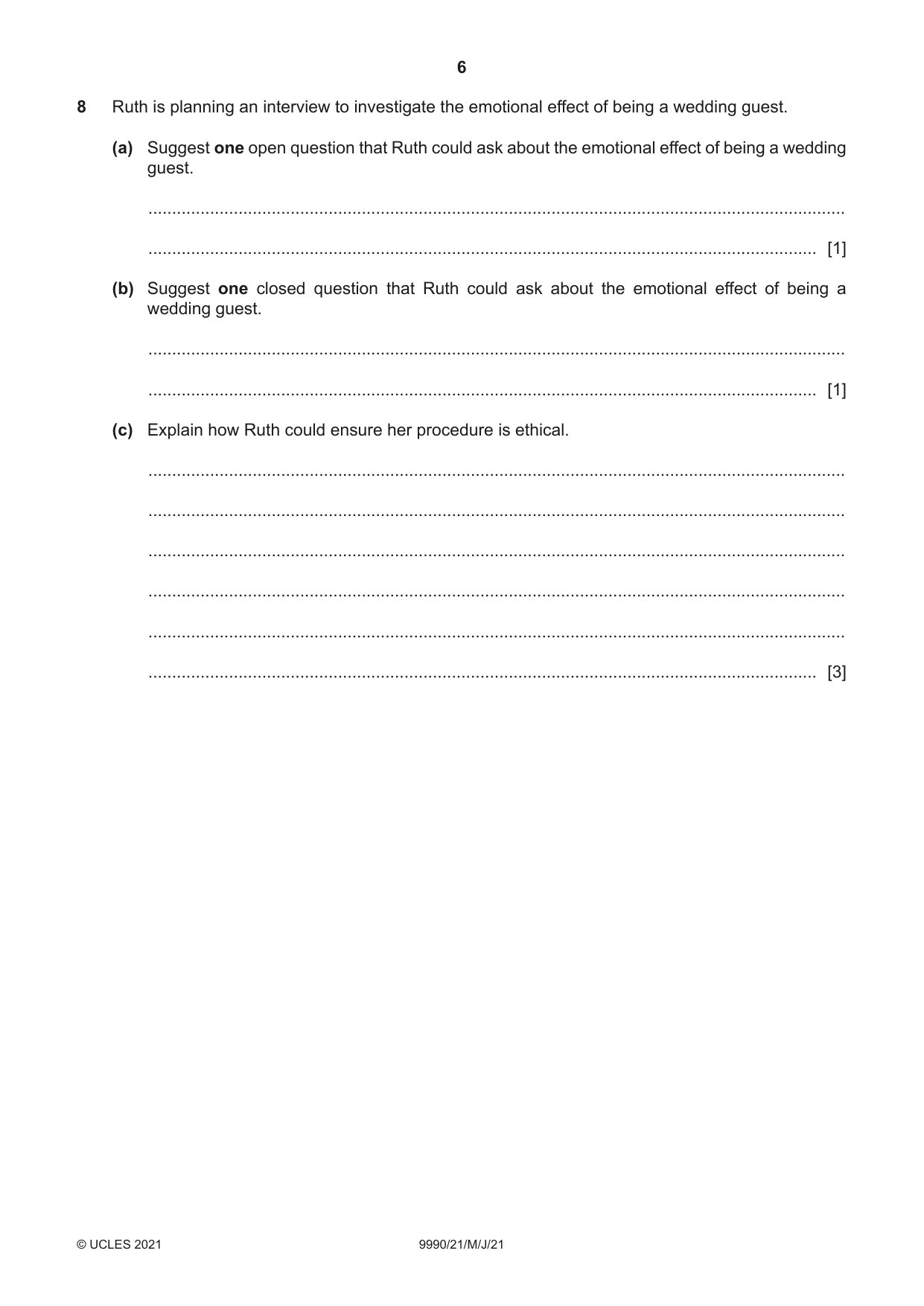
Q8 · Ruth is planning an interview to investigate the emotional effect of being a wedding guest
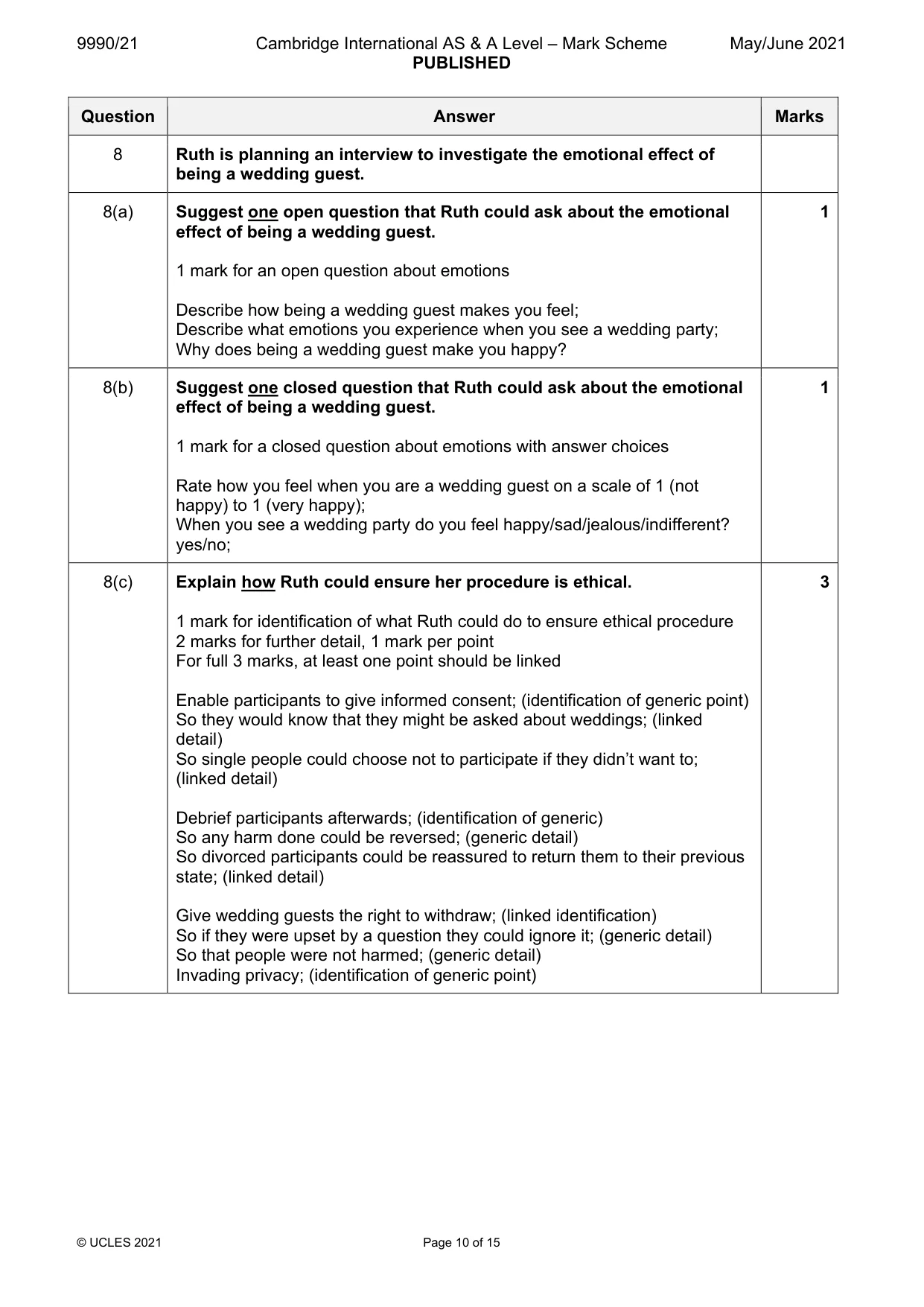
8 Ruth is planning an interview to investigate the emotional effect of being a wedding guest. (a) Suggest one open question that Ruth could ask about the emotional effect of being a wedding guest. ................................................................................................................................................... ............................................................................................................................................. [1] (b) Suggest one closed question that Ruth could ask about the emotional effect of being a wedding guest. ................................................................................................................................................... ............................................................................................................................................. [1] (c) Explain how Ruth could ensure her procedure is ethical. ................................................................................................................................................... ................................................................................................................................................... ................................................................................................................................................... ................................................................................................................................................... ................................................................................................................................................... ............................................................................................................................................. [3]
Mark scheme: 8 Ruth is planning an interview to investigate the emotional effect of being a wedding guest. 8(a) Suggest one open question that Ruth could ask about the emotional 1 effect of being a wedding guest. 1 mark for an open question about emotions Describe how being a wedding guest makes you feel; Describe what emotions you experience when you see a wedding party; Why does being a wedding guest make you happy? 8(b) Suggest one closed question that Ruth could ask about the emotional 1 effect of being a wedding guest. 1 mark for a closed question about emotions with answer choices Rate how you feel when you are a wedding guest on a scale of 1 (not happy) to 1 (very happy); When you see a wedding party do you feel happy/sad/jealous/indifferent? yes/no; 8(c) Explain how Ruth could ensure her procedure is ethical. 3 1 mark for identification of what Ruth could do to ensure ethical procedure 2 marks for further detail, 1 mark per point For full 3 marks, at least one point should be linked Enable participants to give informed consent; (identification of generic point) So they would know that they might be asked about weddings; (linked detail) So single people could choose not to participate if they didn’t want to; (linked detail) Debrief participants afterwards; (identification of generic) So any harm done could be reversed; (generic detail) So divorced participants could be reassured to return them to their previous state; (linked detail) Give wedding guests the right to withdraw; (linked identification) So if they were upset by a question they could ignore it; (generic detail) So that people were not harmed; (generic detail) Invading privacy; (identification of generic point)
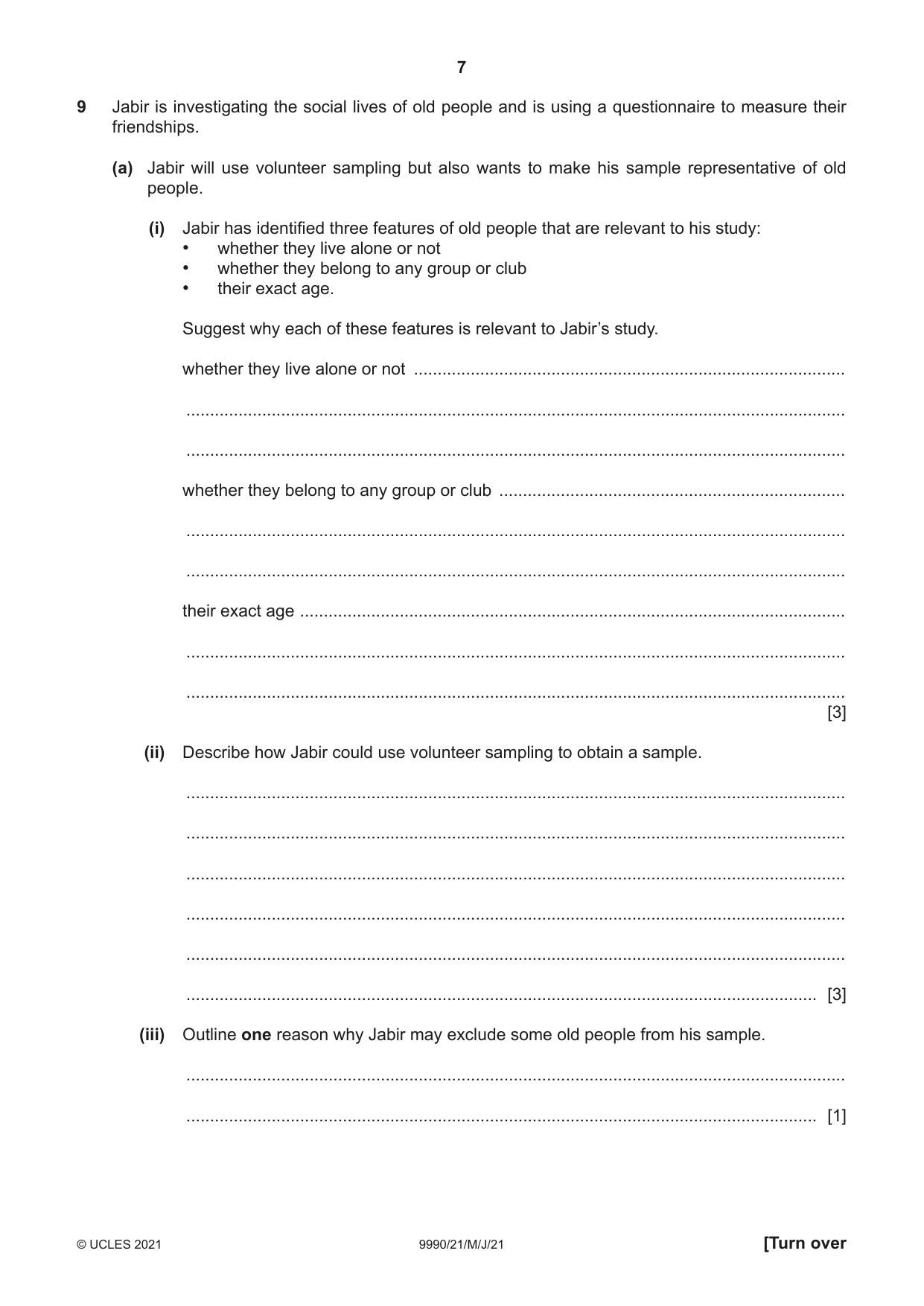
Q9 · Jabir is investigating the social lives of old people and is using a questionnaire to…
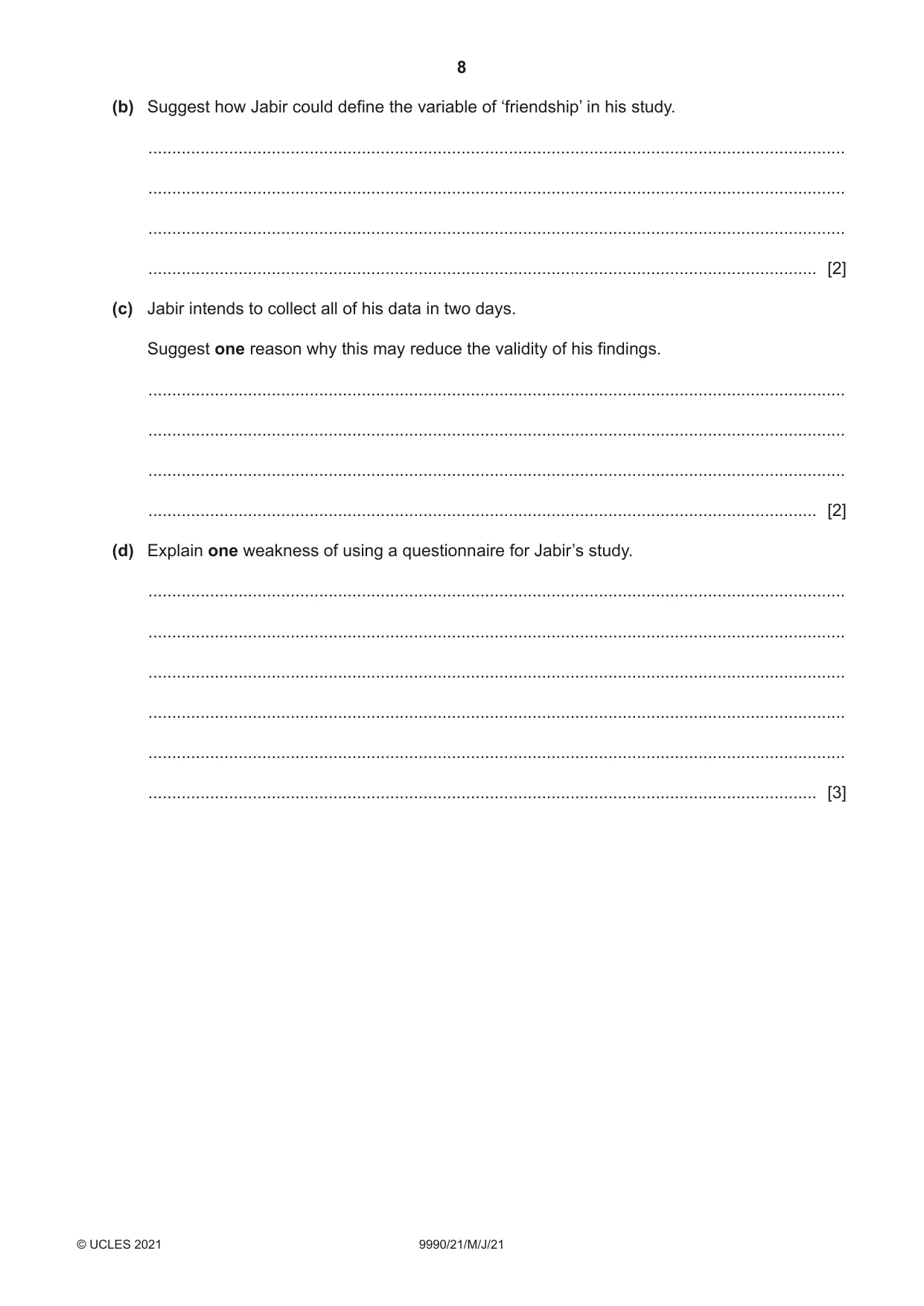
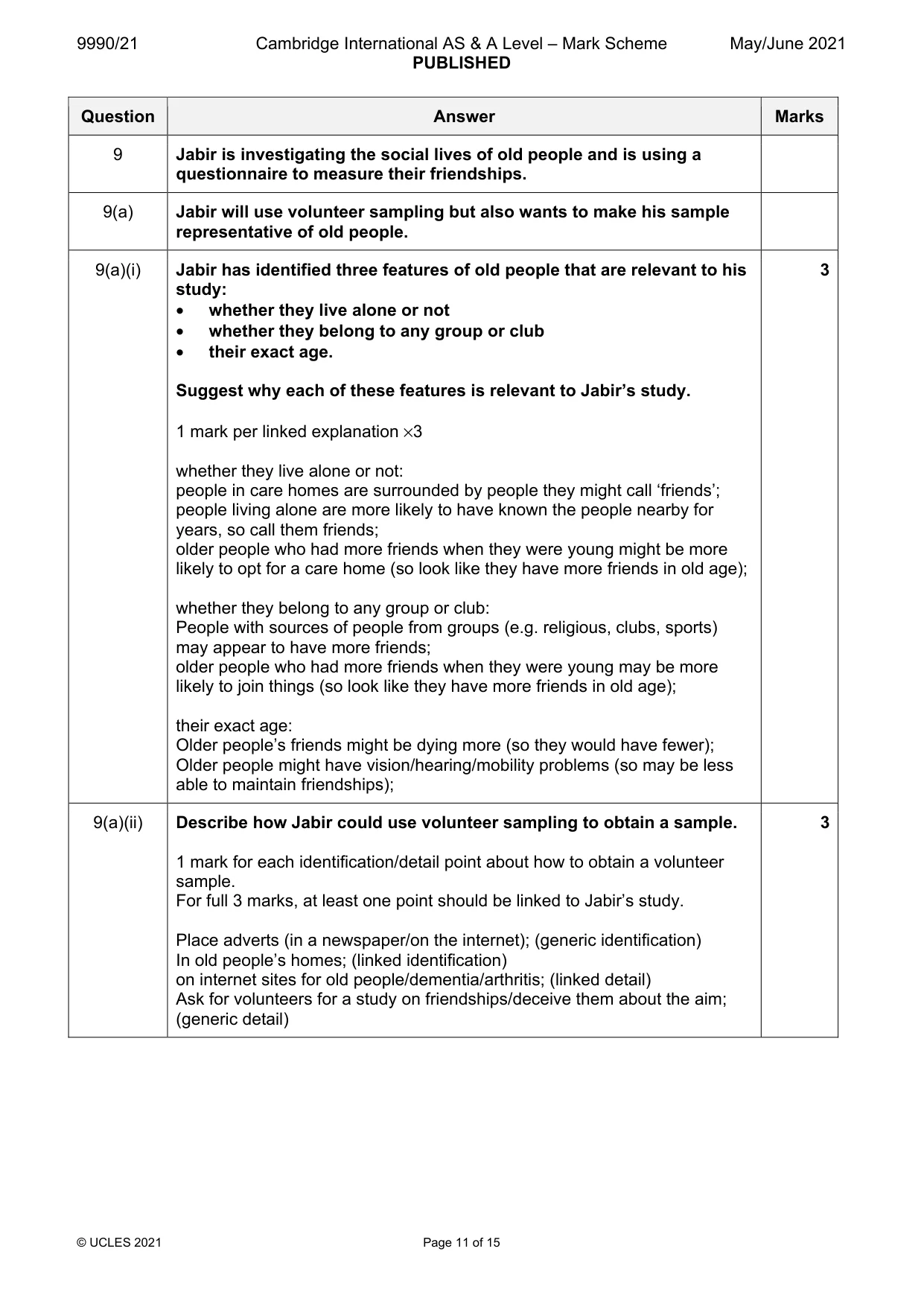
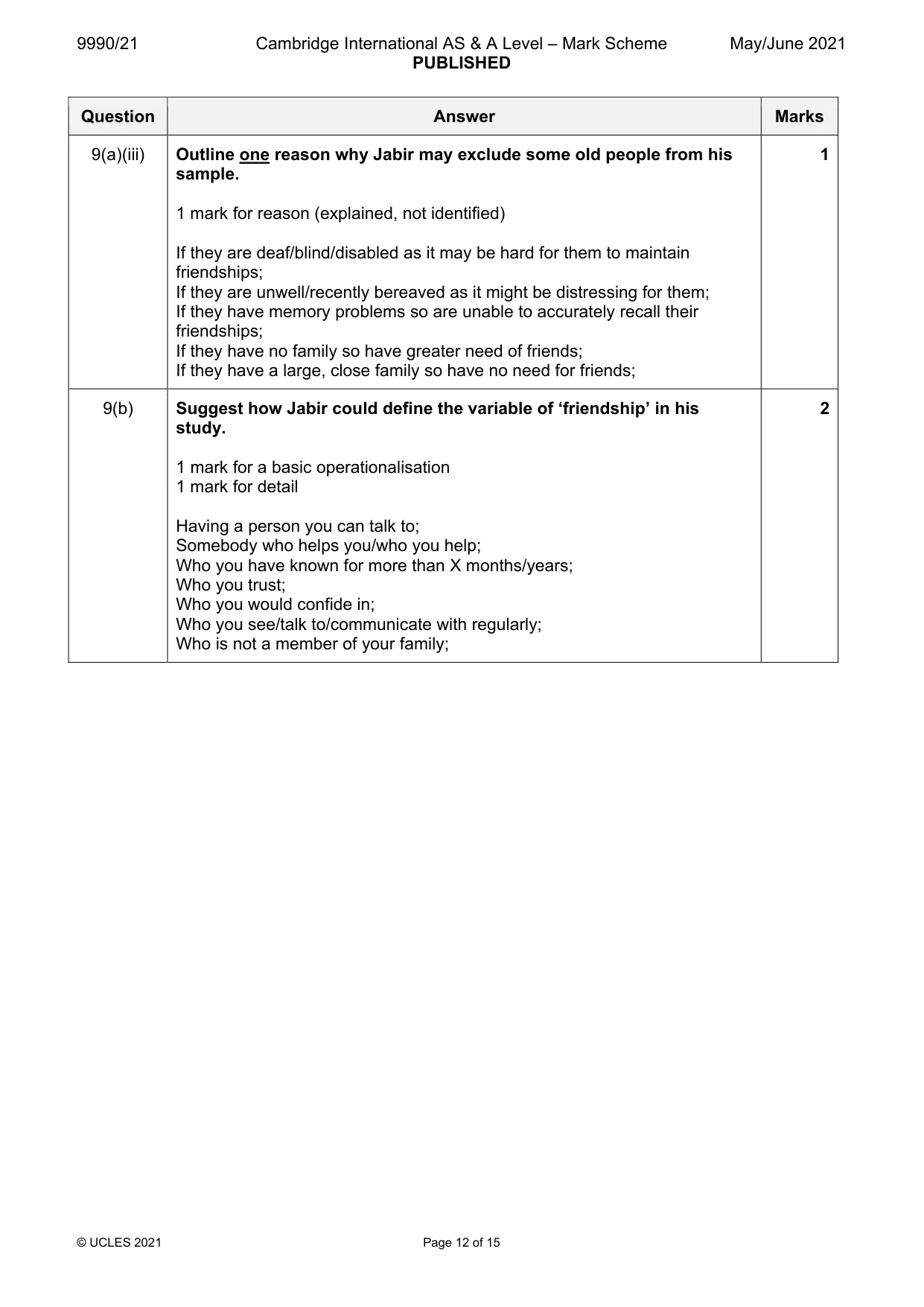
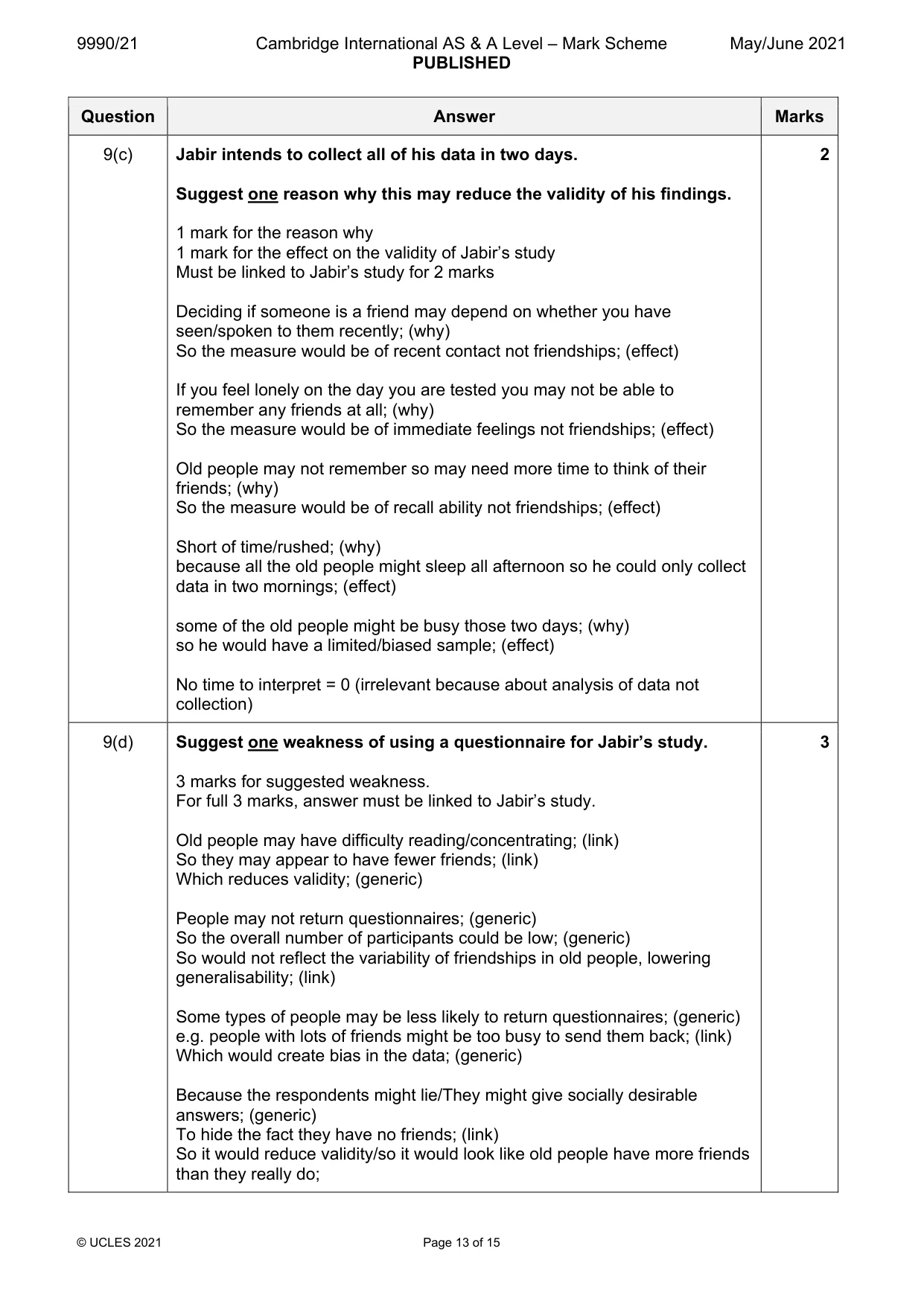
9 Jabir is investigating the social lives of old people and is using a questionnaire to measure their friendships. (a) Jabir will use volunteer sampling but also wants to make his sample representative of old people. (i) Jabir has identified three features of old people that are relevant to his study: • whether they live alone or not • whether they belong to any group or club • their exact age. Suggest why each of these features is relevant to Jabir’s study. whether they live alone or not ........................................................................................... ........................................................................................................................................... ........................................................................................................................................... whether they belong to any group or club ......................................................................... ........................................................................................................................................... ........................................................................................................................................... their exact age ................................................................................................................... ........................................................................................................................................... ........................................................................................................................................... [3] (ii) Describe how Jabir could use volunteer sampling to obtain a sample. ........................................................................................................................................... ........................................................................................................................................... ........................................................................................................................................... ........................................................................................................................................... ........................................................................................................................................... ..................................................................................................................................... [3] (iii) Outline one reason why Jabir may exclude some old people from his sample. ........................................................................................................................................... ..................................................................................................................................... [1] (b) Suggest how Jabir could define the variable of ‘friendship’ in his study. ................................................................................................................................................... ................................................................................................................................................... ................................................................................................................................................... ............................................................................................................................................. [2] (c) Jabir intends to collect all of his data in two days. Suggest one reason why this may reduce the validity of his findings. ................................................................................................................................................... ................................................................................................................................................... ................................................................................................................................................... ............................................................................................................................................. [2] (d) Explain one weakness of using a questionnaire for Jabir’s study. ................................................................................................................................................... ................................................................................................................................................... ................................................................................................................................................... ................................................................................................................................................... ................................................................................................................................................... ............................................................................................................................................. [3] Section C Answer all questions in this section.
Mark scheme: 9 Jabir is investigating the social lives of old people and is using a questionnaire to measure their friendships. 9(a) Jabir will use volunteer sampling but also wants to make his sample representative of old people. 9(a)(i) Jabir has identified three features of old people that are relevant to his 3 study: • whether they live alone or not • whether they belong to any group or club • their exact age. Suggest why each of these features is relevant to Jabir’s study. 1 mark per linked explanation ×3 whether they live alone or not: people in care homes are surrounded by people they might call ‘friends’; people living alone are more likely to have known the people nearby for years, so call them friends; older people who had more friends when they were young might be more likely to opt for a care home (so look like they have more friends in old age); whether they belong to any group or club: People with sources of people from groups (e.g. religious, clubs, sports) may appear to have more friends; older people who had more friends when they were young may be more likely to join things (so look like they have more friends in old age); their exact age: Older people’s friends might be dying more (so they would have fewer); Older people might have vision/hearing/mobility problems (so may be less able to maintain friendships); 9(a)(ii) Describe how Jabir could use volunteer sampling to obtain a sample. 3 1 mark for each identification/detail point about how to obtain a volunteer sample. For full 3 marks, at least one point should be linked to Jabir’s study. Place adverts (in a newspaper/on the internet); (generic identification) In old people’s homes; (linked identification) on internet sites for old people/dementia/arthritis; (linked detail) Ask for volunteers for a study on friendships/deceive them about the aim; (generic detail) 9(a)(iii) Outline one reason why Jabir may exclude some old people from his 1 sample. 1 mark for reason (explained, not identified) If they are deaf/blind/disabled as it may be hard for them to maintain friendships; If they are unwell/recently bereaved as it might be distressing for them; If they have memory problems so are unable to accurately recall their friendships; If they have no family so have greater need of friends; If they have a large, close family so have no need for friends; 9(b) Suggest how Jabir could define the variable of ‘friendship’ in his 2 study. 1 mark for a basic operationalisation 1 mark for detail Having a person you can talk to; Somebody who helps you/who you help; Who you have known for more than X months/years; Who you trust; Who you would confide in; Who you see/talk to/communicate with regularly; Who is not a member of your family; 9(c) Jabir intends to collect all of his data in two days. 2 Suggest one reason why this may reduce the validity of his findings. 1 mark for the reason why 1 mark for the effect on the validity of Jabir’s study Must be linked to Jabir’s study for 2 marks Deciding if someone is a friend may depend on whether you have seen/spoken to them recently; (why) So the measure would be of recent contact not friendships; (effect) If you feel lonely on the day you are tested you may not be able to remember any friends at all; (why) So the measure would be of immediate feelings not friendships; (effect) Old people may not remember so may need more time to think of their friends; (why) So the measure would be of recall ability not friendships; (effect) Short of time/rushed; (why) because all the old people might sleep all afternoon so he could only collect data in two mornings; (effect) some of the old people might be busy those two days; (why) so he would have a limited/biased sample; (effect) No time to interpret = 0 (irrelevant because about analysis of data not collection) 9(d) Suggest one weakness of using a questionnaire for Jabir’s study. 3 3 marks for suggested weakness. For full 3 marks, answer must be linked to Jabir’s study. Old people may have difficulty reading/concentrating; (link) So they may appear to have fewer friends; (link) Which reduces validity; (generic) People may not return questionnaires; (generic) So the overall number of participants could be low; (generic) So would not reflect the variability of friendships in old people, lowering generalisability; (link) Some types of people may be less likely to return questionnaires; (generic) e.g. people with lots of friends might be too busy to send them back; (link) Which would create bias in the data; (generic) Because the respondents might lie/They might give socially desirable answers; (generic) To hide the fact they have no friends; (link) So it would reduce validity/so it would look like old people have more friends than they really do;
Q10 · Nuan wants to test the idea that the way words are presented affects recall
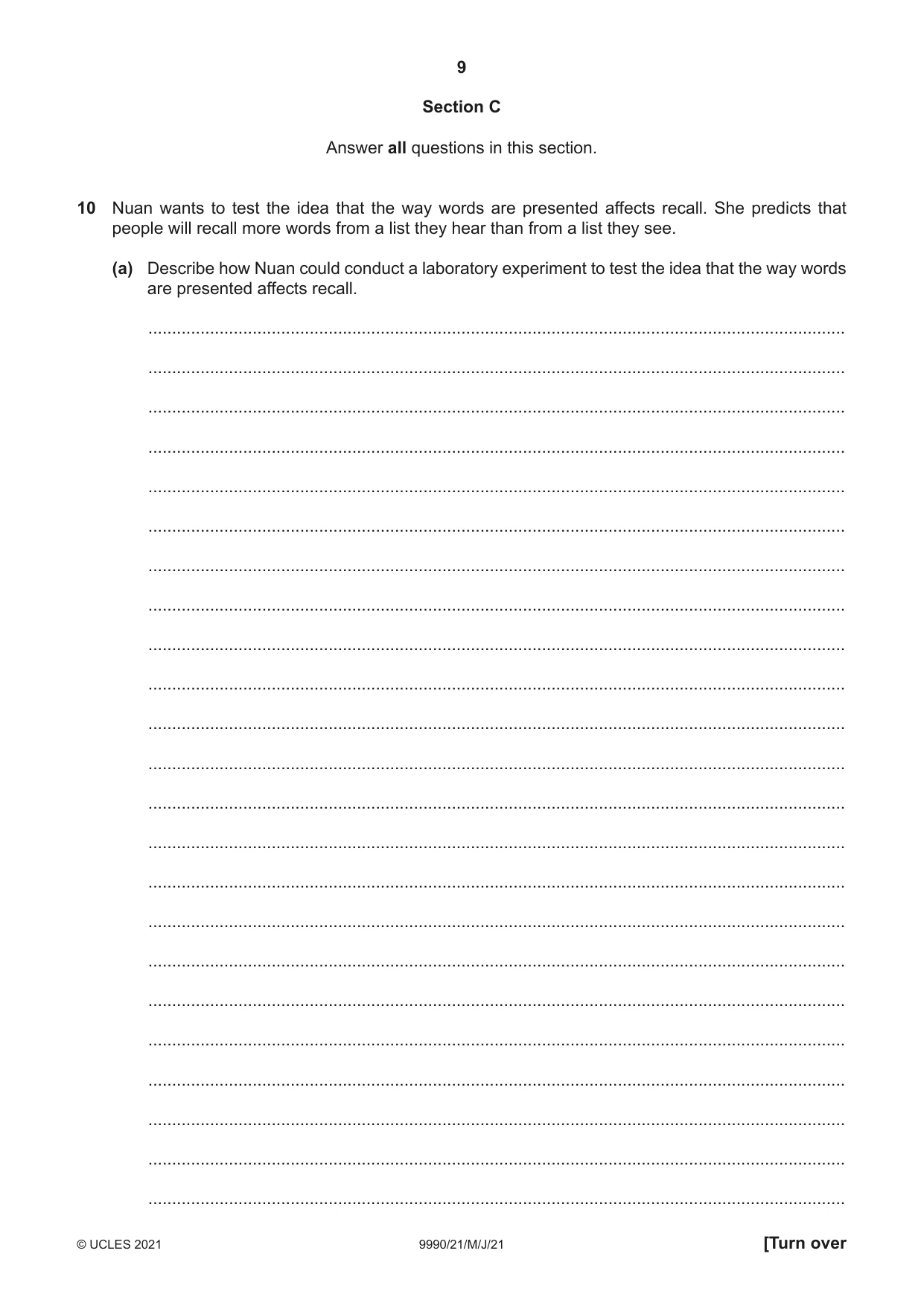
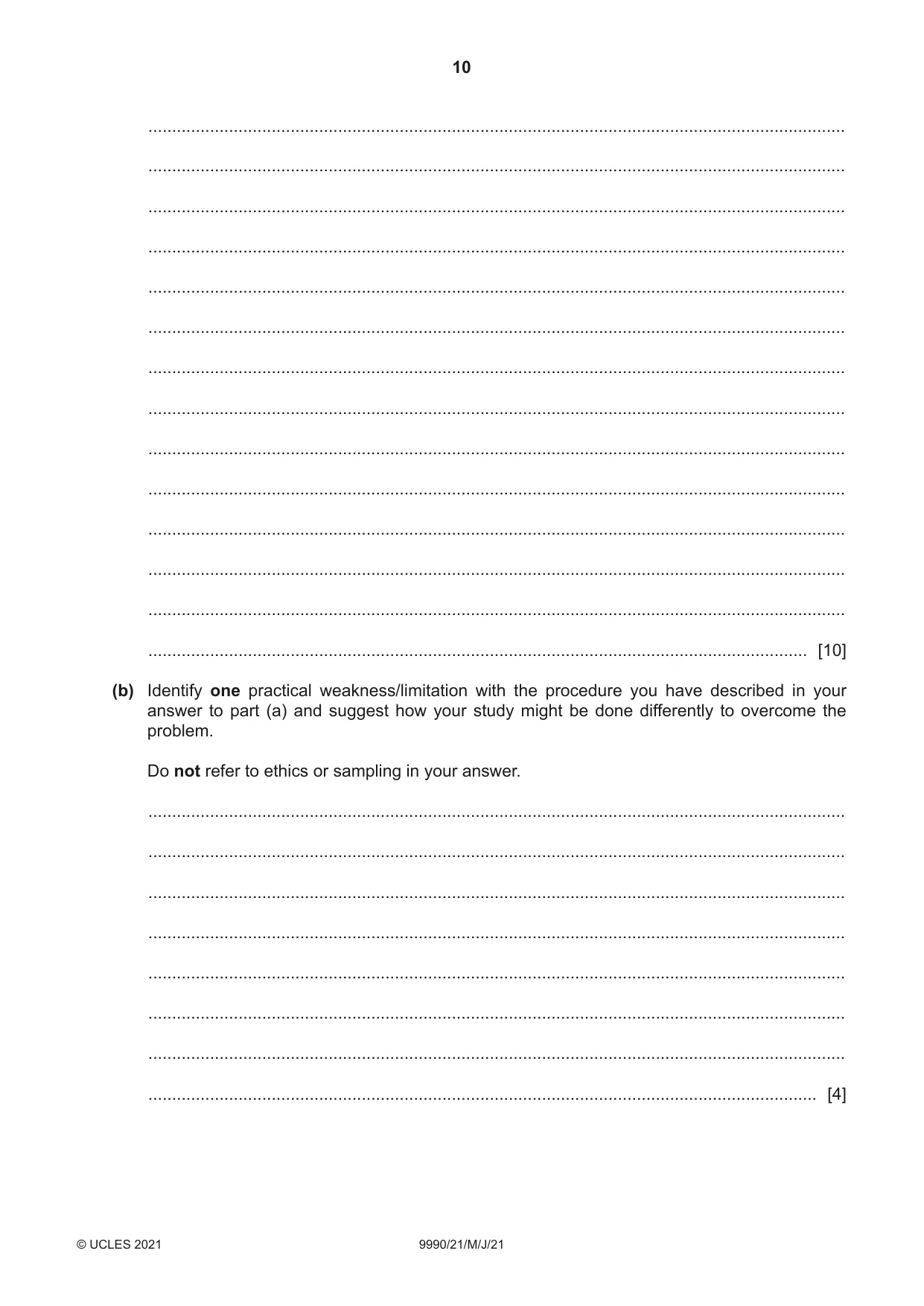
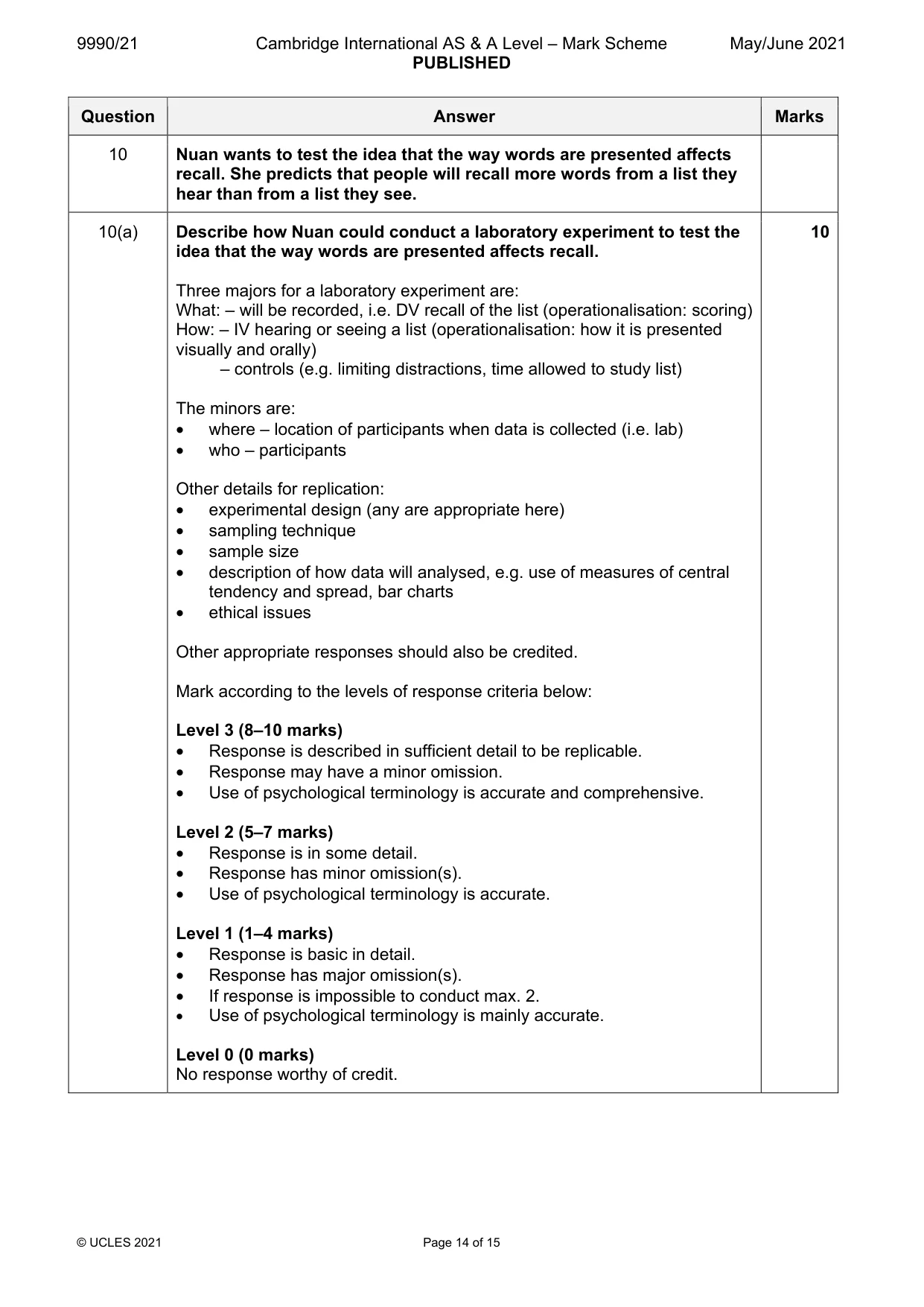
10 Nuan wants to test the idea that the way words are presented affects recall. She predicts that people will recall more words from a list they hear than from a list they see. (a) Describe how Nuan could conduct a laboratory experiment to test the idea that the way words are presented affects recall. ................................................................................................................................................... ................................................................................................................................................... ................................................................................................................................................... ................................................................................................................................................... ................................................................................................................................................... ................................................................................................................................................... ................................................................................................................................................... ................................................................................................................................................... ................................................................................................................................................... ................................................................................................................................................... ................................................................................................................................................... ................................................................................................................................................... ................................................................................................................................................... ................................................................................................................................................... ................................................................................................................................................... ................................................................................................................................................... ................................................................................................................................................... ................................................................................................................................................... ................................................................................................................................................... ................................................................................................................................................... ................................................................................................................................................... ................................................................................................................................................... ................................................................................................................................................... ................................................................................................................................................... ................................................................................................................................................... ................................................................................................................................................... ................................................................................................................................................... ................................................................................................................................................... ................................................................................................................................................... ................................................................................................................................................... ................................................................................................................................................... ................................................................................................................................................... ................................................................................................................................................... ................................................................................................................................................... ................................................................................................................................................... ................................................................................................................................................... ........................................................................................................................................... [10] (b) Identify one practical weakness/limitation with the procedure you have described in your answer to part (a) and suggest how your study might be done differently to overcome the problem. Do not refer to ethics or sampling in your answer. ................................................................................................................................................... ................................................................................................................................................... ................................................................................................................................................... ................................................................................................................................................... ................................................................................................................................................... ................................................................................................................................................... ................................................................................................................................................... ............................................................................................................................................. [4]
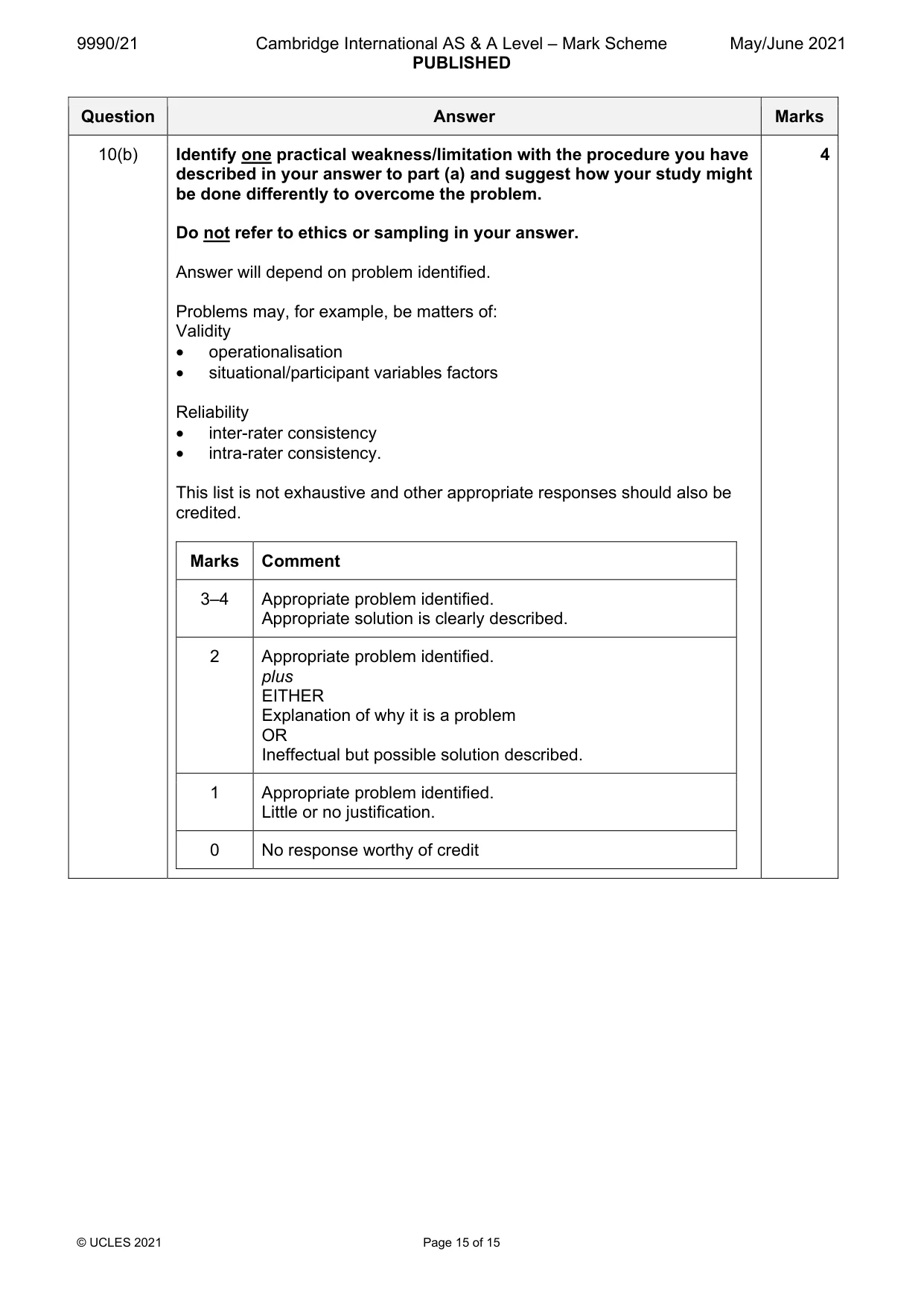
Mark scheme: 10 Nuan wants to test the idea that the way words are presented affects recall. She predicts that people will recall more words from a list they hear than from a list they see. 10(a) Describe how Nuan could conduct a laboratory experiment to test the 10 idea that the way words are presented affects recall. Three majors for a laboratory experiment are: What: – will be recorded, i.e. DV recall of the list (operationalisation: scoring) How: – IV hearing or seeing a list (operationalisation: how it is presented visually and orally) – controls (e.g. limiting distractions, time allowed to study list) The minors are: • where – location of participants when data is collected (i.e. lab) • who – participants Other details for replication: • experimental design (any are appropriate here) • sampling technique • sample size • description of how data will analysed, e.g. use of measures of central tendency and spread, bar charts • ethical issues Other appropriate responses should also be credited. Mark according to the levels of response criteria below: Level 3 (8–10 marks) • Response is described in sufficient detail to be replicable. • Response may have a minor omission. • Use of psychological terminology is accurate and comprehensive. Level 2 (5–7 marks) • Response is in some detail. • Response has minor omission(s). • Use of psychological terminology is accurate. Level 1 (1–4 marks) • Response is basic in detail. • Response has major omission(s). • If response is impossible to conduct max. 2. • Use of psychological terminology is mainly accurate. Level 0 (0 marks) No response worthy of credit. 10(b) Identify one practical weakness/limitation with the procedure you have 4 described in your answer to part (a) and suggest how your study might be done differently to overcome the problem. Do not refer to ethics or sampling in your answer. Answer will depend on problem identified. Problems may, for example, be matters of: Validity • operationalisation • situational/participant variables factors Reliability • inter-rater consistency • intra-rater consistency. This list is not exhaustive and other appropriate responses should also be credited. Marks Comment 3–4 Appropriate problem identified. Appropriate solution is clearly described. 2 Appropriate problem identified. plus EITHER Explanation of why it is a problem OR Ineffectual but possible solution described. 1 Appropriate problem identified. Little or no justification. 0 No response worthy of credit
What was in this paper
The subtopics covered by these 10 questions, and how many questions each got. Open one in a new tab to see every Cambridge question on it.
What you needed in this session
Cambridge’s own grade thresholds for 2021 May/June, Paper 2 · Variant 1. A higher threshold means an easier paper — the bar moves with how the cohort did.