Cambridge A Level Psychology (from 2018) 9990 — 2020 Oct/Nov Paper 2 · Variant 3
9990/23/O/N/20 · 10 questions · 60 marks · ≈68 min
The question paper and its mark scheme, free to read here and free to download. This is Cambridge’s own paper, exactly as it was sat.
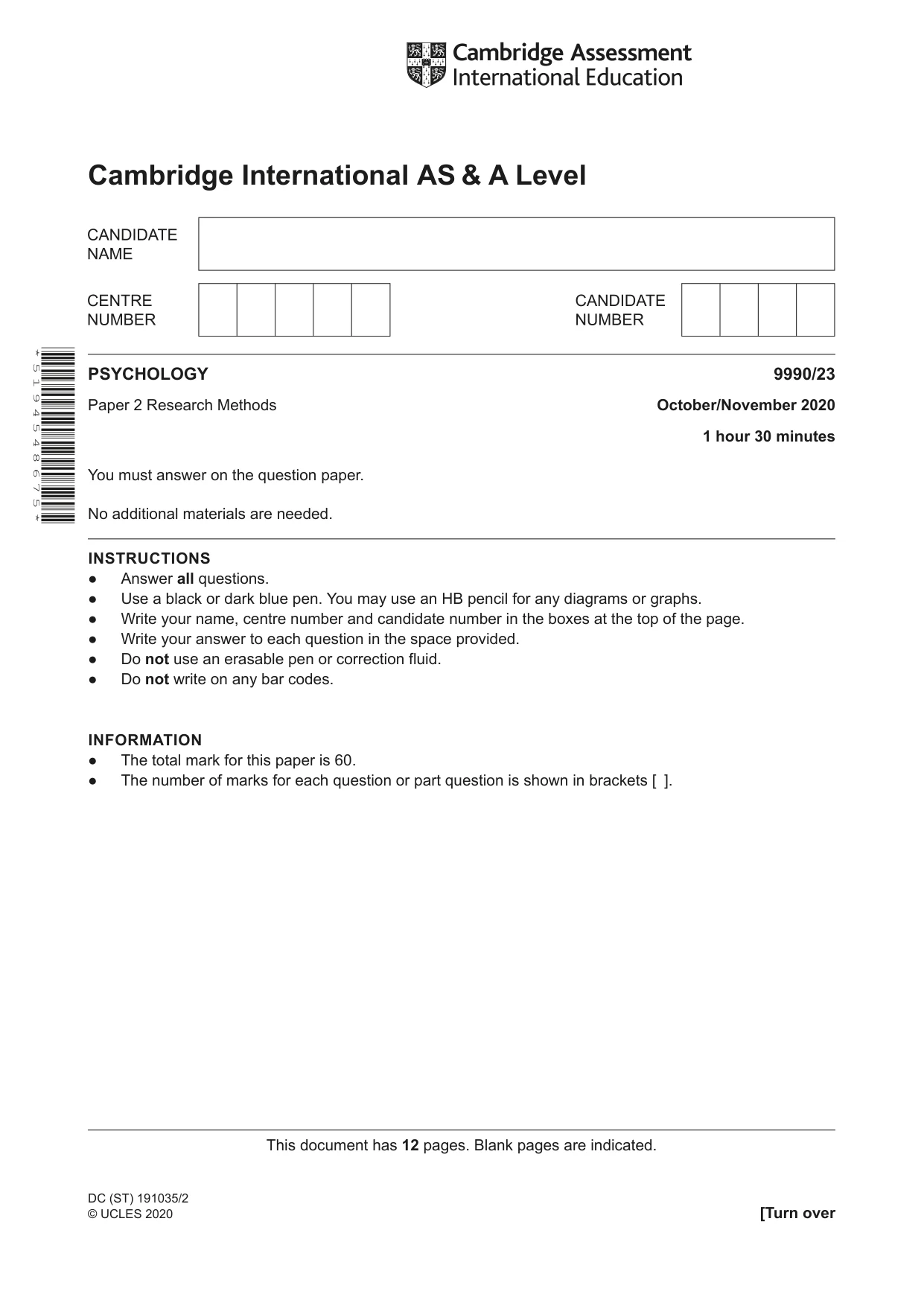
Question paper12 pages

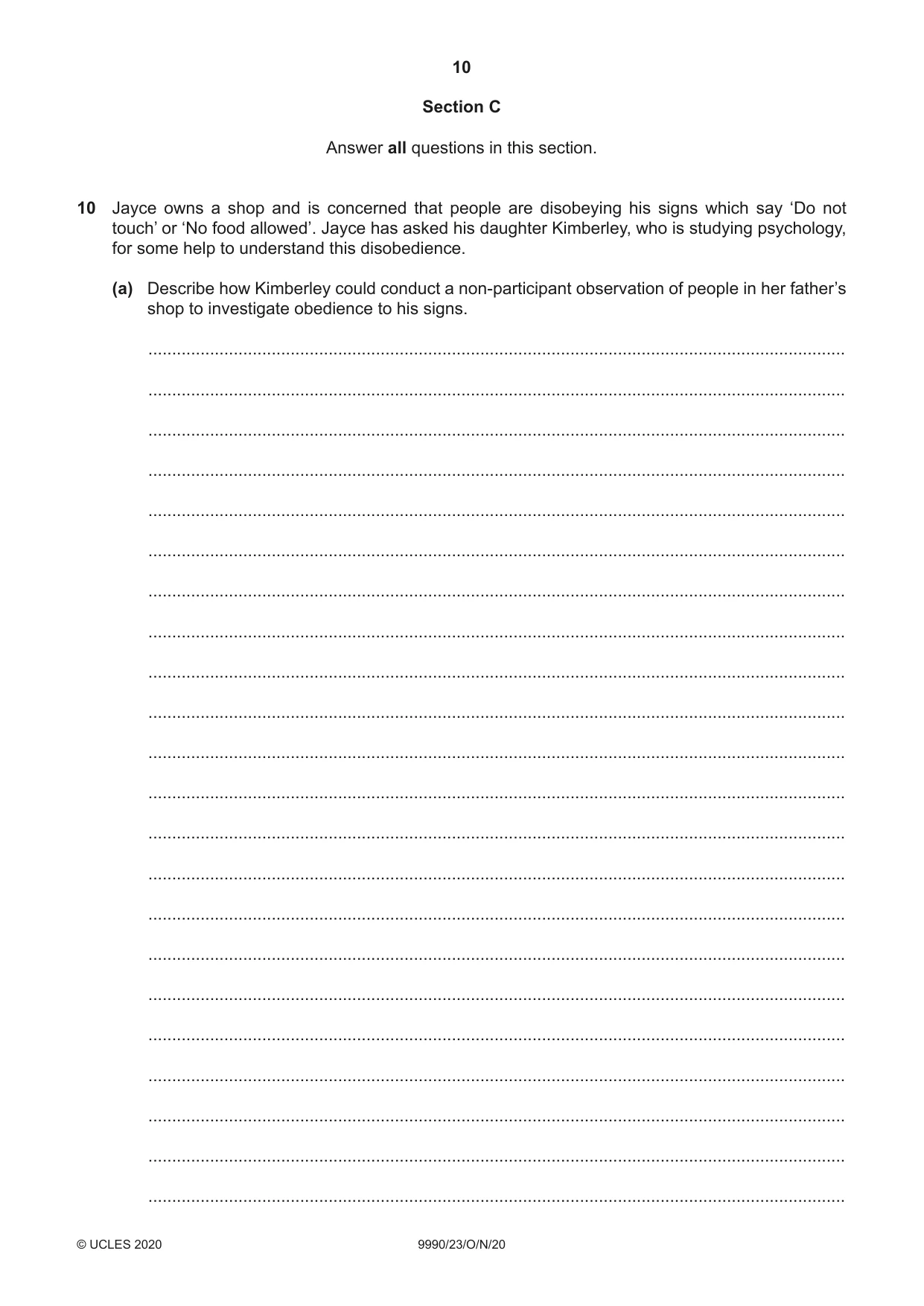
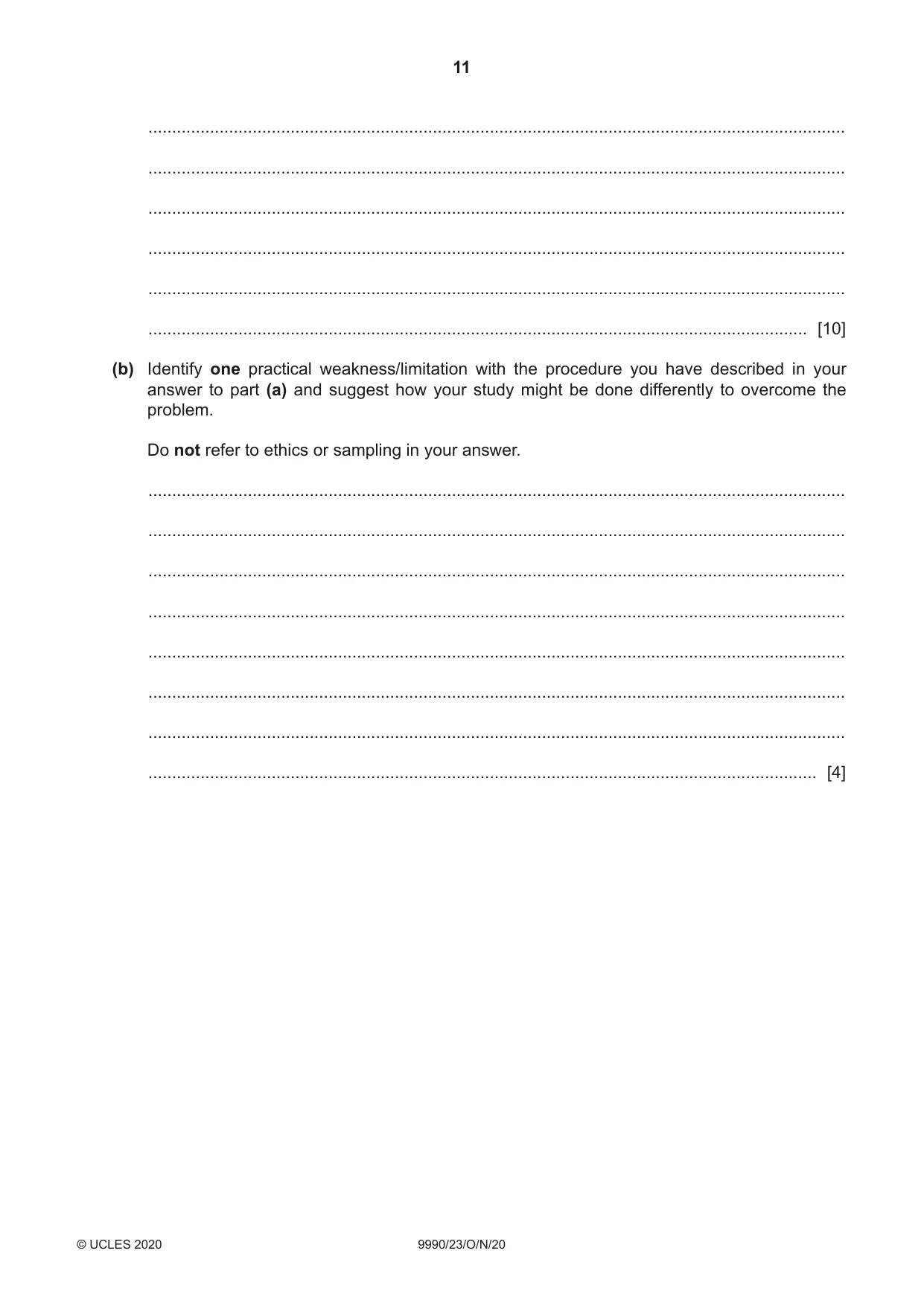

Mark scheme16 pages
Answers below. Sit the paper first if you are practising.

Questions as text
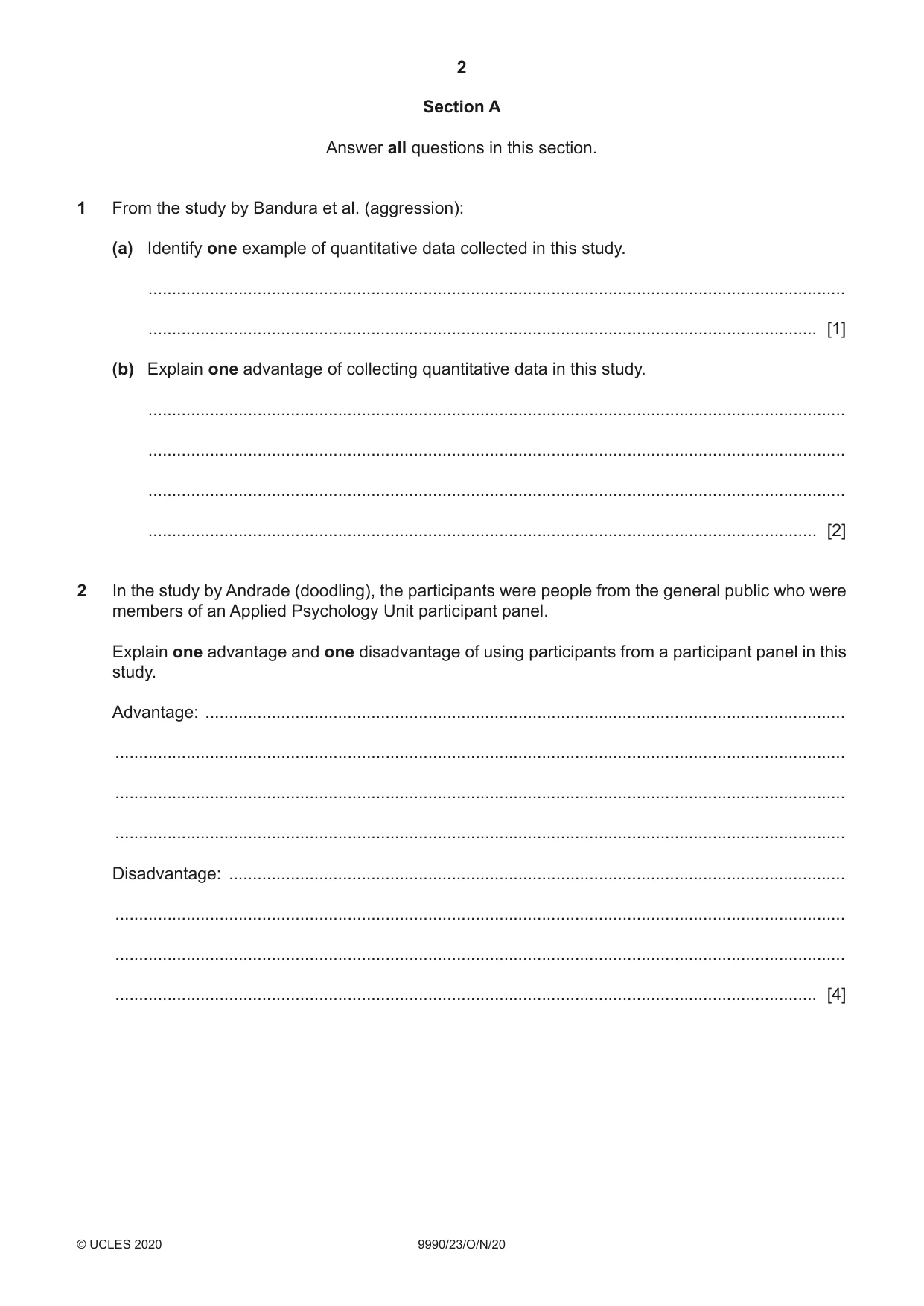
Q1 · From the study by Bandura et al
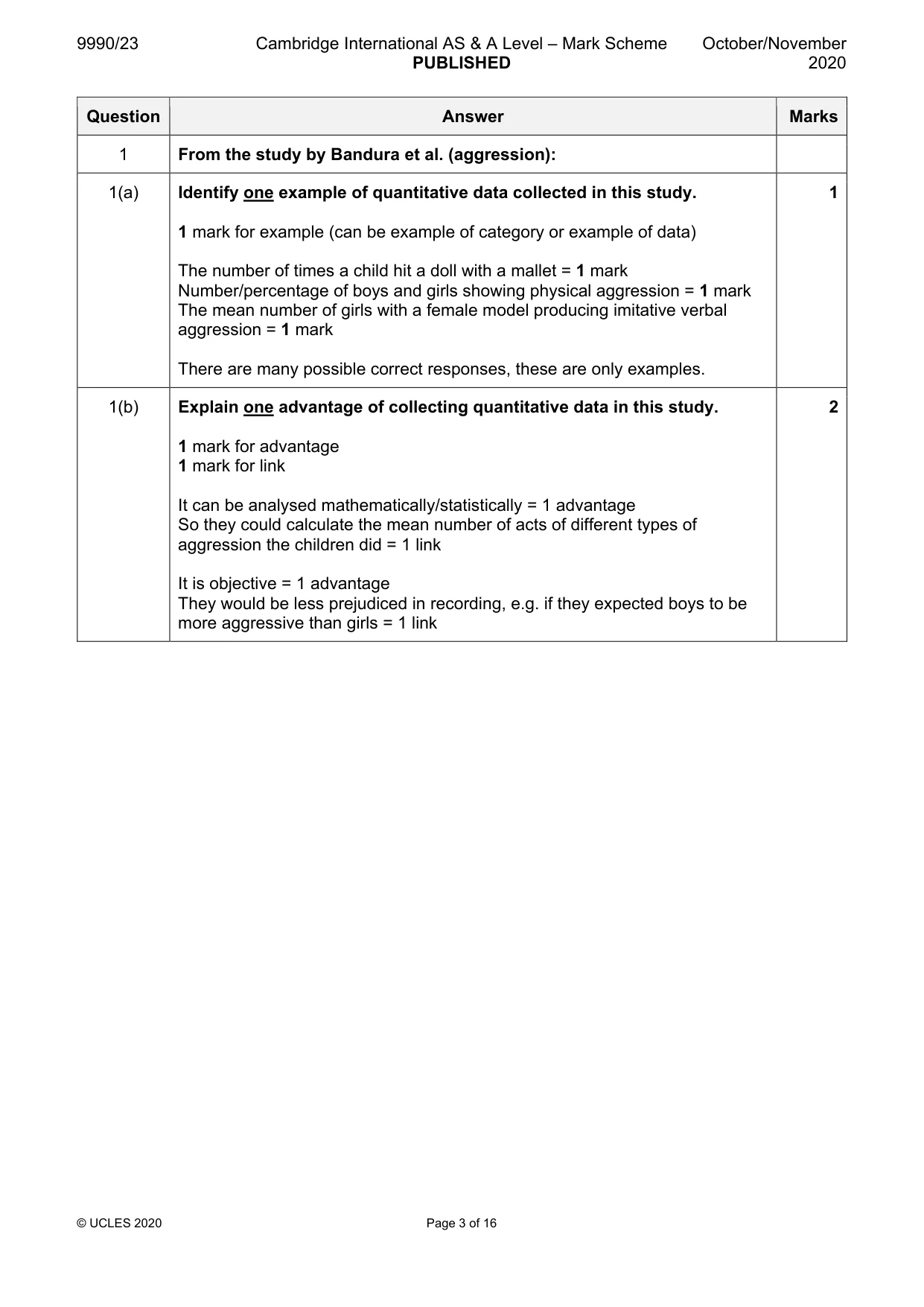
1 From the study by Bandura et al. (aggression): (a) Identify one example of quantitative data collected in this study. ................................................................................................................................................... ............................................................................................................................................. [1] (b) Explain one advantage of collecting quantitative data in this study. ................................................................................................................................................... ................................................................................................................................................... ................................................................................................................................................... ............................................................................................................................................. [2]
Mark scheme: Question Answer Marks 1 From the study by Bandura et al. (aggression): 1(a) Identify one example of quantitative data collected in this study. 1 1 mark for example (can be example of category or example of data) The number of times a child hit a doll with a mallet = 1 mark Number/percentage of boys and girls showing physical aggression = 1 mark The mean number of girls with a female model producing imitative verbal aggression = 1 mark There are many possible correct responses, these are only examples. 1(b) Explain one advantage of collecting quantitative data in this study. 2 1 mark for advantage 1 mark for link It can be analysed mathematically/statistically = 1 advantage So they could calculate the mean number of acts of different types of aggression the children did = 1 link It is objective = 1 advantage They would be less prejudiced in recording, e.g. if they expected boys to be more aggressive than girls = 1 link
Q2 · In the study by Andrade (doodling), the participants were people from the general public…
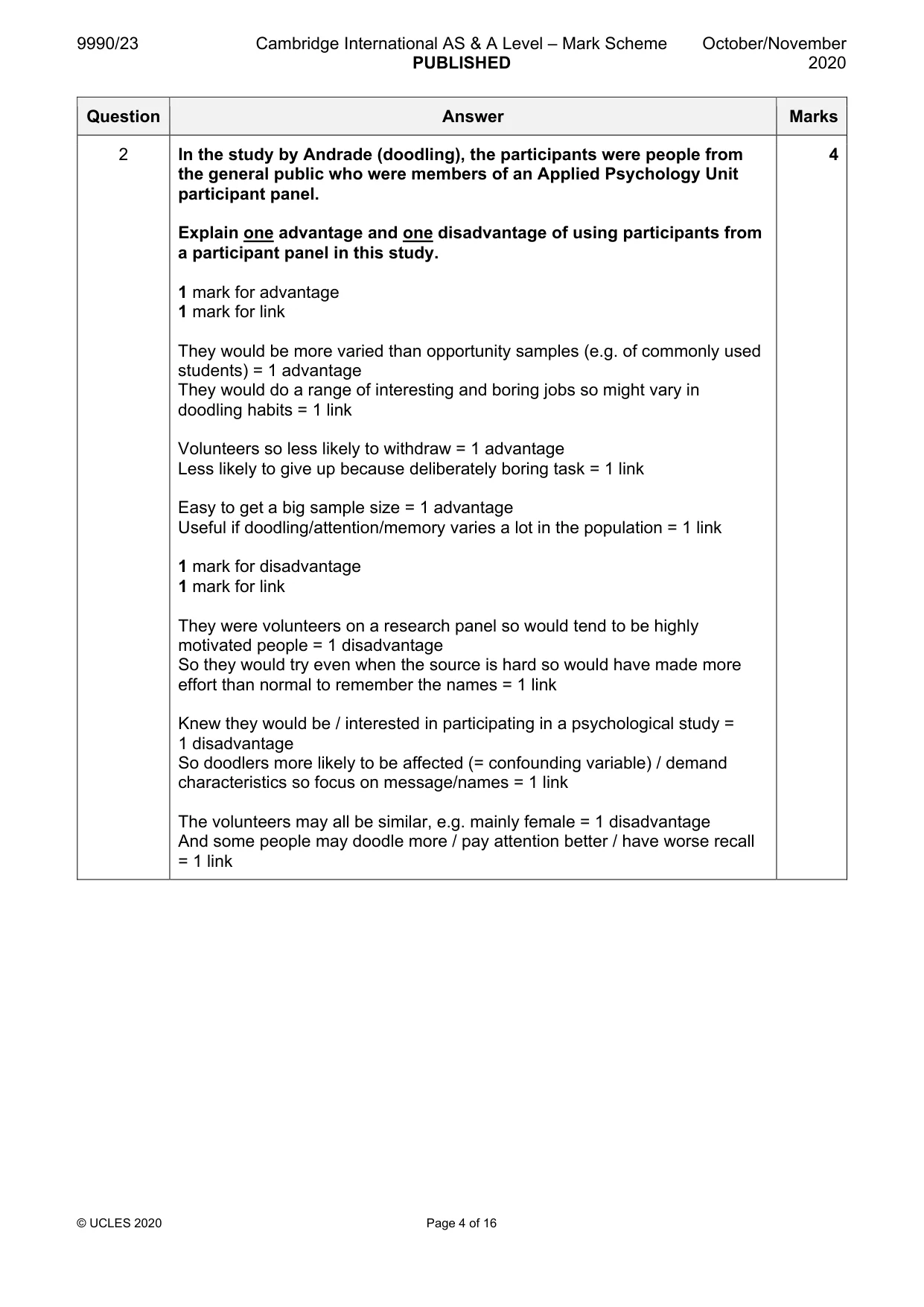
2 In the study by Andrade (doodling), the participants were people from the general public who were members of an Applied Psychology Unit participant panel. Explain one advantage and one disadvantage of using participants from a participant panel in this study. Advantage: ....................................................................................................................................... .......................................................................................................................................................... .......................................................................................................................................................... .......................................................................................................................................................... Disadvantage: .................................................................................................................................. .......................................................................................................................................................... .......................................................................................................................................................... .................................................................................................................................................... [4]
Mark scheme: 2 In the study by Andrade (doodling), the participants were people from 4 the general public who were members of an Applied Psychology Unit participant panel. Explain one advantage and one disadvantage of using participants from a participant panel in this study. 1 mark for advantage 1 mark for link They would be more varied than opportunity samples (e.g. of commonly used students) = 1 advantage They would do a range of interesting and boring jobs so might vary in doodling habits = 1 link Volunteers so less likely to withdraw = 1 advantage Less likely to give up because deliberately boring task = 1 link Easy to get a big sample size = 1 advantage Useful if doodling/attention/memory varies a lot in the population = 1 link 1 mark for disadvantage 1 mark for link They were volunteers on a research panel so would tend to be highly motivated people = 1 disadvantage So they would try even when the source is hard so would have made more effort than normal to remember the names = 1 link Knew they would be / interested in participating in a psychological study = 1 disadvantage So doodlers more likely to be affected (= confounding variable) / demand characteristics so focus on message/names = 1 link The volunteers may all be similar, e.g. mainly female = 1 disadvantage And some people may doodle more / pay attention better / have worse recall = 1 link
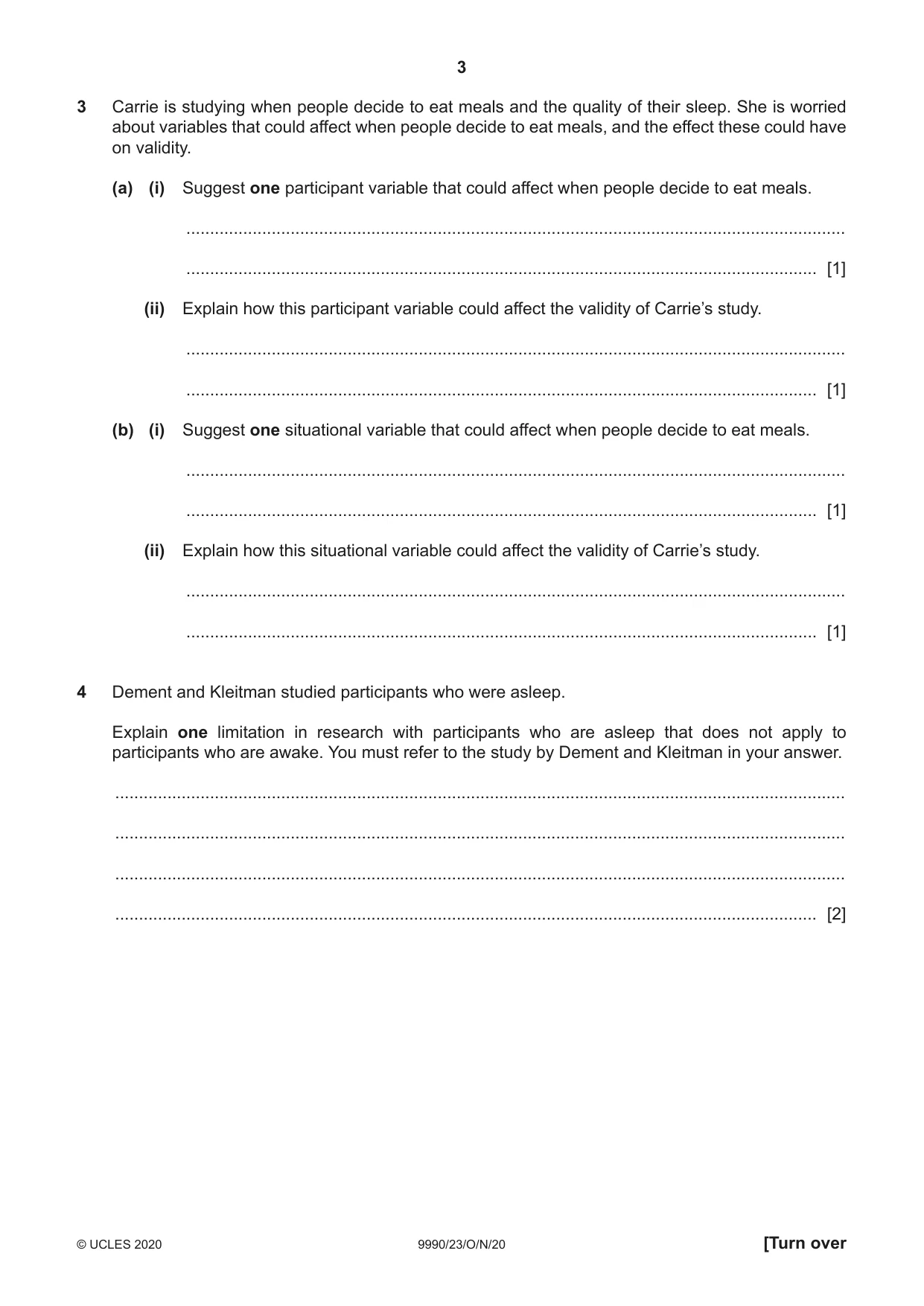
Q3 · Carrie is studying when people decide to eat meals and the quality of their sleep
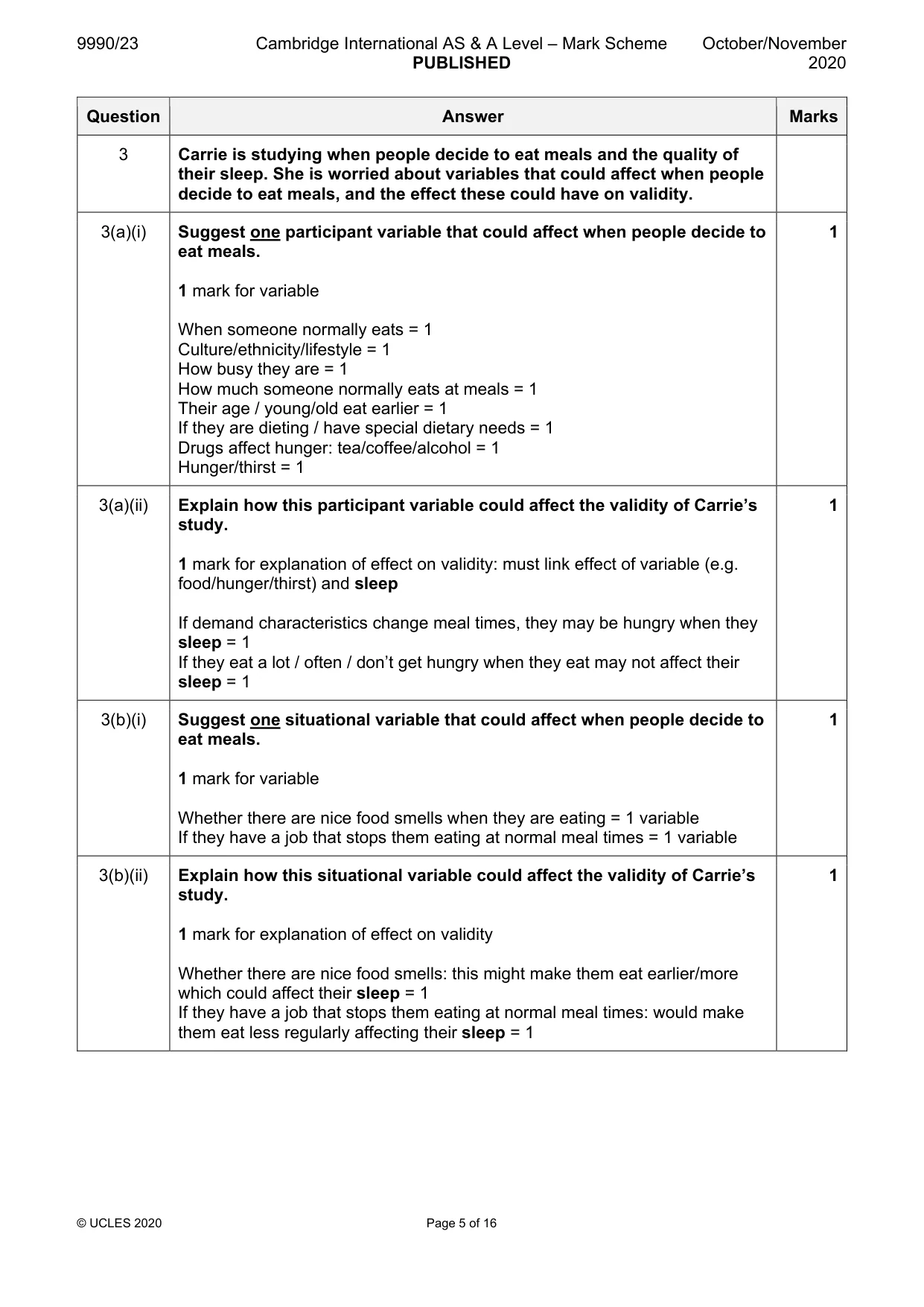
3 Carrie is studying when people decide to eat meals and the quality of their sleep. She is worried about variables that could affect when people decide to eat meals, and the effect these could have on validity. (a) (i) Suggest one participant variable that could affect when people decide to eat meals. ........................................................................................................................................... ..................................................................................................................................... [1] (ii) Explain how this participant variable could affect the validity of Carrie’s study. ........................................................................................................................................... ..................................................................................................................................... [1] (b) (i) Suggest one situational variable that could affect when people decide to eat meals. ........................................................................................................................................... ..................................................................................................................................... [1] (ii) Explain how this situational variable could affect the validity of Carrie’s study. ........................................................................................................................................... ..................................................................................................................................... [1]
Mark scheme: 3 Carrie is studying when people decide to eat meals and the quality of their sleep. She is worried about variables that could affect when people decide to eat meals, and the effect these could have on validity. 3(a)(i) Suggest one participant variable that could affect when people decide to 1 eat meals. 1 mark for variable When someone normally eats = 1 Culture/ethnicity/lifestyle = 1 How busy they are = 1 How much someone normally eats at meals = 1 Their age / young/old eat earlier = 1 If they are dieting / have special dietary needs = 1 Drugs affect hunger: tea/coffee/alcohol = 1 Hunger/thirst = 1 3(a)(ii) Explain how this participant variable could affect the validity of Carrie’s 1 study. 1 mark for explanation of effect on validity: must link effect of variable (e.g. food/hunger/thirst) and sleep If demand characteristics change meal times, they may be hungry when they sleep = 1 If they eat a lot / often / don’t get hungry when they eat may not affect their sleep = 1 3(b)(i) Suggest one situational variable that could affect when people decide to 1 eat meals. 1 mark for variable Whether there are nice food smells when they are eating = 1 variable If they have a job that stops them eating at normal meal times = 1 variable 3(b)(ii) Explain how this situational variable could affect the validity of Carrie’s 1 study. 1 mark for explanation of effect on validity Whether there are nice food smells: this might make them eat earlier/more which could affect their sleep = 1 If they have a job that stops them eating at normal meal times: would make them eat less regularly affecting their sleep = 1
Q4 · Dement and Kleitman studied participants who were asleep
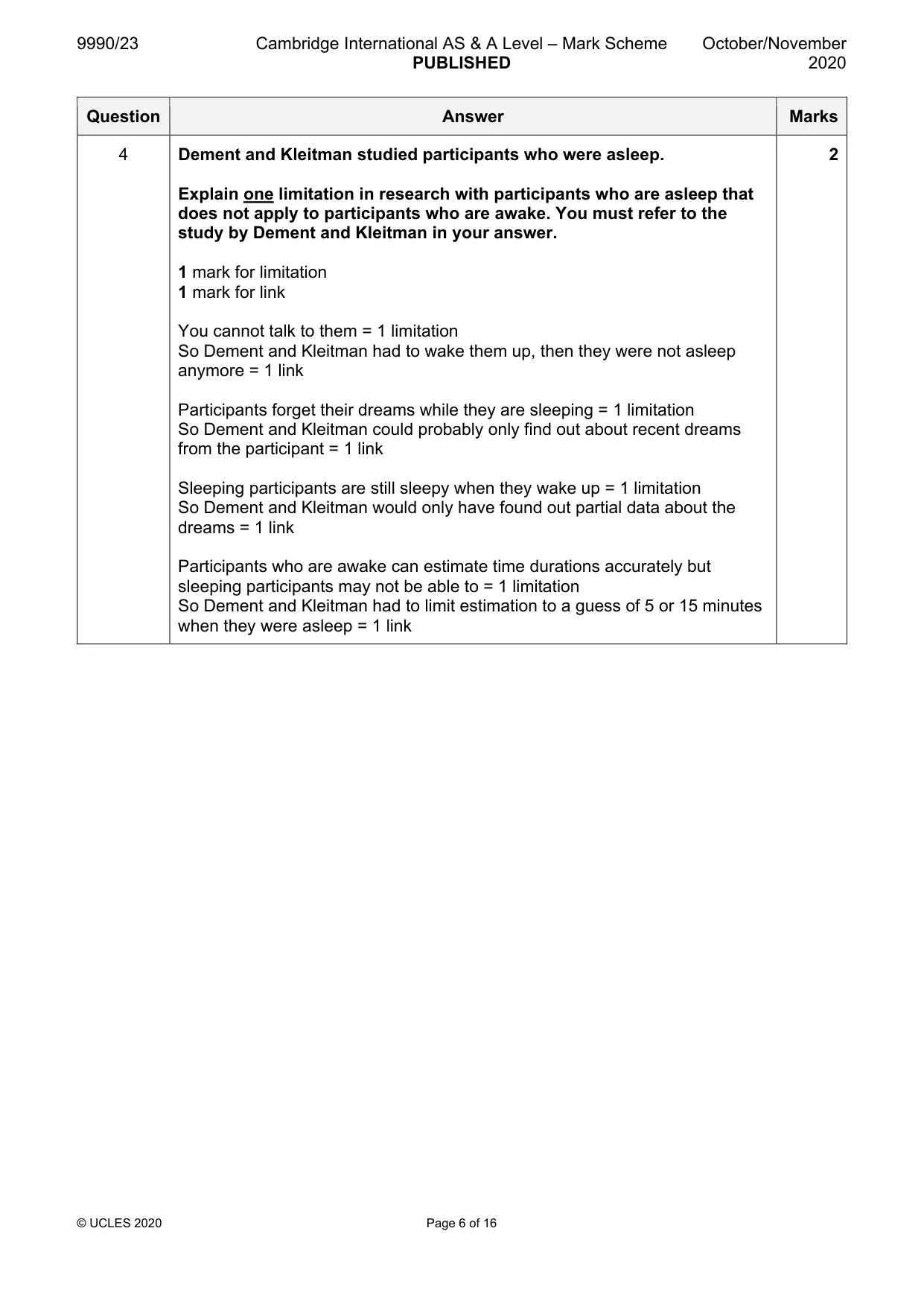
4 Dement and Kleitman studied participants who were asleep. Explain one limitation in research with participants who are asleep that does not apply to participants who are awake. You must refer to the study by Dement and Kleitman in your answer. .......................................................................................................................................................... .......................................................................................................................................................... .......................................................................................................................................................... .................................................................................................................................................... [2]
Mark scheme: 4 Dement and Kleitman studied participants who were asleep. 2 Explain one limitation in research with participants who are asleep that does not apply to participants who are awake. You must refer to the study by Dement and Kleitman in your answer. 1 mark for limitation 1 mark for link You cannot talk to them = 1 limitation So Dement and Kleitman had to wake them up, then they were not asleep anymore = 1 link Participants forget their dreams while they are sleeping = 1 limitation So Dement and Kleitman could probably only find out about recent dreams from the participant = 1 link Sleeping participants are still sleepy when they wake up = 1 limitation So Dement and Kleitman would only have found out partial data about the dreams = 1 link Participants who are awake can estimate time durations accurately but sleeping participants may not be able to = 1 limitation So Dement and Kleitman had to limit estimation to a guess of 5 or 15 minutes when they were asleep = 1 link
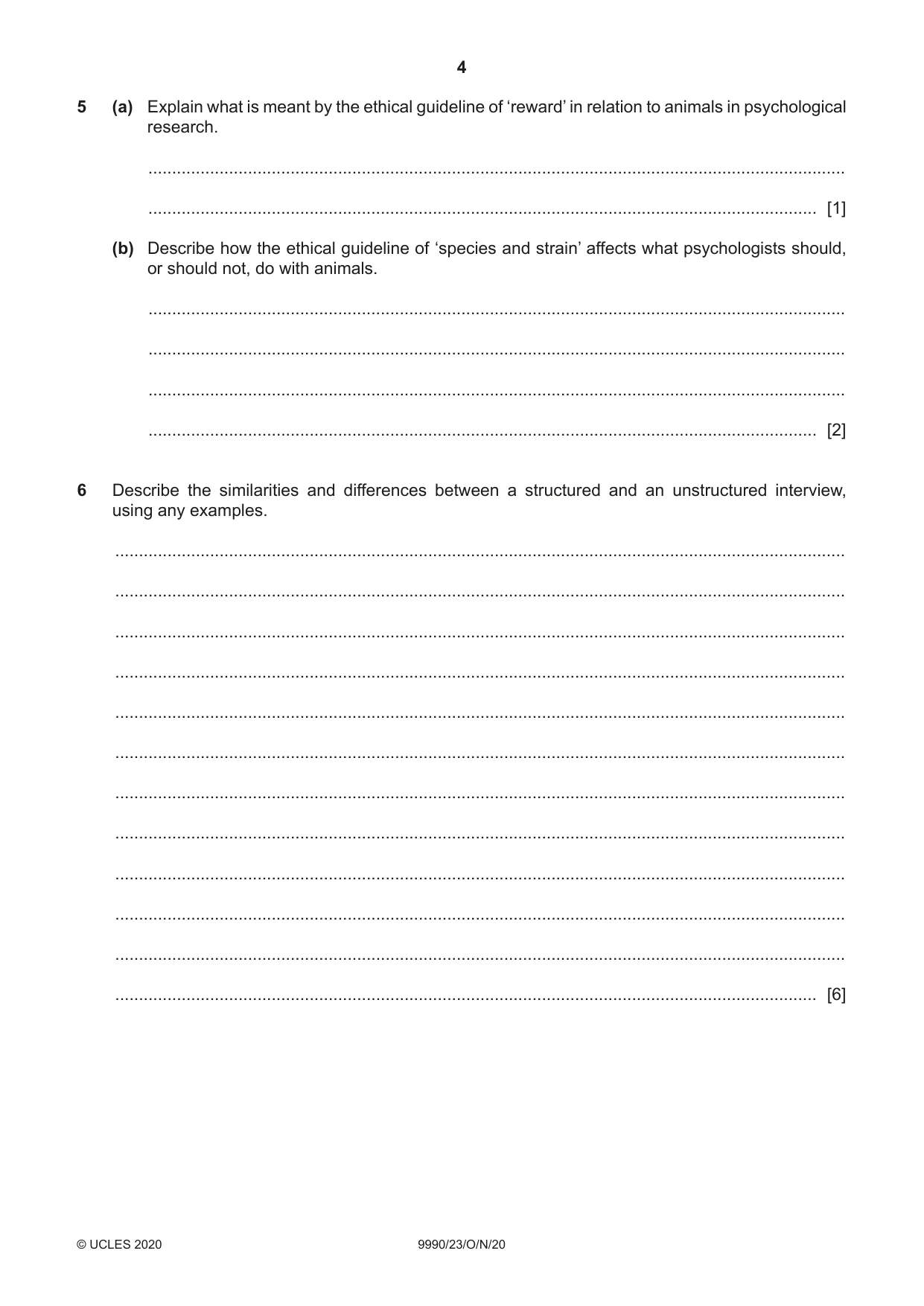
Q5 · Explain what is meant by the ethical guideline of ‘reward’ in relation to animals in…
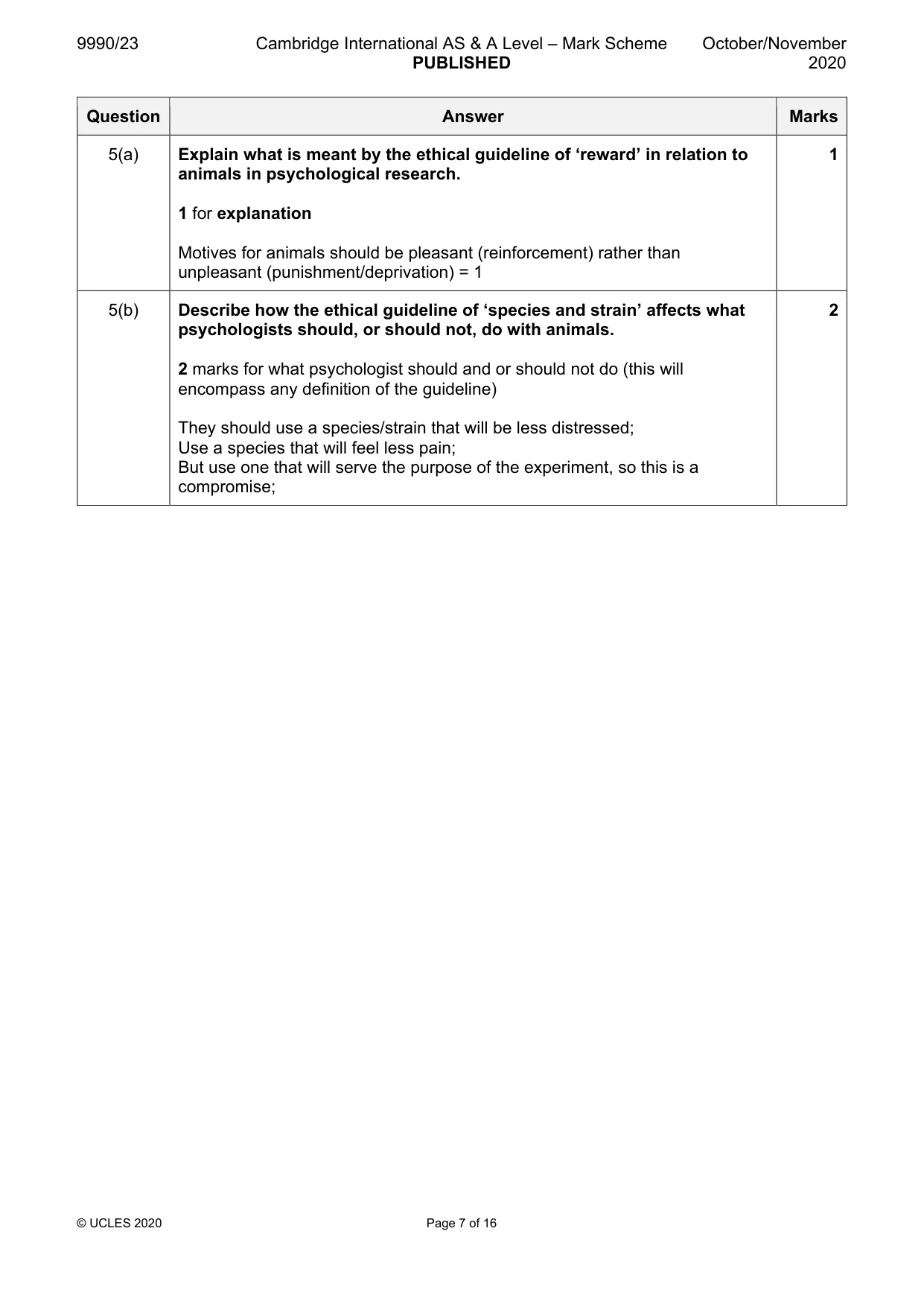
5 (a) Explain what is meant by the ethical guideline of ‘reward’ in relation to animals in psychological research. ................................................................................................................................................... ............................................................................................................................................. [1] (b) Describe how the ethical guideline of ‘species and strain’ affects what psychologists should, or should not, do with animals. ................................................................................................................................................... ................................................................................................................................................... ................................................................................................................................................... ............................................................................................................................................. [2]
Mark scheme: 5(a) Explain what is meant by the ethical guideline of ‘reward’ in relation to 1 animals in psychological research. 1 for explanation Motives for animals should be pleasant (reinforcement) rather than unpleasant (punishment/deprivation) = 1 5(b) Describe how the ethical guideline of ‘species and strain’ affects what 2 psychologists should, or should not, do with animals. 2 marks for what psychologist should and or should not do (this will encompass any definition of the guideline) They should use a species/strain that will be less distressed; Use a species that will feel less pain; But use one that will serve the purpose of the experiment, so this is a compromise;
Q6 · Describe the similarities and differences between a structured and an unstructured…
6 Describe the similarities and differences between a structured and an unstructured interview, using any examples. .......................................................................................................................................................... .......................................................................................................................................................... .......................................................................................................................................................... .......................................................................................................................................................... .......................................................................................................................................................... .......................................................................................................................................................... .......................................................................................................................................................... .......................................................................................................................................................... .......................................................................................................................................................... .......................................................................................................................................................... .......................................................................................................................................................... .................................................................................................................................................... [6]
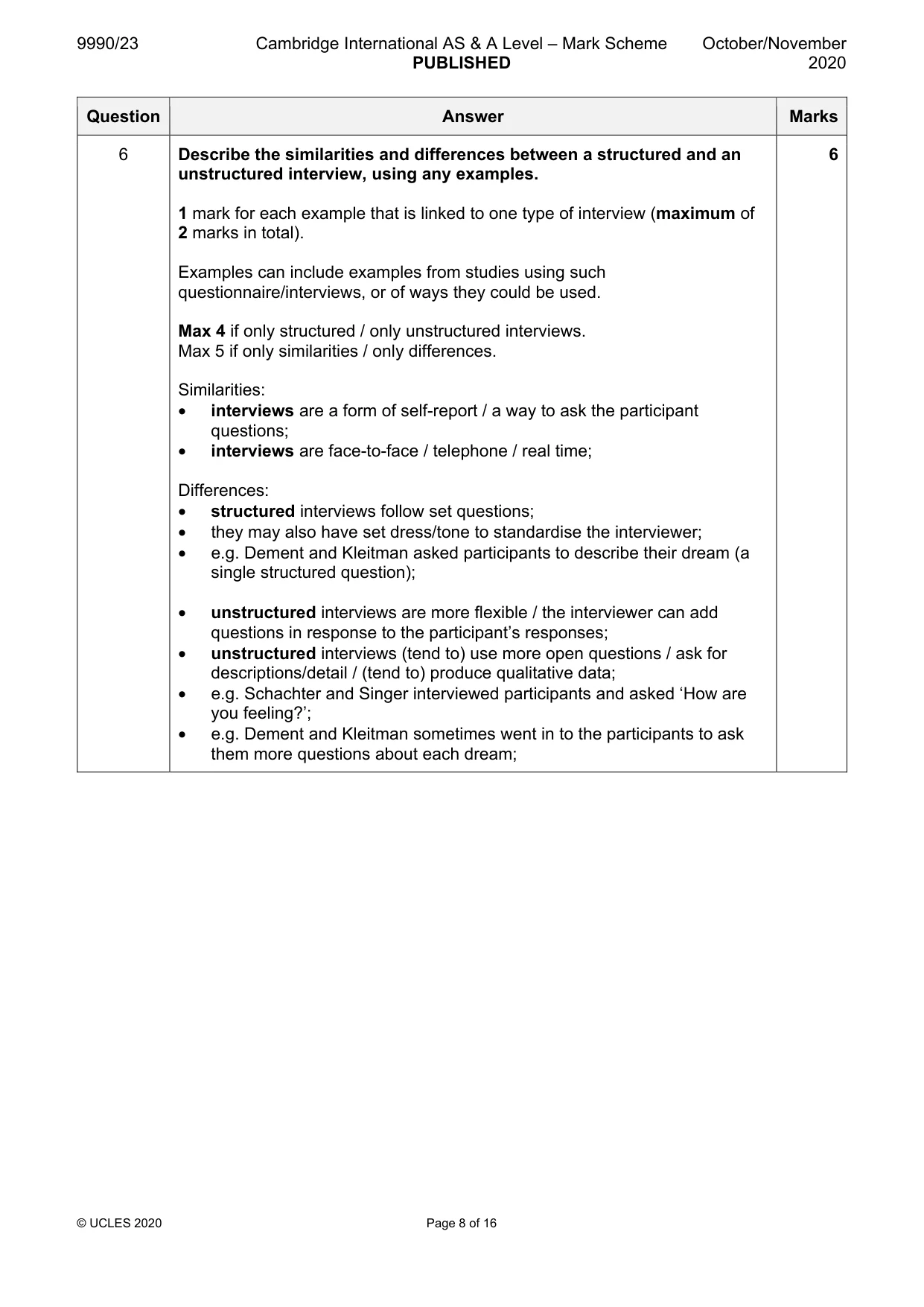
Mark scheme: 6 Describe the similarities and differences between a structured and an 6 unstructured interview, using any examples. 1 mark for each example that is linked to one type of interview (maximum of 2 marks in total). Examples can include examples from studies using such questionnaire/interviews, or of ways they could be used. Max 4 if only structured / only unstructured interviews. Max 5 if only similarities / only differences. Similarities: • interviews are a form of self-report / a way to ask the participant questions; • interviews are face-to-face / telephone / real time; Differences: • structured interviews follow set questions; • they may also have set dress/tone to standardise the interviewer; • e.g. Dement and Kleitman asked participants to describe their dream (a single structured question); • unstructured interviews are more flexible / the interviewer can add questions in response to the participant’s responses; • unstructured interviews (tend to) use more open questions / ask for descriptions/detail / (tend to) produce qualitative data; • e.g. Schachter and Singer interviewed participants and asked ‘How are you feeling?’; • e.g. Dement and Kleitman sometimes went in to the participants to ask them more questions about each dream;
Q7 · A company is having a new kitchen built that will produce better quality food for its…
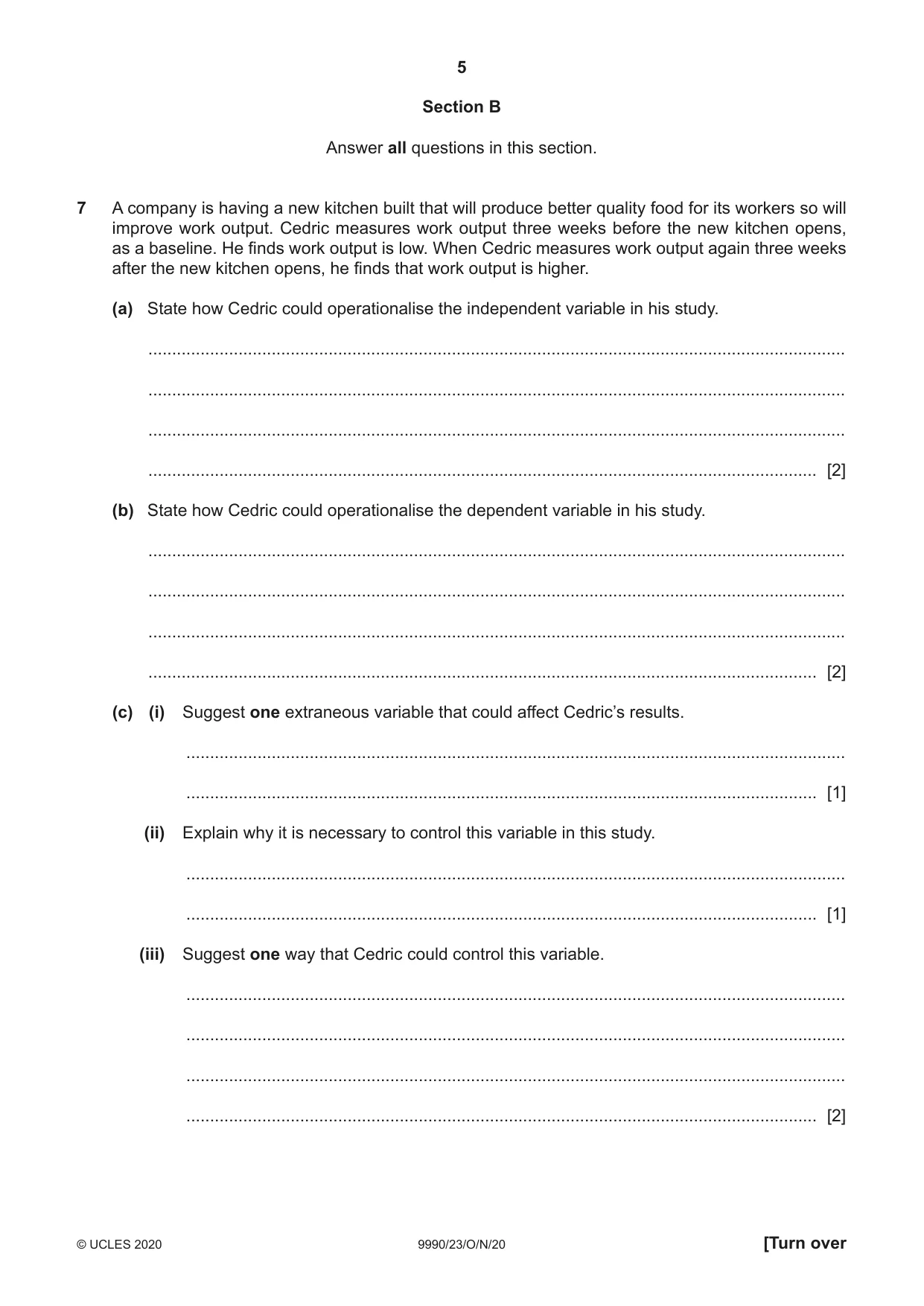
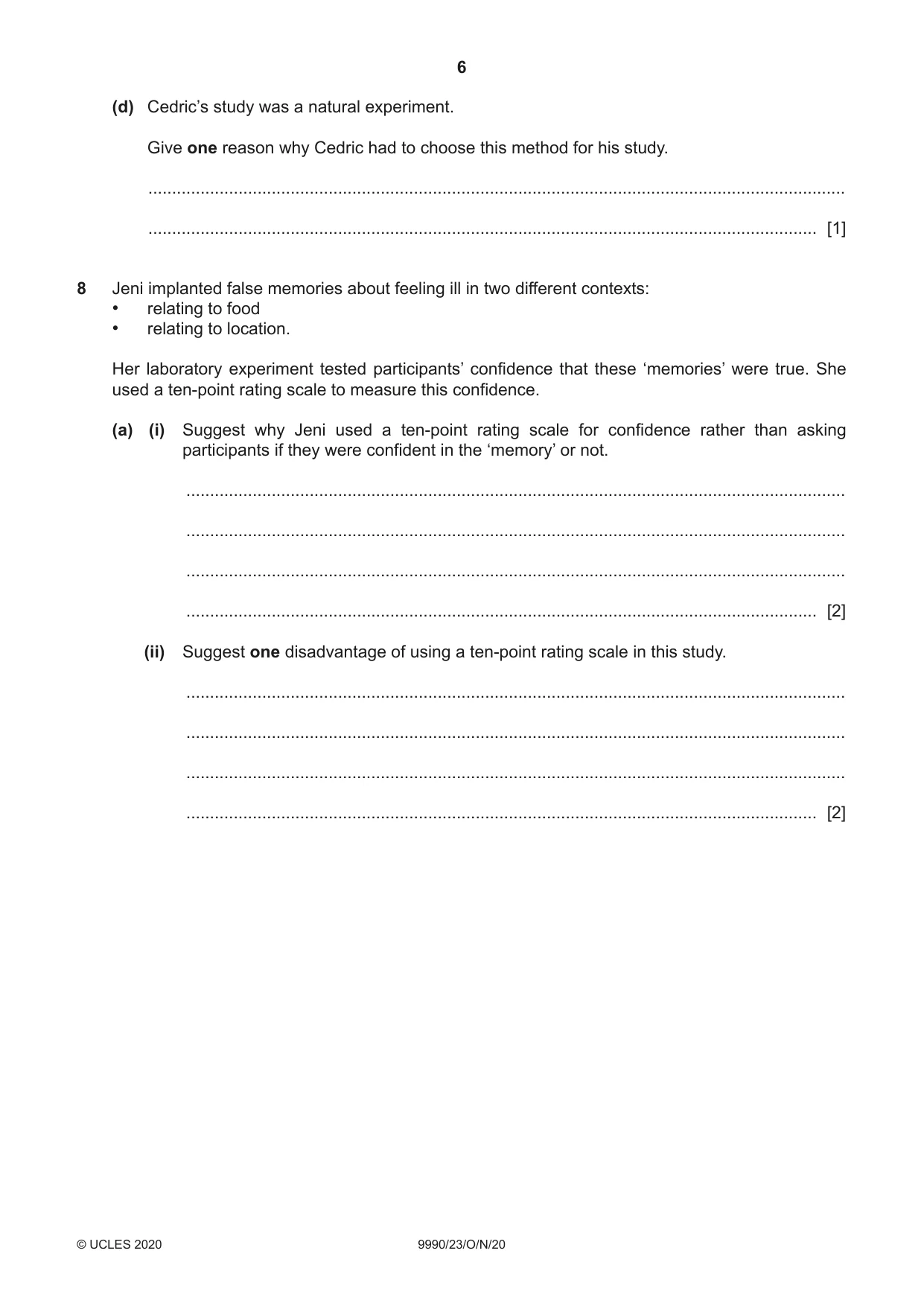
7 A company is having a new kitchen built that will produce better quality food for its workers so will improve work output. Cedric measures work output three weeks before the new kitchen opens, as a baseline. He finds work output is low. When Cedric measures work output again three weeks after the new kitchen opens, he finds that work output is higher. (a) State how Cedric could operationalise the independent variable in his study. ................................................................................................................................................... ................................................................................................................................................... ................................................................................................................................................... ............................................................................................................................................. [2] (b) State how Cedric could operationalise the dependent variable in his study. ................................................................................................................................................... ................................................................................................................................................... ................................................................................................................................................... ............................................................................................................................................. [2] (c) (i) Suggest one extraneous variable that could affect Cedric’s results. ........................................................................................................................................... ..................................................................................................................................... [1] (ii) Explain why it is necessary to control this variable in this study. ........................................................................................................................................... ..................................................................................................................................... [1] (iii) Suggest one way that Cedric could control this variable. ........................................................................................................................................... ........................................................................................................................................... ........................................................................................................................................... ..................................................................................................................................... [2] (d) Cedric’s study was a natural experiment. Give one reason why Cedric had to choose this method for his study. ................................................................................................................................................... ............................................................................................................................................. [1]
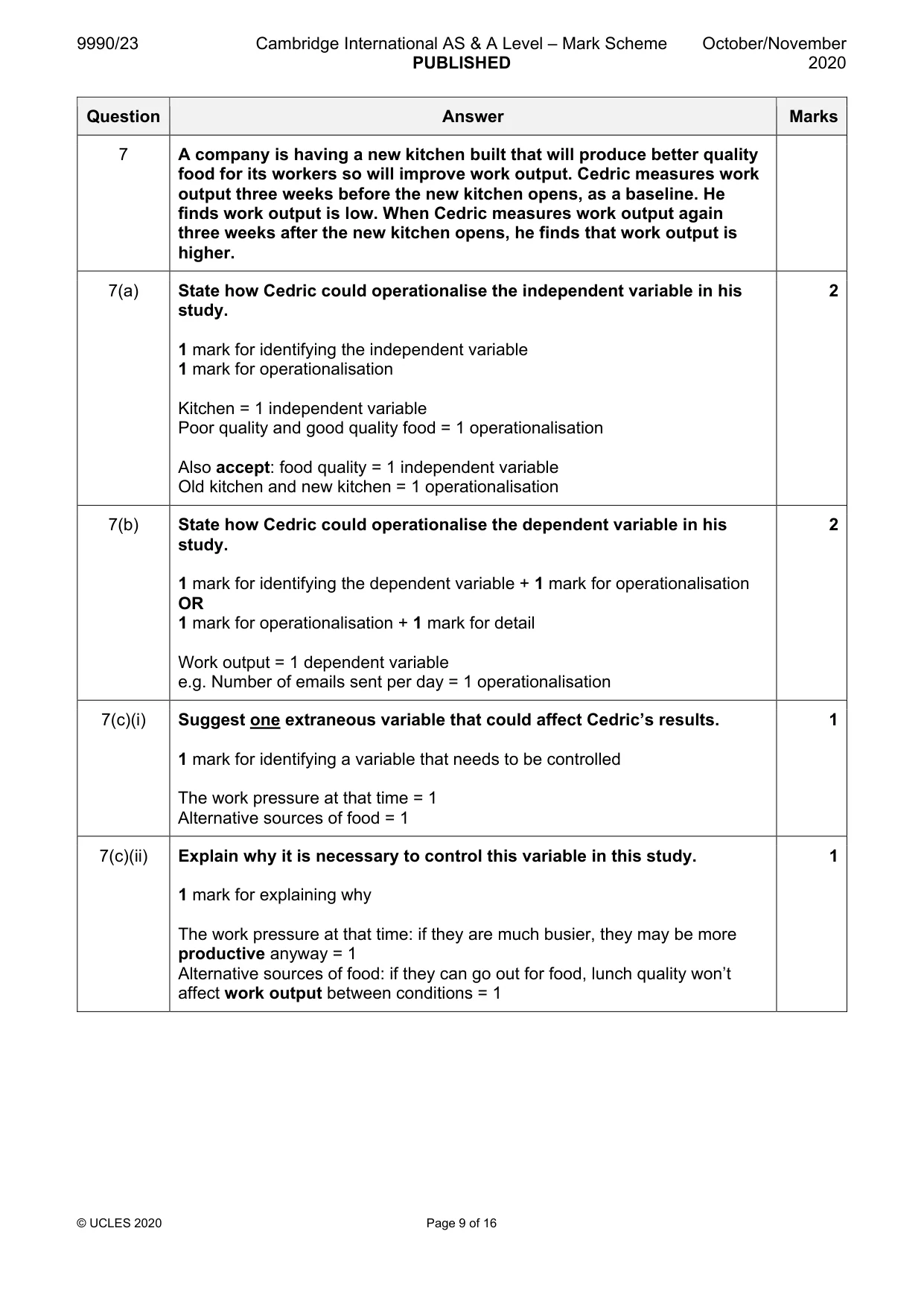
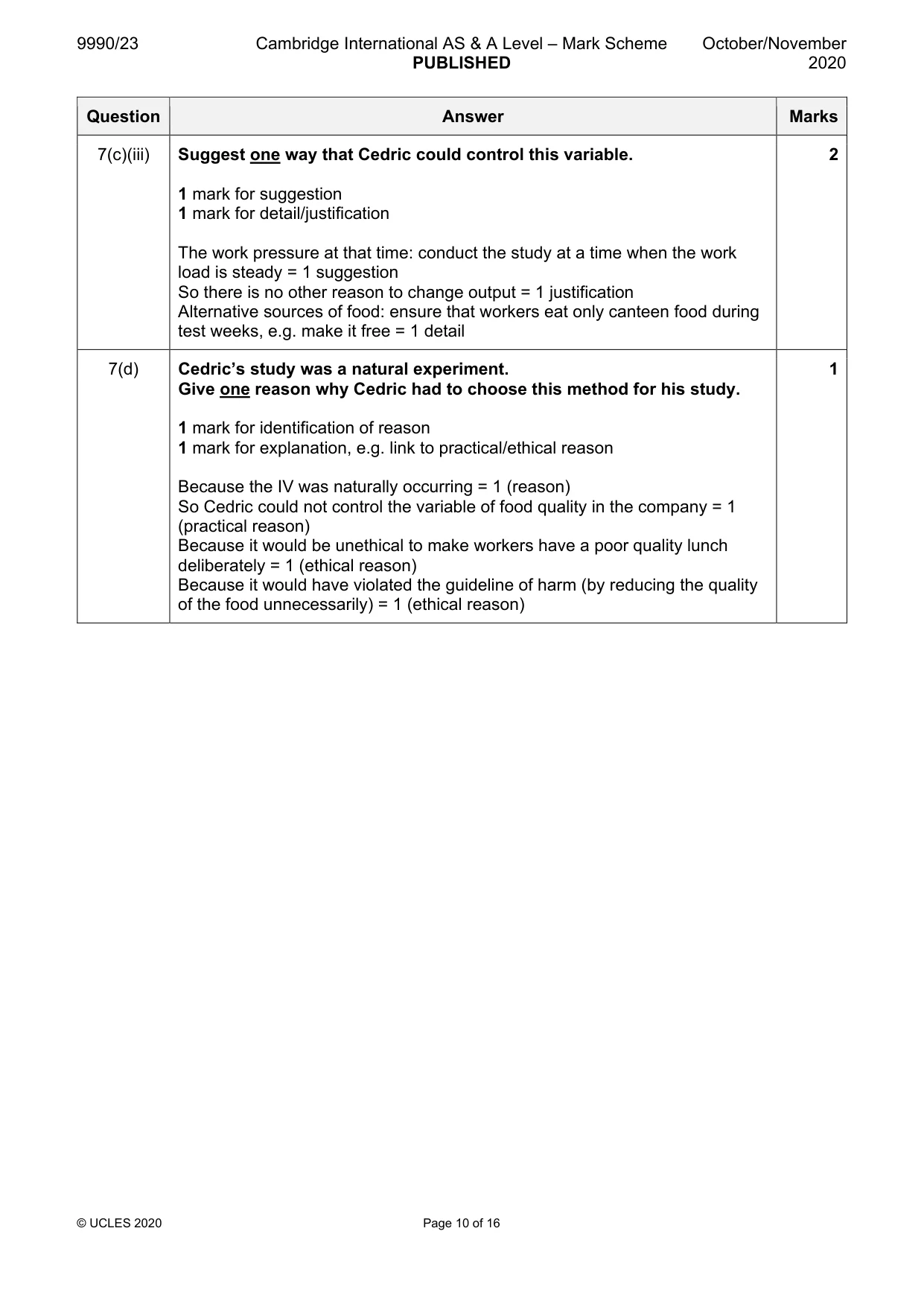
Mark scheme: 7 A company is having a new kitchen built that will produce better quality food for its workers so will improve work output. Cedric measures work output three weeks before the new kitchen opens, as a baseline. He finds work output is low. When Cedric measures work output again three weeks after the new kitchen opens, he finds that work output is higher. 7(a) State how Cedric could operationalise the independent variable in his 2 study. 1 mark for identifying the independent variable 1 mark for operationalisation Kitchen = 1 independent variable Poor quality and good quality food = 1 operationalisation Also accept: food quality = 1 independent variable Old kitchen and new kitchen = 1 operationalisation 7(b) State how Cedric could operationalise the dependent variable in his 2 study. 1 mark for identifying the dependent variable + 1 mark for operationalisation OR 1 mark for operationalisation + 1 mark for detail Work output = 1 dependent variable e.g. Number of emails sent per day = 1 operationalisation 7(c)(i) Suggest one extraneous variable that could affect Cedric’s results. 1 1 mark for identifying a variable that needs to be controlled The work pressure at that time = 1 Alternative sources of food = 1 7(c)(ii) Explain why it is necessary to control this variable in this study. 1 1 mark for explaining why The work pressure at that time: if they are much busier, they may be more productive anyway = 1 Alternative sources of food: if they can go out for food, lunch quality won’t affect work output between conditions = 1 7(c)(iii) Suggest one way that Cedric could control this variable. 2 1 mark for suggestion 1 mark for detail/justification The work pressure at that time: conduct the study at a time when the work load is steady = 1 suggestion So there is no other reason to change output = 1 justification Alternative sources of food: ensure that workers eat only canteen food during test weeks, e.g. make it free = 1 detail 7(d) Cedric’s study was a natural experiment. 1 Give one reason why Cedric had to choose this method for his study. 1 mark for identification of reason 1 mark for explanation, e.g. link to practical/ethical reason Because the IV was naturally occurring = 1 (reason) So Cedric could not control the variable of food quality in the company = 1 (practical reason) Because it would be unethical to make workers have a poor quality lunch deliberately = 1 (ethical reason) Because it would have violated the guideline of harm (by reducing the quality of the food unnecessarily) = 1 (ethical reason)
Q8 · Jeni implanted false memories about feeling ill in two different contexts: • relating to…
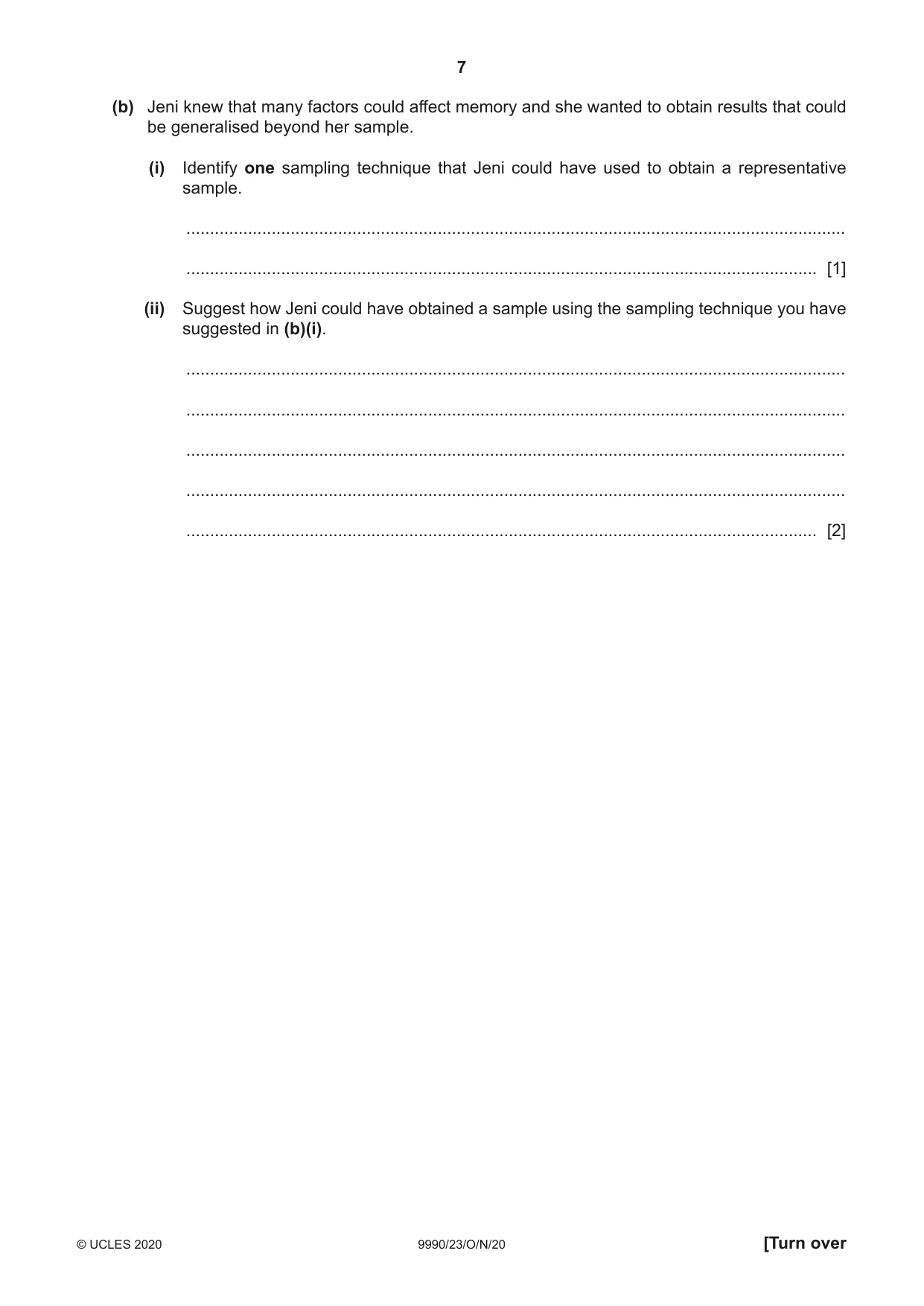
8 Jeni implanted false memories about feeling ill in two different contexts: • relating to food • relating to location. Her laboratory experiment tested participants’ confidence that these ‘memories’ were true. She used a ten-point rating scale to measure this confidence. (a) (i) Suggest why Jeni used a ten-point rating scale for confidence rather than asking participants if they were confident in the ‘memory’ or not. ........................................................................................................................................... ........................................................................................................................................... ........................................................................................................................................... ..................................................................................................................................... [2] (ii) Suggest one disadvantage of using a ten-point rating scale in this study. ........................................................................................................................................... ........................................................................................................................................... ........................................................................................................................................... ..................................................................................................................................... [2] (b) Jeni knew that many factors could affect memory and she wanted to obtain results that could be generalised beyond her sample. (i) Identify one sampling technique that Jeni could have used to obtain a representative sample. ........................................................................................................................................... ..................................................................................................................................... [1] (ii) Suggest how Jeni could have obtained a sample using the sampling technique you have suggested in (b)(i). ........................................................................................................................................... ........................................................................................................................................... ........................................................................................................................................... ........................................................................................................................................... ..................................................................................................................................... [2]
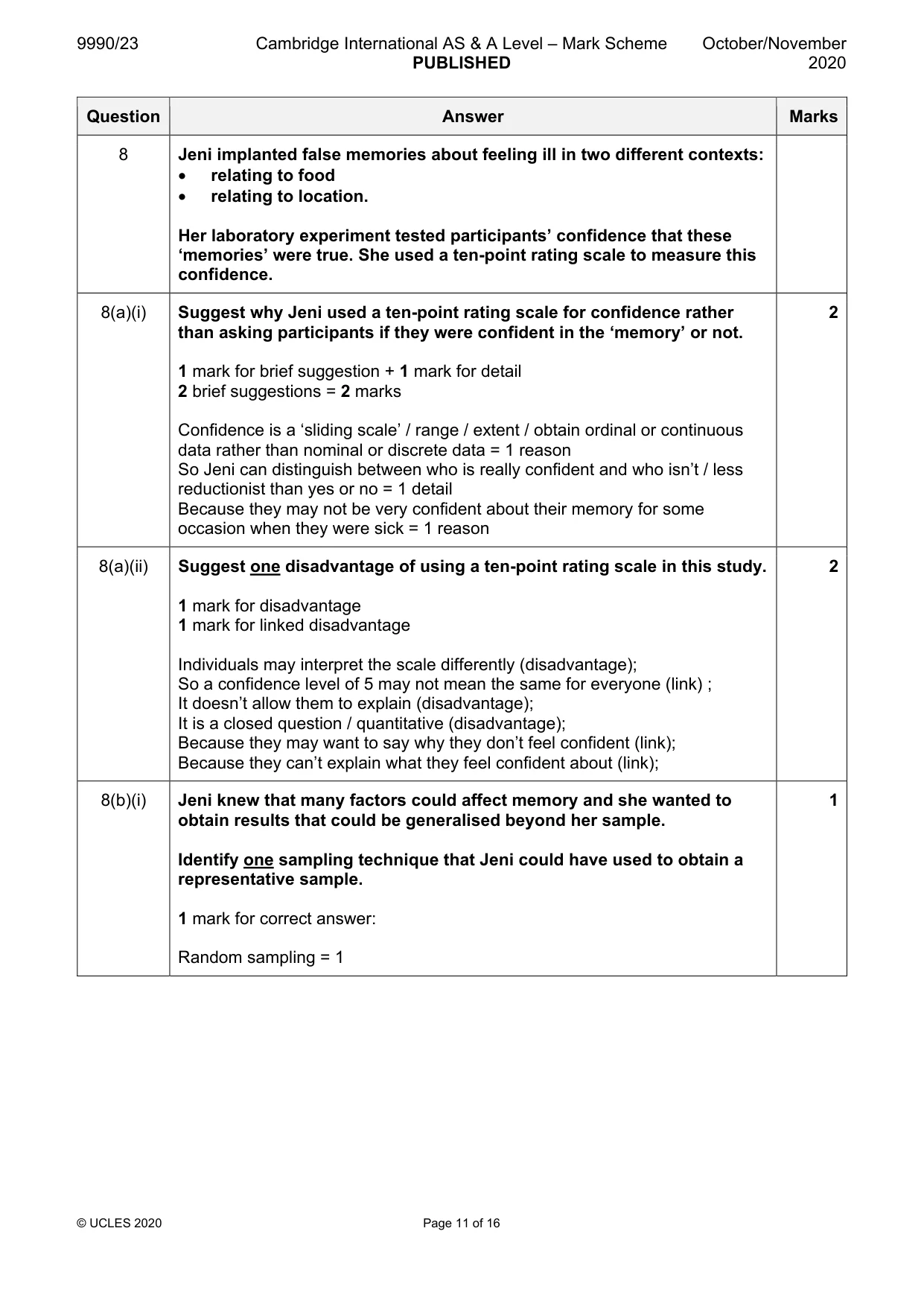
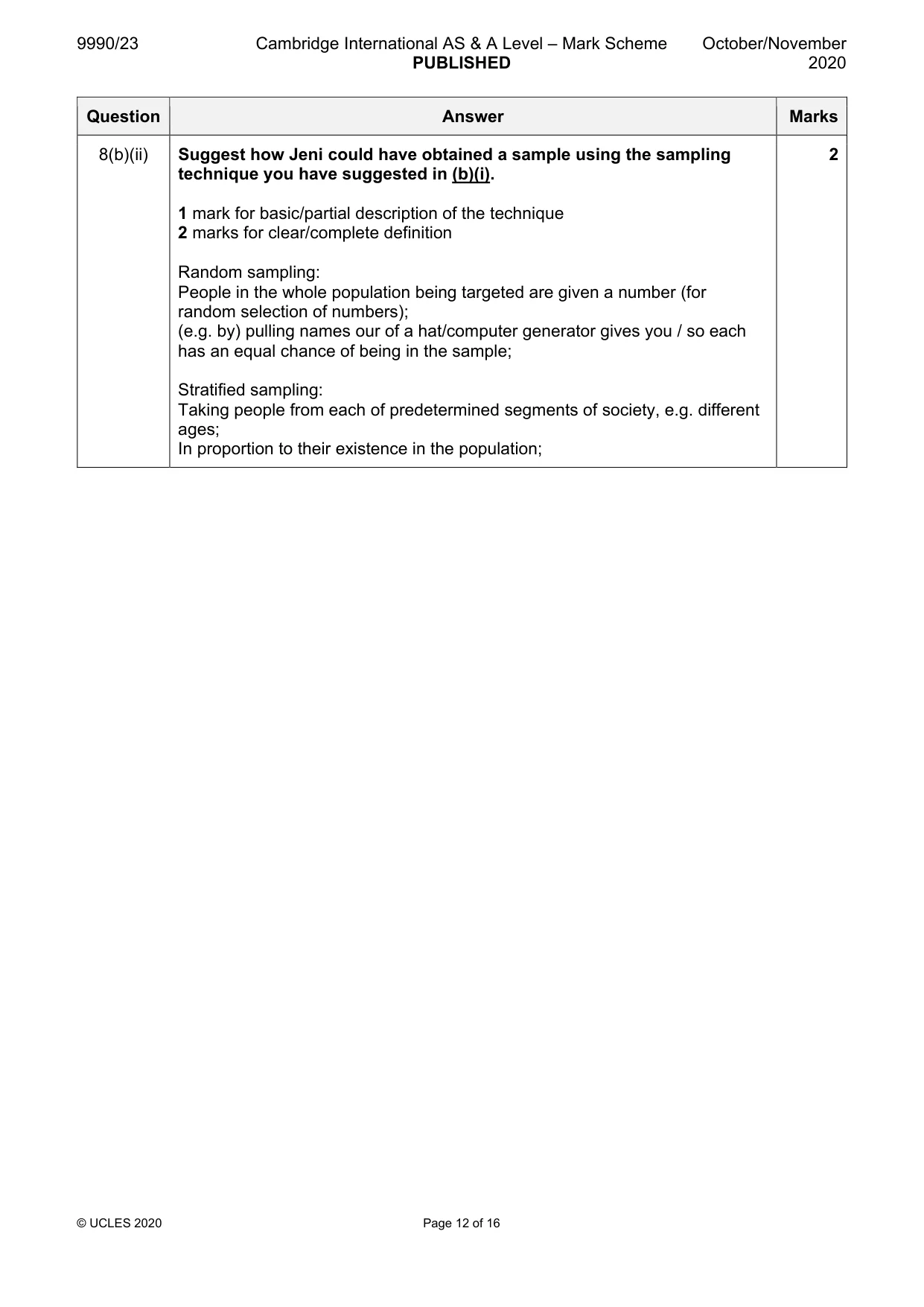
Mark scheme: 8 Jeni implanted false memories about feeling ill in two different contexts: • relating to food • relating to location. Her laboratory experiment tested participants’ confidence that these ‘memories’ were true. She used a ten-point rating scale to measure this confidence. 8(a)(i) Suggest why Jeni used a ten-point rating scale for confidence rather 2 than asking participants if they were confident in the ‘memory’ or not. 1 mark for brief suggestion + 1 mark for detail 2 brief suggestions = 2 marks Confidence is a ‘sliding scale’ / range / extent / obtain ordinal or continuous data rather than nominal or discrete data = 1 reason So Jeni can distinguish between who is really confident and who isn’t / less reductionist than yes or no = 1 detail Because they may not be very confident about their memory for some occasion when they were sick = 1 reason 8(a)(ii) Suggest one disadvantage of using a ten-point rating scale in this study. 2 1 mark for disadvantage 1 mark for linked disadvantage Individuals may interpret the scale differently (disadvantage); So a confidence level of 5 may not mean the same for everyone (link) ; It doesn’t allow them to explain (disadvantage); It is a closed question / quantitative (disadvantage); Because they may want to say why they don’t feel confident (link); Because they can’t explain what they feel confident about (link); 8(b)(i) Jeni knew that many factors could affect memory and she wanted to 1 obtain results that could be generalised beyond her sample. Identify one sampling technique that Jeni could have used to obtain a representative sample. 1 mark for correct answer: Random sampling = 1 8(b)(ii) Suggest how Jeni could have obtained a sample using the sampling 2 technique you have suggested in (b)(i). 1 mark for basic/partial description of the technique 2 marks for clear/complete definition Random sampling: People in the whole population being targeted are given a number (for random selection of numbers); (e.g. by) pulling names our of a hat/computer generator gives you / so each has an equal chance of being in the sample; Stratified sampling: Taking people from each of predetermined segments of society, e.g. different ages; In proportion to their existence in the population;
Q9 · Daniel is planning a correlational study
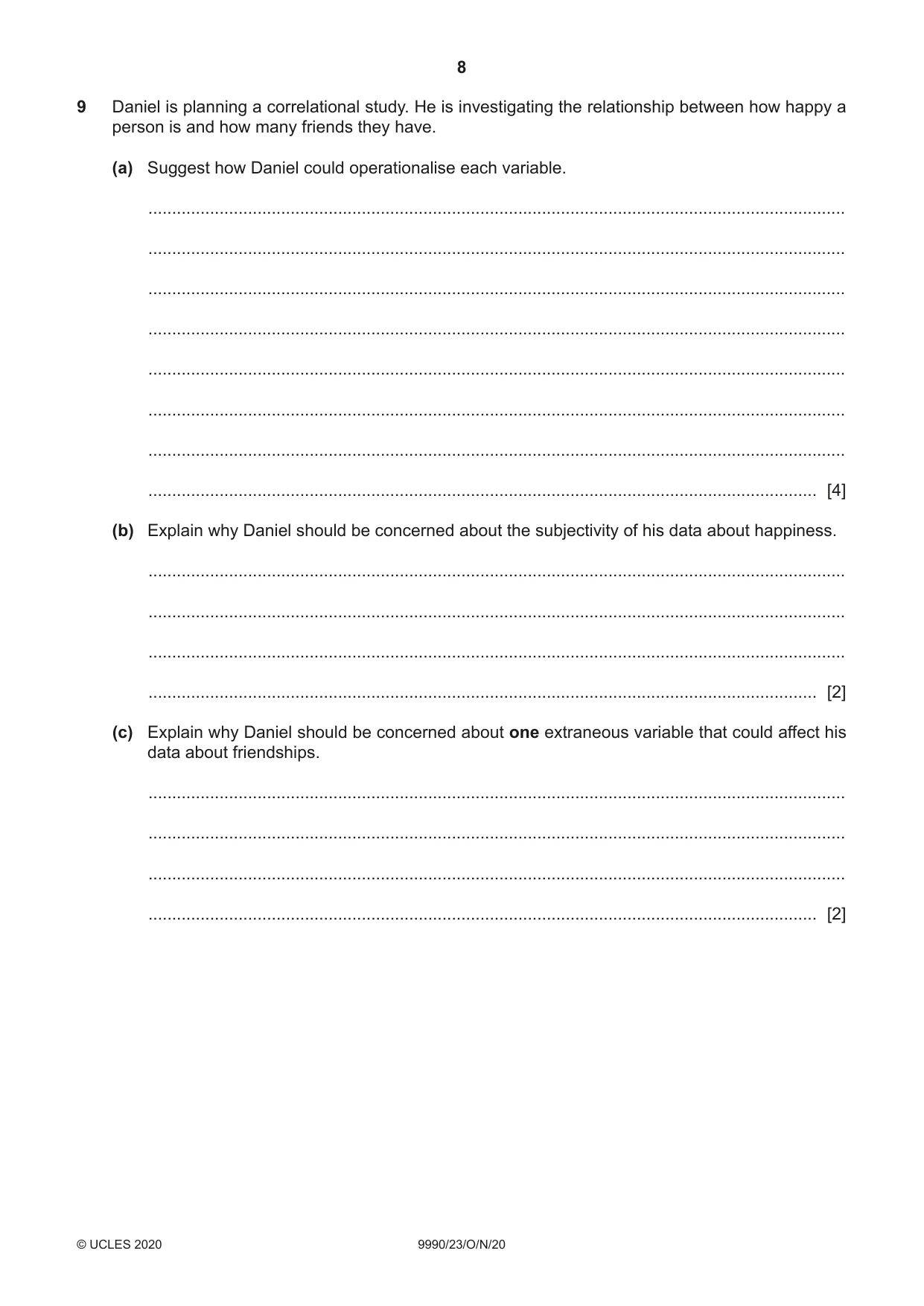
9 Daniel is planning a correlational study. He is investigating the relationship between how happy a person is and how many friends they have. (a) Suggest how Daniel could operationalise each variable. ................................................................................................................................................... ................................................................................................................................................... ................................................................................................................................................... ................................................................................................................................................... ................................................................................................................................................... ................................................................................................................................................... ................................................................................................................................................... ............................................................................................................................................. [4] (b) Explain why Daniel should be concerned about the subjectivity of his data about happiness. ................................................................................................................................................... ................................................................................................................................................... ................................................................................................................................................... ............................................................................................................................................. [2] (c) Explain why Daniel should be concerned about one extraneous variable that could affect his data about friendships. ................................................................................................................................................... ................................................................................................................................................... ................................................................................................................................................... ............................................................................................................................................. [2] Question 10 appears on page 10 Section C Answer all questions in this section.
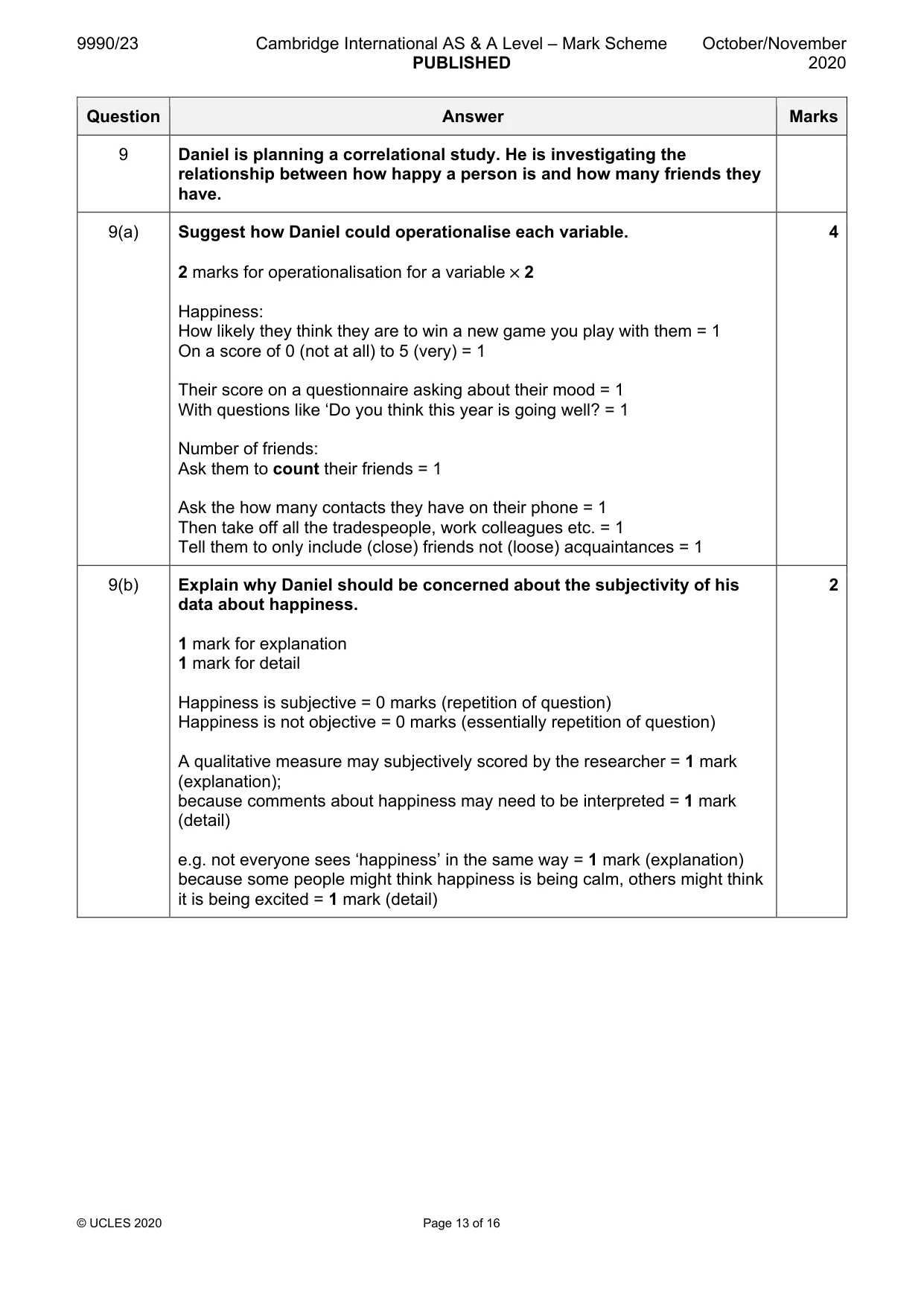
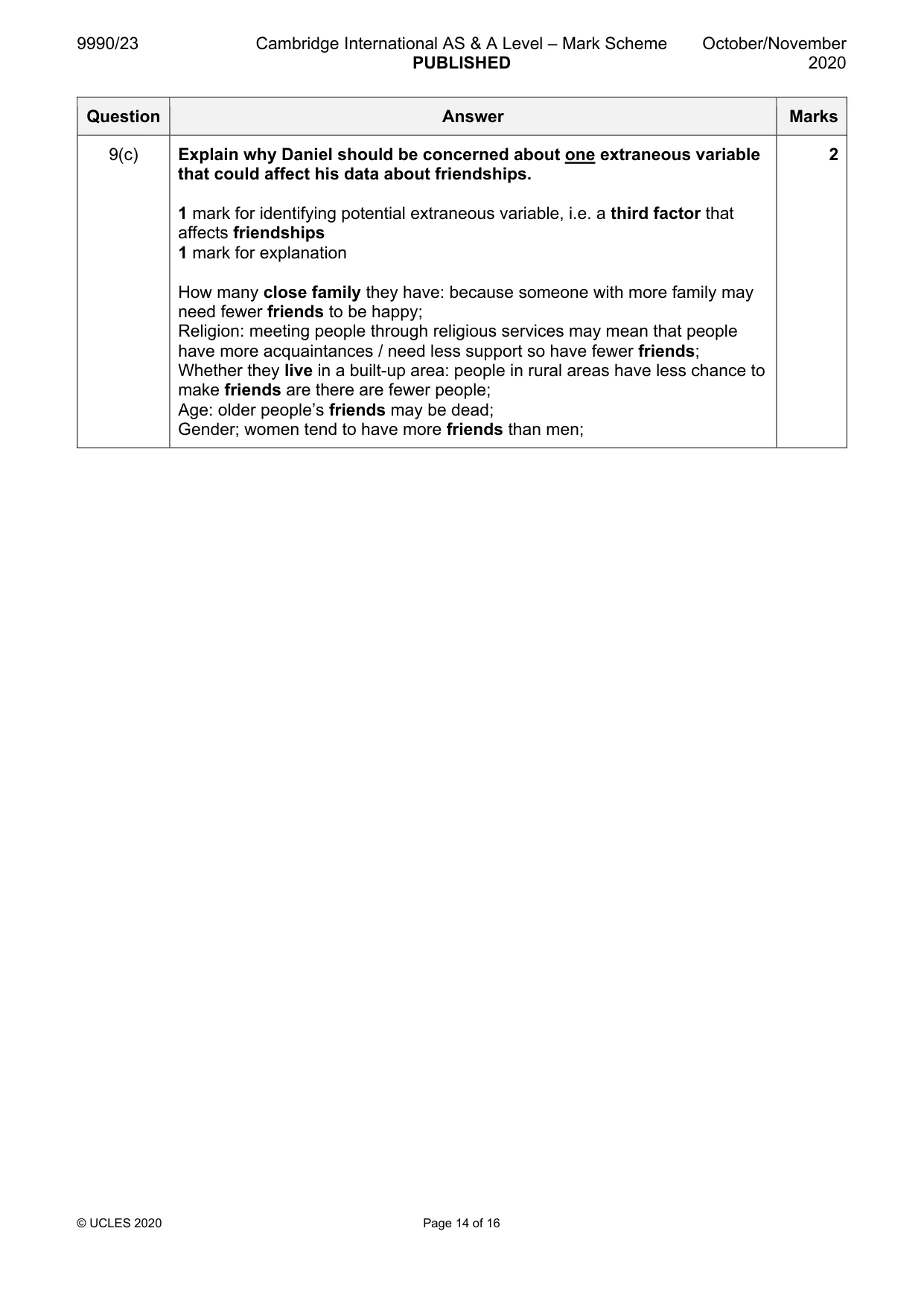
Mark scheme: 9 Daniel is planning a correlational study. He is investigating the relationship between how happy a person is and how many friends they have. 9(a) Suggest how Daniel could operationalise each variable. 4 2 marks for operationalisation for a variable × 2 Happiness: How likely they think they are to win a new game you play with them = 1 On a score of 0 (not at all) to 5 (very) = 1 Their score on a questionnaire asking about their mood = 1 With questions like ‘Do you think this year is going well? = 1 Number of friends: Ask them to count their friends = 1 Ask the how many contacts they have on their phone = 1 Then take off all the tradespeople, work colleagues etc. = 1 Tell them to only include (close) friends not (loose) acquaintances = 1 9(b) Explain why Daniel should be concerned about the subjectivity of his 2 data about happiness. 1 mark for explanation 1 mark for detail Happiness is subjective = 0 marks (repetition of question) Happiness is not objective = 0 marks (essentially repetition of question) A qualitative measure may subjectively scored by the researcher = 1 mark (explanation); because comments about happiness may need to be interpreted = 1 mark (detail) e.g. not everyone sees ‘happiness’ in the same way = 1 mark (explanation) because some people might think happiness is being calm, others might think it is being excited = 1 mark (detail) 9(c) Explain why Daniel should be concerned about one extraneous variable 2 that could affect his data about friendships. 1 mark for identifying potential extraneous variable, i.e. a third factor that affects friendships 1 mark for explanation How many close family they have: because someone with more family may need fewer friends to be happy; Religion: meeting people through religious services may mean that people have more acquaintances / need less support so have fewer friends; Whether they live in a built-up area: people in rural areas have less chance to make friends are there are fewer people; Age: older people’s friends may be dead; Gender; women tend to have more friends than men;
Q10 · Jayce owns a shop and is concerned that people are disobeying his signs which say ‘Do not…
10 Jayce owns a shop and is concerned that people are disobeying his signs which say ‘Do not touch’ or ‘No food allowed’. Jayce has asked his daughter Kimberley, who is studying psychology, for some help to understand this disobedience. (a) Describe how Kimberley could conduct a non-participant observation of people in her father’s shop to investigate obedience to his signs. ................................................................................................................................................... ................................................................................................................................................... ................................................................................................................................................... ................................................................................................................................................... ................................................................................................................................................... ................................................................................................................................................... ................................................................................................................................................... ................................................................................................................................................... ................................................................................................................................................... ................................................................................................................................................... ................................................................................................................................................... ................................................................................................................................................... ................................................................................................................................................... ................................................................................................................................................... ................................................................................................................................................... ................................................................................................................................................... ................................................................................................................................................... ................................................................................................................................................... ................................................................................................................................................... ................................................................................................................................................... ................................................................................................................................................... ................................................................................................................................................... ................................................................................................................................................... ................................................................................................................................................... ................................................................................................................................................... ................................................................................................................................................... ................................................................................................................................................... ........................................................................................................................................... [10] (b) Identify one practical weakness/limitation with the procedure you have described in your answer to part (a) and suggest how your study might be done differently to overcome the problem. Do not refer to ethics or sampling in your answer. ................................................................................................................................................... ................................................................................................................................................... ................................................................................................................................................... ................................................................................................................................................... ................................................................................................................................................... ................................................................................................................................................... ................................................................................................................................................... ............................................................................................................................................. [4]
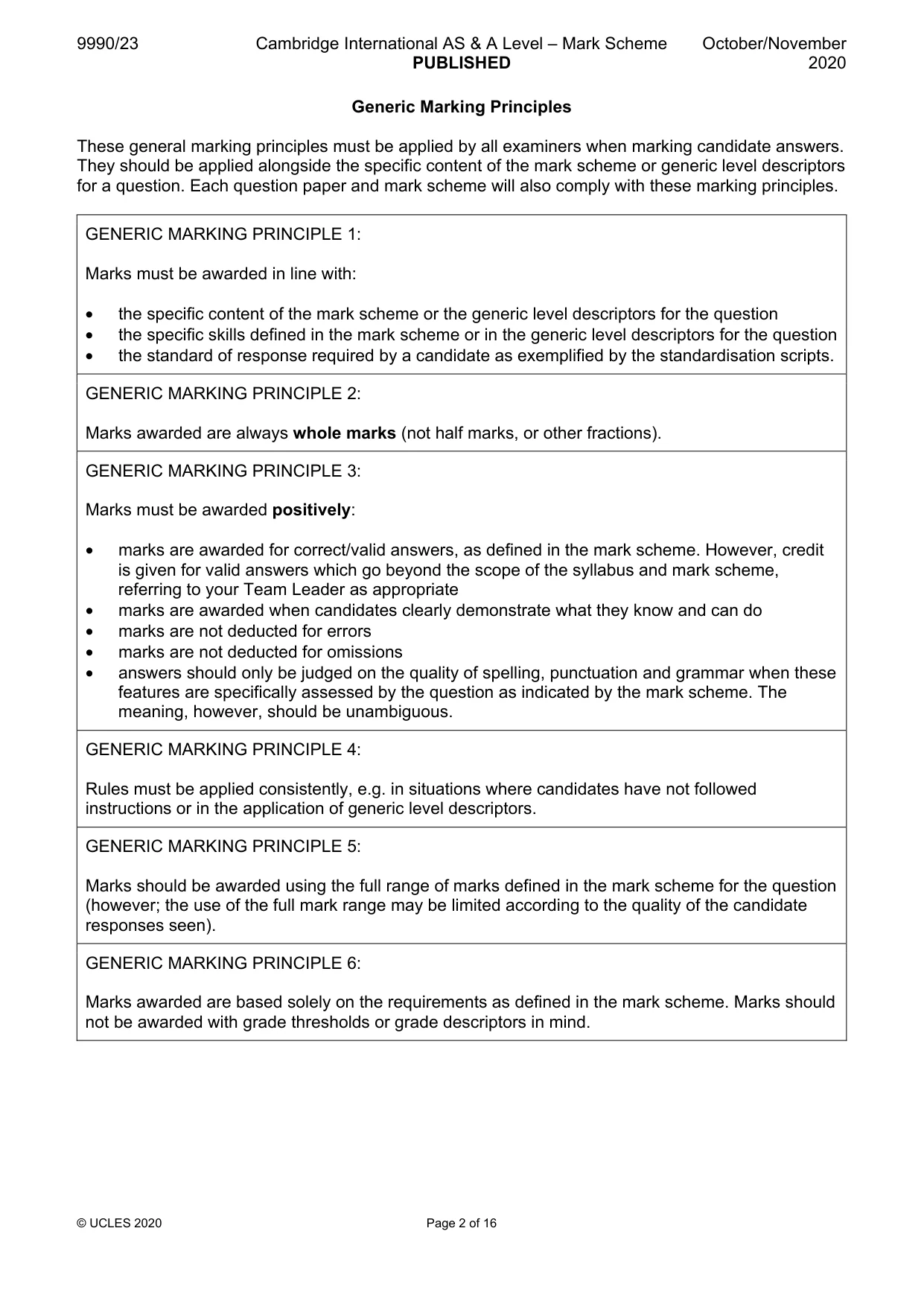
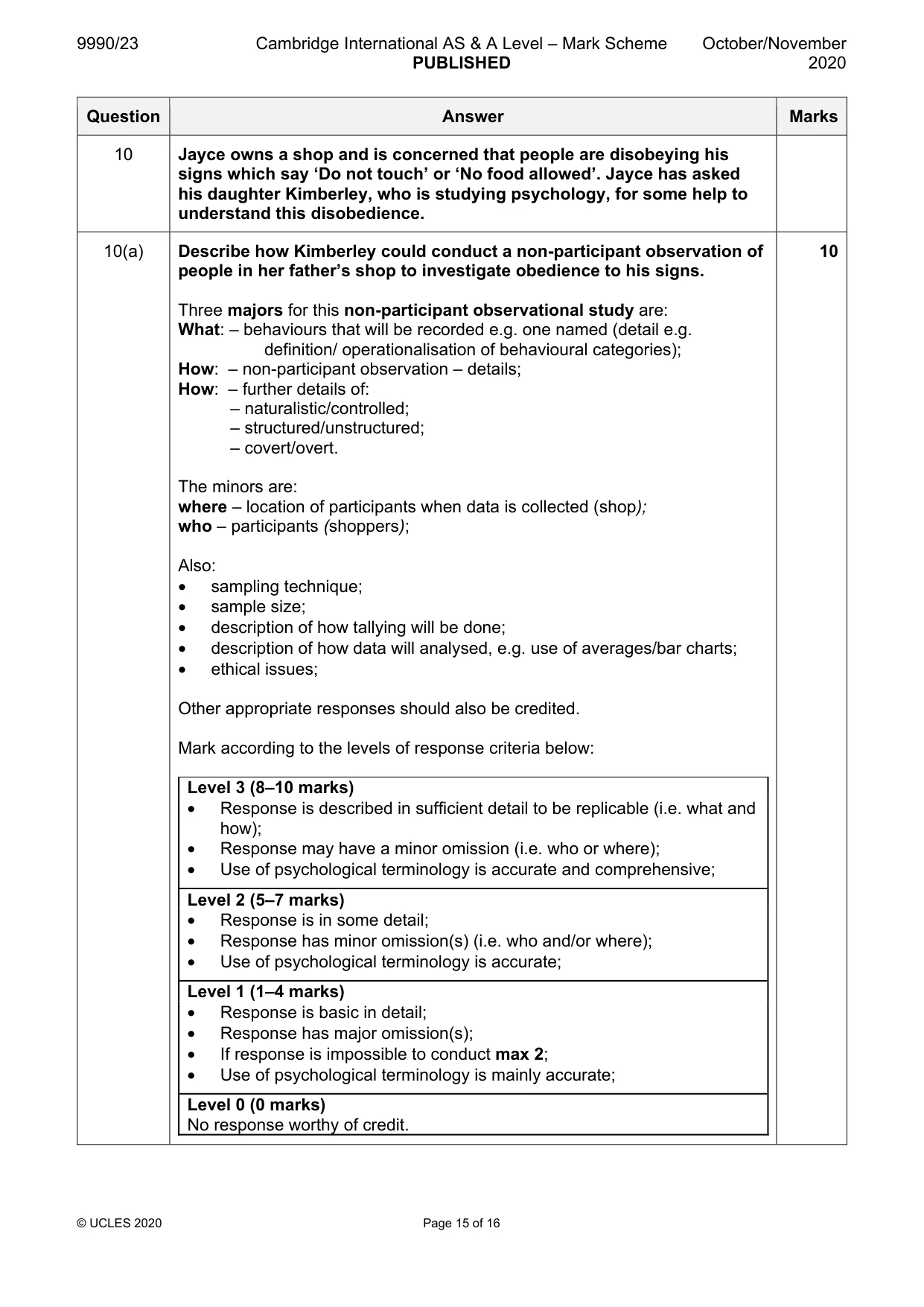
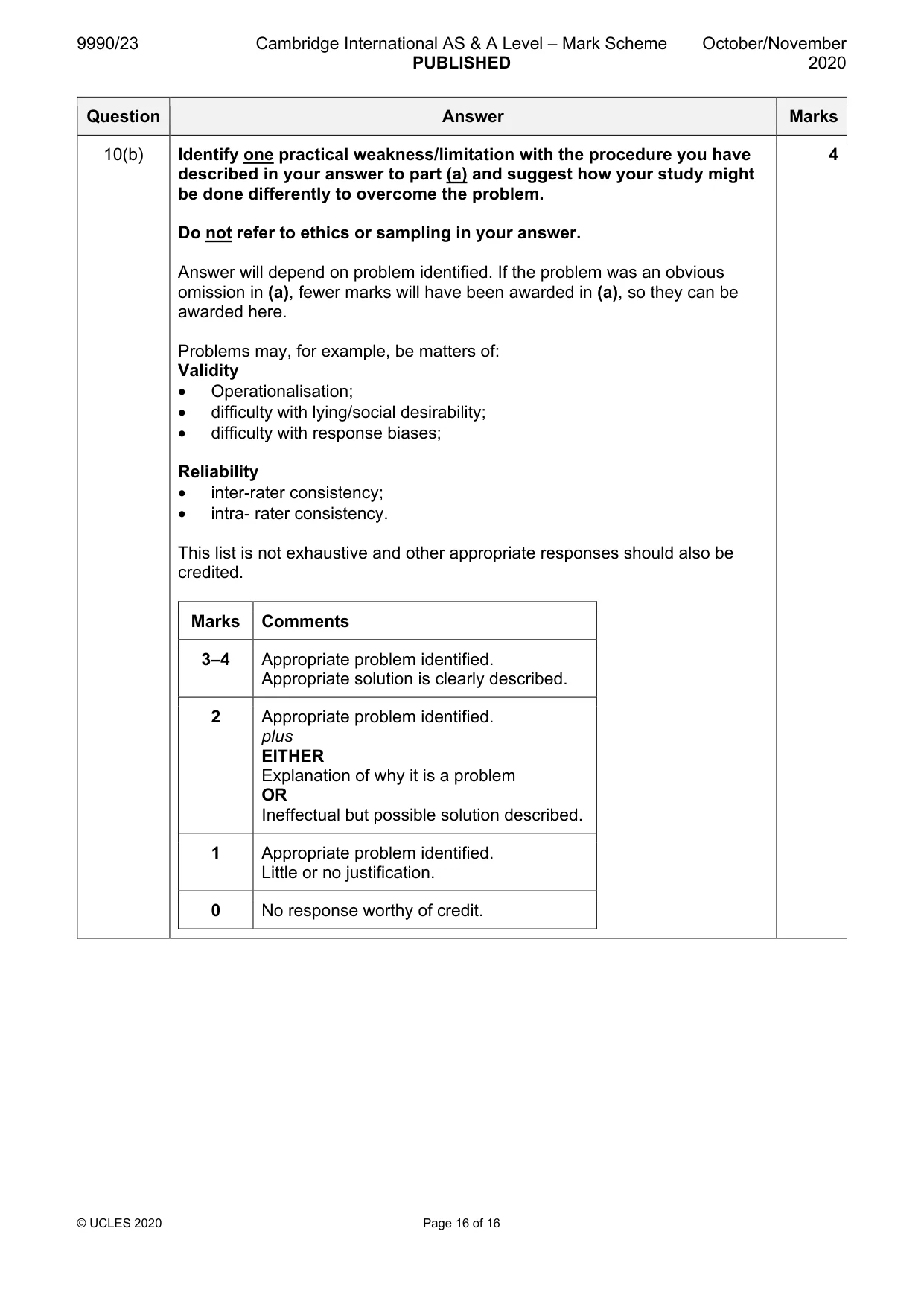
Mark scheme: 10 Jayce owns a shop and is concerned that people are disobeying his signs which say ‘Do not touch’ or ‘No food allowed’. Jayce has asked his daughter Kimberley, who is studying psychology, for some help to understand this disobedience. 10(a) Describe how Kimberley could conduct a non-participant observation of 10 people in her father’s shop to investigate obedience to his signs. Three majors for this non-participant observational study are: What: – behaviours that will be recorded e.g. one named (detail e.g. definition/ operationalisation of behavioural categories); How: – non-participant observation – details; How: – further details of: – naturalistic/controlled; – structured/unstructured; – covert/overt. The minors are: where – location of participants when data is collected (shop); who – participants (shoppers); Also: • sampling technique; • sample size; • description of how tallying will be done; • description of how data will analysed, e.g. use of averages/bar charts; • ethical issues; Other appropriate responses should also be credited. Mark according to the levels of response criteria below: Level 3 (8–10 marks) • Response is described in sufficient detail to be replicable (i.e. what and how); • Response may have a minor omission (i.e. who or where); • Use of psychological terminology is accurate and comprehensive; Level 2 (5–7 marks) • Response is in some detail; • Response has minor omission(s) (i.e. who and/or where); • Use of psychological terminology is accurate; Level 1 (1–4 marks) • Response is basic in detail; • Response has major omission(s); • If response is impossible to conduct max 2; • Use of psychological terminology is mainly accurate; Level 0 (0 marks) No response worthy of credit. 10(b) Identify one practical weakness/limitation with the procedure you have 4 described in your answer to part (a) and suggest how your study might be done differently to overcome the problem. Do not refer to ethics or sampling in your answer. Answer will depend on problem identified. If the problem was an obvious omission in (a), fewer marks will have been awarded in (a), so they can be awarded here. Problems may, for example, be matters of: Validity • Operationalisation; • difficulty with lying/social desirability; • difficulty with response biases; Reliability • inter-rater consistency; • intra- rater consistency. This list is not exhaustive and other appropriate responses should also be credited. Marks Comments 3–4 Appropriate problem identified. Appropriate solution is clearly described. 2 Appropriate problem identified. plus EITHER Explanation of why it is a problem OR Ineffectual but possible solution described. 1 Appropriate problem identified. Little or no justification. 0 No response worthy of credit.
What was in this paper
The subtopics covered by these 10 questions, and how many questions each got. Open one in a new tab to see every Cambridge question on it.
What you needed in this session
Cambridge’s own grade thresholds for 2020 Oct/Nov, Paper 2 · Variant 3. A higher threshold means an easier paper — the bar moves with how the cohort did.