Cambridge A Level Psychology (from 2018) 9990 — 2019 Oct/Nov Paper 2 · Variant 3
9990/23/O/N/19 · 10 questions · 60 marks · ≈68 min
The question paper and its mark scheme, free to read here and free to download. This is Cambridge’s own paper, exactly as it was sat.
Question paper12 pages



Mark scheme10 pages
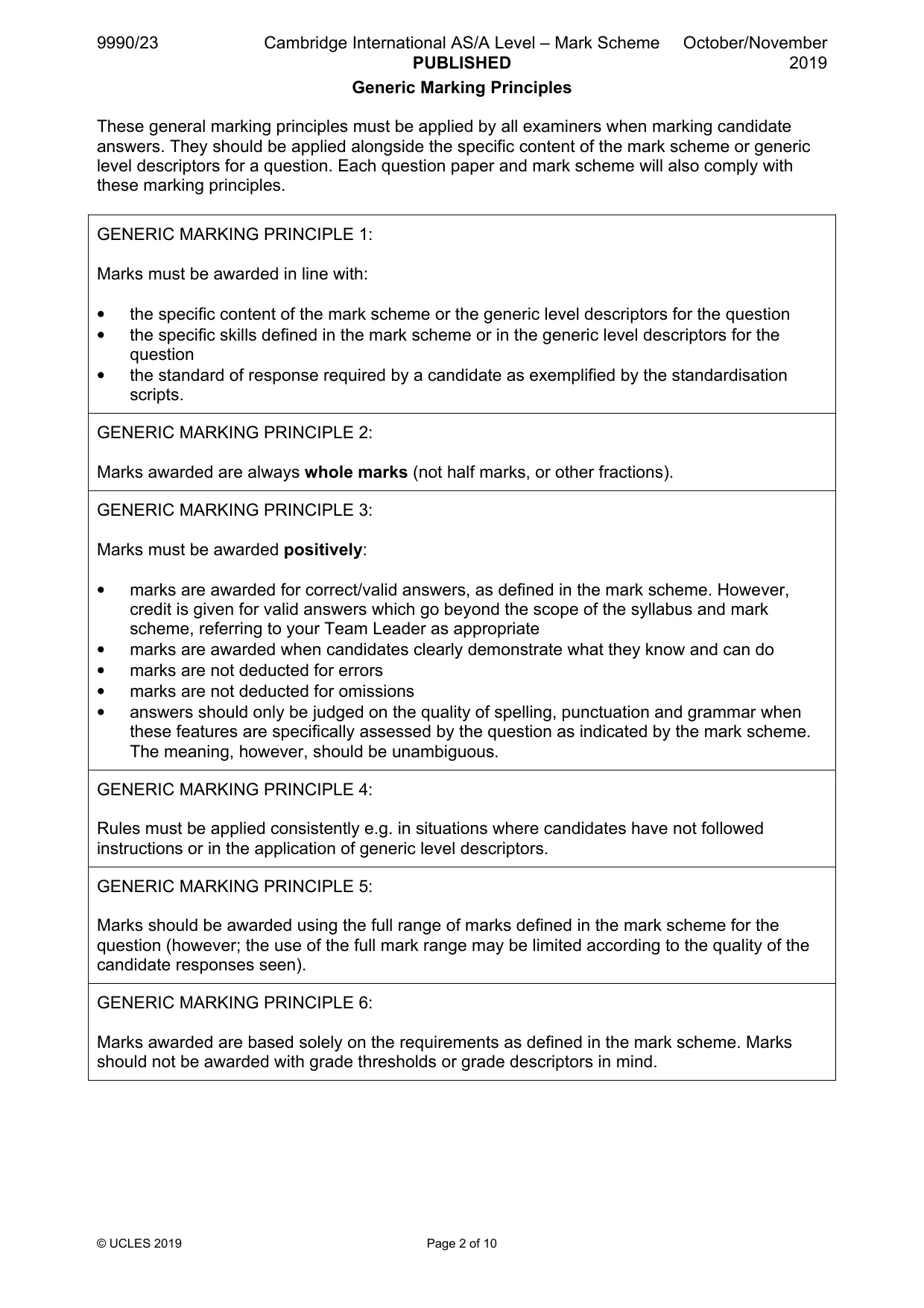
Answers below. Sit the paper first if you are practising.
Questions as text
Q1 · One ethical guideline is to avoid deception in research
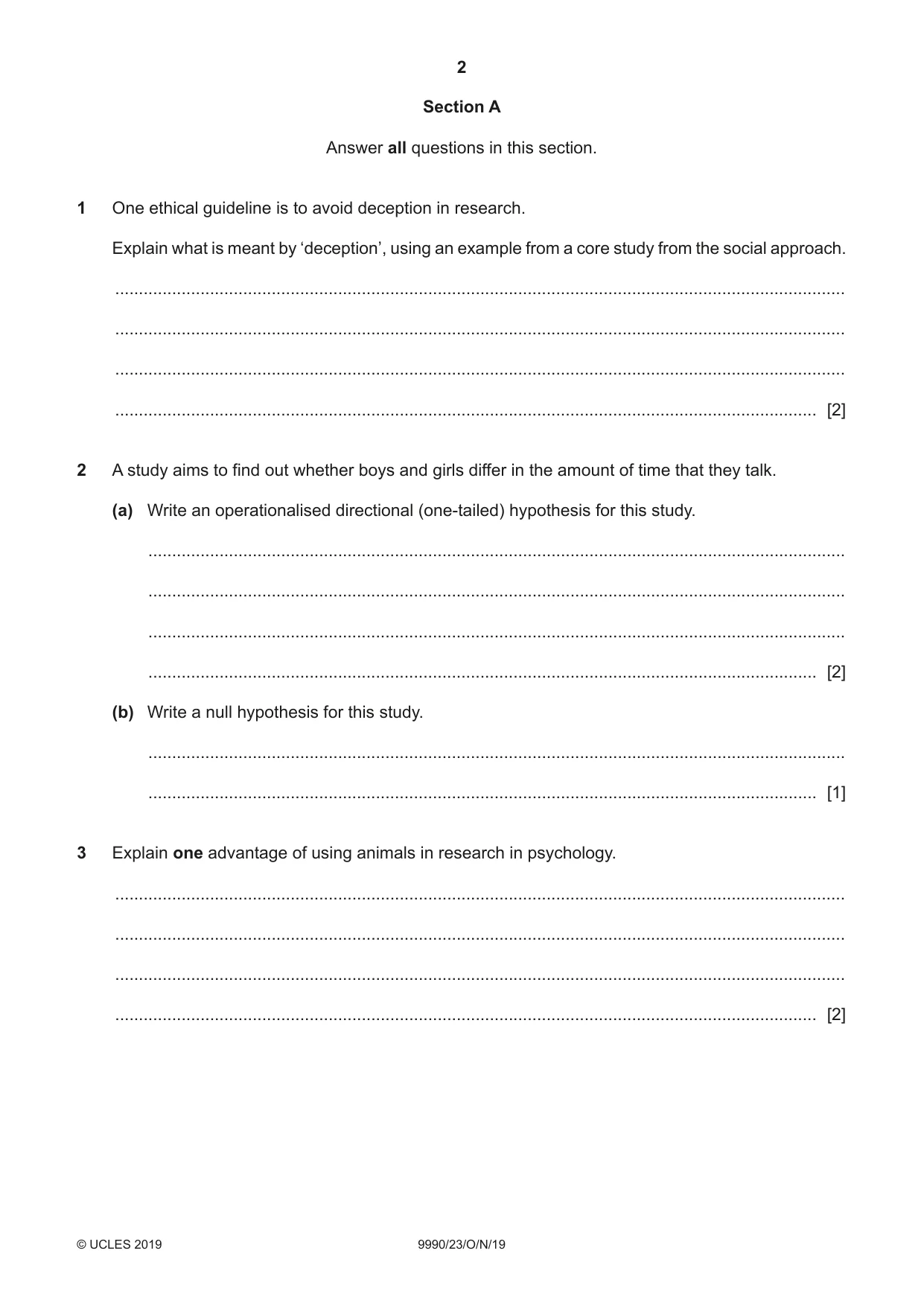
1 One ethical guideline is to avoid deception in research. Explain what is meant by ‘deception’, using an example from a core study from the social approach. .......................................................................................................................................................... .......................................................................................................................................................... .......................................................................................................................................................... .................................................................................................................................................... [2]
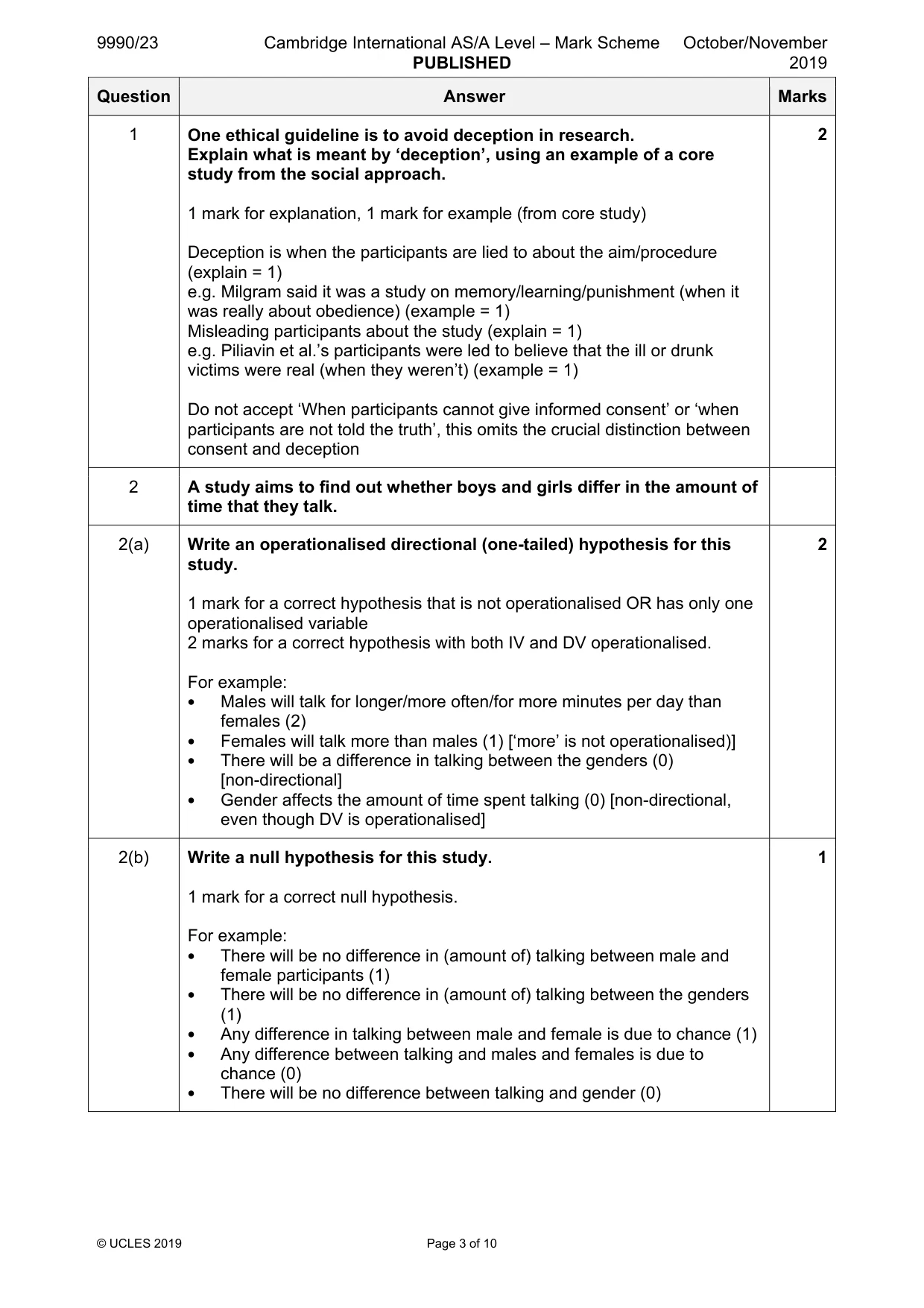
Mark scheme: Question Answer Marks 1 One ethical guideline is to avoid deception in research. 2 Explain what is meant by ‘deception’, using an example of a core study from the social approach. 1 mark for explanation, 1 mark for example (from core study) Deception is when the participants are lied to about the aim/procedure (explain = 1) e.g. Milgram said it was a study on memory/learning/punishment (when it was really about obedience) (example = 1) Misleading participants about the study (explain = 1) e.g. Piliavin et al.’s participants were led to believe that the ill or drunk victims were real (when they weren’t) (example = 1) Do not accept ‘When participants cannot give informed consent’ or ‘when participants are not told the truth’, this omits the crucial distinction between consent and deception 2 A study aims to find out whether boys and girls differ in the amount of time that they talk.
Q2 · A study aims to find out whether boys and girls differ in the amount of time that they…
2 A study aims to find out whether boys and girls differ in the amount of time that they talk. (a) Write an operationalised directional (one-tailed) hypothesis for this study. ................................................................................................................................................... ................................................................................................................................................... ................................................................................................................................................... ............................................................................................................................................. [2] (b) Write a null hypothesis for this study. ................................................................................................................................................... ............................................................................................................................................. [1]
Mark scheme: 2(a) Write an operationalised directional (one-tailed) hypothesis for this 2 study. 1 mark for a correct hypothesis that is not operationalised OR has only one operationalised variable 2 marks for a correct hypothesis with both IV and DV operationalised. For example: • Males will talk for longer/more often/for more minutes per day than females (2) • Females will talk more than males (1) [‘more’ is not operationalised)] • There will be a difference in talking between the genders (0) [non-directional] • Gender affects the amount of time spent talking (0) [non-directional, even though DV is operationalised] 2(b) Write a null hypothesis for this study. 1 1 mark for a correct null hypothesis. For example: • There will be no difference in (amount of) talking between male and female participants (1) • There will be no difference in (amount of) talking between the genders (1) • Any difference in talking between male and female is due to chance (1) • Any difference between talking and males and females is due to chance (0) • There will be no difference between talking and gender (0)
Q3 · Explain one advantage of using animals in research in psychology
3 Explain one advantage of using animals in research in psychology. .......................................................................................................................................................... .......................................................................................................................................................... .......................................................................................................................................................... .................................................................................................................................................... [2]
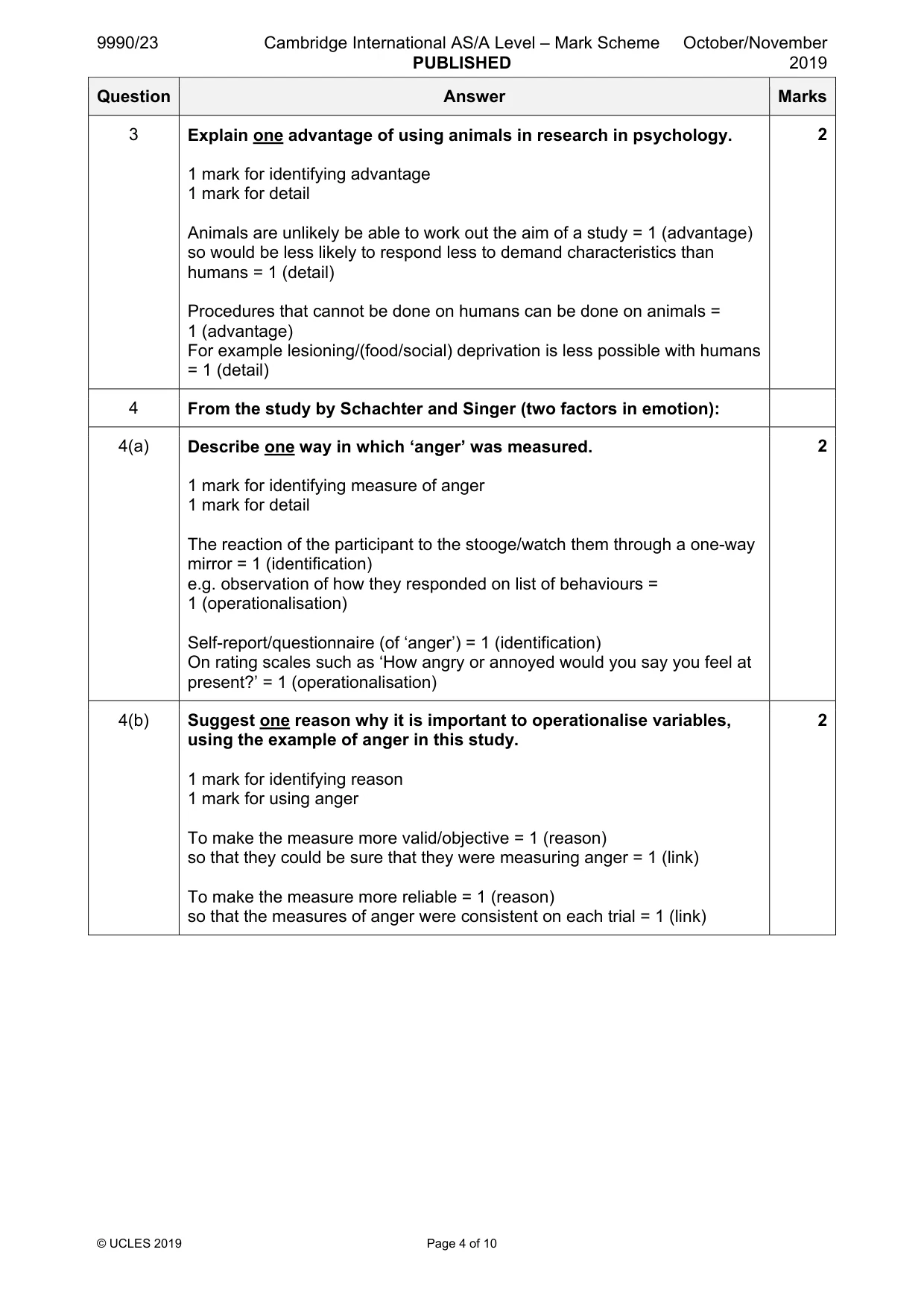
Mark scheme: 3 Explain one advantage of using animals in research in psychology. 2 1 mark for identifying advantage 1 mark for detail Animals are unlikely be able to work out the aim of a study = 1 (advantage) so would be less likely to respond less to demand characteristics than humans = 1 (detail) Procedures that cannot be done on humans can be done on animals = 1 (advantage) For example lesioning/(food/social) deprivation is less possible with humans = 1 (detail) 4 From the study by Schachter and Singer (two factors in emotion):
Q4 · From the study by Schachter and Singer (two factors in emotion): (a) Describe one way in…
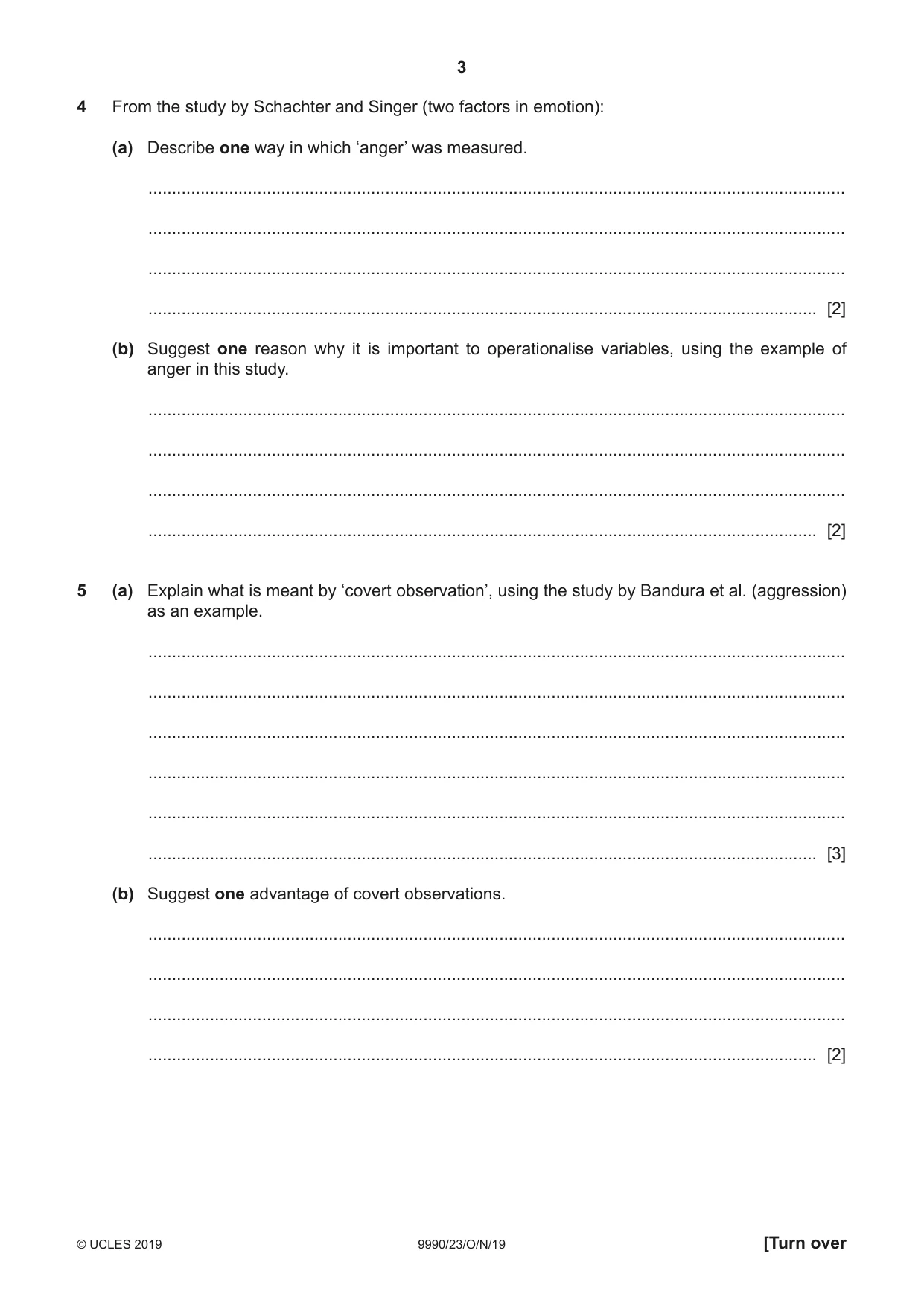
4 From the study by Schachter and Singer (two factors in emotion): (a) Describe one way in which ‘anger’ was measured. ................................................................................................................................................... ................................................................................................................................................... ................................................................................................................................................... ............................................................................................................................................. [2] (b) Suggest one reason why it is important to operationalise variables, using the example of anger in this study. ................................................................................................................................................... ................................................................................................................................................... ................................................................................................................................................... ............................................................................................................................................. [2]
Mark scheme: 4(a) Describe one way in which ‘anger’ was measured. 2 1 mark for identifying measure of anger 1 mark for detail The reaction of the participant to the stooge/watch them through a one-way mirror = 1 (identification) e.g. observation of how they responded on list of behaviours = 1 (operationalisation) Self-report/questionnaire (of ‘anger’) = 1 (identification) On rating scales such as ‘How angry or annoyed would you say you feel at present?’ = 1 (operationalisation) 4(b) Suggest one reason why it is important to operationalise variables, 2 using the example of anger in this study. 1 mark for identifying reason 1 mark for using anger To make the measure more valid/objective = 1 (reason) so that they could be sure that they were measuring anger = 1 (link) To make the measure more reliable = 1 (reason) so that the measures of anger were consistent on each trial = 1 (link)
Q5 · Explain what is meant by ‘covert observation’, using the study by Bandura et al
5 (a) Explain what is meant by ‘covert observation’, using the study by Bandura et al. (aggression) as an example. ................................................................................................................................................... ................................................................................................................................................... ................................................................................................................................................... ................................................................................................................................................... ................................................................................................................................................... ............................................................................................................................................. [3] (b) Suggest one advantage of covert observations. ................................................................................................................................................... ................................................................................................................................................... ................................................................................................................................................... ............................................................................................................................................. [2]
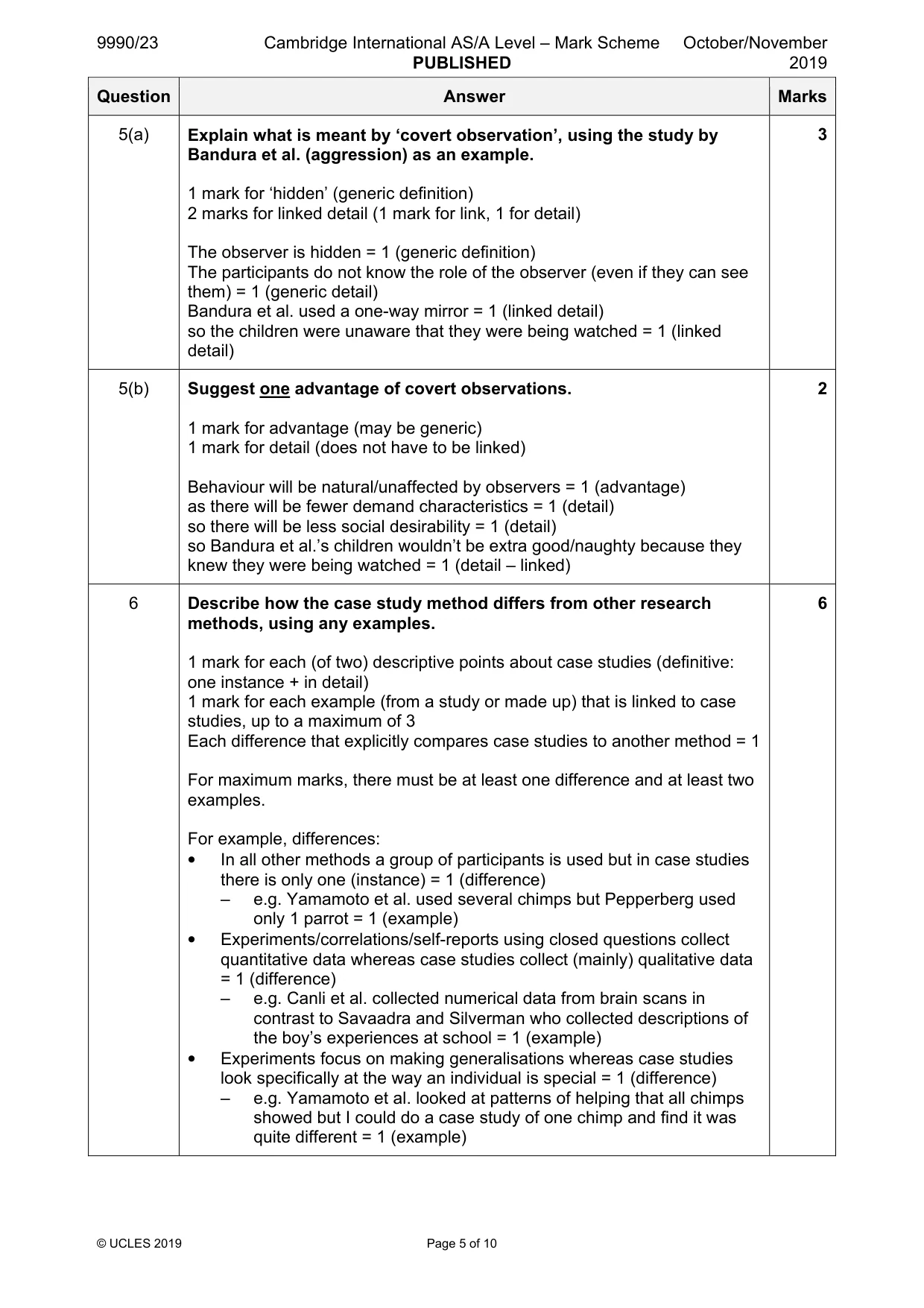
Mark scheme: 5(a) Explain what is meant by ‘covert observation’, using the study by 3 Bandura et al. (aggression) as an example. 1 mark for ‘hidden’ (generic definition) 2 marks for linked detail (1 mark for link, 1 for detail) The observer is hidden = 1 (generic definition) The participants do not know the role of the observer (even if they can see them) = 1 (generic detail) Bandura et al. used a one-way mirror = 1 (linked detail) so the children were unaware that they were being watched = 1 (linked detail) 5(b) Suggest one advantage of covert observations. 2 1 mark for advantage (may be generic) 1 mark for detail (does not have to be linked) Behaviour will be natural/unaffected by observers = 1 (advantage) as there will be fewer demand characteristics = 1 (detail) so there will be less social desirability = 1 (detail) so Bandura et al.’s children wouldn’t be extra good/naughty because they knew they were being watched = 1 (detail – linked)
Q6 · Describe how the case study method differs from other research methods, using any examples
6 Describe how the case study method differs from other research methods, using any examples. .......................................................................................................................................................... .......................................................................................................................................................... .......................................................................................................................................................... .......................................................................................................................................................... .......................................................................................................................................................... .......................................................................................................................................................... .......................................................................................................................................................... .......................................................................................................................................................... .......................................................................................................................................................... .......................................................................................................................................................... .......................................................................................................................................................... .................................................................................................................................................... [6]
Mark scheme: 6 Describe how the case study method differs from other research 6 methods, using any examples. 1 mark for each (of two) descriptive points about case studies (definitive: one instance + in detail) 1 mark for each example (from a study or made up) that is linked to case studies, up to a maximum of 3 Each difference that explicitly compares case studies to another method = 1 For maximum marks, there must be at least one difference and at least two examples. For example, differences: • In all other methods a group of participants is used but in case studies there is only one (instance) = 1 (difference) – e.g. Yamamoto et al. used several chimps but Pepperberg used only 1 parrot = 1 (example) • Experiments/correlations/self-reports using closed questions collect quantitative data whereas case studies collect (mainly) qualitative data = 1 (difference) – e.g. Canli et al. collected numerical data from brain scans in contrast to Savaadra and Silverman who collected descriptions of the boy’s experiences at school = 1 (example) • Experiments focus on making generalisations whereas case studies look specifically at the way an individual is special = 1 (difference) – e.g. Yamamoto et al. looked at patterns of helping that all chimps showed but I could do a case study of one chimp and find it was quite different = 1 (example)
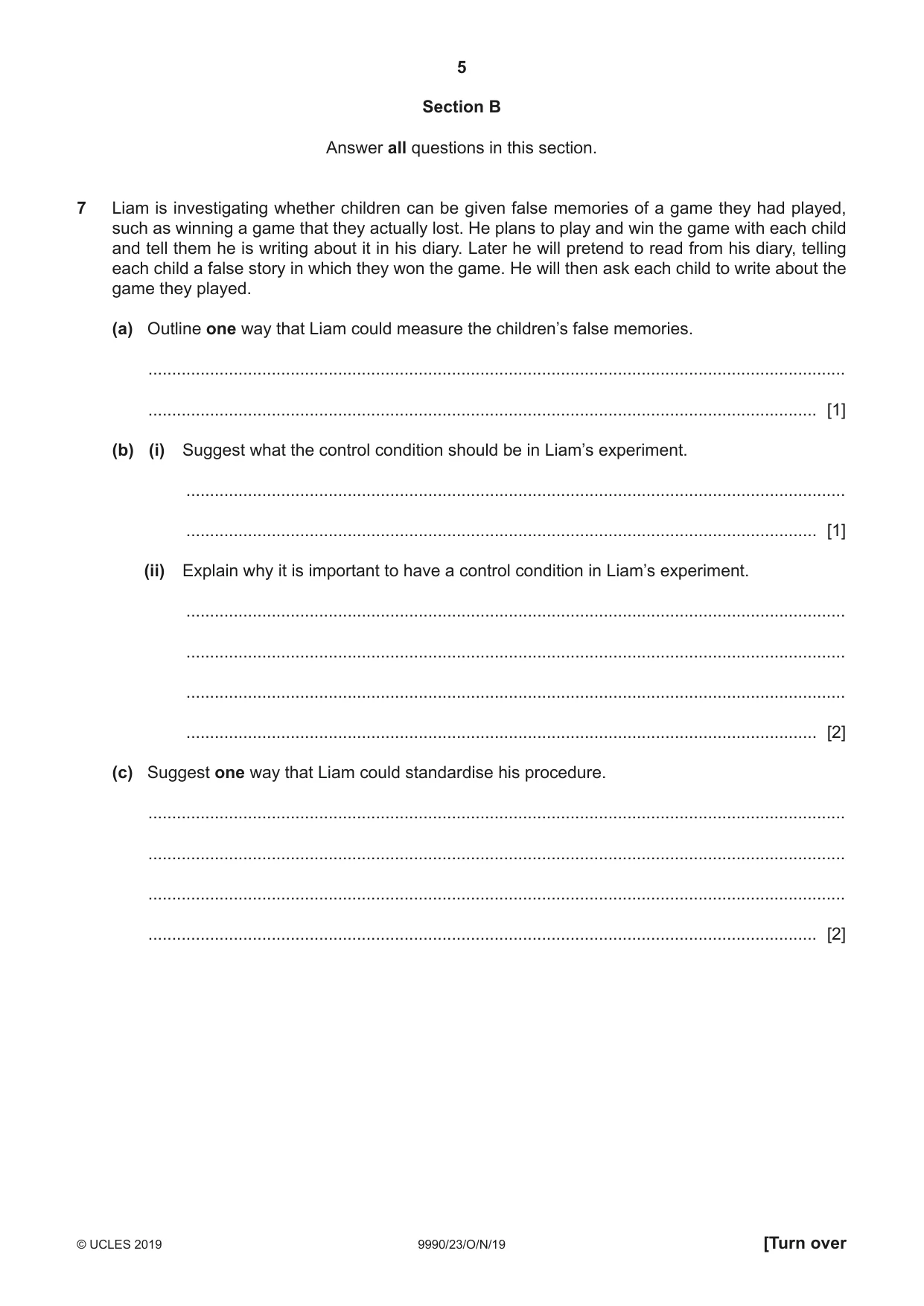
Q7 · Liam is investigating whether children can be given false memories of a game they had…
7 Liam is investigating whether children can be given false memories of a game they had played, such as winning a game that they actually lost. He plans to play and win the game with each child and tell them he is writing about it in his diary. Later he will pretend to read from his diary, telling each child a false story in which they won the game. He will then ask each child to write about the game they played. (a) Outline one way that Liam could measure the children’s false memories. ................................................................................................................................................... ............................................................................................................................................. [1] (b) (i) Suggest what the control condition should be in Liam’s experiment. ........................................................................................................................................... ..................................................................................................................................... [1] (ii) Explain why it is important to have a control condition in Liam’s experiment. ........................................................................................................................................... ........................................................................................................................................... ........................................................................................................................................... ..................................................................................................................................... [2] (c) Suggest one way that Liam could standardise his procedure. ................................................................................................................................................... ................................................................................................................................................... ................................................................................................................................................... ............................................................................................................................................. [2]
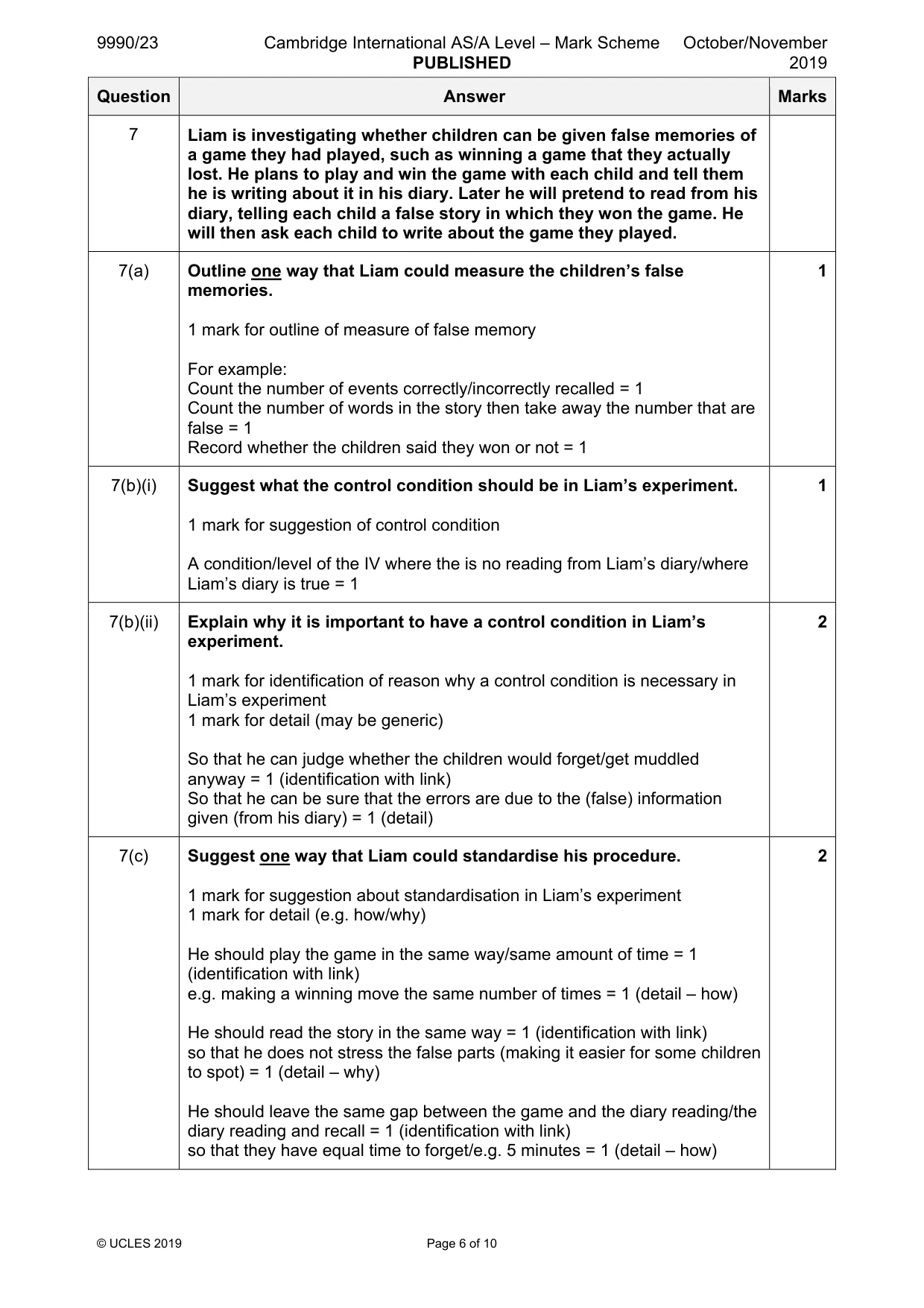
Mark scheme: 7(a) Outline one way that Liam could measure the children’s false 1 memories. 1 mark for outline of measure of false memory For example: Count the number of events correctly/incorrectly recalled = 1 Count the number of words in the story then take away the number that are false = 1 Record whether the children said they won or not = 1 7(b)(i) Suggest what the control condition should be in Liam’s experiment. 1 1 mark for suggestion of control condition A condition/level of the IV where the is no reading from Liam’s diary/where Liam’s diary is true = 1 7(b)(ii) Explain why it is important to have a control condition in Liam’s 2 experiment. 1 mark for identification of reason why a control condition is necessary in Liam’s experiment 1 mark for detail (may be generic) So that he can judge whether the children would forget/get muddled anyway = 1 (identification with link) So that he can be sure that the errors are due to the (false) information given (from his diary) = 1 (detail) 7(c) Suggest one way that Liam could standardise his procedure. 2 1 mark for suggestion about standardisation in Liam’s experiment 1 mark for detail (e.g. how/why) He should play the game in the same way/same amount of time = 1 (identification with link) e.g. making a winning move the same number of times = 1 (detail – how) He should read the story in the same way = 1 (identification with link) so that he does not stress the false parts (making it easier for some children to spot) = 1 (detail – why) He should leave the same gap between the game and the diary reading/the diary reading and recall = 1 (identification with link) so that they have equal time to forget/e.g. 5 minutes = 1 (detail – how)
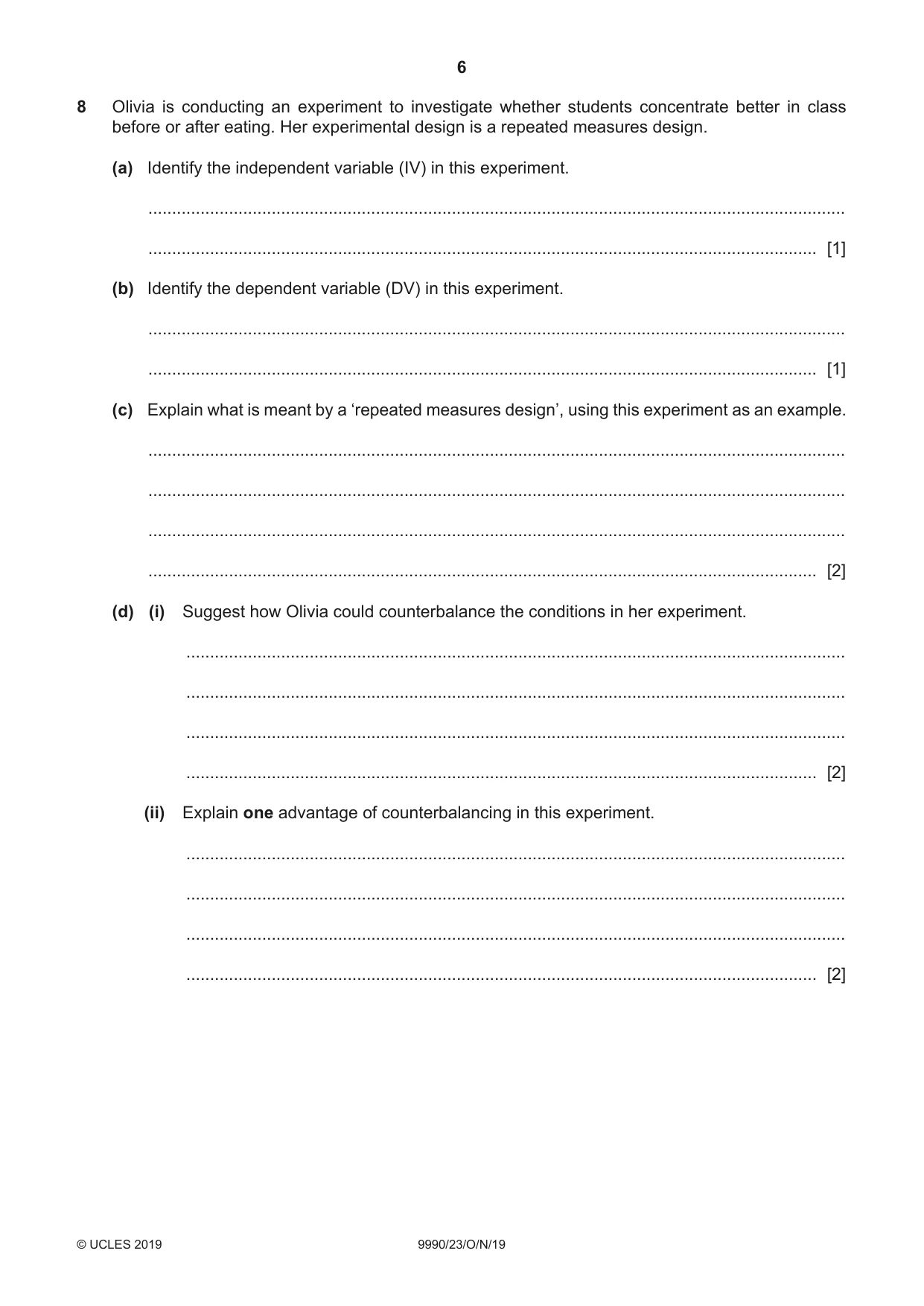
Q8 · Olivia is conducting an experiment to investigate whether students concentrate better in…
8 Olivia is conducting an experiment to investigate whether students concentrate better in class before or after eating. Her experimental design is a repeated measures design. (a) Identify the independent variable (IV) in this experiment. ................................................................................................................................................... ............................................................................................................................................. [1] (b) Identify the dependent variable (DV) in this experiment. ................................................................................................................................................... ............................................................................................................................................. [1] (c) Explain what is meant by a ‘repeated measures design’, using this experiment as an example. ................................................................................................................................................... ................................................................................................................................................... ................................................................................................................................................... ............................................................................................................................................. [2] (d) (i) Suggest how Olivia could counterbalance the conditions in her experiment. ........................................................................................................................................... ........................................................................................................................................... ........................................................................................................................................... ..................................................................................................................................... [2] (ii) Explain one advantage of counterbalancing in this experiment. ........................................................................................................................................... ........................................................................................................................................... ........................................................................................................................................... ..................................................................................................................................... [2]
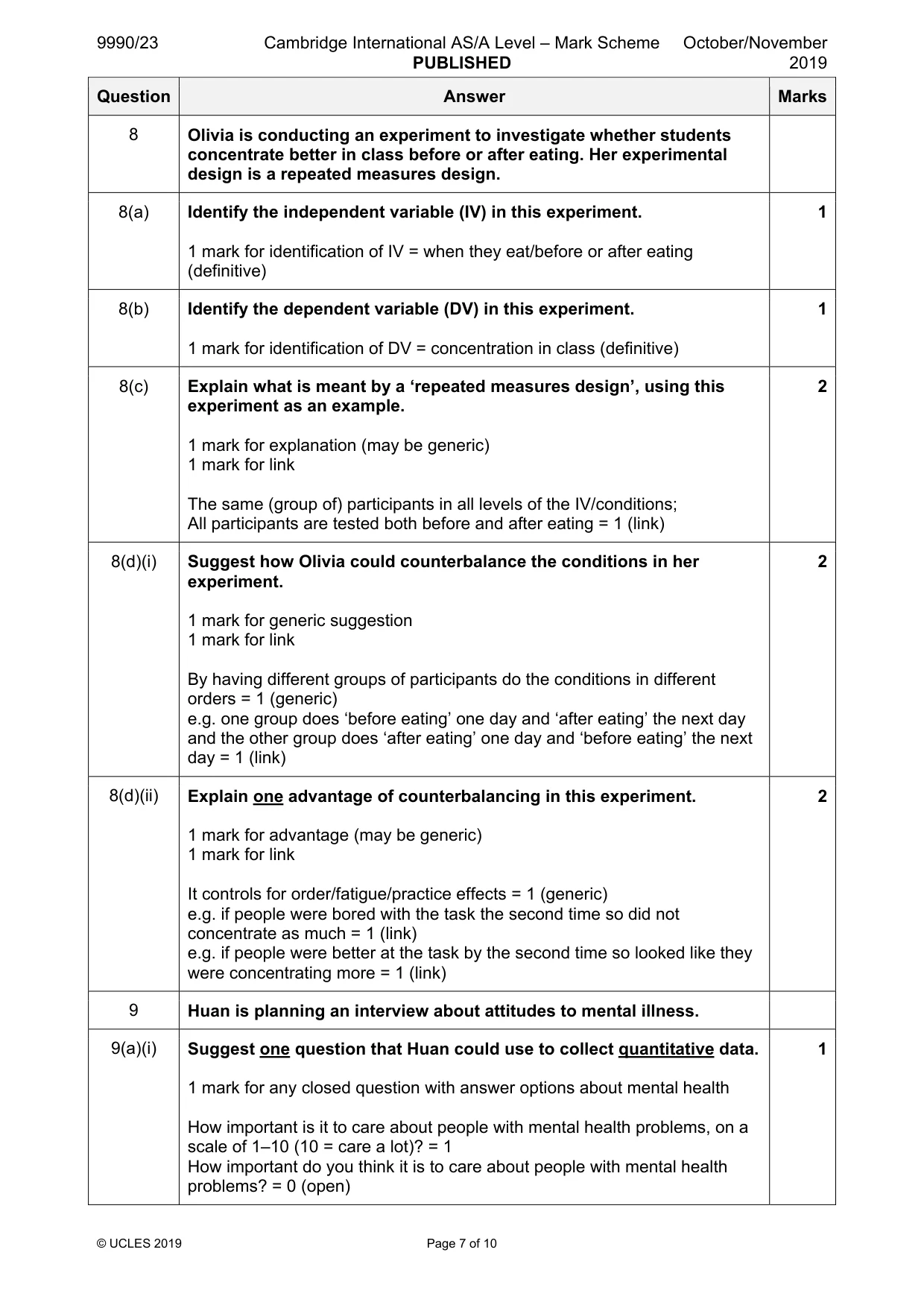
Mark scheme: 8(a) Identify the independent variable (IV) in this experiment. 1 1 mark for identification of IV = when they eat/before or after eating (definitive) 8(b) Identify the dependent variable (DV) in this experiment. 1 1 mark for identification of DV = concentration in class (definitive) 8(c) Explain what is meant by a ‘repeated measures design’, using this 2 experiment as an example. 1 mark for explanation (may be generic) 1 mark for link The same (group of) participants in all levels of the IV/conditions; All participants are tested both before and after eating = 1 (link) 8(d)(i) Suggest how Olivia could counterbalance the conditions in her 2 experiment. 1 mark for generic suggestion 1 mark for link By having different groups of participants do the conditions in different orders = 1 (generic) e.g. one group does ‘before eating’ one day and ‘after eating’ the next day and the other group does ‘after eating’ one day and ‘before eating’ the next day = 1 (link) 8(d)(ii) Explain one advantage of counterbalancing in this experiment. 2 1 mark for advantage (may be generic) 1 mark for link It controls for order/fatigue/practice effects = 1 (generic) e.g. if people were bored with the task the second time so did not concentrate as much = 1 (link) e.g. if people were better at the task by the second time so looked like they were concentrating more = 1 (link)
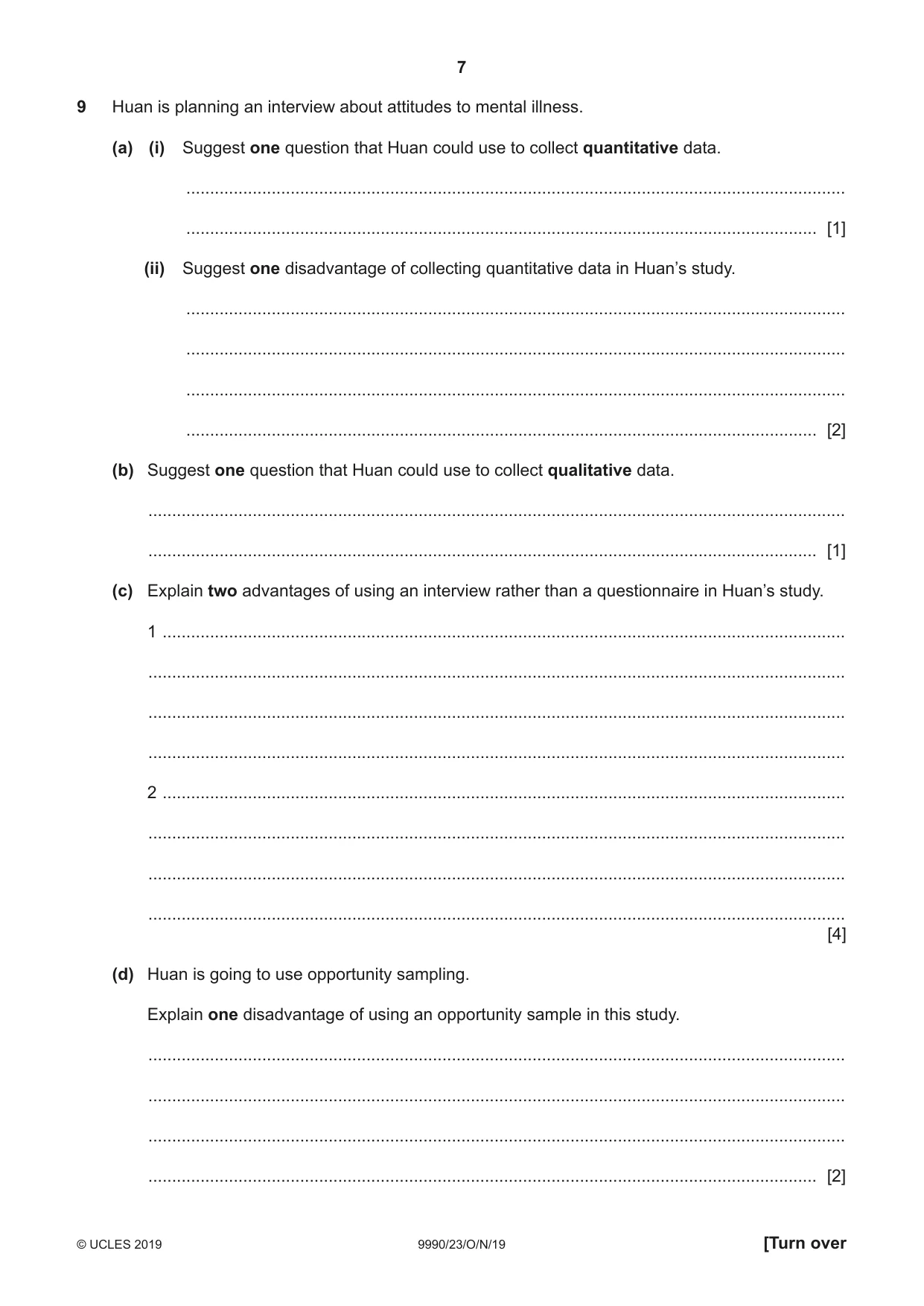
Q9 · Huan is planning an interview about attitudes to mental illness
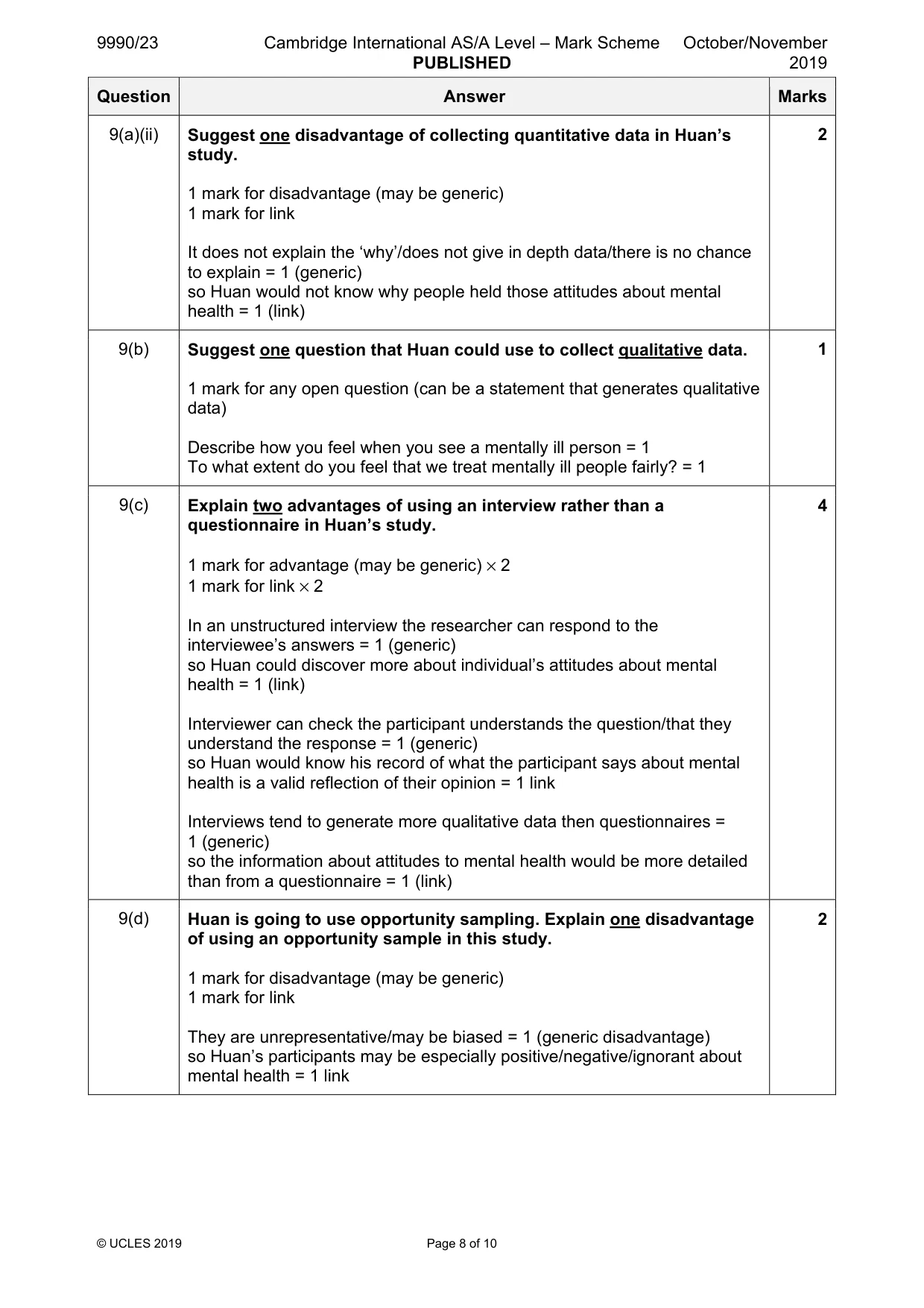
9 Huan is planning an interview about attitudes to mental illness. (a) (i) Suggest one question that Huan could use to collect quantitative data. ........................................................................................................................................... ..................................................................................................................................... [1] (ii) Suggest one disadvantage of collecting quantitative data in Huan’s study. ........................................................................................................................................... ........................................................................................................................................... ........................................................................................................................................... ..................................................................................................................................... [2] (b) Suggest one question that Huan could use to collect qualitative data. ................................................................................................................................................... ............................................................................................................................................. [1] (c) Explain two advantages of using an interview rather than a questionnaire in Huan’s study. 1 ................................................................................................................................................ ................................................................................................................................................... ................................................................................................................................................... ................................................................................................................................................... 2 ................................................................................................................................................ ................................................................................................................................................... ................................................................................................................................................... ................................................................................................................................................... [4] (d) Huan is going to use opportunity sampling. Explain one disadvantage of using an opportunity sample in this study. ................................................................................................................................................... ................................................................................................................................................... ................................................................................................................................................... ............................................................................................................................................. [2] Section C Answer all questions in this section.
Mark scheme: 9 Huan is planning an interview about attitudes to mental illness. 9(a)(i) Suggest one question that Huan could use to collect quantitative data. 1 1 mark for any closed question with answer options about mental health How important is it to care about people with mental health problems, on a scale of 1–10 (10 = care a lot)? = 1 How important do you think it is to care about people with mental health problems? = 0 (open) 9(a)(ii) Suggest one disadvantage of collecting quantitative data in Huan’s 2 study. 1 mark for disadvantage (may be generic) 1 mark for link It does not explain the ‘why’/does not give in depth data/there is no chance to explain = 1 (generic) so Huan would not know why people held those attitudes about mental health = 1 (link) 9(b) Suggest one question that Huan could use to collect qualitative data. 1 1 mark for any open question (can be a statement that generates qualitative data) Describe how you feel when you see a mentally ill person = 1 To what extent do you feel that we treat mentally ill people fairly? = 1 9(c) Explain two advantages of using an interview rather than a 4 questionnaire in Huan’s study. 1 mark for advantage (may be generic) × 2 1 mark for link × 2 In an unstructured interview the researcher can respond to the interviewee’s answers = 1 (generic) so Huan could discover more about individual’s attitudes about mental health = 1 (link) Interviewer can check the participant understands the question/that they understand the response = 1 (generic) so Huan would know his record of what the participant says about mental health is a valid reflection of their opinion = 1 link Interviews tend to generate more qualitative data then questionnaires = 1 (generic) so the information about attitudes to mental health would be more detailed than from a questionnaire = 1 (link) 9(d) Huan is going to use opportunity sampling. Explain one disadvantage 2 of using an opportunity sample in this study. 1 mark for disadvantage (may be generic) 1 mark for link They are unrepresentative/may be biased = 1 (generic disadvantage) so Huan’s participants may be especially positive/negative/ignorant about mental health = 1 link
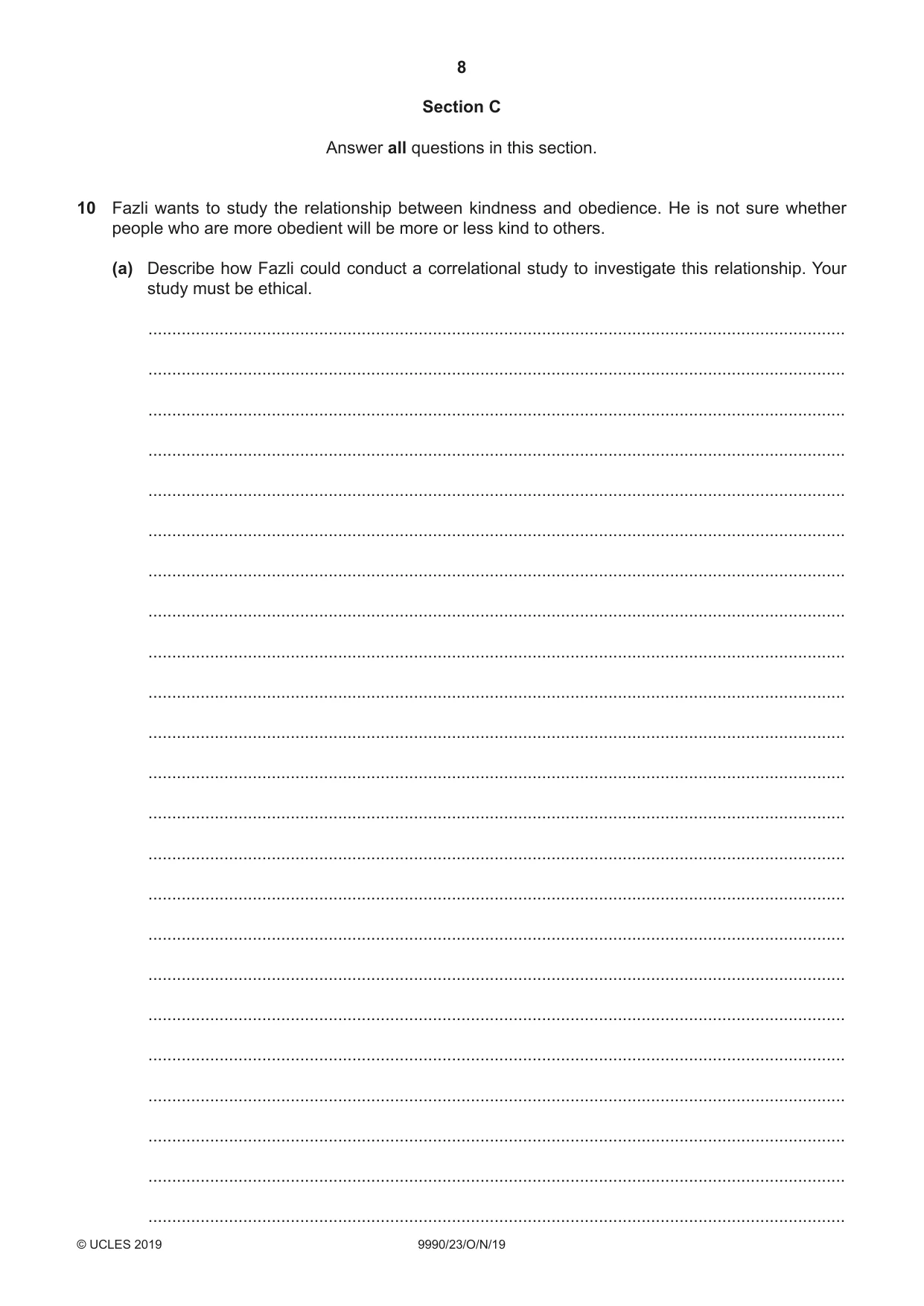
Q10 · Fazli wants to study the relationship between kindness and obedience
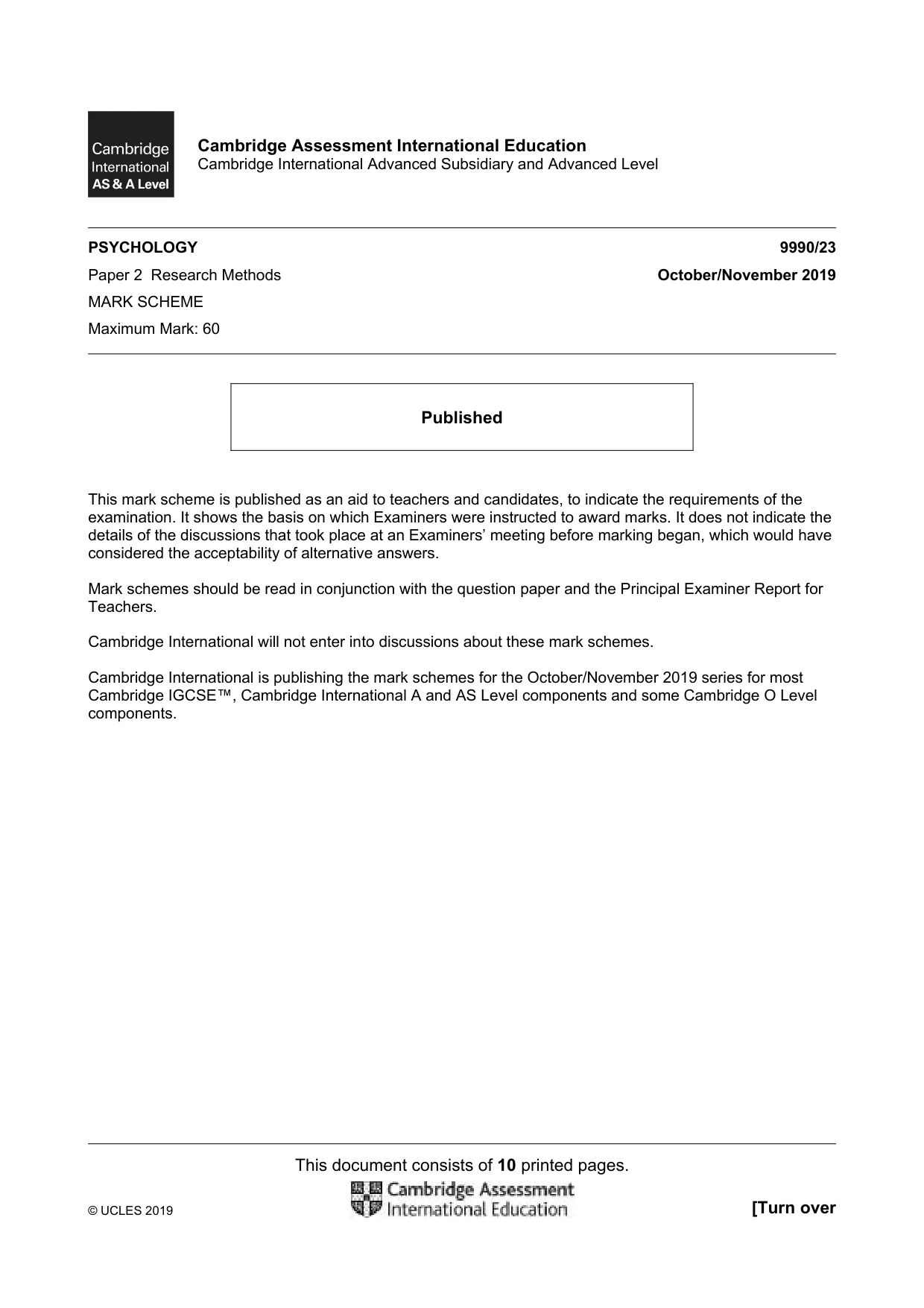
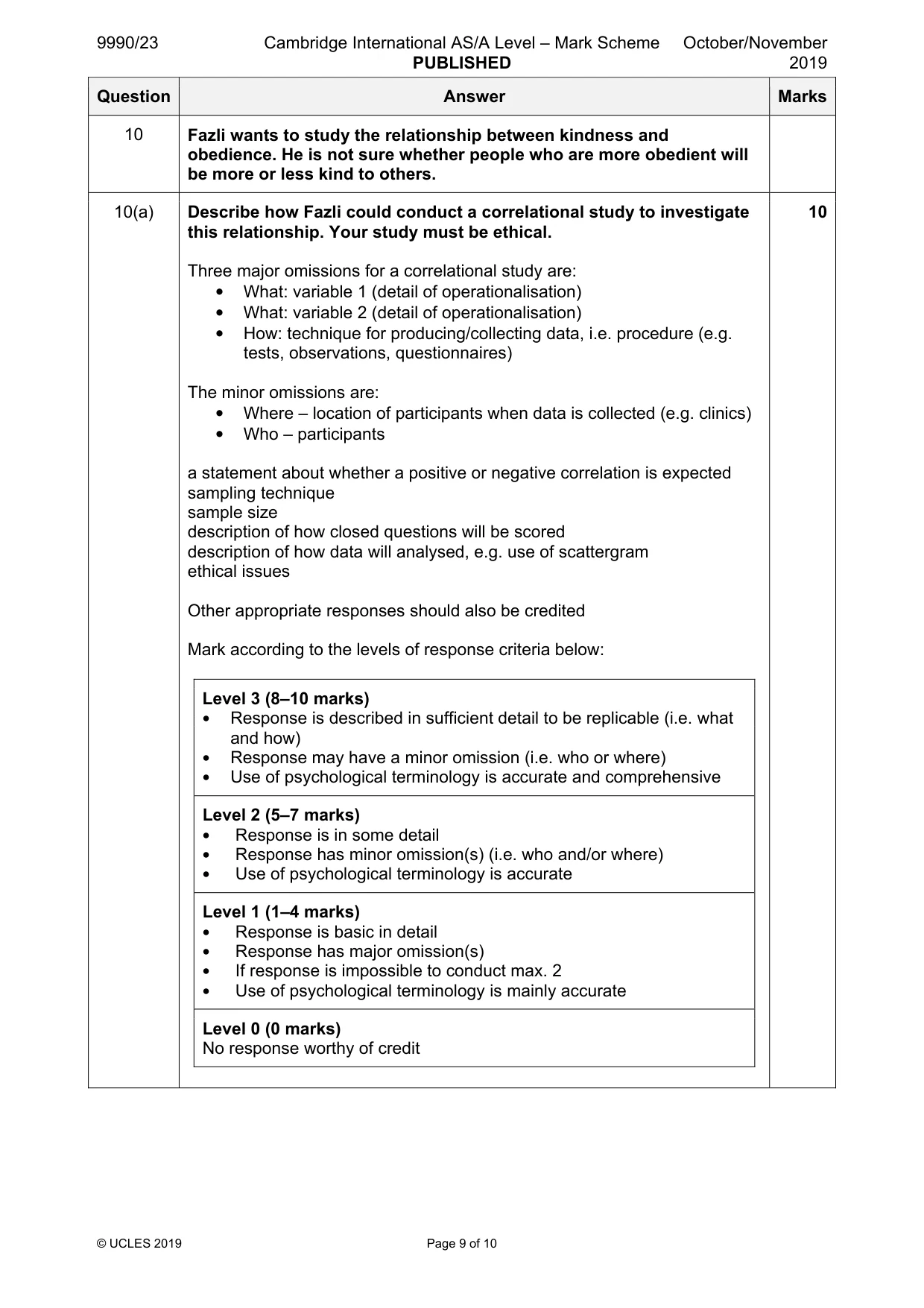
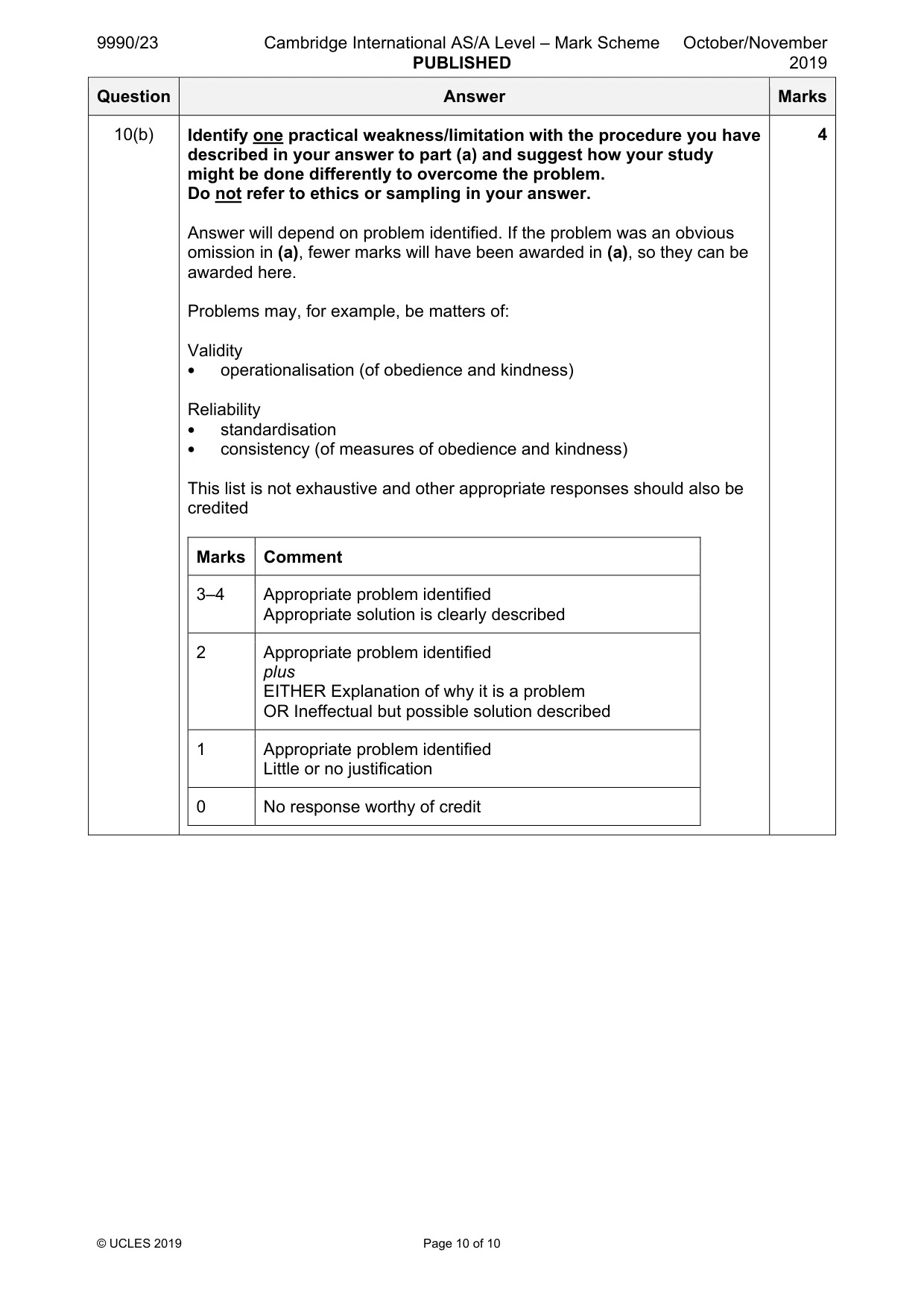
10 Fazli wants to study the relationship between kindness and obedience. He is not sure whether people who are more obedient will be more or less kind to others. (a) Describe how Fazli could conduct a correlational study to investigate this relationship. Your study must be ethical. ................................................................................................................................................... ................................................................................................................................................... ................................................................................................................................................... ................................................................................................................................................... ................................................................................................................................................... ................................................................................................................................................... ................................................................................................................................................... ................................................................................................................................................... ................................................................................................................................................... ................................................................................................................................................... ................................................................................................................................................... ................................................................................................................................................... ................................................................................................................................................... ................................................................................................................................................... ................................................................................................................................................... ................................................................................................................................................... ................................................................................................................................................... ................................................................................................................................................... ................................................................................................................................................... ................................................................................................................................................... ................................................................................................................................................... ................................................................................................................................................... ................................................................................................................................................... ................................................................................................................................................... ................................................................................................................................................... ................................................................................................................................................... ................................................................................................................................................... ................................................................................................................................................... ................................................................................................................................................... ................................................................................................................................................... ........................................................................................................................................... [10] (b) Identify one practical weakness/limitation with the procedure you have described in your answer to part (a) and suggest how your study might be done differently to overcome the problem. Do not refer to ethics or sampling in your answer. ................................................................................................................................................... ................................................................................................................................................... ................................................................................................................................................... ................................................................................................................................................... ................................................................................................................................................... ................................................................................................................................................... ................................................................................................................................................... ............................................................................................................................................. [4]
Mark scheme: 10 Fazli wants to study the relationship between kindness and obedience. He is not sure whether people who are more obedient will be more or less kind to others. 10(a) Describe how Fazli could conduct a correlational study to investigate 10 this relationship. Your study must be ethical. Three major omissions for a correlational study are: • What: variable 1 (detail of operationalisation) • What: variable 2 (detail of operationalisation) • How: technique for producing/collecting data, i.e. procedure (e.g. tests, observations, questionnaires) The minor omissions are: • Where – location of participants when data is collected (e.g. clinics) • Who – participants a statement about whether a positive or negative correlation is expected sampling technique sample size description of how closed questions will be scored description of how data will analysed, e.g. use of scattergram ethical issues Other appropriate responses should also be credited Mark according to the levels of response criteria below: Level 3 (8–10 marks) • Response is described in sufficient detail to be replicable (i.e. what and how) • Response may have a minor omission (i.e. who or where) • Use of psychological terminology is accurate and comprehensive Level 2 (5–7 marks) • Response is in some detail • Response has minor omission(s) (i.e. who and/or where) • Use of psychological terminology is accurate Level 1 (1–4 marks) • Response is basic in detail • Response has major omission(s) • If response is impossible to conduct max. 2 • Use of psychological terminology is mainly accurate Level 0 (0 marks) No response worthy of credit 10(b) Identify one practical weakness/limitation with the procedure you have 4 described in your answer to part (a) and suggest how your study might be done differently to overcome the problem. Do not refer to ethics or sampling in your answer. Answer will depend on problem identified. If the problem was an obvious omission in (a), fewer marks will have been awarded in (a), so they can be awarded here. Problems may, for example, be matters of: Validity • operationalisation (of obedience and kindness) Reliability • standardisation • consistency (of measures of obedience and kindness) This list is not exhaustive and other appropriate responses should also be credited Marks Comment 3–4 Appropriate problem identified Appropriate solution is clearly described 2 Appropriate problem identified plus EITHER Explanation of why it is a problem OR Ineffectual but possible solution described 1 Appropriate problem identified Little or no justification 0 No response worthy of credit
What was in this paper
The subtopics covered by these 10 questions, and how many questions each got. Open one in a new tab to see every Cambridge question on it.
What you needed in this session
Cambridge’s own grade thresholds for 2019 Oct/Nov, Paper 2 · Variant 3. A higher threshold means an easier paper — the bar moves with how the cohort did.