Cambridge A Level Psychology (from 2018) 9990 — 2019 Oct/Nov Paper 2 · Variant 2
9990/22/O/N/19 · 10 questions · 60 marks · ≈68 min
The question paper and its mark scheme, free to read here and free to download. This is Cambridge’s own paper, exactly as it was sat.
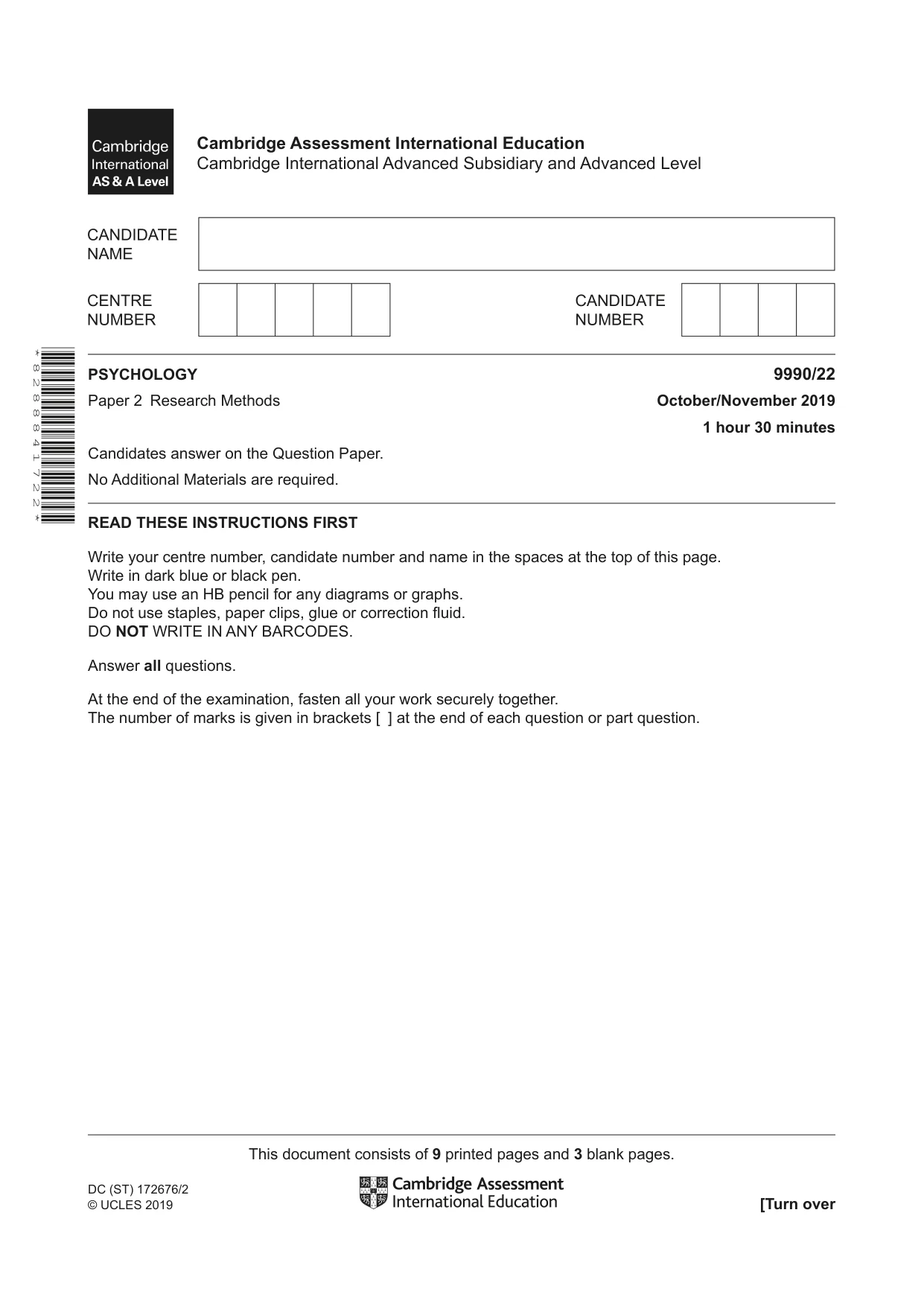
Question paper12 pages



Mark scheme13 pages
Answers below. Sit the paper first if you are practising.
Questions as text
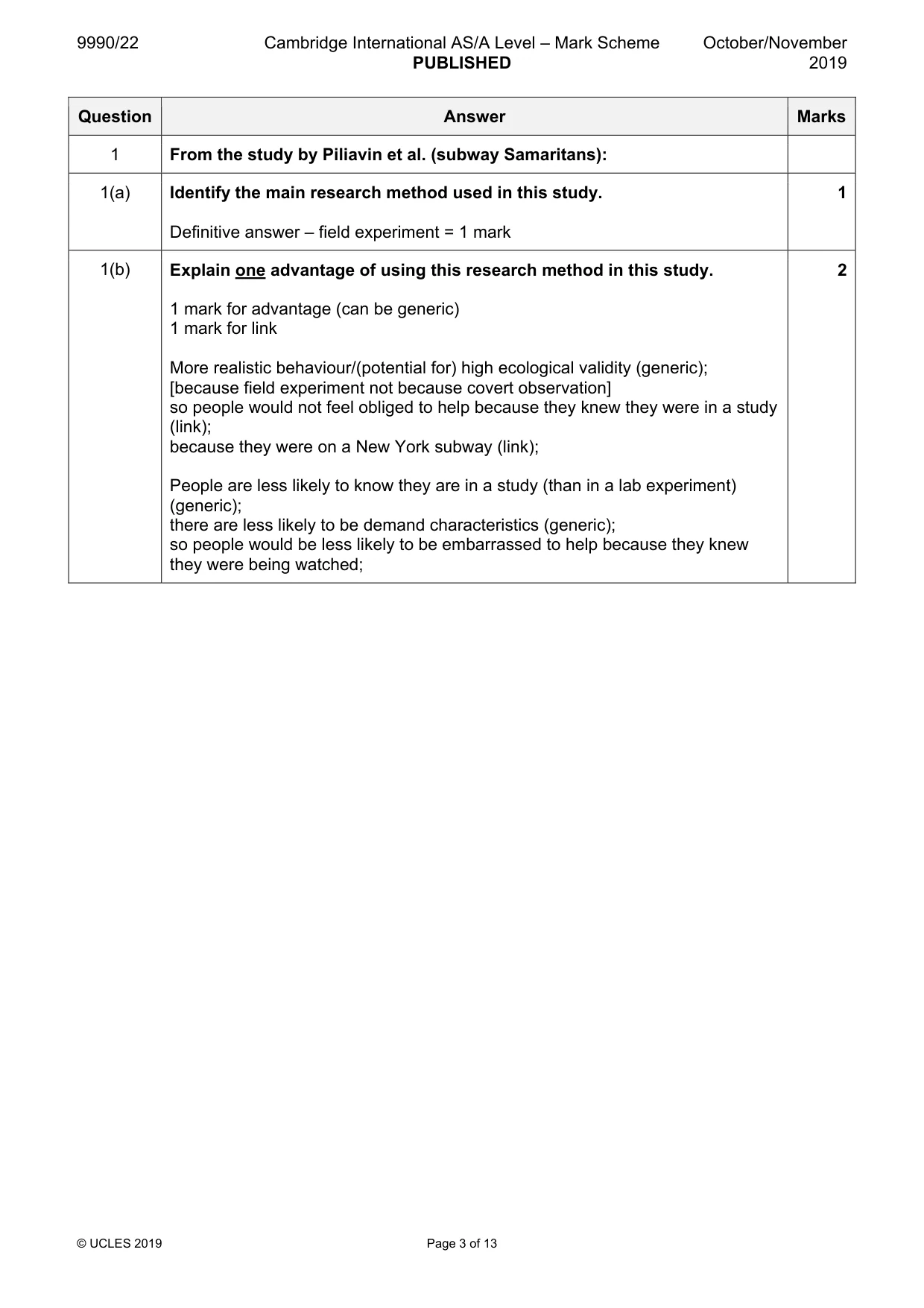
Q1 · From the study by Piliavin et al
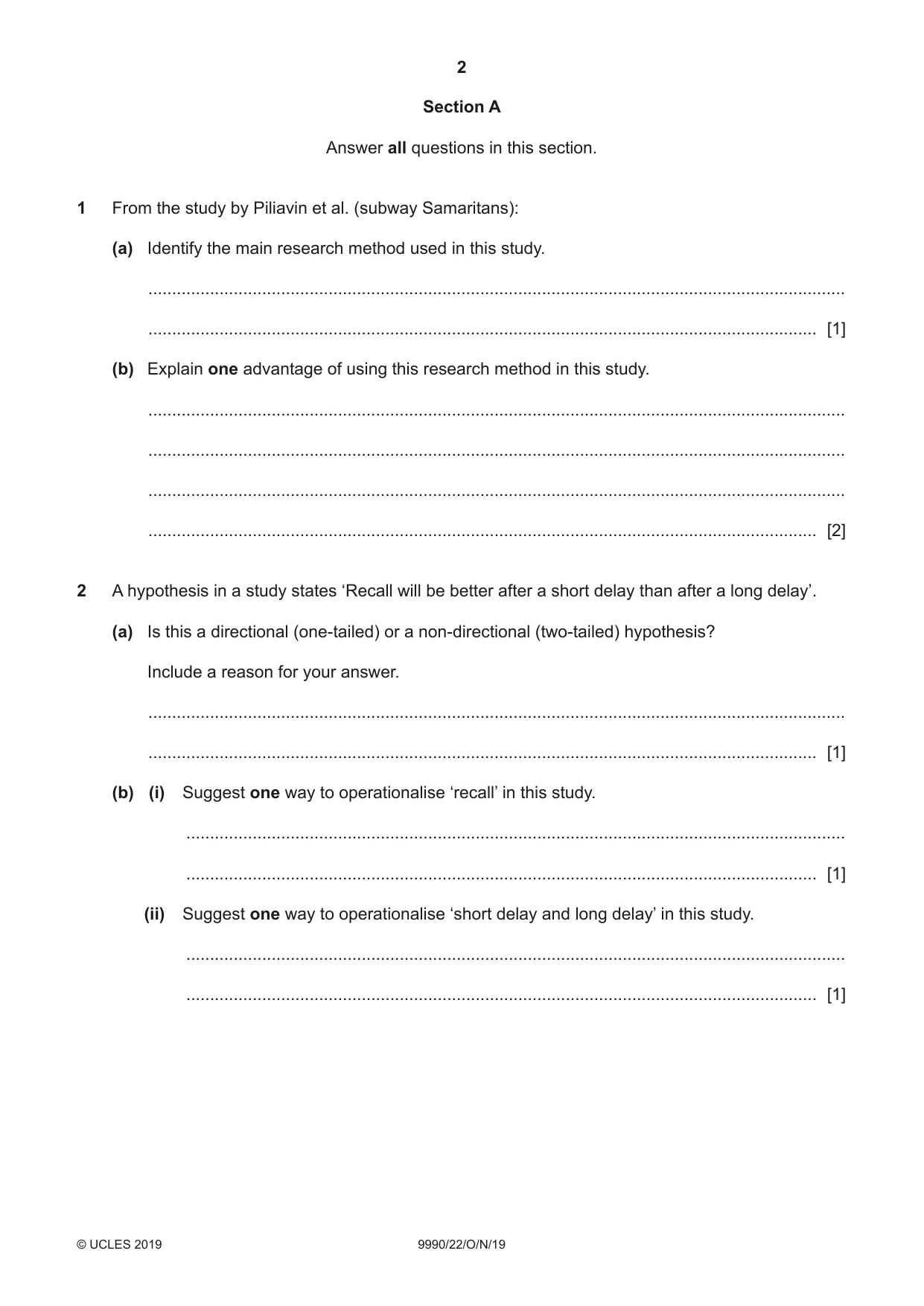
1 From the study by Piliavin et al. (subway Samaritans): (a) Identify the main research method used in this study. ................................................................................................................................................... ............................................................................................................................................. [1] (b) Explain one advantage of using this research method in this study. ................................................................................................................................................... ................................................................................................................................................... ................................................................................................................................................... ............................................................................................................................................. [2]
Mark scheme: Question Answer Marks 1 From the study by Piliavin et al. (subway Samaritans): 1(a) Identify the main research method used in this study. 1 Definitive answer – field experiment = 1 mark 1(b) Explain one advantage of using this research method in this study. 2 1 mark for advantage (can be generic) 1 mark for link More realistic behaviour/(potential for) high ecological validity (generic); [because field experiment not because covert observation] so people would not feel obliged to help because they knew they were in a study (link); because they were on a New York subway (link); People are less likely to know they are in a study (than in a lab experiment) (generic); there are less likely to be demand characteristics (generic); so people would be less likely to be embarrassed to help because they knew they were being watched;
Q2 · A hypothesis in a study states ‘Recall will be better after a short delay than after a…
2 A hypothesis in a study states ‘Recall will be better after a short delay than after a long delay’. (a) Is this a directional (one-tailed) or a non-directional (two-tailed) hypothesis? Include a reason for your answer. ................................................................................................................................................... ............................................................................................................................................. [1] (b) (i) Suggest one way to operationalise ‘recall’ in this study. ........................................................................................................................................... ..................................................................................................................................... [1] (ii) Suggest one way to operationalise ‘short delay and long delay’ in this study. ........................................................................................................................................... ..................................................................................................................................... [1]
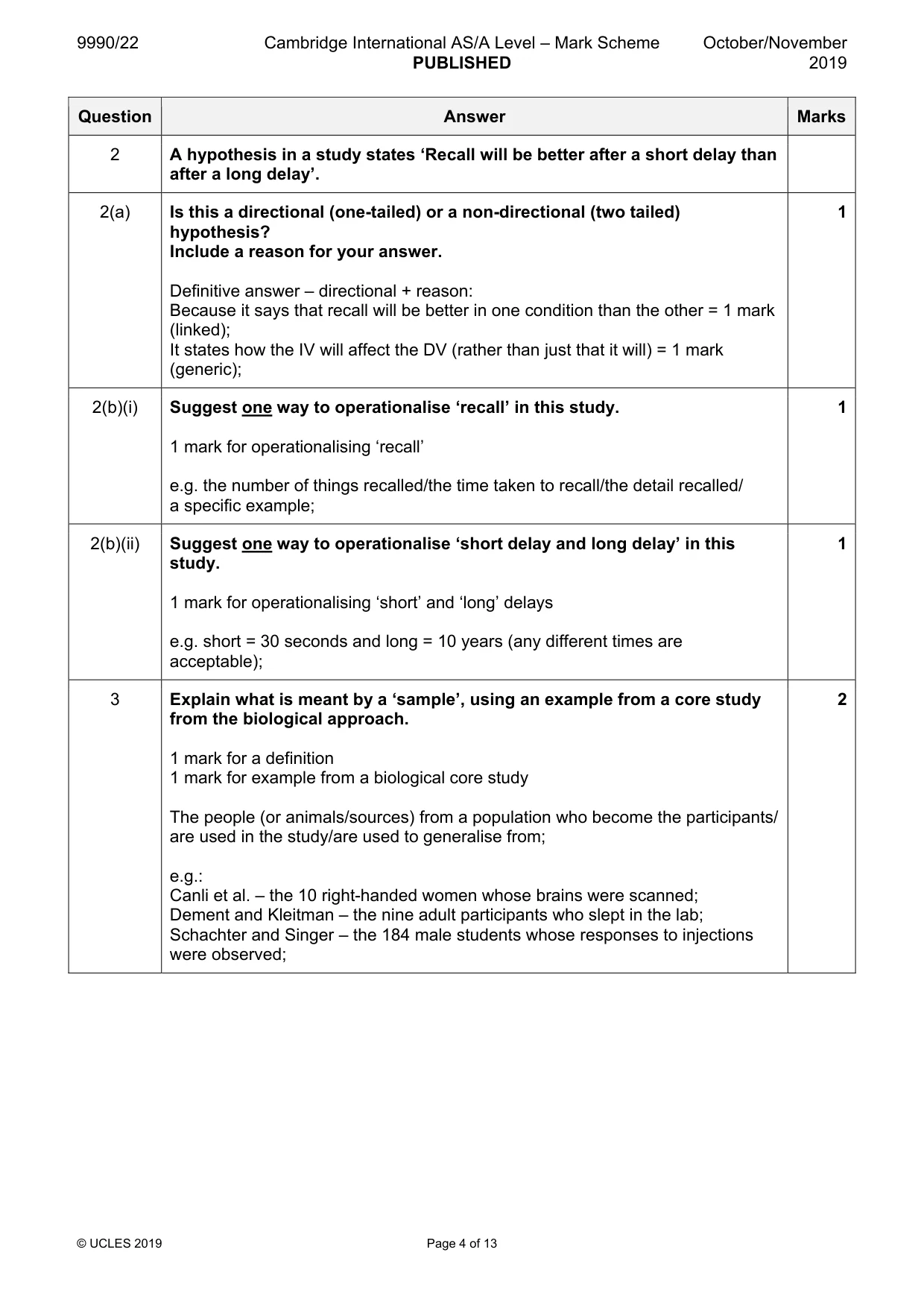
Mark scheme: 2 A hypothesis in a study states ‘Recall will be better after a short delay than after a long delay’. 2(a) Is this a directional (one-tailed) or a non-directional (two tailed) 1 hypothesis? Include a reason for your answer. Definitive answer – directional + reason: Because it says that recall will be better in one condition than the other = 1 mark (linked); It states how the IV will affect the DV (rather than just that it will) = 1 mark (generic); 2(b)(i) Suggest one way to operationalise ‘recall’ in this study. 1 1 mark for operationalising ‘recall’ e.g. the number of things recalled/the time taken to recall/the detail recalled/ a specific example; 2(b)(ii) Suggest one way to operationalise ‘short delay and long delay’ in this 1 study. 1 mark for operationalising ‘short’ and ‘long’ delays e.g. short = 30 seconds and long = 10 years (any different times are acceptable);
Q3 · Explain what is meant by a ‘sample’, using an example from a core study from the…
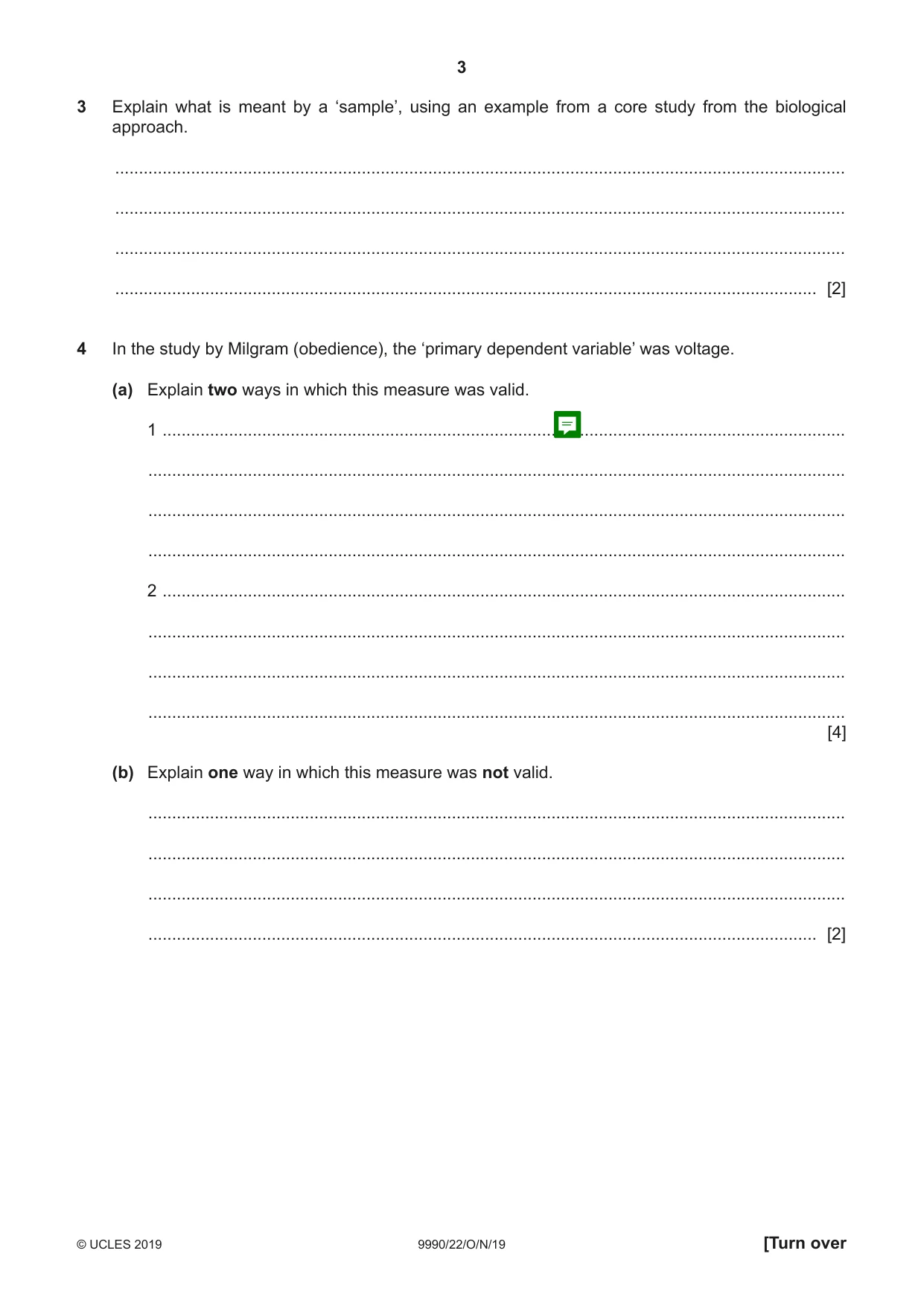
3 Explain what is meant by a ‘sample’, using an example from a core study from the biological approach. .......................................................................................................................................................... .......................................................................................................................................................... .......................................................................................................................................................... .................................................................................................................................................... [2]
Mark scheme: 3 Explain what is meant by a ‘sample’, using an example from a core study 2 from the biological approach. 1 mark for a definition 1 mark for example from a biological core study The people (or animals/sources) from a population who become the participants/ are used in the study/are used to generalise from; e.g.: Canli et al. – the 10 right-handed women whose brains were scanned; Dement and Kleitman – the nine adult participants who slept in the lab; Schachter and Singer – the 184 male students whose responses to injections were observed;
Q4 · In the study by Milgram (obedience), the ‘primary dependent variable’ was voltage
4 In the study by Milgram (obedience), the ‘primary dependent variable’ was voltage. (a) Explain two ways in which this measure was valid. 1 ................................................................................................................................................ ................................................................................................................................................... ................................................................................................................................................... ................................................................................................................................................... 2 ................................................................................................................................................ ................................................................................................................................................... ................................................................................................................................................... ................................................................................................................................................... [4] (b) Explain one way in which this measure was not valid. ................................................................................................................................................... ................................................................................................................................................... ................................................................................................................................................... ............................................................................................................................................. [2]
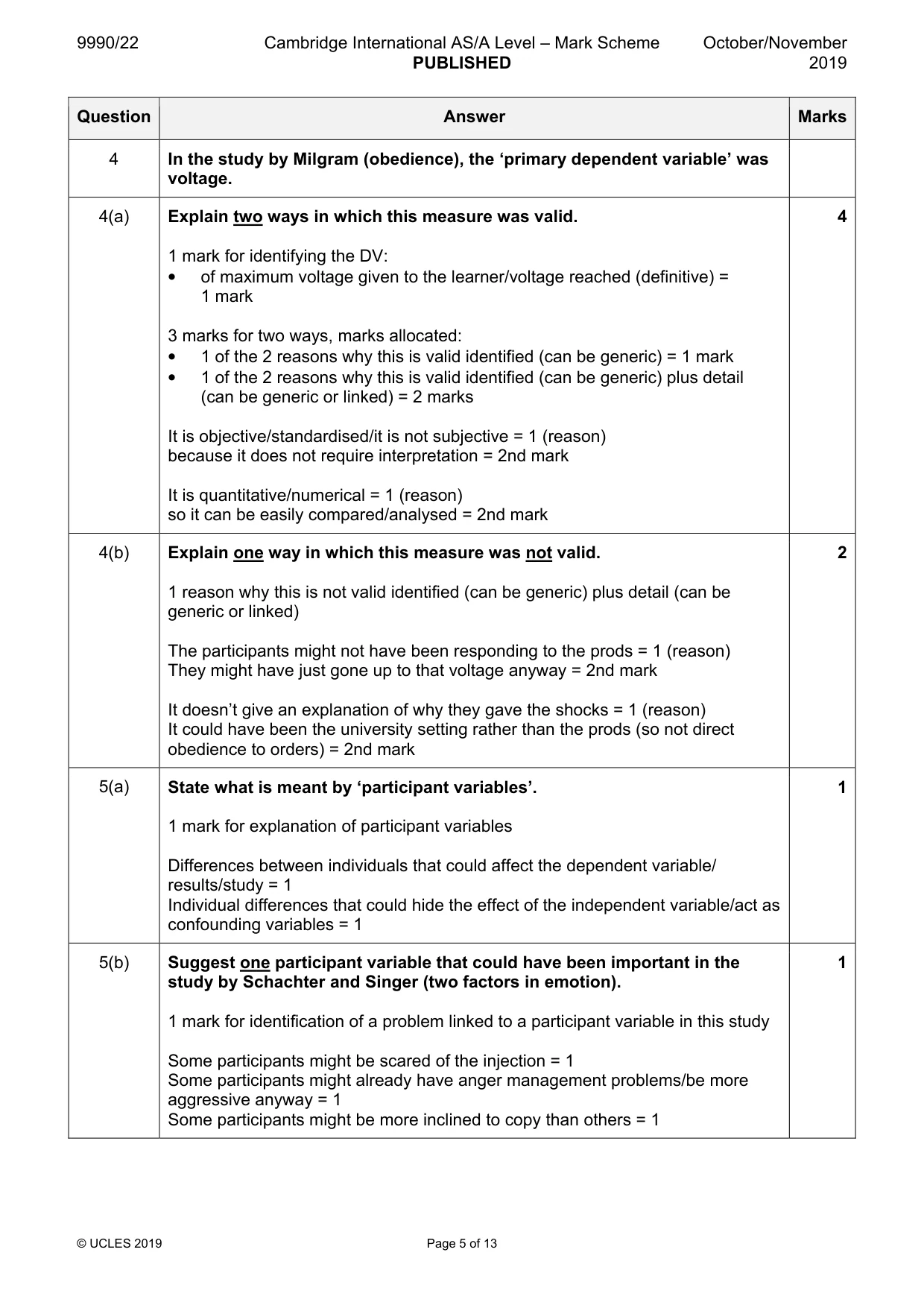
Mark scheme: 4 In the study by Milgram (obedience), the ‘primary dependent variable’ was voltage. 4(a) Explain two ways in which this measure was valid. 4 1 mark for identifying the DV: • of maximum voltage given to the learner/voltage reached (definitive) = 1 mark 3 marks for two ways, marks allocated: • 1 of the 2 reasons why this is valid identified (can be generic) = 1 mark • 1 of the 2 reasons why this is valid identified (can be generic) plus detail (can be generic or linked) = 2 marks It is objective/standardised/it is not subjective = 1 (reason) because it does not require interpretation = 2nd mark It is quantitative/numerical = 1 (reason) so it can be easily compared/analysed = 2nd mark 4(b) Explain one way in which this measure was not valid. 2 1 reason why this is not valid identified (can be generic) plus detail (can be generic or linked) The participants might not have been responding to the prods = 1 (reason) They might have just gone up to that voltage anyway = 2nd mark It doesn’t give an explanation of why they gave the shocks = 1 (reason) It could have been the university setting rather than the prods (so not direct obedience to orders) = 2nd mark
Q5 · State what is meant by ‘participant variables’
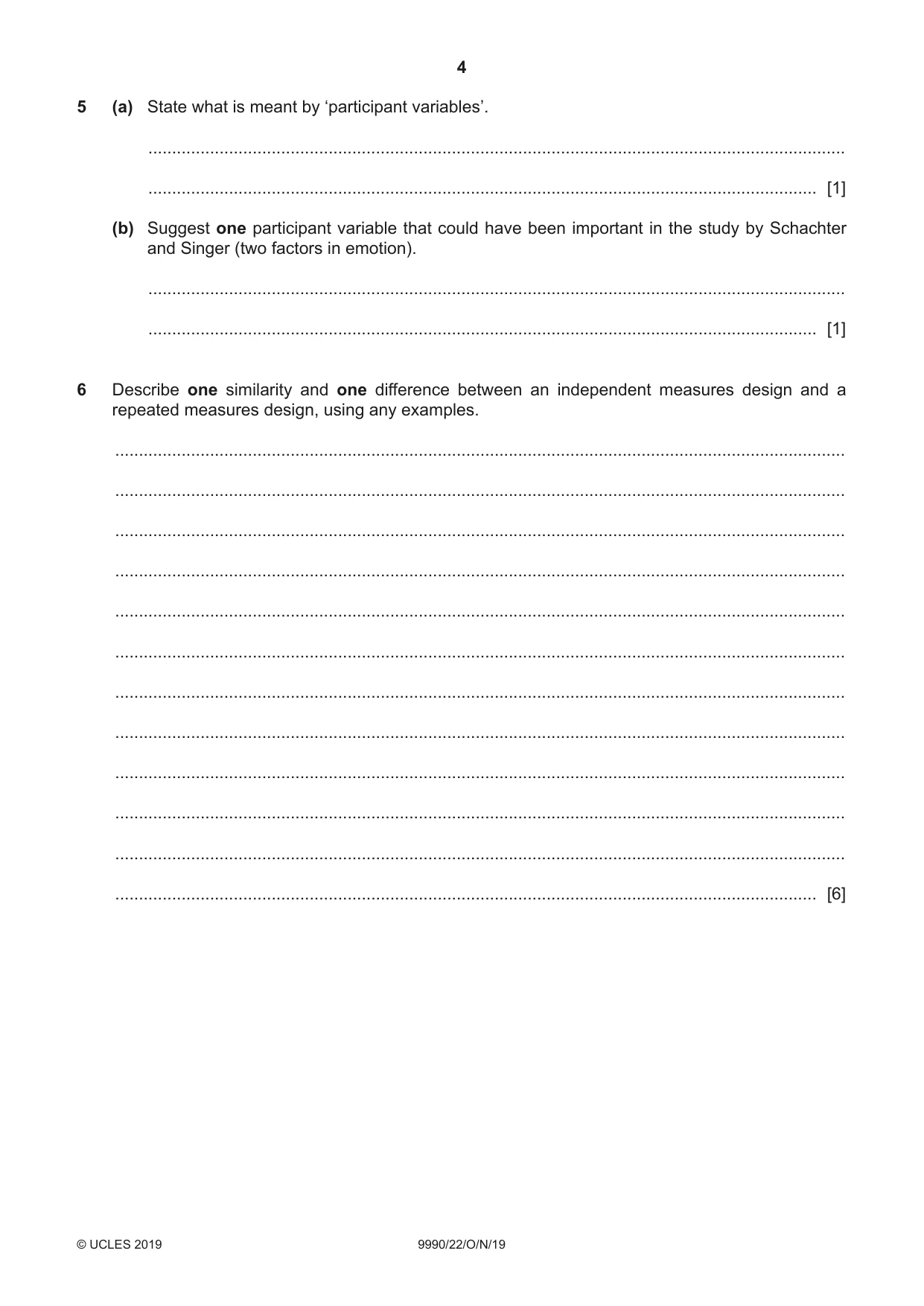
5 (a) State what is meant by ‘participant variables’. ................................................................................................................................................... ............................................................................................................................................. [1] (b) Suggest one participant variable that could have been important in the study by Schachter and Singer (two factors in emotion). ................................................................................................................................................... ............................................................................................................................................. [1]
Mark scheme: 5(a) State what is meant by ‘participant variables’. 1 1 mark for explanation of participant variables Differences between individuals that could affect the dependent variable/ results/study = 1 Individual differences that could hide the effect of the independent variable/act as confounding variables = 1 5(b) Suggest one participant variable that could have been important in the 1 study by Schachter and Singer (two factors in emotion). 1 mark for identification of a problem linked to a participant variable in this study Some participants might be scared of the injection = 1 Some participants might already have anger management problems/be more aggressive anyway = 1 Some participants might be more inclined to copy than others = 1
Q6 · Describe one similarity and one difference between an independent measures design and a…
6 Describe one similarity and one difference between an independent measures design and a repeated measures design, using any examples. .......................................................................................................................................................... .......................................................................................................................................................... .......................................................................................................................................................... .......................................................................................................................................................... .......................................................................................................................................................... .......................................................................................................................................................... .......................................................................................................................................................... .......................................................................................................................................................... .......................................................................................................................................................... .......................................................................................................................................................... .......................................................................................................................................................... .................................................................................................................................................... [6]
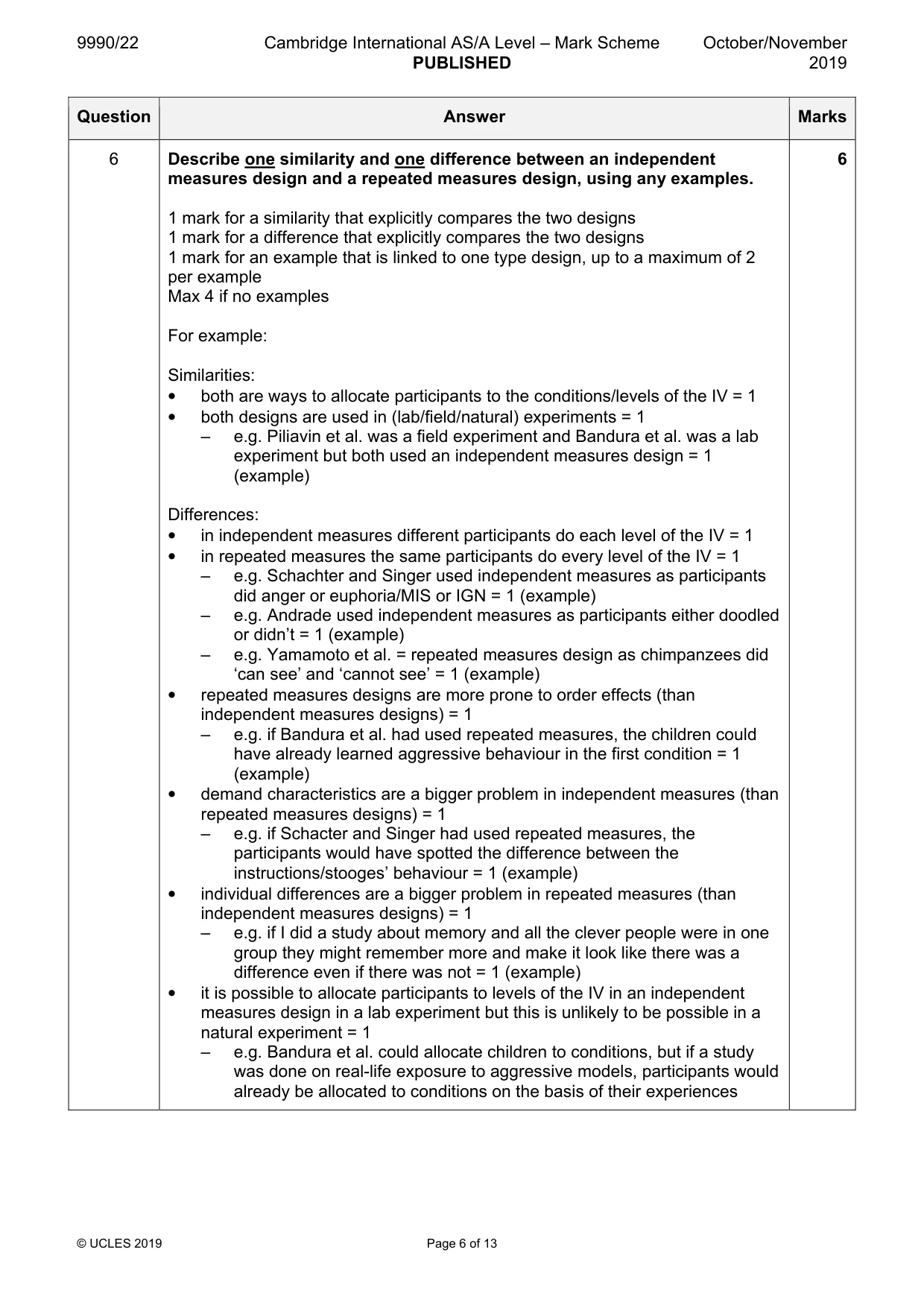
Mark scheme: 6 Describe one similarity and one difference between an independent 6 measures design and a repeated measures design, using any examples. 1 mark for a similarity that explicitly compares the two designs 1 mark for a difference that explicitly compares the two designs 1 mark for an example that is linked to one type design, up to a maximum of 2 per example Max 4 if no examples For example: Similarities: • both are ways to allocate participants to the conditions/levels of the IV = 1 • both designs are used in (lab/field/natural) experiments = 1 – e.g. Piliavin et al. was a field experiment and Bandura et al. was a lab experiment but both used an independent measures design = 1 (example) Differences: • in independent measures different participants do each level of the IV = 1 • in repeated measures the same participants do every level of the IV = 1 – e.g. Schachter and Singer used independent measures as participants did anger or euphoria/MIS or IGN = 1 (example) – e.g. Andrade used independent measures as participants either doodled or didn’t = 1 (example) – e.g. Yamamoto et al. = repeated measures design as chimpanzees did ‘can see’ and ‘cannot see’ = 1 (example) • repeated measures designs are more prone to order effects (than independent measures designs) = 1 – e.g. if Bandura et al. had used repeated measures, the children could have already learned aggressive behaviour in the first condition = 1 (example) • demand characteristics are a bigger problem in independent measures (than repeated measures designs) = 1 – e.g. if Schacter and Singer had used repeated measures, the participants would have spotted the difference between the instructions/stooges’ behaviour = 1 (example) • individual differences are a bigger problem in repeated measures (than independent measures designs) = 1 – e.g. if I did a study about memory and all the clever people were in one group they might remember more and make it look like there was a difference even if there was not = 1 (example) • it is possible to allocate participants to levels of the IV in an independent measures design in a lab experiment but this is unlikely to be possible in a natural experiment = 1 – e.g. Bandura et al. could allocate children to conditions, but if a study was done on real-life exposure to aggressive models, participants would already be allocated to conditions on the basis of their experiences
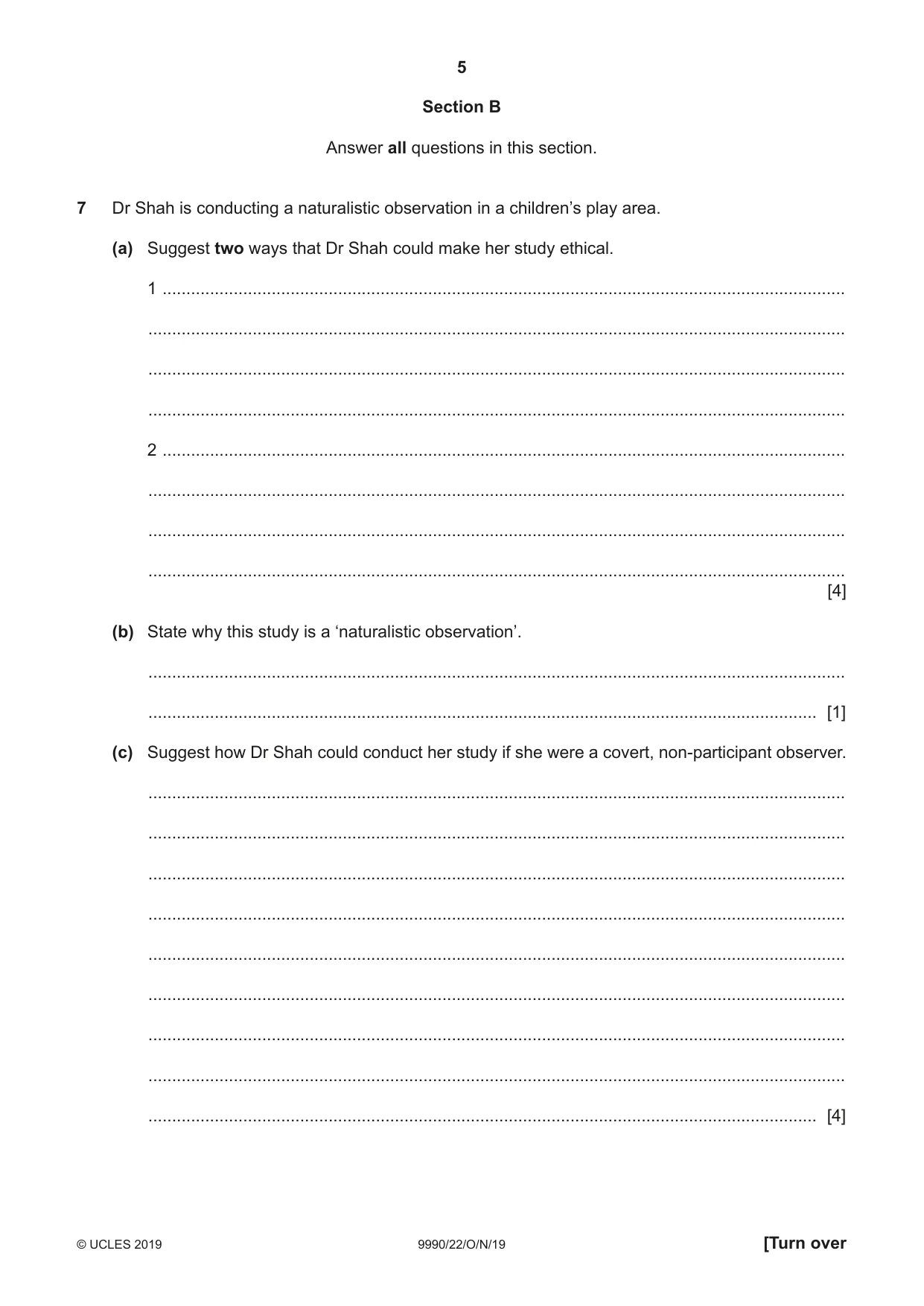
Q7 · Dr Shah is conducting a naturalistic observation in a children’s play area
7 Dr Shah is conducting a naturalistic observation in a children’s play area. (a) Suggest two ways that Dr Shah could make her study ethical. 1 ................................................................................................................................................ ................................................................................................................................................... ................................................................................................................................................... ................................................................................................................................................... 2 ................................................................................................................................................ ................................................................................................................................................... ................................................................................................................................................... ................................................................................................................................................... [4] (b) State why this study is a ‘naturalistic observation’. ................................................................................................................................................... ............................................................................................................................................. [1] (c) Suggest how Dr Shah could conduct her study if she were a covert, non-participant observer. ................................................................................................................................................... ................................................................................................................................................... ................................................................................................................................................... ................................................................................................................................................... ................................................................................................................................................... ................................................................................................................................................... ................................................................................................................................................... ................................................................................................................................................... ............................................................................................................................................. [4]
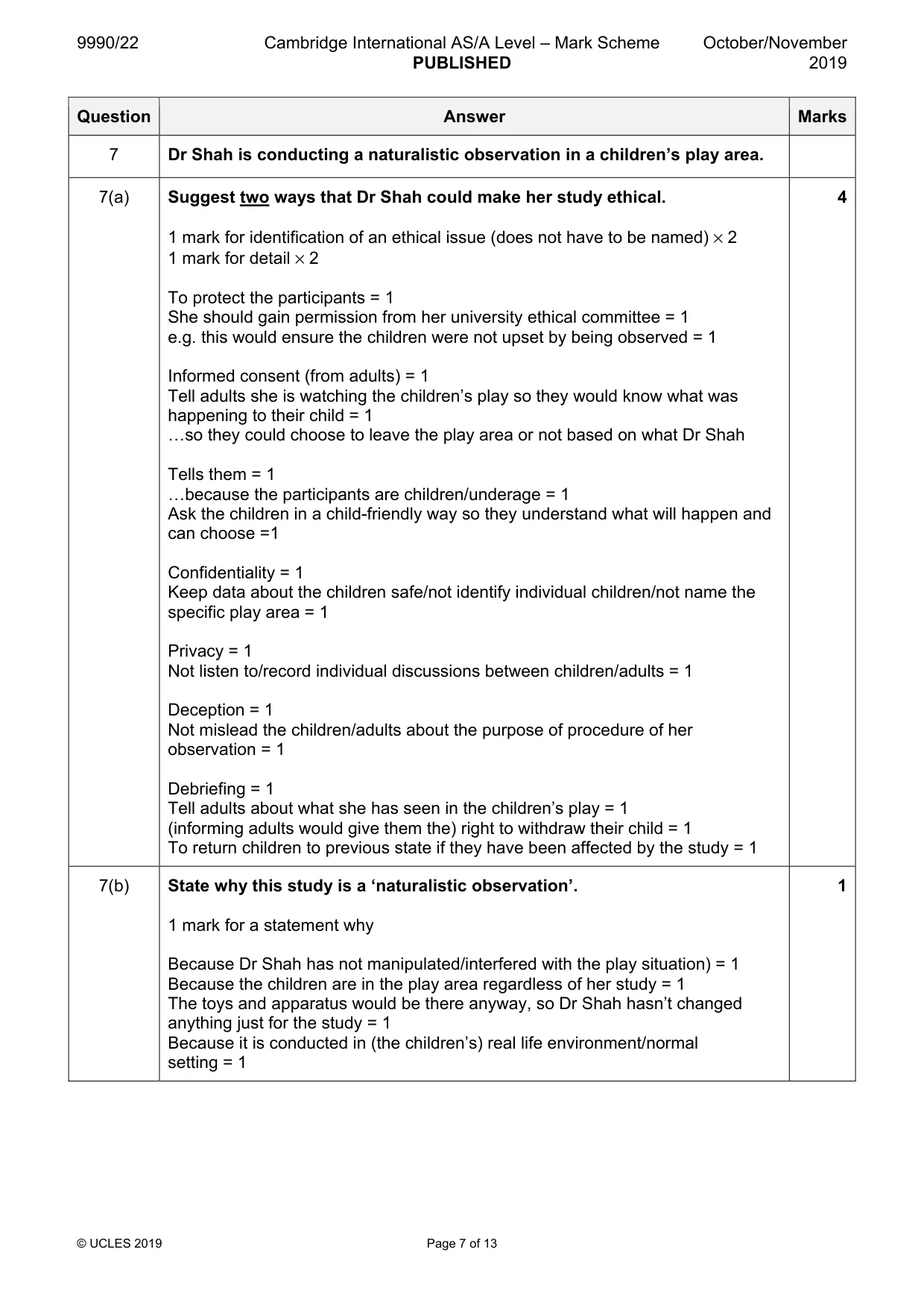
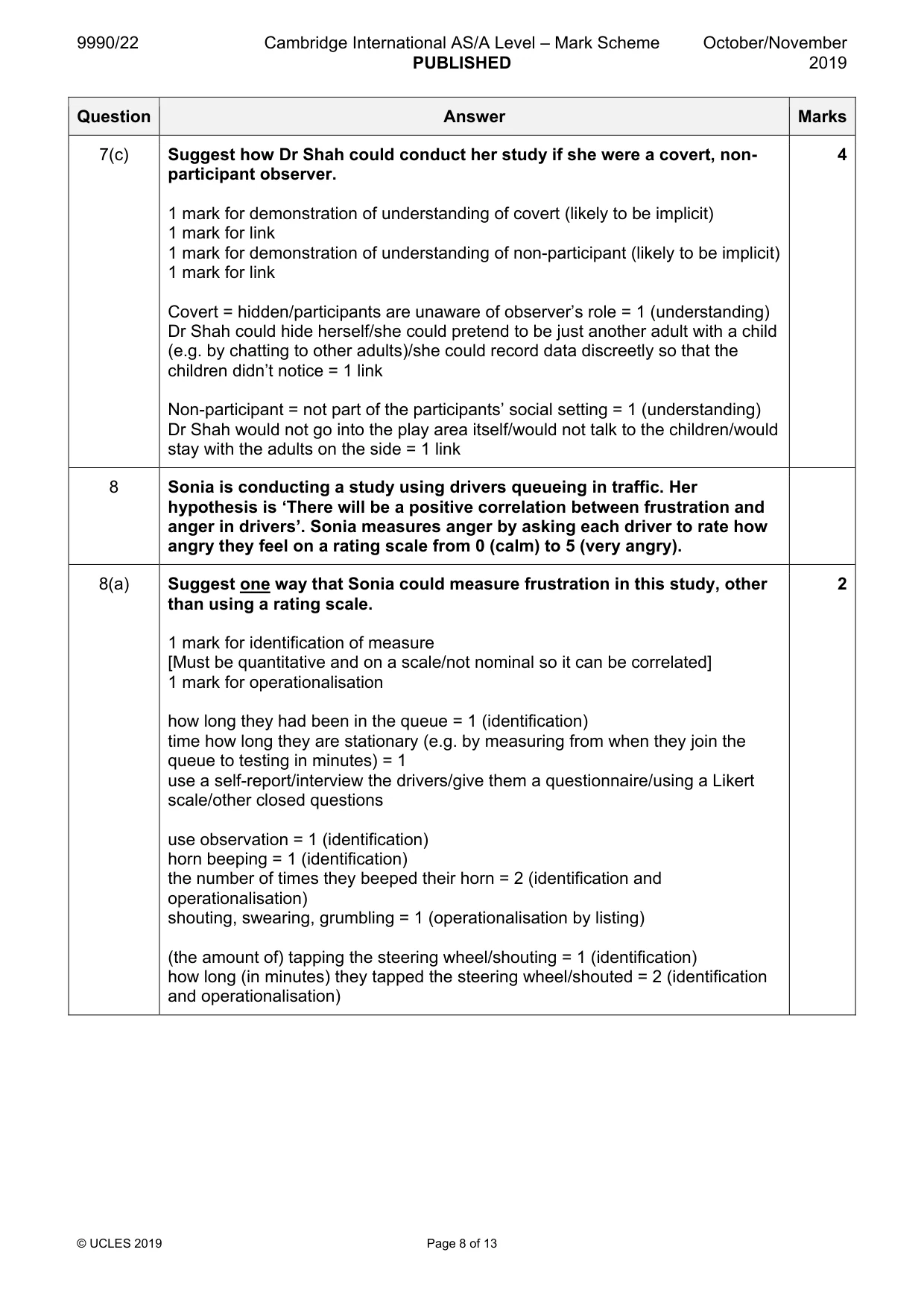
Mark scheme: 7 Dr Shah is conducting a naturalistic observation in a children’s play area. 7(a) Suggest two ways that Dr Shah could make her study ethical. 4 1 mark for identification of an ethical issue (does not have to be named) × 2 1 mark for detail × 2 To protect the participants = 1 She should gain permission from her university ethical committee = 1 e.g. this would ensure the children were not upset by being observed = 1 Informed consent (from adults) = 1 Tell adults she is watching the children’s play so they would know what was happening to their child = 1 «so they could choose to leave the play area or not based on what Dr Shah Tells them = 1 «because the participants are children/underage = 1 Ask the children in a child-friendly way so they understand what will happen and can choose =1 Confidentiality = 1 Keep data about the children safe/not identify individual children/not name the specific play area = 1 Privacy = 1 Not listen to/record individual discussions between children/adults = 1 Deception = 1 Not mislead the children/adults about the purpose of procedure of her observation = 1 Debriefing = 1 Tell adults about what she has seen in the children’s play = 1 (informing adults would give them the) right to withdraw their child = 1 To return children to previous state if they have been affected by the study = 1 7(b) State why this study is a ‘naturalistic observation’. 1 1 mark for a statement why Because Dr Shah has not manipulated/interfered with the play situation) = 1 Because the children are in the play area regardless of her study = 1 The toys and apparatus would be there anyway, so Dr Shah hasn’t changed anything just for the study = 1 Because it is conducted in (the children’s) real life environment/normal setting = 1 7(c) Suggest how Dr Shah could conduct her study if she were a covert, non- 4 participant observer. 1 mark for demonstration of understanding of covert (likely to be implicit) 1 mark for link 1 mark for demonstration of understanding of non-participant (likely to be implicit) 1 mark for link Covert = hidden/participants are unaware of observer’s role = 1 (understanding) Dr Shah could hide herself/she could pretend to be just another adult with a child (e.g. by chatting to other adults)/she could record data discreetly so that the children didn’t notice = 1 link Non-participant = not part of the participants’ social setting = 1 (understanding) Dr Shah would not go into the play area itself/would not talk to the children/would stay with the adults on the side = 1 link
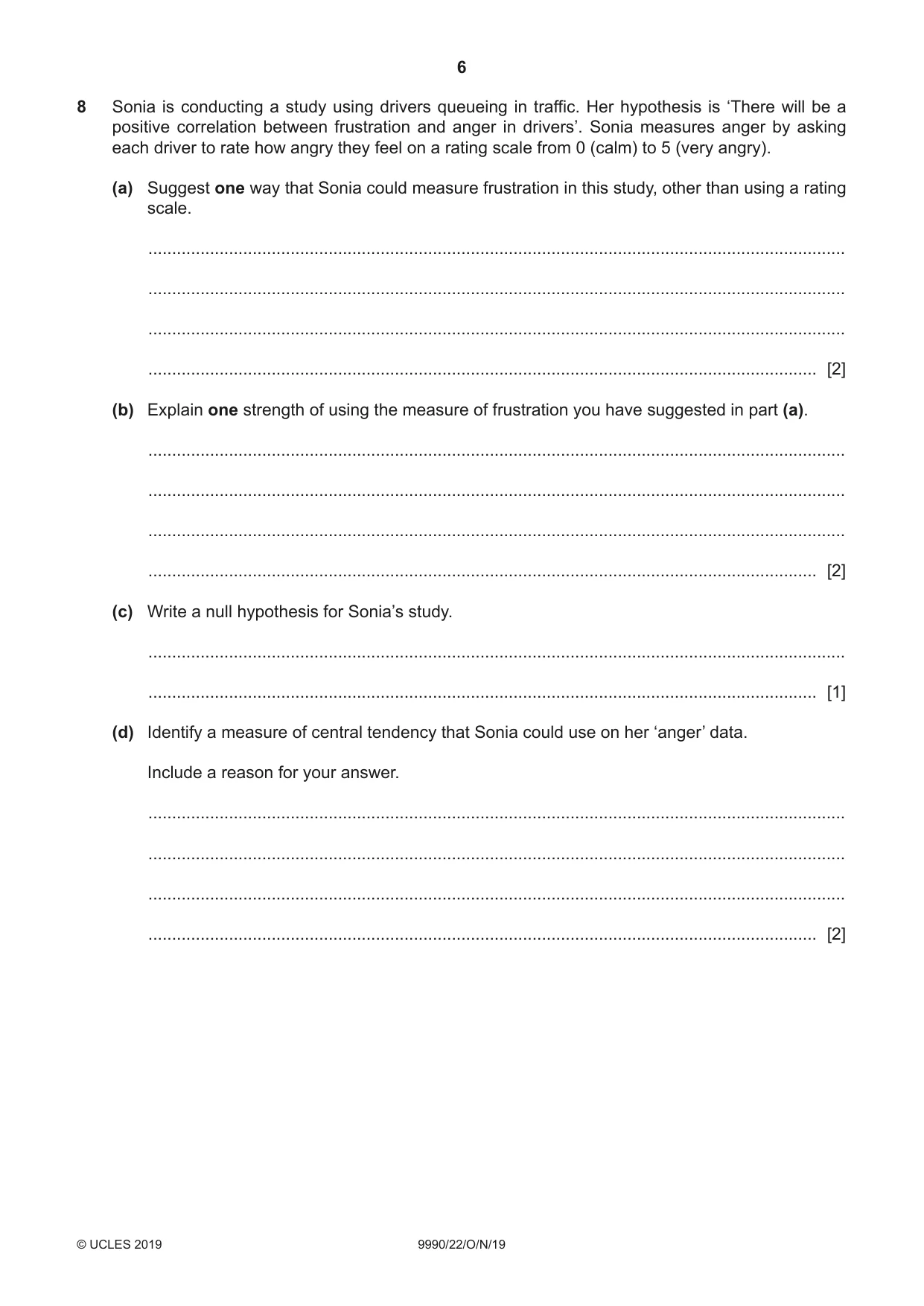
Q8 · Sonia is conducting a study using drivers queueing in traffic
8 Sonia is conducting a study using drivers queueing in traffic. Her hypothesis is ‘There will be a positive correlation between frustration and anger in drivers’. Sonia measures anger by asking each driver to rate how angry they feel on a rating scale from 0 (calm) to 5 (very angry). (a) Suggest one way that Sonia could measure frustration in this study, other than using a rating scale. ................................................................................................................................................... ................................................................................................................................................... ................................................................................................................................................... ............................................................................................................................................. [2] (b) Explain one strength of using the measure of frustration you have suggested in part (a). ................................................................................................................................................... ................................................................................................................................................... ................................................................................................................................................... ............................................................................................................................................. [2] (c) Write a null hypothesis for Sonia’s study. ................................................................................................................................................... ............................................................................................................................................. [1] (d) Identify a measure of central tendency that Sonia could use on her ‘anger’ data. Include a reason for your answer. ................................................................................................................................................... ................................................................................................................................................... ................................................................................................................................................... ............................................................................................................................................. [2]
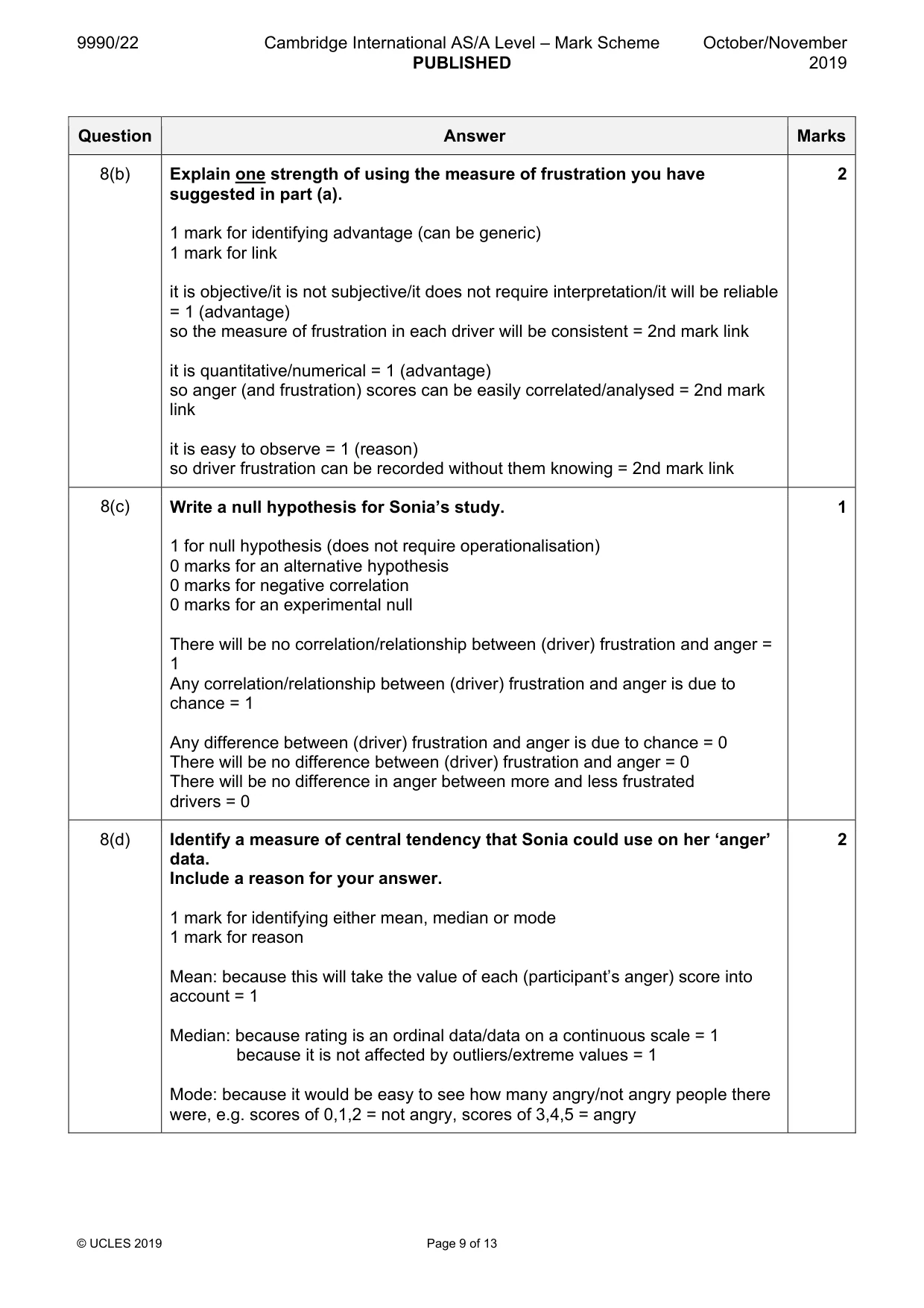
Mark scheme: 8 Sonia is conducting a study using drivers queueing in traffic. Her hypothesis is ‘There will be a positive correlation between frustration and anger in drivers’. Sonia measures anger by asking each driver to rate how angry they feel on a rating scale from 0 (calm) to 5 (very angry). 8(a) Suggest one way that Sonia could measure frustration in this study, other 2 than using a rating scale. 1 mark for identification of measure [Must be quantitative and on a scale/not nominal so it can be correlated] 1 mark for operationalisation how long they had been in the queue = 1 (identification) time how long they are stationary (e.g. by measuring from when they join the queue to testing in minutes) = 1 use a self-report/interview the drivers/give them a questionnaire/using a Likert scale/other closed questions use observation = 1 (identification) horn beeping = 1 (identification) the number of times they beeped their horn = 2 (identification and operationalisation) shouting, swearing, grumbling = 1 (operationalisation by listing) (the amount of) tapping the steering wheel/shouting = 1 (identification) how long (in minutes) they tapped the steering wheel/shouted = 2 (identification and operationalisation) Question Answer Marks 8(b) Explain one strength of using the measure of frustration you have 2 suggested in part (a). 1 mark for identifying advantage (can be generic) 1 mark for link it is objective/it is not subjective/it does not require interpretation/it will be reliable = 1 (advantage) so the measure of frustration in each driver will be consistent = 2nd mark link it is quantitative/numerical = 1 (advantage) so anger (and frustration) scores can be easily correlated/analysed = 2nd mark link it is easy to observe = 1 (reason) so driver frustration can be recorded without them knowing = 2nd mark link 8(c) Write a null hypothesis for Sonia’s study. 1 1 for null hypothesis (does not require operationalisation) 0 marks for an alternative hypothesis 0 marks for negative correlation 0 marks for an experimental null There will be no correlation/relationship between (driver) frustration and anger = 1 Any correlation/relationship between (driver) frustration and anger is due to chance = 1 Any difference between (driver) frustration and anger is due to chance = 0 There will be no difference between (driver) frustration and anger = 0 There will be no difference in anger between more and less frustrated drivers = 0 8(d) Identify a measure of central tendency that Sonia could use on her ‘anger’ 2 data. Include a reason for your answer. 1 mark for identifying either mean, median or mode 1 mark for reason Mean: because this will take the value of each (participant’s anger) score into account = 1 Median: because rating is an ordinal data/data on a continuous scale = 1 because it is not affected by outliers/extreme values = 1 Mode: because it would be easy to see how many angry/not angry people there were, e.g. scores of 0,1,2 = not angry, scores of 3,4,5 = angry
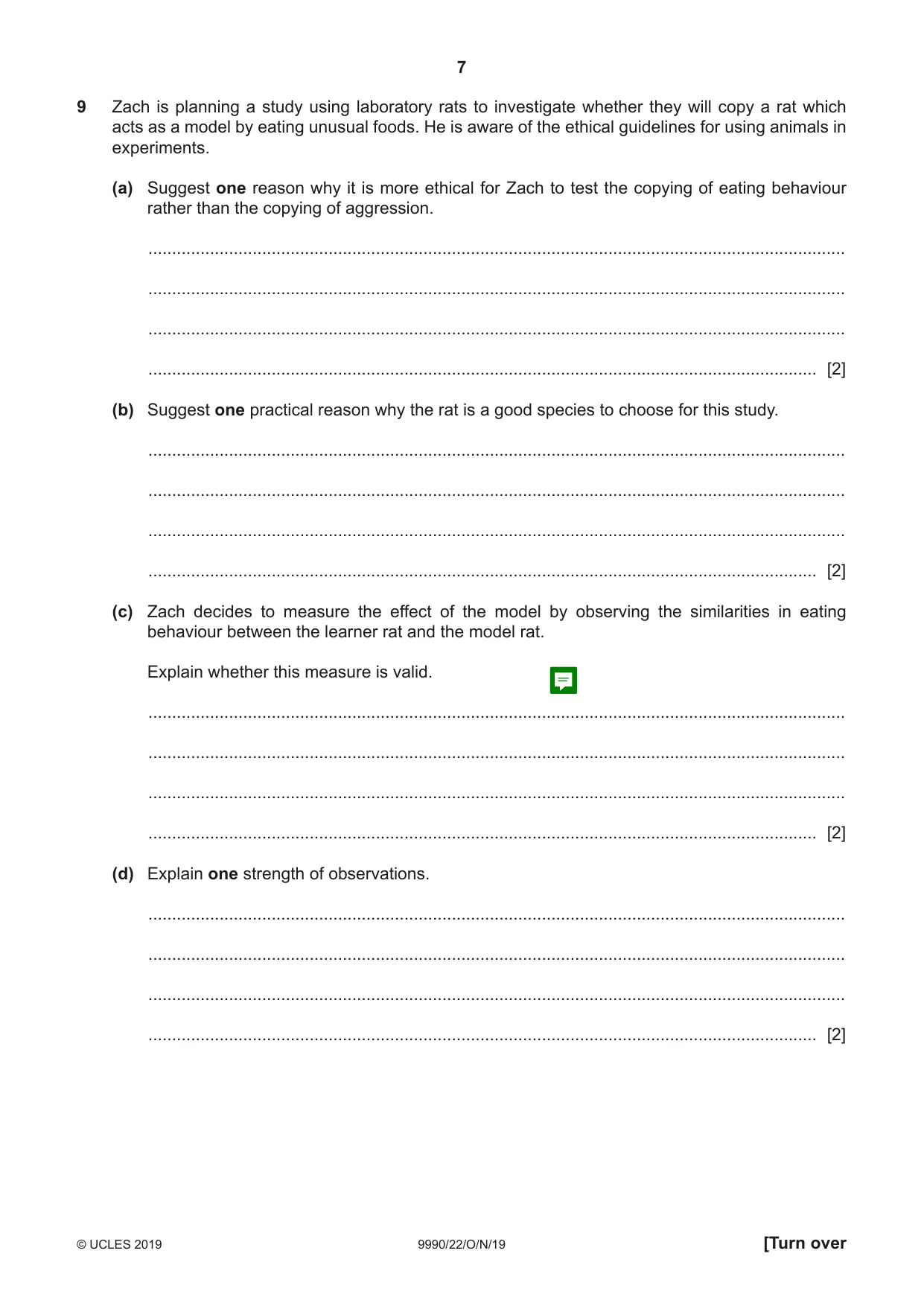
Q9 · Zach is planning a study using laboratory rats to investigate whether they will copy a…
9 Zach is planning a study using laboratory rats to investigate whether they will copy a rat which acts as a model by eating unusual foods. He is aware of the ethical guidelines for using animals in experiments. (a) Suggest one reason why it is more ethical for Zach to test the copying of eating behaviour rather than the copying of aggression. ................................................................................................................................................... ................................................................................................................................................... ................................................................................................................................................... ............................................................................................................................................. [2] (b) Suggest one practical reason why the rat is a good species to choose for this study. ................................................................................................................................................... ................................................................................................................................................... ................................................................................................................................................... ............................................................................................................................................. [2] (c) Zach decides to measure the effect of the model by observing the similarities in eating behaviour between the learner rat and the model rat. Explain whether this measure is valid. ................................................................................................................................................... ................................................................................................................................................... ................................................................................................................................................... ............................................................................................................................................. [2] (d) Explain one strength of observations. ................................................................................................................................................... ................................................................................................................................................... ................................................................................................................................................... ............................................................................................................................................. [2] Section C Answer all questions in this section.
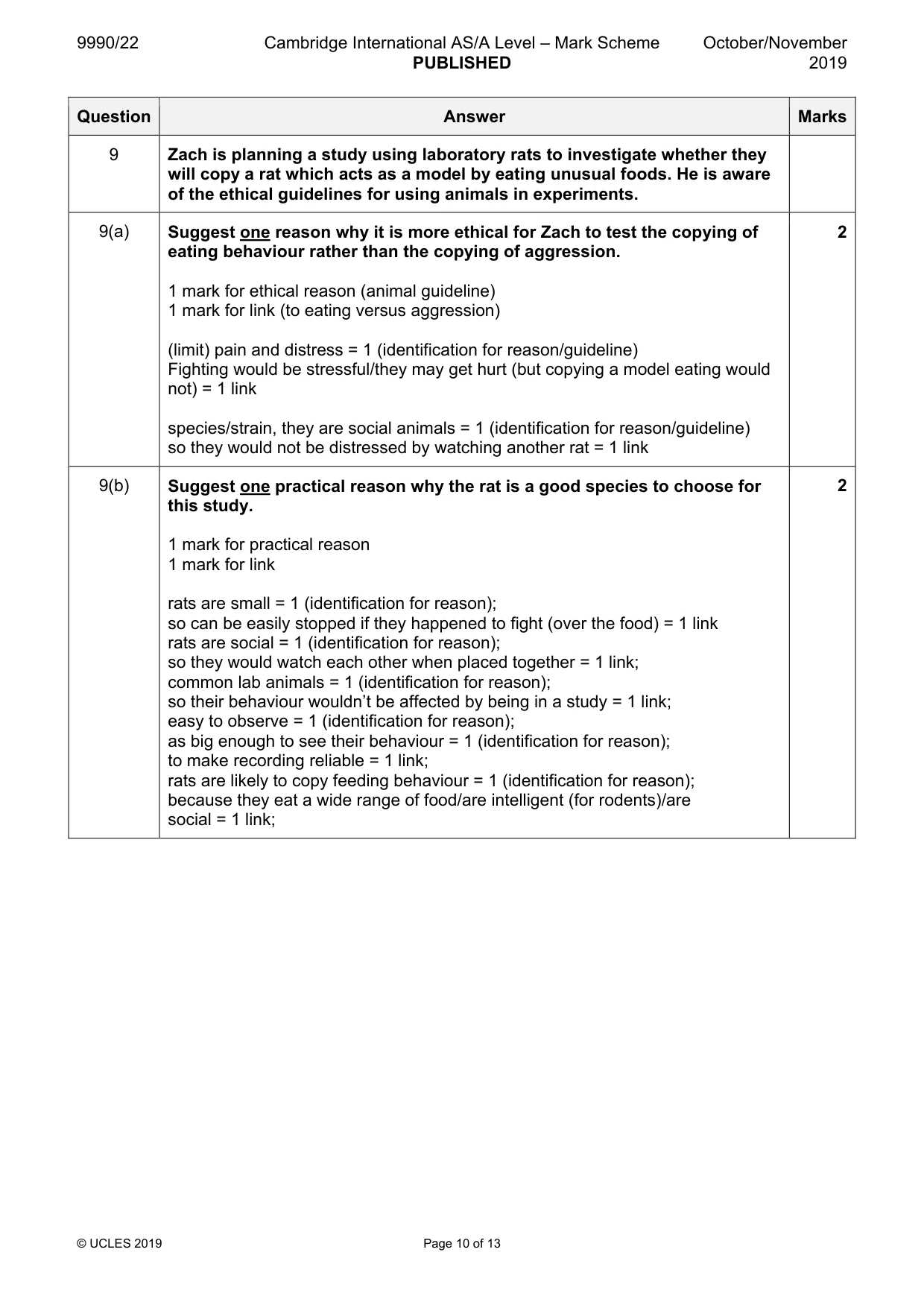
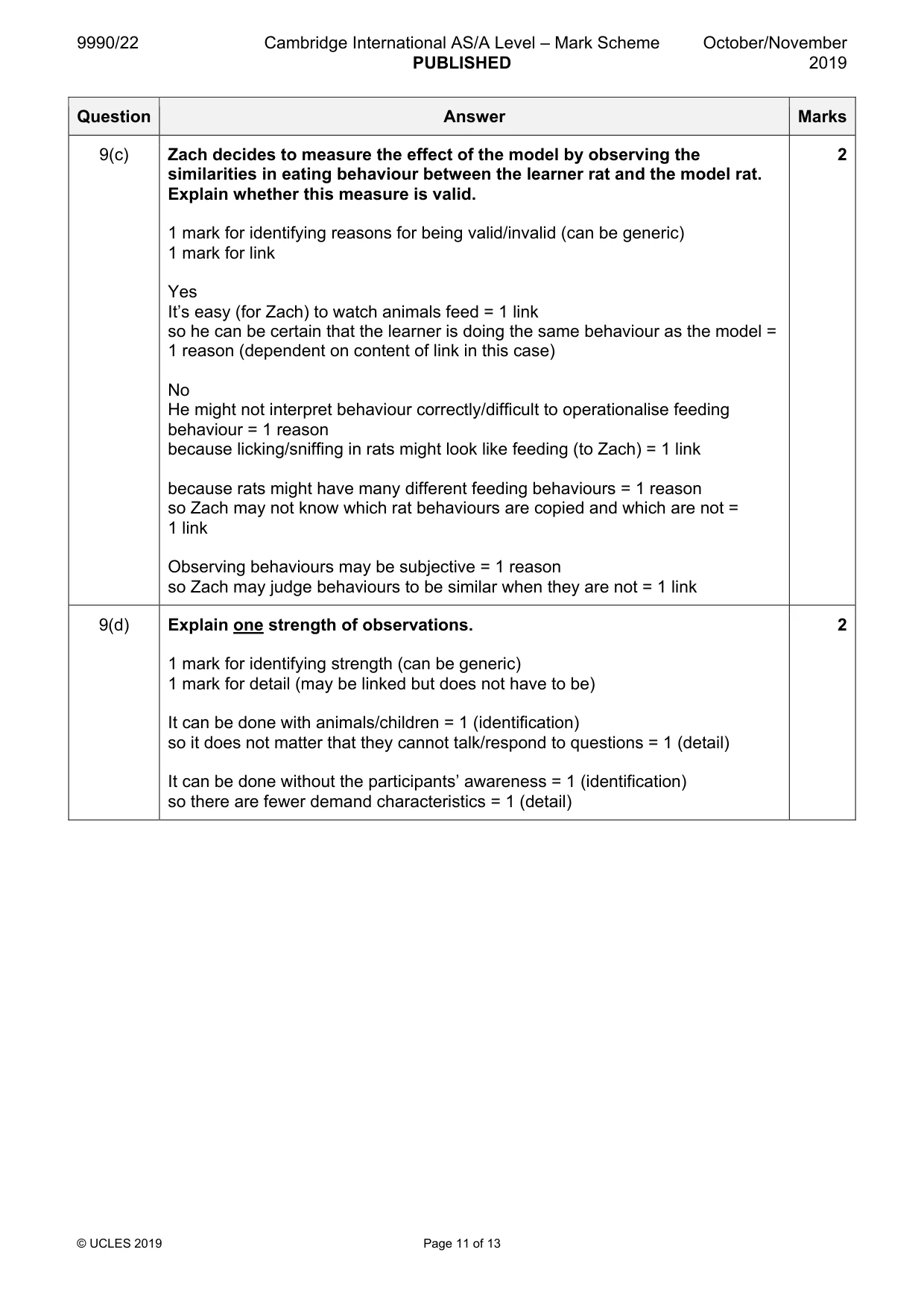
Mark scheme: 9 Zach is planning a study using laboratory rats to investigate whether they will copy a rat which acts as a model by eating unusual foods. He is aware of the ethical guidelines for using animals in experiments. 9(a) Suggest one reason why it is more ethical for Zach to test the copying of 2 eating behaviour rather than the copying of aggression. 1 mark for ethical reason (animal guideline) 1 mark for link (to eating versus aggression) (limit) pain and distress = 1 (identification for reason/guideline) Fighting would be stressful/they may get hurt (but copying a model eating would not) = 1 link species/strain, they are social animals = 1 (identification for reason/guideline) so they would not be distressed by watching another rat = 1 link 9(b) Suggest one practical reason why the rat is a good species to choose for 2 this study. 1 mark for practical reason 1 mark for link rats are small = 1 (identification for reason); so can be easily stopped if they happened to fight (over the food) = 1 link rats are social = 1 (identification for reason); so they would watch each other when placed together = 1 link; common lab animals = 1 (identification for reason); so their behaviour wouldn’t be affected by being in a study = 1 link; easy to observe = 1 (identification for reason); as big enough to see their behaviour = 1 (identification for reason); to make recording reliable = 1 link; rats are likely to copy feeding behaviour = 1 (identification for reason); because they eat a wide range of food/are intelligent (for rodents)/are social = 1 link; 9(c) Zach decides to measure the effect of the model by observing the 2 similarities in eating behaviour between the learner rat and the model rat. Explain whether this measure is valid. 1 mark for identifying reasons for being valid/invalid (can be generic) 1 mark for link Yes It’s easy (for Zach) to watch animals feed = 1 link so he can be certain that the learner is doing the same behaviour as the model = 1 reason (dependent on content of link in this case) No He might not interpret behaviour correctly/difficult to operationalise feeding behaviour = 1 reason because licking/sniffing in rats might look like feeding (to Zach) = 1 link because rats might have many different feeding behaviours = 1 reason so Zach may not know which rat behaviours are copied and which are not = 1 link Observing behaviours may be subjective = 1 reason so Zach may judge behaviours to be similar when they are not = 1 link 9(d) Explain one strength of observations. 2 1 mark for identifying strength (can be generic) 1 mark for detail (may be linked but does not have to be) It can be done with animals/children = 1 (identification) so it does not matter that they cannot talk/respond to questions = 1 (detail) It can be done without the participants’ awareness = 1 (identification) so there are fewer demand characteristics = 1 (detail)
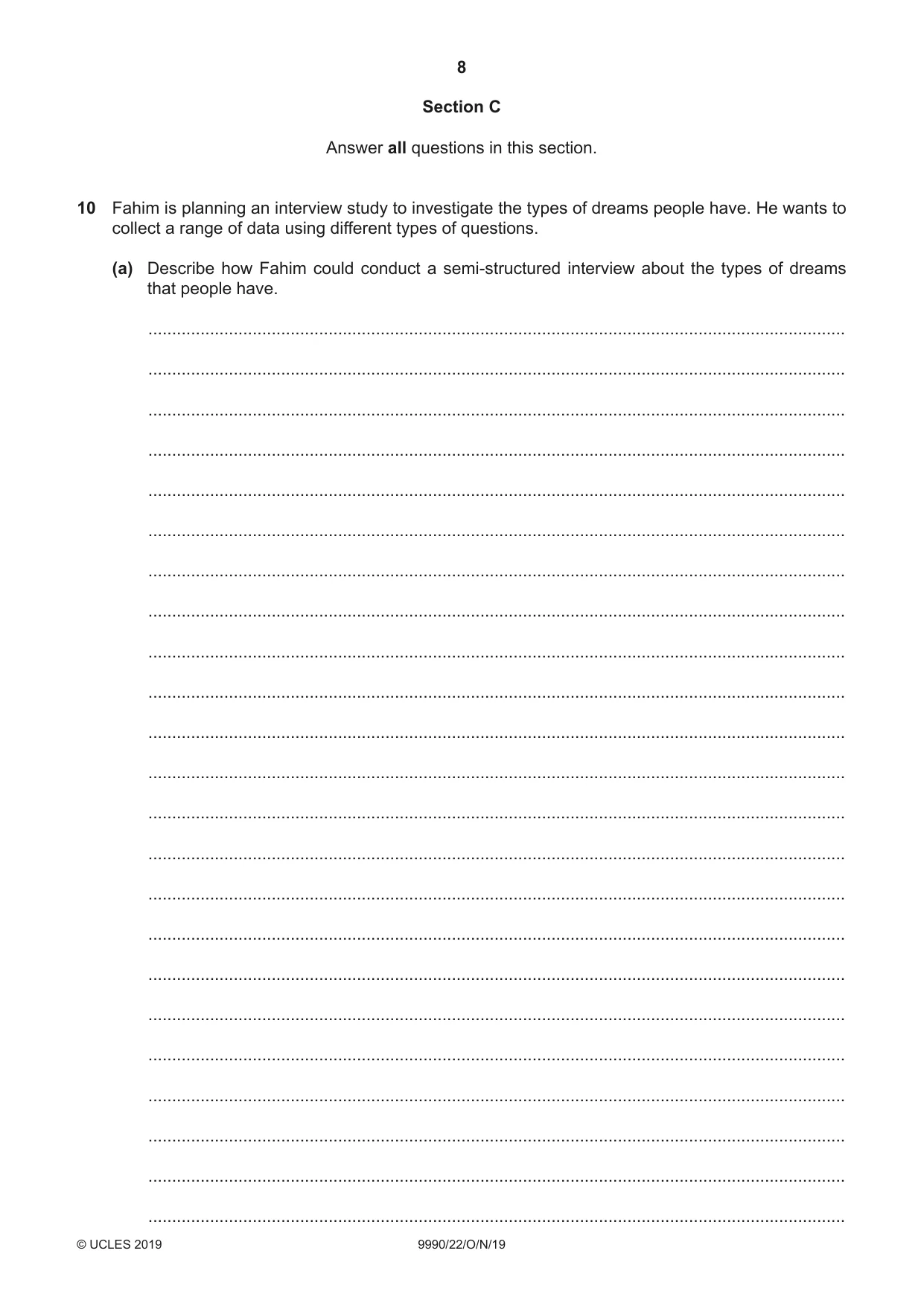
Q10 · Fahim is planning an interview study to investigate the types of dreams people have
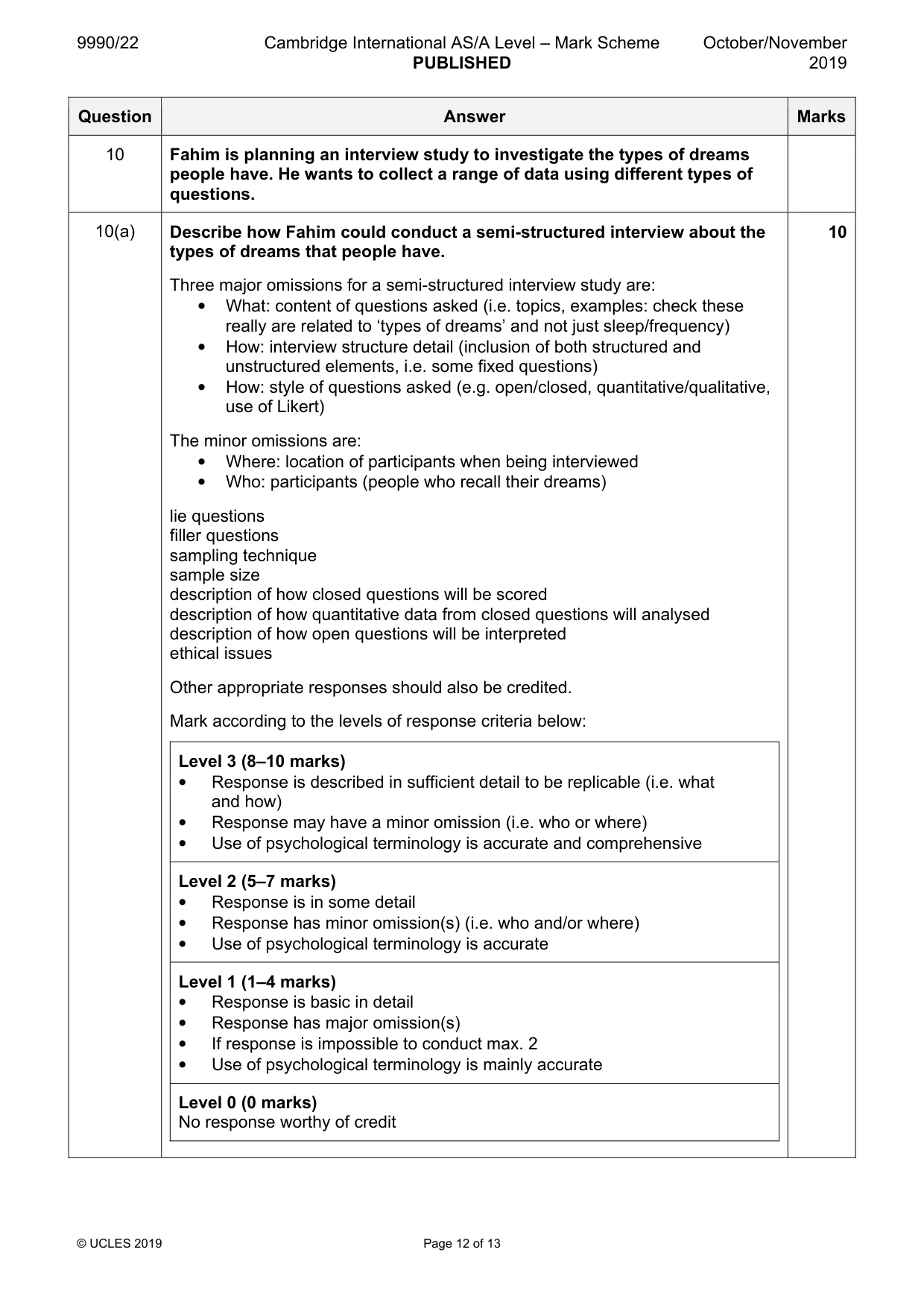
10 Fahim is planning an interview study to investigate the types of dreams people have. He wants to collect a range of data using different types of questions. (a) Describe how Fahim could conduct a semi-structured interview about the types of dreams that people have. ................................................................................................................................................... ................................................................................................................................................... ................................................................................................................................................... ................................................................................................................................................... ................................................................................................................................................... ................................................................................................................................................... ................................................................................................................................................... ................................................................................................................................................... ................................................................................................................................................... ................................................................................................................................................... ................................................................................................................................................... ................................................................................................................................................... ................................................................................................................................................... ................................................................................................................................................... ................................................................................................................................................... ................................................................................................................................................... ................................................................................................................................................... ................................................................................................................................................... ................................................................................................................................................... ................................................................................................................................................... ................................................................................................................................................... ................................................................................................................................................... ................................................................................................................................................... ................................................................................................................................................... ................................................................................................................................................... ................................................................................................................................................... ................................................................................................................................................... ................................................................................................................................................... ................................................................................................................................................... ................................................................................................................................................... ........................................................................................................................................... [10] (b) Identify one practical weakness/limitation with the procedure you have described in your answer to part (a) and suggest how your study might be done differently to overcome the problem. Do not refer to ethics or sampling in your answer. ................................................................................................................................................... ................................................................................................................................................... ................................................................................................................................................... ................................................................................................................................................... ................................................................................................................................................... ................................................................................................................................................... ................................................................................................................................................... ............................................................................................................................................. [4]
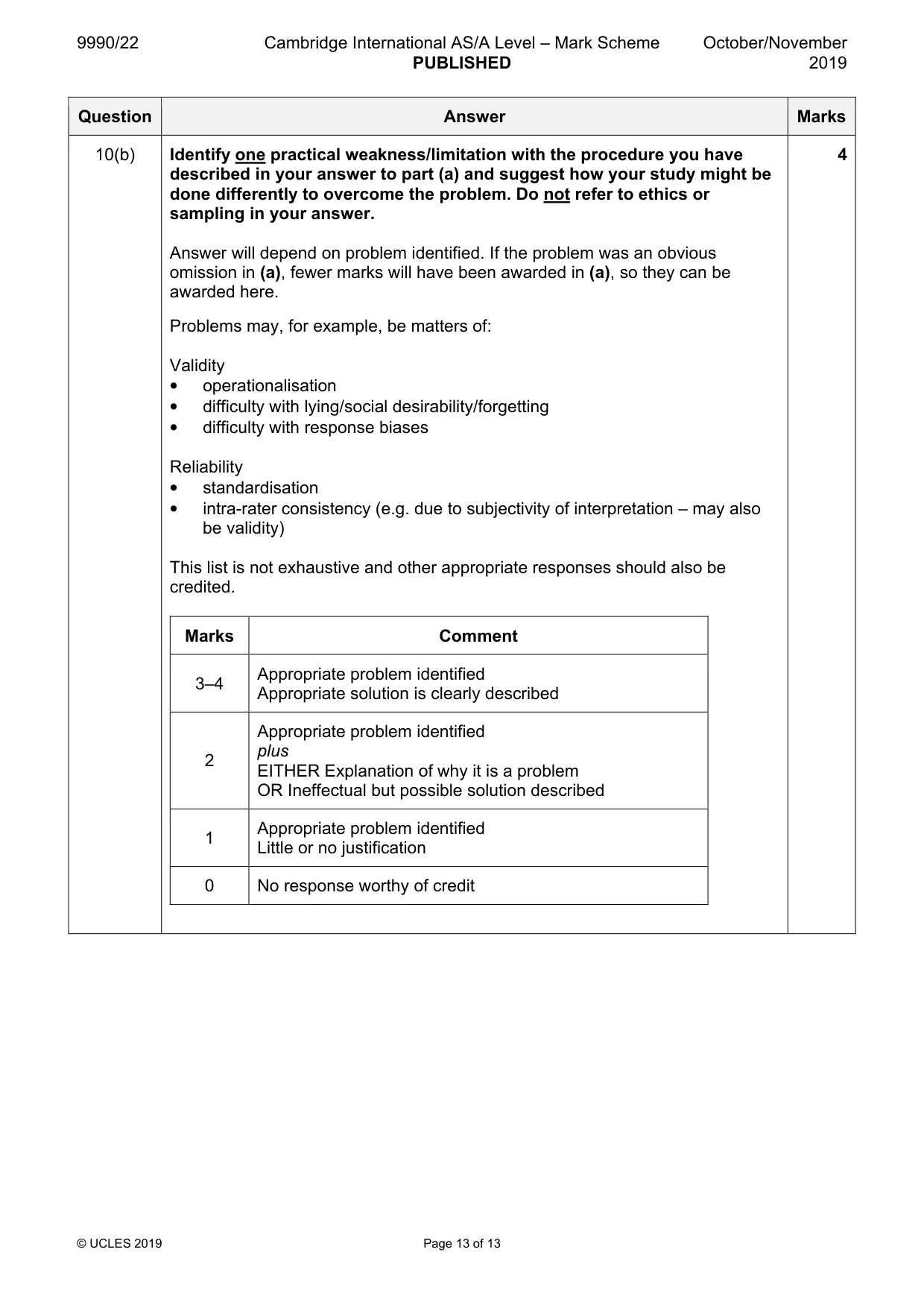
Mark scheme: 10 Fahim is planning an interview study to investigate the types of dreams people have. He wants to collect a range of data using different types of questions. 10(a) Describe how Fahim could conduct a semi-structured interview about the 10 types of dreams that people have. Three major omissions for a semi-structured interview study are: • What: content of questions asked (i.e. topics, examples: check these really are related to ‘types of dreams’ and not just sleep/frequency) • How: interview structure detail (inclusion of both structured and unstructured elements, i.e. some fixed questions) • How: style of questions asked (e.g. open/closed, quantitative/qualitative, use of Likert) The minor omissions are: • Where: location of participants when being interviewed • Who: participants (people who recall their dreams) lie questions filler questions sampling technique sample size description of how closed questions will be scored description of how quantitative data from closed questions will analysed description of how open questions will be interpreted ethical issues Other appropriate responses should also be credited. Mark according to the levels of response criteria below: Level 3 (8–10 marks) • Response is described in sufficient detail to be replicable (i.e. what and how) • Response may have a minor omission (i.e. who or where) • Use of psychological terminology is accurate and comprehensive Level 2 (5–7 marks) • Response is in some detail • Response has minor omission(s) (i.e. who and/or where) • Use of psychological terminology is accurate Level 1 (1–4 marks) • Response is basic in detail • Response has major omission(s) • If response is impossible to conduct max. 2 • Use of psychological terminology is mainly accurate Level 0 (0 marks) No response worthy of credit 10(b) Identify one practical weakness/limitation with the procedure you have 4 described in your answer to part (a) and suggest how your study might be done differently to overcome the problem. Do not refer to ethics or sampling in your answer. Answer will depend on problem identified. If the problem was an obvious omission in (a), fewer marks will have been awarded in (a), so they can be awarded here. Problems may, for example, be matters of: Validity • operationalisation • difficulty with lying/social desirability/forgetting • difficulty with response biases Reliability • standardisation • intra-rater consistency (e.g. due to subjectivity of interpretation – may also be validity) This list is not exhaustive and other appropriate responses should also be credited. Marks Comment Appropriate problem identified 3–4 Appropriate solution is clearly described Appropriate problem identified plus 2 EITHER Explanation of why it is a problem OR Ineffectual but possible solution described Appropriate problem identified 1 Little or no justification 0 No response worthy of credit
What was in this paper
The subtopics covered by these 10 questions, and how many questions each got. Open one in a new tab to see every Cambridge question on it.
What you needed in this session
Cambridge’s own grade thresholds for 2019 Oct/Nov, Paper 2 · Variant 2. A higher threshold means an easier paper — the bar moves with how the cohort did.