Cambridge A Level Psychology (from 2018) 9990 — 2019 Oct/Nov Paper 2 · Variant 1
9990/21/O/N/19 · 10 questions · 60 marks · ≈68 min
The question paper and its mark scheme, free to read here and free to download. This is Cambridge’s own paper, exactly as it was sat.
Question paper12 pages


Mark scheme13 pages
Answers below. Sit the paper first if you are practising.
Questions as text
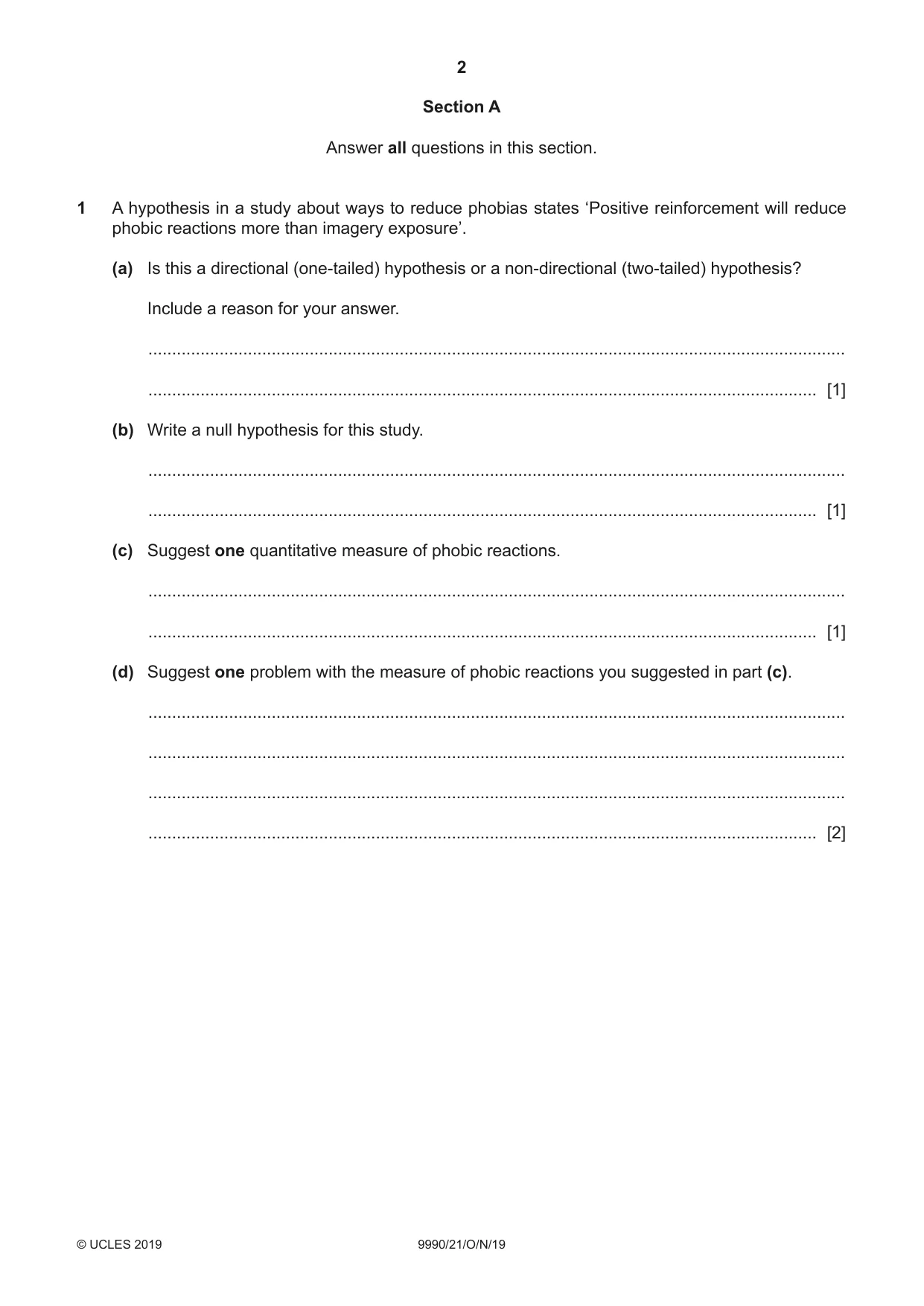
Q1 · A hypothesis in a study about ways to reduce phobias states ‘Positive reinforcement will…
1 A hypothesis in a study about ways to reduce phobias states ‘Positive reinforcement will reduce phobic reactions more than imagery exposure’. (a) Is this a directional (one-tailed) hypothesis or a non-directional (two-tailed) hypothesis? Include a reason for your answer. ................................................................................................................................................... ............................................................................................................................................. [1] (b) Write a null hypothesis for this study. ................................................................................................................................................... ............................................................................................................................................. [1] (c) Suggest one quantitative measure of phobic reactions. ................................................................................................................................................... ............................................................................................................................................. [1] (d) Suggest one problem with the measure of phobic reactions you suggested in part (c). ................................................................................................................................................... ................................................................................................................................................... ................................................................................................................................................... ............................................................................................................................................. [2]
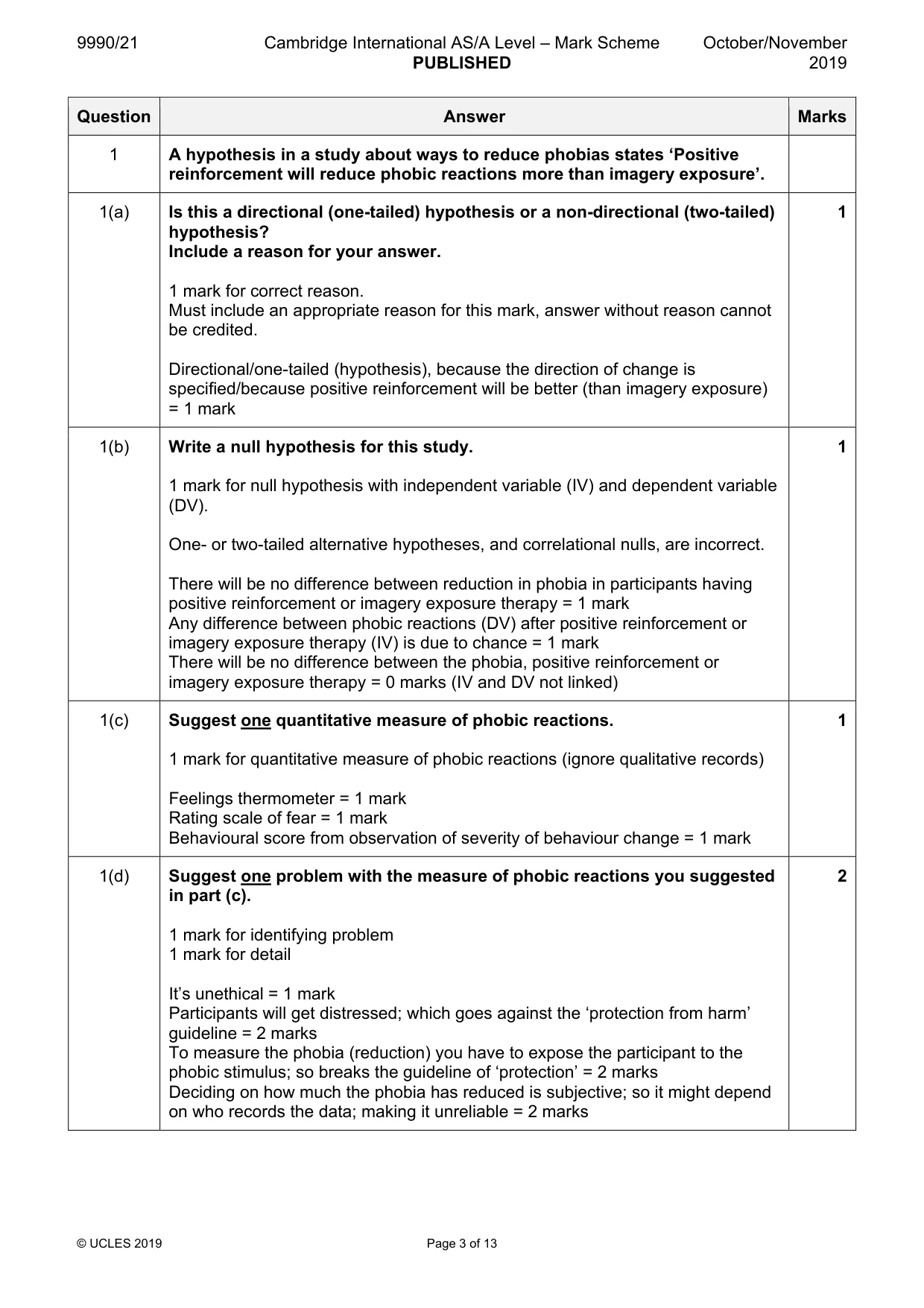
Mark scheme: Question Answer Marks 1 A hypothesis in a study about ways to reduce phobias states ‘Positive reinforcement will reduce phobic reactions more than imagery exposure’. 1(a) Is this a directional (one-tailed) hypothesis or a non-directional (two-tailed) 1 hypothesis? Include a reason for your answer. 1 mark for correct reason. Must include an appropriate reason for this mark, answer without reason cannot be credited. Directional/one-tailed (hypothesis), because the direction of change is specified/because positive reinforcement will be better (than imagery exposure) = 1 mark 1(b) Write a null hypothesis for this study. 1 1 mark for null hypothesis with independent variable (IV) and dependent variable (DV). One- or two-tailed alternative hypotheses, and correlational nulls, are incorrect. There will be no difference between reduction in phobia in participants having positive reinforcement or imagery exposure therapy = 1 mark Any difference between phobic reactions (DV) after positive reinforcement or imagery exposure therapy (IV) is due to chance = 1 mark There will be no difference between the phobia, positive reinforcement or imagery exposure therapy = 0 marks (IV and DV not linked) 1(c) Suggest one quantitative measure of phobic reactions. 1 1 mark for quantitative measure of phobic reactions (ignore qualitative records) Feelings thermometer = 1 mark Rating scale of fear = 1 mark Behavioural score from observation of severity of behaviour change = 1 mark 1(d) Suggest one problem with the measure of phobic reactions you suggested 2 in part (c). 1 mark for identifying problem 1 mark for detail It’s unethical = 1 mark Participants will get distressed; which goes against the ‘protection from harm’ guideline = 2 marks To measure the phobia (reduction) you have to expose the participant to the phobic stimulus; so breaks the guideline of ‘protection’ = 2 marks Deciding on how much the phobia has reduced is subjective; so it might depend on who records the data; making it unreliable = 2 marks
Q2 · Standardisation was important in the study by Dement and Kleitman (sleep and dreams): (a)…
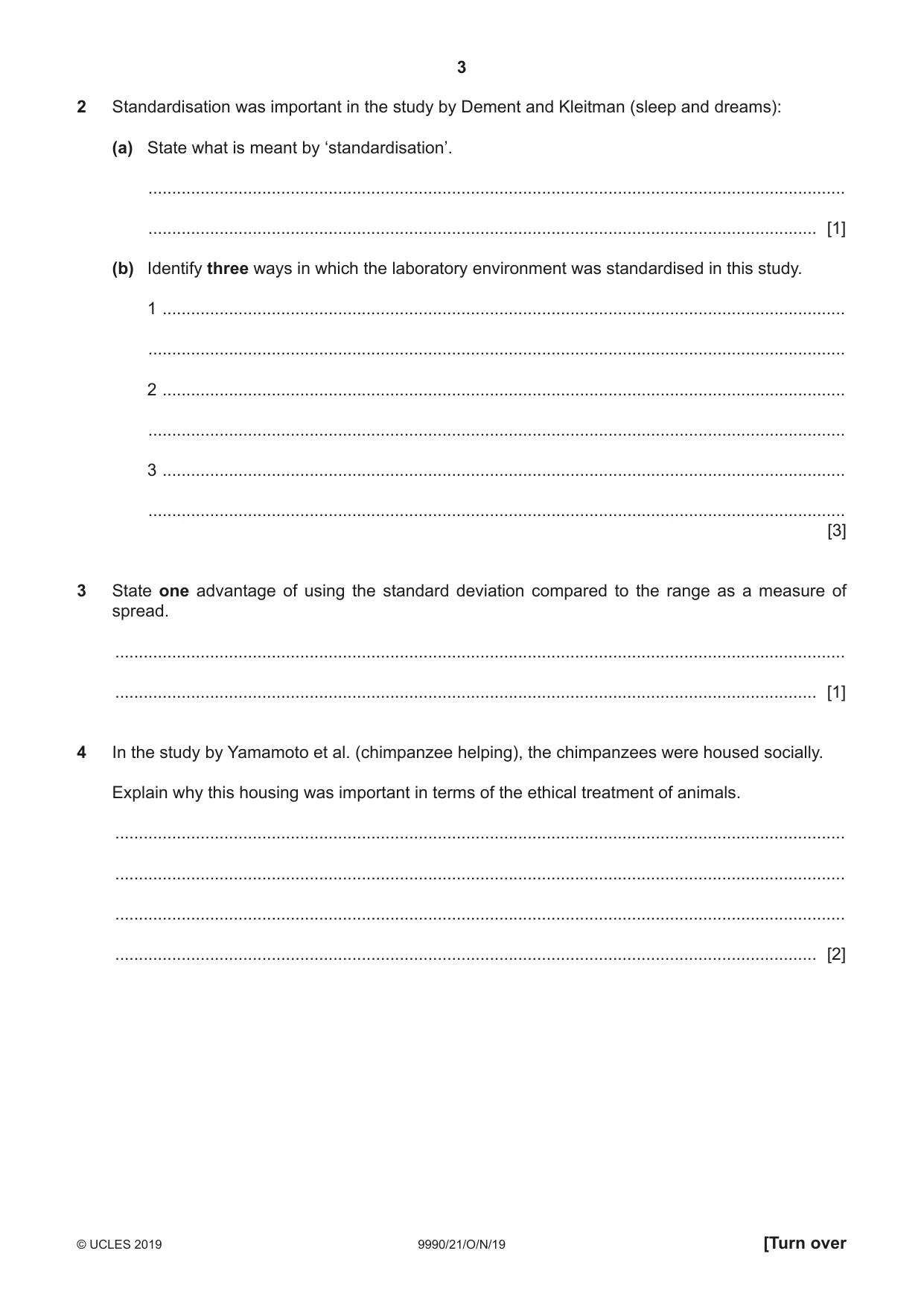
2 Standardisation was important in the study by Dement and Kleitman (sleep and dreams): (a) State what is meant by ‘standardisation’. ................................................................................................................................................... ............................................................................................................................................. [1] (b) Identify three ways in which the laboratory environment was standardised in this study. 1 ................................................................................................................................................ ................................................................................................................................................... 2 ................................................................................................................................................ ................................................................................................................................................... 3 ................................................................................................................................................ ................................................................................................................................................... [3]
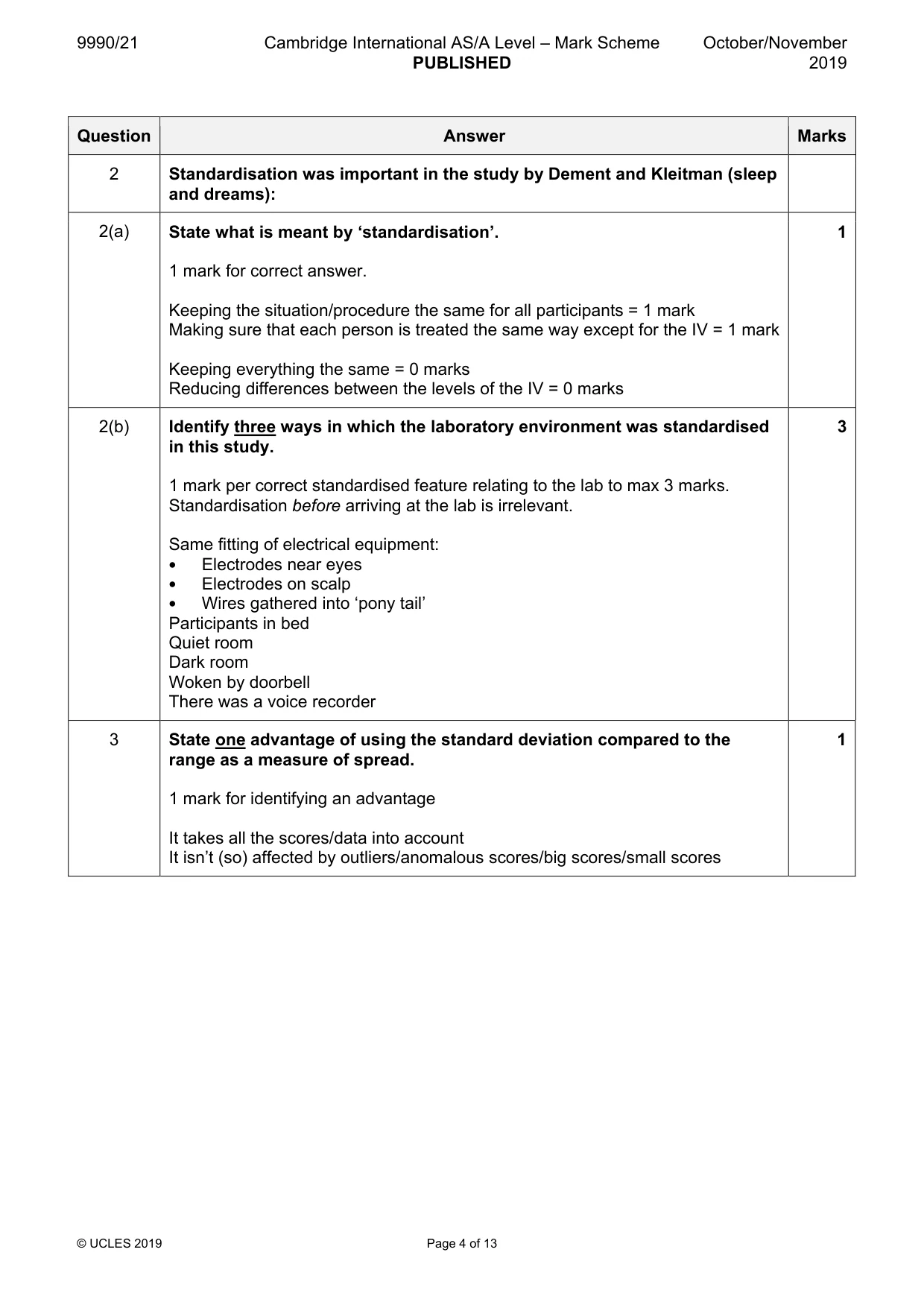
Mark scheme: 2 Standardisation was important in the study by Dement and Kleitman (sleep and dreams): 2(a) State what is meant by ‘standardisation’. 1 1 mark for correct answer. Keeping the situation/procedure the same for all participants = 1 mark Making sure that each person is treated the same way except for the IV = 1 mark Keeping everything the same = 0 marks Reducing differences between the levels of the IV = 0 marks 2(b) Identify three ways in which the laboratory environment was standardised 3 in this study. 1 mark per correct standardised feature relating to the lab to max 3 marks. Standardisation before arriving at the lab is irrelevant. Same fitting of electrical equipment: • Electrodes near eyes • Electrodes on scalp • Wires gathered into ‘pony tail’ Participants in bed Quiet room Dark room Woken by doorbell There was a voice recorder
Q3 · State one advantage of using the standard deviation compared to the range as a measure of…
3 State one advantage of using the standard deviation compared to the range as a measure of spread. .......................................................................................................................................................... .................................................................................................................................................... [1]
Mark scheme: 3 State one advantage of using the standard deviation compared to the 1 range as a measure of spread. 1 mark for identifying an advantage It takes all the scores/data into account It isn’t (so) affected by outliers/anomalous scores/big scores/small scores
Q4 · In the study by Yamamoto et al
4 In the study by Yamamoto et al. (chimpanzee helping), the chimpanzees were housed socially. Explain why this housing was important in terms of the ethical treatment of animals. .......................................................................................................................................................... .......................................................................................................................................................... .......................................................................................................................................................... .................................................................................................................................................... [2]
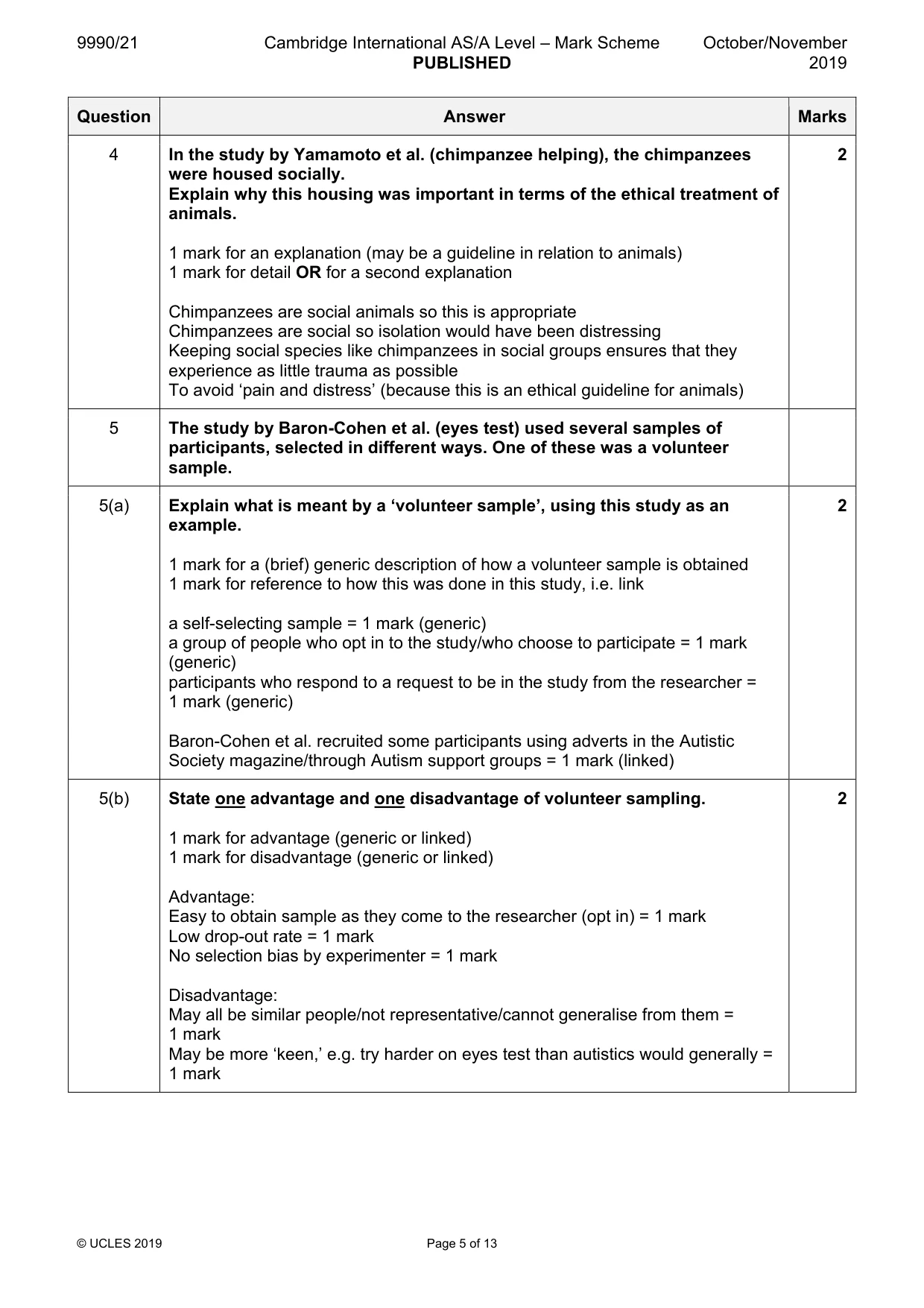
Mark scheme: 4 In the study by Yamamoto et al. (chimpanzee helping), the chimpanzees 2 were housed socially. Explain why this housing was important in terms of the ethical treatment of animals. 1 mark for an explanation (may be a guideline in relation to animals) 1 mark for detail OR for a second explanation Chimpanzees are social animals so this is appropriate Chimpanzees are social so isolation would have been distressing Keeping social species like chimpanzees in social groups ensures that they experience as little trauma as possible To avoid ‘pain and distress’ (because this is an ethical guideline for animals)
Q5 · The study by Baron-Cohen et al
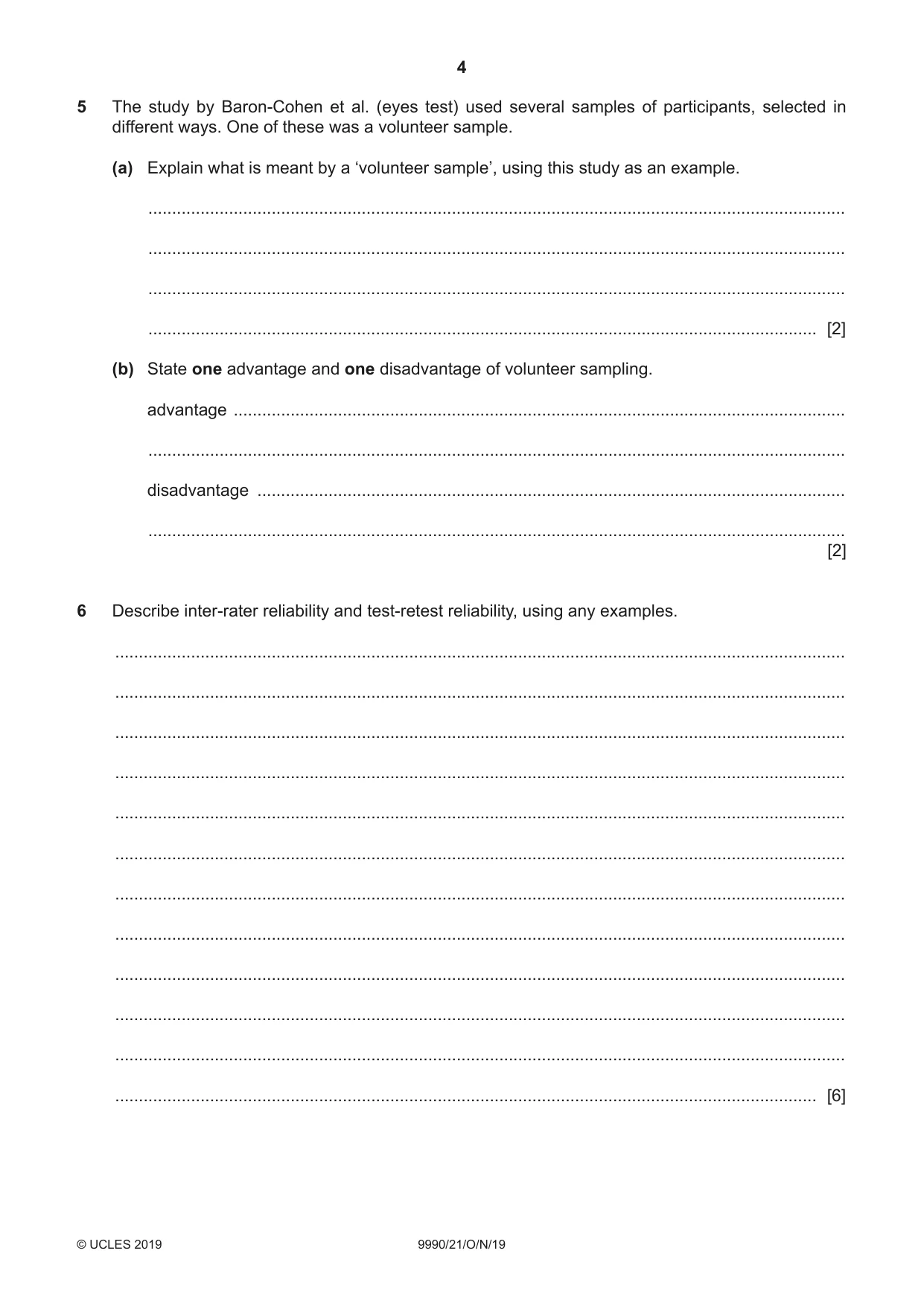
5 The study by Baron-Cohen et al. (eyes test) used several samples of participants, selected in different ways. One of these was a volunteer sample. (a) Explain what is meant by a ‘volunteer sample’, using this study as an example. ................................................................................................................................................... ................................................................................................................................................... ................................................................................................................................................... ............................................................................................................................................. [2] (b) State one advantage and one disadvantage of volunteer sampling. advantage ................................................................................................................................. ................................................................................................................................................... disadvantage ............................................................................................................................ ................................................................................................................................................... [2]
Mark scheme: 5 The study by Baron-Cohen et al. (eyes test) used several samples of participants, selected in different ways. One of these was a volunteer sample. 5(a) Explain what is meant by a ‘volunteer sample’, using this study as an 2 example. 1 mark for a (brief) generic description of how a volunteer sample is obtained 1 mark for reference to how this was done in this study, i.e. link a self-selecting sample = 1 mark (generic) a group of people who opt in to the study/who choose to participate = 1 mark (generic) participants who respond to a request to be in the study from the researcher = 1 mark (generic) Baron-Cohen et al. recruited some participants using adverts in the Autistic Society magazine/through Autism support groups = 1 mark (linked) 5(b) State one advantage and one disadvantage of volunteer sampling. 2 1 mark for advantage (generic or linked) 1 mark for disadvantage (generic or linked) Advantage: Easy to obtain sample as they come to the researcher (opt in) = 1 mark Low drop-out rate = 1 mark No selection bias by experimenter = 1 mark Disadvantage: May all be similar people/not representative/cannot generalise from them = 1 mark May be more ‘keen,’ e.g. try harder on eyes test than autistics would generally = 1 mark
Q6 · Describe inter-rater reliability and test-retest reliability, using any examples
6 Describe inter-rater reliability and test-retest reliability, using any examples. .......................................................................................................................................................... .......................................................................................................................................................... .......................................................................................................................................................... .......................................................................................................................................................... .......................................................................................................................................................... .......................................................................................................................................................... .......................................................................................................................................................... .......................................................................................................................................................... .......................................................................................................................................................... .......................................................................................................................................................... .......................................................................................................................................................... .................................................................................................................................................... [6]
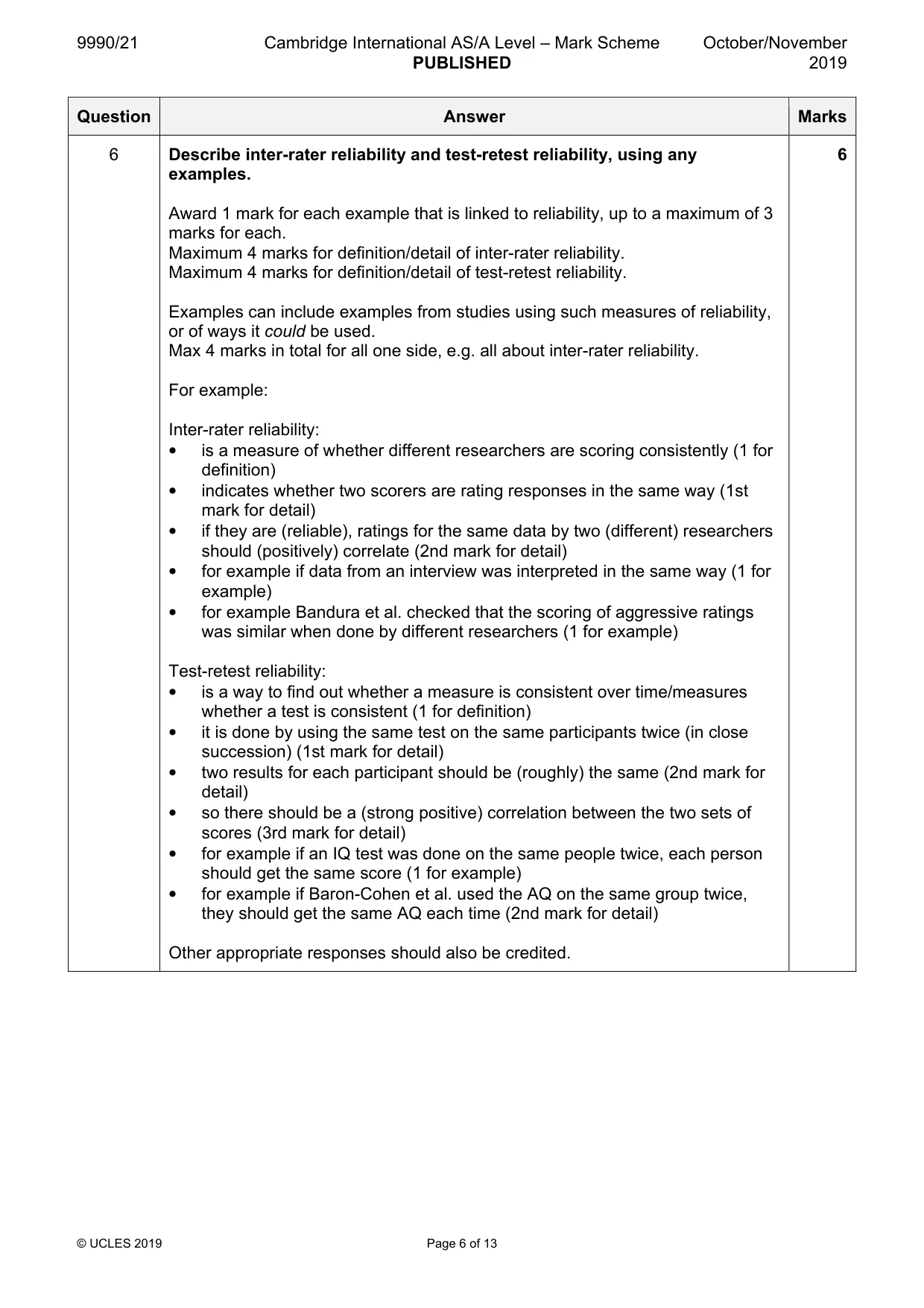
Mark scheme: 6 Describe inter-rater reliability and test-retest reliability, using any 6 examples. Award 1 mark for each example that is linked to reliability, up to a maximum of 3 marks for each. Maximum 4 marks for definition/detail of inter-rater reliability. Maximum 4 marks for definition/detail of test-retest reliability. Examples can include examples from studies using such measures of reliability, or of ways it could be used. Max 4 marks in total for all one side, e.g. all about inter-rater reliability. For example: Inter-rater reliability: • is a measure of whether different researchers are scoring consistently (1 for definition) • indicates whether two scorers are rating responses in the same way (1st mark for detail) • if they are (reliable), ratings for the same data by two (different) researchers should (positively) correlate (2nd mark for detail) • for example if data from an interview was interpreted in the same way (1 for example) • for example Bandura et al. checked that the scoring of aggressive ratings was similar when done by different researchers (1 for example) Test-retest reliability: • is a way to find out whether a measure is consistent over time/measures whether a test is consistent (1 for definition) • it is done by using the same test on the same participants twice (in close succession) (1st mark for detail) • two results for each participant should be (roughly) the same (2nd mark for detail) • so there should be a (strong positive) correlation between the two sets of scores (3rd mark for detail) • for example if an IQ test was done on the same people twice, each person should get the same score (1 for example) • for example if Baron-Cohen et al. used the AQ on the same group twice, they should get the same AQ each time (2nd mark for detail) Other appropriate responses should also be credited.
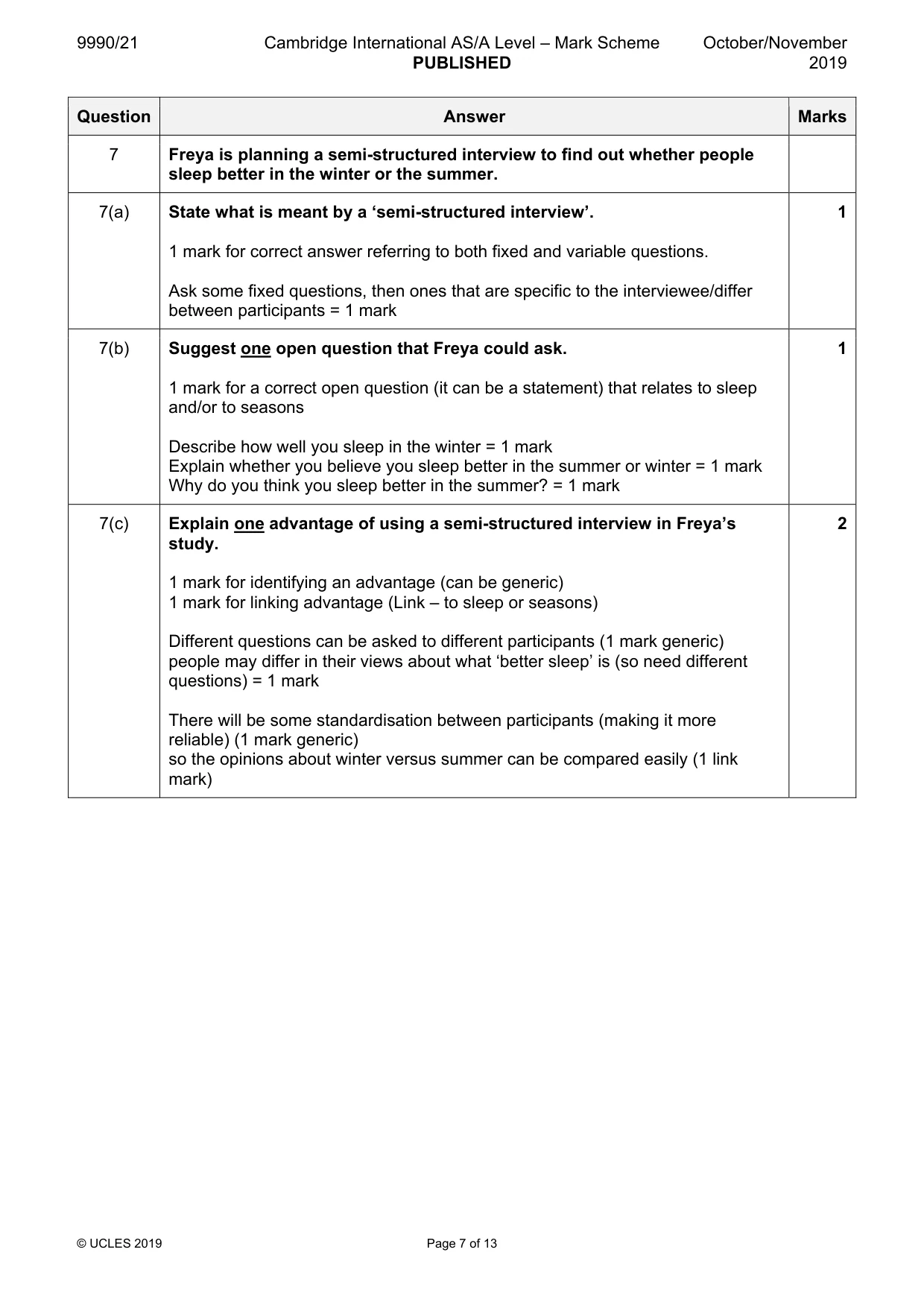
Q7 · Freya is planning a semi-structured interview to find out whether people sleep better in…
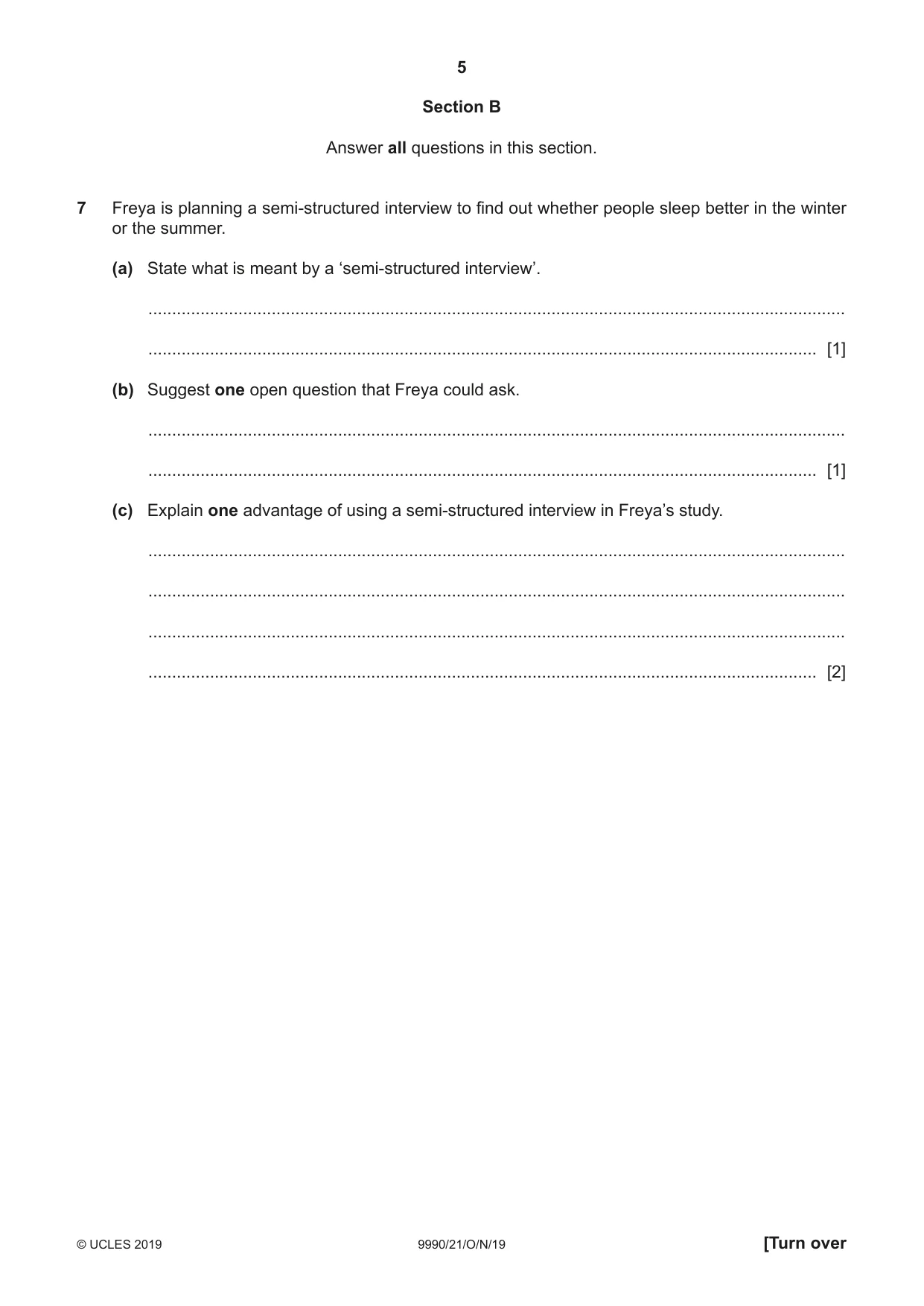
7 Freya is planning a semi-structured interview to find out whether people sleep better in the winter or the summer. (a) State what is meant by a ‘semi-structured interview’. ................................................................................................................................................... ............................................................................................................................................. [1] (b) Suggest one open question that Freya could ask. ................................................................................................................................................... ............................................................................................................................................. [1] (c) Explain one advantage of using a semi-structured interview in Freya’s study. ................................................................................................................................................... ................................................................................................................................................... ................................................................................................................................................... ............................................................................................................................................. [2]
Mark scheme: 7 Freya is planning a semi-structured interview to find out whether people sleep better in the winter or the summer. 7(a) State what is meant by a ‘semi-structured interview’. 1 1 mark for correct answer referring to both fixed and variable questions. Ask some fixed questions, then ones that are specific to the interviewee/differ between participants = 1 mark 7(b) Suggest one open question that Freya could ask. 1 1 mark for a correct open question (it can be a statement) that relates to sleep and/or to seasons Describe how well you sleep in the winter = 1 mark Explain whether you believe you sleep better in the summer or winter = 1 mark Why do you think you sleep better in the summer? = 1 mark 7(c) Explain one advantage of using a semi-structured interview in Freya’s 2 study. 1 mark for identifying an advantage (can be generic) 1 mark for linking advantage (Link – to sleep or seasons) Different questions can be asked to different participants (1 mark generic) people may differ in their views about what ‘better sleep’ is (so need different questions) = 1 mark There will be some standardisation between participants (making it more reliable) (1 mark generic) so the opinions about winter versus summer can be compared easily (1 link mark)
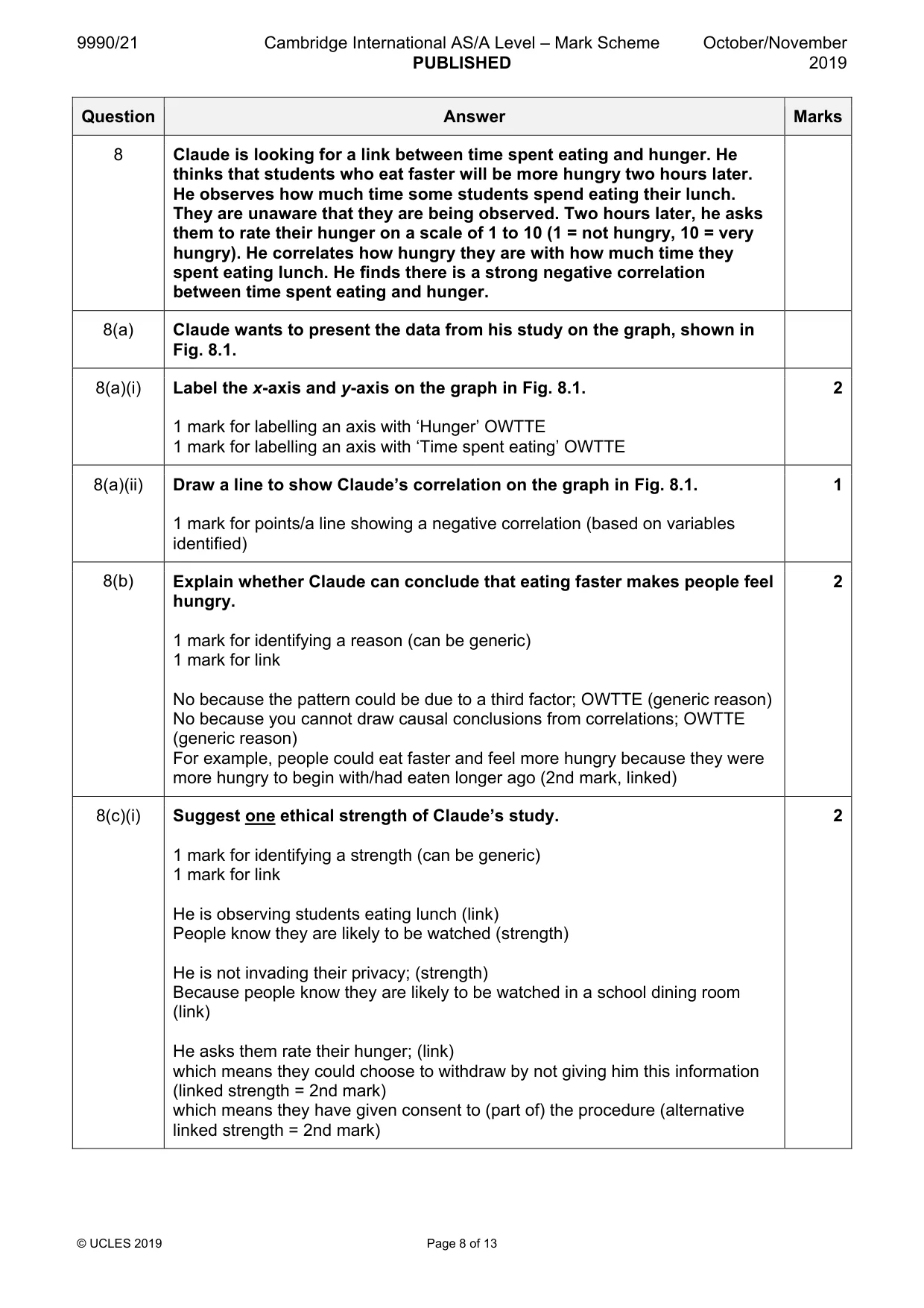
Q8 · Claude is looking for a link between time spent eating and hunger
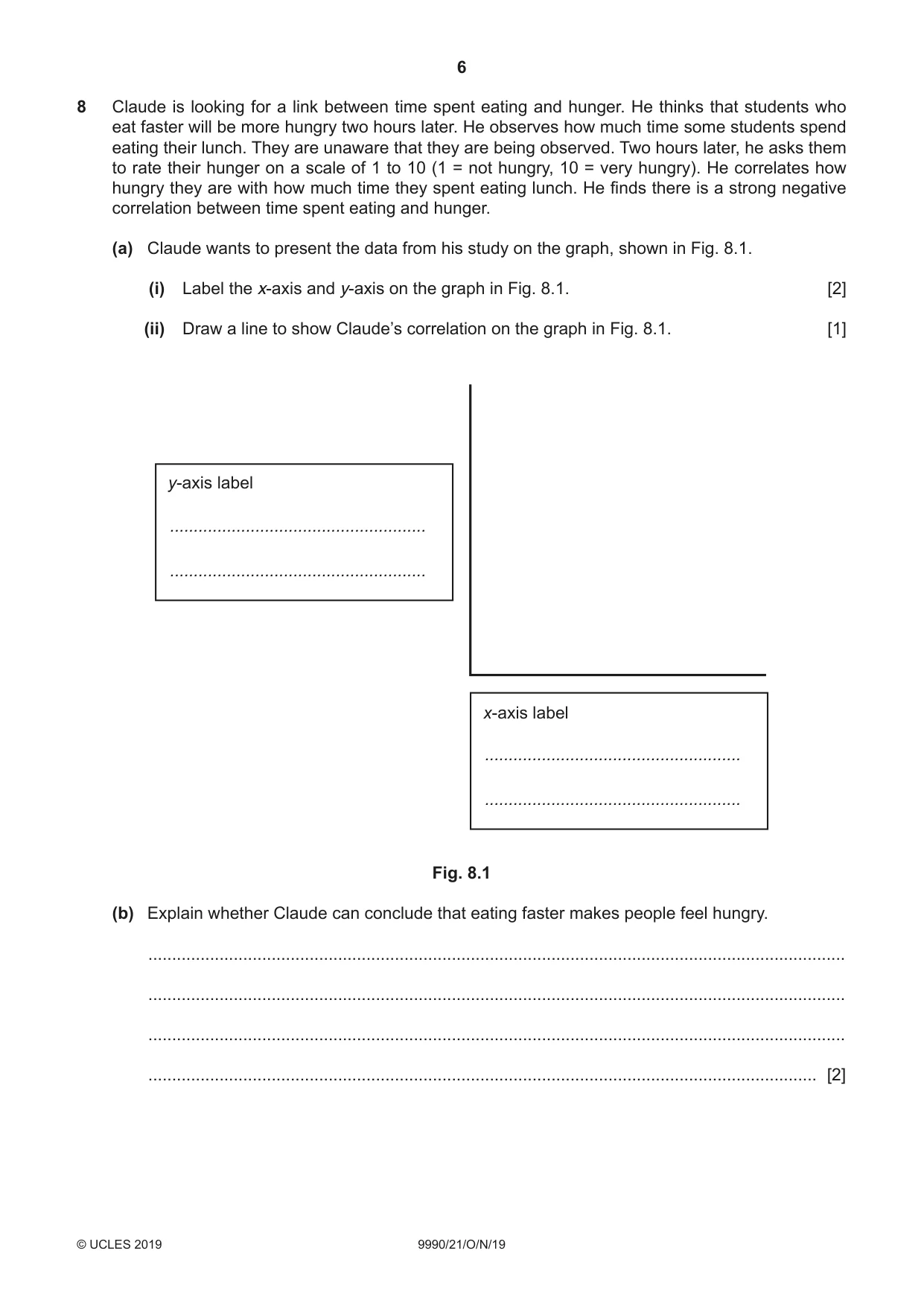
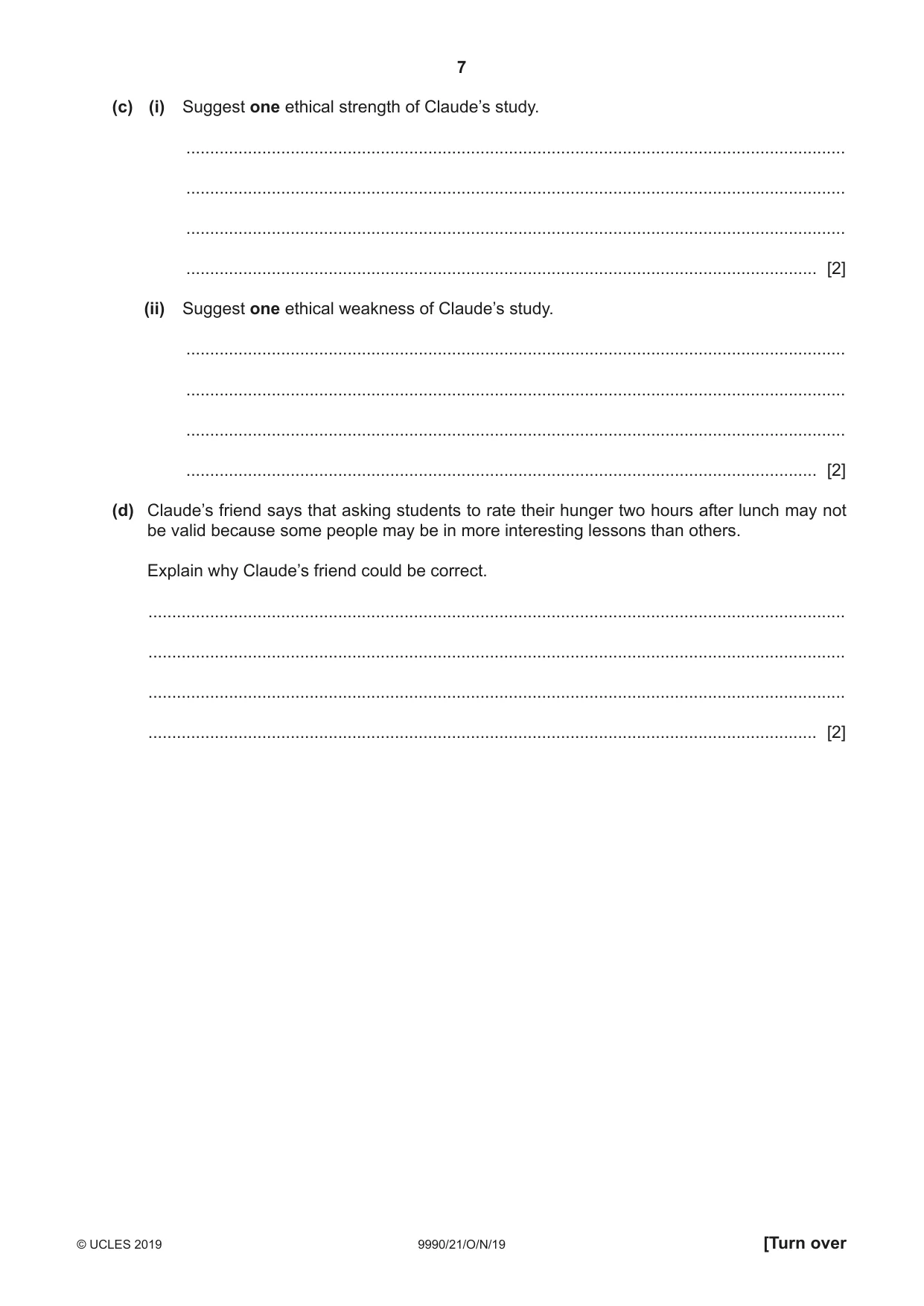
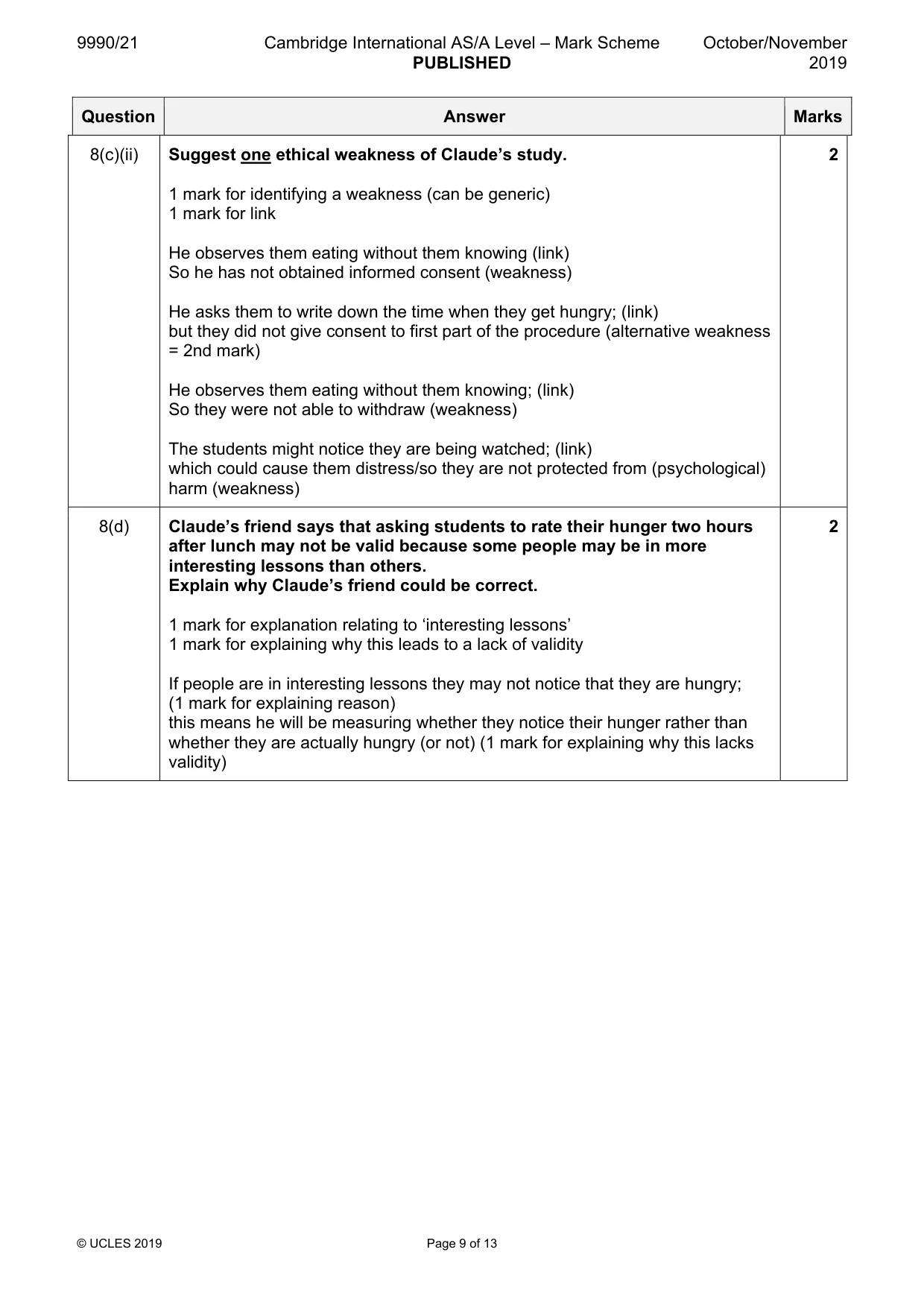
8 Claude is looking for a link between time spent eating and hunger. He thinks that students who eat faster will be more hungry two hours later. He observes how much time some students spend eating their lunch. They are unaware that they are being observed. Two hours later, he asks them to rate their hunger on a scale of 1 to 10 (1 = not hungry, 10 = very hungry). He correlates how hungry they are with how much time they spent eating lunch. He finds there is a strong negative correlation between time spent eating and hunger. (a) Claude wants to present the data from his study on the graph, shown in Fig. 8.1. (i) Label the x-axis and y-axis on the graph in Fig. 8.1. [2] (ii) Draw a line to show Claude’s correlation on the graph in Fig. 8.1. [1] y-axis label ...................................................... ...................................................... x-axis label ...................................................... ...................................................... Fig. 8.1 (b) Explain whether Claude can conclude that eating faster makes people feel hungry. ................................................................................................................................................... ................................................................................................................................................... ................................................................................................................................................... ............................................................................................................................................. [2] (c) (i) Suggest one ethical strength of Claude’s study. ........................................................................................................................................... ........................................................................................................................................... ........................................................................................................................................... ..................................................................................................................................... [2] (ii) Suggest one ethical weakness of Claude’s study. ........................................................................................................................................... ........................................................................................................................................... ........................................................................................................................................... ..................................................................................................................................... [2] (d) Claude’s friend says that asking students to rate their hunger two hours after lunch may not be valid because some people may be in more interesting lessons than others. Explain why Claude’s friend could be correct. ................................................................................................................................................... ................................................................................................................................................... ................................................................................................................................................... ............................................................................................................................................. [2]
Mark scheme: 8 Claude is looking for a link between time spent eating and hunger. He thinks that students who eat faster will be more hungry two hours later. He observes how much time some students spend eating their lunch. They are unaware that they are being observed. Two hours later, he asks them to rate their hunger on a scale of 1 to 10 (1 = not hungry, 10 = very hungry). He correlates how hungry they are with how much time they spent eating lunch. He finds there is a strong negative correlation between time spent eating and hunger. 8(a) Claude wants to present the data from his study on the graph, shown in Fig. 8.1. 8(a)(i) Label the x-axis and y-axis on the graph in Fig. 8.1. 2 1 mark for labelling an axis with ‘Hunger’ OWTTE 1 mark for labelling an axis with ‘Time spent eating’ OWTTE 8(a)(ii) Draw a line to show Claude’s correlation on the graph in Fig. 8.1. 1 1 mark for points/a line showing a negative correlation (based on variables identified) 8(b) Explain whether Claude can conclude that eating faster makes people feel 2 hungry. 1 mark for identifying a reason (can be generic) 1 mark for link No because the pattern could be due to a third factor; OWTTE (generic reason) No because you cannot draw causal conclusions from correlations; OWTTE (generic reason) For example, people could eat faster and feel more hungry because they were more hungry to begin with/had eaten longer ago (2nd mark, linked) 8(c)(i) Suggest one ethical strength of Claude’s study. 2 1 mark for identifying a strength (can be generic) 1 mark for link He is observing students eating lunch (link) People know they are likely to be watched (strength) He is not invading their privacy; (strength) Because people know they are likely to be watched in a school dining room (link) He asks them rate their hunger; (link) which means they could choose to withdraw by not giving him this information (linked strength = 2nd mark) which means they have given consent to (part of) the procedure (alternative linked strength = 2nd mark) 8(c)(ii) Suggest one ethical weakness of Claude’s study. 2 1 mark for identifying a weakness (can be generic) 1 mark for link He observes them eating without them knowing (link) So he has not obtained informed consent (weakness) He asks them to write down the time when they get hungry; (link) but they did not give consent to first part of the procedure (alternative weakness = 2nd mark) He observes them eating without them knowing; (link) So they were not able to withdraw (weakness) The students might notice they are being watched; (link) which could cause them distress/so they are not protected from (psychological) harm (weakness) 8(d) Claude’s friend says that asking students to rate their hunger two hours 2 after lunch may not be valid because some people may be in more interesting lessons than others. Explain why Claude’s friend could be correct. 1 mark for explanation relating to ‘interesting lessons’ 1 mark for explaining why this leads to a lack of validity If people are in interesting lessons they may not notice that they are hungry; (1 mark for explaining reason) this means he will be measuring whether they notice their hunger rather than whether they are actually hungry (or not) (1 mark for explaining why this lacks validity)
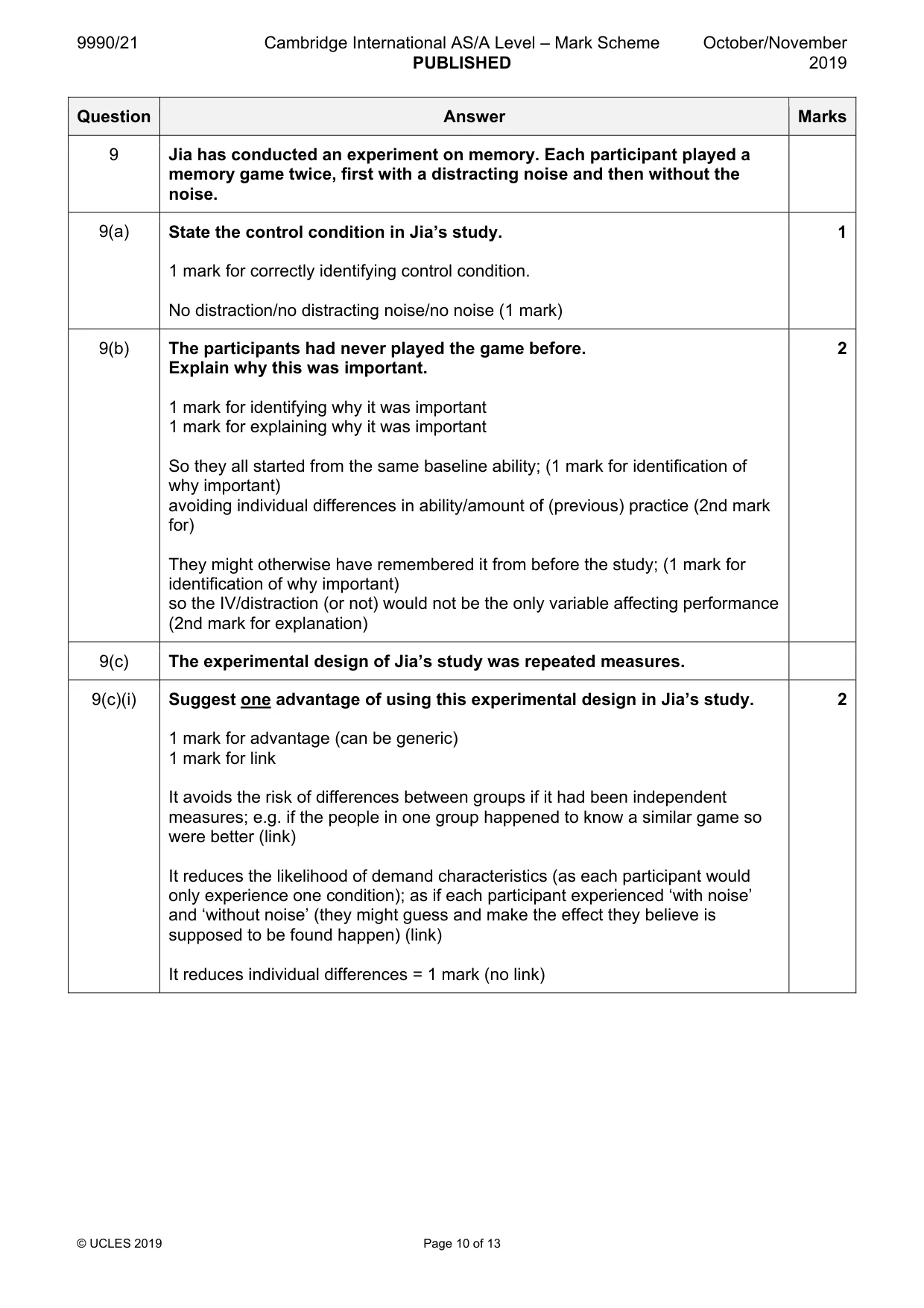
Q9 · Jia has conducted an experiment on memory
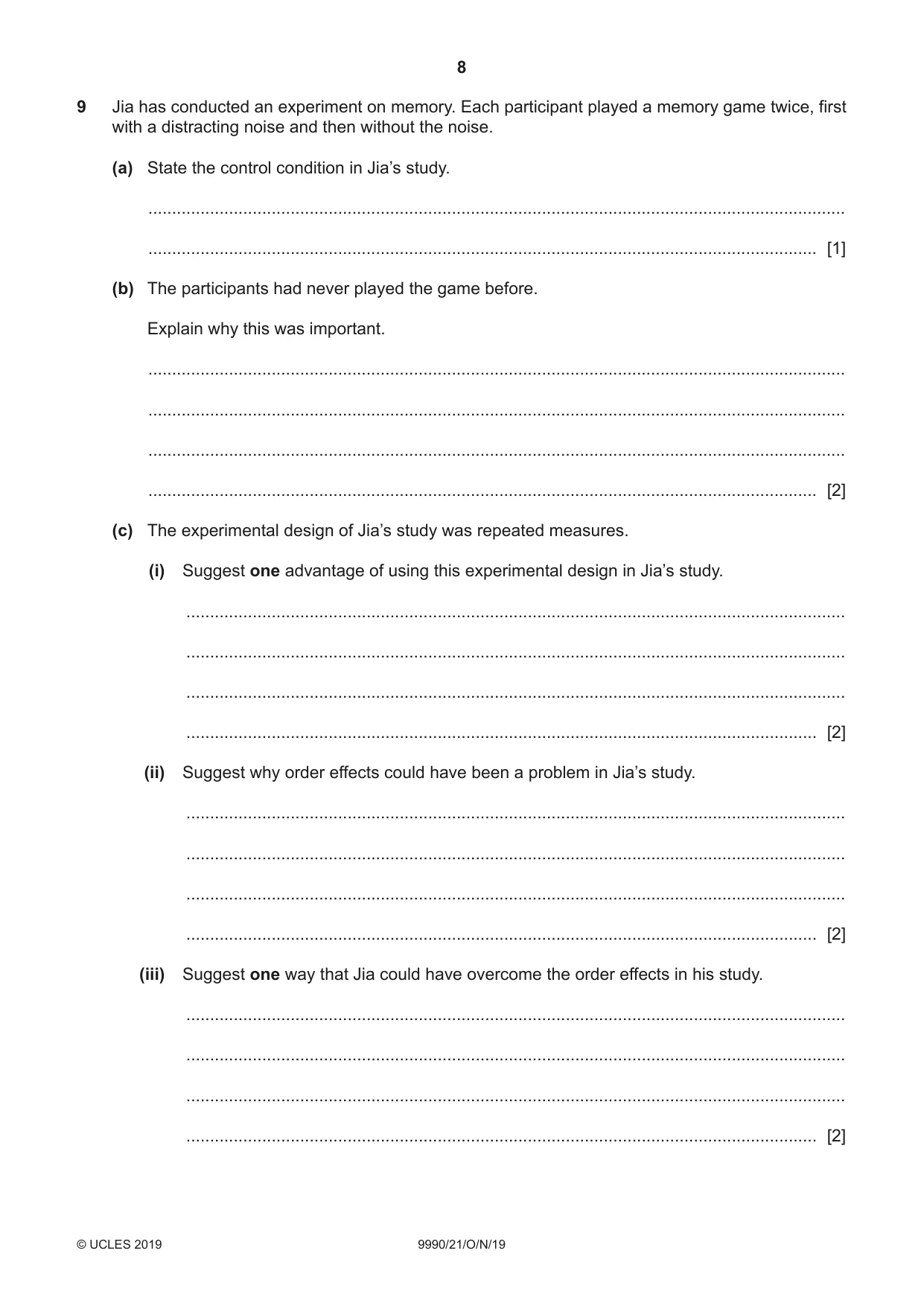
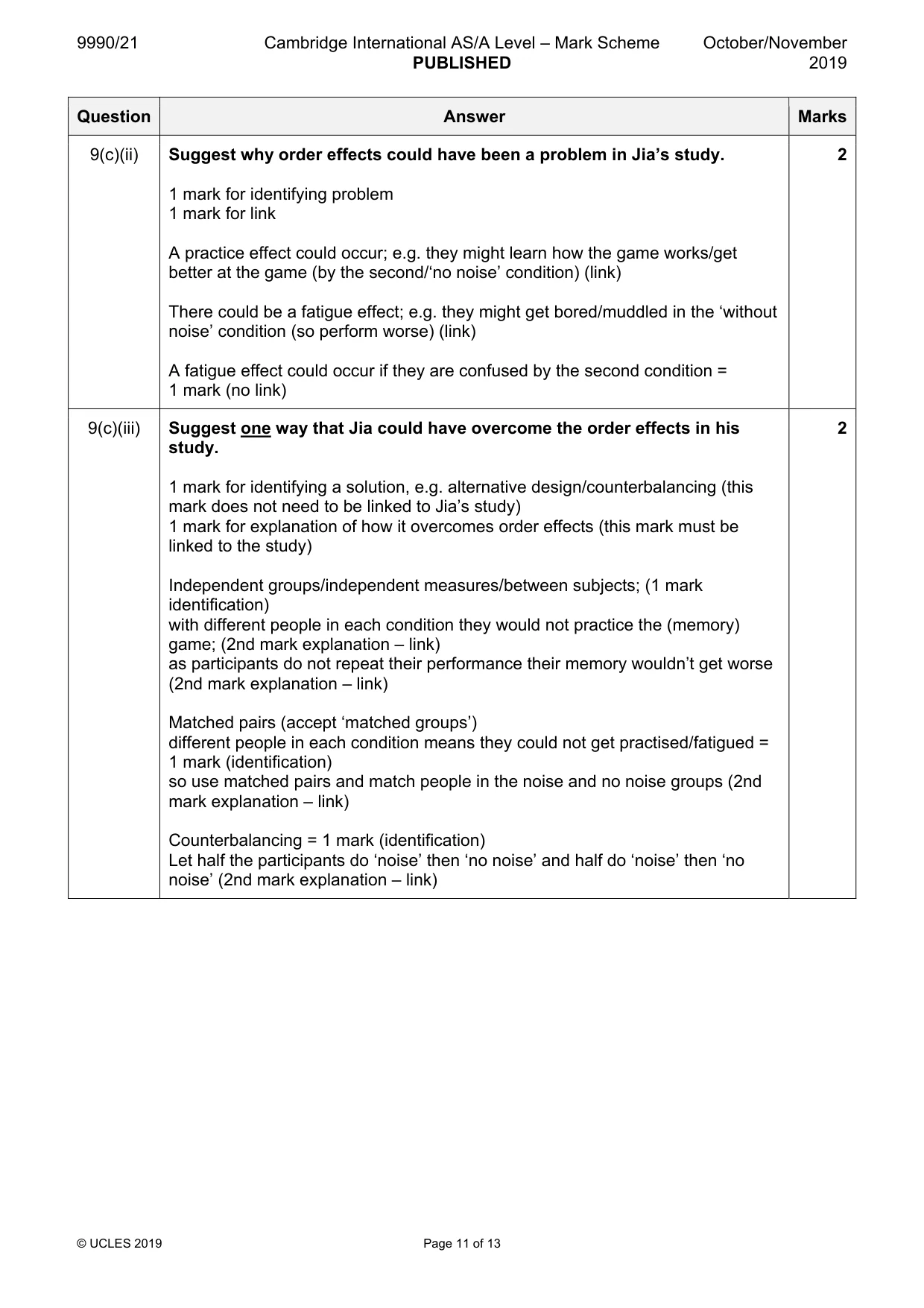
9 Jia has conducted an experiment on memory. Each participant played a memory game twice, first with a distracting noise and then without the noise. (a) State the control condition in Jia’s study. ................................................................................................................................................... ............................................................................................................................................. [1] (b) The participants had never played the game before. Explain why this was important. ................................................................................................................................................... ................................................................................................................................................... ................................................................................................................................................... ............................................................................................................................................. [2] (c) The experimental design of Jia’s study was repeated measures. (i) Suggest one advantage of using this experimental design in Jia’s study. ........................................................................................................................................... ........................................................................................................................................... ........................................................................................................................................... ..................................................................................................................................... [2] (ii) Suggest why order effects could have been a problem in Jia’s study. ........................................................................................................................................... ........................................................................................................................................... ........................................................................................................................................... ..................................................................................................................................... [2] (iii) Suggest one way that Jia could have overcome the order effects in his study. ........................................................................................................................................... ........................................................................................................................................... ........................................................................................................................................... ..................................................................................................................................... [2] Section C Answer all questions in this section.
Mark scheme: 9 Jia has conducted an experiment on memory. Each participant played a memory game twice, first with a distracting noise and then without the noise. 9(a) State the control condition in Jia’s study. 1 1 mark for correctly identifying control condition. No distraction/no distracting noise/no noise (1 mark) 9(b) The participants had never played the game before. 2 Explain why this was important. 1 mark for identifying why it was important 1 mark for explaining why it was important So they all started from the same baseline ability; (1 mark for identification of why important) avoiding individual differences in ability/amount of (previous) practice (2nd mark for) They might otherwise have remembered it from before the study; (1 mark for identification of why important) so the IV/distraction (or not) would not be the only variable affecting performance (2nd mark for explanation) 9(c) The experimental design of Jia’s study was repeated measures. 9(c)(i) Suggest one advantage of using this experimental design in Jia’s study. 2 1 mark for advantage (can be generic) 1 mark for link It avoids the risk of differences between groups if it had been independent measures; e.g. if the people in one group happened to know a similar game so were better (link) It reduces the likelihood of demand characteristics (as each participant would only experience one condition); as if each participant experienced ‘with noise’ and ‘without noise’ (they might guess and make the effect they believe is supposed to be found happen) (link) It reduces individual differences = 1 mark (no link) 9(c)(ii) Suggest why order effects could have been a problem in Jia’s study. 2 1 mark for identifying problem 1 mark for link A practice effect could occur; e.g. they might learn how the game works/get better at the game (by the second/‘no noise’ condition) (link) There could be a fatigue effect; e.g. they might get bored/muddled in the ‘without noise’ condition (so perform worse) (link) A fatigue effect could occur if they are confused by the second condition = 1 mark (no link) 9(c)(iii) Suggest one way that Jia could have overcome the order effects in his 2 study. 1 mark for identifying a solution, e.g. alternative design/counterbalancing (this mark does not need to be linked to Jia’s study) 1 mark for explanation of how it overcomes order effects (this mark must be linked to the study) Independent groups/independent measures/between subjects; (1 mark identification) with different people in each condition they would not practice the (memory) game; (2nd mark explanation – link) as participants do not repeat their performance their memory wouldn’t get worse (2nd mark explanation – link) Matched pairs (accept ‘matched groups’) different people in each condition means they could not get practised/fatigued = 1 mark (identification) so use matched pairs and match people in the noise and no noise groups (2nd mark explanation – link) Counterbalancing = 1 mark (identification) Let half the participants do ‘noise’ then ‘no noise’ and half do ‘noise’ then ‘no noise’ (2nd mark explanation – link)
Q10 · Pihu, a teacher, has been watching the young children at her school playing at lunchtime
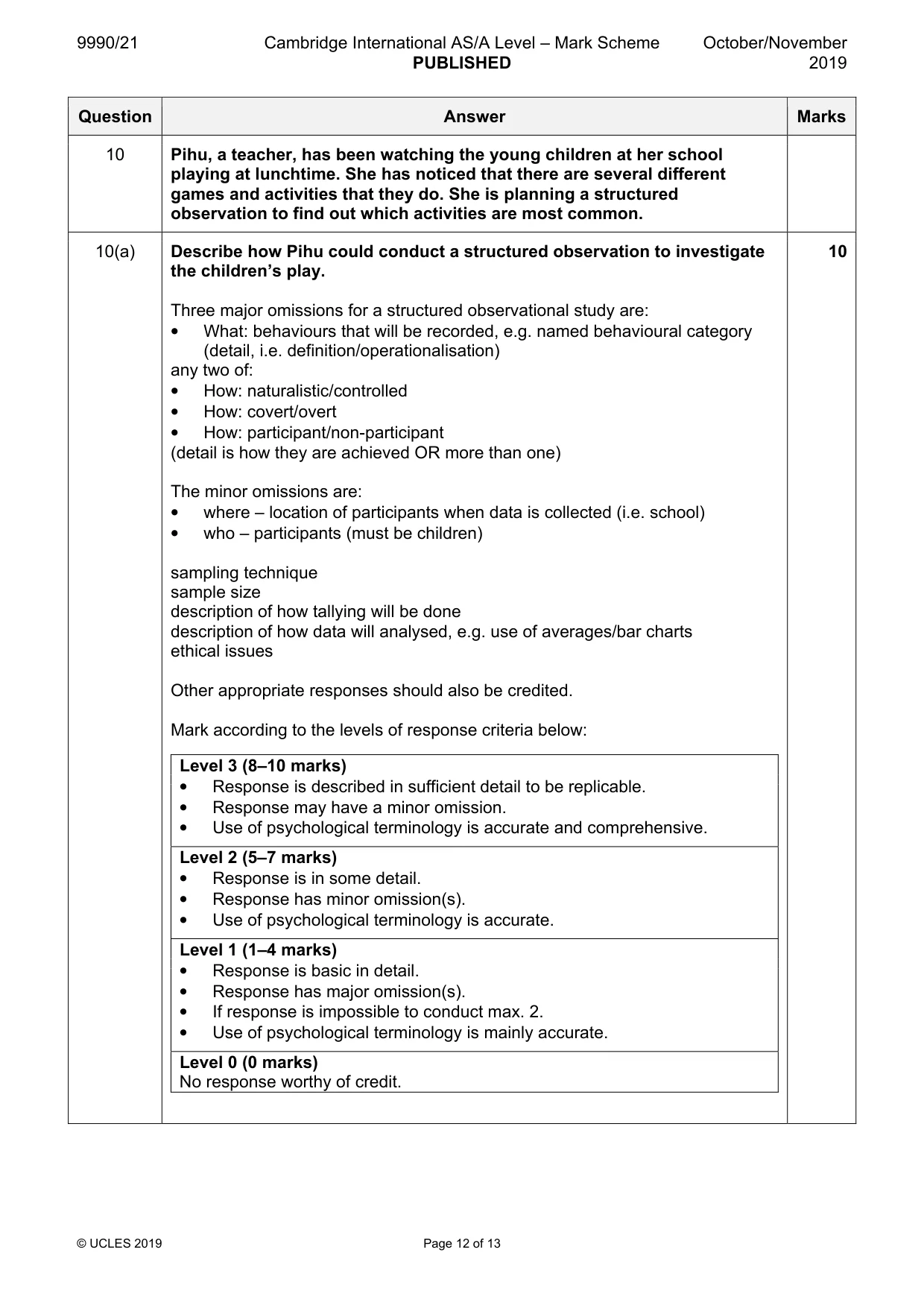
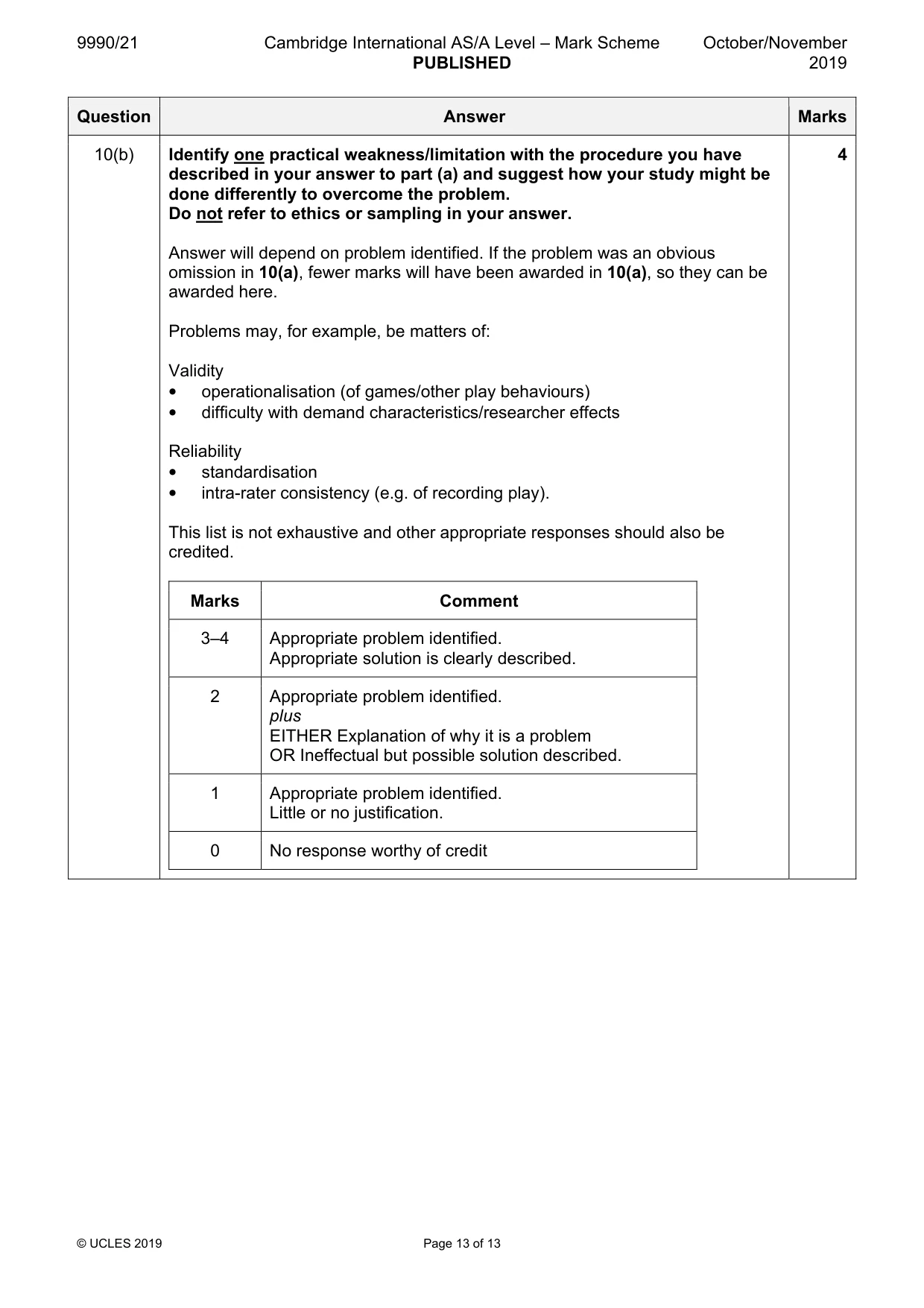
10 Pihu, a teacher, has been watching the young children at her school playing at lunchtime. She has noticed that there are several different games and activities that they do. She is planning a structured observation to find out which activities are most common. (a) Describe how Pihu could conduct a structured observation to investigate the children’s play. ................................................................................................................................................... ................................................................................................................................................... ................................................................................................................................................... ................................................................................................................................................... ................................................................................................................................................... ................................................................................................................................................... ................................................................................................................................................... ................................................................................................................................................... ................................................................................................................................................... ................................................................................................................................................... ................................................................................................................................................... ................................................................................................................................................... ................................................................................................................................................... ................................................................................................................................................... ................................................................................................................................................... ................................................................................................................................................... ................................................................................................................................................... ................................................................................................................................................... ................................................................................................................................................... ................................................................................................................................................... ................................................................................................................................................... ................................................................................................................................................... ................................................................................................................................................... ................................................................................................................................................... ................................................................................................................................................... ................................................................................................................................................... ................................................................................................................................................... ................................................................................................................................................... ................................................................................................................................................... ................................................................................................................................................... ........................................................................................................................................... [10] (b) Identify one practical weakness/limitation with the procedure you have described in your answer to part (a) and suggest how your study might be done differently to overcome the problem. Do not refer to ethics or sampling in your answer. ................................................................................................................................................... ................................................................................................................................................... ................................................................................................................................................... ................................................................................................................................................... ................................................................................................................................................... ................................................................................................................................................... ................................................................................................................................................... ............................................................................................................................................. [4]
Mark scheme: 10 Pihu, a teacher, has been watching the young children at her school playing at lunchtime. She has noticed that there are several different games and activities that they do. She is planning a structured observation to find out which activities are most common. 10(a) Describe how Pihu could conduct a structured observation to investigate 10 the children’s play. Three major omissions for a structured observational study are: • What: behaviours that will be recorded, e.g. named behavioural category (detail, i.e. definition/operationalisation) any two of: • How: naturalistic/controlled • How: covert/overt • How: participant/non-participant (detail is how they are achieved OR more than one) The minor omissions are: • where – location of participants when data is collected (i.e. school) • who – participants (must be children) sampling technique sample size description of how tallying will be done description of how data will analysed, e.g. use of averages/bar charts ethical issues Other appropriate responses should also be credited. Mark according to the levels of response criteria below: Level 3 (8–10 marks) • Response is described in sufficient detail to be replicable. • Response may have a minor omission. • Use of psychological terminology is accurate and comprehensive. Level 2 (5–7 marks) • Response is in some detail. • Response has minor omission(s). • Use of psychological terminology is accurate. Level 1 (1–4 marks) • Response is basic in detail. • Response has major omission(s). • If response is impossible to conduct max. 2. • Use of psychological terminology is mainly accurate. Level 0 (0 marks) No response worthy of credit. 10(b) Identify one practical weakness/limitation with the procedure you have 4 described in your answer to part (a) and suggest how your study might be done differently to overcome the problem. Do not refer to ethics or sampling in your answer. Answer will depend on problem identified. If the problem was an obvious omission in 10(a), fewer marks will have been awarded in 10(a), so they can be awarded here. Problems may, for example, be matters of: Validity • operationalisation (of games/other play behaviours) • difficulty with demand characteristics/researcher effects Reliability • standardisation • intra-rater consistency (e.g. of recording play). This list is not exhaustive and other appropriate responses should also be credited. Marks Comment 3–4 Appropriate problem identified. Appropriate solution is clearly described. 2 Appropriate problem identified. plus EITHER Explanation of why it is a problem OR Ineffectual but possible solution described. 1 Appropriate problem identified. Little or no justification. 0 No response worthy of credit
What was in this paper
The subtopics covered by these 10 questions, and how many questions each got. Open one in a new tab to see every Cambridge question on it.
What you needed in this session
Cambridge’s own grade thresholds for 2019 Oct/Nov, Paper 2 · Variant 1. A higher threshold means an easier paper — the bar moves with how the cohort did.