Cambridge A Level Psychology (from 2018) 9990 — 2019 May/June Paper 2 · Variant 3
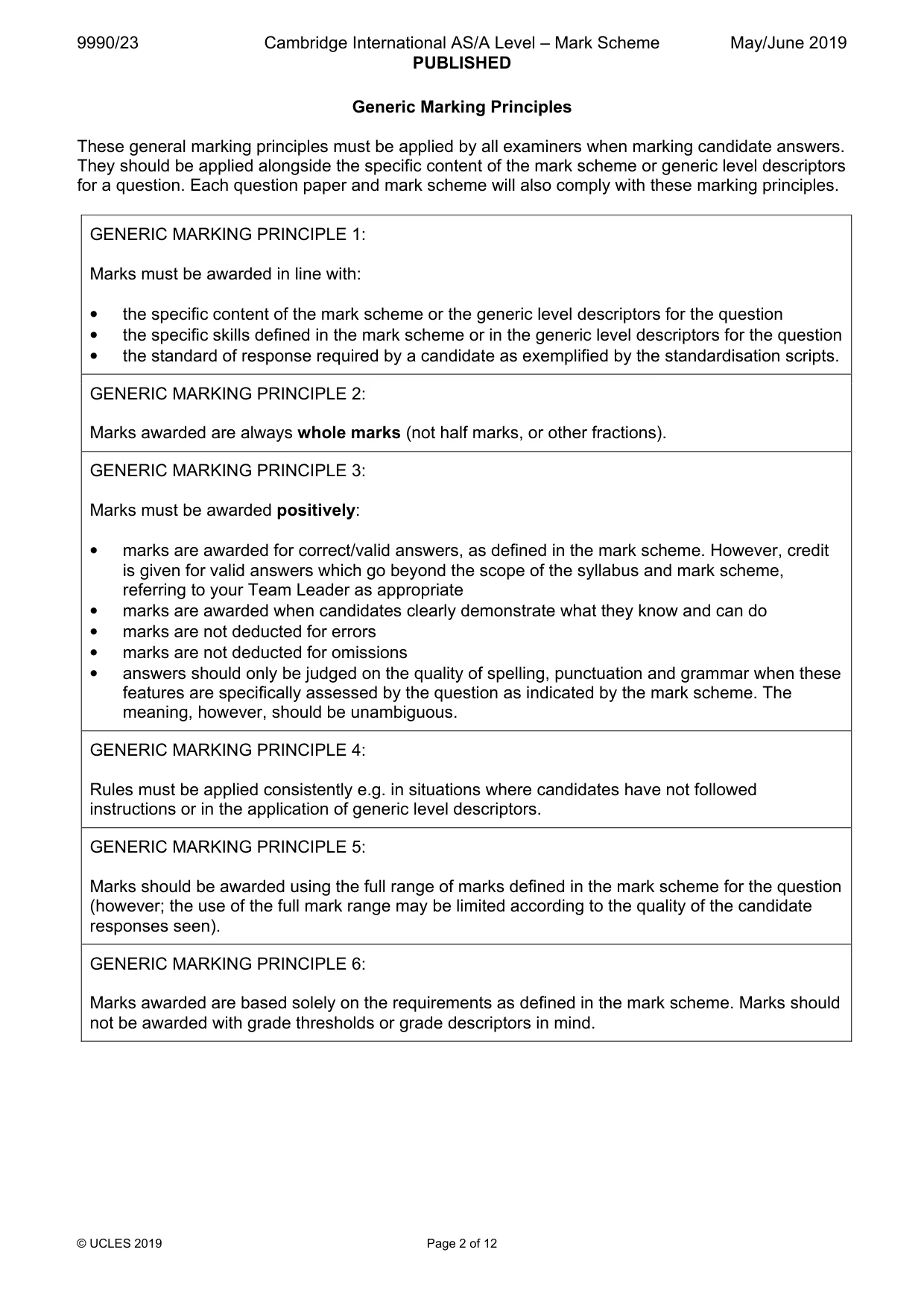
9990/23/M/J/19 · 10 questions · 60 marks · ≈68 min
The question paper and its mark scheme, free to read here and free to download. This is Cambridge’s own paper, exactly as it was sat.
Question paper12 pages




Mark scheme12 pages
Answers below. Sit the paper first if you are practising.


Questions as text
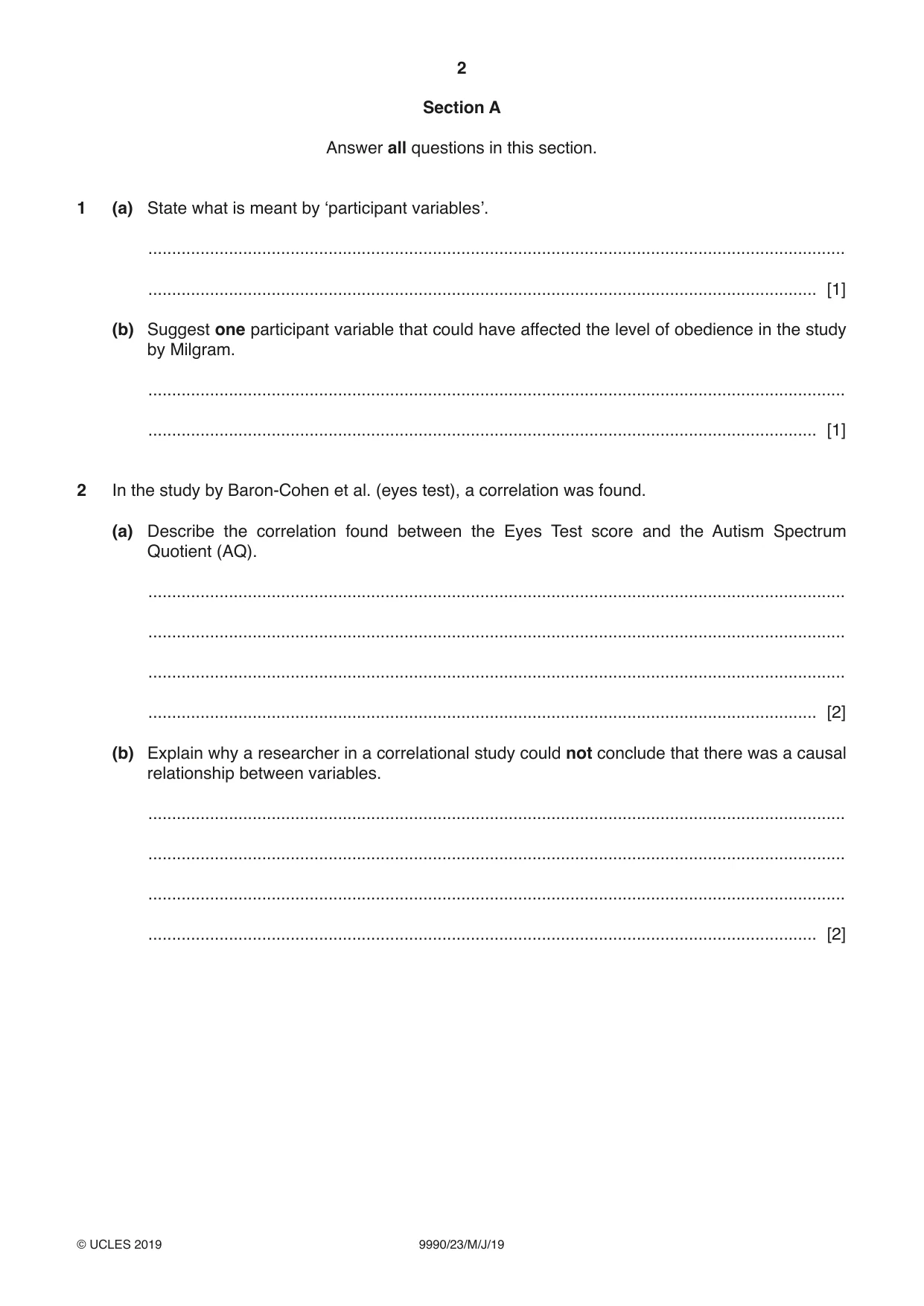
Q1 · State what is meant by ‘participant variables’
1 (a) State what is meant by ‘participant variables’. ................................................................................................................................................... ............................................................................................................................................. [1] (b) Suggest one participant variable that could have affected the level of obedience in the study by Milgram. ................................................................................................................................................... ............................................................................................................................................. [1]
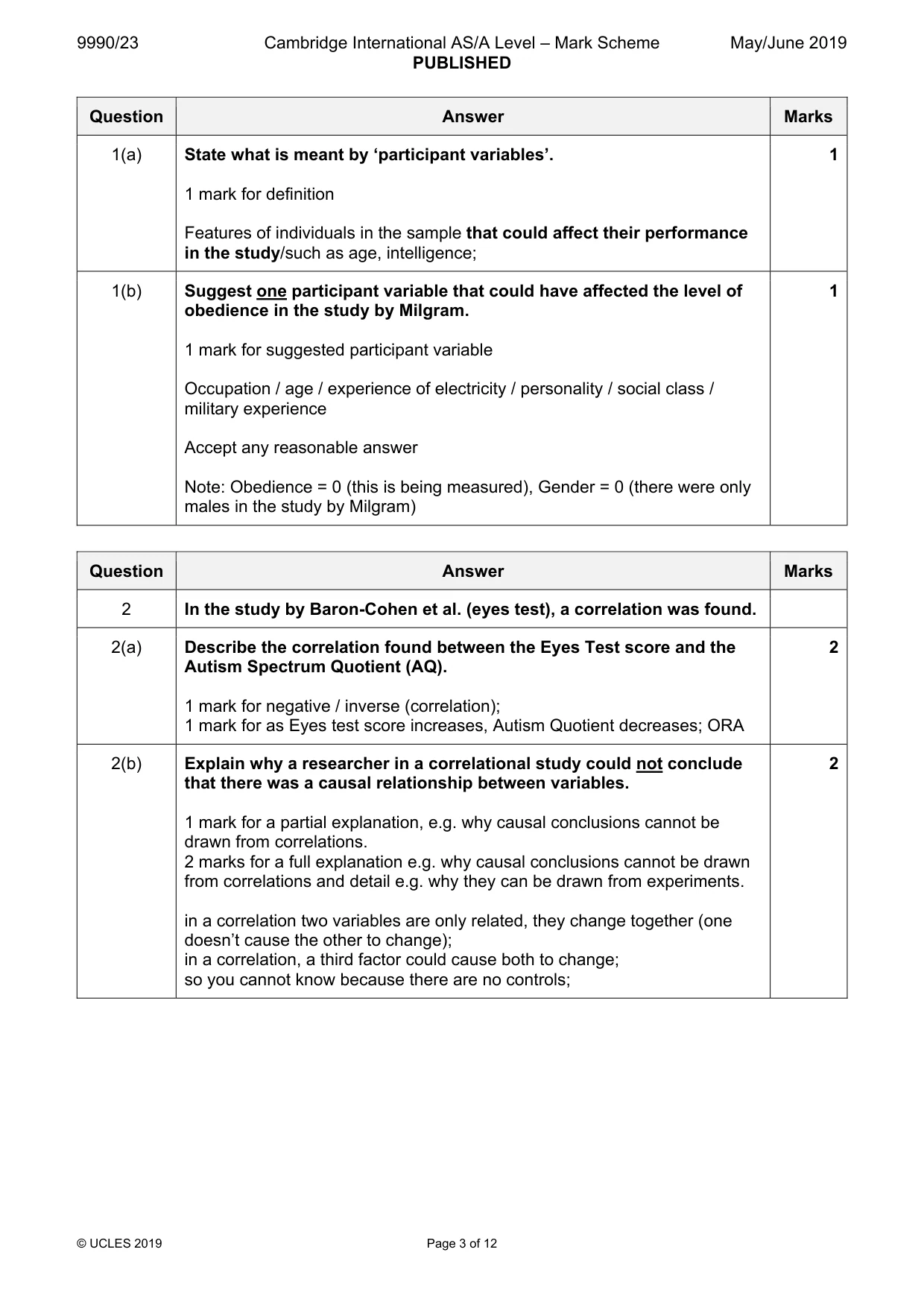
Mark scheme: Question Answer Marks 1(a) State what is meant by ‘participant variables’. 1 1 mark for definition Features of individuals in the sample that could affect their performance in the study/such as age, intelligence; 1(b) Suggest one participant variable that could have affected the level of 1 obedience in the study by Milgram. 1 mark for suggested participant variable Occupation / age / experience of electricity / personality / social class / military experience Accept any reasonable answer Note: Obedience = 0 (this is being measured), Gender = 0 (there were only males in the study by Milgram)
Q2 · In the study by Baron-Cohen et al
2 In the study by Baron-Cohen et al. (eyes test), a correlation was found. (a) Describe the correlation found between the Eyes Test score and the Autism Spectrum Quotient (AQ). ................................................................................................................................................... ................................................................................................................................................... ................................................................................................................................................... ............................................................................................................................................. [2] (b) Explain why a researcher in a correlational study could not conclude that there was a causal relationship between variables. ................................................................................................................................................... ................................................................................................................................................... ................................................................................................................................................... ............................................................................................................................................. [2]
Mark scheme: 2(a) Describe the correlation found between the Eyes Test score and the 2 Autism Spectrum Quotient (AQ). 1 mark for negative / inverse (correlation); 1 mark for as Eyes test score increases, Autism Quotient decreases; ORA 2(b) Explain why a researcher in a correlational study could not conclude 2 that there was a causal relationship between variables. 1 mark for a partial explanation, e.g. why causal conclusions cannot be drawn from correlations. 2 marks for a full explanation e.g. why causal conclusions cannot be drawn from correlations and detail e.g. why they can be drawn from experiments. in a correlation two variables are only related, they change together (one doesn’t cause the other to change); in a correlation, a third factor could cause both to change; so you cannot know because there are no controls;
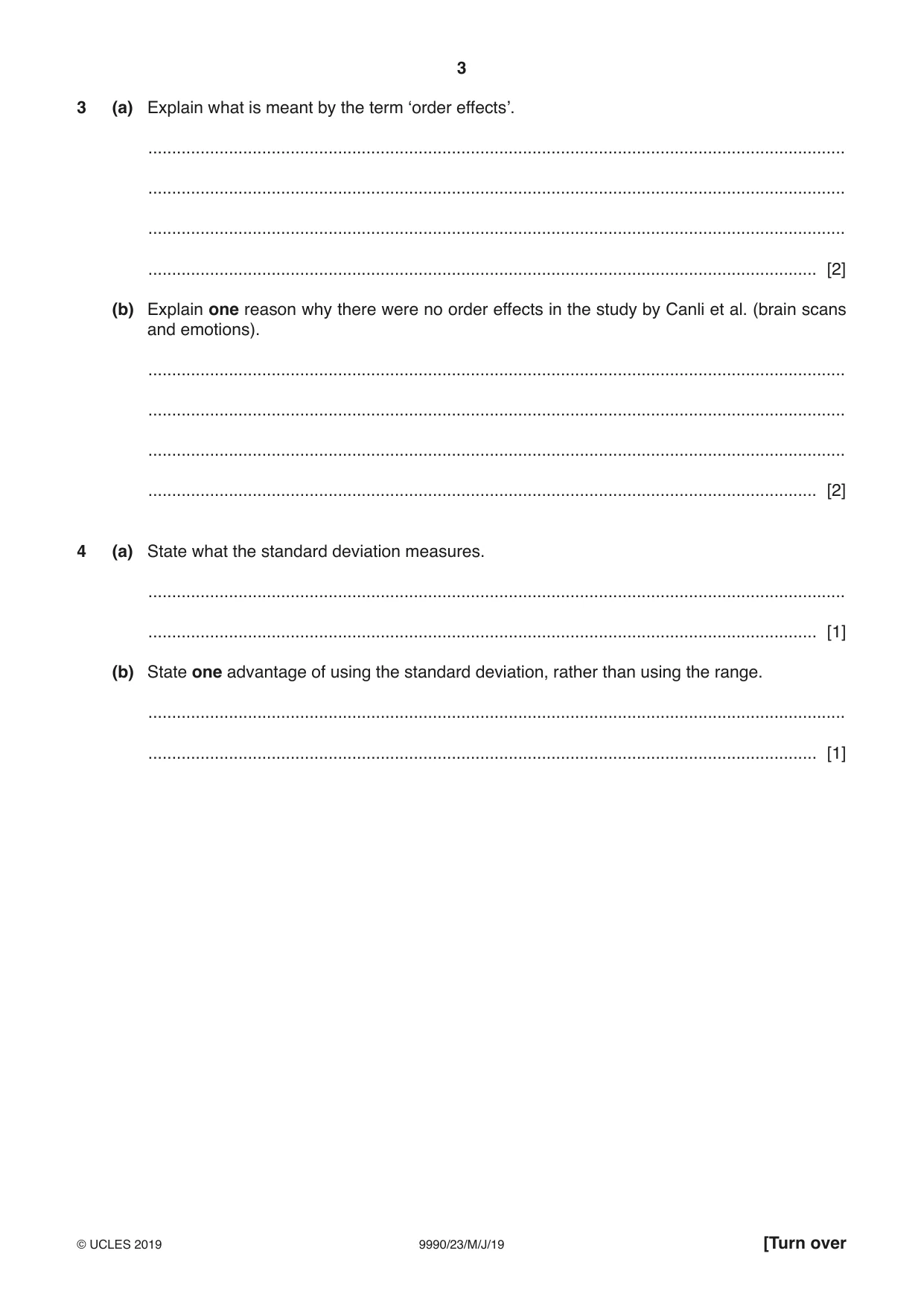
Q3 · Explain what is meant by the term ‘order effects’
3 (a) Explain what is meant by the term ‘order effects’. ................................................................................................................................................... ................................................................................................................................................... ................................................................................................................................................... ............................................................................................................................................. [2] (b) Explain one reason why there were no order effects in the study by Canli et al. (brain scans and emotions). ................................................................................................................................................... ................................................................................................................................................... ................................................................................................................................................... ............................................................................................................................................. [2]
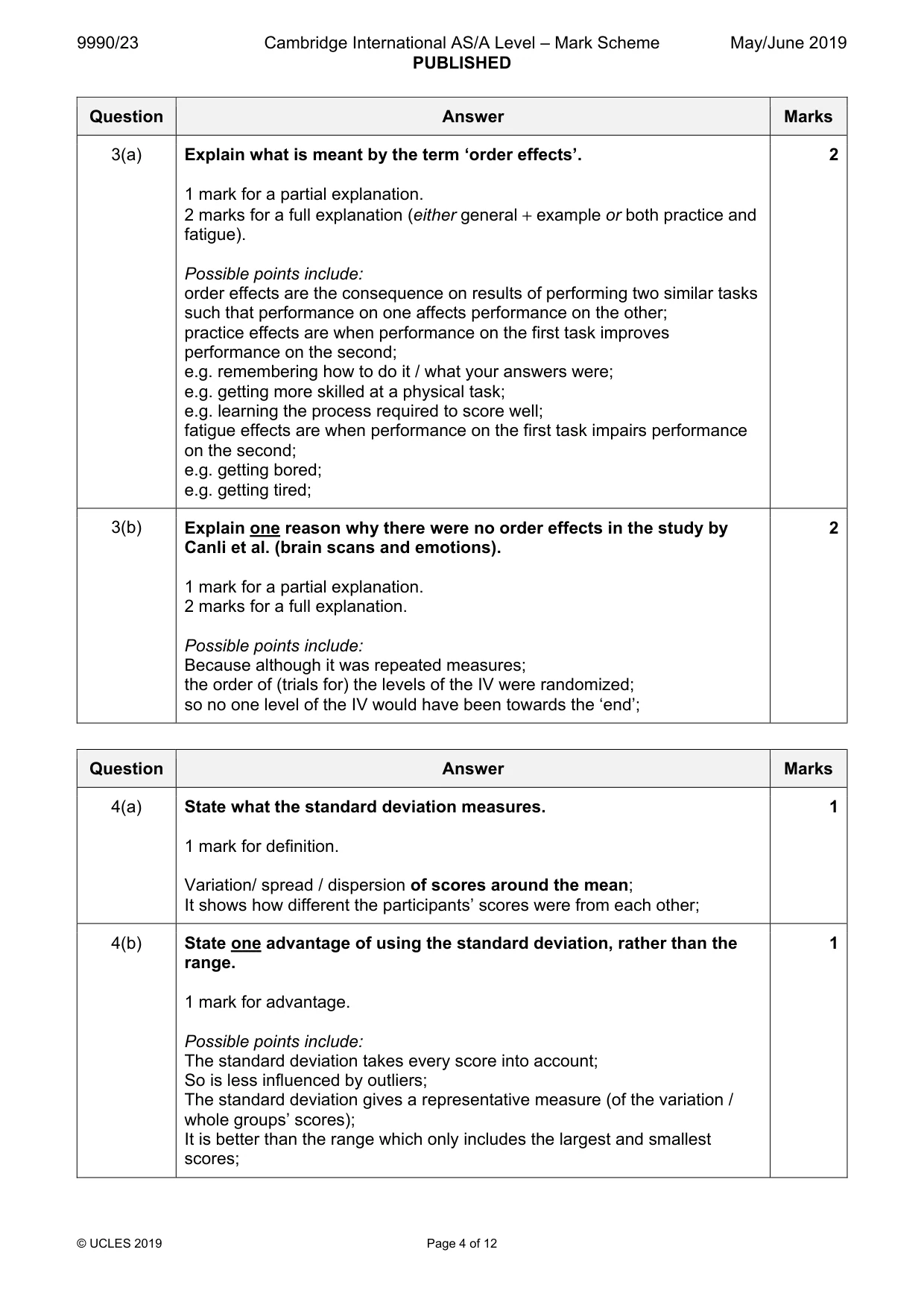
Mark scheme: 3(a) Explain what is meant by the term ‘order effects’. 2 1 mark for a partial explanation. 2 marks for a full explanation (either general + example or both practice and fatigue). Possible points include: order effects are the consequence on results of performing two similar tasks such that performance on one affects performance on the other; practice effects are when performance on the first task improves performance on the second; e.g. remembering how to do it / what your answers were; e.g. getting more skilled at a physical task; e.g. learning the process required to score well; fatigue effects are when performance on the first task impairs performance on the second; e.g. getting bored; e.g. getting tired; 3(b) Explain one reason why there were no order effects in the study by 2 Canli et al. (brain scans and emotions). 1 mark for a partial explanation. 2 marks for a full explanation. Possible points include: Because although it was repeated measures; the order of (trials for) the levels of the IV were randomized; so no one level of the IV would have been towards the ‘end’;
Q4 · State what the standard deviation measures
4 (a) State what the standard deviation measures. ................................................................................................................................................... ............................................................................................................................................. [1] (b) State one advantage of using the standard deviation, rather than using the range. ................................................................................................................................................... ............................................................................................................................................. [1]
Mark scheme: 4(a) State what the standard deviation measures. 1 1 mark for definition. Variation/ spread / dispersion of scores around the mean; It shows how different the participants’ scores were from each other; 4(b) State one advantage of using the standard deviation, rather than the 1 range. 1 mark for advantage. Possible points include: The standard deviation takes every score into account; So is less influenced by outliers; The standard deviation gives a representative measure (of the variation / whole groups’ scores); It is better than the range which only includes the largest and smallest scores;
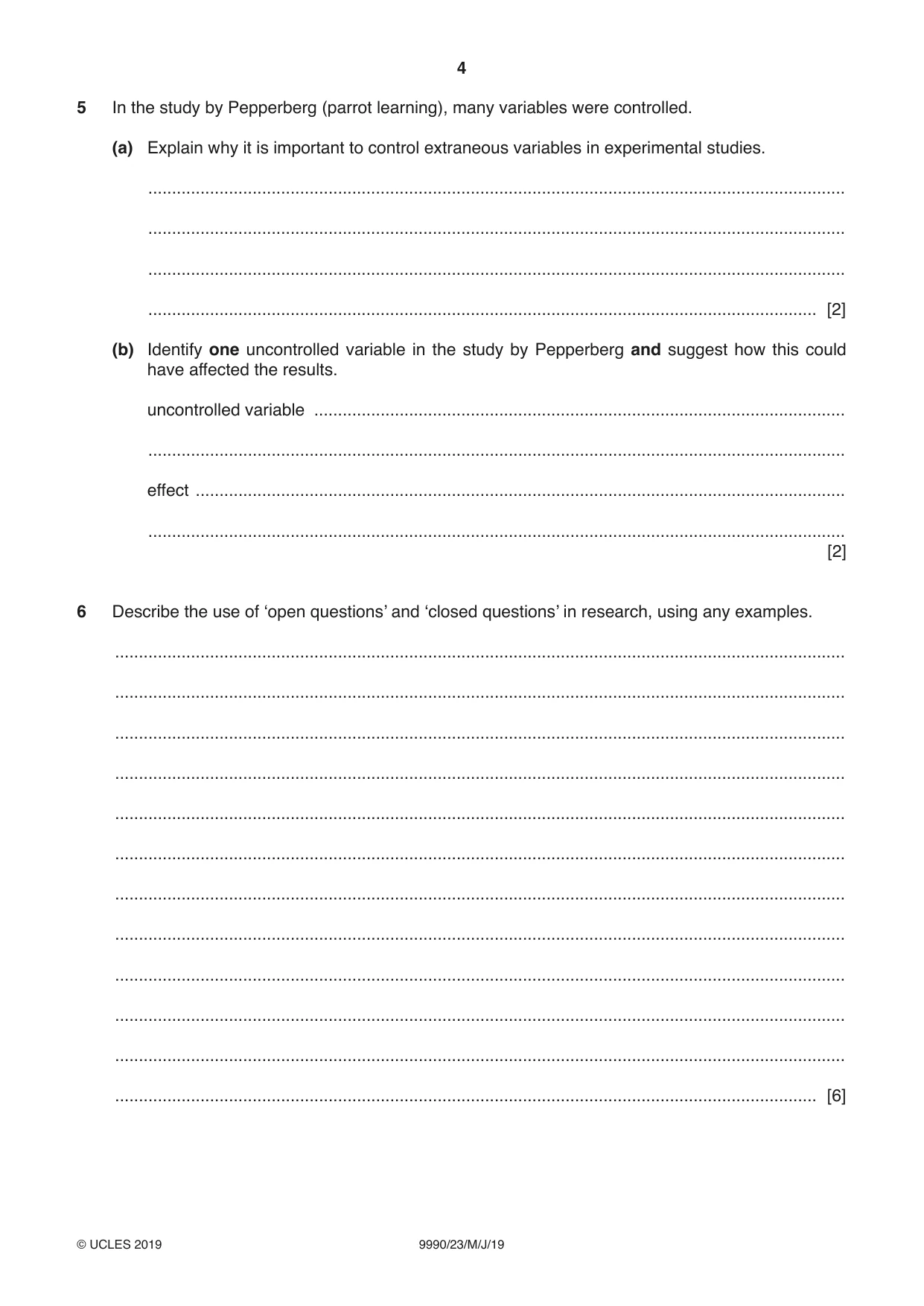
Q5 · In the study by Pepperberg (parrot learning), many variables were controlled
5 In the study by Pepperberg (parrot learning), many variables were controlled. (a) Explain why it is important to control extraneous variables in experimental studies. ................................................................................................................................................... ................................................................................................................................................... ................................................................................................................................................... ............................................................................................................................................. [2] (b) Identify one uncontrolled variable in the study by Pepperberg and suggest how this could have affected the results. uncontrolled variable ................................................................................................................ ................................................................................................................................................... effect ......................................................................................................................................... ................................................................................................................................................... [2]
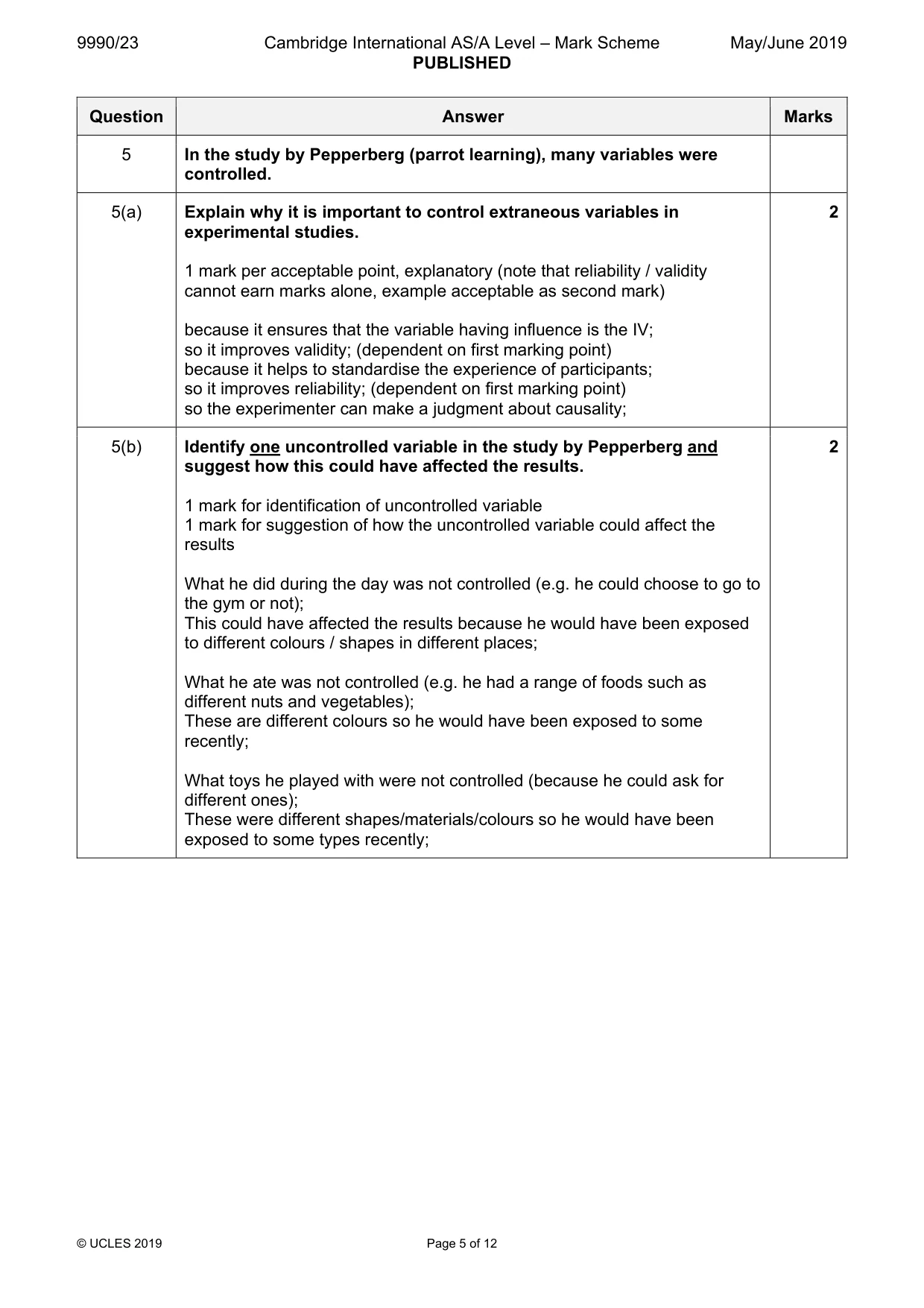
Mark scheme: 5(a) Explain why it is important to control extraneous variables in 2 experimental studies. 1 mark per acceptable point, explanatory (note that reliability / validity cannot earn marks alone, example acceptable as second mark) because it ensures that the variable having influence is the IV; so it improves validity; (dependent on first marking point) because it helps to standardise the experience of participants; so it improves reliability; (dependent on first marking point) so the experimenter can make a judgment about causality; 5(b) Identify one uncontrolled variable in the study by Pepperberg and 2 suggest how this could have affected the results. 1 mark for identification of uncontrolled variable 1 mark for suggestion of how the uncontrolled variable could affect the results What he did during the day was not controlled (e.g. he could choose to go to the gym or not); This could have affected the results because he would have been exposed to different colours / shapes in different places; What he ate was not controlled (e.g. he had a range of foods such as different nuts and vegetables); These are different colours so he would have been exposed to some recently; What toys he played with were not controlled (because he could ask for different ones); These were different shapes/materials/colours so he would have been exposed to some types recently;
Q6 · Describe the use of ‘open questions’ and ‘closed questions’ in research, using any…
6 Describe the use of ‘open questions’ and ‘closed questions’ in research, using any examples. .......................................................................................................................................................... .......................................................................................................................................................... .......................................................................................................................................................... .......................................................................................................................................................... .......................................................................................................................................................... .......................................................................................................................................................... .......................................................................................................................................................... .......................................................................................................................................................... .......................................................................................................................................................... .......................................................................................................................................................... .......................................................................................................................................................... .................................................................................................................................................... [6]
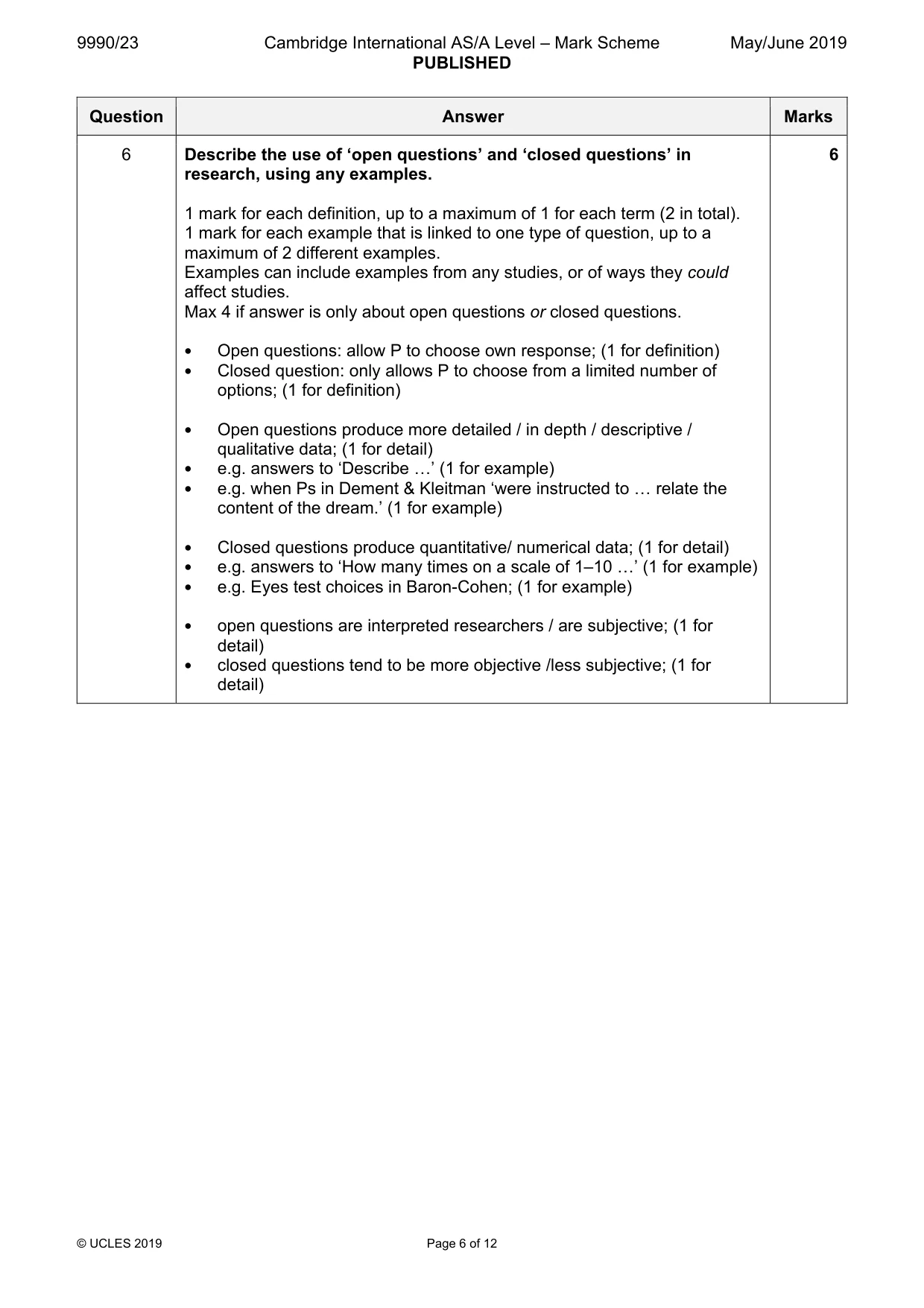
Mark scheme: 6 Describe the use of ‘open questions’ and ‘closed questions’ in 6 research, using any examples. 1 mark for each definition, up to a maximum of 1 for each term (2 in total). 1 mark for each example that is linked to one type of question, up to a maximum of 2 different examples. Examples can include examples from any studies, or of ways they could affect studies. Max 4 if answer is only about open questions or closed questions. • Open questions: allow P to choose own response; (1 for definition) • Closed question: only allows P to choose from a limited number of options; (1 for definition) • Open questions produce more detailed / in depth / descriptive / qualitative data; (1 for detail) • e.g. answers to ‘Describe «’ (1 for example) • e.g. when Ps in Dement & Kleitman ‘were instructed to « relate the content of the dream.’ (1 for example) • Closed questions produce quantitative/ numerical data; (1 for detail) • e.g. answers to ‘How many times on a scale of 1–10 «’ (1 for example) • e.g. Eyes test choices in Baron-Cohen; (1 for example) • open questions are interpreted researchers / are subjective; (1 for detail) • closed questions tend to be more objective /less subjective; (1 for detail)
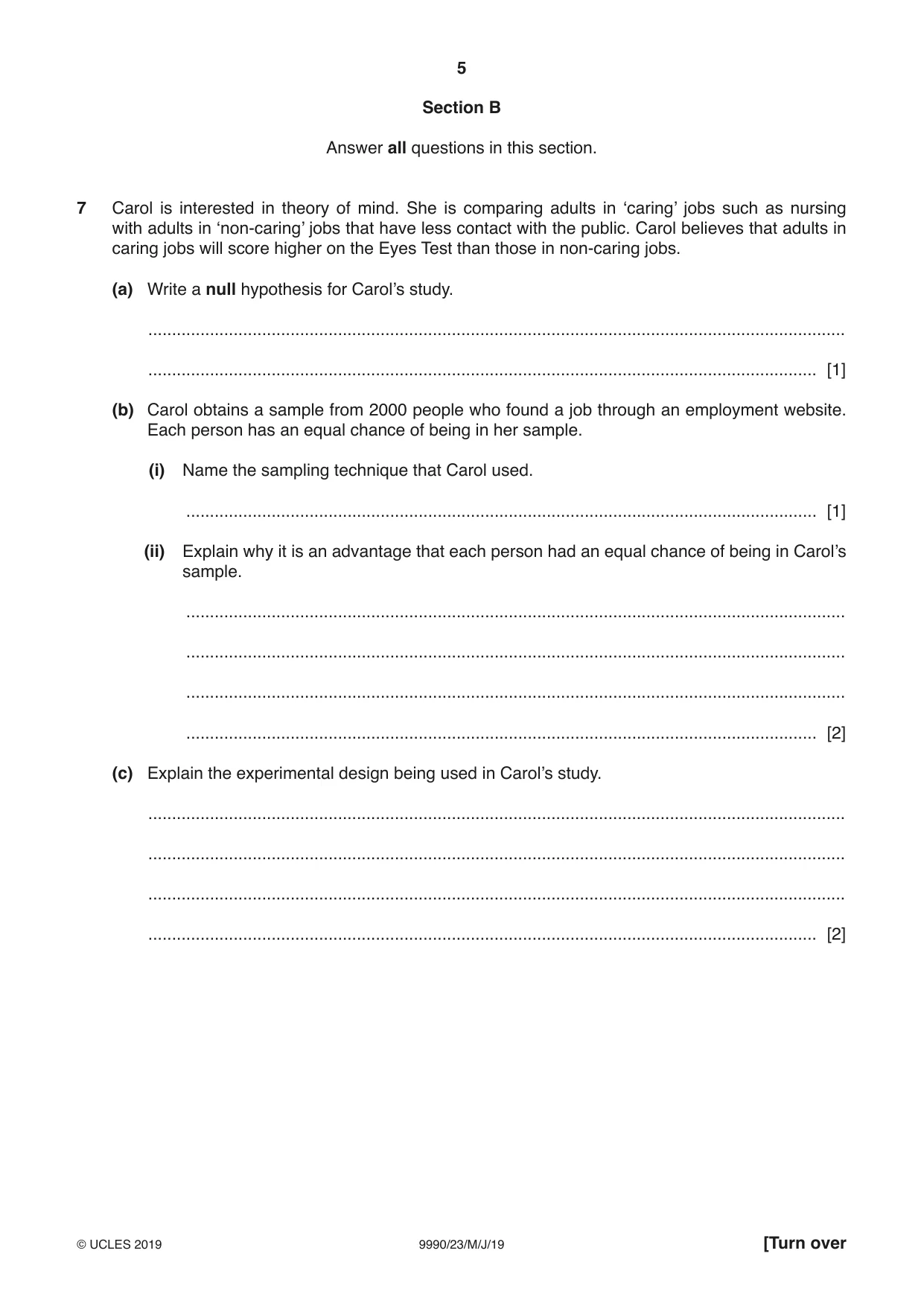
Q7 · Carol is interested in theory of mind
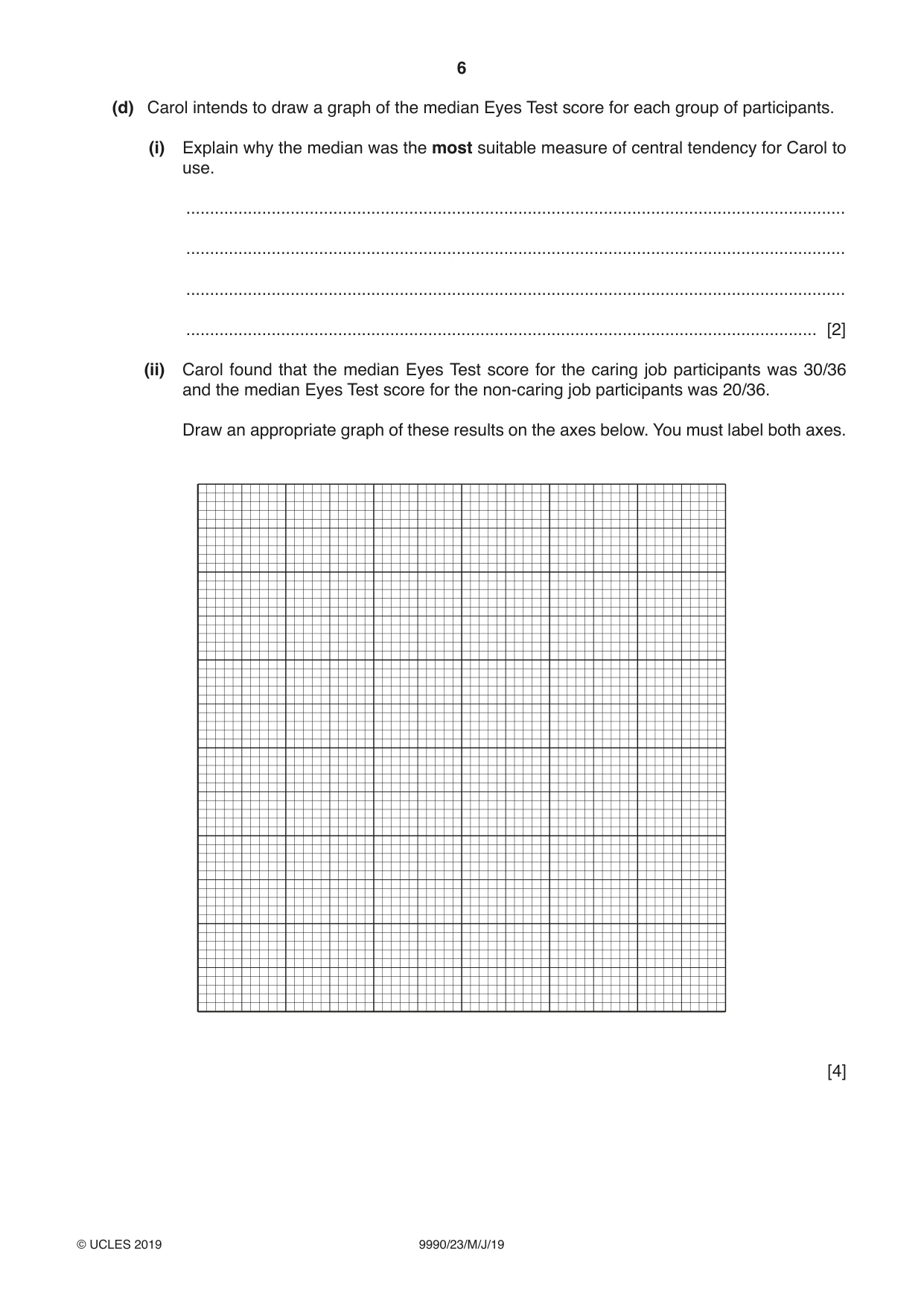
7 Carol is interested in theory of mind. She is comparing adults in ‘caring’ jobs such as nursing with adults in ‘non-caring’ jobs that have less contact with the public. Carol believes that adults in caring jobs will score higher on the Eyes Test than those in non-caring jobs. (a) Write a null hypothesis for Carol’s study. ................................................................................................................................................... ............................................................................................................................................. [1] (b) Carol obtains a sample from 2000 people who found a job through an employment website. Each person has an equal chance of being in her sample. (i) Name the sampling technique that Carol used. ..................................................................................................................................... [1] (ii) Explain why it is an advantage that each person had an equal chance of being in Carol’s sample. ........................................................................................................................................... ........................................................................................................................................... ........................................................................................................................................... ..................................................................................................................................... [2] (c) Explain the experimental design being used in Carol’s study. ................................................................................................................................................... ................................................................................................................................................... ................................................................................................................................................... ............................................................................................................................................. [2] (d) Carol intends to draw a graph of the median Eyes Test score for each group of participants. (i) Explain why the median was the most suitable measure of central tendency for Carol to use. ........................................................................................................................................... ........................................................................................................................................... ........................................................................................................................................... ..................................................................................................................................... [2] (ii) Carol found that the median Eyes Test score for the caring job participants was 30/36 and the median Eyes Test score for the non-caring job participants was 20/36. Draw an appropriate graph of these results on the axes below. You must label both axes. [4]
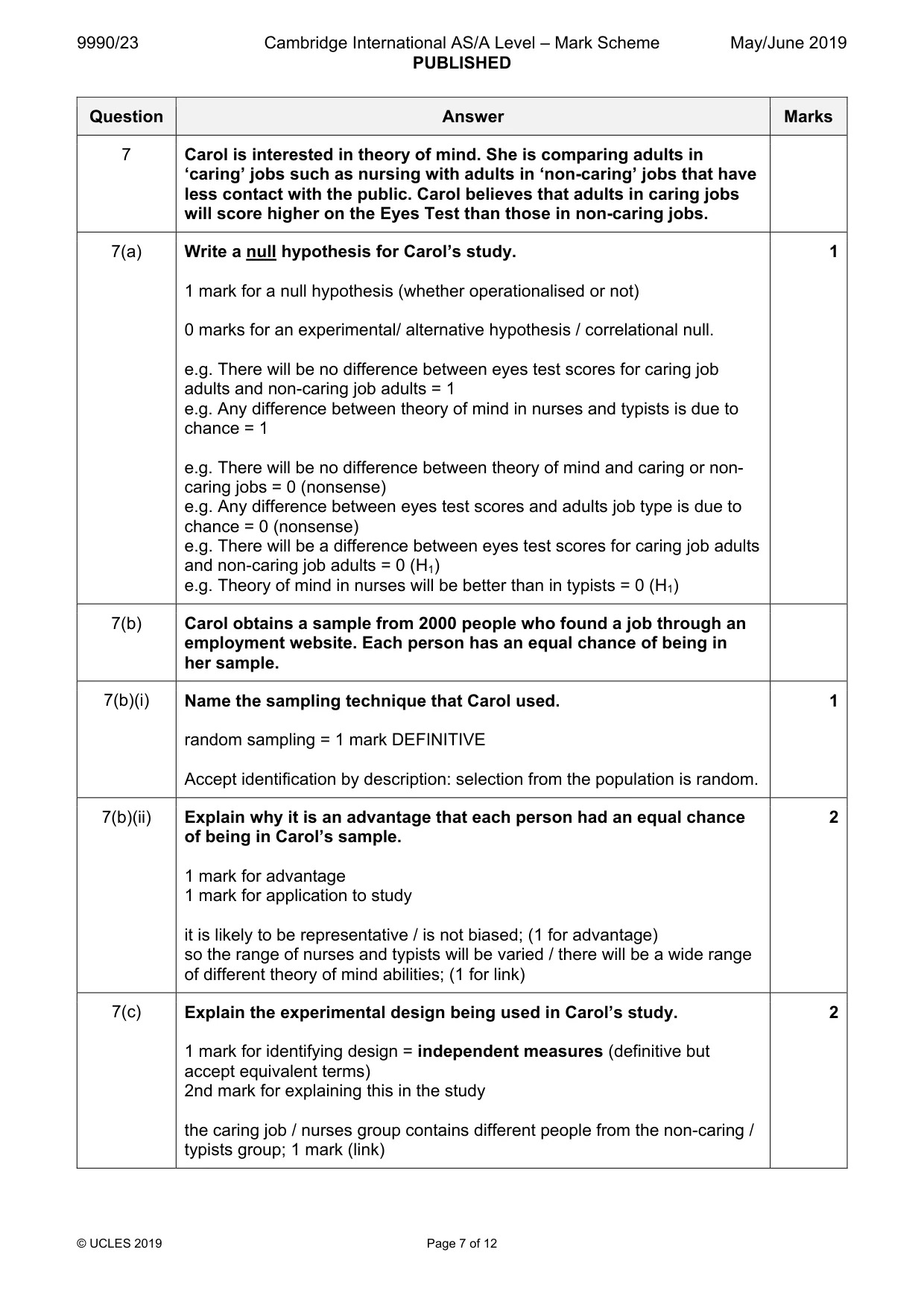
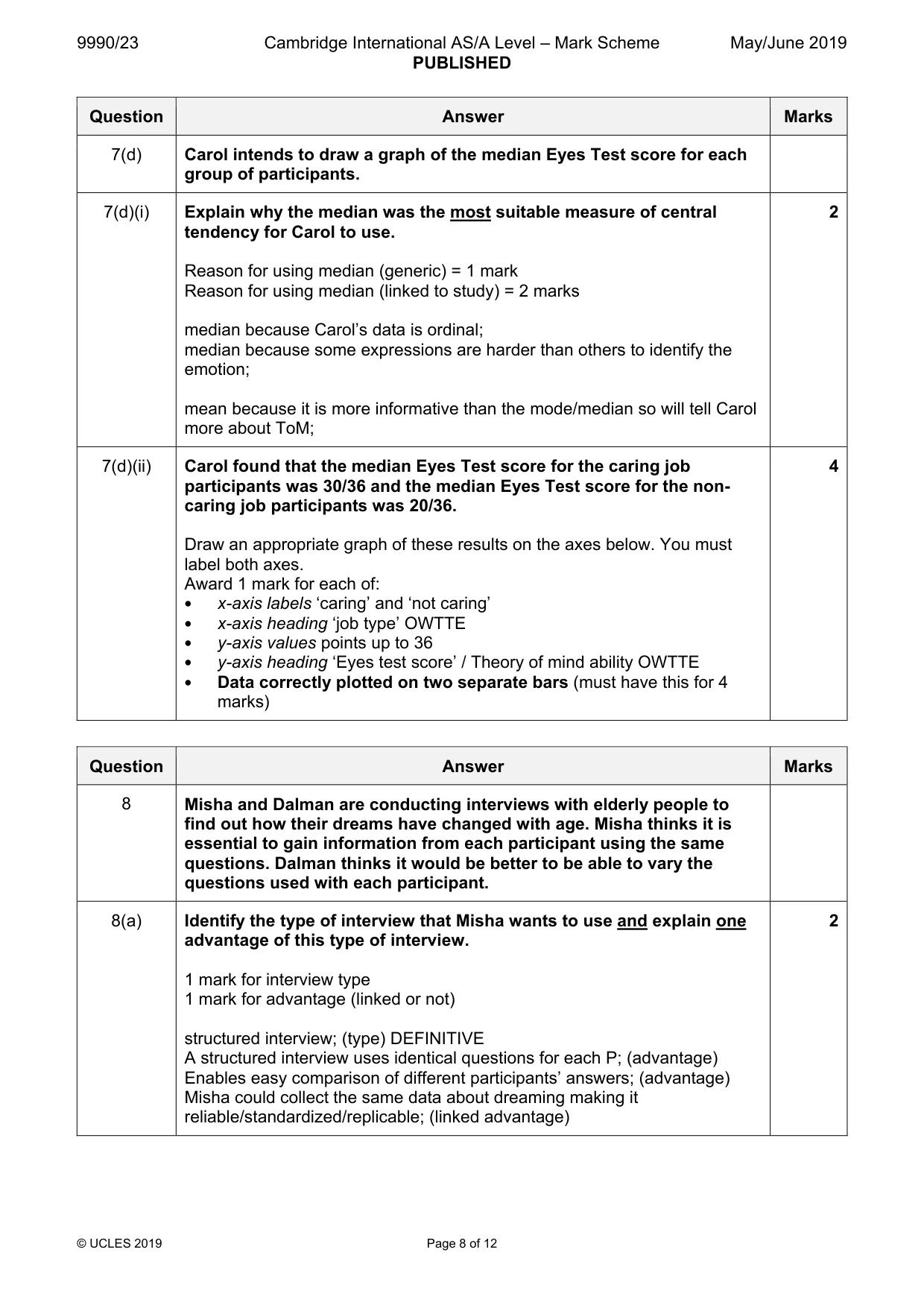
Mark scheme: 7(a) Write a null hypothesis for Carol’s study. 1 1 mark for a null hypothesis (whether operationalised or not) 0 marks for an experimental/ alternative hypothesis / correlational null. e.g. There will be no difference between eyes test scores for caring job adults and non-caring job adults = 1 e.g. Any difference between theory of mind in nurses and typists is due to chance = 1 e.g. There will be no difference between theory of mind and caring or non- caring jobs = 0 (nonsense) e.g. Any difference between eyes test scores and adults job type is due to chance = 0 (nonsense) e.g. There will be a difference between eyes test scores for caring job adults and non-caring job adults = 0 (H1) e.g. Theory of mind in nurses will be better than in typists = 0 (H1) 7(b) Carol obtains a sample from 2000 people who found a job through an employment website. Each person has an equal chance of being in her sample. 7(b)(i) Name the sampling technique that Carol used. 1 random sampling = 1 mark DEFINITIVE Accept identification by description: selection from the population is random. 7(b)(ii) Explain why it is an advantage that each person had an equal chance 2 of being in Carol’s sample. 1 mark for advantage 1 mark for application to study it is likely to be representative / is not biased; (1 for advantage) so the range of nurses and typists will be varied / there will be a wide range of different theory of mind abilities; (1 for link) 7(c) Explain the experimental design being used in Carol’s study. 2 1 mark for identifying design = independent measures (definitive but accept equivalent terms) 2nd mark for explaining this in the study the caring job / nurses group contains different people from the non-caring / typists group; 1 mark (link) 7(d) Carol intends to draw a graph of the median Eyes Test score for each group of participants. 7(d)(i) Explain why the median was the most suitable measure of central 2 tendency for Carol to use. Reason for using median (generic) = 1 mark Reason for using median (linked to study) = 2 marks median because Carol’s data is ordinal; median because some expressions are harder than others to identify the emotion; mean because it is more informative than the mode/median so will tell Carol more about ToM; 7(d)(ii) Carol found that the median Eyes Test score for the caring job 4 participants was 30/36 and the median Eyes Test score for the non- caring job participants was 20/36. Draw an appropriate graph of these results on the axes below. You must label both axes. Award 1 mark for each of: • x-axis labels ‘caring’ and ‘not caring’ • x-axis heading ‘job type’ OWTTE • y-axis values points up to 36 • y-axis heading ‘Eyes test score’ / Theory of mind ability OWTTE • Data correctly plotted on two separate bars (must have this for 4 marks)
Q8 · Misha and Dalman are conducting interviews with elderly people to find out how their…
8 Misha and Dalman are conducting interviews with elderly people to find out how their dreams have changed with age. Misha thinks it is essential to gain information from each participant using the same questions. Dalman thinks it would be better to be able to vary the questions used with each participant. (a) Identify the type of interview that Misha wants to use and explain one advantage of this type of interview. type of interview: ....................................................................................................................... advantage: ................................................................................................................................ ................................................................................................................................................... [2] (b) Identify the type of interview that Dalman wants to use and explain one advantage of this type of interview. type of interview: ....................................................................................................................... advantage: ................................................................................................................................ ................................................................................................................................................... [2]
Mark scheme: 8(a) Identify the type of interview that Misha wants to use and explain one 2 advantage of this type of interview. 1 mark for interview type 1 mark for advantage (linked or not) structured interview; (type) DEFINITIVE A structured interview uses identical questions for each P; (advantage) Enables easy comparison of different participants’ answers; (advantage) Misha could collect the same data about dreaming making it reliable/standardized/replicable; (linked advantage) 8(b) Identify the type of interview that Dalman wants to use and explain one 2 advantage of this type of interview. 1 mark for interview type 1 mark for advantage (linked or not) unstructured interview; (type) An unstructured interview allows the interview to change the questions for each P; (advantage) Better to be able to vary the questions used with each participant to explore their individual experience; (ad) Dalman could collect / valid data by asking lots of specific questions; (linked advantage)
Q9 · Aram plans to use a controlled observation to record the behaviour of children in the…
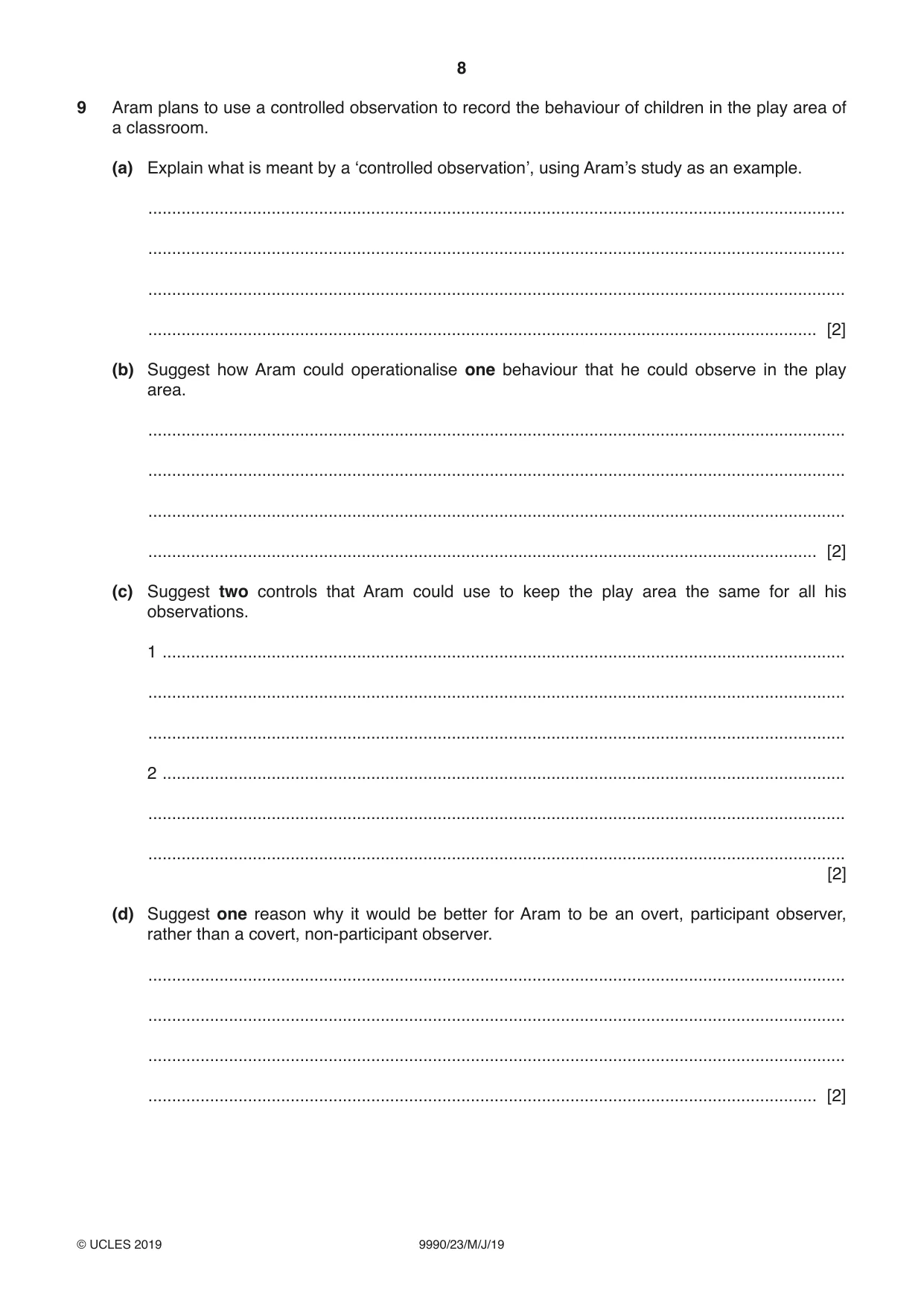
9 Aram plans to use a controlled observation to record the behaviour of children in the play area of a classroom. (a) Explain what is meant by a ‘controlled observation’, using Aram’s study as an example. ................................................................................................................................................... ................................................................................................................................................... ................................................................................................................................................... ............................................................................................................................................. [2] (b) Suggest how Aram could operationalise one behaviour that he could observe in the play area. ................................................................................................................................................... ................................................................................................................................................... ................................................................................................................................................... ............................................................................................................................................. [2] (c) Suggest two controls that Aram could use to keep the play area the same for all his observations. 1 ................................................................................................................................................ ................................................................................................................................................... ................................................................................................................................................... 2 ................................................................................................................................................ ................................................................................................................................................... ................................................................................................................................................... [2] (d) Suggest one reason why it would be better for Aram to be an overt, participant observer, rather than a covert, non-participant observer. ................................................................................................................................................... ................................................................................................................................................... ................................................................................................................................................... ............................................................................................................................................. [2] Section C Answer all questions in this section.
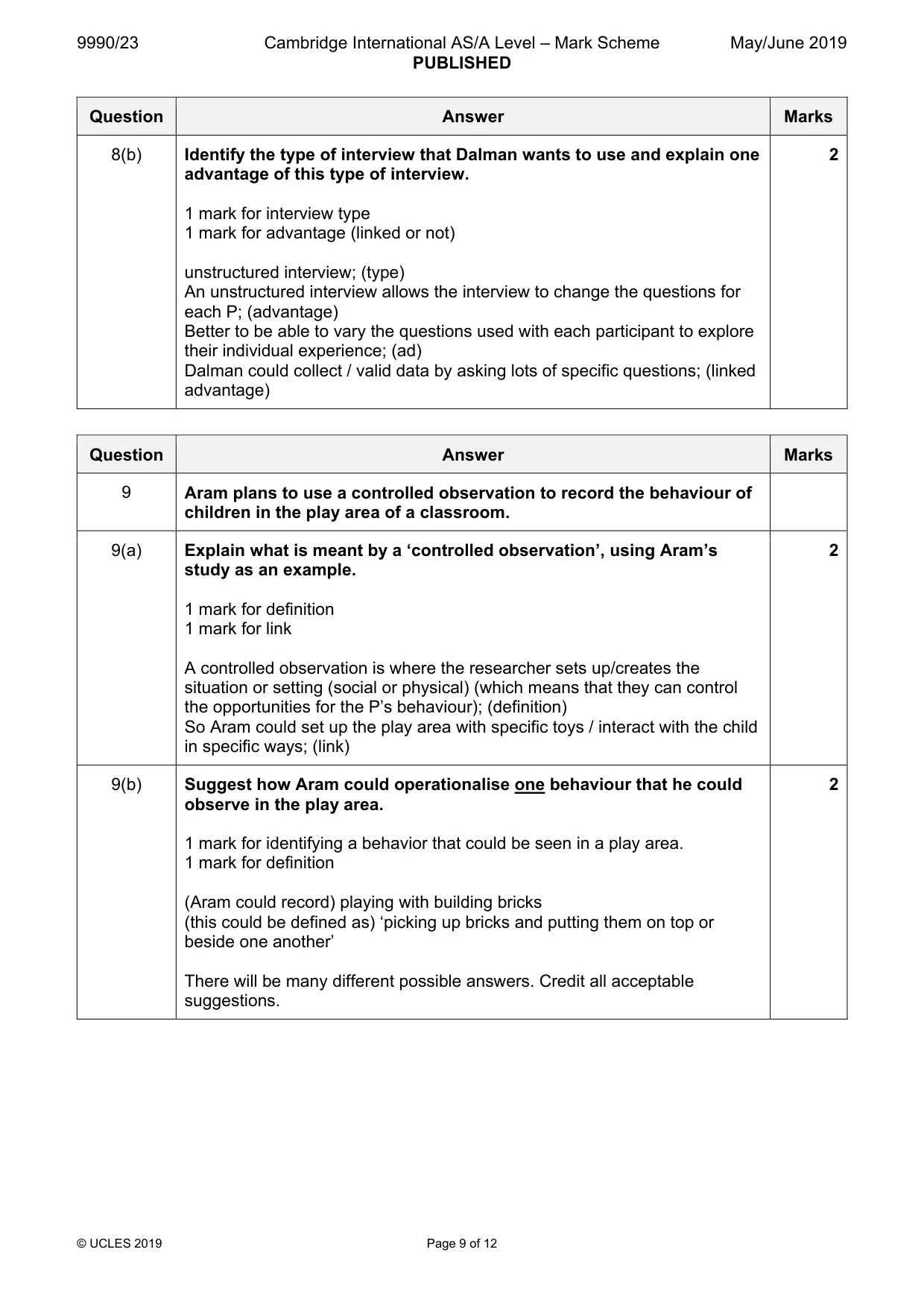
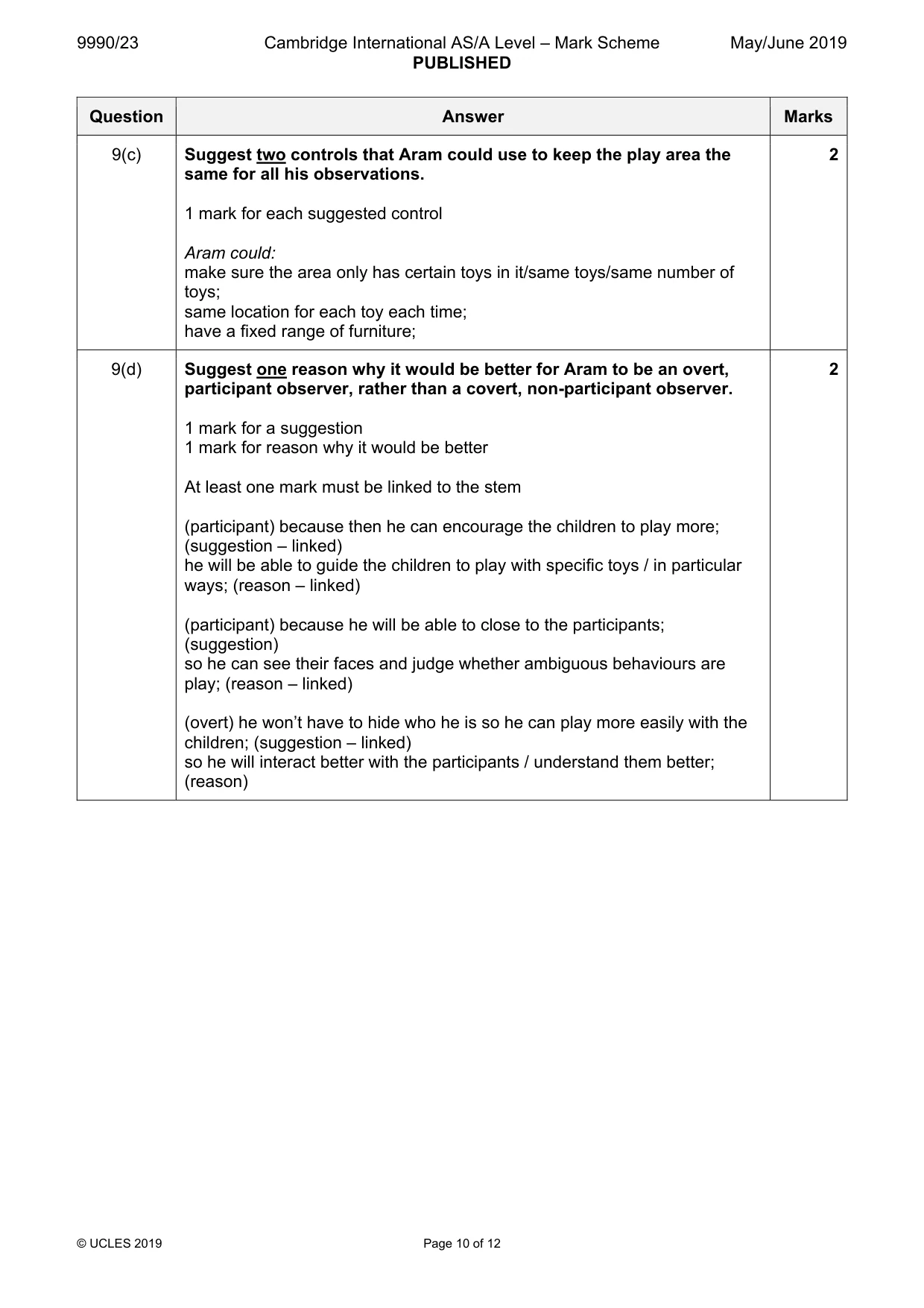
Mark scheme: 9(a) Explain what is meant by a ‘controlled observation’, using Aram’s 2 study as an example. 1 mark for definition 1 mark for link A controlled observation is where the researcher sets up/creates the situation or setting (social or physical) (which means that they can control the opportunities for the P’s behaviour); (definition) So Aram could set up the play area with specific toys / interact with the child in specific ways; (link) 9(b) Suggest how Aram could operationalise one behaviour that he could 2 observe in the play area. 1 mark for identifying a behavior that could be seen in a play area. 1 mark for definition (Aram could record) playing with building bricks (this could be defined as) ‘picking up bricks and putting them on top or beside one another’ There will be many different possible answers. Credit all acceptable suggestions. 9(c) Suggest two controls that Aram could use to keep the play area the 2 same for all his observations. 1 mark for each suggested control Aram could: make sure the area only has certain toys in it/same toys/same number of toys; same location for each toy each time; have a fixed range of furniture; 9(d) Suggest one reason why it would be better for Aram to be an overt, 2 participant observer, rather than a covert, non-participant observer. 1 mark for a suggestion 1 mark for reason why it would be better At least one mark must be linked to the stem (participant) because then he can encourage the children to play more; (suggestion – linked) he will be able to guide the children to play with specific toys / in particular ways; (reason – linked) (participant) because he will be able to close to the participants; (suggestion) so he can see their faces and judge whether ambiguous behaviours are play; (reason – linked) (overt) he won’t have to hide who he is so he can play more easily with the children; (suggestion – linked) so he will interact better with the participants / understand them better; (reason)
Q10 · Elio is planning a field experiment to investigate whether office layout affects laziness
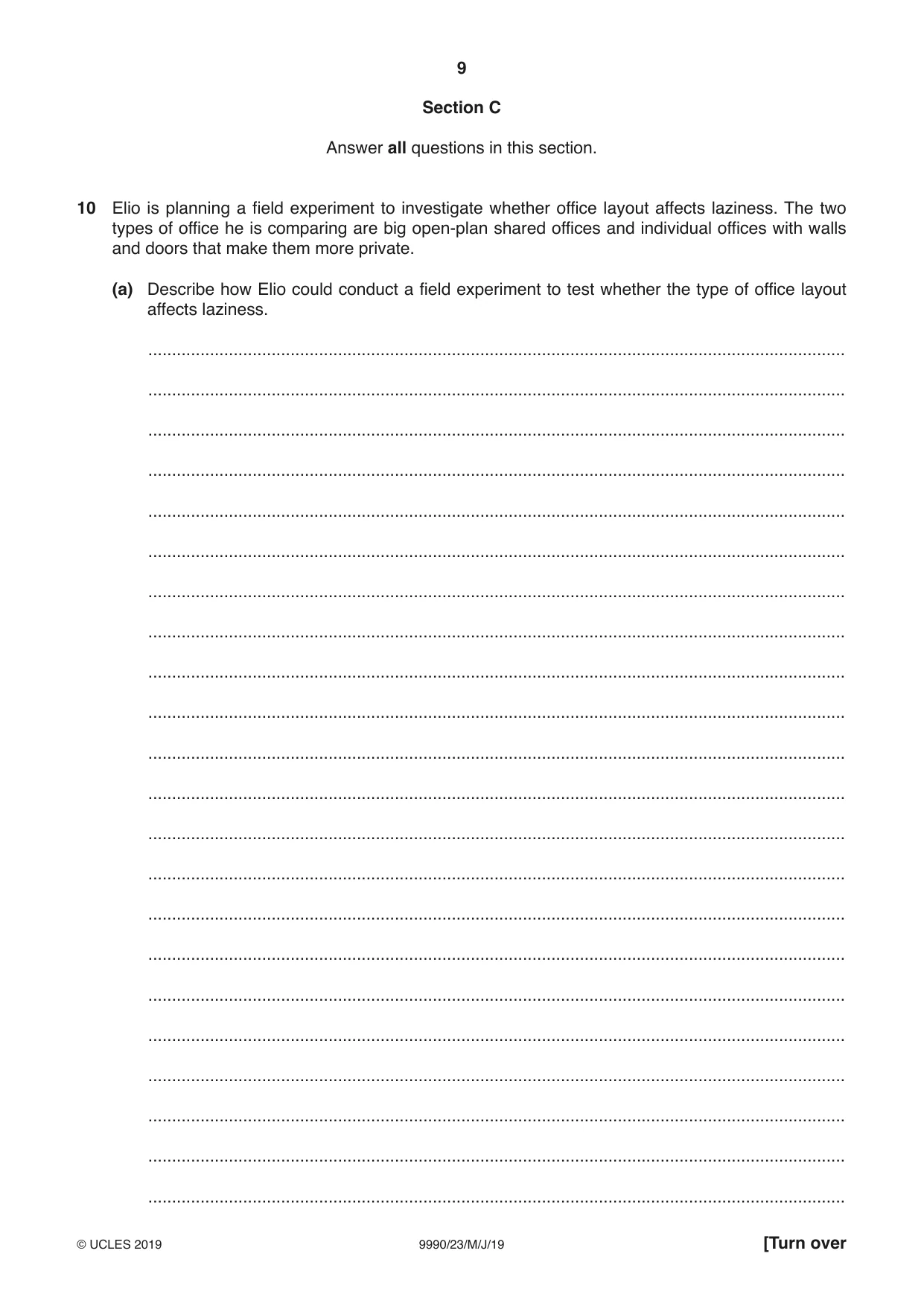
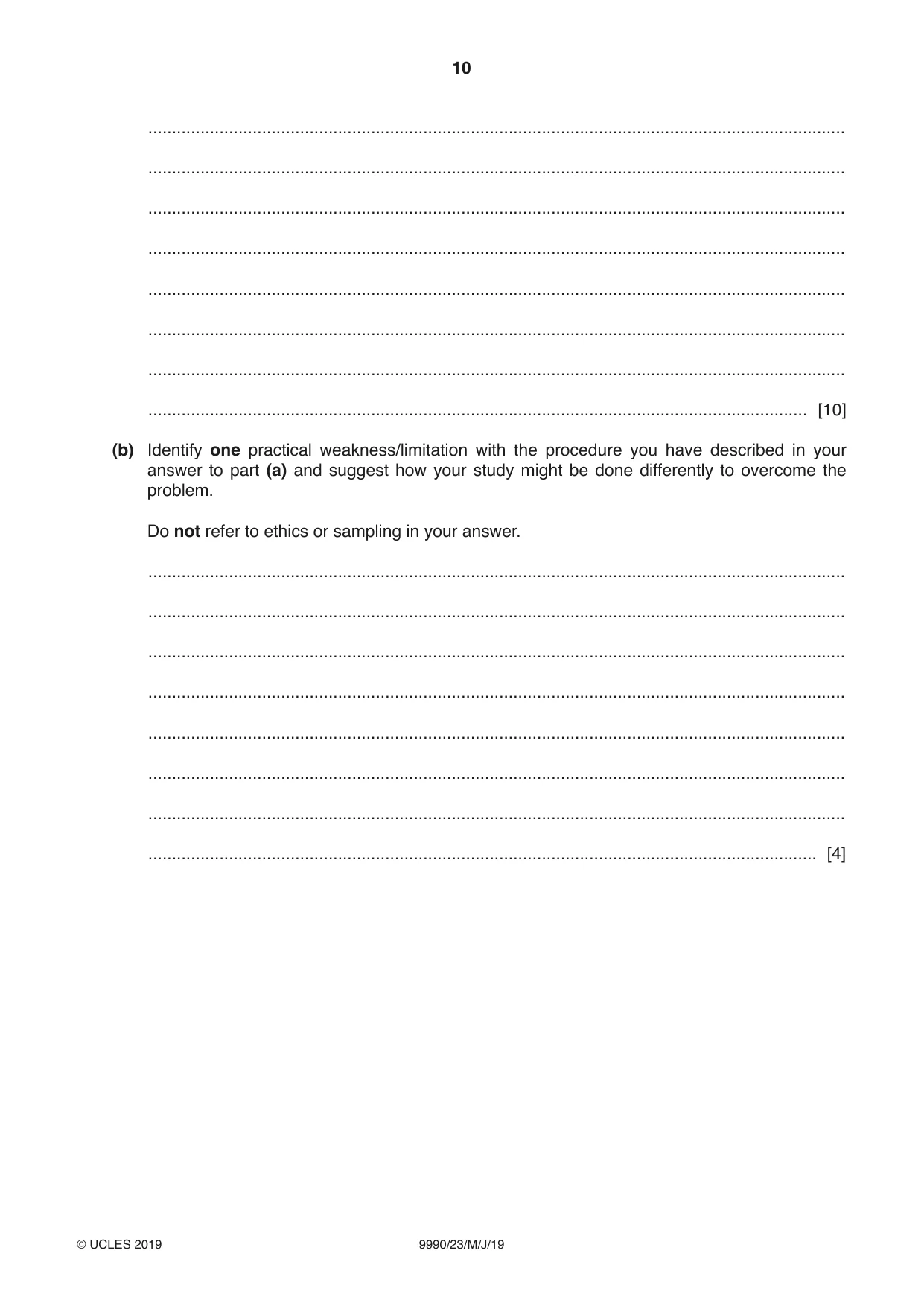
10 Elio is planning a field experiment to investigate whether office layout affects laziness. The two types of office he is comparing are big open-plan shared offices and individual offices with walls and doors that make them more private. (a) Describe how Elio could conduct a field experiment to test whether the type of office layout affects laziness. ................................................................................................................................................... ................................................................................................................................................... ................................................................................................................................................... ................................................................................................................................................... ................................................................................................................................................... ................................................................................................................................................... ................................................................................................................................................... ................................................................................................................................................... ................................................................................................................................................... ................................................................................................................................................... ................................................................................................................................................... ................................................................................................................................................... ................................................................................................................................................... ................................................................................................................................................... ................................................................................................................................................... ................................................................................................................................................... ................................................................................................................................................... ................................................................................................................................................... ................................................................................................................................................... ................................................................................................................................................... ................................................................................................................................................... ................................................................................................................................................... ................................................................................................................................................... ................................................................................................................................................... ................................................................................................................................................... ................................................................................................................................................... ................................................................................................................................................... ................................................................................................................................................... ................................................................................................................................................... ........................................................................................................................................... [10] (b) Identify one practical weakness/limitation with the procedure you have described in your answer to part (a) and suggest how your study might be done differently to overcome the problem. Do not refer to ethics or sampling in your answer. ................................................................................................................................................... ................................................................................................................................................... ................................................................................................................................................... ................................................................................................................................................... ................................................................................................................................................... ................................................................................................................................................... ................................................................................................................................................... ............................................................................................................................................. [4]
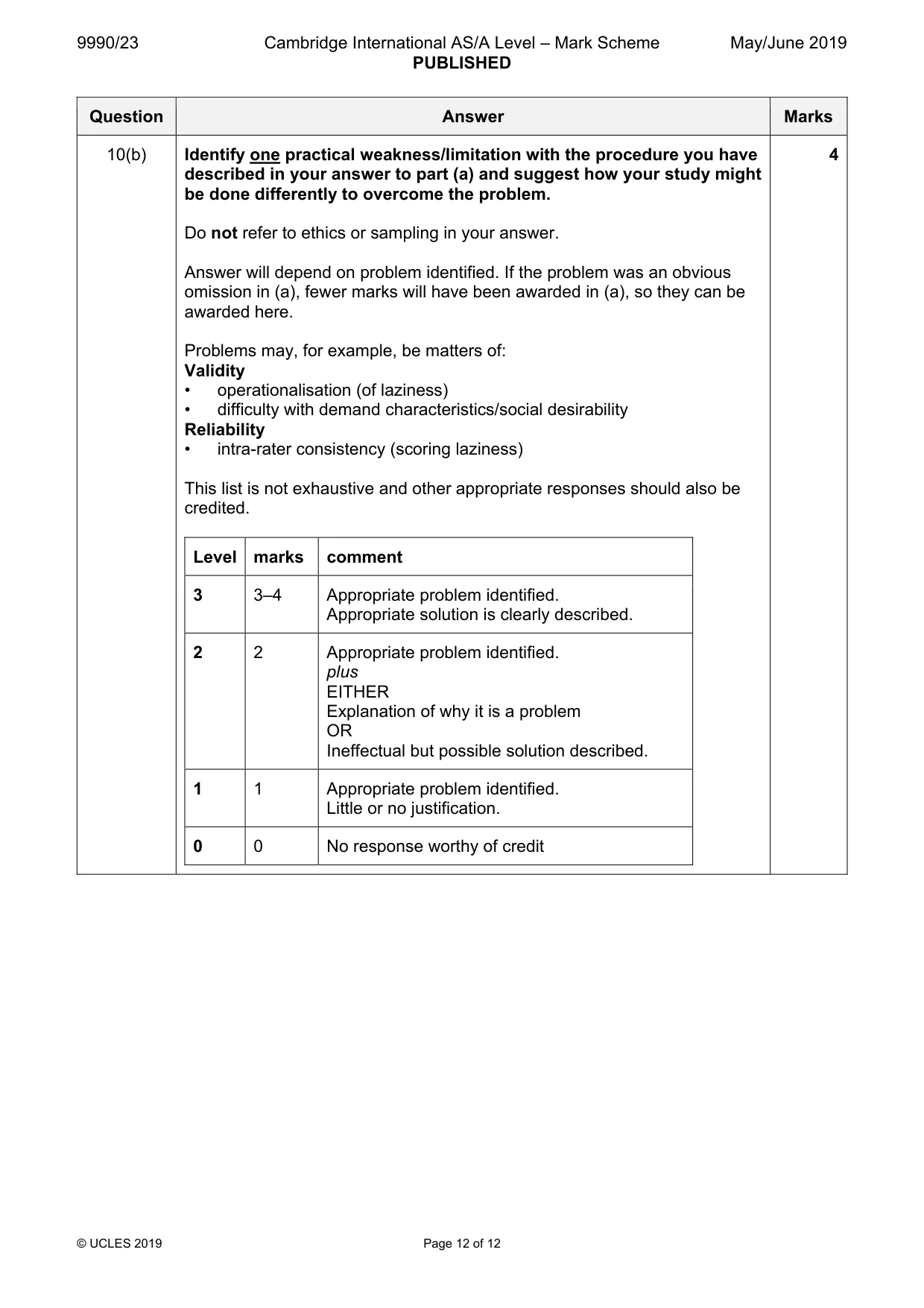
Mark scheme: 10(a) Describe how Elio could conduct a field experiment to test whether the 10 type of office layout affects laziness. Three major omissions for a field experiment are: What: – will be recorded, ie DV How: – IV Where – location of participants when data is collected (e.g. a company with different types of office / different companies with differing style offices) The minor omissions are: how – controls who – participants (must be office workers) Indicative content for a field experiment: • How – identification of the independent variable • operationalisation of the dependent variable • What – identification of the dependent variable • operationalisation of the dependent variable • including examples of ways to measure the variable such as questions/tests used • Where – location of participants when data is collected • How – controls • experimental design (any are appropriate here) • sampling technique • sample size • description of how data will analysed, e.g. use of measures of central tendency and spread, bar charts • ethical issues Level 3 (8–10 marks) • Response is described in sufficient detail to be replicable. • Response may have a minor omission. • Use of psychological terminology is accurate and comprehensive. Level 2 (5–7 marks) • Response is in some detail. • Response has minor omission(s). • Use of psychological terminology is accurate. Level 1 (1–4 marks) • Response is basic in detail. • Response has major omission(s). • If response is impossible to conduct max. 2. • Use of psychological terminology is mainly accurate. Level 0 (0 marks) No response worthy of credit. 10(b) Identify one practical weakness/limitation with the procedure you have 4 described in your answer to part (a) and suggest how your study might be done differently to overcome the problem. Do not refer to ethics or sampling in your answer. Answer will depend on problem identified. If the problem was an obvious omission in (a), fewer marks will have been awarded in (a), so they can be awarded here. Problems may, for example, be matters of: Validity • operationalisation (of laziness) • difficulty with demand characteristics/social desirability Reliability • intra-rater consistency (scoring laziness) This list is not exhaustive and other appropriate responses should also be credited. Level marks comment 3 3–4 Appropriate problem identified. Appropriate solution is clearly described. 2 2 Appropriate problem identified. plus EITHER Explanation of why it is a problem OR Ineffectual but possible solution described. 1 1 Appropriate problem identified. Little or no justification. 0 0 No response worthy of credit
What was in this paper
The subtopics covered by these 10 questions, and how many questions each got. Open one in a new tab to see every Cambridge question on it.
What you needed in this session
Cambridge’s own grade thresholds for 2019 May/June, Paper 2 · Variant 3. A higher threshold means an easier paper — the bar moves with how the cohort did.