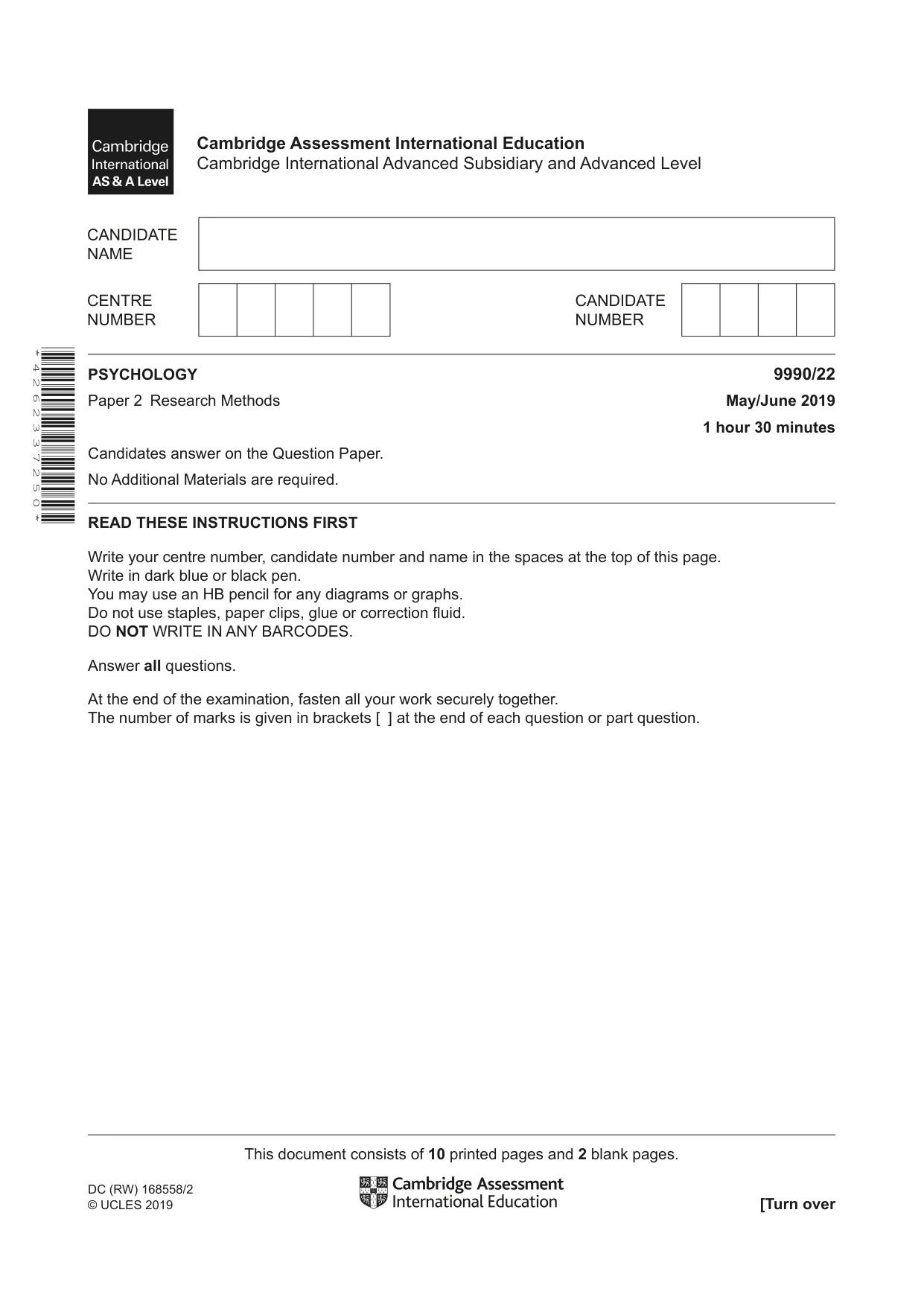
Cambridge A Level Psychology (from 2018) 9990 — 2019 May/June Paper 2 · Variant 2
9990/22/M/J/19 · 10 questions · 60 marks · ≈68 min
The question paper and its mark scheme, free to read here and free to download. This is Cambridge’s own paper, exactly as it was sat.
Question paper12 pages



Mark scheme14 pages
Answers below. Sit the paper first if you are practising.
Questions as text
Q1 · Dement and Kleitman (sleep and dreams) found a positive correlation between REM duration…
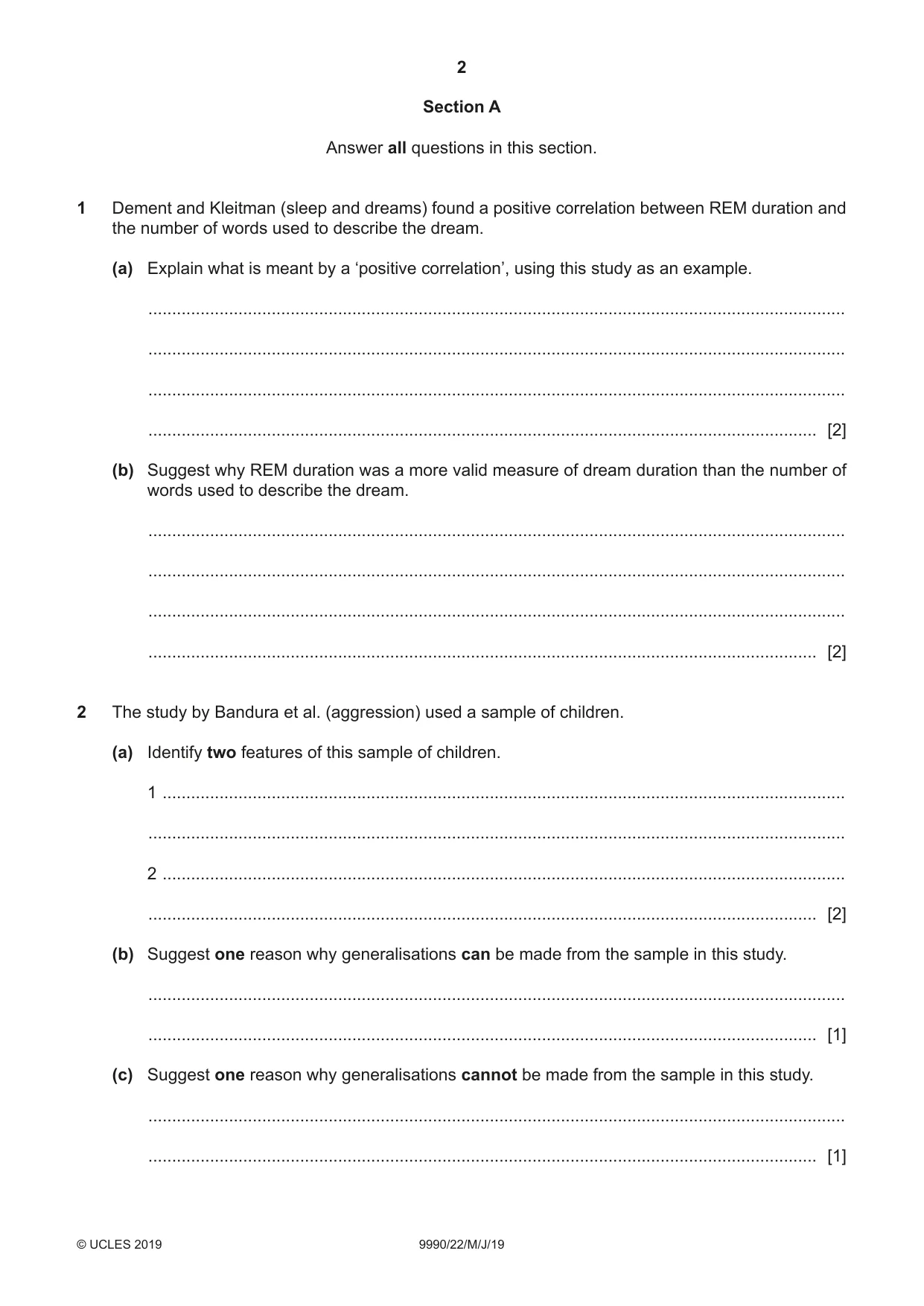
1 Dement and Kleitman (sleep and dreams) found a positive correlation between REM duration and the number of words used to describe the dream. (a) Explain what is meant by a ‘positive correlation’, using this study as an example. ................................................................................................................................................... ................................................................................................................................................... ................................................................................................................................................... ............................................................................................................................................. [2] (b) Suggest why REM duration was a more valid measure of dream duration than the number of words used to describe the dream. ................................................................................................................................................... ................................................................................................................................................... ................................................................................................................................................... ............................................................................................................................................. [2]
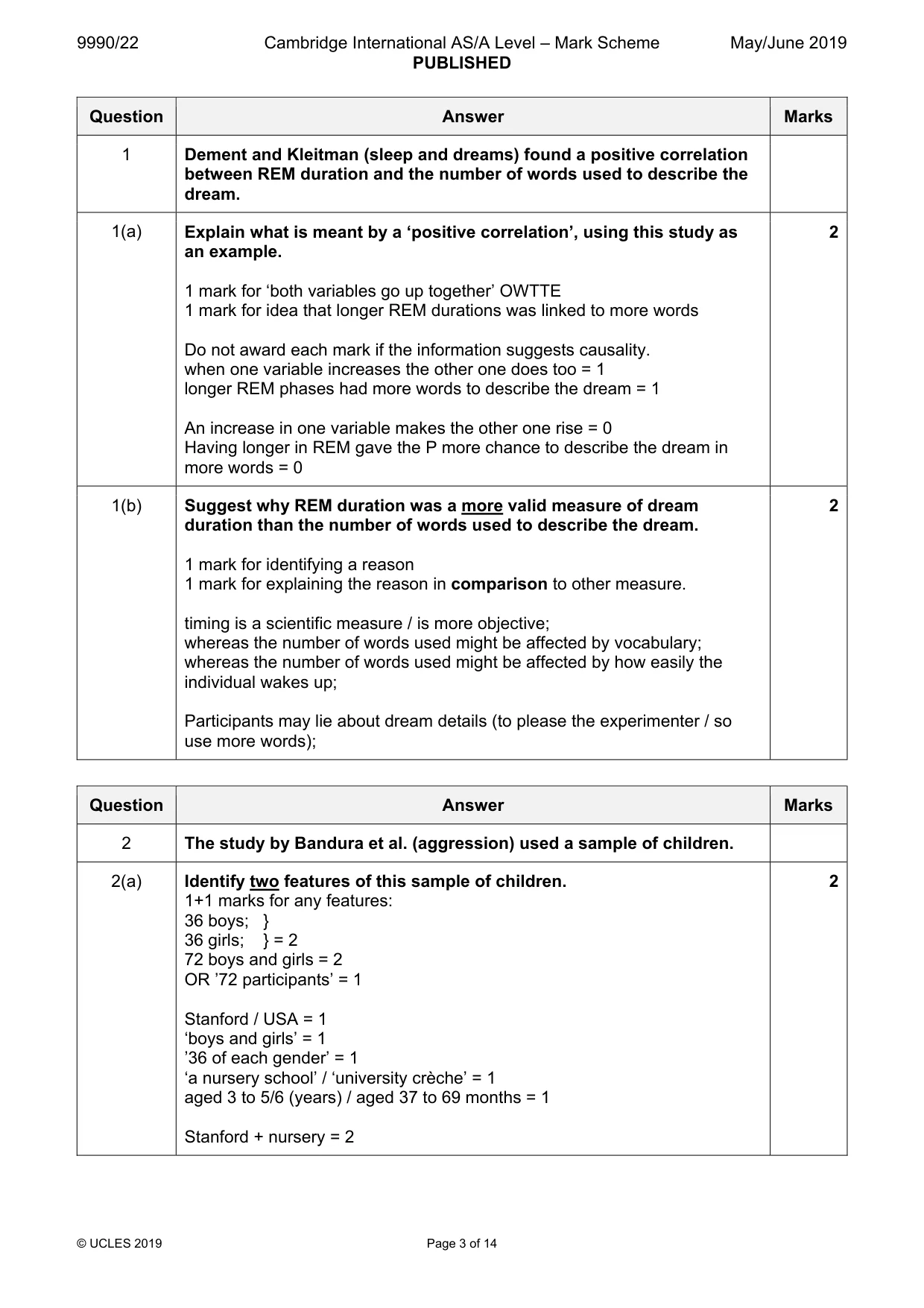
Mark scheme: Question Answer Marks 1 Dement and Kleitman (sleep and dreams) found a positive correlation between REM duration and the number of words used to describe the dream. 1(a) Explain what is meant by a ‘positive correlation’, using this study as 2 an example. 1 mark for ‘both variables go up together’ OWTTE 1 mark for idea that longer REM durations was linked to more words Do not award each mark if the information suggests causality. when one variable increases the other one does too = 1 longer REM phases had more words to describe the dream = 1 An increase in one variable makes the other one rise = 0 Having longer in REM gave the P more chance to describe the dream in more words = 0 1(b) Suggest why REM duration was a more valid measure of dream 2 duration than the number of words used to describe the dream. 1 mark for identifying a reason 1 mark for explaining the reason in comparison to other measure. timing is a scientific measure / is more objective; whereas the number of words used might be affected by vocabulary; whereas the number of words used might be affected by how easily the individual wakes up; Participants may lie about dream details (to please the experimenter / so use more words);
Q2 · The study by Bandura et al
2 The study by Bandura et al. (aggression) used a sample of children. (a) Identify two features of this sample of children. 1 ................................................................................................................................................ ................................................................................................................................................... 2 ................................................................................................................................................ ............................................................................................................................................. [2] (b) Suggest one reason why generalisations can be made from the sample in this study. ................................................................................................................................................... ............................................................................................................................................. [1] (c) Suggest one reason why generalisations cannot be made from the sample in this study. ................................................................................................................................................... ............................................................................................................................................. [1]
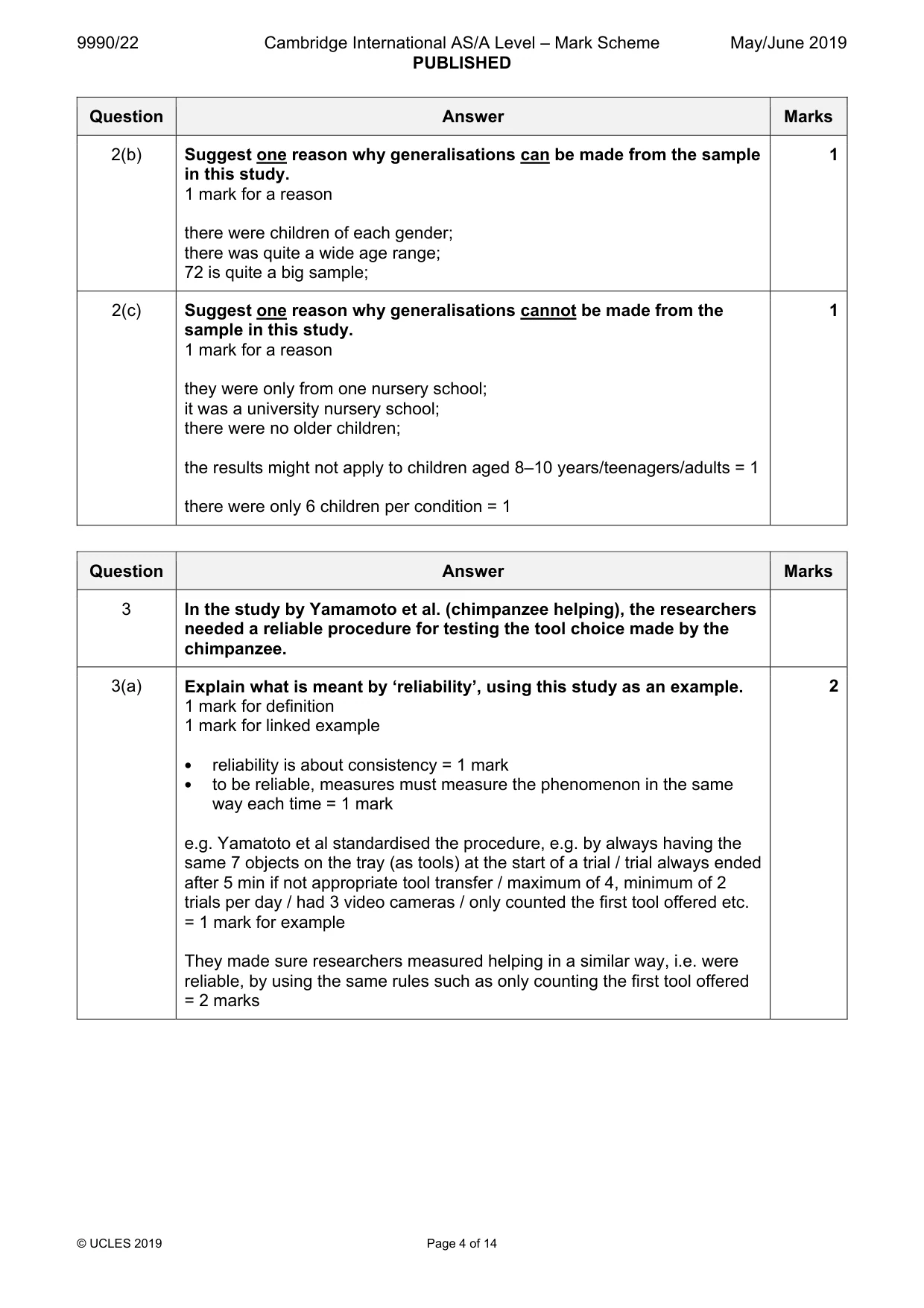
Mark scheme: 2(a) Identify two features of this sample of children. 2 1+1 marks for any features: 36 boys; } 36 girls; } = 2 72 boys and girls = 2 OR ’72 participants’ = 1 Stanford / USA = 1 ‘boys and girls’ = 1 ’36 of each gender’ = 1 ‘a nursery school’ / ‘university crèche’ = 1 aged 3 to 5/6 (years) / aged 37 to 69 months = 1 Stanford + nursery = 2 2(b) Suggest one reason why generalisations can be made from the sample 1 in this study. 1 mark for a reason there were children of each gender; there was quite a wide age range; 72 is quite a big sample; 2(c) Suggest one reason why generalisations cannot be made from the 1 sample in this study. 1 mark for a reason they were only from one nursery school; it was a university nursery school; there were no older children; the results might not apply to children aged 8–10 years/teenagers/adults = 1 there were only 6 children per condition = 1
Q3 · In the study by Yamamoto et al
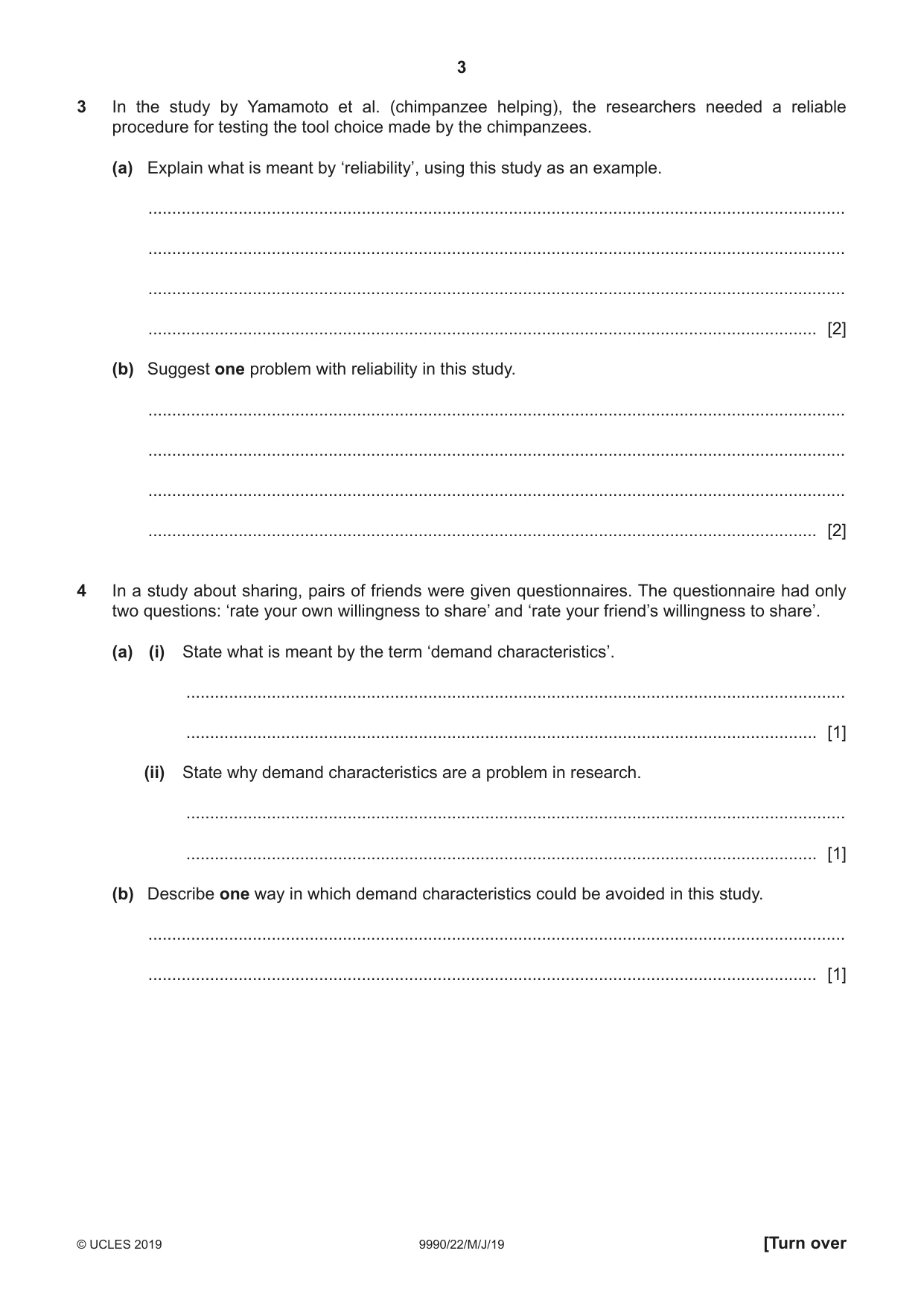
3 In the study by Yamamoto et al. (chimpanzee helping), the researchers needed a reliable procedure for testing the tool choice made by the chimpanzees. (a) Explain what is meant by ‘reliability’, using this study as an example. ................................................................................................................................................... ................................................................................................................................................... ................................................................................................................................................... ............................................................................................................................................. [2] (b) Suggest one problem with reliability in this study. ................................................................................................................................................... ................................................................................................................................................... ................................................................................................................................................... ............................................................................................................................................. [2]
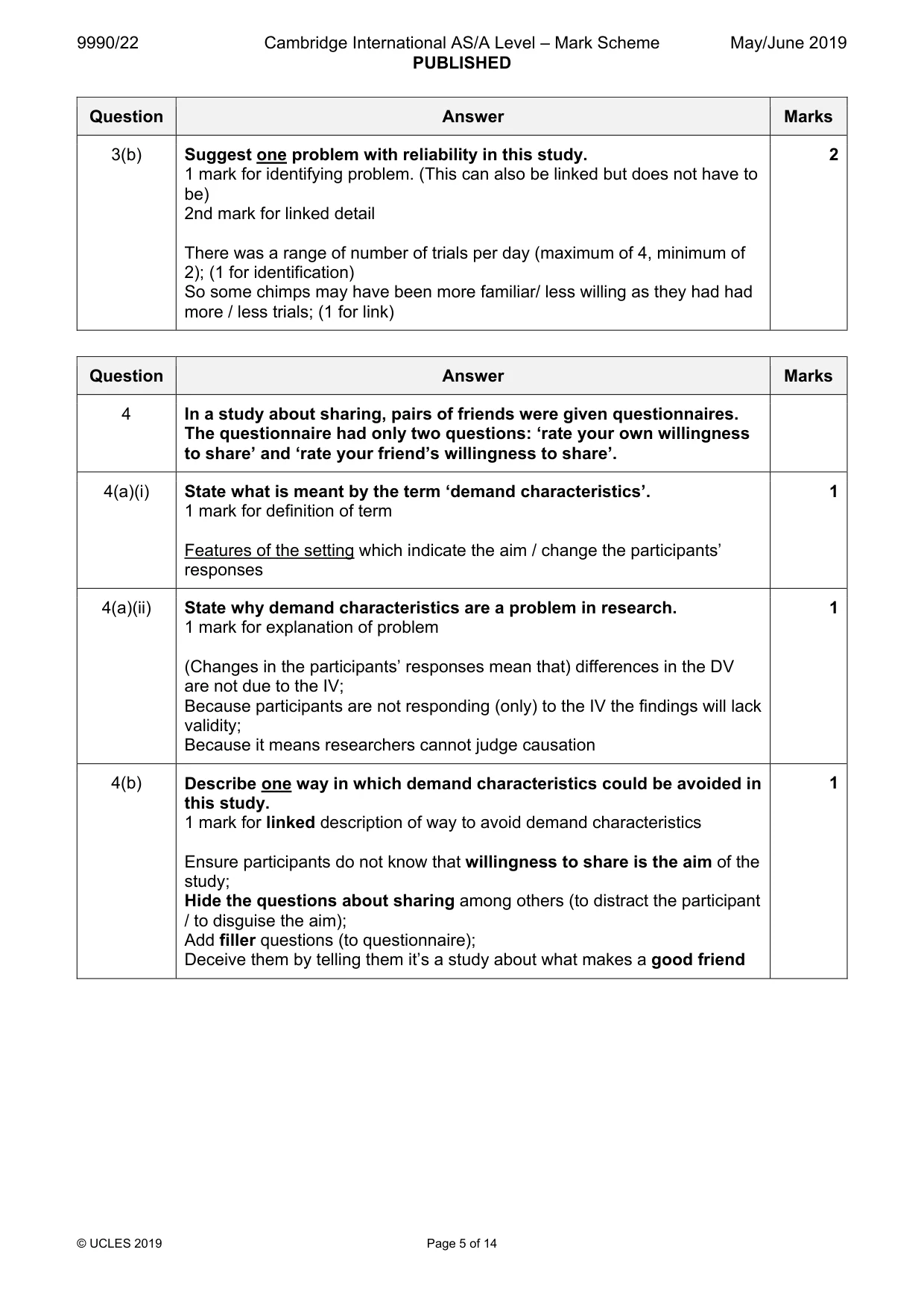
Mark scheme: 3(a) Explain what is meant by ‘reliability’, using this study as an example. 2 1 mark for definition 1 mark for linked example • reliability is about consistency = 1 mark • to be reliable, measures must measure the phenomenon in the same way each time = 1 mark e.g. Yamatoto et al standardised the procedure, e.g. by always having the same 7 objects on the tray (as tools) at the start of a trial / trial always ended after 5 min if not appropriate tool transfer / maximum of 4, minimum of 2 trials per day / had 3 video cameras / only counted the first tool offered etc. = 1 mark for example They made sure researchers measured helping in a similar way, i.e. were reliable, by using the same rules such as only counting the first tool offered = 2 marks 3(b) Suggest one problem with reliability in this study. 2 1 mark for identifying problem. (This can also be linked but does not have to be) 2nd mark for linked detail There was a range of number of trials per day (maximum of 4, minimum of 2); (1 for identification) So some chimps may have been more familiar/ less willing as they had had more / less trials; (1 for link)
Q4 · In a study about sharing, pairs of friends were given questionnaires
4 In a study about sharing, pairs of friends were given questionnaires. The questionnaire had only two questions: ‘rate your own willingness to share’ and ‘rate your friend’s willingness to share’. (a) (i) State what is meant by the term ‘demand characteristics’. ........................................................................................................................................... ..................................................................................................................................... [1] (ii) State why demand characteristics are a problem in research. ........................................................................................................................................... ..................................................................................................................................... [1] (b) Describe one way in which demand characteristics could be avoided in this study. ................................................................................................................................................... ............................................................................................................................................. [1]
Mark scheme: 4(a)(i) State what is meant by the term ‘demand characteristics’. 1 1 mark for definition of term Features of the setting which indicate the aim / change the participants’ responses 4(a)(ii) State why demand characteristics are a problem in research. 1 1 mark for explanation of problem (Changes in the participants’ responses mean that) differences in the DV are not due to the IV; Because participants are not responding (only) to the IV the findings will lack validity; Because it means researchers cannot judge causation 4(b) Describe one way in which demand characteristics could be avoided in 1 this study. 1 mark for linked description of way to avoid demand characteristics Ensure participants do not know that willingness to share is the aim of the study; Hide the questions about sharing among others (to distract the participant / to disguise the aim); Add filler questions (to questionnaire); Deceive them by telling them it’s a study about what makes a good friend 5 Sometimes it is more appropriate to use one measure of central tendency than another. Suggest one reason why it may be better to use the mean as a 1 measure of central tendency than the mode. 1 mark for reason The mean takes (the value of) every score into account (so is more representative) = 1 There might be two modes (which could be different from most of the rest of the data set) = 1 There might not be a most common score (so no mode) = 1
Q5 · Sometimes it is more appropriate to use one measure of central tendency than another
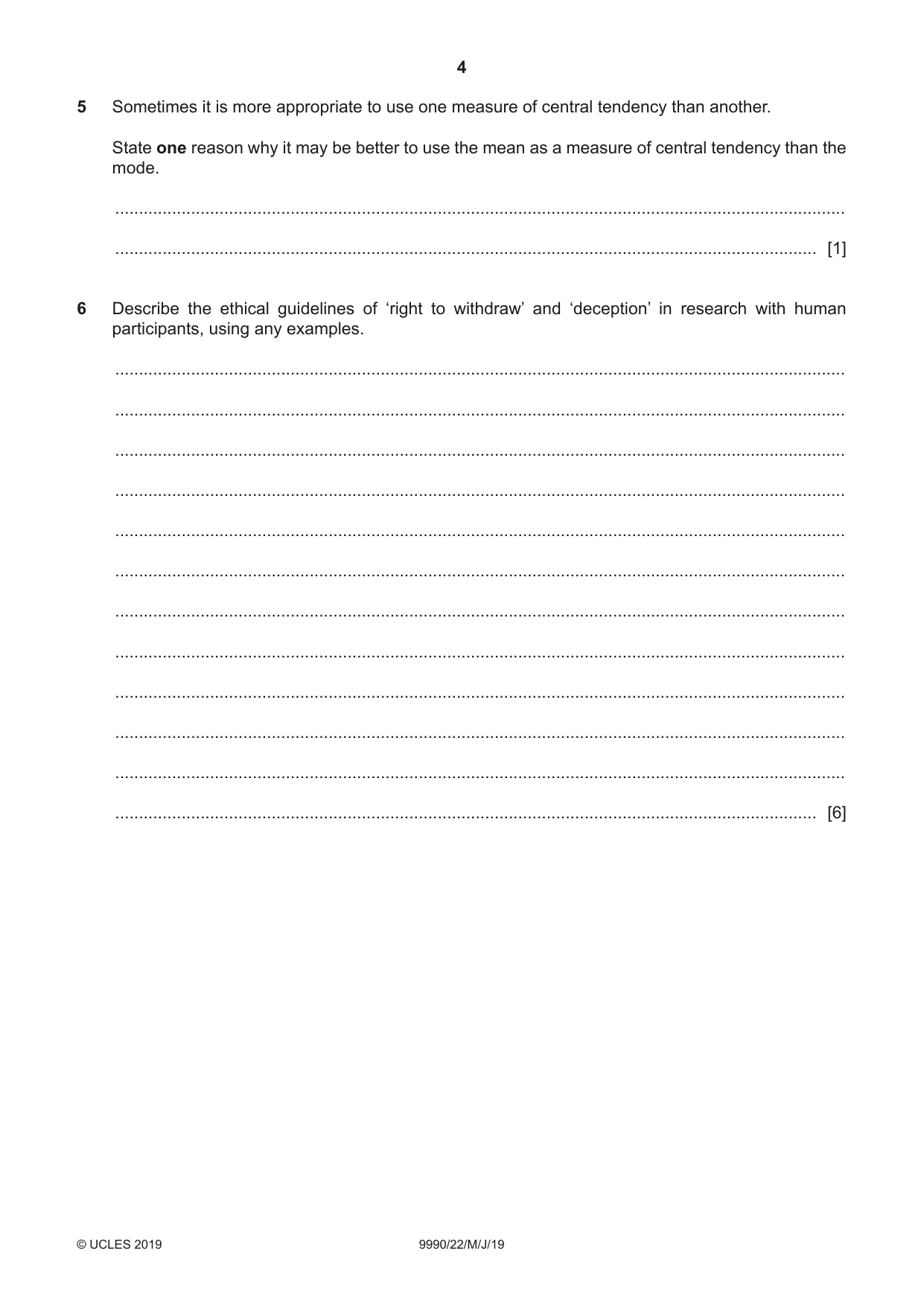
5 Sometimes it is more appropriate to use one measure of central tendency than another. State one reason why it may be better to use the mean as a measure of central tendency than the mode. .......................................................................................................................................................... .................................................................................................................................................... [1]
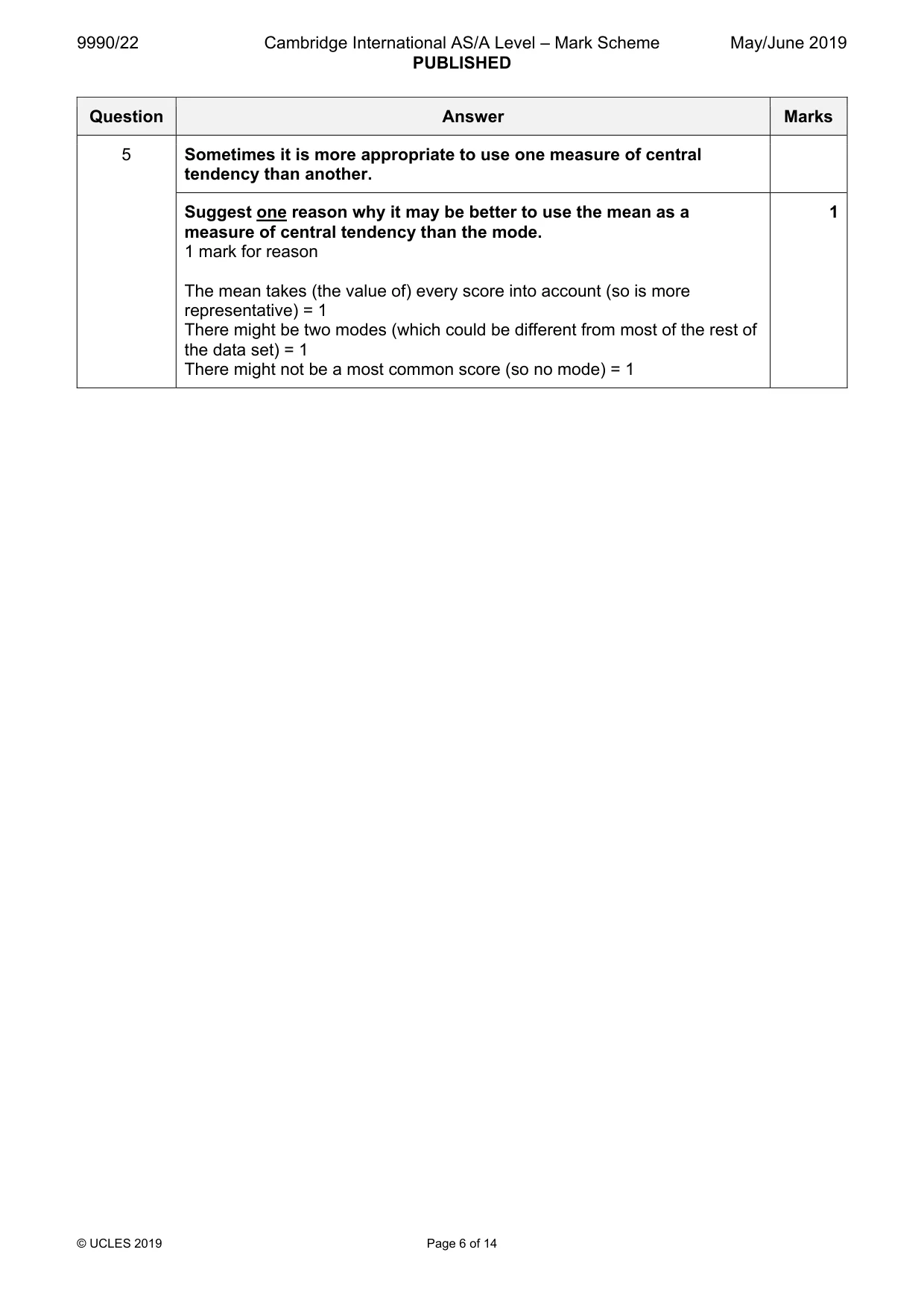
Mark scheme: Question Answer Marks 5 Sometimes it is more appropriate to use one measure of central tendency than another. Suggest one reason why it may be better to use the mean as a 1 measure of central tendency than the mode. 1 mark for reason The mean takes (the value of) every score into account (so is more representative) = 1 There might be two modes (which could be different from most of the rest of the data set) = 1 There might not be a most common score (so no mode) = 1
Q6 · Describe the ethical guidelines of ‘right to withdraw’ and ‘deception’ in research with…
6 Describe the ethical guidelines of ‘right to withdraw’ and ‘deception’ in research with human participants, using any examples. .......................................................................................................................................................... .......................................................................................................................................................... .......................................................................................................................................................... .......................................................................................................................................................... .......................................................................................................................................................... .......................................................................................................................................................... .......................................................................................................................................................... .......................................................................................................................................................... .......................................................................................................................................................... .......................................................................................................................................................... .......................................................................................................................................................... .................................................................................................................................................... [6]
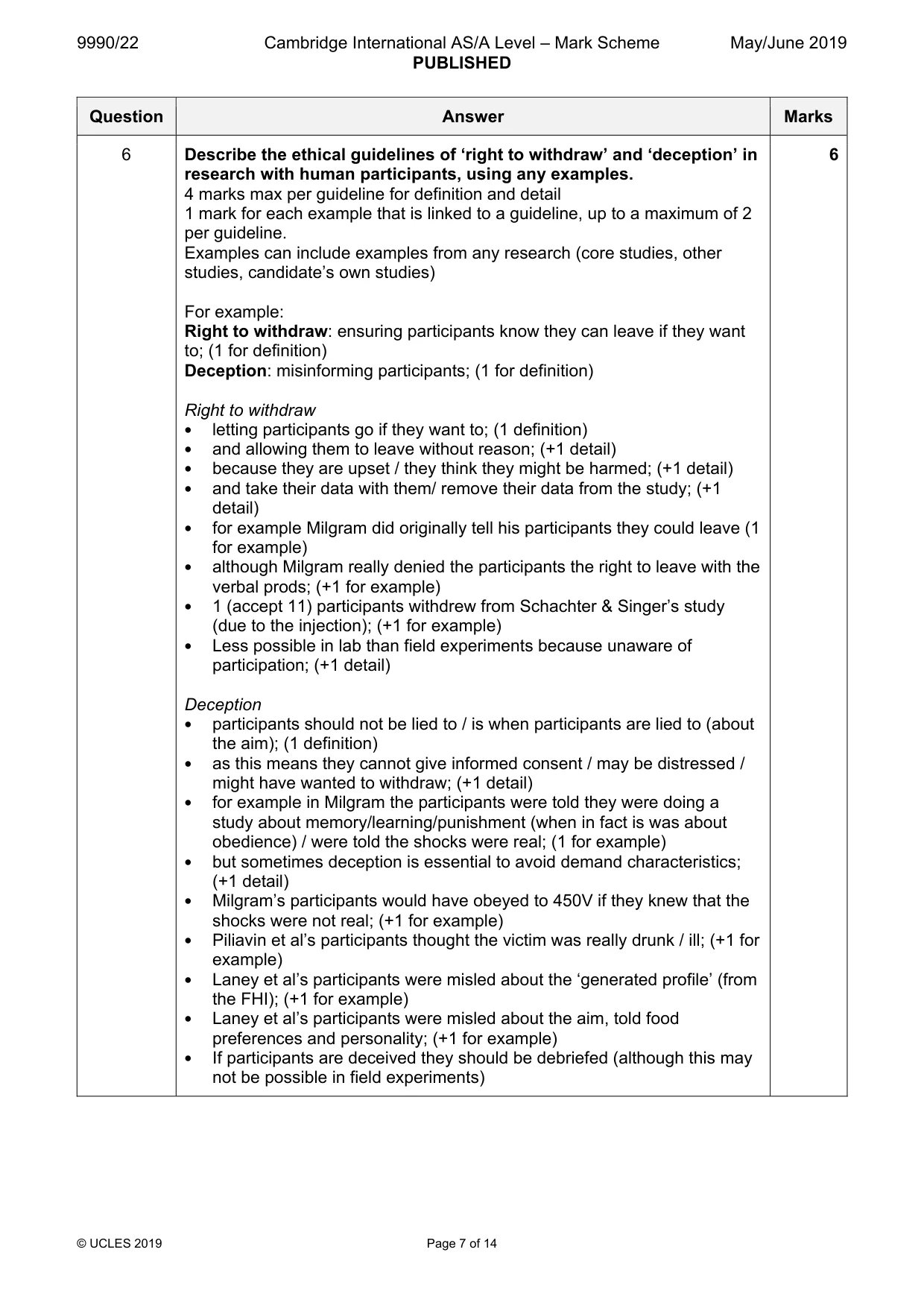
Mark scheme: 6 Describe the ethical guidelines of ‘right to withdraw’ and ‘deception’ in 6 research with human participants, using any examples. 4 marks max per guideline for definition and detail 1 mark for each example that is linked to a guideline, up to a maximum of 2 per guideline. Examples can include examples from any research (core studies, other studies, candidate’s own studies) For example: Right to withdraw: ensuring participants know they can leave if they want to; (1 for definition) Deception: misinforming participants; (1 for definition) Right to withdraw • letting participants go if they want to; (1 definition) • and allowing them to leave without reason; (+1 detail) • because they are upset / they think they might be harmed; (+1 detail) • and take their data with them/ remove their data from the study; (+1 detail) • for example Milgram did originally tell his participants they could leave (1 for example) • although Milgram really denied the participants the right to leave with the verbal prods; (+1 for example) • 1 (accept 11) participants withdrew from Schachter & Singer’s study (due to the injection); (+1 for example) • Less possible in lab than field experiments because unaware of participation; (+1 detail) Deception • participants should not be lied to / is when participants are lied to (about the aim); (1 definition) • as this means they cannot give informed consent / may be distressed / might have wanted to withdraw; (+1 detail) • for example in Milgram the participants were told they were doing a study about memory/learning/punishment (when in fact is was about obedience) / were told the shocks were real; (1 for example) • but sometimes deception is essential to avoid demand characteristics; (+1 detail) • Milgram’s participants would have obeyed to 450V if they knew that the shocks were not real; (+1 for example) • Piliavin et al’s participants thought the victim was really drunk / ill; (+1 for example) • Laney et al’s participants were misled about the ‘generated profile’ (from the FHI); (+1 for example) • Laney et al’s participants were misled about the aim, told food preferences and personality; (+1 for example) • If participants are deceived they should be debriefed (although this may not be possible in field experiments)
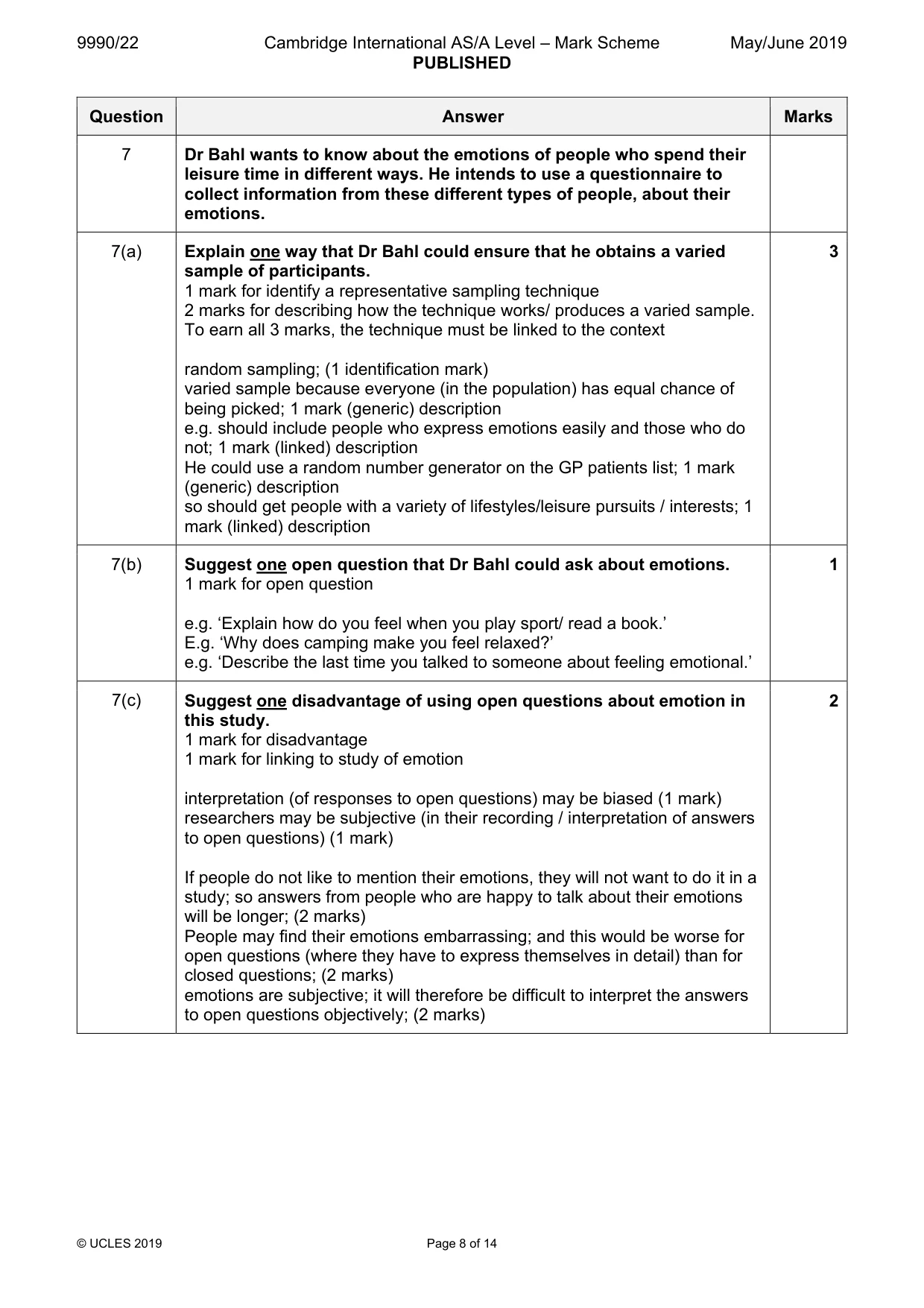
Q7 · Dr Bahl wants to know about the emotions of people who spend their leisure time in…
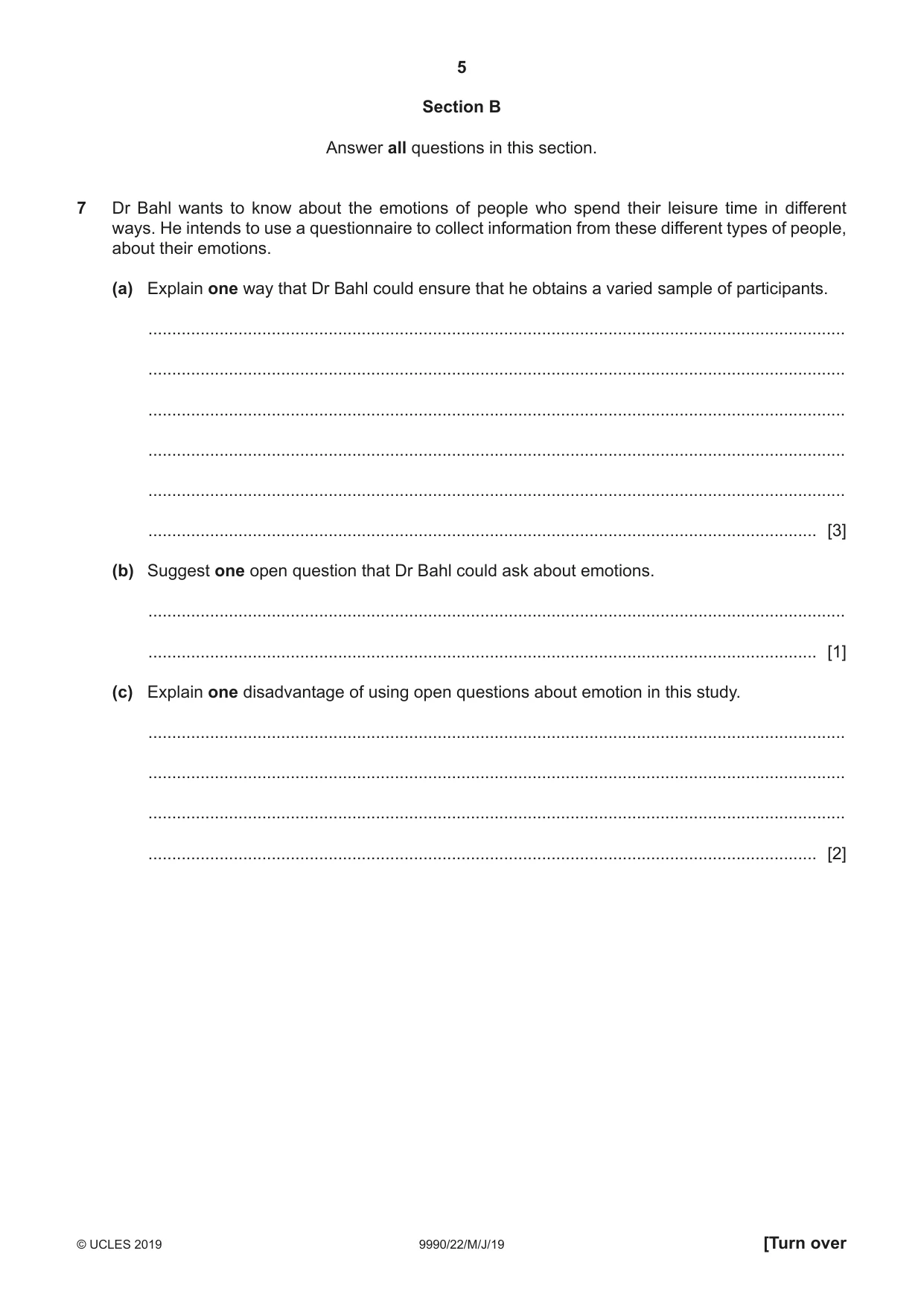
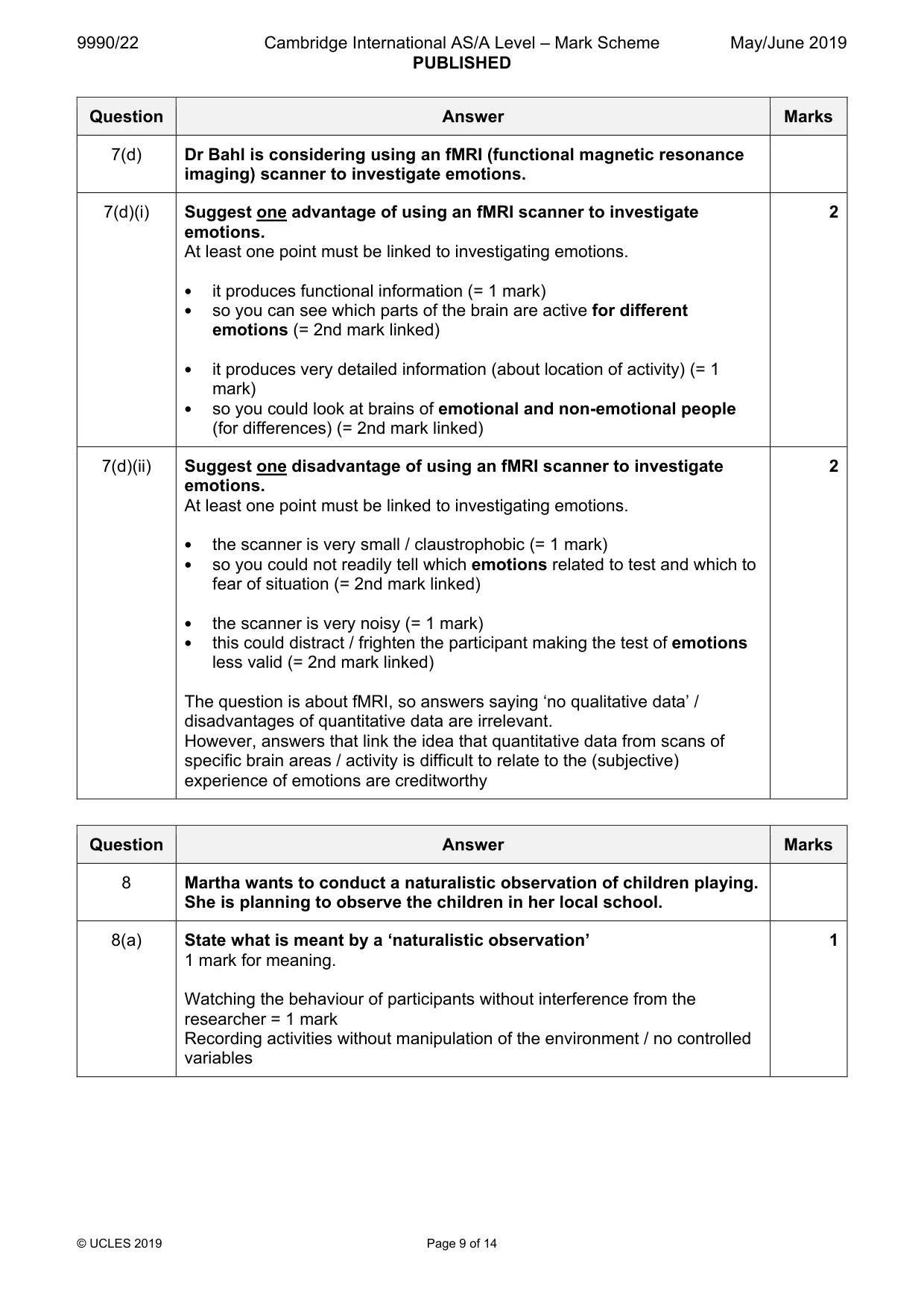
7 Dr Bahl wants to know about the emotions of people who spend their leisure time in different ways. He intends to use a questionnaire to collect information from these different types of people, about their emotions. (a) Explain one way that Dr Bahl could ensure that he obtains a varied sample of participants. ................................................................................................................................................... ................................................................................................................................................... ................................................................................................................................................... ................................................................................................................................................... ................................................................................................................................................... ............................................................................................................................................. [3] (b) Suggest one open question that Dr Bahl could ask about emotions. ................................................................................................................................................... ............................................................................................................................................. [1] (c) Explain one disadvantage of using open questions about emotion in this study. ................................................................................................................................................... ................................................................................................................................................... ................................................................................................................................................... ............................................................................................................................................. [2] (d) Dr Bahl is considering using an fMRI (functional magnetic resonance imaging) scanner to investigate emotions. (i) Suggest one advantage of using an fMRI scanner to investigate emotions. ........................................................................................................................................... ........................................................................................................................................... ........................................................................................................................................... ..................................................................................................................................... [2] (ii) Suggest one disadvantage of using an fMRI scanner to investigate emotions. ........................................................................................................................................... ........................................................................................................................................... ........................................................................................................................................... ..................................................................................................................................... [2]
Mark scheme: 7(a) Explain one way that Dr Bahl could ensure that he obtains a varied 3 sample of participants. 1 mark for identify a representative sampling technique 2 marks for describing how the technique works/ produces a varied sample. To earn all 3 marks, the technique must be linked to the context random sampling; (1 identification mark) varied sample because everyone (in the population) has equal chance of being picked; 1 mark (generic) description e.g. should include people who express emotions easily and those who do not; 1 mark (linked) description He could use a random number generator on the GP patients list; 1 mark (generic) description so should get people with a variety of lifestyles/leisure pursuits / interests; 1 mark (linked) description 7(b) Suggest one open question that Dr Bahl could ask about emotions. 1 1 mark for open question e.g. ‘Explain how do you feel when you play sport/ read a book.’ E.g. ‘Why does camping make you feel relaxed?’ e.g. ‘Describe the last time you talked to someone about feeling emotional.’ 7(c) Suggest one disadvantage of using open questions about emotion in 2 this study. 1 mark for disadvantage 1 mark for linking to study of emotion interpretation (of responses to open questions) may be biased (1 mark) researchers may be subjective (in their recording / interpretation of answers to open questions) (1 mark) If people do not like to mention their emotions, they will not want to do it in a study; so answers from people who are happy to talk about their emotions will be longer; (2 marks) People may find their emotions embarrassing; and this would be worse for open questions (where they have to express themselves in detail) than for closed questions; (2 marks) emotions are subjective; it will therefore be difficult to interpret the answers to open questions objectively; (2 marks) 7(d) Dr Bahl is considering using an fMRI (functional magnetic resonance imaging) scanner to investigate emotions. 7(d)(i) Suggest one advantage of using an fMRI scanner to investigate 2 emotions. At least one point must be linked to investigating emotions. • it produces functional information (= 1 mark) • so you can see which parts of the brain are active for different emotions (= 2nd mark linked) • it produces very detailed information (about location of activity) (= 1 mark) • so you could look at brains of emotional and non-emotional people (for differences) (= 2nd mark linked) 7(d)(ii) Suggest one disadvantage of using an fMRI scanner to investigate 2 emotions. At least one point must be linked to investigating emotions. • the scanner is very small / claustrophobic (= 1 mark) • so you could not readily tell which emotions related to test and which to fear of situation (= 2nd mark linked) • the scanner is very noisy (= 1 mark) • this could distract / frighten the participant making the test of emotions less valid (= 2nd mark linked) The question is about fMRI, so answers saying ‘no qualitative data’ / disadvantages of quantitative data are irrelevant. However, answers that link the idea that quantitative data from scans of specific brain areas / activity is difficult to relate to the (subjective) experience of emotions are creditworthy
Q8 · Martha wants to conduct a study using a naturalistic observation of children playing
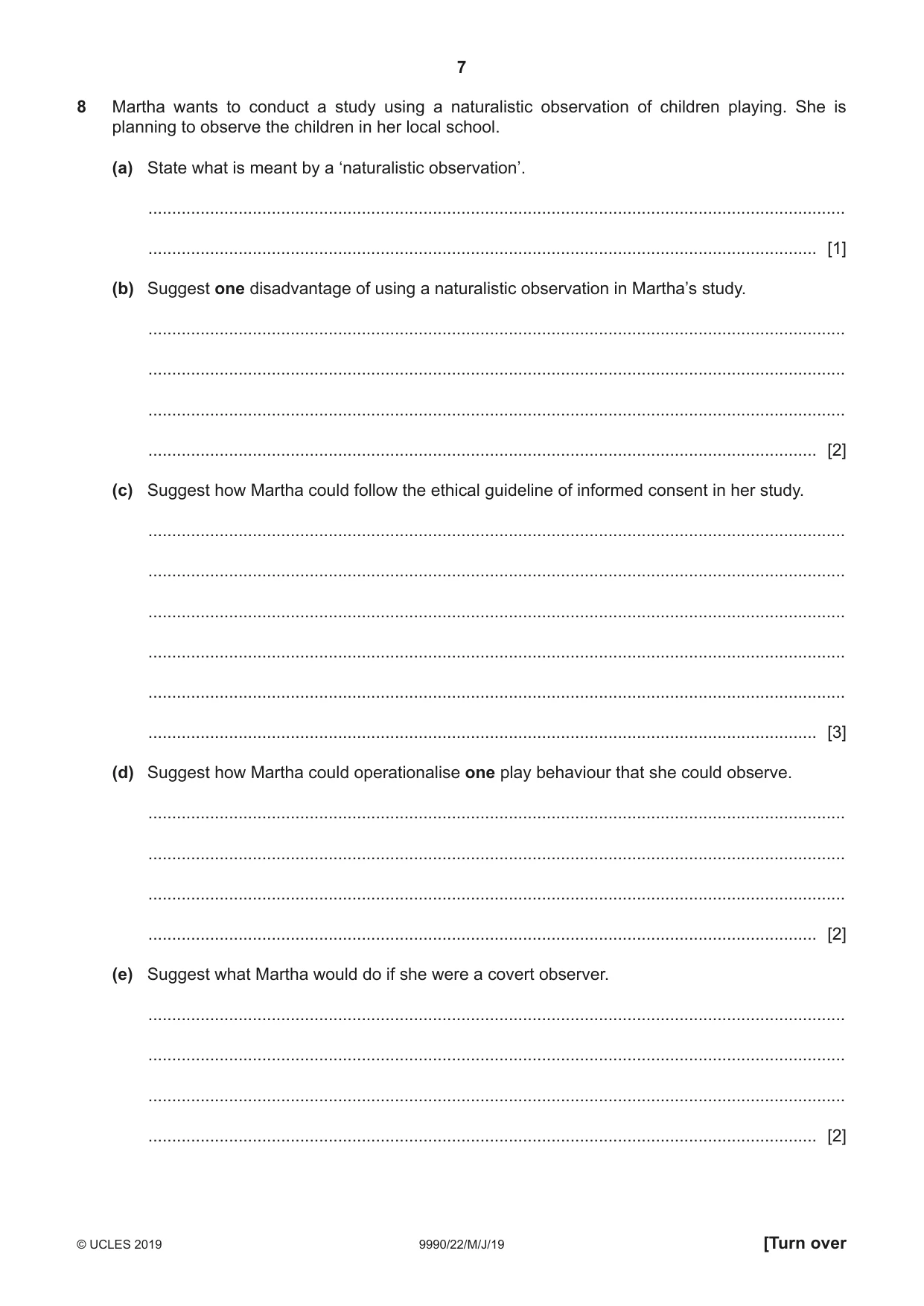
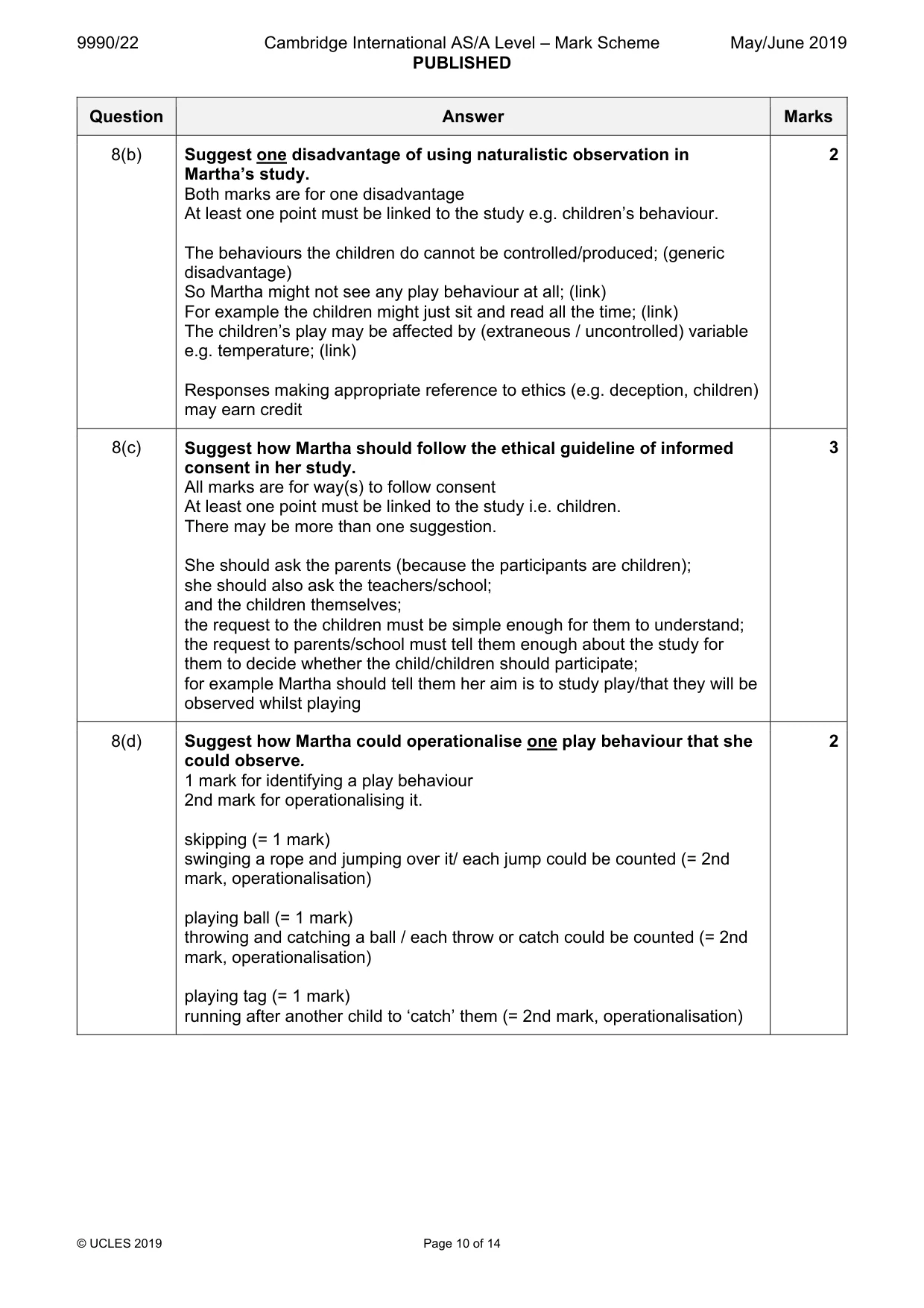
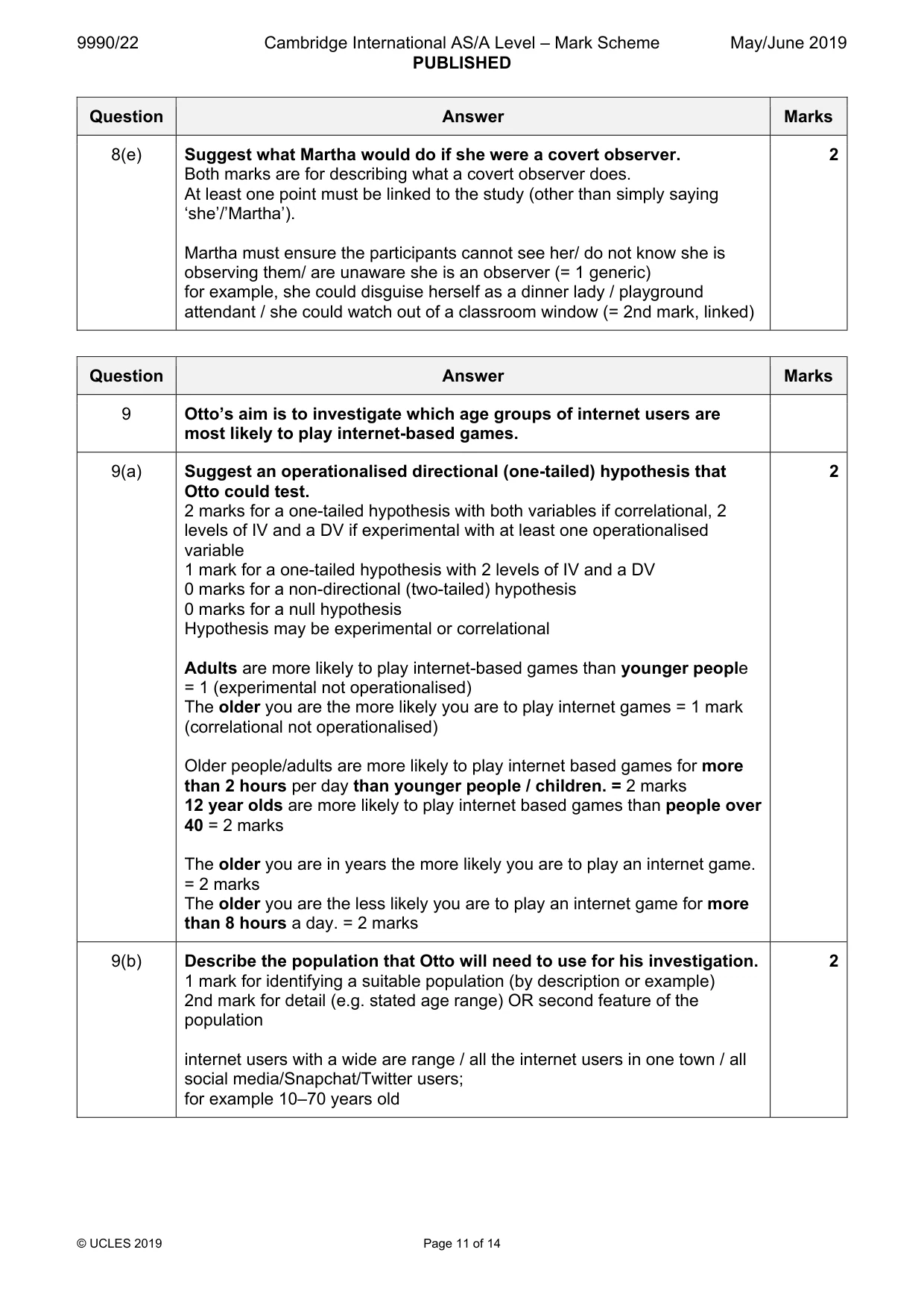
8 Martha wants to conduct a study using a naturalistic observation of children playing. She is planning to observe the children in her local school. (a) State what is meant by a ‘naturalistic observation’. ................................................................................................................................................... ............................................................................................................................................. [1] (b) Suggest one disadvantage of using a naturalistic observation in Martha’s study. ................................................................................................................................................... ................................................................................................................................................... ................................................................................................................................................... ............................................................................................................................................. [2] (c) Suggest how Martha could follow the ethical guideline of informed consent in her study. ................................................................................................................................................... ................................................................................................................................................... ................................................................................................................................................... ................................................................................................................................................... ................................................................................................................................................... ............................................................................................................................................. [3] (d) Suggest how Martha could operationalise one play behaviour that she could observe. ................................................................................................................................................... ................................................................................................................................................... ................................................................................................................................................... ............................................................................................................................................. [2] (e) Suggest what Martha would do if she were a covert observer. ................................................................................................................................................... ................................................................................................................................................... ................................................................................................................................................... ............................................................................................................................................. [2]
Mark scheme: 8(a) State what is meant by a ‘naturalistic observation’ 1 1 mark for meaning. Watching the behaviour of participants without interference from the researcher = 1 mark Recording activities without manipulation of the environment / no controlled variables 8(b) Suggest one disadvantage of using naturalistic observation in 2 Martha’s study. Both marks are for one disadvantage At least one point must be linked to the study e.g. children’s behaviour. The behaviours the children do cannot be controlled/produced; (generic disadvantage) So Martha might not see any play behaviour at all; (link) For example the children might just sit and read all the time; (link) The children’s play may be affected by (extraneous / uncontrolled) variable e.g. temperature; (link) Responses making appropriate reference to ethics (e.g. deception, children) may earn credit 8(c) Suggest how Martha should follow the ethical guideline of informed 3 consent in her study. All marks are for way(s) to follow consent At least one point must be linked to the study i.e. children. There may be more than one suggestion. She should ask the parents (because the participants are children); she should also ask the teachers/school; and the children themselves; the request to the children must be simple enough for them to understand; the request to parents/school must tell them enough about the study for them to decide whether the child/children should participate; for example Martha should tell them her aim is to study play/that they will be observed whilst playing 8(d) Suggest how Martha could operationalise one play behaviour that she 2 could observe. 1 mark for identifying a play behaviour 2nd mark for operationalising it. skipping (= 1 mark) swinging a rope and jumping over it/ each jump could be counted (= 2nd mark, operationalisation) playing ball (= 1 mark) throwing and catching a ball / each throw or catch could be counted (= 2nd mark, operationalisation) playing tag (= 1 mark) running after another child to ‘catch’ them (= 2nd mark, operationalisation) 8(e) Suggest what Martha would do if she were a covert observer. 2 Both marks are for describing what a covert observer does. At least one point must be linked to the study (other than simply saying ‘she’/’Martha’). Martha must ensure the participants cannot see her/ do not know she is observing them/ are unaware she is an observer (= 1 generic) for example, she could disguise herself as a dinner lady / playground attendant / she could watch out of a classroom window (= 2nd mark, linked)
Q9 · Otto’s aim is to investigate which age groups of internet users are most likely to play…
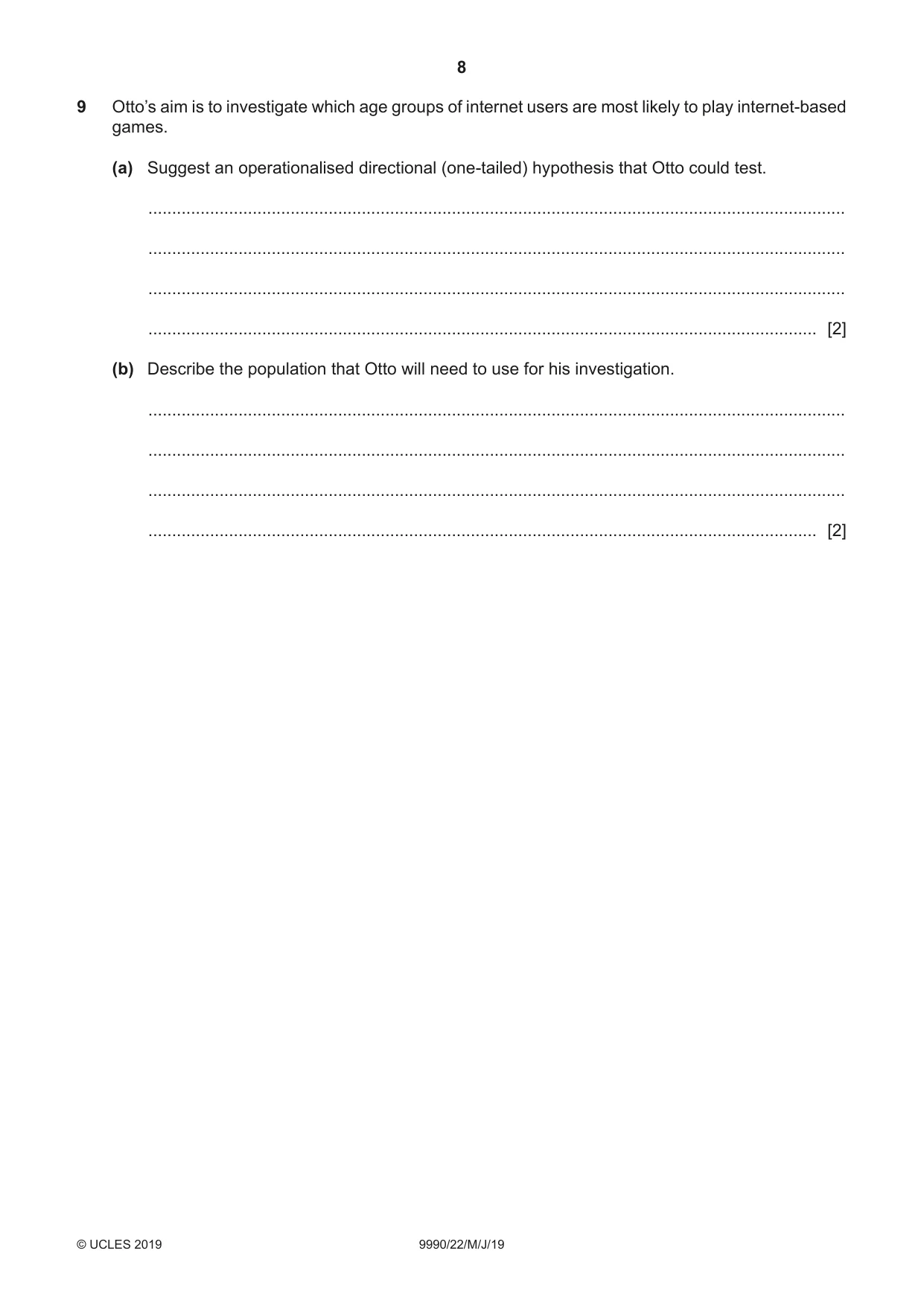
9 Otto’s aim is to investigate which age groups of internet users are most likely to play internet‑based games. (a) Suggest an operationalised directional (one‑tailed) hypothesis that Otto could test. ................................................................................................................................................... ................................................................................................................................................... ................................................................................................................................................... ............................................................................................................................................. [2] (b) Describe the population that Otto will need to use for his investigation. ................................................................................................................................................... ................................................................................................................................................... ................................................................................................................................................... ............................................................................................................................................. [2] Section C Answer all questions in this section.
Mark scheme: 9(a) Suggest an operationalised directional (one-tailed) hypothesis that 2 Otto could test. 2 marks for a one-tailed hypothesis with both variables if correlational, 2 levels of IV and a DV if experimental with at least one operationalised variable 1 mark for a one-tailed hypothesis with 2 levels of IV and a DV 0 marks for a non-directional (two-tailed) hypothesis 0 marks for a null hypothesis Hypothesis may be experimental or correlational Adults are more likely to play internet-based games than younger people = 1 (experimental not operationalised) The older you are the more likely you are to play internet games = 1 mark (correlational not operationalised) Older people/adults are more likely to play internet based games for more than 2 hours per day than younger people / children. = 2 marks 12 year olds are more likely to play internet based games than people over 40 = 2 marks The older you are in years the more likely you are to play an internet game. = 2 marks The older you are the less likely you are to play an internet game for more than 8 hours a day. = 2 marks 9(b) Describe the population that Otto will need to use for his investigation. 2 1 mark for identifying a suitable population (by description or example) 2nd mark for detail (e.g. stated age range) OR second feature of the population internet users with a wide are range / all the internet users in one town / all social media/Snapchat/Twitter users; for example 10–70 years old
Q10 · Cecile has ten parrots that can answer questions about shapes
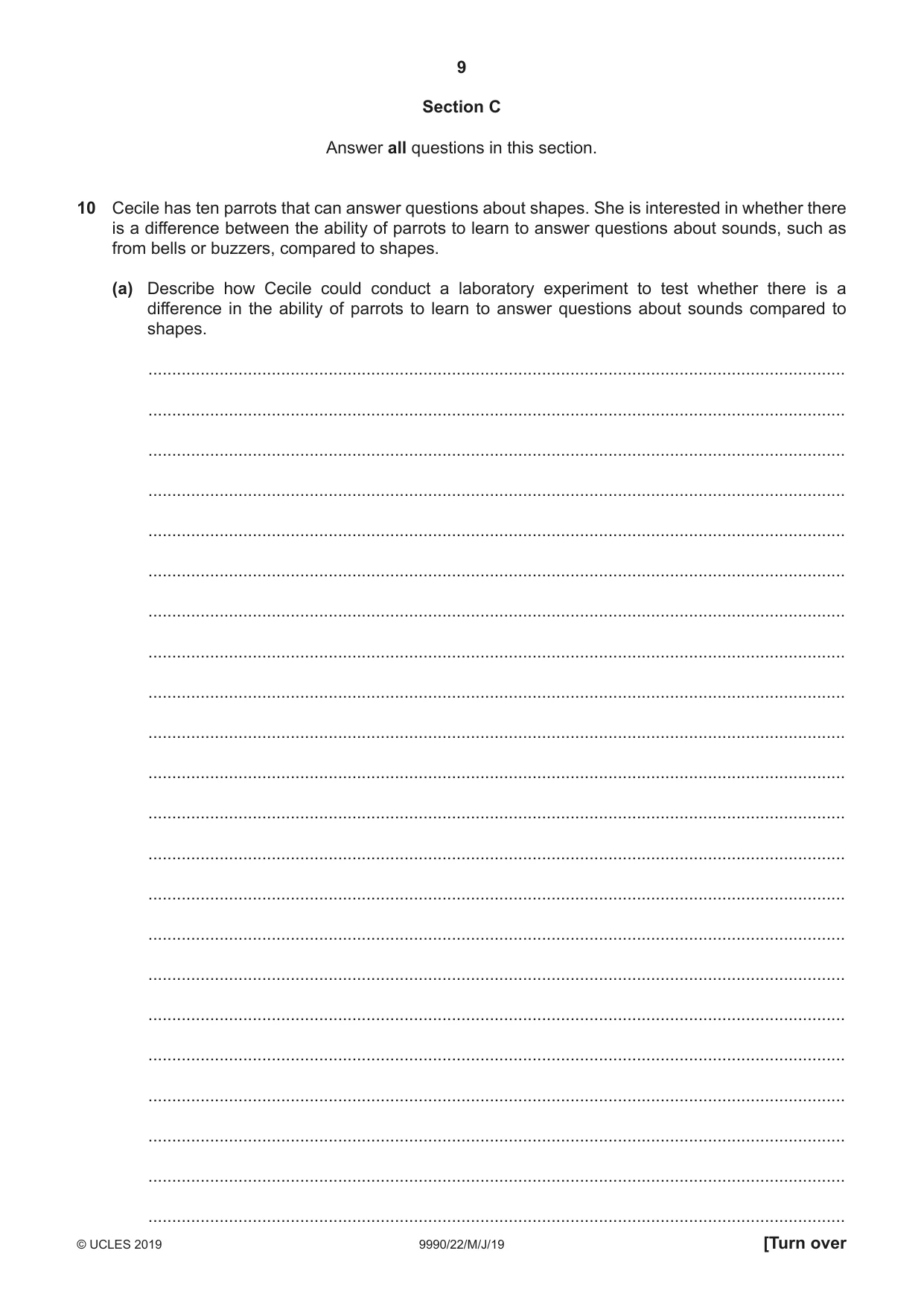
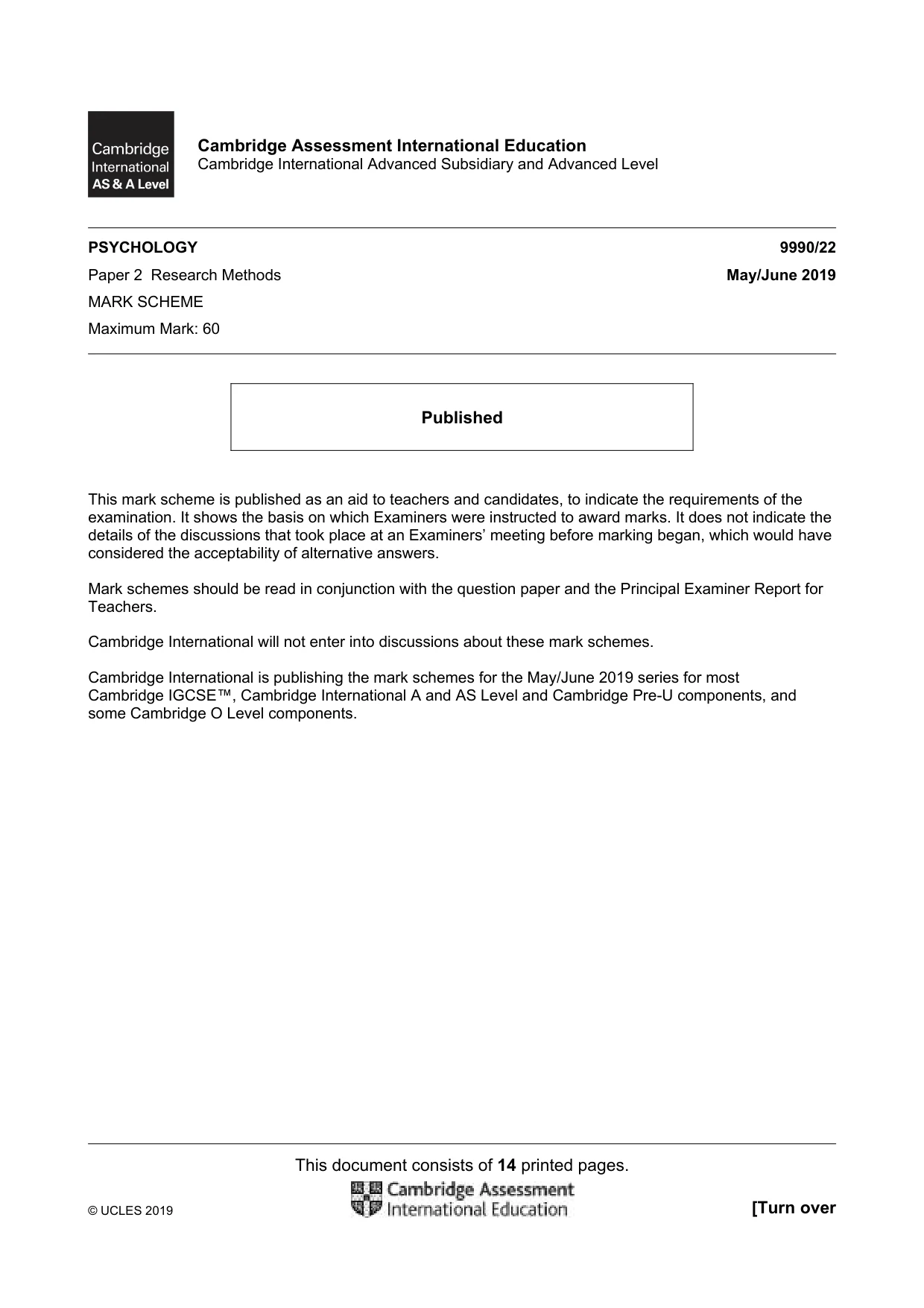
10 Cecile has ten parrots that can answer questions about shapes. She is interested in whether there is a difference between the ability of parrots to learn to answer questions about sounds, such as from bells or buzzers, compared to shapes. (a) Describe how Cecile could conduct a laboratory experiment to test whether there is a difference in the ability of parrots to learn to answer questions about sounds compared to shapes. ................................................................................................................................................... ................................................................................................................................................... ................................................................................................................................................... ................................................................................................................................................... ................................................................................................................................................... ................................................................................................................................................... ................................................................................................................................................... ................................................................................................................................................... ................................................................................................................................................... ................................................................................................................................................... ................................................................................................................................................... ................................................................................................................................................... ................................................................................................................................................... ................................................................................................................................................... ................................................................................................................................................... ................................................................................................................................................... ................................................................................................................................................... ................................................................................................................................................... ................................................................................................................................................... ................................................................................................................................................... ................................................................................................................................................... ................................................................................................................................................... ................................................................................................................................................... ................................................................................................................................................... ................................................................................................................................................... ................................................................................................................................................... ................................................................................................................................................... ................................................................................................................................................... ................................................................................................................................................... ........................................................................................................................................... [10] (b) Identify one practical weakness/limitation with the procedure you have described in your answer to part (a) and suggest how your study might be done differently to overcome the problem. Do not refer to ethics or sampling in your answer. ................................................................................................................................................... ................................................................................................................................................... ................................................................................................................................................... ................................................................................................................................................... ................................................................................................................................................... ................................................................................................................................................... ................................................................................................................................................... ............................................................................................................................................. [4]
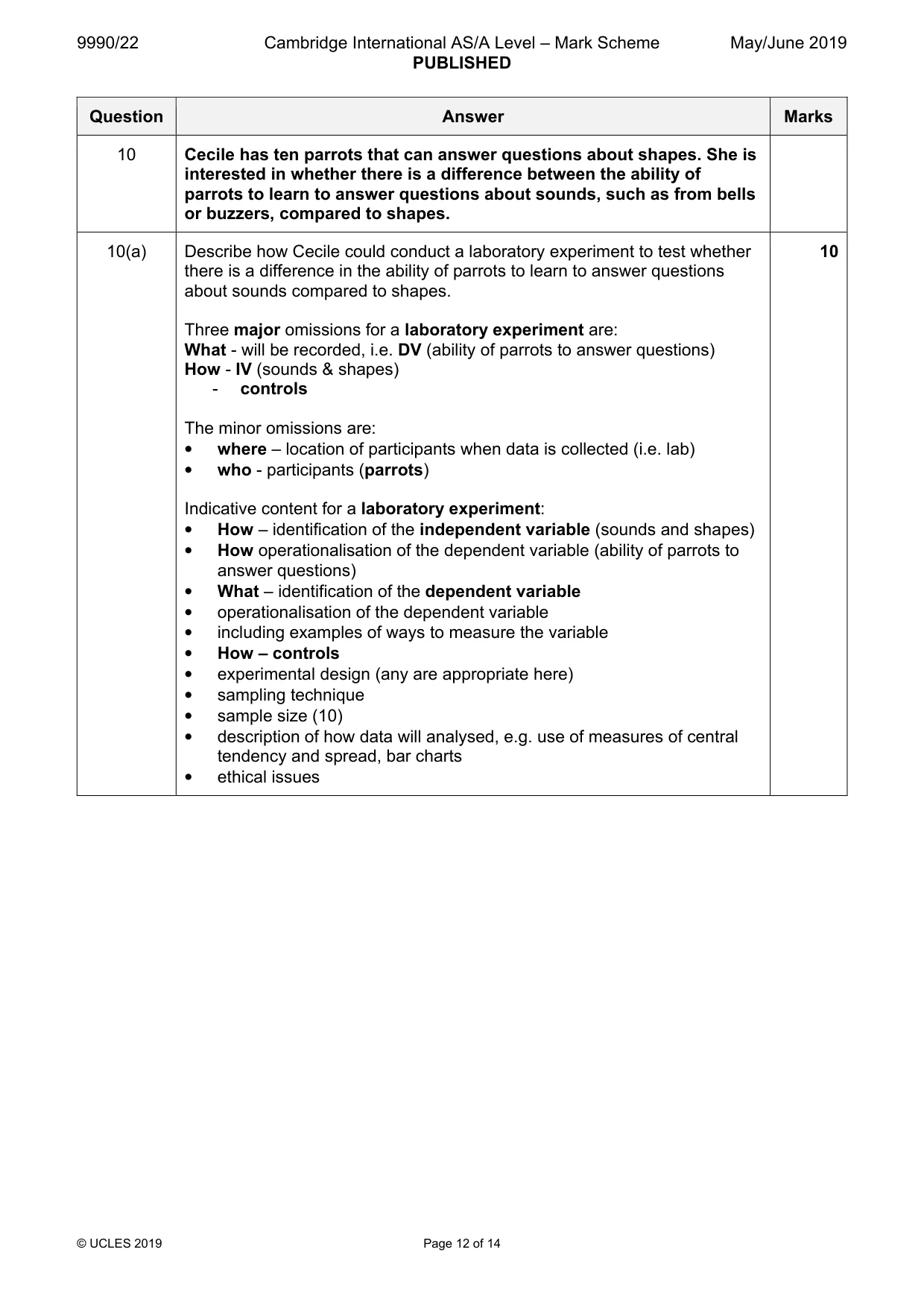
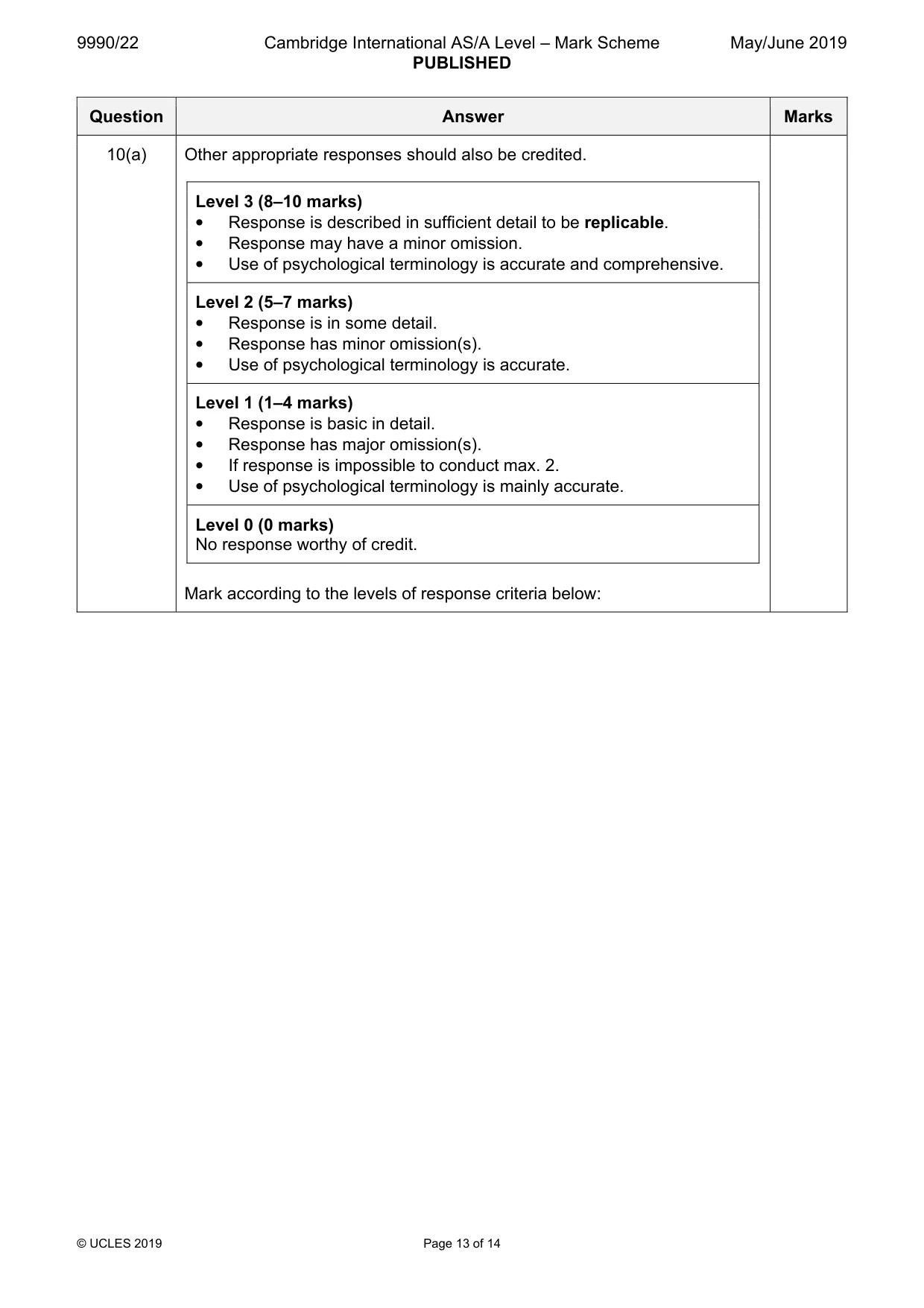
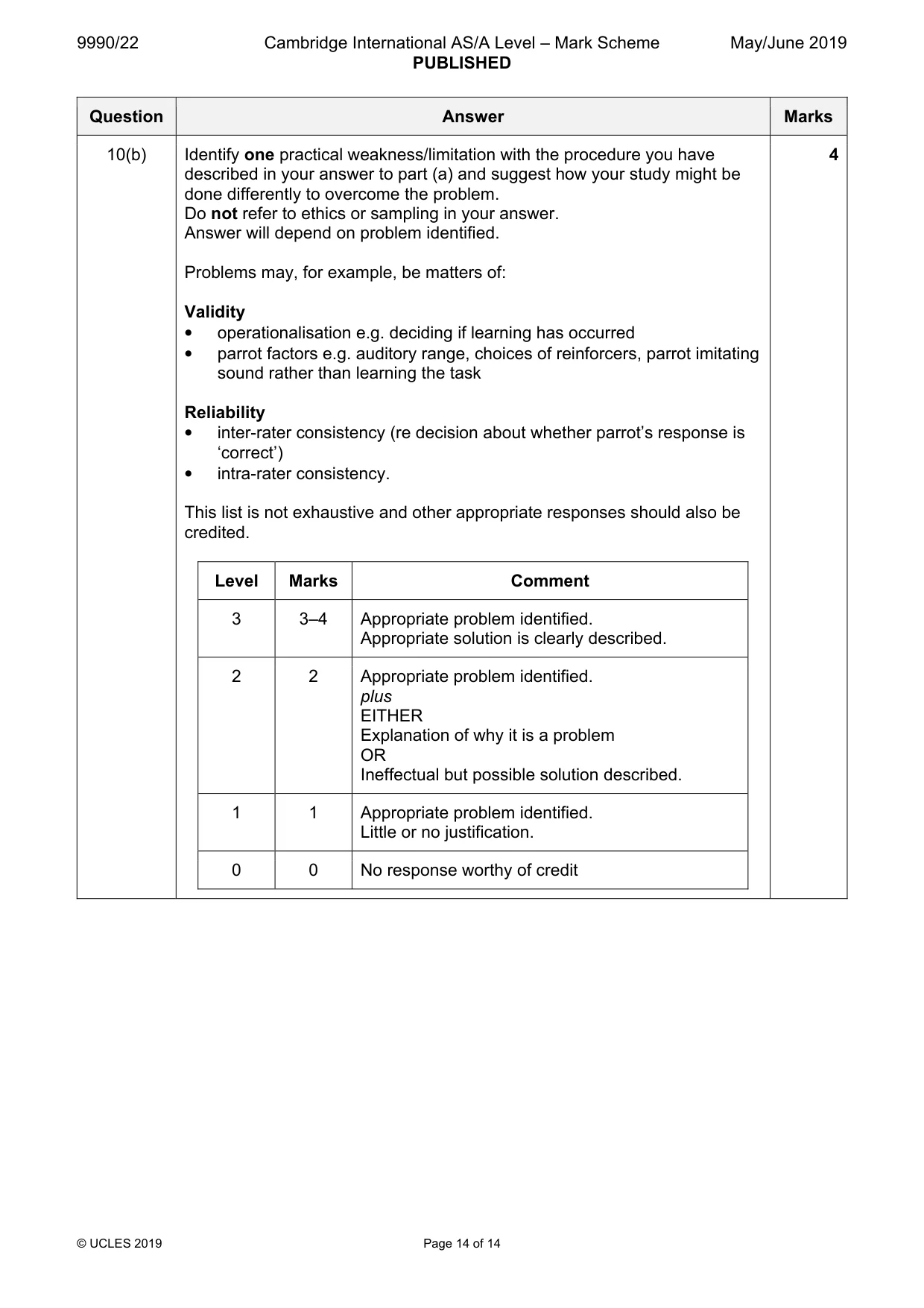
Mark scheme: 10(a) Describe how Cecile could conduct a laboratory experiment to test whether 10 there is a difference in the ability of parrots to learn to answer questions about sounds compared to shapes. Three major omissions for a laboratory experiment are: What - will be recorded, i.e. DV (ability of parrots to answer questions) How - IV (sounds & shapes) - controls The minor omissions are: • where – location of participants when data is collected (i.e. lab) • who - participants (parrots) Indicative content for a laboratory experiment: • How – identification of the independent variable (sounds and shapes) • How operationalisation of the dependent variable (ability of parrots to answer questions) • What – identification of the dependent variable • operationalisation of the dependent variable • including examples of ways to measure the variable • How – controls • experimental design (any are appropriate here) • sampling technique • sample size (10) • description of how data will analysed, e.g. use of measures of central tendency and spread, bar charts • ethical issues 10(a) Other appropriate responses should also be credited. Level 3 (8–10 marks) • Response is described in sufficient detail to be replicable. • Response may have a minor omission. • Use of psychological terminology is accurate and comprehensive. Level 2 (5–7 marks) • Response is in some detail. • Response has minor omission(s). • Use of psychological terminology is accurate. Level 1 (1–4 marks) • Response is basic in detail. • Response has major omission(s). • If response is impossible to conduct max. 2. • Use of psychological terminology is mainly accurate. Level 0 (0 marks) No response worthy of credit. Mark according to the levels of response criteria below: 10(b) Identify one practical weakness/limitation with the procedure you have 4 described in your answer to part (a) and suggest how your study might be done differently to overcome the problem. Do not refer to ethics or sampling in your answer. Answer will depend on problem identified. Problems may, for example, be matters of: Validity • operationalisation e.g. deciding if learning has occurred • parrot factors e.g. auditory range, choices of reinforcers, parrot imitating sound rather than learning the task Reliability • inter-rater consistency (re decision about whether parrot’s response is ‘correct’) • intra-rater consistency. This list is not exhaustive and other appropriate responses should also be credited. Level Marks Comment 3 3–4 Appropriate problem identified. Appropriate solution is clearly described. 2 2 Appropriate problem identified. plus EITHER Explanation of why it is a problem OR Ineffectual but possible solution described. 1 1 Appropriate problem identified. Little or no justification. 0 0 No response worthy of credit
What was in this paper
The subtopics covered by these 10 questions, and how many questions each got. Open one in a new tab to see every Cambridge question on it.
What you needed in this session
Cambridge’s own grade thresholds for 2019 May/June, Paper 2 · Variant 2. A higher threshold means an easier paper — the bar moves with how the cohort did.