Cambridge A Level Psychology (from 2018) 9990 — 2018 Oct/Nov Paper 2 · Variant 2
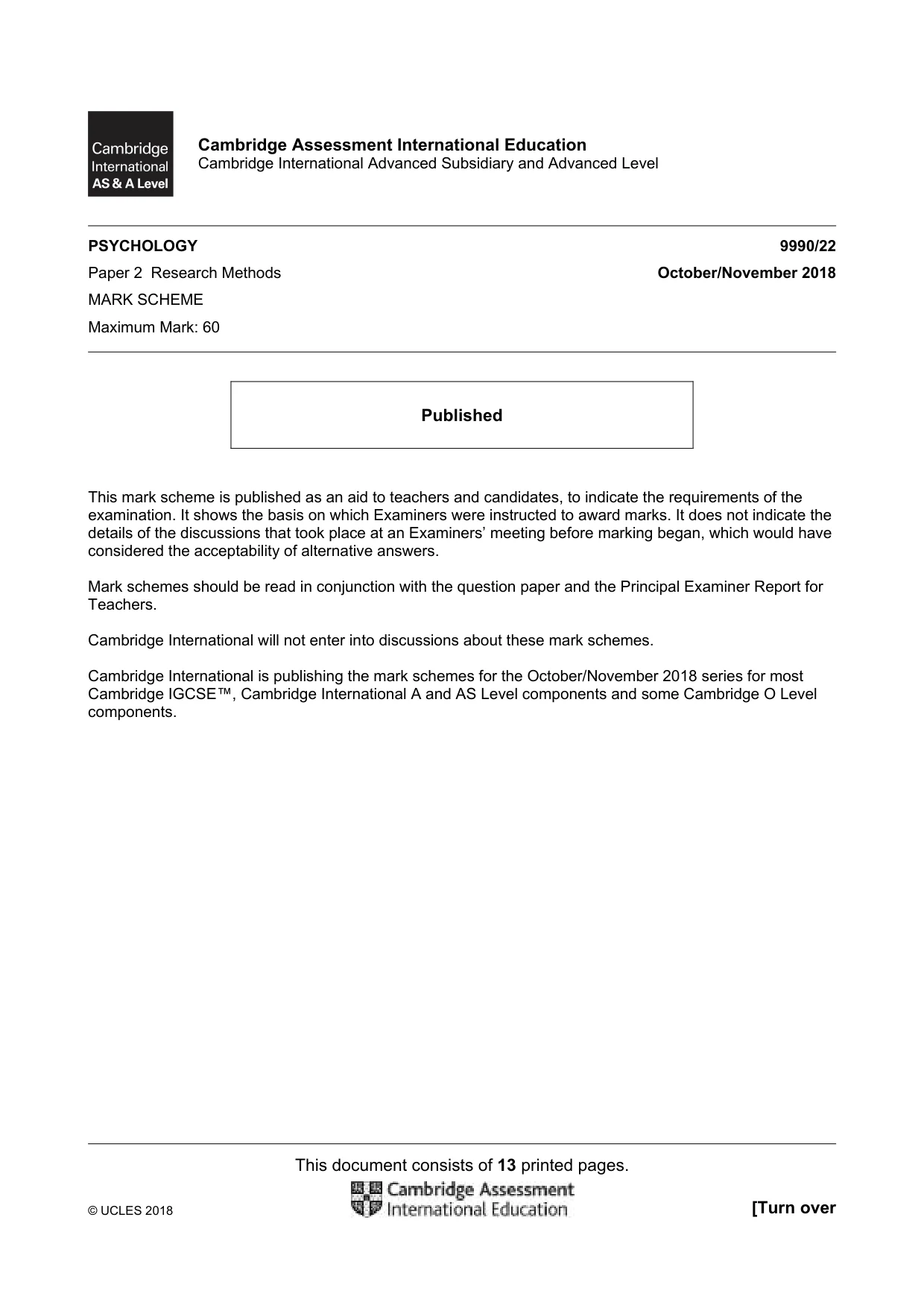
9990/22/O/N/18 · 10 questions · 60 marks · ≈68 min
The question paper and its mark scheme, free to read here and free to download. This is Cambridge’s own paper, exactly as it was sat.
Question paper12 pages
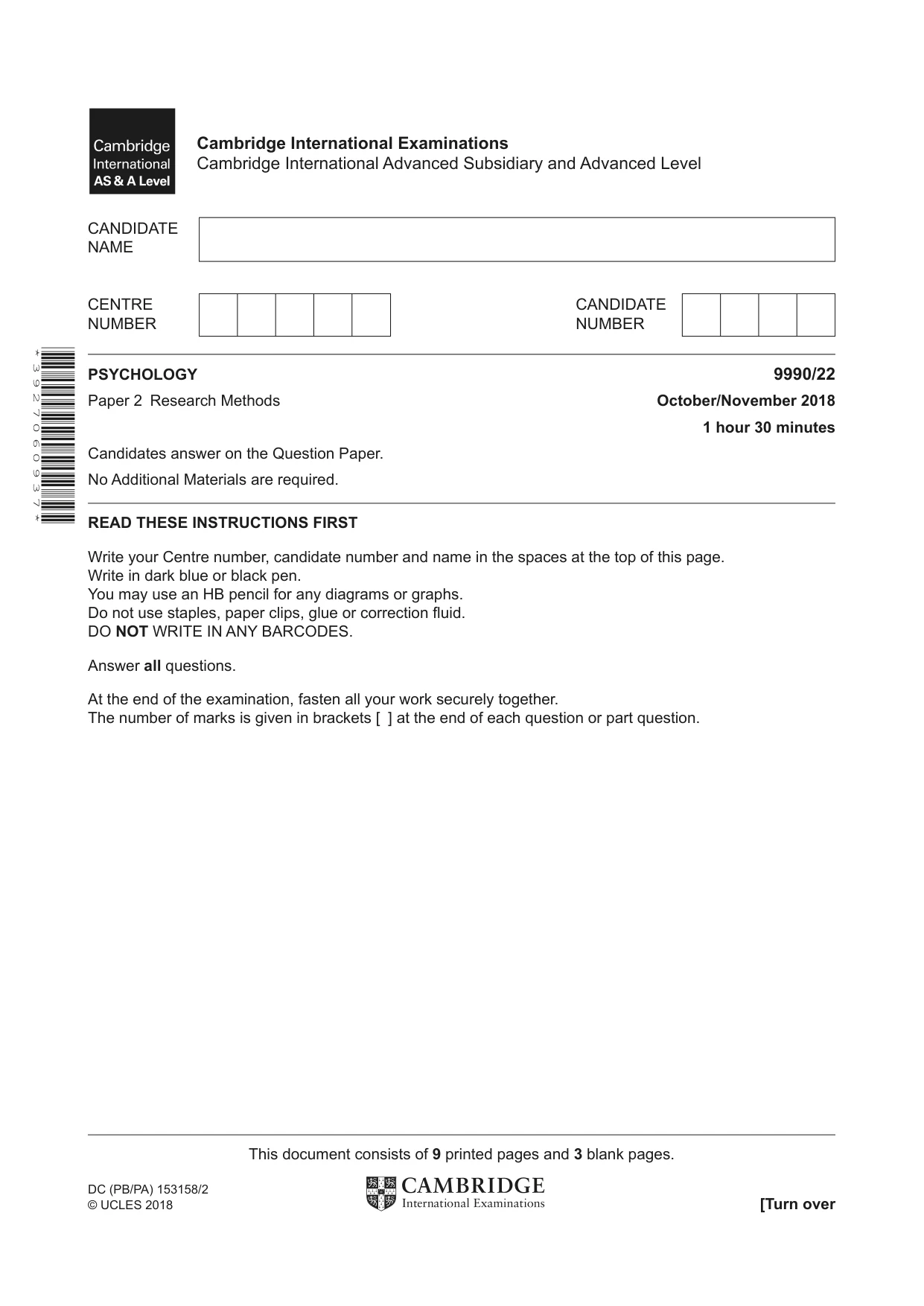




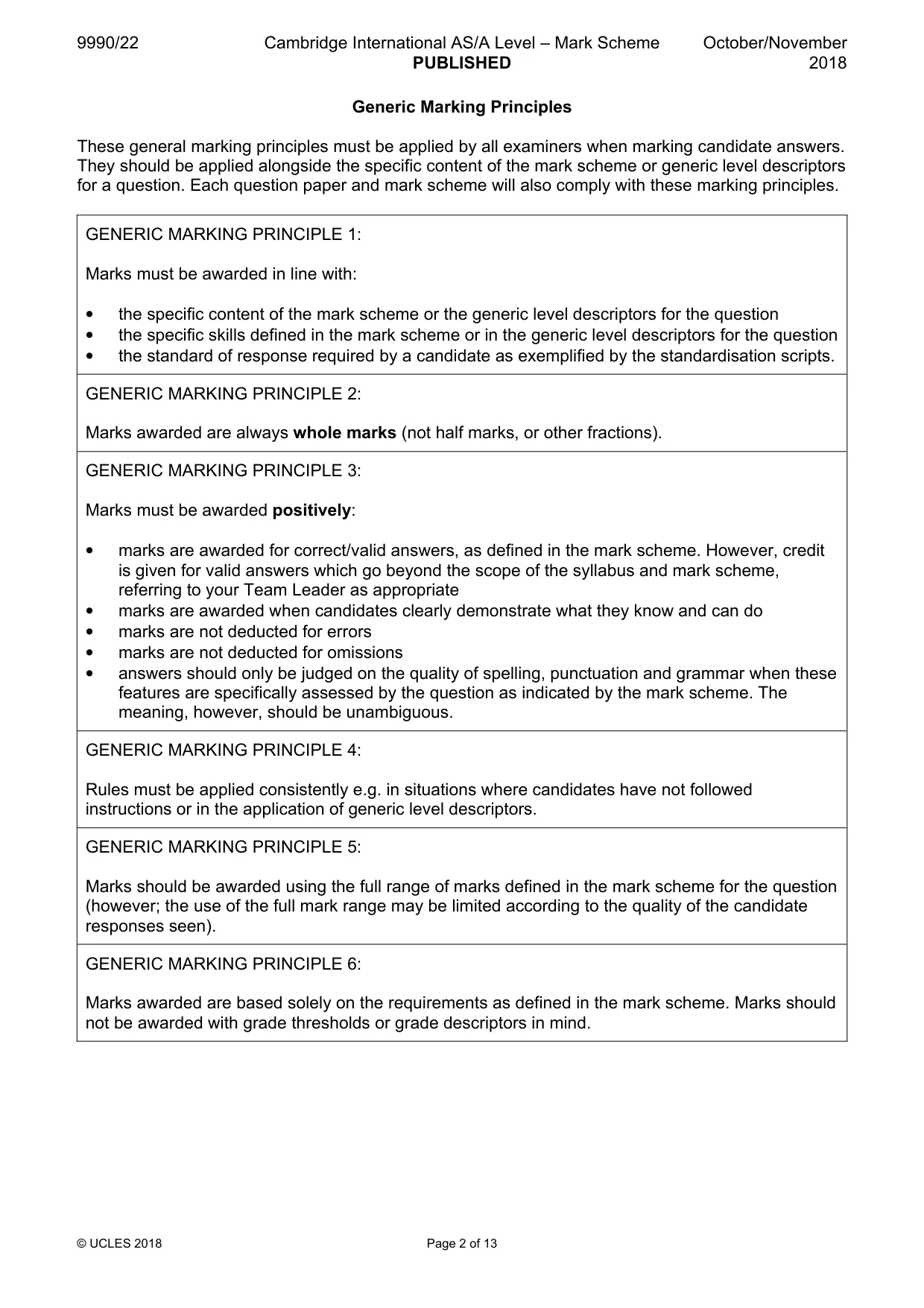
Mark scheme13 pages
Answers below. Sit the paper first if you are practising.
Questions as text
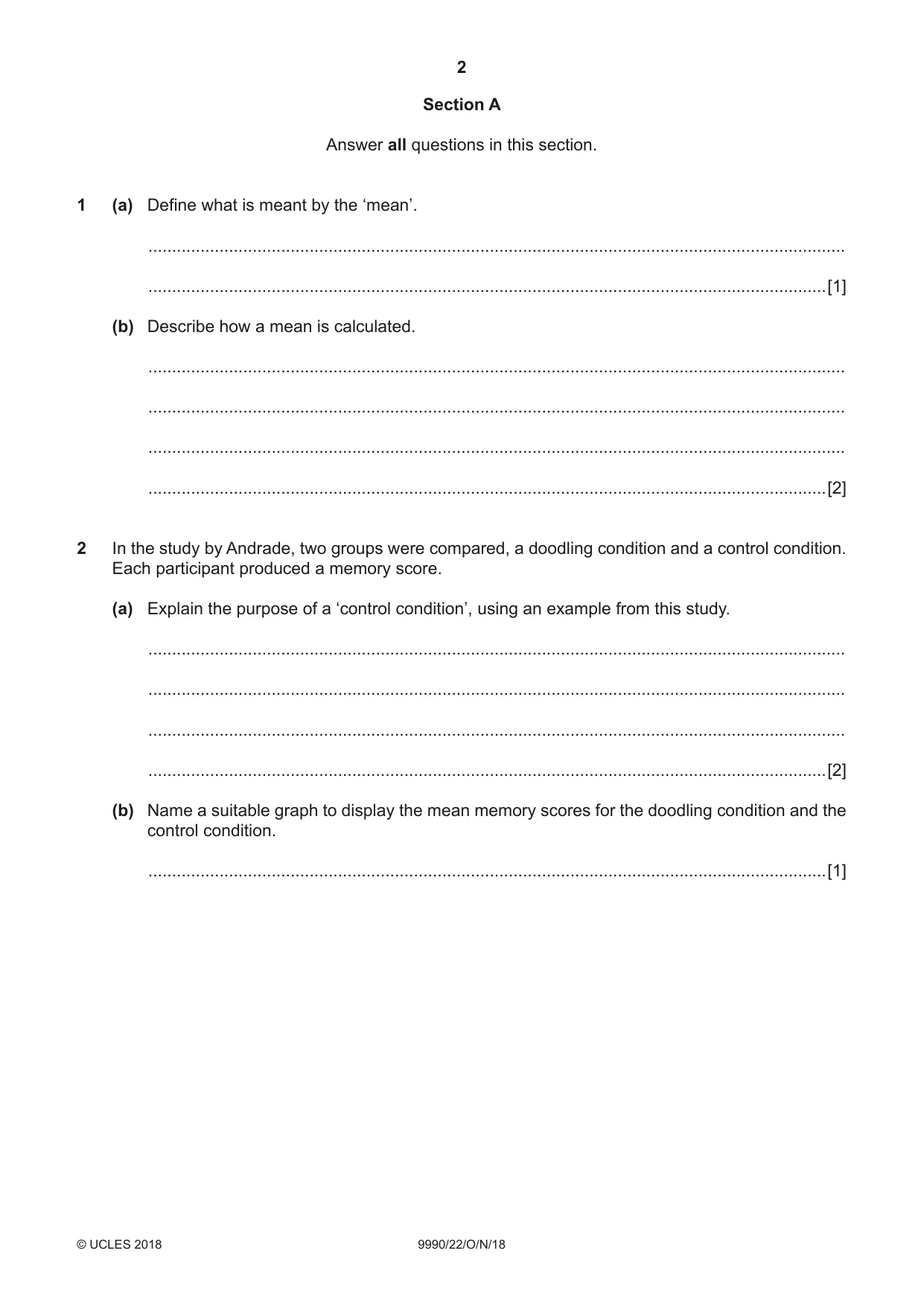
Q1 · Define what is meant by the ‘mean’
1 (a) Define what is meant by the ‘mean’. ................................................................................................................................................... ...............................................................................................................................................[1] (b) Describe how a mean is calculated. ................................................................................................................................................... ................................................................................................................................................... ................................................................................................................................................... ...............................................................................................................................................[2]
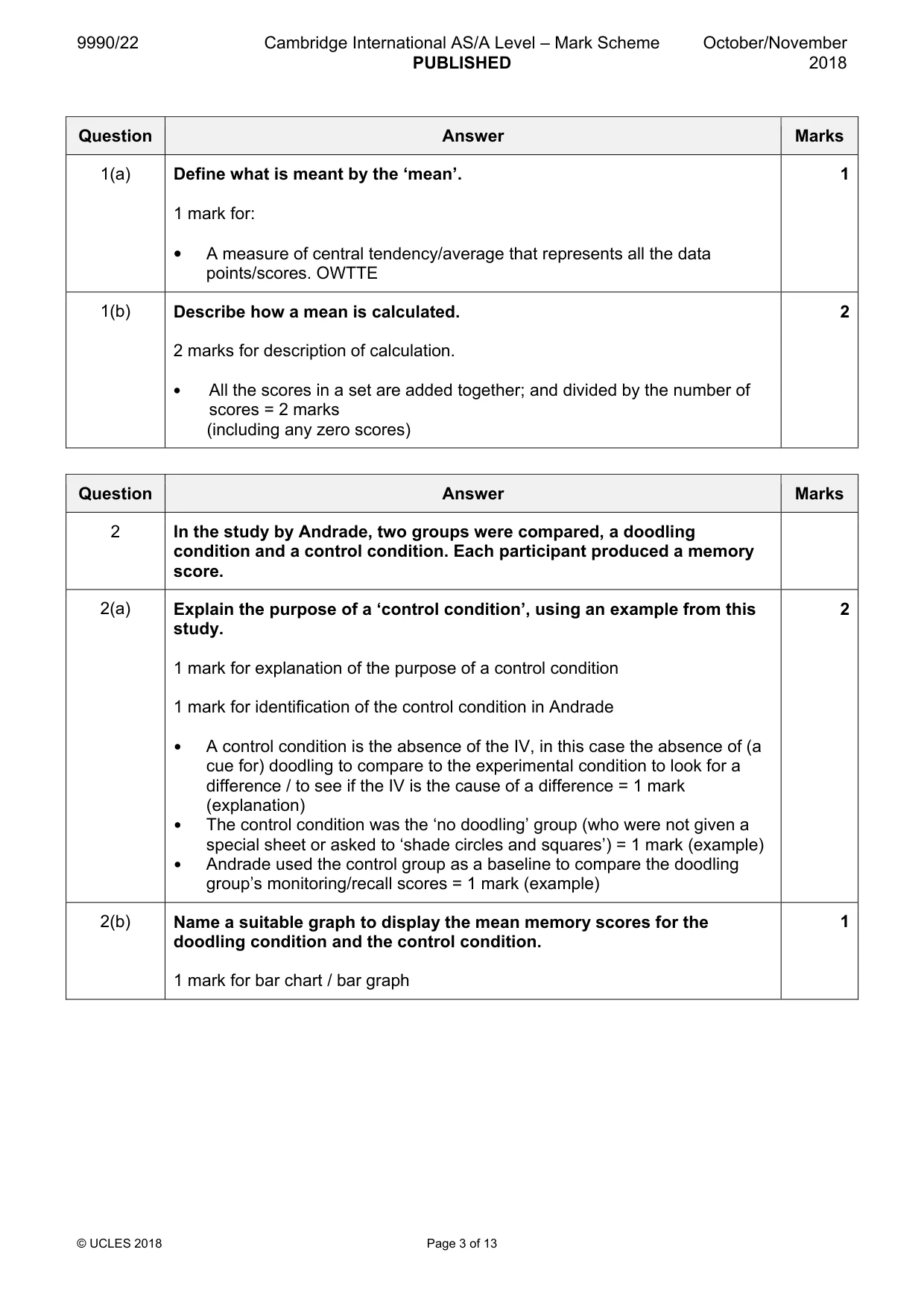
Mark scheme: Question Answer Marks 1(a) Define what is meant by the ‘mean’. 1 1 mark for: • A measure of central tendency/average that represents all the data points/scores. OWTTE 1(b) Describe how a mean is calculated. 2 2 marks for description of calculation. • All the scores in a set are added together; and divided by the number of scores = 2 marks (including any zero scores)
Q2 · In the study by Andrade, two groups were compared, a doodling condition and a control…
2 In the study by Andrade, two groups were compared, a doodling condition and a control condition. Each participant produced a memory score. (a) Explain the purpose of a ‘control condition’, using an example from this study. ................................................................................................................................................... ................................................................................................................................................... ................................................................................................................................................... ...............................................................................................................................................[2] (b) Name a suitable graph to display the mean memory scores for the doodling condition and the control condition. ...............................................................................................................................................[1]
Mark scheme: 2(a) Explain the purpose of a ‘control condition’, using an example from this 2 study. 1 mark for explanation of the purpose of a control condition 1 mark for identification of the control condition in Andrade • A control condition is the absence of the IV, in this case the absence of (a cue for) doodling to compare to the experimental condition to look for a difference / to see if the IV is the cause of a difference = 1 mark (explanation) • The control condition was the ‘no doodling’ group (who were not given a special sheet or asked to ‘shade circles and squares’) = 1 mark (example) • Andrade used the control group as a baseline to compare the doodling group’s monitoring/recall scores = 1 mark (example) 2(b) Name a suitable graph to display the mean memory scores for the 1 doodling condition and the control condition. 1 mark for bar chart / bar graph
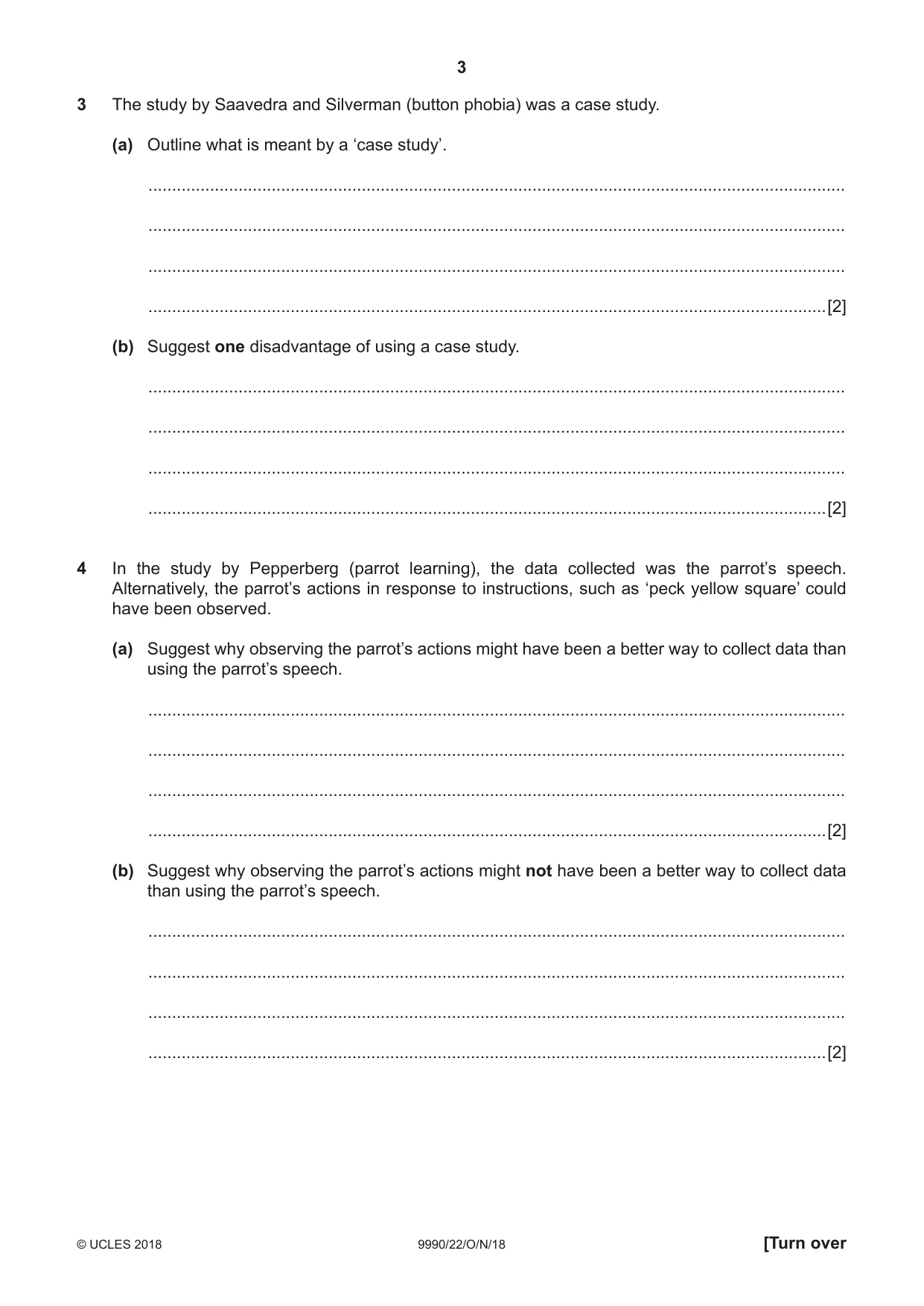
Q3 · The study by Saavedra and Silverman (button phobia) was a case study
3 The study by Saavedra and Silverman (button phobia) was a case study. (a) Outline what is meant by a ‘case study’. ................................................................................................................................................... ................................................................................................................................................... ................................................................................................................................................... ...............................................................................................................................................[2] (b) Suggest one disadvantage of using a case study. ................................................................................................................................................... ................................................................................................................................................... ................................................................................................................................................... ...............................................................................................................................................[2]
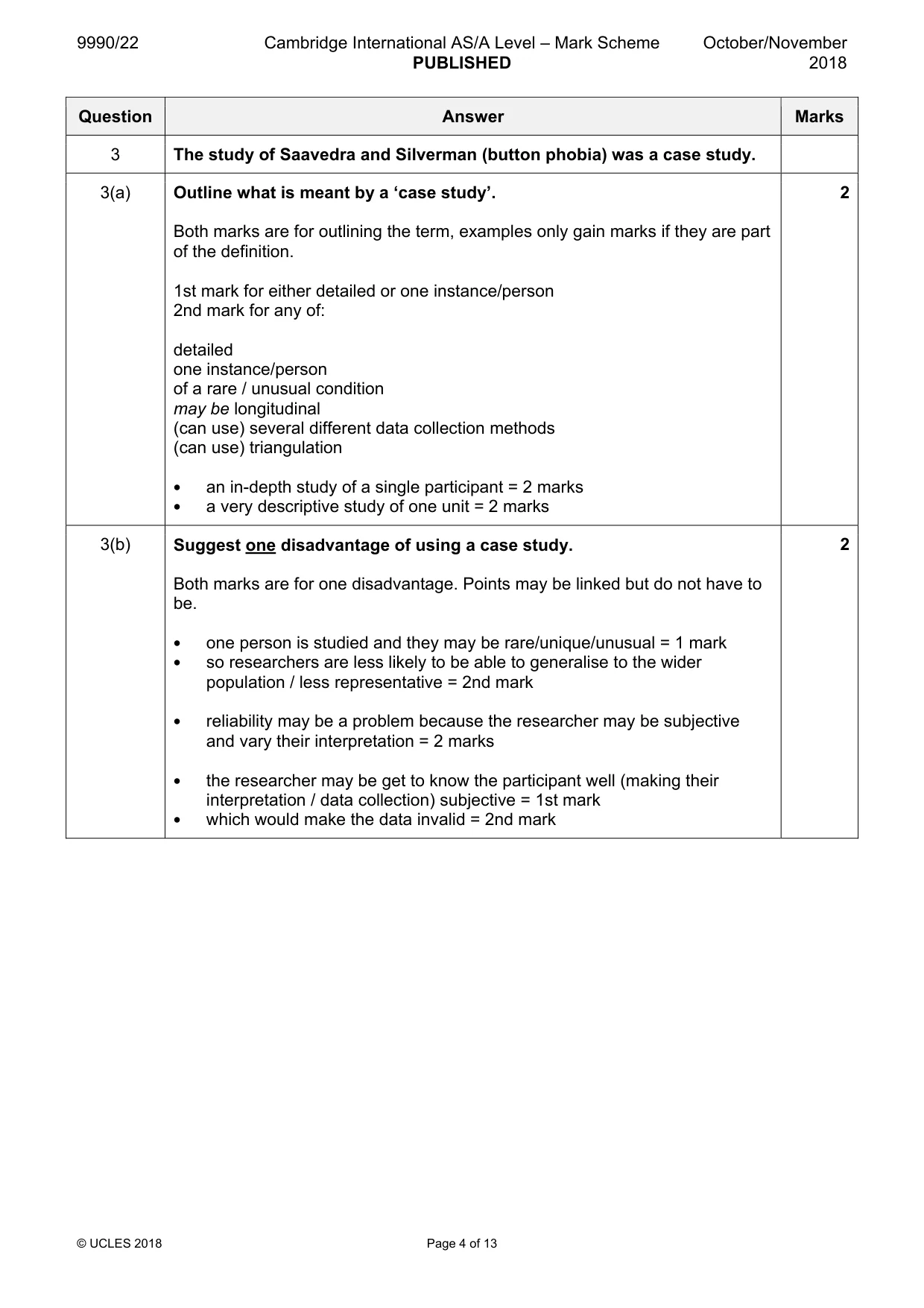
Mark scheme: 3(a) Outline what is meant by a ‘case study’. 2 Both marks are for outlining the term, examples only gain marks if they are part of the definition. 1st mark for either detailed or one instance/person 2nd mark for any of: detailed one instance/person of a rare / unusual condition may be longitudinal (can use) several different data collection methods (can use) triangulation • an in-depth study of a single participant = 2 marks • a very descriptive study of one unit = 2 marks 3(b) Suggest one disadvantage of using a case study. 2 Both marks are for one disadvantage. Points may be linked but do not have to be. • one person is studied and they may be rare/unique/unusual = 1 mark • so researchers are less likely to be able to generalise to the wider population / less representative = 2nd mark • reliability may be a problem because the researcher may be subjective and vary their interpretation = 2 marks • the researcher may be get to know the participant well (making their interpretation / data collection) subjective = 1st mark • which would make the data invalid = 2nd mark
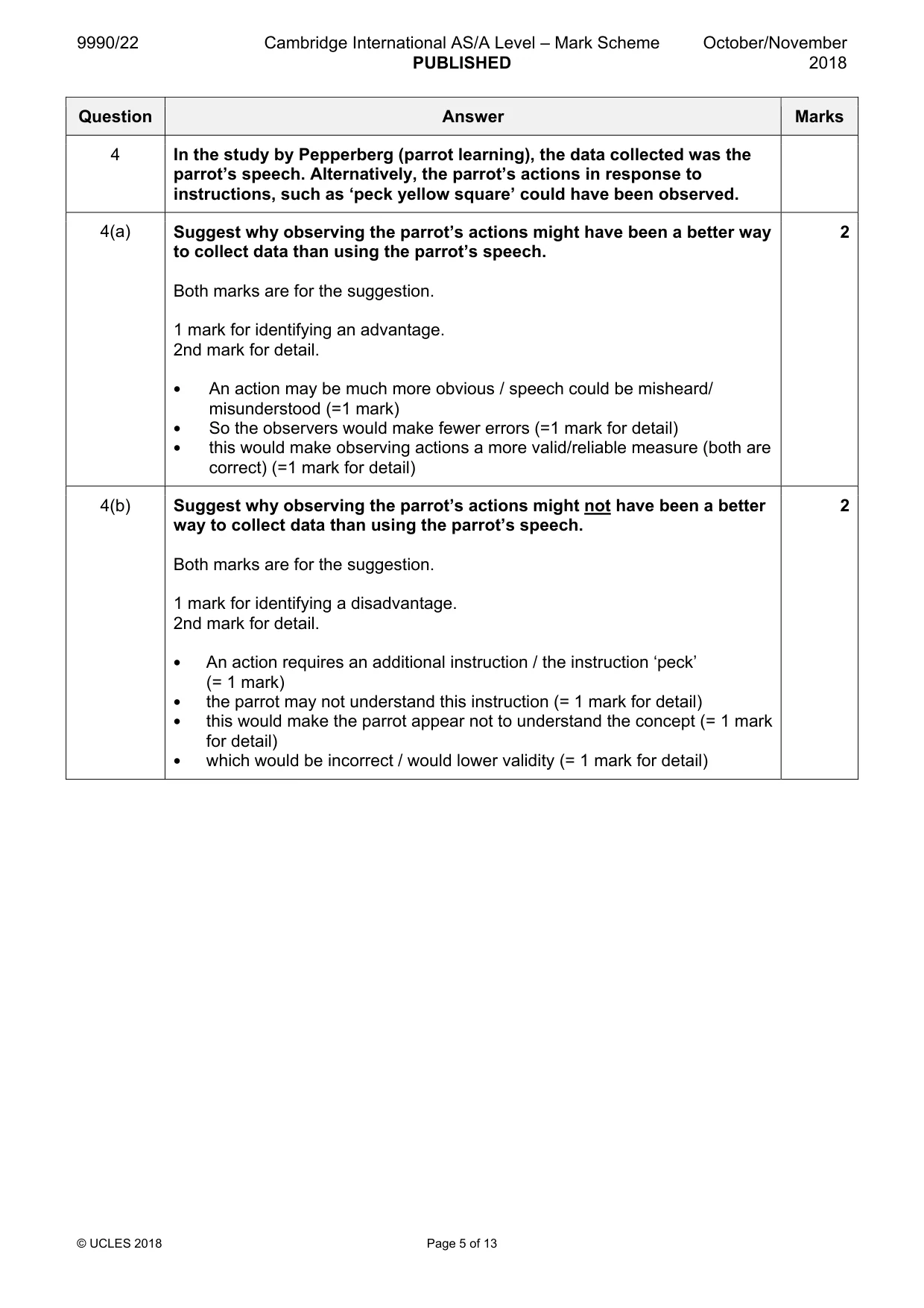
Q4 · In the study by Pepperberg (parrot learning), the data collected was the parrot’s speech
4 In the study by Pepperberg (parrot learning), the data collected was the parrot’s speech. Alternatively, the parrot’s actions in response to instructions, such as ‘peck yellow square’ could have been observed. (a) Suggest why observing the parrot’s actions might have been a better way to collect data than using the parrot’s speech. ................................................................................................................................................... ................................................................................................................................................... ................................................................................................................................................... ...............................................................................................................................................[2] (b) Suggest why observing the parrot’s actions might not have been a better way to collect data than using the parrot’s speech. ................................................................................................................................................... ................................................................................................................................................... ................................................................................................................................................... ...............................................................................................................................................[2]
Mark scheme: 4(a) Suggest why observing the parrot’s actions might have been a better way 2 to collect data than using the parrot’s speech. Both marks are for the suggestion. 1 mark for identifying an advantage. 2nd mark for detail. • An action may be much more obvious / speech could be misheard/ misunderstood (=1 mark) • So the observers would make fewer errors (=1 mark for detail) • this would make observing actions a more valid/reliable measure (both are correct) (=1 mark for detail) 4(b) Suggest why observing the parrot’s actions might not have been a better 2 way to collect data than using the parrot’s speech. Both marks are for the suggestion. 1 mark for identifying a disadvantage. 2nd mark for detail. • An action requires an additional instruction / the instruction ‘peck’ (= 1 mark) • the parrot may not understand this instruction (= 1 mark for detail) • this would make the parrot appear not to understand the concept (= 1 mark for detail) • which would be incorrect / would lower validity (= 1 mark for detail)
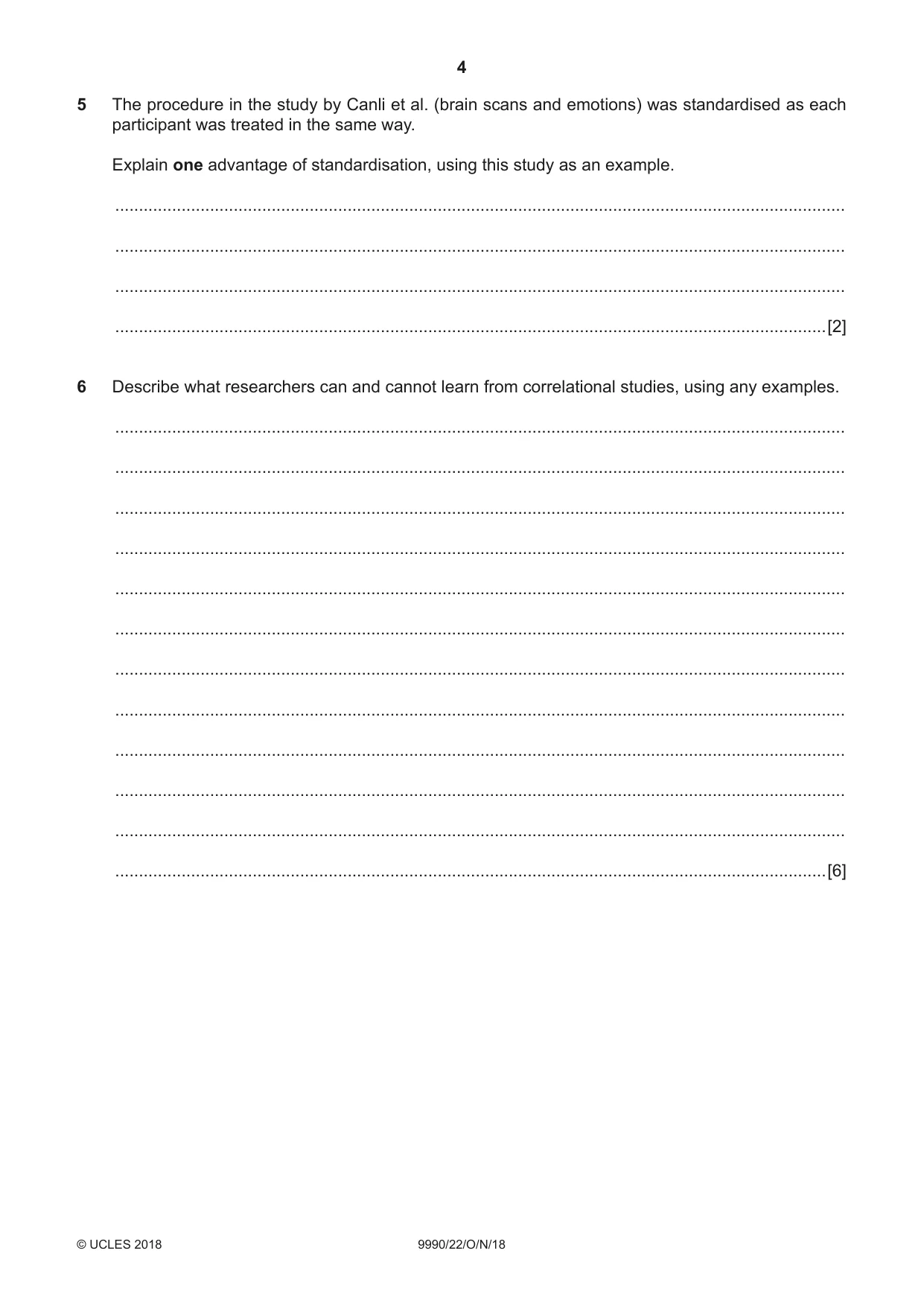
Q5 · The procedure in the study by Canli et al
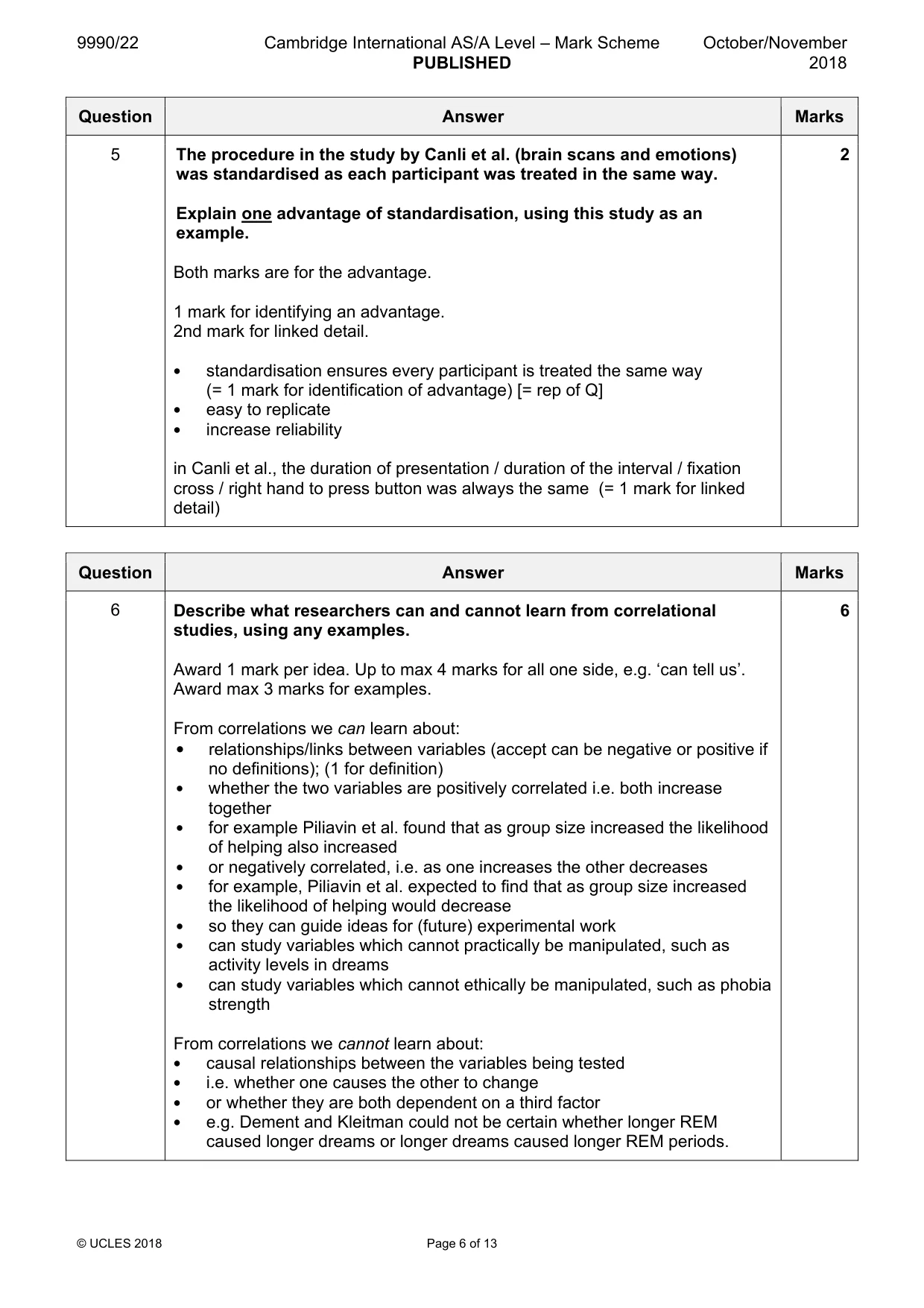
5 The procedure in the study by Canli et al. (brain scans and emotions) was standardised as each participant was treated in the same way. Explain one advantage of standardisation, using this study as an example. .......................................................................................................................................................... .......................................................................................................................................................... .......................................................................................................................................................... ......................................................................................................................................................[2]
Mark scheme: 5 The procedure in the study by Canli et al. (brain scans and emotions) 2 was standardised as each participant was treated in the same way. Explain one advantage of standardisation, using this study as an example. Both marks are for the advantage. 1 mark for identifying an advantage. 2nd mark for linked detail. • standardisation ensures every participant is treated the same way (= 1 mark for identification of advantage) [= rep of Q] • easy to replicate • increase reliability in Canli et al., the duration of presentation / duration of the interval / fixation cross / right hand to press button was always the same (= 1 mark for linked detail)
Q6 · Describe what researchers can and cannot learn from correlational studies, using any…
6 Describe what researchers can and cannot learn from correlational studies, using any examples. .......................................................................................................................................................... .......................................................................................................................................................... .......................................................................................................................................................... .......................................................................................................................................................... .......................................................................................................................................................... .......................................................................................................................................................... .......................................................................................................................................................... .......................................................................................................................................................... .......................................................................................................................................................... .......................................................................................................................................................... .......................................................................................................................................................... ......................................................................................................................................................[6]
Mark scheme: 6 Describe what researchers can and cannot learn from correlational 6 studies, using any examples. Award 1 mark per idea. Up to max 4 marks for all one side, e.g. ‘can tell us’. Award max 3 marks for examples. From correlations we can learn about: • relationships/links between variables (accept can be negative or positive if no definitions); (1 for definition) • whether the two variables are positively correlated i.e. both increase together • for example Piliavin et al. found that as group size increased the likelihood of helping also increased • or negatively correlated, i.e. as one increases the other decreases • for example, Piliavin et al. expected to find that as group size increased the likelihood of helping would decrease • so they can guide ideas for (future) experimental work • can study variables which cannot practically be manipulated, such as activity levels in dreams • can study variables which cannot ethically be manipulated, such as phobia strength From correlations we cannot learn about: • causal relationships between the variables being tested • i.e. whether one causes the other to change • or whether they are both dependent on a third factor • e.g. Dement and Kleitman could not be certain whether longer REM caused longer dreams or longer dreams caused longer REM periods.
Q7 · Dr Kwan plans to investigate whether any species other than chimpanzees will offer help
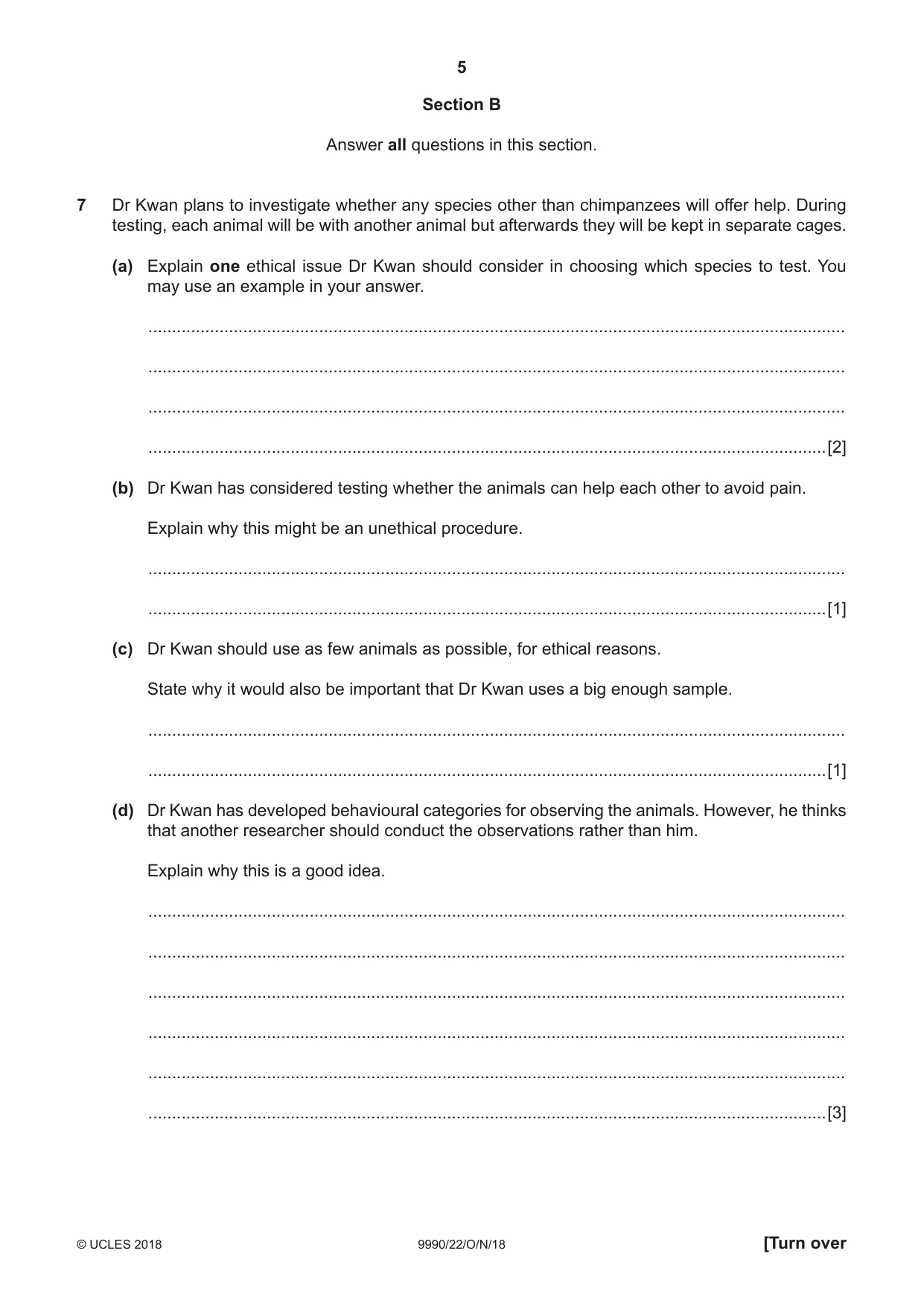
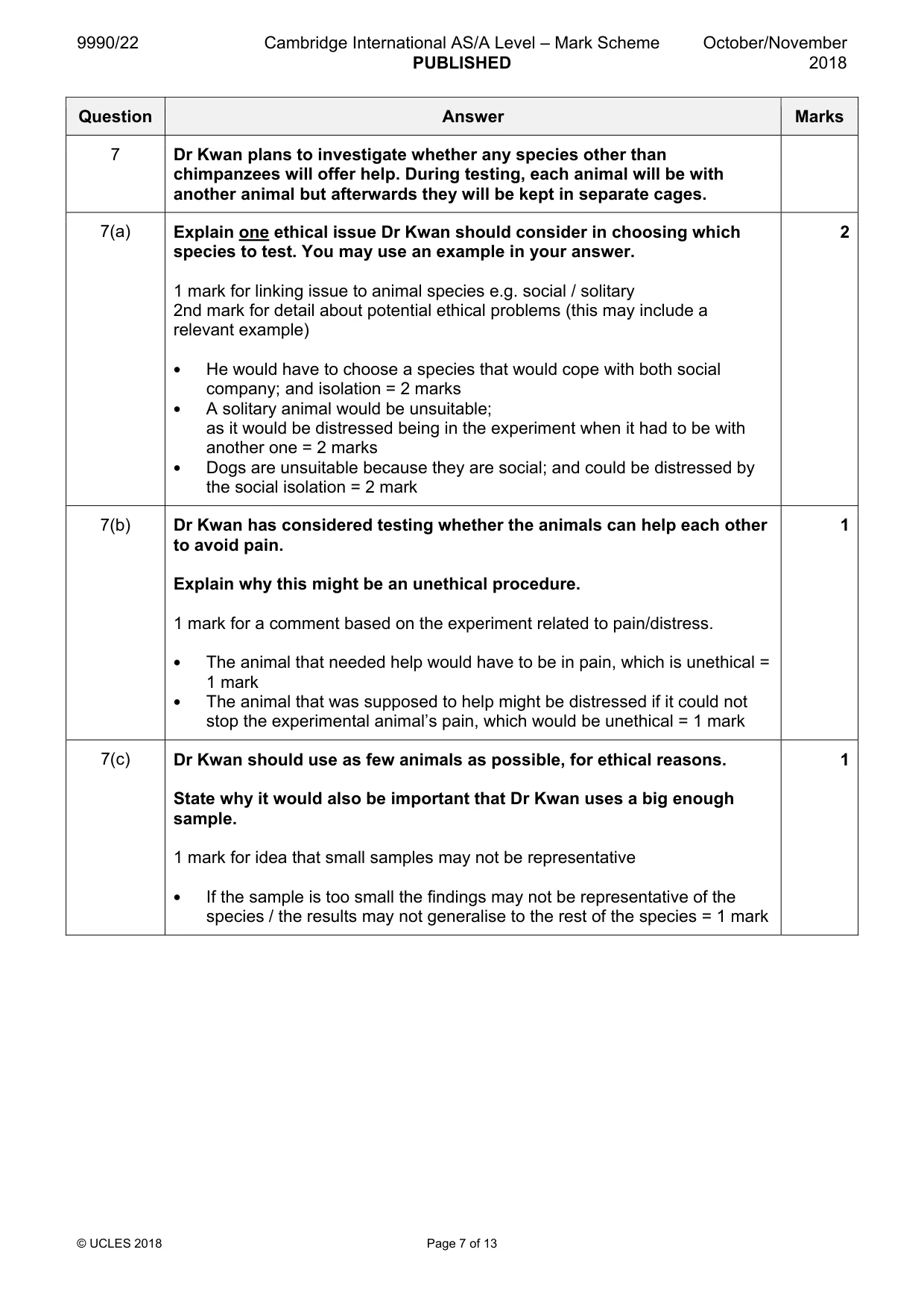
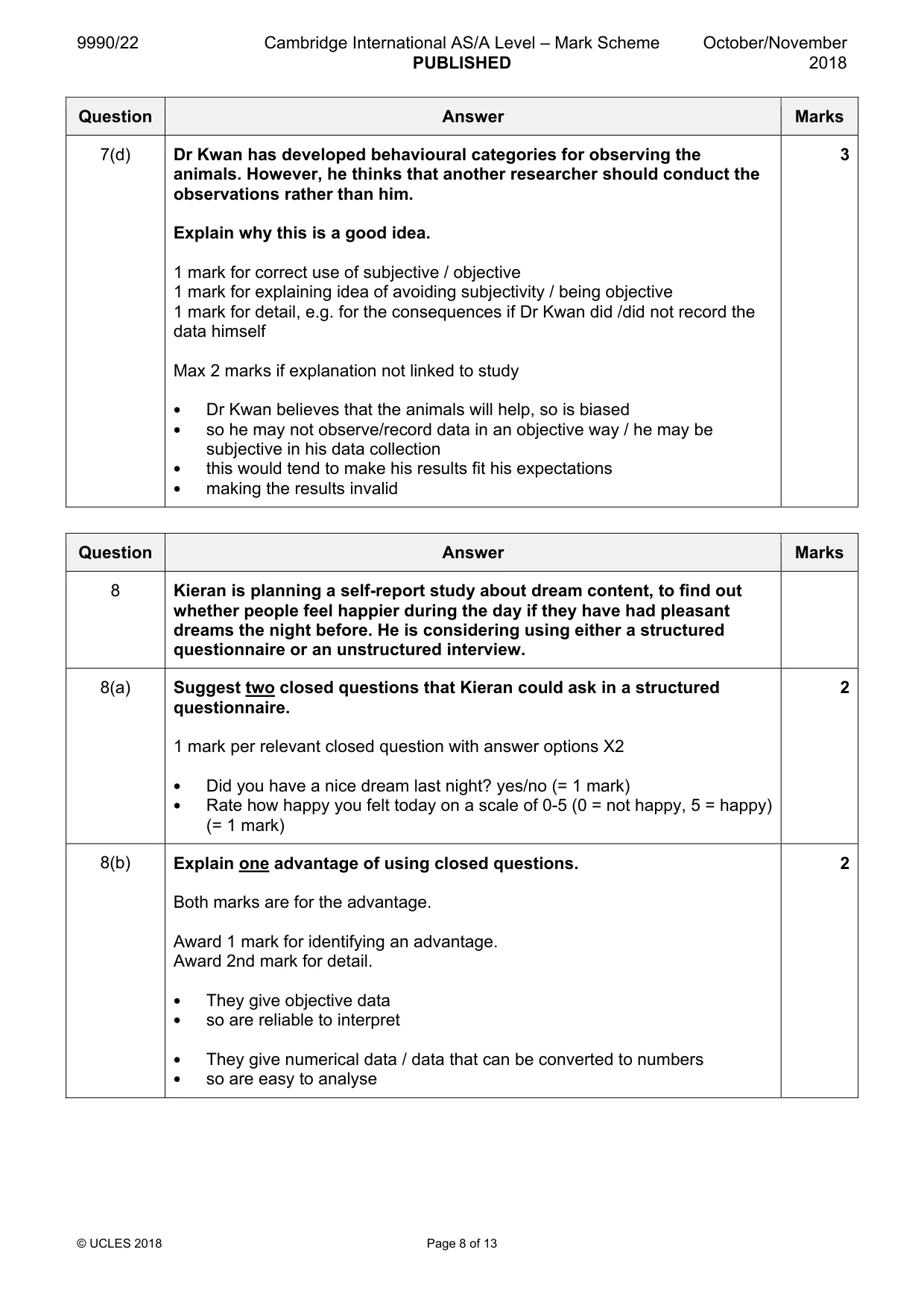
7 Dr Kwan plans to investigate whether any species other than chimpanzees will offer help. During testing, each animal will be with another animal but afterwards they will be kept in separate cages. (a) Explain one ethical issue Dr Kwan should consider in choosing which species to test. You may use an example in your answer. ................................................................................................................................................... ................................................................................................................................................... ................................................................................................................................................... ...............................................................................................................................................[2] (b) Dr Kwan has considered testing whether the animals can help each other to avoid pain. Explain why this might be an unethical procedure. ................................................................................................................................................... ...............................................................................................................................................[1] (c) Dr Kwan should use as few animals as possible, for ethical reasons. State why it would also be important that Dr Kwan uses a big enough sample. ................................................................................................................................................... ...............................................................................................................................................[1] (d) Dr Kwan has developed behavioural categories for observing the animals. However, he thinks that another researcher should conduct the observations rather than him. Explain why this is a good idea. ................................................................................................................................................... ................................................................................................................................................... ................................................................................................................................................... ................................................................................................................................................... ................................................................................................................................................... ...............................................................................................................................................[3]
Mark scheme: 7(a) Explain one ethical issue Dr Kwan should consider in choosing which 2 species to test. You may use an example in your answer. 1 mark for linking issue to animal species e.g. social / solitary 2nd mark for detail about potential ethical problems (this may include a relevant example) • He would have to choose a species that would cope with both social company; and isolation = 2 marks • A solitary animal would be unsuitable; as it would be distressed being in the experiment when it had to be with another one = 2 marks • Dogs are unsuitable because they are social; and could be distressed by the social isolation = 2 mark 7(b) Dr Kwan has considered testing whether the animals can help each other 1 to avoid pain. Explain why this might be an unethical procedure. 1 mark for a comment based on the experiment related to pain/distress. • The animal that needed help would have to be in pain, which is unethical = 1 mark • The animal that was supposed to help might be distressed if it could not stop the experimental animal’s pain, which would be unethical = 1 mark 7(c) Dr Kwan should use as few animals as possible, for ethical reasons. 1 State why it would also be important that Dr Kwan uses a big enough sample. 1 mark for idea that small samples may not be representative • If the sample is too small the findings may not be representative of the species / the results may not generalise to the rest of the species = 1 mark 7(d) Dr Kwan has developed behavioural categories for observing the 3 animals. However, he thinks that another researcher should conduct the observations rather than him. Explain why this is a good idea. 1 mark for correct use of subjective / objective 1 mark for explaining idea of avoiding subjectivity / being objective 1 mark for detail, e.g. for the consequences if Dr Kwan did /did not record the data himself Max 2 marks if explanation not linked to study • Dr Kwan believes that the animals will help, so is biased • so he may not observe/record data in an objective way / he may be subjective in his data collection • this would tend to make his results fit his expectations • making the results invalid
Q8 · Kieran is planning a self-report study about dream content, to find out whether people…
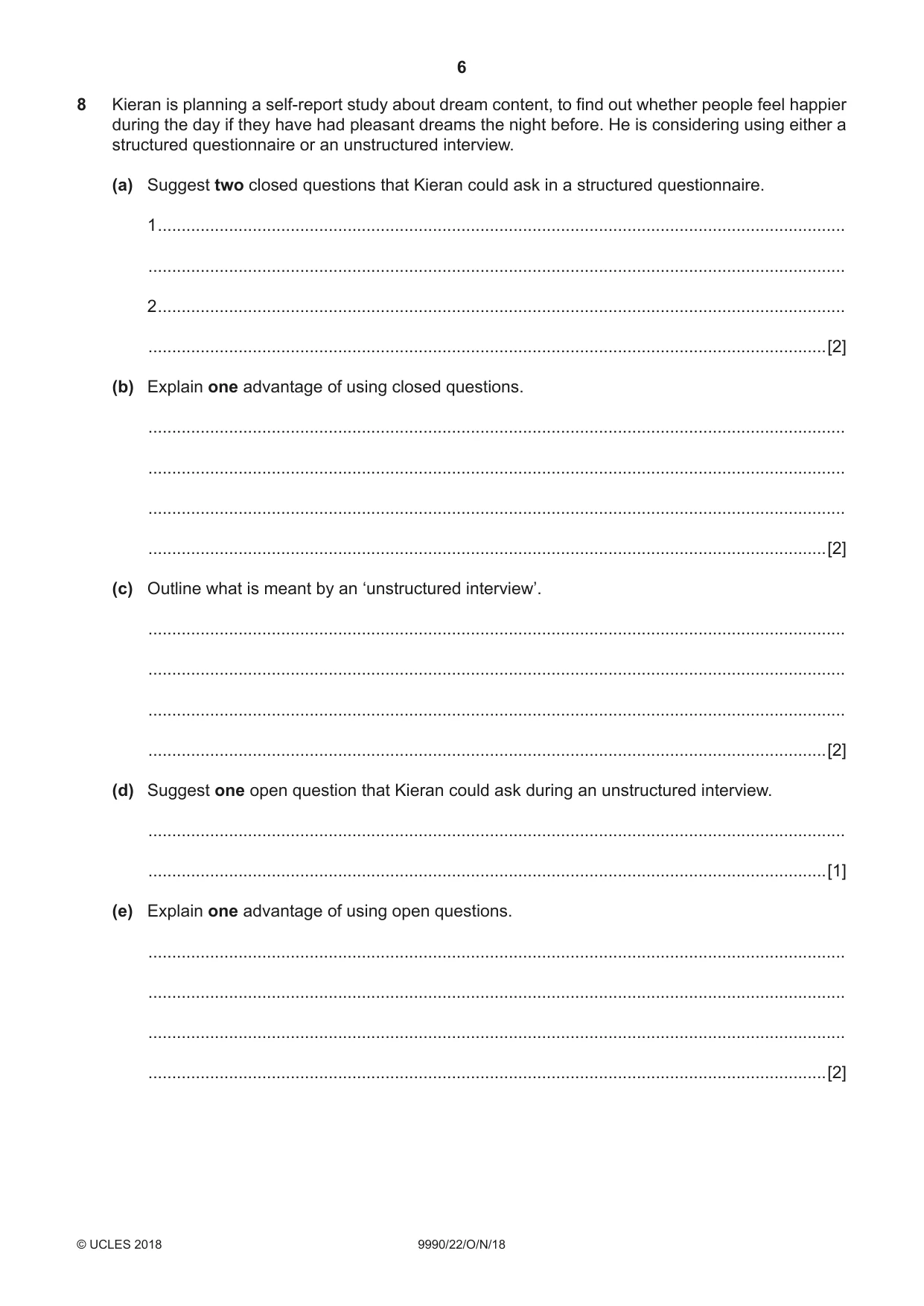
8 Kieran is planning a self-report study about dream content, to find out whether people feel happier during the day if they have had pleasant dreams the night before. He is considering using either a structured questionnaire or an unstructured interview. (a) Suggest two closed questions that Kieran could ask in a structured questionnaire. 1 ................................................................................................................................................. ................................................................................................................................................... 2 ................................................................................................................................................. ...............................................................................................................................................[2] (b) Explain one advantage of using closed questions. ................................................................................................................................................... ................................................................................................................................................... ................................................................................................................................................... ...............................................................................................................................................[2] (c) Outline what is meant by an ‘unstructured interview’. ................................................................................................................................................... ................................................................................................................................................... ................................................................................................................................................... ...............................................................................................................................................[2] (d) Suggest one open question that Kieran could ask during an unstructured interview. ................................................................................................................................................... ...............................................................................................................................................[1] (e) Explain one advantage of using open questions. ................................................................................................................................................... ................................................................................................................................................... ................................................................................................................................................... ...............................................................................................................................................[2]
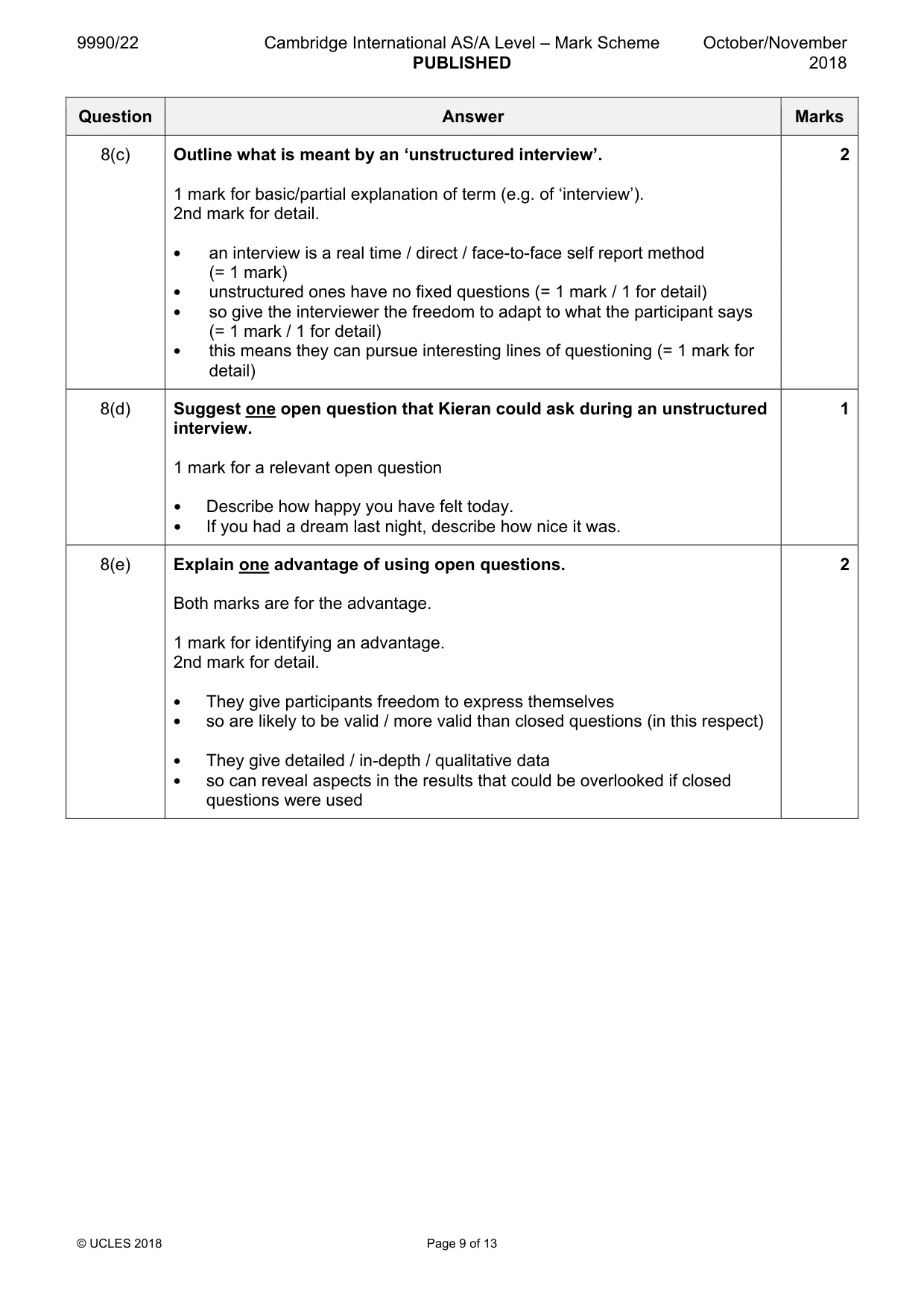
Mark scheme: 8(a) Suggest two closed questions that Kieran could ask in a structured 2 questionnaire. 1 mark per relevant closed question with answer options X2 • Did you have a nice dream last night? yes/no (= 1 mark) • Rate how happy you felt today on a scale of 0-5 (0 = not happy, 5 = happy) (= 1 mark) 8(b) Explain one advantage of using closed questions. 2 Both marks are for the advantage. Award 1 mark for identifying an advantage. Award 2nd mark for detail. • They give objective data • so are reliable to interpret • They give numerical data / data that can be converted to numbers • so are easy to analyse 8(c) Outline what is meant by an ‘unstructured interview’. 2 1 mark for basic/partial explanation of term (e.g. of ‘interview’). 2nd mark for detail. • an interview is a real time / direct / face-to-face self report method (= 1 mark) • unstructured ones have no fixed questions (= 1 mark / 1 for detail) • so give the interviewer the freedom to adapt to what the participant says (= 1 mark / 1 for detail) • this means they can pursue interesting lines of questioning (= 1 mark for detail) 8(d) Suggest one open question that Kieran could ask during an unstructured 1 interview. 1 mark for a relevant open question • Describe how happy you have felt today. • If you had a dream last night, describe how nice it was. 8(e) Explain one advantage of using open questions. 2 Both marks are for the advantage. 1 mark for identifying an advantage. 2nd mark for detail. • They give participants freedom to express themselves • so are likely to be valid / more valid than closed questions (in this respect) • They give detailed / in-depth / qualitative data • so can reveal aspects in the results that could be overlooked if closed questions were used
Q9 · Marla is working in a centre for adults with autism
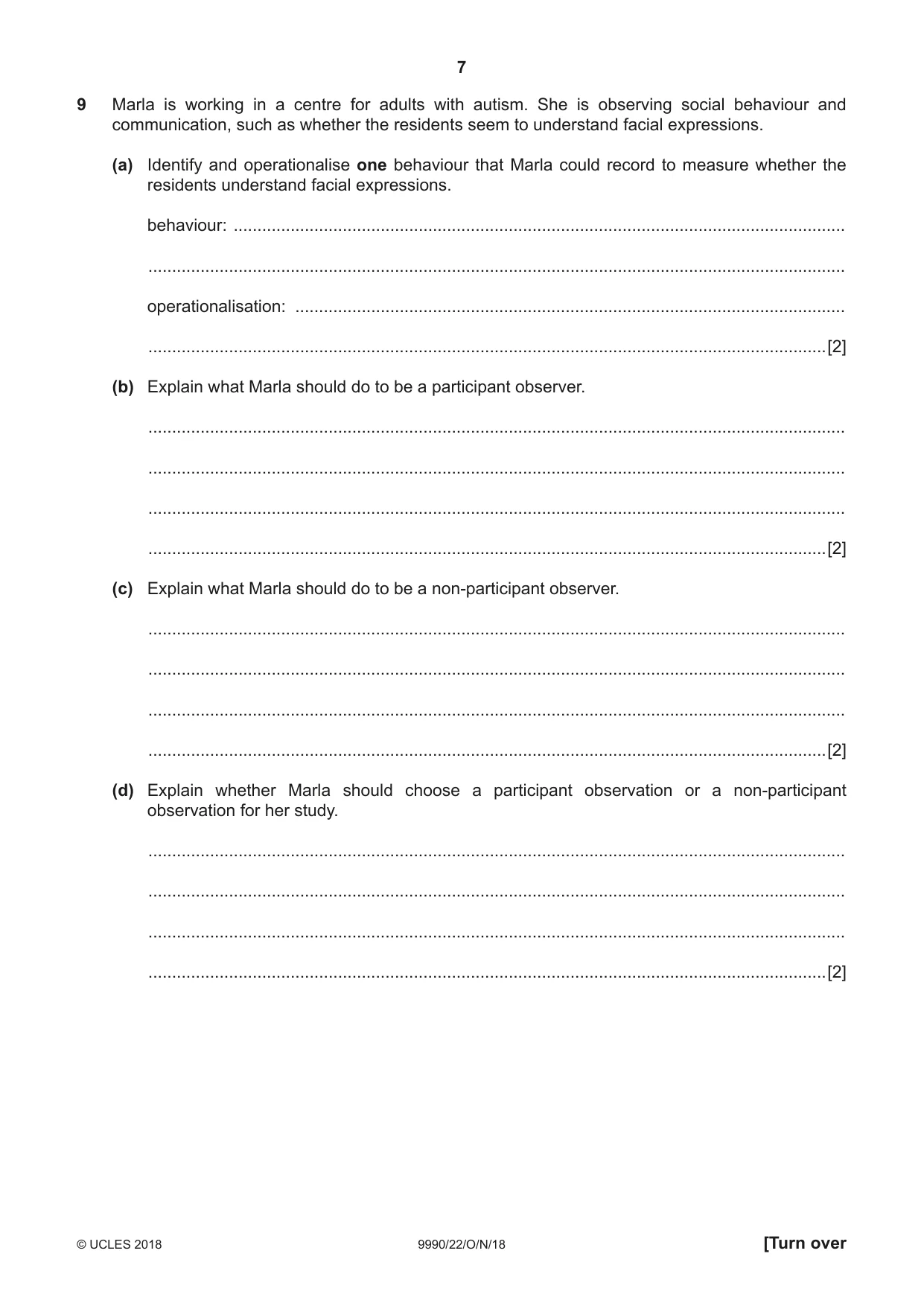
9 Marla is working in a centre for adults with autism. She is observing social behaviour and communication, such as whether the residents seem to understand facial expressions. (a) Identify and operationalise one behaviour that Marla could record to measure whether the residents understand facial expressions. behaviour: ................................................................................................................................. ................................................................................................................................................... operationalisation: .................................................................................................................... ...............................................................................................................................................[2] (b) Explain what Marla should do to be a participant observer. ................................................................................................................................................... ................................................................................................................................................... ................................................................................................................................................... ...............................................................................................................................................[2] (c) Explain what Marla should do to be a non-participant observer. ................................................................................................................................................... ................................................................................................................................................... ................................................................................................................................................... ...............................................................................................................................................[2] (d) Explain whether Marla should choose a participant observation or a non-participant observation for her study. ................................................................................................................................................... ................................................................................................................................................... ................................................................................................................................................... ...............................................................................................................................................[2] Section C Answer all questions in this section.
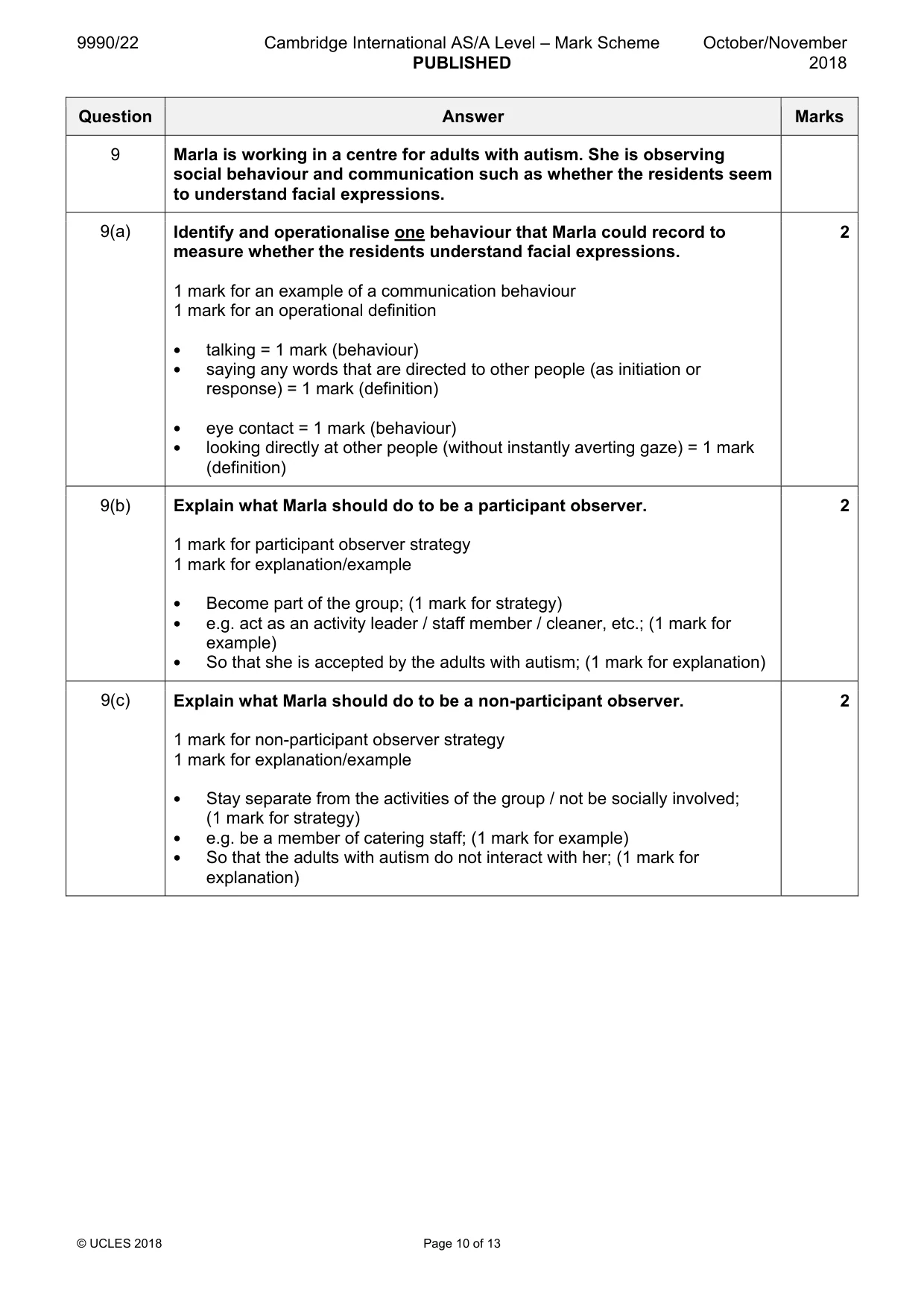
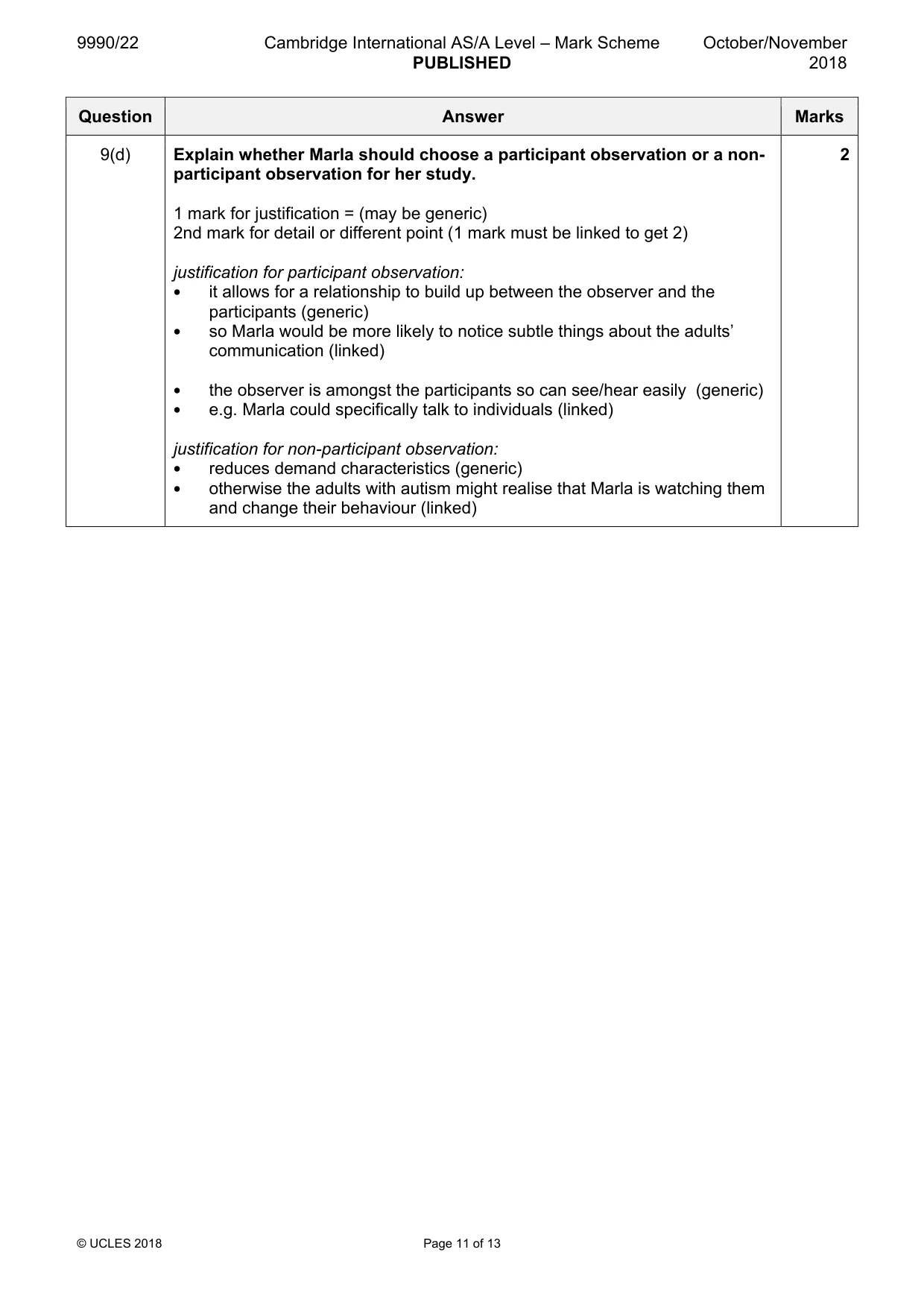
Mark scheme: 9(a) Identify and operationalise one behaviour that Marla could record to 2 measure whether the residents understand facial expressions. 1 mark for an example of a communication behaviour 1 mark for an operational definition • talking = 1 mark (behaviour) • saying any words that are directed to other people (as initiation or response) = 1 mark (definition) • eye contact = 1 mark (behaviour) • looking directly at other people (without instantly averting gaze) = 1 mark (definition) 9(b) Explain what Marla should do to be a participant observer. 2 1 mark for participant observer strategy 1 mark for explanation/example • Become part of the group; (1 mark for strategy) • e.g. act as an activity leader / staff member / cleaner, etc.; (1 mark for example) • So that she is accepted by the adults with autism; (1 mark for explanation) 9(c) Explain what Marla should do to be a non-participant observer. 2 1 mark for non-participant observer strategy 1 mark for explanation/example • Stay separate from the activities of the group / not be socially involved; (1 mark for strategy) • e.g. be a member of catering staff; (1 mark for example) • So that the adults with autism do not interact with her; (1 mark for explanation) 9(d) Explain whether Marla should choose a participant observation or a non- 2 participant observation for her study. 1 mark for justification = (may be generic) 2nd mark for detail or different point (1 mark must be linked to get 2) justification for participant observation: • it allows for a relationship to build up between the observer and the participants (generic) • so Marla would be more likely to notice subtle things about the adults’ communication (linked) • the observer is amongst the participants so can see/hear easily (generic) • e.g. Marla could specifically talk to individuals (linked) justification for non-participant observation: • reduces demand characteristics (generic) • otherwise the adults with autism might realise that Marla is watching them and change their behaviour (linked)
Q10 · Dr Fox is planning a field experiment to investigate obedience in school children
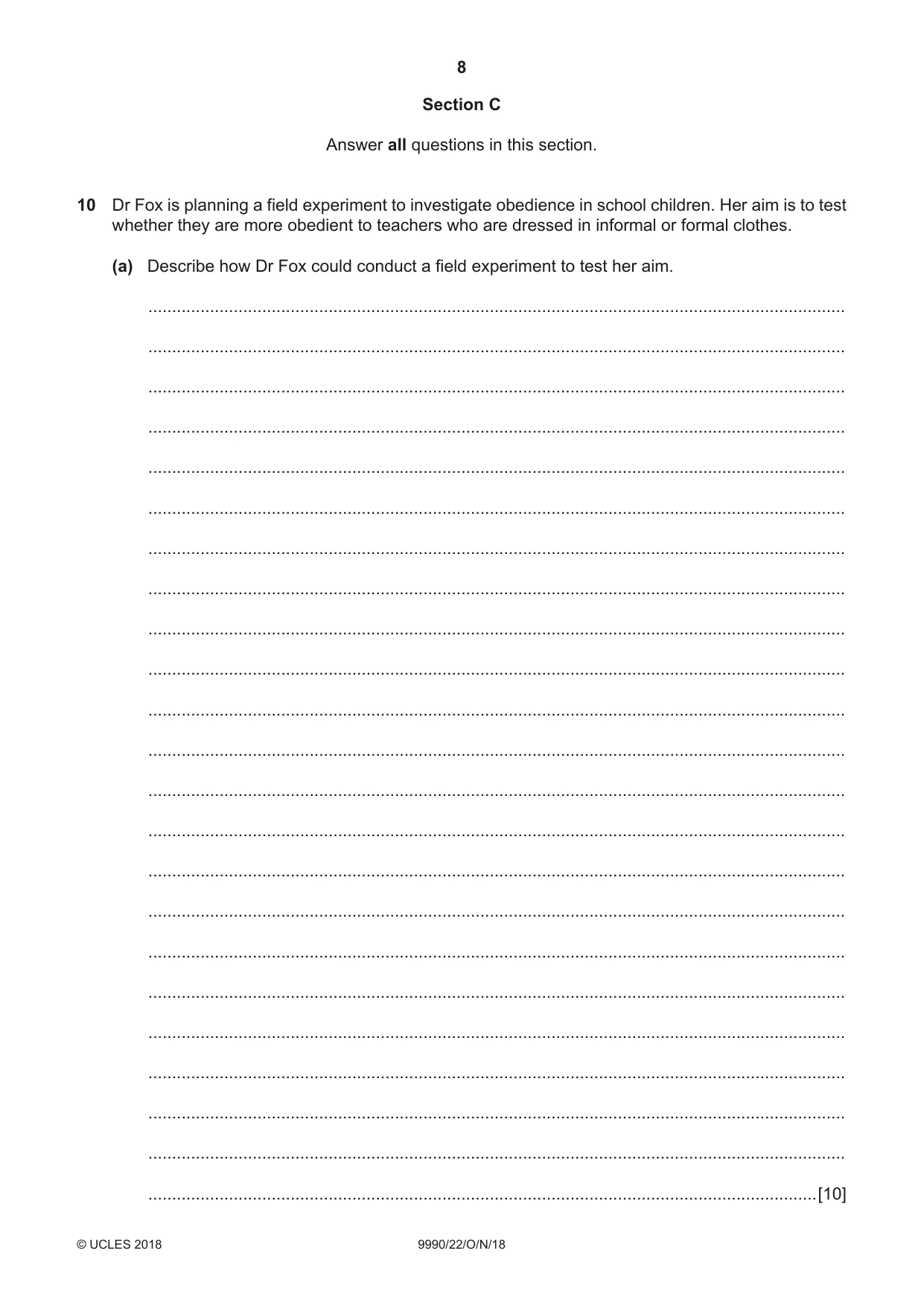
10 Dr Fox is planning a field experiment to investigate obedience in school children. Her aim is to test whether they are more obedient to teachers who are dressed in informal or formal clothes. (a) Describe how Dr Fox could conduct a field experiment to test her aim. ................................................................................................................................................... ................................................................................................................................................... ................................................................................................................................................... ................................................................................................................................................... ................................................................................................................................................... ................................................................................................................................................... ................................................................................................................................................... ................................................................................................................................................... ................................................................................................................................................... ................................................................................................................................................... ................................................................................................................................................... ................................................................................................................................................... ................................................................................................................................................... ................................................................................................................................................... ................................................................................................................................................... ................................................................................................................................................... ................................................................................................................................................... ................................................................................................................................................... ................................................................................................................................................... ................................................................................................................................................... ................................................................................................................................................... ................................................................................................................................................... .............................................................................................................................................[10] (b) Identify one weakness/limitation with the procedure you have described in your answer to part (a) and suggest how your study might be done differently to overcome the problem. ................................................................................................................................................... ................................................................................................................................................... ................................................................................................................................................... ................................................................................................................................................... ................................................................................................................................................... ................................................................................................................................................... ................................................................................................................................................... ...............................................................................................................................................[4]
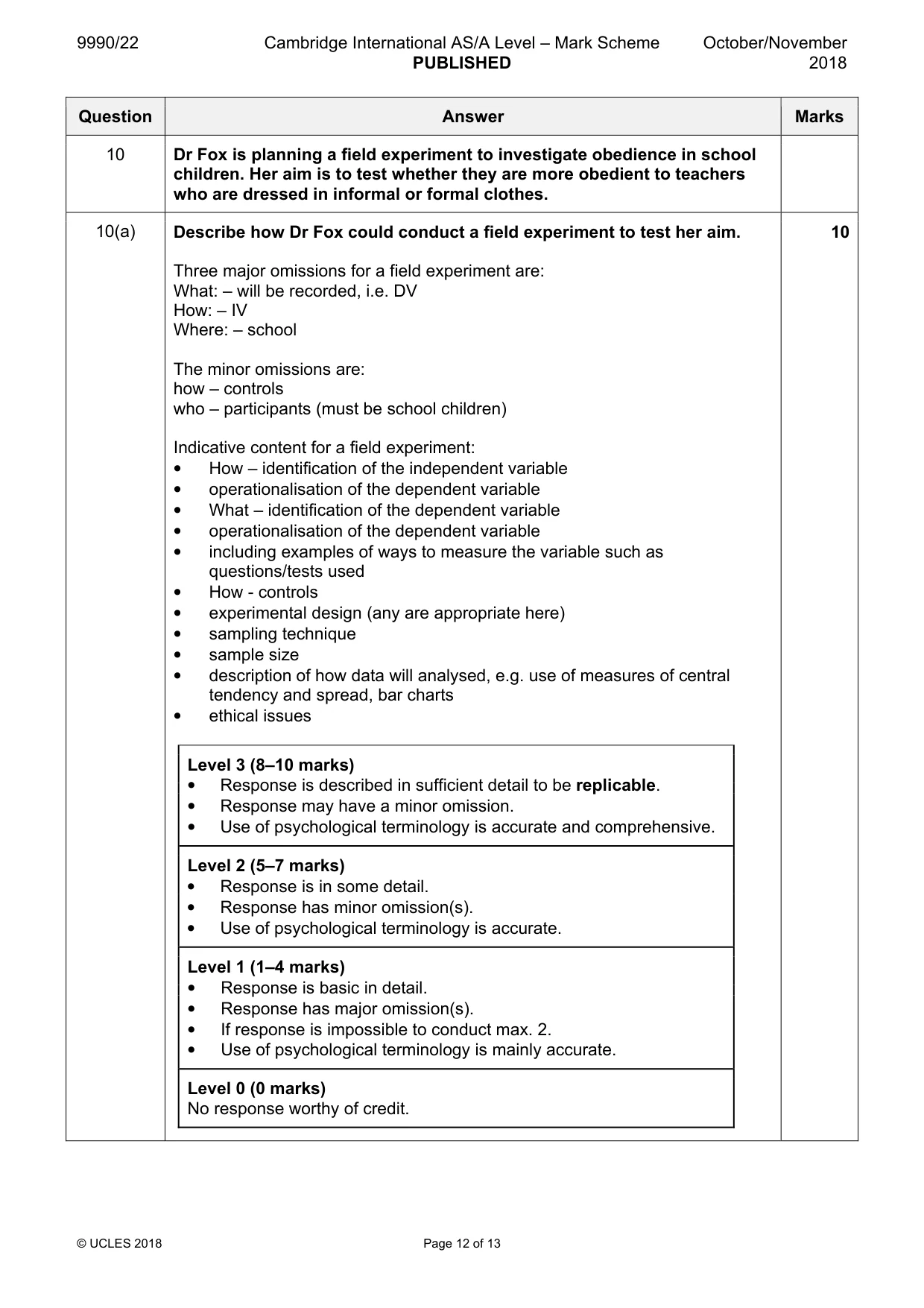
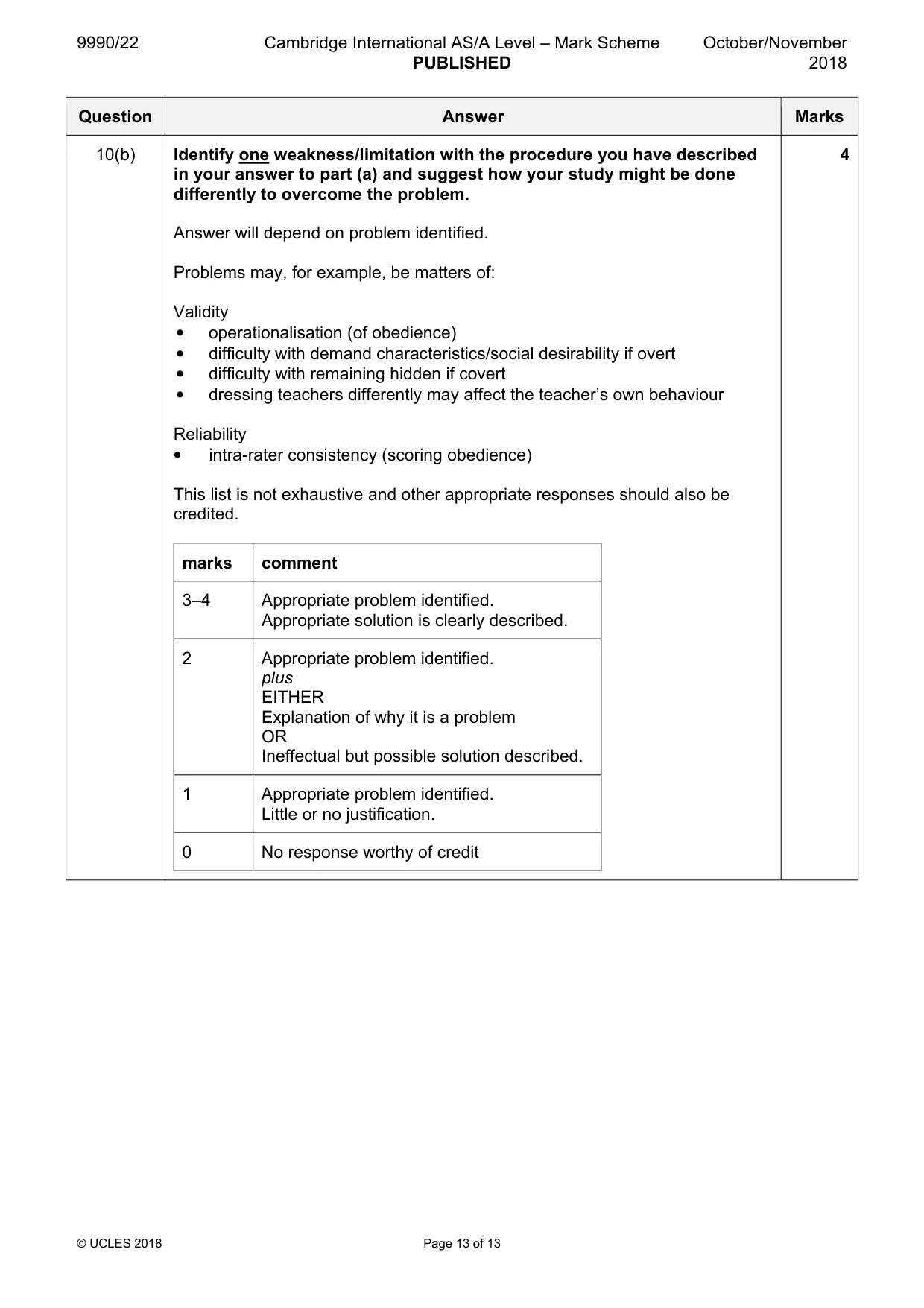
Mark scheme: 10(a) Describe how Dr Fox could conduct a field experiment to test her aim. 10 Three major omissions for a field experiment are: What: – will be recorded, i.e. DV How: – IV Where: – school The minor omissions are: how – controls who – participants (must be school children) Indicative content for a field experiment: • How – identification of the independent variable • operationalisation of the dependent variable • What – identification of the dependent variable • operationalisation of the dependent variable • including examples of ways to measure the variable such as questions/tests used • How - controls • experimental design (any are appropriate here) • sampling technique • sample size • description of how data will analysed, e.g. use of measures of central tendency and spread, bar charts • ethical issues Level 3 (8–10 marks) • Response is described in sufficient detail to be replicable. • Response may have a minor omission. • Use of psychological terminology is accurate and comprehensive. Level 2 (5–7 marks) • Response is in some detail. • Response has minor omission(s). • Use of psychological terminology is accurate. Level 1 (1–4 marks) • Response is basic in detail. • Response has major omission(s). • If response is impossible to conduct max. 2. • Use of psychological terminology is mainly accurate. Level 0 (0 marks) No response worthy of credit. 10(b) Identify one weakness/limitation with the procedure you have described 4 in your answer to part (a) and suggest how your study might be done differently to overcome the problem. Answer will depend on problem identified. Problems may, for example, be matters of: Validity • operationalisation (of obedience) • difficulty with demand characteristics/social desirability if overt • difficulty with remaining hidden if covert • dressing teachers differently may affect the teacher’s own behaviour Reliability • intra-rater consistency (scoring obedience) This list is not exhaustive and other appropriate responses should also be credited. marks comment 3–4 Appropriate problem identified. Appropriate solution is clearly described. 2 Appropriate problem identified. plus EITHER Explanation of why it is a problem OR Ineffectual but possible solution described. 1 Appropriate problem identified. Little or no justification. 0 No response worthy of credit
What was in this paper
The subtopics covered by these 10 questions, and how many questions each got. Open one in a new tab to see every Cambridge question on it.
What you needed in this session
Cambridge’s own grade thresholds for 2018 Oct/Nov, Paper 2 · Variant 2. A higher threshold means an easier paper — the bar moves with how the cohort did.