Questions as text
Q1 · In radio communication, the radio wave is usually modulated 9702/42 Oct/Nov 2018
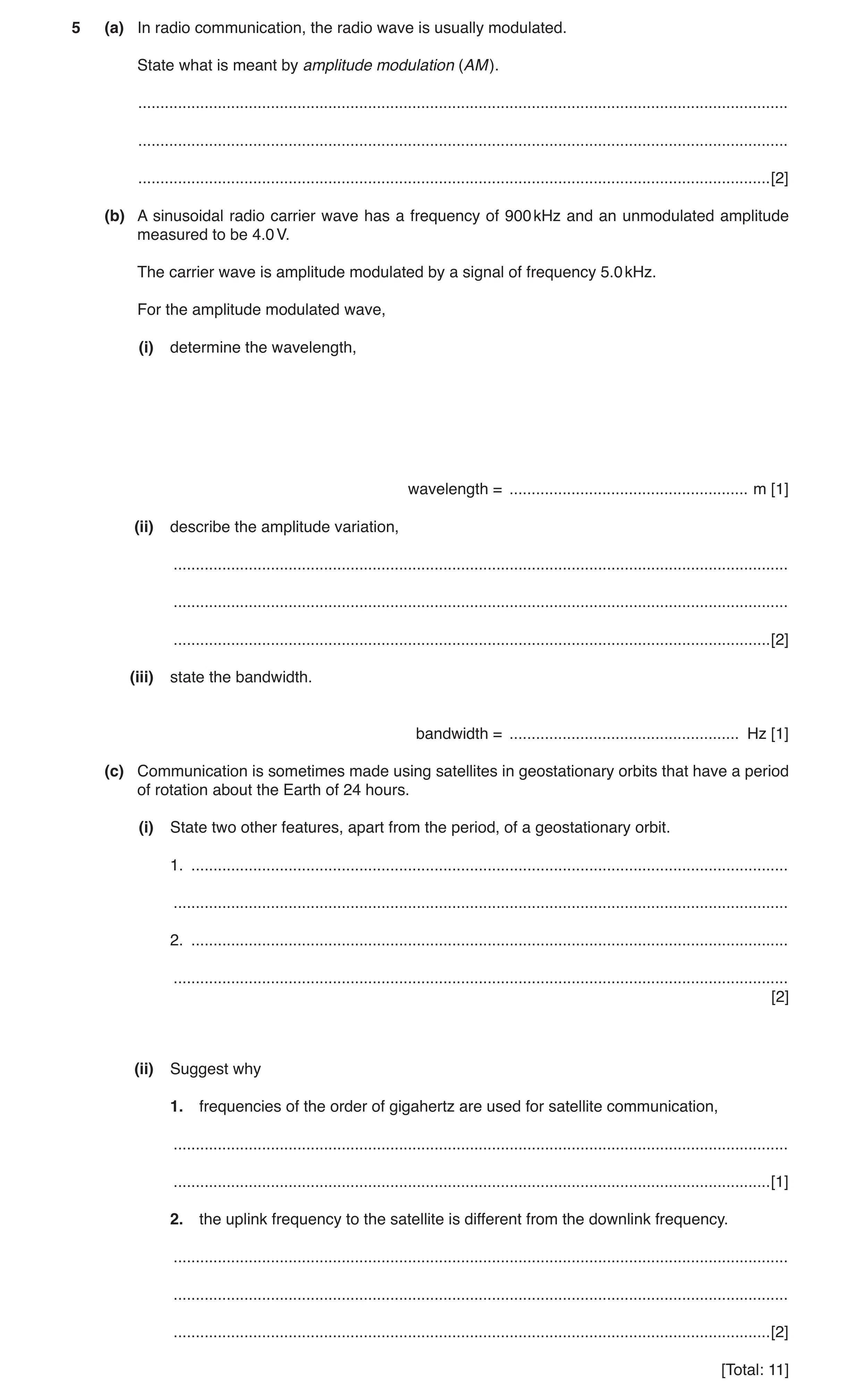
5 (a) In radio communication, the radio wave is usually modulated. State what is meant by amplitude modulation (AM ). … … … [2] (b) A sinusoidal radio carrier wave has a frequency of 900 kHz and an unmodulated amplitude measured to be 4.0 V. The carrier wave is amplitude modulated by a signal of frequency 5.0 kHz. For the amplitude modulated wave, (i) determine the wavelength, wavelength = … m [1] (ii) describe the amplitude variation, … … … [2] (iii) state the bandwidth. bandwidth = … Hz [1] (c) Communication is sometimes made using satellites in geostationary orbits that have a period of rotation about the Earth of 24 hours. (i) State two other features, apart from the period, of a geostationary orbit. 1. … … 2. … … [2] (ii) Suggest why 1. frequencies of the order of gigahertz are used for satellite communication, … … [1] 2. the uplink frequency to the satellite is different from the downlink frequency. … … … [2] [Total: 11]
11 marks
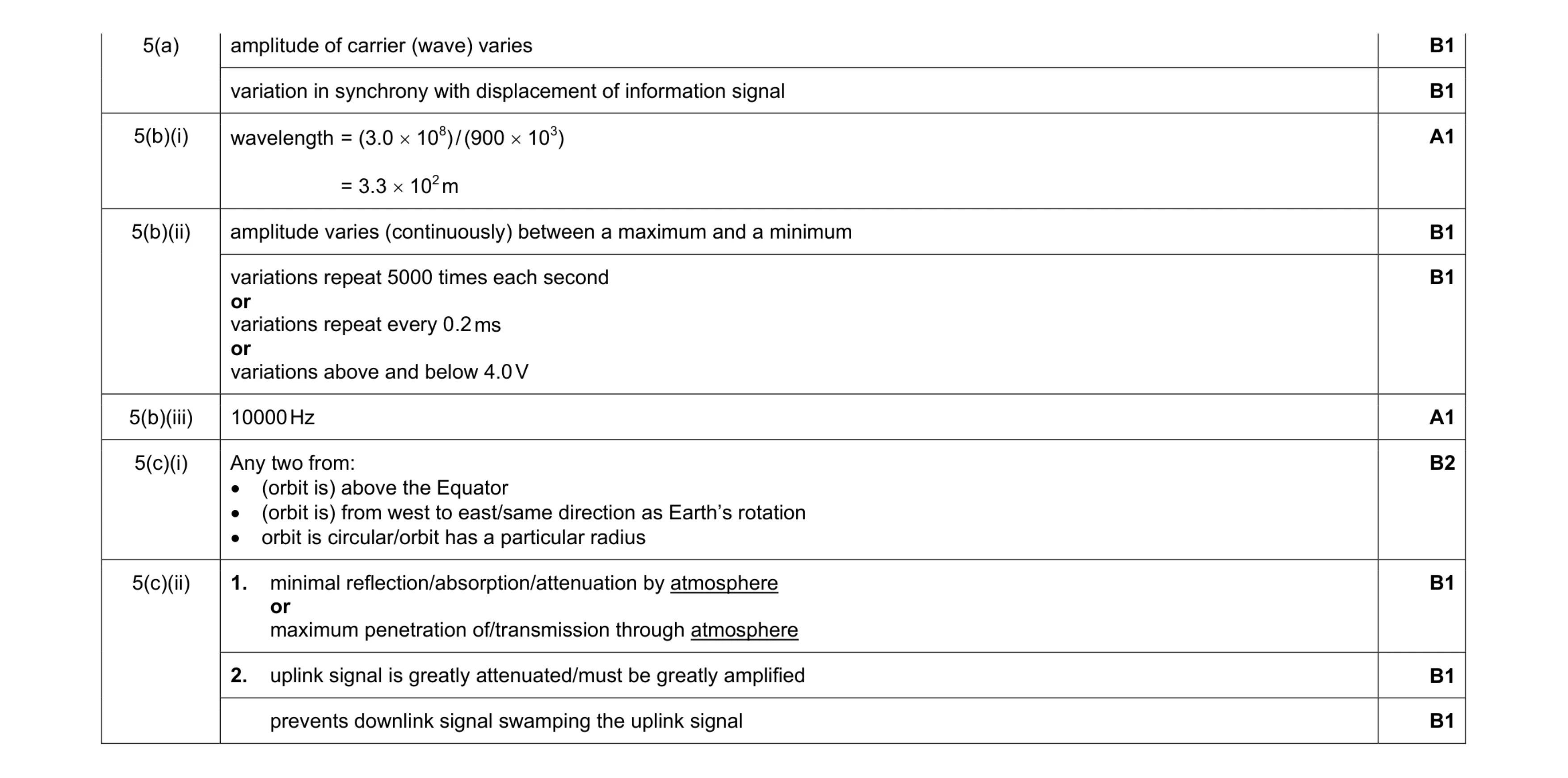
Mark scheme: 5(a) amplitude of carrier (wave) varies B1 variation in synchrony with displacement of information signal B1 5(b)(i) wavelength = (3.0 × 10⁸) / (900 × 103) = 3.3 × 10² m A1 5(b)(ii) amplitude varies (continuously) between a maximum and a minimum B1 variations repeat 5000 times each second or variations repeat every 0.2 ms or variations above and below 4.0 V B1 5(b)(iii) 10000 Hz A1 5(c)(i) Any two from: • (orbit is) above the Equator • (orbit is) from west to east/same direction as Earth’s rotation • orbit is circular/orbit has a particular radius B2 5(c)(ii) 1. minimal reflection/absorption/attenuation by atmosphere or maximum penetration of/transmission through atmosphere B1 2. uplink signal is greatly attenuated/must be greatly amplified B1 prevents downlink signal swamping the uplink signal B1
This question in 9702/42 Oct/Nov 2018
Q2 · During the transmission of a signal, attenuation occurs and noise is picked up 9702/41 May/June 2019
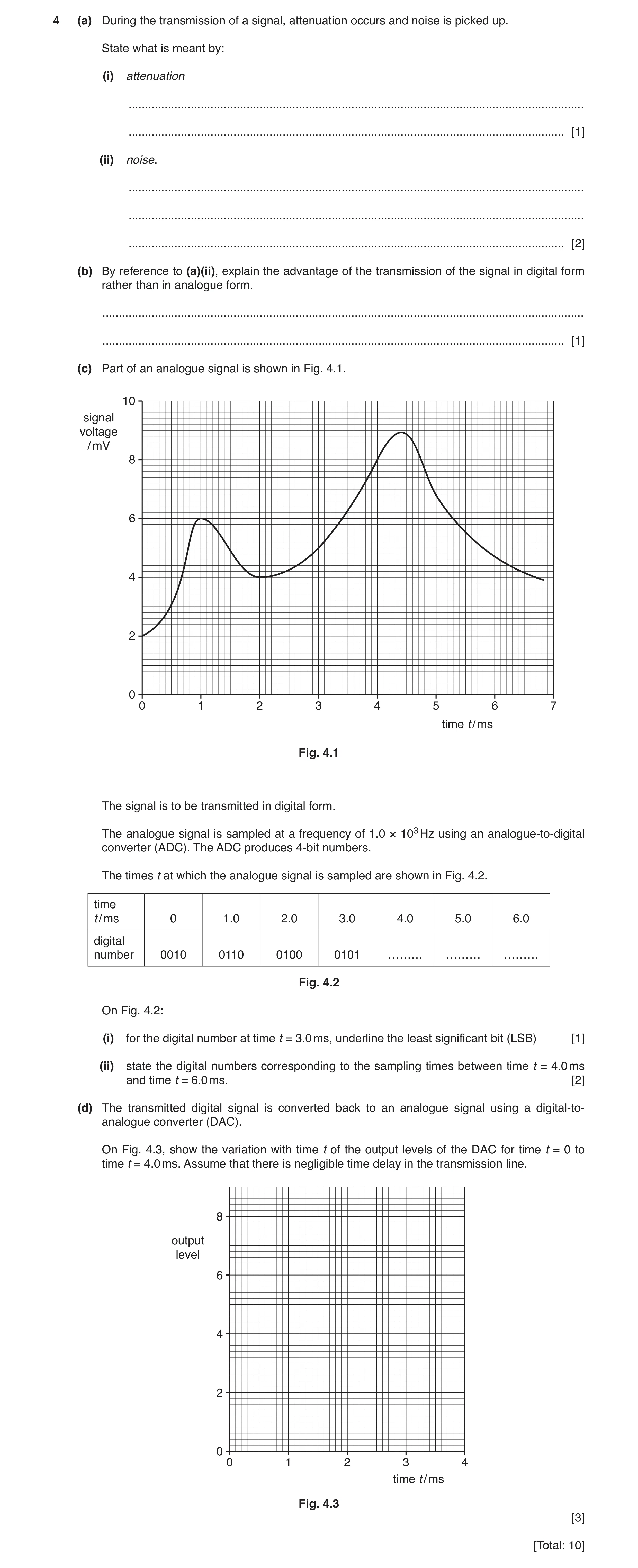
4 (a) During the transmission of a signal, attenuation occurs and noise is picked up. State what is meant by: (i) attenuation … … [1] (ii) noise. … … … [2] (b) By reference to (a)(ii), explain the advantage of the transmission of the signal in digital form rather than in analogue form. … … [1] (c) Part of an analogue signal is shown in Fig. 4.1. 10 signal voltage / mV 8 6 4 2 0 0 1 2 3 4 5 6 7 time t / ms Fig. 4.1 The signal is to be transmitted in digital form. The analogue signal is sampled at a frequency of 1.0 × 10³ Hz using an analogue-to-digital converter (ADC). The ADC produces 4-bit numbers. The times t at which the analogue signal is sampled are shown in Fig. 4.2. time t / ms 0 1.0 2.0 3.0 4.0 5.0 6.0 digital number 0010 0110 0100 0101 ……… ……… ……… Fig. 4.2 On Fig. 4.2: (i) for the digital number at time t = 3.0 ms, underline the least significant bit (LSB) [1] (ii) state the digital numbers corresponding to the sampling times between time t = 4.0 ms and time t = 6.0 ms. [2] (d) The transmitted digital signal is converted back to an analogue signal using a digital-to- analogue converter (DAC). On Fig. 4.3, show the variation with time t of the output levels of the DAC for time t = 0 to time t = 4.0 ms. Assume that there is negligible time delay in the transmission line. 8 output level 6 4 2 0 0 1 2 3 4 time t / ms Fig. 4.3 [3] [Total: 10]
10 marks
Mark scheme: 4(a)(i) loss of (signal) power/amplitude/intensity B1 4(a)(ii) unwanted/random signal B1 superposed on (transmitted) signal B1 4(b) noise can be eliminated (from digital signals) or signal can be regenerated (from digital signals) B1 4(c)(i) 0101 A1 4(c)(ii) 1000 at t = 4.0 ms B1 0110 at t = 5.0 ms and 0100 at t = 6.0 ms B1 4(d) series of equally-spaced steps of width 1 ms B1 each step in correct time interval (0–1 ms, 1–2 ms, 2–3 ms, 3–4 ms) B1 correct step heights (2, 6, 4 and 5) B1
This question in 9702/41 May/June 2019
Q3 · For a signal transmitted along an optic fibre, state what is meant by: (i) attenuation …… 9702/42 May/June 2019
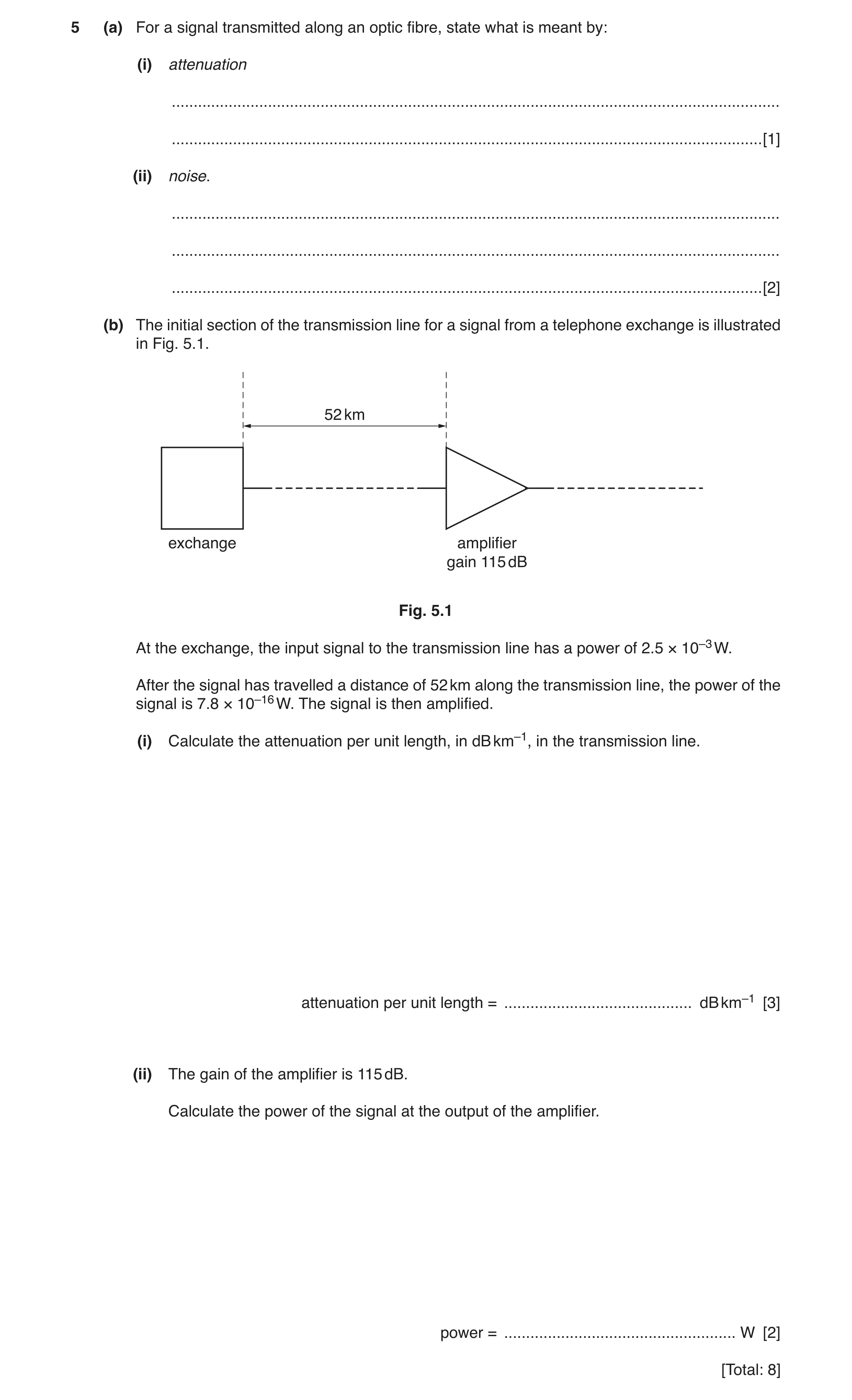
5 (a) For a signal transmitted along an optic fibre, state what is meant by: (i) attenuation … … [1] (ii) noise. … … … [2] (b) The initial section of the transmission line for a signal from a telephone exchange is illustrated in Fig. 5.1. 52 km exchange amplifier gain 115 dB Fig. 5.1 At the exchange, the input signal to the transmission line has a power of 2.5 × 10⁻³ W. After the signal has travelled a distance of 52 km along the transmission line, the power of the signal is 7.8 × 10⁻¹⁶ W. The signal is then amplified. (i) Calculate the attenuation per unit length, in dB km–1, in the transmission line. attenuation per unit length = … dB km–1 [3] (ii) The gain of the amplifier is 115 dB. Calculate the power of the signal at the output of the amplifier. power = … W [2] [Total: 8]
8 marks
Mark scheme: 5(a)(i) loss of (signal) power/amplitude/intensity B1 5(a)(ii) unwanted/random signal B1 superposed on (transmitted) signal B1 5(b)(i) attenuation = 10 lg(P2 / P1) C1 attenuation per unit length = (1 / L) × 10 lg(P2 / P1) = (1 / 52) × 10 lg [(2.5 × 10⁻³) / (7.8 × 10⁻¹⁶)] C1 = 2.4 dB km–1 A1 5(b)(ii) gain / dB = 10 lg(P2 / P1) 115 = 10 lg [P / (7.8 × 10⁻¹⁶)] C1 P = 2.5 × 10⁻⁴ W A1
This question in 9702/42 May/June 2019
Q4 · During the transmission of a signal, attenuation occurs and noise is picked up 9702/43 May/June 2019
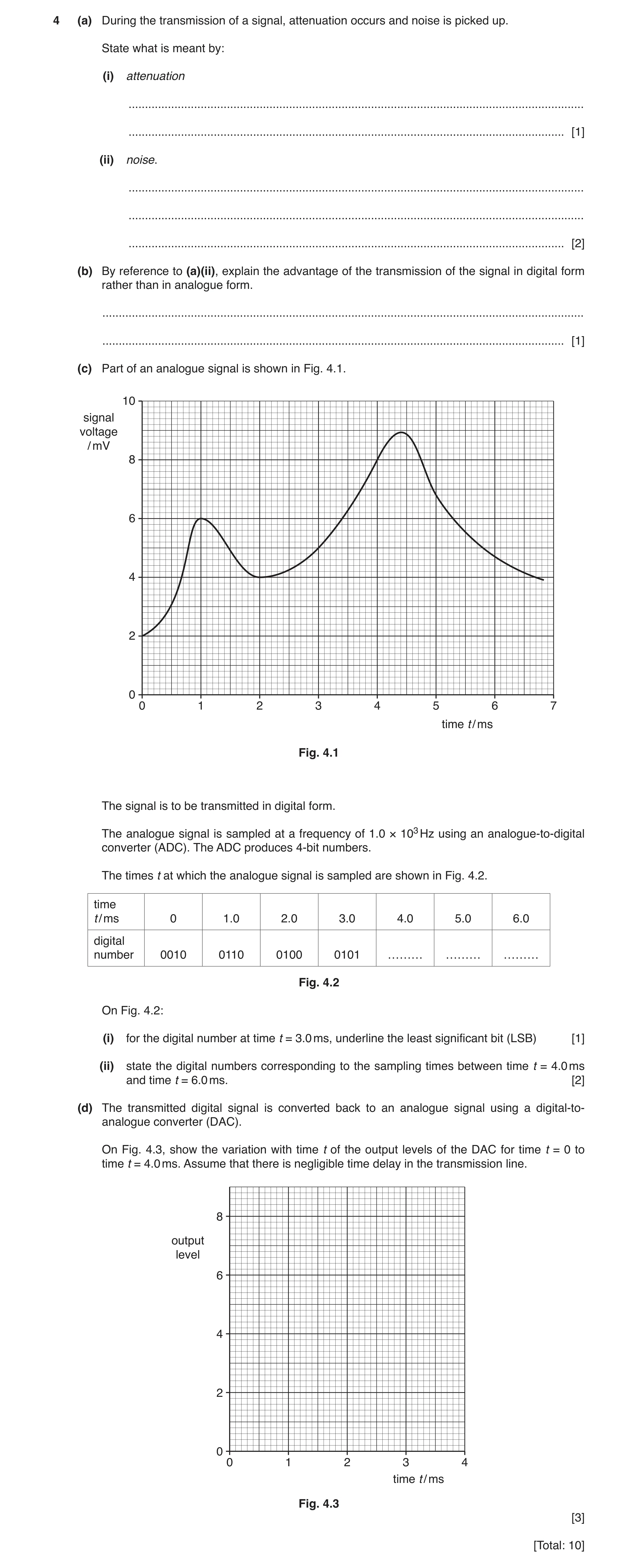
4 (a) During the transmission of a signal, attenuation occurs and noise is picked up. State what is meant by: (i) attenuation … … [1] (ii) noise. … … … [2] (b) By reference to (a)(ii), explain the advantage of the transmission of the signal in digital form rather than in analogue form. … … [1] (c) Part of an analogue signal is shown in Fig. 4.1. 10 signal voltage / mV 8 6 4 2 0 0 1 2 3 4 5 6 7 time t / ms Fig. 4.1 The signal is to be transmitted in digital form. The analogue signal is sampled at a frequency of 1.0 × 10³ Hz using an analogue-to-digital converter (ADC). The ADC produces 4-bit numbers. The times t at which the analogue signal is sampled are shown in Fig. 4.2. time t / ms 0 1.0 2.0 3.0 4.0 5.0 6.0 digital number 0010 0110 0100 0101 ……… ……… ……… Fig. 4.2 On Fig. 4.2: (i) for the digital number at time t = 3.0 ms, underline the least significant bit (LSB) [1] (ii) state the digital numbers corresponding to the sampling times between time t = 4.0 ms and time t = 6.0 ms. [2] (d) The transmitted digital signal is converted back to an analogue signal using a digital-to- analogue converter (DAC). On Fig. 4.3, show the variation with time t of the output levels of the DAC for time t = 0 to time t = 4.0 ms. Assume that there is negligible time delay in the transmission line. 8 output level 6 4 2 0 0 1 2 3 4 time t / ms Fig. 4.3 [3] [Total: 10]
10 marks
Mark scheme: 4(a)(i) loss of (signal) power/amplitude/intensity B1 4(a)(ii) unwanted/random signal B1 superposed on (transmitted) signal B1 4(b) noise can be eliminated (from digital signals) or signal can be regenerated (from digital signals) B1 4(c)(i) 0101 A1 4(c)(ii) 1000 at t = 4.0 ms B1 0110 at t = 5.0 ms and 0100 at t = 6.0 ms B1 4(d) series of equally-spaced steps of width 1 ms B1 each step in correct time interval (0–1 ms, 1–2 ms, 2–3 ms, 3–4 ms) B1 correct step heights (2, 6, 4 and 5) B1
This question in 9702/43 May/June 2019
Q5 · State two advantages of the transmission of data in digital form, rather than analogue… 9702/42 Feb/March 2020
5 (a) State two advantages of the transmission of data in digital form, rather than analogue form. 1. … … 2. … … [2] (b) Optic fibres are used for the transmission of data. (i) A signal in an optic fibre is carried by an electromagnetic wave of frequency 1.36 × 10¹⁴ Hz. The speed of the wave in the fibre is 2.07 × 10⁸ m s−1. For this electromagnetic wave, determine the ratio: wavelength in free space . wavelength in fibre ratio = … [2] (ii) The attenuation per unit length of the signal in the fibre is 0.40 dB km−1. The input power is 1.5 mW and the output power is 0.060 mW. Calculate the length of the fibre. length = … km [3] [Total: 7]
7 marks
Mark scheme: 5(a) Any 2 from: • noise can be filtered out / noise can be removed / signal can be regenerated • can carry more information per unit time / greater rate of transmission of data • can have extra bits of data to check for errors • can be encrypted B2 5(b)(i) v ∝ λ C1 ratio = vair / vfibre = 3.00 × 10⁸ / 2.07 × 108 = 1.45 A1 5(b)(ii) attenuation = 10 log (P2/P1) C1 0.40 × L = 10 log (1.5 / 0.06) 0.40 × L = 13.979 C1 L = 35 km A1
This question in 9702/42 Feb/March 2020
Q6 · The transmission of signals using optic fibres has, to a great extent, replaced the use… 9702/41 May/June 2020
6 (a) The transmission of signals using optic fibres has, to a great extent, replaced the use of coaxial cables. Advantages of optic fibres include greater bandwidth and very little crosslinking. (i) Suggest an advantage of greater bandwidth. … … [1] (ii) State what is meant by crosslinking. … … … [2] (b) In telecommunications, a signal power of 1.0 mW is used as a reference power. Signal powers relative to this reference power and expressed in dB are said to be measured in ‘dBm’. Show that a signal power of 13 dBm is equivalent to 20 mW. [2] (c) A signal of input power 20 mW is transmitted along an optic fibre for an uninterrupted distance of 45 km. The optic fibre has an attenuation per unit length of 0.18 dB km–1. Calculate the output power P from the optic fibre. P = … mW [2] [Total: 7]
7 marks
Mark scheme: 6(a)(i) greater information carrying capacity B1 6(a)(ii) power/energy is radiated B1 signal picked up by adjacent fibre/wire B1 6(b) ratio / dB = 10 lg(P2 / P1) C1 13 = 10 lg [P / (1.0 × 10⁻³)] and so P = 20 mW A1 6(c) 45 × 0.18 = 10 lg (20 / P) C1 P = 3.1 mW A1
This question in 9702/41 May/June 2020
Q7 · Telephone signals may be transmitted either by means of an optic fibre or by means of a… 9702/42 May/June 2020
6 (a) Telephone signals may be transmitted either by means of an optic fibre or by means of a wire pair. State three advantages of the use of an optic fibre rather than a wire pair. 1. … … 2. … … 3. … … [3] (b) It is proposed to transmit a signal over a distance of 4.5 × 10³ km by means of an optic fibre. The input signal has a power of 9.8 mW. The minimum signal that can be detected at the output has a power of 6.3 × 10⁻¹⁷ W. For this signal power, the signal‑to‑noise ratio is 21 dB. Calculate: (i) the power of the background noise power = … W [2] (ii) the maximum attenuation per unit length of the optic fibre that allows for uninterrupted transmission of the signal. attenuation per unit length = … dB km–1 [2] [Total: 7]
7 marks
Mark scheme: 6(a) • greater bandwidth • less noise • less attenuation or fewer repeaters • less crosslinking or greater security Any three points, 1 mark each 6(b)(i) ratio / dB = 10 lg(P1 / P2) C1 21 = 10 lg [(6.3 × 10⁻¹⁷) / P] P = 5.0 × 10⁻¹⁹ W A1 6(b)(ii) attenuation per unit length = (1 / 4.5 × 103) × 10 lg [(9.8 × 10⁻³) / (6.3 × 10⁻¹⁷)] C1 = 0.032 dB km–1 A1
This question in 9702/42 May/June 2020
Q8 · The transmission of signals using optic fibres has, to a great extent, replaced the use… 9702/43 May/June 2020
6 (a) The transmission of signals using optic fibres has, to a great extent, replaced the use of coaxial cables. Advantages of optic fibres include greater bandwidth and very little crosslinking. (i) Suggest an advantage of greater bandwidth. … … [1] (ii) State what is meant by crosslinking. … … … [2] (b) In telecommunications, a signal power of 1.0 mW is used as a reference power. Signal powers relative to this reference power and expressed in dB are said to be measured in ‘dBm’. Show that a signal power of 13 dBm is equivalent to 20 mW. [2] (c) A signal of input power 20 mW is transmitted along an optic fibre for an uninterrupted distance of 45 km. The optic fibre has an attenuation per unit length of 0.18 dB km–1. Calculate the output power P from the optic fibre. P = … mW [2] [Total: 7]
7 marks
Mark scheme: 6(a)(i) greater information carrying capacity B1 6(a)(ii) power/energy is radiated B1 signal picked up by adjacent fibre/wire B1 6(b) ratio / dB = 10 lg(P2 / P1) C1 13 = 10 lg [P / (1.0 × 10⁻³)] and so P = 20 mW A1 6(c) 45 × 0.18 = 10 lg (20 / P) C1 P = 3.1 mW A1
This question in 9702/43 May/June 2020
Q9 · State what is meant by the amplitude modulation (AM) of a radio wave 9702/42 Feb/March 2021
5 (a) (i) State what is meant by the amplitude modulation (AM) of a radio wave. … … … [2] (ii) State two advantages of AM transmissions when compared with frequency modulation (FM) transmissions. 1. … … 2. … … [2] (b) The variation with frequency f of the amplitude A of a transmitted radio wave after amplitude modulation by an audio signal is shown in Fig. 5.1. A 0 1490 1500 1510 f / kHz Fig. 5.1 For this transmission, determine: (i) the wavelength of the carrier wave wavelength = … m [1] (ii) the maximum frequency of the transmitted audio signal. frequency = … kHz [1] (c) Another audio signal with the same maximum frequency is transmitted using a different carrier wave frequency. The lowest frequency of this modulated wave is equal to the highest frequency of the modulated wave in (b). Determine the frequency of this carrier wave. frequency = … kHz [1] [Total: 7]
7 marks
Mark scheme: 5(a)(i) amplitude of the carrier wave varies M1 in synchrony with the displacement of the (information) signal A1 5(a)(ii) Any 2 from: • fewer transmitters needed / each transmitter can cover a greater distance • more stations can share waveband • transmitters and receivers are cheaper B2 Question Answer Marks 5(b)(i) v f λ = 8 6 3.0 10 200 1.5 10 m × = = × A1 5(b)(ii) 10 kHz B1 5(c) 1520 kHz B1
This question in 9702/42 Feb/March 2021
Q10 · State what is meant by the amplitude modulation (AM) of a radio wave 9702/41 May/June 2021
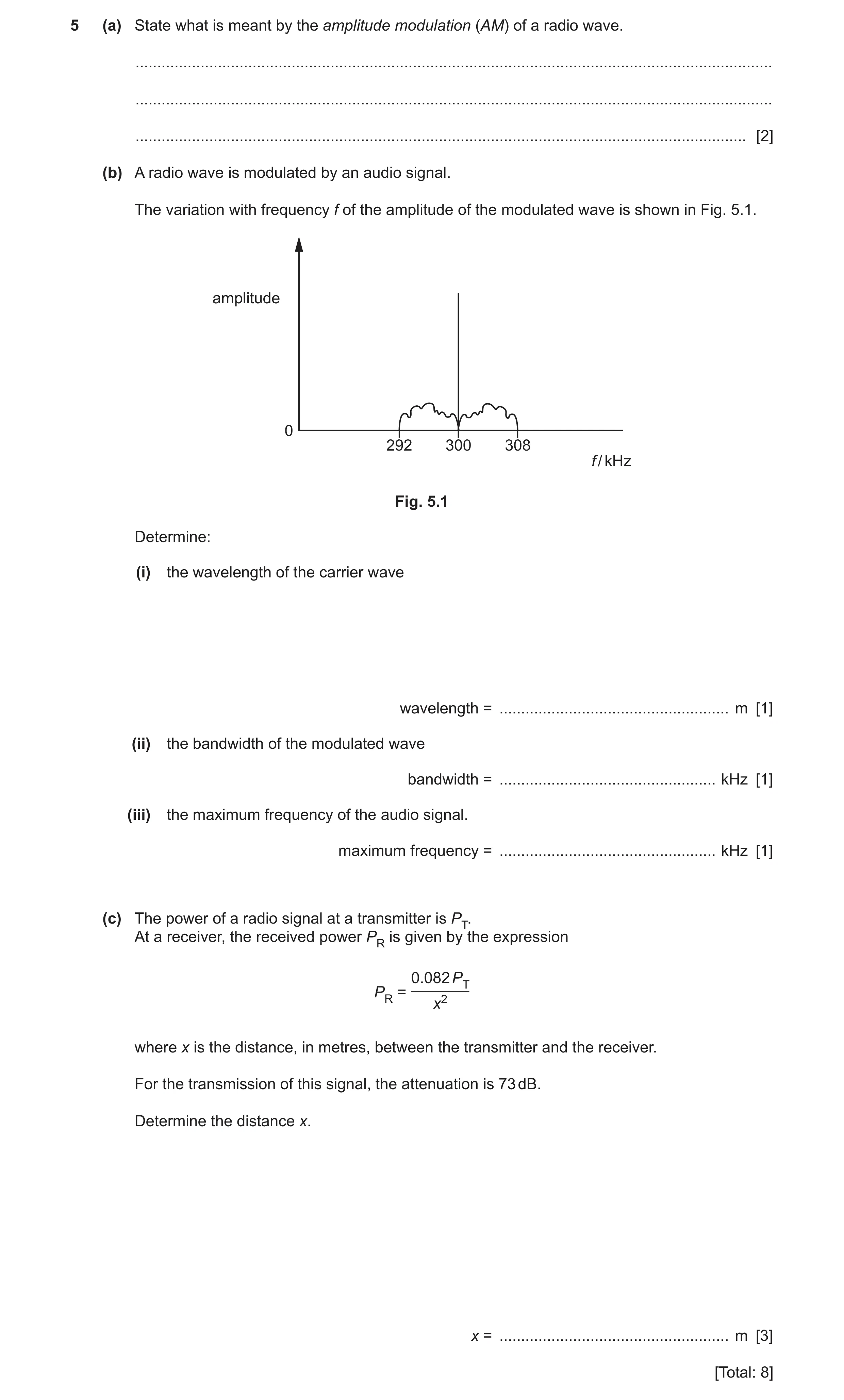
5 (a) State what is meant by the amplitude modulation (AM) of a radio wave. … … … [2] (b) A radio wave is modulated by an audio signal. The variation with frequency f of the amplitude of the modulated wave is shown in Fig. 5.1. amplitude 0 292 300 308 f / kHz Fig. 5.1 Determine: (i) the wavelength of the carrier wave wavelength = … m [1] (ii) the bandwidth of the modulated wave bandwidth = … kHz [1] (iii) the maximum frequency of the audio signal. maximum frequency = … kHz [1] (c) The power of a radio signal at a transmitter is PT. At a receiver, the received power PR is given by the expression 0.082 PT PR = x2 where x is the distance, in metres, between the transmitter and the receiver. For the transmission of this signal, the attenuation is 73 dB. Determine the distance x. x = … m [3] [Total: 8]
8 marks
Mark scheme: 5(a) amplitude of the carrier wave varies M1 in synchrony with the displacement of the (information) signal A1 5(b)(i) wavelength = (3.0 × 10⁸) / (300 × 103) = 1000 m A1 5(b)(ii) bandwidth = 16 kHz A1 5(b)(iii) frequency = 8 kHz A1 5(c) attenuation = 10 lg (P1 / P2) C1 73 = 10 lg (PT / PR) 73 = 10 lg (PT x2 / 0.082 PT) or x2 / 0.082 = 107.3 C1 x = 1300 m A1
This question in 9702/41 May/June 2021
Q11 · A sinusoidal carrier wave has a constant amplitude and a frequency of 1.2 MHz 9702/42 May/June 2021
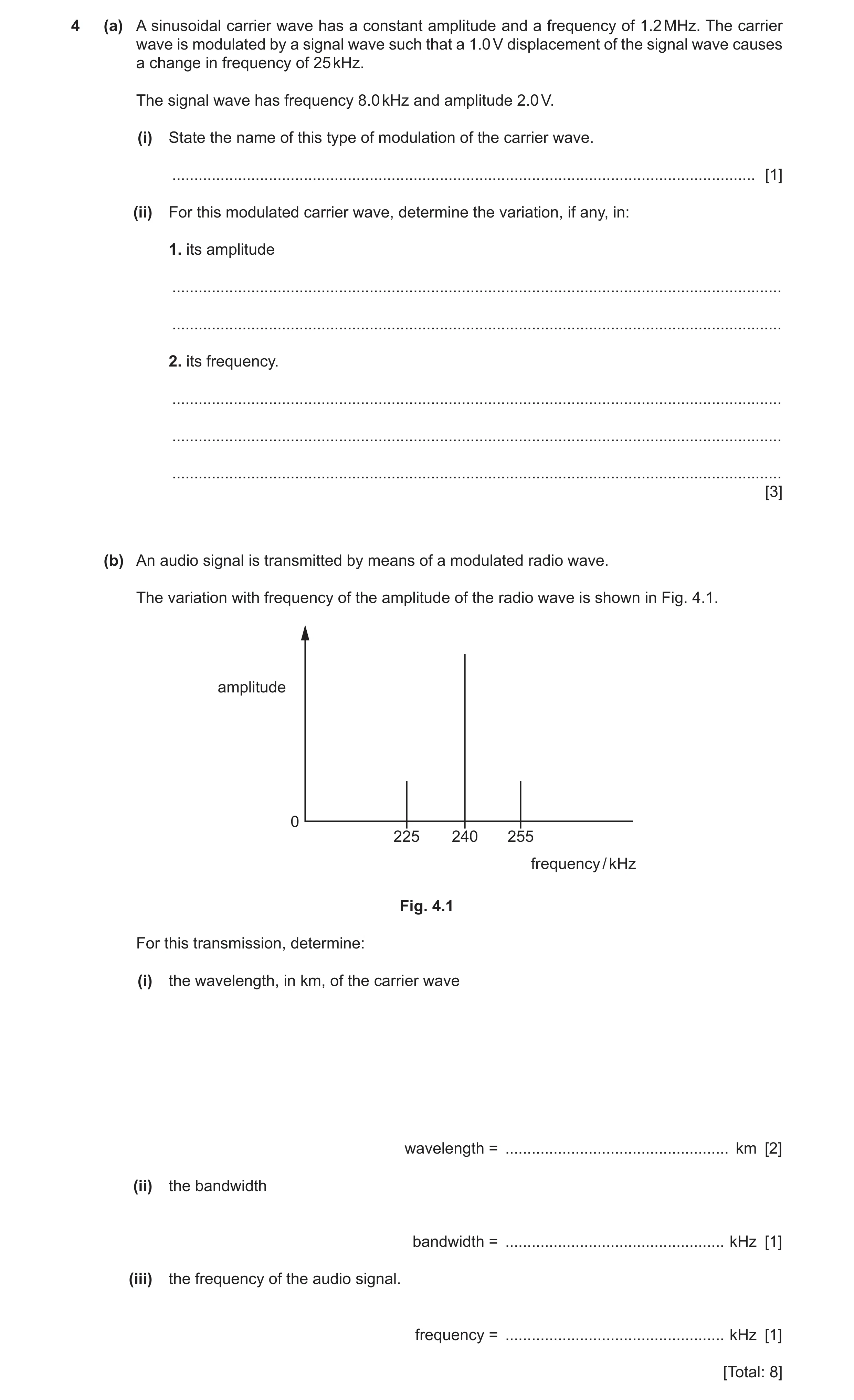
4 (a) A sinusoidal carrier wave has a constant amplitude and a frequency of 1.2 MHz. The carrier wave is modulated by a signal wave such that a 1.0 V displacement of the signal wave causes a change in frequency of 25 kHz. The signal wave has frequency 8.0 kHz and amplitude 2.0 V. (i) State the name of this type of modulation of the carrier wave. … [1] (ii) For this modulated carrier wave, determine the variation, if any, in: 1. its amplitude … … 2. its frequency. … … … [3] (b) An audio signal is transmitted by means of a modulated radio wave. The variation with frequency of the amplitude of the radio wave is shown in Fig. 4.1. amplitude 0 225 240 255 frequency / kHz Fig. 4.1 For this transmission, determine: (i) the wavelength, in km, of the carrier wave wavelength = … km [2] (ii) the bandwidth bandwidth = … kHz [1] (iii) the frequency of the audio signal. frequency = … kHz [1] [Total: 8]
8 marks
Mark scheme: 4(a)(i) frequency (modulation) B1 4(a)(ii) 1. zero B1 2. frequency (of 1.2 MHz) varies by ±50 kHz B1 frequency varies (by ±50 kHz) at a rate of 8000 times per second B1 4(b)(i) wavelength = (3.00 × 10⁸) / (240 × 103) C1 (= 1250 m) = 1.25 km A1 4(b)(ii) bandwidth = 30 kHz A1 4(b)(iii) frequency = 15 kHz A1
This question in 9702/42 May/June 2021
Q12 · State what is meant by the amplitude modulation (AM) of a radio wave 9702/43 May/June 2021
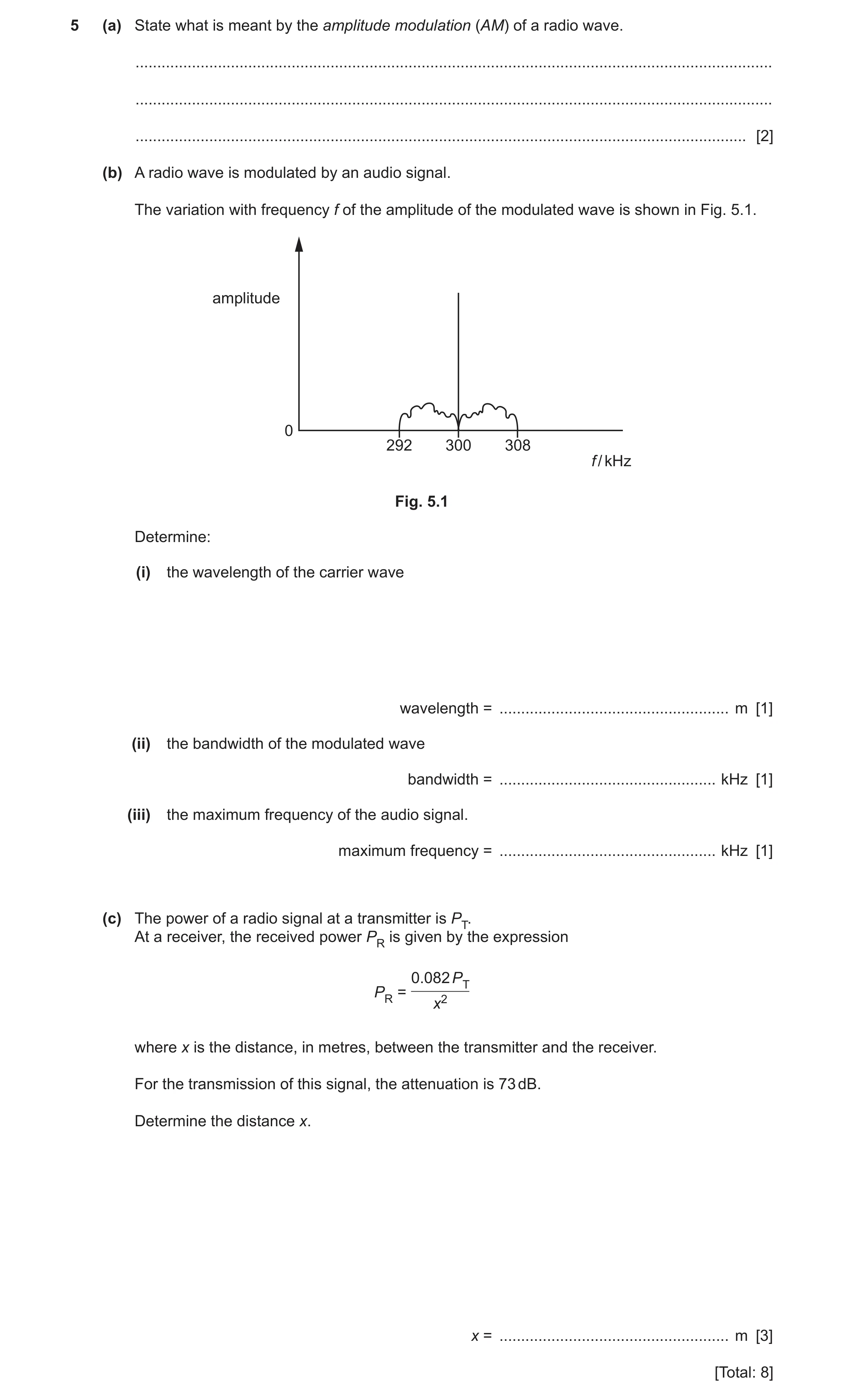
5 (a) State what is meant by the amplitude modulation (AM) of a radio wave. … … … [2] (b) A radio wave is modulated by an audio signal. The variation with frequency f of the amplitude of the modulated wave is shown in Fig. 5.1. amplitude 0 292 300 308 f / kHz Fig. 5.1 Determine: (i) the wavelength of the carrier wave wavelength = … m [1] (ii) the bandwidth of the modulated wave bandwidth = … kHz [1] (iii) the maximum frequency of the audio signal. maximum frequency = … kHz [1] (c) The power of a radio signal at a transmitter is PT. At a receiver, the received power PR is given by the expression 0.082 PT PR = x2 where x is the distance, in metres, between the transmitter and the receiver. For the transmission of this signal, the attenuation is 73 dB. Determine the distance x. x = … m [3] [Total: 8]
8 marks
Mark scheme: 5(a) amplitude of the carrier wave varies M1 in synchrony with the displacement of the (information) signal A1 5(b)(i) wavelength = (3.0 × 10⁸) / (300 × 103) = 1000 m A1 5(b)(ii) bandwidth = 16 kHz A1 5(b)(iii) frequency = 8 kHz A1 5(c) attenuation = 10 lg (P1 / P2) C1 73 = 10 lg (PT / PR) 73 = 10 lg (PT x2 / 0.082 PT) or x2 / 0.082 = 107.3 C1 x = 1300 m A1
This question in 9702/43 May/June 2021
Q13 · When audio signals are transmitted over long distances, modulation of radio waves is used 9702/42 Oct/Nov 2021
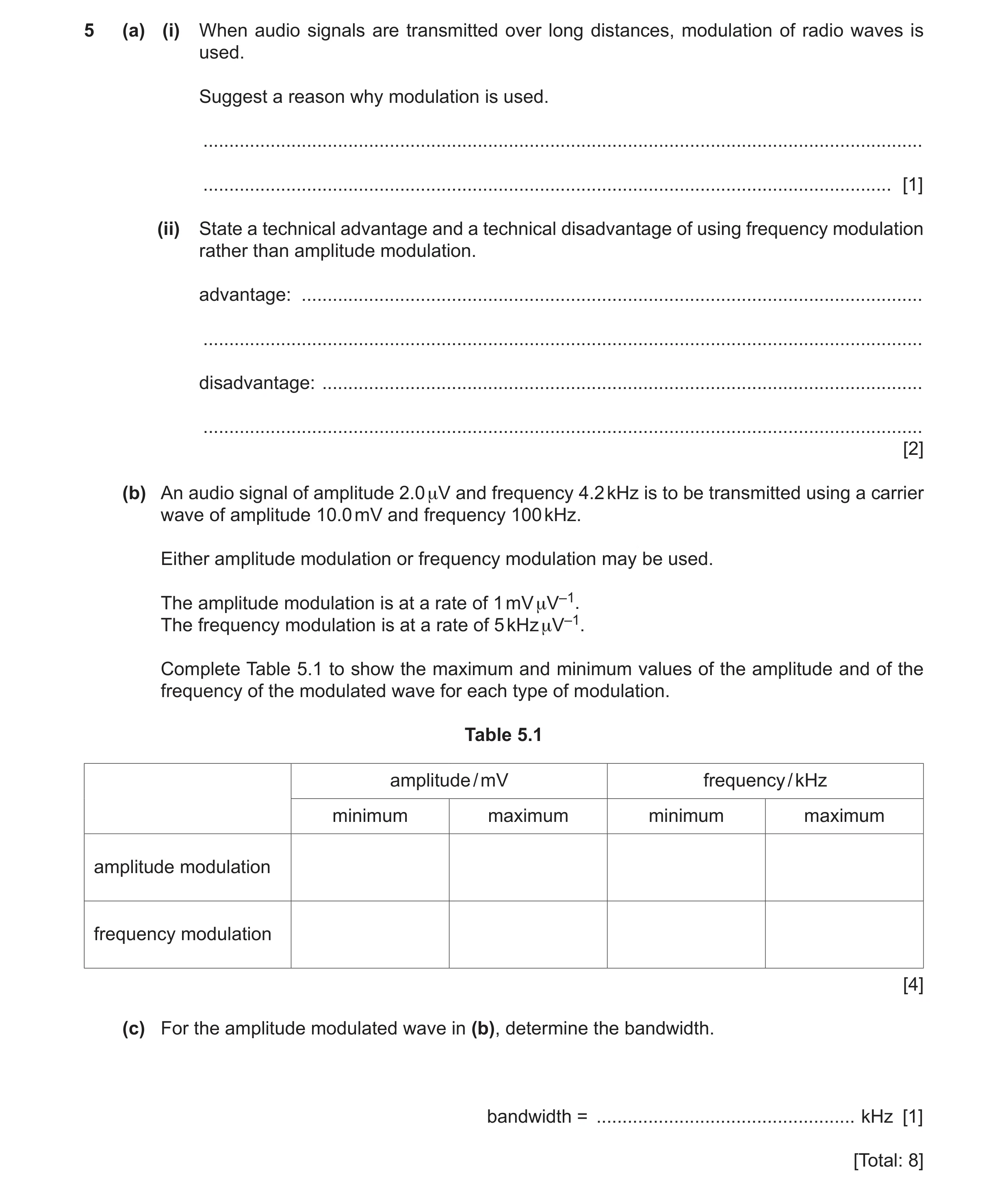
5 (a) (i) When audio signals are transmitted over long distances, modulation of radio waves is used. Suggest a reason why modulation is used. … … [1] (ii) State a technical advantage and a technical disadvantage of using frequency modulation rather than amplitude modulation. advantage: … … disadvantage: … … [2] (b) An audio signal of amplitude 2.0 μV and frequency 4.2 kHz is to be transmitted using a carrier wave of amplitude 10.0 mV and frequency 100 kHz. Either amplitude modulation or frequency modulation may be used. The amplitude modulation is at a rate of 1 mV μV–1. The frequency modulation is at a rate of 5 kHz μV–1. Complete Table 5.1 to show the maximum and minimum values of the amplitude and of the frequency of the modulated wave for each type of modulation. Table 5.1 amplitude / mV frequency / kHz minimum maximum minimum maximum amplitude modulation frequency modulation [4] (c) For the amplitude modulated wave in (b), determine the bandwidth. bandwidth = … kHz [1] [Total: 8]
8 marks
Mark scheme: 5(a)(i) unmodulated (radio) waves would interfere with each other or not modulating would require aerials too long (to be practical) B1 5(a)(ii) advantage: • can transmit higher frequencies • higher quality reproduction • less prone to interference • same frequency can be used in different areas (any one point) B1 disadvantage: • takes up greater bandwidth • shorter range of transmission • requires a greater number of transmitting aerials (any one point) B1 5(b) AM amplitude: min. 8 mV and max. 12 mV B1 AM frequency: min. 100 kHz and max. 100 kHz B1 FM amplitude: min. 10 mV and max. 10 mV B1 FM frequency: min. 90 kHz and max. 110 kHz B1 5(c) 8.4 kHz A1
This question in 9702/42 Oct/Nov 2021
 8 / 17
 9 / 17
 10 / 17
 11 / 17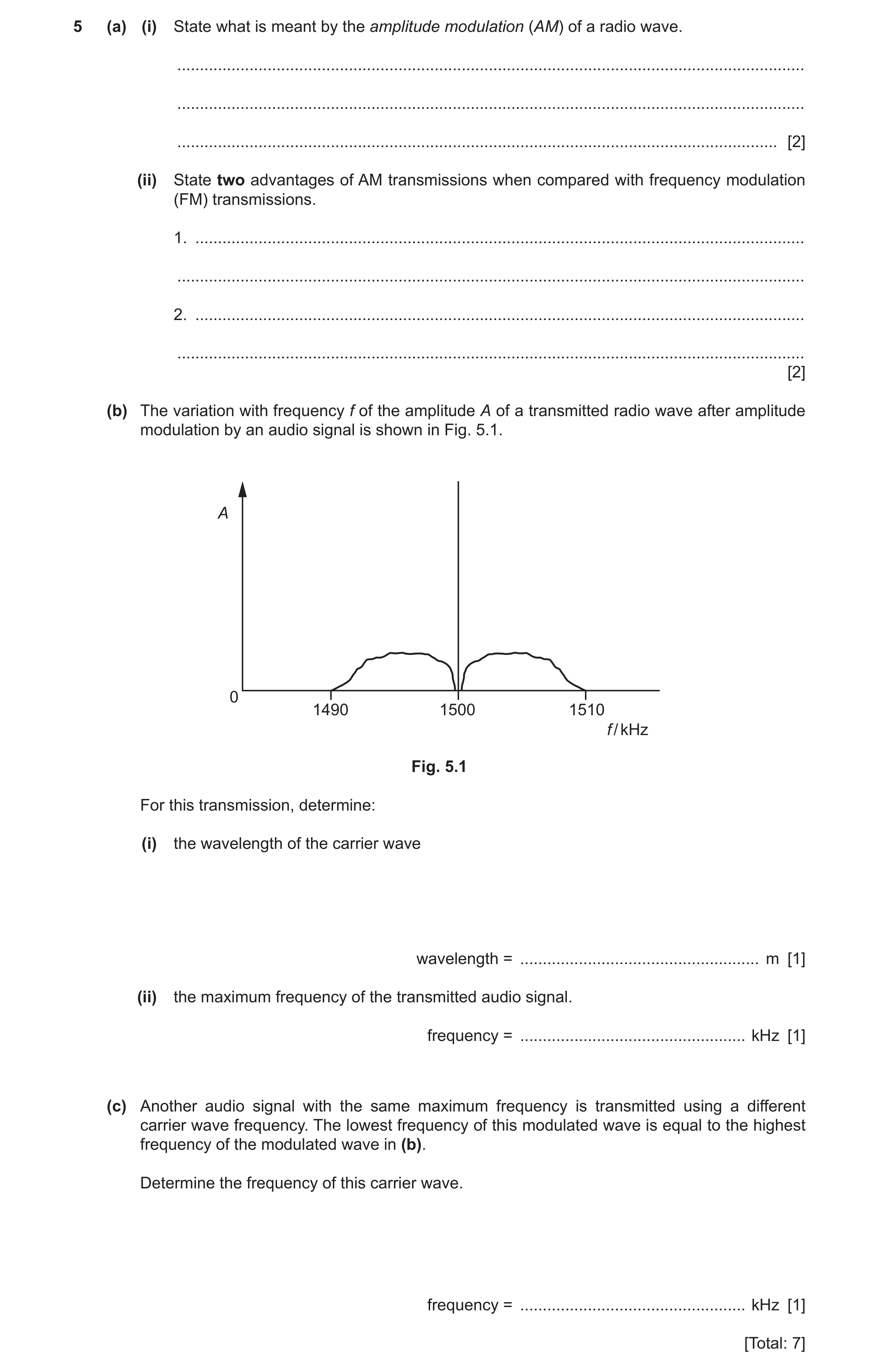
 17 / 17
 11
11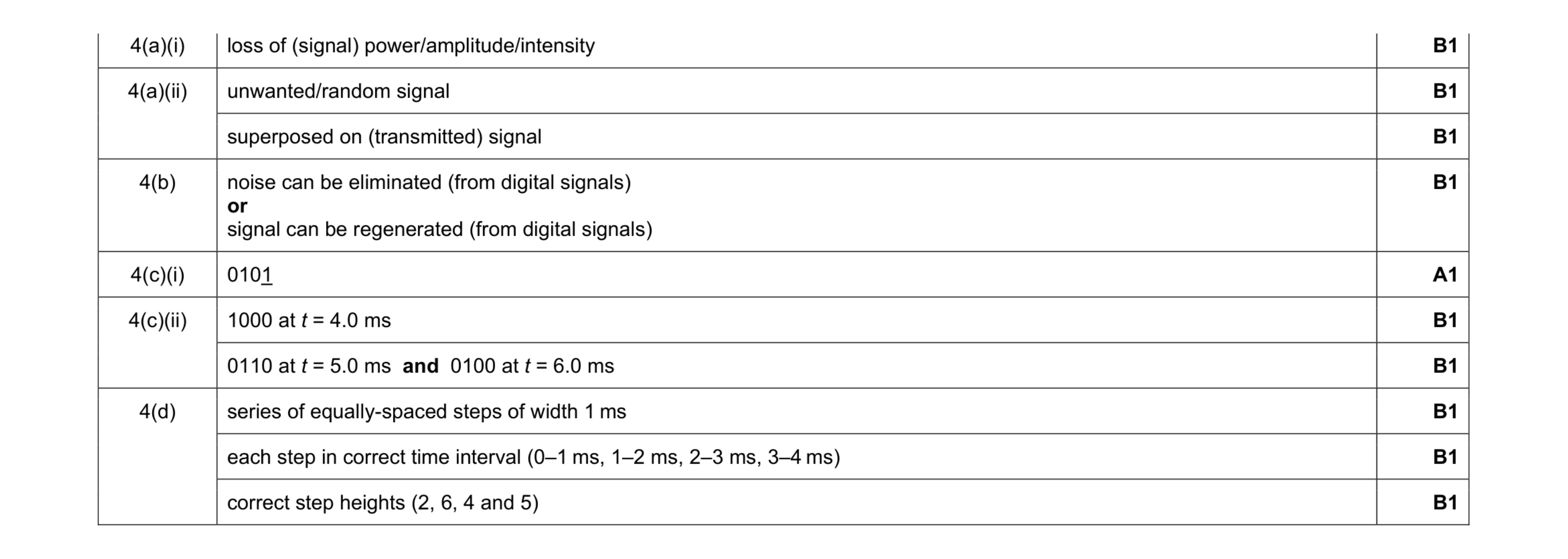 10
10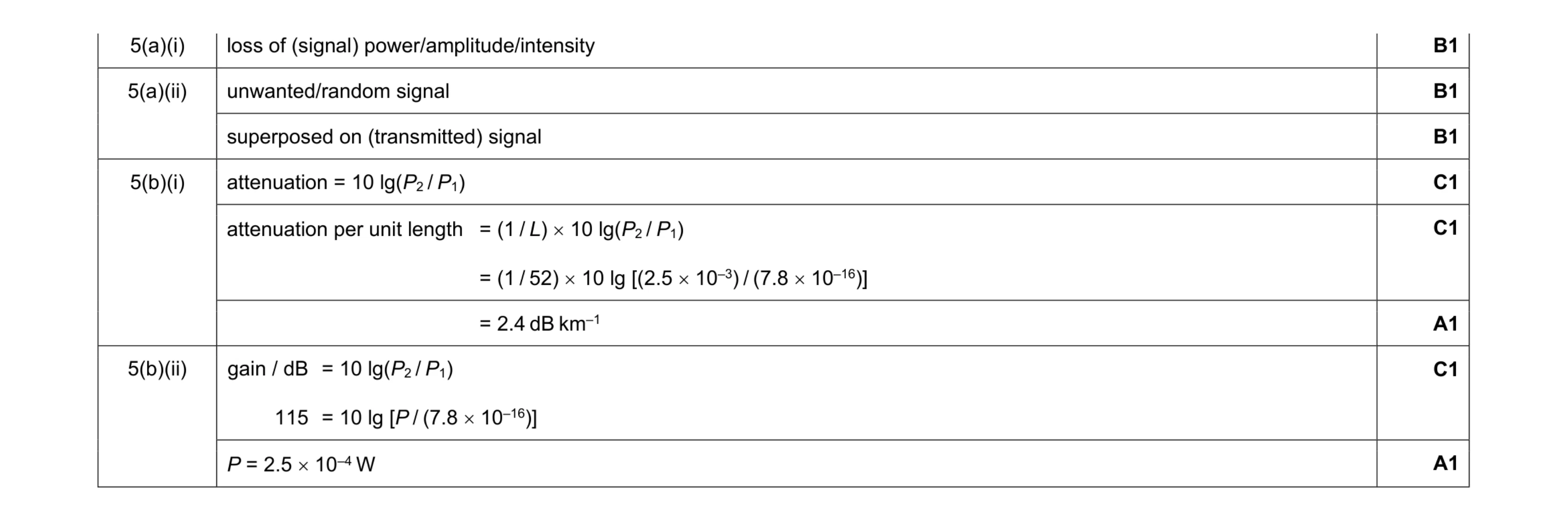 8
8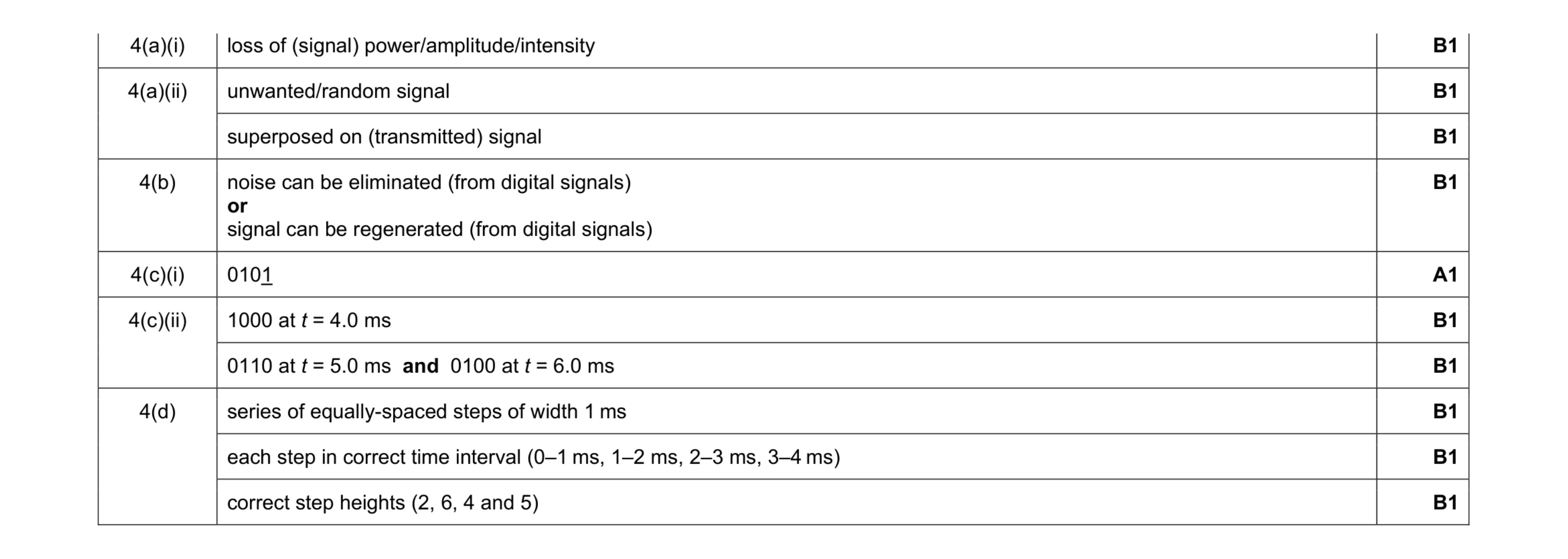 10
10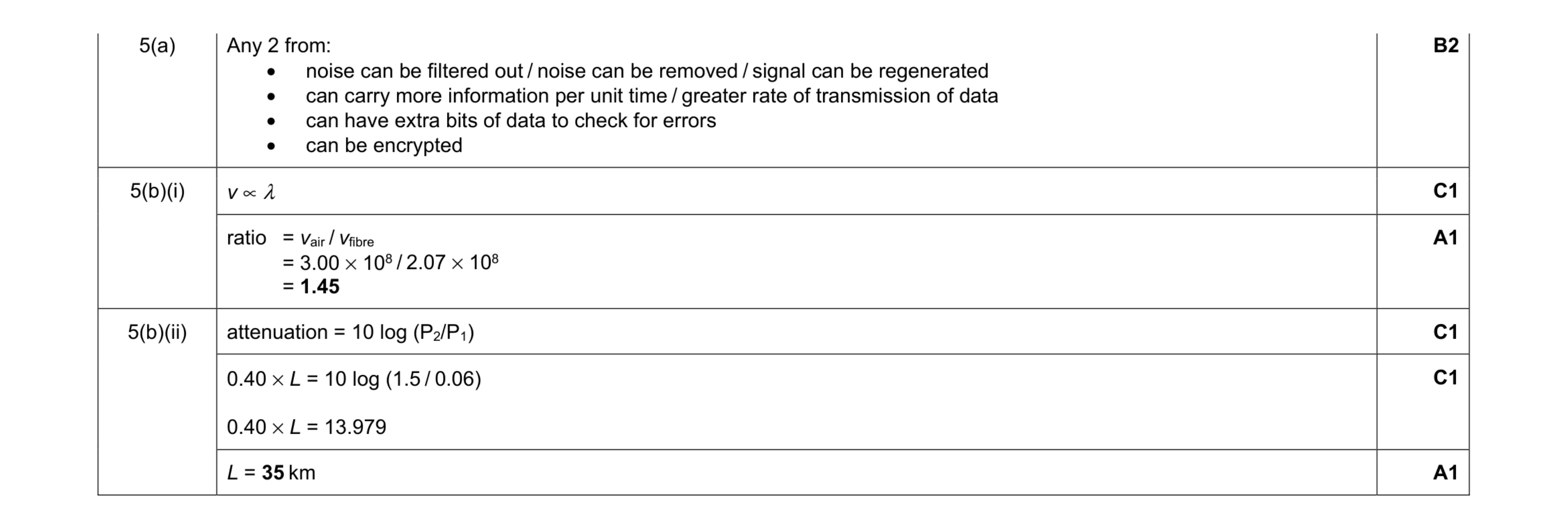 7
7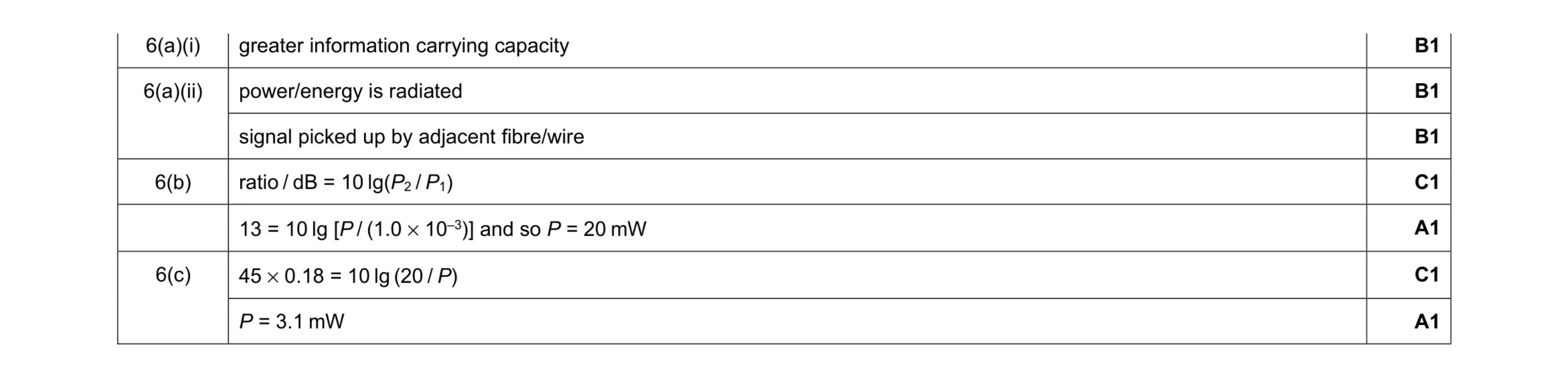 7
7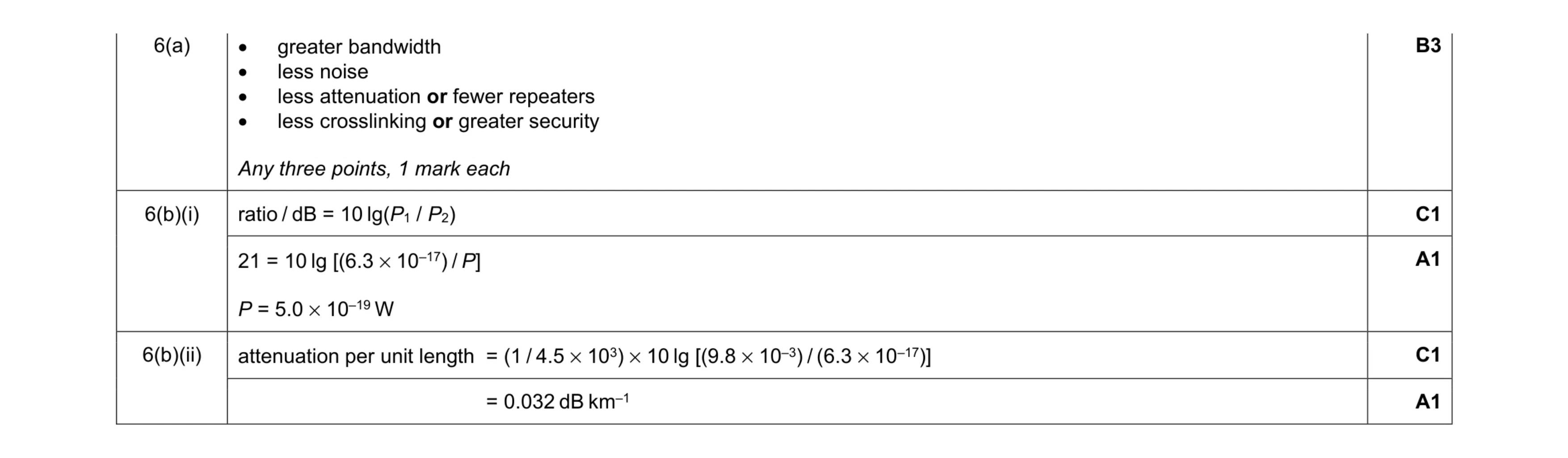 7
7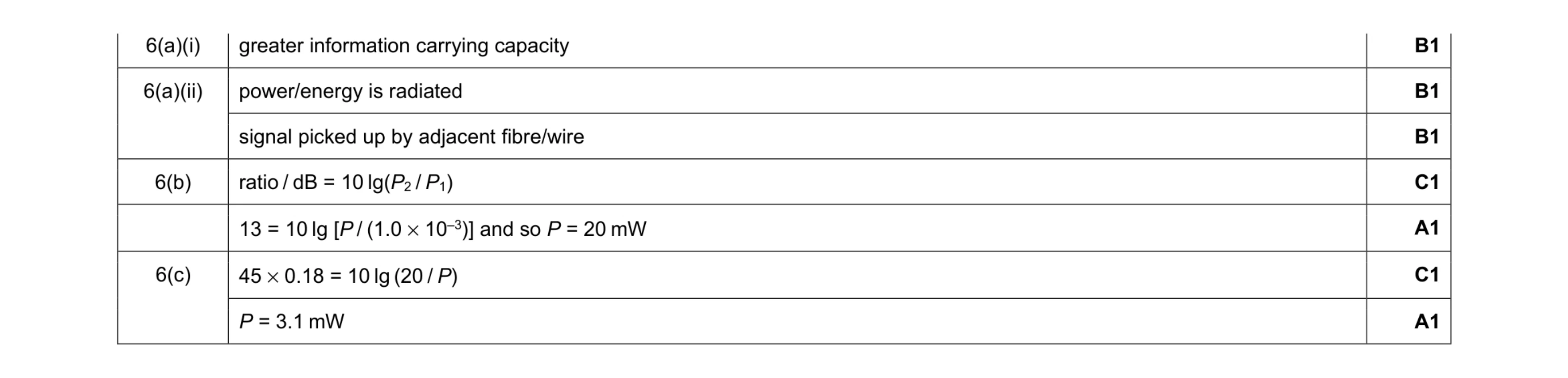 7
7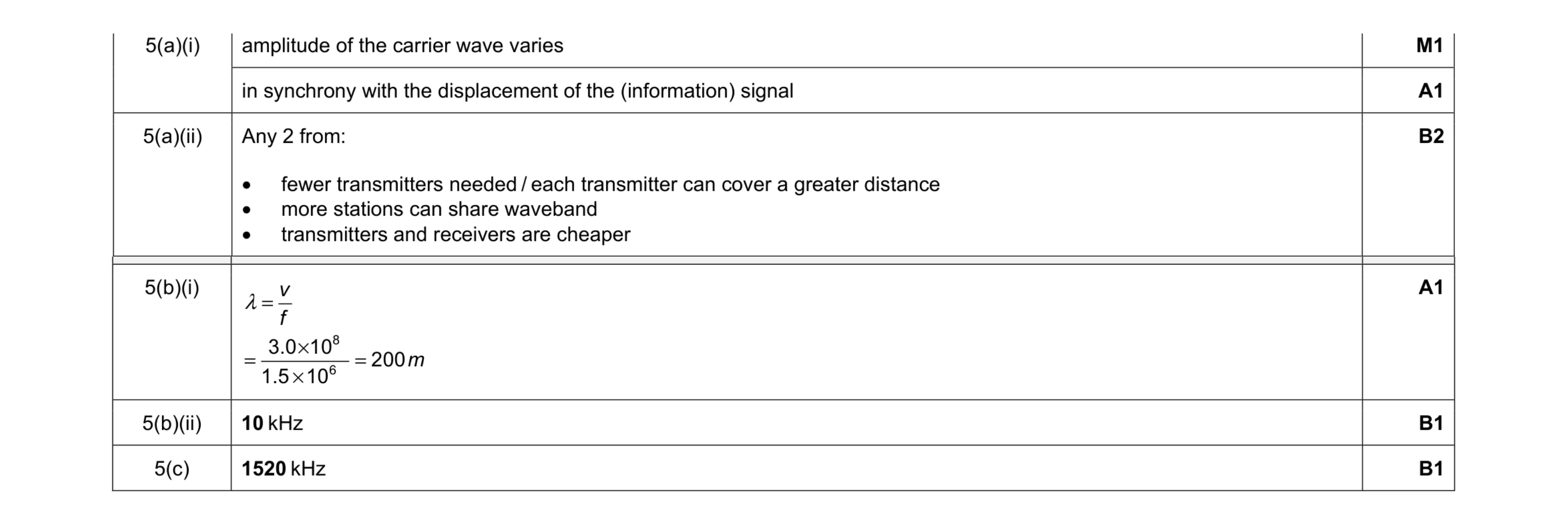 7
7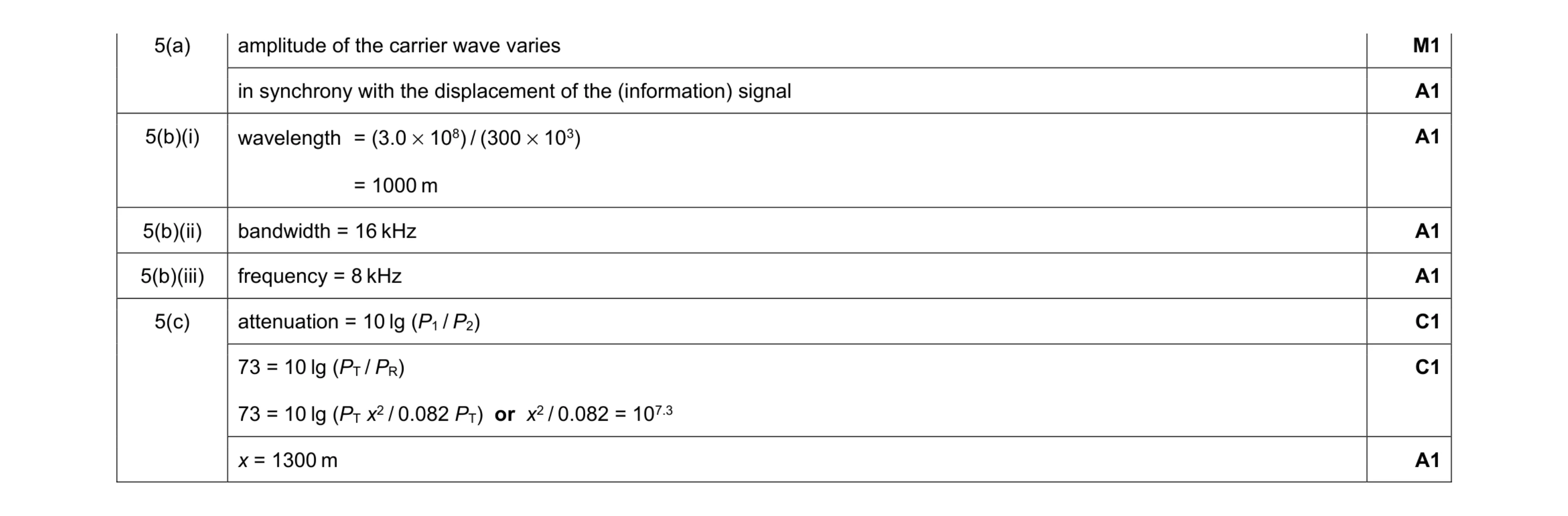 8
8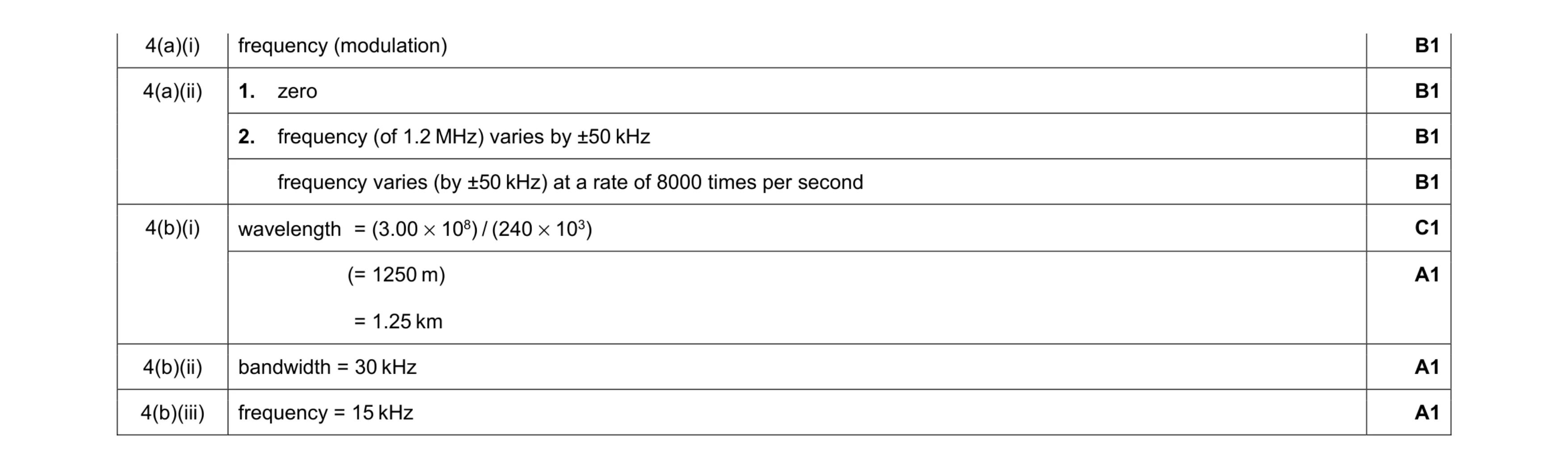 8
8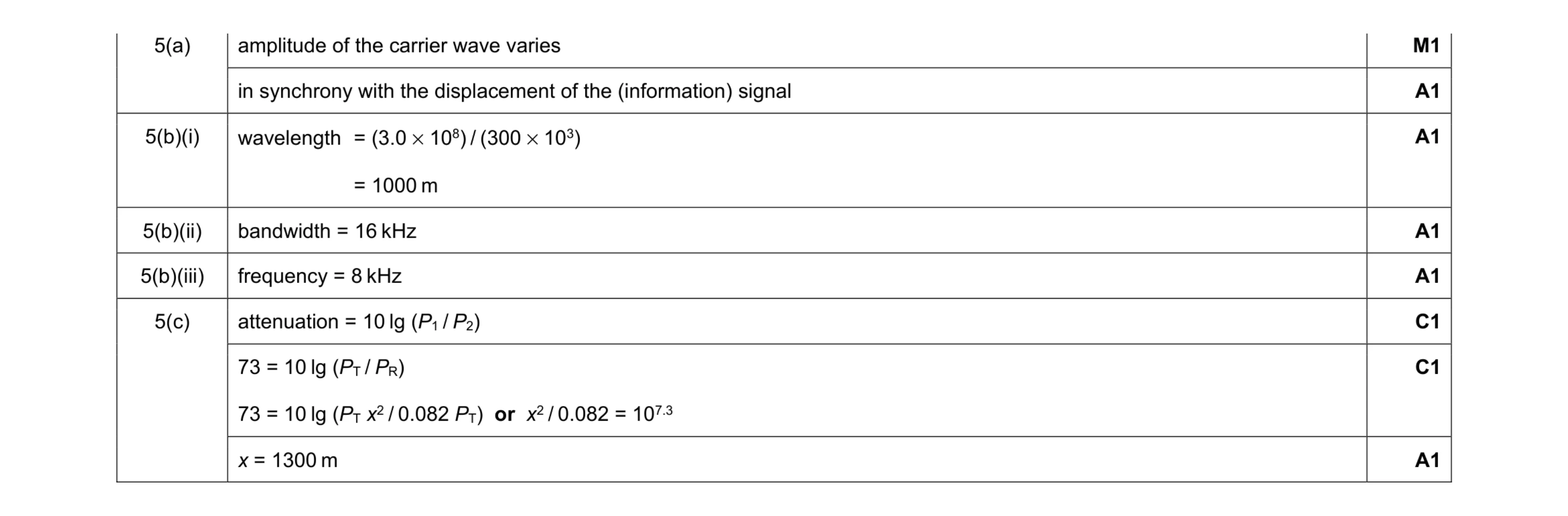 8
8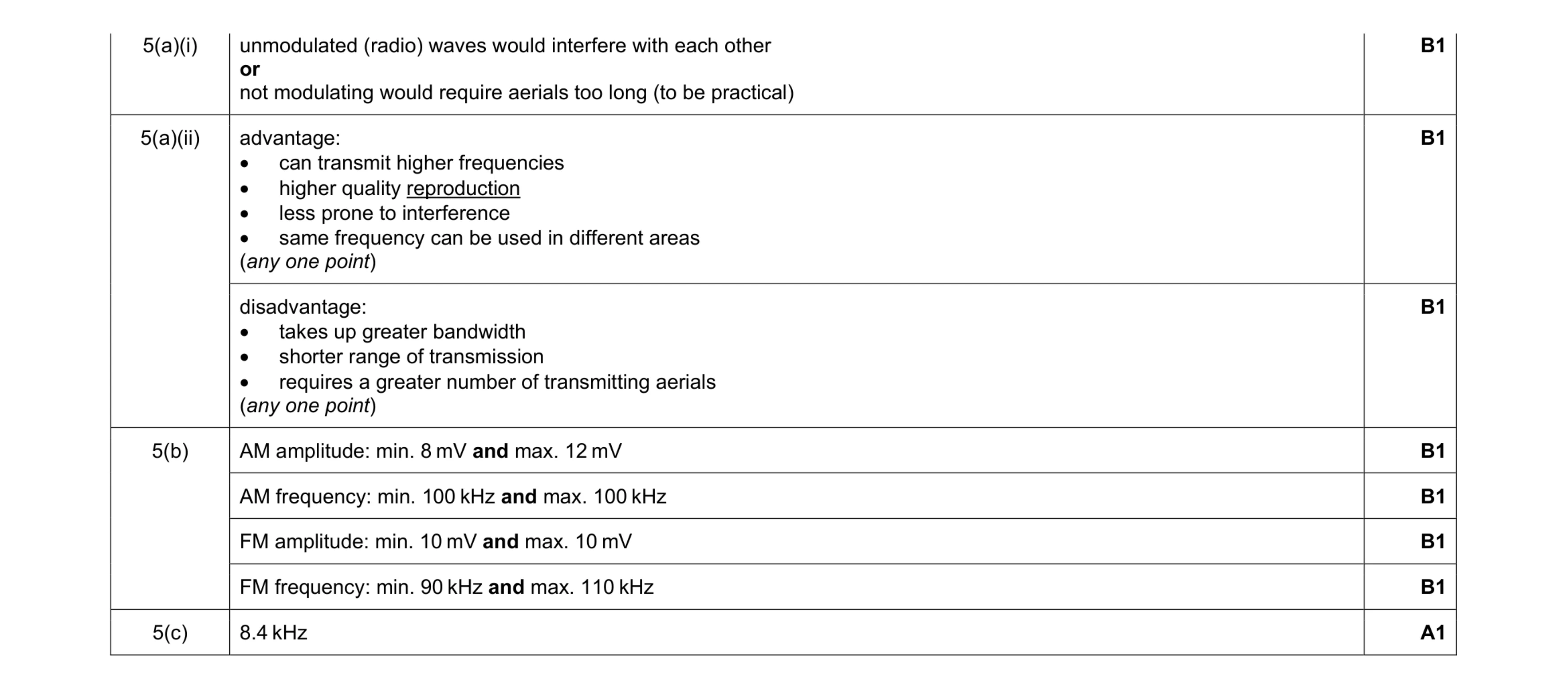 8
8