Questions as text
Q1 · Make reasonable estimates of the following quantities 9702/21 May/June 2008
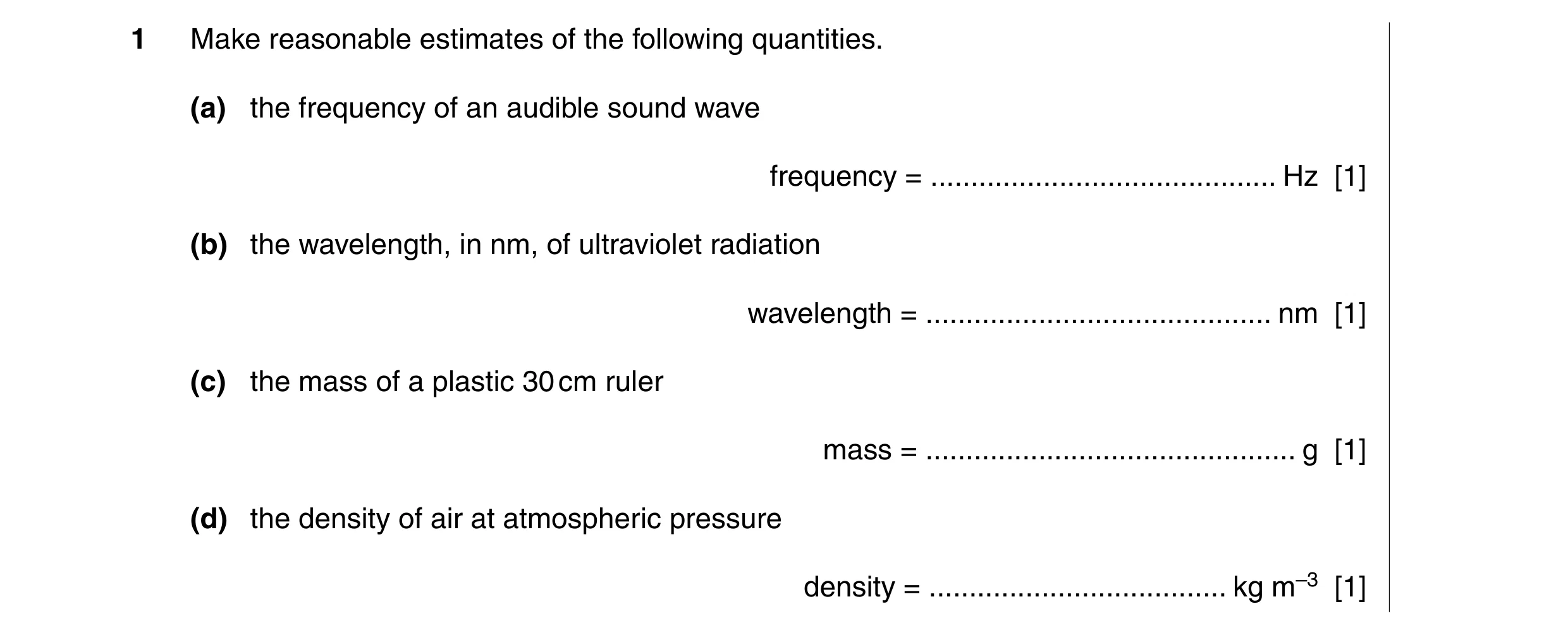
1 Make reasonable estimates of the following quantities. (a) the frequency of an audible sound wave frequency = … Hz [1] (b) the wavelength, in nm, of ultraviolet radiation wavelength = … nm [1] (c) the mass of a plastic 30 cm ruler mass = … g [1] (d) the density of air at atmospheric pressure density = … kg m–3 [1]
4 marks
Mark scheme: 1 (a) allow anything in range 20 Hz → 20 kHz B1 [1] (b) allow anything in range 10 nm → 400 nm B1 [1] (c) allow anything in range 10 g → 100 g B1 [1] (d) allow anything in range 0.1 kg m–3 → 10 kg m–3 B1 [1]
This question in 9702/21 May/June 2008
Q2 · State one property of electromagnetic waves that is not common to other transverse For… 9702/23 Oct/Nov 2012
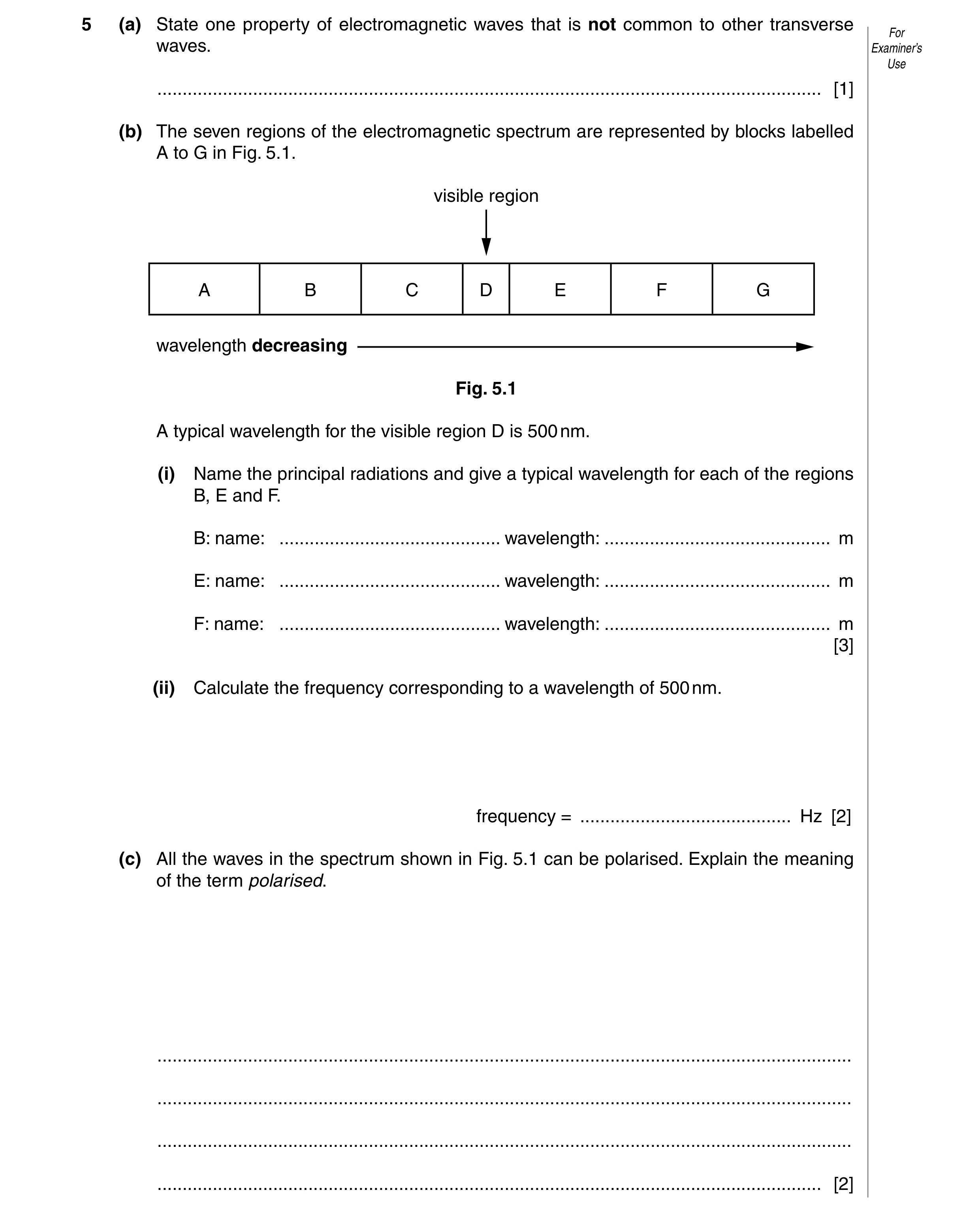
5 (a) State one property of electromagnetic waves that is not common to other transverse For waves. Examiner’s Use … [1] (b) The seven regions of the electromagnetic spectrum are represented by blocks labelled A to G in Fig. 5.1. visible region A B C D E F G wavelength decreasing Fig. 5.1 A typical wavelength for the visible region D is 500 nm. (i) Name the principal radiations and give a typical wavelength for each of the regions B, E and F. B: name: … wavelength: … m E: name: … wavelength: … m F: name: … wavelength: … m [3] (ii) Calculate the frequency corresponding to a wavelength of 500 nm. frequency = … Hz [2] (c) All the waves in the spectrum shown in Fig. 5.1 can be polarised. Explain the meaning of the term polarised. … … … … [2]
8 marks
Mark scheme: 5 (a) travel through a vacuum / free space B1 [1] (b) (i) B : name: microwaves wavelength: 10– 4 to 10–1 m B1 C : name: ultra-violet / UV wavelength: 10–7 to 10–9 m B1 F : name: X –rays wavelength: 10–9 to 10–12 m B1 [3] 3 × 10 8 (ii) f = C1 500 × 10 − 9 f = 6(.0) × 1014 Hz A1 [2] GCE AS/A LEVEL – October/November 2012 9702 23 (c) vibrations are in one direction M1 perpendicular to direction of propagation / energy transfer or good sketch showing this A1 [2]
This question in 9702/23 Oct/Nov 2012
Q3 · The Young modulus of the metal of a wire is 1.8 × 10¹¹ Pa 9702/22 Oct/Nov 2014
1 (a) The Young modulus of the metal of a wire is 1.8 × 10¹¹ Pa. The wire is extended and the strain produced is 8.2 × 10⁻⁴. Calculate the stress in GPa. stress = … GPa [2] (b) An electromagnetic wave has frequency 12 THz. (i) Calculate the wavelength in μm. wavelength = … μm [2] (ii) State the name of the region of the electromagnetic spectrum for this frequency. … [1] (c) An object B is on a horizontal surface. Two forces act on B in this horizontal plane. A vector diagram for these forces is shown to scale in Fig. 1.1. N 2.5 N B 30° W E S 7.5 N Fig. 1.1 A force of 7.5 N towards north and a force of 2.5 N from 30° north of east act on B. The mass of B is 750 g. (i) On Fig. 1.1, draw an arrow to show the approximate direction of the resultant of these two forces. [1] (ii) 1. Show that the magnitude of the resultant force on B is 6.6 N. [1] 2. Calculate the magnitude of the acceleration of B produced by this resultant force. magnitude = … m s–2 [2] (iii) Determine the angle between the direction of the acceleration and the direction of the 7.5 N force. angle = … ° [1]
10 marks
Mark scheme: 1 (a) stress = Young modulus × strain = 1.8 × 1011 × 8.2 × 10–4 or 1.476 × 10⁸ C1 = 0.15 (0.148) GPa A1 [2] (b) (i) wavelength = 3 × 10⁸ / 12 × 1012 C1 = 25 µm A1 [2] (ii) infra-red / IR B1 [1] (c) (i) arrow drawn up to the left of 7.5 N force approximately 5° to 40° to west of north A1 [1] (ii) 1. correct vector triangle or working to show magnitude of resultant force = 6.6 N allow 6.5 to 6.7 N if scale diagram M1 [1] 2. magnitude of acceleration = 6.6 / 0.75 [scale diagram: (6.5 to 6.7) / 0.75] C1 = 8.8 m s–2 [scale diagram: 8.7 – 8.9 m s–2] A1 [2] (iii) 19° [use of scale diagram allow 17° to 21° (a diagram must be seen)] B1 [1]
This question in 9702/22 Oct/Nov 2014
Q4 · The frequency of an X-ray wave is 4.6 × 10²⁰ Hz 9702/22 Oct/Nov 2015
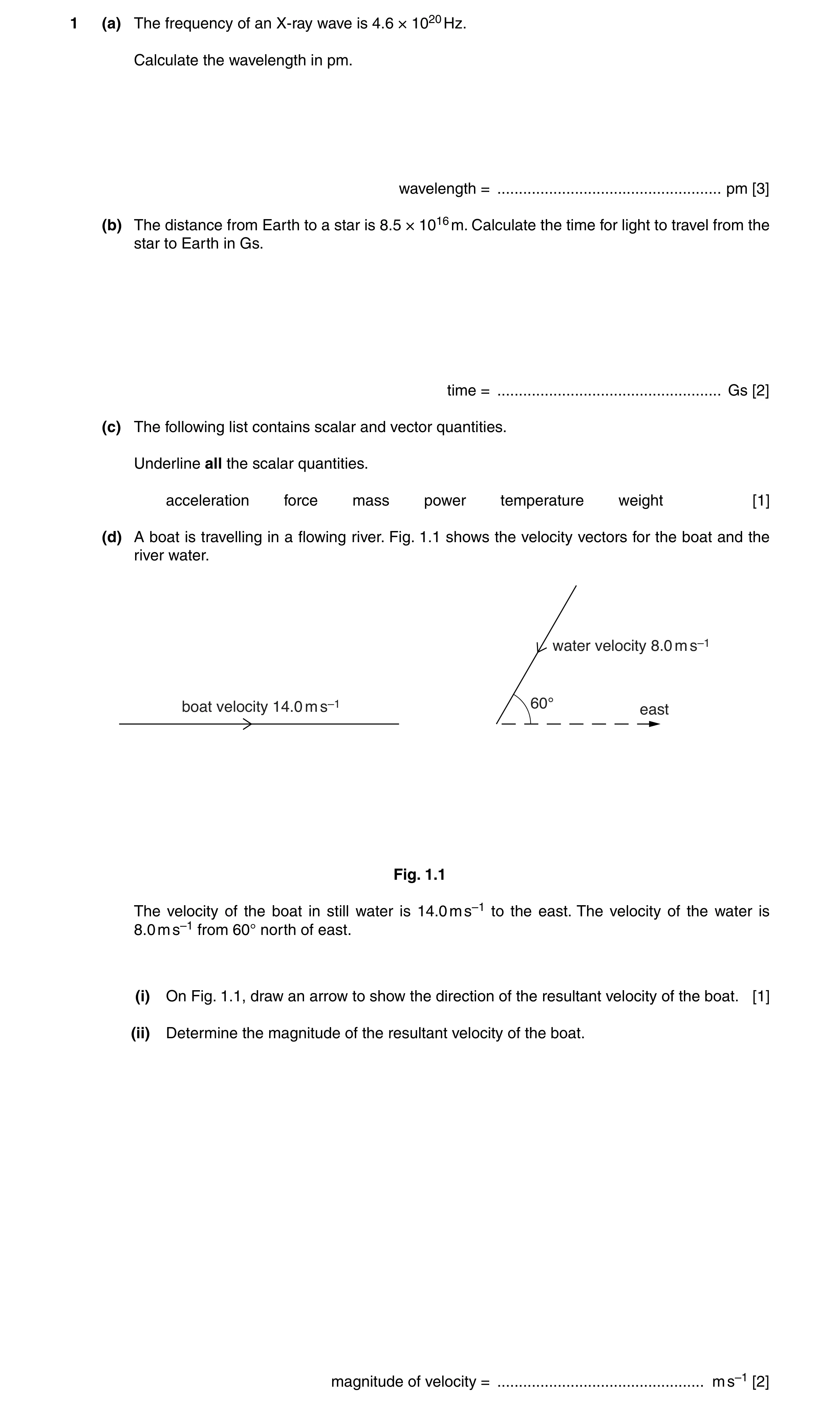
1 (a) The frequency of an X-ray wave is 4.6 × 10²⁰ Hz. Calculate the wavelength in pm. wavelength = … pm [3] (b) The distance from Earth to a star is 8.5 × 10¹⁶ m. Calculate the time for light to travel from the star to Earth in Gs. time = … Gs [2] (c) The following list contains scalar and vector quantities. Underline all the scalar quantities. acceleration force mass power temperature weight [1] (d) A boat is travelling in a flowing river. Fig. 1.1 shows the velocity vectors for the boat and the river water. water velocity 8.0 m s–1 boat velocity 14.0 m s–1 60° east Fig. 1.1 The velocity of the boat in still water is 14.0 m s–1 to the east. The velocity of the water is 8.0 m s–1 from 60° north of east. (i) On Fig. 1.1, draw an arrow to show the direction of the resultant velocity of the boat. [1] (ii) Determine the magnitude of the resultant velocity of the boat. magnitude of velocity = … m s–1 [2]
9 marks
Mark scheme: 1 (a) v = fλ C1 λ = (3.0 × 10⁸) / (4.6 × 10²⁰) C1 ( = 6.52 × 10–13 =) 0.65(2) pm A1 [3] (b) t = (8.5 × 10¹⁶) / (3.0 × 10⁸) C1 ( = 2.83 × 108 =) 0.28(3) Gs A1 [2] (c) mass, power and temperature all underlined and no others B1 [1] (d) (i) arrow in the direction 30° to 40° south of east B1 [1] (ii) triangle of velocities completed (i.e. correct scale diagram) or correct working given C1 e.g. [142 + 8.02 – 2(14)(8.0) cos 60°]1/2 or [(14 – 8.0 cos 60°)2 + (8.0 sin 60°)2]1/2 resultant velocity = 12(.2) (or 12.0 to 12.4 from scale diagram) m s–1 A1 [2]
This question in 9702/22 Oct/Nov 2015
Q5 · A nucleus of bismuth-212 (21823Bi) decays by the emission of an α-particle and γ-radiation 9702/22 Feb/March 2017
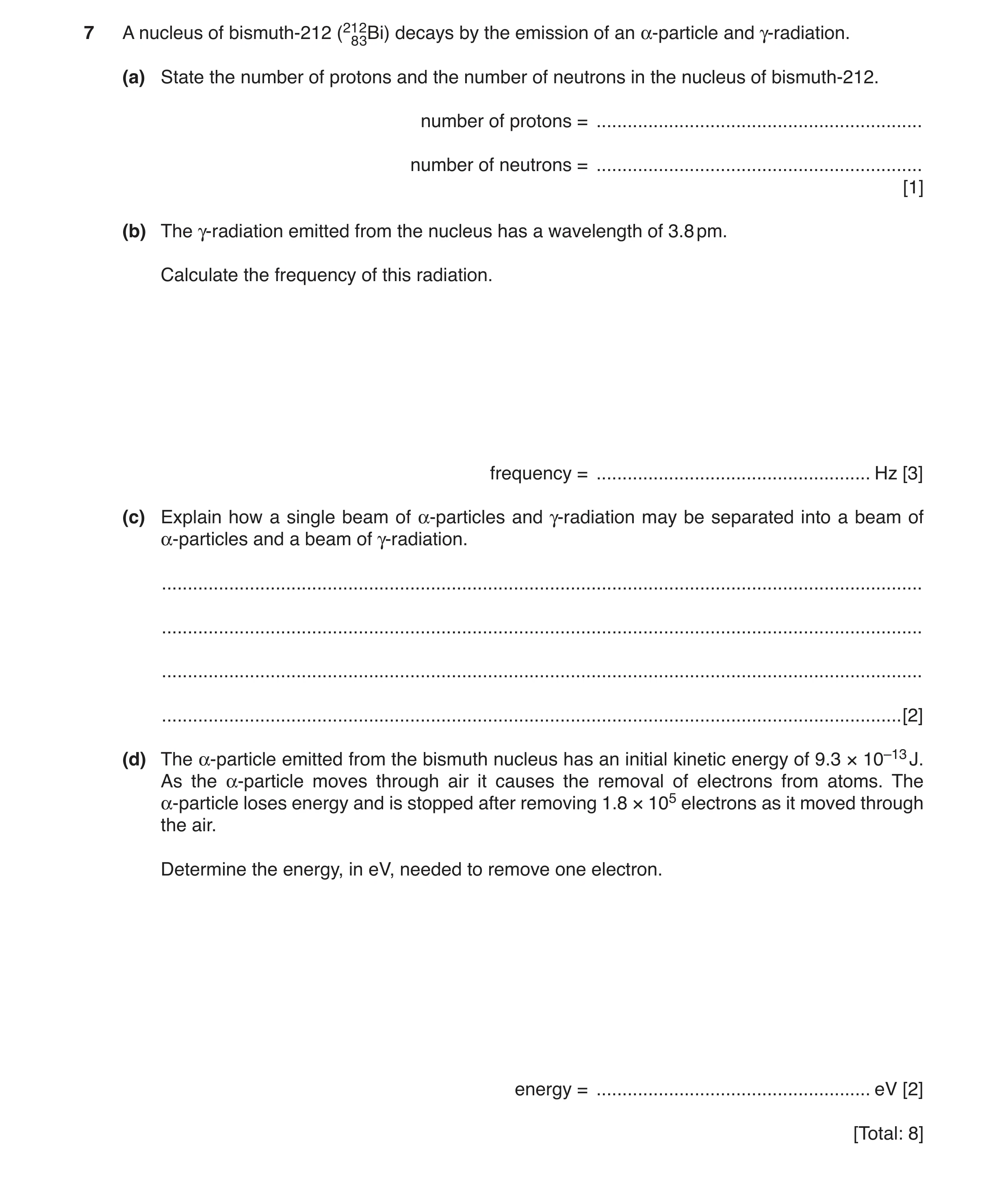
7 A nucleus of bismuth-212 (21823Bi) decays by the emission of an α-particle and γ-radiation. (a) State the number of protons and the number of neutrons in the nucleus of bismuth-212. number of protons = … number of neutrons = … [1] (b) The γ-radiation emitted from the nucleus has a wavelength of 3.8 pm. Calculate the frequency of this radiation. frequency = … Hz [3] (c) Explain how a single beam of α-particles and γ-radiation may be separated into a beam of α-particles and a beam of γ-radiation. … … … … [2] (d) The α-particle emitted from the bismuth nucleus has an initial kinetic energy of 9.3 × 10⁻¹³ J. As the α-particle moves through air it causes the removal of electrons from atoms. The α-particle loses energy and is stopped after removing 1.8 × 10⁵ electrons as it moved through the air. Determine the energy, in eV, needed to remove one electron. energy = … eV [2] [Total: 8]
8 marks
Mark scheme: 7(a) number of protons = 83 and number of neutrons = 129 A1 7(b) λ = 3.8 × 10⁻¹² C1 f = 3.0 × 10⁸ / 3.8 × 10⁻¹² C1 f = 7.9 × 10¹⁹ (7.89 × 10¹⁹) Hz A1 7(c) use an electric field (at an angle to the beam) M1 α is deflected and γ is undeflected A1 7(d) either energy = 9.3 × 10⁻¹³ / 1.8 × 10⁵ (= 5.17 × 10⁻¹⁸ J) C1 = 5.17 × 10⁻¹⁸ / 1.6 × 10–19 = 32 (32.3) eV A1 or energy = 9.3 × 10⁻¹³ / 1.6 × 10⁻¹⁹ (= 5.81 × 10⁶ eV) (C1) = 5.81 × 10⁶ / 1.8 × 105 = 32 (32.3) eV (A1)
This question in 9702/22 Feb/March 2017
Q6 · An electromagnetic wave has a wavelength of 85 μm 9702/23 Oct/Nov 2020
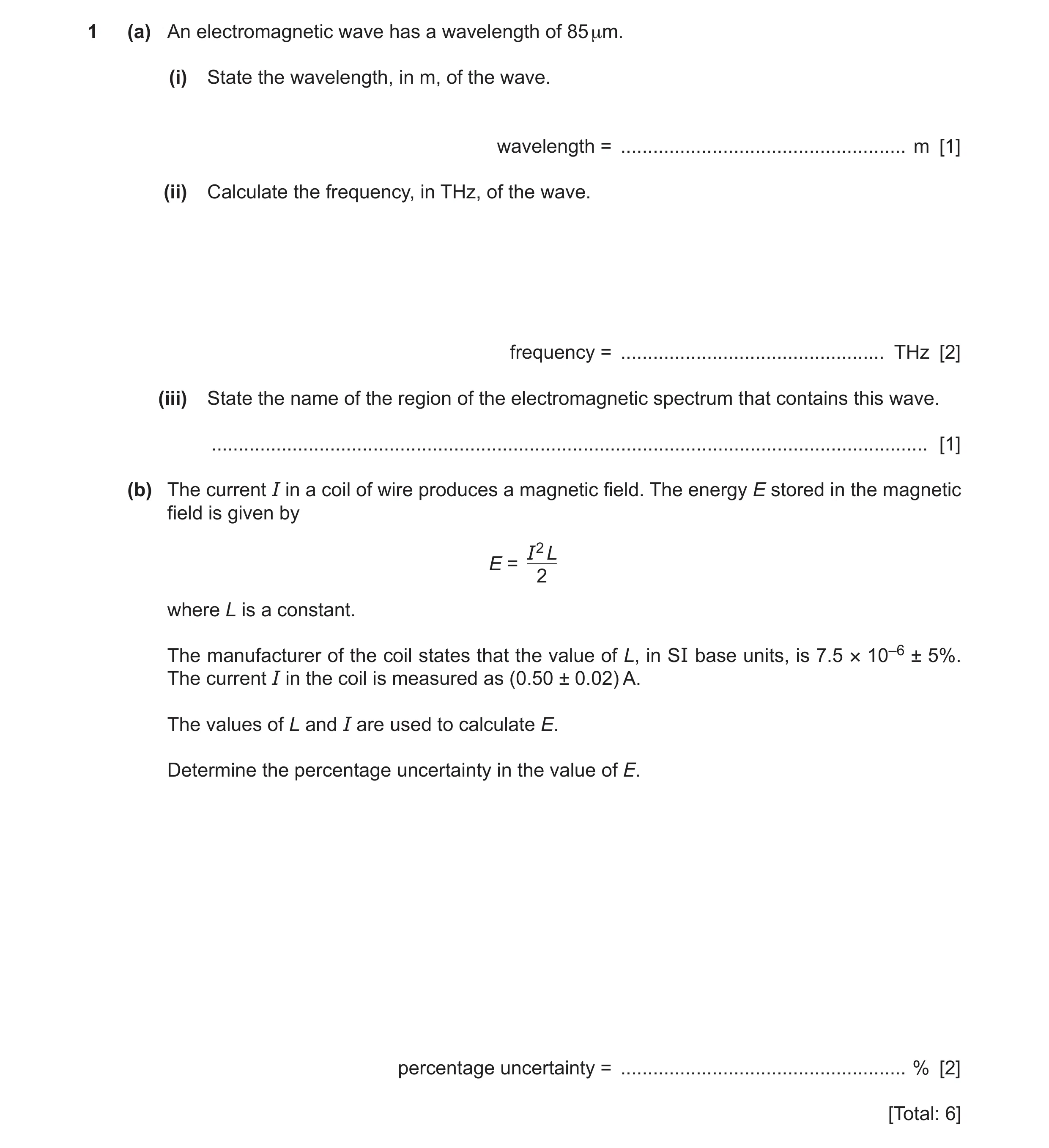
1 (a) An electromagnetic wave has a wavelength of 85 μm. (i) State the wavelength, in m, of the wave. wavelength = … m [1] (ii) Calculate the frequency, in THz, of the wave. frequency = … THz [2] (iii) State the name of the region of the electromagnetic spectrum that contains this wave. … [1] (b) The current I in a coil of wire produces a magnetic field. The energy E stored in the magnetic field is given by I 2 L E = 2 where L is a constant. The manufacturer of the coil states that the value of L, in SI base units, is 7.5 × 10⁻⁶ ± 5%. The current I in the coil is measured as (0.50 ± 0.02) A. The values of L and I are used to calculate E. Determine the percentage uncertainty in the value of E. percentage uncertainty = … % [2] [Total: 6]
6 marks
Mark scheme: 1(a)(i) wavelength = 8.5 × 10⁻⁵ m A1 1(a)(ii) f = v / λ or c / λ C1 = 3.0 × 10⁸ / 8.5 × 10⁻⁵ (= 3.5 × 10¹²) = 3.5 THz A1 1(a)(iii) infrared B1 1(b) (implied) percentage uncertainty in I = 4% or (implied) fractional uncertainty in I = 0.04 C1 percentage uncertainty in E = 5% + (4% × 2) = 13% A1
This question in 9702/23 Oct/Nov 2020
Q7 · For a progressive wave, state what is meant by its period 9702/22 May/June 2021
4 (a) For a progressive wave, state what is meant by its period. … … [1] (b) State the principle of superposition. … … … [2] (c) Electromagnetic waves of wavelength 0.040 m are emitted in phase from two sources X and Y and travel in a vacuum. The arrangement of the sources is shown in Fig. 4.1. X path of detector 1.380 m Z 1.240 m Y Fig. 4.1 (not to scale) A detector moves along a path that is parallel to the line XY. A pattern of intensity maxima and minima is detected. Distance XZ is 1.380 m and distance YZ is 1.240 m. (i) State the name of the region of the electromagnetic spectrum that contains the waves from X and Y. … [1] (ii) Calculate the period, in ps, of the waves. period = … ps [3] (iii) Show that the path difference at point Z between the waves from X and Y is 3.5 λ, where λ is the wavelength of the waves. [1] (iv) Calculate the phase difference between the waves at point Z. phase difference = … ° [1] (v) The waves from X alone have the same amplitude at point Z as the waves from Y alone. State the intensity of the waves at point Z. … [1] (vi) The frequencies of the waves from X and Y are both decreased to the same lower value. The waves stay within the same region of the electromagnetic spectrum. Describe the effect of this change on the pattern of intensity maxima and minima along the path of the detector. … … [1] [Total: 11]
11 marks
Mark scheme: 4(a) time for one oscillation/vibration/cycle or time between adjacent wavefronts (passing the same point) or shortest time between two wavefronts (passing the same point) B1 4(b) (when two or more) waves meet/overlap (at a point) B1 (resultant) displacement is sum of the individual displacements B1 4(c)(i) microwave(s) B1 4(c)(ii) v = λ / T or v = fλ and f = 1/T C1 T = 0.040 / 3.00 × 10⁸ C1 = 1.33 × 10⁻¹⁰ (s) = 1.33 × 10⁻¹⁰ / 10–12 (ps) = 130 ps A1 4(c)(iii) (1.380 – 1.240) / 0.040 = 3.5 or 1.380 / 0.040 – 1.240 / 0.040 = 3.5 A1 4(c)(iv) phase difference = 1260° or 180° A1 4(c)(v) (always) zero A1 4(c)(vi) increase in distance between (adjacent intensity) maxima/minima A1
This question in 9702/22 May/June 2021
Q8 · Parallel light rays from the Sun are incident normally on a magnifying glass 9702/23 May/June 2022
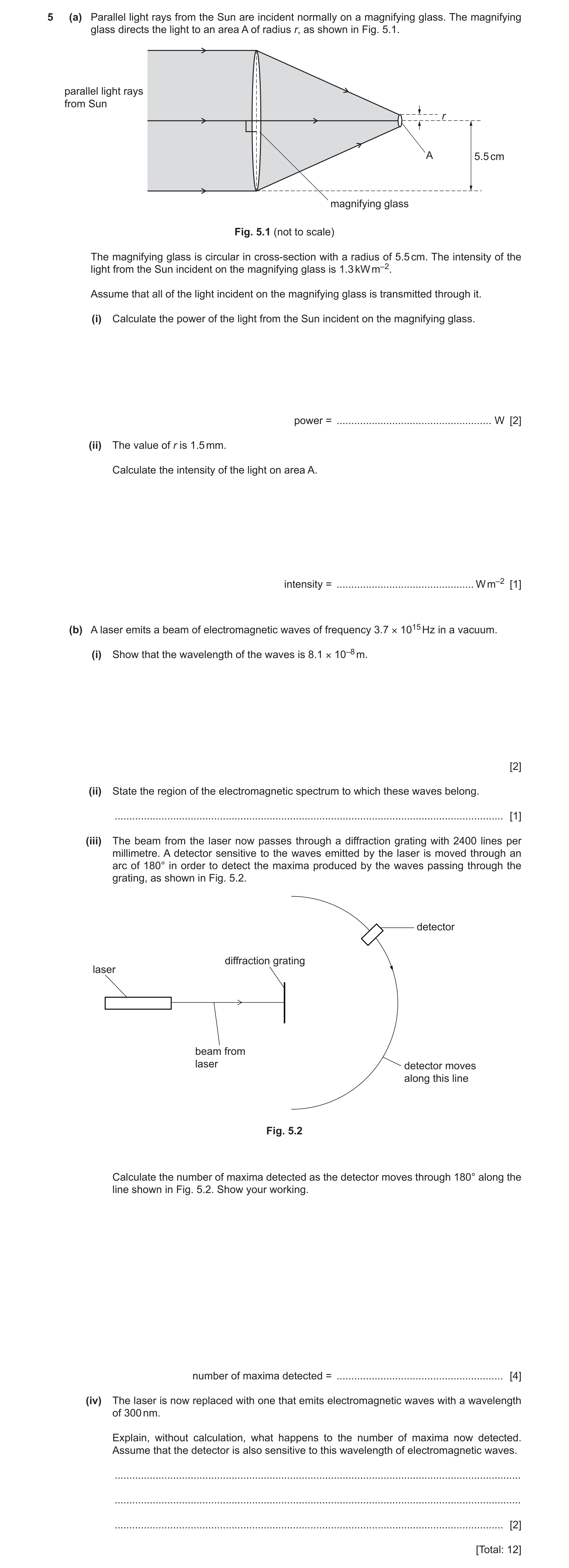
5 (a) Parallel light rays from the Sun are incident normally on a magnifying glass. The magnifying glass directs the light to an area A of radius r, as shown in Fig. 5.1. parallel light rays from Sun r A 5.5 cm magnifying glass Fig. 5.1 (not to scale) The magnifying glass is circular in cross‑section with a radius of 5.5 cm. The intensity of the light from the Sun incident on the magnifying glass is 1.3 kW m–2. Assume that all of the light incident on the magnifying glass is transmitted through it. (i) Calculate the power of the light from the Sun incident on the magnifying glass. power = … W [2] (ii) The value of r is 1.5 mm. Calculate the intensity of the light on area A. intensity = … W m–2 [1] (b) A laser emits a beam of electromagnetic waves of frequency 3.7 × 10¹⁵ Hz in a vacuum. (i) Show that the wavelength of the waves is 8.1 × 10⁻⁸ m. [2] (ii) State the region of the electromagnetic spectrum to which these waves belong. … [1] (iii) The beam from the laser now passes through a diffraction grating with 2400 lines per millimetre. A detector sensitive to the waves emitted by the laser is moved through an arc of 180° in order to detect the maxima produced by the waves passing through the grating, as shown in Fig. 5.2. detector diffraction grating laser beam from laser detector moves along this line Fig. 5.2 Calculate the number of maxima detected as the detector moves through 180° along the line shown in Fig. 5.2. Show your working. number of maxima detected = … [4] (iv) The laser is now replaced with one that emits electromagnetic waves with a wavelength of 300 nm. Explain, without calculation, what happens to the number of maxima now detected. Assume that the detector is also sensitive to this wavelength of electromagnetic waves. … … … [2] [Total: 12]
12 marks
Mark scheme: 5(a)(i) C1 = 1.3 103 ( 0.0552) = 12 W A1 5(a)(ii) intensity = power / area = 12 / ( 0.00152) = 1.7 106 W m−2 A1 5(b)(i) ( =) v / f or c / f C1 ( =) 3.0 108 / 3.7 1015 = 8.1 10−8 (m) A1 5(b)(ii) ultraviolet A1 Question Answer Marks 5(b)(iii) d sin = n or (1 / N) sin = n C1 d = 1 / 2400 103 (m) = 4.2 10–7 (m) or N = 2400 103 (m–1) C1 n = 4.2 10−7 sin 90° / 8.1 10−8 or sin 90° / 2400 103 8.1 10–8 n = 5.2 or 5.1 or when n = 5, = 76.4° and when n = 6, sin > 1 (so) n = 5 B1 number of maxima = (2 5) + 1 = 11 A1 5(b)(iv) the wavelength has increased M1 (so) number of maxima decreases A1
This question in 9702/23 May/June 2022
Q9 · An electromagnetic wave in a vacuum has a wavelength of 8.4 × 10⁻⁶ m 9702/21 May/June 2023
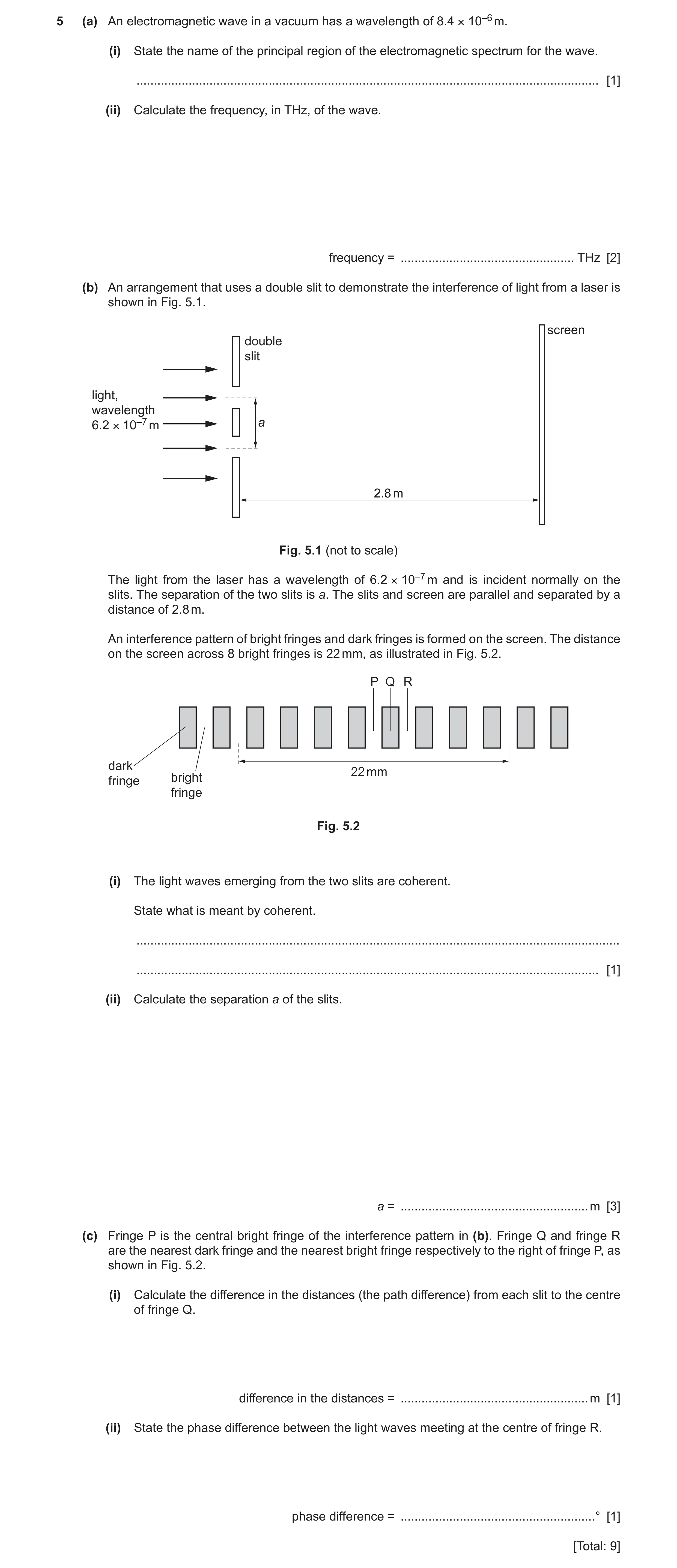
5 (a) An electromagnetic wave in a vacuum has a wavelength of 8.4 × 10⁻⁶ m. (i) State the name of the principal region of the electromagnetic spectrum for the wave. … [1] (ii) Calculate the frequency, in THz, of the wave. frequency = … THz [2] (b) An arrangement that uses a double slit to demonstrate the interference of light from a laser is shown in Fig. 5.1. screen double slit light, wavelength 6.2 × 10⁻⁷ m a 2.8 m Fig. 5.1 (not to scale) The light from the laser has a wavelength of 6.2 × 10⁻⁷ m and is incident normally on the slits. The separation of the two slits is a. The slits and screen are parallel and separated by a distance of 2.8 m. An interference pattern of bright fringes and dark fringes is formed on the screen. The distance on the screen across 8 bright fringes is 22 mm, as illustrated in Fig. 5.2. P Q R dark 22 mm fringe bright fringe Fig. 5.2 (i) The light waves emerging from the two slits are coherent. State what is meant by coherent. … … [1] (ii) Calculate the separation a of the slits. a = … m [3] (c) Fringe P is the central bright fringe of the interference pattern in (b). Fringe Q and fringe R are the nearest dark fringe and the nearest bright fringe respectively to the right of fringe P, as shown in Fig. 5.2. (i) Calculate the difference in the distances (the path difference) from each slit to the centre of fringe Q. difference in the distances = … m [1] (ii) State the phase difference between the light waves meeting at the centre of fringe R. phase difference = … ° [1] [Total: 9]
9 marks
Mark scheme: 5(a)(i) infrared B1 5(a)(ii) v = f or c = f C1 f = 3.0 108 / 8.4 10–6 = 3.6 1013 (Hz) = 36 THz A1 5(b)(i) constant phase difference (between the waves) (with time) B1 5(b)(ii) = ax / D C1 x = 22 / 8 or 2.75 (mm) or 22 10–3 / 8 or 2.75 10–3 (m) C1 a = (6.2 10–7 2.8) / (22 10–3 / 8) = 6.3 10–4 m A1 5(c)(i) difference in distances = 6.2 10–7 / 2 = 3.1 10–7 m A1 5(c)(ii) phase difference = 360° A1
This question in 9702/21 May/June 2023
Q10 · By reference to the direction of propagation of energy, state what is meant by a… 9702/22 Feb/March 2024
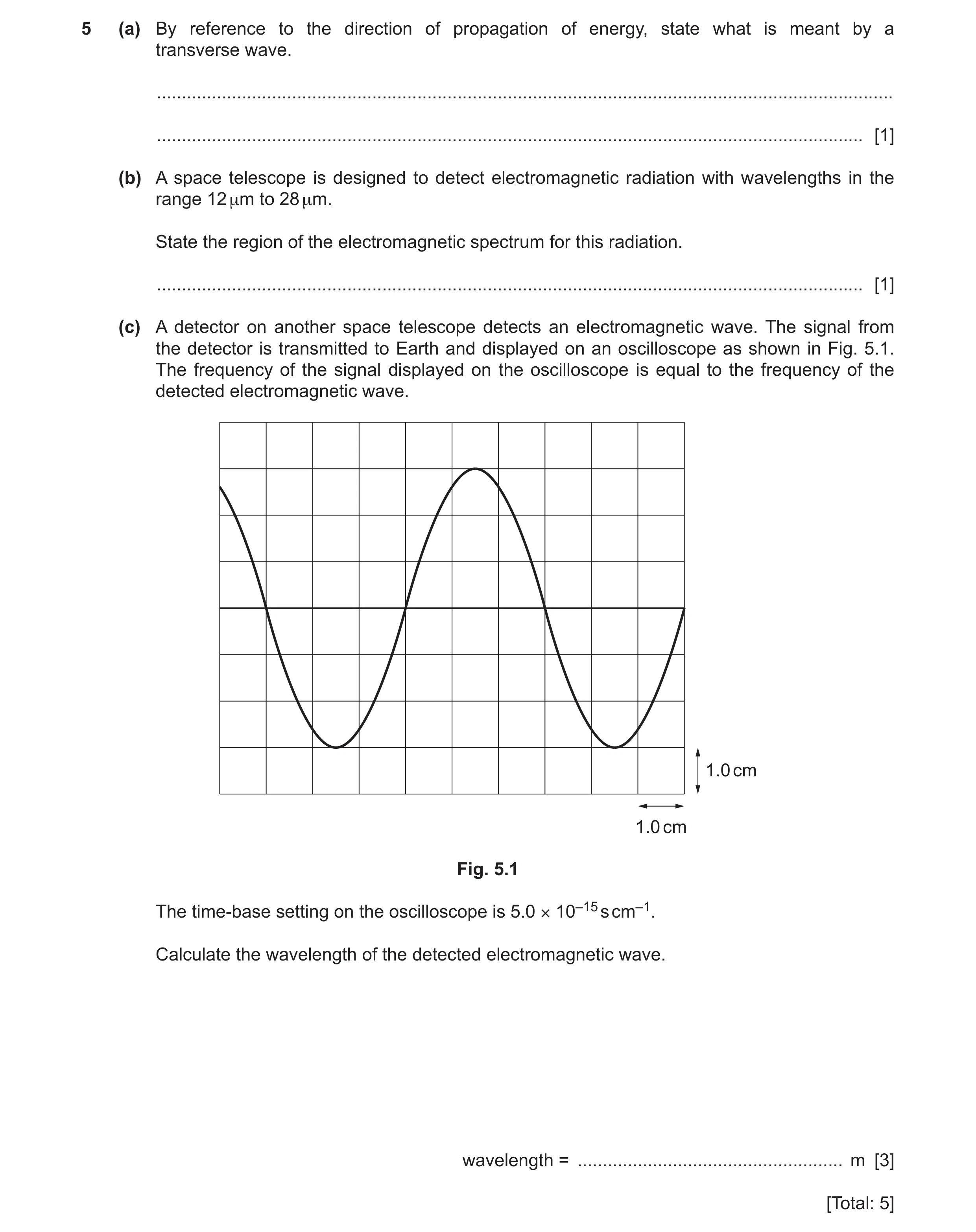
5 (a) By reference to the direction of propagation of energy, state what is meant by a transverse wave. … … [1] (b) A space telescope is designed to detect electromagnetic radiation with wavelengths in the range 12 μm to 28 μm. State the region of the electromagnetic spectrum for this radiation. … [1] (c) A detector on another space telescope detects an electromagnetic wave. The signal from the detector is transmitted to Earth and displayed on an oscilloscope as shown in Fig. 5.1. The frequency of the signal displayed on the oscilloscope is equal to the frequency of the detected electromagnetic wave. 1.0 cm 1.0 cm Fig. 5.1 The time-base setting on the oscilloscope is 5.0 × 10⁻¹⁵ s cm–1. Calculate the wavelength of the detected electromagnetic wave. wavelength = … m [3] [Total: 5]
5 marks
Mark scheme: 5(a) vibrations / oscillations (of the particles / wave) are perpendicular to the direction (of the propagation of energy) B1 5(b) infrared B1 5(c) T = 6 5.0 10–15 C1 T = 3.0 10–14 = c T or = c / f and f = 1 / T C1 = 3.0 108 3.0 10-14 or = 3.0 108 / 3.33 1013 A1 = 9.0 10–6 m
This question in 9702/22 Feb/March 2024
Q11 · A device containing a microwave emitter and receiver is placed in front of a large metal… 9702/22 Feb/March 2025
4 A device containing a microwave emitter and receiver is placed in front of a large metal sheet in a vacuum as shown in Fig. 4.1. X P Q Y microwave emitter and receiver metal sheet Fig. 4.1 (not to scale) The line XY is perpendicular to the metal sheet. The device emits microwaves of frequency 6.3 GHz. (a) When the device is at position P, a stationary wave is formed between the device and the sheet. Explain how the stationary wave, including the nodes and the antinodes, is formed. … … … … … … … … … [4] (b) (i) Calculate the wavelength of the microwaves. wavelength = … m [2] (ii) At point P the receiver detects a maximum amplitude of the stationary wave. The device is moved slowly from point P along the line XY and the receiver detects a series of minimum and maximum amplitudes. The first time a minimum amplitude is detected by the receiver is when the device is at point Q. Determine the distance between P and Q. distance = … m [1] (iii) The intensity of the microwaves emitted by the device is increased. The frequency of the microwaves is unchanged. The device is moved slowly along the line XY from point Q until the next maximum amplitude is detected at point R. State and explain whether the distance QR is greater than, less than or the same as distance PQ. … … … [1] [Total: 8]
8 marks
Mark scheme: 4(a) (micro)wave (from the transmitter) reflects (at metal/sheet) B1 The incident and reflected waves superpose B1 (resultant) amplitude is maximum at an antinode B1 (resultant) amplitude is minimum/zero at a node B1 4(b)(i) = c / f C1 = 3 108 / 6.3 109 = 0.048 m A1 4(b)(ii) distance PQ = ¼ A1 = 0.048 / 4 = 0.012 m 4(b)(iii) (Distance QR is the) same (as PQ) and one of: B1 • Distance (between maxima / minima) does not depend on intensity • distance depends only on wavelength • wavelength is unchanged / constant
This question in 9702/22 Feb/March 2025
 1 / 16
 2 / 16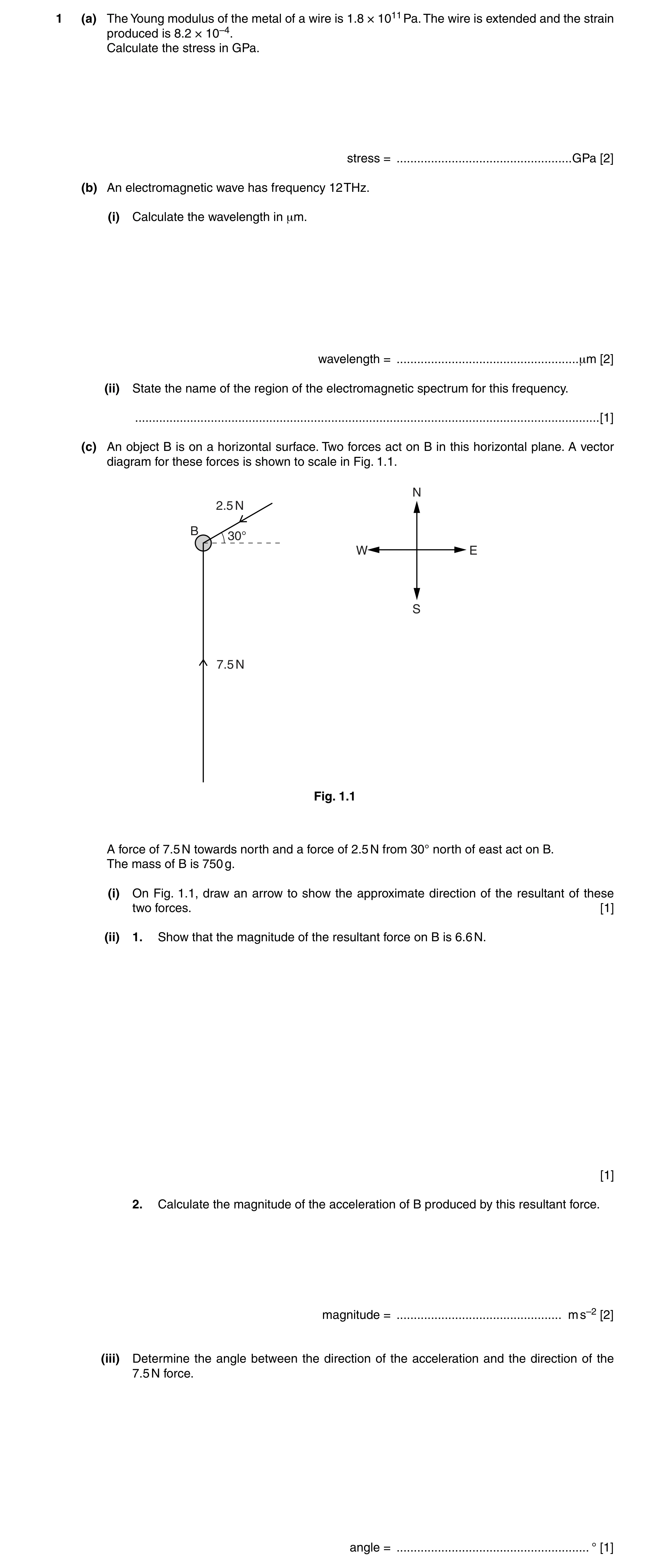
 6 / 16
 7 / 16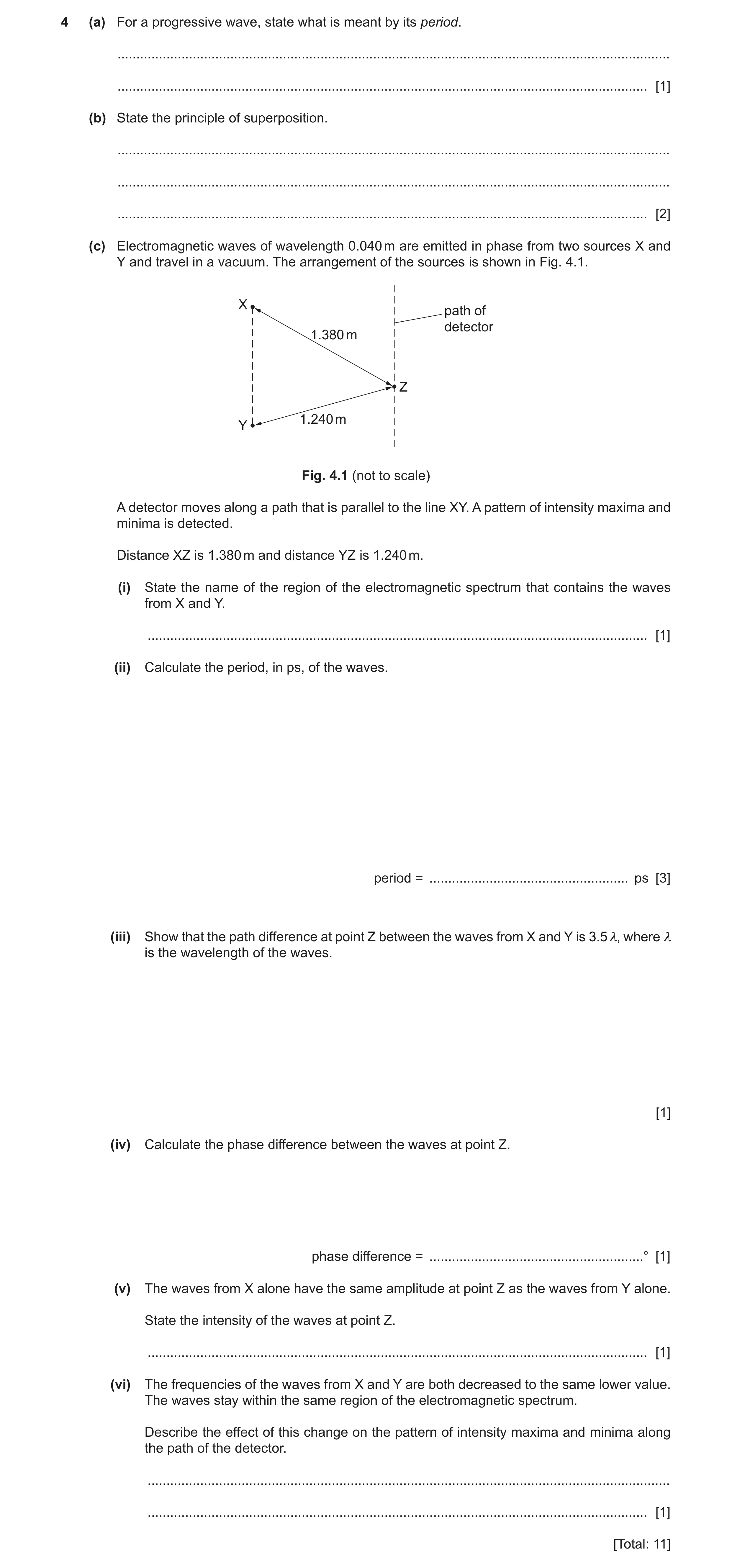
 14 / 16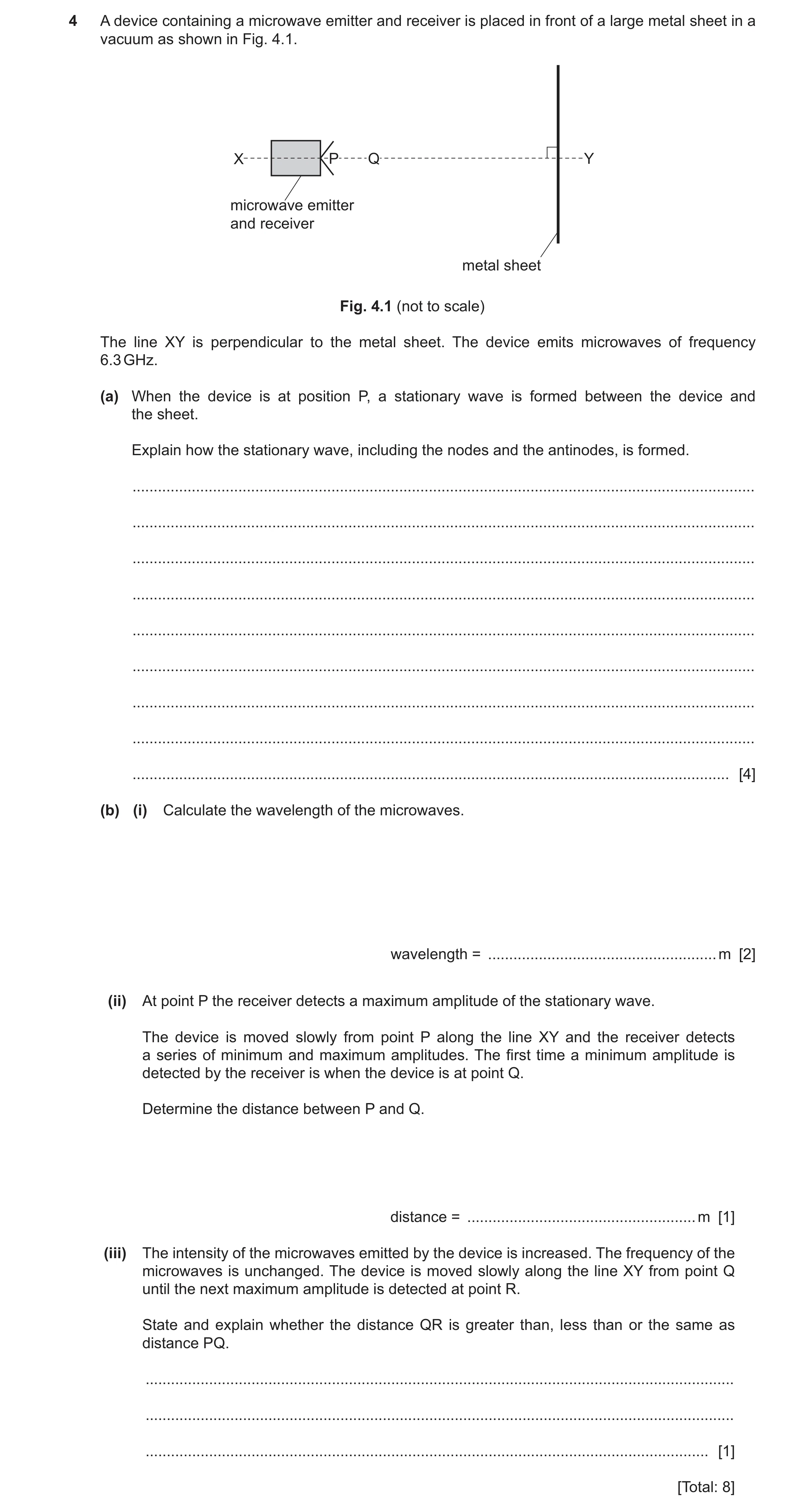
 4
4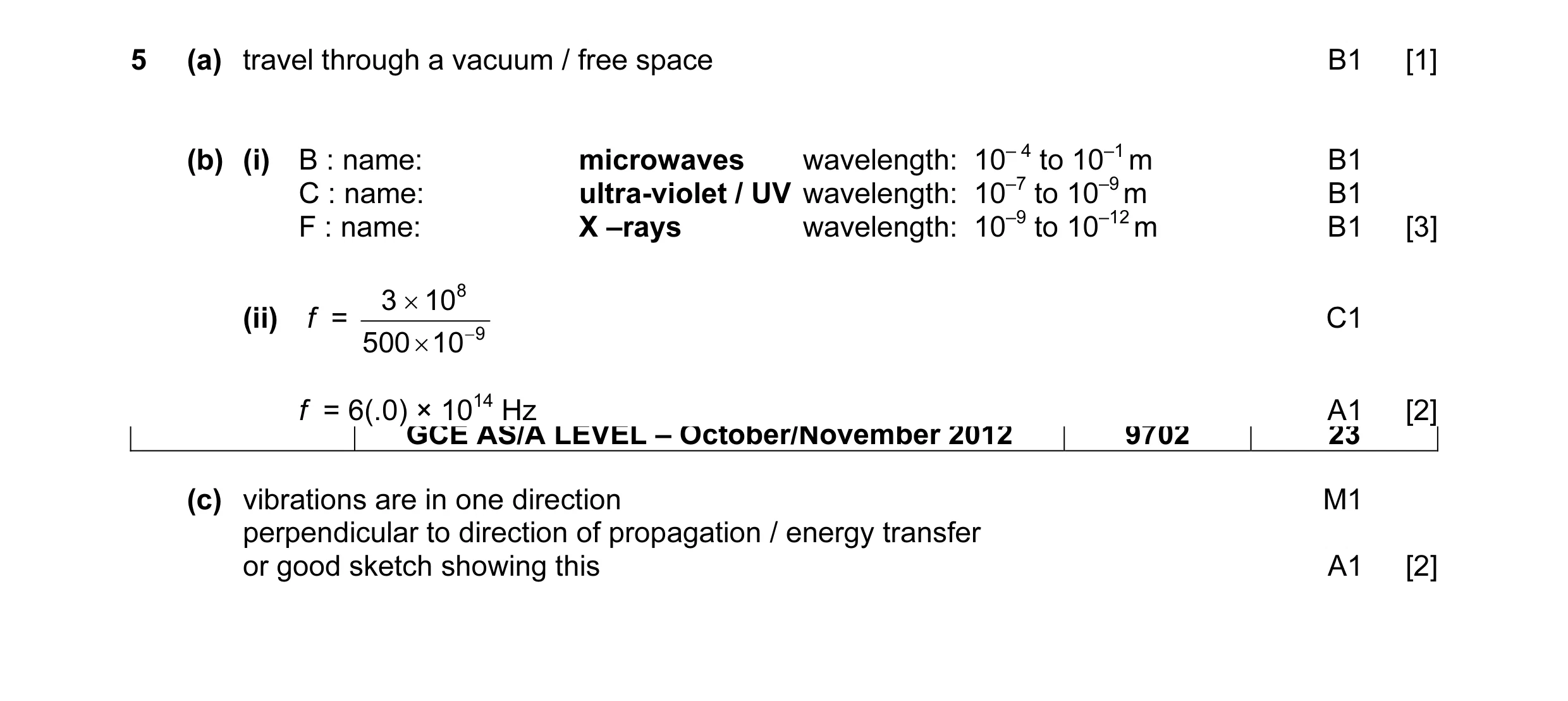 8
8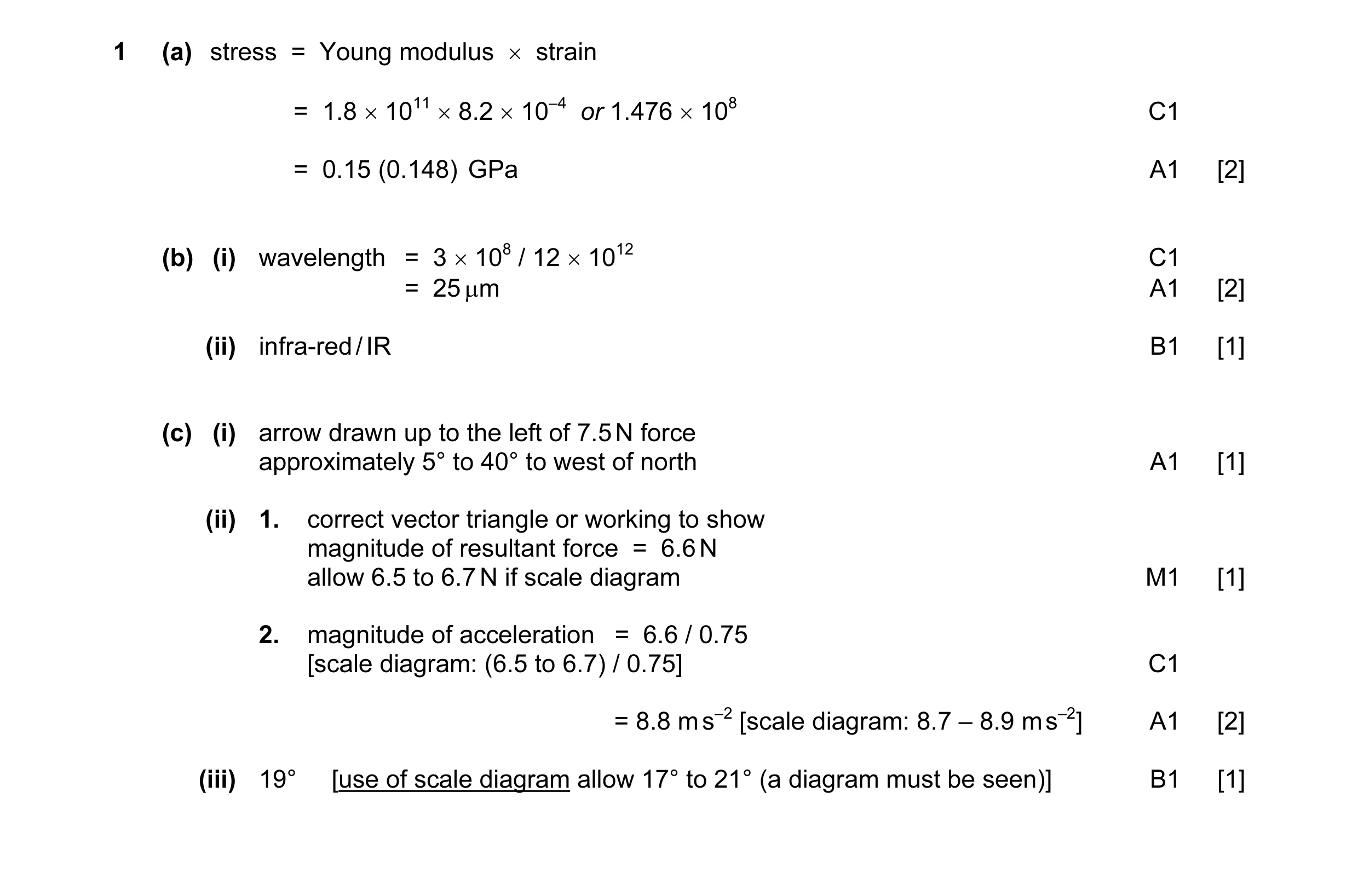 10
10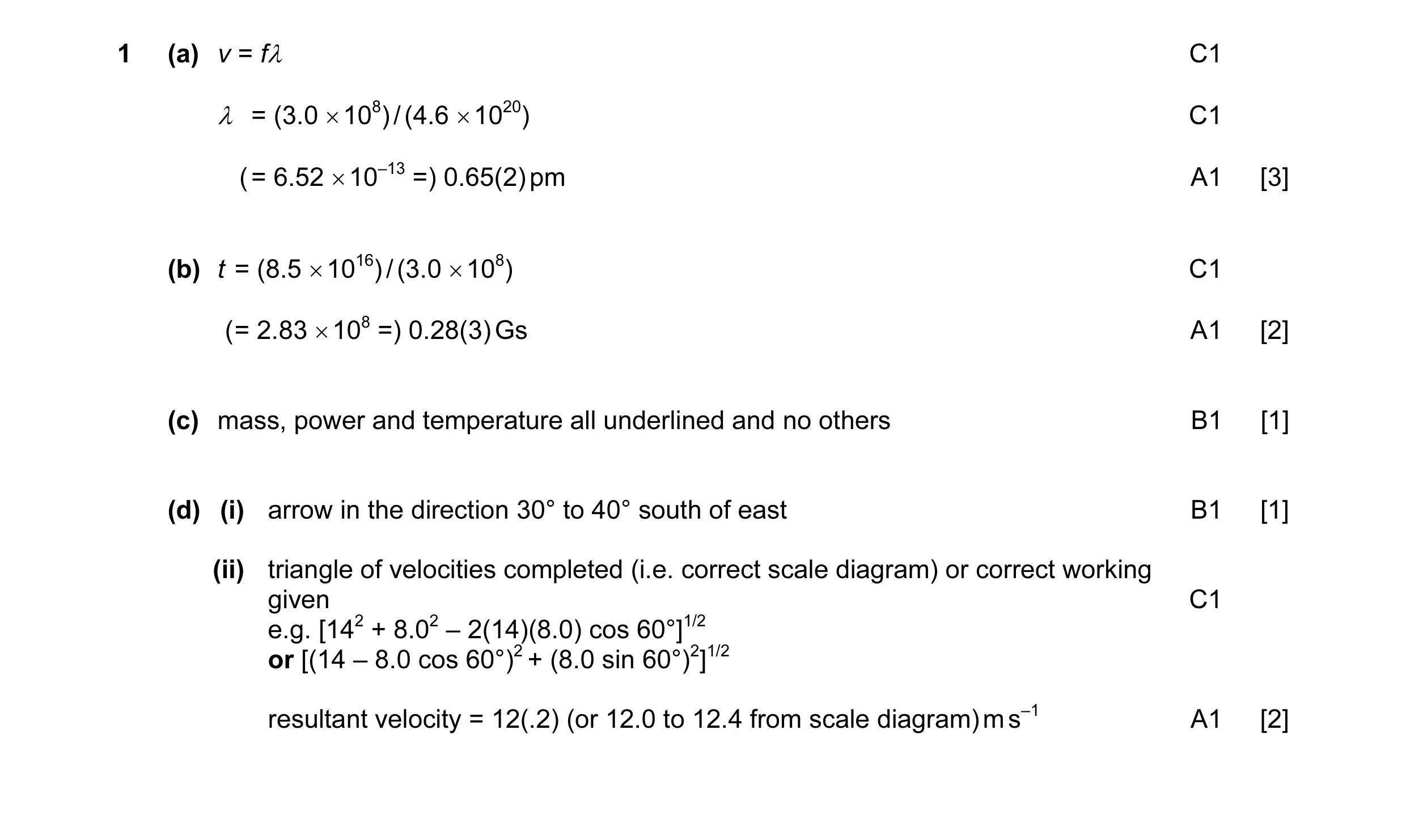 9
9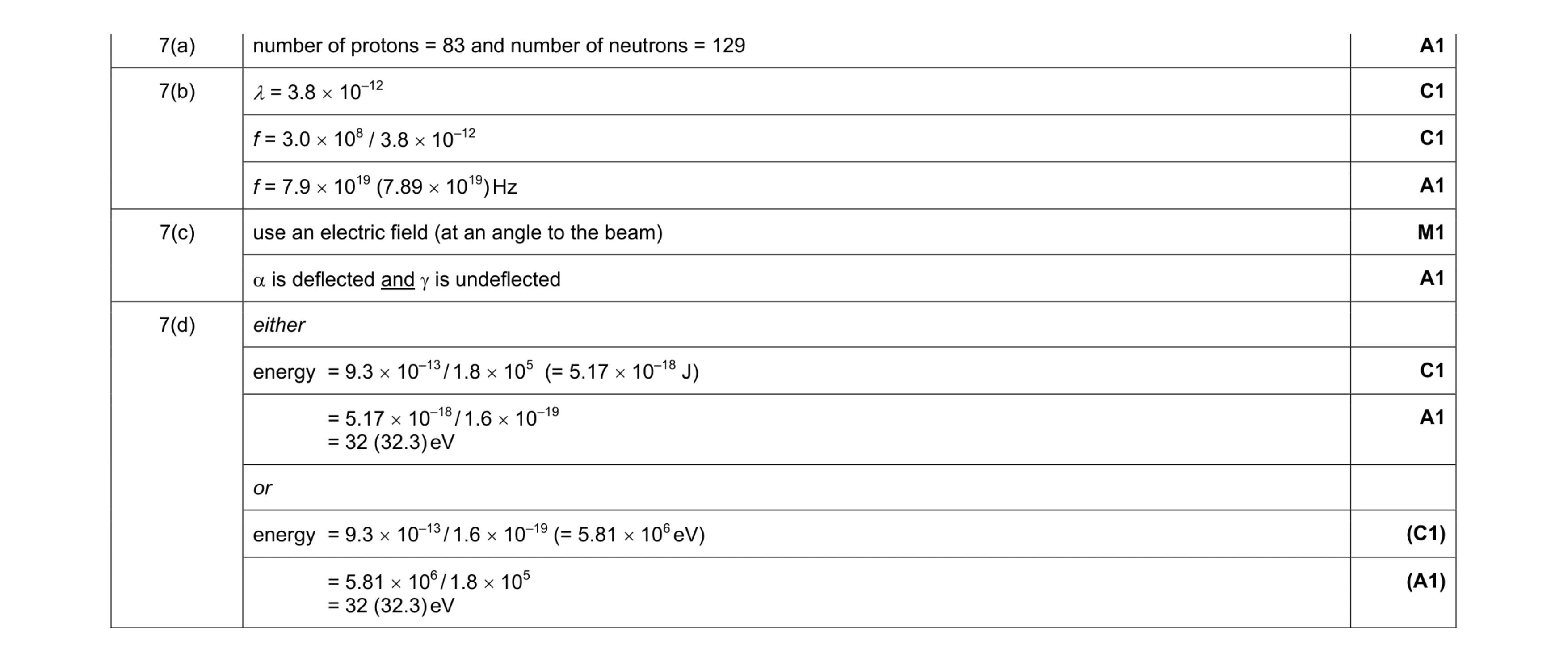 8
8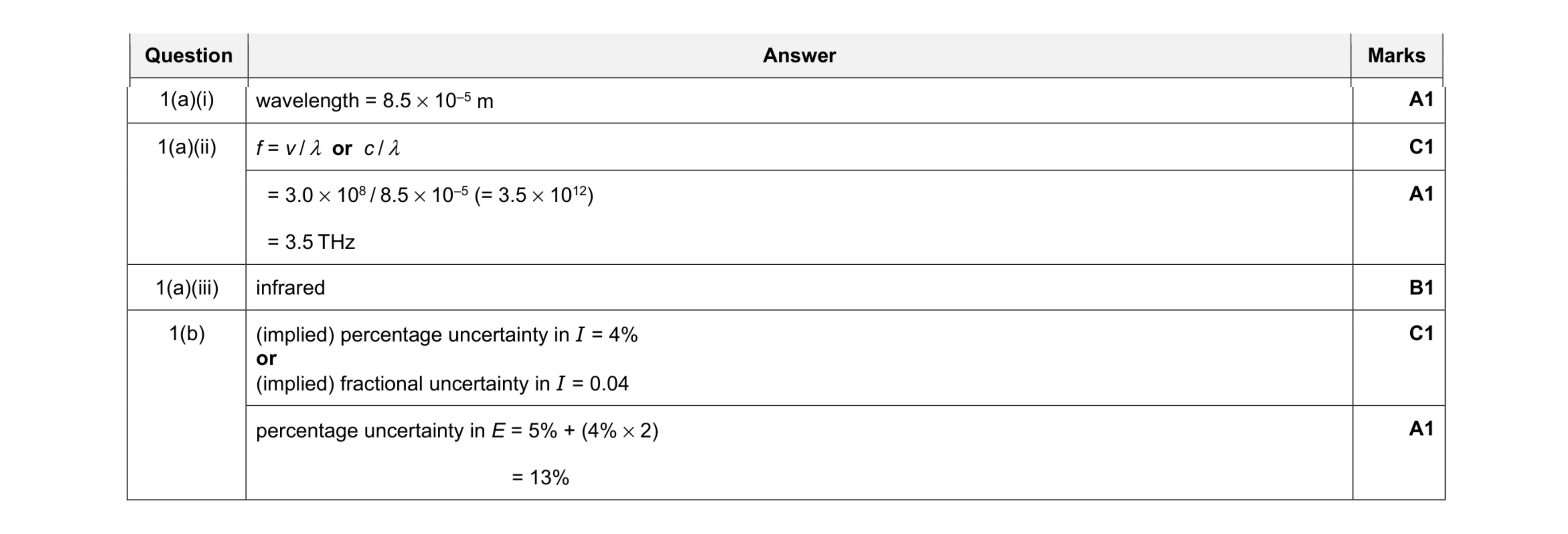 6
6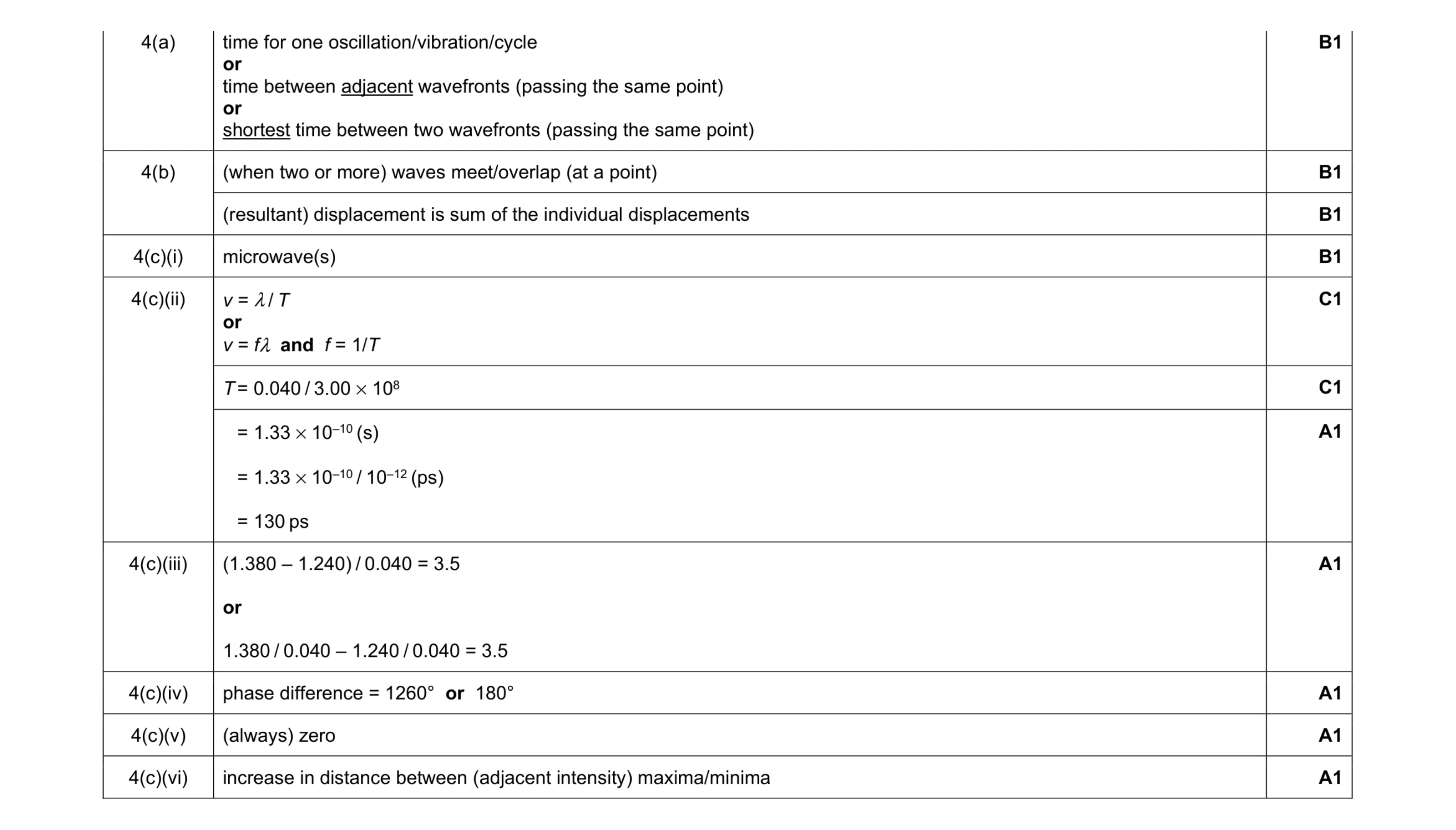 11
11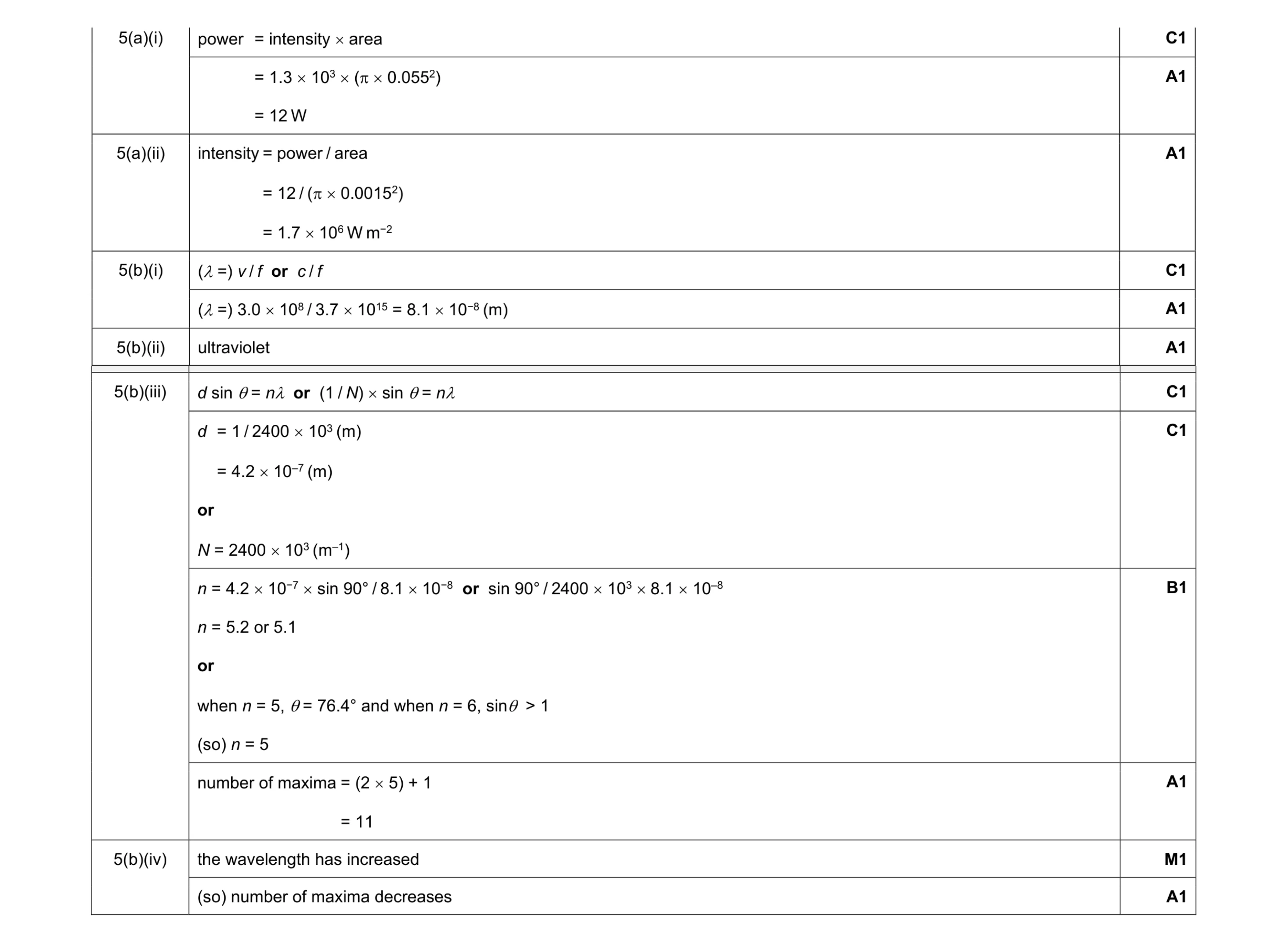 12
12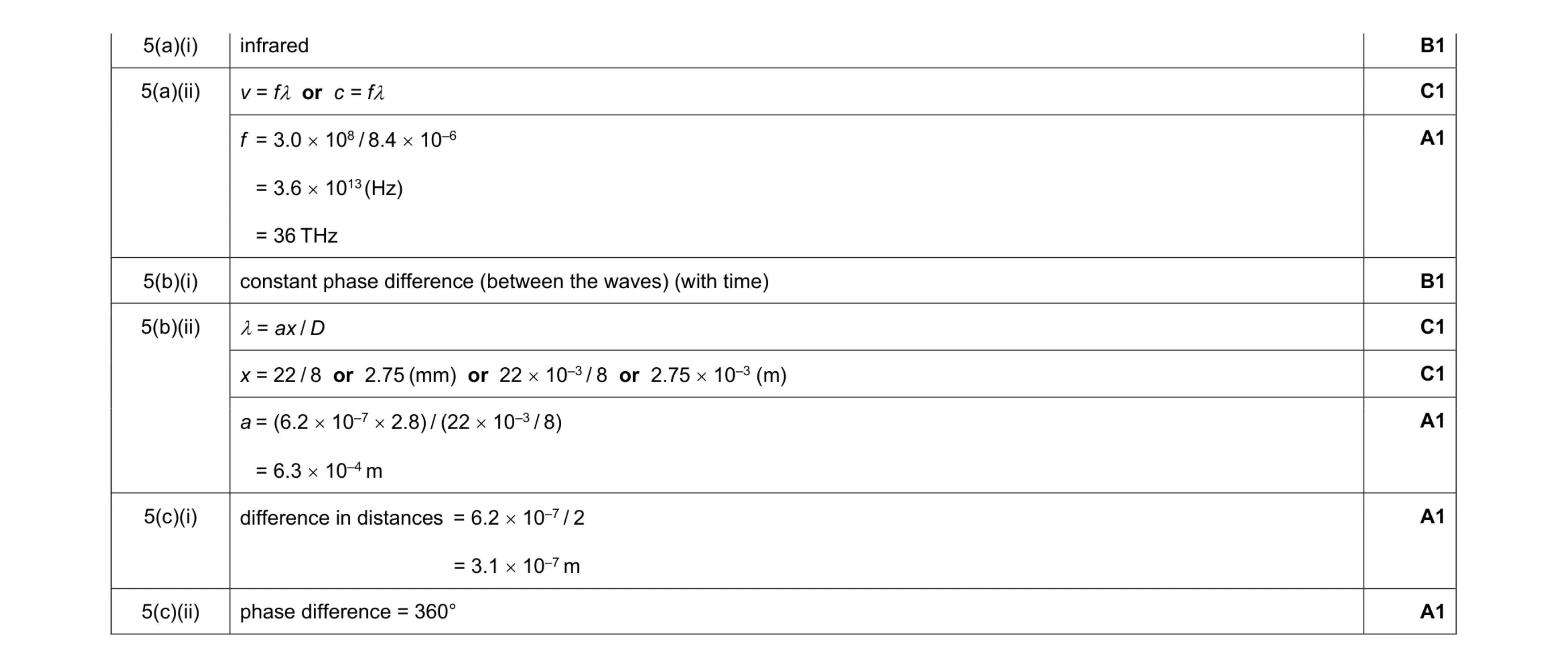 9
9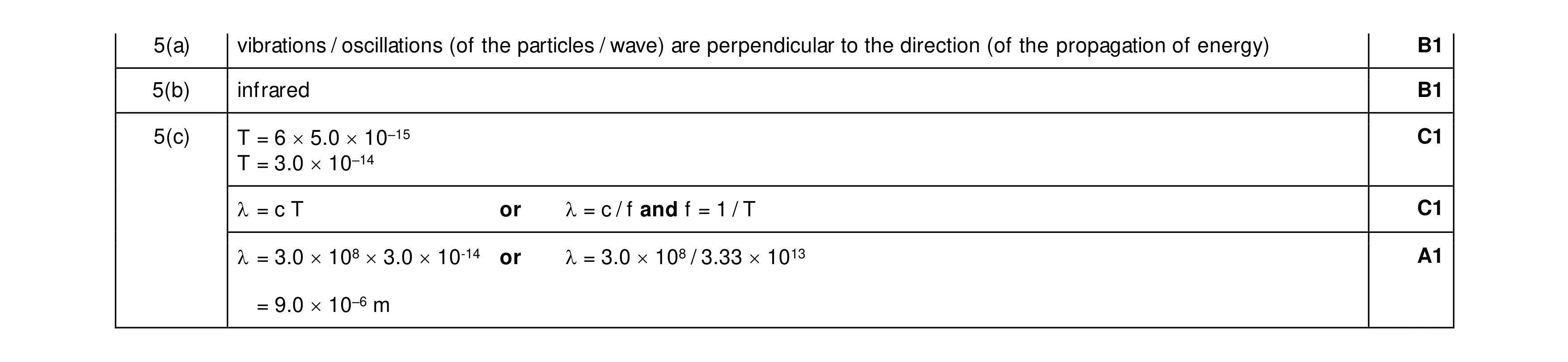 5
5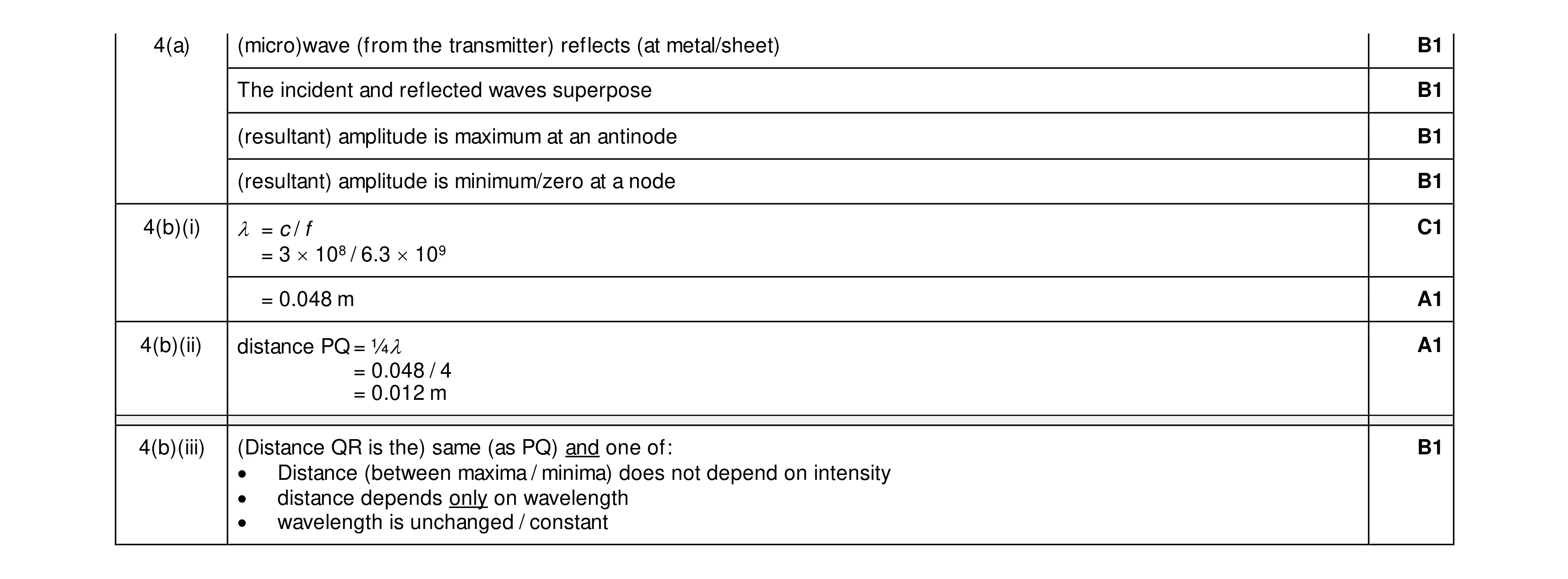 8
8