Questions as text
Q1 · Define the decay constant of a radioactive isotope 9702/41 May/June 2007
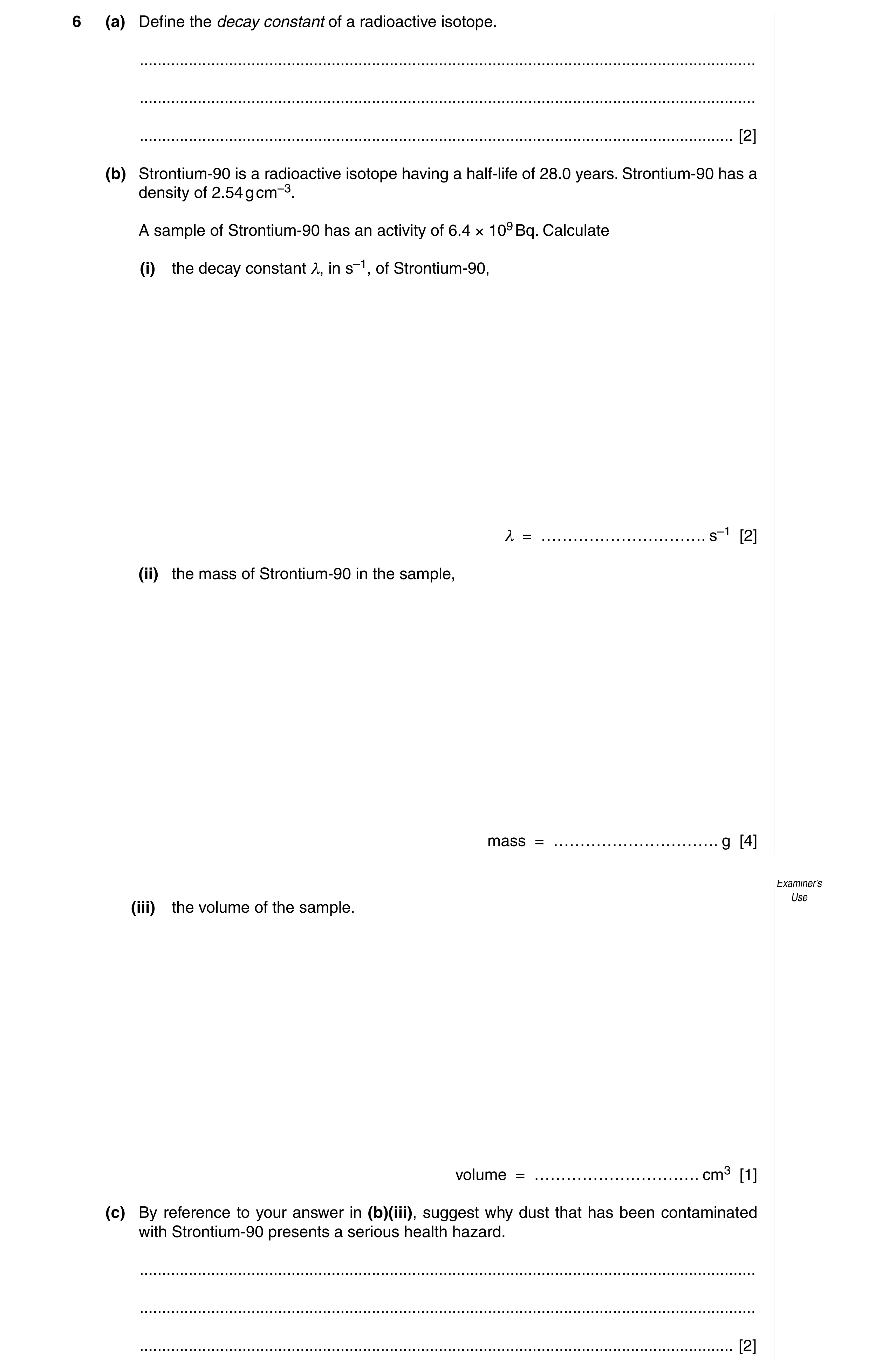
6 (a) Define the decay constant of a radioactive isotope. … … … [2] (b) Strontium-90 is a radioactive isotope having a half-life of 28.0 years. Strontium-90 has a density of 2.54 g cm–3. A sample of Strontium-90 has an activity of 6.4 × 10⁹ Bq. Calculate (i) the decay constant λ, in s–1, of Strontium-90, λ = …………………………. s–1 [2] (ii) the mass of Strontium-90 in the sample, mass = …………………………. g [4] Examiner’s Use (iii) the volume of the sample. volume = …………………………. cm3 [1] (c) By reference to your answer in (b)(iii), suggest why dust that has been contaminated with Strontium-90 presents a serious health hazard. … … … [2]
11 marks
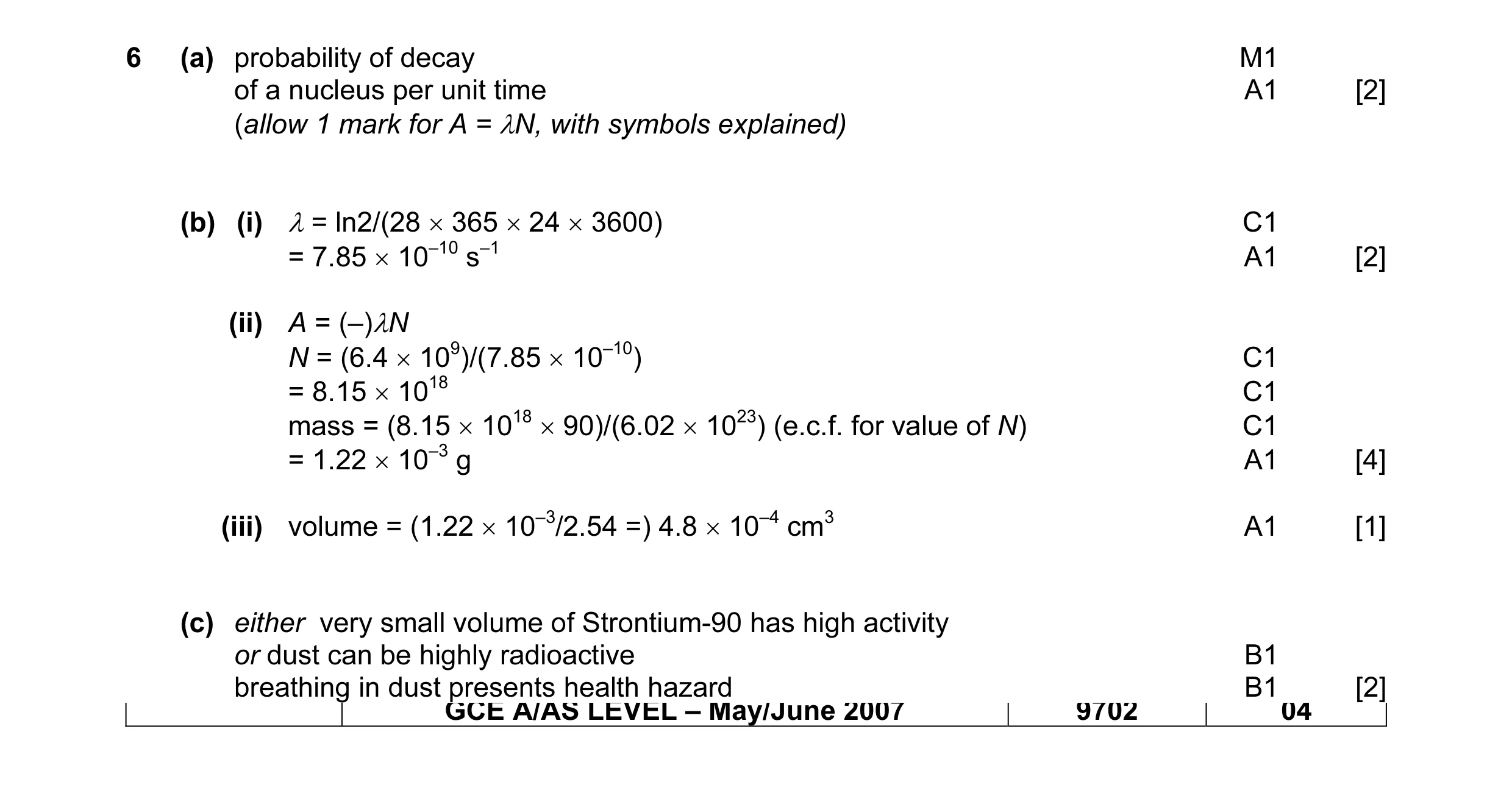
Mark scheme: 6 (a) probability of decay M1 of a nucleus per unit time A1 [2] (allow 1 mark for A = λN, with symbols explained) (b) (i) λ = ln2/(28 × 365 × 24 × 3600) C1 = 7.85 × 10⁻¹⁰ s–1 A1 [2] (ii) A = (–)λN N = (6.4 × 10⁹)/(7.85 × 10–10) C1 = 8.15 × 10¹⁸ C1 mass = (8.15 × 1018 × 90)/(6.02 × 1023) (e.c.f. for value of N) C1 = 1.22 × 10⁻³ g A1 [4] (iii) volume = (1.22 × 10⁻³/2.54 =) 4.8 × 10⁻⁴ cm3 A1 [1] (c) either very small volume of Strontium-90 has high activity or dust can be highly radioactive B1 breathing in dust presents health hazard B1 [2] GCE A/AS LEVEL – May/June 2007 9702 04
This question in 9702/41 May/June 2007
Q2 · State the name of an electrical sensing device that will respond to changes in For… 9702/42 May/June 2010
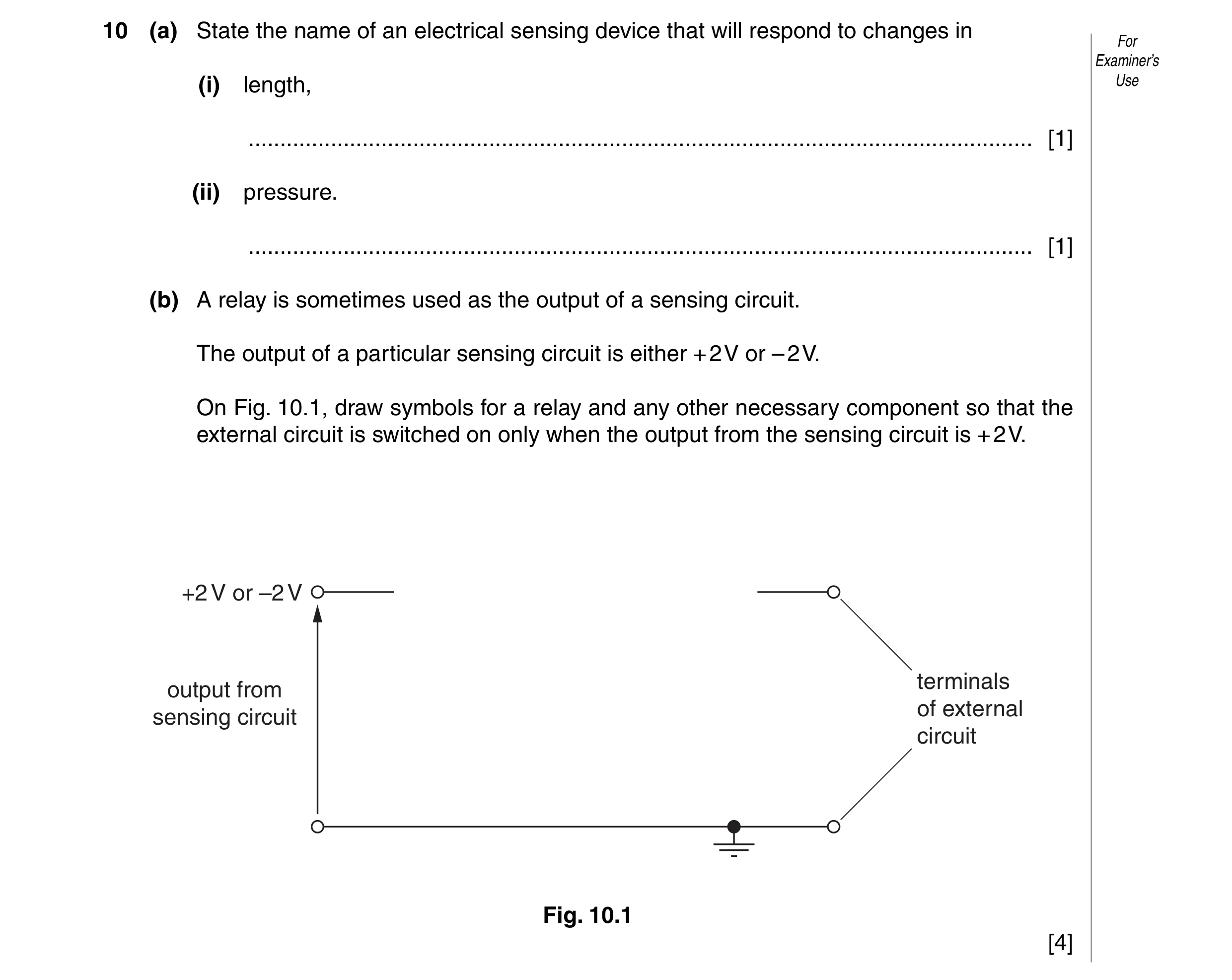
10 (a) State the name of an electrical sensing device that will respond to changes in For Examiner’s (i) length, Use … [1] (ii) pressure. … [1] (b) A relay is sometimes used as the output of a sensing circuit. The output of a particular sensing circuit is either + 2 V or – 2 V. On Fig. 10.1, draw symbols for a relay and any other necessary component so that the external circuit is switched on only when the output from the sensing circuit is + 2 V. +2 V or –2 V terminals output from of external sensing circuit circuit Fig. 10.1 [4]
6 marks
Mark scheme: 10 (a) (i) strain gauge B1 [1] (ii) piezo-electric / quartz crystal / transducer B1 [1] (b) circuit: coil of relay connected between sensing circuit output and earth B1 switch across terminals of external circuit B1 diode in series with coil with correct polarity for diode B1 second diode with correct polarity B1 [4]
This question in 9702/42 May/June 2010
Q3 · State what is meant by the acoustic impedance of a medium 9702/41 Oct/Nov 2010
10 (a) (i) State what is meant by the acoustic impedance of a medium. For Examiner’s … Use … [1] (ii) Data for some media are given in Fig. 10.1. medium speed of ultrasound acoustic impedance / m s–1 / kg m–2 s–1 air 330 4.3 × 10² gel 1500 1.5 × 10⁶ soft tissue 1600 1.6 × 10⁶ bone 4100 7.0 × 10⁶ Fig. 10.1 Use data from Fig. 10.1 to calculate a value for the density of bone. density = … kg m–3 [1] (b) A parallel beam of ultrasound has intensity I. It is incident at right-angles to a boundary between two media, as shown in Fig. 10.2. boundary incident intensity I transmitted intensity IT reflected intensity IR acoustic impedance Z1 acoustic impedance Z2 Fig. 10.2 The media have acoustic impedances of Z1 and Z2. The transmitted intensity of the ultrasound beam is IT and the reflected intensity is IR. (i) State the relation between I, IT and IR. … [1] (ii) The reflection coefficient a is given by the expression For Examiner’s Use (Z2 – Z1)2 a = (Z2 + Z1)2. Use data from Fig. 10.1 to determine the reflection coefficient a for a boundary between 1. gel and soft tissue, a = … [2] 2. air and soft tissue. a = … [1] (c) By reference to your answers in (b)(ii), explain the use of a gel on the surface of skin during ultrasound diagnosis. … … … … [3]
9 marks
Mark scheme: 10 (a) (i) density × speed of wave (in the medium) B1 [1] (ii) ρ = (7.0 × 10⁶) / 4100 = 1700 kg m–3 A1 [1] (b) (i) I = IT + IR B1 [1] (ii) 1. α = (0.1 × 10⁶)2 / (3.1 × 10⁶)2 C1 = 0.001 A1 [2] 2. α ≈ 1 A1 [1] (c) either very little transmission at an air-skin boundary M1 (almost) complete transmission at a gel-skin boundary M1 when wave travels in or out of the body A1 [3] or no gel, majority reflection (M1) with gel, little reflection (M1) when wave travels in or out of the body (A1)
This question in 9702/41 Oct/Nov 2010
Q4 · State what is meant by the acoustic impedance of a medium 9702/42 Oct/Nov 2010
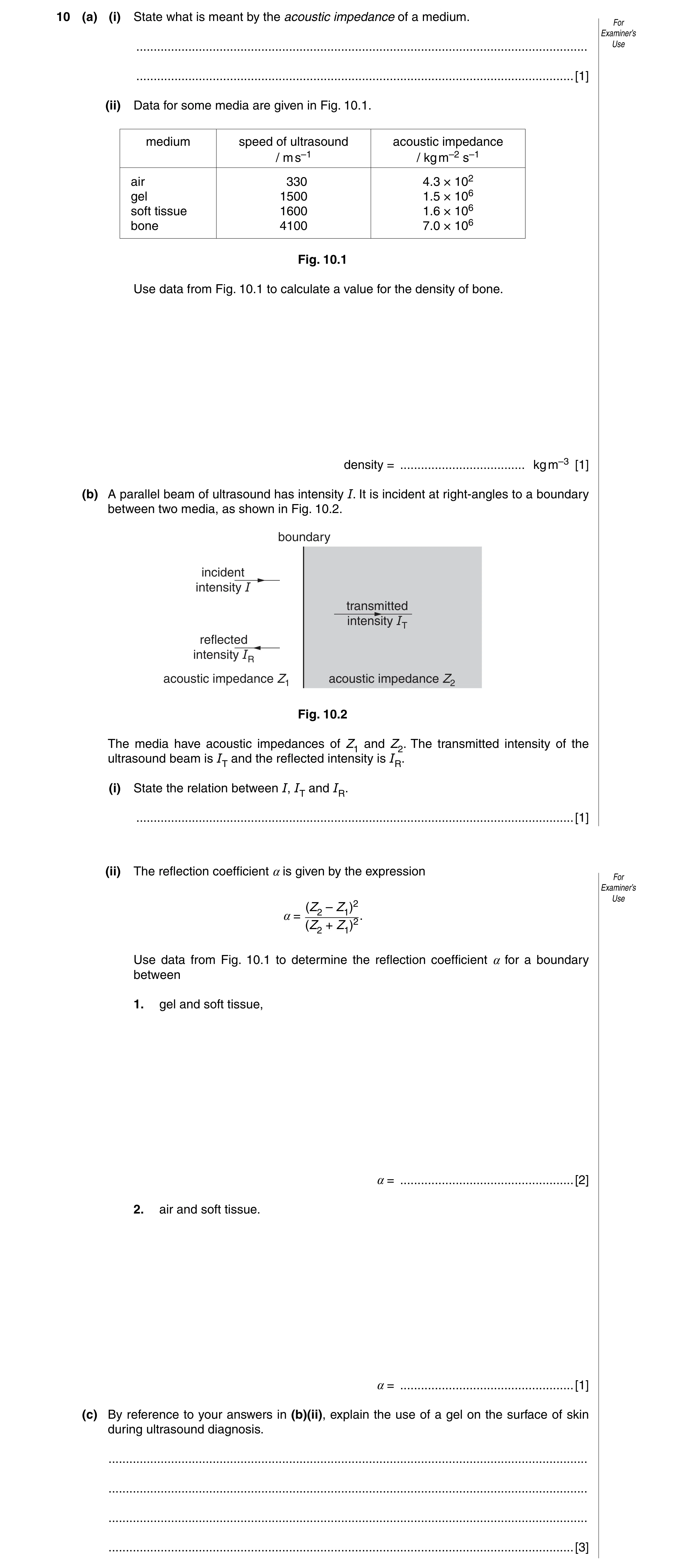
10 (a) (i) State what is meant by the acoustic impedance of a medium. For Examiner’s … Use … [1] (ii) Data for some media are given in Fig. 10.1. medium speed of ultrasound acoustic impedance / m s–1 / kg m–2 s–1 air 330 4.3 × 10² gel 1500 1.5 × 10⁶ soft tissue 1600 1.6 × 10⁶ bone 4100 7.0 × 10⁶ Fig. 10.1 Use data from Fig. 10.1 to calculate a value for the density of bone. density = … kg m–3 [1] (b) A parallel beam of ultrasound has intensity I. It is incident at right-angles to a boundary between two media, as shown in Fig. 10.2. boundary incident intensity I transmitted intensity IT reflected intensity IR acoustic impedance Z1 acoustic impedance Z2 Fig. 10.2 The media have acoustic impedances of Z1 and Z2. The transmitted intensity of the ultrasound beam is IT and the reflected intensity is IR. (i) State the relation between I, IT and IR. … [1] (ii) The reflection coefficient a is given by the expression For Examiner’s Use (Z2 – Z1)2 a = (Z2 + Z1)2. Use data from Fig. 10.1 to determine the reflection coefficient a for a boundary between 1. gel and soft tissue, a = … [2] 2. air and soft tissue. a = … [1] (c) By reference to your answers in (b)(ii), explain the use of a gel on the surface of skin during ultrasound diagnosis. … … … … [3]
9 marks
Mark scheme: 10 (a) (i) density × speed of wave (in the medium) B1 [1] (ii) ρ = (7.0 × 10⁶) / 4100 = 1700 kg m–3 A1 [1] (b) (i) I = IT + IR B1 [1] (ii) 1. α = (0.1 × 10⁶)2 / (3.1 × 10⁶)2 C1 = 0.001 A1 [2] 2. α ≈ 1 A1 [1] (c) either very little transmission at an air-skin boundary M1 (almost) complete transmission at a gel-skin boundary M1 when wave travels in or out of the body A1 [3] or no gel, majority reflection (M1) with gel, little reflection (M1) when wave travels in or out of the body (A1)
This question in 9702/42 Oct/Nov 2010
Q5 · In a mobile phone system, the area covered by the system is divided into a number of For… 9702/43 May/June 2012
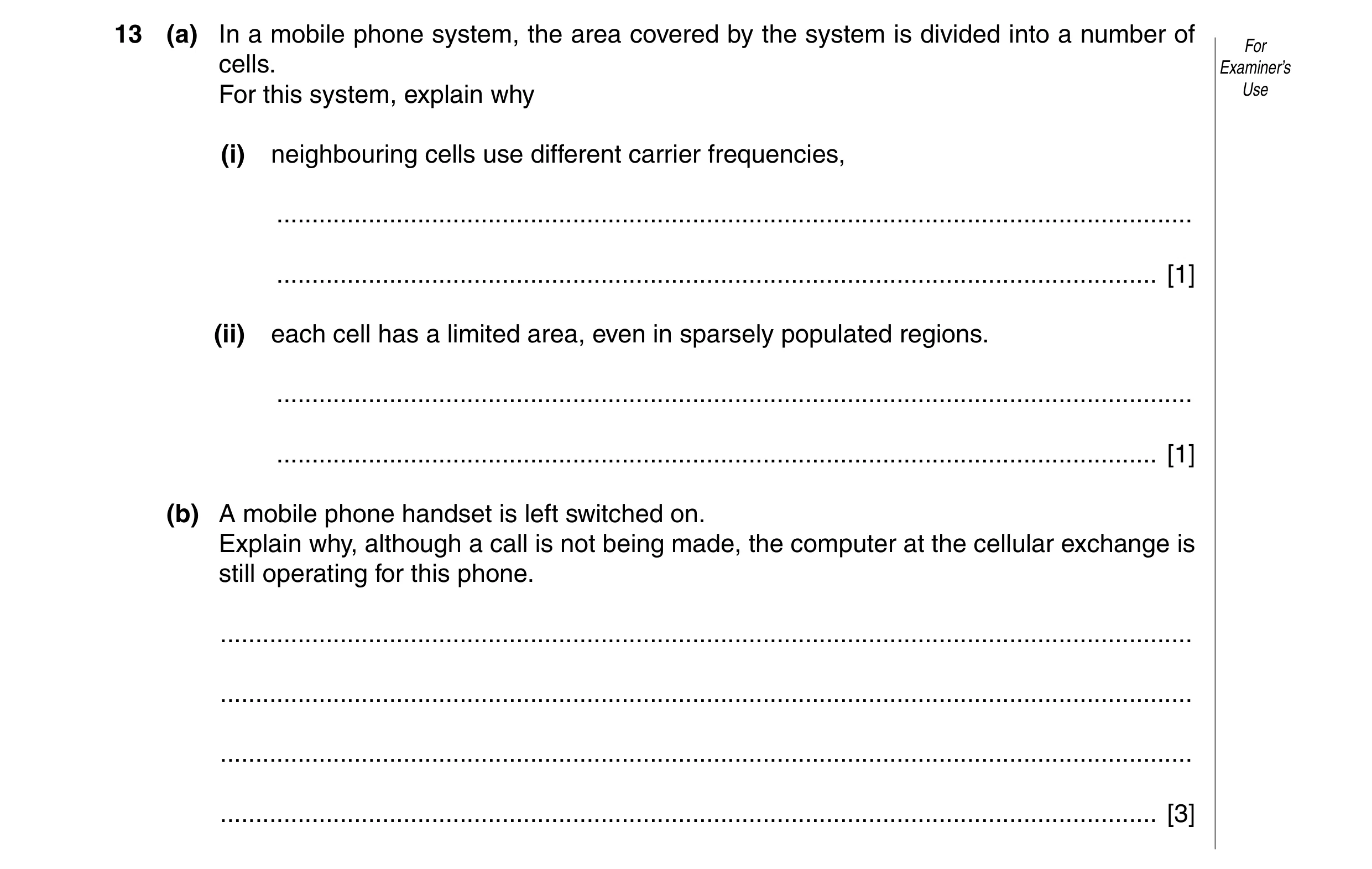
13 (a) In a mobile phone system, the area covered by the system is divided into a number of For cells. Examiner’s For this system, explain why Use (i) neighbouring cells use different carrier frequencies, … … [1] (ii) each cell has a limited area, even in sparsely populated regions. … … [1] (b) A mobile phone handset is left switched on. Explain why, although a call is not being made, the computer at the cellular exchange is still operating for this phone. … … … … [3]
5 marks
Mark scheme: 13 (a) (i) no interference (between signals) near boundaries (of cells) B1 [1] (ii) for large area, signal strength would have to be greater and this could be hazardous to health B1 [1] (b) mobile phone is sending out an (identifying) signal M1 computer/cellular exchange continuously selects cell/base station with strongest signal A1 computer/cellular exchange allocates (carrier) frequency (and slot) A1 [3]
This question in 9702/43 May/June 2012
Q6 · State what is meant by a photon 9702/43 Oct/Nov 2014
8 (a) State what is meant by a photon. … … … [2] (b) A beam of light is incident normally on a metal surface, as illustrated in Fig. 8.1. light beam metal surface area of cross-section 1.3 × 10⁻⁵ m2 Fig. 8.1 The beam of light has cross-sectional area 1.3 × 10⁻⁵ m2 and power 2.7 × 10⁻³ W. The light has wavelength 570 nm. The light energy is absorbed by the metal and no light is reflected. (i) Show that a photon of this light has an energy of 3.5 × 10⁻¹⁹ J. [1] (ii) Calculate, for a time of 1.0 s, 1. the number of photons incident on the surface, number = … [2] 2. the change in momentum of the photons. change in momentum = … kg m s−1 [3] (c) Use your answer in (b)(ii) to calculate the pressure that the light exerts on the metal surface. pressure = … Pa [2]
10 marks
Mark scheme: 8 (a) discrete amount / packet / quantum of energy M1 of electromagnetic radiation / EM radiation A1 [2] (b) (i) E = hc / λ = (6.63 × 10–34 × 3.0 × 108) / (570 × 10–9) = 3.49 × 10⁻¹⁹ J A1 [1] (ii) 1. number = (2.7 × 10⁻³) / (3.5 × 10⁻¹⁹) C1 = 7.7 × 10¹⁵ A1 [2] 2. momentum of photon = h / λ C1 = (6.63 × 10⁻³⁴) / (570 × 10–9) = 1.16 × 10⁻²⁷ kg m s–1 C1 change in momentum = 1.16 × 10–27 × 7.7 × 1015 = 8.96 × 10⁻¹² kg m s–1 A1 [3] (allow E = pc route to 9 × 10–12) (c) pressure = (change in momentum per second) / area C1 = (8.96 × 10⁻¹²) / (1.3 × 10⁻⁵) = 6.9 × 10⁻⁷ Pa A1 [2] 14 6
This question in 9702/43 Oct/Nov 2014
Q7 · Define simple harmonic motion 9702/43 Oct/Nov 2015
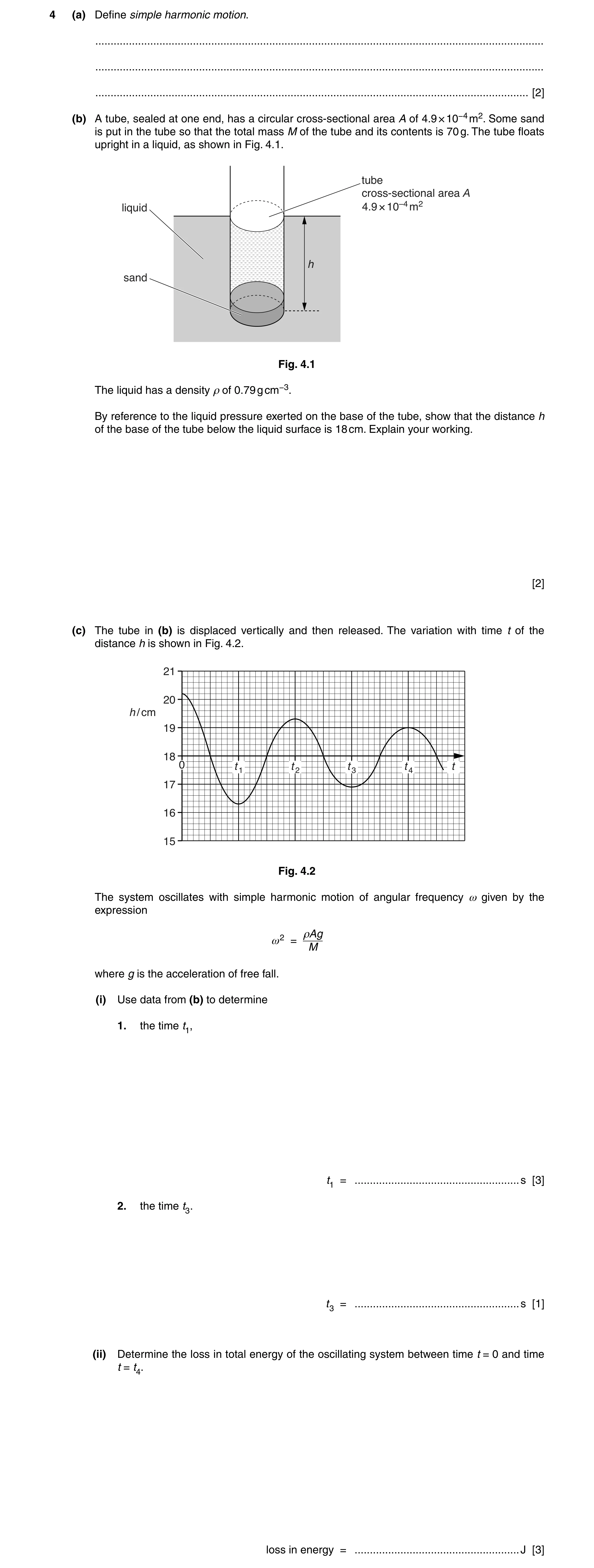
4 (a) Define simple harmonic motion. … … … [2] (b) A tube, sealed at one end, has a circular cross-sectional area A of 4.9 × 10⁻⁴ m2. Some sand is put in the tube so that the total mass M of the tube and its contents is 70 g. The tube floats upright in a liquid, as shown in Fig. 4.1. tube cross-sectional area A liquid 4.9 × 10⁻⁴ m2 h sand Fig. 4.1 The liquid has a density ρ of 0.79 g cm−3. By reference to the liquid pressure exerted on the base of the tube, show that the distance h of the base of the tube below the liquid surface is 18 cm. Explain your working. [2] (c) The tube in (b) is displaced vertically and then released. The variation with time t of the distance h is shown in Fig. 4.2. 21 20 h / cm 19 18 0 t 1 t 2 t 3 t 4 t 17 16 15 Fig. 4.2 The system oscillates with simple harmonic motion of angular frequency ω given by the expression ρAg ω2 = M where g is the acceleration of free fall. (i) Use data from (b) to determine 1. the time t1, t1 = … s [3] 2. the time t3. t3 = … s [1] (ii) Determine the loss in total energy of the oscillating system between time t = 0 and time t = t4. loss in energy = … J [3]
11 marks
Mark scheme: 4 (a) acceleration/force proportional to distance from a fixed point or displacement M1 either acceleration/force and displacement in opposite directions or acceleration/force (always) directed towards a fixed point/mean position/equilibrium position A1 [2] (b) hρ g = Mg / A B1 h × 790 × 4.9 × 10–4 = 70 × 10–3 leading to h = 0.18 m or 18 cm A1 [2] (c) (i) 1. ω2 = (790 × 4.9 × 10–4 × 9.81) / (70 × 10–3) C1 = 54.25 ω = 7.37 (rad s–1) period (= 2π / ω) = 0.85 s C1 t1 = 0.43 s A1 [3] 2. t3 = 1.28 s (allow 2 s.f.) A1 [1] (ii) energy of peak = ½Mω2x02 B1 change = ½ × 70 × 10–3 × 54.25 {(2.2 × 10⁻²)2 – (1.0 × 10⁻²)2} C1 = 7.3 × 10⁻⁴ J A1 [3]
This question in 9702/43 Oct/Nov 2015
Q8 · A magnetic field of flux density B is normal to face PQRS of a slice of a conducting… 9702/42 May/June 2016
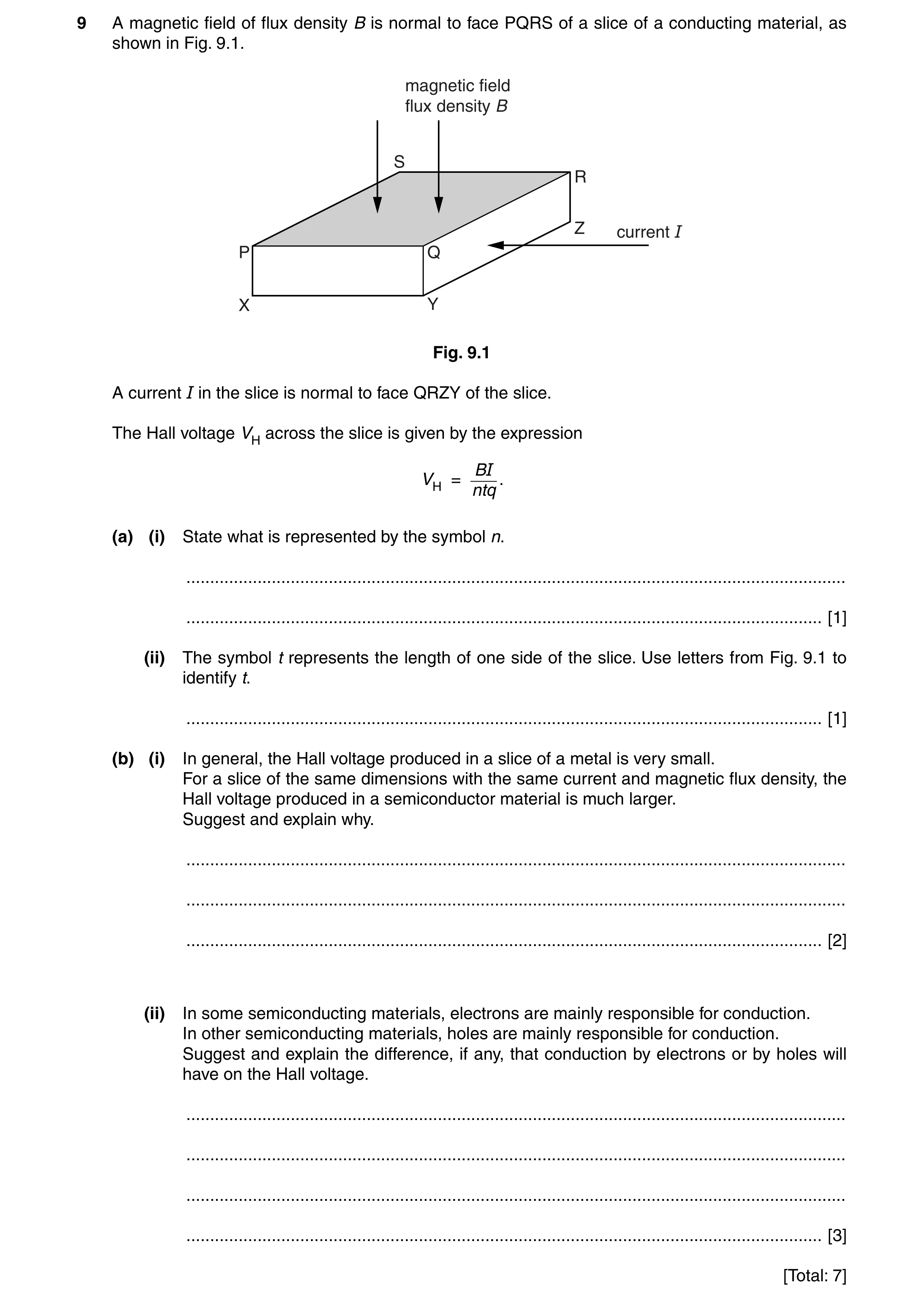
9 A magnetic field of flux density B is normal to face PQRS of a slice of a conducting material, as shown in Fig. 9.1. magnetic field flux density % S R Z FXUUHQW I P Q X Y Fig. 9.1 A current I in the slice is normal to face QRZY of the slice. The Hall voltage VH across the slice is given by the expression BI VH = . ntq (a) (i) State what is represented by the symbol n. … … [1] (ii) The symbol t represents the length of one side of the slice. Use letters from Fig. 9.1 to identify t. … [1] (b) (i) In general, the Hall voltage produced in a slice of a metal is very small. For a slice of the same dimensions with the same current and magnetic flux density, the Hall voltage produced in a semiconductor material is much larger. Suggest and explain why. … … … [2] (ii) In some semiconducting materials, electrons are mainly responsible for conduction. In other semiconducting materials, holes are mainly responsible for conduction. Suggest and explain the difference, if any, that conduction by electrons or by holes will have on the Hall voltage. … … … … [3] [Total: 7]
7 marks
Mark scheme: 9 (a) (i) number density of charge carriers/free electrons or number per unit volume of charge carriers/free electrons B1 [1] (ii) PX or QY or RZ B1 [1] (b) (i) VH is inversely proportional to n B1 for semiconductors, n is (much) smaller than for metals B1 [2] (ii) magnetic field would deflect holes and electrons in same direction B1 (because) electrons are (–)ve, holes are (+)ve M1 so VH has opposite polarity/opposite sign A1 [3]
This question in 9702/42 May/June 2016
Q9 · A small wooden block (cuboid) of mass m floats in water, as shown in Fig 9702/42 Feb/March 2022
3 A small wooden block (cuboid) of mass m floats in water, as shown in Fig. 3.1. wooden block mass m water density ρ Fig. 3.1 The top face of the block is horizontal and has area A. The density of the water is ρ. (a) State the names of the two forces acting on the block when it is stationary. … [1] (b) The block is now displaced downwards as shown in Fig. 3.2 so that the surface of the water is higher up the block. new position of water surface original position of water surface Fig. 3.2 State and explain the direction of the resultant force acting on the wooden block in this position. … … [1] (c) The block in (b) is now released so that it oscillates vertically. The resultant force F acting on the block is given by F = –Agρx where g is the gravitational field strength and x is the vertical displacement of the block from the equilibrium position. (i) Explain why the oscillations of the block are simple harmonic. … … … [2] (ii) Show that the angular frequency ω of the oscillations is given by Aρ g ω = . m [2] (d) The block is now placed in a liquid with a greater density. The block is displaced and released so that it oscillates vertically. The variation with displacement x of the acceleration a of the block is measured for the first half oscillation, as shown in Fig. 3.3. 3 a / m s–2 2 1 0 –0.02 –0.01 0 0.01 0.02 x / m –1 –2 Fig. 3.3 (i) Explain why the maximum negative displacement of the block is not equal to its maximum positive displacement. … … … [1] (ii) The mass of the block is 0.57 kg. Use Fig. 3.3 to determine the decrease ΔE in energy of the oscillation for the first half oscillation. E = … J [3] [Total: 10]
10 marks
Mark scheme: 3(a) upthrust, weight B1 3(b) upthrust greater than weight so (resultant force is) upwards B1 3(c)(i) A, g and ρ all constant so F ∝ x B1 minus sign means F and x are in opposite directions B1 3(c)(ii) F Agρx (a = so) a = ( ) m m − M1 2 Ag Ag so = hence = m m ρ ρ ω ω A1 3(d)(i) damping due to viscous forces B1 3(d)(ii) ( ) 2 2 0 1 E = m x 2 ω C1 ω2 = (–) gradient C1 ( ) 2 2 2 1 2 1 E = m (x x ) 2 ω − 2 2 2.3 1 0.57 ( )(0.020 0.016 ) 2 0.020 = × × − 3 = 4.7 10 J − × A1
This question in 9702/42 Feb/March 2022
Q10 · Define specific heat capacity 9702/42 May/June 2025
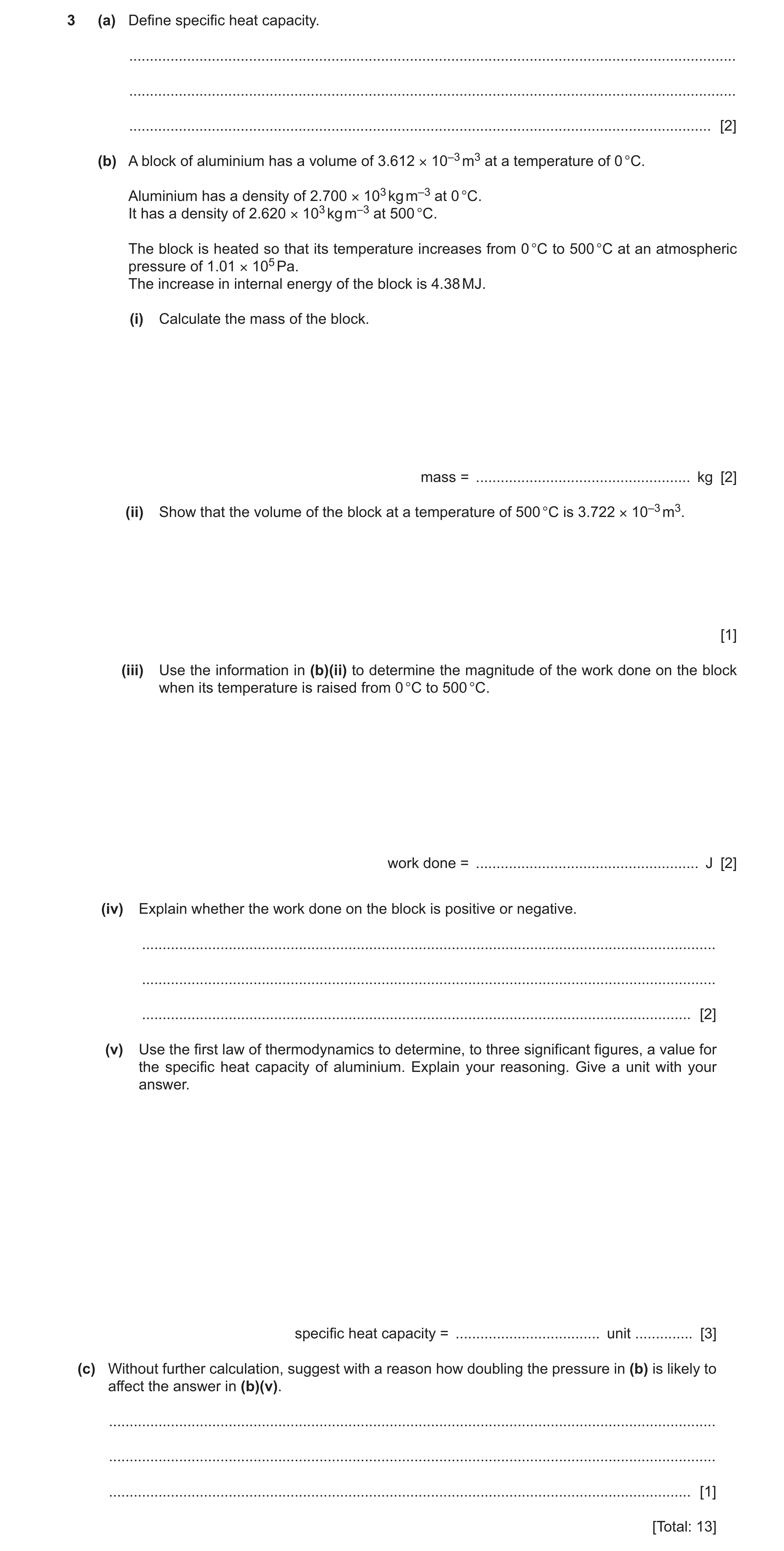
3 (a) Define specific heat capacity. … … … [2] (b) A block of aluminium has a volume of 3.612 × 10⁻³ m3 at a temperature of 0 °C. Aluminium has a density of 2.700 × 10³ kg m–3 at 0 °C. It has a density of 2.620 × 10³ kg m–3 at 500 °C. The block is heated so that its temperature increases from 0 °C to 500 °C at an atmospheric pressure of 1.01 × 10⁵ Pa. The increase in internal energy of the block is 4.38 MJ. (i) Calculate the mass of the block. mass = … kg [2] (ii) Show that the volume of the block at a temperature of 500 °C is 3.722 × 10⁻³ m3. [1] (iii) Use the information in (b)(ii) to determine the magnitude of the work done on the block when its temperature is raised from 0 °C to 500 °C. work done = … J [2] (iv) Explain whether the work done on the block is positive or negative. … … … [2] (v) Use the first law of thermodynamics to determine, to three significant figures, a value for the specific heat capacity of aluminium. Explain your reasoning. Give a unit with your answer. specific heat capacity = … unit … [3] (c) Without further calculation, suggest with a reason how doubling the pressure in (b) is likely to affect the answer in (b)(v). … … … [1] [Total: 13]
13 marks
Mark scheme: 3(a) (thermal) energy per unit mass (to cause temperature change) B1 (thermal) energy per unit change in temperature B1 3(b)(i) density = mass / volume C1 mass = 2.700 × 103 × 3.612 × 10–3 A1 = 9.752 kg 3(b)(ii) volume = 3.612 × 10–3 × (2.700 / 2.620) = 3.722 × 10⁻³ m3 A1 or volume = 9.752 / (2.620 × 10³) = 3.722 × 10⁻³ m3 3(b)(iii) W = pV C1 = 1.01 × 105 × (3.722 – 3.612) × 10–3 A1 = 11.1 J 3(b)(iv) volume (of block) increases B1 work is done against the atmosphere so work done (on block) is negative B1 3(b)(v) thermal energy = (4.38 × 10⁶) + 11.1 B1 specific heat capacity = (4.38 × 10⁶) / (9.75 × 500) C1 = 898 J kg–1 °C–1 A1 3(c) work done is negligible compared with (change in) internal energy so (answer in (b)(v) would be) unchanged B1
This question in 9702/42 May/June 2025
Q11 · A cylinder contains a fixed mass of an ideal gas at pressure 2Y and volume 6X 9702/42 Oct/Nov 2025
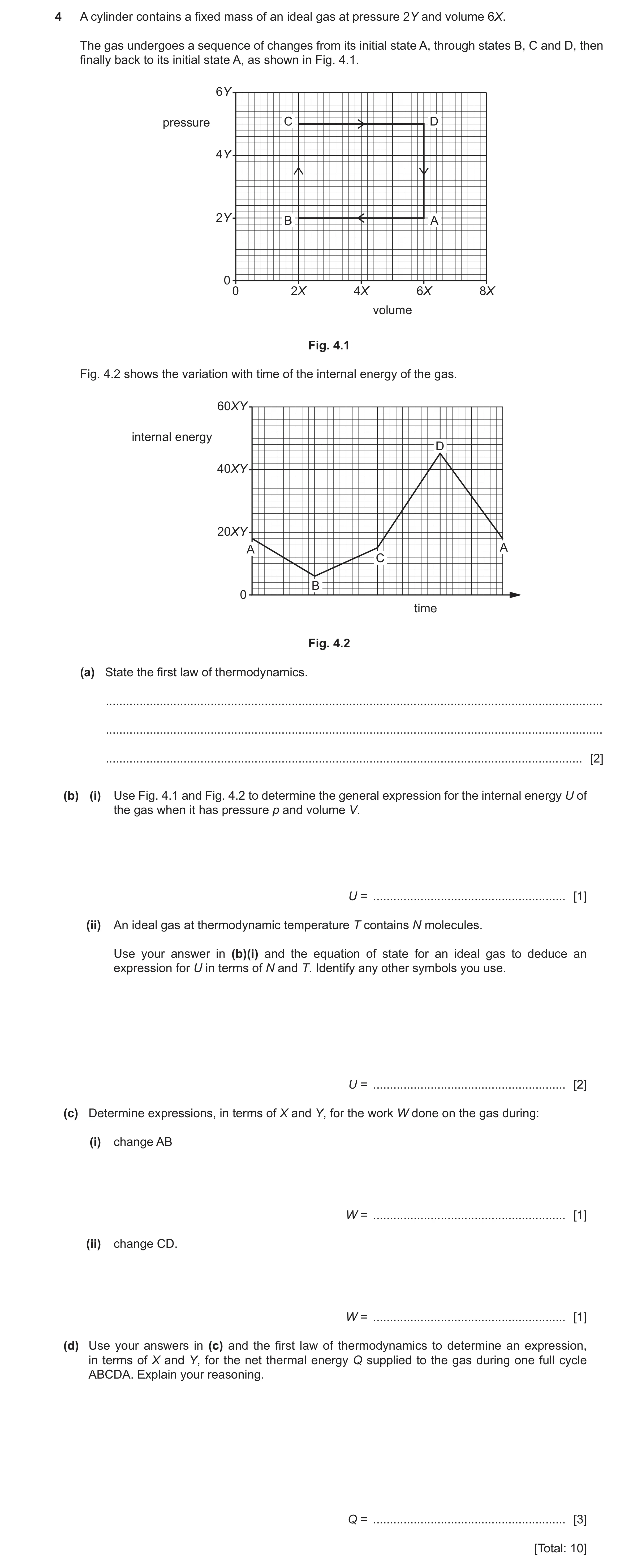
4 A cylinder contains a fixed mass of an ideal gas at pressure 2Y and volume 6X. The gas undergoes a sequence of changes from its initial state A, through states B, C and D, then finally back to its initial state A, as shown in Fig. 4.1. 6Y pressure C D 4Y 2Y B A 0 0 2X 4X 6X 8X volume Fig. 4.1 Fig. 4.2 shows the variation with time of the internal energy of the gas. 60XY internal energy D 40XY 20XY A A C B 0 time Fig. 4.2 (a) State the first law of thermodynamics. … … … [2] (b) (i) Use Fig. 4.1 and Fig. 4.2 to determine the general expression for the internal energy U of the gas when it has pressure p and volume V. U = … [1] (ii) An ideal gas at thermodynamic temperature T contains N molecules. Use your answer in (b)(i) and the equation of state for an ideal gas to deduce an expression for U in terms of N and T. Identify any other symbols you use. U = … [2] (c) Determine expressions, in terms of X and Y, for the work W done on the gas during: (i) change AB W = … [1] (ii) change CD. W = … [1] (d) Use your answers in (c) and the first law of thermodynamics to determine an expression, in terms of X and Y, for the net thermal energy Q supplied to the gas during one full cycle ABCDA. Explain your reasoning. Q = … [3] [Total: 10]
10 marks
Mark scheme: 4(a) change in internal energy = work done + energy transfer by heating C1 increase in internal energy = work done on system + energy transferred to the system by heating A1 4(b)(i) U = (3 / 2) pV A1 4(b)(ii) pV = NkT and k identified as Boltzmann constant B1 U = (3 / 2) NkT A1 4(c)(i) W = (+)8XY A1 4(c)(ii) W = –20XY A1 4(d) work done during stages BC and DA = 0 B1 change in internal energy (over complete cycle) = 0 C1 thermal energy supplied = 20XY – 8XY A1 = (+)12XY
This question in 9702/42 Oct/Nov 2025
 2 / 17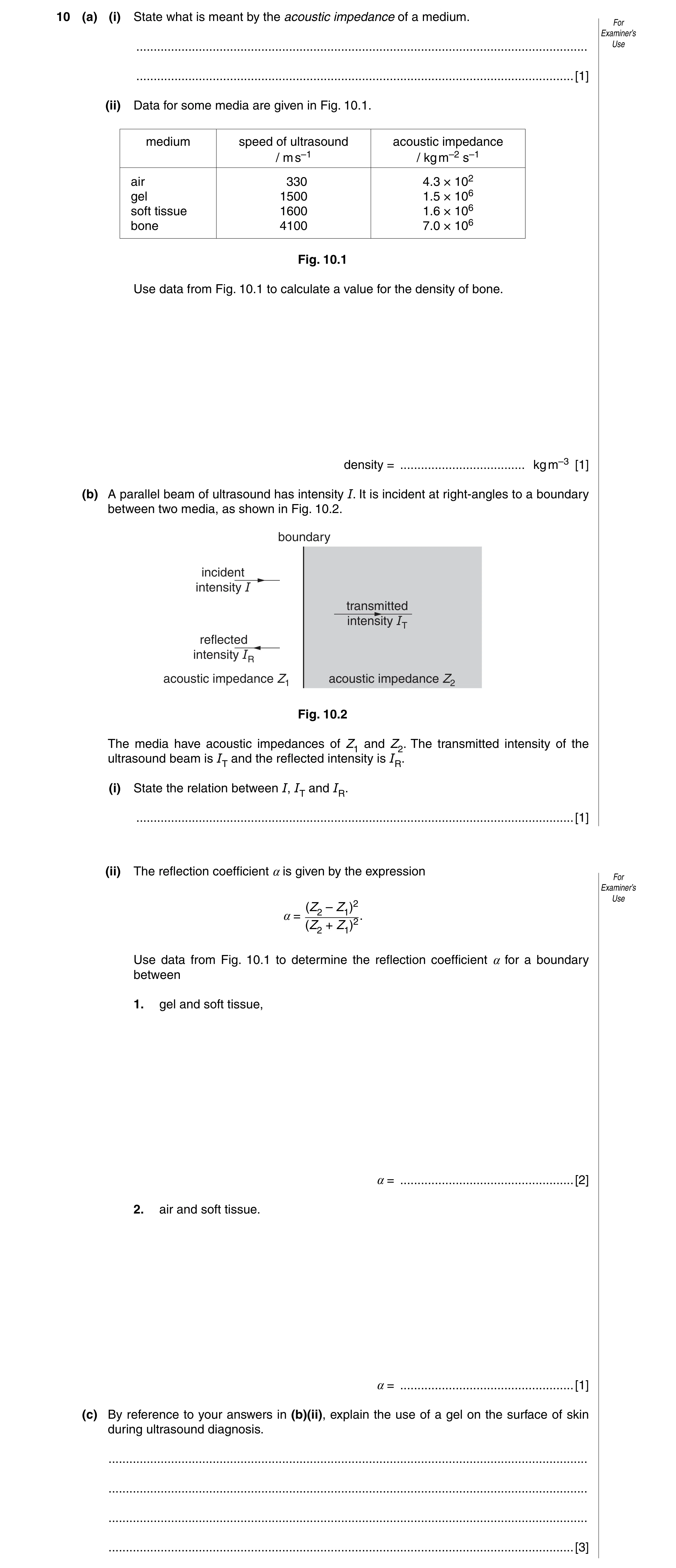
 7 / 17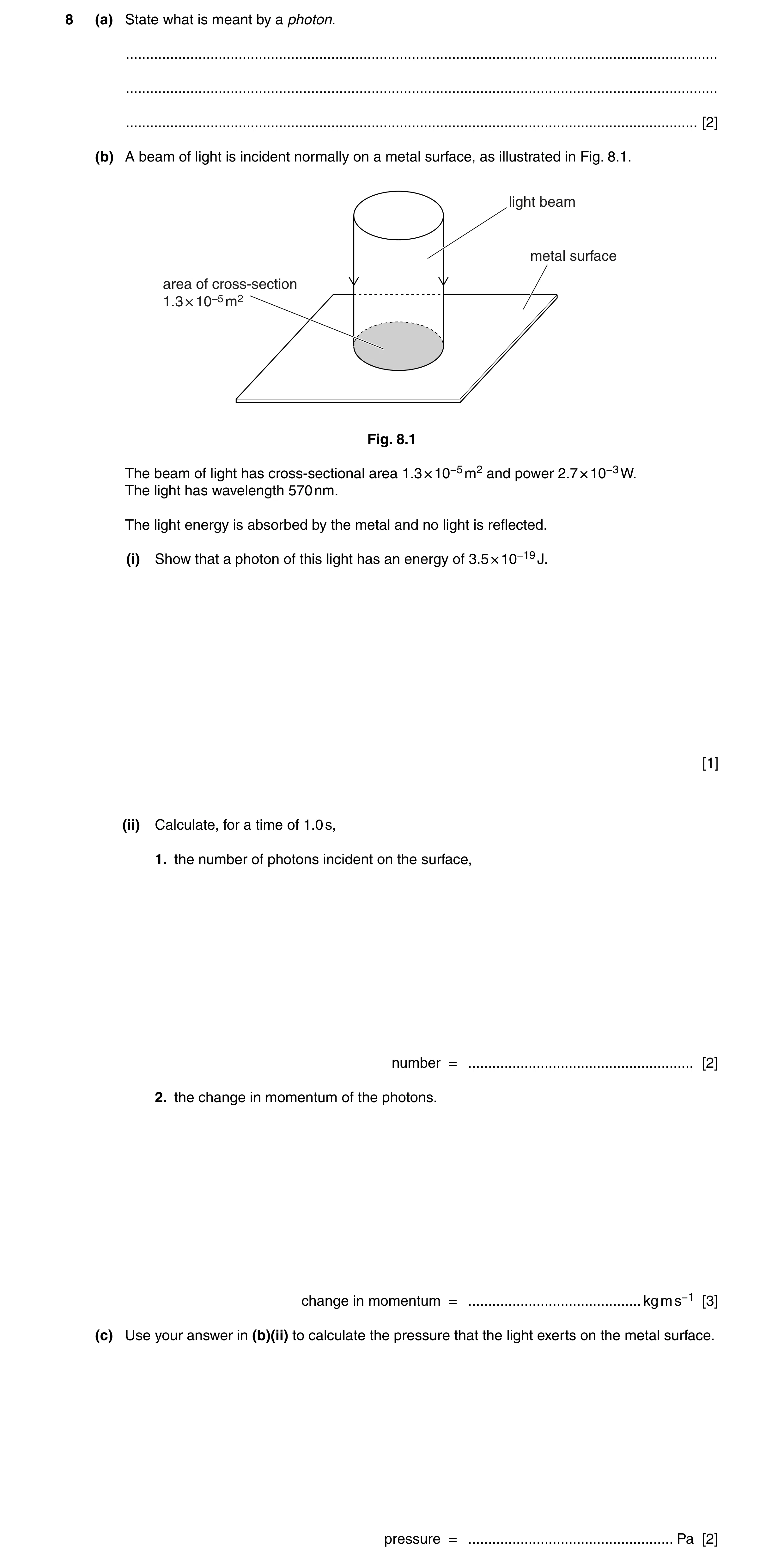
 11 / 17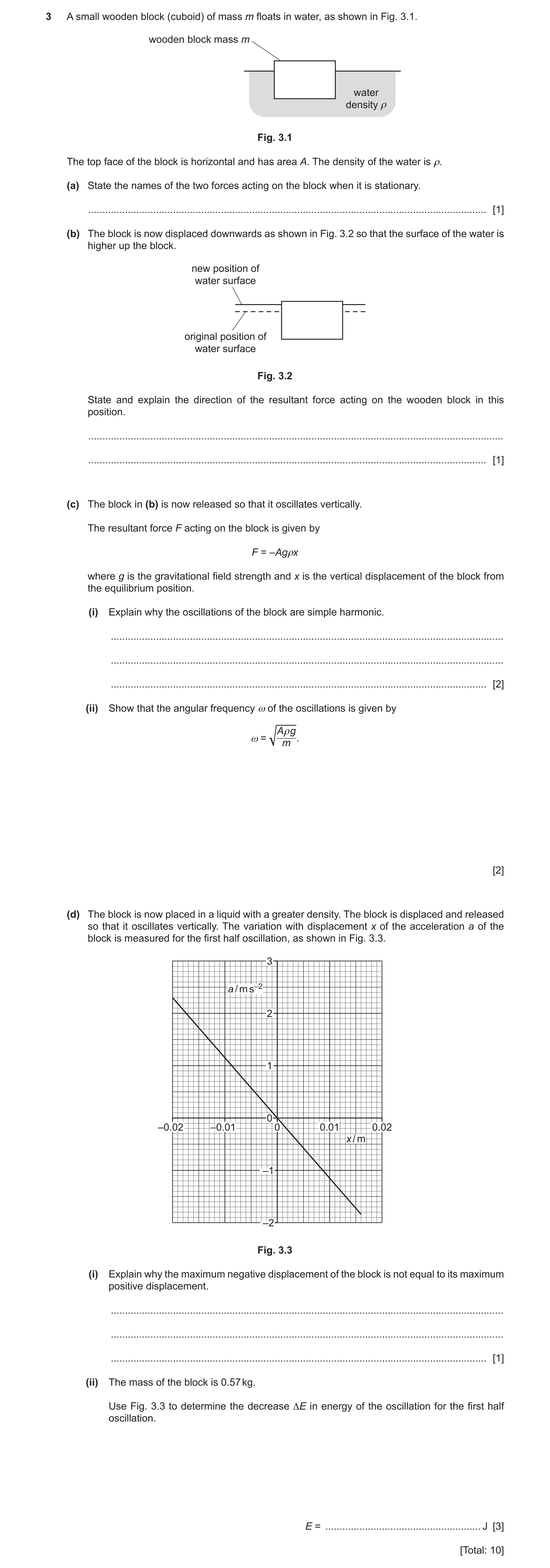
 11
11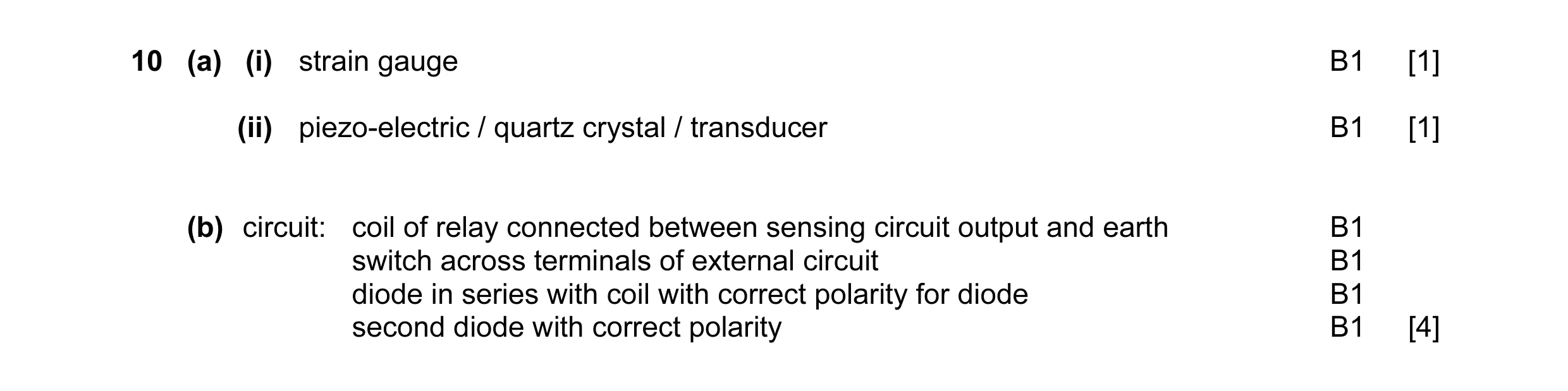 6
6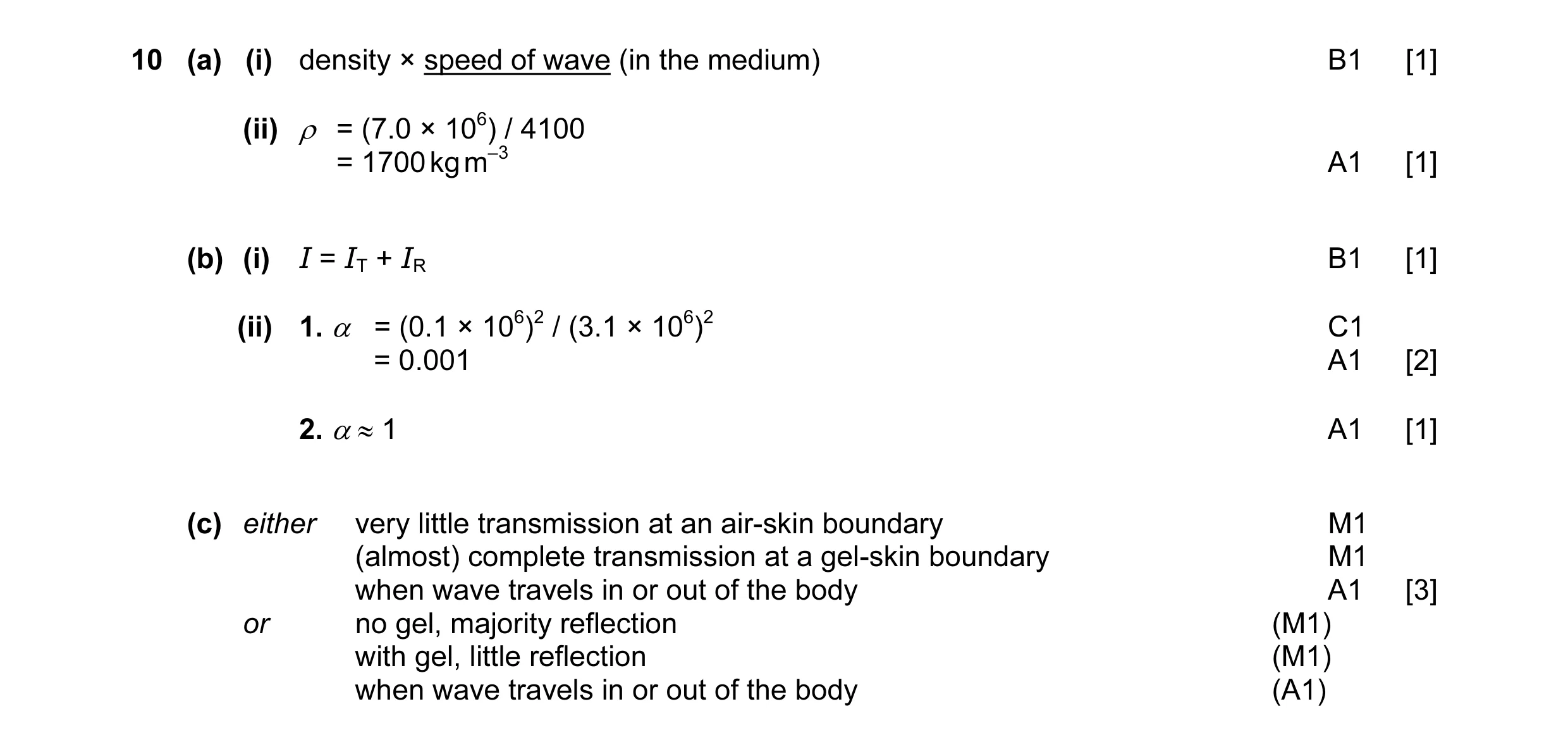 9
9 9
9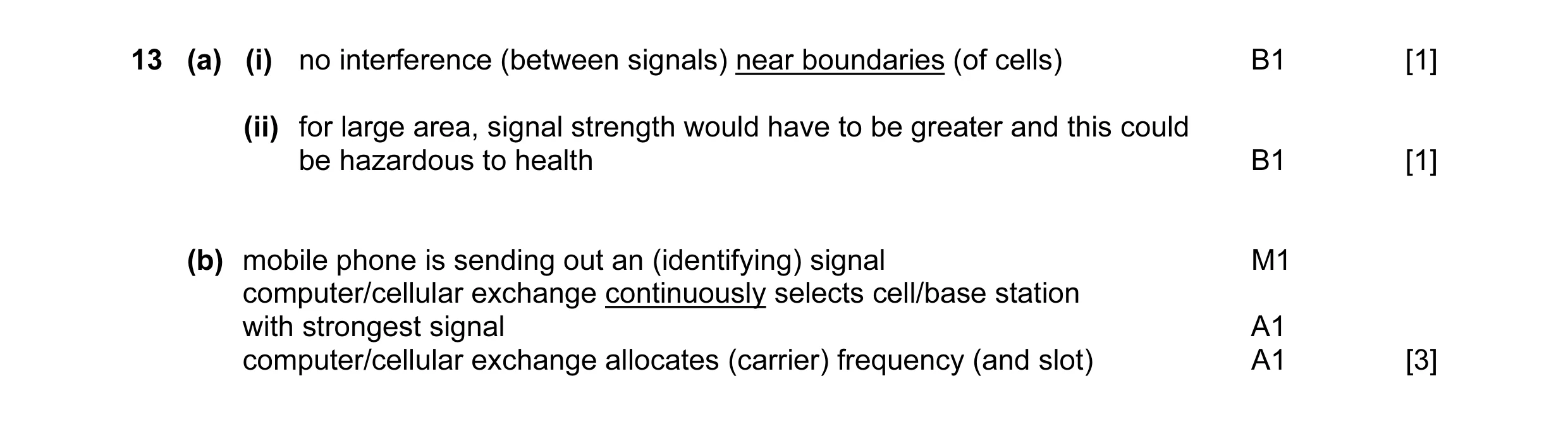 5
5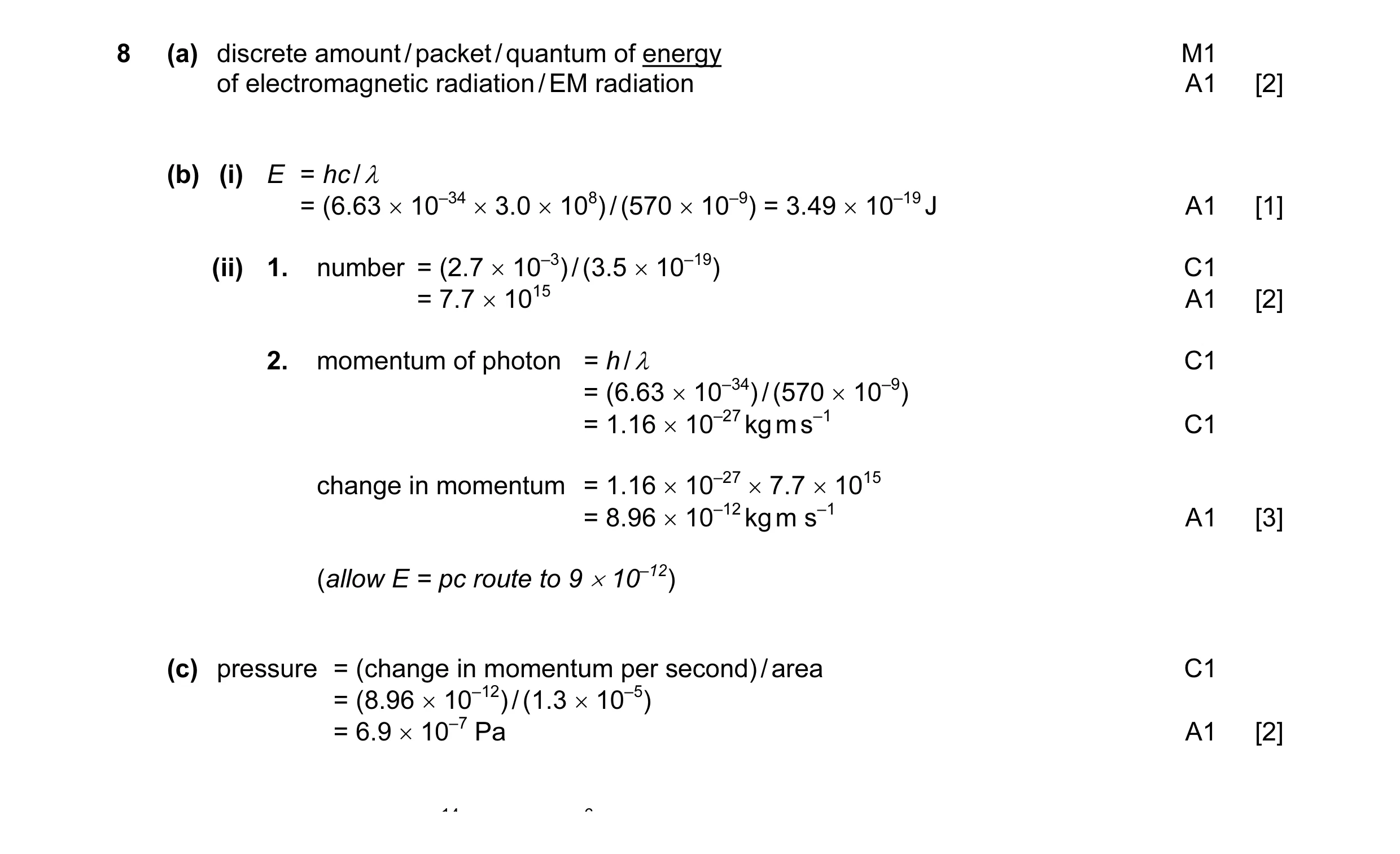 10
10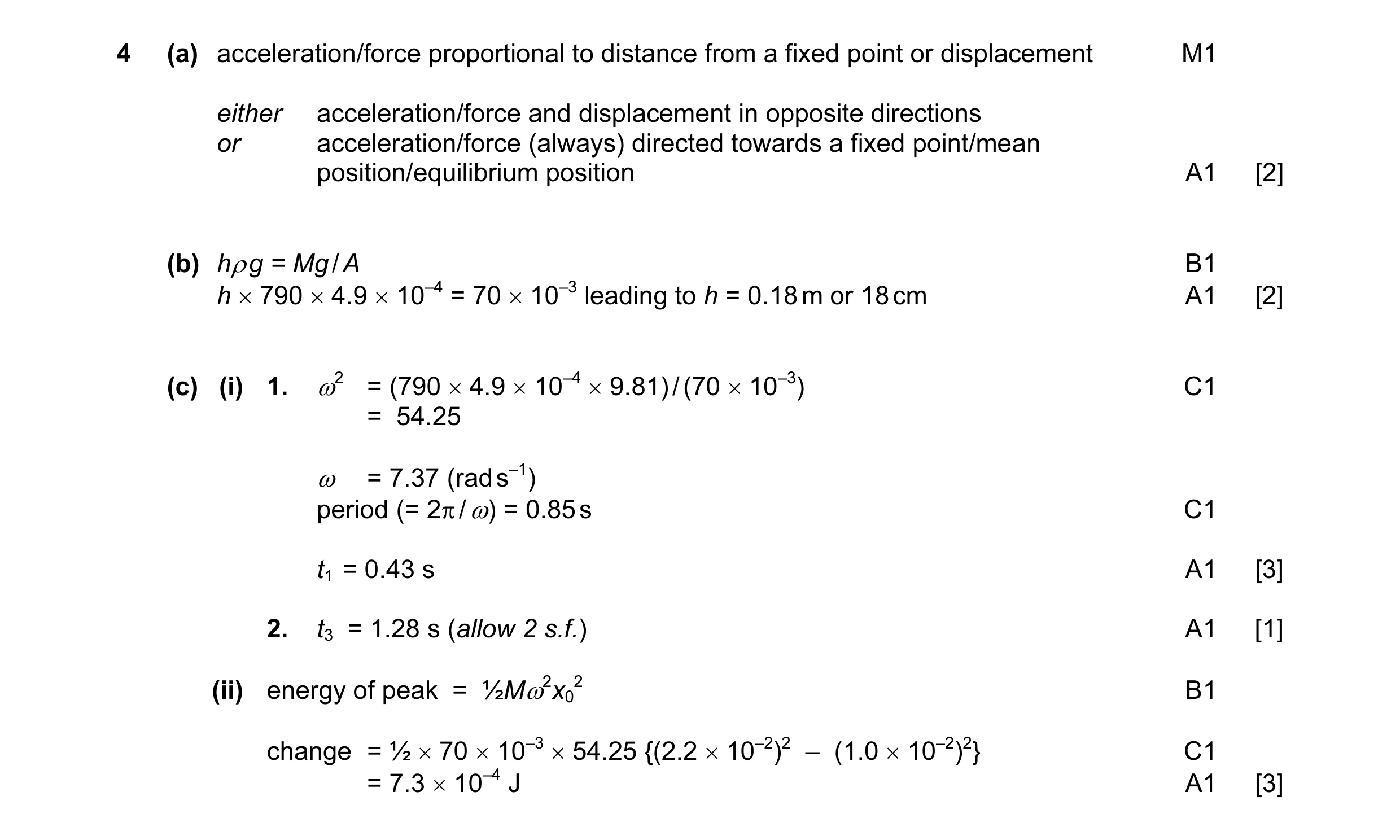 11
11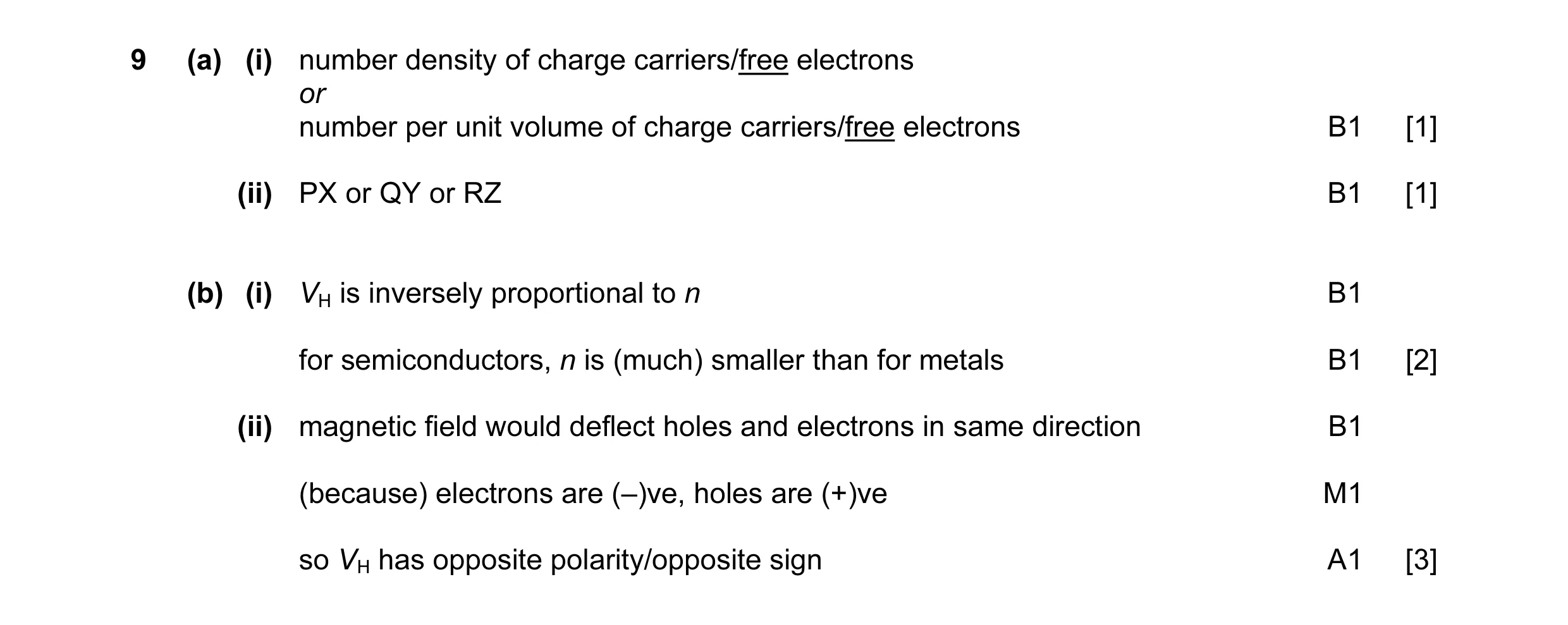 7
7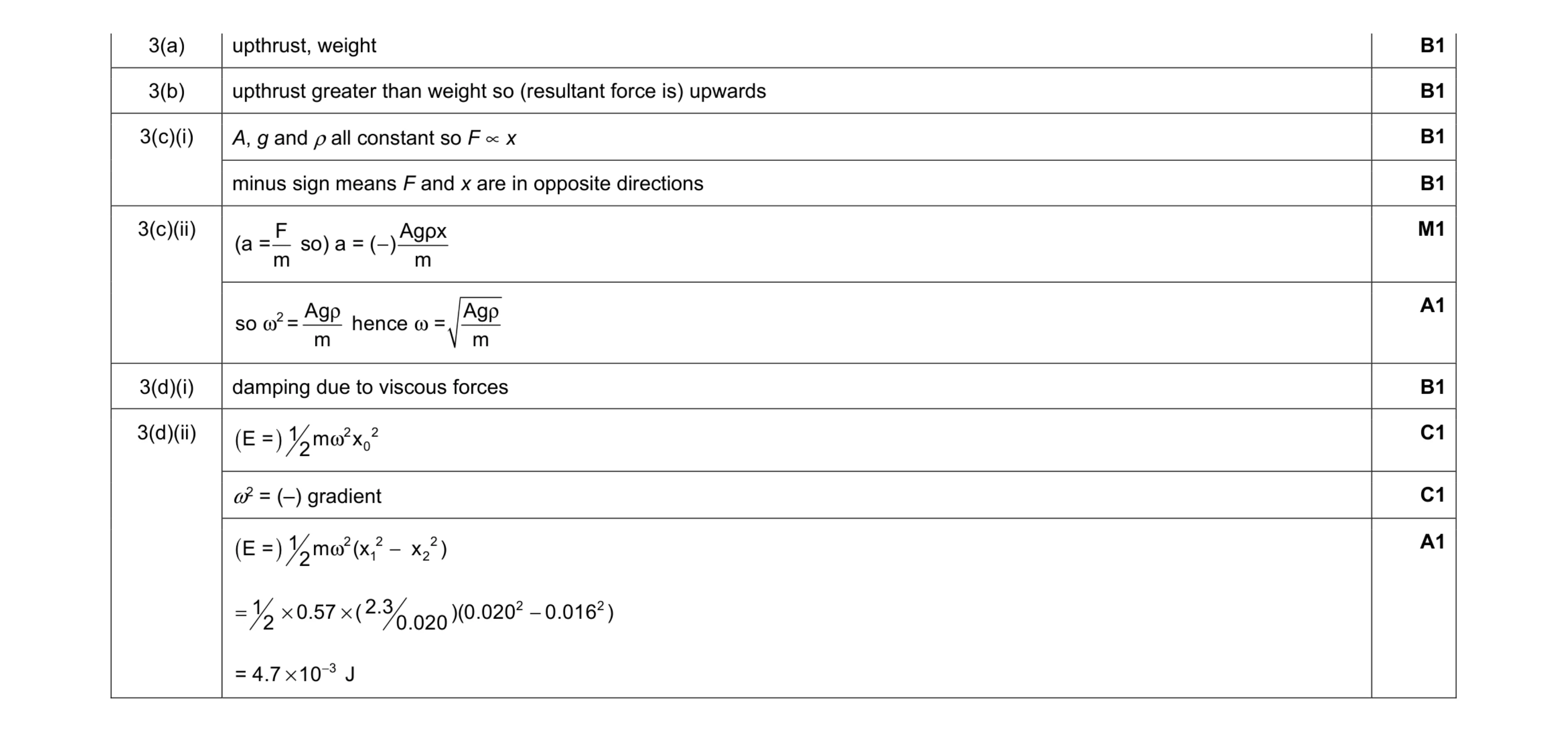 10
10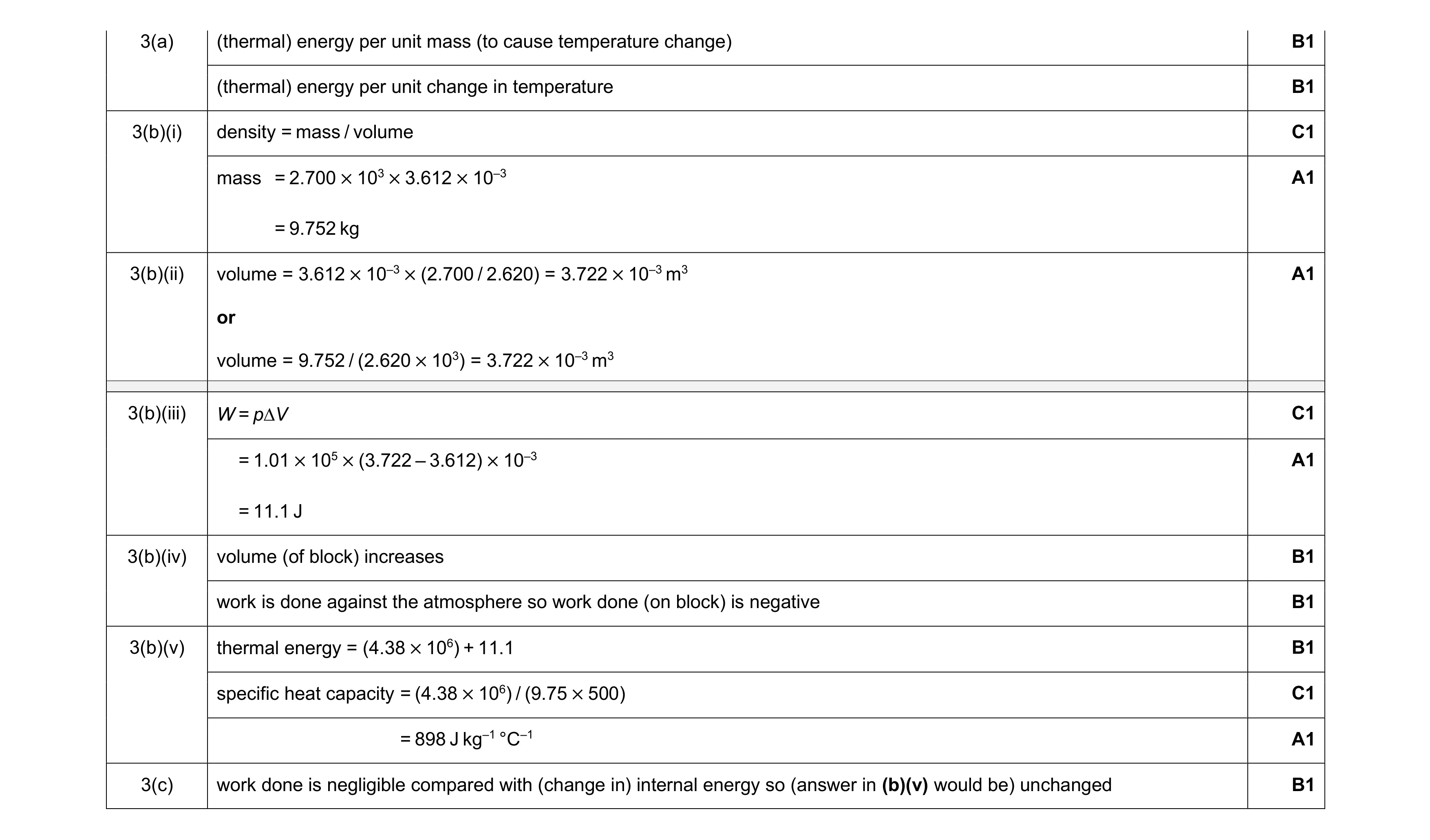 13
13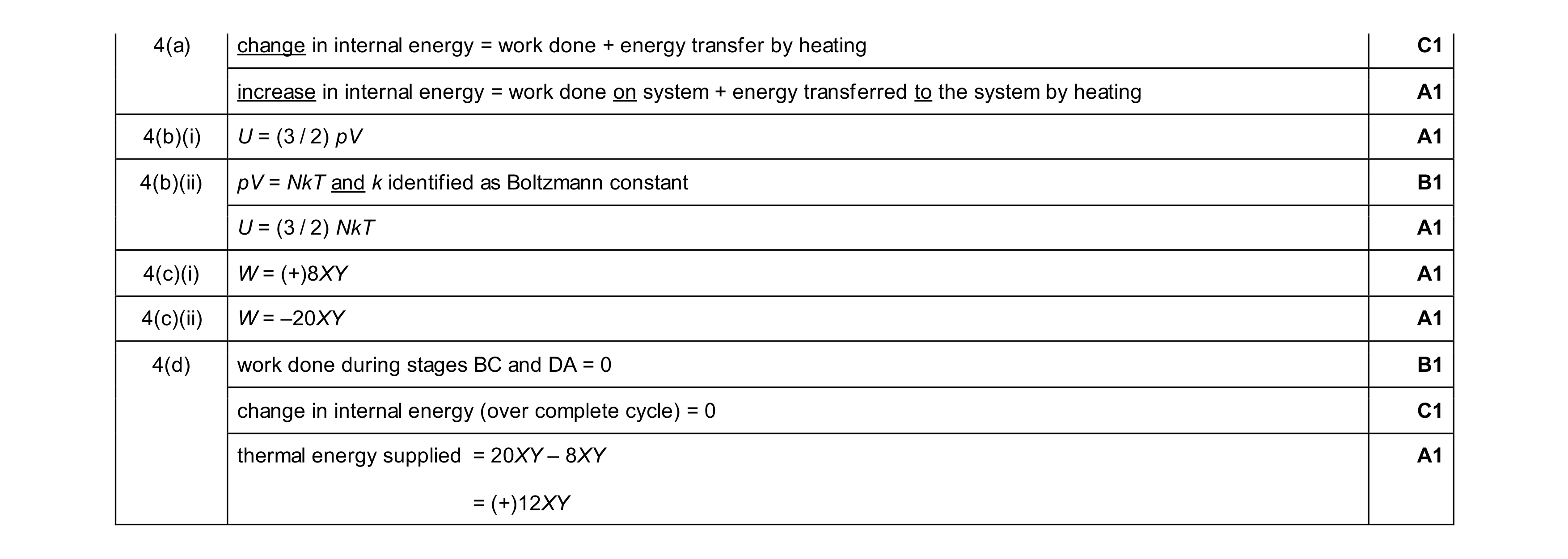 10
10