Questions as text
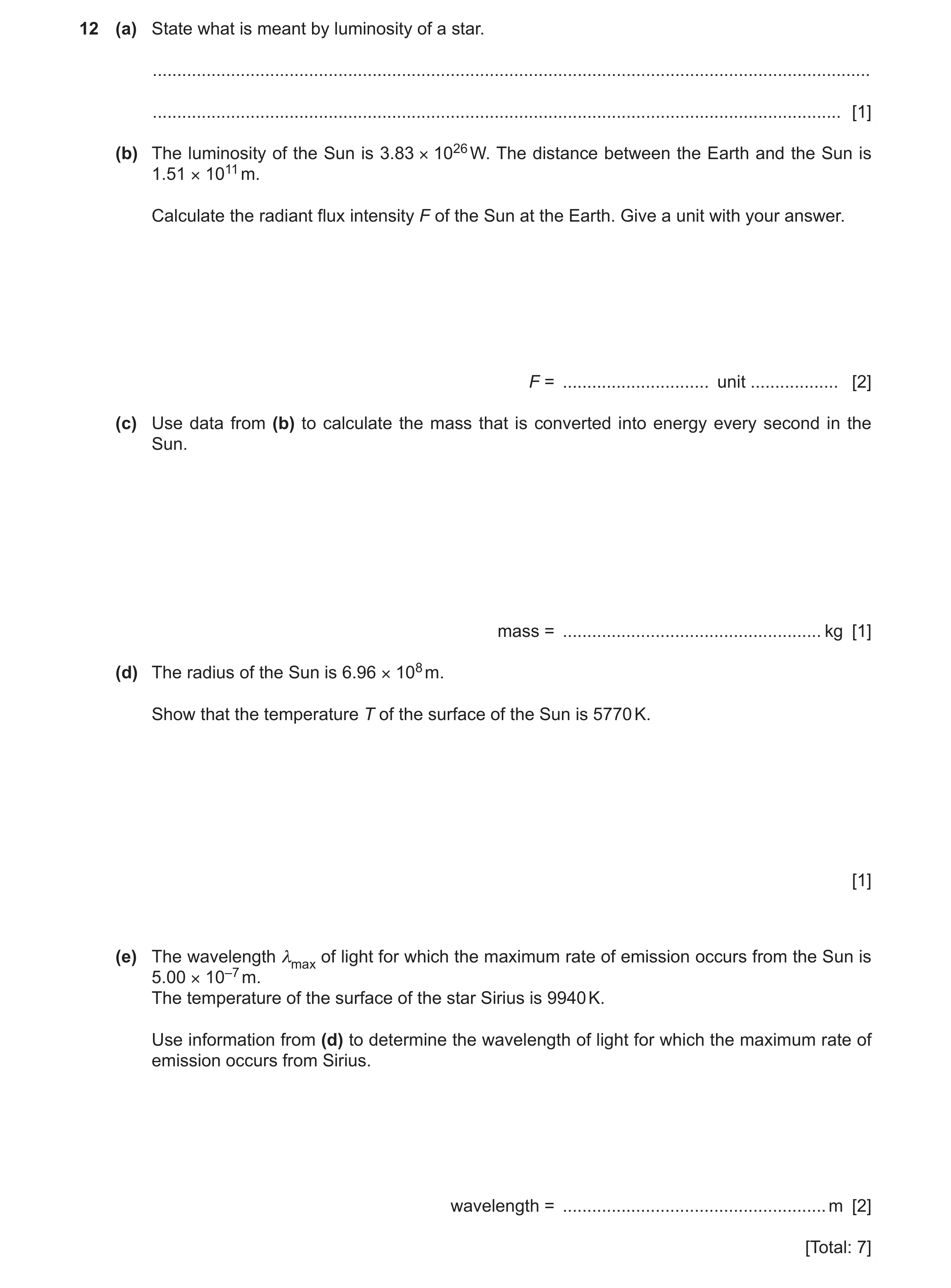
Q1 · State what is meant by luminosity of a star 9702/42 Feb/March 2022
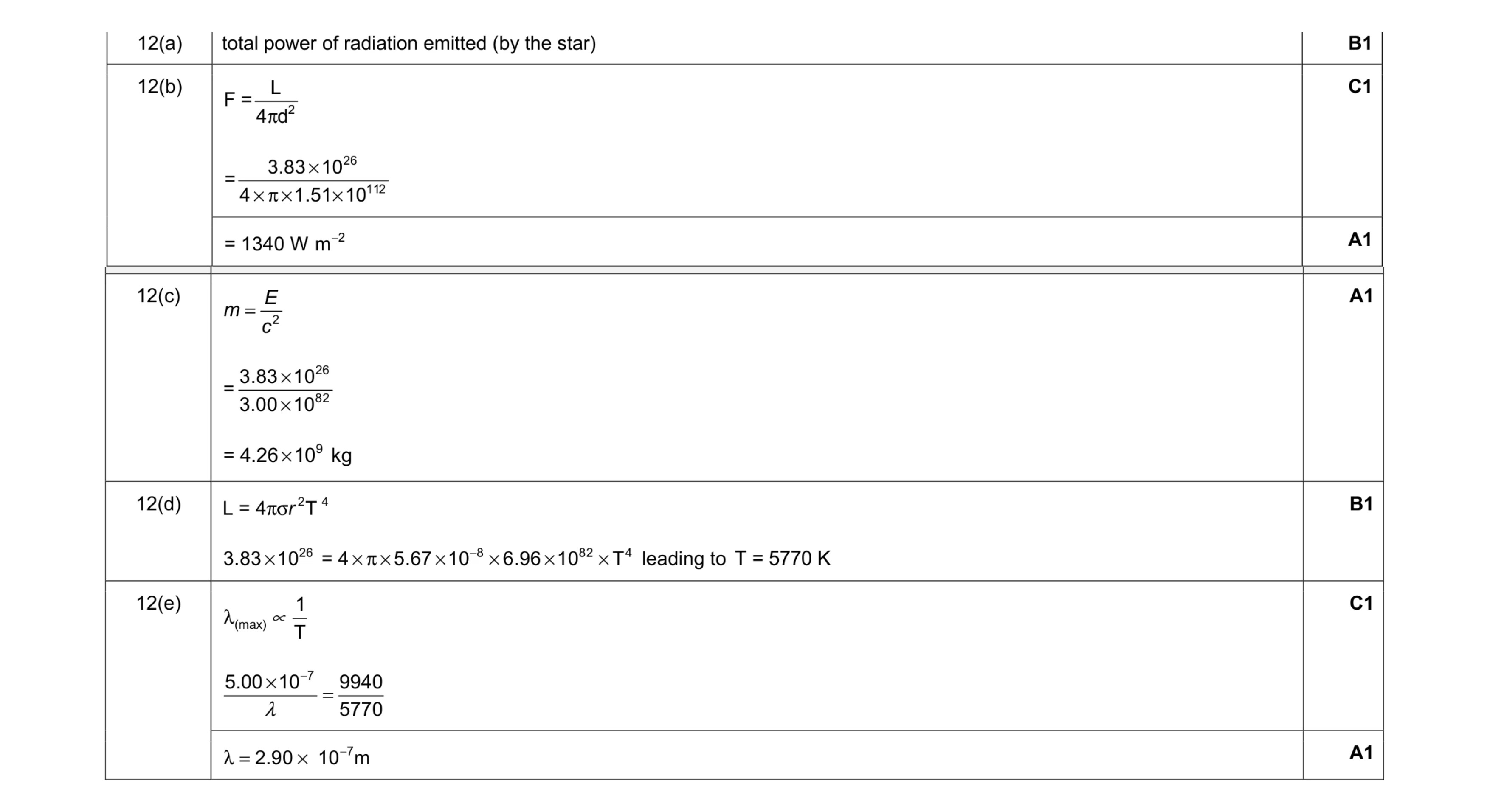
12 (a) State what is meant by luminosity of a star. … … [1] (b) The luminosity of the Sun is 3.83 × 1026 W. The distance between the Earth and the Sun is 1.51 × 10¹¹ m. Calculate the radiant flux intensity F of the Sun at the Earth. Give a unit with your answer. F = … unit … [2] (c) Use data from (b) to calculate the mass that is converted into energy every second in the Sun. mass = … kg [1] (d) The radius of the Sun is 6.96 × 10⁸ m. Show that the temperature T of the surface of the Sun is 5770 K. [1] (e) The wavelength λmax of light for which the maximum rate of emission occurs from the Sun is 5.00 × 10⁻⁷ m. The temperature of the surface of the star Sirius is 9940 K. Use information from (d) to determine the wavelength of light for which the maximum rate of emission occurs from Sirius. wavelength = … m [2] [Total: 7]
7 marks
Mark scheme: 12(a) total power of radiation emitted (by the star) B1 12(b) 2 L F = 4 d π 26 112 3.83 10 = 4 1.51 10 × × π × × C1 2 = 1340 W m− A1 Question Answer Marks 12(c) 2 E m c = 26 82 3.83 10 = 3.00 10 × × 9 = 4.26 10 kg × A1 12(d) 2 4 L = 4 T r πσ 26 8 82 4 3.83 10 = 4 5.67 10 6.96 10 T − × × π× × × × × leading to T = 5770 K B1 12(e) (max) 1 T ∝ λ 7 5.00 10 9940 5770 λ − × = C1 7 2.90 10 m − λ = × A1
This question in 9702/42 Feb/March 2022
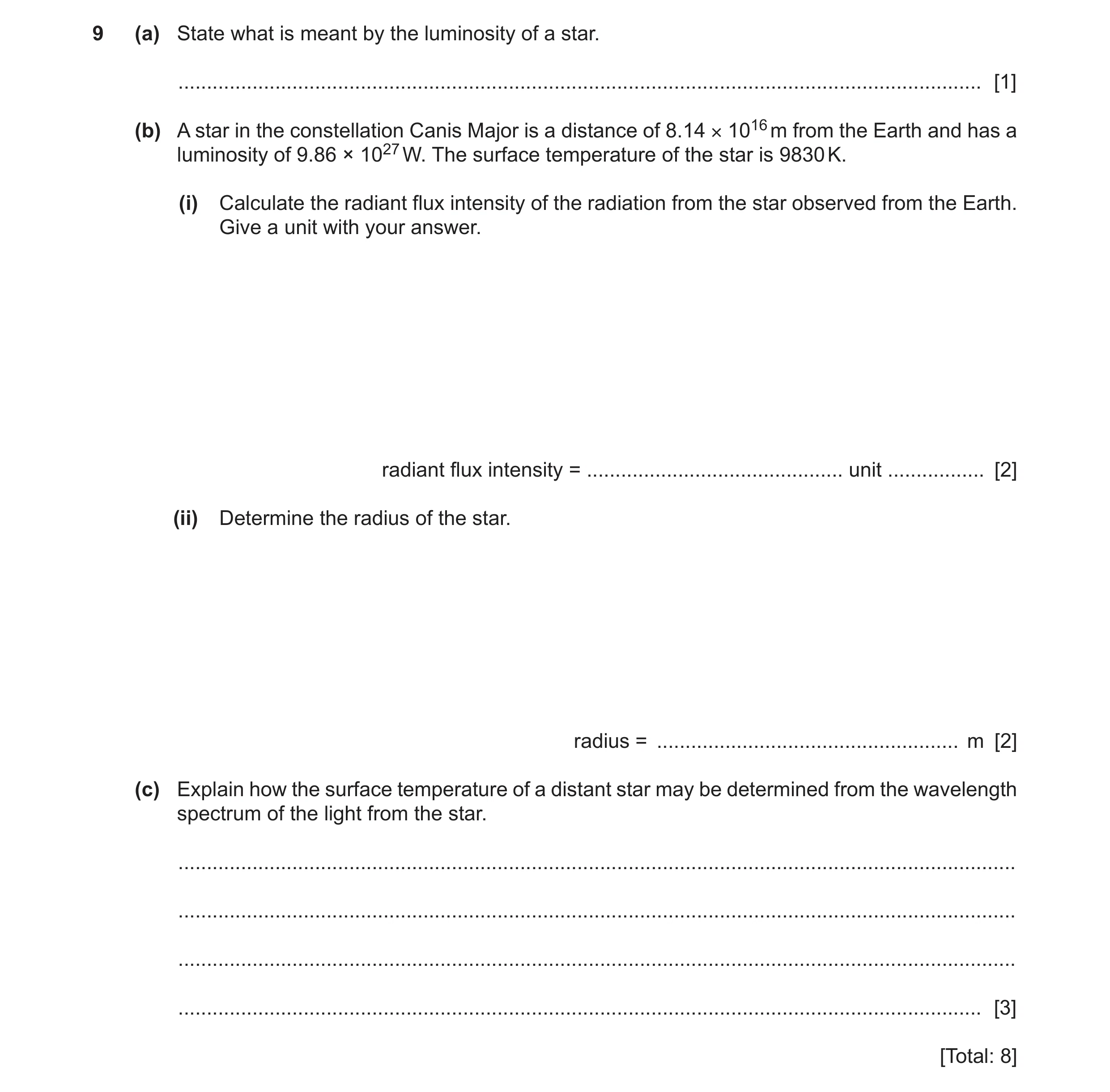
Q2 · State what is meant by the luminosity of a star 9702/41 Oct/Nov 2022
9 (a) State what is meant by the luminosity of a star. … [1] (b) A star in the constellation Canis Major is a distance of 8.14 × 10¹⁶ m from the Earth and has a luminosity of 9.86 × 1027 W. The surface temperature of the star is 9830 K. (i) Calculate the radiant flux intensity of the radiation from the star observed from the Earth. Give a unit with your answer. radiant flux intensity = … unit … [2] (ii) Determine the radius of the star. radius = … m [2] (c) Explain how the surface temperature of a distant star may be determined from the wavelength spectrum of the light from the star. … … … … [3] [Total: 8]
8 marks
Mark scheme: 9(a) total power of radiation emitted (by the star) B1 9(b)(i) F = L / (4d 2) C1 = 9.86 1027 / [4 (8.14 1016)2] A1 = 1.18 10–7 W m–2 9(b)(ii) L = 4 r 2T4 C1 9.86 1027 = 4 5.67 10–8 r 2 98304 radius = 1.22 109 m A1 9(c) wavelength of peak intensity determined (from spectrum of star) B1 wavelength of peak intensity from object of known temperature determined B1 Wien’s displacement law used B1 or wavelength of peak intensity inversely proportional to temperature
This question in 9702/41 Oct/Nov 2022
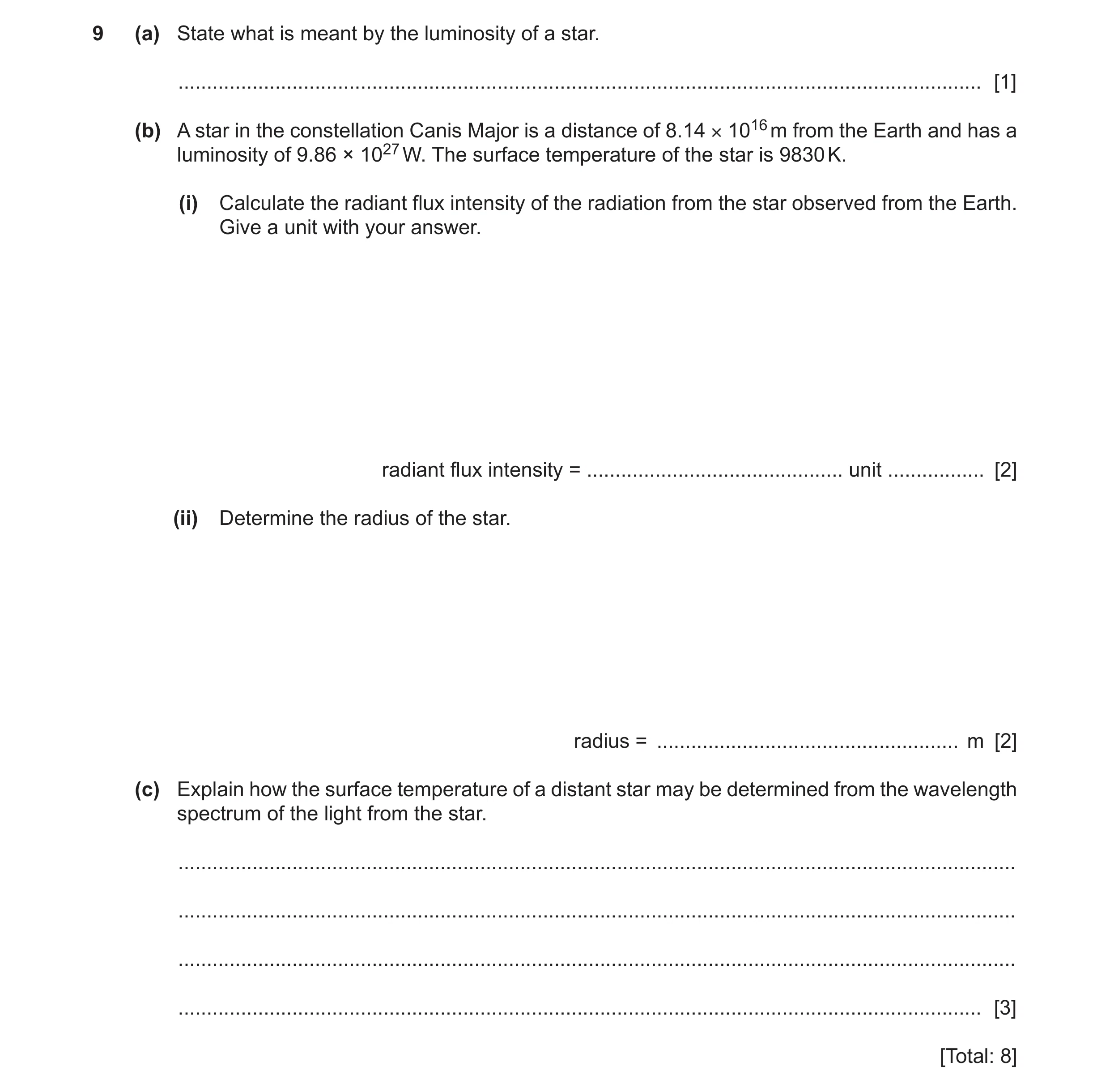
Q3 · State what is meant by the luminosity of a star 9702/43 Oct/Nov 2022
9 (a) State what is meant by the luminosity of a star. … [1] (b) A star in the constellation Canis Major is a distance of 8.14 × 10¹⁶ m from the Earth and has a luminosity of 9.86 × 1027 W. The surface temperature of the star is 9830 K. (i) Calculate the radiant flux intensity of the radiation from the star observed from the Earth. Give a unit with your answer. radiant flux intensity = … unit … [2] (ii) Determine the radius of the star. radius = … m [2] (c) Explain how the surface temperature of a distant star may be determined from the wavelength spectrum of the light from the star. … … … … [3] [Total: 8]
8 marks
Mark scheme: 9(a) total power of radiation emitted (by the star) B1 9(b)(i) F = L / (4d 2) C1 = 9.86 1027 / [4 (8.14 1016)2] A1 = 1.18 10–7 W m–2 9(b)(ii) L = 4 r 2T4 C1 9.86 1027 = 4 5.67 10–8 r 2 98304 radius = 1.22 109 m A1 9(c) wavelength of peak intensity determined (from spectrum of star) B1 wavelength of peak intensity from object of known temperature determined B1 Wien’s displacement law used B1 or wavelength of peak intensity inversely proportional to temperature
This question in 9702/43 Oct/Nov 2022
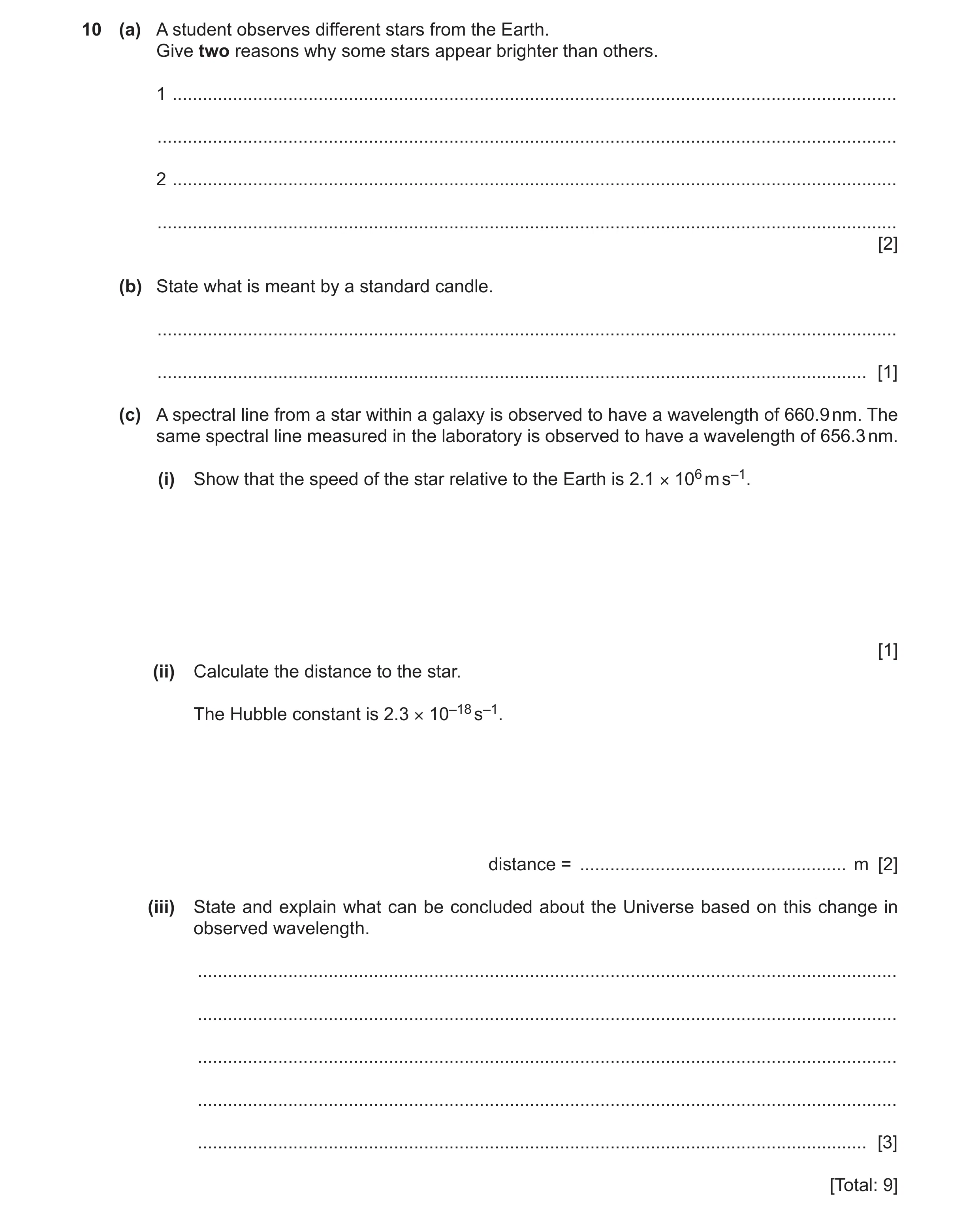
Q4 · A student observes different stars from the Earth 9702/42 Feb/March 2023
10 (a) A student observes different stars from the Earth. Give two reasons why some stars appear brighter than others. 1 … … 2 … … [2] (b) State what is meant by a standard candle. … … [1] (c) A spectral line from a star within a galaxy is observed to have a wavelength of 660.9 nm. The same spectral line measured in the laboratory is observed to have a wavelength of 656.3 nm. (i) Show that the speed of the star relative to the Earth is 2.1 × 10⁶ m s–1. [1] (ii) Calculate the distance to the star. The Hubble constant is 2.3 × 10⁻¹⁸ s–1. distance = … m [2] (iii) State and explain what can be concluded about the Universe based on this change in observed wavelength. … … … … … [3] [Total: 9]
9 marks
Mark scheme: 10(a) brighter star could be closer (to Earth) B1 brighter star could have a greater luminosity (in the visible wavelengths) B1 10(b) object with known luminosity B1 10(c)(i) 660.9 − 656.3 v B1 leading to 2.1 106 m s–1 656.3 3.0 108 10(c)(ii) v = Hod C1 d = 2.1 106 / 2.3 10–18 A1 = 9.1 1023 m 10(c)(iii) wavelength has increased / light is redshifted B1 star within galaxy is moving away / receding (from Earth) B1 Universe is expanding B1
This question in 9702/42 Feb/March 2023
Question 5 9702/41 May/June 2023
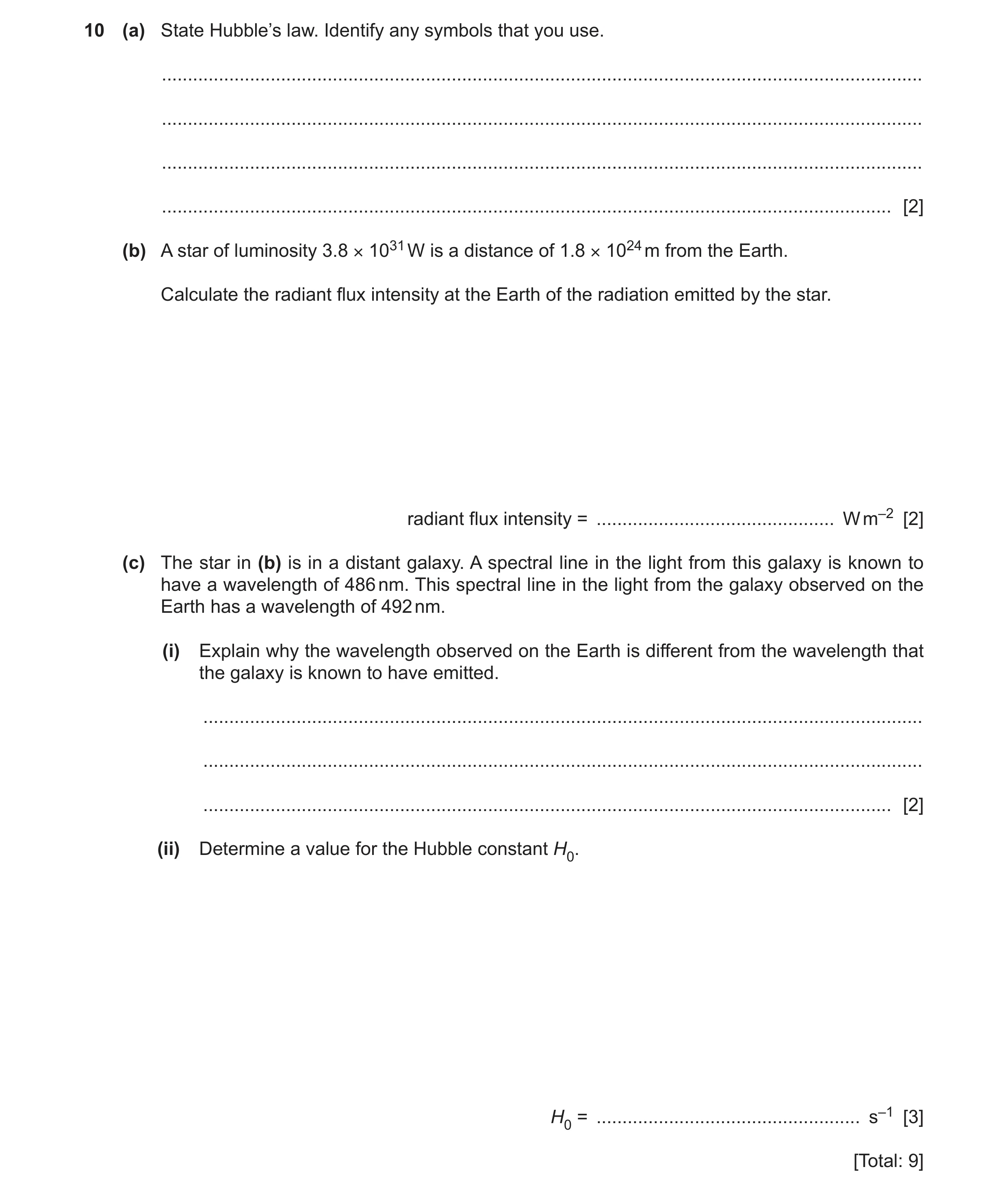
10 (a) State Hubble’s law. Identify any symbols that you use. … … … … [2] (b) A star of luminosity 3.8 × 1031 W is a distance of 1.8 × 1024 m from the Earth. Calculate the radiant flux intensity at the Earth of the radiation emitted by the star. radiant flux intensity = … W m–2 [2] (c) The star in (b) is in a distant galaxy. A spectral line in the light from this galaxy is known to have a wavelength of 486 nm. This spectral line in the light from the galaxy observed on the Earth has a wavelength of 492 nm. (i) Explain why the wavelength observed on the Earth is different from the wavelength that the galaxy is known to have emitted. … … … [2] (ii) Determine a value for the Hubble constant H0. H0 = … s–1 [3] [Total: 9]
9 marks
Mark scheme: 10(a) speed is (directly) proportional to distance M1 speed is speed of recession of galaxy from an observer, and distance is the distance of the galaxy from the observer A1 10(b) F = L / (4d2) C1 = (3.8 1031) / [4 (1.8 1024)2] = 9.3 10–19 W m–2 A1 10(c)(i) galaxy is moving away (from the Earth) B1 wavelength (of light from the galaxy) increased by the Doppler effect / due to redshift B1 10(c)(ii) / = v / c v = [(492 – 486) 3.00 108] / 486 (v = 3.7 106 m s–1) C1 H0 = v / d C1 = (3.7 106) / (1.8 1024) = 2.1 10–18 s–1 A1
This question in 9702/41 May/June 2023
Question 6 9702/43 May/June 2023
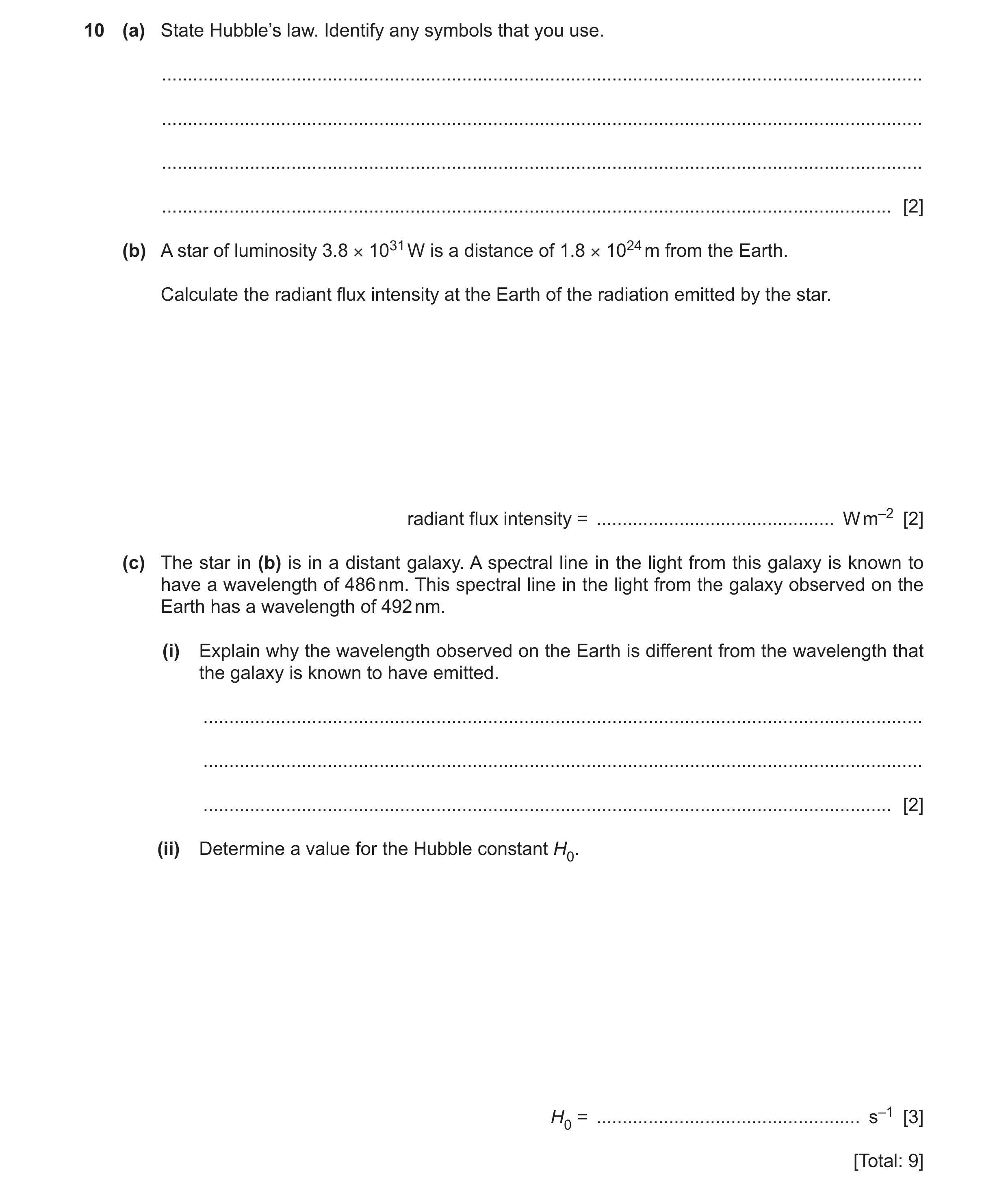
10 (a) State Hubble’s law. Identify any symbols that you use. … … … … [2] (b) A star of luminosity 3.8 × 1031 W is a distance of 1.8 × 1024 m from the Earth. Calculate the radiant flux intensity at the Earth of the radiation emitted by the star. radiant flux intensity = … W m–2 [2] (c) The star in (b) is in a distant galaxy. A spectral line in the light from this galaxy is known to have a wavelength of 486 nm. This spectral line in the light from the galaxy observed on the Earth has a wavelength of 492 nm. (i) Explain why the wavelength observed on the Earth is different from the wavelength that the galaxy is known to have emitted. … … … [2] (ii) Determine a value for the Hubble constant H0. H0 = … s–1 [3] [Total: 9]
9 marks
Mark scheme: 10(a) speed is (directly) proportional to distance M1 speed is speed of recession of galaxy from an observer, and distance is the distance of the galaxy from the observer A1 10(b) F = L / (4d2) C1 = (3.8 1031) / [4 (1.8 1024)2] = 9.3 10–19 W m–2 A1 10(c)(i) galaxy is moving away (from the Earth) B1 wavelength (of light from the galaxy) increased by the Doppler effect / due to redshift B1 10(c)(ii) / = v / c v = [(492 – 486) 3.00 108] / 486 (v = 3.7 106 m s–1) C1 H0 = v / d C1 = (3.7 106) / (1.8 1024) = 2.1 10–18 s–1 A1
This question in 9702/43 May/June 2023
Q7 · The product pV for an ideal gas is given by 1 pV = Nm〈c2〉 3 where p is the pressure of… 9702/41 Oct/Nov 2023
3 (a) The product pV for an ideal gas is given by 1 pV = Nm〈c2〉 3 where p is the pressure of the gas and V is the volume of the gas. (i) State the meaning of the symbols N, m and 〈c2〉 in this equation. N: … m: … 〈c2〉: … [3] (ii) Use the equation of state for an ideal gas to show that the average translational kinetic energy EK of a molecule of the gas at thermodynamic temperature T is given by 3 EK = kT. 2 [2] (b) The surface of a star consists mainly of a gas that may be assumed to be ideal. The molecules of the gas have a root-mean-square (r.m.s.) speed of 9300 m s–1. The mass of a molecule of the gas is 3.34 × 10⁻²⁷ kg. Determine, to three significant figures, the temperature of the surface of the star. temperature = … K [2] (c) The radiant flux intensity of the radiation from the star in (b) is 2.52 × 10⁻⁸ W m–2 when observed at a distance of 4.16 × 10¹⁶ m from the star. (i) Calculate the luminosity of the star. Give a unit with your answer. luminosity = … unit … [2] (ii) Determine the radius of the star. radius = … m [2] (d) The gas at the surface of a star has a very high pressure. Use the basic assumptions of the kinetic theory to suggest why, in practice, a gas at the surface of a star is unlikely to behave as an ideal gas. … … … … [2] [Total: 13]
13 marks
Mark scheme: 3(a)(i) N: number of molecules (of the gas) B1 m: mass of one molecule (of the gas) B1 <c2>: mean square speed (of molecules) B1 3(a)(ii) pV = NkT M1 NkT = ⅓Nm<c2> and EK = ½m<c2> leading to EK = (3/2) kT A1 3(b) ½ 3.34 10–27 93002 = (3/2) 1.38 10–23 T C1 T = 6980 K A1 3(c)(i) L = F 4d2 C1 L = 2.52 10–8 4 (4.16 1016)2 A1 = 5.48 1026 W 3(c)(ii) L = 4r2T4 C1 5.48 1026 = 4 5.67 10–8 r2 69804 r = 5.69 108 m A1 3(d) (very high pressure so) molecules are (very) close together (not just ‘nearer’) B1 forces between molecules are not negligible B1 or volume of molecules not negligible compared with gas volume
This question in 9702/41 Oct/Nov 2023
Q8 · State Wien’s displacement law 9702/42 Oct/Nov 2023
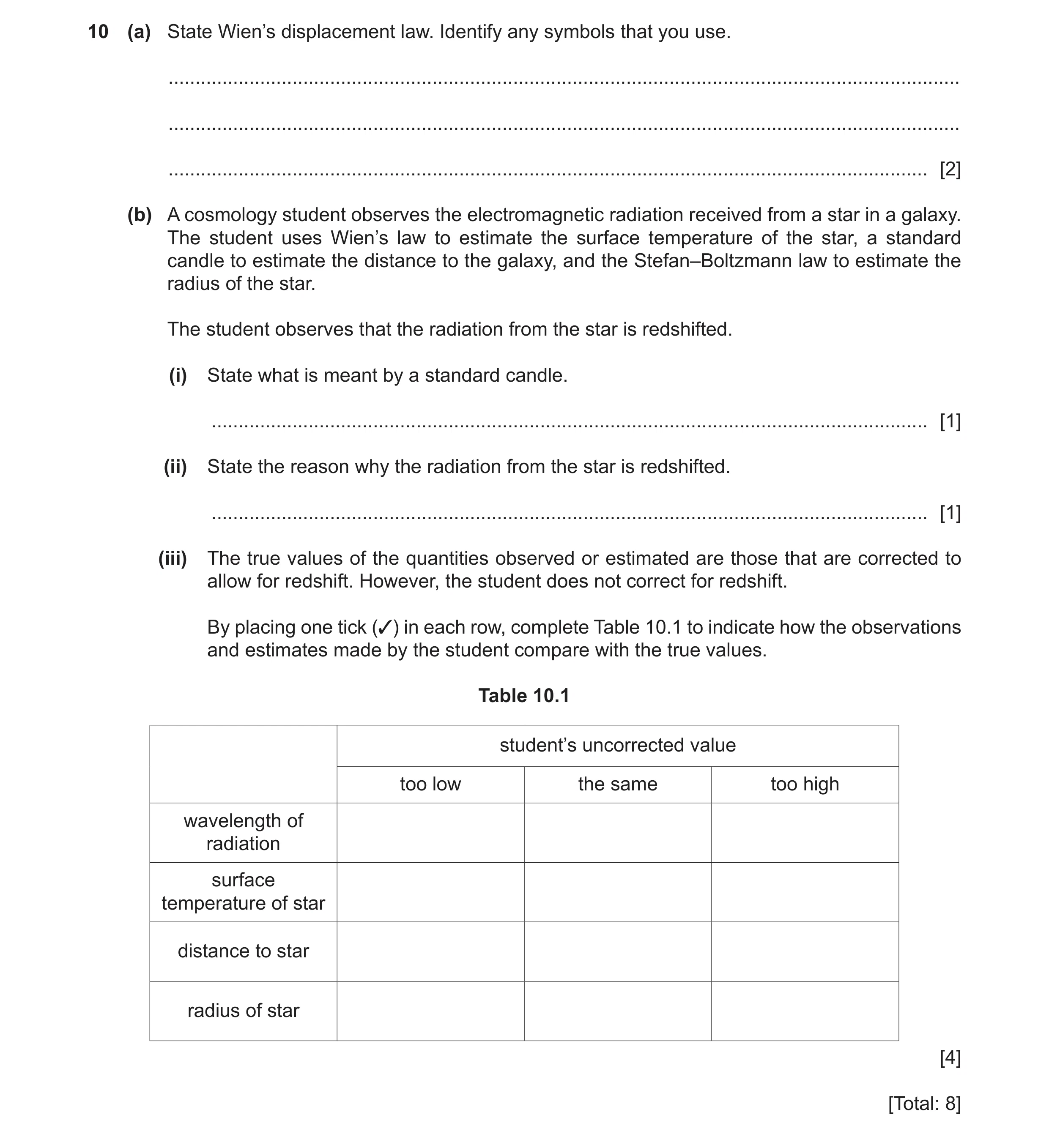
10 (a) State Wien’s displacement law. Identify any symbols that you use. … … … [2] (b) A cosmology student observes the electromagnetic radiation received from a star in a galaxy. The student uses Wien’s law to estimate the surface temperature of the star, a standard candle to estimate the distance to the galaxy, and the Stefan–Boltzmann law to estimate the radius of the star. The student observes that the radiation from the star is redshifted. (i) State what is meant by a standard candle. … [1] (ii) State the reason why the radiation from the star is redshifted. … [1] (iii) The true values of the quantities observed or estimated are those that are corrected to allow for redshift. However, the student does not correct for redshift. By placing one tick (3) in each row, complete Table 10.1 to indicate how the observations and estimates made by the student compare with the true values. Table 10.1 student’s uncorrected value too low the same too high wavelength of radiation surface temperature of star distance to star radius of star [4] [Total: 8]
8 marks
Mark scheme: 10(a) temperature inversely proportional to wavelength M1 temperature is thermodynamic temperature of surface, and wavelength is the wavelength at which maximum emission rate A1 occurs 10(b)(i) (astronomical) object of known luminosity B1 10(b)(ii) star / galaxy is moving away from the student B1 10(b)(iii) one tick placed in correct column in each row: B1 wavelength: too high surface temperature: too low B1 distance: unchanged B1 radius: too high B1
This question in 9702/42 Oct/Nov 2023
Q9 · The product pV for an ideal gas is given by 1 pV = Nm〈c2〉 3 where p is the pressure of… 9702/43 Oct/Nov 2023
3 (a) The product pV for an ideal gas is given by 1 pV = Nm〈c2〉 3 where p is the pressure of the gas and V is the volume of the gas. (i) State the meaning of the symbols N, m and 〈c2〉 in this equation. N: … m: … 〈c2〉: … [3] (ii) Use the equation of state for an ideal gas to show that the average translational kinetic energy EK of a molecule of the gas at thermodynamic temperature T is given by 3 EK = kT. 2 [2] (b) The surface of a star consists mainly of a gas that may be assumed to be ideal. The molecules of the gas have a root-mean-square (r.m.s.) speed of 9300 m s–1. The mass of a molecule of the gas is 3.34 × 10⁻²⁷ kg. Determine, to three significant figures, the temperature of the surface of the star. temperature = … K [2] (c) The radiant flux intensity of the radiation from the star in (b) is 2.52 × 10⁻⁸ W m–2 when observed at a distance of 4.16 × 10¹⁶ m from the star. (i) Calculate the luminosity of the star. Give a unit with your answer. luminosity = … unit … [2] (ii) Determine the radius of the star. radius = … m [2] (d) The gas at the surface of a star has a very high pressure. Use the basic assumptions of the kinetic theory to suggest why, in practice, a gas at the surface of a star is unlikely to behave as an ideal gas. … … … … [2] [Total: 13]
13 marks
Mark scheme: 3(a)(i) N: number of molecules (of the gas) B1 m: mass of one molecule (of the gas) B1 <c2>: mean square speed (of molecules) B1 3(a)(ii) pV = NkT M1 NkT = ⅓Nm<c2> and EK = ½m<c2> leading to EK = (3/2) kT A1 3(b) ½ 3.34 10–27 93002 = (3/2) 1.38 10–23 T C1 T = 6980 K A1 3(c)(i) L = F 4d2 C1 L = 2.52 10–8 4 (4.16 1016)2 A1 = 5.48 1026 W 3(c)(ii) L = 4r2T4 C1 5.48 1026 = 4 5.67 10–8 r2 69804 r = 5.69 108 m A1 3(d) (very high pressure so) molecules are (very) close together (not just ‘nearer’) B1 forces between molecules are not negligible B1 or volume of molecules not negligible compared with gas volume
This question in 9702/43 Oct/Nov 2023
Q10 · State what is meant by the luminosity of a star 9702/41 May/June 2024
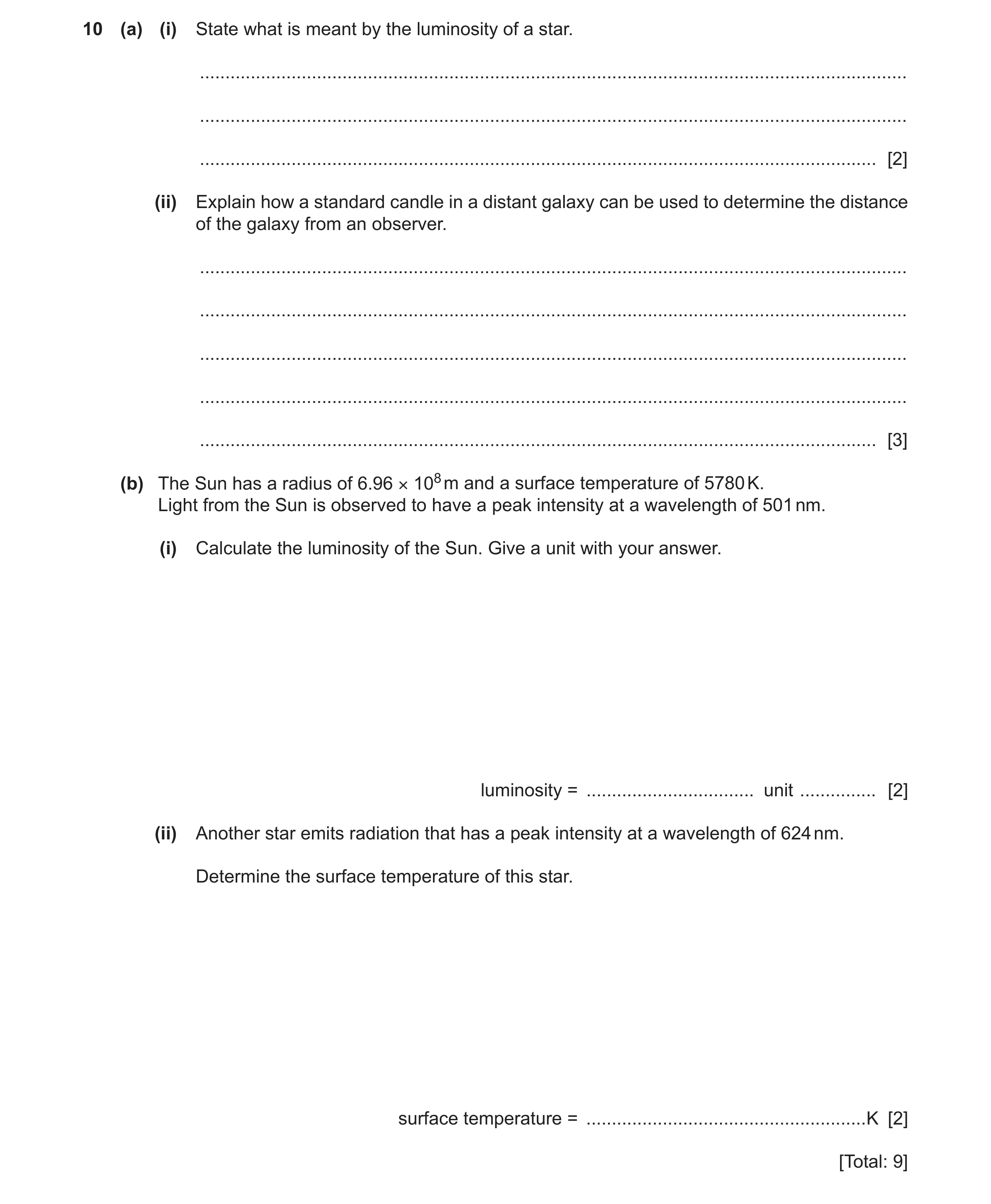
10 (a) (i) State what is meant by the luminosity of a star. … … … [2] (ii) Explain how a standard candle in a distant galaxy can be used to determine the distance of the galaxy from an observer. … … … … … [3] (b) The Sun has a radius of 6.96 × 10⁸ m and a surface temperature of 5780 K. Light from the Sun is observed to have a peak intensity at a wavelength of 501 nm. (i) Calculate the luminosity of the Sun. Give a unit with your answer. luminosity = … unit … [2] (ii) Another star emits radiation that has a peak intensity at a wavelength of 624 nm. Determine the surface temperature of this star. surface temperature = … K [2] [Total: 9]
9 marks
Mark scheme: 10(a)(i) total power B1 power radiated (by the star) B1 10(a)(ii) standard candle has known luminosity B1 radiant flux intensity measured by observer B1 (distance calculated using) F = L / 4d2 B1 10(b)(i) luminosity = 4 r2T4 = 4 5.67 10–8 (6.96 108)2 × 57804 C1 = 3.85 × 1026 W A1 10(b)(ii) MAXT = constant C1 temperature = (5780 501) / 624 = 4640 K A1
This question in 9702/41 May/June 2024
Q11 · State what is meant by the luminosity of a star 9702/43 May/June 2024
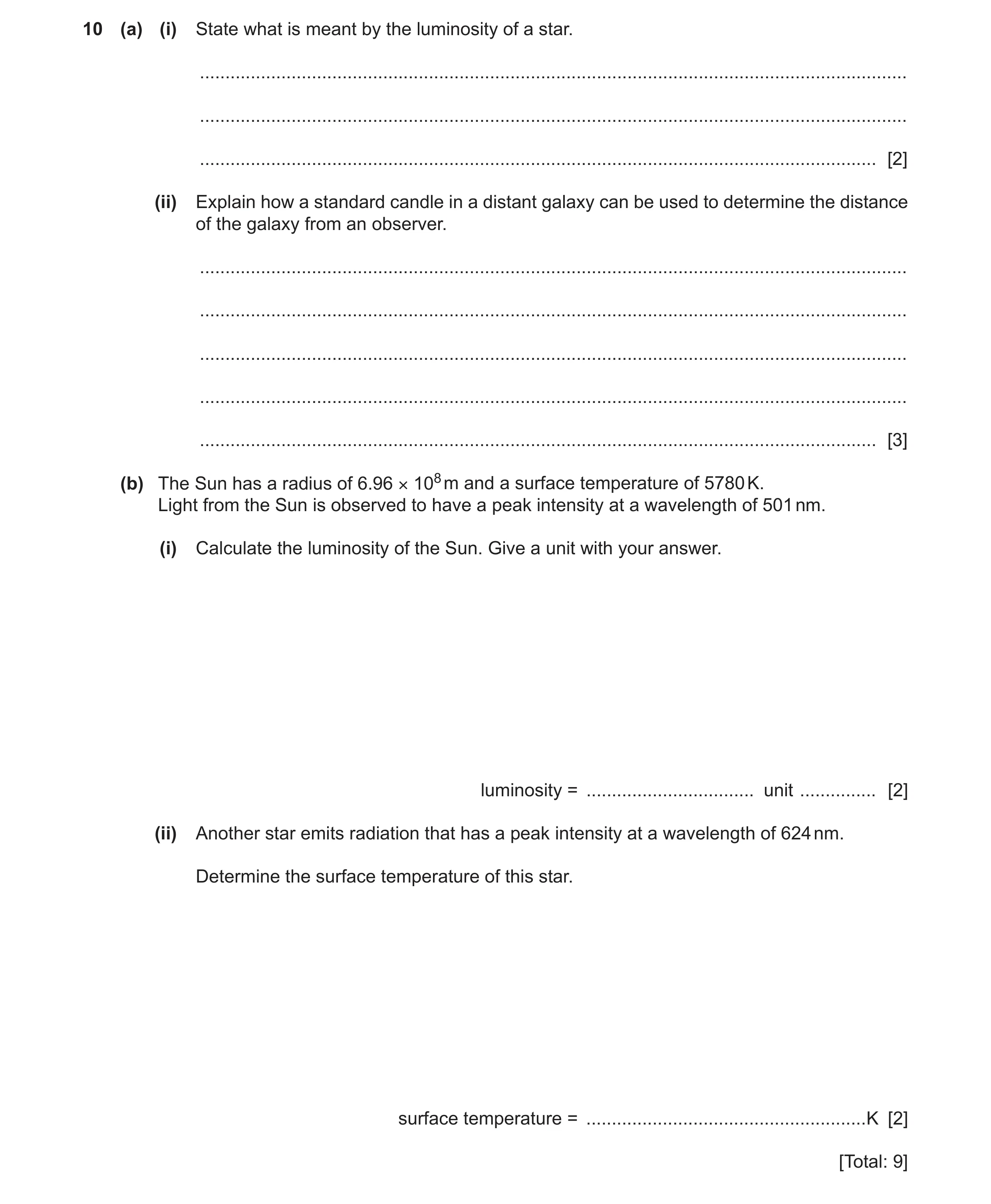
10 (a) (i) State what is meant by the luminosity of a star. … … … [2] (ii) Explain how a standard candle in a distant galaxy can be used to determine the distance of the galaxy from an observer. … … … … … [3] (b) The Sun has a radius of 6.96 × 10⁸ m and a surface temperature of 5780 K. Light from the Sun is observed to have a peak intensity at a wavelength of 501 nm. (i) Calculate the luminosity of the Sun. Give a unit with your answer. luminosity = … unit … [2] (ii) Another star emits radiation that has a peak intensity at a wavelength of 624 nm. Determine the surface temperature of this star. surface temperature = … K [2] [Total: 9]
9 marks
Mark scheme: 10(a)(i) total power B1 power radiated (by the star) B1 10(a)(ii) standard candle has known luminosity B1 radiant flux intensity measured by observer B1 (distance calculated using) F = L / 4d2 B1 10(b)(i) luminosity = 4 r2T4 = 4 5.67 10–8 (6.96 108)2 × 57804 C1 = 3.85 × 1026 W A1 10(b)(ii) MAXT = constant C1 temperature = (5780 501) / 624 = 4640 K A1
This question in 9702/43 May/June 2024
Q12 · Explain how redshift leads to the idea that the Universe is expanding 9702/41 Oct/Nov 2024
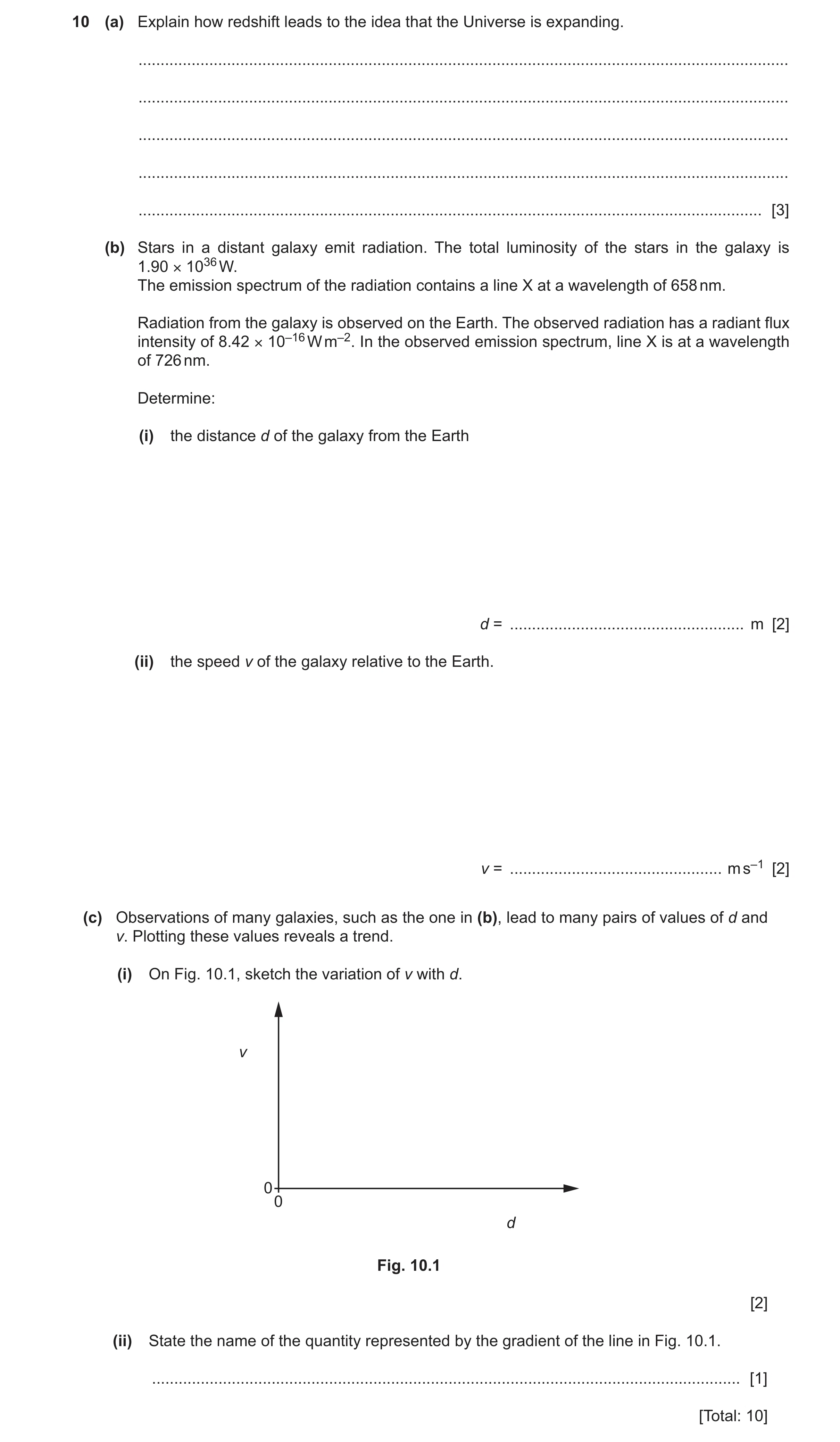
10 (a) Explain how redshift leads to the idea that the Universe is expanding. … … … … … [3] (b) Stars in a distant galaxy emit radiation. The total luminosity of the stars in the galaxy is 1.90 × 1036 W. The emission spectrum of the radiation contains a line X at a wavelength of 658 nm. Radiation from the galaxy is observed on the Earth. The observed radiation has a radiant flux intensity of 8.42 × 10⁻¹⁶ W m–2. In the observed emission spectrum, line X is at a wavelength of 726 nm. Determine: (i) the distance d of the galaxy from the Earth d = … m [2] (ii) the speed v of the galaxy relative to the Earth. v = … m s–1 [2] (c) Observations of many galaxies, such as the one in (b), lead to many pairs of values of d and v. Plotting these values reveals a trend. (i) On Fig. 10.1, sketch the variation of v with d. v 0 0 d Fig. 10.1 [2] (ii) State the name of the quantity represented by the gradient of the line in Fig. 10.1. … [1] [Total: 10]
10 marks
Mark scheme: 10(a) • redshift is the increase in observed wavelength / decrease in observed frequency (caused by Doppler effect) B3 • radiation from distant galaxies is observed to be redshifted • redshift provides evidence that galaxies are moving apart • galaxies moving apart means Universe must be expanding Any three points, 1 mark each 10(b)(i) F = L / 4d2 C1 d = √(1.90 1036 / [4 8.42 10–16]) A1 = 1.34 1025 m 10(b)(ii) / = v / c C1 (726 – 658) / 658 = v / (3.00 108) v = 3.1 107 m s–1 A1 10(c)(i) line with positive gradient passing through the origin B1 straight line with positive gradient B1 10(c)(ii) Hubble constant B1
This question in 9702/41 Oct/Nov 2024
Q13 · Explain how redshift leads to the idea that the Universe is expanding 9702/43 Oct/Nov 2024
10 (a) Explain how redshift leads to the idea that the Universe is expanding. … … … … … [3] (b) Stars in a distant galaxy emit radiation. The total luminosity of the stars in the galaxy is 1.90 × 1036 W. The emission spectrum of the radiation contains a line X at a wavelength of 658 nm. Radiation from the galaxy is observed on the Earth. The observed radiation has a radiant flux intensity of 8.42 × 10⁻¹⁶ W m–2. In the observed emission spectrum, line X is at a wavelength of 726 nm. Determine: (i) the distance d of the galaxy from the Earth d = … m [2] (ii) the speed v of the galaxy relative to the Earth. v = … m s–1 [2] (c) Observations of many galaxies, such as the one in (b), lead to many pairs of values of d and v. Plotting these values reveals a trend. (i) On Fig. 10.1, sketch the variation of v with d. v 0 0 d Fig. 10.1 [2] (ii) State the name of the quantity represented by the gradient of the line in Fig. 10.1. … [1] [Total: 10]
10 marks
Mark scheme: 10(a) • redshift is the increase in observed wavelength / decrease in observed frequency (caused by Doppler effect) B3 • radiation from distant galaxies is observed to be redshifted • redshift provides evidence that galaxies are moving apart • galaxies moving apart means Universe must be expanding Any three points, 1 mark each 10(b)(i) F = L / 4d2 C1 d = √(1.90 1036 / [4 8.42 10–16]) A1 = 1.34 1025 m 10(b)(ii) / = v / c C1 (726 – 658) / 658 = v / (3.00 108) v = 3.1 107 m s–1 A1 10(c)(i) line with positive gradient passing through the origin B1 straight line with positive gradient B1 10(c)(ii) Hubble constant B1
This question in 9702/43 Oct/Nov 2024
Q14 · State what is meant by the luminosity of a star 9702/42 Feb/March 2025
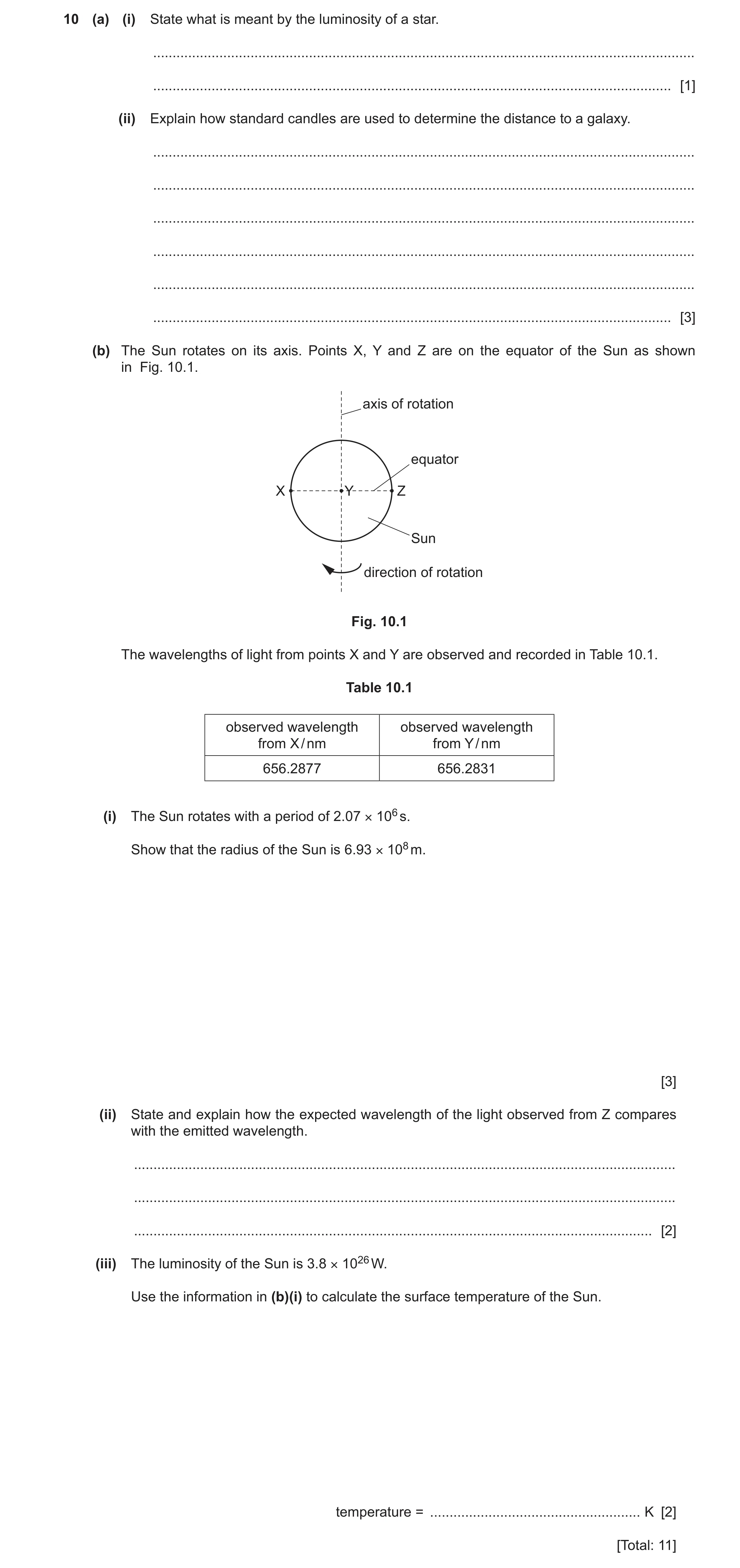
10 (a) (i) State what is meant by the luminosity of a star. … … [1] (ii) Explain how standard candles are used to determine the distance to a galaxy. … … … … … … [3] (b) The Sun rotates on its axis. Points X, Y and Z are on the equator of the Sun as shown in Fig. 10.1. axis of rotation equator X Y Z Sun direction of rotation Fig. 10.1 The wavelengths of light from points X and Y are observed and recorded in Table 10.1. Table 10.1 observed wavelength observed wavelength from X / nm from Y / nm 656.2877 656.2831 (i) The Sun rotates with a period of 2.07 × 10⁶ s. Show that the radius of the Sun is 6.93 × 10⁸ m. [3] (ii) State and explain how the expected wavelength of the light observed from Z compares with the emitted wavelength. … … … [2] (iii) The luminosity of the Sun is 3.8 × 1026 W. Use the information in (b)(i) to calculate the surface temperature of the Sun. temperature = … K [2] [Total: 11]
11 marks
Mark scheme: 10(a)(i) total power of radiation emitted (by the star) B1 10(a)(ii) standard candle has known luminosity B1 measure the radiant flux intensity B1 use F = L / (4d 2) to calculate d B1 10(b)(i) v = 2R / T C1 v = 3.00 108 (656.2877 – 656.2831) / 656.2831 C1 R = [3.00 108 (656.2877 – 656.2831) / 656.2831] (2.07 106) / 2 = 6.93 108 m A1 10(b)(ii) Z is moving towards Earth M1 so observed wavelength is less than the emitted wavelength A1 10(b)(iii) L = 4r 2T 4 C1 3.8 1026 = 4 5.67 10–8 (6.93 108)2 T 4 T = 5800 K A1
This question in 9702/42 Feb/March 2025
Q15 · State what is meant by the mass defect of a nucleus 9702/42 Oct/Nov 2025
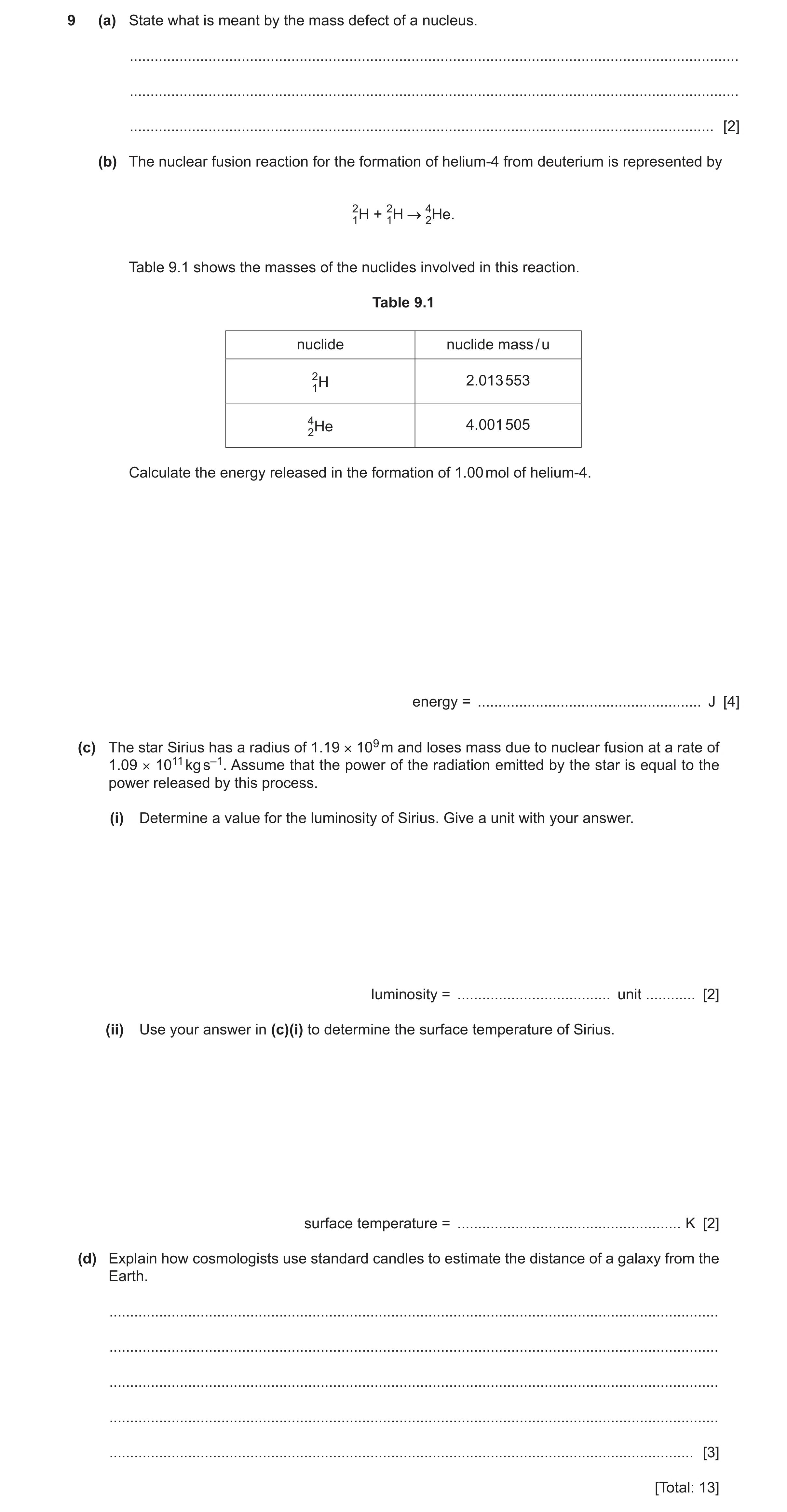
9 (a) State what is meant by the mass defect of a nucleus. … … … [2] (b) The nuclear fusion reaction for the formation of helium-4 from deuterium is represented by 21H + 21H 42He. Table 9.1 shows the masses of the nuclides involved in this reaction. Table 9.1 nuclide nuclide mass / u 21H 2.013 553 42He 4.001 505 Calculate the energy released in the formation of 1.00 mol of helium-4. energy = … J [4] (c) The star Sirius has a radius of 1.19 × 10⁹ m and loses mass due to nuclear fusion at a rate of 1.09 × 10¹¹ kg s–1. Assume that the power of the radiation emitted by the star is equal to the power released by this process. (i) Determine a value for the luminosity of Sirius. Give a unit with your answer. luminosity = … unit … [2] (ii) Use your answer in (c)(i) to determine the surface temperature of Sirius. surface temperature = … K [2] (d) Explain how cosmologists use standard candles to estimate the distance of a galaxy from the Earth. … … … … … [3] [Total: 13]
13 marks
Mark scheme: 9(a) difference between mass of nucleus and mass of (constituent) nucleons M1 when nucleons are separated to infinity A1 9(b) m = (2 2.013553) – (4.001505) (u) C1 ( = 0.025601 u) E = c2m C1 energy from one He-4 nucleus= 0.025601 1.66 10–27 (3.00 108)2 C1 (= 3.82 10–12 J) energy to form 1.00 mol= 3.82 10–12 6.02 1023 A1 = 2.30 1012 J 9(c)(i) L = 1.09 1011 (3.00 108)2 C1 = 9.81 1027 W A1 9(c)(ii) L = 4 r2T4 C1 9.81 1027 = 4 5.67 10–8 (1.19 109)2 T4 T = 9930 K A1 9(d) standard candles have known luminosity B1 radiant flux intensity (from star) measured (on the Earth) B1 distance found from F = L / (4d2) B1
This question in 9702/42 Oct/Nov 2025
 1 / 19
 2 / 19
 3 / 19
 4 / 19
 5 / 19
 6 / 19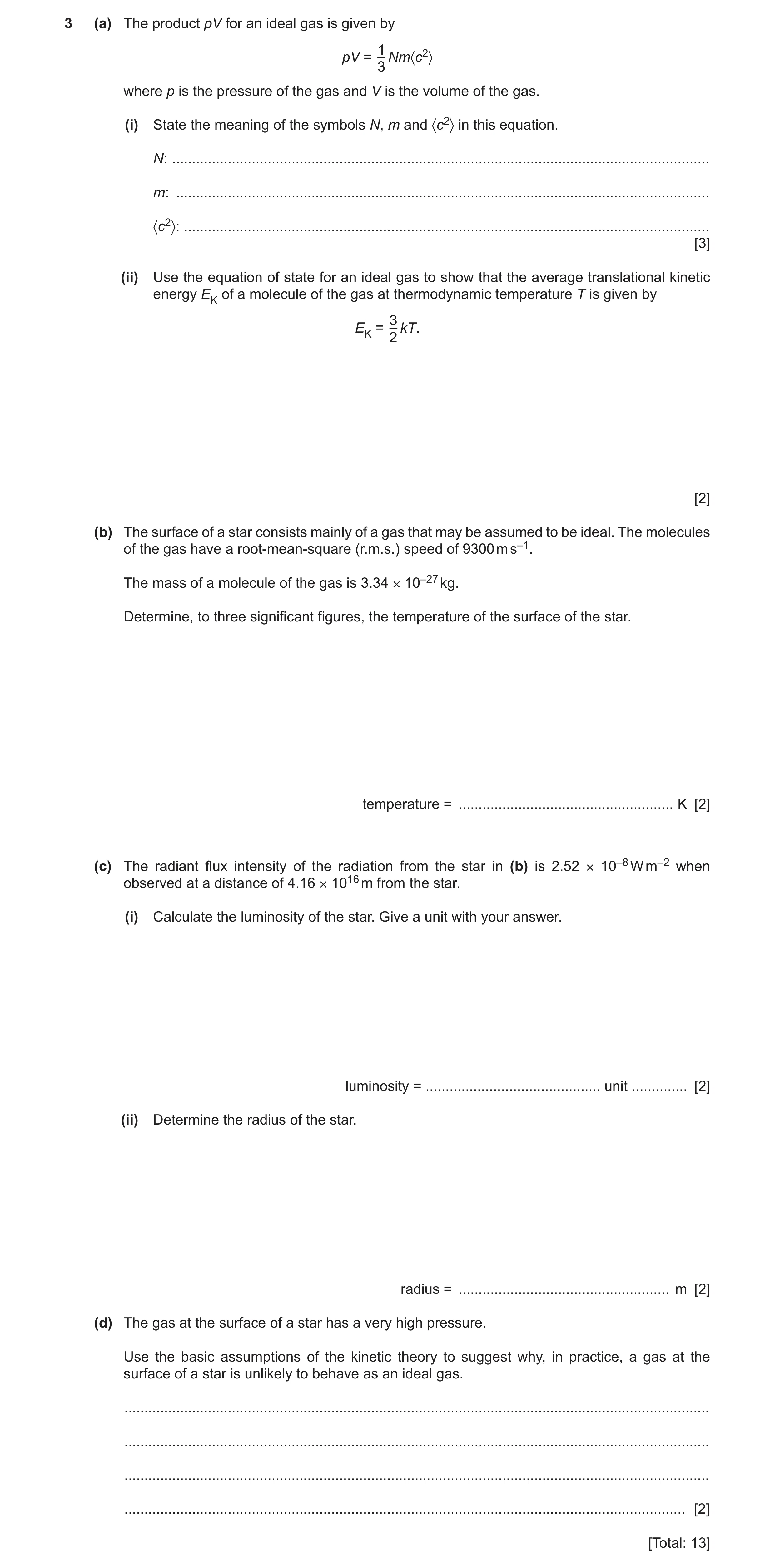
 9 / 19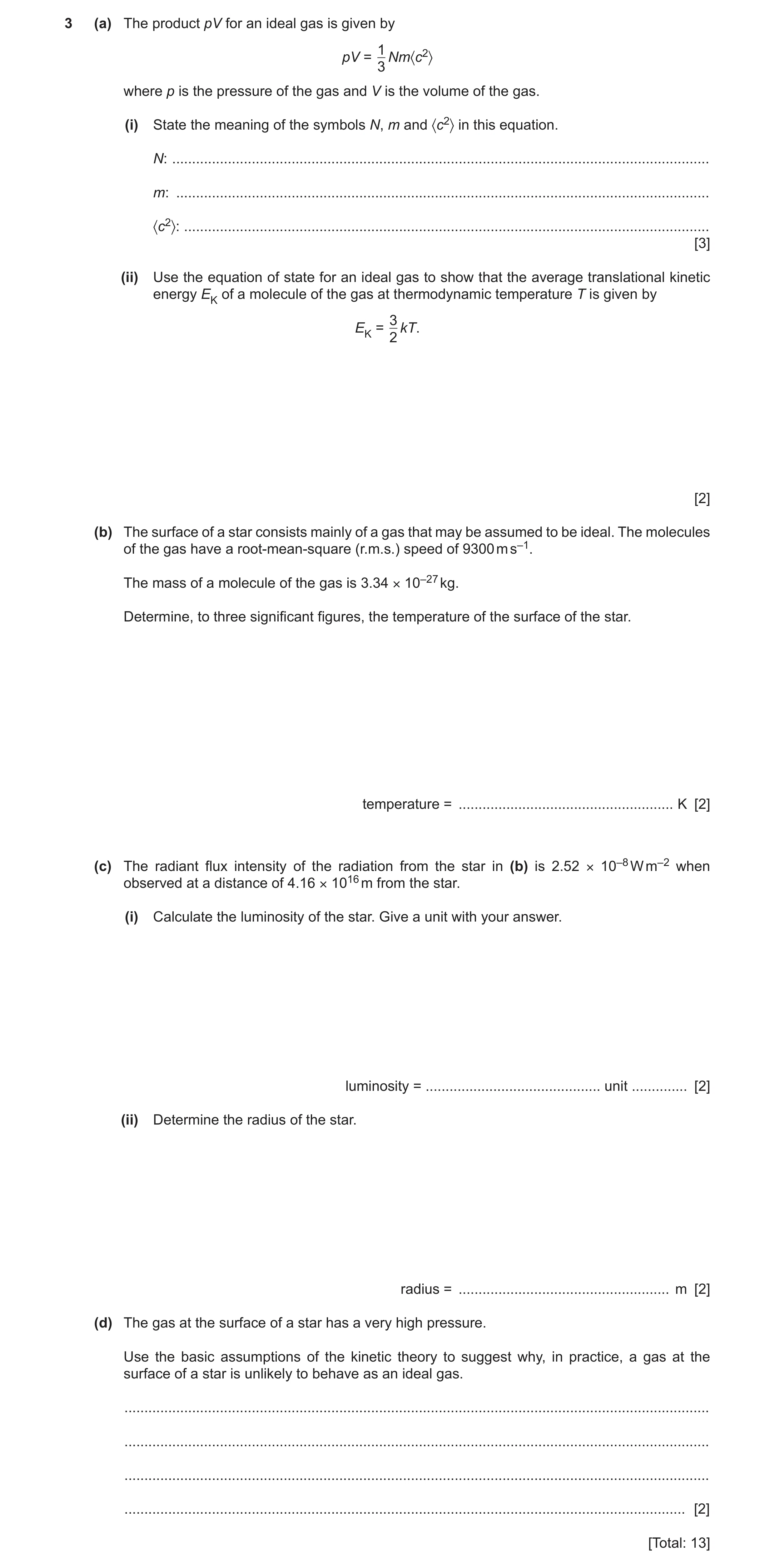
 12 / 19
 13 / 19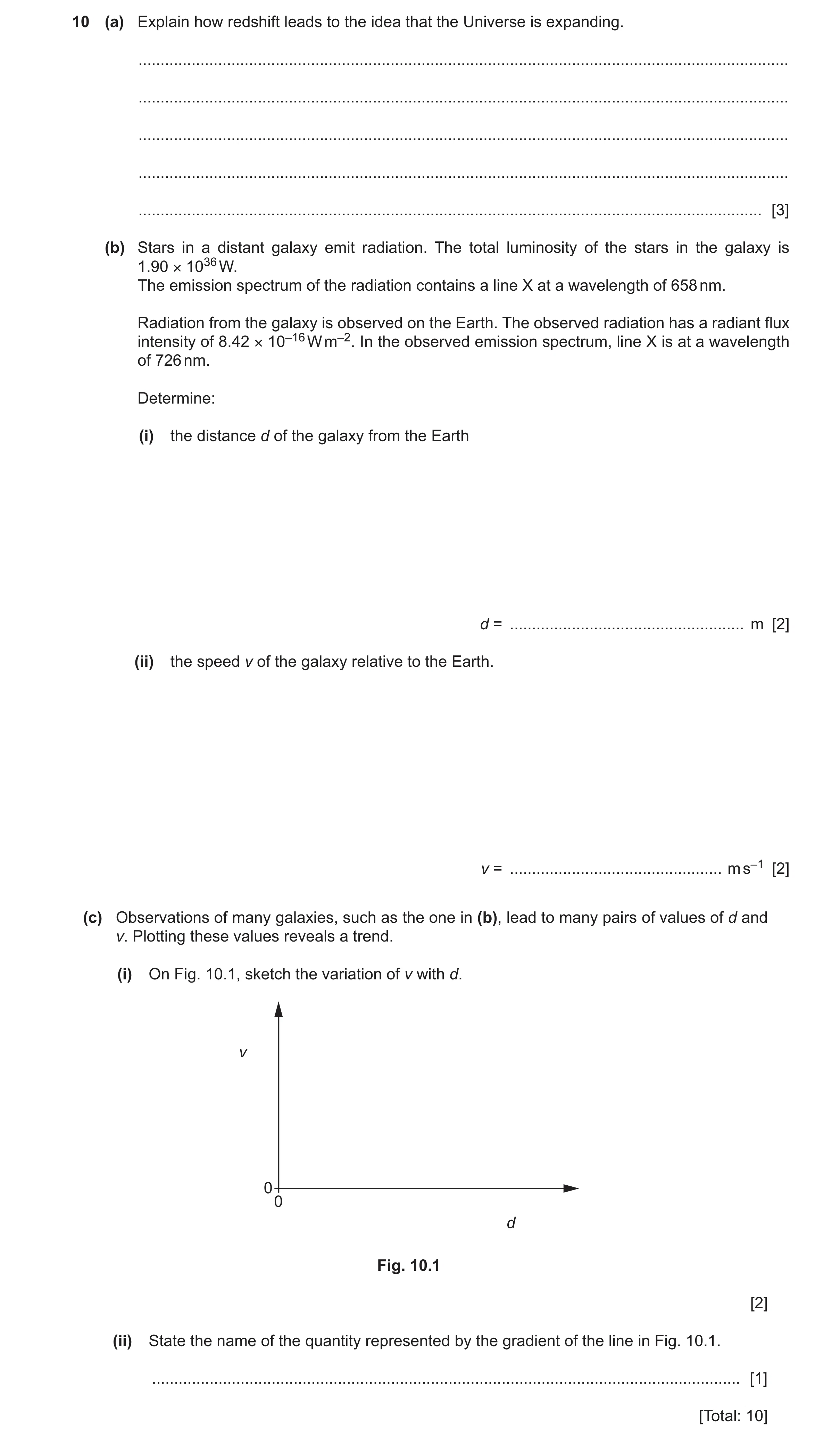
 7
7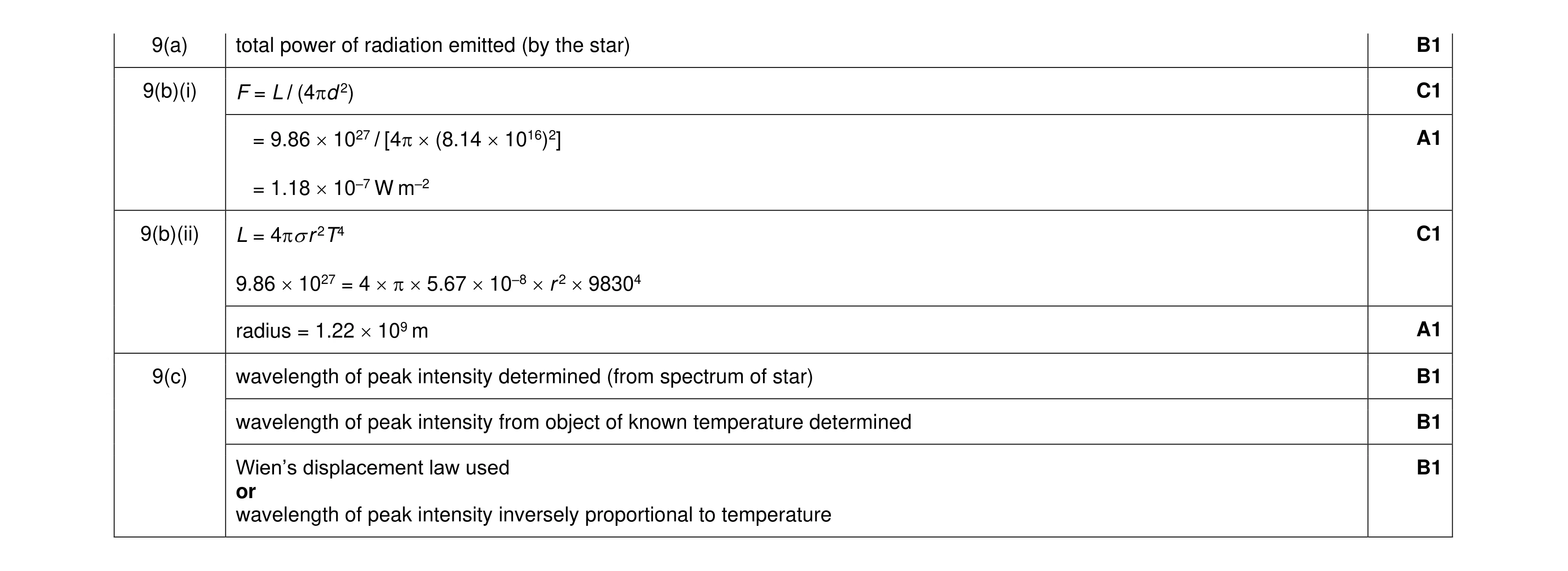 8
8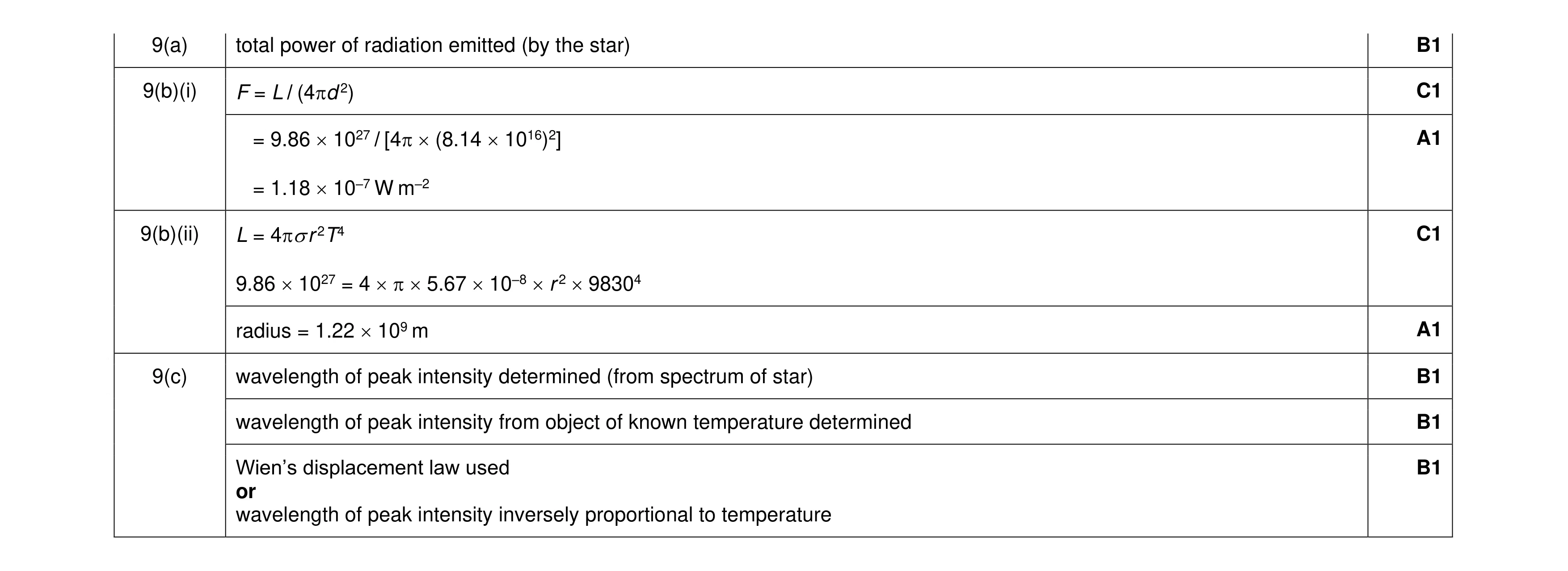 8
8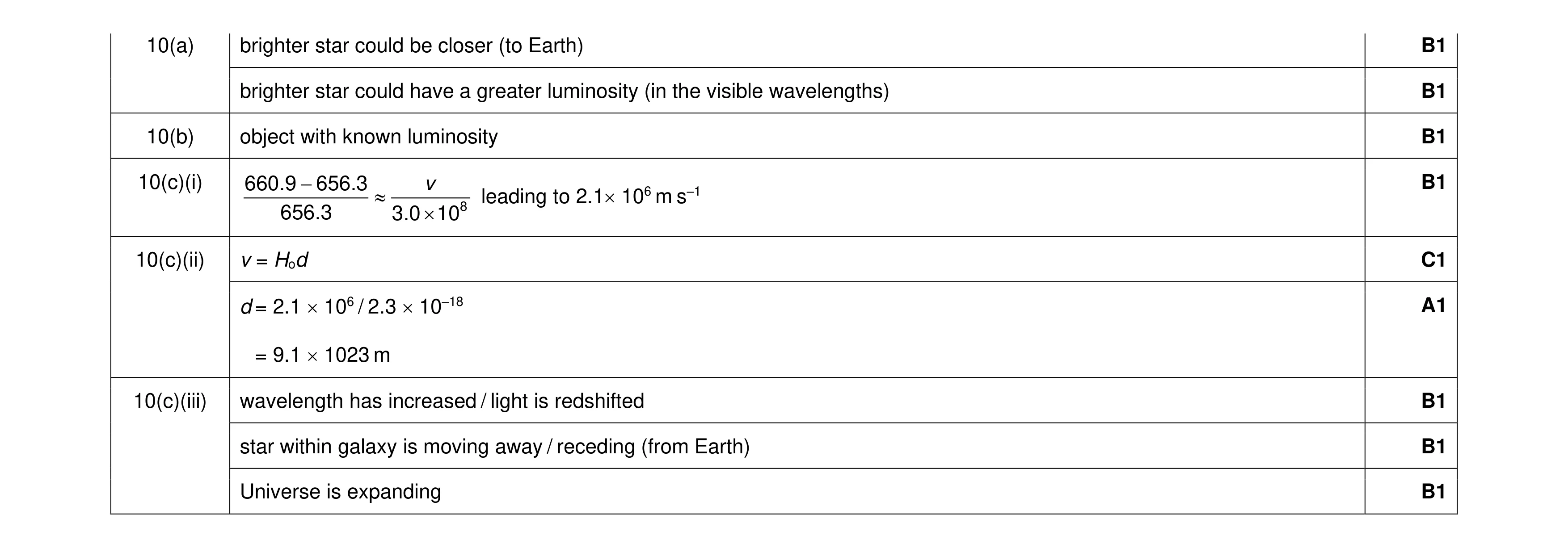 9
9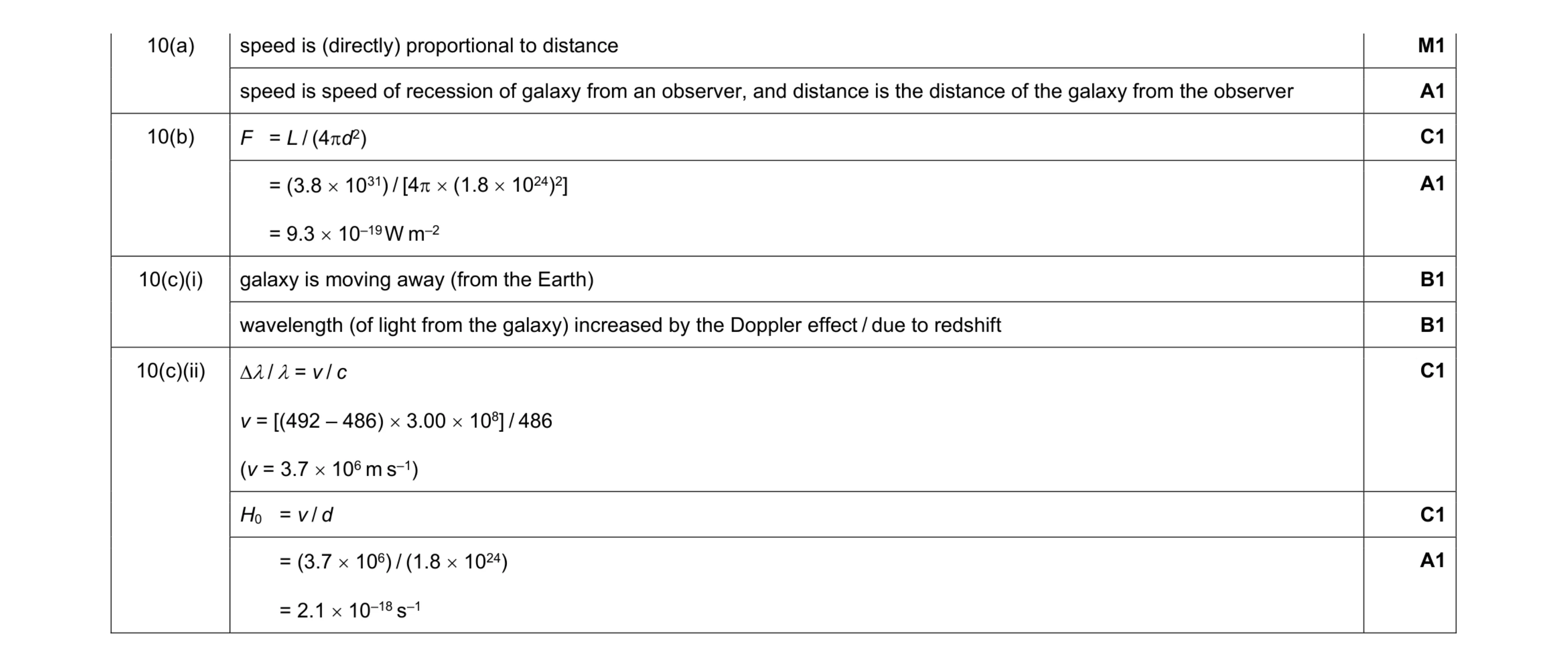 9
9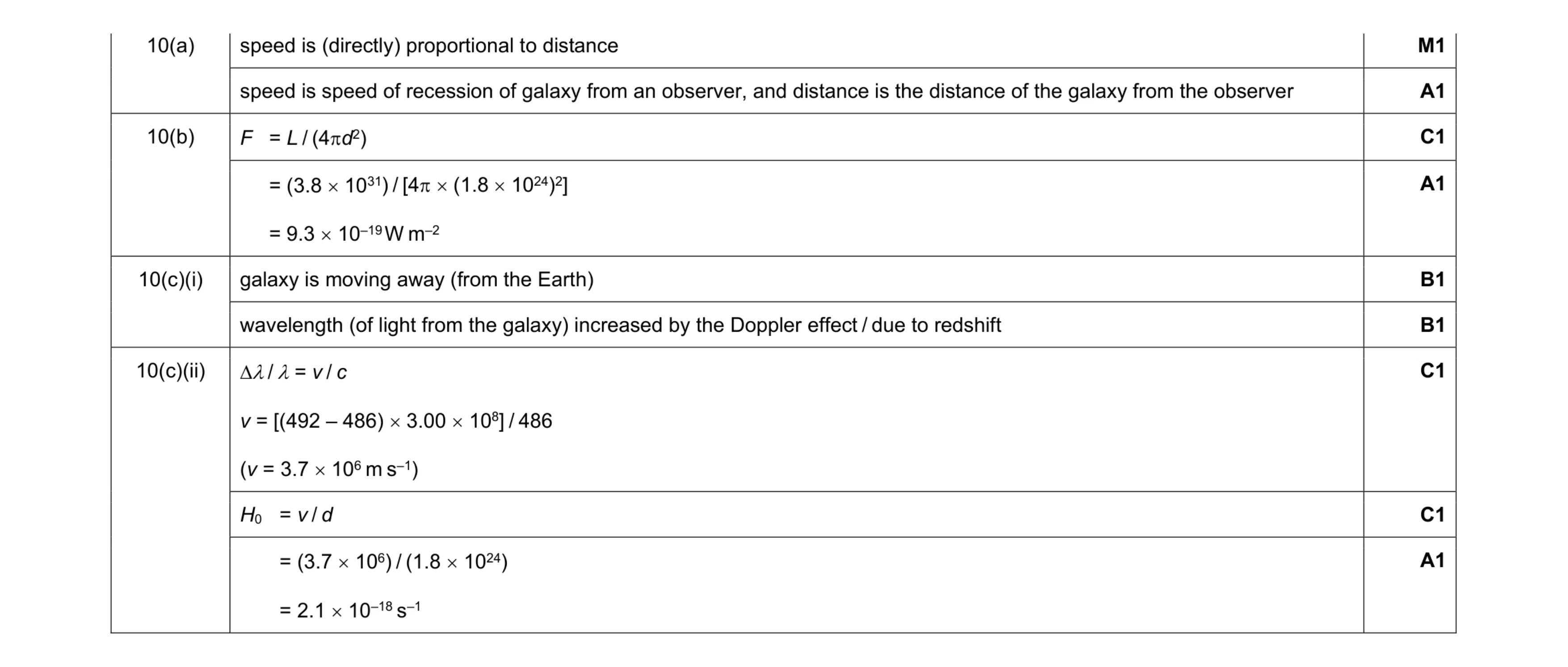 9
9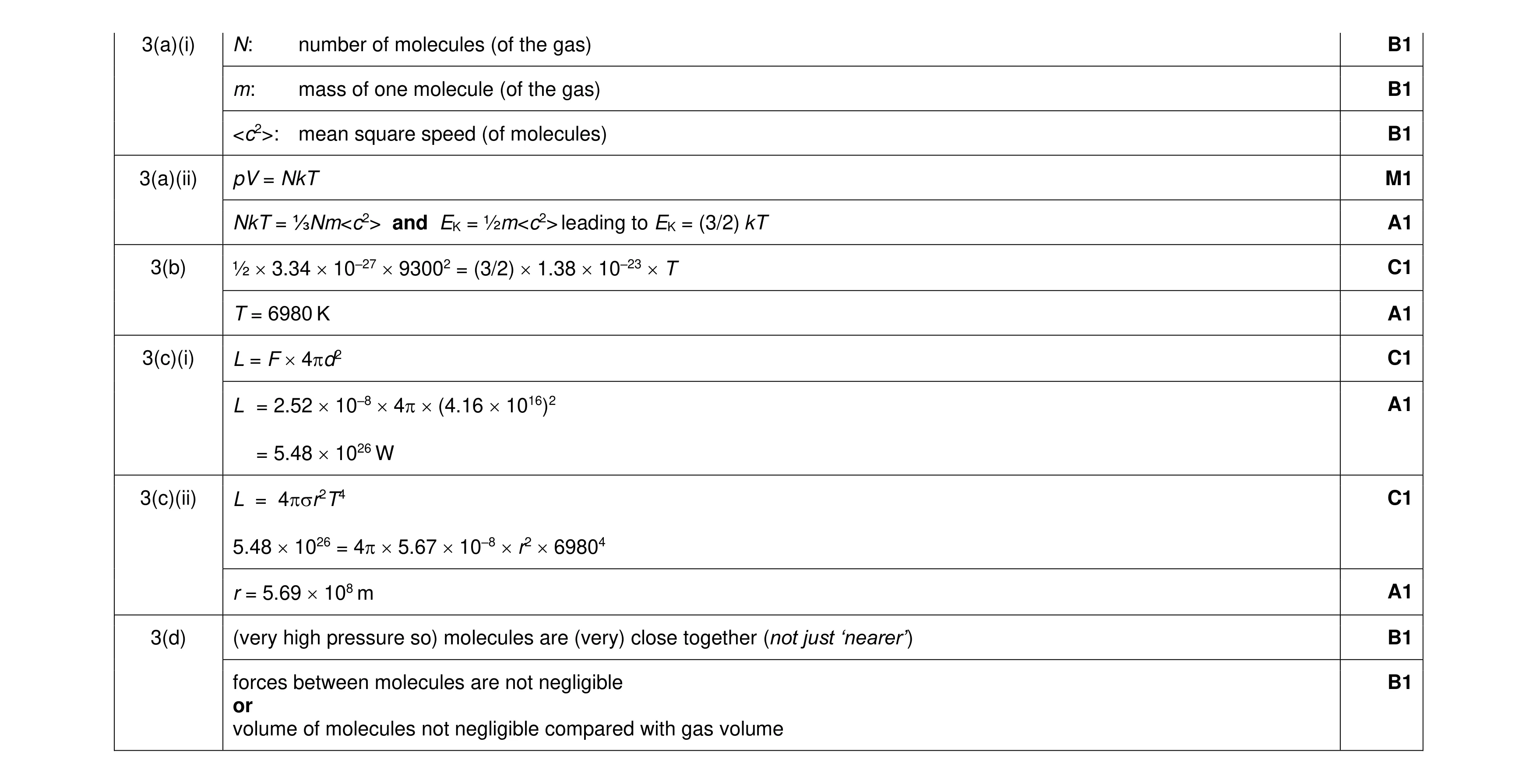 13
13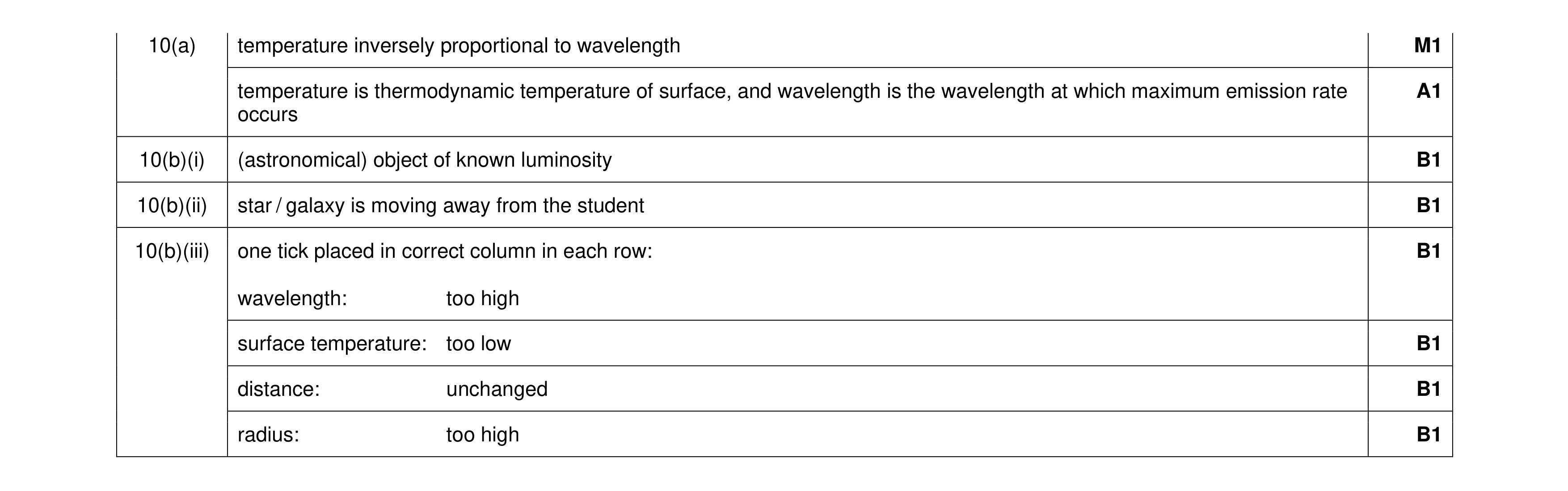 8
8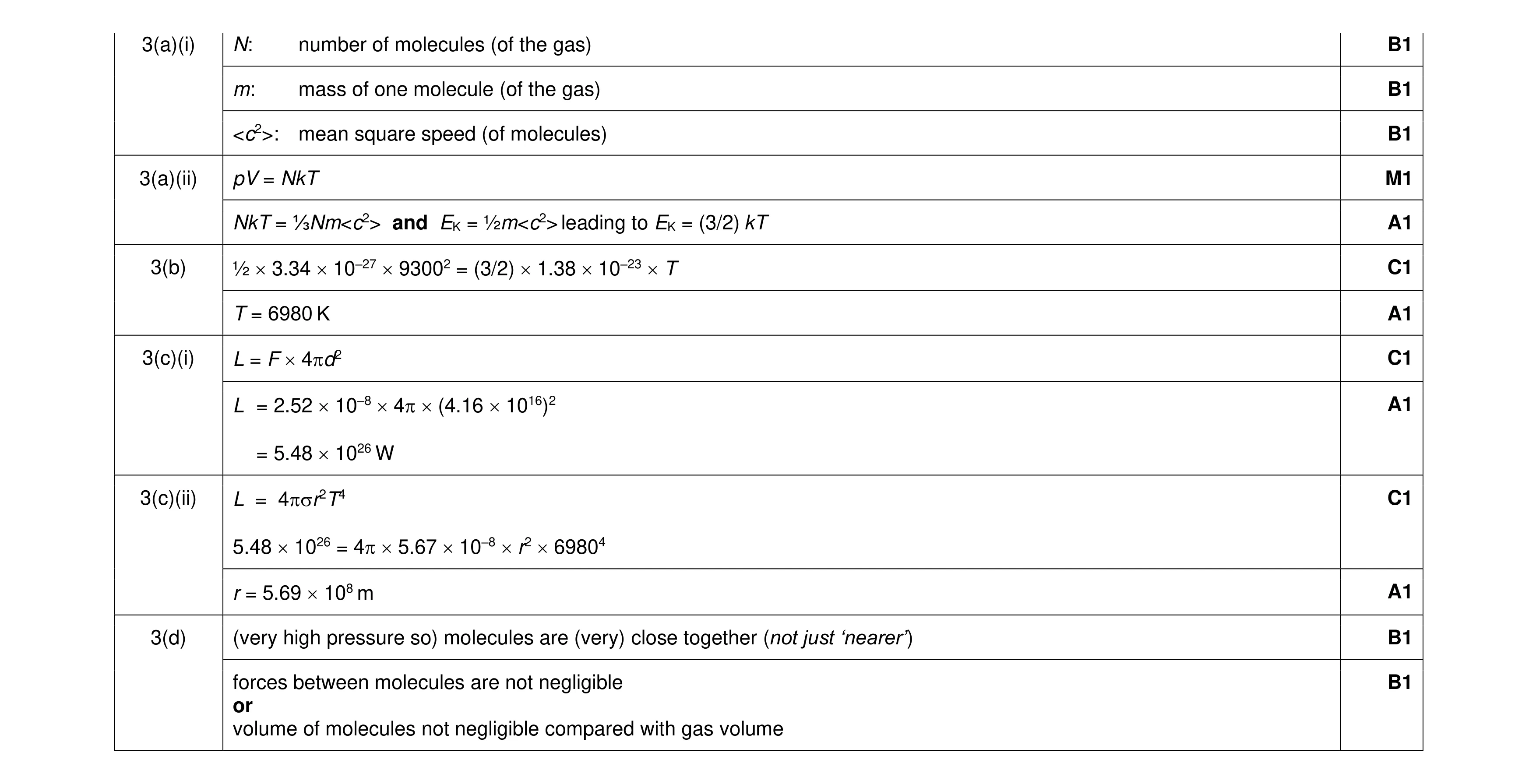 13
13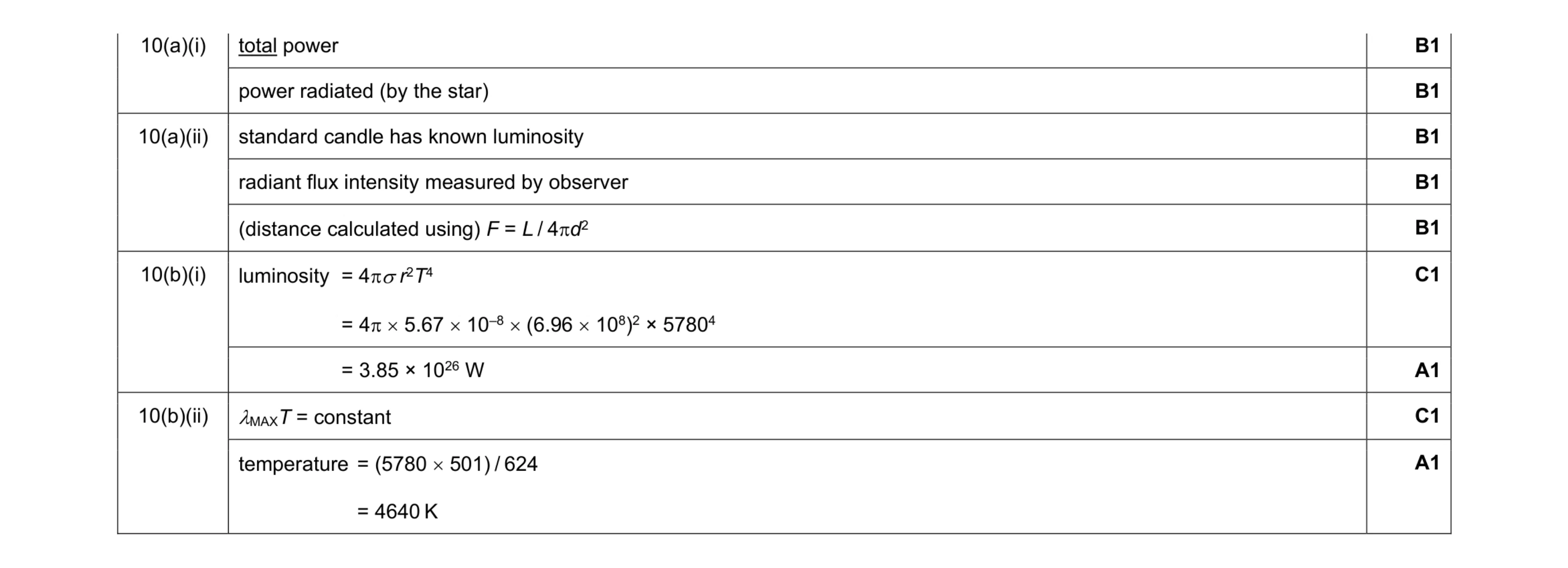 9
9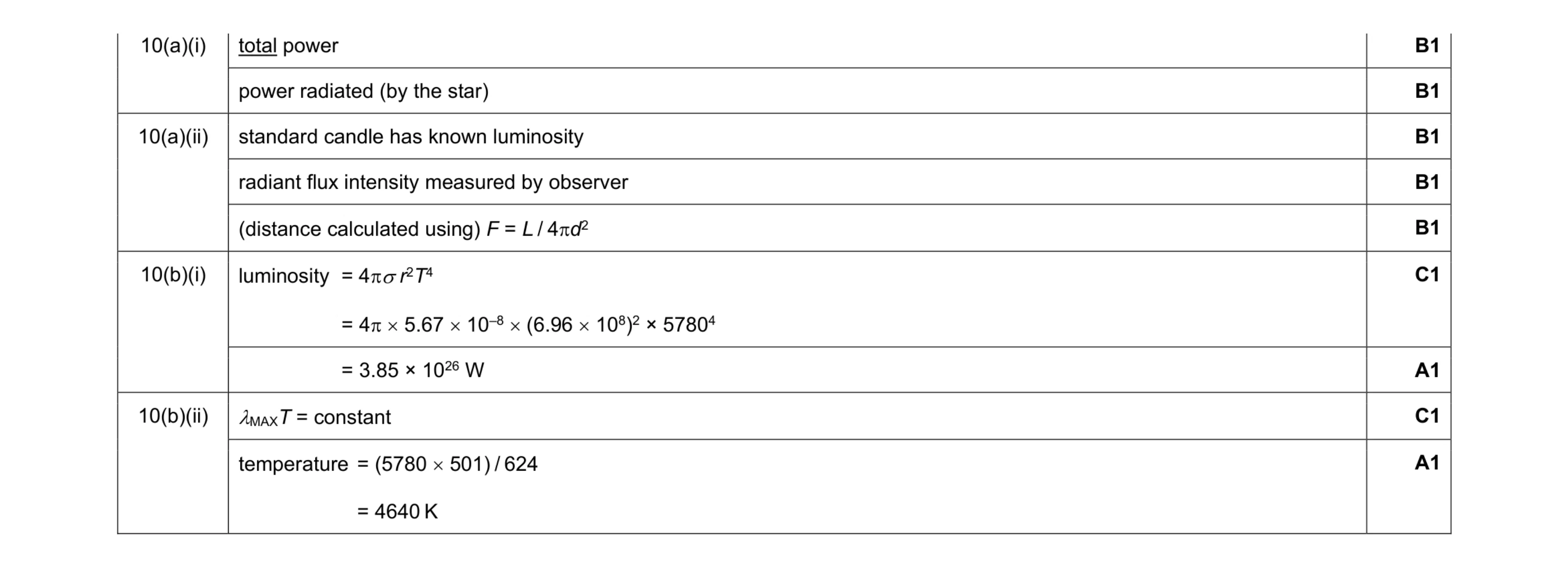 9
9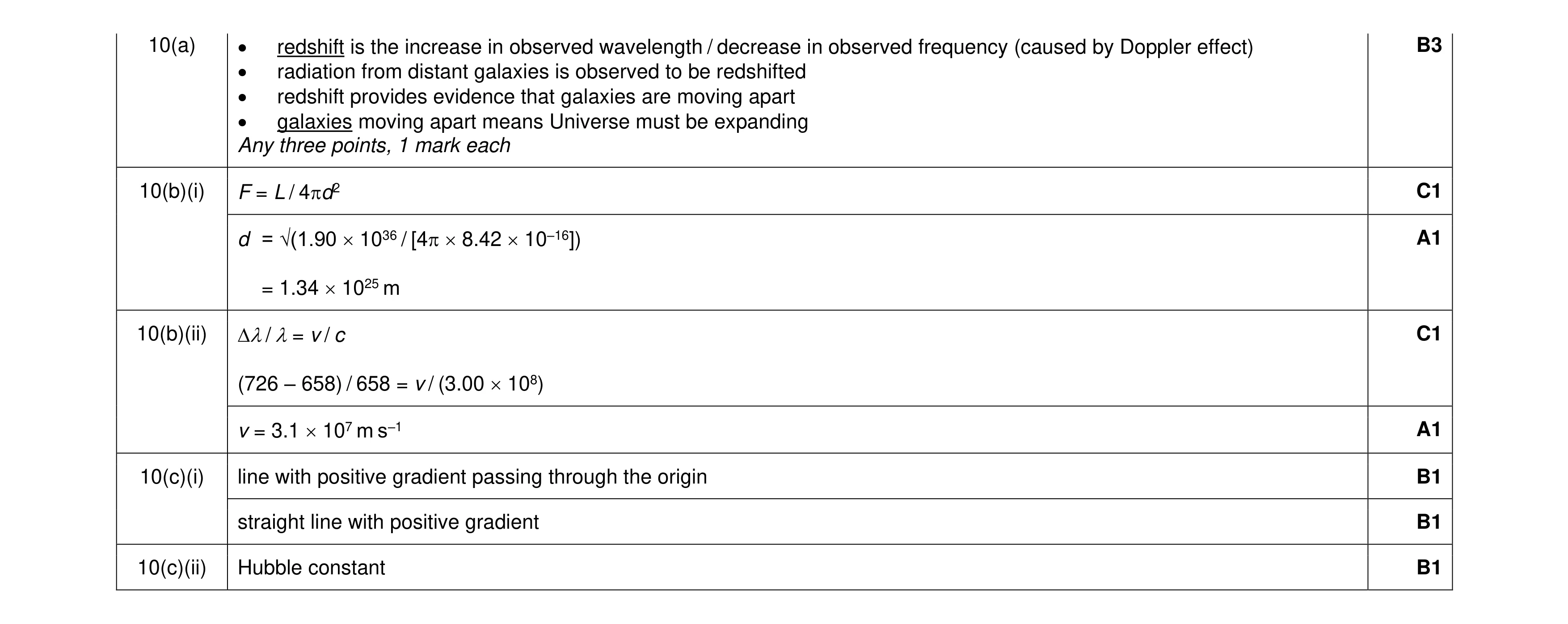 10
10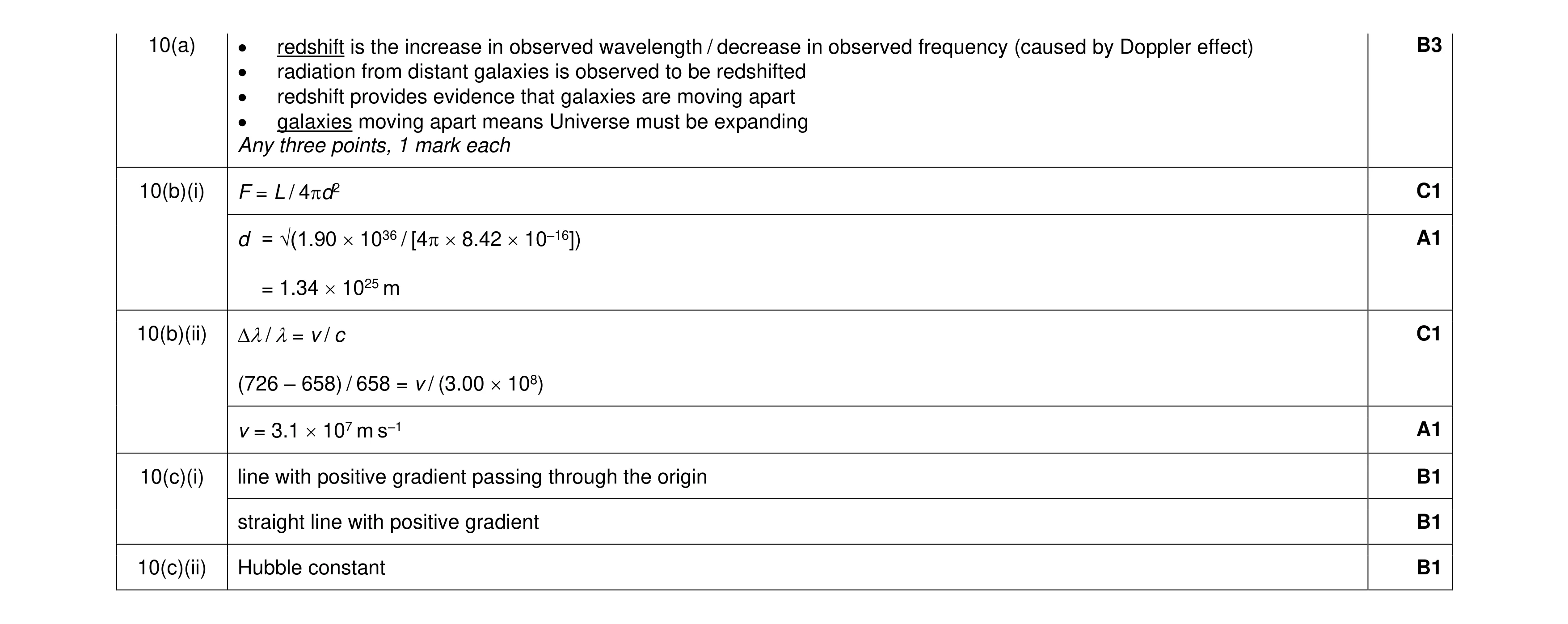 10
10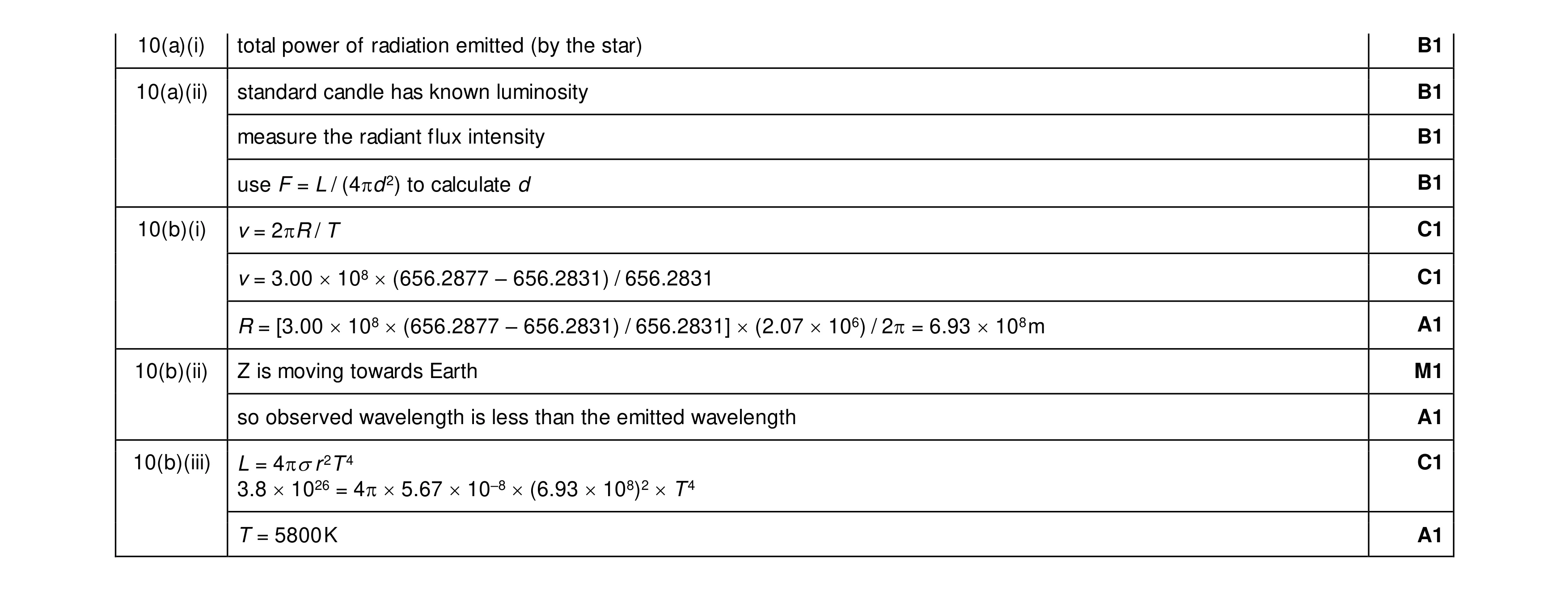 11
11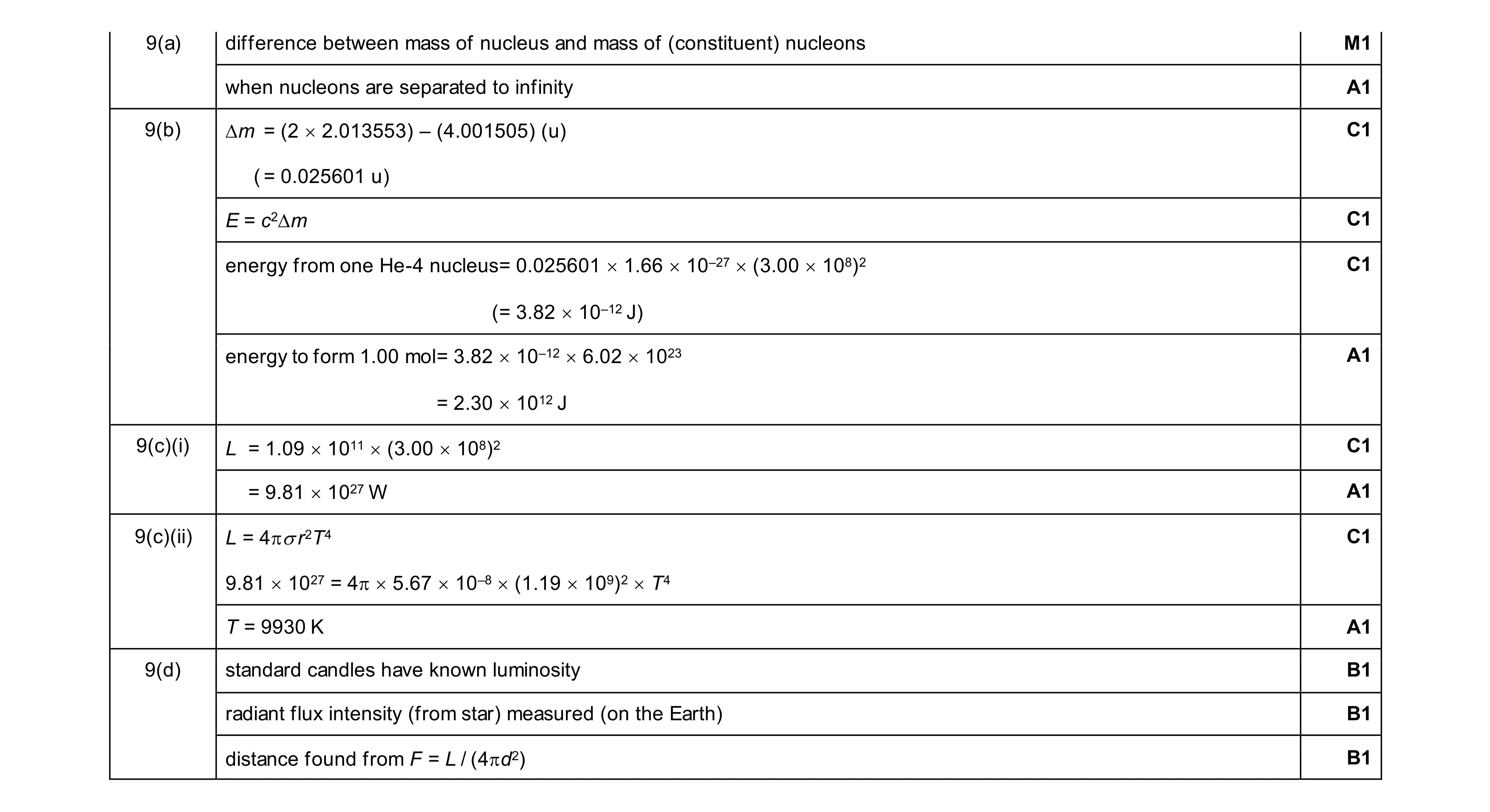 13
13