Questions as text
Q1 · The electrical resistance of a thermistor is to be used to measure temperatures in the… 9702/41 May/June 2006
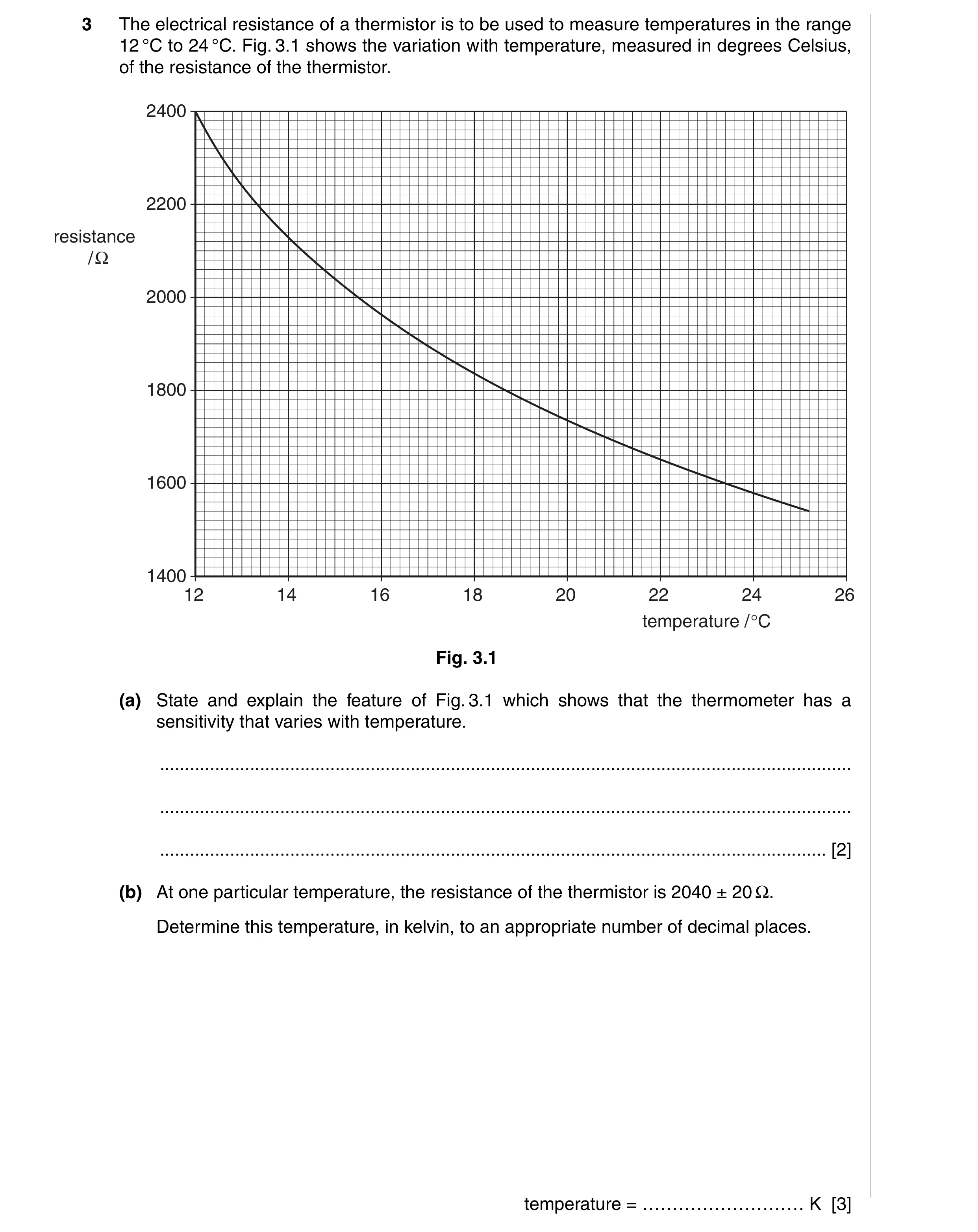
3 The electrical resistance of a thermistor is to be used to measure temperatures in the range 12 °C to 24 °C. Fig. 3.1 shows the variation with temperature, measured in degrees Celsius, of the resistance of the thermistor. 2400 2200 resistance / 2000 1800 1600 1400 12 14 16 18 20 22 24 26 temperature / Fig. 3.1 (a) State and explain the feature of Fig. 3.1 which shows that the thermometer has a sensitivity that varies with temperature. … … … [2] (b) At one particular temperature, the resistance of the thermistor is 2040 ± 20 Ω. Determine this temperature, in kelvin, to an appropriate number of decimal places. temperature = ……………………… K [3]
5 marks
Mark scheme: 3 (a) gradient of graph is (a measure of) the sensitivity M1 the gradient varies with temperature A1 [2] (b) 2040 ± 20 Ω corresponds to 15.0 ± 0.2 °C C1 T / K = T / °C + 273.15 (allow 273.2) C1 temperature is 288.2 K A1 [3]
This question in 9702/41 May/June 2006
Q2 · A student states, quite wrongly, that temperature measures the amount of thermal For… 9702/41 Oct/Nov 2009
3 (a) A student states, quite wrongly, that temperature measures the amount of thermal For energy (heat) in a body. Examiner’s Use State and explain two observations that show why this statement is incorrect. 1. … … … 2. … … … [4] (b) A thermometer and an electrical heater are inserted into holes in an aluminium block of mass 960 g, as shown in Fig. 3.1. connections to thermometer electrical circuit aluminium block Fig. 3.1 The power rating of the heater is 54 W. For Examiner’s The heater is switched on and readings of the temperature of the block are taken at Use regular time intervals. When the block reaches a constant temperature, the heater is switched off and then further temperature readings are taken. The variation with time t of the temperature θ of the block is shown in Fig. 3.2. θ 0 t Fig. 3.2 (i) Suggest why the rate of rise of temperature of the block decreases to zero. … … … [2] (ii) After the heater has been switched off, the maximum rate of fall of temperature is 3.7 K per minute. Estimate the specific heat capacity of aluminium. specific heat capacity = … J kg–1 K–1 [3]
9 marks
Mark scheme: 3 (a) e.g. two objects of different masses at same temperature (M1) same material would have different amount of heat (A1) e.g. temperature shows direction of heat transfer (M1) from high to low regardless of objects (A1) e.g. when substance melts/boils (M1) heat input but no temperature change (A1) any two, M1 + A1 each, max 4 ………………………………..………… … [4] (b) (i) energy losses (to the surroundings) … M1 either increase as the temperature rises or rise is zero when heat loss = heat input … A1 [2] (ii) idea of input power = maximum rate of heat loss … C1 power = m × c × ∆θ / ∆t 54 = 0.96 × c × 3.7 / 60 … C1 c = 910 J kg-1 K-1 … A1 [3] [Total: 9]
This question in 9702/41 Oct/Nov 2009
Q3 · Some gas, initially at a temperature of 27.2 °C, is heated so that its temperature rises… 9702/41 May/June 2010
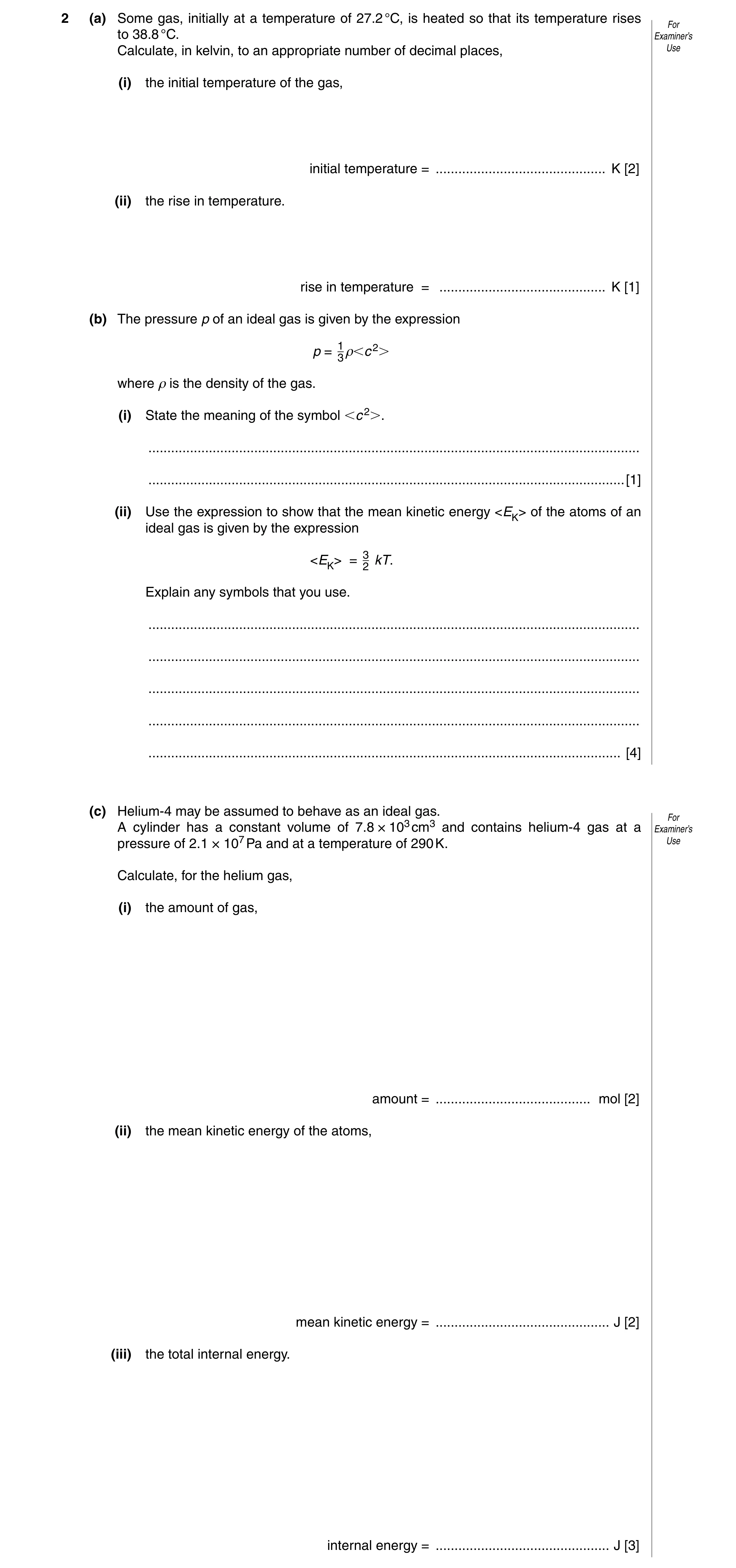
2 (a) Some gas, initially at a temperature of 27.2 °C, is heated so that its temperature rises For to 38.8 °C. Examiner’s Calculate, in kelvin, to an appropriate number of decimal places, Use (i) the initial temperature of the gas, initial temperature = … K [2] (ii) the rise in temperature. rise in temperature = … K [1] (b) The pressure p of an ideal gas is given by the expression 1 2 p = 3ρ c where ρ is the density of the gas. (i) State the meaning of the symbol c 2 . … … [1] (ii) Use the expression to show that the mean kinetic energy <EK> of the atoms of an ideal gas is given by the expression 3 <EK> = 2 kT. Explain any symbols that you use. … … … … … [4] (c) Helium-4 may be assumed to behave as an ideal gas. For A cylinder has a constant volume of 7.8 × 103 cm3 and contains helium-4 gas at a Examiner’s pressure of 2.1 × 10⁷ Pa and at a temperature of 290 K. Use Calculate, for the helium gas, (i) the amount of gas, amount = … mol [2] (ii) the mean kinetic energy of the atoms, mean kinetic energy = … J [2] (iii) the total internal energy. internal energy = … J [3]
15 marks
Mark scheme: 2 (a) (i) 27.2 + 273.15 or 27.2 + 273.2 C1 300.4 K A1 [2] (ii) 11.6 K A1 [1] (b) (i) (<c2> is the) mean / average square speed B1 [1] (ii) ρ = Nm/V with N explained B1 so, pV = 1/3 Nm<c2> B1 and pV = NkT with k explained B1 so mean kinetic energy / <EK> = ½m<c2> = 3/2 kT B1 [4] (c) (i) pV = nRT 2.1 × 107 × 7.8 × 10–3 = n × 8.3 × 290 C1 n = 68 mol A1 [2] (ii) mean kinetic energy = 3/2 kT = 3/2 × 1.38 × 10–23 × 290 C1 = 6.0 × 10⁻²¹ J A1 [2] (iii) realisation that total internal energy is the total kinetic energy C1 energy = 6.0 × 10–21 × 68 × 6.02 × 1023 C1 = 2.46 × 10⁵ J A1 [3]
This question in 9702/41 May/June 2010
Q4 · The resistance of a thermistor at 0 °C is 3840 Ω 9702/42 May/June 2010
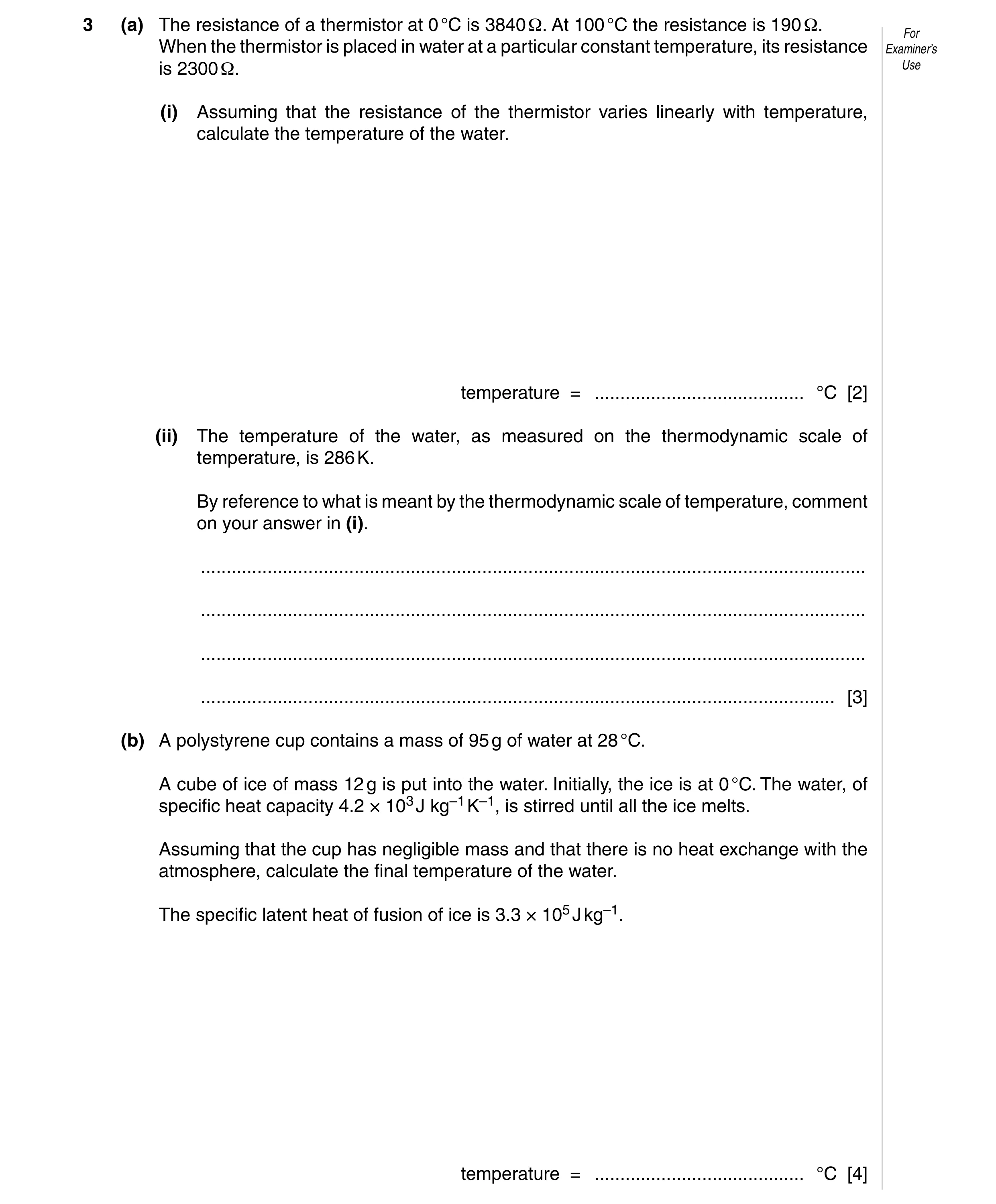
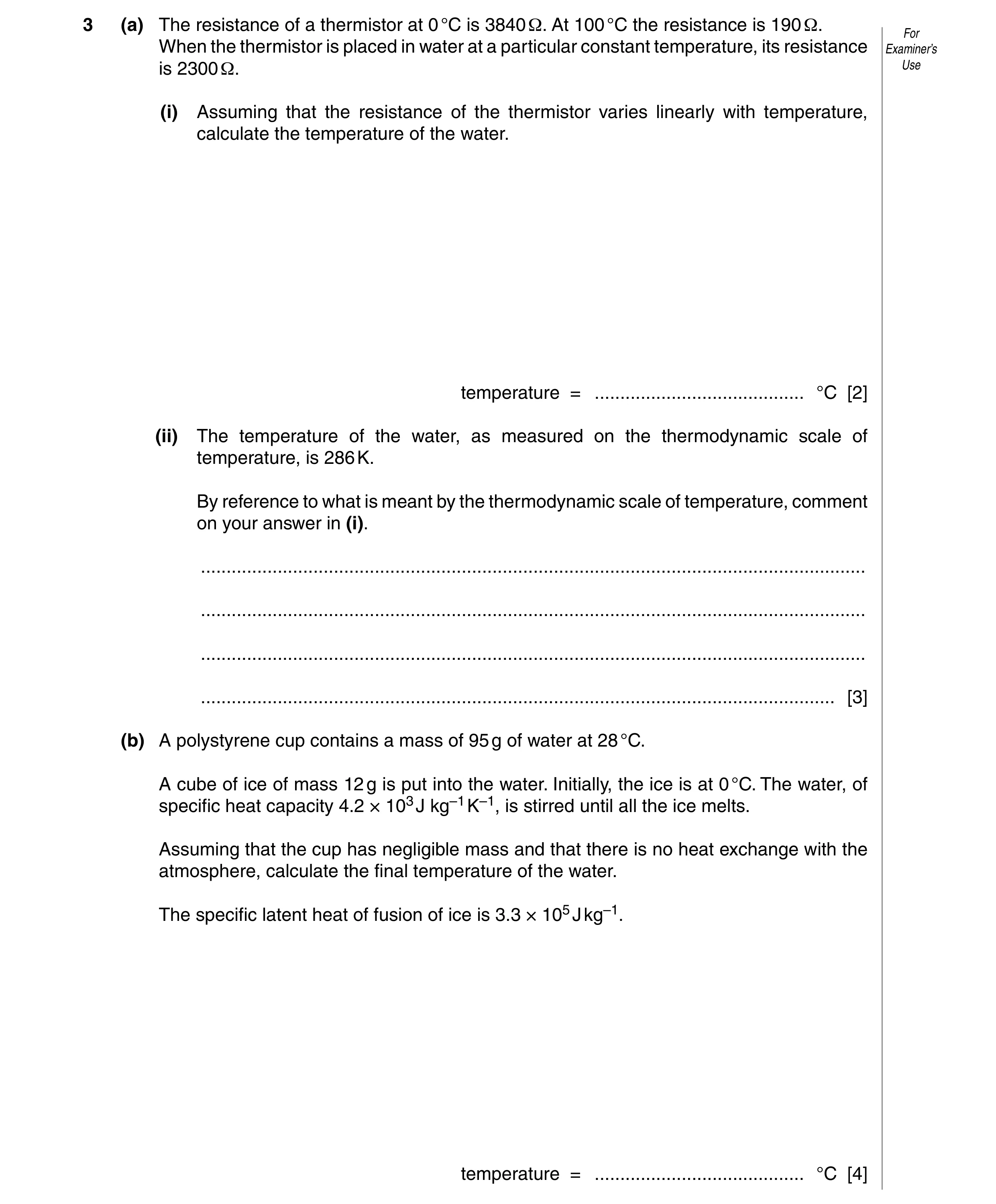
3 (a) The resistance of a thermistor at 0 °C is 3840 Ω. At 100 °C the resistance is 190 Ω. For When the thermistor is placed in water at a particular constant temperature, its resistance Examiner’s is 2300 Ω. Use (i) Assuming that the resistance of the thermistor varies linearly with temperature, calculate the temperature of the water. temperature = … °C [2] (ii) The temperature of the water, as measured on the thermodynamic scale of temperature, is 286 K. By reference to what is meant by the thermodynamic scale of temperature, comment on your answer in (i). … … … … [3] (b) A polystyrene cup contains a mass of 95 g of water at 28 °C. A cube of ice of mass 12 g is put into the water. Initially, the ice is at 0 °C. The water, of specific heat capacity 4.2 × 10³ J kg–1 K–1, is stirred until all the ice melts. Assuming that the cup has negligible mass and that there is no heat exchange with the atmosphere, calculate the final temperature of the water. The specific latent heat of fusion of ice is 3.3 × 10⁵ J kg–1. temperature = … °C [4]
9 marks
Mark scheme: 3 (a) (i) 1 deg C corresponds to (3840 – 190) / 100 Ω C1 for resistance 2300 Ω, temperature is 100 × (2300 – 3840) / (190 – 3840) temperature is 42 °C A1 [2] (ii) either 286 K ≡ 13 °C or 42 °C ≡ 315 K B1 thermodynamic scale does not depend on the property of a substance M1 so change in resistance (of thermistor) with temperature is non-linear A1 [3] (b) heat gained by ice in melting = 0.012 × 3.3 × 105 J C1 = 3960 J heat lost by water = 0.095 × 4.2 × 103 × (28 – θ) C1 3960 + (0.012 × 4.2 × 103 × θ) = 0.095 × 4.2 × 103 × (28 – θ) C1 θ = 16°C A1 [4] (answer 18°C – melted ice omitted – allow max 2 marks) (use of (θ – T) then allow max 1 mark) 2
This question in 9702/42 May/June 2010
Q5 · The resistance of a thermistor at 0 °C is 3840 Ω 9702/43 May/June 2010
3 (a) The resistance of a thermistor at 0 °C is 3840 Ω. At 100 °C the resistance is 190 Ω. For When the thermistor is placed in water at a particular constant temperature, its resistance Examiner’s is 2300 Ω. Use (i) Assuming that the resistance of the thermistor varies linearly with temperature, calculate the temperature of the water. temperature = … °C [2] (ii) The temperature of the water, as measured on the thermodynamic scale of temperature, is 286 K. By reference to what is meant by the thermodynamic scale of temperature, comment on your answer in (i). … … … … [3] (b) A polystyrene cup contains a mass of 95 g of water at 28 °C. A cube of ice of mass 12 g is put into the water. Initially, the ice is at 0 °C. The water, of specific heat capacity 4.2 × 10³ J kg–1 K–1, is stirred until all the ice melts. Assuming that the cup has negligible mass and that there is no heat exchange with the atmosphere, calculate the final temperature of the water. The specific latent heat of fusion of ice is 3.3 × 10⁵ J kg–1. temperature = … °C [4]
9 marks
Mark scheme: 3 (a) (i) 1 deg C corresponds to (3840 – 190) / 100 Ω C1 for resistance 2300 Ω, temperature is 100 × (2300 – 3840) / (190 – 3840) temperature is 42 °C A1 [2] (ii) either 286 K ≡ 13 °C or 42 °C ≡ 315 K B1 thermodynamic scale does not depend on the property of a substance M1 so change in resistance (of thermistor) with temperature is non-linear A1 [3] (b) heat gained by ice in melting = 0.012 × 3.3 × 105 J C1 = 3960 J heat lost by water = 0.095 × 4.2 × 103 × (28 – θ) C1 3960 + (0.012 × 4.2 × 103 × θ) = 0.095 × 4.2 × 103 × (28 – θ) C1 θ = 16°C A1 [4] (answer 18°C – melted ice omitted – allow max 2 marks) (use of (θ – T) then allow max 1 mark) 2
This question in 9702/43 May/June 2010
Q6 · A resistance thermometer and a thermocouple thermometer are both used at the same For… 9702/43 Oct/Nov 2011
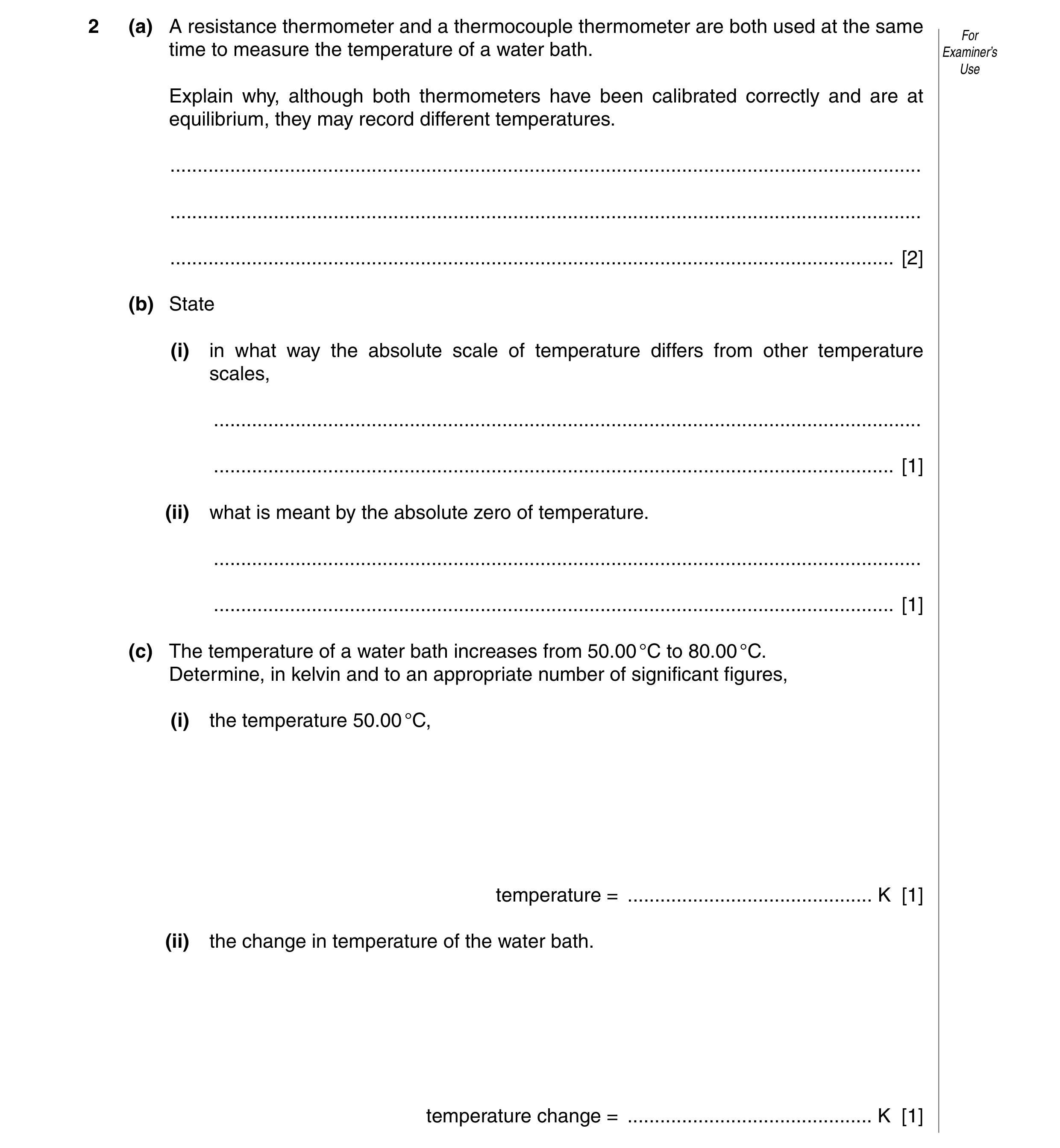
2 (a) A resistance thermometer and a thermocouple thermometer are both used at the same For time to measure the temperature of a water bath. Examiner’s Use Explain why, although both thermometers have been calibrated correctly and are at equilibrium, they may record different temperatures. … … … [2] (b) State (i) in what way the absolute scale of temperature differs from other temperature scales, … … [1] (ii) what is meant by the absolute zero of temperature. … … [1] (c) The temperature of a water bath increases from 50.00 °C to 80.00 °C. Determine, in kelvin and to an appropriate number of significant figures, (i) the temperature 50.00 °C, temperature = … K [1] (ii) the change in temperature of the water bath. temperature change = … K [1]
6 marks
Mark scheme: 2 (a) temperature scale calibrated assuming linear change of property with temperature B1 neither property varies linearly with temperature B1 [2] (b) (i) does not depend on the property of a substance B1 [1] (ii) temperature at which atoms have minimum/zero energy B1 [1] (c) (i) 323.15 K A1 [1] (ii) 30.00 K A1 [1] GCE AS/A LEVEL – October/November 2011 9702 43
This question in 9702/43 Oct/Nov 2011
Q7 · Two bodies are in thermal equilibrium 9702/43 Oct/Nov 2015
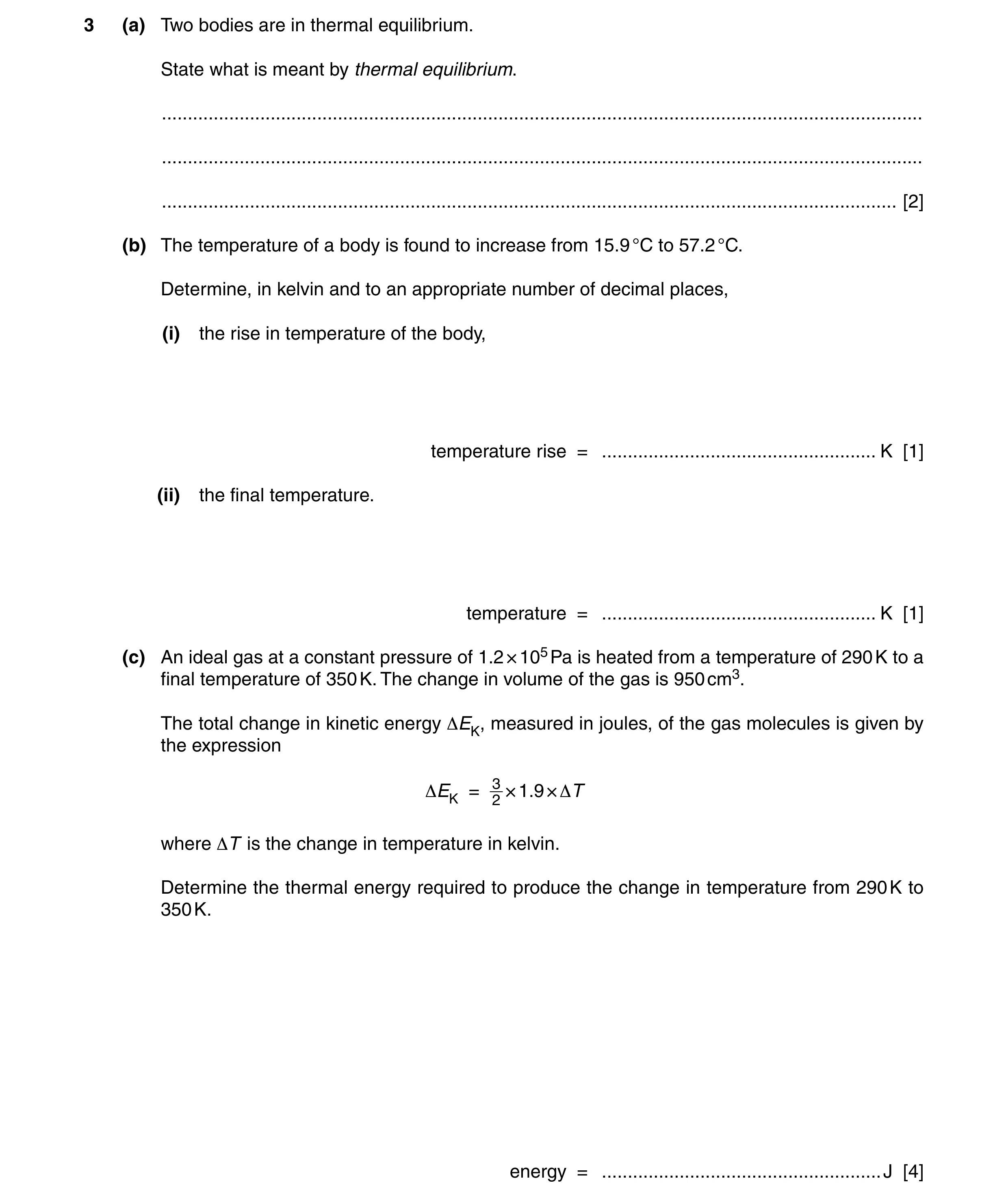
3 (a) Two bodies are in thermal equilibrium. State what is meant by thermal equilibrium. … … … [2] (b) The temperature of a body is found to increase from 15.9 °C to 57.2 °C. Determine, in kelvin and to an appropriate number of decimal places, (i) the rise in temperature of the body, temperature rise = … K [1] (ii) the final temperature. temperature = … K [1] (c) An ideal gas at a constant pressure of 1.2 × 10⁵ Pa is heated from a temperature of 290 K to a final temperature of 350 K. The change in volume of the gas is 950 cm3. The total change in kinetic energy ΔEK, measured in joules, of the gas molecules is given by the expression 3 ΔEK = 2 × 1.9 × ΔT where ΔT is the change in temperature in kelvin. Determine the thermal energy required to produce the change in temperature from 290 K to 350 K. energy = … J [4]
8 marks
Mark scheme: 3 (a) same temperature B1 no (net) transfer of thermal energy (between the bodies) B1 [2] (b) (i) 41.3 K B1 [1] (ii) 330.4 K B1 [1] 3 (c) ∆EK = × 1.9 × 60 2 = 171 J C1 work done = p∆V = 1.2 × 105 × 950 × 10–6 C1 = 114 J C1 thermal energy = 114 + 171 = 285 (290) J A1 [4]
This question in 9702/43 Oct/Nov 2015
Q8 · Explain what is meant by the statement that two bodies are in thermal equilibrium 9702/42 May/June 2016
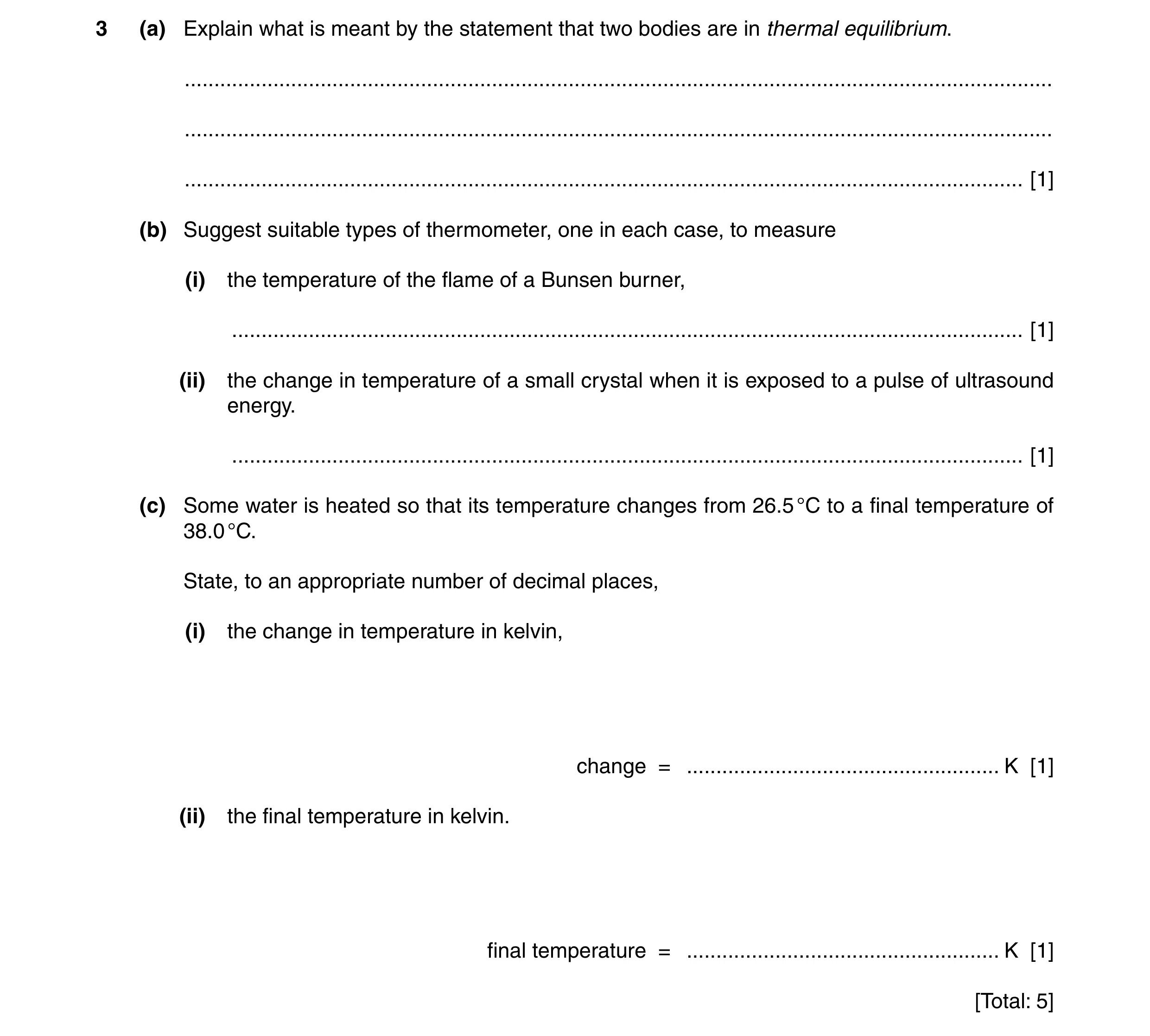
3 (a) Explain what is meant by the statement that two bodies are in thermal equilibrium. … … … [1] (b) Suggest suitable types of thermometer, one in each case, to measure (i) the temperature of the flame of a Bunsen burner, … [1] (ii) the change in temperature of a small crystal when it is exposed to a pulse of ultrasound energy. … [1] (c) Some water is heated so that its temperature changes from 26.5 °C to a final temperature of 38.0 °C. State, to an appropriate number of decimal places, (i) the change in temperature in kelvin, change = … K [1] (ii) the final temperature in kelvin. final temperature = … K [1] [Total: 5]
5 marks
Mark scheme: 3 (a) no net energy transfer between the bodies or bodies are at the same temperature B1 [1] (b) (i) thermocouple, platinum/metal resistance thermometer, pyrometer B1 [1] (ii) thermistor, thermocouple B1 [1] (c) (i) change = 11.5 K B1 [1] (ii) final temperature = 311.2 K B1 [1]
This question in 9702/42 May/June 2016
Q9 · The equation of state for an ideal gas of volume V at pressure p is pV = nRT where R is… 9702/42 Oct/Nov 2016
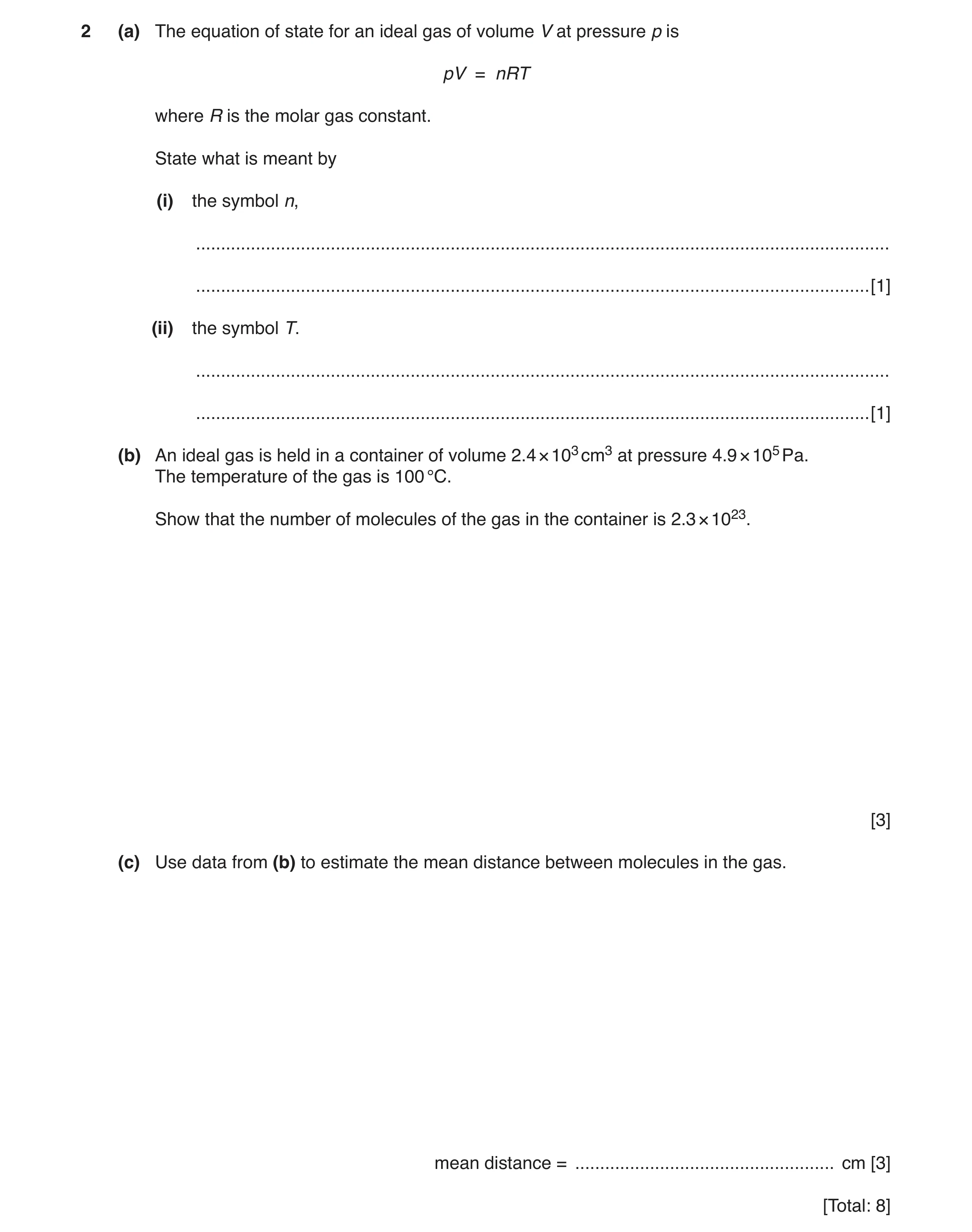
2 (a) The equation of state for an ideal gas of volume V at pressure p is pV = nRT where R is the molar gas constant. State what is meant by (i) the symbol n, … … [1] (ii) the symbol T. … … [1] (b) An ideal gas is held in a container of volume 2.4 × 103 cm3 at pressure 4.9 × 10⁵ Pa. The temperature of the gas is 100 °C. Show that the number of molecules of the gas in the container is 2.3 × 10²³. [3] (c) Use data from (b) to estimate the mean distance between molecules in the gas. mean distance = … cm [3] [Total: 8]
8 marks
Mark scheme: 2 (a) (i) number of moles/amount of substance B1 [1] (ii) kelvin temperature/absolute temperature/thermodynamic temperature B1 [1] (b) pV = nRT 4.9 × 105 × 2.4 × 103 × 10–6 = n × 8.31 × 373 B1 n = 0.38 (mol) C1 number of molecules or N = 0.38 × 6.02 × 1023 = 2.3 × 10²³ A1 [3] or pV = NkT (C1) 4.9 × 105 × 2.4 × 103 × 10–6 = N × 1.38 × 10–23 × 373 (M1) number of molecules or N = 2.3 × 10²³ (A1) (c) volume occupied by one molecule = (2.4 × 10³) / (2.3 × 10²³) C1 = 1.04 × 10⁻²⁰ cm3 mean spacing = (1.04 × 10⁻²⁰)1/3 C1 = 2.2 × 10⁻⁷ cm (allow 1 s.f.) A1 [3] (allow other dimensionally correct methods e.g. V = (4/3)πr3)
This question in 9702/42 Oct/Nov 2016
Q10 · State (i) what may be deduced from the difference in the temperatures of two objects, … …… 9702/41 Oct/Nov 2017
1 (a) State (i) what may be deduced from the difference in the temperatures of two objects, … … [1] (ii) the basic principle by which temperature is measured. … … [1] (b) By reference to your answer in (a)(ii), explain why two thermometers may not give the same temperature reading for an object. … … … [2] (c) A block of aluminium of mass 670 g is heated at a constant rate of 95 W for 6.0 minutes. The specific heat capacity of aluminium is 910 J kg−1 K−1. The initial temperature of the block is 24 °C. (i) Assuming that no thermal energy is lost to the surroundings, show that the final temperature of the block is 80 °C. [3] (ii) In practice, there are energy losses to the surroundings. The actual variation with time t of the temperature θ of the block is shown in Fig. 1.1. 100 80 θ/ °C 60 40 20 0 0 1 2 3 4 5 6 t / minutes Fig. 1.1 1. Use the information in (i) to draw, on Fig. 1.1, a line to represent the temperature of the block, assuming no energy losses to the surroundings. [1] 2. Using Fig. 1.1, calculate the total energy loss to the surroundings during the heating process. energy loss = … J [2] [Total: 10]
10 marks
Mark scheme: 1(a)(i) direction or rate of transfer of (thermal) energy or (if different,) not in thermal equilibrium/energy is transferred B1 1(a)(ii) uses a property (of a substance) that changes with temperature B1 1(b) • temperature scale assumes linear change of property with temperature • physical properties may not vary linearly with temperature • agrees only at fixed points Any 2 points. B2 1(c)(i) Pt = mc(∆)θ C1 95 × 6 × 60 = 0.670 × 910 × ∆θ M1 ∆θ = 56 °C so final temperature = 56 + 24 = 80 °C A1 or 95 × 6 × 60 = 0.67 × 910 × (θ – 24) (M1) so final temperature or θ = 80 °C (A1) Question Answer Marks 1(c)(ii) 1. sketch: straight line from (0,24) to (6,80) B1 2. temperature drop due to energy loss = (80 – 64) = 16 °C C1 energy loss = 0.670 × 910 × (80 – 64) = 9800 J A1 or energy to raise temperature to 64 °C = 0.670 × 910 × (64 – 24) (C1) = 24400 J loss = (95 × 6 × 60) – 24400 = 9800 J (A1)
This question in 9702/41 Oct/Nov 2017
Q11 · State (i) what may be deduced from the difference in the temperatures of two objects, … …… 9702/43 Oct/Nov 2017
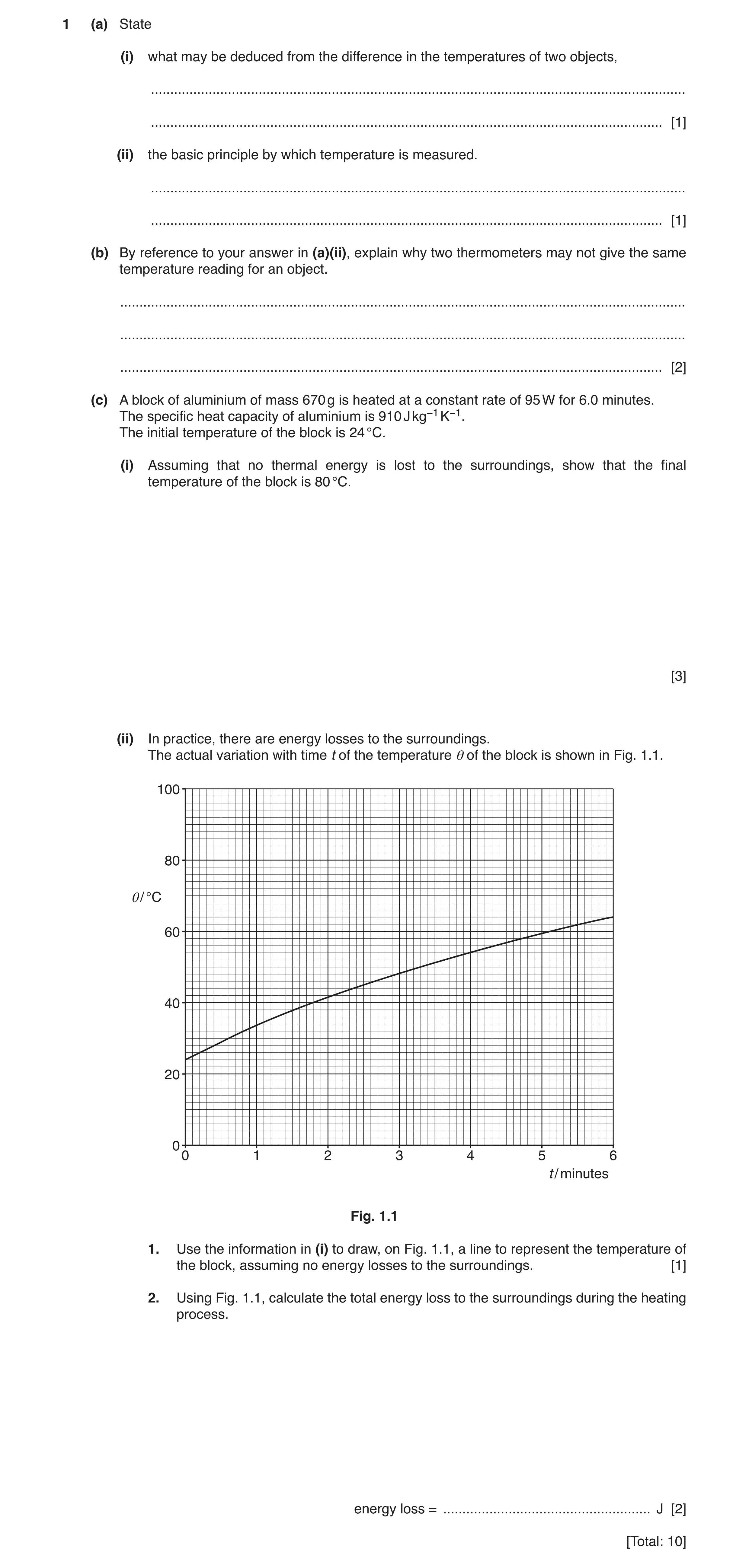
1 (a) State (i) what may be deduced from the difference in the temperatures of two objects, … … [1] (ii) the basic principle by which temperature is measured. … … [1] (b) By reference to your answer in (a)(ii), explain why two thermometers may not give the same temperature reading for an object. … … … [2] (c) A block of aluminium of mass 670 g is heated at a constant rate of 95 W for 6.0 minutes. The specific heat capacity of aluminium is 910 J kg−1 K−1. The initial temperature of the block is 24 °C. (i) Assuming that no thermal energy is lost to the surroundings, show that the final temperature of the block is 80 °C. [3] (ii) In practice, there are energy losses to the surroundings. The actual variation with time t of the temperature θ of the block is shown in Fig. 1.1. 100 80 θ/ °C 60 40 20 0 0 1 2 3 4 5 6 t / minutes Fig. 1.1 1. Use the information in (i) to draw, on Fig. 1.1, a line to represent the temperature of the block, assuming no energy losses to the surroundings. [1] 2. Using Fig. 1.1, calculate the total energy loss to the surroundings during the heating process. energy loss = … J [2] [Total: 10]
10 marks
Mark scheme: 1(a)(i) direction or rate of transfer of (thermal) energy or (if different,) not in thermal equilibrium/energy is transferred B1 1(a)(ii) uses a property (of a substance) that changes with temperature B1 1(b) • temperature scale assumes linear change of property with temperature • physical properties may not vary linearly with temperature • agrees only at fixed points Any 2 points. B2 1(c)(i) Pt = mc(∆)θ C1 95 × 6 × 60 = 0.670 × 910 × ∆θ M1 ∆θ = 56 °C so final temperature = 56 + 24 = 80 °C A1 or 95 × 6 × 60 = 0.67 × 910 × (θ – 24) (M1) so final temperature or θ = 80 °C (A1) Question Answer Marks 1(c)(ii) 1. sketch: straight line from (0,24) to (6,80) B1 2. temperature drop due to energy loss = (80 – 64) = 16 °C C1 energy loss = 0.670 × 910 × (80 – 64) = 9800 J A1 or energy to raise temperature to 64 °C = 0.670 × 910 × (64 – 24) (C1) = 24400 J loss = (95 × 6 × 60) – 24400 = 9800 J (A1)
This question in 9702/43 Oct/Nov 2017
Q12 · A laboratory thermometer that is calibrated to measure temperature in degrees Celsius 9702/41 Oct/Nov 2022
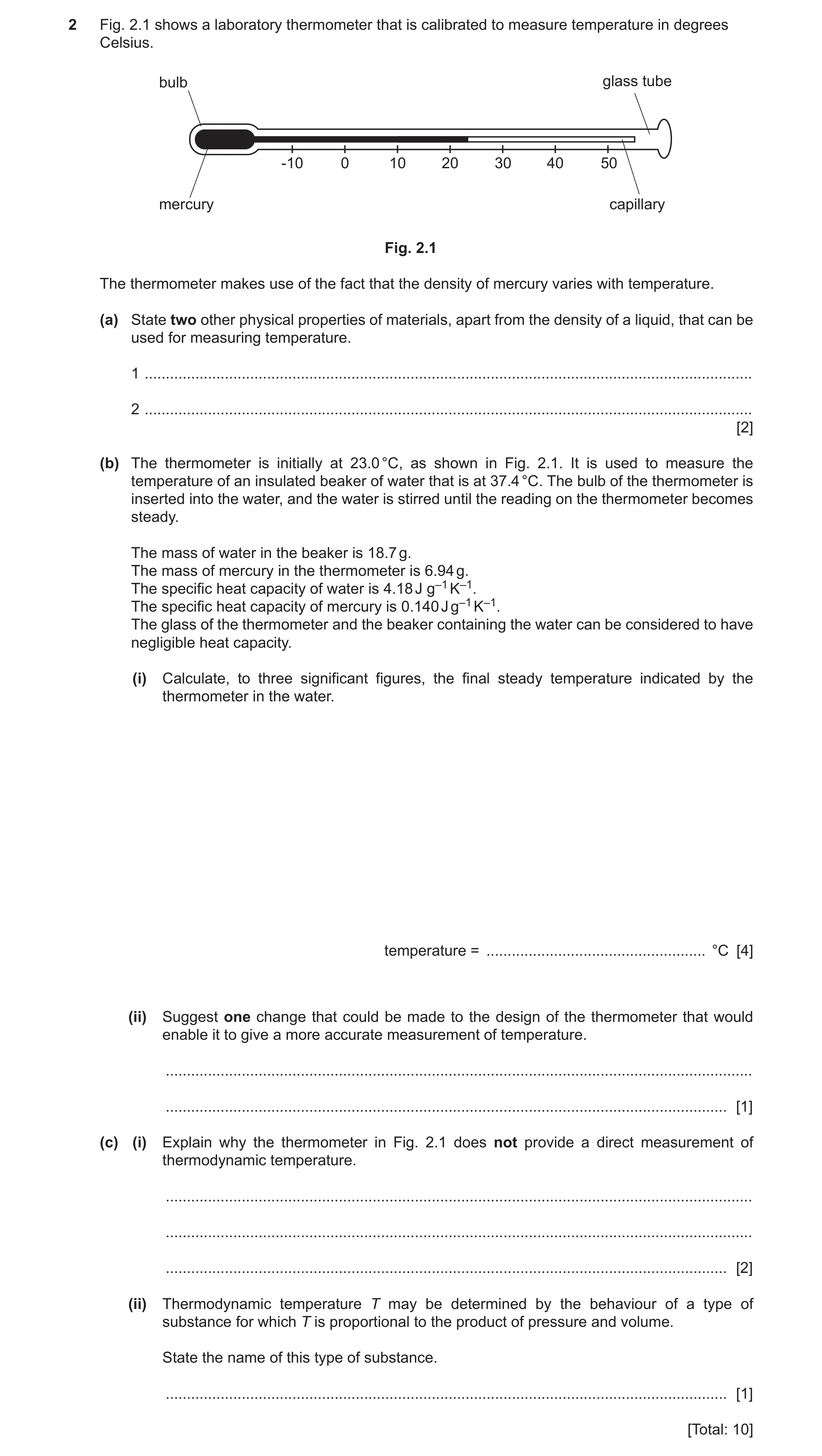
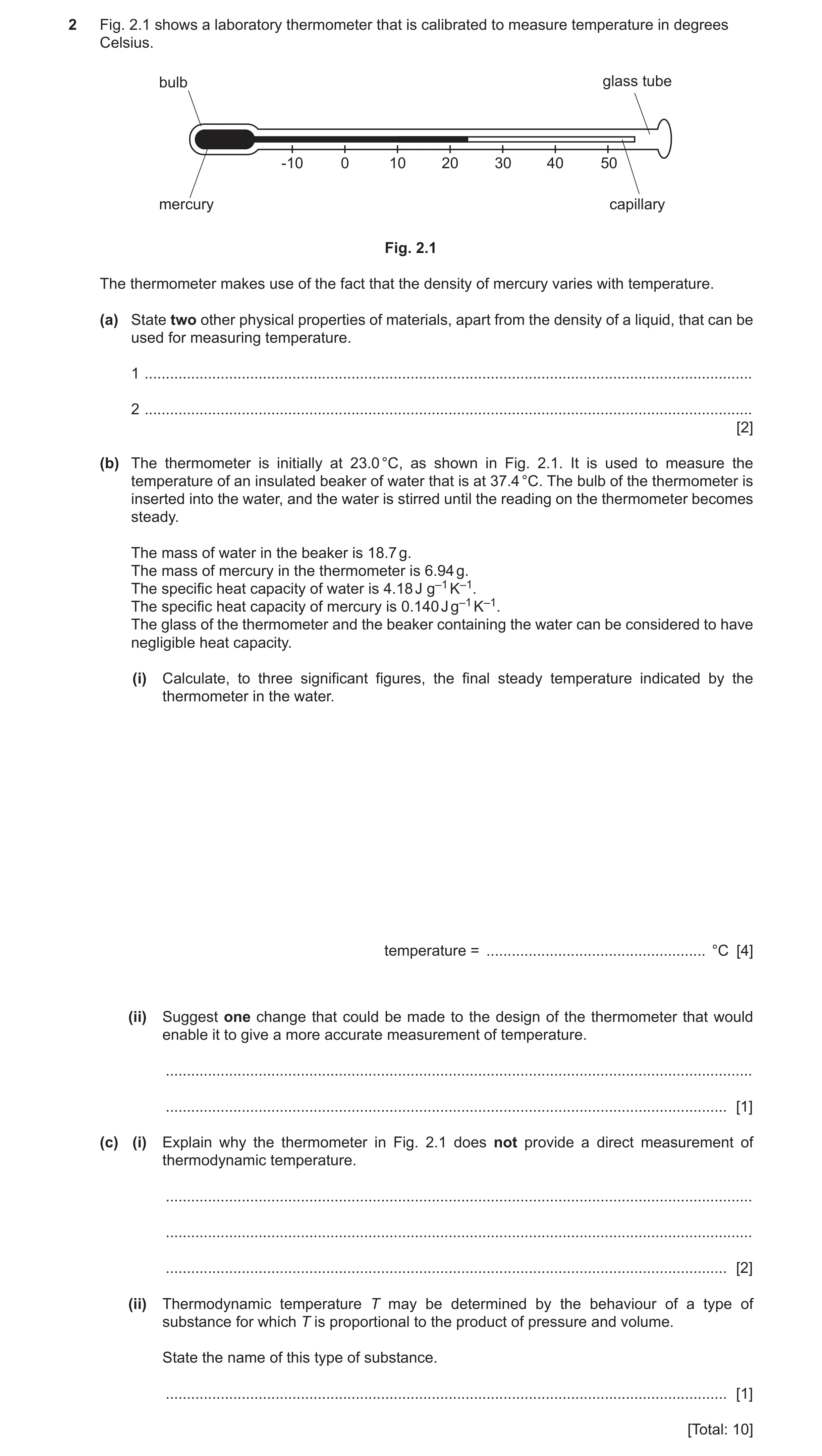
2 Fig. 2.1 shows a laboratory thermometer that is calibrated to measure temperature in degrees Celsius. bulb glass tube -10 0 10 20 30 40 50 mercury capillary Fig. 2.1 The thermometer makes use of the fact that the density of mercury varies with temperature. (a) State two other physical properties of materials, apart from the density of a liquid, that can be used for measuring temperature. 1 … 2 … [2] (b) The thermometer is initially at 23.0 °C, as shown in Fig. 2.1. It is used to measure the temperature of an insulated beaker of water that is at 37.4 °C. The bulb of the thermometer is inserted into the water, and the water is stirred until the reading on the thermometer becomes steady. The mass of water in the beaker is 18.7 g. The mass of mercury in the thermometer is 6.94 g. The specific heat capacity of water is 4.18 J g–1 K–1. The specific heat capacity of mercury is 0.140 J g–1 K–1. The glass of the thermometer and the beaker containing the water can be considered to have negligible heat capacity. (i) Calculate, to three significant figures, the final steady temperature indicated by the thermometer in the water. temperature = … °C [4] (ii) Suggest one change that could be made to the design of the thermometer that would enable it to give a more accurate measurement of temperature. … … [1] (c) (i) Explain why the thermometer in Fig. 2.1 does not provide a direct measurement of thermodynamic temperature. … … … [2] (ii) Thermodynamic temperature T may be determined by the behaviour of a type of substance for which T is proportional to the product of pressure and volume. State the name of this type of substance. … [1] [Total: 10]
10 marks
Mark scheme: 2(a) • resistance of a metal B2 • volume of a gas at constant pressure • e.m.f. of a thermocouple Any two points, 1 mark each 2(b)(i) Q = mcT C1 evidence of realisation that Q lost by water = Q gained by mercury C1 18.7 4.18 (37.4 – T) = 6.94 0.140 (T – 23.0) C1 T = 37.2 °C A1 2(b)(ii) use a liquid with a lower (specific) heat capacity (than mercury) B1 or use a smaller mass of mercury 2(c)(i) depends on properties of a real substance B1 0 °C is not absolute zero B1 2(c)(ii) ideal gas B1
This question in 9702/41 Oct/Nov 2022
Q13 · A laboratory thermometer that is calibrated to measure temperature in degrees Celsius 9702/43 Oct/Nov 2022
2 Fig. 2.1 shows a laboratory thermometer that is calibrated to measure temperature in degrees Celsius. bulb glass tube -10 0 10 20 30 40 50 mercury capillary Fig. 2.1 The thermometer makes use of the fact that the density of mercury varies with temperature. (a) State two other physical properties of materials, apart from the density of a liquid, that can be used for measuring temperature. 1 … 2 … [2] (b) The thermometer is initially at 23.0 °C, as shown in Fig. 2.1. It is used to measure the temperature of an insulated beaker of water that is at 37.4 °C. The bulb of the thermometer is inserted into the water, and the water is stirred until the reading on the thermometer becomes steady. The mass of water in the beaker is 18.7 g. The mass of mercury in the thermometer is 6.94 g. The specific heat capacity of water is 4.18 J g–1 K–1. The specific heat capacity of mercury is 0.140 J g–1 K–1. The glass of the thermometer and the beaker containing the water can be considered to have negligible heat capacity. (i) Calculate, to three significant figures, the final steady temperature indicated by the thermometer in the water. temperature = … °C [4] (ii) Suggest one change that could be made to the design of the thermometer that would enable it to give a more accurate measurement of temperature. … … [1] (c) (i) Explain why the thermometer in Fig. 2.1 does not provide a direct measurement of thermodynamic temperature. … … … [2] (ii) Thermodynamic temperature T may be determined by the behaviour of a type of substance for which T is proportional to the product of pressure and volume. State the name of this type of substance. … [1] [Total: 10]
10 marks
Mark scheme: 2(a) • resistance of a metal B2 • volume of a gas at constant pressure • e.m.f. of a thermocouple Any two points, 1 mark each 2(b)(i) Q = mcT C1 evidence of realisation that Q lost by water = Q gained by mercury C1 18.7 4.18 (37.4 – T) = 6.94 0.140 (T – 23.0) C1 T = 37.2 °C A1 2(b)(ii) use a liquid with a lower (specific) heat capacity (than mercury) B1 or use a smaller mass of mercury 2(c)(i) depends on properties of a real substance B1 0 °C is not absolute zero B1 2(c)(ii) ideal gas B1
This question in 9702/43 Oct/Nov 2022
Q14 · State the reason why two objects that are at the same temperature are described as being… 9702/41 May/June 2023
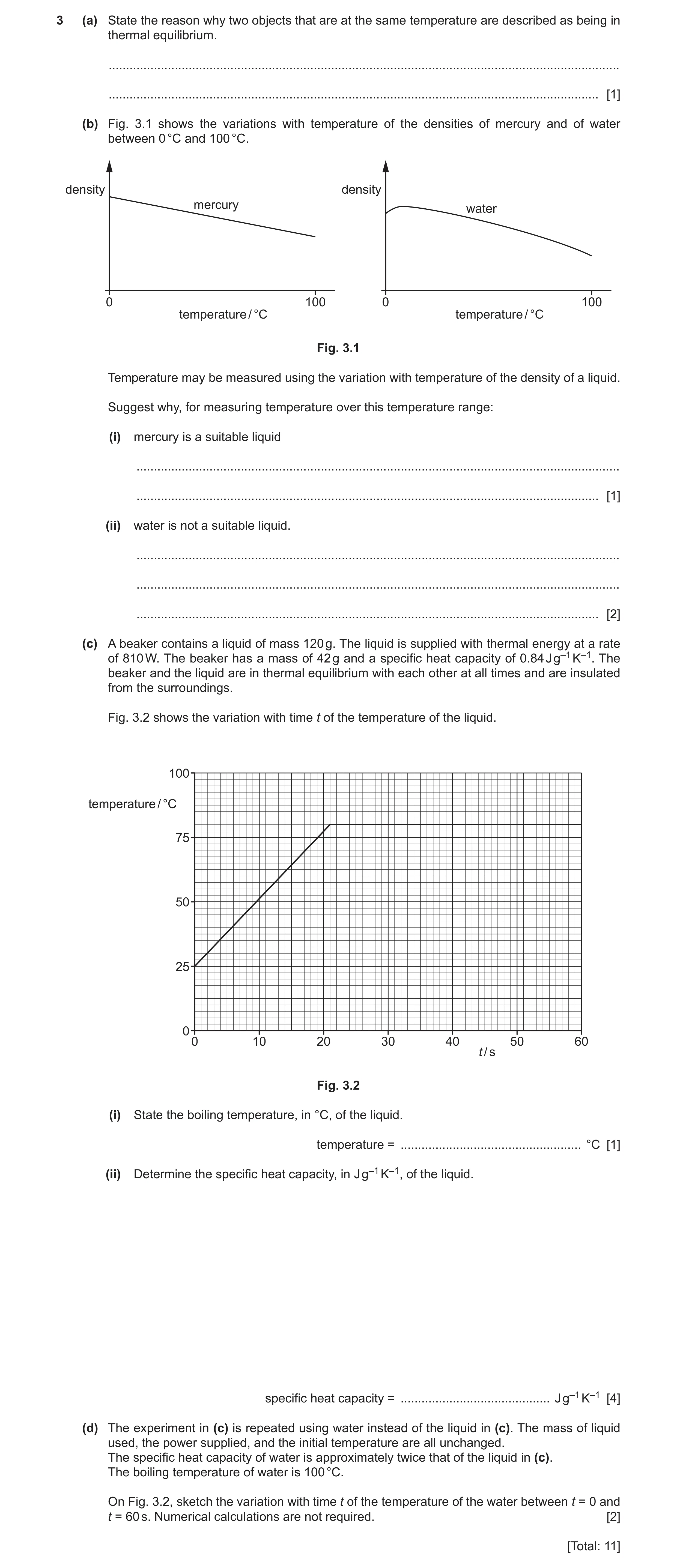
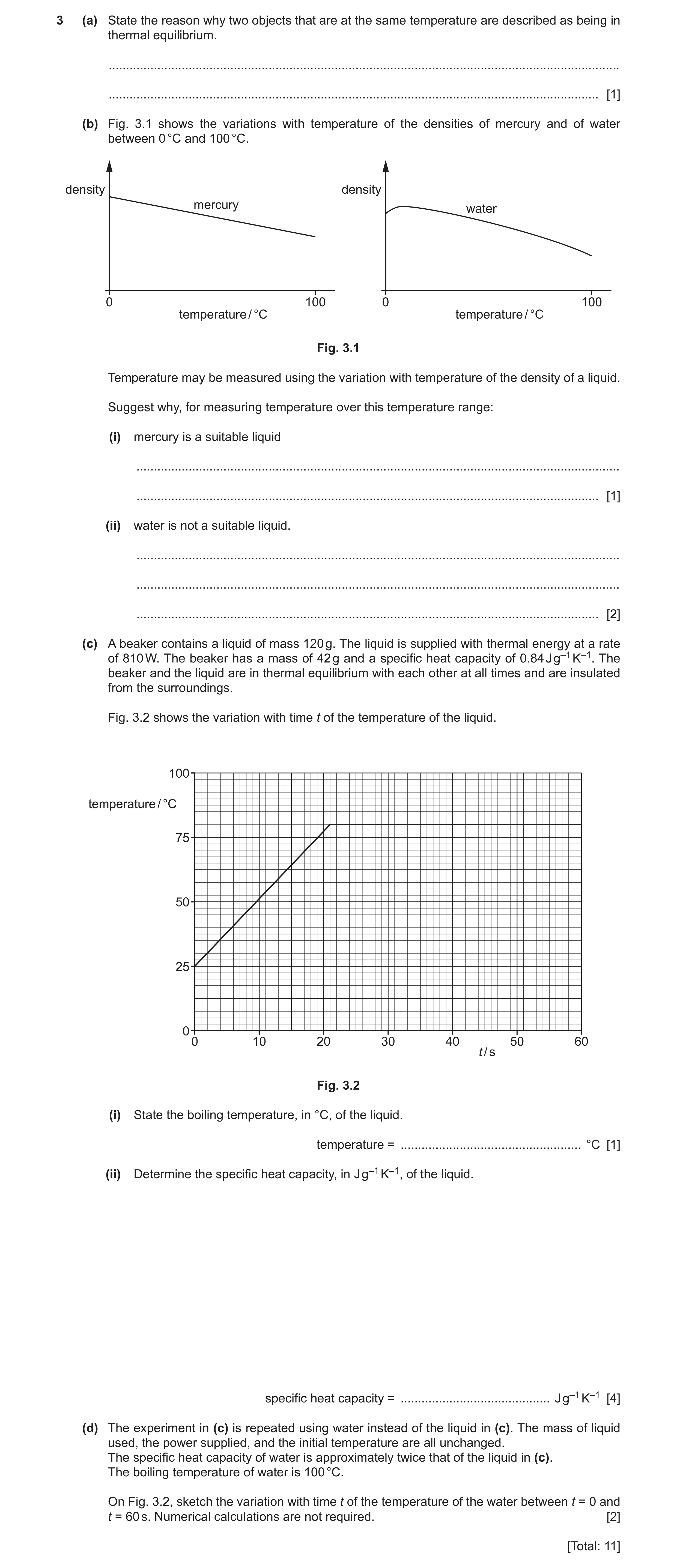
3 (a) State the reason why two objects that are at the same temperature are described as being in thermal equilibrium. … … [1] (b) Fig. 3.1 shows the variations with temperature of the densities of mercury and of water between 0 °C and 100 °C. density density mercury water 0 100 0 100 temperature / °C temperature / °C Fig. 3.1 Temperature may be measured using the variation with temperature of the density of a liquid. Suggest why, for measuring temperature over this temperature range: (i) mercury is a suitable liquid … … [1] (ii) water is not a suitable liquid. … … … [2] (c) A beaker contains a liquid of mass 120 g. The liquid is supplied with thermal energy at a rate of 810 W. The beaker has a mass of 42 g and a specific heat capacity of 0.84 J g–1 K–1. The beaker and the liquid are in thermal equilibrium with each other at all times and are insulated from the surroundings. Fig. 3.2 shows the variation with time t of the temperature of the liquid. 100 temperature / °C 75 50 25 0 0 10 20 30 40 50 60 t / s Fig. 3.2 (i) State the boiling temperature, in °C, of the liquid. temperature = … °C [1] (ii) Determine the specific heat capacity, in J g–1 K–1, of the liquid. specific heat capacity = … J g–1 K–1 [4] (d) The experiment in (c) is repeated using water instead of the liquid in (c). The mass of liquid used, the power supplied, and the initial temperature are all unchanged. The specific heat capacity of water is approximately twice that of the liquid in (c). The boiling temperature of water is 100 °C. On Fig. 3.2, sketch the variation with time t of the temperature of the water between t = 0 and t = 60 s. Numerical calculations are not required. [2] [Total: 11]
11 marks
Mark scheme: 3(a) no net thermal energy is transferred (between them) B1 3(b)(i) variation (of density with temperature) is linear or each temperature has a unique value of density B1 3(b)(ii) variation (of density with temperature) is not linear region where the density does not vary with temperature different temperatures have the same density Any two points, 1 mark each B2 3(c)(i) boiling point = 80 °C A1 3(c)(ii) Q = Pt and t = 21 s (thermal energy supplied = 810 21 = 17000 J) C1 c = Q / m C1 thermal energy absorbed by beaker = 42 0.84 (80 – 25) ( = 1940 J) C1 s.h.c. of liquid = [(810 21) – (42 0.84 (80 – 25))] / [120 (80 – 25)] = 2.3 J g–1 K–1 A1 3(d) sketch: straight diagonal line from 25 °C to 100 °C and then horizontal at 100 °C B1 straight diagonal line starting at 25 °C with gradient approximately half that of the original line B1
This question in 9702/41 May/June 2023
Q15 · State the reason why two objects that are at the same temperature are described as being… 9702/43 May/June 2023
3 (a) State the reason why two objects that are at the same temperature are described as being in thermal equilibrium. … … [1] (b) Fig. 3.1 shows the variations with temperature of the densities of mercury and of water between 0 °C and 100 °C. density density mercury water 0 100 0 100 temperature / °C temperature / °C Fig. 3.1 Temperature may be measured using the variation with temperature of the density of a liquid. Suggest why, for measuring temperature over this temperature range: (i) mercury is a suitable liquid … … [1] (ii) water is not a suitable liquid. … … … [2] (c) A beaker contains a liquid of mass 120 g. The liquid is supplied with thermal energy at a rate of 810 W. The beaker has a mass of 42 g and a specific heat capacity of 0.84 J g–1 K–1. The beaker and the liquid are in thermal equilibrium with each other at all times and are insulated from the surroundings. Fig. 3.2 shows the variation with time t of the temperature of the liquid. 100 temperature / °C 75 50 25 0 0 10 20 30 40 50 60 t / s Fig. 3.2 (i) State the boiling temperature, in °C, of the liquid. temperature = … °C [1] (ii) Determine the specific heat capacity, in J g–1 K–1, of the liquid. specific heat capacity = … J g–1 K–1 [4] (d) The experiment in (c) is repeated using water instead of the liquid in (c). The mass of liquid used, the power supplied, and the initial temperature are all unchanged. The specific heat capacity of water is approximately twice that of the liquid in (c). The boiling temperature of water is 100 °C. On Fig. 3.2, sketch the variation with time t of the temperature of the water between t = 0 and t = 60 s. Numerical calculations are not required. [2] [Total: 11]
11 marks
Mark scheme: 3(a) no net thermal energy is transferred (between them) B1 3(b)(i) variation (of density with temperature) is linear or each temperature has a unique value of density B1 3(b)(ii) variation (of density with temperature) is not linear region where the density does not vary with temperature different temperatures have the same density Any two points, 1 mark each B2 3(c)(i) boiling point = 80 °C A1 3(c)(ii) Q = Pt and t = 21 s (thermal energy supplied = 810 21 = 17000 J) C1 c = Q / m C1 thermal energy absorbed by beaker = 42 0.84 (80 – 25) ( = 1940 J) C1 s.h.c. of liquid = [(810 21) – (42 0.84 (80 – 25))] / [120 (80 – 25)] = 2.3 J g–1 K–1 A1 3(d) sketch: straight diagonal line from 25 °C to 100 °C and then horizontal at 100 °C B1 straight diagonal line starting at 25 °C with gradient approximately half that of the original line B1
This question in 9702/43 May/June 2023
Q16 · State the magnitude and unit of absolute zero on the thermodynamic temperature scale 9702/41 May/June 2024
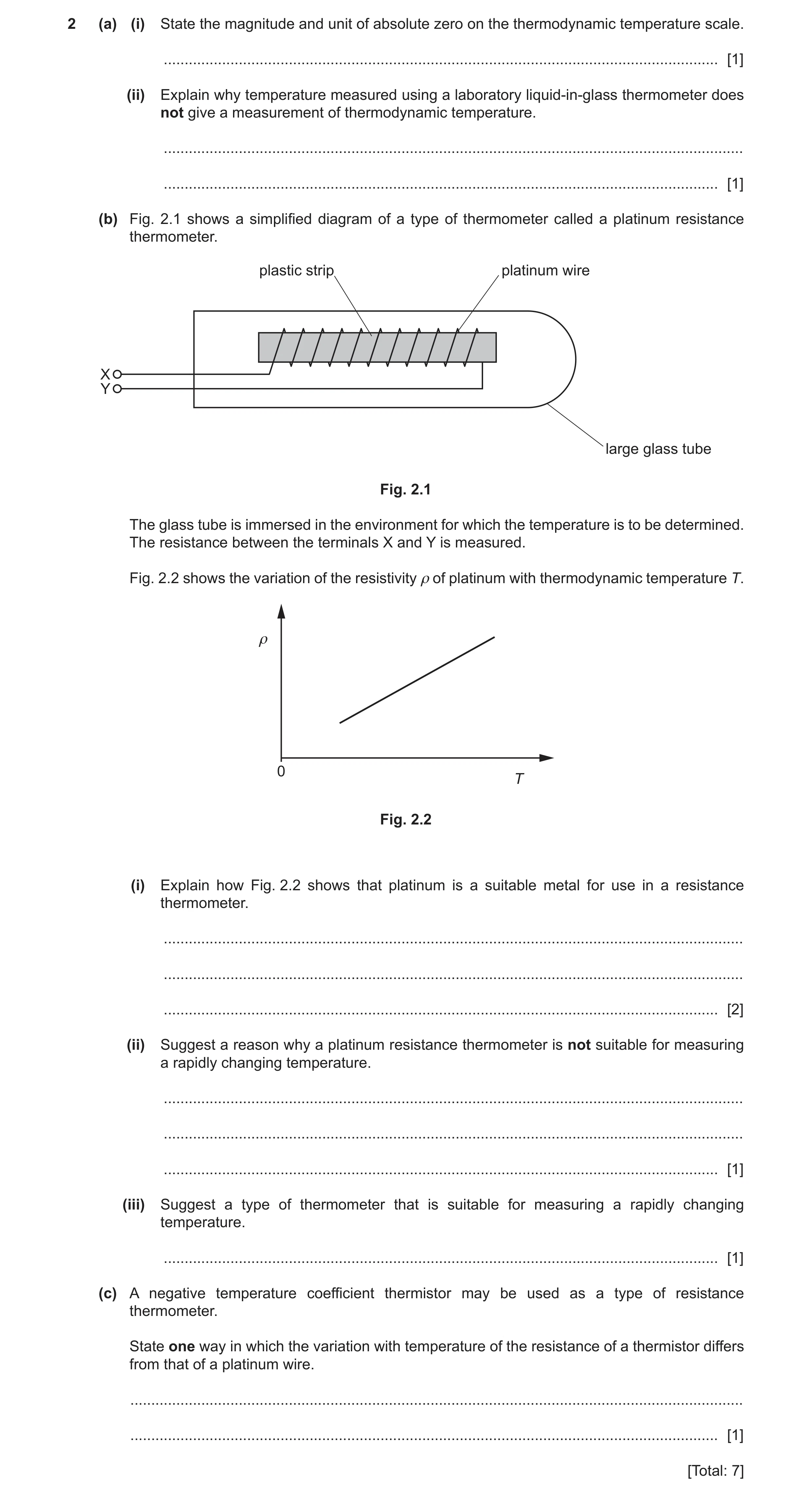
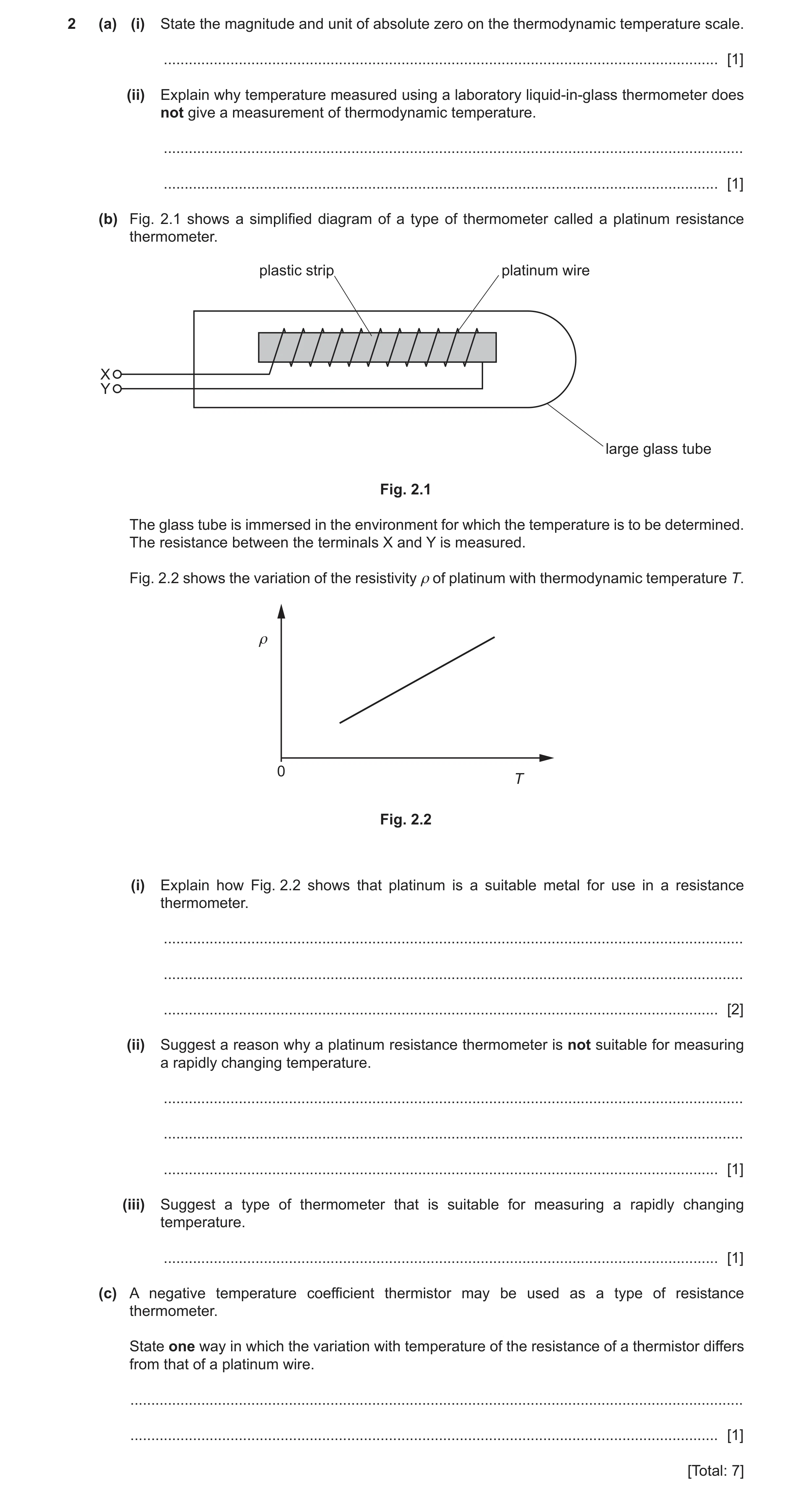
2 (a) (i) State the magnitude and unit of absolute zero on the thermodynamic temperature scale. … [1] (ii) Explain why temperature measured using a laboratory liquid-in-glass thermometer does not give a measurement of thermodynamic temperature. … … [1] (b) Fig. 2.1 shows a simplified diagram of a type of thermometer called a platinum resistance thermometer. plastic strip platinum wire X Y large glass tube Fig. 2.1 The glass tube is immersed in the environment for which the temperature is to be determined. The resistance between the terminals X and Y is measured. Fig. 2.2 shows the variation of the resistivity ρ of platinum with thermodynamic temperature T. ρ 0 T Fig. 2.2 (i) Explain how Fig. 2.2 shows that platinum is a suitable metal for use in a resistance thermometer. … … … [2] (ii) Suggest a reason why a platinum resistance thermometer is not suitable for measuring a rapidly changing temperature. … … … [1] (iii) Suggest a type of thermometer that is suitable for measuring a rapidly changing temperature. … [1] (c) A negative temperature coefficient thermistor may be used as a type of resistance thermometer. State one way in which the variation with temperature of the resistance of a thermistor differs from that of a platinum wire. … … [1] [Total: 7]
7 marks
Mark scheme: 2(a)(i) 0 K B1 2(a)(ii) (measurement) depends on properties of the liquid B1 2(b)(i) resistivity varies with temperature variation with temperature is linear unique value of resistivity for each (different value of) temperature Any two points, 1 mark each B2 2(b)(ii) thermometer has high heat capacity/specific heat capacity or energy transfer needed for thermometer to reach correct temperature or thermometer takes time to reach the correct temperature B1 2(b)(iii) thermocouple B1 2(c) (variation is) inverse or (variation is) non-linear B1
This question in 9702/41 May/June 2024
Q17 · State the magnitude and unit of absolute zero on the thermodynamic temperature scale 9702/43 May/June 2024
2 (a) (i) State the magnitude and unit of absolute zero on the thermodynamic temperature scale. … [1] (ii) Explain why temperature measured using a laboratory liquid-in-glass thermometer does not give a measurement of thermodynamic temperature. … … [1] (b) Fig. 2.1 shows a simplified diagram of a type of thermometer called a platinum resistance thermometer. plastic strip platinum wire X Y large glass tube Fig. 2.1 The glass tube is immersed in the environment for which the temperature is to be determined. The resistance between the terminals X and Y is measured. Fig. 2.2 shows the variation of the resistivity ρ of platinum with thermodynamic temperature T. ρ 0 T Fig. 2.2 (i) Explain how Fig. 2.2 shows that platinum is a suitable metal for use in a resistance thermometer. … … … [2] (ii) Suggest a reason why a platinum resistance thermometer is not suitable for measuring a rapidly changing temperature. … … … [1] (iii) Suggest a type of thermometer that is suitable for measuring a rapidly changing temperature. … [1] (c) A negative temperature coefficient thermistor may be used as a type of resistance thermometer. State one way in which the variation with temperature of the resistance of a thermistor differs from that of a platinum wire. … … [1] [Total: 7]
7 marks
Mark scheme: 2(a)(i) 0 K B1 2(a)(ii) (measurement) depends on properties of the liquid B1 2(b)(i) resistivity varies with temperature variation with temperature is linear unique value of resistivity for each (different value of) temperature Any two points, 1 mark each B2 2(b)(ii) thermometer has high heat capacity/specific heat capacity or energy transfer needed for thermometer to reach correct temperature or thermometer takes time to reach the correct temperature B1 2(b)(iii) thermocouple B1 2(c) (variation is) inverse or (variation is) non-linear B1
This question in 9702/43 May/June 2024
Q18 · State the value of absolute zero on: (i) the Celsius temperature scale temperature = … °C… 9702/41 Oct/Nov 2025
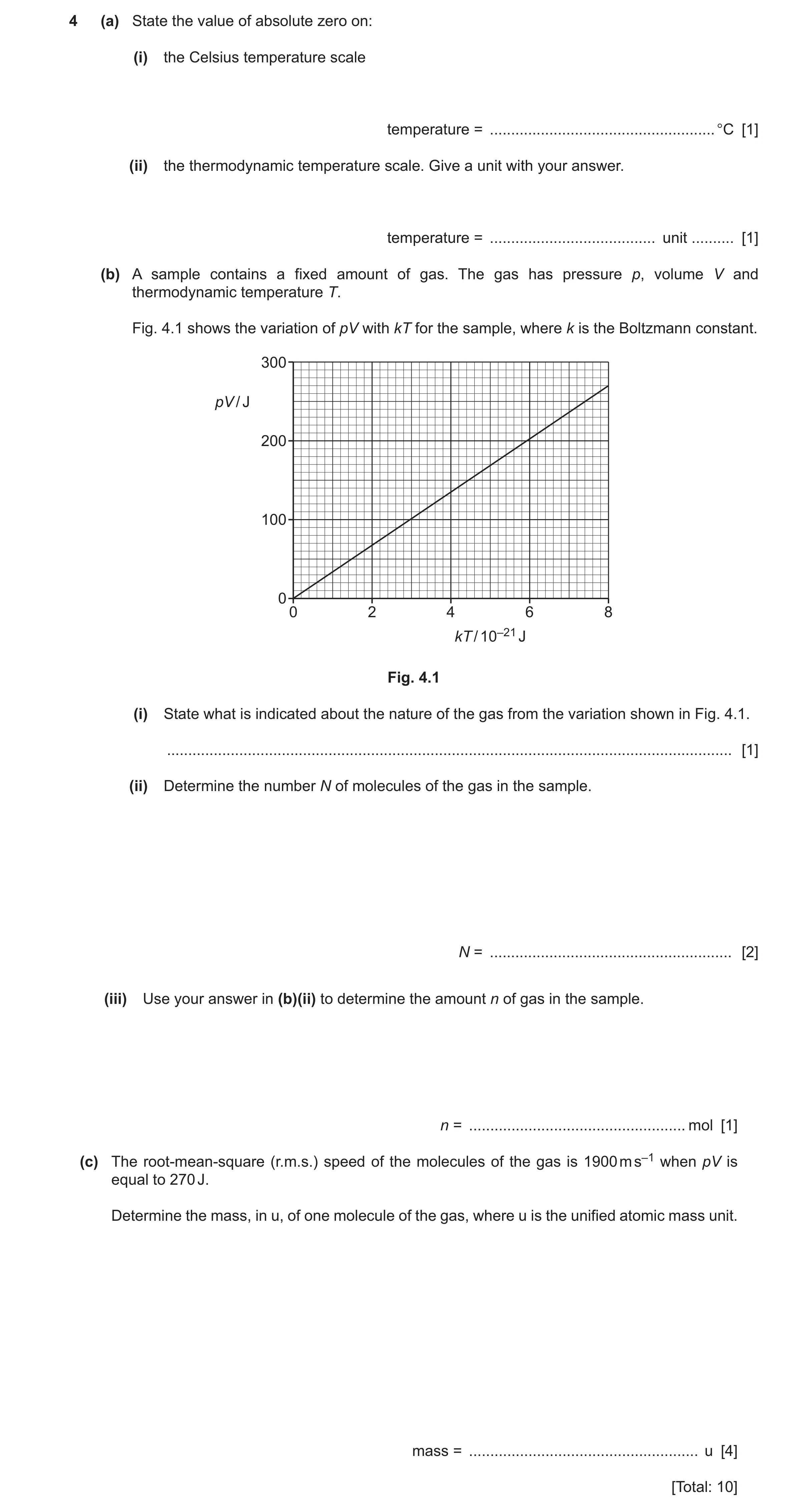
4 (a) State the value of absolute zero on: (i) the Celsius temperature scale temperature = … °C [1] (ii) the thermodynamic temperature scale. Give a unit with your answer. temperature = … unit … [1] (b) A sample contains a fixed amount of gas. The gas has pressure p, volume V and thermodynamic temperature T. Fig. 4.1 shows the variation of pV with kT for the sample, where k is the Boltzmann constant. 300 pV / J 200 100 0 0 2 4 6 8 kT / 10–21 J Fig. 4.1 (i) State what is indicated about the nature of the gas from the variation shown in Fig. 4.1. … [1] (ii) Determine the number N of molecules of the gas in the sample. N = … [2] (iii) Use your answer in (b)(ii) to determine the amount n of gas in the sample. n = … mol [1] (c) The root-mean-square (r.m.s.) speed of the molecules of the gas is 1900 m s–1 when pV is equal to 270 J. Determine the mass, in u, of one molecule of the gas, where u is the unified atomic mass unit. mass = … u [4] [Total: 10]
10 marks
Mark scheme: 4(a)(i) temperature = –273.15 °C A1 4(a)(ii) temperature = 0 K A1 4(b)(i) gas is ideal B1 4(b)(ii) pV = NkT C1 N = 270 / (8.0 10–21) A1 = 3.4 1022 4(b)(iii) n = (3.4 1022) / (6.02 1023) A1 = 0.056 mol 4(c) ½ m<c2> = (3 / 2) kT C1 ½ m 19002 = 1.5 8.0 10–21 C1 (m = 6.65 10–27 kg) m = (6.65 10–27) / (1.66 10–27) C1 = 4.0 u A1
This question in 9702/41 Oct/Nov 2025
Q19 · State the value of absolute zero on: (i) the Celsius temperature scale temperature = … °C… 9702/43 Oct/Nov 2025
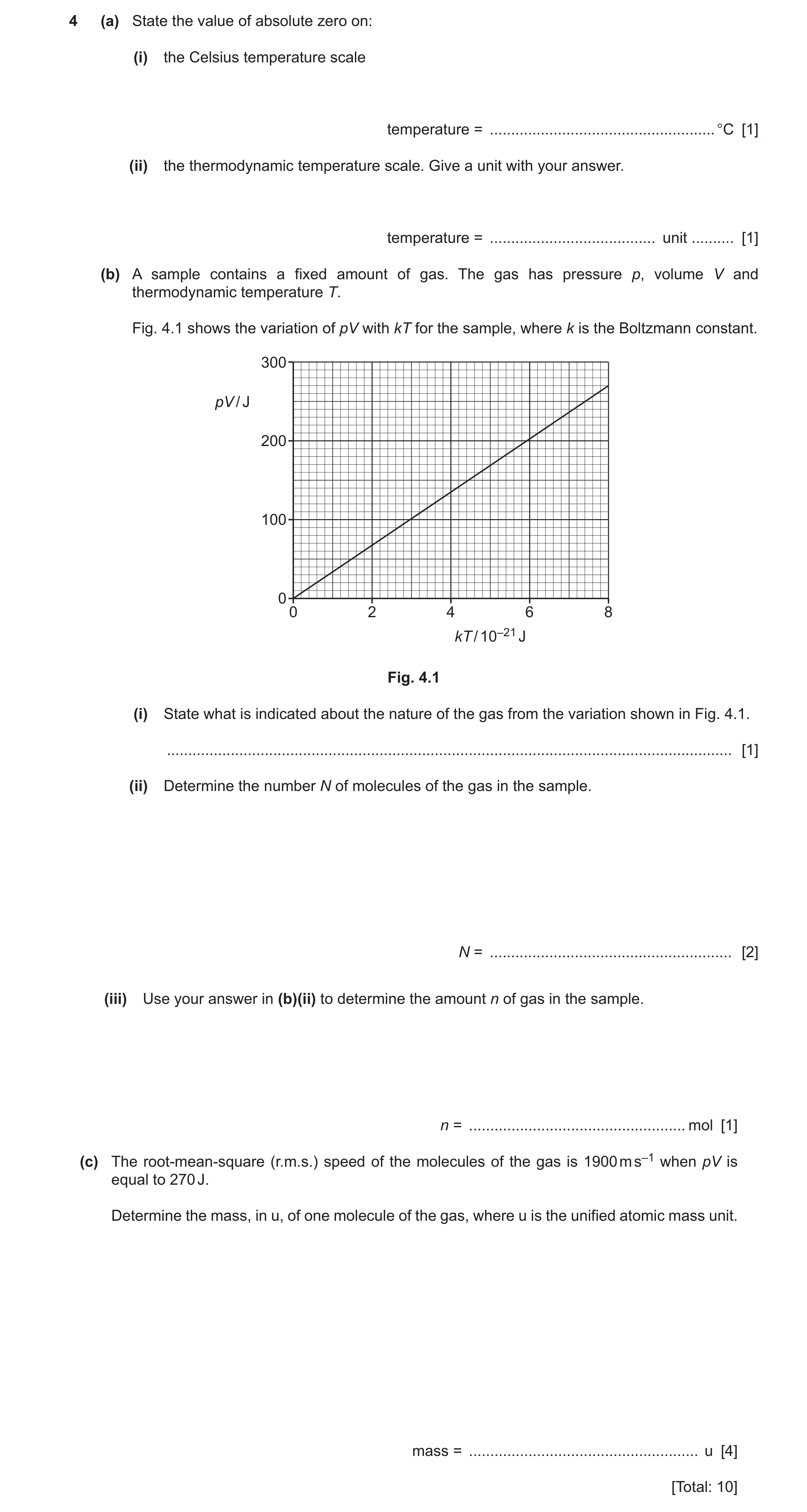
4 (a) State the value of absolute zero on: (i) the Celsius temperature scale temperature = … °C [1] (ii) the thermodynamic temperature scale. Give a unit with your answer. temperature = … unit … [1] (b) A sample contains a fixed amount of gas. The gas has pressure p, volume V and thermodynamic temperature T. Fig. 4.1 shows the variation of pV with kT for the sample, where k is the Boltzmann constant. 300 pV / J 200 100 0 0 2 4 6 8 kT / 10–21 J Fig. 4.1 (i) State what is indicated about the nature of the gas from the variation shown in Fig. 4.1. … [1] (ii) Determine the number N of molecules of the gas in the sample. N = … [2] (iii) Use your answer in (b)(ii) to determine the amount n of gas in the sample. n = … mol [1] (c) The root-mean-square (r.m.s.) speed of the molecules of the gas is 1900 m s–1 when pV is equal to 270 J. Determine the mass, in u, of one molecule of the gas, where u is the unified atomic mass unit. mass = … u [4] [Total: 10]
10 marks
Mark scheme: 4(a)(i) temperature = –273.15 °C A1 4(a)(ii) temperature = 0 K A1 4(b)(i) gas is ideal B1 4(b)(ii) pV = NkT C1 N = 270 / (8.0 10–21) A1 = 3.4 1022 4(b)(iii) n = (3.4 1022) / (6.02 1023) A1 = 0.056 mol 4(c) ½ m<c2> = (3 / 2) kT C1 ½ m 19002 = 1.5 8.0 10–21 C1 (m = 6.65 10–27 kg) m = (6.65 10–27) / (1.66 10–27) C1 = 4.0 u A1
This question in 9702/43 Oct/Nov 2025
 1 / 27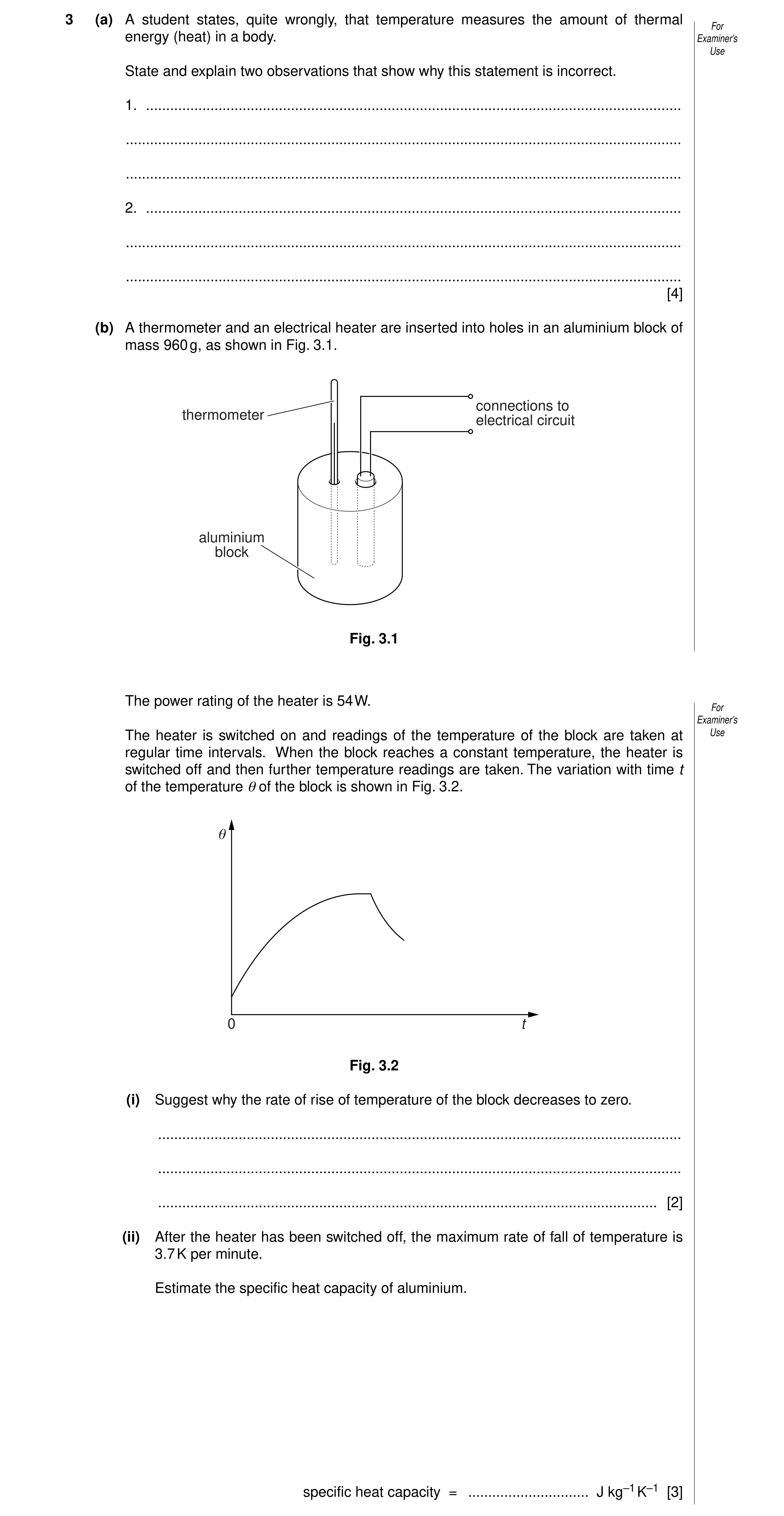
 6 / 27
 7 / 27
 8 / 27
 9 / 27
 10 / 27
 11 / 27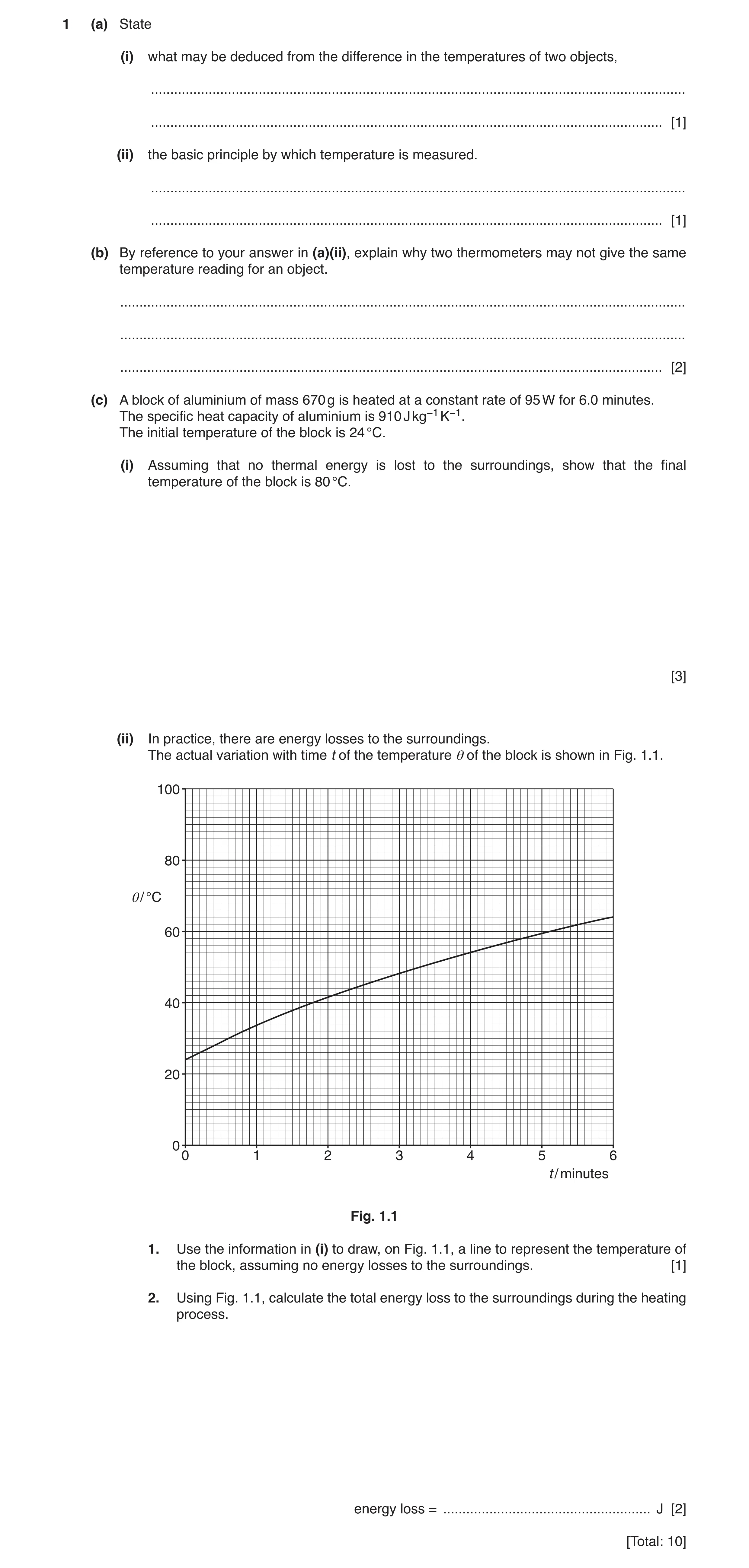
 5
5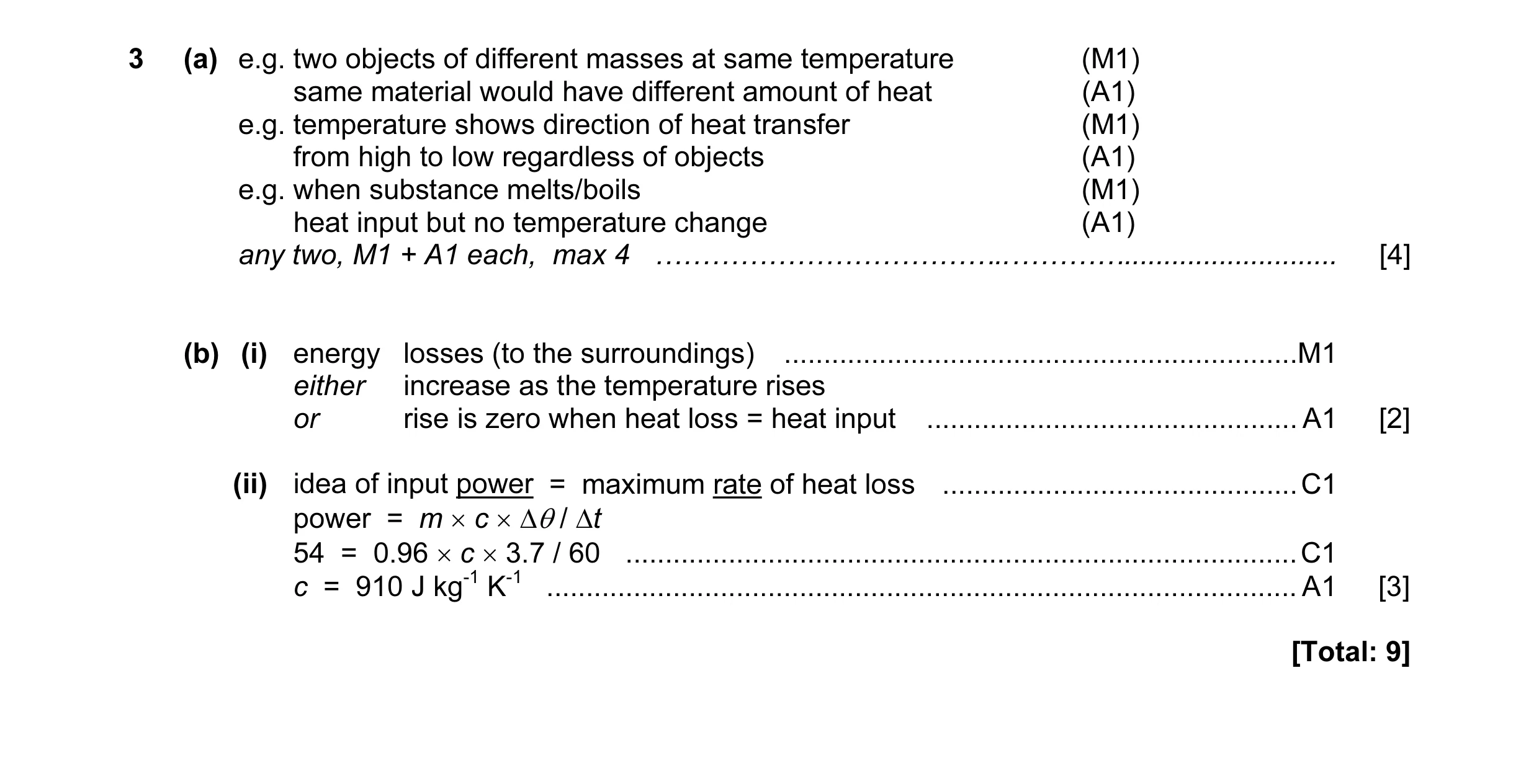 9
9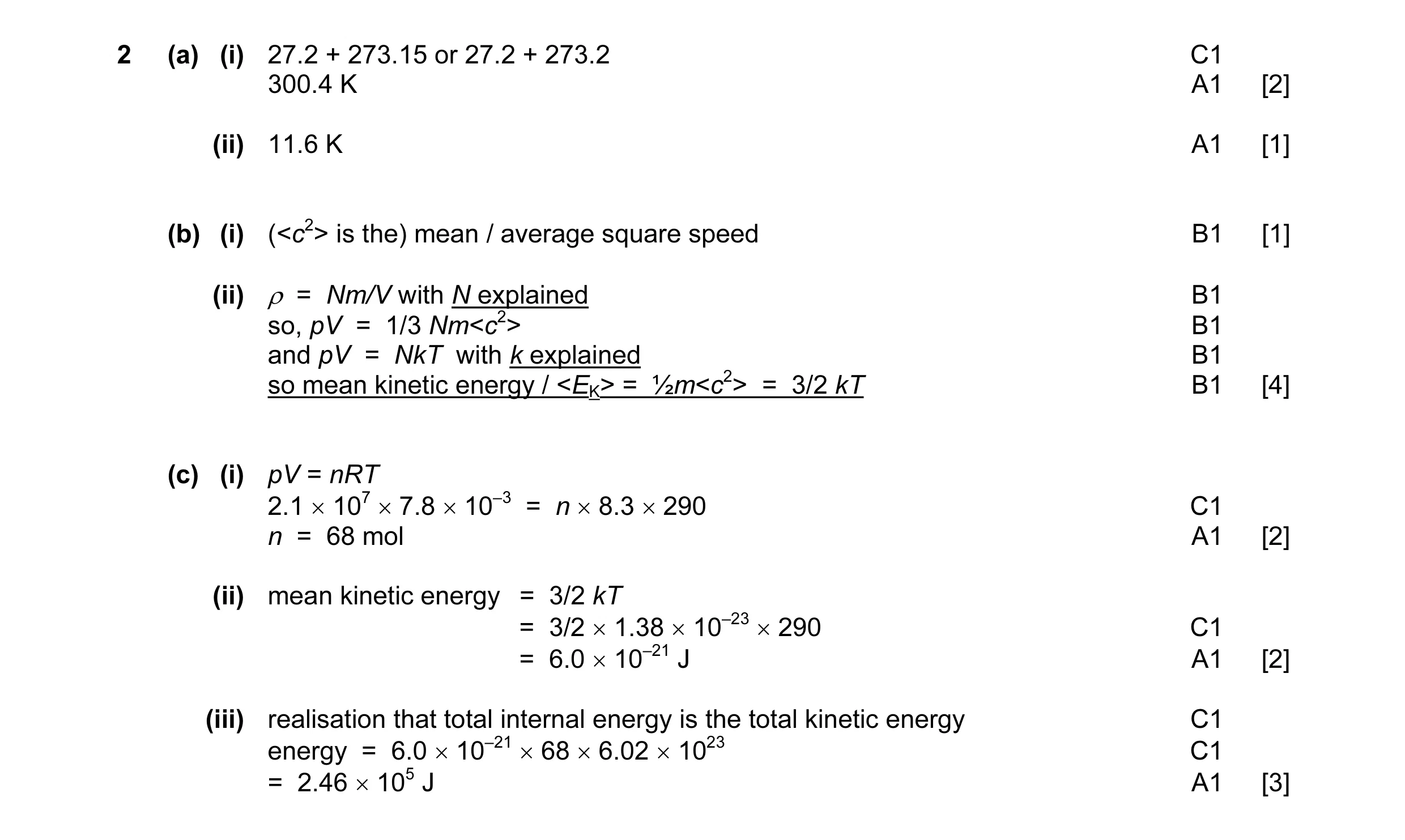 15
15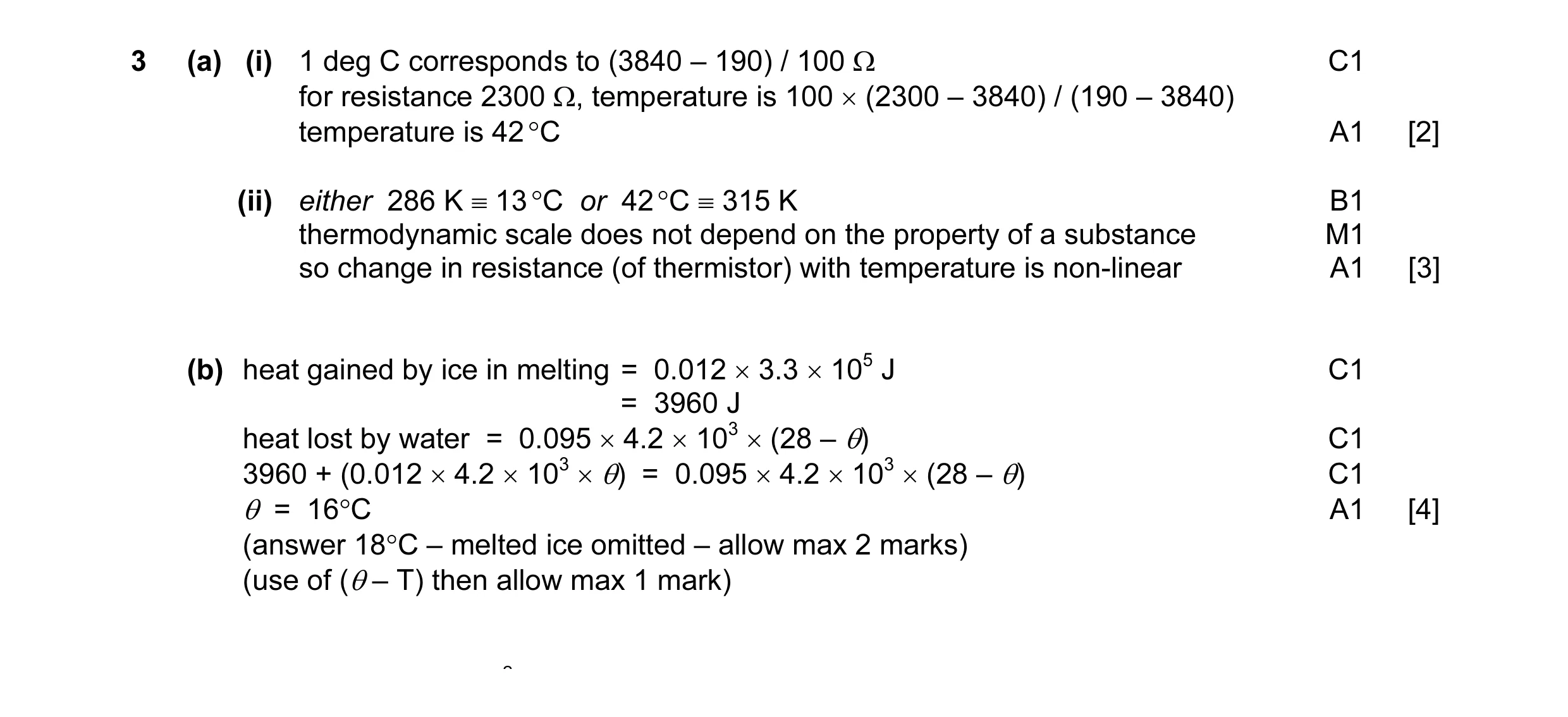 9
9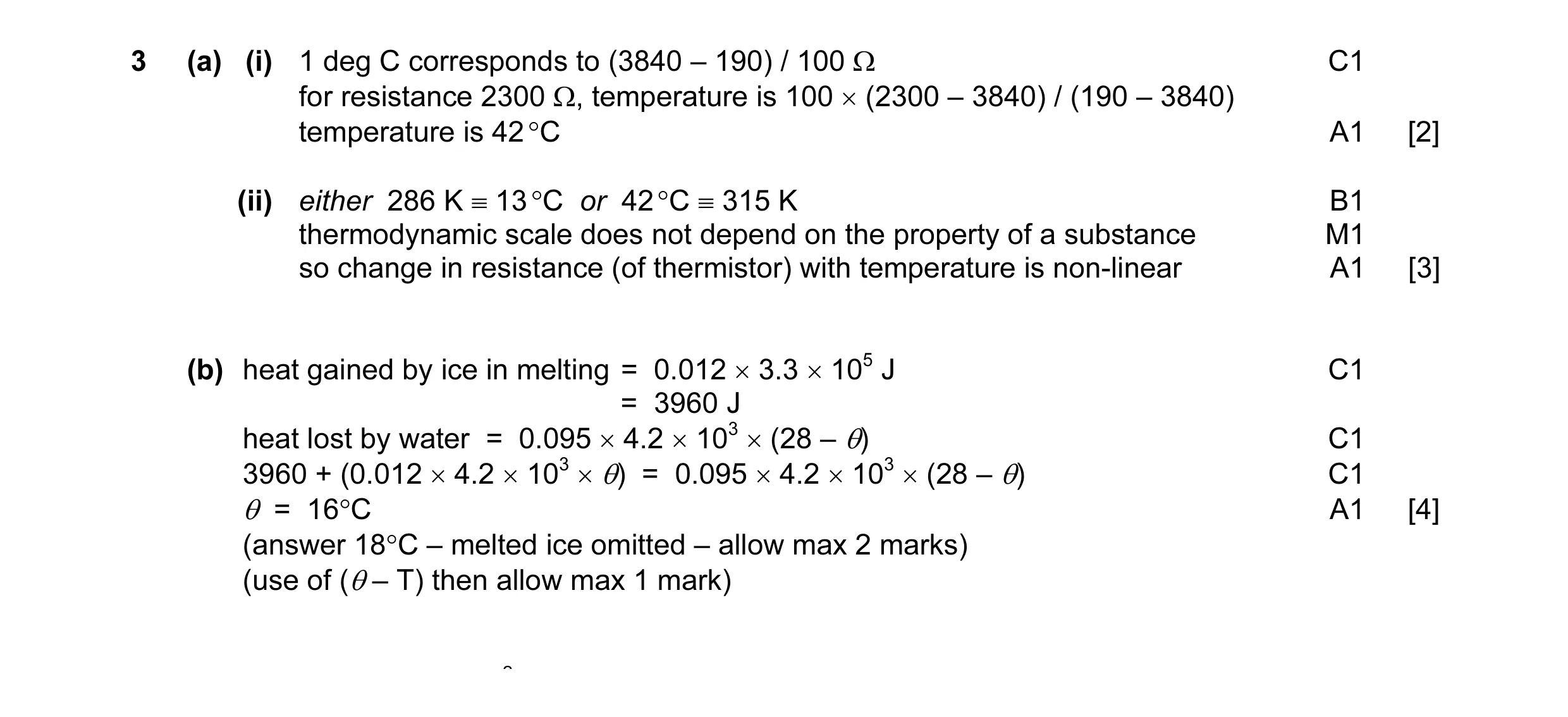 9
9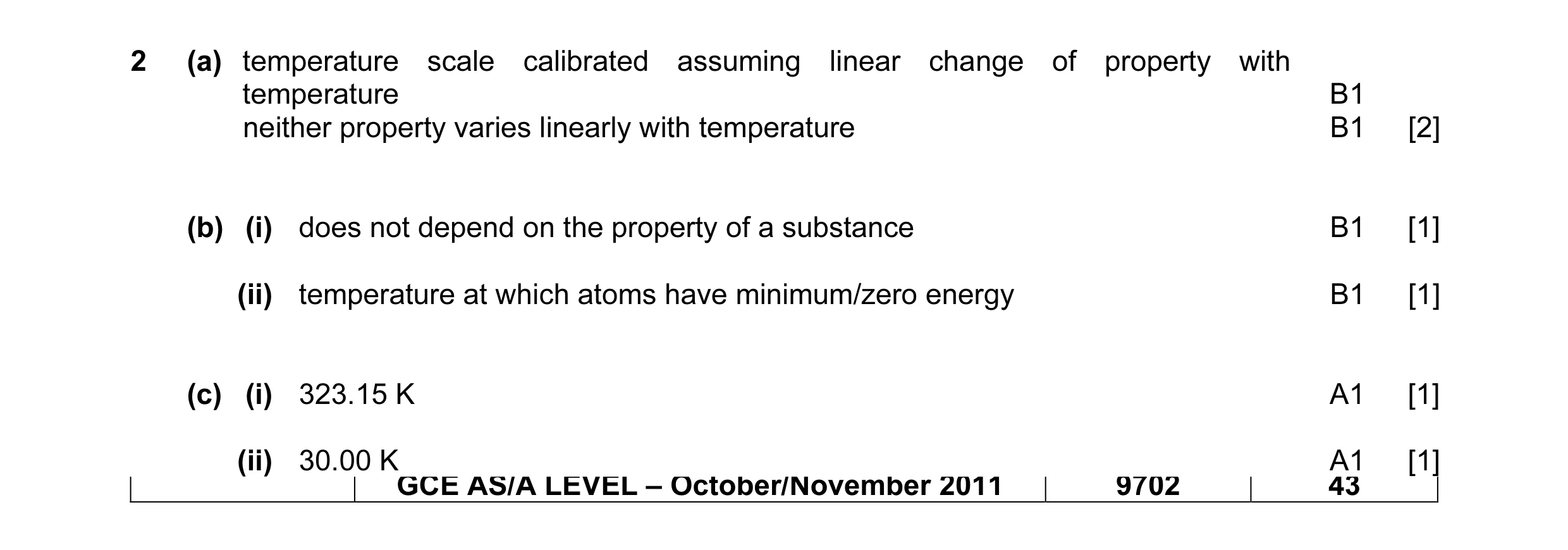 6
6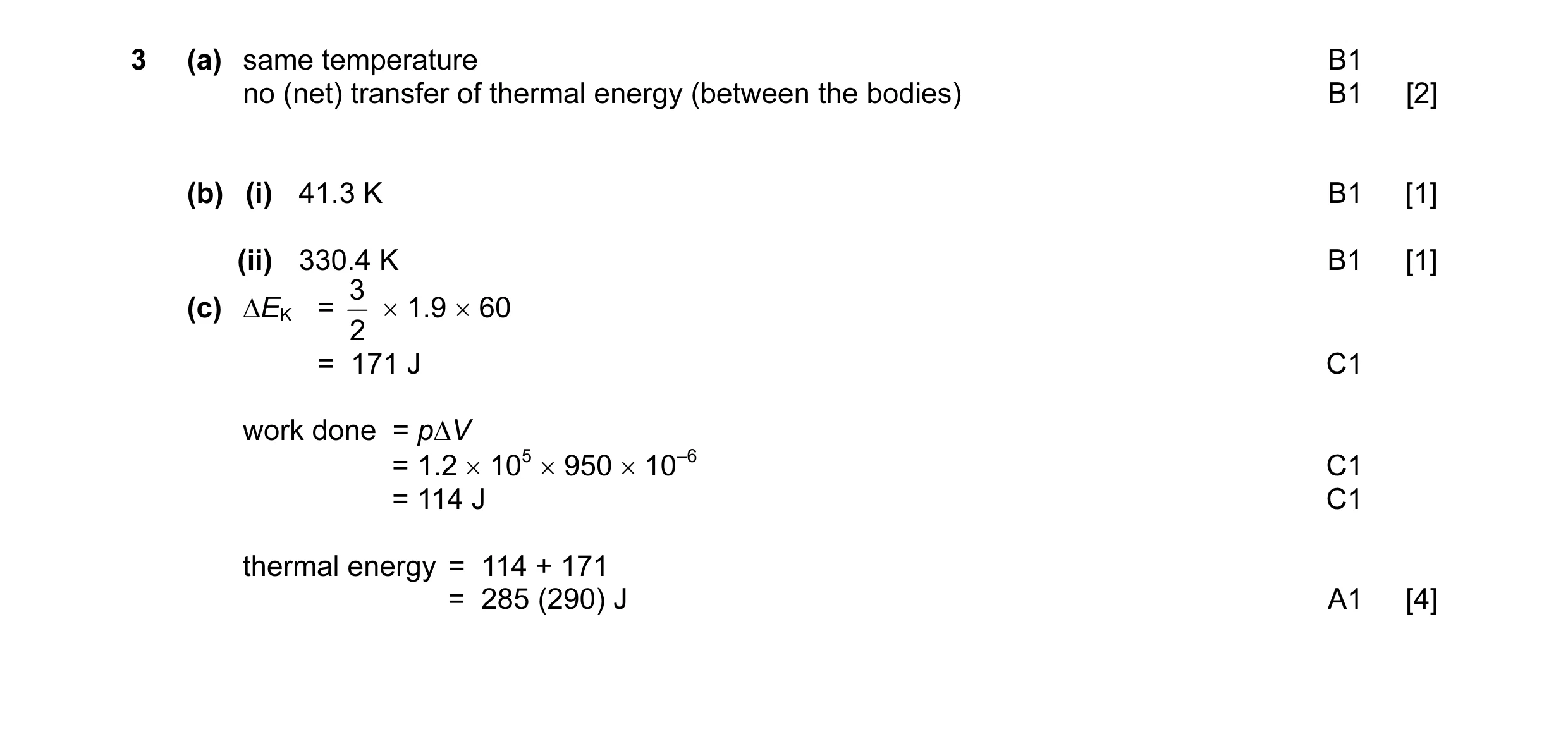 8
8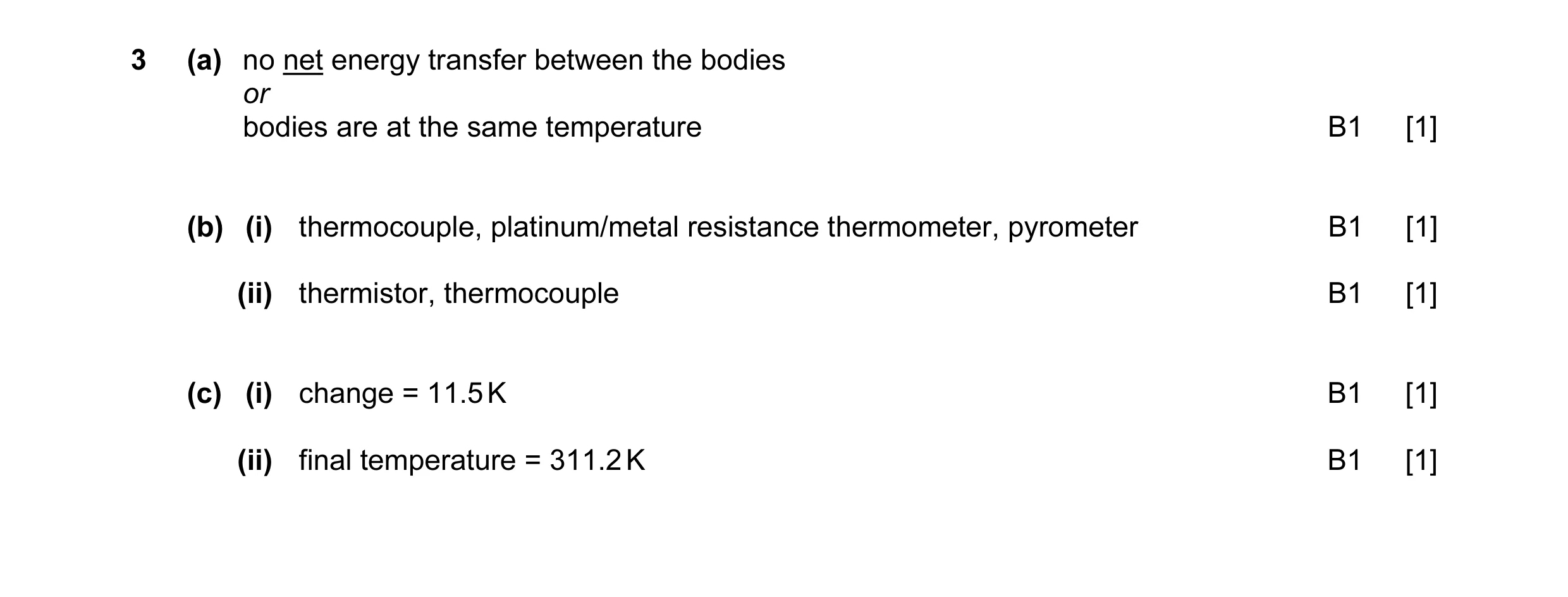 5
5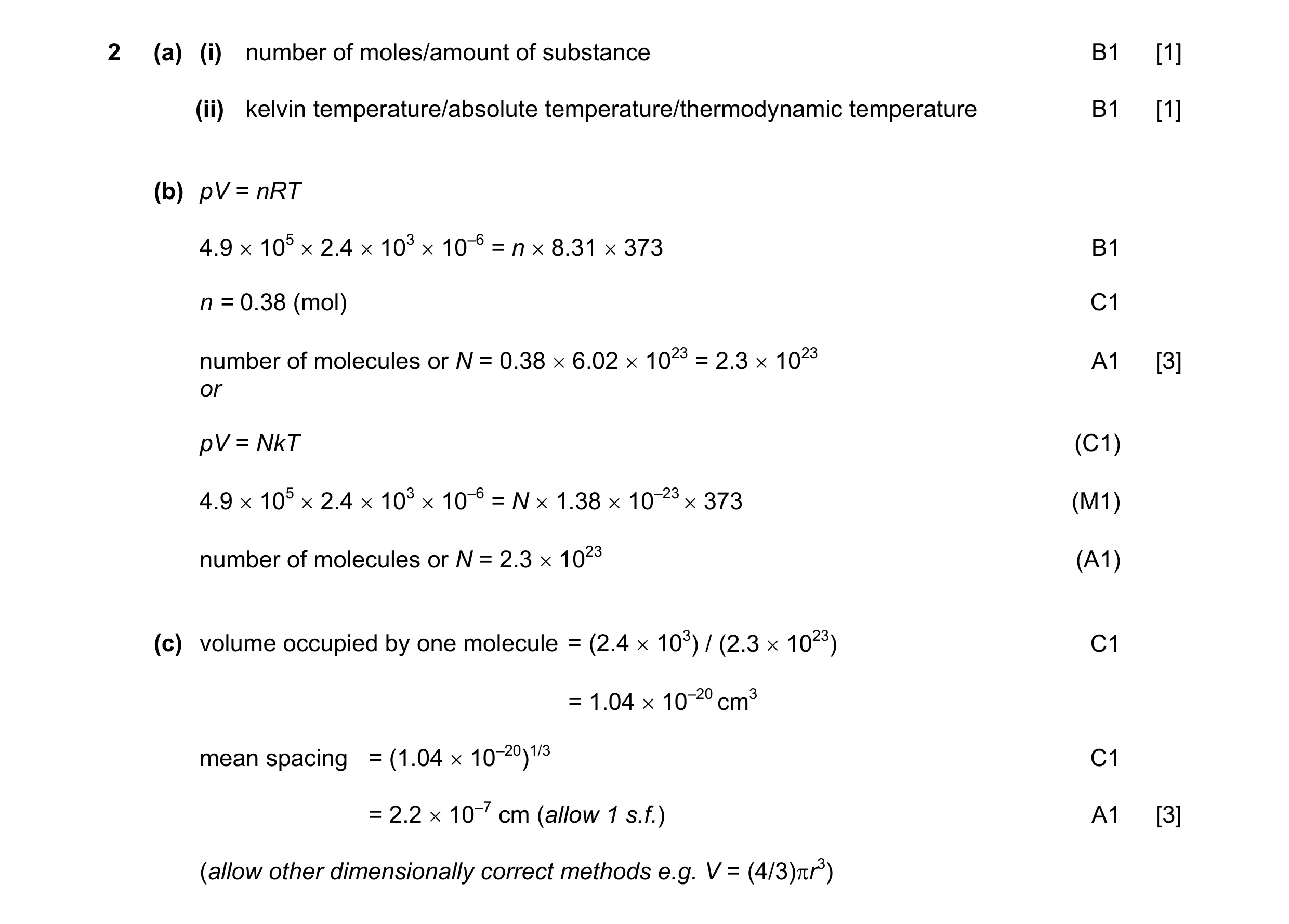 8
8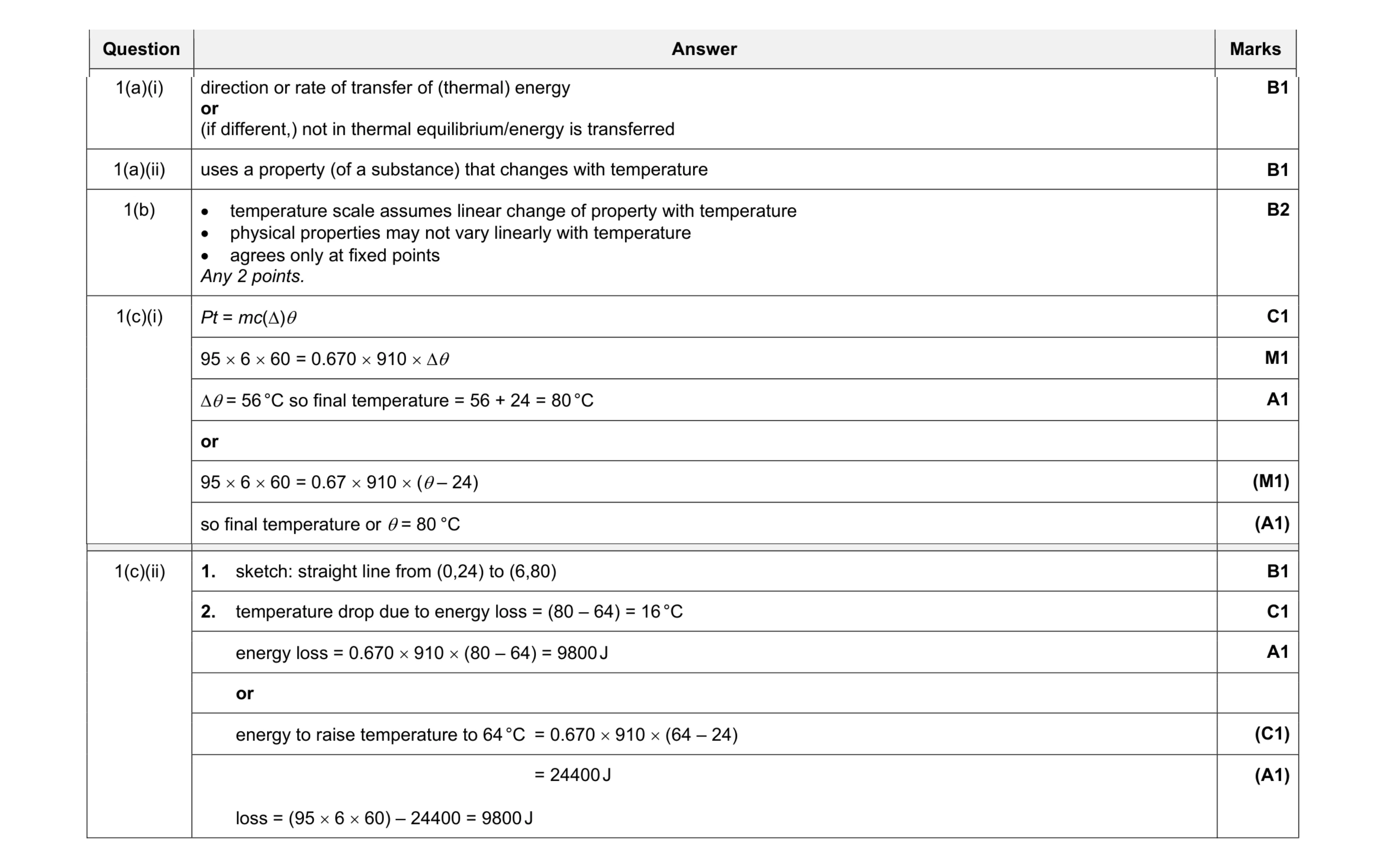 10
10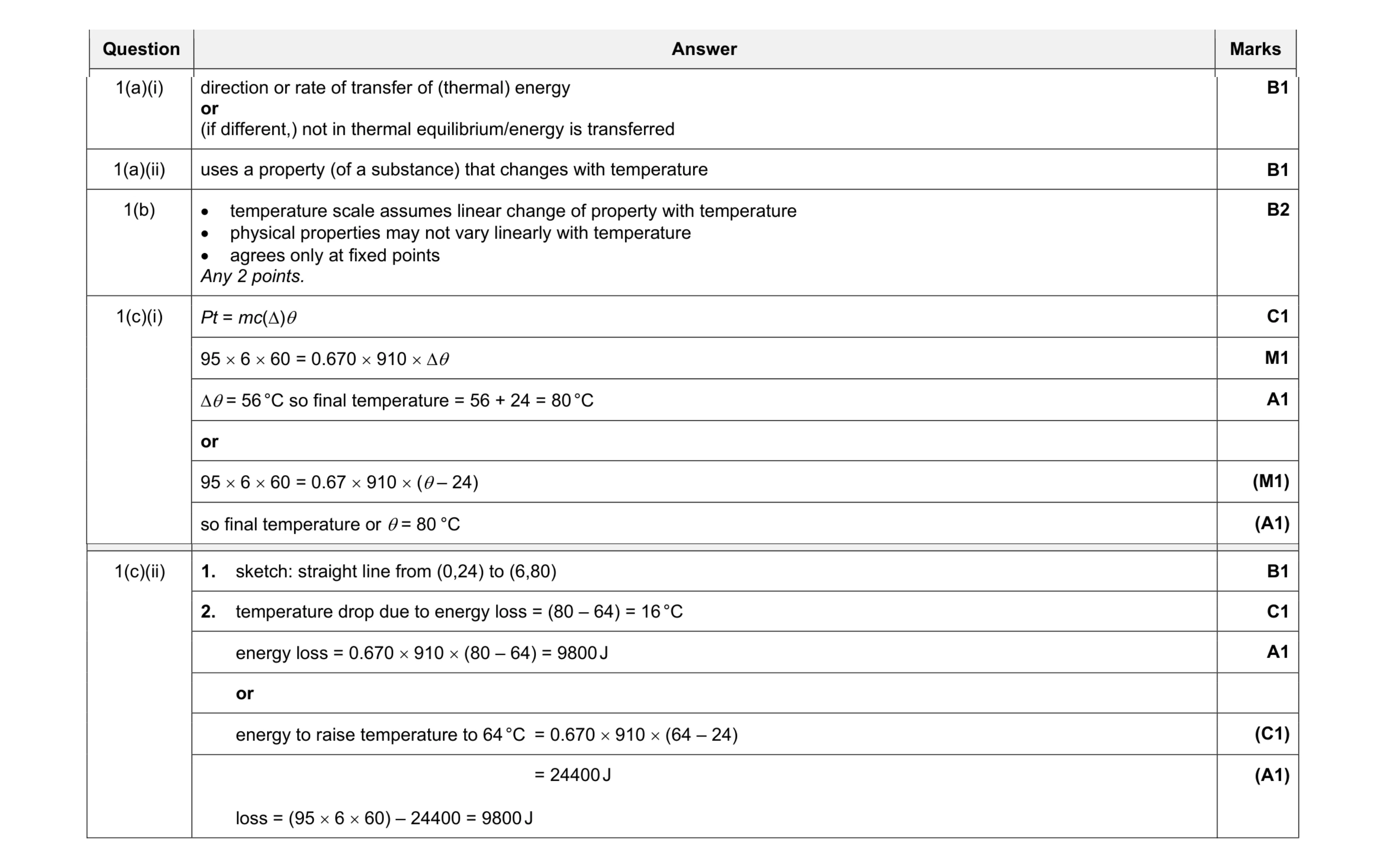 10
10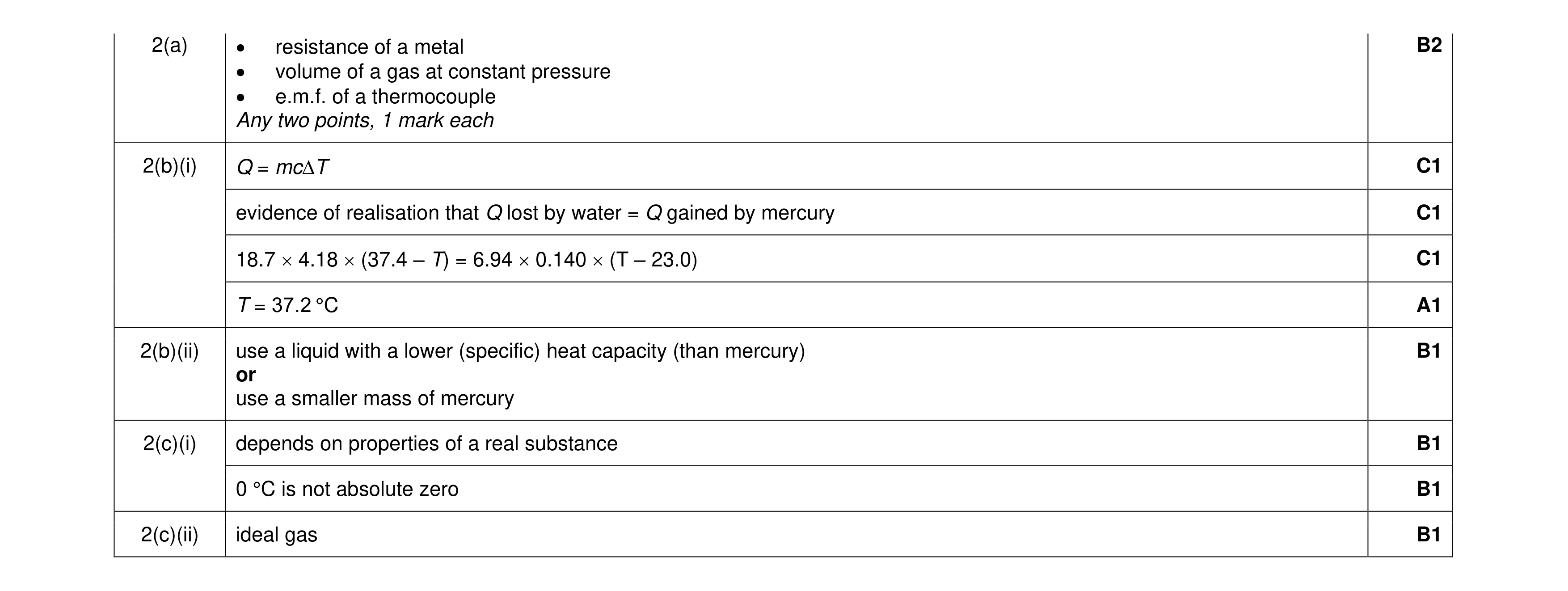 10
10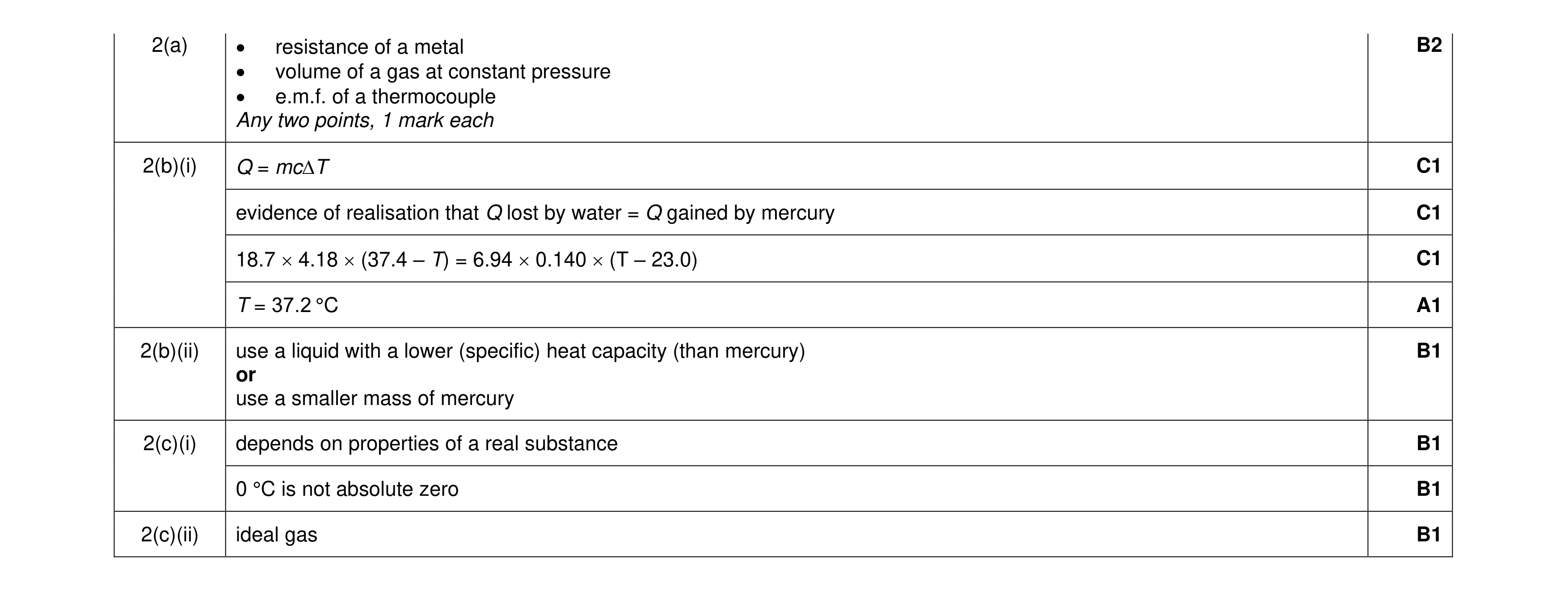 10
10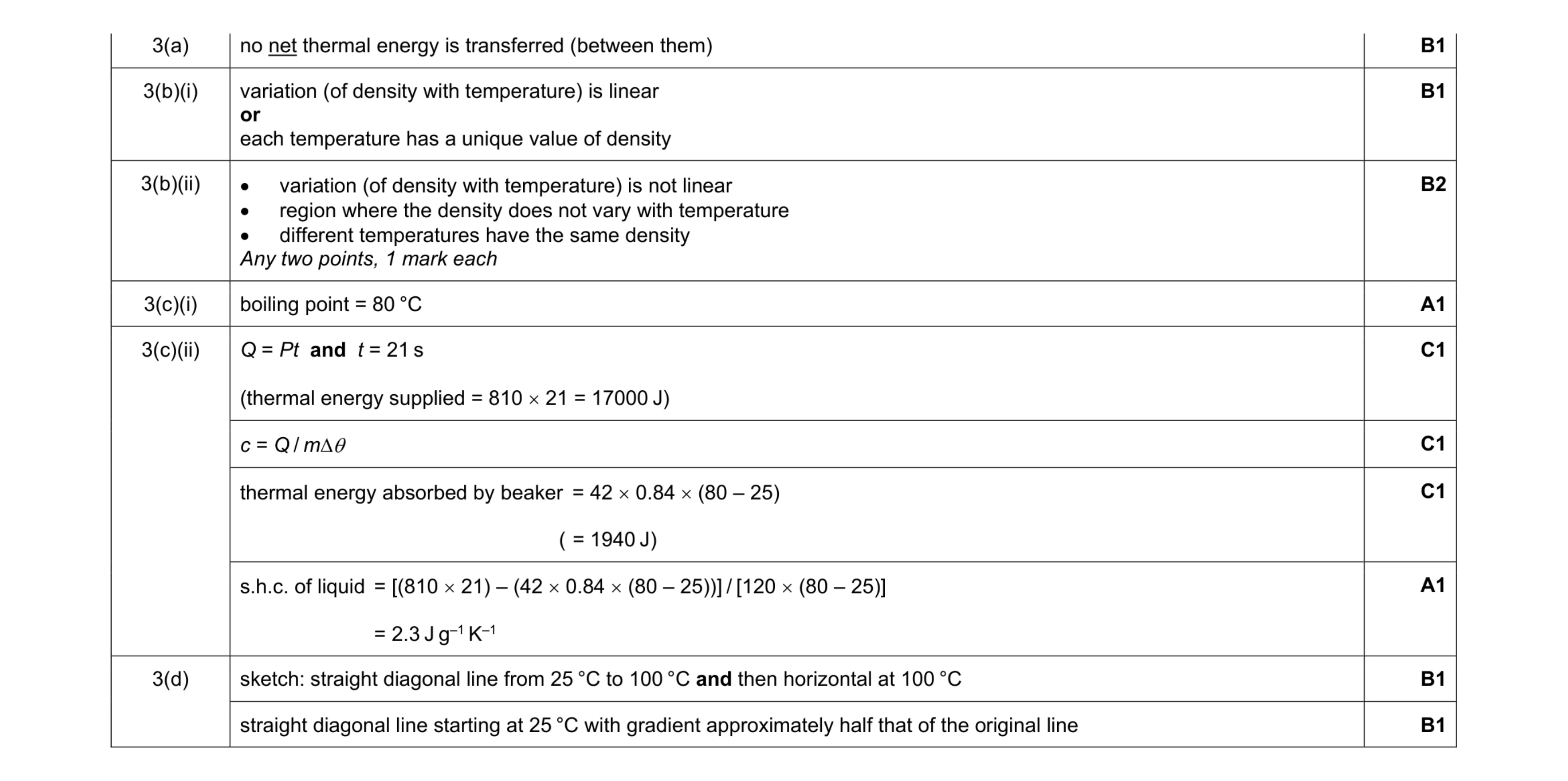 11
11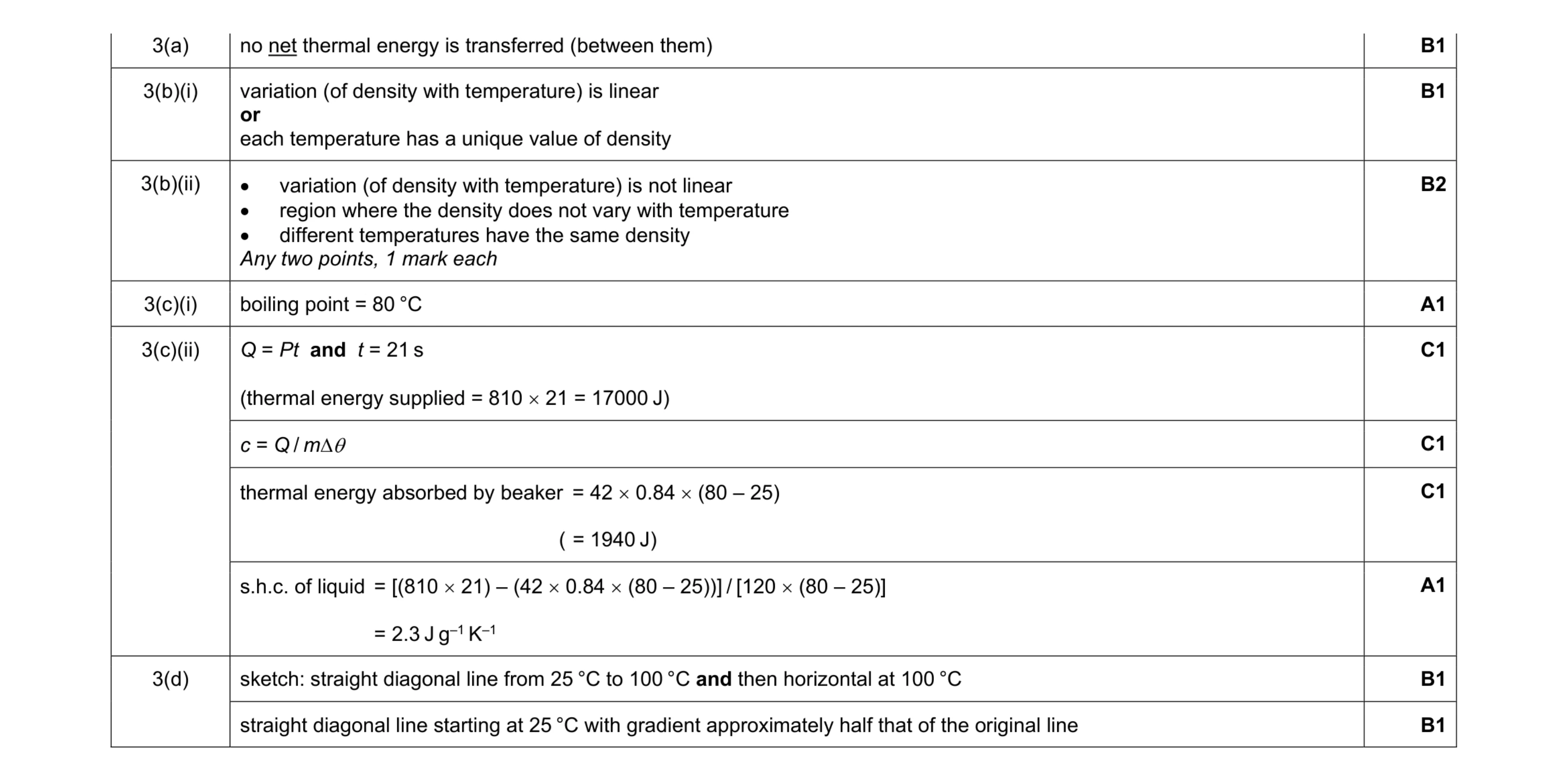 11
11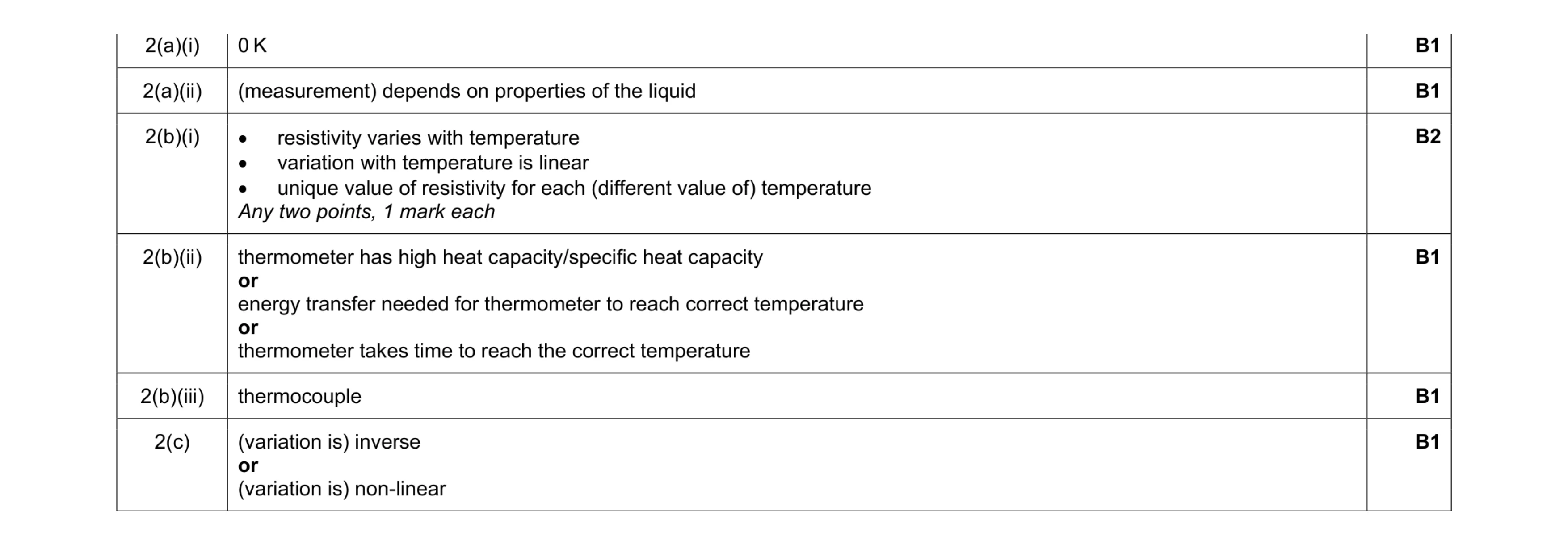 7
7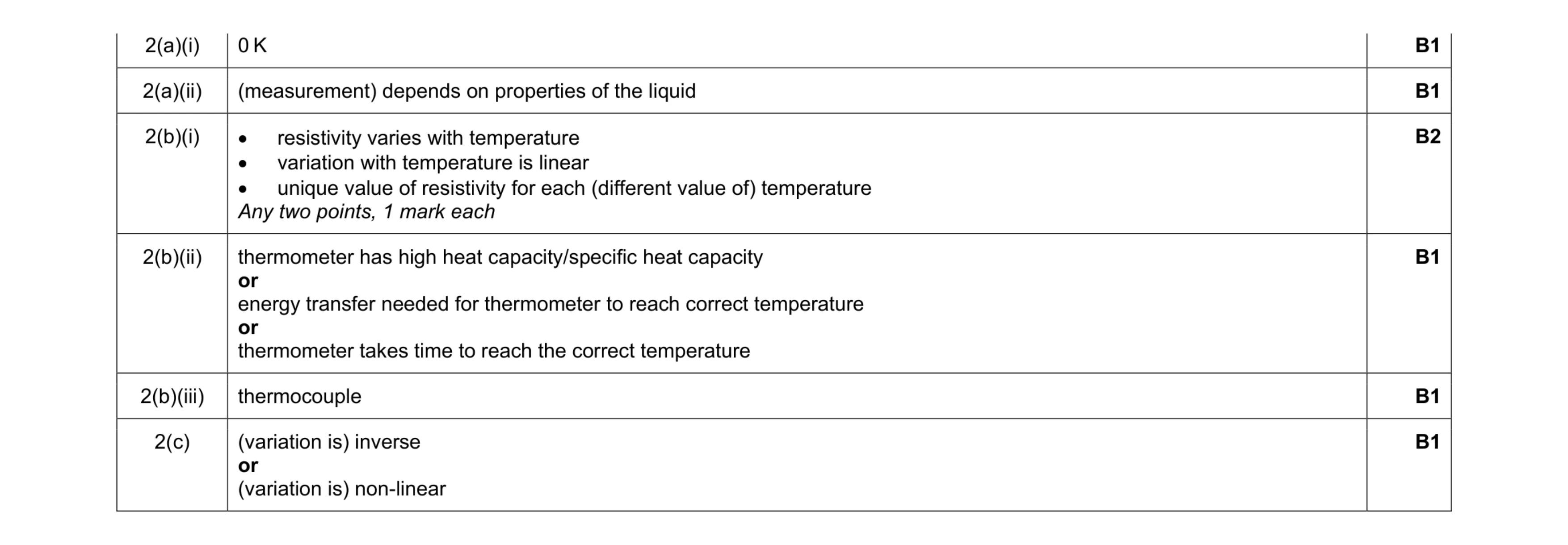 7
7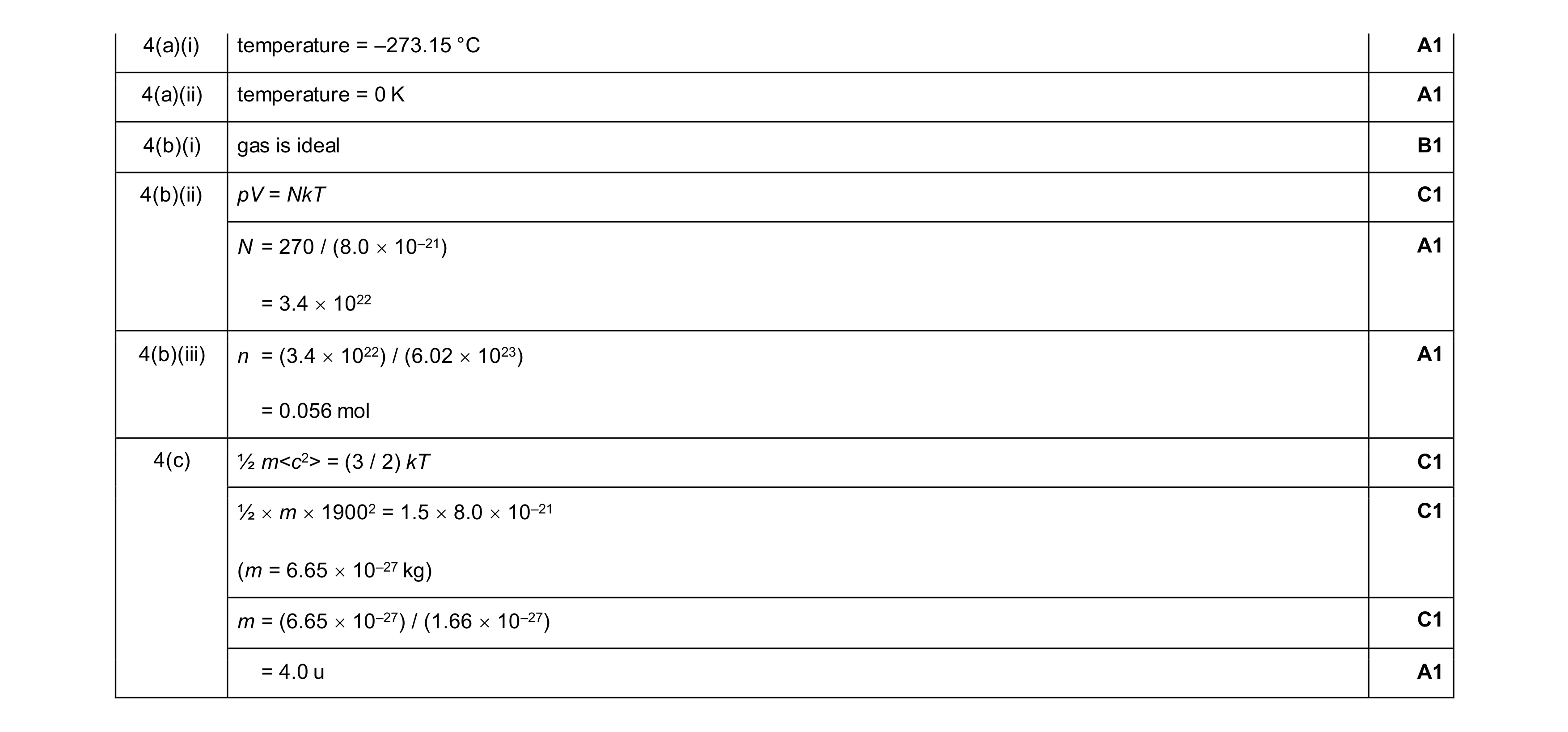 10
10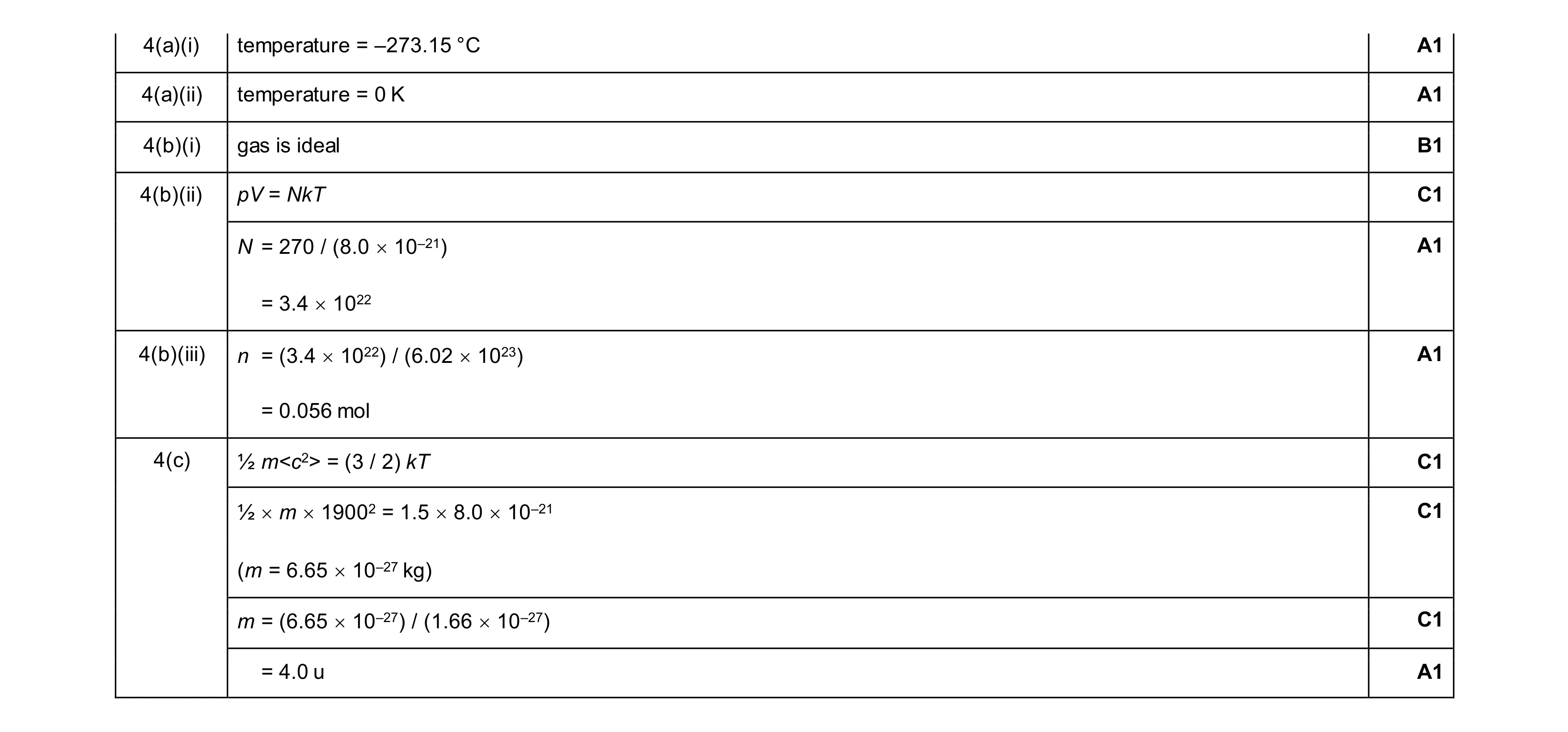 10
10