Questions as text
Q1 · A mercury-in-glass thermometer is to be used to measure the temperature of some oil 9702/41 Oct/Nov 2006
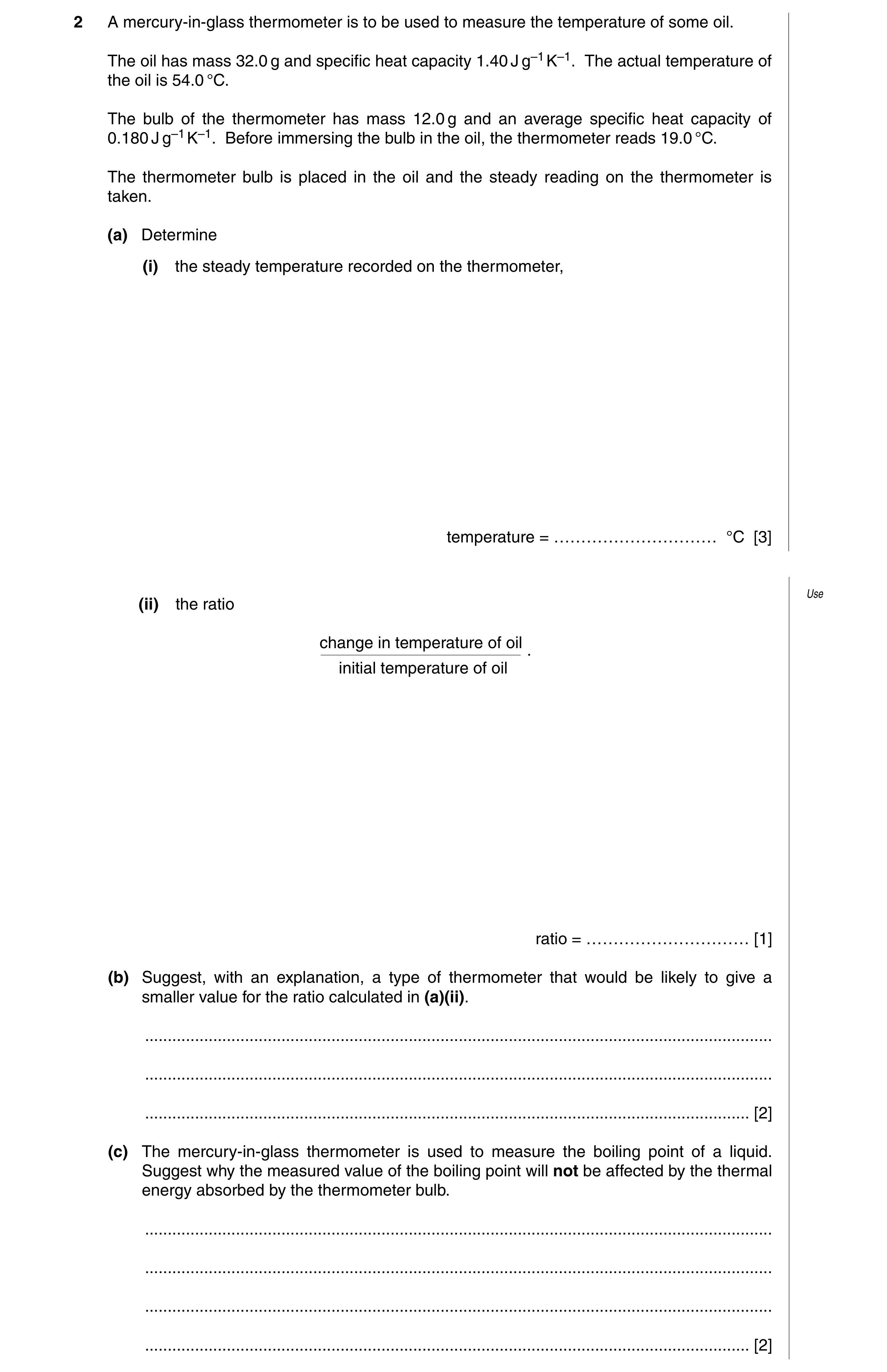
2 A mercury-in-glass thermometer is to be used to measure the temperature of some oil. The oil has mass 32.0 g and specific heat capacity 1.40 J g–1K–1. The actual temperature of the oil is 54.0 °C. The bulb of the thermometer has mass 12.0 g and an average specific heat capacity of 0.180 J g–1K–1. Before immersing the bulb in the oil, the thermometer reads 19.0 °C. The thermometer bulb is placed in the oil and the steady reading on the thermometer is taken. (a) Determine (i) the steady temperature recorded on the thermometer, temperature = ………………………… °C [3] Use (ii) the ratio change in temperature of oil . initial temperature of oil ratio = ………………………… [1] (b) Suggest, with an explanation, a type of thermometer that would be likely to give a smaller value for the ratio calculated in (a)(ii). … … … [2] (c) The mercury-in-glass thermometer is used to measure the boiling point of a liquid. Suggest why the measured value of the boiling point will not be affected by the thermal energy absorbed by the thermometer bulb. … … … … [2]
8 marks
Mark scheme: 2 (a) (i) idea of heat lost (by oil) = heat gained (by thermometer) C1 32 x 1.4 x (54 – t) = 12 x 0.18 x (t – 19) C1 t = 52.4°C A1 [3] (ii) either ratio (= 1.6/54) = 0.030 or (=1.6/327) = 0.0049 A1 [1] (b) thermistor thermometer (allow ‘resistance thermometer’) B1 because small mass/thermal capacity B1 [2] (c) boiling point temperature is constant M1 further comment e.g. heating of bulb would affect only rate of boiling A1 [2]
This question in 9702/41 Oct/Nov 2006
Q2 · A resistance thermometer and a thermocouple thermometer are both used at the same For… 9702/43 Oct/Nov 2011
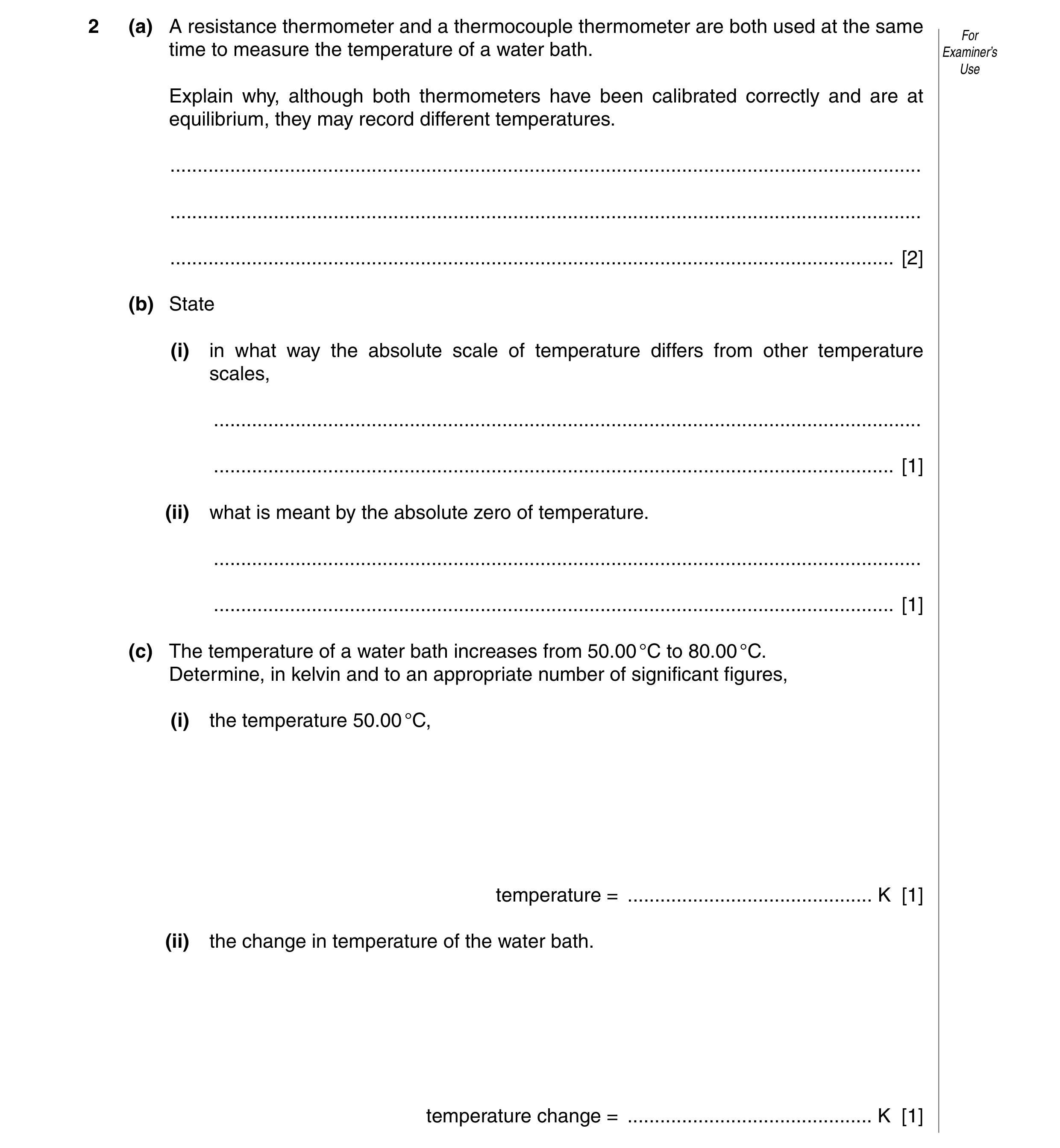
2 (a) A resistance thermometer and a thermocouple thermometer are both used at the same For time to measure the temperature of a water bath. Examiner’s Use Explain why, although both thermometers have been calibrated correctly and are at equilibrium, they may record different temperatures. … … … [2] (b) State (i) in what way the absolute scale of temperature differs from other temperature scales, … … [1] (ii) what is meant by the absolute zero of temperature. … … [1] (c) The temperature of a water bath increases from 50.00 °C to 80.00 °C. Determine, in kelvin and to an appropriate number of significant figures, (i) the temperature 50.00 °C, temperature = … K [1] (ii) the change in temperature of the water bath. temperature change = … K [1]
6 marks
Mark scheme: 2 (a) temperature scale calibrated assuming linear change of property with temperature B1 neither property varies linearly with temperature B1 [2] (b) (i) does not depend on the property of a substance B1 [1] (ii) temperature at which atoms have minimum/zero energy B1 [1] (c) (i) 323.15 K A1 [1] (ii) 30.00 K A1 [1] GCE AS/A LEVEL – October/November 2011 9702 43
This question in 9702/43 Oct/Nov 2011
Q3 · Two metal spheres are in thermal equilibrium 9702/41 Oct/Nov 2012
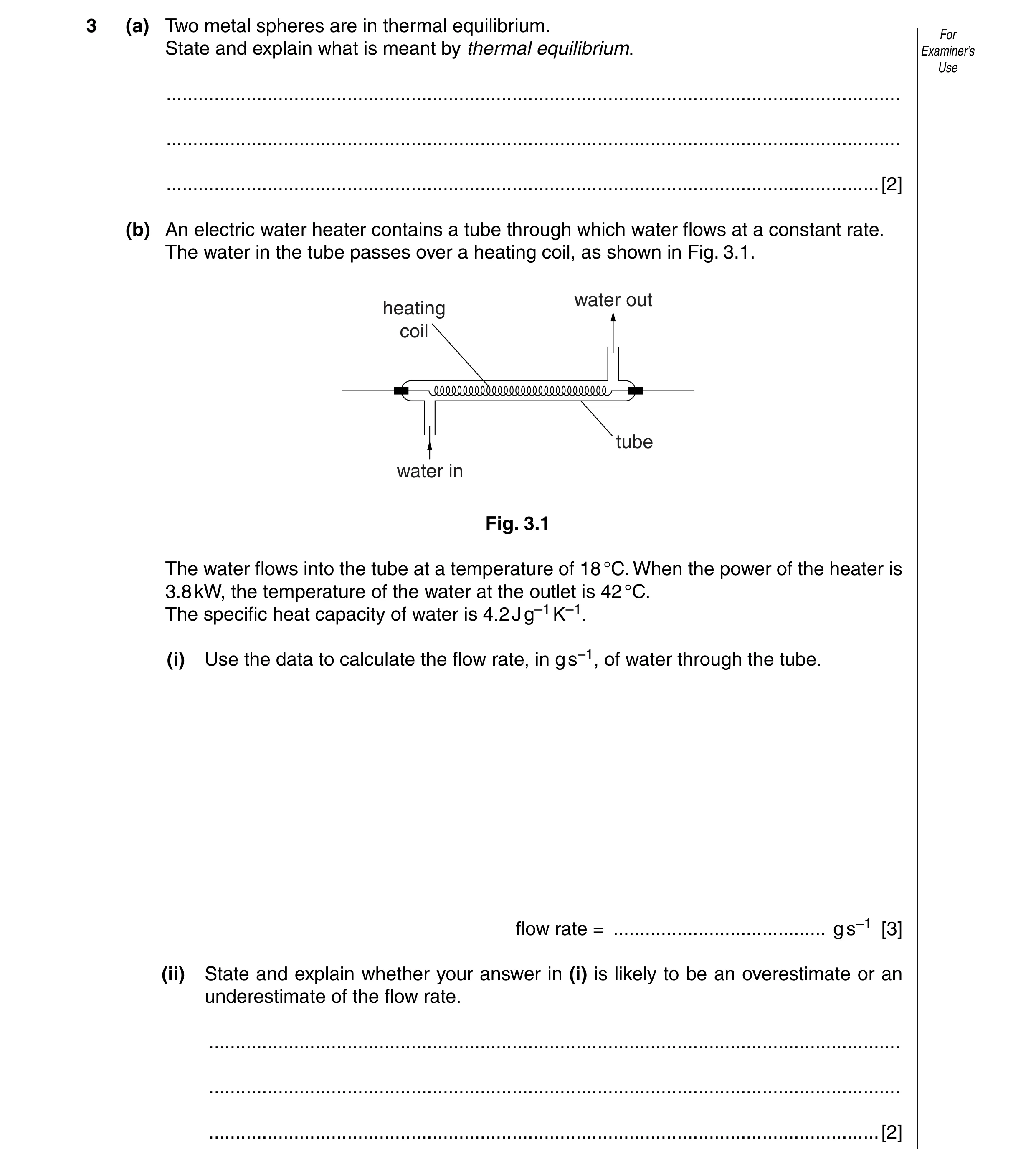
3 (a) Two metal spheres are in thermal equilibrium. For State and explain what is meant by thermal equilibrium. Examiner’s Use … … … [2] (b) An electric water heater contains a tube through which water flows at a constant rate. The water in the tube passes over a heating coil, as shown in Fig. 3.1. water out heating coil tube water in Fig. 3.1 The water flows into the tube at a temperature of 18 °C. When the power of the heater is 3.8 kW, the temperature of the water at the outlet is 42 °C. The specific heat capacity of water is 4.2 J g–1 K–1. (i) Use the data to calculate the flow rate, in g s–1, of water through the tube. flow rate = … g s–1 [3] (ii) State and explain whether your answer in (i) is likely to be an overestimate or an underestimate of the flow rate. … … … [2]
7 marks
Mark scheme: 3 (a) temperature of the spheres is the same B1 no (net) transfer of energy between the spheres B1 [2] (b) (i) power = m × c × ∆θ where m is mass per second C1 3800 = m × 4.2 × (42 – 18) C1 m = 38 g s–1 A1 [3] (ii) some thermal energy is lost to the surroundings M1 so rate is an overestimate A1 [2]
This question in 9702/41 Oct/Nov 2012
Q4 · Two metal spheres are in thermal equilibrium 9702/42 Oct/Nov 2012
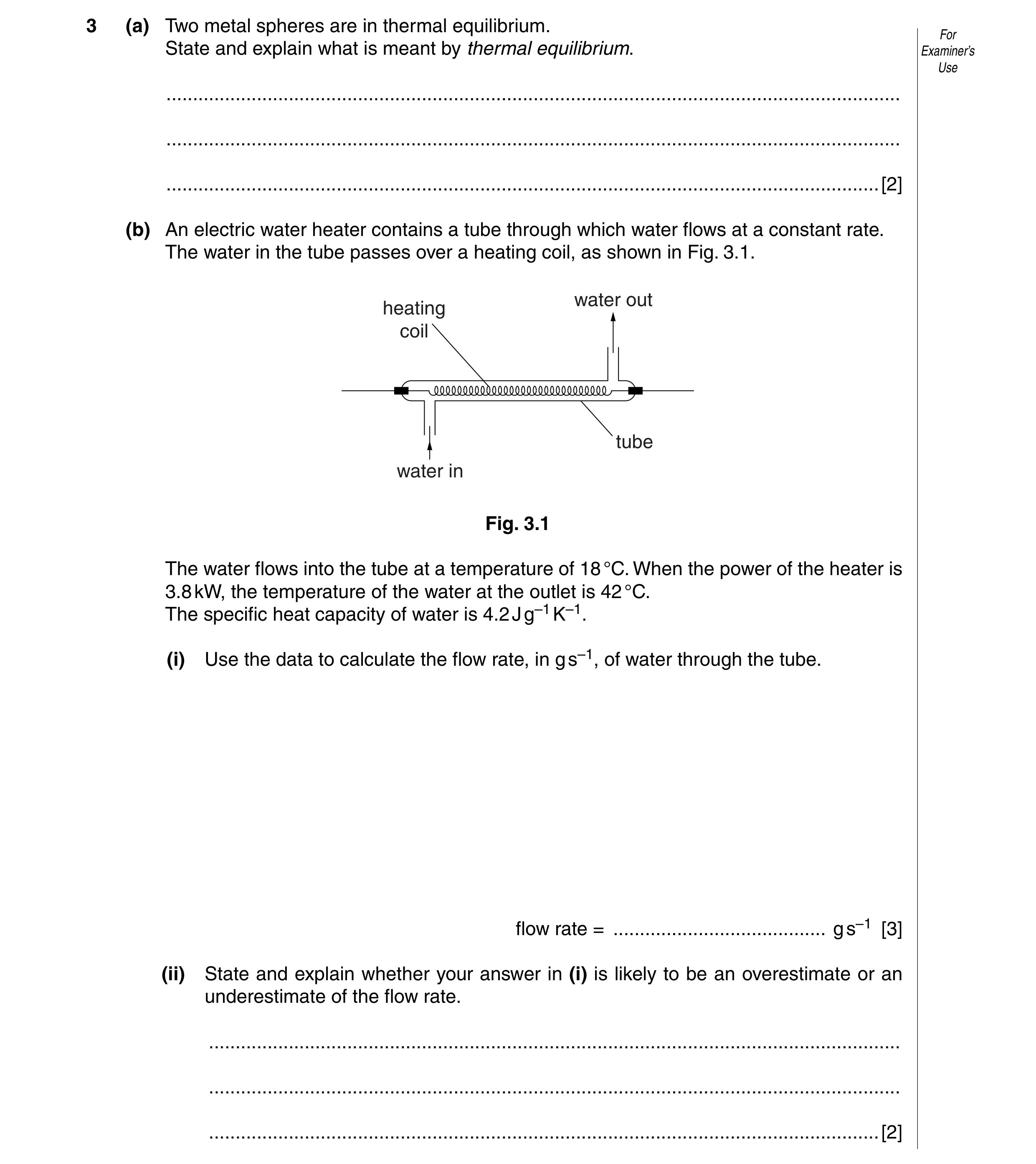
3 (a) Two metal spheres are in thermal equilibrium. For State and explain what is meant by thermal equilibrium. Examiner’s Use … … … [2] (b) An electric water heater contains a tube through which water flows at a constant rate. The water in the tube passes over a heating coil, as shown in Fig. 3.1. water out heating coil tube water in Fig. 3.1 The water flows into the tube at a temperature of 18 °C. When the power of the heater is 3.8 kW, the temperature of the water at the outlet is 42 °C. The specific heat capacity of water is 4.2 J g–1 K–1. (i) Use the data to calculate the flow rate, in g s–1, of water through the tube. flow rate = … g s–1 [3] (ii) State and explain whether your answer in (i) is likely to be an overestimate or an underestimate of the flow rate. … … … [2]
7 marks
Mark scheme: 3 (a) temperature of the spheres is the same B1 no (net) transfer of energy between the spheres B1 [2] (b) (i) power = m × c × ∆θ where m is mass per second C1 3800 = m × 4.2 × (42 – 18) C1 m = 38 g s–1 A1 [3] (ii) some thermal energy is lost to the surroundings M1 so rate is an overestimate A1 [2]
This question in 9702/42 Oct/Nov 2012
Q5 · Two bodies are in thermal equilibrium 9702/43 Oct/Nov 2015
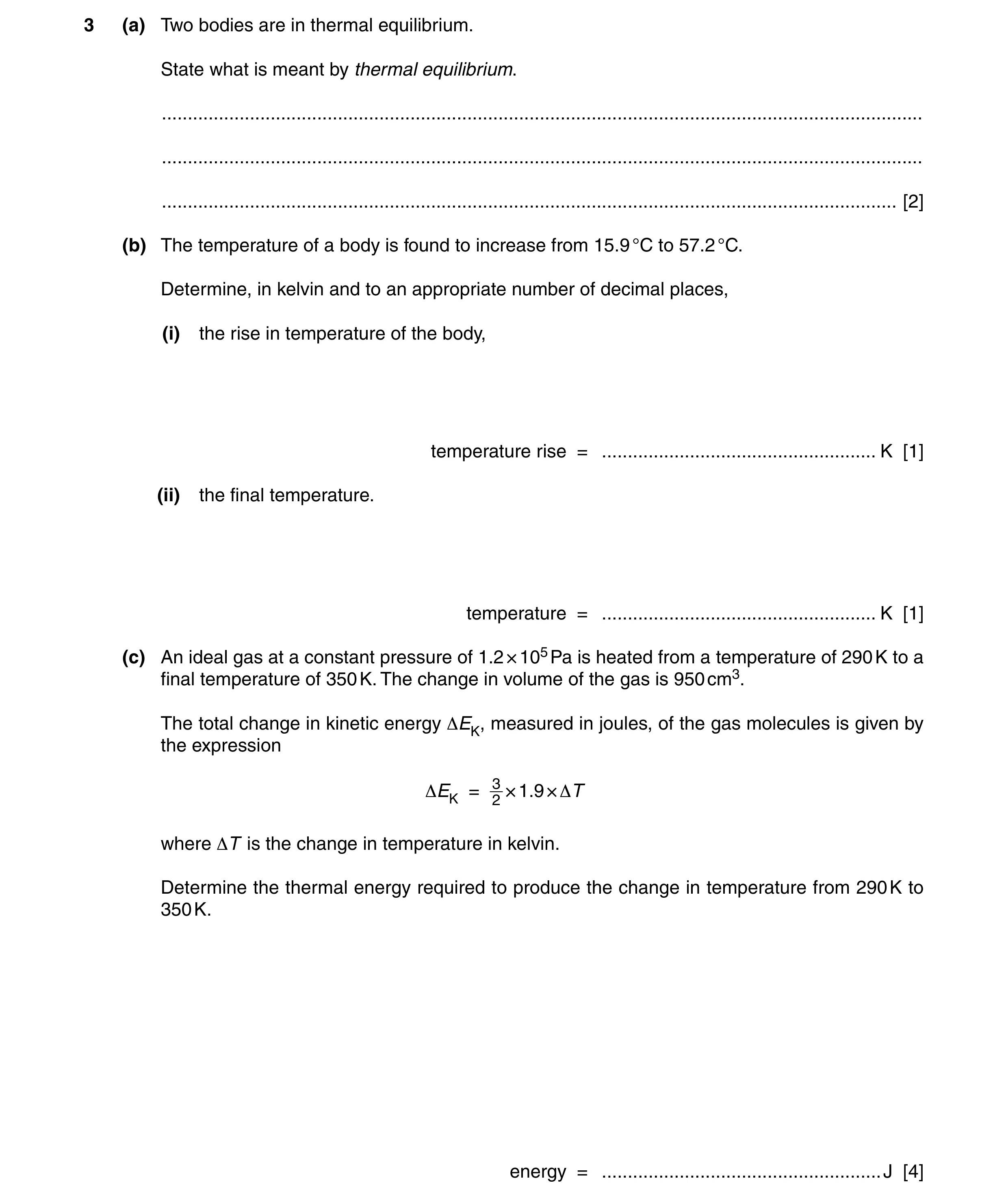
3 (a) Two bodies are in thermal equilibrium. State what is meant by thermal equilibrium. … … … [2] (b) The temperature of a body is found to increase from 15.9 °C to 57.2 °C. Determine, in kelvin and to an appropriate number of decimal places, (i) the rise in temperature of the body, temperature rise = … K [1] (ii) the final temperature. temperature = … K [1] (c) An ideal gas at a constant pressure of 1.2 × 10⁵ Pa is heated from a temperature of 290 K to a final temperature of 350 K. The change in volume of the gas is 950 cm3. The total change in kinetic energy ΔEK, measured in joules, of the gas molecules is given by the expression 3 ΔEK = 2 × 1.9 × ΔT where ΔT is the change in temperature in kelvin. Determine the thermal energy required to produce the change in temperature from 290 K to 350 K. energy = … J [4]
8 marks
Mark scheme: 3 (a) same temperature B1 no (net) transfer of thermal energy (between the bodies) B1 [2] (b) (i) 41.3 K B1 [1] (ii) 330.4 K B1 [1] 3 (c) ∆EK = × 1.9 × 60 2 = 171 J C1 work done = p∆V = 1.2 × 105 × 950 × 10–6 C1 = 114 J C1 thermal energy = 114 + 171 = 285 (290) J A1 [4]
This question in 9702/43 Oct/Nov 2015
Q6 · Explain what is meant by the statement that two bodies are in thermal equilibrium 9702/42 May/June 2016
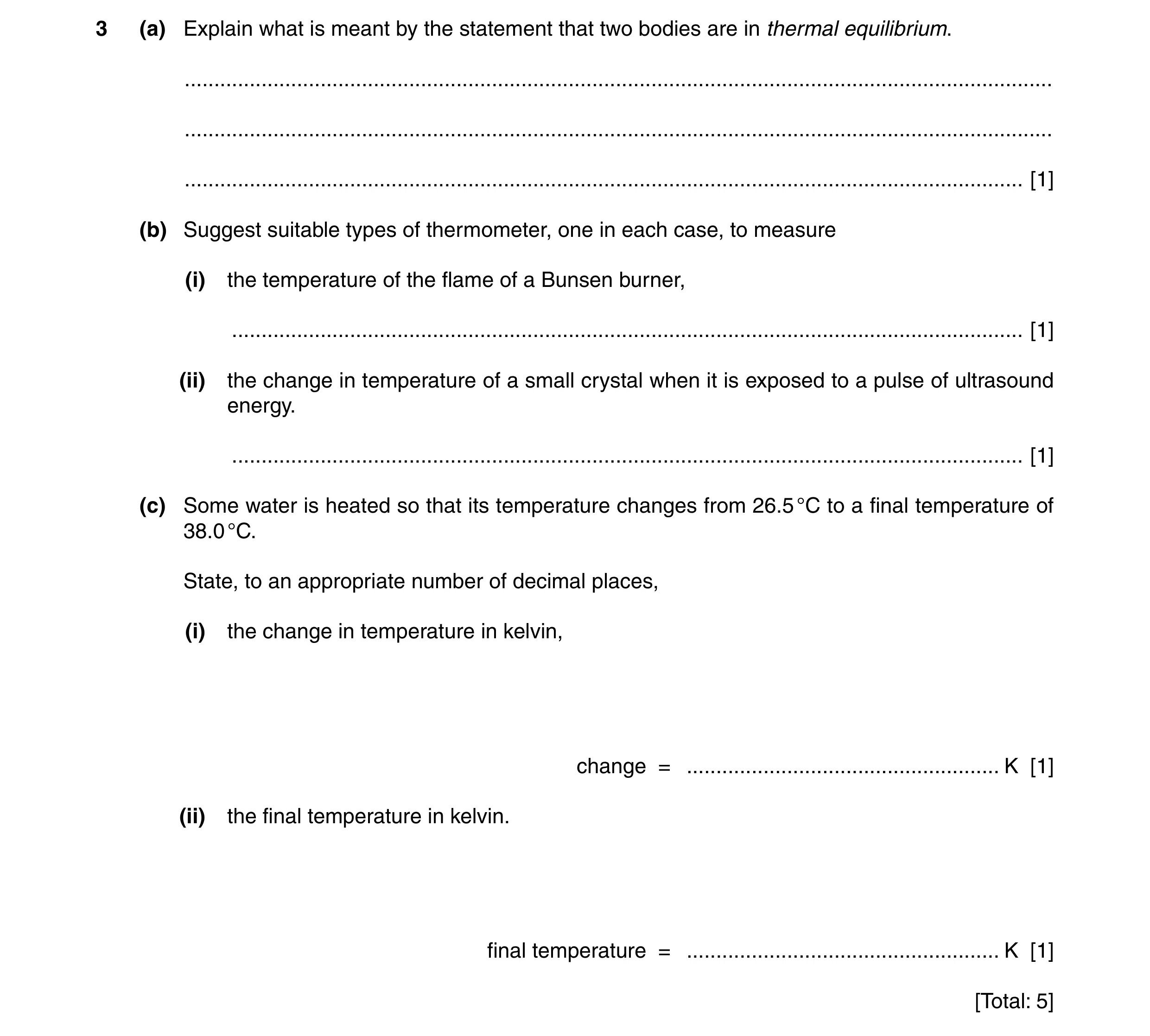
3 (a) Explain what is meant by the statement that two bodies are in thermal equilibrium. … … … [1] (b) Suggest suitable types of thermometer, one in each case, to measure (i) the temperature of the flame of a Bunsen burner, … [1] (ii) the change in temperature of a small crystal when it is exposed to a pulse of ultrasound energy. … [1] (c) Some water is heated so that its temperature changes from 26.5 °C to a final temperature of 38.0 °C. State, to an appropriate number of decimal places, (i) the change in temperature in kelvin, change = … K [1] (ii) the final temperature in kelvin. final temperature = … K [1] [Total: 5]
5 marks
Mark scheme: 3 (a) no net energy transfer between the bodies or bodies are at the same temperature B1 [1] (b) (i) thermocouple, platinum/metal resistance thermometer, pyrometer B1 [1] (ii) thermistor, thermocouple B1 [1] (c) (i) change = 11.5 K B1 [1] (ii) final temperature = 311.2 K B1 [1]
This question in 9702/42 May/June 2016
Q7 · State (i) what may be deduced from the difference in the temperatures of two objects, … …… 9702/41 Oct/Nov 2017
1 (a) State (i) what may be deduced from the difference in the temperatures of two objects, … … [1] (ii) the basic principle by which temperature is measured. … … [1] (b) By reference to your answer in (a)(ii), explain why two thermometers may not give the same temperature reading for an object. … … … [2] (c) A block of aluminium of mass 670 g is heated at a constant rate of 95 W for 6.0 minutes. The specific heat capacity of aluminium is 910 J kg−1 K−1. The initial temperature of the block is 24 °C. (i) Assuming that no thermal energy is lost to the surroundings, show that the final temperature of the block is 80 °C. [3] (ii) In practice, there are energy losses to the surroundings. The actual variation with time t of the temperature θ of the block is shown in Fig. 1.1. 100 80 θ/ °C 60 40 20 0 0 1 2 3 4 5 6 t / minutes Fig. 1.1 1. Use the information in (i) to draw, on Fig. 1.1, a line to represent the temperature of the block, assuming no energy losses to the surroundings. [1] 2. Using Fig. 1.1, calculate the total energy loss to the surroundings during the heating process. energy loss = … J [2] [Total: 10]
10 marks
Mark scheme: 1(a)(i) direction or rate of transfer of (thermal) energy or (if different,) not in thermal equilibrium/energy is transferred B1 1(a)(ii) uses a property (of a substance) that changes with temperature B1 1(b) • temperature scale assumes linear change of property with temperature • physical properties may not vary linearly with temperature • agrees only at fixed points Any 2 points. B2 1(c)(i) Pt = mc(∆)θ C1 95 × 6 × 60 = 0.670 × 910 × ∆θ M1 ∆θ = 56 °C so final temperature = 56 + 24 = 80 °C A1 or 95 × 6 × 60 = 0.67 × 910 × (θ – 24) (M1) so final temperature or θ = 80 °C (A1) Question Answer Marks 1(c)(ii) 1. sketch: straight line from (0,24) to (6,80) B1 2. temperature drop due to energy loss = (80 – 64) = 16 °C C1 energy loss = 0.670 × 910 × (80 – 64) = 9800 J A1 or energy to raise temperature to 64 °C = 0.670 × 910 × (64 – 24) (C1) = 24400 J loss = (95 × 6 × 60) – 24400 = 9800 J (A1)
This question in 9702/41 Oct/Nov 2017
Q8 · State (i) what may be deduced from the difference in the temperatures of two objects, … …… 9702/43 Oct/Nov 2017
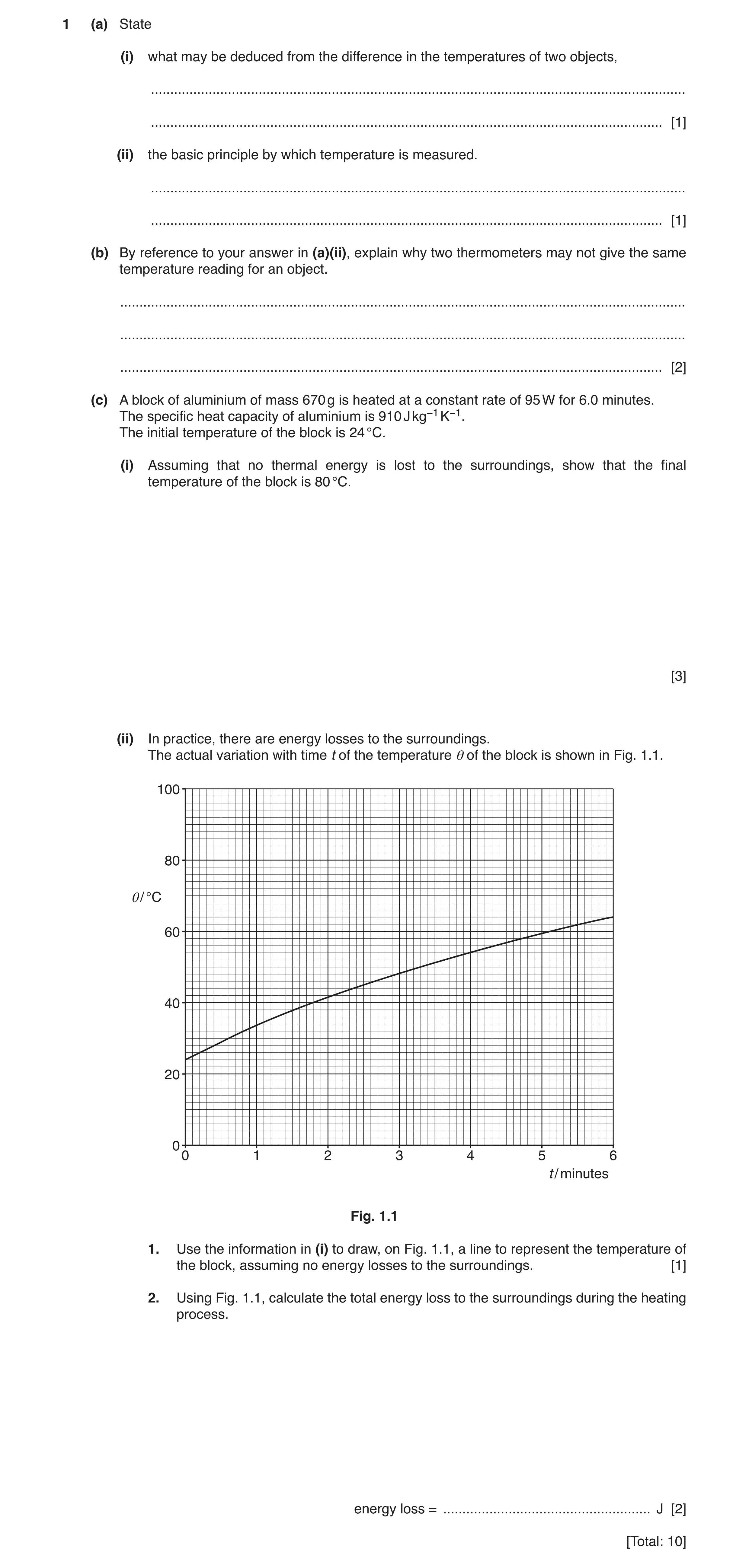
1 (a) State (i) what may be deduced from the difference in the temperatures of two objects, … … [1] (ii) the basic principle by which temperature is measured. … … [1] (b) By reference to your answer in (a)(ii), explain why two thermometers may not give the same temperature reading for an object. … … … [2] (c) A block of aluminium of mass 670 g is heated at a constant rate of 95 W for 6.0 minutes. The specific heat capacity of aluminium is 910 J kg−1 K−1. The initial temperature of the block is 24 °C. (i) Assuming that no thermal energy is lost to the surroundings, show that the final temperature of the block is 80 °C. [3] (ii) In practice, there are energy losses to the surroundings. The actual variation with time t of the temperature θ of the block is shown in Fig. 1.1. 100 80 θ/ °C 60 40 20 0 0 1 2 3 4 5 6 t / minutes Fig. 1.1 1. Use the information in (i) to draw, on Fig. 1.1, a line to represent the temperature of the block, assuming no energy losses to the surroundings. [1] 2. Using Fig. 1.1, calculate the total energy loss to the surroundings during the heating process. energy loss = … J [2] [Total: 10]
10 marks
Mark scheme: 1(a)(i) direction or rate of transfer of (thermal) energy or (if different,) not in thermal equilibrium/energy is transferred B1 1(a)(ii) uses a property (of a substance) that changes with temperature B1 1(b) • temperature scale assumes linear change of property with temperature • physical properties may not vary linearly with temperature • agrees only at fixed points Any 2 points. B2 1(c)(i) Pt = mc(∆)θ C1 95 × 6 × 60 = 0.670 × 910 × ∆θ M1 ∆θ = 56 °C so final temperature = 56 + 24 = 80 °C A1 or 95 × 6 × 60 = 0.67 × 910 × (θ – 24) (M1) so final temperature or θ = 80 °C (A1) Question Answer Marks 1(c)(ii) 1. sketch: straight line from (0,24) to (6,80) B1 2. temperature drop due to energy loss = (80 – 64) = 16 °C C1 energy loss = 0.670 × 910 × (80 – 64) = 9800 J A1 or energy to raise temperature to 64 °C = 0.670 × 910 × (64 – 24) (C1) = 24400 J loss = (95 × 6 × 60) – 24400 = 9800 J (A1)
This question in 9702/43 Oct/Nov 2017
Q9 · State the reason why two objects that are at the same temperature are described as being… 9702/41 May/June 2023
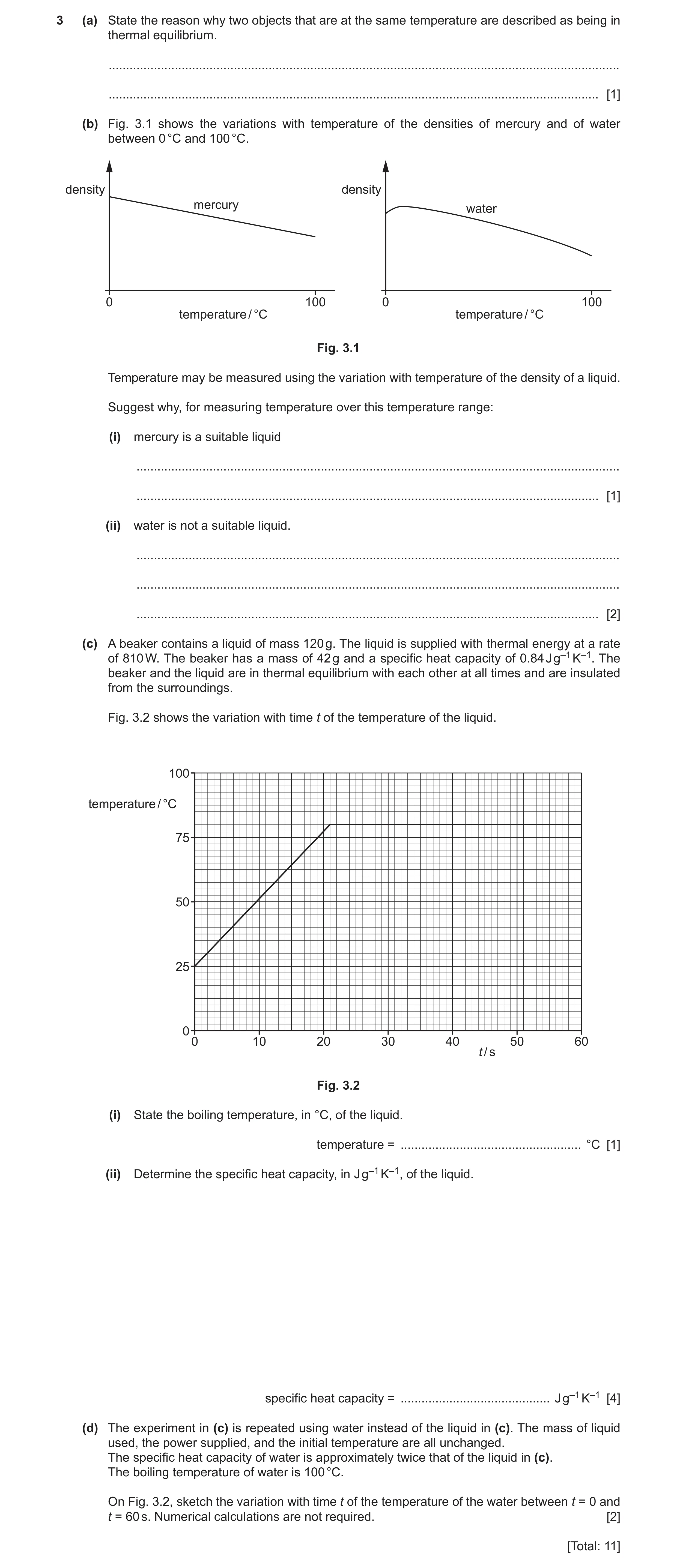
3 (a) State the reason why two objects that are at the same temperature are described as being in thermal equilibrium. … … [1] (b) Fig. 3.1 shows the variations with temperature of the densities of mercury and of water between 0 °C and 100 °C. density density mercury water 0 100 0 100 temperature / °C temperature / °C Fig. 3.1 Temperature may be measured using the variation with temperature of the density of a liquid. Suggest why, for measuring temperature over this temperature range: (i) mercury is a suitable liquid … … [1] (ii) water is not a suitable liquid. … … … [2] (c) A beaker contains a liquid of mass 120 g. The liquid is supplied with thermal energy at a rate of 810 W. The beaker has a mass of 42 g and a specific heat capacity of 0.84 J g–1 K–1. The beaker and the liquid are in thermal equilibrium with each other at all times and are insulated from the surroundings. Fig. 3.2 shows the variation with time t of the temperature of the liquid. 100 temperature / °C 75 50 25 0 0 10 20 30 40 50 60 t / s Fig. 3.2 (i) State the boiling temperature, in °C, of the liquid. temperature = … °C [1] (ii) Determine the specific heat capacity, in J g–1 K–1, of the liquid. specific heat capacity = … J g–1 K–1 [4] (d) The experiment in (c) is repeated using water instead of the liquid in (c). The mass of liquid used, the power supplied, and the initial temperature are all unchanged. The specific heat capacity of water is approximately twice that of the liquid in (c). The boiling temperature of water is 100 °C. On Fig. 3.2, sketch the variation with time t of the temperature of the water between t = 0 and t = 60 s. Numerical calculations are not required. [2] [Total: 11]
11 marks
Mark scheme: 3(a) no net thermal energy is transferred (between them) B1 3(b)(i) variation (of density with temperature) is linear or each temperature has a unique value of density B1 3(b)(ii) variation (of density with temperature) is not linear region where the density does not vary with temperature different temperatures have the same density Any two points, 1 mark each B2 3(c)(i) boiling point = 80 °C A1 3(c)(ii) Q = Pt and t = 21 s (thermal energy supplied = 810 21 = 17000 J) C1 c = Q / m C1 thermal energy absorbed by beaker = 42 0.84 (80 – 25) ( = 1940 J) C1 s.h.c. of liquid = [(810 21) – (42 0.84 (80 – 25))] / [120 (80 – 25)] = 2.3 J g–1 K–1 A1 3(d) sketch: straight diagonal line from 25 °C to 100 °C and then horizontal at 100 °C B1 straight diagonal line starting at 25 °C with gradient approximately half that of the original line B1
This question in 9702/41 May/June 2023
Q10 · State the reason why two objects that are at the same temperature are described as being… 9702/43 May/June 2023
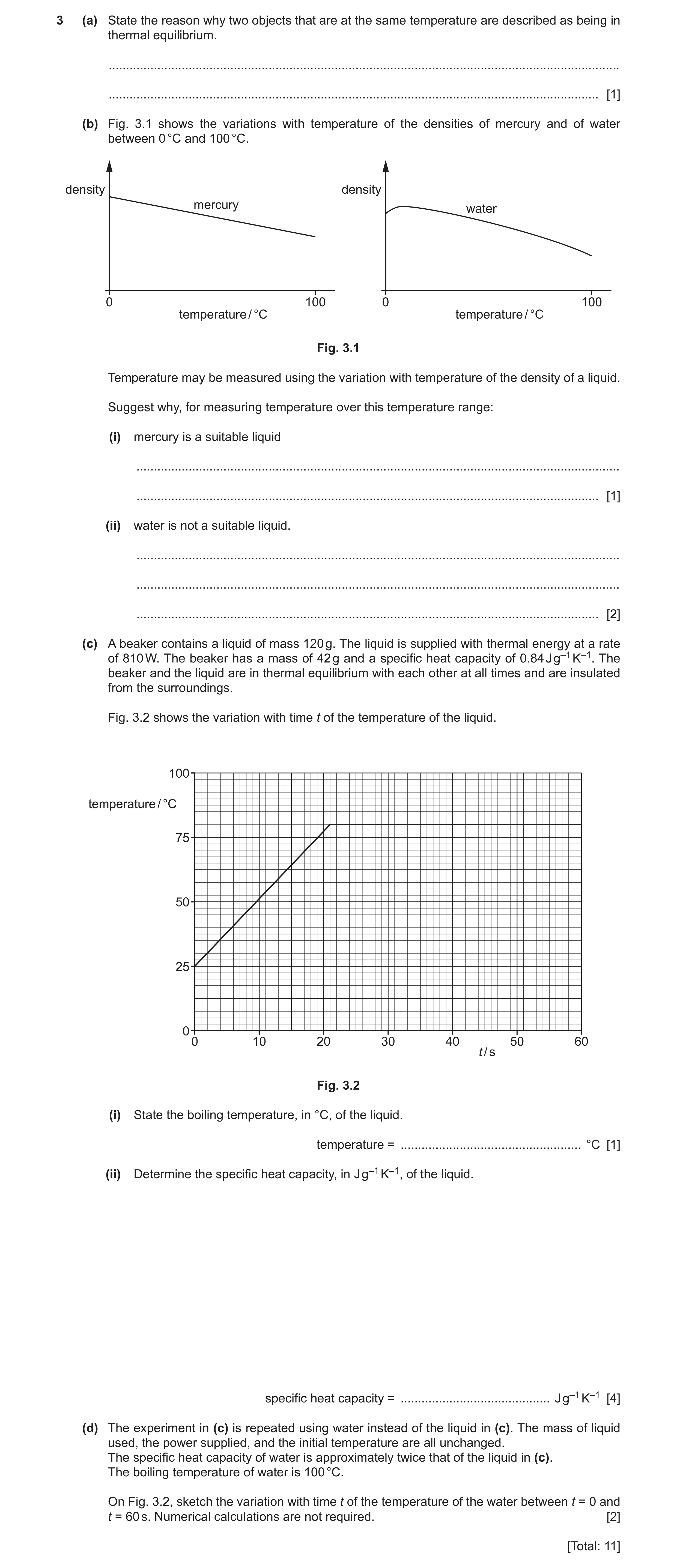
3 (a) State the reason why two objects that are at the same temperature are described as being in thermal equilibrium. … … [1] (b) Fig. 3.1 shows the variations with temperature of the densities of mercury and of water between 0 °C and 100 °C. density density mercury water 0 100 0 100 temperature / °C temperature / °C Fig. 3.1 Temperature may be measured using the variation with temperature of the density of a liquid. Suggest why, for measuring temperature over this temperature range: (i) mercury is a suitable liquid … … [1] (ii) water is not a suitable liquid. … … … [2] (c) A beaker contains a liquid of mass 120 g. The liquid is supplied with thermal energy at a rate of 810 W. The beaker has a mass of 42 g and a specific heat capacity of 0.84 J g–1 K–1. The beaker and the liquid are in thermal equilibrium with each other at all times and are insulated from the surroundings. Fig. 3.2 shows the variation with time t of the temperature of the liquid. 100 temperature / °C 75 50 25 0 0 10 20 30 40 50 60 t / s Fig. 3.2 (i) State the boiling temperature, in °C, of the liquid. temperature = … °C [1] (ii) Determine the specific heat capacity, in J g–1 K–1, of the liquid. specific heat capacity = … J g–1 K–1 [4] (d) The experiment in (c) is repeated using water instead of the liquid in (c). The mass of liquid used, the power supplied, and the initial temperature are all unchanged. The specific heat capacity of water is approximately twice that of the liquid in (c). The boiling temperature of water is 100 °C. On Fig. 3.2, sketch the variation with time t of the temperature of the water between t = 0 and t = 60 s. Numerical calculations are not required. [2] [Total: 11]
11 marks
Mark scheme: 3(a) no net thermal energy is transferred (between them) B1 3(b)(i) variation (of density with temperature) is linear or each temperature has a unique value of density B1 3(b)(ii) variation (of density with temperature) is not linear region where the density does not vary with temperature different temperatures have the same density Any two points, 1 mark each B2 3(c)(i) boiling point = 80 °C A1 3(c)(ii) Q = Pt and t = 21 s (thermal energy supplied = 810 21 = 17000 J) C1 c = Q / m C1 thermal energy absorbed by beaker = 42 0.84 (80 – 25) ( = 1940 J) C1 s.h.c. of liquid = [(810 21) – (42 0.84 (80 – 25))] / [120 (80 – 25)] = 2.3 J g–1 K–1 A1 3(d) sketch: straight diagonal line from 25 °C to 100 °C and then horizontal at 100 °C B1 straight diagonal line starting at 25 °C with gradient approximately half that of the original line B1
This question in 9702/43 May/June 2023
Q11 · With reference to thermal energy, state what is meant by two objects being in thermal… 9702/42 May/June 2024
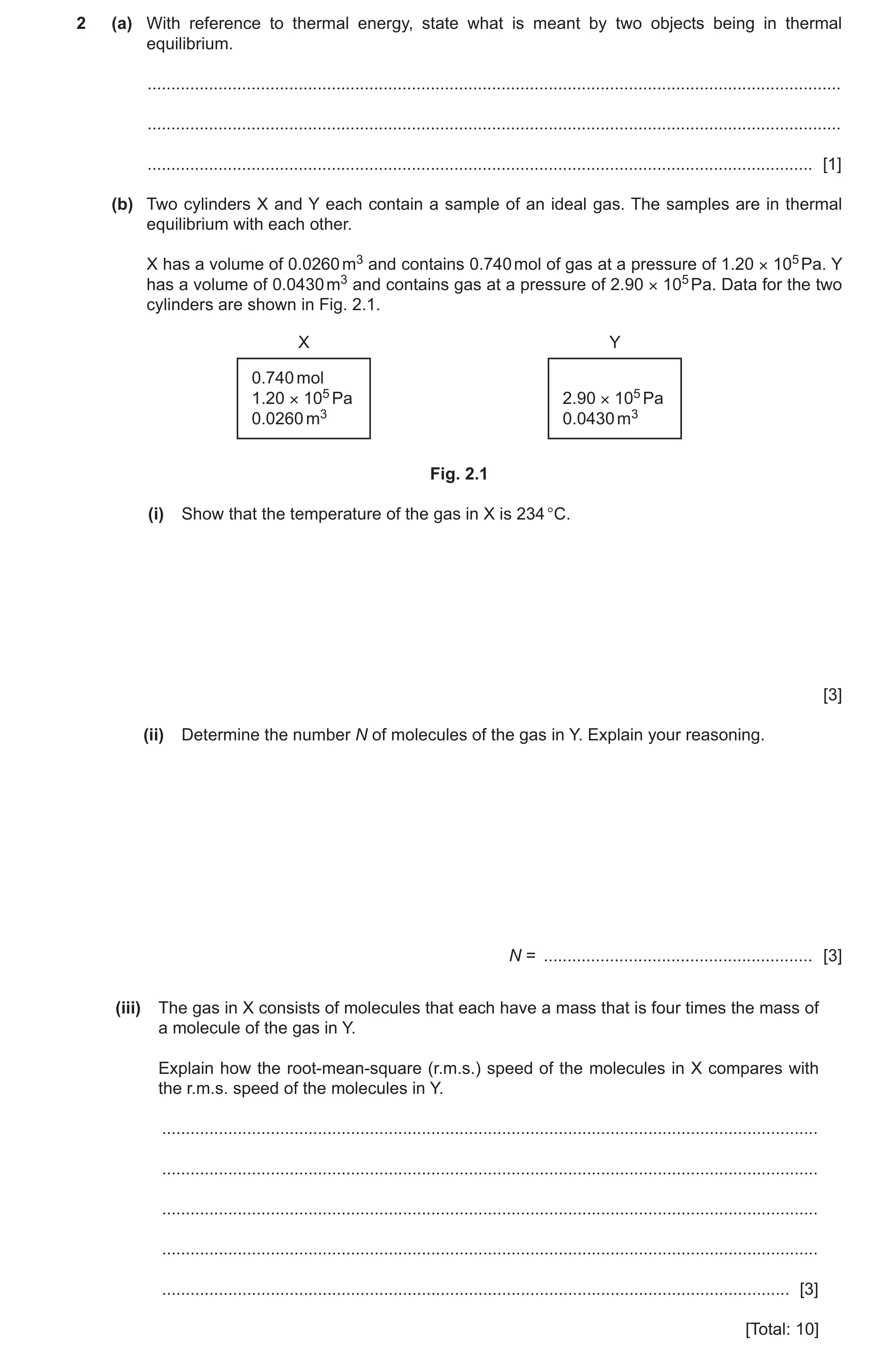
2 (a) With reference to thermal energy, state what is meant by two objects being in thermal equilibrium. … … … [1] (b) Two cylinders X and Y each contain a sample of an ideal gas. The samples are in thermal equilibrium with each other. X has a volume of 0.0260 m3 and contains 0.740 mol of gas at a pressure of 1.20 × 10⁵ Pa. Y has a volume of 0.0430 m3 and contains gas at a pressure of 2.90 × 10⁵ Pa. Data for the two cylinders are shown in Fig. 2.1. X Y 0.740 mol 1.20 × 10⁵ Pa 2.90 × 10⁵ Pa 0.0260 m3 0.0430 m3 Fig. 2.1 (i) Show that the temperature of the gas in X is 234 °C. [3] (ii) Determine the number N of molecules of the gas in Y. Explain your reasoning. N = … [3] (iii) The gas in X consists of molecules that each have a mass that is four times the mass of a molecule of the gas in Y. Explain how the root-mean-square (r.m.s.) speed of the molecules in X compares with the r.m.s. speed of the molecules in Y. … … … … … [3] [Total: 10]
10 marks
Mark scheme: 2(a) (if in thermal contact) no net transfer of (thermal) energy (between them) B1 2(b)(i) pV = nRT C1 T = (1.20 105 0.0260) / (0.740 8.31) ( = 507 K) M1 temperature = 507 – 273 = 234 °C A1 2(b)(ii) thermal equilibrium so temperatures (of X and Y) are equal B1 pV = NkT C1 N = (2.90 105 0.0430) / (1.38 10–23 507) = 1.78 1024 A1 2(b)(iii) (molecular) kinetic energy is proportional to temperature or kinetic energy (of molecules) is same in both cylinders kinetic energy proportional to mass mean-square speed or temperature proportional to mass mean-square speed or r.m.s. speed proportional to √(temperature / mass) mean-square speed inversely proportional to mass or r.m.s. speed inversely proportional to √(mass) Any two bulleted points, 1 mark each B2 r.m.s. speed (of molecules) in X is half r.m.s. speed (of molecules) in Y B1
This question in 9702/42 May/June 2024
Q12 · Two metal cuboids P and Q are in thermal contact with each other 9702/42 Feb/March 2025
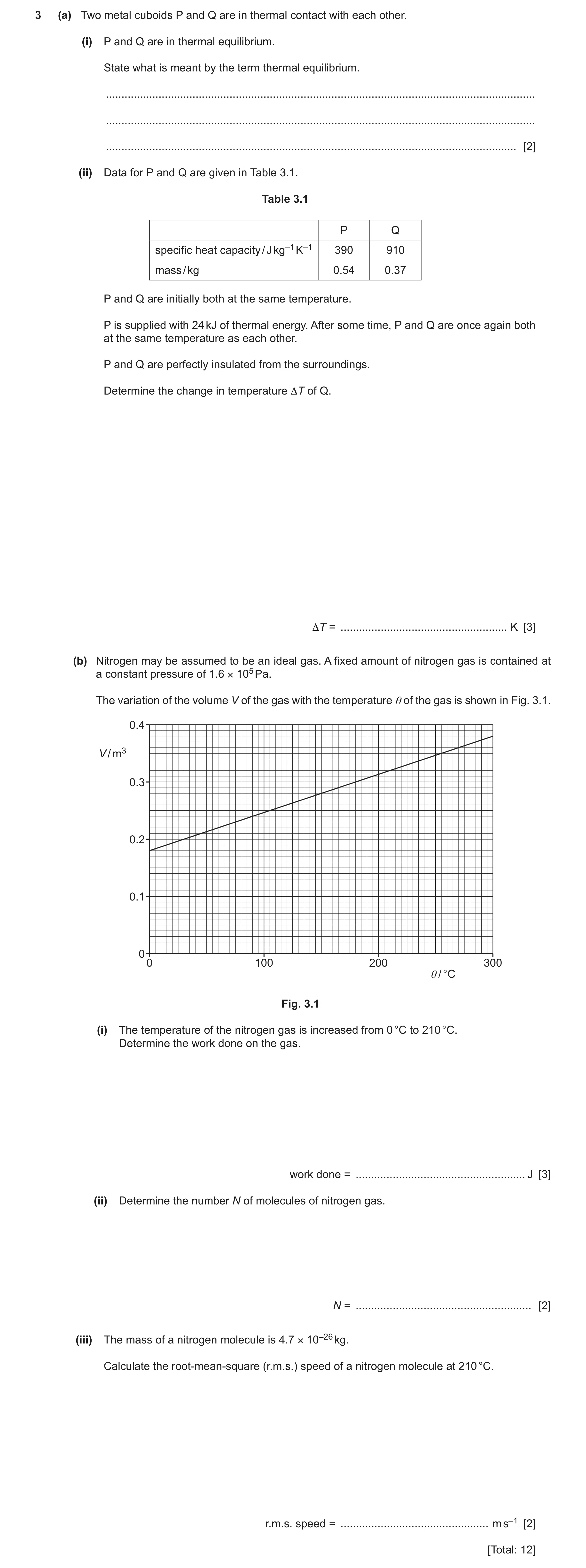
3 (a) Two metal cuboids P and Q are in thermal contact with each other. (i) P and Q are in thermal equilibrium. State what is meant by the term thermal equilibrium. … … … [2] (ii) Data for P and Q are given in Table 3.1. Table 3.1 P Q specific heat capacity / J kg–1 K–1 390 910 mass / kg 0.54 0.37 P and Q are initially both at the same temperature. P is supplied with 24 kJ of thermal energy. After some time, P and Q are once again both at the same temperature as each other. P and Q are perfectly insulated from the surroundings. Determine the change in temperature ΔT of Q. ΔT = … K [3] (b) Nitrogen may be assumed to be an ideal gas. A fixed amount of nitrogen gas is contained at a constant pressure of 1.6 × 10⁵ Pa. The variation of the volume V of the gas with the temperature θ of the gas is shown in Fig. 3.1. 0.4 V / m3 0.3 0.2 0.1 0 0 100 200 300 θ / °C Fig. 3.1 (i) The temperature of the nitrogen gas is increased from 0 °C to 210 °C. Determine the work done on the gas. work done = … J [3] (ii) Determine the number N of molecules of nitrogen gas. N = … [2] (iii) The mass of a nitrogen molecule is 4.7 × 10⁻²⁶ kg. Calculate the root‑mean‑square (r.m.s.) speed of a nitrogen molecule at 210 °C. r.m.s. speed = … m s–1 [2] [Total: 12]
12 marks
Mark scheme: 3(a)(i) (P and Q are at the) same temperature B1 no net transfer of thermal energy (between P and Q) B1 3(a)(ii) Q = mcT C1 24 103 = (0.54 390 T) + (0.37 910 T) C1 T = 44 K A1 3(b)(i) work done = pV C1 = (1.6 105) (0.18 – 0.32) C1 = –2.2 104 J A1 3(b)(ii) pV = NkT C1 N = (1.6 105 0.18) / (1.38 10–23 273) A1 = 7.6 1024 3(b)(iii) ½m<c2> = (3 / 2)kT C1 r.m.s. speed = √[(3 1.38 10–23 (210 + 273) / (4.7 10–26)] A1 = 650 m s–1
This question in 9702/42 Feb/March 2025
Q13 · State what is meant by two objects being in thermal equilibrium 9702/44 May/June 2025
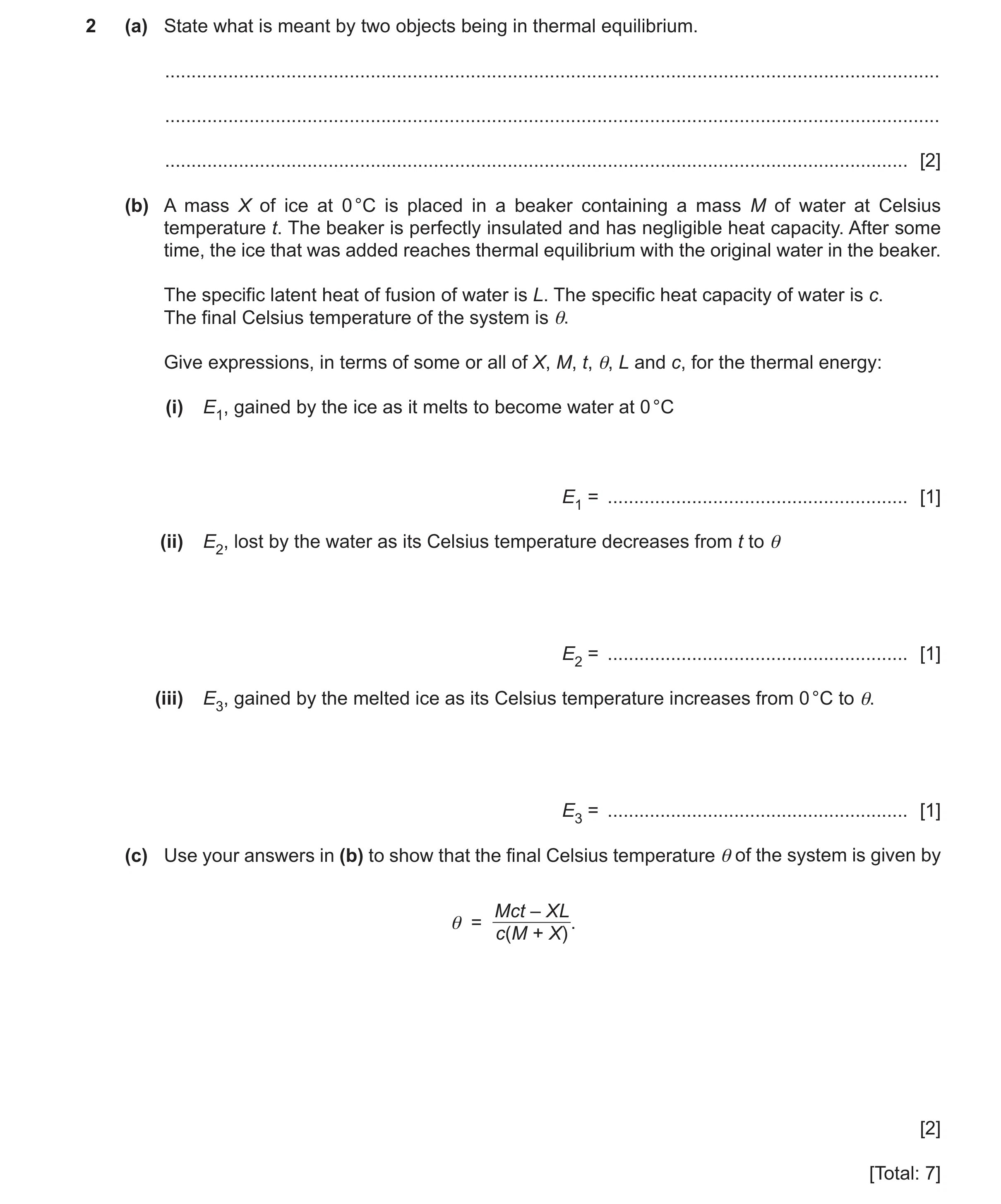
2 (a) State what is meant by two objects being in thermal equilibrium. … … … [2] (b) A mass X of ice at 0 °C is placed in a beaker containing a mass M of water at Celsius temperature t. The beaker is perfectly insulated and has negligible heat capacity. After some time, the ice that was added reaches thermal equilibrium with the original water in the beaker. The specific latent heat of fusion of water is L. The specific heat capacity of water is c. The final Celsius temperature of the system is θ. Give expressions, in terms of some or all of X, M, t, θ, L and c, for the thermal energy: (i) E1, gained by the ice as it melts to become water at 0 °C E1 = … [1] (ii) E2, lost by the water as its Celsius temperature decreases from t to θ E2 = … [1] (iii) E3, gained by the melted ice as its Celsius temperature increases from 0 °C to θ. E3 = … [1] (c) Use your answers in (b) to show that the final Celsius temperature θ of the system is given by Mct – XL θ = . c(M + X) [2] [Total: 7]
7 marks
Mark scheme: 2(a) same temperature (as each other) B1 no net transfer of thermal energy (between them) B1 2(b)(i) E1 = XL B1 2(b)(ii) E2 = Mc(t – ) A1 2(b)(iii) E3 = Xc B1 2(c) E2 = E1 + E3 C1 Mc(t – ) = XL + Xc A1 and completion of algebra to reach = (Mct – XL) / c(M + X)
This question in 9702/44 May/June 2025
Q14 · State what is meant by two objects being in thermal equilibrium 9702/42 Oct/Nov 2025
3 (a) State what is meant by two objects being in thermal equilibrium. … … … [2] (b) Fig. 3.1 shows a type of thermometer called a constant volume gas thermometer. vacuum fixed glass tube scale movable glass tube Y Δh gas X liquid rubber tube glass bulb Fig. 3.1 (not to scale) The thermometer is used to determine the thermodynamic temperature T of the gas in the glass bulb. The glass bulb is immersed in the environment for which the temperature is to be measured. The height of the movable glass tube is then adjusted so that the level of the liquid on the left-hand side aligns with the reference line X marked on the fixed glass tube. The reference line Y is marked on the side of the movable glass tube. The level of the liquid at Y is higher than at X as a result of the pressure of the gas in the glass bulb. The difference in height Δh between the liquid levels at X and Y is then measured using the scale. The thermodynamic temperature T of the gas is directly proportional to the pressure of the gas. This pressure is directly proportional to Δh. (i) The value of Δh can be used to calculate the pressure of the gas. In order to do this, the gravitational field strength is used, along with a property of the liquid. State the property of the liquid that is used to calculate the pressure. … [1] (ii) Before the measurement of Δh can be made, the glass bulb needs to reach thermal equilibrium with the environment for which the temperature is to be measured. State two disadvantages of using a constant volume gas thermometer to measure temperature. 1 … … 2 … … [2] (iii) Suggest one situation in which a constant volume gas thermometer would be an appropriate type of thermometer to choose for measuring temperature. … … … [1] (iv) Level X aligns with 2.31 cm on the scale. At 0 °C, level Y aligns with 8.69 cm. At temperature θ, level Y aligns with 7.83 cm on the scale. Determine a value for θ in °C. θ = … °C [3] [Total: 9]
9 marks
Mark scheme: 3(a) same temperature B1 no net transfer of thermal energy (between them) B1 3(b)(i) density B1 3(b)(ii) Any two points from: B2 • large response time / large time to reach equilibrium or cannot measure rapidly changing temperatures • reaching equilibrium requires (significant) transfer of energy or changes temperature of environment being measured or cannot measure temperature of small objects • bulky / difficult to set up or difficult to take readings / scale not calibrated to read temperature or cannot measure temperature of solid objects 3(b)(iii) substance with large mass B1 or temperature that is constant (over time) or to calibrate other thermometers (in a laboratory) 3(b)(iv) 0 °C = 273 K C1 T = 273 (7.83 – 2.31) / (8.69 – 2.31) C1 ( = 236 K) = 236 – 273 A1 = – 37 °C
This question in 9702/42 Oct/Nov 2025
 3 / 20
 4 / 20
 5 / 20
 6 / 20
 7 / 20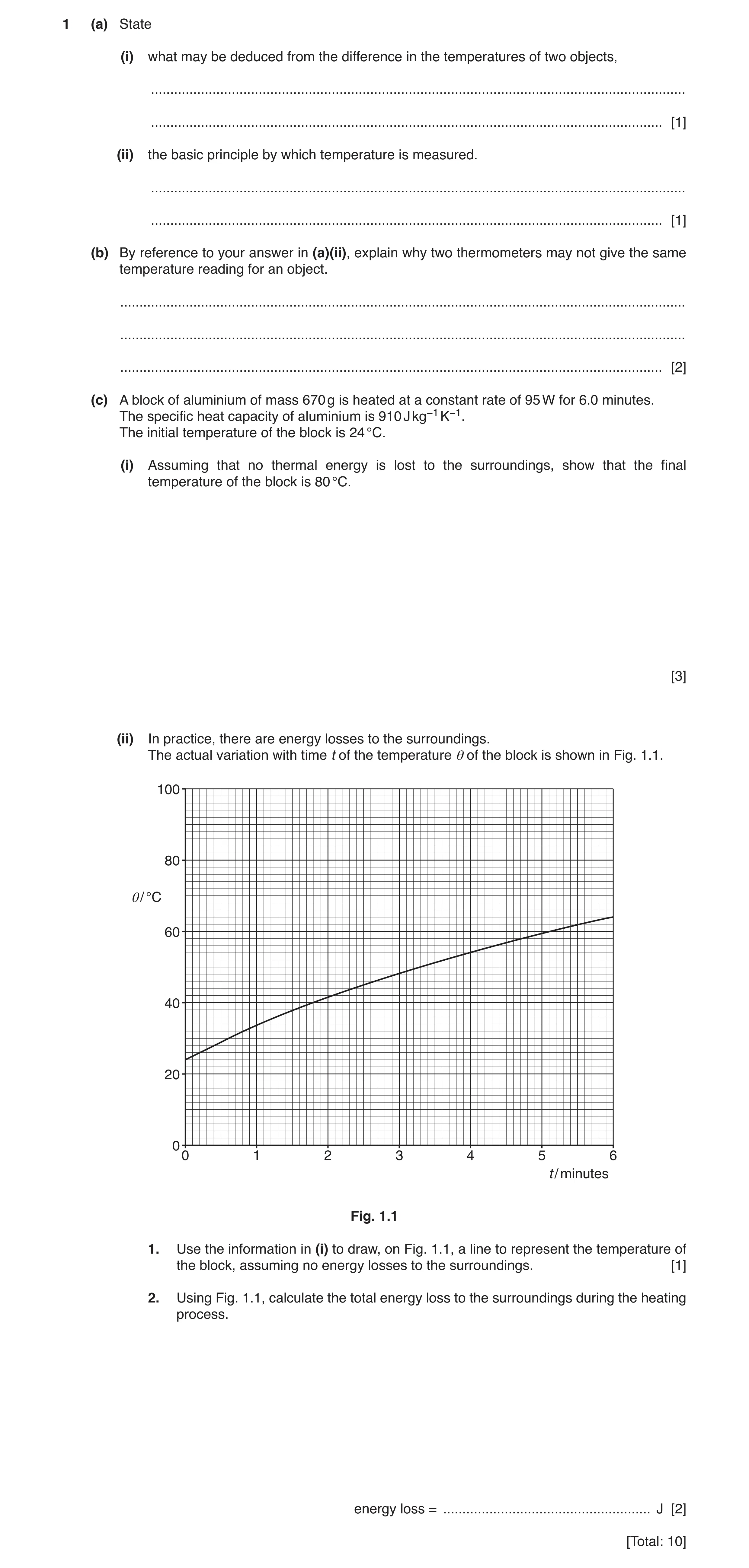
 18 / 20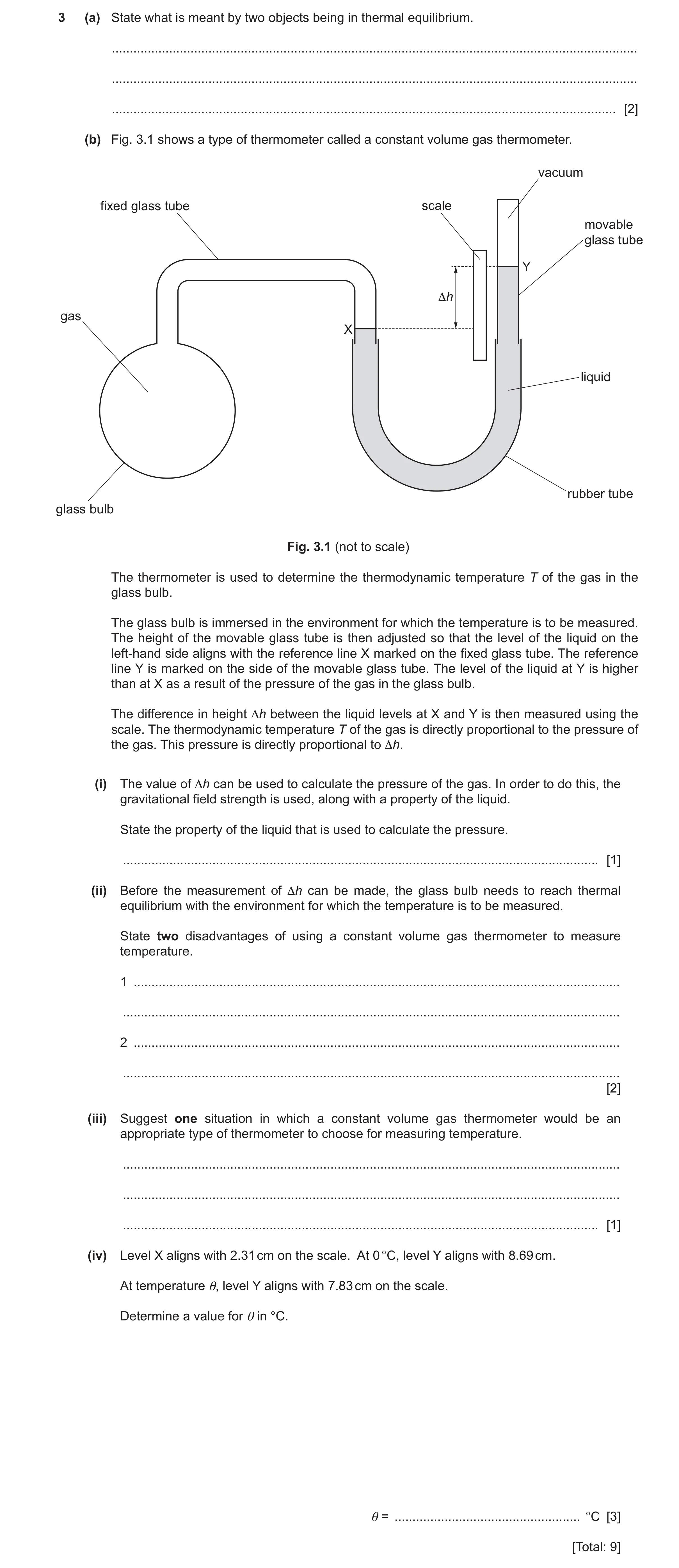
 8
8 6
6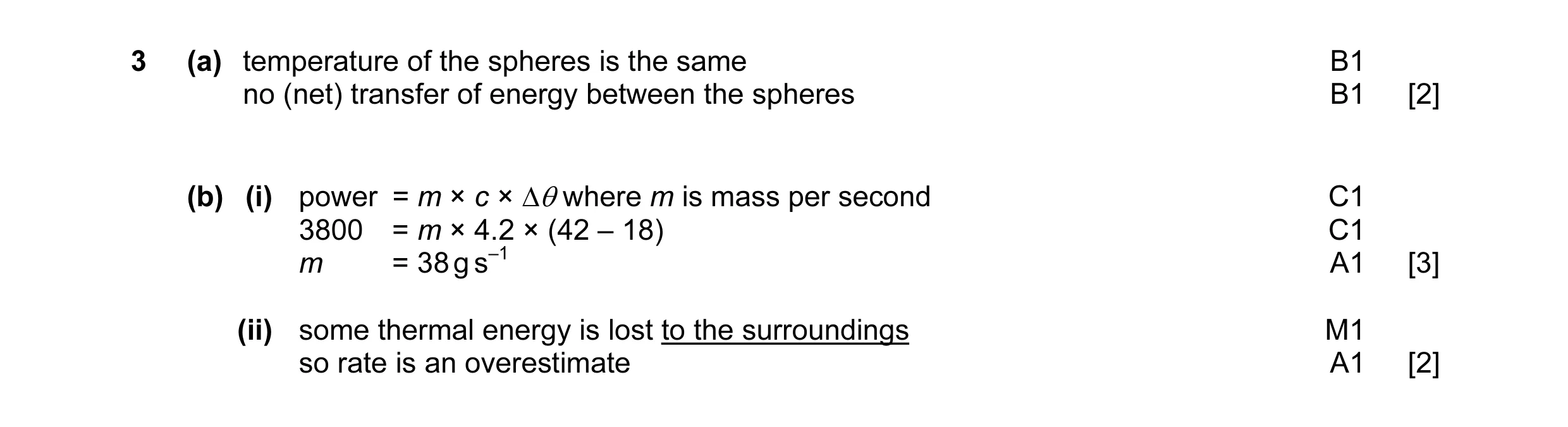 7
7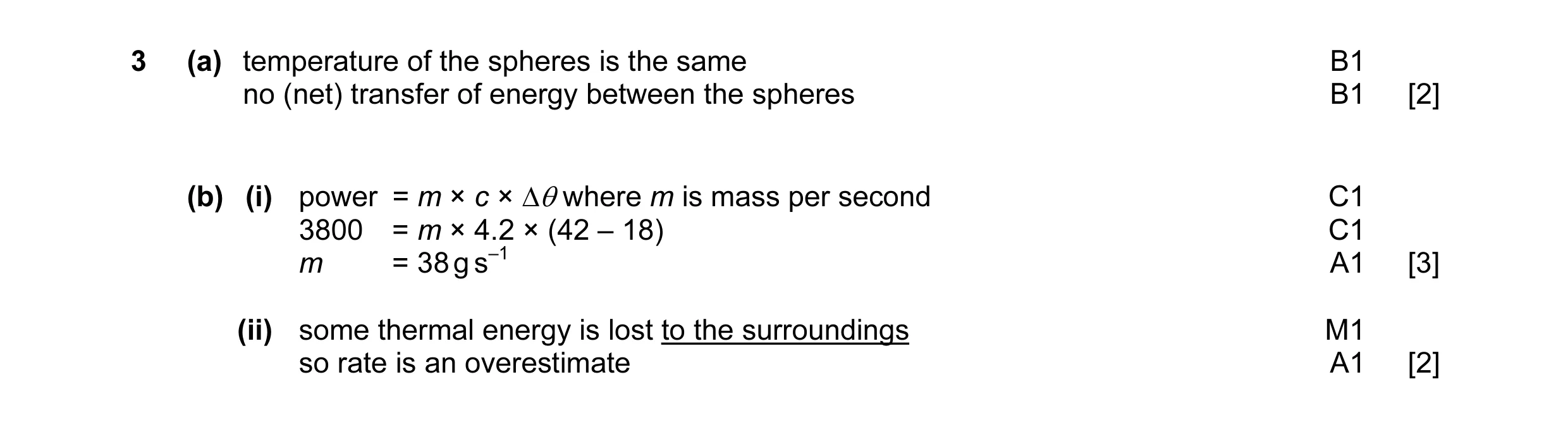 7
7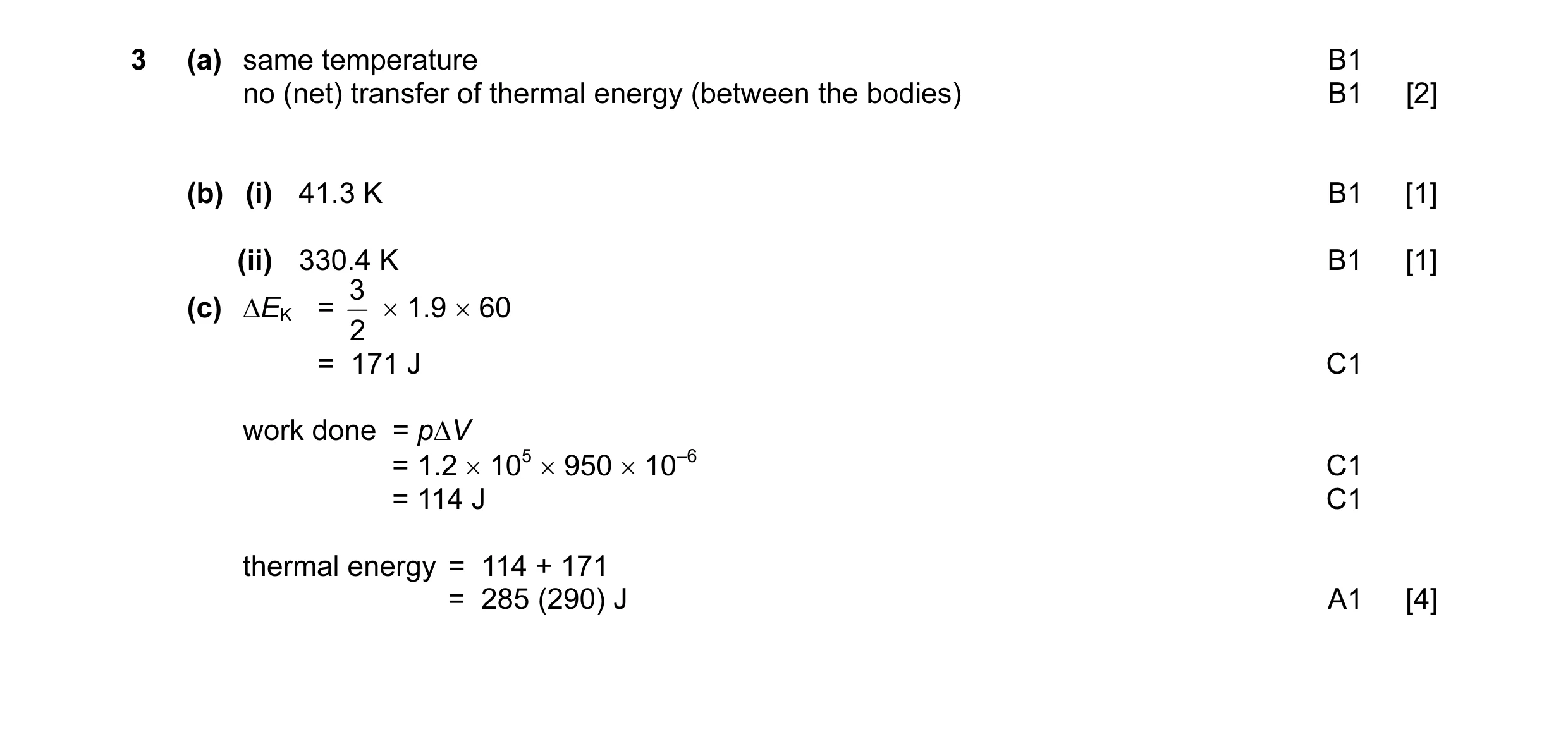 8
8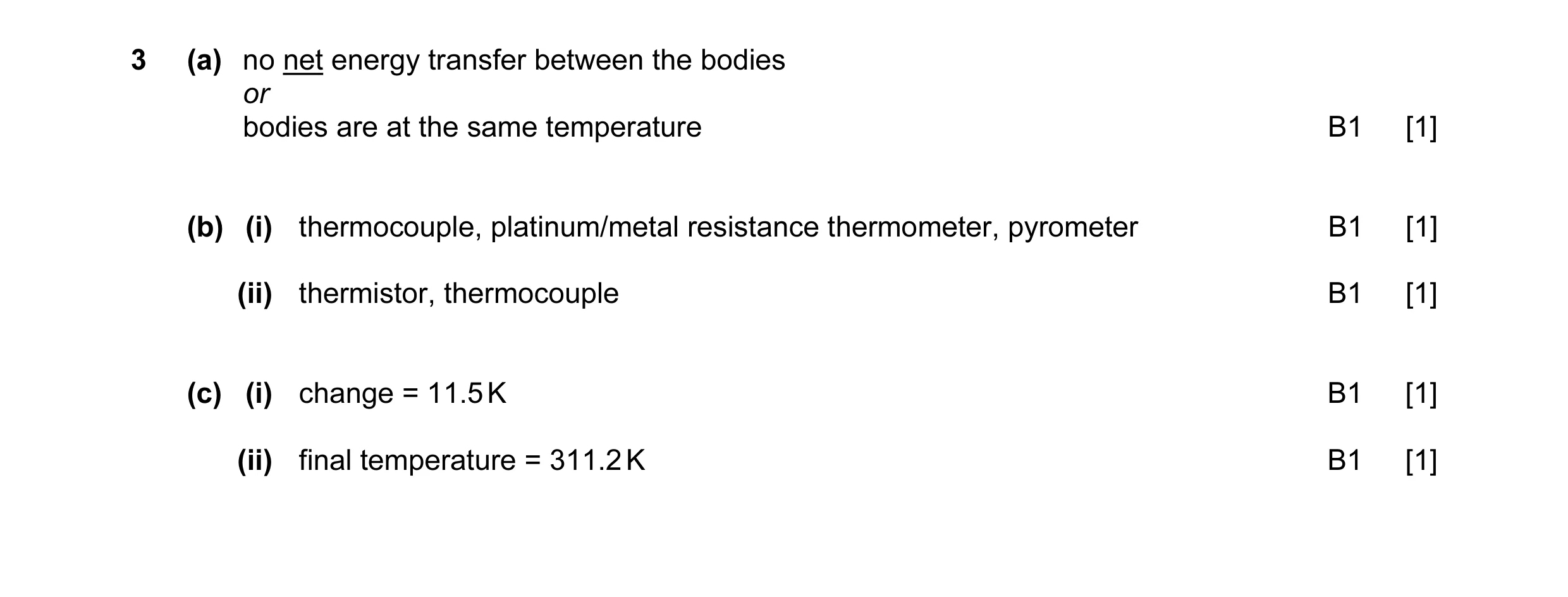 5
5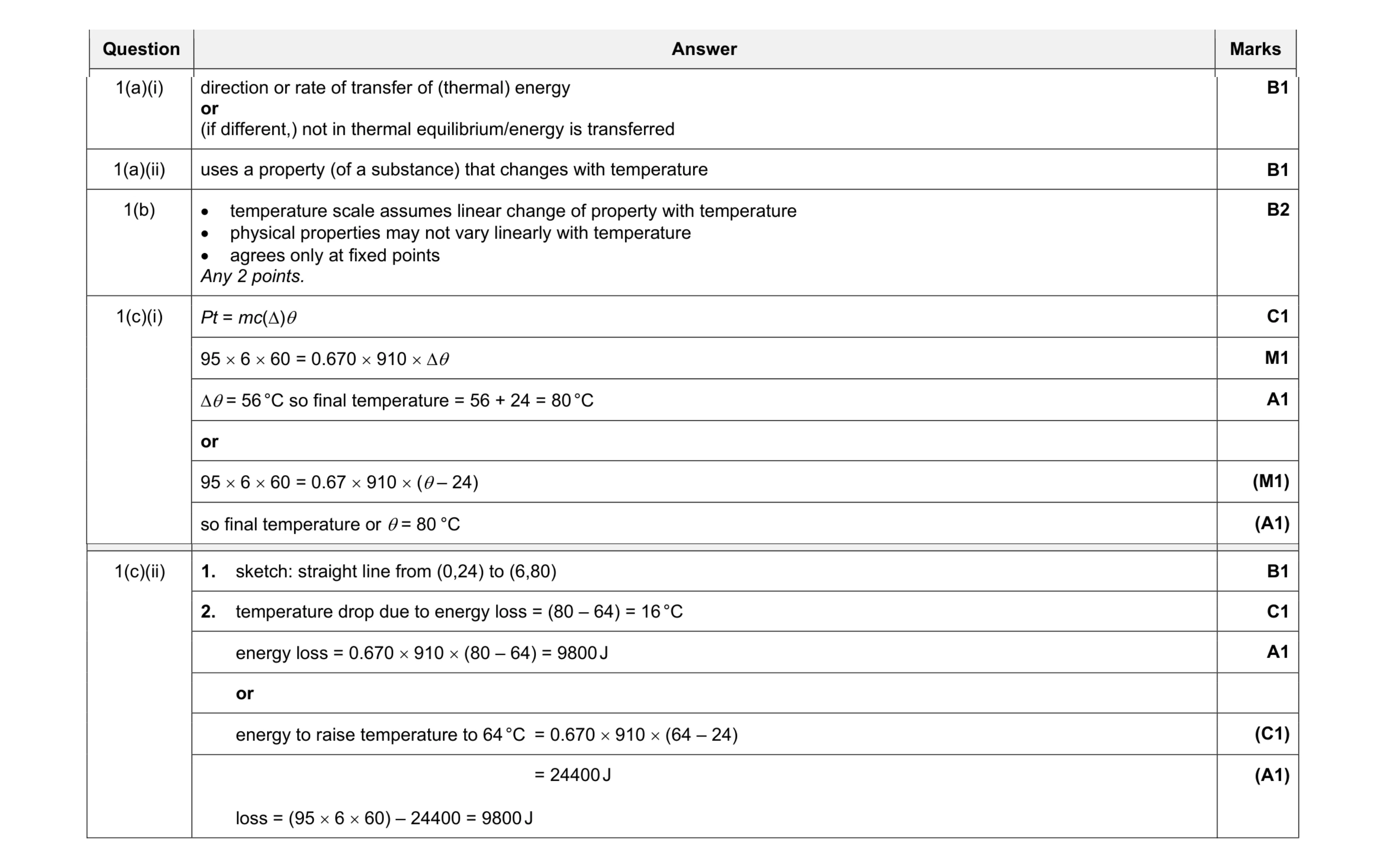 10
10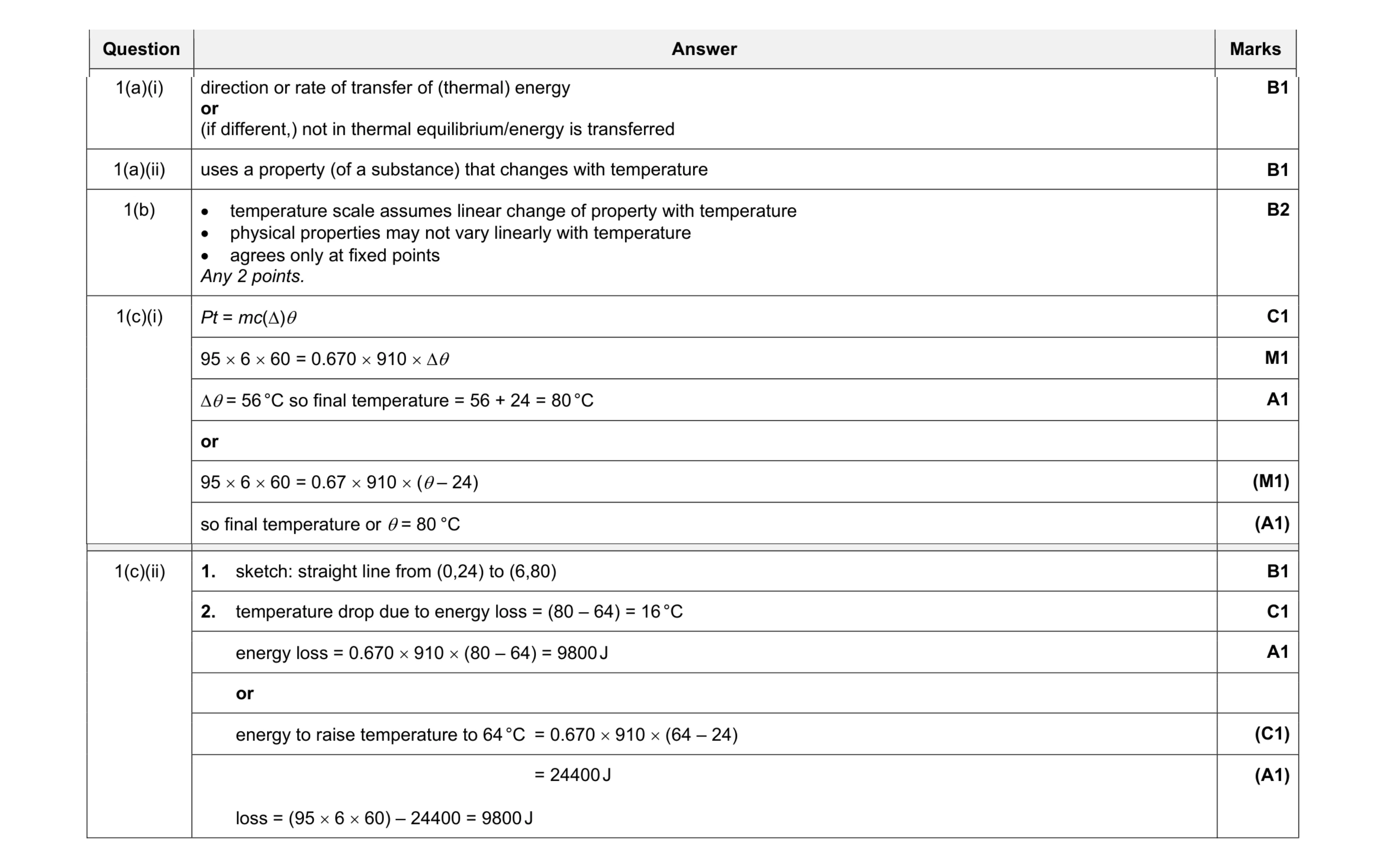 10
10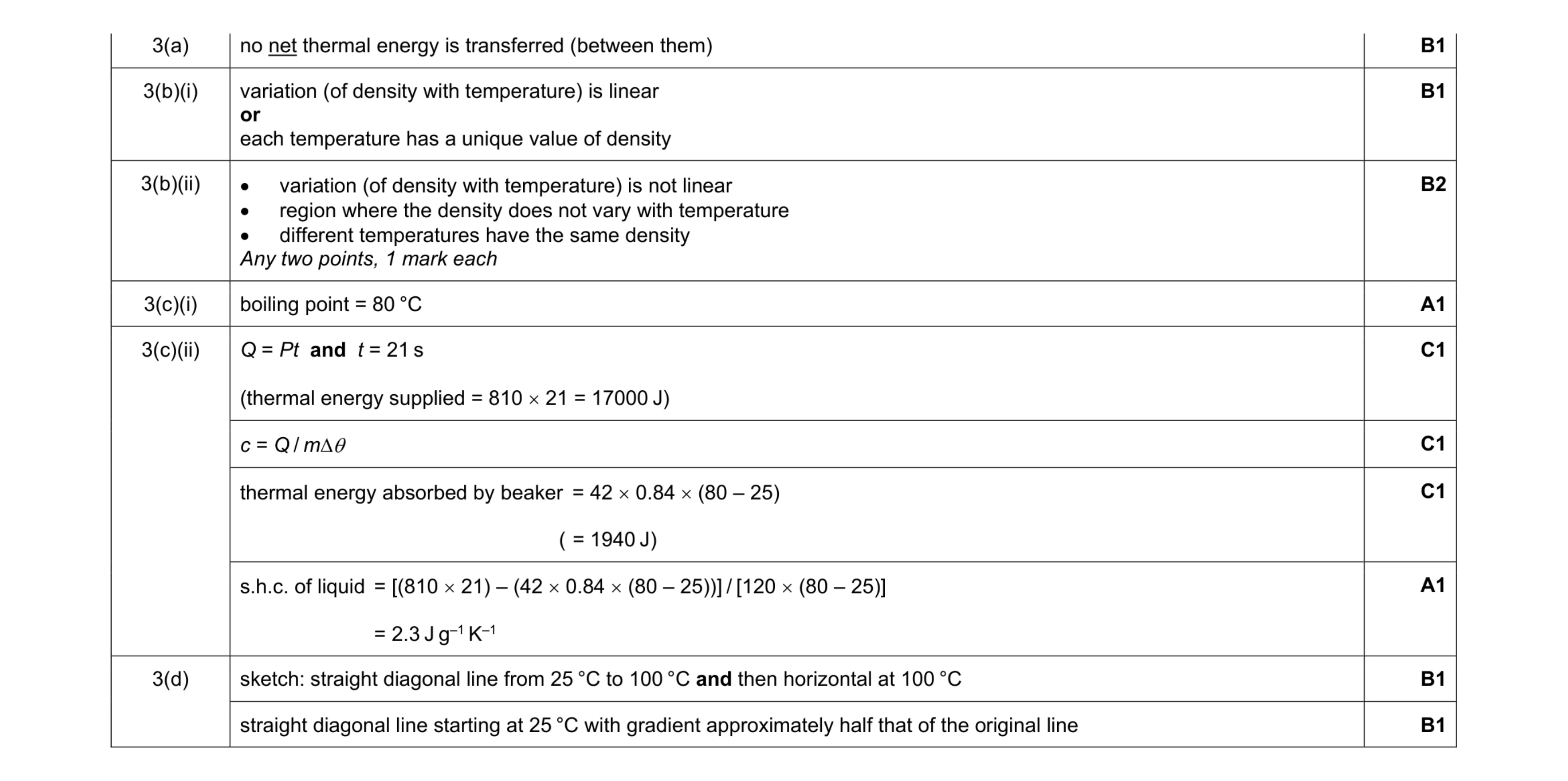 11
11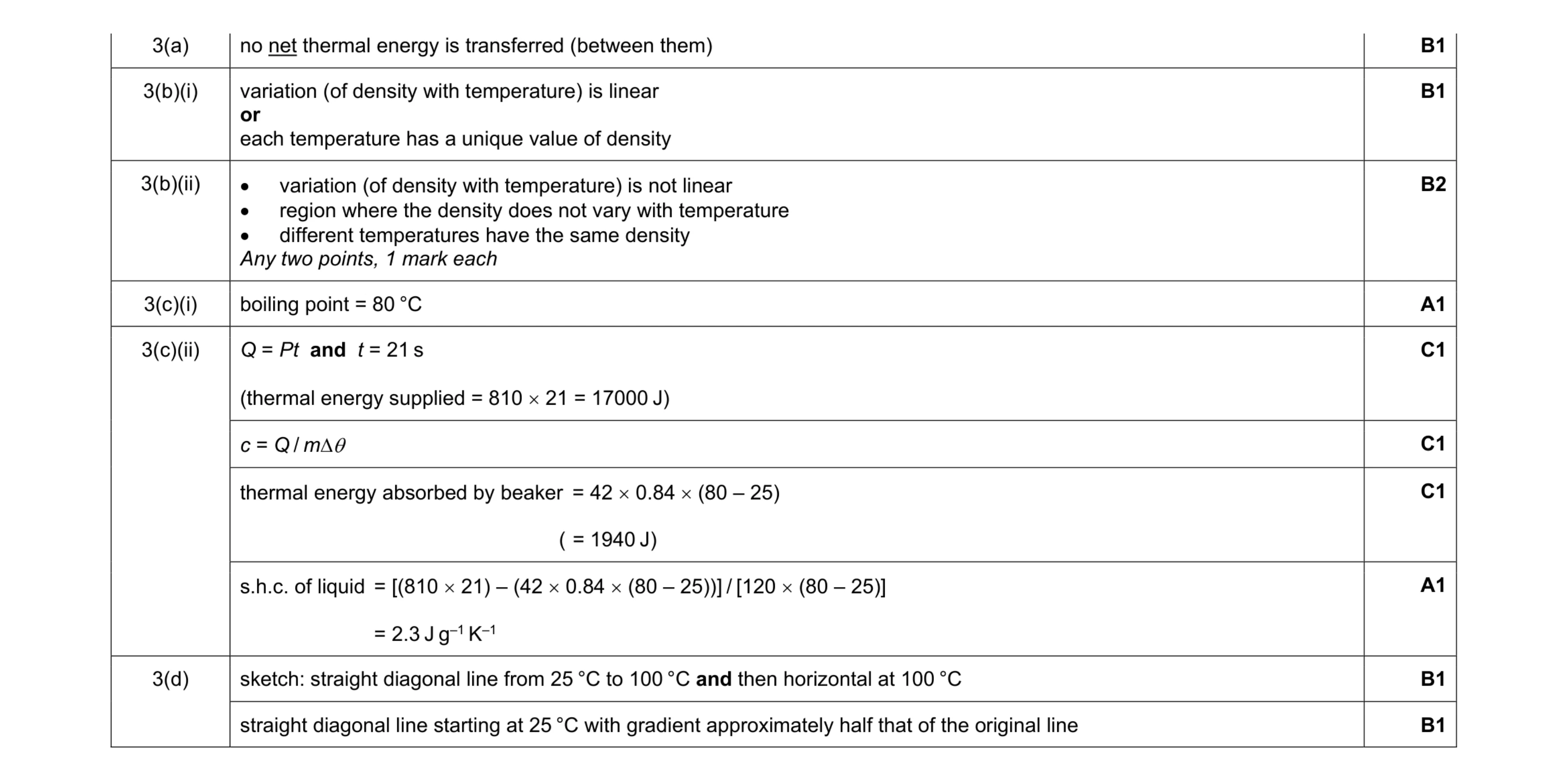 11
11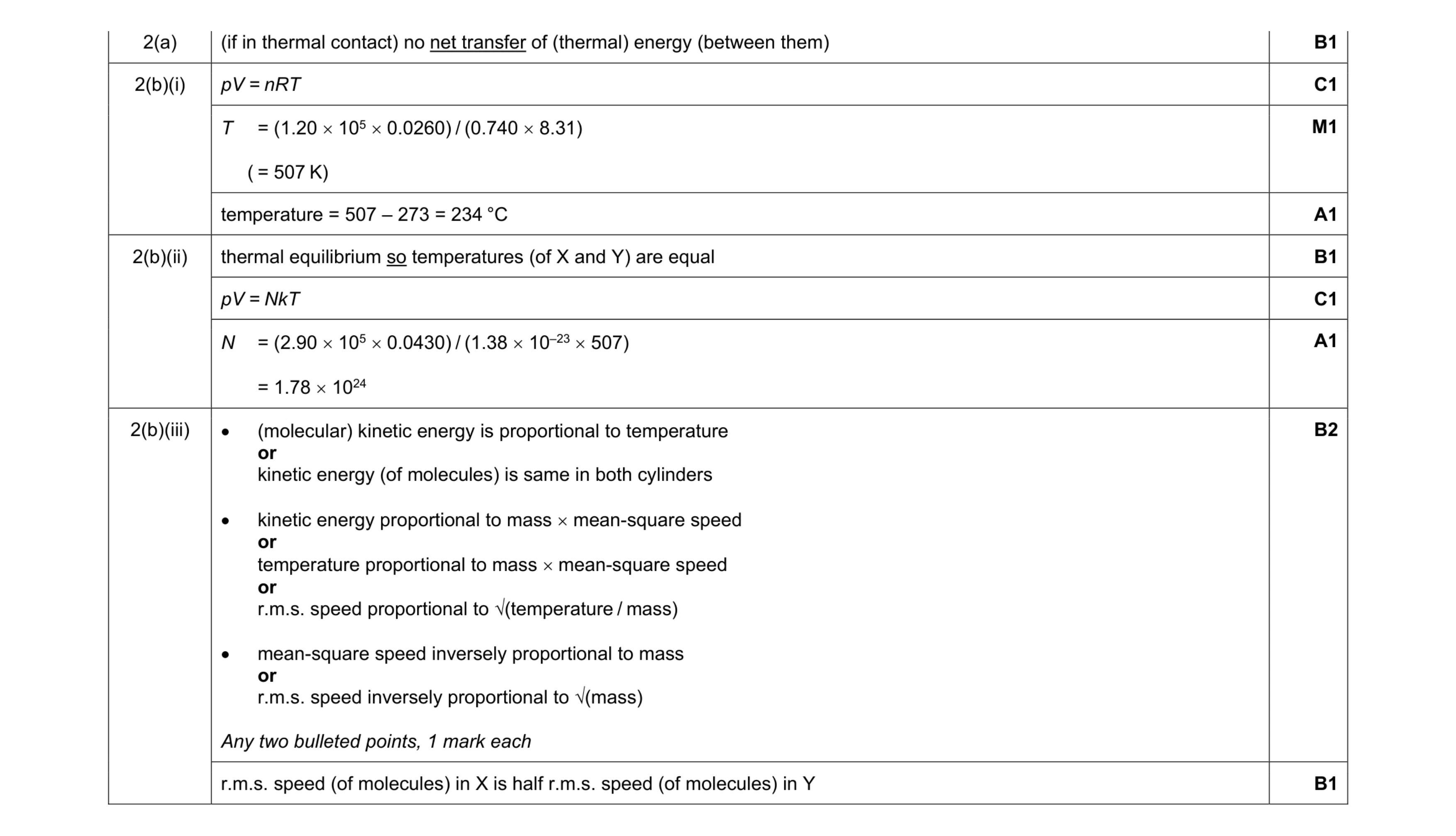 10
10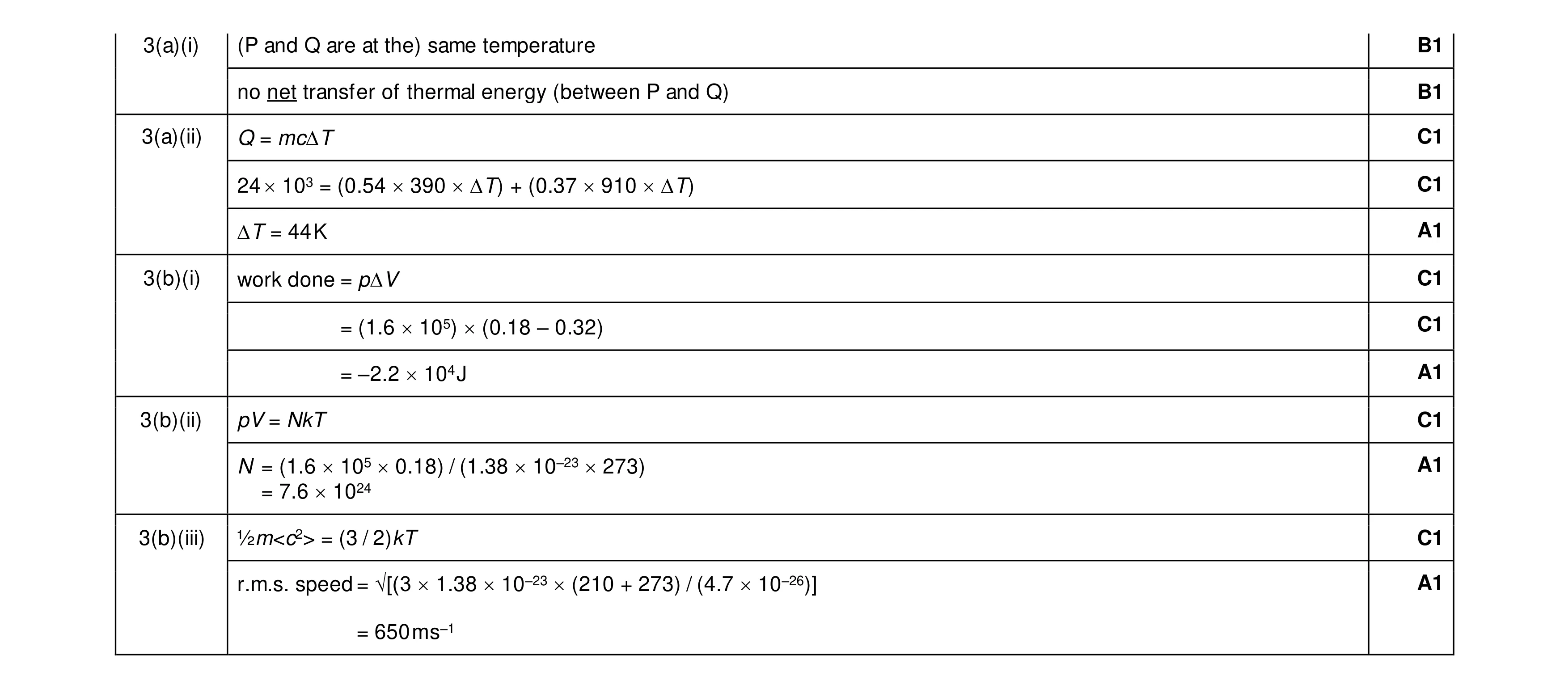 12
12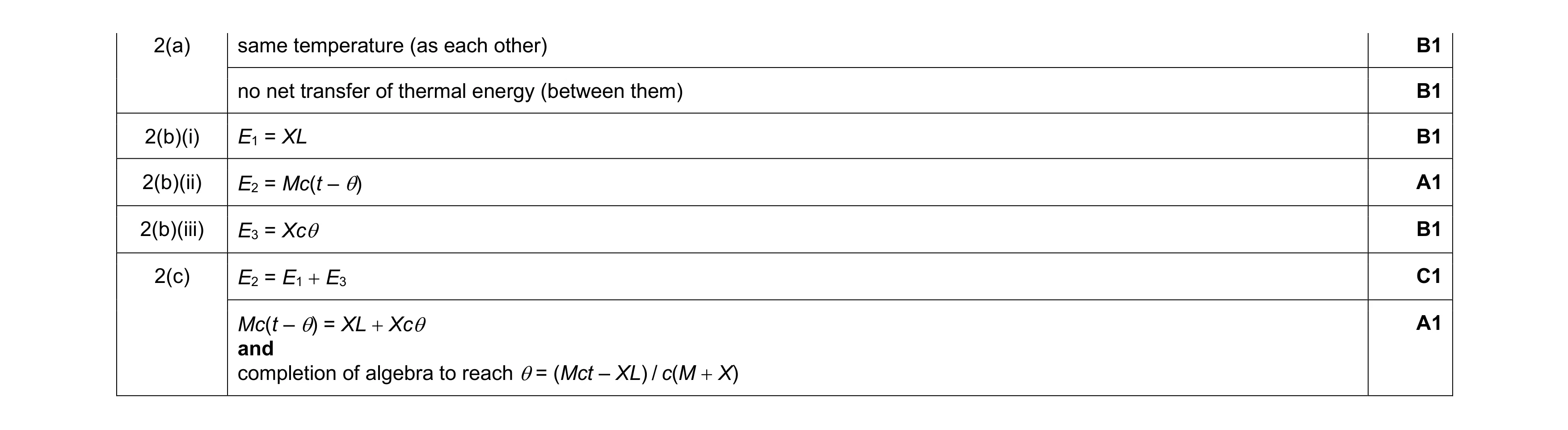 7
7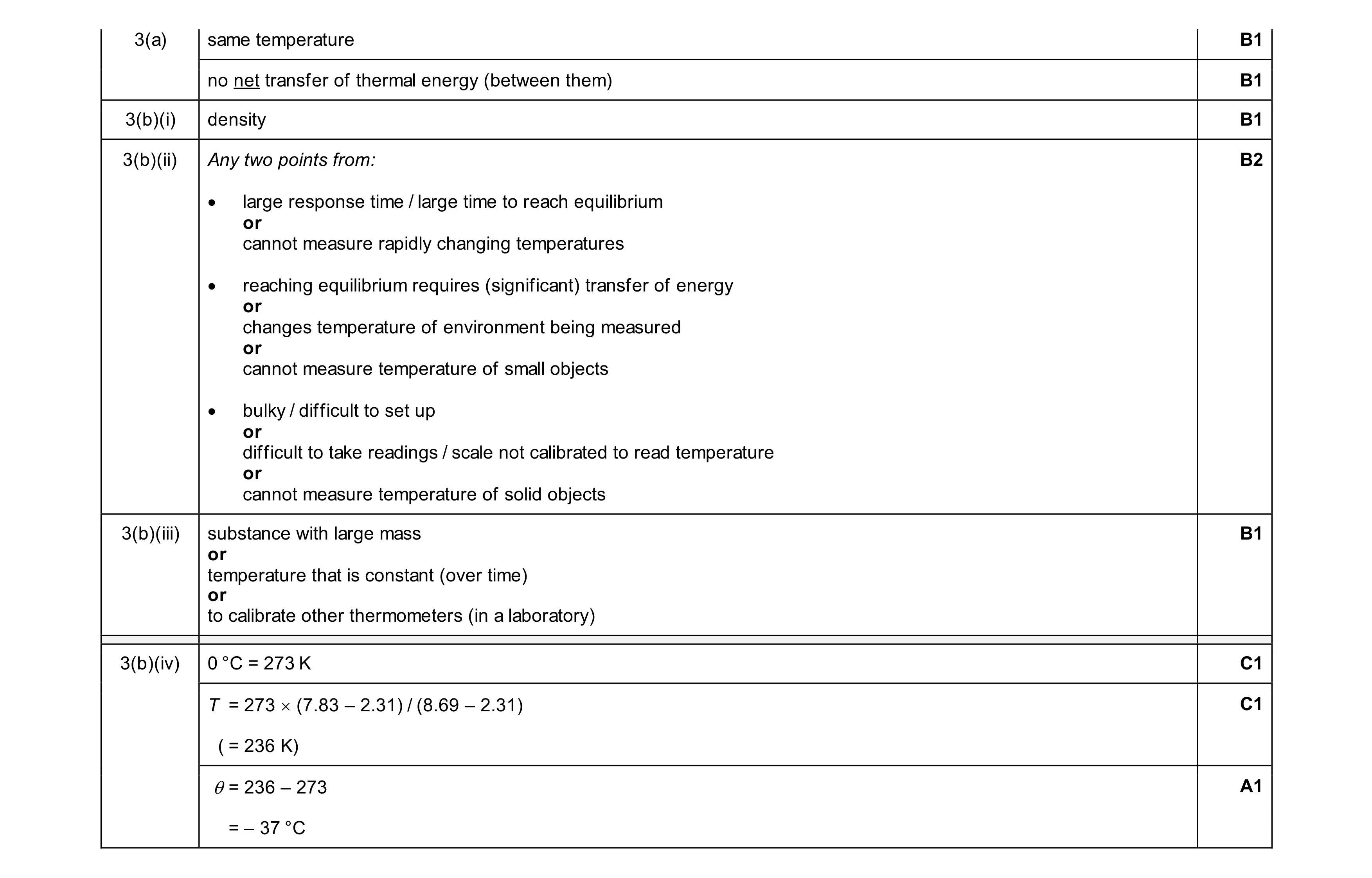 9
9