Questions as text
Question 1 9702/41 May/June 2008
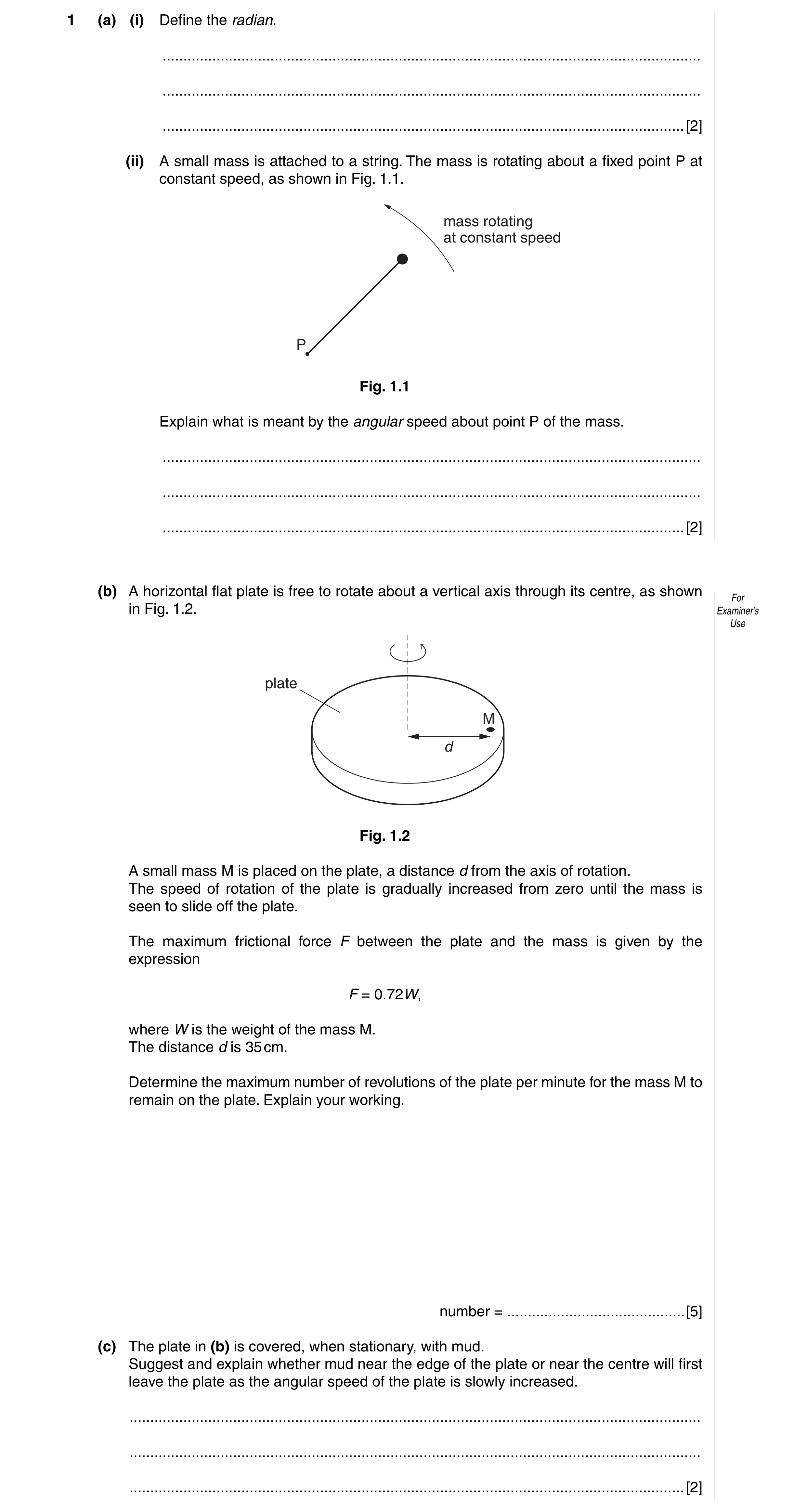
1 (a) (i) Define the radian. … … … [2] (ii) A small mass is attached to a string. The mass is rotating about a fixed point P at constant speed, as shown in Fig. 1.1. mass rotating at constant speed P Fig. 1.1 Explain what is meant by the angular speed about point P of the mass. … … … [2] (b) A horizontal flat plate is free to rotate about a vertical axis through its centre, as shown For in Fig. 1.2. Examiner’s Use plate M d Fig. 1.2 A small mass M is placed on the plate, a distance d from the axis of rotation. The speed of rotation of the plate is gradually increased from zero until the mass is seen to slide off the plate. The maximum frictional force F between the plate and the mass is given by the expression F = 0.72W, where W is the weight of the mass M. The distance d is 35 cm. Determine the maximum number of revolutions of the plate per minute for the mass M to remain on the plate. Explain your working. number = … [5] (c) The plate in (b) is covered, when stationary, with mud. Suggest and explain whether mud near the edge of the plate or near the centre will first leave the plate as the angular speed of the plate is slowly increased. … … … [2]
11 marks
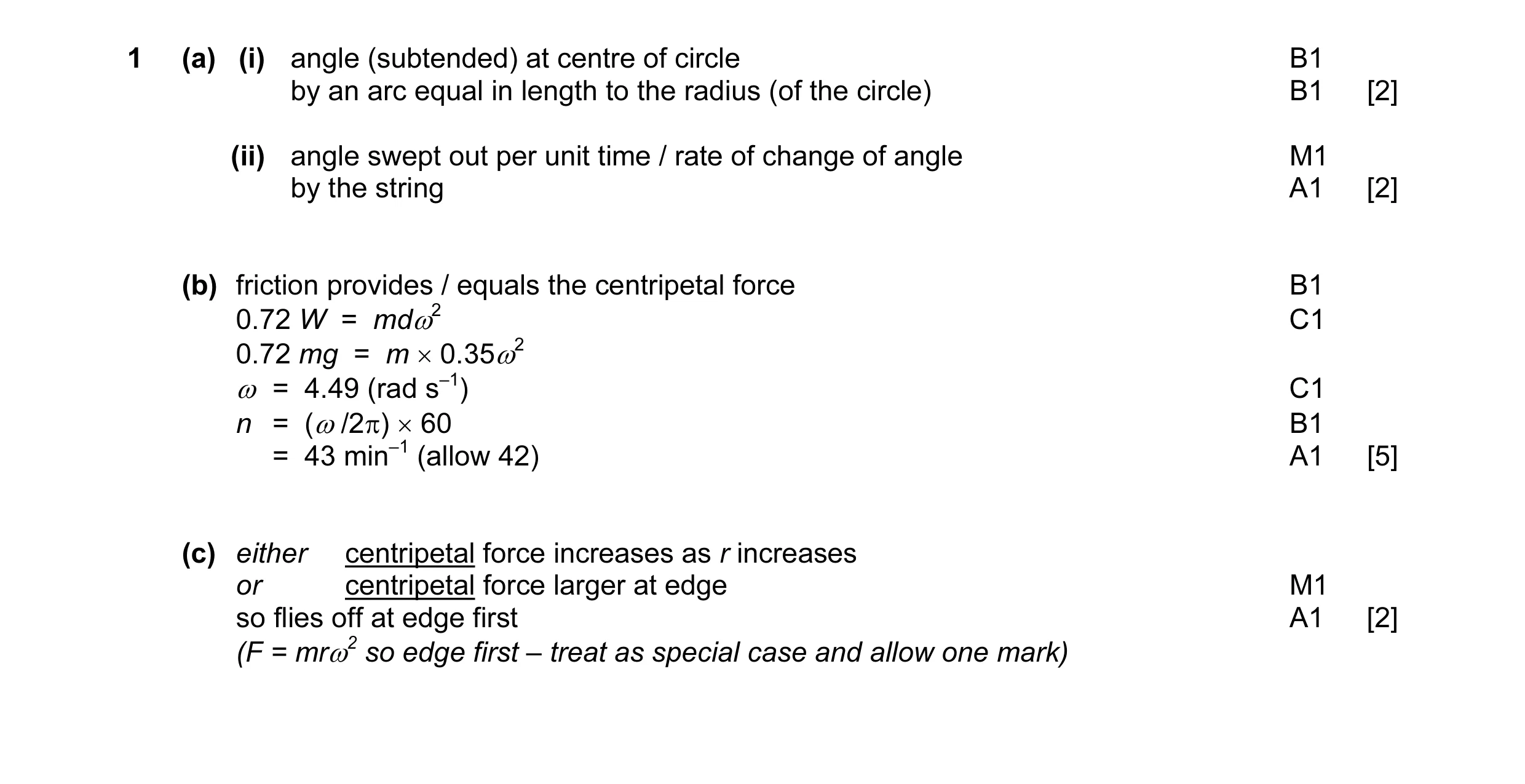
Mark scheme: 1 (a) (i) angle (subtended) at centre of circle B1 by an arc equal in length to the radius (of the circle) B1 [2] (ii) angle swept out per unit time / rate of change of angle M1 by the string A1 [2] (b) friction provides / equals the centripetal force B1 0.72 W = mdω2 C1 0.72 mg = m × 0.35ω2 ω = 4.49 (rad s–1) C1 n = (ω /2π) × 60 B1 = 43 min–1 (allow 42) A1 [5] (c) either centripetal force increases as r increases or centripetal force larger at edge M1 so flies off at edge first A1 [2] (F = mrω2 so edge first – treat as special case and allow one mark)
This question in 9702/41 May/June 2008
Question 2 9702/41 May/June 2010
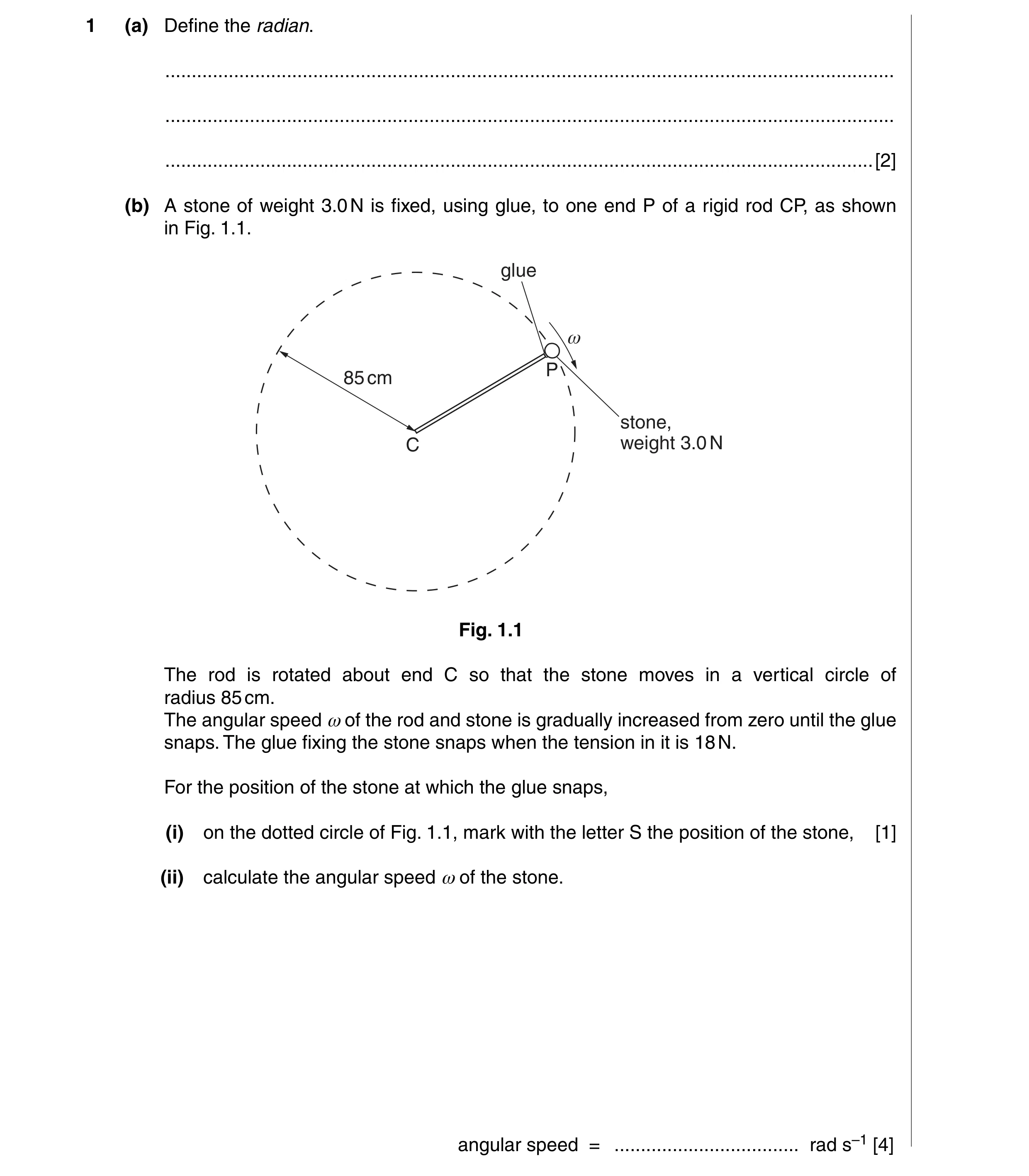
1 (a) Define the radian. … … … [2] (b) A stone of weight 3.0 N is fixed, using glue, to one end P of a rigid rod CP, as shown in Fig. 1.1. glue ω P 85 cm stone, C weight 3.0 N Fig. 1.1 The rod is rotated about end C so that the stone moves in a vertical circle of radius 85 cm. The angular speed ω of the rod and stone is gradually increased from zero until the glue snaps. The glue fixing the stone snaps when the tension in it is 18 N. For the position of the stone at which the glue snaps, (i) on the dotted circle of Fig. 1.1, mark with the letter S the position of the stone, [1] (ii) calculate the angular speed ω of the stone. angular speed = … rad s–1 [4]
7 marks
Mark scheme: 1 (a) angle (subtended) at centre of circle B1 (by) arc equal in length to radius B1 [2] (b) (i) point S shown below C B1 [1] (ii) (max) force / tension = weight + centripetal force C1 centripetal force = mrω2 C1 15 = 3.0/9.8 × 0.85 × ω2 C1 ω = 7.6 rad s–1 A1 [4]
This question in 9702/41 May/June 2010
Q3 · A proton of mass m and charge +q is travelling through a vacuum in a straight line with… 9702/43 Oct/Nov 2012
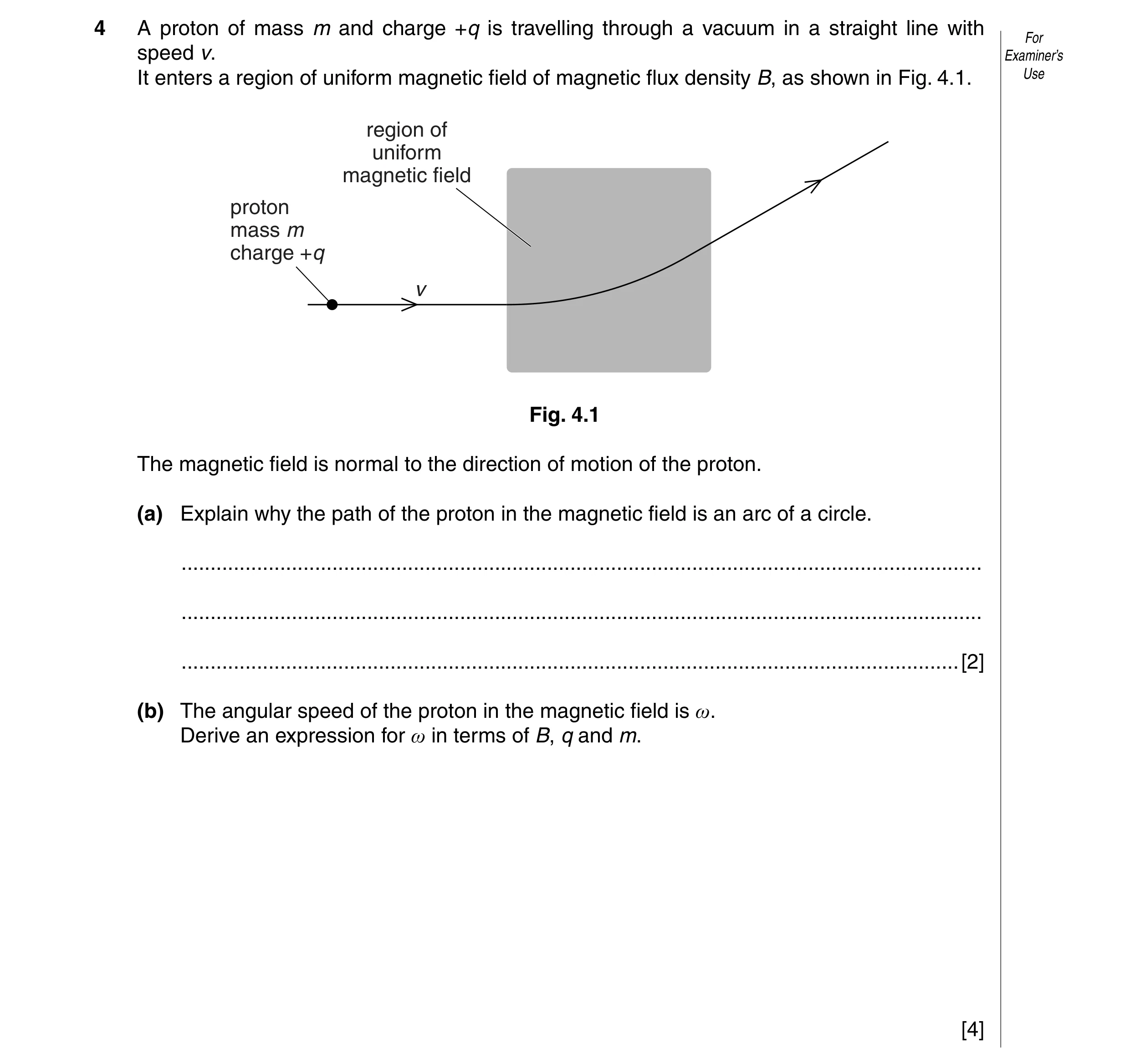
4 A proton of mass m and charge +q is travelling through a vacuum in a straight line with For speed v. Examiner’s It enters a region of uniform magnetic field of magnetic flux density B, as shown in Fig. 4.1. Use region of uniform magnetic field proton mass m charge +q v Fig. 4.1 The magnetic field is normal to the direction of motion of the proton. (a) Explain why the path of the proton in the magnetic field is an arc of a circle. … … … [2] (b) The angular speed of the proton in the magnetic field is ω. Derive an expression for ω in terms of B, q and m. [4]
6 marks
Mark scheme: 4 (a) force on proton is normal to velocity and field M1 provides centripetal force (for circular motion) A1 [2] (b) magnetic force = Bqv B1 centripetal force = mrω2 or mv2/r B1 v = rω B1 Bqv = Bqrω = mrω2 ω = Bq/m A1 [4]
This question in 9702/43 Oct/Nov 2012
Q4 · The Earth may be considered to be a uniform sphere of radius 6.37 × 10³ km with its mass… 9702/42 May/June 2015
1 (a) The Earth may be considered to be a uniform sphere of radius 6.37 × 10³ km with its mass of 5.98 × 1024 kg concentrated at its centre. The Earth spins on its axis with a period of 24.0 hours. (i) A stone of mass 2.50 kg rests on the Earth’s surface at the Equator. 1. Calculate, using Newton’s law of gravitation, the gravitational force on the stone. gravitational force = … N [2] 2. Determine the force required to maintain the stone in its circular path. force = … N [2] (ii) The stone is now hung from a newton-meter. Use your answers in (i) to determine the reading on the meter. Give your answer to three significant figures. reading = … N [2] (b) A satellite is orbiting the Earth. For an astronaut in the satellite, his sensation of weight is caused by the contact force from his surroundings. The astronaut reports that he is ‘weightless’, despite being in the Earth’s gravitational field. Suggest what is meant by the astronaut reporting that he is ‘weightless’. … … … … [3]
9 marks
Mark scheme: 1 (a) (i) 1. F = Gm1m2 / x2 = (6.67 × 10–11 × 2.50 × 5.98 × 1024) / (6.37 × 10⁶)2 M1 = 24.6 N (accept 2 s.f. or more) A1 [2] 2. F = mxω2 or F = mv 2 / x and v = ωx (accept x or r for distance) C1 = 2.50 × 6.37 × 106 × (2π / 24 × 3600)2 = 0.0842 N (accept 2 s.f. or more) A1 [2] (ii) reading = 24.575 – 0.0842 B1 = 24.5 N (accept only 3 s.f.) A1 [2] (b) gravitational force provides the centripetal force M1 gravitational force is ‘equal’ to the centripetal force (accept Gm1m2 / x2 = mxω2 or FC = FG) M1 ‘weight’/sensation of weight/contact force/reaction force is difference between FG and FC which is zero A1 [3] 3 1
This question in 9702/42 May/June 2015
Q5 · State Newton’s law of gravitation 9702/42 Feb/March 2016
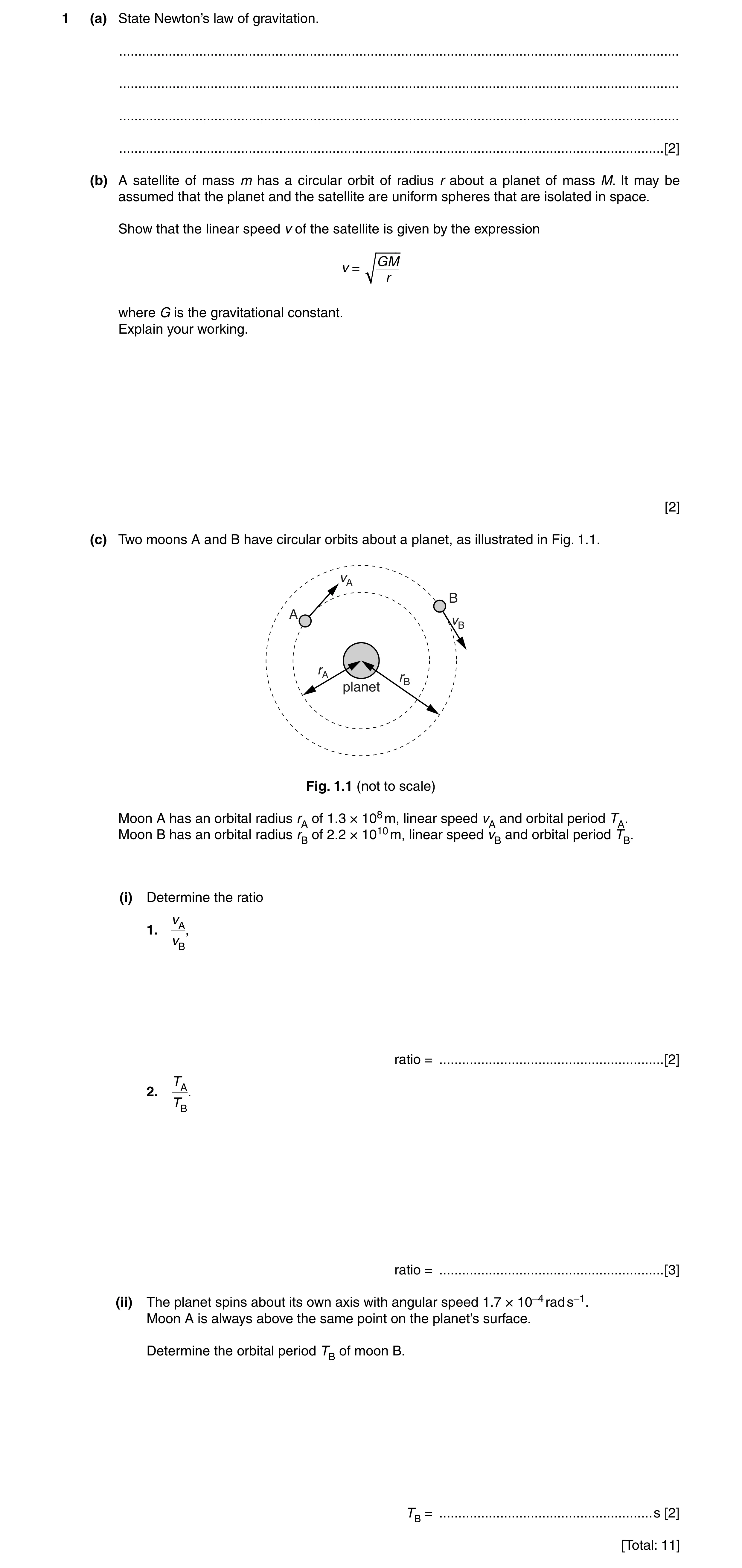
1 (a) State Newton’s law of gravitation. … … … … [2] (b) A satellite of mass m has a circular orbit of radius r about a planet of mass M. It may be assumed that the planet and the satellite are uniform spheres that are isolated in space. Show that the linear speed v of the satellite is given by the expression GM v = r where G is the gravitational constant. Explain your working. [2] (c) Two moons A and B have circular orbits about a planet, as illustrated in Fig. 1.1. vA B A vB rA rB planet Fig. 1.1 (not to scale) Moon A has an orbital radius rA of 1.3 × 10⁸ m, linear speed vA and orbital period TA. Moon B has an orbital radius rB of 2.2 × 10¹⁰ m, linear speed vB and orbital period TB. (i) Determine the ratio vA 1. , vB ratio = … [2] TA 2. . TB ratio = … [3] (ii) The planet spins about its own axis with angular speed 1.7 × 10⁻⁴ rad s–1. Moon A is always above the same point on the planet’s surface. Determine the orbital period TB of moon B. TB = … s [2] [Total: 11]
11 marks
Mark scheme: 1 (a) force proportional to product of the (two) masses and inversely proportional to the square of their separation M1 either reference to point masses or separation << ‘size’ of masses A1 [2] (b) gravitational force provides / is the centripetal force B1 GMm / r 2 = mv 2 / r or GMm / r 2 = mrω 2 and v = rω and algebra leading to v = (GM / r )1 / 2 B1 [2] (c) (i) 1. vA / vB = (rB / rA)1 / 2 = (2.2 × 10¹⁰ / 1.3 × 10⁸)1 / 2 C1 = 13 (13.0) A1 [2] 2. v = 2πr / T or v ∝ r / T or vT / r = constant C1 TA / TB = (rA / rB) × (vB / vA) = (1.3 × 10⁸ / 2.2 × 1010) × (1 / 13) C1 = 4.5 (4.54) × 10–4 A1 or T 2 = 4π2r 3 / GM or T 2 ∝ r 3 or T 2 / r 3 = constant (C1) TA / TB = (rA3 / rB3)1 / 2 = [(1.3 × 10⁸)3 / (2.2 × 10¹⁰)3]1 / 2 (C1) = 4.5 (4.54) × 10–4 (A1) [3] (ii) T = 2π / 1.7 ×10–4 = 3.70 × 10⁴ s C1 TB = 3.70 × 10⁴ / 4.54 × 10–4 = 8.1 × 10⁷ s A1 [2] If identifies TA as TB then 0 / 2
This question in 9702/42 Feb/March 2016
Q6 · A binary star consists of two stars A and B that orbit one another, as illustrated in Fig 9702/42 May/June 2016
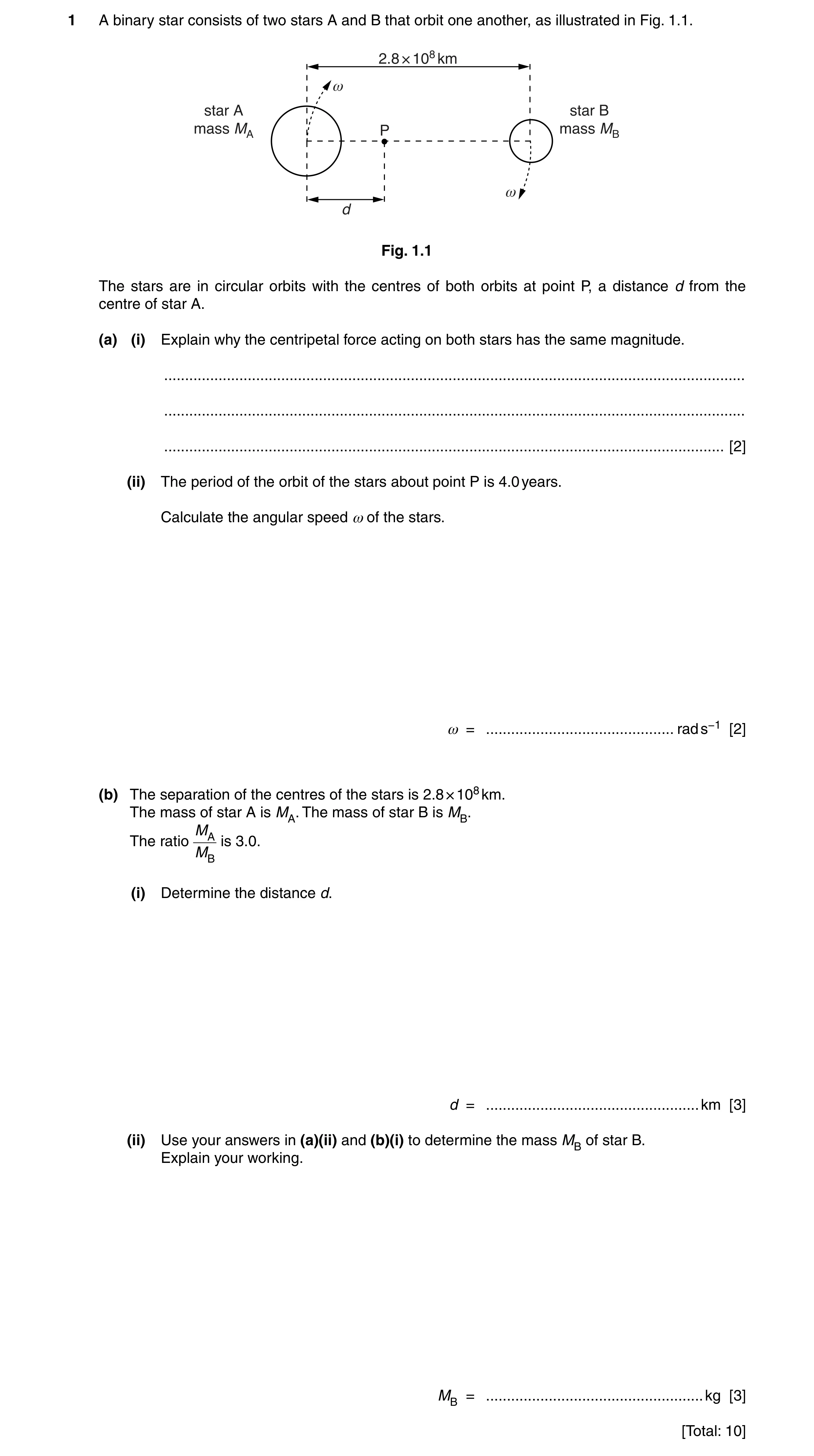
1 A binary star consists of two stars A and B that orbit one another, as illustrated in Fig. 1.1. 2.8 × 10⁸ km t VWDU $ VWDU % PDVV 0$ 3 PDVV 0% t G Fig. 1.1 The stars are in circular orbits with the centres of both orbits at point P, a distance d from the centre of star A. (a) (i) Explain why the centripetal force acting on both stars has the same magnitude. … … … [2] (ii) The period of the orbit of the stars about point P is 4.0 years. Calculate the angular speed ω of the stars. ω = … rad s−1 [2] (b) The separation of the centres of the stars is 2.8 × 10⁸ km. The mass of star A is MA. The mass of star B is MB. MA The ratio is 3.0. MB (i) Determine the distance d. d = … km [3] (ii) Use your answers in (a)(ii) and (b)(i) to determine the mass MB of star B. Explain your working. MB = … kg [3] [Total: 10]
10 marks
Mark scheme: 1 (a) (i) gravitational force provides/is the centripetal force B1 same gravitational force (by Newton III) B1 [2] (ii) ω = 2π / T = 2π / (4.0 × 365 × 24 × 3600) C1 = 5.0 (4.98) × 10–8 rad s–1 A1 [2] (b) (i) (centripetal force =) MAdω2 = MB(2.8 × 10⁸ –d)ω2 or MAdA = MBdB C1 MA / MB = 3.0 = (2.8 × 10⁸ – d) / d C1 d = 7.0 × 10⁷ km A1 [3] (ii) GMAMB / (2.8 × 10¹¹)2 = MAdω2 B1 MB = (2.8 × 10¹¹)2 × dω2 / G = (2.8 × 10¹¹)2 × (7.0 × 1010) × (4.98 × 10–8)2 / (6.67 × 10⁻¹¹) C1 = 2.0 × 1029 kg A1 [3]
This question in 9702/42 May/June 2016
Q7 · With reference to velocity and acceleration, describe uniform circular motion 9702/41 Oct/Nov 2021
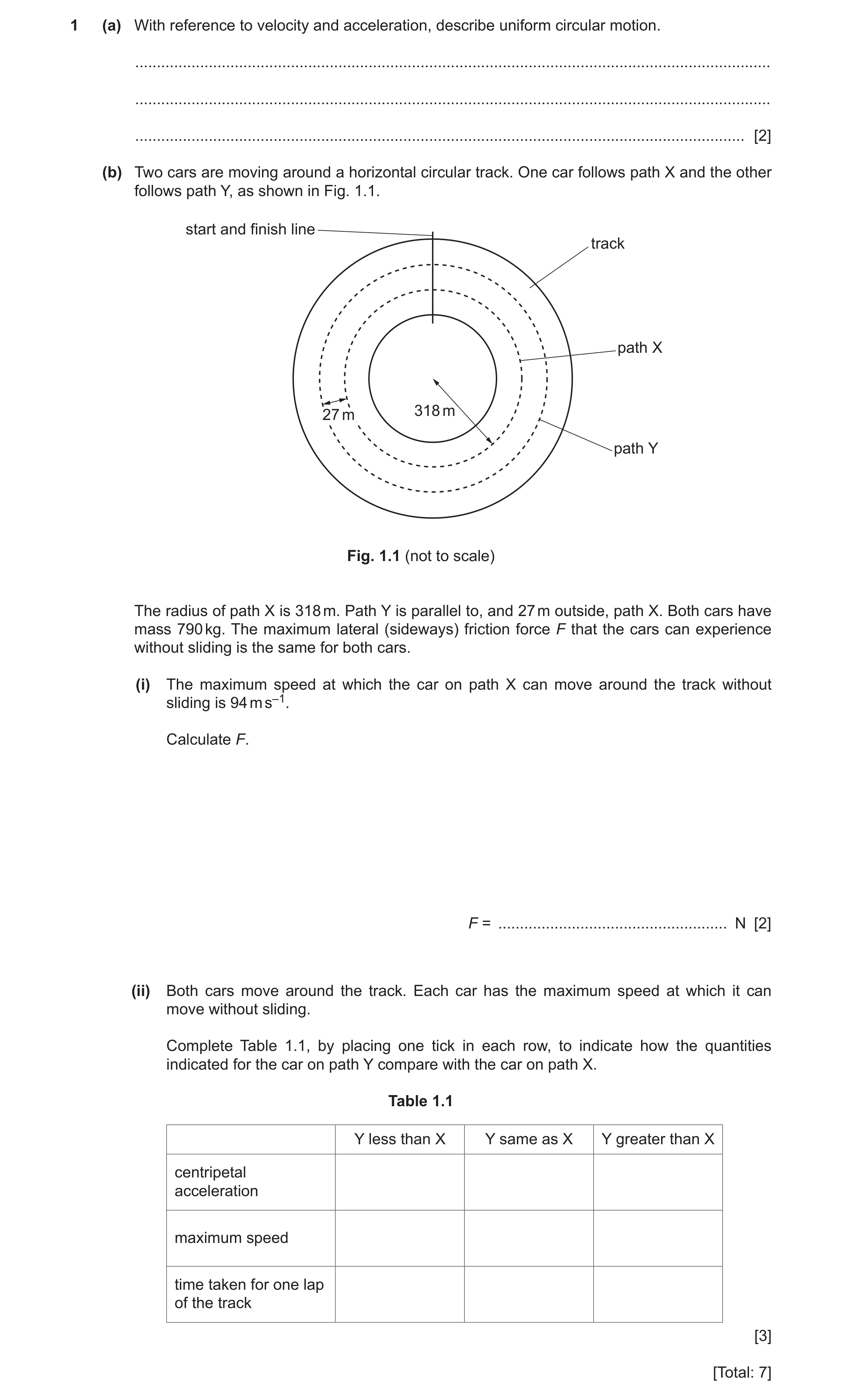
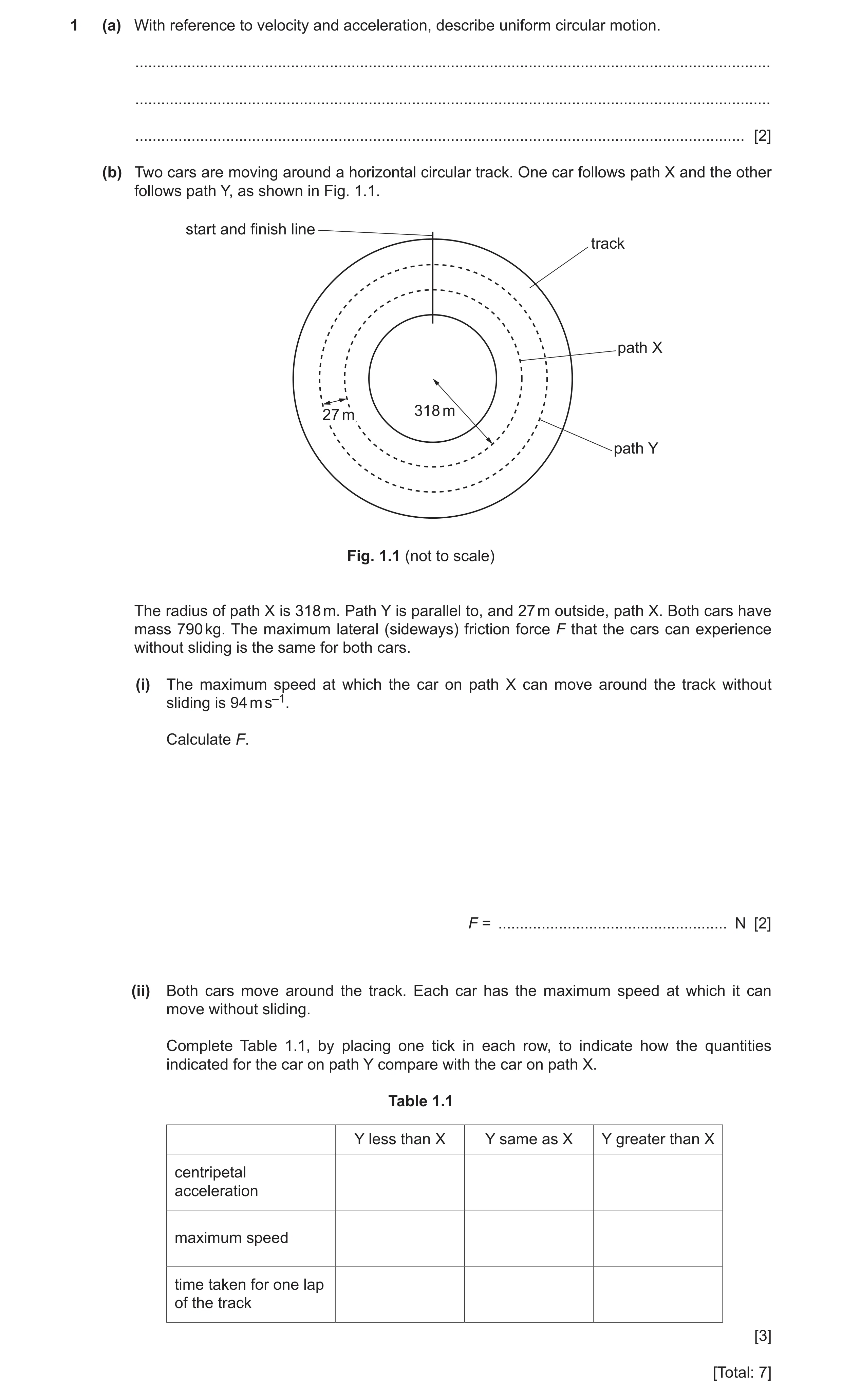
1 (a) With reference to velocity and acceleration, describe uniform circular motion. … … … [2] (b) Two cars are moving around a horizontal circular track. One car follows path X and the other follows path Y, as shown in Fig. 1.1. start and finish line track path X 318 m 27 m path Y Fig. 1.1 (not to scale) The radius of path X is 318 m. Path Y is parallel to, and 27 m outside, path X. Both cars have mass 790 kg. The maximum lateral (sideways) friction force F that the cars can experience without sliding is the same for both cars. (i) The maximum speed at which the car on path X can move around the track without sliding is 94 m s–1. Calculate F. F = … N [2] (ii) Both cars move around the track. Each car has the maximum speed at which it can move without sliding. Complete Table 1.1, by placing one tick in each row, to indicate how the quantities indicated for the car on path Y compare with the car on path X. Table 1.1 Y less than X Y same as X Y greater than X centripetal acceleration maximum speed time taken for one lap of the track [3] [Total: 7]
7 marks
Mark scheme: 1(a) constant speed or constant magnitude of velocity B1 acceleration (always) perpendicular to velocity B1 1(b)(i) F = mv2 / r or v = rω and F = mrω2 C1 F = 790 × 942 / 318 = 22 000 N A1 1(b)(ii) centripetal acceleration: same B1 maximum speed: greater B1 time taken for one lap of the track: greater B1
This question in 9702/41 Oct/Nov 2021
Q8 · State what is meant by centripetal acceleration 9702/42 Oct/Nov 2021
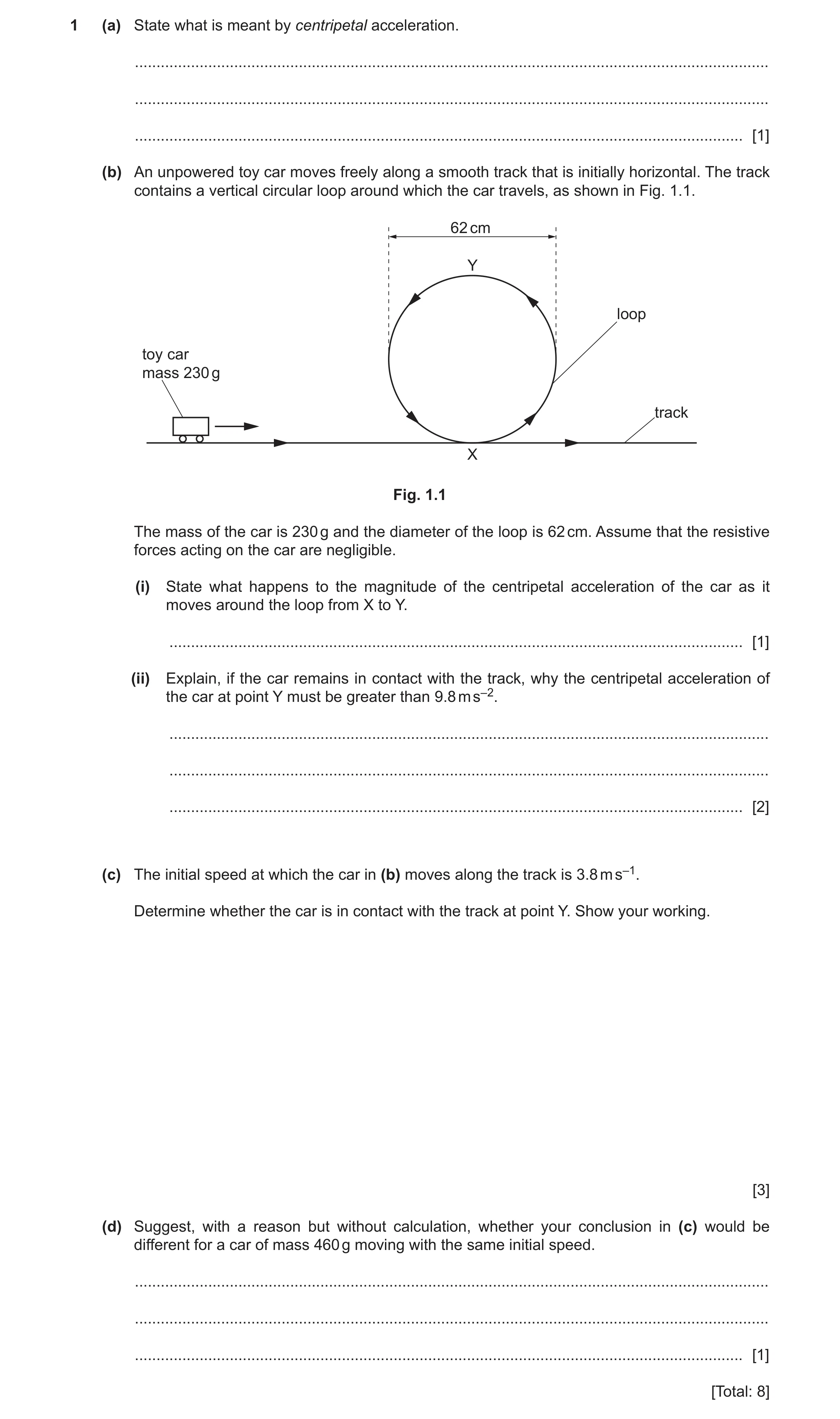
1 (a) State what is meant by centripetal acceleration. … … … [1] (b) An unpowered toy car moves freely along a smooth track that is initially horizontal. The track contains a vertical circular loop around which the car travels, as shown in Fig. 1.1. 62 cm Y loop toy car mass 230 g track X Fig. 1.1 The mass of the car is 230 g and the diameter of the loop is 62 cm. Assume that the resistive forces acting on the car are negligible. (i) State what happens to the magnitude of the centripetal acceleration of the car as it moves around the loop from X to Y. … [1] (ii) Explain, if the car remains in contact with the track, why the centripetal acceleration of the car at point Y must be greater than 9.8 m s–2. … … … [2] (c) The initial speed at which the car in (b) moves along the track is 3.8 m s–1. Determine whether the car is in contact with the track at point Y. Show your working. [3] (d) Suggest, with a reason but without calculation, whether your conclusion in (c) would be different for a car of mass 460 g moving with the same initial speed. … … … [1] [Total: 8]
8 marks
Mark scheme: 1(a) acceleration perpendicular to velocity B1 1(b)(i) decreases B1 1(b)(ii) (acceleration of) 9.8 m s–2 is caused by weight of car or centripetal force must be greater than weight of car B1 (acceleration > 9.8 m s–2) requires contact force from track or (centripetal force > weight) requires contact force from track B1 1(c) ½mvY2 = ½mvX2 – mgh C1 a = v2 / r C1 vY2 = 3.82 – 2 × 9.81 × 0.62 so vY = 1.5 m s–1 a = 1.52 / 0.31 = 7.3 m s–2 (which is less than 9.8 m s–2) so no A1 or vY = √(9.81 × 0.31) = 1.74 m s–1 so vX2 = 1.742 + 2 × 9.81 × 0.62 vX = 3.9 m s–1 (which is greater than 3.8 m s–1) so no (A1) 1(d) acceleration is independent of mass so makes no difference or mass cancels in the equation so makes no difference B1
This question in 9702/42 Oct/Nov 2021
Q9 · With reference to velocity and acceleration, describe uniform circular motion 9702/43 Oct/Nov 2021
1 (a) With reference to velocity and acceleration, describe uniform circular motion. … … … [2] (b) Two cars are moving around a horizontal circular track. One car follows path X and the other follows path Y, as shown in Fig. 1.1. start and finish line track path X 318 m 27 m path Y Fig. 1.1 (not to scale) The radius of path X is 318 m. Path Y is parallel to, and 27 m outside, path X. Both cars have mass 790 kg. The maximum lateral (sideways) friction force F that the cars can experience without sliding is the same for both cars. (i) The maximum speed at which the car on path X can move around the track without sliding is 94 m s–1. Calculate F. F = … N [2] (ii) Both cars move around the track. Each car has the maximum speed at which it can move without sliding. Complete Table 1.1, by placing one tick in each row, to indicate how the quantities indicated for the car on path Y compare with the car on path X. Table 1.1 Y less than X Y same as X Y greater than X centripetal acceleration maximum speed time taken for one lap of the track [3] [Total: 7]
7 marks
Mark scheme: 1(a) constant speed or constant magnitude of velocity B1 acceleration (always) perpendicular to velocity B1 1(b)(i) F = mv2 / r or v = rω and F = mrω2 C1 F = 790 × 942 / 318 = 22 000 N A1 1(b)(ii) centripetal acceleration: same B1 maximum speed: greater B1 time taken for one lap of the track: greater B1
This question in 9702/43 Oct/Nov 2021
Question 10 9702/42 Oct/Nov 2022
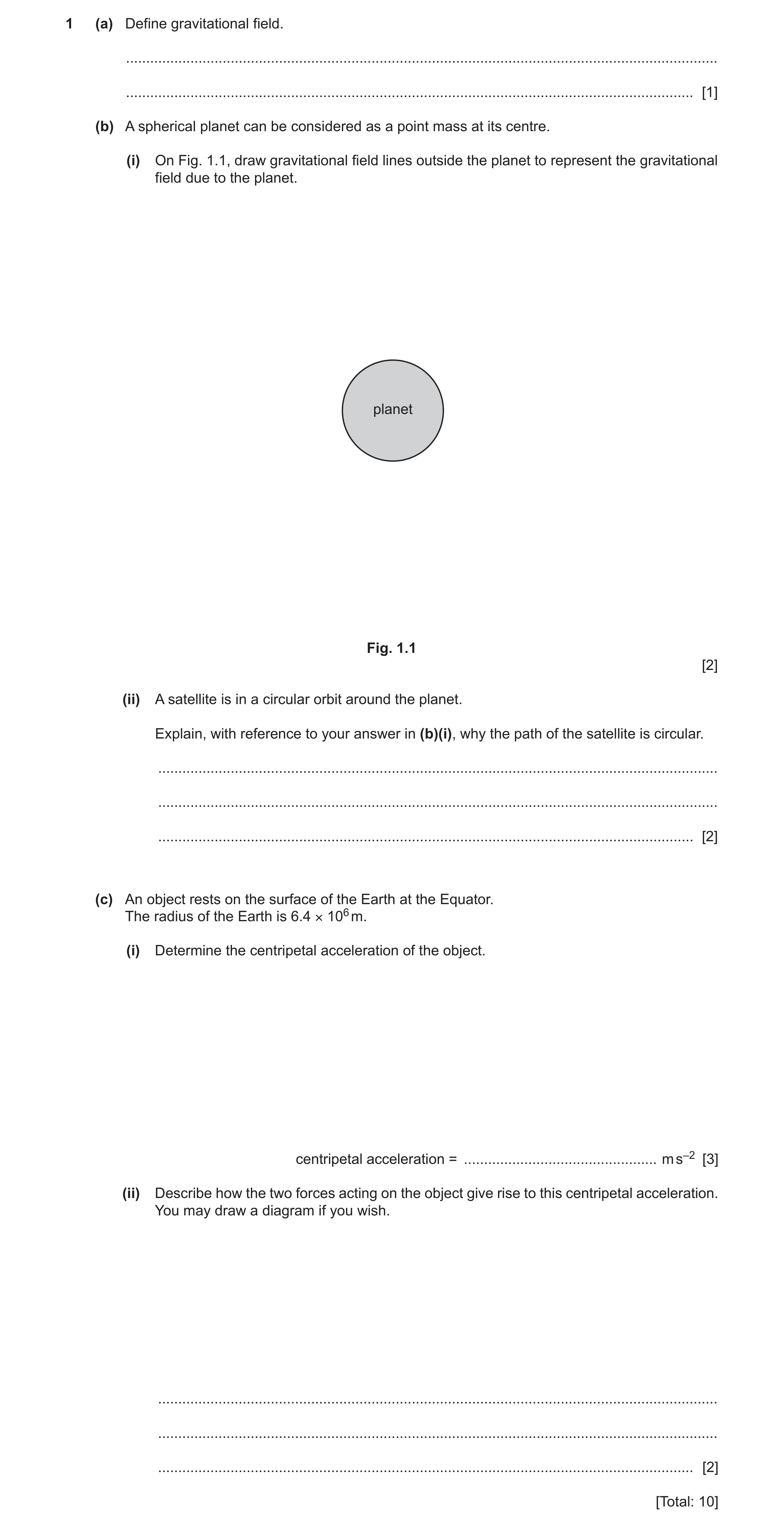
1 (a) Define gravitational field. … … [1] (b) A spherical planet can be considered as a point mass at its centre. (i) On Fig. 1.1, draw gravitational field lines outside the planet to represent the gravitational field due to the planet. planet Fig. 1.1 [2] (ii) A satellite is in a circular orbit around the planet. Explain, with reference to your answer in (b)(i), why the path of the satellite is circular. … … … [2] (c) An object rests on the surface of the Earth at the Equator. The radius of the Earth is 6.4 × 10⁶ m. (i) Determine the centripetal acceleration of the object. centripetal acceleration = … m s–2 [3] (ii) Describe how the two forces acting on the object give rise to this centripetal acceleration. You may draw a diagram if you wish. … … … [2] [Total: 10]
10 marks
Mark scheme: Question Answer Marks 1(a) force per unit mass B1 1(b)(i) lines drawn are radial from the surface B1 arrows show pointing towards planet B1 1(b)(ii) field lines show force (on satellite) is towards centre of planet B1 or velocity of satellite is perpendicular to field lines (gravitational) force perpendicular to velocity causes centripetal acceleration B1 1(c)(i) T = 24 hours C1 a = r2 and = 2 / T C1 or a = v2 / r and v = 2r /T or a = 42r / T 2 a = (42 6.4 106) / (24 60 60)2 A1 = 0.034 m s–2 1(c)(ii) identification of the two forces acting on the object as gravitational force and (normal) contact force M1 gravitational force and normal contact force are in opposite directions, and their resultant causes the (centripetal) A1 acceleration
This question in 9702/42 Oct/Nov 2022
Q11 · A steel sphere of mass 0.29 kg is suspended in equilibrium from a vertical spring 9702/41 May/June 2023
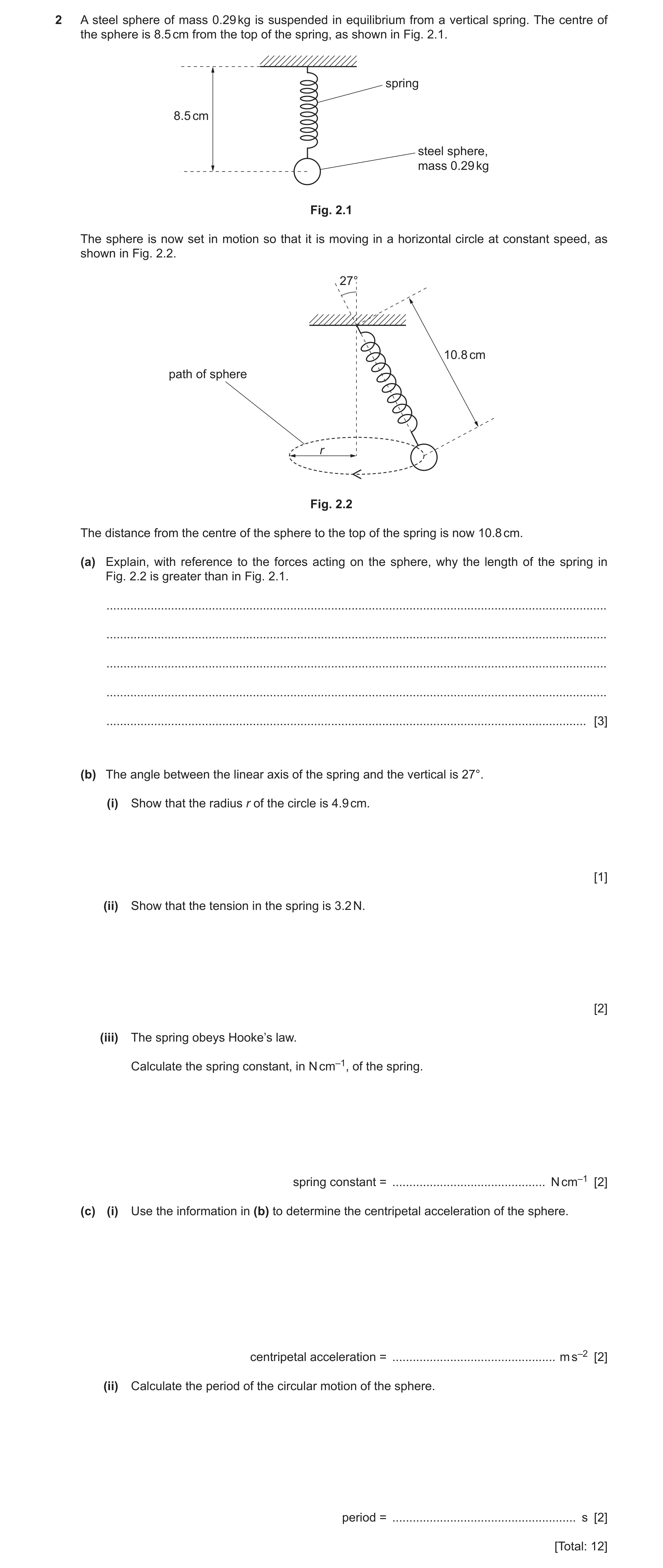
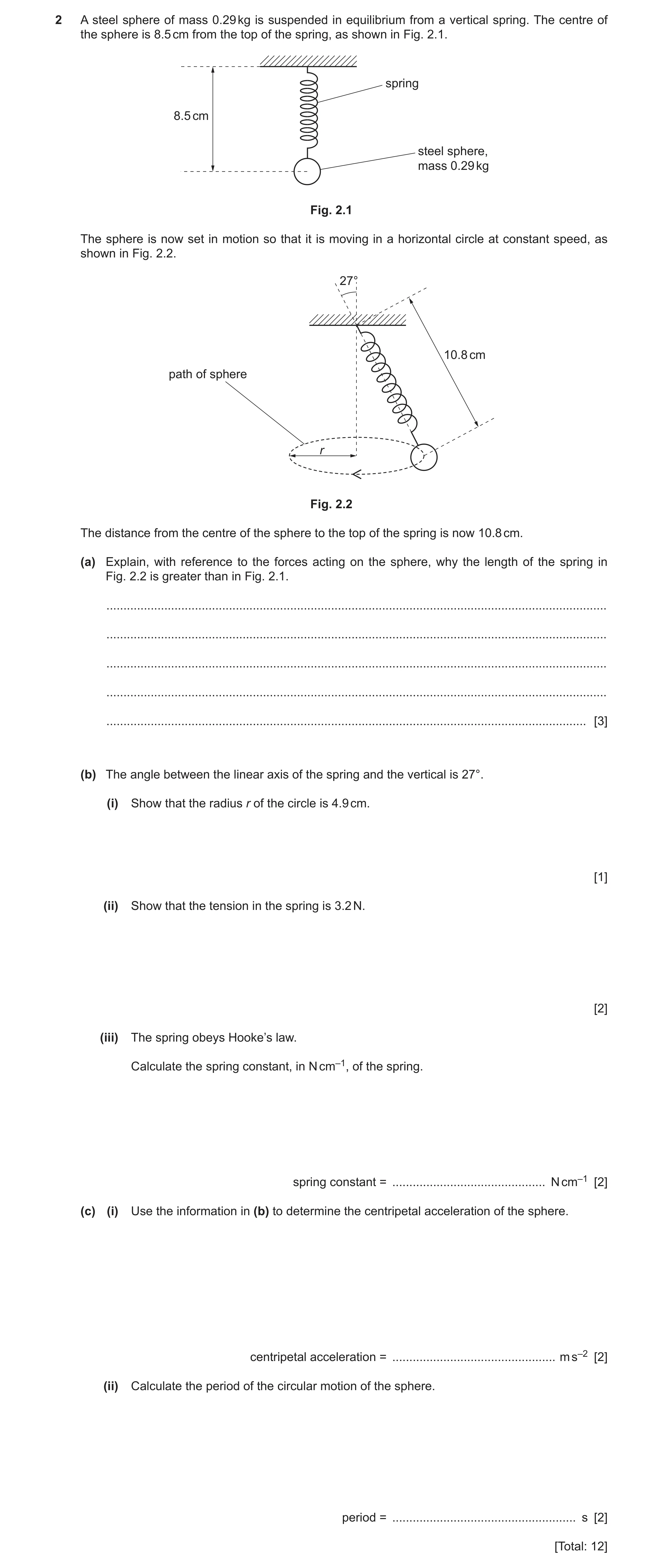
2 A steel sphere of mass 0.29 kg is suspended in equilibrium from a vertical spring. The centre of the sphere is 8.5 cm from the top of the spring, as shown in Fig. 2.1. spring 8.5 cm steel sphere, mass 0.29 kg Fig. 2.1 The sphere is now set in motion so that it is moving in a horizontal circle at constant speed, as shown in Fig. 2.2. 27° 10.8 cm path of sphere r Fig. 2.2 The distance from the centre of the sphere to the top of the spring is now 10.8 cm. (a) Explain, with reference to the forces acting on the sphere, why the length of the spring in Fig. 2.2 is greater than in Fig. 2.1. … … … … … [3] (b) The angle between the linear axis of the spring and the vertical is 27°. (i) Show that the radius r of the circle is 4.9 cm. [1] (ii) Show that the tension in the spring is 3.2 N. [2] (iii) The spring obeys Hooke’s law. Calculate the spring constant, in N cm–1, of the spring. spring constant = … N cm–1 [2] (c) (i) Use the information in (b) to determine the centripetal acceleration of the sphere. centripetal acceleration = … m s–2 [2] (ii) Calculate the period of the circular motion of the sphere. period = … s [2] [Total: 12]
12 marks
Mark scheme: 2(a) horizontal force on sphere causes centripetal acceleration B1 weight of sphere is (now) equal to vertical component of tension or horizontal and vertical components (of force) (now) combine to give greater tension (in spring) B1 greater tension in spring so greater extension of spring B1 2(b)(i) r = 10.8 sin 27° = 4.9 cm A1 2(b)(ii) T cos = mg or T cos = W and W = mg C1 T cos 27° = 0.29 9.81 leading to T = 3.2 N A1 2(b)(iii) T = 3.2 – (0.29 9.81) C1 k = T / x = [3.2 – (0.29 9.81)] / [10.8 – 8.5] = 0.15 N cm–1 A1 2(c)(i) centripetal acceleration = (T sin ) / m = (3.2 sin 27°) / 0.29 C1 = 5.0 m s–2 A1 Question Answer Marks 2(c)(ii) a = r2 and = 2 / T or a = v2 / r and v = 2r / T C1 T = 2 √(0.049 / 5.0) = 0.62 s A1
This question in 9702/41 May/June 2023
Q12 · A steel sphere of mass 0.29 kg is suspended in equilibrium from a vertical spring 9702/43 May/June 2023
2 A steel sphere of mass 0.29 kg is suspended in equilibrium from a vertical spring. The centre of the sphere is 8.5 cm from the top of the spring, as shown in Fig. 2.1. spring 8.5 cm steel sphere, mass 0.29 kg Fig. 2.1 The sphere is now set in motion so that it is moving in a horizontal circle at constant speed, as shown in Fig. 2.2. 27° 10.8 cm path of sphere r Fig. 2.2 The distance from the centre of the sphere to the top of the spring is now 10.8 cm. (a) Explain, with reference to the forces acting on the sphere, why the length of the spring in Fig. 2.2 is greater than in Fig. 2.1. … … … … … [3] (b) The angle between the linear axis of the spring and the vertical is 27°. (i) Show that the radius r of the circle is 4.9 cm. [1] (ii) Show that the tension in the spring is 3.2 N. [2] (iii) The spring obeys Hooke’s law. Calculate the spring constant, in N cm–1, of the spring. spring constant = … N cm–1 [2] (c) (i) Use the information in (b) to determine the centripetal acceleration of the sphere. centripetal acceleration = … m s–2 [2] (ii) Calculate the period of the circular motion of the sphere. period = … s [2] [Total: 12]
12 marks
Mark scheme: 2(a) horizontal force on sphere causes centripetal acceleration B1 weight of sphere is (now) equal to vertical component of tension or horizontal and vertical components (of force) (now) combine to give greater tension (in spring) B1 greater tension in spring so greater extension of spring B1 2(b)(i) r = 10.8 sin 27° = 4.9 cm A1 2(b)(ii) T cos = mg or T cos = W and W = mg C1 T cos 27° = 0.29 9.81 leading to T = 3.2 N A1 2(b)(iii) T = 3.2 – (0.29 9.81) C1 k = T / x = [3.2 – (0.29 9.81)] / [10.8 – 8.5] = 0.15 N cm–1 A1 2(c)(i) centripetal acceleration = (T sin ) / m = (3.2 sin 27°) / 0.29 C1 = 5.0 m s–2 A1 Question Answer Marks 2(c)(ii) a = r2 and = 2 / T or a = v2 / r and v = 2r / T C1 T = 2 √(0.049 / 5.0) = 0.62 s A1
This question in 9702/43 May/June 2023
Question 13 9702/42 Oct/Nov 2023
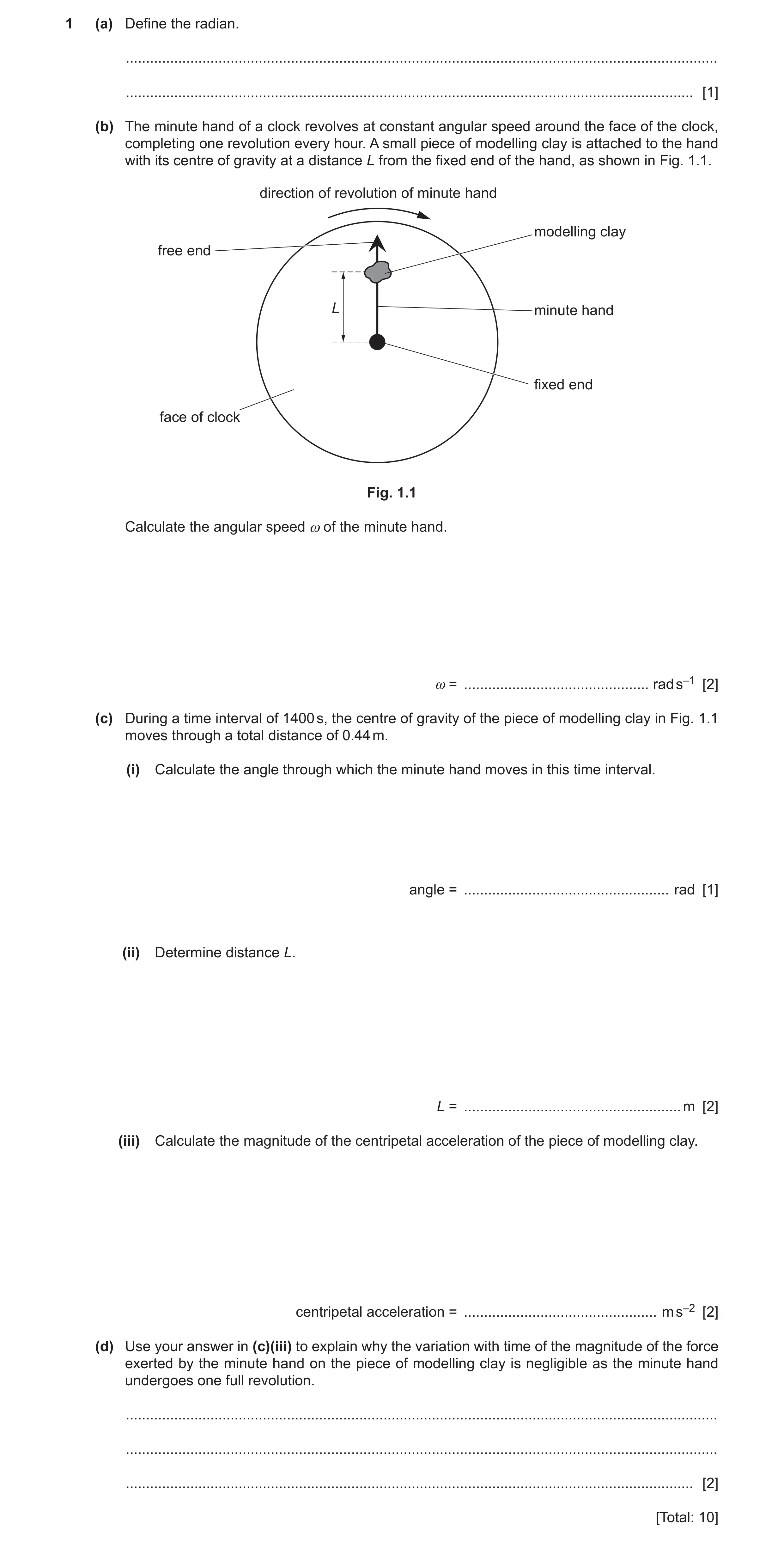
1 (a) Define the radian. … … [1] (b) The minute hand of a clock revolves at constant angular speed around the face of the clock, completing one revolution every hour. A small piece of modelling clay is attached to the hand with its centre of gravity at a distance L from the fixed end of the hand, as shown in Fig. 1.1. direction of revolution of minute hand modelling clay free end L minute hand fixed end face of clock Fig. 1.1 Calculate the angular speed ω of the minute hand. ω = … rad s–1 [2] (c) During a time interval of 1400 s, the centre of gravity of the piece of modelling clay in Fig. 1.1 moves through a total distance of 0.44 m. (i) Calculate the angle through which the minute hand moves in this time interval. angle = … rad [1] (ii) Determine distance L. L = … m [2] (iii) Calculate the magnitude of the centripetal acceleration of the piece of modelling clay. centripetal acceleration = … m s–2 [2] (d) Use your answer in (c)(iii) to explain why the variation with time of the magnitude of the force exerted by the minute hand on the piece of modelling clay is negligible as the minute hand undergoes one full revolution. … … … [2] [Total: 10]
10 marks
Mark scheme: Question Answer Marks 1(a) angle (subtended at centre of circle) when arc length = radius B1 1(b) = 2 / T C1 = 2 / (1.0 60 60) A1 = 1.7 10–3 rad s–1 1(c)(i) angle = 1.7 10–3 1400 A1 = 2.4 rad 1(c)(ii) L = arc length / angle C1 = 0.44 / 2.4 or L = 0.44 (3600 / 1400) / 2 L = 0.18 m A1 1(c)(iii) a = r2 C1 = 0.18 (1.745 10–3)2 A1 = 5.5 10–7 m s–2 1(d) centripetal acceleration is negligible compared with acceleration of free fall B1 or numerical comparison establishing answer to (c)(iii) ≪ 9.81 resultant force is negligible compared with weight (of modelling clay) (so variation is negligible) B1 or force exerted by minute hand (approximately) equal (and opposite) to weight of modelling clay
This question in 9702/42 Oct/Nov 2023
Question 14 9702/42 May/June 2024
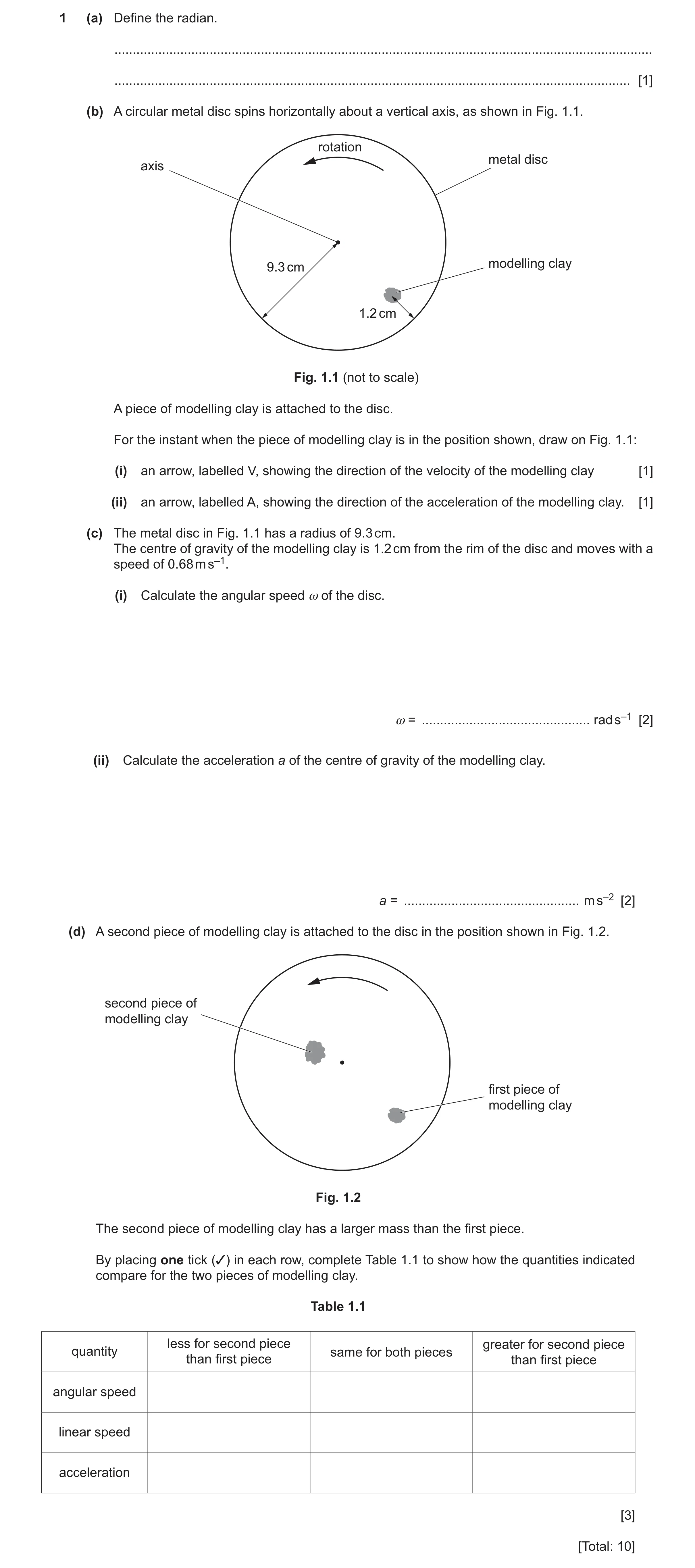
1 (a) Define the radian. … … [1] (b) A circular metal disc spins horizontally about a vertical axis, as shown in Fig. 1.1. rotation metal disc axis modelling clay 9.3 cm 1.2 cm Fig. 1.1 (not to scale) A piece of modelling clay is attached to the disc. For the instant when the piece of modelling clay is in the position shown, draw on Fig. 1.1: (i) an arrow, labelled V, showing the direction of the velocity of the modelling clay [1] (ii) an arrow, labelled A, showing the direction of the acceleration of the modelling clay. [1] (c) The metal disc in Fig. 1.1 has a radius of 9.3 cm. The centre of gravity of the modelling clay is 1.2 cm from the rim of the disc and moves with a speed of 0.68 m s–1. (i) Calculate the angular speed ω of the disc. ω = … rad s–1 [2] (ii) Calculate the acceleration a of the centre of gravity of the modelling clay. a = … m s–2 [2] (d) A second piece of modelling clay is attached to the disc in the position shown in Fig. 1.2. second piece of modelling clay first piece of modelling clay Fig. 1.2 The second piece of modelling clay has a larger mass than the first piece. By placing one tick (3) in each row, complete Table 1.1 to show how the quantities indicated compare for the two pieces of modelling clay. Table 1.1 less for second piece greater for second piece quantity same for both pieces than first piece than first piece angular speed linear speed acceleration [3] [Total: 10]
10 marks
Mark scheme: 1(a) angle (subtended at the centre of a circle) when arc (length) = radius B1 1(b)(i) arrow, labelled V, pointing in NE direction B1 1(b)(ii) arrow, labelled A, pointing in NW direction B1 1(c)(i) v = r C1 = 0.68 / (0.093 – 0.012) = 8.4 rad s–1 A1 1(c)(ii) a = v2 / r or a = r2 C1 a = 0.682 / (0.093 – 0.012) or (0.093 – 0.012) 8.42 = 5.7 m s–2 A1 1(d) angular speed: same for both pieces B1 linear speed: less for second piece than first piece B1 acceleration: less for second piece than first piece B1
This question in 9702/42 May/June 2024
Q15 · In terms of velocity and acceleration, describe uniform circular motion of an object 9702/43 Oct/Nov 2025
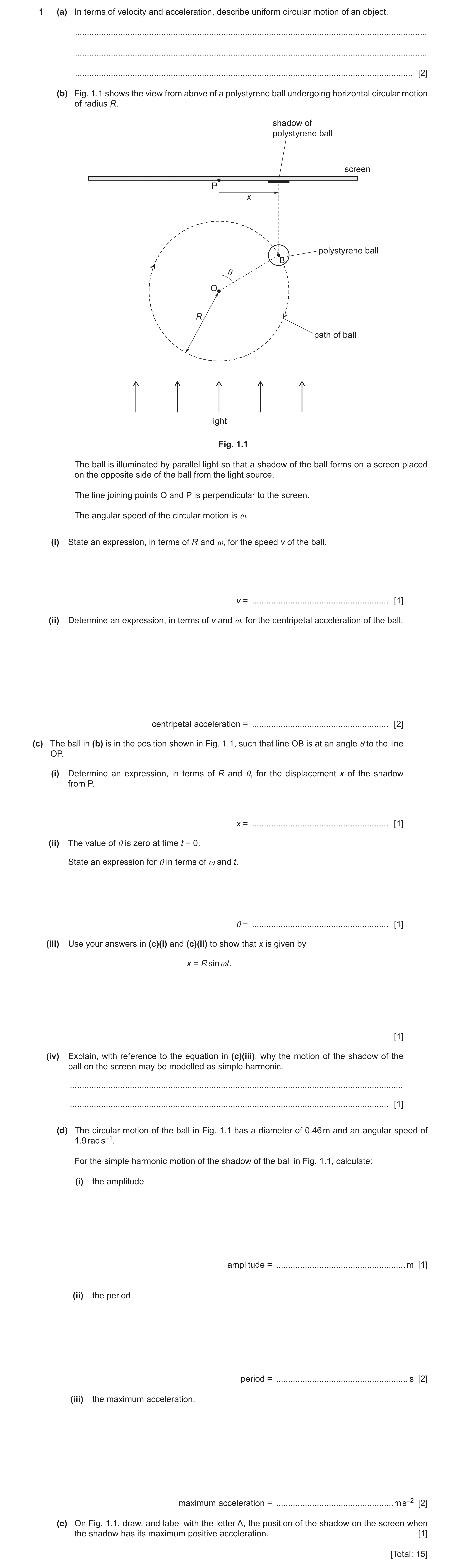
1 (a) In terms of velocity and acceleration, describe uniform circular motion of an object. … … … [2] (b) Fig. 1.1 shows the view from above of a polystyrene ball undergoing horizontal circular motion of radius R. shadow of polystyrene ball screen P x polystyrene ball B θ O R path of ball light Fig. 1.1 The ball is illuminated by parallel light so that a shadow of the ball forms on a screen placed on the opposite side of the ball from the light source. The line joining points O and P is perpendicular to the screen. The angular speed of the circular motion is ω. (i) State an expression, in terms of R and ω, for the speed v of the ball. v = … [1] (ii) Determine an expression, in terms of v and ω, for the centripetal acceleration of the ball. centripetal acceleration = … [2] (c) The ball in (b) is in the position shown in Fig. 1.1, such that line OB is at an angle θ to the line OP. (i) Determine an expression, in terms of R and θ, for the displacement x of the shadow from P. x = … [1] (ii) The value of θ is zero at time t = 0. State an expression for θ in terms of ω and t. θ = … [1] (iii) Use your answers in (c)(i) and (c)(ii) to show that x is given by x = R sin ω t. [1] (iv) Explain, with reference to the equation in (c)(iii), why the motion of the shadow of the ball on the screen may be modelled as simple harmonic. … … [1] (d) The circular motion of the ball in Fig. 1.1 has a diameter of 0.46 m and an angular speed of 1.9 rad s–1. For the simple harmonic motion of the shadow of the ball in Fig. 1.1, calculate: (i) the amplitude amplitude = … m [1] (ii) the period period = … s [2] (iii) the maximum acceleration. maximum acceleration = … m s–2 [2] (e) On Fig. 1.1, draw, and label with the letter A, the position of the shadow on the screen when the shadow has its maximum positive acceleration. [1] [Total: 15]
15 marks
Mark scheme: Question Answer Marks 1(a) velocity and acceleration both have constant magnitude B1 velocity is (always) perpendicular to acceleration B1 1(b)(i) v = R A1 1(b)(ii) a = R2 or a = v2 / R C1 a = v A1 1(c)(i) x = R sin A1 1(c)(ii) = t A1 1(c)(iii) clear substitution of = t into x = R sin leading to x = R sin t A1 1(c)(iv) equation is of the form x = x0 sin t (so simple harmonic motion) B1 1(d)(i) amplitude = 0.46 / 2 A1 = 0.23 m 1(d)(ii) = 2 / T C1 period = 2 / 1.9 A1 = 3.3 s 1(d)(iii) a0 = 2x0 C1 = 1.92 0.23 A1 = 0.83 m s–2 1(e) shadow on screen, labelled A, above left-hand edge of the circular path B1
This question in 9702/43 Oct/Nov 2025
 3 / 23
 4 / 23
 11
11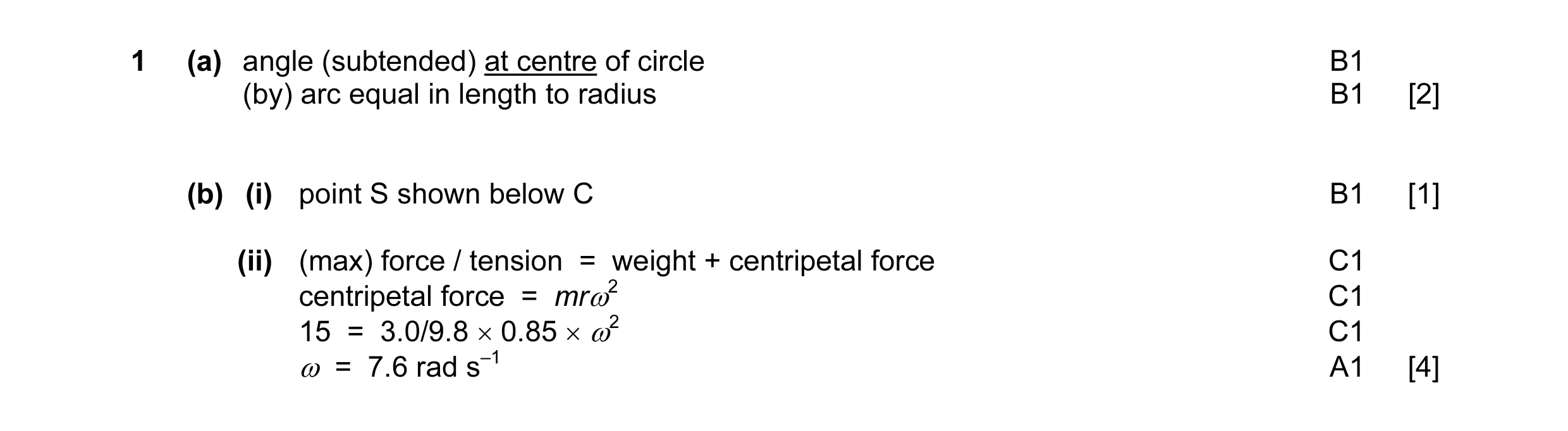 7
7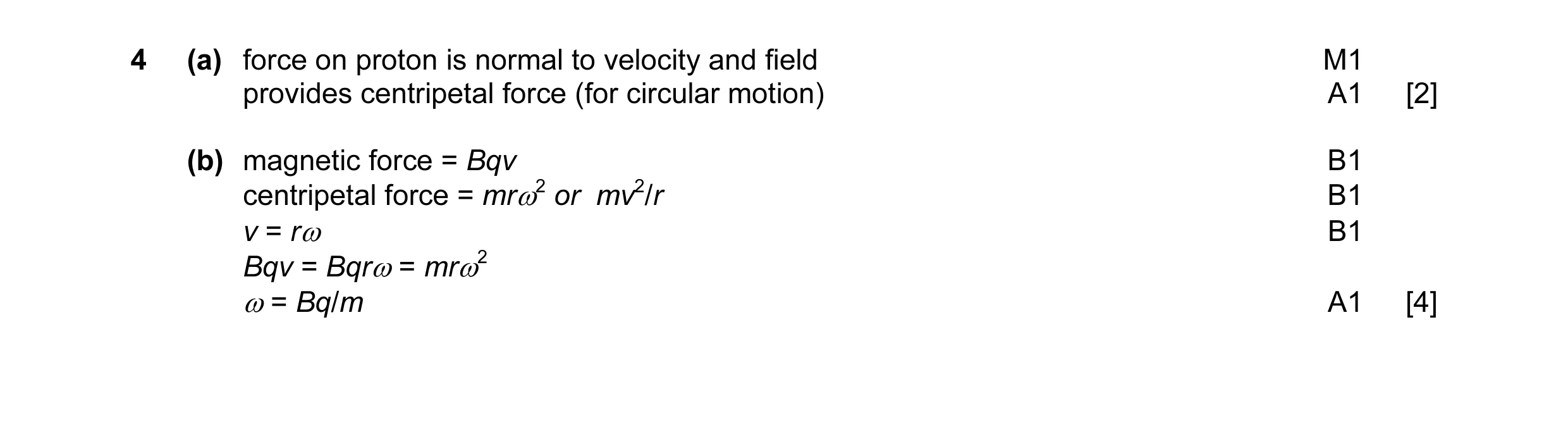 6
6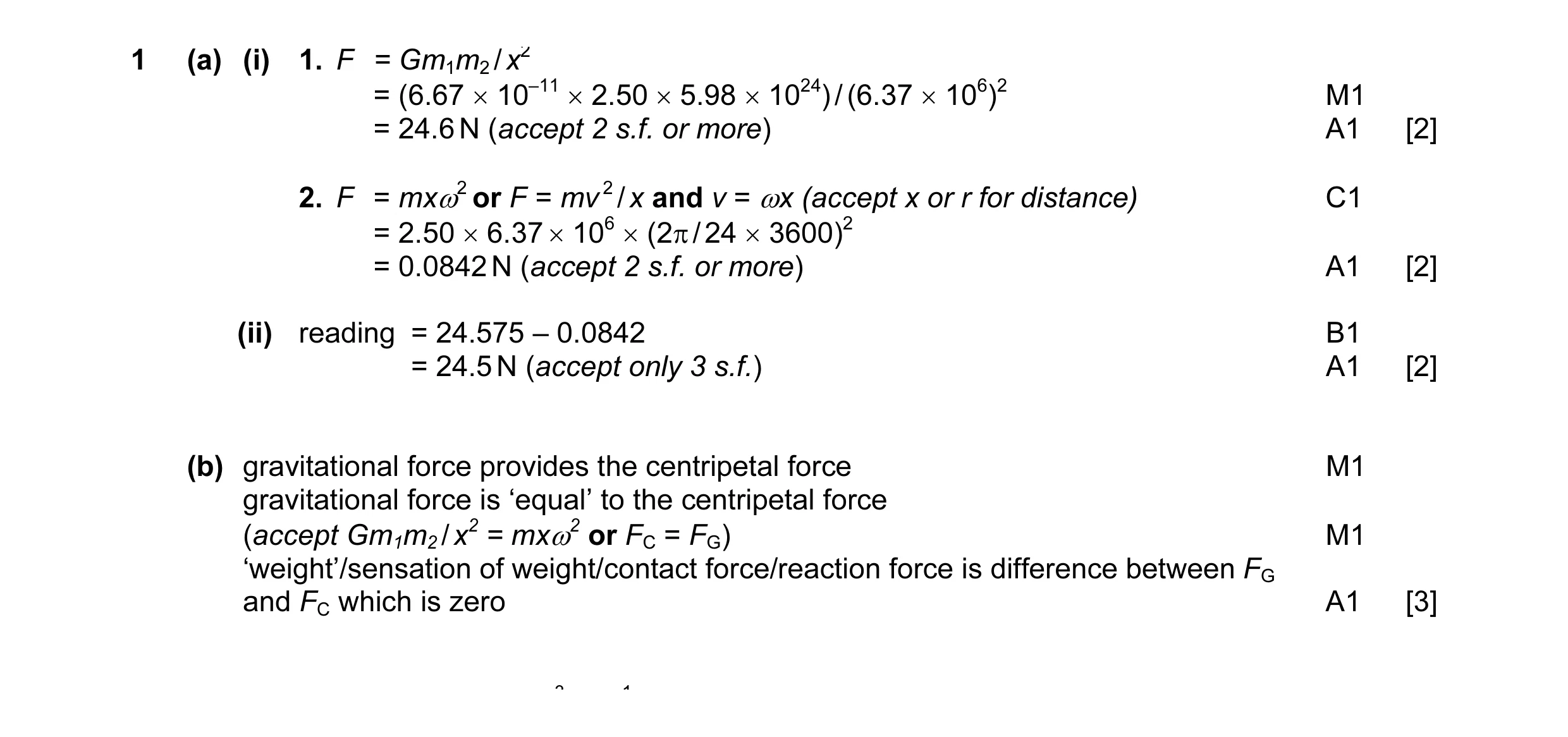 9
9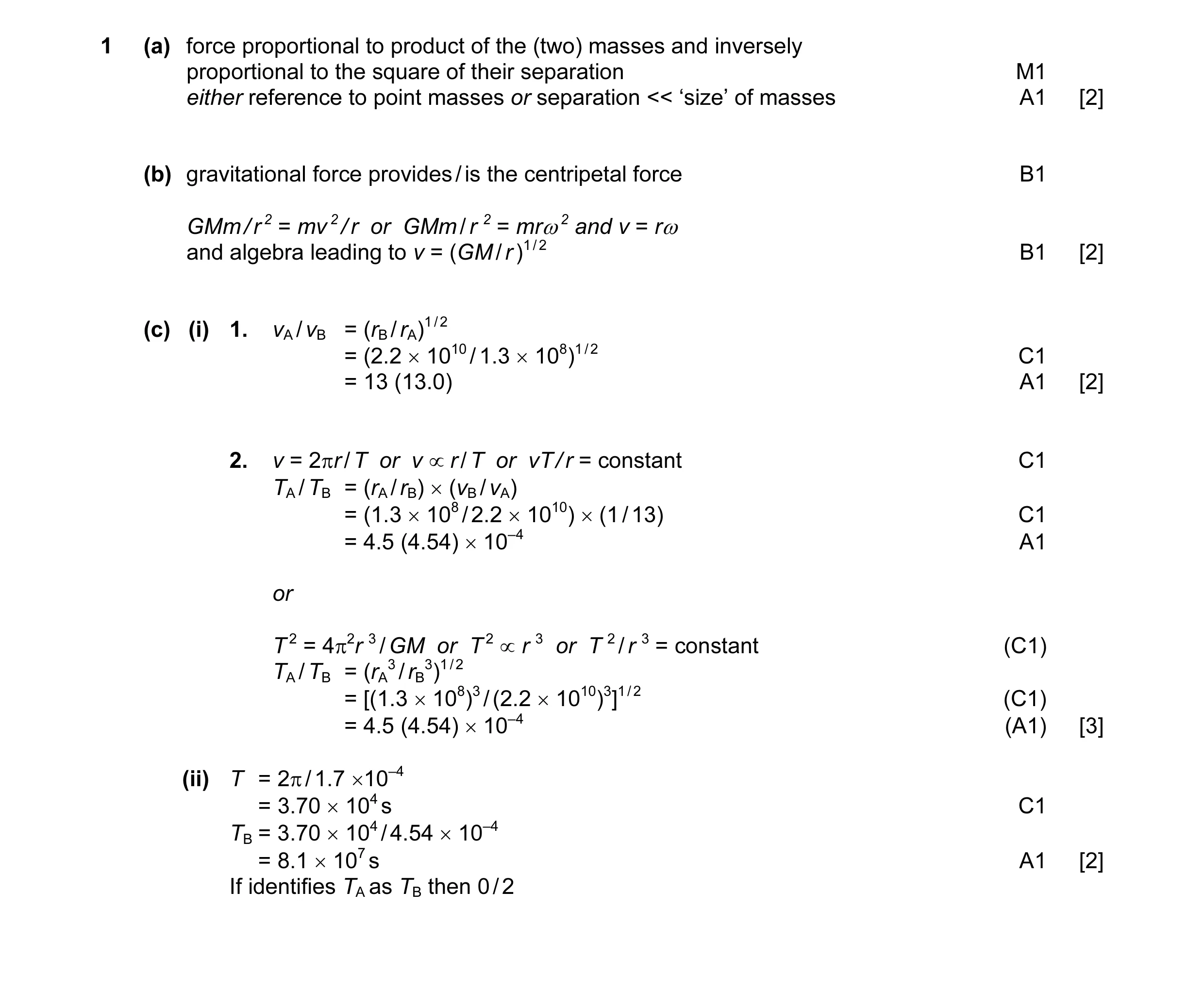 11
11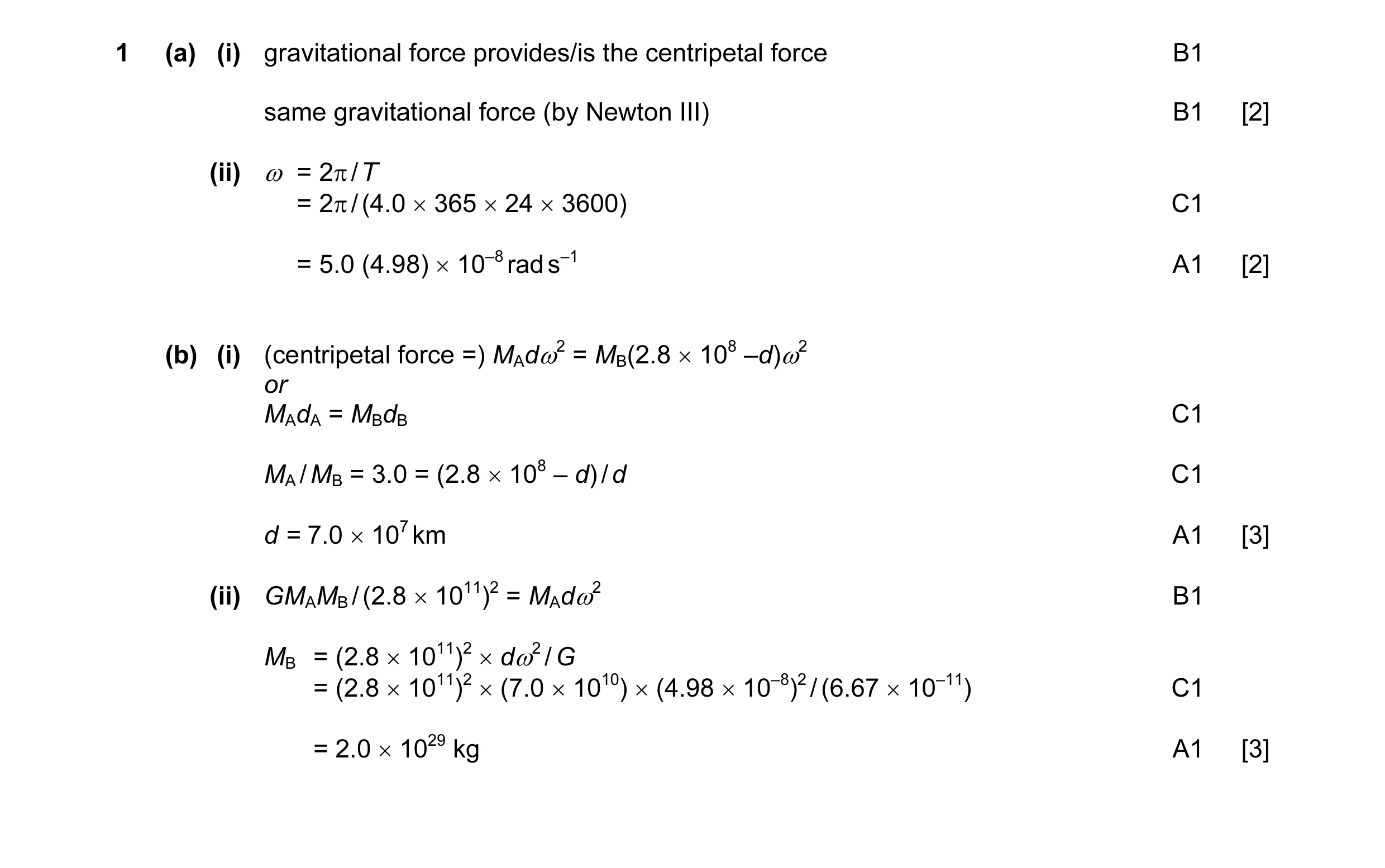 10
10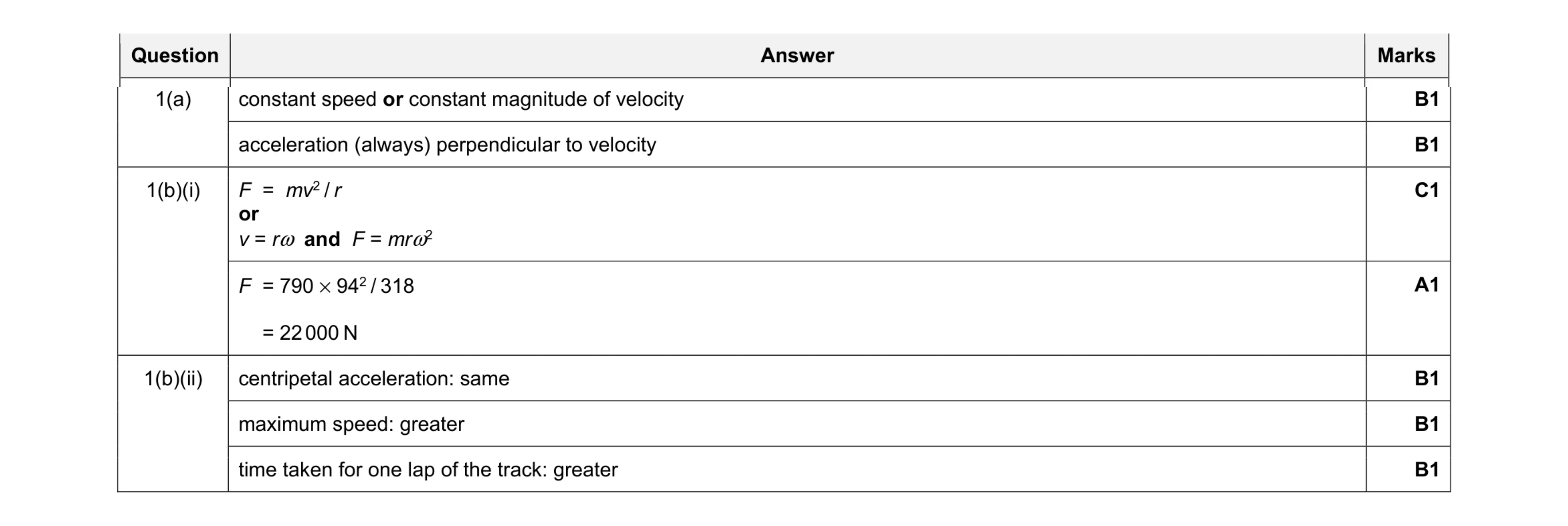 7
7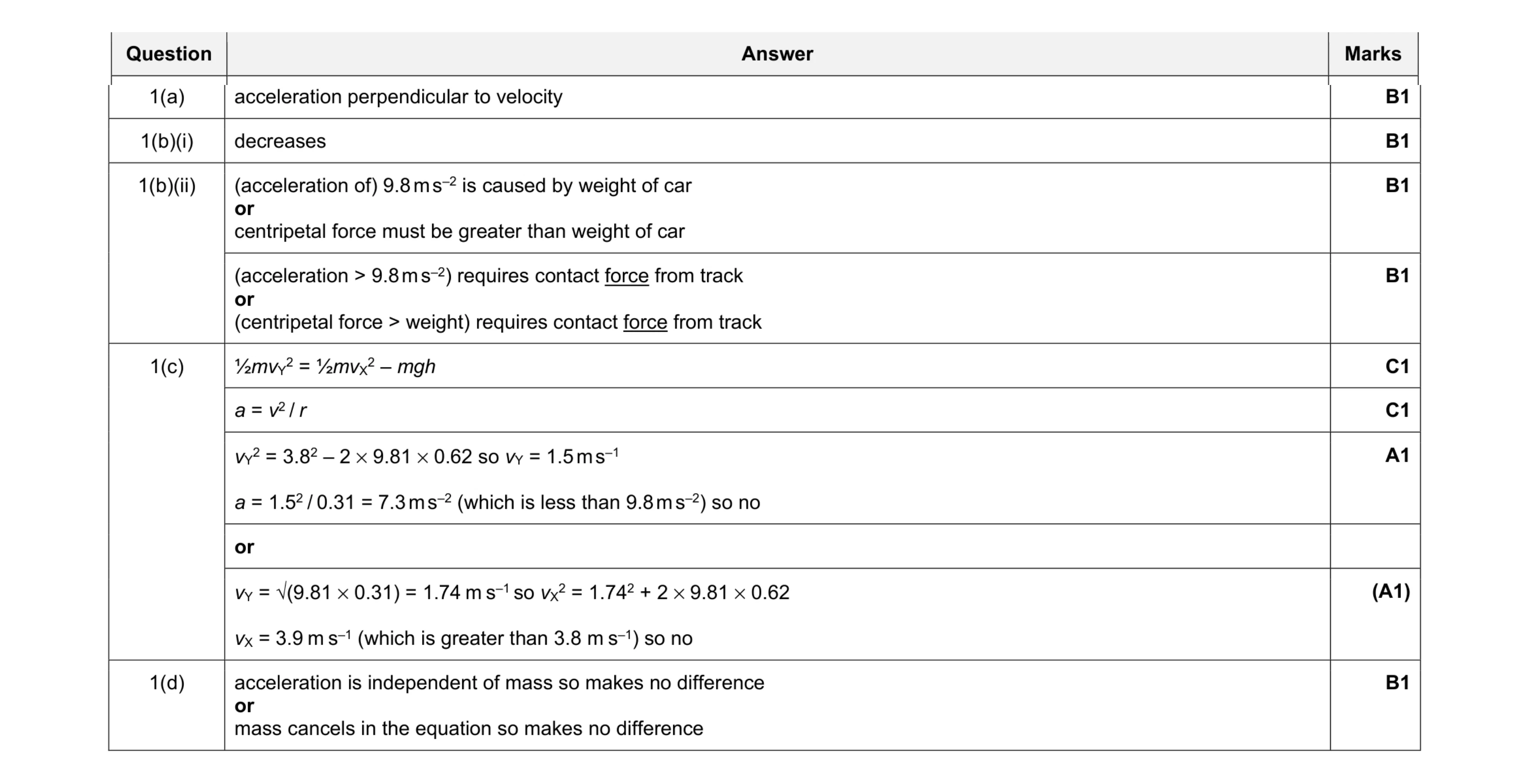 8
8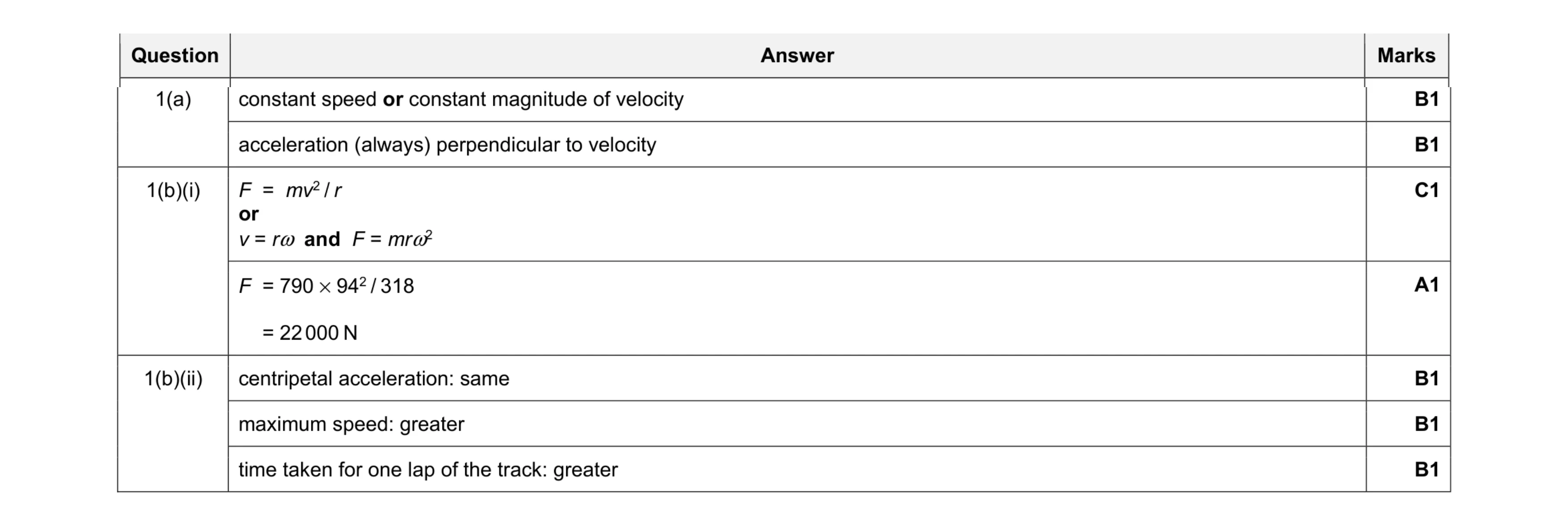 7
7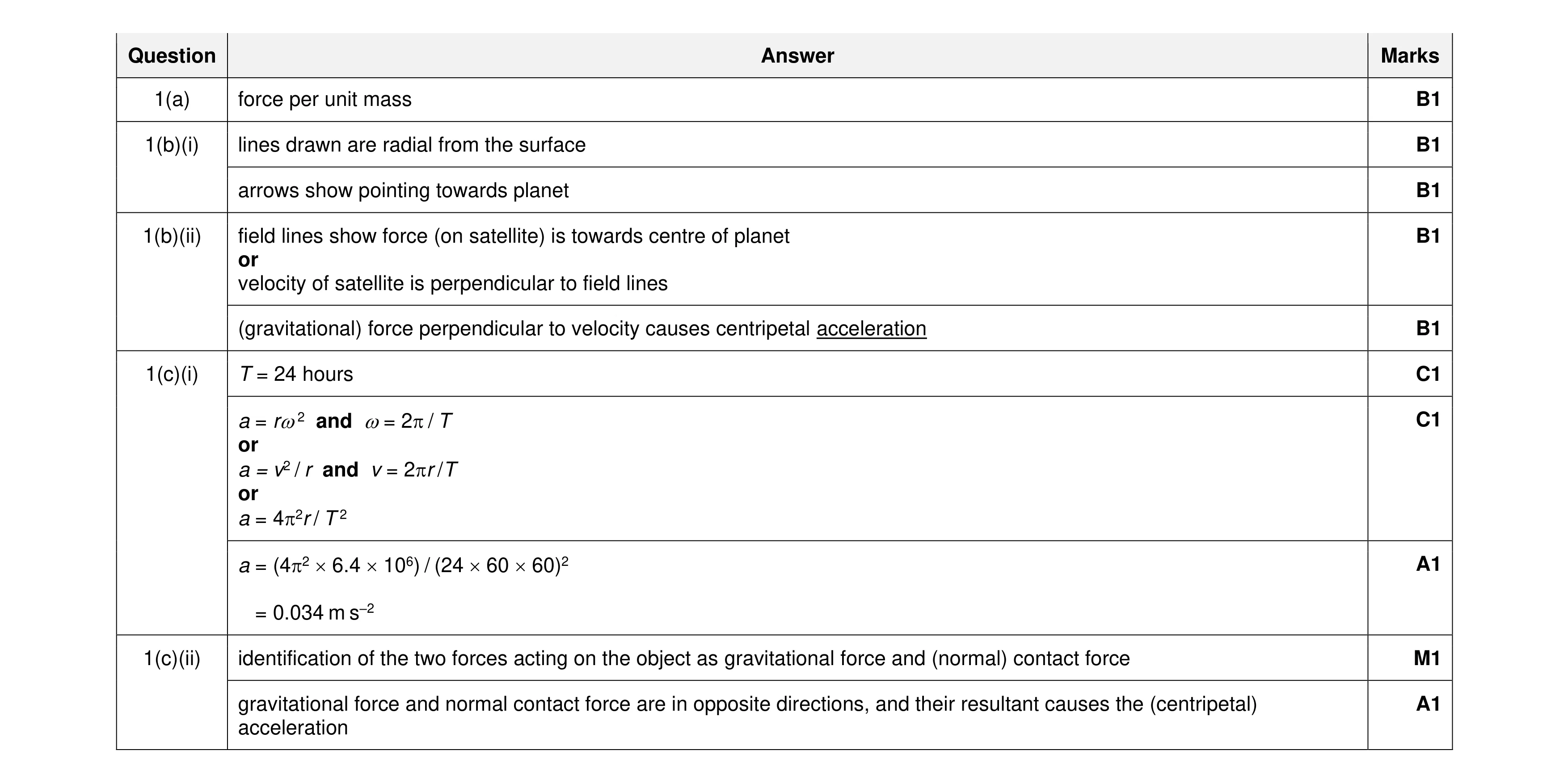 10
10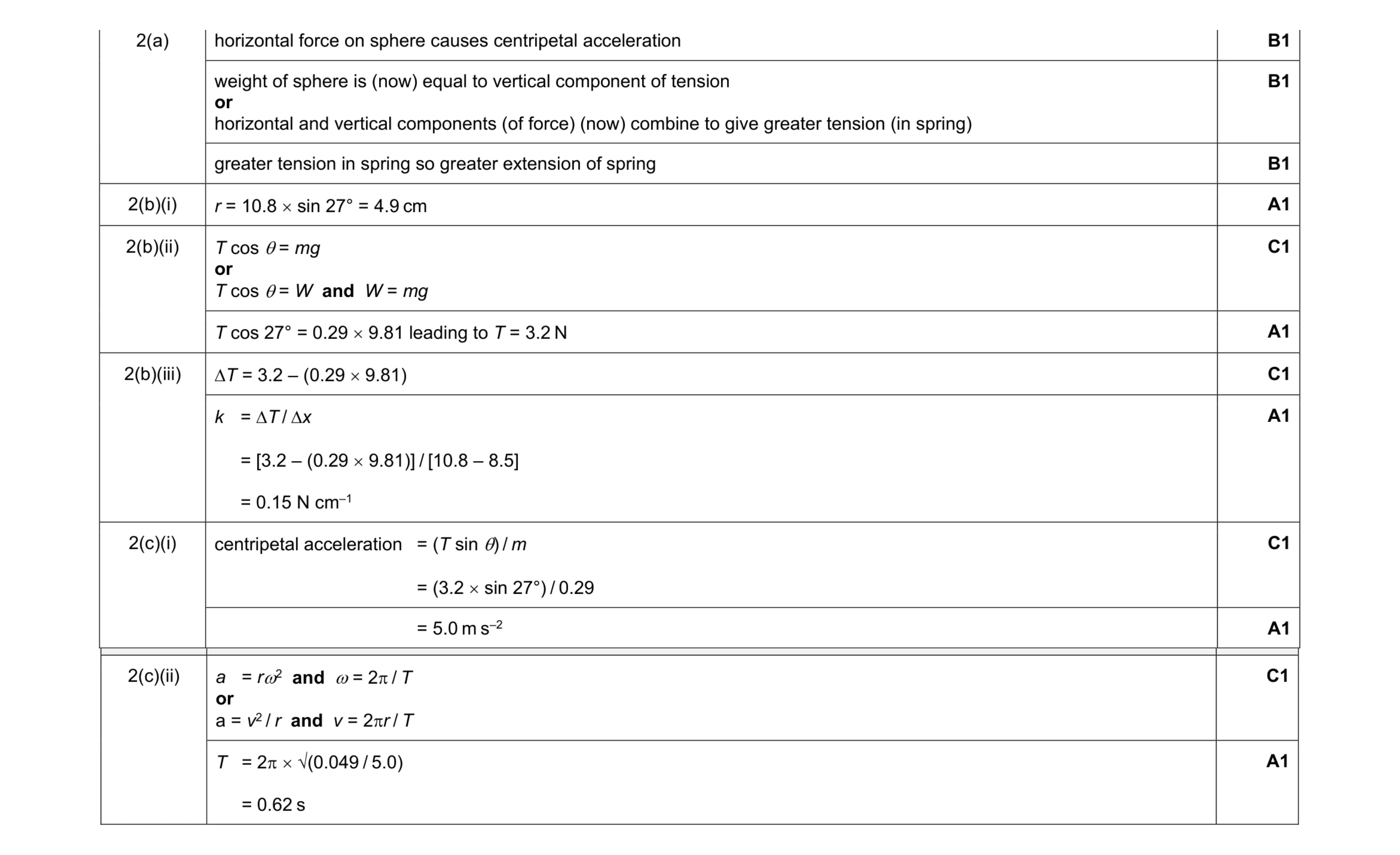 12
12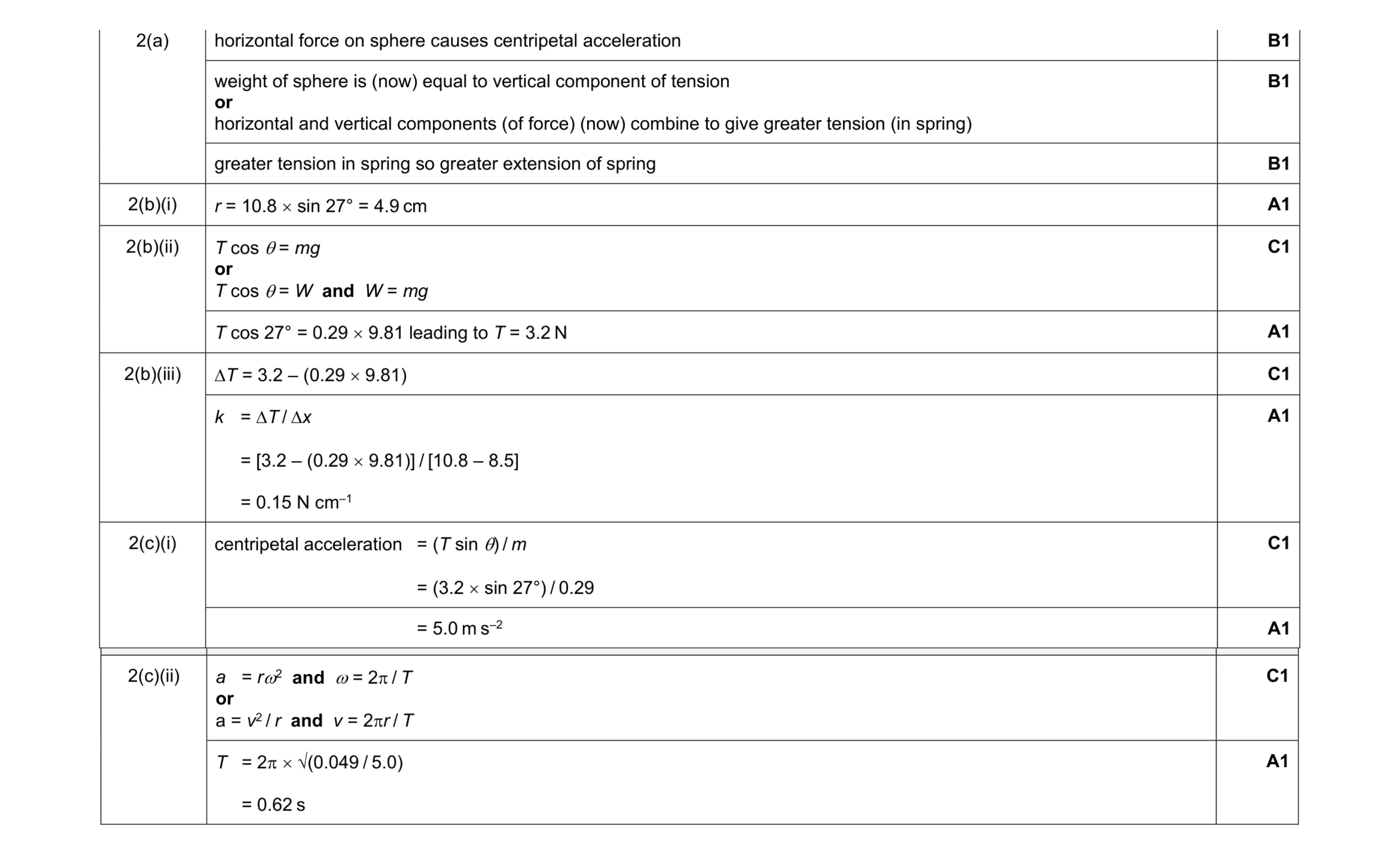 12
12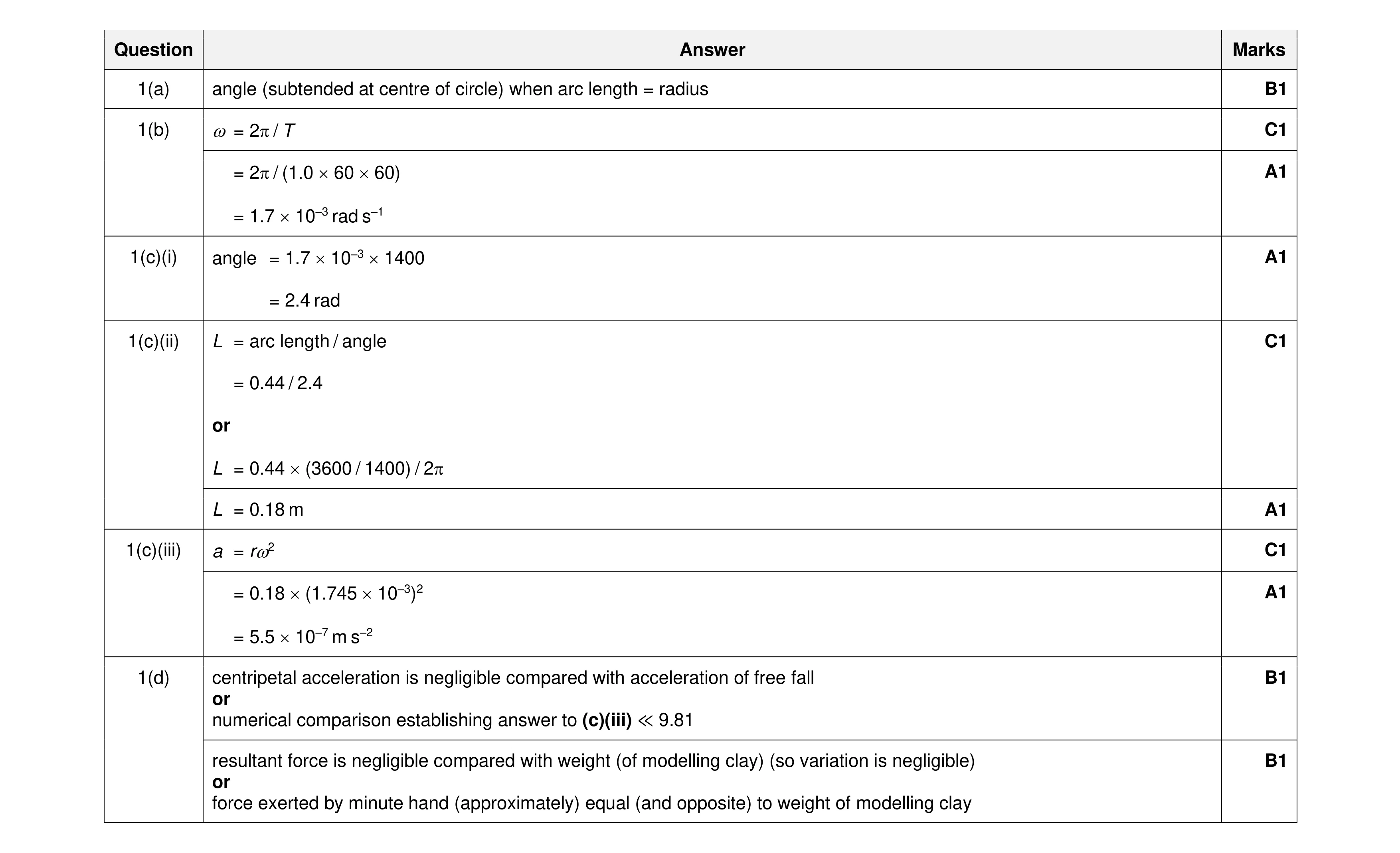 10
10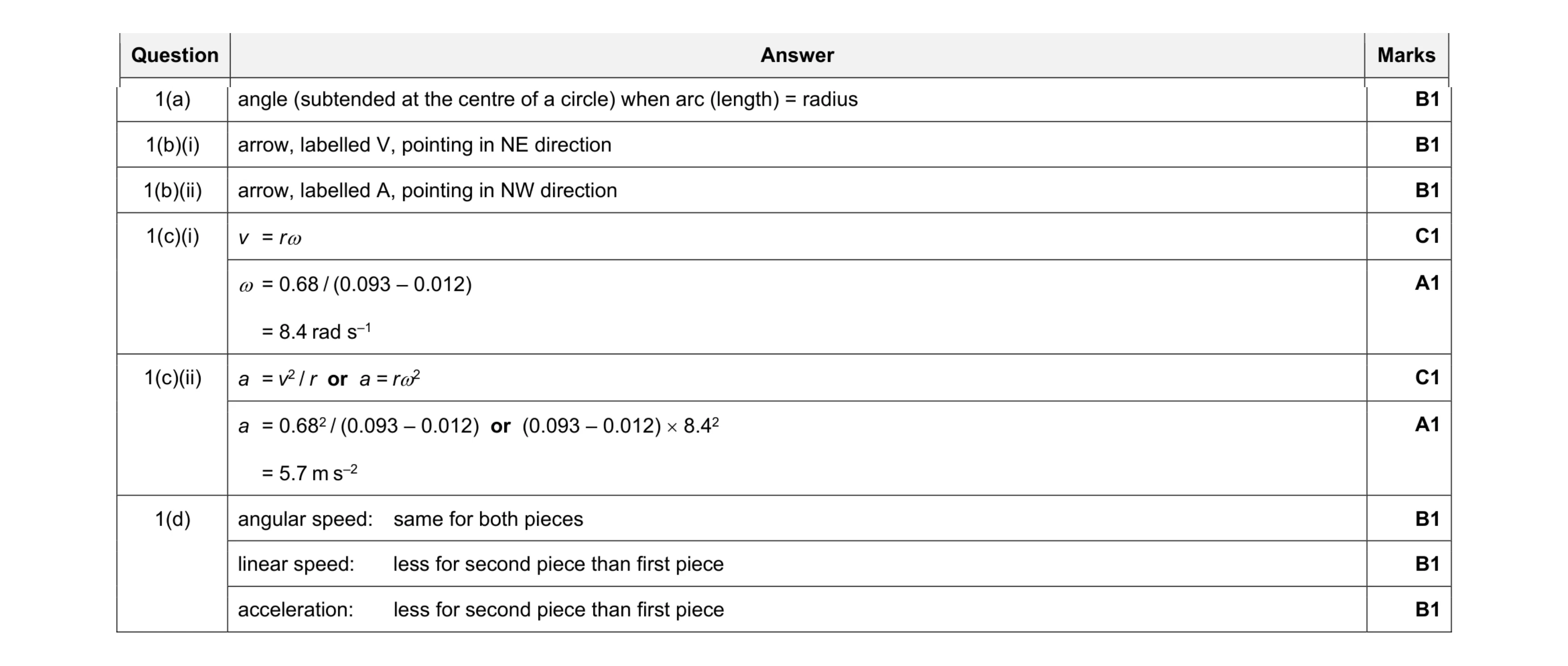 10
10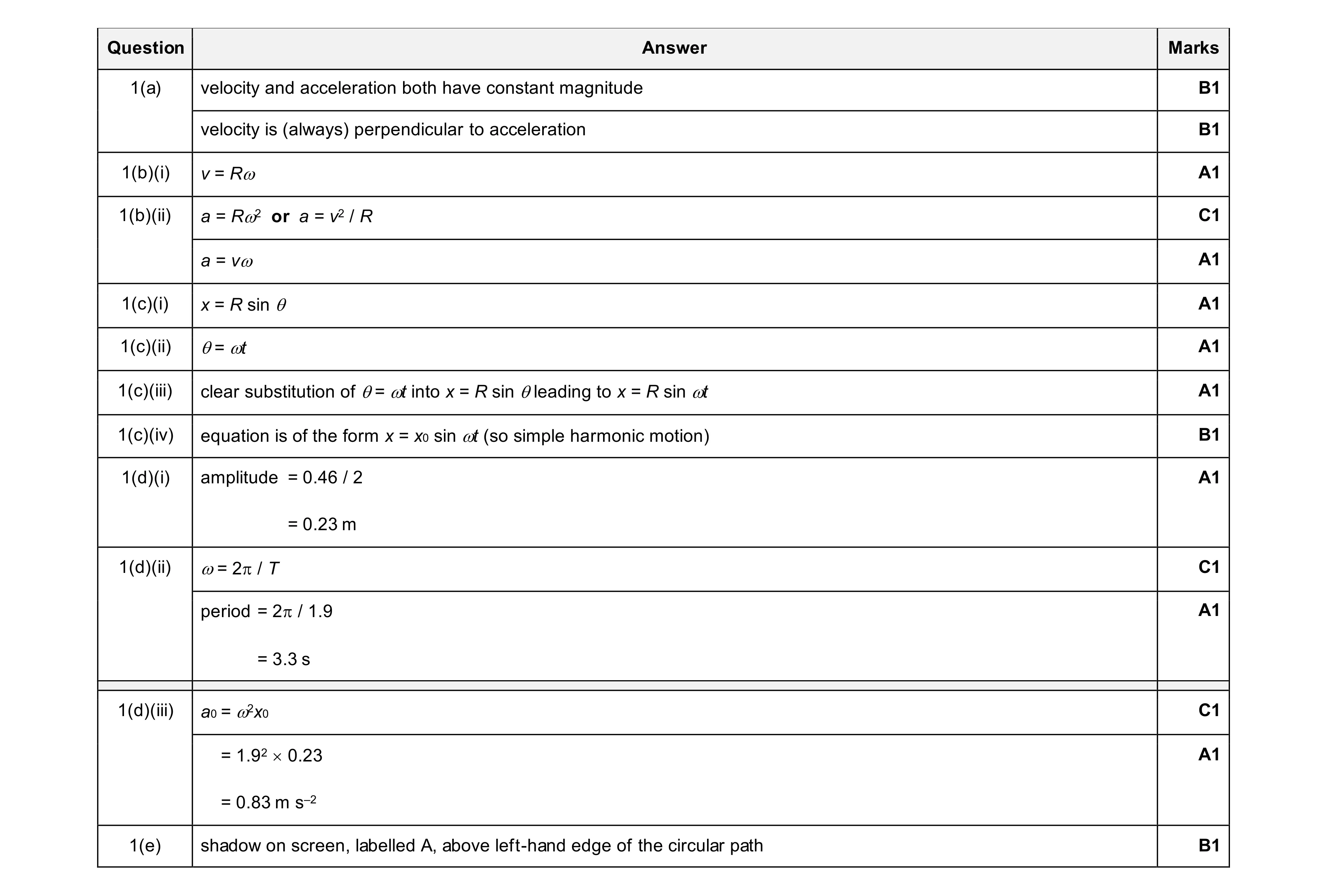 15
15