Questions as text
Q1 · X 8 An appropriate form for expressing in partial fractions is (x + 1)(x −2) A B + x + 1… 9709/31 Oct/Nov 2004
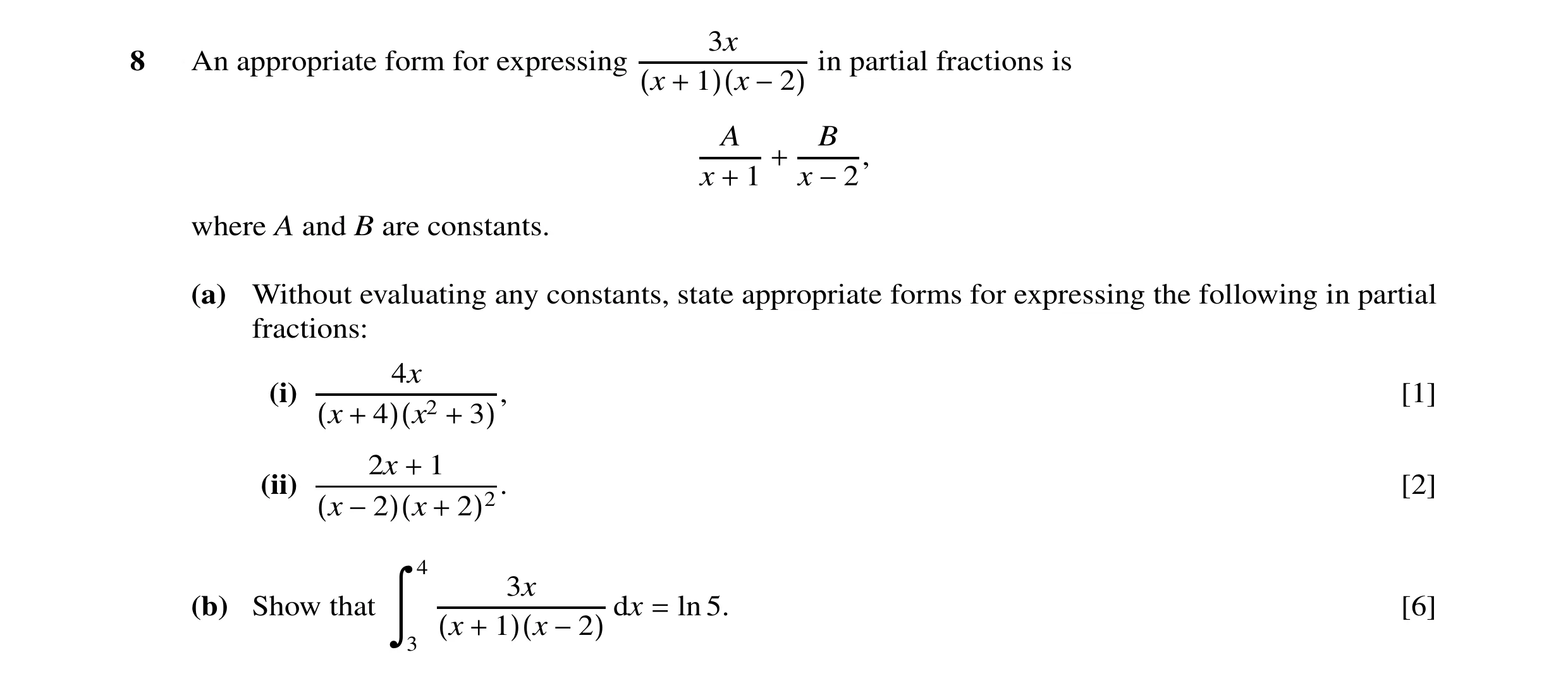
3x 8 An appropriate form for expressing in partial fractions is (x + 1)(x −2) A B + x + 1 x −2, where A and B are constants. (a) Without evaluating any constants, state appropriate forms for expressing the following in partial fractions: 4x (i) [1] (x + 4)(x2 + 3), 2x + 1 (ii) [2] (x −2)(x + 2)2. 4 3x (b) Show that dx = ln 5. [6] (x + 1)(x −2) 3
9 marks
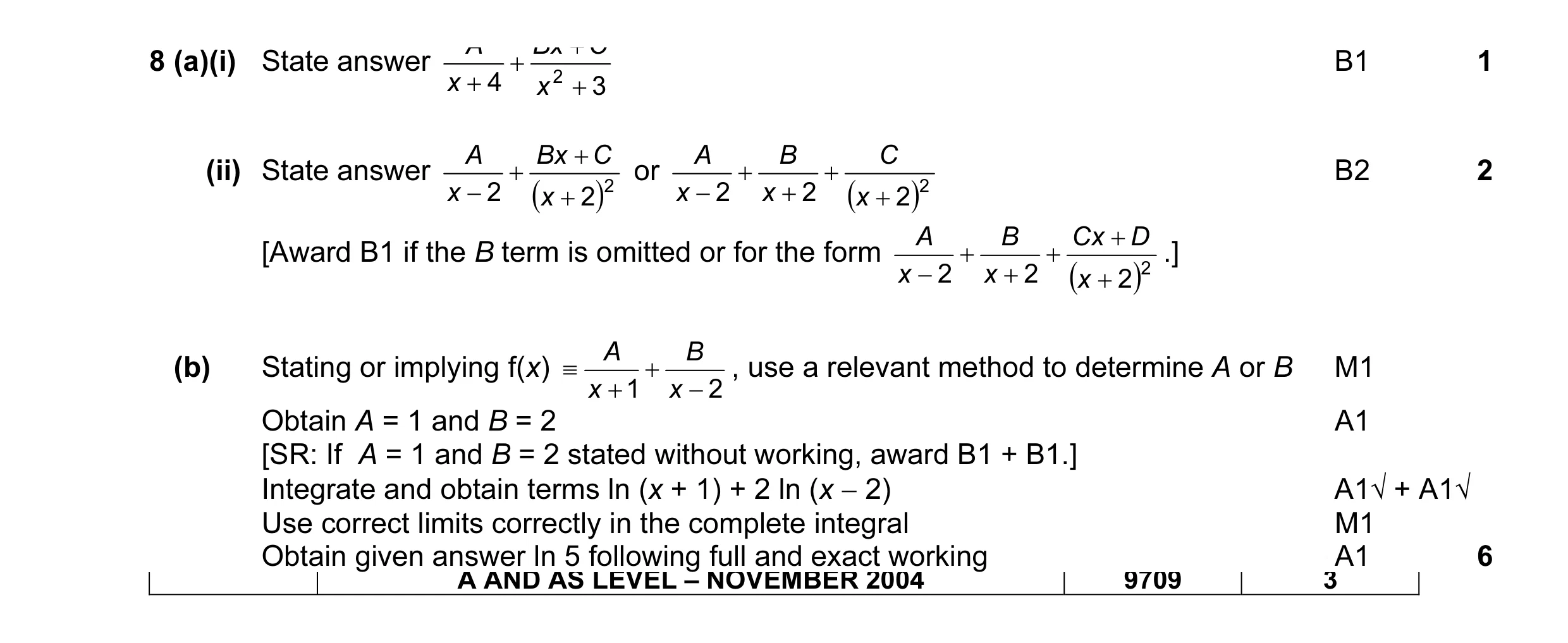
Mark scheme: A Bx + C 8 (a)(i) State answer + B1 1 x + 4 x 2 + 3 A Bx + C A B C (ii) State answer + or + + B2 2 x − 2 ( x + 2 )2 x − 2 x + 2 ( x + 2 )2 A B Cx + D [Award B1 if the B term is omitted or for the form + + .] x − 2 x + 2 ( x + 2 )2 A B (b) Stating or implying f(x) ≡ + , use a relevant method to determine A or B M1 x + 1 x − 2 Obtain A = 1 and B = 2 A1 [SR: If A = 1 and B = 2 stated without working, award B1 + B1.] Integrate and obtain terms ln (x + 1) + 2 ln (x − 2) A1√ + A1√ Use correct limits correctly in the complete integral M1 Obtain given answer ln 5 following full and exact working A1 6 A AND AS LEVEL – NOVEMBER 2004 9709 3
This question in 9709/31 Oct/Nov 2004
Q2 · X2 + x 9 (i) Express in partial fractions 9709/31 Oct/Nov 2005
3x2 + x 9 (i) Express in partial fractions. [5] (x + 2)(x2 + 1) 3x2 + x (ii) Hence obtain the expansion of in ascending powers of x, up to and including the (x + 2)(x2 + 1) term in x3. [5]
10 marks
Mark scheme: A Bx + C 9 (i) State or imply partial fractions are of the form + B1 x + 2 x 2 + 1 Use any relevant method to obtain a constant M1 Obtain A = 2 A1 Obtain B = 1 A1 Obtain C = −1 A1 [5] (ii) Use correct method to obtain the first two terms of the expansion of ( 2 + x ) −1 , or 1( + 1 x ) −1 , or 1( + x 2 ) −1 M1* 2 Obtain complete unsimplified expansions of the fractions, e.g. .2 1 1( − 1 x + 1 x 2 − 1 x 3 ) ; 2 2 4 8 ( x − 1)(1 − x 2 ) A1√ + A1√ Carry out multiplication of expansion of 1( + x 2 ) −1 by (x –1) M1(dep*) Obtain answer 1 x + 5 x 2 − 9 x 3 A1 [5] 2 4 8 − 1 [Binomial coefficients involving –1, such as , are not sufficient for the first M1.] 1 [f.t. is on A, B, C.] [Apply this scheme to attempts to expand (3 x 2 + x )( x + 2) −1 1( + x 2 ) −1 , giving M1A1A1 for the expansions, M1 for multiplying out fully, and A1 for the final answer.] GCE A/AS LEVEL – November 2005 9709, 8719 3
This question in 9709/31 Oct/Nov 2005
Q3 · −x + 8x2 9 (i) Express in partial fractions 9709/31 Oct/Nov 2007
2 −x + 8x2 9 (i) Express in partial fractions. [5] (1 −x)(1 + 2x)(2 + x) 2 −x + 8x2 (ii) Hence obtain the expansionof inascending powers of x, up to and including (1 −x)(1 + 2x)(2 + x) the term in x2. [5]
10 marks
Mark scheme: A B C 9 (i) State or imply the form + + B1 1 − x 1 + 2 x 2 + x Use any relevant method to determine a constant M1 Obtain A = 1, B = 2 and C = −4 A1 + A1 + A1 [5] (ii) Use correct method to obtain the first two terms of the expansion of 1( −x ) −1 , 1( + 2 x ) −1 , ( 2 + x ) −1 , or 1( + 1 x ) −1 M1 2 Obtain complete unsimplified expansions up to x 2 of each partial fraction A1√ + A1√ + A1√ Combine expansions and obtain answer 1 − 2 x + 17 x 2 A1 [5] 2 − 1 [Binomial coefficients such as are not sufficient for the M1. The f.t. is on A, B, C.] 2 [Apply this scheme to attempts to expand ( 2 − x + 8 x 2 )(1 − x ) −1 1( + 2 x ) −1 ( 2 + x ) −1 , giving M1A1A1A1 for the expansions, and A1 for the final answer.] [Allow Maclaurin, giving M1A1√A1√ for f(0) = 1 and f ′(0) = −2, A1√ for f ″(0) = 17 and A1 for the final answer (f.t. is on A, B,C).]
This question in 9709/31 Oct/Nov 2007
Q4 · X2 + 3x + 3 7 Let f(x) ≡ (x + 1)(x + 3) 9709/31 May/June 2008
x2 + 3x + 3 7 Let f(x) ≡ (x + 1)(x + 3). (i) Express f(x) in partial fractions. [5] 3 (ii) Hence show that f(x) dx = 3 −1 ln 2. [4] 2 0
9 marks
Mark scheme: B C 7 (i) State or imply the form A + + B1 x + 1 x + 3 State or obtain A = 1 B1 Use correct method for finding B or C M1 Obtain B = 1 A1 2 Obtain C = − 3 A1 [5] 2 (ii) Obtain integral x + 1 ln ( x + 1) − 3 ln ( x + 3 ) B2√ 2 2 [Award B1√ if only one error. The f.t. is on A, B, C.] Substitute limits correctly M1 Obtain given answer following full and exact working A1 [4] [SR: if A omitted, only M1 in part (i) is available, then in part (ii) B1√ for each correct integral and M1.] y d y
This question in 9709/31 May/June 2008
Q5 · An underground storage tank is being filled with liquid as shown in the diagram 9709/31 Oct/Nov 2008
8 An underground storage tank is being filled with liquid as shown in the diagram. Initially the tank is empty. At time t hours after filling begins, the volume of liquid is V m3 and the depth of liquid is h m. It is given that V = 43h3. The liquid is poured in at a rate of 20 m3 per hour, but owing to leakage, liquid is lost at a rate dh proportional to h2. When h = 1, = 4.95. dt (i) Show that h satisfies the differential equation dh 5 = −1 [4] dt h2 20. 20h2 2000 (ii) Verify that ≡−20 + [1] 100 −h2 (10 −h)(10 + h). (iii) Hence solve the differential equation in part (i), obtaining an expression for t in terms of h. [5]
10 marks
Mark scheme: dV 2 dh dV 28 (i) State or obtain = 4 h , or = 4 h , or equivalent B1 dt dt d h dV 2 State or imply = 20 − kh B1 dt Use the given values to evaluate k M1 Show that k = 0.2, or equivalent, and obtain the given equation A1 [4] [The M1 is dependent on at least one B mark having been earned.] (ii) Fully justify the given identity B1 [1] (iii) Separate variables correctly and attempt integration of both sides M1 Obtain terms –20h and t, or equivalent A1 10 + h Obtain terms aln(10 + h) + bln(10 – h), where ab ≠ 0, or k ln M1 10 − h Obtain correct terms, i.e. with a = 100 and b = −100, or k = 2000/20, or equivalent A1 Evaluate a constant and obtain a correct expression for t in terms of h A1 [5] 1 x 1 x ∫
This question in 9709/31 Oct/Nov 2008
Q6 · 0 8 (i) Express x2(10 −x) in partial fractions 9709/31 May/June 2009
100 8 (i) Express x2(10 −x) in partial fractions. [4] (ii) Given that x 1 when t 0, solve the differential equation = = dx 1 −x), dt = 100x2(10 obtaining an expression for t in terms of x. [6]
10 marks
Mark scheme: A B C 8 (i) State or imply the form + 2 + B1 x x 10 − x Use any relevant method to determine a constant M1 Obtain one of the values A = 1, B = 10, C = 1 A1 Obtain the remaining two values A1 4 Dx + E C [The form 2 + is acceptable and leads to D = 1, E = 10, C = 1] x 10 − x (ii) Separate variables and attempt integration of both sides M1 Obtain terms ln x, –10/x, –ln (10 – x), or equivalent A1√ + A1√ + A1 √ Evaluate a constant or use limits x = 1, t = 0 with a solution containing 3 of the terms kln x, l/x, mln (10 –x) and t, or equivalent M1 9 x 10 Obtain any correct expression for t, e.g. t = ln − + 10 A1 6 10 − x x adx [A separation of the form 2 = bdt is essential for the M1. The f.t. is on A, B, C] x (10 − x ) [If A or B (D or E) omitted from the form of fractions, give B0M1A0A0 in (i); M1A1√ A1√M1A0 in (ii)] GCE A/AS LEVEL – May/June 2009 9709 03
This question in 9709/31 May/June 2009
Q7 · X 38 (i) Express + in partial fractions 9709/31 Oct/Nov 2009
5x 38 (i) Express + in partial fractions. [5] (x + 1)2(3x + 2) 5x 3 (ii) Hence obtain the expansion of + in ascending powers of x, up to and including the (x + 1)2(3x + 2) term in x2, simplifying the coefficients. [5]
10 marks
Mark scheme: A B C 8 (i) State or imply partial fractions are of the form + 2 + B1 x + 1 ( x + )1 3 x + 2 Use any relevant method to obtain a constant M1 Obtain one of the values A = 1, B = 2, C = –3 A1 Obtain a second value A1 Obtain the third value A1 [5] (ii) Use correct method to obtain the first two terms of the expansion of (x + 1)–1, (x + 1)–2, (3x + 2)–1 or (1 + 3 x)–1 M1 2 Obtain correct unsimplified expansion up to the term in x2 of each partial fraction A1√ + A1√ + A1√ Obtain answer 3 − 11 x + 29 x 2 , or equivalent A1 [5] 2 4 8 − 1 [Symbolic binomial coefficients, e.g. , are not sufficient for the first M1. The f.t. is on A, B, C.] 1 Dx + E C [The form 2 + , where D = 1, E = 3, C = –3, is acceptable. In part (i) give ( x + )1 3 x + 2 B1M1A1A1A1. In part (ii) give M1A1√A1√ for the expansions, and, if DE ≠ 0, M1 for multiplying out fully and A1 for the final answer.] [If B or C omitted from the form of fractions, give B0M1A0A0A0 in (i); M1A1√A1√ in (ii), max 4/10] [If D or E omitted from the form of fractions, give B0M1A0A0A0 in (i); M1A1√A1√ in (ii), max 4/10] [In the case of an attempt to expand (5x + 3)(x + 1)–2 (3x + 2)–1, give M1A1A1 for the expansions, M1 for multiplying out fully, and A1 for the final answer.] [Allow use of Maclaurin, giving M1A1√A1√ for differentiating and obtaining f(0) = 3 and 2 f ′(0) = – 11 , A1√ for f ″(0) = 29 , and A1 for the final answer (the f.t. is on A, B, C if used).] 4 4
This question in 9709/31 Oct/Nov 2009
Q8 · X 8 (i) Express in partial fractions 9709/32 Oct/Nov 2009
1 x 8 (i) Express in partial fractions. [5] + (1 −x)(2 + x2) 1 x (ii) Hence obtain the expansion of in ascending powers of x, up to and including the + term in x2. (1 −x)(2 + x2) [5]
10 marks
Mark scheme: A Bx + C 8 (i) State or imply partial fractions are of the form + 2 B1 1 − x 2 + x Use a relevant method to determine a constant M1 Obtain A = 2 , B = 2 and C = 1 A1 + A1 + A1 [5] 3 3 3 GCE A/AS LEVEL – October/November 2009 9709 32 (ii) Use correct method to find first two terms of the expansion of (1 – x)–1, (2 + x2)–1 or (1 + 1 x2)–1 M1 2 Obtain complete unsimplified expansions up to x2 of each partial fraction e.g. 2 (1 + x + x2) 3 and 1 ( 2 x – 1 )(1 – 1 x2) A1√ + A1√ 2 3 3 2 Carry out multiplication of (2 + x2)–1 by ( 2 x – 1 ), or equivalent, provided BC ≠ 0 M1 3 3 Obtain answer 1 + x + 3 x 2 A1 [5] 2 4 [Symbolic binomial coefficients are not sufficient for the first M1. The f.t. is on A, B, C.] [If B or C omitted from the form of fractions, give B0M1A0A0A0 in (i); M1A1√A1√ in (ii), max 4/10] [In the case of an attempt to expand (1 + x)(1 – x)–1 (2 + x2)–1, give M1A1A1 for the expansions, M1 for multiplying out fully, and A1 for the final answer.] [Allow Maclaurin, giving M1A1√A1√ for differentiating and obtaining f(0) = 1 and f ′(0) = 1, A1√ 2 for f ″(0) = 3 , and A1 for the final answer (the f.t. is on A, B, C if used).] 2
This question in 9709/32 Oct/Nov 2009
Q9 · 5x9 (i) Express + −x2 in partial fractions 9709/33 May/June 2010
4 5x9 (i) Express + −x2 in partial fractions. [5] (1 −2x)(2 + x)2 4 5x (ii) Hence obtain the expansion of + −x2 in ascending powers of x, up to and including (1 −2x)(2 + x)2 the term in x2. [5]
10 marks
Mark scheme: A B C 9 (i) State or imply partial fractions of the form + + B1 1 − 2 x 2 + x ( 2 + x 2) Use any relevant method to determine a constant M1 Obtain one of the values A = 1, B = 1, C = −2 A1 Obtain a second value A1 Obtain the third value A1 [5] A Dx + E [The form + , where A = 1, D = 1, E = 0, is acceptable 1 − 2 x ( 2 + x 2) scoring B1M1A1A1A1 as above.] (ii) Use correct method to obtain the first two terms of the expansion of 1( −x2 ) −1 , ( 2 + x ) −1 , ( 2 + x ) −2 , 1( + 12 x ) −1 , or 1( + 12 x ) −2 M1 Obtain correct unsimplified expansions up to the term in x2 of each partial fraction A1√ + A1√ + A1√ 9 15 2 Obtain answer 1 + x + x , or equivalent A1 [5] 4 4 − 1 [Symbolic binomial coefficients, e.g. , are not sufficient for the M1. The f.t. is on A, B, C.] 1 [For the A, D, E form of partial fractions, give M1A1√A1√ for the expansions then, if D ≠ 0, M1 for multiplying out fully and A1 for the final answer.] [In the case of an attempt to expand ( 4 + 5 x − x 2 )(1 − 2 x ) −1 ( 2 + x ) −2 , give M1A1A1 for the expansions, M1 for multiplying out fully, and A1 for the final answer.] [SR: If B or C omitted from the form of fractions, give B0M1A0A0A0 in (i); M1A1√A1√ in (ii).] [SR: If D or E omitted from the form of fractions, give B0M1A0A0A0 in (i); M1A1√A1√ in (ii).]
This question in 9709/33 May/June 2010
Q10 · X 8 Let f(x) = (1 + x)(1 + 2x2) 9709/32 Oct/Nov 2010
3x 8 Let f(x) = (1 + x)(1 + 2x2). (i) Express in partial fractions. [5] f(x) (ii) Hence obtain the expansion of in ascending powers of x, up to and including the term in x3. f(x) [5] [Questions 9 and 10 are printed on the next page.]
10 marks
Mark scheme: A Bx + C 8 (i) State or imply the form + 2 B1 1 + x 1 + 2 x Use any relevant method to evaluate a constant M1 Obtain one of A = –1, B = 2, C = 1 A1 Obtain a second value A1 Obtain the third value A1 [5] (ii) Use correct method to obtain the first two terms of the expansion of (1 + x )−1 or (1 + 2 x 2 )−1 M1 Obtain correct expansion of each partial fraction as far as necessary A1√ + A1√ Multiply out fully by Bx + C, where BC Þ 0 M1 Obtain answer 3x – 3x2 – 3x3 A1 [5] − 1 [Symbolic binomial coefficients, e.g., are not sufficient for the first M1. The f.t. 1 is on A, B, C.] [If B or C omitted from the form of fractions, give B0M1A0A0A0 in (i); M1A1√A1√ in (ii), max 4/10.] [If a constant D is added to the correct form, give M1A1A1A1 and B1 if and only if D = 0 is stated.] [If an extra term D/(1 + 2x2) is added, give B1M1A1A1, and A1 if C + D = 1 is resolved to 1/(1 + 2x2).] [In the case of an attempt to expand 3x(1 + x)–1(1 + 2x2)–1, give M1A1A1 for the expansions up to the term in x2, M1 for multiplying out fully, and A1 for the final answer.] [For the identity 3x ≡ (1 + x + 2x2 + 2x3)(a + bx + cx2 + dx3) give M1A1; then M1A1 for using a relevant method to find two of a = 0, b = 3, c = –3 and d = –3; and then A1 for the final answer in series form.]
This question in 9709/32 Oct/Nov 2010
Q11 · The polynomial is defined by p(ß) 32, p(ß) = ß3 + mß2 + 24ß + where m is a constant 9709/33 Oct/Nov 2010
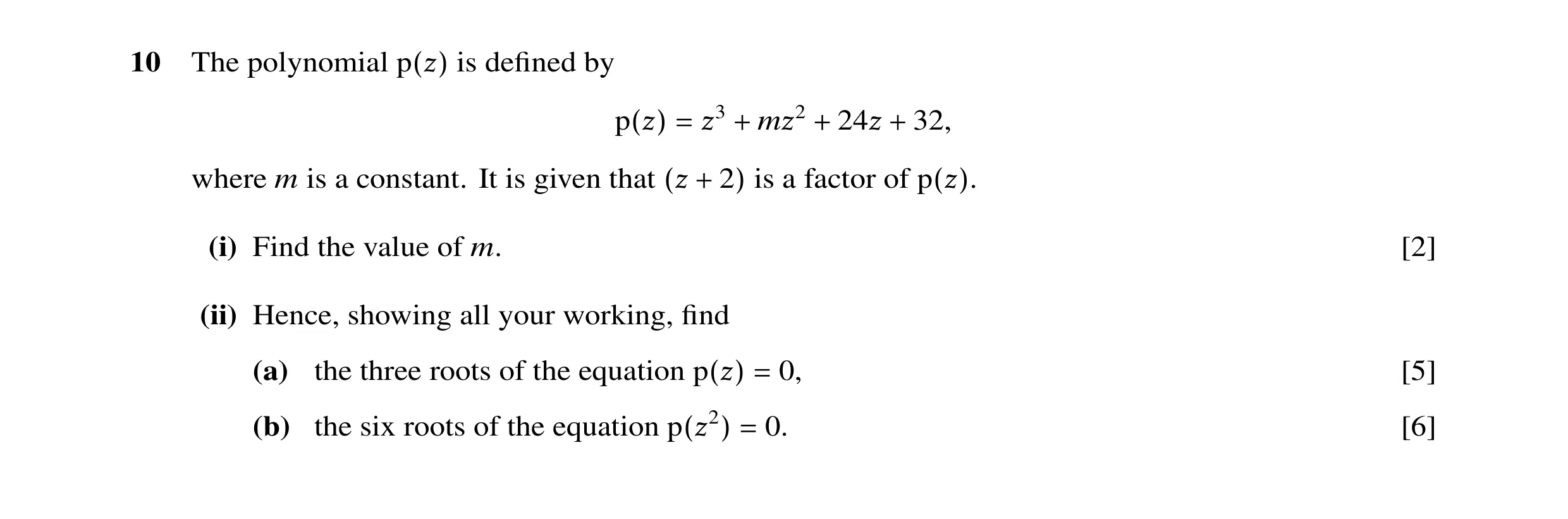
10 The polynomial is defined by p(ß) 32, p(ß) = ß3 + mß2 + 24ß + where m is a constant. It is given that is a factor of (ß + 2) p(ß). (i) Find the value of m. [2] (ii) Hence, showing all your working, find (a) the three roots of the equation 0, [5] p(ß) = (b) the six roots of the equation 0. [6] p(ß2) =
13 marks
Mark scheme: 10 (i) Attempt to solve for m the equation p(–2) = 0 or equivalent M1 Obtain m = 6 A1 [2] Alternative: Attempt p(z) ÷ (z + 2), equate a constant remainder to zero and solve for m. M1 Obtain m = 6 A1 (ii) (a) State z = –2 B1 Attempt to find quadratic factor by inspection, division, identity, … M1 Obtain z2 + 4z + 16 A1 Use correct method to solve a 3-term quadratic equation M1 Obtain − 2 ± 2 i3 or equivalent A1 [5] (b) State or imply that square roots of answers from part (ii)(a) needed M1 Obtain ± i 2 A1 Attempt to find square root of a further root in the form x + iy or in polar form M1 Obtain a2 – b2 = –2 and ab = (± ) 3 following their answer to part (ii)(a) A1√ Solve for a and b M1 Obtain ± (1+ i 3 ) and ± (1− i 3 ) A1 [6]
This question in 9709/33 Oct/Nov 2010
Q12 · X −x2 8 (i) Express in partial fractions 9709/32 May/June 2011
5x −x2 8 (i) Express in partial fractions. [5] (1 + x)(2 + x2) 5x −x2 (ii) Hence obtain the expansion of in ascending powers of x, up to and including the (1 + x)(2 + x2) term in x3. [5]
10 marks
Mark scheme: A Bx + C 8 (i) State or imply partial fractions are of the form + B1 1 + x 2 + x 2 Use a relevant method to determine a constant M1 Obtain one of the values A = –2, B = 1, C = 4 A1 Obtain a second value A1 Obtain the third value A1 [5] (ii) Use correct method to obtain the first two terms of the expansion of (1 + x ) −1 , −1 x M1 + 1 1 x 2 or (2 + x 2 )−1 in ascending powers of 2 Obtain correct unsimplified expansion up to the term in x3 of each partial fraction A1√ + A1√ Multiply out fully by Bx + C, where BC ≠ 0 M1 5 2 7 3 Obtain final answer x − 3 x + x , or equivalent A1 [5] 2 4 − 1 [Symbolic binomial coefficients, e.g. , are not sufficient for the first M1. The f.t. is 1 on A, B, C.] [If B or C omitted from the form of fractions, give B0M1A0A0A0 in (i); M1A1√A1√ in (ii), max 4/10.] [In the case of an attempt to expand (5x – x2)(1 + x)–1(2 + x2)–1, give M1A1A1 for the expansions, M1 for the multiplying out fully, and A1 for the final answer.] [Allow use of Maclaurin, giving M1A1√A1√ for differentiating and obtaining f(0) = 0 5 21 and f '(0) = , A1√ for f ''(0) = –6, and A1 for f '''(0) = and the final answer (the f.t. 2 2 is on A, B, C if used).] [For the identity 5 x − x 2 ≡ (2 + 2 x + x 2 + x 3 )( a + bx + cx 2 + dx 3 ) give M1A1; then M1A1 5 7 for using a relevant method to obtain two of a = 0, b = , c = –3 and d = ; then A1 for 2 4 the final answer in series form.] GCE AS/A LEVEL – May/June 2011 9709 32
This question in 9709/32 May/June 2011
Q13 · The polynomial x4 3x3 ax 3 is denoted by It is given that is divisible by x2 1 9709/32 Oct/Nov 2011
3 The polynomial x4 3x3 ax 3 is denoted by It is given that is divisible by x2 1. + + + p(x). p(x) −x + (i) Find the value of a. [4] (ii) When a has this value, find the real roots of the equation 0. [2] p(x) =
6 marks
Mark scheme: 3 (i) EITHER: Attempt division by x2 – x + 1 reaching a partial quotient of x2 + kx M1 Obtain quotient x2 + 4x + 3 A1 Equate remainder of form lx to zero and solve for a, or equivalent M1 Obtain answer a = 1 A1 OR: Substitute a complex zero of x2 – x + 1 in p(x) and equate to zero M1 Obtain a correct equation in a in any unsimplified form A1 Expand terms, use i2 = –1 and solve for a M1 Obtain answer a = 1 A1 [4] [SR: The first M1 is earned if inspection reaches an unknown factor x2 + Bx + C and an equation in B and/or C, or an unknown factor Ax2 + Bx + 3 and an equation in A and/or B. The second M1 is only earned if use of the equation a = B – C is seen or implied.] (ii) State answer, e.g. x = –3 B1 State answer, e.g. x = –1 and no others B1 [2]
This question in 9709/32 Oct/Nov 2011
Q14 · 8x29 (i) Express −7x + in partial fractions 9709/33 Oct/Nov 2012
9 8x29 (i) Express −7x + in partial fractions. [5] (3 −x)(1 + x2) 9 8x2 (ii) Hence obtain the expansion of −7x + in ascending powers of x, up to and including the (3 −x)(1 + x2) term in x3. [5]
10 marks
Mark scheme: A Bx + C 9 (i) State or imply form + B1 3 − x 1 + x 2 Use relevant method to determine a constant M1 Obtain A = 6 A1 Obtain B = –2 A1 Obtain C = 1 A1 [5] (ii) Either Use correct method to obtain first two terms of expansion − 1 −1 1 2 −1 of (3 −x ) or − 1 x or ( 1 + x ) M1 3 A 1 1 2 1 3 Obtain 1 + x + x + x A1 3 3 9 27 Obtain (Bx + C)(1 – x2) A1 Obtain sufficient terms of the product (Bx + C)(1 – x2), B , C ≠ 0 and add the two expansions M1 4 7 2 56 3 Obtain final answer 3 − x − x + x A1 3 9 27 Or Use correct method to obtain first two terms of expansion − 1 −1 1 2 −1 of (3 −x ) or − 1 x or ( 1 + x ) M1 3 1 1 1 2 1 3 Obtain 1 + x + x + x A1 3 3 9 27 Obtain (1 – x2) A1 Obtain sufficient terms of the product of the three factors M1 4 7 2 56 3 Obtain final answer 3 − x − x + x A1 [5] 3 9 27 2
This question in 9709/33 Oct/Nov 2012
Q15 · X2 −7x −1 7 Let f x = 9709/32 Oct/Nov 2013
2x2 −7x −1 7 Let f x = . x −2 x2 + 3 (i) Express f x in partial fractions. [5] (ii) Hence obtain the expansion of f x in ascending powers of x, up to and including the term in x2. [5]
10 marks
Mark scheme: A Bx + C 7 (i) State or imply partial fractions are of the form + 2 B1 x − 2 x + 3 Use a relevant method to determine a constant M1 Obtain one of the values A = –1, B = 3, C = –1 A1 Obtain a second value A1 Obtain the third value A1 [5] (ii) Use correct method to obtain the first two terms of the expansions of ( x − 2 )−1 , − 1 − 1 − 1 1 x , (x 2 + 3) −1 or + 1 1 x 2 M1 2 3 Substitute correct unsimplified expansions up to the term in x2 into each partial fraction A1 +A1 Multiply out fully by Bx + C, where BC ≠ 0 M1 1 5 17 2 Obtain final answer + x + x , or equivalent A1 [5] 6 4 72 − 1 [Symbolic binomial coefficients, e.g. are not sufficient for the M1. The f.t. is 1 on A, B, C.] 2 −1 2 −1 [In the case of an attempt to expand (2 x − 7 x − 1)( x − 2 ) (x + 3) , give M1A1A1 for the expansions, M1 for multiplying out fully, and A1 for the final answer.] [If B or C omitted from the form of partial fractions, give B0M1A0A0A0 in (i); M1A1 A1 in (ii)]
This question in 9709/32 Oct/Nov 2013
Q16 · 6 (i) Express in partial fractions 9709/33 May/June 2018
1 6 (i) Express in partial fractions. [2] 4 −y2 … … … … … … … … … … (ii) The variables x and y satisfy the differential equation xdy 4 dx = −y2, and y 1 when x 1. Solve the differential equation, obtaining an expression for y in terms of x. = = [6] … … … … … … … … … … … … … … … … … … … … … … … … … … … … … … … … … … … …
8 marks
Mark scheme: 6(i) Carry out relevant method to find A and B such that M1 1 A B ≡ + 4 − y 2 2 + y 2 − y 1 A1 Obtain A = B = 4 Total: 2 6(ii) Separate variables correctly and integrate at least one side to obtain one of the terms M1 a ln x, b ln (2 + y) or c ln (2 – y) Obtain term ln x B1 1 1 A1FT Integrate and obtain terms ln ( 2 + y ) − ln ( 2 − y ) 4 4 Use x = 1 and y = 1 to evaluate a constant, or as limits, in a solution containing at M1 least two terms of the form a ln x, b ln (2 + y) and c ln (2 – y) Obtain a correct solution in any form, e.g. A1 1 1 1 ln x = ln ( 2 + y ) − ln ( 2 − y ) − ln3 4 4 4 4 A1 2 ( 3 x − 1) Rearrange as , or equivalent ( 3 x 4 + 1) Total: 6
This question in 9709/33 May/June 2018
Q17 · Find the quotient and remainder when 6x4 x3 5x is divided by 2x2 1 9709/32 May/June 2020
1 Find the quotient and remainder when 6x4 x3 5x is divided by 2x2 1. [3] + −x2 + −6 −x + … … … … … … … … … … … … … … … … … … … … … … … … …
3 marks
Mark scheme: 1 Obtain quotient 3x2 + 2x –1 A1 Obtain remainder 2x – 5 A1 4
This question in 9709/32 May/June 2020
Q18 · A 210 Let f ( x) = , where a is a positive constant 9709/32 Feb/March 2024
36a 210 Let f ( x) = , where a is a positive constant. ( 2a + x)( 2a - x)( 5a - 2x) (a) Express f ( x) in partial fractions. [5] … … … … … … … … … … … … … … … … … … … … … … … … … a (b) Hence find the exact value of f ( x) d x , giving your answer in the form p ln q + r ln s where p and -ya r are integers and q and s are prime numbers. [5] … … … … … … … … … … … … … … … … … … … … … … … … … …
10 marks
Mark scheme: 10(a) A B C B1 Allow if seen prior to assigning a value for a. State or imply the form + + 2 a + x 2 a − x 5 a − 2 x Use a correct method for finding a coefficient M1 Obtain one of A = 1, B = 9, C = −16 A1 Obtain a second value A1 Obtain the third value A1 5 Dx + E C SC + B0 M1 and C = −16 4 a ^ 2 − x ^ 2 5 a − 2 x A1 Max 2/5. SC Allow M1 only for other incorrect partial fraction. 10(b) Integrate and obtain one of the terms ln 2 a + x − 9ln 2 a − x + 8ln 5 a − 2 x B1 FT Condone missing modulus signs. Use their A, B and C. Obtain a second correct term B1 FT Obtain the third correct term B1 FT Max 3/5 if value is assigned for a (award M0 A0). Substitute limits correctly in an integral of the form M1 Either (i) collect terms with same coeeficient and p ln 2 a + x + q ln 2 a − x + + r ln 5 a − 2 x and remove all a’s remove all a’s e.g. pln 3a −pln a + qln a − qln 3a + rln 3a – rln7a hence pln 3 − qln 3 + rln 3 − rln7 or (ii) collect same ln terms and remove all a’s e.g. (p – q + r) ln 3a – ( p – q) ln a – rln7a and − (p − q) ln a = (−p + q − r ) ln a + r ln a hence p ln 3 – q ln3 + rln 3 – r ln 7. Obtain 18ln3 − 8ln7 from correct working A1 A0 if the solution involves logarithms of negative numbers. 5
This question in 9709/32 Feb/March 2024
Q19 · Express 2 in partial fractions 9709/32 May/June 2024
2 Express 2 in partial fractions. [5] 2x - 5x - 12 … … … … … … … … … … … … … … … … … … … … … … … … … … …
5 marks
Mark scheme: 2 State or imply the form 2 3 4 B C A x x B1 2 3 4 Dx E F x x and 2 3 4 P Qx R x x are also valid. Use a correct method for finding a constant M1 SC: If score B0, they can score M1 A1 for one correct constant. B0 M1 A0 available if they substitute two values to form simultaneous equations but get an incorrect answer, or they substitute one value and make an arithmetic error. Obtain one of 3, 2 and 4 A B C A1 SC: If the horizontal equation is correct apart from an incorrect value for A, the other A marks may be available. Obtain a second value A1 SC: If denominator factorised as 3 2 4 x x can score a maximum of B0 M1 A1 A1 A0 for a split involving 3 terms. Obtain a third value A1 ISW Statement of the final split is not required. Question Answer Marks Guidance 2 Alternative method for Question 2 Divide numerator by denominator (M1) Obtain 2 3 2 5 12 Px Q x x (A1) 6 20 3 (2 3)( 4) x x x State or imply the form 2 2 5 12 2 3 4 Px Q x x D E x x (B1) Must deal with the 3 separately or include it correctly on both sides in their split. Obtain one of 2 and 4 D E (A1) SC: If denominator factorised as 3 2 4 , x x then can score a maximum of B0 M1 A1 A1 A0 for a split involving three terms. Obtain a second value (A1) ISW Statement of the final split is not required. 5
This question in 9709/32 May/June 2024
Q20 · X 2 - 2x + 2 5 Express in partial fractions 9709/33 May/June 2024
6 x 2 - 2x + 2 5 Express in partial fractions. [5] ( x - 1)( 2x + 1) … … … … … … … … … … … … … … … … … … … … … … … … … … …
5 marks
Mark scheme: 5 State or imply the form 1 2 1 B C A x x B1 Use a correct method for finding a constant M1 Correct appropriate method. Obtain one of A = 3, B = 2 and C = –3 A1 Obtain a second value A1 Obtain a third value A1 Alternative Method for Question 5 Divide numerator by denominator to reach A = 3 (M1) May be implied by 3 [+] 1 2 1 ax b x x with a and b not both 0. Obtain 3 + 5 1 2 1 x x x (A1) State or imply the form 1 2 1 D E x x (B1) Obtain one of D = 2 and E = − 3 (A1) Obtain a second value (A1) 5
This question in 9709/33 May/June 2024
Q21 · 2 5x + 8x + 5 Let f ( x) = 9709/31 Oct/Nov 2024
7 2 5x + 8x + 5 Let f ( x) = . ( 1 + 2 x)( 2 + x 2 ) (a) Express f ( )x in partial fractions. [5] … … … … … … … … … … … … … … … … … … … … … … … … … (b) Hence find the coefficient of x3 in the expansion of f ( )x . [4] … … … … … … … … … … … … … … … … … … … … … … … … … … …
9 marks
Mark scheme: 7(a) A Bx + C B1 State or imply the form + 1 + 2 x 2 + x 2 Use a correct method to find a constant M1 Obtain one of A = 1, B = 2 and C = 3 A1 Obtain a second value A1 Obtain the third value A1 5 7(b) −1. − 2. − 3 3 B1 FT Correct term in 3x or coefficient of 3x in the expansion of State ( 2 x ) or −8 3! −1 A (1 + 2 x ) . Any equivalent form. 2 M1 Do not need to deal with 2-1 at this stage. Use a correct method to obtain the coefficient of x in the expansion of −1 2 2 x 2 . 2 + x or the coefficient of x in the expansion of ( − 1 ) ( 1 + 2 ) 1 1 −B x 3 or −B A1 FT Follow their B (and C). Obtain ( Bx + C ) − 2 2 x 2 or 4 4 Obtain final answer − 8 12 or −8 12 x3 A1 Or simplified equivalent. Ignore additional terms for other powers of x. 4
This question in 9709/31 Oct/Nov 2024
Q22 · A 2 8 Let f ( x) = , where a is a positive constant 9709/33 Oct/Nov 2024
7a 2 8 Let f ( x) = , where a is a positive constant. ( a - 2x)( 3a + x) (a) Express f ( )x in partial fractions. [3] … … … … … … … … … … … … … … … … … … … … … … … … … … (b) Hence obtain the expansion of f ( )x in ascending powers of x, up to and including the term in x2. [4] … … … … … … … … … … … … … … … … … … (c) State the set of values of x for which the expansion in part (b) is valid. [1] … … … … … … … …
8 marks
Mark scheme: 8(a) A B M1 State or imply the form + and use a correct method to find a constant a − 2 x 3a + x Obtain A = 2a or B = a A1 Obtain A = 2a and B = a A1 3 8(b) −1 M1 Use a correct method to obtain the first two terms of the expansion of ( a − 2 x ) or −1 −1 2 x −1 x 1 − or ( 3a + x ) or 1 + a 3a 2 x 4 x 2 A1ft OE. May be unsimplified. Obtain +2 1 + + 2 + ... Follow their A, B for an expansion involving a. a a 1 x x 2 A1ft OE. May be unsimplified. Obtain + 1 − + 2 + ... Follow their A, B for an expansion involving a. 3 3a 9 a 7 35 x 217 x 2 A1 Or simplified equivalent. Final answer. Obtain + + + 2 Ignore any terms in higher powers of x. 3 9 a 27 a Do not ISW, e.g. multiplying by 27a2. Condone different order of terms. 8(b) Alternative Method for Question 8(b) Expanding 7a 2 ( a − 2 x )−1 ( 3a + x )−1 from the original question. M1 Use a correct method to obtain the first two terms of the expansion of ( a − 2 x ) −1 or −1 −1 2 x −1 x 1 − or ( 3a + x ) or 1 + a 3a 2 x 4 x 2 7 a x x 2 A1 OE. May be unsimplified. Obtain +7 a 1 + + 2 + ... or + 1 − + 2 + ... May be implied by the expression shown for the a a 3 3a 9 a next A1. 7 2 x 4 x 2 x x 2 A1 OE. May be unsimplified. Obtain + 1 + + 2 + ... 1 − + 2 + ... 3 a a 3a 9 a 7 35 x 217 x 2 A1 Or simplified equivalent. Final answer. Obtain + + + 2 Ignore any terms in higher powers of x. 3 9 a 27 a Do not ISW, e.g. multiplying by 27a2. Condone different order of terms. 4 8(c) B1 a a x a Or − x . 2 2 2 Mark final answer. Must make a clear statement. 1
This question in 9709/33 Oct/Nov 2024
Q23 · - 7x 2 + 2 x - 6 10 Let f ( x) = 9709/32 Feb/March 2025
- 7x 2 + 2 x - 6 10 Let f ( x) = . `1 + x`j4 + x 2j (a) Express f ( )x in partial fractions. [5] … … … … … … … … … … … … … … … … … … … … … … … … … (b) Hence find the exact value of f ( )x d x . Give your answer in the form ar - ln b , where a and b 2y 0 are constants. [6] … … … … … … … … … … … … … … … … … … … … … … … … … …
11 marks
Mark scheme: 10(a) A Bx + C B1 State or imply the form + 4 + x 2 (1 + x ) ( ) Use a correct method for finding a constant Even with incorrect PF denominators M1 A( 4 + x 2 ) + (Bx + C)(1 + x) + = −7 x 2 +2x − 6 Obtain one of A = –3, B = – 4 and C = 6 A1 Obtain a second value A1 Obtain a third value A1 A C Special Case 1: + + Find A, 4 + x 2 (1 + x ) ( ) M1 A1. Max 2/5. A Bx Special Case 2: + + Find A, 4 + x 2 (1 + x ) ( ) M1 A1. Max 2/5. 5 10(b) Obtain term –3ln (1 + x) B1 FT OE FT A ln (1 + x) Obtain term –2ln (4 + x2) B1 FT OE B FT ln (4 + x2) 2 Obtain integral of the form c tan−dx1 with d ≠ 1 following separation into two M1 d = 12 or 2 only. expressions −x1 A1 FT C −1 x Obtain 3tan FT tan 2 2 2 1 where Substitute correct limits correctly in an expression (obtained correctly) of the form M1 a ln (3) + b ln (8) − b ln (4) + c( 4 π ) , 1 where a, b, c ≠ 0. a ln (1 + x), b ln (4 + x2), and c tan −1 ( 2 x ) , a, b, c ≠ 0. 1 Do not allow slips, and must get to c ( 4 π ) . 3 A1 Must be in the form aπ – ln b. Obtain answer π − ln108 4 6
This question in 9709/32 Feb/March 2025
Q24 · A - 5x 7 Let f ( x) = , where a is a positive constant 9709/33 May/June 2025
3a - 5x 7 Let f ( x) = , where a is a positive constant. ( 3 a + 2x)( 2a - x) (a) Express f ( )x in partial fractions. [3] … … … … … … … … … … … … … … … … … … … … … … … … … … (b) Hence obtain the expansion of f ( )x in ascending powers of x, up to and including the term in x2. [4] … … … … … … … … … … … … … … … … … … … (c) State the set of values of x for which the expansion in part (b) is valid. [1] … … … … … … …
8 marks
Mark scheme: 7(a) A B M1 State or imply the form + and use a correct method to find a constant 3a + 2 x 2 a − x Obtain one of A = 3 and B = −1 A1 Allow M1 A1 if correct A or B found even if unwanted terms in the partial fractions expression. Obtain the second value A1 ISW 3 7(b) Use a correct method to obtain the first two terms in the expansion of M1 −1 −1 −1 2 x −1 x ( 3a + 2 x ) , 1 + , ( 2 a − x ) , or 1 − 3a 2 a Obtain the correct unsimplified expansions in terms of a, up to the term in 2x . A2 FT A1 FT for each partial fraction. Follow their A, B 3 2 x 2 x 2 1 x x 2 1 − + .. , − 1 + + .. . 3a 3a 3a 2 a 2 a 2 a 1 11 23 2 A1 Ignore terms in higher powers of x. Obtain final answer − x + x 2 3 Do not ISW. 2a 12a 72a Allow reverse order. 4 7(c) State x 32 a B1 OE 1
This question in 9709/33 May/June 2025
Q25 · X 2 + 55 x - 2 9 (a) Express in partial fractions 9709/35 May/June 2025
12x 2 + 55 x - 2 9 (a) Express in partial fractions. [5] ( 3x - 2 )( x + 6 ) … … … … … … … … … … … … … … … … … … … … … … … … … … 12x 2 + 55 x - 2 (b) Hence obtain the expansion of in ascending powers of x, up to and including the ( 3x - 2 )( x + 6 ) term in x2. [4] … … … … … … … … … … … … … … … … … … … … … … … … … …
9 marks
Mark scheme: 9(a) B C B1 Dx + E F P Qx + R State or imply the form A + + + and + B0 3 x − 2 x + 6 3 x − 2 x + 6 3 x − 2 x + 6 Values for A, B and C do not need to be substituted into this form to gain full However, can recover all marks from these marks S T + B0 and can only gain maximum M1A1 3 x − 2 x + 6 Use a correct method for finding a constant M1 Obtain one of A = 4, B = 6 and C = –5 A1 Allow maximum M1A1 for one or more ‘correct’ values or F = − 5 or P = 6 S T after B0, even if from + or S = 6 or T = –5 3 x − 2 x + 6. D = 12 E = − 2 F = − 5 P = 6 Q = 4 R = 19 S = 6 T = –5 Dx + E B Qx + R C A1 Obtain a second value from = A + or = A + 3 x − 2 3 x − 2 x + 6 x + 6 Obtain a third value A1 Alternative Method for Question 9(a) Divide numerator by denominator and reach quotient of 4 and remainder of M1 Or by inspection Px + Q P or Q ≠ 0 −9 x + 46 −9 x + 46 A1 Obtain 4 + or 4 + 2 ( 3 x − 2 )( x + 6 ) 3 x + 16 x –12 D E B1 State or imply their remainder is of form + 3 x − 2 x + 6 Values for D and E do not need to be substituted into this form to gain full marks 9(a) Obtain one of D = 6, E = –5 A1 Obtain a second value A1 5 9(b) Use the correct method to find the first two unsimplified terms of the expansion M1 E.g. –2−1 – 2−2 (3x), or 6−1 − 6−2(x), or 1 + 32 x or 1 − 16 .x of ( 3 x − 2 ) −1 or ( x + 6 ) −1 or (1 − 32 x ) −1 or (1 + 16 x ) −1 Obtain correct unsimplified expansions up to the term in x2 of each partial A1FT The FT is on B and C, fraction B 3 3 2 C 1 1 2 B = 6 C = − 5 A = 4 A1FT e.g. 1 + x + x + 1 − x + x OE. −2 2 2 6 6 6 1 157 1463 2 A1 OE − x − x Do not ISW, e.g. multiplication through by 216. 6 36 216 Allow terms in any order. 4
This question in 9709/35 May/June 2025
Q26 · X 2 + 4 ax + 6a 2 9 Let f ( x) = , where a is a positive constant 9709/32 Oct/Nov 2025
x 2 + 4 ax + 6a 2 9 Let f ( x) = , where a is a positive constant. ( x + 2 a)( x + 3 a) (a) Express f ( x) in partial fractions. [5] … … … … … … … … … … … … … … … … … … … … … … … … … a (b) Hence find the exact value of f ( x) d x . Give your answer in the form a ( p + ln q) , where p and q -ya are rational. [4] … … … … … … … … … … … … … … … … … … … … … … … … … …
9 marks
Mark scheme: 9(a) B C B1 State or imply the form A + + x + 2 a x + 3a Use a correct method for finding a coefficient M1 Obtain one of A = 1, B = 2a and C = −3a A1 SC: If B0 is scored because of an omission of ‘A’, then maximum M1A1 is available for one constant correct. SC: If they substitute a value for a, or if their working implies the use of a = 1, they can score maximum B1M1. Obtain a second value A1 Obtain the third value A1 Alternative Method for Question 9(a) linear expression B1 − ax State or imply 1 + 1 + ( x + 2 a )( x + 3a ) ( x + 2 a )( x + 3a ) B C B1 State or imply the form 1 + + x + 2a x + 3a Use a correct method for finding B or C M1 Obtain one of B = 2a and C = −3a A1 Obtain the second value A1 5 9(b) Integrate and obtain terms Ax + B ln ( x + 2 a ) + C ln ( x + 3a ) B2FT B1 for any two terms correct, B2 for all three terms correct. The FT is on A, B and C: x + 2 a ln ( x + 2 a ) − 3a ln ( x + 3a ) . Allow for FT on a split completed in (b). Substitute limits correctly in an integral containing at least 2 terms from the M1 3 4 E.g. 2 a + 2 a ln − 3a ln ( 1 ) ( 2 ) form rx + s ln ( x + 2 a ) + t ln ( x + 3a ) 9 A1 Accept equivalent fractions with integers. 2 + ln Obtain a from correct working ( ( 8 ) ) 9 2 + ln A0 XP if a is following an error in (a). ( 8 ( ) ) 4
This question in 9709/32 Oct/Nov 2025
Q27 · 10 (a) Express in partial fractions 9709/33 Oct/Nov 2025
2 10 (a) Express in partial fractions. [2] 1 - 9y 2 … … … … … … … … … … … … (b) The variables x and y satisfy the differential equation 2 d y 2 2 cos 3 x = 1 - 9 y , d x and y = 0 when x = 1 r . 12 Solve the differential equation and obtain an expression for y in terms of x. [6] … … … … … … … … … … … … … … … … … … … … … … … … … … … … … … … … … … … … … …
8 marks
Mark scheme: 10(a) Carry out a relevant method to find A and B such that M1 OE 2 A B A B = + o Allow M1 for finding A and B for + 1 − 9 y 2 1 + 3 y 1 − 3 y 1 + 3 y 3 y − 1 and A1 for A = 1, B = –1 if –2 = A(3y – 1) + B(1 + 3y). But, A0 for A = –1, B = 1 if 2 = A(3y – 1) + B(1 + 3y). Obtain A = 1 and B = 1 A1 If work with x and never see y, award M1A0, but allow M1A1 if y is seen anywhere on right hand side. 2 10(b) Separate variables correctly and attempt integration of at least one side M1 Integrate to obtain at least one log term of the form a + by p ln (a + by) OE, q ln on one side, or a tan a − by term on the other, and disregard the 2 if it appears. 2 1 1 A1FT 1 1 + 3 y Integrate 2 to obtain ln (1 + 3 y ) − ln (1 − 3 y ) OE, e.g. ln . 1 −y9 3 3 3 1 − 3 y A B FT ln (1 + 3 y ) − ln (1 − 3 y ) 3 3 A B or ln (1 + 3 y ) + ln ( 3 y − 1) if their partial 3 3 fractions used. The ‘2’ must have been dealt with correctly for this mark (check right hand side for 2 appearing here) Obtain r tan 3x B1 1 B1 1 Obtain term tan3 x Allow tan3 x if ‘2’ not dealt with correctly 3 6 earlier. 1 M1 0 + 0 +1/3 + C = 0 Use y = 0 when x = π to evaluate a constant or as limits in a solution of the No errors in substitution. 12 form p ln (1 + 3 y ) + q ln (1 − 3 y ) + r tan3x where p,q,r ≠ 0 1 1 1 1 A1 OE ln (1 + 3 y ) − ln (1 − 3 y ) = tan3 x − ISW 3 3 3 3 1 2 e tan3 x −1 − 1 or y = Obtain answer y = − tan3 x −1 + 1) 3 3 (1 tan3 x −1 + e ) 3 ( e 6
This question in 9709/33 Oct/Nov 2025
![Question 2: x2 + x 9 (i) Express in partial fractions. [5] (x + 2)(x2 + 1) 3x2 + x (ii) Hence obtain the expansion of in ascending powers of x, up to a…](https://img.pastlit.com/crops/30dc943a-8456-4af1-900c-c784344d9b37/q9.webp)
![Question 3: −x + 8x2 9 (i) Express in partial fractions. [5] (1 −x)(1 + 2x)(2 + x) 2 −x + 8x2 (ii) Hence obtain the expansionof inascending powers of x…](https://img.pastlit.com/crops/026c7af4-2219-47a8-a5e1-0b697ca91831/q9.webp)
![Question 4: x2 + 3x + 3 7 Let f(x) ≡ (x + 1)(x + 3). (i) Express f(x) in partial fractions. [5] 3 (ii) Hence show that f(x) dx = 3 −1 ln 2. [4] 2 0](https://img.pastlit.com/crops/9699d55b-73cc-4415-b122-2405309f51c4/q7.webp) 1 / 25
1 / 25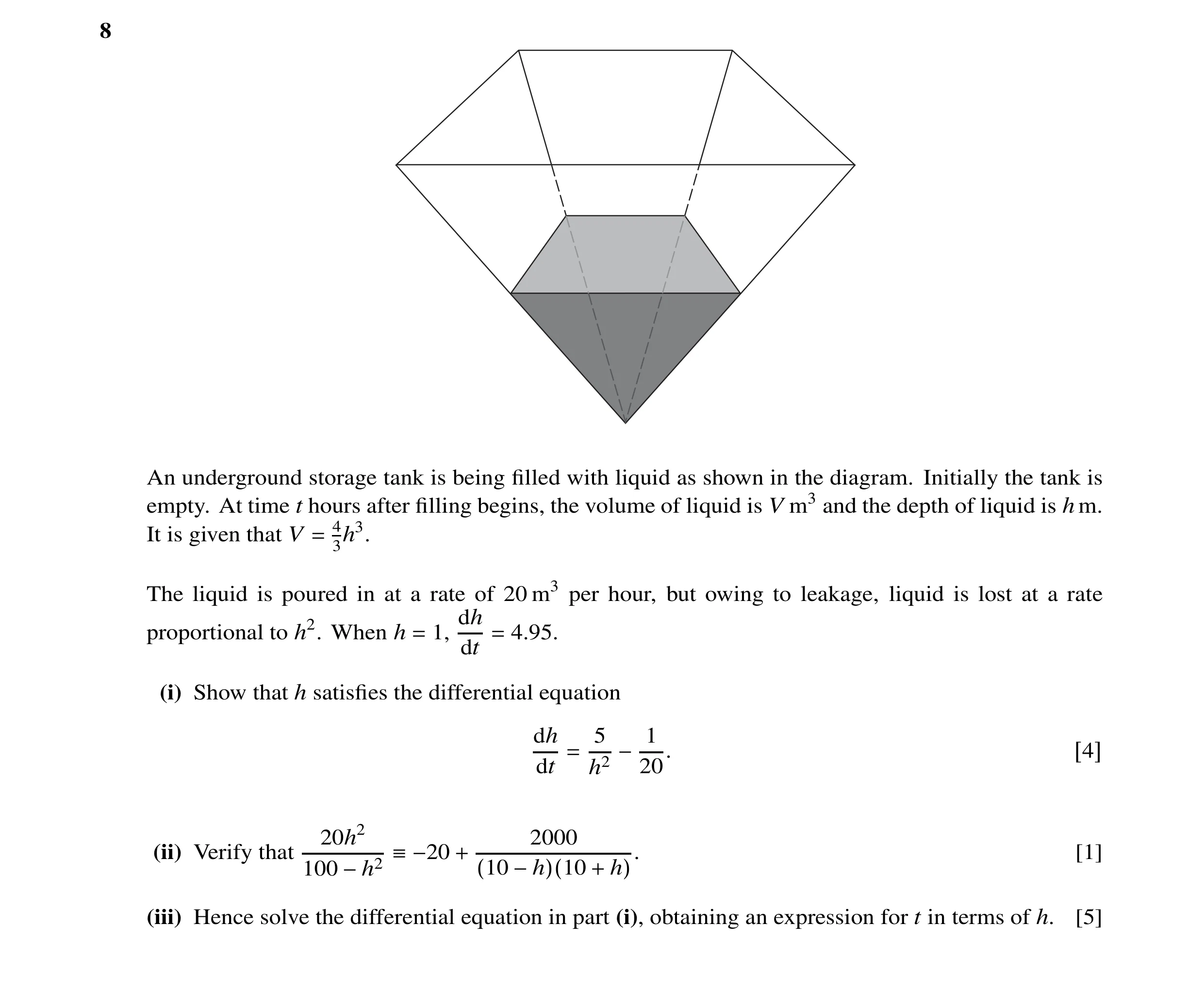
![Question 6: 0 8 (i) Express x2(10 −x) in partial fractions. [4] (ii) Given that x 1 when t 0, solve the differential equation = = dx 1 −x), dt = 100x2(…](https://img.pastlit.com/crops/263107bd-183f-434a-983a-7974f9768e0e/q8.webp)
![Question 7: x 38 (i) Express + in partial fractions. [5] (x + 1)2(3x + 2) 5x 3 (ii) Hence obtain the expansion of + in ascending powers of x, up to and…](https://img.pastlit.com/crops/2a04340e-e118-4900-bca2-4404ab2fc10d/q8.webp) 2 / 25
2 / 25![Question 8: x 8 (i) Express in partial fractions. [5] + (1 −x)(2 + x2) 1 x (ii) Hence obtain the expansion of in ascending powers of x, up to and inclu…](https://img.pastlit.com/crops/35d6677e-6411-4197-a9e1-6e07a41ed3f7/q8.webp)
![Question 9: 5x9 (i) Express + −x2 in partial fractions. [5] (1 −2x)(2 + x)2 4 5x (ii) Hence obtain the expansion of + −x2 in ascending powers of x, up …](https://img.pastlit.com/crops/539b23c9-b1a5-4b95-8a55-b17909a49e1f/q9.webp)
![Question 10: x 8 Let f(x) = (1 + x)(1 + 2x2). (i) Express in partial fractions. [5] f(x) (ii) Hence obtain the expansion of in ascending powers of x, up…](https://img.pastlit.com/crops/658e5349-2f08-4903-881d-6443720f3016/q8.webp)
 3 / 25
![Question 12: x −x2 8 (i) Express in partial fractions. [5] (1 + x)(2 + x2) 5x −x2 (ii) Hence obtain the expansion of in ascending powers of x, up to and…](https://img.pastlit.com/crops/4bf8f599-bb44-417c-8dac-7e136b851345/q8.webp)
![Question 13: The polynomial x4 3x3 ax 3 is denoted by It is given that is divisible by x2 1. + + + p(x). p(x) −x + (i) Find the value of a. [4] (ii) Whe…](https://img.pastlit.com/crops/eeddbbf1-4596-4dd3-a2b6-5c1c2786e5e0/q3.webp)
![Question 14: 8x29 (i) Express −7x + in partial fractions. [5] (3 −x)(1 + x2) 9 8x2 (ii) Hence obtain the expansion of −7x + in ascending powers of x, up…](https://img.pastlit.com/crops/12ace9eb-a4ff-499b-8558-db01d79e8850/q9.webp)
![Question 15: x2 −7x −1 7 Let f x = . x −2 x2 + 3 (i) Express f x in partial fractions. [5] (ii) Hence obtain the expansion of f x in ascending powers of…](https://img.pastlit.com/crops/a575eb4f-320f-4393-8689-6a54ea362bc0/q7.webp) 4 / 25
4 / 25![Question 16: 6 (i) Express in partial fractions. [2] 4 −y2 .............................................................................................…](https://img.pastlit.com/crops/30e4a639-f62d-48be-bef3-66259ea80d86/q6.webp)
![Question 17: Find the quotient and remainder when 6x4 x3 5x is divided by 2x2 1. [3] + −x2 + −6 −x + ...................................................…](https://img.pastlit.com/crops/eb2085d4-0f19-4ee5-a779-c53b68d19d26/q1.webp) 7 / 25
7 / 25![Question 18: a 210 Let f ( x) = , where a is a positive constant. ( 2a + x)( 2a - x)( 5a - 2x) (a) Express f ( x) in partial fractions. [5] ............…](https://img.pastlit.com/crops/7e578ace-a8a9-41e0-8743-11cacfdd1971/q10.webp)
![Question 19: Express 2 in partial fractions. [5] 2x - 5x - 12 ..........................................................................................…](https://img.pastlit.com/crops/18234476-d402-4642-b4fc-9b7d05c714cf/q2.webp) 10 / 25
10 / 25![Question 20: x 2 - 2x + 2 5 Express in partial fractions. [5] ( x - 1)( 2x + 1) ........................................................................…](https://img.pastlit.com/crops/d2d39ed6-d2b4-4ffa-ad32-37304543c1ec/q5.webp) 11 / 25
11 / 25![Question 21: 2 5x + 8x + 5 Let f ( x) = . ( 1 + 2 x)( 2 + x 2 ) (a) Express f ( )x in partial fractions. [5] ...........................................…](https://img.pastlit.com/crops/c689de65-af71-4aa6-a97a-6eb08bd70841/q7.webp)
![Question 22: a 2 8 Let f ( x) = , where a is a positive constant. ( a - 2x)( 3a + x) (a) Express f ( )x in partial fractions. [3] ......................…](https://img.pastlit.com/crops/0e06fcb7-d82e-40ae-b193-314a4df26a57/q8.webp)
![Question 23: - 7x 2 + 2 x - 6 10 Let f ( x) = . `1 + x`j4 + x 2j (a) Express f ( )x in partial fractions. [5] ..........................................…](https://img.pastlit.com/crops/2c04f3ce-b394-41b6-b9af-93f655a5bbd0/q10.webp)
![Question 24: a - 5x 7 Let f ( x) = , where a is a positive constant. ( 3 a + 2x)( 2a - x) (a) Express f ( )x in partial fractions. [3] .................…](https://img.pastlit.com/crops/415ffc4f-fb97-4c15-bcf3-c75615bc7963/q7.webp)
![Question 25: x 2 + 55 x - 2 9 (a) Express in partial fractions. [5] ( 3x - 2 )( x + 6 ) ................................................................…](https://img.pastlit.com/crops/1821d94c-9937-4bdb-b639-2a05274a3e6e/q9.webp)
![Question 26: x 2 + 4 ax + 6a 2 9 Let f ( x) = , where a is a positive constant. ( x + 2 a)( x + 3 a) (a) Express f ( x) in partial fractions. [5] ......…](https://img.pastlit.com/crops/f5e004ff-26c4-46a2-a338-e8ed2bf9d1b6/q9.webp)
![Question 27: 10 (a) Express in partial fractions. [2] 1 - 9y 2 .........................................................................................…](https://img.pastlit.com/crops/a04cea19-353d-4ed0-876c-c4b4619e09a6/q10.webp)
 9
9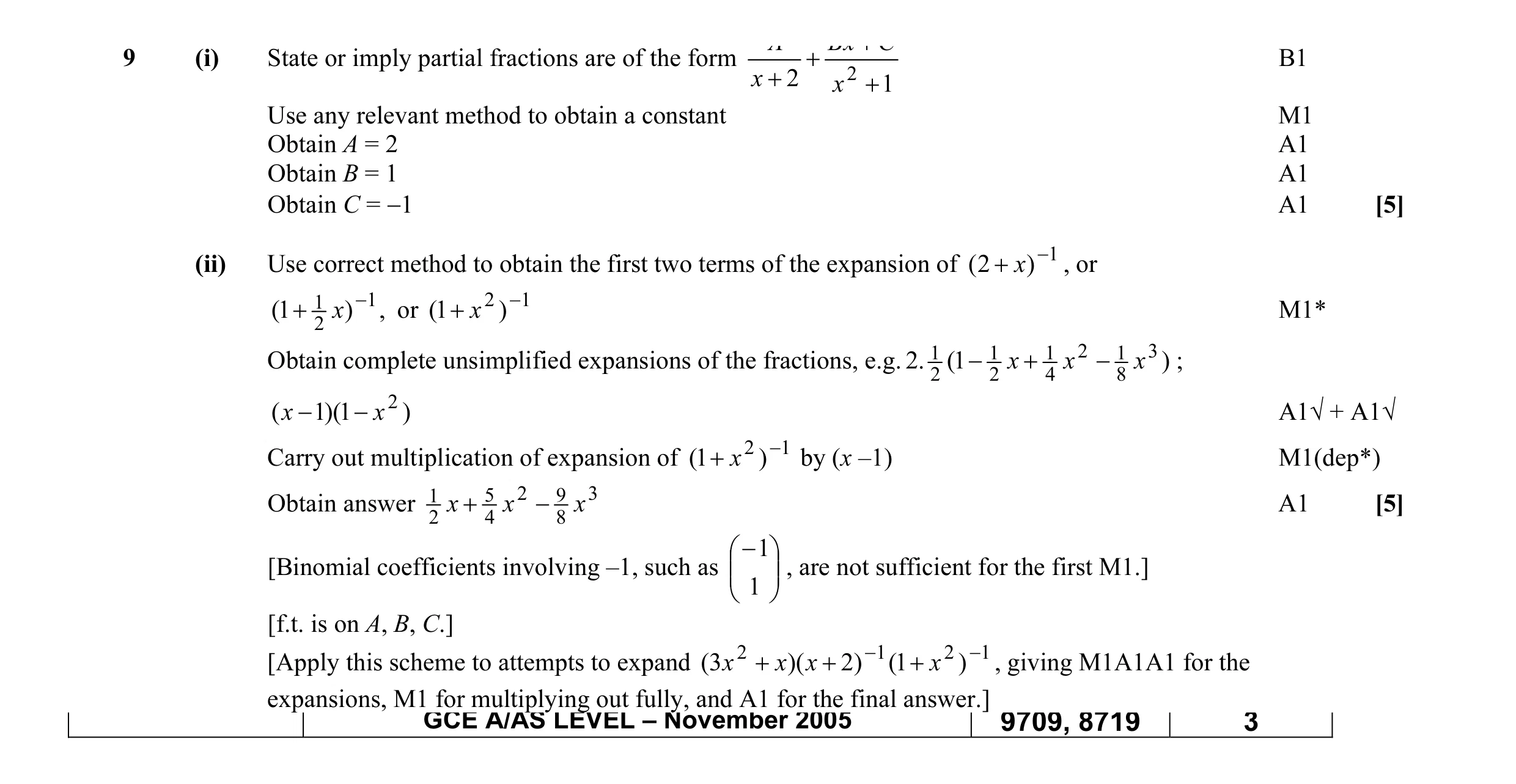 10
10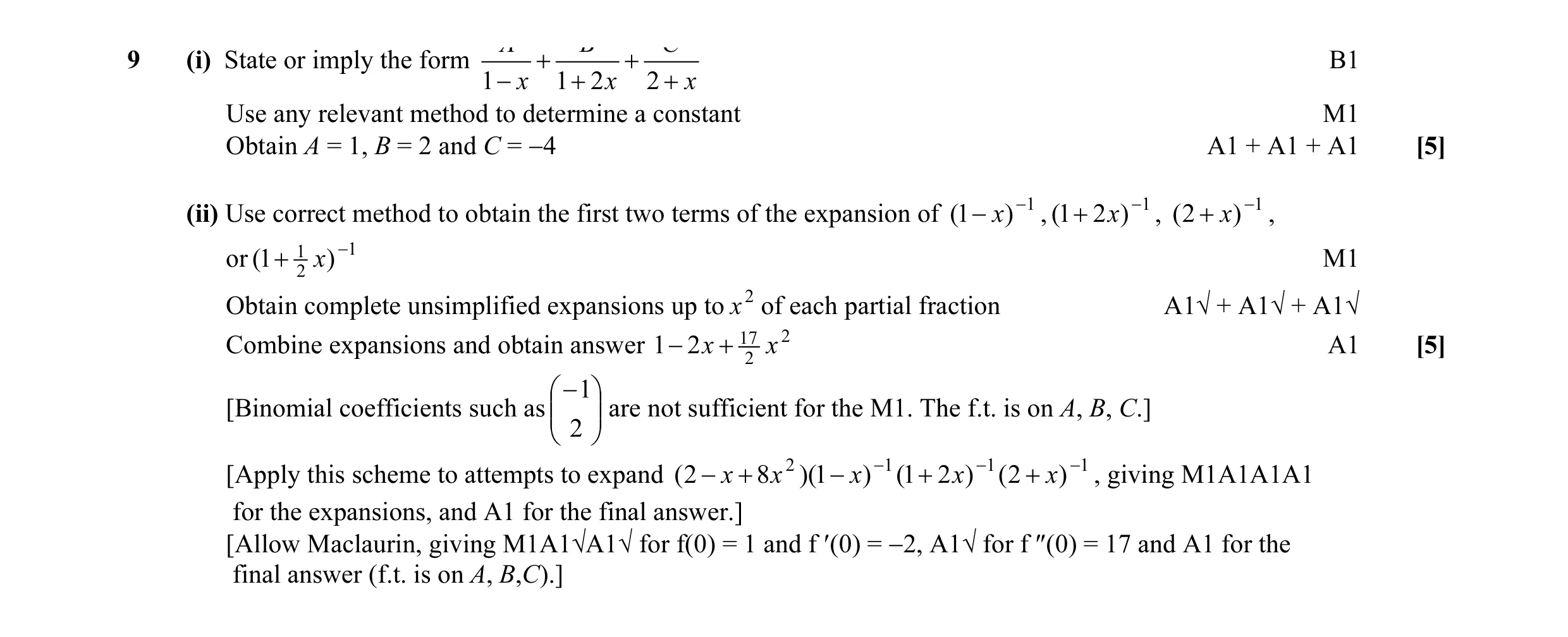 10
10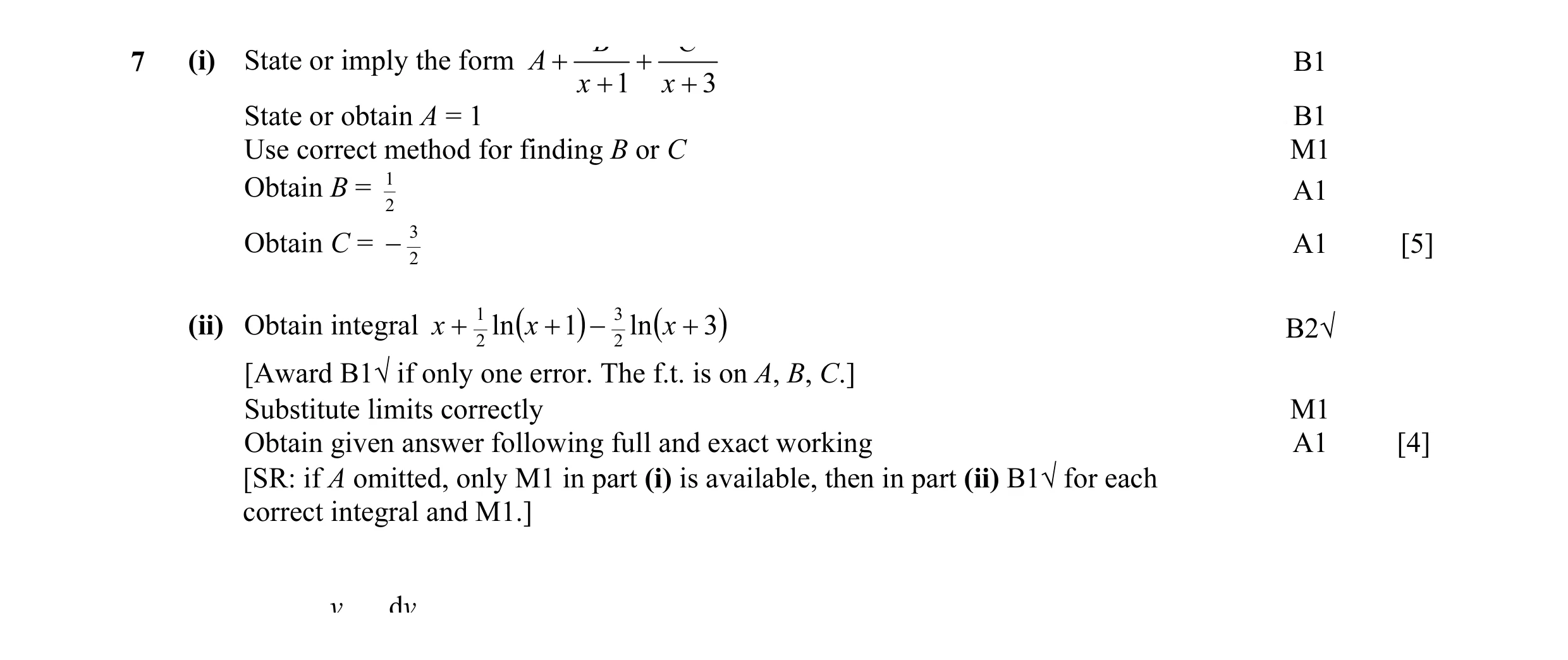 9
9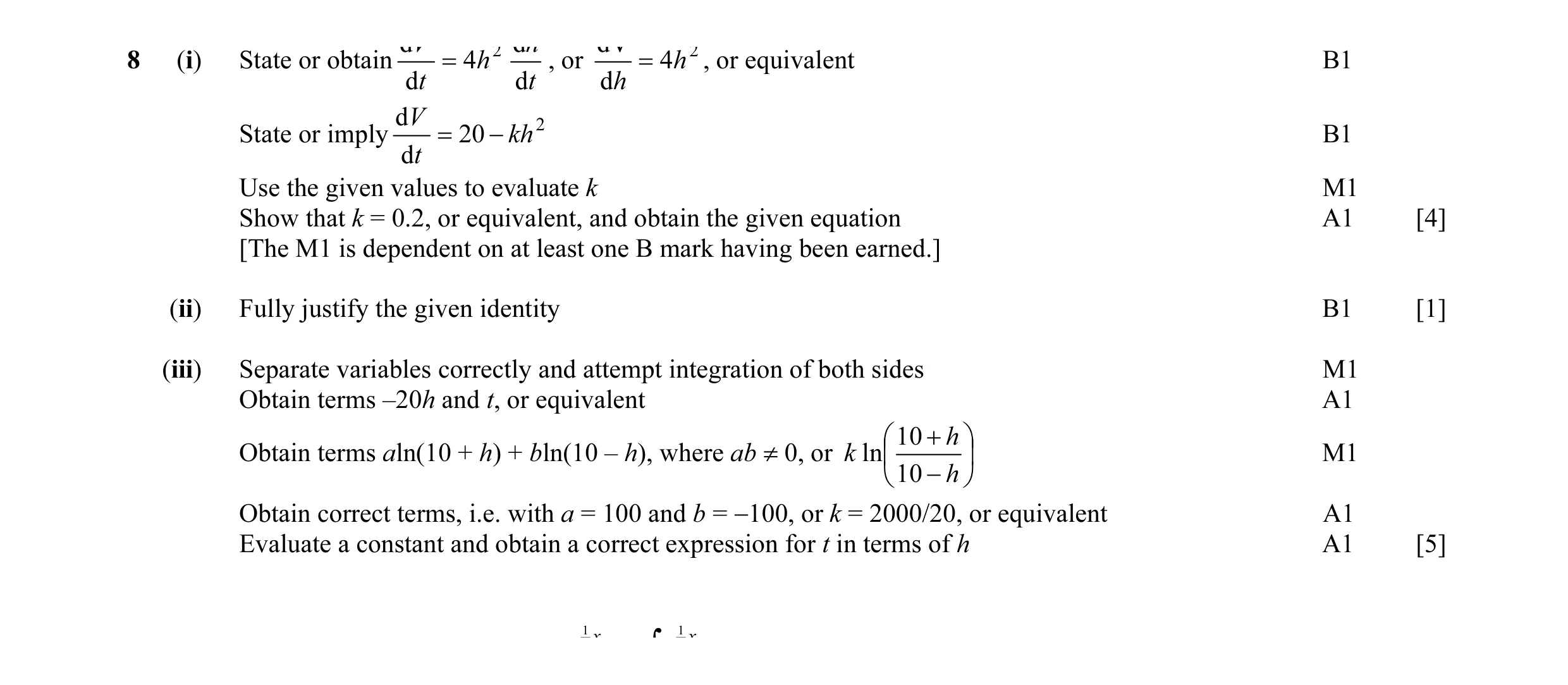 10
10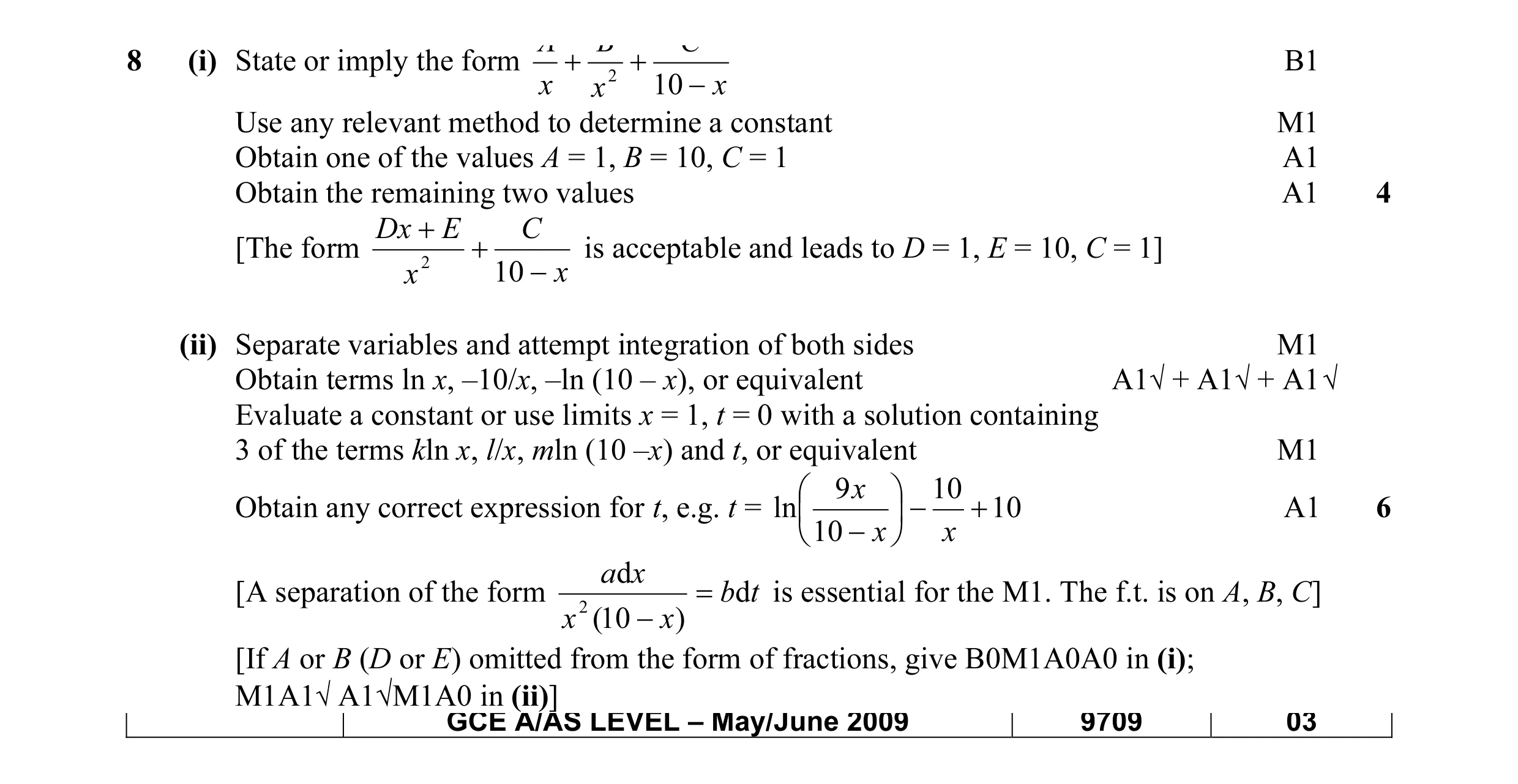 10
10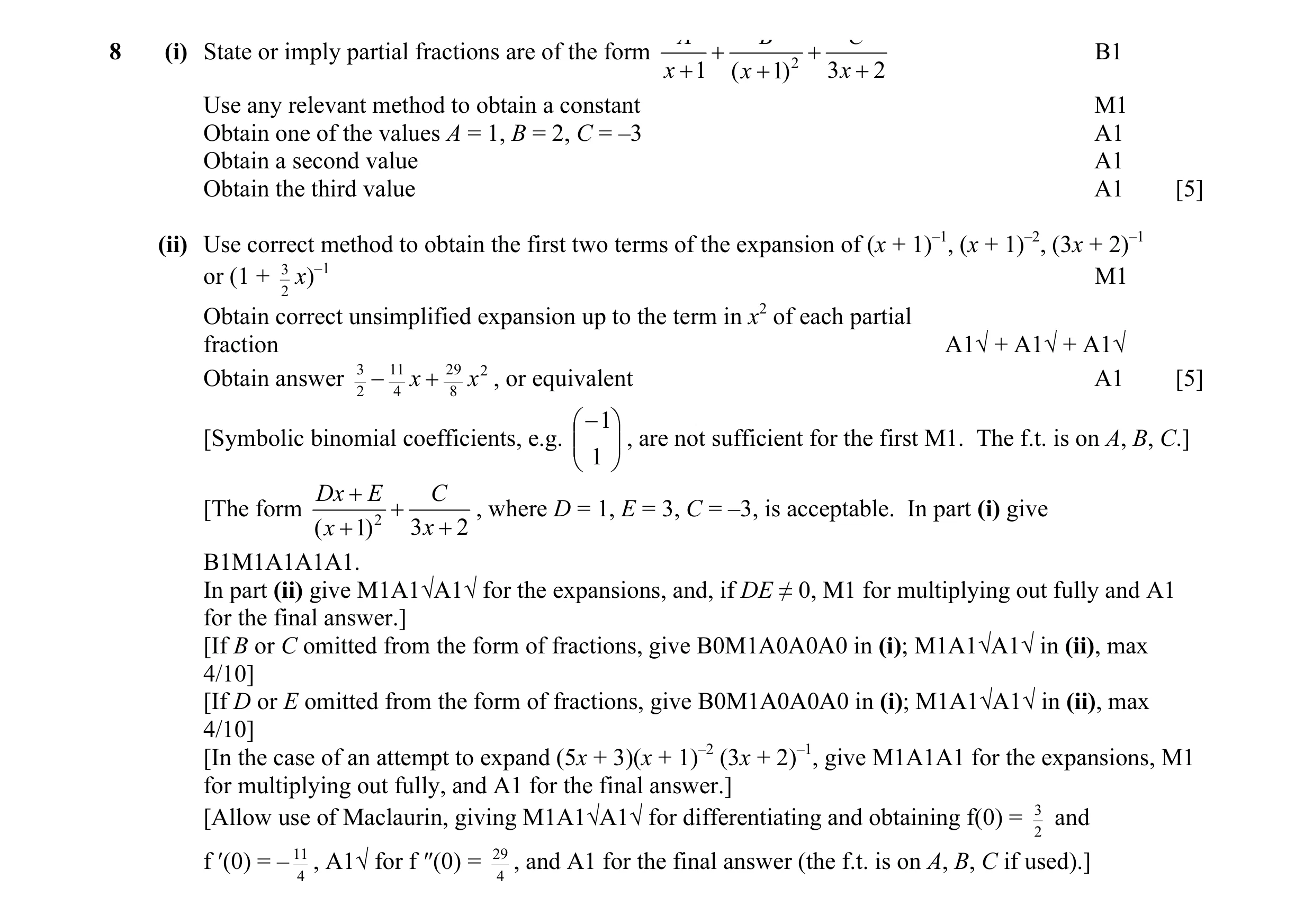 10
10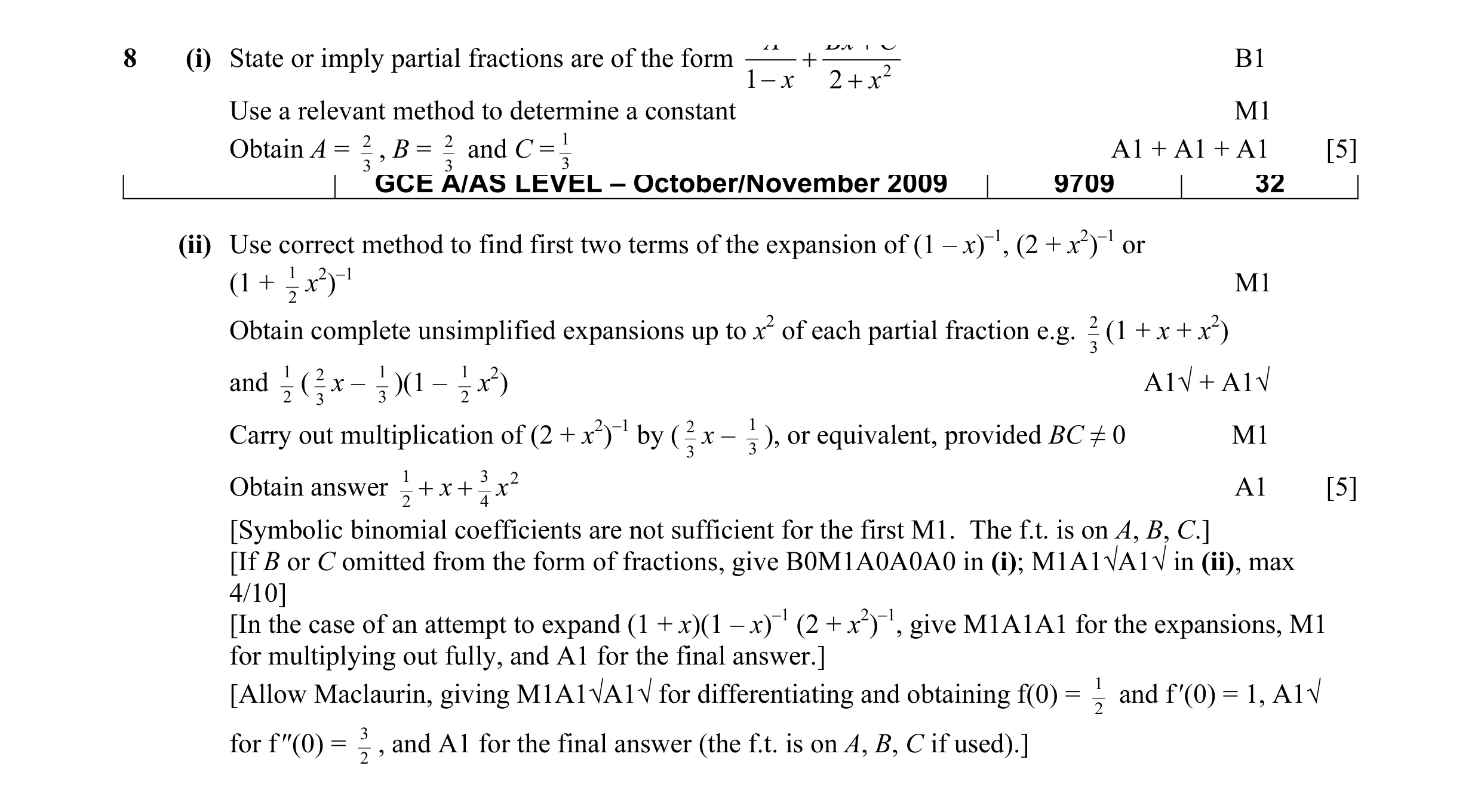 10
10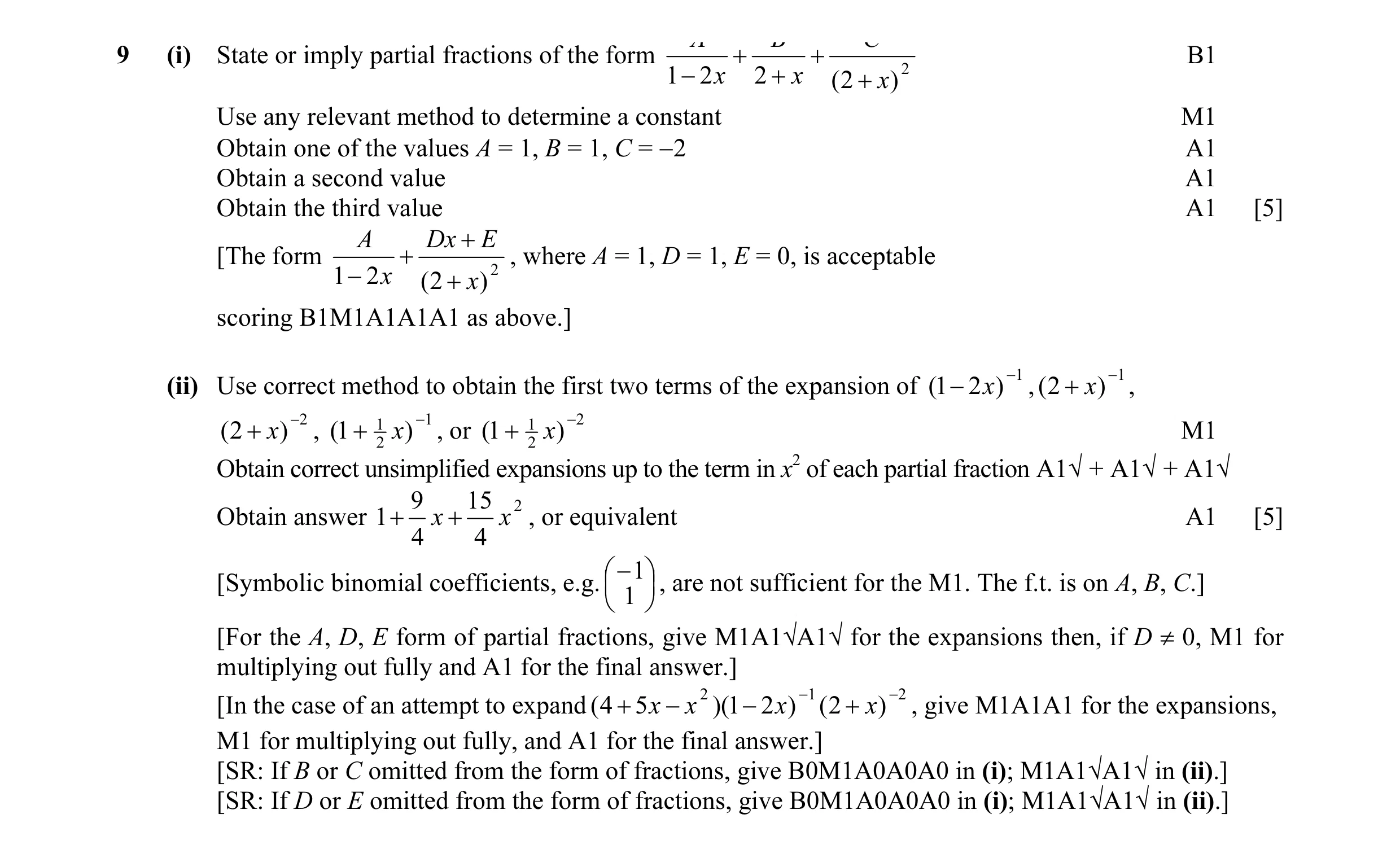 10
10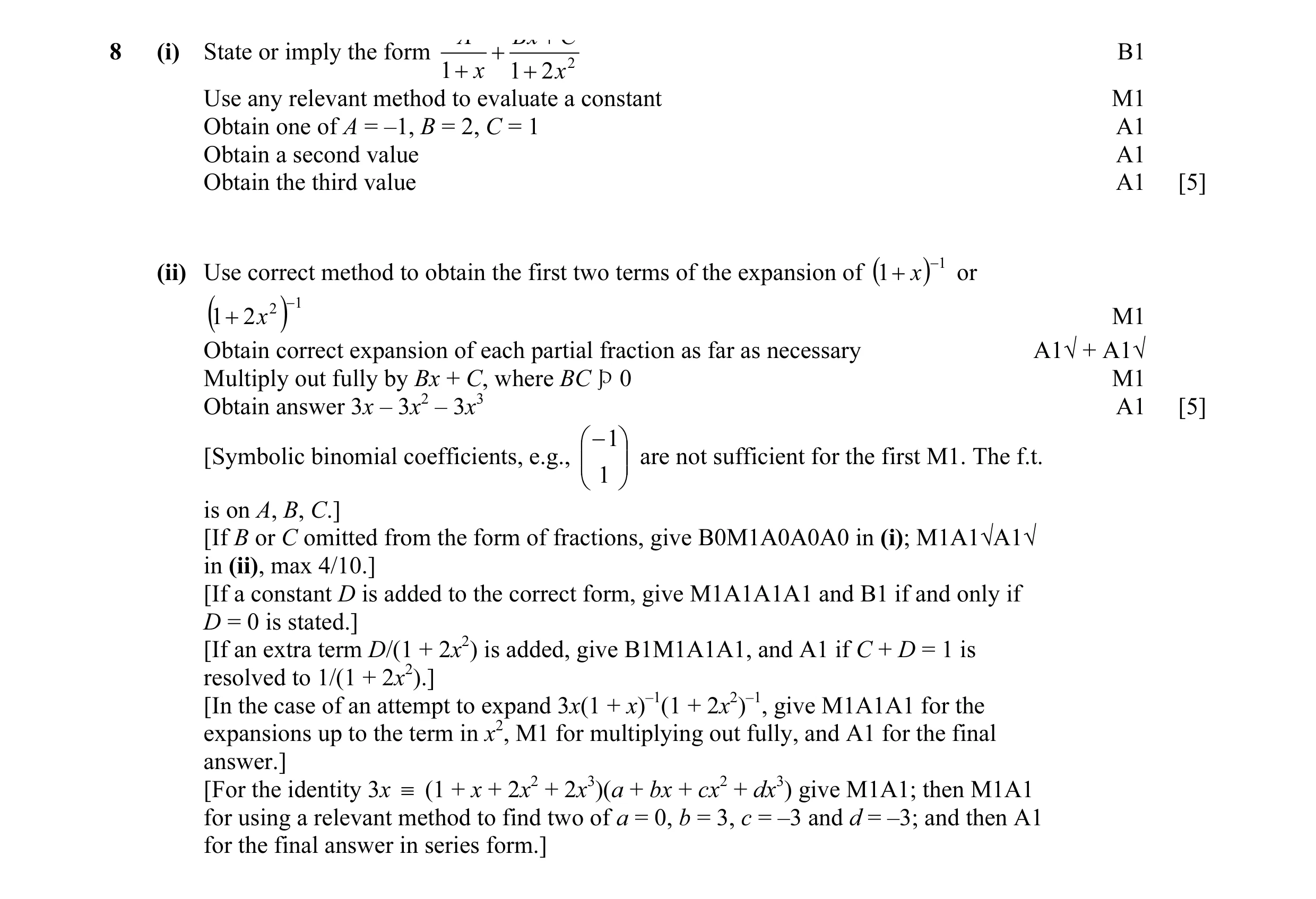 10
10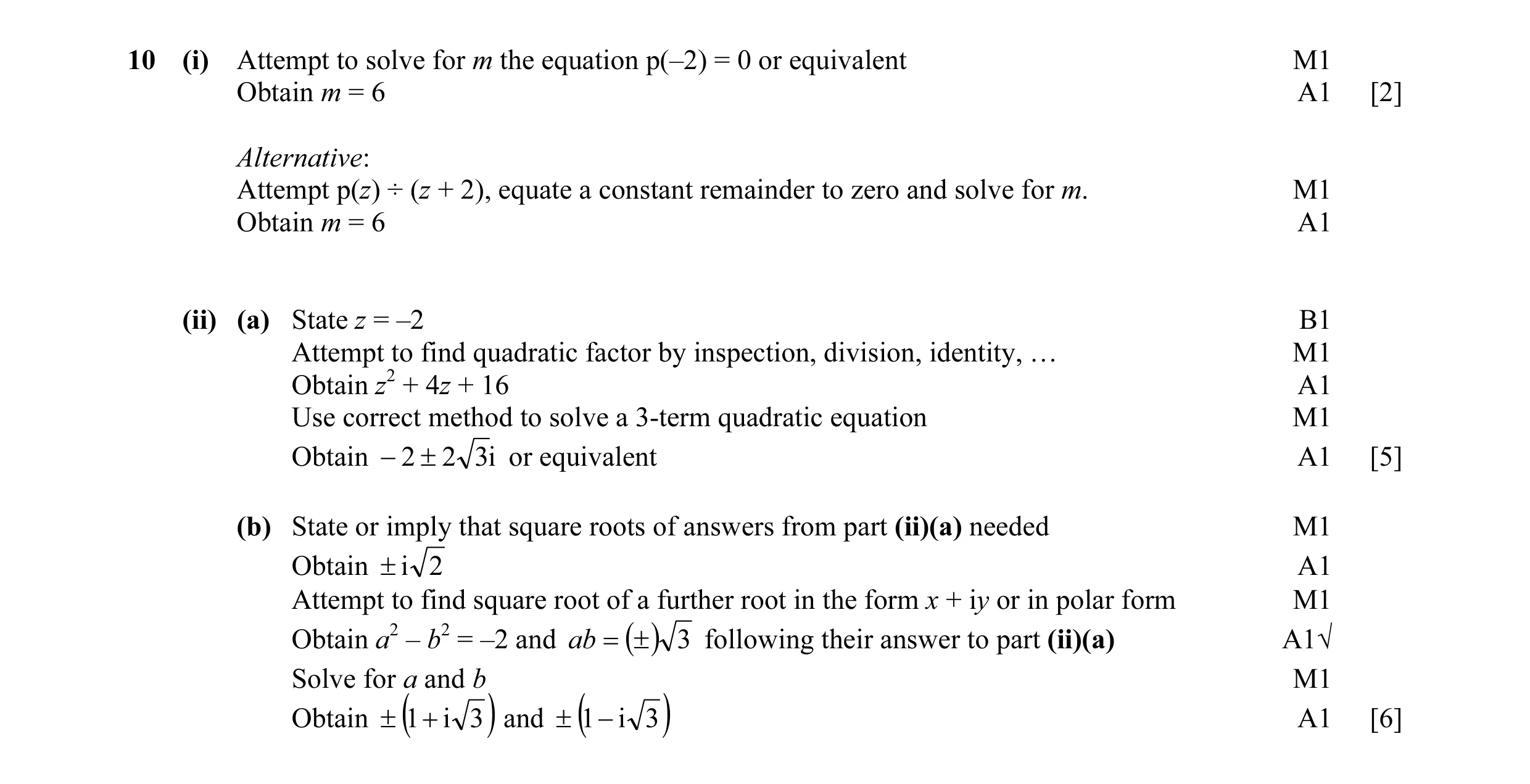 13
13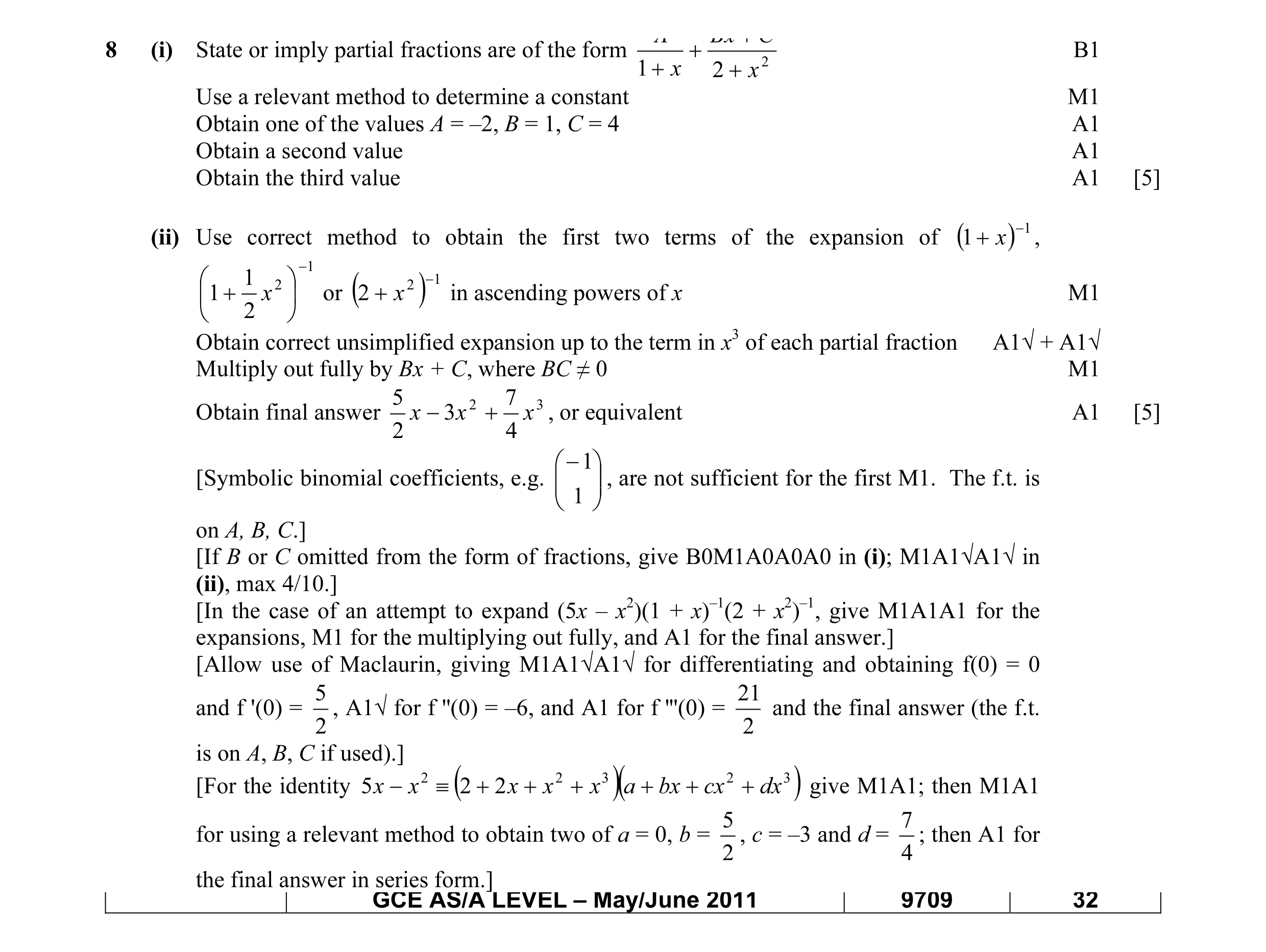 10
10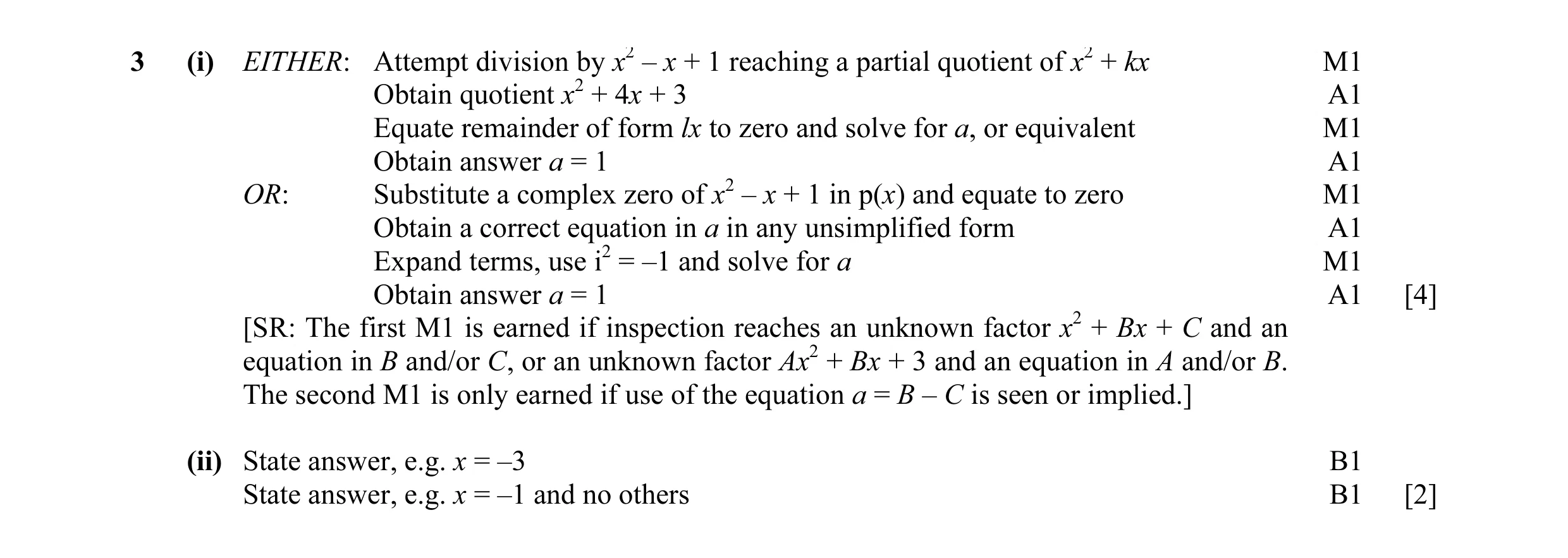 6
6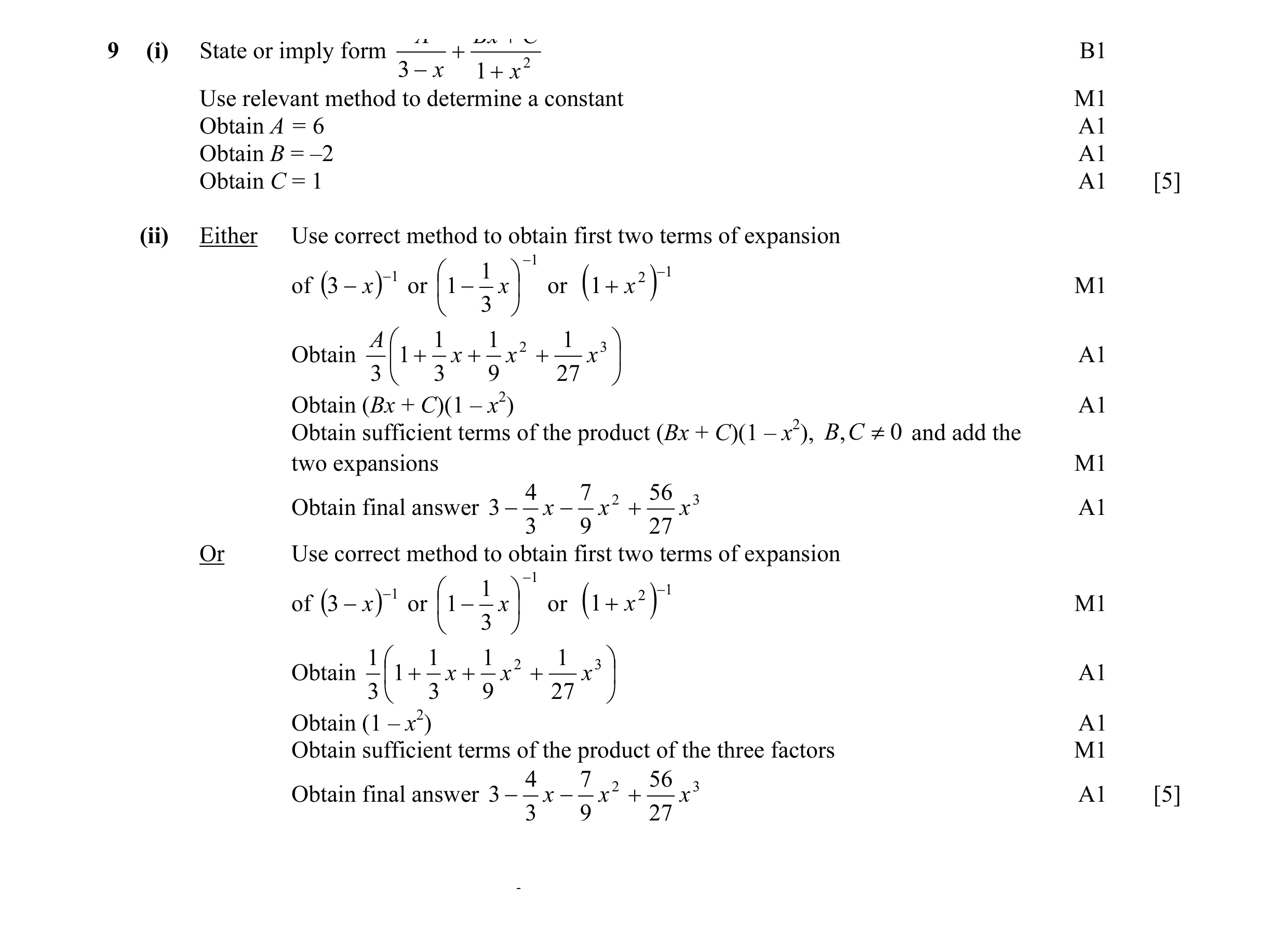 10
10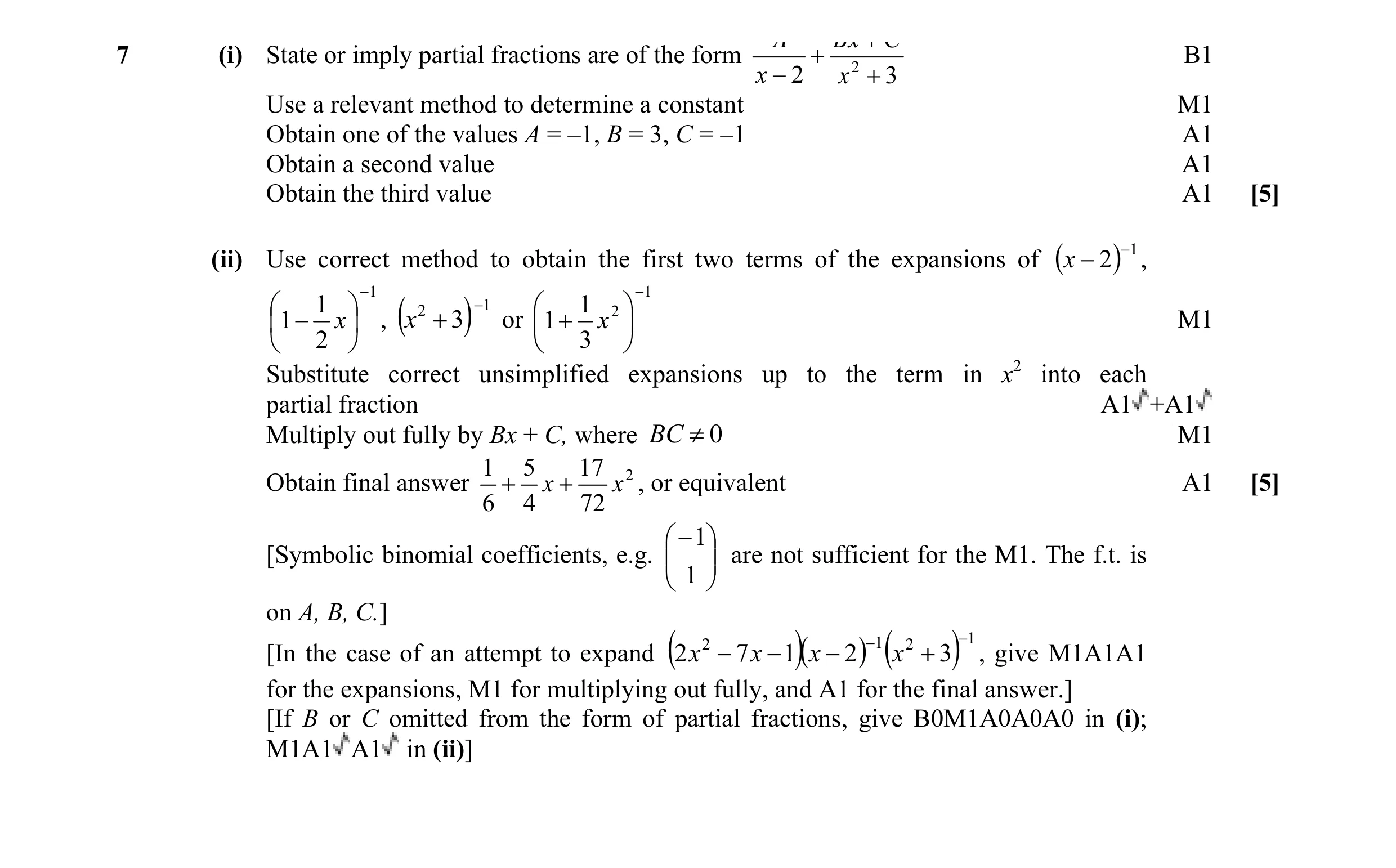 10
10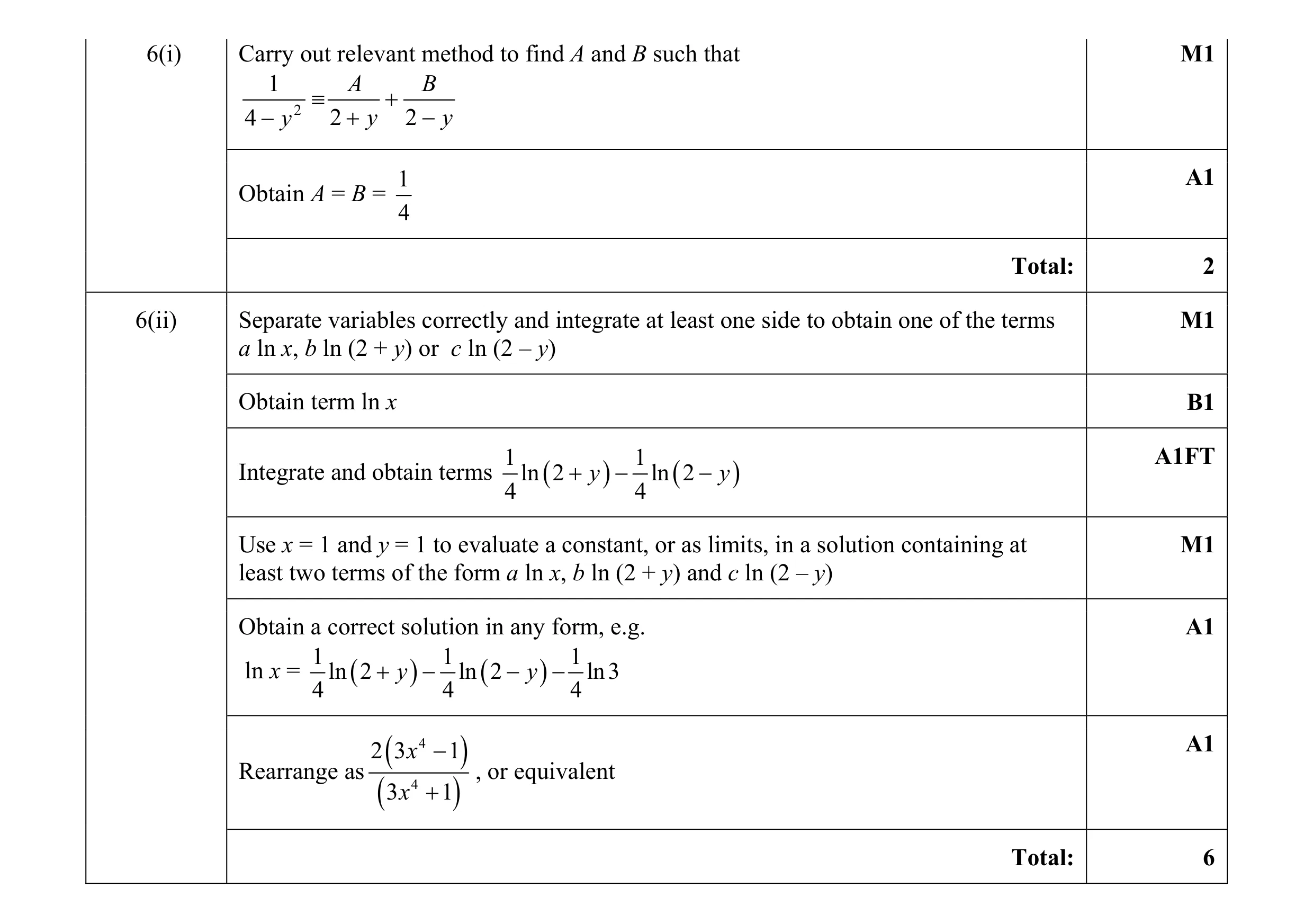 8
8 3
3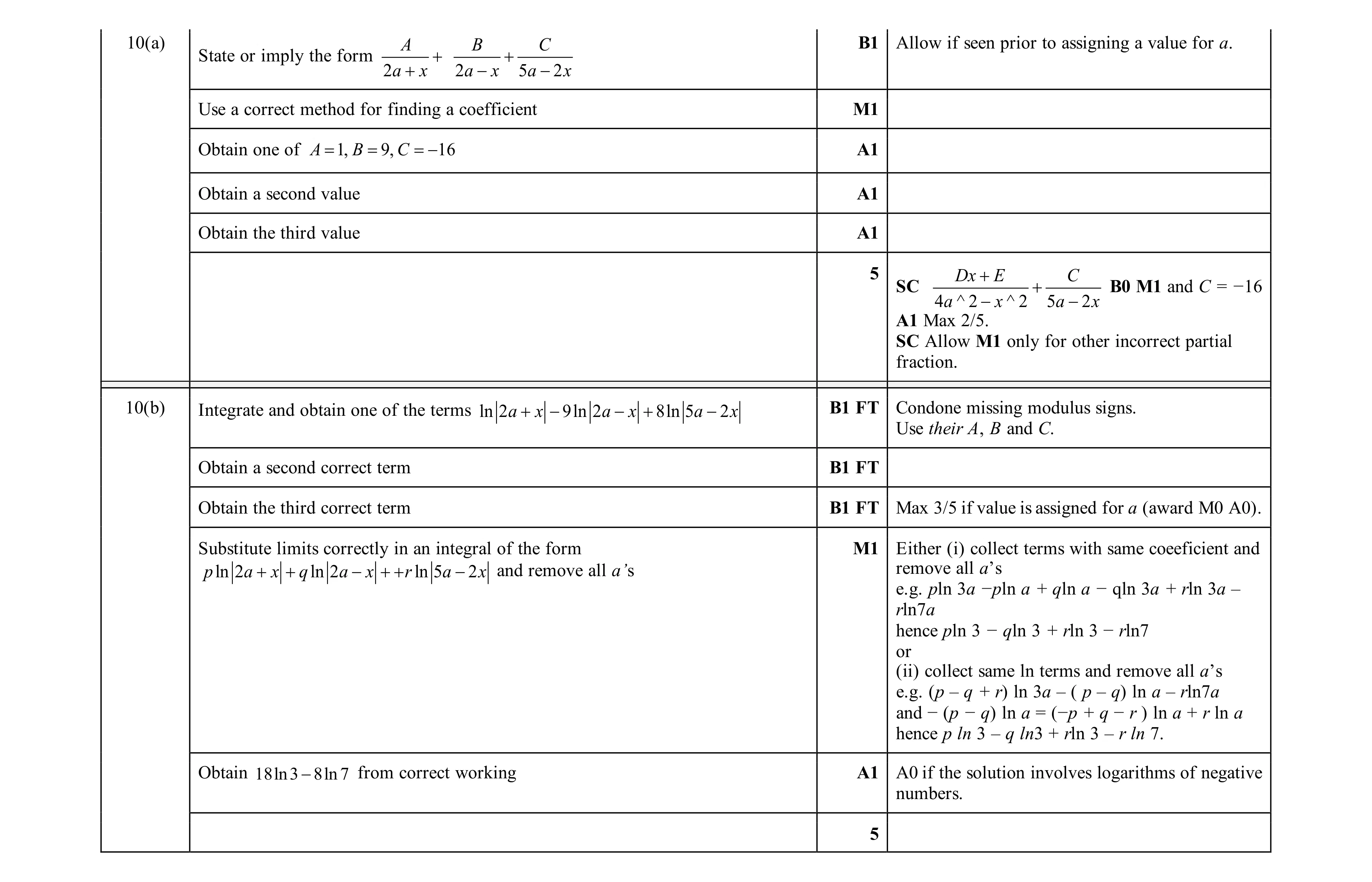 10
10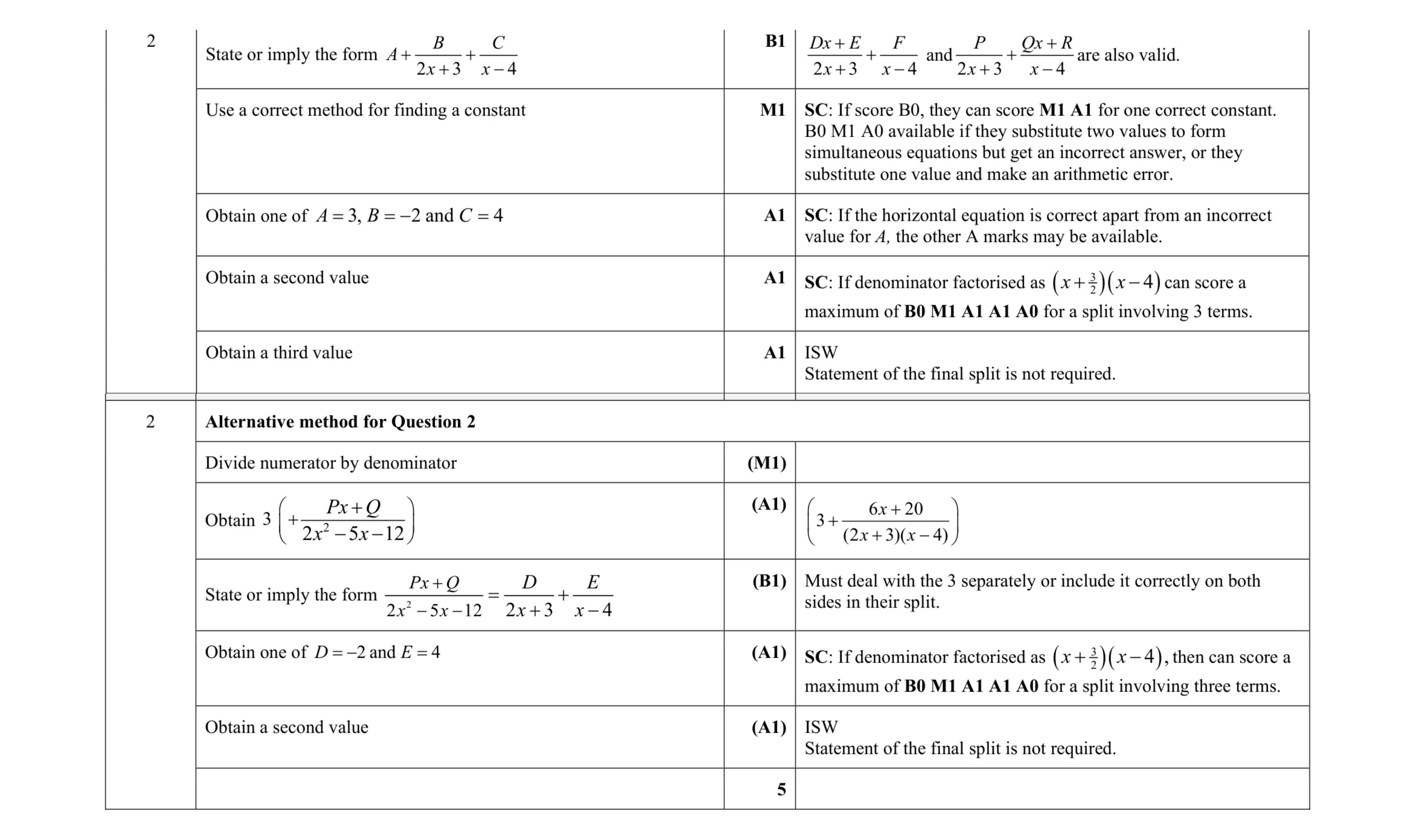 5
5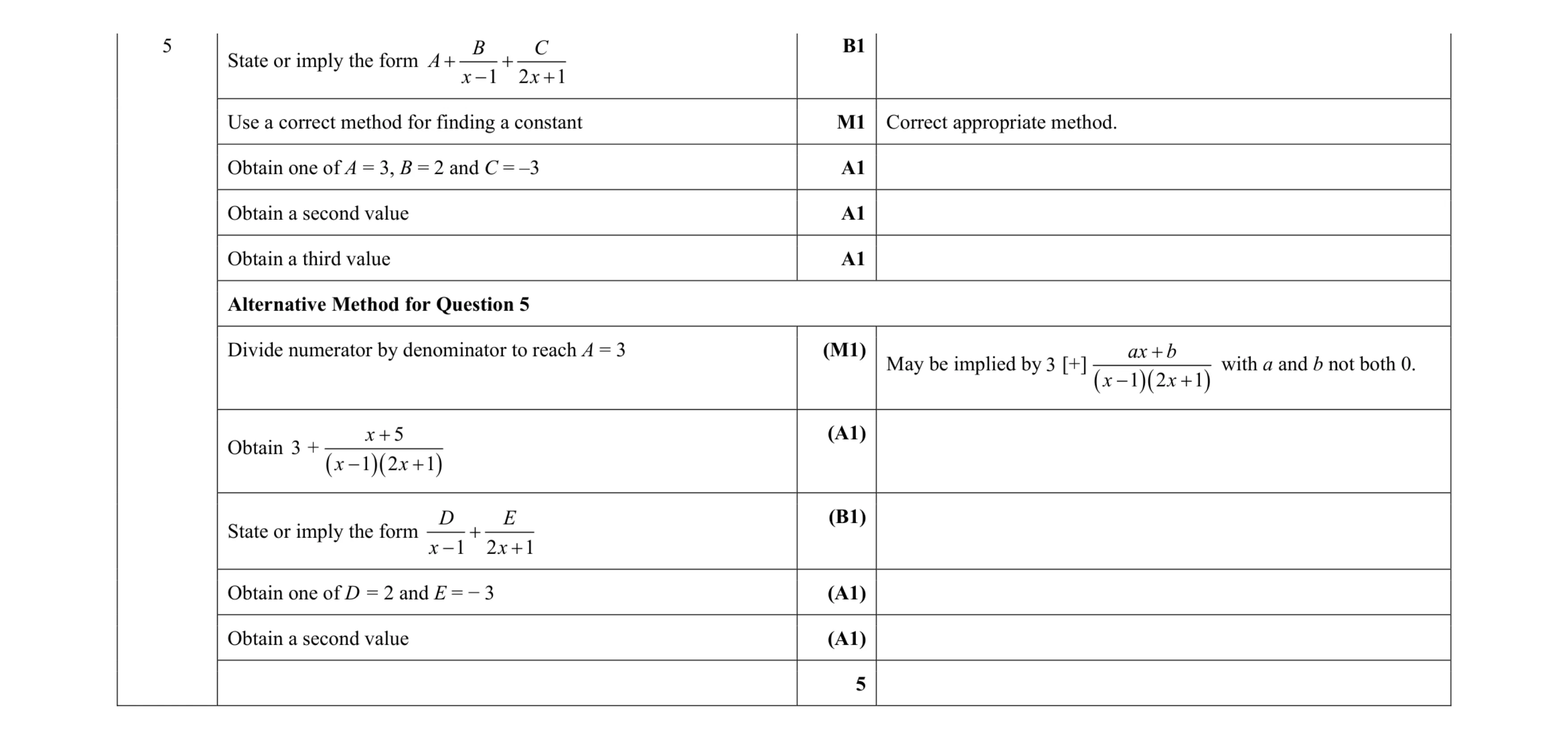 5
5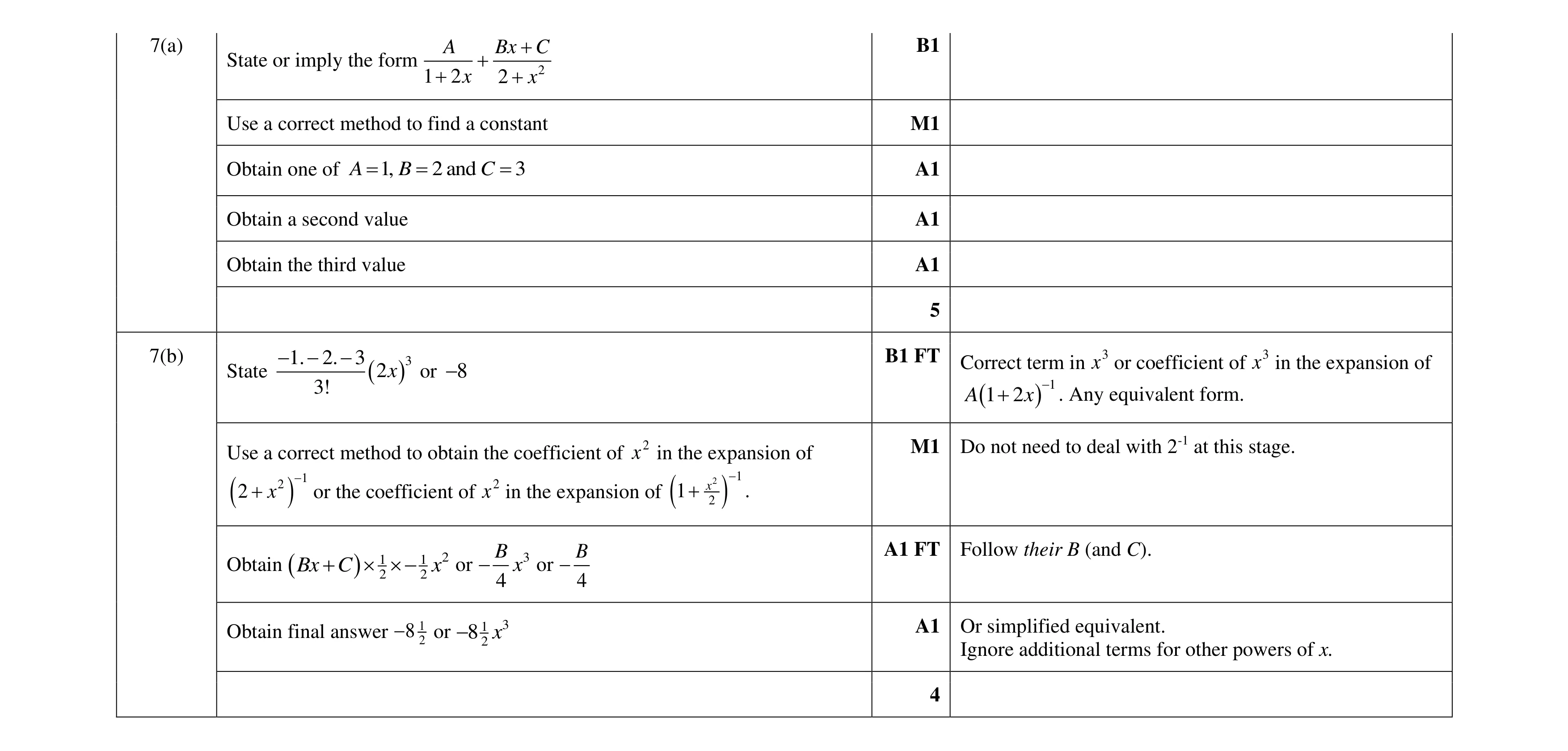 9
9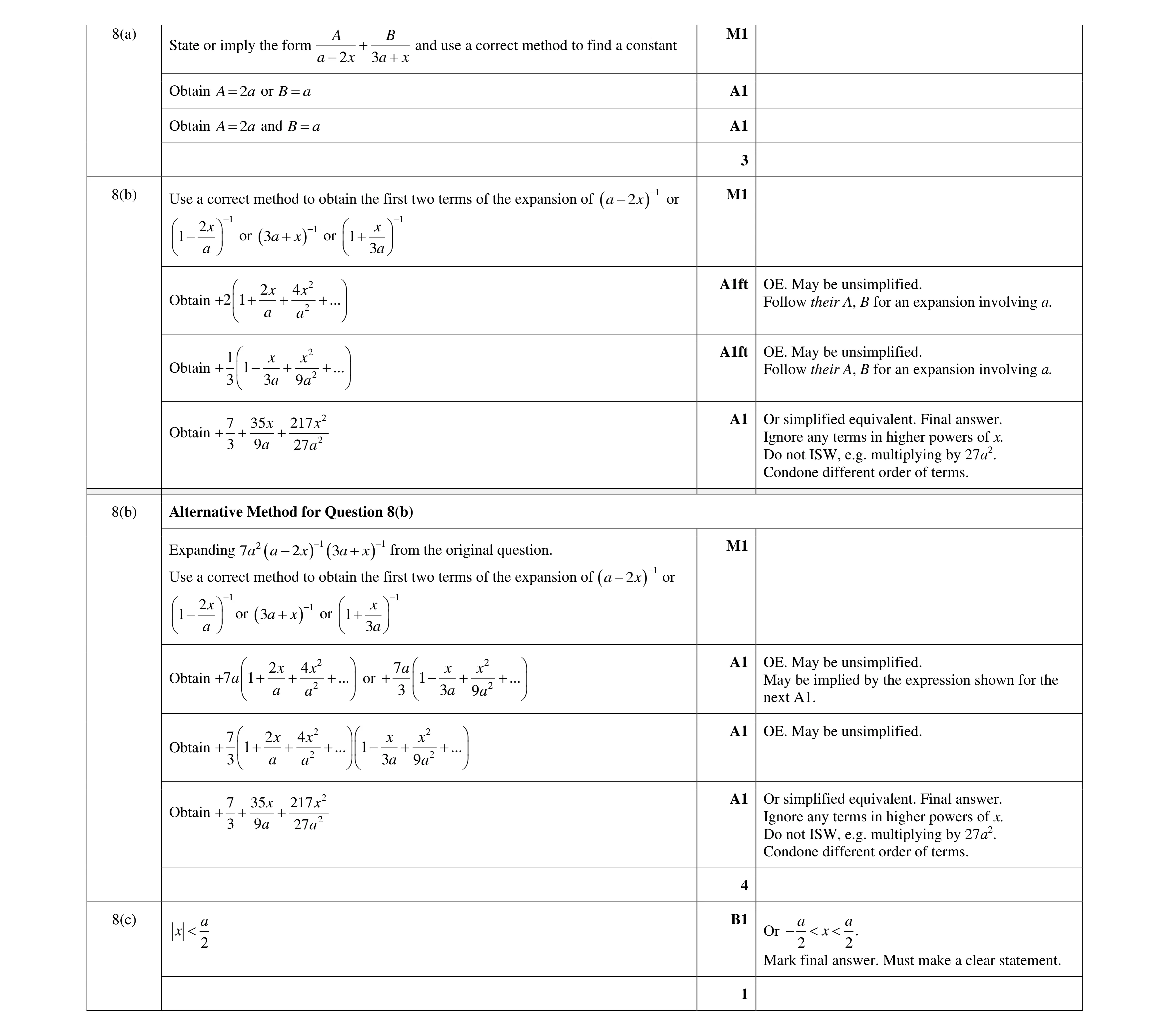 8
8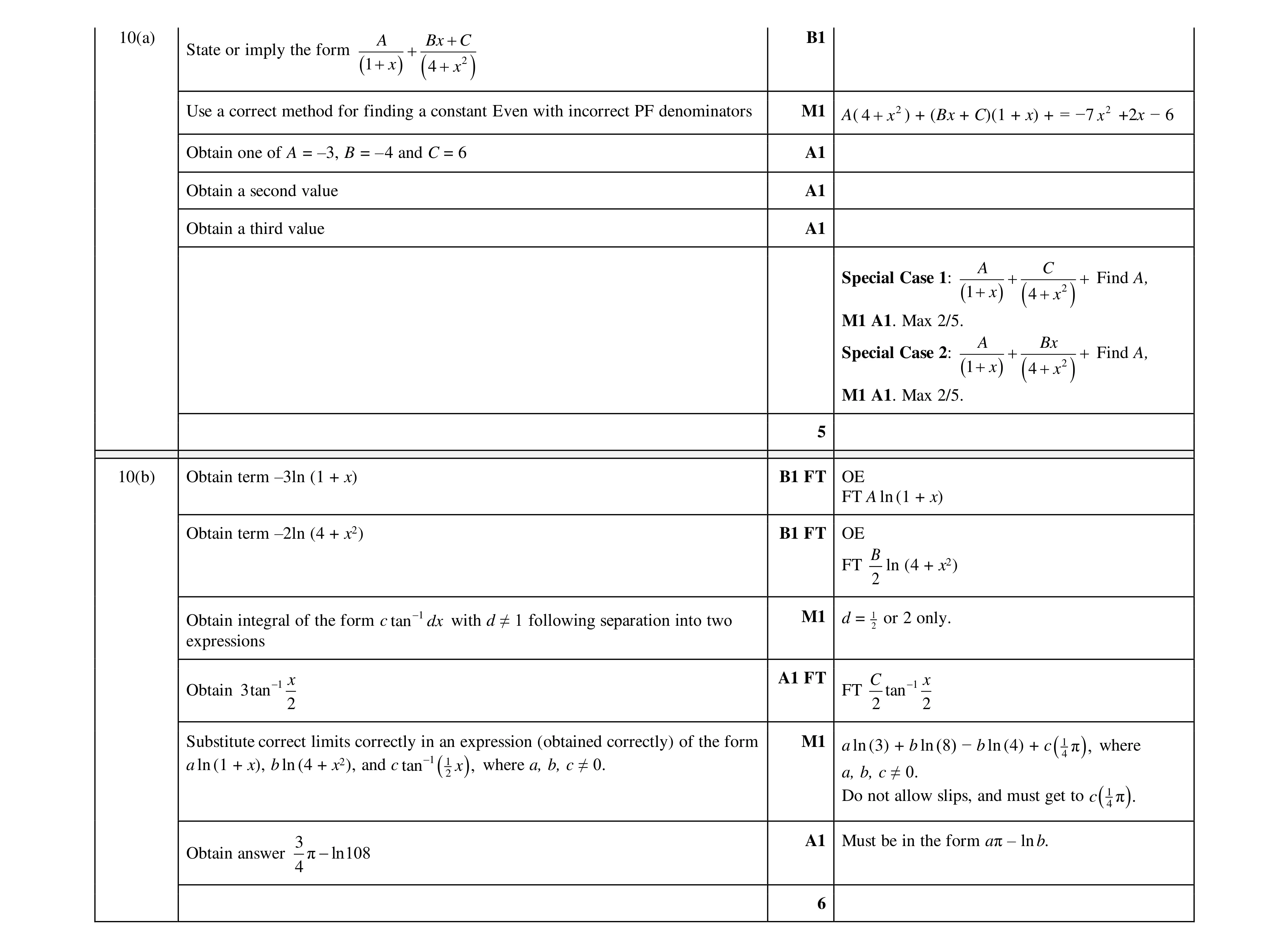 11
11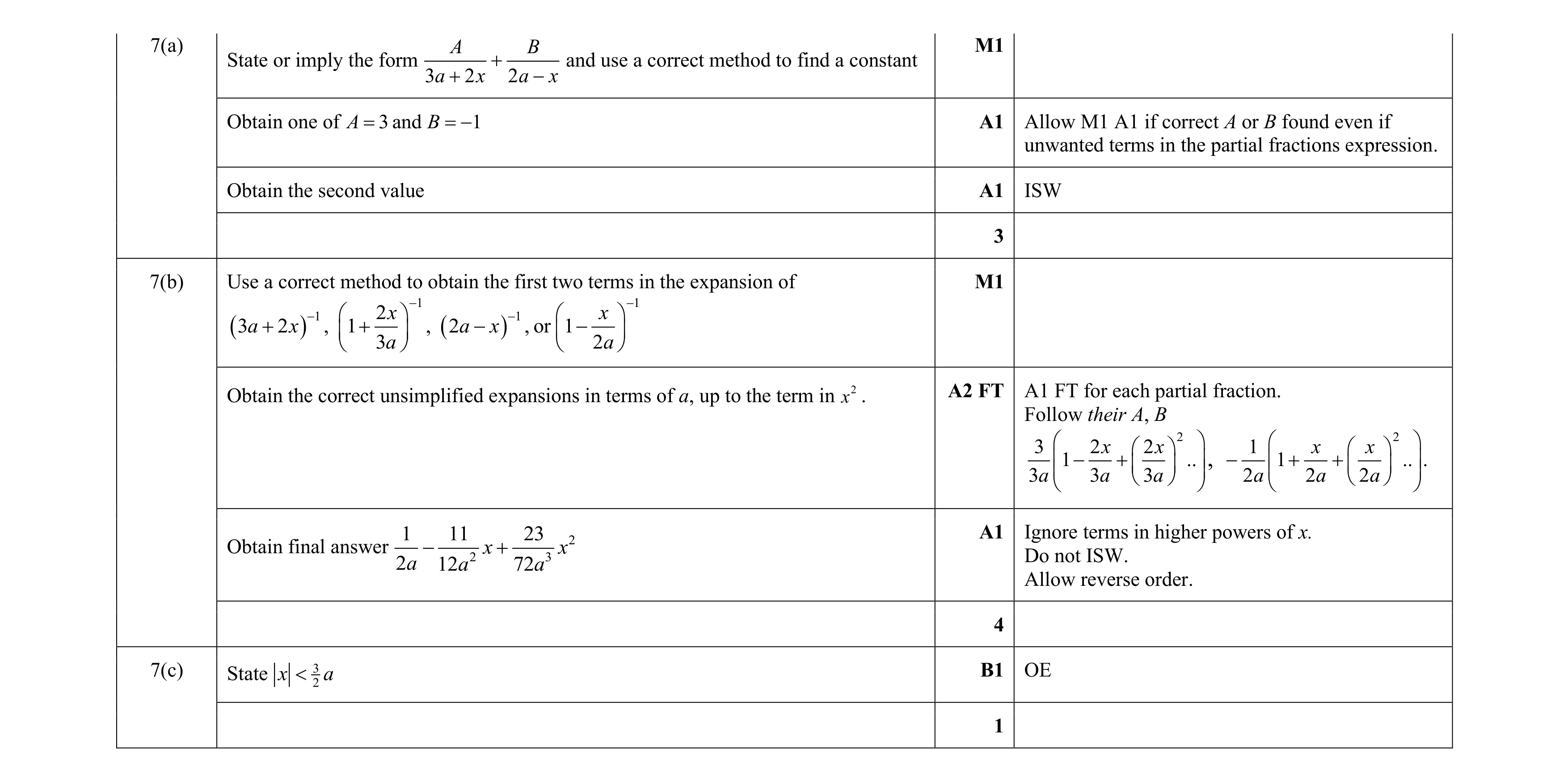 8
8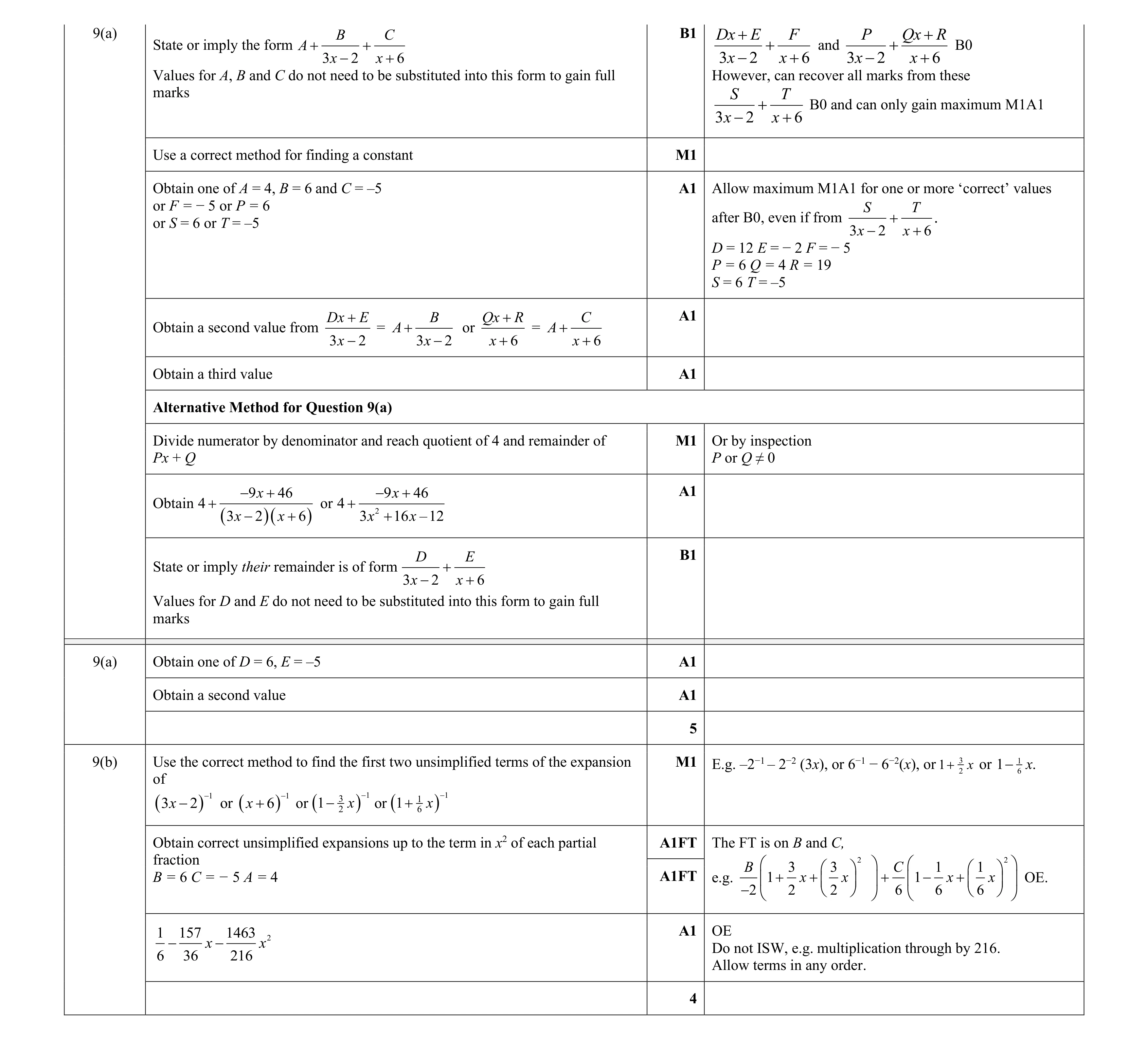 9
9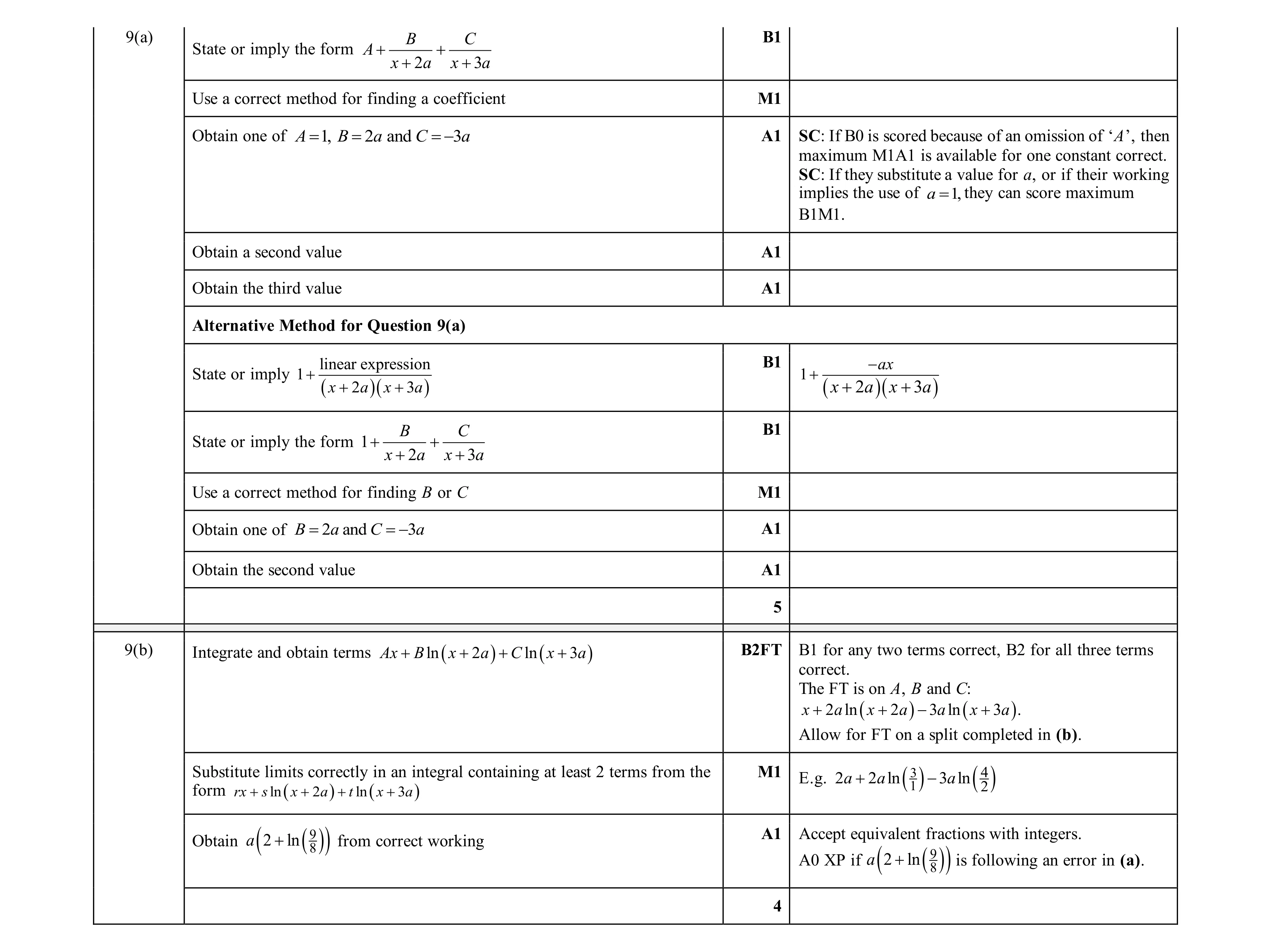 9
9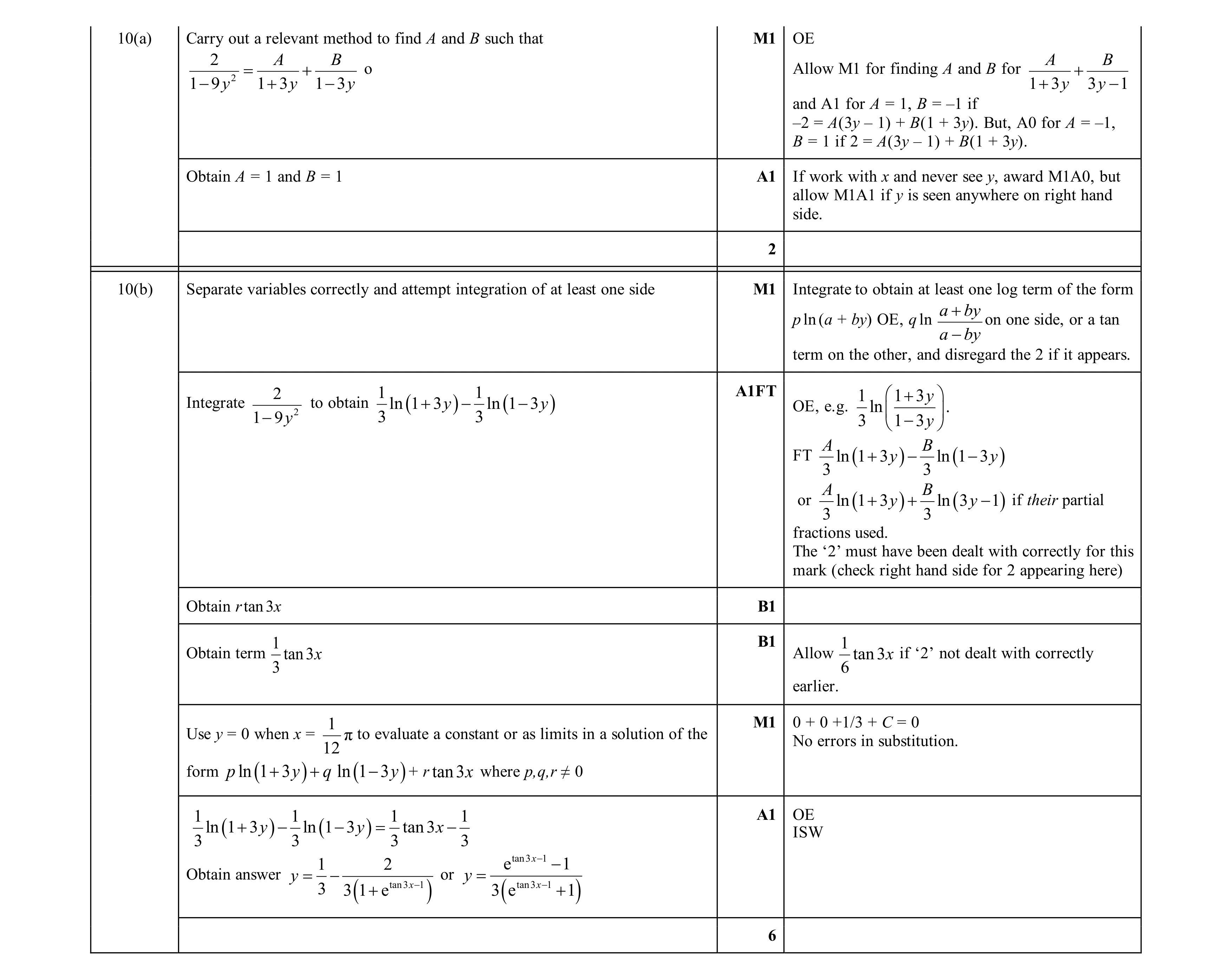 8
8