Cambridge A Level Mathematics 9709 — 2005 Oct/Nov Paper 3 · Variant 1
9709/31/O/N/05 · 10 questions · 75 marks · ≈84 min
The question paper and its mark scheme, free to read here and free to download. This is Cambridge’s own paper, exactly as it was sat.
Question paper4 pages
Mark scheme6 pages
Answers below. Sit the paper first if you are practising.
Questions as text
Q1 · Given that a is a positive constant, solve the inequality |x −3a| > |x −a|
1 Given that a is a positive constant, solve the inequality |x −3a| > |x −a| . [4]
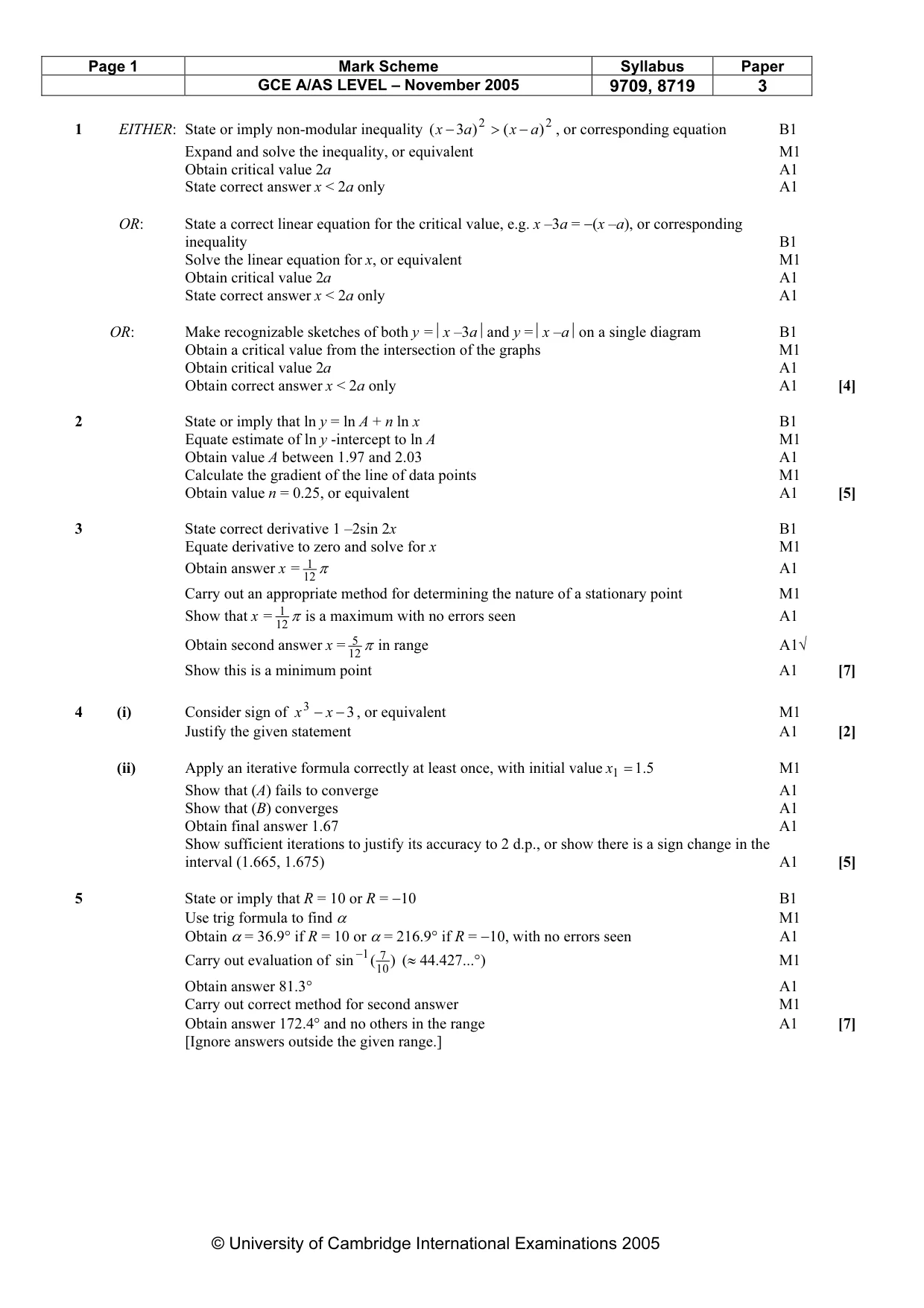
Mark scheme: 1 EITHER: State or imply non-modular inequality ( x − 3a ) 2 > ( x − a ) 2 , or corresponding equation B1 Expand and solve the inequality, or equivalent M1 Obtain critical value 2a A1 State correct answer x < 2a only A1 OR: State a correct linear equation for the critical value, e.g. x –3a = −(x –a), or corresponding inequality B1 Solve the linear equation for x, or equivalent M1 Obtain critical value 2a A1 State correct answer x < 2a only A1 OR: Make recognizable sketches of both y = x –3a and y = x –a on a single diagram B1 Obtain a critical value from the intersection of the graphs M1 Obtain critical value 2a A1 Obtain correct answer x < 2a only A1 [4]
Q2 · Two variable quantities x and y are related by the equation y = Axn, where A and n are…
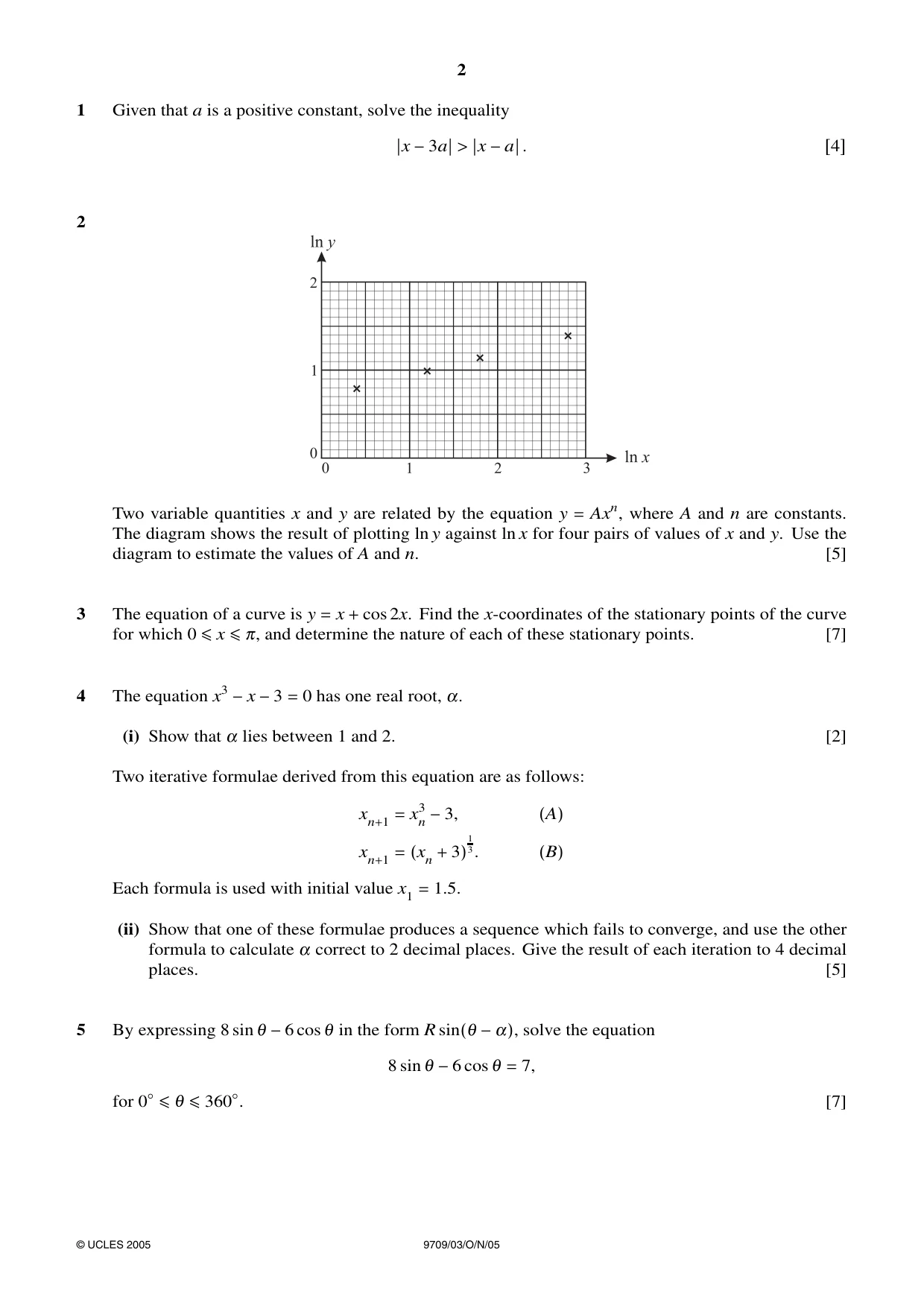
2 Two variable quantities x and y are related by the equation y = Axn, where A and n are constants. The diagram shows the result of plotting ln y against ln x for four pairs of values of x and y. Use the diagram to estimate the values of A and n. [5]
Mark scheme: 2 State or imply that ln y = ln A + n ln x B1 Equate estimate of ln y -intercept to ln A M1 Obtain value A between 1.97 and 2.03 A1 Calculate the gradient of the line of data points M1 Obtain value n = 0.25, or equivalent A1 [5]
Q3 · The equation of a curve is y = x + cos 2x
3 The equation of a curve is y = x + cos 2x. Find the x-coordinates of the stationary points of the curve for which 0 ≤x ≤π, and determine the nature of each of these stationary points. [7]
Mark scheme: 3 State correct derivative 1 –2sin 2x B1 Equate derivative to zero and solve for x M1 Obtain answer x = 1 π A1 12 Carry out an appropriate method for determining the nature of a stationary point M1 Show that x = 1 π is a maximum with no errors seen A1 12 Obtain second answer x = 5 π in range A1√ 12 Show this is a minimum point A1 [7] 3
Q4 · The equation x3 −x −3 = 0 has one real root, α
4 The equation x3 −x −3 = 0 has one real root, α. (i) Show that α lies between 1 and 2. [2] Two iterative formulae derived from this equation are as follows: xn+1 = x3n −3, (A) 1 xn+1 = (xn + 3) 3. (B) Each formula is used with initial value x1 = 1.5. (ii) Show that one of these formulae produces a sequence which fails to converge, and use the other formula to calculate α correct to 2 decimal places. Give the result of each iteration to 4 decimal places. [5]
Mark scheme: 4 (i) Consider sign of x 3 −x − 3 , or equivalent M1 Justify the given statement A1 [2] (ii) Apply an iterative formula correctly at least once, with initial value x1 = 5.1 M1 Show that (A) fails to converge A1 Show that (B) converges A1 Obtain final answer 1.67 A1 Show sufficient iterations to justify its accuracy to 2 d.p., or show there is a sign change in the interval (1.665, 1.675) A1 [5]
Q5 · By expressing 8 sin θ −6 cos θ in the form R sin(θ −α), solve the equation 8 sin θ −6 cos…
5 By expressing 8 sin θ −6 cos θ in the form R sin(θ −α), solve the equation 8 sin θ −6 cos θ = 7, for 0◦≤θ ≤360◦. [7]
Mark scheme: 5 State or imply that R = 10 or R = −10 B1 Use trig formula to find α M1 Obtain α = 36.9° if R = 10 or α = 216.9° if R = −10, with no errors seen A1 Carry out evaluation of sin −1 ( 7 ) (≈ 44.427...°) M1 10 Obtain answer 81.3° A1 Carry out correct method for second answer M1 Obtain answer 172.4° and no others in the range A1 [7] [Ignore answers outside the given range.] GCE A/AS LEVEL – November 2005 9709, 8719 3 dx
Q6 · Use the substitution x = sin2 θ to show that x dx = 2 sin2 θ dθ
6 (i) Use the substitution x = sin2 θ to show that x dx = 2 sin2 θ dθ. [4] 1 −x (ii) Hence find the exact value of 1 4 x dx. [4] 1 −x 0
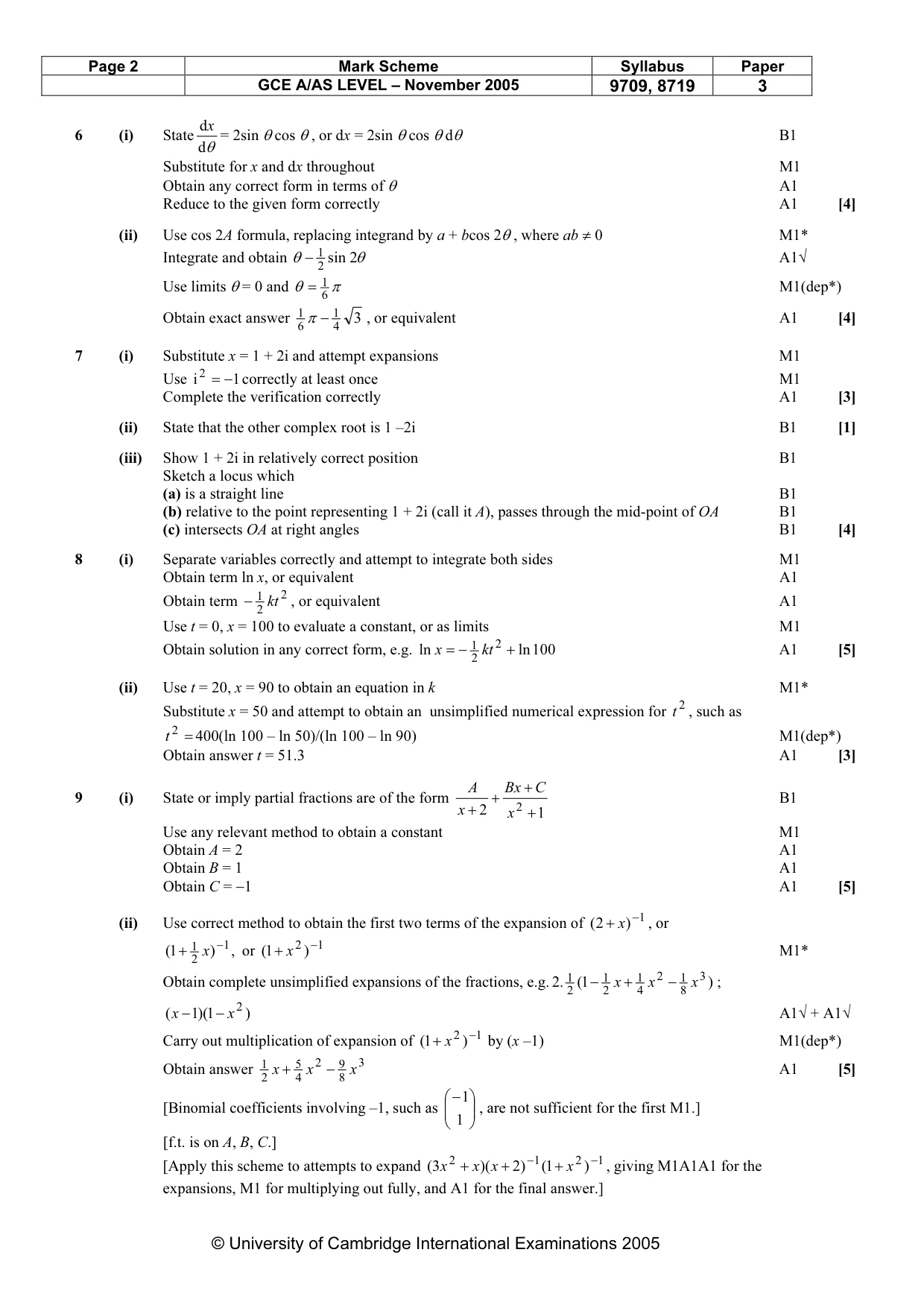
Mark scheme: dx 6 (i) State = 2sin θ cos θ , or dx = 2sin θ cos θ dθ B1 dθ Substitute for x and dx throughout M1 Obtain any correct form in terms of θ A1 Reduce to the given form correctly A1 [4] (ii) Use cos 2A formula, replacing integrand by a + bcos 2θ , where ab ≠ 0 M1* Integrate and obtain θ − 1 sin 2θ A1√ 2 Use limits θ = 0 and θ = 1 π M1(dep*) 6 Obtain exact answer 1 π − 1 3 , or equivalent A1 [4] 6 4
Q7 · The equation 2x3 + x2 + 25 = 0 has one real root and two complex roots
7 The equation 2x3 + x2 + 25 = 0 has one real root and two complex roots. (i) Verify that 1 + 2i is one of the complex roots. [3] (ii) Write down the other complex root of the equation. [1] (iii) Sketch an Argand diagram showing the point representing the complex number 1 + 2i. Show on the same diagram the set of points representing the complex numbers which satisfy | | = | −1 −2i| . [4]
Mark scheme: 7 (i) Substitute x = 1 + 2i and attempt expansions M1 Use i2 = − 1 correctly at least once M1 Complete the verification correctly A1 [3] (ii) State that the other complex root is 1 –2i B1 [1] (iii) Show 1 + 2i in relatively correct position B1 Sketch a locus which (a) is a straight line B1 (b) relative to the point representing 1 + 2i (call it A), passes through the mid-point of OA B1 (c) intersects OA at right angles B1 [4]
Q8 · In a certain chemical reaction the amount, x grams, of a substance present is decreasing
8 In a certain chemical reaction the amount, x grams, of a substance present is decreasing. The rate of decrease of x is proportional to the product of x and the time, t seconds, since the start of the reaction. Thus x and t satisfy the differential equation dx = −kxt, dt where k is a positive constant. At the start of the reaction, when t = 0, x = 100. (i) Solve this differential equation, obtaining a relation between x, k and t. [5] (ii) 20 seconds after the start of the reaction the amount of substance present is 90 grams. Find the time after the start of the reaction at which the amount of substance present is 50 grams. [3]
Mark scheme: 8 (i) Separate variables correctly and attempt to integrate both sides M1 Obtain term ln x, or equivalent A1 Obtain term − 1 kt 2 , or equivalent A1 2 Use t = 0, x = 100 to evaluate a constant, or as limits M1 Obtain solution in any correct form, e.g. ln x = − 1 kt 2 + ln 100 A1 [5] 2 (ii) Use t = 20, x = 90 to obtain an equation in k M1* Substitute x = 50 and attempt to obtain an unsimplified numerical expression for t 2 , such as t 2 = 400(ln 100 – ln 50)/(ln 100 – ln 90) M1(dep*) Obtain answer t = 51.3 A1 [3] A Bx + C
Q9 · X2 + x 9 (i) Express in partial fractions
3x2 + x 9 (i) Express in partial fractions. [5] (x + 2)(x2 + 1) 3x2 + x (ii) Hence obtain the expansion of in ascending powers of x, up to and including the (x + 2)(x2 + 1) term in x3. [5]
Mark scheme: A Bx + C 9 (i) State or imply partial fractions are of the form + B1 x + 2 x 2 + 1 Use any relevant method to obtain a constant M1 Obtain A = 2 A1 Obtain B = 1 A1 Obtain C = −1 A1 [5] (ii) Use correct method to obtain the first two terms of the expansion of ( 2 + x ) −1 , or 1( + 1 x ) −1 , or 1( + x 2 ) −1 M1* 2 Obtain complete unsimplified expansions of the fractions, e.g. .2 1 1( − 1 x + 1 x 2 − 1 x 3 ) ; 2 2 4 8 ( x − 1)(1 − x 2 ) A1√ + A1√ Carry out multiplication of expansion of 1( + x 2 ) −1 by (x –1) M1(dep*) Obtain answer 1 x + 5 x 2 − 9 x 3 A1 [5] 2 4 8 − 1 [Binomial coefficients involving –1, such as , are not sufficient for the first M1.] 1 [f.t. is on A, B, C.] [Apply this scheme to attempts to expand (3 x 2 + x )( x + 2) −1 1( + x 2 ) −1 , giving M1A1A1 for the expansions, M1 for multiplying out fully, and A1 for the final answer.] GCE A/AS LEVEL – November 2005 9709, 8719 3
Q10 · The straight line l passes through the points A and B with position vectors 2i + 2j + k…
10 The straight line l passes through the points A and B with position vectors 2i + 2j + k and i + 4j + 2k respectively. This line intersects the plane p with equation x −2y + 2 = 6 at the point C. (i) Find the position vector of C. [4] (ii) Find the acute angle between l and p. [4] (iii) Show that the perpendicular distance from A to p is equal to 2. [3]
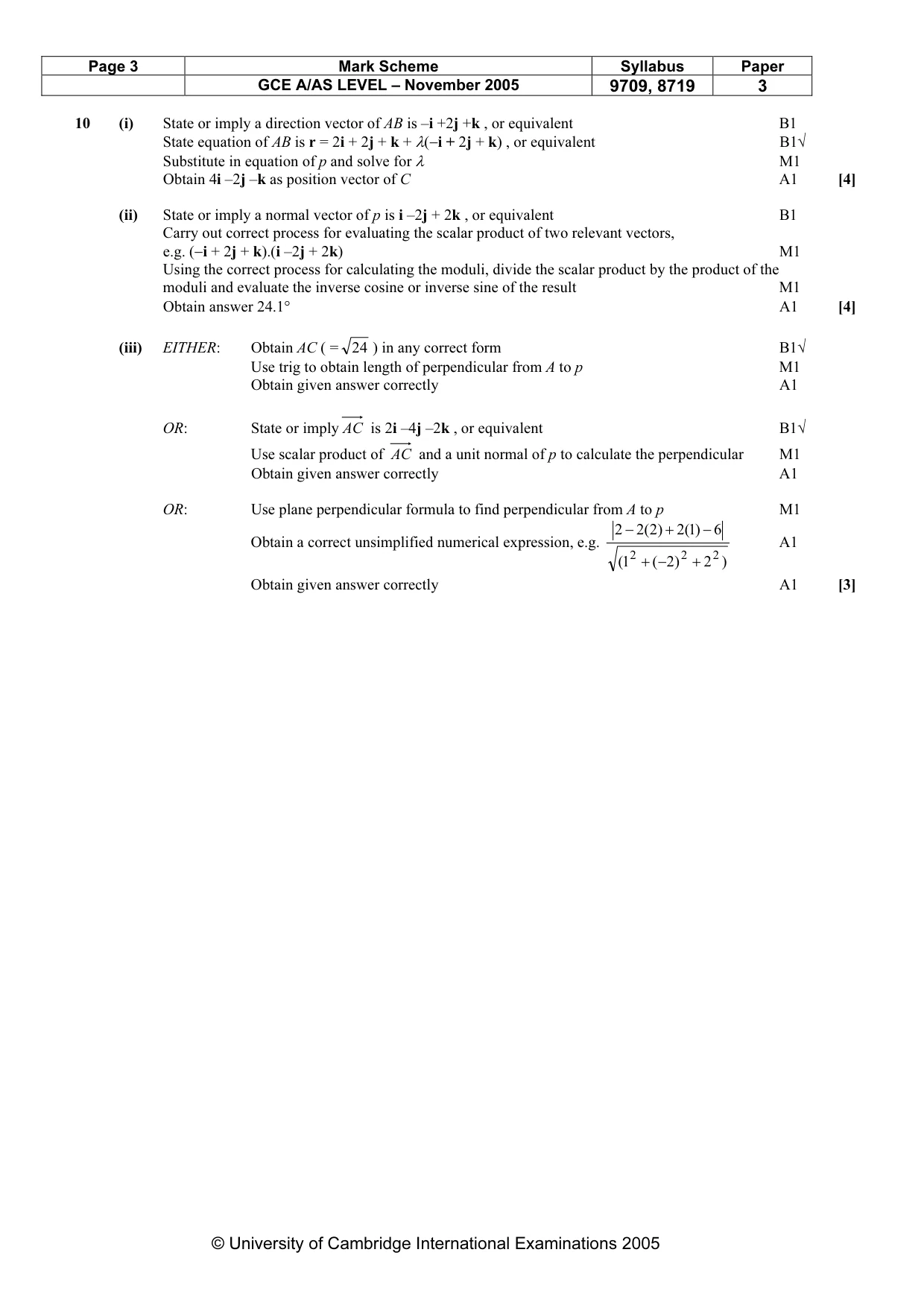
Mark scheme: 10 (i) State or imply a direction vector of AB is –i +2j +k , or equivalent B1 State equation of AB is r = 2i + 2j + k + λ(−i + 2j + k) , or equivalent B1√ Substitute in equation of p and solve for λ M1 Obtain 4i –2j –k as position vector of C A1 [4] (ii) State or imply a normal vector of p is i –2j + 2k , or equivalent B1 Carry out correct process for evaluating the scalar product of two relevant vectors, e.g. (−i + 2j + k).(i –2j + 2k) M1 Using the correct process for calculating the moduli, divide the scalar product by the product of the moduli and evaluate the inverse cosine or inverse sine of the result M1 Obtain answer 24.1° A1 [4] (iii) EITHER: Obtain AC ( = 24 ) in any correct form B1√ Use trig to obtain length of perpendicular from A to p M1 Obtain given answer correctly A1 OR: State or imply AC is 2i –4j –2k , or equivalent B1√ Use scalar product of AC and a unit normal of p to calculate the perpendicular M1 Obtain given answer correctly A1 OR: Use plane perpendicular formula to find perpendicular from A to p M1 2 − 2( 2) + 2)1( − 6 Obtain a correct unsimplified numerical expression, e.g. A1 1( 2 + ( −2) 2 + 2 2 ) Obtain given answer correctly A1 [3]
What was in this paper
The subtopics covered by these 10 questions, and how many questions each got. Open one in a new tab to see every Cambridge question on it.