Questions as text
Q1 · A particle P moves along the x-axis in the positive direction 9709/41 May/June 2005
5 A particle P moves along the x-axis in the positive direction. The velocity of P at time t s is 0.03t2 m s−1. When t = 5 the displacement of P from the origin O is 2.5 m. (i) Find an expression, in terms of t, for the displacement of P from O. [4] (ii) Find the velocity of P when its displacement from O is 11.25 m. [3]
7 marks
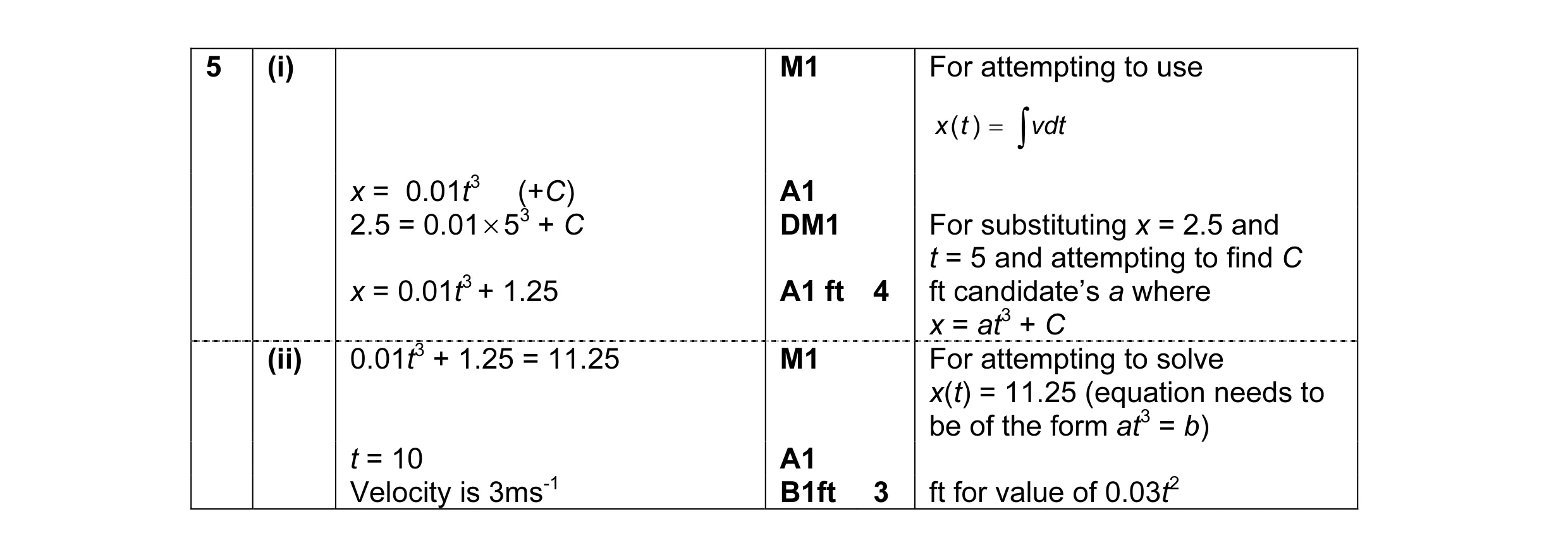
Mark scheme: 5 (i) M1 For attempting to use x ( t ) = ∫ vdt x = 0.01t3 (+C) A1 2.5 = 0.01×53 + C DM1 For substituting x = 2.5 and t = 5 and attempting to find C x = 0.01t3 + 1.25 A1 ft 4 ft candidate’s a where x = at3 + C (ii) 0.01t3 + 1.25 = 11.25 M1 For attempting to solve x(t) = 11.25 (equation needs to be of the form at3 = b) t = 10 A1 Velocity is 3ms-1 B1ft 3 ft for value of 0.03t2
This question in 9709/41 May/June 2005
Q2 · A vehicle is moving in a straight line 9709/41 May/June 2010
7 A vehicle is moving in a straight line. The velocity v m s−1 at time t s after the vehicle starts is given by v = A(t −0.05t2) for 0 ≤t ≤15, B v = for t ≥15, t2 where A and B are constants. The distance travelled by the vehicle between t = 0 and t = 15 is 225 m. (i) Find the value of A and show that B = 3375. [5] (ii) Find an expression in terms of t for the total distance travelled by the vehicle when t ≥15. [3] (iii) Find the speed of the vehicle when it has travelled a total distance of 315 m. [3]
11 marks
Mark scheme: 7 (i) M1 For integrating v1 to find s1 15 dt = 225 A1 1 ∫ 0 v A[(152/2 – 0.05 × 153/3) – (0 – 0)] = 225 A = 4 A1 [4(15 – 0.05 × 152) = B/152] M1 For using v1(15) = v2(15) B = 3375 A1 AG [5] (ii) s2(t) = Bt–1/(–1) (+ C) B1 [–3375/15 + C = 225] M1 For using s2(15) = 225 to find C Distance travelled is [450 – 3375/t] m A1 (for t [ 15) [3] (iii) [450 – 3375/t = 315] M1 For attempting to solve s2(t) = 315 [v = 3375/252] M1 For substituting into v = 3375/t2 Speed is 5.4 ms–1 A1 [3] Alternative for 7(ii) t − 2 1 1 s = ∫ 3375 t dt = − 3375 ( t − 15 ) B1 15 = 225 – 3375/t Distance travelled = 225 + (225 – 3375/t) M1 Distance travelled is [450 – 3375/t] m A1 (for t [ 15)
This question in 9709/41 May/June 2010
Q3 · A car driver makes a journey in a straight line from A to B, starting from rest 9709/41 May/June 2013
7 A car driver makes a journey in a straight line from A to B, starting from rest. The speed of the car increases to a maximum, then decreases until the car is at rest at B. The distance travelled by the car t seconds after leaving A is 0.000 011 7 400t3 −3t4 metres. (i) Find the distance AB. [3] (ii) Find the maximum speed of the car. [4] (iii) Find the acceleration of the car (a) as it starts from A, (b) as it arrives at B. [2] (iv) Sketch the velocity-time graph for the journey. [2]
11 marks
Mark scheme: 7 (i) [0.0000117(1200t2 – 12t3) For differentiating and solving ds/dt = 0 = 0] M1 1200t2 = 12t3 t = 0, 100 A1 Accept just t = 100, if it is used to find distance AB. Distance AB = 1170 m A1 [3] (ii) M1 For differentiating again and solving d2s/dt2 = 0 2400t – 36t2 = 0 t = 0, 200/3 A1 Accept just t = 200/3, if it is used to find vmax. [vmax = 0.0000117{1200(200/3)2 – 12(200/3)3}] M1 For substituting into v(t) Maximum speed is 20.8 ms–1 A1 [4] (iii) At A a(t) = 0 B1 At B a(t) = 0.0000117(2400 × 100 – 36 × 1002) = –1.40 ms–2 (–1.404 exact) B1 [2] (iv) Sketch has v increasing from 0 to maximum and decreasing to 0, with maximum closer to t = 100 than t = 0. B1 Sketch has zero gradient at t = 0 and inflexion closer to t = 0 than t = 100. B1 [2]
This question in 9709/41 May/June 2013
Q4 · A particle P moves in a straight line starting from a point O and comes to rest 35 s later 9709/42 Feb/March 2017
5 A particle P moves in a straight line starting from a point O and comes to rest 35 s later. At time t s after leaving O, the velocity v m s−1 of P is given by v = 45t2 0 ≤t ≤5, v = 2t + 10 5 ≤t ≤15, v = a + bt2 15 ≤t ≤35, where a and b are constants such that a > 0 and b < 0. (i) Show that the values of a and b are 49 and −0.04 respectively. [3] … … … … … … … … … … … … … … … … … … … … … (ii) Sketch the velocity-time graph. [4] v (m s−1) t (s) 0 5 10 15 20 25 30 35 (iii) Find the total distance travelled by P during the 35 s. [5] … … … … … … … … … … … … … … … …
12 marks
Mark scheme: 5(i) 0= a + b × 352 M1 For matching velocities at 40 = a + b × 152 t = 15 and using v = 0 at t = 35 [1000b = -40 → b = –0.04] M1 Solve for a and b [a = 0.04 × 352 = 49] a = 49 and b = -0.04 AG A1 Total: 3 5(ii) 0 ⩽ t ⩽ 5 correct B1 Increasing quadratic, from (0,0) to (5,20), concave up 5 ⩽ t ⩽ 15 correct B1 Line from (5,20) to (15,40) 15 ⩽ t ⩽ 35 correct B1 Decreasing quadratic, from (15,40) to (35,0), concave down 20 and 40 seen correct on v-axis B1 Total: 4 5(iii) 5 B1 2 100 0.8t d t = A1 = ∫ 0 3 1 M1 Using trapezium rule or integration for A2 = ( 20 + 40 ) × 10 = 300 t = 5 to t = 15 2 35 M1 Attempt to integrate the quadratic a + bt 2 d t function ) A3 = ∫ ( 15 from t = 15 to t = 35 0.04 3 = 49t − t 3 A3 = 453.3333 = 1360/3 A1 Total Distance = 2360/3 = 787 m A1 Total: 5
This question in 9709/42 Feb/March 2017
Q5 · A particle starts from rest and moves in a straight line 9709/42 Oct/Nov 2017
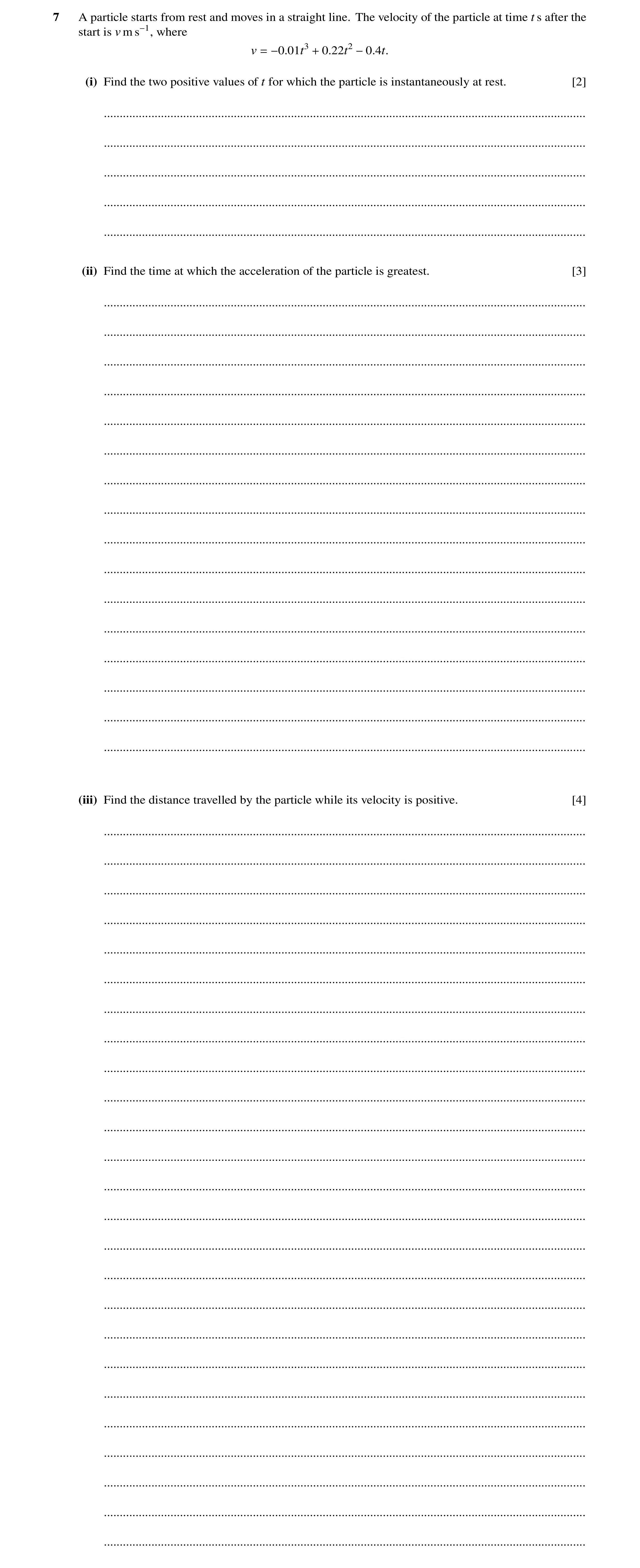
7 A particle starts from rest and moves in a straight line. The velocity of the particle at time t s after the start is v m s−1, where v = −0.01t3 + 0.22t2 −0.4t. (i) Find the two positive values of t for which the particle is instantaneously at rest. [2] … … … … … (ii) Find the time at which the acceleration of the particle is greatest. [3] … … … … … … … … … … … … … … … … (iii) Find the distance travelled by the particle while its velocity is positive. [4] … … … … … … … … … … … … … … … … … … … … … … … … …
9 marks
Mark scheme: 7(i) –0.01t(t2 – 22t + 40) = 0 M1 Attempting to solve v = 0 for t for a –0.01t(t – 20)(t – 2) = 0 solvable quadratic using factors or quadratic formula and obtaining two non- zero solutions t = 2 or t = 20 A1 2 7(ii) a = – 0.03t2 + 0.44t – 0.4 M1 For differentiation a is greatest (maximum) when M1 For differentiation or finding values of 0.44 – 0.06t = 0 t = t1 and t = t2 where a = 0 and using t = ½(t1 + t2) or completing the square or other method to find maximum value Max acceleration when t = 7.33 A1 22 Allow t = 3 3 7(iii) ∫− 0.01t 3 + 0.22t 2 − 0.4t d t *M1 For using integration. ( ) 0.01 4 0.22 3 2 A1 Correct Integration s ( t ) = − t + t − 0.2t Allow + C included 4 3 s ( 20 ) − s ( 2 ) DM1 Limits 2 and 20 used correctly Dependent on previous M1 having been scored Distance = 107 m A1 2673 Distance = = 106.92 25 4
This question in 9709/42 Oct/Nov 2017
Q6 · A particle P moves in a straight line starting from a point O 9709/43 May/June 2018
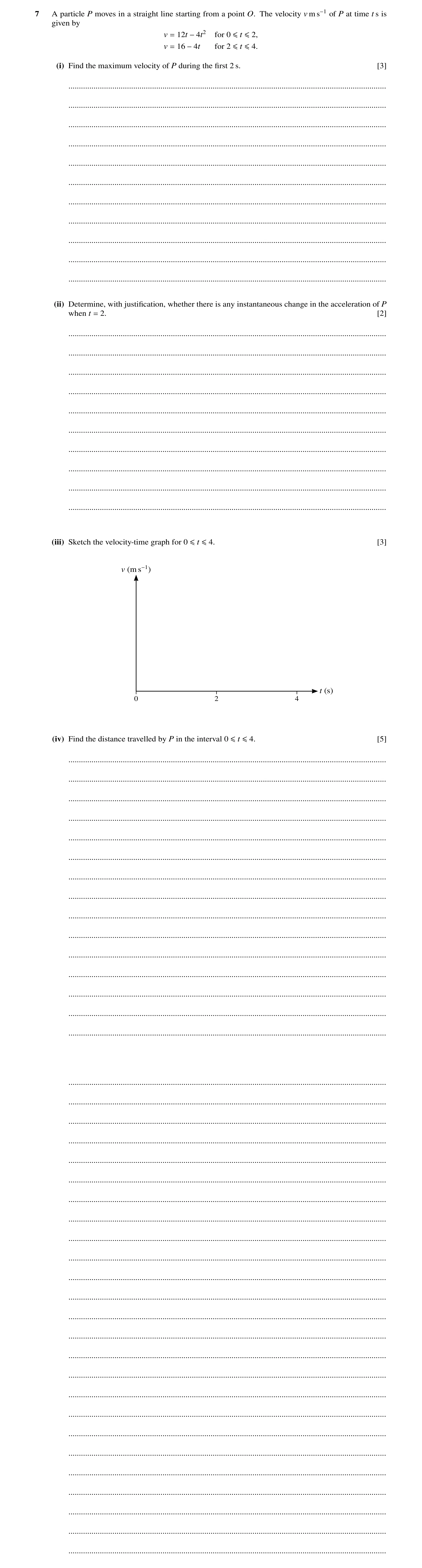
7 A particle P moves in a straight line starting from a point O. The velocity v m s−1 of P at time t s is given by v = 12t −4t2 for 0 ≤t ≤2, v = 16 −4t for 2 ≤t ≤4. (i) Find the maximum velocity of P during the first 2 s. [3] … … … … … … … … … … … (ii) Determine, with justification, whether there is any instantaneous change in the acceleration of P when t = 2. [2] … … … … … … … … … … (iii) Sketch the velocity-time graph for 0 ≤t ≤4. [3] v (m s−1) t (s) 0 2 4 (iv) Find the distance travelled by P in the interval 0 ≤t ≤4. [5] … … … … … … … … … … … … … … … … … … … … … … … … … … … … … … … … … … … … … … … …
13 marks
Mark scheme: 7(i) [ d 12 8 d v t t = − ] or e.g. [–4[(t – 1.5)2 – 2.25]] M1 For attempted differentiation of 2 12 4 t t − (or for alternative e.g. completing the square) [Maximum v when 2 1.5 12 1.5 4 1.5 t v = ⇒ = × −× ] M1 For finding and using t Maximum velocity is 9 (m s–1) A1 Total: 3 7(ii) [ d 12 8 d v t t = − = –4] M1 Finding acceleration for 0 ⩽ t ⩽ 2 when t = 2 Acceleration for 2 ⩽ t ⩽ 4 is –4 No instantaneous change A1 Both values correct, with correct statement Total: 2 Question Answer Marks Guidance 7(iii) B1 Quadratic shape (with max) for 0 ⩽ t ⩽ 2 B1 Line with negative gradient from (2, …) to (4,0) B1 All correct, smooth join and key values indicated Total: 3 7(iv) Area of triangle is 8 B1 (May be obtained by integrating 16 – 4t or use of uvast) [ 2 2 3 4 3 (12 4 ) d 6 t t t t t − = − ∫ ] M1 Integration attempt for 0 ⩽ t ⩽ 2 [ 2 3 2 3 4 4 3 3 6 2 2 6 0 0 × − × − × + × ] DM1 Use of limits 0 and 2; condone absence of zero terms Area under curve is 40 3 or 13.3 A1 Distance travelled is 64 (m) 3 or 21.3 (m) A1 Total: 5
This question in 9709/43 May/June 2018
Q7 · A particle P moves in a straight line from a fixed point O 9709/41 May/June 2019
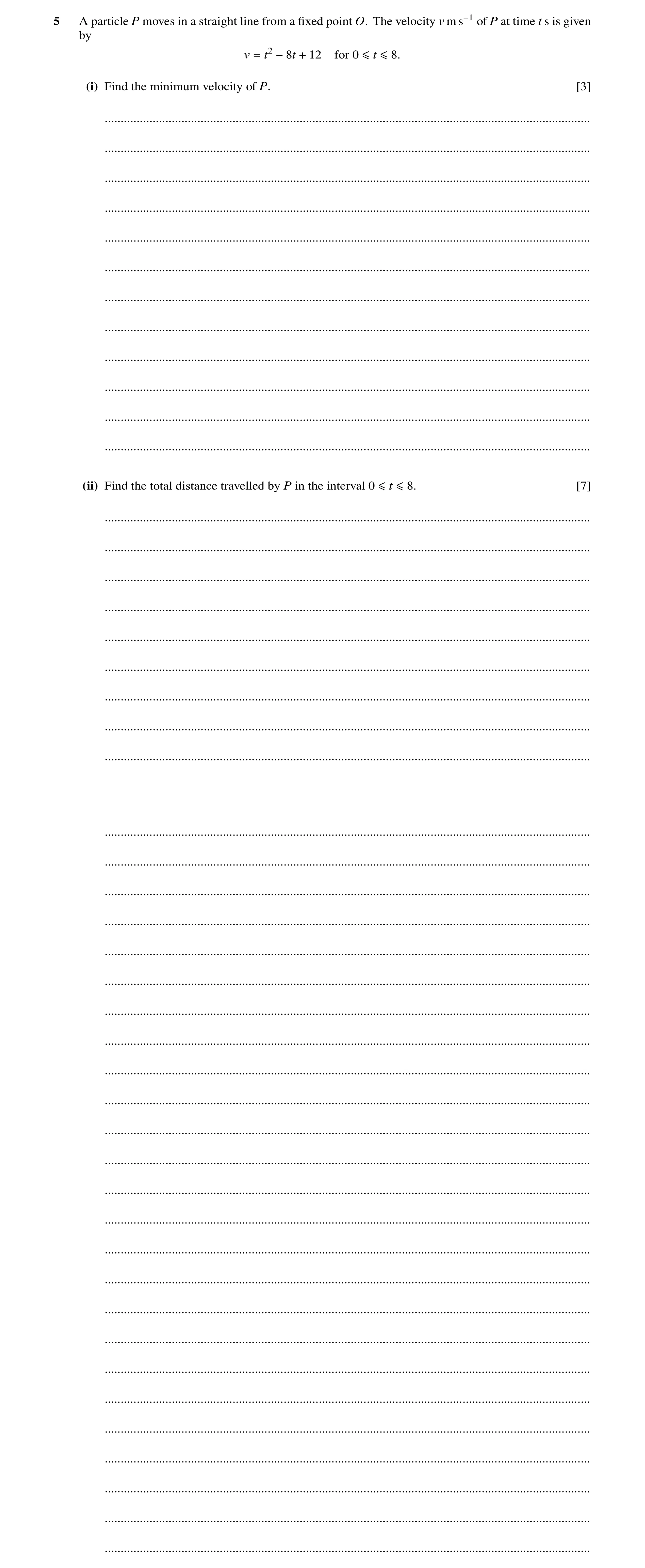
5 A particle P moves in a straight line from a fixed point O. The velocity v m s−1 of P at time t s is given by v = t2 −8t + 12 for 0 ≤t ≤8. (i) Find the minimum velocity of P. [3] … … … … … … … … … … … … (ii) Find the total distance travelled by P in the interval 0 ≤t ≤8. [7] … … … … … … … … … … … … … … … … … … … … … … … … … … … … … … … … … …
10 marks
Mark scheme: 5(i) a = 2t - 8 M1 Differentiate to find a a = 0 → t = 4 M1 Set a = 0 and solve for t Minimum v = –4 ms-1 A1 Full marks available for correct use of a v-t graph or correct use of “t = -b/2a” Alternative method for question 5(i) v = (t – 4)2 – 4 M1 Attempt to complete the square for v [t = 4] M1 Choose the t value which gives minimum v Minimum v = –4 ms–1 A1 3 5(ii) v = 0 when (t – 2)(t – 6) = 0 M1 Find values of t when v = 0, factorise or formula t = 2 or t = 6 A1 [s = ⅓ t3 – 4t2 + 12t (+c)] M1 Integrate v to find s A1 Correct integration 0 ≤ t ≤ 2 s1 = 8/3 – 16 + 24 = 32/3 2 ≤ t ≤ 6 s2 = (216/3 – 144 + 72) – (8/3 – 16 + 24)= -32/3 6 ≤ t ≤ 8 s3 = (512/3 – 4 × 82 + 12 × 8) – (216/3 – 144 + 72) = 32/3 M1 Attempt to find s1, s2 and s3 Look for consideration of the need for 3 intervals Allow use of symmetry when finding s1, and s3 A1 2 correct values of displacement Total distance = 32 m A1 All correct 7
This question in 9709/41 May/June 2019
Q8 · Particles P and Q leave a fixed point A at the same time and travel in the same straight… 9709/42 May/June 2019
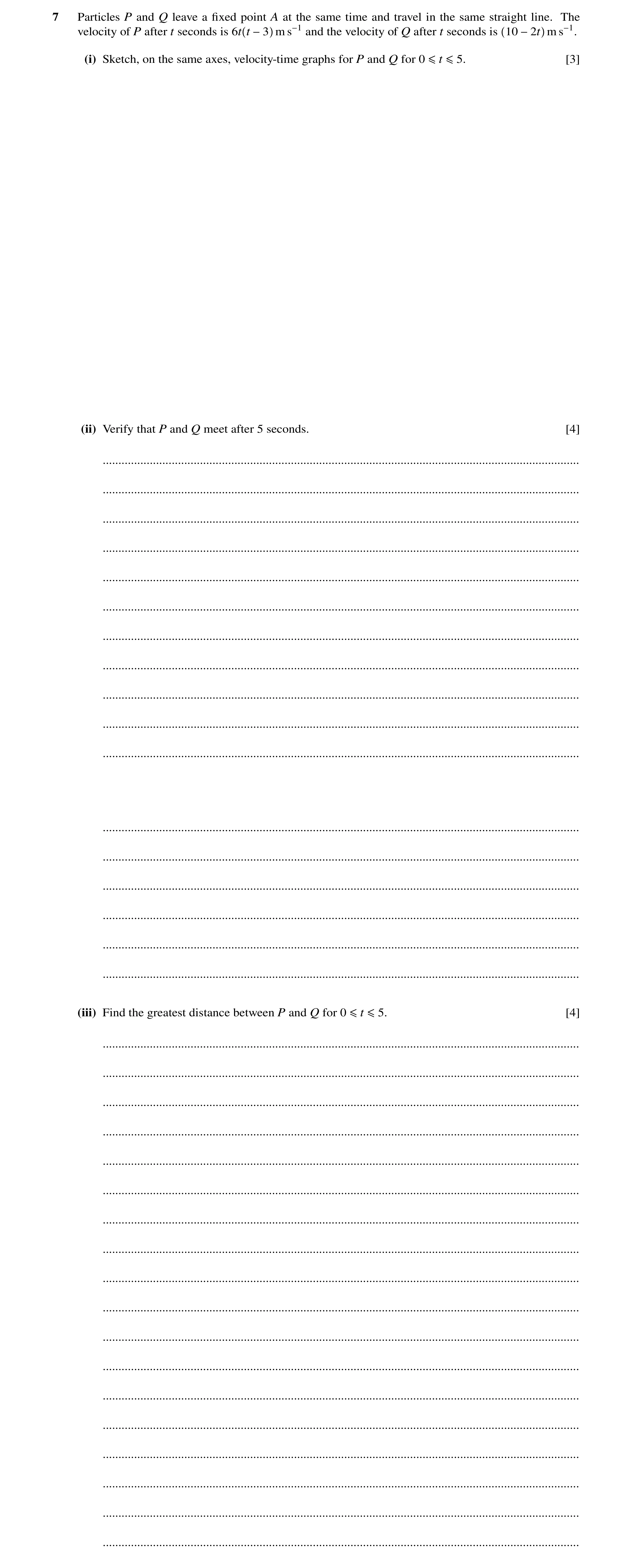
7 Particles P and Q leave a fixed point A at the same time and travel in the same straight line. The velocity of P after t seconds is 6t t −3 m s−1 and the velocity of Q after t seconds is 10 −2t m s−1. (i) Sketch, on the same axes, velocity-time graphs for P and Q for 0 ≤t ≤5. [3] (ii) Verify that P and Q meet after 5 seconds. [4] … … … … … … … … … … … … … … … … … (iii) Find the greatest distance between P and Q for 0 ≤t ≤5. [4] … … … … … … … … … … … … … … … … … …
11 marks
Mark scheme: 7(i) Straight line, reaching positive v-axis and positive t-axis (negative gradient) B1 Quadratic (U shape, through (0,0) and cutting t-axis at t < 5) B1 Fully correct graphs with correct labelling with t = 3, t = 5, v = 10, v = 60 seen B1 3 7(ii) ( ) 2 10 2 d 10 = ∫ − = − s t t t t (+ c) or use area of a triangle ½ × 10 × 5 [= 25] B1 Use either integration to find s for Q or use a correct formula to find the area under the relevant triangle M1 Use integration to find the displacement for P ( ) ( ) 2 3 2 6 18 d 2 9 = ∫ − = − + s t t t t t c A1 Correct integration for P (unsimplified) ( ) 5 3 2 0 2 9 25 = − = s P t t or solve 2 3 2 10 2 9 − = − t t t t B1 Either evaluation of s(P) at t = 5 and show that at t = 5, s(P) = s(Q) = 25 or show that t = 5 is a solution of the cubic by solving or verify t = 5 is a solution of the cubic by substitution. 4 Question Answer Marks Guidance 7(iii) Distance PQ = |sP – sQ| = ±(2t 3 – 8t 2 – 10t) M1 Find the distance between P and Q Allow either sign sP and sQ must have been found by integration Maximum s if 6t 2 – 16t – 10 = 0 M1 Differentiate to obtain an equation in t and attempt to solve t = 3.19 A1 Maximum Distance PQ = (–)48.4 m A1 Alternative method for question 7(iii) 6t 2 – 18t = 10 – 2t M1 State that greatest distance between P and Q occurs when vP = vQ 6t 2 – 16t – 10 = 0 M1 Rearrange and attempt to solve for t t = 3.19 A1 Maximum Distance PQ = (–)48.4 m A1 4
This question in 9709/42 May/June 2019
Q9 · A particle P moves in a straight line 9709/43 May/June 2019
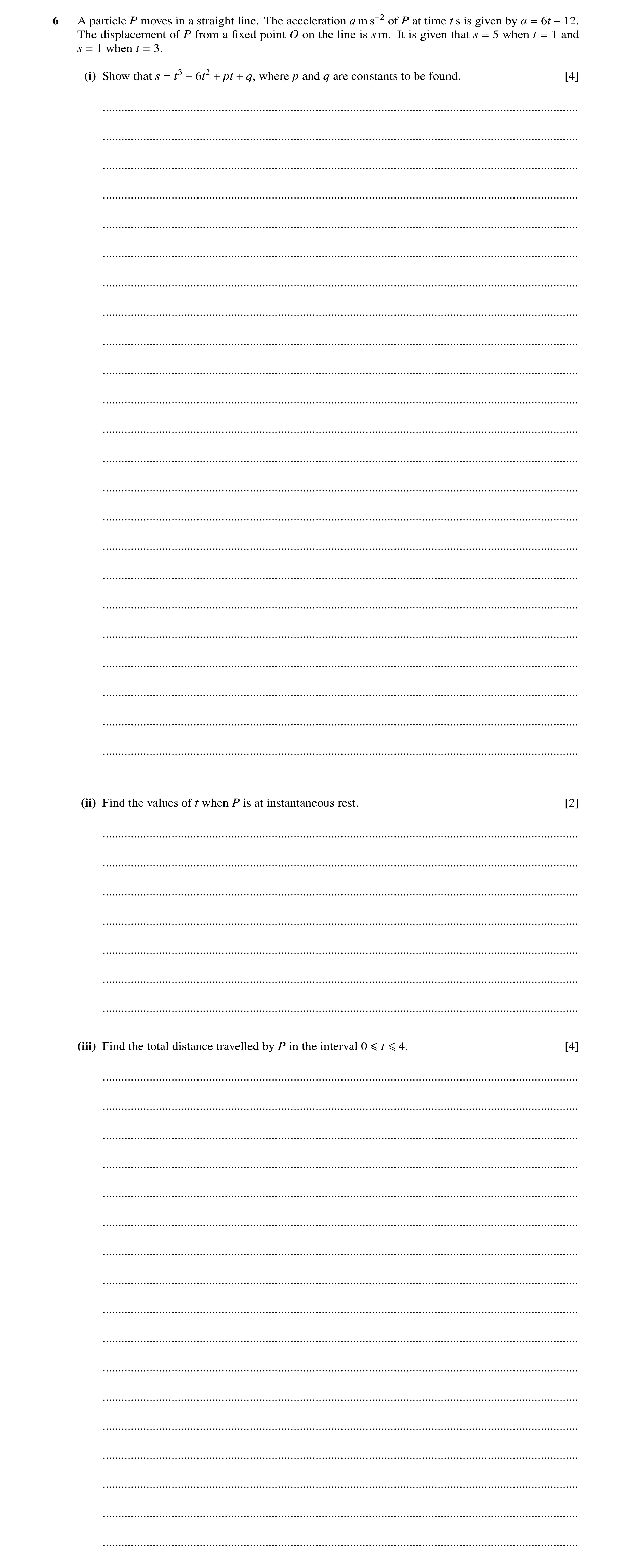
6 A particle P moves in a straight line. The acceleration a m s−2 of P at time t s is given by a = 6t −12. The displacement of P from a fixed point O on the line is s m. It is given that s = 5 when t = 1 and s = 1 when t = 3. (i) Show that s = t3 −6t2 + pt + q, where p and q are constants to be found. [4] … … … … … … … … … … … … … … … … … … … … … … … (ii) Find the values of t when P is at instantaneous rest. [2] … … … … … … … (iii) Find the total distance travelled by P in the interval 0 ≤t ≤4. [4] … … … … … … … … … … … … … … … … …
10 marks
Mark scheme: 6(i) *M1 Use of = ∫ v adt [s = 3t3/3 – 12t2/2 + Ct + D] s = t3 – 6t2 + Ct + D *M1 Use of = ∫ s vdt [5 = 1 – 6 + C + D C + D = 10 1 = 27 – 54 + 3C + D 3C + D = 28 → C = … , D = … ] DM1 Substitutes for s and t and solves equations. Dependent on both Ms. s = t 3 – 6t 2 + 9t + 1 or p = 9, q = 1 A1 4 6(ii) [v = 0, 3t 2 – 12t + 9 = 0 (t – 1)(t – 3) = 0 → t = … ] M1 Solves v = 0 to find t values t = 1 or t = 3 A1 2 6(iii) [ 1 3 4 0 1 3 + + ∫ ∫ ∫ vdt vdt vdt ] M1 Attempts to use at least three t intervals [For 0 ⩽ t ⩽ 1, s = (1 – 6 + 9 + 1) – 1 = 4] M1 Evaluates s for one time interval [0 ⩽ t ⩽ 1, s = (1 – 6 + 9 + 1) – 1 = 4; 1 ⩽ t ⩽ 3, s = (27 – 54 + 27 + 1) – 5 = -4 3 ⩽ t ⩽ 4, s = (64 – 96 + 36 + 1) – 1 = 4 ] A1 Correctly finds all at least two distances (ignoring signs) Total distance is 12 m A1 4
This question in 9709/43 May/June 2019
Q10 · A particle moves in a straight line AB 9709/41 May/June 2020
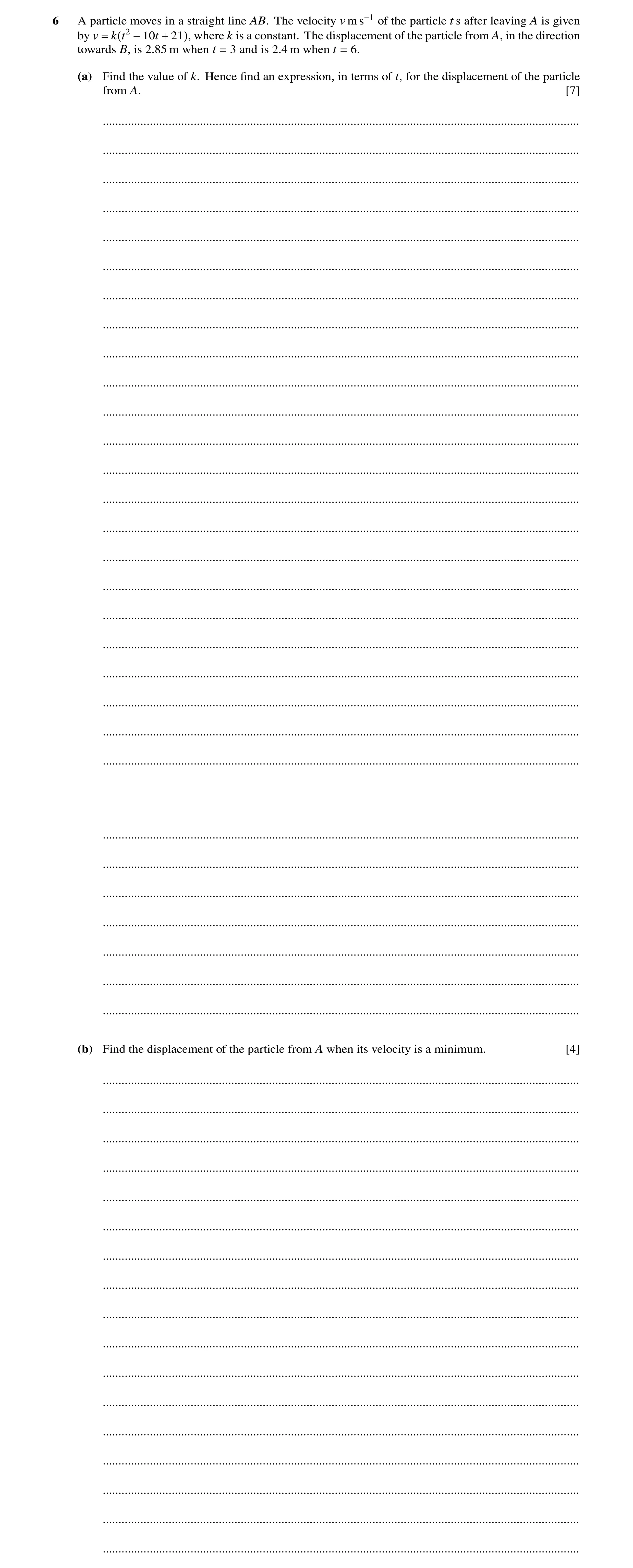
6 A particle moves in a straight line AB. The velocity v m s−1 of the particle t s after leaving A is given by v = k t2 −10t + 21 , where k is a constant. The displacement of the particle from A, in the direction towards B, is 2.85 m when t = 3 and is 2.4 m when t = 6. (a) Find the value of k. Hence find an expression, in terms of t, for the displacement of the particle from A. [7] … … … … … … … … … … … … … … … … … … … … … … … … … … … … … … (b) Find the displacement of the particle from A when its velocity is a minimum. [4] … … … … … … … … … … … … … … … … …
11 marks
Mark scheme: 6(a) ( ) 2 10 21 d k t t t − + M1 3 2 1 5 21 C 3 s k t t t = + + + A1 3 2 1 2.85 3 5 3 21 3 C 3 k = × −× + × + or 3 2 1 2.4 6 5 6 21 6 C 3 k = × −× + × + M1 2.85 = 27k + C, 2.4 = 18k + C (A1 for both) A1 Solving for k M1 k = 0.05 A1 3 2 1 0.05 5 21 1.5 3 s t t t = − + + A1 7 6(b) Differentiating v or completing the square for v M1 a = 0.05(2t –10) A1 Min value of v is at t = 5. M1 Displacement at t = 5 is 2.58 m (2.5833...) A1 4
This question in 9709/41 May/June 2020
Q11 · A particle moves in a straight line 9709/42 Feb/March 2021
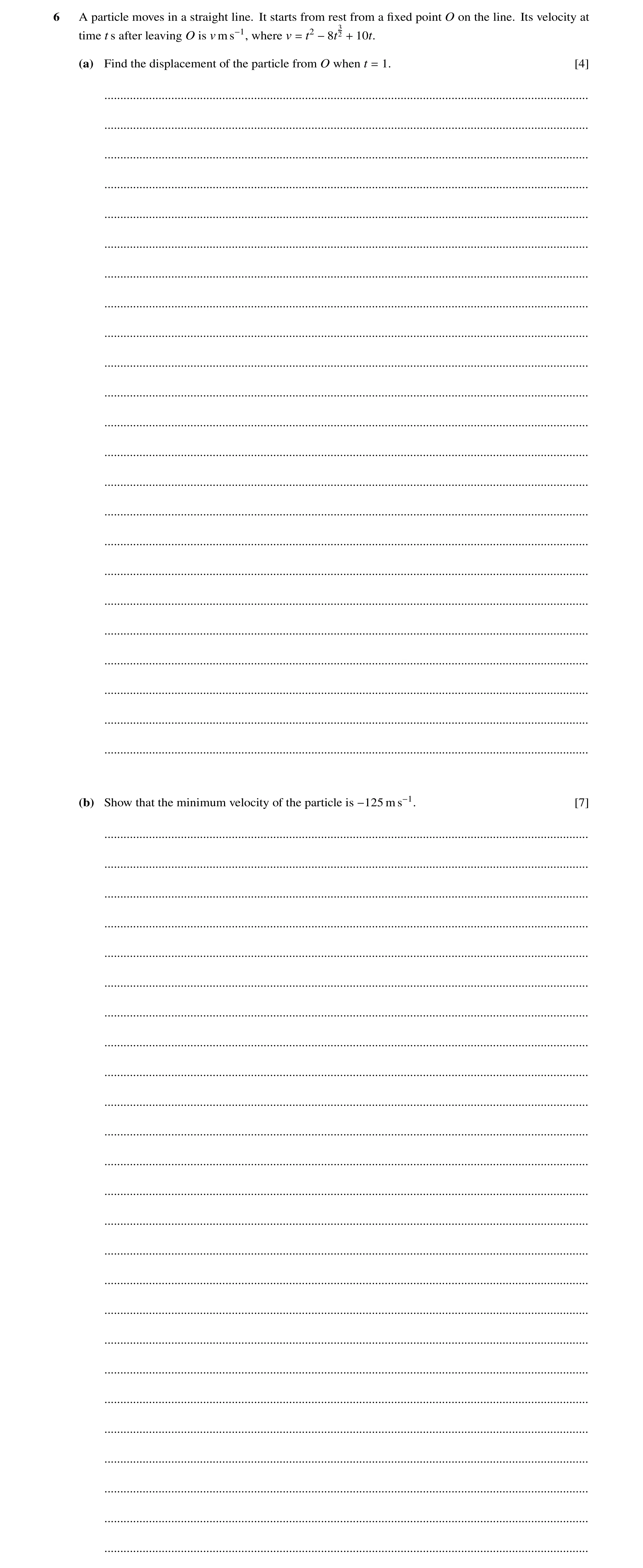
6 A particle moves in a straight line. It starts from rest from a fixed point O on the line. Its velocity at 3 time t s after leaving O is v m s−1, where v = t2 −8t 2 + 10t. (a) Find the displacement of the particle from O when t = 1. [4] … … … … … … … … … … … … … … … … … … … … … … … (b) Show that the minimum velocity of the particle is −125 m s−1. [7] … … … … … … … … … … … … … … … … … … … … … … … … …
11 marks
Mark scheme: 6(a) [ ] 3 2 2 8 10 d s t t t t = − + *M1 For attempting to integrate v. [ ] [ ] 5 3 2 2 1 16 5 3 5 = − + + s t t t C A1 Allow unsimplified. For correct use of correct limits. DM1 Use of limit at t = 0 may be implied. Displacement = 2.13 m (3sf) A1 Allow displacement = 32 15 . 4 Question Answer Marks Guidance 6(b) For attempting to differentiate v. *M1 [ ] 1 2 2 12 10 = − + a t t A1 Allow unsimplified. 1 2 0 2 12 10 0 = − + = a t t DM1 Dependent on *M1. Set a = 0 and attempt to solve their 3 term equation in t or t or (= p t ) by treating it as a quadratic equation. 1 1 2 2 2 5 1 0 − − = t t leading to t = 1 or t = 25 A1 Both correct. 1 2 d 2 6 d − = − a t t *DM1 Dependent on *M1. Determine the nature of the stationary point by: Either differentiating a and testing the sign of d d a t or by substituting values either side of their t value(s) and attempt to determine the nature of the stationary point(s). If using d d a t then must evaluate it at a t value for M1. Allow use with any t value from their ‘quadratic’. Use t = 25 in 1 2 d 2 6 25 d − = − × a t Evaluating d d a t correctly, hence a minimum. A1 Or by using a convincing argument to show that t = 25 gives a minimum value of v. If evaluated then d d a t must be 0.8. Minimum velocity = 3 2 2 25 8 25 10 25 −× + × = −125 m s-1 B1 AG This mark is awarded only if the previous 6 marks are awarded. 7
This question in 9709/42 Feb/March 2021
Q12 · A particle P travels in a straight line, starting at rest from a point O 9709/42 Oct/Nov 2022
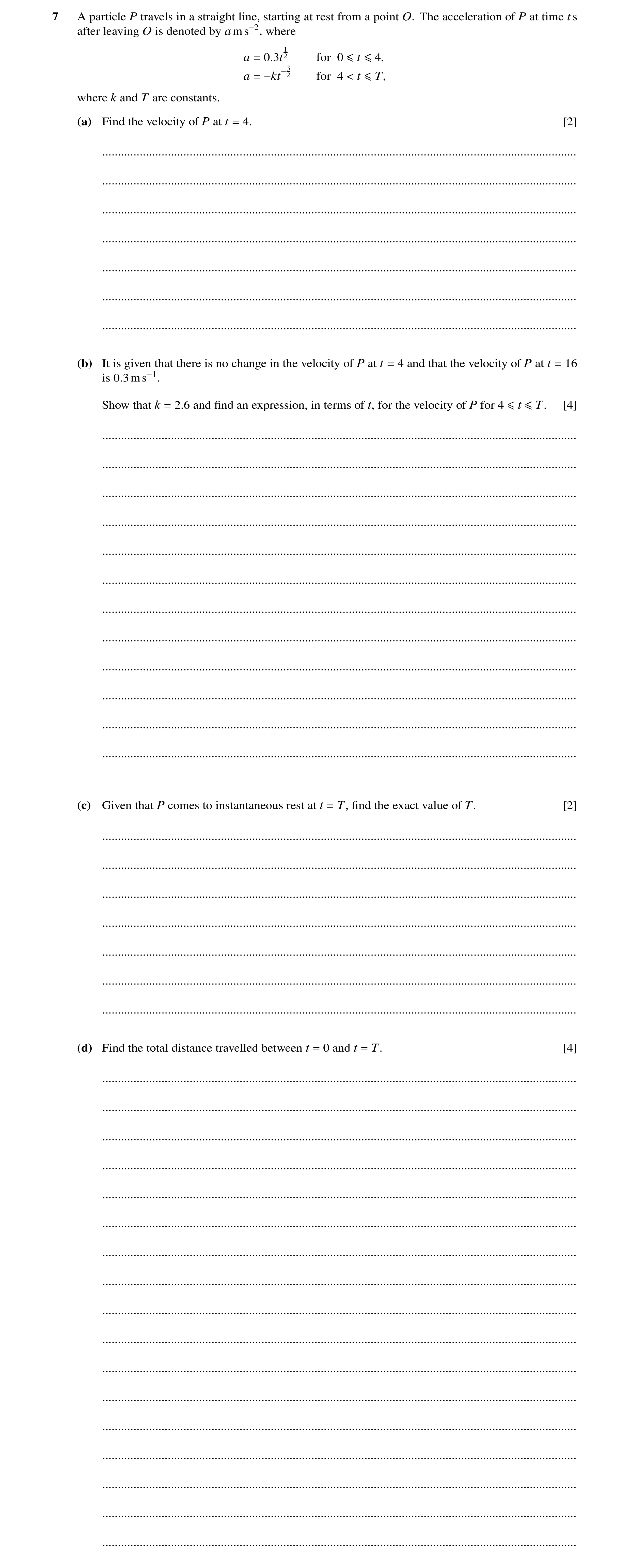
7 A particle P travels in a straight line, starting at rest from a point O. The acceleration of P at time t s after leaving O is denoted by ams−2, where 1 a = 0.3t 2 for 0 ≤t ≤4, a = −kt−3 2 for 4 < t ≤T, where k and T are constants. (a) Find the velocity of P at t = 4. [2] … … … … … … … (b) It is given that there is no change in the velocity of P at t = 4 and that the velocity of P at t = 16 is 0.3ms−1. Show that k = 2.6 and find an expression, in terms of t, for the velocity of P for 4 ≤t ≤T. [4] … … … … … … … … … … … … (c) Given that P comes to instantaneous rest at t = T, find the exact value of T. [2] … … … … … … … (d) Find the total distance travelled between t = 0 and t = T. [4] … … … … … … … … … … … … … … … … …
12 marks
Mark scheme: 7(a) 0.3 32 32 M1 For integration (do not penalise missing c) v = t ( + c ) = 0.2t ( + c ) The power of t must increase by 1 with a change of 1.5 coefficient. Use of v = at scores M0. 8 A1 ISW any extra work using the second equation for a. Velocity = 1.6 = ms−1 5 2 17(b) − *M1 For integration. No need for constant. Allow use of − k − 12 2 v = t + d = 2 kt + d given value of k = 2.6 . −0.5 The power of t must increase by 1 with a change of coefficient. Use of v = at scores M0. 1 − A1 FT For both equations in k and d ( Allow unsimplified ) . − k − 12 2 Their 1.6 = 4 + d = 2 k 4 + d Their 1.6 = k + d −0.5 − k − k − 12 1 2 0.3 = 16 + d = 2 k 16 + d 0.3 = + d −0.5 2 Attempt to solve for k or d DM1 Or substitute k = 2.6 into both equations and solve both for d (with d 0 ). Must get to ‘ k = ’ or ‘ d = ’. 1 − −2.6 − 12 A1 AG (AG for k, not for the expression). 2 k = 2.6 v = 5.2t − 1 or v = t − 1 Allow unsimplified expression for v and/or in terms of −0.5 k. If k is substituted then both equations must be shown 1 − to give a value of d = −1 and getting v = 5.2t 2 − 1 SC B1 for solving the correct equations simultaneously with no working seen and getting correct expression for v . SC A1 for correct expression for v if only the first M1 is scored. 7(b) Alternative method for question 7(b) from using limits 1 − *M1 For integration No need for constant. Allow use of − k − 12 2 v = t + d = 2 kt + d given value of k = 2.6 . −0.5 The power of t must increase by 1 with a change of coefficient. Use of v = at scores M0. 1 1 1 − − − A1 FT OE For correct unsimplified equation in k from using − k − 12 − k 2 2 2 4 − 16 = 1.6 − 0.3 or 2 k 4 − 2 k 16 = 1.6 − 0.3 limits for v as their 1.6 and 0.3 and limits for t as 4 and −0.5 −0.5 16. Attempt to solve for k DM1 Must be an equation using 0.3 and their k, and 16 and 4, Must be subtracting the limits to form the equation in k , but may have sign errors in their 1.6 − 0.3 . 1 − 2 −2.6 − 12 A1 AG (AG for k, not for the expression). k = 2.6, v = 5.2t − 1 or v = t − 1 Allow unsimplified expression for v and/or in terms of −0.5 k. 4 7(c) − 1 M1 For solving for T. Must get to ‘ T = ’. Must come from 5.2T 2 − their 1 = 0 integration, with their 1 from part (b) or found here not equal to zero. Do not allow made up value of d. 676 A1 OE Must be exact. Allow both marks as long as T = or 27.04 expression for v is correct, however obtained in 25 Q7(b). 2 3 1 3 5 1 17(d) 4 M1 − 27.04 0.2 5.2 For integration of 0.2t 2 oe or 5.2t −− 0.2t 2 dt = t 2 or 2 − their 1 t 2 − their 1 t 5.2t dt = 2.5 0.5 2 their 1 . May 0 4 be in terms of k. Not from any other expression. Their 1 may be zero (or replaced by zero). Their 1 may came from either part (b) or part (c) The power of t must increase by 1 with a change of coefficient in at least one term. 4 5 1 27.04 5 4 1 27.04 A1ft For both integrals (unsimplified) No need for limits 0.2 5.2 FT non-zero value of d. May be in terms of k. = t 2 t 2 − t = + 0.08t 2 + 10.4t 2 − t Their 1 may came from either part (b) or part (c). 2.5 0 0.5 4 0 4 = 0.08 32 + (10.4 5.2 − 27.04 ) − (10.4 2 − 4 ) = 2.56 + 10.24 M1 For correct use of limits (0 and 4 then 4 and their 27.04) in both of their integrals, which have come from 3 1 integration of 0.2t 2 and 5.2t −− 2 their 1 . Not from any other expression. Their 1 may be zero (or replaced by zero). Their 1 may came from either part (b) or part (c). Allow M1 for d = 0 (the final answer is 35.8 ). 64 A1 oe Awrt 12.8 Allow if using 27(.0) rather than 27.04 = or 12.8 Allow all 4 marks as long as expression for v is 5 correct, however obtained in Q7(b). 7(d) SC for using a calculator to integrate. 4 3 B1 AWRT 2.56 Either 0.2t 2 dt = 2.56 Allow 10.2 0 Must use 27.04 or 27(.0) if latter integral. 27.04 − 1 Or 5.2t 2 − 1 dt = 10.24 4 Total distance = 12.8 m B1 AWRT 12.8. Allow if using 27(.0) rather than 27.04 Allow both B marks as long as expression for v is correct, however obtained in Q7(b). 4
This question in 9709/42 Oct/Nov 2022
Q13 · A particle travels in a straight line 9709/43 May/June 2024
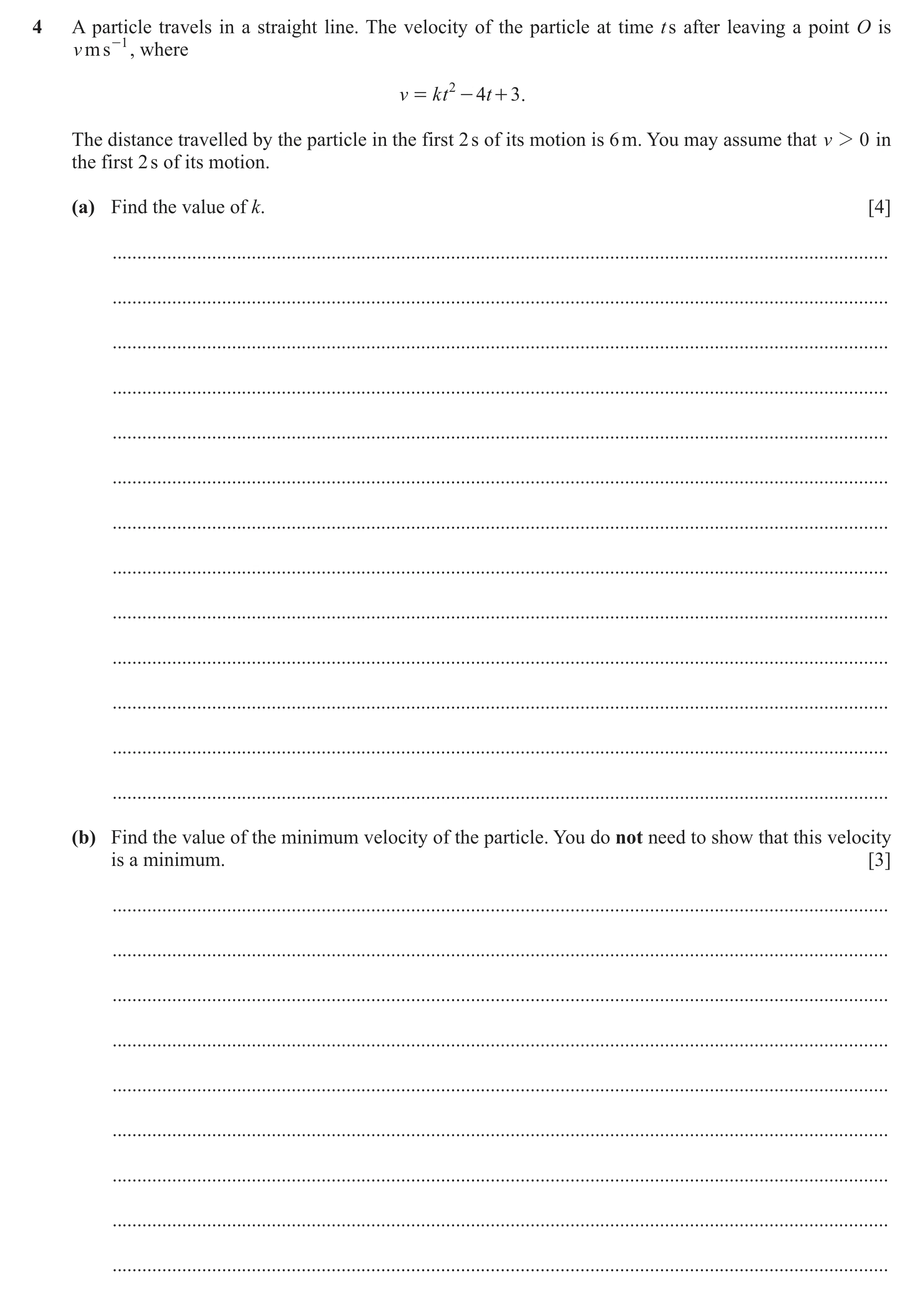
4 A particle travels in a straight line. The velocity of the particle at time t s after leaving a point O is v m s -1 , where v = kt 2 - t4 + 3 . The distance travelled by the particle in the first 2 s of its motion is 6 m. You may assume that v 2 0 in the first 2 s of its motion. (a) Find the value of k. [4] … … … … … … … … … … … … … (b) Find the value of the minimum velocity of the particle. You do not need to show that this velocity is a minimum. [3] … … … … … … … … …
7 marks
Mark scheme: 4(a) For attempt at integration M1* The power of t must increase by 1 with a change of coefficient in the same term. Use of s vt scores M0. 2 1 1 1 3 2 1 4 1 3 2 3 2 1 2 3 kt t t kt t t c A1 Allow unsimplified. 3 2 1 2 2 2 3 2 0 6 3 k DM1 Use of limits 0 and 2 with 6 to form an equation in k only (without c but allow with c c ). 3 k A1 4 Question Answer Marks Guidance 4(b) 2 3 4 t Or at min value 4 2 2 3 b t a M1 For attempt at differentiation. Must have expression of the form at b with 3, a unless their k = 3 2 . Allow 2 4. kt 2 3 4 0 t 2 3 t A1FT OE FT their k 2 . t their k Allow without working. 2 2 2 5 3 4 3 3 3 3 v m s-1 A1 OE Allow 1.67 or better for v. Alternative Method for Question 4(b): Using completing the square Attempt at completing the square (M1) Must have 2 2 3 t OE, or 2 . 2 t their k 2 2 4 3 3 3 3 t (A1FT) FT their k 2 2 4 3. k t k k 5 3 v m s-1 (A1) OE Allow 1.67 or better. 3
This question in 9709/43 May/June 2024
 1 / 19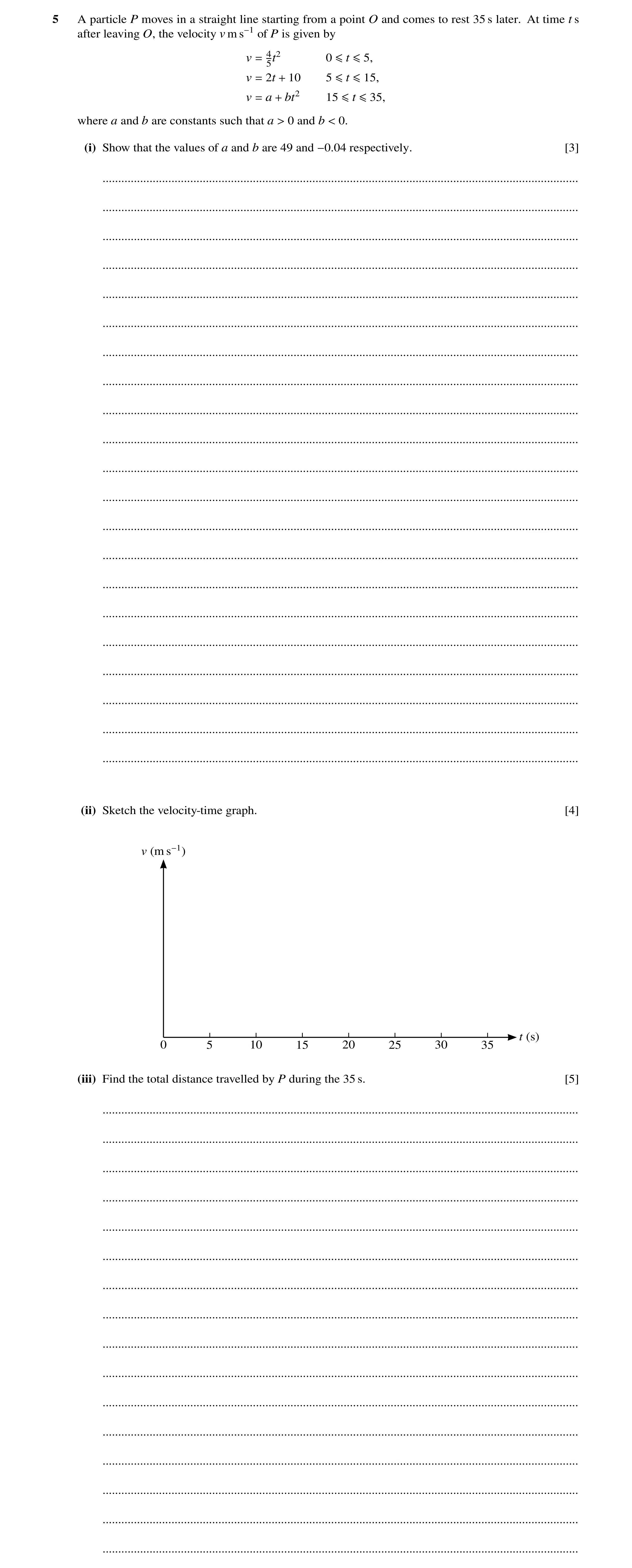
 19 / 19
 7
7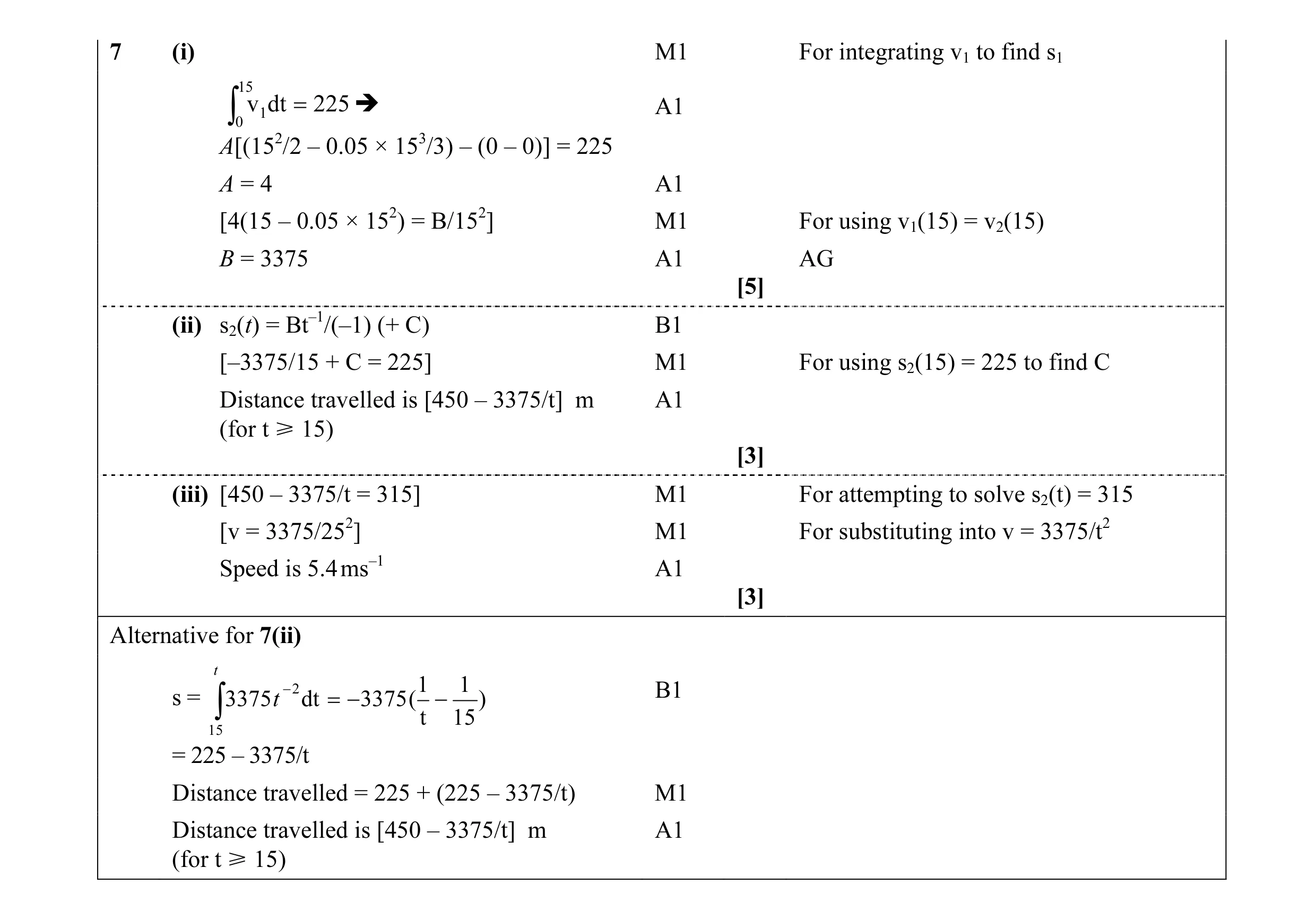 11
11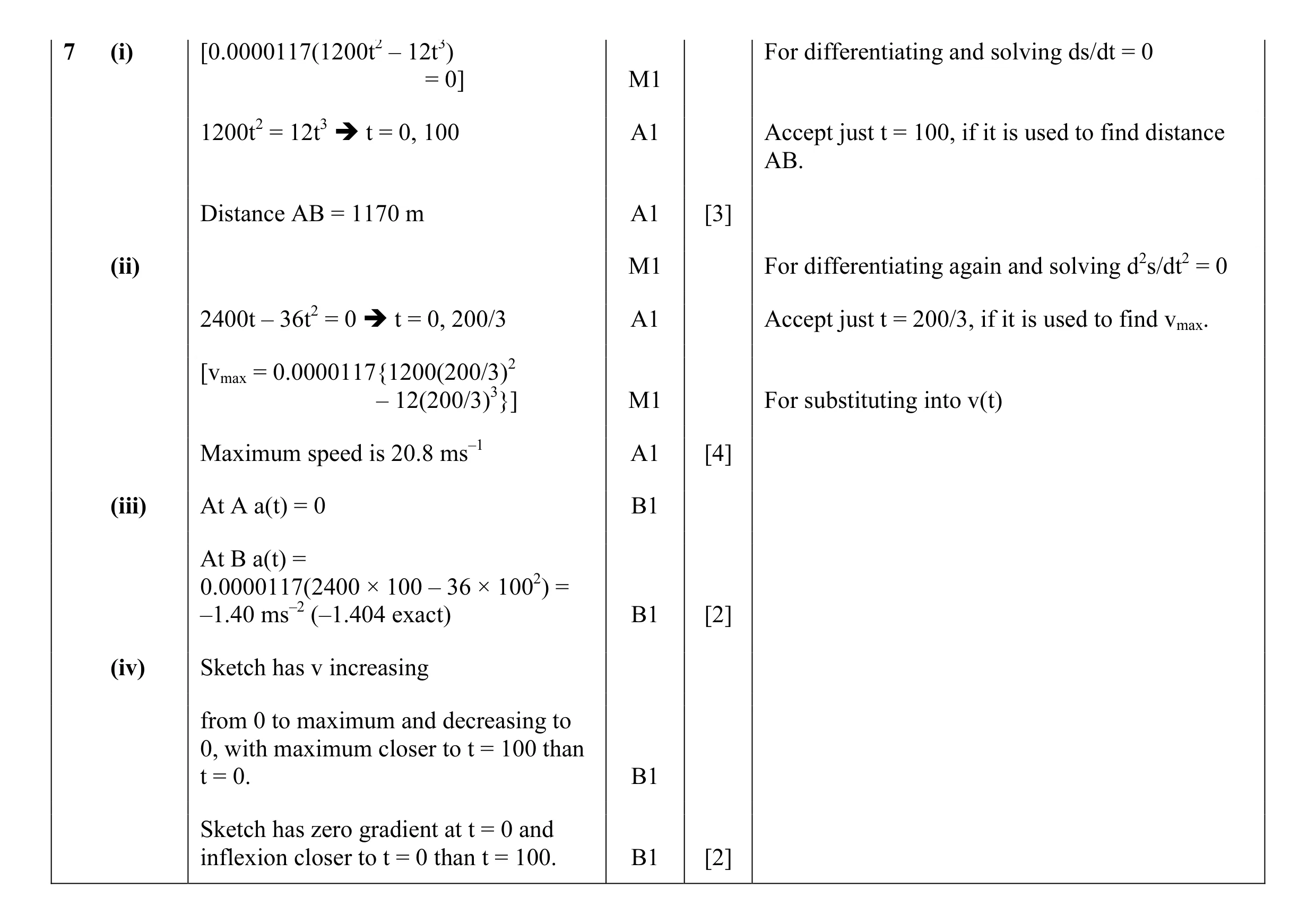 11
11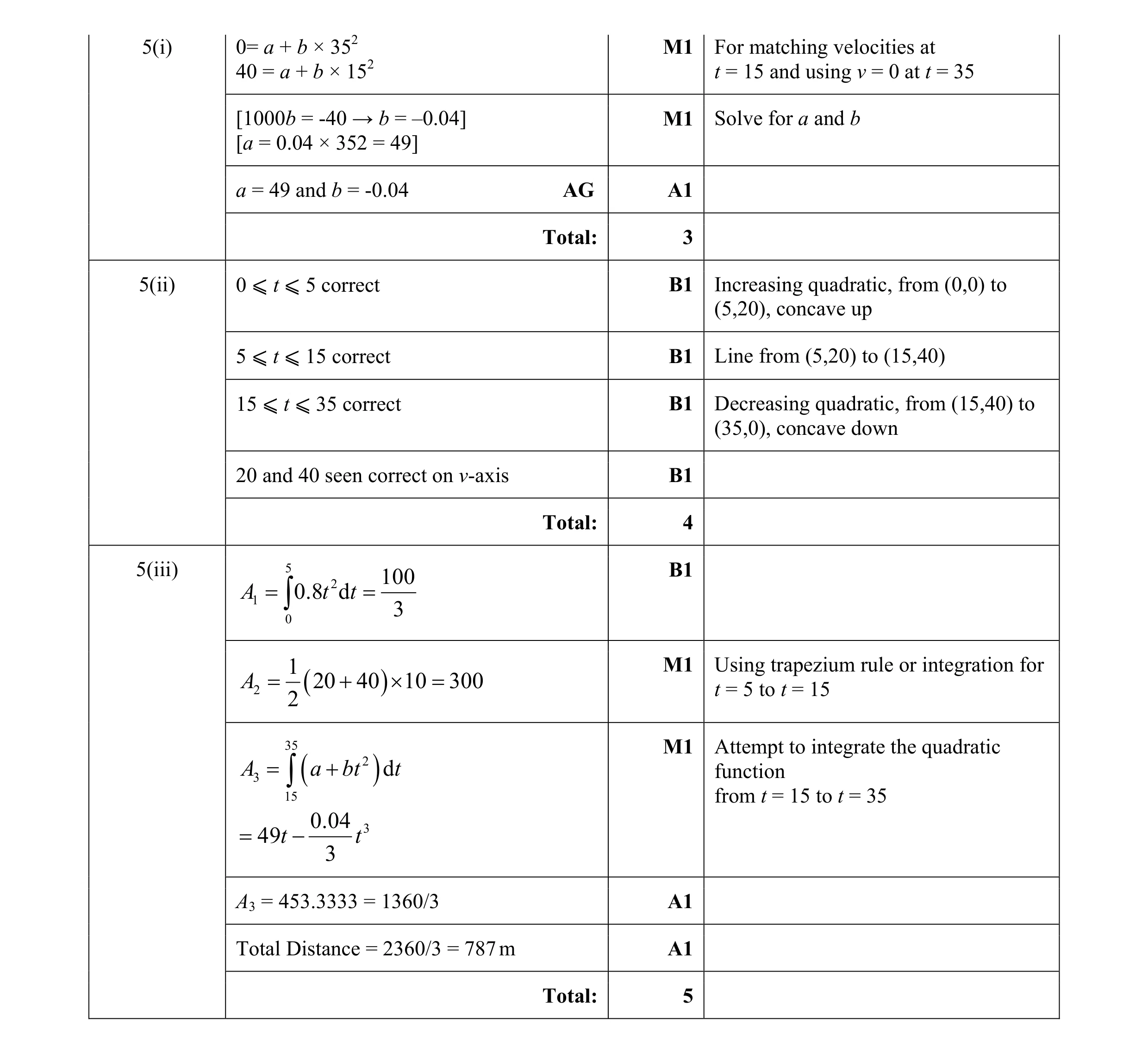 12
12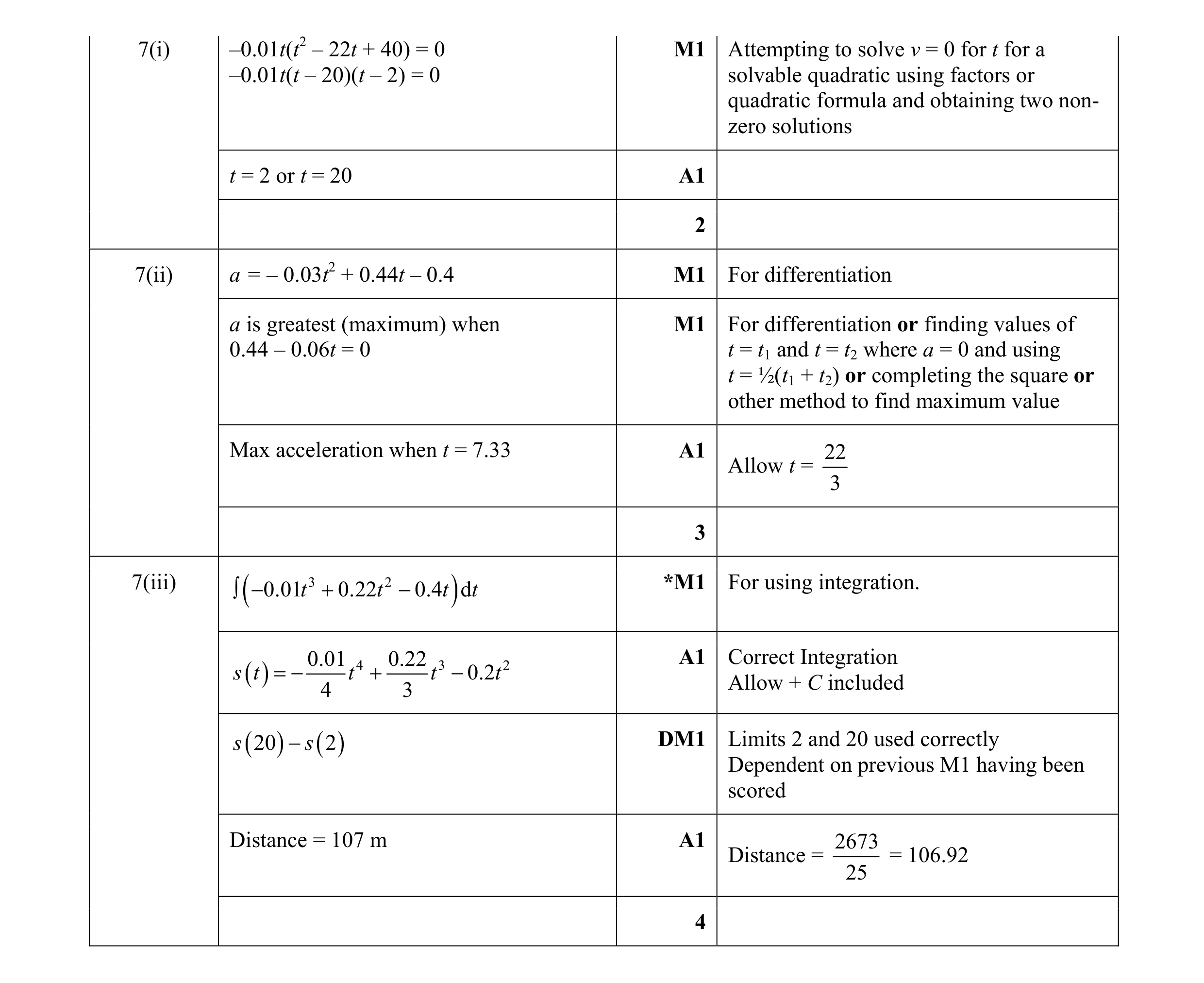 9
9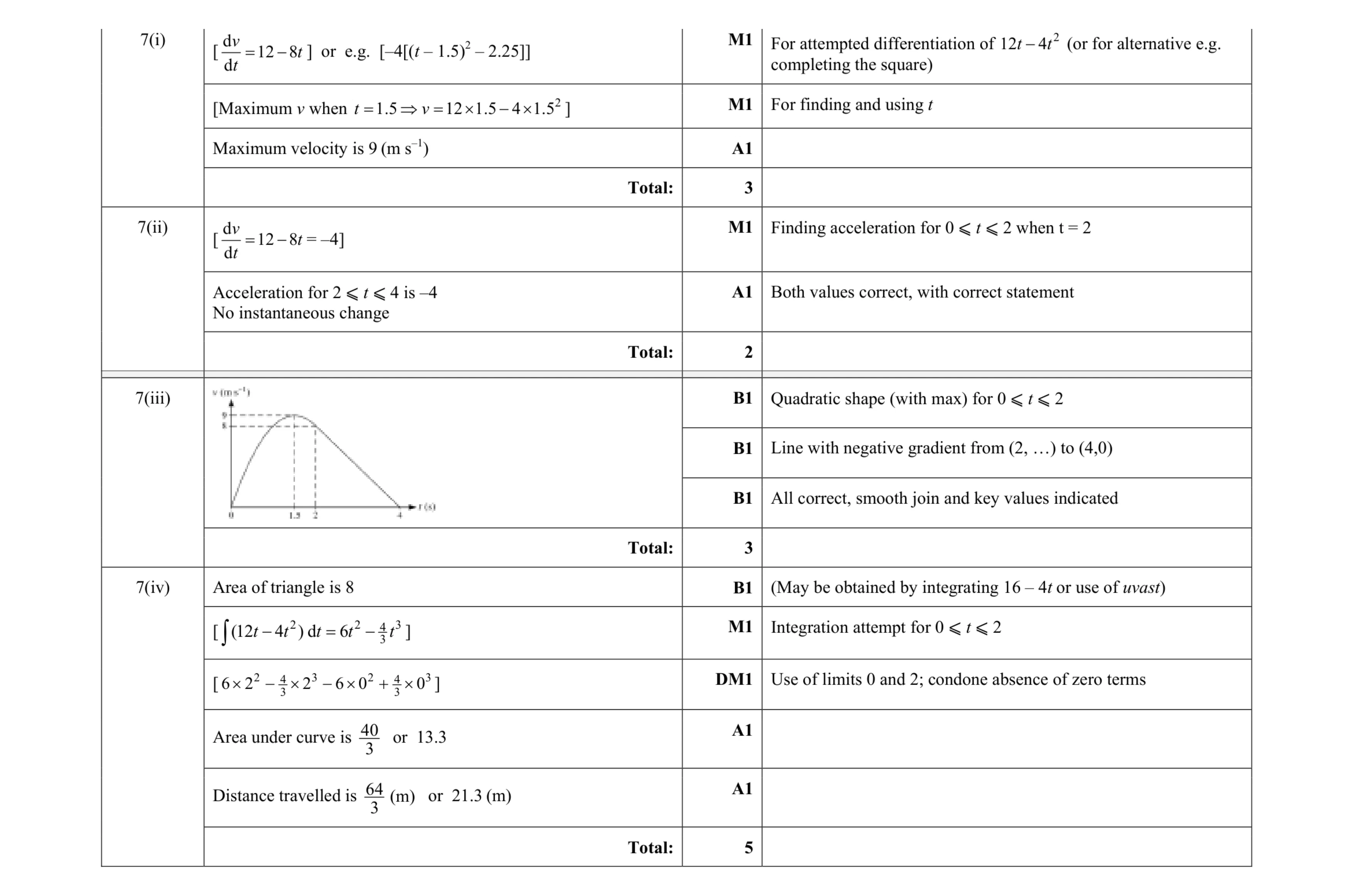 13
13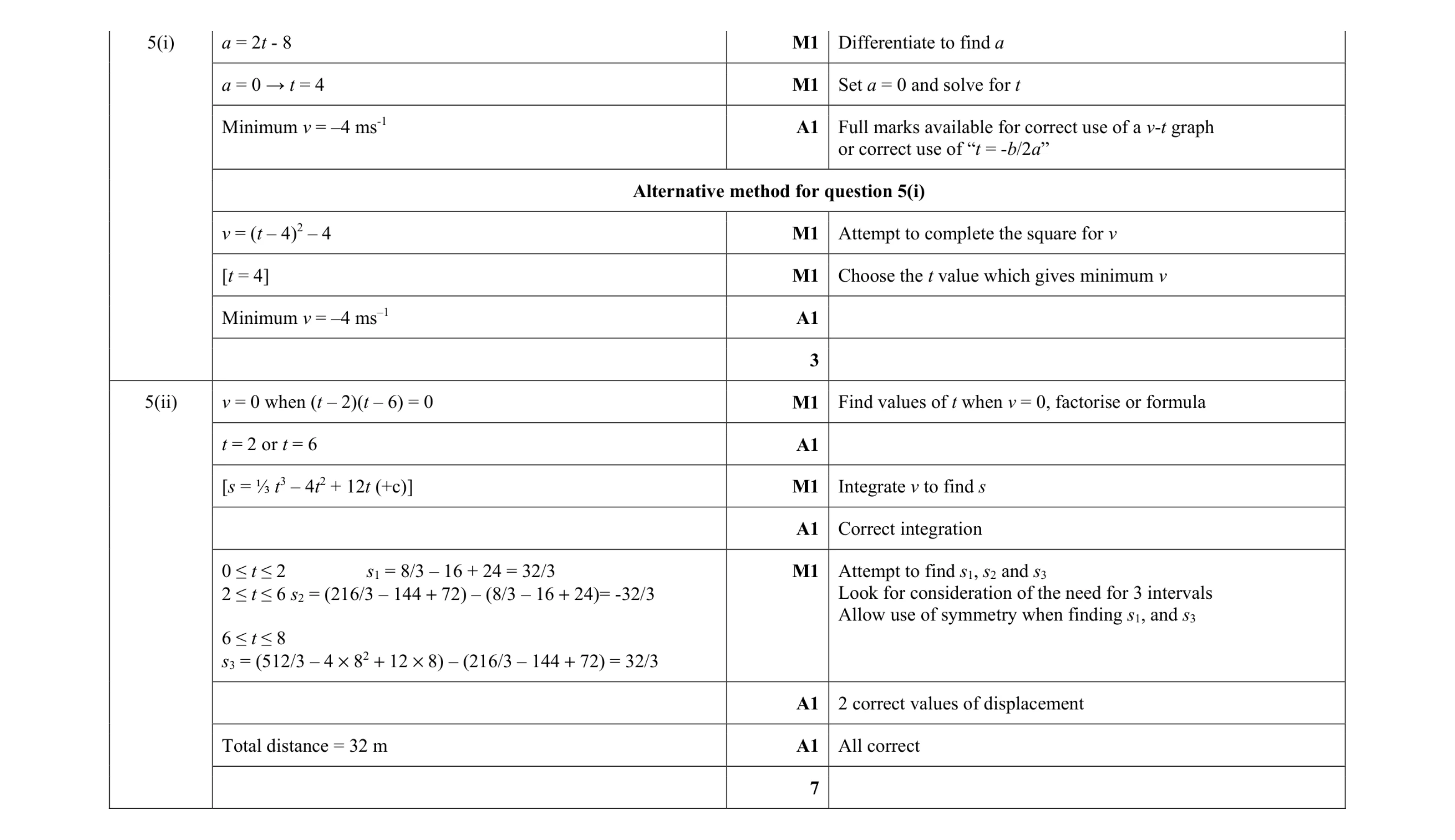 10
10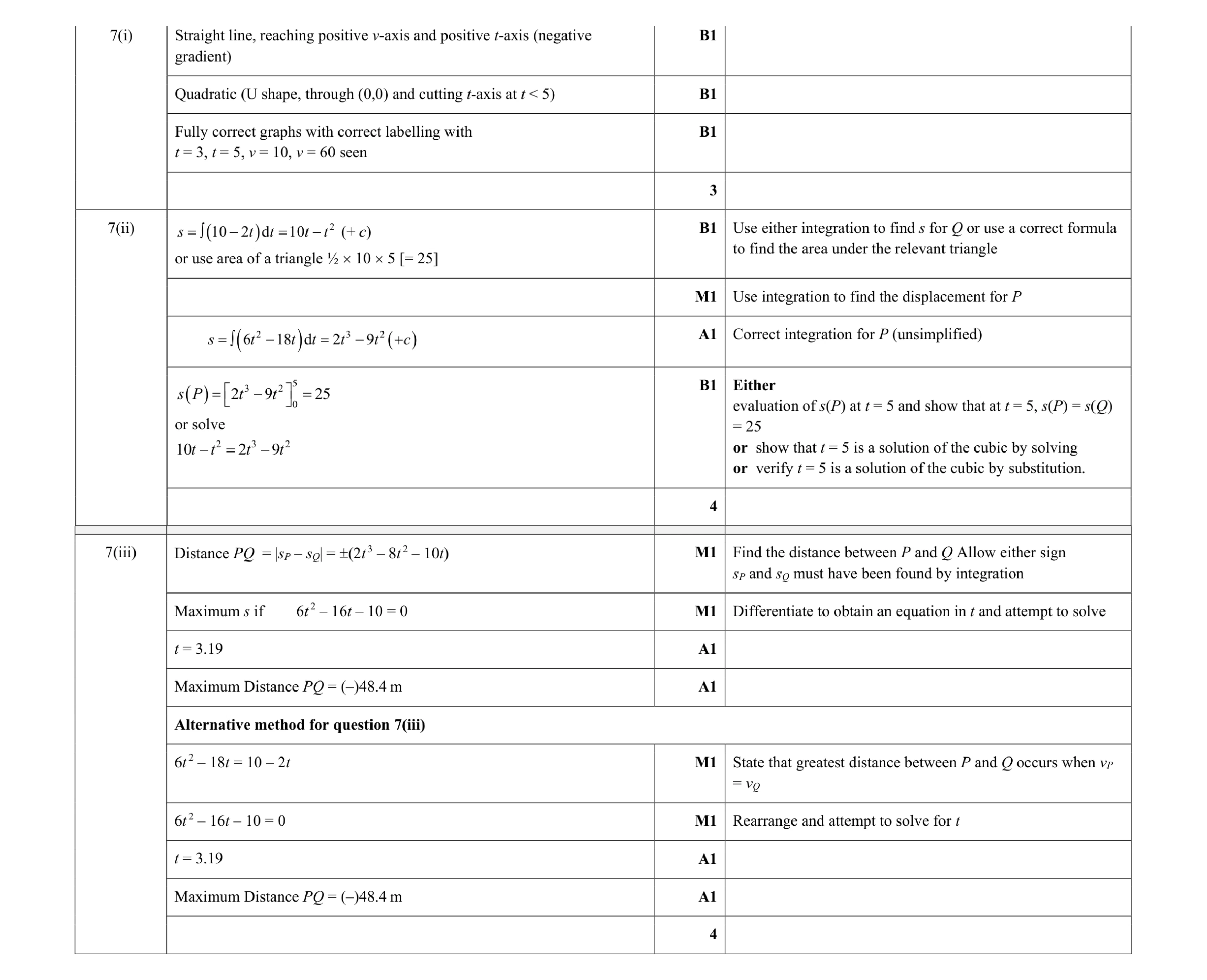 11
11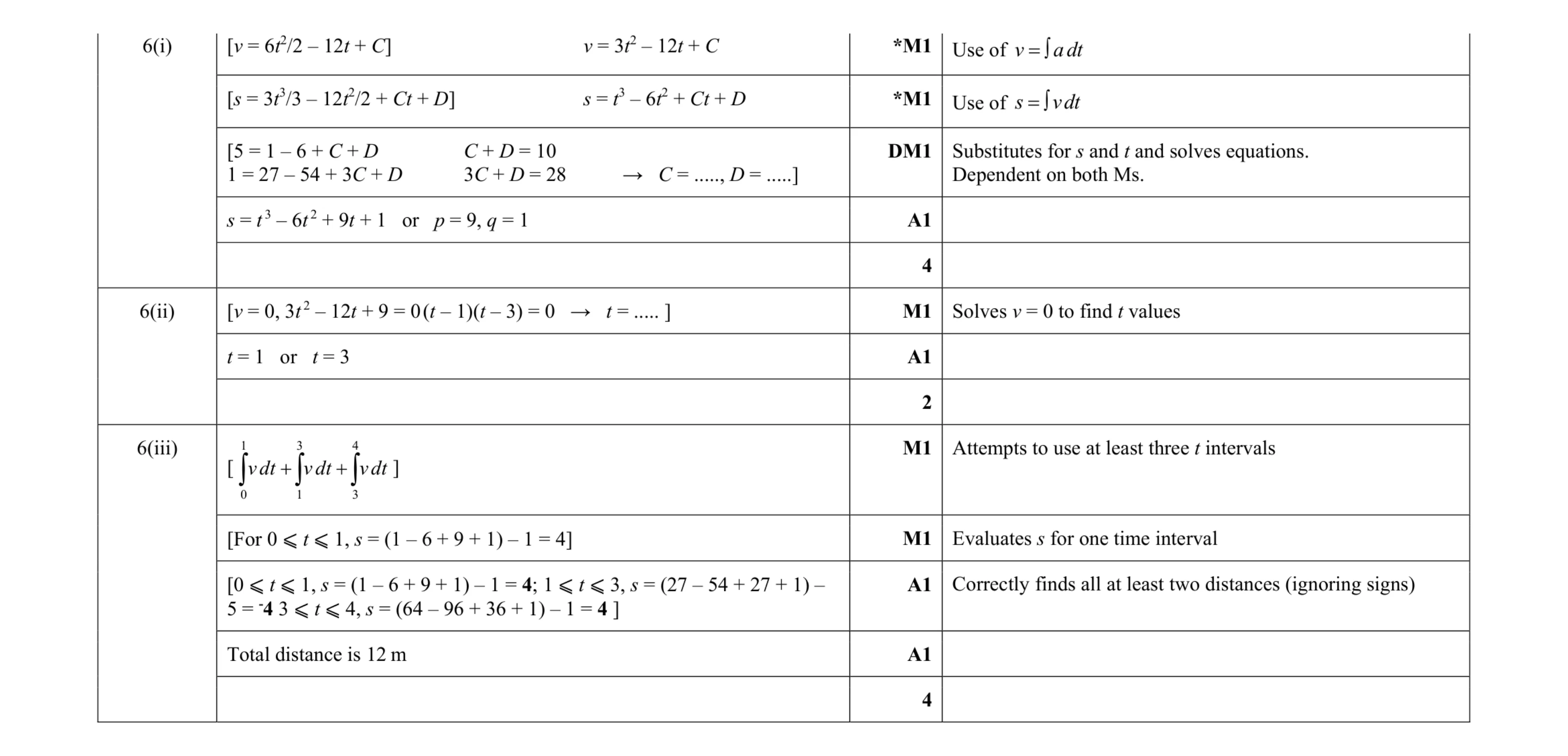 10
10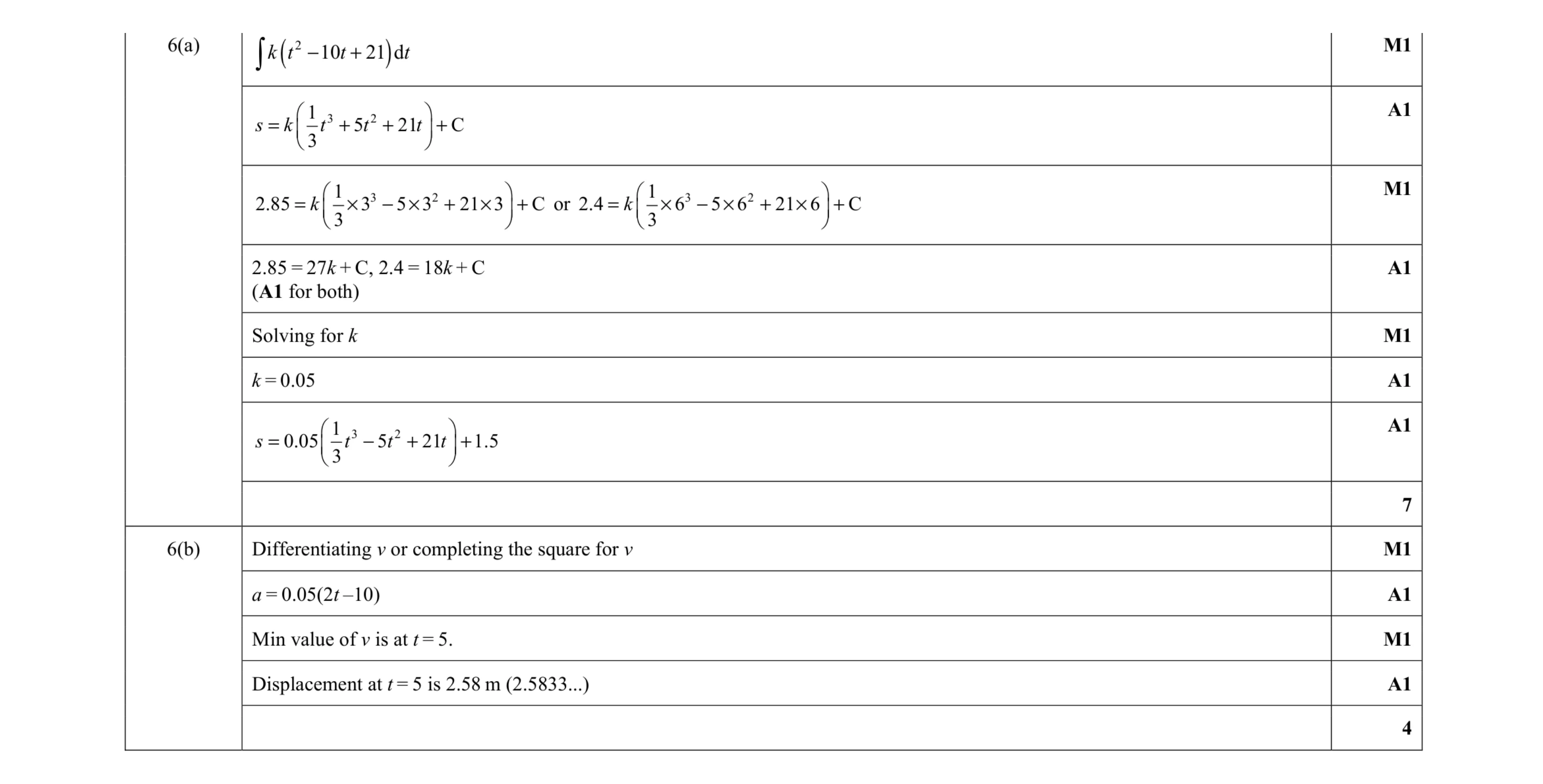 11
11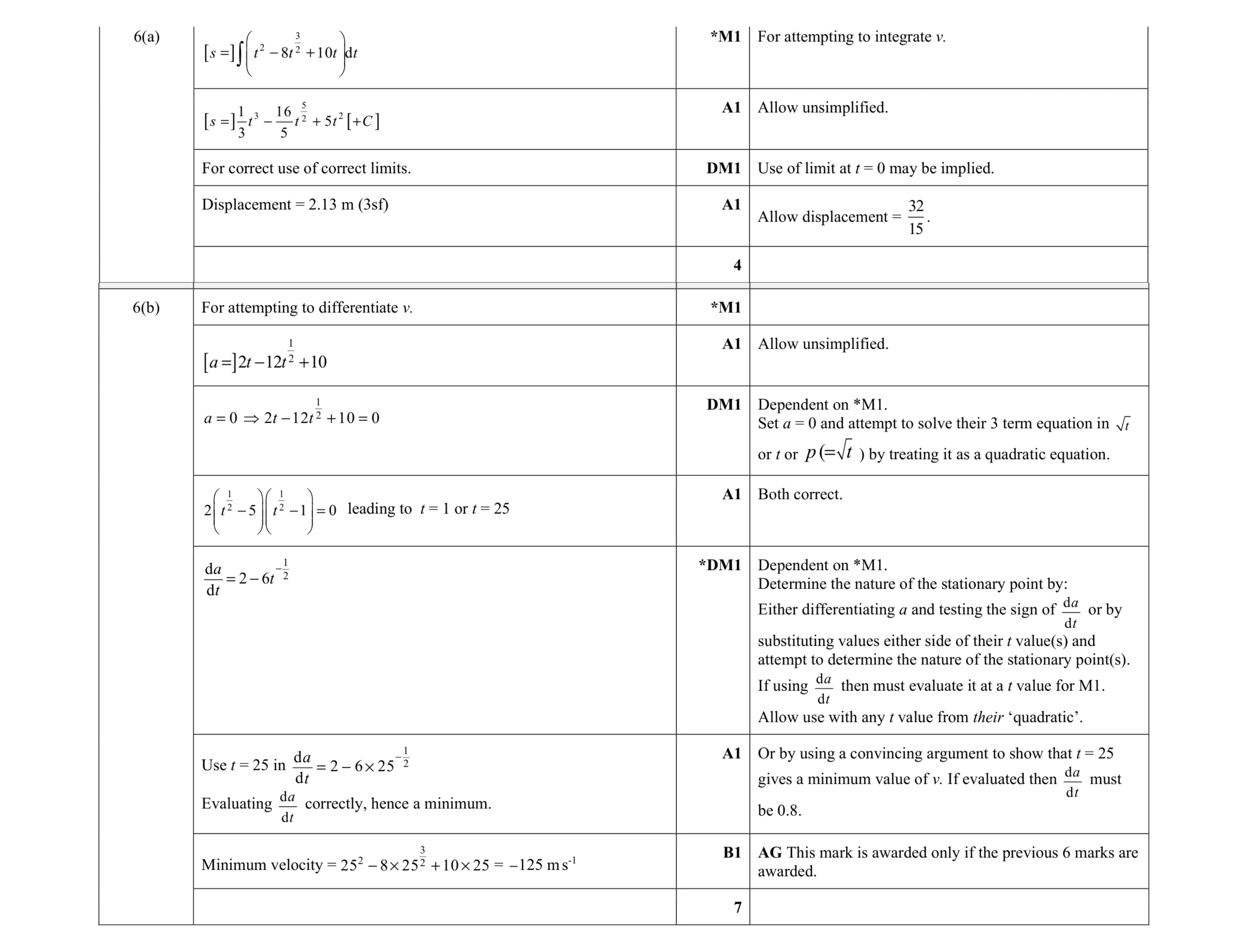 11
11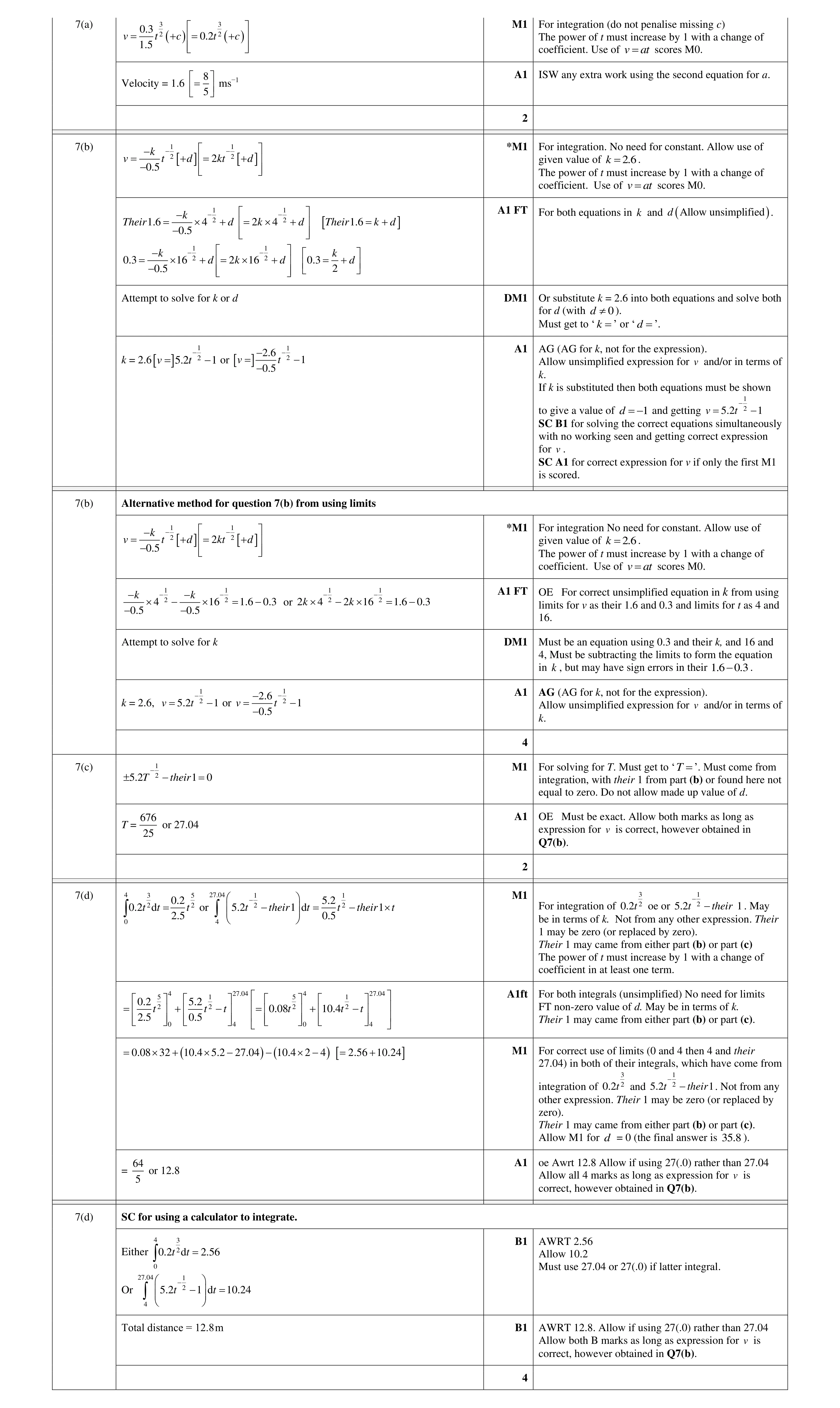 12
12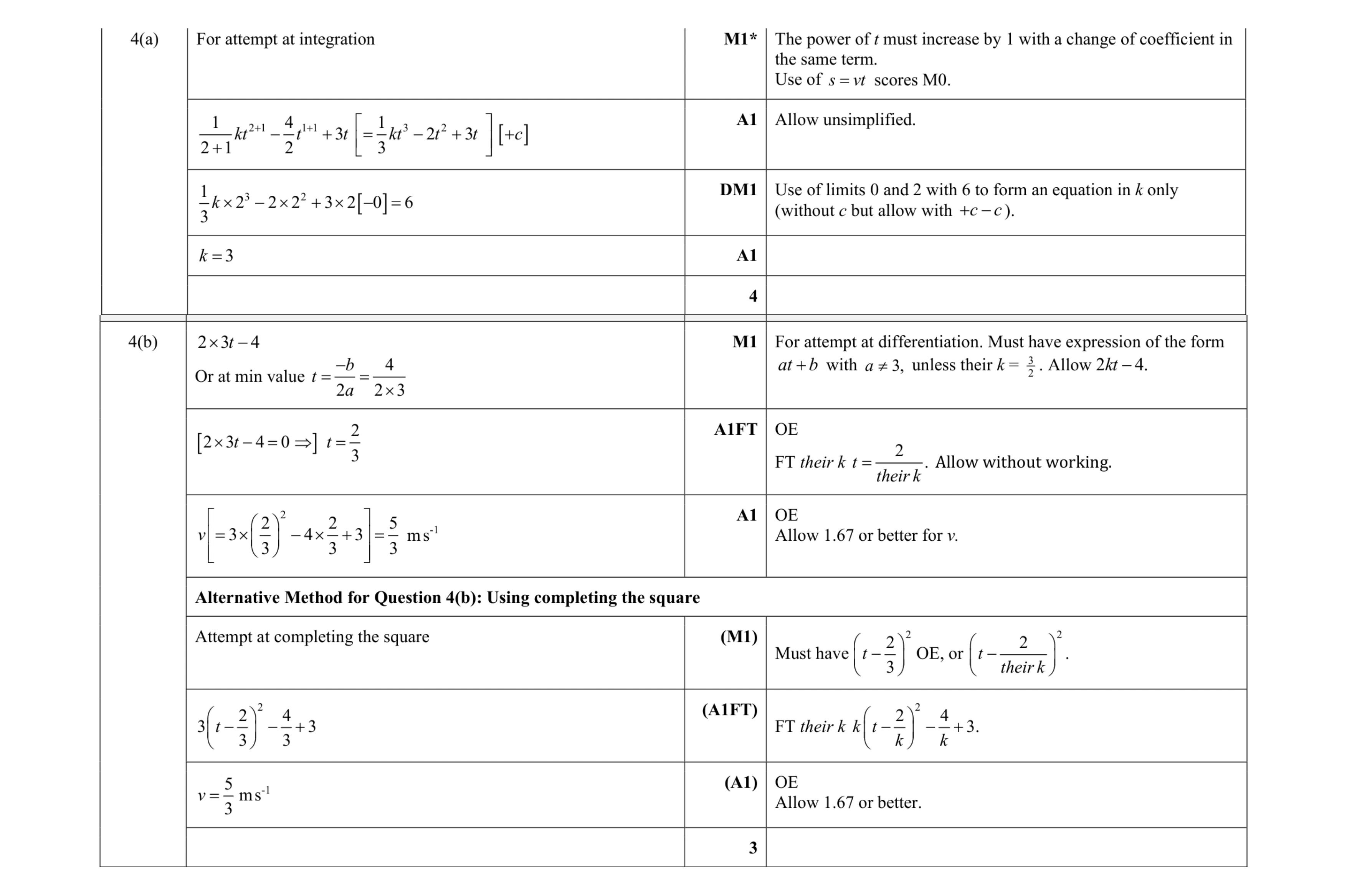 7
7