Cambridge A Level Mathematics 9709 — 2007 May/June Paper 5 · Variant 1
9709/51/M/J/07 · 7 questions · 50 marks · ≈56 min
The question paper and its mark scheme, free to read here and free to download. This is Cambridge’s own paper, exactly as it was sat.
Question paper4 pages
Mark scheme5 pages
Answers below. Sit the paper first if you are practising.
Questions as text
Q1 · A uniform semicircular lamina has radius 5 m
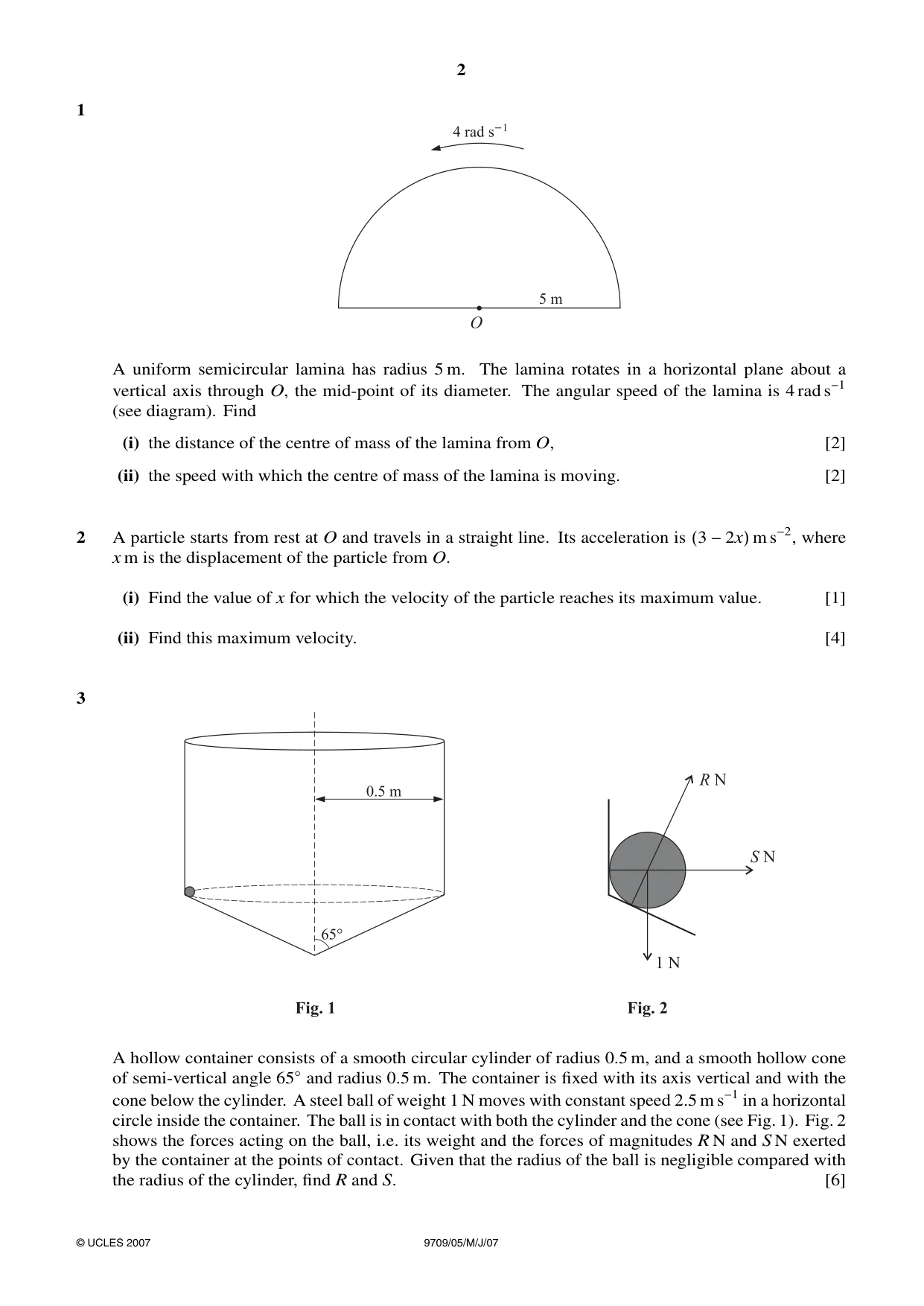
1 A uniform semicircular lamina has radius 5 m. The lamina rotates in a horizontal plane about a vertical axis through O, the mid-point of its diameter. The angular speed of the lamina is 4 rad s−1 (see diagram). Find (i) the distance of the centre of mass of the lamina from O, [2] (ii) the speed with which the centre of mass of the lamina is moving. [2]
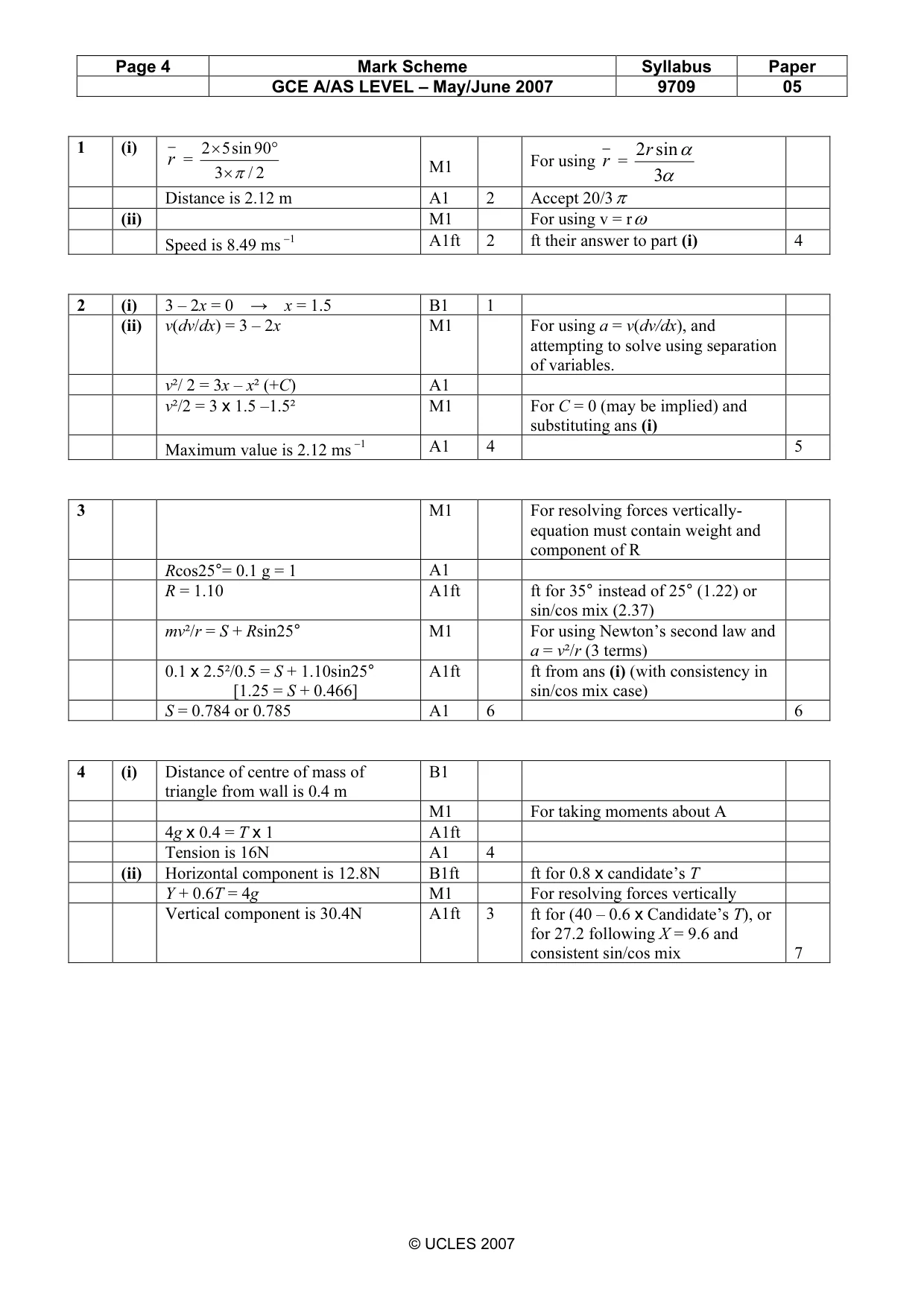
Mark scheme: 1 (i) 2 × 5 sin 90° 2r sin α r = For using r = M1 3 × π / 2 3α Distance is 2.12 m A1 2 Accept 20/3π (ii) M1 For using v = rω Speed is 8.49 ms −1 A1ft 2 ft their answer to part (i) 4
Q2 · A particle starts from rest at O and travels in a straight line
2 A particle starts from rest at O and travels in a straight line. Its acceleration is (3 −2x) m s−2, where x m is the displacement of the particle from O. (i) Find the value of x for which the velocity of the particle reaches its maximum value. [1] (ii) Find this maximum velocity. [4]
Mark scheme: 2 (i) 3 – 2x = 0 → x = 1.5 B1 1 (ii) v(dv/dx) = 3 – 2x M1 For using a = v(dv/dx), and attempting to solve using separation of variables. v²/ 2 = 3x – x² (+C) A1 v²/2 = 3 x 1.5 –1.5² M1 For C = 0 (may be implied) and substituting ans (i) Maximum value is 2.12 ms −1 A1 4 5
Q3 · A hollow container consists of a smooth circular cylinder of radius 0.5 m, and a smooth…
3 A hollow container consists of a smooth circular cylinder of radius 0.5 m, and a smooth hollow cone of semi-vertical angle 65◦and radius 0.5 m. The container is fixed with its axis vertical and with the cone below the cylinder. A steel ball of weight 1 N moves with constant speed 2.5 m s−1 in a horizontal circle inside the container. The ball is in contact with both the cylinder and the cone (see Fig. 1). Fig. 2 shows the forces acting on the ball, i.e. its weight and the forces of magnitudes R N and S N exerted by the container at the points of contact. Given that the radius of the ball is negligible compared with the radius of the cylinder, find R and S. [6]
Mark scheme: 3 M1 For resolving forces vertically- equation must contain weight and component of R Rcos25°= 0.1 g = 1 A1 R = 1.10 A1ft ft for 35° instead of 25° (1.22) or sin/cos mix (2.37) mv²/r = S + Rsin25° M1 For using Newton’s second law and a = v²/r (3 terms) 0.1 x 2.5²/0.5 = S + 1.10sin25° A1ft ft from ans (i) (with consistency in [1.25 = S + 0.466] sin/cos mix case) S = 0.784 or 0.785 A1 6 6
Q4 · A uniform triangular lamina ABC is right-angled at B and has sides AB = 0.6 m and BC =…
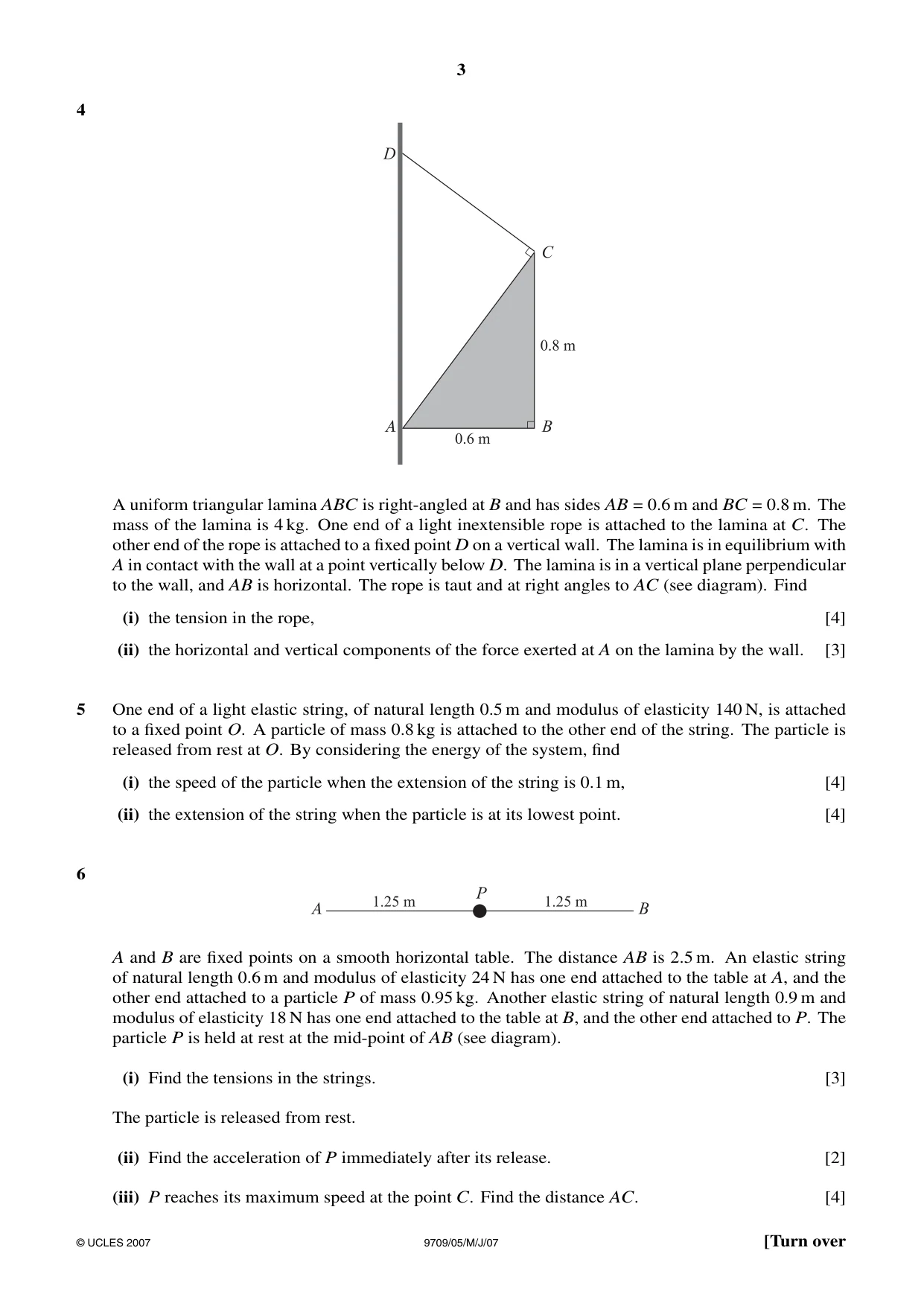
4 A uniform triangular lamina ABC is right-angled at B and has sides AB = 0.6 m and BC = 0.8 m. The mass of the lamina is 4 kg. One end of a light inextensible rope is attached to the lamina at C. The other end of the rope is attached to a fixed point D on a vertical wall. The lamina is in equilibrium with A in contact with the wall at a point vertically below D. The lamina is in a vertical plane perpendicular to the wall, and AB is horizontal. The rope is taut and at right angles to AC (see diagram). Find (i) the tension in the rope, [4] (ii) the horizontal and vertical components of the force exerted at A on the lamina by the wall. [3]
Mark scheme: 4 (i) Distance of centre of mass of B1 triangle from wall is 0.4 m M1 For taking moments about A 4g x 0.4 = T x 1 A1ft Tension is 16N A1 4 (ii) Horizontal component is 12.8N B1ft ft for 0.8 x candidate’s T Y + 0.6T = 4g M1 For resolving forces vertically Vertical component is 30.4N A1ft 3 ft for (40 – 0.6 x Candidate’s T), or for 27.2 following X = 9.6 and consistent sin/cos mix 7 GCE A/AS LEVEL – May/June 2007 9709 05
Q5 · One end of a light elastic string, of natural length 0.5 m and modulus of elasticity 140…
5 One end of a light elastic string, of natural length 0.5 m and modulus of elasticity 140 N, is attached to a fixed point O. A particle of mass 0.8 kg is attached to the other end of the string. The particle is released from rest at O. By considering the energy of the system, find (i) the speed of the particle when the extension of the string is 0.1 m, [4] (ii) the extension of the string when the particle is at its lowest point. [4]
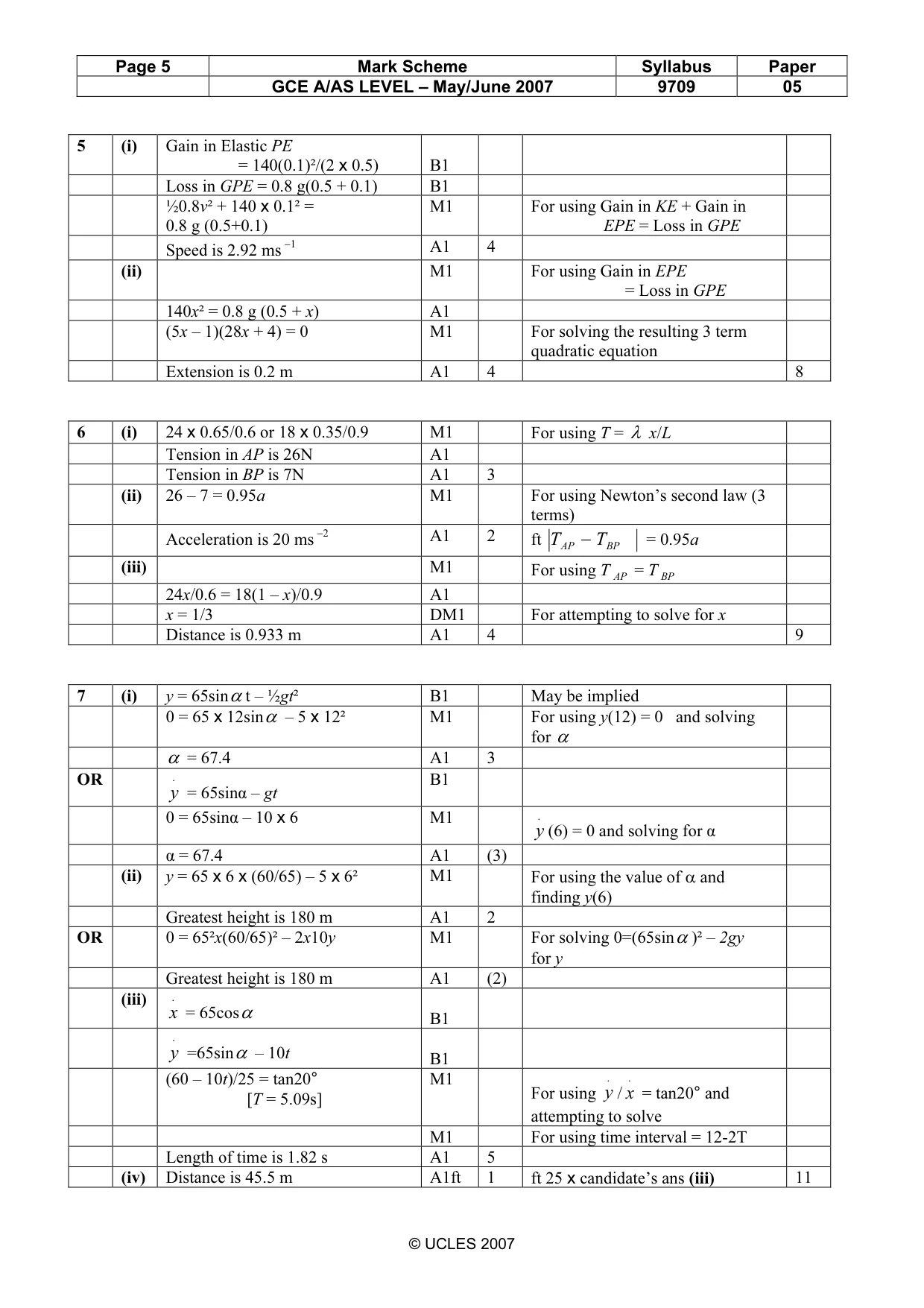
Mark scheme: 5 (i) Gain in Elastic PE = 140(0.1)²/(2 x 0.5) B1 Loss in GPE = 0.8 g(0.5 + 0.1) B1 ½0.8v² + 140 x 0.1² = M1 For using Gain in KE + Gain in 0.8 g (0.5+0.1) EPE = Loss in GPE Speed is 2.92 ms −1 A1 4 (ii) M1 For using Gain in EPE = Loss in GPE 140x² = 0.8 g (0.5 + x) A1 (5x – 1)(28x + 4) = 0 M1 For solving the resulting 3 term quadratic equation Extension is 0.2 m A1 4 8
Q6 · A and B are fixed points on a smooth horizontal table
6 A and B are fixed points on a smooth horizontal table. The distance AB is 2.5 m. An elastic string of natural length 0.6 m and modulus of elasticity 24 N has one end attached to the table at A, and the other end attached to a particle P of mass 0.95 kg. Another elastic string of natural length 0.9 m and modulus of elasticity 18 N has one end attached to the table at B, and the other end attached to P. The particle P is held at rest at the mid-point of AB (see diagram). (i) Find the tensions in the strings. [3] The particle is released from rest. (ii) Find the acceleration of P immediately after its release. [2] (iii) P reaches its maximum speed at the point C. Find the distance AC. [4]
Mark scheme: 6 (i) 24 x 0.65/0.6 or 18 x 0.35/0.9 M1 For using T = λ x/L Tension in AP is 26N A1 Tension in BP is 7N A1 3 (ii) 26 – 7 = 0.95a M1 For using Newton’s second law (3 terms) Acceleration is 20 ms −2 A1 2 ft T AP − T BP = 0.95a (iii) M1 For using T AP = T BP 24x/0.6 = 18(1 – x)/0.9 A1 x = 1/3 DM1 For attempting to solve for x Distance is 0.933 m A1 4 9
Q7 · A particle is projected with speed 65 m s−1 from a point on horizontal ground, in a…
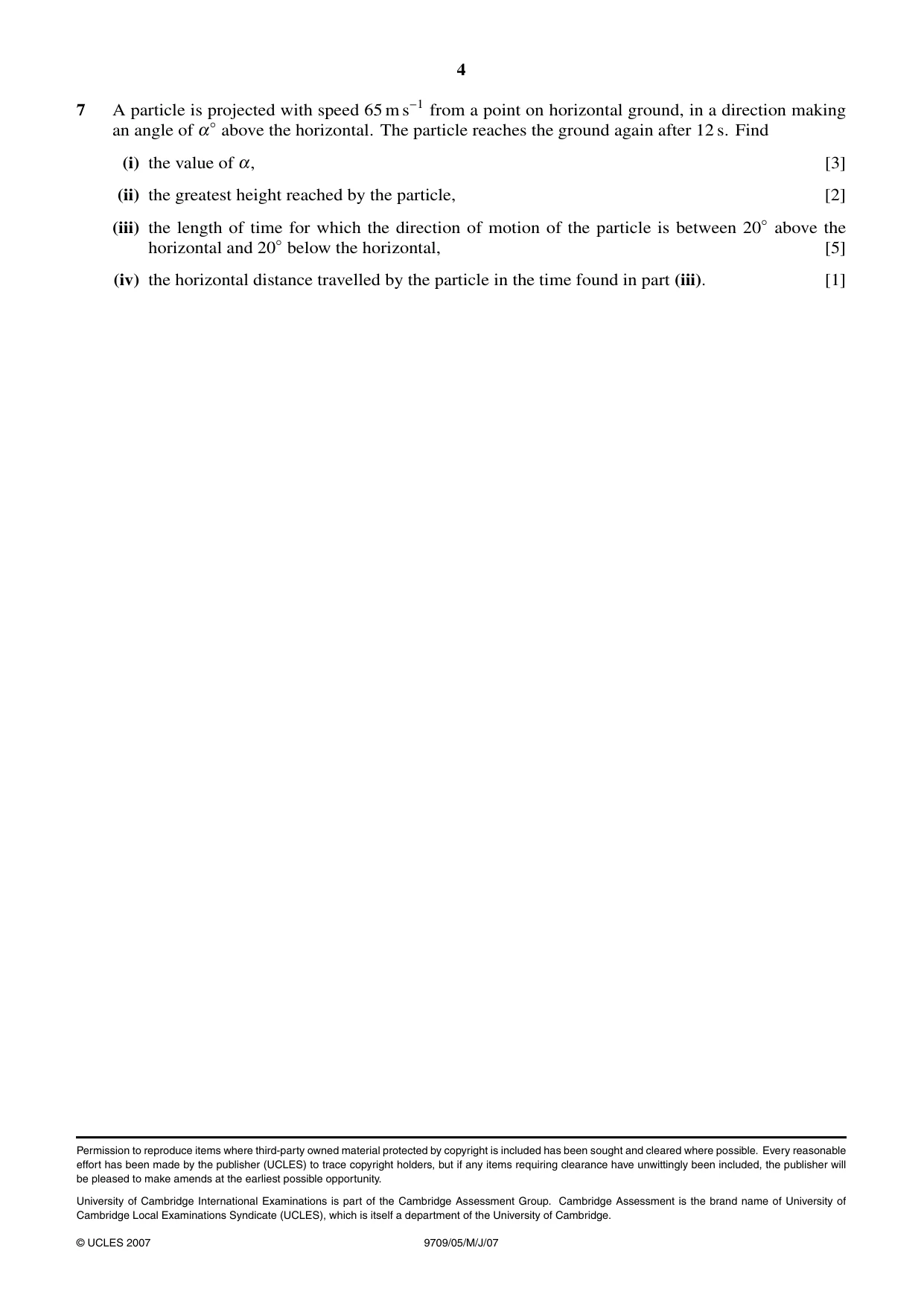
7 A particle is projected with speed 65 m s−1 from a point on horizontal ground, in a direction making an angle of α◦above the horizontal. The particle reaches the ground again after 12 s. Find (i) the value of α, [3] (ii) the greatest height reached by the particle, [2] (iii) the length of time for which the direction of motion of the particle is between 20◦above the horizontal and 20◦below the horizontal, [5] (iv) the horizontal distance travelled by the particle in the time found in part (iii). [1]
Mark scheme: 7 (i) y = 65sinα t – ½gt² B1 May be implied 0 = 65 x 12sinα – 5 x 12² M1 For using y(12) = 0 and solving for α α = 67.4 A1 3 OR . B1 y = 65sinα – gt 0 = 65sinα – 10 x 6 M1 . y (6) = 0 and solving for α α = 67.4 A1 (3) (ii) y = 65 x 6 x (60/65) – 5 x 6² M1 For using the value of α and finding y(6) Greatest height is 180 m A1 2 OR 0 = 65²x(60/65)² – 2x10y M1 For solving 0=(65sinα )² – 2gy for y Greatest height is 180 m A1 (2) (iii) . x = 65cosα B1 . y =65sinα – 10t B1 (60 – 10t)/25 = tan20° M1 . . For using y / x = tan20° and [T = 5.09s] attempting to solve M1 For using time interval = 12-2T Length of time is 1.82 s A1 5 (iv) Distance is 45.5 m A1ft 1 ft 25 x candidate’s ans (iii) 11
What was in this paper
The subtopics covered by these 7 questions, and how many questions each got. Open one in a new tab to see every Cambridge question on it.
What you needed in this session
Cambridge’s own grade thresholds for 2007 May/June, Paper 5 · Variant 1. A higher threshold means an easier paper — the bar moves with how the cohort did.