Cambridge A Level Mathematics 9709 — 2005 May/June Paper 5 · Variant 1
9709/51/M/J/05 · 7 questions · 50 marks · ≈56 min
The question paper and its mark scheme, free to read here and free to download. This is Cambridge’s own paper, exactly as it was sat.
Question paper8 pages
Mark scheme8 pages
Answers below. Sit the paper first if you are practising.
Questions as text
Q1 · A particle P of mass m kg is attached to the mid-point of a light elastic string of…
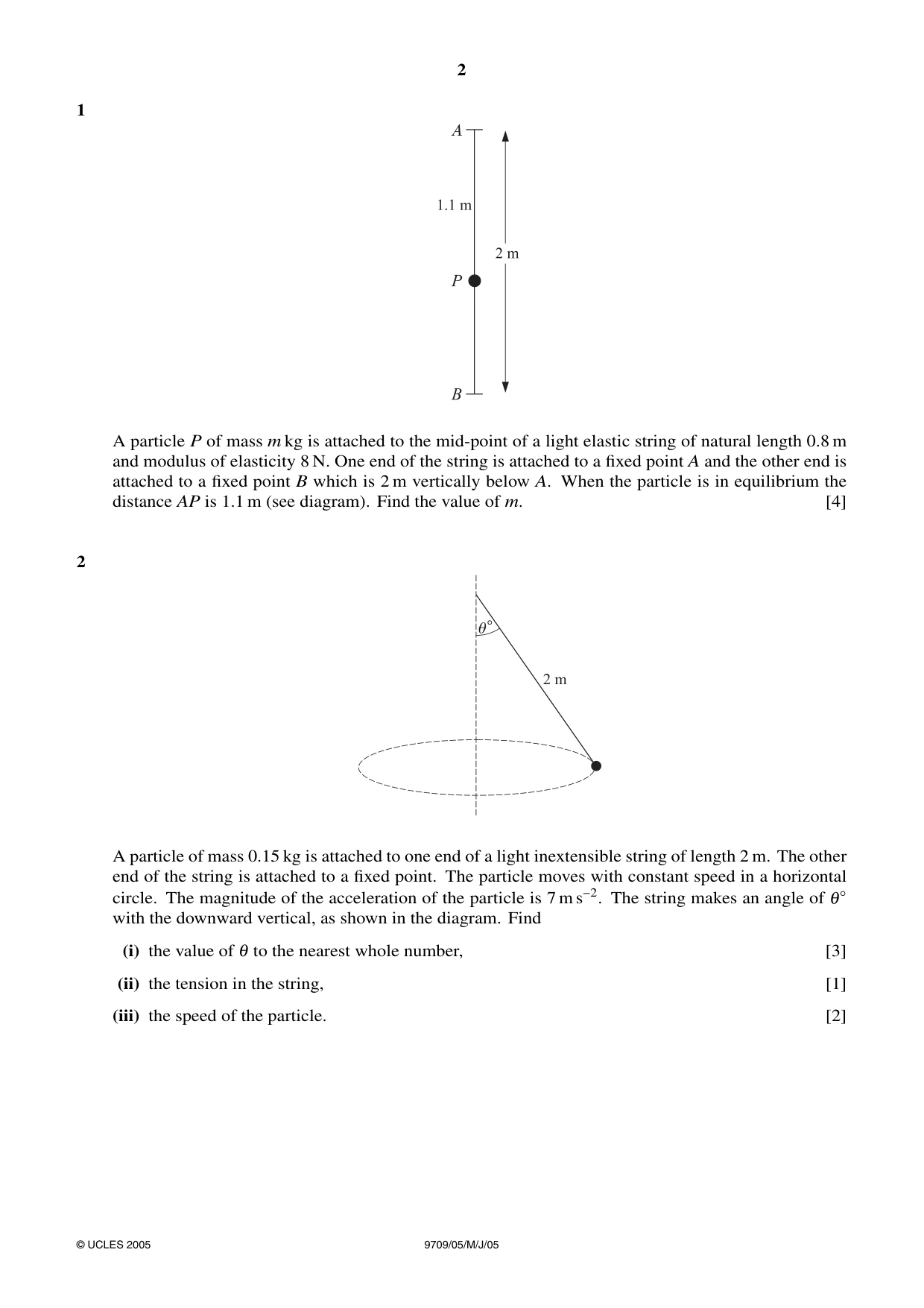
1 A particle P of mass m kg is attached to the mid-point of a light elastic string of natural length 0.8 m and modulus of elasticity 8 N. One end of the string is attached to a fixed point A and the other end is attached to a fixed point B which is 2 m vertically below A. When the particle is in equilibrium the distance AP is 1.1 m (see diagram). Find the value of m. [4]
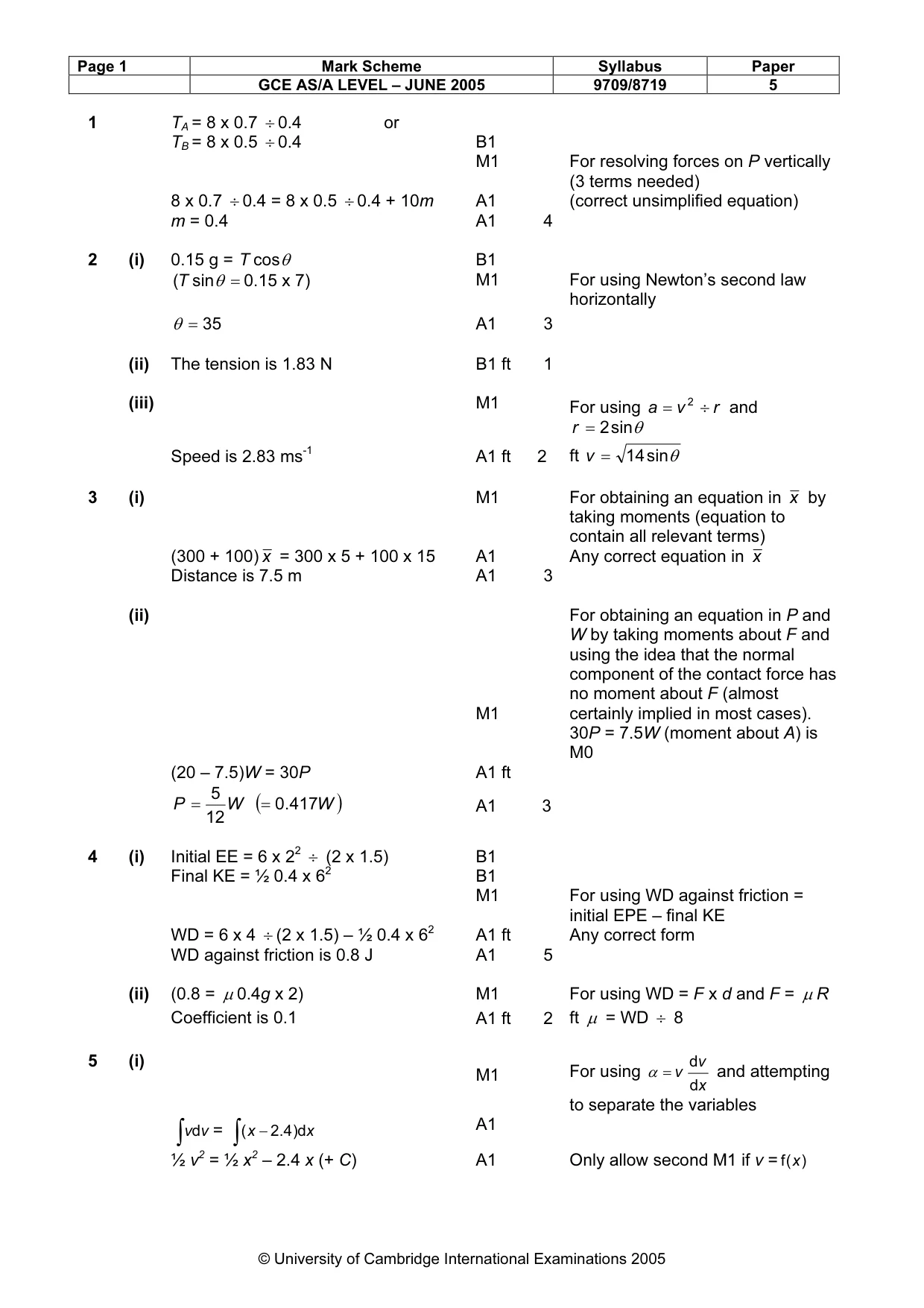
Mark scheme: 1 TA = 8 x 0.7 ÷ 0.4 or TB = 8 x 0.5 ÷ 0.4 B1 M1 For resolving forces on P vertically (3 terms needed) 8 x 0.7 ÷ 0.4 = 8 x 0.5 ÷ 0.4 + 10m A1 (correct unsimplified equation) m = 0.4 A1 4
Q2 · A particle of mass 0.15 kg is attached to one end of a light inextensible string of…
2 A particle of mass 0.15 kg is attached to one end of a light inextensible string of length 2 m. The other end of the string is attached to a fixed point. The particle moves with constant speed in a horizontal circle. The magnitude of the acceleration of the particle is 7 m s−2. The string makes an angle of θ◦ with the downward vertical, as shown in the diagram. Find (i) the value of θ to the nearest whole number, [3] (ii) the tension in the string, [1] (iii) the speed of the particle. [2]
Mark scheme: 2 (i) 0.15 g = T cos θ B1 (T sin θ = 0.15 x 7) M1 For using Newton’s second law horizontally θ = 35 A1 3 (ii) The tension is 1.83 N B1 ft 1 (iii) M1 For using a = v 2 ÷ r and r = 2 sin θ Speed is 2.83 ms-1 A1 ft 2 ft v = 14 sin θ
Q3 · ABCDEF is the L-shaped cross-section of a uniform solid
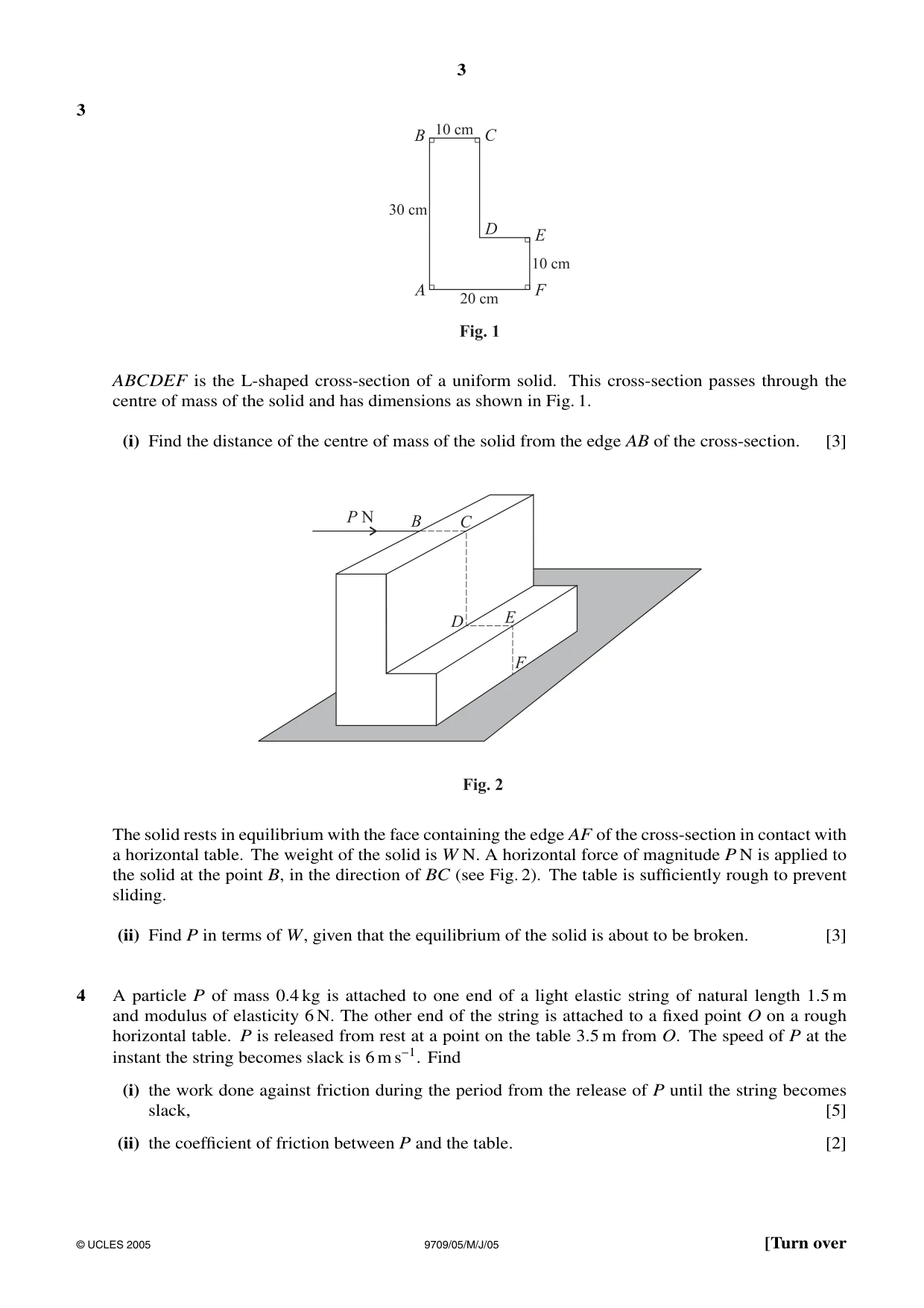
3 ABCDEF is the L-shaped cross-section of a uniform solid. This cross-section passes through the centre of mass of the solid and has dimensions as shown in Fig. 1. (i) Find the distance of the centre of mass of the solid from the edge AB of the cross-section. [3] The solid rests in equilibrium with the face containing the edge AF of the cross-section in contact with a horizontal table. The weight of the solid is W N. A horizontal force of magnitude P N is applied to the solid at the point B, in the direction of BC (see Fig. 2). The table is sufficiently rough to prevent sliding. (ii) Find P in terms of W, given that the equilibrium of the solid is about to be broken. [3]
Mark scheme: 3 (i) M1 For obtaining an equation in x by taking moments (equation to contain all relevant terms) (300 + 100) x = 300 x 5 + 100 x 15 A1 Any correct equation in x Distance is 7.5 m A1 3 (ii) For obtaining an equation in P and W by taking moments about F and using the idea that the normal component of the contact force has no moment about F (almost M1 certainly implied in most cases). 30P = 7.5W (moment about A) is M0 (20 – 7.5)W = 30P A1 ft 5 P = W (= 0 . 417W ) A1 3 12
Q4 · A particle P of mass 0.4 kg is attached to one end of a light elastic string of natural…
4 A particle P of mass 0.4 kg is attached to one end of a light elastic string of natural length 1.5 m and modulus of elasticity 6 N. The other end of the string is attached to a fixed point O on a rough horizontal table. P is released from rest at a point on the table 3.5 m from O. The speed of P at the instant the string becomes slack is 6 m s−1. Find (i) the work done against friction during the period from the release of P until the string becomes slack, [5] (ii) the coefficient of friction between P and the table. [2]
Mark scheme: 4 (i) Initial EE = 6 x 22 ÷ (2 x 1.5) B1 Final KE = ½ 0.4 x 62 B1 M1 For using WD against friction = initial EPE – final KE WD = 6 x 4 ÷ (2 x 1.5) – ½ 0.4 x 62 A1 ft Any correct form WD against friction is 0.8 J A1 5 (ii) (0.8 = µ 0.4g x 2) M1 For using WD = F x d and F = µ R Coefficient is 0.1 A1 ft 2 ft µ = WD ÷ 8
Q5 · The acceleration of a particle moving in a straight line is (x −2.4) m s−2 when its…
5 The acceleration of a particle moving in a straight line is (x −2.4) m s−2 when its displacement from a fixed point O of the line is x m. The velocity of the particle is v m s−1, and it is given that v = 2.5 when x = 0. Find (i) an expression for v in terms of x, [5] (ii) the minimum value of v. [2]
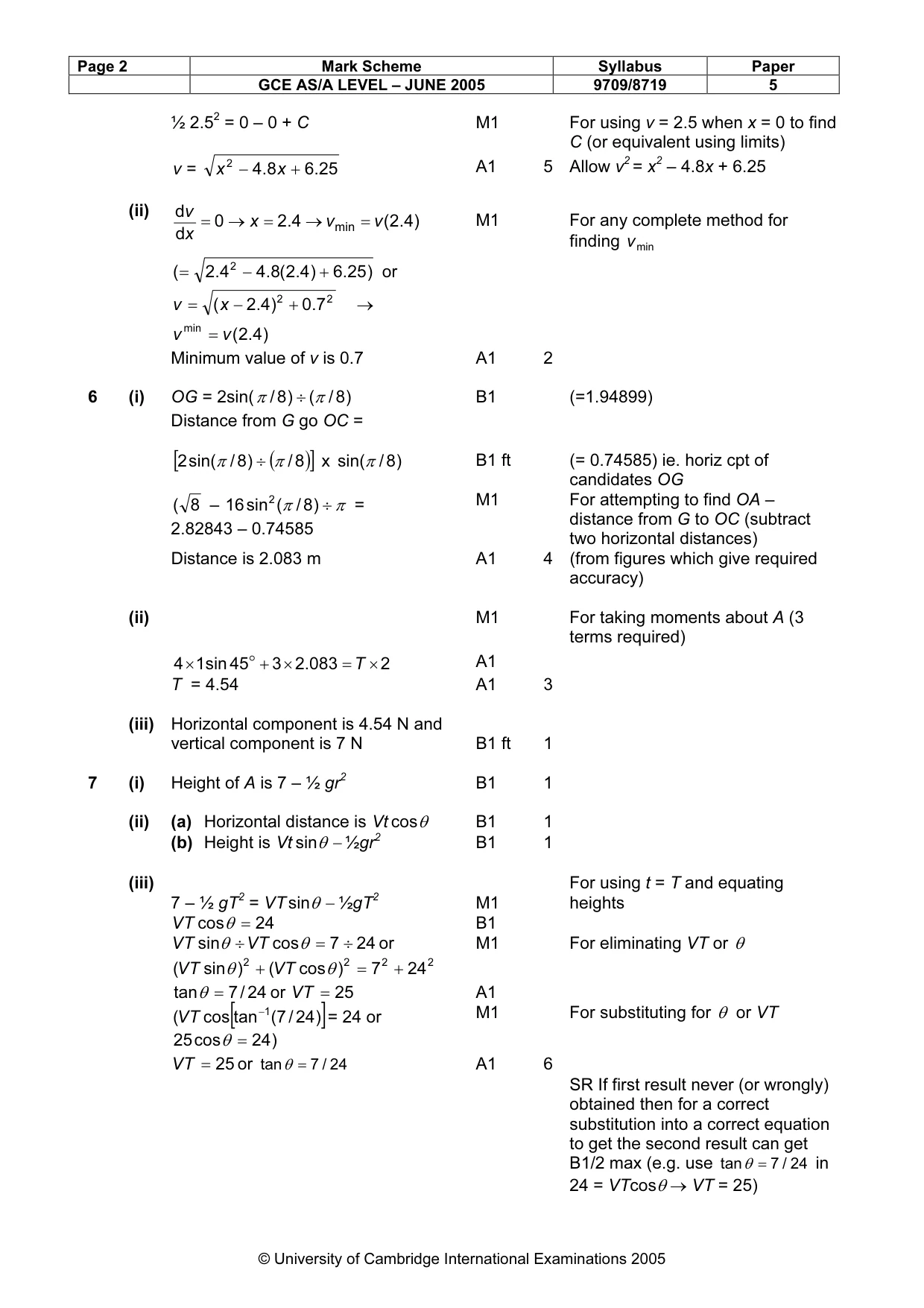
Mark scheme: 5 (i) d v M1 For using α = v and attempting d x to separate the variables ∫ vd v = ∫ ( x − 2 . 4 )d x A1 ½ v2 = ½ x2 – 2.4 x (+ C) A1 Only allow second M1 if v = (f x ) GCE AS/A LEVEL – JUNE 2005 9709/8719 5 ½ 2.52 = 0 – 0 + C M1 For using v = 2.5 when x = 0 to find C (or equivalent using limits) v = x 2 − 4 . 8 x + 6 . 25 A1 5 Allow v2 = x2 – 4.8x + 6.25 (ii) d v = 0 → x = 2 . 4 → v min = v ( 2 . 4 ) M1 For any complete method for d x finding v min ( = 2 . 4 2 − 4 . 8( 2 . 4 ) + 6 . 25 ) or v = ( x − 2 . 4 ) 2 + 0 . 7 2 → v min = v ( 2 . 4 ) Minimum value of v is 0.7 A1 2
Q6 · A rigid rod consists of two parts
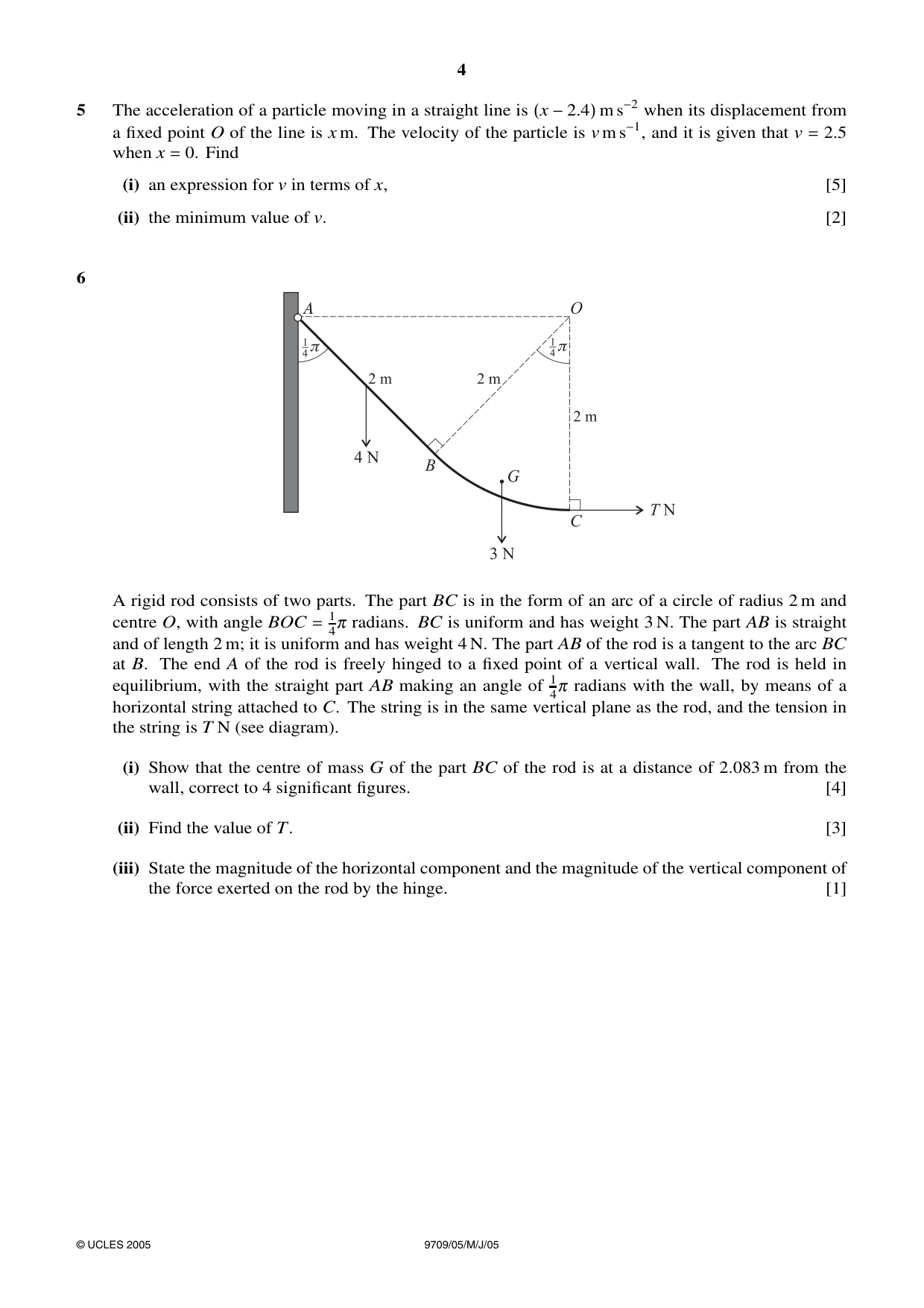
6 A rigid rod consists of two parts. The part BC is in the form of an arc of a circle of radius 2 m and centre O, with angle BOC = 14π radians. BC is uniform and has weight 3 N. The part AB is straight and of length 2 m; it is uniform and has weight 4 N. The part AB of the rod is a tangent to the arc BC at B. The end A of the rod is freely hinged to a fixed point of a vertical wall. The rod is held in equilibrium, with the straight part AB making an angle of 14π radians with the wall, by means of a horizontal string attached to C. The string is in the same vertical plane as the rod, and the tension in the string is T N (see diagram). (i) Show that the centre of mass G of the part BC of the rod is at a distance of 2.083 m from the wall, correct to 4 significant figures. [4] (ii) Find the value of T. [3] (iii) State the magnitude of the horizontal component and the magnitude of the vertical component of the force exerted on the rod by the hinge. [1]
Mark scheme: 6 (i) OG = 2sin( π / 8 ) ÷ (π / 8 ) B1 (=1.94899) Distance from G go OC = [2 sin(π / 8 ) ÷ (π / 8 )] x sin(π / 8 ) B1 ft (= 0.74585) ie. horiz cpt of candidates OG 2 M1 For attempting to find OA – ( 8 – 16 sin (π / 8 ) ÷ π = distance from G to OC (subtract 2.82843 – 0.74585 two horizontal distances) Distance is 2.083 m A1 4 (from figures which give required accuracy) (ii) M1 For taking moments about A (3 terms required) o 4 × 1 sin 45 + 3 × 2 . 083 = T × 2 A1 T = 4.54 A1 3 (iii) Horizontal component is 4.54 N and vertical component is 7 N B1 ft 1
Q7 · A particle A is released from rest at time t = 0, at a point P which is 7 m above…
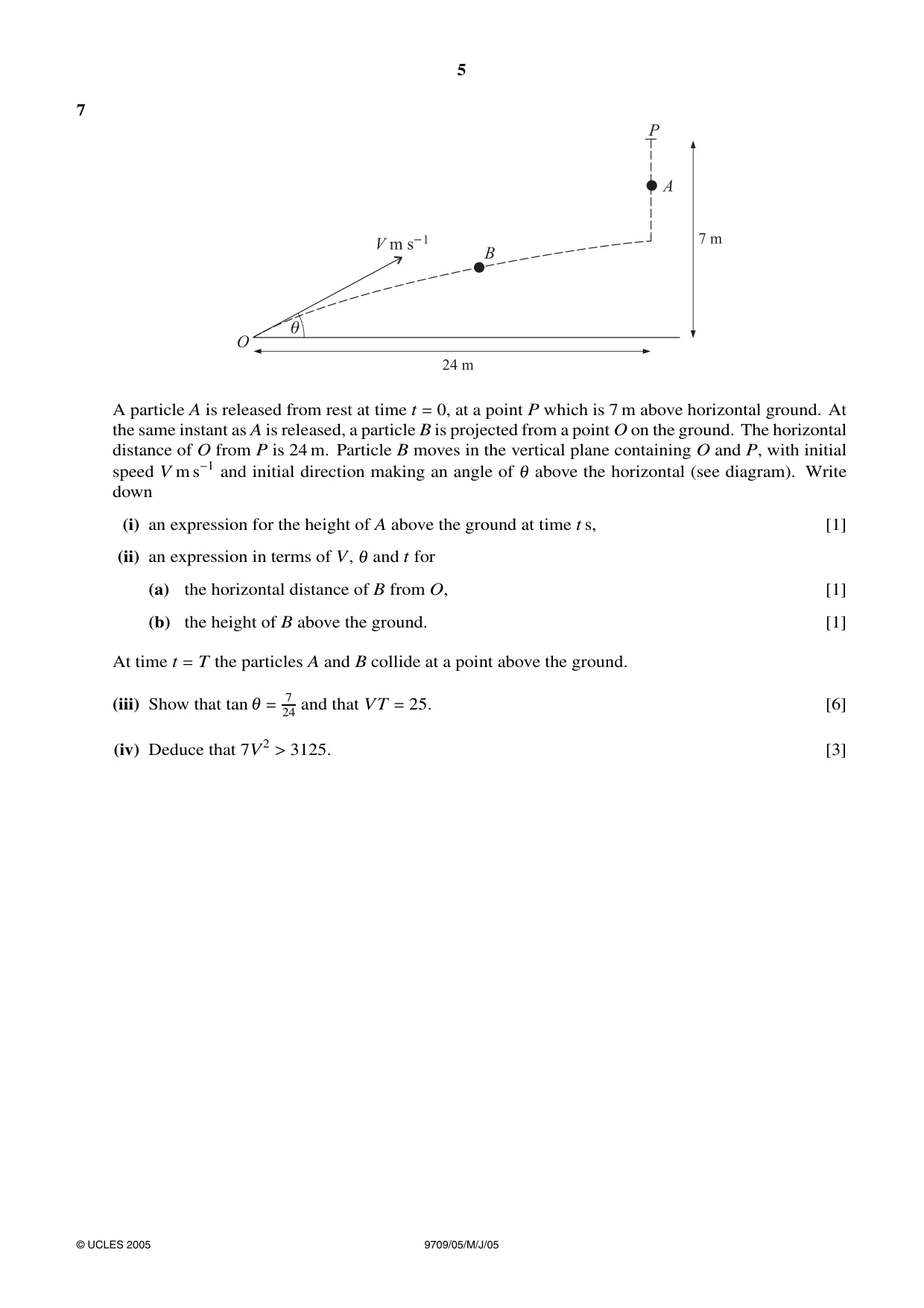
7 A particle A is released from rest at time t = 0, at a point P which is 7 m above horizontal ground. At the same instant as A is released, a particle B is projected from a point O on the ground. The horizontal distance of O from P is 24 m. Particle B moves in the vertical plane containing O and P, with initial speed V m s−1 and initial direction making an angle of θ above the horizontal (see diagram). Write down (i) an expression for the height of A above the ground at time t s, [1] (ii) an expression in terms of V, θ and t for (a) the horizontal distance of B from O, [1] (b) the height of B above the ground. [1] At time t = T the particles A and B collide at a point above the ground. (iii) Show that tan θ = 7 and that VT = 25. [6] 24 (iv) Deduce that 7V2 > 3125. [3]
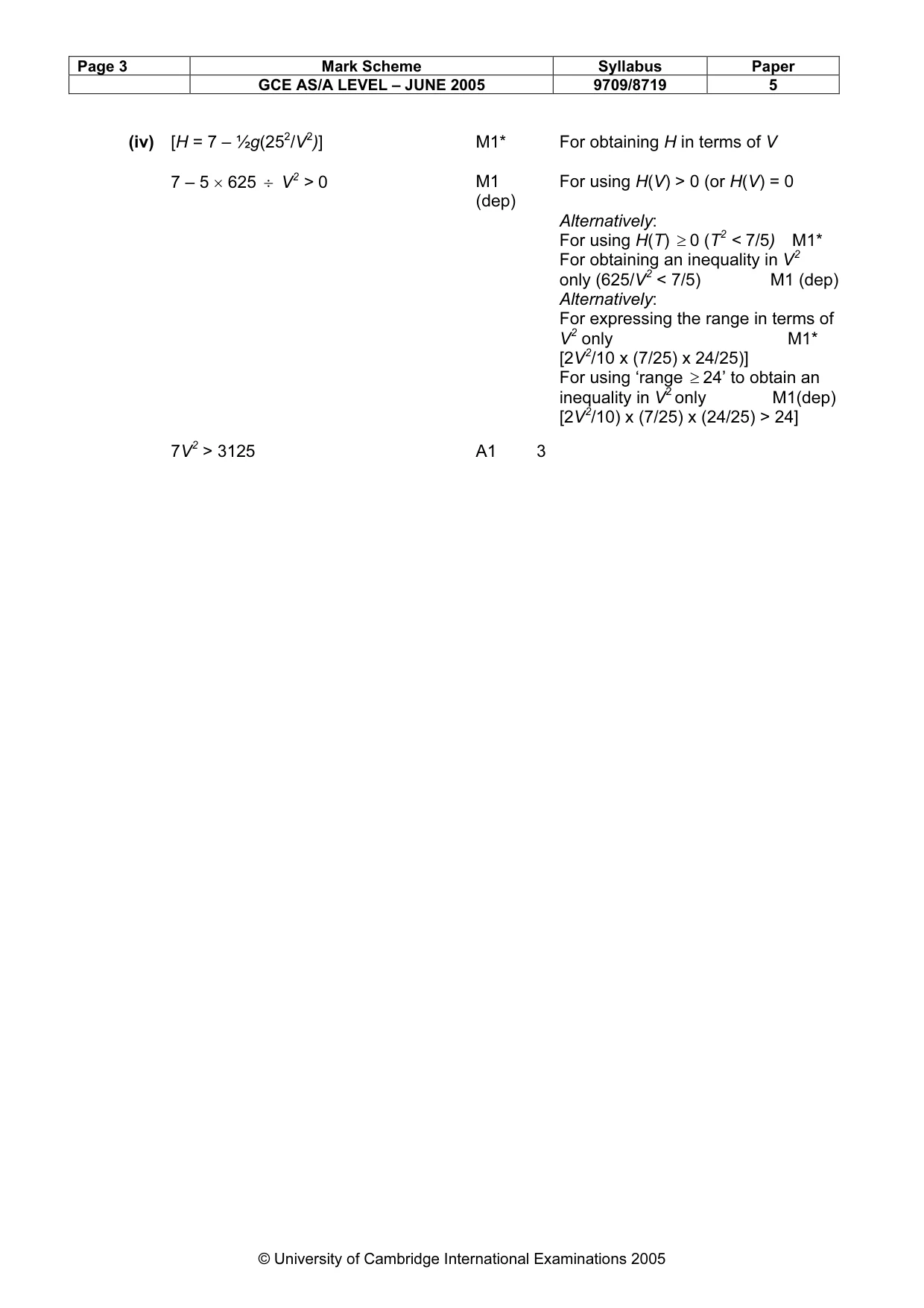
Mark scheme: 7 (i) Height of A is 7 – ½ gr2 B1 1 (ii) (a) Horizontal distance is Vt cos θ B1 1 (b) Height is Vt sin θ − ½gr2 B1 1 (iii) For using t = T and equating 7 – ½ gT2 = VT sin θ − ½gT2 M1 heights VT cos θ = 24 B1 VT sin θ ÷ VT cos θ = 7 ÷ 24 or M1 For eliminating VT or θ (VT sin θ ) 2 + (VT cos θ ) 2 = 7 2 + 24 2 tan θ = 7 / 24 or VT = 25 A1 M1 For substituting for θ or VT (VT cos[tan −1 ( 7 / 24 ]) = 24 or 25 cos θ = 24 ) VT = 25 or tan θ = 7 / 24 A1 6 SR If first result never (or wrongly) obtained then for a correct substitution into a correct equation to get the second result can get B1/2 max (e.g. use tan θ = 7 / 24 in 24 = VTcosθ → VT = 25) GCE AS/A LEVEL – JUNE 2005 9709/8719 5 (iv) [H = 7 – ½g(252/V2)] M1* For obtaining H in terms of V 7 – 5 × 625 ÷ V2 > 0 M1 For using H(V) > 0 (or H(V) = 0 (dep) Alternatively: For using H(T) ≥0 (T2 < 7/5) M1* For obtaining an inequality in V2 only (625/V2 < 7/5) M1 (dep) Alternatively: For expressing the range in terms of V2 only M1* [2V2/10 x (7/25) x 24/25)] For using ‘range ≥24’ to obtain an inequality in V2 only M1(dep) [2V2/10) x (7/25) x (24/25) > 24] 7V2 > 3125 A1 3
What was in this paper
The subtopics covered by these 7 questions, and how many questions each got. Open one in a new tab to see every Cambridge question on it.