Cambridge A Level Law 9084 — 2025 Oct/Nov Paper 2 · Variant 2
9084/22/O/N/25 · 60 marks · ≈68 min
The question paper and its mark scheme, free to download. This is Cambridge’s own paper, exactly as it was sat — the on-screen preview is on its way; download below in the meantime.
Question paper
The on-screen preview isn’t ready for this paper yet — download it above instead.
Mark scheme19 pages
Answers below. Sit the paper first if you are practising.

Paper as text
Mark scheme, page 1
This document consists of 19 printed pages. © Cambridge University Press & Assessment 2025 [Turn over Cambridge International AS & A Level LAW 9084/22 Paper 2 Criminal Law October/November 2025 MARK SCHEME Maximum Mark: 60 Published This mark scheme is published as an aid to teachers and candidates, to indicate the requirements of the examination. It shows the basis on which Examiners were instructed to award marks. It does not indicate the details of the discussions that took place at an Examiners’ meeting before marking began, which would have considered the acceptability of alternative answers. Mark schemes should be read in conjunction with the question paper and the Principal Examiner Report for Teachers. Cambridge International will not enter into discussions about these mark schemes. Cambridge International is publishing the mark schemes for the October/November 2025 series for most Cambridge IGCSE, Cambridge International A and AS Level components, and some Cambridge O Level components.
Mark scheme, page 2
9084/22 Cambridge International AS & A Level – Mark Scheme PUBLISHED October/November 2025 © Cambridge University Press & Assessment 2025 Page 2 of 19 Generic Marking Principles These general marking principles must be applied by all examiners when marking candidate answers. They should be applied alongside the specific content of the mark scheme or generic level descriptions for a question. Each question paper and mark scheme will also comply with these marking principles. GENERIC MARKING PRINCIPLE 1: Marks must be awarded in line with: • the specific content of the mark scheme or the generic level descriptors for the question • the specific skills defined in the mark scheme or in the generic level descriptors for the question • the standard of response required by a candidate as exemplified by the standardisation scripts. GENERIC MARKING PRINCIPLE 2: Marks awarded are always whole marks (not half marks, or other fractions). GENERIC MARKING PRINCIPLE 3: Marks must be awarded positively: • marks are awarded for correct/valid answers, as defined in the mark scheme. However, credit is given for valid answers which go beyond the scope of the syllabus and mark scheme, referring to your Team Leader as appropriate • marks are awarded when candidates clearly demonstrate what they know and can do • marks are not deducted for errors • marks are not deducted for omissions • answers should only be judged on the quality of spelling, punctuation and grammar when these features are specifically assessed by the question as indicated by the mark scheme. The meaning, however, should be unambiguous. GENERIC MARKING PRINCIPLE 4: Rules must be applied consistently, e.g. in situations where candidates have not followed instructions or in the application of generic level descriptors. GENERIC MARKING PRINCIPLE 5: Marks should be awarded using the full range of marks defined in the mark scheme for the question (however; the use of the full mark range may be limited according to the quality of the candidate responses seen). GENERIC MARKING PRINCIPLE 6: Marks awarded are based solely on the requirements as defined in the mark scheme. Marks should not be awarded with grade thresholds or grade descriptors in mind.
Mark scheme, page 3
9084/22 Cambridge International AS & A Level – Mark Scheme PUBLISHED October/November 2025 © Cambridge University Press & Assessment 2025 Page 3 of 19 Social Science-Specific Marking Principles (for point-based marking) 1 Components using point-based marking: • Point marking is often used to reward knowledge, understanding and application of skills. We give credit where the candidate’s answer shows relevant knowledge, understanding and application of skills in answering the question. We do not give credit where the answer shows confusion. From this it follows that we: a DO credit answers which are worded differently from the mark scheme if they clearly convey the same meaning (unless the mark scheme requires a specific term) b DO credit alternative answers/examples which are not written in the mark scheme if they are correct c DO credit answers where candidates give more than one correct answer in one prompt/numbered/scaffolded space where extended writing is required rather than list-type answers. For example, questions that require n reasons (e.g. State two reasons …). d DO NOT credit answers simply for using a ‘key term’ unless that is all that is required. (Check for evidence it is understood and not used wrongly.) e DO NOT credit answers which are obviously self-contradicting or trying to cover all possibilities f DO NOT give further credit for what is effectively repetition of a correct point already credited unless the language itself is being tested. This applies equally to ‘mirror statements’ (i.e. polluted/not polluted). g DO NOT require spellings to be correct, unless this is part of the test. However spellings of syllabus terms must allow for clear and unambiguous separation from other syllabus terms with which they may be confused (e.g. Corrasion/Corrosion) 2 Presentation of mark scheme: • Slashes (/) or the word ‘or’ separate alternative ways of making the same point. • Semi colons (;) bullet points (•) or figures in brackets (1) separate different points. • Content in the answer column in brackets is for examiner information/context to clarify the marking but is not required to earn the mark (except Accounting syllabuses where they indicate negative numbers). 3 Calculation questions: • The mark scheme will show the steps in the most likely correct method(s), the mark for each step, the correct answer(s) and the mark for each answer • If working/explanation is considered essential for full credit, this will be indicated in the question paper and in the mark scheme. In all other instances, the correct answer to a calculation should be given full credit, even if no supporting working is shown. • Where the candidate uses a valid method which is not covered by the mark scheme, award equivalent marks for reaching equivalent stages. • Where an answer makes use of a candidate’s own incorrect figure from previous working, the ‘own figure rule’ applies: full marks will be given if a correct and complete method is used. Further guidance will be included in the mark scheme where necessary and any exceptions to this general principle will be noted.
Mark scheme, page 4
9084/22 Cambridge International AS & A Level – Mark Scheme PUBLISHED October/November 2025 © Cambridge University Press & Assessment 2025 Page 4 of 19 4 Annotation: • For point marking, ticks can be used to indicate correct answers and crosses can be used to indicate wrong answers. There is no direct relationship between ticks and marks. Ticks have no defined meaning for levels of response marking. • For levels of response marking, the level awarded should be annotated on the script. • Other annotations will be used by examiners as agreed during standardisation, and the meaning will be understood by all examiners who marked that paper.
Mark scheme, page 5
9084/22 Cambridge International AS & A Level – Mark Scheme PUBLISHED October/November 2025 © Cambridge University Press & Assessment 2025 Page 5 of 19 Guidance on using levels-based mark schemes Marking of work should be positive, rewarding achievement where possible, but clearly differentiating across the whole range of marks, where appropriate. The marker should look at the work and then make a judgement about which level statement is the best fit. In practice, work does not always match one level statement precisely so a judgement may need to be made between two or more level statements. Once a best-fit level statement has been identified, use the following guidance to decide on a specific mark: • If the candidate’s work convincingly meets the level statement, award the highest mark. • If the candidate’s work adequately meets the level statement, award the most appropriate mark in the middle of the range (where middle marks are available). • If the candidate’s work just meets the level statement, award the lowest mark. Assessment objectives AO1 Knowledge and understanding • Demonstrate knowledge and understanding of legal concepts, principles and rules. • Use statutes, cases, examples and legal terminology. AO2 Analysis and application • Analyse legal concepts, principles and rules. • Apply legal concepts, principles and rules. AO3 Evaluation • Evaluate legal concepts, principles and rules. • Communicate legal argument coherently on the basis of evidence.
Mark scheme, page 6
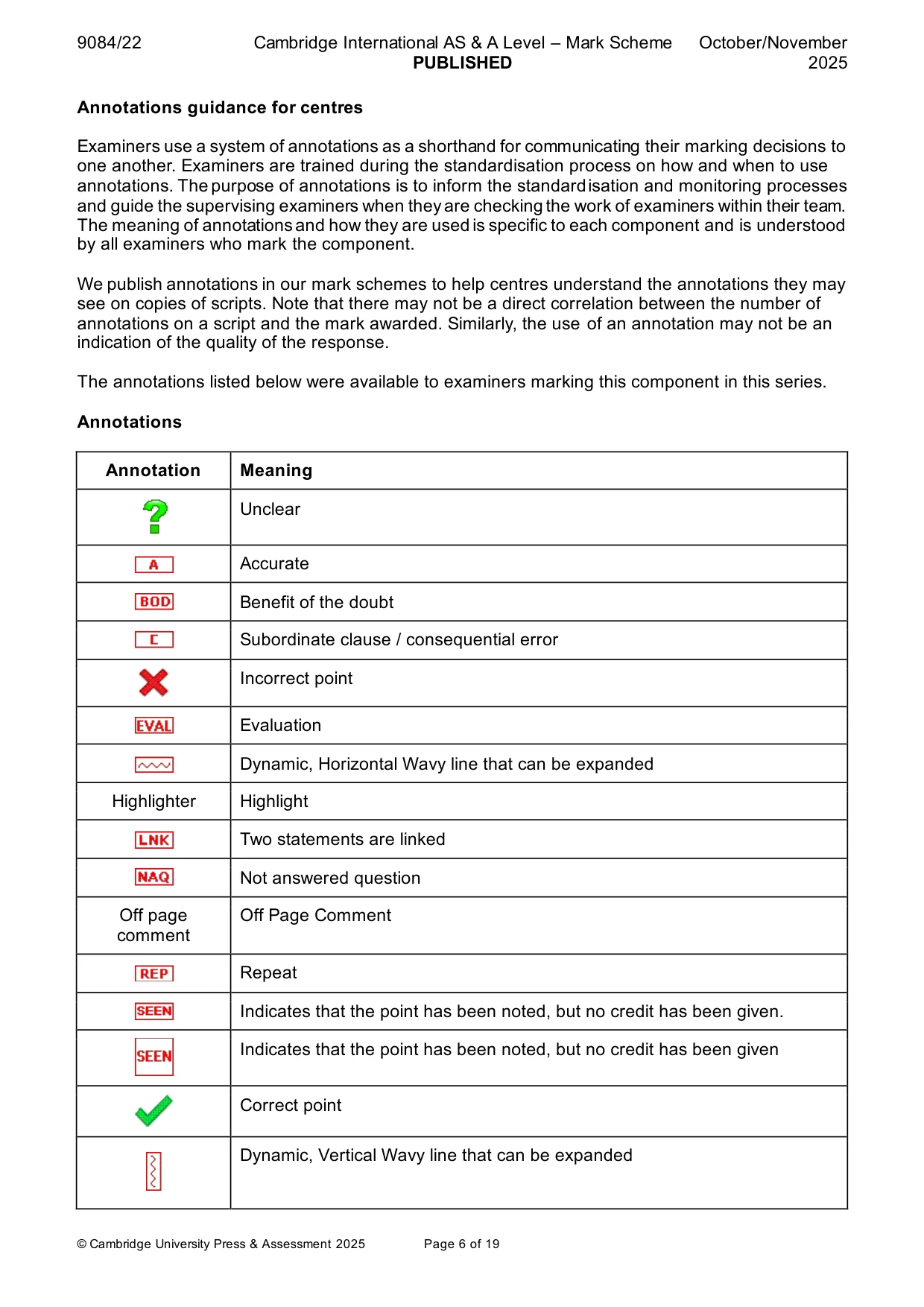
9084/22 Cambridge International AS & A Level – Mark Scheme PUBLISHED October/November 2025 © Cambridge University Press & Assessment 2025 Page 6 of 19 Annotations guidance for centres Examiners use a system of annotations as a shorthand for communicating their marking decisions to one another. Examiners are trained during the standardisation process on how and when to use annotations. The purpose of annotations is to inform the standardisation and monitoring processes and guide the supervising examiners when they are checking the work of examiners within their team. The meaning of annotations and how they are used is specific to each component and is understood by all examiners who mark the component. We publish annotations in our mark schemes to help centres understand the annotations they may see on copies of scripts. Note that there may not be a direct correlation between the number of annotations on a script and the mark awarded. Similarly, the use of an annotation may not be an indication of the quality of the response. The annotations listed below were available to examiners marking this component in this series. Annotations Annotation Meaning Unclear Accurate Benefit of the doubt Subordinate clause / consequential error Incorrect point Evaluation Dynamic, Horizontal Wavy line that can be expanded Highlighter Highlight Two statements are linked Not answered question Off page comment Off Page Comment Repeat Indicates that the point has been noted, but no credit has been given. Indicates that the point has been noted, but no credit has been given Correct point Dynamic, Vertical Wavy line that can be expanded
Mark scheme, page 7
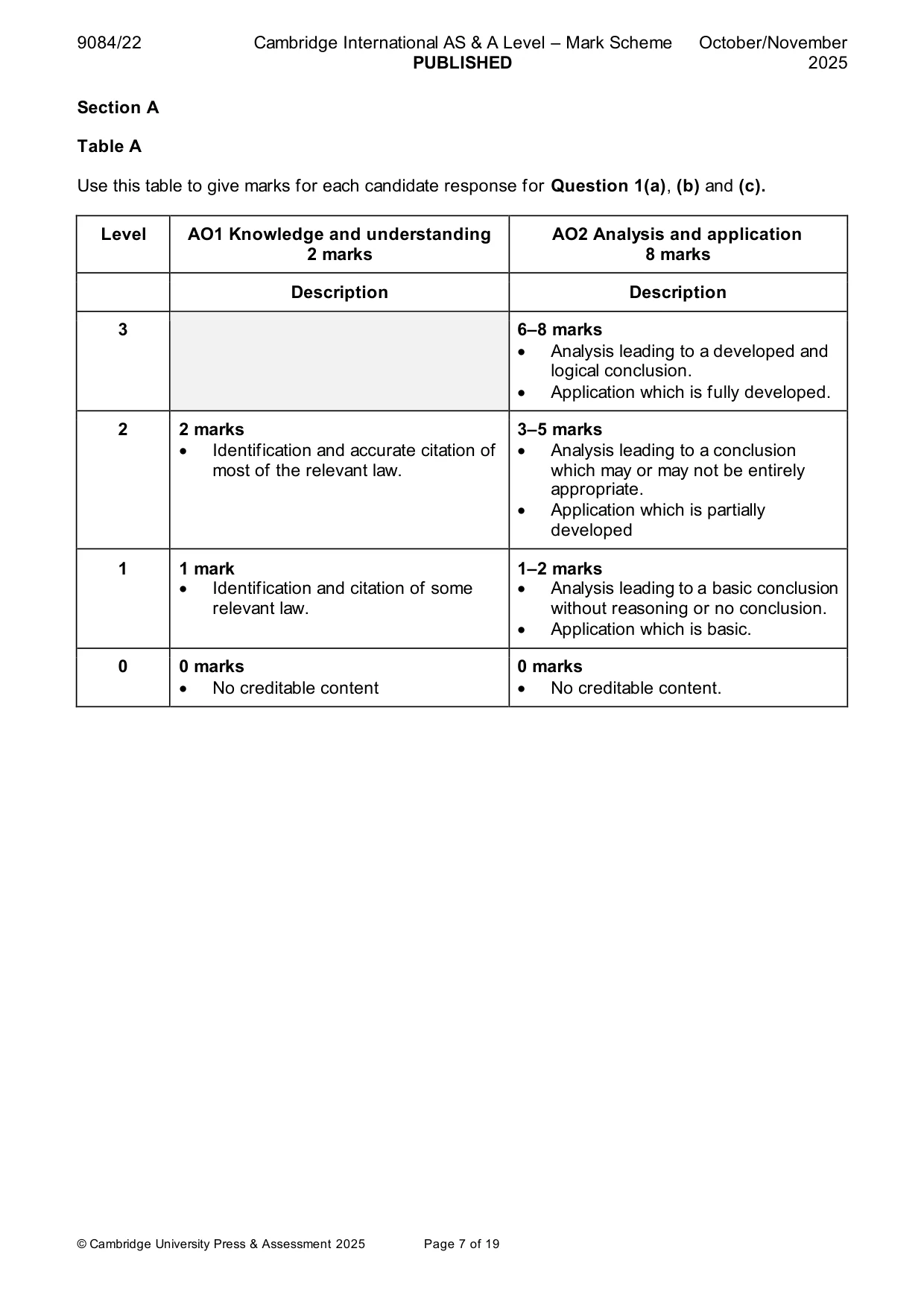
9084/22 Cambridge International AS & A Level – Mark Scheme PUBLISHED October/November 2025 © Cambridge University Press & Assessment 2025 Page 7 of 19 Section A Table A Use this table to give marks for each candidate response for Question 1(a), (b) and (c). Level AO1 Knowledge and understanding 2 marks AO2 Analysis and application 8 marks Description Description 3 6–8 marks • Analysis leading to a developed and logical conclusion. • Application which is fully developed. 2 2 marks • Identification and accurate citation of most of the relevant law. 3–5 marks • Analysis leading to a conclusion which may or may not be entirely appropriate. • Application which is partially developed 1 1 mark • Identification and citation of some relevant law. 1–2 marks • Analysis leading to a basic conclusion without reasoning or no conclusion. • Application which is basic. 0 0 marks • No creditable content 0 marks • No creditable content.
Mark scheme, page 8
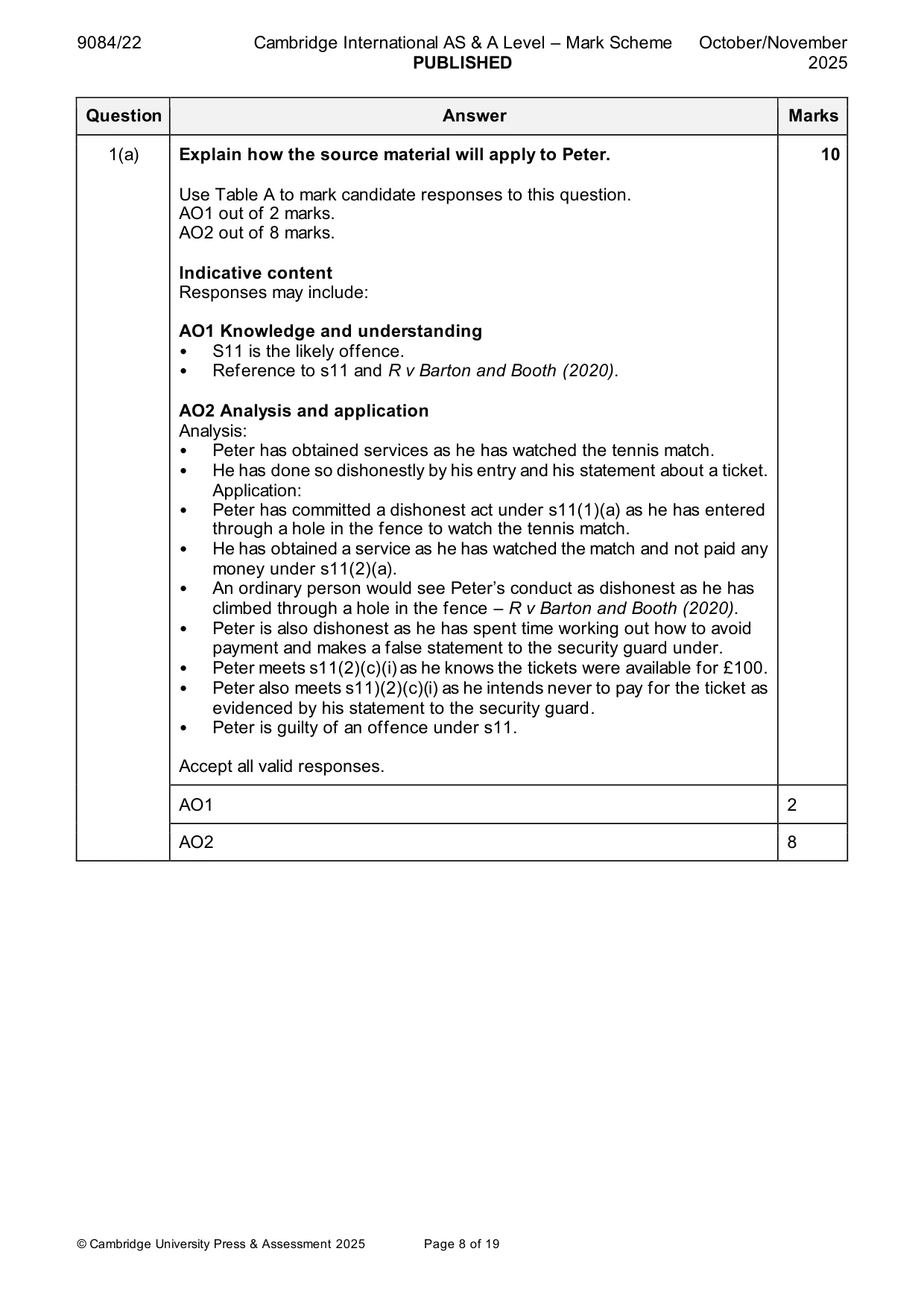
9084/22 Cambridge International AS & A Level – Mark Scheme PUBLISHED October/November 2025 © Cambridge University Press & Assessment 2025 Page 8 of 19 Question Answer Marks 1(a) Explain how the source material will apply to Peter. Use Table A to mark candidate responses to this question. AO1 out of 2 marks. AO2 out of 8 marks. Indicative content Responses may include: AO1 Knowledge and understanding • S11 is the likely offence. • Reference to s11 and R v Barton and Booth (2020). AO2 Analysis and application Analysis: • Peter has obtained services as he has watched the tennis match. • He has done so dishonestly by his entry and his statement about a ticket. Application: • Peter has committed a dishonest act under s11(1)(a) as he has entered through a hole in the fence to watch the tennis match. • He has obtained a service as he has watched the match and not paid any money under s11(2)(a). • An ordinary person would see Peter’s conduct as dishonest as he has climbed through a hole in the fence – R v Barton and Booth (2020). • Peter is also dishonest as he has spent time working out how to avoid payment and makes a false statement to the security guard under. • Peter meets s11(2)(c)(i) as he knows the tickets were available for £100. • Peter also meets s11)(2)(c)(i) as he intends never to pay for the ticket as evidenced by his statement to the security guard. • Peter is guilty of an offence under s11. Accept all valid responses. 10 AO1 2 AO2 8
Mark scheme, page 9
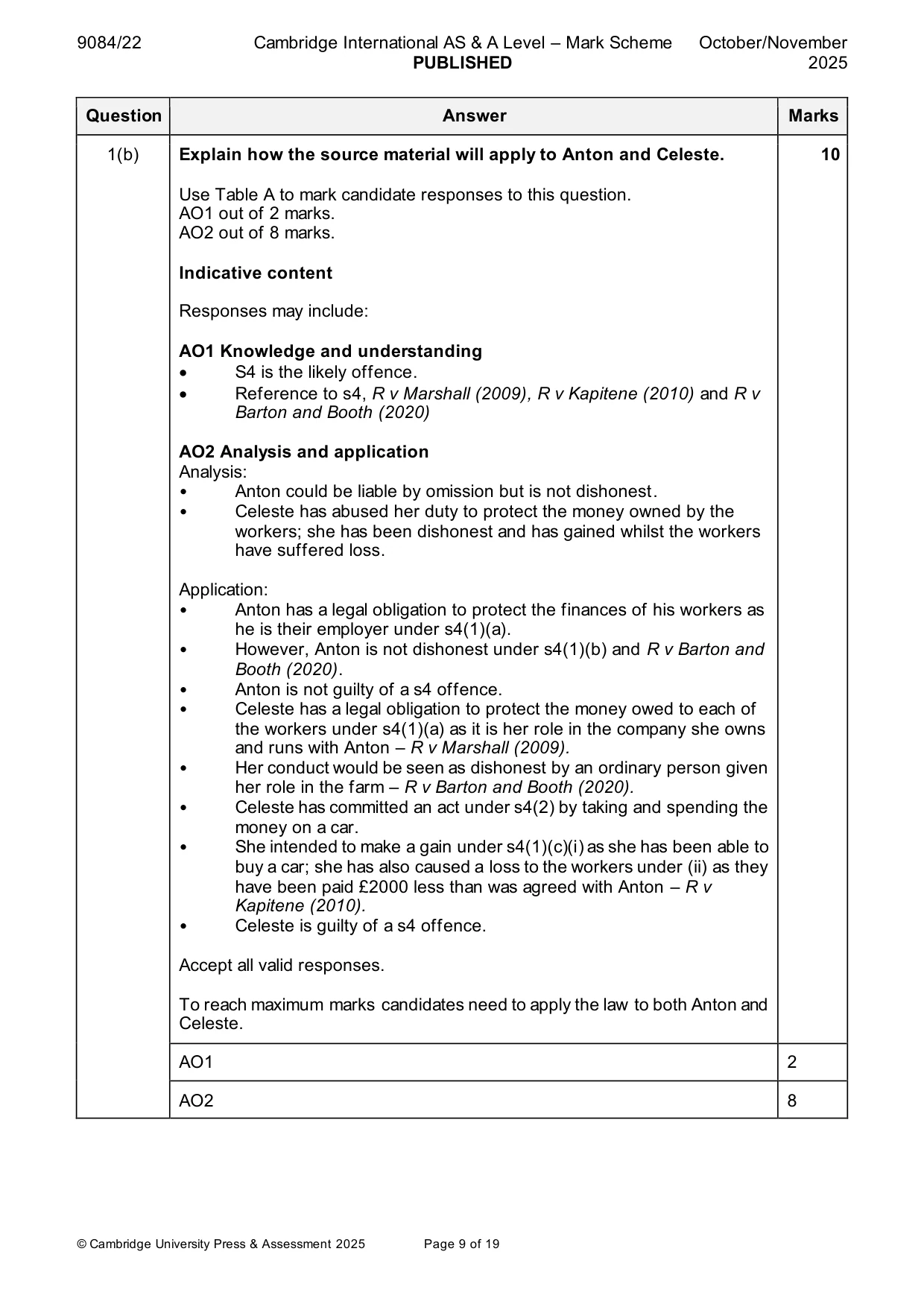
9084/22 Cambridge International AS & A Level – Mark Scheme PUBLISHED October/November 2025 © Cambridge University Press & Assessment 2025 Page 9 of 19 Question Answer Marks 1(b) Explain how the source material will apply to Anton and Celeste. Use Table A to mark candidate responses to this question. AO1 out of 2 marks. AO2 out of 8 marks. Indicative content Responses may include: AO1 Knowledge and understanding • S4 is the likely offence. • Reference to s4, R v Marshall (2009), R v Kapitene (2010) and R v Barton and Booth (2020) AO2 Analysis and application Analysis: • Anton could be liable by omission but is not dishonest. • Celeste has abused her duty to protect the money owned by the workers; she has been dishonest and has gained whilst the workers have suffered loss. Application: • Anton has a legal obligation to protect the finances of his workers as he is their employer under s4(1)(a). • However, Anton is not dishonest under s4(1)(b) and R v Barton and Booth (2020). • Anton is not guilty of a s4 offence. • Celeste has a legal obligation to protect the money owed to each of the workers under s4(1)(a) as it is her role in the company she owns and runs with Anton – R v Marshall (2009). • Her conduct would be seen as dishonest by an ordinary person given her role in the farm – R v Barton and Booth (2020). • Celeste has committed an act under s4(2) by taking and spending the money on a car. • She intended to make a gain under s4(1)(c)(i) as she has been able to buy a car; she has also caused a loss to the workers under (ii) as they have been paid £2000 less than was agreed with Anton – R v Kapitene (2010). • Celeste is guilty of a s4 offence. Accept all valid responses. To reach maximum marks candidates need to apply the law to both Anton and Celeste. 10 AO1 2 AO2 8
Mark scheme, page 10
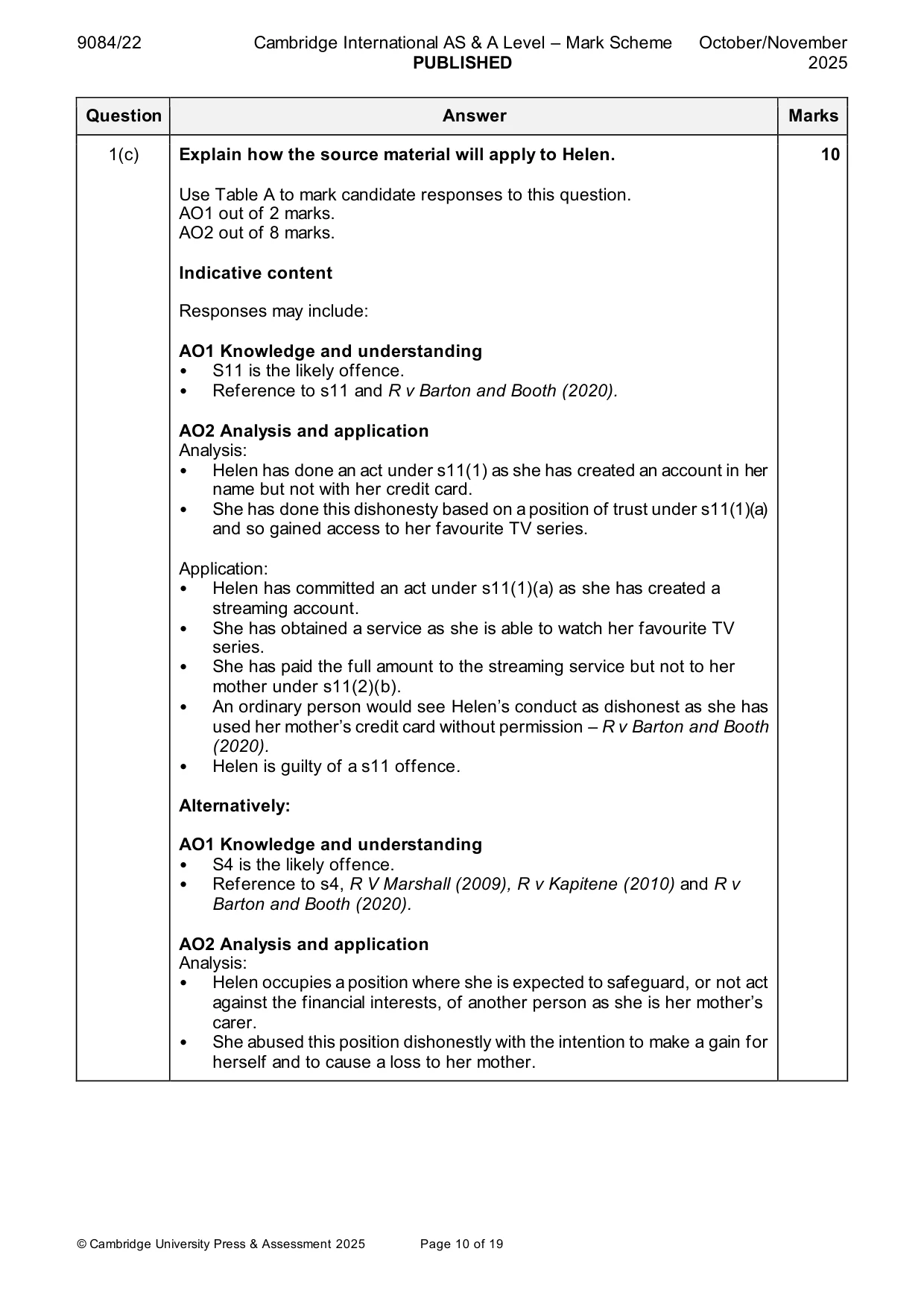
9084/22 Cambridge International AS & A Level – Mark Scheme PUBLISHED October/November 2025 © Cambridge University Press & Assessment 2025 Page 10 of 19 Question Answer Marks 1(c) Explain how the source material will apply to Helen. Use Table A to mark candidate responses to this question. AO1 out of 2 marks. AO2 out of 8 marks. Indicative content Responses may include: AO1 Knowledge and understanding • S11 is the likely offence. • Reference to s11 and R v Barton and Booth (2020). AO2 Analysis and application Analysis: • Helen has done an act under s11(1) as she has created an account in her name but not with her credit card. • She has done this dishonesty based on a position of trust under s11(1)(a) and so gained access to her favourite TV series. Application: • Helen has committed an act under s11(1)(a) as she has created a streaming account. • She has obtained a service as she is able to watch her favourite TV series. • She has paid the full amount to the streaming service but not to her mother under s11(2)(b). • An ordinary person would see Helen’s conduct as dishonest as she has used her mother’s credit card without permission – R v Barton and Booth (2020). • Helen is guilty of a s11 offence. Alternatively: AO1 Knowledge and understanding • S4 is the likely offence. • Reference to s4, R V Marshall (2009), R v Kapitene (2010) and R v Barton and Booth (2020). AO2 Analysis and application Analysis: • Helen occupies a position where she is expected to safeguard, or not act against the financial interests, of another person as she is her mother’s carer. • She abused this position dishonestly with the intention to make a gain for herself and to cause a loss to her mother. 10
Mark scheme, page 11
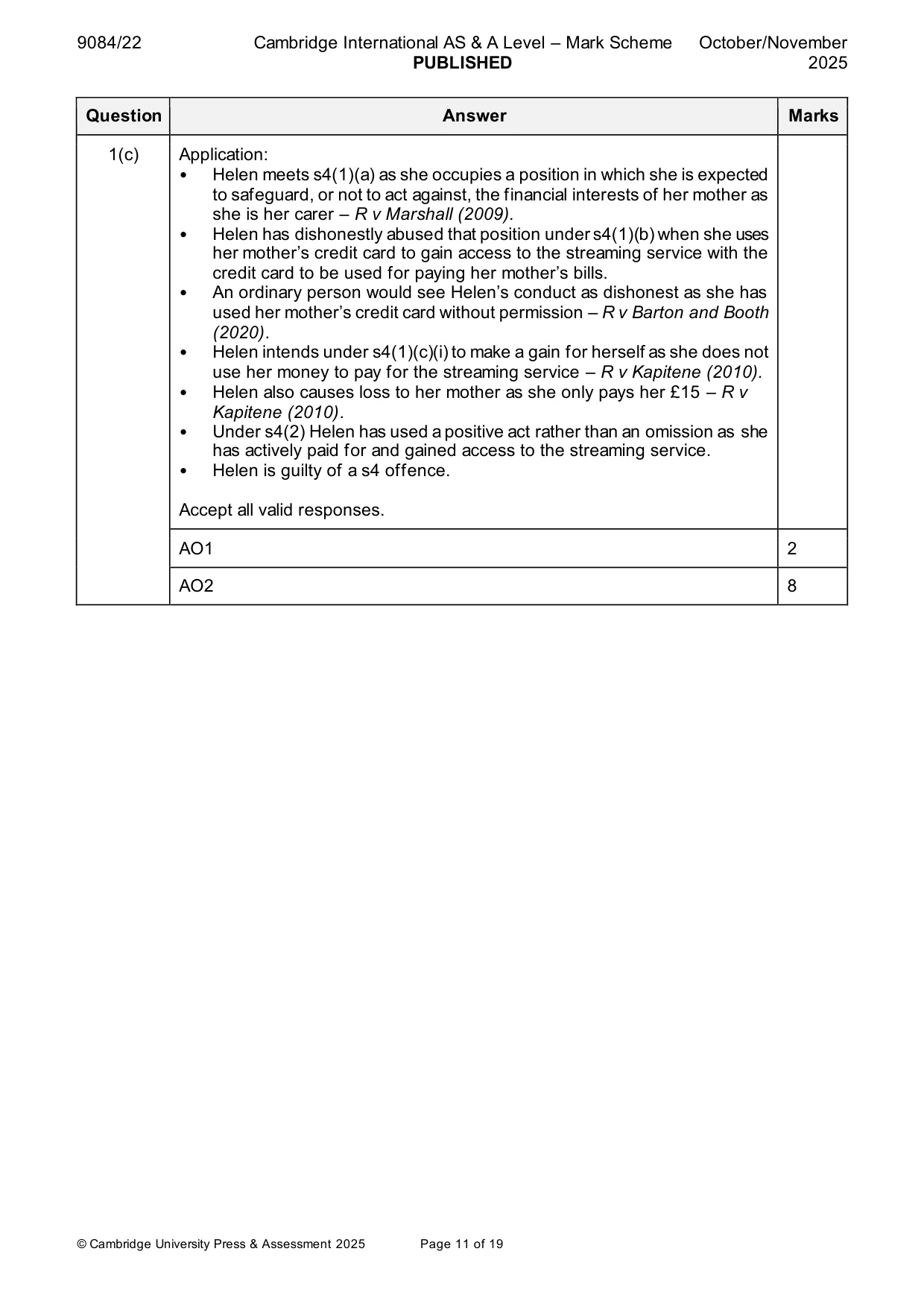
9084/22 Cambridge International AS & A Level – Mark Scheme PUBLISHED October/November 2025 © Cambridge University Press & Assessment 2025 Page 11 of 19 Question Answer Marks 1(c) Application: • Helen meets s4(1)(a) as she occupies a position in which she is expected to safeguard, or not to act against, the financial interests of her mother as she is her carer – R v Marshall (2009). • Helen has dishonestly abused that position under s4(1)(b) when she uses her mother’s credit card to gain access to the streaming service with the credit card to be used for paying her mother’s bills. • An ordinary person would see Helen’s conduct as dishonest as she has used her mother’s credit card without permission – R v Barton and Booth (2020). • Helen intends under s4(1)(c)(i) to make a gain for herself as she does not use her money to pay for the streaming service – R v Kapitene (2010). • Helen also causes loss to her mother as she only pays her £15 – R v Kapitene (2010). • Under s4(2) Helen has used a positive act rather than an omission as she has actively paid for and gained access to the streaming service. • Helen is guilty of a s4 offence. Accept all valid responses. AO1 2 AO2 8
Mark scheme, page 12
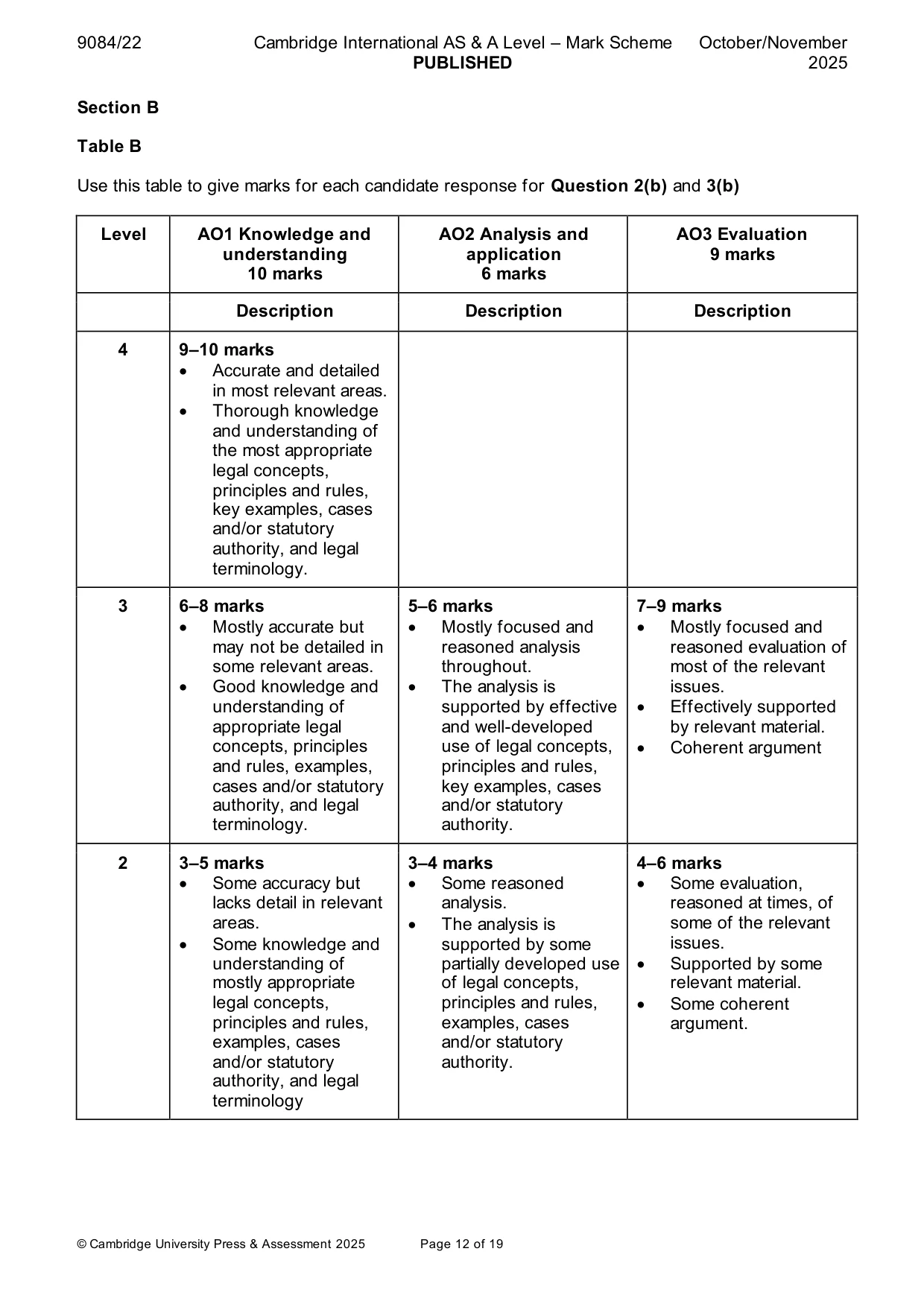
9084/22 Cambridge International AS & A Level – Mark Scheme PUBLISHED October/November 2025 © Cambridge University Press & Assessment 2025 Page 12 of 19 Section B Table B Use this table to give marks for each candidate response for Question 2(b) and 3(b) Level AO1 Knowledge and understanding 10 marks AO2 Analysis and application 6 marks AO3 Evaluation 9 marks Description Description Description 4 9–10 marks • Accurate and detailed in most relevant areas. • Thorough knowledge and understanding of the most appropriate legal concepts, principles and rules, key examples, cases and/or statutory authority, and legal terminology. 3 6–8 marks • Mostly accurate but may not be detailed in some relevant areas. • Good knowledge and understanding of appropriate legal concepts, principles and rules, examples, cases and/or statutory authority, and legal terminology. 5–6 marks • Mostly focused and reasoned analysis throughout. • The analysis is supported by effective and well-developed use of legal concepts, principles and rules, key examples, cases and/or statutory authority. 7–9 marks • Mostly focused and reasoned evaluation of most of the relevant issues. • Effectively supported by relevant material. • Coherent argument 2 3–5 marks • Some accuracy but lacks detail in relevant areas. • Some knowledge and understanding of mostly appropriate legal concepts, principles and rules, examples, cases and/or statutory authority, and legal terminology 3–4 marks • Some reasoned analysis. • The analysis is supported by some partially developed use of legal concepts, principles and rules, examples, cases and/or statutory authority. 4–6 marks • Some evaluation, reasoned at times, of some of the relevant issues. • Supported by some relevant material. • Some coherent argument.
Mark scheme, page 13
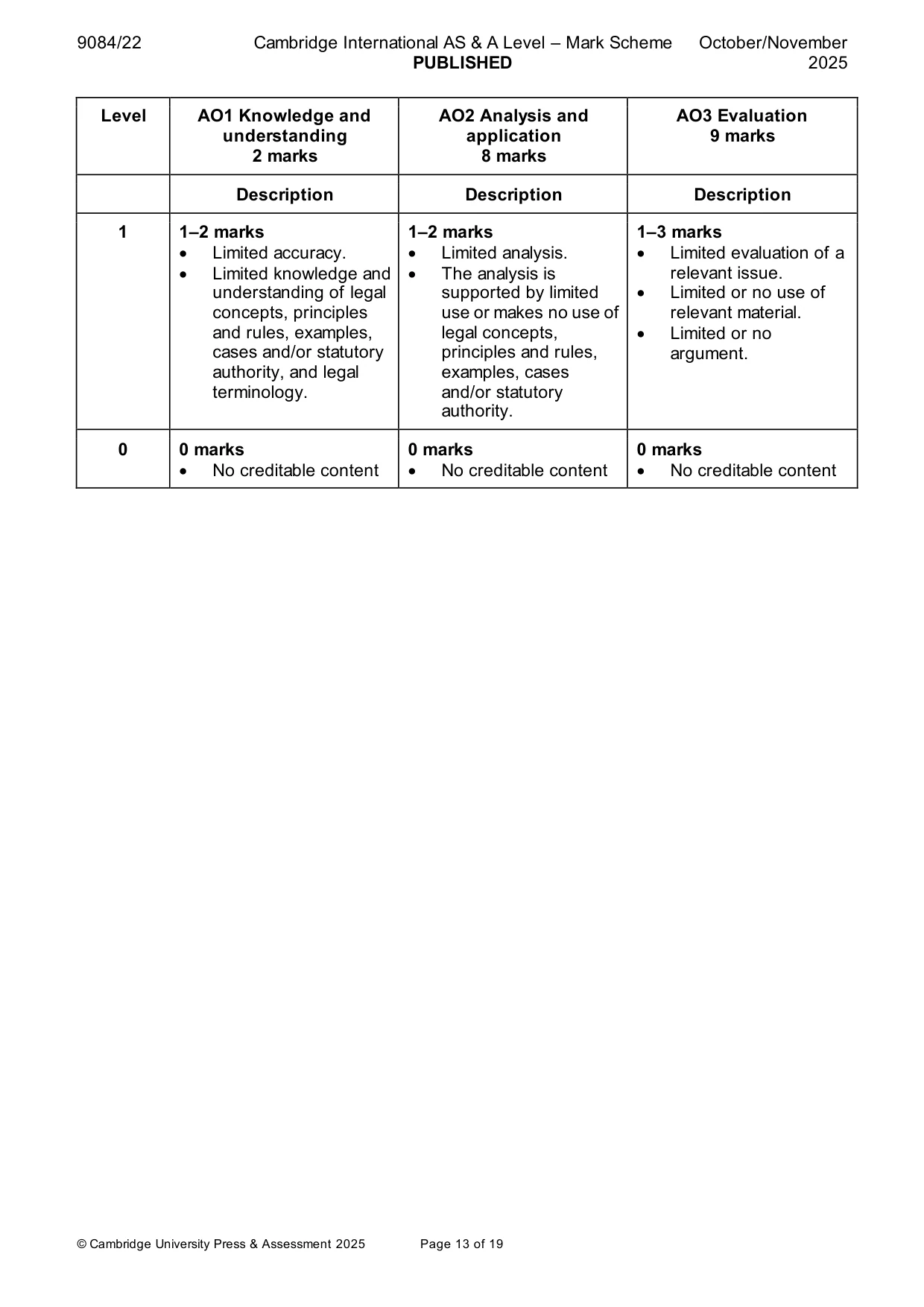
9084/22 Cambridge International AS & A Level – Mark Scheme PUBLISHED October/November 2025 © Cambridge University Press & Assessment 2025 Page 13 of 19 Level AO1 Knowledge and understanding 2 marks AO2 Analysis and application 8 marks AO3 Evaluation 9 marks Description Description Description 1 1–2 marks • Limited accuracy. • Limited knowledge and understanding of legal concepts, principles and rules, examples, cases and/or statutory authority, and legal terminology. 1–2 marks • Limited analysis. • The analysis is supported by limited use or makes no use of legal concepts, principles and rules, examples, cases and/or statutory authority. 1–3 marks • Limited evaluation of a relevant issue. • Limited or no use of relevant material. • Limited or no argument. 0 0 marks • No creditable content 0 marks • No creditable content 0 marks • No creditable content
Mark scheme, page 14
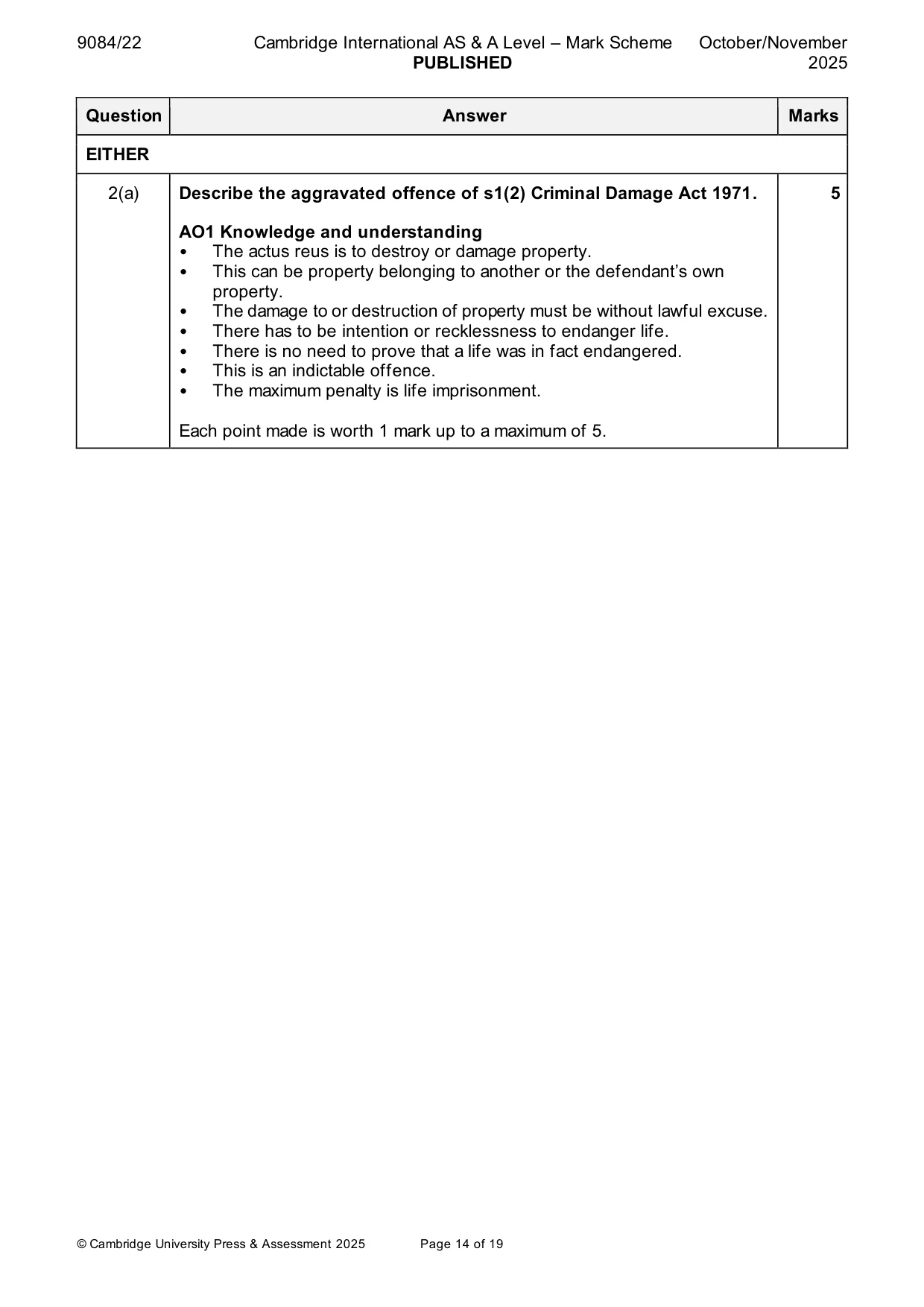
9084/22 Cambridge International AS & A Level – Mark Scheme PUBLISHED October/November 2025 © Cambridge University Press & Assessment 2025 Page 14 of 19 Question Answer Marks EITHER 2(a) Describe the aggravated offence of s1(2) Criminal Damage Act 1971. AO1 Knowledge and understanding • The actus reus is to destroy or damage property. • This can be property belonging to another or the defendant’s own property. • The damage to or destruction of property must be without lawful excuse. • There has to be intention or recklessness to endanger life. • There is no need to prove that a life was in fact endangered. • This is an indictable offence. • The maximum penalty is life imprisonment. Each point made is worth 1 mark up to a maximum of 5. 5
Mark scheme, page 15
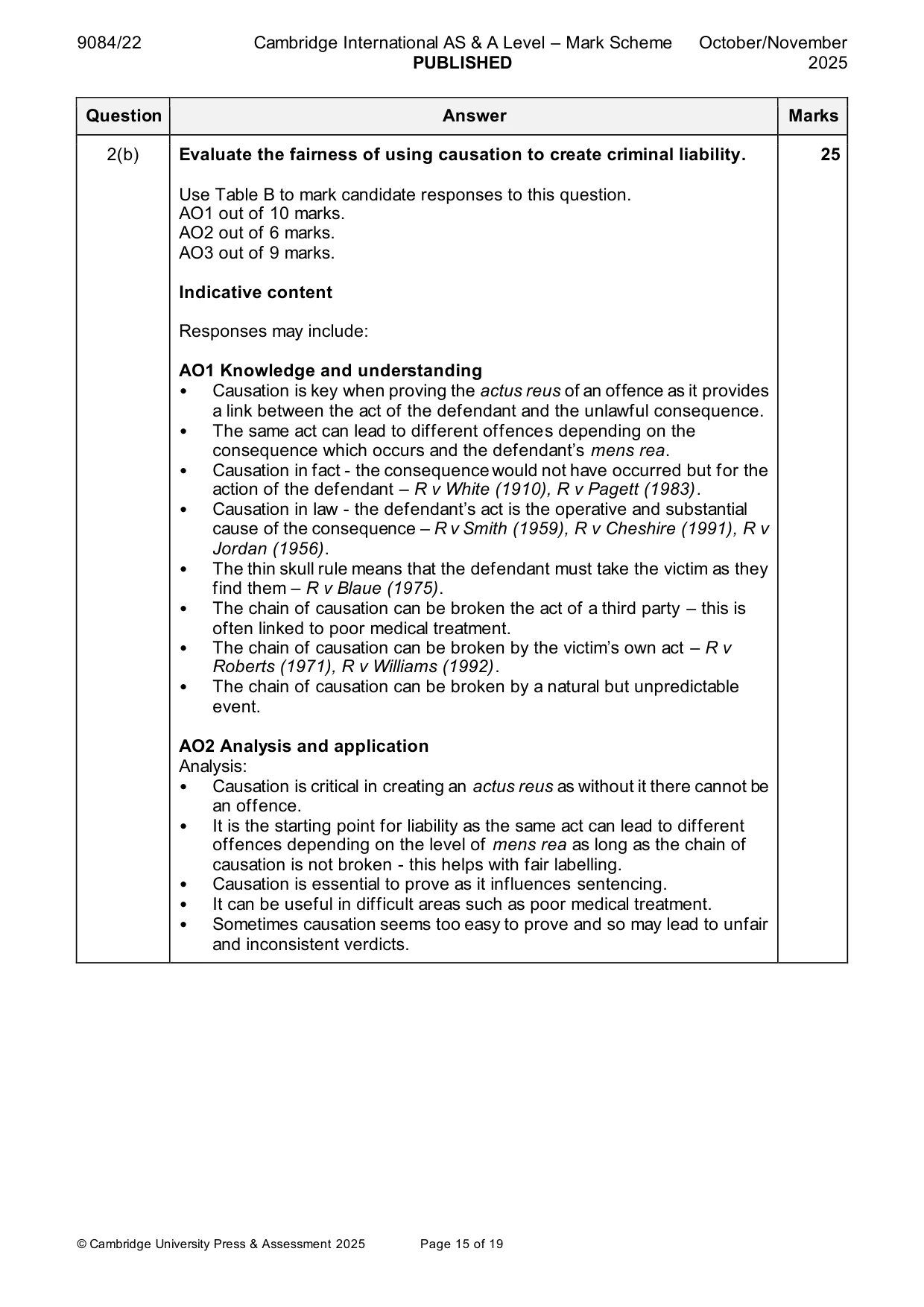
9084/22 Cambridge International AS & A Level – Mark Scheme PUBLISHED October/November 2025 © Cambridge University Press & Assessment 2025 Page 15 of 19 Question Answer Marks 2(b) Evaluate the fairness of using causation to create criminal liability. Use Table B to mark candidate responses to this question. AO1 out of 10 marks. AO2 out of 6 marks. AO3 out of 9 marks. Indicative content Responses may include: AO1 Knowledge and understanding • Causation is key when proving the actus reus of an offence as it provides a link between the act of the defendant and the unlawful consequence. • The same act can lead to different offences depending on the consequence which occurs and the defendant’s mens rea. • Causation in fact - the consequence would not have occurred but for the action of the defendant – R v White (1910), R v Pagett (1983). • Causation in law - the defendant’s act is the operative and substantial cause of the consequence – R v Smith (1959), R v Cheshire (1991), R v Jordan (1956). • The thin skull rule means that the defendant must take the victim as they find them – R v Blaue (1975). • The chain of causation can be broken the act of a third party – this is often linked to poor medical treatment. • The chain of causation can be broken by the victim’s own act – R v Roberts (1971), R v Williams (1992). • The chain of causation can be broken by a natural but unpredictable event. AO2 Analysis and application Analysis: • Causation is critical in creating an actus reus as without it there cannot be an offence. • It is the starting point for liability as the same act can lead to different offences depending on the level of mens rea as long as the chain of causation is not broken - this helps with fair labelling. • Causation is essential to prove as it influences sentencing. • It can be useful in difficult areas such as poor medical treatment. • Sometimes causation seems too easy to prove and so may lead to unfair and inconsistent verdicts. 25
Mark scheme, page 16
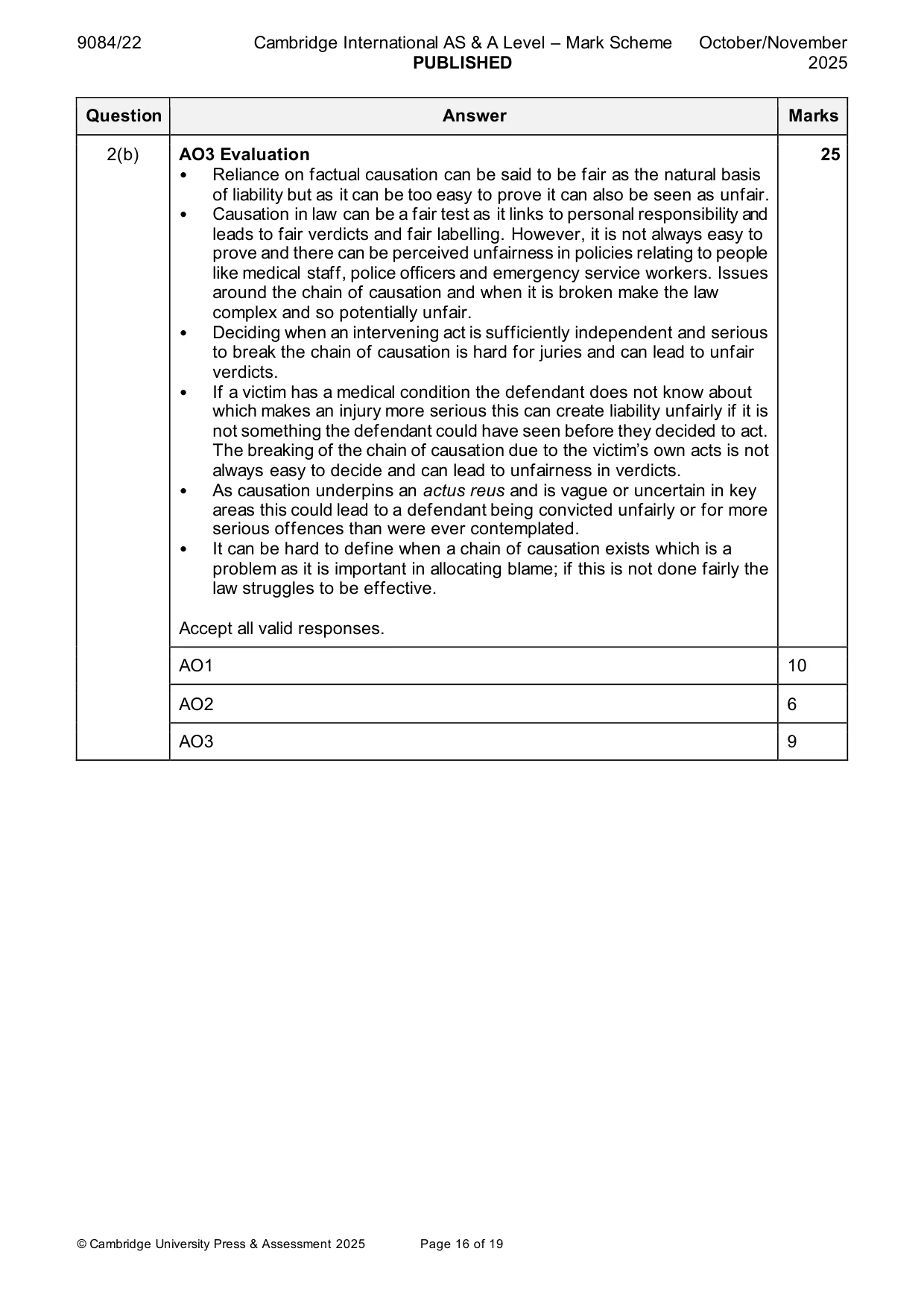
9084/22 Cambridge International AS & A Level – Mark Scheme PUBLISHED October/November 2025 © Cambridge University Press & Assessment 2025 Page 16 of 19 Question Answer Marks 2(b) AO3 Evaluation • Reliance on factual causation can be said to be fair as the natural basis of liability but as it can be too easy to prove it can also be seen as unfair. • Causation in law can be a fair test as it links to personal responsibility and leads to fair verdicts and fair labelling. However, it is not always easy to prove and there can be perceived unfairness in policies relating to people like medical staff, police officers and emergency service workers. Issues around the chain of causation and when it is broken make the law complex and so potentially unfair. • Deciding when an intervening act is sufficiently independent and serious to break the chain of causation is hard for juries and can lead to unfair verdicts. • If a victim has a medical condition the defendant does not know about which makes an injury more serious this can create liability unfairly if it is not something the defendant could have seen before they decided to act. The breaking of the chain of causation due to the victim’s own acts is not always easy to decide and can lead to unfairness in verdicts. • As causation underpins an actus reus and is vague or uncertain in key areas this could lead to a defendant being convicted unfairly or for more serious offences than were ever contemplated. • It can be hard to define when a chain of causation exists which is a problem as it is important in allocating blame; if this is not done fairly the law struggles to be effective. Accept all valid responses. 25 AO1 10 AO2 6 AO3 9
Mark scheme, page 17
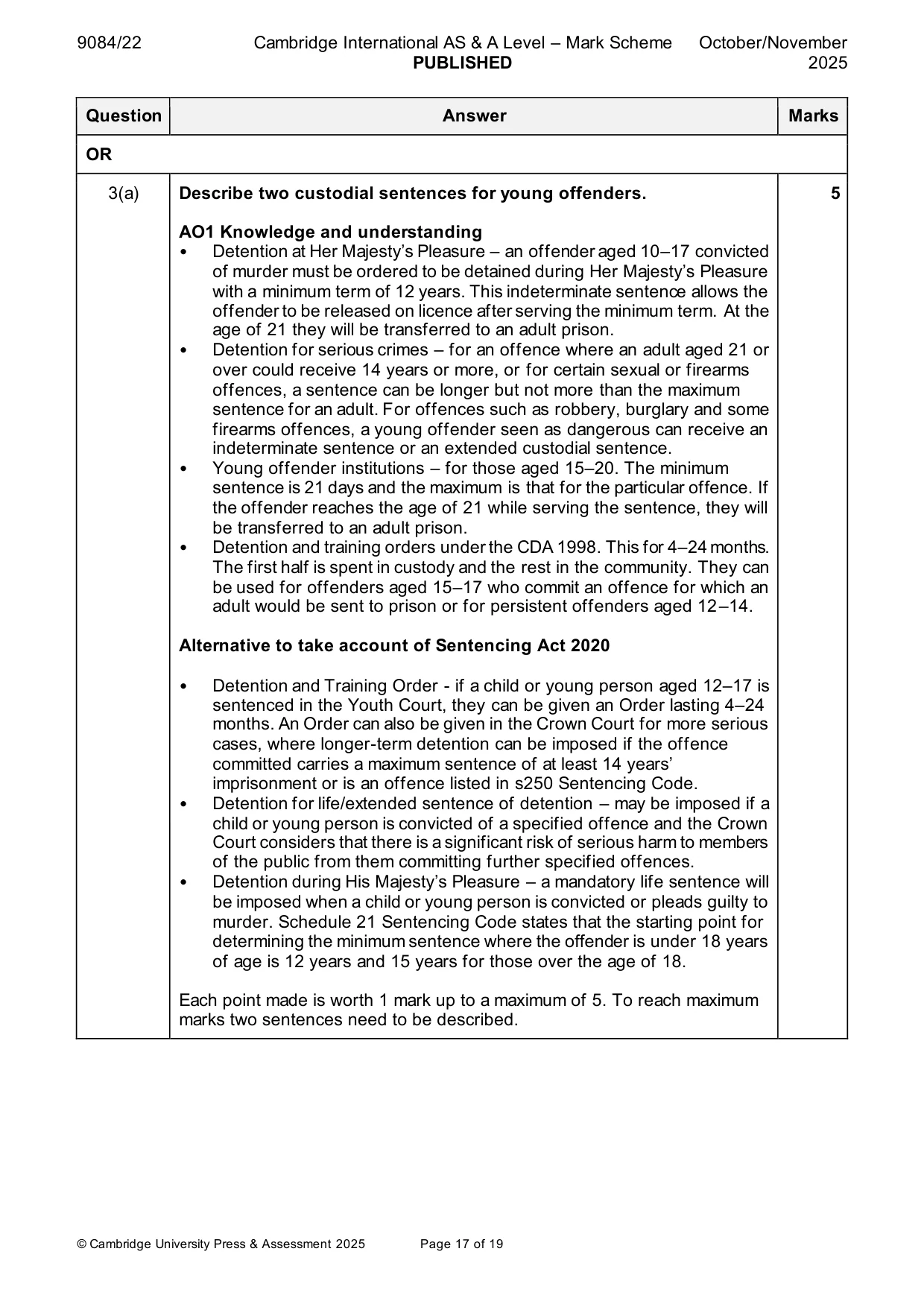
9084/22 Cambridge International AS & A Level – Mark Scheme PUBLISHED October/November 2025 © Cambridge University Press & Assessment 2025 Page 17 of 19 Question Answer Marks OR 3(a) Describe two custodial sentences for young offenders. AO1 Knowledge and understanding • Detention at Her Majesty’s Pleasure – an offender aged 10–17 convicted of murder must be ordered to be detained during Her Majesty’s Pleasure with a minimum term of 12 years. This indeterminate sentence allows the offender to be released on licence after serving the minimum term. At the age of 21 they will be transferred to an adult prison. • Detention for serious crimes – for an offence where an adult aged 21 or over could receive 14 years or more, or for certain sexual or firearms offences, a sentence can be longer but not more than the maximum sentence for an adult. For offences such as robbery, burglary and some firearms offences, a young offender seen as dangerous can receive an indeterminate sentence or an extended custodial sentence. • Young offender institutions – for those aged 15–20. The minimum sentence is 21 days and the maximum is that for the particular offence. If the offender reaches the age of 21 while serving the sentence, they will be transferred to an adult prison. • Detention and training orders under the CDA 1998. This for 4–24 months. The first half is spent in custody and the rest in the community. They can be used for offenders aged 15–17 who commit an offence for which an adult would be sent to prison or for persistent offenders aged 12–14. Alternative to take account of Sentencing Act 2020 • Detention and Training Order - if a child or young person aged 12–17 is sentenced in the Youth Court, they can be given an Order lasting 4–24 months. An Order can also be given in the Crown Court for more serious cases, where longer-term detention can be imposed if the offence committed carries a maximum sentence of at least 14 years’ imprisonment or is an offence listed in s250 Sentencing Code. • Detention for life/extended sentence of detention – may be imposed if a child or young person is convicted of a specified offence and the Crown Court considers that there is a significant risk of serious harm to members of the public from them committing further specified offences. • Detention during His Majesty’s Pleasure – a mandatory life sentence will be imposed when a child or young person is convicted or pleads guilty to murder. Schedule 21 Sentencing Code states that the starting point for determining the minimum sentence where the offender is under 18 years of age is 12 years and 15 years for those over the age of 18. Each point made is worth 1 mark up to a maximum of 5. To reach maximum marks two sentences need to be described. 5
Mark scheme, page 18
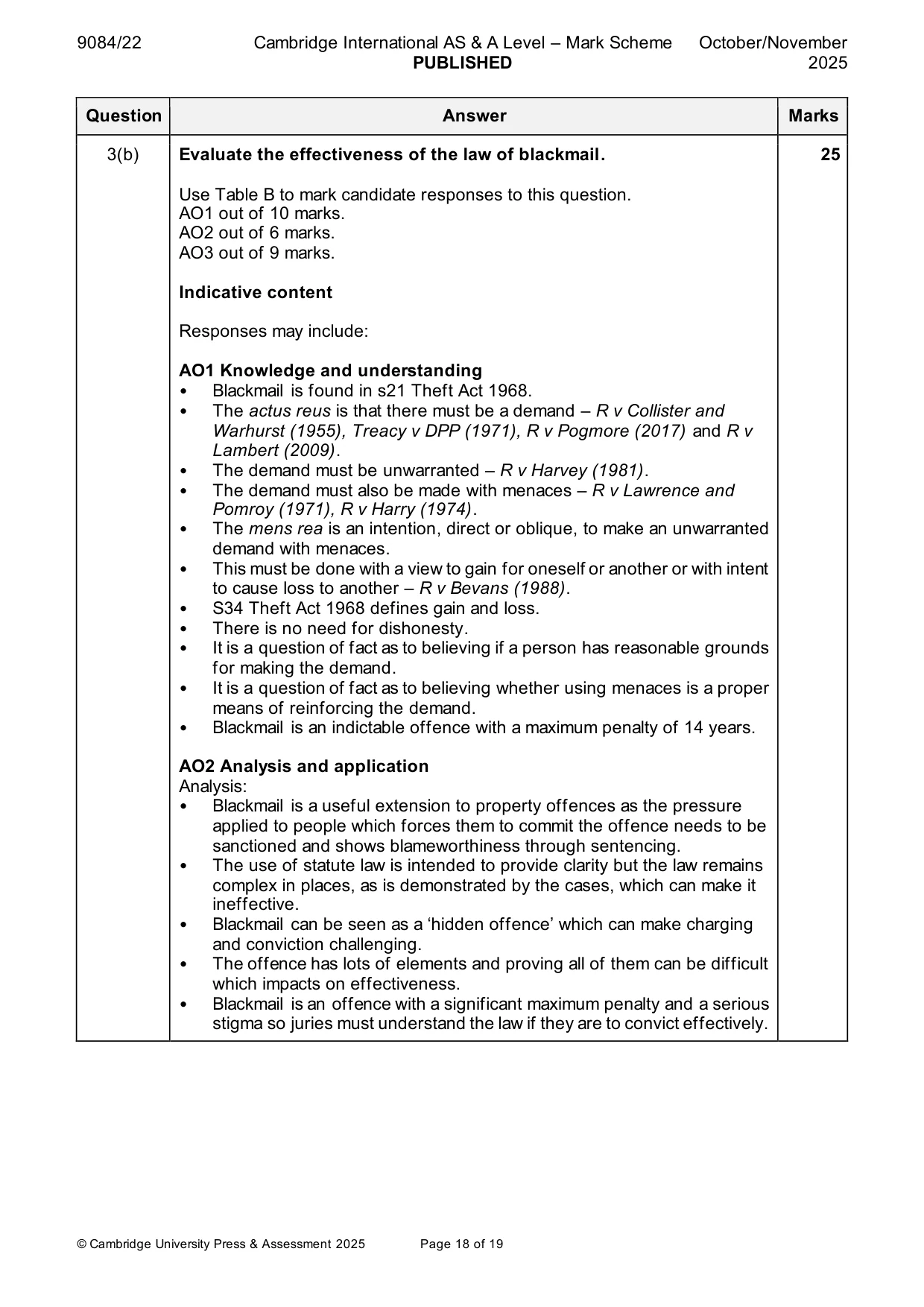
9084/22 Cambridge International AS & A Level – Mark Scheme PUBLISHED October/November 2025 © Cambridge University Press & Assessment 2025 Page 18 of 19 Question Answer Marks 3(b) Evaluate the effectiveness of the law of blackmail. Use Table B to mark candidate responses to this question. AO1 out of 10 marks. AO2 out of 6 marks. AO3 out of 9 marks. Indicative content Responses may include: AO1 Knowledge and understanding • Blackmail is found in s21 Theft Act 1968. • The actus reus is that there must be a demand – R v Collister and Warhurst (1955), Treacy v DPP (1971), R v Pogmore (2017) and R v Lambert (2009). • The demand must be unwarranted – R v Harvey (1981). • The demand must also be made with menaces – R v Lawrence and Pomroy (1971), R v Harry (1974). • The mens rea is an intention, direct or oblique, to make an unwarranted demand with menaces. • This must be done with a view to gain for oneself or another or with intent to cause loss to another – R v Bevans (1988). • S34 Theft Act 1968 defines gain and loss. • There is no need for dishonesty. • It is a question of fact as to believing if a person has reasonable grounds for making the demand. • It is a question of fact as to believing whether using menaces is a proper means of reinforcing the demand. • Blackmail is an indictable offence with a maximum penalty of 14 years. AO2 Analysis and application Analysis: • Blackmail is a useful extension to property offences as the pressure applied to people which forces them to commit the offence needs to be sanctioned and shows blameworthiness through sentencing. • The use of statute law is intended to provide clarity but the law remains complex in places, as is demonstrated by the cases, which can make it ineffective. • Blackmail can be seen as a ‘hidden offence’ which can make charging and conviction challenging. • The offence has lots of elements and proving all of them can be difficult which impacts on effectiveness. • Blackmail is an offence with a significant maximum penalty and a serious stigma so juries must understand the law if they are to convict effectively. 25
Mark scheme, page 19
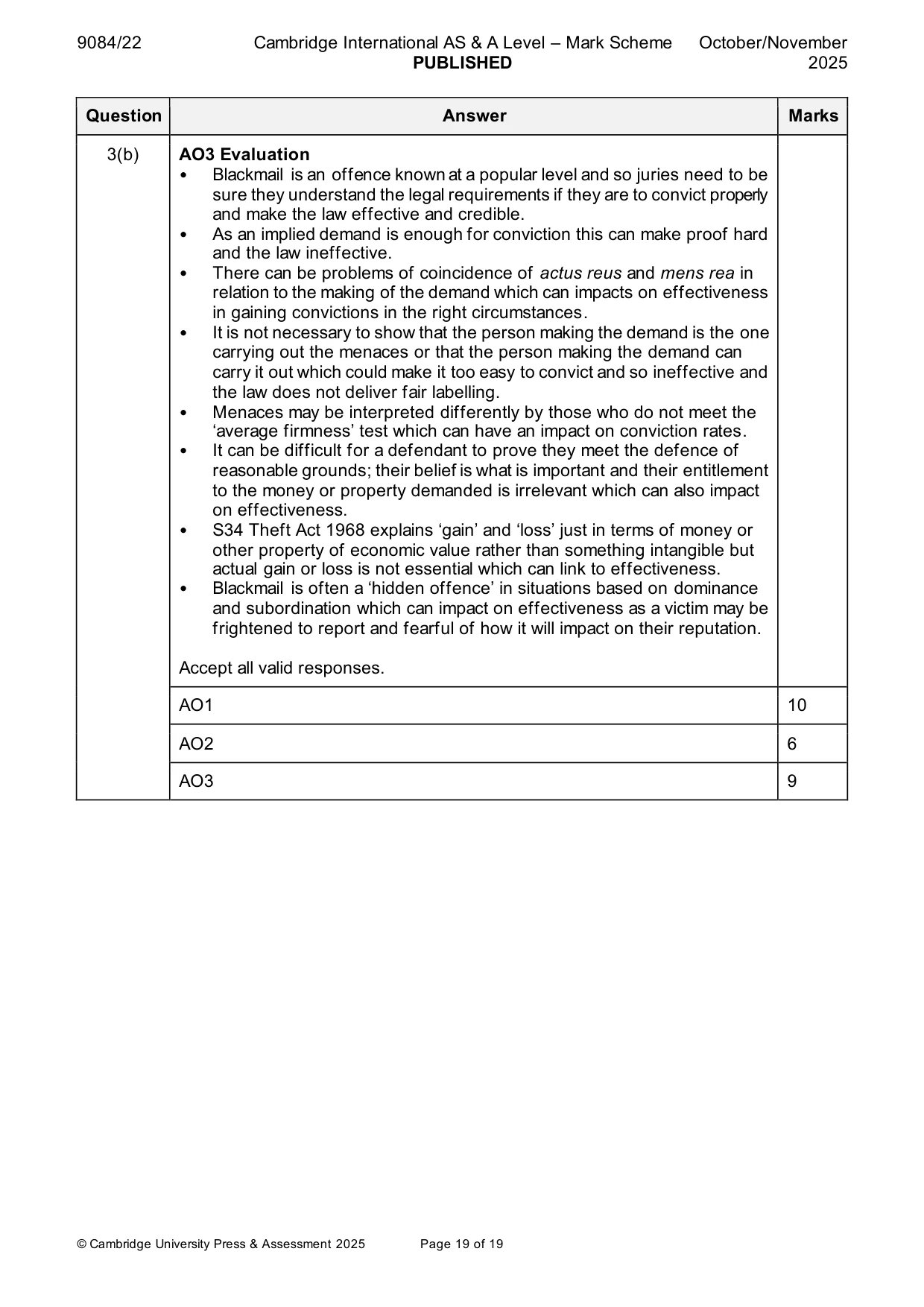
9084/22 Cambridge International AS & A Level – Mark Scheme PUBLISHED October/November 2025 © Cambridge University Press & Assessment 2025 Page 19 of 19 Question Answer Marks 3(b) AO3 Evaluation • Blackmail is an offence known at a popular level and so juries need to be sure they understand the legal requirements if they are to convict properly and make the law effective and credible. • As an implied demand is enough for conviction this can make proof hard and the law ineffective. • There can be problems of coincidence of actus reus and mens rea in relation to the making of the demand which can impacts on effectiveness in gaining convictions in the right circumstances. • It is not necessary to show that the person making the demand is the one carrying out the menaces or that the person making the demand can carry it out which could make it too easy to convict and so ineffective and the law does not deliver fair labelling. • Menaces may be interpreted differently by those who do not meet the ‘average firmness’ test which can have an impact on conviction rates. • It can be difficult for a defendant to prove they meet the defence of reasonable grounds; their belief is what is important and their entitlement to the money or property demanded is irrelevant which can also impact on effectiveness. • S34 Theft Act 1968 explains ‘gain’ and ‘loss’ just in terms of money or other property of economic value rather than something intangible but actual gain or loss is not essential which can link to effectiveness. • Blackmail is often a ‘hidden offence’ in situations based on dominance and subordination which can impact on effectiveness as a victim may be frightened to report and fearful of how it will impact on their reputation. Accept all valid responses. AO1 10 AO2 6 AO3 9
What you needed in this session
Cambridge’s own grade thresholds for 2025 Oct/Nov, Paper 2 · Variant 2. A higher threshold means an easier paper — the bar moves with how the cohort did.