Cambridge A Level Law 9084 — 2024 Oct/Nov Paper 2 · Variant 2
9084/22/O/N/24 · 3 questions · 60 marks · ≈68 min
The question paper and its mark scheme, free to read here and free to download. This is Cambridge’s own paper, exactly as it was sat.
Question paper4 pages
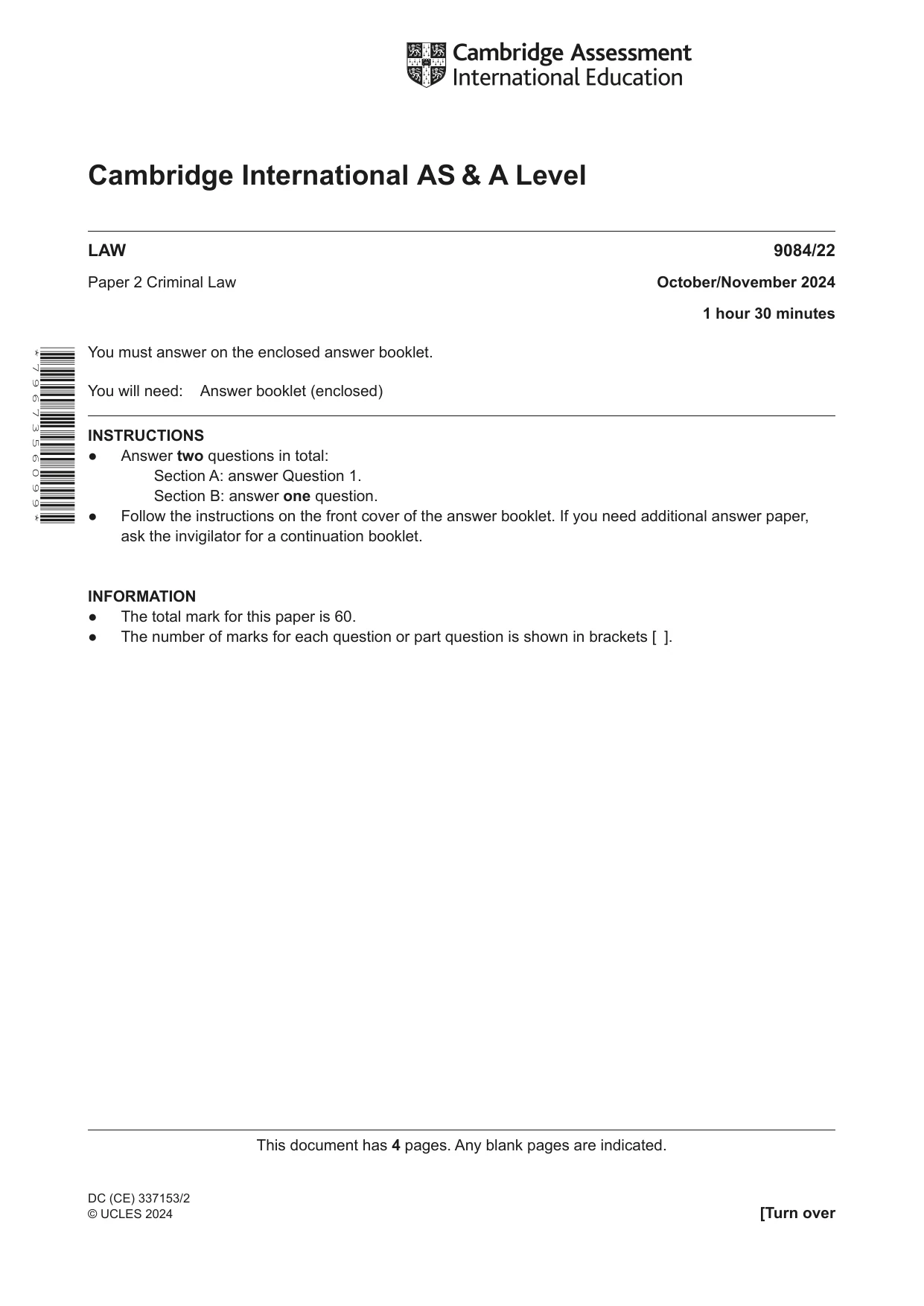
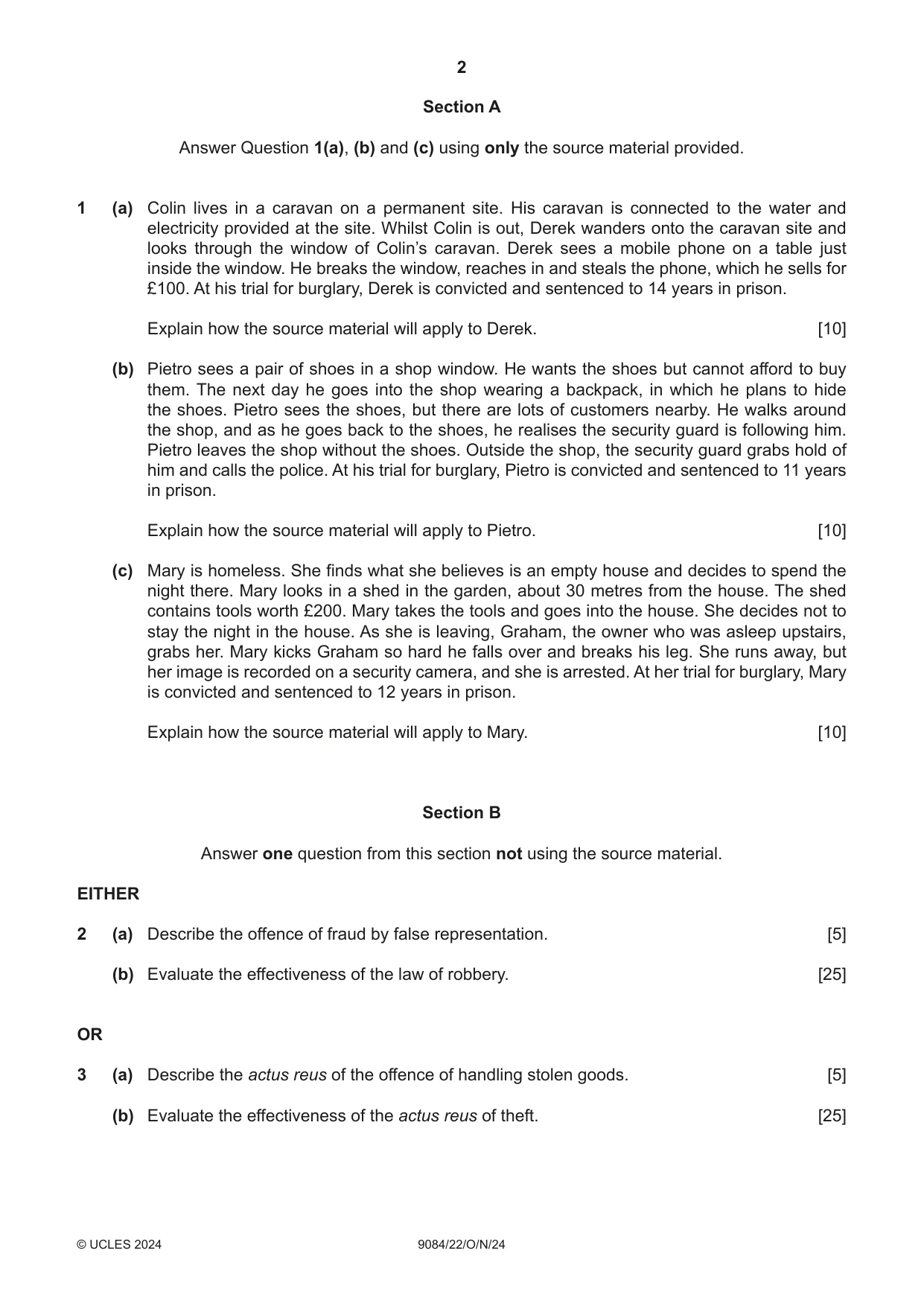
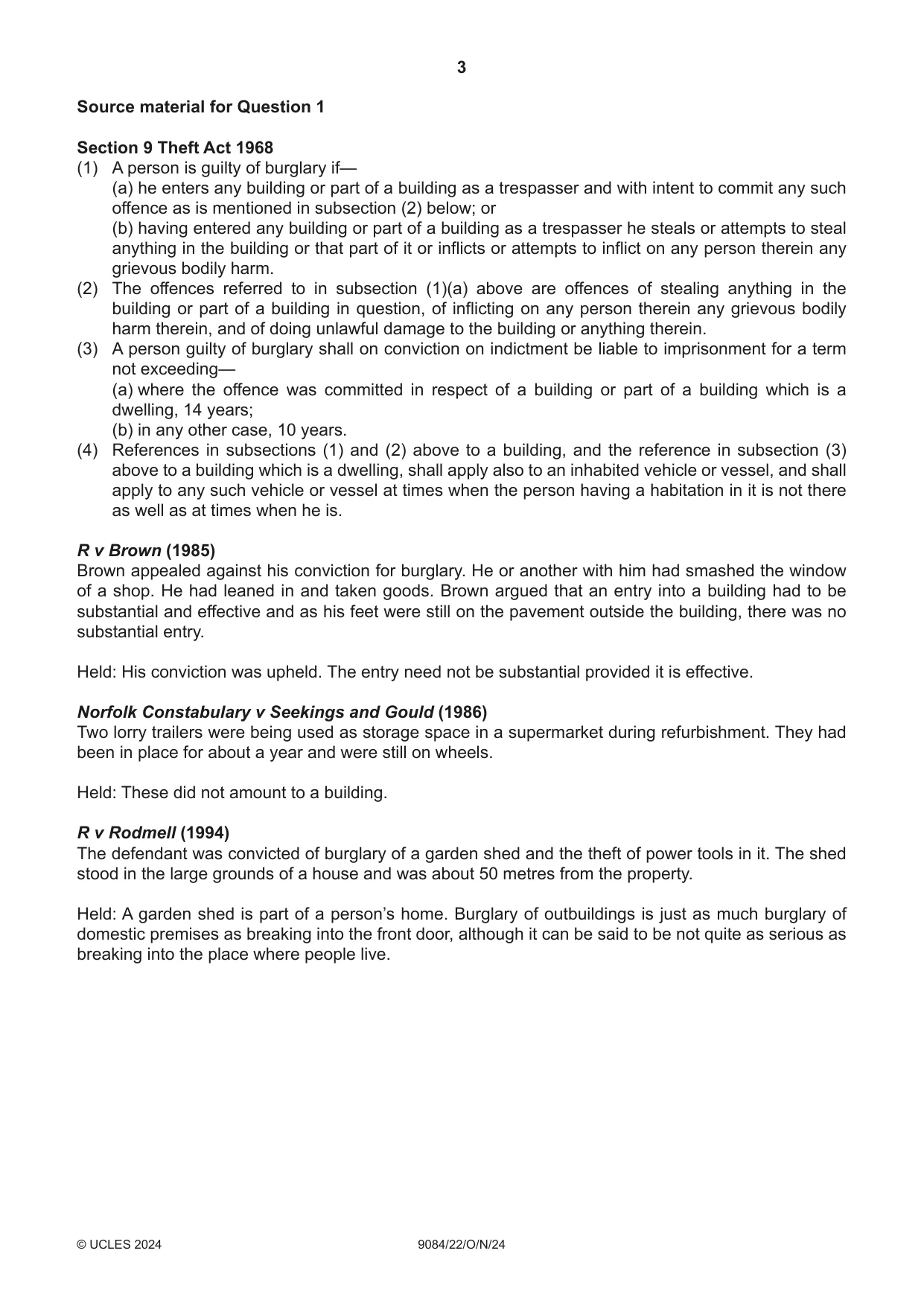

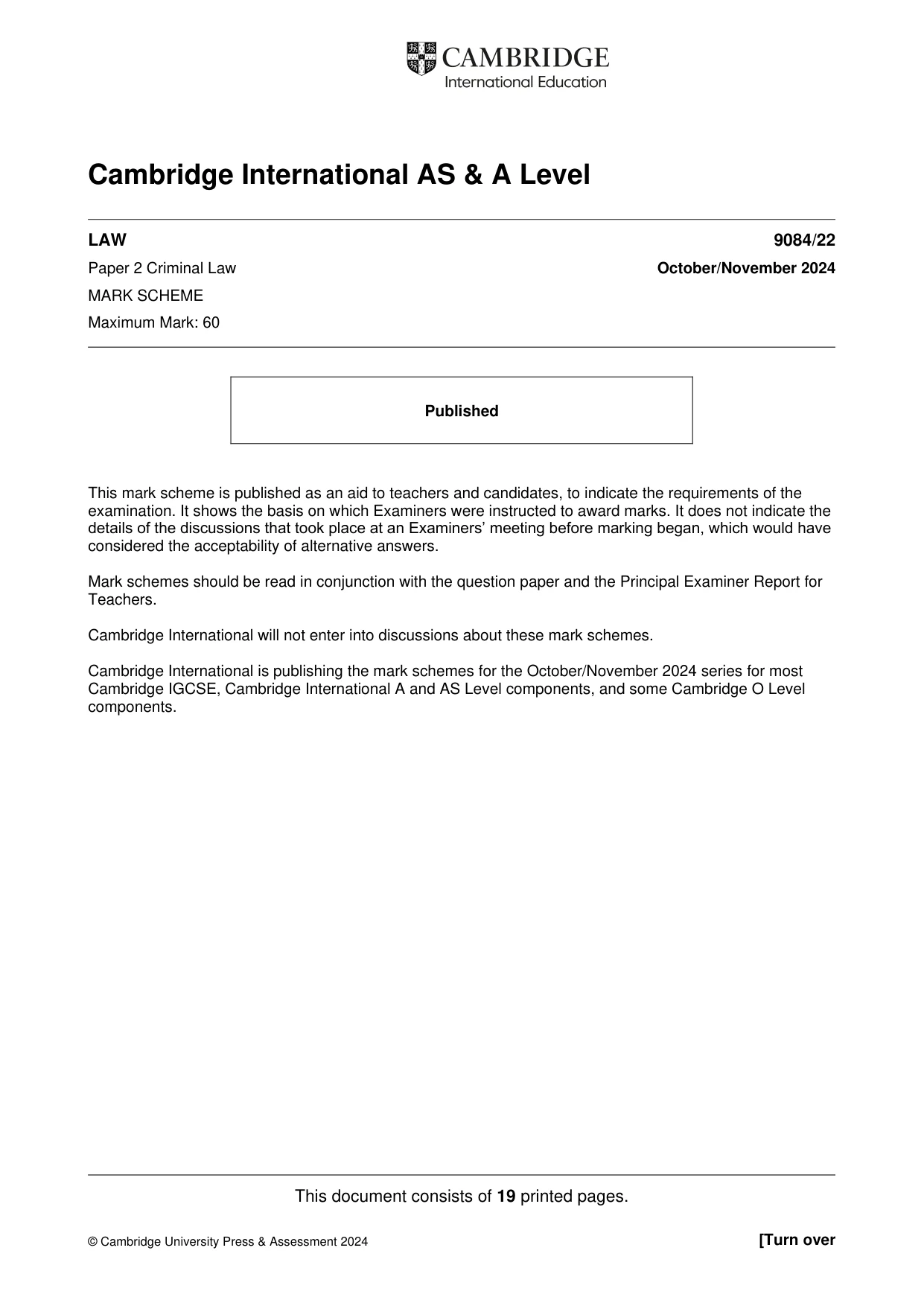
Mark scheme19 pages
Answers below. Sit the paper first if you are practising.


Questions as text
Q1 · Colin lives in a caravan on a permanent site
1 (a) Colin lives in a caravan on a permanent site. His caravan is connected to the water and electricity provided at the site. Whilst Colin is out, Derek wanders onto the caravan site and looks through the window of Colin’s caravan. Derek sees a mobile phone on a table just inside the window. He breaks the window, reaches in and steals the phone, which he sells for £100. At his trial for burglary, Derek is convicted and sentenced to 14 years in prison. Explain how the source material will apply to Derek. [10] (b) Pietro sees a pair of shoes in a shop window. He wants the shoes but cannot afford to buy them. The next day he goes into the shop wearing a backpack, in which he plans to hide the shoes. Pietro sees the shoes, but there are lots of customers nearby. He walks around the shop, and as he goes back to the shoes, he realises the security guard is following him. Pietro leaves the shop without the shoes. Outside the shop, the security guard grabs hold of him and calls the police. At his trial for burglary, Pietro is convicted and sentenced to 11 years in prison. Explain how the source material will apply to Pietro. [10] (c) Mary is homeless. She finds what she believes is an empty house and decides to spend the night there. Mary looks in a shed in the garden, about 30 metres from the house. The shed contains tools worth £200. Mary takes the tools and goes into the house. She decides not to stay the night in the house. As she is leaving, Graham, the owner who was asleep upstairs, grabs her. Mary kicks Graham so hard he falls over and breaks his leg. She runs away, but her image is recorded on a security camera, and she is arrested. At her trial for burglary, Mary is convicted and sentenced to 12 years in prison. Explain how the source material will apply to Mary. [10]
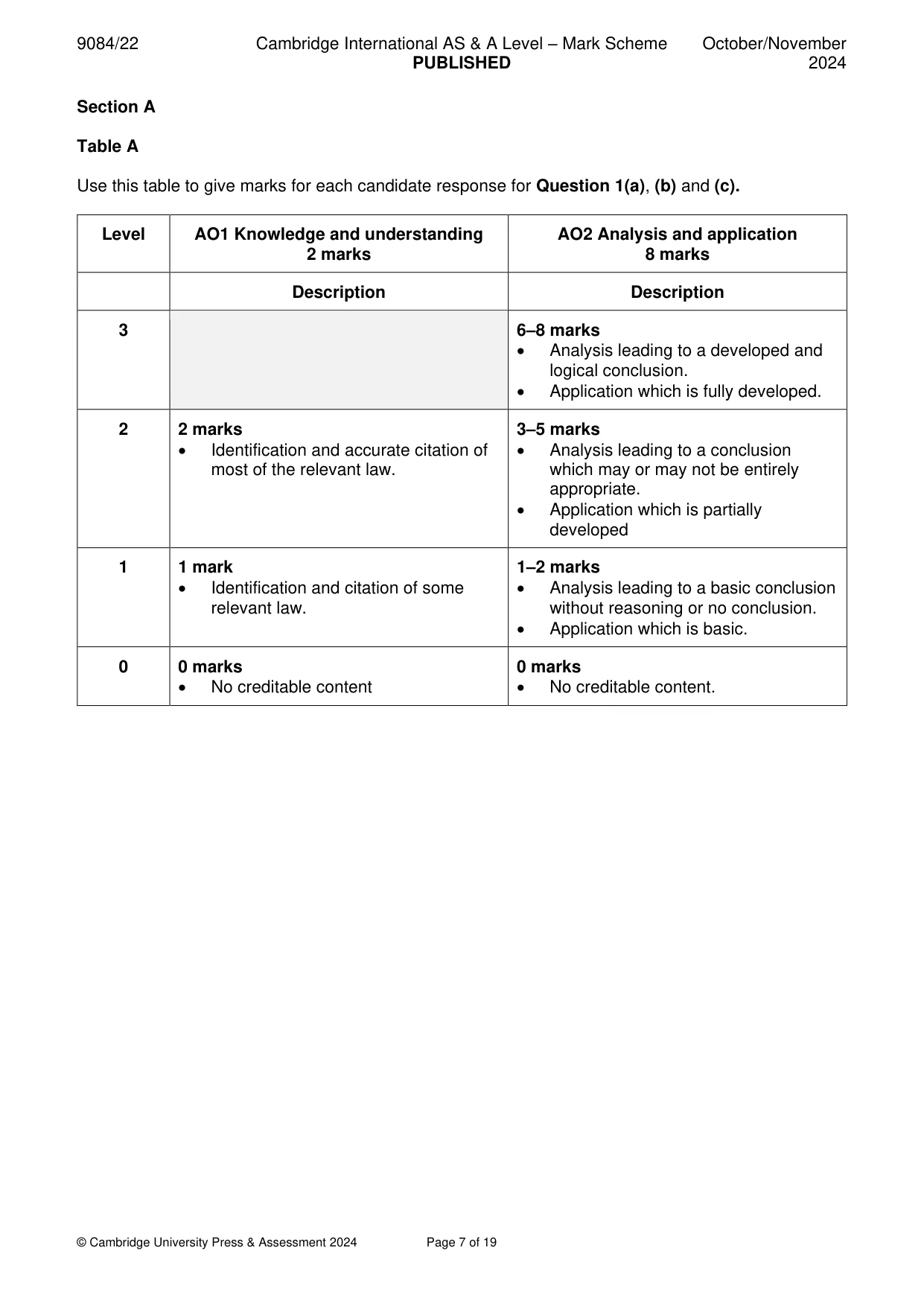
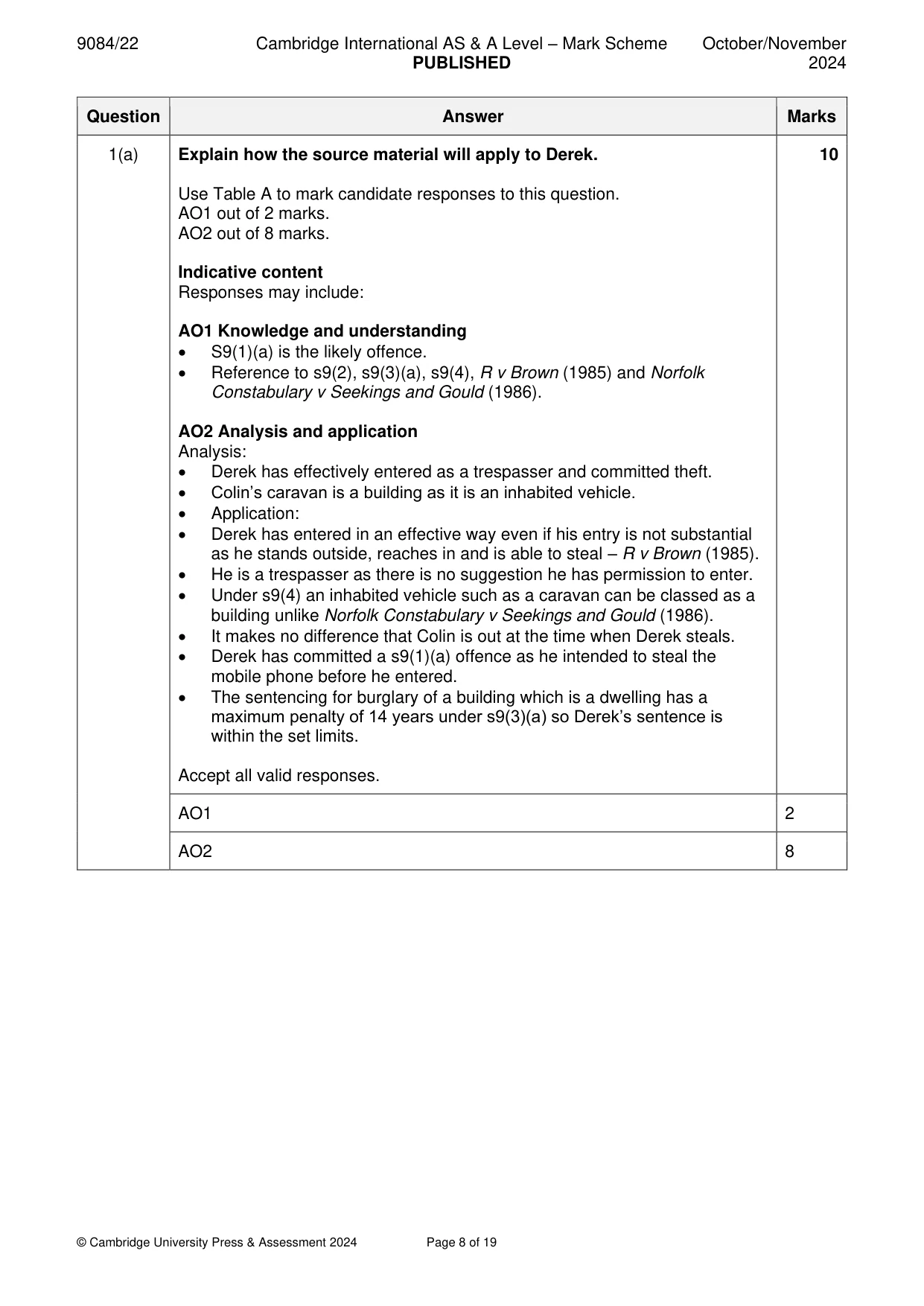
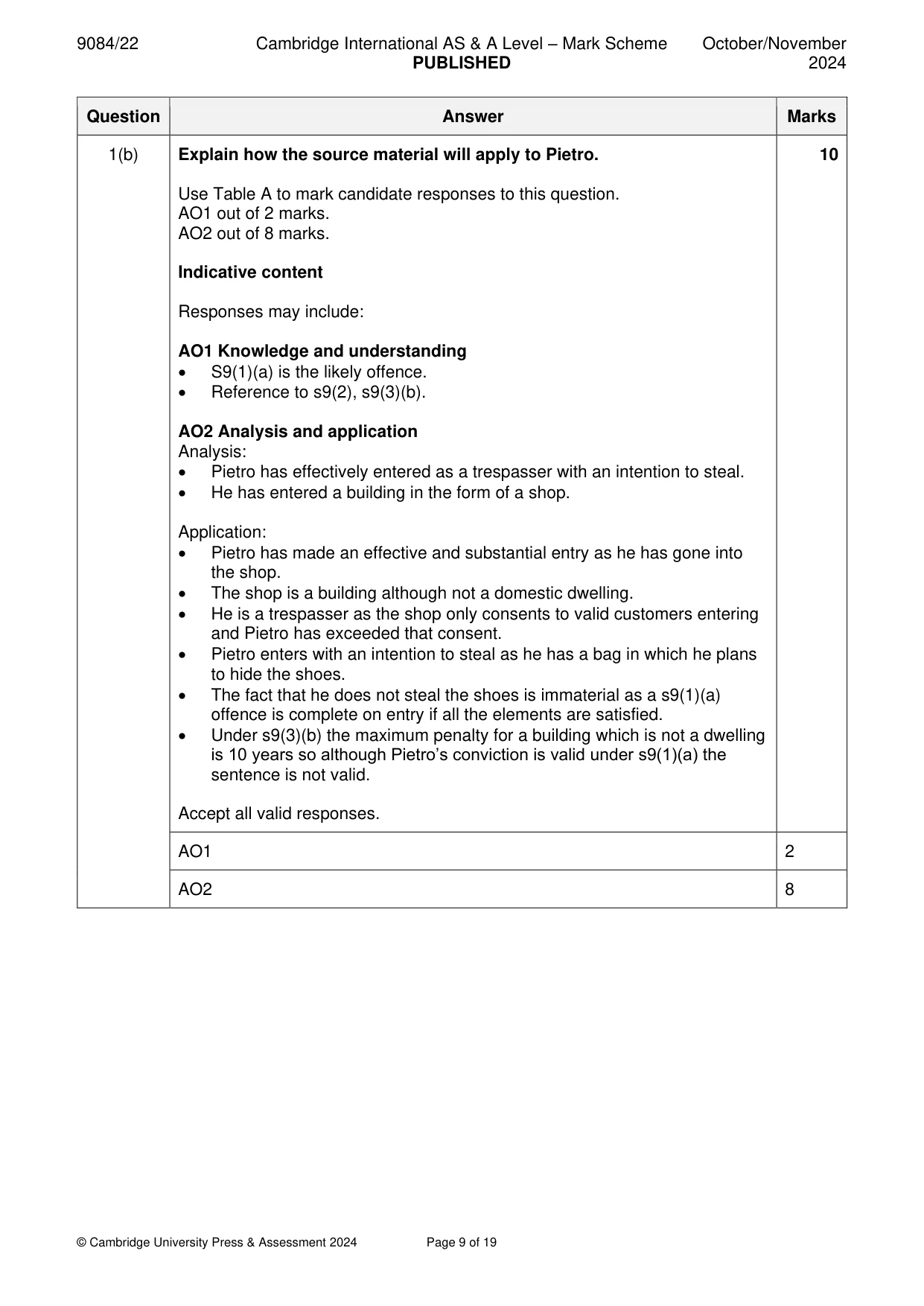
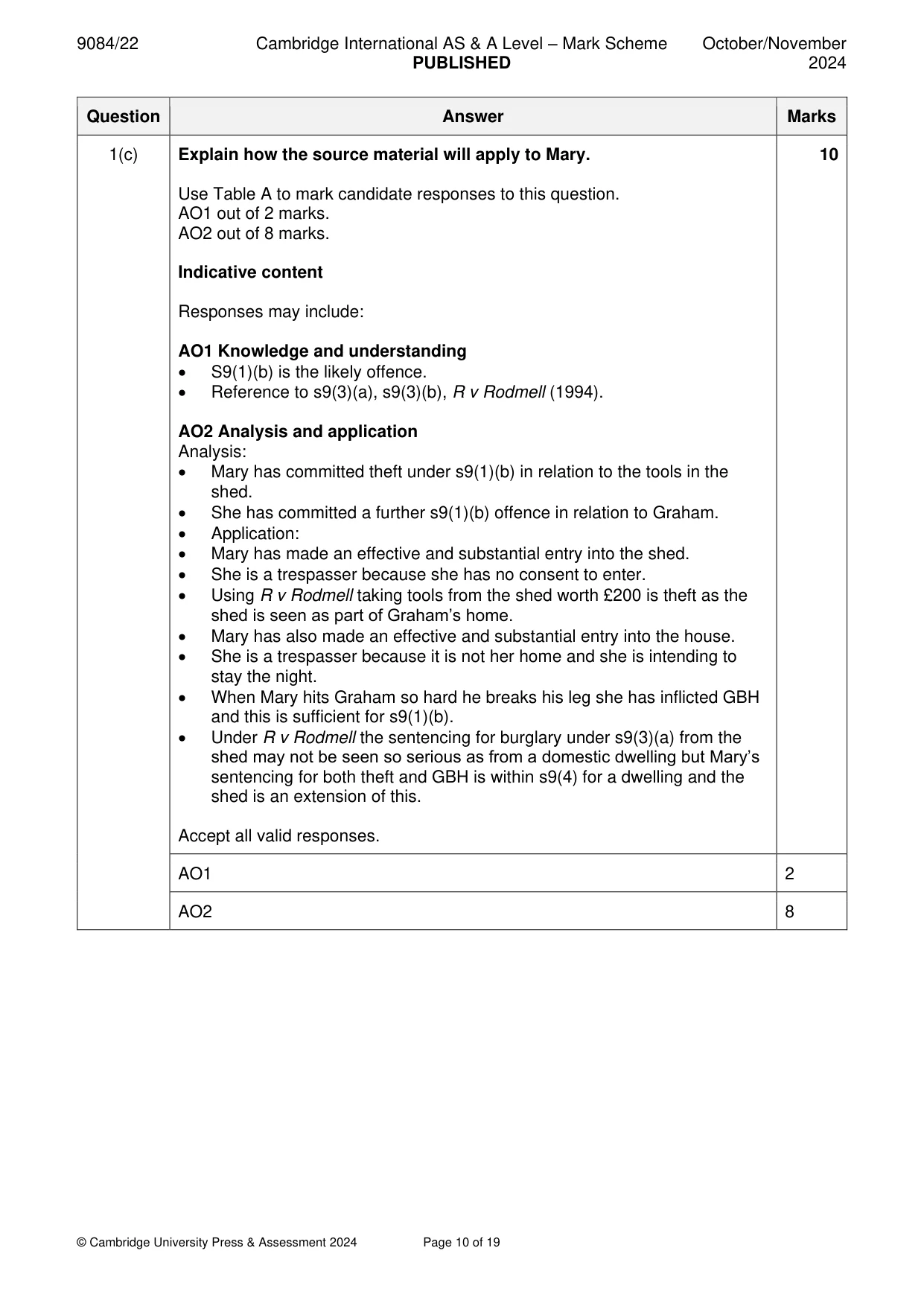
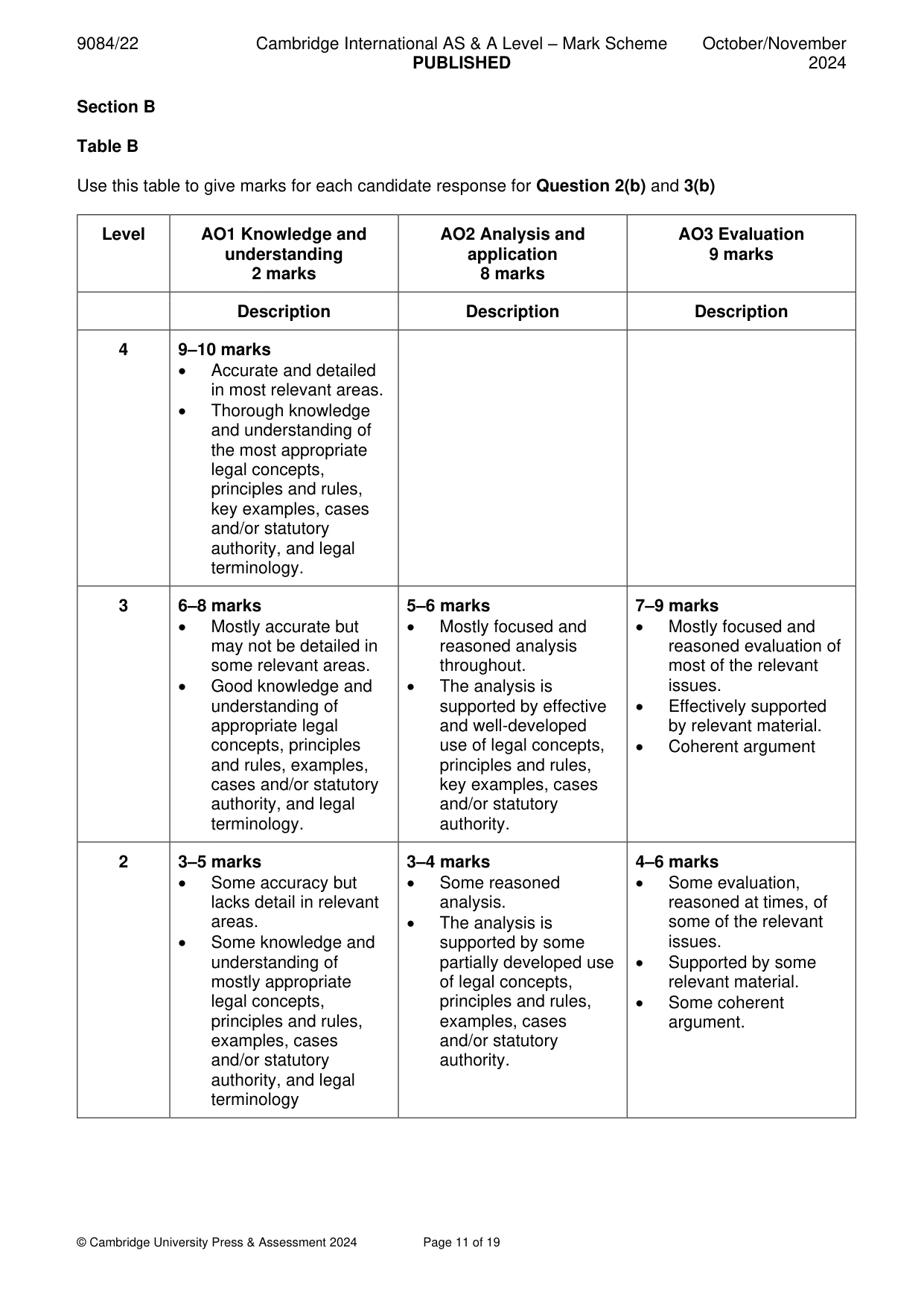
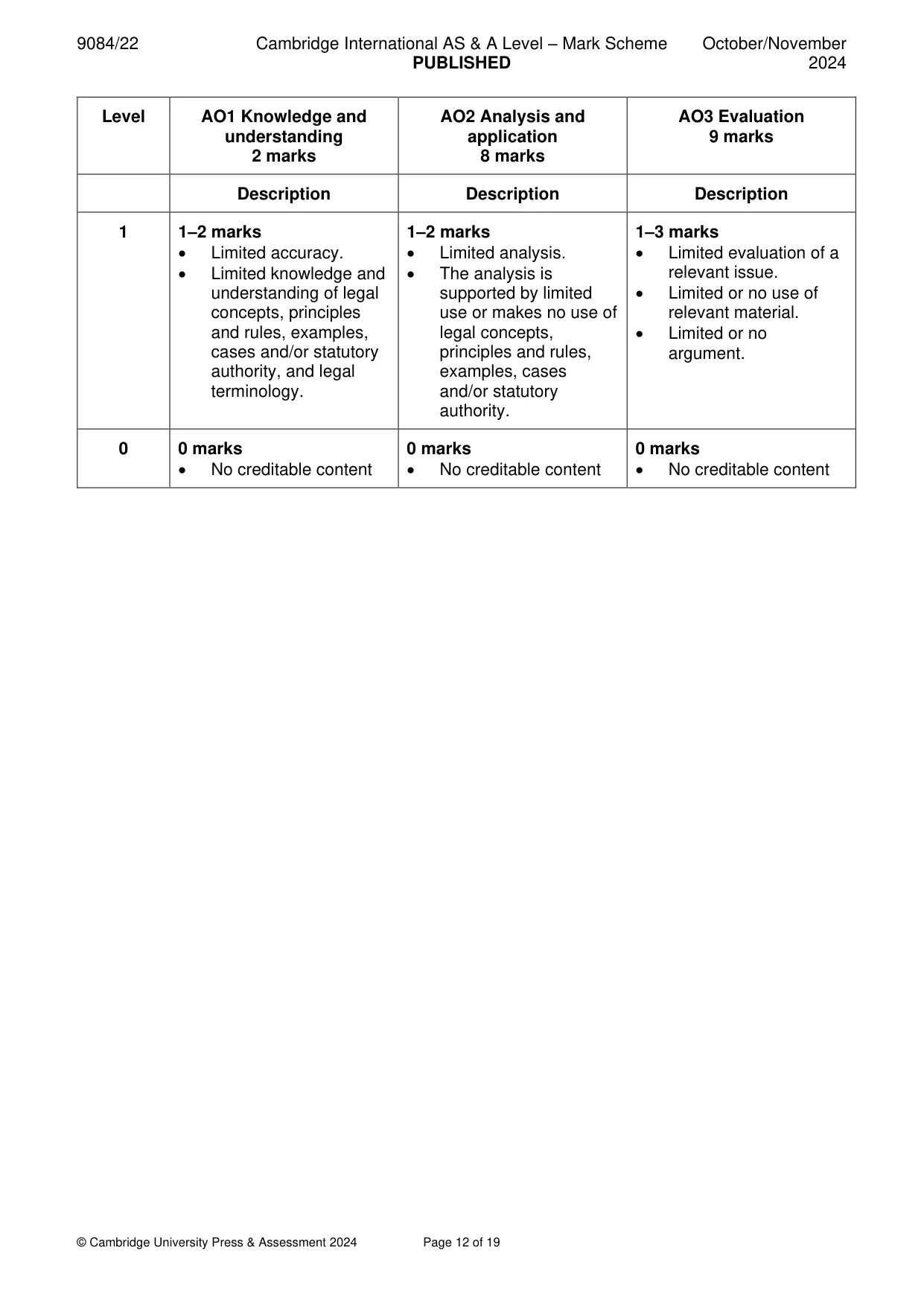
Mark scheme: Question Answer Marks 1(a) Explain how the source material will apply to Derek. 10 Use Table A to mark candidate responses to this question. AO1 out of 2 marks. AO2 out of 8 marks. Indicative content Responses may include: AO1 Knowledge and understanding • S9(1)(a) is the likely offence. • Reference to s9(2), s9(3)(a), s9(4), R v Brown (1985) and Norfolk Constabulary v Seekings and Gould (1986). AO2 Analysis and application Analysis: • Derek has effectively entered as a trespasser and committed theft. • Colin’s caravan is a building as it is an inhabited vehicle. • Application: • Derek has entered in an effective way even if his entry is not substantial as he stands outside, reaches in and is able to steal – R v Brown (1985). • He is a trespasser as there is no suggestion he has permission to enter. • Under s9(4) an inhabited vehicle such as a caravan can be classed as a building unlike Norfolk Constabulary v Seekings and Gould (1986). • It makes no difference that Colin is out at the time when Derek steals. • Derek has committed a s9(1)(a) offence as he intended to steal the mobile phone before he entered. • The sentencing for burglary of a building which is a dwelling has a maximum penalty of 14 years under s9(3)(a) so Derek’s sentence is within the set limits. Accept all valid responses. AO1 2 AO2 8 1(b) Explain how the source material will apply to Pietro. 10 Use Table A to mark candidate responses to this question. AO1 out of 2 marks. AO2 out of 8 marks. Indicative content Responses may include: AO1 Knowledge and understanding • S9(1)(a) is the likely offence. • Reference to s9(2), s9(3)(b). AO2 Analysis and application Analysis: • Pietro has effectively entered as a trespasser with an intention to steal. • He has entered a building in the form of a shop. Application: • Pietro has made an effective and substantial entry as he has gone into the shop. • The shop is a building although not a domestic dwelling. • He is a trespasser as the shop only consents to valid customers entering and Pietro has exceeded that consent. • Pietro enters with an intention to steal as he has a bag in which he plans to hide the shoes. • The fact that he does not steal the shoes is immaterial as a s9(1)(a) offence is complete on entry if all the elements are satisfied. • Under s9(3)(b) the maximum penalty for a building which is not a dwelling is 10 years so although Pietro’s conviction is valid under s9(1)(a) the sentence is not valid. Accept all valid responses. AO1 2 AO2 8 1(c) Explain how the source material will apply to Mary. 10 Use Table A to mark candidate responses to this question. AO1 out of 2 marks. AO2 out of 8 marks. Indicative content Responses may include: AO1 Knowledge and understanding • S9(1)(b) is the likely offence. • Reference to s9(3)(a), s9(3)(b), R v Rodmell (1994). AO2 Analysis and application Analysis: • Mary has committed theft under s9(1)(b) in relation to the tools in the shed. • She has committed a further s9(1)(b) offence in relation to Graham. • Application: • Mary has made an effective and substantial entry into the shed. • She is a trespasser because she has no consent to enter. • Using R v Rodmell taking tools from the shed worth £200 is theft as the shed is seen as part of Graham’s home. • Mary has also made an effective and substantial entry into the house. • She is a trespasser because it is not her home and she is intending to stay the night. • When Mary hits Graham so hard he breaks his leg she has inflicted GBH and this is sufficient for s9(1)(b). • Under R v Rodmell the sentencing for burglary under s9(3)(a) from the shed may not be seen so serious as from a domestic dwelling but Mary’s sentencing for both theft and GBH is within s9(4) for a dwelling and the shed is an extension of this. Accept all valid responses. AO1 2 AO2 8 Section B Table B Use this table to give marks for each candidate response for Question 2(b) and 3(b) Level AO1 Knowledge and AO2 Analysis and AO3 Evaluation understanding application 9 marks 2 marks 8 marks Description Description Description 4 9–10 marks • Accurate and detailed in most relevant areas. • Thorough knowledge and understanding of the most appropriate legal concepts, principles and rules, key examples, cases and/or statutory authority, and legal terminology. 3 6–8 marks 5–6 marks 7–9 marks • Mostly accurate but • Mostly focused and • Mostly focused and may not be detailed in reasoned analysis reasoned evaluation of some relevant areas. throughout. most of the relevant • Good knowledge and • The analysis is issues. understanding of supported by effective • Effectively supported appropriate legal and well-developed by relevant material. concepts, principles use of legal concepts, • Coherent argument and rules, examples, principles and rules, cases and/or statutory key examples, cases authority, and legal and/or statutory terminology. authority. 2 3–5 marks 3–4 marks 4–6 marks • Some accuracy but • Some reasoned • Some evaluation, lacks detail in relevant analysis. reasoned at times, of areas. • The analysis is some of the relevant • Some knowledge and supported by some issues. understanding of partially developed use • Supported by some mostly appropriate of legal concepts, relevant material. legal concepts, principles and rules, • Some coherent principles and rules, examples, cases argument. examples, cases and/or statutory and/or statutory authority. authority, and legal terminology Level AO1 Knowledge and AO2 Analysis and AO3 Evaluation understanding application 9 marks 2 marks 8 marks Description Description Description 1 1–2 marks 1–2 marks 1–3 marks • Limited accuracy. • Limited analysis. • Limited evaluation of a • Limited knowledge and • The analysis is relevant issue. understanding of legal supported by limited • Limited or no use of concepts, principles use or makes no use of relevant material. and rules, examples, legal concepts, • Limited or no cases and/or statutory principles and rules, argument. authority, and legal examples, cases terminology. and/or statutory authority. 0 0 marks 0 marks 0 marks • No creditable content • No creditable content • No creditable content
Q2 · Describe the offence of fraud by false representation
2 (a) Describe the offence of fraud by false representation. [5] (b) Evaluate the effectiveness of the law of robbery. [25] OR
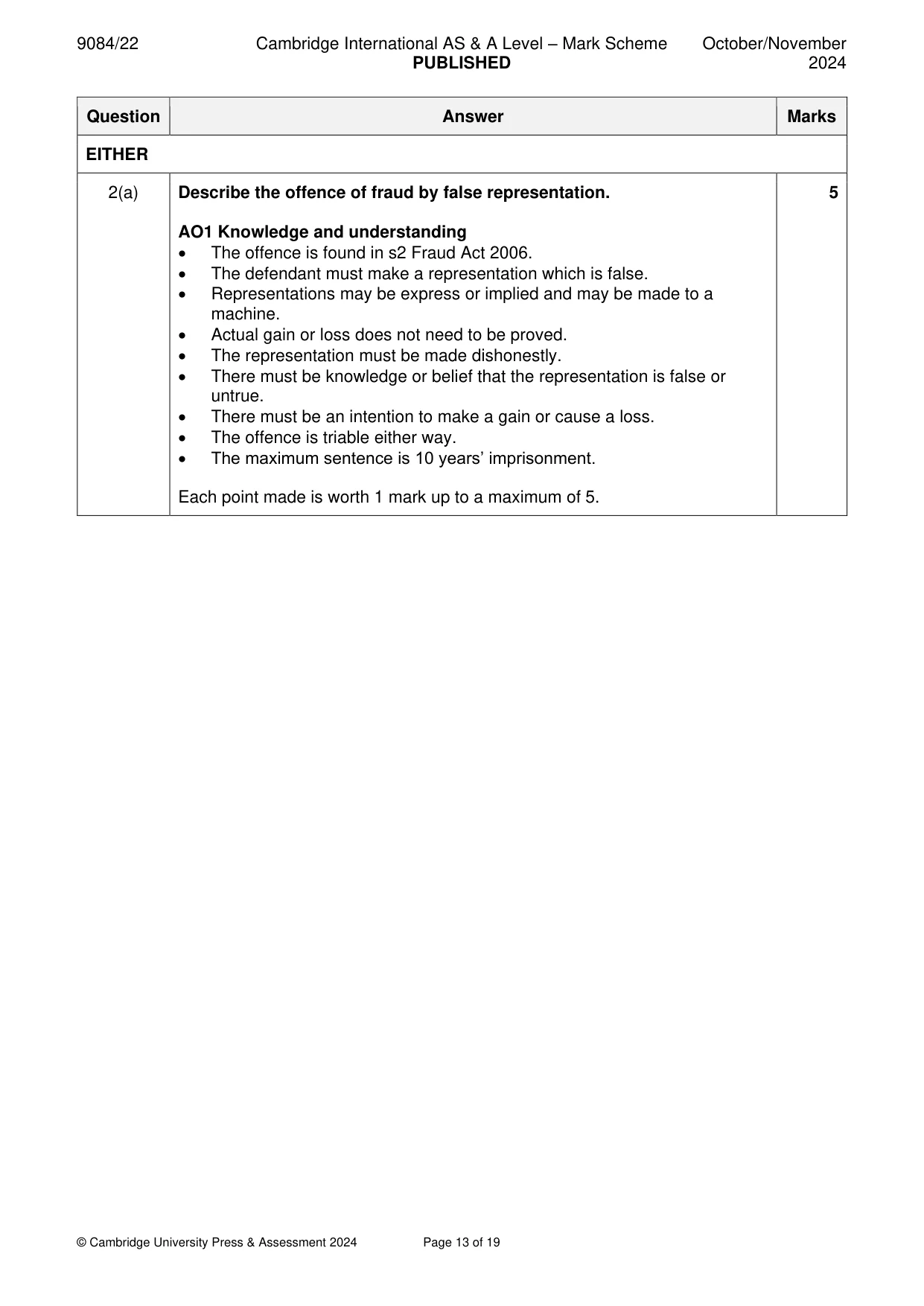
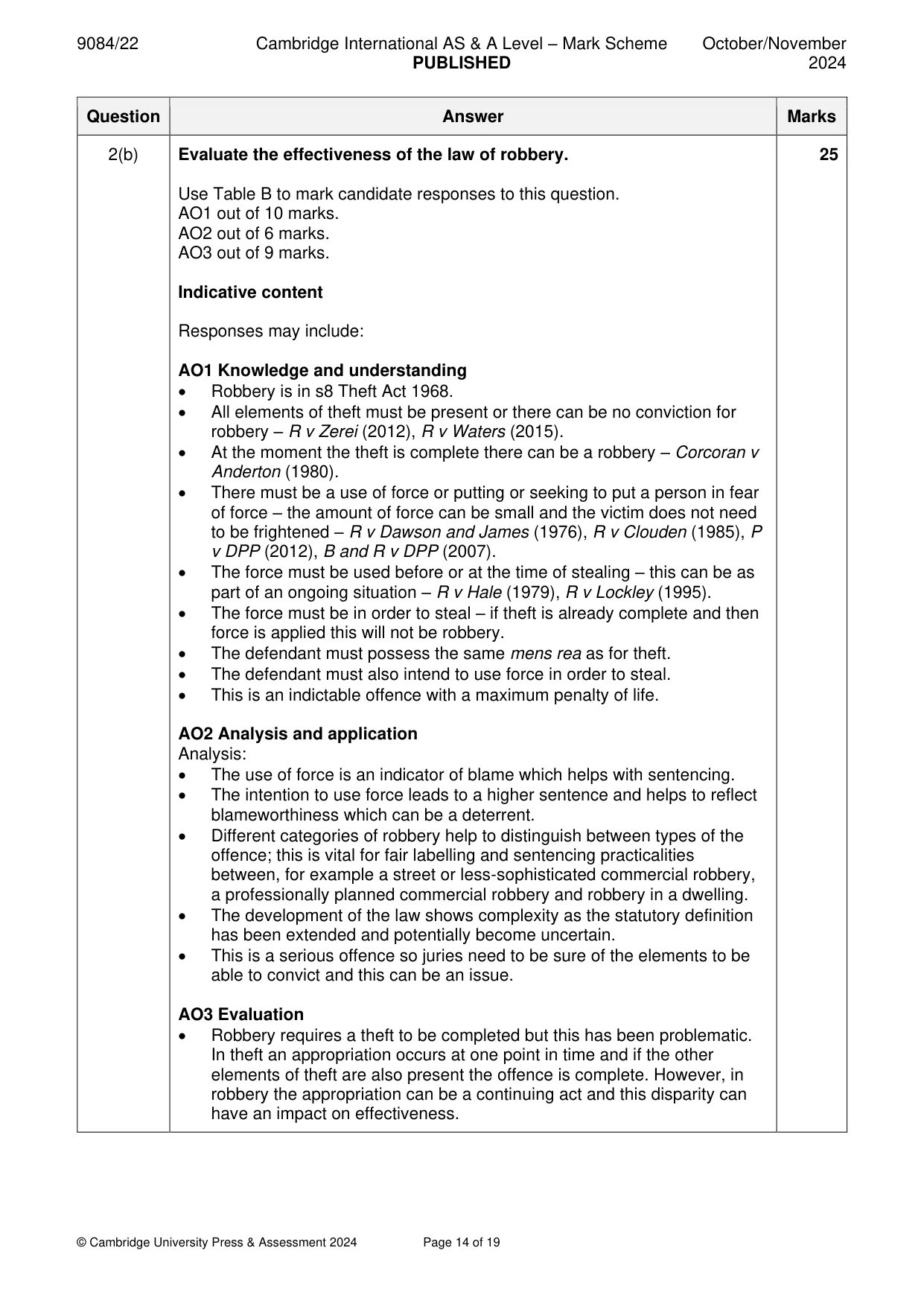
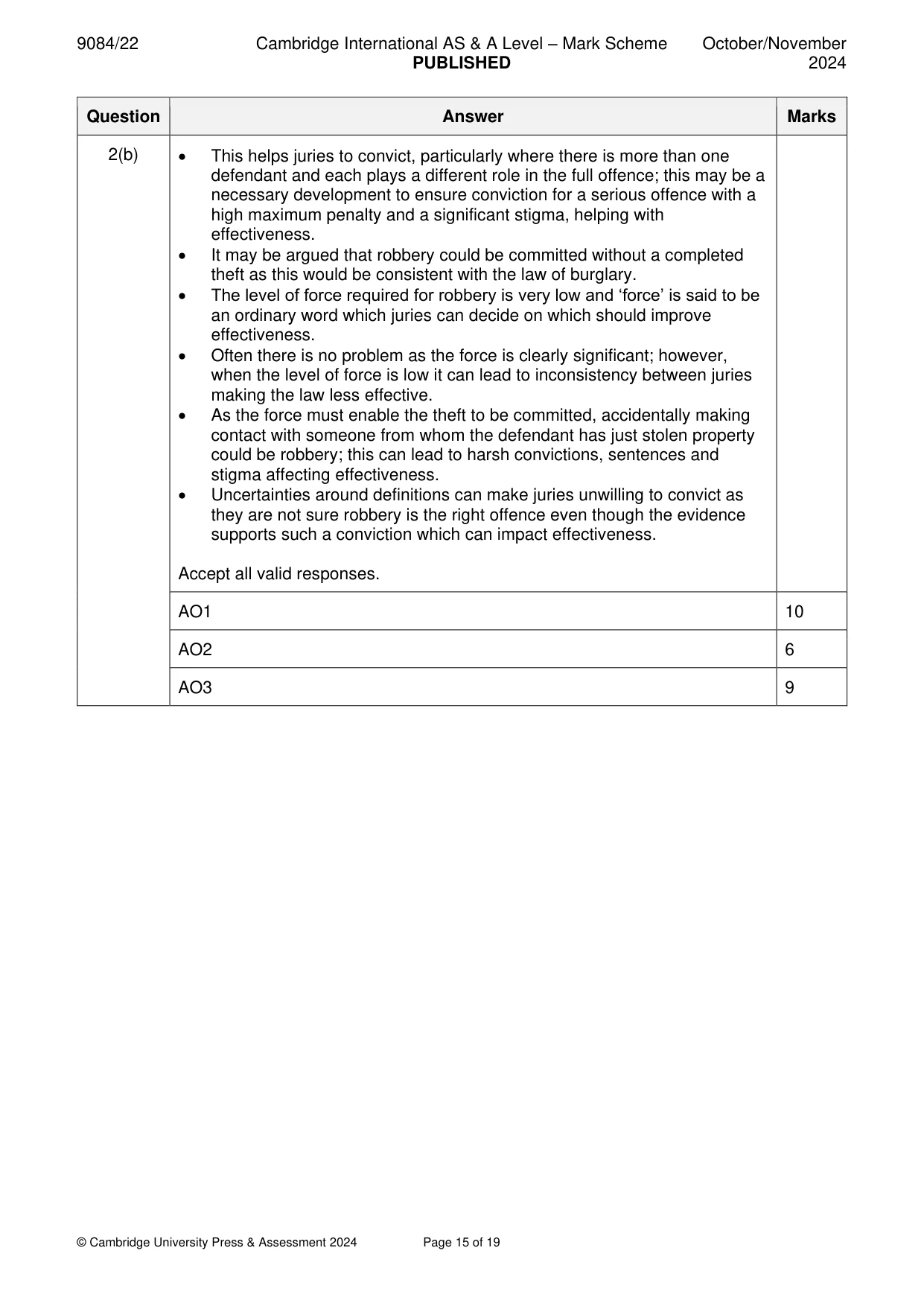
Mark scheme: 2(a) Describe the offence of fraud by false representation. 5 AO1 Knowledge and understanding • The offence is found in s2 Fraud Act 2006. • The defendant must make a representation which is false. • Representations may be express or implied and may be made to a machine. • Actual gain or loss does not need to be proved. • The representation must be made dishonestly. • There must be knowledge or belief that the representation is false or untrue. • There must be an intention to make a gain or cause a loss. • The offence is triable either way. • The maximum sentence is 10 years’ imprisonment. Each point made is worth 1 mark up to a maximum of 5. 2(b) Evaluate the effectiveness of the law of robbery. 25 Use Table B to mark candidate responses to this question. AO1 out of 10 marks. AO2 out of 6 marks. AO3 out of 9 marks. Indicative content Responses may include: AO1 Knowledge and understanding • Robbery is in s8 Theft Act 1968. • All elements of theft must be present or there can be no conviction for robbery – R v Zerei (2012), R v Waters (2015). • At the moment the theft is complete there can be a robbery – Corcoran v Anderton (1980). • There must be a use of force or putting or seeking to put a person in fear of force – the amount of force can be small and the victim does not need to be frightened – R v Dawson and James (1976), R v Clouden (1985), P v DPP (2012), B and R v DPP (2007). • The force must be used before or at the time of stealing – this can be as part of an ongoing situation – R v Hale (1979), R v Lockley (1995). • The force must be in order to steal – if theft is already complete and then force is applied this will not be robbery. • The defendant must possess the same mens rea as for theft. • The defendant must also intend to use force in order to steal. • This is an indictable offence with a maximum penalty of life. AO2 Analysis and application Analysis: • The use of force is an indicator of blame which helps with sentencing. • The intention to use force leads to a higher sentence and helps to reflect blameworthiness which can be a deterrent. • Different categories of robbery help to distinguish between types of the offence; this is vital for fair labelling and sentencing practicalities between, for example a street or less-sophisticated commercial robbery, a professionally planned commercial robbery and robbery in a dwelling. • The development of the law shows complexity as the statutory definition has been extended and potentially become uncertain. • This is a serious offence so juries need to be sure of the elements to be able to convict and this can be an issue. AO3 Evaluation • Robbery requires a theft to be completed but this has been problematic. In theft an appropriation occurs at one point in time and if the other elements of theft are also present the offence is complete. However, in robbery the appropriation can be a continuing act and this disparity can have an impact on effectiveness. 2(b) • This helps juries to convict, particularly where there is more than one defendant and each plays a different role in the full offence; this may be a necessary development to ensure conviction for a serious offence with a high maximum penalty and a significant stigma, helping with effectiveness. • It may be argued that robbery could be committed without a completed theft as this would be consistent with the law of burglary. • The level of force required for robbery is very low and ‘force’ is said to be an ordinary word which juries can decide on which should improve effectiveness. • Often there is no problem as the force is clearly significant; however, when the level of force is low it can lead to inconsistency between juries making the law less effective. • As the force must enable the theft to be committed, accidentally making contact with someone from whom the defendant has just stolen property could be robbery; this can lead to harsh convictions, sentences and stigma affecting effectiveness. • Uncertainties around definitions can make juries unwilling to convict as they are not sure robbery is the right offence even though the evidence supports such a conviction which can impact effectiveness. Accept all valid responses. AO1 10 AO2 6 AO3 9
Q3 · Describe the actus reus of the offence of handling stolen goods
3 (a) Describe the actus reus of the offence of handling stolen goods. [5] (b) Evaluate the effectiveness of the actus reus of theft. [25] Source material for Question 1 Section 9 Theft Act 1968 (1) A person is guilty of burglary if— (a) he enters any building or part of a building as a trespasser and with intent to commit any such offence as is mentioned in subsection (2) below; or (b) having entered any building or part of a building as a trespasser he steals or attempts to steal anything in the building or that part of it or inflicts or attempts to inflict on any person therein any grievous bodily harm. (2) The offences referred to in subsection (1)(a) above are offences of stealing anything in the building or part of a building in question, of inflicting on any person therein any grievous bodily harm therein, and of doing unlawful damage to the building or anything therein. (3) A person guilty of burglary shall on conviction on indictment be liable to imprisonment for a term not exceeding— (a) where the offence was committed in respect of a building or part of a building which is a dwelling, 14 years; (b) in any other case, 10 years. (4) References in subsections (1) and (2) above to a building, and the reference in subsection (3) above to a building which is a dwelling, shall apply also to an inhabited vehicle or vessel, and shall apply to any such vehicle or vessel at times when the person having a habitation in it is not there as well as at times when he is. R v Brown (1985) Brown appealed against his conviction for burglary. He or another with him had smashed the window of a shop. He had leaned in and taken goods. Brown argued that an entry into a building had to be substantial and effective and as his feet were still on the pavement outside the building, there was no substantial entry. Held: His conviction was upheld. The entry need not be substantial provided it is effective. Norfolk Constabulary v Seekings and Gould (1986) Two lorry trailers were being used as storage space in a supermarket during refurbishment. They had been in place for about a year and were still on wheels. Held: These did not amount to a building. R v Rodmell (1994) The defendant was convicted of burglary of a garden shed and the theft of power tools in it. The shed stood in the large grounds of a house and was about 50 metres from the property. Held: A garden shed is part of a person’s home. Burglary of outbuildings is just as much burglary of domestic premises as breaking into the front door, although it can be said to be not quite as serious as breaking into the place where people live.
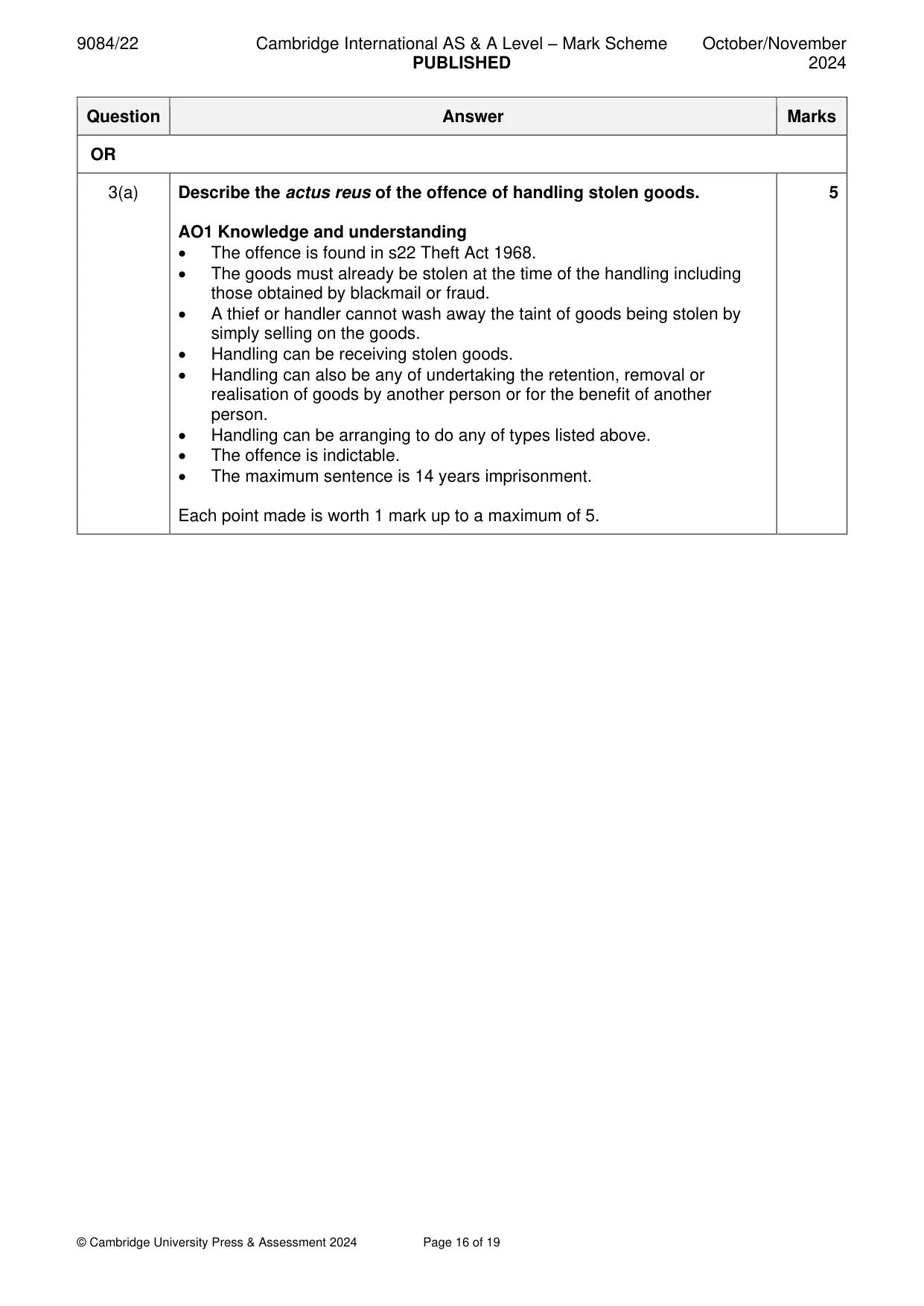
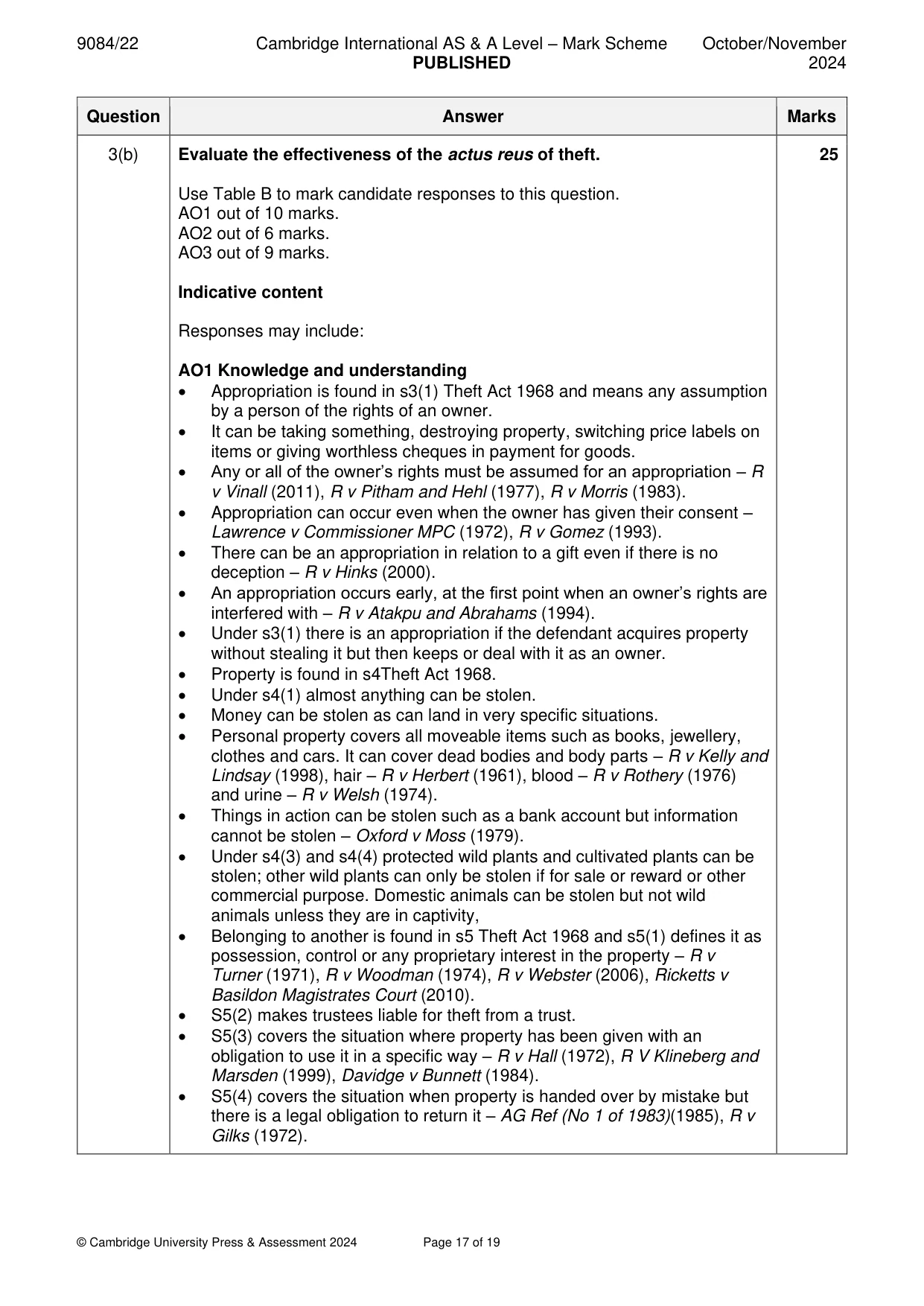
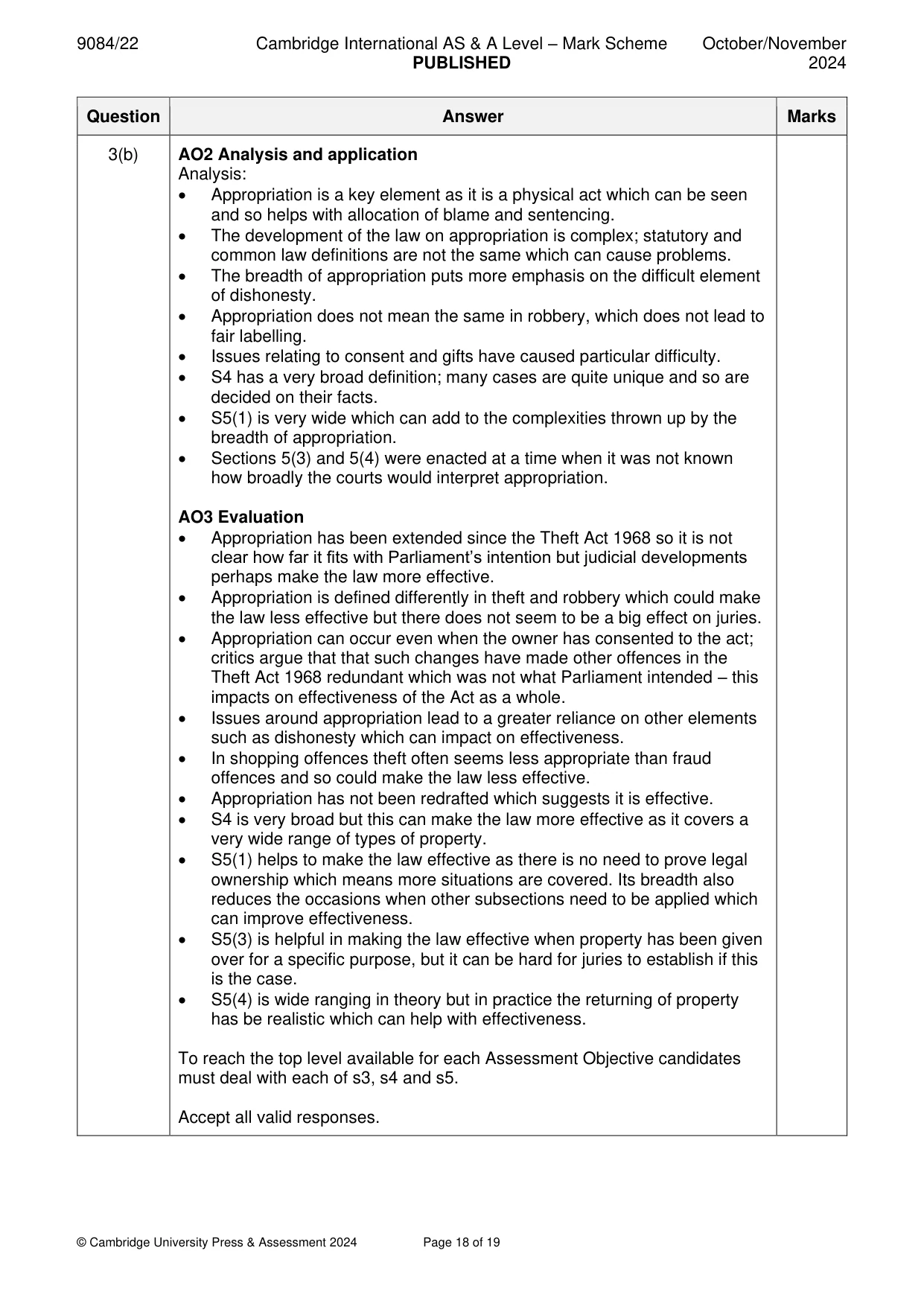
Mark scheme: 3(a) Describe the actus reus of the offence of handling stolen goods. 5 AO1 Knowledge and understanding • The offence is found in s22 Theft Act 1968. • The goods must already be stolen at the time of the handling including those obtained by blackmail or fraud. • A thief or handler cannot wash away the taint of goods being stolen by simply selling on the goods. • Handling can be receiving stolen goods. • Handling can also be any of undertaking the retention, removal or realisation of goods by another person or for the benefit of another person. • Handling can be arranging to do any of types listed above. • The offence is indictable. • The maximum sentence is 14 years imprisonment. Each point made is worth 1 mark up to a maximum of 5. 3(b) Evaluate the effectiveness of the actus reus of theft. 25 Use Table B to mark candidate responses to this question. AO1 out of 10 marks. AO2 out of 6 marks. AO3 out of 9 marks. Indicative content Responses may include: AO1 Knowledge and understanding • Appropriation is found in s3(1) Theft Act 1968 and means any assumption by a person of the rights of an owner. • It can be taking something, destroying property, switching price labels on items or giving worthless cheques in payment for goods. • Any or all of the owner’s rights must be assumed for an appropriation – R v Vinall (2011), R v Pitham and Hehl (1977), R v Morris (1983). • Appropriation can occur even when the owner has given their consent – Lawrence v Commissioner MPC (1972), R v Gomez (1993). • There can be an appropriation in relation to a gift even if there is no deception – R v Hinks (2000). • An appropriation occurs early, at the first point when an owner’s rights are interfered with – R v Atakpu and Abrahams (1994). • Under s3(1) there is an appropriation if the defendant acquires property without stealing it but then keeps or deal with it as an owner. • Property is found in s4Theft Act 1968. • Under s4(1) almost anything can be stolen. • Money can be stolen as can land in very specific situations. • Personal property covers all moveable items such as books, jewellery, clothes and cars. It can cover dead bodies and body parts – R v Kelly and Lindsay (1998), hair – R v Herbert (1961), blood – R v Rothery (1976) and urine – R v Welsh (1974). • Things in action can be stolen such as a bank account but information cannot be stolen – Oxford v Moss (1979). • Under s4(3) and s4(4) protected wild plants and cultivated plants can be stolen; other wild plants can only be stolen if for sale or reward or other commercial purpose. Domestic animals can be stolen but not wild animals unless they are in captivity, • Belonging to another is found in s5 Theft Act 1968 and s5(1) defines it as possession, control or any proprietary interest in the property – R v Turner (1971), R v Woodman (1974), R v Webster (2006), Ricketts v Basildon Magistrates Court (2010). • S5(2) makes trustees liable for theft from a trust. • S5(3) covers the situation where property has been given with an obligation to use it in a specific way – R v Hall (1972), R V Klineberg and Marsden (1999), Davidge v Bunnett (1984). • S5(4) covers the situation when property is handed over by mistake but there is a legal obligation to return it – AG Ref (No 1 of 1983)(1985), R v Gilks (1972). 3(b) AO2 Analysis and application Analysis: • Appropriation is a key element as it is a physical act which can be seen and so helps with allocation of blame and sentencing. • The development of the law on appropriation is complex; statutory and common law definitions are not the same which can cause problems. • The breadth of appropriation puts more emphasis on the difficult element of dishonesty. • Appropriation does not mean the same in robbery, which does not lead to fair labelling. • Issues relating to consent and gifts have caused particular difficulty. • S4 has a very broad definition; many cases are quite unique and so are decided on their facts. • S5(1) is very wide which can add to the complexities thrown up by the breadth of appropriation. • Sections 5(3) and 5(4) were enacted at a time when it was not known how broadly the courts would interpret appropriation. AO3 Evaluation • Appropriation has been extended since the Theft Act 1968 so it is not clear how far it fits with Parliament’s intention but judicial developments perhaps make the law more effective. • Appropriation is defined differently in theft and robbery which could make the law less effective but there does not seem to be a big effect on juries. • Appropriation can occur even when the owner has consented to the act; critics argue that that such changes have made other offences in the Theft Act 1968 redundant which was not what Parliament intended – this impacts on effectiveness of the Act as a whole. • Issues around appropriation lead to a greater reliance on other elements such as dishonesty which can impact on effectiveness. • In shopping offences theft often seems less appropriate than fraud offences and so could make the law less effective. • Appropriation has not been redrafted which suggests it is effective. • S4 is very broad but this can make the law more effective as it covers a very wide range of types of property. • S5(1) helps to make the law effective as there is no need to prove legal ownership which means more situations are covered. Its breadth also reduces the occasions when other subsections need to be applied which can improve effectiveness. • S5(3) is helpful in making the law effective when property has been given over for a specific purpose, but it can be hard for juries to establish if this is the case. • S5(4) is wide ranging in theory but in practice the returning of property has be realistic which can help with effectiveness. To reach the top level available for each Assessment Objective candidates must deal with each of s3, s4 and s5. Accept all valid responses. 3(b) AO1 10 AO2 6 AO3 9
What was in this paper
The subtopics covered by these 3 questions, and how many questions each got. Open one in a new tab to see every Cambridge question on it.
What you needed in this session
Cambridge’s own grade thresholds for 2024 Oct/Nov, Paper 2 · Variant 2. A higher threshold means an easier paper — the bar moves with how the cohort did.