Cambridge A Level Law 9084 — 2025 May/June Paper 2 · Variant 2
9084/22/M/J/25 · 3 questions · 60 marks · ≈68 min
The question paper and its mark scheme, free to read here and free to download. This is Cambridge’s own paper, exactly as it was sat.
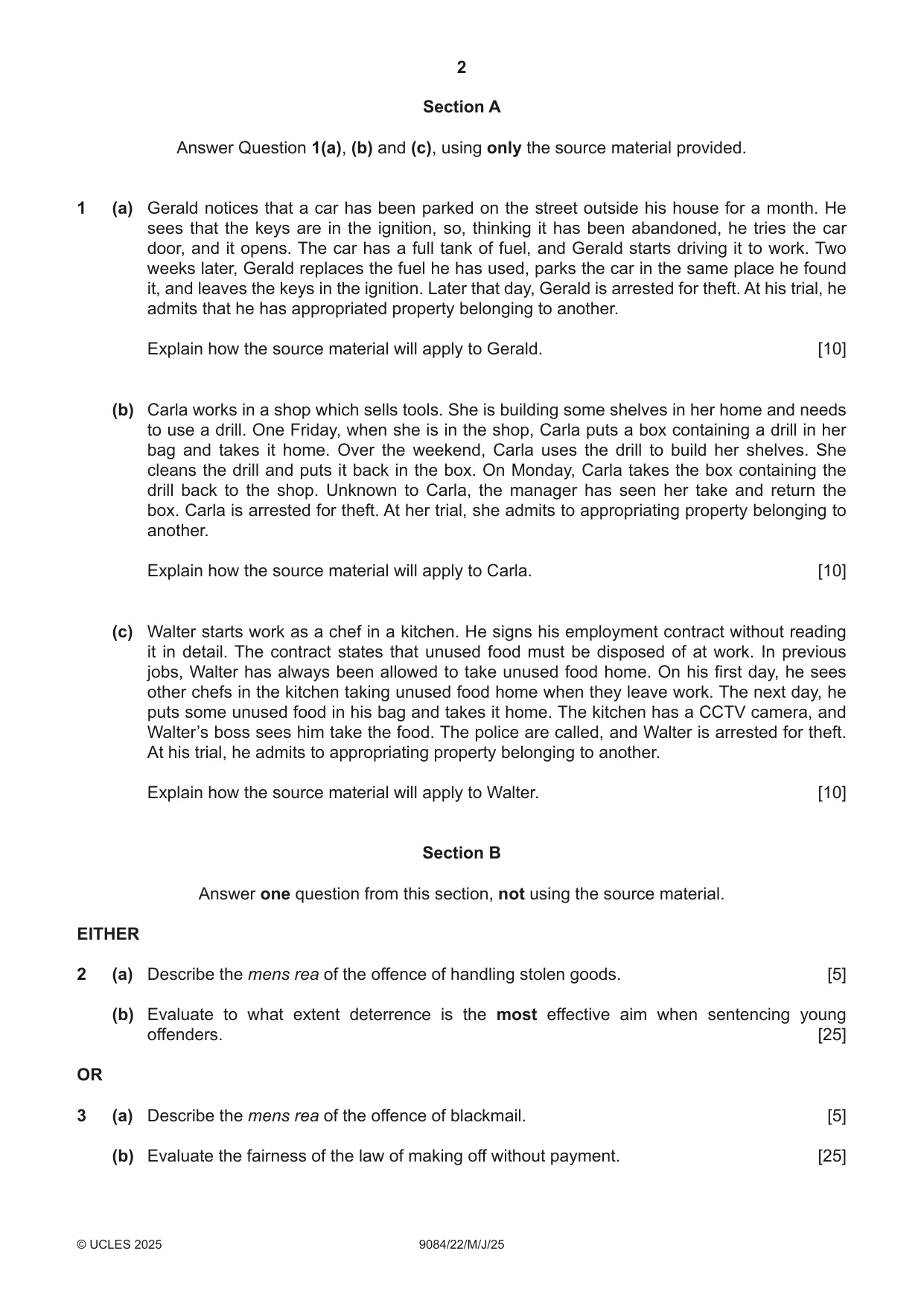
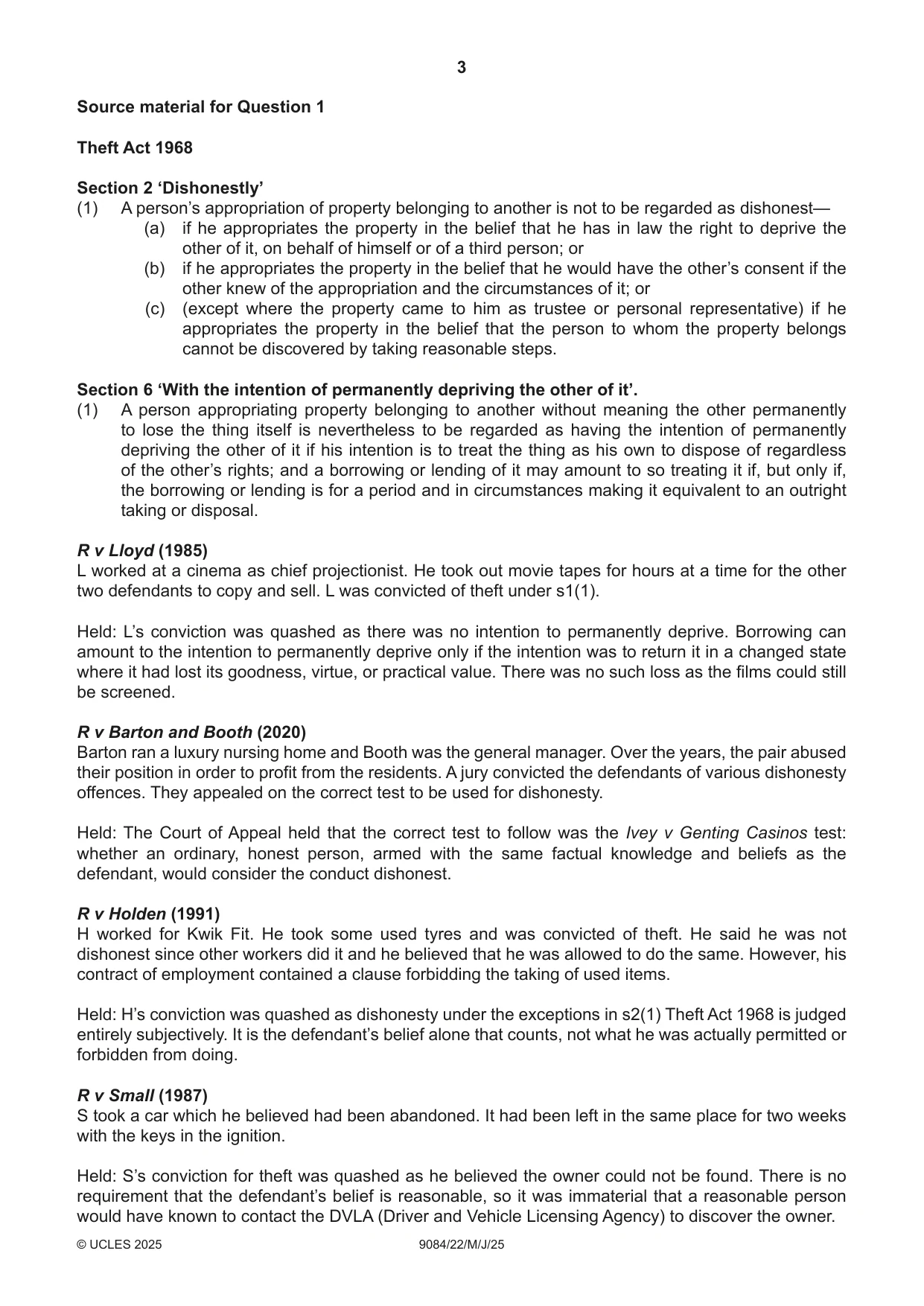
Question paper4 pages

Mark scheme17 pages
Answers below. Sit the paper first if you are practising.

Questions as text
Q1 · Gerald notices that a car has been parked on the street outside his house for a month
1 (a) Gerald notices that a car has been parked on the street outside his house for a month. He sees that the keys are in the ignition, so, thinking it has been abandoned, he tries the car door, and it opens. The car has a full tank of fuel, and Gerald starts driving it to work. Two weeks later, Gerald replaces the fuel he has used, parks the car in the same place he found it, and leaves the keys in the ignition. Later that day, Gerald is arrested for theft. At his trial, he admits that he has appropriated property belonging to another. Explain how the source material will apply to Gerald. [10] (b) Carla works in a shop which sells tools. She is building some shelves in her home and needs to use a drill. One Friday, when she is in the shop, Carla puts a box containing a drill in her bag and takes it home. Over the weekend, Carla uses the drill to build her shelves. She cleans the drill and puts it back in the box. On Monday, Carla takes the box containing the drill back to the shop. Unknown to Carla, the manager has seen her take and return the box. Carla is arrested for theft. At her trial, she admits to appropriating property belonging to another. Explain how the source material will apply to Carla. [10] (c) Walter starts work as a chef in a kitchen. He signs his employment contract without reading it in detail. The contract states that unused food must be disposed of at work. In previous jobs, Walter has always been allowed to take unused food home. On his first day, he sees other chefs in the kitchen taking unused food home when they leave work. The next day, he puts some unused food in his bag and takes it home. The kitchen has a CCTV camera, and Walter’s boss sees him take the food. The police are called, and Walter is arrested for theft. At his trial, he admits to appropriating property belonging to another. Explain how the source material will apply to Walter. [10]
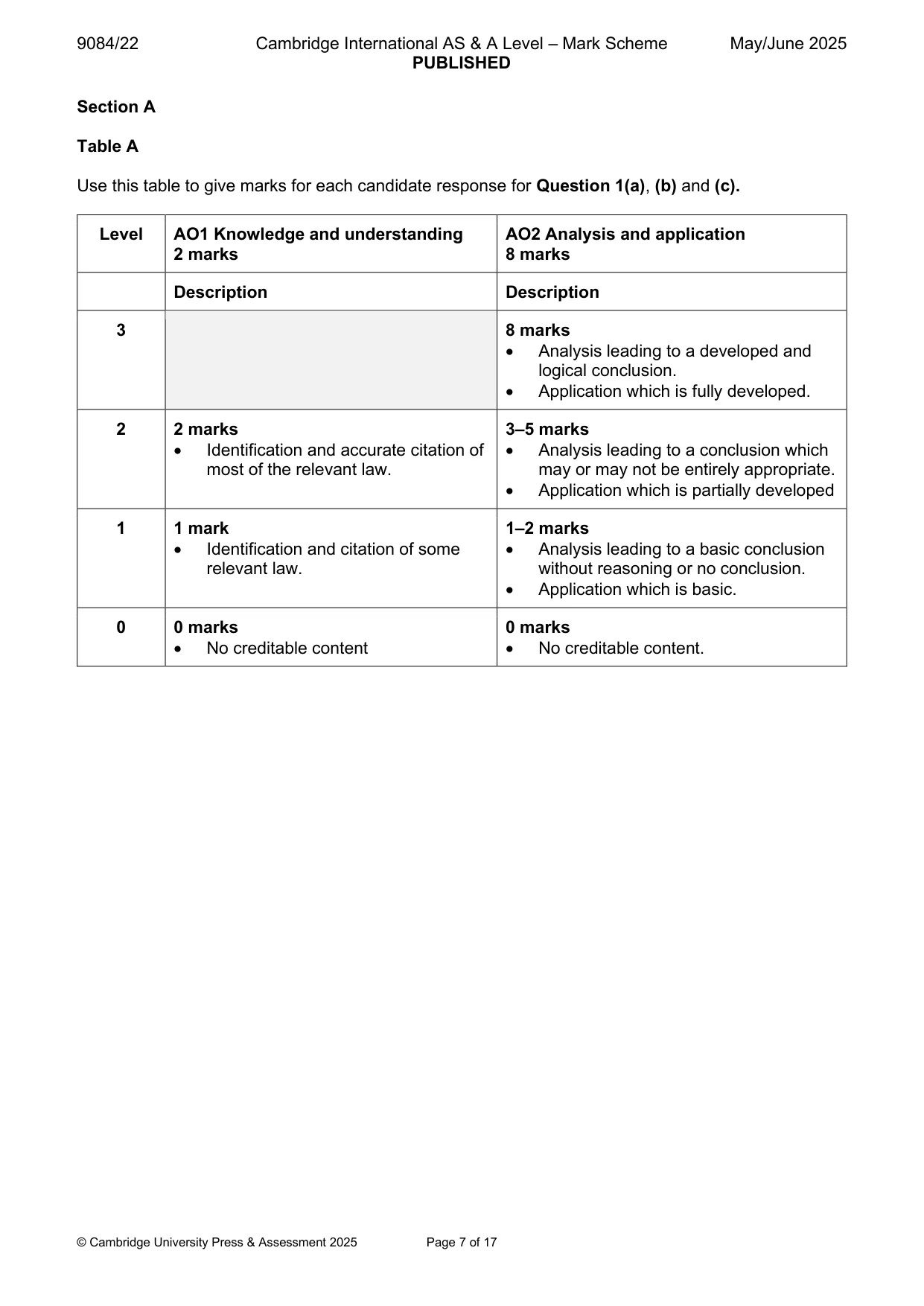
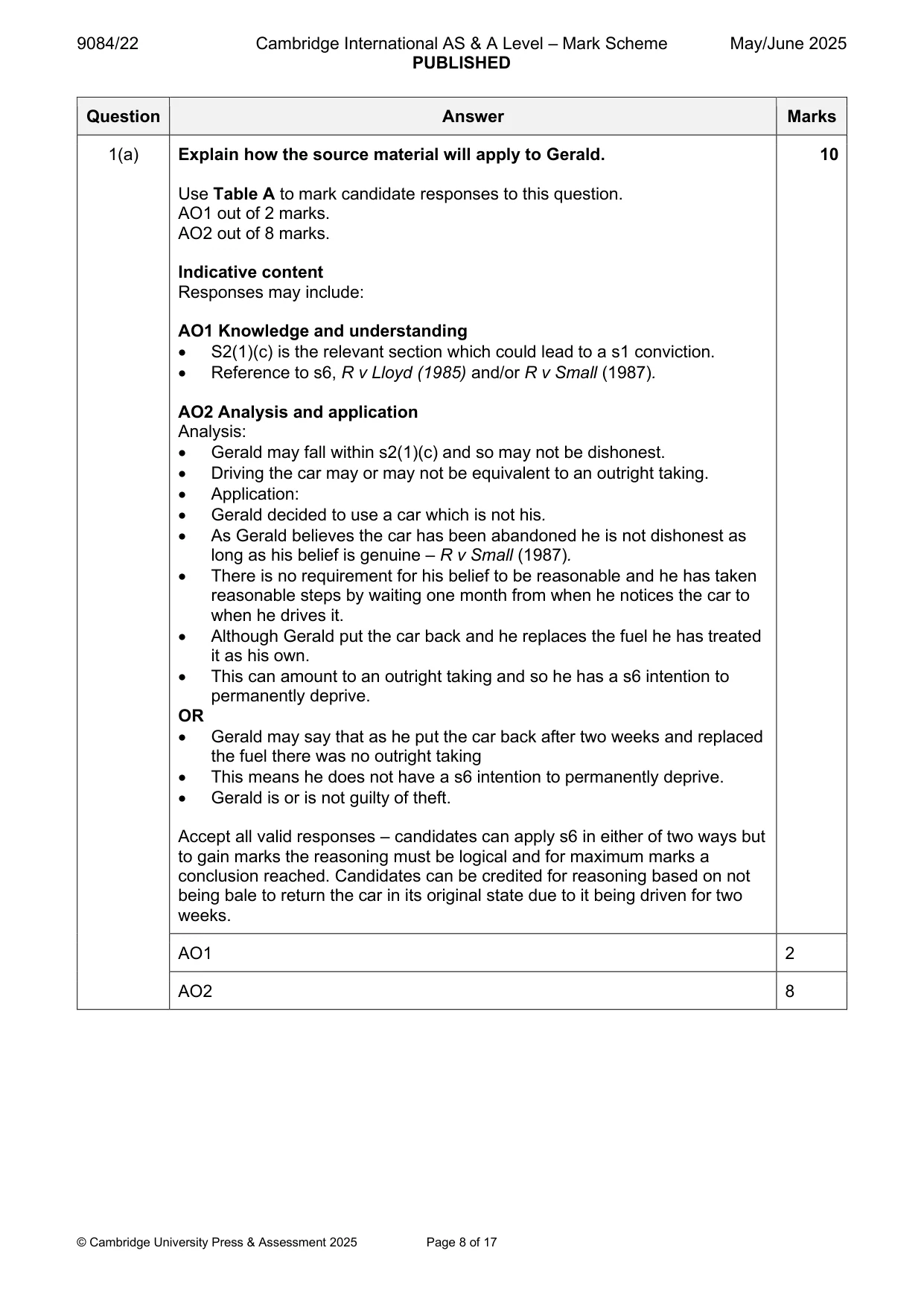
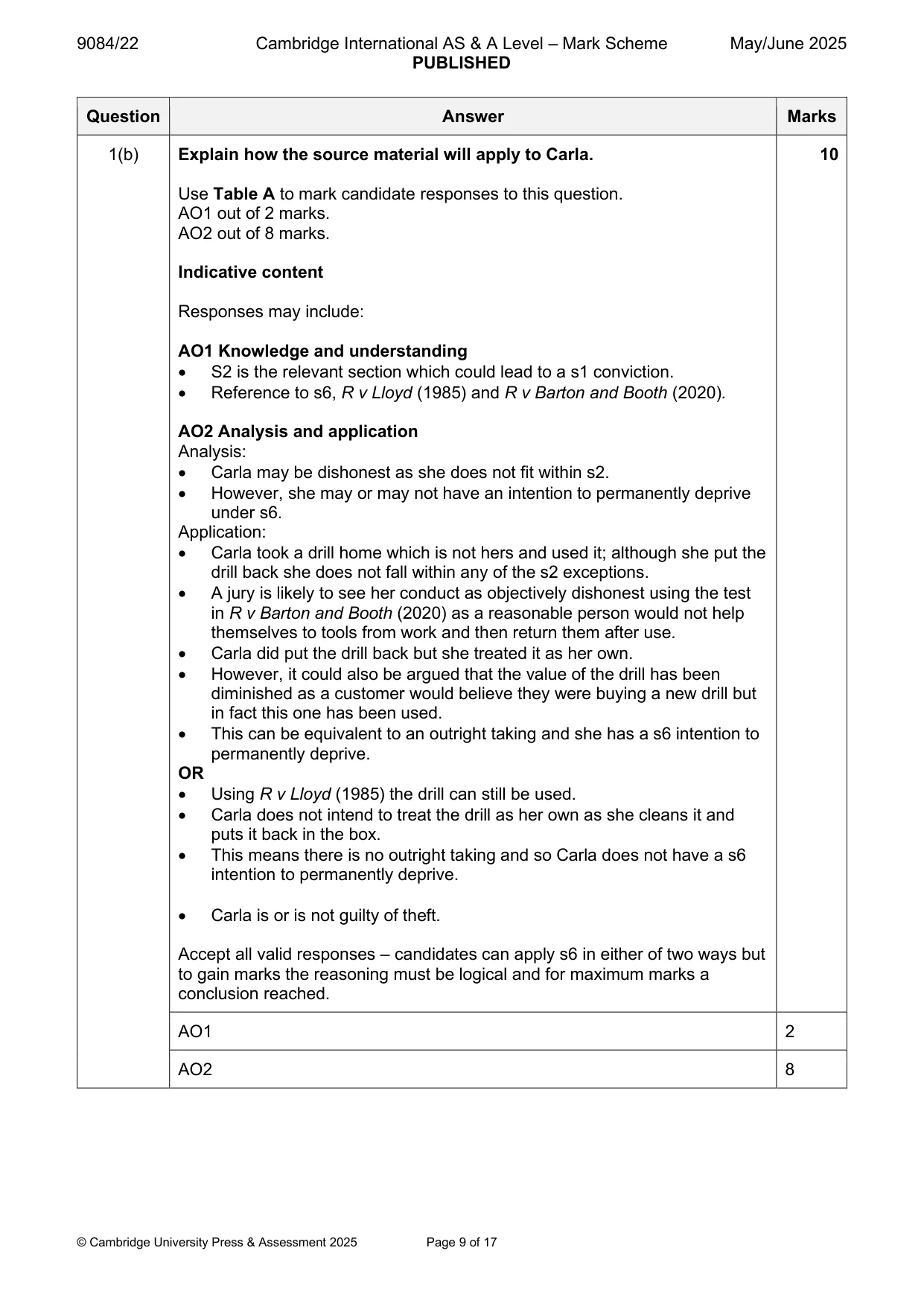
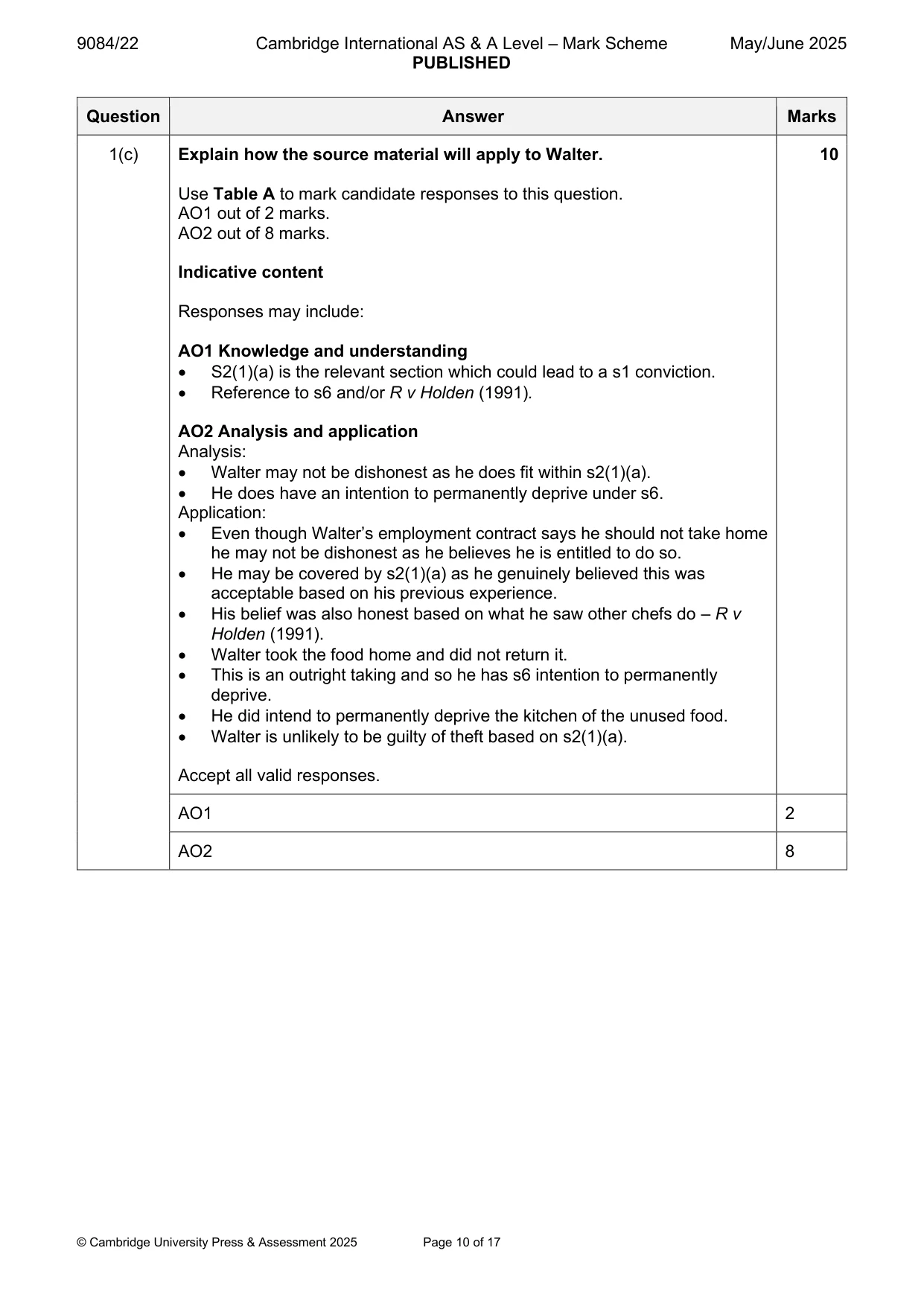
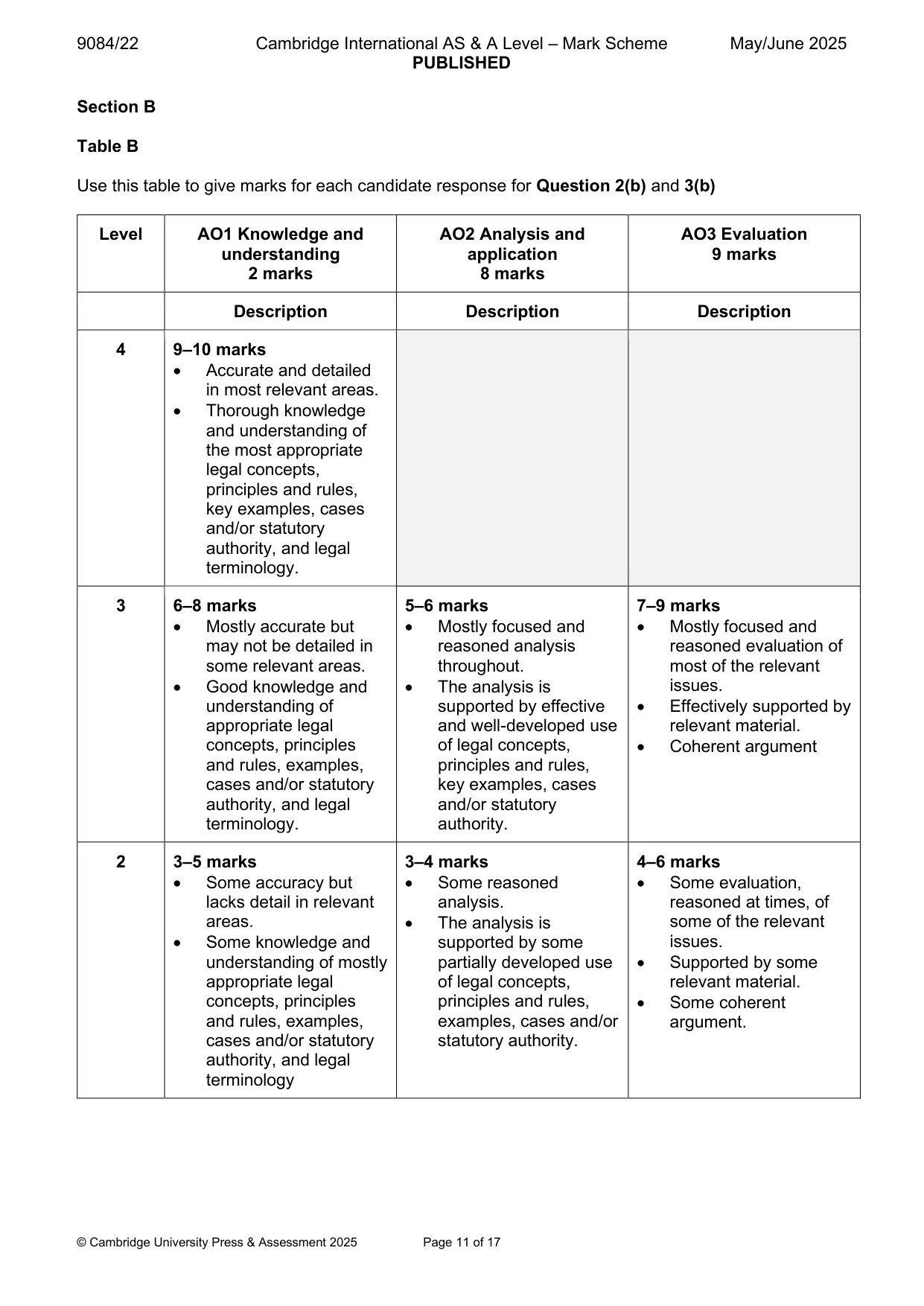
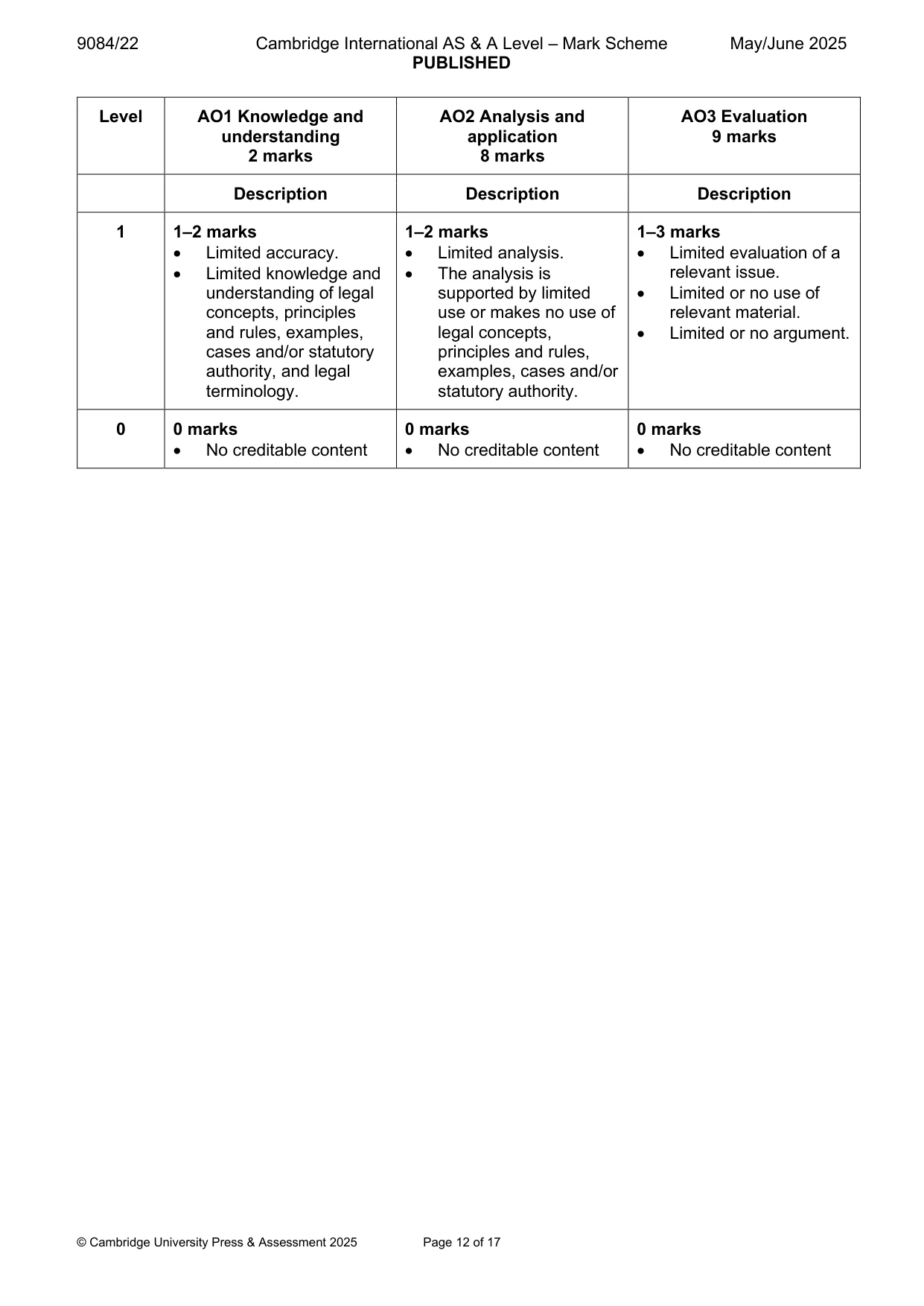
Mark scheme: Question Answer Marks 1(a) Explain how the source material will apply to Gerald. 10 Use Table A to mark candidate responses to this question. AO1 out of 2 marks. AO2 out of 8 marks. Indicative content Responses may include: AO1 Knowledge and understanding • S2(1)(c) is the relevant section which could lead to a s1 conviction. • Reference to s6, R v Lloyd (1985) and/or R v Small (1987). AO2 Analysis and application Analysis: • Gerald may fall within s2(1)(c) and so may not be dishonest. • Driving the car may or may not be equivalent to an outright taking. • Application: • Gerald decided to use a car which is not his. • As Gerald believes the car has been abandoned he is not dishonest as long as his belief is genuine – R v Small (1987). • There is no requirement for his belief to be reasonable and he has taken reasonable steps by waiting one month from when he notices the car to when he drives it. • Although Gerald put the car back and he replaces the fuel he has treated it as his own. • This can amount to an outright taking and so he has a s6 intention to permanently deprive. OR • Gerald may say that as he put the car back after two weeks and replaced the fuel there was no outright taking • This means he does not have a s6 intention to permanently deprive. • Gerald is or is not guilty of theft. Accept all valid responses – candidates can apply s6 in either of two ways but to gain marks the reasoning must be logical and for maximum marks a conclusion reached. Candidates can be credited for reasoning based on not being bale to return the car in its original state due to it being driven for two weeks. AO1 2 AO2 8 1(b) Explain how the source material will apply to Carla. 10 Use Table A to mark candidate responses to this question. AO1 out of 2 marks. AO2 out of 8 marks. Indicative content Responses may include: AO1 Knowledge and understanding • S2 is the relevant section which could lead to a s1 conviction. • Reference to s6, R v Lloyd (1985) and R v Barton and Booth (2020). AO2 Analysis and application Analysis: • Carla may be dishonest as she does not fit within s2. • However, she may or may not have an intention to permanently deprive under s6. Application: • Carla took a drill home which is not hers and used it; although she put the drill back she does not fall within any of the s2 exceptions. • A jury is likely to see her conduct as objectively dishonest using the test in R v Barton and Booth (2020) as a reasonable person would not help themselves to tools from work and then return them after use. • Carla did put the drill back but she treated it as her own. • However, it could also be argued that the value of the drill has been diminished as a customer would believe they were buying a new drill but in fact this one has been used. • This can be equivalent to an outright taking and she has a s6 intention to permanently deprive. OR • Using R v Lloyd (1985) the drill can still be used. • Carla does not intend to treat the drill as her own as she cleans it and puts it back in the box. • This means there is no outright taking and so Carla does not have a s6 intention to permanently deprive. • Carla is or is not guilty of theft. Accept all valid responses – candidates can apply s6 in either of two ways but to gain marks the reasoning must be logical and for maximum marks a conclusion reached. AO1 2 AO2 8 1(c) Explain how the source material will apply to Walter. 10 Use Table A to mark candidate responses to this question. AO1 out of 2 marks. AO2 out of 8 marks. Indicative content Responses may include: AO1 Knowledge and understanding • S2(1)(a) is the relevant section which could lead to a s1 conviction. • Reference to s6 and/or R v Holden (1991). AO2 Analysis and application Analysis: • Walter may not be dishonest as he does fit within s2(1)(a). • He does have an intention to permanently deprive under s6. Application: • Even though Walter’s employment contract says he should not take home he may not be dishonest as he believes he is entitled to do so. • He may be covered by s2(1)(a) as he genuinely believed this was acceptable based on his previous experience. • His belief was also honest based on what he saw other chefs do – R v Holden (1991). • Walter took the food home and did not return it. • This is an outright taking and so he has s6 intention to permanently deprive. • He did intend to permanently deprive the kitchen of the unused food. • Walter is unlikely to be guilty of theft based on s2(1)(a). Accept all valid responses. AO1 2 AO2 8 Section B Table B Use this table to give marks for each candidate response for Question 2(b) and 3(b) Level AO1 Knowledge and AO2 Analysis and AO3 Evaluation understanding application 9 marks 2 marks 8 marks Description Description Description 4 9–10 marks • Accurate and detailed in most relevant areas. • Thorough knowledge and understanding of the most appropriate legal concepts, principles and rules, key examples, cases and/or statutory authority, and legal terminology. 3 6–8 marks 5–6 marks 7–9 marks • Mostly accurate but • Mostly focused and • Mostly focused and may not be detailed in reasoned analysis reasoned evaluation of some relevant areas. throughout. most of the relevant • Good knowledge and • The analysis is issues. understanding of supported by effective • Effectively supported by appropriate legal and well-developed use relevant material. concepts, principles of legal concepts, • Coherent argument and rules, examples, principles and rules, cases and/or statutory key examples, cases authority, and legal and/or statutory terminology. authority. 2 3–5 marks 3–4 marks 4–6 marks • Some accuracy but • Some reasoned • Some evaluation, lacks detail in relevant analysis. reasoned at times, of areas. • The analysis is some of the relevant • Some knowledge and supported by some issues. understanding of mostly partially developed use • Supported by some appropriate legal of legal concepts, relevant material. concepts, principles principles and rules, • Some coherent and rules, examples, examples, cases and/or argument. cases and/or statutory statutory authority. authority, and legal terminology Level AO1 Knowledge and AO2 Analysis and AO3 Evaluation understanding application 9 marks 2 marks 8 marks Description Description Description 1 1–2 marks 1–2 marks 1–3 marks • Limited accuracy. • Limited analysis. • Limited evaluation of a • Limited knowledge and • The analysis is relevant issue. understanding of legal supported by limited • Limited or no use of concepts, principles use or makes no use of relevant material. and rules, examples, legal concepts, • Limited or no argument. cases and/or statutory principles and rules, authority, and legal examples, cases and/or terminology. statutory authority. 0 0 marks 0 marks 0 marks • No creditable content • No creditable content • No creditable content
Q2 · Describe the mens rea of the offence of handling stolen goods
2 (a) Describe the mens rea of the offence of handling stolen goods. [5] (b) Evaluate to what extent deterrence is the most effective aim when sentencing young offenders. [25] OR
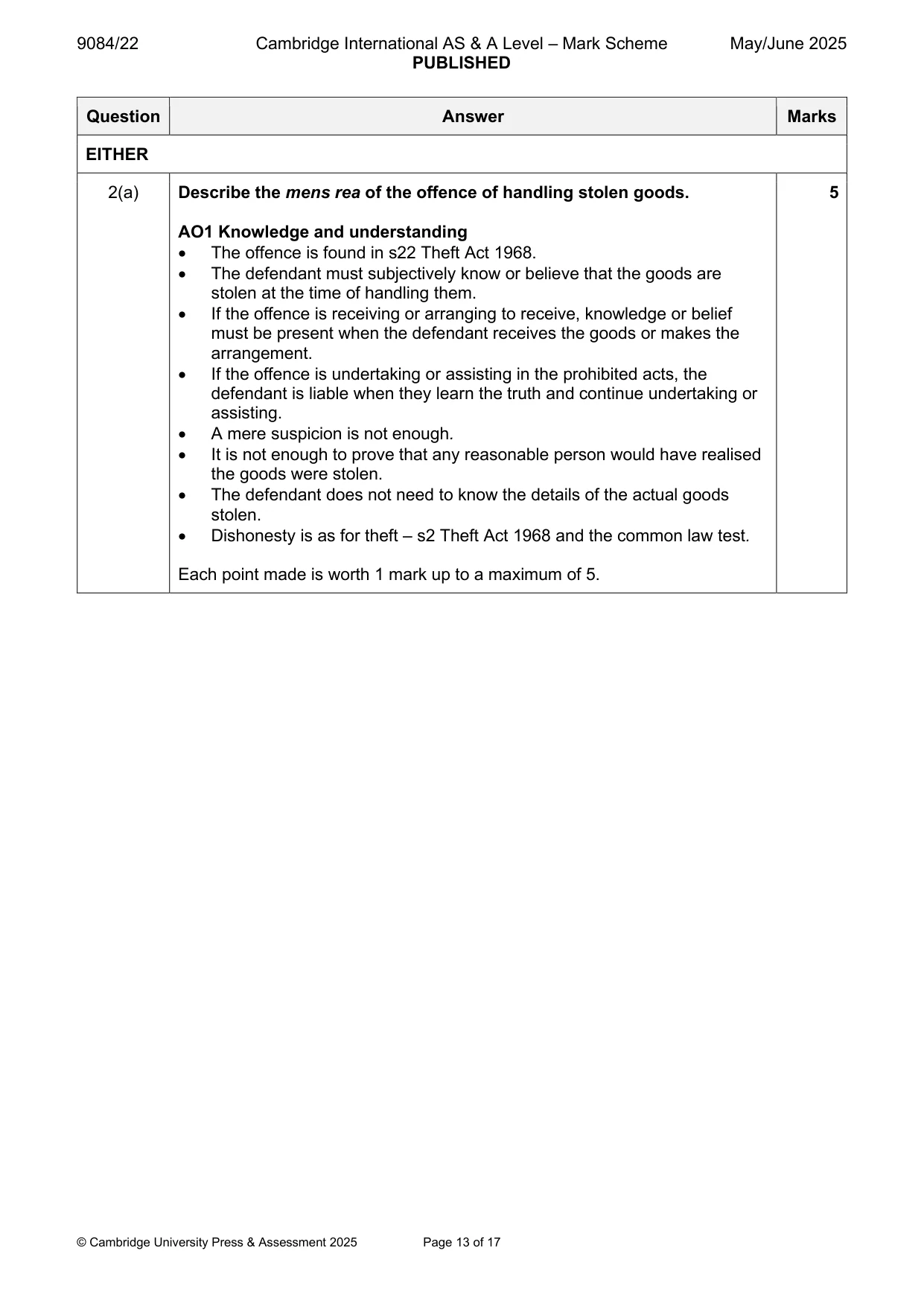
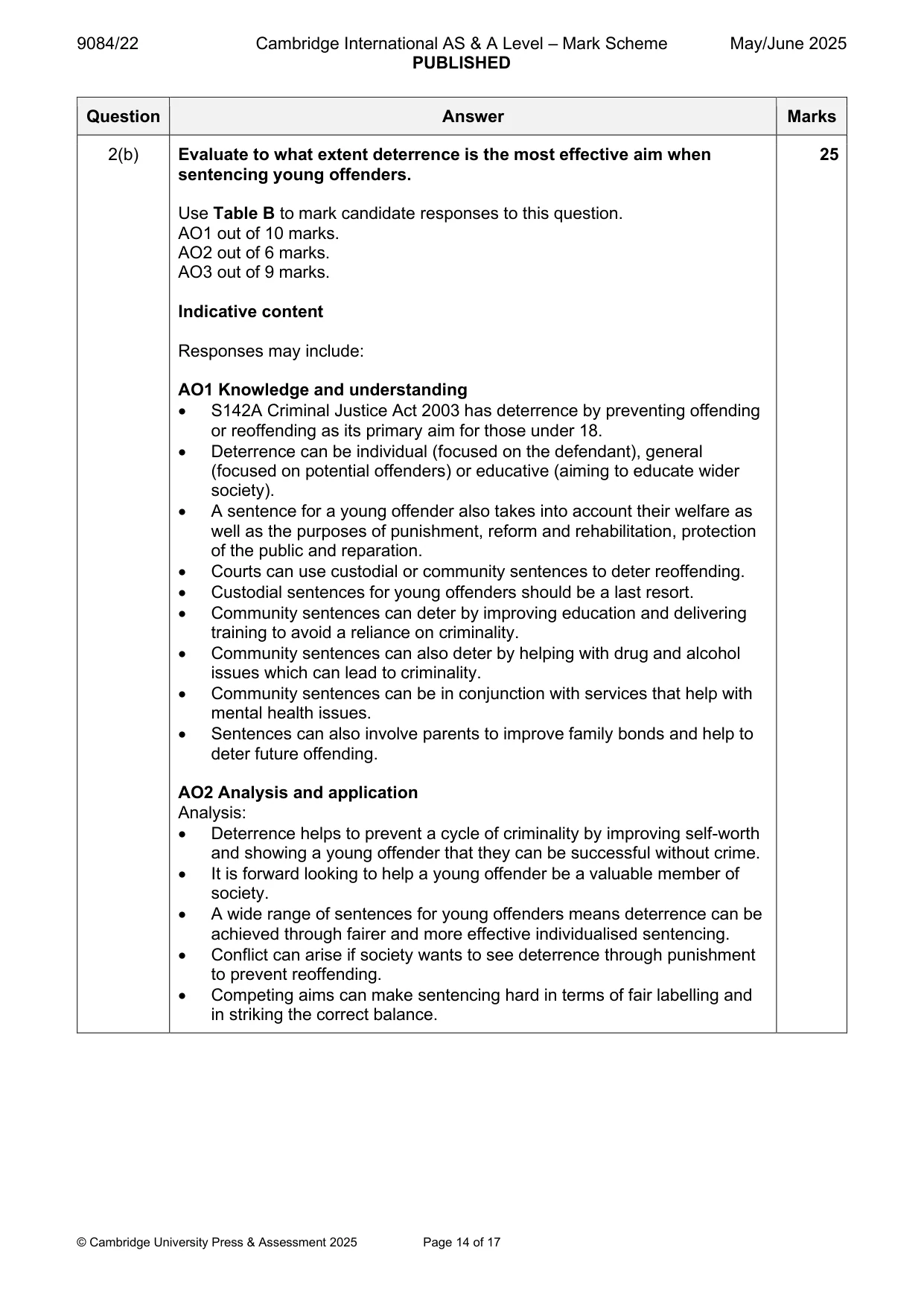
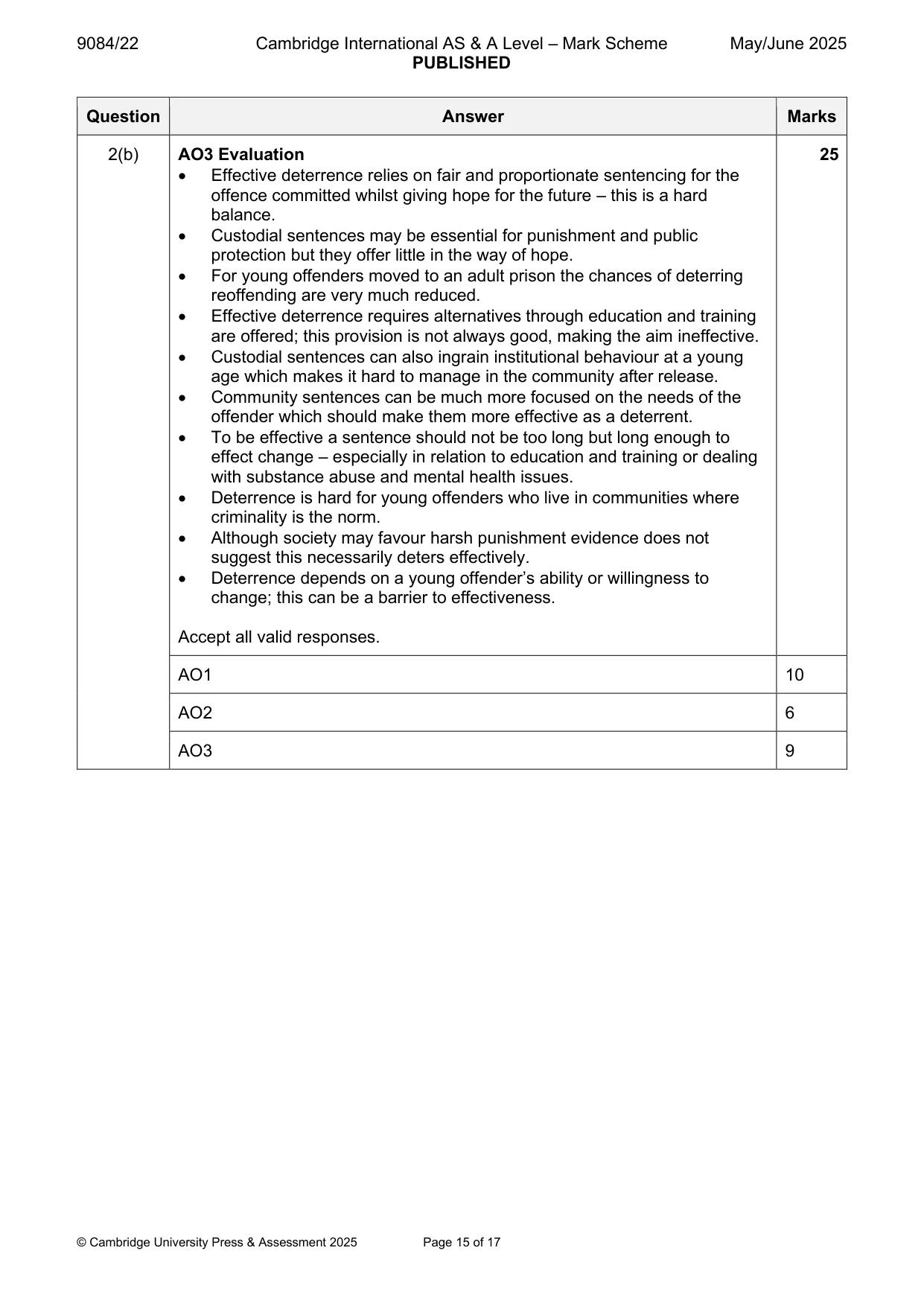
Mark scheme: 2(a) Describe the mens rea of the offence of handling stolen goods. 5 AO1 Knowledge and understanding • The offence is found in s22 Theft Act 1968. • The defendant must subjectively know or believe that the goods are stolen at the time of handling them. • If the offence is receiving or arranging to receive, knowledge or belief must be present when the defendant receives the goods or makes the arrangement. • If the offence is undertaking or assisting in the prohibited acts, the defendant is liable when they learn the truth and continue undertaking or assisting. • A mere suspicion is not enough. • It is not enough to prove that any reasonable person would have realised the goods were stolen. • The defendant does not need to know the details of the actual goods stolen. • Dishonesty is as for theft – s2 Theft Act 1968 and the common law test. Each point made is worth 1 mark up to a maximum of 5. 2(b) Evaluate to what extent deterrence is the most effective aim when 25 sentencing young offenders. Use Table B to mark candidate responses to this question. AO1 out of 10 marks. AO2 out of 6 marks. AO3 out of 9 marks. Indicative content Responses may include: AO1 Knowledge and understanding • S142A Criminal Justice Act 2003 has deterrence by preventing offending or reoffending as its primary aim for those under 18. • Deterrence can be individual (focused on the defendant), general (focused on potential offenders) or educative (aiming to educate wider society). • A sentence for a young offender also takes into account their welfare as well as the purposes of punishment, reform and rehabilitation, protection of the public and reparation. • Courts can use custodial or community sentences to deter reoffending. • Custodial sentences for young offenders should be a last resort. • Community sentences can deter by improving education and delivering training to avoid a reliance on criminality. • Community sentences can also deter by helping with drug and alcohol issues which can lead to criminality. • Community sentences can be in conjunction with services that help with mental health issues. • Sentences can also involve parents to improve family bonds and help to deter future offending. AO2 Analysis and application Analysis: • Deterrence helps to prevent a cycle of criminality by improving self-worth and showing a young offender that they can be successful without crime. • It is forward looking to help a young offender be a valuable member of society. • A wide range of sentences for young offenders means deterrence can be achieved through fairer and more effective individualised sentencing. • Conflict can arise if society wants to see deterrence through punishment to prevent reoffending. • Competing aims can make sentencing hard in terms of fair labelling and in striking the correct balance. 2(b) AO3 Evaluation 25 • Effective deterrence relies on fair and proportionate sentencing for the offence committed whilst giving hope for the future – this is a hard balance. • Custodial sentences may be essential for punishment and public protection but they offer little in the way of hope. • For young offenders moved to an adult prison the chances of deterring reoffending are very much reduced. • Effective deterrence requires alternatives through education and training are offered; this provision is not always good, making the aim ineffective. • Custodial sentences can also ingrain institutional behaviour at a young age which makes it hard to manage in the community after release. • Community sentences can be much more focused on the needs of the offender which should make them more effective as a deterrent. • To be effective a sentence should not be too long but long enough to effect change – especially in relation to education and training or dealing with substance abuse and mental health issues. • Deterrence is hard for young offenders who live in communities where criminality is the norm. • Although society may favour harsh punishment evidence does not suggest this necessarily deters effectively. • Deterrence depends on a young offender’s ability or willingness to change; this can be a barrier to effectiveness. Accept all valid responses. AO1 10 AO2 6 AO3 9
Q3 · Describe the mens rea of the offence of blackmail
3 (a) Describe the mens rea of the offence of blackmail. [5] (b) Evaluate the fairness of the law of making off without payment. [25] Source material for Question 1 Theft Act 1968 Section 2 ‘Dishonestly’ (1) A person’s appropriation of property belonging to another is not to be regarded as dishonest— (a) if he appropriates the property in the belief that he has in law the right to deprive the other of it, on behalf of himself or of a third person; or (b) if he appropriates the property in the belief that he would have the other’s consent if the other knew of the appropriation and the circumstances of it; or (c) (except where the property came to him as trustee or personal representative) if he appropriates the property in the belief that the person to whom the property belongs cannot be discovered by taking reasonable steps. Section 6 ‘With the intention of permanently depriving the other of it’. (1) A person appropriating property belonging to another without meaning the other permanently to lose the thing itself is nevertheless to be regarded as having the intention of permanently depriving the other of it if his intention is to treat the thing as his own to dispose of regardless of the other’s rights; and a borrowing or lending of it may amount to so treating it if, but only if, the borrowing or lending is for a period and in circumstances making it equivalent to an outright taking or disposal. R v Lloyd (1985) L worked at a cinema as chief projectionist. He took out movie tapes for hours at a time for the other two defendants to copy and sell. L was convicted of theft under s1(1). Held: L’s conviction was quashed as there was no intention to permanently deprive. Borrowing can amount to the intention to permanently deprive only if the intention was to return it in a changed state where it had lost its goodness, virtue, or practical value. There was no such loss as the films could still be screened. R v Barton and Booth (2020) Barton ran a luxury nursing home and Booth was the general manager. Over the years, the pair abused their position in order to profit from the residents. A jury convicted the defendants of various dishonesty offences. They appealed on the correct test to be used for dishonesty. Held: The Court of Appeal held that the correct test to follow was the Ivey v Genting Casinos test: whether an ordinary, honest person, armed with the same factual knowledge and beliefs as the defendant, would consider the conduct dishonest. R v Holden (1991) H worked for Kwik Fit. He took some used tyres and was convicted of theft. He said he was not dishonest since other workers did it and he believed that he was allowed to do the same. However, his contract of employment contained a clause forbidding the taking of used items. Held: H’s conviction was quashed as dishonesty under the exceptions in s2(1) Theft Act 1968 is judged entirely subjectively. It is the defendant’s belief alone that counts, not what he was actually permitted or forbidden from doing. R v Small (1987) S took a car which he believed had been abandoned. It had been left in the same place for two weeks with the keys in the ignition. Held: S’s conviction for theft was quashed as he believed the owner could not be found. There is no requirement that the defendant’s belief is reasonable, so it was immaterial that a reasonable person
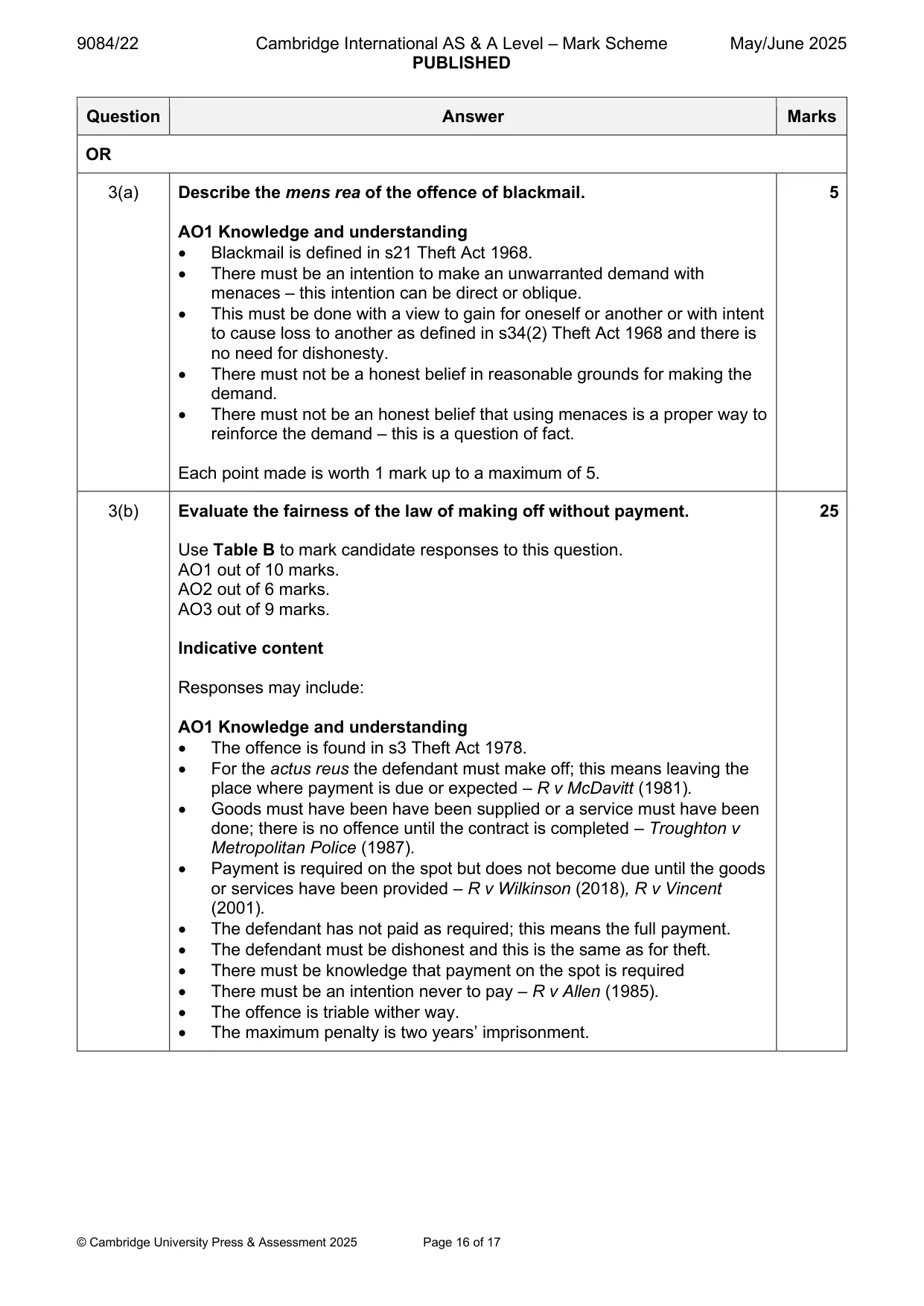
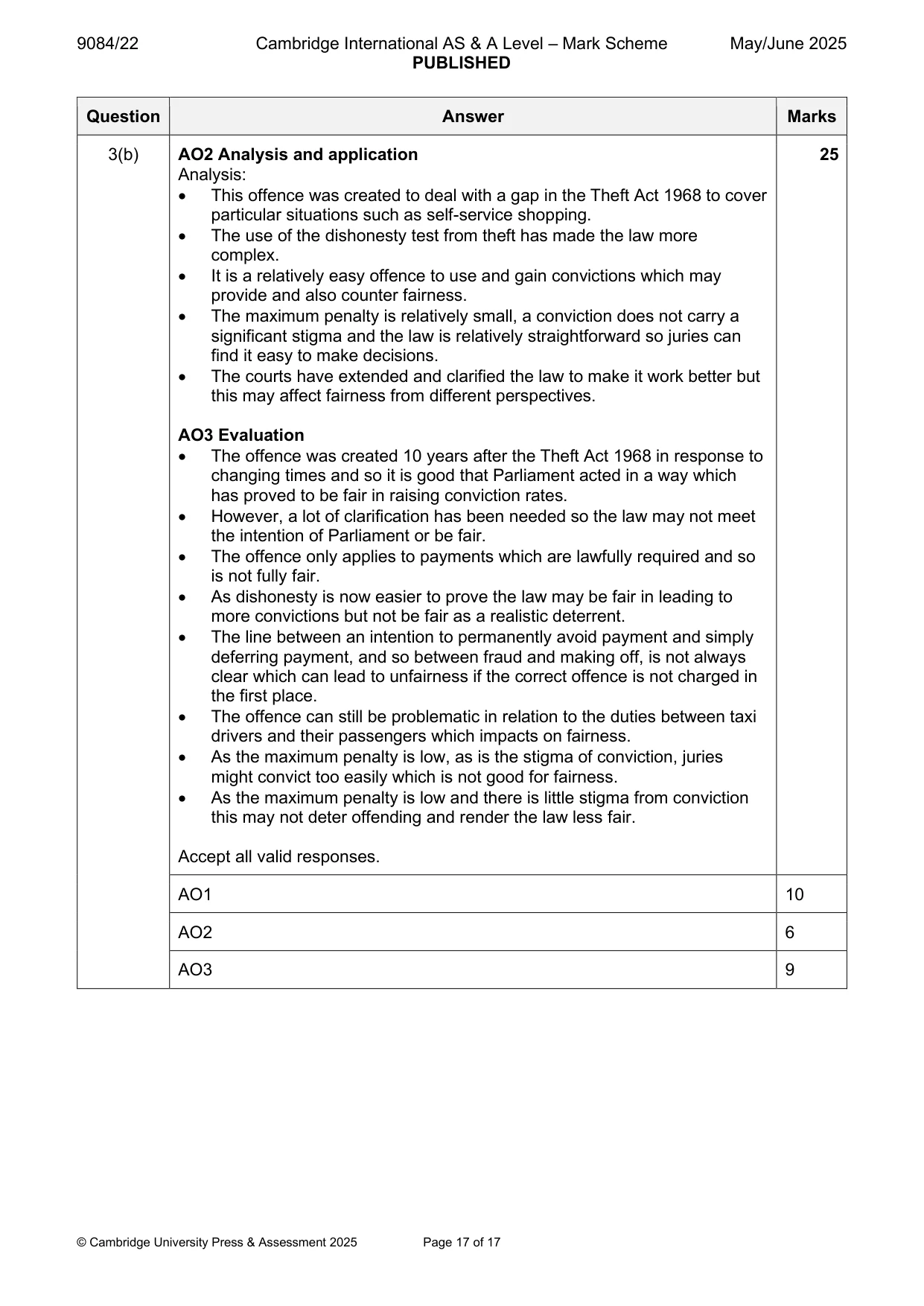
Mark scheme: 3(a) Describe the mens rea of the offence of blackmail. 5 AO1 Knowledge and understanding • Blackmail is defined in s21 Theft Act 1968. • There must be an intention to make an unwarranted demand with menaces – this intention can be direct or oblique. • This must be done with a view to gain for oneself or another or with intent to cause loss to another as defined in s34(2) Theft Act 1968 and there is no need for dishonesty. • There must not be a honest belief in reasonable grounds for making the demand. • There must not be an honest belief that using menaces is a proper way to reinforce the demand – this is a question of fact. Each point made is worth 1 mark up to a maximum of 5. 3(b) Evaluate the fairness of the law of making off without payment. 25 Use Table B to mark candidate responses to this question. AO1 out of 10 marks. AO2 out of 6 marks. AO3 out of 9 marks. Indicative content Responses may include: AO1 Knowledge and understanding • The offence is found in s3 Theft Act 1978. • For the actus reus the defendant must make off; this means leaving the place where payment is due or expected – R v McDavitt (1981). • Goods must have been have been supplied or a service must have been done; there is no offence until the contract is completed – Troughton v Metropolitan Police (1987). • Payment is required on the spot but does not become due until the goods or services have been provided – R v Wilkinson (2018), R v Vincent (2001). • The defendant has not paid as required; this means the full payment. • The defendant must be dishonest and this is the same as for theft. • There must be knowledge that payment on the spot is required • There must be an intention never to pay – R v Allen (1985). • The offence is triable wither way. • The maximum penalty is two years’ imprisonment. 3(b) AO2 Analysis and application 25 Analysis: • This offence was created to deal with a gap in the Theft Act 1968 to cover particular situations such as self-service shopping. • The use of the dishonesty test from theft has made the law more complex. • It is a relatively easy offence to use and gain convictions which may provide and also counter fairness. • The maximum penalty is relatively small, a conviction does not carry a significant stigma and the law is relatively straightforward so juries can find it easy to make decisions. • The courts have extended and clarified the law to make it work better but this may affect fairness from different perspectives. AO3 Evaluation • The offence was created 10 years after the Theft Act 1968 in response to changing times and so it is good that Parliament acted in a way which has proved to be fair in raising conviction rates. • However, a lot of clarification has been needed so the law may not meet the intention of Parliament or be fair. • The offence only applies to payments which are lawfully required and so is not fully fair. • As dishonesty is now easier to prove the law may be fair in leading to more convictions but not be fair as a realistic deterrent. • The line between an intention to permanently avoid payment and simply deferring payment, and so between fraud and making off, is not always clear which can lead to unfairness if the correct offence is not charged in the first place. • The offence can still be problematic in relation to the duties between taxi drivers and their passengers which impacts on fairness. • As the maximum penalty is low, as is the stigma of conviction, juries might convict too easily which is not good for fairness. • As the maximum penalty is low and there is little stigma from conviction this may not deter offending and render the law less fair. Accept all valid responses. AO1 10 AO2 6 AO3 9
What was in this paper
The subtopics covered by these 3 questions, and how many questions each got. Open one in a new tab to see every Cambridge question on it.
2Sentencing in England and Wales This topic is about the sentences that can be handed down to both adult and young offenders who have been convicted of offences. This topic is an opportunity to reflect on the key concepts of liability, justice, fairness, power and its limits, and effectiveness1What you needed in this session
Cambridge’s own grade thresholds for 2025 May/June, Paper 2 · Variant 2. A higher threshold means an easier paper — the bar moves with how the cohort did.