Cambridge A Level Law 9084 — 2024 May/June Paper 2 · Variant 3
9084/23/M/J/24 · 3 questions · 60 marks · ≈68 min
The question paper and its mark scheme, free to read here and free to download. This is Cambridge’s own paper, exactly as it was sat.
Question paper4 pages

Mark scheme16 pages
Answers below. Sit the paper first if you are practising.
Questions as text
Q1 · Simon has a van which he uses to steal a large amount of cheese
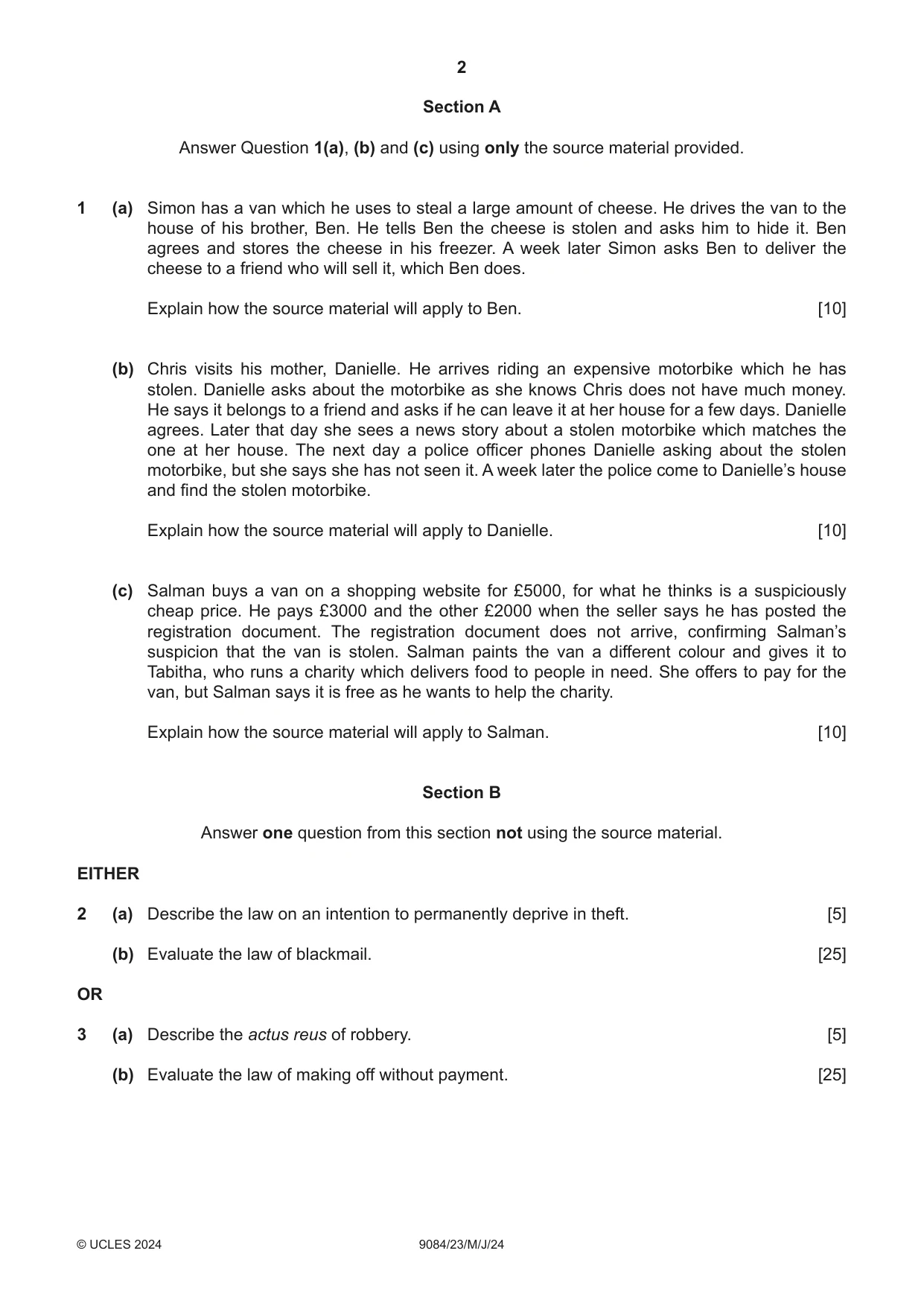
1 (a) Simon has a van which he uses to steal a large amount of cheese. He drives the van to the house of his brother, Ben. He tells Ben the cheese is stolen and asks him to hide it. Ben agrees and stores the cheese in his freezer. A week later Simon asks Ben to deliver the cheese to a friend who will sell it, which Ben does. Explain how the source material will apply to Ben. [10] (b) Chris visits his mother, Danielle. He arrives riding an expensive motorbike which he has stolen. Danielle asks about the motorbike as she knows Chris does not have much money. He says it belongs to a friend and asks if he can leave it at her house for a few days. Danielle agrees. Later that day she sees a news story about a stolen motorbike which matches the one at her house. The next day a police officer phones Danielle asking about the stolen motorbike, but she says she has not seen it. A week later the police come to Danielle’s house and find the stolen motorbike. Explain how the source material will apply to Danielle. [10] (c) Salman buys a van on a shopping website for £5000, for what he thinks is a suspiciously cheap price. He pays £3000 and the other £2000 when the seller says he has posted the registration document. The registration document does not arrive, confirming Salman’s suspicion that the van is stolen. Salman paints the van a different colour and gives it to Tabitha, who runs a charity which delivers food to people in need. She offers to pay for the van, but Salman says it is free as he wants to help the charity. Explain how the source material will apply to Salman. [10]
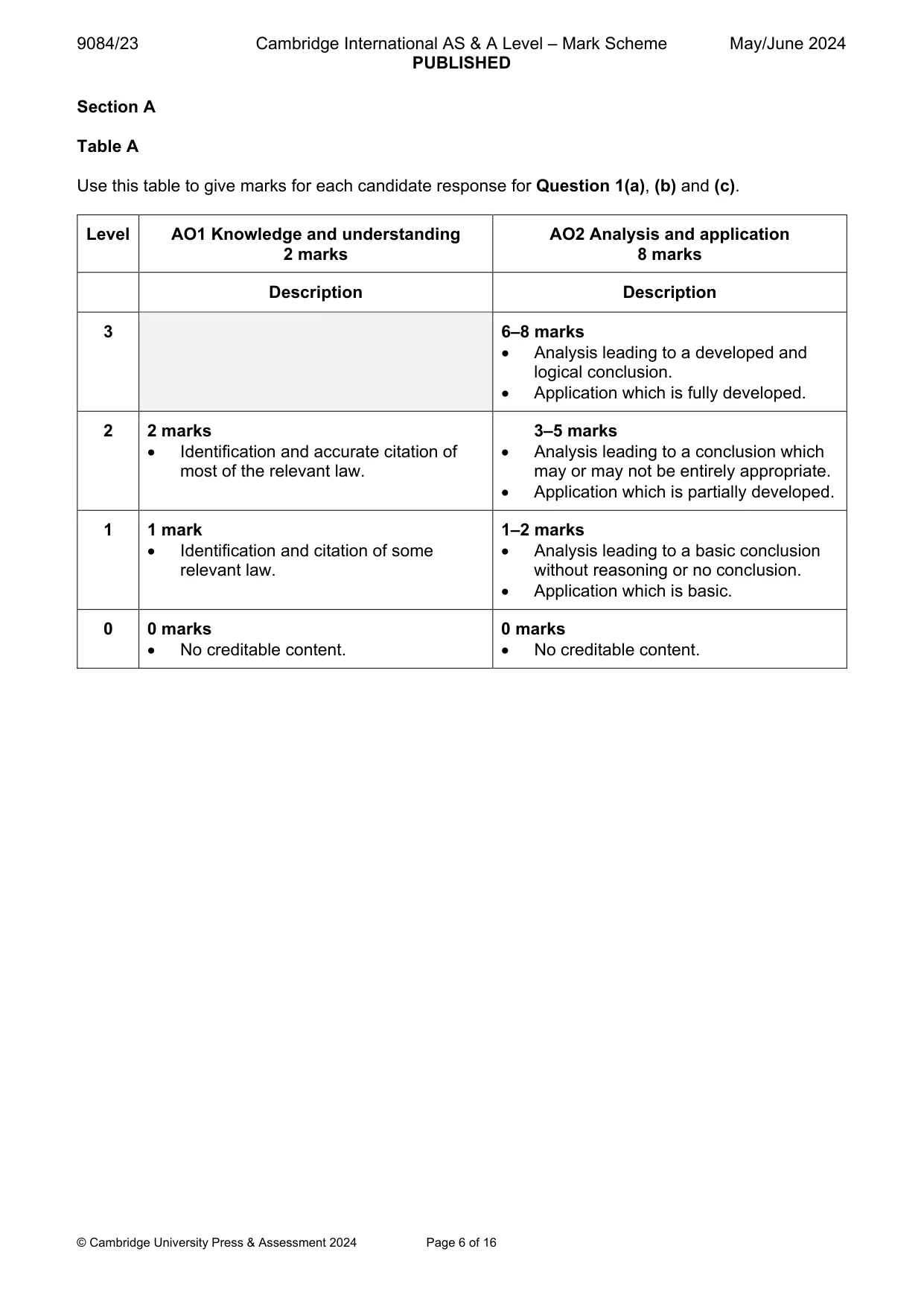
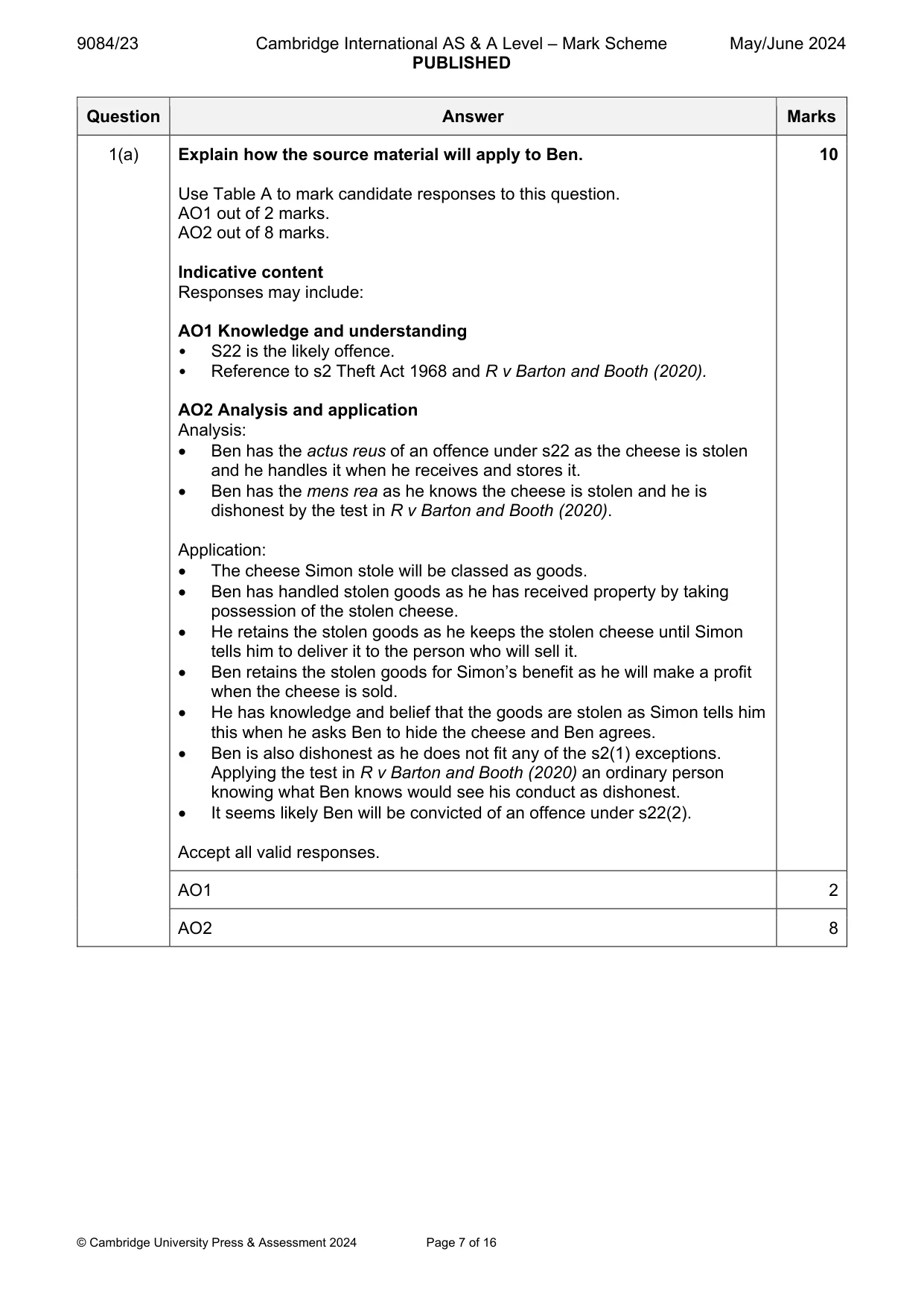
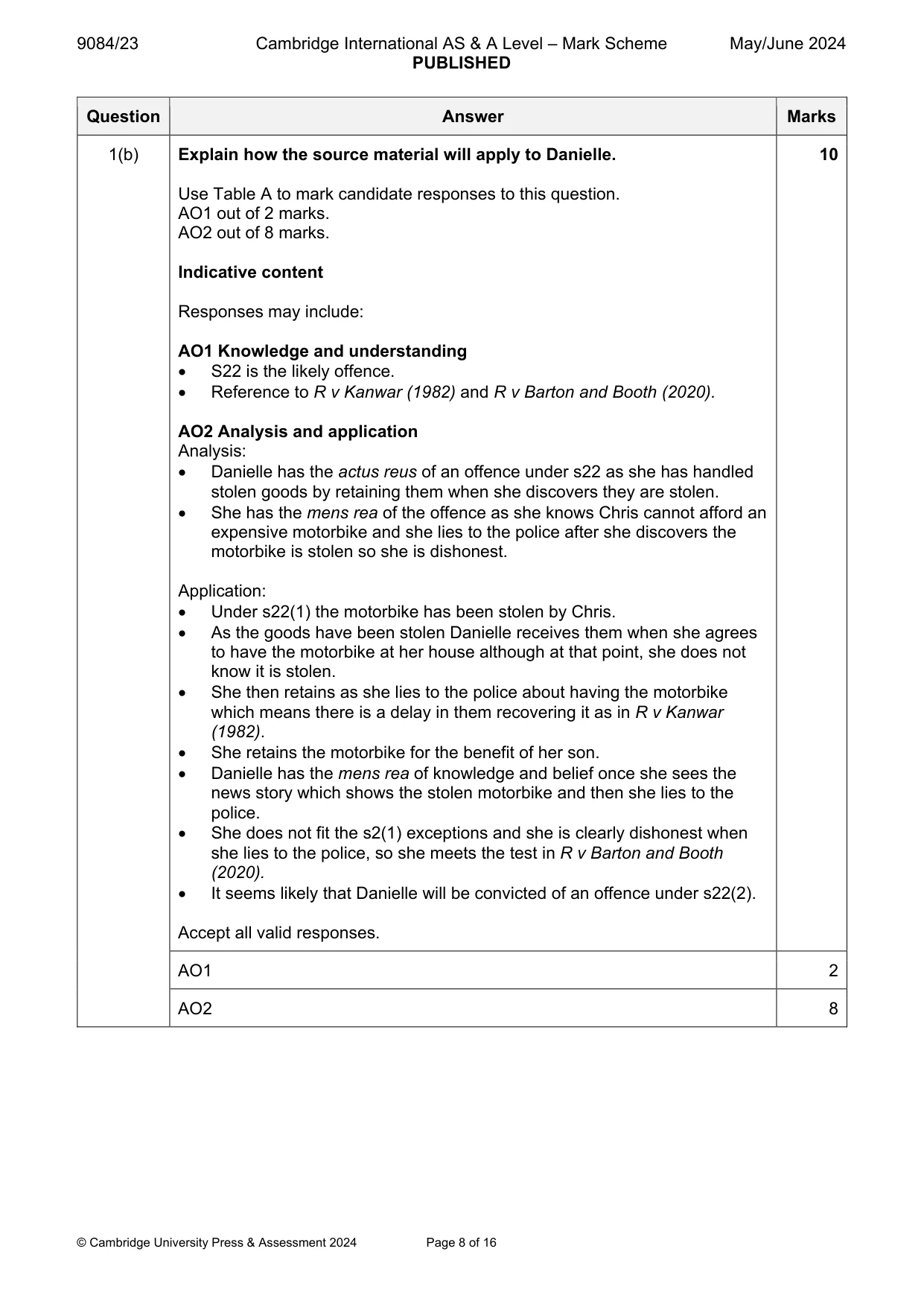
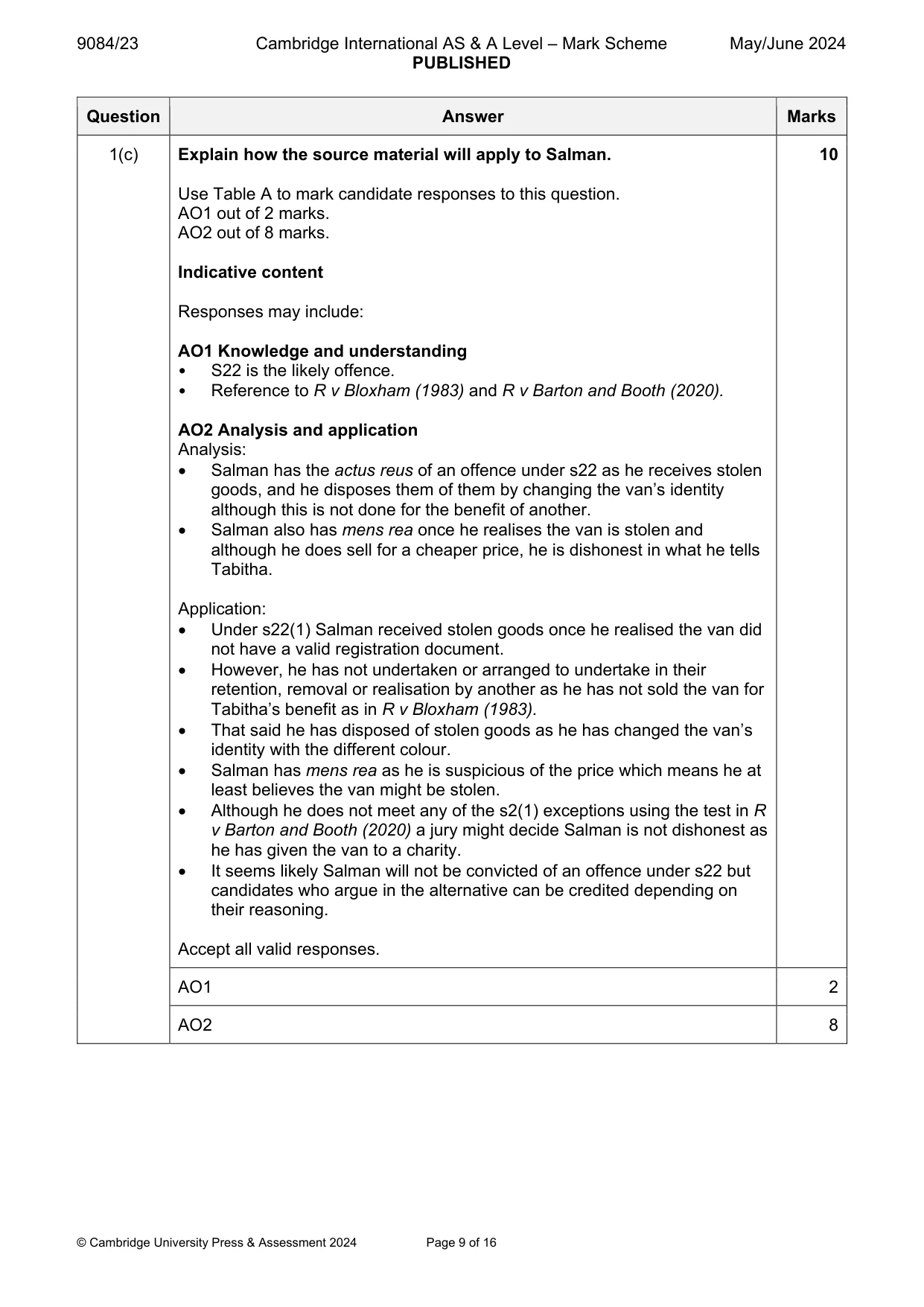
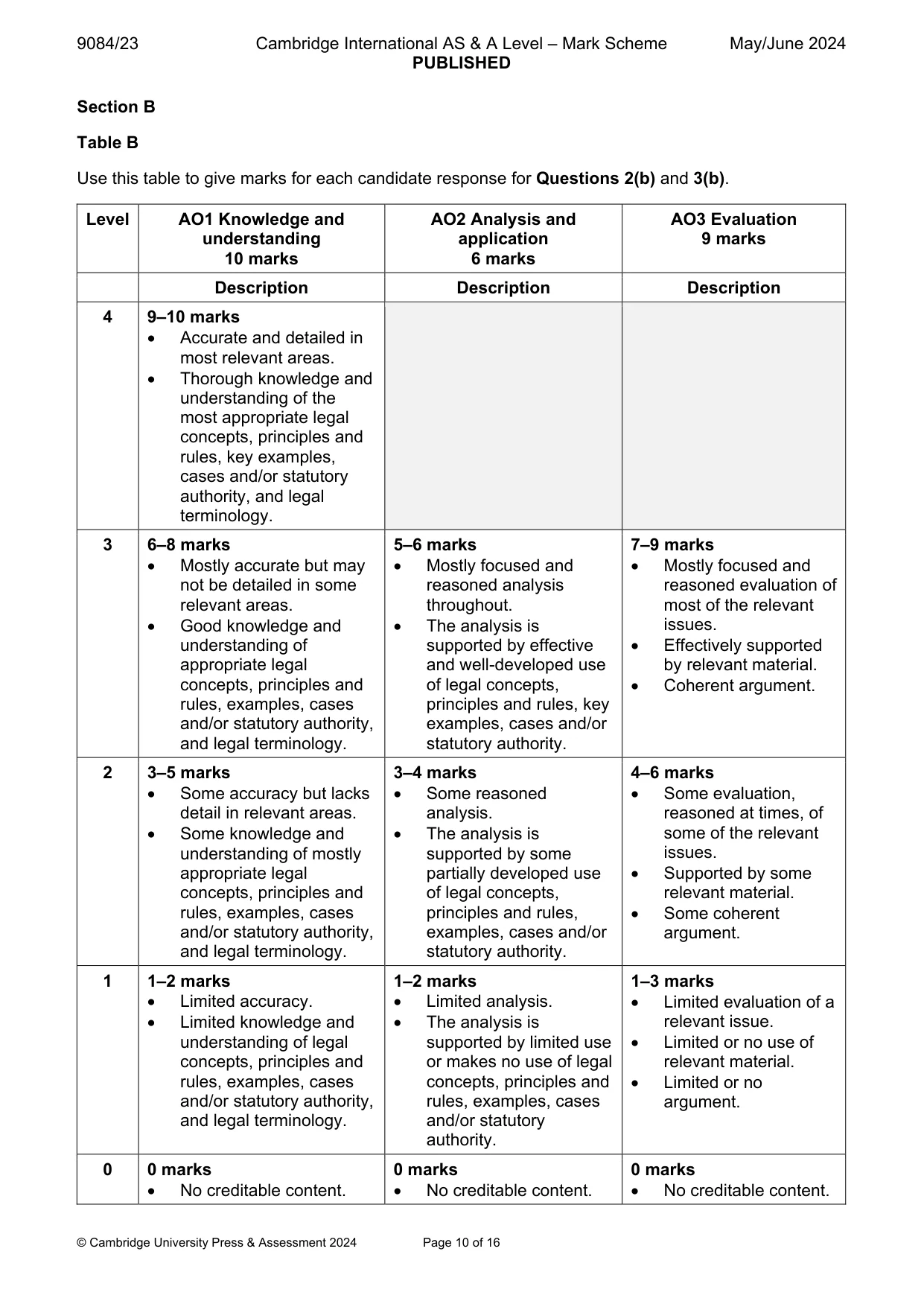
Mark scheme: Question Answer Marks 1(a) Explain how the source material will apply to Ben. 10 Use Table A to mark candidate responses to this question. AO1 out of 2 marks. AO2 out of 8 marks. Indicative content Responses may include: AO1 Knowledge and understanding • S22 is the likely offence. • Reference to s2 Theft Act 1968 and R v Barton and Booth (2020). AO2 Analysis and application Analysis: Ben has the actus reus of an offence under s22 as the cheese is stolen and he handles it when he receives and stores it. Ben has the mens rea as he knows the cheese is stolen and he is dishonest by the test in R v Barton and Booth (2020). Application: The cheese Simon stole will be classed as goods. Ben has handled stolen goods as he has received property by taking possession of the stolen cheese. He retains the stolen goods as he keeps the stolen cheese until Simon tells him to deliver it to the person who will sell it. Ben retains the stolen goods for Simon’s benefit as he will make a profit when the cheese is sold. He has knowledge and belief that the goods are stolen as Simon tells him this when he asks Ben to hide the cheese and Ben agrees. Ben is also dishonest as he does not fit any of the s2(1) exceptions. Applying the test in R v Barton and Booth (2020) an ordinary person knowing what Ben knows would see his conduct as dishonest. It seems likely Ben will be convicted of an offence under s22(2). Accept all valid responses. AO1 2 AO2 8 1(b) Explain how the source material will apply to Danielle. 10 Use Table A to mark candidate responses to this question. AO1 out of 2 marks. AO2 out of 8 marks. Indicative content Responses may include: AO1 Knowledge and understanding S22 is the likely offence. Reference to R v Kanwar (1982) and R v Barton and Booth (2020). AO2 Analysis and application Analysis: Danielle has the actus reus of an offence under s22 as she has handled stolen goods by retaining them when she discovers they are stolen. She has the mens rea of the offence as she knows Chris cannot afford an expensive motorbike and she lies to the police after she discovers the motorbike is stolen so she is dishonest. Application: Under s22(1) the motorbike has been stolen by Chris. As the goods have been stolen Danielle receives them when she agrees to have the motorbike at her house although at that point, she does not know it is stolen. She then retains as she lies to the police about having the motorbike which means there is a delay in them recovering it as in R v Kanwar (1982). She retains the motorbike for the benefit of her son. Danielle has the mens rea of knowledge and belief once she sees the news story which shows the stolen motorbike and then she lies to the police. She does not fit the s2(1) exceptions and she is clearly dishonest when she lies to the police, so she meets the test in R v Barton and Booth (2020). It seems likely that Danielle will be convicted of an offence under s22(2). Accept all valid responses. AO1 2 AO2 8 1(c) Explain how the source material will apply to Salman. 10 Use Table A to mark candidate responses to this question. AO1 out of 2 marks. AO2 out of 8 marks. Indicative content Responses may include: AO1 Knowledge and understanding • S22 is the likely offence. • Reference to R v Bloxham (1983) and R v Barton and Booth (2020). AO2 Analysis and application Analysis: Salman has the actus reus of an offence under s22 as he receives stolen goods, and he disposes them of them by changing the van’s identity although this is not done for the benefit of another. Salman also has mens rea once he realises the van is stolen and although he does sell for a cheaper price, he is dishonest in what he tells Tabitha. Application: Under s22(1) Salman received stolen goods once he realised the van did not have a valid registration document. However, he has not undertaken or arranged to undertake in their retention, removal or realisation by another as he has not sold the van for Tabitha’s benefit as in R v Bloxham (1983). That said he has disposed of stolen goods as he has changed the van’s identity with the different colour. Salman has mens rea as he is suspicious of the price which means he at least believes the van might be stolen. Although he does not meet any of the s2(1) exceptions using the test in R v Barton and Booth (2020) a jury might decide Salman is not dishonest as he has given the van to a charity. It seems likely Salman will not be convicted of an offence under s22 but candidates who argue in the alternative can be credited depending on their reasoning. Accept all valid responses. AO1 2 AO2 8 Section B Table B Use this table to give marks for each candidate response for Questions 2(b) and 3(b). Level AO1 Knowledge and AO2 Analysis and AO3 Evaluation understanding application 9 marks 10 marks 6 marks Description Description Description 4 9–10 marks Accurate and detailed in most relevant areas. Thorough knowledge and understanding of the most appropriate legal concepts, principles and rules, key examples, cases and/or statutory authority, and legal terminology. 3 6–8 marks 5–6 marks 7–9 marks Mostly accurate but may Mostly focused and Mostly focused and not be detailed in some reasoned analysis reasoned evaluation of relevant areas. throughout. most of the relevant Good knowledge and The analysis is issues. understanding of supported by effective Effectively supported appropriate legal and well-developed use by relevant material. concepts, principles and of legal concepts, Coherent argument. rules, examples, cases principles and rules, key and/or statutory authority, examples, cases and/or and legal terminology. statutory authority. 2 3–5 marks 3–4 marks 4–6 marks Some accuracy but lacks Some reasoned Some evaluation, detail in relevant areas. analysis. reasoned at times, of Some knowledge and The analysis is some of the relevant understanding of mostly supported by some issues. appropriate legal partially developed use Supported by some concepts, principles and of legal concepts, relevant material. rules, examples, cases principles and rules, Some coherent and/or statutory authority, examples, cases and/or argument. and legal terminology. statutory authority. 1 1–2 marks 1–2 marks 1–3 marks Limited accuracy. Limited analysis. Limited evaluation of a Limited knowledge and The analysis is relevant issue. understanding of legal supported by limited use Limited or no use of concepts, principles and or makes no use of legal relevant material. rules, examples, cases concepts, principles and Limited or no and/or statutory authority, rules, examples, cases argument. and legal terminology. and/or statutory authority. 0 0 marks 0 marks 0 marks No creditable content. No creditable content. No creditable content.
Q2 · Describe the law on an intention to permanently deprive in theft
2 (a) Describe the law on an intention to permanently deprive in theft. [5] (b) Evaluate the law of blackmail. [25] OR
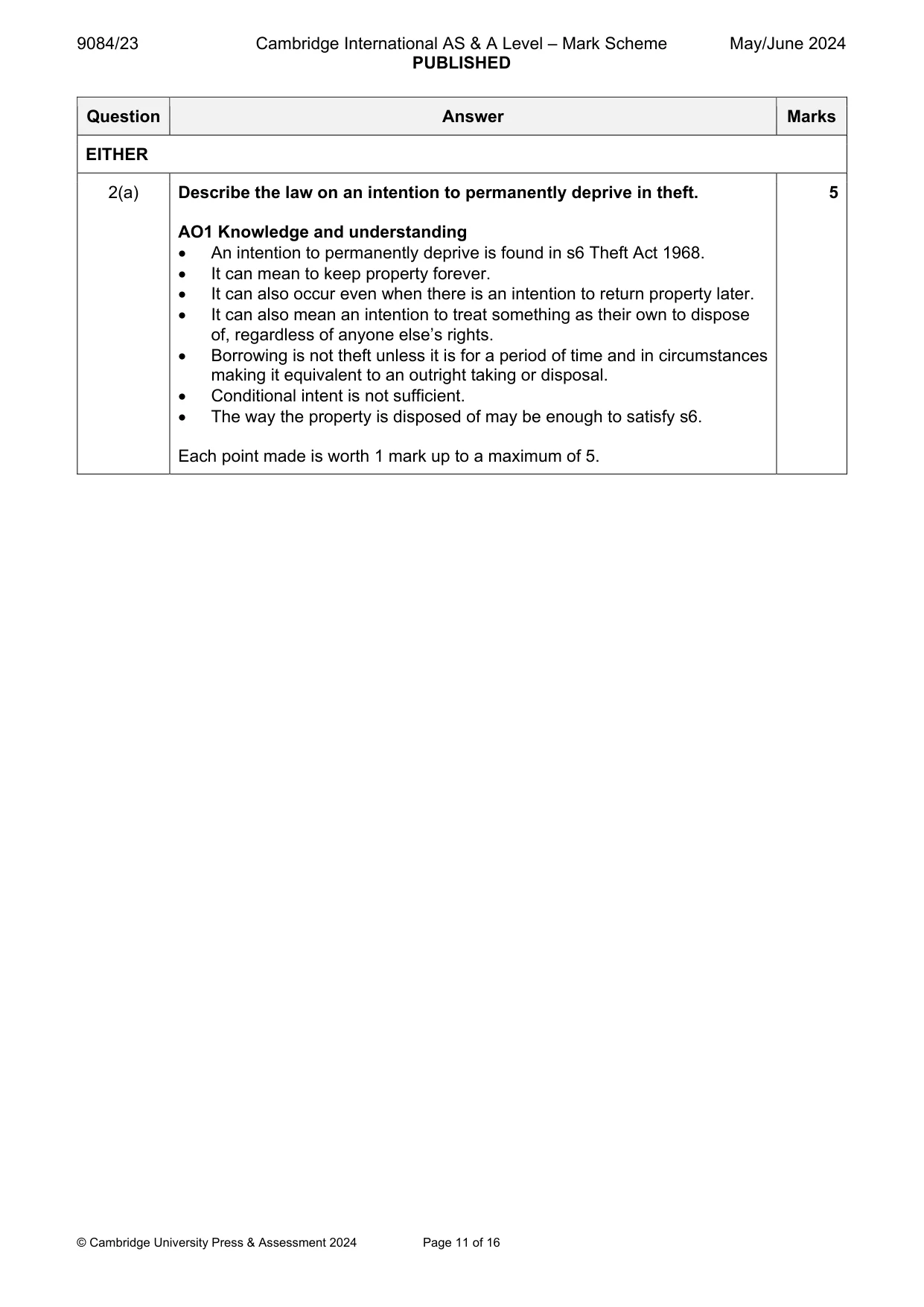
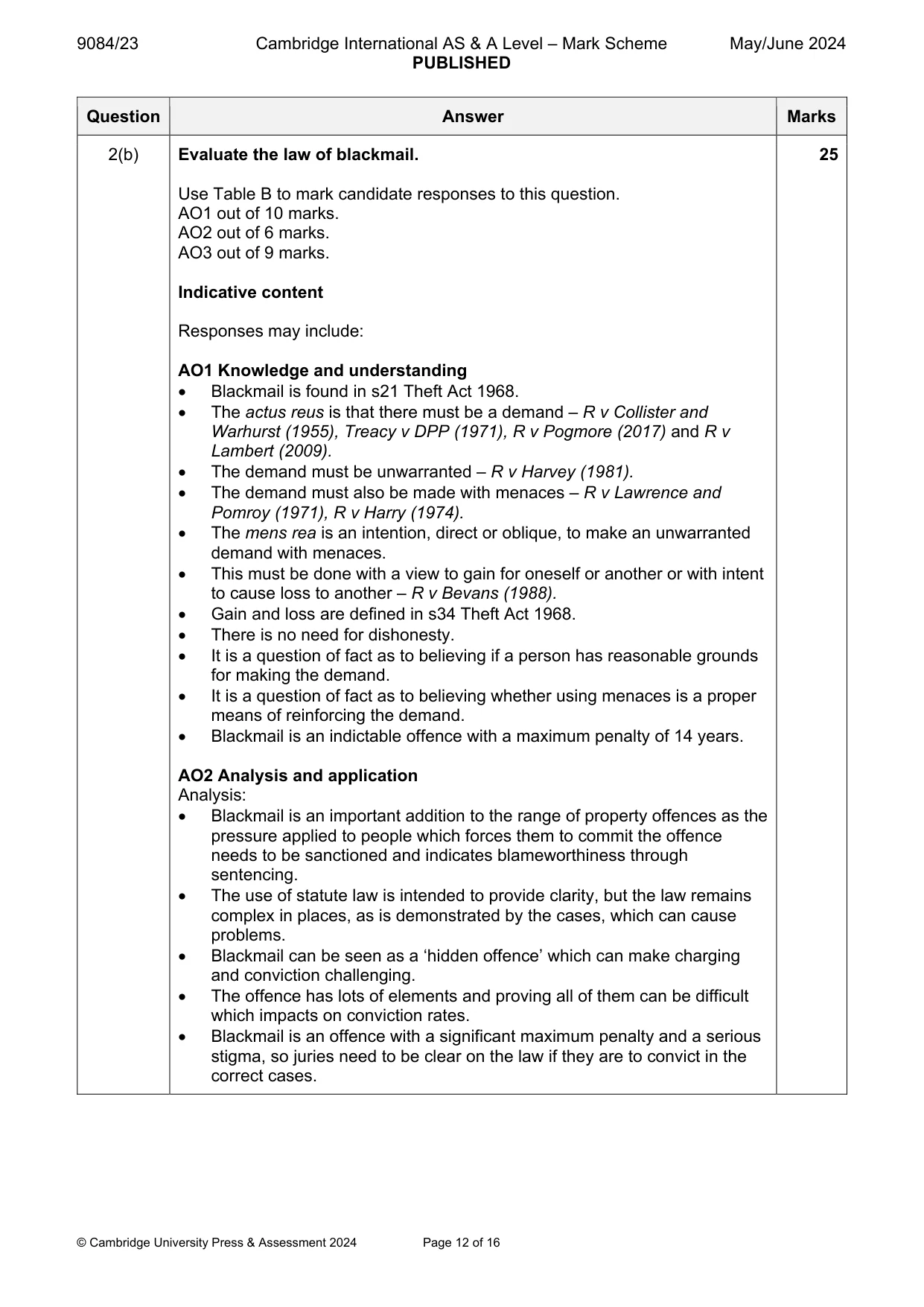
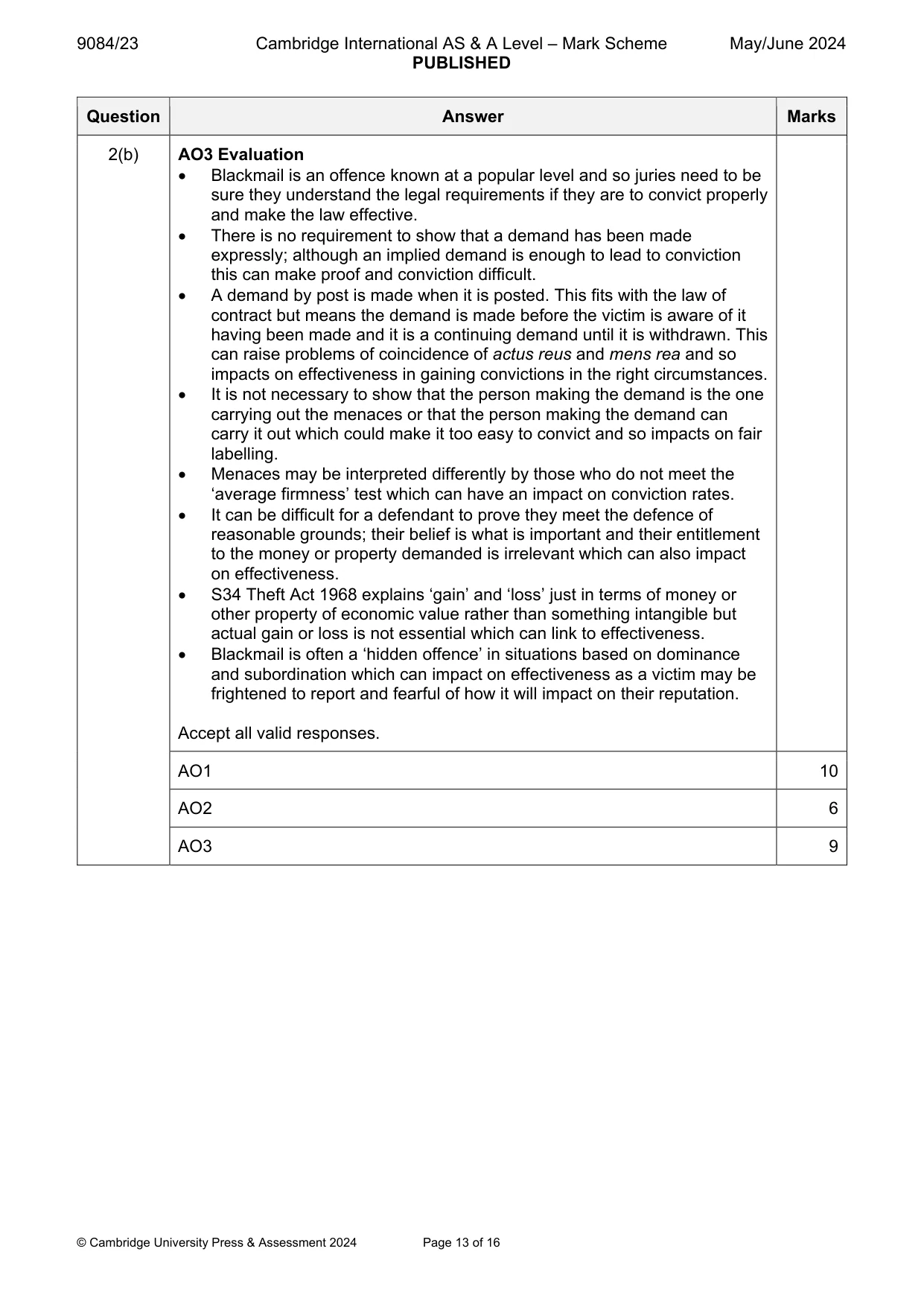
Mark scheme: 2(a) Describe the law on an intention to permanently deprive in theft. 5 AO1 Knowledge and understanding An intention to permanently deprive is found in s6 Theft Act 1968. It can mean to keep property forever. It can also occur even when there is an intention to return property later. It can also mean an intention to treat something as their own to dispose of, regardless of anyone else’s rights. Borrowing is not theft unless it is for a period of time and in circumstances making it equivalent to an outright taking or disposal. Conditional intent is not sufficient. The way the property is disposed of may be enough to satisfy s6. Each point made is worth 1 mark up to a maximum of 5. 2(b) Evaluate the law of blackmail. 25 Use Table B to mark candidate responses to this question. AO1 out of 10 marks. AO2 out of 6 marks. AO3 out of 9 marks. Indicative content Responses may include: AO1 Knowledge and understanding Blackmail is found in s21 Theft Act 1968. The actus reus is that there must be a demand – R v Collister and Warhurst (1955), Treacy v DPP (1971), R v Pogmore (2017) and R v Lambert (2009). The demand must be unwarranted – R v Harvey (1981). The demand must also be made with menaces – R v Lawrence and Pomroy (1971), R v Harry (1974). The mens rea is an intention, direct or oblique, to make an unwarranted demand with menaces. This must be done with a view to gain for oneself or another or with intent to cause loss to another – R v Bevans (1988). Gain and loss are defined in s34 Theft Act 1968. There is no need for dishonesty. It is a question of fact as to believing if a person has reasonable grounds for making the demand. It is a question of fact as to believing whether using menaces is a proper means of reinforcing the demand. Blackmail is an indictable offence with a maximum penalty of 14 years. AO2 Analysis and application Analysis: Blackmail is an important addition to the range of property offences as the pressure applied to people which forces them to commit the offence needs to be sanctioned and indicates blameworthiness through sentencing. The use of statute law is intended to provide clarity, but the law remains complex in places, as is demonstrated by the cases, which can cause problems. Blackmail can be seen as a ‘hidden offence’ which can make charging and conviction challenging. The offence has lots of elements and proving all of them can be difficult which impacts on conviction rates. Blackmail is an offence with a significant maximum penalty and a serious stigma, so juries need to be clear on the law if they are to convict in the correct cases. 2(b) AO3 Evaluation Blackmail is an offence known at a popular level and so juries need to be sure they understand the legal requirements if they are to convict properly and make the law effective. There is no requirement to show that a demand has been made expressly; although an implied demand is enough to lead to conviction this can make proof and conviction difficult. A demand by post is made when it is posted. This fits with the law of contract but means the demand is made before the victim is aware of it having been made and it is a continuing demand until it is withdrawn. This can raise problems of coincidence of actus reus and mens rea and so impacts on effectiveness in gaining convictions in the right circumstances. It is not necessary to show that the person making the demand is the one carrying out the menaces or that the person making the demand can carry it out which could make it too easy to convict and so impacts on fair labelling. Menaces may be interpreted differently by those who do not meet the ‘average firmness’ test which can have an impact on conviction rates. It can be difficult for a defendant to prove they meet the defence of reasonable grounds; their belief is what is important and their entitlement to the money or property demanded is irrelevant which can also impact on effectiveness. S34 Theft Act 1968 explains ‘gain’ and ‘loss’ just in terms of money or other property of economic value rather than something intangible but actual gain or loss is not essential which can link to effectiveness. Blackmail is often a ‘hidden offence’ in situations based on dominance and subordination which can impact on effectiveness as a victim may be frightened to report and fearful of how it will impact on their reputation. Accept all valid responses. AO1 10 AO2 6 AO3 9
Q3 · Describe the actus reus of robbery
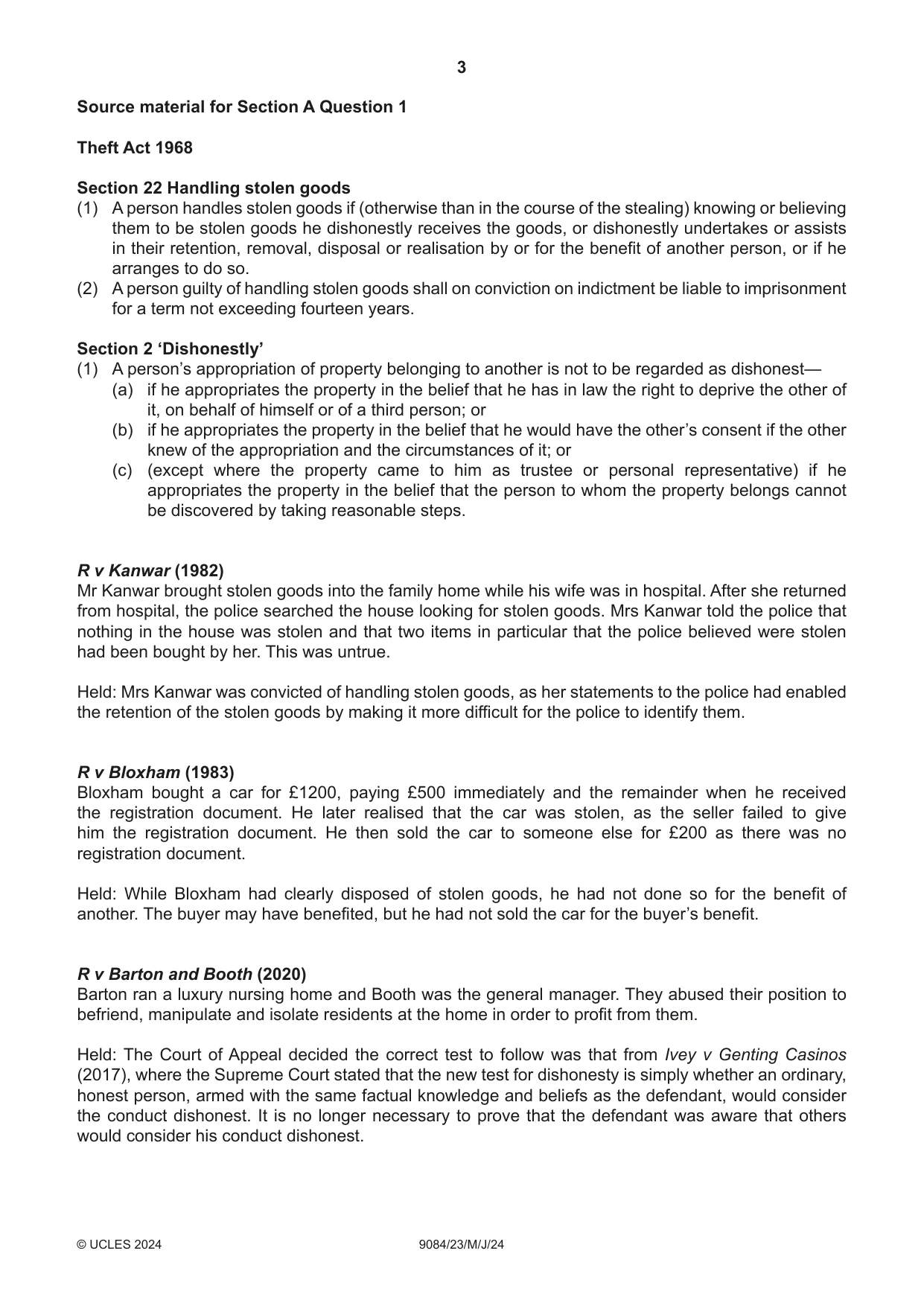
3 (a) Describe the actus reus of robbery. [5] (b) Evaluate the law of making off without payment. [25] Source material for Section A Question 1 Theft Act 1968 Section 22 Handling stolen goods (1) A person handles stolen goods if (otherwise than in the course of the stealing) knowing or believing them to be stolen goods he dishonestly receives the goods, or dishonestly undertakes or assists in their retention, removal, disposal or realisation by or for the benefit of another person, or if he arranges to do so. (2) A person guilty of handling stolen goods shall on conviction on indictment be liable to imprisonment for a term not exceeding fourteen years. Section 2 ‘Dishonestly’ (1) A person’s appropriation of property belonging to another is not to be regarded as dishonest— (a) if he appropriates the property in the belief that he has in law the right to deprive the other of it, on behalf of himself or of a third person; or (b) if he appropriates the property in the belief that he would have the other’s consent if the other knew of the appropriation and the circumstances of it; or (c) (except where the property came to him as trustee or personal representative) if he appropriates the property in the belief that the person to whom the property belongs cannot be discovered by taking reasonable steps. R v Kanwar (1982) Mr Kanwar brought stolen goods into the family home while his wife was in hospital. After she returned from hospital, the police searched the house looking for stolen goods. Mrs Kanwar told the police that nothing in the house was stolen and that two items in particular that the police believed were stolen had been bought by her. This was untrue. Held: Mrs Kanwar was convicted of handling stolen goods, as her statements to the police had enabled the retention of the stolen goods by making it more difficult for the police to identify them. R v Bloxham (1983) Bloxham bought a car for £1200, paying £500 immediately and the remainder when he received the registration document. He later realised that the car was stolen, as the seller failed to give him the registration document. He then sold the car to someone else for £200 as there was no registration document. Held: While Bloxham had clearly disposed of stolen goods, he had not done so for the benefit of another. The buyer may have benefited, but he had not sold the car for the buyer’s benefit. R v Barton and Booth (2020) Barton ran a luxury nursing home and Booth was the general manager. They abused their position to befriend, manipulate and isolate residents at the home in order to profit from them. Held: The Court of Appeal decided the correct test to follow was that from Ivey v Genting Casinos (2017), where the Supreme Court stated that the new test for dishonesty is simply whether an ordinary, honest person, armed with the same factual knowledge and beliefs as the defendant, would consider the conduct dishonest. It is no longer necessary to prove that the defendant was aware that others would consider his conduct dishonest.
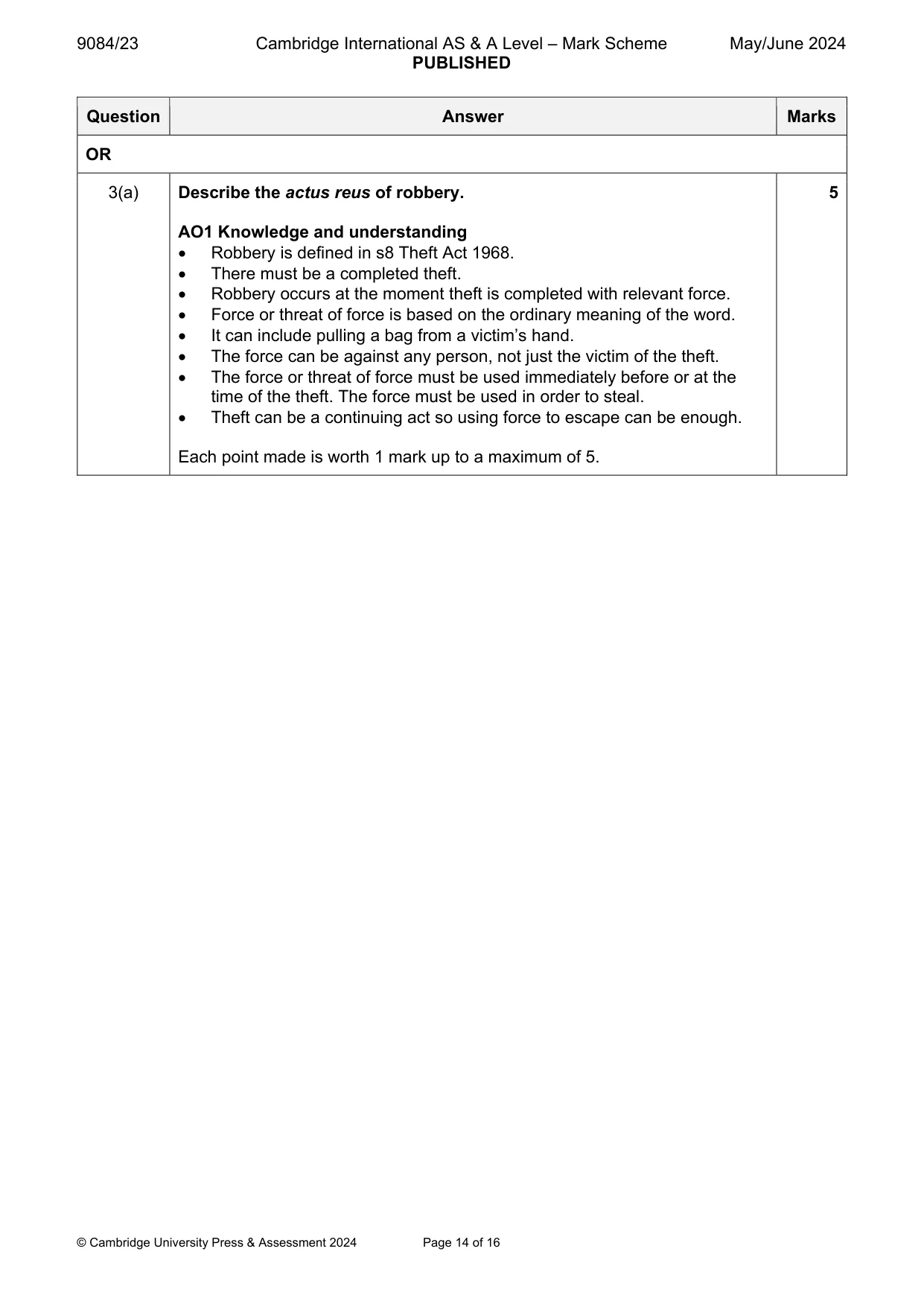
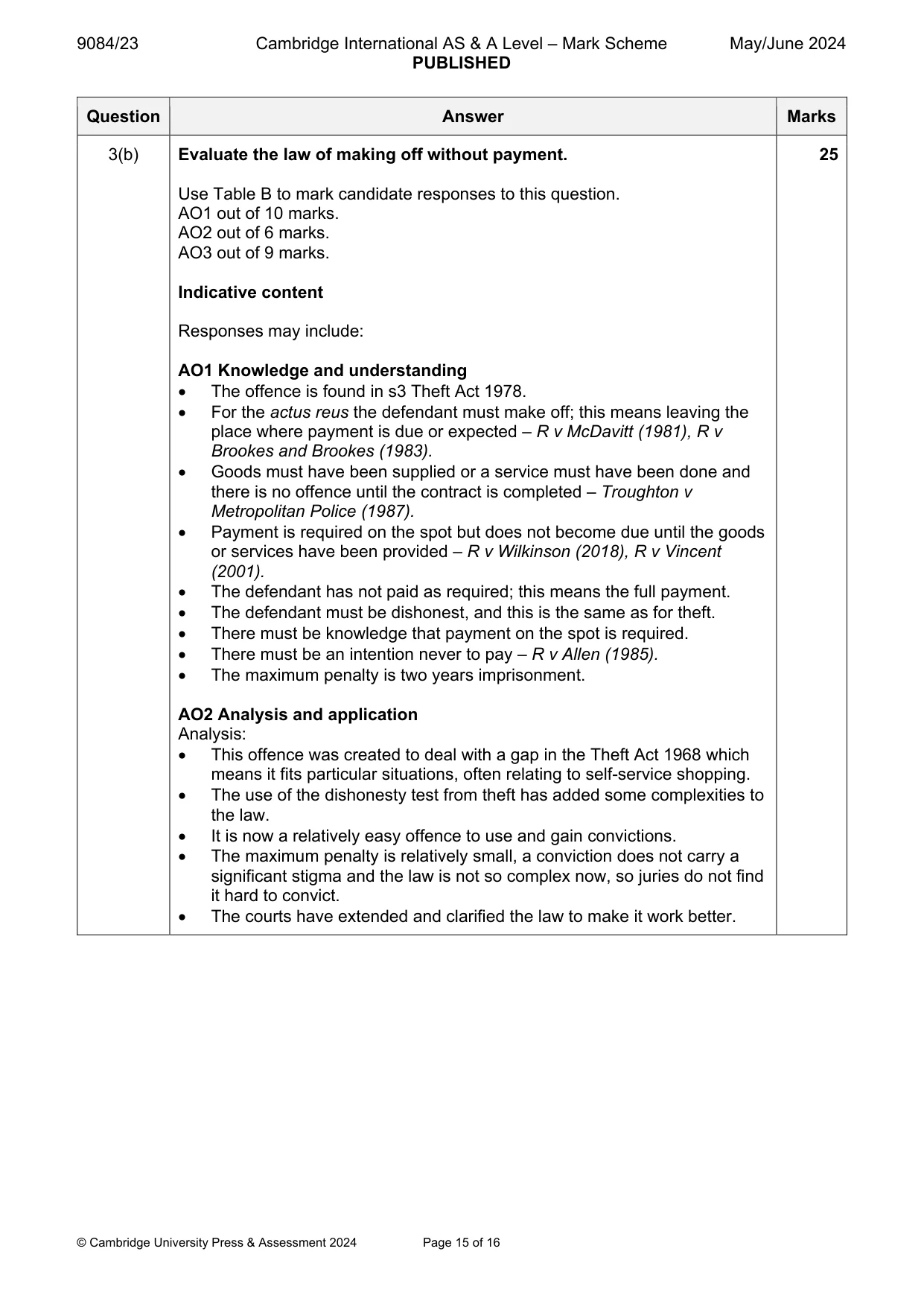
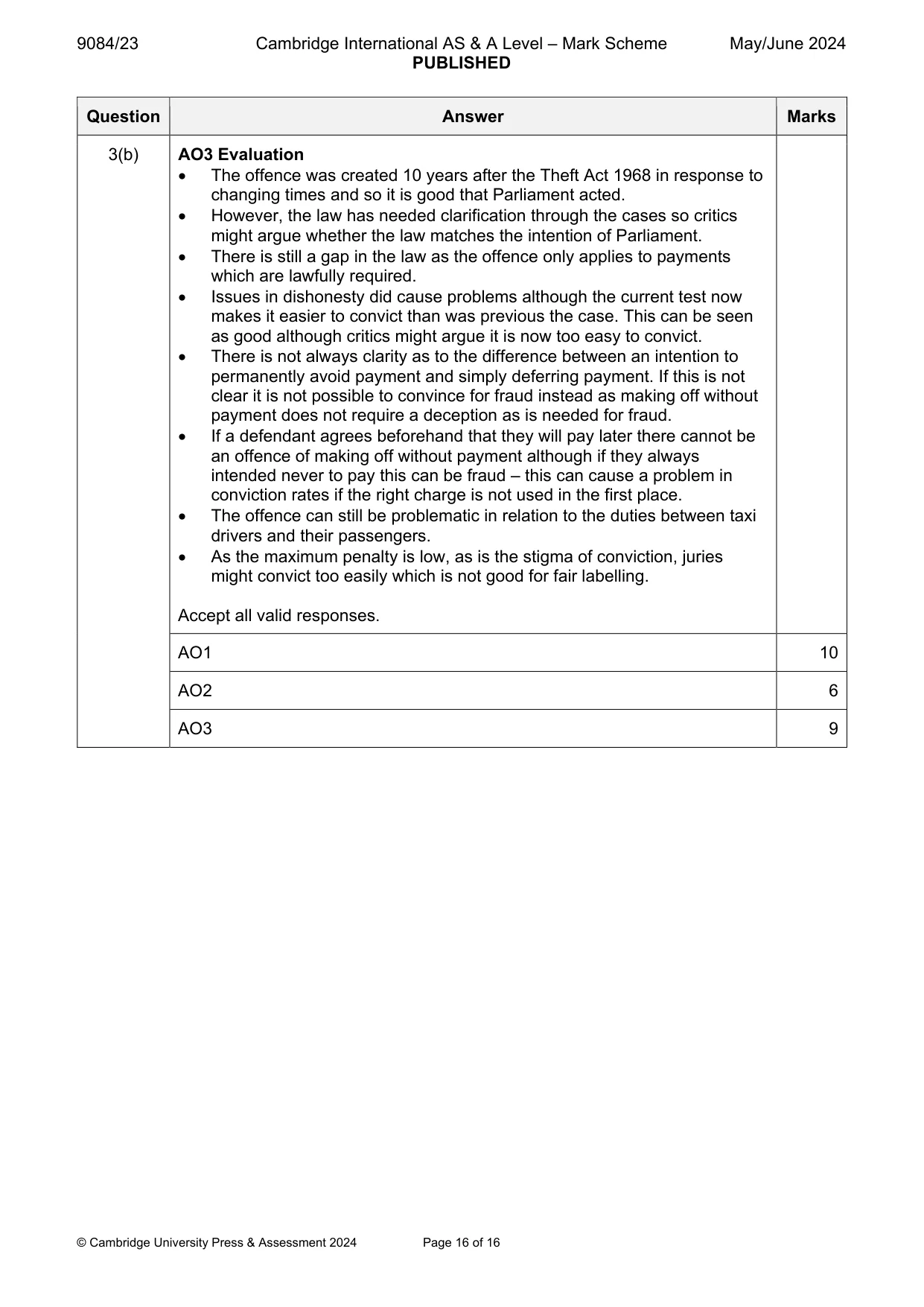
Mark scheme: 3(a) Describe the actus reus of robbery. 5 AO1 Knowledge and understanding Robbery is defined in s8 Theft Act 1968. There must be a completed theft. Robbery occurs at the moment theft is completed with relevant force. Force or threat of force is based on the ordinary meaning of the word. It can include pulling a bag from a victim’s hand. The force can be against any person, not just the victim of the theft. The force or threat of force must be used immediately before or at the time of the theft. The force must be used in order to steal. Theft can be a continuing act so using force to escape can be enough. Each point made is worth 1 mark up to a maximum of 5. 3(b) Evaluate the law of making off without payment. 25 Use Table B to mark candidate responses to this question. AO1 out of 10 marks. AO2 out of 6 marks. AO3 out of 9 marks. Indicative content Responses may include: AO1 Knowledge and understanding The offence is found in s3 Theft Act 1978. For the actus reus the defendant must make off; this means leaving the place where payment is due or expected – R v McDavitt (1981), R v Brookes and Brookes (1983). Goods must have been supplied or a service must have been done and there is no offence until the contract is completed – Troughton v Metropolitan Police (1987). Payment is required on the spot but does not become due until the goods or services have been provided – R v Wilkinson (2018), R v Vincent (2001). The defendant has not paid as required; this means the full payment. The defendant must be dishonest, and this is the same as for theft. There must be knowledge that payment on the spot is required. There must be an intention never to pay – R v Allen (1985). The maximum penalty is two years imprisonment. AO2 Analysis and application Analysis: This offence was created to deal with a gap in the Theft Act 1968 which means it fits particular situations, often relating to self-service shopping. The use of the dishonesty test from theft has added some complexities to the law. It is now a relatively easy offence to use and gain convictions. The maximum penalty is relatively small, a conviction does not carry a significant stigma and the law is not so complex now, so juries do not find it hard to convict. The courts have extended and clarified the law to make it work better. 3(b) AO3 Evaluation The offence was created 10 years after the Theft Act 1968 in response to changing times and so it is good that Parliament acted. However, the law has needed clarification through the cases so critics might argue whether the law matches the intention of Parliament. There is still a gap in the law as the offence only applies to payments which are lawfully required. Issues in dishonesty did cause problems although the current test now makes it easier to convict than was previous the case. This can be seen as good although critics might argue it is now too easy to convict. There is not always clarity as to the difference between an intention to permanently avoid payment and simply deferring payment. If this is not clear it is not possible to convince for fraud instead as making off without payment does not require a deception as is needed for fraud. If a defendant agrees beforehand that they will pay later there cannot be an offence of making off without payment although if they always intended never to pay this can be fraud – this can cause a problem in conviction rates if the right charge is not used in the first place. The offence can still be problematic in relation to the duties between taxi drivers and their passengers. As the maximum penalty is low, as is the stigma of conviction, juries might convict too easily which is not good for fair labelling. Accept all valid responses. AO1 10 AO2 6 AO3 9
What was in this paper
The subtopics covered by these 3 questions, and how many questions each got. Open one in a new tab to see every Cambridge question on it.
What you needed in this session
Cambridge’s own grade thresholds for 2024 May/June, Paper 2 · Variant 3. A higher threshold means an easier paper — the bar moves with how the cohort did.