Cambridge A Level Law 9084 — 2016 May/June Paper 2 · Variant 2
9084/22/M/J/16 · 50 marks · ≈56 min
The question paper and its mark scheme, free to read here and free to download. This is Cambridge’s own paper, exactly as it was sat.
Question paper8 pages



Mark scheme5 pages
Answers below. Sit the paper first if you are practising.
Paper as text
Question paper, page 1
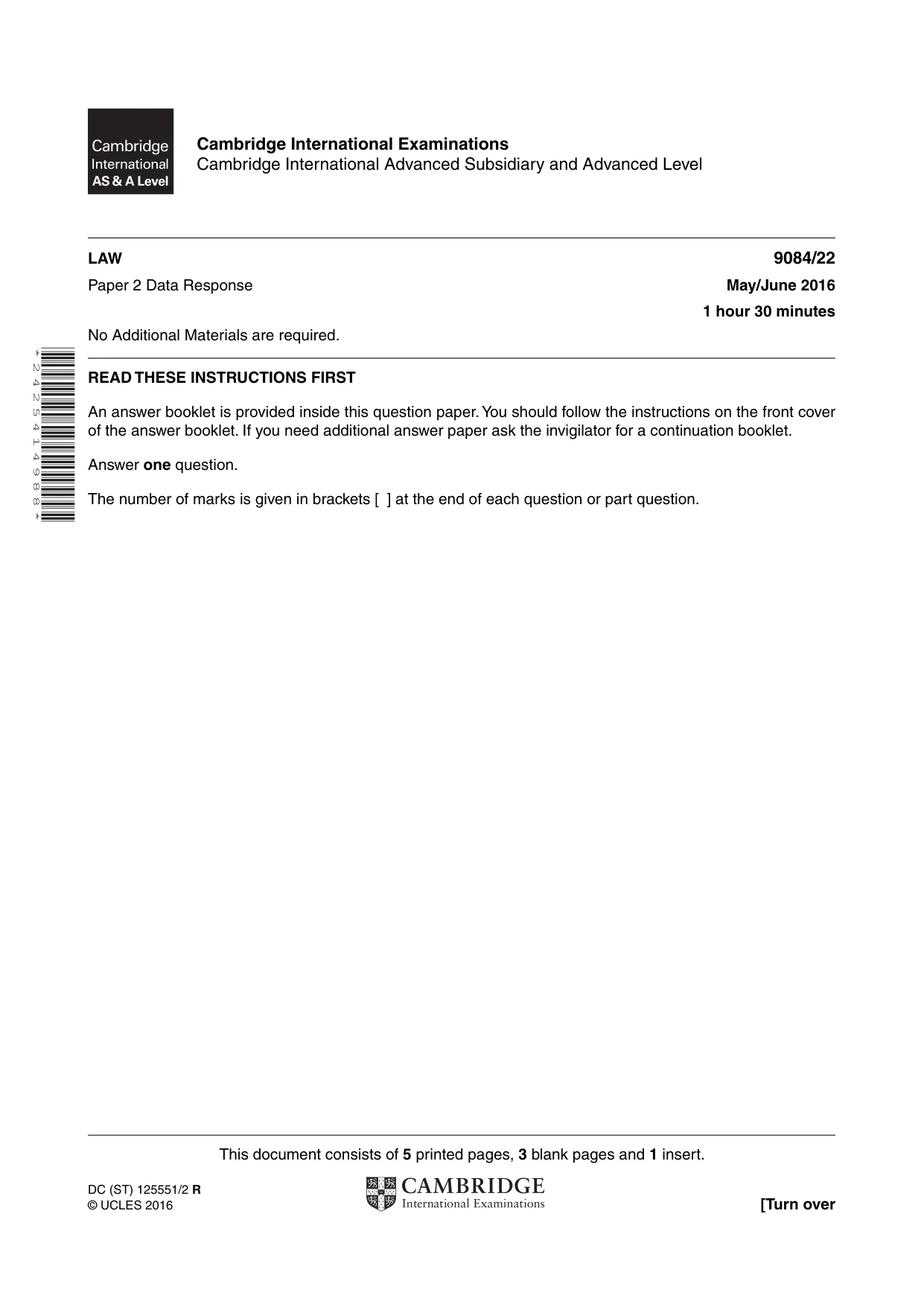
This document consists of 5 printed pages, 3 blank pages and 1 insert. DC (ST) 125551/2 R © UCLES 2016 [Turn over Cambridge International Examinations Cambridge International Advanced Subsidiary and Advanced Level * 2 4 2 5 4 1 4 9 8 8 * LAW 9084/22 Paper 2 Data Response May/June 2016 1 hour 30 minutes No Additional Materials are required. READ THESE INSTRUCTIONS FIRST An answer booklet is provided inside this question paper. You should follow the instructions on the front cover of the answer booklet. If you need additional answer paper ask the invigilator for a continuation booklet. Answer one question. The number of marks is given in brackets [ ] at the end of each question or part question.
Question paper, page 2
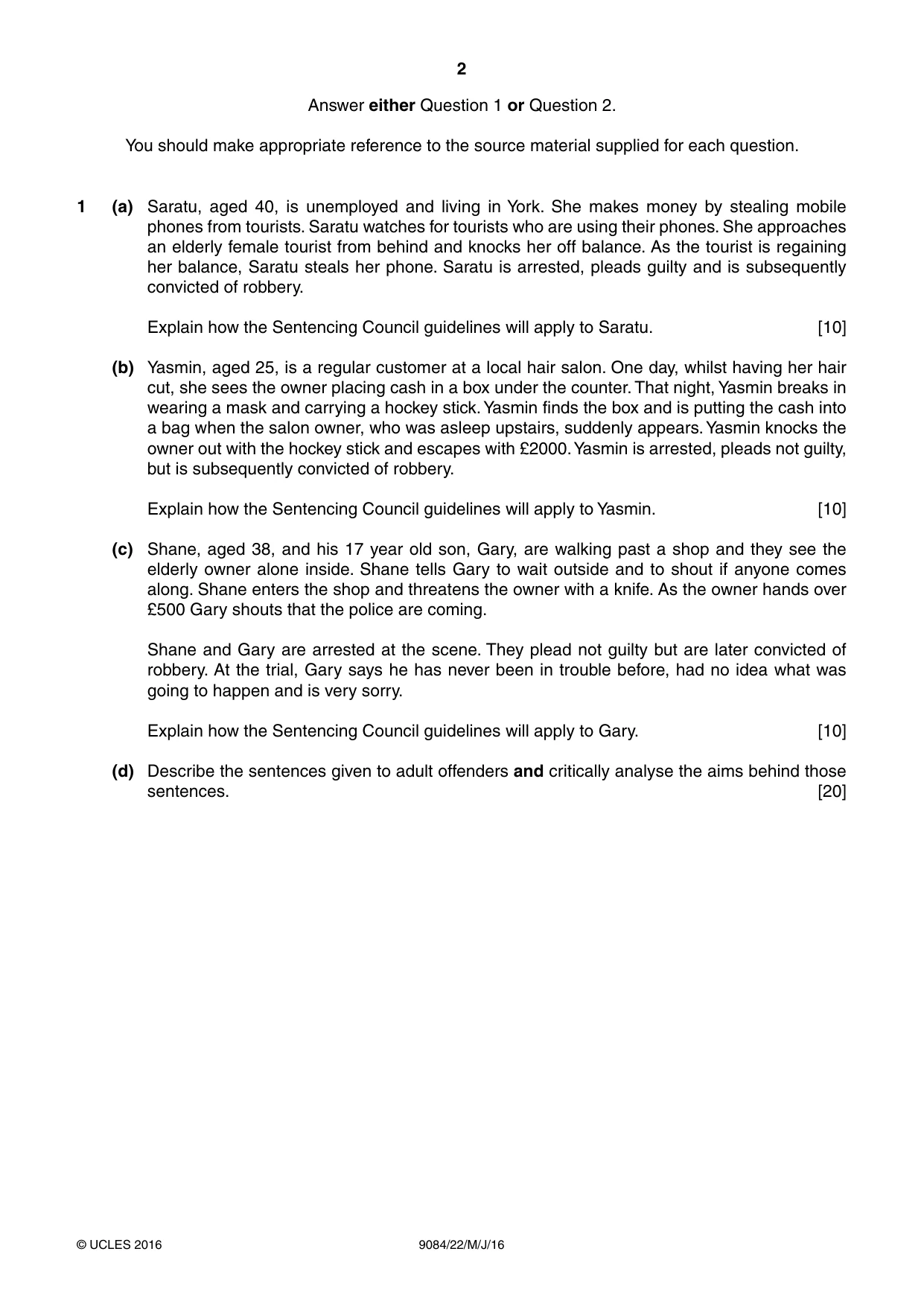
2 9084/22/M/J/16 © UCLES 2016 Answer either Question 1 or Question 2. You should make appropriate reference to the source material supplied for each question. 1 (a) Saratu, aged 40, is unemployed and living in York. She makes money by stealing mobile phones from tourists. Saratu watches for tourists who are using their phones. She approaches an elderly female tourist from behind and knocks her off balance. As the tourist is regaining her balance, Saratu steals her phone. Saratu is arrested, pleads guilty and is subsequently convicted of robbery. Explain how the Sentencing Council guidelines will apply to Saratu. [10] (b) Yasmin, aged 25, is a regular customer at a local hair salon. One day, whilst having her hair cut, she sees the owner placing cash in a box under the counter. That night, Yasmin breaks in wearing a mask and carrying a hockey stick. Yasmin finds the box and is putting the cash into a bag when the salon owner, who was asleep upstairs, suddenly appears. Yasmin knocks the owner out with the hockey stick and escapes with £2000. Yasmin is arrested, pleads not guilty, but is subsequently convicted of robbery. Explain how the Sentencing Council guidelines will apply to Yasmin. [10] (c) Shane, aged 38, and his 17 year old son, Gary, are walking past a shop and they see the elderly owner alone inside. Shane tells Gary to wait outside and to shout if anyone comes along. Shane enters the shop and threatens the owner with a knife. As the owner hands over £500 Gary shouts that the police are coming. Shane and Gary are arrested at the scene. They plead not guilty but are later convicted of robbery. At the trial, Gary says he has never been in trouble before, had no idea what was going to happen and is very sorry. Explain how the Sentencing Council guidelines will apply to Gary. [10] (d) Describe the sentences given to adult offenders and critically analyse the aims behind those sentences. [20]
Question paper, page 3
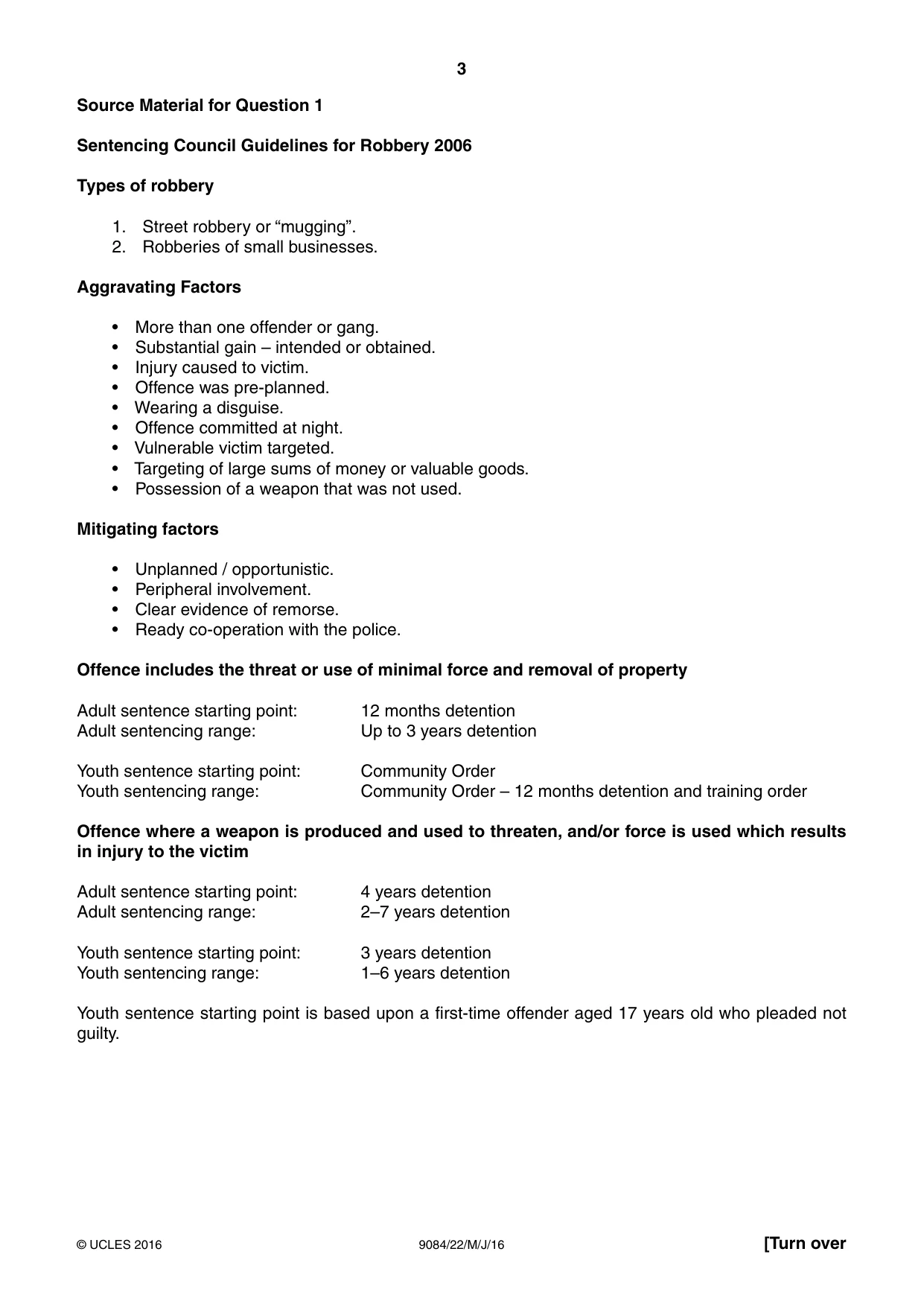
3 9084/22/M/J/16 © UCLES 2016 [Turn over Source Material for Question 1 Sentencing Council Guidelines for Robbery 2006 Types of robbery 1. Street robbery or “mugging”. 2. Robberies of small businesses. Aggravating Factors • More than one offender or gang. • Substantial gain – intended or obtained. • Injury caused to victim. • Offence was pre-planned. • Wearing a disguise. • Offence committed at night. • Vulnerable victim targeted. • Targeting of large sums of money or valuable goods. • Possession of a weapon that was not used. Mitigating factors • Unplanned / opportunistic. • Peripheral involvement. • Clear evidence of remorse. • Ready co-operation with the police. Offence includes the threat or use of minimal force and removal of property Adult sentence starting point: 12 months detention Adult sentencing range: Up to 3 years detention Youth sentence starting point: Community Order Youth sentencing range: Community Order – 12 months detention and training order Offence where a weapon is produced and used to threaten, and/or force is used which results in injury to the victim Adult sentence starting point: 4 years detention Adult sentencing range: 2–7 years detention Youth sentence starting point: 3 years detention Youth sentencing range: 1–6 years detention Youth sentence starting point is based upon a first-time offender aged 17 years old who pleaded not guilty.
Question paper, page 4
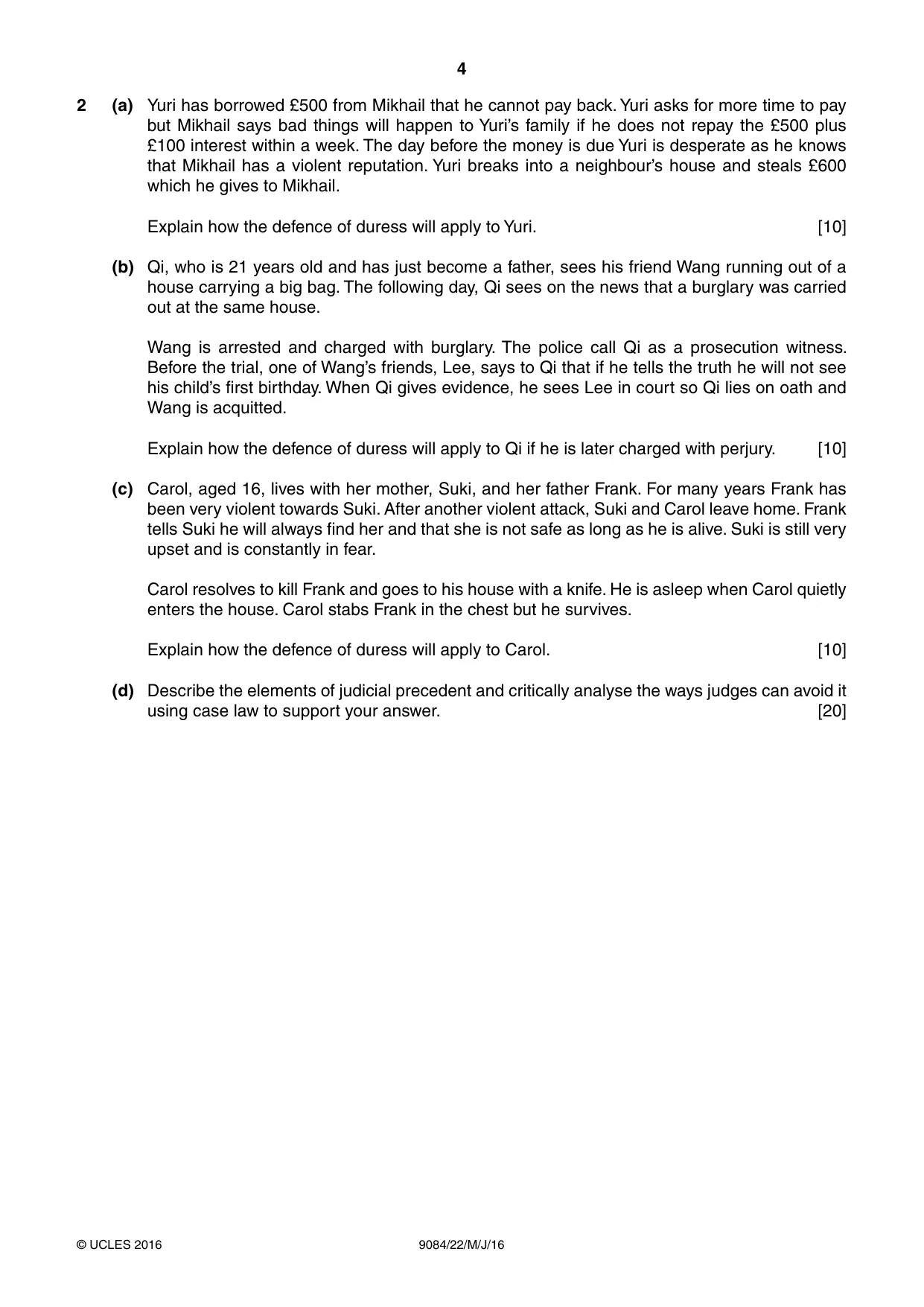
4 9084/22/M/J/16 © UCLES 2016 2 (a) Yuri has borrowed £500 from Mikhail that he cannot pay back. Yuri asks for more time to pay but Mikhail says bad things will happen to Yuri’s family if he does not repay the £500 plus £100 interest within a week. The day before the money is due Yuri is desperate as he knows that Mikhail has a violent reputation. Yuri breaks into a neighbour’s house and steals £600 which he gives to Mikhail. Explain how the defence of duress will apply to Yuri. [10] (b) Qi, who is 21 years old and has just become a father, sees his friend Wang running out of a house carrying a big bag. The following day, Qi sees on the news that a burglary was carried out at the same house. Wang is arrested and charged with burglary. The police call Qi as a prosecution witness. Before the trial, one of Wang’s friends, Lee, says to Qi that if he tells the truth he will not see his child’s first birthday. When Qi gives evidence, he sees Lee in court so Qi lies on oath and Wang is acquitted. Explain how the defence of duress will apply to Qi if he is later charged with perjury. [10] (c) Carol, aged 16, lives with her mother, Suki, and her father Frank. For many years Frank has been very violent towards Suki. After another violent attack, Suki and Carol leave home. Frank tells Suki he will always find her and that she is not safe as long as he is alive. Suki is still very upset and is constantly in fear. Carol resolves to kill Frank and goes to his house with a knife. He is asleep when Carol quietly enters the house. Carol stabs Frank in the chest but he survives. Explain how the defence of duress will apply to Carol. [10] (d) Describe the elements of judicial precedent and critically analyse the ways judges can avoid it using case law to support your answer. [20]
Question paper, page 5
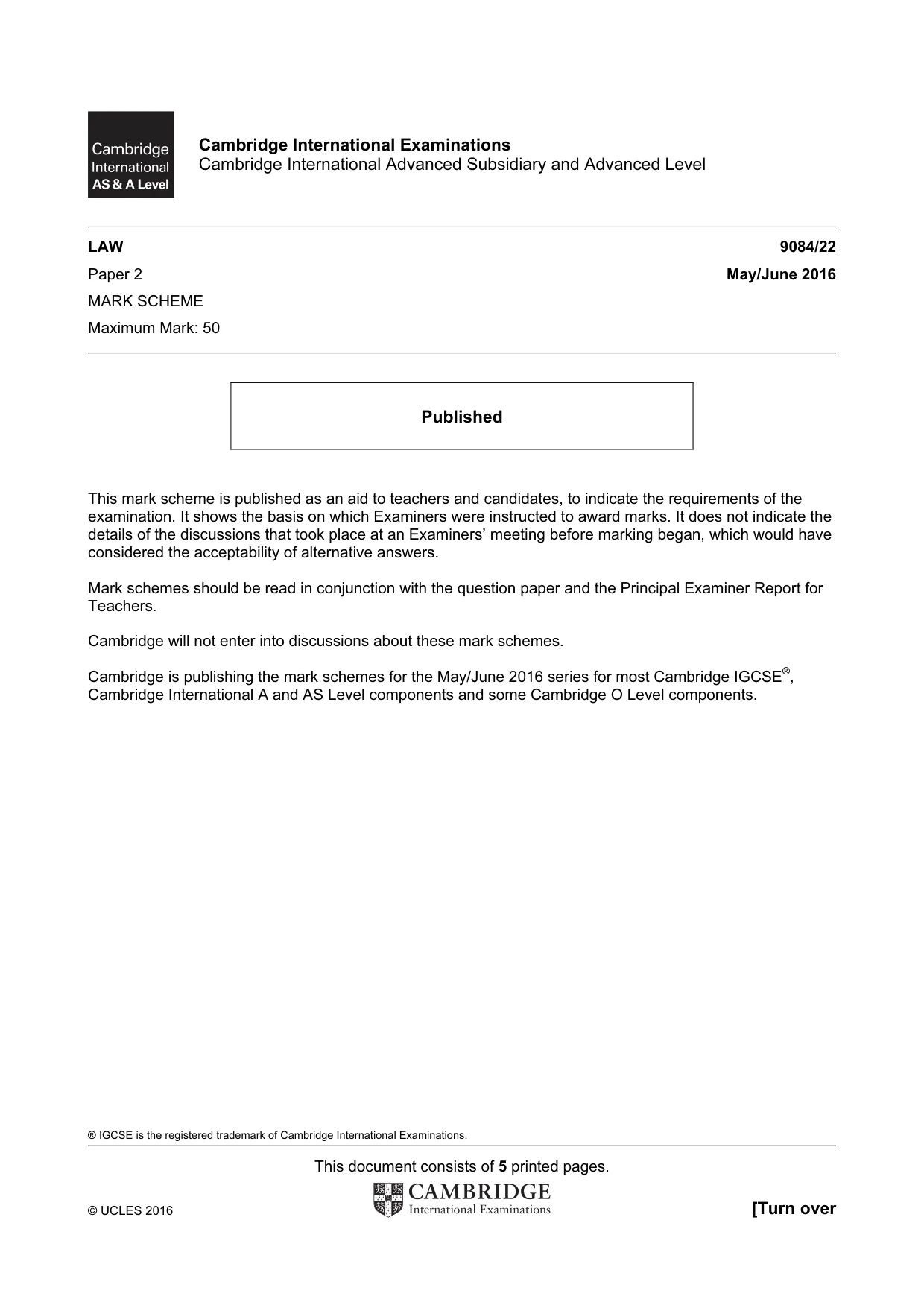
5 9084/22/M/J/16 © UCLES 2016 Source Material for Question 2 R v Hasan [2005] The elements of the defence of duress by threats are: A specified crime; An immediate threat; A threat of death or serious injury; A threat of violence to the defendant or a person for whom he has responsibility; A threat so great as to overbear the ordinary powers of human resistance. R v Hudson & Taylor [1971] H and T, aged 17 and 19, witnessed a fight in a pub. They were called to give evidence against one of those involved and had been threatened several times before the trial with violence if they gave evidence against the defendant. On the day of the trial the person making the threats was in the public gallery and stared menacingly at the appellants. The appellants lied in court and were later charged with perjury. The trial judge held that the defence of duress was not open to the jury – the threat was not of immediate violence as the threat was made in a court room and thus could not be carried out immediately. The jury convicted so H and T appealed. The appeal was allowed and the convictions were quashed. R v Graham [1982] 1. The defendant must have a reasonable belief in the circumstances; 2. This belief must have led the defendant to have a good cause to fear death or serious injury would result if he did not comply; and 3. A sober person of reasonable firmness, sharing the characteristics of the defendant, might have acted as the defendant did. R v Howe & Bannister [1987] Howe & Bailey both aged 19 and Bannister aged 20, were acting under orders of Murray aged 35. The charges related to two murders and one conspiracy to murder. It was held that the defence of duress was not available for murder and the obiter dicta stated that the defence should not be available to one who attempts murder. R v Cole [1994] C borrowed some money from D, a money lender charging a very high rate of interest. D threatened C and his girlfriend with serious violence unless he repaid the money. C robbed several building societies in order to repay the money. He raised the defence of duress. The defence was unsuccessful and C’s conviction was upheld. There was not a sufficient connection between the threat and the crime. D did not tell C to commit a crime to repay the money.
Question paper, page 6
6 9084/22/M/J/16 © UCLES 2016 BLANK PAGE
Question paper, page 7
7 9084/22/M/J/16 © UCLES 2016 BLANK PAGE
Question paper, page 8
8 9084/22/M/J/16 © UCLES 2016 BLANK PAGE Permission to reproduce items where third-party owned material protected by copyright is included has been sought and cleared where possible. Every reasonable effort has been made by the publisher (UCLES) to trace copyright holders, but if any items requiring clearance have unwittingly been included, the publisher will be pleased to make amends at the earliest possible opportunity. To avoid the issue of disclosure of answer-related information to candidates, all copyright acknowledgements are reproduced online in the Cambridge International Examinations Copyright Acknowledgements Booklet. This is produced for each series of examinations and is freely available to download at www.cie.org.uk after the live examination series. Cambridge International Examinations is part of the Cambridge Assessment Group. Cambridge Assessment is the brand name of University of Cambridge Local Examinations Syndicate (UCLES), which is itself a department of the University of Cambridge.
Mark scheme, page 1
® IGCSE is the registered trademark of Cambridge International Examinations. This document consists of 5 printed pages. © UCLES 2016 [Turn over Cambridge International Examinations Cambridge International Advanced Subsidiary and Advanced Level LAW 9084/22 Paper 2 May/June 2016 MARK SCHEME Maximum Mark: 50 Published This mark scheme is published as an aid to teachers and candidates, to indicate the requirements of the examination. It shows the basis on which Examiners were instructed to award marks. It does not indicate the details of the discussions that took place at an Examiners’ meeting before marking began, which would have considered the acceptability of alternative answers. Mark schemes should be read in conjunction with the question paper and the Principal Examiner Report for Teachers. Cambridge will not enter into discussions about these mark schemes. Cambridge is publishing the mark schemes for the May/June 2016 series for most Cambridge IGCSE®, Cambridge International A and AS Level components and some Cambridge O Level components.
Mark scheme, page 2
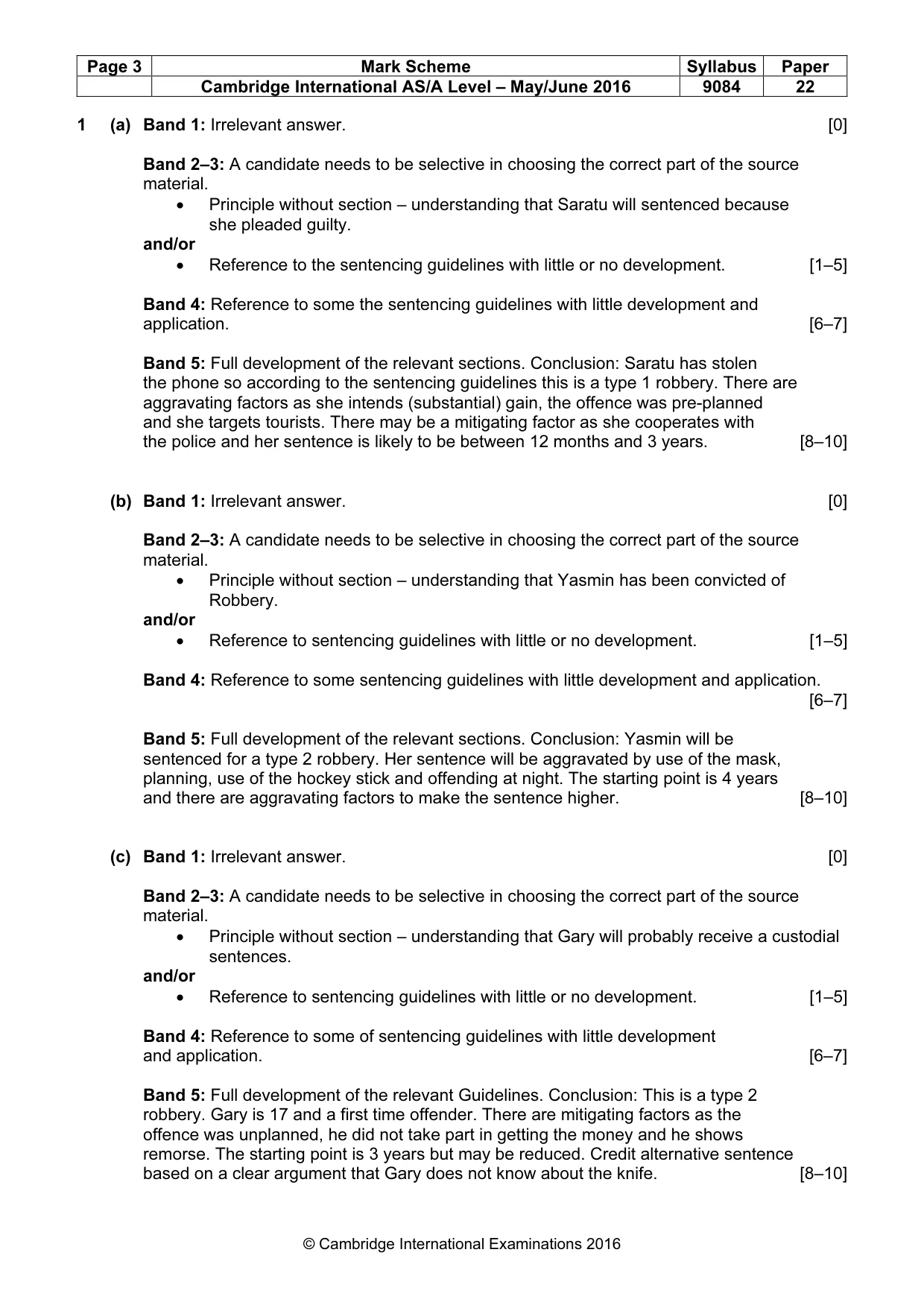
Page 2 Mark Scheme Syllabus Paper Cambridge International AS/A Level – May/June 2016 9084 22 © Cambridge International Examinations 2016 General Marking Guidance This mark scheme includes a summary of appropriate content for answering each question. It should be emphasised, however, that this material is for illustrative purposes and is not intended to provide a definitive guide to acceptable answers. It is quite possible that among the scripts there will be some candidate answers that are not covered directly by the content of this mark scheme. In such cases, professional judgement should be exercised in assessing the merits of the answer and the senior examiners should be consulted if further guidance is required. Mark Bands The mark bands and descriptors applicable to all questions on the paper are as follows. Indicative content for each of the questions follows overleaf. Band 1: The answer contains no relevant material. Band 2: The candidate introduces fragments of information or unexplained examples from which no coherent explanation or analysis can emerge. OR The candidate attempts to introduce an explanation and/or analysis but it is so fundamentally undermined by error and confusion that it remains substantially incoherent. Band 3: The candidate begins to indicate some capacity for explanation and analysis by introducing some of the issues, but explanations are limited and superficial. OR The candidate adopts an approach in which there is concentration on explanation in terms of facts presented rather than through the development and explanation of legal principles and rules. OR The candidate attempts to introduce material across the range of potential content, but it is weak or confused so that no real explanation or conclusion emerges. Band 4: Where there is more than one issue, the candidate demonstrates a clear understanding of one of the main issues of the question, giving explanations and using illustrations so that a full and detailed picture is presented of this issue. OR The candidate presents a more limited explanation of all parts of the answer, but there is some lack of detail or superficiality in respect of either or both so that the answer is not fully rounded. Band 5: The candidate presents a detailed explanation and discussion of all areas of relevant law and, while there may be some minor inaccuracies and/or imbalance, a coherent explanation emerges.
Mark scheme, page 3
Page 3 Mark Scheme Syllabus Paper Cambridge International AS/A Level – May/June 2016 9084 22 © Cambridge International Examinations 2016 1 (a) Band 1: Irrelevant answer. [0] Band 2–3: A candidate needs to be selective in choosing the correct part of the source material. • Principle without section – understanding that Saratu will sentenced because she pleaded guilty. and/or • Reference to the sentencing guidelines with little or no development. [1–5] Band 4: Reference to some the sentencing guidelines with little development and application. [6–7] Band 5: Full development of the relevant sections. Conclusion: Saratu has stolen the phone so according to the sentencing guidelines this is a type 1 robbery. There are aggravating factors as she intends (substantial) gain, the offence was pre-planned and she targets tourists. There may be a mitigating factor as she cooperates with the police and her sentence is likely to be between 12 months and 3 years. [8–10] (b) Band 1: Irrelevant answer. [0] Band 2–3: A candidate needs to be selective in choosing the correct part of the source material. • Principle without section – understanding that Yasmin has been convicted of Robbery. and/or • Reference to sentencing guidelines with little or no development. [1–5] Band 4: Reference to some sentencing guidelines with little development and application. [6–7] Band 5: Full development of the relevant sections. Conclusion: Yasmin will be sentenced for a type 2 robbery. Her sentence will be aggravated by use of the mask, planning, use of the hockey stick and offending at night. The starting point is 4 years and there are aggravating factors to make the sentence higher. [8–10] (c) Band 1: Irrelevant answer. [0] Band 2–3: A candidate needs to be selective in choosing the correct part of the source material. • Principle without section – understanding that Gary will probably receive a custodial sentences. and/or • Reference to sentencing guidelines with little or no development. [1–5] Band 4: Reference to some of sentencing guidelines with little development and application. [6–7] Band 5: Full development of the relevant Guidelines. Conclusion: This is a type 2 robbery. Gary is 17 and a first time offender. There are mitigating factors as the offence was unplanned, he did not take part in getting the money and he shows remorse. The starting point is 3 years but may be reduced. Credit alternative sentence based on a clear argument that Gary does not know about the knife. [8–10]
Mark scheme, page 4
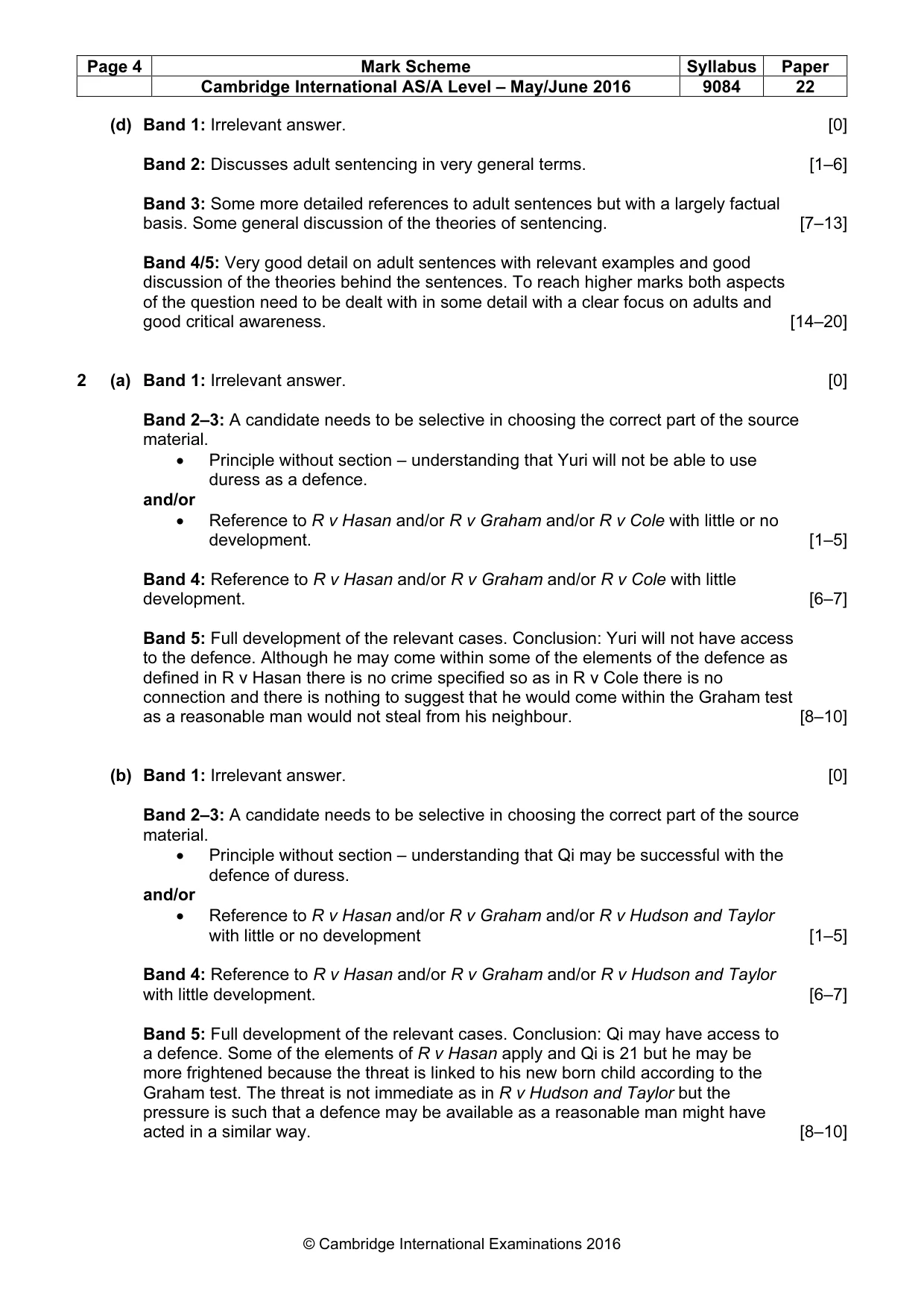
Page 4 Mark Scheme Syllabus Paper Cambridge International AS/A Level – May/June 2016 9084 22 © Cambridge International Examinations 2016 (d) Band 1: Irrelevant answer. [0] Band 2: Discusses adult sentencing in very general terms. [1–6] Band 3: Some more detailed references to adult sentences but with a largely factual basis. Some general discussion of the theories of sentencing. [7–13] Band 4/5: Very good detail on adult sentences with relevant examples and good discussion of the theories behind the sentences. To reach higher marks both aspects of the question need to be dealt with in some detail with a clear focus on adults and good critical awareness. [14–20] 2 (a) Band 1: Irrelevant answer. [0] Band 2–3: A candidate needs to be selective in choosing the correct part of the source material. • Principle without section – understanding that Yuri will not be able to use duress as a defence. and/or • Reference to R v Hasan and/or R v Graham and/or R v Cole with little or no development. [1–5] Band 4: Reference to R v Hasan and/or R v Graham and/or R v Cole with little development. [6–7] Band 5: Full development of the relevant cases. Conclusion: Yuri will not have access to the defence. Although he may come within some of the elements of the defence as defined in R v Hasan there is no crime specified so as in R v Cole there is no connection and there is nothing to suggest that he would come within the Graham test as a reasonable man would not steal from his neighbour. [8–10] (b) Band 1: Irrelevant answer. [0] Band 2–3: A candidate needs to be selective in choosing the correct part of the source material. • Principle without section – understanding that Qi may be successful with the defence of duress. and/or • Reference to R v Hasan and/or R v Graham and/or R v Hudson and Taylor with little or no development [1–5] Band 4: Reference to R v Hasan and/or R v Graham and/or R v Hudson and Taylor with little development. [6–7] Band 5: Full development of the relevant cases. Conclusion: Qi may have access to a defence. Some of the elements of R v Hasan apply and Qi is 21 but he may be more frightened because the threat is linked to his new born child according to the Graham test. The threat is not immediate as in R v Hudson and Taylor but the pressure is such that a defence may be available as a reasonable man might have acted in a similar way. [8–10]
Mark scheme, page 5
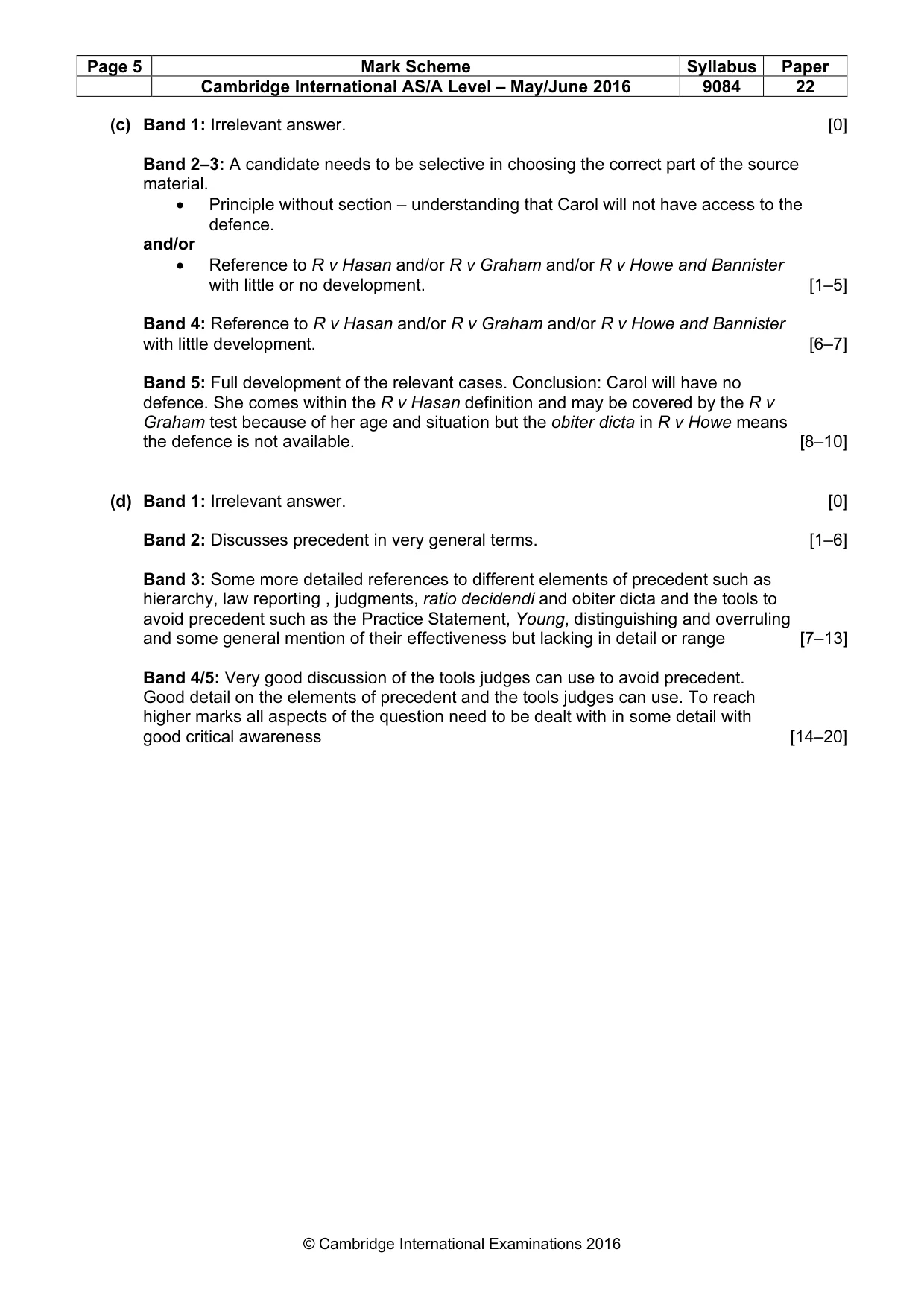
Page 5 Mark Scheme Syllabus Paper Cambridge International AS/A Level – May/June 2016 9084 22 © Cambridge International Examinations 2016 (c) Band 1: Irrelevant answer. [0] Band 2–3: A candidate needs to be selective in choosing the correct part of the source material. • Principle without section – understanding that Carol will not have access to the defence. and/or • Reference to R v Hasan and/or R v Graham and/or R v Howe and Bannister with little or no development. [1–5] Band 4: Reference to R v Hasan and/or R v Graham and/or R v Howe and Bannister with little development. [6–7] Band 5: Full development of the relevant cases. Conclusion: Carol will have no defence. She comes within the R v Hasan definition and may be covered by the R v Graham test because of her age and situation but the obiter dicta in R v Howe means the defence is not available. [8–10] (d) Band 1: Irrelevant answer. [0] Band 2: Discusses precedent in very general terms. [1–6] Band 3: Some more detailed references to different elements of precedent such as hierarchy, law reporting , judgments, ratio decidendi and obiter dicta and the tools to avoid precedent such as the Practice Statement, Young, distinguishing and overruling and some general mention of their effectiveness but lacking in detail or range [7–13] Band 4/5: Very good discussion of the tools judges can use to avoid precedent. Good detail on the elements of precedent and the tools judges can use. To reach higher marks all aspects of the question need to be dealt with in some detail with good critical awareness [14–20]
What you needed in this session
Cambridge’s own grade thresholds for 2016 May/June, Paper 2 · Variant 2. A higher threshold means an easier paper — the bar moves with how the cohort did.