Cambridge A Level Law 9084 — 2016 May/June Paper 2 · Variant 3
9084/23/M/J/16 · 50 marks · ≈56 min
The question paper and its mark scheme, free to read here and free to download. This is Cambridge’s own paper, exactly as it was sat.
Question paper8 pages


Mark scheme
No mark scheme is in the library for this paper.
Paper as text
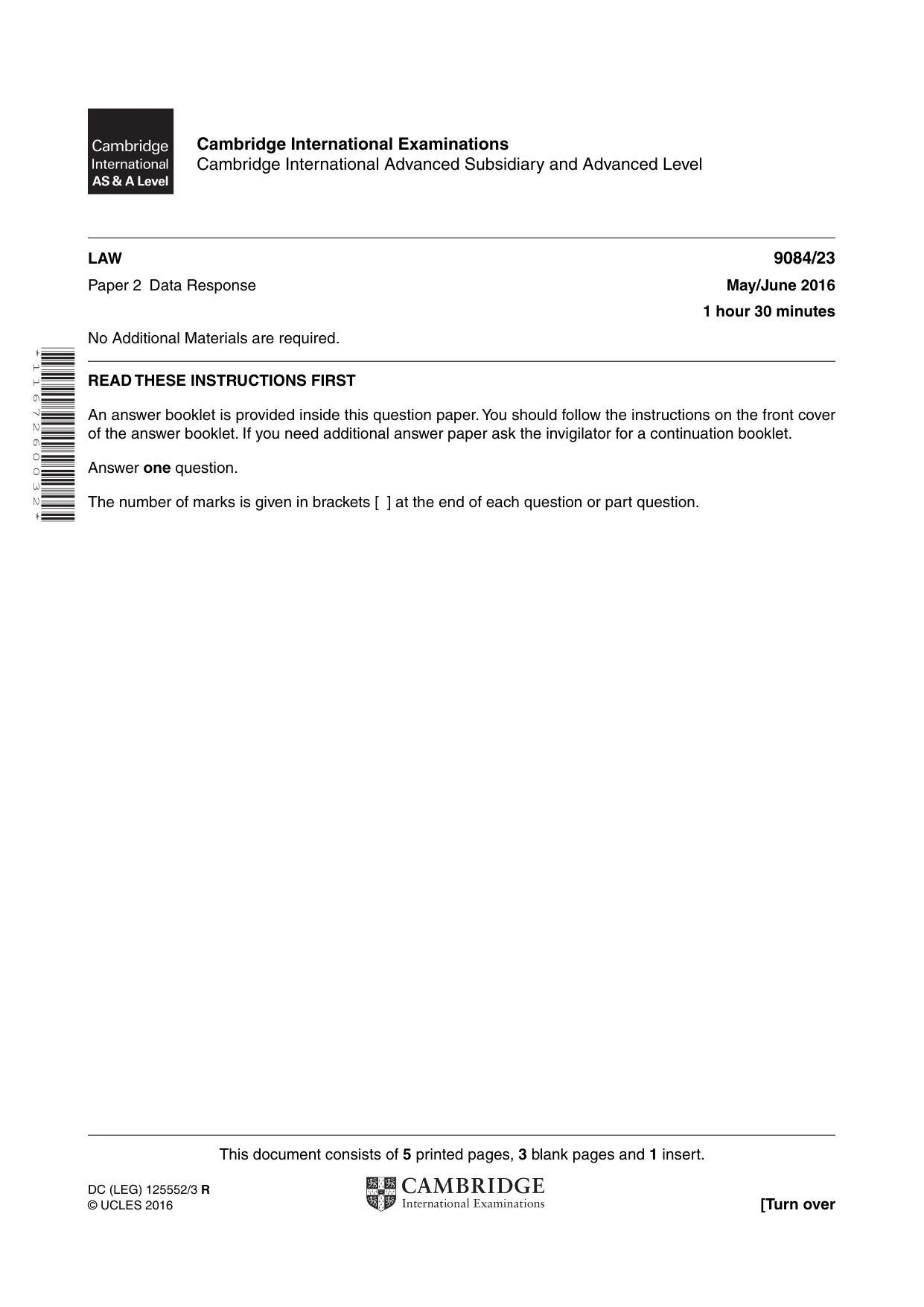
Question paper, page 1
This document consists of 5 printed pages, 3 blank pages and 1 insert. DC (LEG) 125552/3 R © UCLES 2016 [Turn over Cambridge International Examinations Cambridge International Advanced Subsidiary and Advanced Level * 1 1 6 7 2 6 0 0 3 2 * LAW 9084/23 Paper 2 Data Response May/June 2016 1 hour 30 minutes No Additional Materials are required. READ THESE INSTRUCTIONS FIRST An answer booklet is provided inside this question paper. You should follow the instructions on the front cover of the answer booklet. If you need additional answer paper ask the invigilator for a continuation booklet. Answer one question. The number of marks is given in brackets [ ] at the end of each question or part question.
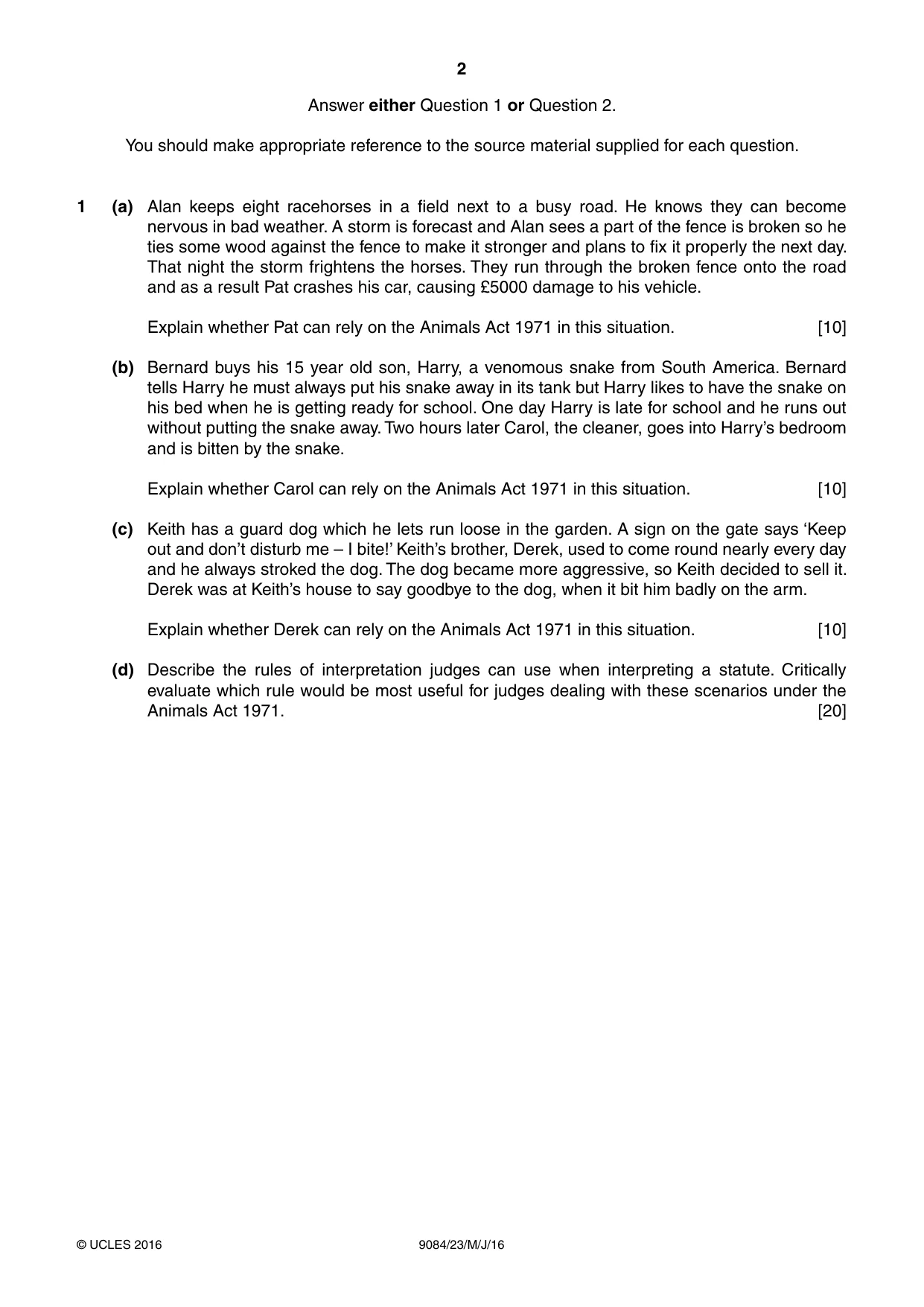
Question paper, page 2
2 9084/23/M/J/16 © UCLES 2016 Answer either Question 1 or Question 2. You should make appropriate reference to the source material supplied for each question. 1 (a) Alan keeps eight racehorses in a field next to a busy road. He knows they can become nervous in bad weather. A storm is forecast and Alan sees a part of the fence is broken so he ties some wood against the fence to make it stronger and plans to fix it properly the next day. That night the storm frightens the horses. They run through the broken fence onto the road and as a result Pat crashes his car, causing £5000 damage to his vehicle. Explain whether Pat can rely on the Animals Act 1971 in this situation. [10] (b) Bernard buys his 15 year old son, Harry, a venomous snake from South America. Bernard tells Harry he must always put his snake away in its tank but Harry likes to have the snake on his bed when he is getting ready for school. One day Harry is late for school and he runs out without putting the snake away. Two hours later Carol, the cleaner, goes into Harry’s bedroom and is bitten by the snake. Explain whether Carol can rely on the Animals Act 1971 in this situation. [10] (c) Keith has a guard dog which he lets run loose in the garden. A sign on the gate says ‘Keep out and don’t disturb me – I bite!’ Keith’s brother, Derek, used to come round nearly every day and he always stroked the dog. The dog became more aggressive, so Keith decided to sell it. Derek was at Keith’s house to say goodbye to the dog, when it bit him badly on the arm. Explain whether Derek can rely on the Animals Act 1971 in this situation. [10] (d) Describe the rules of interpretation judges can use when interpreting a statute. Critically evaluate which rule would be most useful for judges dealing with these scenarios under the Animals Act 1971. [20]
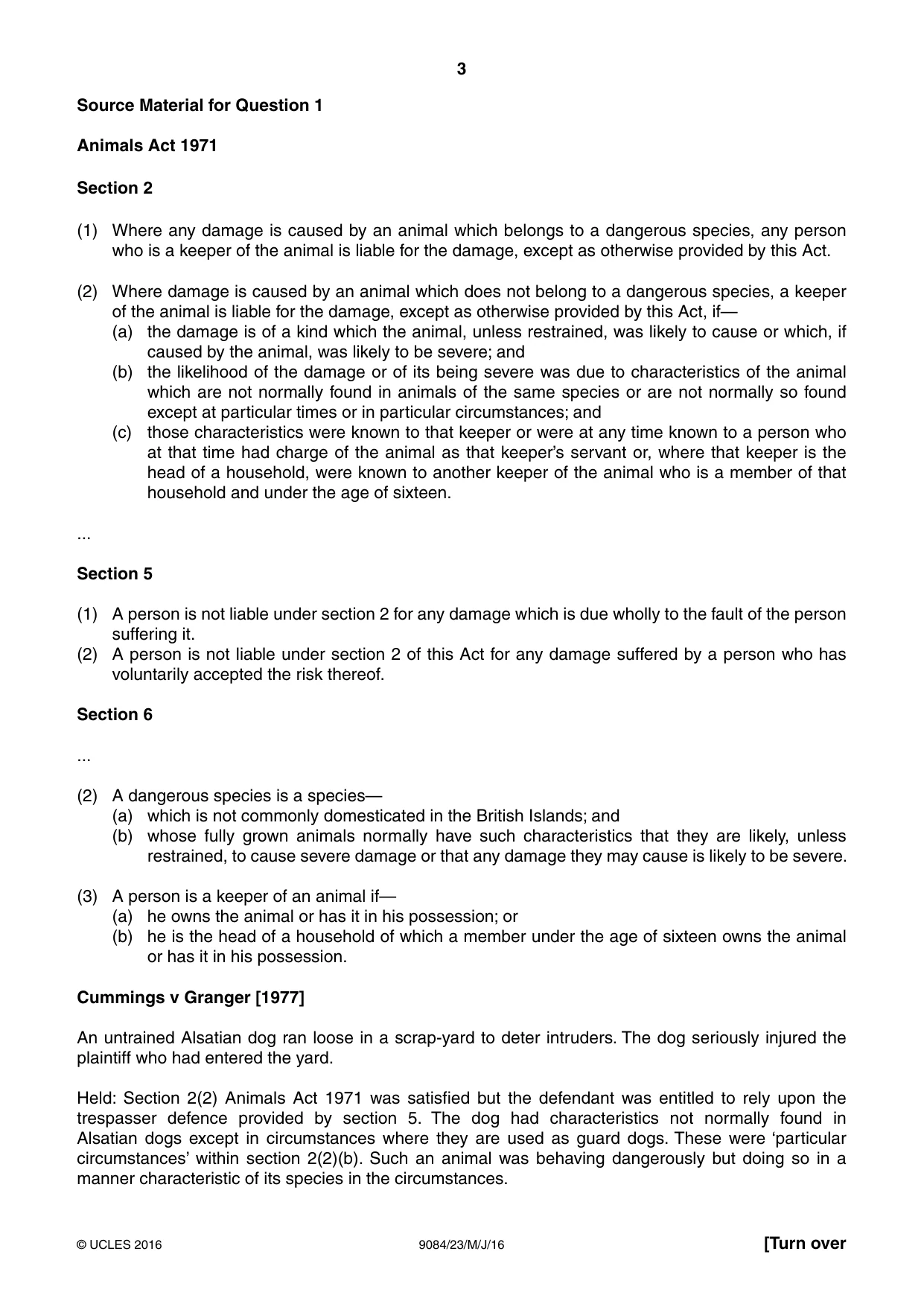
Question paper, page 3
3 9084/23/M/J/16 © UCLES 2016 [Turn over Source Material for Question 1 Animals Act 1971 Section 2 (1) Where any damage is caused by an animal which belongs to a dangerous species, any person who is a keeper of the animal is liable for the damage, except as otherwise provided by this Act. (2) Where damage is caused by an animal which does not belong to a dangerous species, a keeper of the animal is liable for the damage, except as otherwise provided by this Act, if— (a) the damage is of a kind which the animal, unless restrained, was likely to cause or which, if caused by the animal, was likely to be severe; and (b) the likelihood of the damage or of its being severe was due to characteristics of the animal which are not normally found in animals of the same species or are not normally so found except at particular times or in particular circumstances; and (c) those characteristics were known to that keeper or were at any time known to a person who at that time had charge of the animal as that keeper’s servant or, where that keeper is the head of a household, were known to another keeper of the animal who is a member of that household and under the age of sixteen. ... Section 5 (1) A person is not liable under section 2 for any damage which is due wholly to the fault of the person suffering it. (2) A person is not liable under section 2 of this Act for any damage suffered by a person who has voluntarily accepted the risk thereof. Section 6 ... (2) A dangerous species is a species— (a) which is not commonly domesticated in the British Islands; and (b) whose fully grown animals normally have such characteristics that they are likely, unless restrained, to cause severe damage or that any damage they may cause is likely to be severe. (3) A person is a keeper of an animal if— (a) he owns the animal or has it in his possession; or (b) he is the head of a household of which a member under the age of sixteen owns the animal or has it in his possession. Cummings v Granger [1977] An untrained Alsatian dog ran loose in a scrap-yard to deter intruders. The dog seriously injured the plaintiff who had entered the yard. Held: Section 2(2) Animals Act 1971 was satisfied but the defendant was entitled to rely upon the trespasser defence provided by section 5. The dog had characteristics not normally found in Alsatian dogs except in circumstances where they are used as guard dogs. These were ‘particular circumstances’ within section 2(2)(b). Such an animal was behaving dangerously but doing so in a manner characteristic of its species in the circumstances.
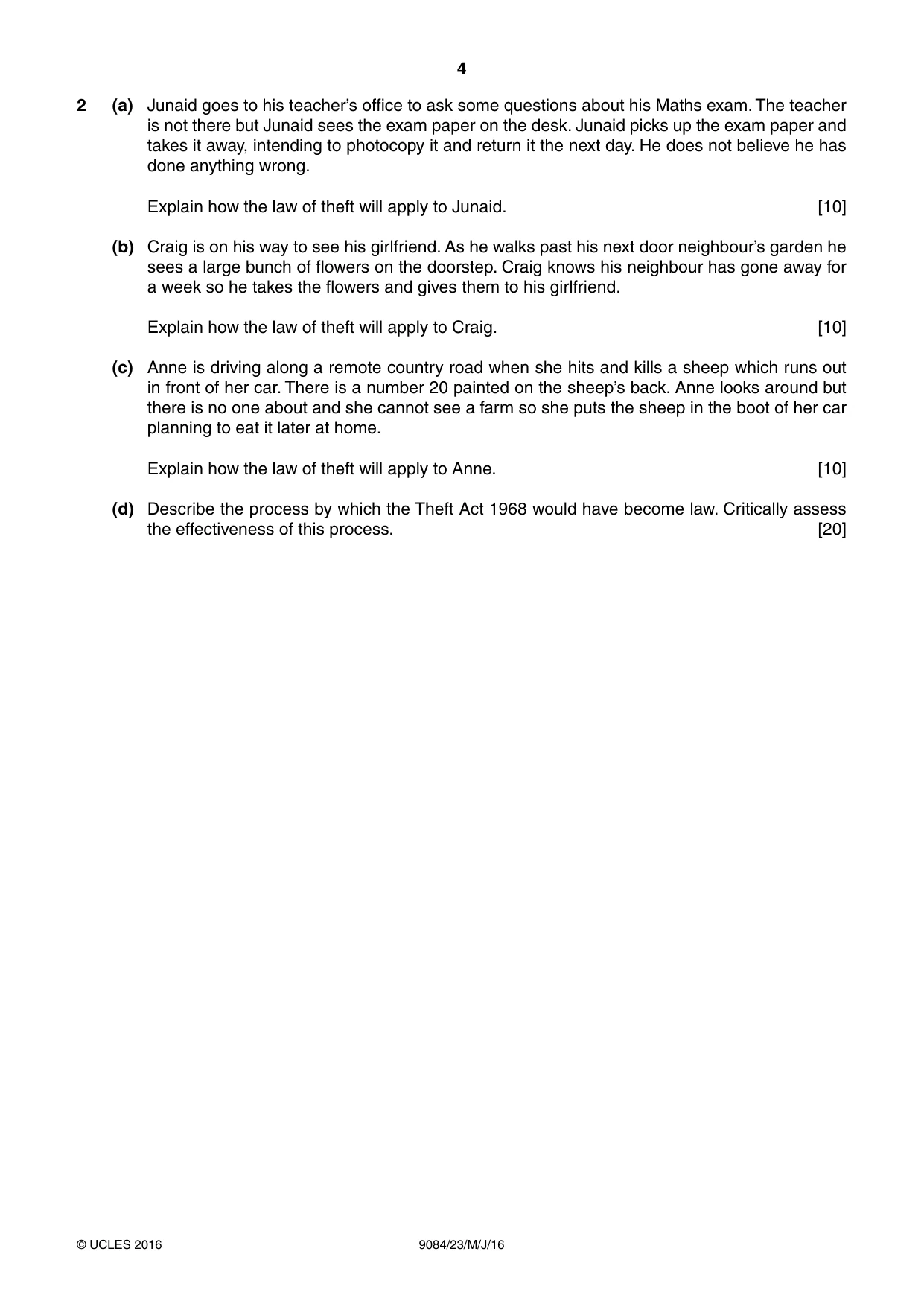
Question paper, page 4
4 9084/23/M/J/16 © UCLES 2016 2 (a) Junaid goes to his teacher’s office to ask some questions about his Maths exam. The teacher is not there but Junaid sees the exam paper on the desk. Junaid picks up the exam paper and takes it away, intending to photocopy it and return it the next day. He does not believe he has done anything wrong. Explain how the law of theft will apply to Junaid. [10] (b) Craig is on his way to see his girlfriend. As he walks past his next door neighbour’s garden he sees a large bunch of flowers on the doorstep. Craig knows his neighbour has gone away for a week so he takes the flowers and gives them to his girlfriend. Explain how the law of theft will apply to Craig. [10] (c) Anne is driving along a remote country road when she hits and kills a sheep which runs out in front of her car. There is a number 20 painted on the sheep’s back. Anne looks around but there is no one about and she cannot see a farm so she puts the sheep in the boot of her car planning to eat it later at home. Explain how the law of theft will apply to Anne. [10] (d) Describe the process by which the Theft Act 1968 would have become law. Critically assess the effectiveness of this process. [20]
Question paper, page 5
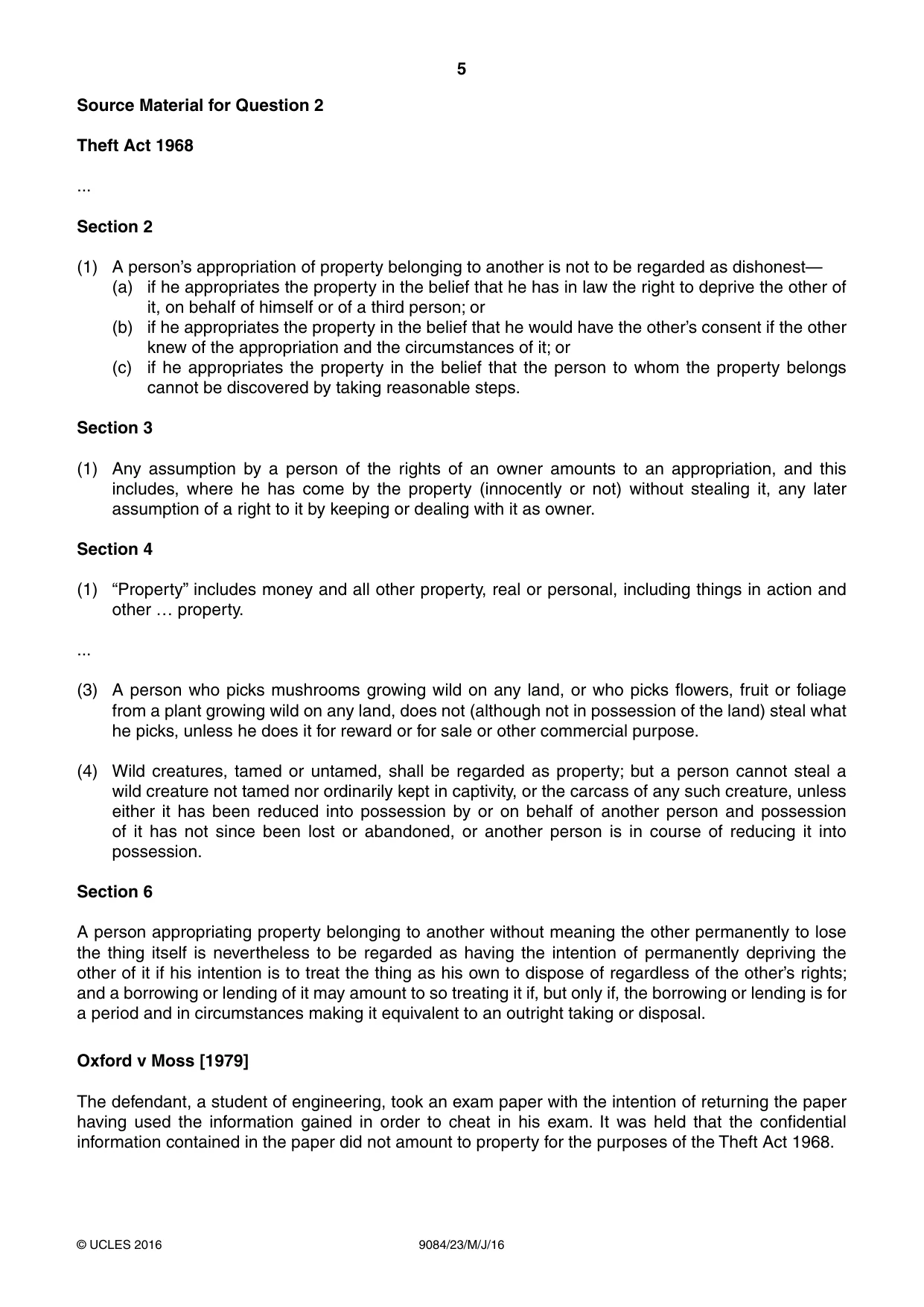
5 9084/23/M/J/16 © UCLES 2016 Source Material for Question 2 Theft Act 1968 ... Section 2 (1) A person’s appropriation of property belonging to another is not to be regarded as dishonest— (a) if he appropriates the property in the belief that he has in law the right to deprive the other of it, on behalf of himself or of a third person; or (b) if he appropriates the property in the belief that he would have the other’s consent if the other knew of the appropriation and the circumstances of it; or (c) if he appropriates the property in the belief that the person to whom the property belongs cannot be discovered by taking reasonable steps. Section 3 (1) Any assumption by a person of the rights of an owner amounts to an appropriation, and this includes, where he has come by the property (innocently or not) without stealing it, any later assumption of a right to it by keeping or dealing with it as owner. Section 4 (1) “Property” includes money and all other property, real or personal, including things in action and other … property. ... (3) A person who picks mushrooms growing wild on any land, or who picks flowers, fruit or foliage from a plant growing wild on any land, does not (although not in possession of the land) steal what he picks, unless he does it for reward or for sale or other commercial purpose. (4) Wild creatures, tamed or untamed, shall be regarded as property; but a person cannot steal a wild creature not tamed nor ordinarily kept in captivity, or the carcass of any such creature, unless either it has been reduced into possession by or on behalf of another person and possession of it has not since been lost or abandoned, or another person is in course of reducing it into possession. Section 6 A person appropriating property belonging to another without meaning the other permanently to lose the thing itself is nevertheless to be regarded as having the intention of permanently depriving the other of it if his intention is to treat the thing as his own to dispose of regardless of the other’s rights; and a borrowing or lending of it may amount to so treating it if, but only if, the borrowing or lending is for a period and in circumstances making it equivalent to an outright taking or disposal. Oxford v Moss [1979] The defendant, a student of engineering, took an exam paper with the intention of returning the paper having used the information gained in order to cheat in his exam. It was held that the confidential information contained in the paper did not amount to property for the purposes of the Theft Act 1968.
Question paper, page 6
6 9084/23/M/J/16 © UCLES 2016 BLANK PAGE
Question paper, page 7
7 9084/23/M/J/16 © UCLES 2016 BLANK PAGE
Question paper, page 8
8 9084/23/M/J/16 © UCLES 2016 Permission to reproduce items where third-party owned material protected by copyright is included has been sought and cleared where possible. Every reasonable effort has been made by the publisher (UCLES) to trace copyright holders, but if any items requiring clearance have unwittingly been included, the publisher will be pleased to make amends at the earliest possible opportunity. To avoid the issue of disclosure of answer-related information to candidates, all copyright acknowledgements are reproduced online in the Cambridge International Examinations Copyright Acknowledgements Booklet. This is produced for each series of examinations and is freely available to download at www.cie.org.uk after the live examination series. Cambridge International Examinations is part of the Cambridge Assessment Group. Cambridge Assessment is the brand name of University of Cambridge Local Examinations Syndicate (UCLES), which is itself a department of the University of Cambridge. BLANK PAGE
What you needed in this session
Cambridge’s own grade thresholds for 2016 May/June, Paper 2 · Variant 3. A higher threshold means an easier paper — the bar moves with how the cohort did.