Cambridge A Level Law 9084 — 2016 May/June Paper 2 · Variant 1
9084/21/M/J/16 · 50 marks · ≈56 min
The question paper and its mark scheme, free to read here and free to download. This is Cambridge’s own paper, exactly as it was sat.
Question paper8 pages



Mark scheme
No mark scheme is in the library for this paper.
Paper as text
Question paper, page 1
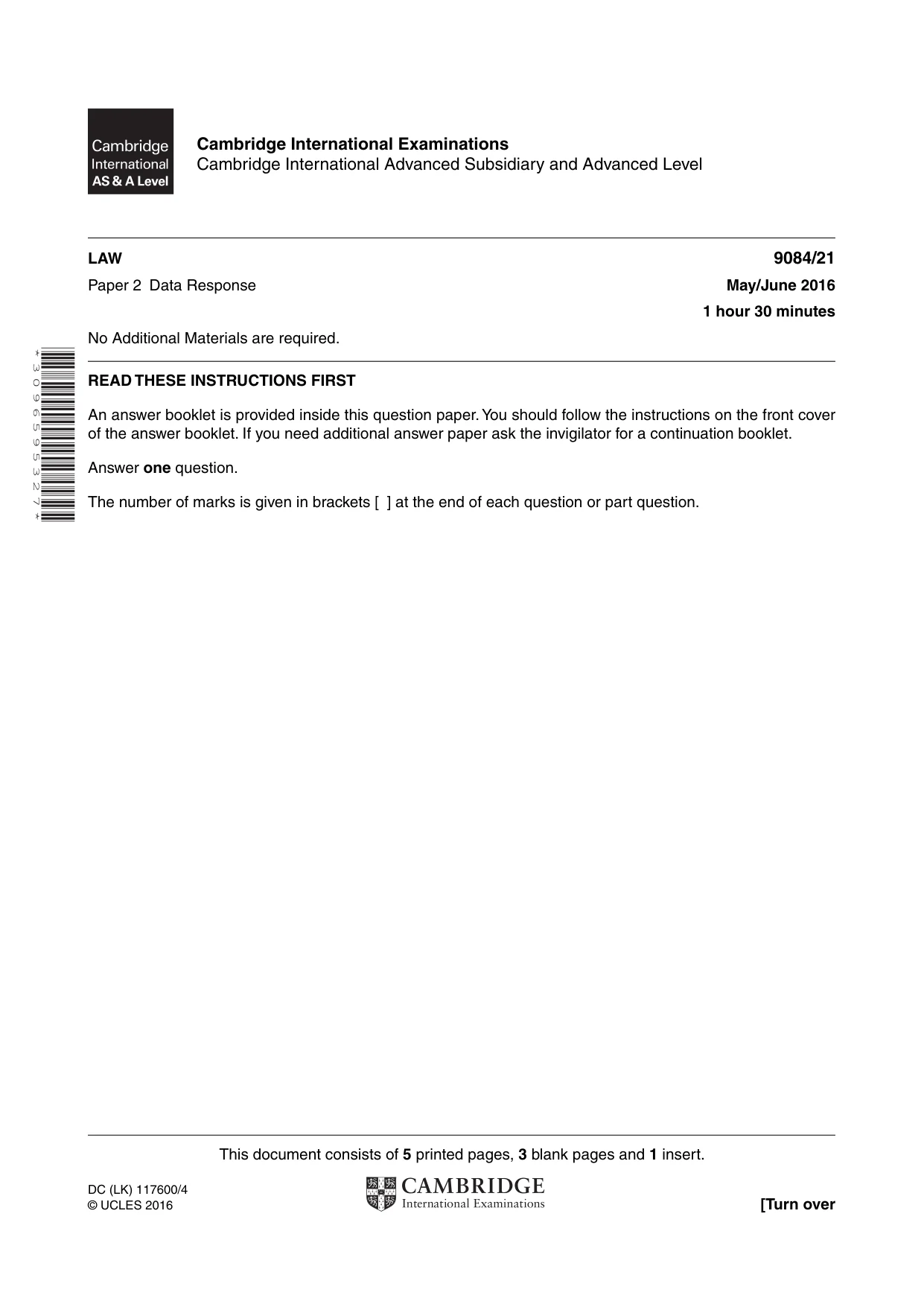
This document consists of 5 printed pages, 3 blank pages and 1 insert. DC (LK) 117600/4 © UCLES 2016 [Turn over Cambridge International Examinations Cambridge International Advanced Subsidiary and Advanced Level * 3 0 9 6 5 9 5 3 2 7 * LAW 9084/21 Paper 2 Data Response May/June 2016 1 hour 30 minutes No Additional Materials are required. READ THESE INSTRUCTIONS FIRST An answer booklet is provided inside this question paper. You should follow the instructions on the front cover of the answer booklet. If you need additional answer paper ask the invigilator for a continuation booklet. Answer one question. The number of marks is given in brackets [ ] at the end of each question or part question.
Question paper, page 2
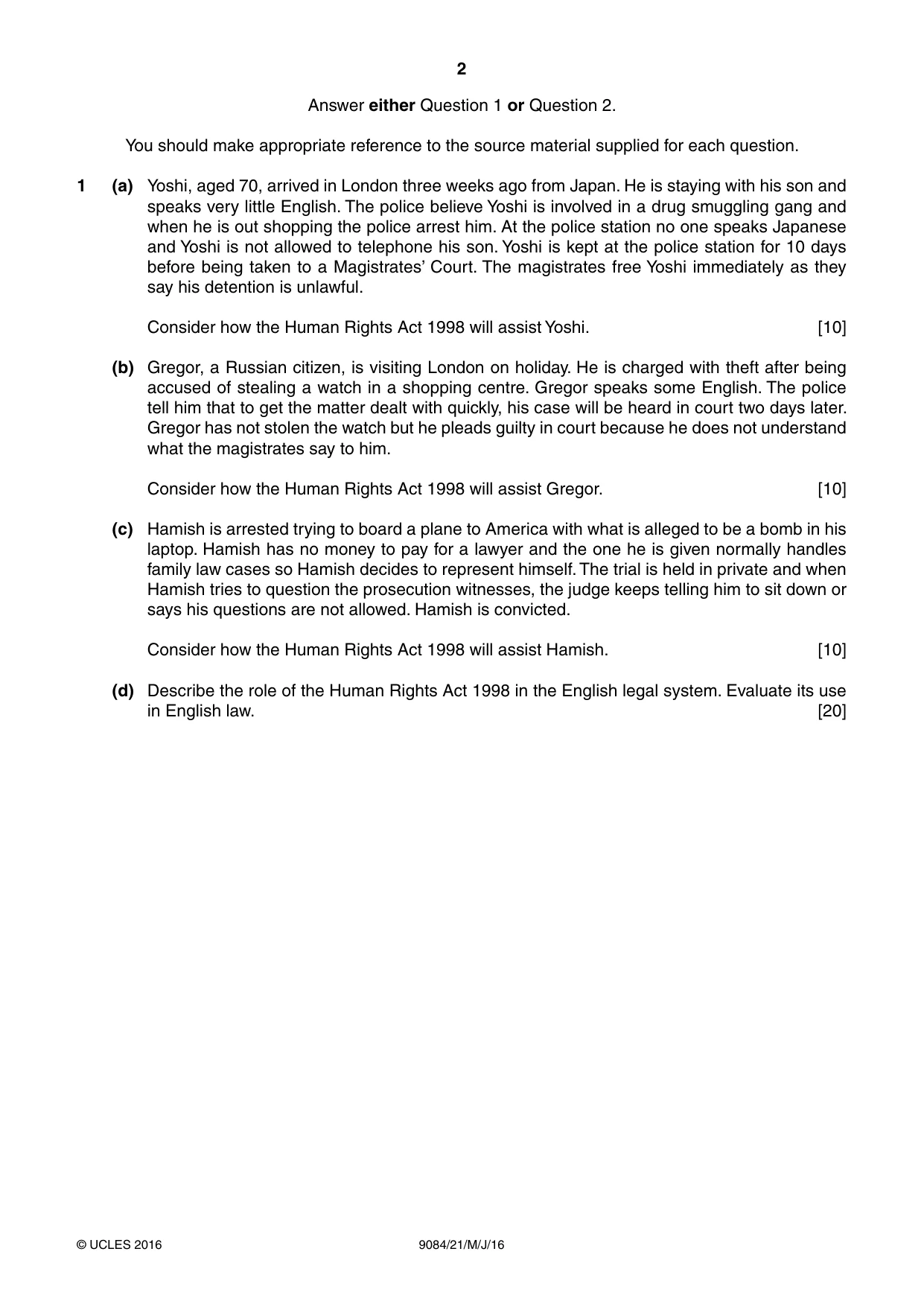
2 9084/21/M/J/16 © UCLES 2016 Answer either Question 1 or Question 2. You should make appropriate reference to the source material supplied for each question. 1 (a) Yoshi, aged 70, arrived in London three weeks ago from Japan. He is staying with his son and speaks very little English. The police believe Yoshi is involved in a drug smuggling gang and when he is out shopping the police arrest him. At the police station no one speaks Japanese and Yoshi is not allowed to telephone his son. Yoshi is kept at the police station for 10 days before being taken to a Magistrates’ Court. The magistrates free Yoshi immediately as they say his detention is unlawful. Consider how the Human Rights Act 1998 will assist Yoshi. [10] (b) Gregor, a Russian citizen, is visiting London on holiday. He is charged with theft after being accused of stealing a watch in a shopping centre. Gregor speaks some English. The police tell him that to get the matter dealt with quickly, his case will be heard in court two days later. Gregor has not stolen the watch but he pleads guilty in court because he does not understand what the magistrates say to him. Consider how the Human Rights Act 1998 will assist Gregor. [10] (c) Hamish is arrested trying to board a plane to America with what is alleged to be a bomb in his laptop. Hamish has no money to pay for a lawyer and the one he is given normally handles family law cases so Hamish decides to represent himself. The trial is held in private and when Hamish tries to question the prosecution witnesses, the judge keeps telling him to sit down or says his questions are not allowed. Hamish is convicted. Consider how the Human Rights Act 1998 will assist Hamish. [10] (d) Describe the role of the Human Rights Act 1998 in the English legal system. Evaluate its use in English law. [20]
Question paper, page 3
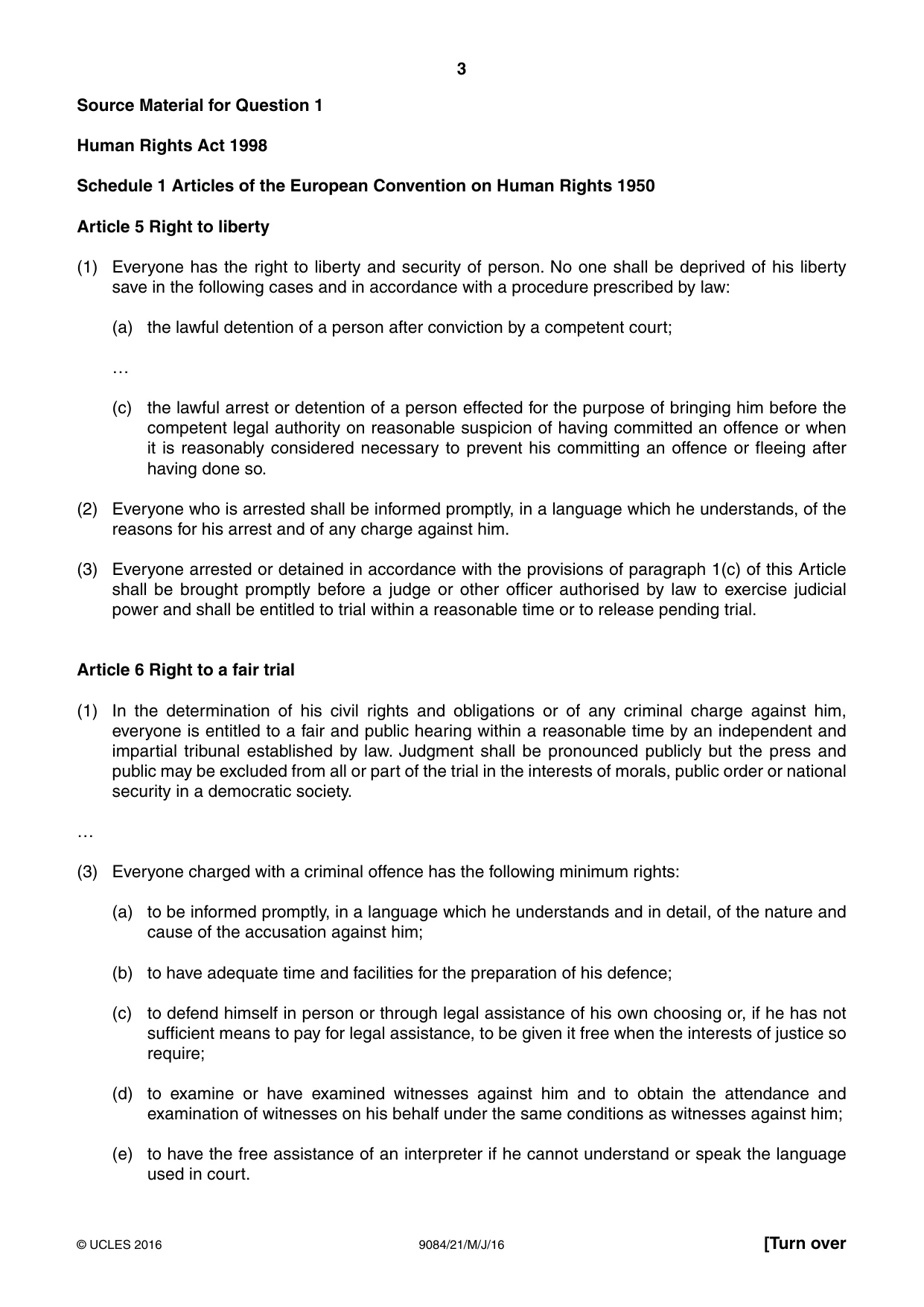
3 9084/21/M/J/16 © UCLES 2016 [Turn over Source Material for Question 1 Human Rights Act 1998 Schedule 1 Articles of the European Convention on Human Rights 1950 Article 5 Right to liberty (1) Everyone has the right to liberty and security of person. No one shall be deprived of his liberty save in the following cases and in accordance with a procedure prescribed by law: (a) the lawful detention of a person after conviction by a competent court; … (c) the lawful arrest or detention of a person effected for the purpose of bringing him before the competent legal authority on reasonable suspicion of having committed an offence or when it is reasonably considered necessary to prevent his committing an offence or fleeing after having done so. (2) Everyone who is arrested shall be informed promptly, in a language which he understands, of the reasons for his arrest and of any charge against him. (3) Everyone arrested or detained in accordance with the provisions of paragraph 1(c) of this Article shall be brought promptly before a judge or other officer authorised by law to exercise judicial power and shall be entitled to trial within a reasonable time or to release pending trial. Article 6 Right to a fair trial (1) In the determination of his civil rights and obligations or of any criminal charge against him, everyone is entitled to a fair and public hearing within a reasonable time by an independent and impartial tribunal established by law. Judgment shall be pronounced publicly but the press and public may be excluded from all or part of the trial in the interests of morals, public order or national security in a democratic society. … (3) Everyone charged with a criminal offence has the following minimum rights: (a) to be informed promptly, in a language which he understands and in detail, of the nature and cause of the accusation against him; (b) to have adequate time and facilities for the preparation of his defence; (c) to defend himself in person or through legal assistance of his own choosing or, if he has not sufficient means to pay for legal assistance, to be given it free when the interests of justice so require; (d) to examine or have examined witnesses against him and to obtain the attendance and examination of witnesses on his behalf under the same conditions as witnesses against him; (e) to have the free assistance of an interpreter if he cannot understand or speak the language used in court.
Question paper, page 4
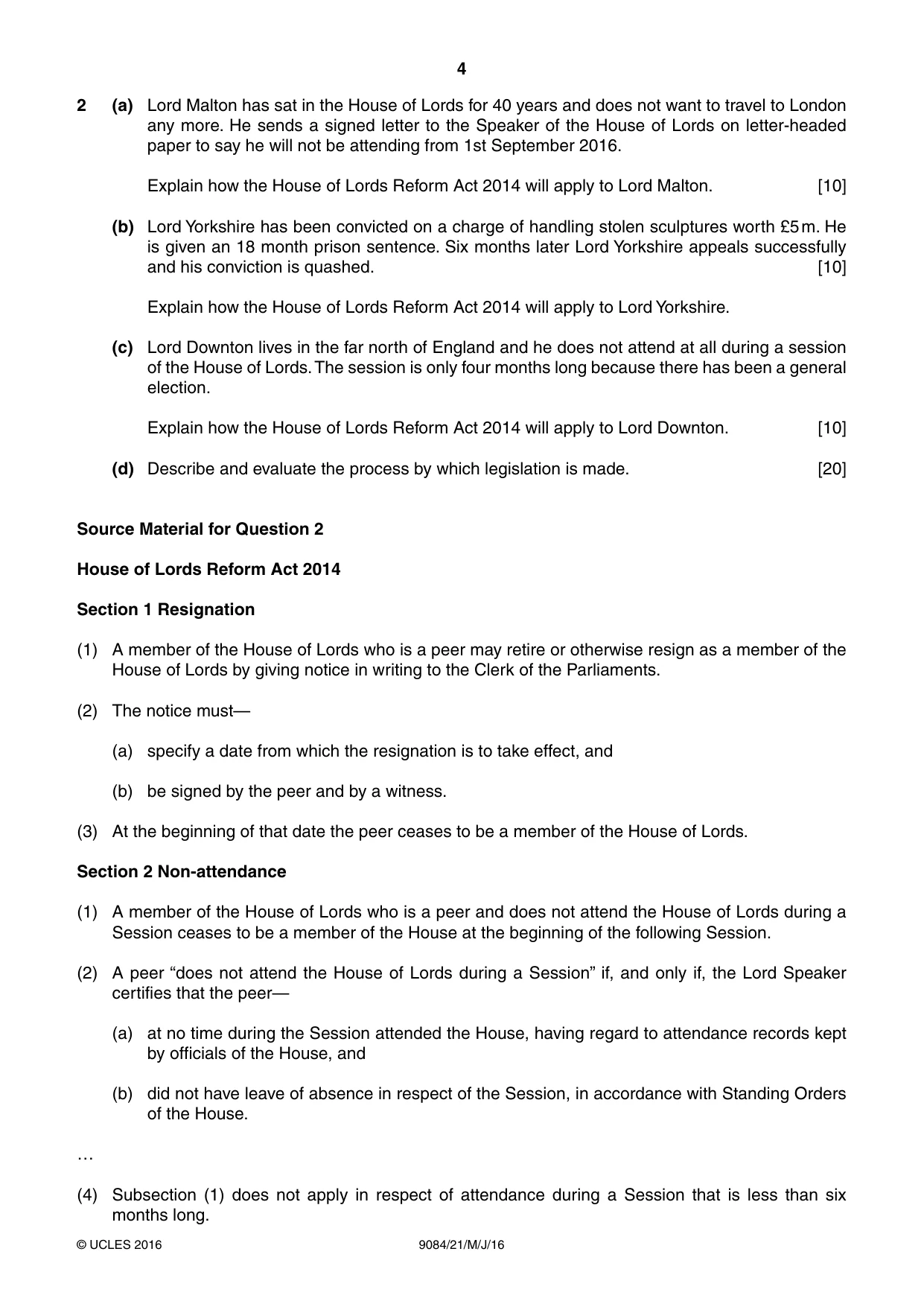
4 9084/21/M/J/16 © UCLES 2016 2 (a) Lord Malton has sat in the House of Lords for 40 years and does not want to travel to London any more. He sends a signed letter to the Speaker of the House of Lords on letter-headed paper to say he will not be attending from 1st September 2016. Explain how the House of Lords Reform Act 2014 will apply to Lord Malton. [10] (b) Lord Yorkshire has been convicted on a charge of handling stolen sculptures worth £5 m. He is given an 18 month prison sentence. Six months later Lord Yorkshire appeals successfully and his conviction is quashed. [10] Explain how the House of Lords Reform Act 2014 will apply to Lord Yorkshire. (c) Lord Downton lives in the far north of England and he does not attend at all during a session of the House of Lords. The session is only four months long because there has been a general election. Explain how the House of Lords Reform Act 2014 will apply to Lord Downton. [10] (d) Describe and evaluate the process by which legislation is made. [20] Source Material for Question 2 House of Lords Reform Act 2014 Section 1 Resignation (1) A member of the House of Lords who is a peer may retire or otherwise resign as a member of the House of Lords by giving notice in writing to the Clerk of the Parliaments. (2) The notice must— (a) specify a date from which the resignation is to take effect, and (b) be signed by the peer and by a witness. (3) At the beginning of that date the peer ceases to be a member of the House of Lords. Section 2 Non-attendance (1) A member of the House of Lords who is a peer and does not attend the House of Lords during a Session ceases to be a member of the House at the beginning of the following Session. (2) A peer “does not attend the House of Lords during a Session” if, and only if, the Lord Speaker certifies that the peer— (a) at no time during the Session attended the House, having regard to attendance records kept by officials of the House, and (b) did not have leave of absence in respect of the Session, in accordance with Standing Orders of the House. … (4) Subsection (1) does not apply in respect of attendance during a Session that is less than six months long.
Question paper, page 5
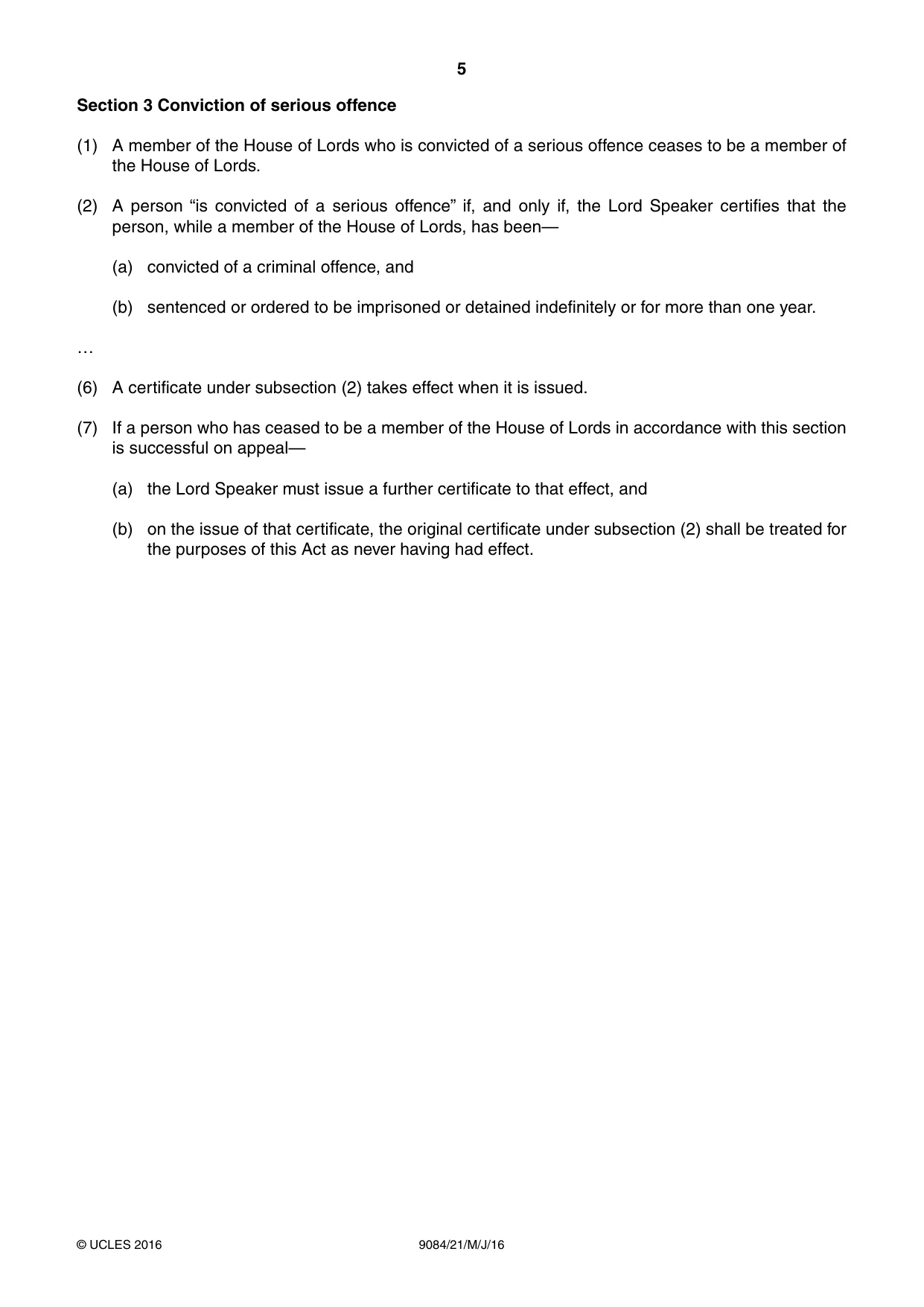
5 9084/21/M/J/16 © UCLES 2016 Section 3 Conviction of serious offence (1) A member of the House of Lords who is convicted of a serious offence ceases to be a member of the House of Lords. (2) A person “is convicted of a serious offence” if, and only if, the Lord Speaker certifies that the person, while a member of the House of Lords, has been— (a) convicted of a criminal offence, and (b) sentenced or ordered to be imprisoned or detained indefinitely or for more than one year. … (6) A certificate under subsection (2) takes effect when it is issued. (7) If a person who has ceased to be a member of the House of Lords in accordance with this section is successful on appeal— (a) the Lord Speaker must issue a further certificate to that effect, and (b) on the issue of that certificate, the original certificate under subsection (2) shall be treated for the purposes of this Act as never having had effect.
Question paper, page 6
6 9084/21/M/J/16 © UCLES 2016 BLANK PAGE
Question paper, page 7
7 9084/21/M/J/16 © UCLES 2016 BLANK PAGE
Question paper, page 8
8 9084/21/M/J/16 © UCLES 2016 BLANK PAGE Permission to reproduce items where third-party owned material protected by copyright is included has been sought and cleared where possible. Every reasonable effort has been made by the publisher (UCLES) to trace copyright holders, but if any items requiring clearance have unwittingly been included, the publisher will be pleased to make amends at the earliest possible opportunity. To avoid the issue of disclosure of answer-related information to candidates, all copyright acknowledgements are reproduced online in the Cambridge International Examinations Copyright Acknowledgements Booklet. This is produced for each series of examinations and is freely available to download at www.cie.org.uk after the live examination series. Cambridge International Examinations is part of the Cambridge Assessment Group. Cambridge Assessment is the brand name of University of Cambridge Local Examinations Syndicate (UCLES), which is itself a department of the University of Cambridge.
What you needed in this session
Cambridge’s own grade thresholds for 2016 May/June, Paper 2 · Variant 1. A higher threshold means an easier paper — the bar moves with how the cohort did.