Cambridge A Level Law 9084 — 2015 May/June Paper 2 · Variant 2
9084/22/M/J/15 · 50 marks · ≈56 min
The question paper and its mark scheme, free to read here and free to download. This is Cambridge’s own paper, exactly as it was sat.
Question paper8 pages


Mark scheme5 pages
Answers below. Sit the paper first if you are practising.
Paper as text
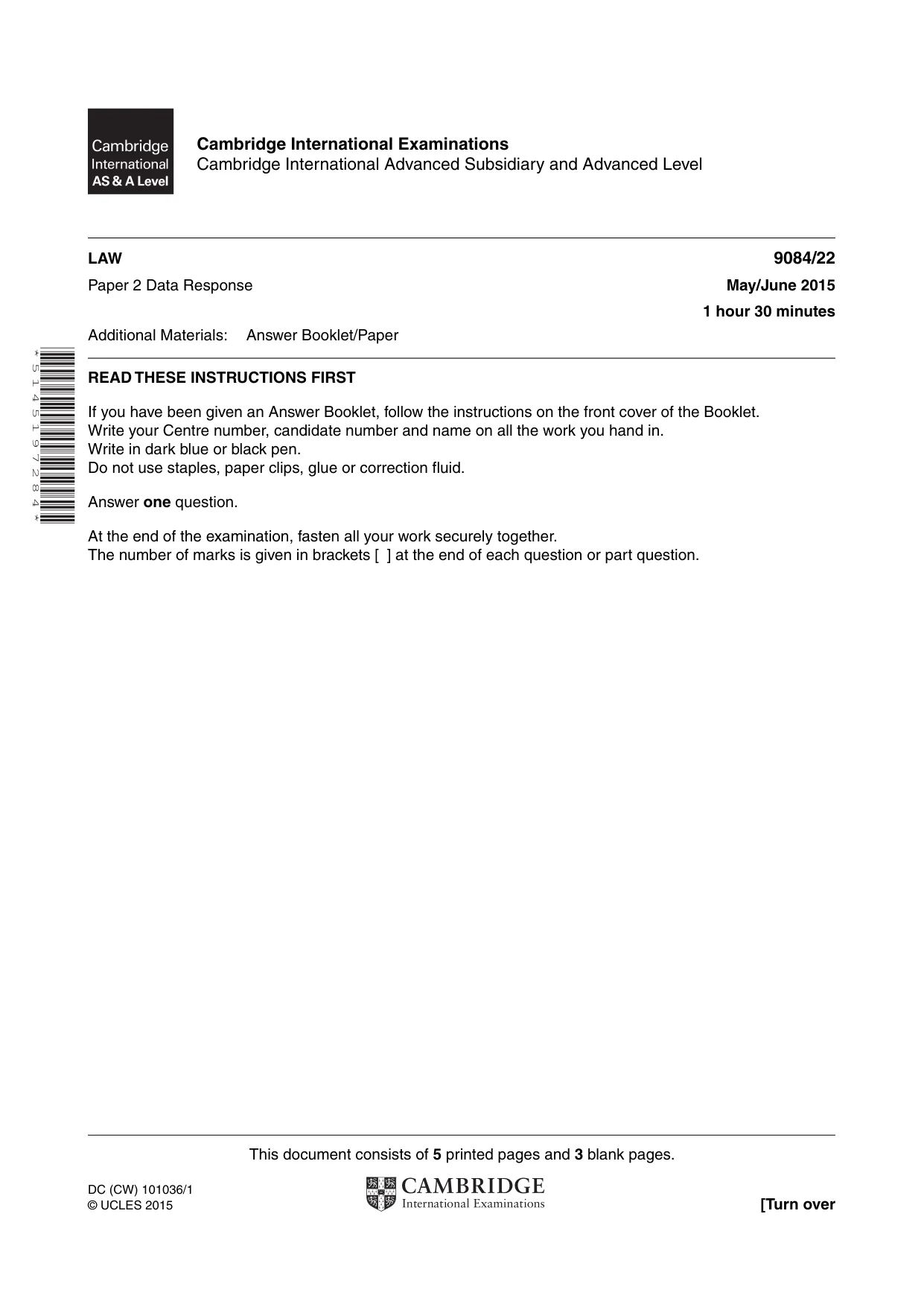
Question paper, page 1
This document consists of 5 printed pages and 3 blank pages. DC (CW) 101036/1 © UCLES 2015 [Turn over Cambridge International Examinations Cambridge International Advanced Subsidiary and Advanced Level * 5 1 4 5 1 9 7 2 8 4 * LAW 9084/22 Paper 2 Data Response May/June 2015 1 hour 30 minutes Additional Materials: Answer Booklet/Paper READ THESE INSTRUCTIONS FIRST If you have been given an Answer Booklet, follow the instructions on the front cover of the Booklet. Write your Centre number, candidate number and name on all the work you hand in. Write in dark blue or black pen. Do not use staples, paper clips, glue or correction fluid. Answer one question. At the end of the examination, fasten all your work securely together. The number of marks is given in brackets [ ] at the end of each question or part question.
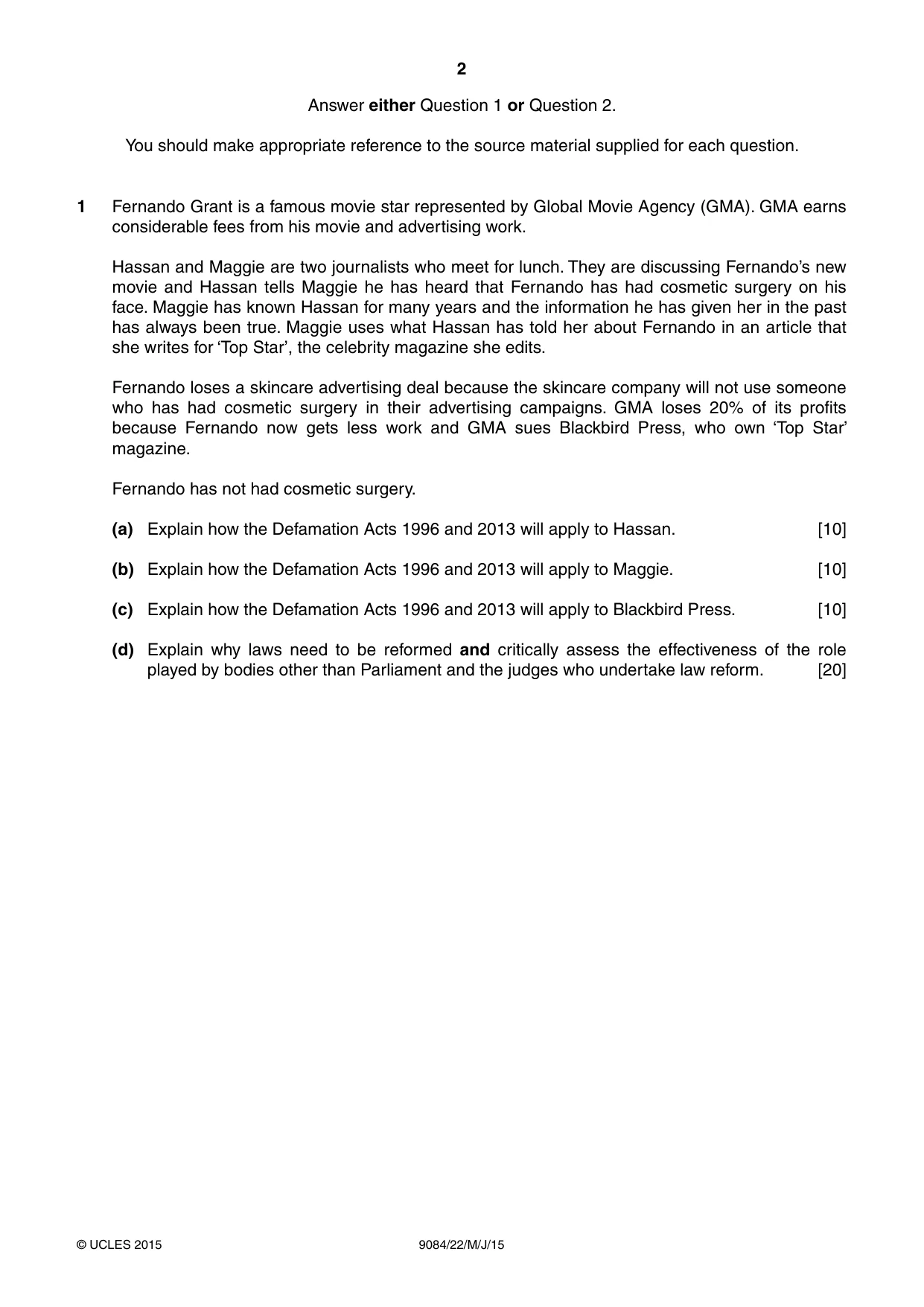
Question paper, page 2
2 9084/22/M/J/15 © UCLES 2015 Answer either Question 1 or Question 2. You should make appropriate reference to the source material supplied for each question. 1 Fernando Grant is a famous movie star represented by Global Movie Agency (GMA). GMA earns considerable fees from his movie and advertising work. Hassan and Maggie are two journalists who meet for lunch. They are discussing Fernando’s new movie and Hassan tells Maggie he has heard that Fernando has had cosmetic surgery on his face. Maggie has known Hassan for many years and the information he has given her in the past has always been true. Maggie uses what Hassan has told her about Fernando in an article that she writes for ‘Top Star’, the celebrity magazine she edits. Fernando loses a skincare advertising deal because the skincare company will not use someone who has had cosmetic surgery in their advertising campaigns. GMA loses 20% of its profits because Fernando now gets less work and GMA sues Blackbird Press, who own ‘Top Star’ magazine. Fernando has not had cosmetic surgery. (a) Explain how the Defamation Acts 1996 and 2013 will apply to Hassan. [10] (b) Explain how the Defamation Acts 1996 and 2013 will apply to Maggie. [10] (c) Explain how the Defamation Acts 1996 and 2013 will apply to Blackbird Press. [10] (d) Explain why laws need to be reformed and critically assess the effectiveness of the role played by bodies other than Parliament and the judges who undertake law reform. [20]
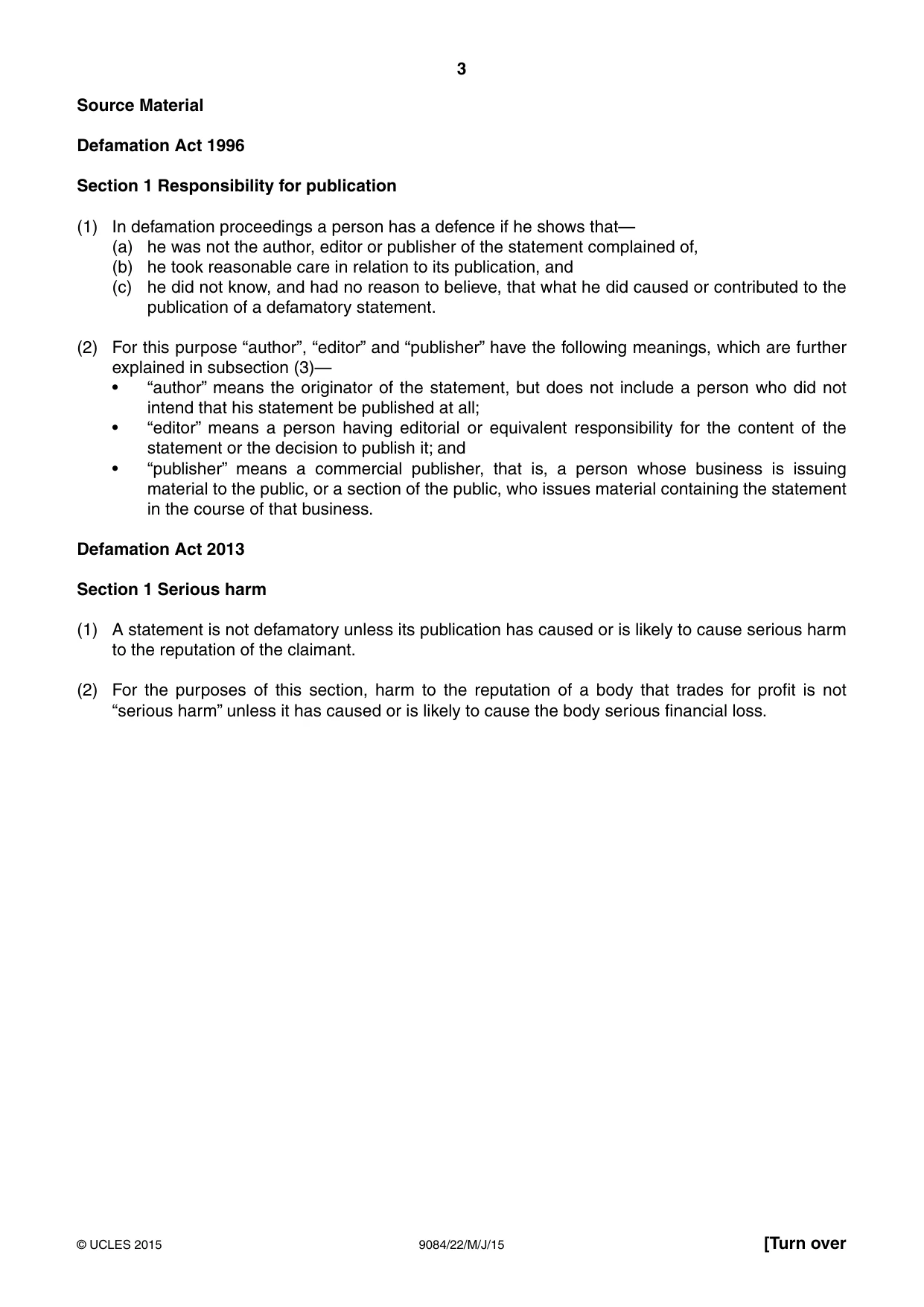
Question paper, page 3
3 9084/22/M/J/15 © UCLES 2015 [Turn over Source Material Defamation Act 1996 Section 1 Responsibility for publication (1) In defamation proceedings a person has a defence if he shows that— (a) he was not the author, editor or publisher of the statement complained of, (b) he took reasonable care in relation to its publication, and (c) he did not know, and had no reason to believe, that what he did caused or contributed to the publication of a defamatory statement. (2) For this purpose “author”, “editor” and “publisher” have the following meanings, which are further explained in subsection (3)— • “author” means the originator of the statement, but does not include a person who did not intend that his statement be published at all; • “editor” means a person having editorial or equivalent responsibility for the content of the statement or the decision to publish it; and • “publisher” means a commercial publisher, that is, a person whose business is issuing material to the public, or a section of the public, who issues material containing the statement in the course of that business. Defamation Act 2013 Section 1 Serious harm (1) A statement is not defamatory unless its publication has caused or is likely to cause serious harm to the reputation of the claimant. (2) For the purposes of this section, harm to the reputation of a body that trades for profit is not “serious harm” unless it has caused or is likely to cause the body serious financial loss.
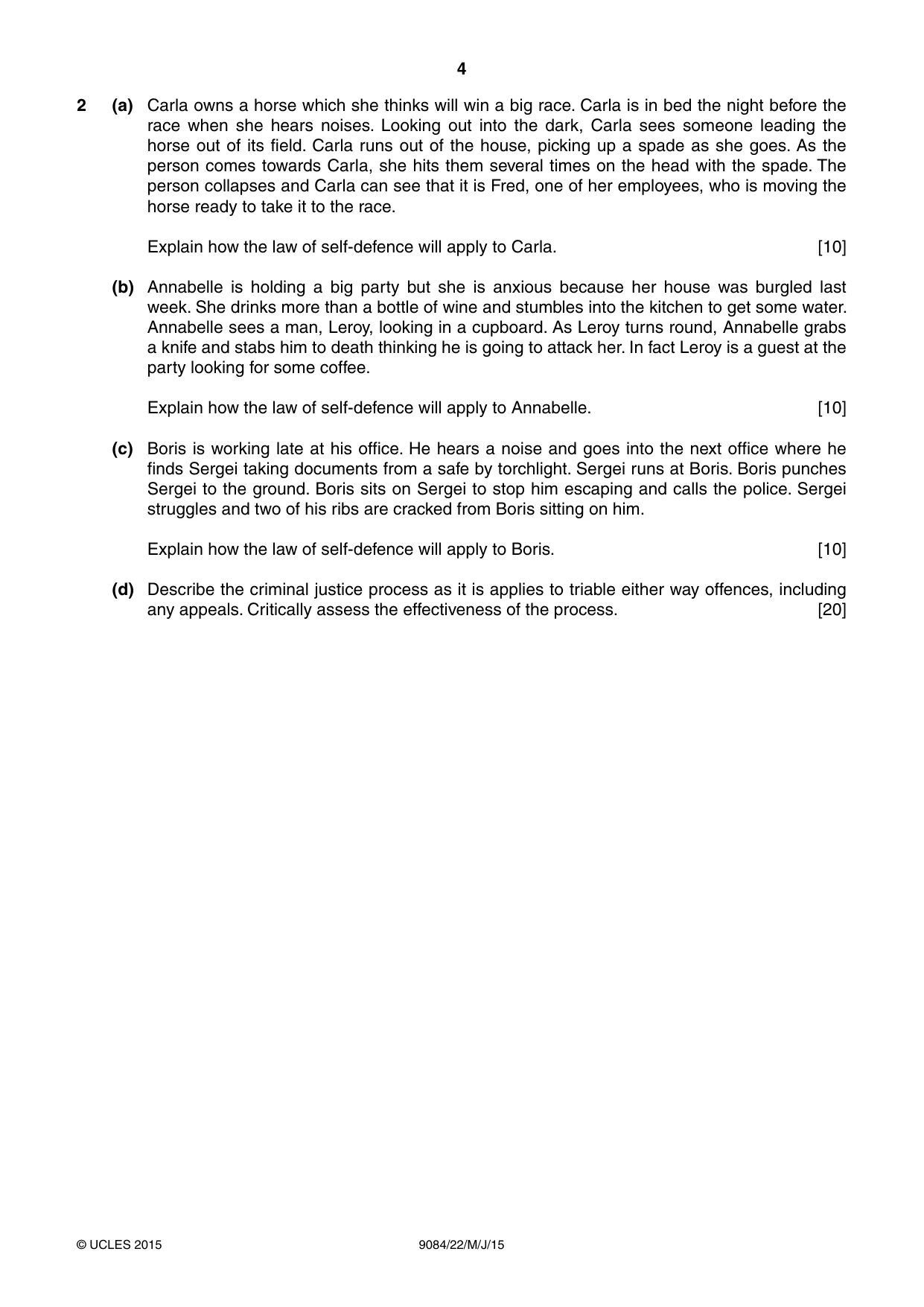
Question paper, page 4
4 9084/22/M/J/15 © UCLES 2015 2 (a) Carla owns a horse which she thinks will win a big race. Carla is in bed the night before the race when she hears noises. Looking out into the dark, Carla sees someone leading the horse out of its field. Carla runs out of the house, picking up a spade as she goes. As the person comes towards Carla, she hits them several times on the head with the spade. The person collapses and Carla can see that it is Fred, one of her employees, who is moving the horse ready to take it to the race. Explain how the law of self-defence will apply to Carla. [10] (b) Annabelle is holding a big party but she is anxious because her house was burgled last week. She drinks more than a bottle of wine and stumbles into the kitchen to get some water. Annabelle sees a man, Leroy, looking in a cupboard. As Leroy turns round, Annabelle grabs a knife and stabs him to death thinking he is going to attack her. In fact Leroy is a guest at the party looking for some coffee. Explain how the law of self-defence will apply to Annabelle. [10] (c) Boris is working late at his office. He hears a noise and goes into the next office where he finds Sergei taking documents from a safe by torchlight. Sergei runs at Boris. Boris punches Sergei to the ground. Boris sits on Sergei to stop him escaping and calls the police. Sergei struggles and two of his ribs are cracked from Boris sitting on him. Explain how the law of self-defence will apply to Boris. [10] (d) Describe the criminal justice process as it is applies to triable either way offences, including any appeals. Critically assess the effectiveness of the process. [20]
Question paper, page 5
5 9084/22/M/J/15 © UCLES 2015 Source Material Criminal Justice and Immigration Act 2008 Section 76 Reasonable force for purposes of self-defence (3) The question whether the degree of force used by D* was reasonable in the circumstances is to be decided by reference to the circumstances as D believed them to be, and subsections (4) to (8) also apply in connection with deciding that question. (4) If D claims to have held a particular belief as regards the existence of any circumstances— (a) the reasonableness or otherwise of that belief is relevant to the question whether D genuinely held it; but (b) if it is determined that D did genuinely hold it, D is entitled to rely on it for the purposes of subsection (3), whether or not— (i) it was mistaken, or (ii) (if it was mistaken) the mistake was a reasonable one to have made. (5) But subsection (4)(b) does not enable D to rely on any mistaken belief attributable to intoxication that was voluntarily induced. (6) The degree of force used by D is not to be regarded as having been reasonable in the circumstances as D believed them to be if it was disproportionate in those circumstances. (7) In deciding the question mentioned in subsection (3) the following considerations are to be taken into account (so far as relevant in the circumstances of the case)— (a) that a person acting for a legitimate purpose may not be able to weigh to a nicety the exact measure of any necessary action; and (b) that evidence of a person’s having only done what the person honestly and instinctively thought was necessary for a legitimate purpose constitutes strong evidence that only reasonable action was taken by that person for that purpose. Crime and Courts Act 2013 Section 43 Use of force in self-defence at place of residence (5A) In a householder case, the degree of force used by D is not to be regarded as having been reasonable in the circumstances as D believed them to be if it was grossly disproportionate in those circumstances. (8A) For the purposes of this section “a householder case” is a case where— (b) the force concerned is force used by D while in or partly in a building, or part of a building, that is a dwelling ….., (c) D is not a trespasser at the time the force is used, and (d) at that time D believed V† to be in, or entering, the building or part as a trespasser. * the defendant † the victim
Question paper, page 6
6 9084/22/M/J/15 © UCLES 2015 BLANK PAGE
Question paper, page 7
7 9084/22/M/J/15 © UCLES 2015 BLANK PAGE
Question paper, page 8
8 9084/22/M/J/15 © UCLES 2015 BLANK PAGE Permission to reproduce items where third-party owned material protected by copyright is included has been sought and cleared where possible. Every reasonable effort has been made by the publisher (UCLES) to trace copyright holders, but if any items requiring clearance have unwittingly been included, the publisher will be pleased to make amends at the earliest possible opportunity. To avoid the issue of disclosure of answer-related information to candidates, all copyright acknowledgements are reproduced online in the Cambridge International Examinations Copyright Acknowledgements Booklet. This is produced for each series of examinations and is freely available to download at www.cie.org.uk after the live examination series. Cambridge International Examinations is part of the Cambridge Assessment Group. Cambridge Assessment is the brand name of University of Cambridge Local Examinations Syndicate (UCLES), which is itself a department of the University of Cambridge.
Mark scheme, page 1
® IGCSE is the registered trademark of Cambridge International Examinations. CAMBRIDGE INTERNATIONAL EXAMINATIONS Cambridge International Advanced Subsidiary and Advanced Level MARK SCHEME for the May/June 2015 series 9084 LAW 9084/22 Paper 2, maximum raw mark 50 This mark scheme is published as an aid to teachers and candidates, to indicate the requirements of the examination. It shows the basis on which Examiners were instructed to award marks. It does not indicate the details of the discussions that took place at an Examiners’ meeting before marking began, which would have considered the acceptability of alternative answers. Mark schemes should be read in conjunction with the question paper and the Principal Examiner Report for Teachers. Cambridge will not enter into discussions about these mark schemes. Cambridge is publishing the mark schemes for the May/June 2015 series for most Cambridge IGCSE®, Cambridge International A and AS Level components and some Cambridge O Level components.
Mark scheme, page 2
Page 2 Mark Scheme Syllabus Paper Cambridge International AS/A Level – May/June 2015 9084 22 © Cambridge International Examinations 2015 General Marking Guidance This mark scheme includes a summary of appropriate content for answering each question. It should be emphasised, however, that this material is for illustrative purposes and is not intended to provide a definitive guide to acceptable answers. It is quite possible that among the scripts there will be some candidate answers that are not covered directly by the content of this mark scheme. In such cases, professional judgement should be exercised in assessing the merits of the answer and the senior examiners should be consulted if further guidance is required. Mark Bands The mark bands and descriptors applicable to all questions on the paper are as follows. Indicative content for each of the questions follows overleaf. Band 1: The answer contains no relevant material. Band 2: The candidate introduces fragments of information or unexplained examples from which no coherent explanation or analysis can emerge OR The candidate attempts to introduce an explanation and/or analysis but it is so fundamentally undermined by error and confusion that it remains substantially incoherent. Band 3: The candidate begins to indicate some capacity for explanation and analysis by introducing some of the issues, but explanations are limited and superficial OR The candidate adopts an approach in which there is concentration on explanation in terms of facts presented rather than through the development and explanation of legal principles and rules OR The candidate attempts to introduce material across the range of potential content, but it is weak or confused so that no real explanation or conclusion emerges. Band 4: Where there is more than one issue, the candidate demonstrates a clear understanding of one of the main issues of the question, giving explanations and using illustrations so that a full and detailed picture is presented of this issue OR The candidate presents a more limited explanation of all parts of the answer, but there is some lack of detail or superficiality in respect of either or both so that the answer is not fully rounded. Band 5: The candidate presents a detailed explanation and discussion of all areas of relevant law and, while there may be some minor inaccuracies and/or imbalance, a coherent explanation emerges.
Mark scheme, page 3
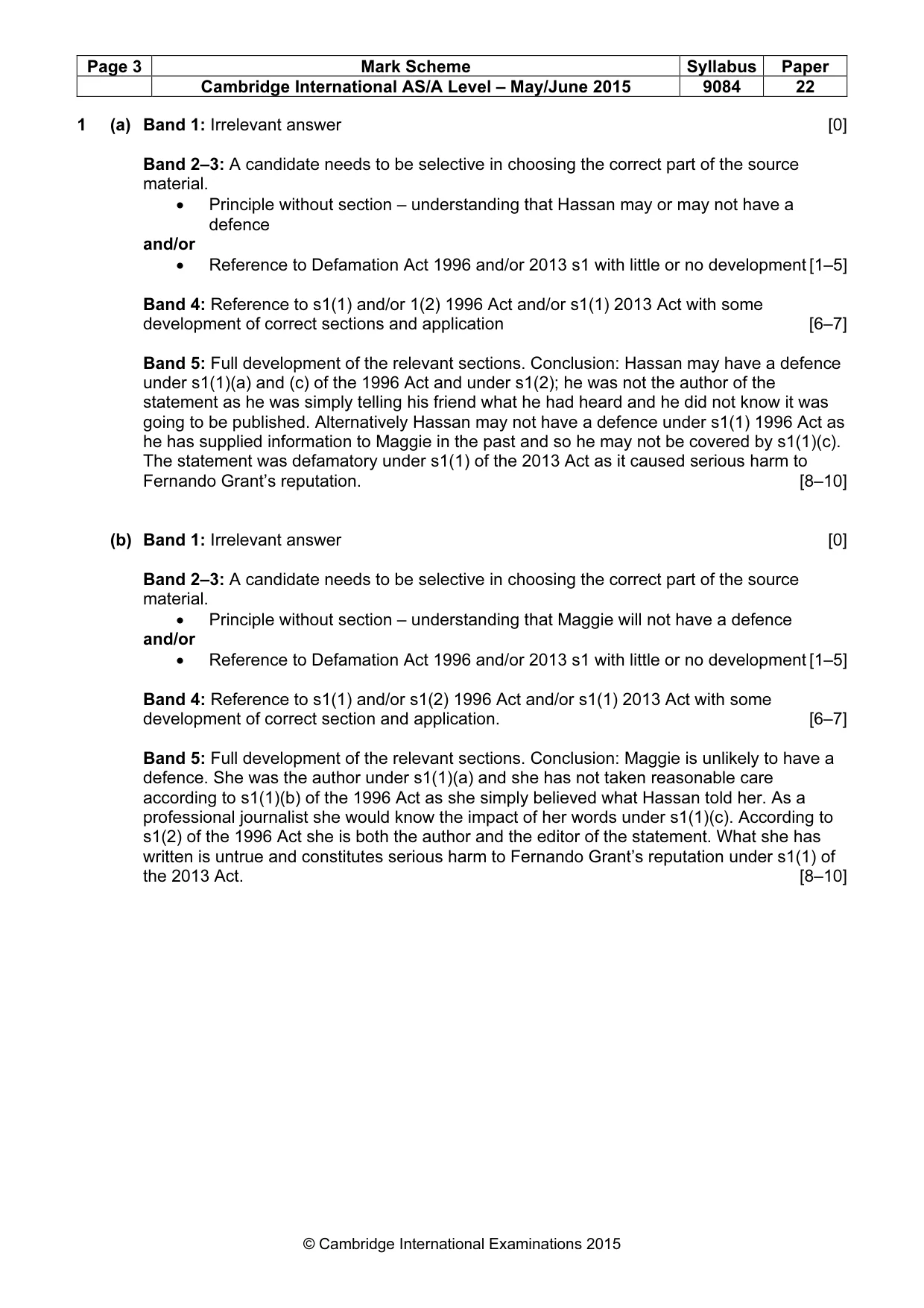
Page 3 Mark Scheme Syllabus Paper Cambridge International AS/A Level – May/June 2015 9084 22 © Cambridge International Examinations 2015 1 (a) Band 1: Irrelevant answer [0] Band 2–3: A candidate needs to be selective in choosing the correct part of the source material. • Principle without section – understanding that Hassan may or may not have a defence and/or • Reference to Defamation Act 1996 and/or 2013 s1 with little or no development [1–5] Band 4: Reference to s1(1) and/or 1(2) 1996 Act and/or s1(1) 2013 Act with some development of correct sections and application [6–7] Band 5: Full development of the relevant sections. Conclusion: Hassan may have a defence under s1(1)(a) and (c) of the 1996 Act and under s1(2); he was not the author of the statement as he was simply telling his friend what he had heard and he did not know it was going to be published. Alternatively Hassan may not have a defence under s1(1) 1996 Act as he has supplied information to Maggie in the past and so he may not be covered by s1(1)(c). The statement was defamatory under s1(1) of the 2013 Act as it caused serious harm to Fernando Grant’s reputation. [8–10] (b) Band 1: Irrelevant answer [0] Band 2–3: A candidate needs to be selective in choosing the correct part of the source material. • Principle without section – understanding that Maggie will not have a defence and/or • Reference to Defamation Act 1996 and/or 2013 s1 with little or no development [1–5] Band 4: Reference to s1(1) and/or s1(2) 1996 Act and/or s1(1) 2013 Act with some development of correct section and application. [6–7] Band 5: Full development of the relevant sections. Conclusion: Maggie is unlikely to have a defence. She was the author under s1(1)(a) and she has not taken reasonable care according to s1(1)(b) of the 1996 Act as she simply believed what Hassan told her. As a professional journalist she would know the impact of her words under s1(1)(c). According to s1(2) of the 1996 Act she is both the author and the editor of the statement. What she has written is untrue and constitutes serious harm to Fernando Grant’s reputation under s1(1) of the 2013 Act. [8–10]
Mark scheme, page 4
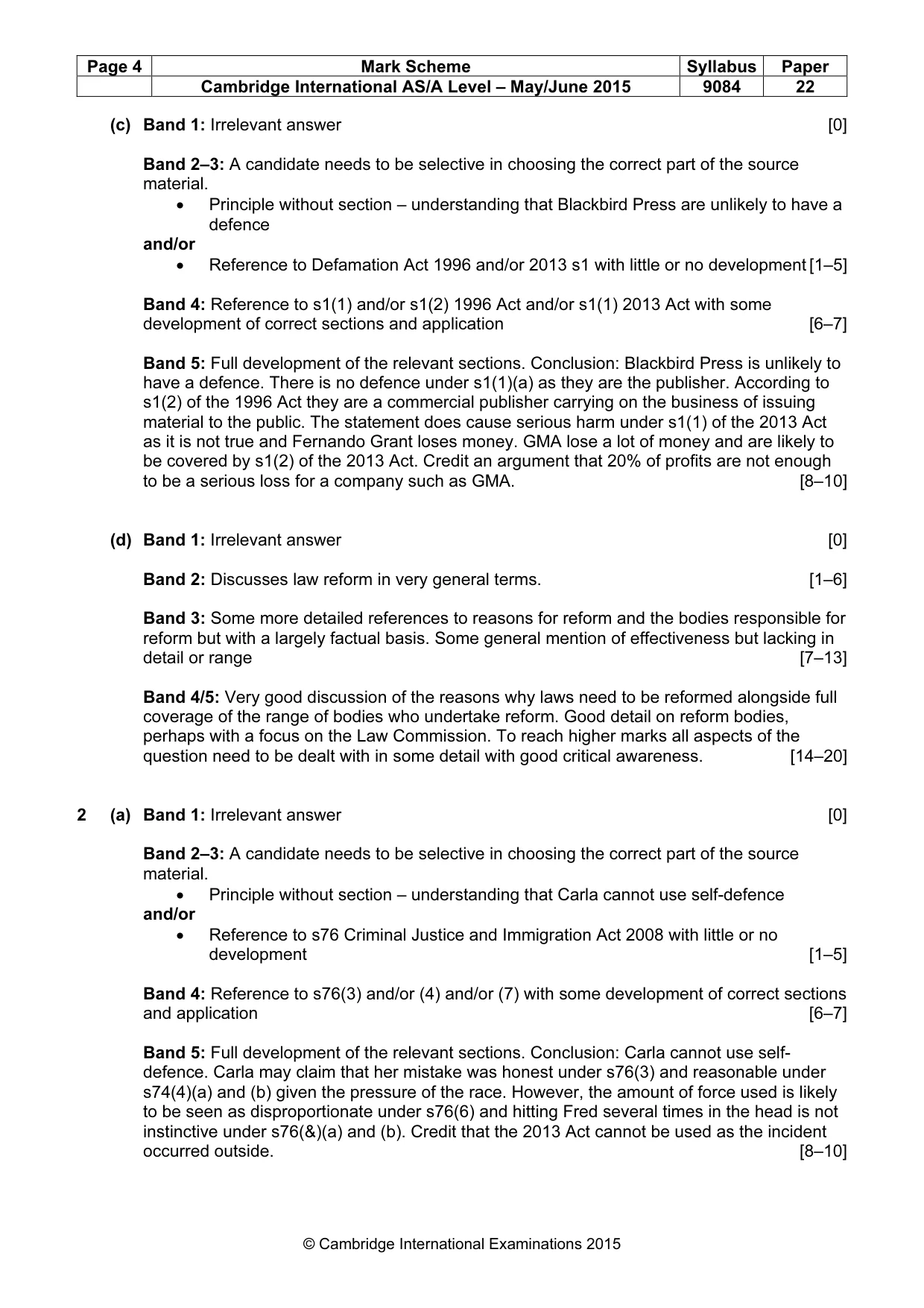
Page 4 Mark Scheme Syllabus Paper Cambridge International AS/A Level – May/June 2015 9084 22 © Cambridge International Examinations 2015 (c) Band 1: Irrelevant answer [0] Band 2–3: A candidate needs to be selective in choosing the correct part of the source material. • Principle without section – understanding that Blackbird Press are unlikely to have a defence and/or • Reference to Defamation Act 1996 and/or 2013 s1 with little or no development [1–5] Band 4: Reference to s1(1) and/or s1(2) 1996 Act and/or s1(1) 2013 Act with some development of correct sections and application [6–7] Band 5: Full development of the relevant sections. Conclusion: Blackbird Press is unlikely to have a defence. There is no defence under s1(1)(a) as they are the publisher. According to s1(2) of the 1996 Act they are a commercial publisher carrying on the business of issuing material to the public. The statement does cause serious harm under s1(1) of the 2013 Act as it is not true and Fernando Grant loses money. GMA lose a lot of money and are likely to be covered by s1(2) of the 2013 Act. Credit an argument that 20% of profits are not enough to be a serious loss for a company such as GMA. [8–10] (d) Band 1: Irrelevant answer [0] Band 2: Discusses law reform in very general terms. [1–6] Band 3: Some more detailed references to reasons for reform and the bodies responsible for reform but with a largely factual basis. Some general mention of effectiveness but lacking in detail or range [7–13] Band 4/5: Very good discussion of the reasons why laws need to be reformed alongside full coverage of the range of bodies who undertake reform. Good detail on reform bodies, perhaps with a focus on the Law Commission. To reach higher marks all aspects of the question need to be dealt with in some detail with good critical awareness. [14–20] 2 (a) Band 1: Irrelevant answer [0] Band 2–3: A candidate needs to be selective in choosing the correct part of the source material. • Principle without section – understanding that Carla cannot use self-defence and/or • Reference to s76 Criminal Justice and Immigration Act 2008 with little or no development [1–5] Band 4: Reference to s76(3) and/or (4) and/or (7) with some development of correct sections and application [6–7] Band 5: Full development of the relevant sections. Conclusion: Carla cannot use self- defence. Carla may claim that her mistake was honest under s76(3) and reasonable under s74(4)(a) and (b) given the pressure of the race. However, the amount of force used is likely to be seen as disproportionate under s76(6) and hitting Fred several times in the head is not instinctive under s76(&)(a) and (b). Credit that the 2013 Act cannot be used as the incident occurred outside. [8–10]
Mark scheme, page 5
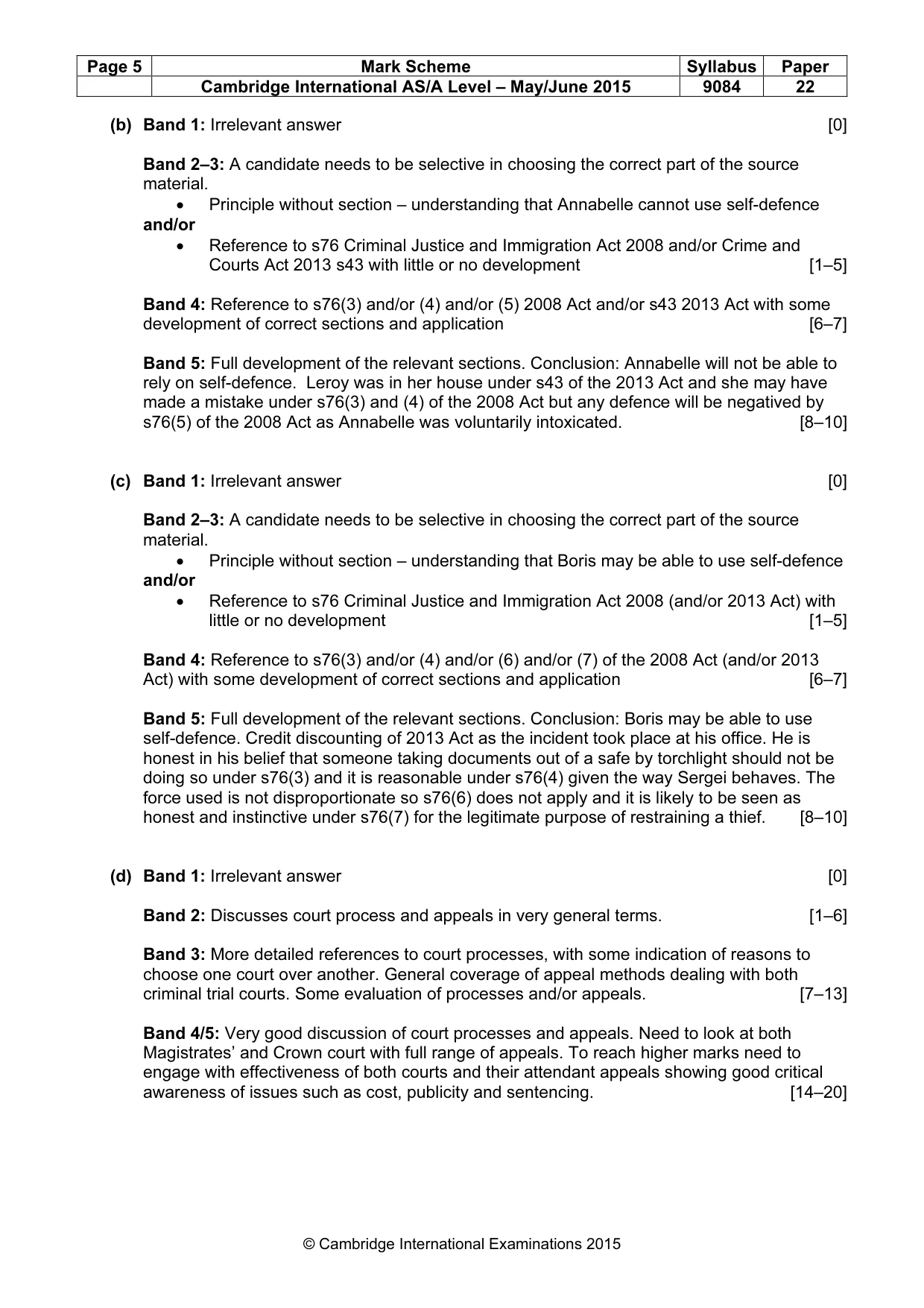
Page 5 Mark Scheme Syllabus Paper Cambridge International AS/A Level – May/June 2015 9084 22 © Cambridge International Examinations 2015 (b) Band 1: Irrelevant answer [0] Band 2–3: A candidate needs to be selective in choosing the correct part of the source material. • Principle without section – understanding that Annabelle cannot use self-defence and/or • Reference to s76 Criminal Justice and Immigration Act 2008 and/or Crime and Courts Act 2013 s43 with little or no development [1–5] Band 4: Reference to s76(3) and/or (4) and/or (5) 2008 Act and/or s43 2013 Act with some development of correct sections and application [6–7] Band 5: Full development of the relevant sections. Conclusion: Annabelle will not be able to rely on self-defence. Leroy was in her house under s43 of the 2013 Act and she may have made a mistake under s76(3) and (4) of the 2008 Act but any defence will be negatived by s76(5) of the 2008 Act as Annabelle was voluntarily intoxicated. [8–10] (c) Band 1: Irrelevant answer [0] Band 2–3: A candidate needs to be selective in choosing the correct part of the source material. • Principle without section – understanding that Boris may be able to use self-defence and/or • Reference to s76 Criminal Justice and Immigration Act 2008 (and/or 2013 Act) with little or no development [1–5] Band 4: Reference to s76(3) and/or (4) and/or (6) and/or (7) of the 2008 Act (and/or 2013 Act) with some development of correct sections and application [6–7] Band 5: Full development of the relevant sections. Conclusion: Boris may be able to use self-defence. Credit discounting of 2013 Act as the incident took place at his office. He is honest in his belief that someone taking documents out of a safe by torchlight should not be doing so under s76(3) and it is reasonable under s76(4) given the way Sergei behaves. The force used is not disproportionate so s76(6) does not apply and it is likely to be seen as honest and instinctive under s76(7) for the legitimate purpose of restraining a thief. [8–10] (d) Band 1: Irrelevant answer [0] Band 2: Discusses court process and appeals in very general terms. [1–6] Band 3: More detailed references to court processes, with some indication of reasons to choose one court over another. General coverage of appeal methods dealing with both criminal trial courts. Some evaluation of processes and/or appeals. [7–13] Band 4/5: Very good discussion of court processes and appeals. Need to look at both Magistrates’ and Crown court with full range of appeals. To reach higher marks need to engage with effectiveness of both courts and their attendant appeals showing good critical awareness of issues such as cost, publicity and sentencing. [14–20]
What you needed in this session
Cambridge’s own grade thresholds for 2015 May/June, Paper 2 · Variant 2. A higher threshold means an easier paper — the bar moves with how the cohort did.