Cambridge A Level Law 9084 — 2015 May/June Paper 2 · Variant 3
9084/23/M/J/15 · 50 marks · ≈56 min
The question paper and its mark scheme, free to read here and free to download. This is Cambridge’s own paper, exactly as it was sat.
Question paper8 pages



Mark scheme5 pages
Answers below. Sit the paper first if you are practising.
Paper as text
Question paper, page 1
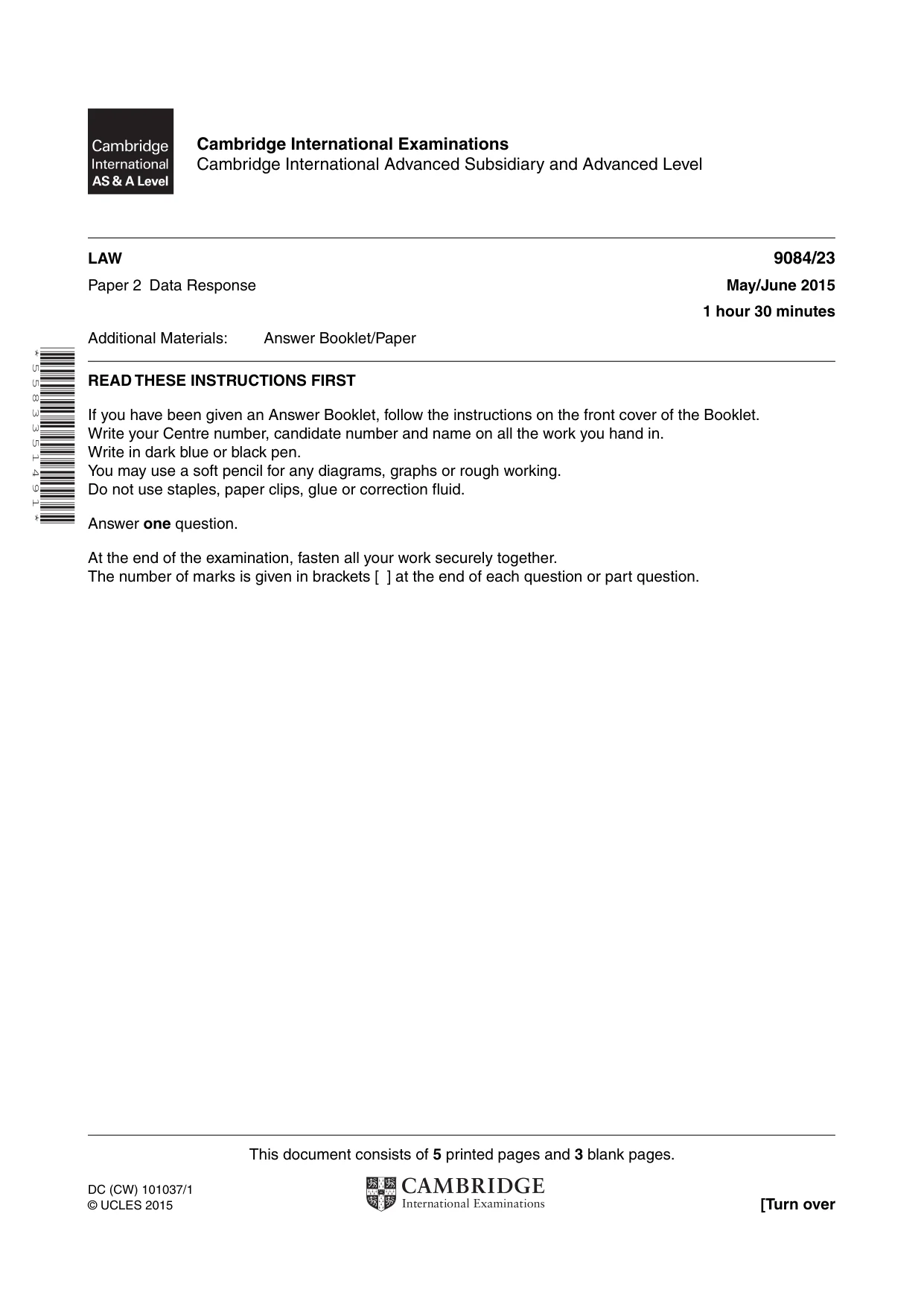
This document consists of 5 printed pages and 3 blank pages. DC (CW) 101037/1 © UCLES 2015 [Turn over Cambridge International Examinations Cambridge International Advanced Subsidiary and Advanced Level * 5 5 8 3 3 5 1 4 9 1 * LAW 9084/23 Paper 2 Data Response May/June 2015 1 hour 30 minutes Additional Materials: Answer Booklet/Paper READ THESE INSTRUCTIONS FIRST If you have been given an Answer Booklet, follow the instructions on the front cover of the Booklet. Write your Centre number, candidate number and name on all the work you hand in. Write in dark blue or black pen. You may use a soft pencil for any diagrams, graphs or rough working. Do not use staples, paper clips, glue or correction fluid. Answer one question. At the end of the examination, fasten all your work securely together. The number of marks is given in brackets [ ] at the end of each question or part question.
Question paper, page 2
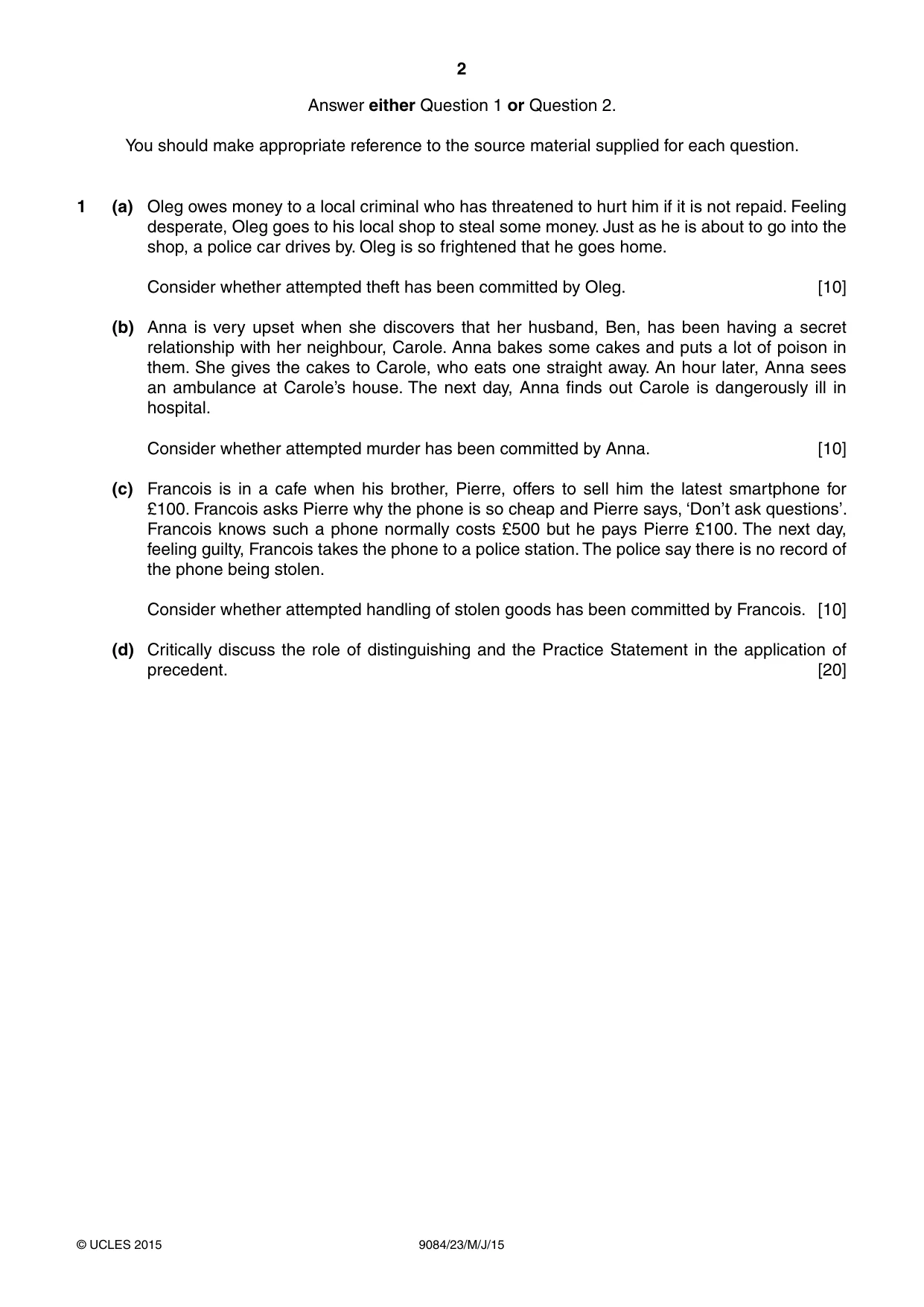
2 9084/23/M/J/15 © UCLES 2015 Answer either Question 1 or Question 2. You should make appropriate reference to the source material supplied for each question. 1 (a) Oleg owes money to a local criminal who has threatened to hurt him if it is not repaid. Feeling desperate, Oleg goes to his local shop to steal some money. Just as he is about to go into the shop, a police car drives by. Oleg is so frightened that he goes home. Consider whether attempted theft has been committed by Oleg. [10] (b) Anna is very upset when she discovers that her husband, Ben, has been having a secret relationship with her neighbour, Carole. Anna bakes some cakes and puts a lot of poison in them. She gives the cakes to Carole, who eats one straight away. An hour later, Anna sees an ambulance at Carole’s house. The next day, Anna finds out Carole is dangerously ill in hospital. Consider whether attempted murder has been committed by Anna. [10] (c) Francois is in a cafe when his brother, Pierre, offers to sell him the latest smartphone for £100. Francois asks Pierre why the phone is so cheap and Pierre says, ‘Don’t ask questions’. Francois knows such a phone normally costs £500 but he pays Pierre £100. The next day, feeling guilty, Francois takes the phone to a police station. The police say there is no record of the phone being stolen. Consider whether attempted handling of stolen goods has been committed by Francois. [10] (d) Critically discuss the role of distinguishing and the Practice Statement in the application of precedent. [20]
Question paper, page 3
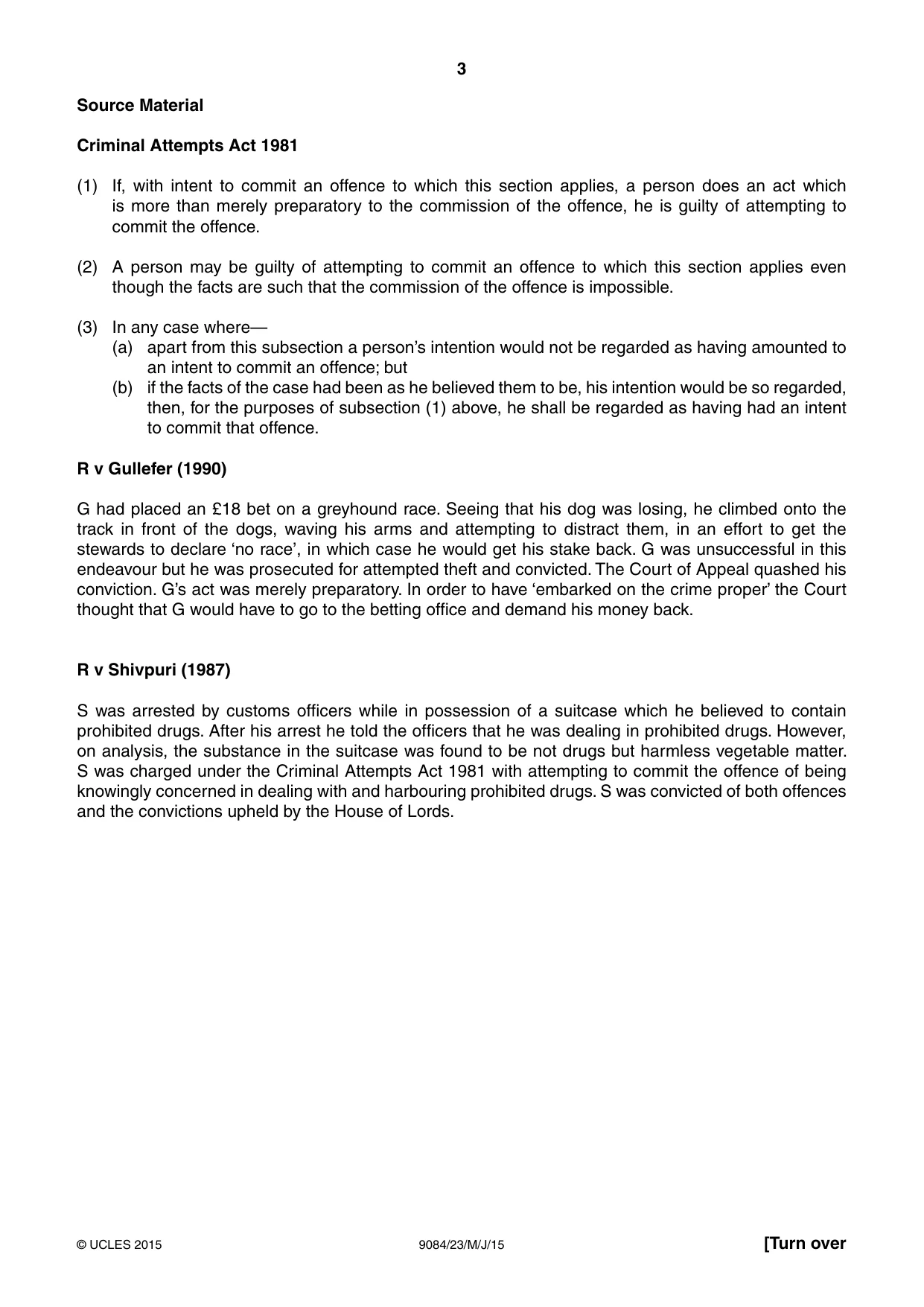
3 9084/23/M/J/15 © UCLES 2015 [Turn over Source Material Criminal Attempts Act 1981 (1) If, with intent to commit an offence to which this section applies, a person does an act which is more than merely preparatory to the commission of the offence, he is guilty of attempting to commit the offence. (2) A person may be guilty of attempting to commit an offence to which this section applies even though the facts are such that the commission of the offence is impossible. (3) In any case where— (a) apart from this subsection a person’s intention would not be regarded as having amounted to an intent to commit an offence; but (b) if the facts of the case had been as he believed them to be, his intention would be so regarded, then, for the purposes of subsection (1) above, he shall be regarded as having had an intent to commit that offence. R v Gullefer (1990) G had placed an £18 bet on a greyhound race. Seeing that his dog was losing, he climbed onto the track in front of the dogs, waving his arms and attempting to distract them, in an effort to get the stewards to declare ‘no race’, in which case he would get his stake back. G was unsuccessful in this endeavour but he was prosecuted for attempted theft and convicted. The Court of Appeal quashed his conviction. G’s act was merely preparatory. In order to have ‘embarked on the crime proper’ the Court thought that G would have to go to the betting office and demand his money back. R v Shivpuri (1987) S was arrested by customs officers while in possession of a suitcase which he believed to contain prohibited drugs. After his arrest he told the officers that he was dealing in prohibited drugs. However, on analysis, the substance in the suitcase was found to be not drugs but harmless vegetable matter. S was charged under the Criminal Attempts Act 1981 with attempting to commit the offence of being knowingly concerned in dealing with and harbouring prohibited drugs. S was convicted of both offences and the convictions upheld by the House of Lords.
Question paper, page 4
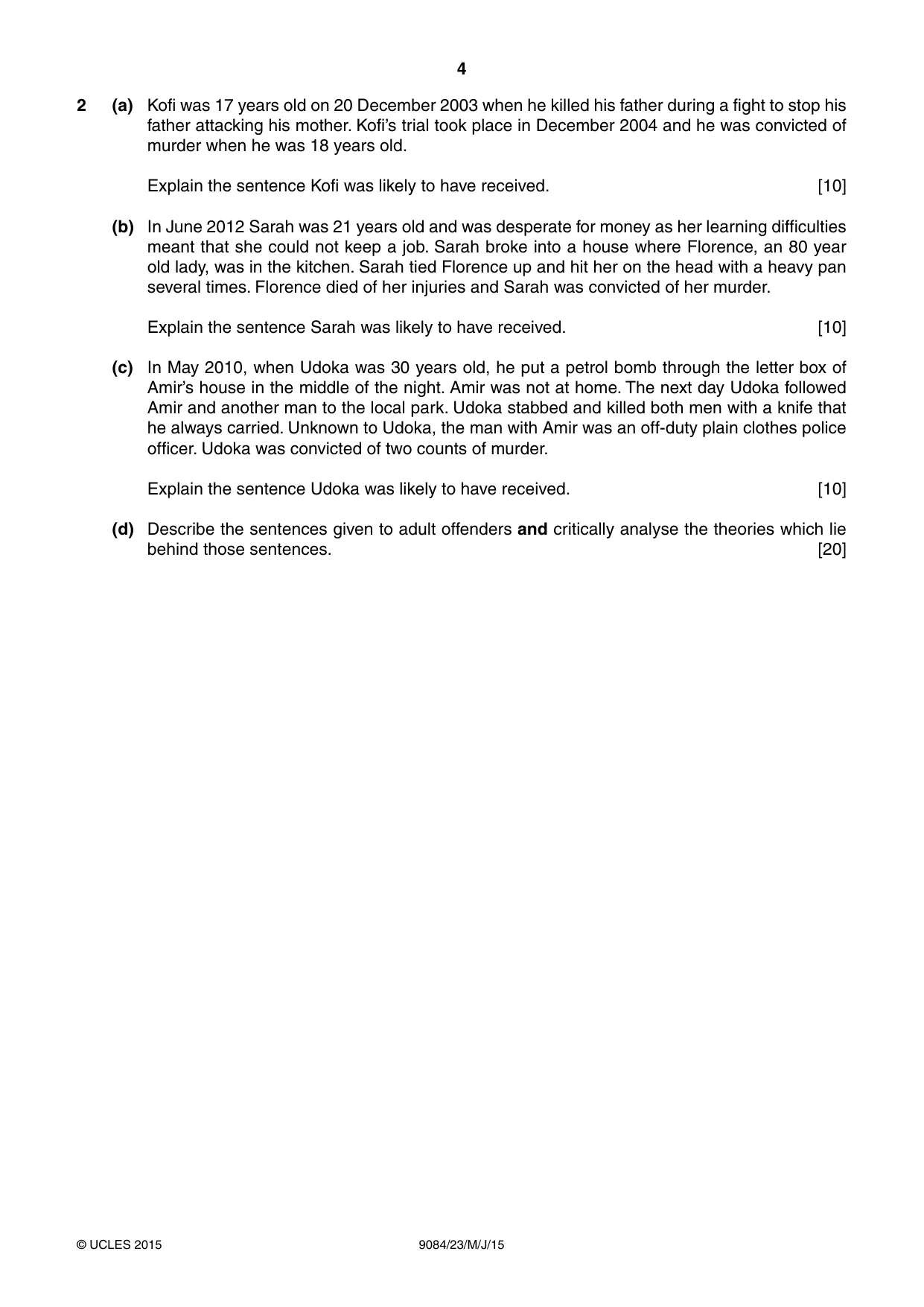
4 9084/23/M/J/15 © UCLES 2015 2 (a) Kofi was 17 years old on 20 December 2003 when he killed his father during a fight to stop his father attacking his mother. Kofi’s trial took place in December 2004 and he was convicted of murder when he was 18 years old. Explain the sentence Kofi was likely to have received. [10] (b) In June 2012 Sarah was 21 years old and was desperate for money as her learning difficulties meant that she could not keep a job. Sarah broke into a house where Florence, an 80 year old lady, was in the kitchen. Sarah tied Florence up and hit her on the head with a heavy pan several times. Florence died of her injuries and Sarah was convicted of her murder. Explain the sentence Sarah was likely to have received. [10] (c) In May 2010, when Udoka was 30 years old, he put a petrol bomb through the letter box of Amir’s house in the middle of the night. Amir was not at home. The next day Udoka followed Amir and another man to the local park. Udoka stabbed and killed both men with a knife that he always carried. Unknown to Udoka, the man with Amir was an off-duty plain clothes police officer. Udoka was convicted of two counts of murder. Explain the sentence Udoka was likely to have received. [10] (d) Describe the sentences given to adult offenders and critically analyse the theories which lie behind those sentences. [20]
Question paper, page 5
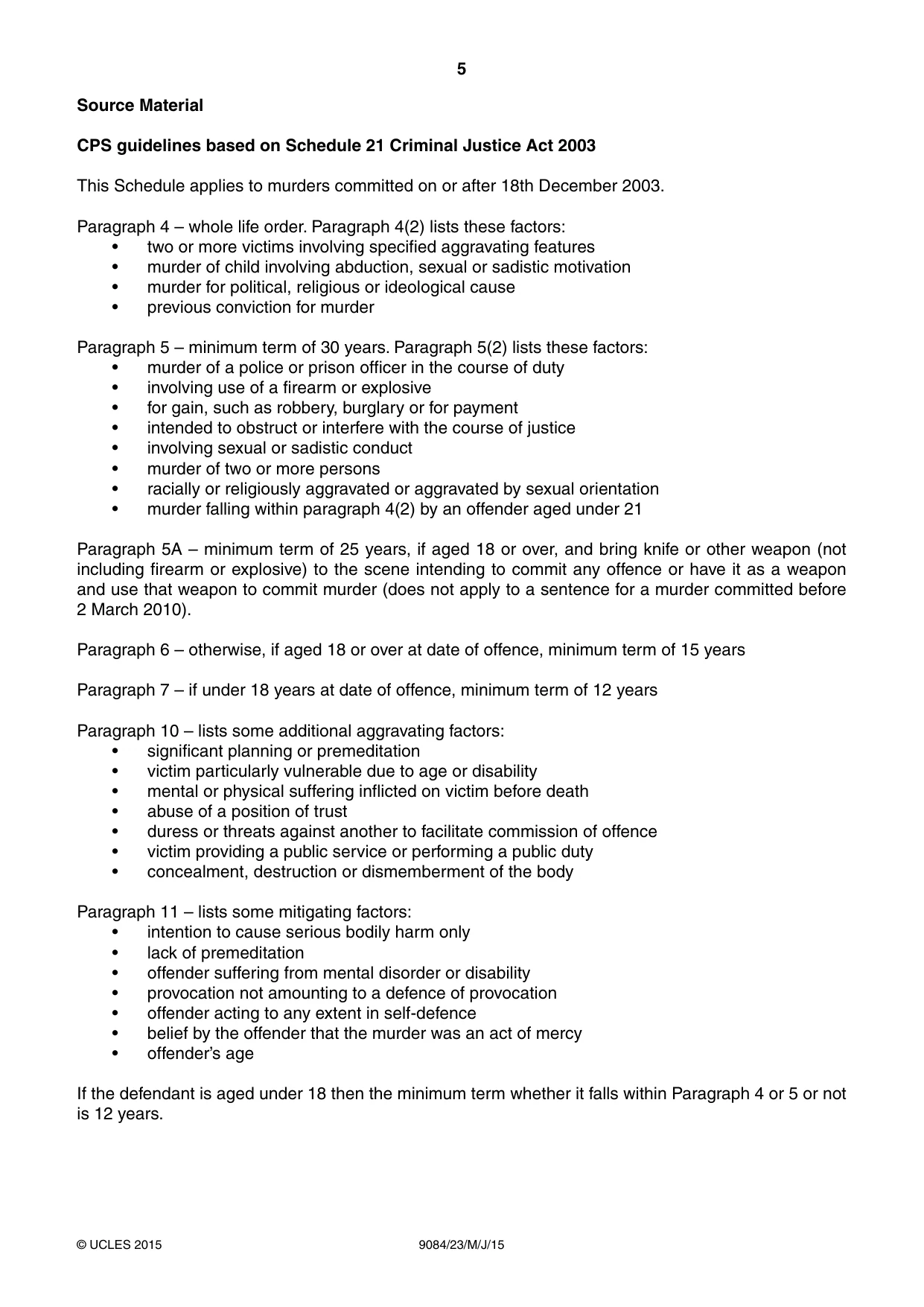
5 9084/23/M/J/15 © UCLES 2015 Source Material CPS guidelines based on Schedule 21 Criminal Justice Act 2003 This Schedule applies to murders committed on or after 18th December 2003. Paragraph 4 – whole life order. Paragraph 4(2) lists these factors: • two or more victims involving specified aggravating features • murder of child involving abduction, sexual or sadistic motivation • murder for political, religious or ideological cause • previous conviction for murder Paragraph 5 – minimum term of 30 years. Paragraph 5(2) lists these factors: • murder of a police or prison officer in the course of duty • involving use of a firearm or explosive • for gain, such as robbery, burglary or for payment • intended to obstruct or interfere with the course of justice • involving sexual or sadistic conduct • murder of two or more persons • racially or religiously aggravated or aggravated by sexual orientation • murder falling within paragraph 4(2) by an offender aged under 21 Paragraph 5A – minimum term of 25 years, if aged 18 or over, and bring knife or other weapon (not including firearm or explosive) to the scene intending to commit any offence or have it as a weapon and use that weapon to commit murder (does not apply to a sentence for a murder committed before 2 March 2010). Paragraph 6 – otherwise, if aged 18 or over at date of offence, minimum term of 15 years Paragraph 7 – if under 18 years at date of offence, minimum term of 12 years Paragraph 10 – lists some additional aggravating factors: • significant planning or premeditation • victim particularly vulnerable due to age or disability • mental or physical suffering inflicted on victim before death • abuse of a position of trust • duress or threats against another to facilitate commission of offence • victim providing a public service or performing a public duty • concealment, destruction or dismemberment of the body Paragraph 11 – lists some mitigating factors: • intention to cause serious bodily harm only • lack of premeditation • offender suffering from mental disorder or disability • provocation not amounting to a defence of provocation • offender acting to any extent in self-defence • belief by the offender that the murder was an act of mercy • offender’s age If the defendant is aged under 18 then the minimum term whether it falls within Paragraph 4 or 5 or not is 12 years.
Question paper, page 6
6 9084/23/M/J/15 © UCLES 2015 BLANK PAGE
Question paper, page 7
7 9084/23/M/J/15 © UCLES 2015 BLANK PAGE
Question paper, page 8
8 9084/23/M/J/15 © UCLES 2015 BLANK PAGE Permission to reproduce items where third-party owned material protected by copyright is included has been sought and cleared where possible. Every reasonable effort has been made by the publisher (UCLES) to trace copyright holders, but if any items requiring clearance have unwittingly been included, the publisher will be pleased to make amends at the earliest possible opportunity. To avoid the issue of disclosure of answer-related information to candidates, all copyright acknowledgements are reproduced online in the Cambridge International Examinations Copyright Acknowledgements Booklet. This is produced for each series of examinations and is freely available to download at www.cie.org.uk after the live examination series. Cambridge International Examinations is part of the Cambridge Assessment Group. Cambridge Assessment is the brand name of University of Cambridge Local Examinations Syndicate (UCLES), which is itself a department of the University of Cambridge.
Mark scheme, page 1
® IGCSE is the registered trademark of Cambridge International Examinations. CAMBRIDGE INTERNATIONAL EXAMINATIONS Cambridge International Advanced Subsidiary and Advanced Level MARK SCHEME for the May/June 2015 series 9084 LAW 9084/23 Paper 2, maximum raw mark 50 This mark scheme is published as an aid to teachers and candidates, to indicate the requirements of the examination. It shows the basis on which Examiners were instructed to award marks. It does not indicate the details of the discussions that took place at an Examiners’ meeting before marking began, which would have considered the acceptability of alternative answers. Mark schemes should be read in conjunction with the question paper and the Principal Examiner Report for Teachers. Cambridge will not enter into discussions about these mark schemes. Cambridge is publishing the mark schemes for the May/June 2015 series for most Cambridge IGCSE®, Cambridge International A and AS Level components and some Cambridge O Level components.
Mark scheme, page 2
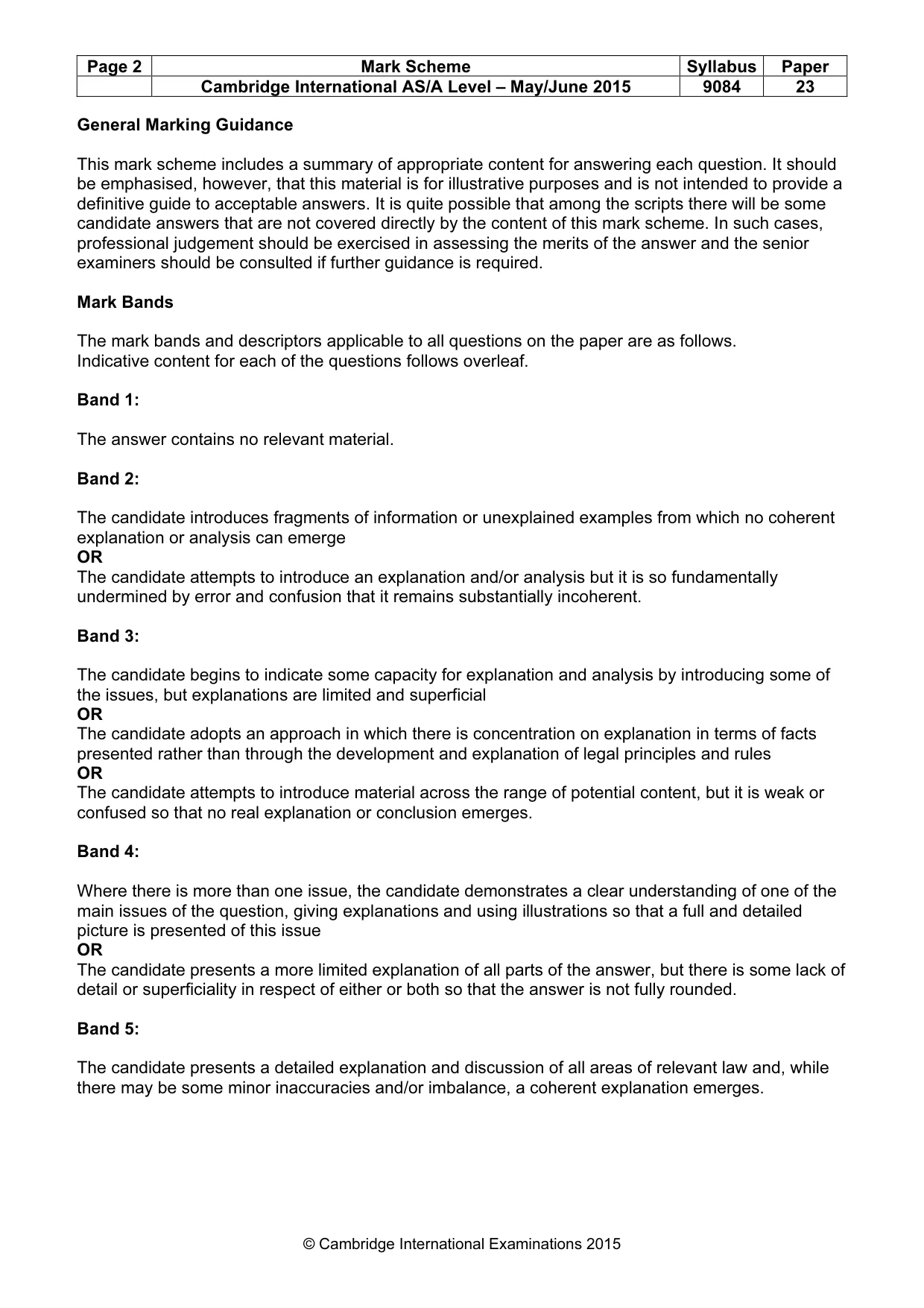
Page 2 Mark Scheme Syllabus Paper Cambridge International AS/A Level – May/June 2015 9084 23 © Cambridge International Examinations 2015 General Marking Guidance This mark scheme includes a summary of appropriate content for answering each question. It should be emphasised, however, that this material is for illustrative purposes and is not intended to provide a definitive guide to acceptable answers. It is quite possible that among the scripts there will be some candidate answers that are not covered directly by the content of this mark scheme. In such cases, professional judgement should be exercised in assessing the merits of the answer and the senior examiners should be consulted if further guidance is required. Mark Bands The mark bands and descriptors applicable to all questions on the paper are as follows. Indicative content for each of the questions follows overleaf. Band 1: The answer contains no relevant material. Band 2: The candidate introduces fragments of information or unexplained examples from which no coherent explanation or analysis can emerge OR The candidate attempts to introduce an explanation and/or analysis but it is so fundamentally undermined by error and confusion that it remains substantially incoherent. Band 3: The candidate begins to indicate some capacity for explanation and analysis by introducing some of the issues, but explanations are limited and superficial OR The candidate adopts an approach in which there is concentration on explanation in terms of facts presented rather than through the development and explanation of legal principles and rules OR The candidate attempts to introduce material across the range of potential content, but it is weak or confused so that no real explanation or conclusion emerges. Band 4: Where there is more than one issue, the candidate demonstrates a clear understanding of one of the main issues of the question, giving explanations and using illustrations so that a full and detailed picture is presented of this issue OR The candidate presents a more limited explanation of all parts of the answer, but there is some lack of detail or superficiality in respect of either or both so that the answer is not fully rounded. Band 5: The candidate presents a detailed explanation and discussion of all areas of relevant law and, while there may be some minor inaccuracies and/or imbalance, a coherent explanation emerges.
Mark scheme, page 3
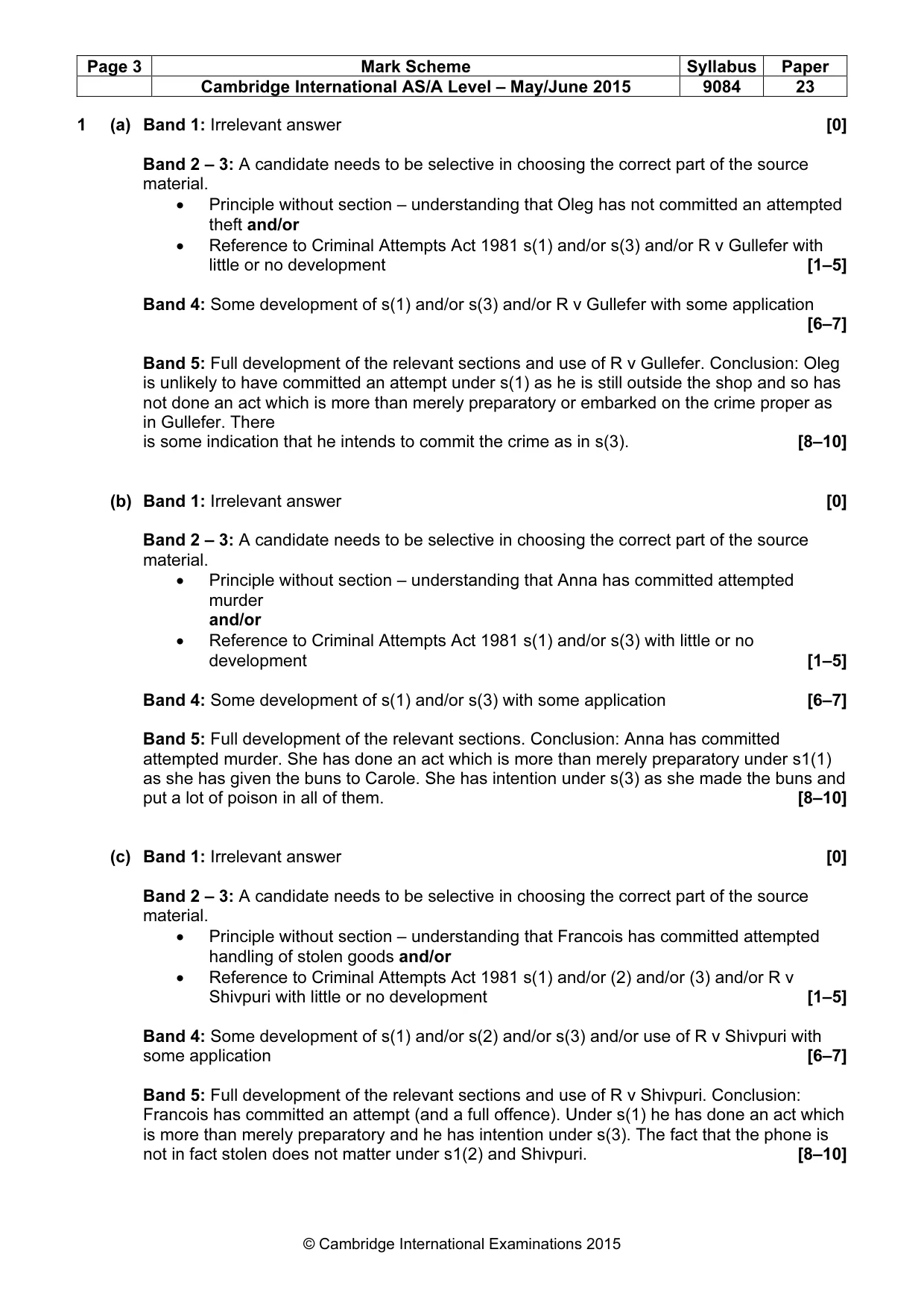
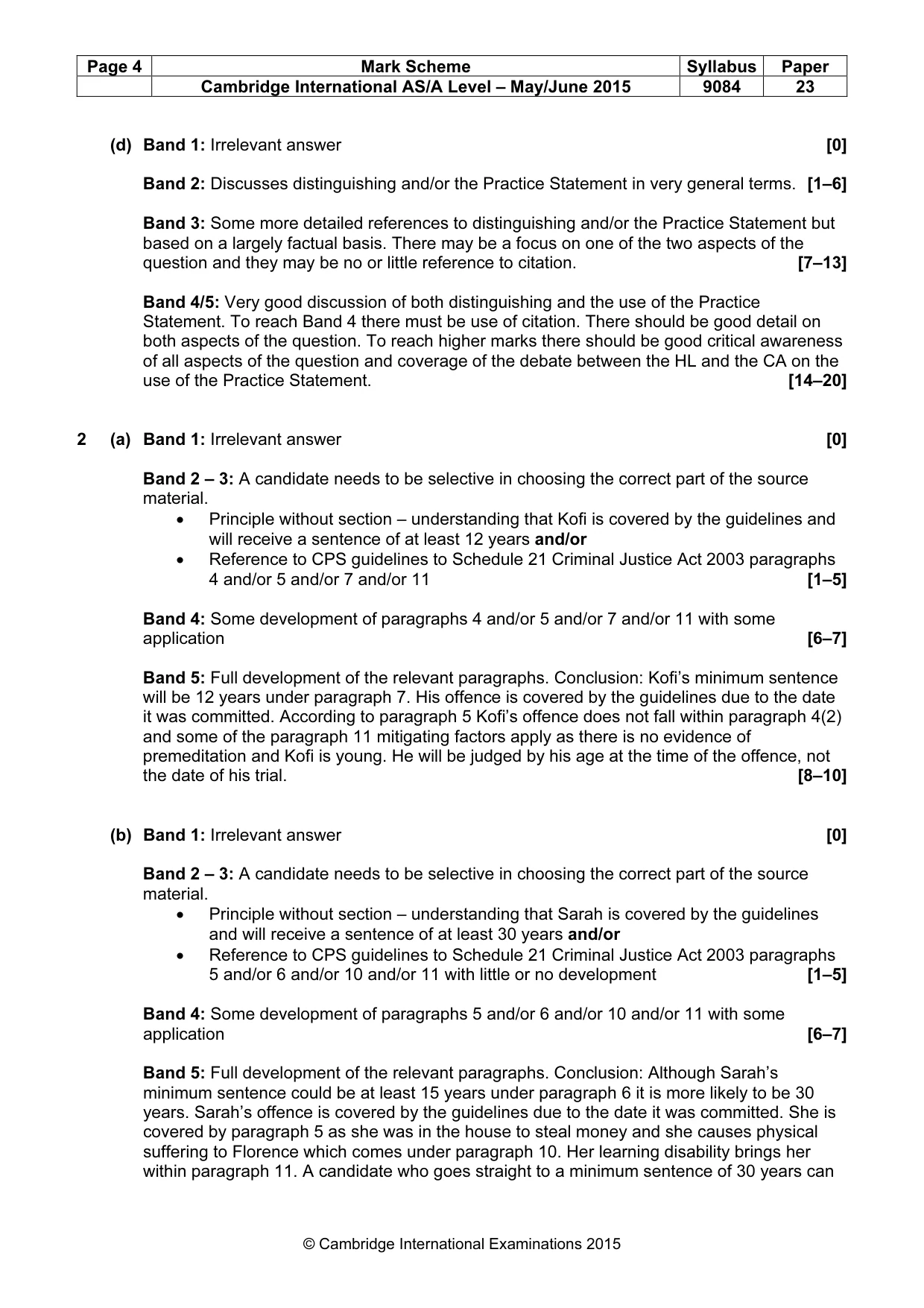
Page 3 Mark Scheme Syllabus Paper Cambridge International AS/A Level – May/June 2015 9084 23 © Cambridge International Examinations 2015 1 (a) Band 1: Irrelevant answer [0] Band 2 – 3: A candidate needs to be selective in choosing the correct part of the source material. • Principle without section – understanding that Oleg has not committed an attempted theft and/or • Reference to Criminal Attempts Act 1981 s(1) and/or s(3) and/or R v Gullefer with little or no development [1–5] Band 4: Some development of s(1) and/or s(3) and/or R v Gullefer with some application [6–7] Band 5: Full development of the relevant sections and use of R v Gullefer. Conclusion: Oleg is unlikely to have committed an attempt under s(1) as he is still outside the shop and so has not done an act which is more than merely preparatory or embarked on the crime proper as in Gullefer. There is some indication that he intends to commit the crime as in s(3). [8–10] (b) Band 1: Irrelevant answer [0] Band 2 – 3: A candidate needs to be selective in choosing the correct part of the source material. • Principle without section – understanding that Anna has committed attempted murder and/or • Reference to Criminal Attempts Act 1981 s(1) and/or s(3) with little or no development [1–5] Band 4: Some development of s(1) and/or s(3) with some application [6–7] Band 5: Full development of the relevant sections. Conclusion: Anna has committed attempted murder. She has done an act which is more than merely preparatory under s1(1) as she has given the buns to Carole. She has intention under s(3) as she made the buns and put a lot of poison in all of them. [8–10] (c) Band 1: Irrelevant answer [0] Band 2 – 3: A candidate needs to be selective in choosing the correct part of the source material. • Principle without section – understanding that Francois has committed attempted handling of stolen goods and/or • Reference to Criminal Attempts Act 1981 s(1) and/or (2) and/or (3) and/or R v Shivpuri with little or no development [1–5] Band 4: Some development of s(1) and/or s(2) and/or s(3) and/or use of R v Shivpuri with some application [6–7] Band 5: Full development of the relevant sections and use of R v Shivpuri. Conclusion: Francois has committed an attempt (and a full offence). Under s(1) he has done an act which is more than merely preparatory and he has intention under s(3). The fact that the phone is not in fact stolen does not matter under s1(2) and Shivpuri. [8–10]
Mark scheme, page 4
Page 4 Mark Scheme Syllabus Paper Cambridge International AS/A Level – May/June 2015 9084 23 © Cambridge International Examinations 2015 (d) Band 1: Irrelevant answer [0] Band 2: Discusses distinguishing and/or the Practice Statement in very general terms. [1–6] Band 3: Some more detailed references to distinguishing and/or the Practice Statement but based on a largely factual basis. There may be a focus on one of the two aspects of the question and they may be no or little reference to citation. [7–13] Band 4/5: Very good discussion of both distinguishing and the use of the Practice Statement. To reach Band 4 there must be use of citation. There should be good detail on both aspects of the question. To reach higher marks there should be good critical awareness of all aspects of the question and coverage of the debate between the HL and the CA on the use of the Practice Statement. [14–20] 2 (a) Band 1: Irrelevant answer [0] Band 2 – 3: A candidate needs to be selective in choosing the correct part of the source material. • Principle without section – understanding that Kofi is covered by the guidelines and will receive a sentence of at least 12 years and/or • Reference to CPS guidelines to Schedule 21 Criminal Justice Act 2003 paragraphs 4 and/or 5 and/or 7 and/or 11 [1–5] Band 4: Some development of paragraphs 4 and/or 5 and/or 7 and/or 11 with some application [6–7] Band 5: Full development of the relevant paragraphs. Conclusion: Kofi’s minimum sentence will be 12 years under paragraph 7. His offence is covered by the guidelines due to the date it was committed. According to paragraph 5 Kofi’s offence does not fall within paragraph 4(2) and some of the paragraph 11 mitigating factors apply as there is no evidence of premeditation and Kofi is young. He will be judged by his age at the time of the offence, not the date of his trial. [8–10] (b) Band 1: Irrelevant answer [0] Band 2 – 3: A candidate needs to be selective in choosing the correct part of the source material. • Principle without section – understanding that Sarah is covered by the guidelines and will receive a sentence of at least 30 years and/or • Reference to CPS guidelines to Schedule 21 Criminal Justice Act 2003 paragraphs 5 and/or 6 and/or 10 and/or 11 with little or no development [1–5] Band 4: Some development of paragraphs 5 and/or 6 and/or 10 and/or 11 with some application [6–7] Band 5: Full development of the relevant paragraphs. Conclusion: Although Sarah’s minimum sentence could be at least 15 years under paragraph 6 it is more likely to be 30 years. Sarah’s offence is covered by the guidelines due to the date it was committed. She is covered by paragraph 5 as she was in the house to steal money and she causes physical suffering to Florence which comes under paragraph 10. Her learning disability brings her within paragraph 11. A candidate who goes straight to a minimum sentence of 30 years can
Mark scheme, page 5
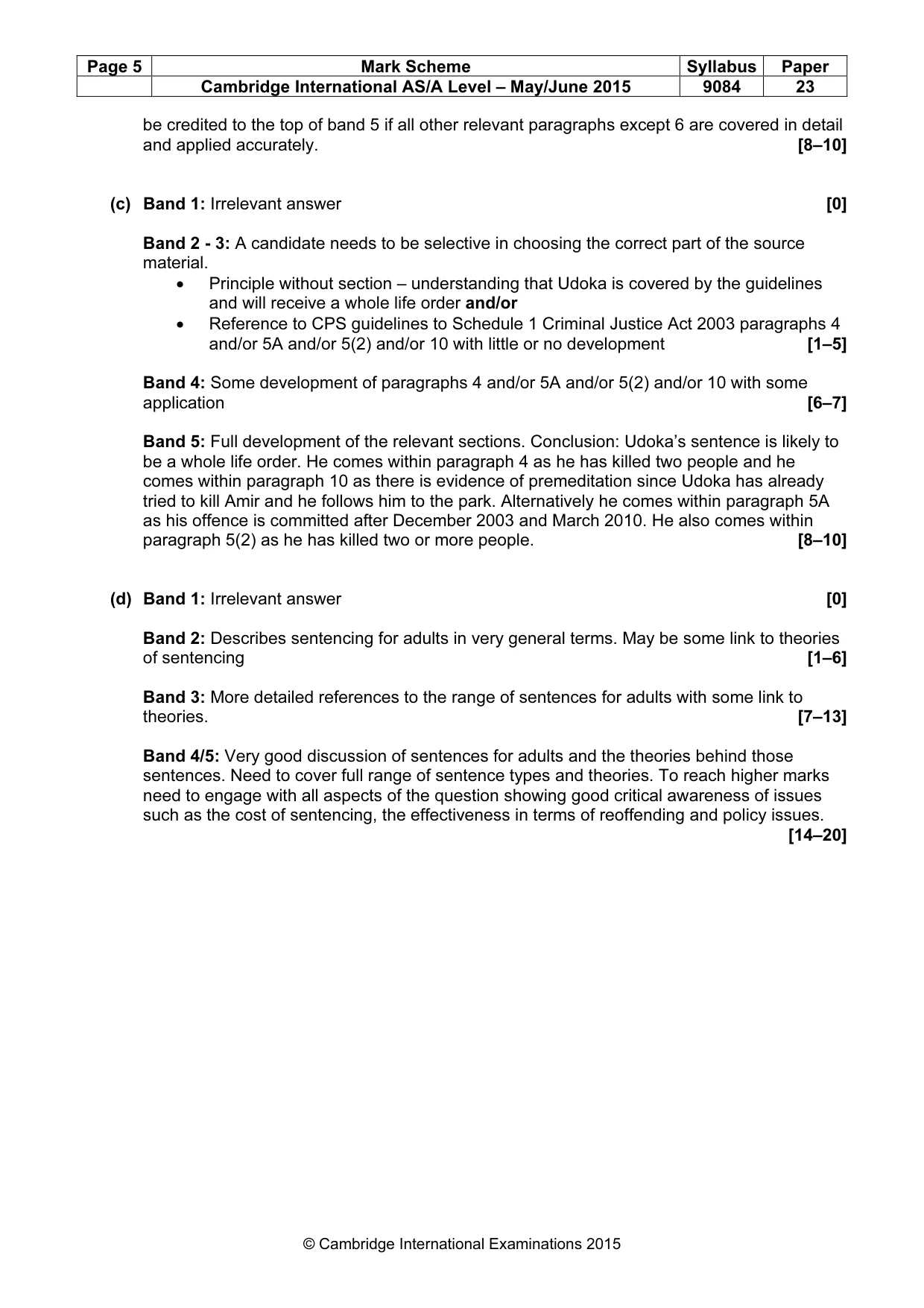
Page 5 Mark Scheme Syllabus Paper Cambridge International AS/A Level – May/June 2015 9084 23 © Cambridge International Examinations 2015 be credited to the top of band 5 if all other relevant paragraphs except 6 are covered in detail and applied accurately. [8–10] (c) Band 1: Irrelevant answer [0] Band 2 - 3: A candidate needs to be selective in choosing the correct part of the source material. • Principle without section – understanding that Udoka is covered by the guidelines and will receive a whole life order and/or • Reference to CPS guidelines to Schedule 1 Criminal Justice Act 2003 paragraphs 4 and/or 5A and/or 5(2) and/or 10 with little or no development [1–5] Band 4: Some development of paragraphs 4 and/or 5A and/or 5(2) and/or 10 with some application [6–7] Band 5: Full development of the relevant sections. Conclusion: Udoka’s sentence is likely to be a whole life order. He comes within paragraph 4 as he has killed two people and he comes within paragraph 10 as there is evidence of premeditation since Udoka has already tried to kill Amir and he follows him to the park. Alternatively he comes within paragraph 5A as his offence is committed after December 2003 and March 2010. He also comes within paragraph 5(2) as he has killed two or more people. [8–10] (d) Band 1: Irrelevant answer [0] Band 2: Describes sentencing for adults in very general terms. May be some link to theories of sentencing [1–6] Band 3: More detailed references to the range of sentences for adults with some link to theories. [7–13] Band 4/5: Very good discussion of sentences for adults and the theories behind those sentences. Need to cover full range of sentence types and theories. To reach higher marks need to engage with all aspects of the question showing good critical awareness of issues such as the cost of sentencing, the effectiveness in terms of reoffending and policy issues. [14–20]
What you needed in this session
Cambridge’s own grade thresholds for 2015 May/June, Paper 2 · Variant 3. A higher threshold means an easier paper — the bar moves with how the cohort did.