Cambridge A Level Law 9084 — 2015 May/June Paper 2 · Variant 1
9084/21/M/J/15 · 50 marks · ≈56 min
The question paper and its mark scheme, free to read here and free to download. This is Cambridge’s own paper, exactly as it was sat.
Question paper8 pages



Mark scheme5 pages
Answers below. Sit the paper first if you are practising.
Paper as text
Question paper, page 1
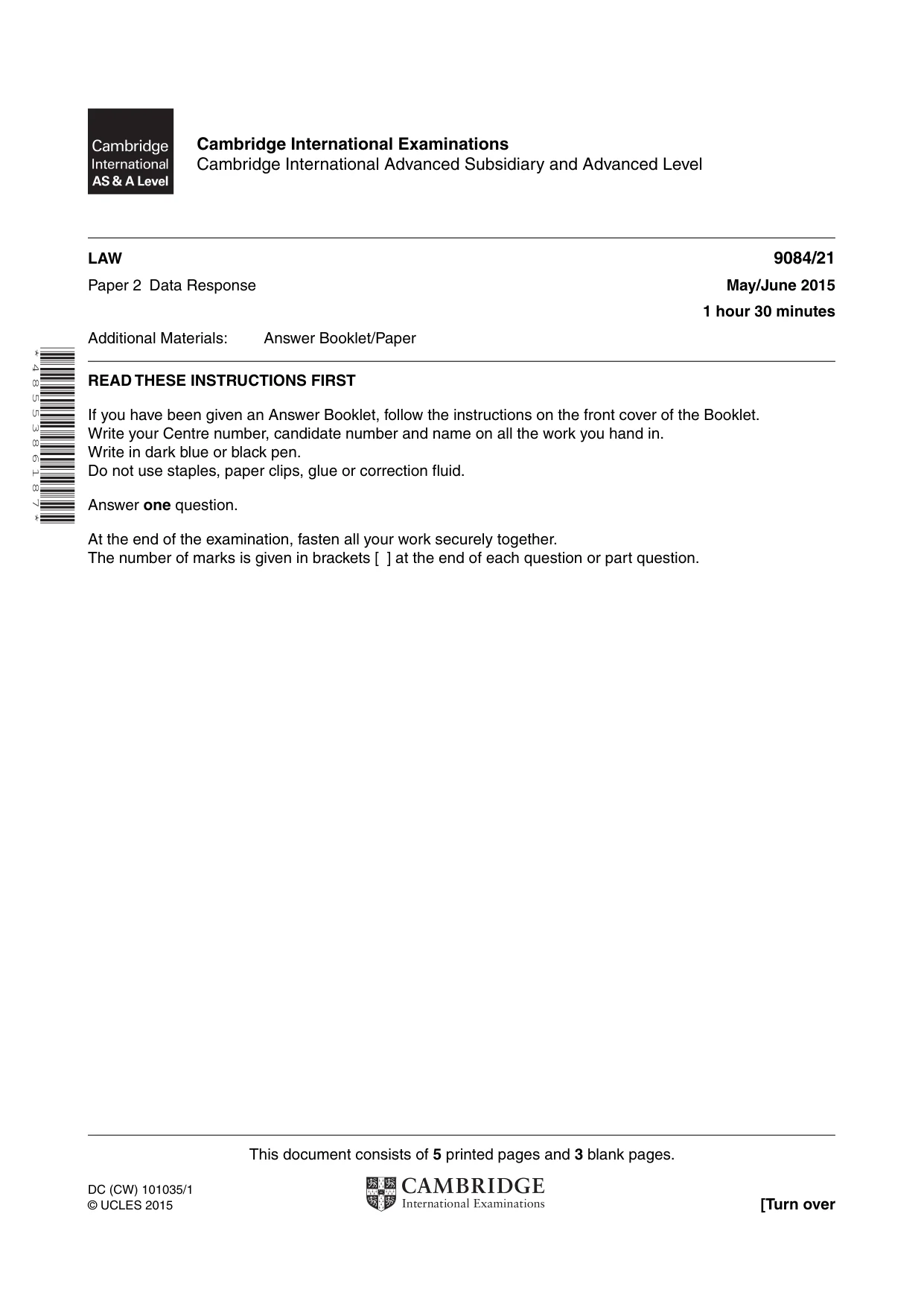
This document consists of 5 printed pages and 3 blank pages. DC (CW) 101035/1 © UCLES 2015 [Turn over Cambridge International Examinations Cambridge International Advanced Subsidiary and Advanced Level * 4 8 5 5 3 8 6 1 8 7 * LAW 9084/21 Paper 2 Data Response May/June 2015 1 hour 30 minutes Additional Materials: Answer Booklet/Paper READ THESE INSTRUCTIONS FIRST If you have been given an Answer Booklet, follow the instructions on the front cover of the Booklet. Write your Centre number, candidate number and name on all the work you hand in. Write in dark blue or black pen. Do not use staples, paper clips, glue or correction fluid. Answer one question. At the end of the examination, fasten all your work securely together. The number of marks is given in brackets [ ] at the end of each question or part question.
Question paper, page 2
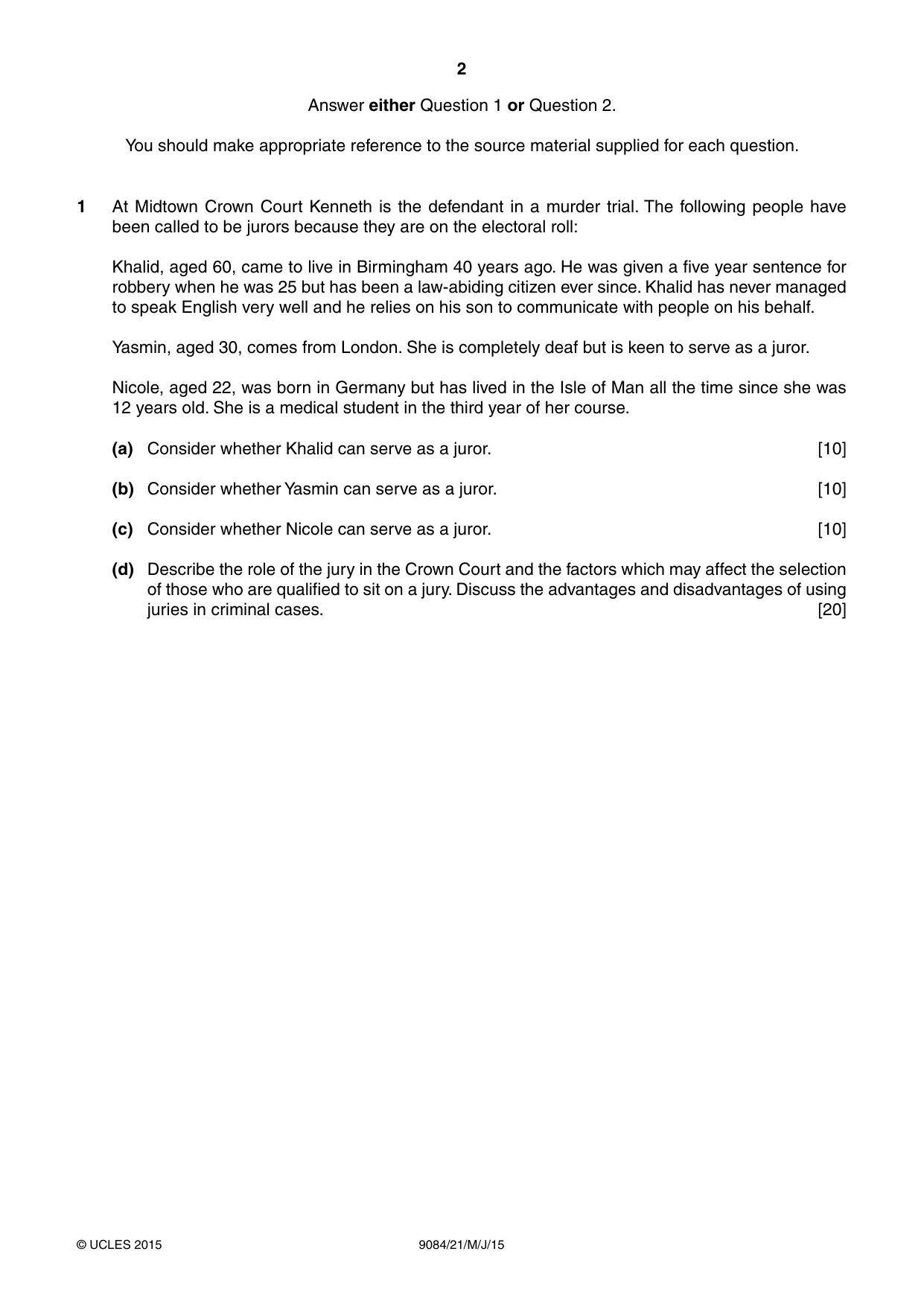
2 9084/21/M/J/15 © UCLES 2015 Answer either Question 1 or Question 2. You should make appropriate reference to the source material supplied for each question. 1 At Midtown Crown Court Kenneth is the defendant in a murder trial. The following people have been called to be jurors because they are on the electoral roll: Khalid, aged 60, came to live in Birmingham 40 years ago. He was given a five year sentence for robbery when he was 25 but has been a law-abiding citizen ever since. Khalid has never managed to speak English very well and he relies on his son to communicate with people on his behalf. Yasmin, aged 30, comes from London. She is completely deaf but is keen to serve as a juror. Nicole, aged 22, was born in Germany but has lived in the Isle of Man all the time since she was 12 years old. She is a medical student in the third year of her course. (a) Consider whether Khalid can serve as a juror. [10] (b) Consider whether Yasmin can serve as a juror. [10] (c) Consider whether Nicole can serve as a juror. [10] (d) Describe the role of the jury in the Crown Court and the factors which may affect the selection of those who are qualified to sit on a jury. Discuss the advantages and disadvantages of using juries in criminal cases. [20]
Question paper, page 3
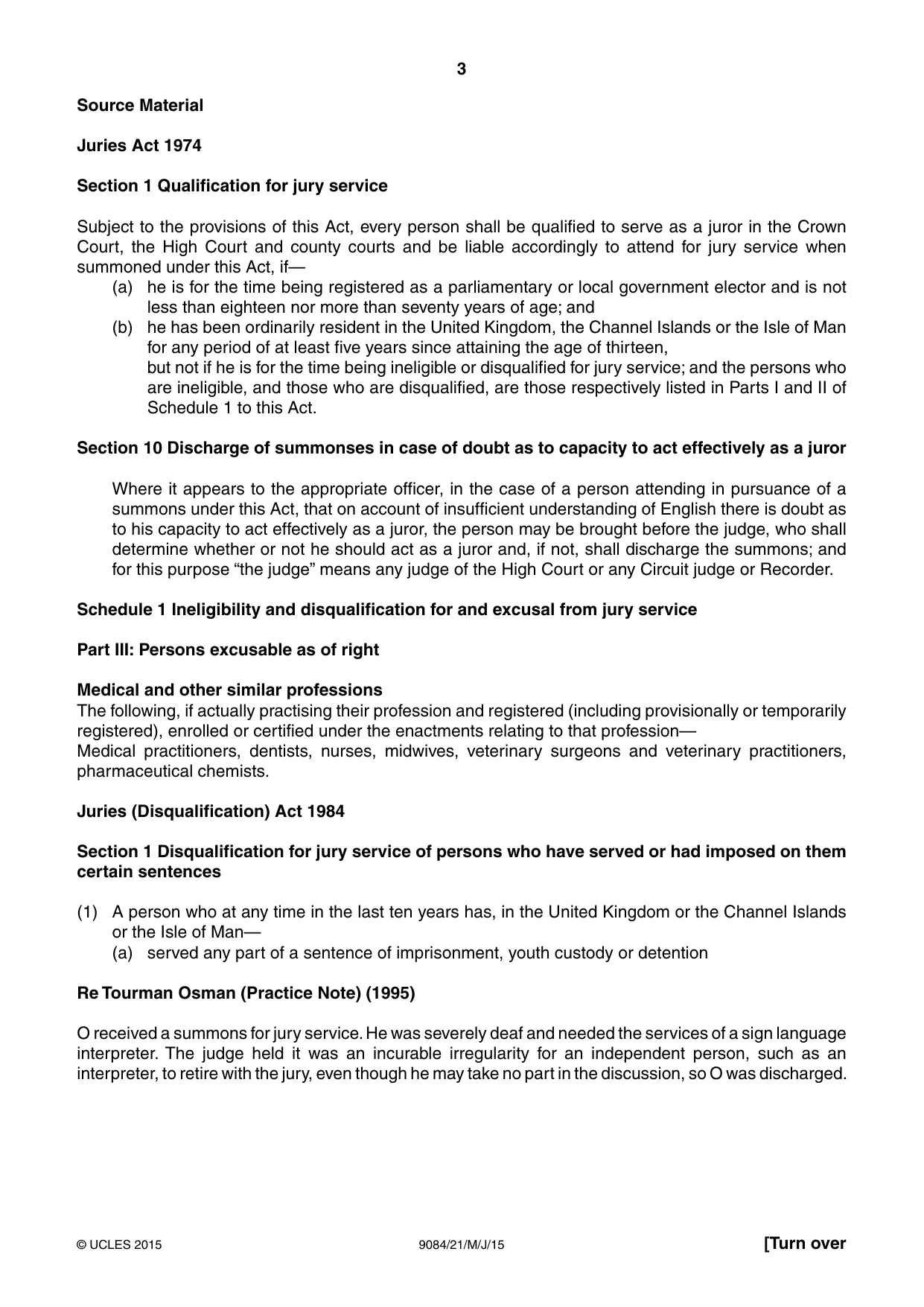
3 9084/21/M/J/15 © UCLES 2015 [Turn over Source Material Juries Act 1974 Section 1 Qualification for jury service Subject to the provisions of this Act, every person shall be qualified to serve as a juror in the Crown Court, the High Court and county courts and be liable accordingly to attend for jury service when summoned under this Act, if— (a) he is for the time being registered as a parliamentary or local government elector and is not less than eighteen nor more than seventy years of age; and (b) he has been ordinarily resident in the United Kingdom, the Channel Islands or the Isle of Man for any period of at least five years since attaining the age of thirteen, but not if he is for the time being ineligible or disqualified for jury service; and the persons who are ineligible, and those who are disqualified, are those respectively listed in Parts I and II of Schedule 1 to this Act. Section 10 Discharge of summonses in case of doubt as to capacity to act effectively as a juror Where it appears to the appropriate officer, in the case of a person attending in pursuance of a summons under this Act, that on account of insufficient understanding of English there is doubt as to his capacity to act effectively as a juror, the person may be brought before the judge, who shall determine whether or not he should act as a juror and, if not, shall discharge the summons; and for this purpose “the judge” means any judge of the High Court or any Circuit judge or Recorder. Schedule 1 Ineligibility and disqualification for and excusal from jury service Part III: Persons excusable as of right Medical and other similar professions The following, if actually practising their profession and registered (including provisionally or temporarily registered), enrolled or certified under the enactments relating to that profession— Medical practitioners, dentists, nurses, midwives, veterinary surgeons and veterinary practitioners, pharmaceutical chemists. Juries (Disqualification) Act 1984 Section 1 Disqualification for jury service of persons who have served or had imposed on them certain sentences (1) A person who at any time in the last ten years has, in the United Kingdom or the Channel Islands or the Isle of Man— (a) served any part of a sentence of imprisonment, youth custody or detention Re Tourman Osman (Practice Note) (1995) O received a summons for jury service. He was severely deaf and needed the services of a sign language interpreter. The judge held it was an incurable irregularity for an independent person, such as an interpreter, to retire with the jury, even though he may take no part in the discussion, so O was discharged.
Question paper, page 4
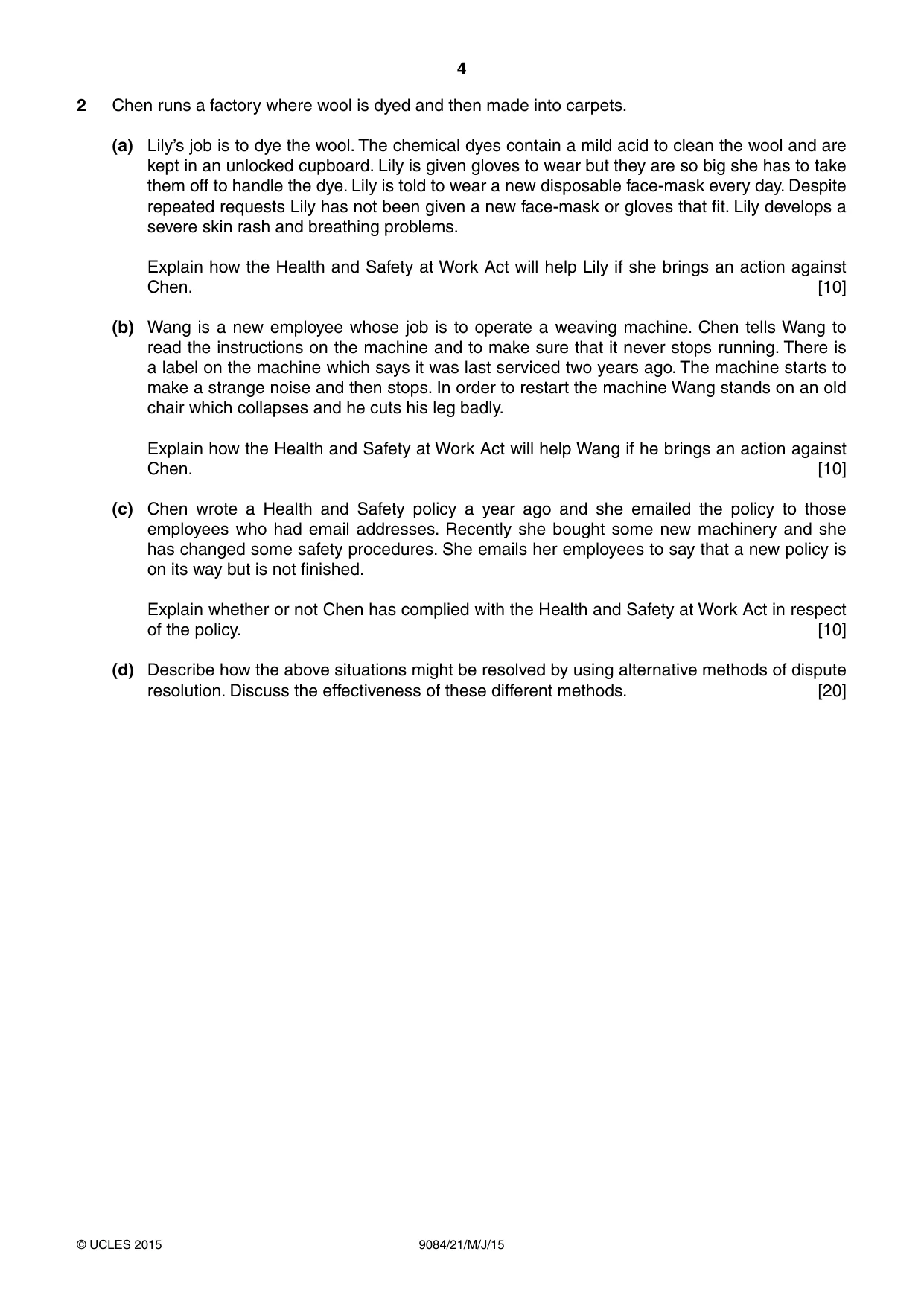
4 9084/21/M/J/15 © UCLES 2015 2 Chen runs a factory where wool is dyed and then made into carpets. (a) Lily’s job is to dye the wool. The chemical dyes contain a mild acid to clean the wool and are kept in an unlocked cupboard. Lily is given gloves to wear but they are so big she has to take them off to handle the dye. Lily is told to wear a new disposable face-mask every day. Despite repeated requests Lily has not been given a new face-mask or gloves that fit. Lily develops a severe skin rash and breathing problems. Explain how the Health and Safety at Work Act will help Lily if she brings an action against Chen. [10] (b) Wang is a new employee whose job is to operate a weaving machine. Chen tells Wang to read the instructions on the machine and to make sure that it never stops running. There is a label on the machine which says it was last serviced two years ago. The machine starts to make a strange noise and then stops. In order to restart the machine Wang stands on an old chair which collapses and he cuts his leg badly. Explain how the Health and Safety at Work Act will help Wang if he brings an action against Chen. [10] (c) Chen wrote a Health and Safety policy a year ago and she emailed the policy to those employees who had email addresses. Recently she bought some new machinery and she has changed some safety procedures. She emails her employees to say that a new policy is on its way but is not finished. Explain whether or not Chen has complied with the Health and Safety at Work Act in respect of the policy. [10] (d) Describe how the above situations might be resolved by using alternative methods of dispute resolution. Discuss the effectiveness of these different methods. [20]
Question paper, page 5
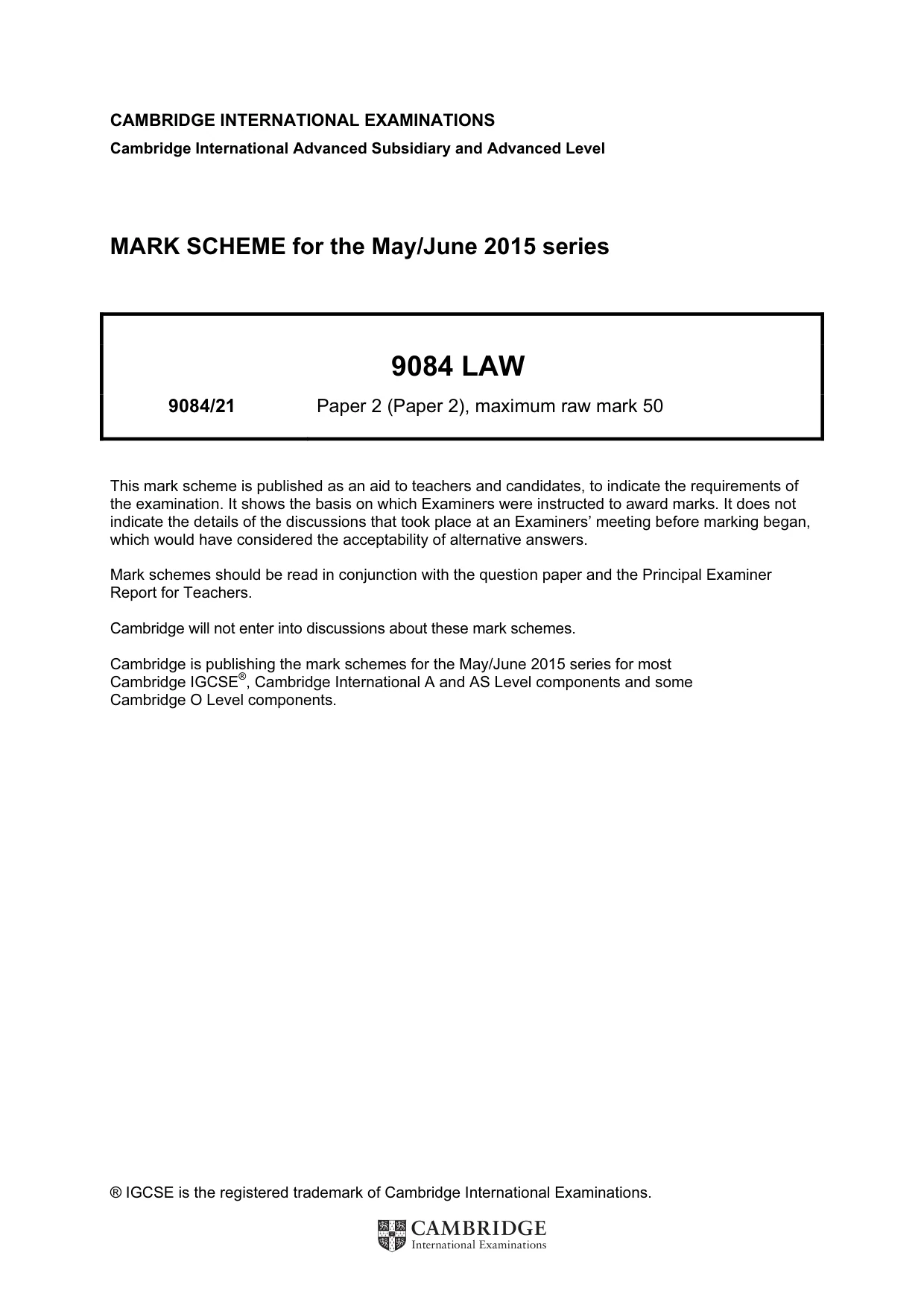
5 9084/21/M/J/15 © UCLES 2015 Source Material Health and Safety at Work Act 1974 Section 2 General duties of employers to their employees (1) It shall be the duty of every employer to ensure, so far as is reasonably practicable, the health, safety and welfare at work of all his employees. (2) Without prejudice to the generality of an employer’s duty under the preceding subsection, the matters to which that duty extends include in particular— (a) the provision and maintenance of plant and systems of work that are, so far as is reasonably practicable, safe and without risks to health; (b) arrangements for ensuring, so far as is reasonably practicable, safety and absence of risks to health in connection with the use, handling, storage and transport of articles and substances; (c) the provision of such information, instruction, training and supervision as is necessary to ensure, so far as is reasonably practicable, the health and safety at work of his employees; (d) so far as is reasonably practicable as regards any place of work under the employer’s control, the maintenance of it in a condition that is safe and without risks to health and the provision and maintenance of means of access to and egress from it that are safe and without such risks; (e) the provision and maintenance of a working environment for his employees that is, so far as is reasonably practicable, safe, without risks to health, and adequate as regards facilities and arrangements for their welfare at work. (3) Except in such cases as may be prescribed, it shall be the duty of every employer to prepare and as often as may be appropriate revise a written statement of his general policy with respect to the health and safety at work of his employees and the organisation and arrangements for the time being in force for carrying out that policy, and to bring the statement and any revision of it to the notice of all of his employees.
Question paper, page 6
6 9084/21/M/J/15 © UCLES 2015 BLANK PAGE
Question paper, page 7
7 9084/21/M/J/15 © UCLES 2015 BLANK PAGE
Question paper, page 8
8 9084/21/M/J/15 © UCLES 2015 BLANK PAGE Permission to reproduce items where third-party owned material protected by copyright is included has been sought and cleared where possible. Every reasonable effort has been made by the publisher (UCLES) to trace copyright holders, but if any items requiring clearance have unwittingly been included, the publisher will be pleased to make amends at the earliest possible opportunity. To avoid the issue of disclosure of answer-related information to candidates, all copyright acknowledgements are reproduced online in the Cambridge International Examinations Copyright Acknowledgements Booklet. This is produced for each series of examinations and is freely available to download at www.cie.org.uk after the live examination series. Cambridge International Examinations is part of the Cambridge Assessment Group. Cambridge Assessment is the brand name of University of Cambridge Local Examinations Syndicate (UCLES), which is itself a department of the University of Cambridge.
Mark scheme, page 1
® IGCSE is the registered trademark of Cambridge International Examinations. CAMBRIDGE INTERNATIONAL EXAMINATIONS Cambridge International Advanced Subsidiary and Advanced Level MARK SCHEME for the May/June 2015 series 9084 LAW 9084/21 Paper 2 (Paper 2), maximum raw mark 50 This mark scheme is published as an aid to teachers and candidates, to indicate the requirements of the examination. It shows the basis on which Examiners were instructed to award marks. It does not indicate the details of the discussions that took place at an Examiners’ meeting before marking began, which would have considered the acceptability of alternative answers. Mark schemes should be read in conjunction with the question paper and the Principal Examiner Report for Teachers. Cambridge will not enter into discussions about these mark schemes. Cambridge is publishing the mark schemes for the May/June 2015 series for most Cambridge IGCSE®, Cambridge International A and AS Level components and some Cambridge O Level components.
Mark scheme, page 2
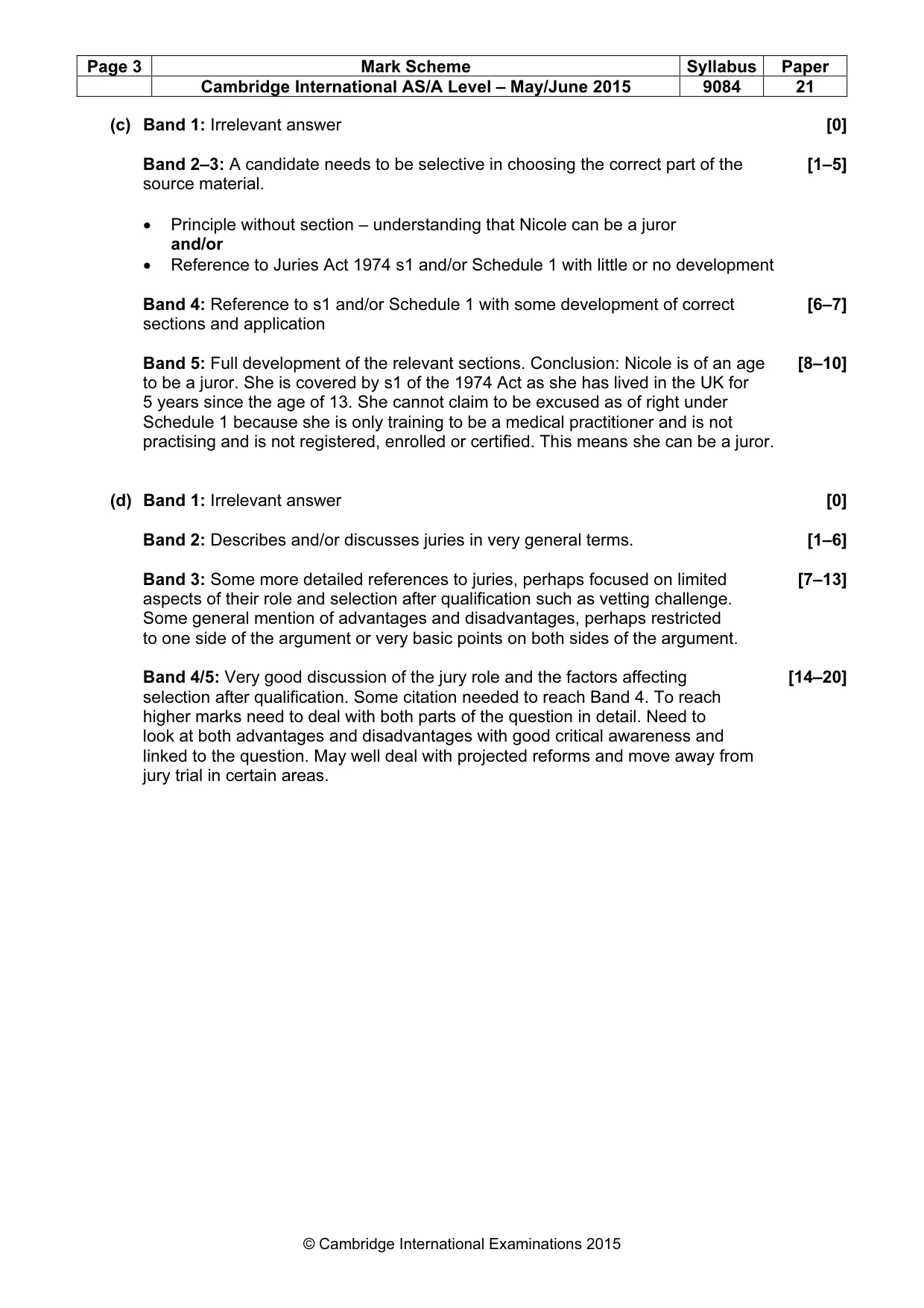
Page 2 Mark Scheme Syllabus Paper Cambridge International AS/A Level – May/June 2015 9084 21 © Cambridge International Examinations 2015 1 (a) Band 1: Irrelevant answer [0] Band 2–3: A candidate needs to be selective in choosing the correct part of the [1–5] source material. • Principle without section – understanding that Khalid cannot be a juror and/or • Reference to Juries Act 1974 s1 and/or s10 and Juries Disqualification Act 1984 s1(1) with little or no development Band 4: Reference to s1 and/or s1(1)(a) and/or s10 with some development of [6–7] correct sections and application Band 5: Full development of the relevant sections. Conclusion: Khalid is of an age [8–10] to be a juror and is covered by s1 of the 1974 Act. He is outside s1(1) of the 1984 Act as he received his sentence over 10 years ago. He is covered by s10 1974 and so is disqualified. (b) Band 1: Irrelevant answer [0] Band 2–3: A candidate needs to be selective in choosing the correct part of the [1–5] source material. • Principle without section – understanding that Yasmin cannot be a juror and/or • Reference to Juries Act 1974 s1 and/or Re Tourman Osman (Practice Note) (1995) with little or no development Band 4: Reference to s1 and/or s1(1) with some development of correct section [6–7] and/or case and application Band 5: Full development of the relevant sections and case. Conclusion: Yasmin [8–10] is of an age to be a juror. She is also covered by s1 of the 1974 Act as she is from London. She cannot be a juror because she is completely deaf and needs an interpreter.
Mark scheme, page 3
Page 3 Mark Scheme Syllabus Paper Cambridge International AS/A Level – May/June 2015 9084 21 © Cambridge International Examinations 2015 (c) Band 1: Irrelevant answer [0] Band 2–3: A candidate needs to be selective in choosing the correct part of the [1–5] source material. • Principle without section – understanding that Nicole can be a juror and/or • Reference to Juries Act 1974 s1 and/or Schedule 1 with little or no development Band 4: Reference to s1 and/or Schedule 1 with some development of correct [6–7] sections and application Band 5: Full development of the relevant sections. Conclusion: Nicole is of an age [8–10] to be a juror. She is covered by s1 of the 1974 Act as she has lived in the UK for 5 years since the age of 13. She cannot claim to be excused as of right under Schedule 1 because she is only training to be a medical practitioner and is not practising and is not registered, enrolled or certified. This means she can be a juror. (d) Band 1: Irrelevant answer [0] Band 2: Describes and/or discusses juries in very general terms. [1–6] Band 3: Some more detailed references to juries, perhaps focused on limited [7–13] aspects of their role and selection after qualification such as vetting challenge. Some general mention of advantages and disadvantages, perhaps restricted to one side of the argument or very basic points on both sides of the argument. Band 4/5: Very good discussion of the jury role and the factors affecting [14–20] selection after qualification. Some citation needed to reach Band 4. To reach higher marks need to deal with both parts of the question in detail. Need to look at both advantages and disadvantages with good critical awareness and linked to the question. May well deal with projected reforms and move away from jury trial in certain areas.
Mark scheme, page 4
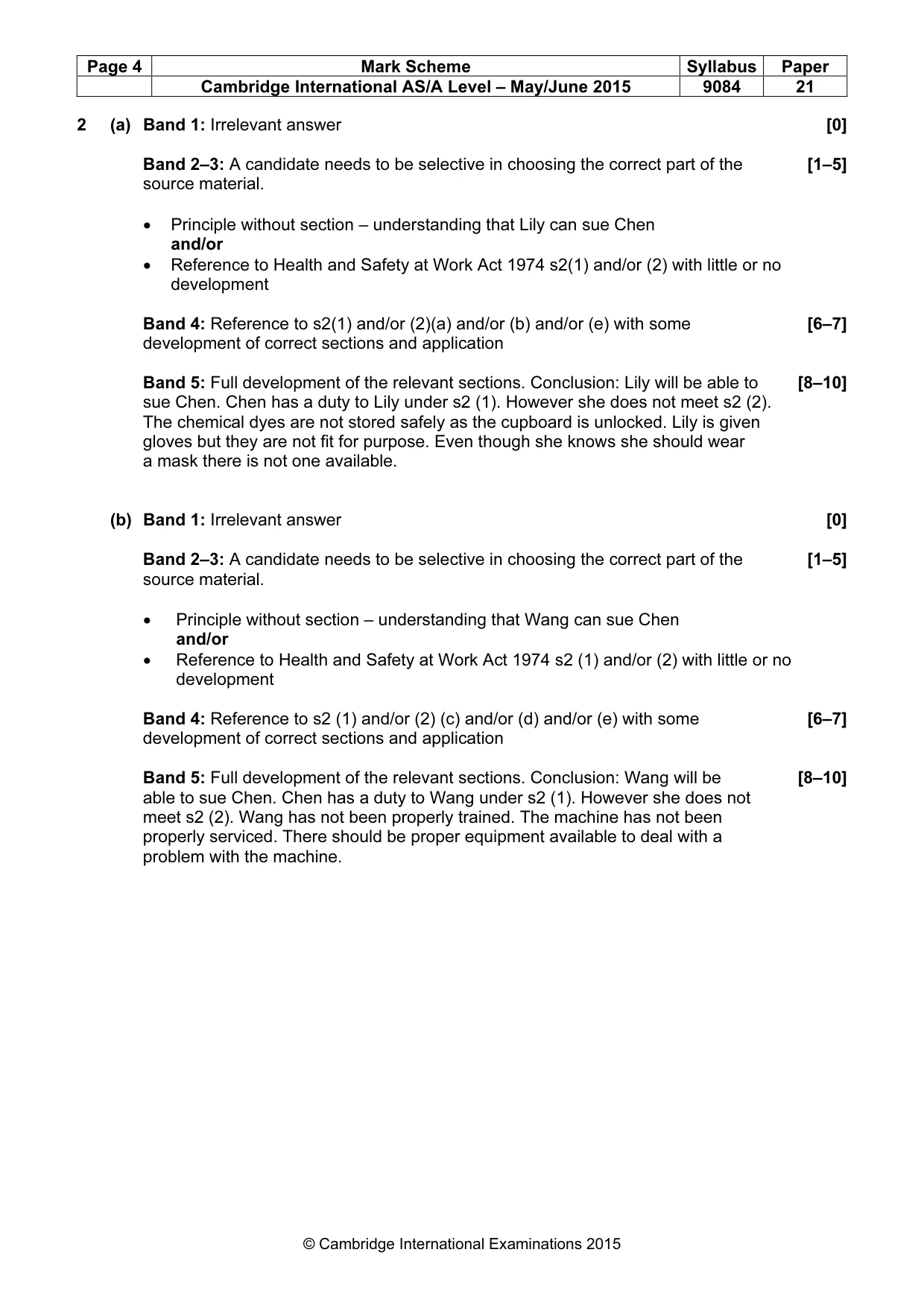
Page 4 Mark Scheme Syllabus Paper Cambridge International AS/A Level – May/June 2015 9084 21 © Cambridge International Examinations 2015 2 (a) Band 1: Irrelevant answer [0] Band 2–3: A candidate needs to be selective in choosing the correct part of the [1–5] source material. • Principle without section – understanding that Lily can sue Chen and/or • Reference to Health and Safety at Work Act 1974 s2(1) and/or (2) with little or no development Band 4: Reference to s2(1) and/or (2)(a) and/or (b) and/or (e) with some [6–7] development of correct sections and application Band 5: Full development of the relevant sections. Conclusion: Lily will be able to [8–10] sue Chen. Chen has a duty to Lily under s2 (1). However she does not meet s2 (2). The chemical dyes are not stored safely as the cupboard is unlocked. Lily is given gloves but they are not fit for purpose. Even though she knows she should wear a mask there is not one available. (b) Band 1: Irrelevant answer [0] Band 2–3: A candidate needs to be selective in choosing the correct part of the [1–5] source material. • Principle without section – understanding that Wang can sue Chen and/or • Reference to Health and Safety at Work Act 1974 s2 (1) and/or (2) with little or no development Band 4: Reference to s2 (1) and/or (2) (c) and/or (d) and/or (e) with some [6–7] development of correct sections and application Band 5: Full development of the relevant sections. Conclusion: Wang will be [8–10] able to sue Chen. Chen has a duty to Wang under s2 (1). However she does not meet s2 (2). Wang has not been properly trained. The machine has not been properly serviced. There should be proper equipment available to deal with a problem with the machine.
Mark scheme, page 5
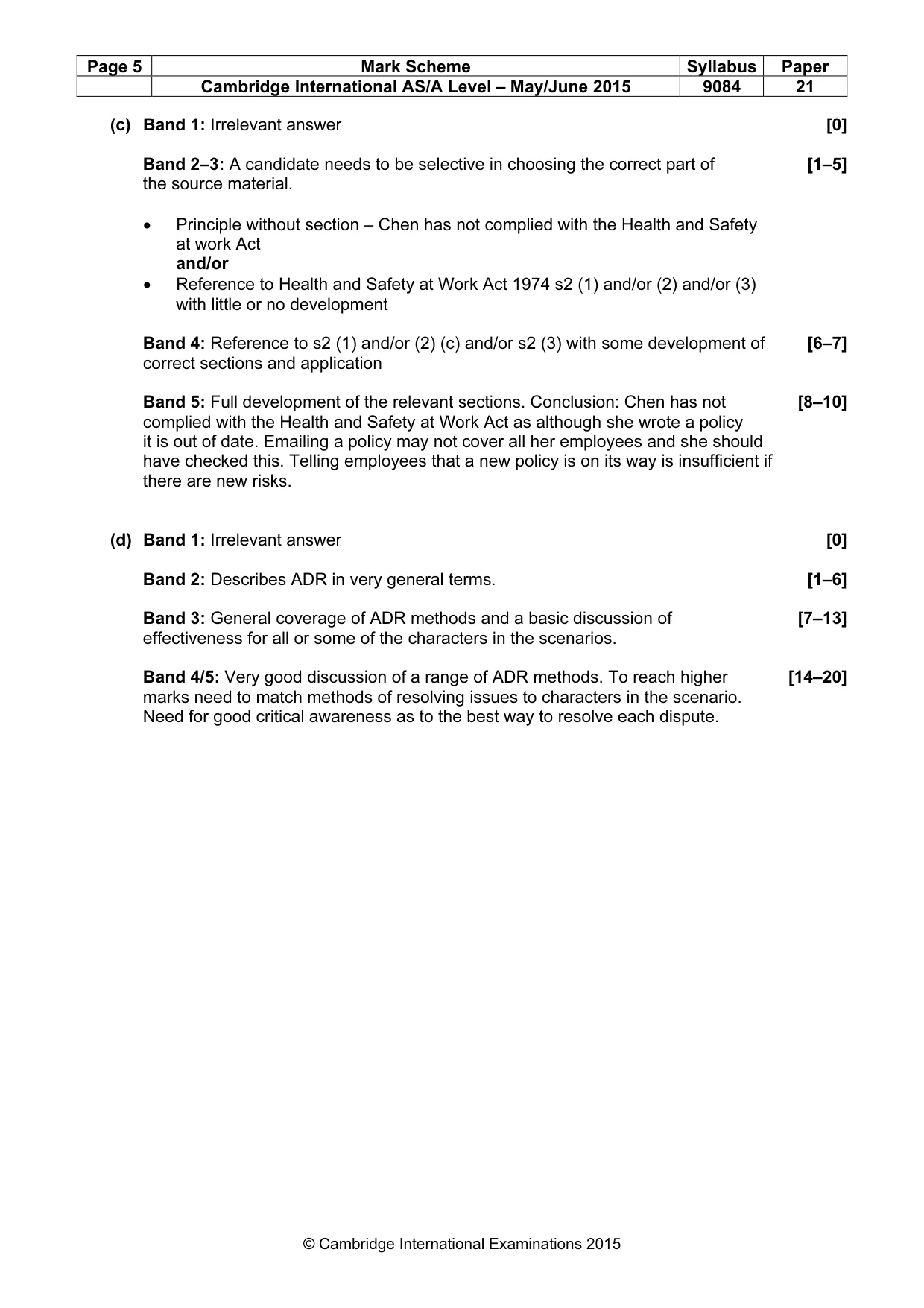
Page 5 Mark Scheme Syllabus Paper Cambridge International AS/A Level – May/June 2015 9084 21 © Cambridge International Examinations 2015 (c) Band 1: Irrelevant answer [0] Band 2–3: A candidate needs to be selective in choosing the correct part of [1–5] the source material. • Principle without section – Chen has not complied with the Health and Safety at work Act and/or • Reference to Health and Safety at Work Act 1974 s2 (1) and/or (2) and/or (3) with little or no development Band 4: Reference to s2 (1) and/or (2) (c) and/or s2 (3) with some development of [6–7] correct sections and application Band 5: Full development of the relevant sections. Conclusion: Chen has not [8–10] complied with the Health and Safety at Work Act as although she wrote a policy it is out of date. Emailing a policy may not cover all her employees and she should have checked this. Telling employees that a new policy is on its way is insufficient if there are new risks. (d) Band 1: Irrelevant answer [0] Band 2: Describes ADR in very general terms. [1–6] Band 3: General coverage of ADR methods and a basic discussion of [7–13] effectiveness for all or some of the characters in the scenarios. Band 4/5: Very good discussion of a range of ADR methods. To reach higher [14–20] marks need to match methods of resolving issues to characters in the scenario. Need for good critical awareness as to the best way to resolve each dispute.
What you needed in this session
Cambridge’s own grade thresholds for 2015 May/June, Paper 2 · Variant 1. A higher threshold means an easier paper — the bar moves with how the cohort did.