Cambridge A Level Law 9084 — 2014 May/June Paper 2 · Variant 2
9084/22/M/J/14 · 50 marks · ≈56 min
The question paper and its mark scheme, free to read here and free to download. This is Cambridge’s own paper, exactly as it was sat.
Question paper4 pages
Mark scheme5 pages
Answers below. Sit the paper first if you are practising.

Paper as text
Question paper, page 1
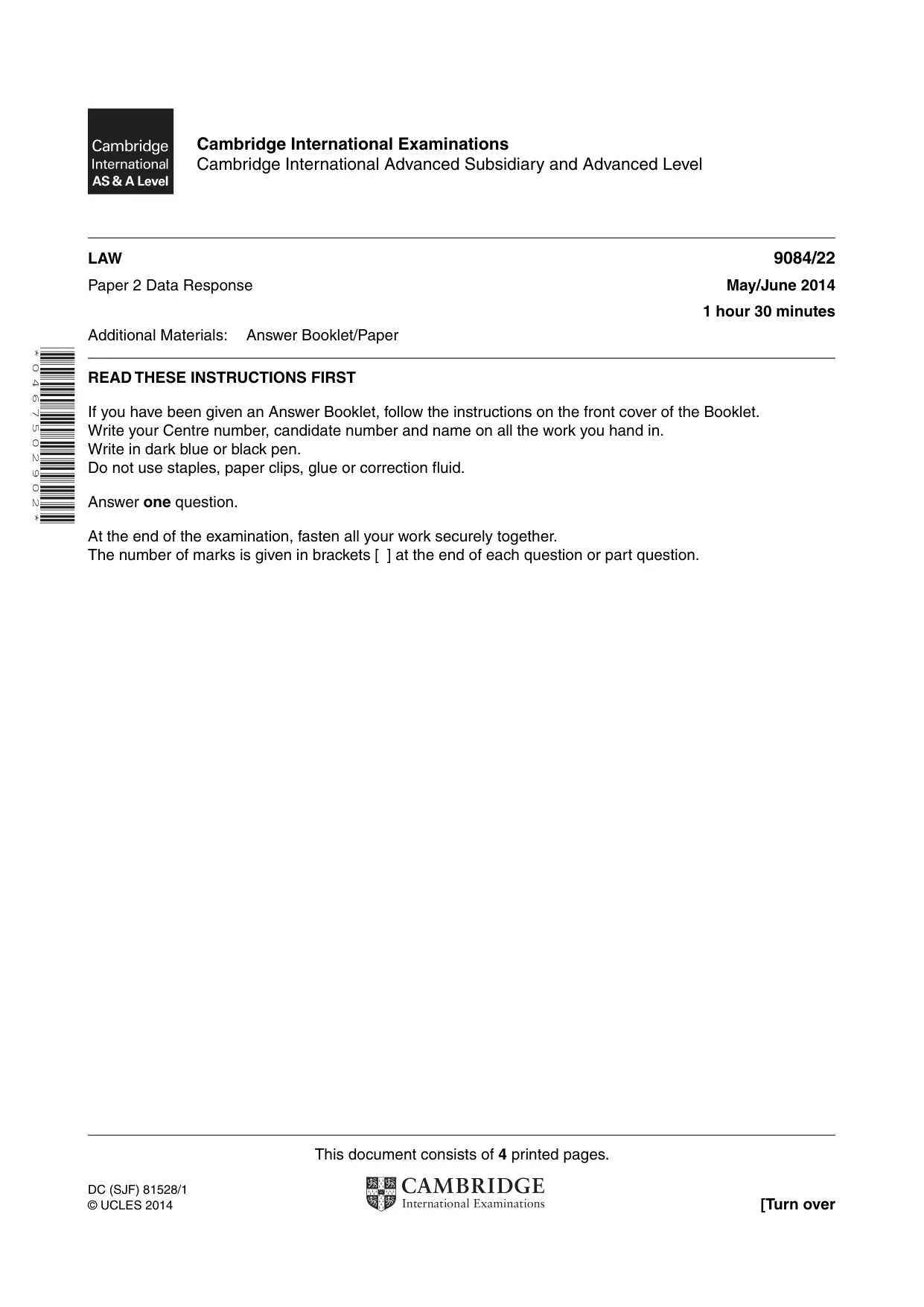
This document consists of 4 printed pages. DC (SJF) 81528/1 © UCLES 2014 [Turn over Cambridge International Examinations Cambridge International Advanced Subsidiary and Advanced Level * 0 4 6 7 5 0 2 9 0 2 * LAW 9084/22 Paper 2 Data Response May/June 2014 1 hour 30 minutes Additional Materials: Answer Booklet/Paper READ THESE INSTRUCTIONS FIRST If you have been given an Answer Booklet, follow the instructions on the front cover of the Booklet. Write your Centre number, candidate number and name on all the work you hand in. Write in dark blue or black pen. Do not use staples, paper clips, glue or correction fluid. Answer one question. At the end of the examination, fasten all your work securely together. The number of marks is given in brackets [ ] at the end of each question or part question.
Question paper, page 2
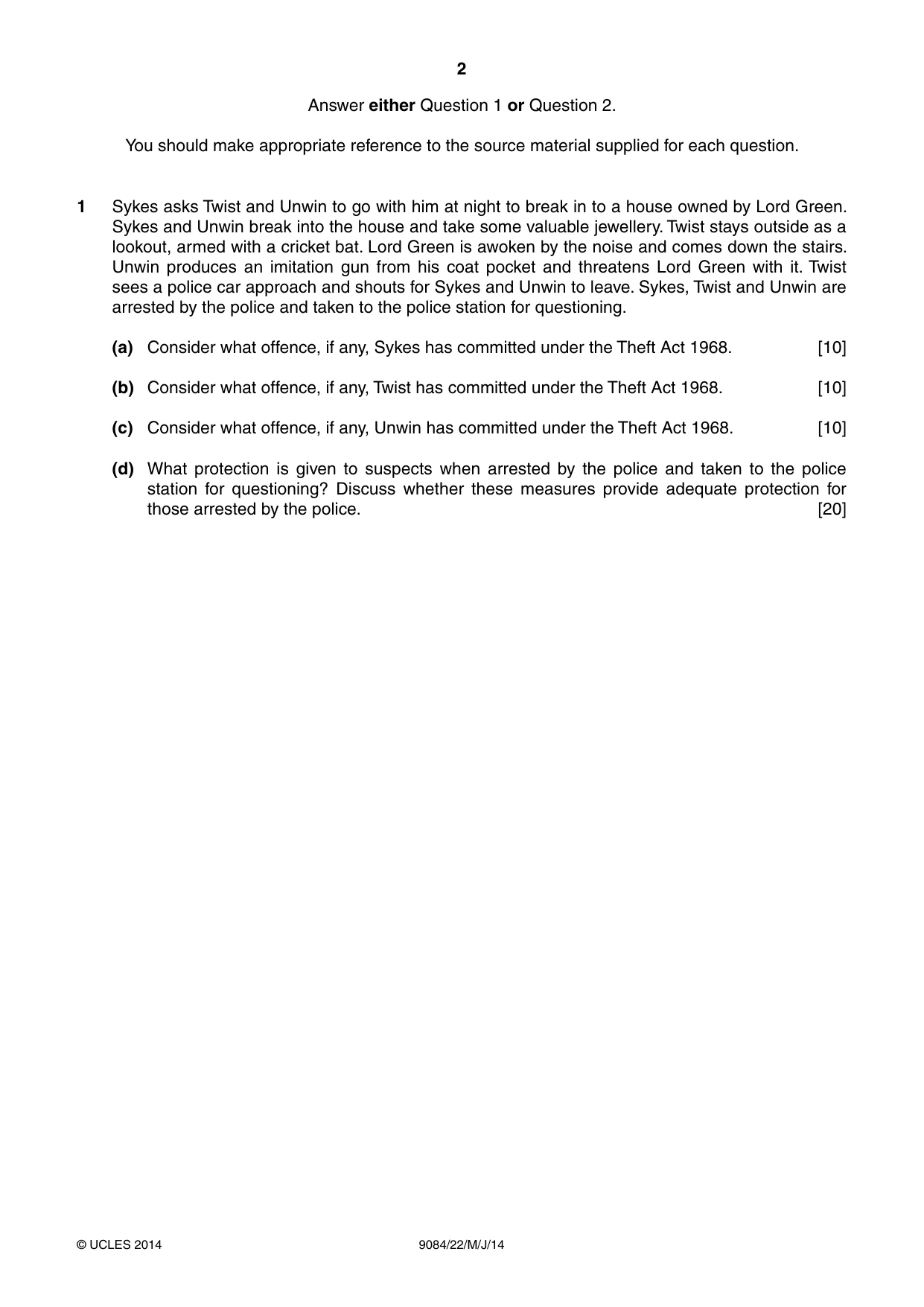
2 9084/22/M/J/14 © UCLES 2014 Answer either Question 1 or Question 2. You should make appropriate reference to the source material supplied for each question. 1 Sykes asks Twist and Unwin to go with him at night to break in to a house owned by Lord Green. Sykes and Unwin break into the house and take some valuable jewellery. Twist stays outside as a lookout, armed with a cricket bat. Lord Green is awoken by the noise and comes down the stairs. Unwin produces an imitation gun from his coat pocket and threatens Lord Green with it. Twist sees a police car approach and shouts for Sykes and Unwin to leave. Sykes, Twist and Unwin are arrested by the police and taken to the police station for questioning. (a) Consider what offence, if any, Sykes has committed under the Theft Act 1968. [10] (b) Consider what offence, if any, Twist has committed under the Theft Act 1968. [10] (c) Consider what offence, if any, Unwin has committed under the Theft Act 1968. [10] (d) What protection is given to suspects when arrested by the police and taken to the police station for questioning? Discuss whether these measures provide adequate protection for those arrested by the police. [20]
Question paper, page 3
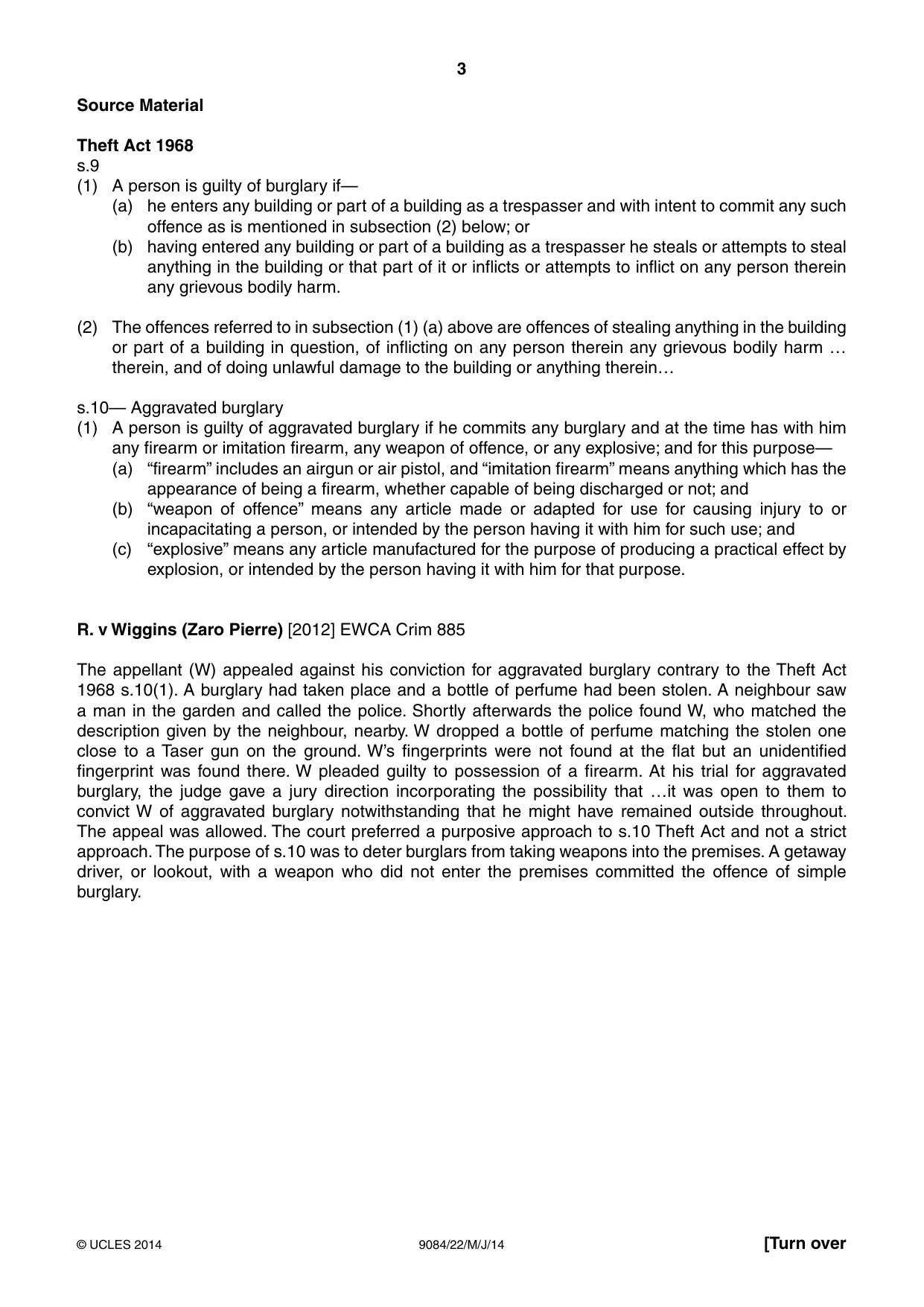
3 9084/22/M/J/14 © UCLES 2014 [Turn over Source Material Theft Act 1968 s.9 (1) A person is guilty of burglary if— (a) he enters any building or part of a building as a trespasser and with intent to commit any such offence as is mentioned in subsection (2) below; or (b) having entered any building or part of a building as a trespasser he steals or attempts to steal anything in the building or that part of it or inflicts or attempts to inflict on any person therein any grievous bodily harm. (2) The offences referred to in subsection (1) (a) above are offences of stealing anything in the building or part of a building in question, of inflicting on any person therein any grievous bodily harm … therein, and of doing unlawful damage to the building or anything therein… s.10— Aggravated burglary (1) A person is guilty of aggravated burglary if he commits any burglary and at the time has with him any firearm or imitation firearm, any weapon of offence, or any explosive; and for this purpose— (a) “firearm” includes an airgun or air pistol, and “imitation firearm” means anything which has the appearance of being a firearm, whether capable of being discharged or not; and (b) “weapon of offence” means any article made or adapted for use for causing injury to or incapacitating a person, or intended by the person having it with him for such use; and (c) “explosive” means any article manufactured for the purpose of producing a practical effect by explosion, or intended by the person having it with him for that purpose. R. v Wiggins (Zaro Pierre) [2012] EWCA Crim 885 The appellant (W) appealed against his conviction for aggravated burglary contrary to the Theft Act 1968 s.10(1). A burglary had taken place and a bottle of perfume had been stolen. A neighbour saw a man in the garden and called the police. Shortly afterwards the police found W, who matched the description given by the neighbour, nearby. W dropped a bottle of perfume matching the stolen one close to a Taser gun on the ground. W’s fingerprints were not found at the flat but an unidentified fingerprint was found there. W pleaded guilty to possession of a firearm. At his trial for aggravated burglary, the judge gave a jury direction incorporating the possibility that …it was open to them to convict W of aggravated burglary notwithstanding that he might have remained outside throughout. The appeal was allowed. The court preferred a purposive approach to s.10 Theft Act and not a strict approach. The purpose of s.10 was to deter burglars from taking weapons into the premises. A getaway driver, or lookout, with a weapon who did not enter the premises committed the offence of simple burglary.
Question paper, page 4
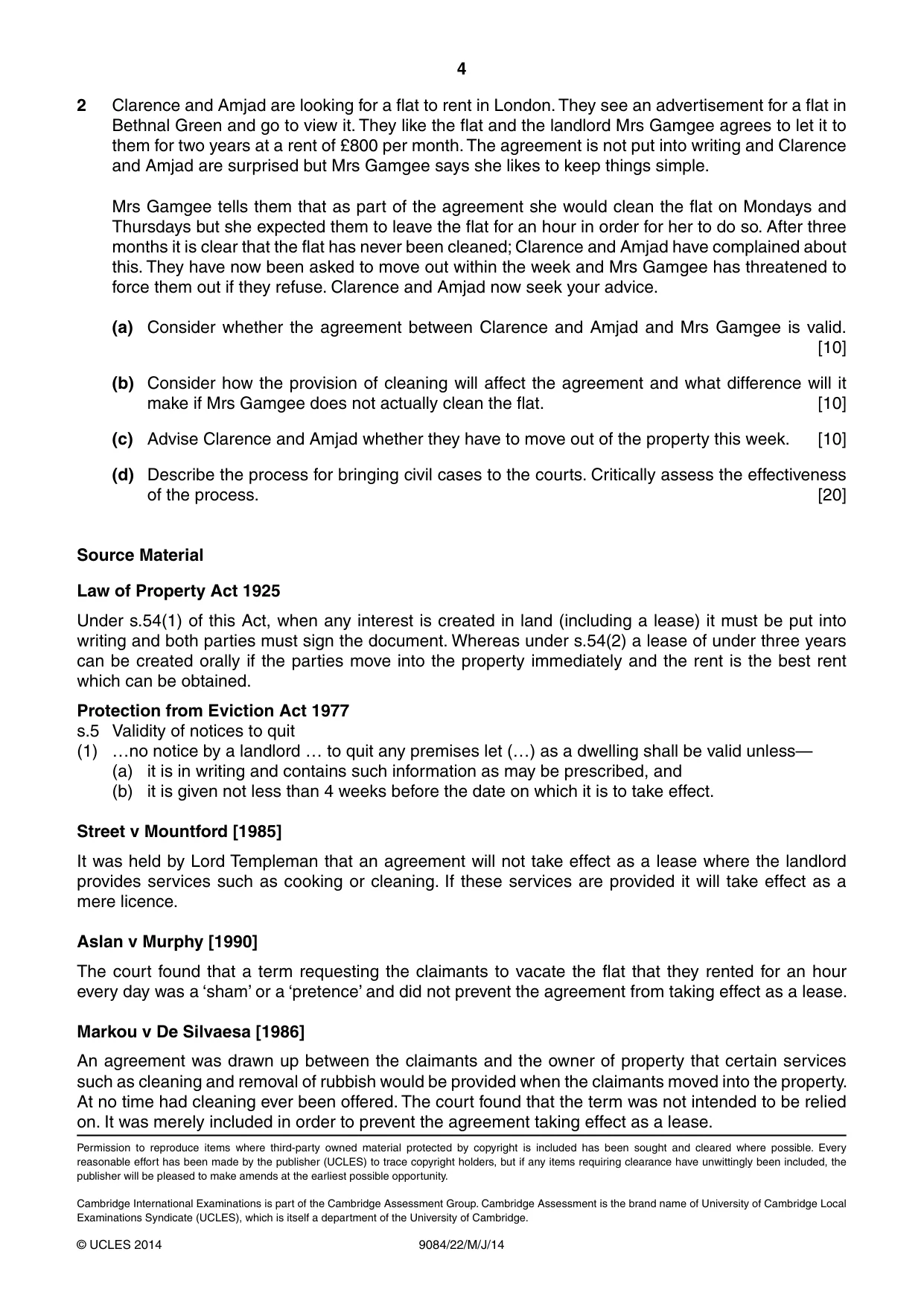
4 9084/22/M/J/14 © UCLES 2014 Permission to reproduce items where third-party owned material protected by copyright is included has been sought and cleared where possible. Every reasonable effort has been made by the publisher (UCLES) to trace copyright holders, but if any items requiring clearance have unwittingly been included, the publisher will be pleased to make amends at the earliest possible opportunity. Cambridge International Examinations is part of the Cambridge Assessment Group. Cambridge Assessment is the brand name of University of Cambridge Local Examinations Syndicate (UCLES), which is itself a department of the University of Cambridge. 2 Clarence and Amjad are looking for a flat to rent in London. They see an advertisement for a flat in Bethnal Green and go to view it. They like the flat and the landlord Mrs Gamgee agrees to let it to them for two years at a rent of £800 per month. The agreement is not put into writing and Clarence and Amjad are surprised but Mrs Gamgee says she likes to keep things simple. Mrs Gamgee tells them that as part of the agreement she would clean the flat on Mondays and Thursdays but she expected them to leave the flat for an hour in order for her to do so. After three months it is clear that the flat has never been cleaned; Clarence and Amjad have complained about this. They have now been asked to move out within the week and Mrs Gamgee has threatened to force them out if they refuse. Clarence and Amjad now seek your advice. (a) Consider whether the agreement between Clarence and Amjad and Mrs Gamgee is valid. [10] (b) Consider how the provision of cleaning will affect the agreement and what difference will it make if Mrs Gamgee does not actually clean the flat. [10] (c) Advise Clarence and Amjad whether they have to move out of the property this week. [10] (d) Describe the process for bringing civil cases to the courts. Critically assess the effectiveness of the process. [20] Source Material Law of Property Act 1925 Under s.54(1) of this Act, when any interest is created in land (including a lease) it must be put into writing and both parties must sign the document. Whereas under s.54(2) a lease of under three years can be created orally if the parties move into the property immediately and the rent is the best rent which can be obtained. Protection from Eviction Act 1977 s.5 Validity of notices to quit (1) …no notice by a landlord … to quit any premises let (…) as a dwelling shall be valid unless— (a) it is in writing and contains such information as may be prescribed, and (b) it is given not less than 4 weeks before the date on which it is to take effect. Street v Mountford [1985] It was held by Lord Templeman that an agreement will not take effect as a lease where the landlord provides services such as cooking or cleaning. If these services are provided it will take effect as a mere licence. Aslan v Murphy [1990] The court found that a term requesting the claimants to vacate the flat that they rented for an hour every day was a ‘sham’ or a ‘pretence’ and did not prevent the agreement from taking effect as a lease. Markou v De Silvaesa [1986] An agreement was drawn up between the claimants and the owner of property that certain services such as cleaning and removal of rubbish would be provided when the claimants moved into the property. At no time had cleaning ever been offered. The court found that the term was not intended to be relied on. It was merely included in order to prevent the agreement taking effect as a lease.
Mark scheme, page 1
CAMBRIDGE INTERNATIONAL EXAMINATIONS GCE Advanced Subsidiary Level and GCE Advanced Level MARK SCHEME for the May/June 2014 series 9084 LAW 9084/22 Paper 2, maximum raw mark 50 This mark scheme is published as an aid to teachers and candidates, to indicate the requirements of the examination. It shows the basis on which Examiners were instructed to award marks. It does not indicate the details of the discussions that took place at an Examiners’ meeting before marking began, which would have considered the acceptability of alternative answers. Mark schemes should be read in conjunction with the question paper and the Principal Examiner Report for Teachers. Cambridge will not enter into discussions about these mark schemes. Cambridge is publishing the mark schemes for the May/June 2014 series for most IGCSE, GCE Advanced Level and Advanced Subsidiary Level components and some Ordinary Level components.
Mark scheme, page 2
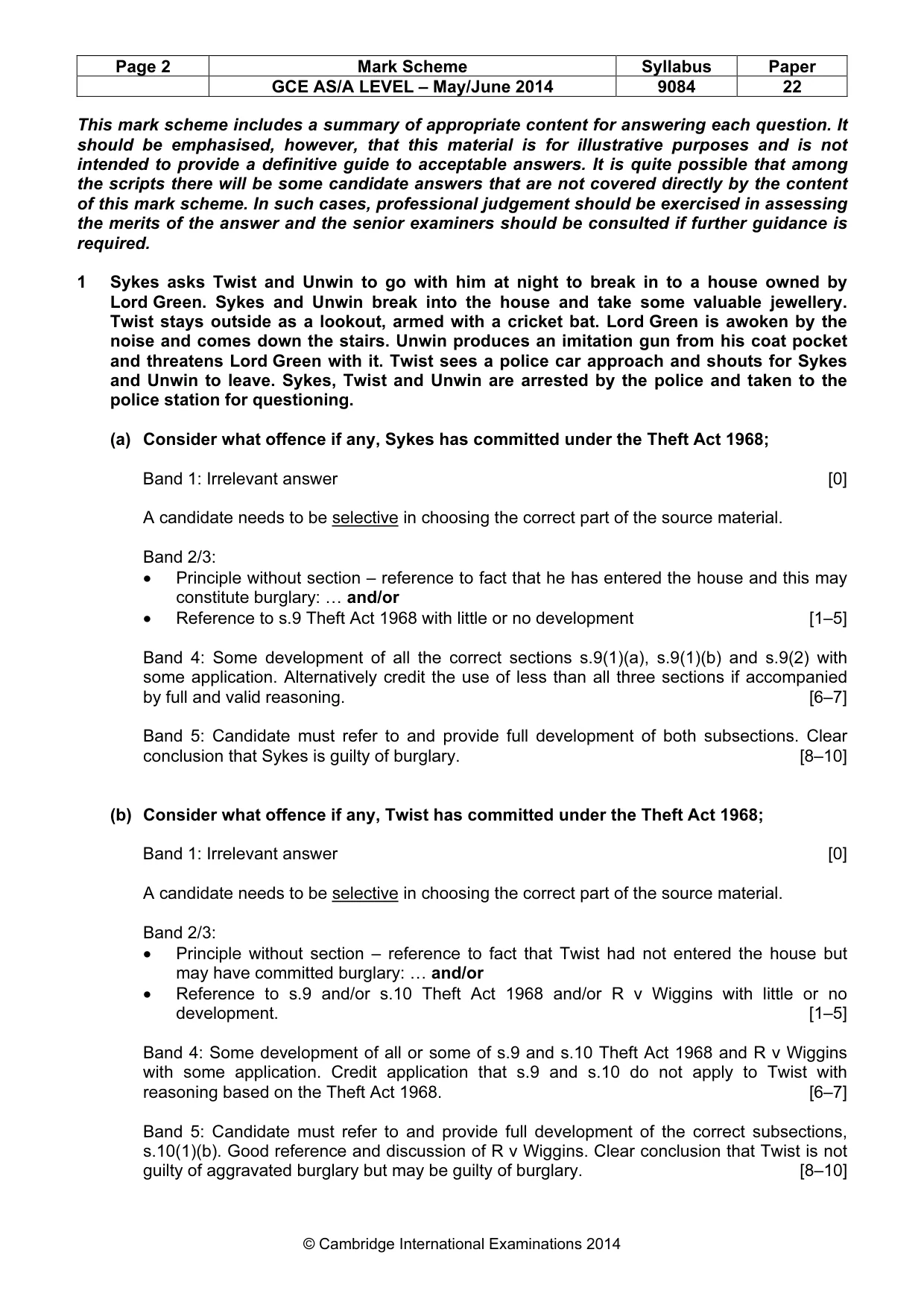
Page 2 Mark Scheme Syllabus Paper GCE AS/A LEVEL – May/June 2014 9084 22 © Cambridge International Examinations 2014 This mark scheme includes a summary of appropriate content for answering each question. It should be emphasised, however, that this material is for illustrative purposes and is not intended to provide a definitive guide to acceptable answers. It is quite possible that among the scripts there will be some candidate answers that are not covered directly by the content of this mark scheme. In such cases, professional judgement should be exercised in assessing the merits of the answer and the senior examiners should be consulted if further guidance is required. 1 Sykes asks Twist and Unwin to go with him at night to break in to a house owned by Lord Green. Sykes and Unwin break into the house and take some valuable jewellery. Twist stays outside as a lookout, armed with a cricket bat. Lord Green is awoken by the noise and comes down the stairs. Unwin produces an imitation gun from his coat pocket and threatens Lord Green with it. Twist sees a police car approach and shouts for Sykes and Unwin to leave. Sykes, Twist and Unwin are arrested by the police and taken to the police station for questioning. (a) Consider what offence if any, Sykes has committed under the Theft Act 1968; Band 1: Irrelevant answer [0] A candidate needs to be selective in choosing the correct part of the source material. Band 2/3: • Principle without section – reference to fact that he has entered the house and this may constitute burglary: … and/or • Reference to s.9 Theft Act 1968 with little or no development [1–5] Band 4: Some development of all the correct sections s.9(1)(a), s.9(1)(b) and s.9(2) with some application. Alternatively credit the use of less than all three sections if accompanied by full and valid reasoning. [6–7] Band 5: Candidate must refer to and provide full development of both subsections. Clear conclusion that Sykes is guilty of burglary. [8–10] (b) Consider what offence if any, Twist has committed under the Theft Act 1968; Band 1: Irrelevant answer [0] A candidate needs to be selective in choosing the correct part of the source material. Band 2/3: • Principle without section – reference to fact that Twist had not entered the house but may have committed burglary: … and/or • Reference to s.9 and/or s.10 Theft Act 1968 and/or R v Wiggins with little or no development. [1–5] Band 4: Some development of all or some of s.9 and s.10 Theft Act 1968 and R v Wiggins with some application. Credit application that s.9 and s.10 do not apply to Twist with reasoning based on the Theft Act 1968. [6–7] Band 5: Candidate must refer to and provide full development of the correct subsections, s.10(1)(b). Good reference and discussion of R v Wiggins. Clear conclusion that Twist is not guilty of aggravated burglary but may be guilty of burglary. [8–10]
Mark scheme, page 3
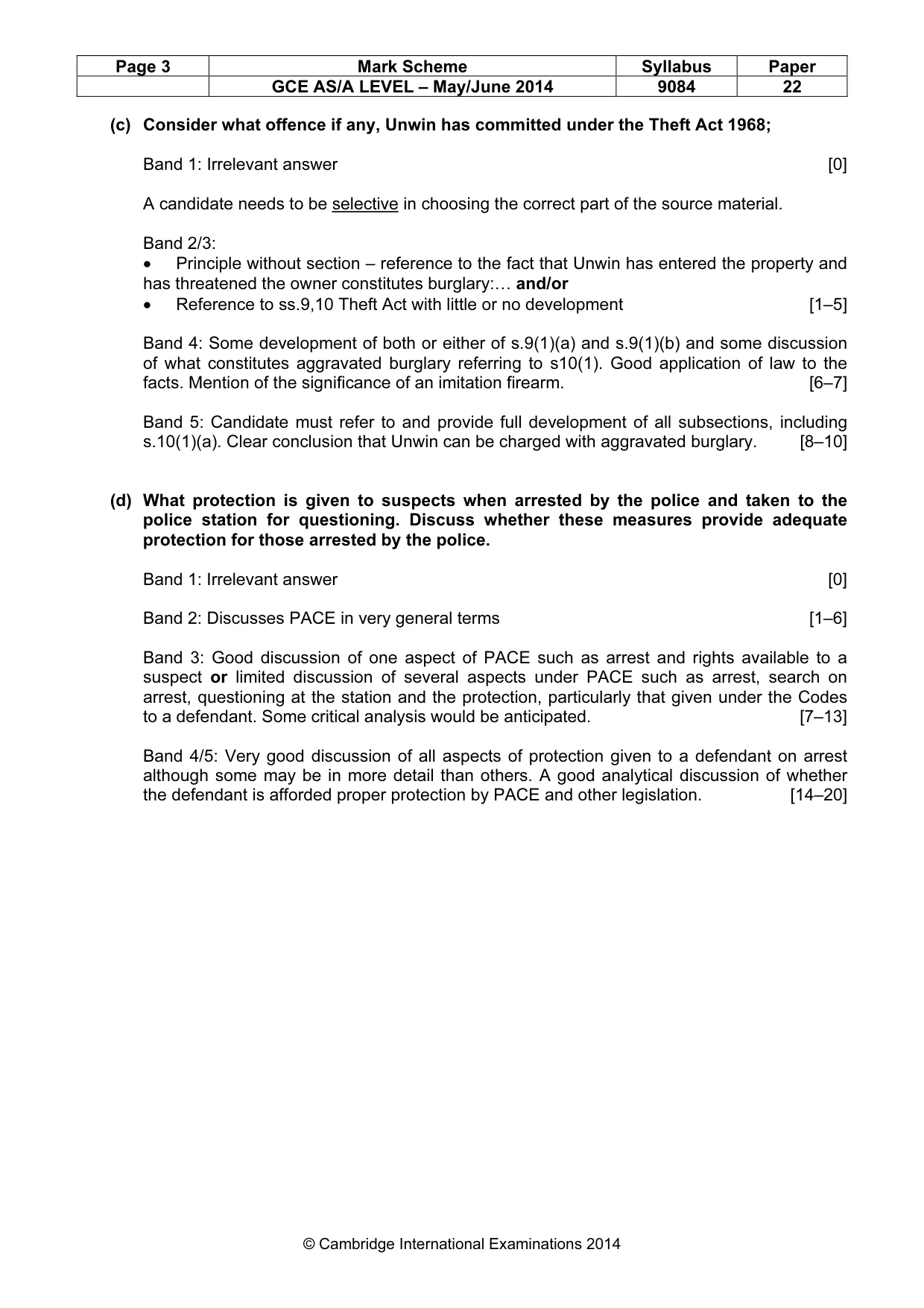
Page 3 Mark Scheme Syllabus Paper GCE AS/A LEVEL – May/June 2014 9084 22 © Cambridge International Examinations 2014 (c) Consider what offence if any, Unwin has committed under the Theft Act 1968; Band 1: Irrelevant answer [0] A candidate needs to be selective in choosing the correct part of the source material. Band 2/3: • Principle without section – reference to the fact that Unwin has entered the property and has threatened the owner constitutes burglary:… and/or • Reference to ss.9,10 Theft Act with little or no development [1–5] Band 4: Some development of both or either of s.9(1)(a) and s.9(1)(b) and some discussion of what constitutes aggravated burglary referring to s10(1). Good application of law to the facts. Mention of the significance of an imitation firearm. [6–7] Band 5: Candidate must refer to and provide full development of all subsections, including s.10(1)(a). Clear conclusion that Unwin can be charged with aggravated burglary. [8–10] (d) What protection is given to suspects when arrested by the police and taken to the police station for questioning. Discuss whether these measures provide adequate protection for those arrested by the police. Band 1: Irrelevant answer [0] Band 2: Discusses PACE in very general terms [1–6] Band 3: Good discussion of one aspect of PACE such as arrest and rights available to a suspect or limited discussion of several aspects under PACE such as arrest, search on arrest, questioning at the station and the protection, particularly that given under the Codes to a defendant. Some critical analysis would be anticipated. [7–13] Band 4/5: Very good discussion of all aspects of protection given to a defendant on arrest although some may be in more detail than others. A good analytical discussion of whether the defendant is afforded proper protection by PACE and other legislation. [14–20]
Mark scheme, page 4
Page 4 Mark Scheme Syllabus Paper GCE AS/A LEVEL – May/June 2014 9084 22 © Cambridge International Examinations 2014 2 Clarence and Amjad are looking for a flat to rent in London. They see an advertisement for a flat in Bethnal Green and go to view it. They like the flat and the landlord Mrs Gamgee agrees to let it to them for two years at a rent of £800 per month. The agreement is not put into writing and Clarence and Amjad are surprised but Mrs Gamgee says she likes to keep things simple. Clarence and Amjad move in immediately. Mrs Gamgee tells them that as part of the agreement she would clean the flat on Mondays and Thursdays but she expected them to leave the flat for an hour in order for her to do so. After three months it is clear that the flat has never been cleaned; Clarence and Amjad have complained about this. They have now been asked to move out within the week and Mrs Gamgee has threatened to force them out if they refuse. Clarence and Amjad now seek your advice. (a) Consider whether the agreement between Clarence and Amjad and Mrs Gamgee is valid. [10] Band 1: Irrelevant answer [0] A candidate needs to be selective in choosing the correct part of the source material. Band 2/3: • Principle without section – /or • Reference to s.54(1) and/ or s.54(2) LPA 1925 with little or no development [1–5] Band 4: Some development of both the correct sections – s.54(1) and s.54(2) LPA 1925 with some application to the scenario. Discussion of the fact that the agreement is an oral agreement but can still take effect as a valid lease as it is under three years and the parties have moved in immediately. [6–7] Band 5: Candidate must refer to and provide full development of both the subsections. Discussion of the fact that the agreement is an oral agreement but can still take effect as a valid lease as it is under three years and the parties have moved in immediately. Credit for any discussion of whether the rent comes within the description ‘best rent’. Clear conclusion that there is a valid agreement. [8–10] (b) Consider how the provision of cleaning will affect the agreement and what difference will it make if Mrs Gamgee does not actually clean the flat. [10] Band 1: Irrelevant answer [0] A candidate needs to be selective in choosing the correct part of the source material. Band 2/3: • Principle without section – general reference to the fact that the cleaning may affect the arrangement, as may the fact that the cleaning never happens:… and/or • Reference to Street v Mountford (1985), Aslan v Murphy (1990) and Markou v Silvaesa (1986) with little or no development. [1–5] Band 4: Some development of the cases and discussion of whether there is a lease or a licence. [6–7] Band 5: Candidate must refer to and provide full development of the correct sections and cases. Clear conclusion that there is a lease despite the requirement to leave for an hour and this is reinforced by the fact that the cleaning never takes place. [8–10]
Mark scheme, page 5
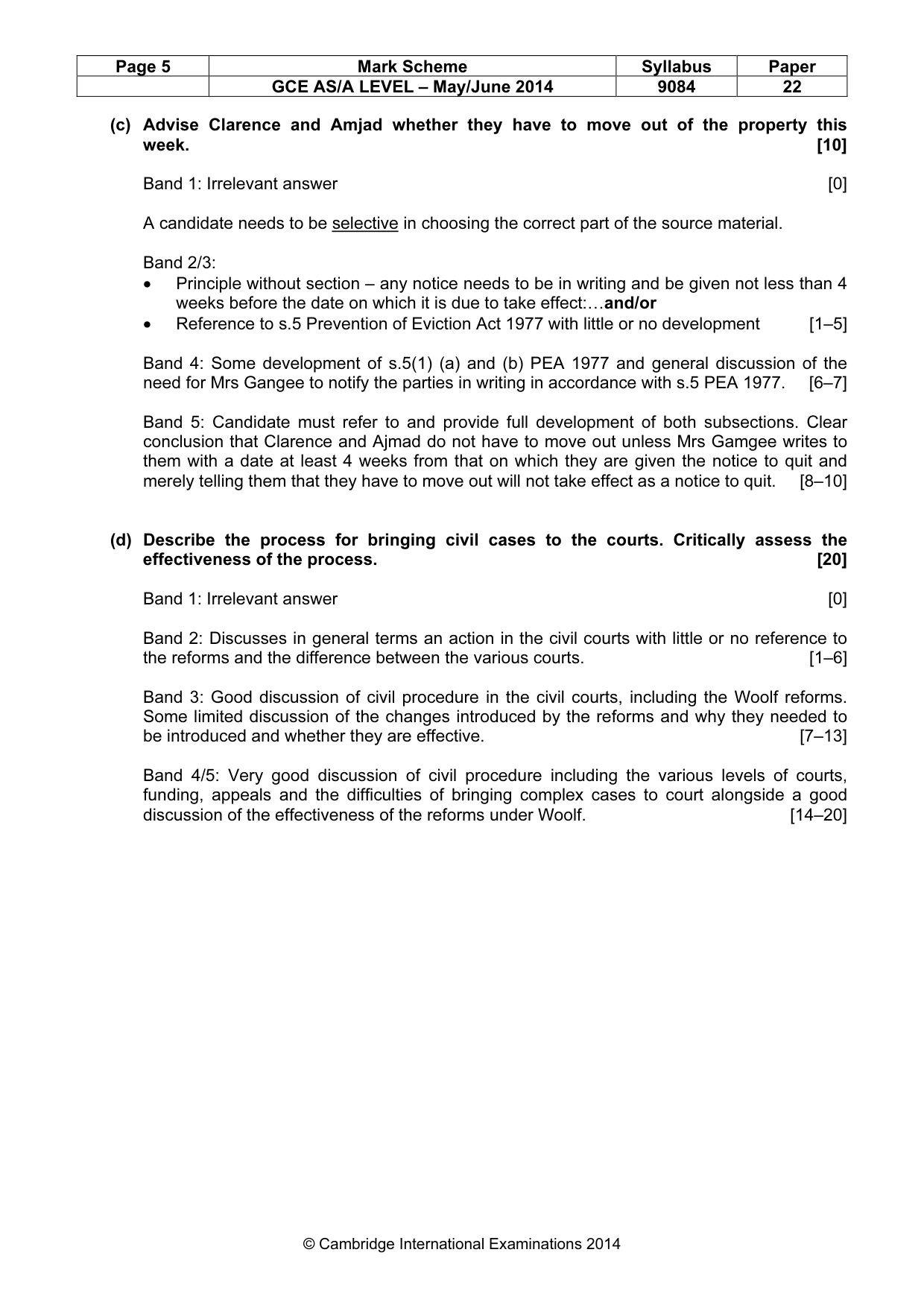
Page 5 Mark Scheme Syllabus Paper GCE AS/A LEVEL – May/June 2014 9084 22 © Cambridge International Examinations 2014 (c) Advise Clarence and Amjad whether they have to move out of the property this week. [10] Band 1: Irrelevant answer [0] A candidate needs to be selective in choosing the correct part of the source material. Band 2/3: • Principle without section – any notice needs to be in writing and be given not less than 4 weeks before the date on which it is due to take effect:…and/or • Reference to s.5 Prevention of Eviction Act 1977 with little or no development [1–5] Band 4: Some development of s.5(1) (a) and (b) PEA 1977 and general discussion of the need for Mrs Gangee to notify the parties in writing in accordance with s.5 PEA 1977. [6–7] Band 5: Candidate must refer to and provide full development of both subsections. Clear conclusion that Clarence and Ajmad do not have to move out unless Mrs Gamgee writes to them with a date at least 4 weeks from that on which they are given the notice to quit and merely telling them that they have to move out will not take effect as a notice to quit. [8–10] (d) Describe the process for bringing civil cases to the courts. Critically assess the effectiveness of the process. [20] Band 1: Irrelevant answer [0] Band 2: Discusses in general terms an action in the civil courts with little or no reference to the reforms and the difference between the various courts. [1–6] Band 3: Good discussion of civil procedure in the civil courts, including the Woolf reforms. Some limited discussion of the changes introduced by the reforms and why they needed to be introduced and whether they are effective. [7–13] Band 4/5: Very good discussion of civil procedure including the various levels of courts, funding, appeals and the difficulties of bringing complex cases to court alongside a good discussion of the effectiveness of the reforms under Woolf. [14–20]
What you needed in this session
Cambridge’s own grade thresholds for 2014 May/June, Paper 2 · Variant 2. A higher threshold means an easier paper — the bar moves with how the cohort did.