Cambridge A Level Law 9084 — 2014 May/June Paper 2 · Variant 3
9084/23/M/J/14 · 50 marks · ≈56 min
The question paper and its mark scheme, free to read here and free to download. This is Cambridge’s own paper, exactly as it was sat.
Question paper8 pages



Mark scheme5 pages
Answers below. Sit the paper first if you are practising.
Paper as text
Question paper, page 1
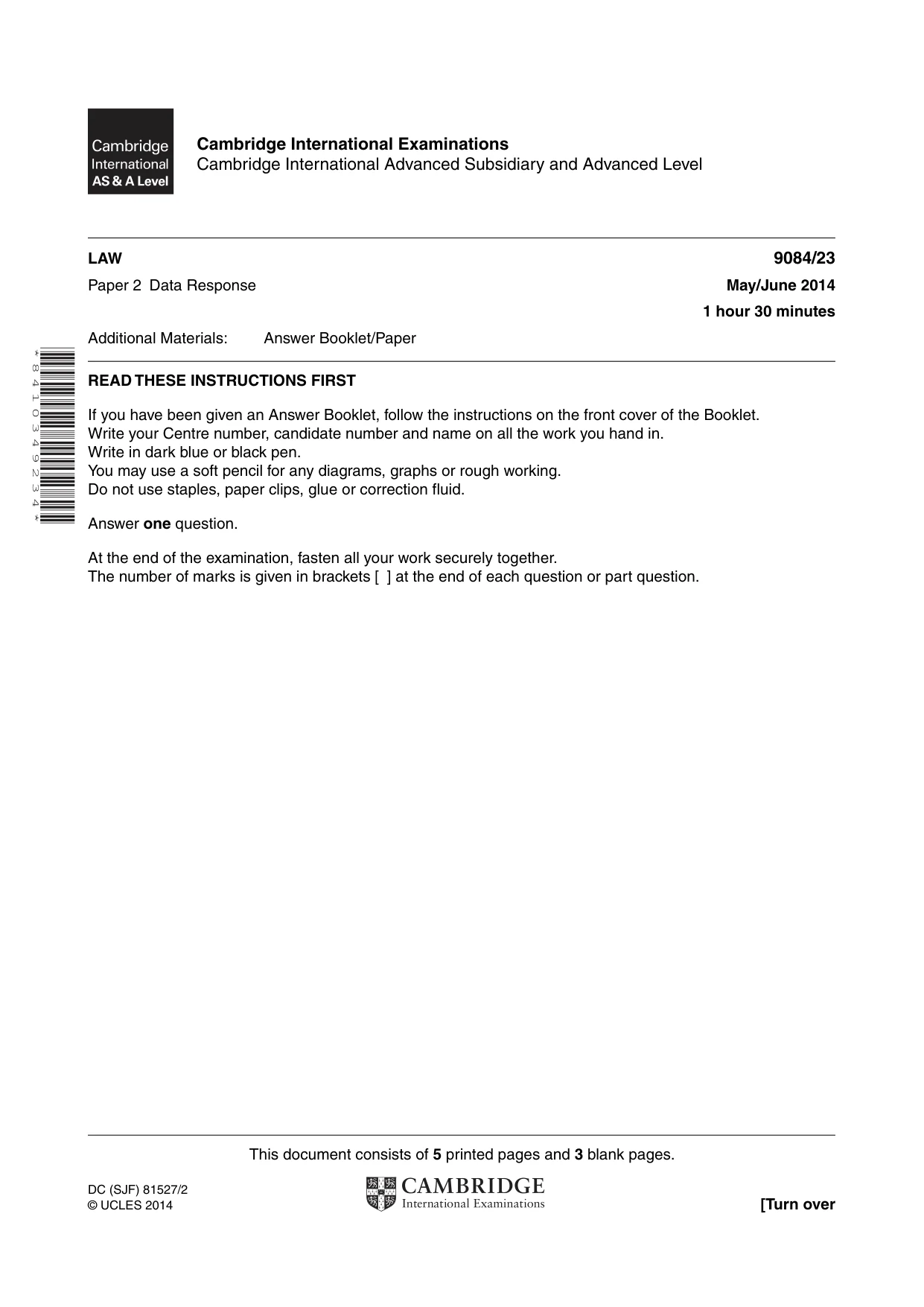
This document consists of 5 printed pages and 3 blank pages. DC (SJF) 81527/2 © UCLES 2014 [Turn over Cambridge International Examinations Cambridge International Advanced Subsidiary and Advanced Level * 8 4 1 0 3 4 9 2 3 4 * LAW 9084/23 Paper 2 Data Response May/June 2014 1 hour 30 minutes Additional Materials: Answer Booklet/Paper READ THESE INSTRUCTIONS FIRST If you have been given an Answer Booklet, follow the instructions on the front cover of the Booklet. Write your Centre number, candidate number and name on all the work you hand in. Write in dark blue or black pen. You may use a soft pencil for any diagrams, graphs or rough working. Do not use staples, paper clips, glue or correction fluid. Answer one question. At the end of the examination, fasten all your work securely together. The number of marks is given in brackets [ ] at the end of each question or part question.
Question paper, page 2
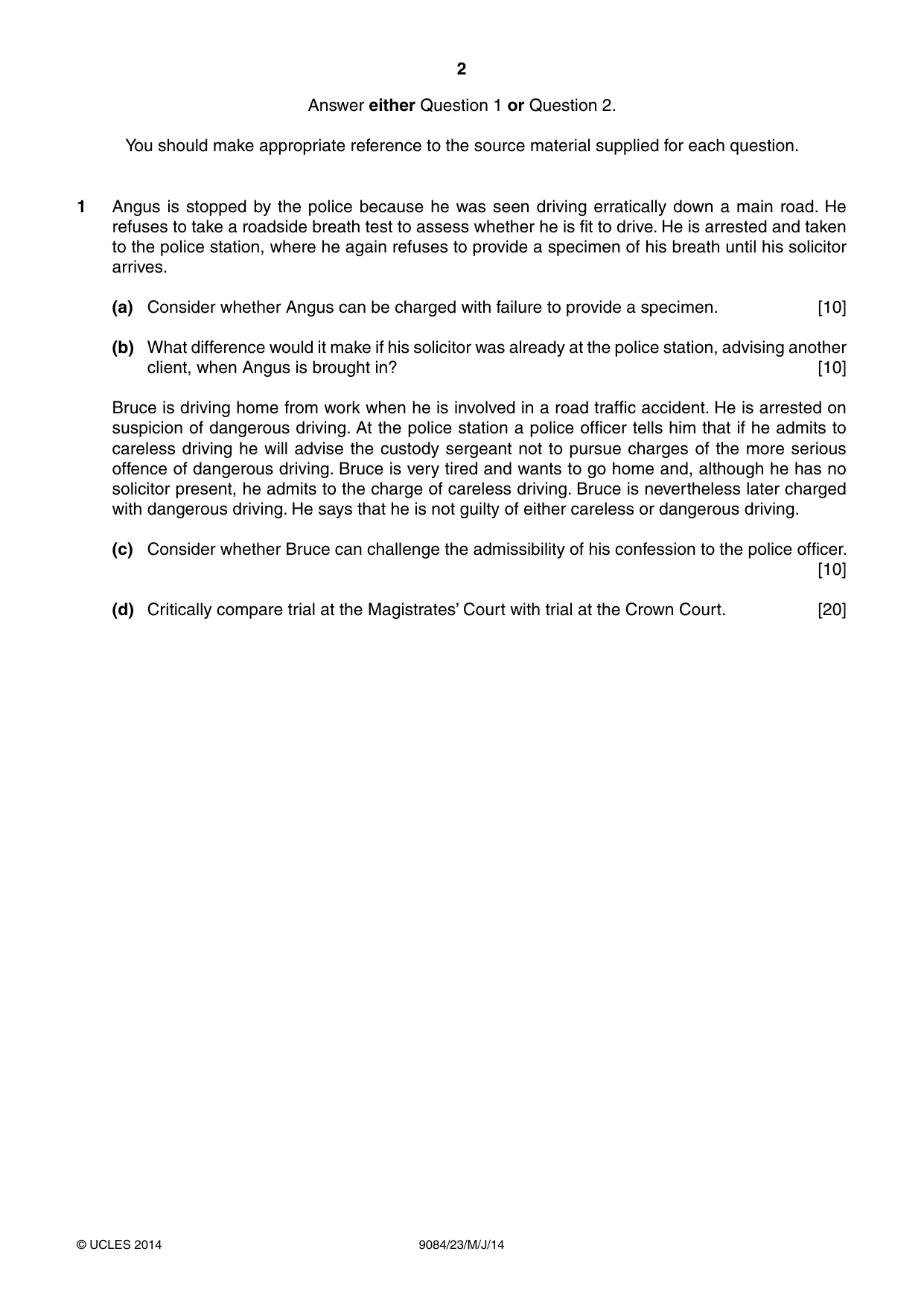
2 9084/23/M/J/14 © UCLES 2014 Answer either Question 1 or Question 2. You should make appropriate reference to the source material supplied for each question. 1 Angus is stopped by the police because he was seen driving erratically down a main road. He refuses to take a roadside breath test to assess whether he is fit to drive. He is arrested and taken to the police station, where he again refuses to provide a specimen of his breath until his solicitor arrives. (a) Consider whether Angus can be charged with failure to provide a specimen. [10] (b) What difference would it make if his solicitor was already at the police station, advising another client, when Angus is brought in? [10] Bruce is driving home from work when he is involved in a road traffic accident. He is arrested on suspicion of dangerous driving. At the police station a police officer tells him that if he admits to careless driving he will advise the custody sergeant not to pursue charges of the more serious offence of dangerous driving. Bruce is very tired and wants to go home and, although he has no solicitor present, he admits to the charge of careless driving. Bruce is nevertheless later charged with dangerous driving. He says that he is not guilty of either careless or dangerous driving. (c) Consider whether Bruce can challenge the admissibility of his confession to the police officer. [10] (d) Critically compare trial at the Magistrates’ Court with trial at the Crown Court. [20]
Question paper, page 3
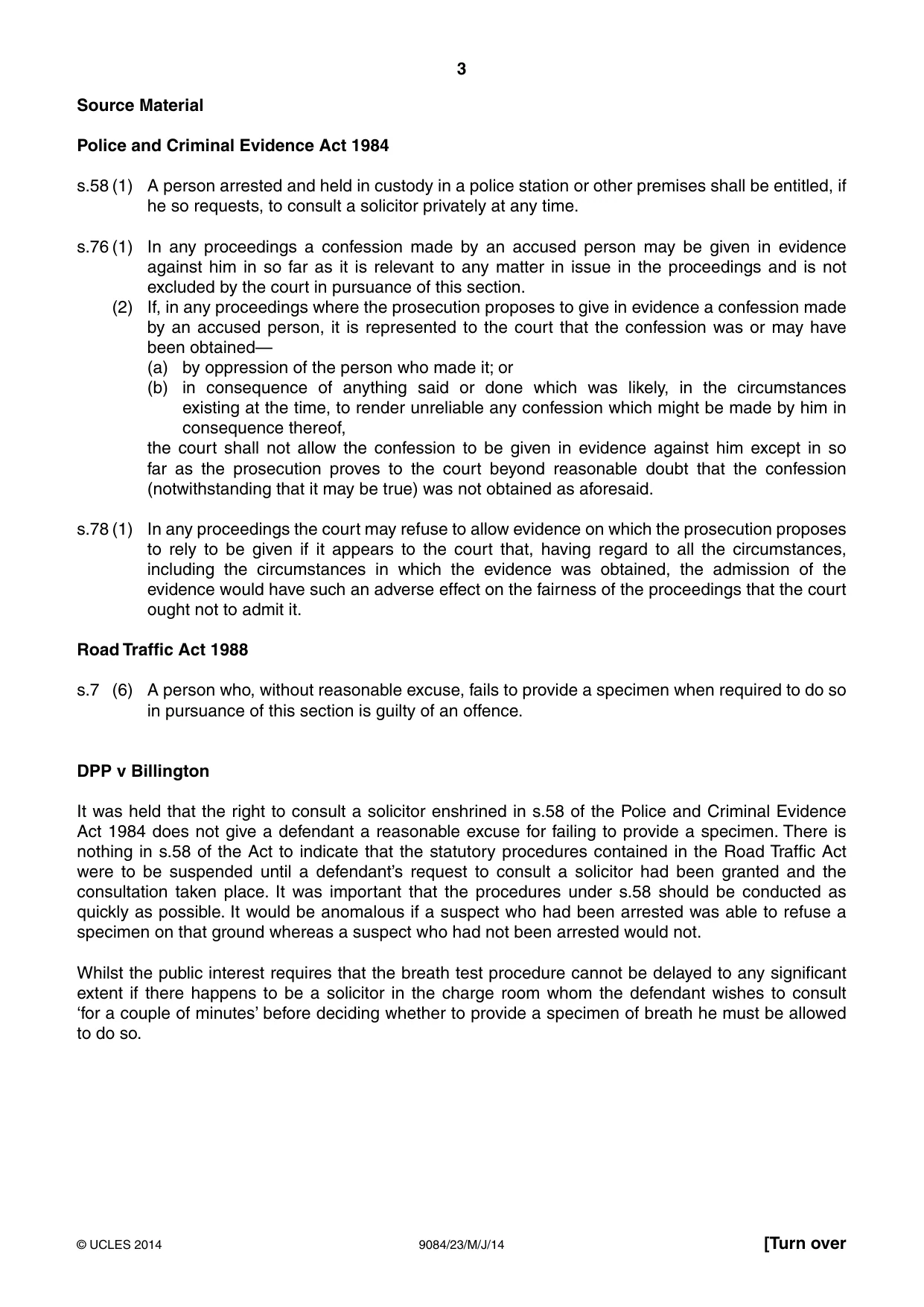
3 9084/23/M/J/14 © UCLES 2014 [Turn over Source Material Police and Criminal Evidence Act 1984 s.58 (1) A person arrested and held in custody in a police station or other premises shall be entitled, if he so requests, to consult a solicitor privately at any time. s.76 (1) In any proceedings a confession made by an accused person may be given in evidence against him in so far as it is relevant to any matter in issue in the proceedings and is not excluded by the court in pursuance of this section. (2) If, in any proceedings where the prosecution proposes to give in evidence a confession made by an accused person, it is represented to the court that the confession was or may have been obtained— (a) by oppression of the person who made it; or (b) in consequence of anything said or done which was likely, in the circumstances existing at the time, to render unreliable any confession which might be made by him in consequence thereof, the court shall not allow the confession to be given in evidence against him except in so far as the prosecution proves to the court beyond reasonable doubt that the confession (notwithstanding that it may be true) was not obtained as aforesaid. s.78 (1) In any proceedings the court may refuse to allow evidence on which the prosecution proposes to rely to be given if it appears to the court that, having regard to all the circumstances, including the circumstances in which the evidence was obtained, the admission of the evidence would have such an adverse effect on the fairness of the proceedings that the court ought not to admit it. Road Traffic Act 1988 s.7 (6) A person who, without reasonable excuse, fails to provide a specimen when required to do so in pursuance of this section is guilty of an offence. DPP v Billington It was held that the right to consult a solicitor enshrined in s.58 of the Police and Criminal Evidence Act 1984 does not give a defendant a reasonable excuse for failing to provide a specimen. There is nothing in s.58 of the Act to indicate that the statutory procedures contained in the Road Traffic Act were to be suspended until a defendant’s request to consult a solicitor had been granted and the consultation taken place. It was important that the procedures under s.58 should be conducted as quickly as possible. It would be anomalous if a suspect who had been arrested was able to refuse a specimen on that ground whereas a suspect who had not been arrested would not. Whilst the public interest requires that the breath test procedure cannot be delayed to any significant extent if there happens to be a solicitor in the charge room whom the defendant wishes to consult ‘for a couple of minutes’ before deciding whether to provide a specimen of breath he must be allowed to do so.
Question paper, page 4
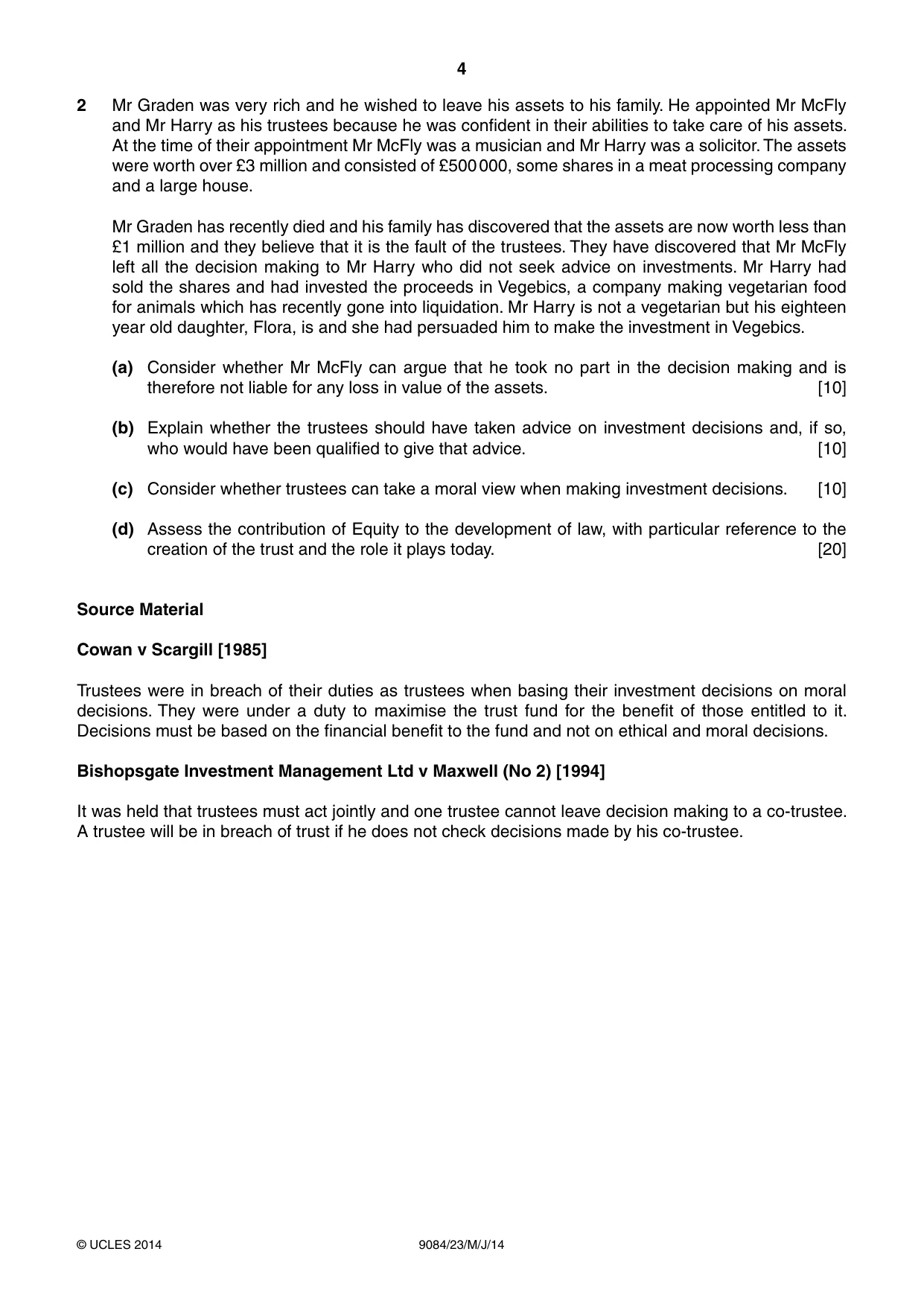
4 9084/23/M/J/14 © UCLES 2014 2 Mr Graden was very rich and he wished to leave his assets to his family. He appointed Mr McFly and Mr Harry as his trustees because he was confident in their abilities to take care of his assets. At the time of their appointment Mr McFly was a musician and Mr Harry was a solicitor. The assets were worth over £3 million and consisted of £500 000, some shares in a meat processing company and a large house. Mr Graden has recently died and his family has discovered that the assets are now worth less than £1 million and they believe that it is the fault of the trustees. They have discovered that Mr McFly left all the decision making to Mr Harry who did not seek advice on investments. Mr Harry had sold the shares and had invested the proceeds in Vegebics, a company making vegetarian food for animals which has recently gone into liquidation. Mr Harry is not a vegetarian but his eighteen year old daughter, Flora, is and she had persuaded him to make the investment in Vegebics. (a) Consider whether Mr McFly can argue that he took no part in the decision making and is therefore not liable for any loss in value of the assets. [10] (b) Explain whether the trustees should have taken advice on investment decisions and, if so, who would have been qualified to give that advice. [10] (c) Consider whether trustees can take a moral view when making investment decisions. [10] (d) Assess the contribution of Equity to the development of law, with particular reference to the creation of the trust and the role it plays today. [20] Source Material Cowan v Scargill [1985] Trustees were in breach of their duties as trustees when basing their investment decisions on moral decisions. They were under a duty to maximise the trust fund for the benefit of those entitled to it. Decisions must be based on the financial benefit to the fund and not on ethical and moral decisions. Bishopsgate Investment Management Ltd v Maxwell (No 2) [1994] It was held that trustees must act jointly and one trustee cannot leave decision making to a co-trustee. A trustee will be in breach of trust if he does not check decisions made by his co-trustee.
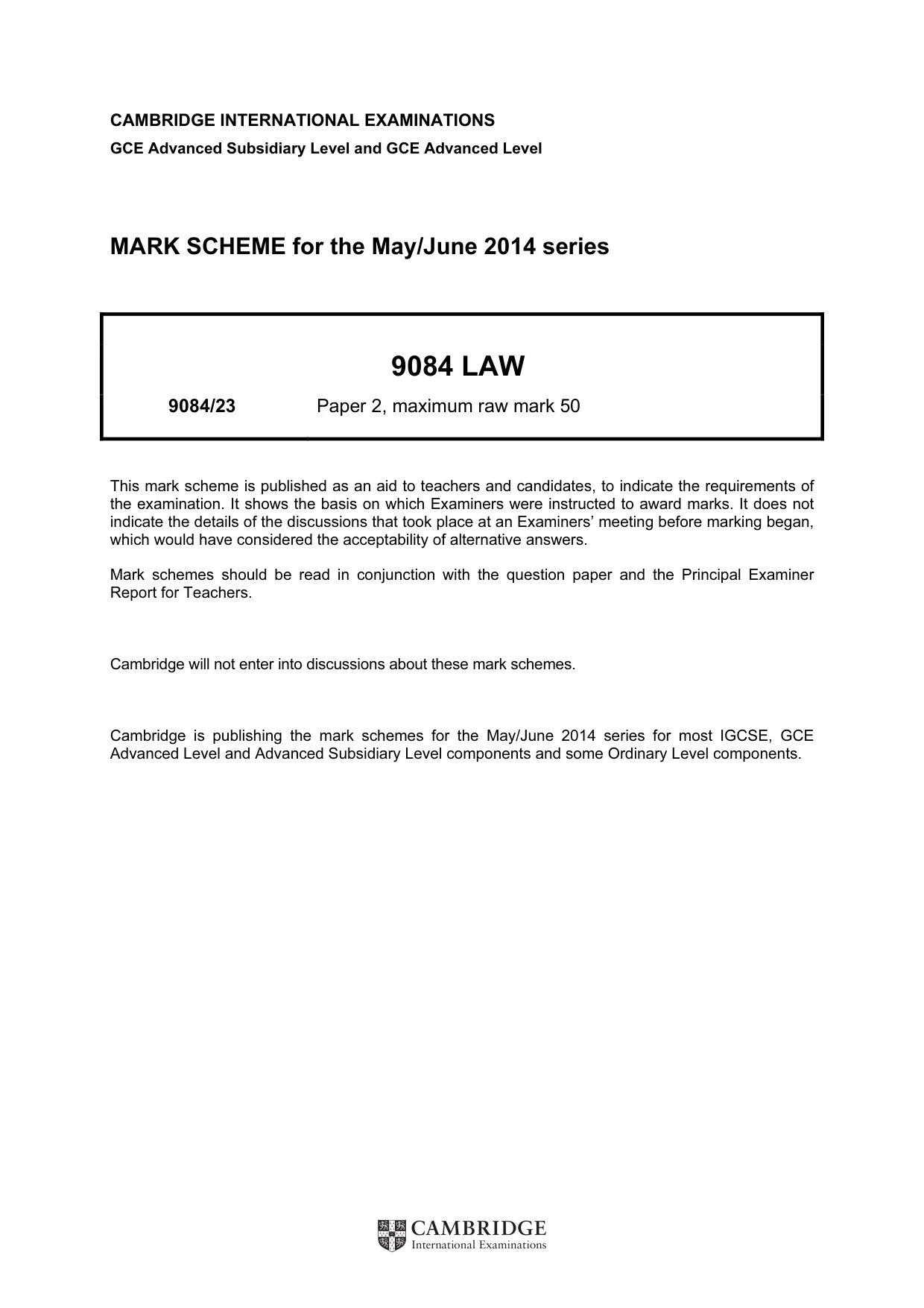
Question paper, page 5
5 9084/23/M/J/14 © UCLES 2014 Trustee Act 2000 s.1 The duty of care (1) … a trustee ... must exercise such care and skill as is reasonable in the circumstances, (a) … (b) if he acts as trustee in the course of a business or profession that it is reasonable to expect of a person acting in the course of that kind of business or profession. s.3 General power of investment (1) Subject to the provisions of this Part, a trustee may make any kind of investment that he could make if he were absolutely entitled to the assets of the trust. s.5 Advice (1) Before exercising any power of investment, whether arising under this Part or otherwise, a trustee must (unless the exception applies) obtain and consider proper advice about the way in which, having regard to the standard investment criteria, the power should be exercised. (2) When reviewing the investments of the trust, a trustee must (unless the exception applies) obtain and consider proper advice about whether, having regard to the standard investment criteria, the investments should be varied. (3) The exception is that a trustee need not obtain such advice if he reasonably concludes that in all the circumstances it is unnecessary or inappropriate to do so. (4) Proper advice is the advice of a person who is reasonably believed by the trustee to be qualified to give it by his ability in and practical experience of financial and other matters relating to the proposed investment.
Question paper, page 6
6 9084/23/M/J/14 © UCLES 2014 BLANK PAGE
Question paper, page 7
7 9084/23/M/J/14 © UCLES 2014 BLANK PAGE
Question paper, page 8
8 9084/23/M/J/14 © UCLES 2014 Permission to reproduce items where third-party owned material protected by copyright is included has been sought and cleared where possible. Every reasonable effort has been made by the publisher (UCLES) to trace copyright holders, but if any items requiring clearance have unwittingly been included, the publisher will be pleased to make amends at the earliest possible opportunity. Cambridge International Examinations is part of the Cambridge Assessment Group. Cambridge Assessment is the brand name of University of Cambridge Local Examinations Syndicate (UCLES), which is itself a department of the University of Cambridge. BLANK PAGE
Mark scheme, page 1
CAMBRIDGE INTERNATIONAL EXAMINATIONS GCE Advanced Subsidiary Level and GCE Advanced Level MARK SCHEME for the May/June 2014 series 9084 LAW 9084/23 Paper 2, maximum raw mark 50 This mark scheme is published as an aid to teachers and candidates, to indicate the requirements of the examination. It shows the basis on which Examiners were instructed to award marks. It does not indicate the details of the discussions that took place at an Examiners’ meeting before marking began, which would have considered the acceptability of alternative answers. Mark schemes should be read in conjunction with the question paper and the Principal Examiner Report for Teachers. Cambridge will not enter into discussions about these mark schemes. Cambridge is publishing the mark schemes for the May/June 2014 series for most IGCSE, GCE Advanced Level and Advanced Subsidiary Level components and some Ordinary Level components.
Mark scheme, page 2
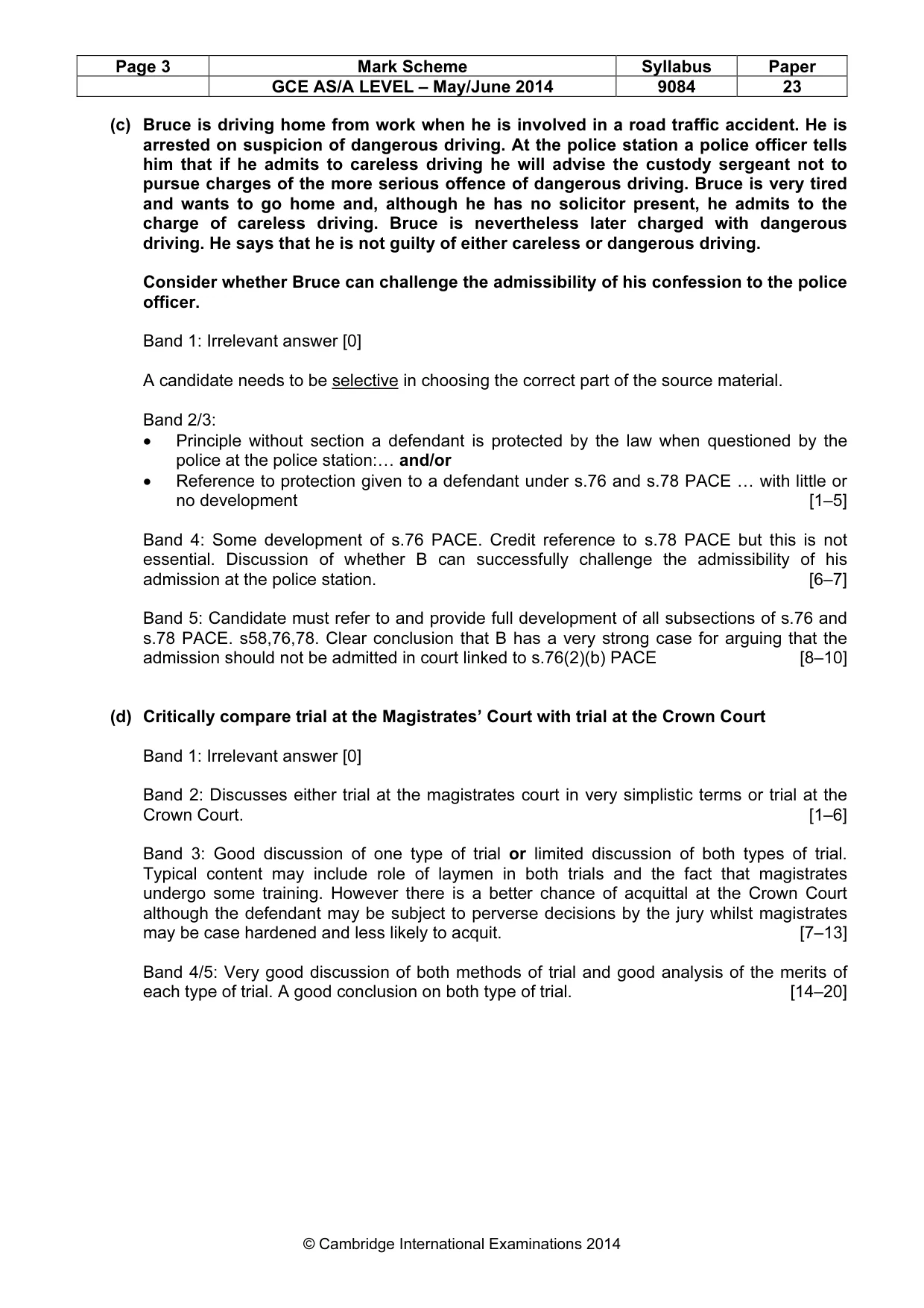
Page 2 Mark Scheme Syllabus Paper GCE AS/A LEVEL – May/June 2014 9084 23 © Cambridge International Examinations 2014 Mark Scheme This mark scheme includes a summary of appropriate content for answering each question. It should be emphasised, however, that this material is for illustrative purposes and is not intended to provide a definitive guide to acceptable answers. It is quite possible that among the scripts there will be some candidate answers that are not covered directly by the content of this mark scheme. In such cases, professional judgement should be exercised in assessing the merits of the answer and the senior examiners should be consulted if further guidance is required. 1 (a) Angus is stopped by the police because he was seen driving erratically down a main road. He refuses to take a roadside breath test to assess whether he is fit to drive. He is arrested and taken to the police station, where he again refuses to provide a specimen of his breath until his solicitor arrives. Consider whether Angus can be charged with failure to provide a specimen. Band 1: Irrelevant answer [0] A candidate needs to be selective in choosing the correct part of the source material. Band 2/3: • Principle without section – reference to the fact that a defendant is under a duty to comply with the police if he/she is suspected of drink driving:… and/or • Reference to s.7(6) RTA 1988 and/or s.58 PACE with little or no development. [1–5] Band 4: Some development of s.7(6) RTA 1988 and s.58 PACE. Discussion of whether this is similar to DPP v Billington. [6–7] Band 5: Candidate must refer to and provide full development of all subsections. Clear conclusion that Angus can be charged under s.7 RTA and is unlikely to be able to defend the charge by arguing that he has the right to delay the provision of a specimen. [8–10] (b) What difference would it make if his solicitor was already at the police station, advising another client, when Angus is brought in? [10] Band 1: Irrelevant answer [0] A candidate needs to be selective in choosing the correct part of the source material. Band 2/3: • Principle without section – reference to the fact that Angus may have the right to legal advice and recognition of the failure of Angus to take the breath test. :…and/or • Reference to s.58(1) PACE and/or DPP v Billington and/or s.7(6) RTA 1988 with little or no development [1–5] Band 4: Some development of DPP v Billington with some application to the facts. Reference to s.7(6) can be credited but is not required. [6–7] Band 5: Candidate must refer to and provide full development of DPP v Billington and at least one other of s.7(6) RTA 1988 and s.58(1) PACE 1984 and DPP v Billington. Clear conclusion that as Angus may have been able to speak to a solicitor quickly because he was already at the police station and so available almost immediately, the slight delay in taking the breath test may be acceptable but does not prevent him being guilty under s.7(6) RTA 1988 if he does not provide a specimen at all. [8–10]
Mark scheme, page 3
Page 3 Mark Scheme Syllabus Paper GCE AS/A LEVEL – May/June 2014 9084 23 © Cambridge International Examinations 2014 (c) Bruce is driving home from work when he is involved in a road traffic accident. He is arrested on suspicion of dangerous driving. At the police station a police officer tells him that if he admits to careless driving he will advise the custody sergeant not to pursue charges of the more serious offence of dangerous driving. Bruce is very tired and wants to go home and, although he has no solicitor present, he admits to the charge of careless driving. Bruce is nevertheless later charged with dangerous driving. He says that he is not guilty of either careless or dangerous driving. Consider whether Bruce can challenge the admissibility of his confession to the police officer. Band 1: Irrelevant answer [0] A candidate needs to be selective in choosing the correct part of the source material. Band 2/3: • Principle without section a defendant is protected by the law when questioned by the police at the police station:… and/or • Reference to protection given to a defendant under s.76 and s.78 PACE … with little or no development [1–5] Band 4: Some development of s.76 PACE. Credit reference to s.78 PACE but this is not essential. Discussion of whether B can successfully challenge the admissibility of his admission at the police station. [6–7] Band 5: Candidate must refer to and provide full development of all subsections of s.76 and s.78 PACE. s58,76,78. Clear conclusion that B has a very strong case for arguing that the admission should not be admitted in court linked to s.76(2)(b) PACE [8–10] (d) Critically compare trial at the Magistrates’ Court with trial at the Crown Court Band 1: Irrelevant answer [0] Band 2: Discusses either trial at the magistrates court in very simplistic terms or trial at the Crown Court. [1–6] Band 3: Good discussion of one type of trial or limited discussion of both types of trial. Typical content may include role of laymen in both trials and the fact that magistrates undergo some training. However there is a better chance of acquittal at the Crown Court although the defendant may be subject to perverse decisions by the jury whilst magistrates may be case hardened and less likely to acquit. [7–13] Band 4/5: Very good discussion of both methods of trial and good analysis of the merits of each type of trial. A good conclusion on both type of trial. [14–20]
Mark scheme, page 4
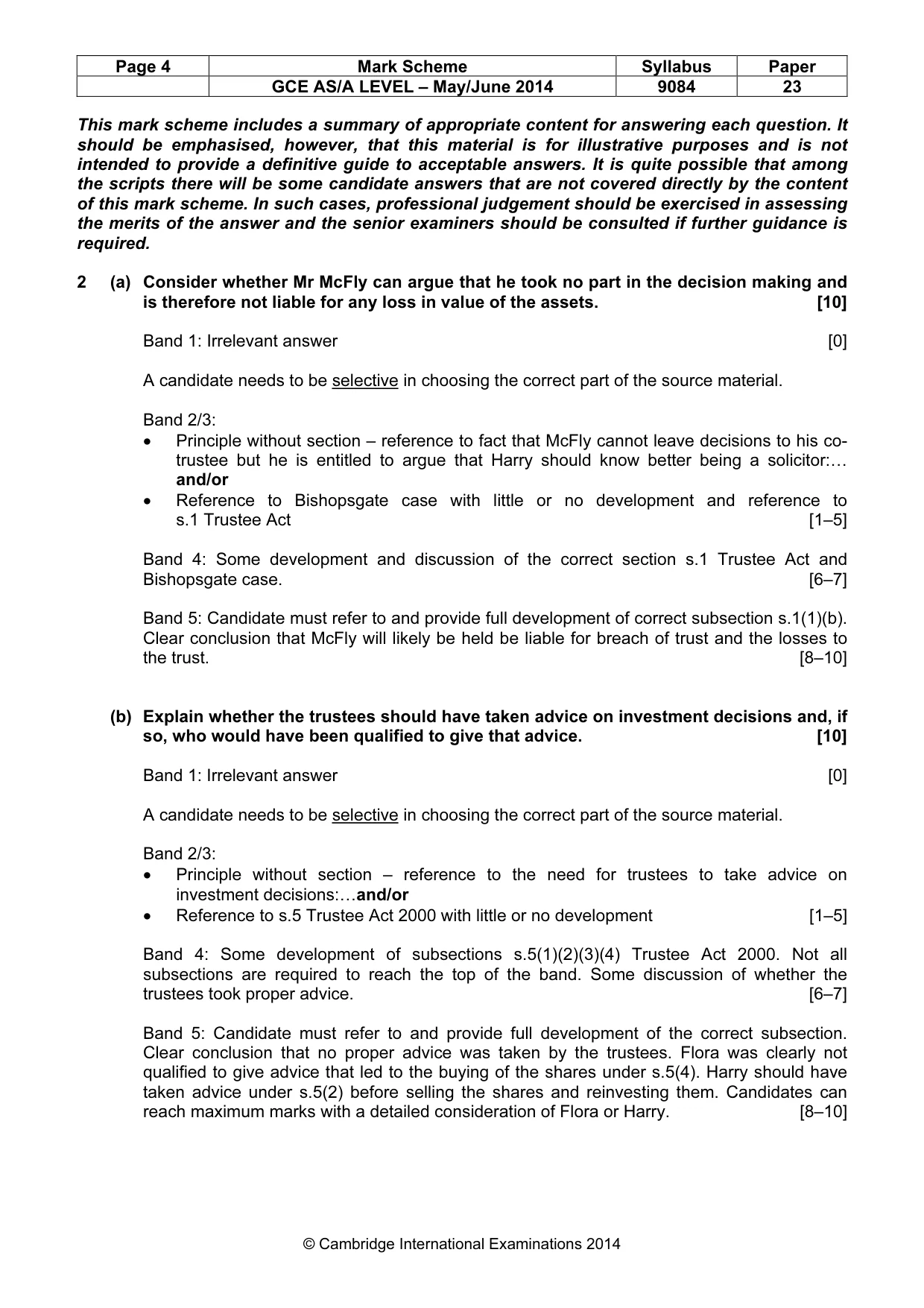
Page 4 Mark Scheme Syllabus Paper GCE AS/A LEVEL – May/June 2014 9084 23 © Cambridge International Examinations 2014 This mark scheme includes a summary of appropriate content for answering each question. It should be emphasised, however, that this material is for illustrative purposes and is not intended to provide a definitive guide to acceptable answers. It is quite possible that among the scripts there will be some candidate answers that are not covered directly by the content of this mark scheme. In such cases, professional judgement should be exercised in assessing the merits of the answer and the senior examiners should be consulted if further guidance is required. 2 (a) Consider whether Mr McFly can argue that he took no part in the decision making and is therefore not liable for any loss in value of the assets. [10] Band 1: Irrelevant answer [0] A candidate needs to be selective in choosing the correct part of the source material. Band 2/3: • Principle without section – reference to fact that McFly cannot leave decisions to his co- trustee but he is entitled to argue that Harry should know better being a solicitor:… and/or • Reference to Bishopsgate case with little or no development and reference to s.1 Trustee Act [1–5] Band 4: Some development and discussion of the correct section s.1 Trustee Act and Bishopsgate case. [6–7] Band 5: Candidate must refer to and provide full development of correct subsection s.1(1)(b). Clear conclusion that McFly will likely be held be liable for breach of trust and the losses to the trust. [8–10] (b) Explain whether the trustees should have taken advice on investment decisions and, if so, who would have been qualified to give that advice. [10] Band 1: Irrelevant answer [0] A candidate needs to be selective in choosing the correct part of the source material. Band 2/3: • Principle without section – reference to the need for trustees to take advice on investment decisions:…and/or • Reference to s.5 Trustee Act 2000 with little or no development [1–5] Band 4: Some development of subsections s.5(1)(2)(3)(4) Trustee Act 2000. Not all subsections are required to reach the top of the band. Some discussion of whether the trustees took proper advice. [6–7] Band 5: Candidate must refer to and provide full development of the correct subsection. Clear conclusion that no proper advice was taken by the trustees. Flora was clearly not qualified to give advice that led to the buying of the shares under s.5(4). Harry should have taken advice under s.5(2) before selling the shares and reinvesting them. Candidates can reach maximum marks with a detailed consideration of Flora or Harry. [8–10]
Mark scheme, page 5
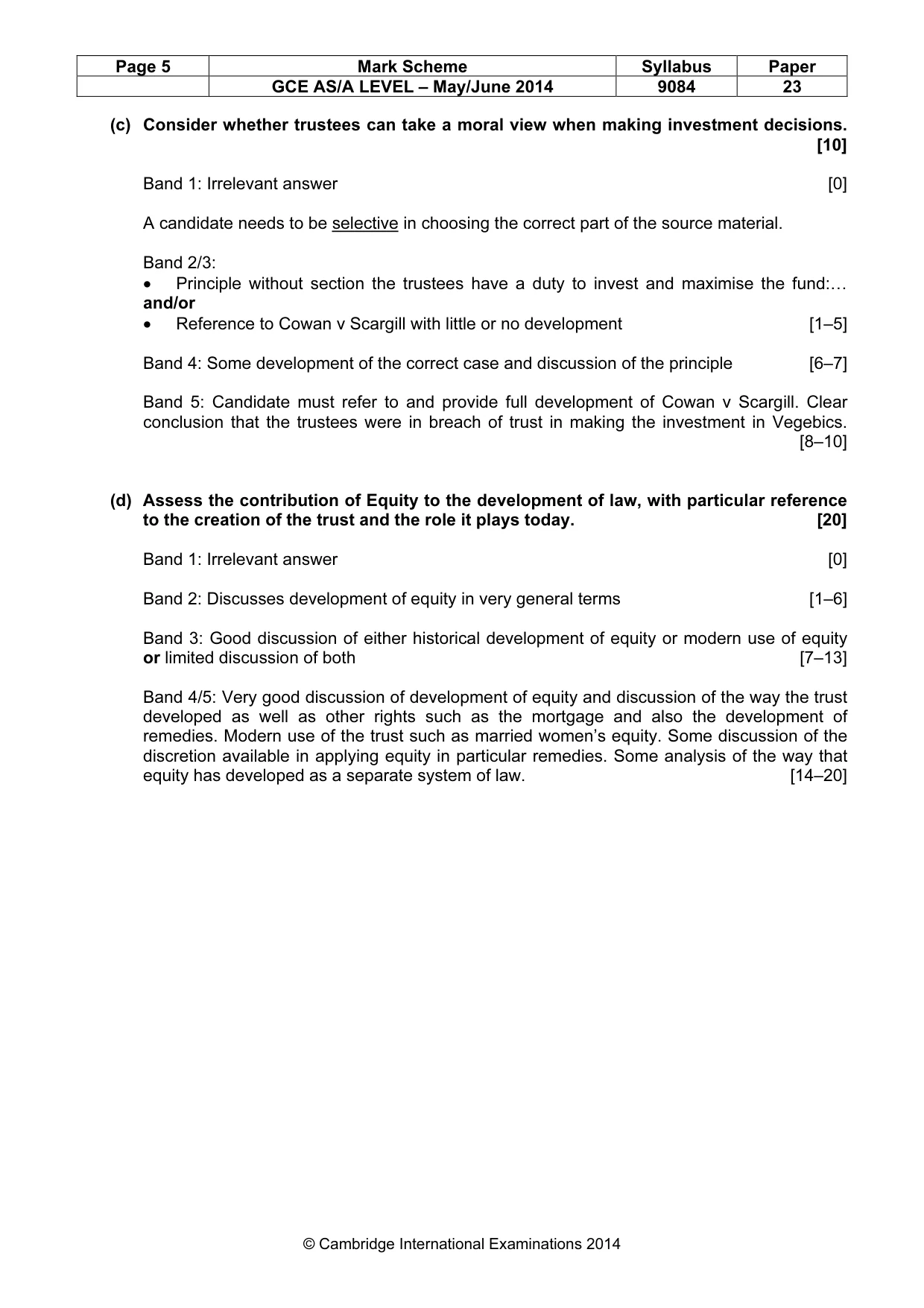
Page 5 Mark Scheme Syllabus Paper GCE AS/A LEVEL – May/June 2014 9084 23 © Cambridge International Examinations 2014 (c) Consider whether trustees can take a moral view when making investment decisions. [10] Band 1: Irrelevant answer [0] A candidate needs to be selective in choosing the correct part of the source material. Band 2/3: • Principle without section the trustees have a duty to invest and maximise the fund:… and/or • Reference to Cowan v Scargill with little or no development [1–5] Band 4: Some development of the correct case and discussion of the principle [6–7] Band 5: Candidate must refer to and provide full development of Cowan v Scargill. Clear conclusion that the trustees were in breach of trust in making the investment in Vegebics. [8–10] (d) Assess the contribution of Equity to the development of law, with particular reference to the creation of the trust and the role it plays today. [20] Band 1: Irrelevant answer [0] Band 2: Discusses development of equity in very general terms [1–6] Band 3: Good discussion of either historical development of equity or modern use of equity or limited discussion of both [7–13] Band 4/5: Very good discussion of development of equity and discussion of the way the trust developed as well as other rights such as the mortgage and also the development of remedies. Modern use of the trust such as married women’s equity. Some discussion of the discretion available in applying equity in particular remedies. Some analysis of the way that equity has developed as a separate system of law. [14–20]
What you needed in this session
Cambridge’s own grade thresholds for 2014 May/June, Paper 2 · Variant 3. A higher threshold means an easier paper — the bar moves with how the cohort did.