Cambridge A Level Law 9084 — 2014 May/June Paper 2 · Variant 1
9084/21/M/J/14 · 50 marks · ≈56 min
The question paper and its mark scheme, free to read here and free to download. This is Cambridge’s own paper, exactly as it was sat.
Question paper4 pages
Mark scheme6 pages
Answers below. Sit the paper first if you are practising.
Paper as text
Question paper, page 1
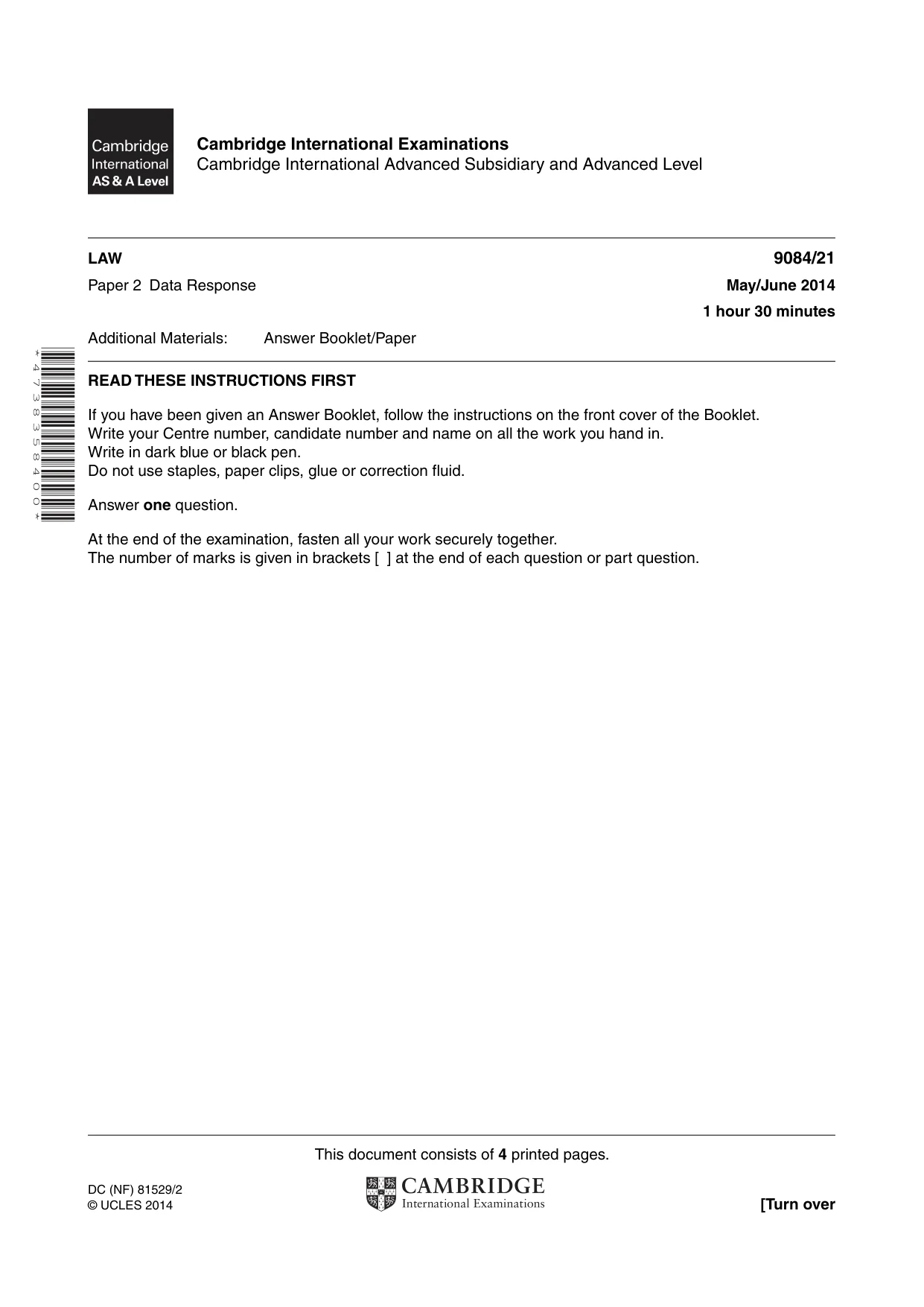
This document consists of 4 printed pages. DC (NF) 81529/2 © UCLES 2014 [Turn over Cambridge International Examinations Cambridge International Advanced Subsidiary and Advanced Level * 4 7 3 8 3 5 8 4 0 0 * LAW 9084/21 Paper 2 Data Response May/June 2014 1 hour 30 minutes Additional Materials: Answer Booklet/Paper READ THESE INSTRUCTIONS FIRST If you have been given an Answer Booklet, follow the instructions on the front cover of the Booklet. Write your Centre number, candidate number and name on all the work you hand in. Write in dark blue or black pen. Do not use staples, paper clips, glue or correction fluid. Answer one question. At the end of the examination, fasten all your work securely together. The number of marks is given in brackets [ ] at the end of each question or part question.
Question paper, page 2
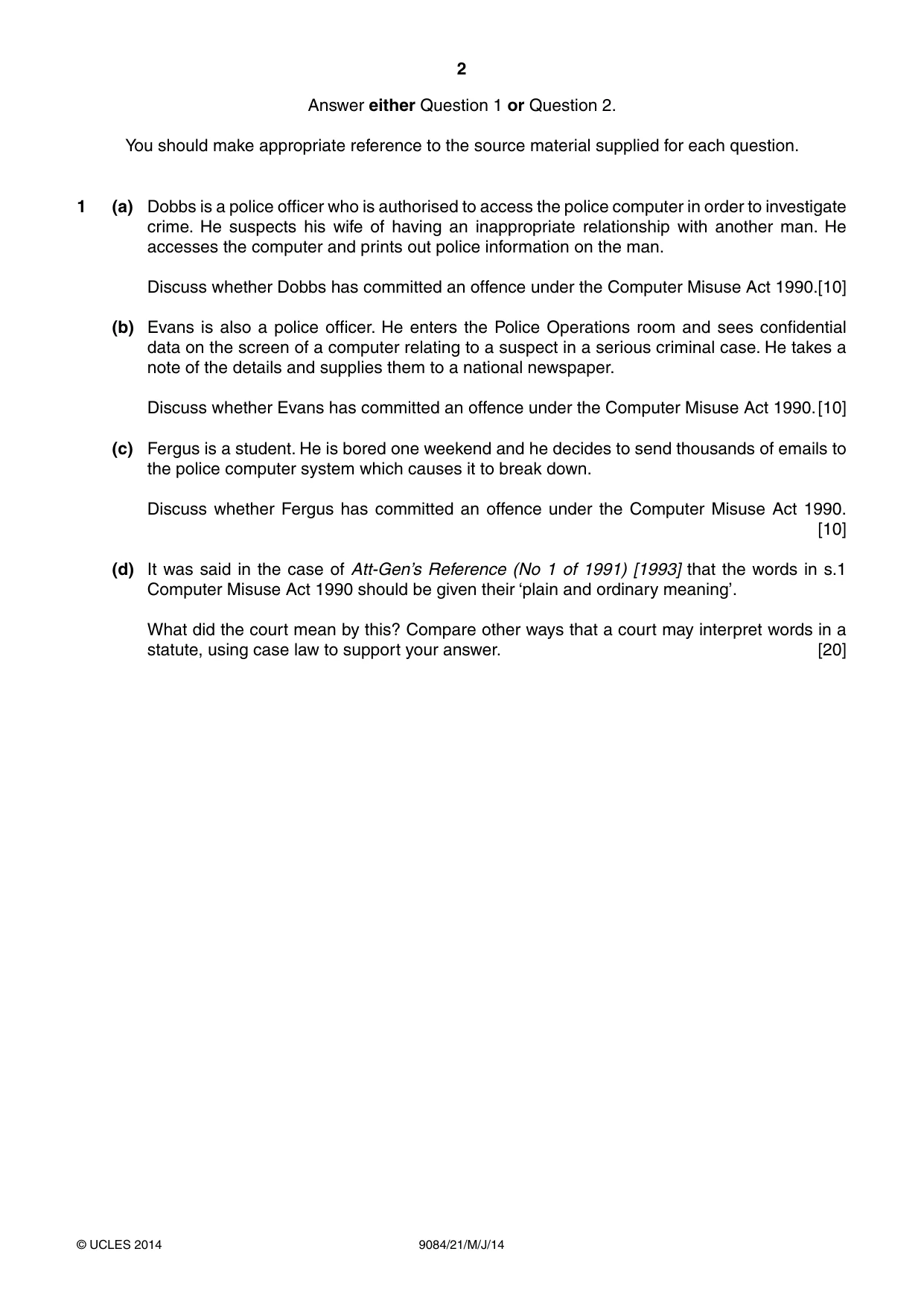
2 9084/21/M/J/14 © UCLES 2014 Answer either Question 1 or Question 2. You should make appropriate reference to the source material supplied for each question. 1 (a) Dobbs is a police officer who is authorised to access the police computer in order to investigate crime. He suspects his wife of having an inappropriate relationship with another man. He accesses the computer and prints out police information on the man. Discuss whether Dobbs has committed an offence under the Computer Misuse Act 1990. [10] (b) Evans is also a police officer. He enters the Police Operations room and sees confidential data on the screen of a computer relating to a suspect in a serious criminal case. He takes a note of the details and supplies them to a national newspaper. Discuss whether Evans has committed an offence under the Computer Misuse Act 1990. [10] (c) Fergus is a student. He is bored one weekend and he decides to send thousands of emails to the police computer system which causes it to break down. Discuss whether Fergus has committed an offence under the Computer Misuse Act 1990. [10] (d) It was said in the case of Att-Gen’s Reference (No 1 of 1991) [1993] that the words in s.1 Computer Misuse Act 1990 should be given their ‘plain and ordinary meaning’. What did the court mean by this? Compare other ways that a court may interpret words in a statute, using case law to support your answer. [20]
Question paper, page 3
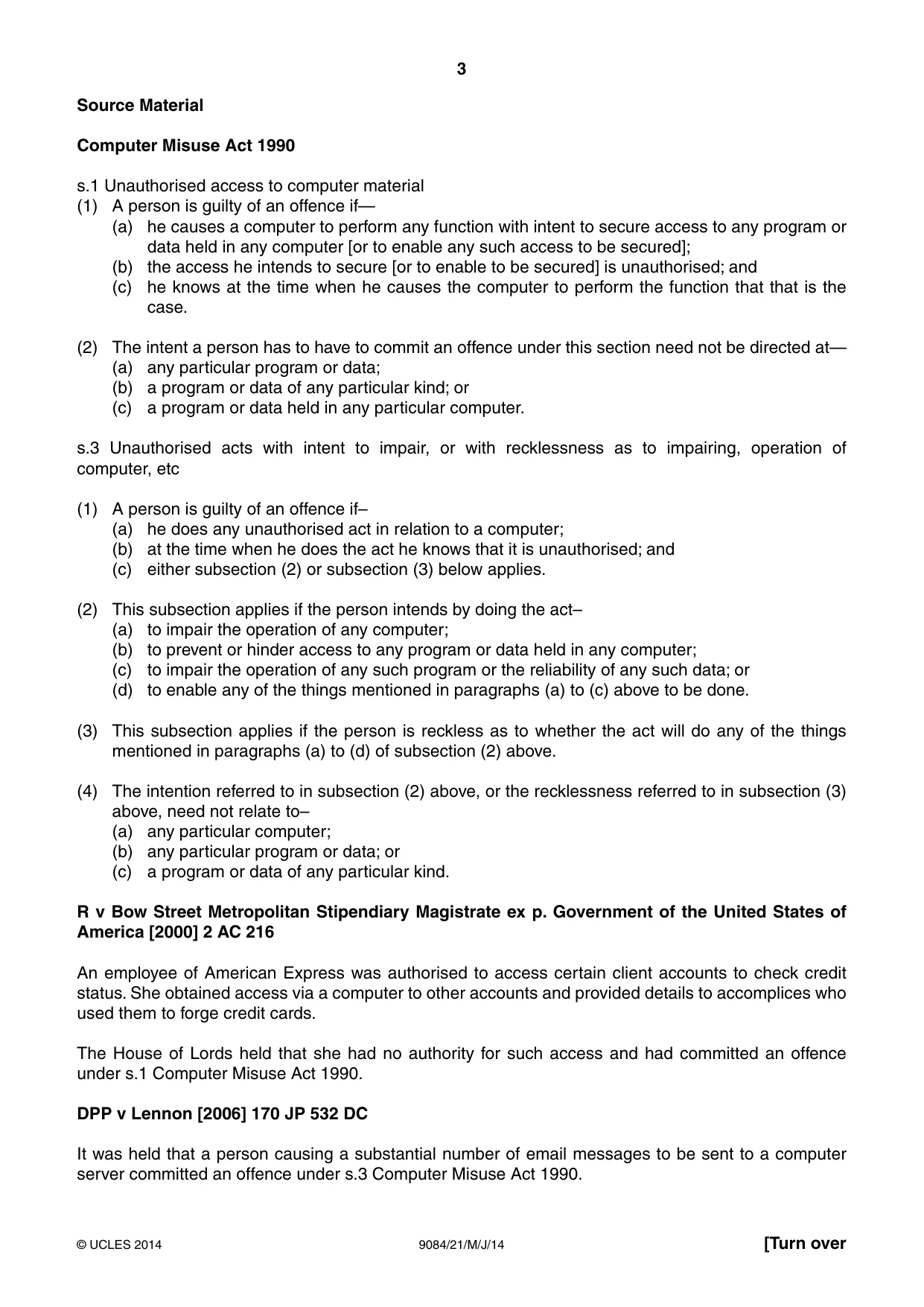
3 9084/21/M/J/14 © UCLES 2014 [Turn over Source Material Computer Misuse Act 1990 s.1 Unauthorised access to computer material (1) A person is guilty of an offence if— (a) he causes a computer to perform any function with intent to secure access to any program or data held in any computer [or to enable any such access to be secured]; (b) the access he intends to secure [or to enable to be secured] is unauthorised; and (c) he knows at the time when he causes the computer to perform the function that that is the case. (2) The intent a person has to have to commit an offence under this section need not be directed at— (a) any particular program or data; (b) a program or data of any particular kind; or (c) a program or data held in any particular computer. s.3 Unauthorised acts with intent to impair, or with recklessness as to impairing, operation of computer, etc (1) A person is guilty of an offence if– (a) he does any unauthorised act in relation to a computer; (b) at the time when he does the act he knows that it is unauthorised; and (c) either subsection (2) or subsection (3) below applies. (2) This subsection applies if the person intends by doing the act– (a) to impair the operation of any computer; (b) to prevent or hinder access to any program or data held in any computer; (c) to impair the operation of any such program or the reliability of any such data; or (d) to enable any of the things mentioned in paragraphs (a) to (c) above to be done. (3) This subsection applies if the person is reckless as to whether the act will do any of the things mentioned in paragraphs (a) to (d) of subsection (2) above. (4) The intention referred to in subsection (2) above, or the recklessness referred to in subsection (3) above, need not relate to– (a) any particular computer; (b) any particular program or data; or (c) a program or data of any particular kind. R v Bow Street Metropolitan Stipendiary Magistrate ex p. Government of the United States of America [2000] 2 AC 216 An employee of American Express was authorised to access certain client accounts to check credit status. She obtained access via a computer to other accounts and provided details to accomplices who used them to forge credit cards. The House of Lords held that she had no authority for such access and had committed an offence under s.1 Computer Misuse Act 1990. DPP v Lennon [2006] 170 JP 532 DC It was held that a person causing a substantial number of email messages to be sent to a computer server committed an offence under s.3 Computer Misuse Act 1990.
Question paper, page 4
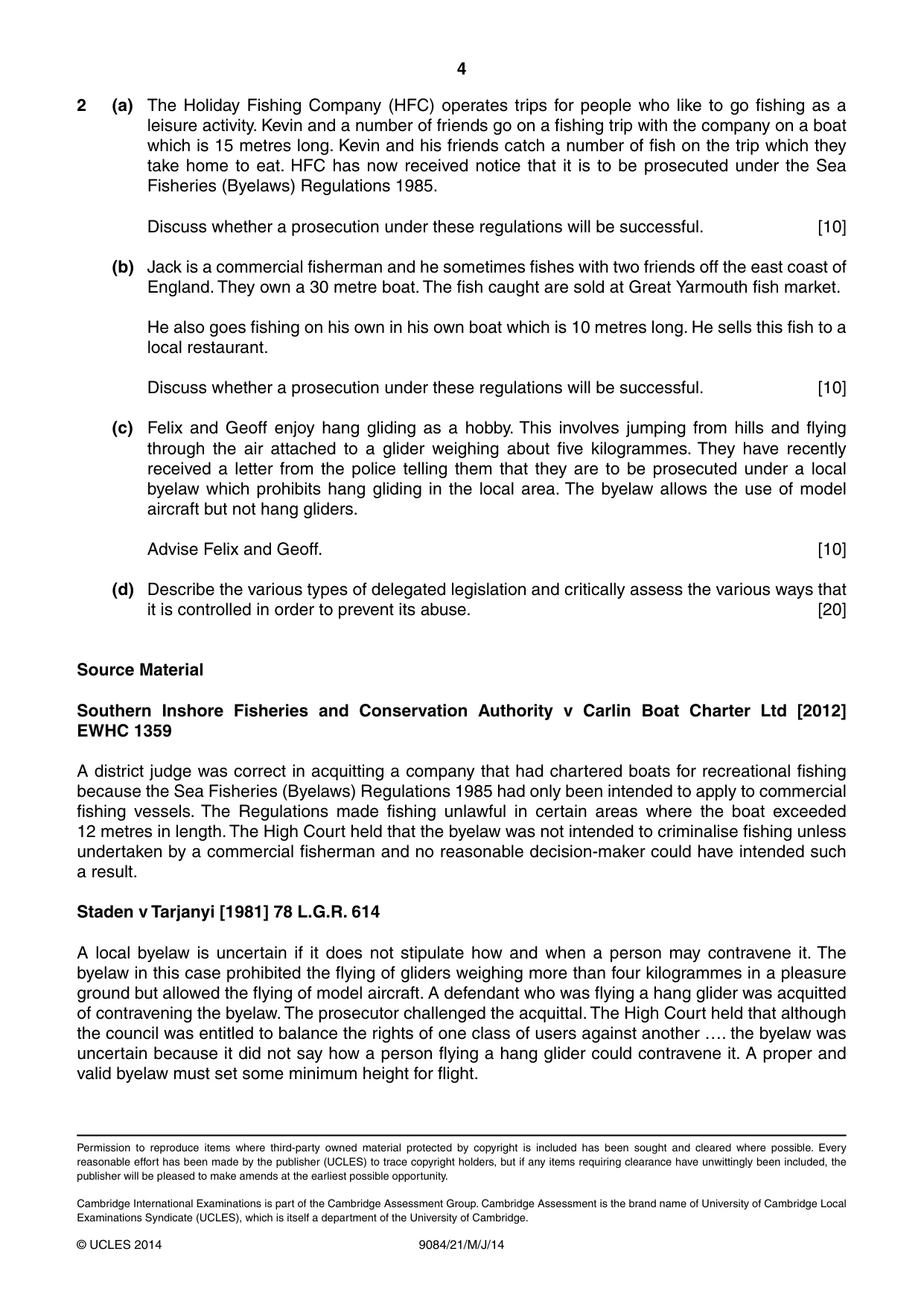
4 9084/21/M/J/14 © UCLES 2014 2 (a) The Holiday Fishing Company (HFC) operates trips for people who like to go fishing as a leisure activity. Kevin and a number of friends go on a fishing trip with the company on a boat which is 15 metres long. Kevin and his friends catch a number of fish on the trip which they take home to eat. HFC has now received notice that it is to be prosecuted under the Sea Fisheries (Byelaws) Regulations 1985. Discuss whether a prosecution under these regulations will be successful. [10] (b) Jack is a commercial fisherman and he sometimes fishes with two friends off the east coast of England. They own a 30 metre boat. The fish caught are sold at Great Yarmouth fish market. He also goes fishing on his own in his own boat which is 10 metres long. He sells this fish to a local restaurant. Discuss whether a prosecution under these regulations will be successful. [10] (c) Felix and Geoff enjoy hang gliding as a hobby. This involves jumping from hills and flying through the air attached to a glider weighing about five kilogrammes. They have recently received a letter from the police telling them that they are to be prosecuted under a local byelaw which prohibits hang gliding in the local area. The byelaw allows the use of model aircraft but not hang gliders. Advise Felix and Geoff. [10] (d) Describe the various types of delegated legislation and critically assess the various ways that it is controlled in order to prevent its abuse. [20] Source Material Southern Inshore Fisheries and Conservation Authority v Carlin Boat Charter Ltd [2012] EWHC 1359 A district judge was correct in acquitting a company that had chartered boats for recreational fishing because the Sea Fisheries (Byelaws) Regulations 1985 had only been intended to apply to commercial fishing vessels. The Regulations made fishing unlawful in certain areas where the boat exceeded 12 metres in length. The High Court held that the byelaw was not intended to criminalise fishing unless undertaken by a commercial fisherman and no reasonable decision-maker could have intended such a result. Staden v Tarjanyi [1981] 78 L.G.R. 614 A local byelaw is uncertain if it does not stipulate how and when a person may contravene it. The byelaw in this case prohibited the flying of gliders weighing more than four kilogrammes in a pleasure ground but allowed the flying of model aircraft. A defendant who was flying a hang glider was acquitted of contravening the byelaw. The prosecutor challenged the acquittal. The High Court held that although the council was entitled to balance the rights of one class of users against another …. the byelaw was uncertain because it did not say how a person flying a hang glider could contravene it. A proper and valid byelaw must set some minimum height for flight. Permission to reproduce items where third-party owned material protected by copyright is included has been sought and cleared where possible. Every reasonable effort has been made by the publisher (UCLES) to trace copyright holders, but if any items requiring clearance have unwittingly been included, the publisher will be pleased to make amends at the earliest possible opportunity. Cambridge International Examinations is part of the Cambridge Assessment Group. Cambridge Assessment is the brand name of University of Cambridge Local Examinations Syndicate (UCLES), which is itself a department of the University of Cambridge.
Mark scheme, page 1
CAMBRIDGE INTERNATIONAL EXAMINATIONS GCE Advanced Subsidiary Level and GCE Advanced Level MARK SCHEME for the May/June 2014 series 9084 LAW 9084/21 Paper 2, maximum raw mark 50 This mark scheme is published as an aid to teachers and candidates, to indicate the requirements of the examination. It shows the basis on which Examiners were instructed to award marks. It does not indicate the details of the discussions that took place at an Examiners’ meeting before marking began, which would have considered the acceptability of alternative answers. Mark schemes should be read in conjunction with the question paper and the Principal Examiner Report for Teachers. Cambridge will not enter into discussions about these mark schemes. Cambridge is publishing the mark schemes for the May/June 2014 series for most IGCSE, GCE Advanced Level and Advanced Subsidiary Level components and some Ordinary Level components.
Mark scheme, page 2
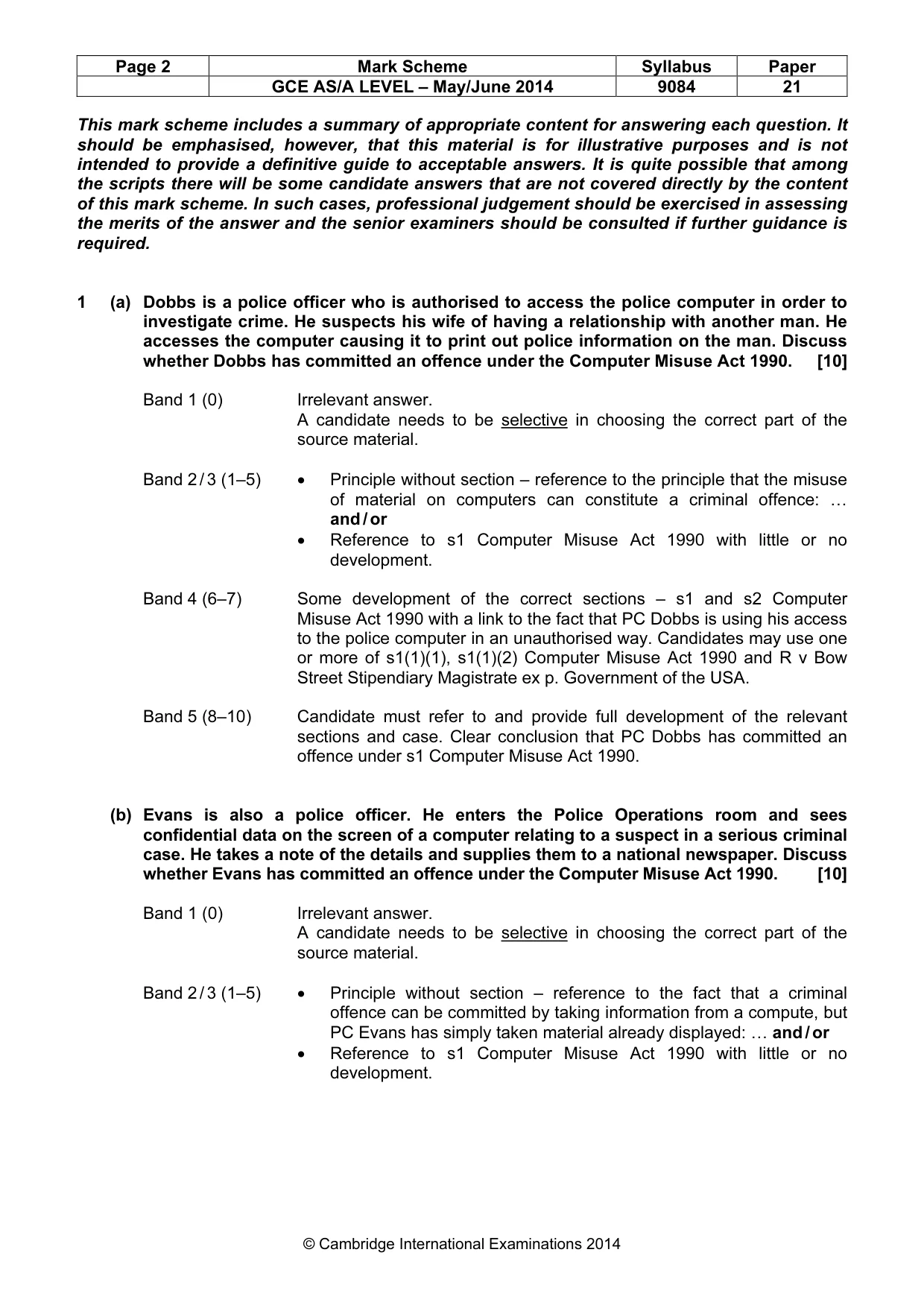
Page 2 Mark Scheme Syllabus Paper GCE AS/A LEVEL – May/June 2014 9084 21 © Cambridge International Examinations 2014 This mark scheme includes a summary of appropriate content for answering each question. It should be emphasised, however, that this material is for illustrative purposes and is not intended to provide a definitive guide to acceptable answers. It is quite possible that among the scripts there will be some candidate answers that are not covered directly by the content of this mark scheme. In such cases, professional judgement should be exercised in assessing the merits of the answer and the senior examiners should be consulted if further guidance is required. 1 (a) Dobbs is a police officer who is authorised to access the police computer in order to investigate crime. He suspects his wife of having a relationship with another man. He accesses the computer causing it to print out police information on the man. Discuss whether Dobbs has committed an offence under the Computer Misuse Act 1990. [10] Band 1 (0) Irrelevant answer. A candidate needs to be selective in choosing the correct part of the source material. Band 2 / 3 (1–5) • Principle without section – reference to the principle that the misuse of material on computers can constitute a criminal offence: … and / or • Reference to s1 Computer Misuse Act 1990 with little or no development. Band 4 (6–7) Some development of the correct sections – s1 and s2 Computer Misuse Act 1990 with a link to the fact that PC Dobbs is using his access to the police computer in an unauthorised way. Candidates may use one or more of s1(1)(1), s1(1)(2) Computer Misuse Act 1990 and R v Bow Street Stipendiary Magistrate ex p. Government of the USA. Band 5 (8–10) Candidate must refer to and provide full development of the relevant sections and case. Clear conclusion that PC Dobbs has committed an offence under s1 Computer Misuse Act 1990. (b) Evans is also a police officer. He enters the Police Operations room and sees confidential data on the screen of a computer relating to a suspect in a serious criminal case. He takes a note of the details and supplies them to a national newspaper. Discuss whether Evans has committed an offence under the Computer Misuse Act 1990. [10] Band 1 (0) Irrelevant answer. A candidate needs to be selective in choosing the correct part of the source material. Band 2 / 3 (1–5) • Principle without section – reference to the fact that a criminal offence can be committed by taking information from a compute, but PC Evans has simply taken material already displayed: … and / or • Reference to s1 Computer Misuse Act 1990 with little or no development.
Mark scheme, page 3
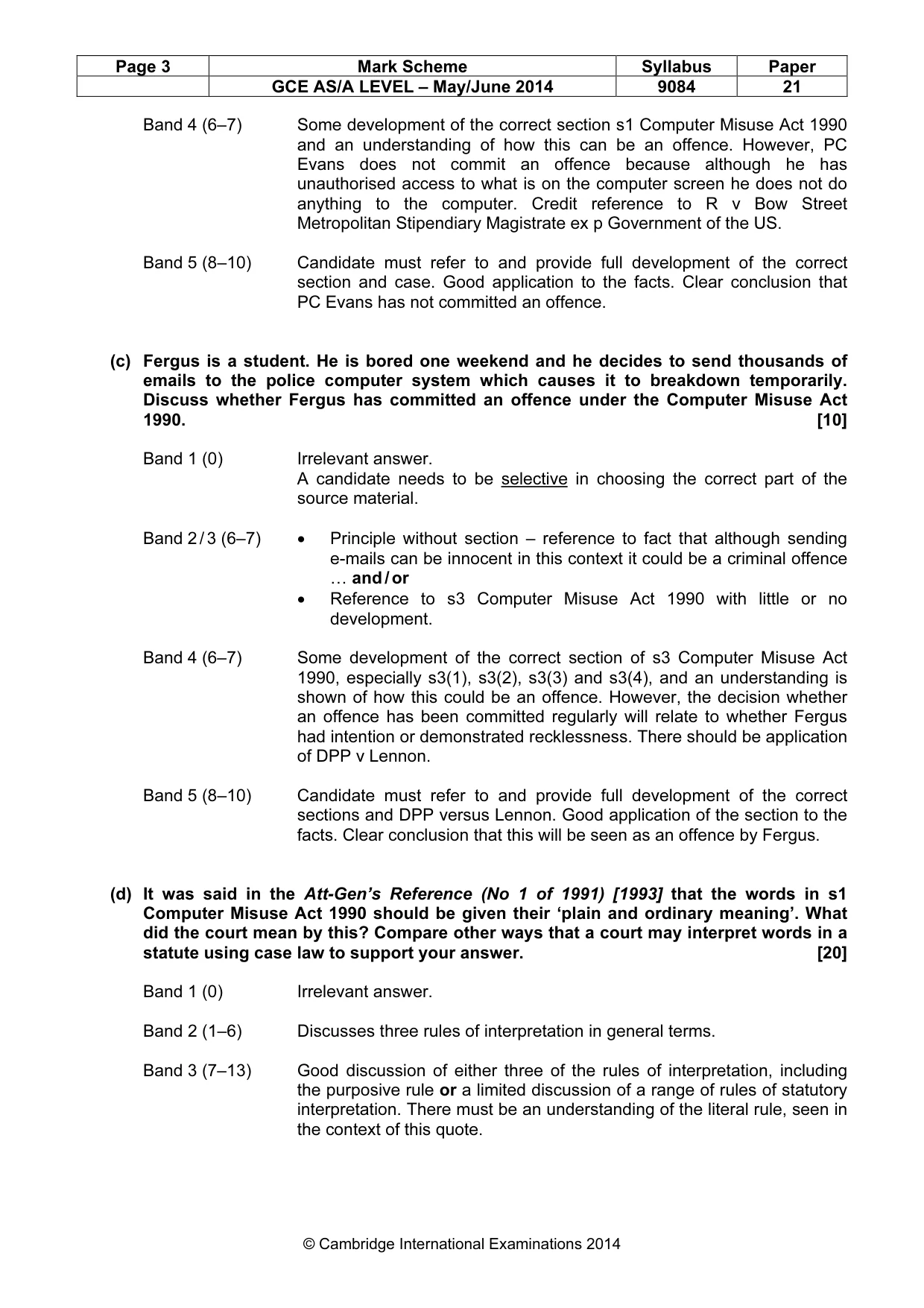
Page 3 Mark Scheme Syllabus Paper GCE AS/A LEVEL – May/June 2014 9084 21 © Cambridge International Examinations 2014 Band 4 (6–7) Some development of the correct section s1 Computer Misuse Act 1990 and an understanding of how this can be an offence. However, PC Evans does not commit an offence because although he has unauthorised access to what is on the computer screen he does not do anything to the computer. Credit reference to R v Bow Street Metropolitan Stipendiary Magistrate ex p Government of the US. Band 5 (8–10) Candidate must refer to and provide full development of the correct section and case. Good application to the facts. Clear conclusion that PC Evans has not committed an offence. (c) Fergus is a student. He is bored one weekend and he decides to send thousands of emails to the police computer system which causes it to breakdown temporarily. Discuss whether Fergus has committed an offence under the Computer Misuse Act 1990. [10] Band 1 (0) Irrelevant answer. A candidate needs to be selective in choosing the correct part of the source material. Band 2 / 3 (6–7) • Principle without section – reference to fact that although sending e-mails can be innocent in this context it could be a criminal offence … and / or • Reference to s3 Computer Misuse Act 1990 with little or no development. Band 4 (6–7) Some development of the correct section of s3 Computer Misuse Act 1990, especially s3(1), s3(2), s3(3) and s3(4), and an understanding is shown of how this could be an offence. However, the decision whether an offence has been committed regularly will relate to whether Fergus had intention or demonstrated recklessness. There should be application of DPP v Lennon. Band 5 (8–10) Candidate must refer to and provide full development of the correct sections and DPP versus Lennon. Good application of the section to the facts. Clear conclusion that this will be seen as an offence by Fergus. (d) It was said in the Att-Gen’s Reference (No 1 of 1991) [1993] that the words in s1 Computer Misuse Act 1990 should be given their ‘plain and ordinary meaning’. What did the court mean by this? Compare other ways that a court may interpret words in a statute using case law to support your answer. [20] Band 1 (0) Irrelevant answer. Band 2 (1–6) Discusses three rules of interpretation in general terms. Band 3 (7–13) Good discussion of either three of the rules of interpretation, including the purposive rule or a limited discussion of a range of rules of statutory interpretation. There must be an understanding of the literal rule, seen in the context of this quote.
Mark scheme, page 4
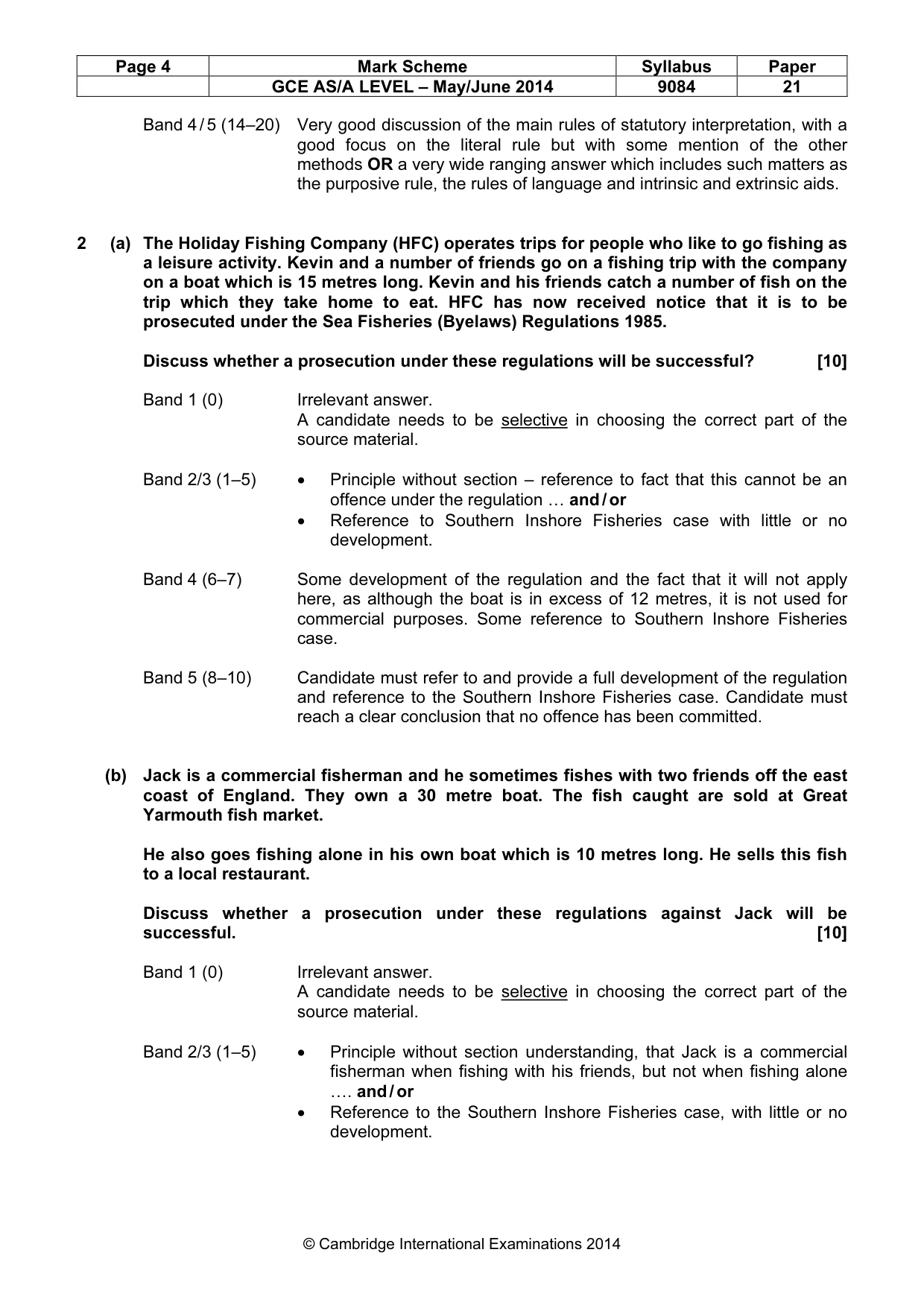
Page 4 Mark Scheme Syllabus Paper GCE AS/A LEVEL – May/June 2014 9084 21 © Cambridge International Examinations 2014 Band 4 / 5 (14–20) Very good discussion of the main rules of statutory interpretation, with a good focus on the literal rule but with some mention of the other methods OR a very wide ranging answer which includes such matters as the purposive rule, the rules of language and intrinsic and extrinsic aids. 2 (a) The Holiday Fishing Company (HFC) operates trips for people who like to go fishing as a leisure activity. Kevin and a number of friends go on a fishing trip with the company on a boat which is 15 metres long. Kevin and his friends catch a number of fish on the trip which they take home to eat. HFC has now received notice that it is to be prosecuted under the Sea Fisheries (Byelaws) Regulations 1985. Discuss whether a prosecution under these regulations will be successful? [10] Band 1 (0) Irrelevant answer. A candidate needs to be selective in choosing the correct part of the source material. Band 2/3 (1–5) • Principle without section – reference to fact that this cannot be an offence under the regulation … and / or • Reference to Southern Inshore Fisheries case with little or no development. Band 4 (6–7) Some development of the regulation and the fact that it will not apply here, as although the boat is in excess of 12 metres, it is not used for commercial purposes. Some reference to Southern Inshore Fisheries case. Band 5 (8–10) Candidate must refer to and provide a full development of the regulation and reference to the Southern Inshore Fisheries case. Candidate must reach a clear conclusion that no offence has been committed. (b) Jack is a commercial fisherman and he sometimes fishes with two friends off the east coast of England. They own a 30 metre boat. The fish caught are sold at Great Yarmouth fish market. He also goes fishing alone in his own boat which is 10 metres long. He sells this fish to a local restaurant. Discuss whether a prosecution under these regulations against Jack will be successful. [10] Band 1 (0) Irrelevant answer. A candidate needs to be selective in choosing the correct part of the source material. Band 2/3 (1–5) • Principle without section understanding, that Jack is a commercial fisherman when fishing with his friends, but not when fishing alone …. and / or • Reference to the Southern Inshore Fisheries case, with little or no development.
Mark scheme, page 5
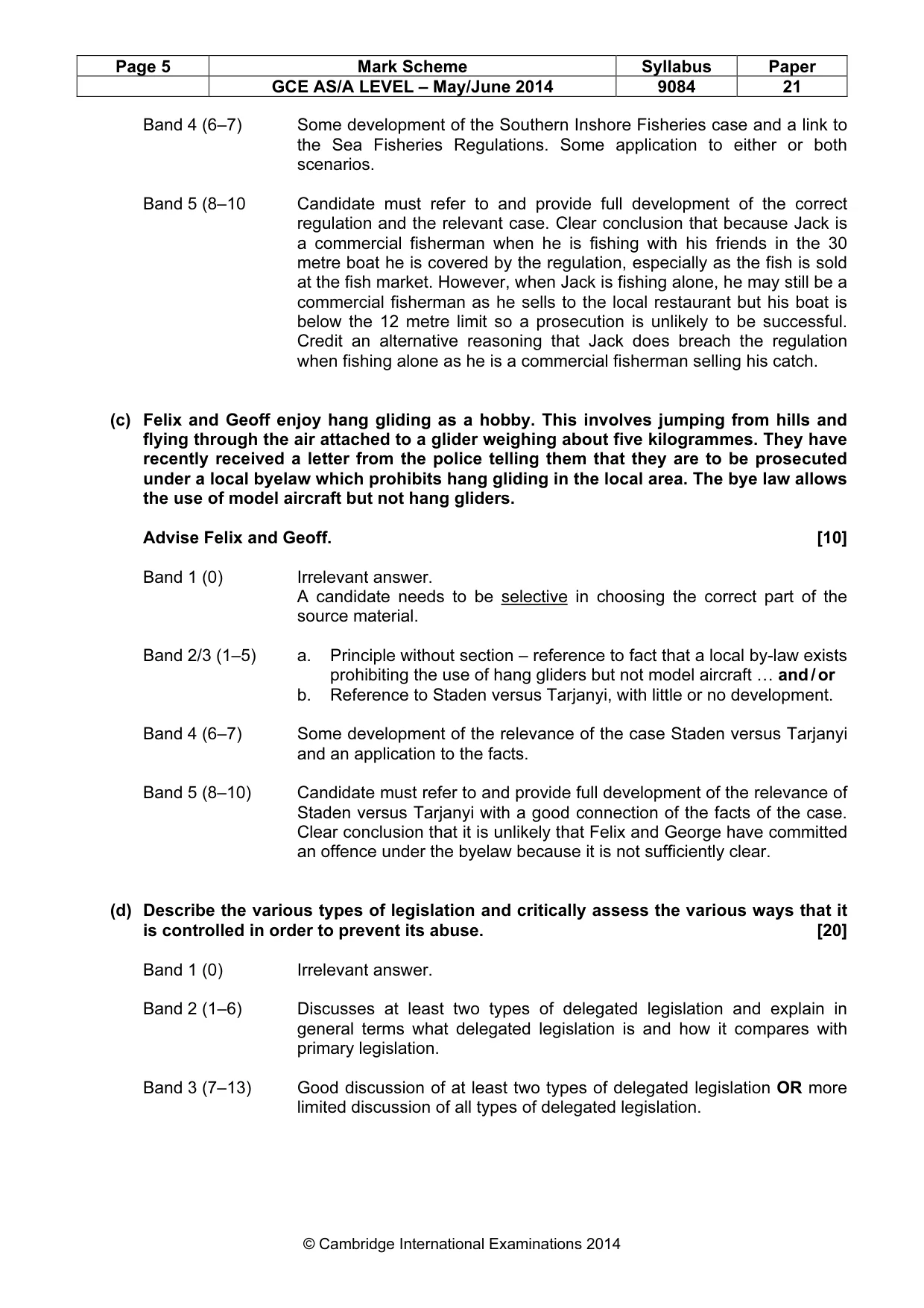
Page 5 Mark Scheme Syllabus Paper GCE AS/A LEVEL – May/June 2014 9084 21 © Cambridge International Examinations 2014 Band 4 (6–7) Some development of the Southern Inshore Fisheries case and a link to the Sea Fisheries Regulations. Some application to either or both scenarios. Band 5 (8–10 Candidate must refer to and provide full development of the correct regulation and the relevant case. Clear conclusion that because Jack is a commercial fisherman when he is fishing with his friends in the 30 metre boat he is covered by the regulation, especially as the fish is sold at the fish market. However, when Jack is fishing alone, he may still be a commercial fisherman as he sells to the local restaurant but his boat is below the 12 metre limit so a prosecution is unlikely to be successful. Credit an alternative reasoning that Jack does breach the regulation when fishing alone as he is a commercial fisherman selling his catch. (c) Felix and Geoff enjoy hang gliding as a hobby. This involves jumping from hills and flying through the air attached to a glider weighing about five kilogrammes. They have recently received a letter from the police telling them that they are to be prosecuted under a local byelaw which prohibits hang gliding in the local area. The bye law allows the use of model aircraft but not hang gliders. Advise Felix and Geoff. [10] Band 1 (0) Irrelevant answer. A candidate needs to be selective in choosing the correct part of the source material. Band 2/3 (1–5) a. Principle without section – reference to fact that a local by-law exists prohibiting the use of hang gliders but not model aircraft … and / or b. Reference to Staden versus Tarjanyi, with little or no development. Band 4 (6–7) Some development of the relevance of the case Staden versus Tarjanyi and an application to the facts. Band 5 (8–10) Candidate must refer to and provide full development of the relevance of Staden versus Tarjanyi with a good connection of the facts of the case. Clear conclusion that it is unlikely that Felix and George have committed an offence under the byelaw because it is not sufficiently clear. (d) Describe the various types of legislation and critically assess the various ways that it is controlled in order to prevent its abuse. [20] Band 1 (0) Irrelevant answer. Band 2 (1–6) Discusses at least two types of delegated legislation and explain in general terms what delegated legislation is and how it compares with primary legislation. Band 3 (7–13) Good discussion of at least two types of delegated legislation OR more limited discussion of all types of delegated legislation.
Mark scheme, page 6
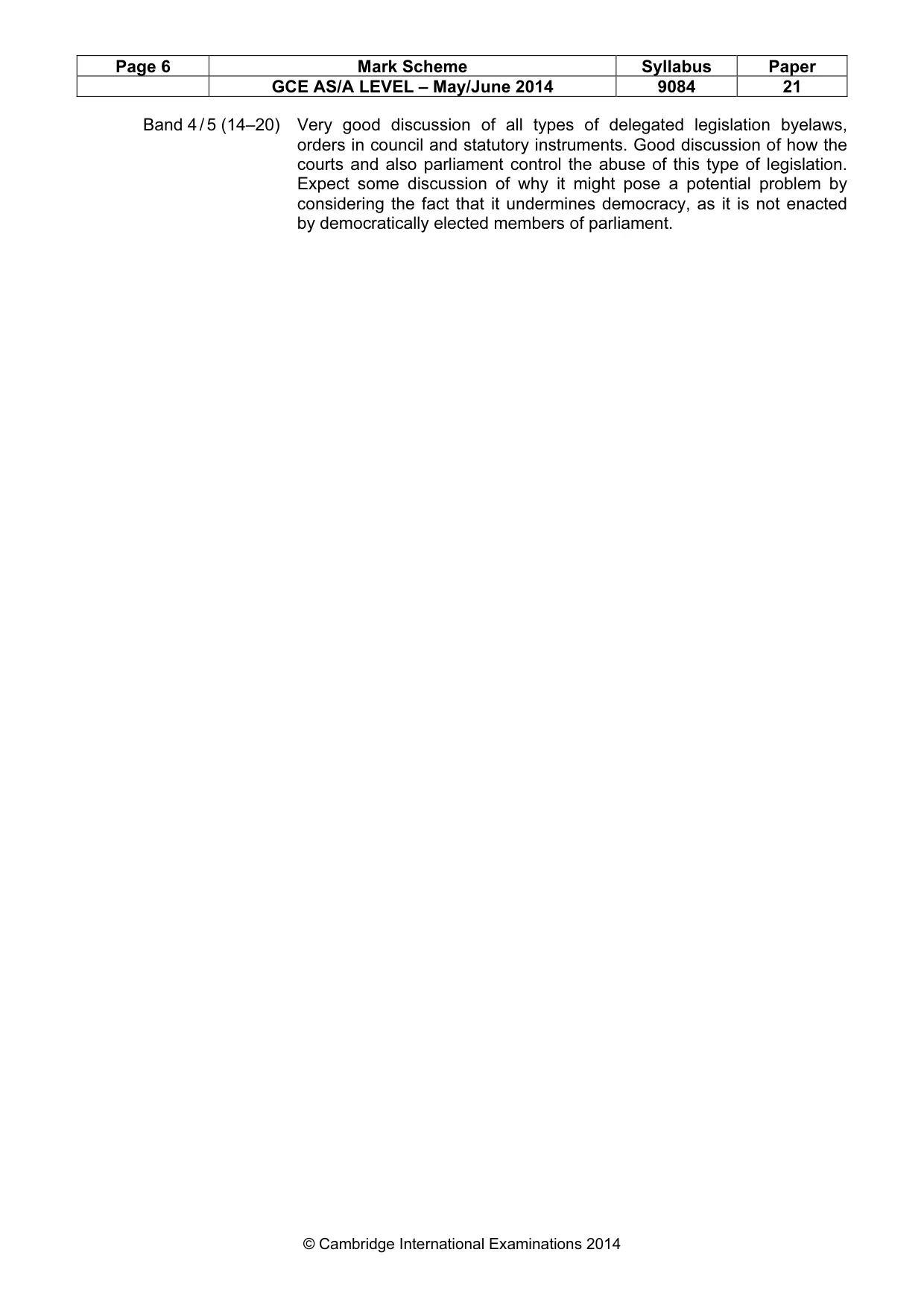
Page 6 Mark Scheme Syllabus Paper GCE AS/A LEVEL – May/June 2014 9084 21 © Cambridge International Examinations 2014 Band 4 / 5 (14–20) Very good discussion of all types of delegated legislation byelaws, orders in council and statutory instruments. Good discussion of how the courts and also parliament control the abuse of this type of legislation. Expect some discussion of why it might pose a potential problem by considering the fact that it undermines democracy, as it is not enacted by democratically elected members of parliament.
What you needed in this session
Cambridge’s own grade thresholds for 2014 May/June, Paper 2 · Variant 1. A higher threshold means an easier paper — the bar moves with how the cohort did.