Cambridge A Level Law 9084 — 2013 May/June Paper 2 · Variant 2
9084/22/M/J/13 · 50 marks · ≈56 min
The question paper and its mark scheme, free to read here and free to download. This is Cambridge’s own paper, exactly as it was sat.
Question paper4 pages
Mark scheme5 pages
Answers below. Sit the paper first if you are practising.
Paper as text
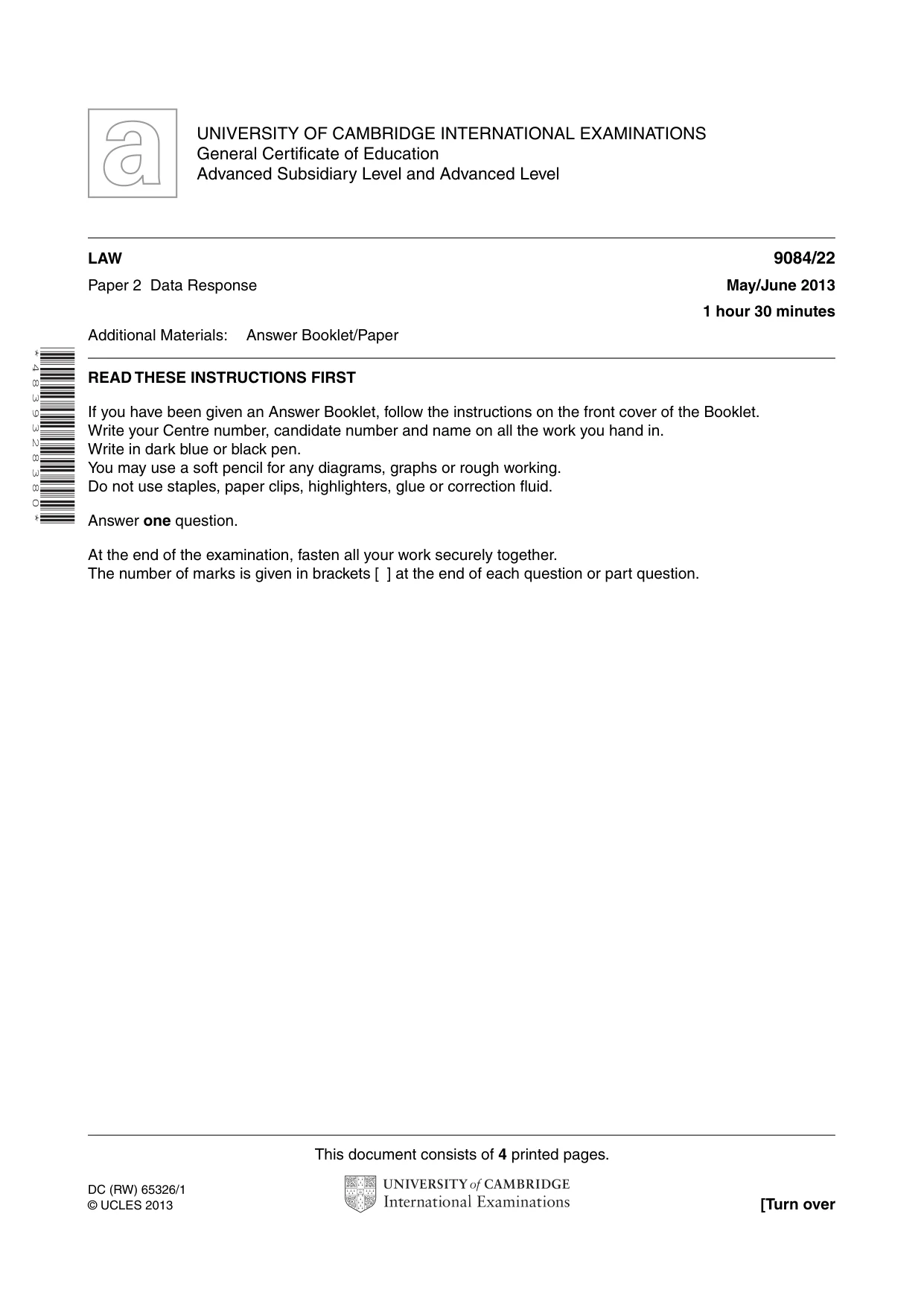
Question paper, page 1
This document consists of 4 printed pages. DC (RW) 65326/1 © UCLES 2013 [Turn over UNIVERSITY OF CAMBRIDGE INTERNATIONAL EXAMINATIONS General Certificate of Education Advanced Subsidiary Level and Advanced Level * 4 8 3 9 3 2 8 3 8 0 * LAW 9084/22 Paper 2 Data Response May/June 2013 1 hour 30 minutes Additional Materials: Answer Booklet/Paper READ THESE INSTRUCTIONS FIRST If you have been given an Answer Booklet, follow the instructions on the front cover of the Booklet. Write your Centre number, candidate number and name on all the work you hand in. Write in dark blue or black pen. You may use a soft pencil for any diagrams, graphs or rough working. Do not use staples, paper clips, highlighters, glue or correction fluid. Answer one question. At the end of the examination, fasten all your work securely together. The number of marks is given in brackets [ ] at the end of each question or part question.
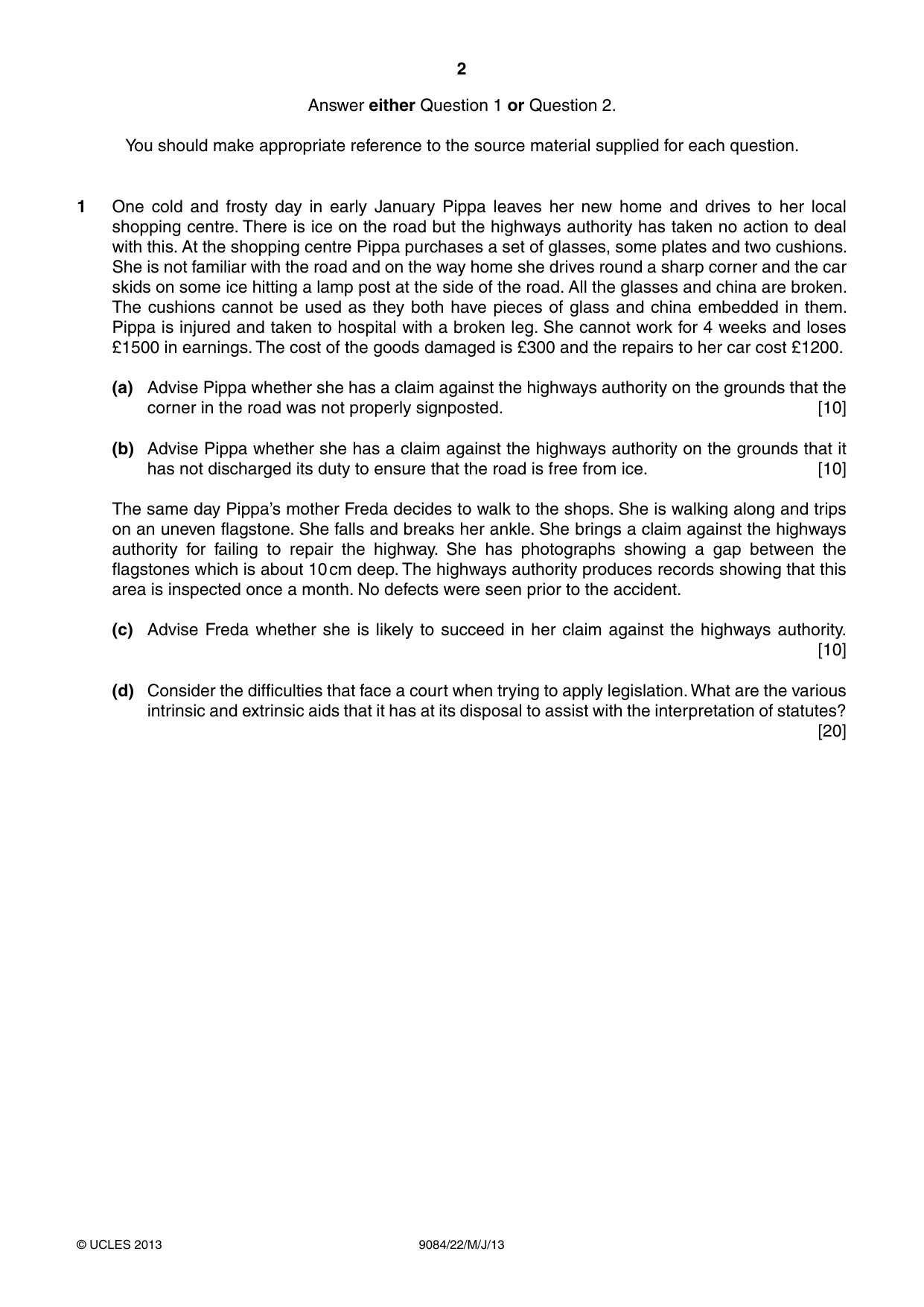
Question paper, page 2
2 9084/22/M/J/13 © UCLES 2013 Answer either Question 1 or Question 2. You should make appropriate reference to the source material supplied for each question. 1 One cold and frosty day in early January Pippa leaves her new home and drives to her local shopping centre. There is ice on the road but the highways authority has taken no action to deal with this. At the shopping centre Pippa purchases a set of glasses, some plates and two cushions. She is not familiar with the road and on the way home she drives round a sharp corner and the car skids on some ice hitting a lamp post at the side of the road. All the glasses and china are broken. The cushions cannot be used as they both have pieces of glass and china embedded in them. Pippa is injured and taken to hospital with a broken leg. She cannot work for 4 weeks and loses £1500 in earnings. The cost of the goods damaged is £300 and the repairs to her car cost £1200. (a) Advise Pippa whether she has a claim against the highways authority on the grounds that the corner in the road was not properly signposted. [10] (b) Advise Pippa whether she has a claim against the highways authority on the grounds that it has not discharged its duty to ensure that the road is free from ice. [10] The same day Pippa’s mother Freda decides to walk to the shops. She is walking along and trips on an uneven flagstone. She falls and breaks her ankle. She brings a claim against the highways authority for failing to repair the highway. She has photographs showing a gap between the flagstones which is about 10 cm deep. The highways authority produces records showing that this area is inspected once a month. No defects were seen prior to the accident. (c) Advise Freda whether she is likely to succeed in her claim against the highways authority. [10] (d) Consider the difficulties that face a court when trying to apply legislation. What are the various intrinsic and extrinsic aids that it has at its disposal to assist with the interpretation of statutes? [20]
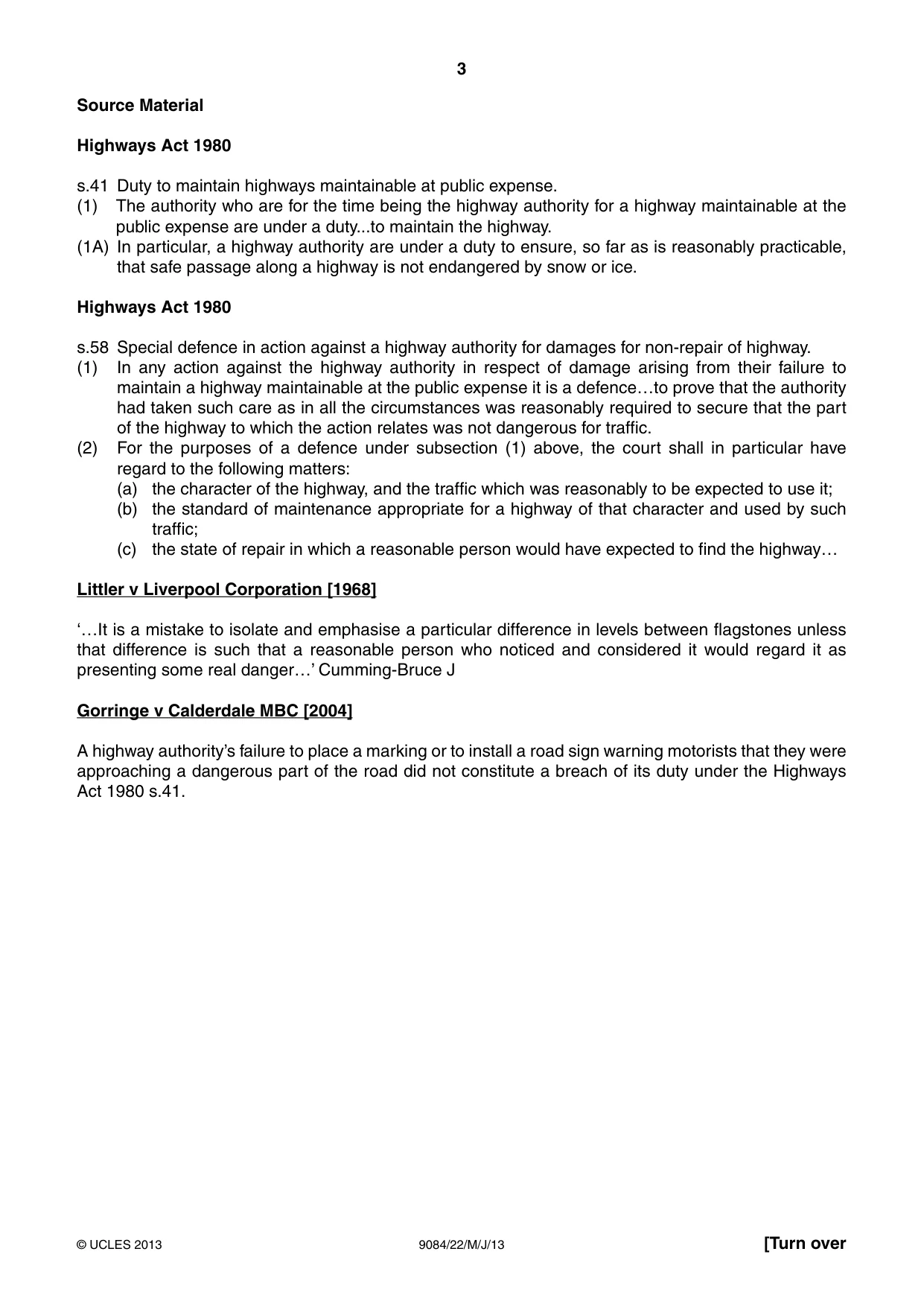
Question paper, page 3
3 9084/22/M/J/13 © UCLES 2013 [Turn over Source Material Highways Act 1980 s.41 Duty to maintain highways maintainable at public expense. (1) The authority who are for the time being the highway authority for a highway maintainable at the public expense are under a duty...to maintain the highway. (1A) In particular, a highway authority are under a duty to ensure, so far as is reasonably practicable, that safe passage along a highway is not endangered by snow or ice. Highways Act 1980 s.58 Special defence in action against a highway authority for damages for non-repair of highway. (1) In any action against the highway authority in respect of damage arising from their failure to maintain a highway maintainable at the public expense it is a defence…to prove that the authority had taken such care as in all the circumstances was reasonably required to secure that the part of the highway to which the action relates was not dangerous for traffic. (2) For the purposes of a defence under subsection (1) above, the court shall in particular have regard to the following matters: (a) the character of the highway, and the traffic which was reasonably to be expected to use it; (b) the standard of maintenance appropriate for a highway of that character and used by such traffic; (c) the state of repair in which a reasonable person would have expected to find the highway… Littler v Liverpool Corporation [1968] ‘…It is a mistake to isolate and emphasise a particular difference in levels between flagstones unless that difference is such that a reasonable person who noticed and considered it would regard it as presenting some real danger…’ Cumming-Bruce J Gorringe v Calderdale MBC [2004] A highway authority’s failure to place a marking or to install a road sign warning motorists that they were approaching a dangerous part of the road did not constitute a breach of its duty under the Highways Act 1980 s.41.
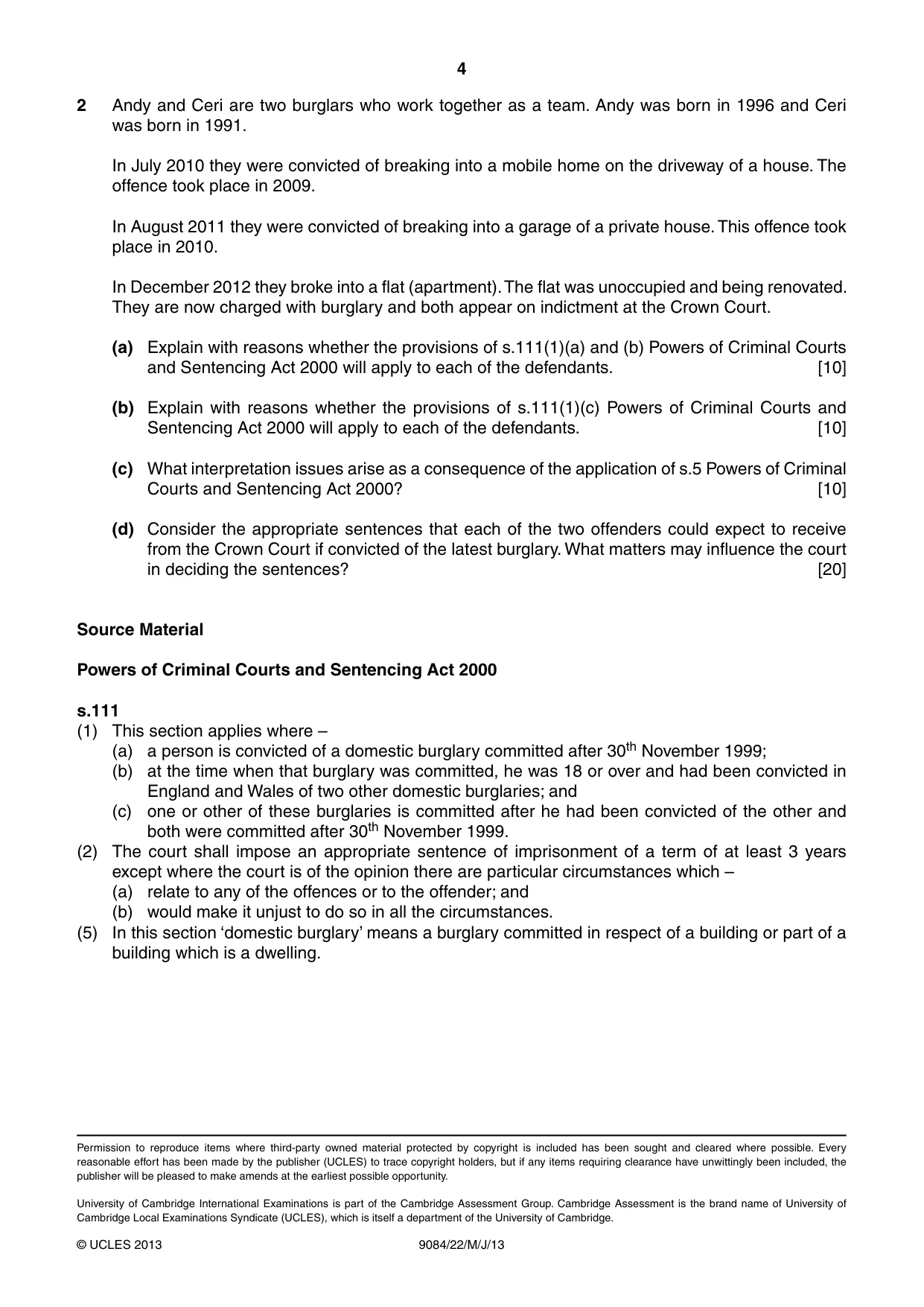
Question paper, page 4
4 9084/22/M/J/13 © UCLES 2013 Permission to reproduce items where third-party owned material protected by copyright is included has been sought and cleared where possible. Every reasonable effort has been made by the publisher (UCLES) to trace copyright holders, but if any items requiring clearance have unwittingly been included, the publisher will be pleased to make amends at the earliest possible opportunity. University of Cambridge International Examinations is part of the Cambridge Assessment Group. Cambridge Assessment is the brand name of University of Cambridge Local Examinations Syndicate (UCLES), which is itself a department of the University of Cambridge. 2 Andy and Ceri are two burglars who work together as a team. Andy was born in 1996 and Ceri was born in 1991. In July 2010 they were convicted of breaking into a mobile home on the driveway of a house. The offence took place in 2009. In August 2011 they were convicted of breaking into a garage of a private house. This offence took place in 2010. In December 2012 they broke into a flat (apartment). The flat was unoccupied and being renovated. They are now charged with burglary and both appear on indictment at the Crown Court. (a) Explain with reasons whether the provisions of s.111(1)(a) and (b) Powers of Criminal Courts and Sentencing Act 2000 will apply to each of the defendants. [10] (b) Explain with reasons whether the provisions of s.111(1)(c) Powers of Criminal Courts and Sentencing Act 2000 will apply to each of the defendants. [10] (c) What interpretation issues arise as a consequence of the application of s.5 Powers of Criminal Courts and Sentencing Act 2000? [10] (d) Consider the appropriate sentences that each of the two offenders could expect to receive from the Crown Court if convicted of the latest burglary. What matters may influence the court in deciding the sentences? [20] Source Material Powers of Criminal Courts and Sentencing Act 2000 s.111 (1) This section applies where – (a) a person is convicted of a domestic burglary committed after 30th November 1999; (b) at the time when that burglary was committed, he was 18 or over and had been convicted in England and Wales of two other domestic burglaries; and (c) one or other of these burglaries is committed after he had been convicted of the other and both were committed after 30th November 1999. (2) The court shall impose an appropriate sentence of imprisonment of a term of at least 3 years except where the court is of the opinion there are particular circumstances which – (a) relate to any of the offences or to the offender; and (b) would make it unjust to do so in all the circumstances. (5) In this section ‘domestic burglary’ means a burglary committed in respect of a building or part of a building which is a dwelling.
Mark scheme, page 1
CAMBRIDGE INTERNATIONAL EXAMINATIONS GCE Advanced Subsidiary Level and GCE Advanced Level MARK SCHEME for the May/June 2013 series 9084 LAW 9084/22 Paper 2, maximum raw mark 50 This mark scheme is published as an aid to teachers and candidates, to indicate the requirements of the examination. It shows the basis on which Examiners were instructed to award marks. It does not indicate the details of the discussions that took place at an Examiners’ meeting before marking began, which would have considered the acceptability of alternative answers. Mark schemes should be read in conjunction with the question paper and the Principal Examiner Report for Teachers. Cambridge will not enter into discussions about these mark schemes. Cambridge is publishing the mark schemes for the May/June 2013 series for most IGCSE, GCE Advanced Level and Advanced Subsidiary Level components and some Ordinary Level components.
Mark scheme, page 2
Page 2 Mark Scheme Syllabus Paper GCE AS/A LEVEL – May/June 2013 9084 22 © Cambridge International Examinations 2013 This mark scheme includes a summary of appropriate content for answering each question. It should be emphasised, however, that this material is for illustrative purposes and is not intended to provide a definitive guide to acceptable answers. It is quite possible that among the scripts there will be some candidate answers that are not covered directly by the content of this mark scheme. In such cases, professional judgement should be exercised in assessing the merits of the answer and the senior examiners should be consulted if further guidance is required. 1 (a) Band 1: Irrelevant answer [0] A candidate needs to be selective in choosing the correct part of the source material. Band 2/3: • Principle without section – understanding that this concerns the duty of the highways authority to maintain the road: and/or • Reference to s.41 Highways Act 1980 and/or Gorringe v Calderdale MBC with little or no development. [1–5] Band 4: Some development of the correct section and case. [6–7] Band 5: Candidate must refer to and provide full development of section and Gorringe. Clear conclusion. It is unlikely that the court will uphold a claim by Pippa against the Highways Authority because dicta from Gorringe holds that there is no breach of its duty under the Highways Act 1980 s.41. [8–10] The fact that it is an icy day is not necessarily relevant here and should not be credited unless it is expressly linked to the increased risk from driving around the sharp bend on an icy day. (b) Band 1: Irrelevant answer [0] A candidate needs to be selective in choosing the correct part of the source material. Band 2/3: • Principle without section – the highways authority have a duty to clear the road of snow so far as it is reasonably practicable and/or • Reference to s.41(1)(1A) Highways Act with little or no development. [1–5] Band 4: Some development of the correct sections and some discussion of the duty of the Highways Authority as to what is considered to be reasonably practicable. [6–7] Band 5: Candidate must refer to and provide full development of the correct section. Clear conclusion: the highways authority may have a valid defence to a claim that it has breached its duty under the Highways Act 1980 if it can argue that it was not reasonably practicable to ensure safe passage along the highway for Pippa. It will depend on such matters as the amount of ice on the road at the time and also the nature of the road and the general weather conditions. Credit for sensible discussion of these and any other relevant matters. [8–10] Where candidates discuss the losses sustained by Pippa credit will be given if there is a link to the claim and the possible liability of the Highways Authority if it were found to be in breach of its duty.
Mark scheme, page 3
Page 3 Mark Scheme Syllabus Paper GCE AS/A LEVEL – May/June 2013 9084 22 © Cambridge International Examinations 2013 (c) Band 1: Irrelevant answer [0] A candidate needs to be selective in choosing the correct part of the source material. Band 2/3: • Principle without section – reference to fact that a highways authority may have a defence against Freda and/or • Reference to s.41(1) and s.58 Highways Act 1980 and/or reference to Littler v Liverpool Corporation with little or no development. [1–5] Band 4: Some development of the correct section and comment from the case of Littler. The correct answer here is that they may be able to prove that they had taken such care as in all the circumstances was reasonably required to secure that part of the road. [6–7] Band 5: Candidate must refer to and provide full development of all subsections/Littler. Good application to the facts of the problem. Clear conclusion. Highways Authority unlikely to be liable here and can rely on a defence under s.58 Highways Act 1980. [8–10] Special credit for any candidate who notes the date of Littler and queries whether it remains binding today. (d) Band 1: Irrelevant answer [0] Band 2: Discusses statutory interpretation in very general terms. Some general discussion of the problem inherent in interpretation that faces the courts. [1–6] Band 3: Good discussion of the main rules of statutory interpretation and good detail on the three rules, rules of language and reference to extrinsic and intrinsic aids; good use of case law. Can reach no more than 10 marks if fail to refer to intrinsic and extrinsic aids at all even if obliquely. [7–13] Band 4/5: Very good discussion of difficulties encountered by the court when interpreting statutes with very good use of case law and discussion of the use of intrinsic and extrinsic aids in interpreting statutes. Must refer to intrinsic and extrinsic aids in order to get into top band. There must be some critical analysis and general discussion of the difficulties of interpreting statutes encountered by the courts in order to reach this band. [14–20] Can get into top band with no reference to case law if very good critical analysis but MAX 14. 2 (a) Band 1: Irrelevant answer [0] A candidate needs to be selective in choosing the correct part of the source material. Band 2/3: • Principle without section – reference to the fact that s.111(1)(a)(b) will not apply to Andy as is not 18 until 2012 and/or • Reference to s.111(a)(b) PCC and S Act 2000 with little or no development. [1–5] Band 4: Some development of the correct section s.111 understanding that in this case the issues depend on the age of the defendants. [6–7] Band 5: Candidate must refer to and provide full development of the subsection. Clear conclusion that no offence has been committed here by Andy but potentially can apply to Ceri. Any student who suggests that this section could possibly be applied to Ceri but not Andy based on age should be credited generously. [8–10]
Mark scheme, page 4
Page 4 Mark Scheme Syllabus Paper GCE AS/A LEVEL – May/June 2013 9084 22 © Cambridge International Examinations 2013 (b) Band 1: Irrelevant answer [0] A candidate needs to be selective in choosing the correct part of the source material. Band 2/3: • Principle without section – reference to the fact that a criminal offence has been committed here but not robbery. and/or • Reference to s.111 (1) with little or no development. [1–5] Band 4: Some development of s.111 and good link to the facts of the question. [6–7] Band 5: Candidate must refer to and provide full development of the relevant subsection. Clear conclusion that based on the timing of the burglaries Ceri and Andy could both be guilty of an offence but read cumulatively the section could not apply to Andy. [8–10] The key point in this part of the question is a discussion of the timing of the first two burglaries. (c) Band 1: Irrelevant answer [0] A candidate needs to be selective in choosing the correct part of the source material. Band 2/3: • Principle without section – reference to fact that none of the properties may be dwelling houses and/or • Reference to s.111(5) with little or no development. [1–5] Band 4: Some development of the correct section and also reference to the problem of what constitutes a dwelling. Credit for some discussion. [6–7] Band 5: Candidate must refer to and provide full development of the correct subsection. Clear conclusion that the mobile home could be seen as a dwelling although it is not a building. In this case it will be a question of fact and credit should be given for any sensible discussion of this. The garage is unlikely to be a dwelling. Credit for sensible use of various rules here such as a comparison between the literal rule and the purposive or mischief rule. [8–10] MAX 7 for no application to the facts of the question.
Mark scheme, page 5
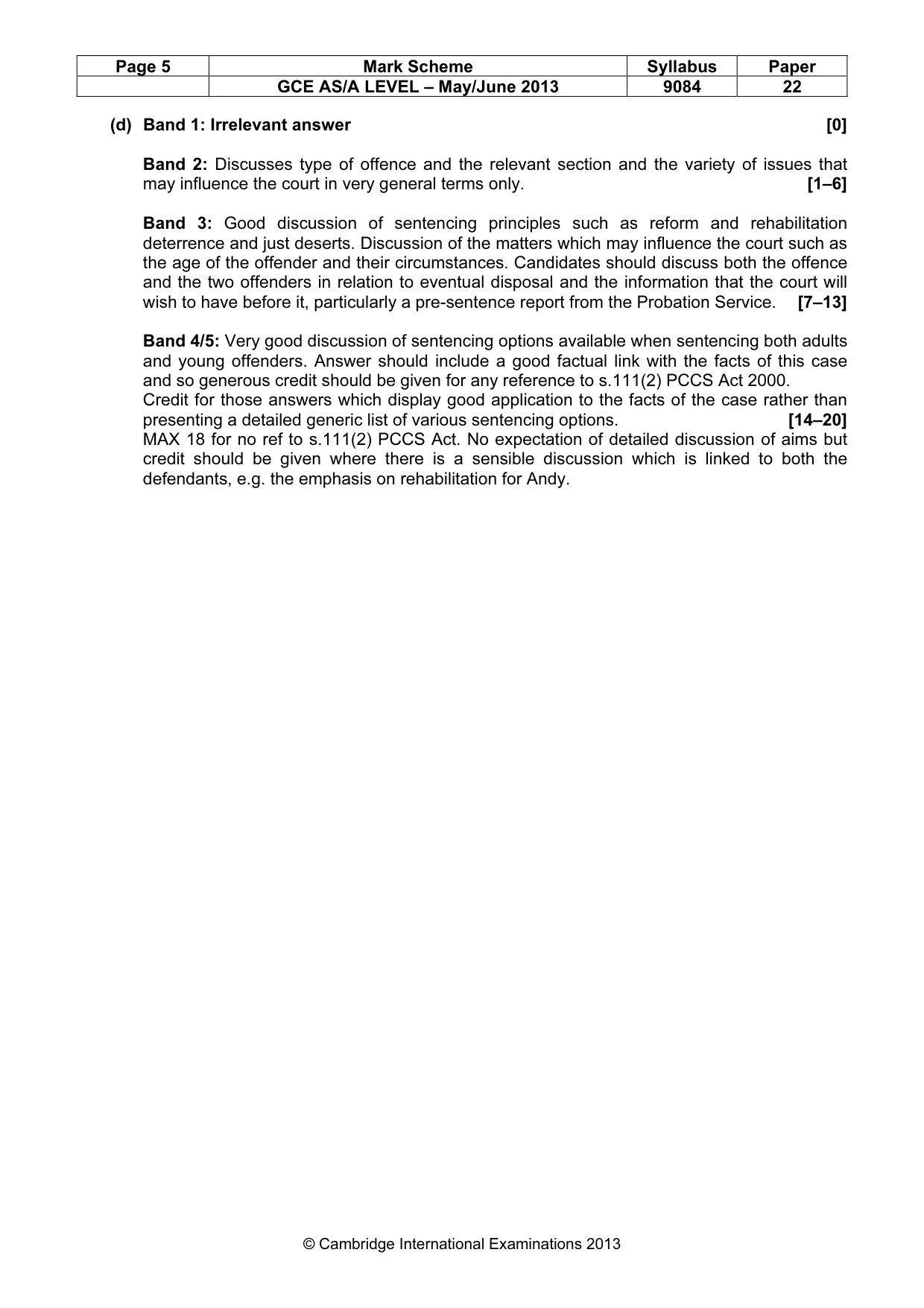
Page 5 Mark Scheme Syllabus Paper GCE AS/A LEVEL – May/June 2013 9084 22 © Cambridge International Examinations 2013 (d) Band 1: Irrelevant answer [0] Band 2: Discusses type of offence and the relevant section and the variety of issues that may influence the court in very general terms only. [1–6] Band 3: Good discussion of sentencing principles such as reform and rehabilitation deterrence and just deserts. Discussion of the matters which may influence the court such as the age of the offender and their circumstances. Candidates should discuss both the offence and the two offenders in relation to eventual disposal and the information that the court will wish to have before it, particularly a pre-sentence report from the Probation Service. [7–13] Band 4/5: Very good discussion of sentencing options available when sentencing both adults and young offenders. Answer should include a good factual link with the facts of this case and so generous credit should be given for any reference to s.111(2) PCCS Act 2000. Credit for those answers which display good application to the facts of the case rather than presenting a detailed generic list of various sentencing options. [14–20] MAX 18 for no ref to s.111(2) PCCS Act. No expectation of detailed discussion of aims but credit should be given where there is a sensible discussion which is linked to both the defendants, e.g. the emphasis on rehabilitation for Andy.
What you needed in this session
Cambridge’s own grade thresholds for 2013 May/June, Paper 2 · Variant 2. A higher threshold means an easier paper — the bar moves with how the cohort did.