Cambridge A Level Law 9084 — 2013 May/June Paper 2 · Variant 1
9084/21/M/J/13 · 50 marks · ≈56 min
The question paper and its mark scheme, free to read here and free to download. This is Cambridge’s own paper, exactly as it was sat.
Question paper4 pages

Mark scheme4 pages
Answers below. Sit the paper first if you are practising.
Paper as text
Question paper, page 1
This document consists of 3 printed pages and 1 blank page. DC (RW) 65324/1 © UCLES 2013 [Turn over UNIVERSITY OF CAMBRIDGE INTERNATIONAL EXAMINATIONS General Certificate of Education Advanced Subsidiary Level and Advanced Level * 1 2 7 7 0 0 5 4 7 6 * LAW 9084/21 Paper 2 Data Response May/June 2013 1 hour 30 minutes Additional Materials: Answer Booklet/Paper READ THESE INSTRUCTIONS FIRST If you have been given an Answer Booklet, follow the instructions on the front cover of the Booklet. Write your Centre number, candidate number and name on all the work you hand in. Write in dark blue or black pen. You may use a soft pencil for any diagrams, graphs or rough working. Do not use staples, paper clips, highlighters, glue or correction fluid. Answer one question. At the end of the examination, fasten all your work securely together. The number of marks is given in brackets [ ] at the end of each question or part question.
Question paper, page 2
2 9084/21/M/J/13 © UCLES 2013 Answer either Question 1 or Question 2. You should make appropriate reference to the source material supplied for each question. 1 (a) Consider the following situations and with reference to the source material consider whether an offence has been committed in each case. (i) Alex enters a shop and says to the shop assistant Mr Syed: ‘Give me £100 or I will burn your house down.’ Mr Syed hands over the money and Alex leaves the shop. [10] (ii) Bella and Cara enter Barchester Post Office and take £100 from the cash register. They then tie up the manager, Mr Asif, to prevent him from contacting the police and run away. [10] (iii) Shortly afterwards Dee enters Barchester Post Office and finds Mr Asif tied to a chair. She takes his wallet from his pocket and leaves. [10] (b) If any or all of the above are convicted of an offence, what rights of appeal would each of them have? Critically assess the rights of appeal available to those convicted of indictable offences. [20] Source Material Theft Act 1968 s.1 (1) A person is guilty of theft if he dishonestly appropriates property belonging to another with the intention of permanently depriving the other of it. s.8 (1) A person is guilty of robbery if he steals, and immediately before or at the time of doing so, and in order to do so, he uses force on any person or puts or seeks to put any person in fear of being then and there subjected to force. (2) A person guilty of robbery, or of an assault with intent to rob, shall on conviction on indictment be liable to imprisonment for life. R v Harris The Times March 4th 1988 A defendant has not committed robbery if that person has taken advantage of a person who has already been rendered powerless by others, for instance having already been tied up by them, and the defendant has not been involved in these actions.
Question paper, page 3
3 9084/21/M/J/13 © UCLES 2013 2 Samuel is a multi-millionaire. He wants to avoid paying too much tax so he creates a trust. He transfers half his money to the 4 trustees Kiran, Leila, Mandeep and Nina to be held for his children, who are all under 18 years of age. He would now like to replace 2 of the trustees and he wishes to know if he can do so. Kiran left England to live in France a year ago but returned to England for a day during that period for a family wedding. Mandeep has been suffering difficulties in her business recently and was declared bankrupt last month. (a) Advise Samuel on the following issues. (i) Can Kiran be replaced as a trustee? Explain your reasons. [10] (ii) Can Mandeep be replaced as a trustee? Assess any potential difficulties in doing so. [10] (iii) If Kiran or Mandeep could be replaced, who would appoint the replacement trustees? Explain your reasons. [10] (b) Assess the contribution made by Equity to the development of English law. [20] Source Material Trustee Act 1925 s.36 (1) Where a trustee…whether appointed by a court or otherwise is dead, remains out of the United Kingdom for more than twelve months, or desires to be discharged from all or any of the trusts or powers reposed in or conferred on him, or refuses or is unfit to act therein, or is incapable of acting… then, subject to the restrictions imposed by this act on the number of trustees – (a) The person or persons nominated for the purpose of appointing new trustees by the instrument, if any, creating the trust; or (b) If there is no such person or no such person able and willing to act then the surviving or continuing trustees or trustee for the time being… may, by writing, appoint one or more other persons…to be trustee. Re Walker [1901] There was no power to replace a trustee where a trustee had been out of the United Kingdom for more than twelve months but had returned to the United Kingdom for any time even where it was as short as a month. Re Wheeler and De Rochow [1896] It was held that bankruptcy made a trustee unfit to act but not incapable of acting. It was accepted that bankruptcy should not always make a trustee unfit particularly if no moral blame attaches to the bankrupt trustee.
Question paper, page 4
4 9084/21/M/J/13 © UCLES 2013 Permission to reproduce items where third-party owned material protected by copyright is included has been sought and cleared where possible. Every reasonable effort has been made by the publisher (UCLES) to trace copyright holders, but if any items requiring clearance have unwittingly been included, the publisher will be pleased to make amends at the earliest possible opportunity. University of Cambridge International Examinations is part of the Cambridge Assessment Group. Cambridge Assessment is the brand name of University of Cambridge Local Examinations Syndicate (UCLES), which is itself a department of the University of Cambridge. BLANK PAGE
Mark scheme, page 1
CAMBRIDGE INTERNATIONAL EXAMINATIONS GCE Advanced Subsidiary Level and GCE Advanced Level MARK SCHEME for the May/June 2013 series 9084 LAW 9084/21 Paper 2, maximum raw mark 50 This mark scheme is published as an aid to teachers and candidates, to indicate the requirements of the examination. It shows the basis on which Examiners were instructed to award marks. It does not indicate the details of the discussions that took place at an Examiners’ meeting before marking began, which would have considered the acceptability of alternative answers. Mark schemes should be read in conjunction with the question paper and the Principal Examiner Report for Teachers. Cambridge will not enter into discussions about these mark schemes. Cambridge is publishing the mark schemes for the May/June 2013 series for most IGCSE, GCE Advanced Level and Advanced Subsidiary Level components and some Ordinary Level components.
Mark scheme, page 2
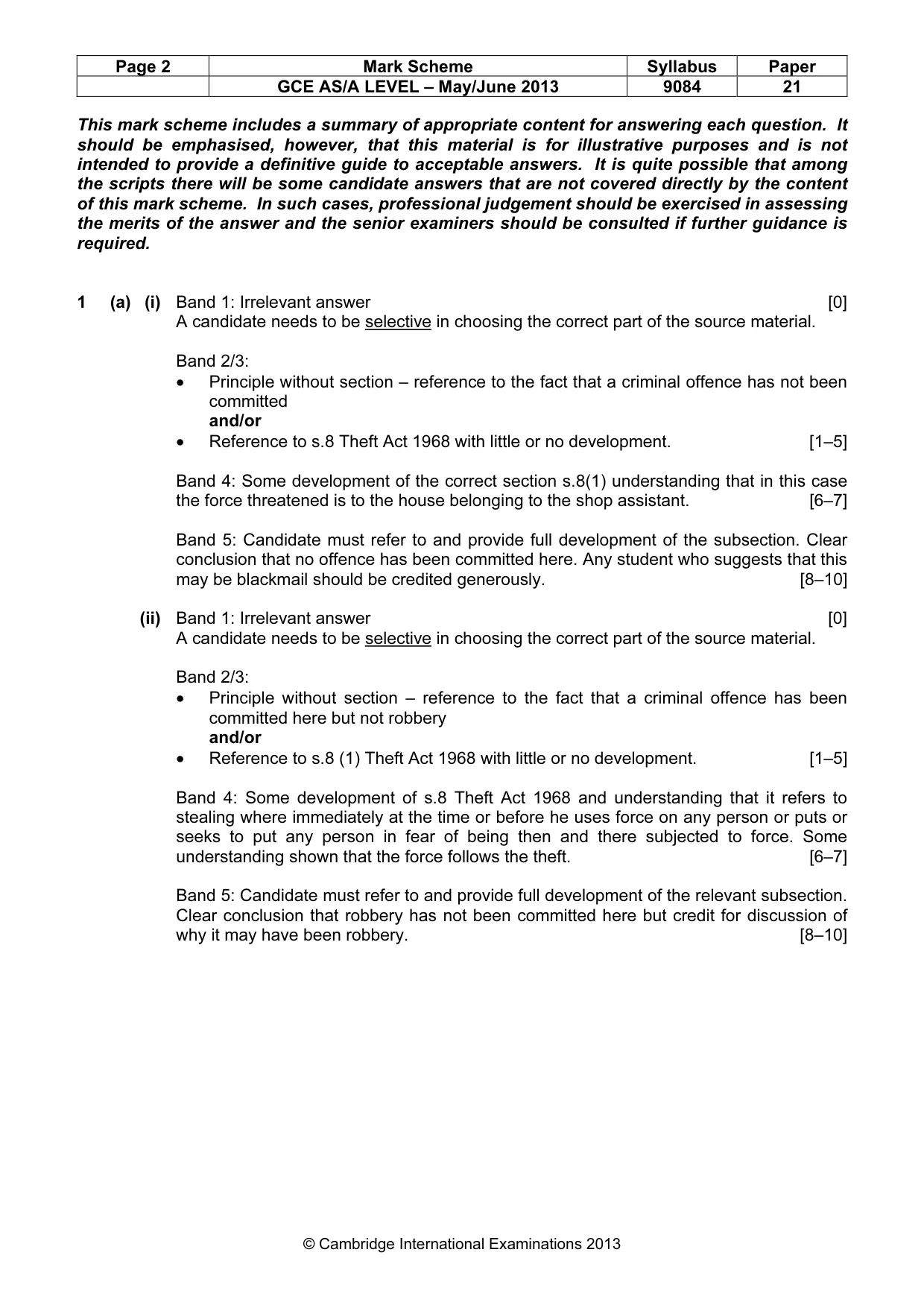
Page 2 Mark Scheme Syllabus Paper GCE AS/A LEVEL – May/June 2013 9084 21 © Cambridge International Examinations 2013 This mark scheme includes a summary of appropriate content for answering each question. It should be emphasised, however, that this material is for illustrative purposes and is not intended to provide a definitive guide to acceptable answers. It is quite possible that among the scripts there will be some candidate answers that are not covered directly by the content of this mark scheme. In such cases, professional judgement should be exercised in assessing the merits of the answer and the senior examiners should be consulted if further guidance is required. 1 (a) (i) Band 1: Irrelevant answer [0] A candidate needs to be selective in choosing the correct part of the source material. Band 2/3: • Principle without section – reference to the fact that a criminal offence has not been committed and/or • Reference to s.8 Theft Act 1968 with little or no development. [1–5] Band 4: Some development of the correct section s.8(1) understanding that in this case the force threatened is to the house belonging to the shop assistant. [6–7] Band 5: Candidate must refer to and provide full development of the subsection. Clear conclusion that no offence has been committed here. Any student who suggests that this may be blackmail should be credited generously. [8–10] (ii) Band 1: Irrelevant answer [0] A candidate needs to be selective in choosing the correct part of the source material. Band 2/3: • Principle without section – reference to the fact that a criminal offence has been committed here but not robbery and/or • Reference to s.8 (1) Theft Act 1968 with little or no development. [1–5] Band 4: Some development of s.8 Theft Act 1968 and understanding that it refers to stealing where immediately at the time or before he uses force on any person or puts or seeks to put any person in fear of being then and there subjected to force. Some understanding shown that the force follows the theft. [6–7] Band 5: Candidate must refer to and provide full development of the relevant subsection. Clear conclusion that robbery has not been committed here but credit for discussion of why it may have been robbery. [8–10]
Mark scheme, page 3
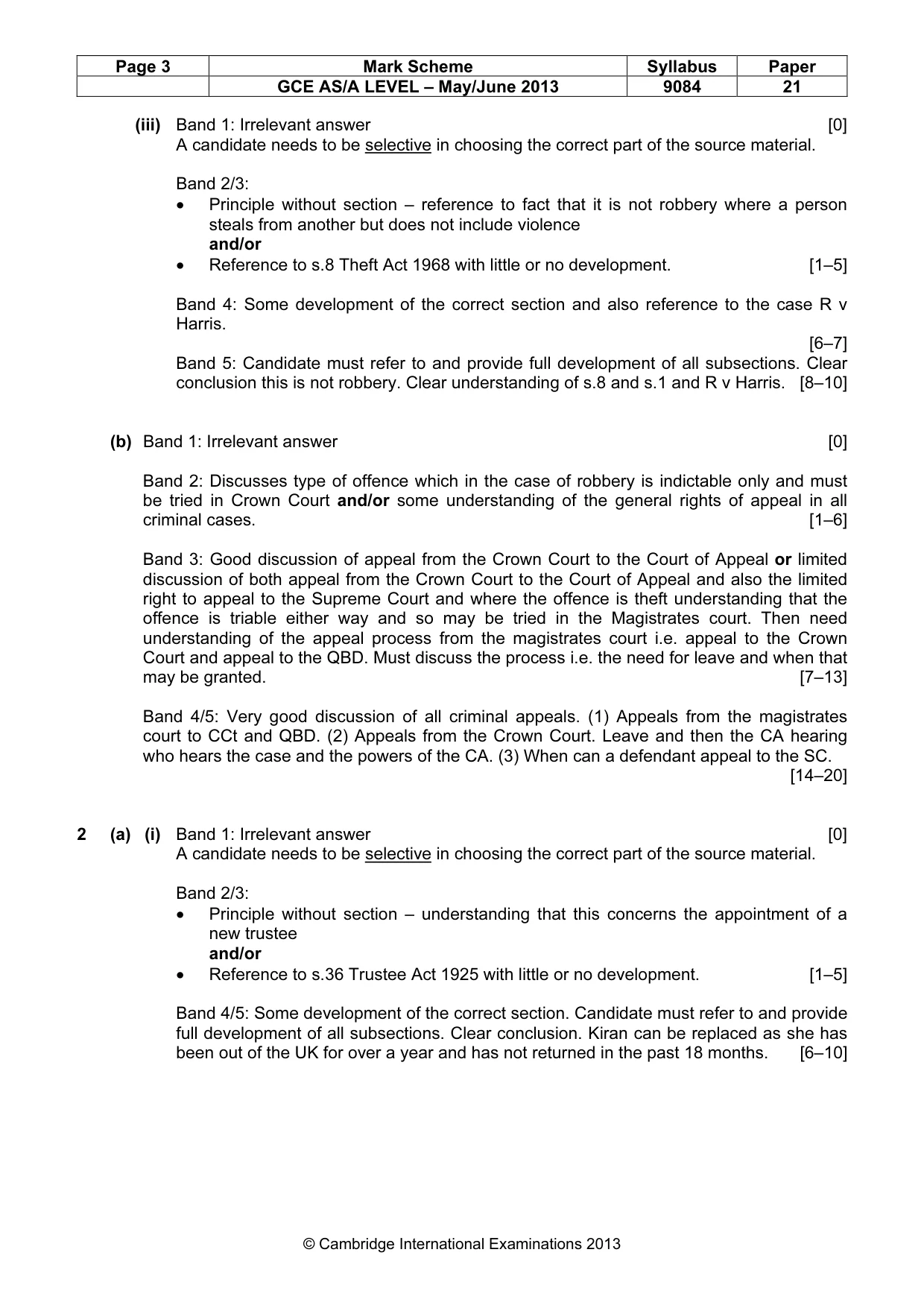
Page 3 Mark Scheme Syllabus Paper GCE AS/A LEVEL – May/June 2013 9084 21 © Cambridge International Examinations 2013 (iii) Band 1: Irrelevant answer [0] A candidate needs to be selective in choosing the correct part of the source material. Band 2/3: • Principle without section – reference to fact that it is not robbery where a person steals from another but does not include violence and/or • Reference to s.8 Theft Act 1968 with little or no development. [1–5] Band 4: Some development of the correct section and also reference to the case R v Harris. [6–7] Band 5: Candidate must refer to and provide full development of all subsections. Clear conclusion this is not robbery. Clear understanding of s.8 and s.1 and R v Harris. [8–10] (b) Band 1: Irrelevant answer [0] Band 2: Discusses type of offence which in the case of robbery is indictable only and must be tried in Crown Court and/or some understanding of the general rights of appeal in all criminal cases. [1–6] Band 3: Good discussion of appeal from the Crown Court to the Court of Appeal or limited discussion of both appeal from the Crown Court to the Court of Appeal and also the limited right to appeal to the Supreme Court and where the offence is theft understanding that the offence is triable either way and so may be tried in the Magistrates court. Then need understanding of the appeal process from the magistrates court i.e. appeal to the Crown Court and appeal to the QBD. Must discuss the process i.e. the need for leave and when that may be granted. [7–13] Band 4/5: Very good discussion of all criminal appeals. (1) Appeals from the magistrates court to CCt and QBD. (2) Appeals from the Crown Court. Leave and then the CA hearing who hears the case and the powers of the CA. (3) When can a defendant appeal to the SC. [14–20] 2 (a) (i) Band 1: Irrelevant answer [0] A candidate needs to be selective in choosing the correct part of the source material. Band 2/3: • Principle without section – understanding that this concerns the appointment of a new trustee and/or • Reference to s.36 Trustee Act 1925 with little or no development. [1–5] Band 4/5: Some development of the correct section. Candidate must refer to and provide full development of all subsections. Clear conclusion. Kiran can be replaced as she has been out of the UK for over a year and has not returned in the past 18 months. [6–10]
Mark scheme, page 4
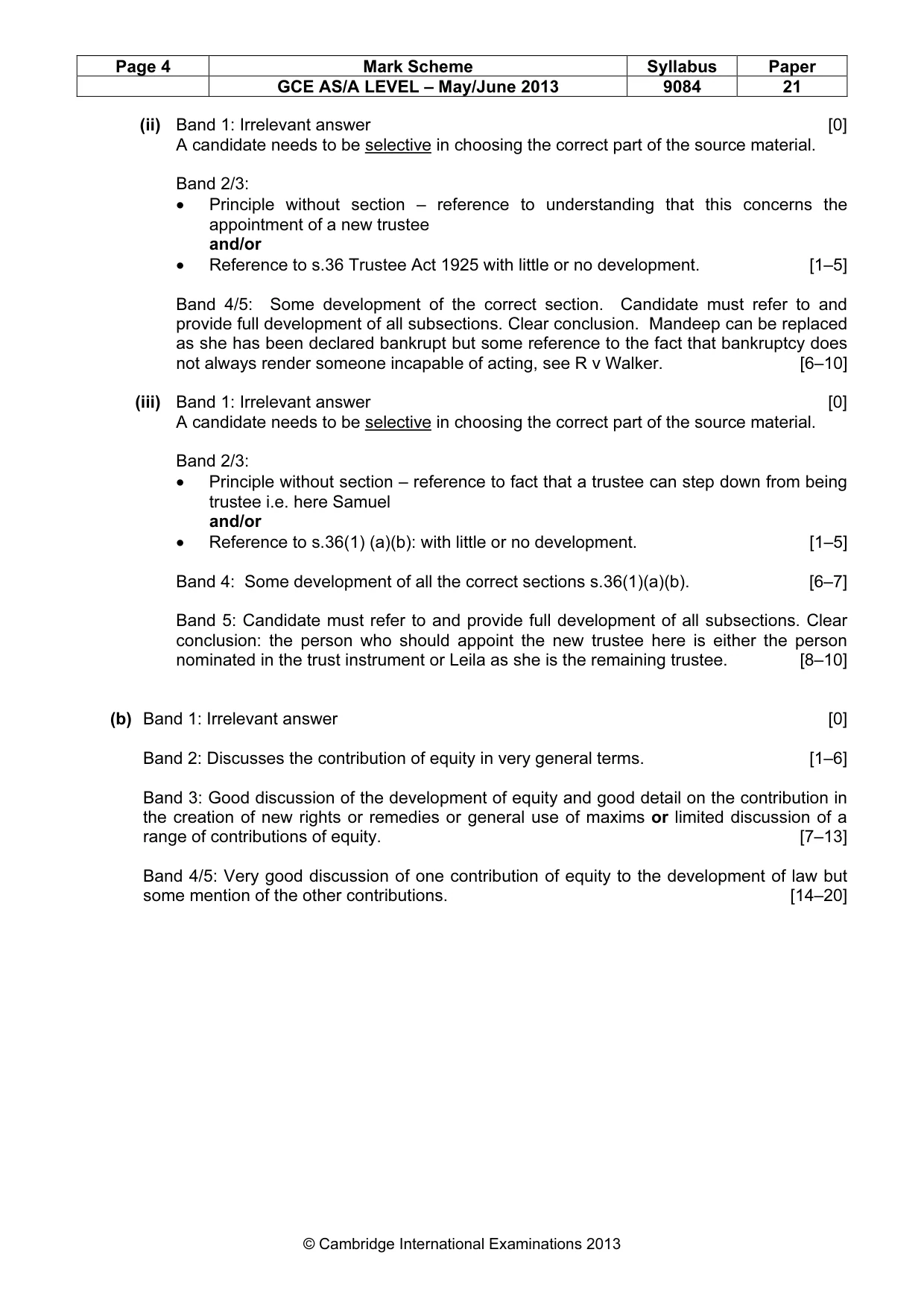
Page 4 Mark Scheme Syllabus Paper GCE AS/A LEVEL – May/June 2013 9084 21 © Cambridge International Examinations 2013 (ii) Band 1: Irrelevant answer [0] A candidate needs to be selective in choosing the correct part of the source material. Band 2/3: • Principle without section – reference to understanding that this concerns the appointment of a new trustee and/or • Reference to s.36 Trustee Act 1925 with little or no development. [1–5] Band 4/5: Some development of the correct section. Candidate must refer to and provide full development of all subsections. Clear conclusion. Mandeep can be replaced as she has been declared bankrupt but some reference to the fact that bankruptcy does not always render someone incapable of acting, see R v Walker. [6–10] (iii) Band 1: Irrelevant answer [0] A candidate needs to be selective in choosing the correct part of the source material. Band 2/3: • Principle without section – reference to fact that a trustee can step down from being trustee i.e. here Samuel and/or • Reference to s.36(1) (a)(b): with little or no development. [1–5] Band 4: Some development of all the correct sections s.36(1)(a)(b). [6–7] Band 5: Candidate must refer to and provide full development of all subsections. Clear conclusion: the person who should appoint the new trustee here is either the person nominated in the trust instrument or Leila as she is the remaining trustee. [8–10] (b) Band 1: Irrelevant answer [0] Band 2: Discusses the contribution of equity in very general terms. [1–6] Band 3: Good discussion of the development of equity and good detail on the contribution in the creation of new rights or remedies or general use of maxims or limited discussion of a range of contributions of equity. [7–13] Band 4/5: Very good discussion of one contribution of equity to the development of law but some mention of the other contributions. [14–20]
What you needed in this session
Cambridge’s own grade thresholds for 2013 May/June, Paper 2 · Variant 1. A higher threshold means an easier paper — the bar moves with how the cohort did.