Cambridge A Level Law 9084 — 2013 May/June Paper 2 · Variant 3
9084/23/M/J/13 · 50 marks · ≈56 min
The question paper and its mark scheme, free to read here and free to download. This is Cambridge’s own paper, exactly as it was sat.
Question paper8 pages



Mark scheme5 pages
Answers below. Sit the paper first if you are practising.
Paper as text
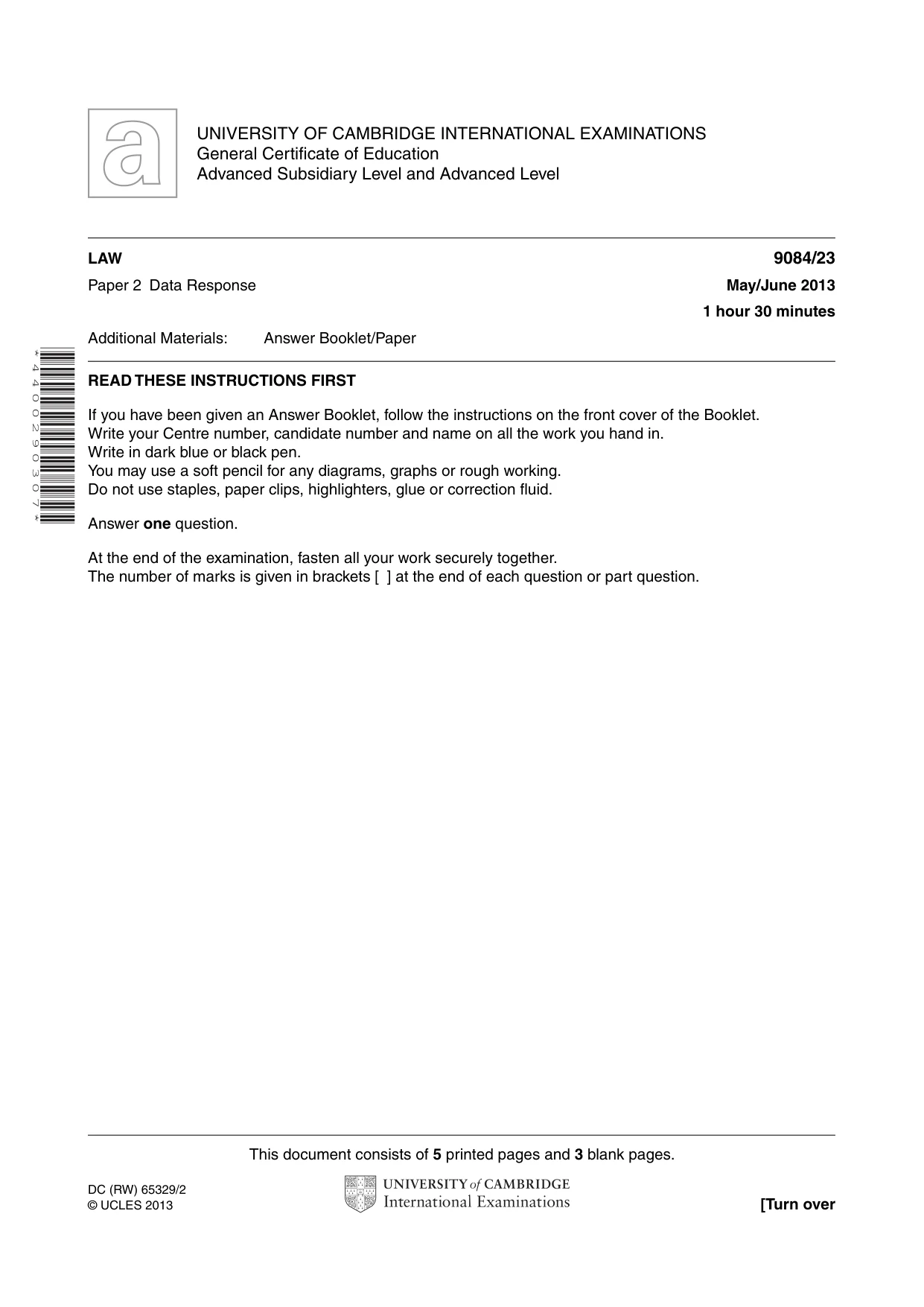
Question paper, page 1
This document consists of 5 printed pages and 3 blank pages. DC (RW) 65329/2 © UCLES 2013 [Turn over UNIVERSITY OF CAMBRIDGE INTERNATIONAL EXAMINATIONS General Certificate of Education Advanced Subsidiary Level and Advanced Level * 4 4 0 0 2 9 0 3 0 7 * LAW 9084/23 Paper 2 Data Response May/June 2013 1 hour 30 minutes Additional Materials: Answer Booklet/Paper READ THESE INSTRUCTIONS FIRST If you have been given an Answer Booklet, follow the instructions on the front cover of the Booklet. Write your Centre number, candidate number and name on all the work you hand in. Write in dark blue or black pen. You may use a soft pencil for any diagrams, graphs or rough working. Do not use staples, paper clips, highlighters, glue or correction fluid. Answer one question. At the end of the examination, fasten all your work securely together. The number of marks is given in brackets [ ] at the end of each question or part question.
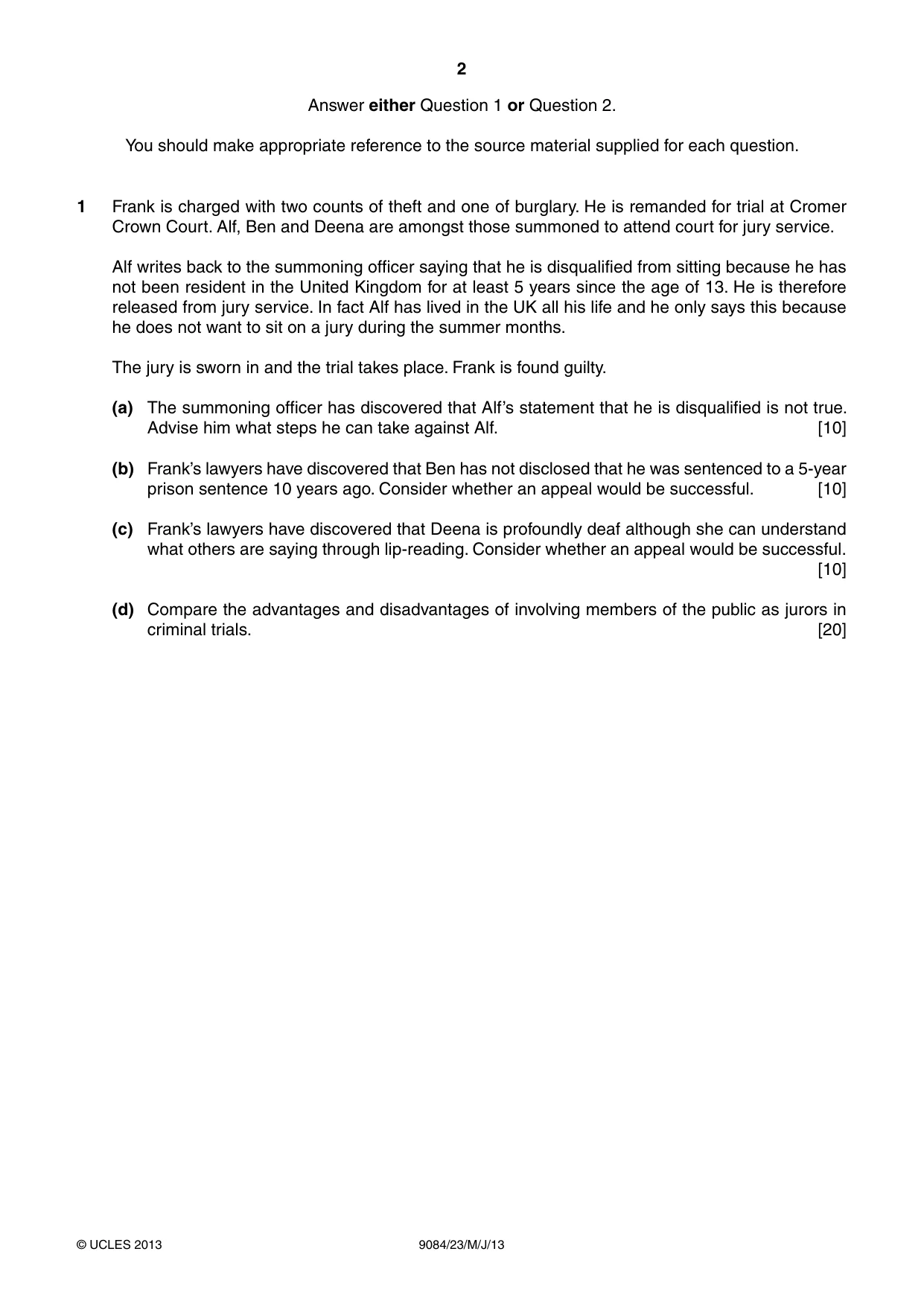
Question paper, page 2
2 9084/23/M/J/13 © UCLES 2013 Answer either Question 1 or Question 2. You should make appropriate reference to the source material supplied for each question. 1 Frank is charged with two counts of theft and one of burglary. He is remanded for trial at Cromer Crown Court. Alf, Ben and Deena are amongst those summoned to attend court for jury service. Alf writes back to the summoning officer saying that he is disqualified from sitting because he has not been resident in the United Kingdom for at least 5 years since the age of 13. He is therefore released from jury service. In fact Alf has lived in the UK all his life and he only says this because he does not want to sit on a jury during the summer months. The jury is sworn in and the trial takes place. Frank is found guilty. (a) The summoning officer has discovered that Alf’s statement that he is disqualified is not true. Advise him what steps he can take against Alf. [10] (b) Frank’s lawyers have discovered that Ben has not disclosed that he was sentenced to a 5-year prison sentence 10 years ago. Consider whether an appeal would be successful. [10] (c) Frank’s lawyers have discovered that Deena is profoundly deaf although she can understand what others are saying through lip-reading. Consider whether an appeal would be successful. [10] (d) Compare the advantages and disadvantages of involving members of the public as jurors in criminal trials. [20]
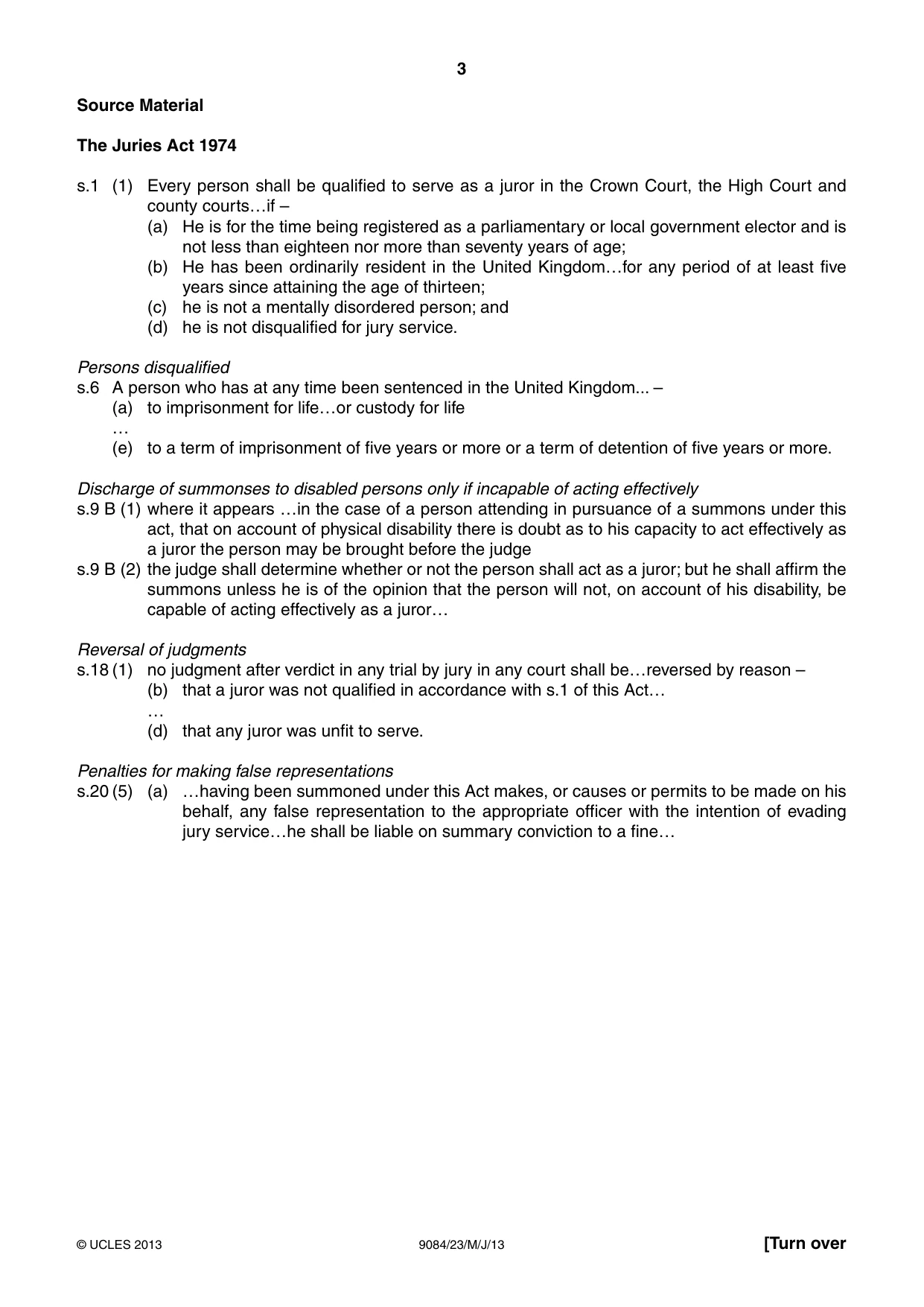
Question paper, page 3
3 9084/23/M/J/13 © UCLES 2013 [Turn over Source Material The Juries Act 1974 s.1 (1) Every person shall be qualified to serve as a juror in the Crown Court, the High Court and county courts…if – (a) He is for the time being registered as a parliamentary or local government elector and is not less than eighteen nor more than seventy years of age; (b) He has been ordinarily resident in the United Kingdom…for any period of at least five years since attaining the age of thirteen; (c) he is not a mentally disordered person; and (d) he is not disqualified for jury service. Persons disqualified s.6 A person who has at any time been sentenced in the United Kingdom... – (a) to imprisonment for life…or custody for life … (e) to a term of imprisonment of five years or more or a term of detention of five years or more. Discharge of summonses to disabled persons only if incapable of acting effectively s.9 B (1) where it appears …in the case of a person attending in pursuance of a summons under this act, that on account of physical disability there is doubt as to his capacity to act effectively as a juror the person may be brought before the judge s.9 B (2) the judge shall determine whether or not the person shall act as a juror; but he shall affirm the summons unless he is of the opinion that the person will not, on account of his disability, be capable of acting effectively as a juror… Reversal of judgments s.18 (1) no judgment after verdict in any trial by jury in any court shall be…reversed by reason – (b) that a juror was not qualified in accordance with s.1 of this Act… … (d) that any juror was unfit to serve. Penalties for making false representations s.20 (5) (a) …having been summoned under this Act makes, or causes or permits to be made on his behalf, any false representation to the appropriate officer with the intention of evading jury service…he shall be liable on summary conviction to a fine…
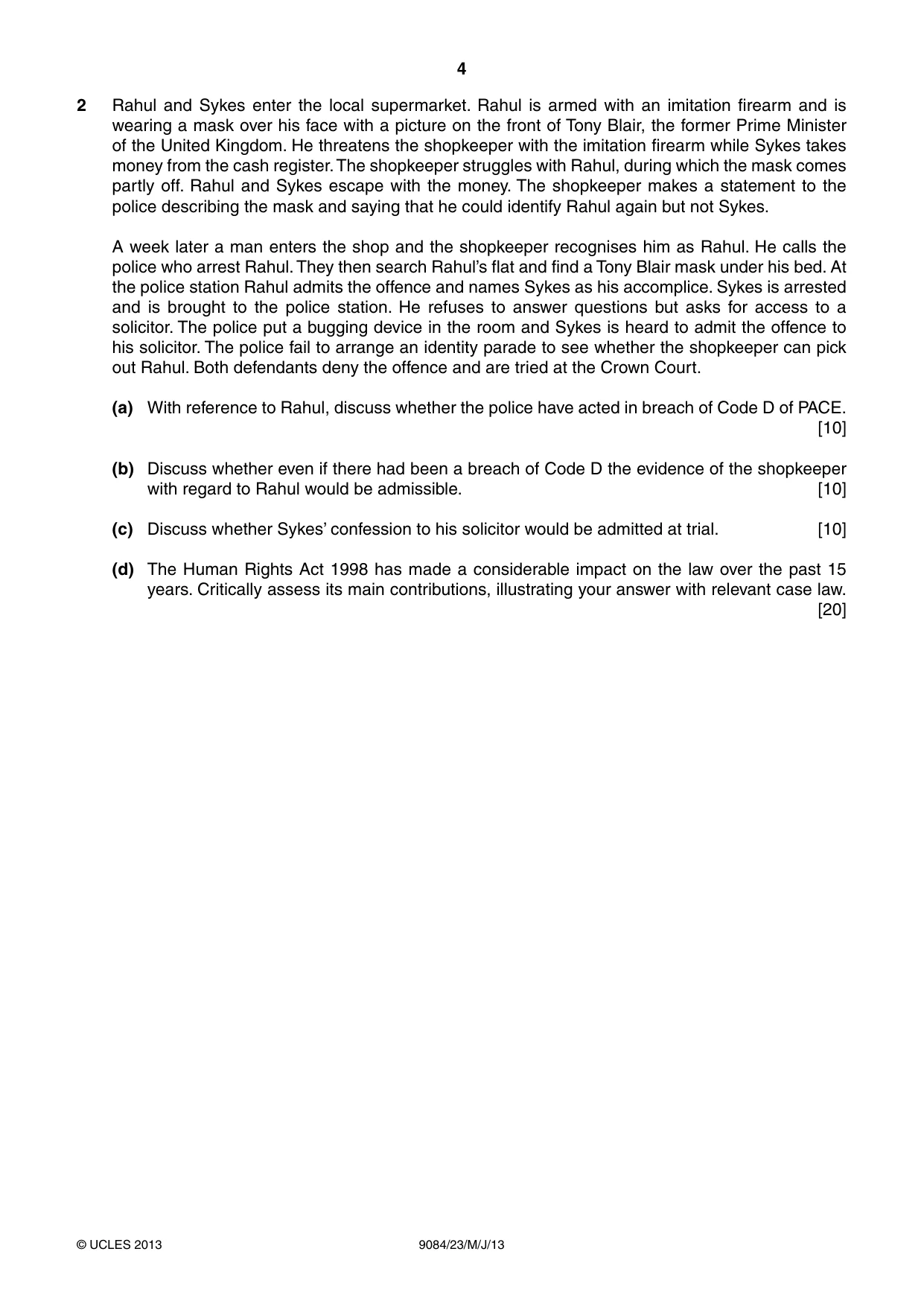
Question paper, page 4
4 9084/23/M/J/13 © UCLES 2013 2 Rahul and Sykes enter the local supermarket. Rahul is armed with an imitation firearm and is wearing a mask over his face with a picture on the front of Tony Blair, the former Prime Minister of the United Kingdom. He threatens the shopkeeper with the imitation firearm while Sykes takes money from the cash register. The shopkeeper struggles with Rahul, during which the mask comes partly off. Rahul and Sykes escape with the money. The shopkeeper makes a statement to the police describing the mask and saying that he could identify Rahul again but not Sykes. A week later a man enters the shop and the shopkeeper recognises him as Rahul. He calls the police who arrest Rahul. They then search Rahul’s flat and find a Tony Blair mask under his bed. At the police station Rahul admits the offence and names Sykes as his accomplice. Sykes is arrested and is brought to the police station. He refuses to answer questions but asks for access to a solicitor. The police put a bugging device in the room and Sykes is heard to admit the offence to his solicitor. The police fail to arrange an identity parade to see whether the shopkeeper can pick out Rahul. Both defendants deny the offence and are tried at the Crown Court. (a) With reference to Rahul, discuss whether the police have acted in breach of Code D of PACE. [10] (b) Discuss whether even if there had been a breach of Code D the evidence of the shopkeeper with regard to Rahul would be admissible. [10] (c) Discuss whether Sykes’ confession to his solicitor would be admitted at trial. [10] (d) The Human Rights Act 1998 has made a considerable impact on the law over the past 15 years. Critically assess its main contributions, illustrating your answer with relevant case law. [20]
Question paper, page 5
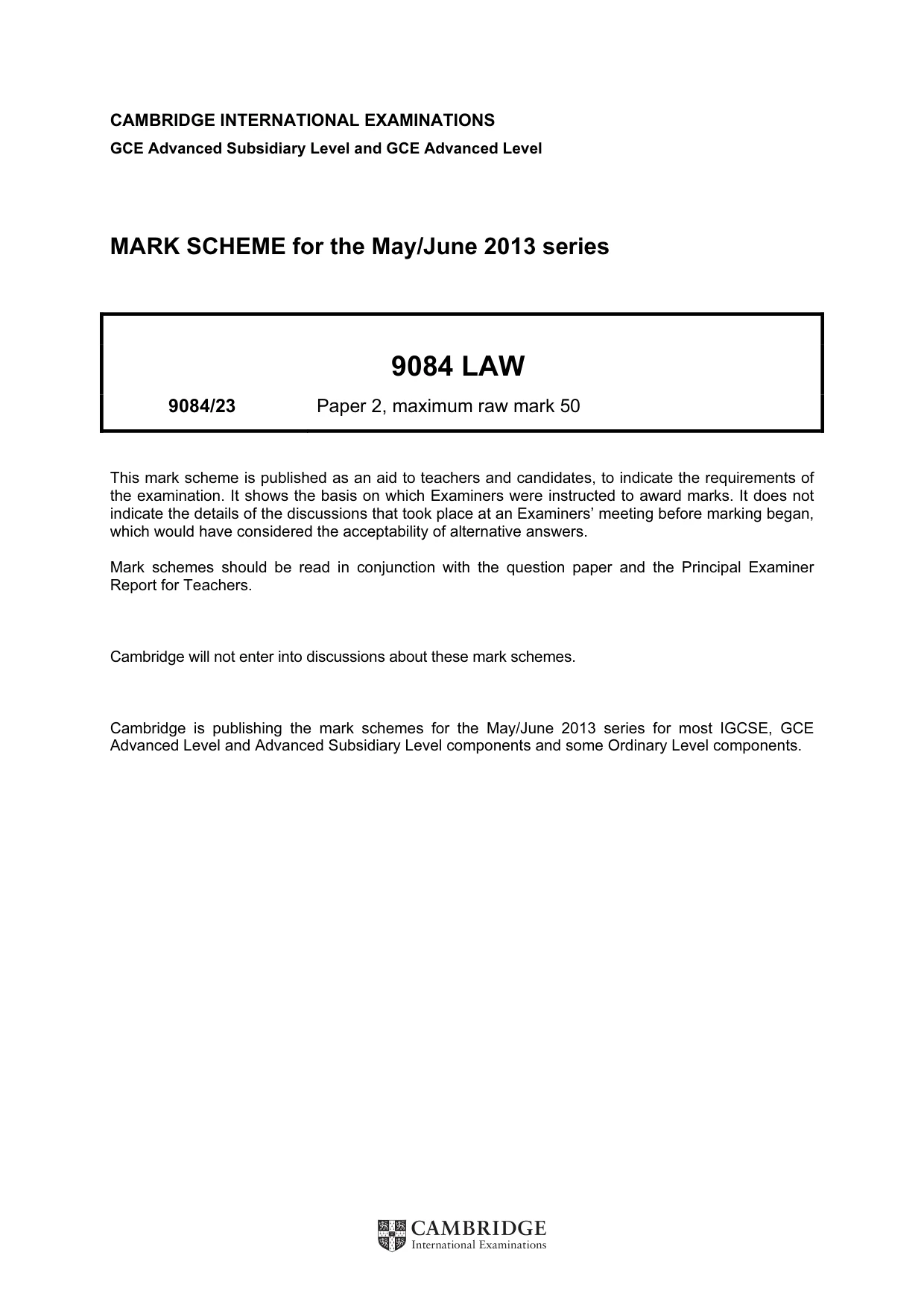
5 9084/23/M/J/13 © UCLES 2013 Source Material Police and Criminal Evidence Act 1984 Code D 3.12 Whenever: (i) a witness has identified a suspect prior to any identification procedure…having been held; or (ii) there is a witness available, who expresses an ability to identify the suspect and the suspect disputes being the person the witness claims to have seen… an identification procedure shall be held unless it is not practicable or it would serve no useful purpose in proving or disproving whether the suspect was involved in committing the offence. Police and Criminal Evidence Act 1984 s.78 (1) In any proceedings the court may refuse to allow evidence on which the prosecution proposes to rely…if it appears to the court that, having regard to all the circumstances, including the circumstances in which the evidence was obtained, the admission of the evidence would have such an adverse effect on the fairness of the proceedings that the court ought not to admit it. Human Rights Act 1998 Schedule 1 Article 6 In the determination of his civil rights and obligations or of any criminal offence everyone is entitled to a fair and public hearing within a reasonable time by an independent and impartial tribunal established by law. Article 8 (1) Everyone has the right to respect for his private and family life… Article 8 (2) There shall be no interference by a public authority with the exercise of this right except such as in accordance with the law… Campbell v UK 15 EHRR Held that a high level of protection is to be accorded to communications between a detained person and his lawyer. A breach of privilege may give rise to violation of Article 8 and Article 6.
Question paper, page 6
6 9084/23/M/J/13 © UCLES 2013 BLANK PAGE
Question paper, page 7
7 9084/23/M/J/13 © UCLES 2013 BLANK PAGE
Question paper, page 8
8 9084/23/M/J/13 © UCLES 2013 Permission to reproduce items where third-party owned material protected by copyright is included has been sought and cleared where possible. Every reasonable effort has been made by the publisher (UCLES) to trace copyright holders, but if any items requiring clearance have unwittingly been included, the publisher will be pleased to make amends at the earliest possible opportunity. University of Cambridge International Examinations is part of the Cambridge Assessment Group. Cambridge Assessment is the brand name of University of Cambridge Local Examinations Syndicate (UCLES), which is itself a department of the University of Cambridge. BLANK PAGE
Mark scheme, page 1
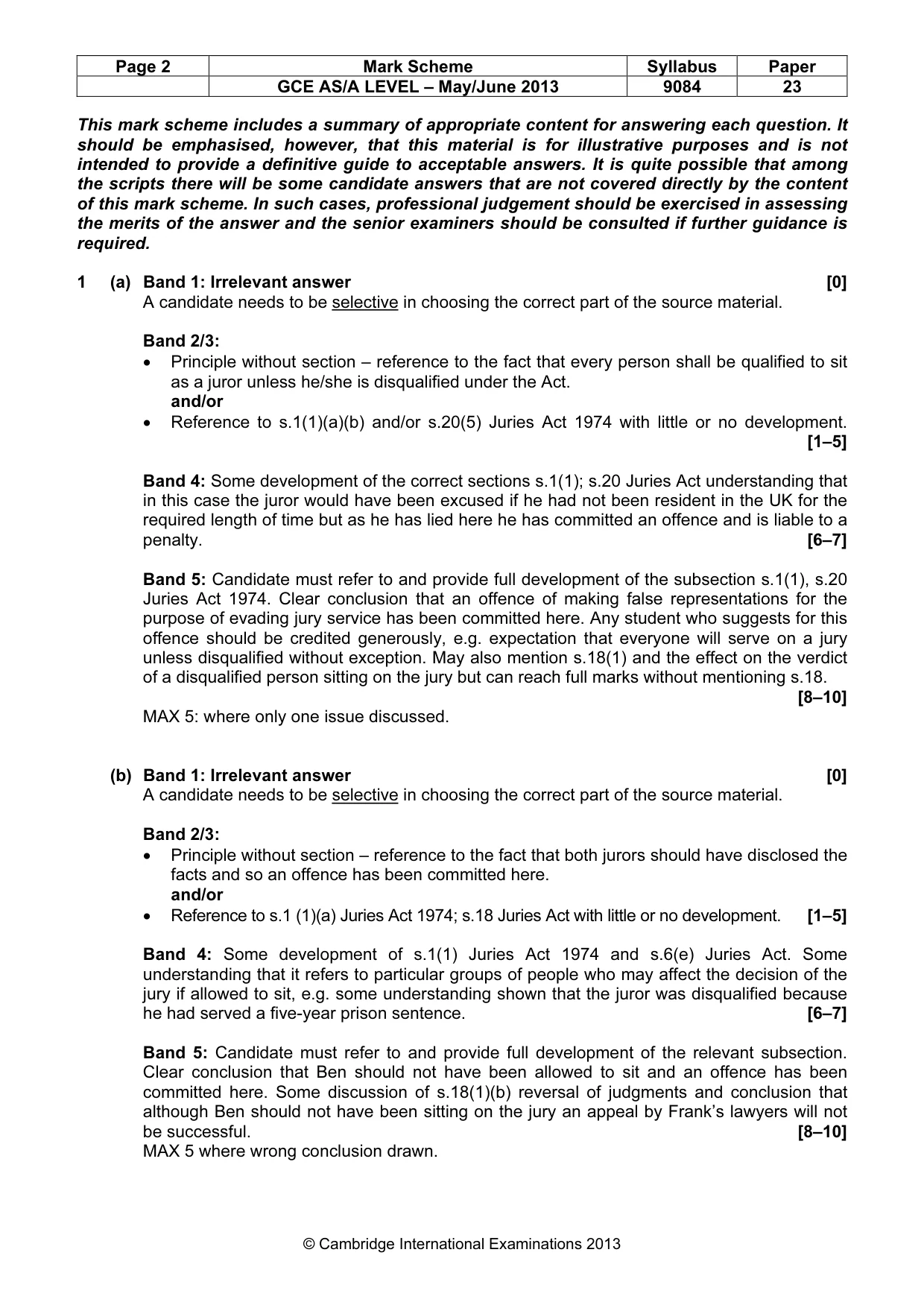
CAMBRIDGE INTERNATIONAL EXAMINATIONS GCE Advanced Subsidiary Level and GCE Advanced Level MARK SCHEME for the May/June 2013 series 9084 LAW 9084/23 Paper 2, maximum raw mark 50 This mark scheme is published as an aid to teachers and candidates, to indicate the requirements of the examination. It shows the basis on which Examiners were instructed to award marks. It does not indicate the details of the discussions that took place at an Examiners’ meeting before marking began, which would have considered the acceptability of alternative answers. Mark schemes should be read in conjunction with the question paper and the Principal Examiner Report for Teachers. Cambridge will not enter into discussions about these mark schemes. Cambridge is publishing the mark schemes for the May/June 2013 series for most IGCSE, GCE Advanced Level and Advanced Subsidiary Level components and some Ordinary Level components.
Mark scheme, page 2
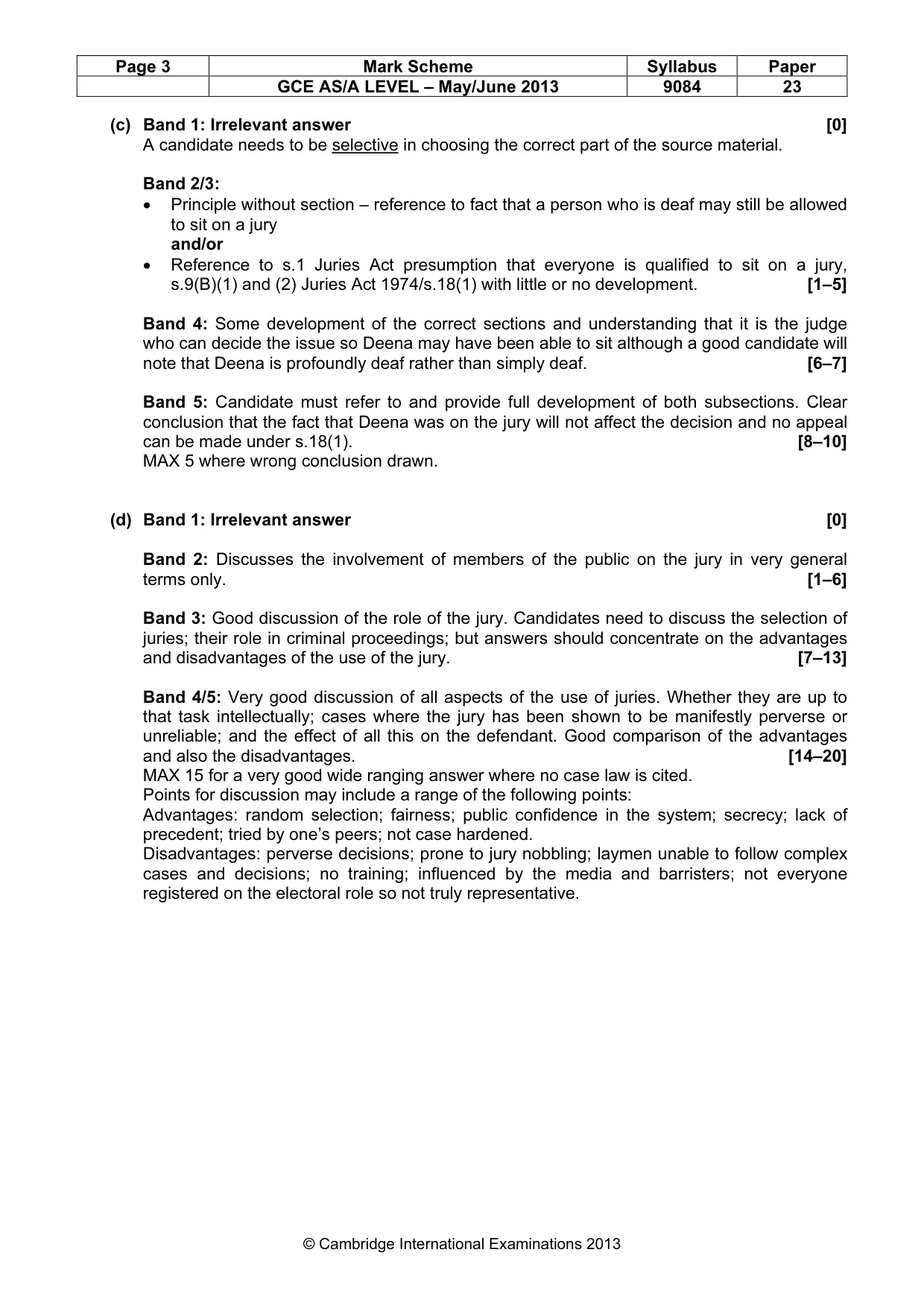
Page 2 Mark Scheme Syllabus Paper GCE AS/A LEVEL – May/June 2013 9084 23 © Cambridge International Examinations 2013 This mark scheme includes a summary of appropriate content for answering each question. It should be emphasised, however, that this material is for illustrative purposes and is not intended to provide a definitive guide to acceptable answers. It is quite possible that among the scripts there will be some candidate answers that are not covered directly by the content of this mark scheme. In such cases, professional judgement should be exercised in assessing the merits of the answer and the senior examiners should be consulted if further guidance is required. 1 (a) Band 1: Irrelevant answer [0] A candidate needs to be selective in choosing the correct part of the source material. Band 2/3: • Principle without section – reference to the fact that every person shall be qualified to sit as a juror unless he/she is disqualified under the Act. and/or • Reference to s.1(1)(a)(b) and/or s.20(5) Juries Act 1974 with little or no development. [1–5] Band 4: Some development of the correct sections s.1(1); s.20 Juries Act understanding that in this case the juror would have been excused if he had not been resident in the UK for the required length of time but as he has lied here he has committed an offence and is liable to a penalty. [6–7] Band 5: Candidate must refer to and provide full development of the subsection s.1(1), s.20 Juries Act 1974. Clear conclusion that an offence of making false representations for the purpose of evading jury service has been committed here. Any student who suggests for this offence should be credited generously, e.g. expectation that everyone will serve on a jury unless disqualified without exception. May also mention s.18(1) and the effect on the verdict of a disqualified person sitting on the jury but can reach full marks without mentioning s.18. [8–10] MAX 5: where only one issue discussed. (b) Band 1: Irrelevant answer [0] A candidate needs to be selective in choosing the correct part of the source material. Band 2/3: • Principle without section – reference to the fact that both jurors should have disclosed the facts and so an offence has been committed here. and/or • Reference to s.1 (1)(a) Juries Act 1974; s.18 Juries Act with little or no development. [1–5] Band 4: Some development of s.1(1) Juries Act 1974 and s.6(e) Juries Act. Some understanding that it refers to particular groups of people who may affect the decision of the jury if allowed to sit, e.g. some understanding shown that the juror was disqualified because he had served a five-year prison sentence. [6–7] Band 5: Candidate must refer to and provide full development of the relevant subsection. Clear conclusion that Ben should not have been allowed to sit and an offence has been committed here. Some discussion of s.18(1)(b) reversal of judgments and conclusion that although Ben should not have been sitting on the jury an appeal by Frank’s lawyers will not be successful. [8–10] MAX 5 where wrong conclusion drawn.
Mark scheme, page 3
Page 3 Mark Scheme Syllabus Paper GCE AS/A LEVEL – May/June 2013 9084 23 © Cambridge International Examinations 2013 (c) Band 1: Irrelevant answer [0] A candidate needs to be selective in choosing the correct part of the source material. Band 2/3: • Principle without section – reference to fact that a person who is deaf may still be allowed to sit on a jury and/or • Reference to s.1 Juries Act presumption that everyone is qualified to sit on a jury, s.9(B)(1) and (2) Juries Act 1974/s.18(1) with little or no development. [1–5] Band 4: Some development of the correct sections and understanding that it is the judge who can decide the issue so Deena may have been able to sit although a good candidate will note that Deena is profoundly deaf rather than simply deaf. [6–7] Band 5: Candidate must refer to and provide full development of both subsections. Clear conclusion that the fact that Deena was on the jury will not affect the decision and no appeal can be made under s.18(1). [8–10] MAX 5 where wrong conclusion drawn. (d) Band 1: Irrelevant answer [0] Band 2: Discusses the involvement of members of the public on the jury in very general terms only. [1–6] Band 3: Good discussion of the role of the jury. Candidates need to discuss the selection of juries; their role in criminal proceedings; but answers should concentrate on the advantages and disadvantages of the use of the jury. [7–13] Band 4/5: Very good discussion of all aspects of the use of juries. Whether they are up to that task intellectually; cases where the jury has been shown to be manifestly perverse or unreliable; and the effect of all this on the defendant. Good comparison of the advantages and also the disadvantages. [14–20] MAX 15 for a very good wide ranging answer where no case law is cited. Points for discussion may include a range of the following points: Advantages: random selection; fairness; public confidence in the system; secrecy; lack of precedent; tried by one’s peers; not case hardened. Disadvantages: perverse decisions; prone to jury nobbling; laymen unable to follow complex cases and decisions; no training; influenced by the media and barristers; not everyone registered on the electoral role so not truly representative.
Mark scheme, page 4
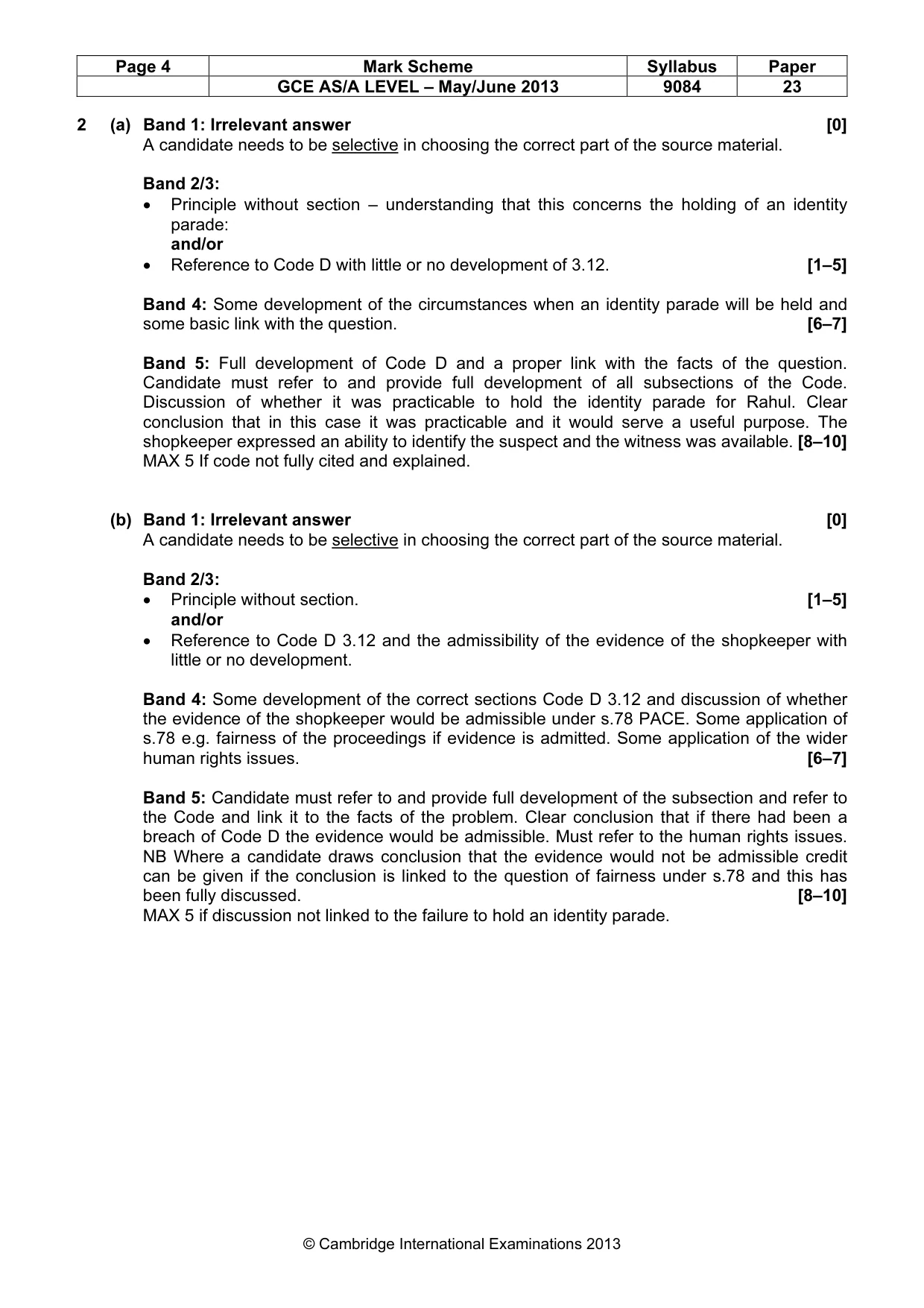
Page 4 Mark Scheme Syllabus Paper GCE AS/A LEVEL – May/June 2013 9084 23 © Cambridge International Examinations 2013 2 (a) Band 1: Irrelevant answer [0] A candidate needs to be selective in choosing the correct part of the source material. Band 2/3: • Principle without section – understanding that this concerns the holding of an identity parade: and/or • Reference to Code D with little or no development of 3.12. [1–5] Band 4: Some development of the circumstances when an identity parade will be held and some basic link with the question. [6–7] Band 5: Full development of Code D and a proper link with the facts of the question. Candidate must refer to and provide full development of all subsections of the Code. Discussion of whether it was practicable to hold the identity parade for Rahul. Clear conclusion that in this case it was practicable and it would serve a useful purpose. The shopkeeper expressed an ability to identify the suspect and the witness was available. [8–10] MAX 5 If code not fully cited and explained. (b) Band 1: Irrelevant answer [0] A candidate needs to be selective in choosing the correct part of the source material. Band 2/3: • Principle without section. [1–5] and/or • Reference to Code D 3.12 and the admissibility of the evidence of the shopkeeper with little or no development. Band 4: Some development of the correct sections Code D 3.12 and discussion of whether the evidence of the shopkeeper would be admissible under s.78 PACE. Some application of s.78 e.g. fairness of the proceedings if evidence is admitted. Some application of the wider human rights issues. [6–7] Band 5: Candidate must refer to and provide full development of the subsection and refer to the Code and link it to the facts of the problem. Clear conclusion that if there had been a breach of Code D the evidence would be admissible. Must refer to the human rights issues. NB Where a candidate draws conclusion that the evidence would not be admissible credit can be given if the conclusion is linked to the question of fairness under s.78 and this has been fully discussed. [8–10] MAX 5 if discussion not linked to the failure to hold an identity parade.
Mark scheme, page 5
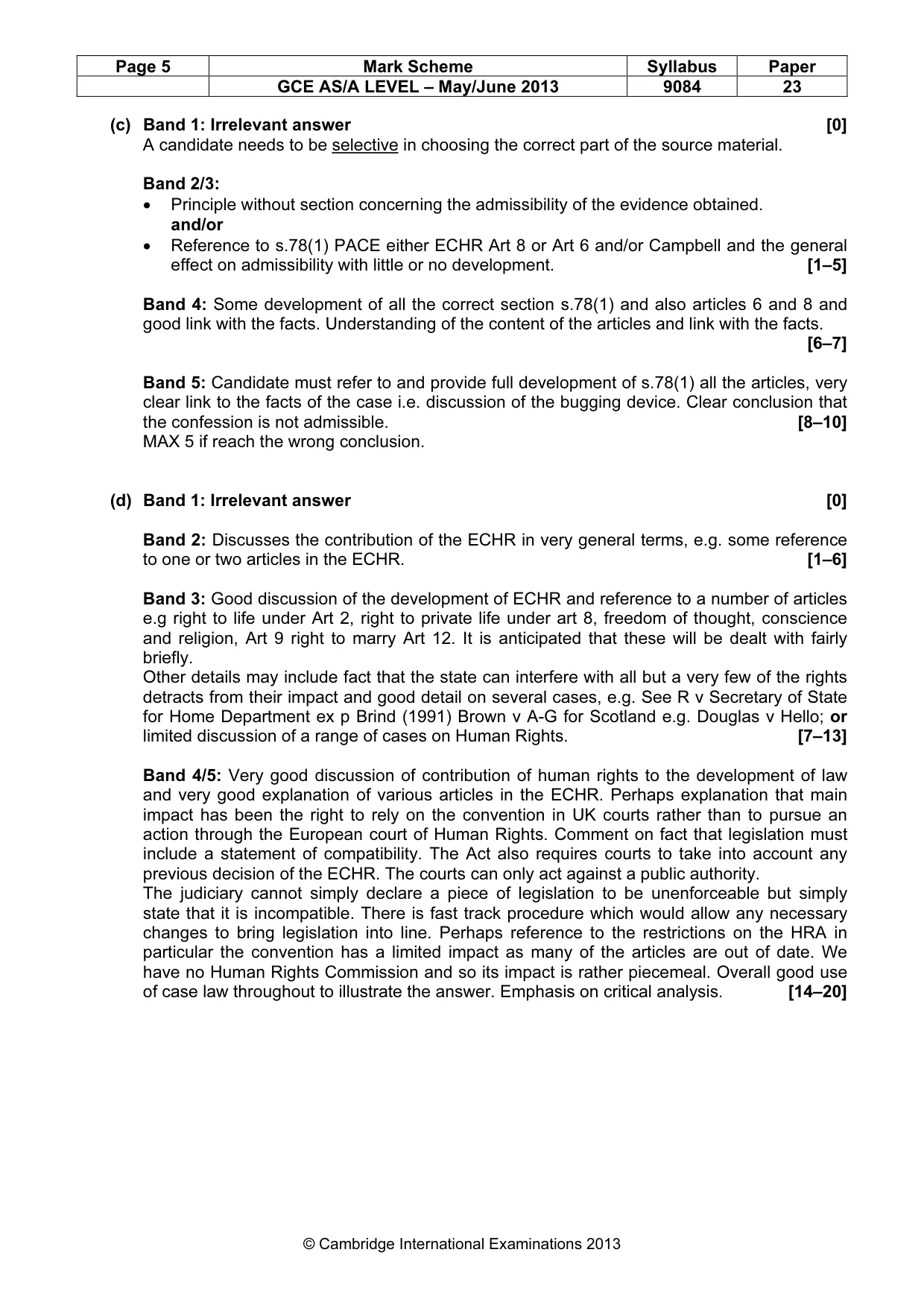
Page 5 Mark Scheme Syllabus Paper GCE AS/A LEVEL – May/June 2013 9084 23 © Cambridge International Examinations 2013 (c) Band 1: Irrelevant answer [0] A candidate needs to be selective in choosing the correct part of the source material. Band 2/3: • Principle without section concerning the admissibility of the evidence obtained. and/or • Reference to s.78(1) PACE either ECHR Art 8 or Art 6 and/or Campbell and the general effect on admissibility with little or no development. [1–5] Band 4: Some development of all the correct section s.78(1) and also articles 6 and 8 and good link with the facts. Understanding of the content of the articles and link with the facts. [6–7] Band 5: Candidate must refer to and provide full development of s.78(1) all the articles, very clear link to the facts of the case i.e. discussion of the bugging device. Clear conclusion that the confession is not admissible. [8–10] MAX 5 if reach the wrong conclusion. (d) Band 1: Irrelevant answer [0] Band 2: Discusses the contribution of the ECHR in very general terms, e.g. some reference to one or two articles in the ECHR. [1–6] Band 3: Good discussion of the development of ECHR and reference to a number of articles e.g right to life under Art 2, right to private life under art 8, freedom of thought, conscience and religion, Art 9 right to marry Art 12. It is anticipated that these will be dealt with fairly briefly. Other details may include fact that the state can interfere with all but a very few of the rights detracts from their impact and good detail on several cases, e.g. See R v Secretary of State for Home Department ex p Brind (1991) Brown v A-G for Scotland e.g. Douglas v Hello; or limited discussion of a range of cases on Human Rights. [7–13] Band 4/5: Very good discussion of contribution of human rights to the development of law and very good explanation of various articles in the ECHR. Perhaps explanation that main impact has been the right to rely on the convention in UK courts rather than to pursue an action through the European court of Human Rights. Comment on fact that legislation must include a statement of compatibility. The Act also requires courts to take into account any previous decision of the ECHR. The courts can only act against a public authority. The judiciary cannot simply declare a piece of legislation to be unenforceable but simply state that it is incompatible. There is fast track procedure which would allow any necessary changes to bring legislation into line. Perhaps reference to the restrictions on the HRA in particular the convention has a limited impact as many of the articles are out of date. We have no Human Rights Commission and so its impact is rather piecemeal. Overall good use of case law throughout to illustrate the answer. Emphasis on critical analysis. [14–20]
What you needed in this session
Cambridge’s own grade thresholds for 2013 May/June, Paper 2 · Variant 3. A higher threshold means an easier paper — the bar moves with how the cohort did.