Cambridge A Level Law 9084 — 2012 May/June Paper 2 · Variant 2
9084/22/M/J/12 · 50 marks · ≈56 min
The question paper and its mark scheme, free to read here and free to download. This is Cambridge’s own paper, exactly as it was sat.
Question paper4 pages

Mark scheme6 pages
Answers below. Sit the paper first if you are practising.
Paper as text
Question paper, page 1
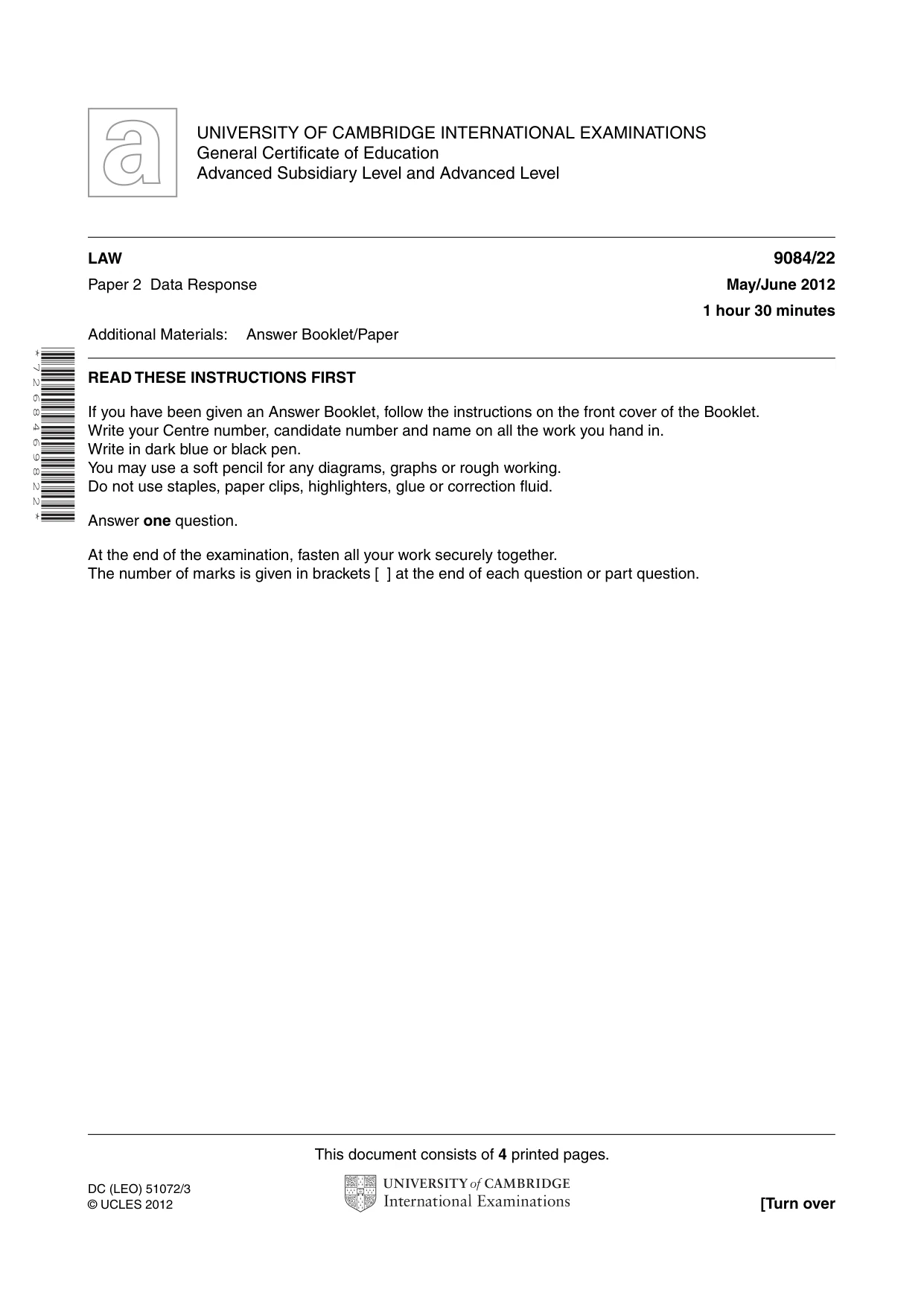
This document consists of 4 printed pages. DC (LEO) 51072/3 © UCLES 2012 [Turn over UNIVERSITY OF CAMBRIDGE INTERNATIONAL EXAMINATIONS General Certificate of Education Advanced Subsidiary Level and Advanced Level READ THESE INSTRUCTIONS FIRST If you have been given an Answer Booklet, follow the instructions on the front cover of the Booklet. Write your Centre number, candidate number and name on all the work you hand in. Write in dark blue or black pen. You may use a soft pencil for any diagrams, graphs or rough working. Do not use staples, paper clips, highlighters, glue or correction fluid. Answer one question. At the end of the examination, fasten all your work securely together. The number of marks is given in brackets [ ] at the end of each question or part question. * 7 2 6 8 4 6 9 8 2 2 * LAW 9084/22 Paper 2 Data Response May/June 2012 1 hour 30 minutes Additional Materials: Answer Booklet/Paper
Question paper, page 2
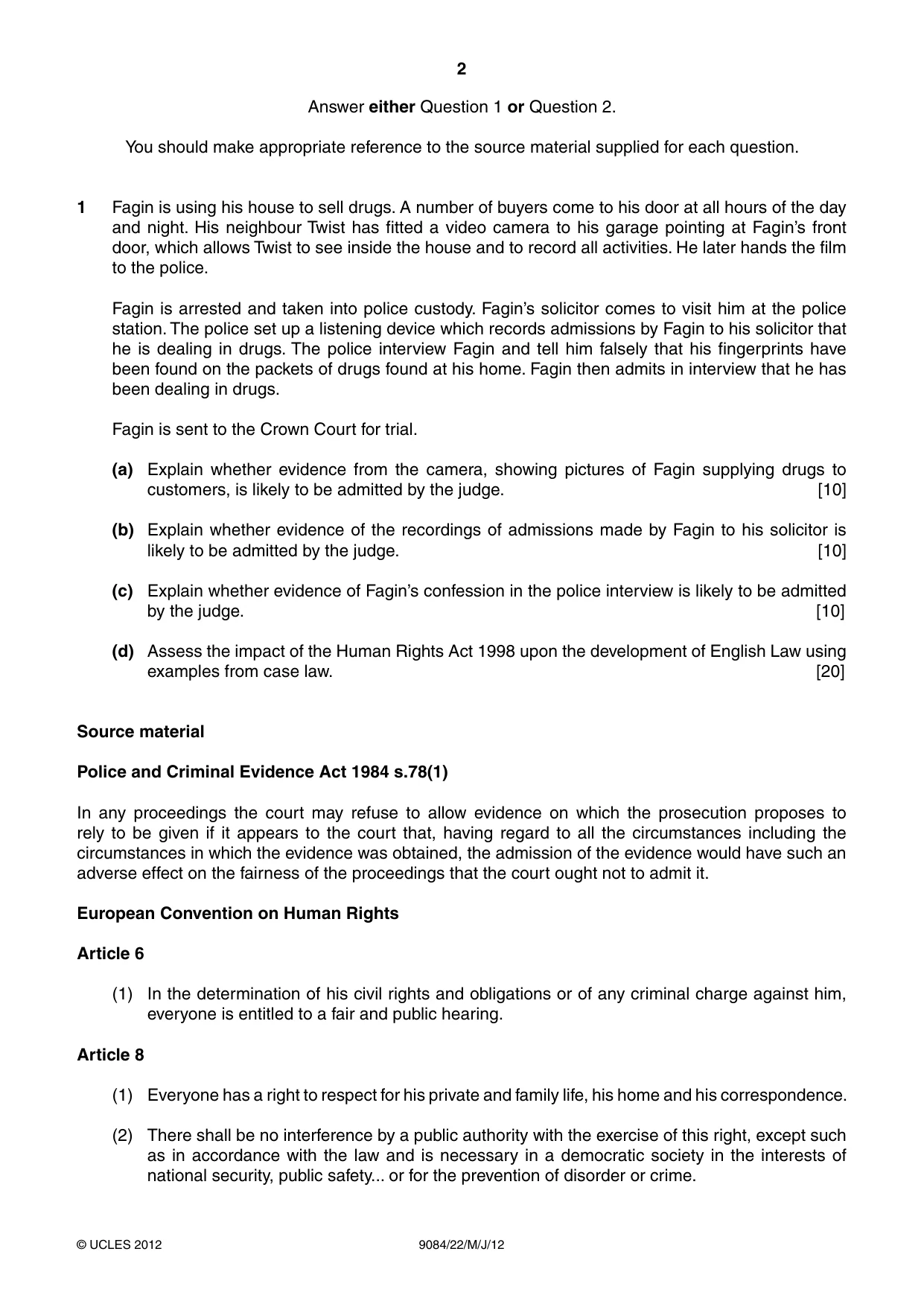
2 9084/22/M/J/12 © UCLES 2012 Answer either Question 1 or Question 2. You should make appropriate reference to the source material supplied for each question. 1 Fagin is using his house to sell drugs. A number of buyers come to his door at all hours of the day and night. His neighbour Twist has fitted a video camera to his garage pointing at Fagin’s front door, which allows Twist to see inside the house and to record all activities. He later hands the film to the police. Fagin is arrested and taken into police custody. Fagin’s solicitor comes to visit him at the police station. The police set up a listening device which records admissions by Fagin to his solicitor that he is dealing in drugs. The police interview Fagin and tell him falsely that his fingerprints have been found on the packets of drugs found at his home. Fagin then admits in interview that he has been dealing in drugs. Fagin is sent to the Crown Court for trial. (a) Explain whether evidence from the camera, showing pictures of Fagin supplying drugs to customers, is likely to be admitted by the judge. [10] (b) Explain whether evidence of the recordings of admissions made by Fagin to his solicitor is likely to be admitted by the judge. [10] (c) Explain whether evidence of Fagin’s confession in the police interview is likely to be admitted by the judge. [10] (d) Assess the impact of the Human Rights Act 1998 upon the development of English Law using examples from case law. [20] Source material Police and Criminal Evidence Act 1984 s.78(1) In any proceedings the court may refuse to allow evidence on which the prosecution proposes to rely to be given if it appears to the court that, having regard to all the circumstances including the circumstances in which the evidence was obtained, the admission of the evidence would have such an adverse effect on the fairness of the proceedings that the court ought not to admit it. European Convention on Human Rights Article 6 (1) In the determination of his civil rights and obligations or of any criminal charge against him, everyone is entitled to a fair and public hearing. Article 8 (1) Everyone has a right to respect for his private and family life, his home and his correspondence. (2) There shall be no interference by a public authority with the exercise of this right, except such as in accordance with the law and is necessary in a democratic society in the interests of national security, public safety... or for the prevention of disorder or crime.
Question paper, page 3
3 9084/22/M/J/12 © UCLES 2012 [Turn over R v Mason [1988] The defendant’s conviction for arson was quashed because police officers tricked him into making a confession. They told him and his solicitor, untruthfully, that his fingerprints had been found on fragments of a bottle used in starting the fire. The trial judge had wrongly admitted the evidence. He failed to consider, in the exercise of his discretion under s.78, the deceit. R v Grant [2006] The court held that deliberate acts carried out by the police which are designed to violate a suspected person’s right to privileged communications with his lawyer constitute such an affront to the integrity of the justice system and the rule of law that they will invariably lead to a stay in proceedings, notwithstanding the absence of prejudice to the defence.
Question paper, page 4
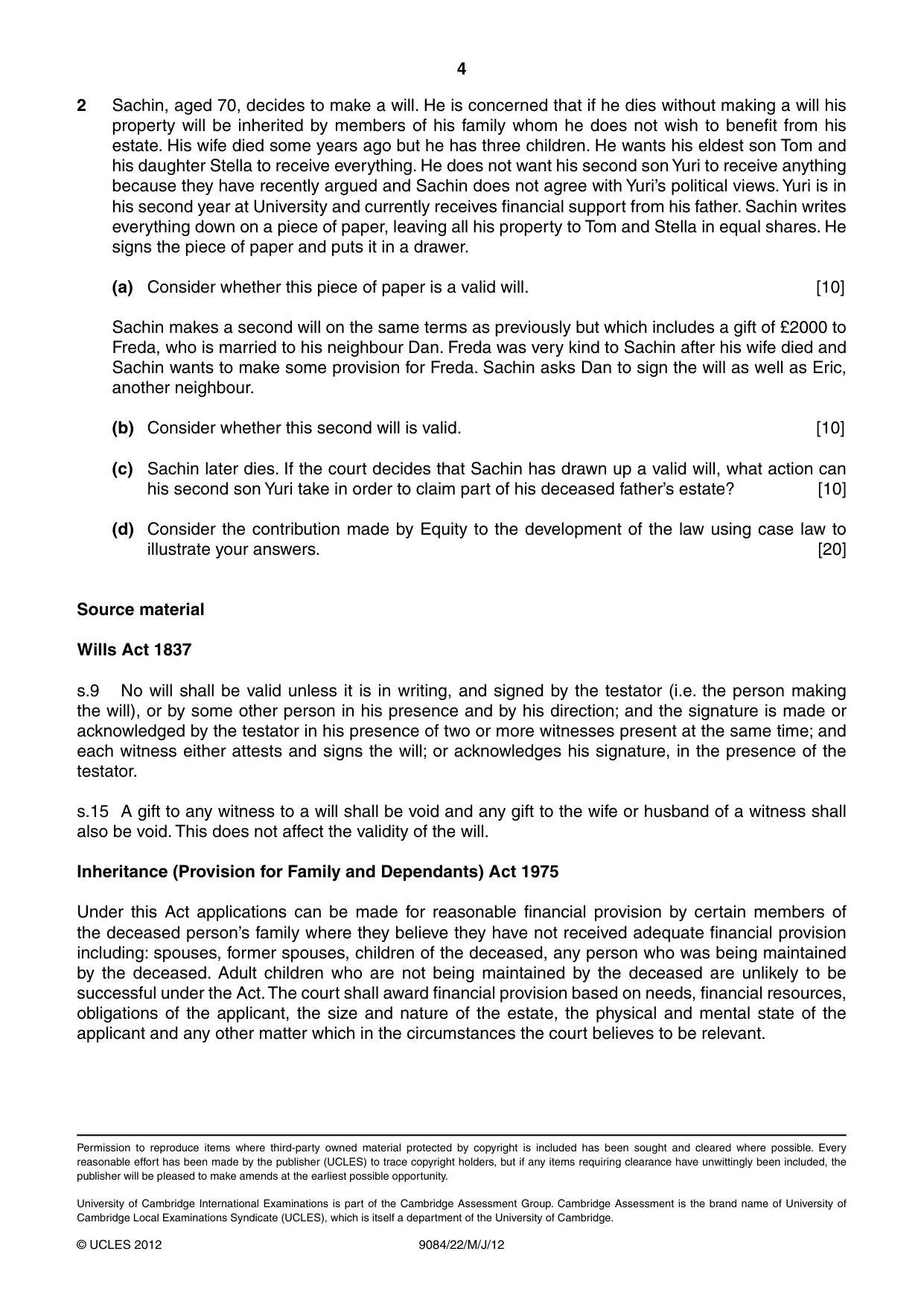
4 9084/22/M/J/12 © UCLES 2012 2 Sachin, aged 70, decides to make a will. He is concerned that if he dies without making a will his property will be inherited by members of his family whom he does not wish to benefit from his estate. His wife died some years ago but he has three children. He wants his eldest son Tom and his daughter Stella to receive everything. He does not want his second son Yuri to receive anything because they have recently argued and Sachin does not agree with Yuri’s political views. Yuri is in his second year at University and currently receives financial support from his father. Sachin writes everything down on a piece of paper, leaving all his property to Tom and Stella in equal shares. He signs the piece of paper and puts it in a drawer. (a) Consider whether this piece of paper is a valid will. [10] Sachin makes a second will on the same terms as previously but which includes a gift of £2000 to Freda, who is married to his neighbour Dan. Freda was very kind to Sachin after his wife died and Sachin wants to make some provision for Freda. Sachin asks Dan to sign the will as well as Eric, another neighbour. (b) Consider whether this second will is valid. [10] (c) Sachin later dies. If the court decides that Sachin has drawn up a valid will, what action can his second son Yuri take in order to claim part of his deceased father’s estate? [10] (d) Consider the contribution made by Equity to the development of the law using case law to illustrate your answers. [20] Source material Wills Act 1837 s.9 No will shall be valid unless it is in writing, and signed by the testator (i.e. the person making the will), or by some other person in his presence and by his direction; and the signature is made or acknowledged by the testator in his presence of two or more witnesses present at the same time; and each witness either attests and signs the will; or acknowledges his signature, in the presence of the testator. s.15 A gift to any witness to a will shall be void and any gift to the wife or husband of a witness shall also be void. This does not affect the validity of the will. Inheritance (Provision for Family and Dependants) Act 1975 Under this Act applications can be made for reasonable financial provision by certain members of the deceased person’s family where they believe they have not received adequate financial provision including: spouses, former spouses, children of the deceased, any person who was being maintained by the deceased. Adult children who are not being maintained by the deceased are unlikely to be successful under the Act. The court shall award financial provision based on needs, financial resources, obligations of the applicant, the size and nature of the estate, the physical and mental state of the applicant and any other matter which in the circumstances the court believes to be relevant. Permission to reproduce items where third-party owned material protected by copyright is included has been sought and cleared where possible. Every reasonable effort has been made by the publisher (UCLES) to trace copyright holders, but if any items requiring clearance have unwittingly been included, the publisher will be pleased to make amends at the earliest possible opportunity. University of Cambridge International Examinations is part of the Cambridge Assessment Group. Cambridge Assessment is the brand name of University of Cambridge Local Examinations Syndicate (UCLES), which is itself a department of the University of Cambridge.
Mark scheme, page 1
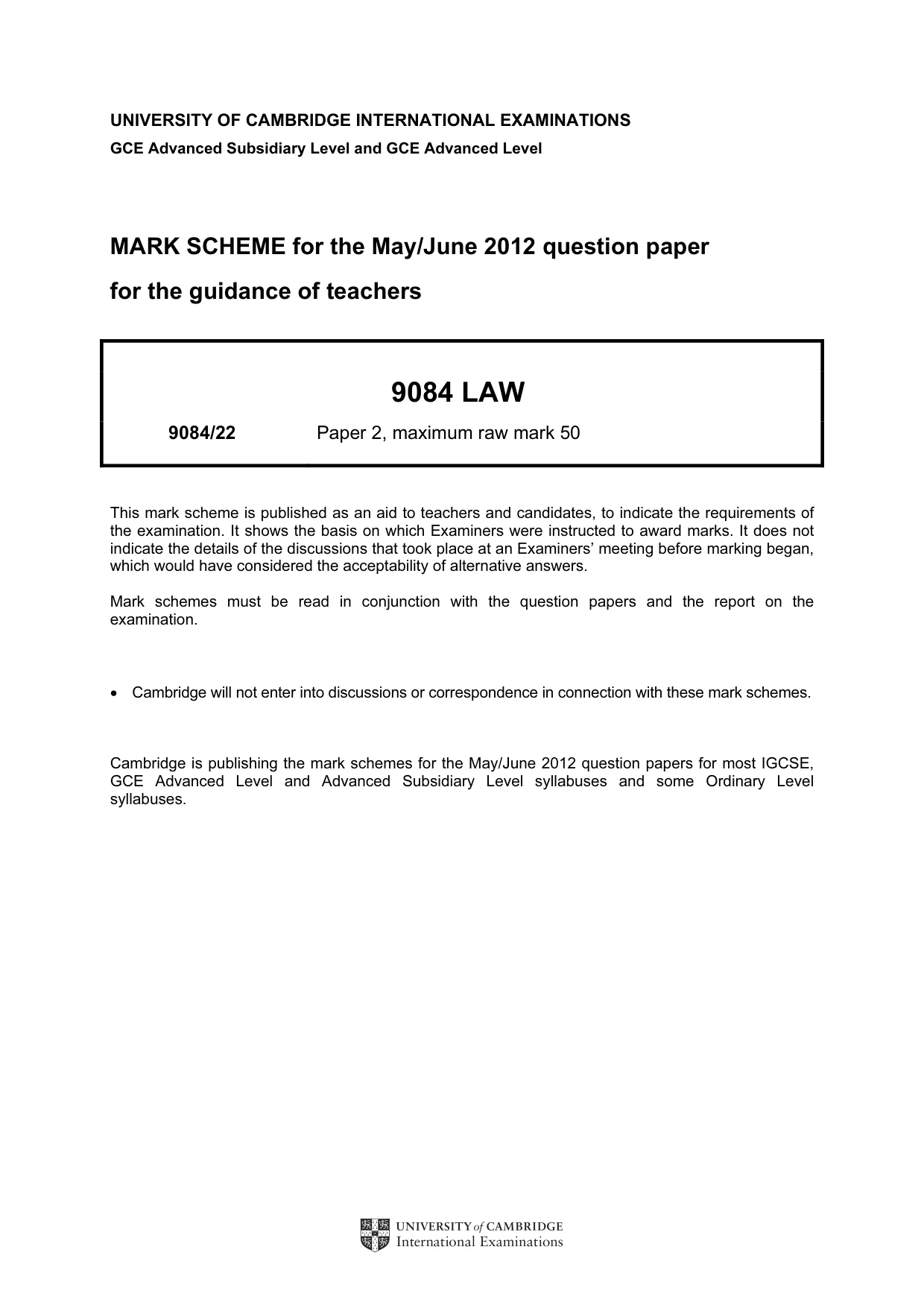
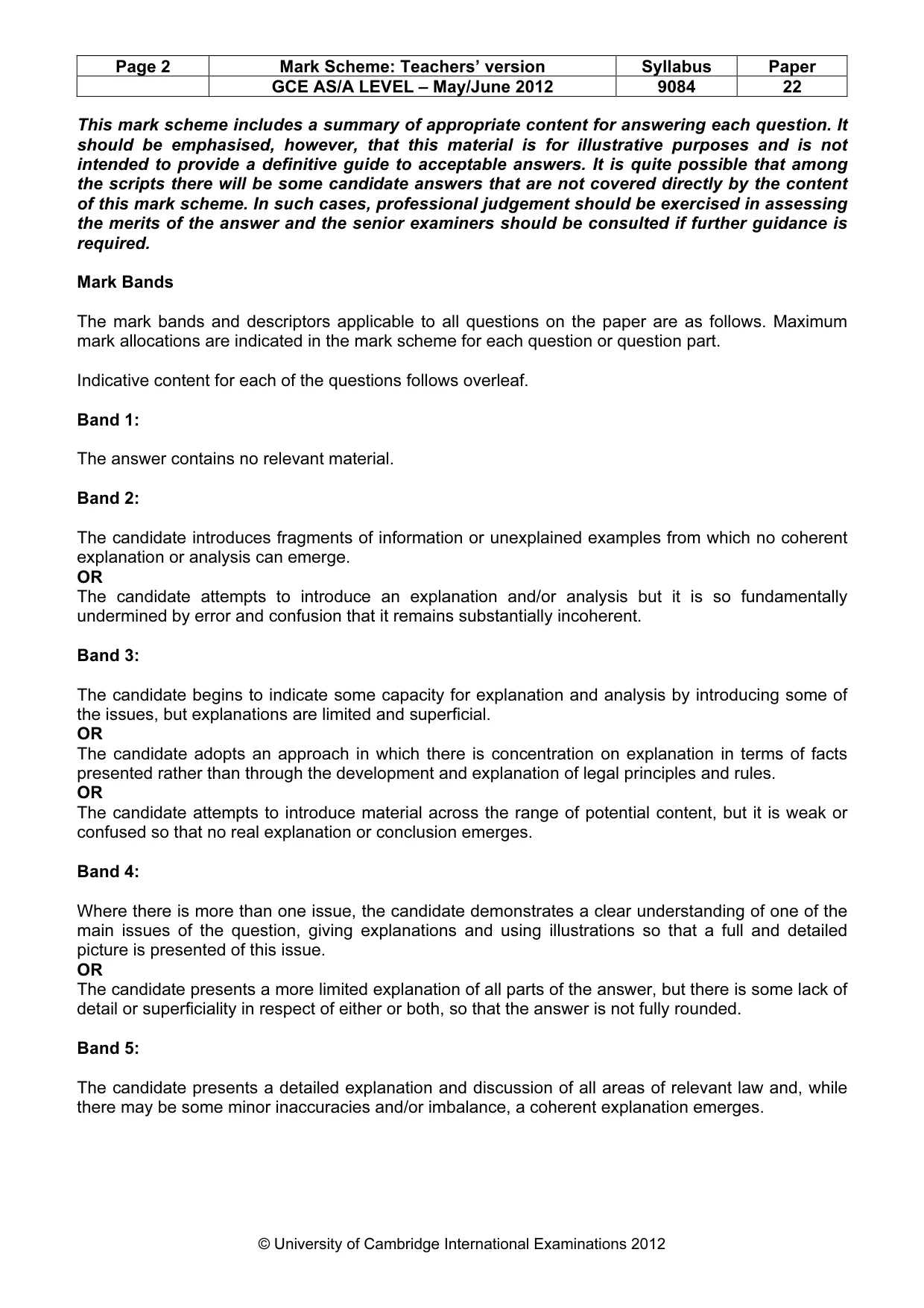
UNIVERSITY OF CAMBRIDGE INTERNATIONAL EXAMINATIONS GCE Advanced Subsidiary Level and GCE Advanced Level MARK SCHEME for the May/June 2012 question paper for the guidance of teachers 9084 LAW 9084/22 Paper 2, maximum raw mark 50 This mark scheme is published as an aid to teachers and candidates, to indicate the requirements of the examination. It shows the basis on which Examiners were instructed to award marks. It does not indicate the details of the discussions that took place at an Examiners’ meeting before marking began, which would have considered the acceptability of alternative answers. Mark schemes must be read in conjunction with the question papers and the report on the examination. • Cambridge will not enter into discussions or correspondence in connection with these mark schemes. Cambridge is publishing the mark schemes for the May/June 2012 question papers for most IGCSE, GCE Advanced Level and Advanced Subsidiary Level syllabuses and some Ordinary Level syllabuses.
Mark scheme, page 2
Page 2 Mark Scheme: Teachers’ version Syllabus Paper GCE AS/A LEVEL – May/June 2012 9084 22 © University of Cambridge International Examinations 2012 This mark scheme includes a summary of appropriate content for answering each question. It should be emphasised, however, that this material is for illustrative purposes and is not intended to provide a definitive guide to acceptable answers. It is quite possible that among the scripts there will be some candidate answers that are not covered directly by the content of this mark scheme. In such cases, professional judgement should be exercised in assessing the merits of the answer and the senior examiners should be consulted if further guidance is required. Mark Bands The mark bands and descriptors applicable to all questions on the paper are as follows. Maximum mark allocations are indicated in the mark scheme for each question or question part. Indicative content for each of the questions follows overleaf. Band 1: The answer contains no relevant material. Band 2: The candidate introduces fragments of information or unexplained examples from which no coherent explanation or analysis can emerge. OR The candidate attempts to introduce an explanation and/or analysis but it is so fundamentally undermined by error and confusion that it remains substantially incoherent. Band 3: The candidate begins to indicate some capacity for explanation and analysis by introducing some of the issues, but explanations are limited and superficial. OR The candidate adopts an approach in which there is concentration on explanation in terms of facts presented rather than through the development and explanation of legal principles and rules. OR The candidate attempts to introduce material across the range of potential content, but it is weak or confused so that no real explanation or conclusion emerges. Band 4: Where there is more than one issue, the candidate demonstrates a clear understanding of one of the main issues of the question, giving explanations and using illustrations so that a full and detailed picture is presented of this issue. OR The candidate presents a more limited explanation of all parts of the answer, but there is some lack of detail or superficiality in respect of either or both, so that the answer is not fully rounded. Band 5: The candidate presents a detailed explanation and discussion of all areas of relevant law and, while there may be some minor inaccuracies and/or imbalance, a coherent explanation emerges.
Mark scheme, page 3
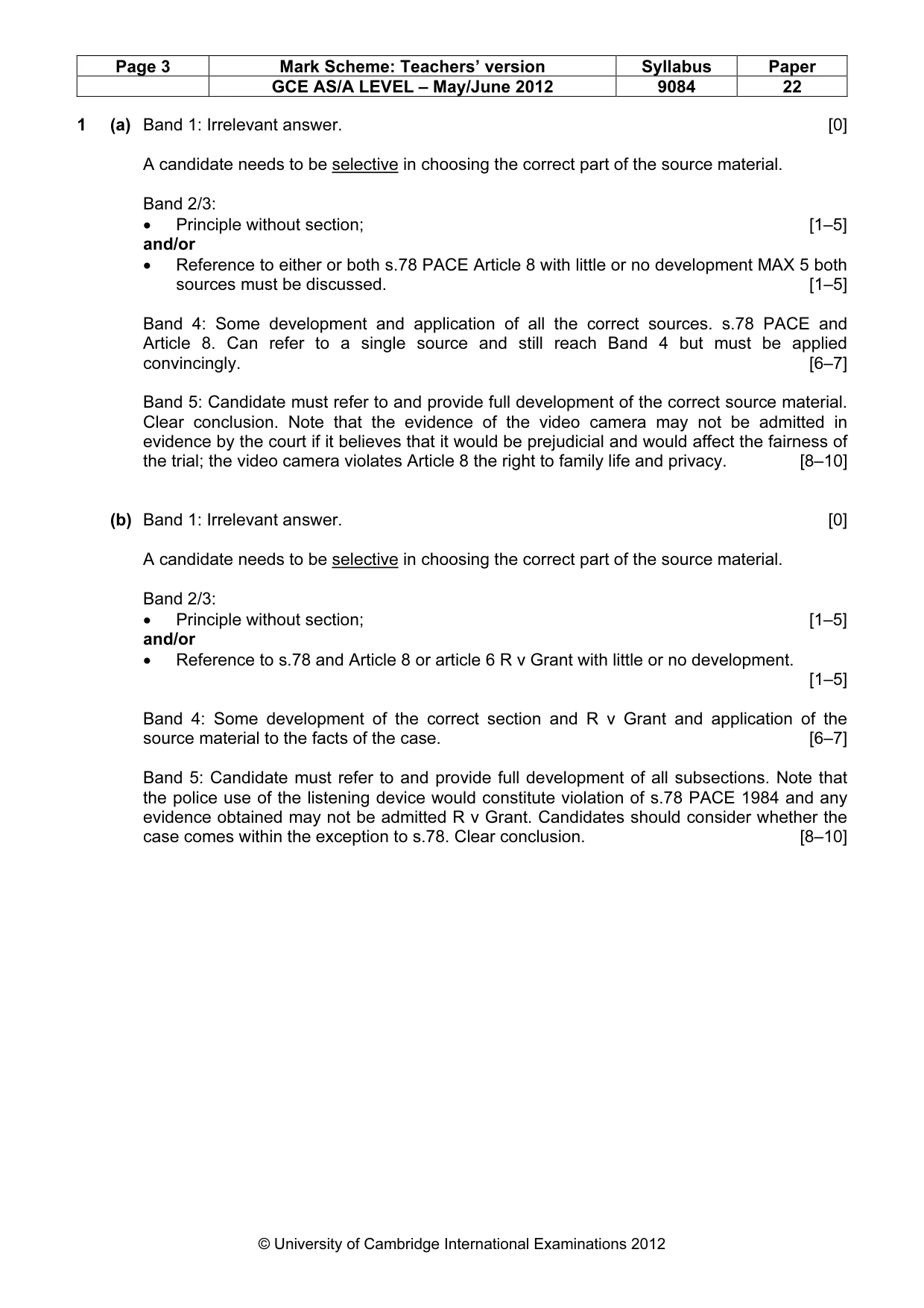
Page 3 Mark Scheme: Teachers’ version Syllabus Paper GCE AS/A LEVEL – May/June 2012 9084 22 © University of Cambridge International Examinations 2012 1 (a) Band 1: Irrelevant answer. [0] A candidate needs to be selective in choosing the correct part of the source material. Band 2/3: • Principle without section; [1–5] and/or • Reference to either or both s.78 PACE Article 8 with little or no development MAX 5 both sources must be discussed. [1–5] Band 4: Some development and application of all the correct sources. s.78 PACE and Article 8. Can refer to a single source and still reach Band 4 but must be applied convincingly. [6–7] Band 5: Candidate must refer to and provide full development of the correct source material. Clear conclusion. Note that the evidence of the video camera may not be admitted in evidence by the court if it believes that it would be prejudicial and would affect the fairness of the trial; the video camera violates Article 8 the right to family life and privacy. [8–10] (b) Band 1: Irrelevant answer. [0] A candidate needs to be selective in choosing the correct part of the source material. Band 2/3: • Principle without section; [1–5] and/or • Reference to s.78 and Article 8 or article 6 R v Grant with little or no development. [1–5] Band 4: Some development of the correct section and R v Grant and application of the source material to the facts of the case. [6–7] Band 5: Candidate must refer to and provide full development of all subsections. Note that the police use of the listening device would constitute violation of s.78 PACE 1984 and any evidence obtained may not be admitted R v Grant. Candidates should consider whether the case comes within the exception to s.78. Clear conclusion. [8–10]
Mark scheme, page 4
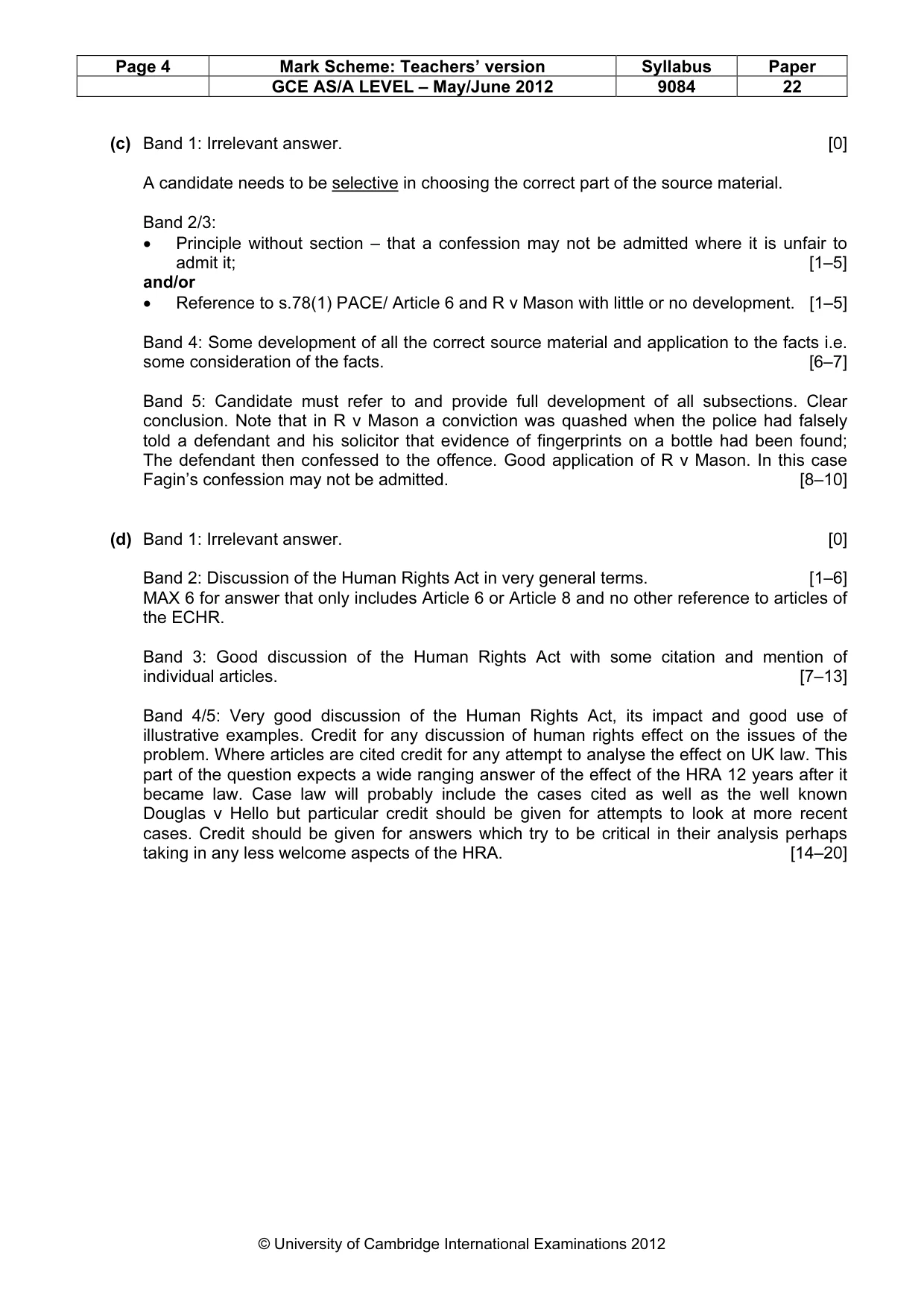
Page 4 Mark Scheme: Teachers’ version Syllabus Paper GCE AS/A LEVEL – May/June 2012 9084 22 © University of Cambridge International Examinations 2012 (c) Band 1: Irrelevant answer. [0] A candidate needs to be selective in choosing the correct part of the source material. Band 2/3: • Principle without section – that a confession may not be admitted where it is unfair to admit it; [1–5] and/or • Reference to s.78(1) PACE/ Article 6 and R v Mason with little or no development. [1–5] Band 4: Some development of all the correct source material and application to the facts i.e. some consideration of the facts. [6–7] Band 5: Candidate must refer to and provide full development of all subsections. Clear conclusion. Note that in R v Mason a conviction was quashed when the police had falsely told a defendant and his solicitor that evidence of fingerprints on a bottle had been found; The defendant then confessed to the offence. Good application of R v Mason. In this case Fagin’s confession may not be admitted. [8–10] (d) Band 1: Irrelevant answer. [0] Band 2: Discussion of the Human Rights Act in very general terms. [1–6] MAX 6 for answer that only includes Article 6 or Article 8 and no other reference to articles of the ECHR. Band 3: Good discussion of the Human Rights Act with some citation and mention of individual articles. [7–13] Band 4/5: Very good discussion of the Human Rights Act, its impact and good use of illustrative examples. Credit for any discussion of human rights effect on the issues of the problem. Where articles are cited credit for any attempt to analyse the effect on UK law. This part of the question expects a wide ranging answer of the effect of the HRA 12 years after it became law. Case law will probably include the cases cited as well as the well known Douglas v Hello but particular credit should be given for attempts to look at more recent cases. Credit should be given for answers which try to be critical in their analysis perhaps taking in any less welcome aspects of the HRA. [14–20]
Mark scheme, page 5
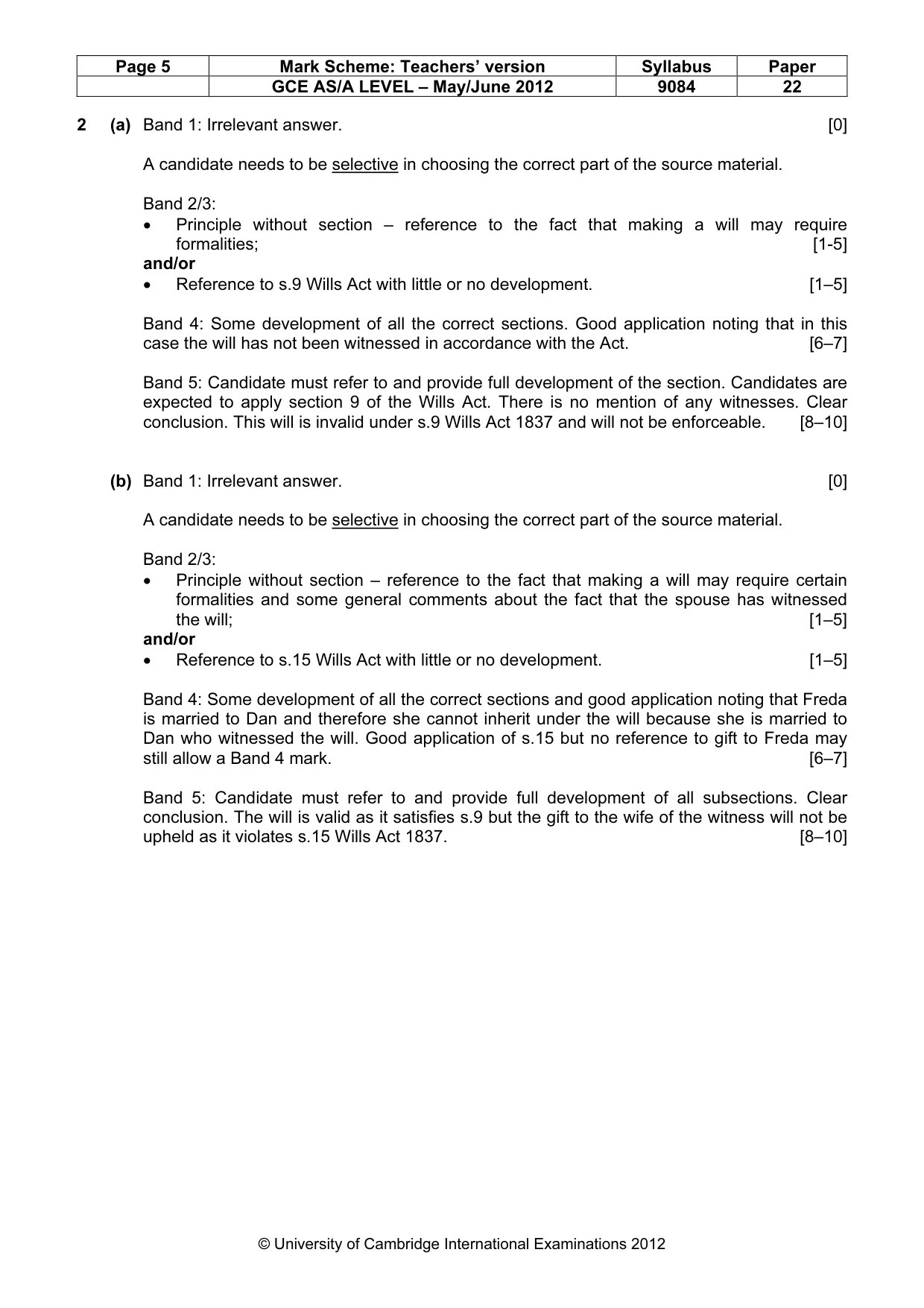
Page 5 Mark Scheme: Teachers’ version Syllabus Paper GCE AS/A LEVEL – May/June 2012 9084 22 © University of Cambridge International Examinations 2012 2 (a) Band 1: Irrelevant answer. [0] A candidate needs to be selective in choosing the correct part of the source material. Band 2/3: • Principle without section – reference to the fact that making a will may require formalities; [1-5] and/or • Reference to s.9 Wills Act with little or no development. [1–5] Band 4: Some development of all the correct sections. Good application noting that in this case the will has not been witnessed in accordance with the Act. [6–7] Band 5: Candidate must refer to and provide full development of the section. Candidates are expected to apply section 9 of the Wills Act. There is no mention of any witnesses. Clear conclusion. This will is invalid under s.9 Wills Act 1837 and will not be enforceable. [8–10] (b) Band 1: Irrelevant answer. [0] A candidate needs to be selective in choosing the correct part of the source material. Band 2/3: • Principle without section – reference to the fact that making a will may require certain formalities and some general comments about the fact that the spouse has witnessed the will; [1–5] and/or • Reference to s.15 Wills Act with little or no development. [1–5] Band 4: Some development of all the correct sections and good application noting that Freda is married to Dan and therefore she cannot inherit under the will because she is married to Dan who witnessed the will. Good application of s.15 but no reference to gift to Freda may still allow a Band 4 mark. [6–7] Band 5: Candidate must refer to and provide full development of all subsections. Clear conclusion. The will is valid as it satisfies s.9 but the gift to the wife of the witness will not be upheld as it violates s.15 Wills Act 1837. [8–10]
Mark scheme, page 6
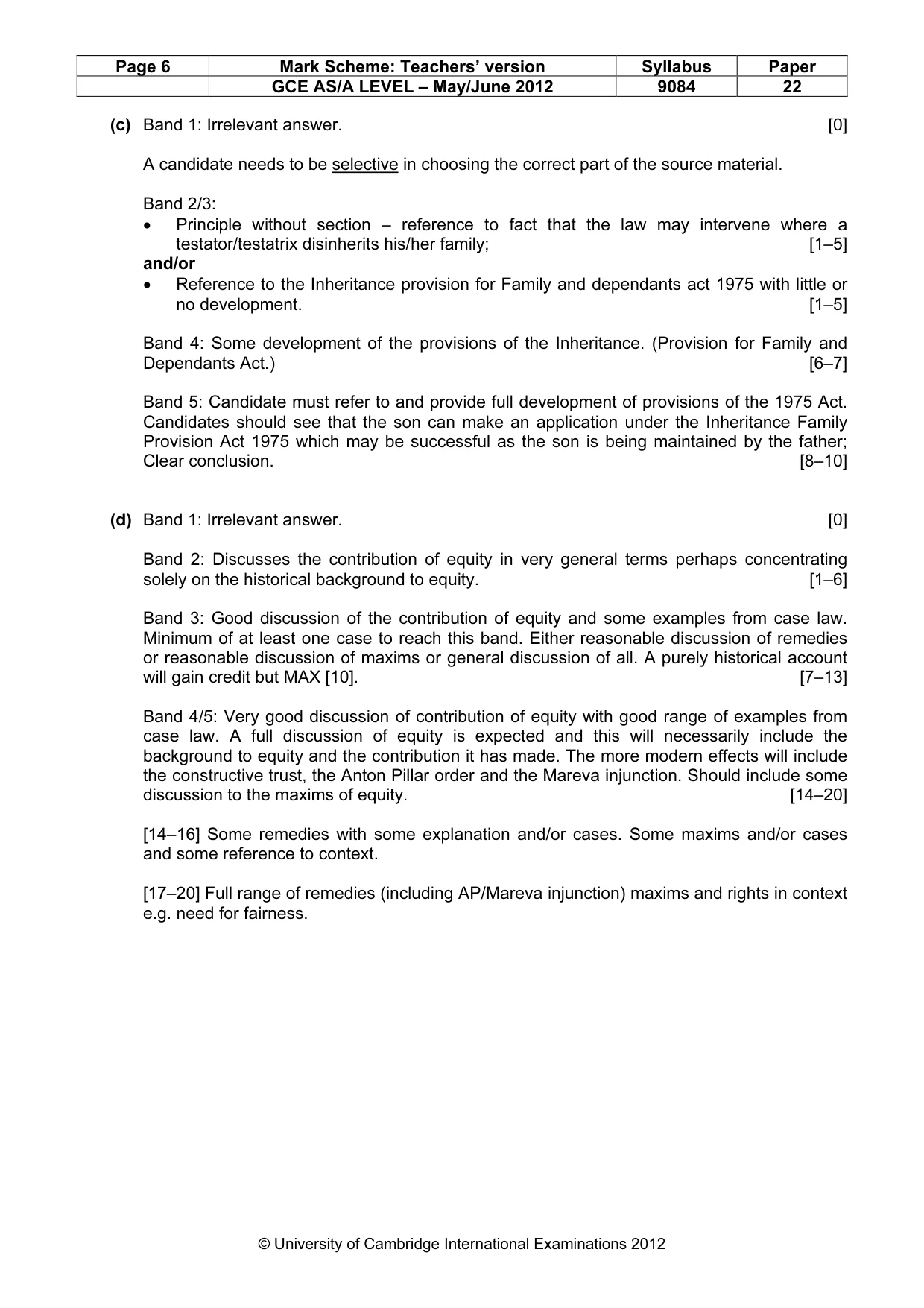
Page 6 Mark Scheme: Teachers’ version Syllabus Paper GCE AS/A LEVEL – May/June 2012 9084 22 © University of Cambridge International Examinations 2012 (c) Band 1: Irrelevant answer. [0] A candidate needs to be selective in choosing the correct part of the source material. Band 2/3: • Principle without section – reference to fact that the law may intervene where a testator/testatrix disinherits his/her family; [1–5] and/or • Reference to the Inheritance provision for Family and dependants act 1975 with little or no development. [1–5] Band 4: Some development of the provisions of the Inheritance. (Provision for Family and Dependants Act.) [6–7] Band 5: Candidate must refer to and provide full development of provisions of the 1975 Act. Candidates should see that the son can make an application under the Inheritance Family Provision Act 1975 which may be successful as the son is being maintained by the father; Clear conclusion. [8–10] (d) Band 1: Irrelevant answer. [0] Band 2: Discusses the contribution of equity in very general terms perhaps concentrating solely on the historical background to equity. [1–6] Band 3: Good discussion of the contribution of equity and some examples from case law. Minimum of at least one case to reach this band. Either reasonable discussion of remedies or reasonable discussion of maxims or general discussion of all. A purely historical account will gain credit but MAX [10]. [7–13] Band 4/5: Very good discussion of contribution of equity with good range of examples from case law. A full discussion of equity is expected and this will necessarily include the background to equity and the contribution it has made. The more modern effects will include the constructive trust, the Anton Pillar order and the Mareva injunction. Should include some discussion to the maxims of equity. [14–20] [14–16] Some remedies with some explanation and/or cases. Some maxims and/or cases and some reference to context. [17–20] Full range of remedies (including AP/Mareva injunction) maxims and rights in context e.g. need for fairness.
What you needed in this session
Cambridge’s own grade thresholds for 2012 May/June, Paper 2 · Variant 2. A higher threshold means an easier paper — the bar moves with how the cohort did.