Cambridge A Level Law 9084 — 2012 May/June Paper 2 · Variant 1
9084/21/M/J/12 · 50 marks · ≈56 min
The question paper and its mark scheme, free to read here and free to download. This is Cambridge’s own paper, exactly as it was sat.
Question paper4 pages
Mark scheme6 pages
Answers below. Sit the paper first if you are practising.
Paper as text
Question paper, page 1
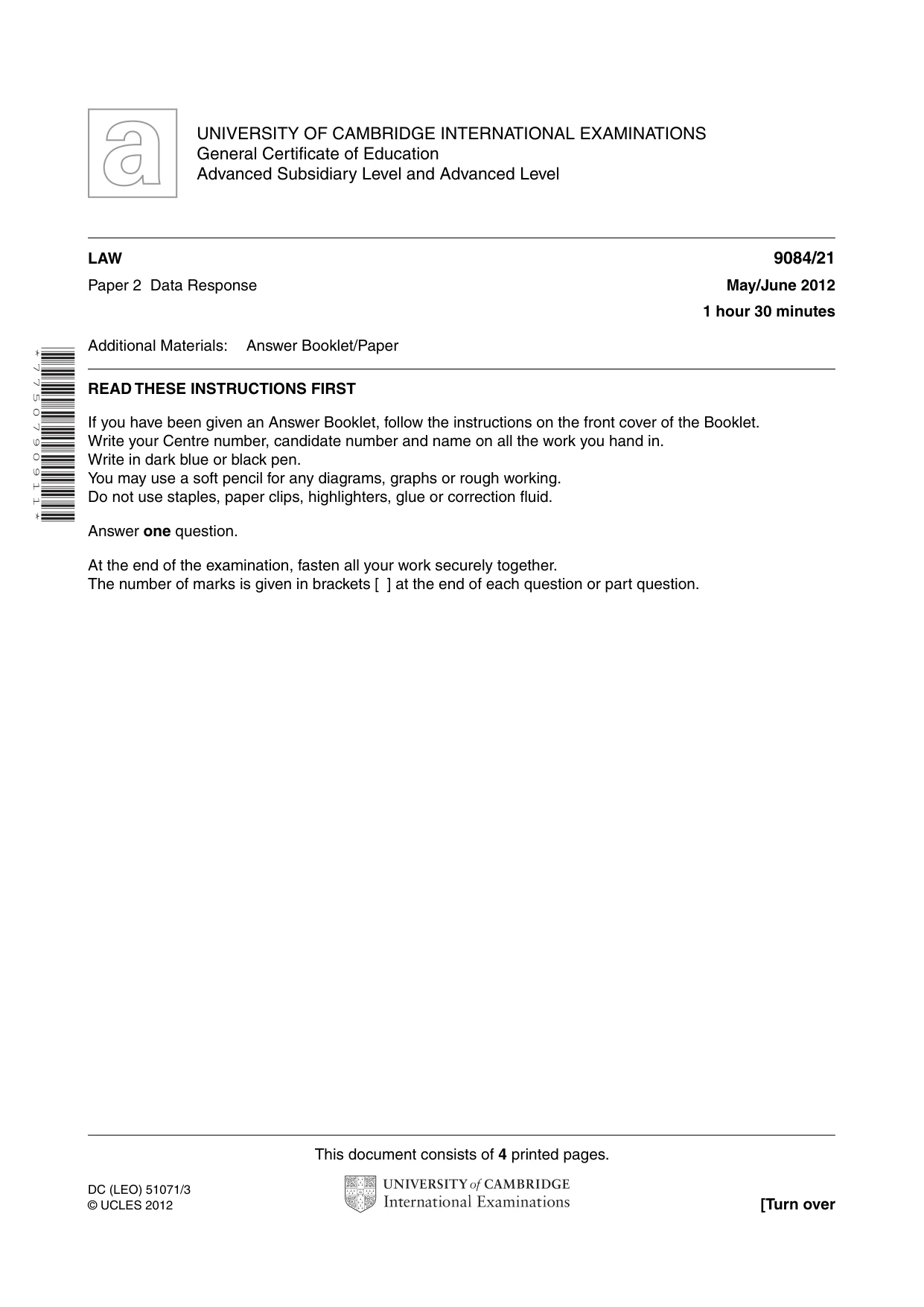
This document consists of 4 printed pages. DC (LEO) 51071/3 © UCLES 2012 [Turn over UNIVERSITY OF CAMBRIDGE INTERNATIONAL EXAMINATIONS General Certificate of Education Advanced Subsidiary Level and Advanced Level * 7 7 5 0 7 9 0 9 1 1 * LAW 9084/21 Paper 2 Data Response May/June 2012 1 hour 30 minutes Additional Materials: Answer Booklet/Paper READ THESE INSTRUCTIONS FIRST If you have been given an Answer Booklet, follow the instructions on the front cover of the Booklet. Write your Centre number, candidate number and name on all the work you hand in. Write in dark blue or black pen. You may use a soft pencil for any diagrams, graphs or rough working. Do not use staples, paper clips, highlighters, glue or correction fluid. Answer one question. At the end of the examination, fasten all your work securely together. The number of marks is given in brackets [ ] at the end of each question or part question.
Question paper, page 2
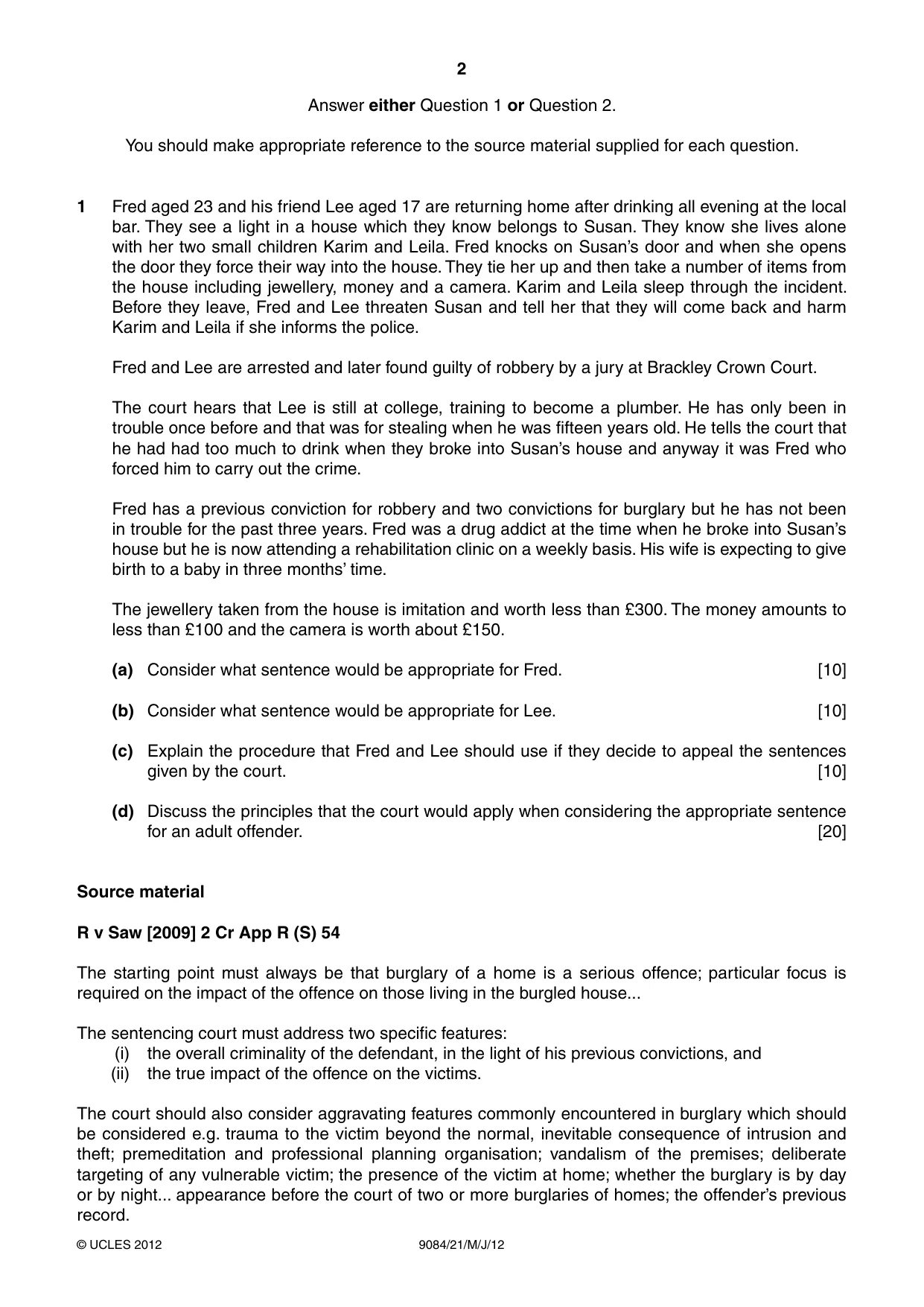
2 9084/21/M/J/12 © UCLES 2012 Answer either Question 1 or Question 2. You should make appropriate reference to the source material supplied for each question. 1 Fred aged 23 and his friend Lee aged 17 are returning home after drinking all evening at the local bar. They see a light in a house which they know belongs to Susan. They know she lives alone with her two small children Karim and Leila. Fred knocks on Susan’s door and when she opens the door they force their way into the house. They tie her up and then take a number of items from the house including jewellery, money and a camera. Karim and Leila sleep through the incident. Before they leave, Fred and Lee threaten Susan and tell her that they will come back and harm Karim and Leila if she informs the police. Fred and Lee are arrested and later found guilty of robbery by a jury at Brackley Crown Court. The court hears that Lee is still at college, training to become a plumber. He has only been in trouble once before and that was for stealing when he was fifteen years old. He tells the court that he had had too much to drink when they broke into Susan’s house and anyway it was Fred who forced him to carry out the crime. Fred has a previous conviction for robbery and two convictions for burglary but he has not been in trouble for the past three years. Fred was a drug addict at the time when he broke into Susan’s house but he is now attending a rehabilitation clinic on a weekly basis. His wife is expecting to give birth to a baby in three months’ time. The jewellery taken from the house is imitation and worth less than £300. The money amounts to less than £100 and the camera is worth about £150. (a) Consider what sentence would be appropriate for Fred. [10] (b) Consider what sentence would be appropriate for Lee. [10] (c) Explain the procedure that Fred and Lee should use if they decide to appeal the sentences given by the court. [10] (d) Discuss the principles that the court would apply when considering the appropriate sentence for an adult offender. [20] Source material R v Saw [2009] 2 Cr App R (S) 54 The starting point must always be that burglary of a home is a serious offence; particular focus is required on the impact of the offence on those living in the burgled house... The sentencing court must address two specific features: (i) the overall criminality of the defendant, in the light of his previous convictions, and (ii) the true impact of the offence on the victims. The court should also consider aggravating features commonly encountered in burglary which should be considered e.g. trauma to the victim beyond the normal, inevitable consequence of intrusion and theft; premeditation and professional planning organisation; vandalism of the premises; deliberate targeting of any vulnerable victim; the presence of the victim at home; whether the burglary is by day or by night... appearance before the court of two or more burglaries of homes; the offender’s previous record.
Question paper, page 3
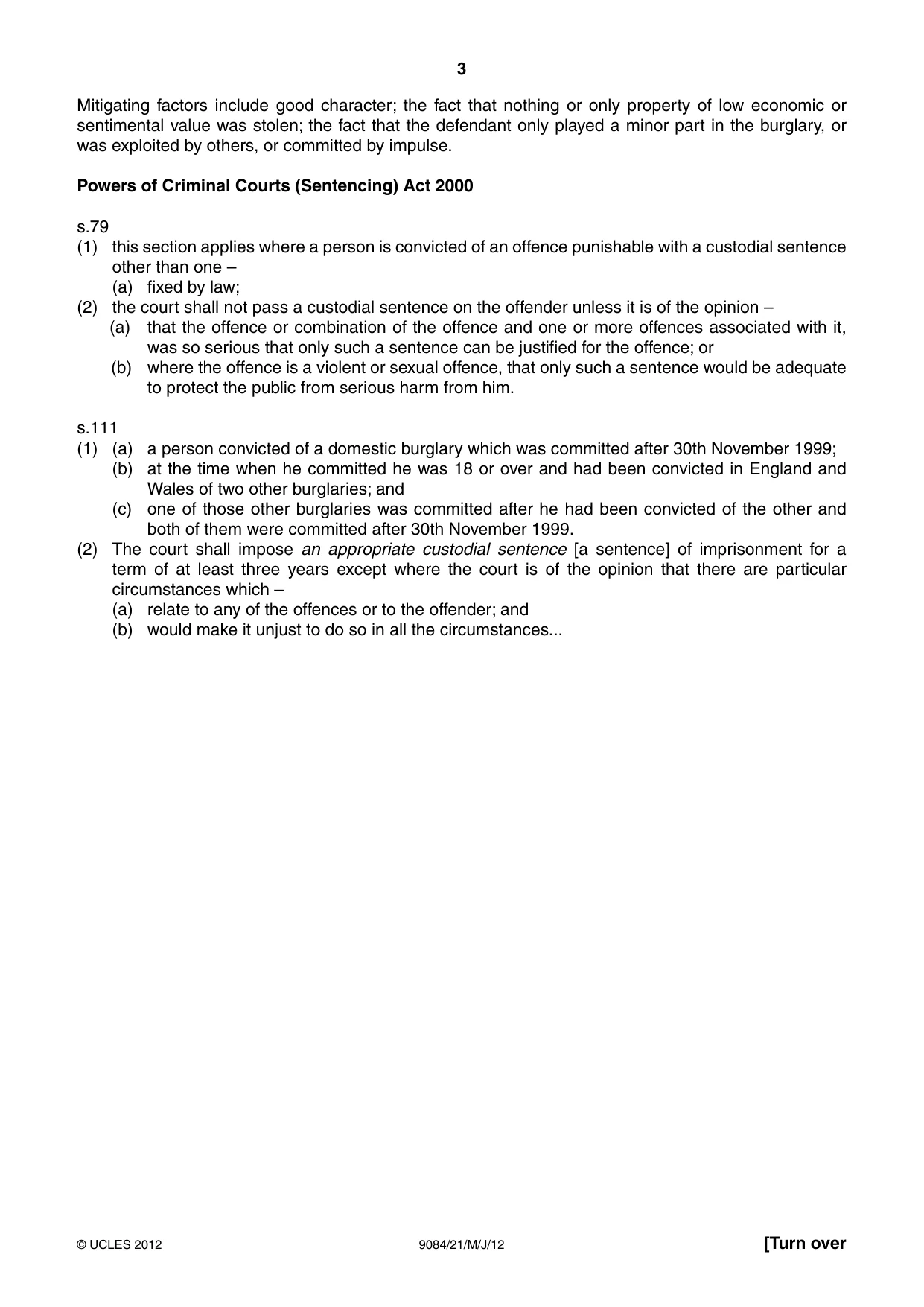
3 9084/21/M/J/12 © UCLES 2012 [Turn over Mitigating factors include good character; the fact that nothing or only property of low economic or sentimental value was stolen; the fact that the defendant only played a minor part in the burglary, or was exploited by others, or committed by impulse. Powers of Criminal Courts (Sentencing) Act 2000 s.79 (1) this section applies where a person is convicted of an offence punishable with a custodial sentence other than one – (a) fixed by law; (2) the court shall not pass a custodial sentence on the offender unless it is of the opinion – (a) that the offence or combination of the offence and one or more offences associated with it, was so serious that only such a sentence can be justified for the offence; or (b) where the offence is a violent or sexual offence, that only such a sentence would be adequate to protect the public from serious harm from him. s.111 (1) (a) a person convicted of a domestic burglary which was committed after 30th November 1999; (b) at the time when he committed he was 18 or over and had been convicted in England and Wales of two other burglaries; and (c) one of those other burglaries was committed after he had been convicted of the other and both of them were committed after 30th November 1999. (2) The court shall impose an appropriate custodial sentence [a sentence] of imprisonment for a term of at least three years except where the court is of the opinion that there are particular circumstances which – (a) relate to any of the offences or to the offender; and (b) would make it unjust to do so in all the circumstances...
Question paper, page 4
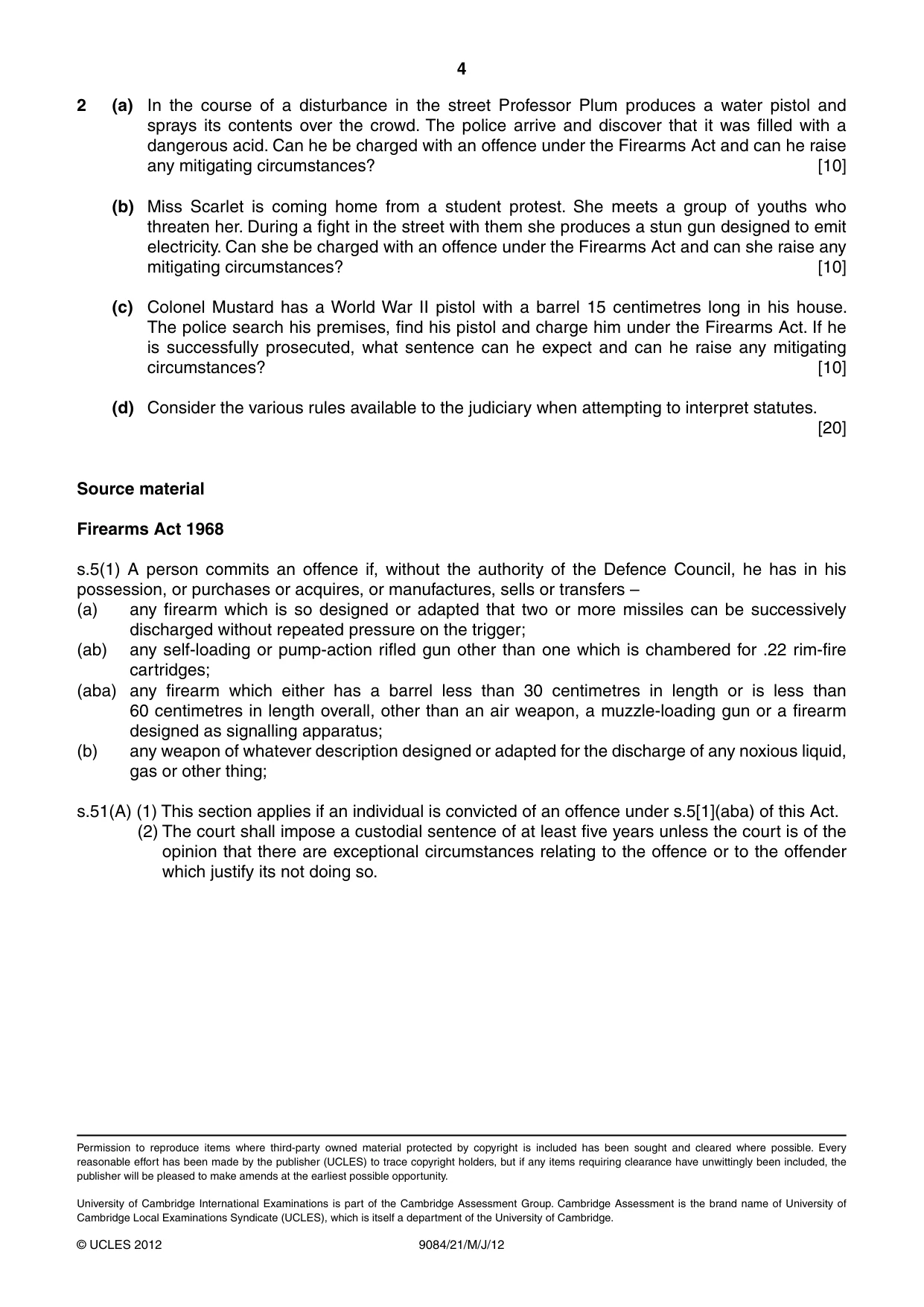
4 9084/21/M/J/12 © UCLES 2012 Permission to reproduce items where third-party owned material protected by copyright is included has been sought and cleared where possible. Every reasonable effort has been made by the publisher (UCLES) to trace copyright holders, but if any items requiring clearance have unwittingly been included, the publisher will be pleased to make amends at the earliest possible opportunity. University of Cambridge International Examinations is part of the Cambridge Assessment Group. Cambridge Assessment is the brand name of University of Cambridge Local Examinations Syndicate (UCLES), which is itself a department of the University of Cambridge. 2 (a) In the course of a disturbance in the street Professor Plum produces a water pistol and sprays its contents over the crowd. The police arrive and discover that it was filled with a dangerous acid. Can he be charged with an offence under the Firearms Act and can he raise any mitigating circumstances? [10] (b) Miss Scarlet is coming home from a student protest. She meets a group of youths who threaten her. During a fight in the street with them she produces a stun gun designed to emit electricity. Can she be charged with an offence under the Firearms Act and can she raise any mitigating circumstances? [10] (c) Colonel Mustard has a World War II pistol with a barrel 15 centimetres long in his house. The police search his premises, find his pistol and charge him under the Firearms Act. If he is successfully prosecuted, what sentence can he expect and can he raise any mitigating circumstances? [10] (d) Consider the various rules available to the judiciary when attempting to interpret statutes. [20] Source material Firearms Act 1968 s.5(1) A person commits an offence if, without the authority of the Defence Council, he has in his possession, or purchases or acquires, or manufactures, sells or transfers – (a) any firearm which is so designed or adapted that two or more missiles can be successively discharged without repeated pressure on the trigger; (ab) any self-loading or pump-action rifled gun other than one which is chambered for .22 rim-fire cartridges; (aba) any firearm which either has a barrel less than 30 centimetres in length or is less than 60 centimetres in length overall, other than an air weapon, a muzzle-loading gun or a firearm designed as signalling apparatus; (b) any weapon of whatever description designed or adapted for the discharge of any noxious liquid, gas or other thing; s.51(A) (1) This section applies if an individual is convicted of an offence under s.5[1](aba) of this Act. (2) The court shall impose a custodial sentence of at least five years unless the court is of the opinion that there are exceptional circumstances relating to the offence or to the offender which justify its not doing so.
Mark scheme, page 1
UNIVERSITY OF CAMBRIDGE INTERNATIONAL EXAMINATIONS GCE Advanced Subsidiary Level and GCE Advanced Level MARK SCHEME for the May/June 2012 question paper for the guidance of teachers 9084 LAW 9084/21 Paper 2, maximum raw mark 50 This mark scheme is published as an aid to teachers and candidates, to indicate the requirements of the examination. It shows the basis on which Examiners were instructed to award marks. It does not indicate the details of the discussions that took place at an Examiners’ meeting before marking began, which would have considered the acceptability of alternative answers. Mark schemes must be read in conjunction with the question papers and the report on the examination. • Cambridge will not enter into discussions or correspondence in connection with these mark schemes. Cambridge is publishing the mark schemes for the May/June 2012 question papers for most IGCSE, GCE Advanced Level and Advanced Subsidiary Level syllabuses and some Ordinary Level syllabuses.
Mark scheme, page 2
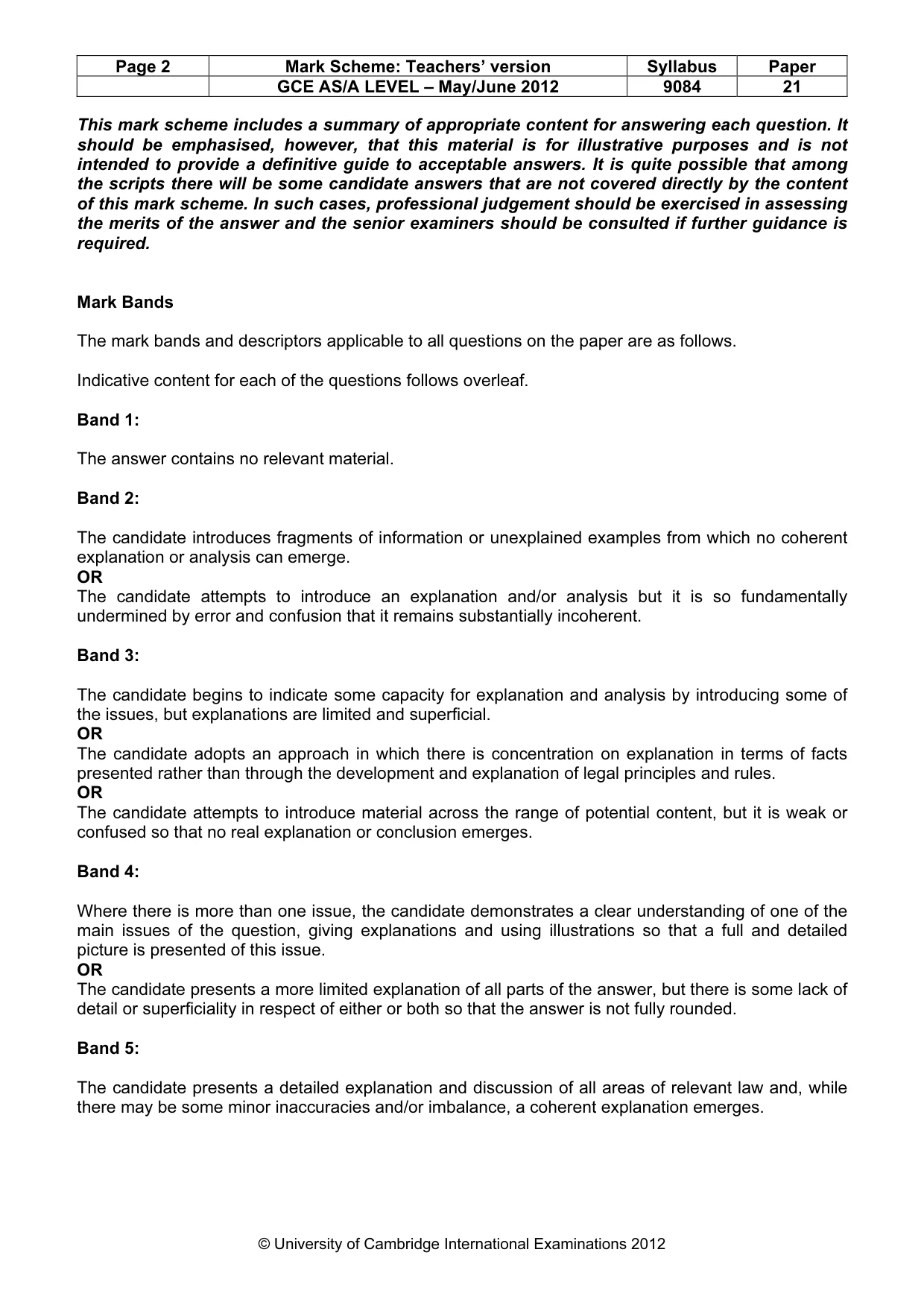
Page 2 Mark Scheme: Teachers’ version Syllabus Paper GCE AS/A LEVEL – May/June 2012 9084 21 © University of Cambridge International Examinations 2012 This mark scheme includes a summary of appropriate content for answering each question. It should be emphasised, however, that this material is for illustrative purposes and is not intended to provide a definitive guide to acceptable answers. It is quite possible that among the scripts there will be some candidate answers that are not covered directly by the content of this mark scheme. In such cases, professional judgement should be exercised in assessing the merits of the answer and the senior examiners should be consulted if further guidance is required. Mark Bands The mark bands and descriptors applicable to all questions on the paper are as follows. Indicative content for each of the questions follows overleaf. Band 1: The answer contains no relevant material. Band 2: The candidate introduces fragments of information or unexplained examples from which no coherent explanation or analysis can emerge. OR The candidate attempts to introduce an explanation and/or analysis but it is so fundamentally undermined by error and confusion that it remains substantially incoherent. Band 3: The candidate begins to indicate some capacity for explanation and analysis by introducing some of the issues, but explanations are limited and superficial. OR The candidate adopts an approach in which there is concentration on explanation in terms of facts presented rather than through the development and explanation of legal principles and rules. OR The candidate attempts to introduce material across the range of potential content, but it is weak or confused so that no real explanation or conclusion emerges. Band 4: Where there is more than one issue, the candidate demonstrates a clear understanding of one of the main issues of the question, giving explanations and using illustrations so that a full and detailed picture is presented of this issue. OR The candidate presents a more limited explanation of all parts of the answer, but there is some lack of detail or superficiality in respect of either or both so that the answer is not fully rounded. Band 5: The candidate presents a detailed explanation and discussion of all areas of relevant law and, while there may be some minor inaccuracies and/or imbalance, a coherent explanation emerges.
Mark scheme, page 3
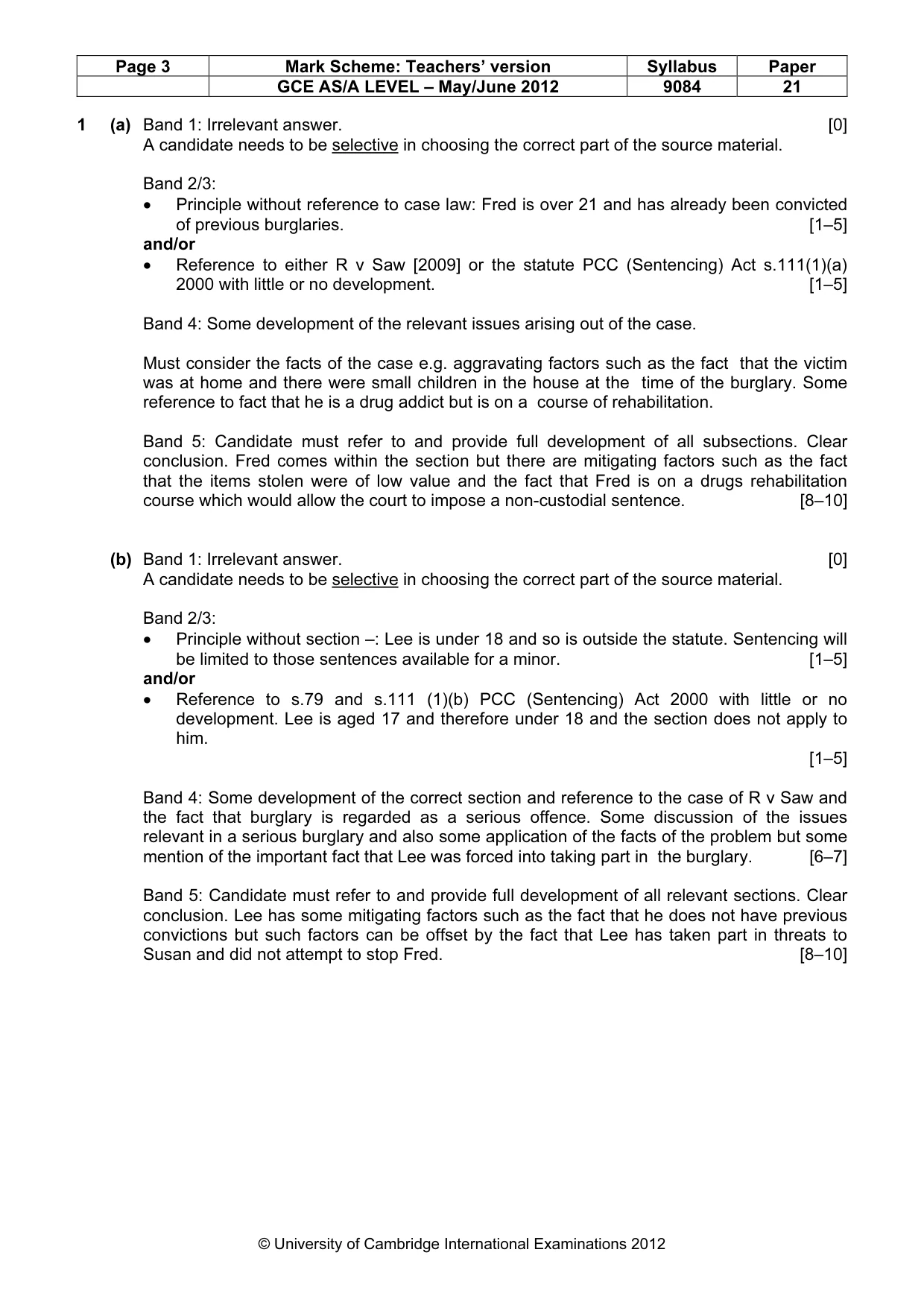
Page 3 Mark Scheme: Teachers’ version Syllabus Paper GCE AS/A LEVEL – May/June 2012 9084 21 © University of Cambridge International Examinations 2012 1 (a) Band 1: Irrelevant answer. [0] A candidate needs to be selective in choosing the correct part of the source material. Band 2/3: • Principle without reference to case law: Fred is over 21 and has already been convicted of previous burglaries. [1–5] and/or • Reference to either R v Saw [2009] or the statute PCC (Sentencing) Act s.111(1)(a) 2000 with little or no development. [1–5] Band 4: Some development of the relevant issues arising out of the case. Must consider the facts of the case e.g. aggravating factors such as the fact that the victim was at home and there were small children in the house at the time of the burglary. Some reference to fact that he is a drug addict but is on a course of rehabilitation. Band 5: Candidate must refer to and provide full development of all subsections. Clear conclusion. Fred comes within the section but there are mitigating factors such as the fact that the items stolen were of low value and the fact that Fred is on a drugs rehabilitation course which would allow the court to impose a non-custodial sentence. [8–10] (b) Band 1: Irrelevant answer. [0] A candidate needs to be selective in choosing the correct part of the source material. Band 2/3: • Principle without section –: Lee is under 18 and so is outside the statute. Sentencing will be limited to those sentences available for a minor. [1–5] and/or • Reference to s.79 and s.111 (1)(b) PCC (Sentencing) Act 2000 with little or no development. Lee is aged 17 and therefore under 18 and the section does not apply to him. [1–5] Band 4: Some development of the correct section and reference to the case of R v Saw and the fact that burglary is regarded as a serious offence. Some discussion of the issues relevant in a serious burglary and also some application of the facts of the problem but some mention of the important fact that Lee was forced into taking part in the burglary. [6–7] Band 5: Candidate must refer to and provide full development of all relevant sections. Clear conclusion. Lee has some mitigating factors such as the fact that he does not have previous convictions but such factors can be offset by the fact that Lee has taken part in threats to Susan and did not attempt to stop Fred. [8–10]
Mark scheme, page 4
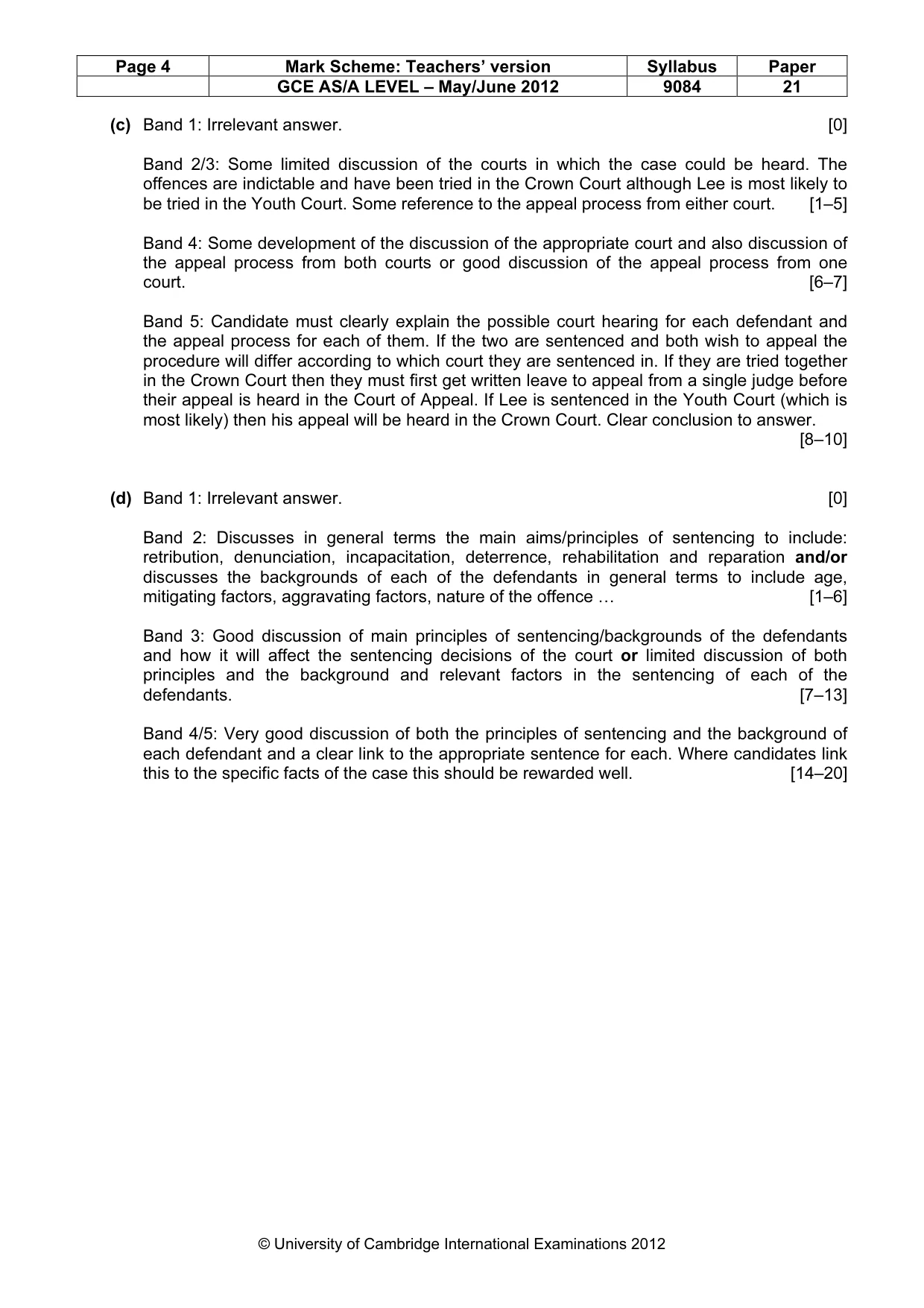
Page 4 Mark Scheme: Teachers’ version Syllabus Paper GCE AS/A LEVEL – May/June 2012 9084 21 © University of Cambridge International Examinations 2012 (c) Band 1: Irrelevant answer. [0] Band 2/3: Some limited discussion of the courts in which the case could be heard. The offences are indictable and have been tried in the Crown Court although Lee is most likely to be tried in the Youth Court. Some reference to the appeal process from either court. [1–5] Band 4: Some development of the discussion of the appropriate court and also discussion of the appeal process from both courts or good discussion of the appeal process from one court. [6–7] Band 5: Candidate must clearly explain the possible court hearing for each defendant and the appeal process for each of them. If the two are sentenced and both wish to appeal the procedure will differ according to which court they are sentenced in. If they are tried together in the Crown Court then they must first get written leave to appeal from a single judge before their appeal is heard in the Court of Appeal. If Lee is sentenced in the Youth Court (which is most likely) then his appeal will be heard in the Crown Court. Clear conclusion to answer. [8–10] (d) Band 1: Irrelevant answer. [0] Band 2: Discusses in general terms the main aims/principles of sentencing to include: retribution, denunciation, incapacitation, deterrence, rehabilitation and reparation and/or discusses the backgrounds of each of the defendants in general terms to include age, mitigating factors, aggravating factors, nature of the offence … [1–6] Band 3: Good discussion of main principles of sentencing/backgrounds of the defendants and how it will affect the sentencing decisions of the court or limited discussion of both principles and the background and relevant factors in the sentencing of each of the defendants. [7–13] Band 4/5: Very good discussion of both the principles of sentencing and the background of each defendant and a clear link to the appropriate sentence for each. Where candidates link this to the specific facts of the case this should be rewarded well. [14–20]
Mark scheme, page 5
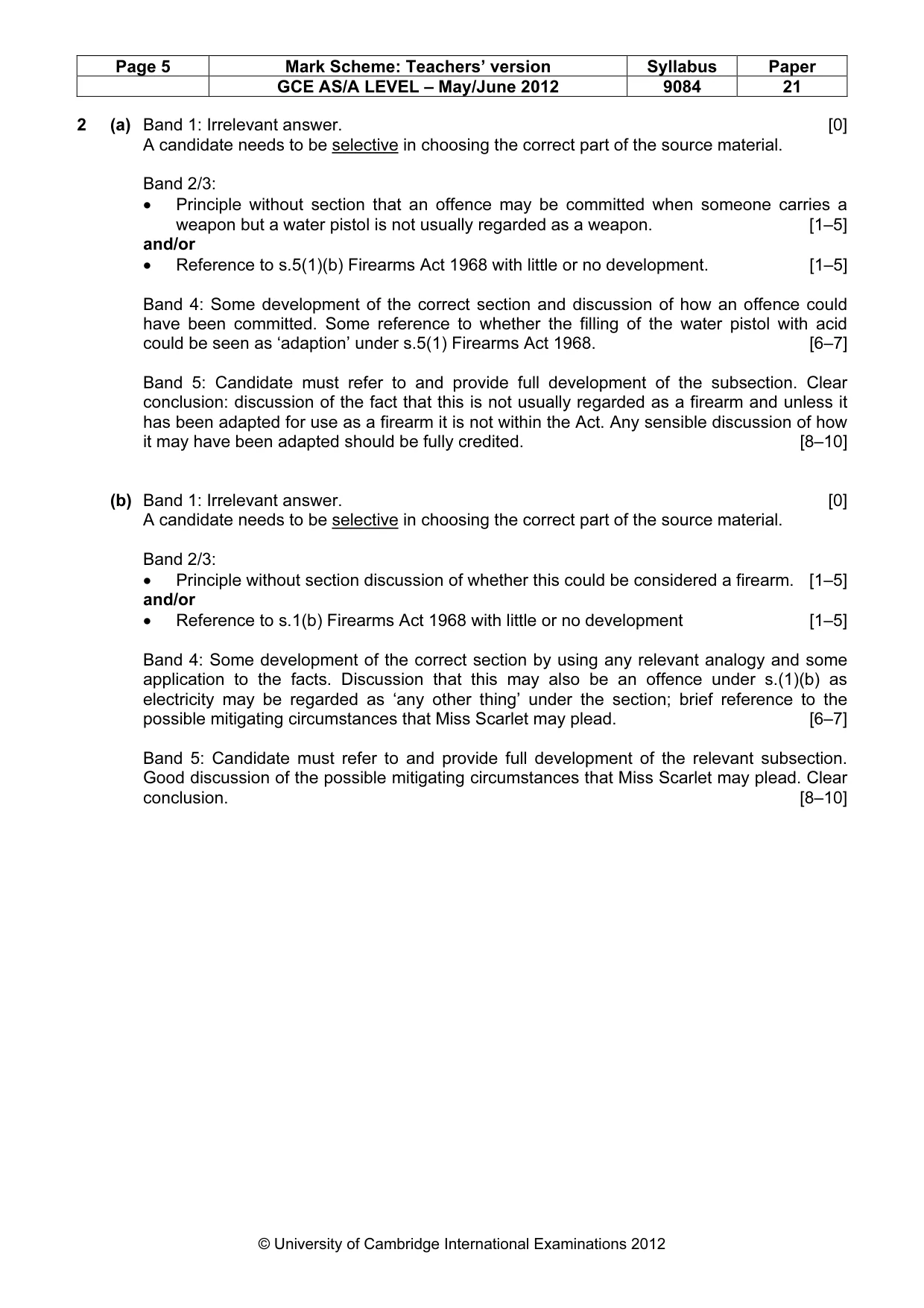
Page 5 Mark Scheme: Teachers’ version Syllabus Paper GCE AS/A LEVEL – May/June 2012 9084 21 © University of Cambridge International Examinations 2012 2 (a) Band 1: Irrelevant answer. [0] A candidate needs to be selective in choosing the correct part of the source material. Band 2/3: • Principle without section that an offence may be committed when someone carries a weapon but a water pistol is not usually regarded as a weapon. [1–5] and/or • Reference to s.5(1)(b) Firearms Act 1968 with little or no development. [1–5] Band 4: Some development of the correct section and discussion of how an offence could have been committed. Some reference to whether the filling of the water pistol with acid could be seen as ‘adaption’ under s.5(1) Firearms Act 1968. [6–7] Band 5: Candidate must refer to and provide full development of the subsection. Clear conclusion: discussion of the fact that this is not usually regarded as a firearm and unless it has been adapted for use as a firearm it is not within the Act. Any sensible discussion of how it may have been adapted should be fully credited. [8–10] (b) Band 1: Irrelevant answer. [0] A candidate needs to be selective in choosing the correct part of the source material. Band 2/3: • Principle without section discussion of whether this could be considered a firearm. [1–5] and/or • Reference to s.1(b) Firearms Act 1968 with little or no development [1–5] Band 4: Some development of the correct section by using any relevant analogy and some application to the facts. Discussion that this may also be an offence under s.(1)(b) as electricity may be regarded as ‘any other thing’ under the section; brief reference to the possible mitigating circumstances that Miss Scarlet may plead. [6–7] Band 5: Candidate must refer to and provide full development of the relevant subsection. Good discussion of the possible mitigating circumstances that Miss Scarlet may plead. Clear conclusion. [8–10]
Mark scheme, page 6
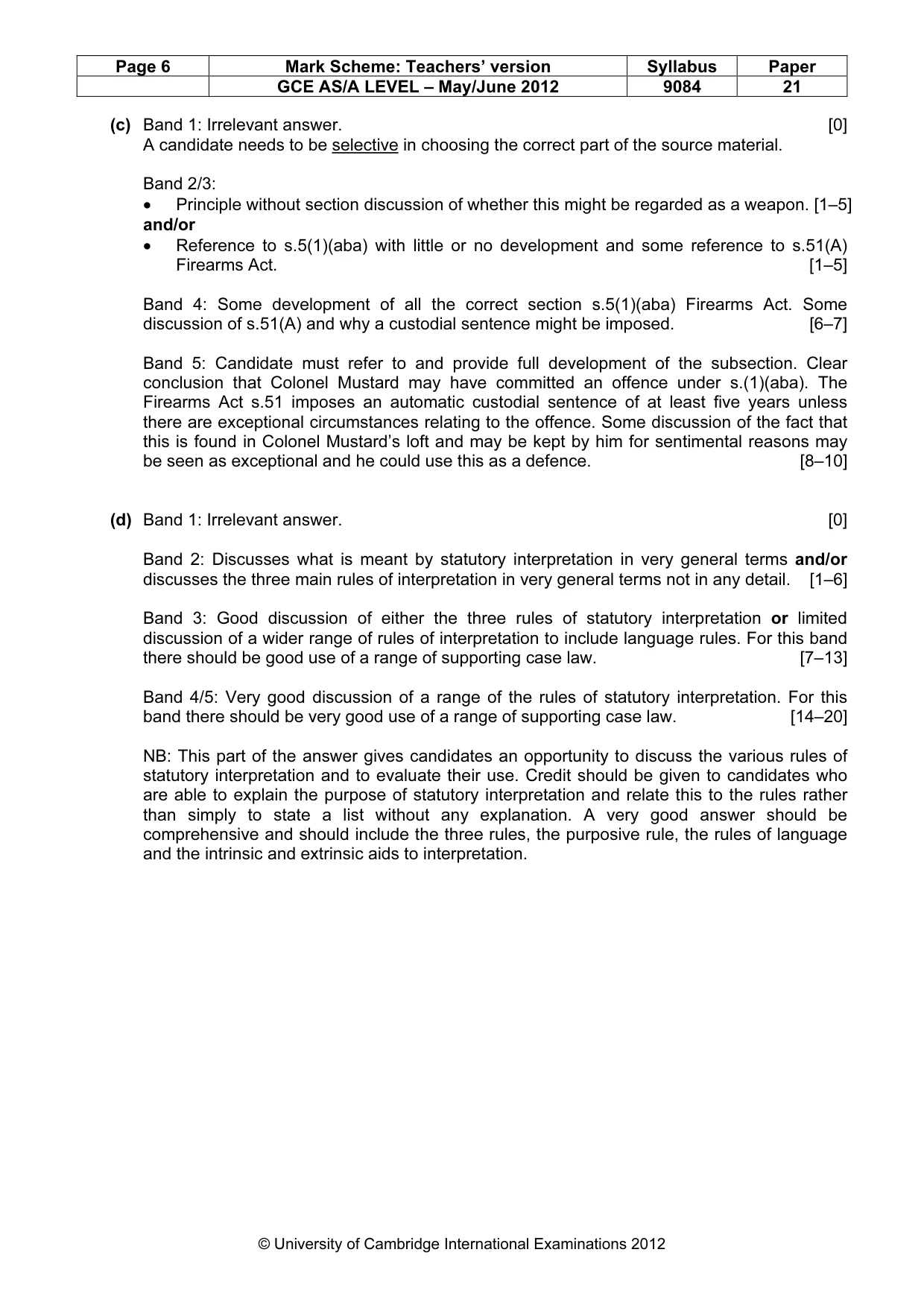
Page 6 Mark Scheme: Teachers’ version Syllabus Paper GCE AS/A LEVEL – May/June 2012 9084 21 © University of Cambridge International Examinations 2012 (c) Band 1: Irrelevant answer. [0] A candidate needs to be selective in choosing the correct part of the source material. Band 2/3: • Principle without section discussion of whether this might be regarded as a weapon. [1–5] and/or • Reference to s.5(1)(aba) with little or no development and some reference to s.51(A) Firearms Act. [1–5] Band 4: Some development of all the correct section s.5(1)(aba) Firearms Act. Some discussion of s.51(A) and why a custodial sentence might be imposed. [6–7] Band 5: Candidate must refer to and provide full development of the subsection. Clear conclusion that Colonel Mustard may have committed an offence under s.(1)(aba). The Firearms Act s.51 imposes an automatic custodial sentence of at least five years unless there are exceptional circumstances relating to the offence. Some discussion of the fact that this is found in Colonel Mustard’s loft and may be kept by him for sentimental reasons may be seen as exceptional and he could use this as a defence. [8–10] (d) Band 1: Irrelevant answer. [0] Band 2: Discusses what is meant by statutory interpretation in very general terms and/or discusses the three main rules of interpretation in very general terms not in any detail. [1–6] Band 3: Good discussion of either the three rules of statutory interpretation or limited discussion of a wider range of rules of interpretation to include language rules. For this band there should be good use of a range of supporting case law. [7–13] Band 4/5: Very good discussion of a range of the rules of statutory interpretation. For this band there should be very good use of a range of supporting case law. [14–20] NB: This part of the answer gives candidates an opportunity to discuss the various rules of statutory interpretation and to evaluate their use. Credit should be given to candidates who are able to explain the purpose of statutory interpretation and relate this to the rules rather than simply to state a list without any explanation. A very good answer should be comprehensive and should include the three rules, the purposive rule, the rules of language and the intrinsic and extrinsic aids to interpretation.
What you needed in this session
Cambridge’s own grade thresholds for 2012 May/June, Paper 2 · Variant 1. A higher threshold means an easier paper — the bar moves with how the cohort did.