Cambridge A Level Law 9084 — 2012 May/June Paper 2 · Variant 3
9084/23/M/J/12 · 50 marks · ≈56 min
The question paper and its mark scheme, free to read here and free to download. This is Cambridge’s own paper, exactly as it was sat.
Question paper4 pages

Mark scheme6 pages
Answers below. Sit the paper first if you are practising.
Paper as text
Question paper, page 1
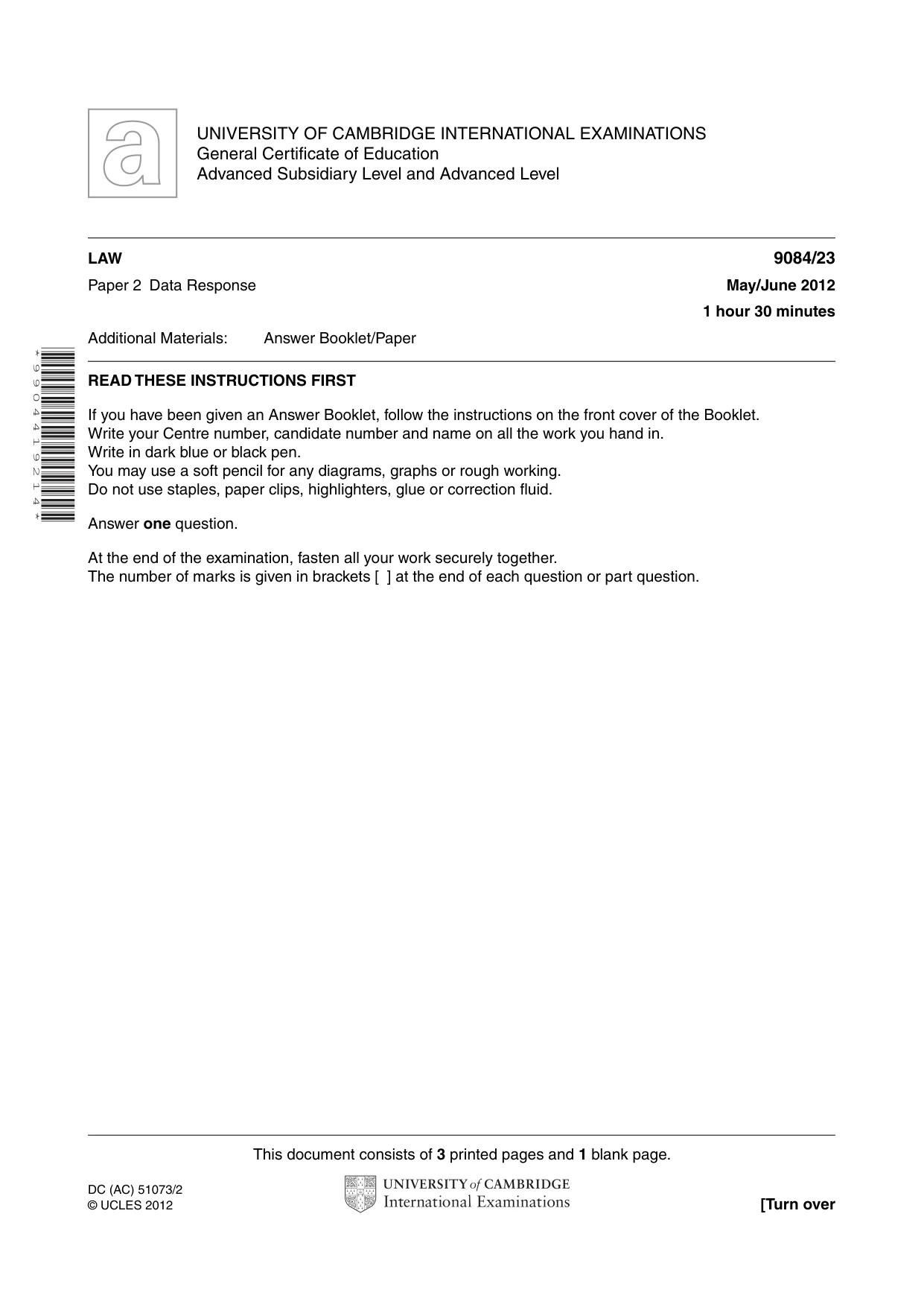
This document consists of 3 printed pages and 1 blank page. DC (AC) 51073/2 © UCLES 2012 [Turn over UNIVERSITY OF CAMBRIDGE INTERNATIONAL EXAMINATIONS General Certificate of Education Advanced Subsidiary Level and Advanced Level * 9 9 0 4 4 1 9 2 1 4 * LAW 9084/23 Paper 2 Data Response May/June 2012 1 hour 30 minutes Additional Materials: Answer Booklet/Paper READ THESE INSTRUCTIONS FIRST If you have been given an Answer Booklet, follow the instructions on the front cover of the Booklet. Write your Centre number, candidate number and name on all the work you hand in. Write in dark blue or black pen. You may use a soft pencil for any diagrams, graphs or rough working. Do not use staples, paper clips, highlighters, glue or correction fluid. Answer one question. At the end of the examination, fasten all your work securely together. The number of marks is given in brackets [ ] at the end of each question or part question.
Question paper, page 2
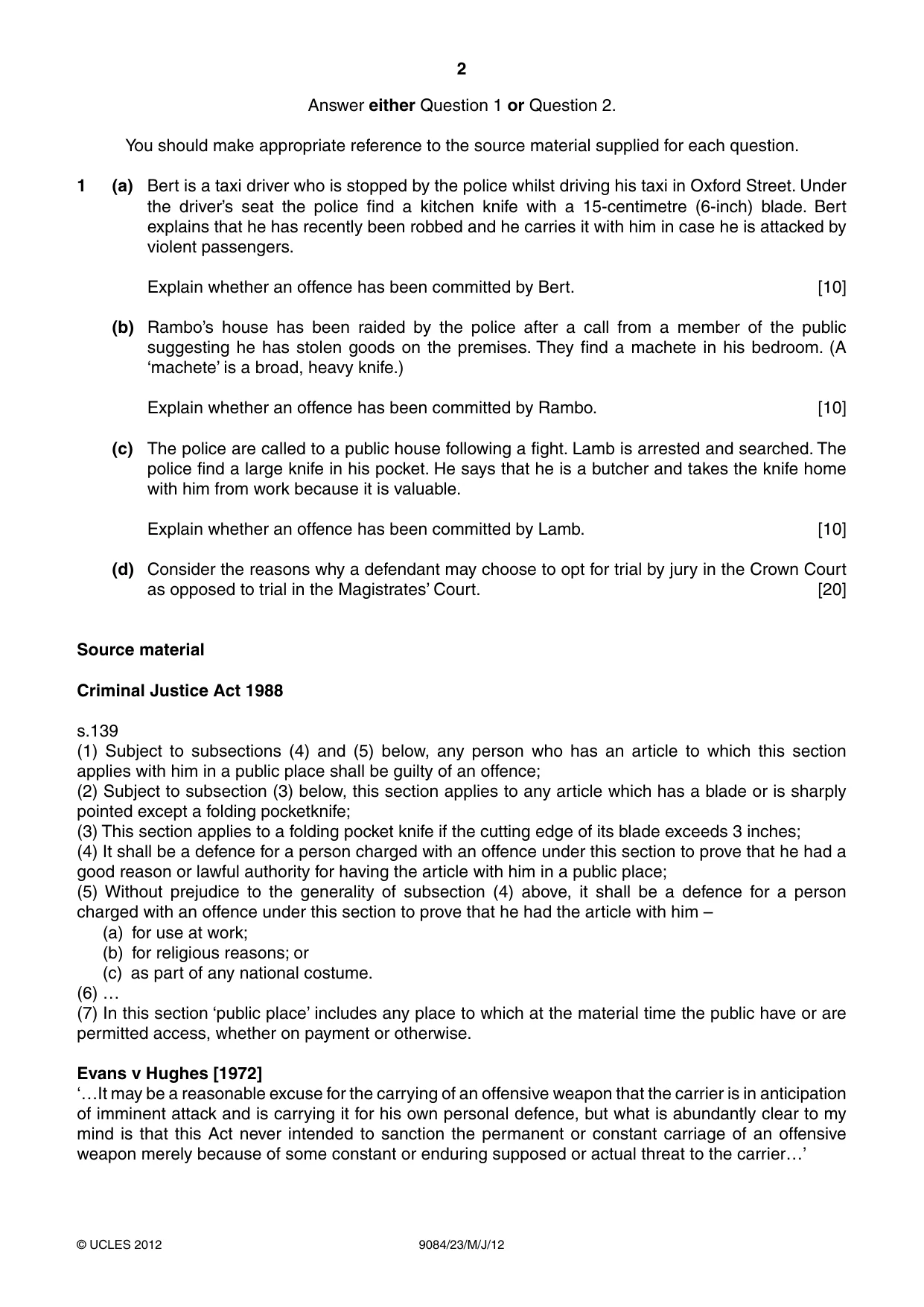
2 9084/23/M/J/12 © UCLES 2012 Answer either Question 1 or Question 2. You should make appropriate reference to the source material supplied for each question. 1 (a) Bert is a taxi driver who is stopped by the police whilst driving his taxi in Oxford Street. Under the driver’s seat the police find a kitchen knife with a 15-centimetre (6-inch) blade. Bert explains that he has recently been robbed and he carries it with him in case he is attacked by violent passengers. Explain whether an offence has been committed by Bert. [10] (b) Rambo’s house has been raided by the police after a call from a member of the public suggesting he has stolen goods on the premises. They find a machete in his bedroom. (A ‘machete’ is a broad, heavy knife.) Explain whether an offence has been committed by Rambo. [10] (c) The police are called to a public house following a fight. Lamb is arrested and searched. The police find a large knife in his pocket. He says that he is a butcher and takes the knife home with him from work because it is valuable. Explain whether an offence has been committed by Lamb. [10] (d) Consider the reasons why a defendant may choose to opt for trial by jury in the Crown Court as opposed to trial in the Magistrates’ Court. [20] Source material Criminal Justice Act 1988 s.139 (1) Subject to subsections (4) and (5) below, any person who has an article to which this section applies with him in a public place shall be guilty of an offence; (2) Subject to subsection (3) below, this section applies to any article which has a blade or is sharply pointed except a folding pocketknife; (3) This section applies to a folding pocket knife if the cutting edge of its blade exceeds 3 inches; (4) It shall be a defence for a person charged with an offence under this section to prove that he had a good reason or lawful authority for having the article with him in a public place; (5) Without prejudice to the generality of subsection (4) above, it shall be a defence for a person charged with an offence under this section to prove that he had the article with him – (a) for use at work; (b) for religious reasons; or (c) as part of any national costume. (6) … (7) In this section ‘public place’ includes any place to which at the material time the public have or are permitted access, whether on payment or otherwise. Evans v Hughes [1972] ‘…It may be a reasonable excuse for the carrying of an offensive weapon that the carrier is in anticipation of imminent attack and is carrying it for his own personal defence, but what is abundantly clear to my mind is that this Act never intended to sanction the permanent or constant carriage of an offensive weapon merely because of some constant or enduring supposed or actual threat to the carrier…’
Question paper, page 3
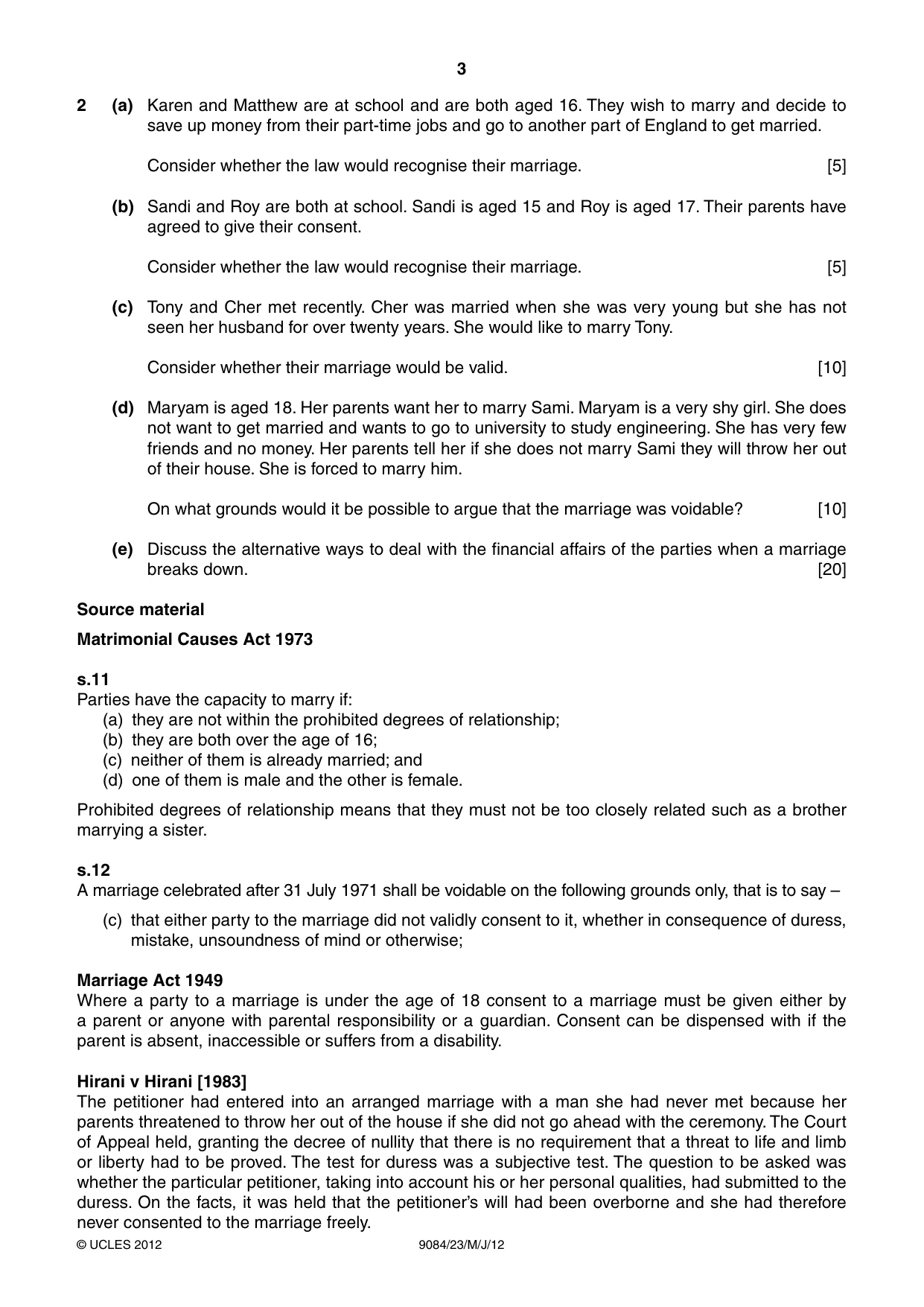
3 9084/23/M/J/12 © UCLES 2012 2 (a) Karen and Matthew are at school and are both aged 16. They wish to marry and decide to save up money from their part-time jobs and go to another part of England to get married. Consider whether the law would recognise their marriage. [5] (b) Sandi and Roy are both at school. Sandi is aged 15 and Roy is aged 17. Their parents have agreed to give their consent. Consider whether the law would recognise their marriage. [5] (c) Tony and Cher met recently. Cher was married when she was very young but she has not seen her husband for over twenty years. She would like to marry Tony. Consider whether their marriage would be valid. [10] (d) Maryam is aged 18. Her parents want her to marry Sami. Maryam is a very shy girl. She does not want to get married and wants to go to university to study engineering. She has very few friends and no money. Her parents tell her if she does not marry Sami they will throw her out of their house. She is forced to marry him. On what grounds would it be possible to argue that the marriage was voidable? [10] (e) Discuss the alternative ways to deal with the financial affairs of the parties when a marriage breaks down. [20] Source material Matrimonial Causes Act 1973 s.11 Parties have the capacity to marry if: (a) they are not within the prohibited degrees of relationship; (b) they are both over the age of 16; (c) neither of them is already married; and (d) one of them is male and the other is female. Prohibited degrees of relationship means that they must not be too closely related such as a brother marrying a sister. s.12 A marriage celebrated after 31 July 1971 shall be voidable on the following grounds only, that is to say – (c) that either party to the marriage did not validly consent to it, whether in consequence of duress, mistake, unsoundness of mind or otherwise; Marriage Act 1949 Where a party to a marriage is under the age of 18 consent to a marriage must be given either by a parent or anyone with parental responsibility or a guardian. Consent can be dispensed with if the parent is absent, inaccessible or suffers from a disability. Hirani v Hirani [1983] The petitioner had entered into an arranged marriage with a man she had never met because her parents threatened to throw her out of the house if she did not go ahead with the ceremony. The Court of Appeal held, granting the decree of nullity that there is no requirement that a threat to life and limb or liberty had to be proved. The test for duress was a subjective test. The question to be asked was whether the particular petitioner, taking into account his or her personal qualities, had submitted to the duress. On the facts, it was held that the petitioner’s will had been overborne and she had therefore never consented to the marriage freely.
Question paper, page 4
4 9084/23/M/J/12 © UCLES 2012 Permission to reproduce items where third-party owned material protected by copyright is included has been sought and cleared where possible. Every reasonable effort has been made by the publisher (UCLES) to trace copyright holders, but if any items requiring clearance have unwittingly been included, the publisher will be pleased to make amends at the earliest possible opportunity. University of Cambridge International Examinations is part of the Cambridge Assessment Group. Cambridge Assessment is the brand name of University of Cambridge Local Examinations Syndicate (UCLES), which is itself a department of the University of Cambridge. BLANK PAGE
Mark scheme, page 1
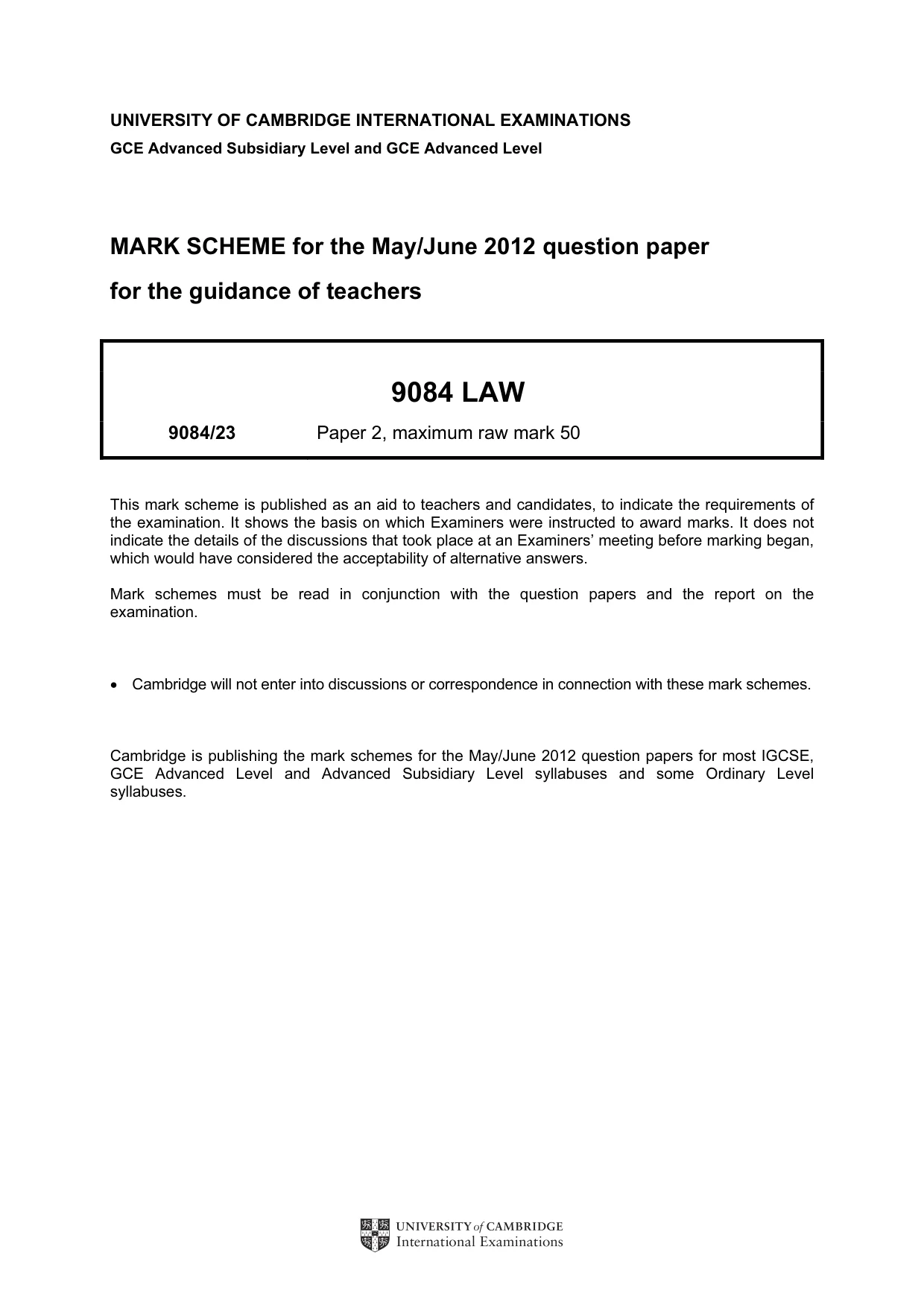
UNIVERSITY OF CAMBRIDGE INTERNATIONAL EXAMINATIONS GCE Advanced Subsidiary Level and GCE Advanced Level MARK SCHEME for the May/June 2012 question paper for the guidance of teachers 9084 LAW 9084/23 Paper 2, maximum raw mark 50 This mark scheme is published as an aid to teachers and candidates, to indicate the requirements of the examination. It shows the basis on which Examiners were instructed to award marks. It does not indicate the details of the discussions that took place at an Examiners’ meeting before marking began, which would have considered the acceptability of alternative answers. Mark schemes must be read in conjunction with the question papers and the report on the examination. • Cambridge will not enter into discussions or correspondence in connection with these mark schemes. Cambridge is publishing the mark schemes for the May/June 2012 question papers for most IGCSE, GCE Advanced Level and Advanced Subsidiary Level syllabuses and some Ordinary Level syllabuses.
Mark scheme, page 2
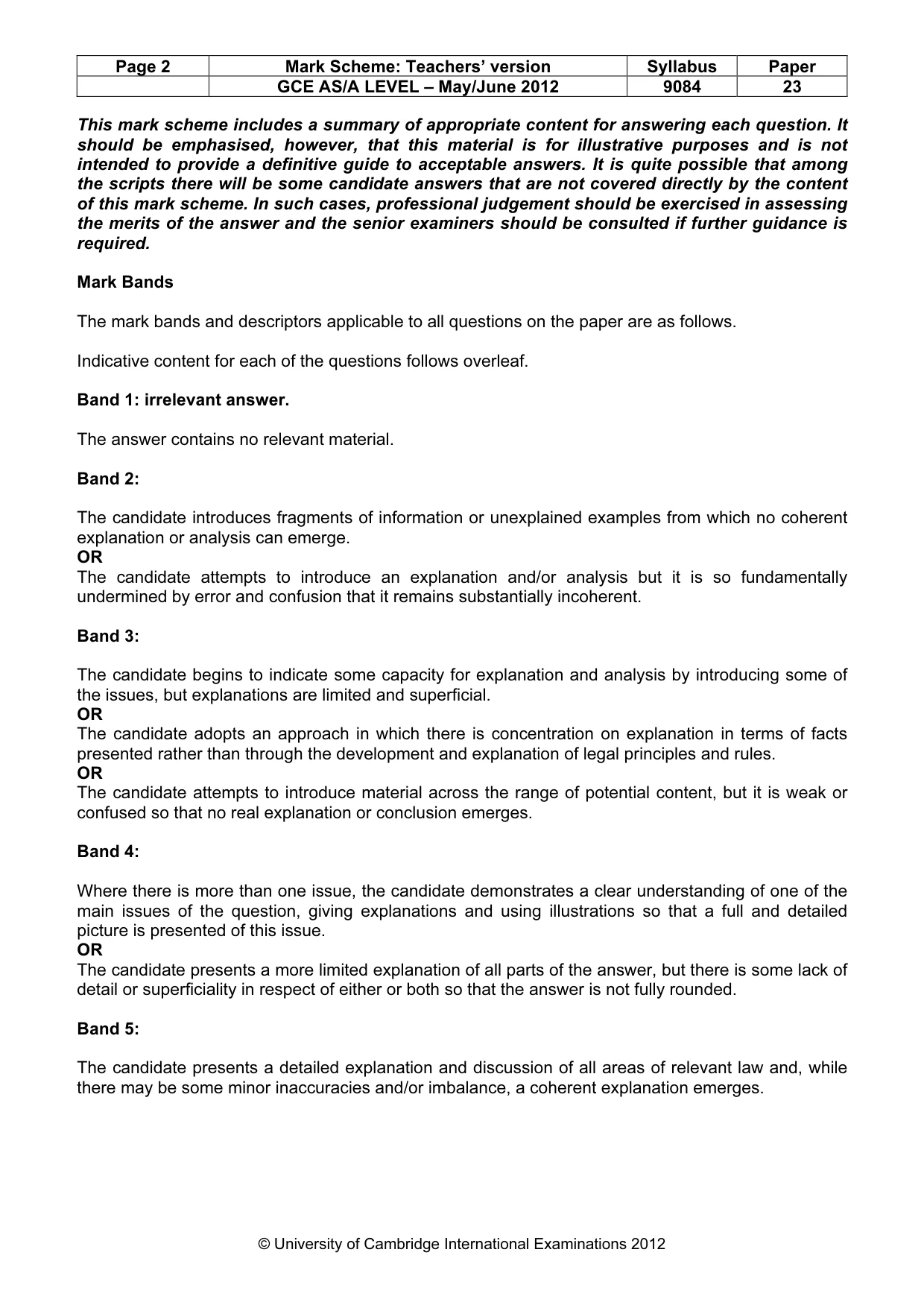
Page 2 Mark Scheme: Teachers’ version Syllabus Paper GCE AS/A LEVEL – May/June 2012 9084 23 © University of Cambridge International Examinations 2012 This mark scheme includes a summary of appropriate content for answering each question. It should be emphasised, however, that this material is for illustrative purposes and is not intended to provide a definitive guide to acceptable answers. It is quite possible that among the scripts there will be some candidate answers that are not covered directly by the content of this mark scheme. In such cases, professional judgement should be exercised in assessing the merits of the answer and the senior examiners should be consulted if further guidance is required. Mark Bands The mark bands and descriptors applicable to all questions on the paper are as follows. Indicative content for each of the questions follows overleaf. Band 1: irrelevant answer. The answer contains no relevant material. Band 2: The candidate introduces fragments of information or unexplained examples from which no coherent explanation or analysis can emerge. OR The candidate attempts to introduce an explanation and/or analysis but it is so fundamentally undermined by error and confusion that it remains substantially incoherent. Band 3: The candidate begins to indicate some capacity for explanation and analysis by introducing some of the issues, but explanations are limited and superficial. OR The candidate adopts an approach in which there is concentration on explanation in terms of facts presented rather than through the development and explanation of legal principles and rules. OR The candidate attempts to introduce material across the range of potential content, but it is weak or confused so that no real explanation or conclusion emerges. Band 4: Where there is more than one issue, the candidate demonstrates a clear understanding of one of the main issues of the question, giving explanations and using illustrations so that a full and detailed picture is presented of this issue. OR The candidate presents a more limited explanation of all parts of the answer, but there is some lack of detail or superficiality in respect of either or both so that the answer is not fully rounded. Band 5: The candidate presents a detailed explanation and discussion of all areas of relevant law and, while there may be some minor inaccuracies and/or imbalance, a coherent explanation emerges.
Mark scheme, page 3
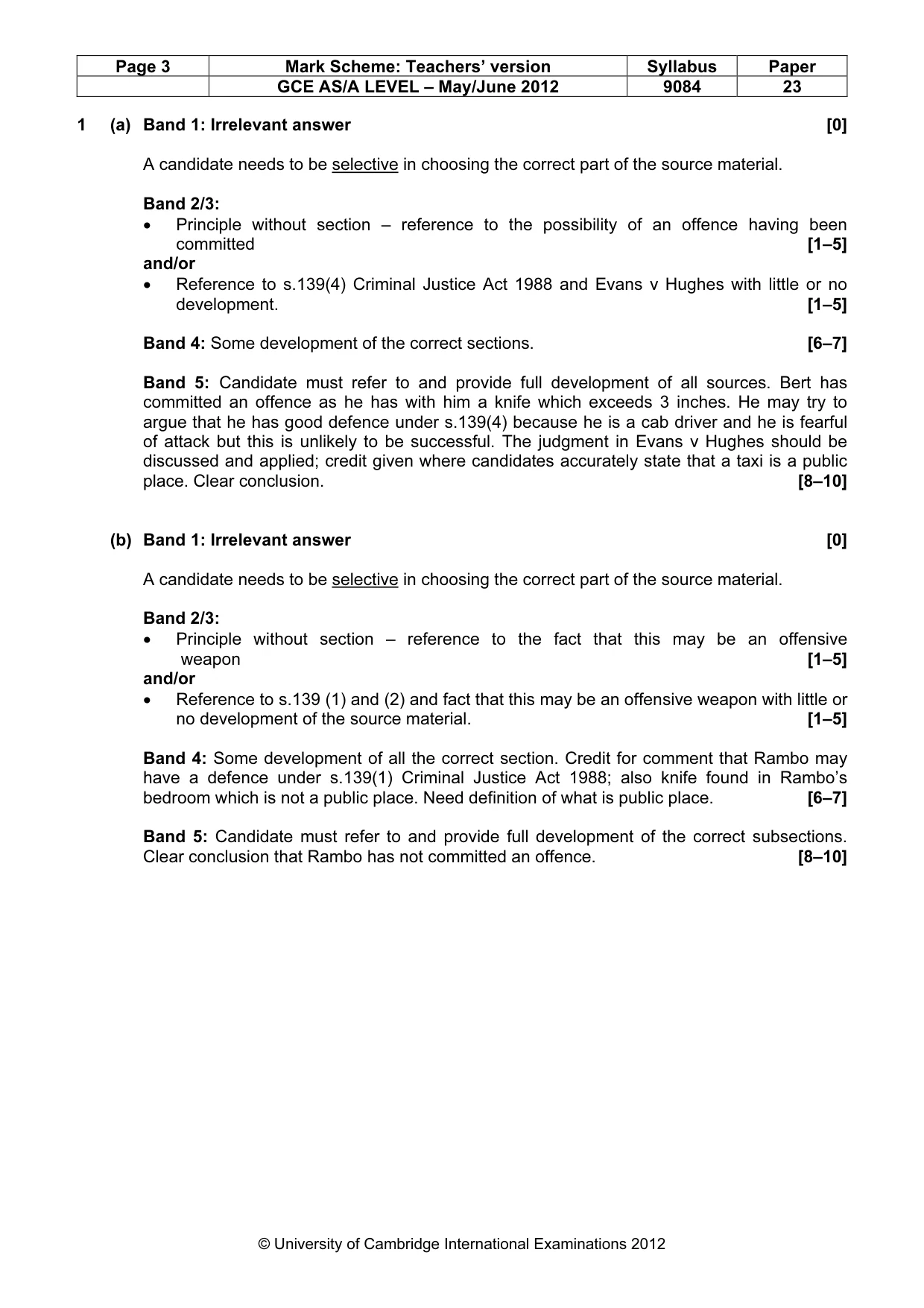
Page 3 Mark Scheme: Teachers’ version Syllabus Paper GCE AS/A LEVEL – May/June 2012 9084 23 © University of Cambridge International Examinations 2012 1 (a) Band 1: Irrelevant answer [0] A candidate needs to be selective in choosing the correct part of the source material. Band 2/3: • Principle without section – reference to the possibility of an offence having been committed [1–5] and/or • Reference to s.139(4) Criminal Justice Act 1988 and Evans v Hughes with little or no development. [1–5] Band 4: Some development of the correct sections. [6–7] Band 5: Candidate must refer to and provide full development of all sources. Bert has committed an offence as he has with him a knife which exceeds 3 inches. He may try to argue that he has good defence under s.139(4) because he is a cab driver and he is fearful of attack but this is unlikely to be successful. The judgment in Evans v Hughes should be discussed and applied; credit given where candidates accurately state that a taxi is a public place. Clear conclusion. [8–10] (b) Band 1: Irrelevant answer [0] A candidate needs to be selective in choosing the correct part of the source material. Band 2/3: • Principle without section – reference to the fact that this may be an offensive weapon [1–5] and/or • Reference to s.139 (1) and (2) and fact that this may be an offensive weapon with little or no development of the source material. [1–5] Band 4: Some development of all the correct section. Credit for comment that Rambo may have a defence under s.139(1) Criminal Justice Act 1988; also knife found in Rambo’s bedroom which is not a public place. Need definition of what is public place. [6–7] Band 5: Candidate must refer to and provide full development of the correct subsections. Clear conclusion that Rambo has not committed an offence. [8–10]
Mark scheme, page 4
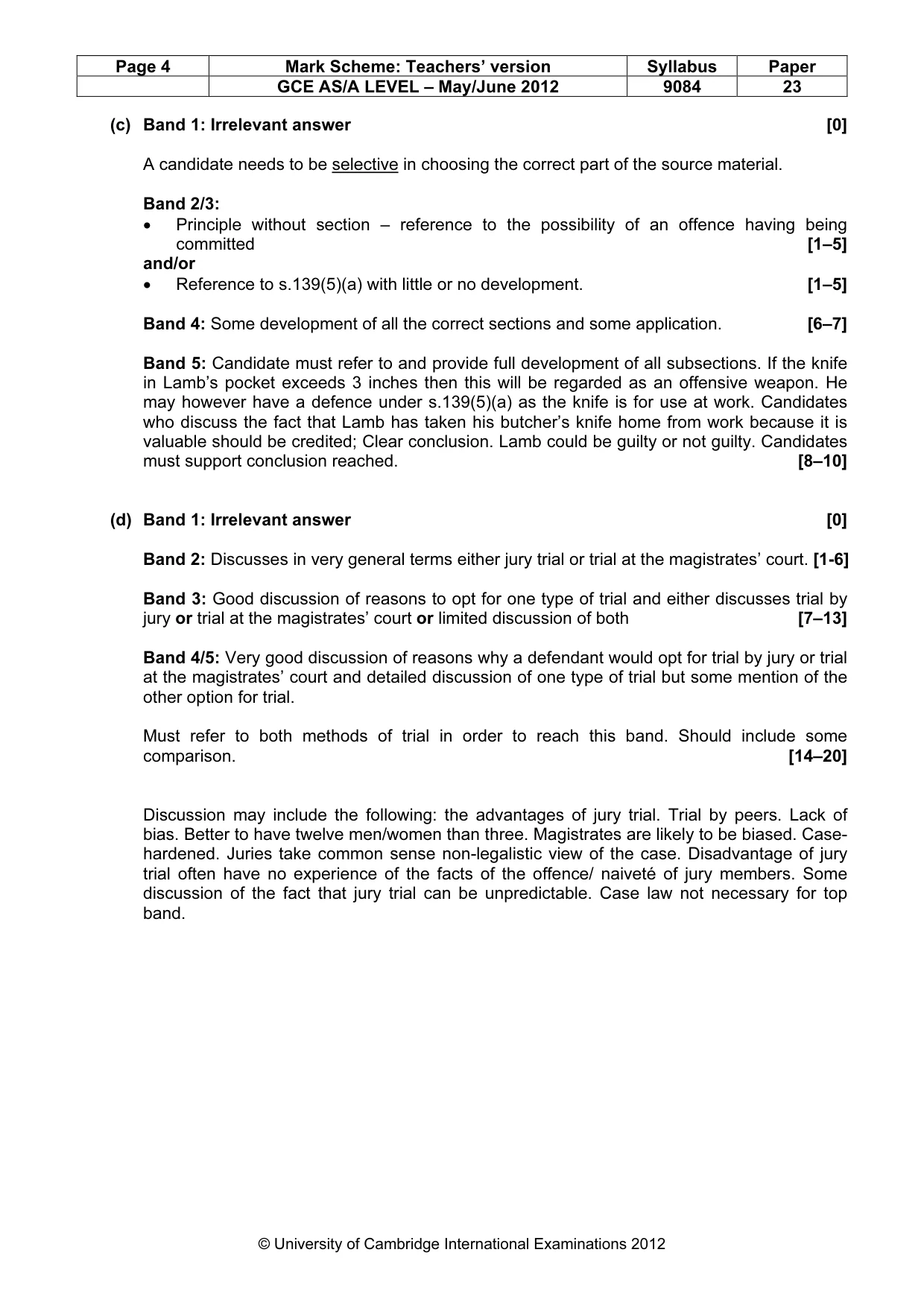
Page 4 Mark Scheme: Teachers’ version Syllabus Paper GCE AS/A LEVEL – May/June 2012 9084 23 © University of Cambridge International Examinations 2012 (c) Band 1: Irrelevant answer [0] A candidate needs to be selective in choosing the correct part of the source material. Band 2/3: • Principle without section – reference to the possibility of an offence having being committed [1–5] and/or • Reference to s.139(5)(a) with little or no development. [1–5] Band 4: Some development of all the correct sections and some application. [6–7] Band 5: Candidate must refer to and provide full development of all subsections. If the knife in Lamb’s pocket exceeds 3 inches then this will be regarded as an offensive weapon. He may however have a defence under s.139(5)(a) as the knife is for use at work. Candidates who discuss the fact that Lamb has taken his butcher’s knife home from work because it is valuable should be credited; Clear conclusion. Lamb could be guilty or not guilty. Candidates must support conclusion reached. [8–10] (d) Band 1: Irrelevant answer [0] Band 2: Discusses in very general terms either jury trial or trial at the magistrates’ court. [1-6] Band 3: Good discussion of reasons to opt for one type of trial and either discusses trial by jury or trial at the magistrates’ court or limited discussion of both [7–13] Band 4/5: Very good discussion of reasons why a defendant would opt for trial by jury or trial at the magistrates’ court and detailed discussion of one type of trial but some mention of the other option for trial. Must refer to both methods of trial in order to reach this band. Should include some comparison. [14–20] Discussion may include the following: the advantages of jury trial. Trial by peers. Lack of bias. Better to have twelve men/women than three. Magistrates are likely to be biased. Case- hardened. Juries take common sense non-legalistic view of the case. Disadvantage of jury trial often have no experience of the facts of the offence/ naiveté of jury members. Some discussion of the fact that jury trial can be unpredictable. Case law not necessary for top band.
Mark scheme, page 5
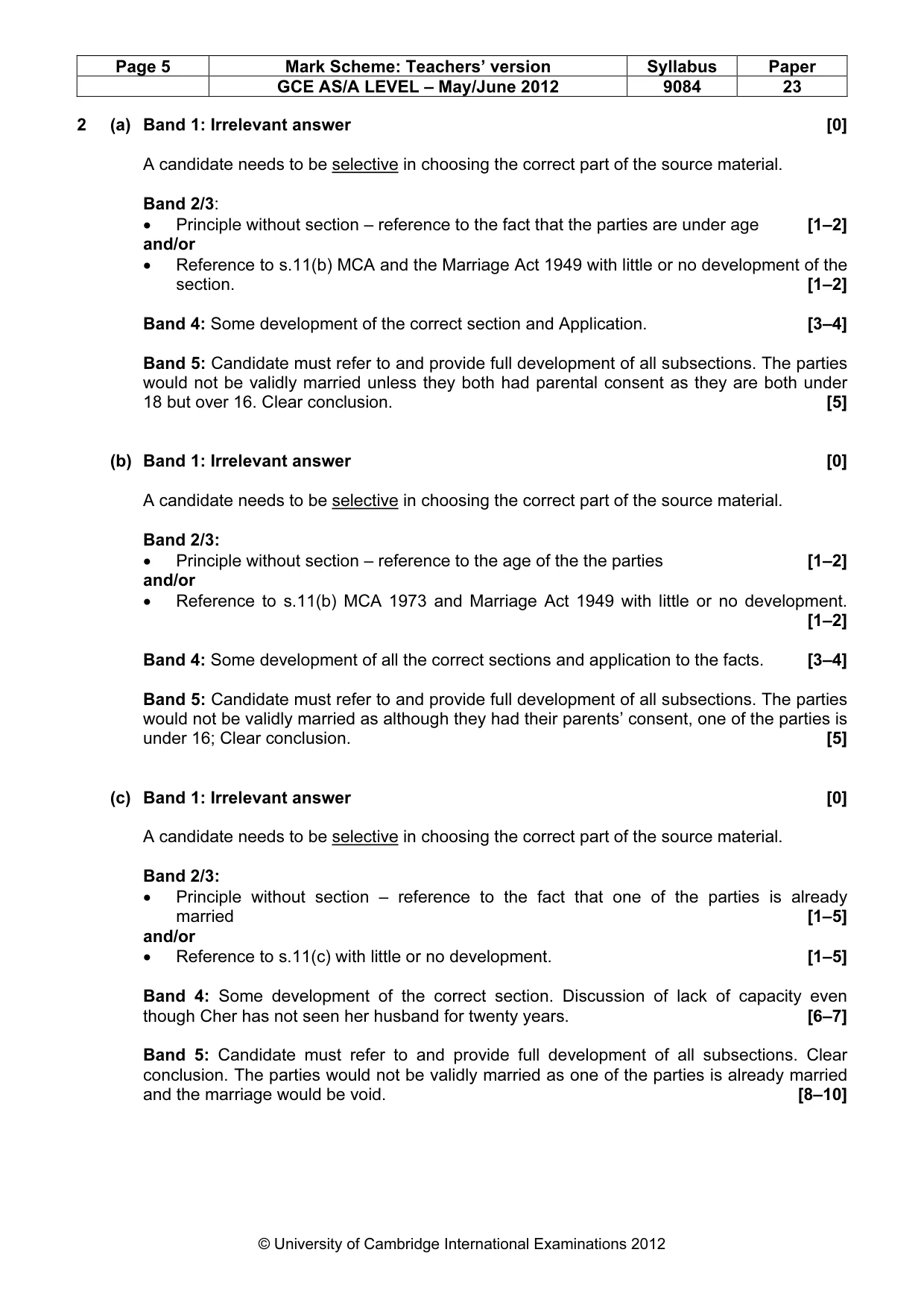
Page 5 Mark Scheme: Teachers’ version Syllabus Paper GCE AS/A LEVEL – May/June 2012 9084 23 © University of Cambridge International Examinations 2012 2 (a) Band 1: Irrelevant answer [0] A candidate needs to be selective in choosing the correct part of the source material. Band 2/3: • Principle without section – reference to the fact that the parties are under age [1–2] and/or • Reference to s.11(b) MCA and the Marriage Act 1949 with little or no development of the section. [1–2] Band 4: Some development of the correct section and Application. [3–4] Band 5: Candidate must refer to and provide full development of all subsections. The parties would not be validly married unless they both had parental consent as they are both under 18 but over 16. Clear conclusion. [5] (b) Band 1: Irrelevant answer [0] A candidate needs to be selective in choosing the correct part of the source material. Band 2/3: • Principle without section – reference to the age of the the parties [1–2] and/or • Reference to s.11(b) MCA 1973 and Marriage Act 1949 with little or no development. [1–2] Band 4: Some development of all the correct sections and application to the facts. [3–4] Band 5: Candidate must refer to and provide full development of all subsections. The parties would not be validly married as although they had their parents’ consent, one of the parties is under 16; Clear conclusion. [5] (c) Band 1: Irrelevant answer [0] A candidate needs to be selective in choosing the correct part of the source material. Band 2/3: • Principle without section – reference to the fact that one of the parties is already married [1–5] and/or • Reference to s.11(c) with little or no development. [1–5] Band 4: Some development of the correct section. Discussion of lack of capacity even though Cher has not seen her husband for twenty years. [6–7] Band 5: Candidate must refer to and provide full development of all subsections. Clear conclusion. The parties would not be validly married as one of the parties is already married and the marriage would be void. [8–10]
Mark scheme, page 6
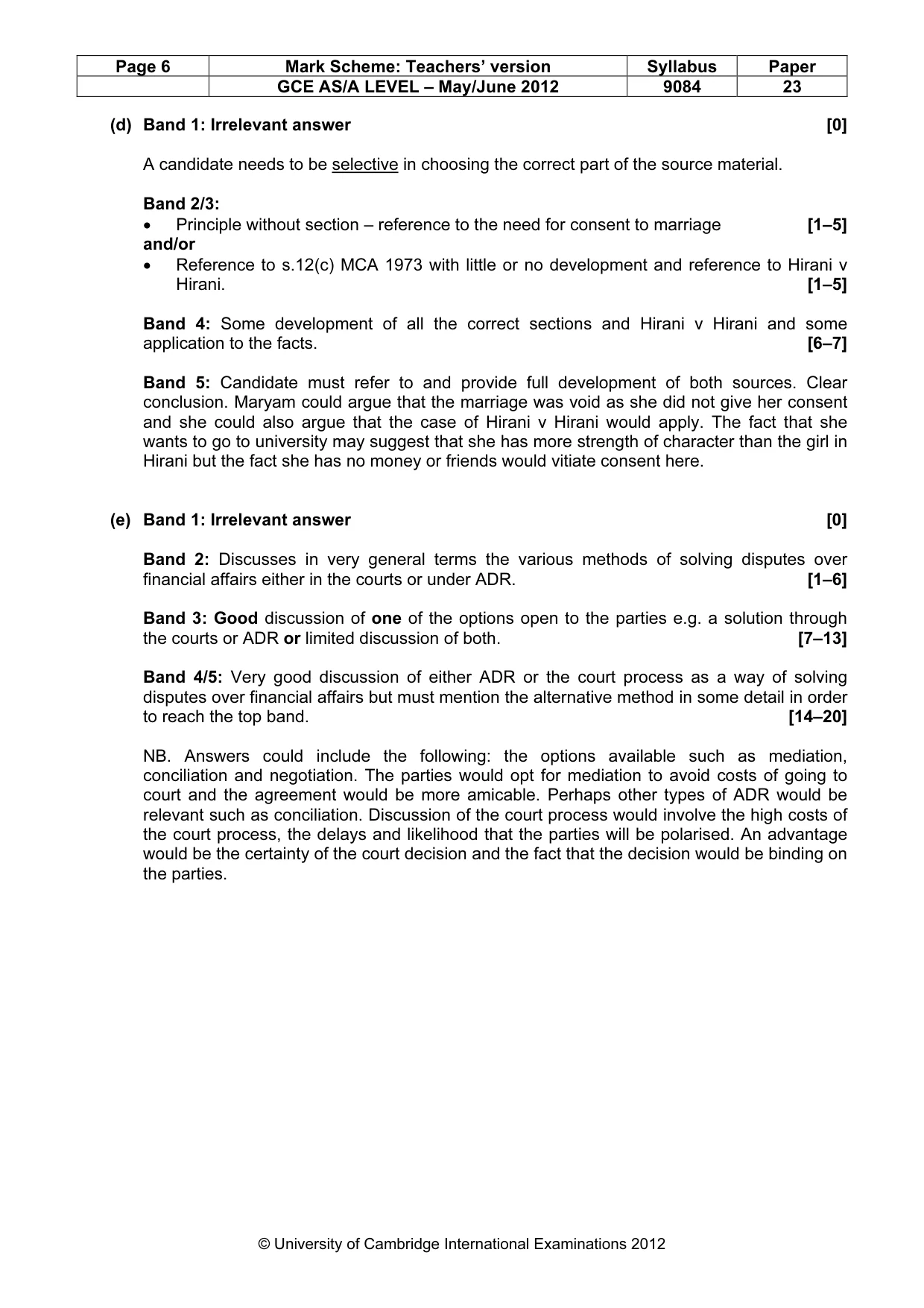
Page 6 Mark Scheme: Teachers’ version Syllabus Paper GCE AS/A LEVEL – May/June 2012 9084 23 © University of Cambridge International Examinations 2012 (d) Band 1: Irrelevant answer [0] A candidate needs to be selective in choosing the correct part of the source material. Band 2/3: • Principle without section – reference to the need for consent to marriage [1–5] and/or • Reference to s.12(c) MCA 1973 with little or no development and reference to Hirani v Hirani. [1–5] Band 4: Some development of all the correct sections and Hirani v Hirani and some application to the facts. [6–7] Band 5: Candidate must refer to and provide full development of both sources. Clear conclusion. Maryam could argue that the marriage was void as she did not give her consent and she could also argue that the case of Hirani v Hirani would apply. The fact that she wants to go to university may suggest that she has more strength of character than the girl in Hirani but the fact she has no money or friends would vitiate consent here. (e) Band 1: Irrelevant answer [0] Band 2: Discusses in very general terms the various methods of solving disputes over financial affairs either in the courts or under ADR. [1–6] Band 3: Good discussion of one of the options open to the parties e.g. a solution through the courts or ADR or limited discussion of both. [7–13] Band 4/5: Very good discussion of either ADR or the court process as a way of solving disputes over financial affairs but must mention the alternative method in some detail in order to reach the top band. [14–20] NB. Answers could include the following: the options available such as mediation, conciliation and negotiation. The parties would opt for mediation to avoid costs of going to court and the agreement would be more amicable. Perhaps other types of ADR would be relevant such as conciliation. Discussion of the court process would involve the high costs of the court process, the delays and likelihood that the parties will be polarised. An advantage would be the certainty of the court decision and the fact that the decision would be binding on the parties.
What you needed in this session
Cambridge’s own grade thresholds for 2012 May/June, Paper 2 · Variant 3. A higher threshold means an easier paper — the bar moves with how the cohort did.