Cambridge A Level Law 9084 — 2011 May/June Paper 2 · Variant 2
9084/22/M/J/11 · 50 marks · ≈56 min
The question paper and its mark scheme, free to read here and free to download. This is Cambridge’s own paper, exactly as it was sat.
Question paper4 pages

Mark scheme6 pages
Answers below. Sit the paper first if you are practising.
Paper as text
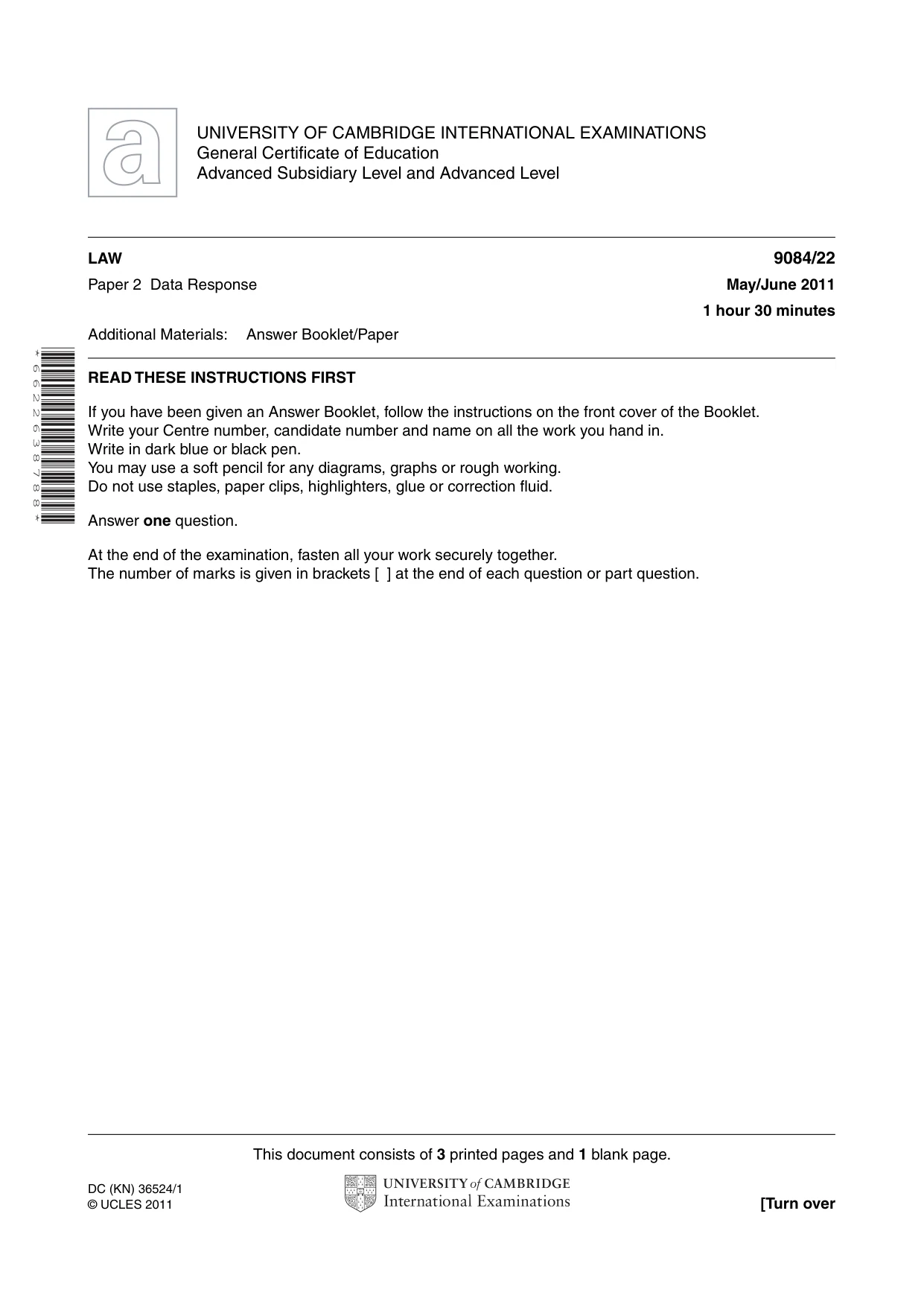
Question paper, page 1
This document consists of 3 printed pages and 1 blank page. DC (KN) 36524/1 © UCLES 2011 [Turn over UNIVERSITY OF CAMBRIDGE INTERNATIONAL EXAMINATIONS General Certificate of Education Advanced Subsidiary Level and Advanced Level READ THESE INSTRUCTIONS FIRST If you have been given an Answer Booklet, follow the instructions on the front cover of the Booklet. Write your Centre number, candidate number and name on all the work you hand in. Write in dark blue or black pen. You may use a soft pencil for any diagrams, graphs or rough working. Do not use staples, paper clips, highlighters, glue or correction fluid. Answer one question. At the end of the examination, fasten all your work securely together. The number of marks is given in brackets [ ] at the end of each question or part question. * 6 6 2 2 6 3 8 7 8 8 * LAW 9084/22 Paper 2 Data Response May/June 2011 1 hour 30 minutes Additional Materials: Answer Booklet/Paper
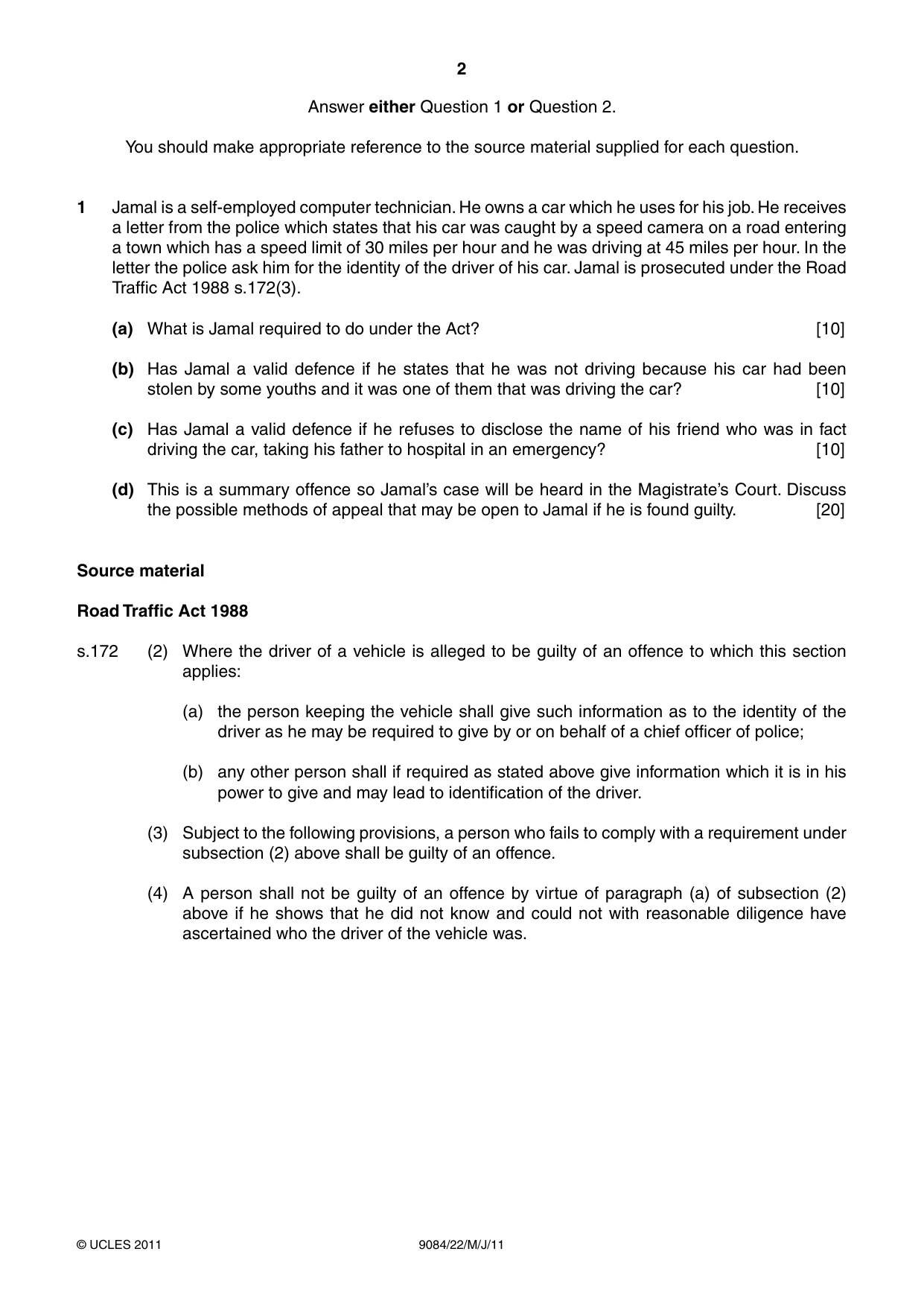
Question paper, page 2
2 9084/22/M/J/11 © UCLES 2011 Answer either Question 1 or Question 2. You should make appropriate reference to the source material supplied for each question. 1 Jamal is a self-employed computer technician. He owns a car which he uses for his job. He receives a letter from the police which states that his car was caught by a speed camera on a road entering a town which has a speed limit of 30 miles per hour and he was driving at 45 miles per hour. In the letter the police ask him for the identity of the driver of his car. Jamal is prosecuted under the Road Traffic Act 1988 s.172(3). (a) What is Jamal required to do under the Act? [10] (b) Has Jamal a valid defence if he states that he was not driving because his car had been stolen by some youths and it was one of them that was driving the car? [10] (c) Has Jamal a valid defence if he refuses to disclose the name of his friend who was in fact driving the car, taking his father to hospital in an emergency? [10] (d) This is a summary offence so Jamal’s case will be heard in the Magistrate’s Court. Discuss the possible methods of appeal that may be open to Jamal if he is found guilty. [20] Source material Road Traffic Act 1988 s.172 (2) Where the driver of a vehicle is alleged to be guilty of an offence to which this section applies: (a) the person keeping the vehicle shall give such information as to the identity of the driver as he may be required to give by or on behalf of a chief officer of police; (b) any other person shall if required as stated above give information which it is in his power to give and may lead to identification of the driver. (3) Subject to the following provisions, a person who fails to comply with a requirement under subsection (2) above shall be guilty of an offence. (4) A person shall not be guilty of an offence by virtue of paragraph (a) of subsection (2) above if he shows that he did not know and could not with reasonable diligence have ascertained who the driver of the vehicle was.
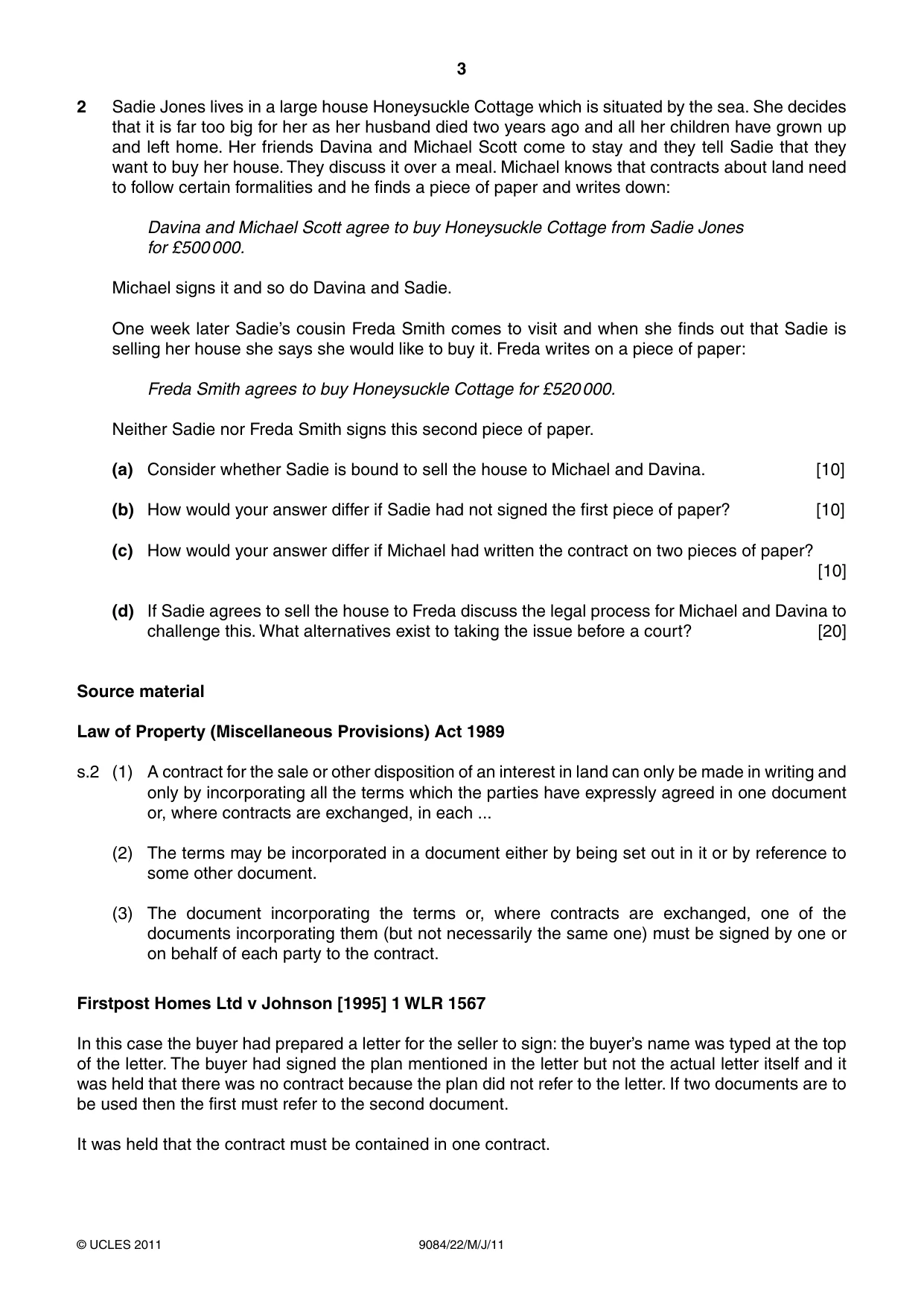
Question paper, page 3
3 9084/22/M/J/11 © UCLES 2011 2 Sadie Jones lives in a large house Honeysuckle Cottage which is situated by the sea. She decides that it is far too big for her as her husband died two years ago and all her children have grown up and left home. Her friends Davina and Michael Scott come to stay and they tell Sadie that they want to buy her house. They discuss it over a meal. Michael knows that contracts about land need to follow certain formalities and he finds a piece of paper and writes down: Davina and Michael Scott agree to buy Honeysuckle Cottage from Sadie Jones for £500 000. Michael signs it and so do Davina and Sadie. One week later Sadie’s cousin Freda Smith comes to visit and when she finds out that Sadie is selling her house she says she would like to buy it. Freda writes on a piece of paper: Freda Smith agrees to buy Honeysuckle Cottage for £520 000. Neither Sadie nor Freda Smith signs this second piece of paper. (a) Consider whether Sadie is bound to sell the house to Michael and Davina. [10] (b) How would your answer differ if Sadie had not signed the first piece of paper? [10] (c) How would your answer differ if Michael had written the contract on two pieces of paper? [10] (d) If Sadie agrees to sell the house to Freda discuss the legal process for Michael and Davina to challenge this. What alternatives exist to taking the issue before a court? [20] Source material Law of Property (Miscellaneous Provisions) Act 1989 s.2 (1) A contract for the sale or other disposition of an interest in land can only be made in writing and only by incorporating all the terms which the parties have expressly agreed in one document or, where contracts are exchanged, in each ... (2) The terms may be incorporated in a document either by being set out in it or by reference to some other document. (3) The document incorporating the terms or, where contracts are exchanged, one of the documents incorporating them (but not necessarily the same one) must be signed by one or on behalf of each party to the contract. Firstpost Homes Ltd v Johnson [1995] 1 WLR 1567 In this case the buyer had prepared a letter for the seller to sign: the buyer’s name was typed at the top of the letter. The buyer had signed the plan mentioned in the letter but not the actual letter itself and it was held that there was no contract because the plan did not refer to the letter. If two documents are to be used then the first must refer to the second document. It was held that the contract must be contained in one contract.
Question paper, page 4
4 9084/22/M/J/11 © UCLES 2011 BLANK PAGE Permission to reproduce items where third-party owned material protected by copyright is included has been sought and cleared where possible. Every reasonable effort has been made by the publisher (UCLES) to trace copyright holders, but if any items requiring clearance have unwittingly been included, the publisher will be pleased to make amends at the earliest possible opportunity. University of Cambridge International Examinations is part of the Cambridge Assessment Group. Cambridge Assessment is the brand name of University of Cambridge Local Examinations Syndicate (UCLES), which is itself a department of the University of Cambridge.
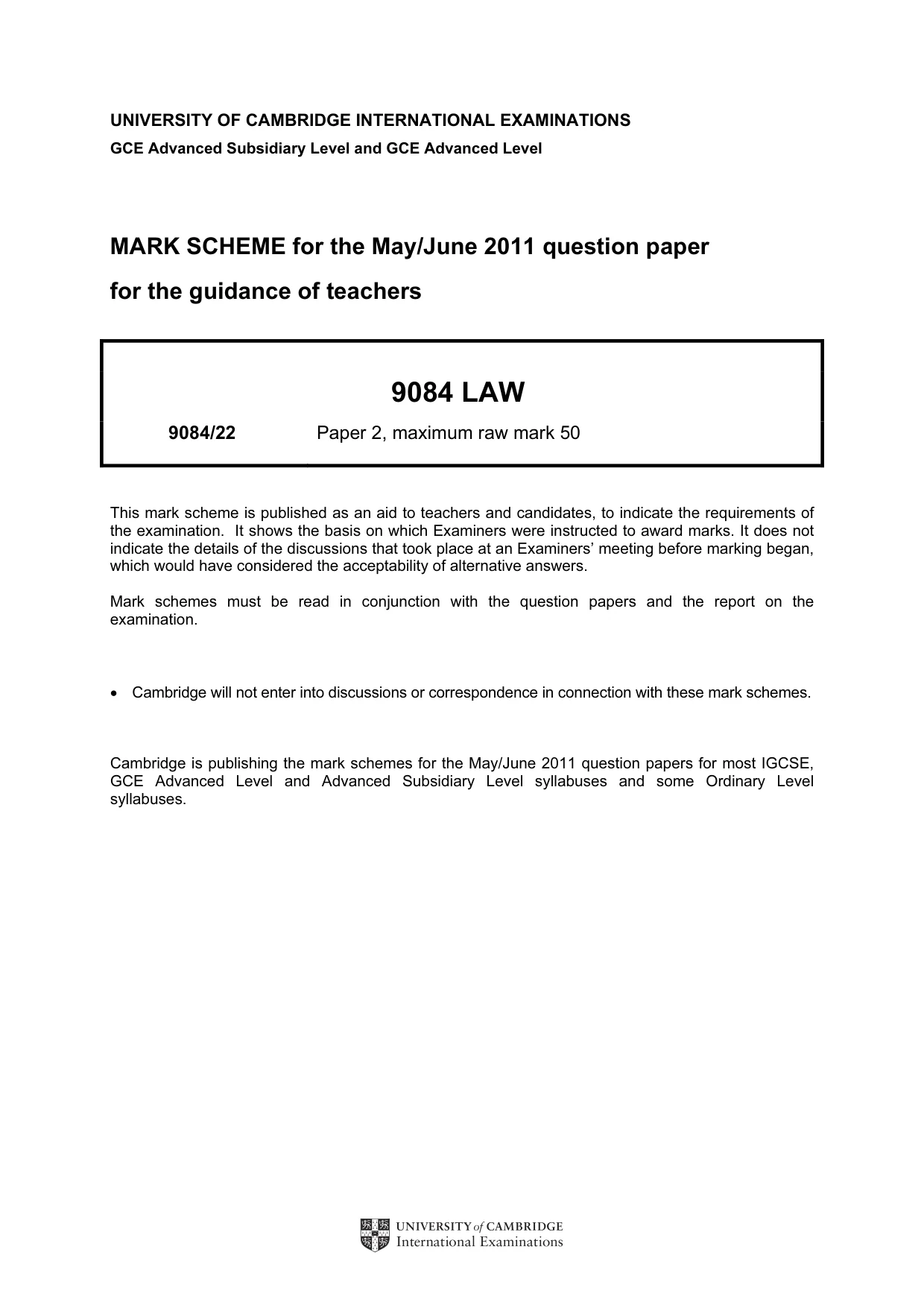
Mark scheme, page 1
UNIVERSITY OF CAMBRIDGE INTERNATIONAL EXAMINATIONS GCE Advanced Subsidiary Level and GCE Advanced Level MARK SCHEME for the May/June 2011 question paper for the guidance of teachers 9084 LAW 9084/22 Paper 2, maximum raw mark 50 This mark scheme is published as an aid to teachers and candidates, to indicate the requirements of the examination. It shows the basis on which Examiners were instructed to award marks. It does not indicate the details of the discussions that took place at an Examiners’ meeting before marking began, which would have considered the acceptability of alternative answers. Mark schemes must be read in conjunction with the question papers and the report on the examination. • Cambridge will not enter into discussions or correspondence in connection with these mark schemes. Cambridge is publishing the mark schemes for the May/June 2011 question papers for most IGCSE, GCE Advanced Level and Advanced Subsidiary Level syllabuses and some Ordinary Level syllabuses.
Mark scheme, page 2
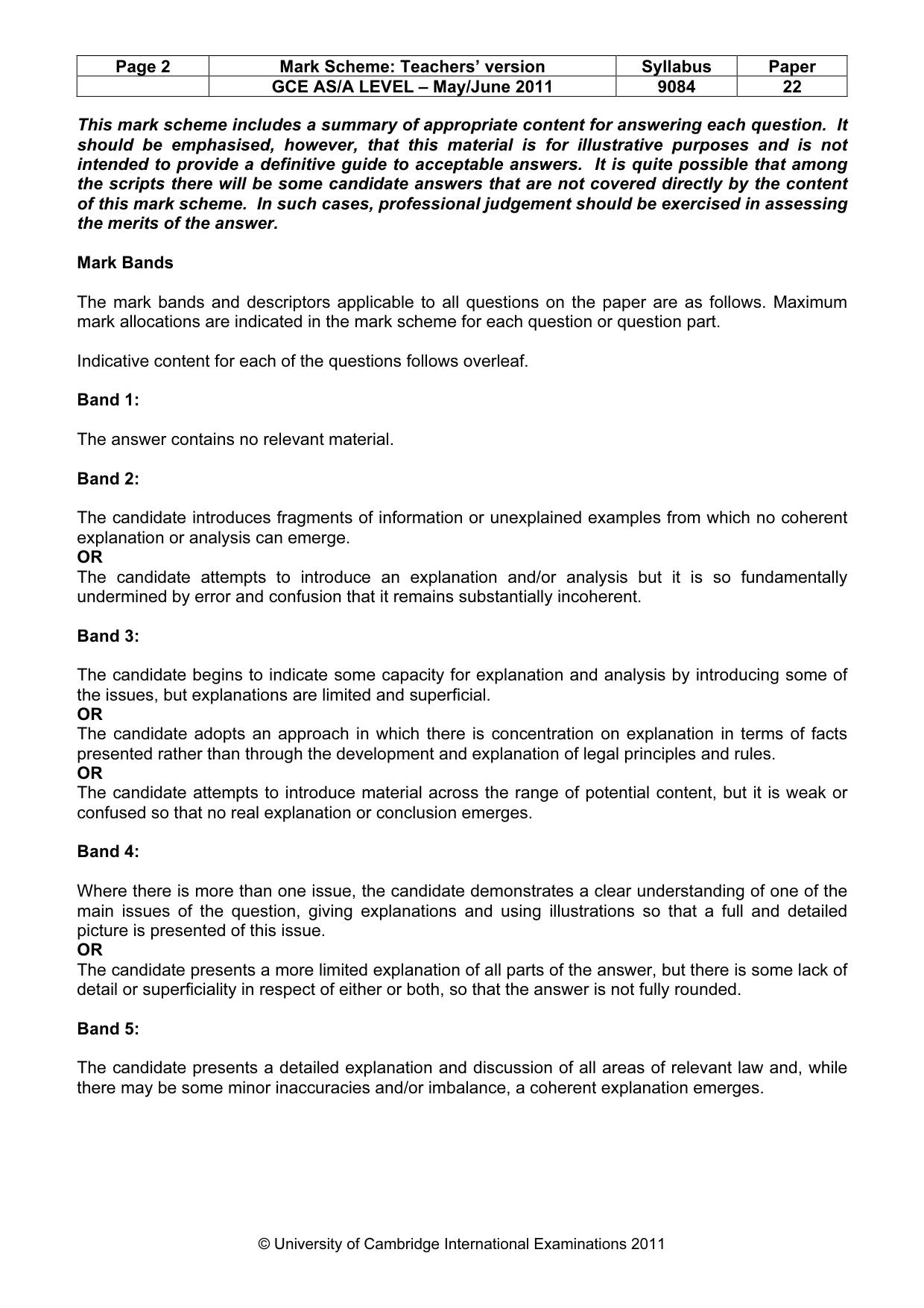
Page 2 Mark Scheme: Teachers’ version Syllabus Paper GCE AS/A LEVEL – May/June 2011 9084 22 © University of Cambridge International Examinations 2011 This mark scheme includes a summary of appropriate content for answering each question. It should be emphasised, however, that this material is for illustrative purposes and is not intended to provide a definitive guide to acceptable answers. It is quite possible that among the scripts there will be some candidate answers that are not covered directly by the content of this mark scheme. In such cases, professional judgement should be exercised in assessing the merits of the answer. Mark Bands The mark bands and descriptors applicable to all questions on the paper are as follows. Maximum mark allocations are indicated in the mark scheme for each question or question part. Indicative content for each of the questions follows overleaf. Band 1: The answer contains no relevant material. Band 2: The candidate introduces fragments of information or unexplained examples from which no coherent explanation or analysis can emerge. OR The candidate attempts to introduce an explanation and/or analysis but it is so fundamentally undermined by error and confusion that it remains substantially incoherent. Band 3: The candidate begins to indicate some capacity for explanation and analysis by introducing some of the issues, but explanations are limited and superficial. OR The candidate adopts an approach in which there is concentration on explanation in terms of facts presented rather than through the development and explanation of legal principles and rules. OR The candidate attempts to introduce material across the range of potential content, but it is weak or confused so that no real explanation or conclusion emerges. Band 4: Where there is more than one issue, the candidate demonstrates a clear understanding of one of the main issues of the question, giving explanations and using illustrations so that a full and detailed picture is presented of this issue. OR The candidate presents a more limited explanation of all parts of the answer, but there is some lack of detail or superficiality in respect of either or both, so that the answer is not fully rounded. Band 5: The candidate presents a detailed explanation and discussion of all areas of relevant law and, while there may be some minor inaccuracies and/or imbalance, a coherent explanation emerges.
Mark scheme, page 3
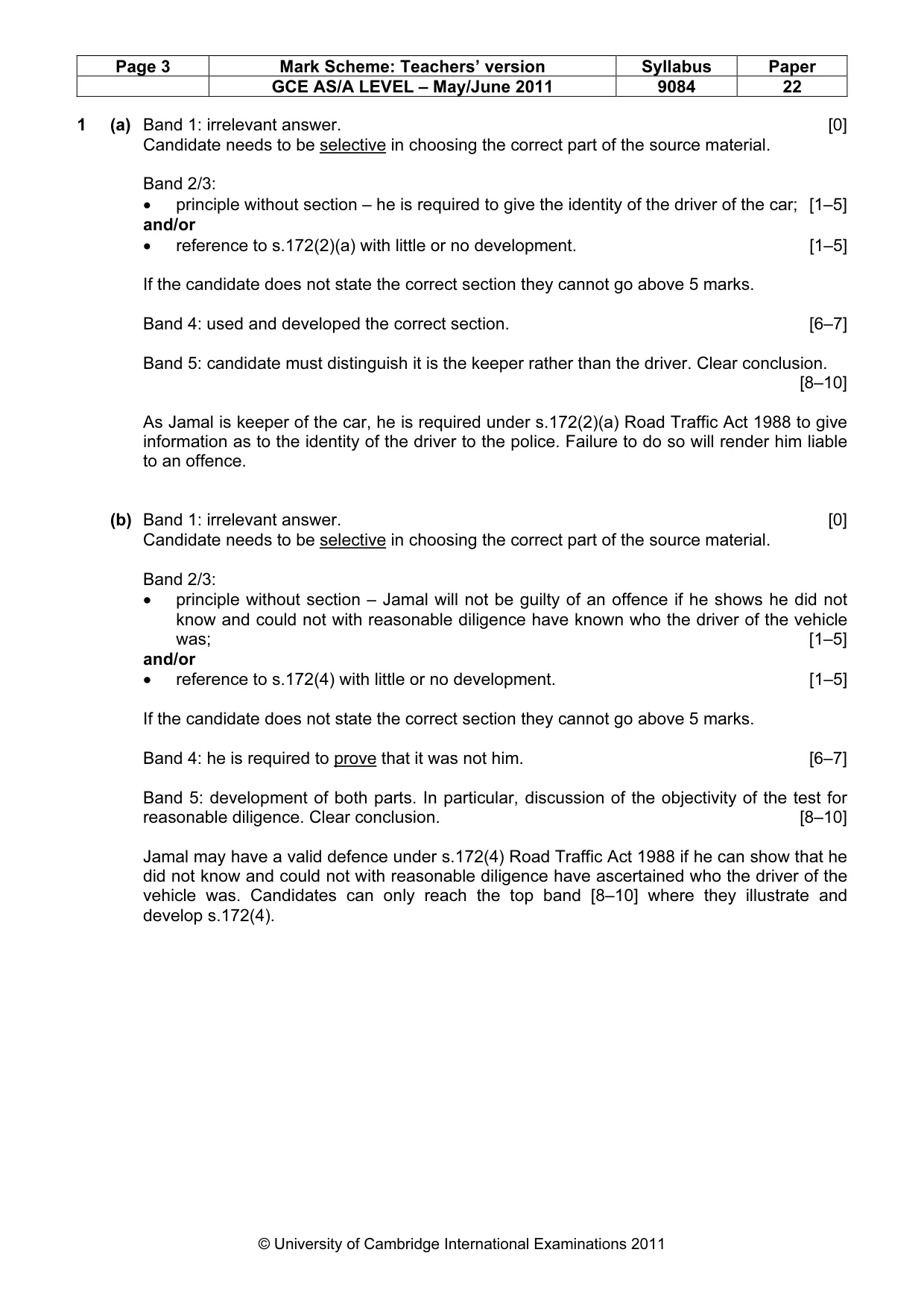
Page 3 Mark Scheme: Teachers’ version Syllabus Paper GCE AS/A LEVEL – May/June 2011 9084 22 © University of Cambridge International Examinations 2011 1 (a) Band 1: irrelevant answer. [0] Candidate needs to be selective in choosing the correct part of the source material. Band 2/3: • principle without section – he is required to give the identity of the driver of the car; [1–5] and/or • reference to s.172(2)(a) with little or no development. [1–5] If the candidate does not state the correct section they cannot go above 5 marks. Band 4: used and developed the correct section. [6–7] Band 5: candidate must distinguish it is the keeper rather than the driver. Clear conclusion. [8–10] As Jamal is keeper of the car, he is required under s.172(2)(a) Road Traffic Act 1988 to give information as to the identity of the driver to the police. Failure to do so will render him liable to an offence. (b) Band 1: irrelevant answer. [0] Candidate needs to be selective in choosing the correct part of the source material. Band 2/3: • principle without section – Jamal will not be guilty of an offence if he shows he did not know and could not with reasonable diligence have known who the driver of the vehicle was; [1–5] and/or • reference to s.172(4) with little or no development. [1–5] If the candidate does not state the correct section they cannot go above 5 marks. Band 4: he is required to prove that it was not him. [6–7] Band 5: development of both parts. In particular, discussion of the objectivity of the test for reasonable diligence. Clear conclusion. [8–10] Jamal may have a valid defence under s.172(4) Road Traffic Act 1988 if he can show that he did not know and could not with reasonable diligence have ascertained who the driver of the vehicle was. Candidates can only reach the top band [8–10] where they illustrate and develop s.172(4).
Mark scheme, page 4
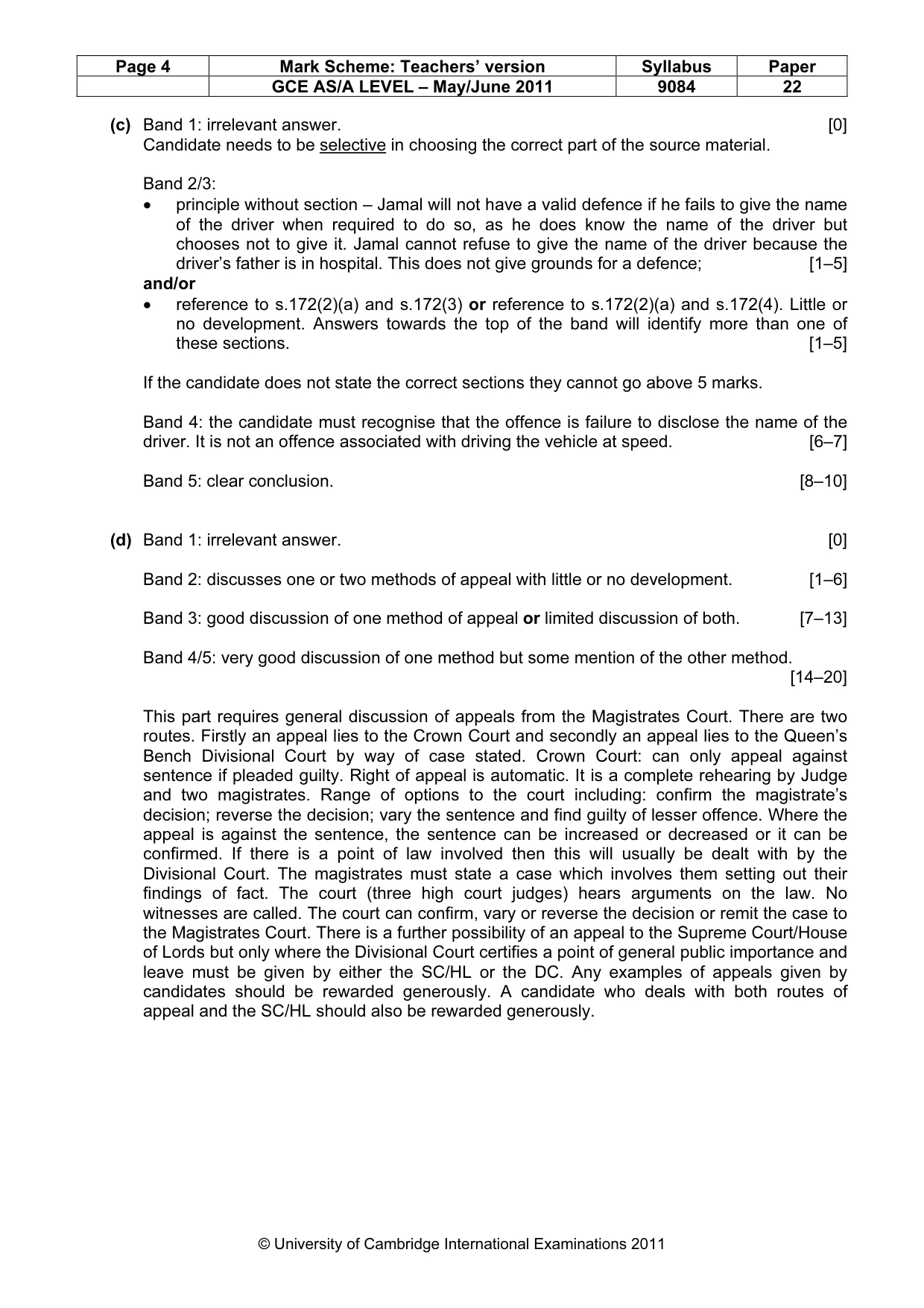
Page 4 Mark Scheme: Teachers’ version Syllabus Paper GCE AS/A LEVEL – May/June 2011 9084 22 © University of Cambridge International Examinations 2011 (c) Band 1: irrelevant answer. [0] Candidate needs to be selective in choosing the correct part of the source material. Band 2/3: • principle without section – Jamal will not have a valid defence if he fails to give the name of the driver when required to do so, as he does know the name of the driver but chooses not to give it. Jamal cannot refuse to give the name of the driver because the driver’s father is in hospital. This does not give grounds for a defence; [1–5] and/or • reference to s.172(2)(a) and s.172(3) or reference to s.172(2)(a) and s.172(4). Little or no development. Answers towards the top of the band will identify more than one of these sections. [1–5] If the candidate does not state the correct sections they cannot go above 5 marks. Band 4: the candidate must recognise that the offence is failure to disclose the name of the driver. It is not an offence associated with driving the vehicle at speed. [6–7] Band 5: clear conclusion. [8–10] (d) Band 1: irrelevant answer. [0] Band 2: discusses one or two methods of appeal with little or no development. [1–6] Band 3: good discussion of one method of appeal or limited discussion of both. [7–13] Band 4/5: very good discussion of one method but some mention of the other method. [14–20] This part requires general discussion of appeals from the Magistrates Court. There are two routes. Firstly an appeal lies to the Crown Court and secondly an appeal lies to the Queen’s Bench Divisional Court by way of case stated. Crown Court: can only appeal against sentence if pleaded guilty. Right of appeal is automatic. It is a complete rehearing by Judge and two magistrates. Range of options to the court including: confirm the magistrate’s decision; reverse the decision; vary the sentence and find guilty of lesser offence. Where the appeal is against the sentence, the sentence can be increased or decreased or it can be confirmed. If there is a point of law involved then this will usually be dealt with by the Divisional Court. The magistrates must state a case which involves them setting out their findings of fact. The court (three high court judges) hears arguments on the law. No witnesses are called. The court can confirm, vary or reverse the decision or remit the case to the Magistrates Court. There is a further possibility of an appeal to the Supreme Court/House of Lords but only where the Divisional Court certifies a point of general public importance and leave must be given by either the SC/HL or the DC. Any examples of appeals given by candidates should be rewarded generously. A candidate who deals with both routes of appeal and the SC/HL should also be rewarded generously.
Mark scheme, page 5
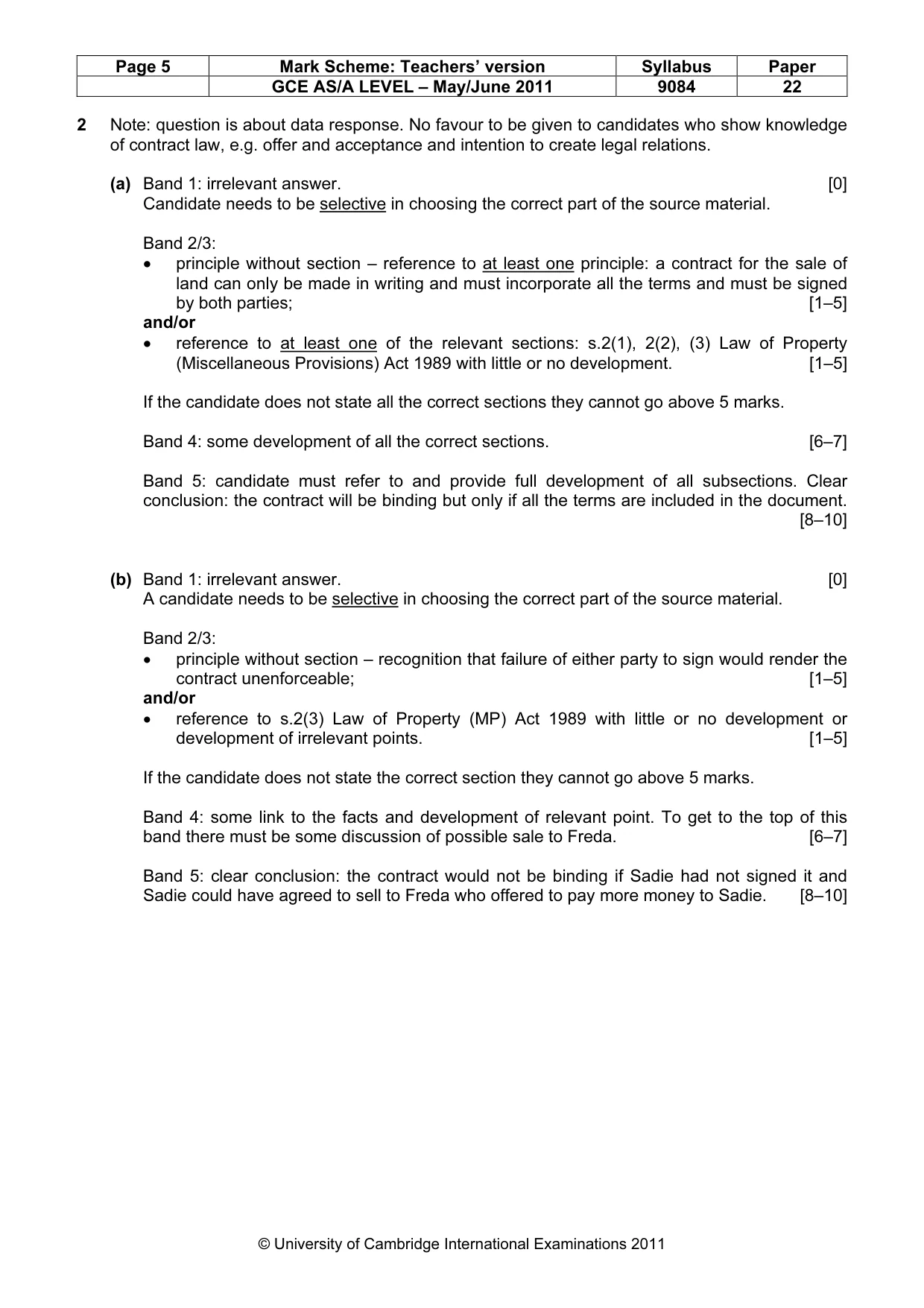
Page 5 Mark Scheme: Teachers’ version Syllabus Paper GCE AS/A LEVEL – May/June 2011 9084 22 © University of Cambridge International Examinations 2011 2 Note: question is about data response. No favour to be given to candidates who show knowledge of contract law, e.g. offer and acceptance and intention to create legal relations. (a) Band 1: irrelevant answer. [0] Candidate needs to be selective in choosing the correct part of the source material. Band 2/3: • principle without section – reference to at least one principle: a contract for the sale of land can only be made in writing and must incorporate all the terms and must be signed by both parties; [1–5] and/or • reference to at least one of the relevant sections: s.2(1), 2(2), (3) Law of Property (Miscellaneous Provisions) Act 1989 with little or no development. [1–5] If the candidate does not state all the correct sections they cannot go above 5 marks. Band 4: some development of all the correct sections. [6–7] Band 5: candidate must refer to and provide full development of all subsections. Clear conclusion: the contract will be binding but only if all the terms are included in the document. [8–10] (b) Band 1: irrelevant answer. [0] A candidate needs to be selective in choosing the correct part of the source material. Band 2/3: • principle without section – recognition that failure of either party to sign would render the contract unenforceable; [1–5] and/or • reference to s.2(3) Law of Property (MP) Act 1989 with little or no development or development of irrelevant points. [1–5] If the candidate does not state the correct section they cannot go above 5 marks. Band 4: some link to the facts and development of relevant point. To get to the top of this band there must be some discussion of possible sale to Freda. [6–7] Band 5: clear conclusion: the contract would not be binding if Sadie had not signed it and Sadie could have agreed to sell to Freda who offered to pay more money to Sadie. [8–10]
Mark scheme, page 6
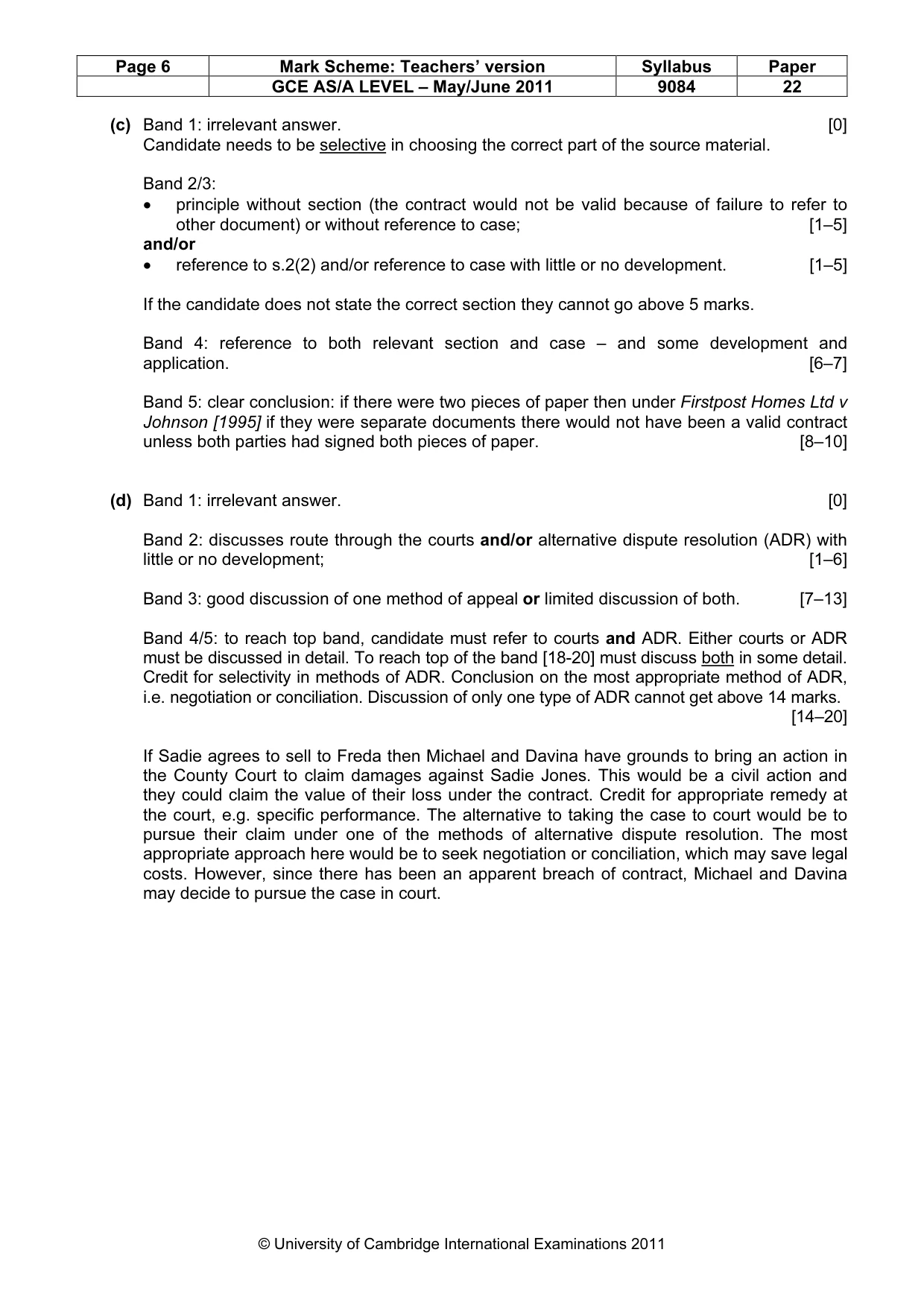
Page 6 Mark Scheme: Teachers’ version Syllabus Paper GCE AS/A LEVEL – May/June 2011 9084 22 © University of Cambridge International Examinations 2011 (c) Band 1: irrelevant answer. [0] Candidate needs to be selective in choosing the correct part of the source material. Band 2/3: • principle without section (the contract would not be valid because of failure to refer to other document) or without reference to case; [1–5] and/or • reference to s.2(2) and/or reference to case with little or no development. [1–5] If the candidate does not state the correct section they cannot go above 5 marks. Band 4: reference to both relevant section and case – and some development and application. [6–7] Band 5: clear conclusion: if there were two pieces of paper then under Firstpost Homes Ltd v Johnson [1995] if they were separate documents there would not have been a valid contract unless both parties had signed both pieces of paper. [8–10] (d) Band 1: irrelevant answer. [0] Band 2: discusses route through the courts and/or alternative dispute resolution (ADR) with little or no development; [1–6] Band 3: good discussion of one method of appeal or limited discussion of both. [7–13] Band 4/5: to reach top band, candidate must refer to courts and ADR. Either courts or ADR must be discussed in detail. To reach top of the band [18-20] must discuss both in some detail. Credit for selectivity in methods of ADR. Conclusion on the most appropriate method of ADR, i.e. negotiation or conciliation. Discussion of only one type of ADR cannot get above 14 marks. [14–20] If Sadie agrees to sell to Freda then Michael and Davina have grounds to bring an action in the County Court to claim damages against Sadie Jones. This would be a civil action and they could claim the value of their loss under the contract. Credit for appropriate remedy at the court, e.g. specific performance. The alternative to taking the case to court would be to pursue their claim under one of the methods of alternative dispute resolution. The most appropriate approach here would be to seek negotiation or conciliation, which may save legal costs. However, since there has been an apparent breach of contract, Michael and Davina may decide to pursue the case in court.
What you needed in this session
Cambridge’s own grade thresholds for 2011 May/June, Paper 2 · Variant 2. A higher threshold means an easier paper — the bar moves with how the cohort did.