Cambridge A Level Law 9084 — 2011 May/June Paper 2 · Variant 1
9084/21/M/J/11 · 50 marks · ≈56 min
The question paper and its mark scheme, free to read here and free to download. This is Cambridge’s own paper, exactly as it was sat.
Question paper4 pages

Mark scheme7 pages
Answers below. Sit the paper first if you are practising.
Paper as text
Question paper, page 1
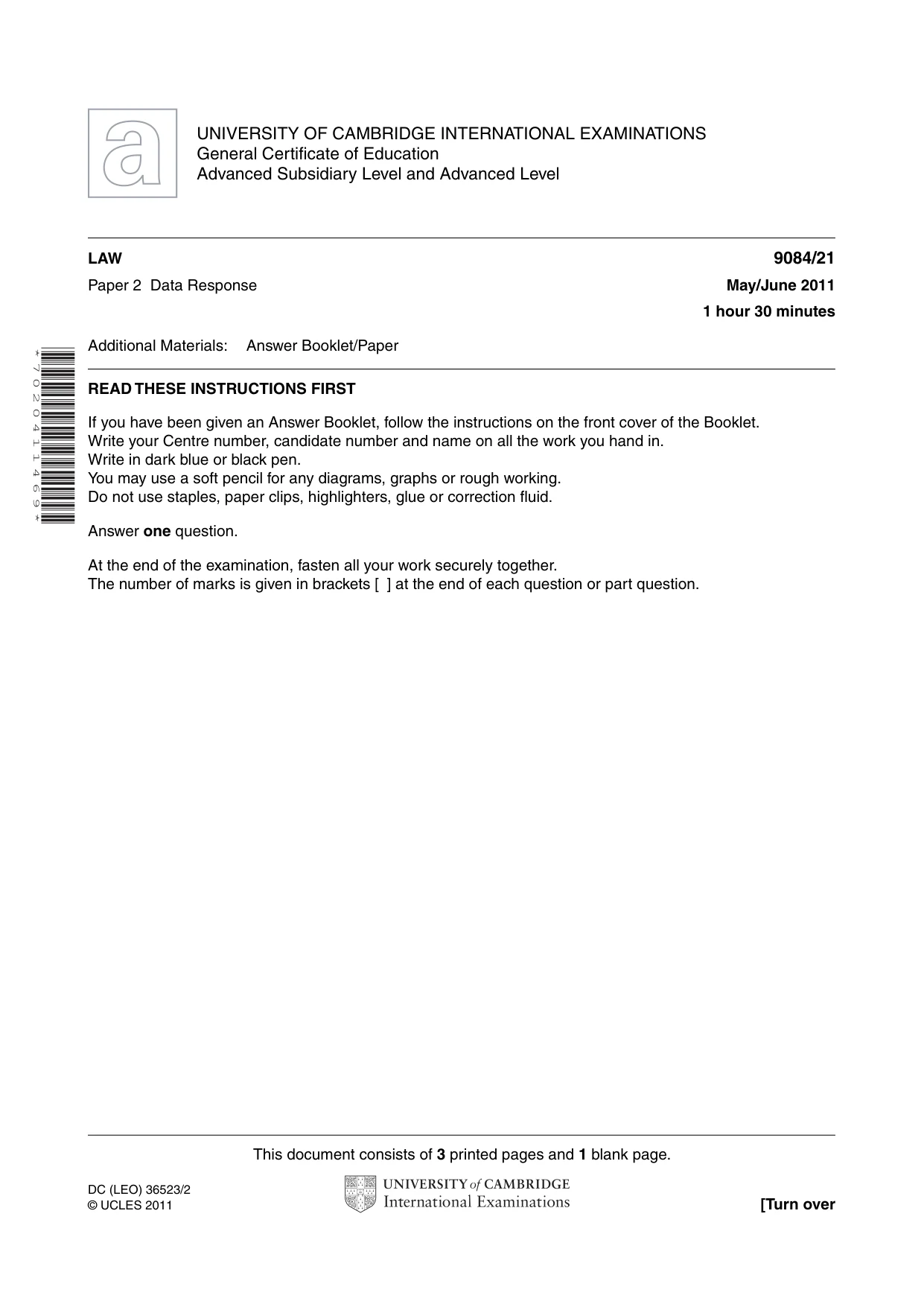
This document consists of 3 printed pages and 1 blank page. DC (LEO) 36523/2 © UCLES 2011 [Turn over UNIVERSITY OF CAMBRIDGE INTERNATIONAL EXAMINATIONS General Certificate of Education Advanced Subsidiary Level and Advanced Level * 7 0 2 0 4 1 1 4 6 9 * LAW 9084/21 Paper 2 Data Response May/June 2011 1 hour 30 minutes Additional Materials: Answer Booklet/Paper READ THESE INSTRUCTIONS FIRST If you have been given an Answer Booklet, follow the instructions on the front cover of the Booklet. Write your Centre number, candidate number and name on all the work you hand in. Write in dark blue or black pen. You may use a soft pencil for any diagrams, graphs or rough working. Do not use staples, paper clips, highlighters, glue or correction fluid. Answer one question. At the end of the examination, fasten all your work securely together. The number of marks is given in brackets [ ] at the end of each question or part question.
Question paper, page 2
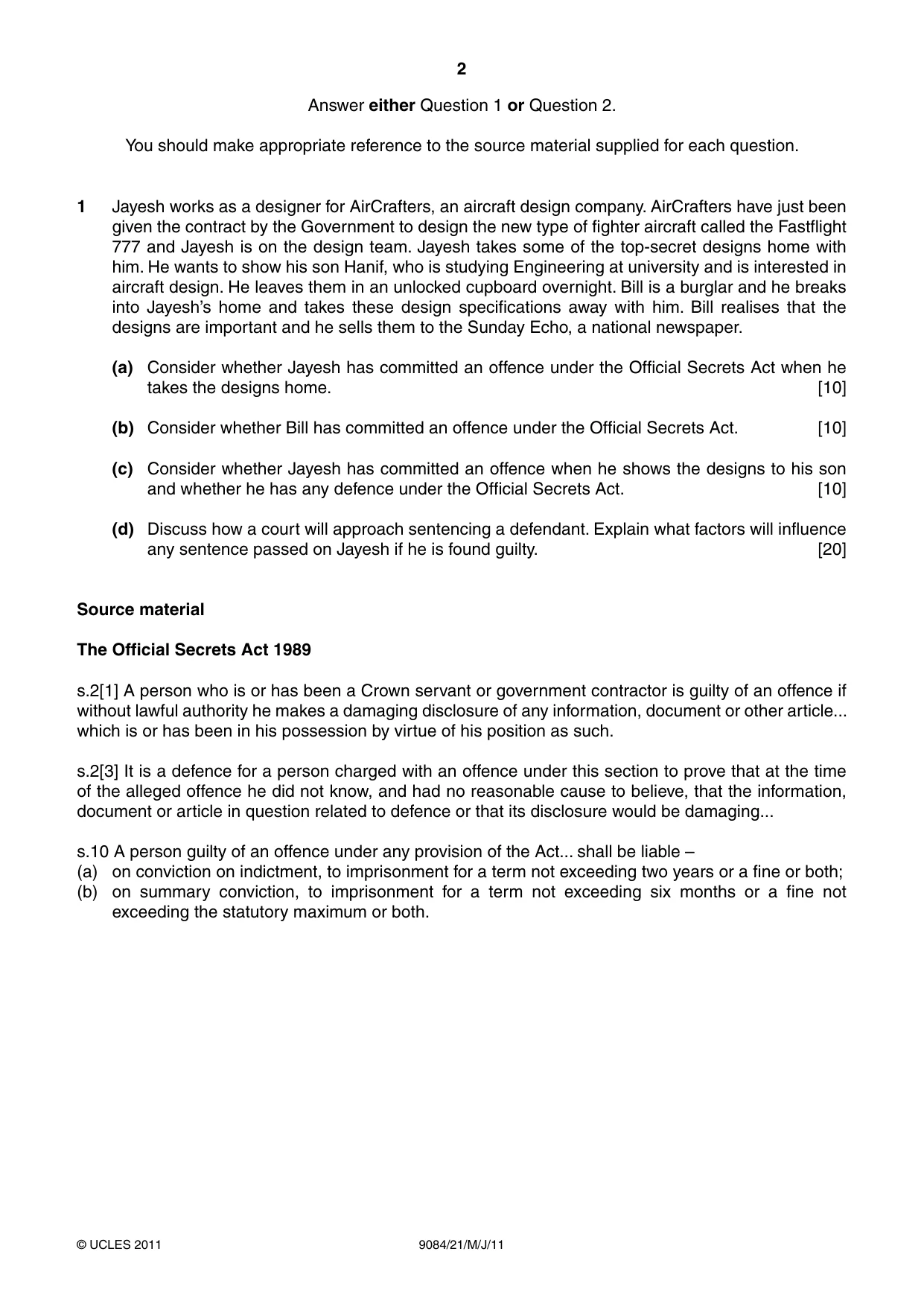
2 9084/21/M/J/11 © UCLES 2011 Answer either Question 1 or Question 2. You should make appropriate reference to the source material supplied for each question. 1 Jayesh works as a designer for AirCrafters, an aircraft design company. AirCrafters have just been given the contract by the Government to design the new type of fighter aircraft called the Fastflight 777 and Jayesh is on the design team. Jayesh takes some of the top-secret designs home with him. He wants to show his son Hanif, who is studying Engineering at university and is interested in aircraft design. He leaves them in an unlocked cupboard overnight. Bill is a burglar and he breaks into Jayesh’s home and takes these design specifications away with him. Bill realises that the designs are important and he sells them to the Sunday Echo, a national newspaper. (a) Consider whether Jayesh has committed an offence under the Official Secrets Act when he takes the designs home. [10] (b) Consider whether Bill has committed an offence under the Official Secrets Act. [10] (c) Consider whether Jayesh has committed an offence when he shows the designs to his son and whether he has any defence under the Official Secrets Act. [10] (d) Discuss how a court will approach sentencing a defendant. Explain what factors will influence any sentence passed on Jayesh if he is found guilty. [20] Source material The Official Secrets Act 1989 s.2[1] A person who is or has been a Crown servant or government contractor is guilty of an offence if without lawful authority he makes a damaging disclosure of any information, document or other article... which is or has been in his possession by virtue of his position as such. s.2[3] It is a defence for a person charged with an offence under this section to prove that at the time of the alleged offence he did not know, and had no reasonable cause to believe, that the information, document or article in question related to defence or that its disclosure would be damaging... s.10 A person guilty of an offence under any provision of the Act... shall be liable – (a) on conviction on indictment, to imprisonment for a term not exceeding two years or a fine or both; (b) on summary conviction, to imprisonment for a term not exceeding six months or a fine not exceeding the statutory maximum or both.
Question paper, page 3
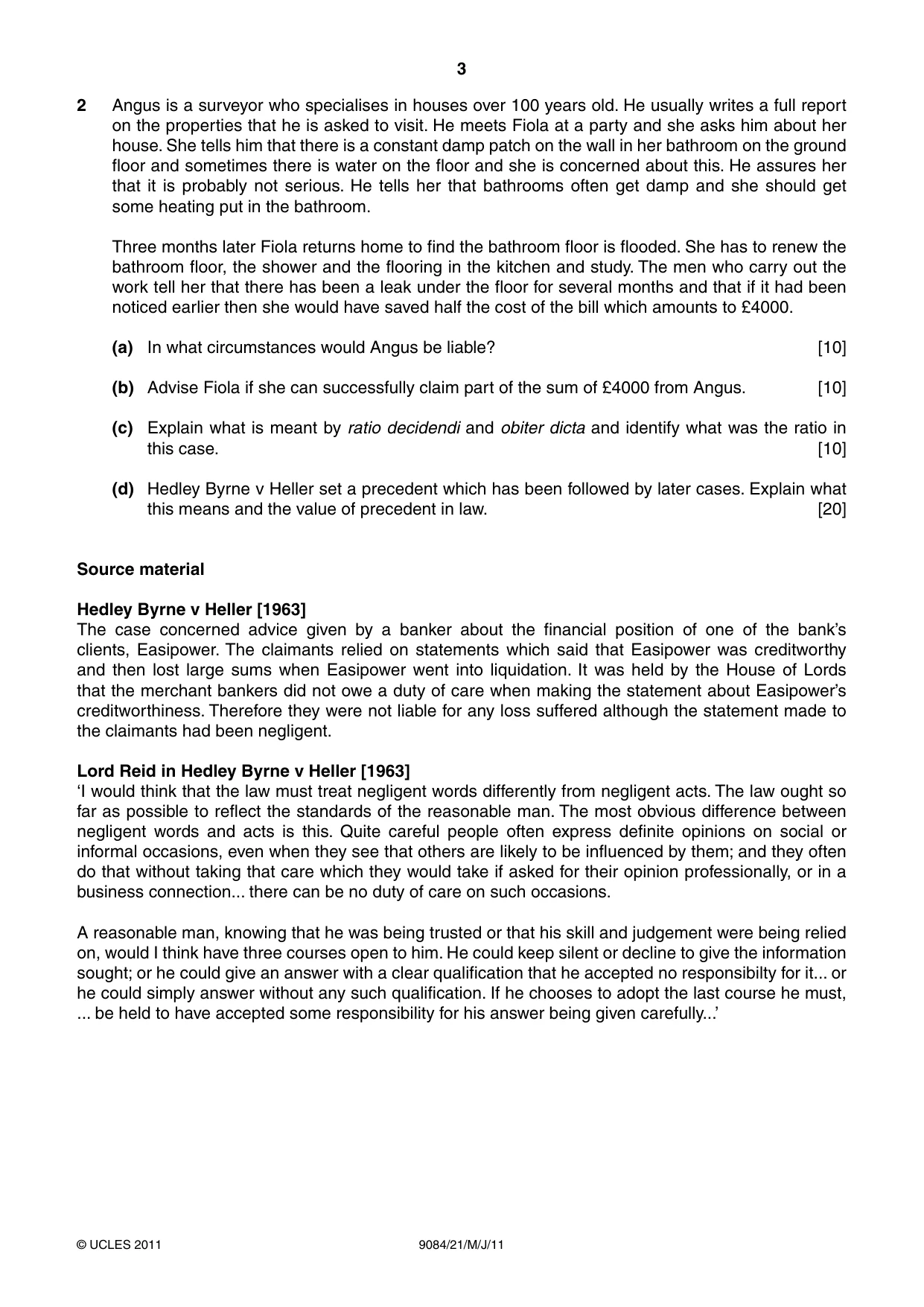
3 9084/21/M/J/11 © UCLES 2011 2 Angus is a surveyor who specialises in houses over 100 years old. He usually writes a full report on the properties that he is asked to visit. He meets Fiola at a party and she asks him about her house. She tells him that there is a constant damp patch on the wall in her bathroom on the ground floor and sometimes there is water on the floor and she is concerned about this. He assures her that it is probably not serious. He tells her that bathrooms often get damp and she should get some heating put in the bathroom. Three months later Fiola returns home to find the bathroom floor is flooded. She has to renew the bathroom floor, the shower and the flooring in the kitchen and study. The men who carry out the work tell her that there has been a leak under the floor for several months and that if it had been noticed earlier then she would have saved half the cost of the bill which amounts to £4000. (a) In what circumstances would Angus be liable? [10] (b) Advise Fiola if she can successfully claim part of the sum of £4000 from Angus. [10] (c) Explain what is meant by ratio decidendi and obiter dicta and identify what was the ratio in this case. [10] (d) Hedley Byrne v Heller set a precedent which has been followed by later cases. Explain what this means and the value of precedent in law. [20] Source material Hedley Byrne v Heller [1963] The case concerned advice given by a banker about the financial position of one of the bank’s clients, Easipower. The claimants relied on statements which said that Easipower was creditworthy and then lost large sums when Easipower went into liquidation. It was held by the House of Lords that the merchant bankers did not owe a duty of care when making the statement about Easipower’s creditworthiness. Therefore they were not liable for any loss suffered although the statement made to the claimants had been negligent. Lord Reid in Hedley Byrne v Heller [1963] ‘I would think that the law must treat negligent words differently from negligent acts. The law ought so far as possible to reflect the standards of the reasonable man. The most obvious difference between negligent words and acts is this. Quite careful people often express definite opinions on social or informal occasions, even when they see that others are likely to be influenced by them; and they often do that without taking that care which they would take if asked for their opinion professionally, or in a business connection... there can be no duty of care on such occasions. A reasonable man, knowing that he was being trusted or that his skill and judgement were being relied on, would I think have three courses open to him. He could keep silent or decline to give the information sought; or he could give an answer with a clear qualification that he accepted no responsibilty for it... or he could simply answer without any such qualification. If he chooses to adopt the last course he must, ... be held to have accepted some responsibility for his answer being given carefully...’
Question paper, page 4
4 9084/21/M/J/11 © UCLES 2011 Permission to reproduce items where third-party owned material protected by copyright is included has been sought and cleared where possible. Every reasonable effort has been made by the publisher (UCLES) to trace copyright holders, but if any items requiring clearance have unwittingly been included, the publisher will be pleased to make amends at the earliest possible opportunity. University of Cambridge International Examinations is part of the Cambridge Assessment Group. Cambridge Assessment is the brand name of University of Cambridge Local Examinations Syndicate (UCLES), which is itself a department of the University of Cambridge. BLANK PAGE
Mark scheme, page 1
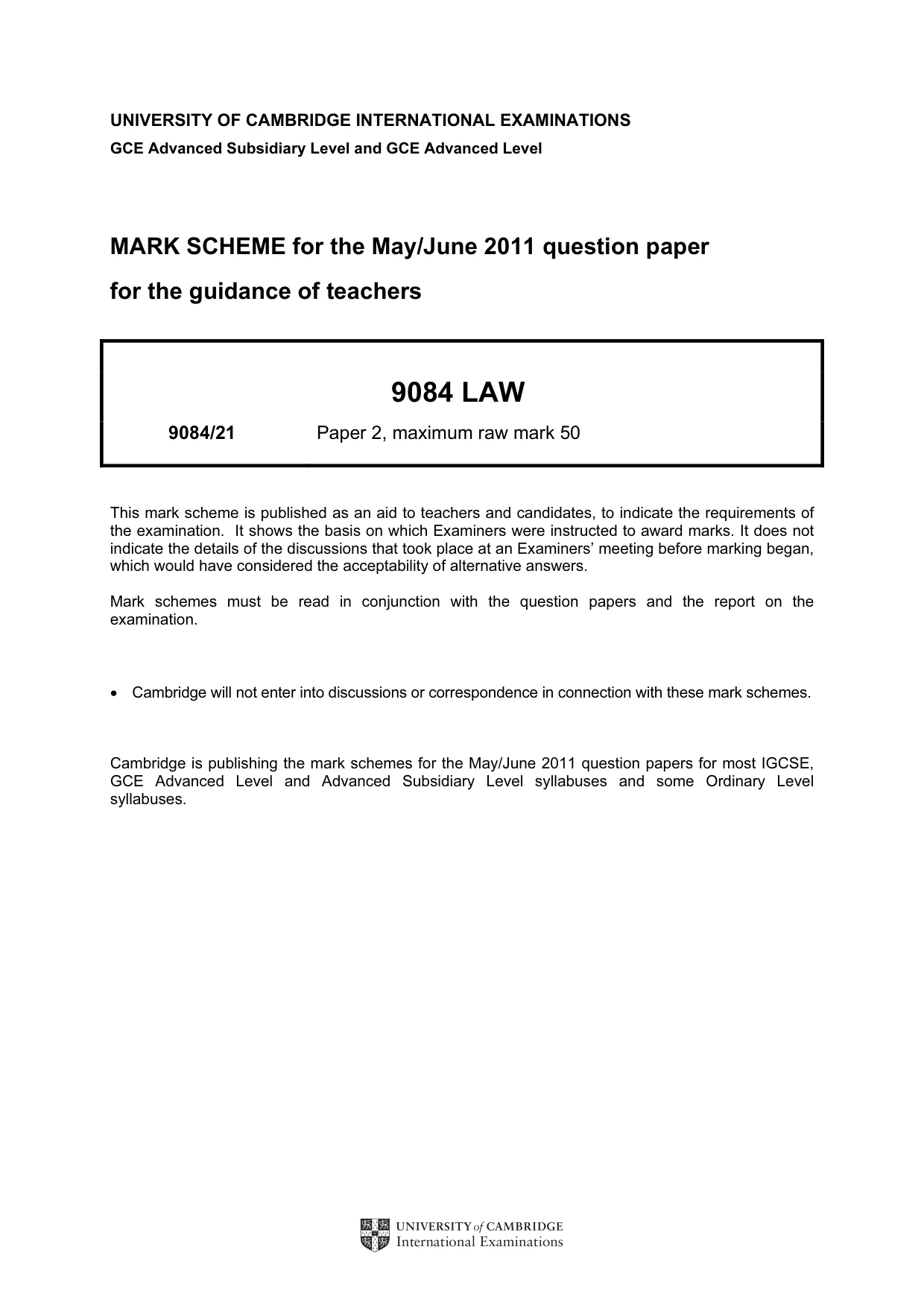
UNIVERSITY OF CAMBRIDGE INTERNATIONAL EXAMINATIONS GCE Advanced Subsidiary Level and GCE Advanced Level MARK SCHEME for the May/June 2011 question paper for the guidance of teachers 9084 LAW 9084/21 Paper 2, maximum raw mark 50 This mark scheme is published as an aid to teachers and candidates, to indicate the requirements of the examination. It shows the basis on which Examiners were instructed to award marks. It does not indicate the details of the discussions that took place at an Examiners’ meeting before marking began, which would have considered the acceptability of alternative answers. Mark schemes must be read in conjunction with the question papers and the report on the examination. • Cambridge will not enter into discussions or correspondence in connection with these mark schemes. Cambridge is publishing the mark schemes for the May/June 2011 question papers for most IGCSE, GCE Advanced Level and Advanced Subsidiary Level syllabuses and some Ordinary Level syllabuses.
Mark scheme, page 2
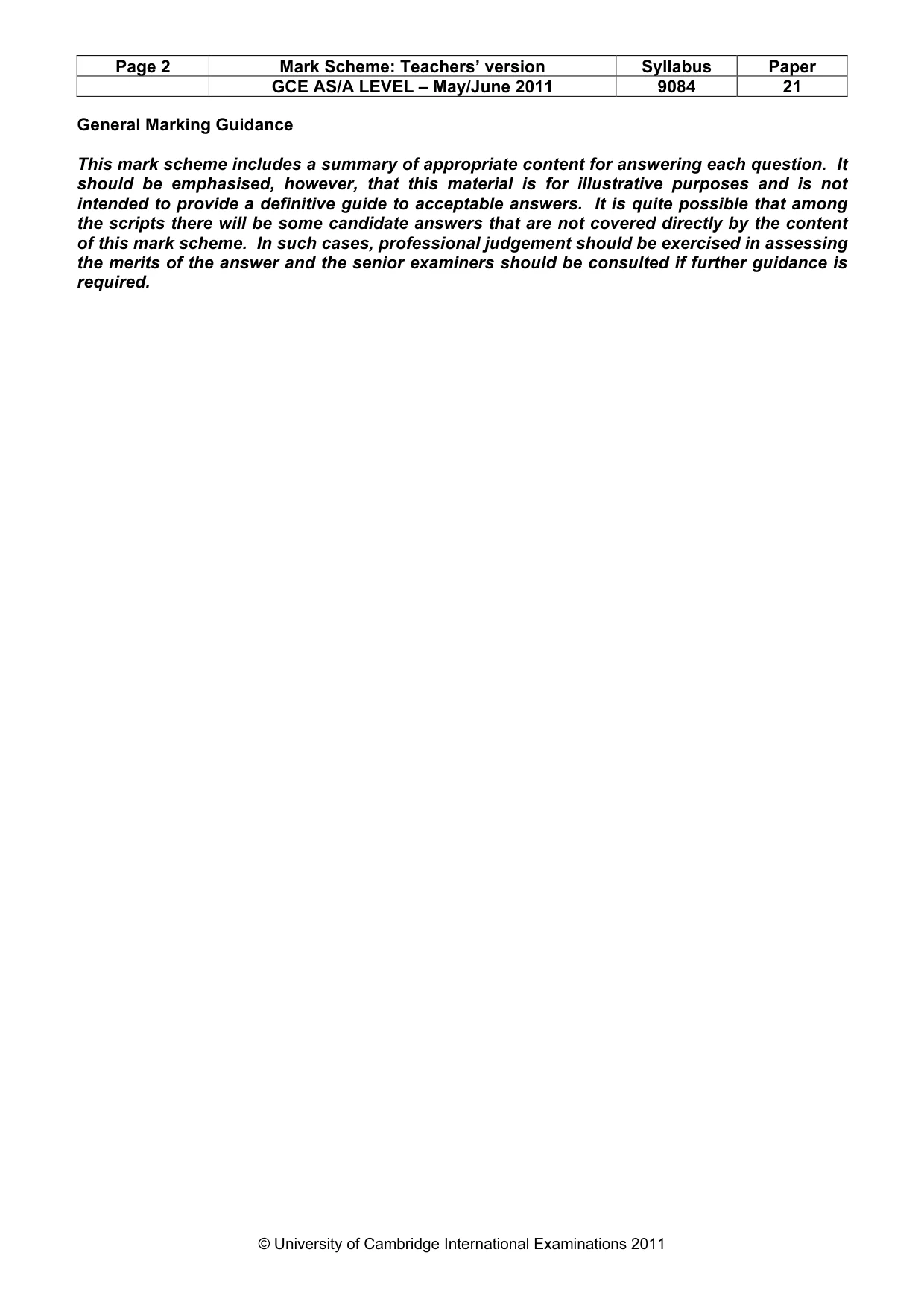
Page 2 Mark Scheme: Teachers’ version Syllabus Paper GCE AS/A LEVEL – May/June 2011 9084 21 © University of Cambridge International Examinations 2011 General Marking Guidance This mark scheme includes a summary of appropriate content for answering each question. It should be emphasised, however, that this material is for illustrative purposes and is not intended to provide a definitive guide to acceptable answers. It is quite possible that among the scripts there will be some candidate answers that are not covered directly by the content of this mark scheme. In such cases, professional judgement should be exercised in assessing the merits of the answer and the senior examiners should be consulted if further guidance is required.
Mark scheme, page 3
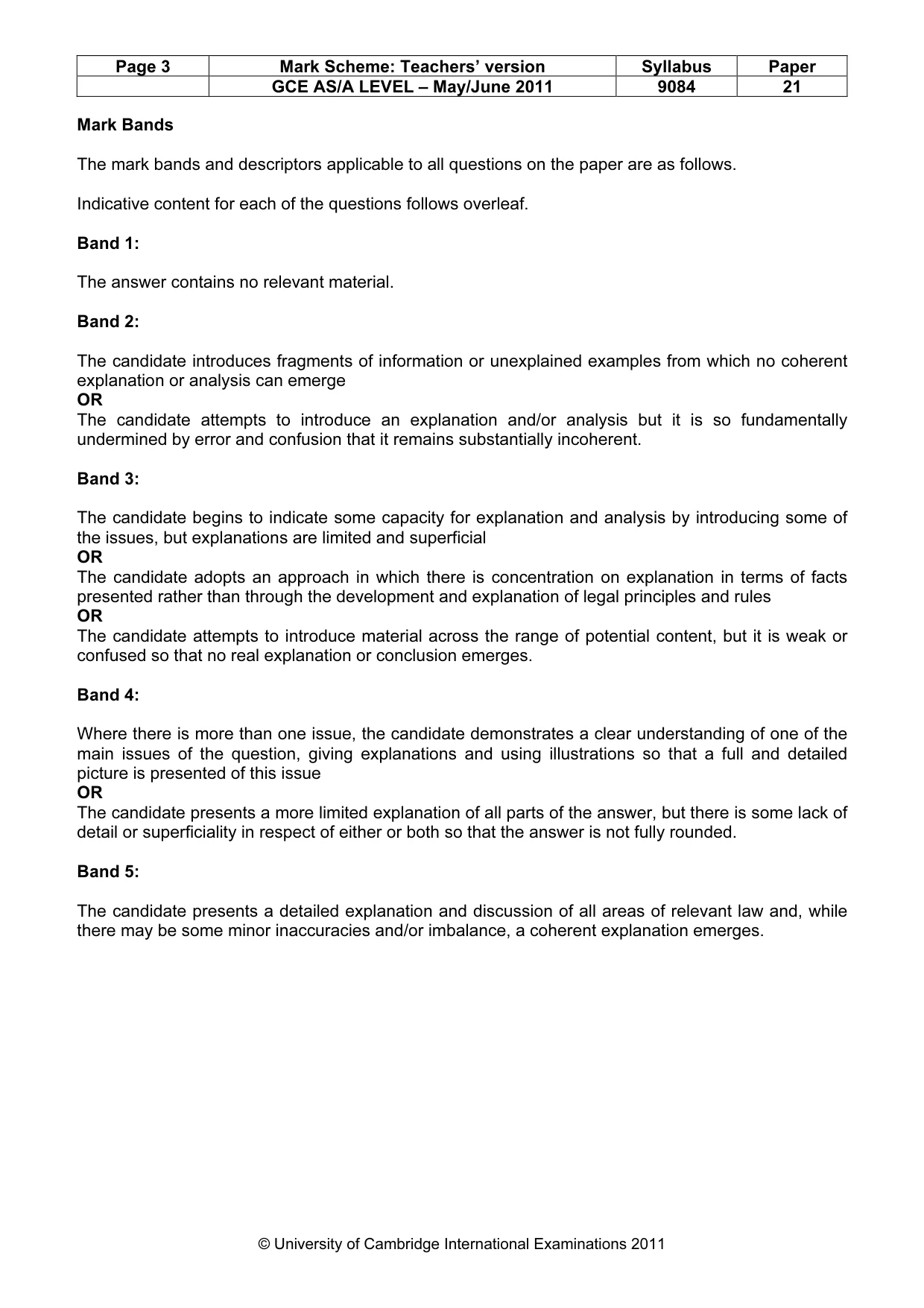
Page 3 Mark Scheme: Teachers’ version Syllabus Paper GCE AS/A LEVEL – May/June 2011 9084 21 © University of Cambridge International Examinations 2011 Mark Bands The mark bands and descriptors applicable to all questions on the paper are as follows. Indicative content for each of the questions follows overleaf. Band 1: The answer contains no relevant material. Band 2: The candidate introduces fragments of information or unexplained examples from which no coherent explanation or analysis can emerge OR The candidate attempts to introduce an explanation and/or analysis but it is so fundamentally undermined by error and confusion that it remains substantially incoherent. Band 3: The candidate begins to indicate some capacity for explanation and analysis by introducing some of the issues, but explanations are limited and superficial OR The candidate adopts an approach in which there is concentration on explanation in terms of facts presented rather than through the development and explanation of legal principles and rules OR The candidate attempts to introduce material across the range of potential content, but it is weak or confused so that no real explanation or conclusion emerges. Band 4: Where there is more than one issue, the candidate demonstrates a clear understanding of one of the main issues of the question, giving explanations and using illustrations so that a full and detailed picture is presented of this issue OR The candidate presents a more limited explanation of all parts of the answer, but there is some lack of detail or superficiality in respect of either or both so that the answer is not fully rounded. Band 5: The candidate presents a detailed explanation and discussion of all areas of relevant law and, while there may be some minor inaccuracies and/or imbalance, a coherent explanation emerges.
Mark scheme, page 4
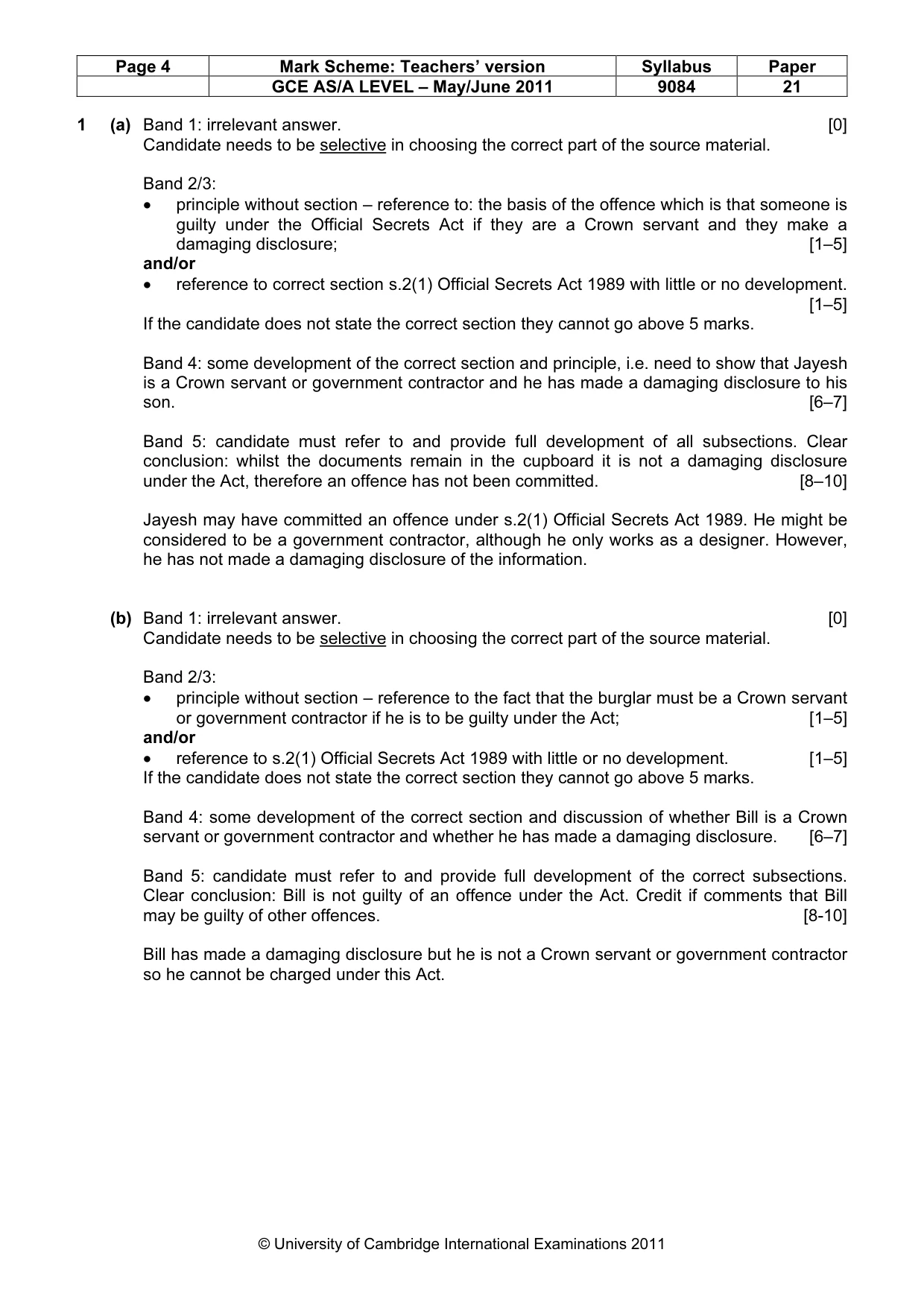
Page 4 Mark Scheme: Teachers’ version Syllabus Paper GCE AS/A LEVEL – May/June 2011 9084 21 © University of Cambridge International Examinations 2011 1 (a) Band 1: irrelevant answer. [0] Candidate needs to be selective in choosing the correct part of the source material. Band 2/3: • principle without section – reference to: the basis of the offence which is that someone is guilty under the Official Secrets Act if they are a Crown servant and they make a damaging disclosure; [1–5] and/or • reference to correct section s.2(1) Official Secrets Act 1989 with little or no development. [1–5] If the candidate does not state the correct section they cannot go above 5 marks. Band 4: some development of the correct section and principle, i.e. need to show that Jayesh is a Crown servant or government contractor and he has made a damaging disclosure to his son. [6–7] Band 5: candidate must refer to and provide full development of all subsections. Clear conclusion: whilst the documents remain in the cupboard it is not a damaging disclosure under the Act, therefore an offence has not been committed. [8–10] Jayesh may have committed an offence under s.2(1) Official Secrets Act 1989. He might be considered to be a government contractor, although he only works as a designer. However, he has not made a damaging disclosure of the information. (b) Band 1: irrelevant answer. [0] Candidate needs to be selective in choosing the correct part of the source material. Band 2/3: • principle without section – reference to the fact that the burglar must be a Crown servant or government contractor if he is to be guilty under the Act; [1–5] and/or • reference to s.2(1) Official Secrets Act 1989 with little or no development. [1–5] If the candidate does not state the correct section they cannot go above 5 marks. Band 4: some development of the correct section and discussion of whether Bill is a Crown servant or government contractor and whether he has made a damaging disclosure. [6–7] Band 5: candidate must refer to and provide full development of the correct subsections. Clear conclusion: Bill is not guilty of an offence under the Act. Credit if comments that Bill may be guilty of other offences. [8-10] Bill has made a damaging disclosure but he is not a Crown servant or government contractor so he cannot be charged under this Act.
Mark scheme, page 5
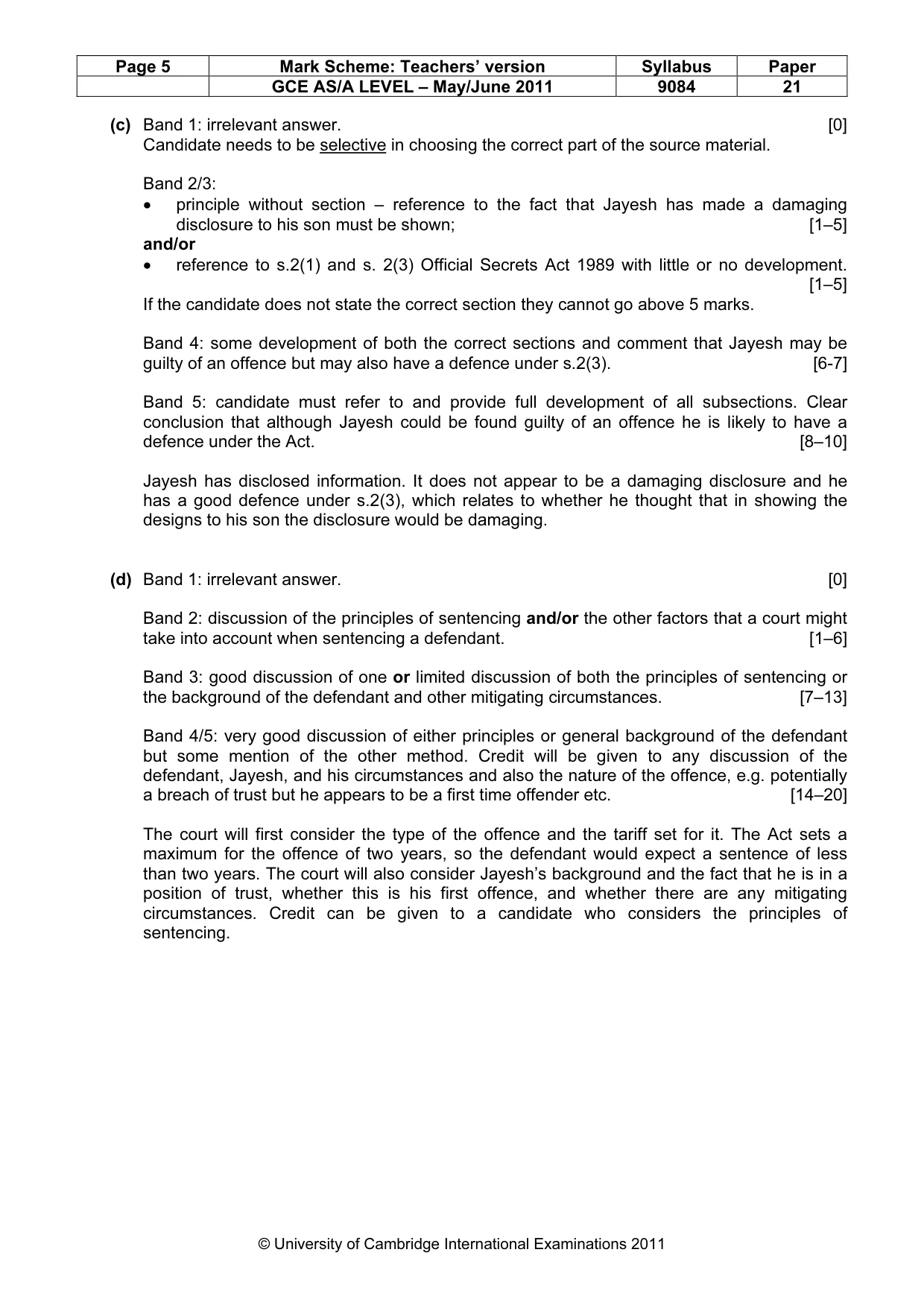
Page 5 Mark Scheme: Teachers’ version Syllabus Paper GCE AS/A LEVEL – May/June 2011 9084 21 © University of Cambridge International Examinations 2011 (c) Band 1: irrelevant answer. [0] Candidate needs to be selective in choosing the correct part of the source material. Band 2/3: • principle without section – reference to the fact that Jayesh has made a damaging disclosure to his son must be shown; [1–5] and/or • reference to s.2(1) and s. 2(3) Official Secrets Act 1989 with little or no development. [1–5] If the candidate does not state the correct section they cannot go above 5 marks. Band 4: some development of both the correct sections and comment that Jayesh may be guilty of an offence but may also have a defence under s.2(3). [6-7] Band 5: candidate must refer to and provide full development of all subsections. Clear conclusion that although Jayesh could be found guilty of an offence he is likely to have a defence under the Act. [8–10] Jayesh has disclosed information. It does not appear to be a damaging disclosure and he has a good defence under s.2(3), which relates to whether he thought that in showing the designs to his son the disclosure would be damaging. (d) Band 1: irrelevant answer. [0] Band 2: discussion of the principles of sentencing and/or the other factors that a court might take into account when sentencing a defendant. [1–6] Band 3: good discussion of one or limited discussion of both the principles of sentencing or the background of the defendant and other mitigating circumstances. [7–13] Band 4/5: very good discussion of either principles or general background of the defendant but some mention of the other method. Credit will be given to any discussion of the defendant, Jayesh, and his circumstances and also the nature of the offence, e.g. potentially a breach of trust but he appears to be a first time offender etc. [14–20] The court will first consider the type of the offence and the tariff set for it. The Act sets a maximum for the offence of two years, so the defendant would expect a sentence of less than two years. The court will also consider Jayesh’s background and the fact that he is in a position of trust, whether this is his first offence, and whether there are any mitigating circumstances. Credit can be given to a candidate who considers the principles of sentencing.
Mark scheme, page 6
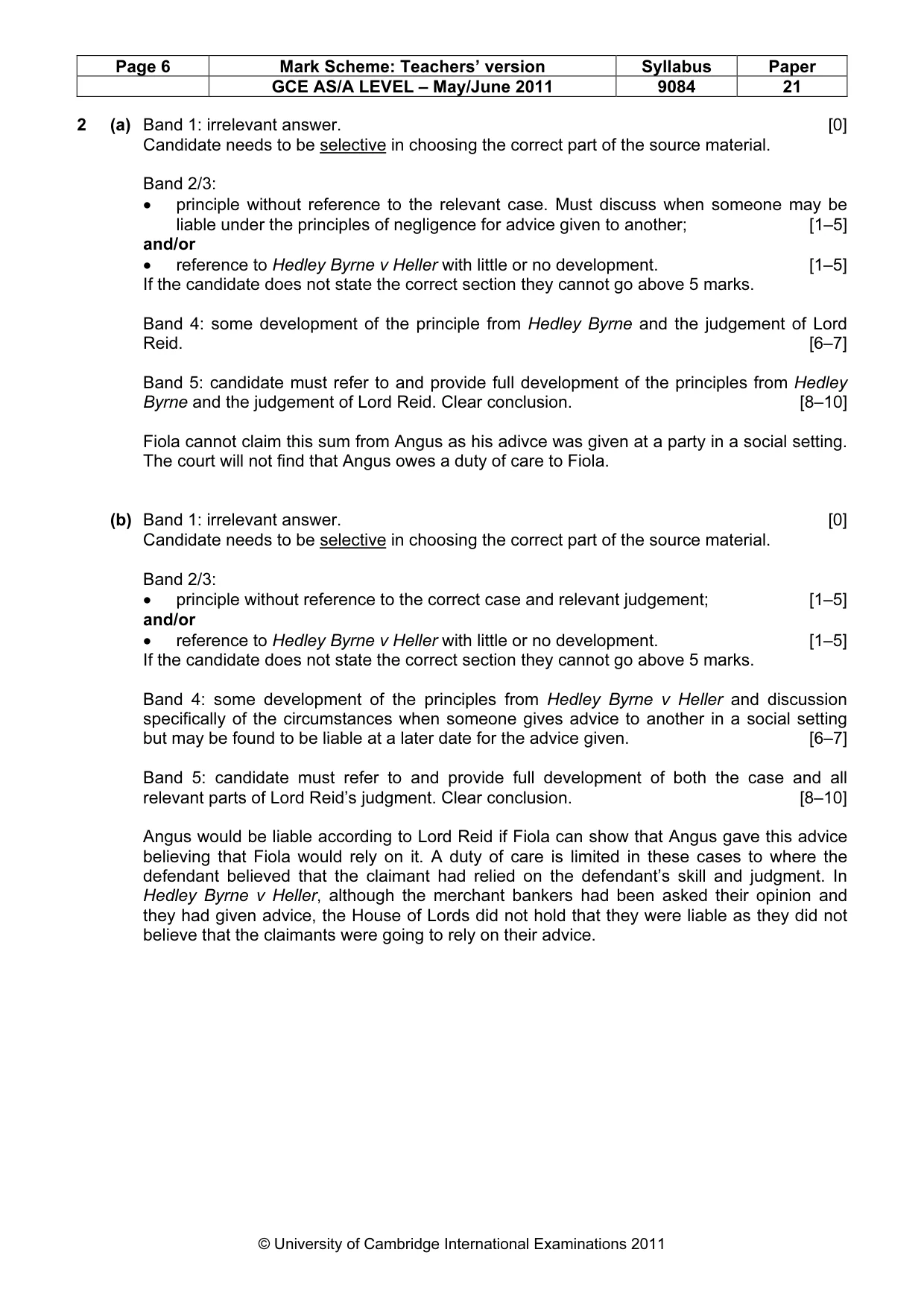
Page 6 Mark Scheme: Teachers’ version Syllabus Paper GCE AS/A LEVEL – May/June 2011 9084 21 © University of Cambridge International Examinations 2011 2 (a) Band 1: irrelevant answer. [0] Candidate needs to be selective in choosing the correct part of the source material. Band 2/3: • principle without reference to the relevant case. Must discuss when someone may be liable under the principles of negligence for advice given to another; [1–5] and/or • reference to Hedley Byrne v Heller with little or no development. [1–5] If the candidate does not state the correct section they cannot go above 5 marks. Band 4: some development of the principle from Hedley Byrne and the judgement of Lord Reid. [6–7] Band 5: candidate must refer to and provide full development of the principles from Hedley Byrne and the judgement of Lord Reid. Clear conclusion. [8–10] Fiola cannot claim this sum from Angus as his adivce was given at a party in a social setting. The court will not find that Angus owes a duty of care to Fiola. (b) Band 1: irrelevant answer. [0] Candidate needs to be selective in choosing the correct part of the source material. Band 2/3: • principle without reference to the correct case and relevant judgement; [1–5] and/or • reference to Hedley Byrne v Heller with little or no development. [1–5] If the candidate does not state the correct section they cannot go above 5 marks. Band 4: some development of the principles from Hedley Byrne v Heller and discussion specifically of the circumstances when someone gives advice to another in a social setting but may be found to be liable at a later date for the advice given. [6–7] Band 5: candidate must refer to and provide full development of both the case and all relevant parts of Lord Reid’s judgment. Clear conclusion. [8–10] Angus would be liable according to Lord Reid if Fiola can show that Angus gave this advice believing that Fiola would rely on it. A duty of care is limited in these cases to where the defendant believed that the claimant had relied on the defendant’s skill and judgment. In Hedley Byrne v Heller, although the merchant bankers had been asked their opinion and they had given advice, the House of Lords did not hold that they were liable as they did not believe that the claimants were going to rely on their advice.
Mark scheme, page 7
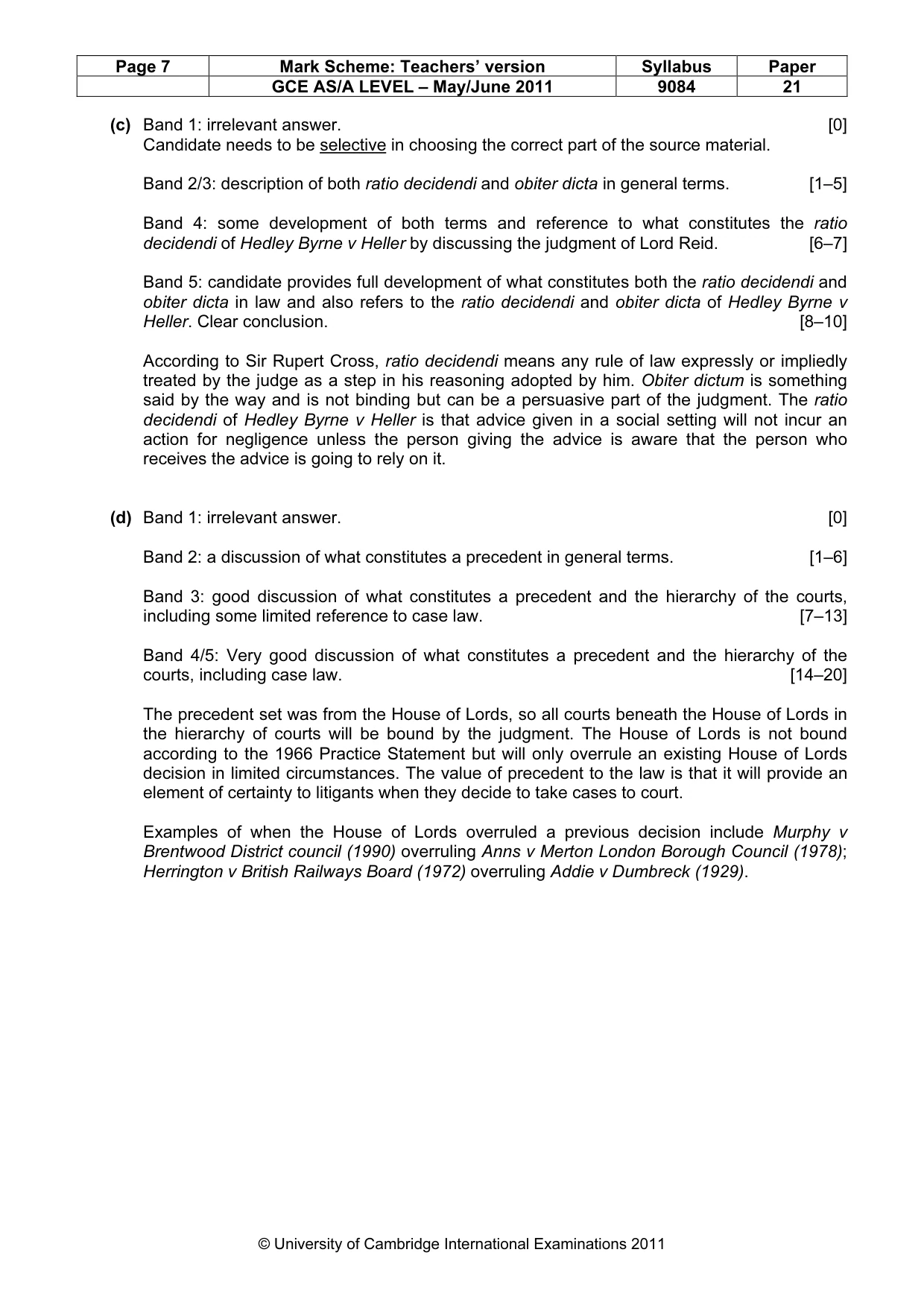
Page 7 Mark Scheme: Teachers’ version Syllabus Paper GCE AS/A LEVEL – May/June 2011 9084 21 © University of Cambridge International Examinations 2011 (c) Band 1: irrelevant answer. [0] Candidate needs to be selective in choosing the correct part of the source material. Band 2/3: description of both ratio decidendi and obiter dicta in general terms. [1–5] Band 4: some development of both terms and reference to what constitutes the ratio decidendi of Hedley Byrne v Heller by discussing the judgment of Lord Reid. [6–7] Band 5: candidate provides full development of what constitutes both the ratio decidendi and obiter dicta in law and also refers to the ratio decidendi and obiter dicta of Hedley Byrne v Heller. Clear conclusion. [8–10] According to Sir Rupert Cross, ratio decidendi means any rule of law expressly or impliedly treated by the judge as a step in his reasoning adopted by him. Obiter dictum is something said by the way and is not binding but can be a persuasive part of the judgment. The ratio decidendi of Hedley Byrne v Heller is that advice given in a social setting will not incur an action for negligence unless the person giving the advice is aware that the person who receives the advice is going to rely on it. (d) Band 1: irrelevant answer. [0] Band 2: a discussion of what constitutes a precedent in general terms. [1–6] Band 3: good discussion of what constitutes a precedent and the hierarchy of the courts, including some limited reference to case law. [7–13] Band 4/5: Very good discussion of what constitutes a precedent and the hierarchy of the courts, including case law. [14–20] The precedent set was from the House of Lords, so all courts beneath the House of Lords in the hierarchy of courts will be bound by the judgment. The House of Lords is not bound according to the 1966 Practice Statement but will only overrule an existing House of Lords decision in limited circumstances. The value of precedent to the law is that it will provide an element of certainty to litigants when they decide to take cases to court. Examples of when the House of Lords overruled a previous decision include Murphy v Brentwood District council (1990) overruling Anns v Merton London Borough Council (1978); Herrington v British Railways Board (1972) overruling Addie v Dumbreck (1929).
What you needed in this session
Cambridge’s own grade thresholds for 2011 May/June, Paper 2 · Variant 1. A higher threshold means an easier paper — the bar moves with how the cohort did.