Cambridge A Level Law 9084 — 2011 May/June Paper 2 · Variant 3
9084/23/M/J/11 · 50 marks · ≈56 min
The question paper and its mark scheme, free to read here and free to download. This is Cambridge’s own paper, exactly as it was sat.
Question paper4 pages

Mark scheme7 pages
Answers below. Sit the paper first if you are practising.
Paper as text
Question paper, page 1
This document consists of 3 printed pages and 1 blank page. DC (LEO) 36525/2 © UCLES 2011 [Turn over UNIVERSITY OF CAMBRIDGE INTERNATIONAL EXAMINATIONS General Certificate of Education Advanced Subsidiary Level and Advanced Level * 0 0 5 3 3 2 4 9 1 9 * LAW 9084/23 Paper 2 Data Response May/June 2011 1 hour 30 minutes Additional Materials: Answer Booklet/Paper READ THESE INSTRUCTIONS FIRST If you have been given an Answer Booklet, follow the instructions on the front cover of the Booklet. Write your Centre number, candidate number and name on all the work you hand in. Write in dark blue or black pen. You may use a soft pencil for any diagrams, graphs or rough working. Do not use staples, paper clips, highlighters, glue or correction fluid. Answer one question. At the end of the examination, fasten all your work securely together. The number of marks is given in brackets [ ] at the end of each question or part question.
Question paper, page 2
2 9084/23/M/J/11 © UCLES 2011 Answer either Question 1 or Question 2. You should make appropriate reference to the source material supplied in each question. 1 Lakshmi and Paul, who are both British nationals, have been married for ten years. Their marriage is now in difficulties and they have agreed to divorce. Paul has made a large amount of money as an art dealer. He does not want his wife to be able to claim all his money. Before he and Lakshmi got married they both signed an agreement (a pre-nuptial settlement) in which she agreed to accept £200 000 and the transfer of the parties’ flat in London in full and final settlement of any claim that she might bring in the event that their marriage ended in divorce. Paul is concerned whether the agreement will be enforceable. He has amassed a fortune in excess of £1 000 000 and owns three houses in England including the flat in London. (a) Will the pre-nuptial settlement be enforceable under English Law? [10] (b) Would it make any difference if either Paul or Lakshmi had been born abroad or if the agreement had been drawn up abroad? [10] (c) Consider the source below and explain why a court may give greater weight to a pre-nuptial settlement in cases today. [10] (d) Examine the role of the Law Commission. Compare its role with other Law Reform agencies. [20] Source material G v R (Pre-nuptial Contract) [2009] H was French and W was a German national. They married in England and spent most of their married life there. W came from a very wealthy family and had significant assets when she married. The parties entered into a pre-nuptial agreement under which they waived any claims for maintenance following divorce. On divorce H made a substantial claim for maintenance. The judge held that although pre- nuptial agreements were not enforceable under English law, as they were contrary to public policy, she could give limited weight to the fact that the parties’ agreement was valid and enforceable in France and Germany and the parties were French and German. The Court of Appeal upheld an appeal by the wife that insufficient weight had been given to the pre-nuptial agreement entered into by the parties before they had married when the judge had come to her decision regarding the distribution of the assets of the family and reduced the maintenance awarded to H. Judgment of Lord Justice Rix in G v R (Pre-nuptial Contract) [2009] Pre-nuptial agreements were both unenforceable and invalid as being against public policy and, at the same time, they were matters which the court was prepared to take into account. If the only difficulty about the validity of a pre-nuptial agreement was that it remained subject to the discretion of the court, it was not obvious that there was any need to describe such an agreement as being void for reasons of public policy at all. The present rule was anomalous... Judgment of Lord Justice Thorpe in G v R (Pre-nuptial Contract) [2009] Wholesale reform of the law on pre-nuptial agreements was for Parliament and not for judges, particularly now that the Law Commission had announced its intention to examine the enforceability of these agreements.
Question paper, page 3
3 9084/23/M/J/11 © UCLES 2011 2 (a) Fred is a British lorry driver. His lorry is parked in the port of Calais in France waiting for a ferry to take him back to England. Amjad, an asylum seeker, climbs into his lorry and hides. When Fred arrives in Dover in England the police search his lorry and find Amjad. Explain whether or not Fred is guilty of an offence. [10] (b) Brian is another British lorry driver. He stops in a café in the port of Calais in France. There he meets Malik who agrees to pay him £500 if he will take him to England in the back of his lorry. At Dover in England the police search the lorry and find Malik. Explain whether or not Brian is guilty of an offence. [10] (c) Tariq is a member of a political party in country X called the Purple Party. He has been involved in a number of demonstrations. He decides to leave the country. He sends money to his brother Marq to arrange for his accommodation in England. Marq meets him at Heathrow airport and is arrested. Explain whether or not Marq is guilty of an offence. [10] (d) Consider the reasons why a defendant charged with a triable either way offence might choose a jury trial as opposed to a trial in the Magistrates Court. [20] Source material Immigration Act 1971 s.25A[1] A person commits an offence if – (a) he knowingly and for gain facilitates the arrival in the United KIngdom of an individual, and (b) he knows or has reasonable grounds to believe that the individual is an asylum seeker. s.25A[2] In this section ‘asylum seeker’ means a person who intends to claim that to remove him from or require him to leave the United Kingdom would be contrary to the United Kingdom’s obligations under (a) the Refugee Convention (b) the Human Rights Convention. s.25[6] A person guilty of an offence under this section shall be liable – (a) on conviction on indictment to imprisonment for a term not exceeding 14 years, to a fine or to both, or (b) on summary conviction, to imprisonment for a term not exceeding six months, to a fine not exceeding the statutory maximum or to both.
Question paper, page 4
4 9084/23/M/J/11 © UCLES 2011 Permission to reproduce items where third-party owned material protected by copyright is included has been sought and cleared where possible. Every reasonable effort has been made by the publisher (UCLES) to trace copyright holders, but if any items requiring clearance have unwittingly been included, the publisher will be pleased to make amends at the earliest possible opportunity. University of Cambridge International Examinations is part of the Cambridge Assessment Group. Cambridge Assessment is the brand name of University of Cambridge Local Examinations Syndicate (UCLES), which is itself a department of the University of Cambridge. BLANK PAGE
Mark scheme, page 1
UNIVERSITY OF CAMBRIDGE INTERNATIONAL EXAMINATIONS GCE Advanced Subsidiary Level and GCE Advanced Level MARK SCHEME for the May/June 2011 question paper for the guidance of teachers 9084 LAW 9084/23 Paper 2, maximum raw mark 50 This mark scheme is published as an aid to teachers and candidates, to indicate the requirements of the examination. It shows the basis on which Examiners were instructed to award marks. It does not indicate the details of the discussions that took place at an Examiners’ meeting before marking began, which would have considered the acceptability of alternative answers. Mark schemes must be read in conjunction with the question papers and the report on the examination. • Cambridge will not enter into discussions or correspondence in connection with these mark schemes. Cambridge is publishing the mark schemes for the May/June 2011 question papers for most IGCSE, GCE Advanced Level and Advanced Subsidiary Level syllabuses and some Ordinary Level syllabuses.
Mark scheme, page 2
Page 2 Mark Scheme: Teachers’ version Syllabus Paper GCE AS/A LEVEL – May/June 2011 9084 23 © University of Cambridge International Examinations 2011 General Marking Guidance This mark scheme includes a summary of appropriate content for answering each question. It should be emphasised, however, that this material is for illustrative purposes and is not intended to provide a definitive guide to acceptable answers. It is quite possible that among the scripts there will be some candidate answers that are not covered directly by the content of this mark scheme. In such cases, professional judgement should be exercised in assessing the merits of the answer and the senior examiners should be consulted if further guidance is required.
Mark scheme, page 3
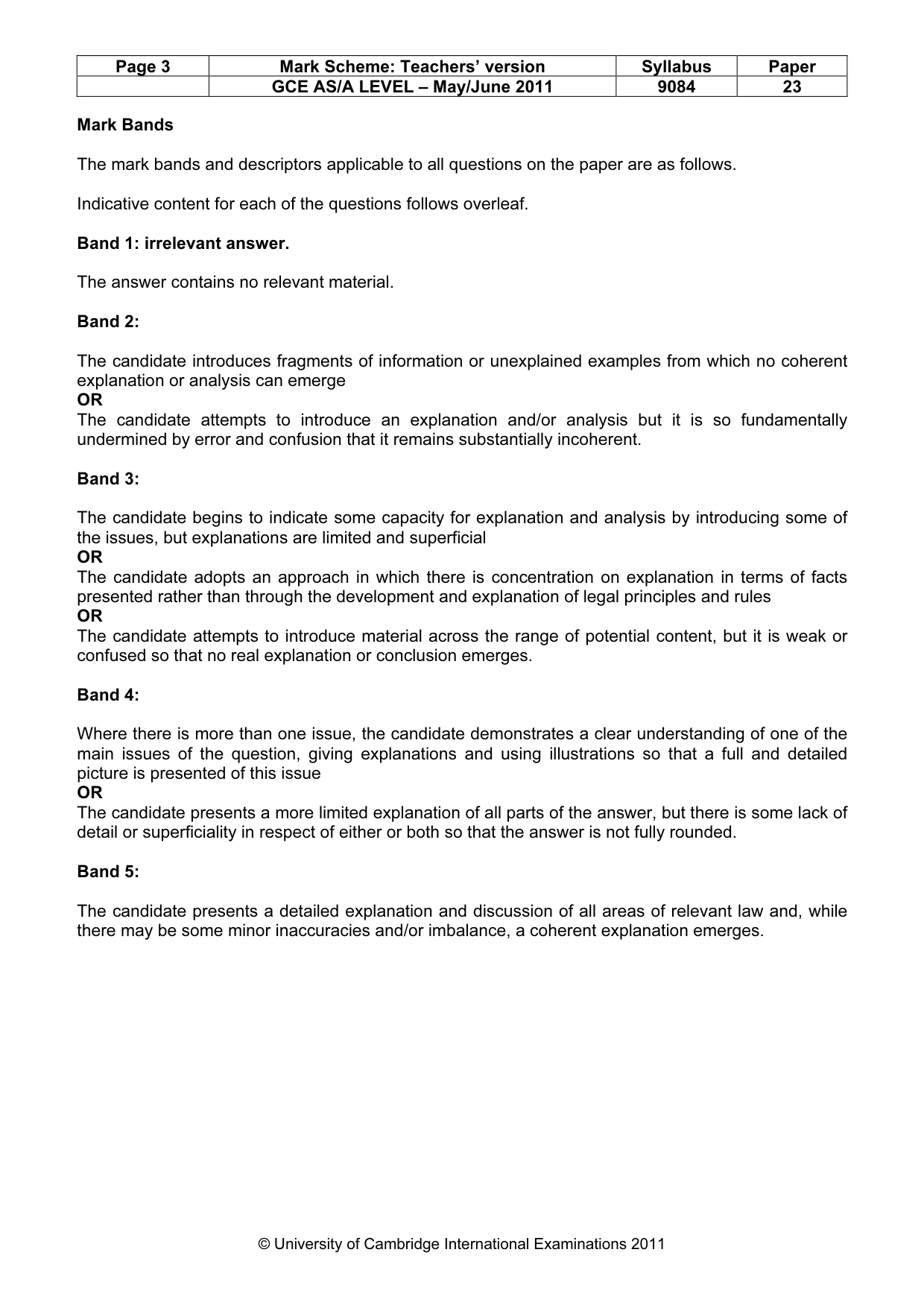
Page 3 Mark Scheme: Teachers’ version Syllabus Paper GCE AS/A LEVEL – May/June 2011 9084 23 © University of Cambridge International Examinations 2011 Mark Bands The mark bands and descriptors applicable to all questions on the paper are as follows. Indicative content for each of the questions follows overleaf. Band 1: irrelevant answer. The answer contains no relevant material. Band 2: The candidate introduces fragments of information or unexplained examples from which no coherent explanation or analysis can emerge OR The candidate attempts to introduce an explanation and/or analysis but it is so fundamentally undermined by error and confusion that it remains substantially incoherent. Band 3: The candidate begins to indicate some capacity for explanation and analysis by introducing some of the issues, but explanations are limited and superficial OR The candidate adopts an approach in which there is concentration on explanation in terms of facts presented rather than through the development and explanation of legal principles and rules OR The candidate attempts to introduce material across the range of potential content, but it is weak or confused so that no real explanation or conclusion emerges. Band 4: Where there is more than one issue, the candidate demonstrates a clear understanding of one of the main issues of the question, giving explanations and using illustrations so that a full and detailed picture is presented of this issue OR The candidate presents a more limited explanation of all parts of the answer, but there is some lack of detail or superficiality in respect of either or both so that the answer is not fully rounded. Band 5: The candidate presents a detailed explanation and discussion of all areas of relevant law and, while there may be some minor inaccuracies and/or imbalance, a coherent explanation emerges.
Mark scheme, page 4
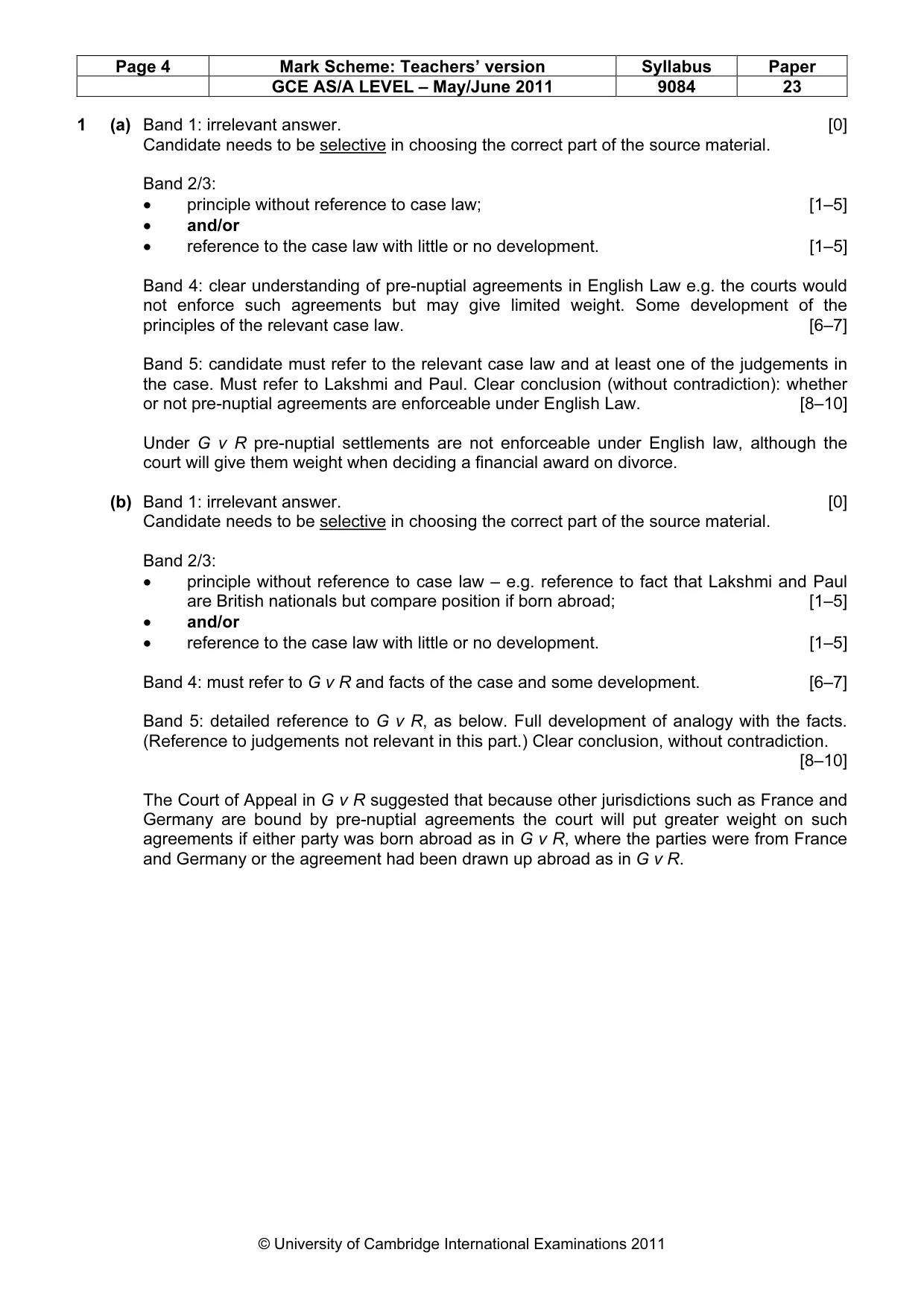
Page 4 Mark Scheme: Teachers’ version Syllabus Paper GCE AS/A LEVEL – May/June 2011 9084 23 © University of Cambridge International Examinations 2011 1 (a) Band 1: irrelevant answer. [0] Candidate needs to be selective in choosing the correct part of the source material. Band 2/3: • principle without reference to case law; [1–5] • and/or • reference to the case law with little or no development. [1–5] Band 4: clear understanding of pre-nuptial agreements in English Law e.g. the courts would not enforce such agreements but may give limited weight. Some development of the principles of the relevant case law. [6–7] Band 5: candidate must refer to the relevant case law and at least one of the judgements in the case. Must refer to Lakshmi and Paul. Clear conclusion (without contradiction): whether or not pre-nuptial agreements are enforceable under English Law. [8–10] Under G v R pre-nuptial settlements are not enforceable under English law, although the court will give them weight when deciding a financial award on divorce. (b) Band 1: irrelevant answer. [0] Candidate needs to be selective in choosing the correct part of the source material. Band 2/3: • principle without reference to case law – e.g. reference to fact that Lakshmi and Paul are British nationals but compare position if born abroad; [1–5] • and/or • reference to the case law with little or no development. [1–5] Band 4: must refer to G v R and facts of the case and some development. [6–7] Band 5: detailed reference to G v R, as below. Full development of analogy with the facts. (Reference to judgements not relevant in this part.) Clear conclusion, without contradiction. [8–10] The Court of Appeal in G v R suggested that because other jurisdictions such as France and Germany are bound by pre-nuptial agreements the court will put greater weight on such agreements if either party was born abroad as in G v R, where the parties were from France and Germany or the agreement had been drawn up abroad as in G v R.
Mark scheme, page 5
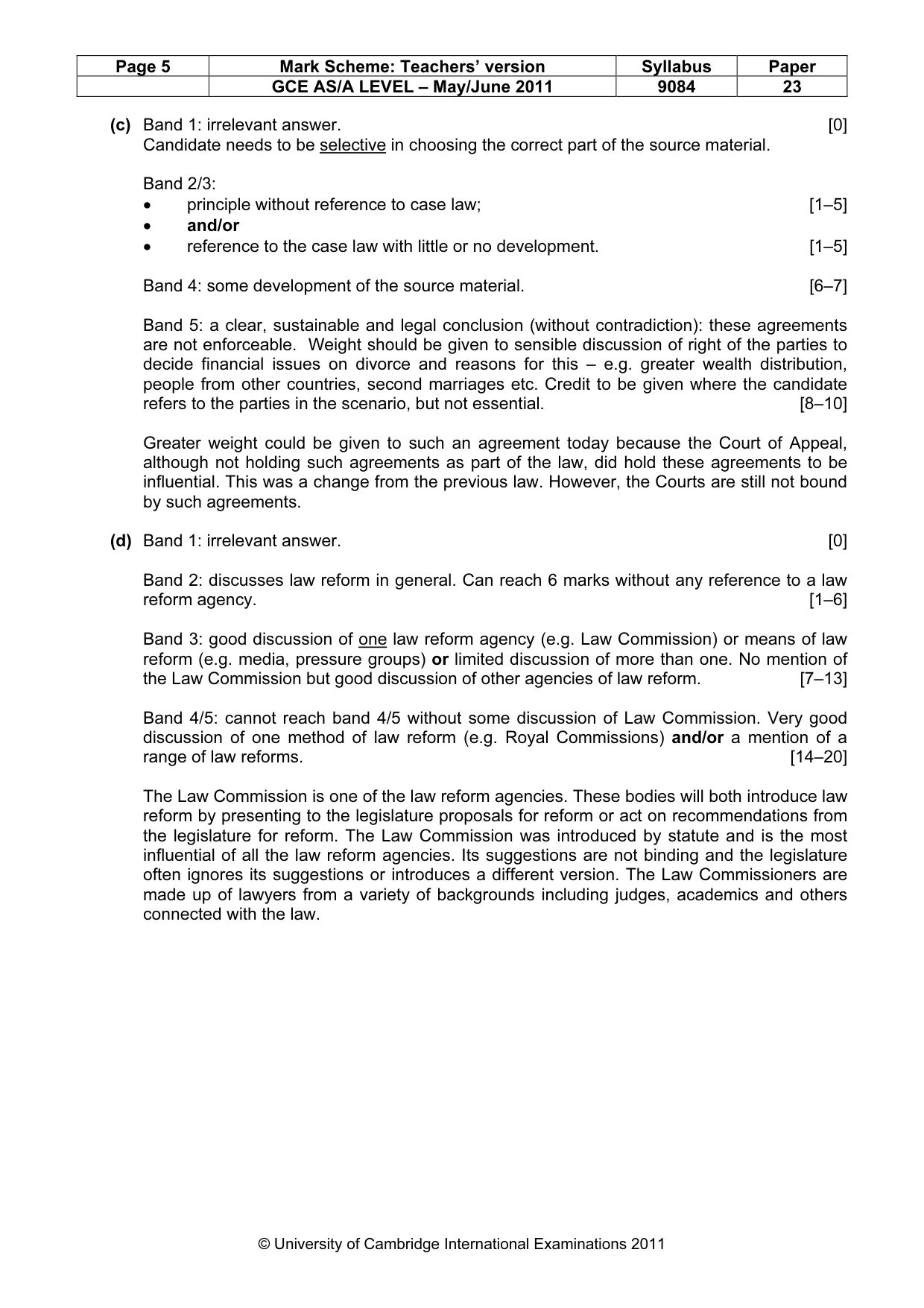
Page 5 Mark Scheme: Teachers’ version Syllabus Paper GCE AS/A LEVEL – May/June 2011 9084 23 © University of Cambridge International Examinations 2011 (c) Band 1: irrelevant answer. [0] Candidate needs to be selective in choosing the correct part of the source material. Band 2/3: • principle without reference to case law; [1–5] • and/or • reference to the case law with little or no development. [1–5] Band 4: some development of the source material. [6–7] Band 5: a clear, sustainable and legal conclusion (without contradiction): these agreements are not enforceable. Weight should be given to sensible discussion of right of the parties to decide financial issues on divorce and reasons for this – e.g. greater wealth distribution, people from other countries, second marriages etc. Credit to be given where the candidate refers to the parties in the scenario, but not essential. [8–10] Greater weight could be given to such an agreement today because the Court of Appeal, although not holding such agreements as part of the law, did hold these agreements to be influential. This was a change from the previous law. However, the Courts are still not bound by such agreements. (d) Band 1: irrelevant answer. [0] Band 2: discusses law reform in general. Can reach 6 marks without any reference to a law reform agency. [1–6] Band 3: good discussion of one law reform agency (e.g. Law Commission) or means of law reform (e.g. media, pressure groups) or limited discussion of more than one. No mention of the Law Commission but good discussion of other agencies of law reform. [7–13] Band 4/5: cannot reach band 4/5 without some discussion of Law Commission. Very good discussion of one method of law reform (e.g. Royal Commissions) and/or a mention of a range of law reforms. [14–20] The Law Commission is one of the law reform agencies. These bodies will both introduce law reform by presenting to the legislature proposals for reform or act on recommendations from the legislature for reform. The Law Commission was introduced by statute and is the most influential of all the law reform agencies. Its suggestions are not binding and the legislature often ignores its suggestions or introduces a different version. The Law Commissioners are made up of lawyers from a variety of backgrounds including judges, academics and others connected with the law.
Mark scheme, page 6
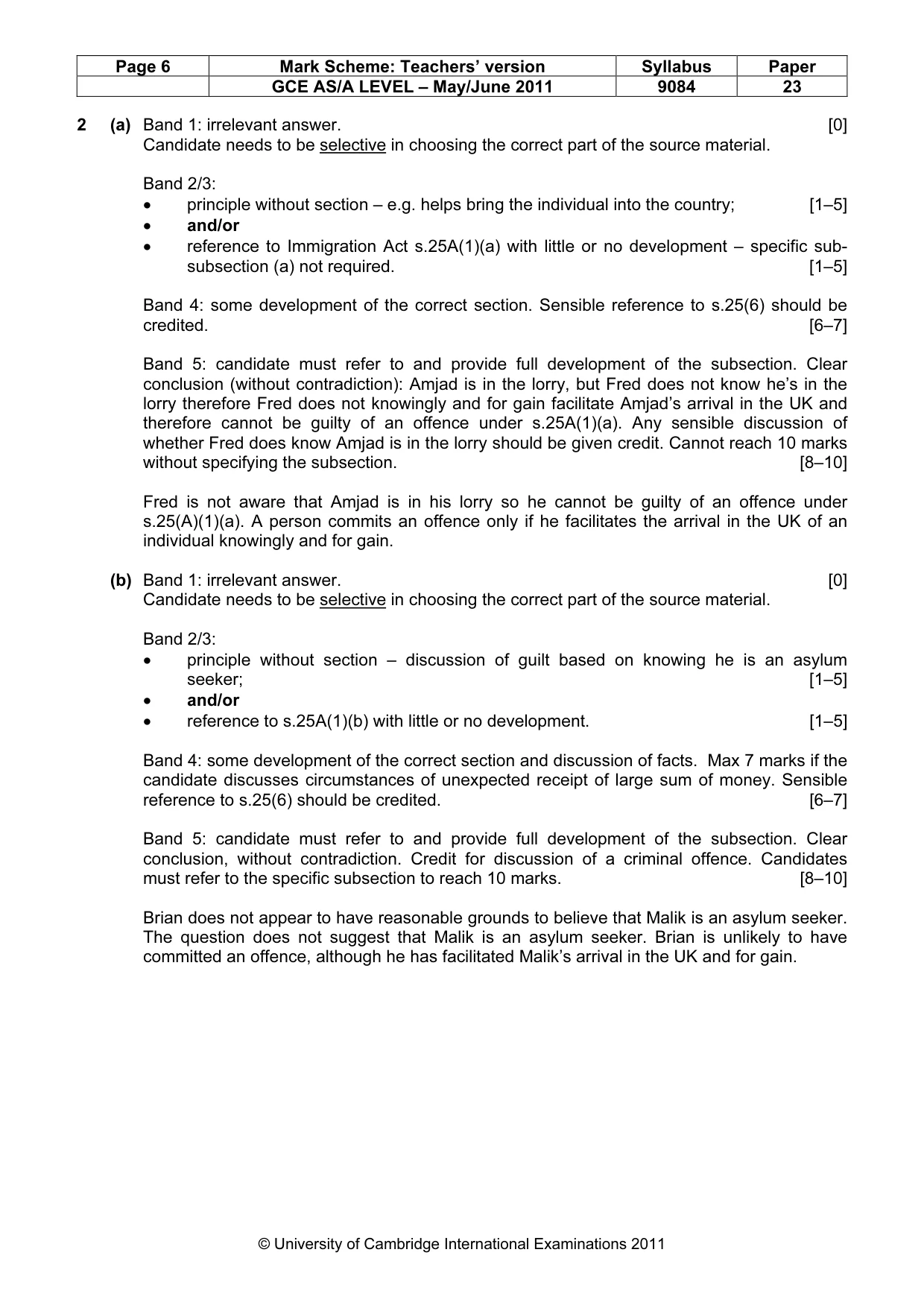
Page 6 Mark Scheme: Teachers’ version Syllabus Paper GCE AS/A LEVEL – May/June 2011 9084 23 © University of Cambridge International Examinations 2011 2 (a) Band 1: irrelevant answer. [0] Candidate needs to be selective in choosing the correct part of the source material. Band 2/3: • principle without section – e.g. helps bring the individual into the country; [1–5] • and/or • reference to Immigration Act s.25A(1)(a) with little or no development – specific sub- subsection (a) not required. [1–5] Band 4: some development of the correct section. Sensible reference to s.25(6) should be credited. [6–7] Band 5: candidate must refer to and provide full development of the subsection. Clear conclusion (without contradiction): Amjad is in the lorry, but Fred does not know he’s in the lorry therefore Fred does not knowingly and for gain facilitate Amjad’s arrival in the UK and therefore cannot be guilty of an offence under s.25A(1)(a). Any sensible discussion of whether Fred does know Amjad is in the lorry should be given credit. Cannot reach 10 marks without specifying the subsection. [8–10] Fred is not aware that Amjad is in his lorry so he cannot be guilty of an offence under s.25(A)(1)(a). A person commits an offence only if he facilitates the arrival in the UK of an individual knowingly and for gain. (b) Band 1: irrelevant answer. [0] Candidate needs to be selective in choosing the correct part of the source material. Band 2/3: • principle without section – discussion of guilt based on knowing he is an asylum seeker; [1–5] • and/or • reference to s.25A(1)(b) with little or no development. [1–5] Band 4: some development of the correct section and discussion of facts. Max 7 marks if the candidate discusses circumstances of unexpected receipt of large sum of money. Sensible reference to s.25(6) should be credited. [6–7] Band 5: candidate must refer to and provide full development of the subsection. Clear conclusion, without contradiction. Credit for discussion of a criminal offence. Candidates must refer to the specific subsection to reach 10 marks. [8–10] Brian does not appear to have reasonable grounds to believe that Malik is an asylum seeker. The question does not suggest that Malik is an asylum seeker. Brian is unlikely to have committed an offence, although he has facilitated Malik’s arrival in the UK and for gain.
Mark scheme, page 7
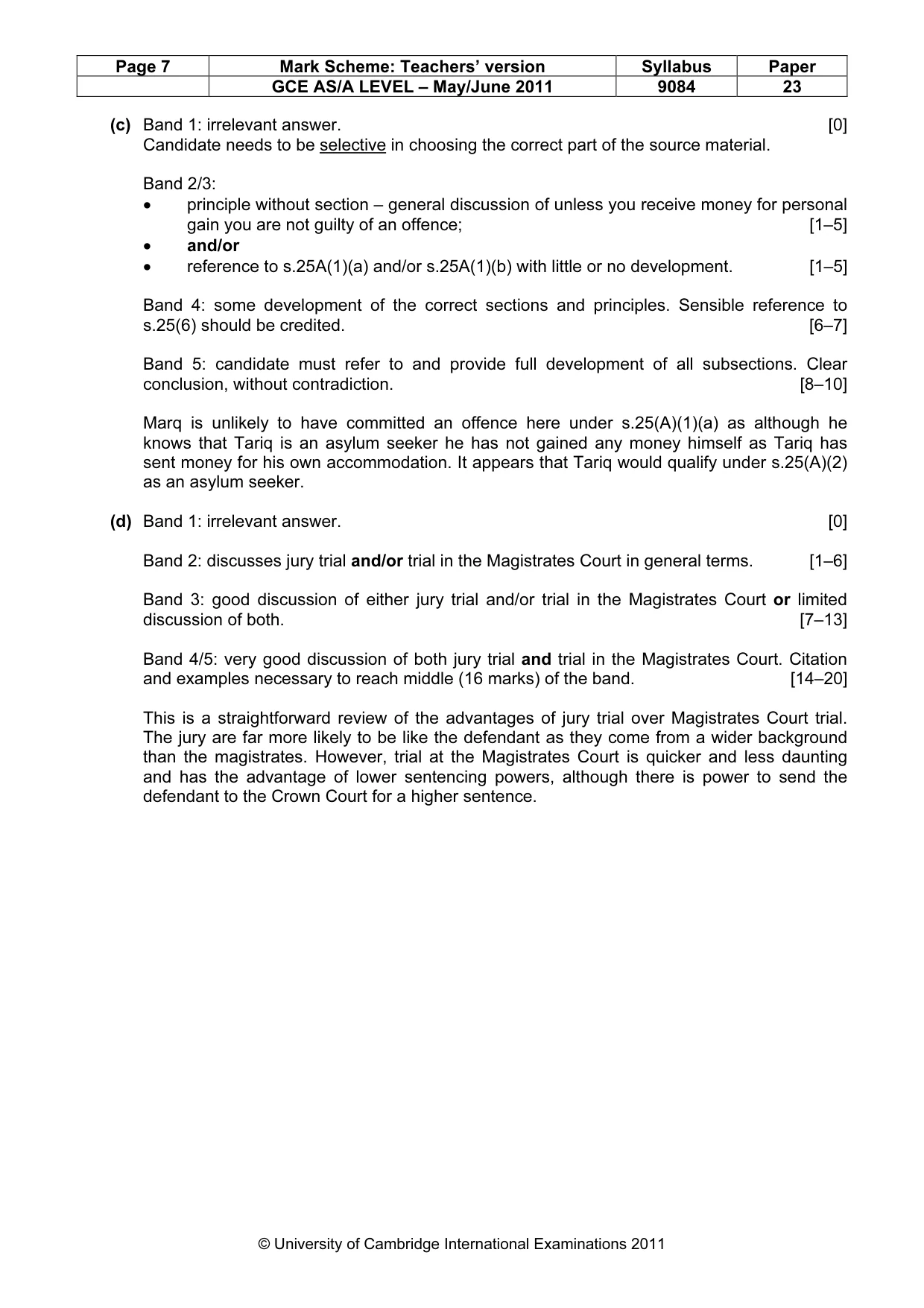
Page 7 Mark Scheme: Teachers’ version Syllabus Paper GCE AS/A LEVEL – May/June 2011 9084 23 © University of Cambridge International Examinations 2011 (c) Band 1: irrelevant answer. [0] Candidate needs to be selective in choosing the correct part of the source material. Band 2/3: • principle without section – general discussion of unless you receive money for personal gain you are not guilty of an offence; [1–5] • and/or • reference to s.25A(1)(a) and/or s.25A(1)(b) with little or no development. [1–5] Band 4: some development of the correct sections and principles. Sensible reference to s.25(6) should be credited. [6–7] Band 5: candidate must refer to and provide full development of all subsections. Clear conclusion, without contradiction. [8–10] Marq is unlikely to have committed an offence here under s.25(A)(1)(a) as although he knows that Tariq is an asylum seeker he has not gained any money himself as Tariq has sent money for his own accommodation. It appears that Tariq would qualify under s.25(A)(2) as an asylum seeker. (d) Band 1: irrelevant answer. [0] Band 2: discusses jury trial and/or trial in the Magistrates Court in general terms. [1–6] Band 3: good discussion of either jury trial and/or trial in the Magistrates Court or limited discussion of both. [7–13] Band 4/5: very good discussion of both jury trial and trial in the Magistrates Court. Citation and examples necessary to reach middle (16 marks) of the band. [14–20] This is a straightforward review of the advantages of jury trial over Magistrates Court trial. The jury are far more likely to be like the defendant as they come from a wider background than the magistrates. However, trial at the Magistrates Court is quicker and less daunting and has the advantage of lower sentencing powers, although there is power to send the defendant to the Crown Court for a higher sentence.
What you needed in this session
Cambridge’s own grade thresholds for 2011 May/June, Paper 2 · Variant 3. A higher threshold means an easier paper — the bar moves with how the cohort did.