Questions as text
Q1 · A large, profitable manufacturing company wishes to replace its current computer system… 9626/31 May/June 2017
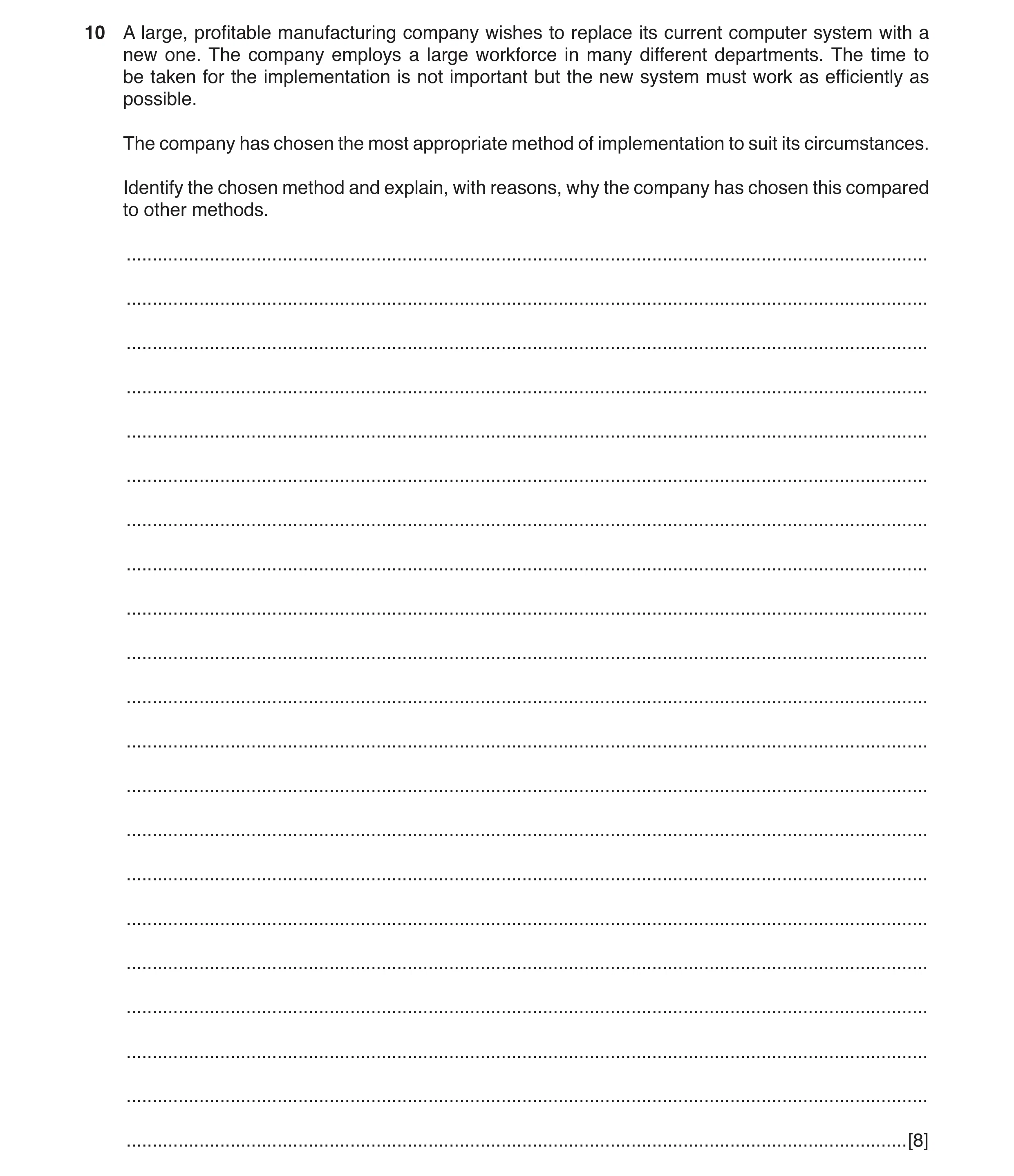
10 A large, profitable manufacturing company wishes to replace its current computer system with a new one. The company employs a large workforce in many different departments. The time to be taken for the implementation is not important but the new system must work as efficiently as possible. The company has chosen the most appropriate method of implementation to suit its circumstances. Identify the chosen method and explain, with reasons, why the company has chosen this compared to other methods. … … … … … … … … … … … … … … … … … … … … … [8]
8 marks
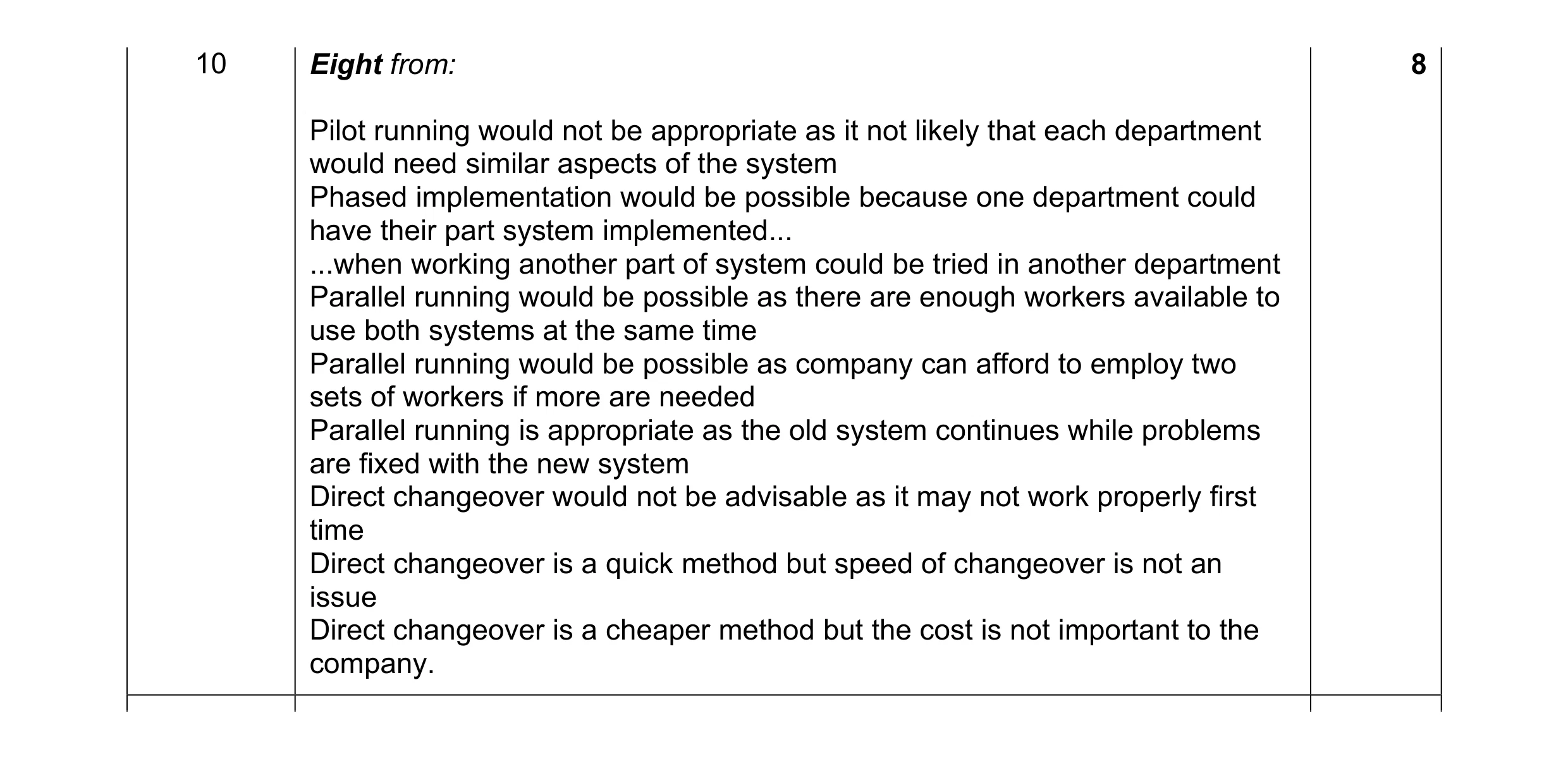
Mark scheme: 10 Eight from: 8 Pilot running would not be appropriate as it not likely that each department would need similar aspects of the system Phased implementation would be possible because one department could have their part system implemented... ...when working another part of system could be tried in another department Parallel running would be possible as there are enough workers available to use both systems at the same time Parallel running would be possible as company can afford to employ two sets of workers if more are needed Parallel running is appropriate as the old system continues while problems are fixed with the new system Direct changeover would not be advisable as it may not work properly first time Direct changeover is a quick method but speed of changeover is not an issue Direct changeover is a cheaper method but the cost is not important to the company.
This question in 9626/31 May/June 2017
Q2 · A large, profitable manufacturing company wishes to replace its current computer system… 9626/33 May/June 2017
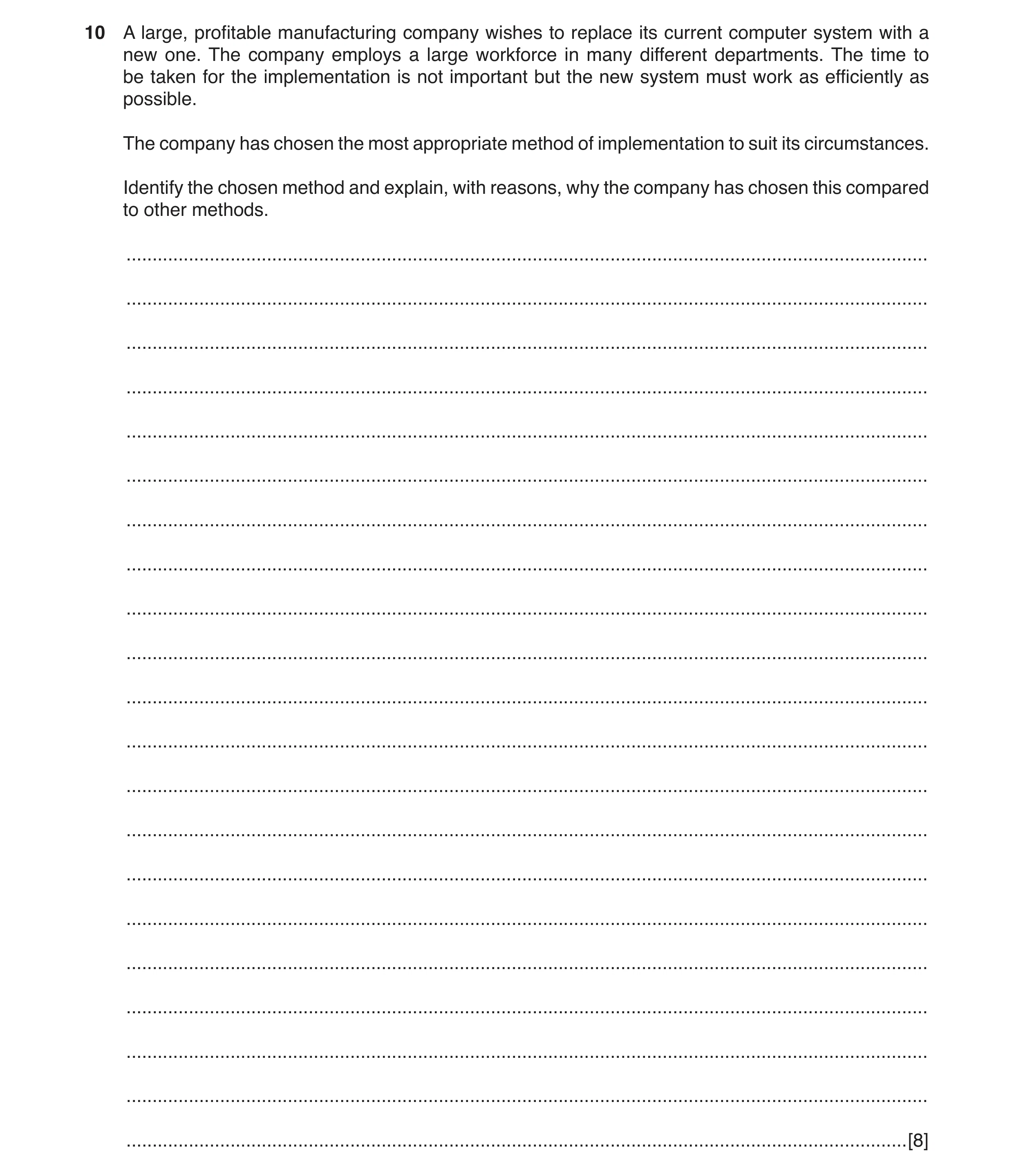
10 A large, profitable manufacturing company wishes to replace its current computer system with a new one. The company employs a large workforce in many different departments. The time to be taken for the implementation is not important but the new system must work as efficiently as possible. The company has chosen the most appropriate method of implementation to suit its circumstances. Identify the chosen method and explain, with reasons, why the company has chosen this compared to other methods. … … … … … … … … … … … … … … … … … … … … … [8]
8 marks
Mark scheme: 10 Eight from: 8 Pilot running would not be appropriate as it not likely that each department would need similar aspects of the system Phased implementation would be possible because one department could have their part system implemented... ...when working another part of system could be tried in another department Parallel running would be possible as there are enough workers available to use both systems at the same time Parallel running would be possible as company can afford to employ two sets of workers if more are needed Parallel running is appropriate as the old system continues while problems are fixed with the new system Direct changeover would not be advisable as it may not work properly first time Direct changeover is a quick method but speed of changeover is not an issue Direct changeover is a cheaper method but the cost is not important to the company.
This question in 9626/33 May/June 2017
Q3 · A store has a large number of departments each with its own sales staff 9626/32 May/June 2018
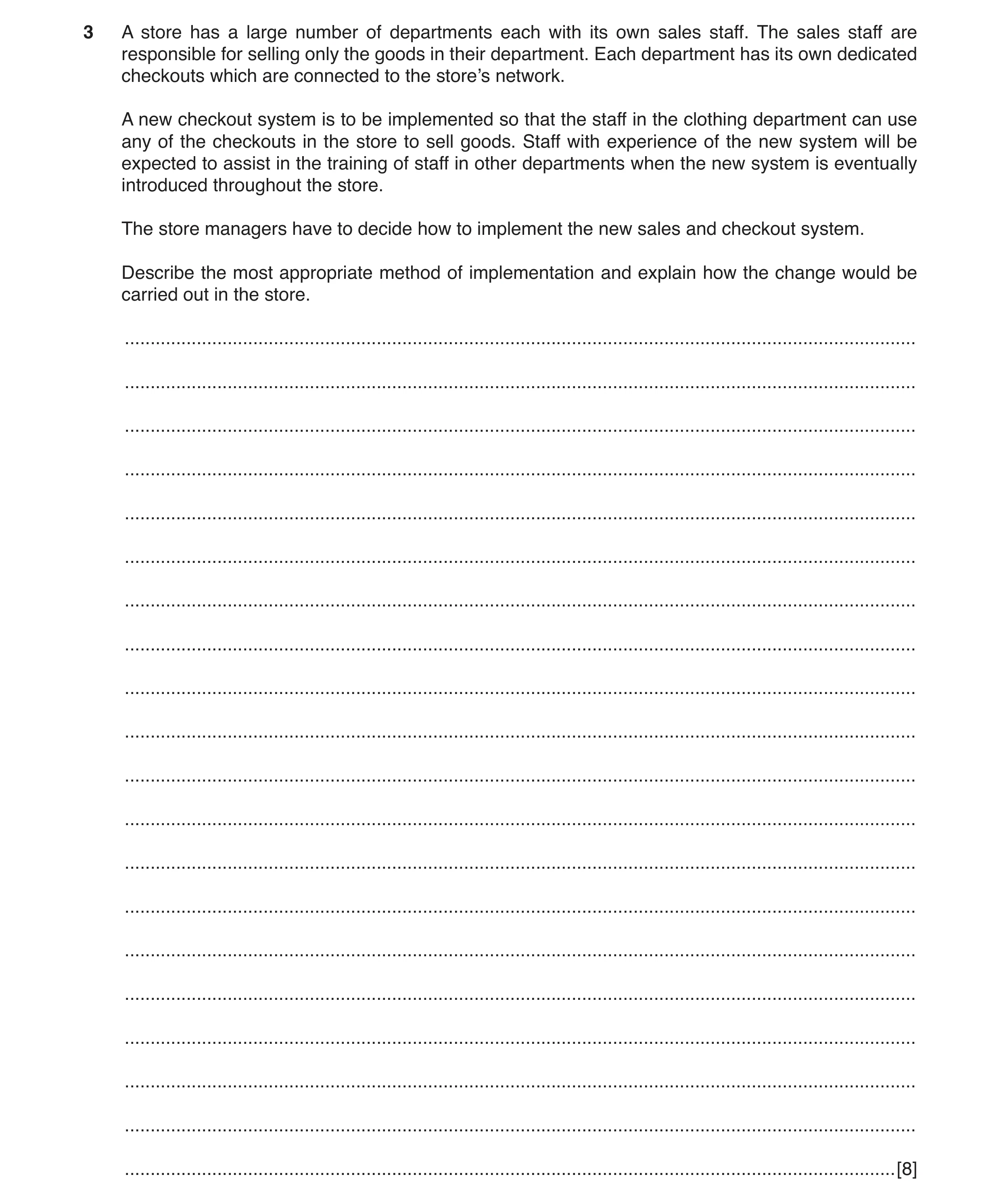
3 A store has a large number of departments each with its own sales staff. The sales staff are responsible for selling only the goods in their department. Each department has its own dedicated checkouts which are connected to the store’s network. A new checkout system is to be implemented so that the staff in the clothing department can use any of the checkouts in the store to sell goods. Staff with experience of the new system will be expected to assist in the training of staff in other departments when the new system is eventually introduced throughout the store. The store managers have to decide how to implement the new sales and checkout system. Describe the most appropriate method of implementation and explain how the change would be carried out in the store. … … … … … … … … … … … … … … … … … … … … [8]
8 marks
Mark scheme: 3 Eight from: 8 Pilot implementation where the system is introduced one branch/department at a time Clothing department has new checkouts installed before the others Staff in clothing department are trained to sell all goods ...and use the new checkouts Checkouts and staff performance is tested for some time Ensures that new checkouts are working correctly Ensures that staff in clothing department understand/can use new checkouts/sell all goods successfully Stock and accounting systems are correctly updated If new system works then staff from other departments can take turns working in the clothing department If new system does not work then only clothing department is affected Other departments can carry on as before until faults are corrected/new system does work The changeover may take a long time to implement in the whole store But there is no danger of having to close the whole store if one section fails to work properly.
This question in 9626/32 May/June 2018
Q4 · Analyse the suitability of using pilot implementation to install and use WiFi internet… 9626/32 Oct/Nov 2018
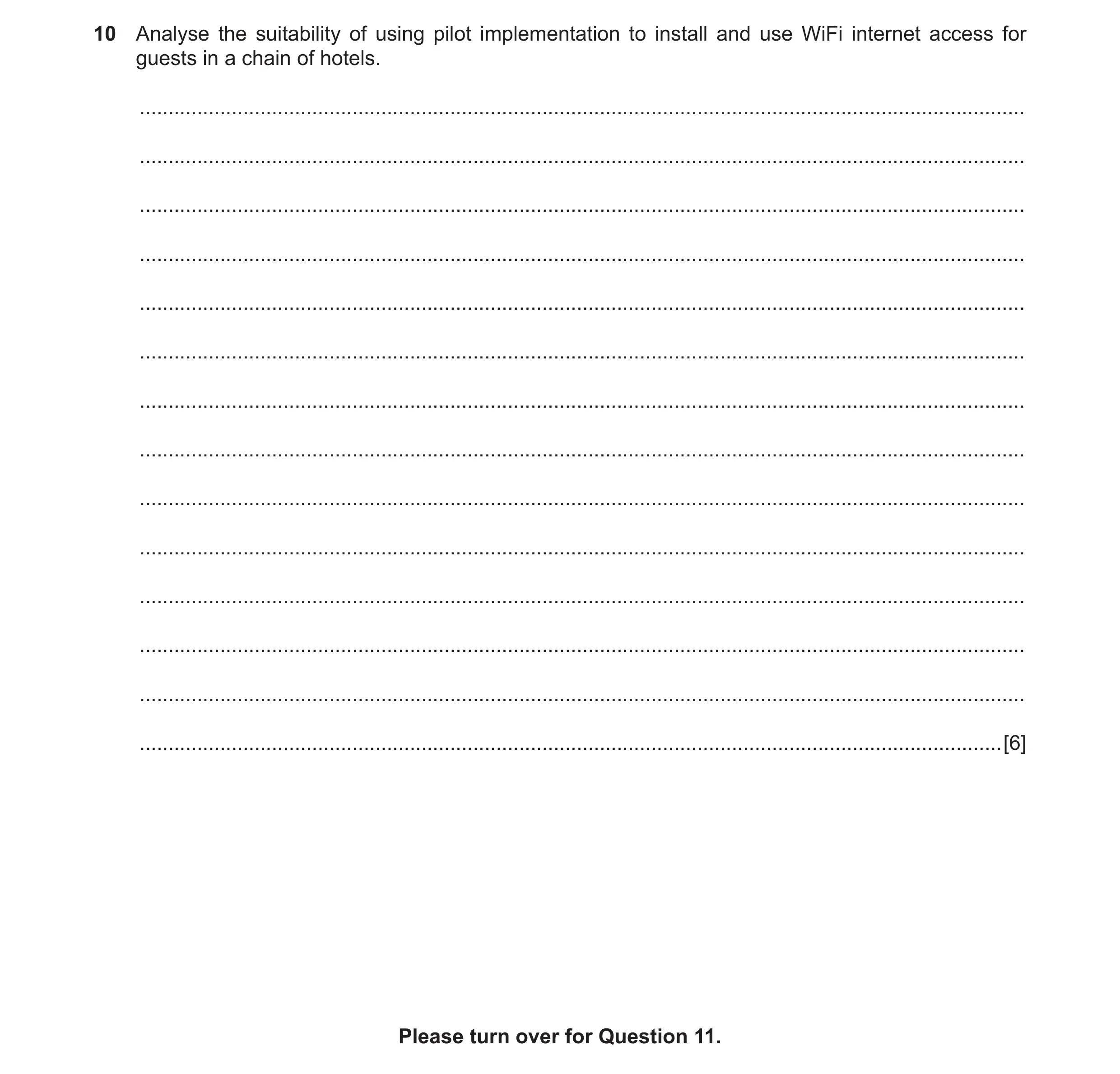
10 Analyse the suitability of using pilot implementation to install and use WiFi internet access for guests in a chain of hotels. … … … … … … … … … … … … … … [6] Please turn over for Question 11.
6 marks
Mark scheme: 10 Six from: 6 Running in one hotel until it is working perfectly When working perfectly it can be installed in the other hotels The method is more effective than installing in all hotels and discovering problems If it does not work only one hotel is affected not the whole chain of hotels Staff at the hotel can be used to train staff at the other hotels Feedback is collected and collating reviews by guests/users in one hotel Will take longer to fully implement all guest access to Wi-Fi in all hotels compared to direct changeover.
This question in 9626/32 Oct/Nov 2018
Q5 · The owners of a bank are replacing its current system by transferring all accounts and… 9626/32 Feb/March 2019
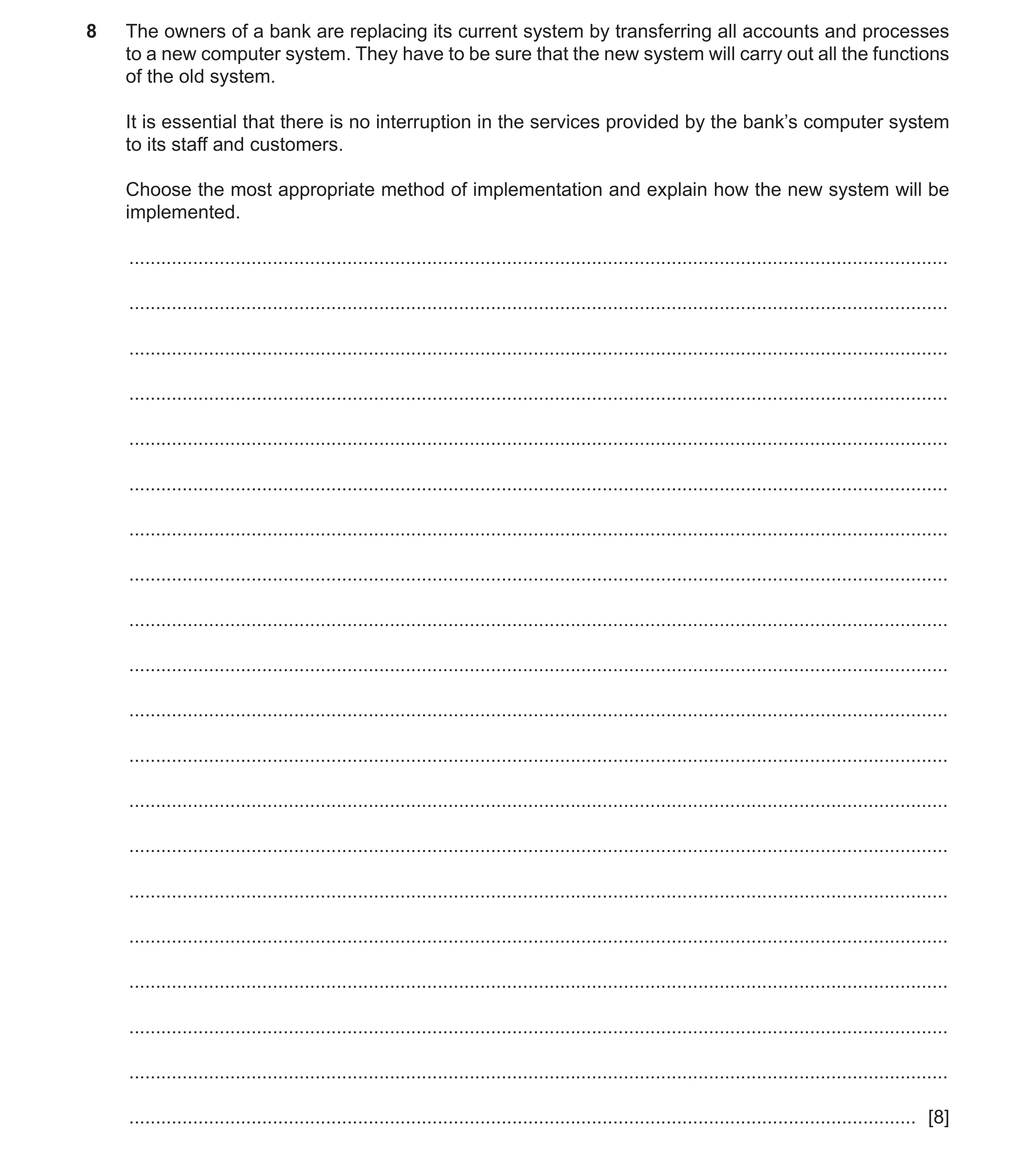
8 The owners of a bank are replacing its current system by transferring all accounts and processes to a new computer system. They have to be sure that the new system will carry out all the functions of the old system. It is essential that there is no interruption in the services provided by the bank’s computer system to its staff and customers. Choose the most appropriate method of implementation and explain how the new system will be implemented. … … … … … … … … … … … … … … … … … … … … [8]
8 marks
Mark scheme: 8 Eight from: 8 Install and start the new system alongside the old system Copy/set up all accounts services to the new system Allow some staff and some/new customers to use services on new system Switch all services to new system once it is installed and running Compare results from new system/performance of new system with old/current system over a period of time Period of time long enough to test/try all provided services Keep old/current system running to ensure that no features are lost/in case new system fails Ensure that all services are duplicated properly/in full No perceived difference in services by staff or customers Revert to old/current system if new system needs to be updated/amended/maintained during testing/parallel running time period Once new system has proved successful complete switch to new system Retain old system as backup in case of failure of new system for a period of time/archive.
This question in 9626/32 Feb/March 2019
Q6 · A chain of supermarkets has a computer system which deals with stock control, payroll… 9626/32 Feb/March 2020
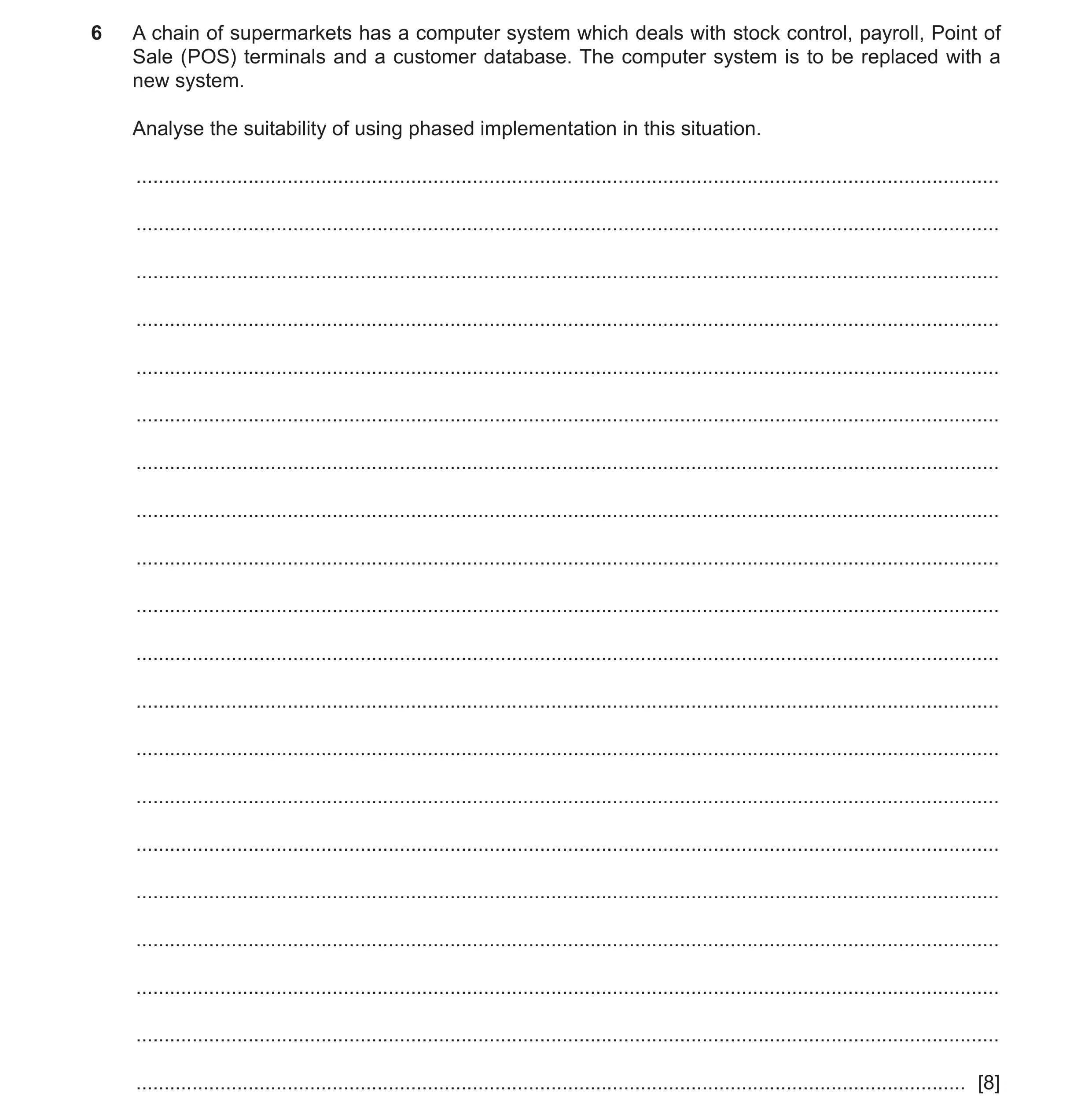
6 A chain of supermarkets has a computer system which deals with stock control, payroll, Point of Sale (POS) terminals and a customer database. The computer system is to be replaced with a new system. Analyse the suitability of using phased implementation in this situation. … … … … … … … … … … … … … … … … … … … … [8]
8 marks
Mark scheme: 6 Eight from: 8 Changeover takes place in stages by replacing one part/area then another Parts of the old system are used alongside/with newly installed parts Costs of implementation can be spread over time as all hardware/software is not installed at once New systems can be used alongside old ones/form of parallel running with same stock control system to check suitability/functionality If (one/individual) new POS system does not work properly old ones can be used to avoid customer dissatisfaction at sales points Staff/user training can be carried out in stages by rotating staff around departments/areas …with trained staff assisting those being trained Staff/users can be familiarised slowly/gradually with new system and see how it works while using old one If new POS system fails at checkout there is no backup/alternative available other than to move to an old POS system at another checkout with accompanying customer dissatisfaction Complete changeover of all POS systems will take much longer than e.g. direct changeover of all POS systems Disruption to checkouts will be longer/more intensive than e.g. direct changeover of all POS systems.
This question in 9626/32 Feb/March 2020
Q7 · A store that sells and delivers furniture is installing a new ordering and booking… 9626/32 Oct/Nov 2020
4 A store that sells and delivers furniture is installing a new ordering and booking computer system to replace its old computer system. The direct changeover method of implementation will be used. (a) Describe, in detail, the steps that need to be taken to prepare for the changeover and the steps that need to be taken after the changeover. … … … … … … … … … … … … … … [6] (b) Give two reasons why direct changeover is a suitable method of implementing the new system. 1 … … … … 2 … … … … [2] (c) Give two reasons why direct changeover might not be a suitable method of implementing the new system. 1 … … … … 2 … … … … [2]
10 marks
Mark scheme: 4(a) Six from: 6 Ensure that management/staff are prepared/aware of/trained for the changeover to determine what needs to be done after/will happen at changeover Train experienced/expert staff beforehand to support other staff Train technicians to maintain the new system Prepare/distribute new user manuals/instructions/help services Ensure that all data is suitably backed up/secured Confirm that the new system hardware/software is compatible with the data from the old system Ensure that the new hardware/software is ready and available for installation Transfer the data from the old system to the new one Test the new system to ensure that it is working/data has transferred correctly Plan/amend details of training for future/new users. 4(b) Two from: 2 Store can change systems when it is most convenient/store is shut Benefits of new system are available to all users immediately Can be carried out (overnight/quickly) with minimal disruption to the store operations 4(c) Two from: 2 If the new system fails, the old system is not available for use in store May lose data as old data/backups cannot be installed/used on new system Staff have very little time to learn the new system so may make errors/mistakes
This question in 9626/32 Oct/Nov 2020
Q8 · A bank is installing a new computer system to replace its existing system 9626/33 Oct/Nov 2020
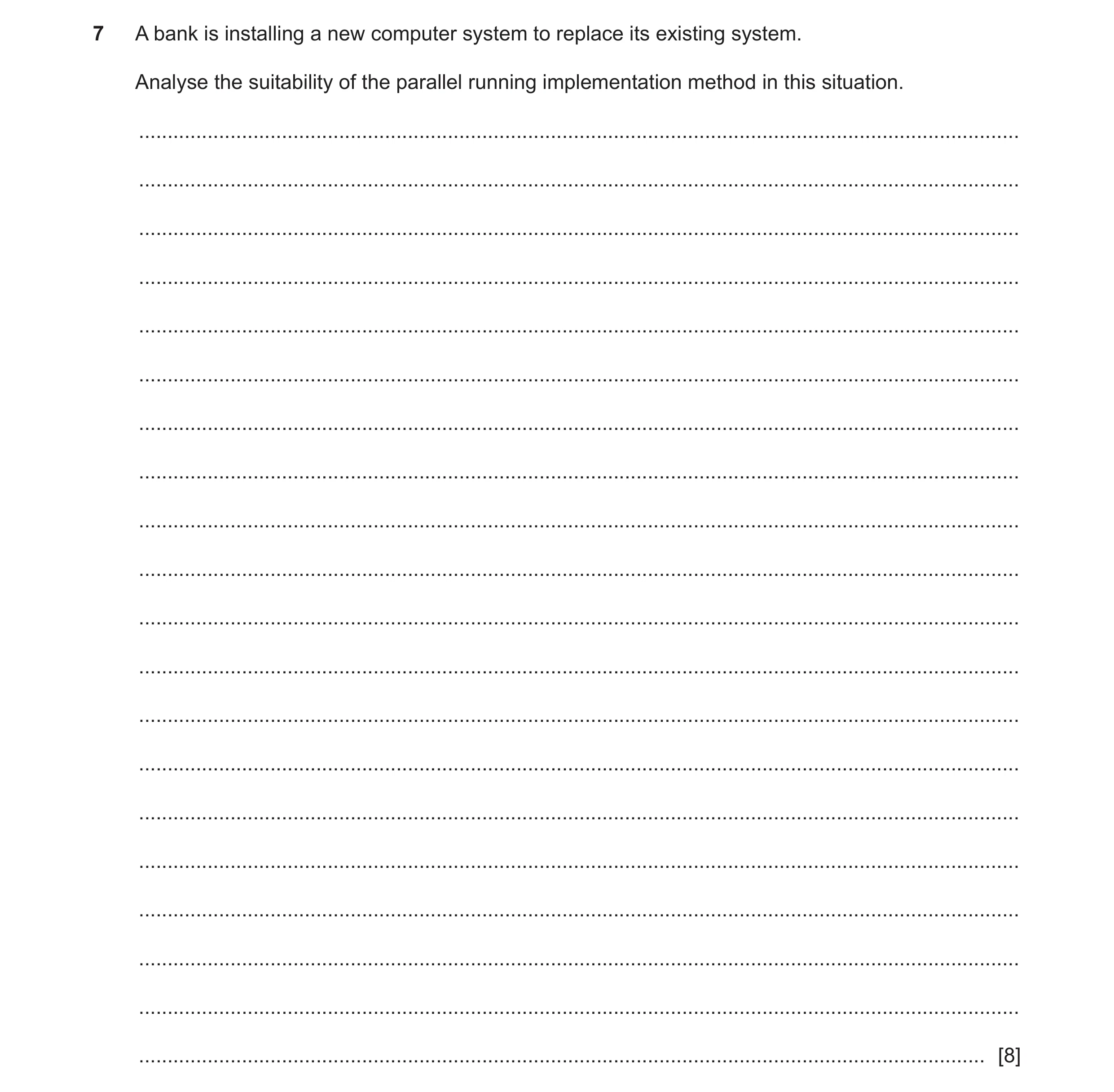
7 A bank is installing a new computer system to replace its existing system. Analyse the suitability of the parallel running implementation method in this situation. … … … … … … … … … … … … … … … … … … … … [8]
8 marks
Mark scheme: 7 Eight from: 8 Parallel running requires the new system to run/be used alongside the old system for a period of time. Benefits: Can ensure that the new system is running without errors by comparing results to the existing system Can resolve any errors by checking with the old system to find any modifications needed If the new system fails then the old system is still operating so there is no loss of data/functions/work Staff can be trained on the new system in batches as the old system is still operating/not all new staff need to use the new system at once Staff may be more confident in using the new system if they can check against the old system Drawbacks: Costs of running both systems at the same time can be expensive/prohibitive Staff may have to use two/both systems and require extensive training Staff may have to do twice the amount of work Maintenance and checking can be frequent and time-consuming Data has to be duplicated and input twice Data has to be carefully checked to ensure that the same data is going into both systems. Must be at least one of each for full marks.
This question in 9626/33 Oct/Nov 2020
Q9 · A hospital is to replace its database management system (DBMS) for storing patient… 9626/31 May/June 2021
7 A hospital is to replace its database management system (DBMS) for storing patient records with a new system. Analyse the effectiveness of the phased implementation method to install the new DBMS. … … … … … … … … … … … … … … … … … … … … [8]
8 marks
Mark scheme: 7 Eight from: 8 Phased implementation of the new system module/part by part The implementation/changeover will be done in stages so time is available for adjustments Users have more time to adapt to/learn the new system so the changeover will run more smoothly Technical staff can concentrate on part of the system/some users so changeover will run more smoothly Problems that arise at the start/first stages are less critical than with other methods so the changeover will have fewer problems Training sessions are/can be confusing for users being asked to work with the new and the old system so users are less productive Several changes in documentation are often required so more time/effort/ resources are used The duration of the changeover can be much longer so there is more disruption to the business/users over a longer period System delivery milestone/endpoint is unclear compared to direct changeover so users are uncertain as to how long the disruption will go on/users will be disrupted for an indeterminate time period. Correctness/completeness/integrity of the data has to be checked several times when a new module is introduced, resulting in a longer time for the changeover with added costs A ‘fall back’ to the old system becomes more difficult with each new stage so if anything goes wrong/fails later data can be lost The implementation may appear unclear/confusing to the employees and other users, resulting in a lack of motivation/care in the work with more errors Complexity of the implementation makes it more difficult to understand/monitor so more technical support/higher costs/much longer time taken Prone to make mistakes/errors/several adjustments may be needed Fall back to old system becomes impossible in later phases so the changeover has to proceed to completion regardless of the consequences. Max 6 marks if bullets/list of points.
This question in 9626/31 May/June 2021
Q10 · A regional government is planning to install broadband internet technology throughout its… 9626/32 May/June 2021
10 A regional government is planning to install broadband internet technology throughout its rural areas. Analyse the effectiveness of using pilot implementation when installing the technology. … … … … … … … … … … … … … … … … … … … … [8]
8 marks
This question in 9626/32 May/June 2021
Q11 · A hospital is to replace its database management system (DBMS) for storing patient… 9626/33 May/June 2021
7 A hospital is to replace its database management system (DBMS) for storing patient records with a new system. Analyse the effectiveness of the phased implementation method to install the new DBMS. … … … … … … … … … … … … … … … … … … … … [8]
8 marks
Mark scheme: 7 Eight from: 8 Phased implementation of the new system module/part by part The implementation/changeover will be done in stages so time is available for adjustments Users have more time to adapt to/learn the new system so the changeover will run more smoothly Technical staff can concentrate on part of the system/some users so changeover will run more smoothly Problems that arise at the start/first stages are less critical than with other methods so the changeover will have fewer problems Training sessions are/can be confusing for users being asked to work with the new and the old system so users are less productive Several changes in documentation are often required so more time/effort/ resources are used The duration of the changeover can be much longer so there is more disruption to the business/users over a longer period System delivery milestone/endpoint is unclear compared to direct changeover so users are uncertain as to how long the disruption will go on/users will be disrupted for an indeterminate time period. Correctness/completeness/integrity of the data has to be checked several times when a new module is introduced, resulting in a longer time for the changeover with added costs A ‘fall back’ to the old system becomes more difficult with each new stage so if anything goes wrong/fails later data can be lost The implementation may appear unclear/confusing to the employees and other users, resulting in a lack of motivation/care in the work with more errors Complexity of the implementation makes it more difficult to understand/monitor so more technical support/higher costs/much longer time taken Prone to make mistakes/errors/several adjustments may be needed Fall back to old system becomes impossible in later phases so the changeover has to proceed to completion regardless of the consequences. Max 6 marks if bullets/list of points.
This question in 9626/33 May/June 2021
Q12 · A manufacturing company uses outdated hardware and software which need to be replaced… 9626/32 May/June 2022
6 A manufacturing company uses outdated hardware and software which need to be replaced with new hardware and software. Discuss the benefits and drawbacks of using parallel running to change over from the old hardware and software to the new hardware and software. … … … … … … … … … … … … … … … … … [6]
6 marks
Mark scheme: 6 Discuss: write about issue(s) or topic(s) in depth in a structured way. Max 1 for good description of parallel running method of implementation Six from: Benefits: Can compare results from existing hardware/software/system …to ensure that there are no errors Can refer to/use existing hardware/software/system for reference if errors occur …so that the errors can be rectified Existing hardware/software/system can be used while errors/problems in new are rectified …so that production is not stopped/can continue Staff can be trained on new hardware/software/system while referring to existing hardware/software/system …so that staff confidence can be maintained/improved Drawbacks: Costs of parallel running can be high as two sets of hardware/software/system have to be run at the same time …requiring more power use/staff to run both sets of hardware/software/system Staff may need to do twice normal workload to run two sets of hardware/software/system …so production may slow down Maintenance time/effort is increased as there is two sets of hardware/software/system …this may slow production/increase costs Requirement to input data/instructions twice which increases data entry costs/production costs/slows production time Need to ensure accurate input of same data to ensure comparable results from both sets of hardware/software/system. Must have at least one of each for full marks. Must be a proper discussion for full marks. Max 4 marks if bullets/list of points.
This question in 9626/32 May/June 2022
Q13 · A retail company has a computer system used by all of its departments 9626/32 Feb/March 2023
5 A retail company has a computer system used by all of its departments. Pilot running will be used to implement a new computer system. Discuss the benefits and drawbacks of using pilot running to implement the new system. … … … … … … … … … … … … … … … … … … … … … [8]
8 marks
Mark scheme: 5 Discuss: write about issue(s) or topic(s) in depth in a structured way. 8 Eight from: Pilot running is one department trying out/implementing the new system before implementing in all other departments. Benefits: • If the new system fails/does not work properly then only a part/section/department is affected while the others are not • Implementation is easier to manage as on smaller scale/affects less users/staff/employees at once than a full direct changeover/other methods of implementation • Staff/users/employees can be trained in small groups/by department/section • Staff/users/users/employees will/can learn from mistakes made by group using pilot system • Trained staff can assist/support training of other staff • Only one part of the company is changed over so the implementation costs can be phased over a longer period of time – which may save the company money/having to pay large sums at once/cost of complete shut down during changeover/cost of parallel running Drawbacks • Full implementation in all departments/sections of company takes a longer period of time compared to e.g., direct changeover • Can cause more disruption to company business than other methods • Support/IT staff have to support two systems at the same time unlike direct changeover • Old and new system have to interact as data is/may be exchanged between departments – so data is at risk of loss/corruption/staff have to use two systems • If the new system fails in a department/section its data may be lost/inaccessible by other departments/sections. Must be at least two of each for full marks. Max 6 marks if bullets/list of points.
This question in 9626/32 Feb/March 2023
Q14 · A healthcare organisation has centres in different towns and cities 9626/32 Oct/Nov 2023
8 A healthcare organisation has centres in different towns and cities. The organisation uses a networked computer system that allows healthcare professionals to access patient records and appointments from any centre. The user interface for accessing patient records and appointments is going to be replaced. The organisation is considering using pilot implementation. Evaluate the use of pilot implementation to replace the user interface for the computer system. … … … … … … … … … … … … … … … … … … … … [8]
8 marks
Mark scheme: 8 Evaluate: judge or calculate the quality, importance, amount, or value of 8 something. Eight from: • Pilot implementation is implementing the change in one centre before implementing the change in the remaining centres. Max 6 from: For: • Problems/issues in one facility can be addressed/fixed/dealt with before changeover in other centres − So reducing overall problems/issues/risk to data • Users have access to new system/user documentation and can assist others in its use − so reducing the burden/difficulties of using a new system in their work/can concentrate on primary task of patient care • Workload of IT team can be spread out over time • Software IT technicians are required to fully implement the new system • Disruption to the health care organisation is reduced (compared to other implementation methods) − so danger to/disruption to patient care is reduced/minimised • User feedback can be used to assist in training other users at different centres − so improving the user experience at the centres/fewer mistakes/less impact on patient care at different/other centres Max 6 from: Against: • The time taken for the full implementation/changeover is (very) long − so the full benefits of the new system are not realised immediately/can be a long time coming/available to all users/at all centres • The costs for the full implementation can be high − as IT services/technicians may have to be continually relocated/moving between centres to deal with e.g. issues that have different effects in different centres • Systems/interfaces is some centres will be changed before others − so compatibility issues/workarounds for connections/issues will have to developed/implemented as and when necessary/may compromise data • Staff moving between centres are required to be familiar/use different interfaces/systems/be able to use two systems − so adding to their workload/increase in risk of error/mistakes • Motivation of IT team to complete changeover may decrease over long periods of time − leading to slowing of work/increase in errors/increase in duration of changeover. Max 6 if all for or all against. Max 6 marks if bullets/list of points.
This question in 9626/32 Oct/Nov 2023
Q15 · Designers in a company use standalone computer-aided design (CAD) applications to design… 9626/32 Oct/Nov 2024
8 Designers in a company use standalone computer-aided design (CAD) applications to design products. The company has now decided that its designers will change to using a cloud-based CAD application. The company will use parallel running to implement the change. Discuss the use of the parallel running method of implementation in this scenario. … … … … … … … … … … … … … … … … … … … … [8]
8 marks
Mark scheme: 8 Command word: Discuss: write about issue(s) or topic(s) in depth in a structured way. 8 Eight from: • Both (CAD) applications are run at the same time / simultaneously (1st) – until the new system takes over (1) Advantages: • If the new application / system fails users can fall back on / revert to the old application (1st) – system so data is not lost / work can continue (1) • Considered to be the least / less risky to data compared to other methods of implementation • Staff can learn how to use the system gradually / at a steady pace / learn alongside / while still using old system // properly understand the new system (1st) – so, risks to data / product / designs are reduced (1) • Live data can be used to test the new system so new application / system is tested under real conditions • Both applications / systems can be used and the results / products / drawings compared to identify differences / improvements / faults in new system Disadvantages: • Network / internet infrastructure / access / devices must be available • Designers need to be retrained / learn new skills / method of working / security policies • (More) expensive / costs more time / personnel / resources / financial resources (1st) Max Three from: – because extra / more designers / staff / labour may be needed to run both systems (1) – because more office space / IT systems / power / utilities are needed (1) – specialist / new IT services / technicians needed (1) – cloud-based services are / can be expensive (1) – because designers with IT skills / specialist designers may be in short supply so salaries raised to attract them (1) • Data / products / results from the two applications / systems can be out of synchronisation with each other // compatibility issues between applications • Designers may be lost to other companies / leave the company if they are asked to duplicate their work using two systems • Data / drawings have to be duplicated (1st) – and this can cause errors / mistakes (1) – increase the time taken to produce designs (1)
This question in 9626/32 Oct/Nov 2024
Q16 · A store has point-of-sale terminals at the checkouts in its departments 9626/32 Feb/March 2025
10 A store has point-of-sale terminals at the checkouts in its departments. It is using phased implementation to replace its point-of-sale terminals in every department. Discuss the advantages and disadvantages to the store of using phased implementation rather than direct changeover. … … … … … … … … … … … … … … … … … … … … [8]
8 marks
Mark scheme: 10 Command word: Discuss – write about issues(s) or topic(s) in a 8 structured way. One mark for a valid description of phased implementation e.g.: • system changeover / replacement in different time slots / periods in different parts of an organisation One mark for a valid description of direct changeover e.g.: • totally remove original system and replace with new system at once. One mark per bullet point to a maximum of eight marks. Max 5 from : Advantages: e.g.: • End-users can be trained on new terminals in smaller group • So become gradually used to using the new terminals system • New terminals can be tested in one section before replacing other terminals • Evaluation of new terminals in one section before moving on to the next • Smaller workforce / less technicians needed to install terminals compared to e.g. direct changeover • During replacement in one section sales can continue on other sections / customers can pay at other checkouts while change is occurring in one section / store does not have to close during implementation. Max 5 from: Disadvantages: e.g.: • No fall-back option for the terminals that have been replaced / old terminals have been removed so are not available if the new ones fail • Can take a very long time to fully implement / changeover to a whole new system / all new terminals in all sections • May have to update / change other parts of checkout system in phases if new terminals are not (fully) compatible.
This question in 9626/32 Feb/March 2025
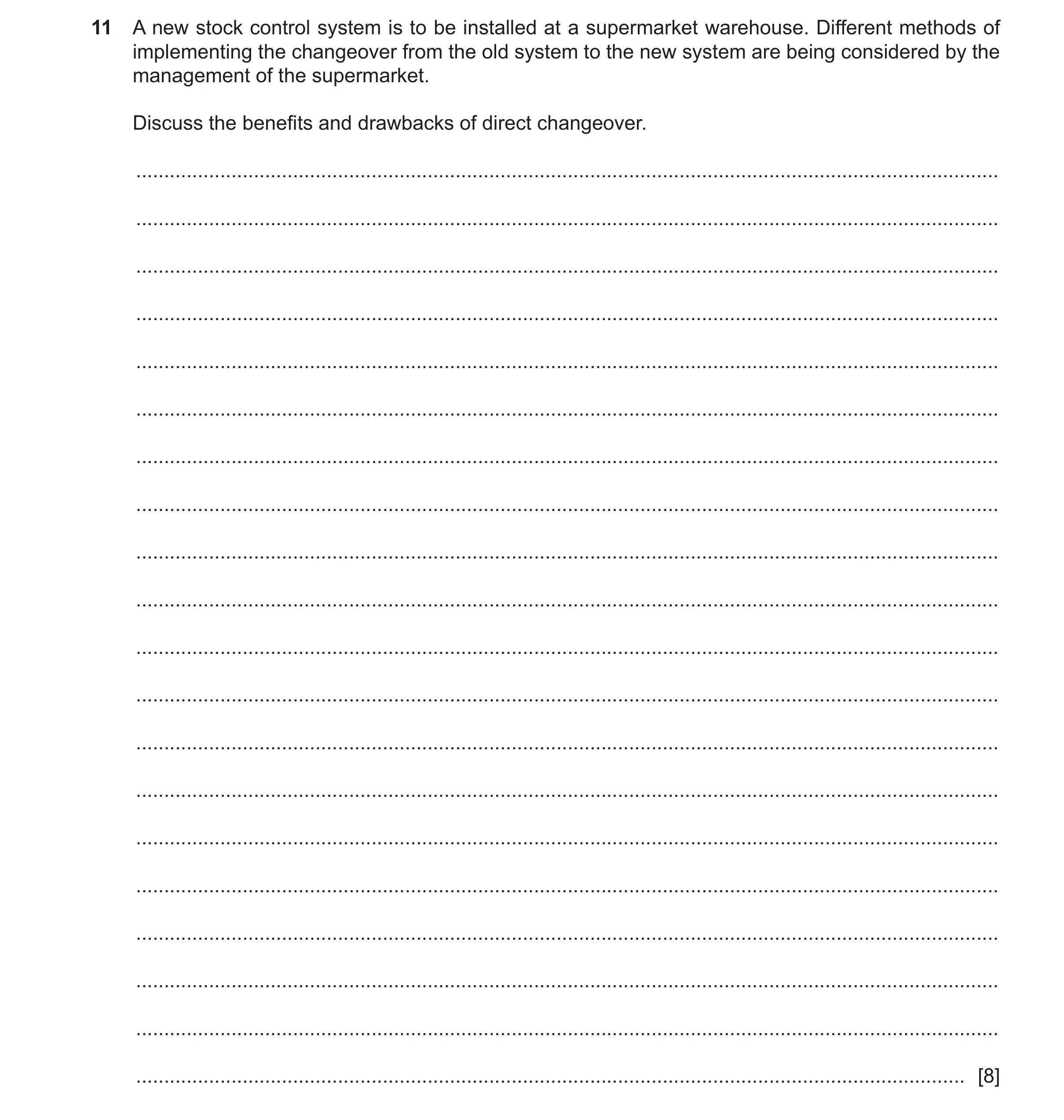
Q17 · A new stock control system is to be installed at a supermarket warehouse 9626/33 Oct/Nov 2025
11 A new stock control system is to be installed at a supermarket warehouse. Different methods of implementing the changeover from the old system to the new system are being considered by the management of the supermarket. Discuss the benefits and drawbacks of direct changeover. … … … … … … … … … … … … … … … … … … … … [8]
8 marks
Mark scheme: 11 Eight from: 8 Command word: Discuss – write about issues(s) or topic(s) in a structured way. Max one from: • The old system is stopped and the new system starts / is used immediately / overnight Max six from: Benefits: • The benefits of the new system can be had immediately after installation / implementation − no delays / loss of work / production / service / deliveries / shipments • Fastest method of installation / implementation compared to other methods − reduced loss of profit and no loss of customers • Only one system is running at any one time − no need to have two sets of hardware / staff − reduced costs of staffing • New system is less likely to have issues / problems / bugs − as has been fully tested before deployment Max six from: Drawbacks: • Staff have to be trained before the new system is installed − staff have to be trained instead of doing real / proper job − reduced productivity by work force during training − staff cannot be trained on a live system − staff have to be trained on a simulated / training system − staff can make mistakes on a training system so get a false sense of security • Old system data has to be transferred to new system − increased risk of data loss − can be time-consuming so may introduce delays − no fallback option if new system fails − stock data may be permanently lost − deliveries / shipments / business may stop / fail • No system at all / may not be available during the point of changeover − old system is not available if the new system fails − so business may not be available to operate
This question in 9626/33 Oct/Nov 2025
 1 / 17
 2 / 17
 3 / 17
 4 / 17
 5 / 17
 6 / 17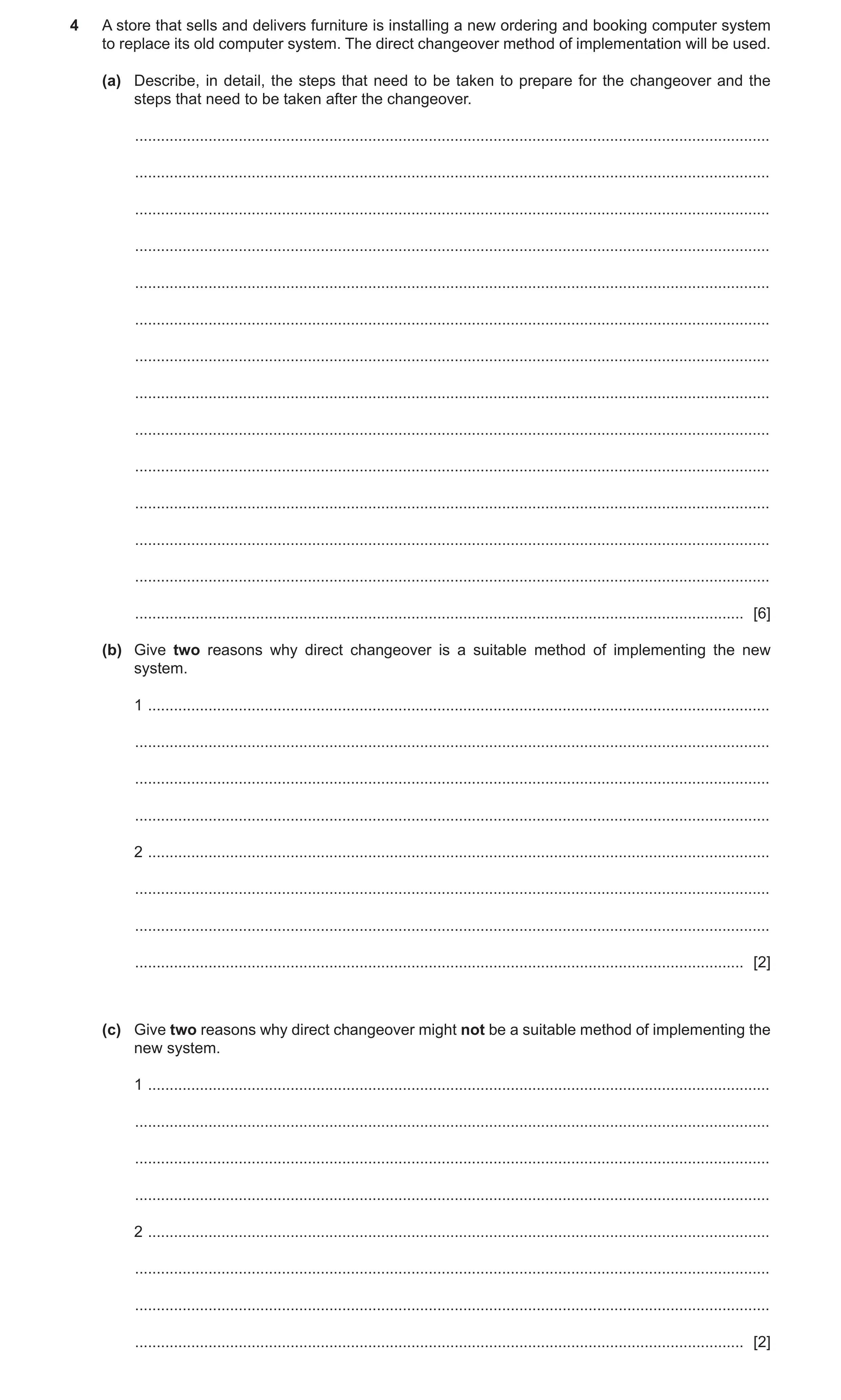
 8 / 17
 9 / 17
 10 / 17
 11 / 17
 12 / 17
 13 / 17
 14 / 17
 15 / 17
 16 / 17
 17 / 17
 8
8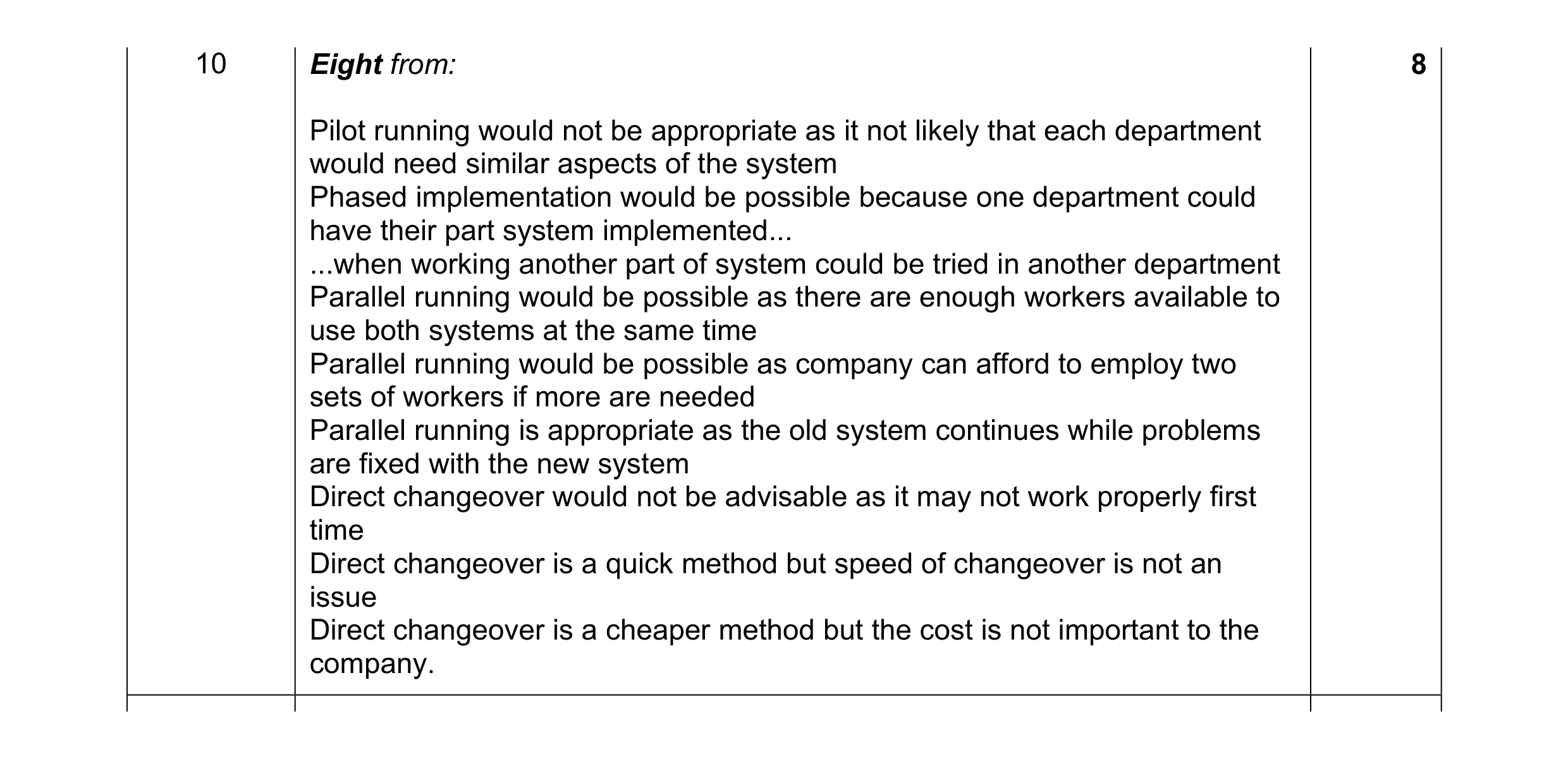 8
8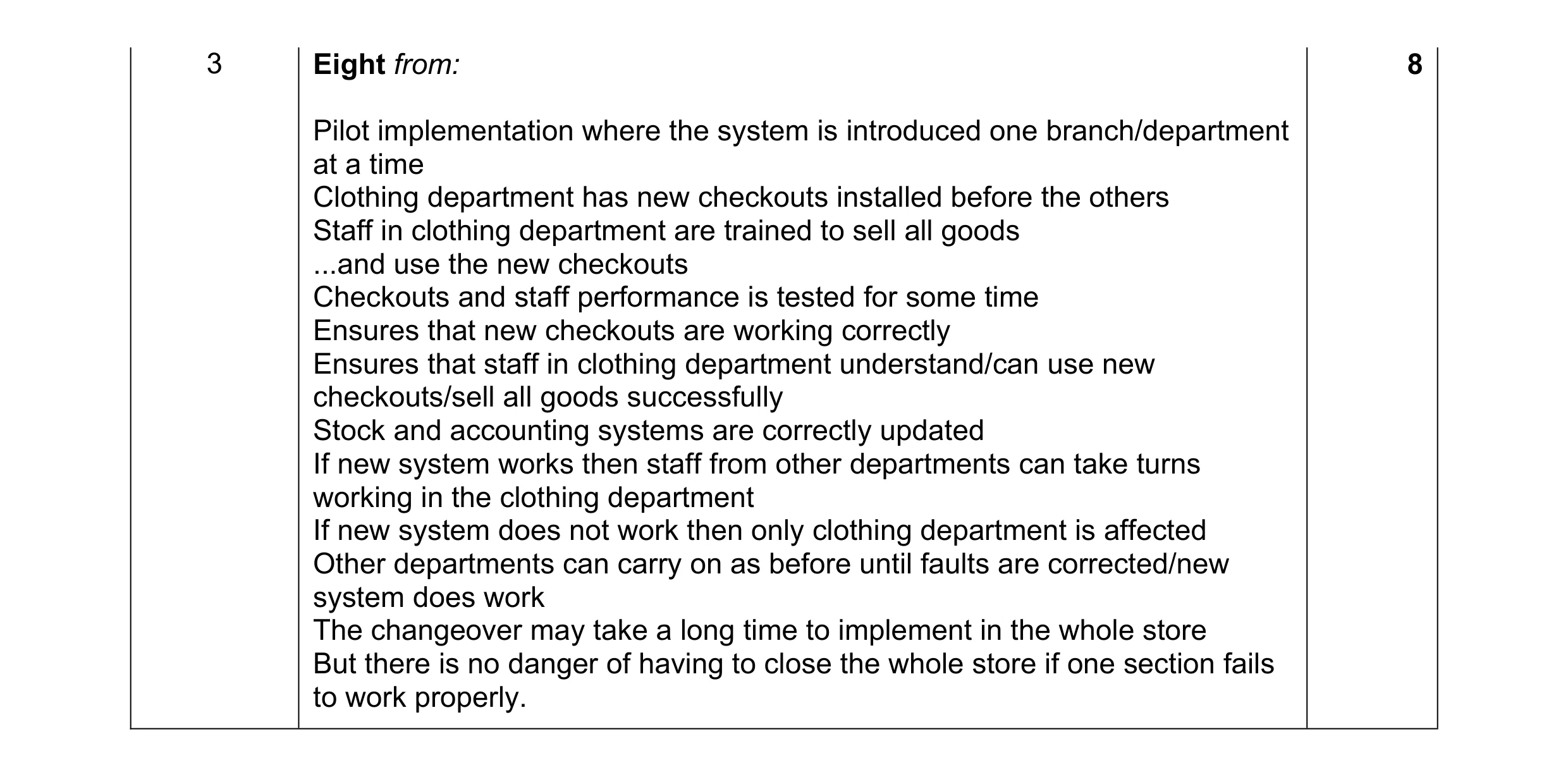 8
8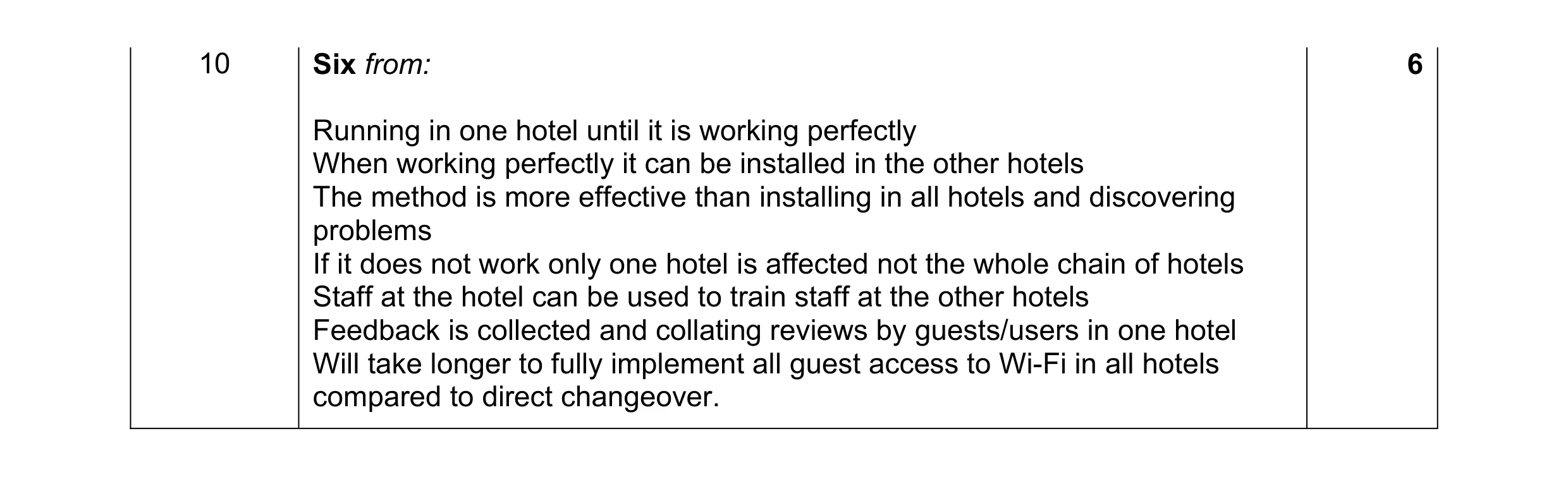 6
6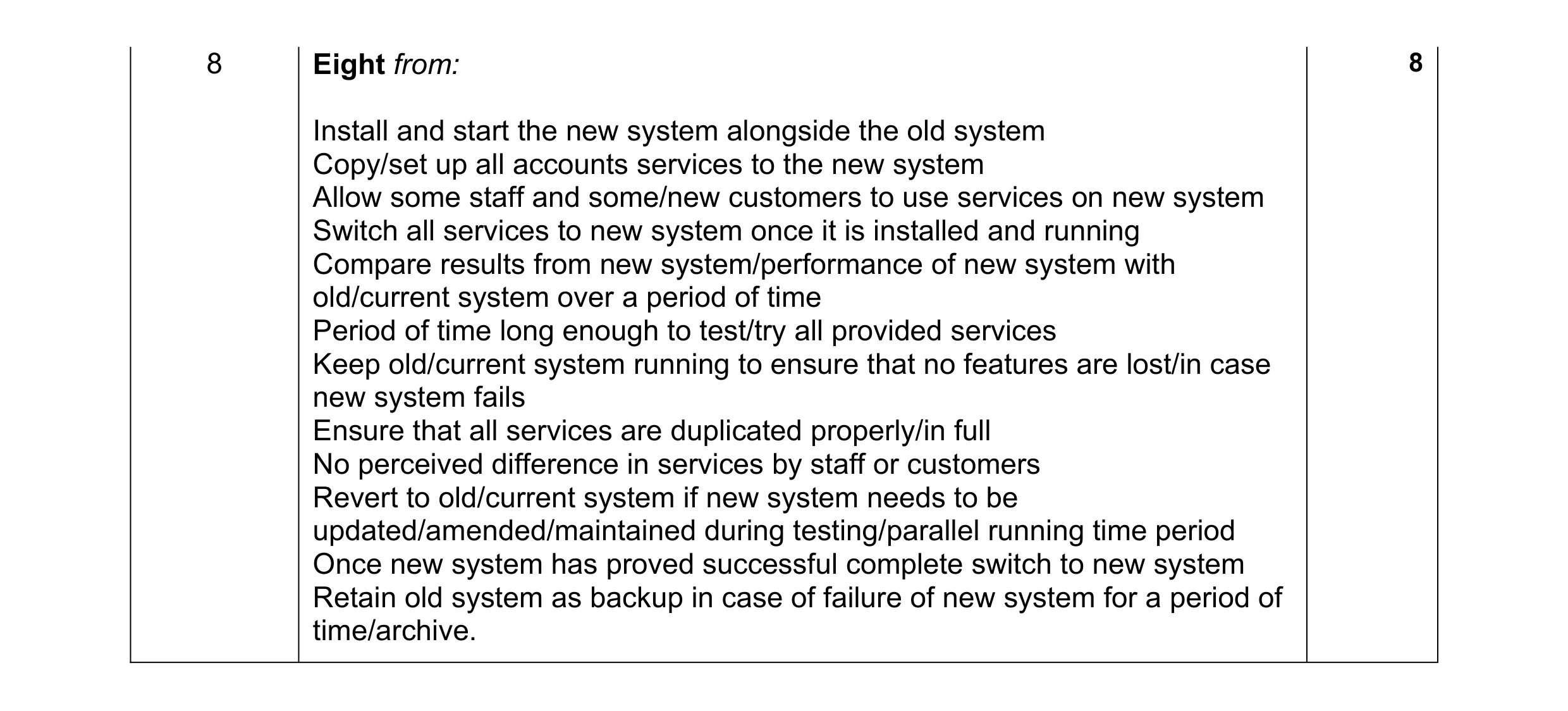 8
8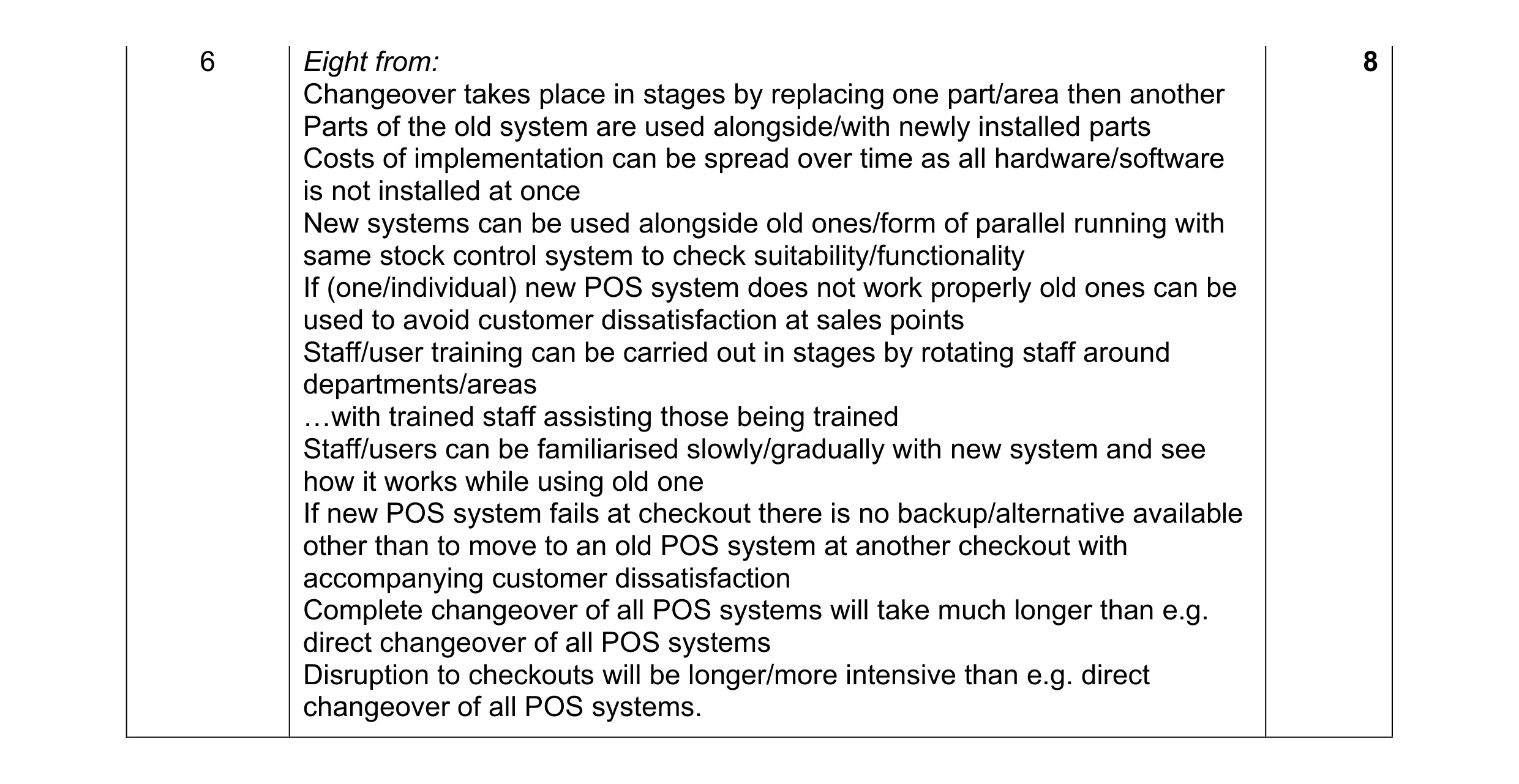 8
8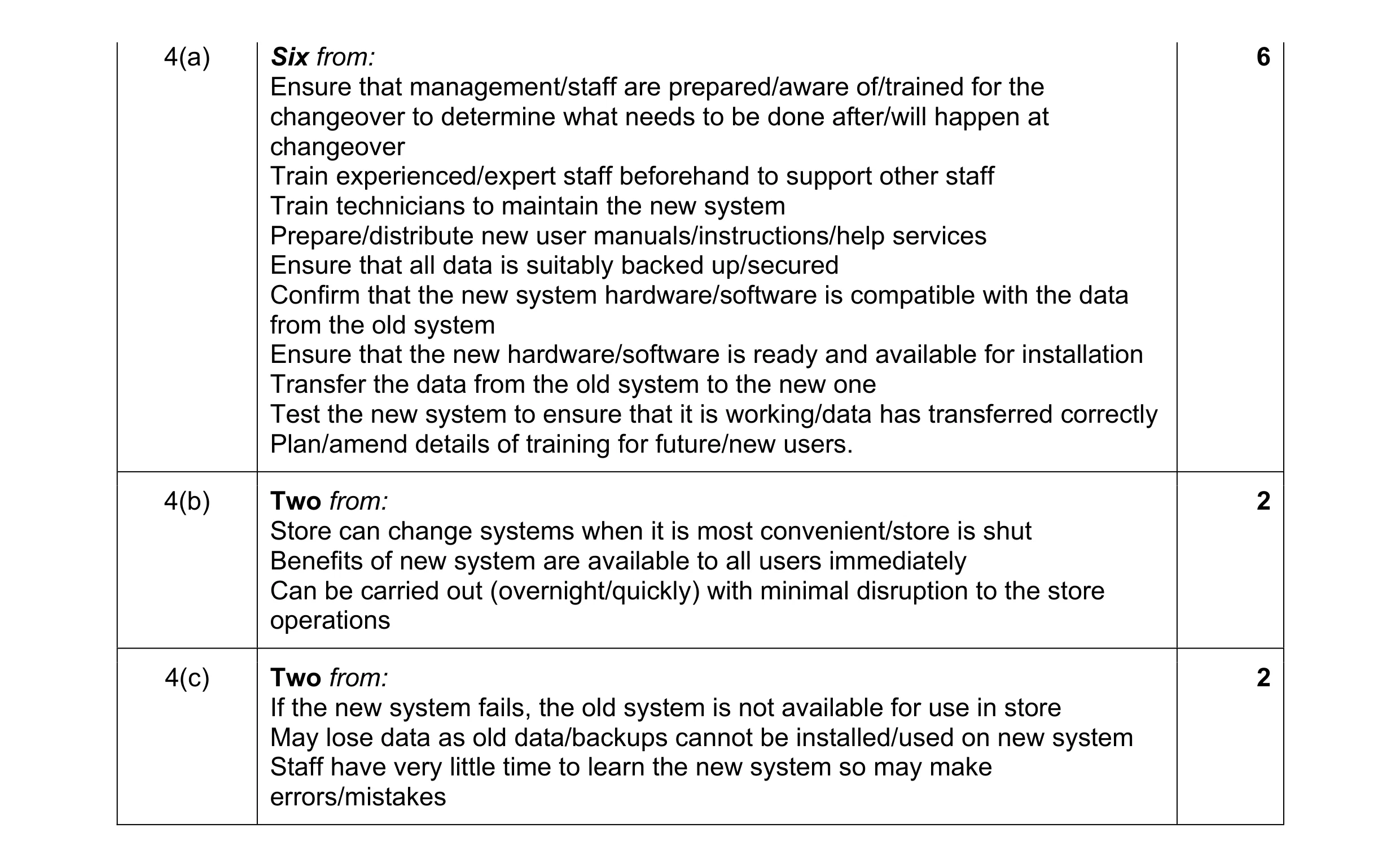 10
10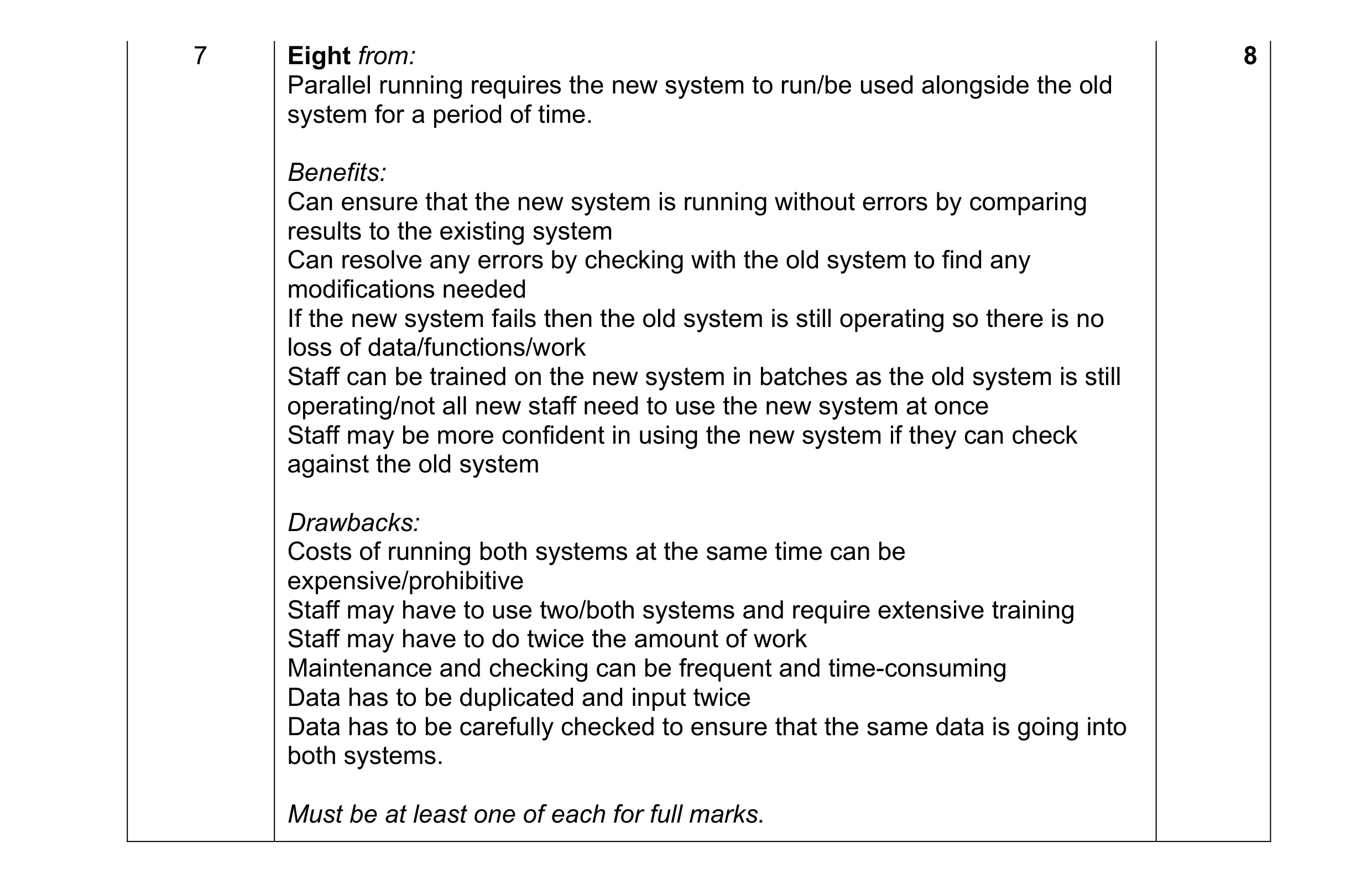 8
8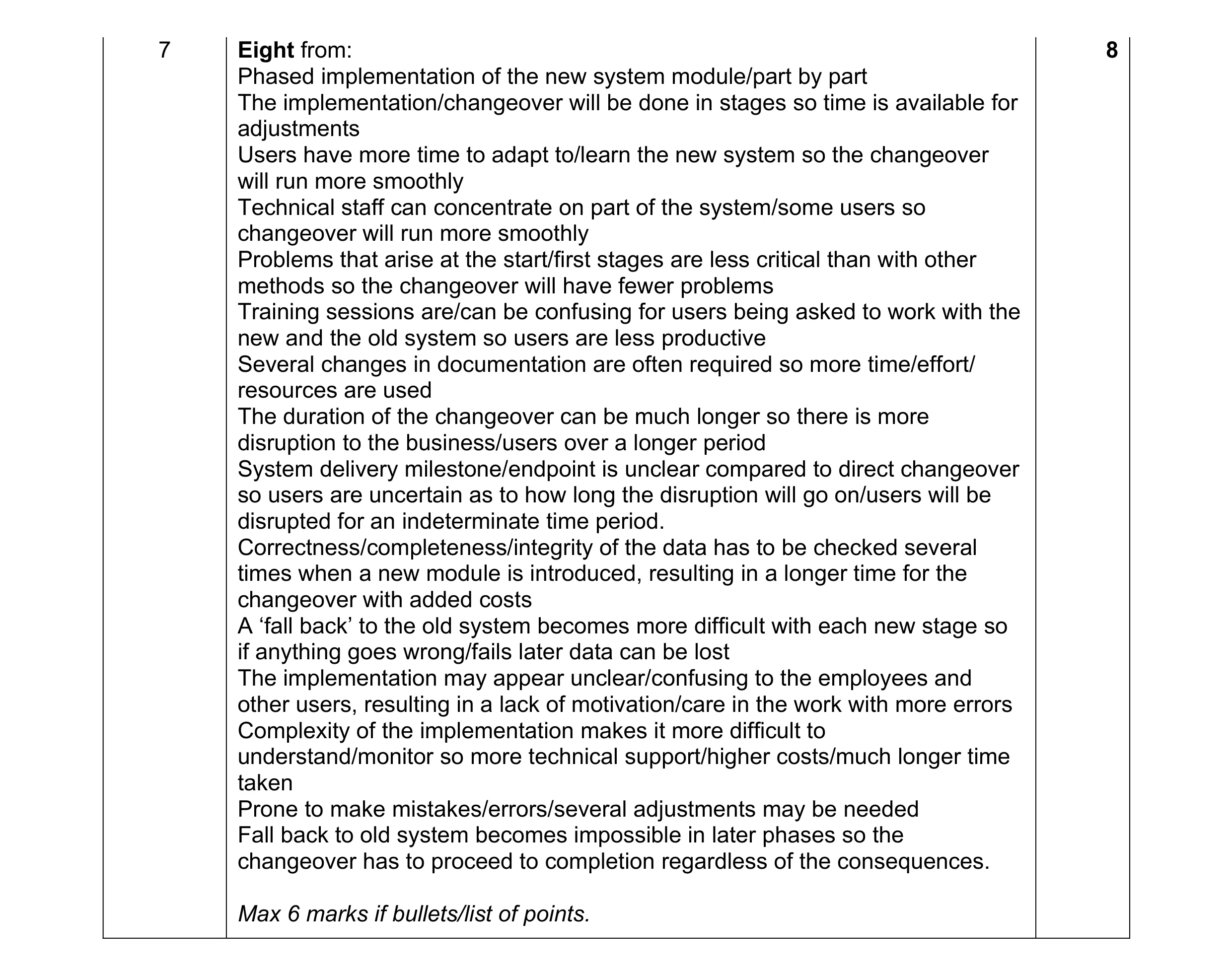 8
8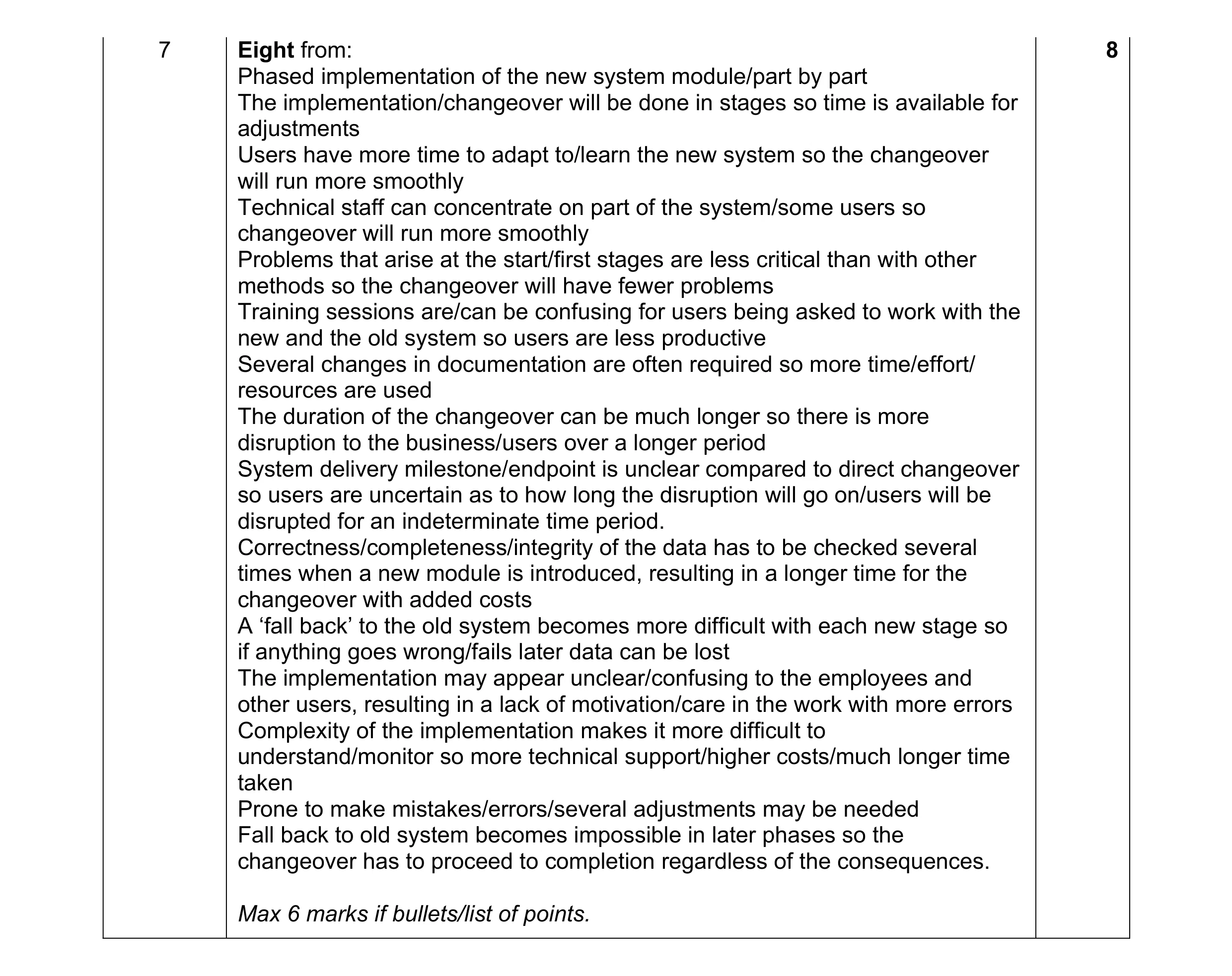 8
8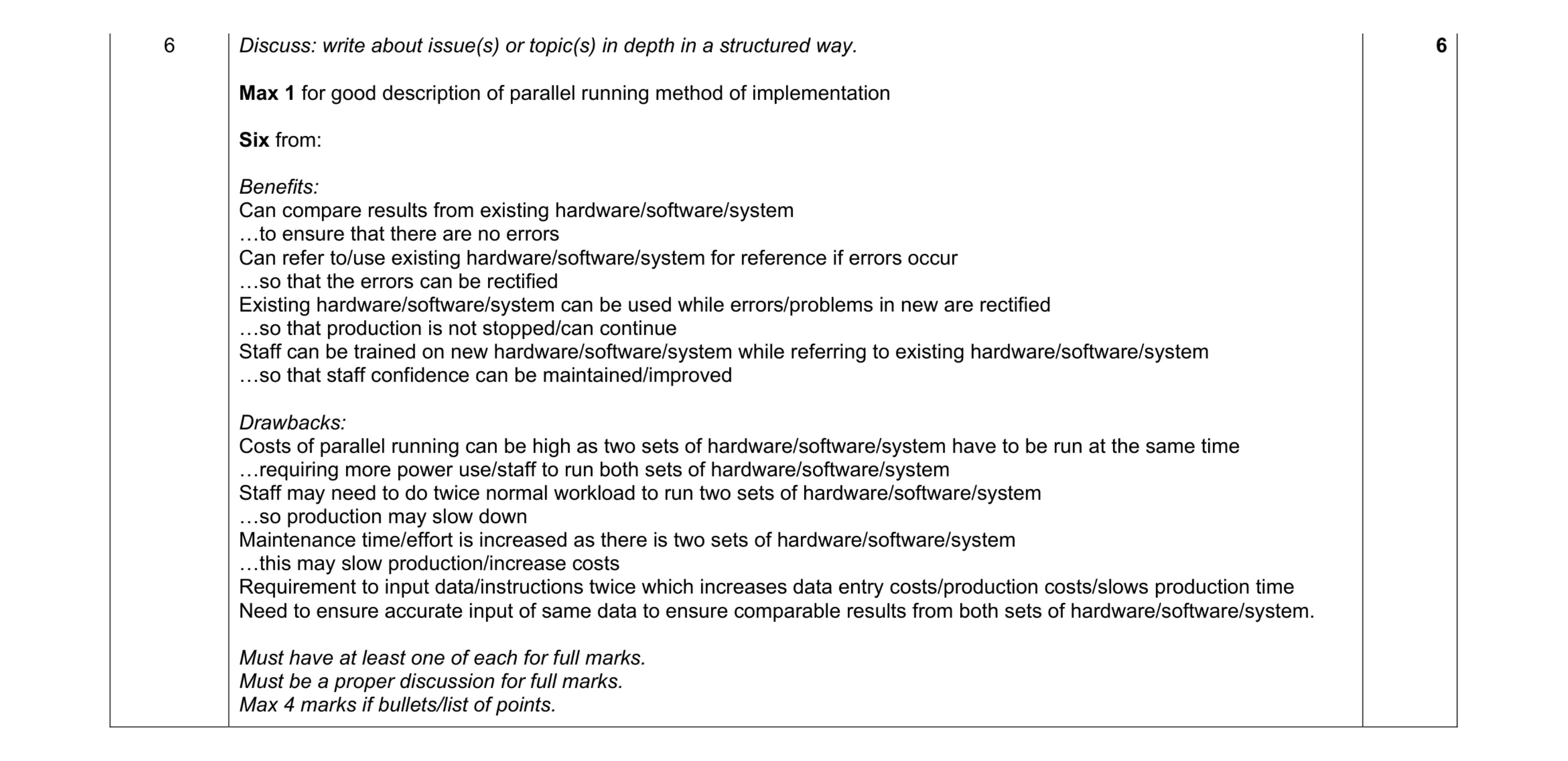 6
6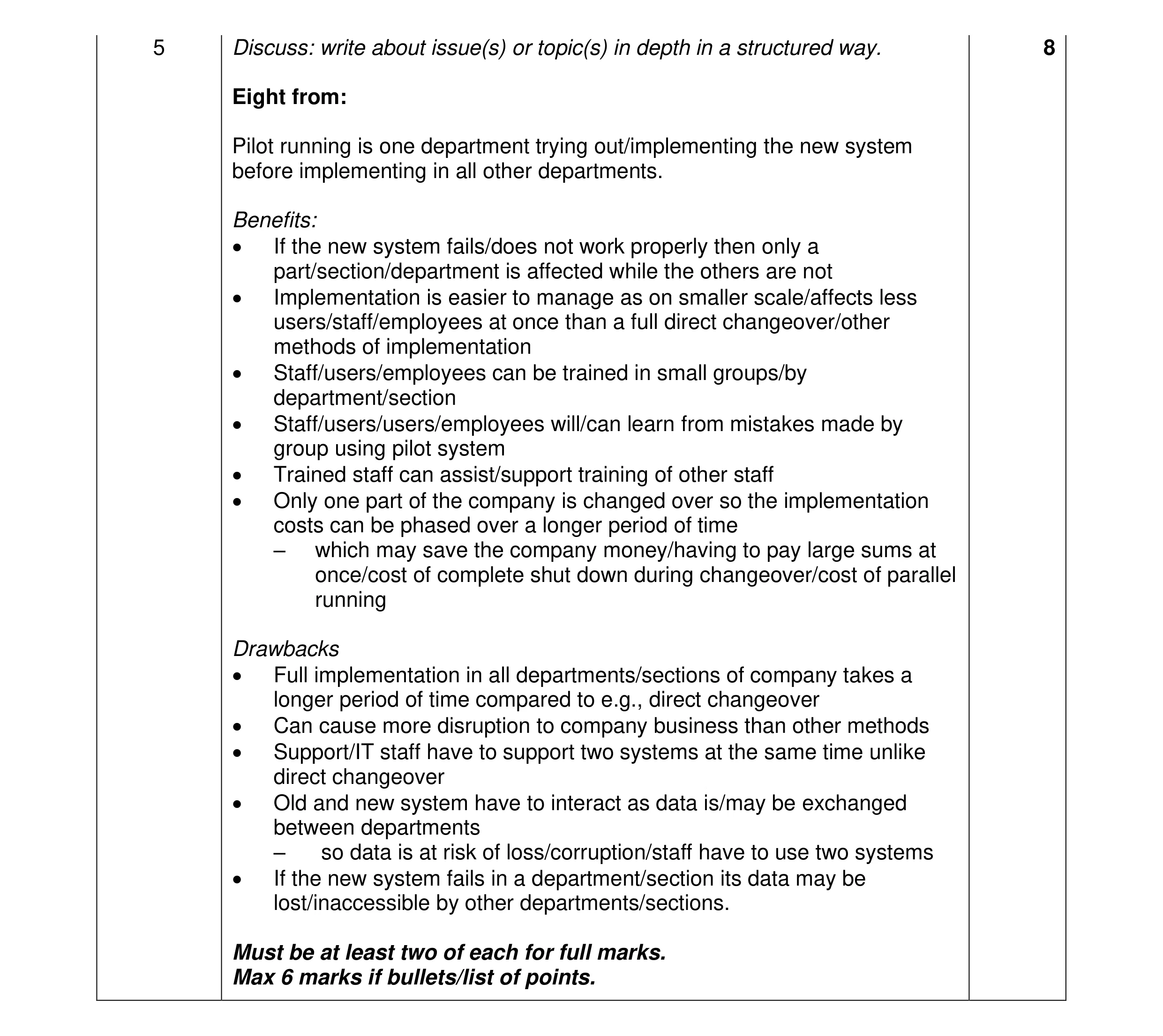 8
8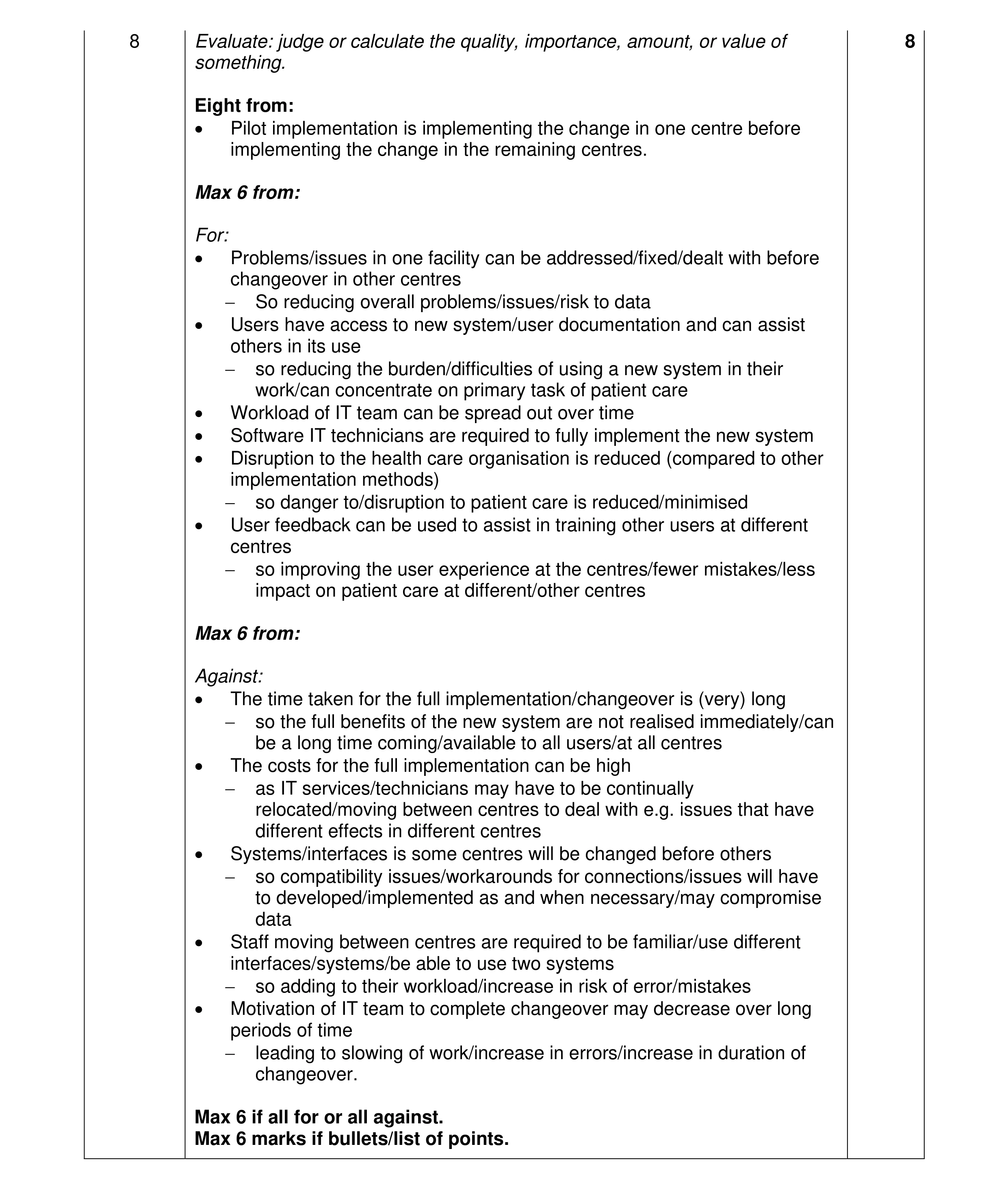 8
8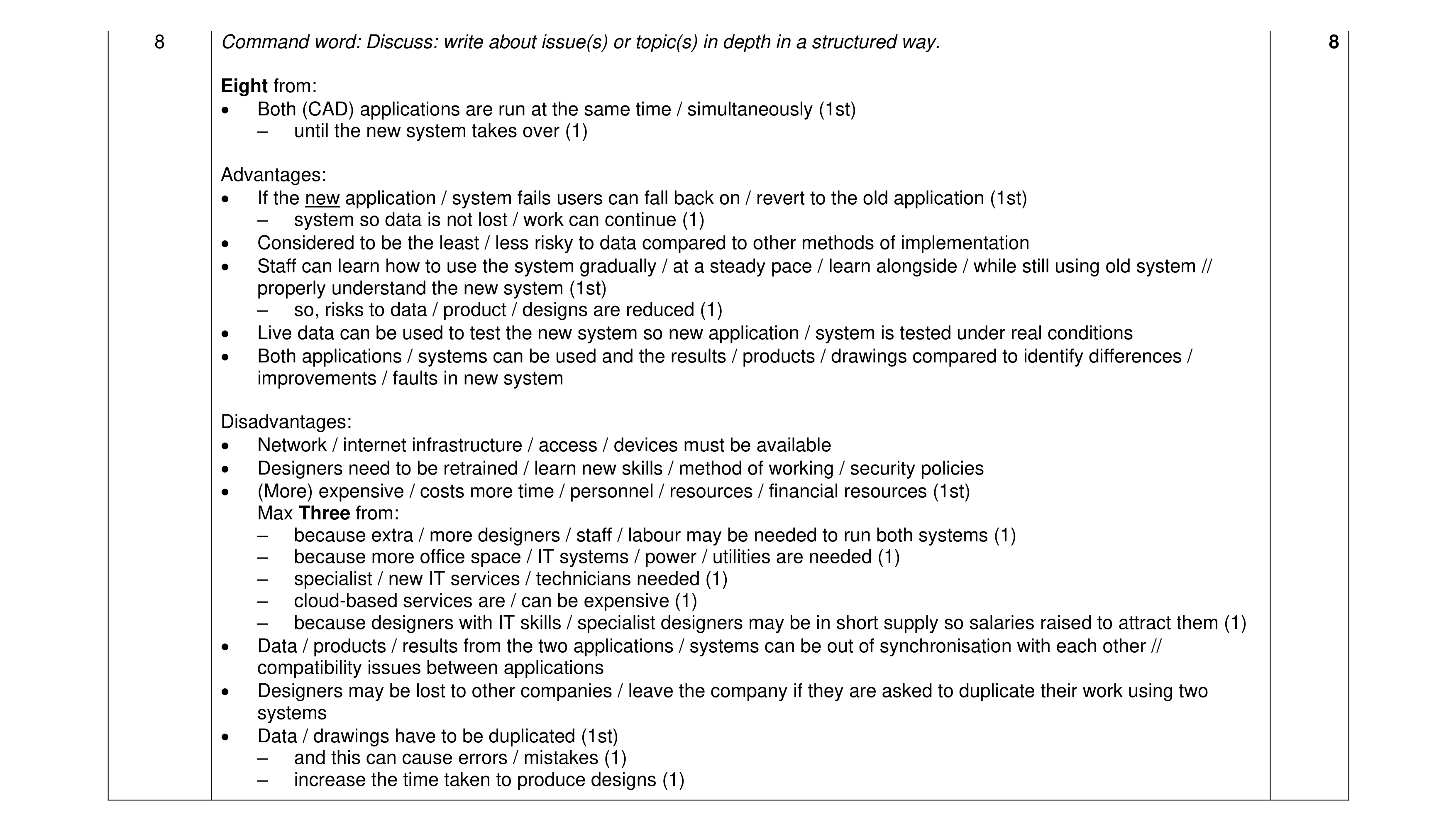 8
8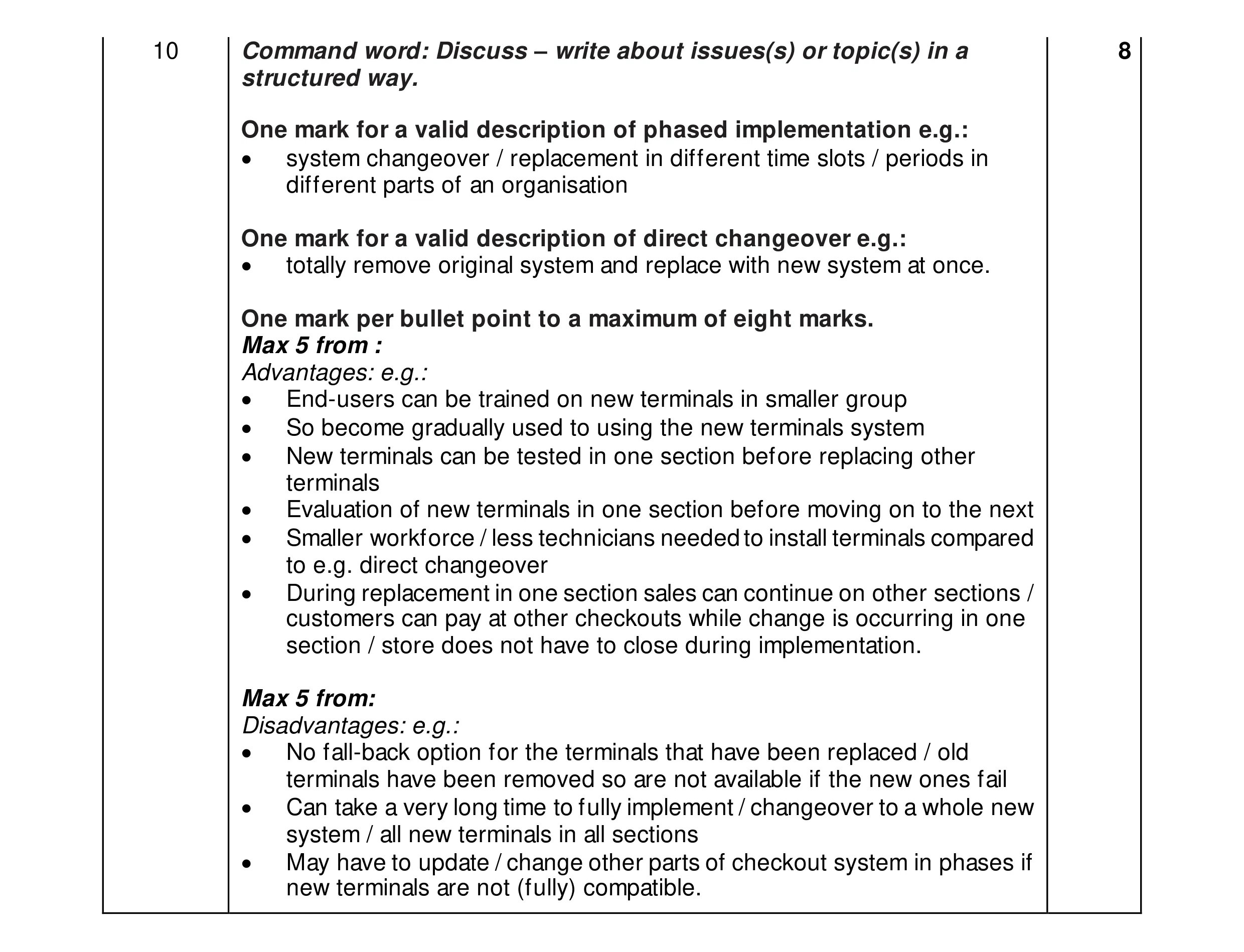 8
8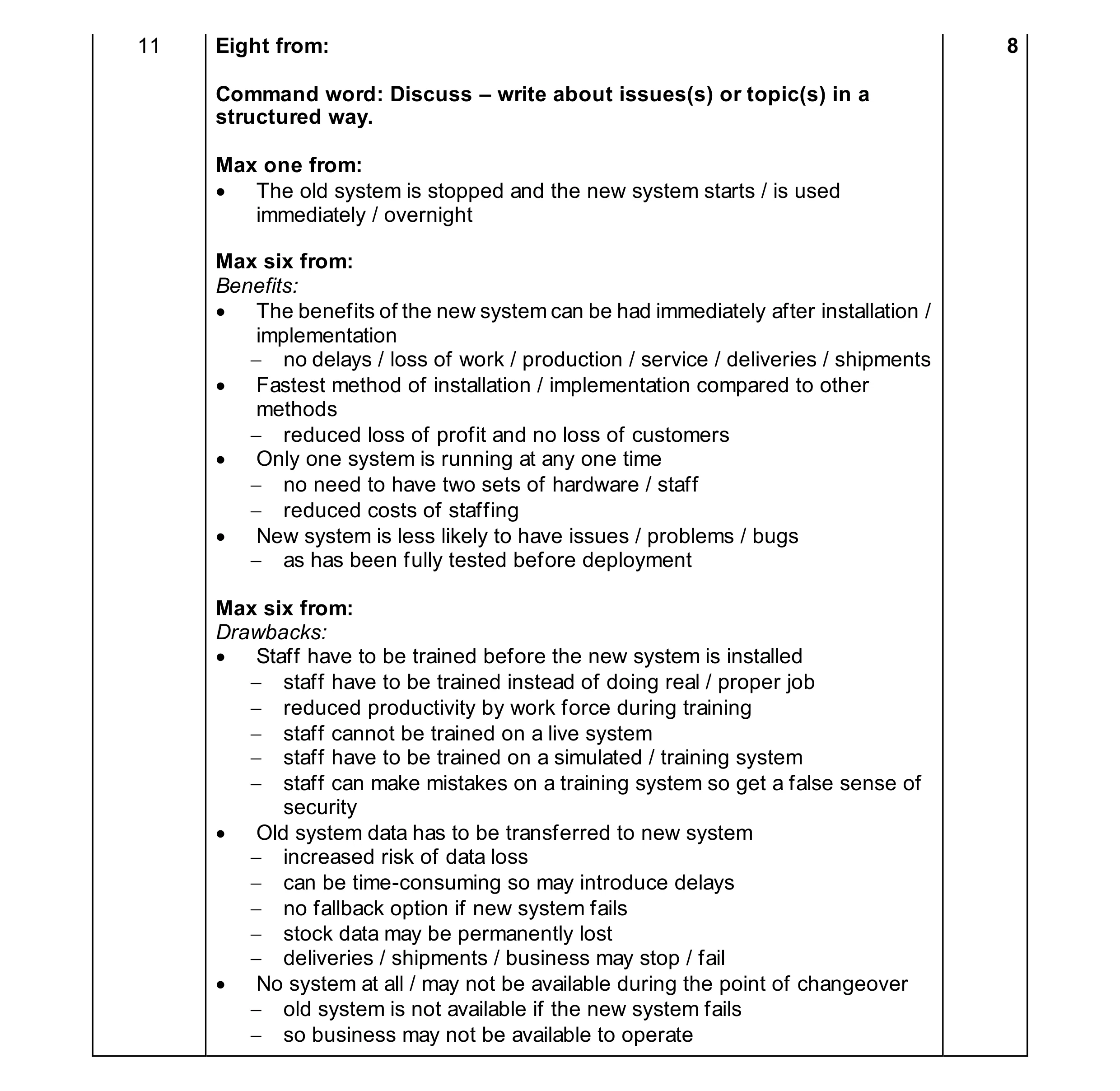 8
8