Cambridge A Level Information Technology (from 2017) 9626 — 2018 May/June Paper 3 · Variant 2
9626/32/M/J/18 · 10 questions · 90 marks · ≈101 min
The question paper and its mark scheme, free to read here and free to download. This is Cambridge’s own paper, exactly as it was sat.
Question paper16 pages














Mark scheme10 pages
Answers below. Sit the paper first if you are practising.

Questions as text
Q1 · An online store requires customers to create an account using its website
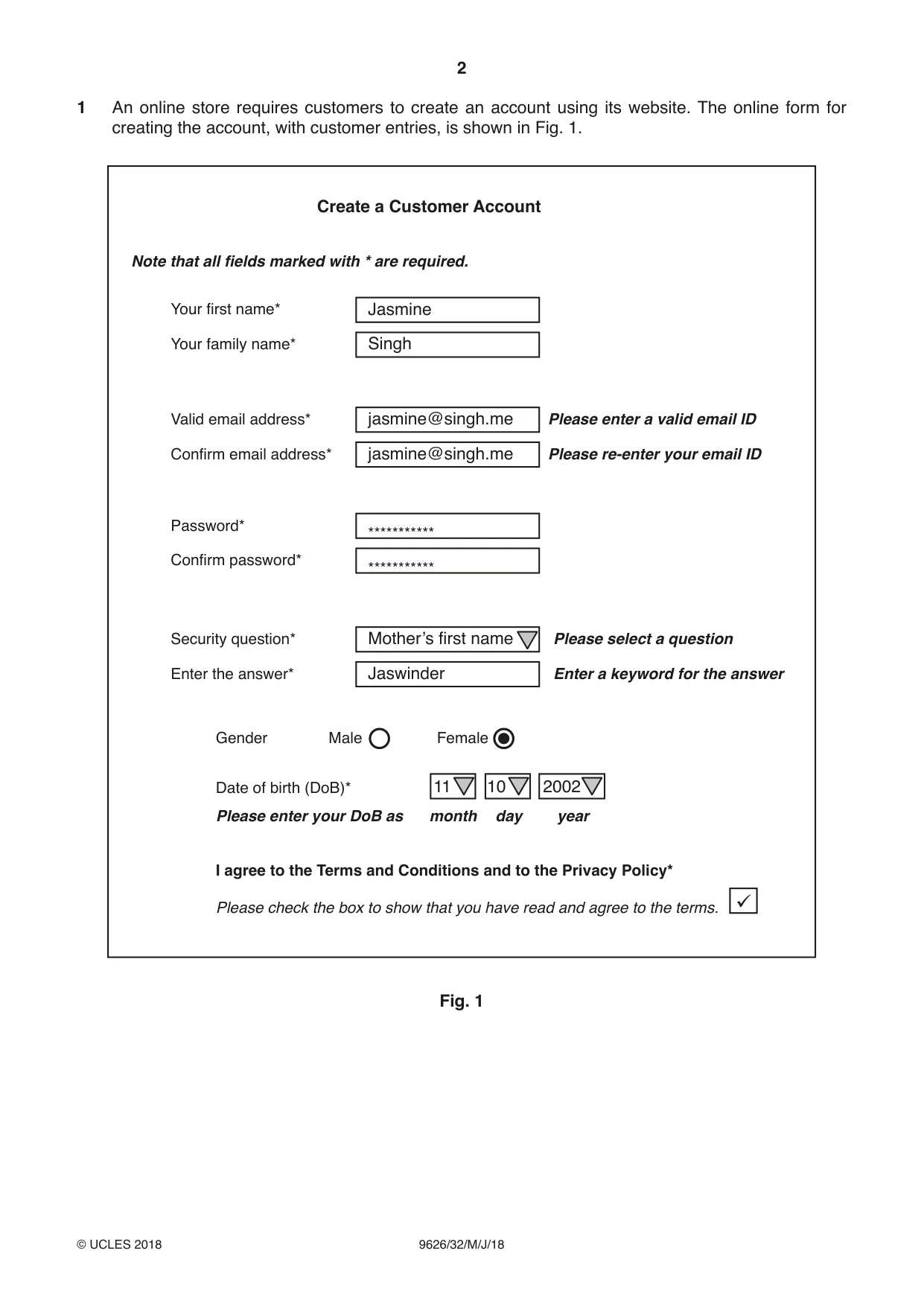
1 An online store requires customers to create an account using its website. The online form for creating the account, with customer entries, is shown in Fig. 1. Create a Customer Account Note that all fields marked with * are required. Your first name* Jasmine Your family name* Singh Valid email address* jasmine@singh.me Please enter a valid email ID Confirm email address* jasmine@singh.me Please re-enter your email ID Password* *********** Confirm password* *********** Security question* Mother’s first name Please select a question Enter the answer* Jaswinder Enter a keyword for the answer Gender Male Female Date of birth (DoB)* 11 10 2002 Please enter your DoB as month day year I agree to the Terms and Conditions and to the Privacy Policy* Please check the box to show that you have read and agree to the terms. Fig. 1 The data entered by the customer is checked for accuracy before it is submitted to the website. (a) Describe, using the information shown in Fig. 1, how the data in the required fields (fields marked *) on the form could be checked. ................................................................................................................................................... ................................................................................................................................................... ................................................................................................................................................... ................................................................................................................................................... ................................................................................................................................................... ................................................................................................................................................... ................................................................................................................................................... ................................................................................................................................................... ................................................................................................................................................... ................................................................................................................................................... ................................................................................................................................................... ...............................................................................................................................................[5] (b) Describe one essential element that must be added to the form. ................................................................................................................................................... ................................................................................................................................................... ...............................................................................................................................................[1]
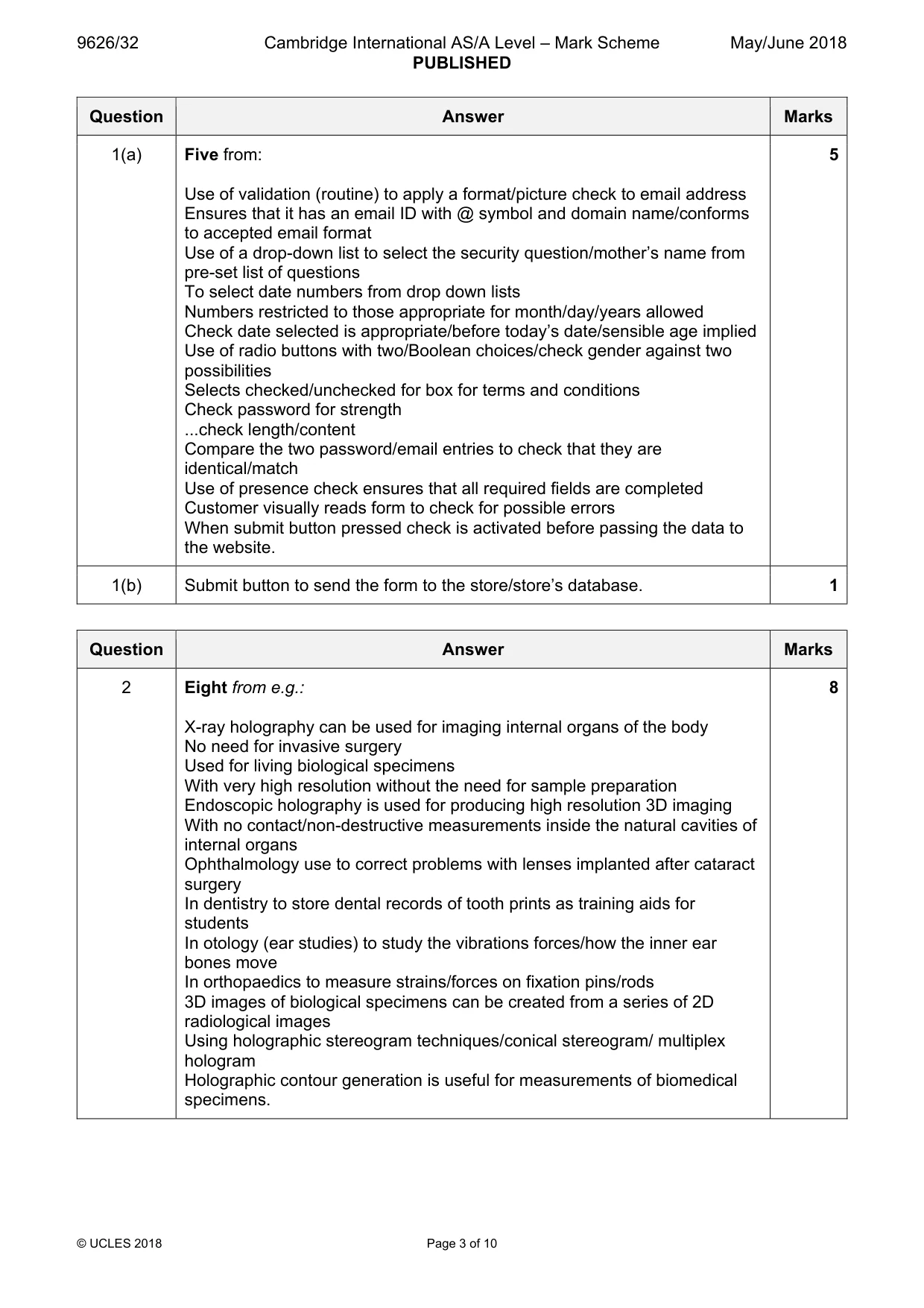
Mark scheme: Question Answer Marks 1(a) Five from: 5 Use of validation (routine) to apply a format/picture check to email address Ensures that it has an email ID with @ symbol and domain name/conforms to accepted email format Use of a drop-down list to select the security question/mother’s name from pre-set list of questions To select date numbers from drop down lists Numbers restricted to those appropriate for month/day/years allowed Check date selected is appropriate/before today’s date/sensible age implied Use of radio buttons with two/Boolean choices/check gender against two possibilities Selects checked/unchecked for box for terms and conditions Check password for strength ...check length/content Compare the two password/email entries to check that they are identical/match Use of presence check ensures that all required fields are completed Customer visually reads form to check for possible errors When submit button pressed check is activated before passing the data to the website. 1(b) Submit button to send the form to the store/store’s database. 1
Q2 · Holographic imaging is an emerging technology
2 Holographic imaging is an emerging technology. Describe how holographic imaging could be used in the field of medicine. .......................................................................................................................................................... .......................................................................................................................................................... .......................................................................................................................................................... .......................................................................................................................................................... .......................................................................................................................................................... .......................................................................................................................................................... .......................................................................................................................................................... .......................................................................................................................................................... .......................................................................................................................................................... .......................................................................................................................................................... .......................................................................................................................................................... .......................................................................................................................................................... .......................................................................................................................................................... .......................................................................................................................................................... .......................................................................................................................................................... .......................................................................................................................................................... .......................................................................................................................................................... .......................................................................................................................................................... .......................................................................................................................................................... ......................................................................................................................................................[8]
Mark scheme: 2 Eight from e.g.: 8 X-ray holography can be used for imaging internal organs of the body No need for invasive surgery Used for living biological specimens With very high resolution without the need for sample preparation Endoscopic holography is used for producing high resolution 3D imaging With no contact/non-destructive measurements inside the natural cavities of internal organs Ophthalmology use to correct problems with lenses implanted after cataract surgery In dentistry to store dental records of tooth prints as training aids for students In otology (ear studies) to study the vibrations forces/how the inner ear bones move In orthopaedics to measure strains/forces on fixation pins/rods 3D images of biological specimens can be created from a series of 2D radiological images Using holographic stereogram techniques/conical stereogram/ multiplex hologram Holographic contour generation is useful for measurements of biomedical specimens.
Q3 · A store has a large number of departments each with its own sales staff
3 A store has a large number of departments each with its own sales staff. The sales staff are responsible for selling only the goods in their department. Each department has its own dedicated checkouts which are connected to the store’s network. A new checkout system is to be implemented so that the staff in the clothing department can use any of the checkouts in the store to sell goods. Staff with experience of the new system will be expected to assist in the training of staff in other departments when the new system is eventually introduced throughout the store. The store managers have to decide how to implement the new sales and checkout system. Describe the most appropriate method of implementation and explain how the change would be carried out in the store. .......................................................................................................................................................... .......................................................................................................................................................... .......................................................................................................................................................... .......................................................................................................................................................... .......................................................................................................................................................... .......................................................................................................................................................... .......................................................................................................................................................... .......................................................................................................................................................... .......................................................................................................................................................... .......................................................................................................................................................... .......................................................................................................................................................... .......................................................................................................................................................... .......................................................................................................................................................... .......................................................................................................................................................... .......................................................................................................................................................... .......................................................................................................................................................... .......................................................................................................................................................... .......................................................................................................................................................... .......................................................................................................................................................... ......................................................................................................................................................[8]
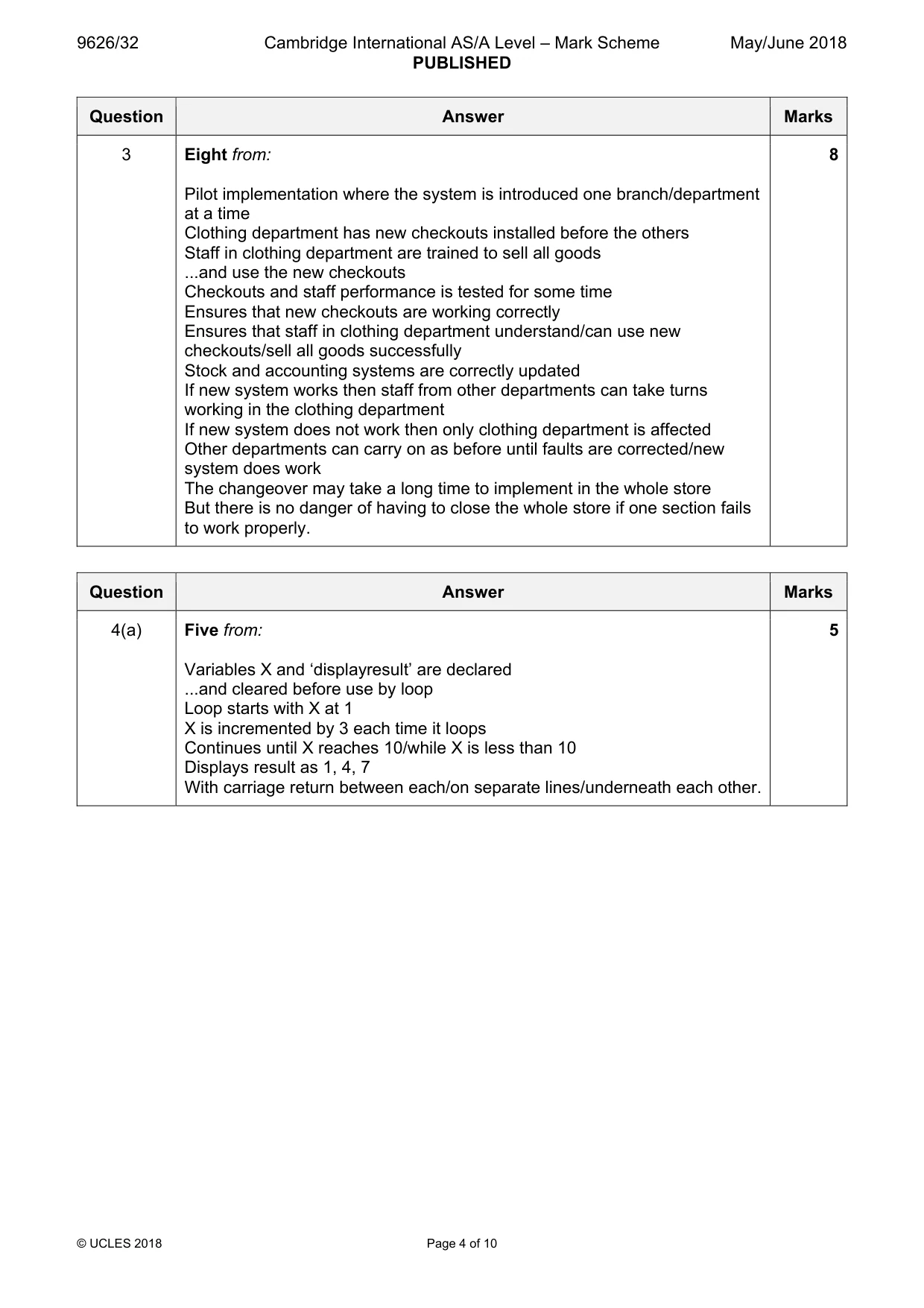
Mark scheme: 3 Eight from: 8 Pilot implementation where the system is introduced one branch/department at a time Clothing department has new checkouts installed before the others Staff in clothing department are trained to sell all goods ...and use the new checkouts Checkouts and staff performance is tested for some time Ensures that new checkouts are working correctly Ensures that staff in clothing department understand/can use new checkouts/sell all goods successfully Stock and accounting systems are correctly updated If new system works then staff from other departments can take turns working in the clothing department If new system does not work then only clothing department is affected Other departments can carry on as before until faults are corrected/new system does work The changeover may take a long time to implement in the whole store But there is no danger of having to close the whole store if one section fails to work properly.
Q4 · ‘Loops’ are used in JavaScript to execute a block of code several times
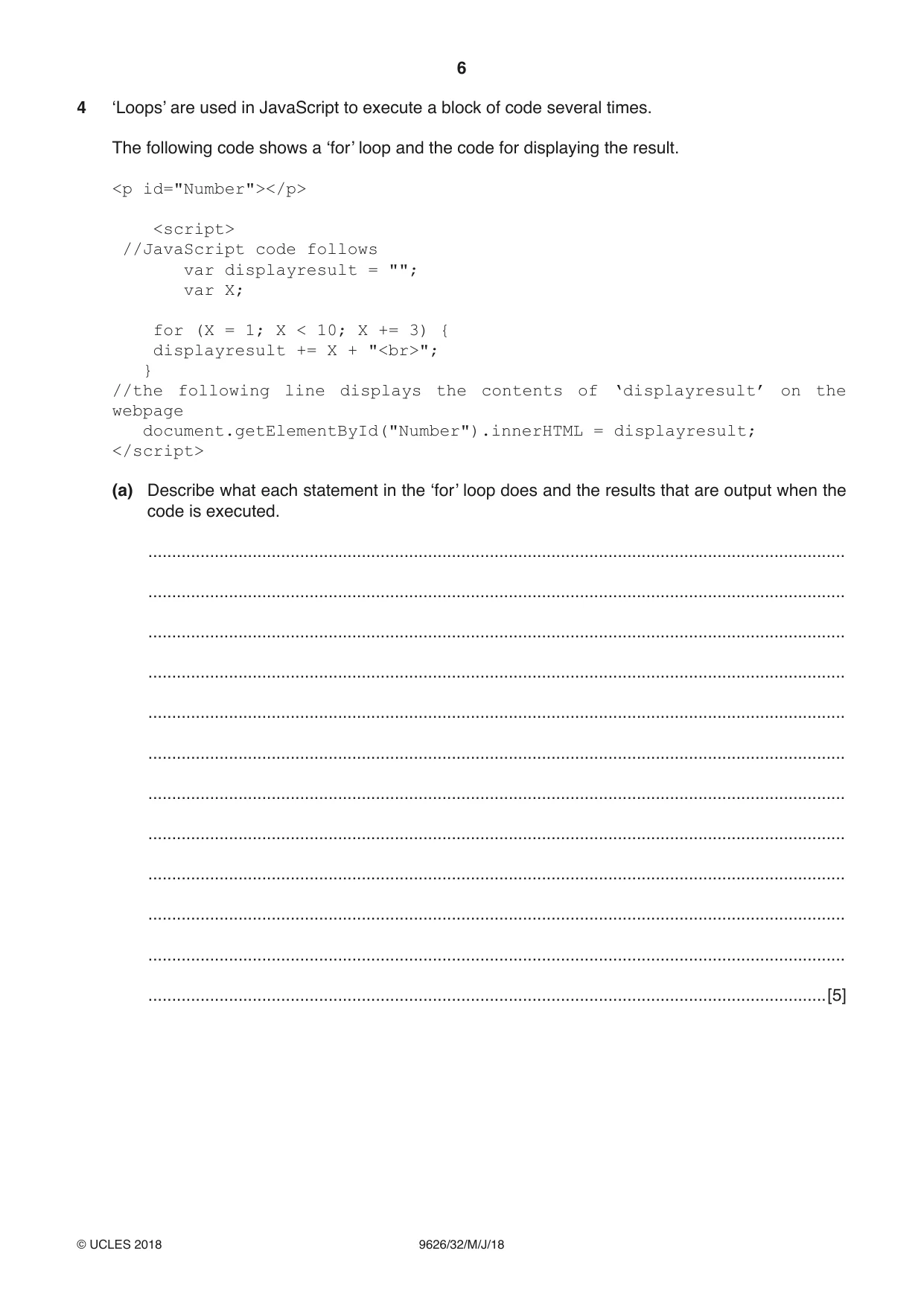
4 ‘Loops’ are used in JavaScript to execute a block of code several times. The following code shows a ‘for’ loop and the code for displaying the result. <p id="Number"></p> <script> //JavaScript code follows var displayresult = ""; var X; for (X = 1; X < 10; X += 3) { displayresult += X + "<br>"; } //the following line displays the contents of ‘displayresult’ on the webpage document.getElementById("Number").innerHTML = displayresult; </script> (a) Describe what each statement in the ‘for’ loop does and the results that are output when the code is executed. ................................................................................................................................................... ................................................................................................................................................... ................................................................................................................................................... ................................................................................................................................................... ................................................................................................................................................... ................................................................................................................................................... ................................................................................................................................................... ................................................................................................................................................... ................................................................................................................................................... ................................................................................................................................................... ................................................................................................................................................... ...............................................................................................................................................[5] (b) Rewrite the ‘loop’ code as a DO WHILE loop to display the same results. ................................................................................................................................................... ................................................................................................................................................... ................................................................................................................................................... ................................................................................................................................................... ................................................................................................................................................... ................................................................................................................................................... ................................................................................................................................................... ................................................................................................................................................... ................................................................................................................................................... ................................................................................................................................................... ................................................................................................................................................... ................................................................................................................................................... ................................................................................................................................................... ...............................................................................................................................................[6] (c) The JavaScript code is deemed to be ‘client-side’ code. Explain why the use of ‘client-side’ code can cause problems. ................................................................................................................................................... ................................................................................................................................................... ................................................................................................................................................... ................................................................................................................................................... ................................................................................................................................................... ................................................................................................................................................... ................................................................................................................................................... ................................................................................................................................................... ...............................................................................................................................................[4]
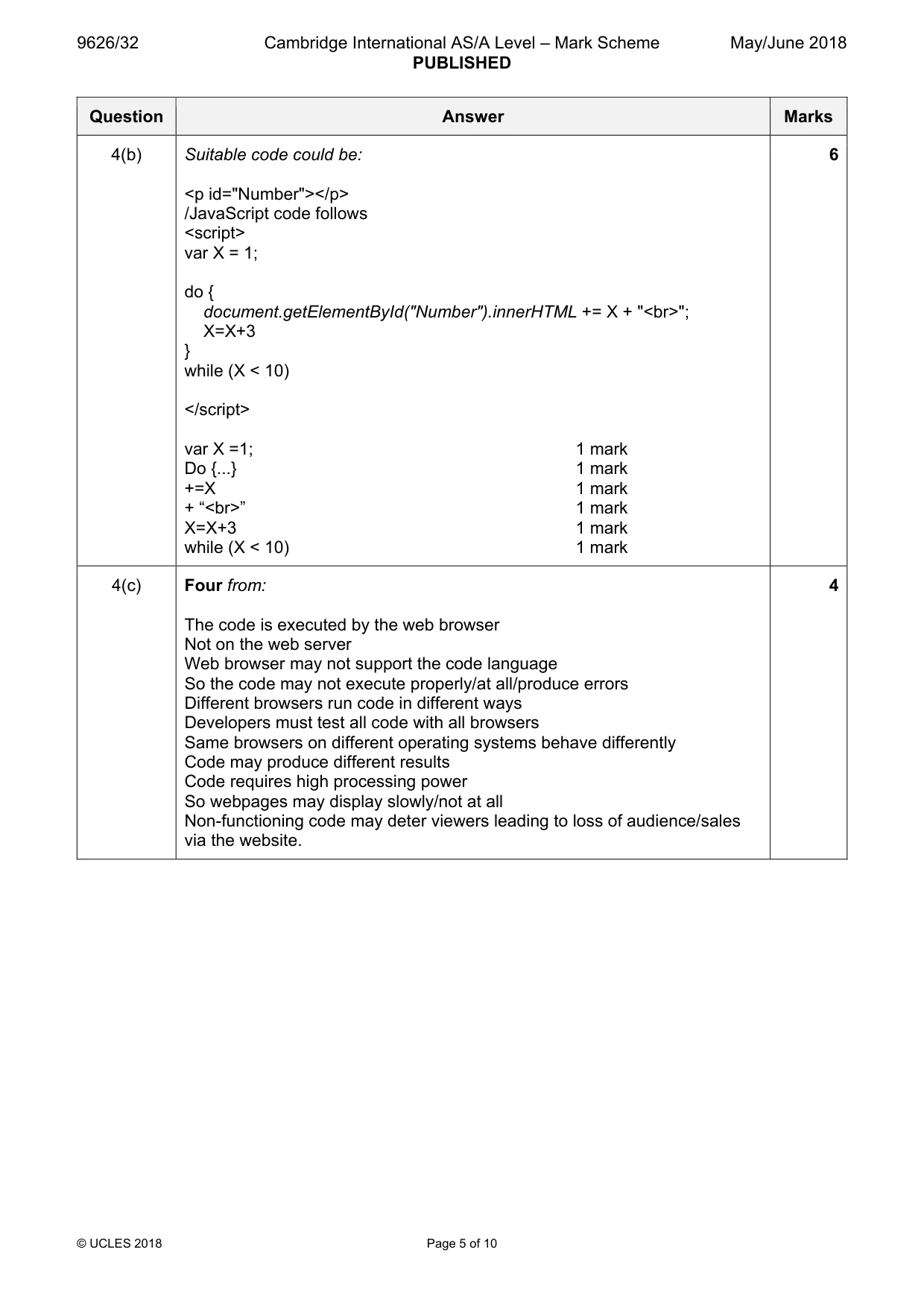
Mark scheme: 4(a) Five from: 5 Variables X and ‘displayresult’ are declared ...and cleared before use by loop Loop starts with X at 1 X is incremented by 3 each time it loops Continues until X reaches 10/while X is less than 10 Displays result as 1, 4, 7 With carriage return between each/on separate lines/underneath each other. 4(b) Suitable code could be: 6 <p id="Number"></p> /JavaScript code follows <script> var X = 1; do { document.getElementById("Number").innerHTML += X + "<br>"; X=X+3 } while (X < 10) </script> var X =1; 1 mark Do {...} 1 mark +=X 1 mark + “<br>” 1 mark X=X+3 1 mark while (X < 10) 1 mark 4(c) Four from: 4 The code is executed by the web browser Not on the web server Web browser may not support the code language So the code may not execute properly/at all/produce errors Different browsers run code in different ways Developers must test all code with all browsers Same browsers on different operating systems behave differently Code may produce different results Code requires high processing power So webpages may display slowly/not at all Non-functioning code may deter viewers leading to loss of audience/sales via the website.
Q5 · A company sells replacement windows for customers’ homes
5 A company sells replacement windows for customers’ homes. A salesman visits customers’ homes to measure the windows. The salesman usually takes a company laptop on the visit. The salesman is away from the office most of the day. When the salesman is back in the office he has to type up a report on the visit and create quotations to send to the customers. He needs access to a variety of documents including those found on the internet. The salesman also needs to be able to communicate with customers in a variety of ways. The company managers are considering replacing the laptop with a new smartphone for the salesman to take on the visit. The salesman has made a comparison of the two devices. Explain why the salesman has told the company managers that both devices are needed for the visits. .......................................................................................................................................................... .......................................................................................................................................................... .......................................................................................................................................................... .......................................................................................................................................................... .......................................................................................................................................................... .......................................................................................................................................................... .......................................................................................................................................................... .......................................................................................................................................................... .......................................................................................................................................................... .......................................................................................................................................................... .......................................................................................................................................................... .......................................................................................................................................................... .......................................................................................................................................................... .......................................................................................................................................................... .......................................................................................................................................................... .......................................................................................................................................................... .......................................................................................................................................................... .......................................................................................................................................................... .......................................................................................................................................................... ......................................................................................................................................................[8]
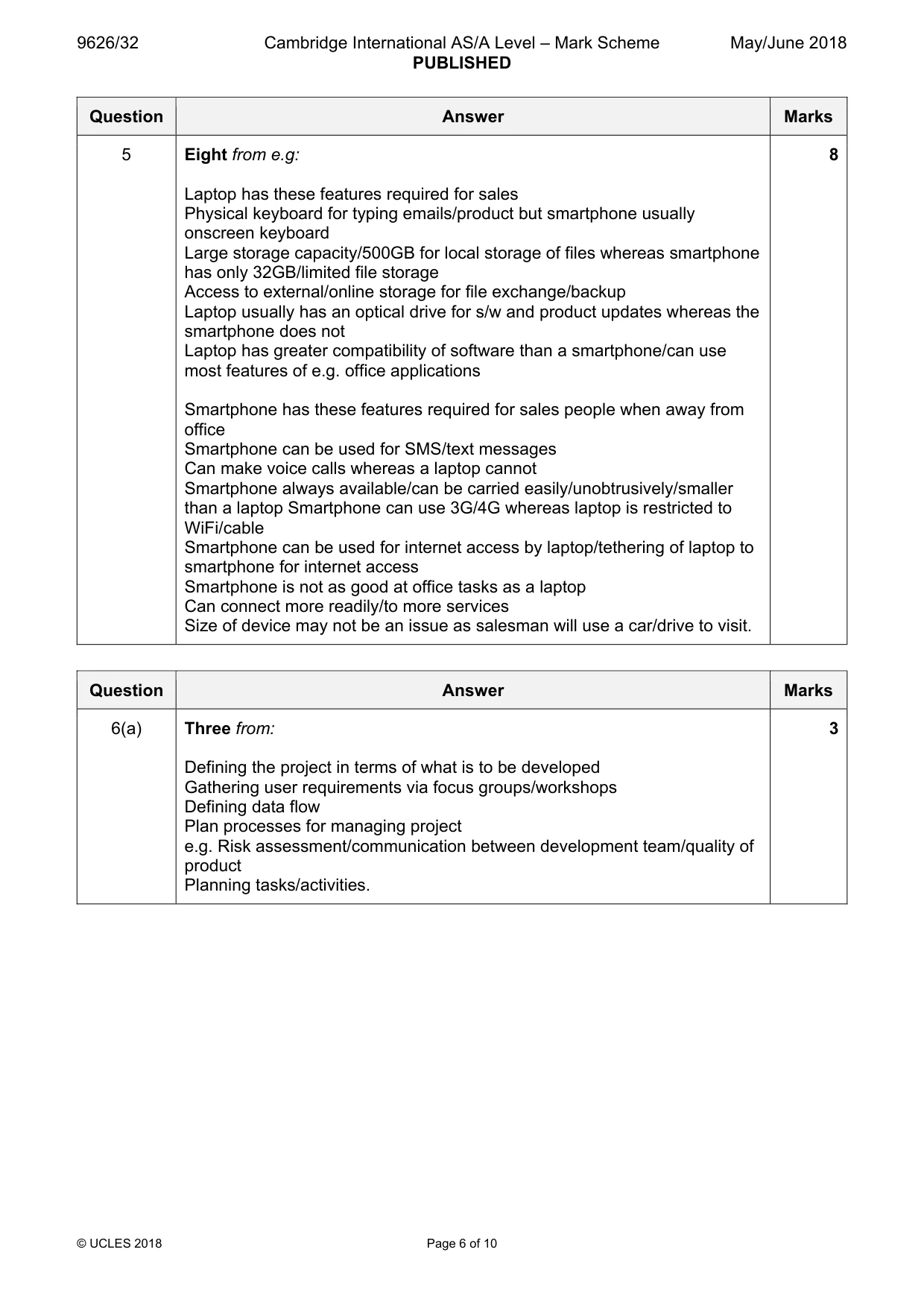
Mark scheme: 5 Eight from e.g: 8 Laptop has these features required for sales Physical keyboard for typing emails/product but smartphone usually onscreen keyboard Large storage capacity/500GB for local storage of files whereas smartphone has only 32GB/limited file storage Access to external/online storage for file exchange/backup Laptop usually has an optical drive for s/w and product updates whereas the smartphone does not Laptop has greater compatibility of software than a smartphone/can use most features of e.g. office applications Smartphone has these features required for sales people when away from office Smartphone can be used for SMS/text messages Can make voice calls whereas a laptop cannot Smartphone always available/can be carried easily/unobtrusively/smaller than a laptop Smartphone can use 3G/4G whereas laptop is restricted to WiFi/cable Smartphone can be used for internet access by laptop/tethering of laptop to smartphone for internet access Smartphone is not as good at office tasks as a laptop Can connect more readily/to more services Size of device may not be an issue as salesman will use a car/drive to visit.
Q6 · A software company is developing a new ‘app’ for smartphones
6 A software company is developing a new ‘app’ for smartphones. The Rapid Application Development (RAD) method is used to ensure that the ‘app’ is available as soon as possible. (a) The RAD process involves several phases. The first phase is often referred to as Business Modelling. Describe the tasks that must occur in this phase of RAD. ................................................................................................................................................... ................................................................................................................................................... ................................................................................................................................................... ................................................................................................................................................... ................................................................................................................................................... ................................................................................................................................................... ................................................................................................................................................... ...............................................................................................................................................[3] (b) Describe two other phases of RAD. 1 ................................................................................................................................................ ................................................................................................................................................... ................................................................................................................................................... ................................................................................................................................................... ................................................................................................................................................... ................................................................................................................................................... ................................................................................................................................................... ................................................................................................................................................... ................................................................................................................................................... ...............................................................................................................................................[4] 2 ................................................................................................................................................ ................................................................................................................................................... ................................................................................................................................................... ................................................................................................................................................... ................................................................................................................................................... ................................................................................................................................................... ................................................................................................................................................... ................................................................................................................................................... ................................................................................................................................................... ...............................................................................................................................................[4]
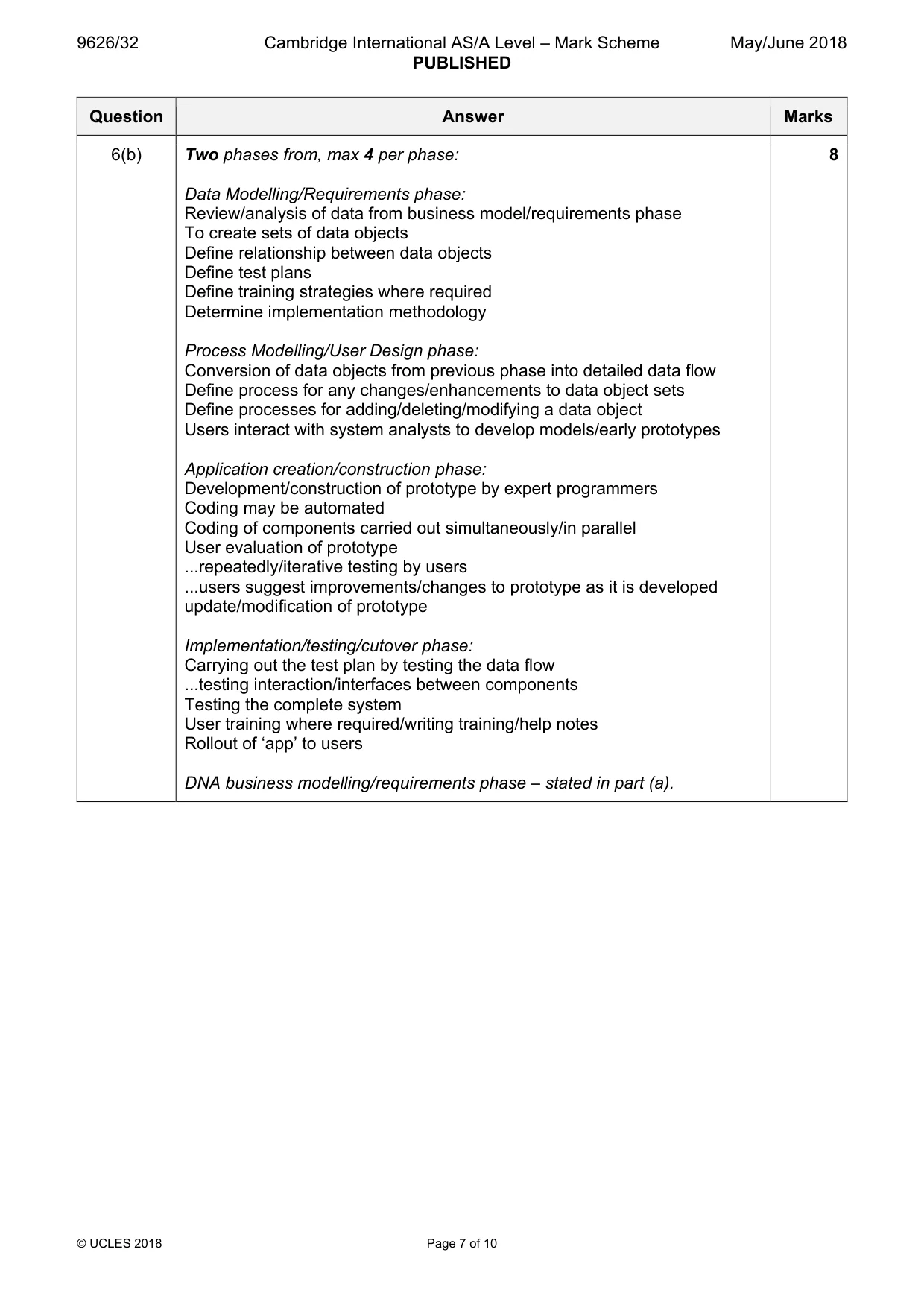
Mark scheme: 6(a) Three from: 3 Defining the project in terms of what is to be developed Gathering user requirements via focus groups/workshops Defining data flow Plan processes for managing project e.g. Risk assessment/communication between development team/quality of product Planning tasks/activities. 6(b) Two phases from, max 4 per phase: 8 Data Modelling/Requirements phase: Review/analysis of data from business model/requirements phase To create sets of data objects Define relationship between data objects Define test plans Define training strategies where required Determine implementation methodology Process Modelling/User Design phase: Conversion of data objects from previous phase into detailed data flow Define process for any changes/enhancements to data object sets Define processes for adding/deleting/modifying a data object Users interact with system analysts to develop models/early prototypes Application creation/construction phase: Development/construction of prototype by expert programmers Coding may be automated Coding of components carried out simultaneously/in parallel User evaluation of prototype ...repeatedly/iterative testing by users ...users suggest improvements/changes to prototype as it is developed update/modification of prototype Implementation/testing/cutover phase: Carrying out the test plan by testing the data flow ...testing interaction/interfaces between components Testing the complete system User training where required/writing training/help notes Rollout of ‘app’ to users DNA business modelling/requirements phase – stated in part (a).
Q7 · Telecommunication companies often prefer to use fibre optic cables to transmit data
7 Telecommunication companies often prefer to use fibre optic cables to transmit data. Discuss the benefits and drawbacks of using fibre optic cables for data transmission. .......................................................................................................................................................... .......................................................................................................................................................... .......................................................................................................................................................... .......................................................................................................................................................... .......................................................................................................................................................... .......................................................................................................................................................... .......................................................................................................................................................... .......................................................................................................................................................... .......................................................................................................................................................... .......................................................................................................................................................... .......................................................................................................................................................... .......................................................................................................................................................... .......................................................................................................................................................... .......................................................................................................................................................... .......................................................................................................................................................... .......................................................................................................................................................... .......................................................................................................................................................... .......................................................................................................................................................... .......................................................................................................................................................... ......................................................................................................................................................[8]
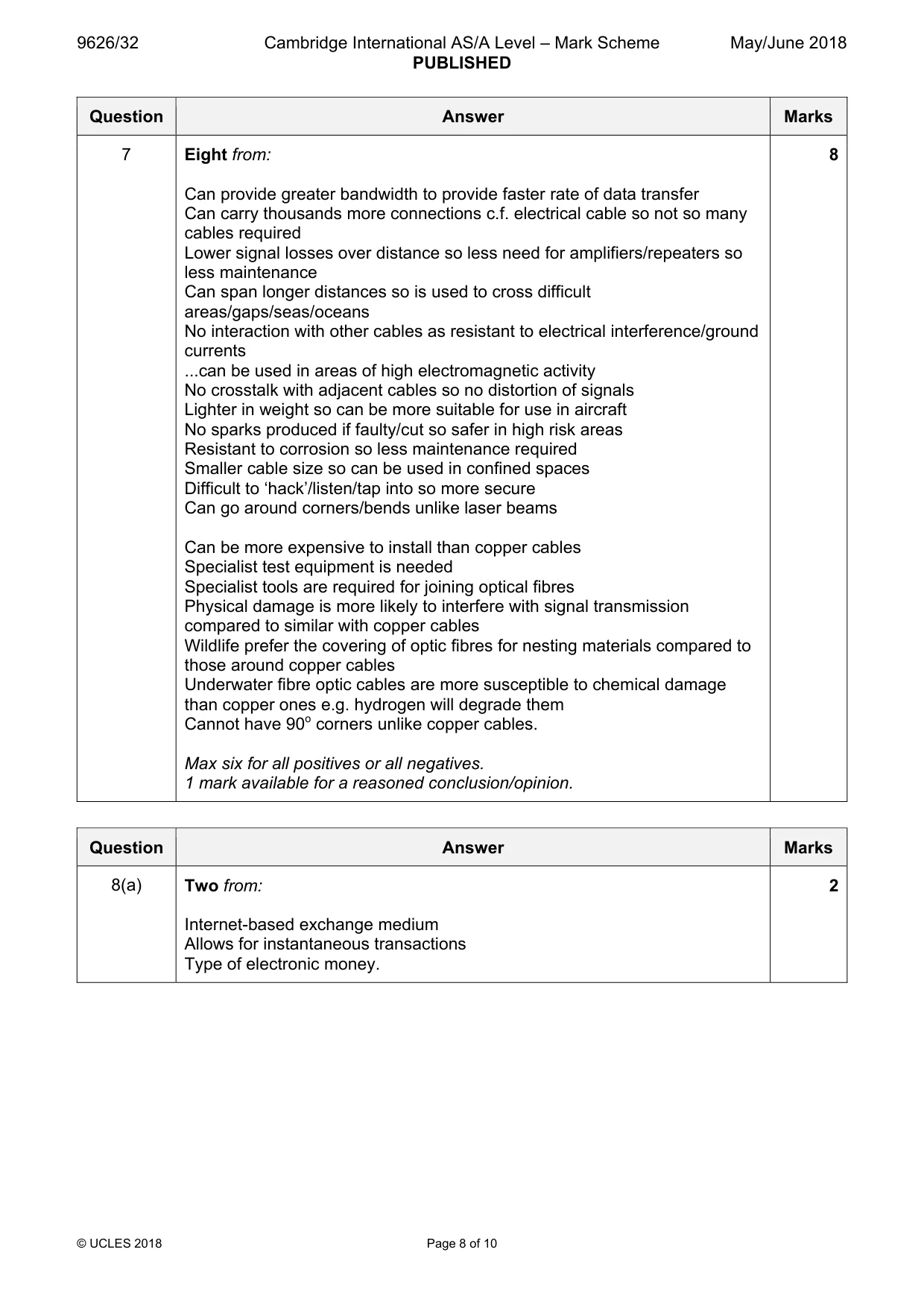
Mark scheme: 7 Eight from: 8 Can provide greater bandwidth to provide faster rate of data transfer Can carry thousands more connections c.f. electrical cable so not so many cables required Lower signal losses over distance so less need for amplifiers/repeaters so less maintenance Can span longer distances so is used to cross difficult areas/gaps/seas/oceans No interaction with other cables as resistant to electrical interference/ground currents ...can be used in areas of high electromagnetic activity No crosstalk with adjacent cables so no distortion of signals Lighter in weight so can be more suitable for use in aircraft No sparks produced if faulty/cut so safer in high risk areas Resistant to corrosion so less maintenance required Smaller cable size so can be used in confined spaces Difficult to ‘hack’/listen/tap into so more secure Can go around corners/bends unlike laser beams Can be more expensive to install than copper cables Specialist test equipment is needed Specialist tools are required for joining optical fibres Physical damage is more likely to interfere with signal transmission compared to similar with copper cables Wildlife prefer the covering of optic fibres for nesting materials compared to those around copper cables Underwater fibre optic cables are more susceptible to chemical damage than copper ones e.g. hydrogen will degrade them Cannot have 90o corners unlike copper cables. Max six for all positives or all negatives. 1 mark available for a reasoned conclusion/opinion.
Q8 · Explain what is meant by digital currency
8 (a) Explain what is meant by digital currency. ................................................................................................................................................... ................................................................................................................................................... ................................................................................................................................................... ................................................................................................................................................... ...............................................................................................................................................[2] (b) Evaluate the impact of digital currencies. ................................................................................................................................................... ................................................................................................................................................... ................................................................................................................................................... ................................................................................................................................................... ................................................................................................................................................... ................................................................................................................................................... ................................................................................................................................................... ................................................................................................................................................... ................................................................................................................................................... ................................................................................................................................................... ................................................................................................................................................... ................................................................................................................................................... ................................................................................................................................................... ................................................................................................................................................... ................................................................................................................................................... ................................................................................................................................................... ................................................................................................................................................... ................................................................................................................................................... ................................................................................................................................................... ...............................................................................................................................................[8]
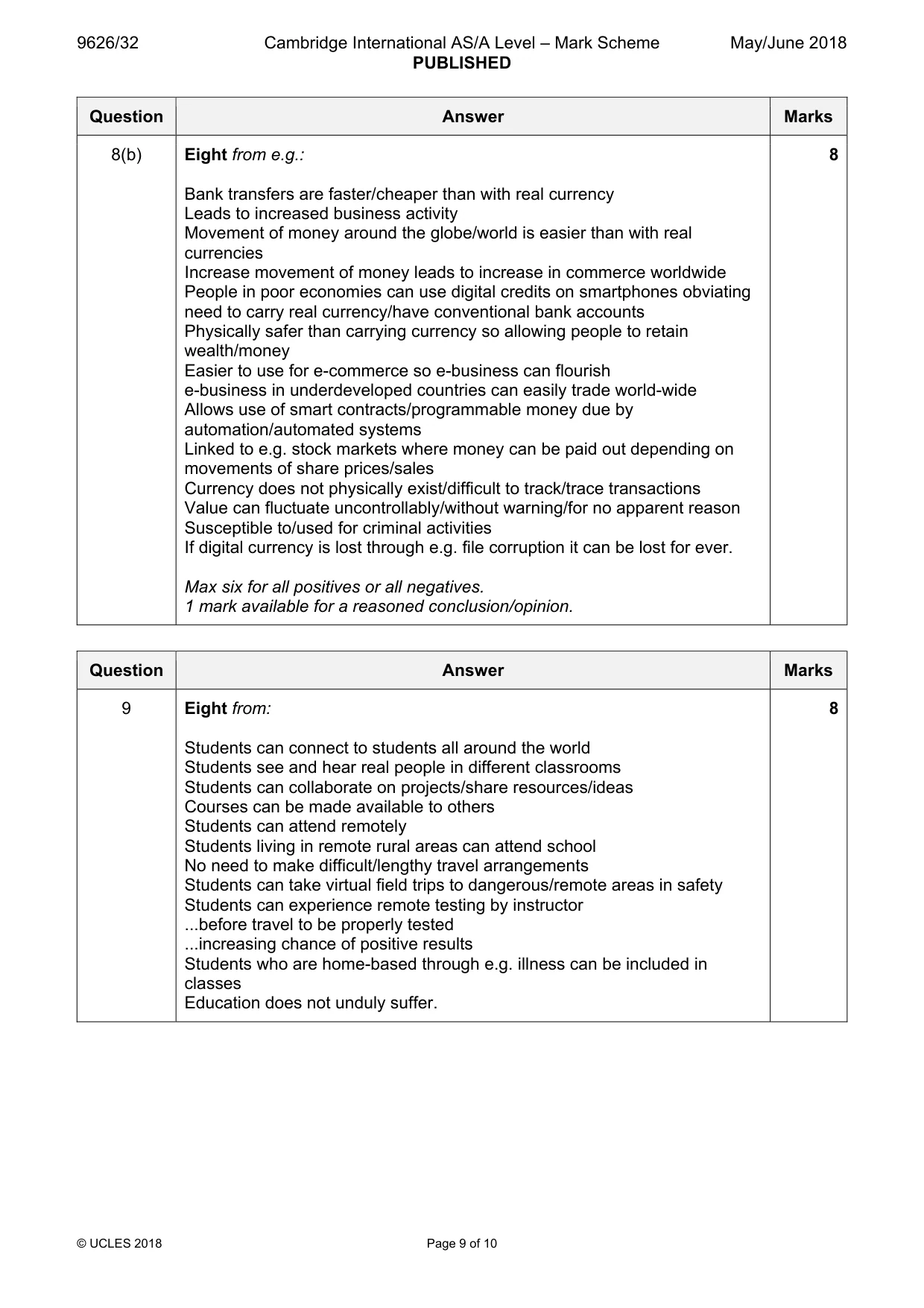
Mark scheme: 8(a) Two from: 2 Internet-based exchange medium Allows for instantaneous transactions Type of electronic money. 8(b) Eight from e.g.: 8 Bank transfers are faster/cheaper than with real currency Leads to increased business activity Movement of money around the globe/world is easier than with real currencies Increase movement of money leads to increase in commerce worldwide People in poor economies can use digital credits on smartphones obviating need to carry real currency/have conventional bank accounts Physically safer than carrying currency so allowing people to retain wealth/money Easier to use for e-commerce so e-business can flourish e-business in underdeveloped countries can easily trade world-wide Allows use of smart contracts/programmable money due by automation/automated systems Linked to e.g. stock markets where money can be paid out depending on movements of share prices/sales Currency does not physically exist/difficult to track/trace transactions Value can fluctuate uncontrollably/without warning/for no apparent reason Susceptible to/used for criminal activities If digital currency is lost through e.g. file corruption it can be lost for ever. Max six for all positives or all negatives. 1 mark available for a reasoned conclusion/opinion.
Q9 · Describe the impact of video-conferencing on learning in schools
9 Describe the impact of video-conferencing on learning in schools. .......................................................................................................................................................... .......................................................................................................................................................... .......................................................................................................................................................... .......................................................................................................................................................... .......................................................................................................................................................... .......................................................................................................................................................... .......................................................................................................................................................... .......................................................................................................................................................... .......................................................................................................................................................... .......................................................................................................................................................... .......................................................................................................................................................... .......................................................................................................................................................... .......................................................................................................................................................... .......................................................................................................................................................... .......................................................................................................................................................... .......................................................................................................................................................... .......................................................................................................................................................... .......................................................................................................................................................... .......................................................................................................................................................... ......................................................................................................................................................[8]
Mark scheme: 9 Eight from: 8 Students can connect to students all around the world Students see and hear real people in different classrooms Students can collaborate on projects/share resources/ideas Courses can be made available to others Students can attend remotely Students living in remote rural areas can attend school No need to make difficult/lengthy travel arrangements Students can take virtual field trips to dangerous/remote areas in safety Students can experience remote testing by instructor ...before travel to be properly tested ...increasing chance of positive results Students who are home-based through e.g. illness can be included in classes Education does not unduly suffer.
Q10 · Discuss the advantages and disadvantages of software-based training methods
10 Discuss the advantages and disadvantages of software-based training methods. .......................................................................................................................................................... .......................................................................................................................................................... .......................................................................................................................................................... .......................................................................................................................................................... .......................................................................................................................................................... .......................................................................................................................................................... .......................................................................................................................................................... .......................................................................................................................................................... .......................................................................................................................................................... .......................................................................................................................................................... .......................................................................................................................................................... .......................................................................................................................................................... .......................................................................................................................................................... .......................................................................................................................................................... .......................................................................................................................................................... .......................................................................................................................................................... .......................................................................................................................................................... .......................................................................................................................................................... .......................................................................................................................................................... ......................................................................................................................................................[8]
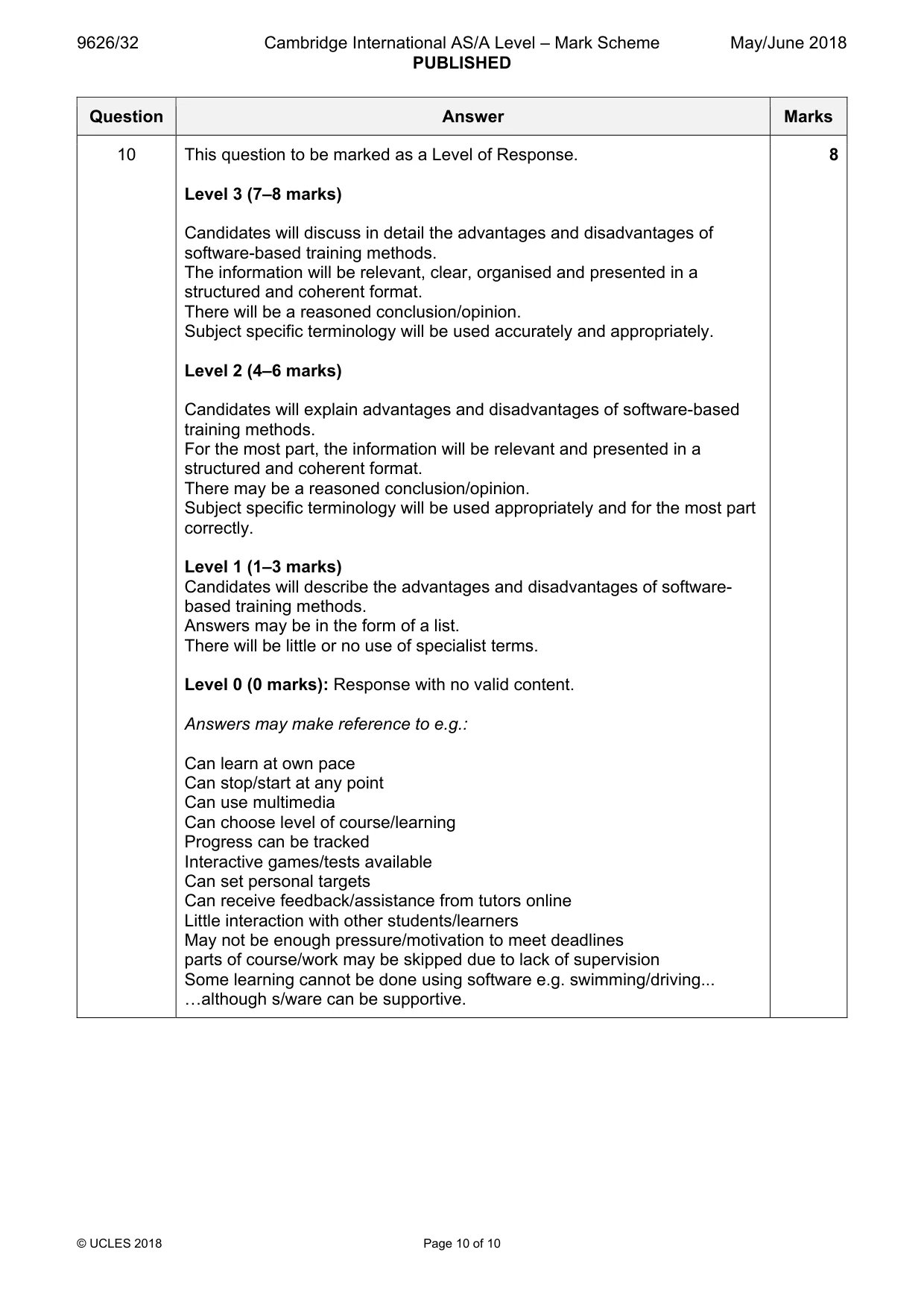
Mark scheme: 10 This question to be marked as a Level of Response. 8 Level 3 (7–8 marks) Candidates will discuss in detail the advantages and disadvantages of software-based training methods. The information will be relevant, clear, organised and presented in a structured and coherent format. There will be a reasoned conclusion/opinion. Subject specific terminology will be used accurately and appropriately. Level 2 (4–6 marks) Candidates will explain advantages and disadvantages of software-based training methods. For the most part, the information will be relevant and presented in a structured and coherent format. There may be a reasoned conclusion/opinion. Subject specific terminology will be used appropriately and for the most part correctly. Level 1 (1–3 marks) Candidates will describe the advantages and disadvantages of software- based training methods. Answers may be in the form of a list. There will be little or no use of specialist terms. Level 0 (0 marks): Response with no valid content. Answers may make reference to e.g.: Can learn at own pace Can stop/start at any point Can use multimedia Can choose level of course/learning Progress can be tracked Interactive games/tests available Can set personal targets Can receive feedback/assistance from tutors online Little interaction with other students/learners May not be enough pressure/motivation to meet deadlines parts of course/work may be skipped due to lack of supervision Some learning cannot be done using software e.g. swimming/driving... «although s/ware can be supportive.
What was in this paper
The subtopics covered by these 10 questions, and how many questions each got. Open one in a new tab to see every Cambridge question on it.
What you needed in this session
Cambridge’s own grade thresholds for 2018 May/June, Paper 3 · Variant 2. A higher threshold means an easier paper — the bar moves with how the cohort did.
Other variants, same session
” 1 mark X=X+3 1 mark while (X < 10) 1 mark 4(c) Four from: 4 The code is executed by the web browser Not on the web server Web browser may not support the code language So the code may not execute properly/at all/produce errors Different browsers run code in different ways Developers must test all code with all browsers Same browsers on different operating systems behave differently Code may produce different results Code requires high processing power So webpages may display slowly/not at all Non-functioning code may deter viewers leading to loss of audience/sales via the website."},"additionalProperty":[{"@type":"PropertyValue","name":"marks","value":15}],"about":{"@type":"Thing","name":"Programming for the web"},"educationalAlignment":{"@type":"AlignmentObject","alignmentType":"educationalSubject","educationalFramework":"Cambridge Information Technology (from 2017) 9626 syllabus","targetName":"Programming for the web"}},{"@type":"Question","position":"5","name":"Q5 · A company sells replacement windows for customers’ homes","text":"5 A company sells replacement windows for customers’ homes. A salesman visits customers’ homes to measure the windows. The salesman usually takes a company laptop on the visit. The salesman is away from the office most of the day. When the salesman is back in the office he has to type up a report on the visit and create quotations to send to the customers. He needs access to a variety of documents including those found on the internet. The salesman also needs to be able to communicate with customers in a variety of ways. The company managers are considering replacing the laptop with a new smartphone for the salesman to take on the visit. The salesman has made a comparison of the two devices. Explain why the salesman has told the company managers that both devices are needed for the visits. .......................................................................................................................................................... .......................................................................................................................................................... .......................................................................................................................................................... .......................................................................................................................................................... .......................................................................................................................................................... .......................................................................................................................................................... .......................................................................................................................................................... .......................................................................................................................................................... .......................................................................................................................................................... .......................................................................................................................................................... .......................................................................................................................................................... .......................................................................................................................................................... .......................................................................................................................................................... .......................................................................................................................................................... .......................................................................................................................................................... .......................................................................................................................................................... .......................................................................................................................................................... .......................................................................................................................................................... .......................................................................................................................................................... ......................................................................................................................................................[8]","acceptedAnswer":{"@type":"Answer","text":"5 Eight from e.g: 8 Laptop has these features required for sales Physical keyboard for typing emails/product but smartphone usually onscreen keyboard Large storage capacity/500GB for local storage of files whereas smartphone has only 32GB/limited file storage Access to external/online storage for file exchange/backup Laptop usually has an optical drive for s/w and product updates whereas the smartphone does not Laptop has greater compatibility of software than a smartphone/can use most features of e.g. office applications Smartphone has these features required for sales people when away from office Smartphone can be used for SMS/text messages Can make voice calls whereas a laptop cannot Smartphone always available/can be carried easily/unobtrusively/smaller than a laptop Smartphone can use 3G/4G whereas laptop is restricted to WiFi/cable Smartphone can be used for internet access by laptop/tethering of laptop to smartphone for internet access Smartphone is not as good at office tasks as a laptop Can connect more readily/to more services Size of device may not be an issue as salesman will use a car/drive to visit."},"additionalProperty":[{"@type":"PropertyValue","name":"marks","value":8}],"about":{"@type":"Thing","name":"Mobile communication systems"},"educationalAlignment":{"@type":"AlignmentObject","alignmentType":"educationalSubject","educationalFramework":"Cambridge Information Technology (from 2017) 9626 syllabus","targetName":"Mobile communication systems"}},{"@type":"Question","position":"6","name":"Q6 · A software company is developing a new ‘app’ for smartphones","text":"6 A software company is developing a new ‘app’ for smartphones. The Rapid Application Development (RAD) method is used to ensure that the ‘app’ is available as soon as possible. (a) The RAD process involves several phases. The first phase is often referred to as Business Modelling. Describe the tasks that must occur in this phase of RAD. ................................................................................................................................................... ................................................................................................................................................... ................................................................................................................................................... ................................................................................................................................................... ................................................................................................................................................... ................................................................................................................................................... ................................................................................................................................................... ...............................................................................................................................................[3] (b) Describe two other phases of RAD. 1 ................................................................................................................................................ ................................................................................................................................................... ................................................................................................................................................... ................................................................................................................................................... ................................................................................................................................................... ................................................................................................................................................... ................................................................................................................................................... ................................................................................................................................................... ................................................................................................................................................... ...............................................................................................................................................[4] 2 ................................................................................................................................................ ................................................................................................................................................... ................................................................................................................................................... ................................................................................................................................................... ................................................................................................................................................... ................................................................................................................................................... ................................................................................................................................................... ................................................................................................................................................... ................................................................................................................................................... ...............................................................................................................................................[4]","acceptedAnswer":{"@type":"Answer","text":"6(a) Three from: 3 Defining the project in terms of what is to be developed Gathering user requirements via focus groups/workshops Defining data flow Plan processes for managing project e.g. Risk assessment/communication between development team/quality of product Planning tasks/activities. 6(b) Two phases from, max 4 per phase: 8 Data Modelling/Requirements phase: Review/analysis of data from business model/requirements phase To create sets of data objects Define relationship between data objects Define test plans Define training strategies where required Determine implementation methodology Process Modelling/User Design phase: Conversion of data objects from previous phase into detailed data flow Define process for any changes/enhancements to data object sets Define processes for adding/deleting/modifying a data object Users interact with system analysts to develop models/early prototypes Application creation/construction phase: Development/construction of prototype by expert programmers Coding may be automated Coding of components carried out simultaneously/in parallel User evaluation of prototype ...repeatedly/iterative testing by users ...users suggest improvements/changes to prototype as it is developed update/modification of prototype Implementation/testing/cutover phase: Carrying out the test plan by testing the data flow ...testing interaction/interfaces between components Testing the complete system User training where required/writing training/help notes Rollout of ‘app’ to users DNA business modelling/requirements phase – stated in part (a)."},"additionalProperty":[{"@type":"PropertyValue","name":"marks","value":11}],"about":{"@type":"Thing","name":"Methods of software development"},"educationalAlignment":{"@type":"AlignmentObject","alignmentType":"educationalSubject","educationalFramework":"Cambridge Information Technology (from 2017) 9626 syllabus","targetName":"Methods of software development"}},{"@type":"Question","position":"7","name":"Q7 · Telecommunication companies often prefer to use fibre optic cables to transmit data","text":"7 Telecommunication companies often prefer to use fibre optic cables to transmit data. Discuss the benefits and drawbacks of using fibre optic cables for data transmission. .......................................................................................................................................................... .......................................................................................................................................................... .......................................................................................................................................................... .......................................................................................................................................................... .......................................................................................................................................................... .......................................................................................................................................................... .......................................................................................................................................................... .......................................................................................................................................................... .......................................................................................................................................................... .......................................................................................................................................................... .......................................................................................................................................................... .......................................................................................................................................................... .......................................................................................................................................................... .......................................................................................................................................................... .......................................................................................................................................................... .......................................................................................................................................................... .......................................................................................................................................................... .......................................................................................................................................................... .......................................................................................................................................................... ......................................................................................................................................................[8]","acceptedAnswer":{"@type":"Answer","text":"7 Eight from: 8 Can provide greater bandwidth to provide faster rate of data transfer Can carry thousands more connections c.f. electrical cable so not so many cables required Lower signal losses over distance so less need for amplifiers/repeaters so less maintenance Can span longer distances so is used to cross difficult areas/gaps/seas/oceans No interaction with other cables as resistant to electrical interference/ground currents ...can be used in areas of high electromagnetic activity No crosstalk with adjacent cables so no distortion of signals Lighter in weight so can be more suitable for use in aircraft No sparks produced if faulty/cut so safer in high risk areas Resistant to corrosion so less maintenance required Smaller cable size so can be used in confined spaces Difficult to ‘hack’/listen/tap into so more secure Can go around corners/bends unlike laser beams Can be more expensive to install than copper cables Specialist test equipment is needed Specialist tools are required for joining optical fibres Physical damage is more likely to interfere with signal transmission compared to similar with copper cables Wildlife prefer the covering of optic fibres for nesting materials compared to those around copper cables Underwater fibre optic cables are more susceptible to chemical damage than copper ones e.g. hydrogen will degrade them Cannot have 90o corners unlike copper cables. Max six for all positives or all negatives. 1 mark available for a reasoned conclusion/opinion."},"additionalProperty":[{"@type":"PropertyValue","name":"marks","value":8}],"about":{"@type":"Thing","name":"Data transmission across networks"},"educationalAlignment":{"@type":"AlignmentObject","alignmentType":"educationalSubject","educationalFramework":"Cambridge Information Technology (from 2017) 9626 syllabus","targetName":"Data transmission across networks"}},{"@type":"Question","position":"8","name":"Q8 · Explain what is meant by digital currency","text":"8 (a) Explain what is meant by digital currency. ................................................................................................................................................... ................................................................................................................................................... ................................................................................................................................................... ................................................................................................................................................... ...............................................................................................................................................[2] (b) Evaluate the impact of digital currencies. ................................................................................................................................................... ................................................................................................................................................... ................................................................................................................................................... ................................................................................................................................................... ................................................................................................................................................... ................................................................................................................................................... ................................................................................................................................................... ................................................................................................................................................... ................................................................................................................................................... ................................................................................................................................................... ................................................................................................................................................... ................................................................................................................................................... ................................................................................................................................................... ................................................................................................................................................... ................................................................................................................................................... ................................................................................................................................................... ................................................................................................................................................... ................................................................................................................................................... ................................................................................................................................................... ...............................................................................................................................................[8]","acceptedAnswer":{"@type":"Answer","text":"8(a) Two from: 2 Internet-based exchange medium Allows for instantaneous transactions Type of electronic money. 8(b) Eight from e.g.: 8 Bank transfers are faster/cheaper than with real currency Leads to increased business activity Movement of money around the globe/world is easier than with real currencies Increase movement of money leads to increase in commerce worldwide People in poor economies can use digital credits on smartphones obviating need to carry real currency/have conventional bank accounts Physically safer than carrying currency so allowing people to retain wealth/money Easier to use for e-commerce so e-business can flourish e-business in underdeveloped countries can easily trade world-wide Allows use of smart contracts/programmable money due by automation/automated systems Linked to e.g. stock markets where money can be paid out depending on movements of share prices/sales Currency does not physically exist/difficult to track/trace transactions Value can fluctuate uncontrollably/without warning/for no apparent reason Susceptible to/used for criminal activities If digital currency is lost through e.g. file corruption it can be lost for ever. Max six for all positives or all negatives. 1 mark available for a reasoned conclusion/opinion."},"additionalProperty":[{"@type":"PropertyValue","name":"marks","value":10}],"about":{"@type":"Thing","name":"Digital currencies"},"educationalAlignment":{"@type":"AlignmentObject","alignmentType":"educationalSubject","educationalFramework":"Cambridge Information Technology (from 2017) 9626 syllabus","targetName":"Digital currencies"}},{"@type":"Question","position":"9","name":"Q9 · Describe the impact of video-conferencing on learning in schools","text":"9 Describe the impact of video-conferencing on learning in schools. .......................................................................................................................................................... .......................................................................................................................................................... .......................................................................................................................................................... .......................................................................................................................................................... .......................................................................................................................................................... .......................................................................................................................................................... .......................................................................................................................................................... .......................................................................................................................................................... .......................................................................................................................................................... .......................................................................................................................................................... .......................................................................................................................................................... .......................................................................................................................................................... .......................................................................................................................................................... .......................................................................................................................................................... .......................................................................................................................................................... .......................................................................................................................................................... .......................................................................................................................................................... .......................................................................................................................................................... .......................................................................................................................................................... ......................................................................................................................................................[8]","acceptedAnswer":{"@type":"Answer","text":"9 Eight from: 8 Students can connect to students all around the world Students see and hear real people in different classrooms Students can collaborate on projects/share resources/ideas Courses can be made available to others Students can attend remotely Students living in remote rural areas can attend school No need to make difficult/lengthy travel arrangements Students can take virtual field trips to dangerous/remote areas in safety Students can experience remote testing by instructor ...before travel to be properly tested ...increasing chance of positive results Students who are home-based through e.g. illness can be included in classes Education does not unduly suffer."},"additionalProperty":[{"@type":"PropertyValue","name":"marks","value":8}],"about":{"@type":"Thing","name":"Technology enhanced learning"},"educationalAlignment":{"@type":"AlignmentObject","alignmentType":"educationalSubject","educationalFramework":"Cambridge Information Technology (from 2017) 9626 syllabus","targetName":"Technology enhanced learning"}},{"@type":"Question","position":"10","name":"Q10 · Discuss the advantages and disadvantages of software-based training methods","text":"10 Discuss the advantages and disadvantages of software-based training methods. .......................................................................................................................................................... .......................................................................................................................................................... .......................................................................................................................................................... .......................................................................................................................................................... .......................................................................................................................................................... .......................................................................................................................................................... .......................................................................................................................................................... .......................................................................................................................................................... .......................................................................................................................................................... .......................................................................................................................................................... .......................................................................................................................................................... .......................................................................................................................................................... .......................................................................................................................................................... .......................................................................................................................................................... .......................................................................................................................................................... .......................................................................................................................................................... .......................................................................................................................................................... .......................................................................................................................................................... .......................................................................................................................................................... ......................................................................................................................................................[8]","acceptedAnswer":{"@type":"Answer","text":"10 This question to be marked as a Level of Response. 8 Level 3 (7–8 marks) Candidates will discuss in detail the advantages and disadvantages of software-based training methods. The information will be relevant, clear, organised and presented in a structured and coherent format. There will be a reasoned conclusion/opinion. Subject specific terminology will be used accurately and appropriately. Level 2 (4–6 marks) Candidates will explain advantages and disadvantages of software-based training methods. For the most part, the information will be relevant and presented in a structured and coherent format. There may be a reasoned conclusion/opinion. Subject specific terminology will be used appropriately and for the most part correctly. Level 1 (1–3 marks) Candidates will describe the advantages and disadvantages of software- based training methods. Answers may be in the form of a list. There will be little or no use of specialist terms. Level 0 (0 marks): Response with no valid content. Answers may make reference to e.g.: Can learn at own pace Can stop/start at any point Can use multimedia Can choose level of course/learning Progress can be tracked Interactive games/tests available Can set personal targets Can receive feedback/assistance from tutors online Little interaction with other students/learners May not be enough pressure/motivation to meet deadlines parts of course/work may be skipped due to lack of supervision Some learning cannot be done using software e.g. swimming/driving... «although s/ware can be supportive."},"additionalProperty":[{"@type":"PropertyValue","name":"marks","value":8}],"about":{"@type":"Thing","name":"Technology enhanced learning"},"educationalAlignment":{"@type":"AlignmentObject","alignmentType":"educationalSubject","educationalFramework":"Cambridge Information Technology (from 2017) 9626 syllabus","targetName":"Technology enhanced learning"}}]},{"@context":"https://schema.org","@type":"BreadcrumbList","itemListElement":[{"@type":"ListItem","position":1,"name":"Home","item":"https://pastlit.com"},{"@type":"ListItem","position":2,"name":"Cambridge A Level","item":"https://pastlit.com/alevel"},{"@type":"ListItem","position":3,"name":"Information Technology (from 2017) 9626","item":"https://pastlit.com/alevel/information-technology-from-2017-9626"},{"@type":"ListItem","position":4,"name":"Yearly papers","item":"https://pastlit.com/alevel/information-technology-from-2017-9626#papers-by-year"},{"@type":"ListItem","position":5,"name":"2018 May/June","item":"https://pastlit.com/alevel/information-technology-from-2017-9626/2018-may-june"},{"@type":"ListItem","position":6,"name":"Paper 3 · Variant 2","item":"https://pastlit.com/alevel/information-technology-from-2017-9626/2018-may-june/paper-32"}]}]