Questions as text
Q1 · Explain what is meant by digital currency 9626/32 May/June 2018
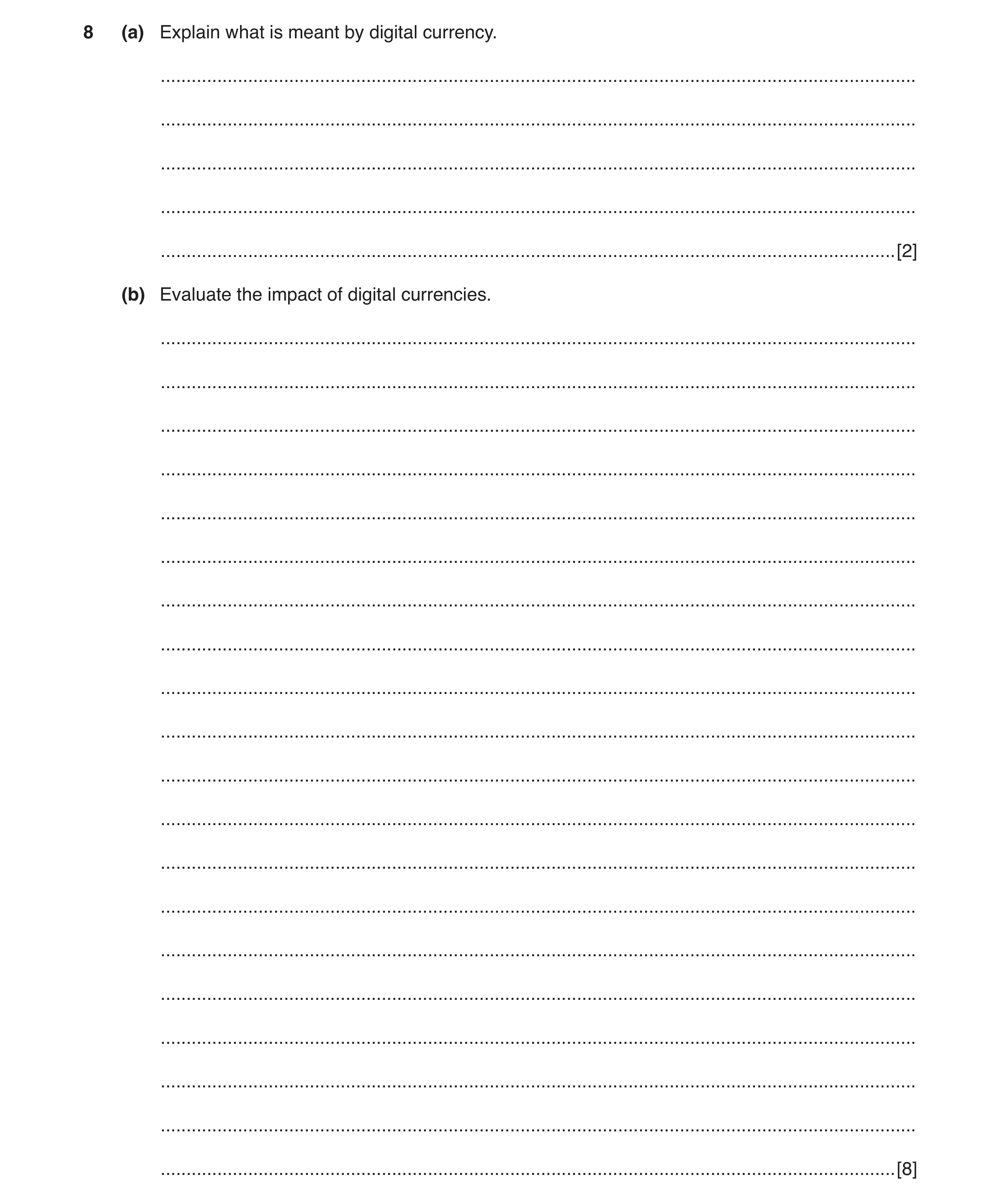
8 (a) Explain what is meant by digital currency. … … … … … [2] (b) Evaluate the impact of digital currencies. … … … … … … … … … … … … … … … … … … … … [8]
10 marks
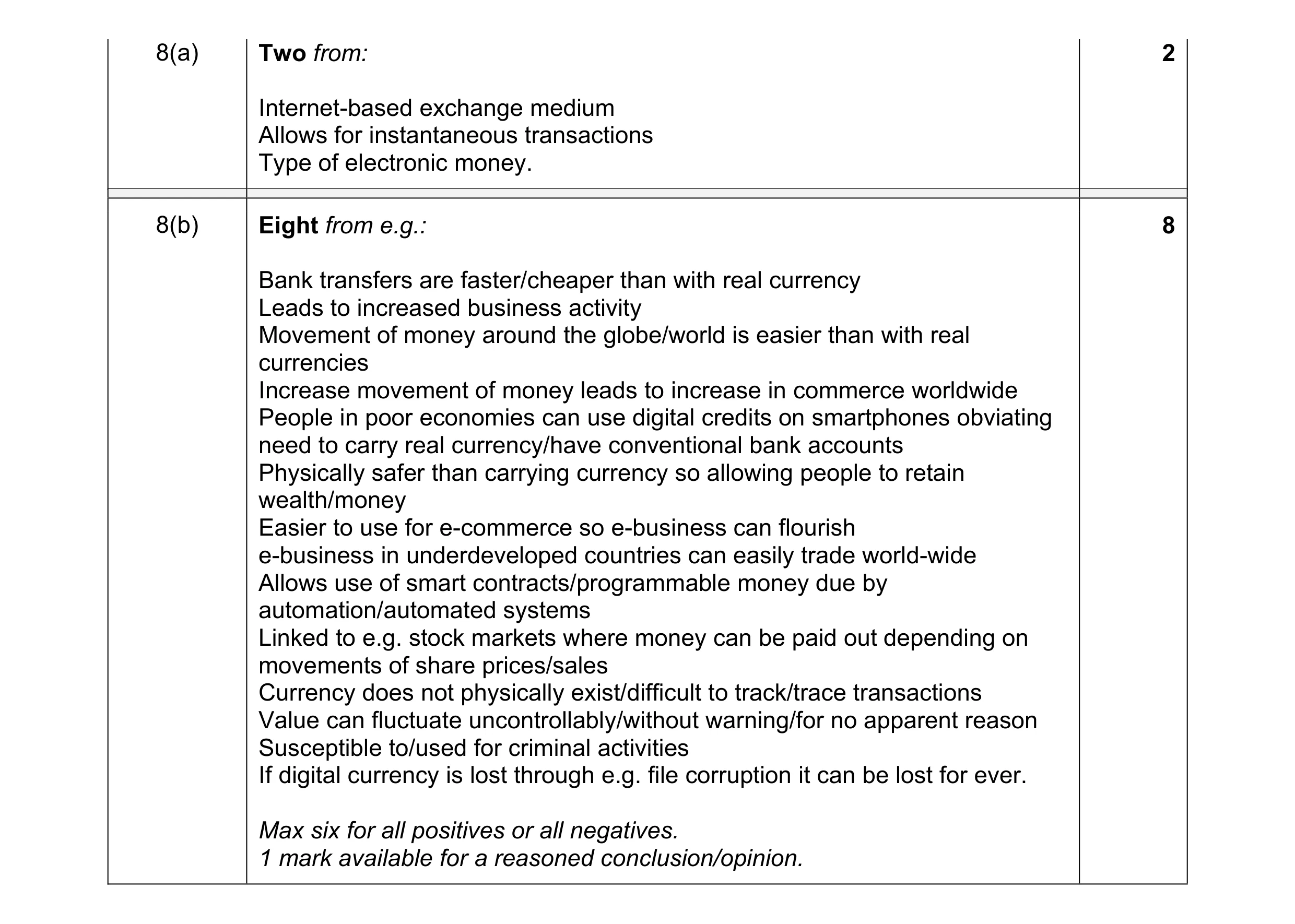
Mark scheme: 8(a) Two from: 2 Internet-based exchange medium Allows for instantaneous transactions Type of electronic money. 8(b) Eight from e.g.: 8 Bank transfers are faster/cheaper than with real currency Leads to increased business activity Movement of money around the globe/world is easier than with real currencies Increase movement of money leads to increase in commerce worldwide People in poor economies can use digital credits on smartphones obviating need to carry real currency/have conventional bank accounts Physically safer than carrying currency so allowing people to retain wealth/money Easier to use for e-commerce so e-business can flourish e-business in underdeveloped countries can easily trade world-wide Allows use of smart contracts/programmable money due by automation/automated systems Linked to e.g. stock markets where money can be paid out depending on movements of share prices/sales Currency does not physically exist/difficult to track/trace transactions Value can fluctuate uncontrollably/without warning/for no apparent reason Susceptible to/used for criminal activities If digital currency is lost through e.g. file corruption it can be lost for ever. Max six for all positives or all negatives. 1 mark available for a reasoned conclusion/opinion.
This question in 9626/32 May/June 2018
Q2 · Digital currencies, such as Bitcoin and Litecoin, can be used to pay for goods and… 9626/31 Oct/Nov 2021
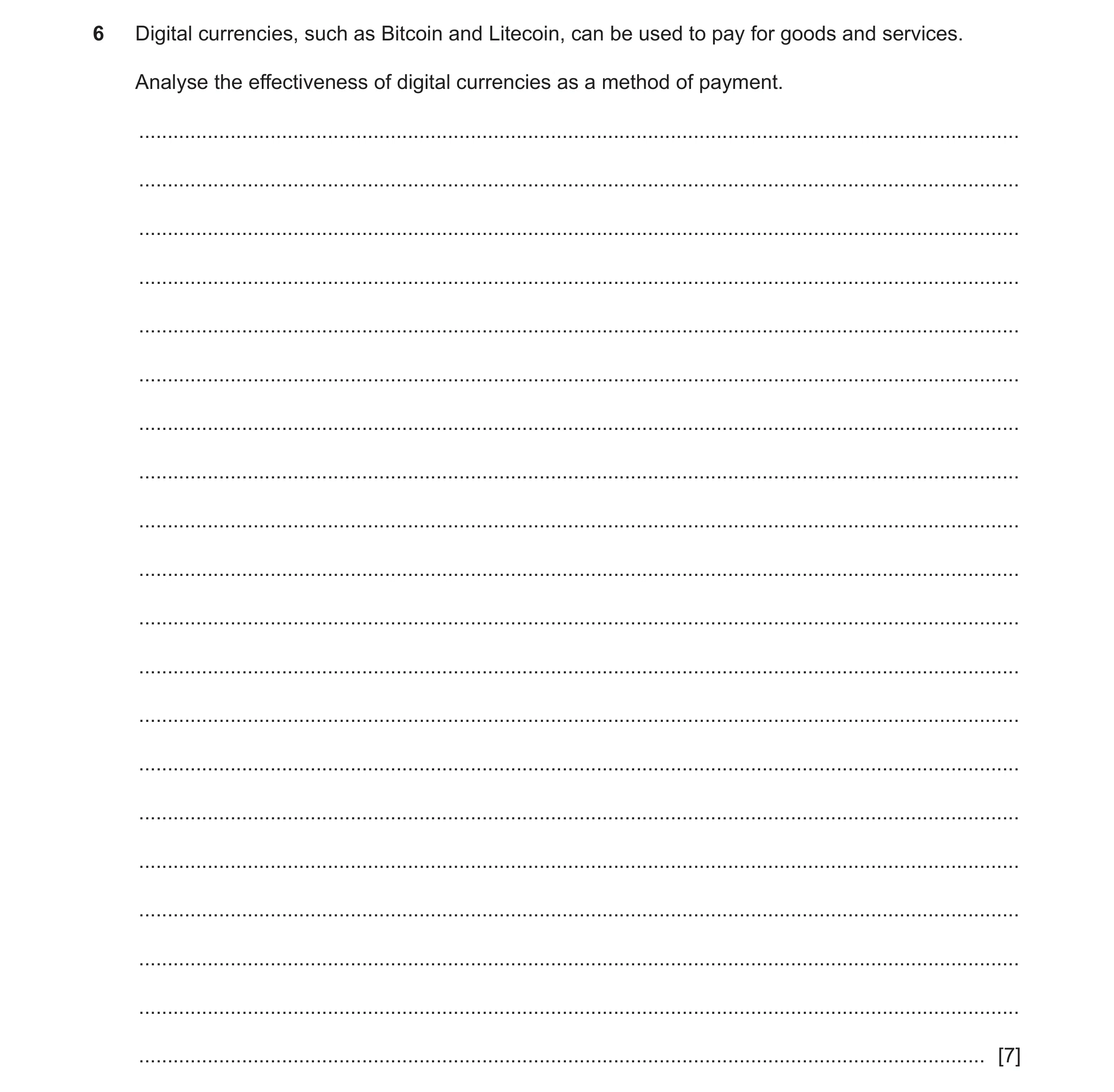
6 Digital currencies, such as Bitcoin and Litecoin, can be used to pay for goods and services. Analyse the effectiveness of digital currencies as a method of payment. … … … … … … … … … … … … … … … … … … … … [7]
7 marks
Mark scheme: 6 Max two from: 7 Digital currency is a form of currency that is non-physical/exists only in digital domain/recorded electronically/e-money Allows for (almost) instantaneous transactions Allows easy transactions across borders/regions Max seven from: Effectiveness: Provides fixed/unchangeable record of transactions Transactions can be almost/seemingly anonymous Transaction fees can be much lower than with other forms of currency Reduced fraud from chargebacks as these are not possible Funds are received faster than with other forms of transaction International transactions are easier than with other forms of currency Lack of effectiveness Difficult to understand how to use Not widely accepted by retailers/sellers Digital currency ‘wallets’ can be lost /fail if password lost, leading to failed transactions Transactions cannot be reversed in case of error Value can fluctuate, leading to uncertainty.
This question in 9626/31 Oct/Nov 2021
Q3 · Digital currencies, such as Bitcoin and Litecoin, can be used to pay for goods and… 9626/33 Oct/Nov 2021
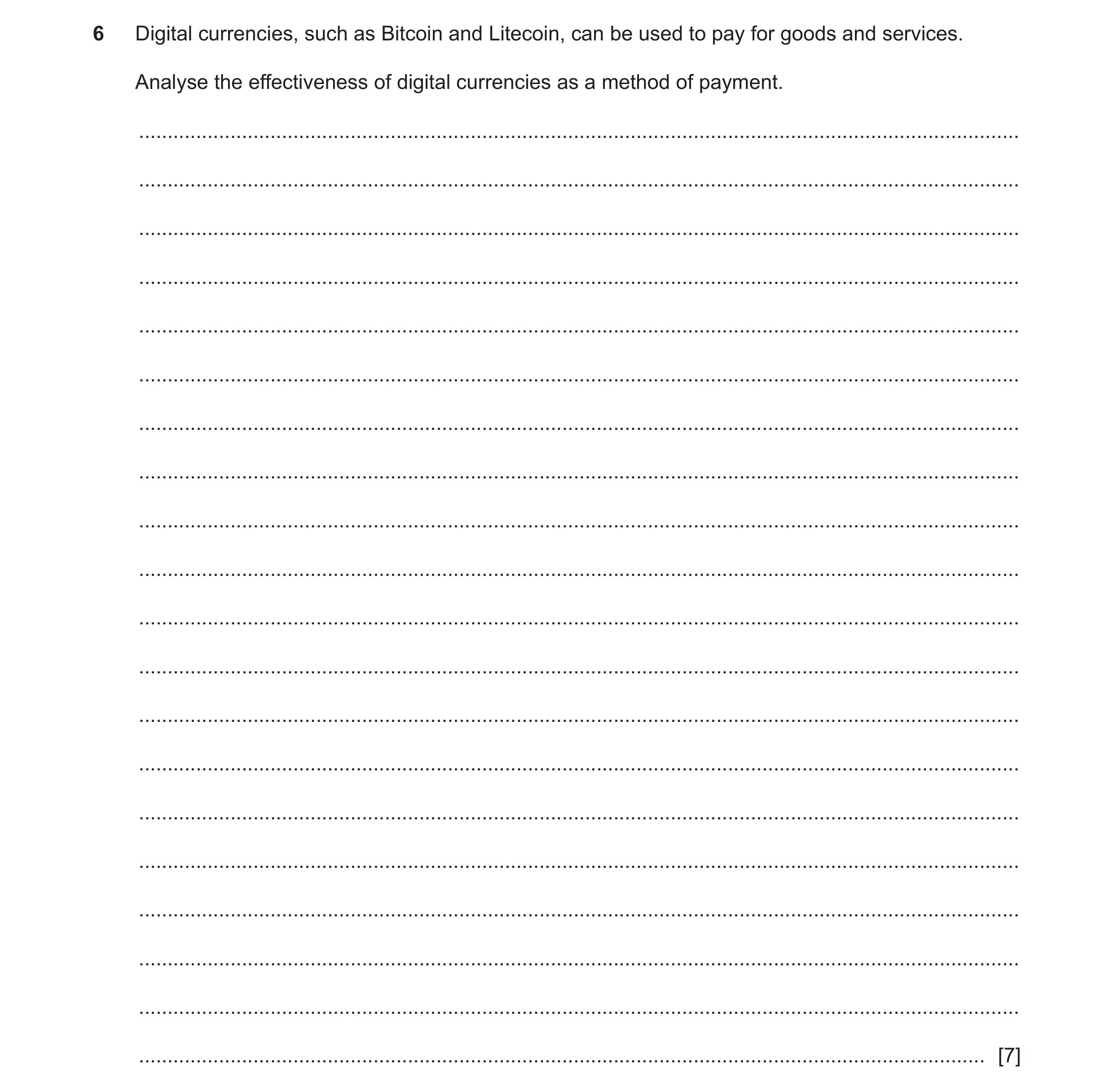
6 Digital currencies, such as Bitcoin and Litecoin, can be used to pay for goods and services. Analyse the effectiveness of digital currencies as a method of payment. … … … … … … … … … … … … … … … … … … … … [7]
7 marks
Mark scheme: 6 Max two from: 7 Digital currency is a form of currency that is non-physical/exists only in digital domain/recorded electronically/e-money Allows for (almost) instantaneous transactions Allows easy transactions across borders/regions Max seven from: Effectiveness: Provides fixed/unchangeable record of transactions Transactions can be almost/seemingly anonymous Transaction fees can be much lower than with other forms of currency Reduced fraud from chargebacks as these are not possible Funds are received faster than with other forms of transaction International transactions are easier than with other forms of currency Lack of effectiveness Difficult to understand how to use Not widely accepted by retailers/sellers Digital currency ‘wallets’ can be lost /fail if password lost, leading to failed transactions Transactions cannot be reversed in case of error Value can fluctuate, leading to uncertainty.
This question in 9626/33 Oct/Nov 2021
Q4 · Mobile electronic wallets can be used to make small payments 9626/32 May/June 2022
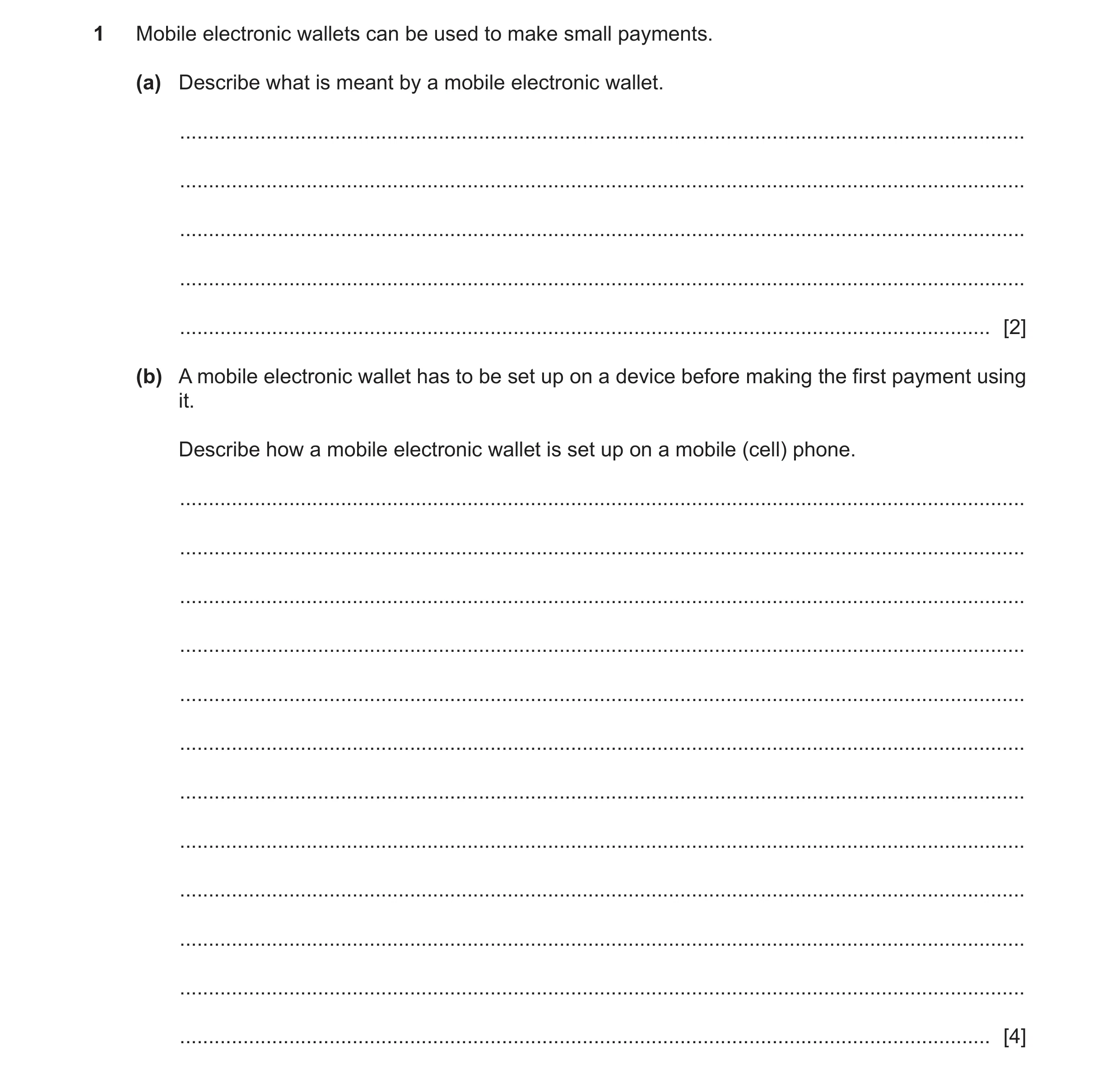
1 Mobile electronic wallets can be used to make small payments. (a) Describe what is meant by a mobile electronic wallet. … … … … … [2] (b) A mobile electronic wallet has to be set up on a device before making the first payment using it. Describe how a mobile electronic wallet is set up on a mobile (cell) phone. … … … … … … … … … … … … [4]
6 marks
Mark scheme: 1(a) Two from: An app running on (a mobile device/smartphone) Stores debit/credit card information/digital currency/electronic money Allows payment for goods/services (digitally) Enables/allows contactless payments/uses NFC technology. 2 1(b) Four from: User downloads/installs app (from (finance) provider) User registers with (finance) provider on/via app User inputs phone number Provider sends user a verification code via SMS/text message User authenticates number when receiving verification code User inputs debit/credit card information/data/payment details/adds account details Allows linking to bank account User validates/authenticates payment details. 4
This question in 9626/32 May/June 2022
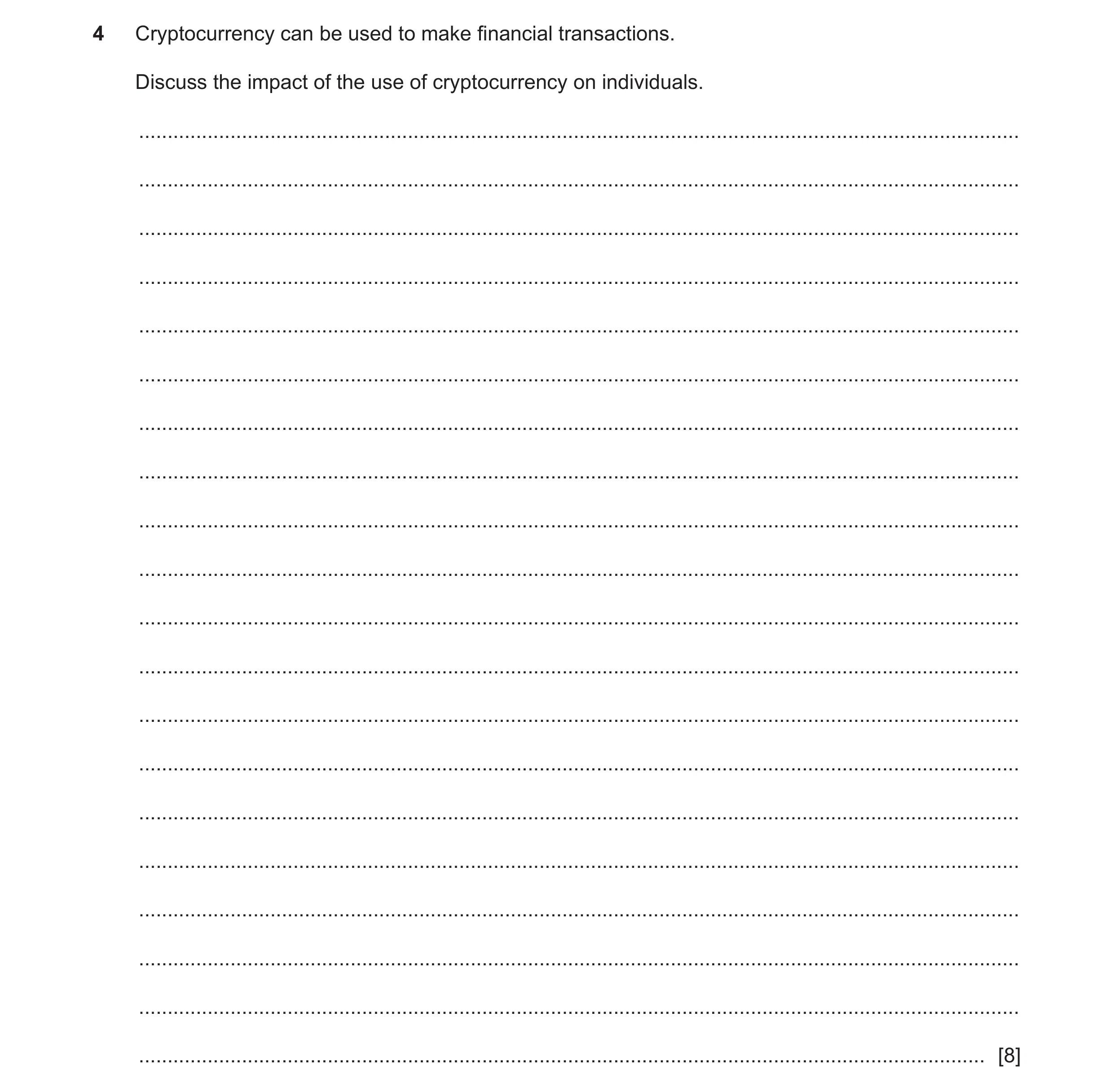
Q5 · Cryptocurrency can be used to make financial transactions 9626/31 Oct/Nov 2022
4 Cryptocurrency can be used to make financial transactions. Discuss the impact of the use of cryptocurrency on individuals. … … … … … … … … … … … … … … … … … … … … [8]
8 marks
Mark scheme: 4 Eight from: 8 Positive impacts include: Currency records/transactions are encrypted for security …so privacy/anonymity is assured Not regulated/subject to financial laws …so is not subject to interest rate charges/fees/surcharges during transactions Not subject to exchange rates when used internationally Cannot be seized/’garnished’/frozen as no ownership records are held Offers complete anonymity as there are no (central) records of ownership/transactions Negative impacts include: Transactions are irreversible/cannot be cancelled/be recalled …so if the currency can be sent to the wrong address the value is lost Price/value of currency is not regulated and fluctuates wildly as it is a commodity …so is a high-risk activity Subject to fraudulent claims of high returns for little investment as is a new technology/area of finance Encrypted records of currency hold value but not ownership …so if its stolen/lost there is no proof of ownership so it’s lost Private keys for cryptocurrency can be permanently lost from local storage due to malware/data loss /destruction of/damage to physical media …so cryptocurrency cannot be spent/used/trade resulting …so it is effectively removed from markets Currency can become worthless if markets fluctuate/provider goes out of business/stops trading Some countries do not allow cryptocurrency use …so goods/services cannot be purchased from/in these countries with cryptocurrency. Must be at least two Positives and at least two Negatives for full marks. Max 6 marks if all bullets/statements/points.
This question in 9626/31 Oct/Nov 2022
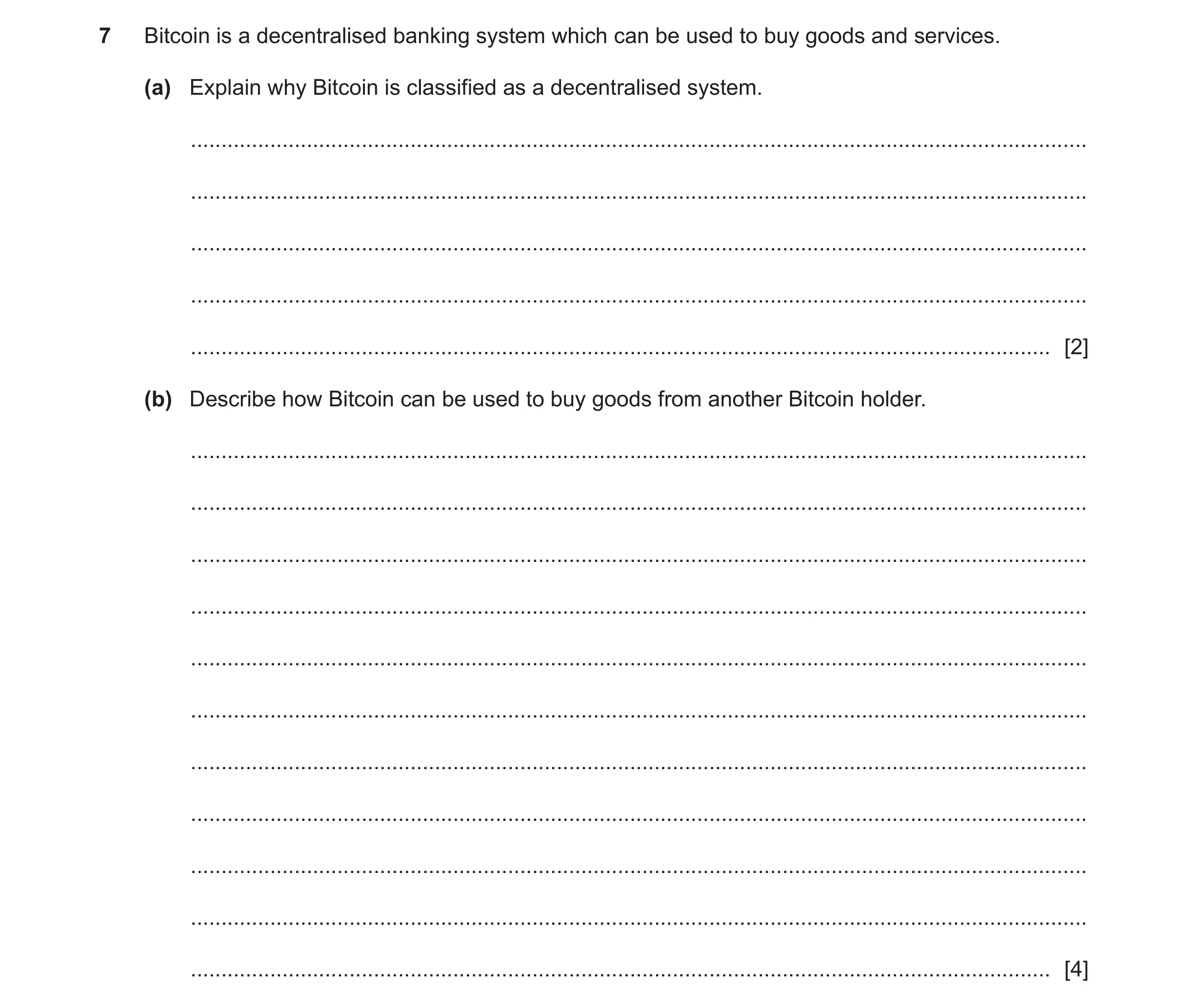
Q6 · Bitcoin is a decentralised banking system which can be used to buy goods and services 9626/31 Oct/Nov 2022
7 Bitcoin is a decentralised banking system which can be used to buy goods and services. (a) Explain why Bitcoin is classified as a decentralised system. … … … … … [2] (b) Describe how Bitcoin can be used to buy goods from another Bitcoin holder. … … … … … … … … … … … [4]
6 marks
Mark scheme: 7(a) Two from: 2 No central bank needed to provide payment services/hold money Payments are made peer-to-peer/direct between persons No central regulatory authority to oversee transactions/financial dealings. 7(b) Four from: 4 Bitcoin wallet/software is set up to provide a Bitcoin address to/from which payments are made Bitcoin addresses are complex number/character sequences staring with a 1 or a 3 Bitcoin(s) are purchased from a Bitcoin exchange and loaded into the wallet Use of credit/debit/bank card/bank transfer only to purchase Bitcoins to store in wallet Bitcoins can be transferred directly from one wallet to another by specifying Bitcoin address of seller to send to Use of Bitcoin debit card that can debit wallet directly when used for payments.
This question in 9626/31 Oct/Nov 2022
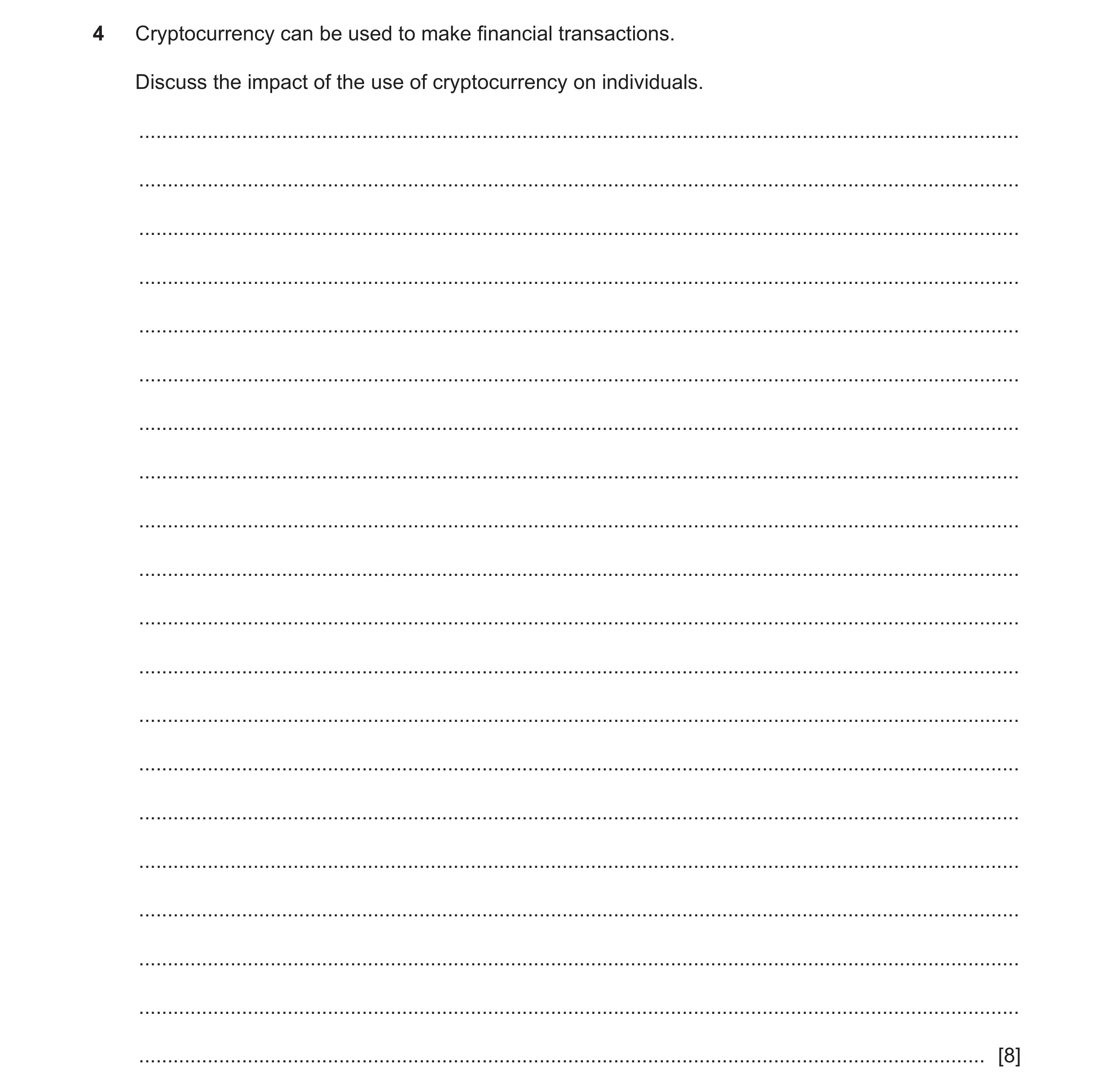
Q7 · Cryptocurrency can be used to make financial transactions 9626/33 Oct/Nov 2022
4 Cryptocurrency can be used to make financial transactions. Discuss the impact of the use of cryptocurrency on individuals. … … … … … … … … … … … … … … … … … … … … [8]
8 marks
Mark scheme: 4 Eight from: 8 Positive impacts include: Currency records/transactions are encrypted for security …so privacy/anonymity is assured Not regulated/subject to financial laws …so is not subject to interest rate charges/fees/surcharges during transactions Not subject to exchange rates when used internationally Cannot be seized/’garnished’/frozen as no ownership records are held Offers complete anonymity as there are no (central) records of ownership/transactions Negative impacts include: Transactions are irreversible/cannot be cancelled/be recalled …so if the currency can be sent to the wrong address the value is lost Price/value of currency is not regulated and fluctuates wildly as it is a commodity …so is a high-risk activity Subject to fraudulent claims of high returns for little investment as is a new technology/area of finance Encrypted records of currency hold value but not ownership …so if its stolen/lost there is no proof of ownership so it’s lost Private keys for cryptocurrency can be permanently lost from local storage due to malware/data loss /destruction of/damage to physical media …so cryptocurrency cannot be spent/used/trade resulting …so it is effectively removed from markets Currency can become worthless if markets fluctuate/provider goes out of business/stops trading Some countries do not allow cryptocurrency use …so goods/services cannot be purchased from/in these countries with cryptocurrency. Must be at least two Positives and at least two Negatives for full marks. Max 6 marks if all bullets/statements/points.
This question in 9626/33 Oct/Nov 2022
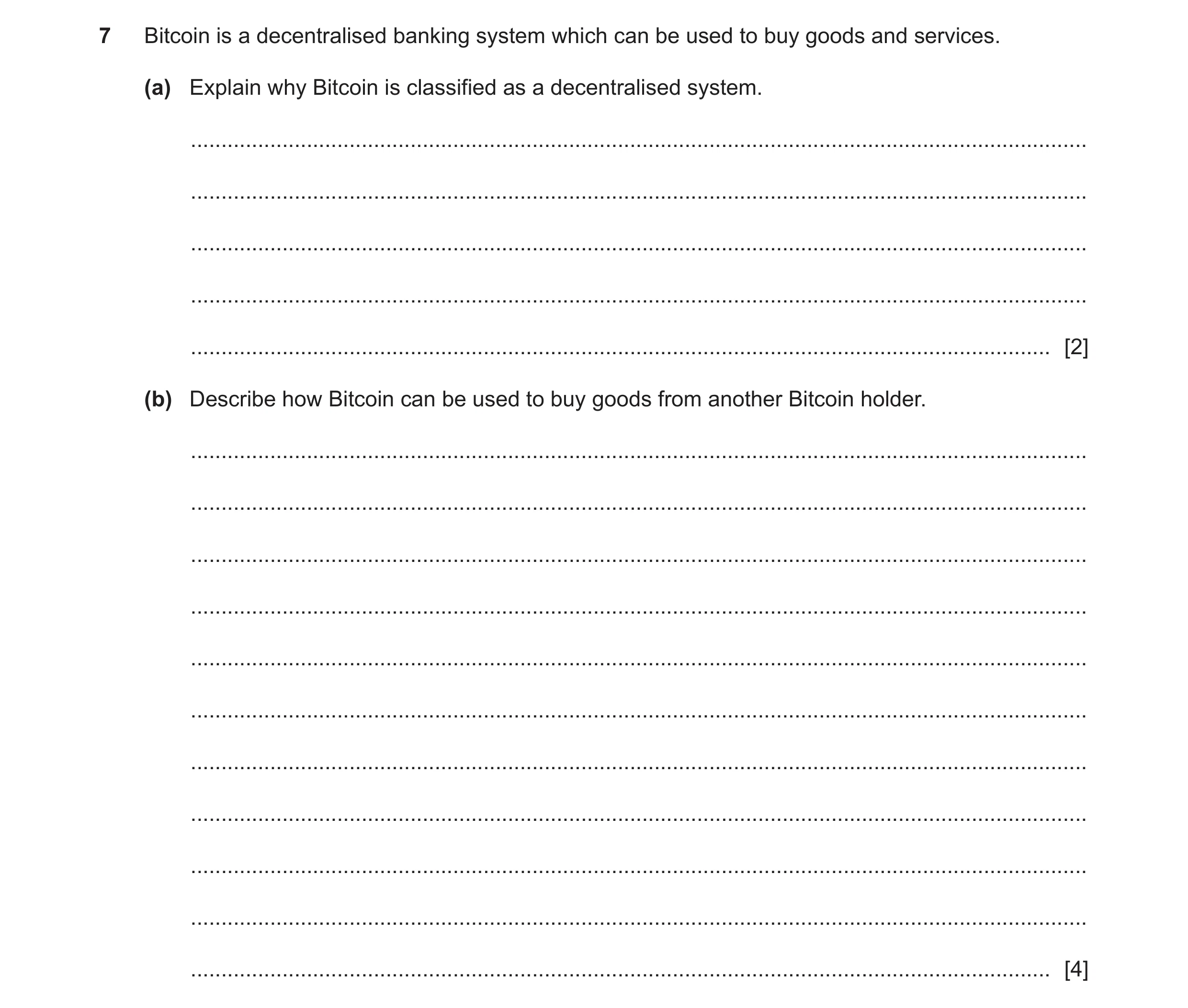
Q8 · Bitcoin is a decentralised banking system which can be used to buy goods and services 9626/33 Oct/Nov 2022
7 Bitcoin is a decentralised banking system which can be used to buy goods and services. (a) Explain why Bitcoin is classified as a decentralised system. … … … … … [2] (b) Describe how Bitcoin can be used to buy goods from another Bitcoin holder. … … … … … … … … … … … [4]
6 marks
Mark scheme: 7(a) Two from: 2 No central bank needed to provide payment services/hold money Payments are made peer-to-peer/direct between persons No central regulatory authority to oversee transactions/financial dealings. 7(b) Four from: 4 Bitcoin wallet/software is set up to provide a Bitcoin address to/from which payments are made Bitcoin addresses are complex number/character sequences staring with a 1 or a 3 Bitcoin(s) are purchased from a Bitcoin exchange and loaded into the wallet Use of credit/debit/bank card/bank transfer only to purchase Bitcoins to store in wallet Bitcoins can be transferred directly from one wallet to another by specifying Bitcoin address of seller to send to Use of Bitcoin debit card that can debit wallet directly when used for payments.
This question in 9626/33 Oct/Nov 2022
Q9 · Compare the characteristics of stored value cards and credit cards 9626/31 May/June 2023
3 Compare the characteristics of stored value cards and credit cards. You must include similarities and differences. … … … … … … … … … … … … … … … … … … … … … … … … [8]
8 marks
Mark scheme: 3 Eight from: 8 Similarities: Both use magnetic strip/chip/RFID chip Cards carry identification text/symbols/images of issuer Cards carry unique (account/card number/security) numbers Cards may carry holographic information to deter fraud Stored data includes PIN Used in same way for contactless Both used for in person payments Differences: Stored value cards may not always carry name of owner/may be anonymous whereas credit cards always carry name of account holder Stored value cards carry the amount of money available (as data stored on card) whereas credit card monetary value is set by issuer/stored at issuer of card/bank Stored value cards used in low-value transactions whereas credit cards subject only to issuer limits Stored value cards usually have a limited amount of money whereas credit cards may not/can have extended limits (When used for payment) stored value cards may not require connection to issuer bank whereas credit cards often/usually do require connection to issuer bank/account Stored value cards may be discarded when money used up/may be topped up with more money whereas credit cards must be kept safe because value is stored in (connected) account Stored value cards can be used by anyone (in physical possession of card) in the same way as physical currency whereas credit cards require authentication of user before transaction is carried out No fees are payable to merchant when accepting stored value cards whereas credit card use incurs a (percentage/fixed) fee payable to issuer by merchant when used Stored value cards are not accepted for online/telephone/mail order/card not physically present transactions unlike credit cards which are readily accepted/preferred Credit cards can help build up a credit rating for the user whereas stored cards do not. Must be at least two similarities and at least two differences for full marks.
This question in 9626/31 May/June 2023
Q10 · A government is concerned that the use of digital currencies may affect its economy 9626/32 May/June 2023
7 A government is concerned that the use of digital currencies may affect its economy. Analyse the risks to an economy of an increase in the use of digital currencies. … … … … … … … … … … … … … … … … [6]
6 marks
Mark scheme: 7 Analyse: examine in detail to show meaning, identify elements and the 6 relationship between them. Six from, e.g.: Risk(s) to monetary stability increase as the amount/value of digital currency in an economy increases… …which may cause inflation/devaluation of base/traditional currency Risks due to fraud/lack of control of economy are small if amount/value of digital currency in the economy is small/when most financial transactions are by traditional means Price/value of digital currency is (very) volatile and great fluctuations lead to financial instability/a great rise followed by great crash in price imposes vast losses on buyers/sellers Pensions/income is lost Investment by organisations vital to economy/pension/healthcare in digital currency exposes them to risk of sudden financial loss Risk of system-wide fraud if a group/organisation gained control of computing resources involved in electronic payments Increase in crime/financial loss Risk of erosion/undermining/circumvention of monetary controls set by governments to regulate economy Rise in inflation/unemployment Risk of fragmentation of economy if all digital currency/transactions were restricted to small numbers of users Risk of move from traditional/base money to digital currency transactions… …reducing the value of traditional currency Risk of loss consumer protection/taxation income if transactions carried out using digital currency Risk of money laundering/illegal payments Transactions are anonymous/not tracked/recorded. Max 5 marks if bullets/list of points/characteristic.
This question in 9626/32 May/June 2023
Q11 · Compare the characteristics of stored value cards and credit cards 9626/33 May/June 2023
3 Compare the characteristics of stored value cards and credit cards. You must include similarities and differences. … … … … … … … … … … … … … … … … … … … … … … … … [8]
8 marks
Mark scheme: 3 Eight from: 8 Similarities: Both use magnetic strip/chip/RFID chip Cards carry identification text/symbols/images of issuer Cards carry unique (account/card number/security) numbers Cards may carry holographic information to deter fraud Stored data includes PIN Used in same way for contactless Both used for in person payments Differences: Stored value cards may not always carry name of owner/may be anonymous whereas credit cards always carry name of account holder Stored value cards carry the amount of money available (as data stored on card) whereas credit card monetary value is set by issuer/stored at issuer of card/bank Stored value cards used in low-value transactions whereas credit cards subject only to issuer limits Stored value cards usually have a limited amount of money whereas credit cards may not/can have extended limits (When used for payment) stored value cards may not require connection to issuer bank whereas credit cards often/usually do require connection to issuer bank/account Stored value cards may be discarded when money used up/may be topped up with more money whereas credit cards must be kept safe because value is stored in (connected) account Stored value cards can be used by anyone (in physical possession of card) in the same way as physical currency whereas credit cards require authentication of user before transaction is carried out No fees are payable to merchant when accepting stored value cards whereas credit card use incurs a (percentage/fixed) fee payable to issuer by merchant when used Stored value cards are not accepted for online/telephone/mail order/card not physically present transactions unlike credit cards which are readily accepted/preferred Credit cards can help build up a credit rating for the user whereas stored cards do not. Must be at least two similarities and at least two differences for full marks.
This question in 9626/33 May/June 2023
Q12 · Discuss the benefits and drawbacks of the use of cryptocurrencies by individuals 9626/32 Feb/March 2024
8 Discuss the benefits and drawbacks of the use of cryptocurrencies by individuals. … … … … … … … … … … … … … … … … … … … … [8]
8 marks
Mark scheme: 8 Eight from: 8 One for • valid description of cryptocurrency e.g.: a digital currency in which transactions are verified and recorded by a decentralised system using cryptography Benefits: Max six from: • Cannot be counterfeited so is not devalued by forgers • Transactions cannot be reversed by the sender for arbitrary reasons/without consent/assistance of recipient • Transactions can be anonymous so finances cannot be tracked/traced • Cost-effective option for immigrants who have left their homes to find work and wish to send payments to their families in other countries • Requires a private key/cryptographic password unique to each user for access so central government/organisation/corporation/bank cannot seize/freeze assets • Unaffected by government defaults on loans/bank collapses • Uses a “push” model prompting cryptocurrency holder to send exactly the amount to the seller without any other form of information • Not bound by exchange rates so no cost when transferring between countries • No need to change currency for transactions between countries • No transaction charges resulting in lower costs to senders/recipients • Transactions take place at the same speed regardless of where the sender and receiver are located. Drawbacks: Max six from: • Not backed by a government/central bank so subject to risks e.g. price volatility and regulatory intervention • Risk of centralised intervention/not be legal in some countries • Subject to volatility/significant price swings (as markets develop)/can lose a lot money quickly • Small part of the global financial ecosystem so few retailers/organisations accept it • Cannot easily be convert into cash/hard currency • Some governments have banned the use of cryptocurrencies • Risk of software errors affecting the chains leading to roll back/loss of transactions/value • Significant contribution to climate change due to power consumption. Max six if bullets/list of points.
This question in 9626/32 Feb/March 2024
Q13 · Central bank digital base money is a type of digital currency issued by banks 9626/32 Feb/March 2025
8 Central bank digital base money is a type of digital currency issued by banks. Describe the benefits and drawbacks of central bank digital base money. … … … … … … … … … … … … … … [6]
6 marks
Mark scheme: 8 One mark per bullet point to a maximum of six marks. 6 Max 5 from : Benefits: e.g.: • Used for online and offline transactions • Integrated into existing payment systems • Used to facilitate cross-border / international payments • Accounts / easier for people to access financial services and participate in the digital economy • Provides a digital alternative to cash • Beneficial for those with limited access to traditional banking services • Provide a secure digital payment service • Provide reliable digital payment service Max 5 from : Drawbacks: e.g.: • Allows increased surveillance of financial transactions • Could raise privacy and security concerns • Costly / complex implementation of CBDCS • Security risks associated with the integration of CBDCS into existing payment systems • Increased competition to traditional from CBDCS (1st) • decline in their profits (1) • reduction in the availability of banking / credit facilities (1).
This question in 9626/32 Feb/March 2025
Q14 · Blockchain technology is used in financial transactions and for smart contracts 9626/31 May/June 2025
10 Blockchain technology is used in financial transactions and for smart contracts. (a) Blockchain technology requires a great deal of computing power and is expensive. Describe one other drawback of blockchain technology. … … … … … … [2] (b) Describe how a smart contract works. … … … … … … … … … … [4]
6 marks
Mark scheme: 10(a) TWO from: 2 • The time taken to carry out / approve transactions can be very long (1st) because all nodes / peers have to be updated / approve the transactions (1) • Large numbers of nodes / peers can add to network congestion (1st) which can slow the process (1) • Different versions of blockchains are not interchangeable / cannot be exchanged for each other (1st) so must use the same blockchain technology (1) 10(b) FOUR from: 4 • Parties (to the contract) agree on conditions of contract to be met / code to be used / deal to be struck / valid example of deal (e.g. sell painting for an amount of money) • Code / program / application representing the contract stored in a blockchain • (Code) runs / is executed only when predetermined conditions are met / only when all parties agree / have authorised its completion • Uses if / when …- type statements to test conditions // checks conditions have been met • Uses then …- type statements to execute code // if conditions met code is executed • Blockchain is updated when transaction is complete / conditions are met and authorised by all parties
This question in 9626/31 May/June 2025
Q15 · Blockchain technology is used as a distributed ledger in cryptocurrencies 9626/32 May/June 2025
10 Blockchain technology is used as a distributed ledger in cryptocurrencies. (a) Describe what is meant by a distributed ledger. … … … … … … [2] (b) Describe two items of data that would be stored in a cryptocurrency’s distributed ledger. … … … … … … … [2]
4 marks
Mark scheme: 10(a) TWO from: 2 • A shared database • (Copied / replicated) to all members / users • Is decentralised • All copies synchronised / updated at every transaction 10(b) TWO from: 2 • A record of every transaction • A timestamp for every / each transaction • A unique cryptographic signature (linked to every / each transaction)
This question in 9626/32 May/June 2025
Q16 · A blockchain is a list of records linked securely together 9626/33 May/June 2025
5 A blockchain is a list of records linked securely together. (a) Blockchains contain the records and the cryptographic hashes used to secure the records. State one other item of data that makes up the blockchain. … … … [1] (b) Describe two uses of blockchain technology. … … … … … … [2]
3 marks
Mark scheme: 5(a) ONE from: 1 • a cryptographic hash of the previous block • a timestamp • (all the) transaction data 5(b) TWO from, e.g.: 2 • (As a distributed ledger) in cryptocurrency • Smart contracts • Storing medical records
This question in 9626/33 May/June 2025
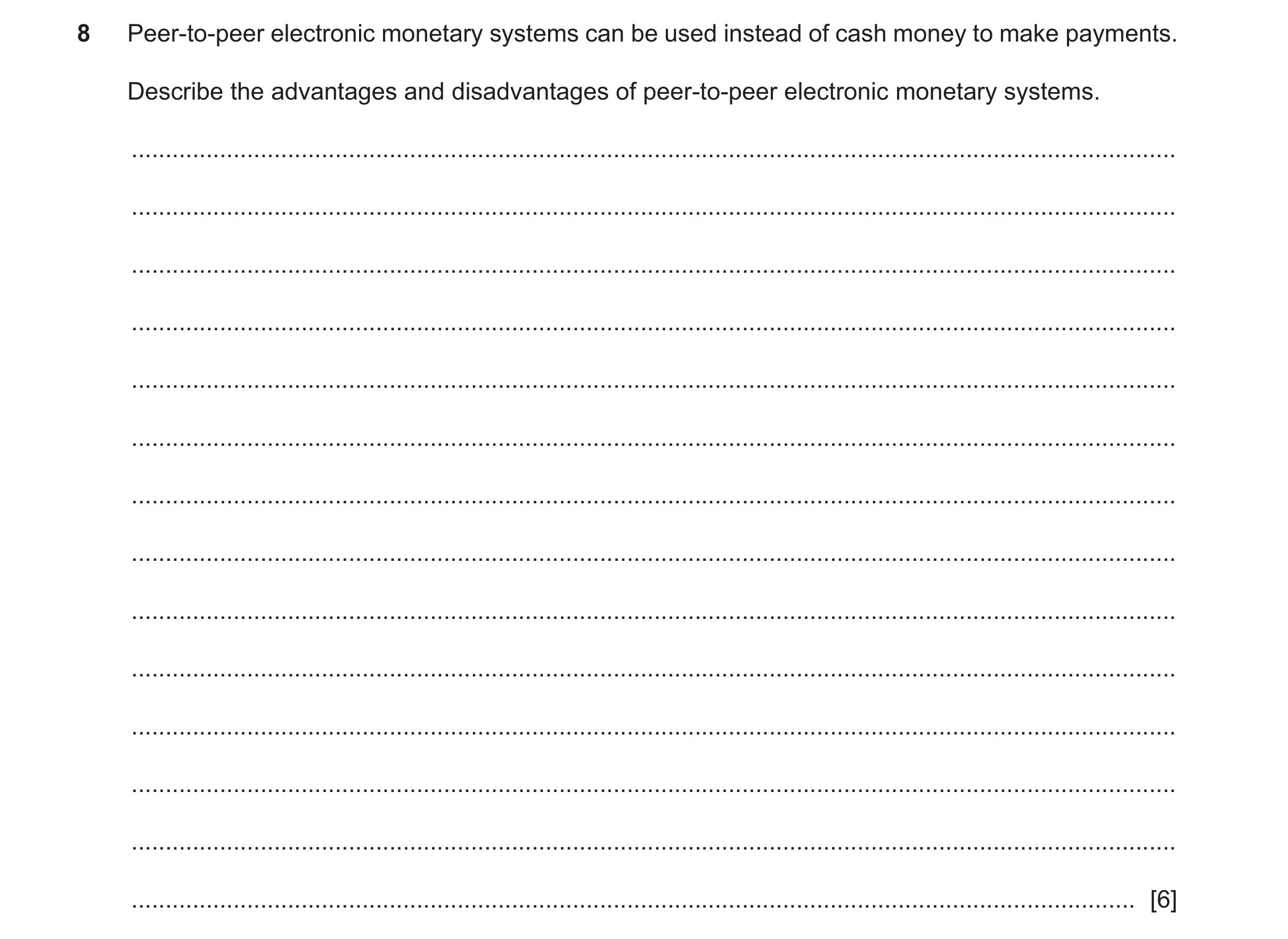
Q17 · Peer-to-peer electronic monetary systems can be used instead of cash money to make… 9626/33 May/June 2025
8 Peer-to-peer electronic monetary systems can be used instead of cash money to make payments. Describe the advantages and disadvantages of peer-to-peer electronic monetary systems. … … … … … … … … … … … … … … [6]
6 marks
Mark scheme: 8 SIX from: 6 Max FIVE from: Advantages: • No need to carry cash (1st) – so, risk of loss / theft of money is reduced (1) – security is higher (1) • (mobile) app can hold all required information (1st) – so easily / quickly used when mobile / in a hurry (1) • Money transfer is (usually) faster than when using back transfers / credit cards / cheques • Recipient gets payment quicker / transactions completed faster • Not tracked by banking system / regulators • No need to exchange currencies / visit money exchange • Avoid additional bank / exchange charges • Automatically calculates into home currency Max FIVE from: Disadvantages: • If error in transaction / money sent to wrong recipient refunds / reversal of transaction not possible • Requires regular checking of balance to ensure sufficient funds stored • Needs regular top-ups to allow payments / avoid refusal of transaction • Some transactions can take several days to appear / funds made available • Banks cannot monitor transactions • Can be used for illegal transactions • Need an internet connection to reconcile payments
This question in 9626/33 May/June 2025
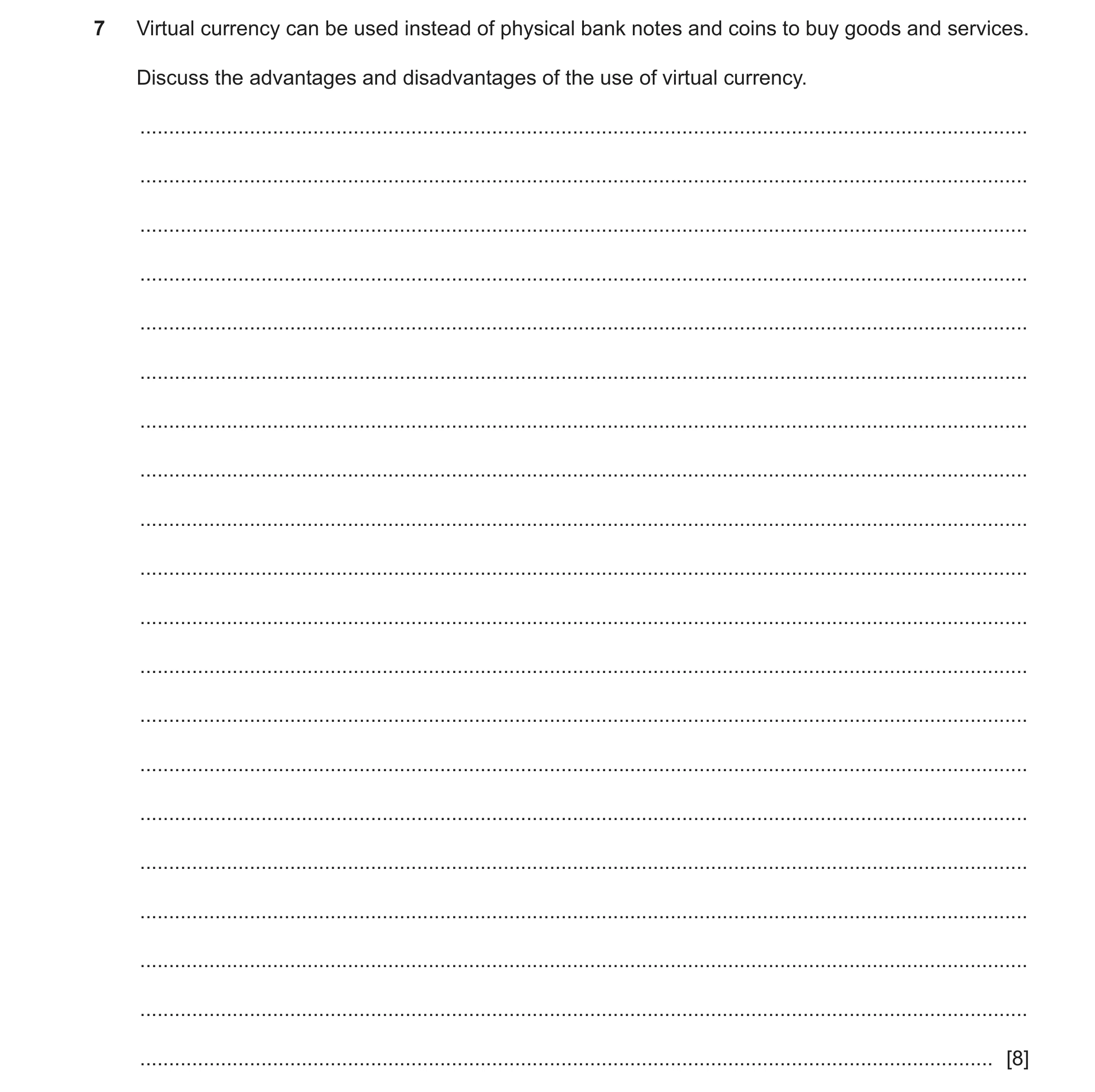
Q18 · Virtual currency can be used instead of physical bank notes and coins to buy goods and… 9626/32 Oct/Nov 2025
7 Virtual currency can be used instead of physical bank notes and coins to buy goods and services. Discuss the advantages and disadvantages of the use of virtual currency. … … … … … … … … … … … … … … … … … … … … [8]
8 marks
Mark scheme: 7 Eight from: 8 Command word: Discuss – write about issues(s) or topic(s) in a structured way. Max one from: Definition of virtual currency: • A virtual currency represents an amount of money that is stored only in digital form • Can be represented by coupons / stamps / reward points Max five from: Advantages: • Use of cryptography during transactions increases security • Not regulated so value can change hands without oversight (1 st) − with no records available to regulators (1) • Issuing company has a captive market • Goods / services can only be purchased from that company • Value stays the same when used in different countries • Transactions are faster than with physical currency Max five from: Disadvantages: • Use is restricted to members of specific (virtual) group / community / game environment that agree to use it • No connection to the real-world economy / no interchangeability with real currency • No intrinsic value / value because it depends on agreement between users / group / community / game environment • Not regulated so value depends on trust between users • Value can fluctuate widely as not regulated so can lose / gain money
This question in 9626/32 Oct/Nov 2025
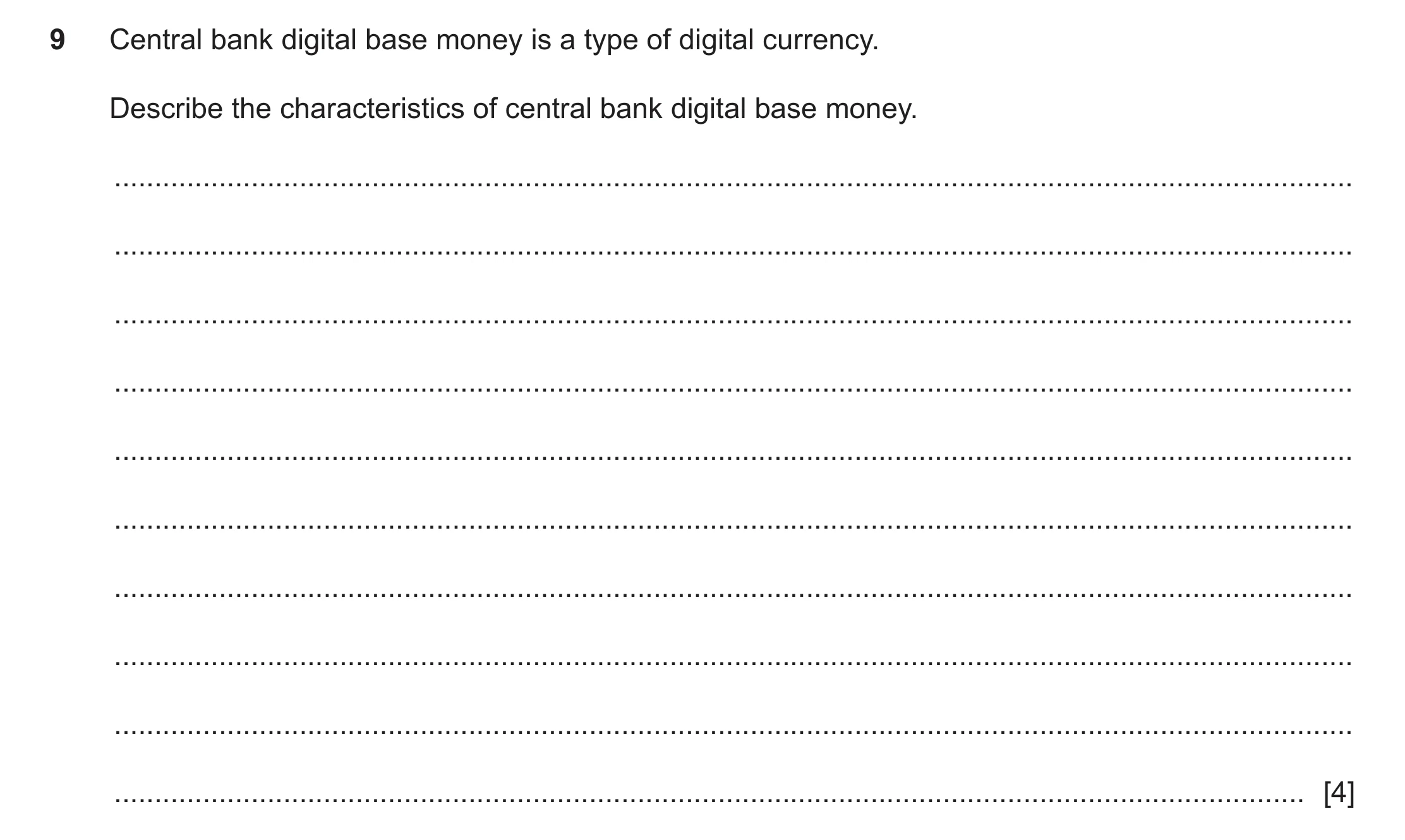
Q19 · Central bank digital base money is a type of digital currency 9626/33 Oct/Nov 2025
9 Central bank digital base money is a type of digital currency. Describe the characteristics of central bank digital base money. … … … … … … … … … … [4]
4 marks
Mark scheme: 9 Four from: 4 • A digital representation of sovereign / country’s currency • Issued by a central bank / central monetary authority − which guarantees / backs / supports the CBDC − considered to be legal tender • Value set against the flat currency / usual currency • Easily transferred using peer-to-peer networking
This question in 9626/33 Oct/Nov 2025
 1 / 18
 2 / 18
 3 / 18
 4 / 18
 5 / 18
 6 / 18
 7 / 18
 8 / 18
 9 / 18
 10 / 18
 11 / 18
 12 / 18
 13 / 18
 14 / 18
 15 / 18
 16 / 18
 17 / 18
 18 / 18
 10
10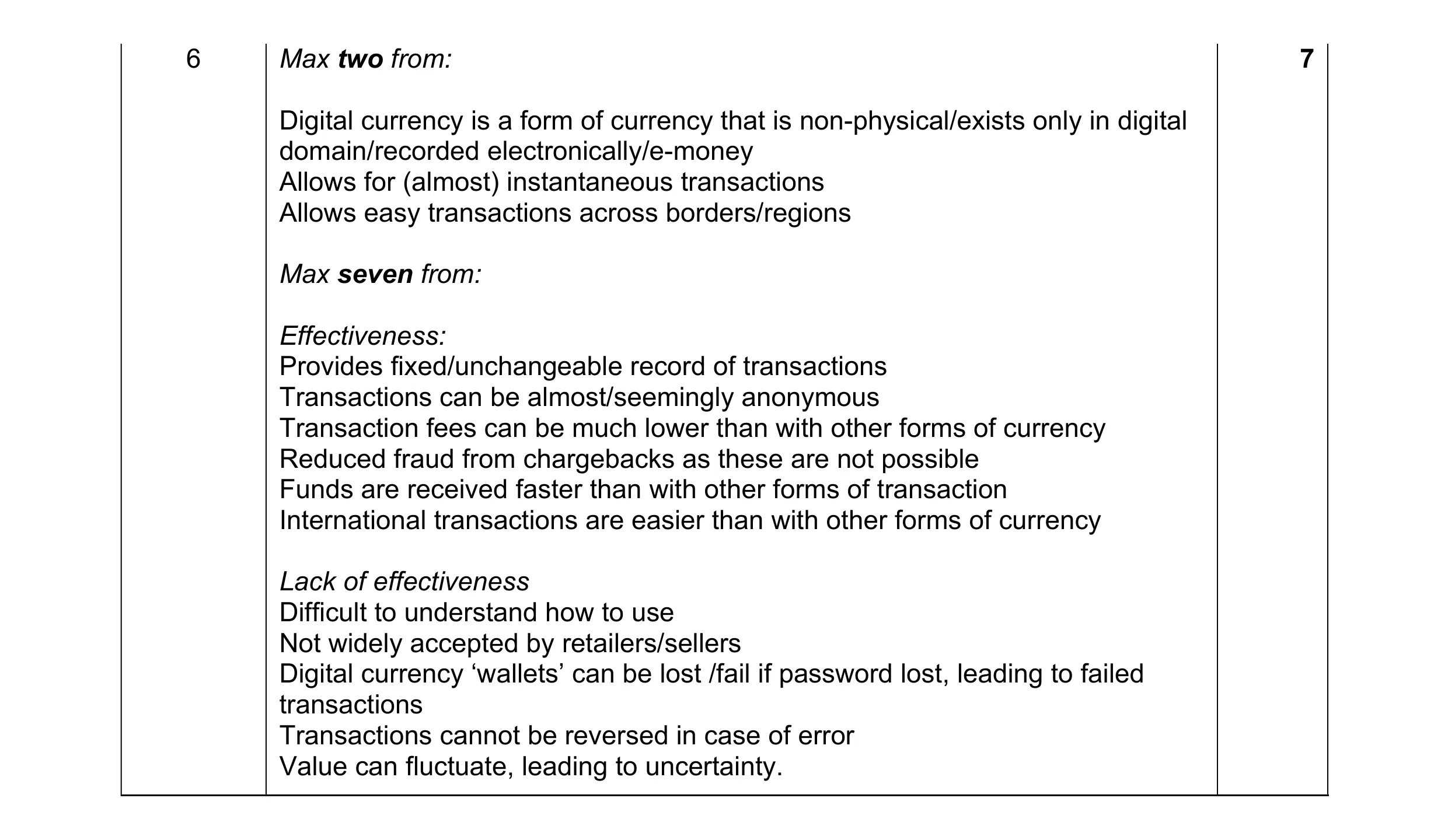 7
7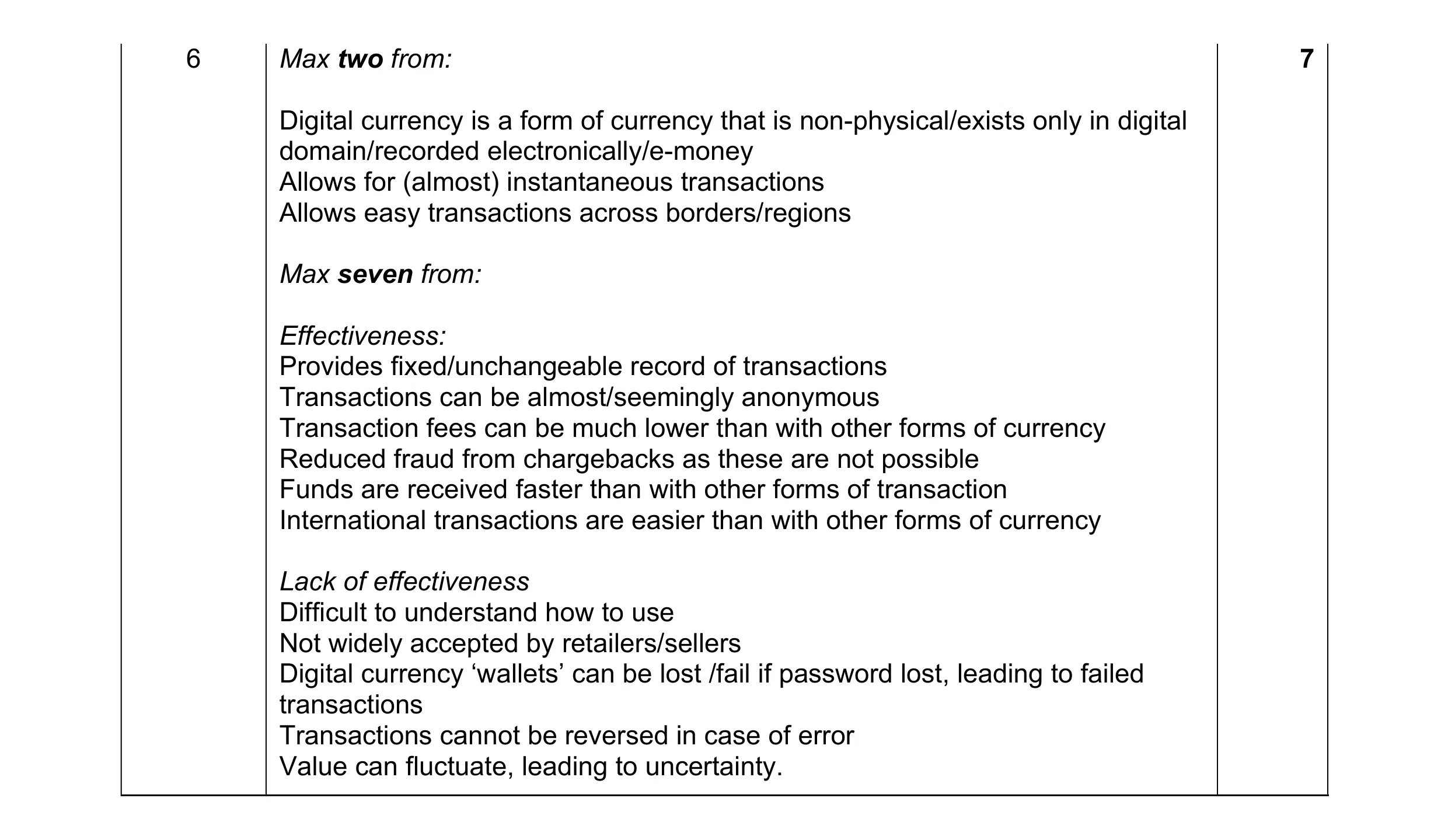 7
7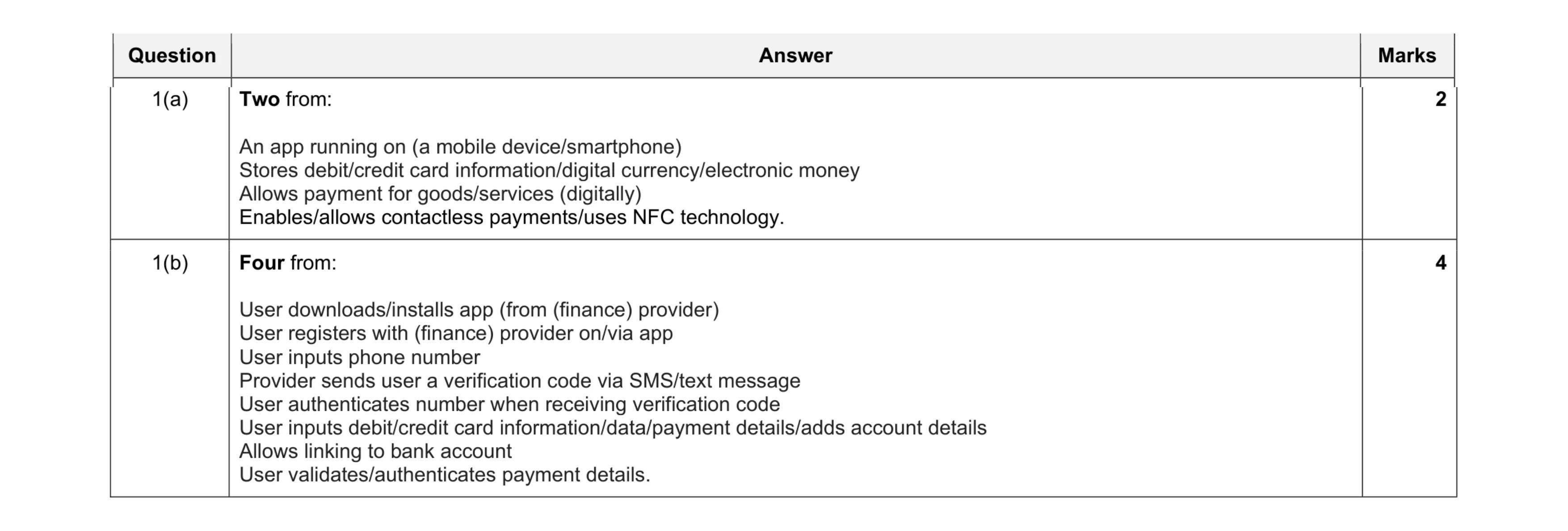 6
6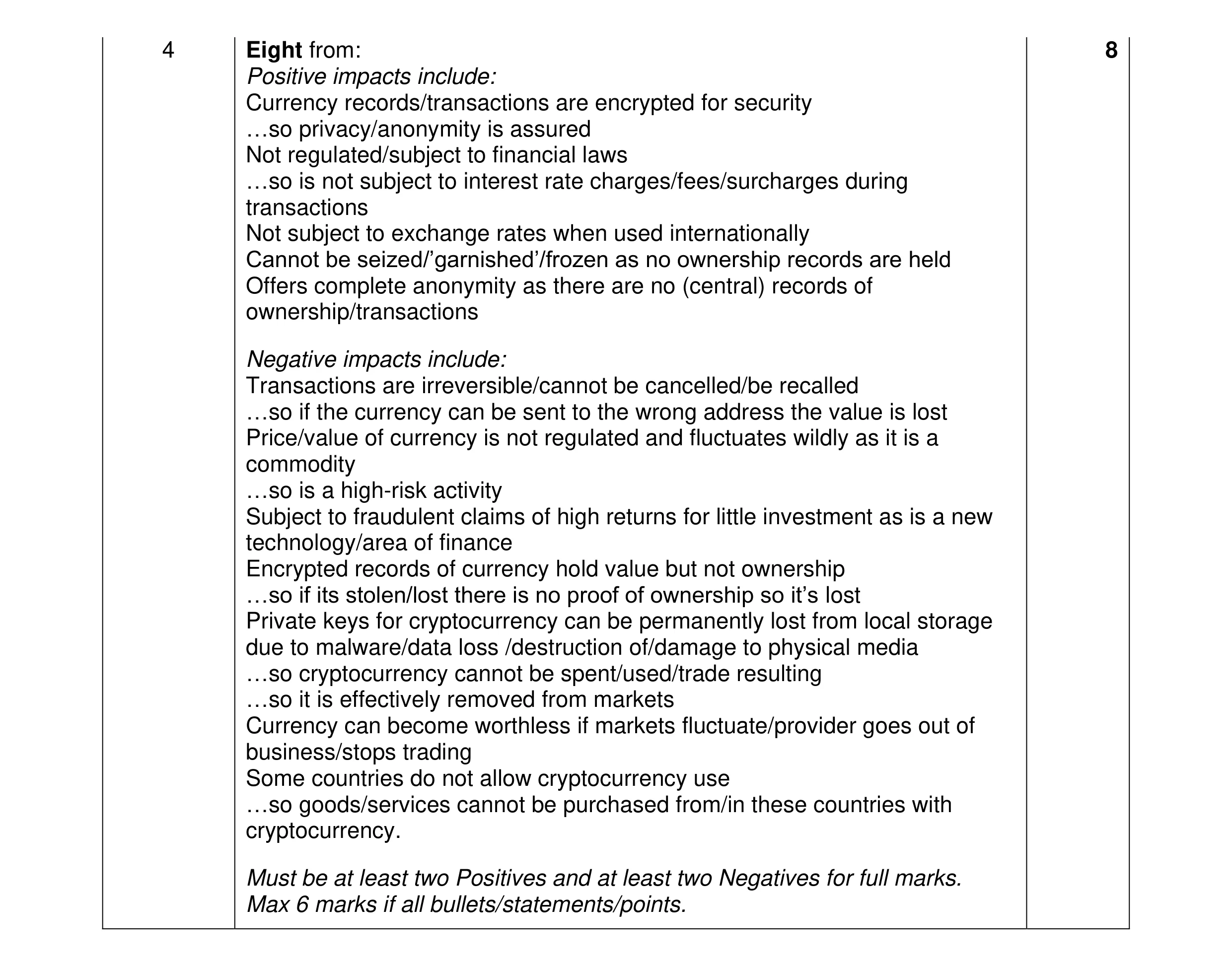 8
8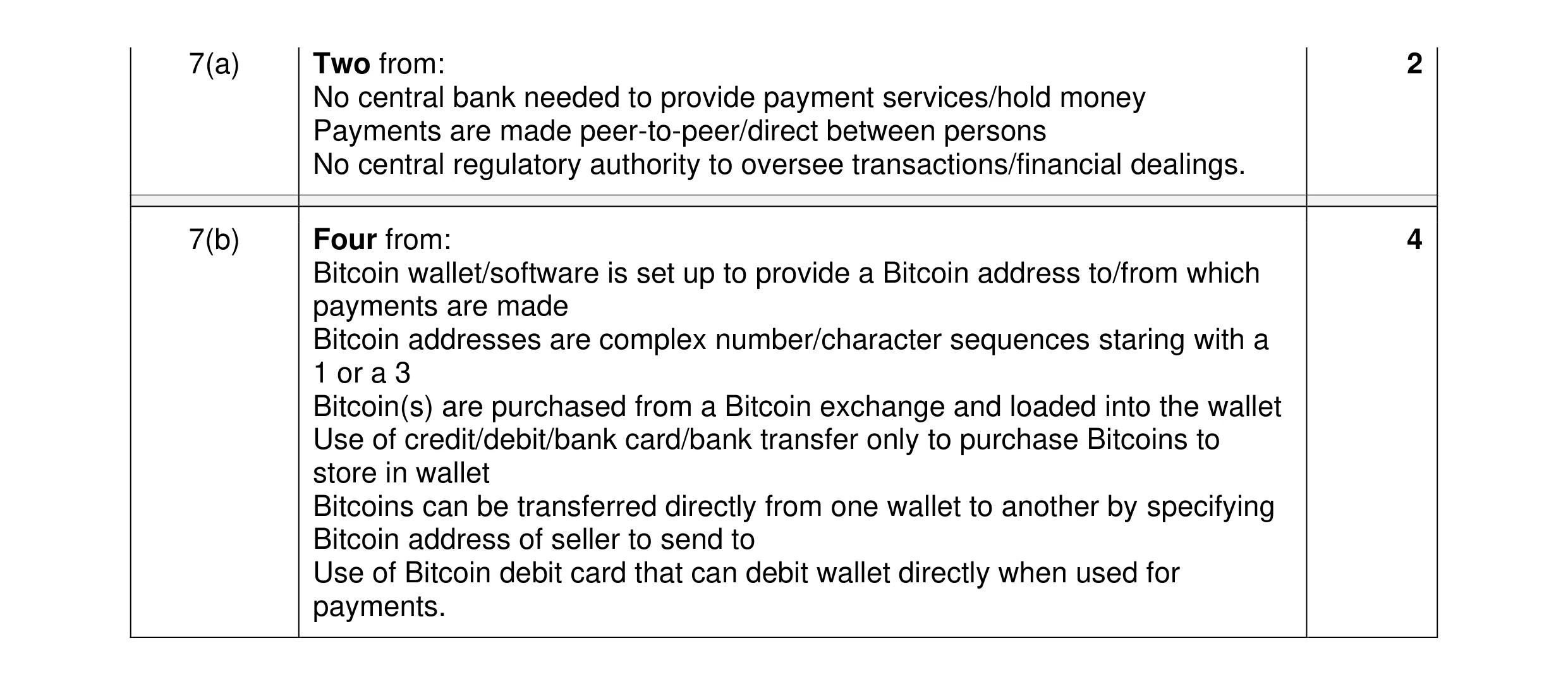 6
6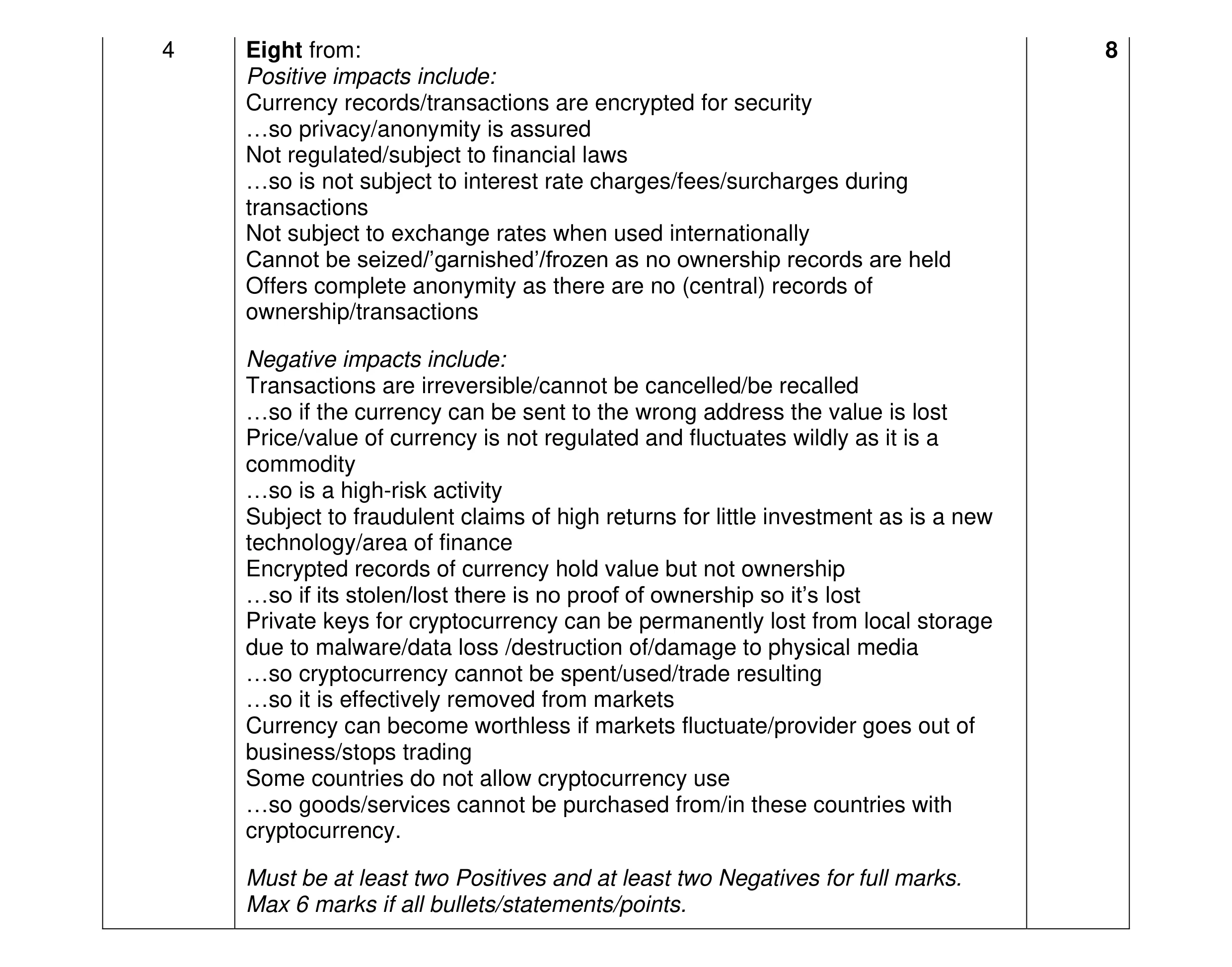 8
8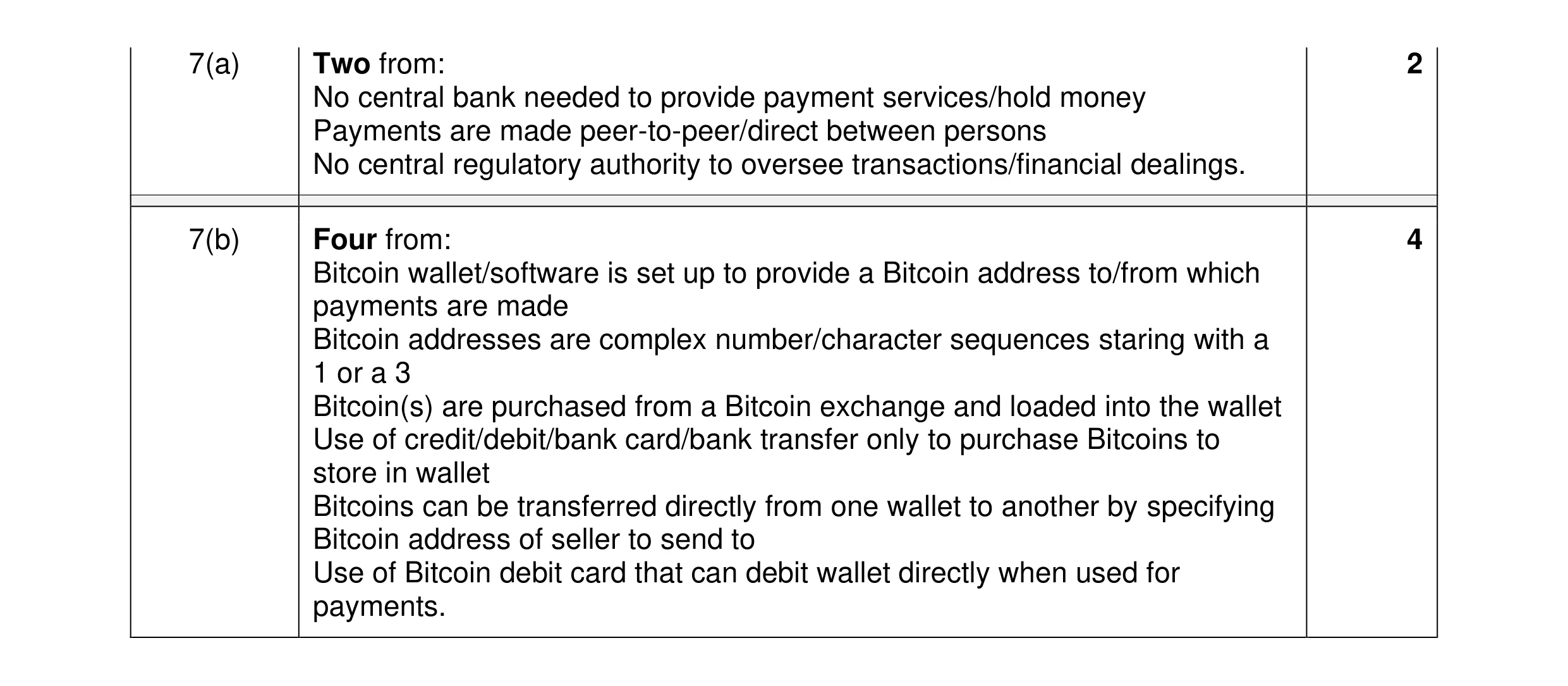 6
6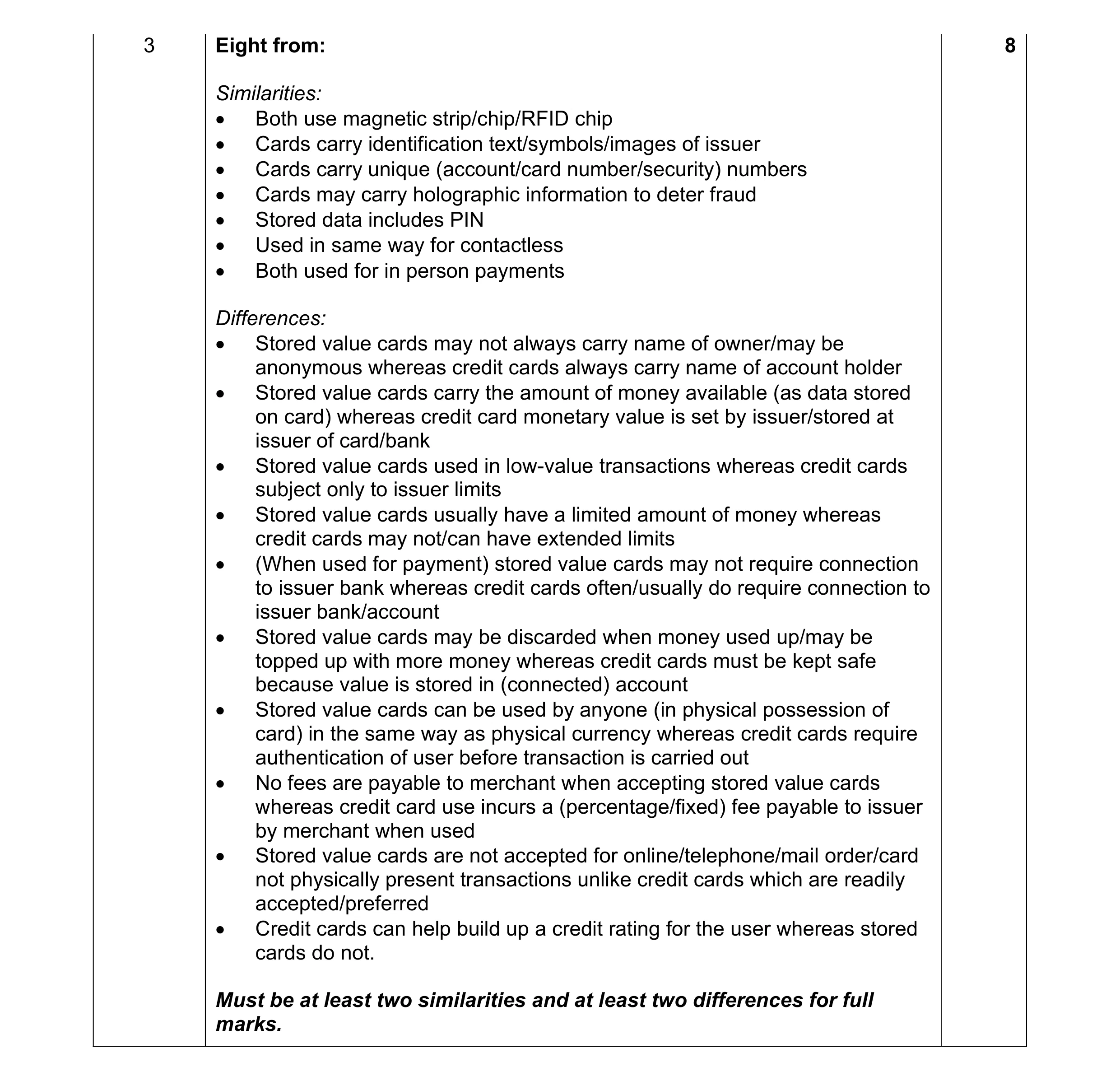 8
8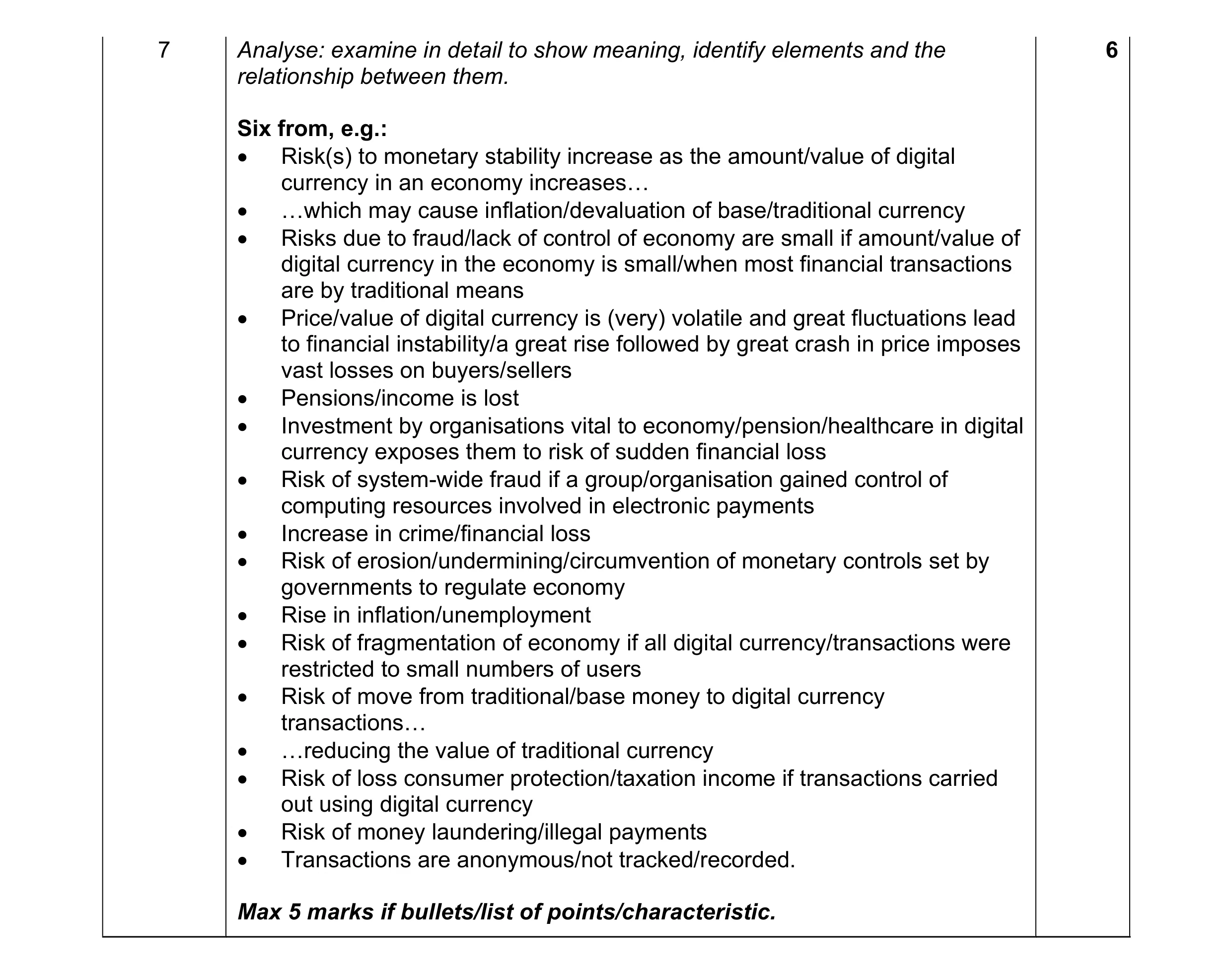 6
6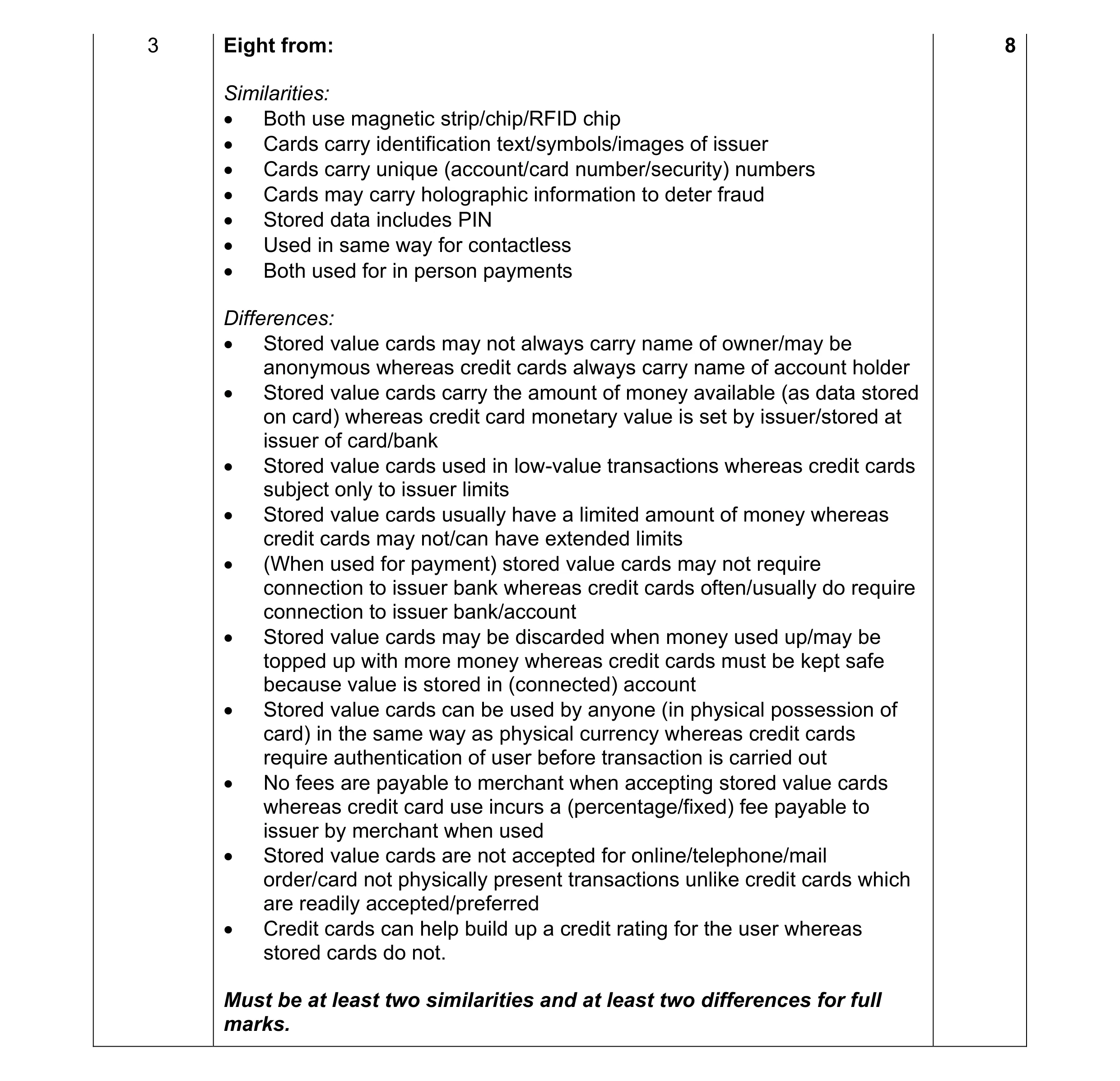 8
8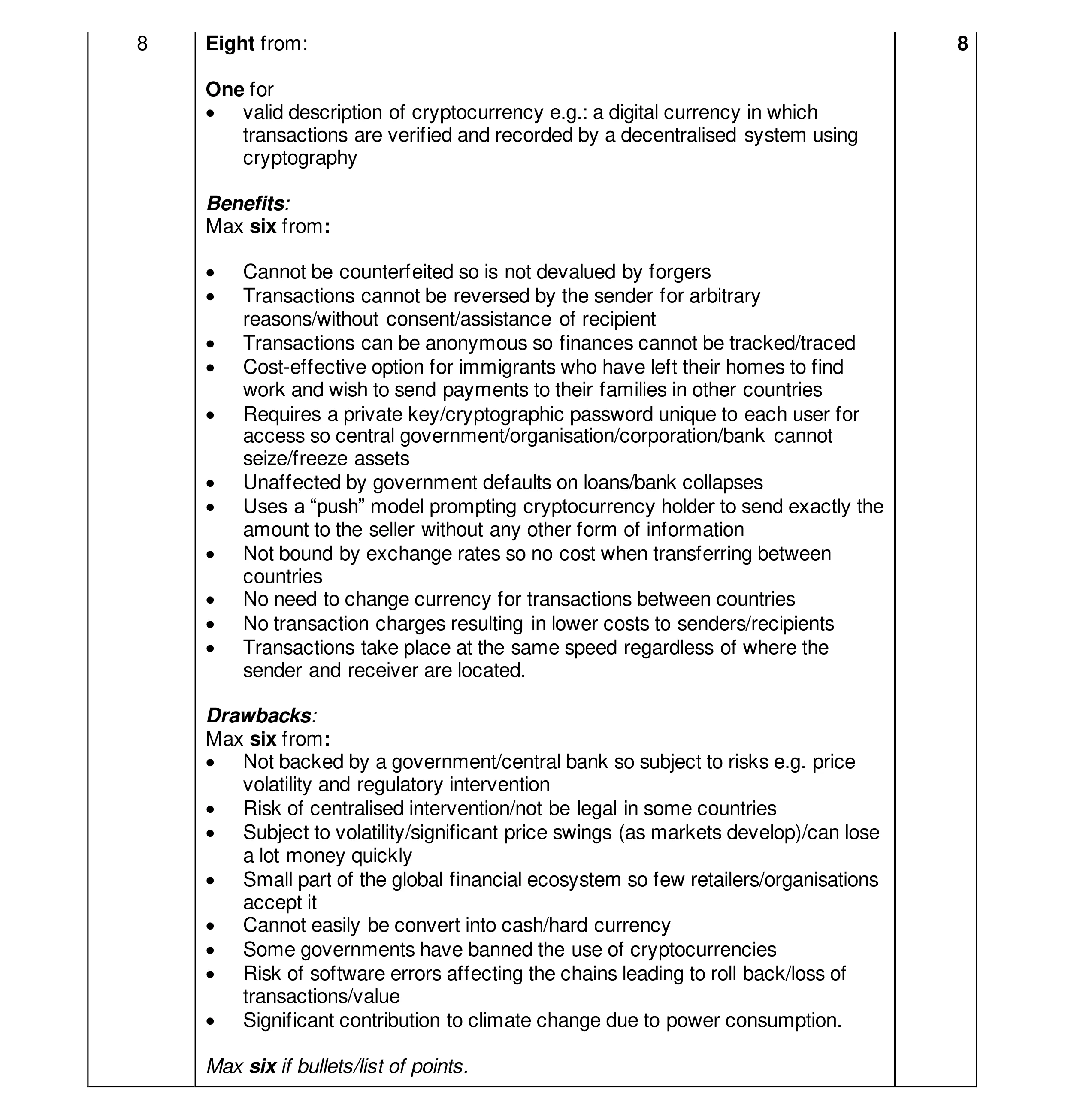 8
8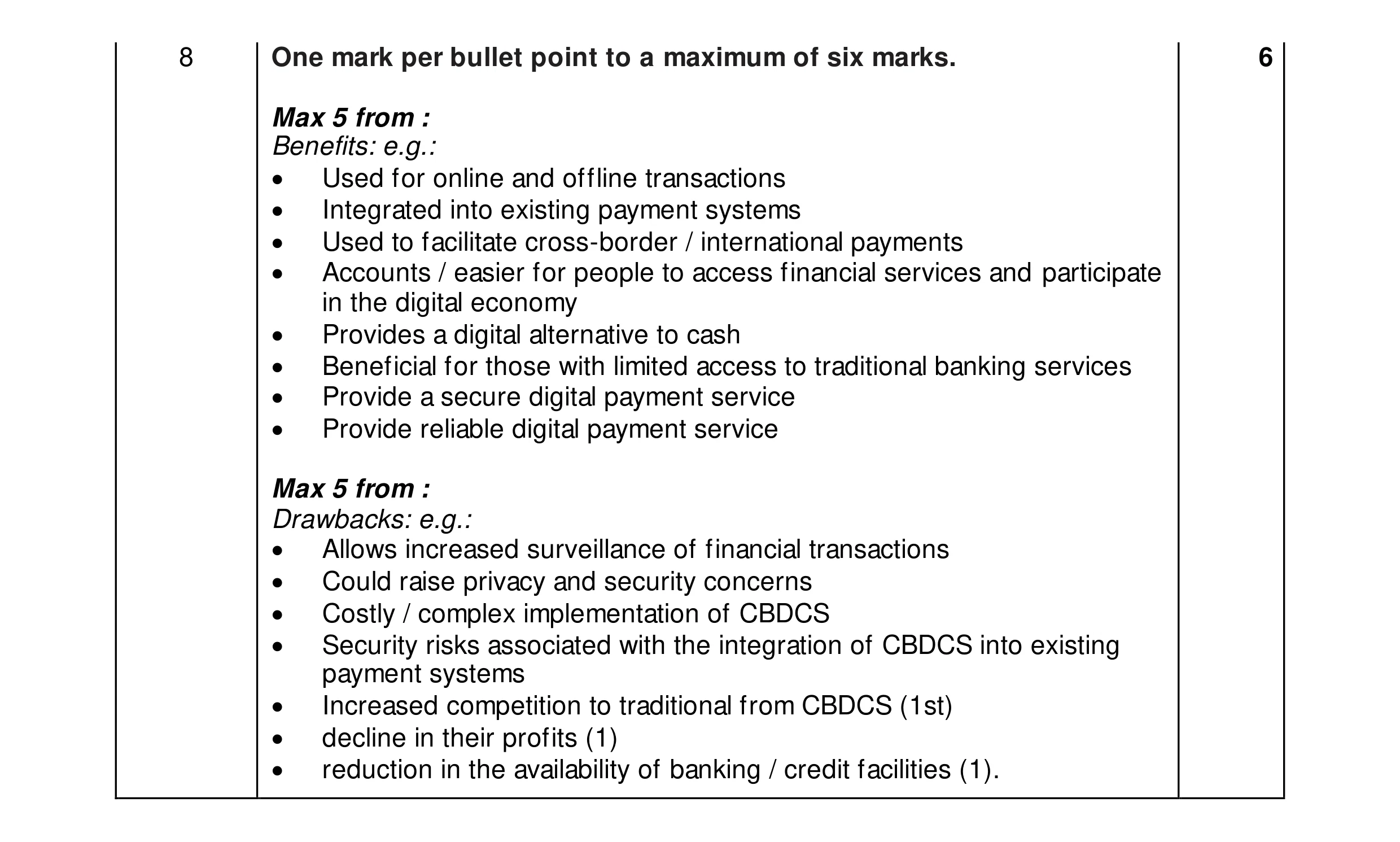 6
6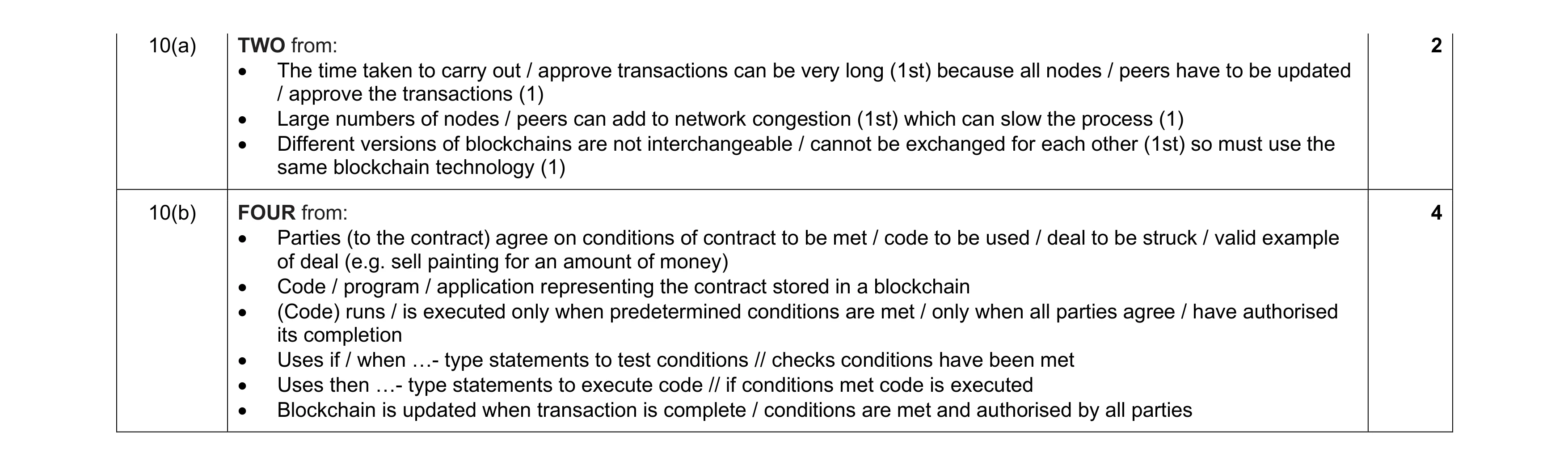 6
6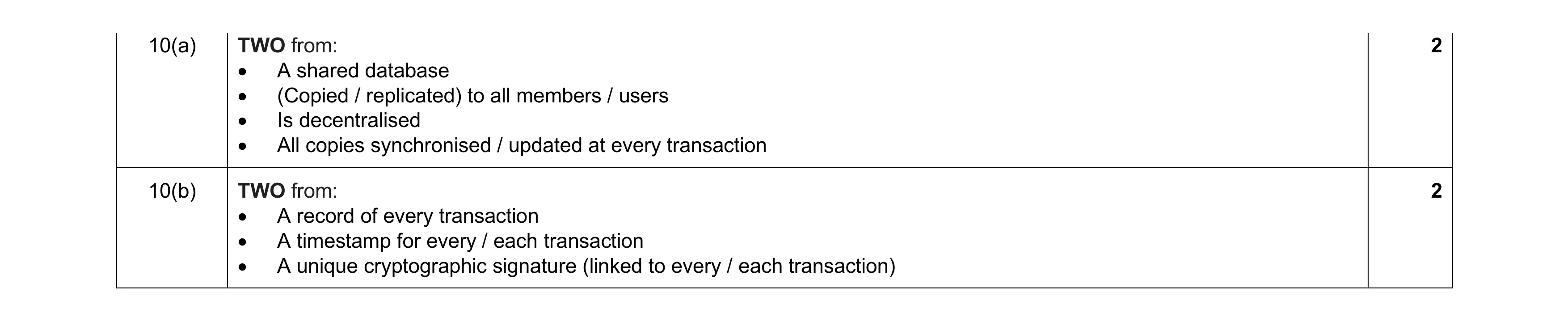 4
4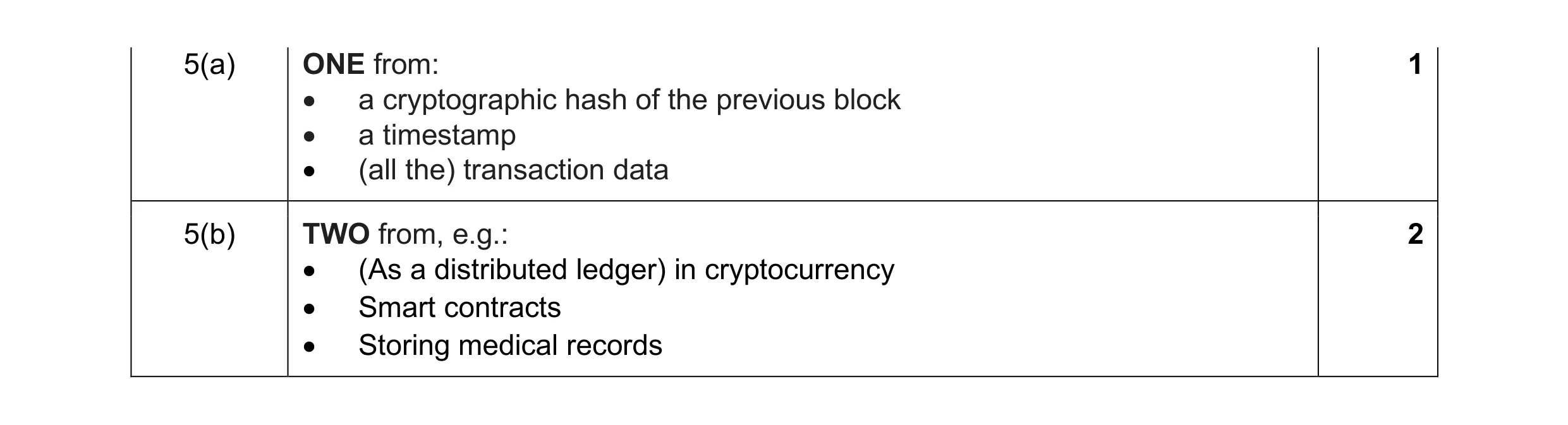 3
3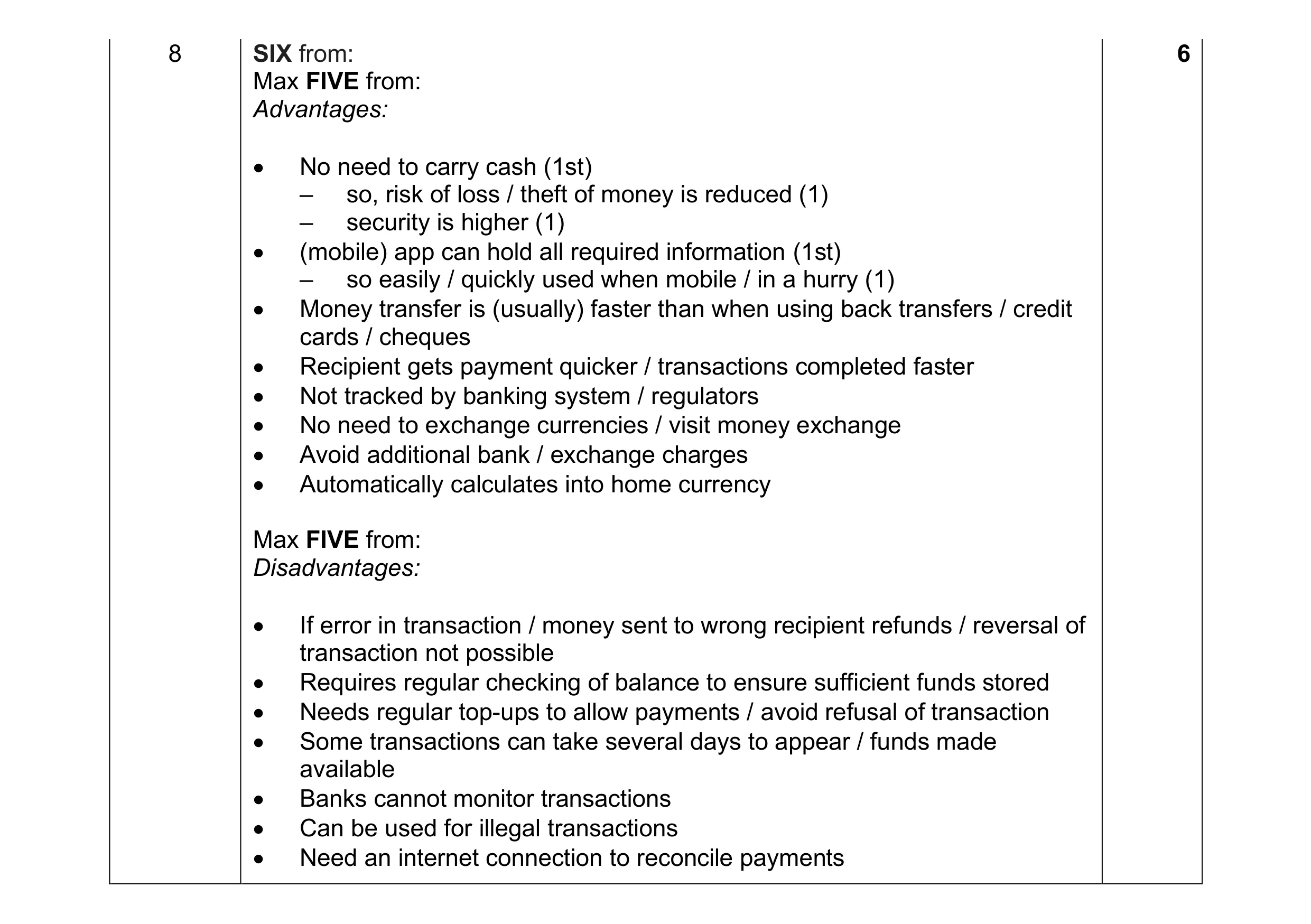 6
6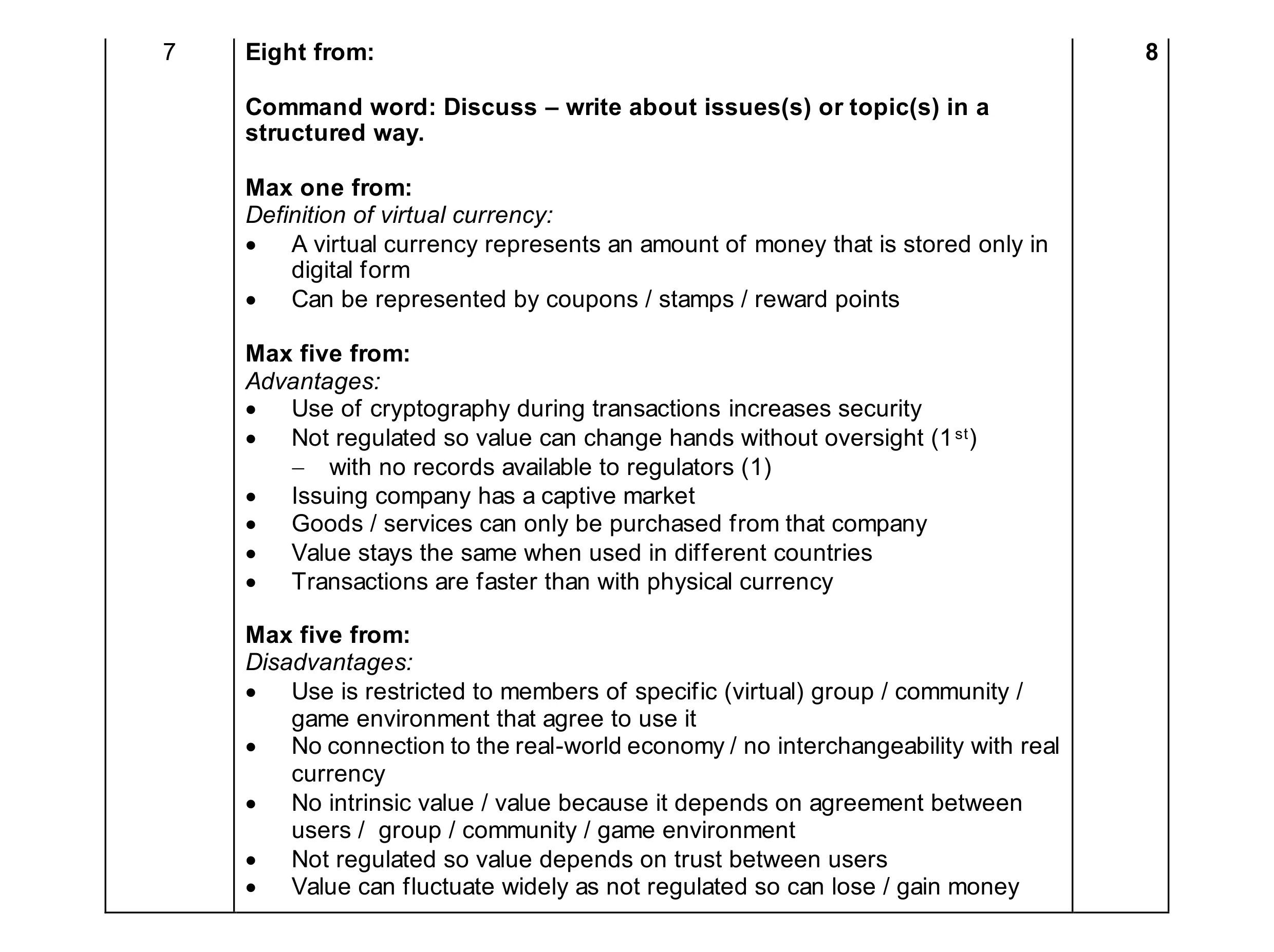 8
8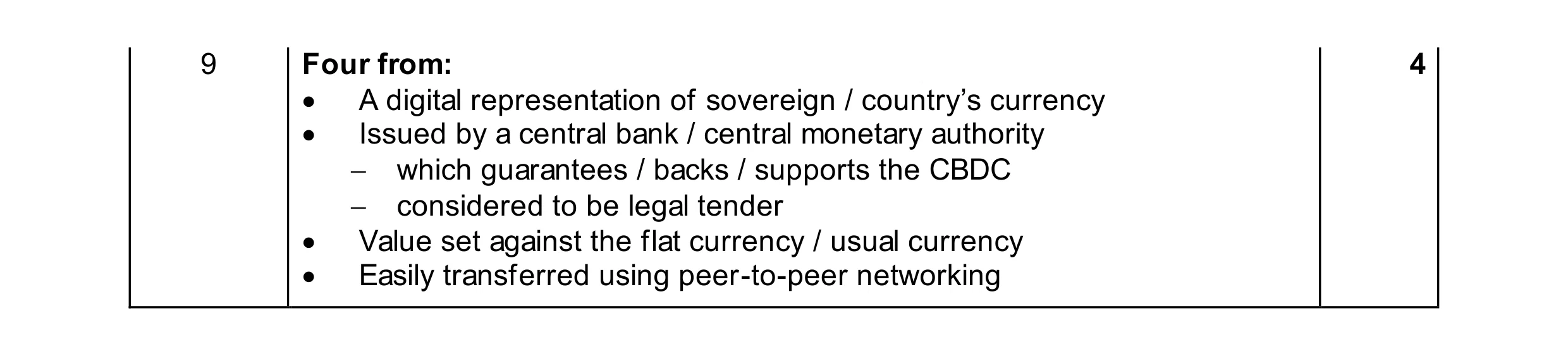 4
4