Cambridge A Level Information Technology (from 2017) 9626 — 2023 May/June Paper 3 · Variant 2
9626/32/M/J/23 · 10 questions · 70 marks · ≈79 min
The question paper and its mark scheme, free to read here and free to download. This is Cambridge’s own paper, exactly as it was sat.
Question paper12 pages







Mark scheme12 pages
Answers below. Sit the paper first if you are practising.

Questions as text
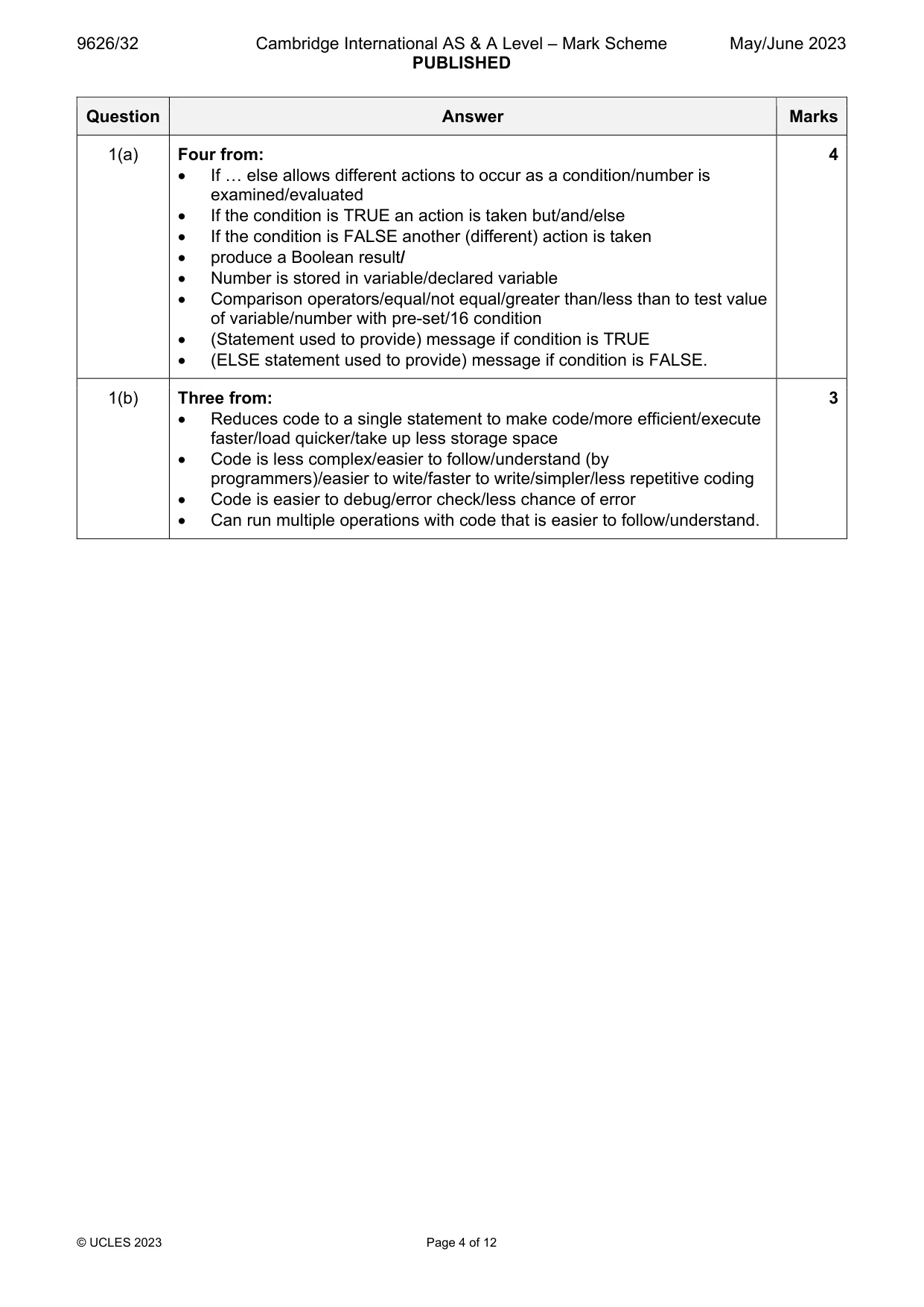
Q1 · JavaScript can be used in a web-based form to test whether a number entered by a user…
1 JavaScript can be used in a web-based form to test whether a number entered by a user matches a certain condition and to select and output an appropriate message. (a) Explain how if...else statements are used to do this. ................................................................................................................................................... ................................................................................................................................................... ................................................................................................................................................... ................................................................................................................................................... ................................................................................................................................................... ................................................................................................................................................... ................................................................................................................................................... ................................................................................................................................................... ................................................................................................................................................... ............................................................................................................................................. [4] (b) The ternary operator could be used instead of if...else. Explain why the ternary operator could be used to do this. ................................................................................................................................................... ................................................................................................................................................... ................................................................................................................................................... ................................................................................................................................................... ................................................................................................................................................... ................................................................................................................................................... ................................................................................................................................................... ............................................................................................................................................. [3]
Mark scheme: Question Answer Marks 1(a) Four from: 4 If … else allows different actions to occur as a condition/number is examined/evaluated If the condition is TRUE an action is taken but/and/else If the condition is FALSE another (different) action is taken produce a Boolean result/ Number is stored in variable/declared variable Comparison operators/equal/not equal/greater than/less than to test value of variable/number with pre-set/16 condition (Statement used to provide) message if condition is TRUE (ELSE statement used to provide) message if condition is FALSE. 1(b) Three from: 3 Reduces code to a single statement to make code/more efficient/execute faster/load quicker/take up less storage space Code is less complex/easier to follow/understand (by programmers)/easier to wite/faster to write/simpler/less repetitive coding Code is easier to debug/error check/less chance of error Can run multiple operations with code that is easier to follow/understand.
Q2 · IP networks can be connected by switches and routers so that data can be exchanged…
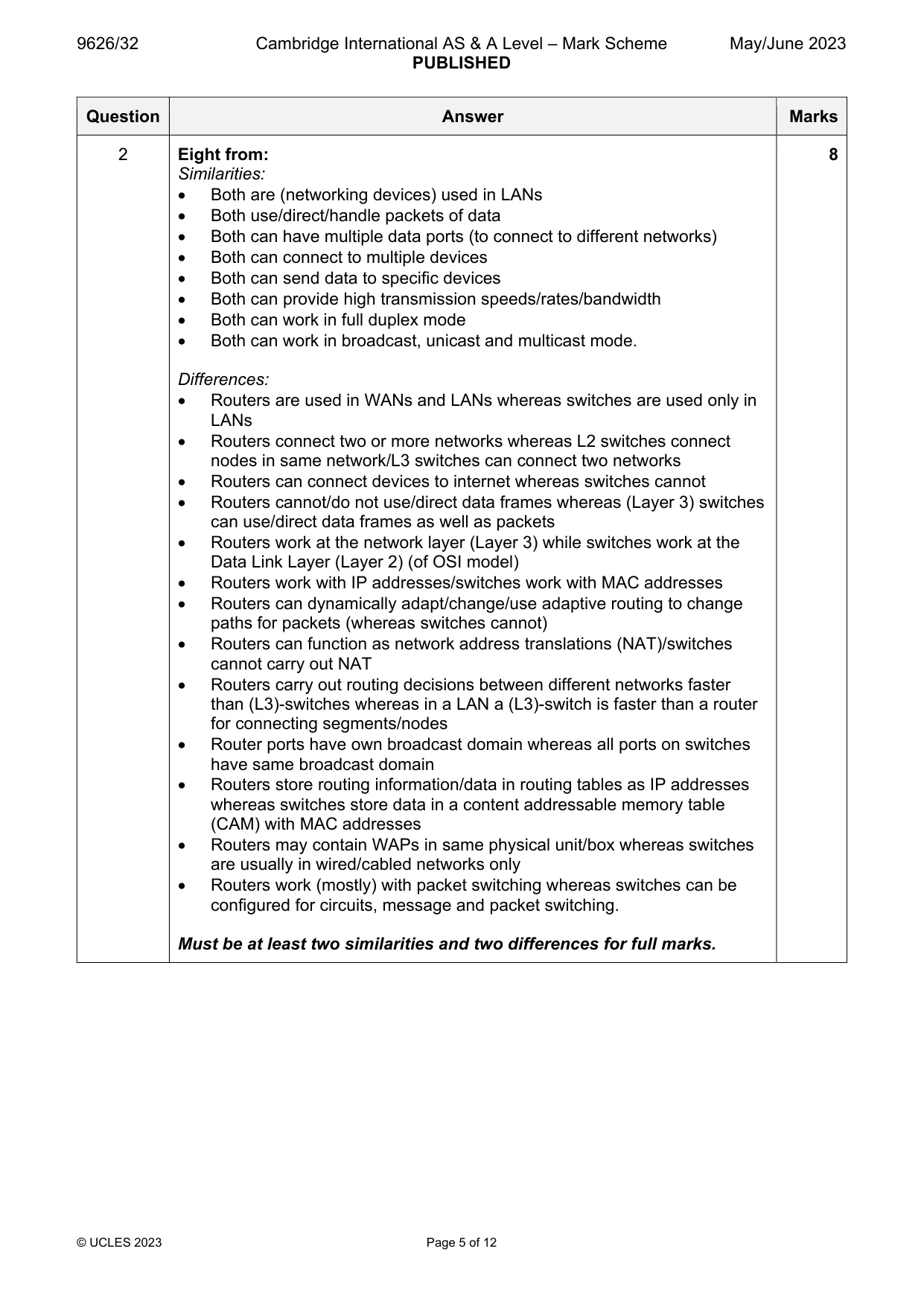
2 IP networks can be connected by switches and routers so that data can be exchanged between devices. Compare the operations of switches and routers in networks. You must include similarities and differences. .......................................................................................................................................................... .......................................................................................................................................................... .......................................................................................................................................................... .......................................................................................................................................................... .......................................................................................................................................................... .......................................................................................................................................................... .......................................................................................................................................................... .......................................................................................................................................................... .......................................................................................................................................................... .......................................................................................................................................................... .......................................................................................................................................................... .......................................................................................................................................................... .......................................................................................................................................................... .......................................................................................................................................................... .......................................................................................................................................................... .......................................................................................................................................................... .......................................................................................................................................................... .......................................................................................................................................................... .......................................................................................................................................................... .................................................................................................................................................... [8]
Mark scheme: 2 Eight from: 8 Similarities: Both are (networking devices) used in LANs Both use/direct/handle packets of data Both can have multiple data ports (to connect to different networks) Both can connect to multiple devices Both can send data to specific devices Both can provide high transmission speeds/rates/bandwidth Both can work in full duplex mode Both can work in broadcast, unicast and multicast mode. Differences: Routers are used in WANs and LANs whereas switches are used only in LANs Routers connect two or more networks whereas L2 switches connect nodes in same network/L3 switches can connect two networks Routers can connect devices to internet whereas switches cannot Routers cannot/do not use/direct data frames whereas (Layer 3) switches can use/direct data frames as well as packets Routers work at the network layer (Layer 3) while switches work at the Data Link Layer (Layer 2) (of OSI model) Routers work with IP addresses/switches work with MAC addresses Routers can dynamically adapt/change/use adaptive routing to change paths for packets (whereas switches cannot) Routers can function as network address translations (NAT)/switches cannot carry out NAT Routers carry out routing decisions between different networks faster than (L3)-switches whereas in a LAN a (L3)-switch is faster than a router for connecting segments/nodes Router ports have own broadcast domain whereas all ports on switches have same broadcast domain Routers store routing information/data in routing tables as IP addresses whereas switches store data in a content addressable memory table (CAM) with MAC addresses Routers may contain WAPs in same physical unit/box whereas switches are usually in wired/cabled networks only Routers work (mostly) with packet switching whereas switches can be configured for circuits, message and packet switching. Must be at least two similarities and two differences for full marks.
Q3 · When data is transmitted across networks it needs to be protected from interception and…
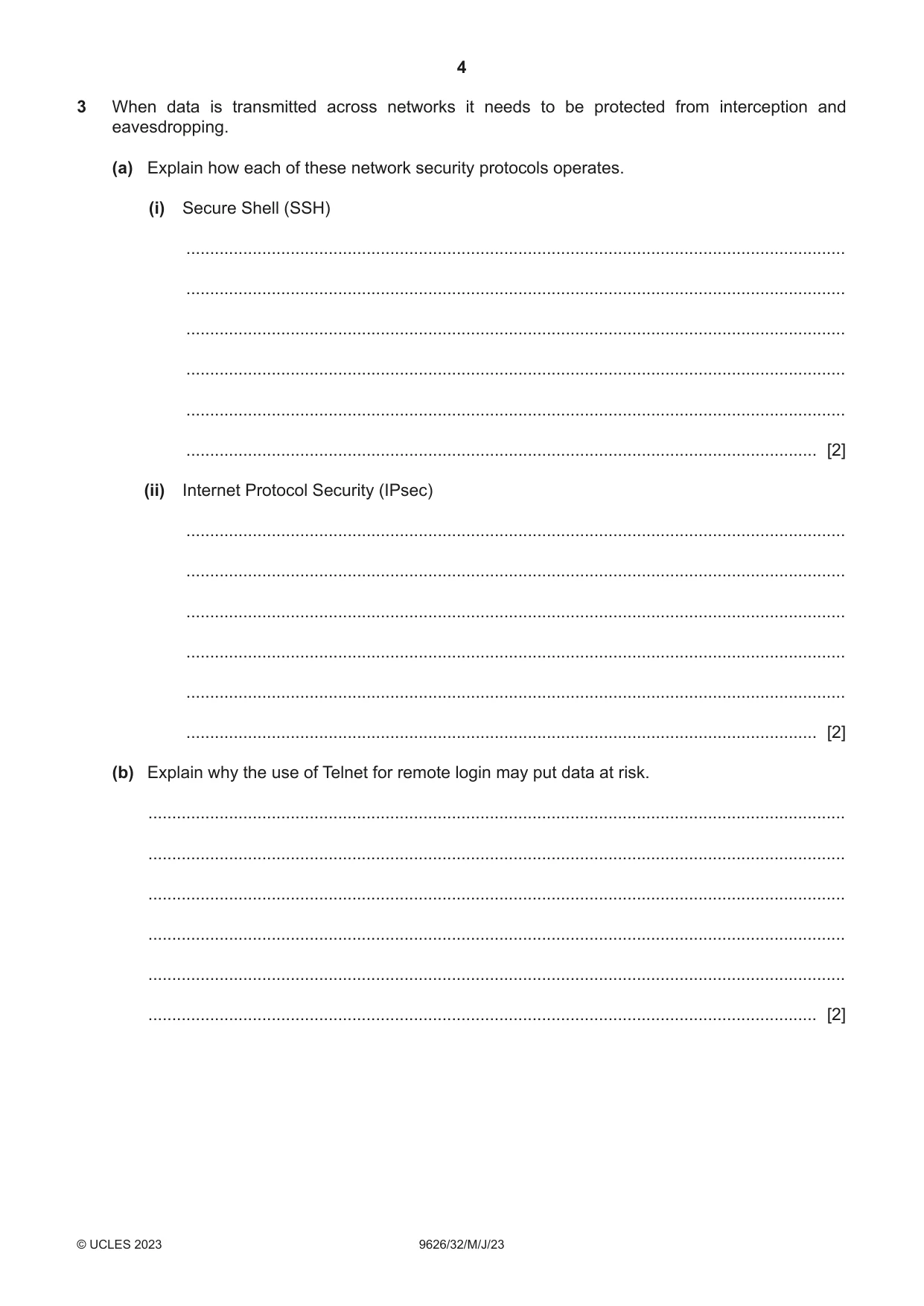
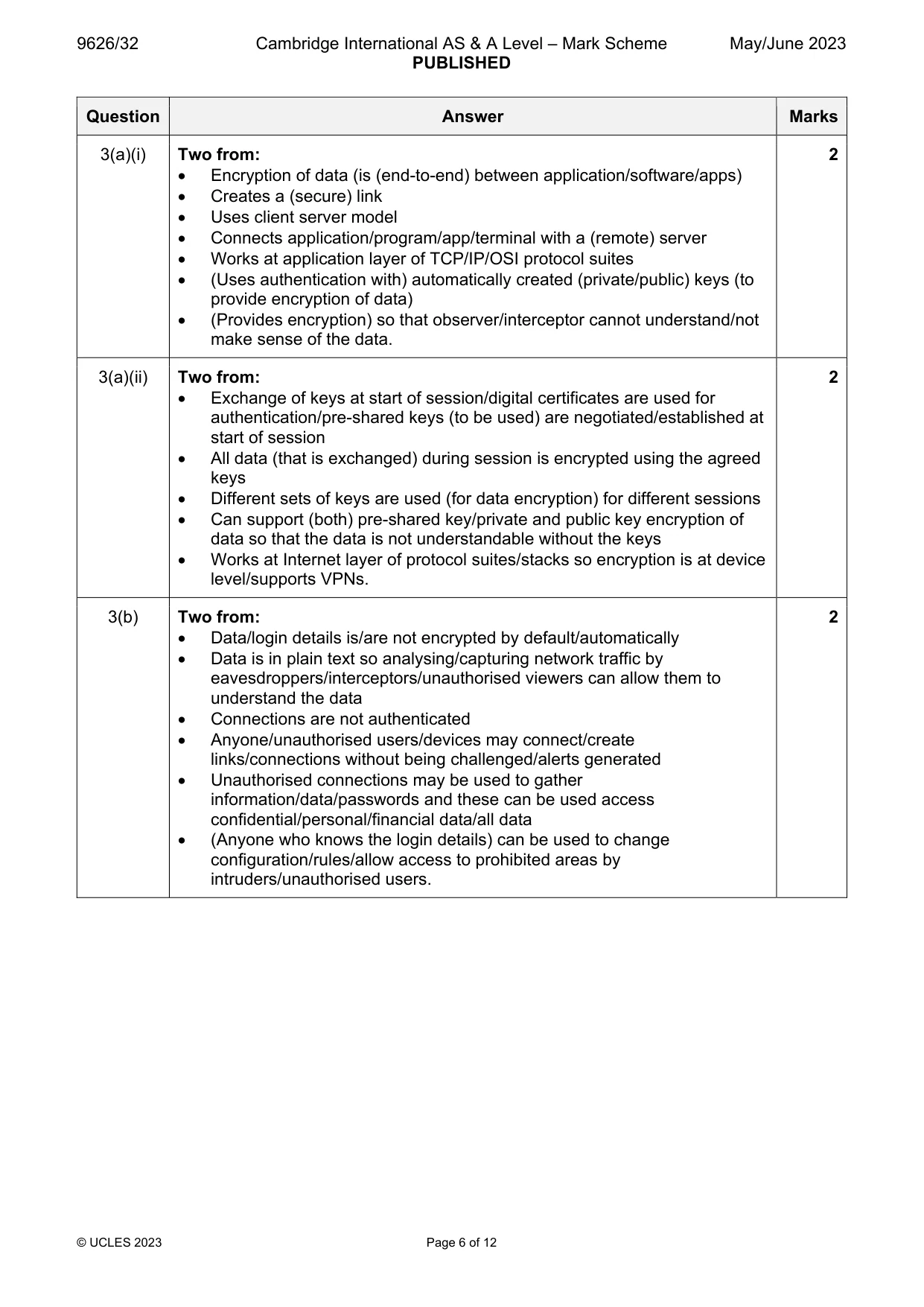
3 When data is transmitted across networks it needs to be protected from interception and eavesdropping. (a) Explain how each of these network security protocols operates. (i) Secure Shell (SSH) ........................................................................................................................................... ........................................................................................................................................... ........................................................................................................................................... ........................................................................................................................................... ........................................................................................................................................... ..................................................................................................................................... [2] (ii) Internet Protocol Security (IPsec) ........................................................................................................................................... ........................................................................................................................................... ........................................................................................................................................... ........................................................................................................................................... ........................................................................................................................................... ..................................................................................................................................... [2] (b) Explain why the use of Telnet for remote login may put data at risk. ................................................................................................................................................... ................................................................................................................................................... ................................................................................................................................................... ................................................................................................................................................... ................................................................................................................................................... ............................................................................................................................................. [2]
Mark scheme: 3(a)(i) Two from: 2 Encryption of data (is (end-to-end) between application/software/apps) Creates a (secure) link Uses client server model Connects application/program/app/terminal with a (remote) server Works at application layer of TCP/IP/OSI protocol suites (Uses authentication with) automatically created (private/public) keys (to provide encryption of data) (Provides encryption) so that observer/interceptor cannot understand/not make sense of the data. 3(a)(ii) Two from: 2 Exchange of keys at start of session/digital certificates are used for authentication/pre-shared keys (to be used) are negotiated/established at start of session All data (that is exchanged) during session is encrypted using the agreed keys Different sets of keys are used (for data encryption) for different sessions Can support (both) pre-shared key/private and public key encryption of data so that the data is not understandable without the keys Works at Internet layer of protocol suites/stacks so encryption is at device level/supports VPNs. 3(b) Two from: 2 Data/login details is/are not encrypted by default/automatically Data is in plain text so analysing/capturing network traffic by eavesdroppers/interceptors/unauthorised viewers can allow them to understand the data Connections are not authenticated Anyone/unauthorised users/devices may connect/create links/connections without being challenged/alerts generated Unauthorised connections may be used to gather information/data/passwords and these can be used access confidential/personal/financial data/all data (Anyone who knows the login details) can be used to change configuration/rules/allow access to prohibited areas by intruders/unauthorised users.
Q4 · Bluetooth and Wi-fi are wireless technologies used to exchange data between devices
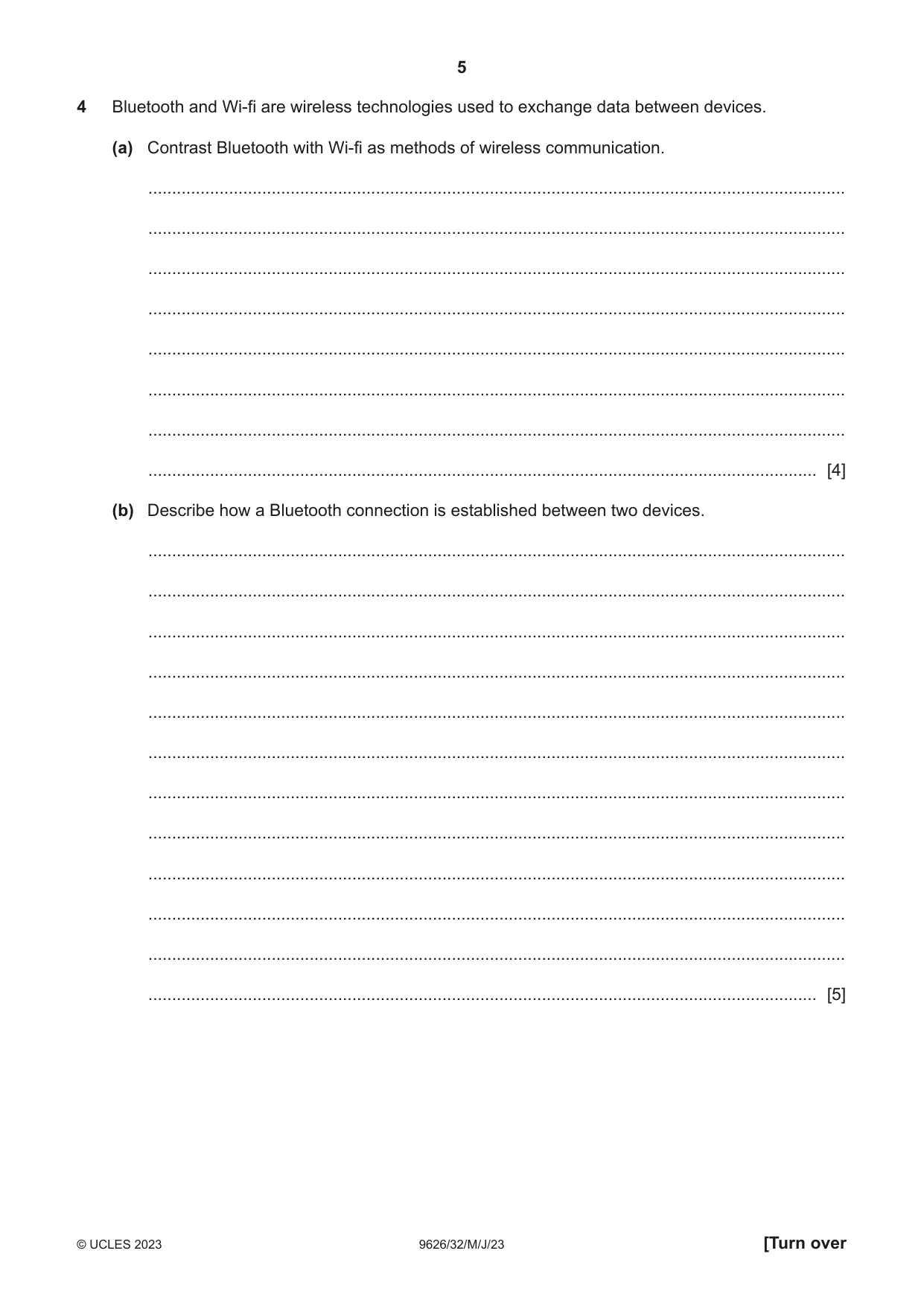
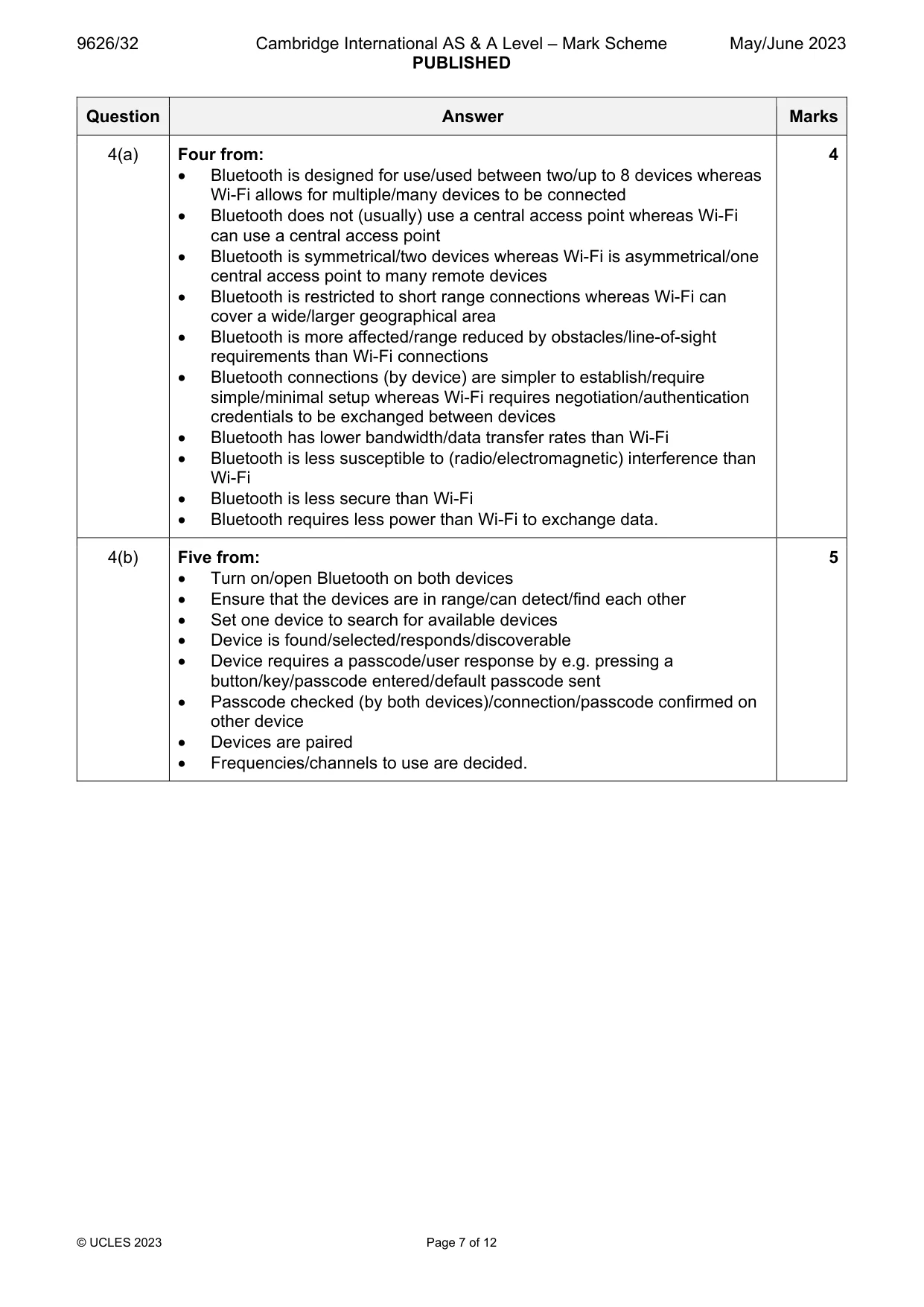
4 Bluetooth and Wi-fi are wireless technologies used to exchange data between devices. (a) Contrast Bluetooth with Wi-fi as methods of wireless communication. ................................................................................................................................................... ................................................................................................................................................... ................................................................................................................................................... ................................................................................................................................................... ................................................................................................................................................... ................................................................................................................................................... ................................................................................................................................................... ............................................................................................................................................. [4] (b) Describe how a Bluetooth connection is established between two devices. ................................................................................................................................................... ................................................................................................................................................... ................................................................................................................................................... ................................................................................................................................................... ................................................................................................................................................... ................................................................................................................................................... ................................................................................................................................................... ................................................................................................................................................... ................................................................................................................................................... ................................................................................................................................................... ................................................................................................................................................... ............................................................................................................................................. [5]
Mark scheme: 4(a) Four from: 4 Bluetooth is designed for use/used between two/up to 8 devices whereas Wi-Fi allows for multiple/many devices to be connected Bluetooth does not (usually) use a central access point whereas Wi-Fi can use a central access point Bluetooth is symmetrical/two devices whereas Wi-Fi is asymmetrical/one central access point to many remote devices Bluetooth is restricted to short range connections whereas Wi-Fi can cover a wide/larger geographical area Bluetooth is more affected/range reduced by obstacles/line-of-sight requirements than Wi-Fi connections Bluetooth connections (by device) are simpler to establish/require simple/minimal setup whereas Wi-Fi requires negotiation/authentication credentials to be exchanged between devices Bluetooth has lower bandwidth/data transfer rates than Wi-Fi Bluetooth is less susceptible to (radio/electromagnetic) interference than Wi-Fi Bluetooth is less secure than Wi-Fi Bluetooth requires less power than Wi-Fi to exchange data. 4(b) Five from: 5 Turn on/open Bluetooth on both devices Ensure that the devices are in range/can detect/find each other Set one device to search for available devices Device is found/selected/responds/discoverable Device requires a passcode/user response by e.g. pressing a button/key/passcode entered/default passcode sent Passcode checked (by both devices)/connection/passcode confirmed on other device Devices are paired Frequencies/channels to use are decided.
Q5 · Discuss the impact of the use of social media on the health of individuals
5 Discuss the impact of the use of social media on the health of individuals. .......................................................................................................................................................... .......................................................................................................................................................... .......................................................................................................................................................... .......................................................................................................................................................... .......................................................................................................................................................... .......................................................................................................................................................... .......................................................................................................................................................... .......................................................................................................................................................... .......................................................................................................................................................... .......................................................................................................................................................... .......................................................................................................................................................... .......................................................................................................................................................... .......................................................................................................................................................... .......................................................................................................................................................... .......................................................................................................................................................... .......................................................................................................................................................... .......................................................................................................................................................... .......................................................................................................................................................... .......................................................................................................................................................... .................................................................................................................................................... [8]
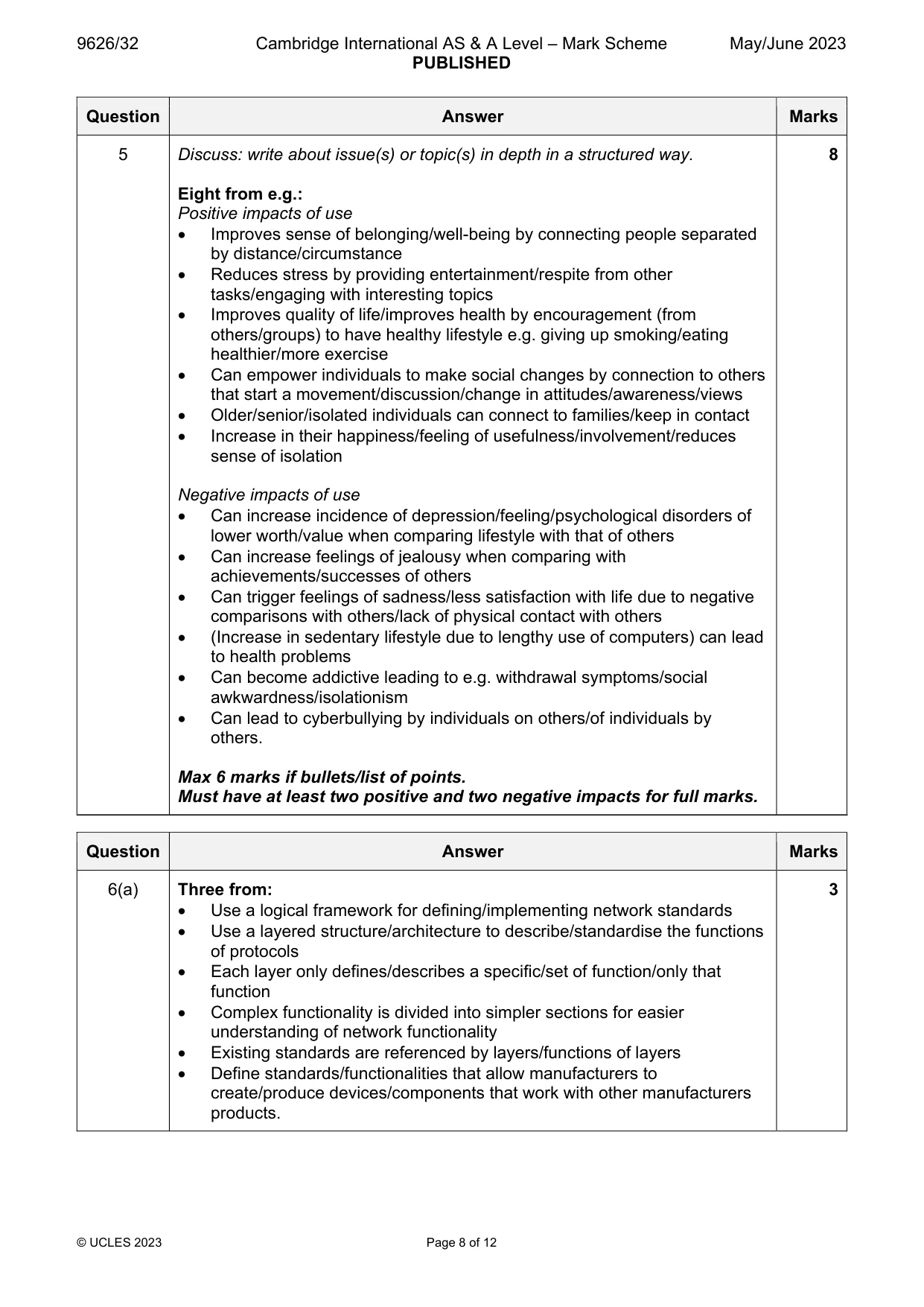
Mark scheme: 5 Discuss: write about issue(s) or topic(s) in depth in a structured way. 8 Eight from e.g.: Positive impacts of use Improves sense of belonging/well-being by connecting people separated by distance/circumstance Reduces stress by providing entertainment/respite from other tasks/engaging with interesting topics Improves quality of life/improves health by encouragement (from others/groups) to have healthy lifestyle e.g. giving up smoking/eating healthier/more exercise Can empower individuals to make social changes by connection to others that start a movement/discussion/change in attitudes/awareness/views Older/senior/isolated individuals can connect to families/keep in contact Increase in their happiness/feeling of usefulness/involvement/reduces sense of isolation Negative impacts of use Can increase incidence of depression/feeling/psychological disorders of lower worth/value when comparing lifestyle with that of others Can increase feelings of jealousy when comparing with achievements/successes of others Can trigger feelings of sadness/less satisfaction with life due to negative comparisons with others/lack of physical contact with others (Increase in sedentary lifestyle due to lengthy use of computers) can lead to health problems Can become addictive leading to e.g. withdrawal symptoms/social awkwardness/isolationism Can lead to cyberbullying by individuals on others/of individuals by others. Max 6 marks if bullets/list of points. Must have at least two positive and two negative impacts for full marks.
Q6 · The OSI and the TCP/IP reference models are used to describe communications in networks
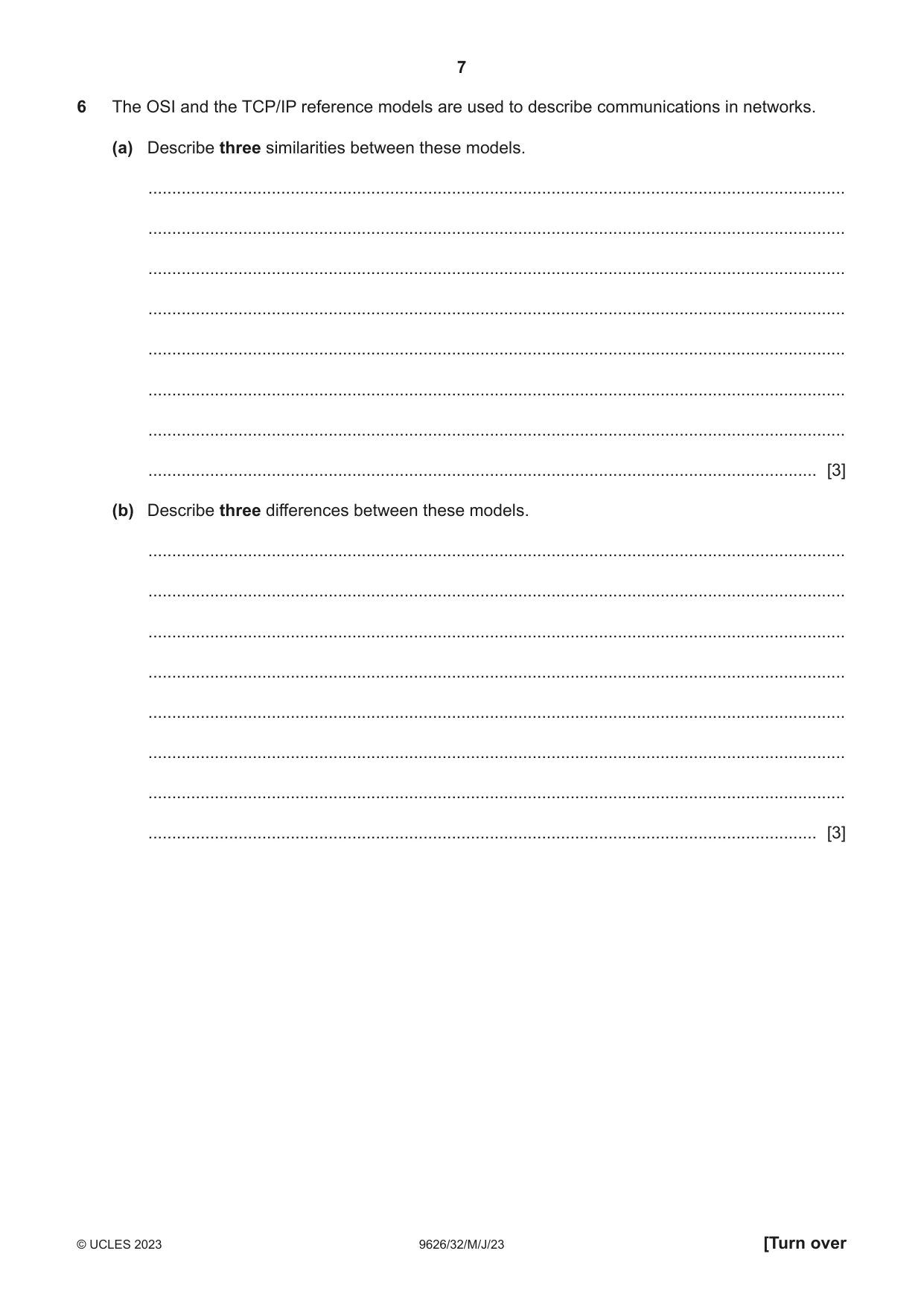
6 The OSI and the TCP/IP reference models are used to describe communications in networks. (a) Describe three similarities between these models. ................................................................................................................................................... ................................................................................................................................................... ................................................................................................................................................... ................................................................................................................................................... ................................................................................................................................................... ................................................................................................................................................... ................................................................................................................................................... ............................................................................................................................................. [3] (b) Describe three differences between these models. ................................................................................................................................................... ................................................................................................................................................... ................................................................................................................................................... ................................................................................................................................................... ................................................................................................................................................... ................................................................................................................................................... ................................................................................................................................................... ............................................................................................................................................. [3]
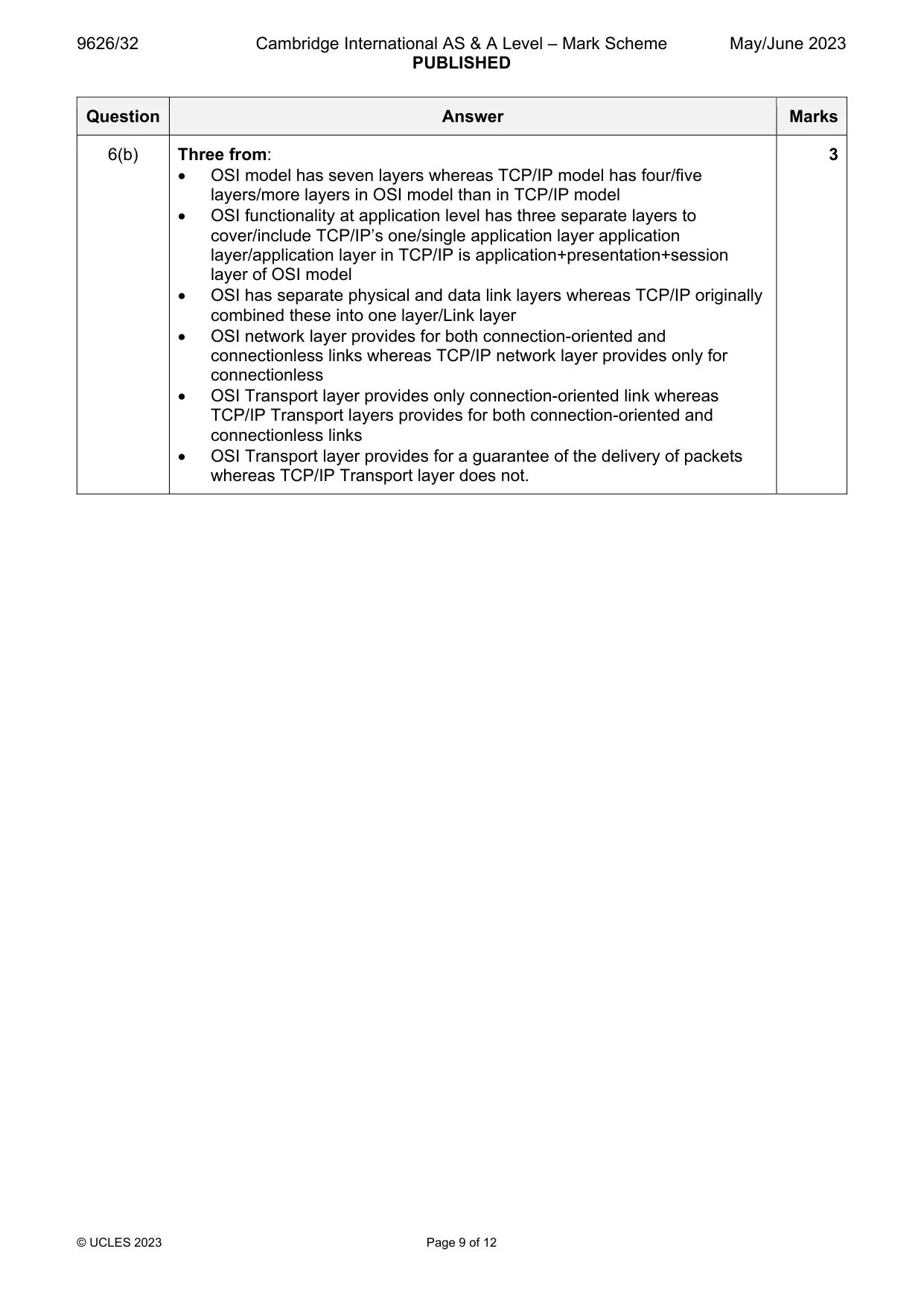
Mark scheme: 6(a) Three from: 3 Use a logical framework for defining/implementing network standards Use a layered structure/architecture to describe/standardise the functions of protocols Each layer only defines/describes a specific/set of function/only that function Complex functionality is divided into simpler sections for easier understanding of network functionality Existing standards are referenced by layers/functions of layers Define standards/functionalities that allow manufacturers to create/produce devices/components that work with other manufacturers products. 6(b) Three from: 3 OSI model has seven layers whereas TCP/IP model has four/five layers/more layers in OSI model than in TCP/IP model OSI functionality at application level has three separate layers to cover/include TCP/IP’s one/single application layer application layer/application layer in TCP/IP is application+presentation+session layer of OSI model OSI has separate physical and data link layers whereas TCP/IP originally combined these into one layer/Link layer OSI network layer provides for both connection-oriented and connectionless links whereas TCP/IP network layer provides only for connectionless OSI Transport layer provides only connection-oriented link whereas TCP/IP Transport layers provides for both connection-oriented and connectionless links OSI Transport layer provides for a guarantee of the delivery of packets whereas TCP/IP Transport layer does not.
Q7 · A government is concerned that the use of digital currencies may affect its economy
7 A government is concerned that the use of digital currencies may affect its economy. Analyse the risks to an economy of an increase in the use of digital currencies. .......................................................................................................................................................... .......................................................................................................................................................... .......................................................................................................................................................... .......................................................................................................................................................... .......................................................................................................................................................... .......................................................................................................................................................... .......................................................................................................................................................... .......................................................................................................................................................... .......................................................................................................................................................... .......................................................................................................................................................... .......................................................................................................................................................... .......................................................................................................................................................... .......................................................................................................................................................... .......................................................................................................................................................... .......................................................................................................................................................... .................................................................................................................................................... [6]
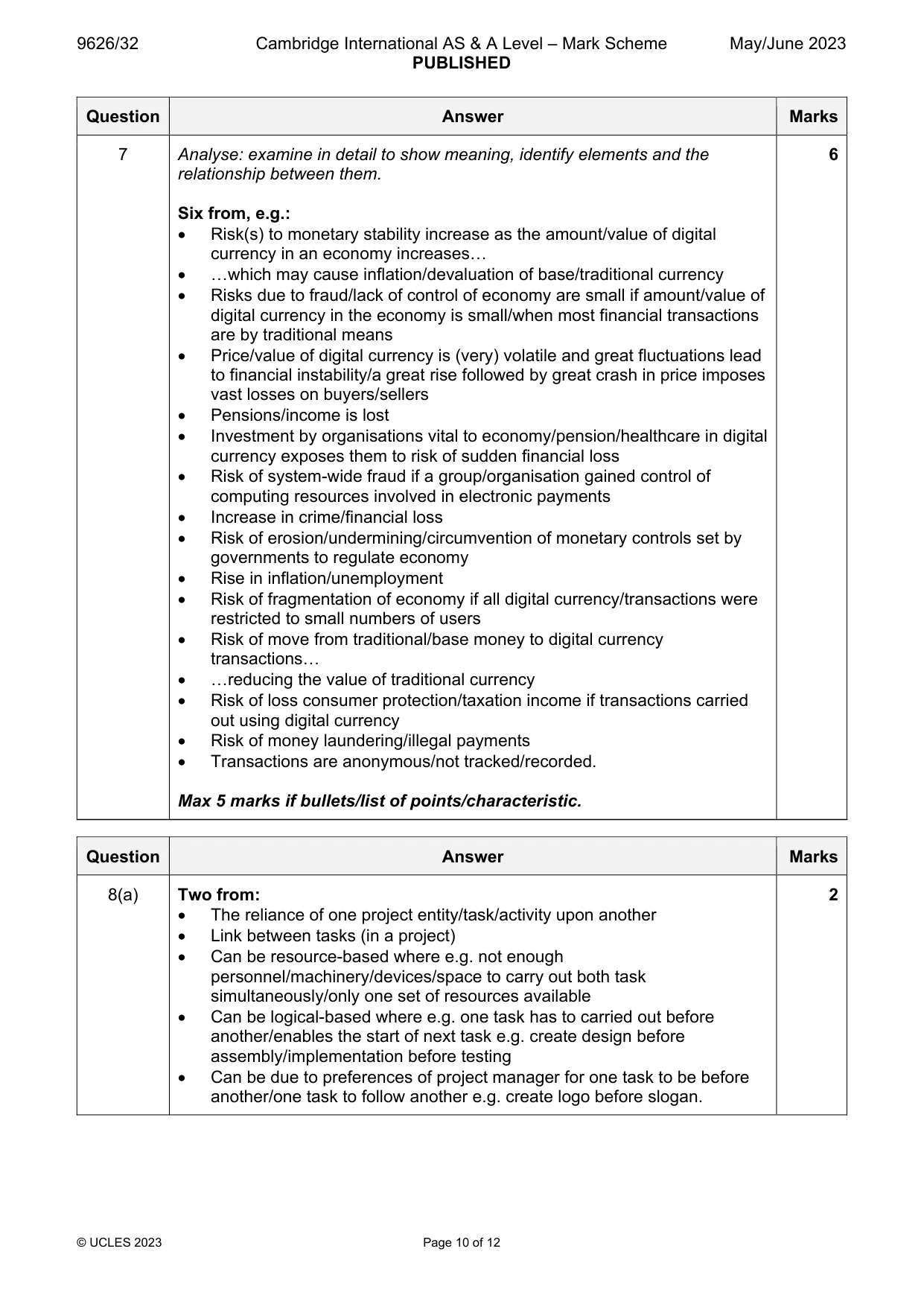
Mark scheme: 7 Analyse: examine in detail to show meaning, identify elements and the 6 relationship between them. Six from, e.g.: Risk(s) to monetary stability increase as the amount/value of digital currency in an economy increases… …which may cause inflation/devaluation of base/traditional currency Risks due to fraud/lack of control of economy are small if amount/value of digital currency in the economy is small/when most financial transactions are by traditional means Price/value of digital currency is (very) volatile and great fluctuations lead to financial instability/a great rise followed by great crash in price imposes vast losses on buyers/sellers Pensions/income is lost Investment by organisations vital to economy/pension/healthcare in digital currency exposes them to risk of sudden financial loss Risk of system-wide fraud if a group/organisation gained control of computing resources involved in electronic payments Increase in crime/financial loss Risk of erosion/undermining/circumvention of monetary controls set by governments to regulate economy Rise in inflation/unemployment Risk of fragmentation of economy if all digital currency/transactions were restricted to small numbers of users Risk of move from traditional/base money to digital currency transactions… …reducing the value of traditional currency Risk of loss consumer protection/taxation income if transactions carried out using digital currency Risk of money laundering/illegal payments Transactions are anonymous/not tracked/recorded. Max 5 marks if bullets/list of points/characteristic.
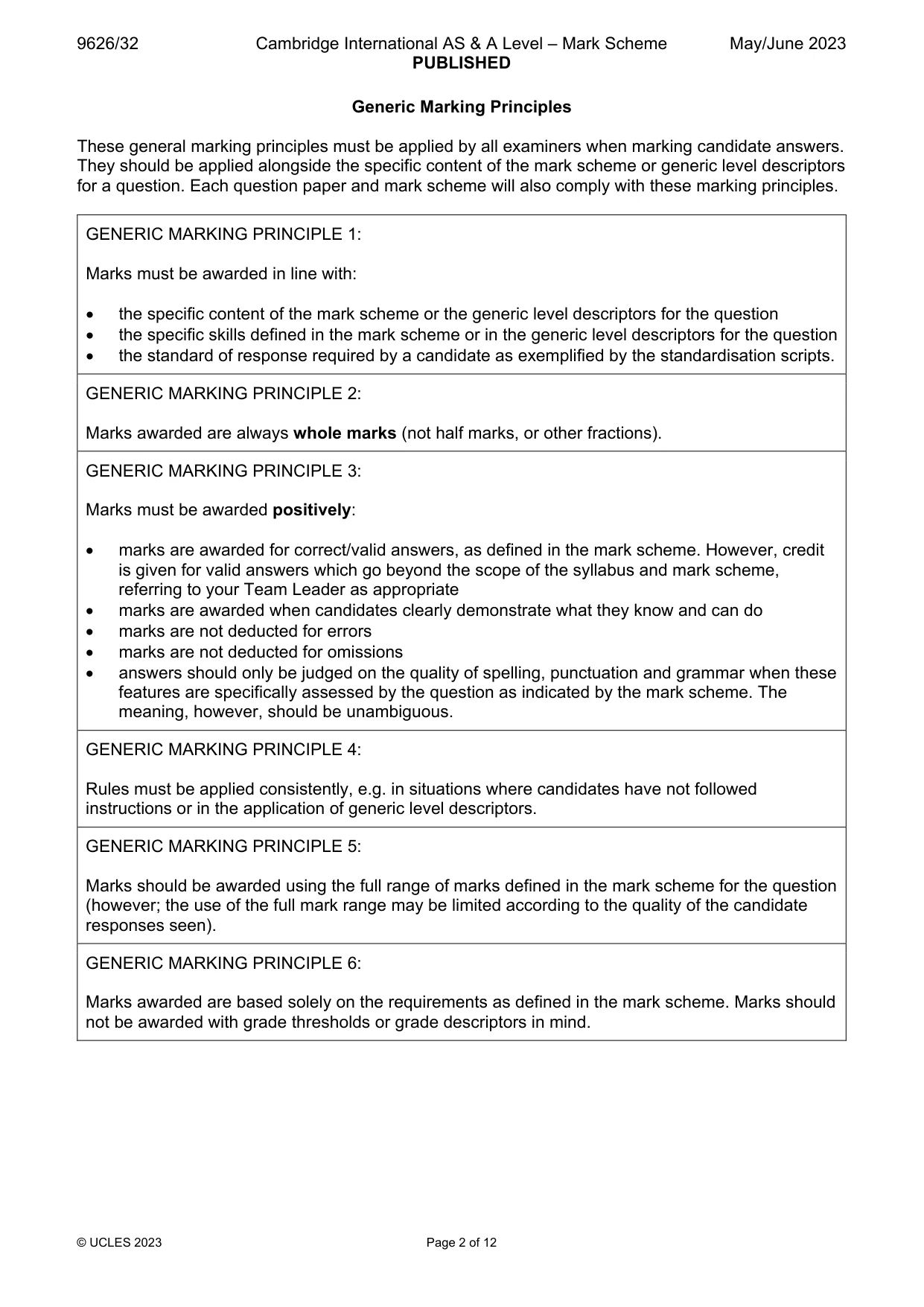
Q8 · Describe each of these project management terms
8 Describe each of these project management terms. (a) dependencies ................................................................................................................................................... ................................................................................................................................................... ................................................................................................................................................... ................................................................................................................................................... ................................................................................................................................................... ............................................................................................................................................. [2] (b) deliverables ................................................................................................................................................... ................................................................................................................................................... ................................................................................................................................................... ................................................................................................................................................... ................................................................................................................................................... ............................................................................................................................................. [2] (c) tasks ................................................................................................................................................... ................................................................................................................................................... ................................................................................................................................................... ................................................................................................................................................... ................................................................................................................................................... ............................................................................................................................................. [2]
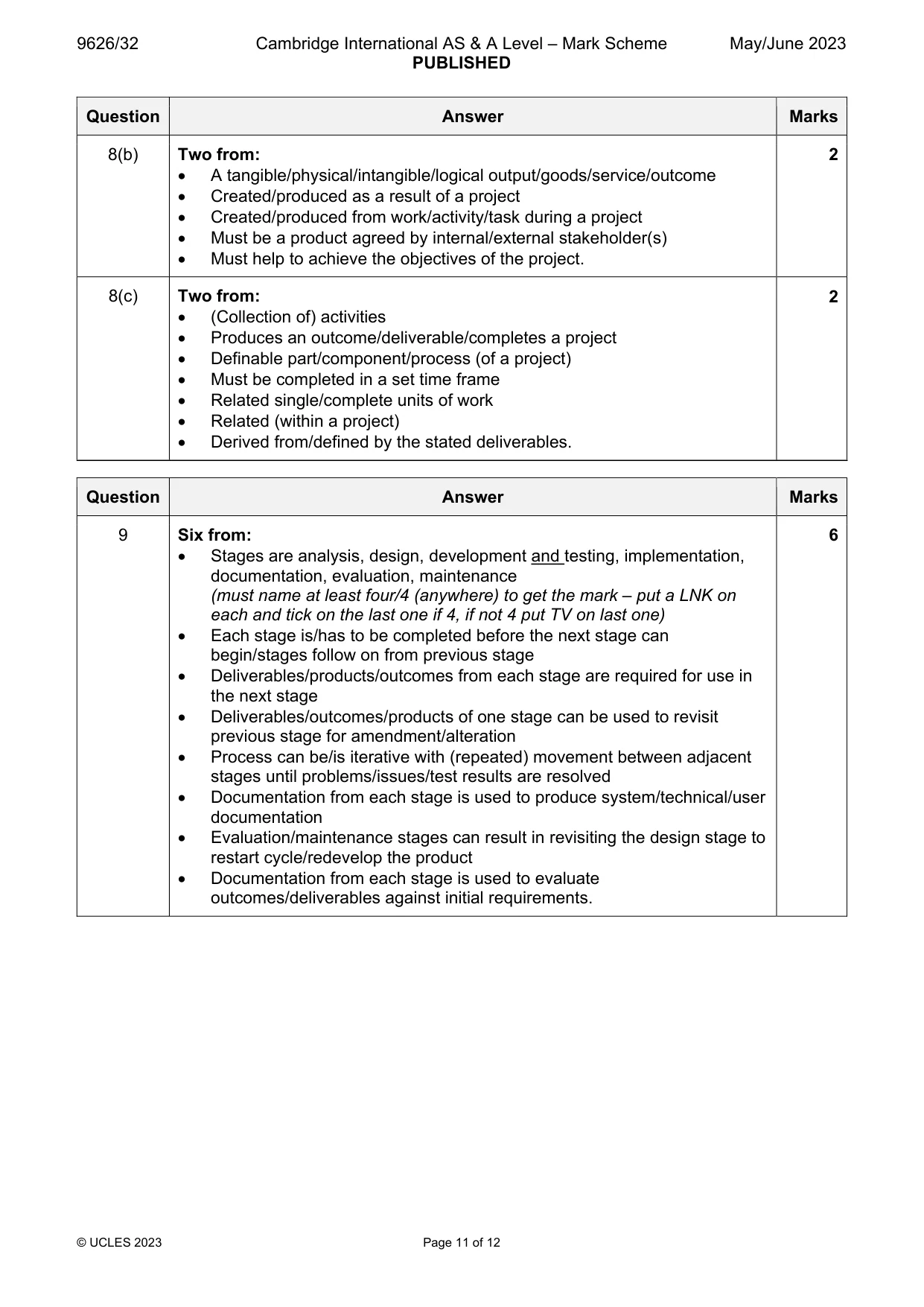
Mark scheme: 8(a) Two from: 2 The reliance of one project entity/task/activity upon another Link between tasks (in a project) Can be resource-based where e.g. not enough personnel/machinery/devices/space to carry out both task simultaneously/only one set of resources available Can be logical-based where e.g. one task has to carried out before another/enables the start of next task e.g. create design before assembly/implementation before testing Can be due to preferences of project manager for one task to be before another/one task to follow another e.g. create logo before slogan. 8(b) Two from: 2 A tangible/physical/intangible/logical output/goods/service/outcome Created/produced as a result of a project Created/produced from work/activity/task during a project Must be a product agreed by internal/external stakeholder(s) Must help to achieve the objectives of the project. 8(c) Two from: 2 (Collection of) activities Produces an outcome/deliverable/completes a project Definable part/component/process (of a project) Must be completed in a set time frame Related single/complete units of work Related (within a project) Derived from/defined by the stated deliverables.
More questions on Tools and techniques for project management tasks
Q9 · Explain how the stages of the system life cycle are related to each other
9 Explain how the stages of the system life cycle are related to each other. .......................................................................................................................................................... .......................................................................................................................................................... .......................................................................................................................................................... .......................................................................................................................................................... .......................................................................................................................................................... .......................................................................................................................................................... .......................................................................................................................................................... .......................................................................................................................................................... .......................................................................................................................................................... .......................................................................................................................................................... .......................................................................................................................................................... .......................................................................................................................................................... .......................................................................................................................................................... .......................................................................................................................................................... .......................................................................................................................................................... .................................................................................................................................................... [6]
Mark scheme: 9 Six from: 6 Stages are analysis, design, development and testing, implementation, documentation, evaluation, maintenance (must name at least four/4 (anywhere) to get the mark – put a LNK on each and tick on the last one if 4, if not 4 put TV on last one) Each stage is/has to be completed before the next stage can begin/stages follow on from previous stage Deliverables/products/outcomes from each stage are required for use in the next stage Deliverables/outcomes/products of one stage can be used to revisit previous stage for amendment/alteration Process can be/is iterative with (repeated) movement between adjacent stages until problems/issues/test results are resolved Documentation from each stage is used to produce system/technical/user documentation Evaluation/maintenance stages can result in revisiting the design stage to restart cycle/redevelop the product Documentation from each stage is used to evaluate outcomes/deliverables against initial requirements.
Q10 · Scientific research includes reading documents published in different languages by…
10 Scientific research includes reading documents published in different languages by scientists all over the world. Discuss the impact of computer-assisted translation on scientific research. .......................................................................................................................................................... .......................................................................................................................................................... .......................................................................................................................................................... .......................................................................................................................................................... .......................................................................................................................................................... .......................................................................................................................................................... .......................................................................................................................................................... .......................................................................................................................................................... .......................................................................................................................................................... .......................................................................................................................................................... .......................................................................................................................................................... .......................................................................................................................................................... .......................................................................................................................................................... .......................................................................................................................................................... .......................................................................................................................................................... .......................................................................................................................................................... .......................................................................................................................................................... .......................................................................................................................................................... .......................................................................................................................................................... .................................................................................................................................................... [8]
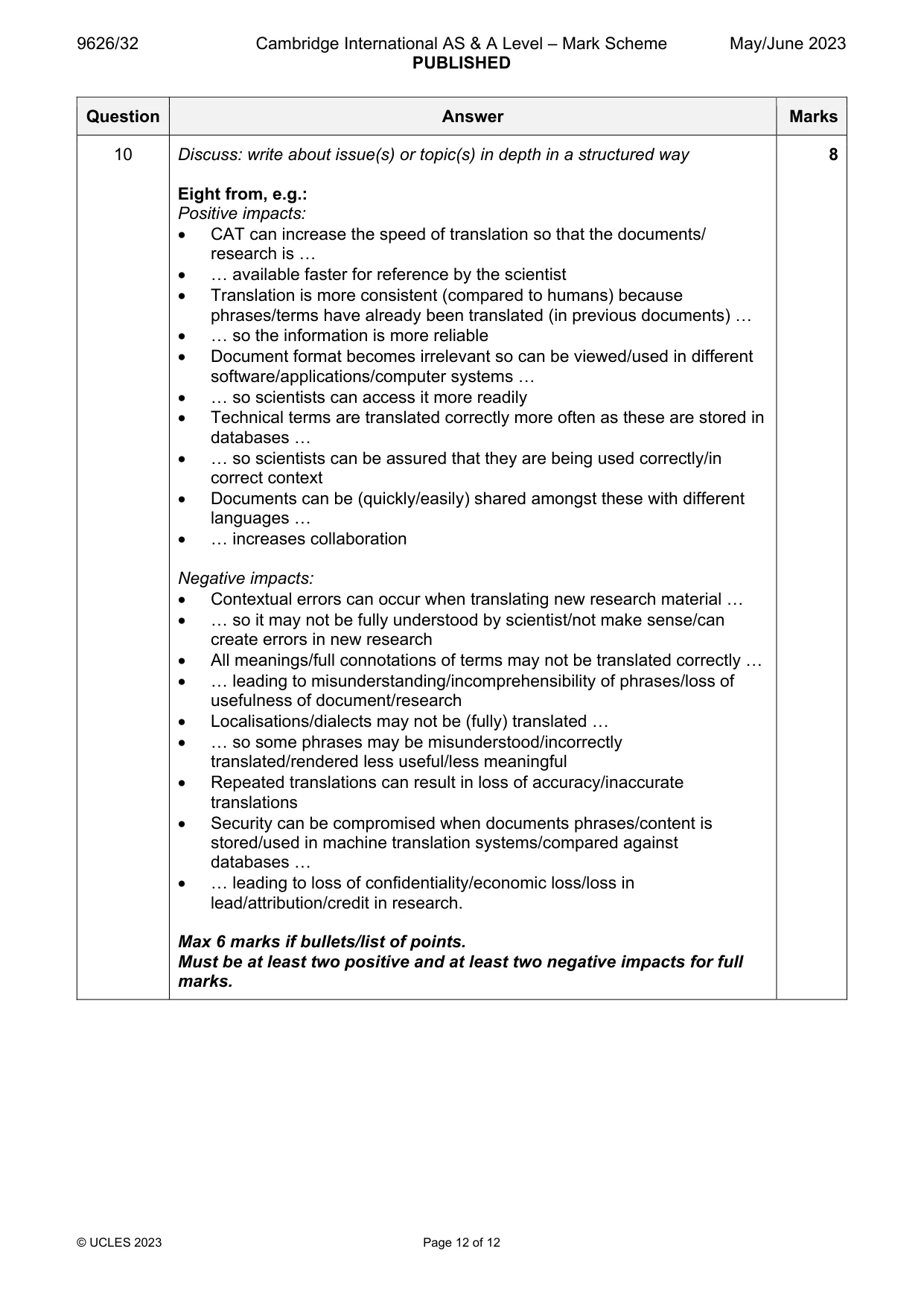
Mark scheme: 10 Discuss: write about issue(s) or topic(s) in depth in a structured way 8 Eight from, e.g.: Positive impacts: CAT can increase the speed of translation so that the documents/ research is … … available faster for reference by the scientist Translation is more consistent (compared to humans) because phrases/terms have already been translated (in previous documents) … … so the information is more reliable Document format becomes irrelevant so can be viewed/used in different software/applications/computer systems … … so scientists can access it more readily Technical terms are translated correctly more often as these are stored in databases … … so scientists can be assured that they are being used correctly/in correct context Documents can be (quickly/easily) shared amongst these with different languages … … increases collaboration Negative impacts: Contextual errors can occur when translating new research material … … so it may not be fully understood by scientist/not make sense/can create errors in new research All meanings/full connotations of terms may not be translated correctly … … leading to misunderstanding/incomprehensibility of phrases/loss of usefulness of document/research Localisations/dialects may not be (fully) translated … … so some phrases may be misunderstood/incorrectly translated/rendered less useful/less meaningful Repeated translations can result in loss of accuracy/inaccurate translations Security can be compromised when documents phrases/content is stored/used in machine translation systems/compared against databases … … leading to loss of confidentiality/economic loss/loss in lead/attribution/credit in research. Max 6 marks if bullets/list of points. Must be at least two positive and at least two negative impacts for full marks.
What was in this paper
The subtopics covered by these 10 questions, and how many questions each got. Open one in a new tab to see every Cambridge question on it.
What you needed in this session
Cambridge’s own grade thresholds for 2023 May/June, Paper 3 · Variant 2. A higher threshold means an easier paper — the bar moves with how the cohort did.