Cambridge A Level Information Technology (from 2017) 9626 — 2025 May/June Paper 3 · Variant 3
9626/33/M/J/25 · 11 questions · 70 marks · 105 min
The question paper and its mark scheme, free to read here and free to download. This is Cambridge’s own paper, exactly as it was sat.
Question paper12 pages
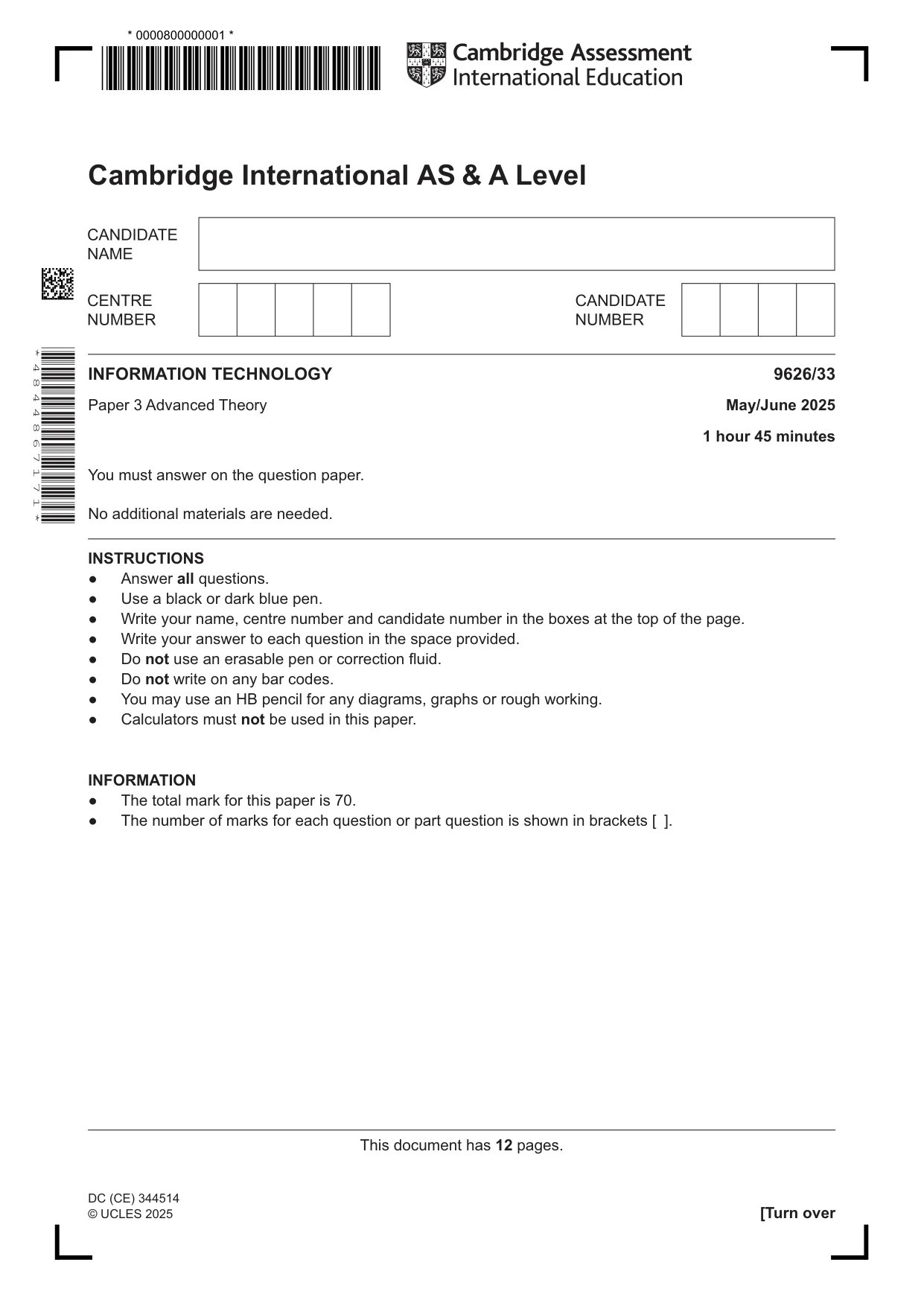
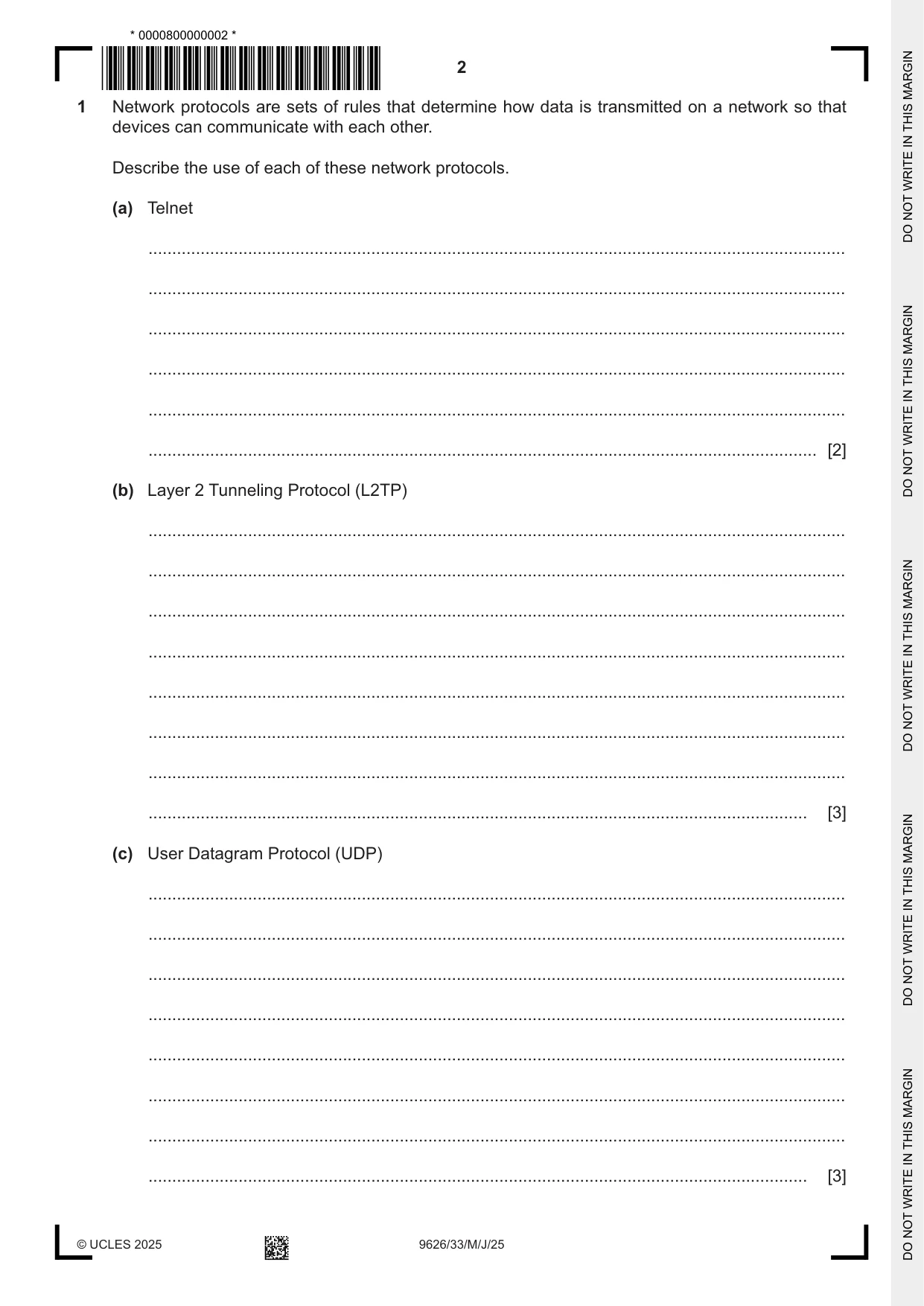
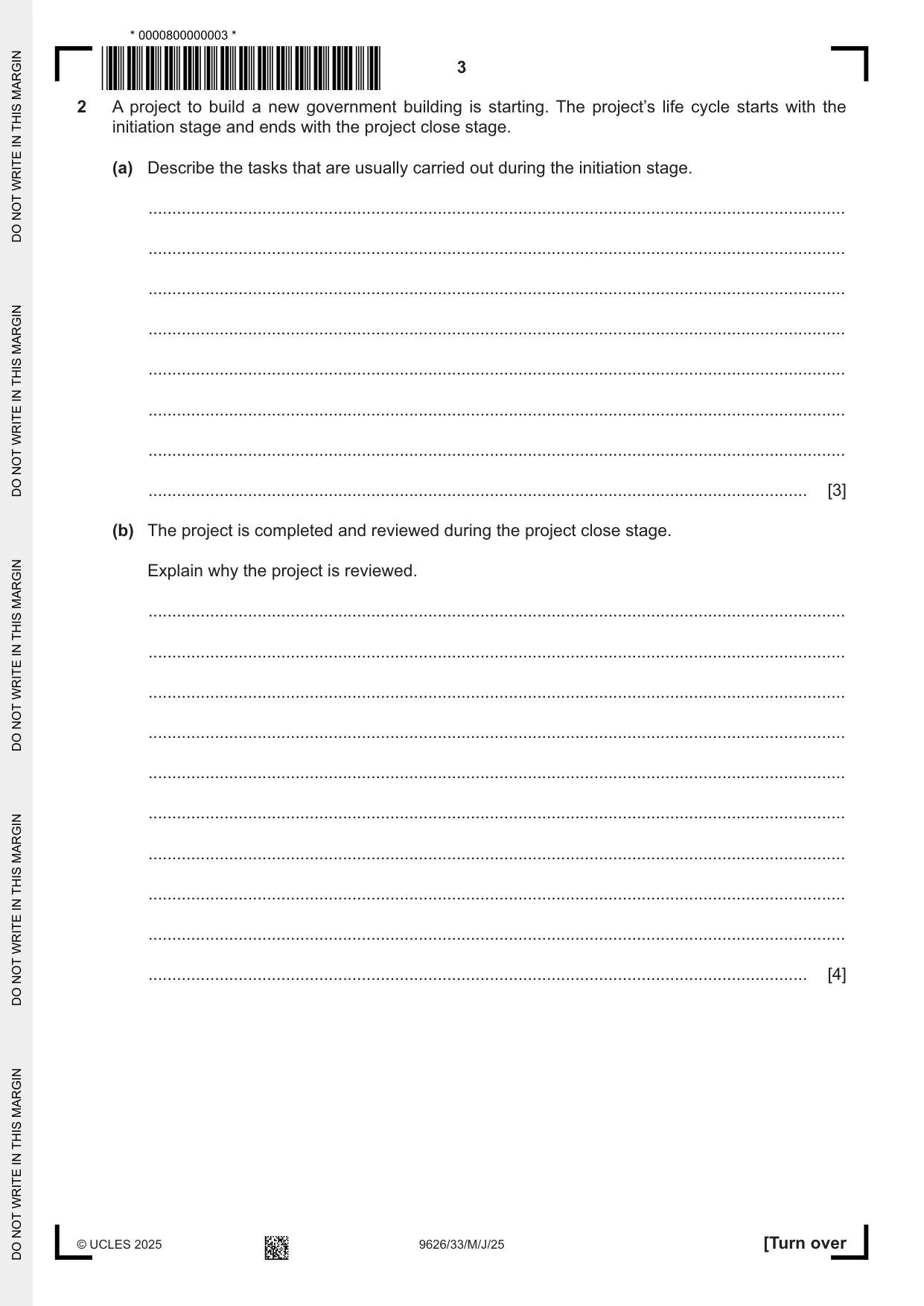
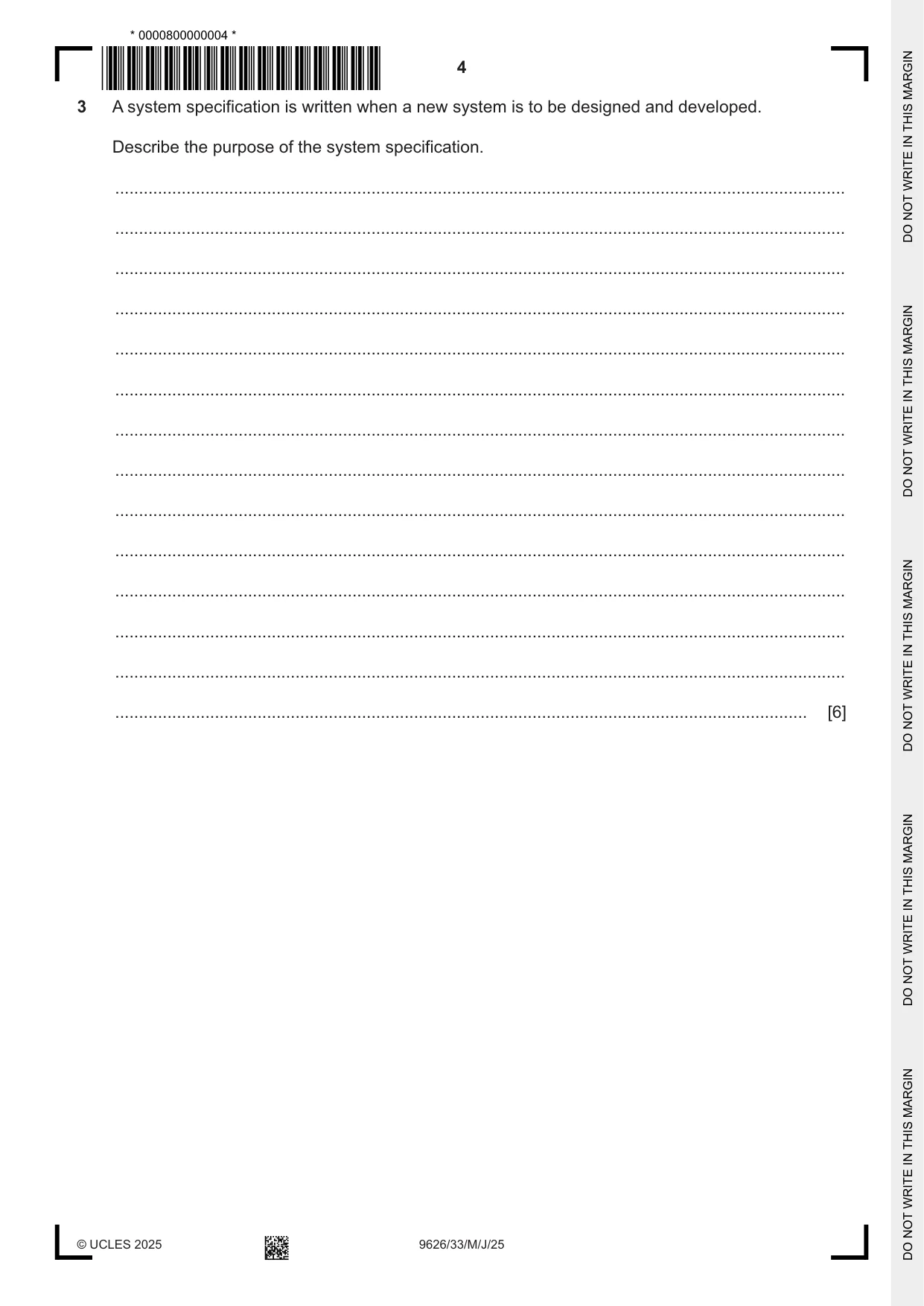



Mark scheme12 pages
Answers below. Sit the paper first if you are practising.

Questions as text
Q1 · Network protocols are sets of rules that determine how data is transmitted on a network…
1 Network protocols are sets of rules that determine how data is transmitted on a network so that devices can communicate with each other. Describe the use of each of these network protocols. (a) Telnet ................................................................................................................................................... ................................................................................................................................................... ................................................................................................................................................... ................................................................................................................................................... ................................................................................................................................................... ............................................................................................................................................. [2] (b) Layer 2 Tunneling Protocol (L2TP) ................................................................................................................................................... ................................................................................................................................................... ................................................................................................................................................... ................................................................................................................................................... ................................................................................................................................................... ................................................................................................................................................... ................................................................................................................................................... ........................................................................................................................................... [3] (c) User Datagram Protocol (UDP) ................................................................................................................................................... ................................................................................................................................................... ................................................................................................................................................... ................................................................................................................................................... ................................................................................................................................................... ................................................................................................................................................... ................................................................................................................................................... ........................................................................................................................................... [3]
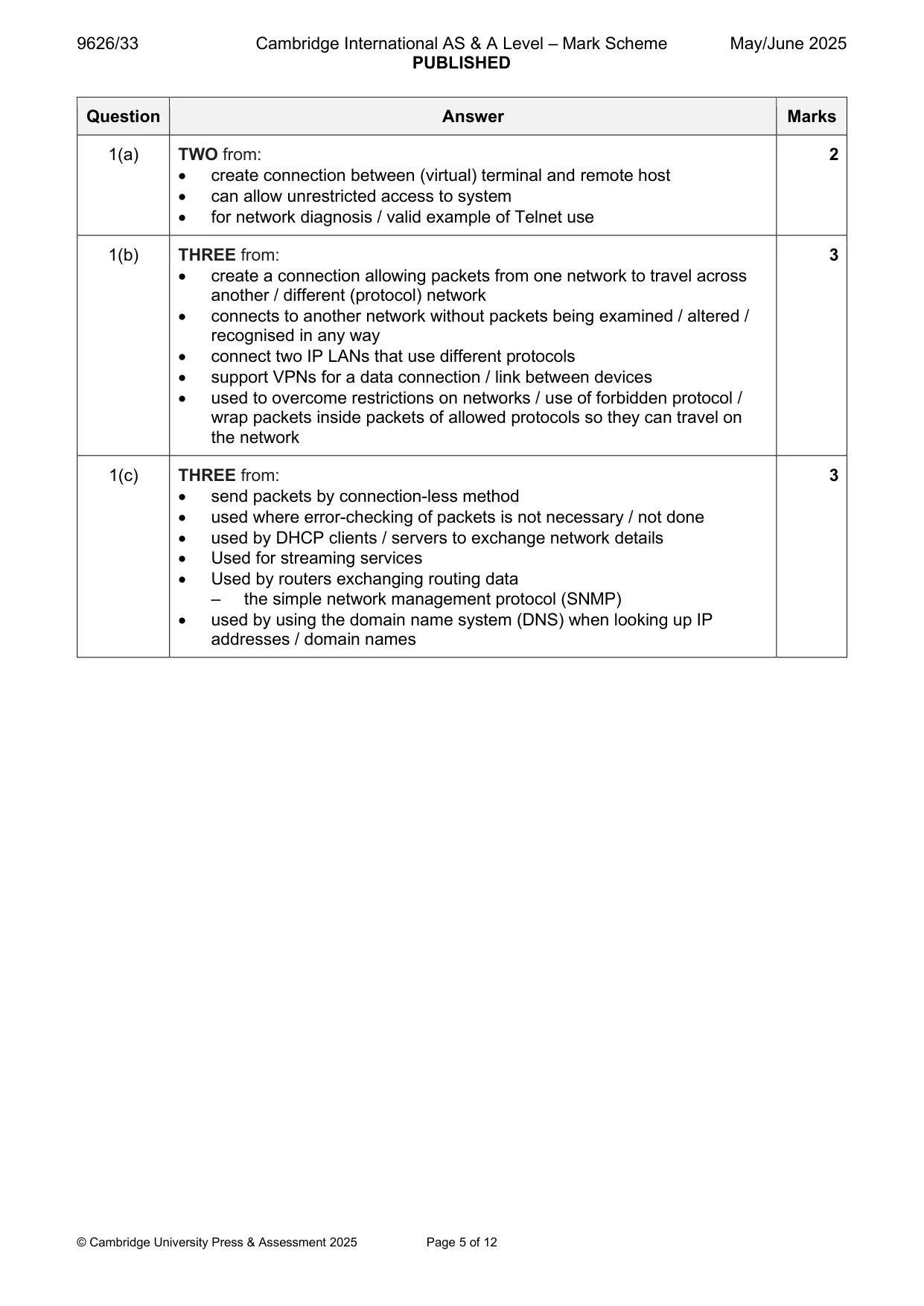
Mark scheme: Question Answer Marks 1(a) TWO from: 2 • create connection between (virtual) terminal and remote host • can allow unrestricted access to system • for network diagnosis / valid example of Telnet use 1(b) THREE from: 3 • create a connection allowing packets from one network to travel across another / different (protocol) network • connects to another network without packets being examined / altered / recognised in any way • connect two IP LANs that use different protocols • support VPNs for a data connection / link between devices • used to overcome restrictions on networks / use of forbidden protocol / wrap packets inside packets of allowed protocols so they can travel on the network 1(c) THREE from: 3 • send packets by connection-less method • used where error-checking of packets is not necessary / not done • used by DHCP clients / servers to exchange network details • Used for streaming services • Used by routers exchanging routing data – the simple network management protocol (SNMP) • used by using the domain name system (DNS) when looking up IP addresses / domain names
Q2 · A project to build a new government building is starting
2 A project to build a new government building is starting. The project’s life cycle starts with the initiation stage and ends with the project close stage. (a) Describe the tasks that are usually carried out during the initiation stage. ................................................................................................................................................... ................................................................................................................................................... ................................................................................................................................................... ................................................................................................................................................... ................................................................................................................................................... ................................................................................................................................................... ................................................................................................................................................... ........................................................................................................................................... [3] (b) The project is completed and reviewed during the project close stage. Explain why the project is reviewed. ................................................................................................................................................... ................................................................................................................................................... ................................................................................................................................................... ................................................................................................................................................... ................................................................................................................................................... ................................................................................................................................................... ................................................................................................................................................... ................................................................................................................................................... ................................................................................................................................................... ........................................................................................................................................... [4]
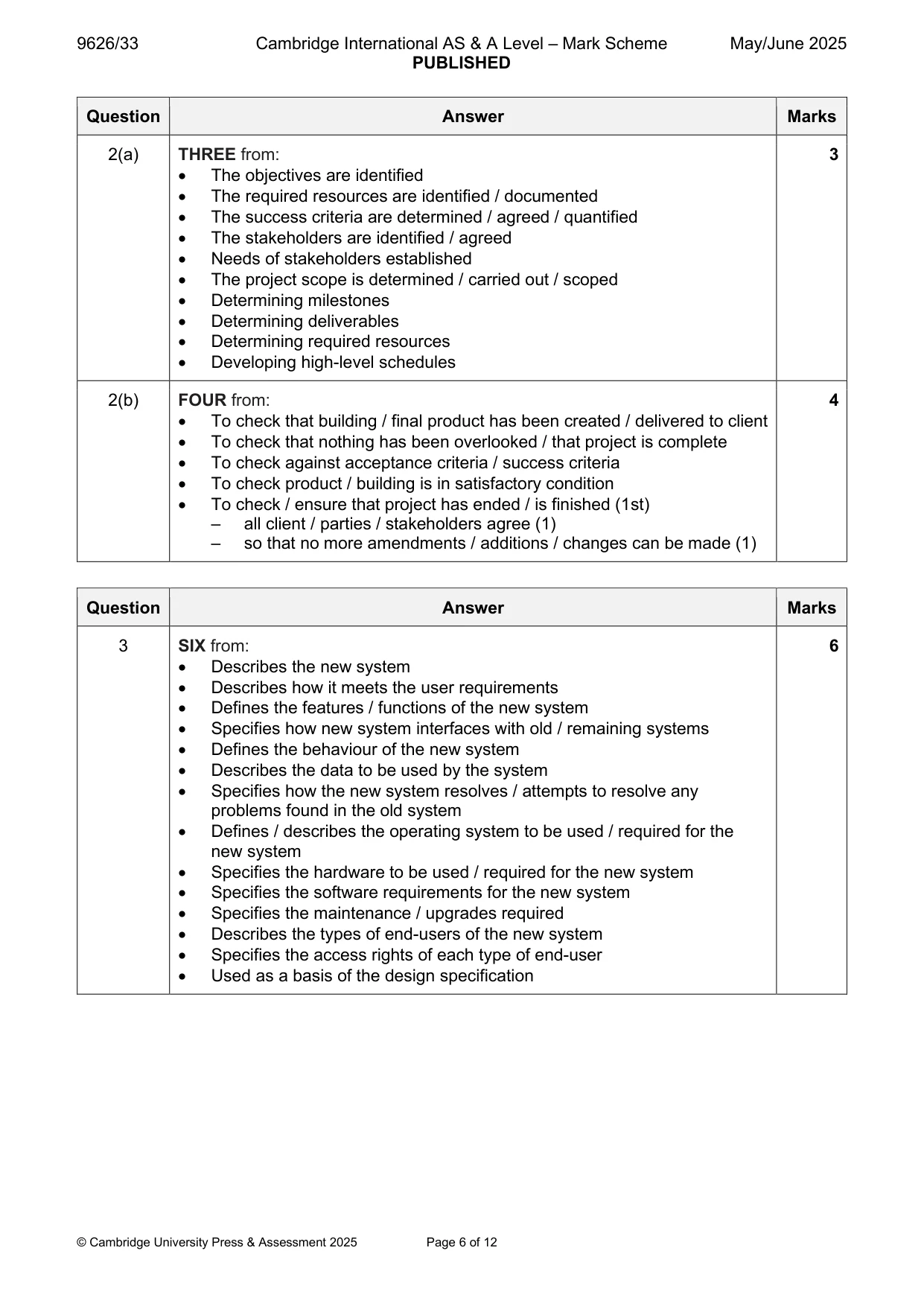
Mark scheme: 2(a) THREE from: 3 • The objectives are identified • The required resources are identified / documented • The success criteria are determined / agreed / quantified • The stakeholders are identified / agreed • Needs of stakeholders established • The project scope is determined / carried out / scoped • Determining milestones • Determining deliverables • Determining required resources • Developing high-level schedules 2(b) FOUR from: 4 • To check that building / final product has been created / delivered to client • To check that nothing has been overlooked / that project is complete • To check against acceptance criteria / success criteria • To check product / building is in satisfactory condition • To check / ensure that project has ended / is finished (1st) – all client / parties / stakeholders agree (1) – so that no more amendments / additions / changes can be made (1)
Q3 · A system specification is written when a new system is to be designed and developed
3 A system specification is written when a new system is to be designed and developed. Describe the purpose of the system specification. .......................................................................................................................................................... .......................................................................................................................................................... .......................................................................................................................................................... .......................................................................................................................................................... .......................................................................................................................................................... .......................................................................................................................................................... .......................................................................................................................................................... .......................................................................................................................................................... .......................................................................................................................................................... .......................................................................................................................................................... .......................................................................................................................................................... .......................................................................................................................................................... .......................................................................................................................................................... .................................................................................................................................................. [6]
Mark scheme: 3 SIX from: 6 • Describes the new system • Describes how it meets the user requirements • Defines the features / functions of the new system • Specifies how new system interfaces with old / remaining systems • Defines the behaviour of the new system • Describes the data to be used by the system • Specifies how the new system resolves / attempts to resolve any problems found in the old system • Defines / describes the operating system to be used / required for the new system • Specifies the hardware to be used / required for the new system • Specifies the software requirements for the new system • Specifies the maintenance / upgrades required • Describes the types of end-users of the new system • Specifies the access rights of each type of end-user • Used as a basis of the design specification
Q4 · A mobile (cell) phone service provider is sending emails to all of its customers
4 A mobile (cell) phone service provider is sending emails to all of its customers. The email informs each customer of changes to their individual contract. Justify the use of mail merge to create the emails. .......................................................................................................................................................... .......................................................................................................................................................... .......................................................................................................................................................... .......................................................................................................................................................... .......................................................................................................................................................... .......................................................................................................................................................... .......................................................................................................................................................... .......................................................................................................................................................... .......................................................................................................................................................... .......................................................................................................................................................... .......................................................................................................................................................... .......................................................................................................................................................... .......................................................................................................................................................... .................................................................................................................................................. [6]
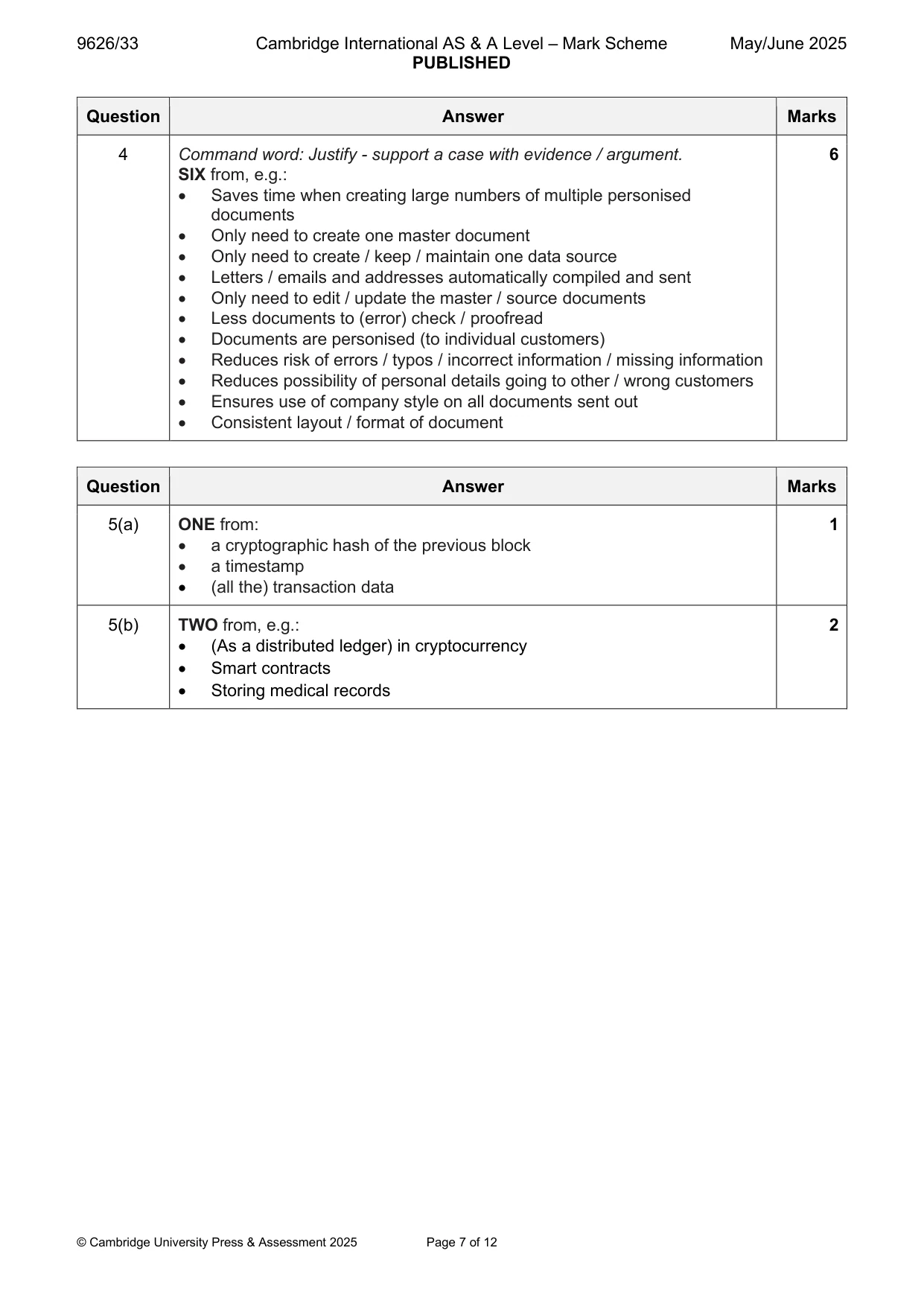
Mark scheme: 4 Command word: Justify - support a case with evidence / argument. 6 SIX from, e.g.: • Saves time when creating large numbers of multiple personised documents • Only need to create one master document • Only need to create / keep / maintain one data source • Letters / emails and addresses automatically compiled and sent • Only need to edit / update the master / source documents • Less documents to (error) check / proofread • Documents are personised (to individual customers) • Reduces risk of errors / typos / incorrect information / missing information • Reduces possibility of personal details going to other / wrong customers • Ensures use of company style on all documents sent out • Consistent layout / format of document
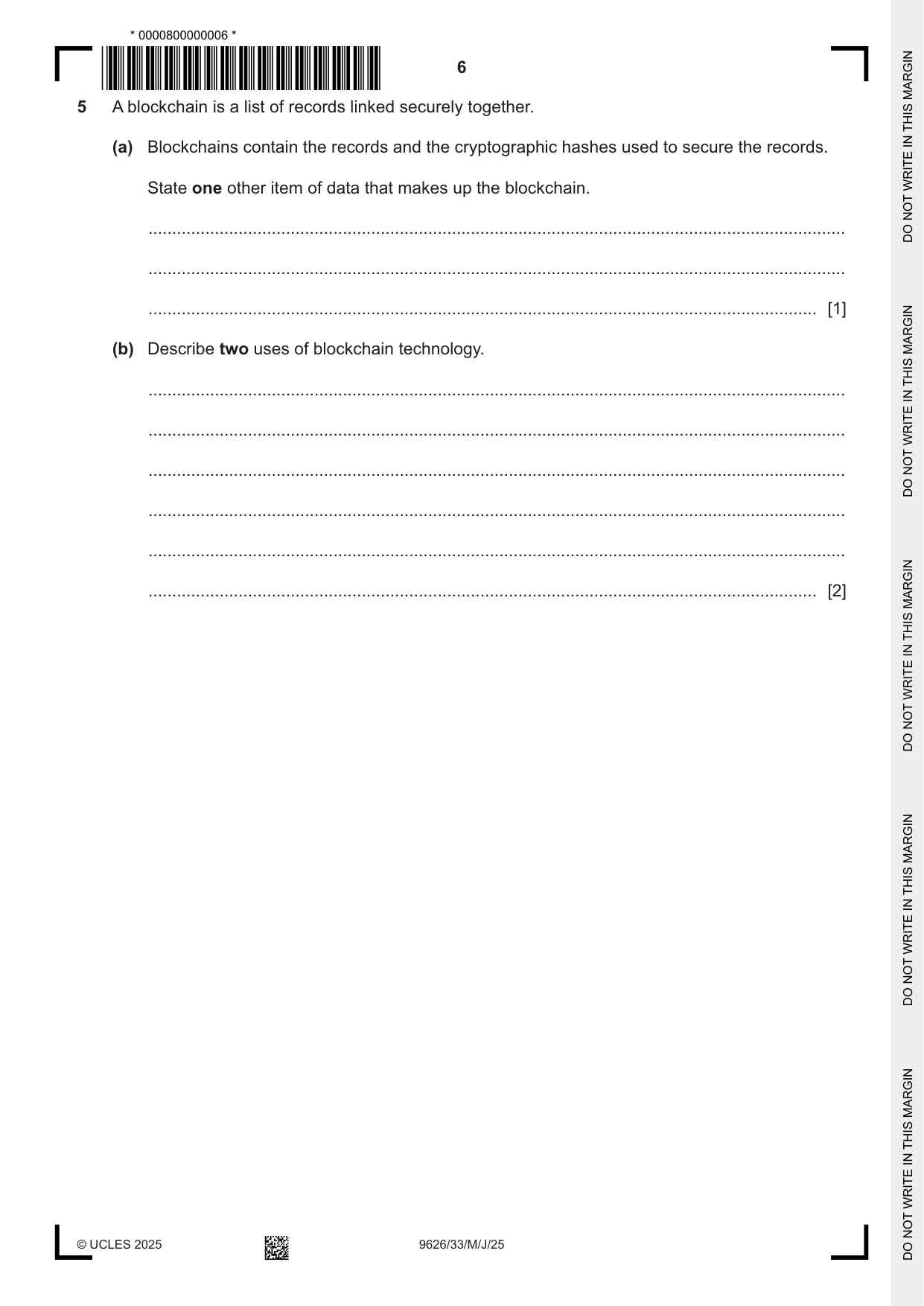
Q5 · A blockchain is a list of records linked securely together
5 A blockchain is a list of records linked securely together. (a) Blockchains contain the records and the cryptographic hashes used to secure the records. State one other item of data that makes up the blockchain. ................................................................................................................................................... ................................................................................................................................................... ............................................................................................................................................. [1] (b) Describe two uses of blockchain technology. ................................................................................................................................................... ................................................................................................................................................... ................................................................................................................................................... ................................................................................................................................................... ................................................................................................................................................... ............................................................................................................................................. [2]
Mark scheme: 5(a) ONE from: 1 • a cryptographic hash of the previous block • a timestamp • (all the) transaction data 5(b) TWO from, e.g.: 2 • (As a distributed ledger) in cryptocurrency • Smart contracts • Storing medical records
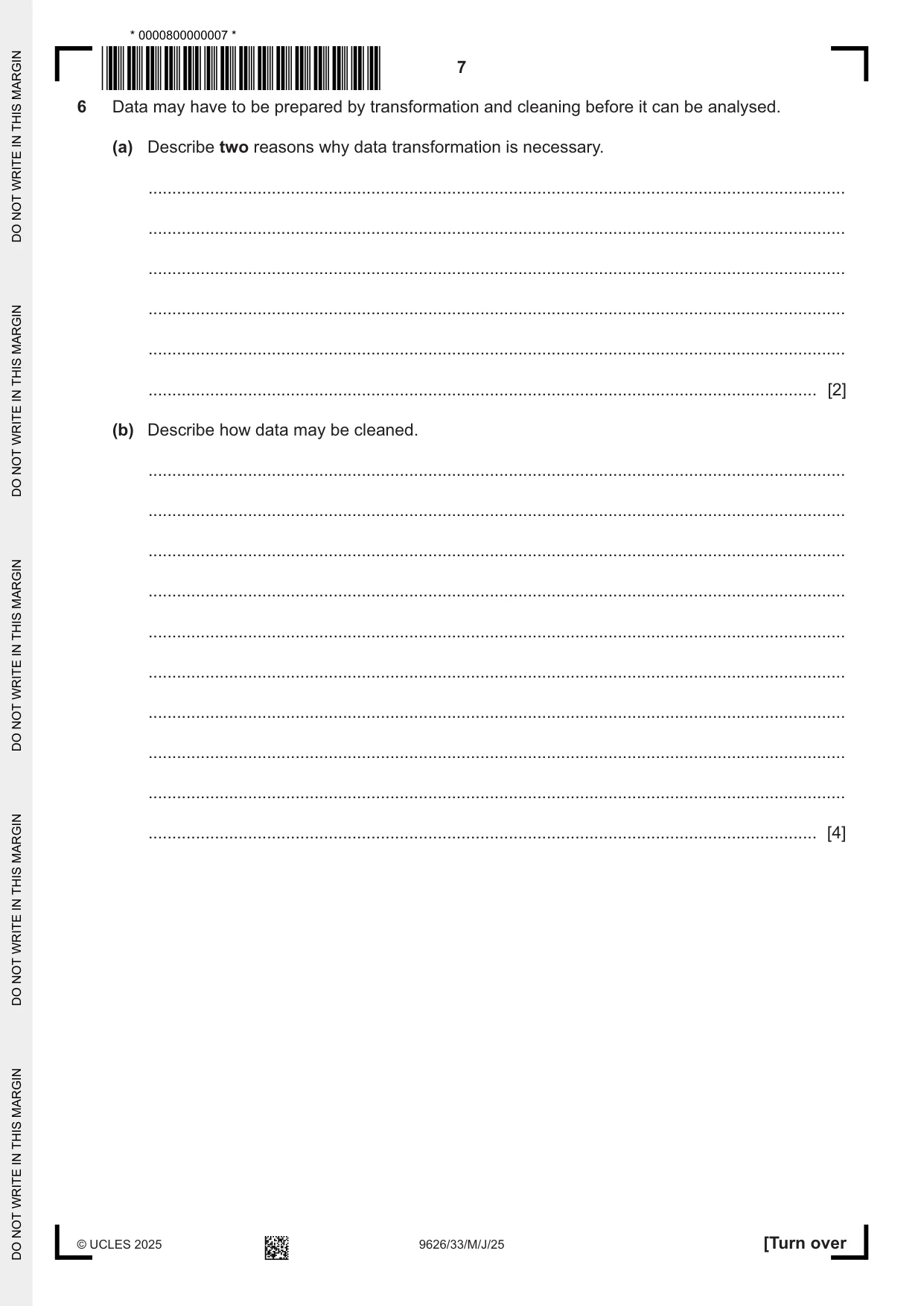
Q6 · Data may have to be prepared by transformation and cleaning before it can be analysed
6 Data may have to be prepared by transformation and cleaning before it can be analysed. (a) Describe two reasons why data transformation is necessary. ................................................................................................................................................... ................................................................................................................................................... ................................................................................................................................................... ................................................................................................................................................... ................................................................................................................................................... ............................................................................................................................................. [2] (b) Describe how data may be cleaned. ................................................................................................................................................... ................................................................................................................................................... ................................................................................................................................................... ................................................................................................................................................... ................................................................................................................................................... ................................................................................................................................................... ................................................................................................................................................... ................................................................................................................................................... ................................................................................................................................................... ............................................................................................................................................. [4]
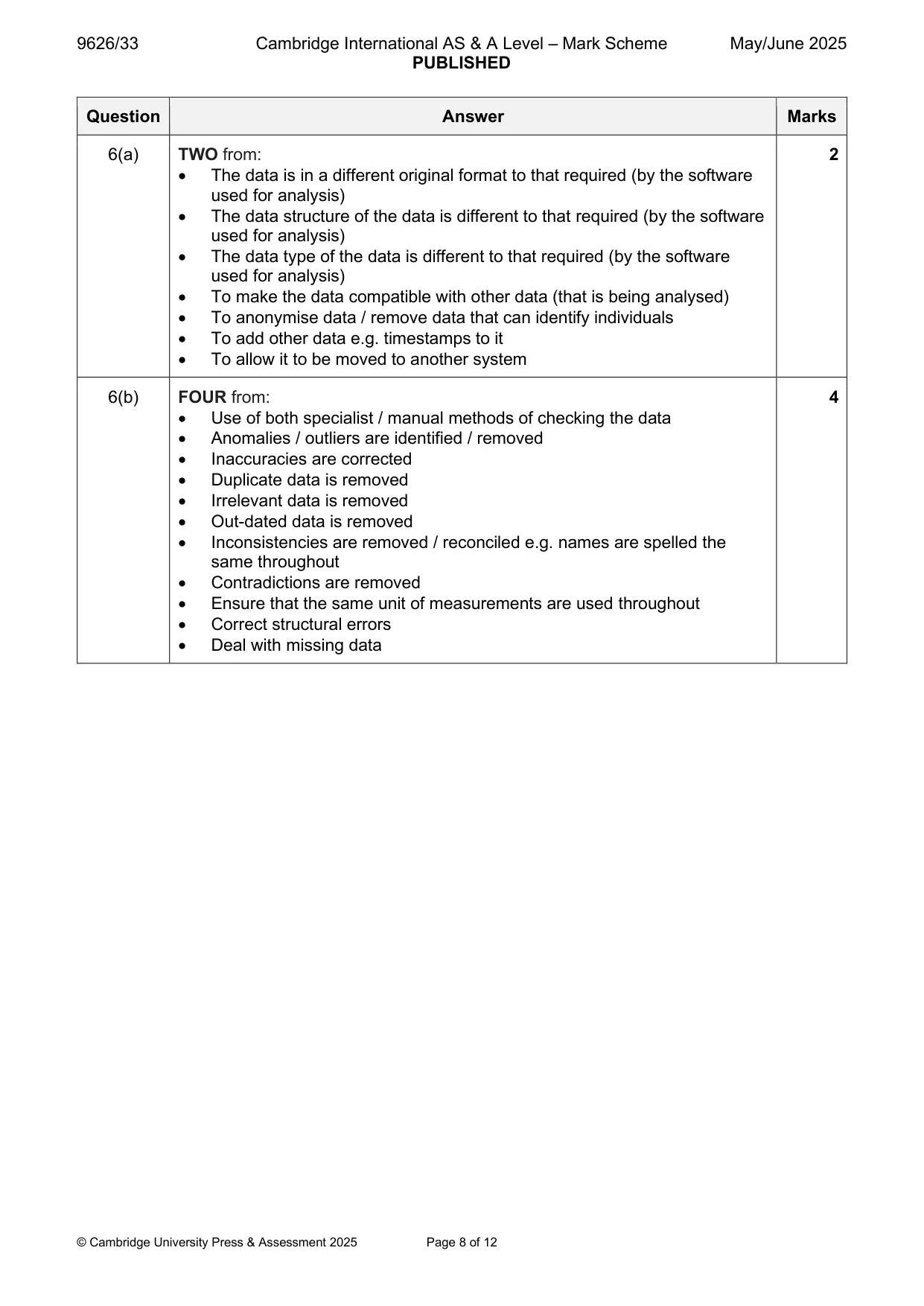
Mark scheme: 6(a) TWO from: 2 • The data is in a different original format to that required (by the software used for analysis) • The data structure of the data is different to that required (by the software used for analysis) • The data type of the data is different to that required (by the software used for analysis) • To make the data compatible with other data (that is being analysed) • To anonymise data / remove data that can identify individuals • To add other data e.g. timestamps to it • To allow it to be moved to another system 6(b) FOUR from: 4 • Use of both specialist / manual methods of checking the data • Anomalies / outliers are identified / removed • Inaccuracies are corrected • Duplicate data is removed • Irrelevant data is removed • Out-dated data is removed • Inconsistencies are removed / reconciled e.g. names are spelled the same throughout • Contradictions are removed • Ensure that the same unit of measurements are used throughout • Correct structural errors • Deal with missing data
Q7 · Compression is applied to digital images for many reasons
7 Compression is applied to digital images for many reasons. Evaluate the use of compression on digital images. .......................................................................................................................................................... .......................................................................................................................................................... .......................................................................................................................................................... .......................................................................................................................................................... .......................................................................................................................................................... .......................................................................................................................................................... .......................................................................................................................................................... .......................................................................................................................................................... .......................................................................................................................................................... .......................................................................................................................................................... .......................................................................................................................................................... .......................................................................................................................................................... .......................................................................................................................................................... .......................................................................................................................................................... .......................................................................................................................................................... .......................................................................................................................................................... .......................................................................................................................................................... .......................................................................................................................................................... .......................................................................................................................................................... .................................................................................................................................................... [8]
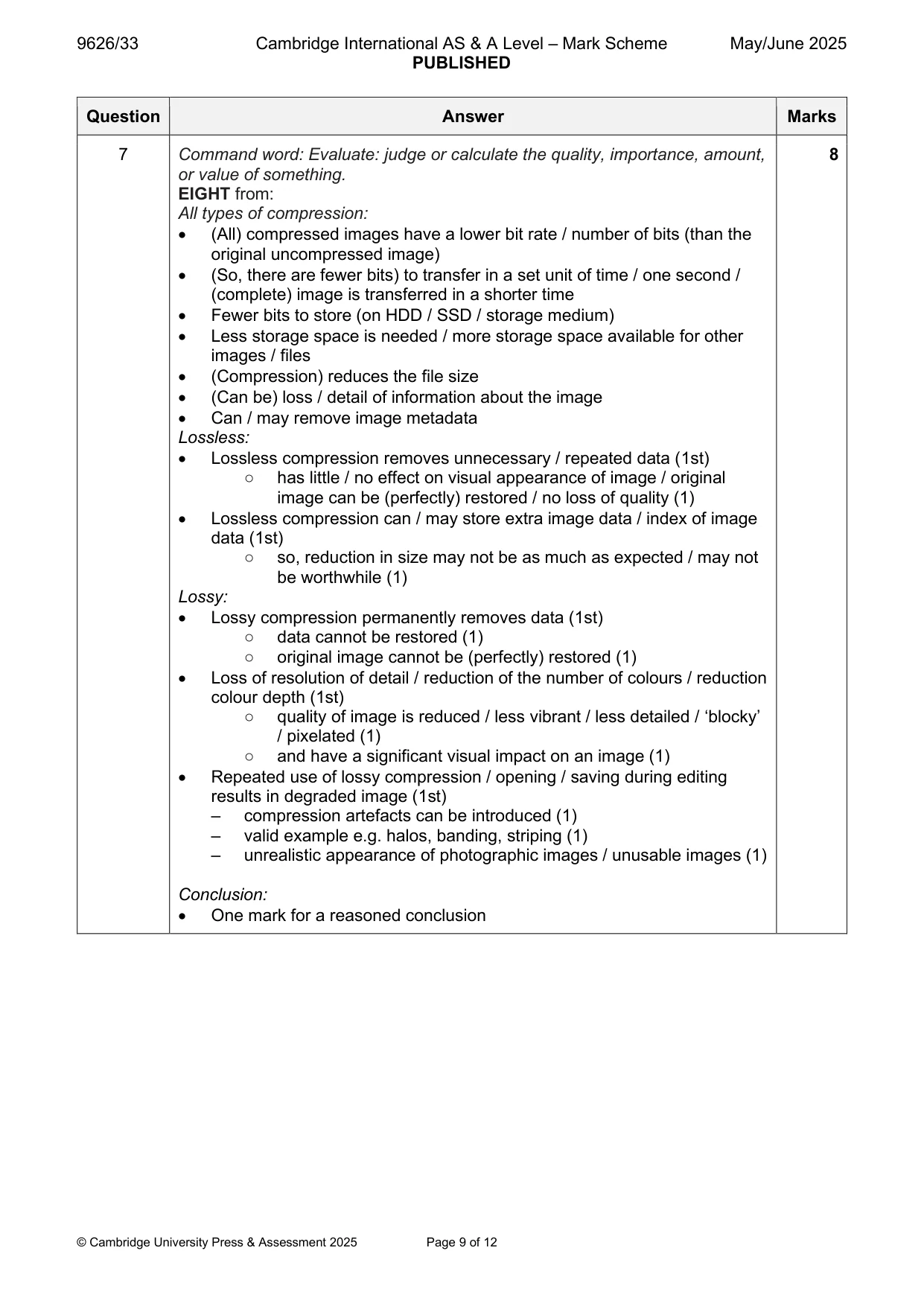
Mark scheme: 7 Command word: Evaluate: judge or calculate the quality, importance, amount, 8 or value of something. EIGHT from: All types of compression: • (All) compressed images have a lower bit rate / number of bits (than the original uncompressed image) • (So, there are fewer bits) to transfer in a set unit of time / one second / (complete) image is transferred in a shorter time • Fewer bits to store (on HDD / SSD / storage medium) • Less storage space is needed / more storage space available for other images / files • (Compression) reduces the file size • (Can be) loss / detail of information about the image • Can / may remove image metadata Lossless: • Lossless compression removes unnecessary / repeated data (1st) ○ has little / no effect on visual appearance of image / original image can be (perfectly) restored / no loss of quality (1) • Lossless compression can / may store extra image data / index of image data (1st) ○ so, reduction in size may not be as much as expected / may not be worthwhile (1) Lossy: • Lossy compression permanently removes data (1st) ○ data cannot be restored (1) ○ original image cannot be (perfectly) restored (1) • Loss of resolution of detail / reduction of the number of colours / reduction colour depth (1st) ○ quality of image is reduced / less vibrant / less detailed / ‘blocky’ / pixelated (1) ○ and have a significant visual impact on an image (1) • Repeated use of lossy compression / opening / saving during editing results in degraded image (1st) – compression artefacts can be introduced (1) – valid example e.g. halos, banding, striping (1) – unrealistic appearance of photographic images / unusable images (1) Conclusion: • One mark for a reasoned conclusion
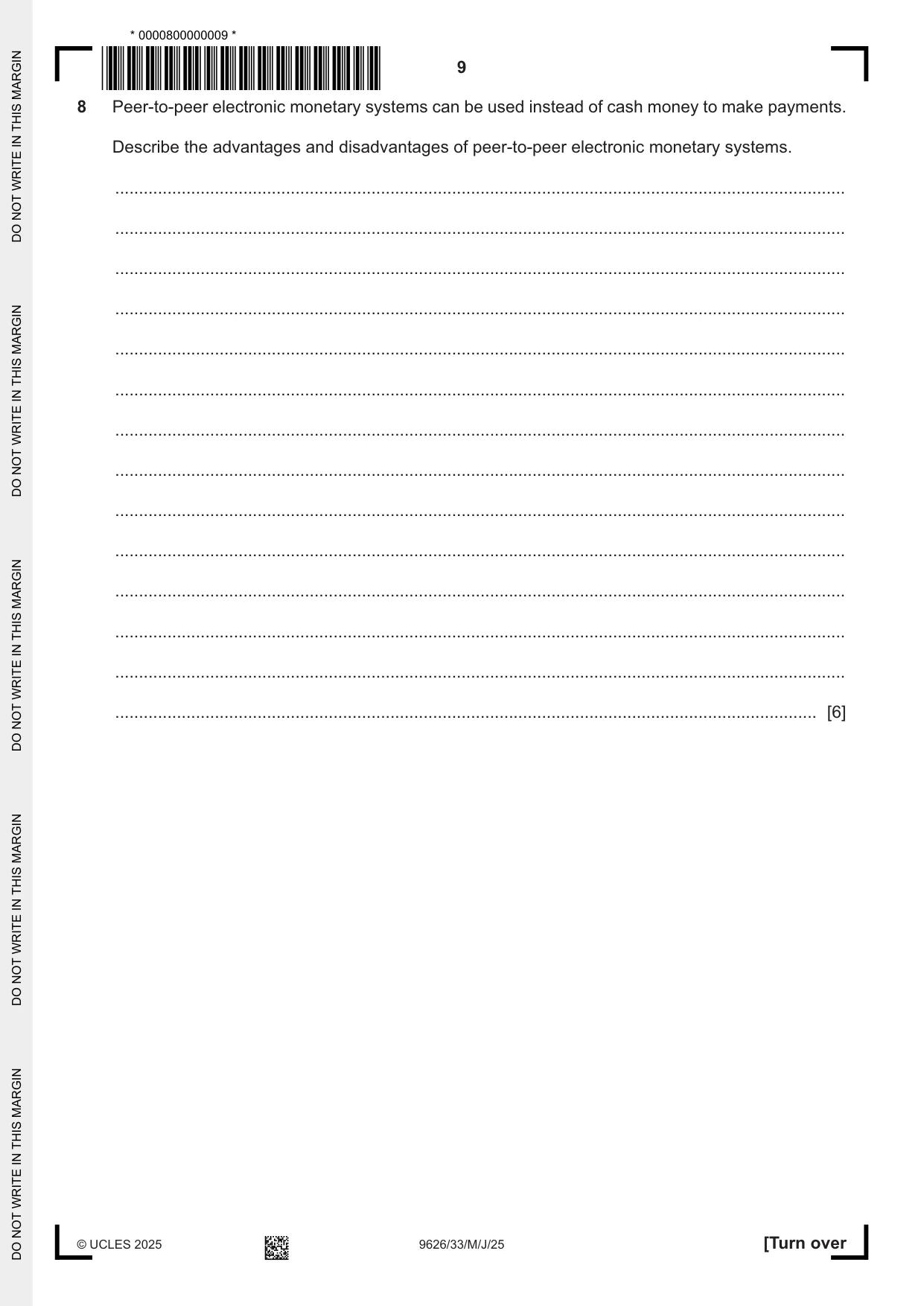
Q8 · Peer-to-peer electronic monetary systems can be used instead of cash money to make…
8 Peer-to-peer electronic monetary systems can be used instead of cash money to make payments. Describe the advantages and disadvantages of peer-to-peer electronic monetary systems. .......................................................................................................................................................... .......................................................................................................................................................... .......................................................................................................................................................... .......................................................................................................................................................... .......................................................................................................................................................... .......................................................................................................................................................... .......................................................................................................................................................... .......................................................................................................................................................... .......................................................................................................................................................... .......................................................................................................................................................... .......................................................................................................................................................... .......................................................................................................................................................... .......................................................................................................................................................... .................................................................................................................................................... [6]
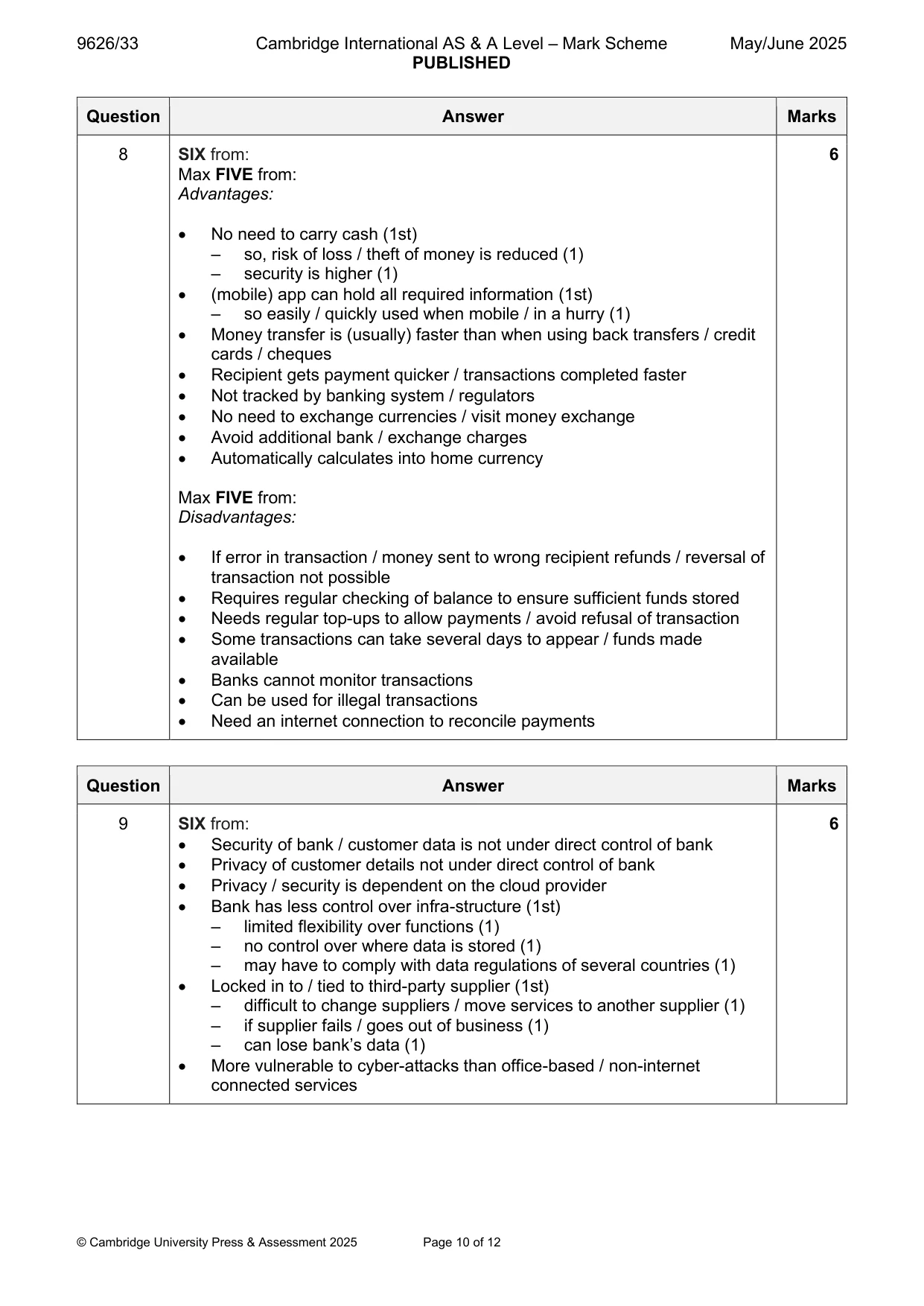
Mark scheme: 8 SIX from: 6 Max FIVE from: Advantages: • No need to carry cash (1st) – so, risk of loss / theft of money is reduced (1) – security is higher (1) • (mobile) app can hold all required information (1st) – so easily / quickly used when mobile / in a hurry (1) • Money transfer is (usually) faster than when using back transfers / credit cards / cheques • Recipient gets payment quicker / transactions completed faster • Not tracked by banking system / regulators • No need to exchange currencies / visit money exchange • Avoid additional bank / exchange charges • Automatically calculates into home currency Max FIVE from: Disadvantages: • If error in transaction / money sent to wrong recipient refunds / reversal of transaction not possible • Requires regular checking of balance to ensure sufficient funds stored • Needs regular top-ups to allow payments / avoid refusal of transaction • Some transactions can take several days to appear / funds made available • Banks cannot monitor transactions • Can be used for illegal transactions • Need an internet connection to reconcile payments
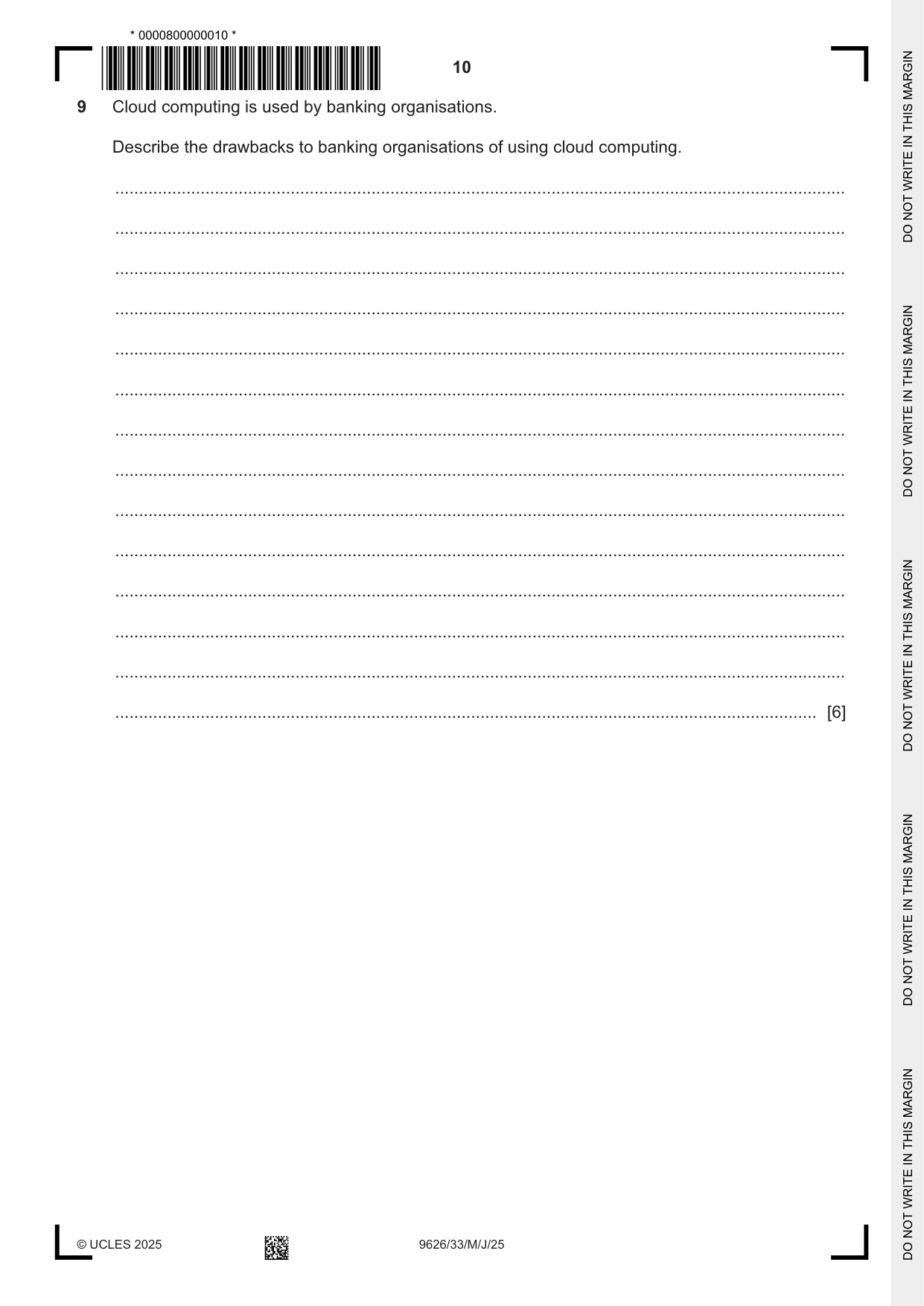
Q9 · Cloud computing is used by banking organisations
9 Cloud computing is used by banking organisations. Describe the drawbacks to banking organisations of using cloud computing. .......................................................................................................................................................... .......................................................................................................................................................... .......................................................................................................................................................... .......................................................................................................................................................... .......................................................................................................................................................... .......................................................................................................................................................... .......................................................................................................................................................... .......................................................................................................................................................... .......................................................................................................................................................... .......................................................................................................................................................... .......................................................................................................................................................... .......................................................................................................................................................... .......................................................................................................................................................... .................................................................................................................................................... [6]
Mark scheme: 9 SIX from: 6 • Security of bank / customer data is not under direct control of bank • Privacy of customer details not under direct control of bank • Privacy / security is dependent on the cloud provider • Bank has less control over infra-structure (1st) – limited flexibility over functions (1) – no control over where data is stored (1) – may have to comply with data regulations of several countries (1) • Locked in to / tied to third-party supplier (1st) – difficult to change suppliers / move services to another supplier (1) – if supplier fails / goes out of business (1) – can lose bank’s data (1) • More vulnerable to cyber-attacks than office-based / non-internet connected services
Q10 · Individuals and businesses can use a virtual private network (VPN) to create a…
10 Individuals and businesses can use a virtual private network (VPN) to create a point-to-point connection between two computing devices over a public telecommunication system. Justify the use of a VPN. .......................................................................................................................................................... .......................................................................................................................................................... .......................................................................................................................................................... .......................................................................................................................................................... .......................................................................................................................................................... .......................................................................................................................................................... .......................................................................................................................................................... .......................................................................................................................................................... .......................................................................................................................................................... .......................................................................................................................................................... .......................................................................................................................................................... .......................................................................................................................................................... .......................................................................................................................................................... .................................................................................................................................................... [6]
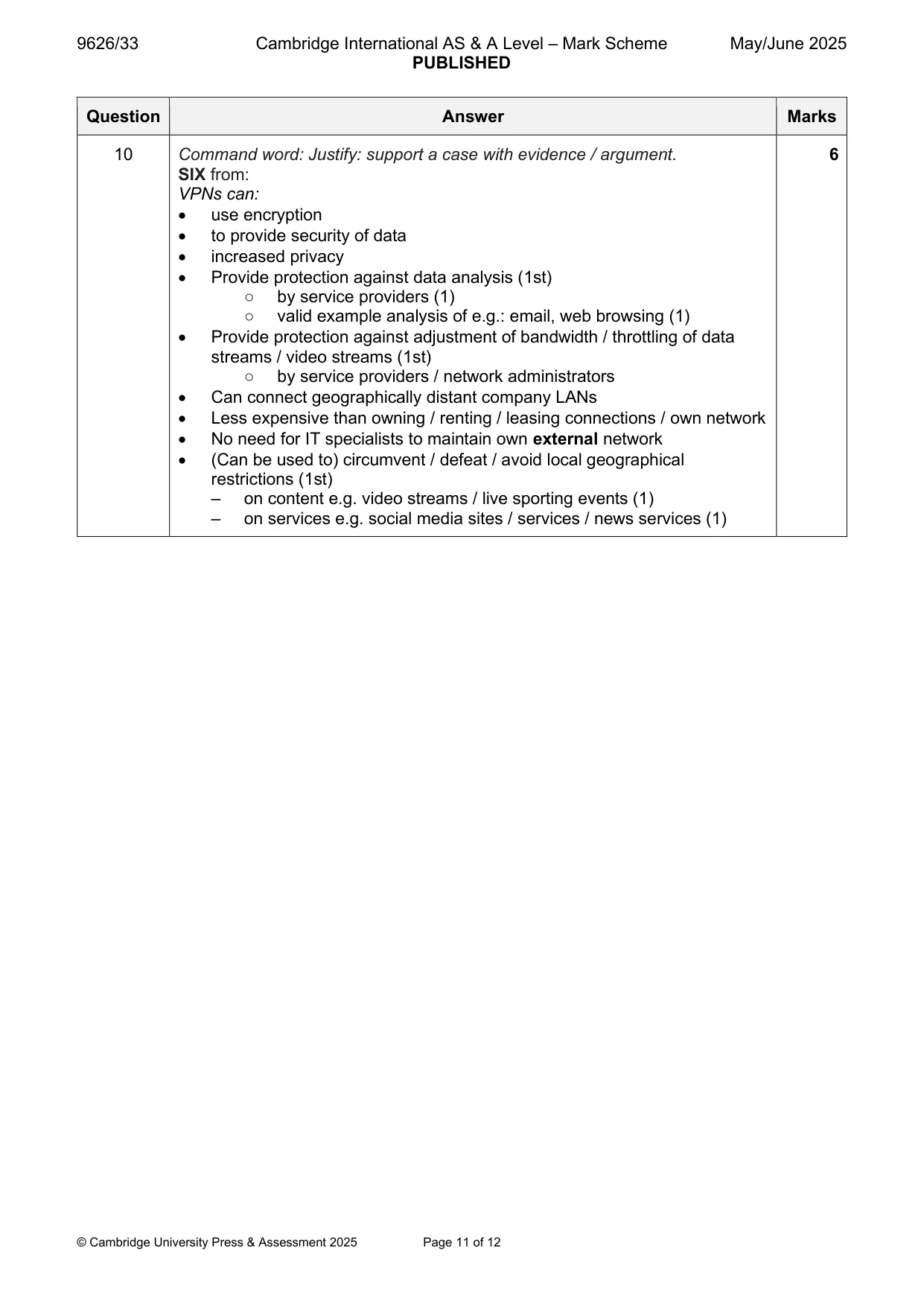
Mark scheme: 10 Command word: Justify: support a case with evidence / argument. 6 SIX from: VPNs can: • use encryption • to provide security of data • increased privacy • Provide protection against data analysis (1st) ○ by service providers (1) ○ valid example analysis of e.g.: email, web browsing (1) • Provide protection against adjustment of bandwidth / throttling of data streams / video streams (1st) ○ by service providers / network administrators • Can connect geographically distant company LANs • Less expensive than owning / renting / leasing connections / own network • No need for IT specialists to maintain own external network • (Can be used to) circumvent / defeat / avoid local geographical restrictions (1st) – on content e.g. video streams / live sporting events (1) – on services e.g. social media sites / services / news services (1)
Q11 · Explain how 3D printing can have a positive impact on the environment
11 (a) Explain how 3D printing can have a positive impact on the environment. .......................................................................................................................................................... .......................................................................................................................................................... .......................................................................................................................................................... .......................................................................................................................................................... .......................................................................................................................................................... .......................................................................................................................................................... .......................................................................................................................................................... .......................................................................................................................................................... .......................................................................................................................................................... .......................................................................................................................................................... .......................................................................................................................................................... .................................................................................................................................................... [5] (b) Explain how 3D printing can have a negative impact on the environment. .......................................................................................................................................................... .......................................................................................................................................................... .......................................................................................................................................................... .......................................................................................................................................................... .......................................................................................................................................................... .......................................................................................................................................................... .......................................................................................................................................................... .................................................................................................................................................... [3]
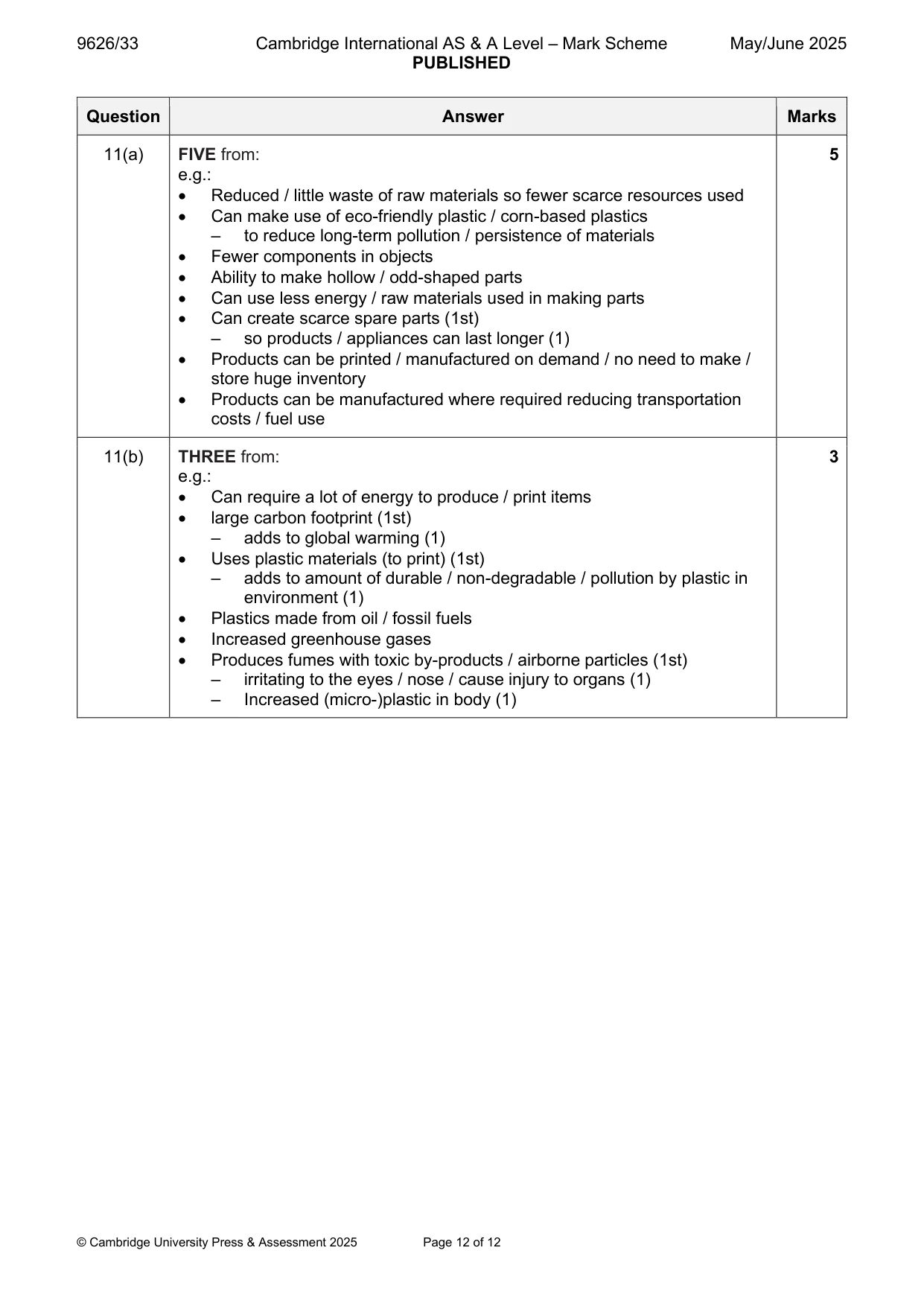
Mark scheme: 11(a) FIVE from: 5 e.g.: • Reduced / little waste of raw materials so fewer scarce resources used • Can make use of eco-friendly plastic / corn-based plastics – to reduce long-term pollution / persistence of materials • Fewer components in objects • Ability to make hollow / odd-shaped parts • Can use less energy / raw materials used in making parts • Can create scarce spare parts (1st) – so products / appliances can last longer (1) • Products can be printed / manufactured on demand / no need to make / store huge inventory • Products can be manufactured where required reducing transportation costs / fuel use 11(b) THREE from: 3 e.g.: • Can require a lot of energy to produce / print items • large carbon footprint (1st) – adds to global warming (1) • Uses plastic materials (to print) (1st) – adds to amount of durable / non-degradable / pollution by plastic in environment (1) • Plastics made from oil / fossil fuels • Increased greenhouse gases • Produces fumes with toxic by-products / airborne particles (1st) – irritating to the eyes / nose / cause injury to organs (1) – Increased (micro-)plastic in body (1)
What was in this paper
The subtopics covered by these 11 questions, and how many questions each got. Open one in a new tab to see every Cambridge question on it.
What you needed in this session
Cambridge’s own grade thresholds for 2025 May/June, Paper 3 · Variant 3. A higher threshold means an easier paper — the bar moves with how the cohort did.